Shoving “Nachas for the Rebbe” down kids’ throats

It is well-known that in Melbourne, Beth Rivkah College, the sister School to the boy’s Yeshivah College is more moderate. It does not seek to distance itself from the State of Israel; it has no problem engendering feelings for the love of Israel, appreciating the חיילים who risk their lives for their State and their people. This traditional, more moderate, attitude of Beth Rivkah has meant that non-Chabad families, who are otherwise traditional or even frum, feel comfortable sending their daughters to Beth Rivkah. Much of the credit for this lies at the feet of earlier principals of Beth Rivkah, including the current principal, Mr Gurewicz, who was a soldier in the Israeli Army and whose wife is an Israeli who also exudes a love of the land. Mr Gurewicz isn’t going to be principal for ever, and if Beth Rivkah goes down the track of Yeshivah, latent, triumphalist hard-line Meshichist elements may well take over Beth Rivkah. They have begun chipping away at Sepharadit as their first effort.

Beth Rivkah, unlike its brother school Yeshivah College, would not allow Meshichist chanting or signs of this variety that appear in the Mesivtah room at the Yeshivah. Indeed, in a possibly significant or unrelated move, Rabbi Gurewicz just resigned from the Va’ad Ruchni of Chabad in Melbourne (the Vaad was devised to replace Rabbi Groner ז’ל as the source of spiritual direction) for what has been described as “personal reasons”.

It is with this backdrop that I feel compelled to describe a recent incident involving my young niece. She’s not from a Chabad home. Her mother attended Beth Rivkah, as did her sister and Aunties and cousins. She’s very bright and a respectful if not precocious little girl; she is also very perceptive.

Just before Pesach, one of her teachers suggested that girls who wanted to write a note that would be personally delivered to the grave site of the last Rebbe, ז’ל could do so by writing their names and any message or request they might have. It is not my intention in this post to enter a halachic excursus about אין דורשים על המתים. Let’s assume that what the girls were asked to do  is acceptable from a Halachic ground (yes, we are well aware that the Rambam is opposed to such practices).

One would expect that an intelligent and sensitive teacher would realise that there is some tension about this practice. I’m not sure how clever one has to be in order to be aware that there are those who do not feel that it is appropriate to make requests of a holy person who now resides in Gan Eden. There are others who are comfortable with such requests, provided that the request is cast in language which beseeches the dead person to make a representation to Hashem, using their proximity to Hashem and their exalted status in Hashem’s eyes in Gan Eden. Finally, there are others, who are simply not comfortable sending letters to a grave, period. Some such people are uncomfortable sending letters to Hashem via the Kosel.

What about the teacher? She is both an educator and a chasid. Do the two roles clash? Is there a tension between these two roles? I do not think that there need ever be a clash between the two roles. In my estimation it is a primitive Chasid or an unsophisticated Teacher whose involvement will inevitably cause a tension between the two roles.

In the case at hand, in the spirit of positive criticism, here is what I would have done, if I was the teacher in a Chabad School (also marketed ostensibly as a community School—Beth Rivkah College).

  1. I would have explained the מצווה of visiting the dead at their graves (using simple sources)
  2. I would explain the opinions of those who lie on grave sites cry and moan versus the opinion of those who consider it wrong to even visit a grave site because it is a place of Tumah (using simple sources)
  3. I would explain what the position of Chabad was, in the context of the two aforementioned opposing views, and then enunciate the different practices of Rebbes up to and including the last Rebbe who spent long periods at the gravesite of his father-in-law, the Rayatz ז’ל (I’d use some audio visual support if available)
  4. I would then suggest that those who felt inclined to pass on written requests to be read at the grave of the last Rebbe ז’ל that they could do so by filling out a form. (I’d show some examples of things that are appropriate or inappropriate)
  5. I would suggest that those who wanted to pass on a written request to a different Rebbe or indeed to Hashem via the Kosel, could do so.
  6. Finally, I would ask the girls who did not feel inclined to write any request, to say some Tehillim while other girls filled their forms. I’d explain that Tehillim is an equally acceptable way to beseech Hashem.
  7. I would try to discern if I was successful in encapsulating the language of tolerance and if there was any latent tension, I’d deal with it.

If a teacher did the above, I think it is appropriate, and I am not sure one could say this teacher is a bad or failed chasid if a few girls choose not to fill in a form and say Tehillim instead!

Alas, before Pesach, at least one educator at Beth Rivkah decided that she was not going to be considered a good Chasid unless each girl filled out a form. So, how did she get around the issue of some girls feeling uncomfortable writing anything? She simply advised them that they didn’t have to write a specific request.  Instead, all they needed to do was write their name and their mother’s name on the form.

The teacher thought she was clever. She wasn’t. She thought she was now a perfect 100% chasid because she got a 100% hit-rate and was able to go to the Kever and tell her Rebbe that she managed to achieve 100%. Does she think that Hashem is a fool? What she didn’t realise is that each and every girl who was cajoled into filling out a blank form has potentially experienced a negative educational experience. They have gone home and told their parents. They have felt forced. They have felt distance from the Rebbe ז’ל and their likelihood to have a positive attitude to Chabad down the track, is diminished by every such incident.

It’s an asinine approach, but what would I know. I’m just an educator, I’m not a Chabadnik.

Measuring Quality in Jewish Education

Why haven’t we developed benchmarks that can be applied across any Jewish school to measure literacy outcomes? Subjectivity of material certainly is an issue, but I feel that there are enough objective materials that can be used to fill an important gap.

Let’s start with something basic: vocabulary. You would want to define a basic set of words which  each student graduating from year 6 should know like the proverbial back of their hand. In English, these words were originally described as dolch words, catering to year 3.

There have been attempts to put together Hebrew/Jewish Dolch lists. We have computers, ipods and ipads. We can fine grain this activity. For example, imagine you are going to teach your class Parshas Noach. Before you start, organise an online flash word type activity which is based on the, say, 150 words that most appear in Parshas Noach. Apart from improving vocabulary, the student’s ability to deal with the text is greatly enhanced. They are comfortable learning in their own skin. Comprehension then becomes the main focus of the learning.

You are teaching Perek אילו מציאות in Gemora. Assume that the students have already completed and graduated from R’ Aryeh Carmel’s well known list of words for Gemora. Now, you find the 100 most used, or even the 100 most unique words in the Perek. This can be continued to incorporate Rashi and more. It’s not a replacement for textual learning but an adjunct; a measurable adjunct.

How many times do we see children graduate and not have a basic command of hebrew (or aramaic) words?

I don’t have any doubt that there could also be made available software programs to drill students about basic halacha based on Kitzur Shulchan Aruch. Again, use the software to create and measure—non negotiable—basic knowledge.

Yes, it’s important that schools train children to be Menchen and have יראת שמים but this needs to also include basic measurable outcomes in jewish learning.

Why don’t we measure across a common worldwide benchmark?

Unsophisticated Education Contraindicated

You are a teacher. You are now teaching a (mainly) frum class of  students who are 17 years of age. You are teaching Halacha. In and among your lesson you ask someone “What is Halacha” and you get the ubiquitous answer “It’s Jewish Law”. Fine. One student then says

it’s not really Law because unlike non-Jewish Law where there is no choice and every body must follow the Law, Halacha is couched within a system of free choice and it is the person who chooses to accept the yoke of heaven for whom Halacha becomes Law (albeit Divine Law)”.

Some teachers would be taken aback with this answer.

Sounds fine to me. Shabbos is not like a speeding law. You choose to keep Shabbos and we hope you do, and we try to educate you to appreciate Shabbos so that you do, but it isn’t like a speeding law which must be kept whether you agree or not. Indeed, one of the oft quoted answers to the question “Why is God invisible” has always been “because if he was visible, you’d have no choice but to keep His Laws (Halacha)”. Put simply, if He was visible, it would be like the proverbial policeman standing there with the speed gun wherever you were driving; you’d be hard pressed deciding to speed. Where would בחירה חפשית free choice be? Without בחירה חפשית there is no reward system and we may as well be מלאכים.

Sadly, I think that many teachers lack the basic sophistry to use the aforementioned non standard answer as a pick up point to actually engage the students into a deeper discussion that also expound on the actual term הלכה and what this means vis-a-vis the journey and way of life.

I’d suggest many teachers when faced with such an answer would exclaim

ה’ ירחם, God have mercy on us all! I thought you came from a religious house, how could you possibly present a view which implied that Halacha was anything but mandatory Law”.

It’s lamentable. We need teachers who understand our youth and have enough sophistication to capture any moment or insight and make it a positive educational experience. What we often have instead is outmoded fossils who can only yell and condemn in response and thereby actually turn more people off than they turn on.

Balance and Tolerance in Religious Education

It is entirely natural and expected that a school advances a particular leitmotif . Indeed, some would argue that a school that doesn’t have or project a particular bias is like a body without a soul, wandering aimlessly from issue to issue, approach to approach, without a guiding rudder. Parents choose a particular school for their child, and apart from the expected quality of education, another ingredient contributing to their choice is the compatibility between the philosophy at home and the Weltanschauung  imparted by the school.

In Melbourne, the so-called religiously inclined schools are arguably four:

  1. The Hungarian Charedi, Adass Israel Schools
  2. The Chabad Chassidic, Yeshivah Beth Rivkah Schools
  3. The Mizrachi Religious Zionist, Yavneh College
  4. The Misnagdic/Lithuanian, Yesodei Hatorah School

I am sure that some educational leaders of Mt Scopus College would consider Scopus  a religious school, however, this is not the popular street-view. There are a number of other secular-oriented Jewish Schools in Melbourne and of course elsewhere, but these aren’t the focus of my thoughts.

The Melbourne experience is not atypical. In Israel and the USA one sees more choice but I’d suggest that the choice  is generally an expansion of different shades of the same broad categories above.

My issue with many schools is that they do not promote balance or tolerance. To be specific, I’ll describe some topics which I think would not be dealt with adequately, or at all, within  the above schools. I’m not so much focussing on the particular schools in Melbourne, but rather the type of school.

  1. A Hungarian/Haredi style School would not cover
    • the approach of Torah im Derech Eretz per R’ Shamshon Raphael Hirsch. They wouldn’t even do so in the context of הרבה עשו כרשב’י ולא עלתה בידם.
    • a rejoinder on the שלש שבועות and an understanding of the philosophy of religious Zionism
    • Chabad Chassidus
    • Torah for women
  2. ָA Chabad Chassidic style School would not cover
    • a comparative study of the Nefesh Hachaim and Sefer HaTanya
    • an understanding of the philosophy of religious zionism
  3. A Mizrachi Religious Zionist School would not cover
    • the philosophy of the Satmar Rebbe ז’ל vis a vis ויואל משה
    • chassidus (although that has changed of late with the emergence of חבקוק (but not in Melbourne)
  4. A Misnagdic/Lithuanian would not cover
    • anything that remotely resembled Chabad
    • an understanding of the philosophy of religious Zionism
    • Gemara for women

Now, you might say that’s a short list of items. They aren’t exactly fundamental issues. There are more important things to focus on. What’s the big deal?

The topics above are just indicators—sign posts. The general issue of balance and tolerance runs deeper than these specific matters. In fact, what prompted  this post relates to none of the aforementioned issues!

Our youngest daughter, who attends a respected Chabad School, was learning the halachos of women wearing a head  covering. Sadly, the lesson style was not a textual study, even though the girls are in year 12. The teacher adopted a more informal—Balabatish—study based on short essays and articles on the topic. I chanced upon the material at home and read it with interest. This material, which the girls passively read in class and then discuss, is comprised of

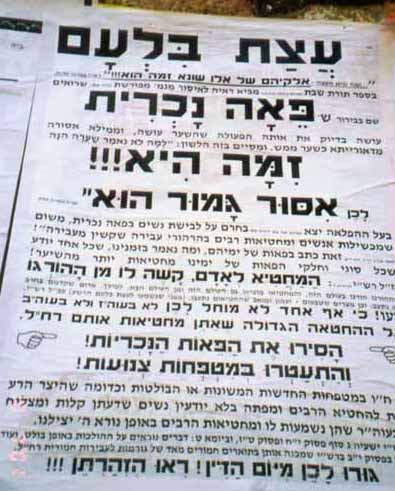
Warning against those who wear a Sheytel

What struck me about the coverage, however, was the complete and perhaps wilful omission of the not insignificant opinions of those who consider the wearing of a Sheytel to actually be forbidden! This view is held, of course, by Chacham Ovadya Yosef  at one end of the spectrum and various Chassidic Poskim at the other end, who held that if one does wear a Sheytel it needs to also include a hat or kerchief. Others who are against Sheytels include: R’ Yaacov Emden ז’ל, the Vilna Gaon ז’ל, the Chasam Sofer ז’ל, the Divrei Chaim of Sanz ז’ל and R’ Shlomo Kluger ז’ל. Maharil Diskin ז’ל and Rav Elyashiv are opposed to particular styles of Sheytels (those that are “too real”) whilst in Beis Ya’akov Schools I am told that a teacher who wears a Mitpachat (a Tichel instead of a Sheytel) will not be admitted. In Charedi Leumi circles, full tichels are the order of the day, and unlike the claim of the Lubavitcher Rebbe, many women simply do not remove their tichels.

I urge you not to misunderstand me. I am decidedly not taking any sides here in the debate about proper modes of hair covering. Indeed, when we were married, many moons ago, I told my wife that she should use whatever style she was comfortable with. I was never about to dictate the style of hair covering; I felt it was a difficult enough thing to live with and there was really no concensus.

What I am against, however, is imbalance and lack of tolerance in education. The children should have been exposed to alternate Torah-based views even if they aren’t the views of the School. Sure, the Lubavitcher Rebbe ז’ל was very pro-Sheytels and anti-Tichels, even in the house, but if a teacher is going to teach children about the concept, why wouldn’t she also cover the sizeable alternative views?

There seems to be a lack of balance, let alone tolerance, in our school systems. It cuts across all the four broad types of schools I mentioned above.

Do you agree with me?