In an amongst a previous post, I received the following comment (which I have slightly edited) … and no, there was nothing at all wrong with the comment, which is why I am not ignoring it (I’ve just been incredibly busy).
Rabbi Hershel Shachter provoked a storm of criticism for using the word shvartze. As far as I am concerned that is the least of it. The much bigger problem is that he propounded several insidious arguments for not dealing with sex abuse. He gave with one hand and took away with the other. He said there is no issue of mesirah (snitching) per se in reporting a known molester. Great. But then he said it is takah (actually) mesirah if the offender will be sent to state prisons where wardens could harm you by placing you in a cell with a member of Farakkan’s Nation of Islam. Yes I think that is racism. Why does he believe a Jew should fear a Black Muslim more than a member of the Aryan Nation? But never mind.
It’s important to note that R’ Schachter has given many Shiurim on this topic, and I’ve heard some of them well before the sound bite you refer to. In fact, the shiurim on mesirah were also well before the issue of child abuse became the grave topic of concern for all of us. His view, has not changed. He speaks Halacha, as he sees it. He is a Posek.
Whilst you acknowledge that R’ Schachter is strongly against those who hide behind Mesira and is in fact concerned with the safety of a community and ובערת הרע מקרבך, and yes, I have heard him say both of these things explicitly over and over, he is also concerned about safety in jails for those who are incarcerated. Halachically, R’ Schachter contends that nobody should be in a type of jail where they are beaten and/or gang raped (and all the horrible things that we hear). In a previous shiur, R’ Schachter described different types of prisons in the USA, and said he was concerned about one type as opposed to the other. If we are to be true to Halacha and indeed true to the country we live in, what we should also be doing is ensuring that those who are incarcerated go to a “normal” prison or a system where such things are very unlikely to happen. All over the world, we have read many times of the “mysterious” death of an inmate. Chazal most certainly would never approve of such a thing in their own prison systems.
R’ Schachter often interludes with urbane language. In a number of shiurim, he called the reasonable prisons “Glatt Kosher/Daf HaYomi style prisons”. People giggled when he said that. Perhaps Daf HaYomi learners or Glatt Kosher eaters might take umbrage; I doubt it. When R’ Schachter said a shvartze, he immediately expanded on that, and anyone listening knew he was giving an example, that is, of one of those Army of Farrakhan types who might be sharing a cell with a Yid (albeit a sinning Yid). Criticising him for this is unfair.
The real issue is that almost all sex abuse prosecutions are in the state courts. So he has now precluded virtually all prosecutions.
No he doesn’t. He actually says that (Frum) Lawyers and Law Makers should try to influence the powers that be to make sure that all those incarcerated are put in a situation where their rights are actually protected and they aren’t subject to jail abuse.
He also insists on vetting by a mental health professional who is also a talmid chacham (rabbinical scholar).
Knowing what he has said elsewhere, let me explain. He strongly encourages that any educational institution should not just have Rabbonim on staff, but also Rabbonim who are trained professionals. As opposed to a teacher/Rabbi who hasn’t lived in the real world, and is fresh-faced out of Yeshivah/Kollel and is confronted by an allegation, he would insist that the professionally trained Rabbi/teacher be one to hear the allegation and then pass it onto the authorities as the case almost always is (now). What you don’t know, is that R’ Schachter was very upset about a respected Rav/Teacher whose life was destroyed when it turned out that their pictures was published as a molester and in fact it was a complete case of mistaken identity. The teacher wasn’t even remotely connected to the allegation. Apologies were made, and the incorrect picture was removed, but, and I’ve heard R’ Schachter speak about it, that teacher’s life had been ruined. They are depressed, unable to work when in fact they had nothing what to do with the incident. They weren’t even in the same institution if I remember correctly. It was a case of “man with a beard who looks like this” but it was the wrong person whose picture was put up. I surmise that this also concerned R’ Schachter.
There definitely is such thing as a recidivist liar, who as a student has a reputation for lying on all manner of issues in the past (I’ve known such people and I suggest we all have) . It is best that a trained psychologist be on staff and ensure that a proper process is followed. That means, the person who makes the allegation makes it in front of someone who is skilled and trained, not someone who knows Shas and Poskim.
He obsesses about the terrible damage of a false allegation. I too find a false allegation a terrible thing. But the professionals most capable of such an evaluation are the ones inside the criminal justice system.
I’ve explained what worried him, based on cases he had known. I’m sure that the professionals in the criminal justice system will do a good job. Having a professional on staff to hear an allegation, is a good idea. Remember, this is not at all the Aguda proposal that a board of Rabonim examine each case and decide. R’ Schachter is not only part of the RCA, he is probably their venerated Posek, and as such, you really need to understand his point of view from the RCA stand point.
If I can make it a bit clearer. Where I work, and where many/most of us work, we have line managers. However, we also have HR (Human Resources). If a line manager or staff have issues with each other, HR (who have trained professionals) do get involved, before actions arising. Sometimes those actions are indeed a referral to the police! For example, if someone alleges they were sexually harassed or racially vilified. In the context of R’ Schachter, I believe he is suggesting that Schools and similar, davka need to have a quasi-HR through having professionals as he suggested and not just people with Yoreh Yoreh and a Yeshivah Teaching certificate.
Prior interrogations contaminate evidence and alert suspects who can then hoof it. More than that, most such prior screenings end up discouraging reporting.
Picture the scene. A student makes an allegation. They go the headmaster. The headmaster immediately calls in Rabbi Dr So and So, who is a psychologist on staff. What’s wrong with that?
It is true that if the Headmaster is corrupt and/or the psychologist is a psycho then we are in trouble. But, we would have been in trouble anyway, in that situation. No system can help here, unless a kid goes directly to the police or tells their parents and the parents are not indoctrinated to keep shtum. On the contrary, there isn’t a culture of “run away from Mesira” with R’ Schachter. We need to also ensure that the kid is not fobbed off and the issue buried (as it has been tragically, and in some places still will be).
I recognize that false allegations do happen, usually in the context of divorce custody battles. Folks in the criminal justice system are quite adept at recognizing them and screening them out.In the end, the decision to support reporting involves balancing the danger to children versus the danger to someone falsely accused. In a situation of uncertainty I would rather leave an adult with the problem of undoing damage to his reputation then subject children to damaging abuse. It is much harder for children to recover. Children need more protection than adults. But that is me. Rabbi Shachter thinks in terms of adult and institutional interests.
He is talking to Rabbonim and this is a grab from a speech he gave. He cares greatly about children, and that is why he is advising the Rabbonim to change things so that they have staff who are also skilled and are professionally qualified to deal with abuse allegations and related matters that arise (eg bullying and harassment). This is my understanding based on more than the particular 10 minute sound bite I heard.
I could be wrong, of course, and will stand corrected if that is the case.
[ R’ Schachter is incredibly busy at the moment. I waited for 1 month before I could get an answer to some questions I asked repeatedly. I expect that he will make his views clearer in the near future, given the thoughts you expressed and which no doubt others have also expressed or thought. Let’s wait and see. ]
I have pitputed about this in the past. At the OU, the two senior Poskim are Rav Hershel Schachter and Rav Yisroel Belsky. They agree on most things. Let me state first, that my personal posek (on matters that are complex and/or not clear in Shulchan Aruch etc) is Rav Schachter, so I do have a bias. On very rare occasions, I have not “understood” the reasoning of a Psak, but I am not a Posek, and he is, and so I listen. That’s our Mesora. That’s what we are meant to do.
As the article from the JTA below shows, they disagree on Quinoa. My earlier views on this matter happily are consonant with Rav Schachter’s Psak. The OU however as a policy will follow the stricter opinion of the two Rabonim disagree. There is in fact a private kuntres, in the spirit of Milchamto Shel Torah, where the two give formal Psokim and their reasoning, for the occasions where they disagree. I haven’t seen it. The kuntres is only available to recognised Rabonim who are formally or informally affiliated with the OU standards.
Kosher Australia (correctly in my opinion) advises people to check with their own Rabbi about Kitniyos, and notes that it doesn’t approve/use Quinoa in any of its own supervised products for Pesach.
Personally, if someone in Melbourne, brought in supervised Quinoa (eg from the Star K), I’d have absolutely no problem consuming it.
By Chavie Lieber · March 11, 2013
NEW YORK (JTA) — On any given day, a wind might blow through the farmlands of South America, pick up an errant grain of barley and deposit it nearby among the vast rows of cultivated quinoa. If that barley manages to make its way into a sifted batch of quinoa, and avoid detection during repackaging, it could wind up gracing your seder table on Passover night.
However dubious it might seem, the scenario is among the reasons that the world’s largest kosher certification agency is refusing to sanction quinoa for Passover consumption, potentially depriving Jewish consumers of a high-fiber, protein-rich staple that many have come to rely on during the weeklong holiday.
The Orthodox Union announced last year that it would not certify quinoa as kosher for Passover out of concern that quinoa falls into the category of kitniyot, a group of legumes forbidden because they look similar to grains proscribed on the holiday.
Menachem Genack, the CEO of O.U. Kosher, also cited the danger of quinoa crops grown in close proximity to wheat and barley fields.
Star-K, a rival kosher certification company based in Baltimore, has been certifying quinoa as Passover-friendly for years and dismisses what it sees as an outlandish prohibition.
“Rav Moshe Feinstein said we weren’t to add on to the rules of kitniyot, so I don’t know why anyone would,” said Rabbi Tzvi Rosen of Star-K, referring to the esteemed decisor of Jewish religious law who died in 1986. “And what’s more telling of this ridiculous debate is that quinoa is a seed, not a legume.”
Long a staple of the Andean diet, quinoa has earned a reputation as “the mother of all grains,” celebrated for its high nutrient quality and as an alternative for those following a gluten-free diet. But quinoa is not a grain at all. It’s a member of the goosefoot family, and closely related to spinach and beets.
On Passover — when wheat, oats, rye, spelt and barley are all prohibited — quinoa has emerged as a popular substitute.
That could change, however, with the world’s major kosher certifier refusing to give quinoa its Passover seal of approval.
“We can’t certify quinoa because it looks like a grain and people might get confused,” Genack said. “It’s a disputed food, so we can’t hold an opinion, and we don’t certify it. Those who rely on the O.U. for a kashrut just won’t have quinoa on Passover.”
The O.U.’s non-endorsement is the result of a debate within the organization’s own ranks.
Rabbi Yisroel Belsky, the head of Brooklyn’s Yeshiva Torah Vodaas and a consulting rabbi for the O.U., maintains that quinoa qualifies as kitniyot because it’s used in a manner similar to forbidden grains. Rabbi Hershel Schachter, one of the heads of Yeshiva University’s rabbinical school and also an O.U. consultant, agrees with Rosen that the category of kitniyot should not be expanded.
Rosen said the Star-K certifies only the quinoa that has no other grains growing nearby. This year, for the first time, the company sent supervisors to South America to supervise the harvesting, sifting and packaging of the product.
“Whenever there’s a new age food, there’s always a fight between kosher factions,” Rosen said. “But we should be worrying about other things, like all the cookies, pizzas and noodles that are Passover certified but appear to be chametz. Quinoa is the least of our problems.”
The O.U. is recommending that kosher consumers look to their local rabbis for guidance on the quinoa question. But for Eve Becker, risking a rabbinic prohibition on a staple food probably won’t sit too well in her house. A Jewish food blogger who maintains a strictly gluten-free kitchen because her daughter has Celiac disease, Becker said quinoa is one of the most important foods.
“It’s a tiny powerhouse packed with protein, vitamins and minerals, and it’s an important grain alternative, especially on Passover,” Becker said. “It’s great to have it on Passover instead of the usual potatoes, potatoes, potatoes. Most of the Passover foods just end up tasting like Passover, so we rely on quinoa to be that side staple.”
Ilana S., a mother of two who lives on Manhattan’s Upper West Side, said she trusts the O.U. and will refrain, begrudingly, from buying quinoa this Passover.
“These rabbis are always changing their minds, so I’m confident they’ll have a new statement next year,” she said. “Until then, its only eight days.”
We have all been reading with interest about the expiration of the Tal Law, which had afforded “Kollel Yungerleit” the opportunity to avoid military service in the State of Israel on account of their extended and continued full time study of Torah. We have also heard many Gedolim say that this is a situation of יהרג ועל יעבור … that people should give up their lives rather than join the army.
Parshas Shoftim describes the process whereby the Cohen, משוח מלחמה explains the procedures before warfare. First he encourages the troops and tells them that they only should fear Hashem and not the enemy, then he describes the categories of soldier (male soldiers, of course) who are exempt from battle (anyone is engaged but yet to marry a woman, anyone who has built a house but did not move in, anyone who has planted a vineyard but has yet to reap a harvest, and anyone who feels afraid). The Shotrim (policemen/miitary staff) then repeat this to groups of soldiers, according to Rashi.
There are two broad categories of war: the Milchemes Mitzvah (loosely described as a war where one defends the very existence/populace) and a Milchemes Reshus (a type of warfare which is waged for other reasons). A Milchemes Mitzvah is obviously a more serious, life threatening situation, and so we fine that the Mishne in Sotah (8:7) states that the aforementioned exemptions do not apply to a Milchemes Mitzvah. In other words, when it comes to defending the very existence of the people/State, it’s “all hands on the deck”.
Strangely, the Rambam at the beginning of the seventh chapter of Hilchos Melachim, states that the Cohen also announces these exemptions for a Milchemes Mitzvah. How can the Rambam contradict a clear Mishna? One explanation I read from Rav Schachter in the name of the Rav is that there is a dual obligation when anyone goes to war. One obligation is a national obligation. The person is part of the כלל and in the sense that the כלל is threatened in a Milchemes Mitzvah, the Torah does not provide an opportunity for exemption. There is also an individual obligation, the obligation of the פרט, the potential soldier who signs up for military service or considers doing so. In a Milchemes Reshus, the Cohen explains that someone who is in one of the aforementioned categories is strongly urged to stay home. They aren’t needed, and furthermore it could be argued that they may even damage morale by virtue of their preponderant thoughts.
According to the Rav, the Rambam is saying that even in a Milchemes Mitzvah, the Cohen explains the laws of the פרט being absolved from joining the armed forces before they defend the nation. It is necessary to explain the difference, and stress that this is only an exemption in as much as they are private individuals, however, since they are about to embark on a life and death battle for the defence of the people and the State, the aspect of the כלל affords them no exemption.
Of course, there are other explanations. Reflecting on this on Parshas Shoftim, I have great difficulty understanding how those who ostensibly don’t feel politically part of the State, give themselves the right to also not feel existentially part of the כלל.
Certainly, as I sit in Melbourne, Australia, I’m not exactly entitled to criticise the life and death decisions taken by those who live in Eretz HaKodesh. I am, however, entitled, I believe to ask for an explanation in light of the above.
A number of years ago, while listening to one of R’ Schachter’s Shiurim, I came away with the distinct impression that he had a serious issue in regards the Kashrus of any Milk in the USA because of the prevalence of Halachically damaged milk cows aka Treyf cows.
I discussed the issue with Rabbi Mordechai Gutnick of Kosher Australia and he advised me that the veterinary procedures extant in the USA were not germane here in the same way on account of the different feeding practices which obviated the potentially Treyf inducing condition common in the USA.
I also asked Rabbi Tzvi Telsner Dayan of of the Chabad Yeshivah Shule in Melbourne whether in light of Rav Schachter’s views, there was a problem with Chalav Yisrael in the USA. Rabbi Telsner claimed that the conditions in Chalav Yisrael production in the USA were much better than the general USA dairy industry and did not have this problem.
To understand this issue, please see the following article
[hat tip Moshe]
Medical research into sleep apnea and what it can be responsible for is established and continuing to develop. Sleep apnea can cause:
Heart arrhythmias
Heart failure
High blood pressure
Stroke
Depression
Hyperactivity
The use of CPAP (or these days APAP machines) is now widespread and the relief that the devices provide is real, including:
Restoration of normal sleep patterns.
Greater alertness and less daytime sleepiness.
Less anxiety and depression and better mood.
Improvements in work productivity.
Better concentration and memory.
Patients’ bed partners also report improvement in their own sleep when their mates use CPAP, even though objective sleep tests showed no real difference in the partners’ sleep quality.
Current machines are turned on by pressing a button and then “wait” for you to start breathing. Once you breathe, air is pumped into you (at a pre-set measured level depending on whether you are moderately or severely impaired) and this keeps a flap open so that the air you breathe during the night is unobstructed. The obstruction is also one cause of snoring. The machines are relatively quiet. Some machines build up to the required pressure gradually. There is an LCD or LED style readout on the machine that is activated once it is turned on. There is no “visible” fire/filament. Some patients also use a humidifier which is attached to the machine. This warms and wets the pumped air in patients who are unable to breathe through their nose, and whose mouths become dry and irritated as a result.
Can these machines be used on Shabbos/Yom Tov? Let’s note first that the accepted opinion is that of R’ Shlomo Zalman Auerbach ז’ל that Electricity is forbidden מדרבנן unless there is flame involved (or filament, as opposed to incandescence). The Chazon Ish isn’t disregarded, but his opinion that all electricity is forbidden דאורייתא is not followed when it comes to medical issues.
What about the status of the patient? Is he (most patients are men 40+) a חולה at the time he is using the machine? What type of חולה is he? Is he a חולה שיש בו סכנה or שאין בו סכנה? Is he considered “sick all over”, that is חולה של כל הגוף? Perhaps he is a ספק סכנה? The answer to these questions will probably depend on the severity of the apnea. For example, it might be questionable if the patient was only “mild” as opposed to moderate or severe. On such matters, one needs to consult with experts, that is, Doctors. Preferably, one should see a Sleep Physician.
Using a shabbos clock doesn’t really help. It can’t turn on the machine. Furthermore, many machines turn off automatically anyway if left on.
I am pretty sure that if you asked a Brisker Posek, they would tell you that there was no שאלה and to go ahead and use it. There is a tradition from R’ Chaim Volozhiner through to R’ Chaim Brisker, the Griz and the Rav, that the Brisker way is to be מחמיר when it comes to looking after health and avoiding illness. There are many stories told in this regard. One that comes to mind was R’ Chaim making his eldest son R’ Moshe Soloveitchik (the father of the Rav) absolutely swear that he would never ever be מחמיר on issues of סכנת נפשות or ספק סכנת נפשות. Only after R’ Moshe did that, was he given permission from his father to take up his first Rabbonus.
There have been a few articles written on this topic. R’ Moshe Heineman (who was close to R’ Moshe Feinstein) from the Star K, is lenient, see here. See the opinion of R’ Halperin and R’ Prof. Abraham over here and here who are also lenient.
One is required to turn on the machine with a שינוי (change) to minimise any infraction. [I also think one could consider getting two people to turn it on together].
I rang R’ Hershel Schachter to ask his opinion. He stated that if there is no choice but to use such a machine, then what can one do. He quoted the שולחן ערוך of the Baal HaTanya who is lenient in Dinim of a חולה and said that this opinion is defended by the אגלי טל from Sochatchow (the Kotzker Rebbe’s son-in-law). He also suggested turning it on with a Shinui.
Some might argue that “what is one night” although this year we know it can be three nights as it is this evening. It seems that the Poskim are wary about interrupting medical treatment and consider such interruptions as contributing cumulatively to the danger (סכנה).
I haven’t considered the issue of the humidifier and whether it boils the water to יד סולדת and if there are ramifications thereby.
Does anyone out there know of other Psakim?
Disclaimer: The above is not L’Halacha and not L’Maaseh. Ask your own Rabbi for advice if you have an issue.
This puts an end to R’ Meir Rabi’s attempts to use Rav Schachter’s name in support of his Laffa. I hope he has the good sense to remove Rav Schachter from his marketing and information websites.
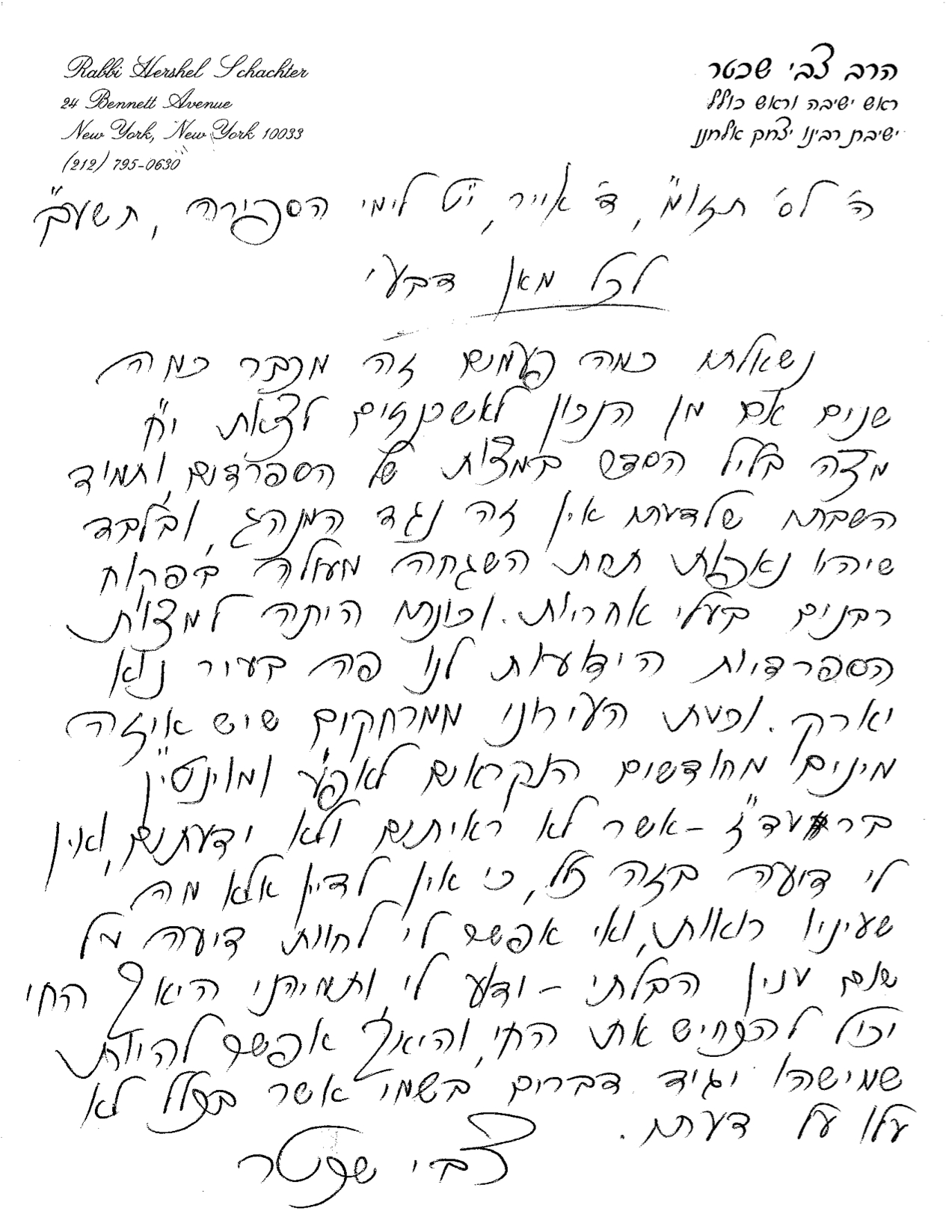
In English:
TO WHOM IT MAY CONCERNI have been asked many times over the past years if it is correct for Ashkenazi Jews to fulfill their obligation to eat Matza on the night of Pesach with Sephardic Matza. I have always answered that, in my opinion, this is not against custom provided that the Matza is produced under expert supervision and under the strict guidance of reliable and responsible Rabbinic authorities. My intention was in strict reference to the Sephardic Matzas that are known to us here in New York. I have now been informed from afar that there are new varieties called Laffa and Mountain Bread that I have never seen and know nothing about and I have not expressed any opinion concerning them, for one may only rule on what one’s eyes have seen. It is impossible to give my opinion on anything that I am not familiar with. I am greatly astonished how a “living person can contradict a living person” and how it is possible that anyone can say things in my name that have totally never entered my mind.Signed: Tzvi Schachter
It is proper and laudable when concerned brothers and sisters pray for those who are dangerously ill. We say private prayers in the Amida, make a Mishebeyrach, say an extra chapter of Tehillim, sometimes privately, and other times as a collective group.
Recently, several prominent Rabbis continue to be dangerously ill. These include: R’ Ya’akov Yoseph, R’ Yisroel Belsky, and R’ Yosef Shalom Elyashiv. Rav Aviner recently addressed a question about R’ Elyashiv, who is 100+, and as I understand, on a ventilator and in need of רחמי שמים.
R Ya'akov Yosef
The question was:
Should we pray for Ha-Rav Yosef Shalom Elyashiv to heal from his illness, or – as one Rabbi suggested – should we pray for Hashem to take his soul on High since he is suffering so much?
This is a very bold question to ask (I think that most people who ask such questions either are on an exceedingly high level or are asking להלכה and not למעשה.
Rav Aviner’s answer was:
It is correct that the Ran writes in Nedarim (40a d.h. Ain. And see Baba Metzia 84) that if a person is suffering terribly and seems to have no hope of recovery, it is permissible to pray for him to die. The source for this idea is the Gemara at the end of Ketubot (104a), where it is told that Rebbe Yehudah HaNasi was suffering terribly; his maidservant saw and prayed that he should die. Even though she was not a Torah scholar, but a maidservant, the Sages greatly respected her and the Ran rules according to her example. In Shut Tzitz Eliezer (vol. 5 Ramat Rachel #5, 7:49 Kuntres Even Yaakov chap. 13, 9:47), it is written that this applies only if one is davening for the benefit of the sick person who is suffering a fatal illness, and not in order to lighten our own burden. It is clear that our intent in this case it is to lighten the burden on Ha-Rav Elyashiv.
The Ran writes that it is permissible to pray for a person’s end in such a situation, but he does not write that one is obligated to do so. After all, the Gemara itself relates that while the maidservant prayed that Rebbe should die, the Sages prayed that he should not die. In the book “Midbar Shur,” in his eulogy for Ha-Rav Yitzchak Elchanan (pp. 332-336), Maran Ha-Rav Kook asks: Why did the Sages pray that he should not die? Their view is difficult to understand. After all, Rebbe Yehudah Ha-Nasi was bed-ridden, suffering, could not teach or give halachic rulings, and was seemingly of no benefit to this world. If he would ascend on High, he would continue to teach Torah there. So why didn’t they pray for him to die? Maran Ha-Rav Kook explains that the influence of a great Torah scholar is not only through his teaching, halachic rulings, etc., but also in the presence of his holy soul in this world. The fact that his soul is located in this world brings blessing, even when he is unable to provide practical benefit, is closed in a room and cannot converse with others. This is similar to the Vilna Gaon, who for many years was closed in a room learning Torah. This world with Rebbe Yehudah Ha-Nasi is not the same as a world without Rebbe Yehudah Ha-Nasi.
When Rabbenu Ha-Rav Tzvi Yehudah taught us this idea, he would say that Maran Ha-Rav Kook also suffered greatly, and he told him: Each and every moment that Abba is in this world, despite the suffering, he brings it light. And our Rabbenu would relate this with tears in his eyes.
If so, the same applies in our case. This world with the Ha-Tzadik, Ha-Gaon, Ha-Gadol, Ha-Rav Elyashiv is not the same as a world without him, even though he is currently unable to teach, give rulings, etc. The Rabbis who called on us to pray for Ha-Rav Elyashiv’s healing are therefore correct, and we hope that he will truly be healed and will once again actively bring the blessing of Torah and holiness to this world.
May Hashem send him a speedy and complete recovery.
R’ Hershel Schachter recently discussed the question of davening for a Refuah Shelema for someone who is close to being a גוסס—basically on their deathbed with no hope of survival, short of a miracle. R’ Schachter notes that the Mishna in Brachos is clear that one is forbidden to pray for a revealed miracle. As an example, he describes a man rushing home from work after being told that there is a major fire burning around his house. While driving, the man prays that his house is not one of those engulfed by flames. R’ Schachter notes that such a תפלה is ridiculous. Either the house is, God forbid, in flames or it is not in flames. Asking that it not be in flames is tantamount to praying for an overt miracle to transform a readily observable occurence.
R' Shmuel Rozovsky ז'ל
R’ Schachter then to retells a story that he experienced when visiting the Ponovitzer Yeshiva in B’nei Brak, during the time that Reb Chatzkel Levenstein ז’ל was the Mashgiach. Apparently, someone was very sick due to a certain cancer, רחמנא לצלן, and there was a request that everyone say Tehillim for a Refuah Shelema. Reb Chatzkel, who was sitting in Mizrach, refused and exclaimed that it was forbidden. The mood was incredulous; who would refuse such a request? At that time, the famed Rosh Yeshivah, R’ Shmuel Rozovsky ז’ל was seen leaning over to Reb Chatzkel and talking to him. Tehillim commenced. R’ Schachter was to subsequently learn that R’ Shmuel had explained to R’ Chatzkel that there were people who were successfully treated for the particular cancer afflicting the person for whom Tehillim had been requested, and it wasn’t one where there was “no hope” because the doctors had no more new ideas or one where the patient was effectively in palliative care. Had it been someone in palliative care, R’ Chatzkel would have been right.
Importantly, R’ Schachter explains that it is still proper to say Tehillim. However, one does not ask for a רפואה שלמה. Rather, one should ask for רחמי שמים, mercy from Heaven.
In reflecting on the question to R’ Aviner, in light of R’ Schachter’s insight, I think it’s most appropriate, when someone is effectively in a palliative state, to ask for רחמי שמים and not assume that we should suggest to Hashem how that רחמנות should be manifest (e.g. by death חס ושלום).
Let’s hope that we don’t need to say Tehillim for anyone because we have merited the realisation of the pasuk of אני ה’ רופאיך, “I am God your Healer”.
The following was posted as a comment to my earlier blog post on this topic by P. Hasofer. He hasn’t asked for a guest post, but I am posting it as it is a little long for a comment, and worth reading. Yes, I have little knowledge of Chassidus in general, including Chabad Chassidus. Allow me to bring to the table, a different perspective (similar to that of R’ Hershel Schachter and no doubt from where he derived it) by R’ Chaim Volozhiner ז’ל (the successor and lead student of the Vilna Gaon) in his Nefesh Hachaim. See the words of the Nefesh Hachaim here.
Dear R’ Isaac Balbin:
To understand what the Rebbe, Zechusoi yogen oleinu. is explaining here, please let me give you a short introduction with which will make things more understood, You have written in the past that you don’t have much knowledge in Chabad Chassidus, so this will hopefully help you understand this Inyan.
This idea is explained at length in Chabad Chassidus starting from the Alter Rebbes Tanya.
There are 3 general elements in our world. 1. Kedusha 2. Klipas noga 3. Sholosh Klipas Hatmeos:
Kedusha doesn’t really need to much explanation I hope, its basically anything holy, Torah and Mitzvos, Shabbos, Tefillin etc.
Klipas Noga, is the middle area, which includes everything mundane, anything that is kosher, or just simply not Kedusha, for example – all kosher foods etc, which can be elevated to Kedusha, by either using it Leshem Shomayim, or Making a brocho before eating the food, and having the intention to use the energy derived from the food, for Torah study or the keeping of Mitzvos.
Sholosh Klipos Hatmeos are all those things which are forbidden or Not Kosher, and cannot be elevated or used for Kedusha, or Lesham Shomayim, we are prohibited to have anything to do with them, and through pushing it away, that is its redemption and purpose. “Ibudo zehu tikuno”
The second level, Klipas Noga, is clearly not Kedusha at all, and can be used against Kedusha, or be elevated to the realm of Kedusha, it is therefore our mission to elevate the “nitzus” (holy spark) which is inside these creations, and bring them to the realm of Kedusha.
Now onto our subject, the transformation or effect that Kedusha – light can have on Klipa – darkness.
Lets separate this into 3 parts:
The effect the light of Torah “Or Hashemesh” has on the darkness – “klipa” in the world that surrounds us.
The effect Mitzvos “Or Haner” has on the darkness (Klipa).
The effect a Baal Tshuvah has on the darkness (Klipa).
“Ki Ner Miztva VeTorah Or”
The effect of the light of the sun – Or Hashemesh on the darkness – it pushes away the darkness, when the sun comes up, it disperses the darkness. It does not transform the darkness into light, it merely pushes it away, and overpowers it, by its mere existence and nature.
On the other hand, the light of a candle is quite different by its mere nature, not only does it disperse the darkness, depending of course how big the candle is, but it has another advantage. As explained above, the sun light pushes away the darkness. The candle however not only pushes away the darkness, but it also transforms the wick and oil etc, into light, it transforms what is not light, into light.
So too, in our Discussion:
Torah is like the sunlight, it pushes away and disperses any darkness in reach, it pushes away the Darkness and Klipas around us, and inside us.
Mitzvos have the same effect, but with an additional advantage, Mitzvos do not only push away the darkness and klipa, but with its intense light it has the power to transform that which is not light – that which is not holy, the mundane, the Klipas Noga. It transforms the Physical objects and energy used in the fulfillment of the Mitzva into Light, into Kedusha. (it must be noted that Torah also transforms the persons energy used to study Torah, into Kedusha, but it is specifically the Mitzvas Talmud Torah which has that effect.)
When affecting or transforming the Darkness – the Klipas, the light can only have an effect on the darkness which has the capability to be transformed into light – into Kedusha. Just like the candle can only burn and transform into light those materials which are possible to burn and become light, the oil and wick etc. must be suitable to burn. Meaning: Torah and Mitzvos can only have an effect on Klipas noga, which has the ability, and is suitable to become Kedusha, one cannot elevate Sholosh Klipas Hatmeos into Kedusha.
A Baal Teshuva though, through their Teshuva (and each of us as well, with our own Aveiros, in which we are can be a Baal Teshuva in our own way) not only transforms the mundane, the Klipas Noga, but effects the Sholosh Klipas Hatmeos, they with the power of Teshuva, transforms their sins – the ultimate darkness and Klipa, into Kedusha, “zdonos nasu lo Kezochios”
To Summarize: there are 3 ways of effecting the darkness – Klipas.
Torah: Pushes away the darkness – Klipas, but only that which is possible to push away – Klipas Noga.
Mitzvos: Transforms the Klipas Noga, and elevates it into the realm of Kedusha.
A Baal Teshuva: Transforms even the lowest darkness – Sholosh Klipas Hatmeos into Kedusha.
It is a long-standing Chabad metaphor, repeated by the last Lubavitcher Rebbe, that his Chassidim need to be lamp lighters. One of their tasks is to create light in a dark world, so to speak. In advice allegedly also given to Binyamin Netanyahu, he had said
“even in the darkest hall, the light of a single candle can be seen from a great distance”
Netanyahu had taken to using this metaphor in many speeches and discussions. If I’m not mistaken, he also used this metaphor in his famous recent speech to the UN. The metaphor is apt an powerful, and certainly justifies the lighting of the Jewish soul, if you wish, by Chabad emissaries throughout the world.
Recently, I was listening to a shiur by R’ Hershel Schachter. He mentioned the Pasuk
כי נר מצוה ותורה אור
For Mitzvos are a candle and Torah is light
He made the point (unrelated to Chabad) that whilst its true that a little light can illuminate “big” darkness, that Mitzvos are limited in that they are but the light of the candle. It is not effective on the larger scale, so to speak, of vast darkness. They light up the immediate surround, but are pretty limited as one moves away. Torah, however, is light itself. Accordingly, says R’ Schachter, if one wants to really illuminate and disperse the darkness, one needs to increase in Torah learning, whose light is Or itself.
Yeshivah World News is reporting that R’ Kanievsky, widely regarded by everyone as a holy man and Talmid Chacham of the highest order, has issued an order banning the internet to the extent of יהרג ועל יעבור. Now, we have not seen this advice written explicitly and it should, therefore, be ignored as purporting to be R’ Kanievsky’s view until such time as R’ Kanievsky writes and signs his opinion in his own clear sentences.
But we don’t need Yeshivah World News to report such things (via the internet) to be convinced that there are and will continue to be eminent Rabbis who issue blanket bans on various modes of modern technology, such as the internet. What does this mean for the בעל הבית? I’m not referring to someone who does business via the internet. I’d be surprised if there was even a single Rav of stature who would issue a ban on business activities using the internet. I’m referring to the rest of us: we who use the internet to interact with family and friends; we who use the internet to read and pass on articles of interest; we who use the internet to find out what is happening in the world; we who use the internet to have a laugh; and we who use the internet to discover Torah in an unprecedented manner.
I heard R’ Schachter speak last week. He amusingly pointed out that the Yekkes (Frankfurters vs Hamburgers) have a מחלוקת about what פרשה one should speak about on מוצאי שבת. One group holds that until Tuesday you speak about last week’s Parsha, and the other group opines that from מוצאי שבת you speak about next week’s Parsha. In order to satisfy both opinions, he spoke about both חיי שרה and תולדות.
R’ Schachter noted that finding yourself a Rabbi very much depended on where you were at a particular stage of your life. When younger and learning in a seminary, it is natural and correct that the Rabbi is your Rosh Yeshivah. That Rabbi, like R’ Kanievsky, lives in a particular world, a refined idealistic world. They live in the world of the Yeshivah where consideration of halachic questions is inherently contextual. While spending formative years in a בית המדרש, it may very well be halachically correct to not interact with the internet. One’s interaction should be solely with our holy texts. One is able to learn תורה לשמה with relative ease, coupled with והגית בו יומם ולילה. Eventually, one leaves this environment. Some may return to חוץ לארץ others to their homes in Israel, but most assume and are consumed by a new and changing environment together with different challenges and expectations.
R’ Schachter asks: should that Rosh Yeshivah still be your Rebbe? He answers, probably not. The Rosh Yeshivah lives in a different world. It is not your world. Psak and halachic advice requires the Posek to appreciate and understand your new context. Some do and others don’t. Certainly, it might have been correct to Pasken one way when addressing a Yeshivah or Seminary student. Certainly, it is correct to Pasken in a particular way for certain types of towns, environments and shielded cities. That Psak may, however, no longer be relevant to someone’s new situation and challenges and expectations. R’ Schachter mentions that we find that the Malochim of חוץ לארץ departed and were replaced by the Malochim of ארץ ישראל. They served different roles in different contexts. They weren’t mixed. יצחק אבינו was not אברהם אבינו. He was מקודש by virtue of the עקידה and he was the only one of the אבות who was commanded not to leave ארץ ישראל and descend to the context of the טומאה of חוץ לארץ.
I’d like to suggest that we look at certain Piskei Din, such as those bandied around the internet as דעת תורה in the same light. A strict ban may well be appropriate for certain people at a certain place and in certain times. Such a Psak, however, can be entirely misplaced for someone in a different place in a different environment and facing another reality. Does this make the R’ Kanievsky’s of this world any less authoritative? Certainly not. He is and remains a holy man, one of the giants of our generation. Does it mean that one is ignoring דעת תורה? I would also say certainly not. So called, דעת תורה is what your Rebbe or Rav tells you today, for you, in your time, and in your place, and in your environment.
The bottom line is that you should respect these Psakim but understand their context.
It’s no secret that despite never having seen him face to face, I have felt very comfortable asking (what I thought were) difficult questions of Halacha to R’ Hershel Schachter. R’ Schachter’s father, R’ Melech Schachter ז’ל was a prominent Rabbi in Philadelphia and a Rosh Yeshivah at RIETS. Recognising that his son’s education was paramount, R’ Melech gave up a large pulpit job and moved his entire family to take up a small job as a Rav in the Bronx. He knew his son, R’ Hershel was a genius and that R’ Hershel was destined to greatness. R’ Hershel began studying in the Salanter School in New York. In those times, this was one of the few decent schools that combined Torah with a proper secular education. During the Mathematics classes, little R’ Hershel was inattentive. This was not a once off. R’ Hershel seemed pre-occupied with something else during these classes. Finally, the irate teacher had enough.
“Schachter, I’m tired of having to constantly try to get your attention. Will you please concentrate. These subjects are very important and you need them for life”
The young Hershel stood up and responded:
My father moved our family here so that I would learn more Torah. He didn’t send me away from Philadelphia so I would excel in Maths
R' Hershel Schachter שליט’’א
This story was promulgated by one of the students in the class at that time.
By the age of 26 he was appointed as a Rosh Yeshivah at YU’s Yeshivas Yitzchak Elchanan Theological Seminary (RIETS) the same year that he received his Smicha from the Rav ז’ל, having been an assistant to the Rav at the age of 22.
To me, one of the things that sets R’ Hershel apart is not just his enormous בקיאות in הלכה which has seen him as a major Posek for the OU together with R’ Belsky. His ability to completely distance himself from שקר becomes clear through his שיעורים. His candour is breathtakingly transparent and all based on firm מקורות. His moral fibre and ethics are completely derived from הלכה.
He doesn’t impose himself in any way. He talks with a genuine humbleness, not someone who assumes a facile text-book based humbleness. R’ Hershel basically teaches. He is constantly teaching Torah. YU have some 3000+ of his shiurim online. He is a veritable מעיין הנובע. R’ Schachter says “I don’t know” with ease. I remember the first time he said it to me, I thought
“what the heck, he didn’t say, I need to check and be מעיין and get back to you. He had no problems saying ‘I don’t know’ and when I tried to push him he repeated ‘I don’t know'”.
In each case when he said that, it took me some time to realise that his answer was calculated, and there was more behind it than simply saying “I don’t know”.
It was, therefore, no surprise to me that a I came across (hat tip Anon) a typically candid interview where R’ Schachter’s plain unadulterated clear thinking was there for all to see. His advice on reforming the Beis Din System is a clarion call. Privately, many Charedim love R’ Schachter and consider him one of the Gedolim. R’ Schachter, though, will never formally be considered a Gadol by the Aguda or Charedi world. After all, his Rebbe was the Rav, and he still teaches at that “treyf” institution known as YU.
The בזיון התורה that Aguda demonstrates towards R’ Schachter is typified by their seating of him at an anonymous table amongst the crowd during the Siyumim of Daf HaYomi. R’ Schachter doesn’t care. He genuinely doesn’t take himself seriously. He doesn’t complain.
I reproduce two questions and answers from R’ Schachter’s interview about the reforms needed for the Beis Din System. These comments say it all. On second thoughts, the entire interview just needs to be read. I’m reproducing it all here without permission. It is from Ami Magazine as reprinted with permission by Voz Is Nayes.
Q: Unfortunately many kehillos in the charedi community are taking their disputes not to bais din, but to court. That seems to say that there is a problem with the way people perceive batei din, a crisis. You have been outspoken about the bais din system. What is your assessment? A: The present system is terrible. There is a Mishna in Pirkei Avos that the oilam says a vort on. It says, “K’sheyihiyu habaalei dinim lifanecha, yihiyu b’einecha k’resha’im. K’she’yaamdu m’lifanecha yihiyub’einecha k’tzaddikim, shekiblu aleihem es hadin.” [“When the litigants stand before you (the judges), they should be in your eyes like wicked people. When they stand up from being in front of you, they should be in your eyes like righteous people, because they have accepted the judgment.”] They say from a few different dayanim that they would put a tallis over their face, to not see the face of a rasha. But that is wrong; part of the din Torah is to look at the person and see from his facial expression and how he talks…whether or not he is saying the truth. You have to be able to detect whether he is telling the truth. Any judicial panel must get to the underlying facts and the truth in order to render a proper decision. Unfortunately that is not always the case in the present-day bais din system.
Q: Did you come to this conclusion from personal experience? A: I was once asked to sit in on a din Torah to see that there wouldn’t be any shenanigans. I believe that it was a yeshiva against an administrator. The administrator just sat there while the toain [lawyer in bais din] presented the whole case. You have to hear from the administrator himself! How can the toain present the case? The toain can say all sorts of shekarim [lies], because he just says whatever the baal din told him. If the baal din himself says it, he’d be scared; he’d be shaking. You can tell if he’s telling the truth; nikarim divrei emes, nikarim divrei sheker. I thought it was terrible. What kind of a din Torah was that?
Q: Is that experience indicative of dinei Torah today? A: Certainly. I remember another case where a widow had died and she had no children. The question had become who would get the yerusha [estate]. One of her relatives probably thought that, just as in the case of a geir shemais v’ain lo yorshim [a convert who dies without inheritors], the nichasim [property] become hefker (the property becomes ownerless), so too in the case of this almanah everything would become hefker [which is not true]. This relative, I believe it was a great-nephew, pocketed all the money. The other members of the family wanted a din Torah. Someone asked me to watch. The head of the bais din asked the great nephew, “How many bankbooks were there when your great-aunt asked you to take care of her finances?”He answered, “Four.”The dayan asked, “How much money was there in each account?”Suddenly the toain screamed out, “Don’t answer! You’re not mechuyav [obligated] to answer!”That was the end of the case. Had this been a secular court, they would have thrown him out the window. What do you mean, you don’t have to answer? A chutzpah! The dayanim want to find out the facts. But that was the end; there was nowhere to go after that.
Q: Are you saying that this is nowadays the general trend to obfuscate the facts? A: There are countless similar instances when the toain instructs his client not to respond to a question. It also became the style now that when a couple is getting divorced, the toanim tell the husband to say that he wants shalom bayis, so that the bais din assumes that she is a moredes (rebellious wife), and she doesn’t get the kesuba. Ridiculous. One of the latest pieces of shtick was where a wife had apartment buildings, and the husband wanted a heter meah rabbanim so that he could have peiros nichsei milug [proceeds from a wife’s property], even after he was living with the second wife. This was written up in the New York Times and the non-Jewish lawyers were laughing at us. Such a chillul Hashem! This is what our religion stands for? Now they tell the husband to take peiros nichsei milug, even though he never took peiros during the marriage. He doesn’t know about it, so why tell him? Even if he knows that there are nichsei milug, but he doesn’t know that the husband gets peiros nichsei milug, Rav Moshe Feinstein says in his teshuvos that they are considered nichasim she’sinam yiduim [unpublicized property] and the Gemara in Kesubos says that the husband doesn’t get peiros from that property. So why are the toanim telling the husband that he is entitled? Just to make more agmas nefesh (aggravation)?
Q: Would you call then the problem in the bais din system a crisis? A: It’s worse than a crisis. They tell me that there is a prominent talmid chacham in Flatbush who tells his baalei battim to go to a secular court because they stand a better chance of yoshor [justice] in a goyishe [non-Jewish] court than in a din Torah. If you ask him, he’ll deny it, but that’s what he tells people. Unfortunately, I think that the comment about yoshor is true.
Q: Is the problem because of the toanim? A: They drei a kup and obstruct the proceedings. They keep repeating the same things over and over. Rabbi Belsky says that they get paid by the hour, so….I asked Rabbi Belsky, “How do you allow toanim in your bais din?” He said that if he didn’t allow toanim, no one will go to him. They will go to a weaker batei din than his. Here in our yeshiva, when a baal habos wants to have a din Torah, we never allow toanim. One time a person did want to have a toain. We told him, “Stay in the other room. We’ll know what the din is; just tell us what the facts are.”
Q: But isn’t that a problem? Once there is a toain system, people feel that they have a better chance with a toain, so, like Rabbi Belsky said, if you have a bais din without toanim, everyone will go to other batei din? A: Yes. It’s terrible.
Q: How old is this toain system? A: Very recent. In the Shulchan Aruch it says that you’re not allowed to have a toain.
Q: But if the litigant doesn’t know how to express himself, can’t the toain present his claims for him? A: If he can’t express it for himself, thereis a rule of psach picha l’ilaim [“speakingfor the mute”]. But what can’t he express? Tell us what the facts of the case are. Often there is no argument about what the facts are.
Q: When do you believe this system started? A: I think it started in America. I wasn’t there in Europe, but I don’t think they had it years ago.
Q: If you would make a takana, you would say to abolish the entire toain system? A: Absolutely. You don’t need a toain. If you have a katan (minor) or someone who doesn’t know the facts, you have to have psach picha l’ilaim; you have to help him out a little. But the bais din, who is learned, can do that. Tayninan l’yisomim;tayninan l’likuchos. Whenever the baal din doesn’t know the facts, we have to helpthem.
Q: When many people come to bais din, they are not coming because they are having a shaila l’halacha; they are coming to win. So they want a toain for that, don’t they? A: It’s terrible. Bais din should tell them that every penny that they have shelo k’din [wrongly] is gezel [theft].Regarding the case I told you about the toain screaming out, “Don’t answer them,” I recently asked someone whether anything changed in the situation. They told me that no, nothing changed, but that the great-nephew who got the money had to spend it all on a relative who was very sick. That’s always the case.
Q: There is a recent case involving two kehillos that have been fighting for five years in bais din and have no psak. The proceedings are going on and on. Is this the norm today? A: Rabbi Belsky told me that, in the case you are referring to, they’ve had over two hundred sessions. He told me, in this language, that why does someone have to go to graduate school and become an engineer? Just become a toain and you can make a fortune of money. Have unlimited sessions, and get paid by the hour. A shanda and a cherpa. [It’s a shame and repulsive matter.]
Q: How do we bring public awareness to these problems? A: Rabbonim should speak about it. Why is there so much cheating in business? Rabbonim should get up once a year in shuls and speak about Lo sigzol, that you’re not allowed to cheat in business, and that you’re not allowed to cheat on your income tax. If you talk about it long enough it will have an effect on some of the baal habattim. Rabbonim have certain topics that they talk about in hashkafa. Let them give chizuk about gezel.
Q: Do you have a problem with the borerim system [in which two of the dayanim are chosen by the litigants and the two dayanim choose a third]? A: The borerim system is also a shanda. A lot of the borerim act like toanim. I was involved in a din Torah. The borer took shochad (bribes). I had to resign from the case. He felt insulted. It was before Rosh Hashanah, and he told me that he was not going to be mochel [forgive] me. I told him, “I don’t need mechila. You took shochad. You’re pasul to be a dayan.”It says in Shulchan Aruch that you can’t have one litigant pay his dayan and the other pay his dayan, unless, which Reb Moshe writes in a teshuva, it is clear that both are being paid the same amount, in which case each one can pay his dayan and they both pay the third. But that isn’t what happens. They don’t pay the same amount. The payment depends on how long each one bothers the dayan. So they don’t pay the same amount and it is true shochad.
Q: You mean that they are not allowed to charge for the private sessions, as well? A: Of course not. That’s shochad! They pay more money for the private sessions, and then the dayan, instead of talking like a dayan, talks like a toain. I was once involved in a din Torah. One of the dayanim was making up his mind: “This side is wealthier than the other, so let him pay.” What way to talk is that? A din Torah of a penny has to be treated like a din Torah of a million dollars.
Q: Are you saying there is a problem with the dayanim? A: Of course. Do you think that all of the dayanim are honest? Many are acting like toanim; many of the toanim are acting like criminals. They make up their minds in advance that their side has to win. I don’t walk into a din Torah with the attitude that my side always has to win. If I think my side is wrong, I’ll pasken against them. The Rosh in the beginning of Perek Zeh Borer says that people think that their dayan always has to side with them. He has to explore their position; that’s true. But not to invent reasoning out of nowhere. Once we had a din Torah here. It was over real estate in California where they had invested a couple of million dollars. We asked them, “Do you want a din Torah, or would you rather have a peshara [compromise]?”We told them that a peshara is not a fifty-fifty split. It is whatever yoshor dictates. They agreed. The din of peshara in this case turned out to be one hundred percent in favor of one person. That was the peshara. They thanked us. They shook hands with us, shook hands with each other. That’s the way it should be. Regrettably, dayanim today don’t judge with yoshor.
Q: An individual person is affected by this greatly. The big groups can go to a court, because they aren’t worried about any social repercussions. If a regular person did that, he would not be able to get a shidduch for his children, because he would be called a rasha. A: It’s terrible. The dayanim themselves are misusing the system. Someone told me that he was divorcing his wife. He gave the get (divorce) first; he didn’t want to hold it up. So now every time there is a question about custody, his wife goes to court with impunity. Each time he goes to court for anything, the bais din sends him a seruv [summons]. They misuse the seruv. They vilify him, and if there would be a seruv against him, he would lose his job. He is a rabbi.
Q: Could there be a watchdog group, with rabbanim getting together to examine how the batei din are behaving? A: It’s a safek sakana [possible danger] for the watchdog group; they’re going to be killed.
Q: Meaning physically? A: Yes. These people are chashud [suspected] on shifichas damim [murder].Many years ago, Rav Dovid Cohen from Gvul Yaavetz visited me in the summertime. He said that he wanted to set up a dayanim system from all the yeshivos. Whenever someone would want to have a din Torah, they would have to pick three dayanim from the group. They wouldn’t be able to pick a professional who would act like a toain. They would get paid from an outside source, not by the baalei dinim at all. He asked me if I would join, and I said,” Fine.” He said that he would be working on it. It never got off the ground. I don’t know what happened. That we can’t have a bais din system that works is an embarrassment, a shanda and a cherpa.
Q: What should a person who has a claim do, other than go to secular court? A: People who have a dispute should find an honest rav to make a din Torah between them. I remember that the Mirrer Yeshiva in Yerushalayim had an arrangement with a headhunter in New York. They ended up having a din Torah between them. The headhunter was Modern Orthodox. Mir wanted a veryyeshivish bais din; he wanted a Modern Orthodox bais din. Somehow they both agreed on me. So they came and presented both sides, and I paskened that the yeshiva owed him the money. But then I took out my checkbook and wrote the yeshiva a check. Everybody knows that the Mirrer Yeshiva needs money. So the baal habayis also realized that he should give the yeshiva money. I think that he gave up all his claims.
Q: Are you saying it is preferable to go to one upstanding rav? A: If you can find one trustworthy person, that would be the best. The zabla system [of choosing dayanim by each party choosing one judge] is no good. The borer will sometimes say things that are not true. The party tells him something in the private session, where he is being paid by the hour, and he repeats what he has been told, and then in the next session we find out that it’s not true. Better to just have one person that both trust.
Q: Is it common to choose one dayan to hear a case? A: I remember one time there was a chassidishe rebbe who died and was buried in Eretz Yisrael. There was a plot next to him and the question became who would get it. His oldest son was in business, though he had semicha. The second had taken over the title of rebbe, so he felt that he should get it, but the oldest said that he should get it because he was the bechor [firstborn]. They both came to Rav Soloveitchik. He told them that kol hakodem zacha; whoever would die first would get it. Eventually the oldest son died first, but he had realized that his brother was right and before he died he asked to be buried in another cemetery.
Q: Do you want to share another personal anecdote? A: I remember that I was in a din Torah, and the toain was acting so nastily that I said, “Reb So-and-so, you’re a genius!” He didn’t realize that I meant a chacham l’ra [an evil genius] and he went around saying that Rabbi Schachter had said that he was a genius.
Q: But doesn’t a toain assist a litigant in the halachic research related to his case? A: The toanim will quote a line from Shulchan Aruch or a line from a teshuva sefer out of context. They quote it out of context because they know that it will be beneficial for their case.
Q: Any solution? A: The rabbanim should give drashos and tell people that if they take money shelo k’din, Hakadosh Baruch Hu will see to it that they lose that money.
End of Interview
Postscript: My father told me that after the war he was in dispute with another Jew over a business deal in Berlin. They went to Beis Din. My father hired a Toyen (his advocate). When my father began briefing the Toyen as to why he thought he was right, the Toyen said to him (it’s much better in Yiddish)



 pitputim
You must be logged in to post a comment.