
It is entirely natural and expected that a school advances a particular leitmotif . Indeed, some would argue that a school that doesn’t have or project a particular bias is like a body without a soul, wandering aimlessly from issue to issue, approach to approach, without a guiding rudder. Parents choose a particular school for their child, and apart from the expected quality of education, another ingredient contributing to their choice is the compatibility between the philosophy at home and the Weltanschauung imparted by the school.
In Melbourne, the so-called religiously inclined schools are arguably four:
- The Hungarian Charedi, Adass Israel Schools
- The Chabad Chassidic, Yeshivah Beth Rivkah Schools
- The Mizrachi Religious Zionist, Yavneh College
- The Misnagdic/Lithuanian, Yesodei Hatorah School
I am sure that some educational leaders of Mt Scopus College would consider Scopus a religious school, however, this is not the popular street-view. There are a number of other secular-oriented Jewish Schools in Melbourne and of course elsewhere, but these aren’t the focus of my thoughts.
The Melbourne experience is not atypical. In Israel and the USA one sees more choice but I’d suggest that the choice is generally an expansion of different shades of the same broad categories above.
My issue with many schools is that they do not promote balance or tolerance. To be specific, I’ll describe some topics which I think would not be dealt with adequately, or at all, within the above schools. I’m not so much focussing on the particular schools in Melbourne, but rather the type of school.
- A Hungarian/Haredi style School would not cover
- the approach of Torah im Derech Eretz per R’ Shamshon Raphael Hirsch. They wouldn’t even do so in the context of הרבה עשו כרשב’י ולא עלתה בידם.
- a rejoinder on the שלש שבועות and an understanding of the philosophy of religious Zionism
- Chabad Chassidus
- Torah for women
- ָA Chabad Chassidic style School would not cover
- a comparative study of the Nefesh Hachaim and Sefer HaTanya
- an understanding of the philosophy of religious zionism
- A Mizrachi Religious Zionist School would not cover
- the philosophy of the Satmar Rebbe ז’ל vis a vis ויואל משה
- chassidus (although that has changed of late with the emergence of חבקוק (but not in Melbourne)
- A Misnagdic/Lithuanian would not cover
- anything that remotely resembled Chabad
- an understanding of the philosophy of religious Zionism
- Gemara for women
Now, you might say that’s a short list of items. They aren’t exactly fundamental issues. There are more important things to focus on. What’s the big deal?
The topics above are just indicators—sign posts. The general issue of balance and tolerance runs deeper than these specific matters. In fact, what prompted this post relates to none of the aforementioned issues!
Our youngest daughter, who attends a respected Chabad School, was learning the halachos of women wearing a head covering. Sadly, the lesson style was not a textual study, even though the girls are in year 12. The teacher adopted a more informal—Balabatish—study based on short essays and articles on the topic. I chanced upon the material at home and read it with interest. This material, which the girls passively read in class and then discuss, is comprised of
- a plagiarised introduction massaged from an original article in myjewishlearning.com,
- a 2007 summary article from Rabbi Maroof,
- an answer from askmoses,
- a series of letters from the Lubavitcher Rebbe ז’ל on the topic of Sheytels.
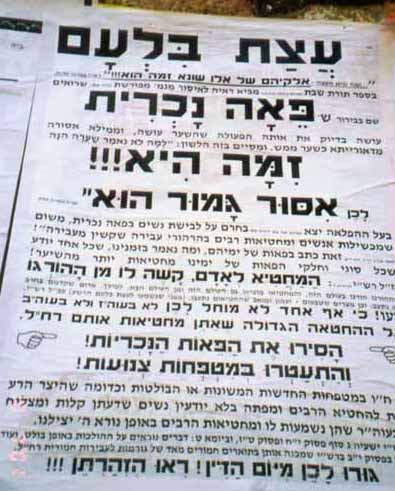
What struck me about the coverage, however, was the complete and perhaps wilful omission of the not insignificant opinions of those who consider the wearing of a Sheytel to actually be forbidden! This view is held, of course, by Chacham Ovadya Yosef at one end of the spectrum and various Chassidic Poskim at the other end, who held that if one does wear a Sheytel it needs to also include a hat or kerchief. Others who are against Sheytels include: R’ Yaacov Emden ז’ל, the Vilna Gaon ז’ל, the Chasam Sofer ז’ל, the Divrei Chaim of Sanz ז’ל and R’ Shlomo Kluger ז’ל. Maharil Diskin ז’ל and Rav Elyashiv are opposed to particular styles of Sheytels (those that are “too real”) whilst in Beis Ya’akov Schools I am told that a teacher who wears a Mitpachat (a Tichel instead of a Sheytel) will not be admitted. In Charedi Leumi circles, full tichels are the order of the day, and unlike the claim of the Lubavitcher Rebbe, many women simply do not remove their tichels.
I urge you not to misunderstand me. I am decidedly not taking any sides here in the debate about proper modes of hair covering. Indeed, when we were married, many moons ago, I told my wife that she should use whatever style she was comfortable with. I was never about to dictate the style of hair covering; I felt it was a difficult enough thing to live with and there was really no concensus.
What I am against, however, is imbalance and lack of tolerance in education. The children should have been exposed to alternate Torah-based views even if they aren’t the views of the School. Sure, the Lubavitcher Rebbe ז’ל was very pro-Sheytels and anti-Tichels, even in the house, but if a teacher is going to teach children about the concept, why wouldn’t she also cover the sizeable alternative views?
There seems to be a lack of balance, let alone tolerance, in our school systems. It cuts across all the four broad types of schools I mentioned above.
 pitputim
You must be logged in to post a comment.