Mishloach Manos and Aveylus

As everyone knows, an Avel (mourner) is still required to give Mishloach Manos, but is not meant to be given Mishloach Manos. What is the essential difference? Clearly, an Avel is still someone who must do good deeds, including Chesed (kindness) and acts of goodness. This is claimed to not only be good for the Avel, so to speak, but is something the Neshama (my father, הכ”מ) gets an Aliya/Nachas from. So far so good.

We can understand why someone should not be involved in giving to an Avel. Likely, the Mishloach Manos is (meant to be) a contribution to the Avel’s Purim Seuda. The Avel’s Purim Seuda, though, in a year of Aveylus, isn’t what it normally is. One isn’t supposed to go (based on the Ramoh) to someone else’s Seuda. Rather, it should be a relatively “quiet” and home-bound one, much like the rest of Aveylus of the 12 months, which is characterised by an avoidance of more public modes of enjoyment and celebration.

An interesting question arises in regards to a family Seuda. What is the Halacha, if customarily, the wider family, including siblings, who are also Aveylim, get together each year for Purim Seuda under normal circumstances. Should they also get together in a year of Aveylus? You can always argue that the “Niftar would prefer that”, but it’s not that simple. Like many laws of Aveylus, one may well get two different answers from two Rabonim. We also say that הלכה כמיקל באבילות. There is also a fair amount of grey area. If you open up a Nitei Gavriel you can probably find every type of a הנהגה under the sun, but that doesn’t really help when you seek direction and clear Psak. Telling me that in the community of “bochunovich” they did XYZ doesn’t offer Psak. Nitei Gavriel is a wonderful “encyclopedia”. It’s often difficult to “pasken” from unless of course one is from “bochunovich”.

So, I was pretty convinced that it should be okay: Aveylim with Aveylim at a Purim Seuda, without the usual dancing and banter, what could be wrong. I asked the question to מו’’ר Rav Hershel Schachter, and he replied that it is better during the year of Aveylus, that the Aveylim have their seudos individually in their own homes.

Purim, being a Yom Tov from the Rabbis, somehow places itself in this Halachic “no man’s land”. It’s not a Torah Yom Tov, nor is it a normal Yom Chol. You are meant to drink, be merry, etc to a level of עד דלא ידע. This means that although it’s a happy day with certain Mitzvos it’s perhaps not quite as important enough in terms of Toraitic שמחה. It’s a day of perhaps “wanton” happiness for want of a better word. This isn’t the natural domain of the Avel. Instead, they should partake of this סעודה meal at their own home with one’s direct family, in the first instance.

Ironically, as I delivered some Mishloach Manos today, I was pleased in a macabre way that some people could not give me Mishloach Manos in return. You know the scene, you give, and then they scurry out the back and give you one “in return”. This time, I had pure giving. I was the initiator. I didn’t need anything in return (thank God). It might sound weird, but that’s how I felt. I actually got some strange comfort out of it.

I can’t stomach this attitude

Is it any wonder that people are so sensitised and seem to have more of a propensity to abuse? The Rambam advocated a middle road. This is an extreme position, largely influenced by the influx of Hungarian Charedim to our Holy Land. It needs to be seen for what it is, a crazy chumra which serves no halachic purpose and if anything is an abuse of Halacha in the sense that it places a (future) stumbling block before the “blind”. The day somebody gets excited or over-refreshed by such “brazen imagery” is the day they need to see a psychiatrist.

I don’t see it as some attitude against women. I see it as a complete and wanton abuse of men.

From yediot:

PurimNonsense

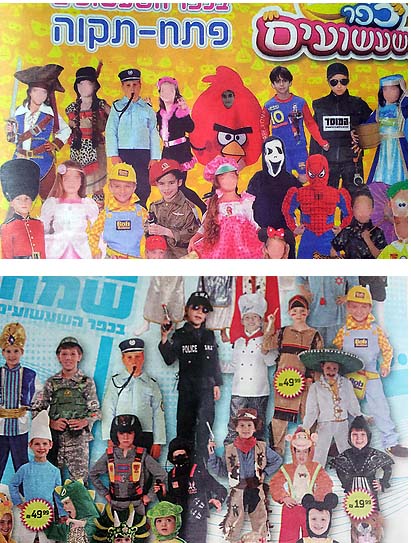
No Queen Esther in Purim costume ads

What does one do in order to avoid blurring the faces of little girls in Purim costume ads? Very simple: Show boys only.

After being criticized in recent years for concealing girls’ faces for “modesty reasons” or replacing them with dolls, this year some Israeli toy stores have decided to completely remove pictures of girls from their advertisements.

Ads published by some chains in ultra-Orthodox newspapers in recent weeks are surprisingly missing costumes which were included in their ads in the past, although these costumes are still on sale.

For example, the biblical matriarch Rachel and even Queen Esther are absent from the ads this year, as part of an ongoing trend in the haredi media not to publish pictures of women or feminine clothing items

Last year, girls were blurred (upper photo) – this year, they’re gone

Religious Jews belonging to moderate factions are protesting the haredi press’ radicalization, which they say has reached the “exclusion of four-year-old girls,” but are also criticizing ads showing young girls in revealing costumes in the general press, which they say “border on pornography.”

Religious-Zionist movement Ne’emanei Torah Va’Avodah, for example, responded cynically to the two extreme phenomena: “It appears that there are those who prefer to read only the parts related to Ahasuerus’ feasts in the Book of Esther, while on the other hand there are those who completely hide Esther.

“The despicable treatment of women, on both sides, strengthens extremism and creates a public domain which ranges between over-conservatism and over-permissiveness. The public is responsible for designing a road in the middle, which respects human beings and does not see them as an object.”

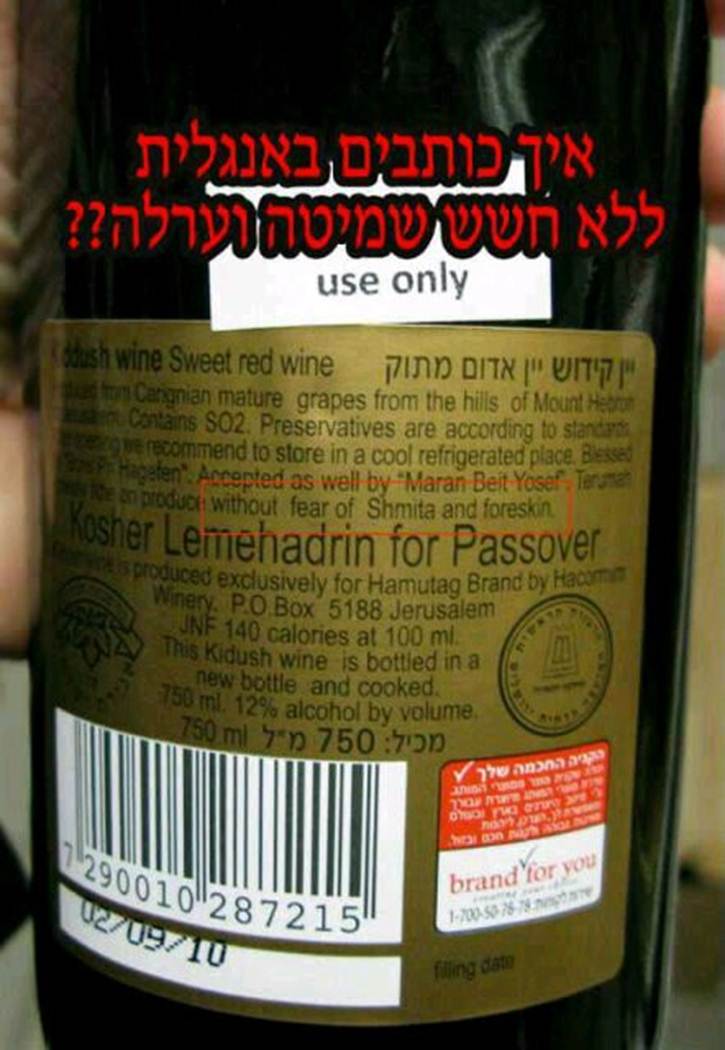
The dangers of google translate?

[Hat tip to MG]

image002

Making sense of Slichos Timing

Tomorrow morning, for example, we say Selichos for Taanis Esther. There are various minhagim about when you say the Selichos. I am not sure anyone says it before davening?

During Davening, it’s said at the time of Tachanun, and yet it looks like Tachanun is embedded within it. I’ve almost got the feeling that perhaps (and I have to admit gross ignorance on this topic as I’ve not had the time to look into it, nor have I done so in the past) it was meant to be a substitute for the standard Tachanun. I say that because at least for Nusach Sfard and Chabad and I think Sefaradim, we already say Oshamnu and Nefilas Apayim. For Ashkenaz it makes more sense as an add on because they don’t ordinarily say Ashamnu. I believe Chabad say it just before the last stanza of Tachanun, immediately after Nefilas Apayim?

Has anyone looked into this and made sense of it? It’s like spaghetti …

Answering Amen before Krias Shema

I daven in the morning in a Beis Medrash which allows the Shliach Tzibbur to daven in their own Nusach, with a few “universal” compromises.

For example:

  • There is always a gap in time to enable those (Ashkenaz and Sefard) who say Baruch Hashem Lo’Olom before Shmoneh Esreh at Ma’ariv to do so
  • Tachanun is said in a way to accomodate those (Ashkenaz) who fall immediately onto their arm and not start with Ashamnu, by leaving the parts from Ashamnu until then said quietly.
  • Yehalelu is said immediately after Hagba but before Ashrei at Shacharis (with no loud U’Venucho Yomar)

It is well known that there are three practices in respect of the Bracha immediately before Krias Shema at Shacharis and Ma’ariv.

  • Chazan says the Bracha in its entirety out loud, and the Kahal say that Bracha word for word with the Chazan, and so they don’t answer Amen
  • Chazan says the Bracha in its out loud, and the Kahal answer Amen
  • Chazan breaks off that Bracha at the end by reciting it inaudibly (Chabad)

Now, I say the Bracha out loud, as Chazan.

The issue is briefly sourced in Brachos 45b.

Sefardi Rishonim consider it fine to answer Amen after your own Bracha (eg Rambam Brachos 1:16). Ashkenazi Rishonim, such as Rabbenu Tam (see Shulchan Aruch OC 215:1, 188:1,2) holds that the only Bracha we answer Amen to, even though we say it, is Boneh B’Rachamov Yerushalayim Amen (in Benching).

For the Bracha before Shema, the Rishonim say that since this is the second of the Birchas Krias Shema we do not need to say Amen. Shema is integrated, and the final Bracha (for Shacharis) is Go-al Yisroel. It’s not clear why one couldn’t, however, say Amen. For example, after Yotzer Or U’Voreh Choshech, one may say Amen, and many are careful to do so.

Minhag Chabad is not to say Amen for any of these Brachos. My question is as follows: if you daven according to Minhag Chabad in the Beis Medrash that I daven in, and I say the first of the Birchas Krias Shema out loud, (Yotzer Or U’Voreh Choshech) should you stay silent and choose not to answer Amen to this Bracha? In addition, if the Chazan says “Habocher B’Amo Yisroel Behava” loudly, should you say Amen. Clearly, Chabad Minhag seems concerned about it, because they say the second bracha quietly and don’t say any part of the first Bracah out loud.

So what do Chabad do? Do they simply say no Amen? Do they try to say the Bracha with the Chazan? Does anyone know?

[Apologies I fixed the last sentence … I was a bit off colour yesterday and my last sentence was almost random letters]

The Modiin Illit mother was apparently lying

In this article, I asked how it was possible for a woman to fake claim that her 5-year-old was raped and then withdraw the charge. Complicating matters was the apparent refusal of Charedi Medical offices to cooperate.

It turns out now that the Police do believe that the woman was lying. One can only presume she has psychological problems herself and needs treatment. That being said, surely this is yet another reason the Charedi community should not fear police investigations, and makes a mockery of their decision to stay mum and not assist the police with their inquiries!

Introductory words for the Shloshim of my father הכ’’מ

We had decided that in keeping with my father’s modest comportment and innate sense of unpretentiousness, that we’d keep his Shloshim, “low key” and a family affair. My mother had a few of her closest friends, but apart from that, it was a sombre and less public event. I know many people would have attended if it had been a different way; we hope you can appreciate the approach we took, however.

In truth, it is very difficult at a time of Aveylus to once more “confront the public gaze”. The Avel often craves solitude and is struggling with their sense of loss and grief. Indeed, Halacha encourages a detachment from the more public aspects of life during the year of Aveylus.

I had spoken at the Levaya, and was somewhat “grateful”, if I can use that word in context, that I was voicing introductions and context, as well as a Siyum Mishnayos.

The following is most of what I said to introduce the Shloshim.

Tonight we have gathered on the night of the Shloshim, the thirty-day period after the departure of our dear father, ר’ שאול זעליג הכהן הריני כפרת משכבו from the world as we know it, to the mysterious and exalted world of Souls. The Jewish people have a firm foundational framework which is rooted in Torah and through which we live and after which we depart this world. That framework does not evolve in the sense that it takes on new manifestations of populist modes of worship. Rather, like the foundations of a building that has been constructed to withstand an earthquake, Halacha is designed to move a given and acceptable number of degrees to the left or to the right, to remain intact, eventually returning to a proper and upright posture.

Following on from the Kevurah, where we tear our clothes, mourners observe seven days where there are major restrictions on the mourners and a responsibility for others to attempt to comfort the mourners.

Emerging from Shiva is a strange feeling. It is akin to letting go of certain practices; practices that directly and indirectly affect both the mourner and the comforter. It can sometimes be seen as an expression of “recovery”, and the notion of recovery is somewhat “offensive” to a mourner who is convinced that they will never recover, and perhaps should be sitting for two weeks and not one. Halacha is clear, however. A secondary period of mourning commences after the Shiva. Essentially, many of the restrictions are removed, providing a gentle but steady integration into society. It is far from a complete re-entry.

Some technical restrictions remain, and these represent visible signs that a person is very much still in a state of mourning. The aim of these restrictions is not to cause pain to the mourner. Rather, like all tenets of Judaism, there must be a tangible materialisation of the existential feeling of loneliness and aloneness that uniquely defines the state of mind of a mourner. Judaism has not ever been only a religion of the heart. One cannot reduce Judaism to “I am a Jew at heart”. Judaism is a religion of action emanating from feelings and belief.

From tomorrow morning, the Shloshim period ends and the mode of mourning is relaxed further, although there are still some clear strictures in place.

Jews have always had these three types of mourning: the Shiva, the Shloshim and the 12 months, and the customs and laws that go with each of these categories.

Each year, on Tisha B’Av, we mourn the fact that our true independence in the land of Israel, together with our Temple and all its accoutrements were removed from us. Even today, when we are blessed with our own country, we are far from independent, and find ourselves constantly bullied by our so-called friends and enemies. The commemoration of this loss follows three stages: the three weeks, the nine days, and then Tisha B’Av itself.

Unsurprisingly, Judaism is innately consistent. The customs surrounding the mourning of the three weeks are derived from those of the 12 month period of mourning after a parent. The customs of the nine days corresponds to the period of Shloshim. Finally, on Tisha B’Av, when we also sit on low chairs, the customs of mourning are based on the period of Shiva. Note though that the order is reversed. First it’s the 12 months, followed by the Shloshim and finally on Tisha B’Av it’s the Shiva. Rav Soloveitchik explained that this is an Aveilus Yeshana, and older event that we are mourning. We can’t simply start with the Shiva minhagim. Rather, there needs to be a gradual build up, culminating through Slichos and Kinnos to the Shiva, which is the last stage of mourning.

In the case of mourning after a human being, however, the wounds are red raw. The Aveilus is termed Chadasha, a new experience: both shocking and harrowing. The mourning commences from Shiva, the most intense period, and over time moves to Shloshim, and then finally onto the 12 months. Eventually, it becomes a Yohr Tzeit as well as special Rabinically enacted Yizkor prayers.

What then is the nature of the particular 12 month period that we are moving into?

Consider the following Halachic conundrum. A boy’s parent passed away when he was under Bar Mitzvah age. The boy became Bar Mitzvah during the Shiva period. He commences mourning. Does his choice of observing the remainder of the Shiva and Shloshim constitute the technical fulfilment חיוב of the Rabbinic enactment of the Customs of Shiva and Shloshim or do we say that since he was a minor at the time of the parent’s passing, he is doing a normal and good thing, but he couldn’t have been commanded to do this by the Rabbis because he was a minor at the time of death. Without argument, the Shulchan Aruch concludes that the unfortunate child is performing Minagim of mourning, but he cannot be considered as one who was commanded, or had to do so (בר חיובא).

I was learning the Chochmas Odom last Shabbos at Elwood Shule; the Shule where my father and his father davened, and where I have been leading the prayers each day in his honour. The Chochmas Adam (later cited by the Pischei Tshuva) made the following observation: in respect of the mourning after the Shloshim, that is, the mourning of the 12 months, the boy is actually doing what he was commanded even though he was a minor at the time. How so? The Chochmas Odom explains that the mourning after the Shloshim is essentially connected to the Mitzvah of Kibud Av V’Eim, honouring one’s parents. In this case, honouring a parent through acts that are undertaken which will bring them Nachas Ruach in another world, is something that he is now expected to do. This can commence as soon as the boy turns Bar Mitzvah.

It is this new period that we as children move into from tomorrow morning. It is also something that grandchildren may participate in, since the Gemara tells us that בני בנים הרי הם כבנים (grandchildren are like children). This insight might also explain why curiously, for our dear mother and aunt, the formal mourning laws and minhagim cease tomorrow morning. It is only children who are commanded in the Mitzvah of Kibud Av V’Eim.

The human process of grieving and missing someone, of course, is another thing entirely, and that is something that each person deals with in their own way, and their own time, and hopefully with well-meaning friends and family, especially those who have gathered here tonight and who have been so loyal and supportive to all of us.

ר' שאול זעליג הכהן בלבין הכ’מ
ר’ שאול זעליג הכהן בלבין הכ’מ

Anonymity and the Internet

Never assume that you are “anonymous” on the internet. You can go through hoola hoops to hide your identity if you know your stuff, but 99.9% of people don’t know how to do this. Is it worth it? The only time I can think of someone wanting to post an anonymous comment is if they have something that is so important to tell but simply are unable to reveal their name. This is an exception. It should happen in very few cases. One example might be a real victim of crime. Even in that situation, you would hope that the person doesn’t just use the internet, but actually goes to the police and makes a formal complaint. If they cannot bring themselves to make a formal complaint, then depending on the nature of what they have written, we make a value judgement call on whether it is reasonable that they remain anonymous in the context. There are far too many weasels, sock-puppets, and malingerers on the net who make “anonymous” comments which are demonstratively false and hurtful. That’s not what anonymity is about. That’s just offensive cowardice. Some websites are simply magnets for these toilet-like comments: Scott Rosenberg’s blog is one example where there is much horrible comment and back stabbing.

Sometimes, it is unfair. There is no effective right of reply because of smoke and daggers and innuendo. When we say things, just like in our daily speech, we need to be careful that there is a positive purpose in what we say or write, and that we are very sure about the veracity of our statement.

When I started blogging, it was for my benefit, so to speak. I enjoyed and enjoy the opportunity to express what’s on my mind, or something I have learned. In doing so, I have been (or tried to be) very conscious of not allowing ad hominem attacks via comments, and have edited and rejected comments accordingly. I don’t force people to login to show their identity; they could use a fake email, but anyone who thinks that authorities can’t trace them, should think again. I know a little about these things as a computer scientist. That being said, I’ve only once wanted to find out someone’s identity, and that’s when that person made threats to my family through this blog. In the end, I let it go. If it would have occurred more than once, that person may have found me on their door step, with an officer in tow.

It comes then, as little surprise that the “anonymous” blogger “ifyoutickleus” who has been trying to out R’ Chaim Halpern of London, is now under attack. R’ Halpern’s supporters have applied to find out “who he or she is” via google (who host that blog). This is not new. We have such cases in Australia as well.

It will be an interesting unfolding episode. If R’ Halpern is found guilty of an infraction of Jewish Law, then as I understand it, the anonymous blogger may not be found guilty of defamation?  But who will determine if R’ Halpern allegedly did what he is purported to have done (which I understand may not be against Secular Law)? Will it involve the courts summoning the new Beis Din that has been formed to judge this case, and about which I understand very few women trusted enough to come forward? Will they subpoena the Rabbis who have publicly called on R’ Halpern to resign? This is going to get very messy, and I think R’ Halpern’s advisors have made a poor call. They may end up knowing who is publicising the material “anonymously” if google cough up the information, but that won’t cleanse R’ Halpern, surely, except in the eyes of one-eyed supporters. One needs to look at these issues with both eyes. If R’ Halpern has nothing to answer for, so be it. If, on the other hand, some allegations are true, then he should do the honourable thing, and step aside.

The mere fact that there was already an exposé on Channel 4, in which R’ Padwa did not emerge in a very good light as far as the issue of Mesira is concerned, would tend to suggest that this new subpoena will only cause a brighter torch to shine on the Charedi community in London, and Jews as a whole. Not good. It is true that R’ Halpern has a right to defend himself. Did the Beis Din who is sitting on this case, give permission to R’ Halpern to apply to the secular courts? Who did?

In the meanwhile, the rest of us sit back and ask ourselves, “why is this happening?”

Sam Lipski gets it wrong about the Australian election date

[Disclaimer: as always, these views are my own. They do not represent my employer or any organisation with which I am affiliated or a member of]

In an article in the Australian Jewish News, the erudite and respected figure editorialised that it didn’t bother him that the Australian Labor Party through the Prime Minister Julia Gillard had chosen Yom Kippur as the election date, despite having other possibilities. Amongst his points Lipski argues that as far as he knew Halacha knew no difference between the voting on Shabbos and the voting on Yom Kippur. Despite Sam’s Orthodox roots and his current alleged membership of the (small) Conservative Jewish Community, it shocks me that he would make such statements. Granted, the job of an editorial is to be somewhat left (sic) field and sensationalist, but in this case he has taken his license too far.

The implication that once you drive on Shabbos, you may as well drive on Yom Kippur is a nonsense, and Sam knows it. Yom Kippur is the holiest day of the year, and even those who might infract on other days, attempt to refrain from doing so on Yom Kippur.


On Yom Kippur evening after davening at Elwood Shule, there are many people who walk back to their homes even though they drive on Shabbos. Are we expecting Sam to knock on their window and say “Hey Buddy, what’s the point, you already drove last Shabbos”. It is well-known that the Conservative movement’s attempt to purify driving on Shabbos was an abject failure. Even its own leaders now acknowledge this fact.

No Sam, your role isn’t to find special meaning on the “wonderful” conjugation of the election and Yom Kippur. That, is distasteful, disrespectful, and frankly grandstanding. You already have a good name. There is no need to engage in this populist, sensationalist nonsense that strikes at the holiest day of the Jewish Calendar.

Michael Danby a Labor MP, a member of Elwood Shule, put it respectfully and rightly when he expressed disappointment over the date and announced that extra polling days would be available in Jewish areas.

I urge all people to not even remotely consider the possibility of casting your ballot on Yom Kippur. Do it before, or by postal vote. All Orthodox Shules should contact their members in this regard, in my opinion. I’d venture to say that even the Conservadox, Conservative or Reform movements should do the same.

I’m told that on another blog, there is an article whose title suggests it is “Great” that an election is held on Yom Kippur. Whether this is sarcasm, wit or a real opinion, it’s a great shame that writers and thinkers even have the temerity, let alone the Jewish vacuity, to evince a view that is remotely positive about such a sad conjunction.

Woman withdraws complaint about girl’s rape

The article below is Itamar Fleishman from Yediot

I just don’t get it. People don’t all of a sudden suspect that a 5-year-old has been raped. If they do, then on what basis do they magically decide it was a figment of their imagination? As to the “local haredi (sic) Medical Facility” refusing to cooperate, they should be closed down simply on that basis. Modi’in Ilit has featured on my blog elsewhere. It sounds like a great place to live.

Several days after the police opened an investigation into an alleged rape of a five-year-old girl in Modiin Illit, the woman who filed the complaint has withdrawn it.

Nevertheless, the police have not suspended the investigation despite admitting that there are doubts as to whether a rape had indeed taken place.

On Monday, the police confirmed it was investigating suspicions that a girl at the age of five was raped by a man in the haredi settlement of Modiin Illit. The probe was launched following reports of medical treatment the girl had undergone.

The local haredi medical facility refused to cooperate with the investigation as did other residents who were reportedly instructed to keep mum. Neither the child nor the suspect have been located as of yet.

Rumor of the incident started spreading in the town last weekend, and according to residents, an anonymous complaint was filed with the police Friday.

Police questioned several residents who were warned they would be charged with obstruction of justice if they fail to cooperate.

According to the few details investigators have managed to gather, it is suspected that sometime in the past two weeks a man approached a five-year-old girl he saw on the street, took her to a warehouse at a nearby synagogue where he abused her for two hours.

Police said: “The investigation is rigorous, but we’re running into walls of silence from everyone. We’re utilizing all the resources we have in order to trace all those involved. I hope we can do so soon.”

courtesy YWN

Hungarian Jews

There has long been conjecture about this group. Their cholent isn’t; it’s a legume soup (highly recommended if you are constipated)They speak Hungarian (Goyish) in Shule, whereas Poles and Russians speak Yiddish and considered it anathema to speak “Goyish” in Shule. Polacks often sneeringly (in jest) deride Hungarians. They drink this poisonous harsh on the palate drink called Slivovitz (which is now being considered as injurious to health as DDT) etc.

In response, once often hears that the person isn’t really Hungarian but they are Czhecoslovakian or born on the “border”. One startling fact, however, is that of the non Czech style Hungarians, the percentage of Cohanim is lower than among any other group. There have been many theories about this phenomenon. One that has gained traction over the years is that the Hungarian Jews are descended from the Khazars (Khuzarim) who converted to Judaism, as mentioned by R’ Yehuda HaLevi in his Sefer HaCuzari.

We’ve all read anecdotes such as:

“I recenly met a Jewish woman from Hungary. She is in her eighties. She told me that her family were descended from the Khazars who travelled with the Magyars into what is now the lovely land of Hungary. She said that they were part of the ten arrows. She said that her family converted to Judaism thousands of years ago after the Khazars met ancient Hebrews.”

While nobody questioned the Poles and Russian’s Jewish heritage, these two groups were considered the “peasant” class especially in respect of the “cultured” German jews. I fondly after my engagement to my wife, who is of half German origin, that they asked me what foods I liked. I answered that herring would be great. My wife’s grandmother, Ella Herzberg ע’’ה was seeped in Germanic traditions. She liked me despite my ‘Polish Peasant’ lineage. Herring just wasn’t served at a high-class Yekkishe meal, so she needed to come up with a good line in front of her friends. It went something like this:

“You know, when we were younger, Herring was for the poor people. Now there are almost no Herrings left, and it has become a delicacy”

This always brought a smile to my face 🙂

Back to the issue of Hungarian Jews, another intriguing addition to the jigsaw puzzle appeared in Yediot, which I produce below.

Jews of European origin are a mix of ancestries, with many hailing from tribes in the Caucasus who converted to Judaism and created an empire that lasted half a millennium, according to a gene study.

The investigation, its author says, should settle a debate that has been roiling for more than two centuries.

Further Research
Genetic map of Jewish Diasporas defined / Ynetnews
Findings of new study support historical record of Middle Eastern Jews settling in North Africa during Classical Antiquity, proselytizing and marrying local populations, forming distinct populations that stayed largely intact for more than 2,000 years
Full story
Jews of European descent, often called Ashkenazim, account for some 90% of the more than 13 million Jews in the world today.

According to the so-called Rhineland Hypothesis, Ashkenazim descended from Jews who progressively fled Palestine after the Muslim conquest of 638 AD.

They settled in southern Europe and then, in the late Middle Ages, about 50,000 of them moved from the Rhineland in Germany into eastern Europe, according to the hypothesis.

But detractors say this idea is implausible.

Barring a miracle – which some supporters of the Rhineland Hypothesis have in fact suggested – the scenario would have been demographically impossible.

It would mean that the population of Eastern European Jews leapt from 50,000 in the 15th century to around eight million at the start of the 20th century.

That birth rate would have been 10 times greater than that of the local non-Jewish population. And it would have occurred despite economic hardship, disease, wars and pogroms that ravaged Jewish communities.

Seeking new light in the argument, a study published in the British journal Genome Biology and Evolution, compares the genomes of 1,287 unrelated individuals who hail from eight Jewish and 74 non-Jewish populations.

Geneticist Eran Elhaik of the Johns Hopkins School of Public Health in Baltimore, Maryland, trawled through this small mountain of data in search of single changes in the DNA code that are linked to a group’s geographical origins.

Such telltales have been used in past research to delve into the origins of the Basque people and the pygmy people of central Africa.

Among European Jews, Elhaik found ancestral signatures that pointed clearly to the Caucasus and also, but to a smaller degree, the Middle East.

The results, said Elhaik, give sound backing for the rival theory – the “Khazarian Hypothesis.”

Backed by archaeological findings

Under this concept, eastern European Jews descended from the Khazars, a hotchpotch of Turkic clans that settled the Caucasus in the early centuries AD and, influenced by Jews from Palestine, converted to Judaism in the 8th century.

The Judeo-Khazars built a flourishing empire, drawing in Jews from Mesopotamia and imperial Byzantium.

They became so successful that they sent offshoots into Hungary and Romania, planting the seeds of a great Diaspora.

But Khazaria collapsed in the 13th century when it was attacked by the Mongols and became weakened by outbreaks of the Black Death.

The Judeo-Khazars fled westwards, settling in the rising Polish Kingdom and in Hungary, where their skills in finance, economics and politics were in demand, and eventually spread to central and western Europe, according to the “Khazarian Hypothesis.”

“We conclude that the genome of European Jews is a tapestry of ancient populations including Judaised Khazars, Greco-Roman Jews, Mesopotamian Jews and Judeans,” says Elhaik.

“Their population structure was formed in the Caucasus and the banks of the Volga, with roots stretching to Canaan and the banks of the Jordan.”

Many things are unknown about the Khazars, whose tribal confederation gathered Slavs, Scythians, Hunnic-Bulgars, Iranians, Alans and Turks.

But, argues Elhaik, the tale sketched in the genes is backed by archaeological findings, by Jewish literature that describes the Khazars’ conversion to Judaism, and by language, too.

“Yiddish, the language of Central and Eastern European Jews, began as a Slavic language” before being reclassified as High German, he notes.

Another pointer is that European Jews and their ancestral groups in the Caucasus and Middle East share a relatively high risk of diseases such as cystic fibrosis.

The investigation should help fine-tune a fast-expanding branch of genomics, which looks at single-change DNA mutations that are linked with inherited disease, adds Elhaik.

Religious Hungarian Family

Another case of child abuse cover up?

Direct responsibility for not dealing with these issues is with the Rabbinate of Modiin Ilit. The scourge must be removed and all alleged perpetrators surrendered to police. It’s incomprehensible that there is a “better way”. There isn’t.

Police are investigating the alleged rape of a five-year-old girl in the haredi city of Modiin Ilit that occurred two weeks ago.

It is suspected that the girl was on her way to kindergarten, when a haredi youth grabbed her and took her to an unknown location close by, possibly a storage room or an empty communal building, where he raped and abused her.

He then release the girl who arrived at her kindergarten bruised an injured. The kindergarten teachers contacted the girl’s parents to collect their daughter and she was subsequently taken to hospital.

It appears that communal leaders have attempted to cover up the incident and have pressured anyone involved and the broader community not to cooperate with the police investigation; neither the parents nor anyone else involved in the incident reported it and residents are reluctant to speak to the police or media about it.

Army Radio, which first exposed the allegations, revealed that the incident was only finally reported last Friday by an anonymous tip off sent by SMS to an officer.

A police investigation is currently underway. Investigators went to the hospital where the child was treated but were not able to see her due to family objections.

Police officers from the Judea and Samaria District Police also went to the kindergarten in question but no-one was prepared to cooperate with the investigation.

A Modiin Ilit resident whose child attends the same kindergarten said on Channel 2 News that the kindergarten management was silencing the incident, specifically accusing the director of the kindergarten association.

The above article is from the Jerusalem Post by Jeremy Sharon.

New free seforim from Reuven Brauner

I am pleased to inform you that several new ETC publications are NOW available on Rabbi Tzvee Zahavy’s wonderful Torah resource site http://www.halakhah.com (http://halakhah.com/index.html).

Newly uploaded are:

1. An updated and revised edition of 25 RULES FOR PERFORMING MITZVOHS derived from the famous Halachic compendium, the Chayei Odom. This is available at http://halakhah.com/rst/25rules.pdf.
2. A completely new translation with commentaries of SEFER MISHLEI (the Book of Proverbs). This you can find at http://halakhah.com/rst/mishlei.pdf.
3. The first volume (Bereishis) of Dr. Seligmann Baer’s (author of Siddur Avodas Yisroel) famous MASORETIC TEXT OF THE TANACH. This can be accessed at http://halakhah.com/rst/baer1.pdf. The remaining books of Tanach (except for Shemos through Devorim which were never produced) will be available, too, but due to their large size we are trying to figure out if it should be made available as zip files or on Drop Box or something like that.
4. Another volume in the Hadgashas Hane’emar series, SEFER YONA http://halakhah.com/rst/yona.pdf. Soon to be available on halakhah.com, please G-d, will be Sefer Esther (in time for Purim) and Sefer Ruth http://halakhah.com/rst/ruth.pdf. BTW, the entire Tanach has been formatted like this and, please G-d, will be made available in due time, as well. I think this format is an excellent study tool, particularly for young students, facilitating faster and better comprehension of the text.

Besides these items, halakhah.com hosts a number of other ETC monographs and works including the comprehensive Hebrew Verb Root thesaurus Shoroshim http://halakhah.com/rst/shoroshim.pdf, hundreds of non-esoteric passages from the Zohar http://halakhah.com/rst/kkz.pdf, an index to the usage of all verses and passages from Tanach in our liturgy, called Shimush Pesukim http://halakhah.com/rst/pesukim.pdf, a nice translation of Pirkei Avos with many unique and interesting lists http://halakhah.com/rst/pirkeiavos.pdf and lots more unique, fun and educational material.

On top of all this, you have the entire two-column, easy to read and download, REFORMATTED SONCINO TALMUD – the only complete, online, English language translation of the Talmud at http://halakhah.com/indexrst.html as well as the more traditional format of the Soncino, found scrolled-down lower on the same page. Rabbi Zahavy has made available some of his excellent works there, too, including access to an outstanding, world-class and highly-recommended philosophical exposition called Whence and Wherefore written by his late father, Rabbi Zev Zahavy, ztz”l. This book explores the most fundamental issues of the purpose and meaning of the creation, life and existence.

Do You Practice ‘Gadolatry’?

[Hat tip to Norm]

What are people’s views on this?

Appeals to a gadol and gedolim suggests that there does in fact exist within Judaism an elite class with the final authority over legal, theological, and public policy questions.

Published: January 31st, 2013
I first heard the term “gadolatry” attributed to the late professor Arthur Hertzberg. A portmanteau of “gadol” and “idolatry,” the word “gadolatry” refers to a perceived phenomenon in Orthodox Judaism where select rabbinic leaders are treated with a degree of deference or reverence, bordering on worshipping the person of the rabbi himself. That Dr. Hertzberg would coin such an inflammatory term is not surprising given his personality, such that reactions offense or outrage are as intentional as they are predictable. However, it has been my experience that those strong passions on either side have turned the reasonable question of the role of the gadol in Judaism into the single greatest impediment to intelligent religious discourse in the Orthodox Jewish community.

While I have no expectations of resolving this divisive issue, I do hope to explicate the rationales implied when one invokes a gadol, and why others may find such an argument unconvincing.

In order to participate in an intelligible or meaningful debate, opposing sides must accept certain mutually agreed upon assumptions or premises relevant to the discussion at hand. This prerequisite can be particularly challenging in religious debates where the logical foundations are not based in empirical fact as much as one’s subjective faith, though such statements of faith are often presented as fact. Thus if only one side assumes an idea as a religious truism, the conversation will quickly deteriorate into personal attacks on the other’s religious integrity.

To illustrate this distinction between “fact” and “faith,” consider an instance where one cites a passage in the Talmud to support a halakhic or theological position. Whether or not the passage appears in the Talmud is a matter of “fact” which one can easily verify by looking up the citation in the Talmud. However the significance of that passage – i.e. the degree to which it is determines normative Jewish thought or practice – is a subjective matter of “faith” Often based on one’s tradition. For example, according to Maimonides the Talmud is final authority in determining the universally obligatory or prohibited laws for all halakhic process (Introduction to Mishnah Torah). For others popular practice takes an equal if not superior role in determining halakha, as demonstrated in the idiom “the custom of Israel is Torah” (Ramban Commentary to Pesachim 7b). Today it is not uncommon to hear from Orthodox rabbis, “we don’t pasken from the gemara.” To some degree the fact/faith dichotomy is at the core of any argument in which one invokes a “gadol” to support a position in an argument.

The term “gadol” means “great one” or more specifically a “great rabbi,” whose opinions because of his greatness, are treated not only as superior to those of ordinary rabbis (let alone common Jews) but may also be considered to be the definitive religious position on any given subject. Similarly, its plural form “gedolim” refers to a collective of great rabbis, which in addition to the implication of rabbinic greatness, also conveys the perception of consensus among the religious elite. Thus, when one invokes a gadol or attributes a stated position to a gadol or the gedolim, he is not only appealing to the higher authority in support of a position as much as arguing that the gadol’s affirmation itself determines the correct Jewish position. Conversely, any position which contradicts or criticizes a gadol or the gedolim on matters of halakha, theology, or even public policy is inherently illegitimate if not an outright heretical affront to the Jewish religion or even God’s will. In either case, any position contrary to that of a gadol is summarily dismissed purely on the authority of the elite rabbinic persona.

Appeals to a gadol and gedolim are primarily predicated on two categorical assumptions of faith.1 The first set of assumptions are ontological, in that there does in fact exist within Judaism an elite class with the final authority over legal, theological, and public policy questions to which all Jews must adhere and all lesser rabbis must defer. It is important to distinguish this elite class from the Sanhedrin which was a formal judicial and legislative body with its own qualifications, procedures, and regulations. Even if the other party in the argument agrees that certain rabbis are greater in some way than others, he may not necessarily bestow upon those rabbis the superior authority implied by the designation of “gadol.”

The primary obstacle with this assumption is that it is nearly impossible to verify or reject without similar assumptions of faith regarding the source(s) of religious authority in Judaism. Were one to support the existence of such an authoritative informal institution, one must provide some basis to justify that position. One such option would be to find supporting (or opposing) sources in Jewish texts such as the Bible or Talmud. However, even if these sources are considered part of the religious canon, their respective authority may be disputed and their meanings reinterpreted. In the Talmud itself we find differing opinions relating to the legal normativity of the books of the Prophets,2 and the Rabbinic sages often reinterpreted Biblical verses outside of their literal meaning – the most famous example of which being Ex. 21:24 “an eye for an eye” to mean a monetary penalty (B. Bava Kamma 83b-84a). Finally, as noted above, even the normative role of the Talmud is disputed among Orthodox traditions, not to mention the authority of interpreting Talmudic sources.

In other words, the very question of religious authority in Judaism requires a priori assumptions of faith regarding the very sources of religious authority with which to justify one’s position. After all, rabbinic authority is defined by the Rabbis, and the gadol’s authority would only be validated through the authority of other great rabbis, even those of an earlier era. The authority of any institution must come from some place outside of itself, and unless that source of validation is agreed upon a priori, the question of any authority is never answered, only deferred. Therefore, arguments for the existance of an authoritative gadol class through Jewish texts will not result in definitive conclusions.

And yet, if the existence and authority of an elite rabbinic class is granted, the second set of assumptions which need to be addressed relate to its membership. In particular, two questions which must be answered are 1. who is considered to be a gadol or among the gedolim and 2. what is the criteria by which one makes those determinations. Rarely (if ever) will an individual rabbi declare himself to be a gadol – such a declaration would be not only the mark of arrogance but blatantly self serving. Thus membership in the gadol class must come from an outside source.

Given the elite status of the gadol one may suspect that only one who has attained this elite status could in turn bestow it upon others. Rabbis can only be ordained by other Rabbis, members of the Sanhedrin appoint their own colleagues. To attain a high rank, one suspects the authority must derive from an equal or higher authority. However, there is no such formal mechanism of meritocracy for gedolim. There is no formal election, recognition, or proclamation indicating when a rabbi has achieved greatness. Thus, despite the magnified importance and authority attributed to the gedolim, there is no objective criteria to identify or define them.3

None of this is to argue that great rabbis do not exist. Every field of knowledge has it experts, and indeed, some may argue that similar to other areas of knowledge the gedolim are the recognized authorities in their field such that their opinions ought to carry greater significance. In other words, even if deference to gedolim is not mandated by Jewish texts it should still be expected by dint of the gedolim‘s superior expertise.

However, there are three important differences between the expertise of secular scholars and gedolim and the expectations in relating to that expertise. First, there are important differences in how such expertise is determined. Usually this is measured in terms of the academic output of publications or contributions to a field, except that each field has its own criteria for evaluating the quality of another’s work. Works in the sciences or social sciences must include a section on methodology – how is data collected and why were those conditions valid (if not optimal) for collecting data. In the humanities where there is more subjectivity, scholars not only justify the veracity of their claims or interpretation, but in many cases must justify the very existence of their scholarship. After all, who needs another essay on Hamlet.

As noted above, there no objective criteria by which to similarly evaluate the expertise and contributions of gedolim. In fact I would argue that this is by design. Secular experts seek to convince others of the validity and importance of their research, and so much meet certain formalistic requirements evaluated by peer review. But gedolim by definition of their elite status could only be properly vetted by other gedolim. Gedolim have no need to convince others of the correctness of their positions when those others lack the stature to use their own judgements.

Along these lines, the second difference between secular experts and gedolim is the expectation of obedience. Unless one is a university student dependant on GPA or a PhD advisor’s approval, there are no practical negative consequences for rejecting any expert’s theory. Even an expert’s devotees cannot expect to attract followers if they simply demand obsequiousness to their chosen mentor. On the other hand, a gadol is responsible for determining Jewish law, in which case his word becomes the law itself – which all Orthodox Jews must ostensibly follow. Due to this religious authority, it is not surprising for gedolim to attract a cult like following who will in turn attempt to get others to follow the gadol’s authority because after all, the religion commands it.

The third difference between secular experts and gedolim is also perhaps the source of the most of the controversies in Judaism. Specifically, what are the expectations when one speaks beyond their respective fields of expertise? Secular experts rarely venture beyond their training if they have not done appropriate research, and if they do, there are usually well defined rules of engagement for making a persuasive case. But gedolim frequently issue proclamations affecting public policies of economics, bioethics,4 criminology, or international and local politics. Instead of acknowledging that perhaps a gadol may contradict actual experts, supporters may argue epistemologically that all knowledge is encoded in the Torah, such that an expert in Torah is automatically an expert in all fields of knowledge. But this too is ultimately an assumption of faith, not fact.

One final point which must be mentioned is that not all references to gedolim follow this pattern. It is difficult to discuss contemporary Jewish law without at least consulting with the works of R. Moshe Feinstein or R. Ovadia Yosef, both of whom are considered gedolim even beyond their immediate constituency. Yet, not everyone who cites these undeniably influential sages does so with the expectation that their positions must be normative law binding on all Jews. The distinction between citing an invoking a gadol is in the expectation of unquestioning deference to the gadol’s position.

In conclusion, despite any pretense of a logical rational argument, most appeals to gedolim in religious arguments are not intended to advance a discussion but to end it through the imposition of one’s faith, or at least several components thereof. And as with most arguments of faith, it is usually a pointless exercise to counter argue on those terms. In this regard Dr. Hertzberg was correct in coining the term “gadolatry” – not in the sense that those who follow gedolim are idolaters, but in the minds of a non-trival segment of the Jewish population, when one disputes the sacred authority of a gadol, he might as well argue with God himself.

1. There are of course factual assumptions as well, such as if the person is accurately representing the gadol or gedolim’s position. Sometimes these representations are based on hearsay and on occasion may contradict a rabbi’s published position. In such cases the correct attribution of a position to the gadol is itself a matter of “faith” as well, but since in most instances it is empirically verifiable, for the purposes of this essay I will treat them as facts.

2. For one example, R. Elazar and R. Nachman Bar Yitzchak cites Hosea 2:1 as source that one who counts Jews violates one or two, ostensibly Biblical, prohibitions (B. Yoma 22b), yet B. Chagigah 10b rejects a legal argument based on Amos 5:25 staying, “divrei Torah medivrei kabbalah la yalpinan” – we do not derive words of Torah (i.e. law) from words of tradition. Space does not permit a full treatment of the legal sources of the Prophets, but for the purposes of my argument it does demonstrate at least two approaches codified in the Talmud.

3. Based on my own observations, it seems to me that the designation of “gadol” is more of the result of populism, that there is some communal recognition that someone has attained this rank. Even if other gedolim deem someone worthy, it is still dependent on a community to accept that person as such. And despite the deference one ought to bestow upon gedolim, in rare instances a community can turn against a gadol when he takes certain controversial positions. One such example is R. Saul Lieberman, who upon accepting a position at the Jewish Theological Seminary became went from being respected to reviled in the Orthodox community. See Marc Shapiro’s wonderful monograph, Saul Lieberman and the Orthodox

4. R. Moshe Tendler, a PhD in biology, once complained in shiur about having to argue brain death with people who never went to college.

About the Author: Rabbi Joshua Yuter was ordained in 2003 from Yeshiva University’s Rabbi Isaac Elchanan Theological Seminary. He also holds a B.A. in Computer Science from Yeshiva University, an M.A. in Talmudic Studies from Yeshiva University, and a Master’s Degree in Social Sciences from the University of Chicago. Rabbi Yuter is also an alum of Yeshivat Har Etzion. He is currently the rabbi of The Stanton St. Shul on New York’s historic Lower East Side.

Nazi Goebbels’ Step-Grandchildren Are Hidden Billionaires

[Hat tip to Ezra]

This article is from Bloombergs. There has been a traditional antipathy towards driving German cars. My father הכ’’מ used to drive one in Berlin immediately after the Holocaust.

My father post war in his convertible Mercedes.

I asked him why and he said

Because they are my כפרה. They destroyed my youth, I decided that I would דווקא enjoy the best that they had to offer.

I understood this to be “dancing on the grave of the person who tried to murder you”. That was soon after the war. Feelings were mixed and the psyche was scarred. Yet, once in Melbourne, he wouldn’t dream of driving a German car. He always admired “Daatchishe” technology and had no problem buying devices they made. Those devices, however, weren’t “in your face” and were used at home.

It wasn’t for me to make value judgements about his choice. I hadn’t gone through what he had  and perhaps, in time, a public embracement through the aegis of a fancy car was not something that neither he, nor most survivors, were ready to make. Yet, there were and are children of holocaust survivors who bought fancy German cars and drove these cars while their parents were alive. I’ve never understood that attitude. If your parents lived through it and don’t do it, even if they are somewhat inconsistent by purchasing private goods of German origin, why would one feel so “obligated” to דווקא drive a car that their parents wouldn’t dream of driving. Even if my father had given me permission to do so (not that I could ever afford a fancy car) I wouldn’t do it while he was not doing the same. After all, there are alternatives.

Ironically, we now have the expose below about BMW. I’d imagine some Jewish BMW owners are now squirming in their warm leather seats.

Harald Quandt, Magda Goebbels’ son by her first marriage, center back stands in uniform with his step-father Nazi propaganda minister Joseph Goebbels, bottom from right, his mother Magda, third from left, and the couple’s children, Helga, Hildegard, Helmut, Hedwig, Holdine and Heidrun in 1942. Photograph: Keystone/Hulton Archive/Getty Images

In the spring of 1945, Harald Quandt, a 23-year-old officer in the German Luftwaffe, was being held as a prisoner of war by Allied forces in the Libyan port city of Benghazi when he received a farewell letter from his mother, Magda Goebbels — the wife of Nazi propaganda minister Joseph Goebbels.

The hand-written note confirmed the devastating news he had heard weeks earlier: His mother had committed suicide with her husband on May 1, after slipping their six children cyanide capsules in Adolf Hitler’s underground bunker in Berlin.

“My dear son! By now we’ve been in the Fuehrerbunker for six days already, Daddy, your six little siblings and I, to give our national socialistic lives the only possible, honorable ending,” she wrote. “Harald, dear son, I want to give you what I learned in life: Be loyal! Loyal to yourself, loyal to the people and loyal to your country!”

Quandt was released from captivity in 1947. Seven years later, he and his half-brother Herbert — Harald was the only remaining child from Magda Goebbels’ first marriage — would inherit the industrial empire built by their father, Guenther Quandt, which had produced Mauser firearms and anti-aircraft missiles for the Third Reich’s war machine. Among their most valuable assets at the time was a stake in car manufacturer Daimler AG. (DAI) They bought a part of Bayerische Motoren Werke AG (BMW) a few years later.

Lower Profile

While the half-brothers passed away decades ago, their legacy has endured. Herbert’s widow, Johanna Quandt, 86, and their children Susanne Klatten and Stefan Quandt, have remained in the public eye as BMW’s dominant shareholders. The billionaire daughters of Harald Quandt — Katarina Geller-Herr, 61, Gabriele Quandt, 60, Anette-Angelika May-Thies, 58, and 50-year-old Colleen-Bettina Rosenblat-Mo — have kept a lower profile.

The four sisters inherited about 1.5 billion deutsche marks ($760 million) after the death of their mother, Inge, in 1978, according to the family’s sanctioned biography, “Die Quandts.” They manage their wealth through the Harald Quandt Holding GmbH, a Bad Homburg, Germany-based family investment company and trust named after their father. Fritz Becker, the chief executive officer of the family entities, said the siblings realized average annual returns above 7 percent from its founding in 1981 through 1996. Since then, the returns have averaged 7.6 percent.

“The family wants to stay private and that is an acceptable situation for me,” said Becker in an interview at his Bad Homburg office. “We invest our money globally and if it’s $1 billion, $500 million or $3 billion, who cares?”

Wartime Profits

Together, the four sisters — and the two children of a deceased sibling — share a fortune worth at least $6 billion, giving each of them a net worth of $1.2 billion, according to the Bloomberg Billionaires Index. They have never appeared individually as billionaires on an international wealth ranking.

See the new interactive Bloomberg Billionaires Index

Becker declined to provide the exact figure the holding manages for the four sisters. The siblings declined to comment for this account, said Ralf-Dieter Brunowsky, a spokesman for the family investment company, in an e-mail. He said the net worth calculation was “too high,” declining to be more specific.

The rise of the Quandt family fortune shares the same trajectory as Germany’s quest for global domination in the 20th century. It began in 1883, when Emil Quandt acquired a textile company owned by his late father-in-law. At the turn of the century, Emil passed the business to his eldest son, Guenther.

The younger Quandt saw an opportunity with the onset of war in 1914. His factories, already one of the biggest clothing manufacturers for the German state, quadrupled their weekly uniform production for the army, according to “Die Quandts.”

Weapons Production

After Germany’s surrender four years later, Quandt put the company’s wartime profits to use. In 1922, he bought a majority stake in Accumulatoren-Fabrik AG (AFA), a Hagen-based battery manufacturer. Six years later, he took over Berlin-Karlsruher Industriewerken AG (BKIW), a Berlin-based manufacturer that made sewing machines and silverware. The factory, once one of Germany’s largest weapon producers, had been forced to retool as part of the country’s disarmament agreement.

“The Quandts’ business grew in the Kaiserreich, it grew during the Weimar Republic, it grew during the Second World War and it grew strongly after the war,” Rudiger Jungbluth, author of “Die Quandts,” said in an interview at a Bavarian restaurant in Hamburg last November.

Nazi Connections

In 1918, Guenther Quandt’s first wife died of the Spanish flu, leaving him a widower with two young sons, Hellmut and Herbert. He married Magda Ritschel in 1921, and the couple’s only son, Harald, was born later that year. Hellmut died in 1927, from complications related to appendicitis.

Quandt and Magda divorced in 1929. Two years later, she married Joseph Goebbels, a member of the German parliament who also held a doctorate degree in drama and served as head of propaganda for Germany’s growing Nazi party. After the Nazis took power in 1933, their leader, Adolf Hitler, appointed Goebbels as the Third Reich’s propaganda minister. Hitler was the best man at the couple’s wedding.

Guenther Quandt joined the party that same year. His factories became key suppliers to the German war effort, even though his relationship with Goebbels had become increasingly strained.

“There was constant rivalry,” said Bonn-based history professor Joachim Scholtyseck, author of a family-commissioned study about their involvement with the Third Reich, in a telephone interview. “It didn’t matter that Goebbels didn’t like him. It didn’t have any influence on Quandt’s ability to make money.”

Forced Labor

In 1937, he earned the title of Wehrwirtschaftsfuehrer, the name given to members of an elite group of businessmen who were deemed beneficial to the production of war materials for the Third Reich. During the war, Quandt’s AFA manufactured batteries for U-Boat submarines and V-2 rocket launchers. His BKIW –which had been renamed Deutsche Waffen-und Munitionsfabriken AG in 1936 — produced Mauser firearms, ammunition and anti-aircraft missiles.

“He was one of the leading industrialists in the Third Reich and the Second World War,” Scholtyseck said. “He always kept a very low profile.”

From 1940 to 1945, the Quandt family factories were staffed with more than 50,000 forced civilian laborers, prisoners of war and concentration camp workers, according to Scholtyseck’s 1,183-page study. The report was commissioned by the family in 2007 after German television aired the documentary “The Silence of the Quandts,” a critical look at their wartime activities.

Released in September 2011, the study also found that Quandt appropriated assets from Jewish company owners and that his son Herbert had planned building an AFA factory in which slave laborers would be deployed.

Army Volunteer

“Guenther Quandt didn’t have a Nazi-kind of thinking,” said Jungbluth, the family biographer. “He was looking for any opportunity to expand his personal empire.”

Quandt’s youngest son, Harald, lived with his mother, Goebbels and six half-siblings. In 1939, he joined the German army after the country’s invasion of Poland, volunteering for the army’s paratrooper unit one year later.

During the war, Harald was deployed in Greece, France and Russia, before being shot and captured in Italy in 1944, and taken to the British Army-run POW camp in Benghazi where he received his mother’s farewell letter.

His stepfather also sent him a goodbye note.

“It’s likely that you’ll be the only one to remain who can continue the tradition of our family,” wrote Goebbels, who served as Chancellor of Germany for one day following Hitler’s suicide on April 30, 1945.

Denazification Hearings

After the war, Guenther Quandt served in an internment camp in Moosburg an der Isar for more than a year, before being judged a “Mitlaeufer” — a Nazi follower who wasn’t formally involved in the regime’s crimes — in denazification hearings in 1948. No repercussions followed.

“He was lucky that he wasn’t as prominent as someone like Flick or Krupp,” said Scholtyseck, referring to the German industrialists Friedrich Flick and Alfried Krupp, who were sentenced to prison terms at the Nuremberg war crimes trials.

Guenther died in 1954 while vacationing in Cairo, leaving his business empire equally in the hands of his two surviving sons, Harald and Herbert. Most notably, the assets included ownership of AFA and Deutsche Waffen-und Munitionsfabriken — renamed Industrie-Werke Karlsruhe AG after the war — and stakes in Daimler-Benz and potash miner Wintershall AG.

Sovereign Wealth

Herbert managed the stakes in the battery, car and potash firm, while Harald oversaw the interests in the industrial companies, according to Jungbluth’s biography.

Over the next decade, the brothers increased their stake in Daimler; Herbert saved BMW from collapse in the 1960s after becoming its largest shareholder and backing the development of new models.

Harald died in 1967, at age 45, in an airplane crash outside Turin, Italy. The relationship between his widow, Inge, and Herbert deteriorated after his death. Negotiations to settle the estate by separating assets commenced in 1970.

The most valuable asset that the Harald Quandt heirs received was four-fifths of a 14 percent stake in Daimler, according to the biography. In 1974, the entire stake was sold to the Kuwait Investment Authority, the country’s sovereign wealth fund, for about 1 billion deutsche marks, according to a Daimler-Benz publication from 1986 celebrating its centennial.

Inge Quandt, who suffered from depression, died of a heart attack on Christmas Eve 1978. Her new husband, Hans-Hilman von Halem, shot himself in the head two days later. The five orphaned daughters, two of them teenagers, were left to split the family fortune.

Family Meetings

The estate’s trustees had started overseeing the daughters’ money in 1974. An active investment approach commenced with the founding of the family investment company in 1981.

“It’s different if you work for a family than a corporation,” said Becker. “You can really invest instead of fulfilling regulation requirements.”

According to “Die Quandts,” the siblings try to get together a few times a year to discuss their investments. Gabriele Quandt lives in Munich. After earning a master’s degree in business administration at Insead in Fontainebleau, France, she married German publishing heir Florian Langenscheidt, with whom she had two sons. The couple divorced in 2008.

Katarina Geller-Herr owns Gestuet Waeldershausen, an equestrian center in Homberg (Ohm), Germany. She sponsored Lars Nieberg, a two-time Olympic gold medalist in show jumping.

Jewish Conversion

Colleen-Bettina Rosenblat-Mo is a jewelry designer who runs a studio and showroom in Hamburg. She converted to Judaism in New York at age 24. Her first marriage was to Michael Rosenblat, a German-Jewish businessman, whose father survived a concentration camp. The couple divorced in 1997. She remarried Frode Mo, a Norwegian journalist.

“We live with both religions and also celebrate Christmas,” Rosenblat-Mo said in “Die Quandts.”

Anette-Angelika May-Thies lives in Hamburg, according to the Harald Quandt Holding shareholders list filed with the German federal trade registry. Her first marriage was to Axel May, a Goldman Sachs Group Inc. (GS) international adviser for private banking, who managed the family’s investments for about 25 years.

The siblings are also majority owners and investors in five financial services companies, all of which pay dividends, according to Becker. The firms were founded to manage the sisters’ wealth and subsequently opened up to third parties.

Private Equity

The six companies combined manage $18 billion in assets, according to the family investment company’s website. Becker said the majority of the money controlled by these firms is invested for third parties. One-fifth of the family fortune is managed by trustees for the two children of the youngest Quandt sibling, Patricia Halterman, who died in July 2005, four days before turning 38. Her townhouse on the Upper East Side of New York City sold for $37.5 million in 2008.

Auda International LP serves as the sisters’ New York-based private-equity unit. It manages almost $5 billion and was founded as their U.S. office in 1989, said Becker. Real Estate Capital Partners LP started the same year and has invested about $9 billion in real estate, according to its website. Both companies are owned through HQFS LP, an offshore entity based in the Cayman Islands.

Family Fortunes

In Bad Homburg, HQ Trust GmbH serves as a investment management company for about 30 families with fortunes ranging from 50 million euros to 500 million euros. Equita Management GmbH invests in small and mid-cap companies in Austria, Switzerland and Germany. HQ Advisor GmbH provides accounting and controlling services.

Only one sister, Gabriele, carries the family name, and none are active in the day-to-day business of the family office, said Becker.

Their uncle, Herbert Quandt, died in 1982. His fortune was divided between six children from three different marriages. BMW, his most valuable asset, was inherited by his third wife Johanna Quandt and their children, Stefan Quandt, 46, and Susanne Klatten, 50. The three billionaires hold 46.7 percent of the Munich-based car producer, according to the company’s 2011 annual report.

After Scholtyseck’s study was published in 2011, cousins Gabriele and Stefan Quandt acknowledged their family’s ties and involvement with the Third Reich in an interview with Germany’s Die Zeit newspaper.

‘Sad Truth’

“Magda killed her six children in the Fuehrerbunker. Our father loved his half-siblings very much. And when, like me, you have something like this in your family history, you think: It can’t be any worse,” Gabriele Quandt said in the interview. “It’s a sad truth that forced laborers died in Quandt companies,” said Stefan.

The acknowledgment didn’t prompt a public distancing from the men that made their family Germany’s richest. The families’ offices in Bad Homburg are named after Guenther and Harald Quandt, and the Herbert Quandt media prize of 50,000 euros is awarded annually to German journalists.

“They have to live with the name. It’s part of the history,” said Scholtyseck. “It will be a constant reminder of dictatorship and the challenges that families have to face.”

To contact the reporter on this story: David De Jong in New York at ddejong3@bloomberg.net

To contact the editor responsible for this story: Matthew G. Miller at mmiller144@bloomberg.net

Ed Koch ז’ל story

I haven’t read this story before, nor had I heard about the globe (or I’d forgotten). I think it’s well worth sharing. It’s from aish.com

Mayor Ed Koch, who passed away Friday at the age of 88, understood that all Jews are connected. Rabbi Yisrael Meir Lau, the former chief rabbi of Israel tells the story.

Years ago, Rabbi Yisrael Meir Lau visited his brother in New York. The two brothers were in Buchenwald together, and miraculously survived while the rest of their family was wiped out. Rabbi Lau, following in the footsteps of his father and grandfather, became a rabbi, continuing his family’s unbroken chain of 38 generations of rabbis. His brother, Naphtali Lau-Levie, became a noted author and was appointed Israel’s consul general to New York.

Ed Koch, New York City’s brash, outspoken, overtly Jewish leader, asked Naphtali to introduce him to the great Rabbi Lau – then Chief Rabbi of Tel Aviv – if his illustrious brother was ever in town.

Rabbi Lau visited New York and Naphtali arranged a meeting. When Mr. Koch walked into the room, he announced to a surprised Rabbi Lau, “I’m a Holocaust survivor too.” Rabbi Lau turned to his brother in puzzlement; this was not the information he’d received about the American-born Koch.

Mr. Koch explained. He was born in the Bronx, and grew up an American. He only went to Europe for the first time as a GI.

Years later, though, after he’d been elected mayor, he had the chance to travel to Germany as part of an international delegation of mayors. There he met with officials in Berlin and was shown various artifacts. One piece made the greatest impression on him: a globe that had once belonged to Adolph Hitler.

This globe was special. Hitler asked his assistants to determine the Jewish population in every country on earth, and to write this number under each nation’s name on his globe.

Poland, Hungary, Germany, Austria…. The Jewish population of each country was recorded, waiting – in Hitler’s twisted mind – for extermination. There was even a number 1 written under the city of Tirana in Albania, Ed Koch told Rabbi Lau. That lone Jew in Tirana was offensive to Hitler; even he was worthy of being remembered and targeted by the Nazis.

Ed Koch also saw a number under the “United States.” It was a special number, Mr. Koch remembered: 6,000,000.

“I was recorded in that number,” Ed Koch said to Rabbi Lau. “I was one of Hitler’s intended victims too.”

Ed Koch not only acknowledged and felt their pain; he realized that their pain was his pain too. In his mind, there were no distinctions between him and other Jews.

Rabbi Lau realized that Mr. Koch was right – he was one of Hitler’s intended victims; he was a survivor of the Holocaust too.

Ed Koch wasn’t just an onlooker; he was a survivor. He saw himself as part of history, as a vital member of the ongoing narrative of the Jewish people. One way to honor his memory is to follow his example, to look at our fellow Jews not as foreigners divided by language, religious observance, geography or time. Like Mr. Koch, let’s try to look at other Jews around the world and see ourselves.

Rabbi Manis Friedman apologises

It is never too late, and it is usually the sign of a good person when they publicly apologise. I received a copy of the apology

I want to apologize for my completely inappropriate use of language when discussing sexual abuse. I have always believed in the importance of empowering victims of all kinds to move forward in building their lives. In my zeal to reinforce that belief, I came across as being dismissive of one of the worst crimes imaginable.

For that I am deeply sorry.

Molestation is a devastating crime, violating the intimacy and innocence of the pure and defenseless. The victim is left feeling that there is something wrong with the world in which they live. Perpetrators of molestation should be reported to the police and prosecuted appropriately. Any person, organization or entity that stands by silently is abetting in the crime.

From now on, I will make sure to make those points absolutely clear. This is about more than regret. The subject can’t be neglected.

I hope over time to earn the forgiveness of those who were hurt by my words.

I also received some comments attributed to Manny Waks of Tzedek where Manny was alleged to have said:

It is regrettable that Rabbi Friedman waited until now to issue this apology – but it is nonetheless a welcome development.

I do not understand this back-hander. If it takes a week of world-wide condemnation for someone to realise their wrong and express it, why focus on that week and give them a slap? People don’t always act immediately for a variety of reasons. There is all manner of reason for this, but I see absolutely no value whatsoever in being hypercritical about such. When victims take years and years to realise that going to the police is the right thing to do, would anyone dare say, “Oh that’s a good first step, but we regret that you took so long?”. Rabbi Friedman is not a victim. One week really isn’t an eternity, and Manny’s attack over this aspect really is unnecessary and mean-spirited.

I have no issue with Manny’s organisation Tzedek pursuing the issue, and I am on record as being critical of Rabbi Friedman. That being said, he was very foolish, but he isn’t a fool. I have every confidence that he will turn this incident into a launching pad to assist in shaking out the cobwebs and helping those who have experienced trauma. Sadly, some groups, such as Satmar and the supporters of Rabbi Halpern and Rabbi Padwa are not within cooee of even coming close to changing their attitude to the (correct) Torah view, let alone addressing the issue properly within their communities. Hopefully, Manny’s organisation can make some incursions into these two topical infamous cases. I’d encourage Tzedek and other similar organisations, however, to be a little more temperate in their language. When someone apologises, don’t give them a back-hander; it serves nothing.

Beth Din for Rabbi Manis Friedman?

Someone pointed me to an extract which described a purported letter from Manny Waks of Tzedek, where Manny’s organisation calls on two Botei Din to censure Rabbi Friedman. I hadn’t seen this alleged letter when I posted my thoughts on the topic. Let’s assume the letter is legitimate.

Let’s also assume that the purpose of the letter is to ask Rabbi Manis to retract the what I described as “crass and unsophisticated” comments he had made. In two paragraphs, Manny allegedly wrote (I’ve emboldened some key words)

Most concerning, he is having a direct, damaging impact on victims and survivors of child sexual abuse and their families. Some of those who have not yet addressed their abuse will think twice before taking any measures to obtain justice and to alleviate their pain and suffering. And some of those who have already taken measures will be self-critical.

I can only hope and pray that Rabbi Friedman’s remarks do not cause victims additional trauma, potentially leading to extreme consequences.

I do not believe for one minute that a Beth Din making an order to Rabbi Manis, and he acting on this order will cease “causing victims additional trauma.” It could be equally argued that victims will look at both the comments made by Rabbi Manis and any retraction or apology as being in the same category: “simply too far-fetched to be believed or taken seriously”.

If I am beaten black and blue by a thug, and spend 2 years in hospital, and end up with a prosthetic device all my life to help me walk, and somebody says “be happy you didn’t die” or “you know some people are worse off than you” then I may be very upset, very angry, very hurt and more. I might even curse the person as being over simplistic. If that person is then called to a Beth Din by an organisation responsible for helping those who have been mugged recover from their mental trauma and that person is forced to apologise, then I’m not likely to consider it real or likely to “feel better” or feel more inclined to report a previously unreported attack on me. Would you?

Let’s be clear: I’m not making comparisons of the psychological after-effects of different trauma-causing cataclysms. They will differ by trauma and victim. I am commenting on what I think is common human nature.

There are other ways to address Rabbi Manis’s offensive words. The Beth Din, in the context, would not have been my chosen approach. I’m baffled as to what the local sydney beth din has to do with it. As far as I know, Manny lives in Melbourne, and there are victims in many countries. Perhaps a group approach would have been better?

Either way, this issue is really one that should be dealt with by those who Rabbi Manis considers as his Mashpiim. After all, the last Lubavitcher Rebbe ז’ל issued a clear missive that each Chossid should have three Rabbonim/Mashpiim who they should turn to when/if they face issues that need advice or experience conundra and the like. The Lubavitcher Rebbe was clearly talking about the period after his own passing, and made this request first after the Shiva of his own wife, on Motzei Shabbos in a hidden (but now published Sicha) entitled בואו ונחשוב חשבונו של עולם. I don’t have a link to it, but I know it’s available and now published at the back of Toras Menachem. I believe there is an audio and possibly a video of this Sicha. If I recall he said it at the bottom of the stairs in 770. Allegedly, the LR asked for this Sicha to be sent to him for correction, but his Askanim refrained from doing so because? it implied there was a process after he passed away.

Anyway, Good Shabbos to all.