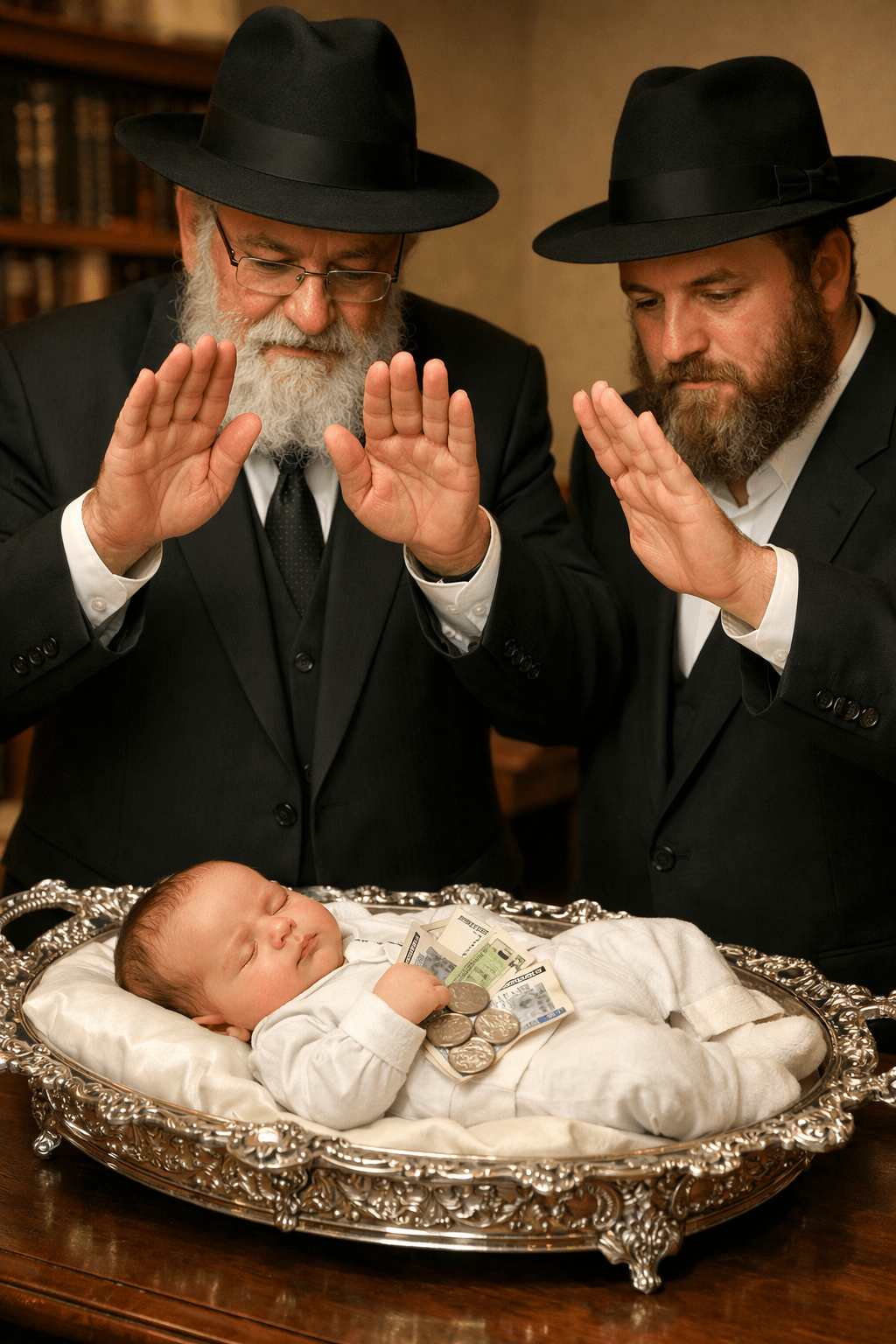
Exploring Birkas Kohanim: Insights Customs and Halakha

The month of Shevat is, for me, perennially a difficult one. My father, alav ha-shalom, has his yahrzeit on the 3rd, and my mother, aleha ha-shalom, has hers in the coming week on the 29th. I am sure there is nothing unique about feeling somewhat alone in their absence.

Barukh Hashem, my father has seven great-grandchildren who carry his name, as does my mother. Perhaps obsessively, even when their English names vary slightly, I insist on calling them all by their Jewish names. It can be confusing with my own grandchildren: when I say “Shaul Zelig,” three boys turn to me.

My mother’s name was Elka, which is a little easier, because the girls often have a middle name, so I can distinguish between Elka X and Elka Y. There is probably a minor thesis in this for anyone inclined to psychoanalyse my obsession, but in simple terms, I take comfort—indeed, I luxuriate—in being able to say their names every day.

Though time moves forward in its measured, ever-changing way, I find that certain constants remain firmly anchored throughout that continuum. Subconsciously, I feel that, where possible, I seek to emulate their values and the way they approached life.

It may be seen as an obsession, as might my tendency towards melancholy when a special occasion—a simcha—takes place. That is simply who I am. I do not apologise for it, and I do not regret these tendencies for a moment.

To honour their memory, I have written an essay—quite a long one—on the topic of Birkas Kohanim. After reviewing various parameters of this mitzvah, I delve into the question of Birkas Kohanim outside the context of shul and formal davening.

The essay is too lengthy for a blog post, so I will attach it here as a PDF, which can be printed. It is certainly not the final word on the subject, and I would greatly value any comments, corrections, or feedback. If you know Kohanim who may be interested in this topic and who don’t subscribe to my blog, please feel free to send them a link to this post.

I will borrow a paragraph from the essay as a way of introducing what first piqued my interest..

One impetus for composing this essay stems from personal experience at a Pidyon HaBen ceremony. Following the conclusion, the officiating Rabbi—who was also the Kohen that performed the redemption—invited any other Kohanim present to join in bestowing Birkas Kohanim upon the infant. There were two Kohanim present: the Rabbi and me. As we recited the pesukim of Birkas Kohanim, I observed that the Rabbi raised both his hands over the head of the baby, while I, following my customary practice in such informal contexts, extended only one hand. This practice was consistent with how I have traditionally conducted such berakhos outside of the formal dukhening that occurs during Musaf on Yom Tov in the Diaspora or daily in Eretz Yisrael.
Afterwards, I inquired why he had chosen to use both hands. He responded that while he was unsure of the halakhic reasoning, he was simply following the custom of his father, who was a respected Posek. In contrast, my own practice—what might be termed “halakhic intuition”—led me to use a single hand. Although I could not recall the exact source or rationale at that moment, I had evidently internalised a precedent or explanation that once guided this choice. This essay, then, charts a journey leading to that choice.

A very sad day in Jewish history

Over thirty years ago, I was listening to the radio in Israel, and was thunderstruck. People were ringing up with questions of halacha, and HaRav Ovadya Yosef ז’ל was answering in real-time. I was a young Yeshivah Bochur, who often simply struggled with a Tosfos, and this “machine” was speaking at a rate of knots, piling source after source after source into his sentences. I hadn’t even heard of half the Seforim he quoted, and Rav Ovadya didn’t just know of them or their opinions, but was quoting their sentences verbatim.

It was mesmerising. One could see his opinion unfolding in real-time, climaxing in a Psak Halacha, which he then often buttressed with more sources. Although he was a Sefardi Chacham, he would often say “אבל אחינו האשכנזים” and summarise how we (Ashkenazim) thought on the same issue, as opposed to Maran (the Beis Yosef and those who followed him).

I was so taken by the breadth of his Torah knowledge, that I just “had” to buy a copy of his first set of responsa (Yabia Omer) and later followed this with Yechave Daas. I loved reading responsa and was often exhilarated by the veritable encyclopaedic journey that Rav Ovadya led us on.

This was before the Bar Ilan CD came out. The Encylopaedia Talmudis still isn’t finished. For sciolists like me, though, the Teshuvos/Responsa constituted an incredible source of Torah that none of us would even remotely approach.

It is important to read the introduction to his Responsa. Based on tradition/Mesora, Chacham Ovadya followed a specific methodology. Some, mistakenly think (or perhaps this is one of those jokes I heard many times) that Rav Ovadya had 4000 opinions to say it was forbidden and then 10,000 that implied it was permitted and that’s how he came to his conclusions. This is overly simplistic, and is not respectful to such a genius and giant of Torah knowledge.

There is no doubt, in my mind, that we (Ashkenazim) created a situation (which could be described as racist) whereby we looked upon our brothers the Sefardim as “second-rate”. This was unfair. They didn’t emigrate from cultured Europe. They often came from third world Arab countries, and demonstrated many elements of that culture. Chacham Ovadya however, who was of Iraqi descent, and then went to Egypt (from memory) before coming to Israel, fought tooth and nail to lift the spirits of Sephardim and convince them that they were most certainly not second rate or second to anyone.

I remember the Sephardi taxi drivers back in those days. Unlike the “emancipated” Ashkenazim, these drivers were able to literally repeat Tanach off by heart. There was an Emunas Chachamim and Kavod HaTorah which was palpable, even among those who were less observant. One can still see this today, in my opinion.

This situation gave birth to the Sefardim seeking their own political party (Shas) and again I blame mainly ourselves (Ashkenazim) for this phenomenon. There was no reason to have a split in party politics just because of colour or because we follow the Ramah and they follow the Beis Yosef.

I am sure that Chacham Ovadya would have preferred not to be part of the politics, behind the scenes, but if not him, who would they turn to?

He was not swayed by the prestige of those who disagreed with his rulings. For instance, he was most often aligned with those who were in favour of “land for peace”. Jewish life was most sacred in his determinations. Sure, there was a judgement call, but he was entitled to that call. There is no doubt, this is what endeared him to even people like Shimon Peres.

Later in life, he changed his view. He did not trust Palestinian Arab intentions with respect to peace. Certainly he made some comments which were not “diplomatic” and unnecessary. I believe I blogged about some of these in the past.

Now that he left our world, a huge void is left. A giant of Torah learning has departed.

חבל על דאבדין ולא משתכחין