
The invocation of memory is often a double-edged sword. To begin an essay with “I remember when” risks self-identifying as a relic of a bygone era. Yet, perhaps I must accept this designation as a witness to a past epoch, perpetually disquieted by the trajectory of contemporary “neo-developments.”
My arrival in Israel from Melbourne as a young man to study at Israel’s first Hesder Yeshiva, during an era when such institutions were a novelty, was a profound ontological shift. My formative religious education had been filtered almost exclusively through the prism of Ḥabad. A quintessential Ḥabadnik maintains a fervent interest in the “Jews residing in the Land of Israel,” much in the same way they support the “Jews in the Land of Australia.” The distinction is viewed largely through a functional lens: the Land of Israel simply necessitates the performance of additional mitzvot and is imbued with a certain Kedusha.
Crucially, however, the committed Lubavitcher historically eschewed the nomenclature of the “State of Israel,” favouring “Land of Israel” (Eretz Yisrael) instead. The Rebbe, Zechuso Yogen Alaynu, famously refrained from uttering the word “State” (Medina) in a sovereign context. This ideological boundary was so rigid that in his correspondence with Zalman Shazar, the President of Israel and a man of Lubavitch lineage, the Rebbe pointedly omitted his official title.
Consequently, my first encounter with Yom Ha’atzmaut at Yeshivat Kerem B’Yavneh was a revelation. The atmosphere was transformative: the student body was arrayed in Sabbath finery of pristine white shirts and formal trousers. The day was punctuated by festive meals, scholarly shiurim, and exuberant dancing. Liturgically, the service was augmented within a rigorous Halakhic framework, including the recitation of Hallel during Shacharis (albeit without a preceding berakha). This approach mirrored the personal praxis of Rav Yosef Dov HaLevi Soloveitchik z”l, the Rav, who according to Mori V’Rabbi Rav Hershel Schachter, preferred its recitation after Aleinu.
Regardless of the liturgical minutiae, the day was palpably infused with a providential weight. There was a collective conviction that the Divine Hand had orchestrated the State’s inception and this was a critical milestone in the process of Geula. To those who perceived God as “concealed” during the horrors of the Holocaust, the State was the “mighty finger of God” signalling that He had not forsaken His people. The mission was clear: to imbue this nascent State with Kedusha, creating the vessel through which the Diaspora would eventually all return.
Upon returning to Melbourne, I observed a bifurcated communal commemoration. The secular or “not-yet-frum” community, under the aegis of the Zionist Council of Victoria, hosted celebrations ranging from musical performances to discos. While well-intentioned, these gatherings lacked the liturgical gravity and other considerations required by Halakhic Jews. They omitted the communal gratitude expressed through formal prayer.
The religious alternative was the communal Ma’ariv service held at Mizrachi Shule. This was a truly ecumenical event. Rabbis from nearly every congregation (excluding Ḥabad and the Ḥaredi Adass Israel) were in attendance. The Ḥazanim and keynote speakers rotated annually, representing a diverse cross-section of the community. The pews were not merely filled with Mizrachi regulars. They were packed with Holocaust survivors who viewed the State as the literal manifestation of their personal salvation. The religious Zionist youth movement, B’nei Akiva, provided the energetic vanguard of the evening.
Over time, this cooperation was formalised. Promotional materials bore the insignias of all mainstream Orthodox synagogues, presented under the auspices of the Council of Orthodox Synagogues of Victoria (COSV) and the Rabbinic Council of Victoria (RCV).
However, a liturgical shift eventually took hold. Mizrachi adopted a service largely sourced from the Kibbutz Hadati Maḥzor, introducing elements like the blowing of the Shofar, singing Lekha Dodi to alternative lyrics, and a quasi-cantillation of biblical verses. This “neo-liturgy” was foreign to the Hesder Yeshivos of my youth. While I initially found these innovations stylistically jarring, I continued to attend, moved by the imperative of communal unity and the shared recognition of the Divine in Israel’s continued development.
Melbourne’s communal landscape has since undergone a significant demographic and leadership metamorphosis. Historically, “mainstream” pulpits—Toorak, Elwood, Caulfield, St. Kilda, Kew, and South Caulfield and more—were occupied by distinguished non-Ḥabad Rabbis. Even where Ḥabad lineage existed, such as with Rabbis Ḥaim and Sholem Gutnick, there was a fierce, vocal Zionism. Rabbi Ḥaim Gutnick, in particular, was a titan of the communal Mizrachi service, untethered by any ideological prohibition against celebrating the State. I remember Rabbi Shmuel Gurevich, Headmaster of Ḥabad’s Beth Rivkah College and a former Israeli soldier giving a riveting address.
The current reality is different. A side effect of Aliyah is that the “best and brightest” of the Religious Zionist cohort make Aliyah, leading to a relative vacuum in local Rabbinic and other leadership. This has resulted in a Rabbinate that is now overwhelmingly Ḥabad-leaning. Within the RCV, non-Ḥabad voices have become a dwindling minority.
The consequences of this shift became manifest this year. For the first time in memory, Yom Ha’atzmaut was no longer hosted by the Council of Orthodox Synagogues. The RCV was reportedly not formally invited to participate. The logos of the various mainstream synagogues vanished from advertisements. The event had morphed from a communal milestone into a localised Mizrachi Shule service, to which the rest of the community was now “invited.”
I admit to a certain aggravation regarding this development. Perhaps I am “old-fashioned,” but I maintain that the celebration of the State should be a collective endeavour, supported and led by the clergy of all mainstream congregations on a rotational basis. Sadly, the generation of survivors who once anchored this event has passed, and the presence of members from other synagogues has become increasingly sparse.
There is a final, poignant irony: even Mizrachi now employs five Rabbis of Ḥabad extraction on its staff. They attended the service, of course, though they mostly remained silent observers of a Nusaḥ and a theology they do not fully share.
PostScript: Of course, I am aware that Katanga in keeping with their curious identity forged by Holocaust survivors who broke away from Mizrachi, also include liturgical nuance to their davening on this day. There are other organisations, such as Hineni and even Ohrsom, who might otherwise have been formally included in a wider tent.

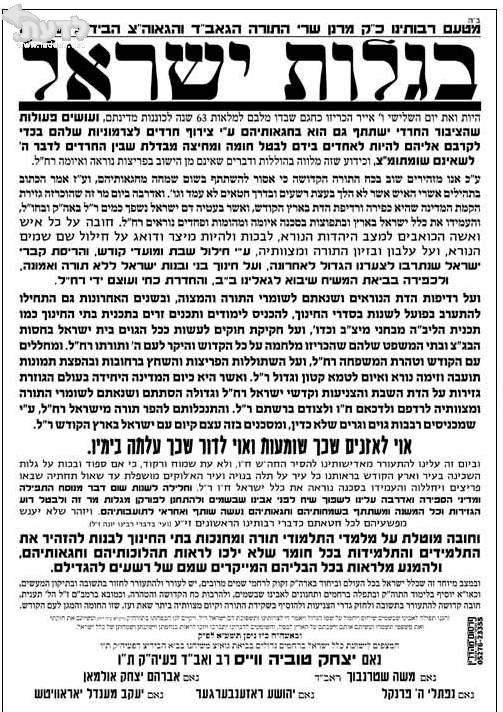
 The letter below was penned by famed Rosh Yeshivah of






You must be logged in to post a comment.