Vote No!

I received this, and am passing it on.

Please can you take a few seconds to go on online and vote “no” to this criticism of Israel (poll at foot of article): http://www.theguardian.com/global-development-professionals-network/poll/2014/jan/28/communications


You will probably be aware of the controversy in recent days because of the actress Scarlett Johansson agreeing to be the advertising face of Sodastream, the manufacturer of machines for making carbonated drinks at home.

Sodastream is an Israeli company which has a manufacturing facility in Area C of the West Bank, at a site which may well become part of Israel in any peace deal. Because it operates in the West Bank it is the subject of intensive boycott campaigning by anti-Israel protesters, including protests at its store in Brighton, here in the UK. The company employs hundreds of Palestinian workers, with pay and conditions well above the Palestinian average. Their livelihoods are at stake if the boycott succeeds. You can read more about Sodastream’s operations in the West Bank here: http://forward.com/articles/170873/boycott-israel-push-against-sodastream-could-hurt/

Scarlet Johansson is also a global ambassador for Oxfam. The boycott campaigners are calling for Oxfam to drop her from this role, in line with Oxfam’s critical position towards Israel.

The Guardian website is running an unscientific online poll about whether Oxfam should break its links with Scarlett Johansson.

At the moment it is running 85% in favour of this attack on Scarlett Johansson’s links to an Israeli company.

Please can you take a few seconds to go on online and vote “no” to this criticism:http://www.theguardian.com/global-development-professionals-network/poll/2014/jan/28/communications

Please then forward this email to your friends and family and ask them to vote “no”.


Michael Danby’s critique of OXFAM can be seen here

Gelatine? I’m hardly surprised

The issue of gelatine and the view of R’ Chaim Ozer is  well-known and as old as the hills. Sure, the Oilom Goilom think that someone has suddenly leaped to R’ Chaim Ozer’s defence and set him back up on the pedestal of decisor for all. Well, R’ Chaim Ozer was and remains so! On the issue of Gelatine from Cows (not Pigs) however R’ Chaim Ozer’s Psak was not accepted.

So what next? You can expect Meir Rabi to scour every nash in order to ascertain that they definitely don’t use pig gelatine and then make a splash that the delicacy is now suddenly kosher after all.

Well, the facts are that all major world-respected Kashrus authorities didn’t and don’t accept R’ Chaim Ozer’s Psak. Those of you who want to follow Meir Rabi and his company (they curiously claim a”community service”, heck, it’s a private profit making business making money out of declaring things kosher) go right ahead.

For the rest of us, I suggest you read Rabbi Eli Gersten, here.

Modern Orthodox High School in New York Allows Girls to Wear Tefillin

[Hat tip from Krakover]

This is from the forward.

Two SAR Students Break Ritual Barriers

Published January 20, 2014.

SAR High School, a Modern Orthodox institution in Riverdale, New York, is now allowing girls to wear tefillin.
Rabbi Tully Harcsztark, head of the school, sent out an email explaining that two girls were granted permission to wrap tefillin at the school’s daily all-girls meeting,reports the Boiling Pot, the online student newspaper of Shalhevet High School in LA.
 
“I have given permission to two female students… to put on tefillin during tefilah,” Rabbi Harcsztark wrote Dec. 8, in an email to the school’s faculty, obtained by The Boiling Point. “They do so every day and have not been permitted to do so in school until now. “I believe that it is halachically permissible although it is a communally complicated issue.”
 
Ronit Morris (‘15) and Yael Marans (‘16) will now be wearing tefillin every day, the SAR Buzz reported.

“(This mitzvah) has been very important to me for a very long time and I’m really glad to be doing it at SAR,” Morris (‘15 told the Buzz. “I started putting on tefillin after my bat mitzvah. I lay tefillin for three years straight at [Solomon] Schechter every morning, and then I came to SAR and it did not seem like that was a thing that the school was going to go for at the time, and we put it off for a while.”
 
Marans (‘16) told a similar story, adding that her mother also wore tefillin every day. “Just before my bat mitzvah, I began putting on tefillin. It was just what my mom did, and, of course, what my brothers did,” she explained. “But I was one of a few girls in my grade that did. It made me think a lot about individuality, and eventually, when I wasn’t so overwhelmed by this new ritual, I realized it was making me think about God. I’m not going to say that every time I lay tefillin I feel a renewed awe of God, but sometimes it really makes me think. It’s just something in my day that makes me really conscious and concentrated.”
 
According to a Ricki Heicklin, a senior at SAR, meetings with every grade were held to address the reasoning behind the controversial decision.
 
“There were a handful of students who saw tefillin as something strongly correlated with the Conservative movement.” Heicklen told The Boiling Point, adding: “I strongly support the girls and I think it’s absurd that anybody would be upset about Rabbi Harcsztark’s decision.”
 
“Regardless of my personal choices, I think everyone at SAR should be allowed to connect to Hashem in whatever way they find meaningful, as long as it falls within the scope of halacha, which this clearly does,” Heicklen said.
 
Praying with tefillin — boxes containing the Shema prayer that are wrapped around the head and arm — is an obligatory mitzvah for boys. 
 
Girls are not forbidden to do so by halacha, but rabbis from different streams of Judaism disagree as to whether or not they should.
My opinion on this and similar matters has remained steadfast over many years. It is greatly influenced by the views of the Rav and R’ Moshe Feinstein.
There will always be people who do things which are permitted according to Jewish Law, when performed in earnest, not as a temporal manifestation of a Jerusalem Syndrome or the like, and most certainly not motivated in any shape of form by the populist egalitarianism and equality arguments bandied about by the left, as if they are the two missing links of the ten commandments.
Let’s call it as it is. Men and Women are existentially different. Period. The Torah  also provides for different roles and responsibilities. This is a legally grounded Mesora.
There are degrees of freedom. They are applied, also based on Mesora, to those who have attained a certain level of kedusha. That’s not the same as saying that every man already has that kedusha when they are born, of course. They do not.
There have been female Rebbes. Read about it. There have been and are women who put on Tefillin. Maybe some want to wear Tzitzis etc. Those who are at that level, consult a Rav, and act accordingly. Judaism hasn’t censored these acts or hidden them. It is condoned, but it is controlled.
What I do object to, is the institutionalisation of such practices. No school or similar should allow these things to be done with the style of pomp and ceremony implied by the article above. Those girls are quite capable of doing these things, in a modest way, without their school or they advertising their predispositions.
I don’t say Tikun Chatzos. If I did, frankly, I’d be a complete joke. Why? I’m simply not at a level that I could meaningfully sit and cry each night at midnight about the Churban. Those who do, do so in private. Sure, some of their family will know, but they do not make it known, nor do they announce a Tikun Chatzos evening.
One of my daughters who attended Lindenbaum (Brovenders) started to get sick and tired of her Halacha class. I asked her why. She said, because they were learning the laws of Tzniyus and most of the girls (from the USA) who are extremely bright, were attempting every which way to argue with the Rav, about sleeve lengths, hem lines, and neck lines. They started with the premise that the lines (sic) were too long, and then tried to argue their way through the sources to find support for their views. The Rav who taught, engaged them, quite correctly, explaining the various views etc. Eventually, my daughter stood up in the class (as an Aussie would) and said
“Hey, I came to learn Halacha. I didn’t come to spend months arguing about skirt length and pants etc. Many of you don’t keep these Dinim anyway, and you argue. Just accept what the Halacha is, and if you can’t/don’t keep it, then it’s your business with Hashem. Can we move onto other topics please.”
I was proud of her. That’s not to imply that my daughter was a paragon of Tzniyus etc. Rather, her balance was there, and she was more comfortable knowing what Halacha and Mesora were, and their parameters, than trying to somehow stretch and play with it so that they matched her parameters of comfort.
Ten females will never be considered a Minyan. That’s another halachic axiom. If you have Yiras Shomayim, you accept it. If your religion is egalitarianism/equality, you won’t.
It reminds me of words my father ע’’ה used to say in Yiddish when I asked him a question he didn’t think he should answer:
Do you have to know, or do you need to know

Guest post on the travels of B’Nei Yisrael

Thanks to Meme.

Ramses Sukot Migdol Pi-Hachirot Sea Eitam Shur-Desert Mara Eilim Sin-Desert

This is not a map, just a schematic presentation.

שמות טו-טז
1. ויסעו מסוכות ויחנו באיתם בקצה המדבר
Going from Sukot to Eitam one has to cross the sea

2. וישובו ויחנו לפני פי-החירות בין מידגול ובין הים
They returned and parked ahead of Pi-Hachirot between Migdol and the sea. Going back from Eitam to Pi-Hachirot they had to cross the sea in the opposite direction than before – they returned.

3. ויסע משה את ישראל מים סוף ויצאו אל מדבר שור
To get to the Shur-Desert they had to cross the sea again.

4. ויסעו מרתה, ויבואו אלימה, ויסעו מאלים […] אל מדבר סין.
We see here that BNE YISRAEL crossed the sea three time, one of the crossings was by going back toward Egypt.

Now, let us look at the description in SEFER BAMIDBAR.

במדבר לג
1. ויסעו […] מרמסס ויחנו בסוכות. ויסעו מסוכות ויחנו באיתם בקצה המדבר
Going from Sukot to Eitam they had to cross the sea.

2. ויסעו מאיתם וישב על פי החירות […] ויחנו לפני מיגדול
As we saw in SHMOT, Moshe took the folk back from Eitam to Pi-Hachirot. As there, also here they had to cross the sea in the opposite direction.

3. ויסעו מפי החירות ויעברו בתוך הים המדברה […] במדבר איתם ויחנו במרה. ויסעו ממרה ויבואו אלימה
Now they have to cross the sea, but this time it says that they crossed it by going into the sea, and they eventually reach Eilim. Here they did not go as far as the Sin-Dessert as mentioned in Shmot, but instead:

4. ויסעו מאלים ויחנו על ים סוף. ויסעו מים סוף ויחנו במדבר סין
Here we have another march back toward Egypt. It is not mentioned in Shmot. Did they cross the sea here or just stopped at the sea-shore? All the same, after looking at the sea for the last time they leave Yam-Suf and reach the Sin-Desert, which they did in Shmot going directly to it without returning to the sea.

What we see is that the journeys of Israel, after leaving Egypt, was forward and backward. They cross the sea and reach the desert. Paroh says: the desert closed on them (not the sea). When Paroh dicides to go after Bne Yisrael, Moshe takes them back to the sea. What happened there at KRIAT YAM SUF we all know.

What is surprising is that in Shmot we have three crossings of the sea, one of them in the opposite direction. In Bamidbar we have also the three crossings, but before getting to the Sin-Deseret they go back to the sea once more.
At KRIAT YAM SUF we know how Moshe and Israel crossed the sea. I wonder how were the other sea crossings done?

Remembering Ariel Sharon ע״ה

[hat tip yw]

I enjoyed reading this article from commentary magazine.

How much more of this “it’s not treyf, fress” do we need to endure?

Someone  emailed me a posting from Meir G. Rabi, this time on Golus Australis (Hi Alex and Yaron, hope the bubba is well.).

Here we have the self-proclaimed Rabbi of a private profit-making business, mitzvah doing business that seeks to (surely) try and make/proclaim as many things as possible Kosher (within a solitary perception of halachic understanding) this time drawing Gzeiro Shavos from the London Beth Din web site and pasta production guidelines.

It’s a new Talmud? maybe it’s Tosefta D’R’Meir Gershon.

Meir still basks in the mystery of not telling anyone from where he got Smicha and where he did Shimush in Kashrus. Any other Rov I’ve asked, tells me immediately. Meir isn’t any other type of Rabbi. Maybe he’s more comfortable telling us about the unverifiable stories regarding Rabbi Rudzki’s pleas for him to to take over. I’m sure he won’t tell you about how the Abaranok family wanted every single mention of Rav Abaranok זצ’’ל and היס picture completely removed from that web site. Anyway, even if what Rabbi Ruszki said these things: (a) they are no longer relevant, and (b) they aren’t necessary to start your own business venture with a partner, in kashrus.

So, I am just ranting? Nope.

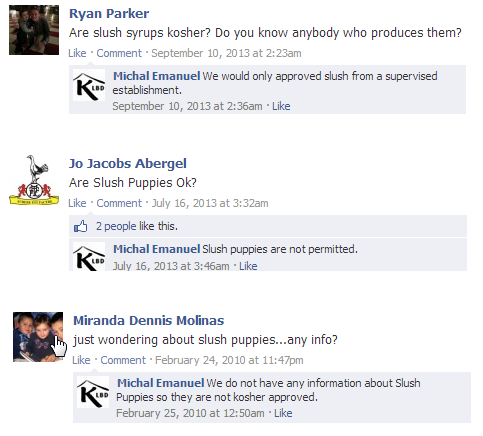
They quote the London Beth Din. Well they do have Slurpees there, except (typical Poms) they call them “slush puppies”.

Some tidbits:

Screen Shot 2014-01-13 at 2.32.13 pm

Alex and Yaron, and others, get off the bandwagon, and try and follow Emes

PS. Anyone who thinks the aim of the respected Kosher Australia is to make as much Kosher food acceptable, is quite correct. I had my own interaction with Schweppes, who used the law to tell me that they were not obliged to advise on what goes into their drinks. I missed their Diet Tonic Water. There is no Diet Tonic Water. Schweppes didn’t care about the Kosher market, even if it was kept confidential. Cocal Cola we can know, but the Heiliger Schweppes, won’t tell us anything.

Someone got angry with products that have a Halal symbol

I was sent this for comment (I’ve deleted most of the bits which aren’t relevant and may be legally problematic)

A Halal certification stamp?!?! Seriously???…  It’s bad enough that sometimes I am eating an Australian owned product and I see the Halal symbol, and believe me I try very hard to avoid this ….

….

Most people would be concerned about the price of Kosher and Chalav Yisrael goods. Those for whom it is an issue (the price differential), with respect to the latter they may choose to rely on the Chazon Ish, R’ Moshe Feinstein, and the Pri Chadash and more to drink today’s Chalav Stam in a civilised country. An answer to prices is often competition.

On the issue of Halal, I have to say it doesn’t bother me in the slightest. I’d like to think that if it increases sales in any way, then this will be reflected in a reduction in price for those who cannot rely (for whatever reason) on those who think there is nothing wrong with Chalav Stam in Australia and elsewhere. They certainly have who to rely on. Those with a Kabbalistic bent have other considerations.

Arik Sharon, may he have a complete Refuah Shelemah

Rabbi Yisroel Rosen of Zomet, wrote the following. I disagree about the Tzeduki part.  I do not believe for one minute that Ariel ever took his eye off the ball or that he didn’t do what he thought was best for his country and people. Rabbi Rosen, with respect, was never in the cauldron of international politics, but lies in Milchamta Shel Torah and Technology. As he lies in a very precarious state, I also believe it is in extremely poor taste for Rabbi Rosen to express these views while the Satan is Mekatreg. If you can’t say something good about someone on their death-bed, don’t say it.

As for the Chashmonaim, we knew they wouldn’t last. They were Cohanim.

“In the End He became a Tzeduki” / Rabbi Yisrael Rosen
Dean of the Zomet Institute

“Yochanan the Kohen served as a High Priest for eighty years, and in the end he became a Tzeduki” [Berachot 29a].

From the Depths of the Expulsion…

As soon as Ariel Sharon, the Prime Minister at the time, fell into a sick bed eight years ago, I wrote an article in this bulletin with a title that is still relevant today: “One Tearful Eye and One That is Dry” (Issue 1100, Tevet 5766, January 2006). Here is the beginning of the article, written with tears in my eyes:

“One eye is ‘filled with tears’ for this glorious warrior, often decorated in the past for bravery and strength… He was a man who deserves credit for several of the victories during the past wars. It can be said that in his techniques of war he embodied the military approach of active deterrence, meaning that he moved the battlefield across the enemy lines, to the heart of their fortresses… Sharon educated generations of commanders in the spirit of ‘after me’… As a ‘man of the fields’ from his earliest days, as a ‘man of the land’ who clung to the concept of love of the land, based on his ingrained Mapai instinct, he knew to follow the principle of the Rambam, that settlement provides more of an act of possession than conquest (see Hilchot Beit Habechira 6:16)… in spite of his secular way of life he appreciated the traditions of old, and he insisted on the Jewish identity of the State of Israel.”

The weeping eye, on the other hand, is not for “Arik” the man but for his historical rejection of the principles of Zionism and of the security of Israel, which he had so strongly developed and defended. As far as all those “in the know” are concerned, this turnabout was meant to cover for crimes in the realms of finance and criminal activities. Thus, using transparent and crushing guile he quickly became the “darling of the left” by putting his massive weight behind the operation of evacuating Gush Katif and the Gaza Strip. He knew very well that there are judges in Jerusalem who read the newspaper Haaretz, where an article would be published with a headline along the lines of, “Democracy and Corruption can Wait their Turn.” Those who would destroy you from within were given immunity by the courts of the earth, down below! The deeper the expulsion went, the greater was the level of pardon available.

However, there is also a court in the heavens. And here is what I wrote in this column five months ago (issue 1483, Av 5773, July 2013:

“More than once I have asked myself and my readers what the Holy One, Blessed be He, is hinting at by the unpr ecedented act of suspending Arik Sharon as in a slingshot between heaven and earth, in an unprecedented coma between life and death, for so many years. Can it be that his body and soul will only come to final rest when all of his ‘partners in crime,’ both political and military, will apologize and repent for their actions? So far only a few have done so, and they were mostly lower-level participants. Recently, these people were joined by the deputy head of operations of the police at the time of the events and by one of the perpetrators who came to his senses, General Gershon Hakohen.”

A Commission of Inquiry Before and After

This accusation that has been brought against Arik Sharon, that the decree of expulsion was born as a result of his own personal interest, is based on strong circumstantial evidence, and is a very serious matter. The same is true of accusations of traitorous activity or worse. As time passes, I have been waiting for these matters to be thoroughly investigated by establishing a “Commission of Inquiry of the Motives of the Expulsion from Gush Katif and the Gaza Strip, and of the Results.” This should begin as soon as possible, while those who are privy to the information are still with us.

Another reason for the urgency of appointing such a commission is linked to the frequent repeated visits to our region by the American Foreign Minister, John Kerry. Everybody knows that in the balance Kerry holds the destruction of many settlements in Yehuda and the Shomron (and the Jordan Valley?), G-d forbid. I cannot be sure that a commission will accept the suggestion that the motivations for the previous expulsions were as explained above, perhaps it will leave room for an explanation that the motive was a real hope for and belief in “peace.” But one thing is certai n: In the summary section of the commission’s report, it will be written clearly, in black and/or red, that nothing was accomplished by this move. Just the opposite – on all fronts, we are in a worse situation than before – with respect to security, international relations, deterrence, and of course the values of Zionism and settlement activity.

Did a Chashmonai Warrior become a Tzeduki?

At the beginning of this article, we quoted the words of the sages about the possibility that even Yochanan the High Priest might have become a Tzeduki (who opposed the rule of the Perushim, the traditional rabbis). He might even pour the water of libation (on Succot) on his feet and dirty them, as required by the Tzedukim, instead of sanctifying the Altar of G-d.

In Chassidic lore (in the name of Rabbi Baruch of Mezhibezh, in the book Butzina Din’Hora), a remarkab le assertion is made – that “Yochanan the High Priest” who became a Tzeduki was none other than the father of Matityahu the Maccabee, who is known to us from the “Al Hanissim” prayer (“In the days of Matityahu Ben Yochanan, the High Priest…” – admittedly, many commentators insist that the two priests named Yochanan are not the same person). Thus, we see that even a Maccabee who fought valiantly and with great courage, the few against the many, is liable in the end to reject his status as a warrior.

Rabbi Tzvi Elimelech from Dinov, in the Chassidic book Bnei Issasschar (Kislev-Tevet number 4), also saw the two priests named Yochanan as the same person: “At the time, this great and holy man made a terrible mistake. But then his son Matityahu came and made a new oral mitzva (which the Tzedukim did not accept).”

Will the Matityahu (or is it Netanyahu) of our generation also correct the error of his predecessor?

Calling on Meir and Kalman

Hi there,

Are you a private Kashrus business who has a more lenient (you will say pure) take on just about everything (yes we know about your comments re your Mashgiach Temidi at the mostly Treif Limor’s and how you are ‘better’ than KA) and are there for a combination of profit and wages for yourselves, together with a dose of ‘we are a God fearing service who are here to provide more options to the genuine kosher consumer’ and we are not getting rich from Kashrus

OR

Are you a business whose aim is NOT to make profit but to ‘benefit’ the we don’t eat treyf community with all manner of new delicacies like the Manna of yore.

Which is it? We know of your unsubstantiated claims re Rabbi Rudzki whose hechsher the frum world across the board did not rely on, but who was a fine man. We know of the attempts at legitimisation by rather transparently poor attempts at ‘association’ with respected Rabonim of the past and present. Those convince nobody. They are actually an insult to anyone with half a brain or half an honest approach to life. It’s good that you continue this line of pseudo self justification as opposed to telling us with whom you did Shimush in Kashrus.

Tell us about your financial policy. Are you profit makers through providing licences or are you jewish utopians who do favours with your expansionist views of what’s not treyf.

Meir, do your children and family eat at your establishments or have your food products in their houses? Does your wife eat Krispy Creme now? Is it only because of alignment with Beis HaTalmud or Adass that stops them trusting Daddy or Zeyda? You know the answers. Share them?

Do you drink Chalav Hacompanies?

You guys LOVE publicity … How about actually answering these questions or are we just going to see you visit Shule after Shule week after week, often talking (self promotion?) and not seemingly davening at many Shules? I watched you mysteriously turn up for Eicha I think it was at Elwood once. You were too late turned around and left. What’s the deal?

Oh, I see it as do the Oilom at large.

But I’m not a ‘Rav Hamachshir’ I’m just a regular from the Poshei Yisroel who wouldn’t touch ‘it’s not treyf’ with a barge pole.

In case you are wondering, what promoted this post was my experience in South Africa where things are done right.

Powerful speech by Rabbi Riskin on kiruv

This is well worth WATCHING

[hat tip DM]

Talmidei Chachomim earning a living

I have written about this here.

I don’t always agree with Rav Aviner. For example, I disagree vehemently with his attitude towards Rabbi Elon. On the issue below [Hat tip NB]  he is undoubtedly right. There isn’t any reason someone who knows Torah and continues to learn should be a pauper. If they do want that, perhaps they should set up a Kollel in Vietnam?

Prominent Dati Leumi Posek Rabbi Shlomo Ha-Cohain Aviner Shlit”a addressed a statistic reporting that 40% of Charedim do not work. The Rav stated that due to the economic realities in Israel today, an Avreich (married Yeshiva student) must learn a profession that permits him to support his family. “A Talmid Yeshiva cannot remain in Yeshiva indefinitely. He must earn a living and it is not enough to say ‘Hashem will take care of things and it will be fine’”.

He told students during a Shiur that there are Avreichim who go to soup kitchens daily, and that in some Charedi homes children regularly go hungry.  That is why a husband must be able to earn a living. A Talmid can learn for a number of years as everyone must, but at some point one must reflect and determine if one will be a Rav or Rebbe and if not, it is time to look for work. The Rav added that not everyone is suited to be a Rav or Rebbe, though most believe they are, and while one may be a Talmid Chacham there is still the issue of earning a livelihood. Batei Medrashim are bursting with Talmidei Chacham that do not have work because all of the jobs in the Yeshivot are taken.

The Rav then addressed Avreichim who used to make do with the bare minimum. “Once upon a time, man slept on straw like Rabbi Akiva and this was fine.  But today it is not possible to live like this. We may sleep on straw but how will one pay tuition for one’s children? One does not have to eat Prili (type of fruit yogurt) daily but even when living austerely there is a need for money to pay for different necessities.  We cannot change reality with Pilpul. Perhaps in Vietnam one can survive on one dollar a day but in Israel it is impossible.”

The intrepid ‘hashgocho’ strikes again

(Guest Post)

I received this from a reader.

On 1 January Meir Rabi posted on his Facebook page and website that Krispy Kreme’s glazed doughnut is kosher (see http://www.kosherveyosher.com/products–services.html).

However, Krispy Kreme has NO KNOWLEDGE of Meir Rabi’s hechsher!

See my correspondence with them below.

Obviously, Meir Rabi did not contact the company for information, nor visit the production facilities.

Yet again, he has declared a product kosher without ANY investigation whatsoever!

> From: australia2@krispykreme.com.au
> To:
> Date: Wed, 8 Jan 2014 08:06:44 +1100
> Subject: RE: Contact form from krispykreme.com.au
>
> Hi xxx,
>
> Thank you for your enquiry.
>
> Unfortunately, Krispy Kreme Australia products are not Kosher certified.
>
> Kind Regards

All we hear about is controversy and conspiracy theories about “Chesed”

I was gob-smacked to once more learn about (in general terms) the constant and consistent help being given by  http://www.jewishtaskforce.com.au to all sectors of the community.

This voluntary group has been quietly doing a great job behind the scenes, and in public view with their education programs. It seems to have one agenda, and that is the protection and education of those encountering current and potential violence.

People would be shocked to find out that this violence occurs throughout the gamut of our “holy” and not so holy communities. Who helps them? The Jewish Task Force. Who else?

What is their reward? It will be from above. The Vivien Resofskys of this world  seem to criticise almost every initiative taken by any organisation, quoting chapter and verse of sometimes obtuse theoretical approaches to how it “should be done” and dissecting every word that is uttered in a press release. I’d be happier to read about the good deeds and results as opposed to theory.

This cross-sectional committee of the Jewish community are to be commended. They are great women and by the nature of their work, not too many survivors of such violence will feel comfortable to express their public thanks. I understand that. There are people who deal with issues, effectively, and seek no limelight, let alone a salary.

I have conferred with the task force for advice when I knew of an unsavoury situation or two, on an unofficial basis, and found them thoughtful and sage in their advice.

חזק וברוך

Johannesburg and Melbourne

I have never been to South Africa. If you would have asked me 3 months ago whether I would have two future sons-in-law both born and bred in South Africa, I would have looked strangely at you.

My connection to South Africa commenced over 30 years ago when I was learning at Kerem B’Yavneh. Naturally, I found them “closer” to Australians, followed by the English, and the non New York, Americans: New Yorkers were another species altogether, as removed as Israelis. One of my Chavrusas back then was a young earnest Masmid (always learning) named Stanley Moffson, now known and loved throughout South Africa as Rabbi Shmuel Moffson of Ohr Someach fame. There were other South Africans, but I don’t even remember their names.

We could share cricket with the South Africans and Poms, but that was it. On Thursday nights we had Mishmar, where traditionally one would endeavour to learn all night. We didn’t learn all night, in general. By about 1am our brains were mush, and the words really just spun on the page (at least that’s true of me). We had a tradition of going to the basketball court, and playing 5 a side soccer for the rest of the night. Here again, the Poms and South Africans, Aussies, and Europeans studying at KBY would “go for it” as if we were representing our country. I still remember one mature English guy who used to play as sweeper and he had me on a string. I couldn’t ever get passed him: the memory still frustrates.

By the time my older son went to learn at KBY, they had a gym. This was a great idea. You need to have outlets, especially for the kids of our day, but I digress.

So, here I was an Avel no longer saying Kaddish, and our youngest daughter is engaged to a nice young man from J’Burg. We try to organise dates, but my wife is in New York for the engagement of our middle daughter, also to a J’Burger who has been in the States for a while. It was nigh on impossible to re-route and change things for my wife so she could also make the J’Burg engagement. I offered to try to book a flight which would take me to NY and then to J’Burg so I could be at both, but my wife insisted that if I’m at both, then she has to be at both. Fair enough too.

It was high season. I managed to get a flight on a full plane via Perth. On the way back I travelled on Kratzmech, and that was a Mechaye because there was plenty of room (and it was Qantas).

Arriving just after 5am in the morning, I was picked up by my daughter and the future Chosson. We dropped my daughter off, and I went to Shule on the Thursday. I didn’t realise it but I had sat (as I usually do) in the back of the Shule (the Chabad house in Sandton under Rabbi Yossi Hecht who was overseas), and the regulars thought that I was a Schnorrer. Now, if they had only had given me some Tzedoko!

I was called up to the Torah as Cohen, and although I’m uncomfortable saying HaGomel (according to the view of the Rav, Rav Soloveitchik given how relatively safe flying is), I did so and not become controversial. The Mechutan was also sitting in a back corner, and I didn’t notice him and hadn’t approached.

Davening ended and everyone shook my hand and said Sholom Aleichem and that was that. They remarked later that they were expecting me to pull out a few sheets of paper testifying that I was a genuine collector.

The thing that struck me was that apart from two dressed in dark suits, the rest of the Minyan looked “ordinary”. They weren’t bearded, were casually dressed, etc. I wondered what the attraction was to coming so early to Shule so early during the holidays. I know that mainstream Shules in Melbourne struggle to get a Minyan each day. The Mispallelim come three times a year and if you are lucky to a Yohr Tzeit. These guys, as I saw came for Shacharis and Mincha/Ma’ariv and I was to learn that this was not unusual.

As I was still technically an Avel, I did not allow myself to go touring and made do with the gym/jacuzzi/shvitz facilities at my hotel. That was therapeutic, and was a Menuchas HaNefesh and Guf which I really needed. My wife needed it as well, but she was in the snow of New York, wearing out the American Express card.

In my travels, I noticed that there seemed to be one and one only Kashrus organisation. There were no maverick entrepreneurial Rabbis who went off on their own for “utopian interests” which were really for “our” benefit. The result was that I could go into Woolworths and pick out items and find a stamp, a single stamp, in much the same way as the OU operates. What a Mechaye. Why was it happening here and in Melbourne we seem to have two Kashrus organisations: Kosher Australia and Adass, as well as the more recent  smaller maverick operation run by R’ Rabi. I won’t even start writing about the mess in Sydney where they simply can’t get their act together and separate Kashrus from Money, and agree on a single operation for all, without even a smell of self-interest.

I then asked where the so-called Charedi community “hung out”. I was to learn that J’Burg was pretty much void of (Hungarian) Chassidim. There was no “highest standard” Hechsher run by a separate Beis Din, where OO is EE, and separatism is a way of life. No, here, the Rabbinic institutions were set up by Litvaks. Even the Chief Rabbi claimed to be a Telzer, even though he apparently had learned only in South Africa.

What of Chabad? They certainly existed and were everywhere with really professional Chabad Houses augmenting the large choir-style Shules. I bumped into the charismatic R’ Sholom Ber Groner, who I knew in Melbourne. In fact, he gave me goose bumps each time I spoke with him in learning because so many of his mannerisms reminded me of his saintly father. He told me that the Ramash נ’’ע had written a letter to the Rabbonim many years ago that they should always work within the existing Rabbinical organisations and not separate themselves into another group. The Ramash was of course quite brilliant, and it came as no surprise that such sage advice was given. The result was that the Litvaks and Lubavitchers had mutual respect and genuine Chavivus. They worked together. The Beis Din is Litvak heavy but universally respected. There was a time when Chalav Yisrael was difficult to obtain, but they managed. They have “Mehadrin” Shechita which effectively means Chassidishe Shechitah. You can find that on menus in fleishig restaurants.

I guess the overall feeling had been of peace and fraternity between Rabonim, and I would argue that this is South Africa’s secret. There are no fifth columnists and private hashgochas and certainly no aspersions being cast around that “I’m frumer than you”.

The “Yavneh College” style school also impressed me. The primary school is mixed, but the high school is separate between males and females, and the males who want, have a Mesivta program where they can come back at 7pm for more learning. I was gob smacked. If something like this existed in Melbourne, with non Charedi teachers, I think Yavneh would really differentiate itself and move to a higher level of Chinuch. Again, I digress.

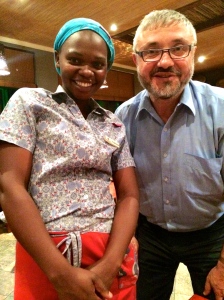
Yet, despite all this, many Jews from SA left. The apartheid was horrible and I detected racist feelings amongst Afrikaaners. When I suggested that it would take a generation or two of education and opportunity for reform (on the criminal level) to materialise, I was told “No, it will never change”. I loved watching the B’Nei Cham, with their ultra thick hair and perfect teeth walking around the Mandela mall. As someone who came from a persecuted people, I felt a natural affinity. I spoke with anyone who would talk to me. I could have done this for weeks. I loved them, I just felt that I had a duty to lift their morale and make them feel entirely comfortable. I tipped them too much, but what the heck. Their names were just wonderful. Names like Romeo, Delicious, Precious, etc were common place. The ones who worked in the Chabad houses were very well looked after and respected as human beings and I just loved being in that type of morality. The pejorative “Shvartzer” never passed my lips. What was Tzippora? What about Batsheva? What about our Sephardi brothers and sisters. Who are we to comment about any such things.
IMG_3058

Where was the Reform and Conservative movements, let alone the neo conservadox style movements? They barely existed. Why? In a place where Orthodoxy exudes peace, friendship and a typically Chabad and Ohr Sameach non judgemental approach to human relations, this is the most powerful antidote to counter these inaccurate and inauthentic branch offs from authentic traditional Judaism.

I came away with a great feeling. Yes, there are some security issues. Yes, you need to not go on your own without advice etc. There are challenges. As a community, though, I have to say that in general, although we might have more Kollels, their institutions achieve so much more and are more outward looking and manage to enfranchise individuals.

Disclaimer: I was only there for a week, and no doubt I was on a high, and perhaps ignorant and oblivious to various issues. This is my overall impression, however. In Melbourne, if you pass someone from a different “caste” you’d be lucky if they acknowledged you with a Good Shabbos when passing them. We have much to learn, not the least of which is learning to mind our own business and not whispering about every “bad” thing that happens in someone else’s family.

Guest post from Meme: Parshas Beshalach and more

Comments welcome.

ויהי בשלח פרעה את העם. שבט העבדים יוצא לעבוד את ה’ שלושת ימים במדבר. הוא לוקח עימו את הנשים, הילדים, הצאן והבקר וצידה לדרך. כאשר עברו אותם שלושת ימים מבין פרעה כי “ברח העם” והוא עומד להפסיד את עבדיו. העבדות של בני ישראל הייתה עבדות משונה. מצד אחד נוגשים ועבודת פרך, ומצד שני אותם עבדים הם הבעלים של צאן ובקר, שהם סמל הסטאטוס באותם ימים. זו הייתה מאין עבדות של עבדים קפיטליסטים. ייתכן שגם להם היו עבדים שטיפלו בצאן ובבקר שלהם כאשר הם עצמם עבדו בפרך.

בני ישראל נוסעים מסוכות ויחנו באיתם בקצה המדבר, ופרעה אומר: “סגר עליהם המדבר“. התורה ממשיכה ואומרת “וישובו” (על עקבותיהם) “ויחנו […] בין מיגדול ובין הים“. האם כבר עברו את הים והגיעו לקצה המדבר ונצטוו לשוב ולחצות את הים בכיוון ההפוך ולחנות ליד הים, בצידו המערבי, בצידה של מצריים? כבר אמרנו שפרעה אומר “סגר עליהם המדבר” ולא סגר עליהם הים. לאחר קריעת ים סוף הם ממשיכים אל מידבר שור ומשם מרתה, שם משליך משה עץ הממתיק המים המרים. משם אלימה עם 12 עינות מים ושבעים תמרים. האם יכלו להצטייד כאן במזון להמשך הדרך? האם שבעים עצי תמרים נותנים כמות פרי המספיקה לאותם 4 מיליון נפש יוצאי מצריים? מאלים נוסעים למדבר סין אליו מגיעים חודש לאחר יציאתם ממצרים, ב-15 לחודש השני.

אחר חודש של מסעות, במדבר סין, הם מרגישים רעב. אזלו המצות שנאפו בחיפזון, הצידה שלקחו עמם, והתמרים מנוה המדבר שבאלים. הם אומרים למשה ולאהרון:

“מי ייתן מותנו ביד ה’ בארץ מצריים בשיבתנו על סיר הבשר, באוכלנו לחם לשובע, כי הוצאתם אותנו אל המידבר הזה להמית את כל הקהל הזה ברעב.” טענה מוצדקת אחר הצמא של המים המרים ושהייה במדבר הצחיח. לא בכל מקום היה נווה מדבר עם תמרים. גם החלב מן הצאן והבקר שברשותם, החמאה הגבינות ואולי היוגורטים לא הספיקו. אבותינו היו כנראה אוכלי בשר, ולכן ביקשו בשר ולחם.

אז אומר ה’ למשה כי הוא “ממטיר […] לחם מין השמיים.” ה’ מבטיח למשה כי ייתן לעם לחם, אבל משה, על דעת עצמו, מרחיב את ההבטחה ואומר לבני ישראל:

“ויאמר משה בתת ה’ לכם בערב בשר לאכול, ולחם בבוקר לשבוע, בשמוע ה’ את תלונותיכם…”

תלונת בני ישראל על הרעב הייתה סיר הבשר ולחם לשובע שבמצריים. ה’ מבטיח לבני ישראל רק לחם משמיים. כדי לרצות את העם ולתת להם את כל מה שביקשו, משה מרחיב את ההבטחה לבשר וללחם. האם היה למשה סמכות או כיסוי להרחבת ההבטחה של ה’? בכל אופן, ה’ בא לקראת משה ואומר בהמשך:

“שמעתי את תלונות בני ישראל, דבר אליהם לאמור: בין הערביים תוכלו בשר ובבוקר תשבעו לחם וידעתם כי אני ה’ אלו-היכם.”

כאן ממשיכה התורה ומפרטת את המנה היומית של המן, עומר לגולגולת, וכדי שידייקו מציינת כי העומר הוא עשירית האיפה. התורה ממשיכה כי ביום השישי ייקחו מנה כפולה. אנו רואים פירוט רב על ההתעסקות במן. האם נאמר דבר על הבשר? כמה בשר עליהם לאסוף? האם גם את הבשר צריך להכין ביום השישי עבור שבת? האם ימצאוהו במחנה ביום השבת?

כאשר אני עובר מפרשתנו אל פרשת “בהעלותך” שבספר במדבר, אני נתקל בבעיה.

בפרשת “בהעלותך” שבספר במדבר נאמר:

והאספסוף אשר בקרבו התאוו תאווה וישובו ויבכו גם בני ישראל ויאמרו: מי יאכילנו בשר? זכרנו את הדגה אשר נאכל במצריים חינם, את הקישואים ואת האבטיחים ואת החציר ואת הבצלים ואת השומים. ועתה נפשנו יבשה, אין כל בלתי את המן עינינו.” יש להדגיש שהתורה אומרת שהאספסוף  התאווה, ואליו הצטרפו לאחר מכן גם בני ישראל.

משה פונה אל ה’ ואומר: “מאין לי בשר לתת לכל העם הזה…”. ה’ משיב: ” ואל העם תאמר: התקדשו למחר ואכלתם בשר כי בכיתם באוזניי […]  לא יום אחד תוכלון ולא יומיים לא חמישה ימים ולא עשרה ימים ולא עשרים יום. עד חודש ימים, עד אשר יצא מאפכם…”

משה, כלא מאמין למשמע אוזניו, שואל את ה’: “600 אלף רגלי העם… ואתה אמרת בשר אתן להם ואכלו חודש ימים? הצאן והבקר ישחט להם ומצא להם? אם כל דגי הים יאסף להם ומצא להם?” ה’ משיב לו בשאלה: “היד ה’ תקצר? עתה תראה היקרך דברי אם לאו.” ה’ מביא רוח שבעקבותיה באים השלווים אל המחנה.

הבעיה שלי היא: אם בפרשתנו, פרשת בשלח, קיבלו בני ישראל, כבר כעבור חודש מיציאתם ממצריים, את הלחם – המן, ואת הבשר – שלווים, מדוע בכו בפרשת “בהעלותך” כי אין להם בשר “בלתי המן”? הרי יש להם שלווים כבר מהחודש הראשון ליציאתם ממצריים? יש שלווים ועדיין מבקשים בשר? אולי בשר אחר? אבל גם שם לא קיבלו בשר אחר אלא שלווים.

חיפשתי תשובה לשאלתי אצל מפרשי התורה. ה”בכור שור (רבנו יוסף)” רואה את השלו של פרשתנו כסיפור השייך לפרשת “בהעלותך”. לדעתו, שניהם סיפור אחד הם. ולמה נכתב כאן? כי פרשתנו מדברת על המן וגם ב”בהעלותך” מדובר על המן, הכניס הכתוב את השלווים לפרשתנו. פירוש זה נראה דחוק. בפרשתנו העם רעב ורוצה אוכל, מבקש בשר ולחם ומקבל מן ושלווים. בפרשת בהעלותך העם אוכל כבר מן ומתאווה לבשר. בפרשתנו אין העם הרעב נענש בבקשו מזון, שלא כן ב”בהעלותך”, שם “ויך ה’ מכה רבה מאוד” את העם המתאווה לבשר.

חזקוני אומר כי השלו של פרשתנו פסק אחר שנה. האומנם? בפרשתנו נאמר בערב יאכלו בשר ובבוקר לחם – מן. האם כתוב בתורה שהבשר פסק והמן המשיך? האם פסקו בני ישראל לאכול ארוחת ערב? חזקוני מסתמך על דעתו של יוסף קרא שבתוספות בערכין. על מה מסתמך אותו ר’ יוסף קרא לא פורש!

הרמב”ן,  בהסתמכו על דברי רש”י במסכת ערכין (טו ב), ובניגוד לדעת יוסף קרא בתוספות שם,  אומר “שהיה השלו עימהם מן היום ההוא והלאה כמו המן”. הרמב”ן הוא גם הפרשן היחיד שמצאתי שדן בשאלתנו. הוא זהיר בדבריו ואינו בא לקבוע אלא אומר כי ייתכן והבשר שקיבלו בני ישראל החל מהחודש השני ליציאתם ממצריים לא היה מספיק לכולם. לא נאמר שכל אחד אסף אותו ולא באיזו כמות לנפש הוא נאסף כמו במן. האספסוף כנראה לא הצליח לאסוף, וכאשר הם התלוננו הצטרפו אליהם גם מבני ישראל שלא הצליחו לאסוף מן השלו ולאכול בשר. לפי דבריו יוצא כי איזה מסכנים או חלשים שלא הצליחו להידחף ולאסוף “מהסוכריות שנזרקו על החתן”, בא כל הכעס של ה’ והוא הכה בהם מכה רבה מאוד. קברות התאווה.

זאת הייתה שאלתי הראשונה לפרשת הבשר שבפרשת “בהעלותך”. אסיים בתמיהה נוספת.

אם, כאן בפרשתנו, נותן ה’ בשר שלווים להאכיל את בני ישראל מידי יום, ומשה רואה זאת במו עיניו כדבר יום ביומו, מדוע בפרשת “בהעלותך” אינו מאמין אותו משה, או מפקפק,  ביכולתו של ה’ לספק בשר, לא בכל יום אלא לחודש ימים בלבד ואומר: “הצאן והבקר ישחט להם ומצא להם? אם כל דגי הים יאסף להם ומצא להם?” בפרשתנו מרחיב משה על דעת עצמו את אספקת המזון ליוצאי מצריים. ה’ מבטיח לחם ומשה מרחיב את ההבטחה לבשר ולחם. לא זו בלבד שמשה מבטיח מה שה’ לא הבטיח, אין משה מפקפק כאן ביכולת להאכיל את העם בשר, ואין הוא שואל: “מאין לי בשר לתת לכל העם הזה…”.


Can or should an Avel perform Bircas Cohanim (Part 4)

Context:

Part 1, Part 2, Part 3.

Minhag Chassidim in general, and Minhag Chabad in particular.

Dayan Telsner, who is a good Yedid of mine, wrote a number of articles where he responded to my points in the local Chabad publications הערות התמימים ואנ’’ש

I am not challenging his right to pasken according to the minhag brought by the Ramoh, which he conflates as some universal practice throughout the Ashkenazic world, and for which he uses the ultra-strong words of מנהג עוקר הלכה,I believe out of context.

I will just post this excerpt from Chabad’s own התקשרות magazine, which is referred to religiously by Rabbonim and Chassidim in respect of how to behave על פי מנהג חב’’ד.

My translation follows:

It is written in the Shulchan Aruch HoRav (Ba’al Hatanya), “in our regions, where mourning extends until 12 months on a mother of father, and 30 days after another relative, the Cohen [Avel] does not Duchen, even if he is the only Cohen, and even on Yom Yov…”

But, in practice [despite the listing of the Ramoh by the Shulchan Oruch HoRav] I heard from many [important] Poskim in Chabad, and these include The Gaon and Chosid, R Osher Lemil HaCohen, of Beitar, and the Gaon and Chosid R’ Yisrael Yosef Hendel of Migdal Haemek, they they never saw [in Chabad] even outside Israel that an Avel would avoid Duchening.

They referred to the Nitei Gavriel [of R’ Gavriel Tzinner, who is the Rav HaMachshir of the Melbourne Eruv], who wrote that that the Custom of Chassidim is in accord with the Shulchan Aruch [and not the Ramoh] according to the practice of the Sephardim. He brings as support the view of the Kaf HaChaim, that according to mystical [kabbalistic] line of Judaic practice, one must Duchen even if he is a mourner. An in the responsa Mishnas Shlomo [R’ Shlomoeleh Vilna, the Dayan of Vilna] he brings that according to the Ari Zal, we are especially careful not to show any mourning on Shabbos and Yom Tov, and certainly no Cohen should refrain from Duchening because they are an Avel.

The Kaf HaChaim also quotes the [famous] Mekubal R’ Shalom Sharabi, that Duchening is from the “Great Lights”, and just like an Avel is permitted to wear the Tefillin of Rabenu Tam, which is also permitted because of the same concept as the “Great lights—מוחין דאבא’ a Cohen who is a mourner must also Duchen. He goes on further to write that that one should not even cause Duchening to be displaced during the Shiva itself, because Duchening is an integral part of Davening to the extent that if there is no Cohen, we use a different Nusach as said by the Shaliach Tzibbur.

Notwithstanding this opinion, during Shiva itself, Chassidim do not follow the practice of Duchening of an Avel, and neither do the Sephardim [despite the Kabalistic justification]

It is possible that the reason we do Duchen as an Avel, even in Chutz La’aretz, is because it becomes a very clear expression of public mourning if/when a Cohen who is an Avel purposefully avoids doing so. This is especially so in Chutz La’aratez where it is most noticeable because they (Ashkenazim) only duchen on Yom Tov.

I spoke about this with Dayan Telsner’s brother-in-law, Rav Sholom Ber Groner, and he told me that he would be lenient himself based on this Nitei Gavriel. Interestingly, on a number of issues where I mentioned to Rav Sholom Ber, that his father had a seemingly different opinion, that did not seem to worry him to the extent that he was ossified. He said, in fact, that some of his own opinions changed according to time and circumstance, and that was the way to Pasken.

I will close with two words which are ubiquitous in halacha נתפשט המנהג—the Minhag spread (or became established). These simple words imply as everyone know that despite the fact that there may well be competing MINHAGIM on a RANGE of item, an equilibrium often [but not always] emerges as the “prevalent minhag”.

I’m not here to change anything. I didn’t Duchen once Rabbi Telsner paskened that way in his Shule. I mention it one last time, because I disagree completely with the concept of ossification of quoted ancient minhagim when those are known not to be universally adopted!

Finally, if someone can actually point me to MINHAG CHABAD on this, I’d be obliged. I do not think it exists formally in the sense that it was ever enunciated. This lends more credence to my argument, I’d suggest!

Let me also note to anyone who had observed my exchanges with Rabbi Telsner, that this was ריתחה דאורייתא and God forbid that anyone should think that “bad blood” or “beleidung” would ever enter my head over such matters. I can’t think of a better way to spend time that talking and shouting Torah!

Chabad and Israeli Military Service

The following is from Israel National News. You would think that MK Stern is a tad naive. No Chabadnik would remotely consider themselves an emissary of anyone other than the Rebbe Ramash נ’’ע, in keeping with attempts to bring Geulah quicker.

That being said, he is suggesting that influencing Jewry to become more observant (albeit through the particular prism of the Chabad approach) is a formal State service. That, in of itself, is a significant development.

Wouldn’t it be deliciously ironic if someone who wasn’t going to go on Shlichus, now did so because they would (also) be serving the State’s needs in a different way to enlisting in the physical army?

Israel should recognize young adults who volunteer with the Chabad hassidic movement as having done national service, MK Elazar Stern (Hatnua) has proposed.

Stern’s proposal was accepted by the Committee for the Equal Burden of Service (Shaked Committee), the Knesset committee weighing Israel’s options regarding hareidi-religious military service.

Stern suggested that under certain circumstances, yeshiva students who volunteer with Jewish communities overseas should be recognized as having done national civilian service, an alternative to military service. Among those who would benefit under the criteria he proposed are Chabad youth, many of whom spend time overseas working with Chabad emissaries.

“There is an organization that is active around the world, on a purely voluntary basis, that does not get recognition from the state of Israel,” Stern said. “The Chabad movement sends people to every corner of the earth.”

Roughly 250-300 Israelis are volunteering with Chabad at any given moment, he said. Chabad emissaries engage in outreach and support to local people in places as diverse as Eastern Europe, Africa and the Far-East, and are often a welcome site for Jewish backpackers and tourists as well, providing them with kosher food and other services.

“There are many elements to the Chabad emissaries’ activity with clear parallels to civilian national service,” he said of Chabad’s social activism. “They do important work in Jewish communities around the world and we need to recognize their important work.”

“I want the Chabad emissaries out there to know they are emissaries of the state,” Stern declared.

The sorry plight of the victims of abuse

This academic paper may be of interest to some. It describes the victim of the “victim syndrome”. Although it is a working paper, it has attracted lots of interest


From the preamble:

People who suffer from the victim syndrome are always complaining about the ―bad things that happen in their lives. Because they believe they have no control over the way events unfold, they don’t feel a sense of responsibility for them.

One moment, they present themselves dramatically as victims; the next, they morph into victimisers, hurting the people trying to help them and leaving would be helpers with a sense of utter frustration.

People with a victim mentality display passive-aggressive characteristics when
interacting with others. Their behavior has a self-defeating, almost masochistic quality. The victim style becomes a relational mode—a life affirming activity:

I am miserable therefore I am.

In this article, I present three examples of people with this syndrome and a checklist that can be used to identify sufferers. I also discuss the concept of secondary gain—the “benefits” people get from perpetuating a problem and the developmental origins of the victim mind set.

The article ends with advice on how to help people who suffer from the victim syndrome.

Calling on the leftist intelligentsia: why only Moshiach will result in peace

I have long known about this rule of Islam and it never ceases to amaze me that “the west” remains deluded into thinking it will ever change

this is an excellent analysis and should be not only compulsory reading for all Jews, it should be compulsory reading for anyone.

I also reproduce it below from the Jerusalem Post in case the link moves.

The World From Here: Will Abbas defy Islam for peace with Israel?

by Dan Diker and Harold Rhode

“Can Israeli concessions influence the Palestinians to sign an historic peace deal that ends the Arab-Israeli conflict once and for all?”
Palestinian Authority President Mahmoud Abbas at a PLO meeting in Ramallah, October 2, 2013. Photo: REUTERS/Mohamad Torokman Israel’s release of convicted Palestinian terrorists and Prime Minister Binyamin Netanyahu’s reported agreement in principle to concessions in the Jordan Valley beg an important question: Can Israeli concessions influence the Palestinians to sign an historic peace deal that ends the Arab-Israeli conflict once and for all?

The experience of former prime ministers Barak and Olmert with their Palestinian counterparts may be helpful in understanding that even the most far-reaching Israeli concessions have failed to end the conflict for an historically under-appreciated reason: Palestinian Authority chairman Mahmoud Abbas would be required to defy Islam’s view of territorial sovereignty to arrive at a compromise with Israel. In short, once Islam conquers territory, it remains Muslim forever.

Two recent historical examples illustrate the problem. Following the collapse of the ill-fated Camp David Accords in 2000, former prime minister Ehud Barak summed up his experience negotiating with former PA chairman Yasser Arafat and the PA leadership in a “tell all” interview with Israeli historian Benny Morris. Barak said, “What they [Arafat and his colleagues] want is a Palestinian state in all of Palestine….Arafat does not recognize the existence of a Jewish people or nation, only a Jewish religion.”

According to the Barak interview, “Arafat denied that any Jewish temple has ever stood on the Temple Mount in Jerusalem and this is a microcosm of his denial of the Jews’ historical connection and claim to the Land of Israel/ Palestine, which from his point of view has been Muslim since it was conquered by Islam in 637 CE. Hence, in December 2000, Arafat refused to accept even the vague formulation proposed by former US President Bill Clinton positing Israeli sovereignty over the earth beneath the Temple Mount’s surface area.” Dennis Ross also noted in his book, A Missing Peace, that Arafat even refused to concede the ancient Jewish Western Wall to Israel.

Abbas is also “claimed” by Islam’s view of territory. As Arafat’s loyal deputy at the time, and as Arafat’s successor, Abbas similarly denied the existence of Israel’s ancient temple as recently as July 2012, telling an Israeli Arab daily, “Anyone who wants to forget the [Islamic] past [i.e., the Israelis] cannot come and claim that the [Jewish] temple is situated beneath the Haram [the Muslim shrines].”

Abbas’s dedication to Islam’s uncompromising sovereignty over Muslim territory also explains his rejection of Olmert’s equally far-reaching peace offer in 2008. Olmert would later recall in a 2009 interview Abbas’s zerosum stance on Jerusalem, saying, “I would never agree to an exclusive Muslim sovereignty over areas that are religiously important to Jews and Christians.”

Barak and Olmert’s recollections provide context to Abbas’s approach to the current negotiations with Israel. The prime ministers’ post mortems also illustrate a tenet of Islam that has been frequently overlooked by western mediators and negotiators, but which claims fealty in the Muslim world regardless of personal levels of religious observance.

Islamic jurisprudence dictates that once Muslim lands have been conquered by non-Muslims, it is prohibited for Muslims to let non-Muslims rule those lands. Muslims must ultimately reconquer them.

Professor Bernard Lewis, the preeminent western scholar of Islam and the Near East, remarks in his most recent book, Notes on a Century, regarding the view of Islam on territorial rule, “that Muslims should rule over non-Muslims is right and normal. That non-Muslims should rule over Muslims is an offense against the laws of God and nature and this is true whether in Kashmir, Palestine, Lebanon, or Cyprus.”

Lewis recalled his own visit to a local Islamic Center in Cordoba whose members are still seeking to reconvert Spanish Christians to Islam and reconquer Spain that Islam lost over 500 years ago.

If after 521 years Islam still rejects Spain as Christian, It is unsurprising that 65 years of reestablished Jewish sovereignty in Israel collide with Abbas’s refusal to accept Israel as the nation state of the Jewish people. In Abbas’s view, Israel, like Spain, Lebanon, Cyprus and the other lands of the Middle East, remain Islam’s inheritance forever. If he were to concede territory to Israel, he would subject himself to the Middle Eastern concept of “eib” or humiliation and shame whereby others blame him for shaming the Palestinians, the Arab world and Islam as a whole by what is called “compromise” in the West.

Arafat claimed that he would be assassinated for signing a final peace deal with Israel. This is just as true for Abbas. As Egyptian commentator Ali Salim observed recently, “PA President Mahmoud Abbas undoubtedly knows that the minute he signs a peace deal with Israel, the Palestinian terrorist organizations will assassinate him.” Ironically perhaps, Saudi Arabia and Egypt had reportedly pushed Arafat to sign a deal with Israel in 2000. How is it possible that Arab Muslim leaders would seemingly compromise on this immutable Islamic principle that Muslim territory cannot be conceded to non-Muslims? Had he agreed to a peace deal with Israel, only Arafat personally would have been humiliated, which would not have mattered to the Saudis or the Egyptians. That is why they only pressured Arafat privately, not publicly. Otherwise Egypt and Saudi Arabia would have been shamed as well.

Peace process observers may remember a humiliated Hosni Mubarak calling Arafat “a dog” when Arafat balked at signing the Gaza Jericho agreement with Israel in Cairo in 1994.

In sum, Islam cannot permit non-Muslims to rule territories permanently that are or were once Muslim. Nevertheless, Muslims can make temporary agreements when they are weak, modeled after the agreement made by their prophet Muhammad made after his military loss at Hudaybiya in 629. Later, when Muhammad was stronger, he abrogated this agreement and defeated his enemies.

Hudaybiya therefore has ramifications, not only for Spain and Israel, as explained above, but also for other countries such as India and northwestern China which had been ruled by Muslims for centuries. Hudaybiya is equally relevant to Abbas. Like the Muslim prophet, he may agree to an interim accord due to his current weakness. But as former prime minister Barak noted in 2002, the Palestinians will always look for excuses to refrain from signing an end-of-conflict agreement.

As Israel Radio reported on December 31, 2013, Abbas now insists “all Palestinian prisoners must be released to reach an agreement.” He simply cannot agree to a permanent peace treaty that ends the conflict and all Palestinian claims and recognizes Jewish sovereignty over any part of what was British Mandatory Palestine.

Dan Diker is a Research Fellow at the International Institute for Counter Terrorism, IDC Herzelia, and a Foreign Policy Fellow at the Jerusalem Center for Public Affairs. Dr. Harold Rhode is an Islamic affairs expert.