When I became aware that this event was being planned, I quietly contacted the organisers, and asked that either the Chabad speakers (I didn’t know who they might be) and/or the YU speakers might address the telling letter where the Rebbe זצ’ל chose to write some of his personal thoughts about the Rav.
I felt that the YU speakers were generally “polite”, reminiscing and respectful. There is and was no problem (to my knowledge) in a pluralist place like YU to condemn anyone who decided to learn Chassidus (of any type) that I am aware of. In the same way, although Mussar was not seen as a useful use of one’s time according to the Beis HoRav (through R’ Chaim) it would be hard to imagine YU or the Rav condemning or putting a stop to someone for whom learning Mussar was part of their daily regimen. Talmidim had to know all about the Shiurim that they attended, and in particular, those who went to the Rav’s shiur, say, as opposed to those of R’ Dovid Lifshiz ז’ל were exposed to the method of trying to learn what is in-between the lines. R’ Dovid, the Suvalker Gaon, had a different approach. The Yeshivah co-existed with different viewpoints, but the Rav’s charisma and enormous depth in learning, naturally attracted many now esteemed Talmidim.
I received some replies from the organisers about the source of the letter I presented in an earlier blog post in which the Rebbe clearly expressed a form of misgiving about what he considered to be character traits of the Rav. I responded that if this was to be a true event where the relationship was to be studied openly and honestly, that the organisers should approach Chabad about the authenticity of the letter (not that this can be questioned, it’s very clearly the Lubavitcher Rebbe’s handwriting) and be ready to analyse and comment on it.
I didn’t hear back for months, and I just assumed that the organisers would pass the letter onto the Chabad speakers, and we’d hear a perspective, at least, in due course. Perhaps the organisers did pass on the letter, and Rabbis Krinsky and Jacobsen decided that they wouldn’t “touch it” because it might introduce controversy. I don’t know. I may email the organisers and ask them.
I’m an academic. If this was a colloquium or extended seminar and it failed to discuss the contents of the letter (they are of course entitled to disagree entirely with my personal interpretation) then it was deficient because it seemed to be ignored.
Perhaps I am oversensitive because the Rav has become such an important ingredient in my ability to make sense of the world through the prism of Yahadus, but I felt that Rabbi Krinsky, continually referring to him as “Rabbi” Soloveitchik was (perhaps unwittingly) derogatory. The Rav described himself as a Melamed, but given the number of Rabbinic folk in Chabad who get Smicha and call themselves “Rabbi” XYZ, I felt this was a come down. He could have been called “the Rav”, or even R’ Yoshe Ber, especially since the event was being held at YU. (I find those who refer to him as “J.B” rude). Can you imagine for one minute if someone from YU spoke at a Chabad event at 770 and referred to the Rebbe as Rabbi Schneersohn? I know people are even sensitive to the acronym Ramash, because acronyms are usually applied once someone has passed away and is in גן עדן מקדם or in עדן itself. I found Rabbi Krinsky’s anecdotes interesting, but I didn’t find them academically incisive or revealing. Certainly his recollection of the Rambam in Pirush Hamishnayos when the Rav came to be Menachem Avel to the Rebbe, was enhanced by Rabbi Jacobson and more detailed than what I head read in (I think) Nefesh HoRav.
Rabbi JJ Schechter, not to be confused with the Rav’s Talmid Muvhak, R’ Hershel Schachter שליט’’א is a fine scholar, and I have read a number of his articles, books, and listened to his talks. However, here, I felt he (perhaps diplomatically, or influenced by his late father, the other Rabbi Hershel Schechter ז’ל) provided more of a sociological talk which, while entertaining, wasn’t overly enlightening (at least to me).
I felt the most dynamic speaker was Rabbi Jacobson. His reputation as a speaker precedes him. He, at least, tried to link the contents of the Sichos which the Rav heard, with his interpretation that they were an “answer” to the Rav’s lonely man of faith, halachic man, etc. Nobody seemed to mention that the Rav went to the farbrengen as an expression of HakoRas HaTov as described by close Talmidim. To look at Rabbi Jacobson’s thesis, and he was second guessing his own Rebbe, one would have to study those Sichos and see whether in the gamut of other Sichos or Ma’amorim at farbrengens, these were indeed somewhat out of left field, and directed as a theological approach by the Rebbe to assuage the original thoughts of the Rav, as expressed in his published works to date. I certainly am not in a position to comment on that thesis, as I do not have the knowledge of the Rebbe’s general style and content at such a Farbrengen, let alone those Sichos.
I am surprised that nobody took the opportunity to mention that the Rav wrote a Pirush on the Tanya in Ksav Yad, that remains unpublished, as claimed by Rabbi Kenneth Brander on his recent visit to Melbourne. It’s certainly indicative of the Rav’s attitude to Chabad, as opposed to the Rebbe in particular.
To summarise, what I considered, a few years ago, to be a letter which provided potentially important insight, was seemingly wilfully? ignored. As such, I felt it was a “feel good” evening in American style, where the YU people stressed that the Rav had enormous respect for the Rebbe (which needs to be tempered by statements recorded in Rabbi Holtzer’s book, and statements attributed to the Rav’s own son Prof Chaym Soloveitchik)
So, in conclusion, congratulations on a great idea, but I would have preferred a more academically inclined approach than the “slap on the back” style which seemed to permeate most speaker’s style of delivery. Then again, maybe that was the aim of the organisers, and my issues are misplaced in context.
[Please note: I will keep this list updated as information comes in]
Phew. I’m physically wasted. Baruch Hashem, our daughter was married last night, and apart from the usual responsibilities of being the “father of the bride” and all that goes with it, I sang and danced during the evening with my great band, Schnapps. That’s not an advertisement. They were simply magnificent last night.
Someone drew my attention to an interesting point which then had me think of the following hypothetical:
If you received an Aliya on Shabbos, and asked the Gabbay to make a Misheberach for Tzahal (Tzva Hagana L’Yisrael) what would the different attitudes be in different Orthodox Shules. I will list those that I believe will have and do have no problem with such a benign (Zionistically speaking) request (and donation)
Elwood
Caulfield
Mizrachi
South Caulfield
St. Kilda
Kew
Brighton
Ohel Dvora
Yeshiva
Da Minyan
Moorabbin Shule
HaMerkaz Shelanu (Rabbi Liberow)
SpiritGrow
I do not know what the attitude would be at the following Shules. I accept of course that there may be differing practices within, say, some Chabad Houses
Rabbi Kohn’s Shule
Russian Chabad Shule (FREE)
Central Chabad
Chabad Sephardi Shule
Glen Eira Chabad
Malvern Chabad
East Brighton Chabad
Other Chabad Houses
Rabbi Donnenbaum’s Heichal HaTorah
Rabbi Berlin’s Shule
Rabbi Wurtzberger’s Lakewood Kollel Beth HaTalmud
Perhaps readers can enlighten me on these and any that I inadvertently forgot. I haven’t mentioned Adass yet. I will relay, though, a true occurrence which was at a public gathering of prayer which might shed light on their view.
During the time when those three Charedi Yeshivah Bochurim were arrested and incarcerated in Japan, Adass organised a public gathering to say Tehillim to beseech God to release those boys. At that public gathering, it was suggested (quite vocally) that since Gilad Shalit was incarcerated by Hamas in Gazastan, that he also be included in the Tefillos. I’m advised that the response was like
You can organise your own Tehillim if you want to daven for him
If this is true, it’s an outrageous view. Now, I know this isn’t a universally held opinion. Adass certainly has various categories of views and it’s quite remarkable that those views can co-exist in the one place, however, if Adass President Binyomin Koppel could enlighten the official view about such a Misheberach, I would be obliged.
Certainly, I have been at Chabad Shules, notably Yeshivah where special Tehillim is said for Israel when it faces many of its challenges.
I raise this because if a Shule does not allow a Misheberach or special Tehillim or similar for Tzahal, then, frankly, I do not want to hear about their special Torah learning protecting the Chayalim. It’s incongruous, is it not?
Similar questions could be asked in respect of Jewish Schools and their allowable activities.
I was sent this, presumably from Rabbi Kennard’s facebook page. I will take the liberty of interspersing what I think answers might be.
Rabbi James Kennard Rabbi Schochet introduces his second piece by making clear that he was asked to become involved “at the behest of the Chabad Leadership of Australia” (as stated on his FB page and on collide.com).
This raises three questions:
1. If the Chabad leadership of Australia wanted a response to my first piece, why could they not find any Chabad rabbi in the whole country to write it? Why was no-one as suitable for this task as someone on the other side of the world?
I would have thought the answer to this question was obvious. Each Chabad Rabbi has their constituency and is dependent on it. Most/many would not seek to become actively involved in a debate on such a topic as it may cause heat and/or discussion in their constituency. They would see their roles as Rabbi Kennard has noted, as bringing Moshiach, and would not see debating this topic as helping to do so. On the other hand, some, presumably younger? or perhaps more likely to want to defend the Chabad brand, sought out a well-known Rabbi, Davka, who is not on these shores in the (ill-advised in my opinion) hope that he could “argue the case with Rabbi Kennard and defend the brand”.
2. If Rabbi Schochet’s piece was written at the behest of the Chabad Leadership, will they agree to what was written in response to their request? In particular, are they of the opinion that Chabad rabbis are uniquely dedicated to their shuls, in a way that non-Chabad rabbis are not?
No doubt they have opinions or even a single opinion on this, however, I don’t expect them to comment as they will feel it won’t achieve anything in practice (B’Poel, as they put it). They will likely exercise their right to silence and not respond (further directly or indirectly through an agent). Followers of the disagreement will make up their own minds about the lack of response and what that means to them, in practice.
3. Of course there is another possibility. I have been informed that Rabbi Schochet’s article was not written at the behest of the Chabad Leadership in Australia. That would render questions 1 and 2 above moot. However, that would imply that Rabbi Schochet’s statement was incorrect. Since he accused me, repeatedly of “peddling lies” and repeating “falsehoods”, it couldn’t be that his article was factually inaccurate. Or could it?
I don’t expect Rabbi Schochet or anyone will tell you whether he was were asked, cajoled, encouraged, and/or by whom. Accordingly, my advice is to continue to focus on the important issue of pluralism within Orthodoxy, something I wholeheartedly support, and the advantages of alternative approaches for certain congregations. And yes, I repeat, I support the presumption of different approaches/diversity.
A clear response from either the Chabad Leadership, or from Rabbi Schochet, will clear the matter up.
I am not a supporter of R’ Boteach’s approach. I am not a Chabadnik, and for reasons which I won’t go into, I most certainly don’t advocate the glamour and glitz approach of R’ Boteach. Recently, R’ Boteach spoke at Caulfield Shule. I am told it was a packed house and many enjoyed his talks. Yoshke isn’t Kosher in my eyes, and in the eyes of many, but came they did to hear Boteach’s messages on that and “Kosher Sex” and more.
Enter an Ashkenaz Shule, Sydenham, in South Africa. Yes, my Mechutan is the Rav of the Shule and a Chabadnik. He’s actually moderate for what it’s worth. They, for whatever reason, also had R’ Boteach speak. I don’t know how it went, but I’d imagine it was popular. R’ Groner in Melbourne spoke firmly, personally and with gentle persuasion to R’ Boteach to use his talents in other ways. That did not work.
Now Caulfield Shule is led by an arguably left-wing modern Orthodox Rabbi, who I believe is from Rhodesia? Either way, he allowed the talk to go ahead.
The Shule in South Africa, led by a Chabad Chosid, also allowed the talk to go ahead. That’s not to say either Rabbi agreed with the approach of Boteach. I don’t know the circumstances.
If we are to accept that a large Ashkenaz, mainly non-observant Shule in South Africa ought to also have a more diverse Rabbinate (as in Melbourne, Australia) as alleged by Rabbi Kennard, then I ask, in practical terms: what was the difference between the Caulfield event and the one in Johannesburg?
I think the answer is that were the Rabbi of Caulfield someone who asked his Sheylos to R’ Hershel Schachter, the pre-eminent Posek of the Centrist Orthodox community, and senior Posek of the OU, then he may have been advised that it was unwise. On the other hand, the Rabbi in Joannesburg found himself criticised in the Jewish Press by scions of Chabad in the guise of the respected R’ Ezra Shochet. No doubt though he discussed it with his trusted colleagues.
If there is one thing I’ve observed about Chabad, is that it’s a binary system. The Rebbe was it, and everyone else is at the same 0 level. That is, a 1 and many 0’s. Again, while I agree with R’ Kennard that we do need home-grown Rabbis and more diversity, Chabad cannot be painted (any longer, if at all) with one brush. I’d say the quality, honesty and energy of the personality is at least if not more important than their Hashkafa (in our day and age)
The community in Melbourne, and abroad, has been buzzing about a series of articles/indirect interchanges between Rabbi James Kennard, principal of Mount Scopus College and Rabbi Yitzchok Shochet of the UK. I caught the tail end as we were heavily involved in planning and enjoying the wedding of our daughter! I had a moment after the Shabbos Sheva Brachos to quickly read Rabbi Kennard’s second article (I haven’t seen the first) in the Australian Jewish News, and formed some thoughts which I now have a moment to put down.
Firstly, the usual disclaimers and context:
Three of our children married into Chabad families. Our fourth will also do so in a month or so.
I attended a Chabad school, Yeshivah College in Melbourne
I did not attend a Chabad Yeshivah after year 12, I went to Kerem B’Yavneh, a religious zionist yeshivah (call it Chardal if you like)
I was Rosh Chinuch at B’nei Akiva for a few years, and my wife was a Meracezet in Sydney
None of our children attended a Chabad Yeshivah or Seminary after their Schooling.
There is little doubt that a follower of Chabad, who considers themselves a Chosid, needs to effect the wishes and approach of the late and great Lubavitcher Rebbe, the Ramash נ’ע
There is little doubt that the philosophy of Chabad is that the Geula (Moshiach) will be effected when Yidden will augment their Torah with Chassidus Chabad. אימתי קאתי מר…
There is little doubt that where a person has no known minhag because their family practices have lapsed, that Chabad will only introduce Chabad minhagim to that person, and will in general not make an effort to find out what a family practice might have been. This is because Chabad philosophy considers their approach as one which subsumes other approaches, and is superior at this time. שער הכולל …
There is little doubt that Chabad has indeed changed its approach to Zionism, in practice. Whereas the Rashab spoke with vitriol in a manner not too different to Satmar, the Ramash’s language became far more sanguine and displayed an acceptance? of historical reality (to use the words of the Rav, “History has paskened that the Aguda was wrong”)
Chabad never saw the establishment of the State as the moment of the beginning of Geula. On the other hand, the establishment of the State certainly occurred during the time when the Geula was imminent, according to Chabad philosophy.
In general, unlike many groups, Chabadniks do not spend their lives in Kollel. They either go out and get a job/study, or they become Shluchim. That’s not to say they embrace Torah Im Derech Eretz as a particular philosophy. Rather, it’s how one survives and lives.
Chabad was and still is a leader in Jewish outreach, and this stems from extreme! Ahavas Yisroel, as stressed in Chassidus Chabad, where the Neshomo Elokis of a Yid is what counts, at the cost of all other considerations. This is a good thing!
The Rav himself stated that Chabad taught the world how to bring Yiddishkeit into Reshus HoRabbim as opposed to Reshus HaYochid.
The Rav noted that the differences between the Tanya and Nefesh Hachaim were semantic nuances that most did not and could not understand. The Rav did, of course. Indeed, Rabbi Brander mentioned that the Rav wrote a Pirush on Tanya which is still בכתב יד!
Until now, I have written about Chabad. Of course, like every group, there will always be a mismatch between the philosophy and some of the implementors (call them Chassidim) of that particular philosophy. Some Chassidei Chabad are what one might call “more tolerant” of difference, whereas others (often these are newer chassidim) range from less tolerant to downright intolerant of anything which isn’t in immediate accord with the Chabad approach to life. In this, one could argue that Chabad are no different to others. I would argue, however, that Chabad are different. Their difference lies in the fact that they absolutely revere and adhere to their approach to Yiddishkeit and do so with Mesiras Nefesh. Any student of history or sociology will have noticed that elements of this reverence have rubbed off on so called Misnagdim, who now have Rebbes in everything but name. “Gadol HaDor” anyone?
I agree with Rabbi Kennard that there isn’t only one way. I have always felt that way. Indeed, when I was a student and introduced to Tanya, I had a “stand up” with my teacher who said that Moshe Rabbeinu was a Lubavitcher. I said this was absurd and he called me a “Moshchas”. I think that’s where I started going down hill 🙂
It is a well-known Gemora (I think in Taanis) that says that Hashem will, in the future, create a circle of Tzaddikim (in plural) who will dance around him and point to the epicentre of truth, which IS Hashem, בעצמותו. Many have repeated the interpretation (two which readily come to mind are Rabbi Akiva Eiger (whose grandchildren were Chassidim) and Rav Kook (whose mother came from Chabad)) that a circle was chosen rather than a square or indeed a line (dance) because each Tzaddik represented a different but equal approach to Avodas Hashem: call it a different perspective. The point of this Gemora (I think it might even be a Mishna, but I’m writing without looking as I have little time at the minute) is that each approach is equidistant to Hashem. Each is valid. Each is correct.
How can they all be correct? Simply because it’s a matter of perspective. Two people can be in the same room and the same spot, and witness or observe the same thing from two perspectives. Both are right. Both see truth. One of my sons is very talented in design. I have zero talent in the area in which he excels. I will not see what he sees. At the same time, I’m perhaps extra-logical. My PhD intersected with formal logic. My son won’t see or be bothered by what I see or am influenced by. Undoubtedly, this also extends to the concept of education, where we are enjoined to teach each child according to that particular child’s needs and expectations, approach and ability. חנוך על פי דרכו
No doubt, the Chabad perspective on the Tzaddikim in the circle will be that they consist of the line starting from the Baal Shem Tov through to the Ramash, and the reason they are equidistant is that they represent the same spark of Moshe Rabeinu, and that is a super soul which incorporates the souls of all of us. (This is not entirely correct though because the Ramash inherited the greatness of the Rayatz who inherited the greatness of the Rashab etc)
Personally, despite my background, I have not developed an understanding or appreciation of Chassidus Chabad or any other Chassidus. When I was introduced to Mussar, I disliked the almost “abusive” approach of reproach. I learned Kuzari (which Rabbi Kennard might be interested to know was originally something that Chabadniks had to know together with Moreh Nevuchim!) but found it outdated.
I was attracted to the Rav, and elements of Rav Kook, in the main. That’s just me. That being said, I don’t know if so-called “modern orthodoxy”, which is a term the Rav did not like, is what is “needed” by the congregants of the Great Synagogue. I do not know how Rabbi Kennard knows that either. If he does know it, then I would hope that he flew to Sydney and addressed the board and congregation of the Great Synagogue and explained to them why that style of philosophy was the correct one for the Great Synagogue.
Perhaps I am spoilt. I saw a Chabad at Elwood Shule in the frame of Rabbi Chaim Gutnick. The Shule davened Ashkenaz, and still does. In fact, I inserted that expectation into the constitution of the Shule! Rabbi Gutnick was a master orator and a Chabad Chossid, however, I never witnessed him pushing Chabad down the throats of his congregation. Occasionally, he would refer to his master and teacher, the Ramash, but in the end, he related to people כמות שהם, “as they were”. His son, R’ Mottel follows in exactly the same footsteps as his father, although he does mention the Ramash more often than his father. Some may call this “Chabad Light”, but I beg to differ. It’s what you achieve that matters. I know that Rabbi Chaim Gutnick discussed his approach and issues with the Ramash on several occasions, and the latter called him הכהן הגדול מאחיו
At the other end of the spectrum was the late and great Rabbi Groner. He wasn’t the Rabbi of a non Chabad Shule. He was the Rabbi of a Chabad Shule. He was the head Shaliach of the Rayatz and then the Ramash. He certainly projected Chabad through a more defined prism, however, at the end of the day, he too never shoved Chabad down my throat, and I was known to be vocal on issues I might have. I often heard him give a drasha based on a vort he read from someone other than the Ramash (not that it contradicted Chabad philosophy).
I attend a great shiur by R’ Yehoshua Hecht. He has no problem with saying “the Rebbe Nishmoso Eden“. He is as strong a Chosid as anyone else, and speaks without fear or favour.
I am aware, though, of some who are “not as well read” or “not as exposed” to the different Jewish world views and people who exist. As such, they are certainly less tolerant, more narrow-minded, and frankly, less likely to succeed! (in my opinion).
The point I am making, of course, is that it is more about the Chosid him or herself, than the Chassidus itself.
I recall coming back from learning in Israel, and R’ Arel Serebryanski asked me at a Farbrengen (yes, I do enjoy a good farbrengen, but sadly there aren’t many good ones these days) to learn Tanya with him. I responded that I would do so if he agreed to learn Chazon HaGeula from Rav Kook with me in return. He promptly averred. That’s fine. R’ Arel has his Chassidim and his circle of influence, but I’m obviously some type of “Klipa” that is in the too hard basket 🙂
So, while I don’t learn Chabad Chassidus per se, I have to say that their approach of love and being non judgemental as a primary mode of returning Jews to their roots, is something that is inspiring and we all can learn from. Clearly, places like Aish HaTorah have adopted this approach. It’s the only approach that can work in my opinion. The days of chastisement and admonition have long passed their expiry.
I did not like Rabbi Kennard introducing the issue of child abuse in the context of his article. I felt that this was completely out of context and in boxing terms a hit below the belt. Rabbi Kennard is not a fool, and he knows full well, as we all do, that actions speak louder than words, and words unfortunately seem to fall in the domain of lawyers and those who are litigious by nature. When the Labor Government came into power they promised an apology to the indigenous population of Australia. Speak to any indigenous person. They will tell you that an apology is meaningless in the context of a void of action. Action is the key, and like Rabbi Kennard, I have no doubt that action has and continues to be taken to make sure that world’s best practice of prevention is implemented in the School in question.
I think it was unwise for Rabbi Shochet to debate Rabbi Kennard on this matter. Did he really think that he could argue cogently with the points that Kennard had made?
I also think it was unwise for Rabbi Kennard to make a call on the Great Synagogue’s needs in the Australian Jewish News, when in my opinion there are much more important issues threatening all Orthodox approaches in the circle I mentioned above. The Jewish world is buzzing about “egalitarianism” and the actions arising out of that fever. There is a growing Shira Chadasha, a private Hechsher that is causing waves of discontent, Ramaz’s issues with Tefillin in the women’s gallery (will Rabbi Kennard allow that at Scopus?), the Maharat debate and more.
Yes, I agree with Rabbi Kennard that there is more than one way. Yes, I agree with Rabbi Kennard that Chabad (like others) think that their way is the best way, but I am interested to know where the issue of Chabad and the Great Synagogue’s choice of Rabbi sits in terms of importance to the Jewish world, vis-a-vis the issues I outlined above (and more).
I have never been to South Africa. If you would have asked me 3 months ago whether I would have two future sons-in-law both born and bred in South Africa, I would have looked strangely at you.
My connection to South Africa commenced over 30 years ago when I was learning at Kerem B’Yavneh. Naturally, I found them “closer” to Australians, followed by the English, and the non New York, Americans: New Yorkers were another species altogether, as removed as Israelis. One of my Chavrusas back then was a young earnest Masmid (always learning) named Stanley Moffson, now known and loved throughout South Africa as Rabbi Shmuel Moffson of Ohr Someach fame. There were other South Africans, but I don’t even remember their names.
We could share cricket with the South Africans and Poms, but that was it. On Thursday nights we had Mishmar, where traditionally one would endeavour to learn all night. We didn’t learn all night, in general. By about 1am our brains were mush, and the words really just spun on the page (at least that’s true of me). We had a tradition of going to the basketball court, and playing 5 a side soccer for the rest of the night. Here again, the Poms and South Africans, Aussies, and Europeans studying at KBY would “go for it” as if we were representing our country. I still remember one mature English guy who used to play as sweeper and he had me on a string. I couldn’t ever get passed him: the memory still frustrates.
By the time my older son went to learn at KBY, they had a gym. This was a great idea. You need to have outlets, especially for the kids of our day, but I digress.
So, here I was an Avel no longer saying Kaddish, and our youngest daughter is engaged to a nice young man from J’Burg. We try to organise dates, but my wife is in New York for the engagement of our middle daughter, also to a J’Burger who has been in the States for a while. It was nigh on impossible to re-route and change things for my wife so she could also make the J’Burg engagement. I offered to try to book a flight which would take me to NY and then to J’Burg so I could be at both, but my wife insisted that if I’m at both, then she has to be at both. Fair enough too.
It was high season. I managed to get a flight on a full plane via Perth. On the way back I travelled on Kratzmech, and that was a Mechaye because there was plenty of room (and it was Qantas).
Arriving just after 5am in the morning, I was picked up by my daughter and the future Chosson. We dropped my daughter off, and I went to Shule on the Thursday. I didn’t realise it but I had sat (as I usually do) in the back of the Shule (the Chabad house in Sandton under Rabbi Yossi Hecht who was overseas), and the regulars thought that I was a Schnorrer. Now, if they had only had given me some Tzedoko!
I was called up to the Torah as Cohen, and although I’m uncomfortable saying HaGomel (according to the view of the Rav, Rav Soloveitchik given how relatively safe flying is), I did so and not become controversial. The Mechutan was also sitting in a back corner, and I didn’t notice him and hadn’t approached.
Davening ended and everyone shook my hand and said Sholom Aleichem and that was that. They remarked later that they were expecting me to pull out a few sheets of paper testifying that I was a genuine collector.
The thing that struck me was that apart from two dressed in dark suits, the rest of the Minyan looked “ordinary”. They weren’t bearded, were casually dressed, etc. I wondered what the attraction was to coming so early to Shule so early during the holidays. I know that mainstream Shules in Melbourne struggle to get a Minyan each day. The Mispallelim come three times a year and if you are lucky to a Yohr Tzeit. These guys, as I saw came for Shacharis and Mincha/Ma’ariv and I was to learn that this was not unusual.
As I was still technically an Avel, I did not allow myself to go touring and made do with the gym/jacuzzi/shvitz facilities at my hotel. That was therapeutic, and was a Menuchas HaNefesh and Guf which I really needed. My wife needed it as well, but she was in the snow of New York, wearing out the American Express card.
In my travels, I noticed that there seemed to be one and one only Kashrus organisation. There were no maverick entrepreneurial Rabbis who went off on their own for “utopian interests” which were really for “our” benefit. The result was that I could go into Woolworths and pick out items and find a stamp, a single stamp, in much the same way as the OU operates. What a Mechaye. Why was it happening here and in Melbourne we seem to have two Kashrus organisations: Kosher Australia and Adass, as well as the more recent smaller maverick operation run by R’ Rabi. I won’t even start writing about the mess in Sydney where they simply can’t get their act together and separate Kashrus from Money, and agree on a single operation for all, without even a smell of self-interest.
I then asked where the so-called Charedi community “hung out”. I was to learn that J’Burg was pretty much void of (Hungarian) Chassidim. There was no “highest standard” Hechsher run by a separate Beis Din, where OO is EE, and separatism is a way of life. No, here, the Rabbinic institutions were set up by Litvaks. Even the Chief Rabbi claimed to be a Telzer, even though he apparently had learned only in South Africa.
What of Chabad? They certainly existed and were everywhere with really professional Chabad Houses augmenting the large choir-style Shules. I bumped into the charismatic R’ Sholom Ber Groner, who I knew in Melbourne. In fact, he gave me goose bumps each time I spoke with him in learning because so many of his mannerisms reminded me of his saintly father. He told me that the Ramash נ’’ע had written a letter to the Rabbonim many years ago that they should always work within the existing Rabbinical organisations and not separate themselves into another group. The Ramash was of course quite brilliant, and it came as no surprise that such sage advice was given. The result was that the Litvaks and Lubavitchers had mutual respect and genuine Chavivus. They worked together. The Beis Din is Litvak heavy but universally respected. There was a time when Chalav Yisrael was difficult to obtain, but they managed. They have “Mehadrin” Shechita which effectively means Chassidishe Shechitah. You can find that on menus in fleishig restaurants.
I guess the overall feeling had been of peace and fraternity between Rabonim, and I would argue that this is South Africa’s secret. There are no fifth columnists and private hashgochas and certainly no aspersions being cast around that “I’m frumer than you”.
The “Yavneh College” style school also impressed me. The primary school is mixed, but the high school is separate between males and females, and the males who want, have a Mesivta program where they can come back at 7pm for more learning. I was gob smacked. If something like this existed in Melbourne, with non Charedi teachers, I think Yavneh would really differentiate itself and move to a higher level of Chinuch. Again, I digress.
Yet, despite all this, many Jews from SA left. The apartheid was horrible and I detected racist feelings amongst Afrikaaners. When I suggested that it would take a generation or two of education and opportunity for reform (on the criminal level) to materialise, I was told “No, it will never change”. I loved watching the B’Nei Cham, with their ultra thick hair and perfect teeth walking around the Mandela mall. As someone who came from a persecuted people, I felt a natural affinity. I spoke with anyone who would talk to me. I could have done this for weeks. I loved them, I just felt that I had a duty to lift their morale and make them feel entirely comfortable. I tipped them too much, but what the heck. Their names were just wonderful. Names like Romeo, Delicious, Precious, etc were common place. The ones who worked in the Chabad houses were very well looked after and respected as human beings and I just loved being in that type of morality. The pejorative “Shvartzer” never passed my lips. What was Tzippora? What about Batsheva? What about our Sephardi brothers and sisters. Who are we to comment about any such things.
Where was the Reform and Conservative movements, let alone the neo conservadox style movements? They barely existed. Why? In a place where Orthodoxy exudes peace, friendship and a typically Chabad and Ohr Sameach non judgemental approach to human relations, this is the most powerful antidote to counter these inaccurate and inauthentic branch offs from authentic traditional Judaism.
I came away with a great feeling. Yes, there are some security issues. Yes, you need to not go on your own without advice etc. There are challenges. As a community, though, I have to say that in general, although we might have more Kollels, their institutions achieve so much more and are more outward looking and manage to enfranchise individuals.
Disclaimer: I was only there for a week, and no doubt I was on a high, and perhaps ignorant and oblivious to various issues. This is my overall impression, however. In Melbourne, if you pass someone from a different “caste” you’d be lucky if they acknowledged you with a Good Shabbos when passing them. We have much to learn, not the least of which is learning to mind our own business and not whispering about every “bad” thing that happens in someone else’s family.
The following is from Israel National News. You would think that MK Stern is a tad naive. No Chabadnik would remotely consider themselves an emissary of anyone other than the Rebbe Ramash נ’’ע, in keeping with attempts to bring Geulah quicker.
That being said, he is suggesting that influencing Jewry to become more observant (albeit through the particular prism of the Chabad approach) is a formal State service. That, in of itself, is a significant development.
Wouldn’t it be deliciously ironic if someone who wasn’t going to go on Shlichus, now did so because they would (also) be serving the State’s needs in a different way to enlisting in the physical army?
Israel should recognize young adults who volunteer with the Chabad hassidic movement as having done national service, MK Elazar Stern (Hatnua) has proposed.
Stern’s proposal was accepted by the Committee for the Equal Burden of Service (Shaked Committee), the Knesset committee weighing Israel’s options regarding hareidi-religious military service.
Stern suggested that under certain circumstances, yeshiva students who volunteer with Jewish communities overseas should be recognized as having done national civilian service, an alternative to military service. Among those who would benefit under the criteria he proposed are Chabad youth, many of whom spend time overseas working with Chabad emissaries.
“There is an organization that is active around the world, on a purely voluntary basis, that does not get recognition from the state of Israel,” Stern said. “The Chabad movement sends people to every corner of the earth.”
Roughly 250-300 Israelis are volunteering with Chabad at any given moment, he said. Chabad emissaries engage in outreach and support to local people in places as diverse as Eastern Europe, Africa and the Far-East, and are often a welcome site for Jewish backpackers and tourists as well, providing them with kosher food and other services.
“There are many elements to the Chabad emissaries’ activity with clear parallels to civilian national service,” he said of Chabad’s social activism. “They do important work in Jewish communities around the world and we need to recognize their important work.”
“I want the Chabad emissaries out there to know they are emissaries of the state,” Stern declared.
[Apologies as this may seem like a repost for some readers. WordPress seemed to get confused, so I have re-published as a new article]
There is seemingly a trend that has taken hold in the last 12 months or more. We’ve seen it employed by Orthodox Jews, some Orthodox Shules, and the Conservadox Shira Chadasha. The trend is to move out of the Shule and into the outdoors, presumably for a heightened, perhaps more “spiritual” davening. To be sure, it’s not (yet) regular, and is something that is utilised at chosen times. Many of these services revolve around music, and “nature”.
I am a musician. I’m not a “mathematical” musician in the sense of analysing a score and declaring it a piece of genius. Rather, I was blessed (I guess) to have a special חוש/sense for music to the extent that I can play a piece after I have listened to it.
I am inspired by music. I find that it touches my Neshama. It’s something that can uplift me, or just as importantly it can solemnise my feelings to the extent that I’m “at one” with those ambient feelings. Feeling melancholy I may choose Rachmaninov, for example; I love Russian classical music as it seems to accurately reflect the oeuvre of the tragedy of much of Jewish history. On Yom HaShoah, when I hear the ‘Partisan Song’, it never fails to stir and uplift.
Halacha discusses what type of music is acceptable. Obviously, love songs, as mentioned by the Rambam, aren’t in the frame. Some, such as R’ Moshe Feinstein based on the fact that he felt the Pshat in a Gemora was more in tune with the R’ Yosef Karo, the Mechaber, than the Ramo) went as far as prohibiting pleasurable music all year around as an expression of זכר לחורבן. This view is not widely accepted.
As I always reiterate, my pitputim are just that. Ask your own Rov if you have any questions or concerns. Rav Ovadya also had interesting Teshuvos on this (I can’t recall whether it was in Yabia Omer or Yechave Daas). If my memory serves me correctly, he even permitted muslim prayer tunes to be set to Jewish words and used as part of Tefilla!
I’m a traditionalist, especially when it comes to authentic Jewish expressions of connection with Hashem and preserving the Mesora via modes of accepted expression, additions and location.
I’m lucky enough to also feel exhilaration when learning, and I prefer delving than more surface-oriented coverage. The latter is instructive and important, in the sense of המעשה אשר יעשון but it doesn’t perhaps titillate me when compared to the combination of intellect/neshama as elicited by חכמת התורה. That for me, provides a tangible connection to אלוקות. Your mileage will vary, of course, and that’s perfectly fine. There have always been at least two approaches. הרבה דרכים למקום
Many of our current youth seek tangible and immediately perceived connection through their senses. Some are limited in their ידיעת התורה armoury, and the soul-like, metaphysical connection through song, works effectively as a catalyst. A catalyst towards what, one might ask? Is it a means or an end? Effectively in my Weltanschauung, is when this leads one to the level that they can meditate on Shmoneh Esreh in the very least, and through that seek to “connect”. Shmoneh Esreh is Tefilla.
As Rav Soloveitchik always pointed out, Judaism has never been reactive or temporally focussed on modes of pomp and ceremony and new forms of worship: these cross the line of Mesora. We are bound, happily, through our Mesora. To Chazal, Mesora is Halacha, and it regulates accepted methods and modes of Tefilla and delineates the unacceptable.
We don’t make up new integral prayers (as opposed to תחנות and בקשות) or modes of prayer. We follow the Nusach of our Mesorah, and we do not deviate. It is, of course, well-known, that when faced with the rising influence of conservative temples in the USA, the Rav stood steadfast, and would only allow “innovation” that didn’t step beyond Mesora and Halacha. Sometimes, protective mechanisms were needed to entrench a barrier against a temporal but threatening breach. These need to be approved by an expert Posek. One does not innovate on the basis of a more academically inclined analysis of sections culled from the Bar Ilan responsa DVD. That does not a Psak make.
There is the story recorded by Mori V’Rabbi, Rav Schachter, of a Baal Teshuva who would have offended his family by not attending the Bar Mitzvah of his brother. The Bar Mitzvah was to be held in a conservative temple. The Rav, whose Psokim one may not generally extend to their own situation, ruled that the Baal Teshuva should attend so as not to cause Agmas Nefesh and Machlokes on the strict proviso that in respect of the conservative service he:
Daven in a proper Orthodox Minyan beforehand
Sit when they stood
Stand when they sat
Not answer Amen
In no way, should he give the impression that he was participating in davening per se at a conservative temple. Each situation is different, of course, and a Posek needs to be appraised of the complete circumstance before issuing their Psak Din.
R’ Shlomo Carlebach, a controversial figure, is in vogue, especially in sing/song style prayer. Allegations, about him, abound. Some are most concerning and sinister. Yet he was also proffered love by the Amshinover Rebbe שליט’’א, widely considered as one of the “holiest Rebbes” of our generation.
A young Amshinover Rebbe with R’ Shlomo Carlebach
At the same time, in Igros Moshe, Even HoEzer (in the middle of a Tshuva), Reb Moshe Feinstein intimated that nigunnim performed before a certain period in Reb Shlomo’s life were acceptable, but those after that date were not to be played or sung.
Rabbi Groner ז’ל personally told me that he was a chavrusa/learning partner of R’ Shlomo. He asked the Lubavitcher Rebbe, after Reb Shlomo diverted to a more controversial path, how to interact with him. The Lubavitcher Rebbe answered that Rabbi Groner should be Mekarev R’ Shlomo, but never under the umbrella or Mosdos of Chabad per se.
I once used a Carlebach melody at Yeshivah Shule in Melbourne, and Rabbi Groner advised me not to do it again, for these reasons. He, of course, told me this privately and quietly after Shule, as I walked out after ravening. I know that Rabbi Groner’s son, Rabbi Chaim Tzvi also adheres to this approach in the Chabad House where he is Rabbi.
Many of our youth seem to seek spirituality. Authentic Jewish spirituality can be achieved in a number of Masoretic ways. I’m not sure, though, whether home-grown techniques of spirituality lead towards מעשה בפועל or if they are all permitted anyway. One would hope so, even if contraindicated, as per Reb Moshe or others. We should assume that seekers are earnest in their quest for interaction with אלוקות. The method of T’filla and the place of T’filla however, must remain the mainstream Chazal-mandated approach. Yes, there is a place for התבוננות, reflection and meditation. The Breslaver Chassidim require it once a day, the Baal Shem Tov himself did it—each to their own.
Lately, I’ve noticed various Orthodox groups (I consider Shira Chadasha conservadox in my nomenclature despite spirited sound-bites on a Melbourne TV show attempting to convince us that they are Orthodox) seek to leave the sanctuary of Shules and Shteiblach, or even house-minyanim and seek the outdoors through the aegis of an open area/park or similar setting.
I am not enamoured halachically by house minyanim on a regular basis during, say, summer months. There are shules close by.
ברוב עם הדרת מלך
is not a platitude. It is a halachic requirement.
Sometimes, perhaps mostly, so-called alternate services are accompanied by a Carlebachian inspired sing-song. As a musician, I know this can stir the heart. The effect is amplified when there is a knowledge of Pirush Hamilos. [ I cringe if the wrong style of tune is used for a passage or chapter. I even cringe when commas are placed at the wrong places: a sure indication that a basic understanding of the structure of Tefilla and Pirush Hamilos needs serious attention. ]
But what does Halacha say about davening in an outdoor setting? I’m assuming that Dina D’Malchusa is followed and council permits are obtained. Parks are not normally designated as places of worship. Imagine if Muslims, Xtians and Buddhists also decided to utilise parks for their places of worship. I, for one, do not think it is appropriate.
The encounter with Hashem is a private one (in the sense of occurring in a house of God), that should be constructed through the agency of a quorum of ten males and a suitable separation of males and females. Dogs, children playing, plain schmutz and the like, do not appear environmentally appropriate. As summarised in Shulchan Aruch Siman 90 S
לא יתפלל במקום פרוץ כמן בשדה
Shulchan Aruch (‘סע’ ה) rules that one should not daven in an open area, for example, a field. The rationale he gives for this halacha is that when one davens in a place that is closed one will have more awe for the King and will have a broken heart which is advantageous for davening. Mishnah Berurah writes that if a place is surrounded by walls it is an acceptable place (ס”ק י”ב מובא דבריו בחיי משה) to daven even if there is no roof.
Shulchan Tahor maintains that l’chatchila, ideally, one should daven in a place that has a roof in addition to walls. However, if the walls extend ten tefachim higher than the average person’s height, one could daven there in a pressing circumstance.
Eshel Avrohom adopts a more lenient approach and contends that it is sufficient if there is a wall in front of the person davening even if there are no walls on his sides. He also adds that this requirement is only for shemone esrei but for pesukei d’zimra one may even daven in an open area.
Sefer Toras Chaim (סק”ז) asserts that this halacha applies when someone davens by himself but it is acceptable for a tzibbur to daven in an open place since the experience of davening with a tzibbur will cause him to have a broken heart and awe of the King. Kaf HaChaim (אות ל”א) cites Ritva who rules that if a minyan is davening together this issue does not apply.
Sha’arei Teshuvah (סק”א) implies, however, that this issue applies to a tzibbbur the same way it applies to an individual.
So, while there is room to be lenient I would think, and this is borne out by opinion, that praying in a park/field is perhaps a stepping stone to the ideal, which is to pray in an ascribed place, viz, a Shule with all its concomitant Kedusha (ironically) and regulation. At the end of the day, it is the iconic Mikdash M’at, a miniature of the Beis Hamikdash itself. See especially the Kitzur Minyan HaMitzvos from the Rambam where he clearly describes this as a D’Orayso, a Torah imperative. We are enjoined to simulate the Beis Hamikdash through both the prayer, the behaviour and the building structure!
A certain man rushed to daven Maariv but missed borchu. Naturally, he wished to daven with a minyan that was just beginning so that he could answer borchu in the beginning of the tefillah. There actually was another Maariv which began a few minutes later but the minyan was outside the sanctuary, in a place without walls. This man wondered what he should do. On the one hand, he knew that it is preferable to daven in a place with walls as we find on today’s amud. On the other hand, he was loath to miss borchu. When this question reached Rav Yosef Shalom Eliyashiv, shlit”a, he ruled that davening in the shul with walls is preferable. “Even if you will miss borchu it is still better to daven with the minyan inside. Even though the davening outside is complete with borchu, davening without mechitzos is less than ideal.” אבני ישפה, תפילה, פי”א, ס”ו, ובהערה ז
In another place they would pray Minchah in a largish stairwell. Although a minyan always stayed inside, some of the people would wind up joining them outside the building. Since there were no functional walls out of doors, one of the group protested. ”The Shulchan Aruch rules that it is forbidden to daven in a place without mechitzos. It is therefore b’dieved to daven outside.” But those who stood outside disagreed. “As long as you are part of a minyan which davens inside it shouldn’t matter what you yourself do. It is not as though I have less kavanah, so why assume that inside is superior for every individ- ual?” When this question reached Rav Yosef Shalom Eliyashiv, he ruled that they should indeed pray with the minyan inside. “Those who daven in a stairwell should remain together inside, and not have some people davening inside the building while others are outside.” תפילה כהלכתה, פ”ב, הערה פ”ה
Pardon the pun, but we need to see the wood from the trees. If it is desirable in our age to enfranchise those who would otherwise not seek to daven, through Carlebachian/Breslav, outdoor or “spirit grow style” techniques, then that is an intermediate level, and an expert Posek must be consulted. However, it should always be understood that this level is a stepping stone to the ideal. The ideal is to daven in a Shule or Beis Medrash and to be become a Doogma Chaya, a living example, of how one should comport oneself in a Mikdash Me’at, a miniature version of the Beis Hamikdash. The laws of a Beis Knesses and Beis Medrash are directly derived, according to many, such as R’ Chaim Brisker, from the Beis Hamikdash itself. The Rav gave many examples of this in his Torah.
In a tangential way, even though there is leeway to innovate in respect of melodies during the Nusach HaTefilla, one must remember that some elements are inviolate. Can anyone imagine singing Kol Nidrei to another tune? Cantor Be’er from YU’s Belz School of Music has written a wonderful article where he delineates the Tefillos and categorizes those which one may innovate, tune-wise.
I remember as a boy that both L’cha Dodi and Kel Adon were sung, but this took place in the Masoretic mode of the Chazan and congregation pausing between stanza in the form of “saying and answering” (Davar Shebikdusha, as expounded by the Rav)
Mesora must be protected and cherished.
שמע בני מוסר אביך ואל תטוש תורת אמך
Mesora must be protected and cherished. It alone provides the protective borders within which we can serve through an authentic Jewish service.
The laws of mourning are those which one customarily does not teach their child in respect of the Torah command to teach Torah to one’s children. It is not part of a School curriculum, and is normally the domain of a Rabbinic curriculum, as these laws often need instant answers with unfortunately little warning.
God should make sure that all those who know nothing about the laws of mourning remain clueless and בלע המוות לנצח—may death be disposed of from our world, for ever. Indeed, let me take this opportunity to wish all those in need of a רפואה שלמה that therapeutic redress be imminent and complete.
In my personal situation, after the passing of my dear father הכ’’מ, I was in the somewhat unusual situation of needing to lead the congregation on Yomim Tovim. This is permitted by the Poskim in certain situations. In my case, there were at different times three separate reasons to permit it. I did not find leading services on Pesach or Shavuous as difficult as Rosh Hashono/Yom Kippur. Some of this was due to my state of mind. Specific piyyutim, not limited to בראש השנה יכתבון and אדם יסודו מאפר, represented a challenge in terms of me maintaining a controlled comportment. On the other hand, I have been less in control of my emotions during Tefillos during years when I was not a mourner, so it wasn’t anything too unexpected. It is not contraindicated, and if anything, perhaps, just perhaps, God, above, may consider me a worthy representative of the congregation whose prayers I led and lead.
A sad fact about our congregation is that those Cohanim, for whom the opportunity to bless the people באהבה with love was something they would never miss, have now departed this world, especially of late. My father was one of these. Apart from the Rabbi who is also a Cohen, and one or two others, the Duchan for Cohanim was an expansive area. I remember where, pardon the pun, it was “standing room only”. In the early days, I’d snuggle between my father, Mr Blass ע’ה and Mr Erdi ע’ה. Later, my sons, Tzvi Yehuda and Yossi would do likewise. These days, there is easily enough room for another 50 Cohanim to stand on the Duchan and bless the people, as per the Torah command (some say that it’s 3 Torah commands, corresponding to each specific formulaic blessing that should not be said in another language, and should not be changed one iota). I reiterate that many Poskim contend that it’s a Torah command to bless the people (הגר”י עמדין, במור וקציעה סי’ קכ”ח, כתב שנשיאת כפיים בזמן הזה היא מדרבנן). Indeed it is important that the volume of the Bracha be something that binds the Cohanim with the people. A large crowd with few Cohanim means they really should “belt out” the Bircas Cohanim (according to the Beis Halevi if I’m not mistaken, when discussung a pilpul of Shomea K’Oneh and Bikurim and Duchening). Originally, the Beracha was said after the bringing of the Korbanos on the Shmini LaMiluim; today we daven instead of bringing Korbanos).
Outside of Israel, many/most Ashkenazi communities only do so on Yomim Tovim. Some Sephardim also do so each Shabbos. When I used to visit Bombay, I was the celebrity Cohen. None of the native Bene Yisrael were Cohanim, and the remaining elderly Jews of Iraqi descent were also not from B’nei Levi, let alone Cohanim. Similarly, when I was in Singapore for Shabbos, the custom was to perform Bircas Cohanim on Shabbos as well. In Singapore, the Ashkenazi Cohanim performed the Priestly Blessings, even though it was a Sephardi Custom. We were, after all, in a Sephardi Shule. One could cogently argue that this was also the “custom of the place” מנהג המקום. Singapore (like Amsterdam, for example) has always had the custom to Duchen on Shabbos as well as Yom Tov.
It would be an interesting question whether a new Shule made up of those of Ashkenazic descent, should continue Minhag Singapore or refrain from Duchening on Shabbos.
Getting back to me leading the davening as a Cohen, there is a disagreement among the Poskim whether a Cohen leading the service should stay silent or whether he should join the other Cohanim and utter the priestly blessings during the repetition of the Amida. One can find both opinions, and much has to do whether the Cohen will get mixed up switching roles. In our Shule, the Cohen does Duchen, and in fact, I find it an opportune moment to actually catch my breath. On Rosh Hashono and Yom Kippur, I’m exhausted at that stage, and having a regular Yisrael leading the calling of the special blessings, and only having to answer, is something I find quite easy. The Rabbi of our Shule does likewise, and he is a Cohen. This seems to be even more important now, where there is a veritable dearth of Cohanim.
In summary then, during the year of Aveylus after my father, I had already duchened on Pesach, Shavuos, Rosh Hashana and Yom Kippur.
Over the last few weeks I’ve endured a stubborn virus (at least that’s what I think it was) which thankfully only affected my voice in a minor way on Yom Kippur. I didn’t fancy the longer trek to where I normally davened, and instead attended services at a closer Shule which follows Minhag Chabad. I daven Sefard anyway, and have a seat there, and am certainly no stranger to that Shule. Well before Retzeh, as is the custom among some fellow Mispallelim at this Shule, I am asked “have me in my mind please” and so on. In fact, the revered Rabbi Groner ז’ל always asked me to remember יצחק דוד בן מנוחה רחל and I had the merit of being the last Cohen to give him ברכת כהנים before he passed away from our world. I mention this, because there is and was already an expectation that I was to Duchen, well before uprooting myself prior to Retzeh, let alone upon hearing the clarion call “Cohanim”.
So, up I went on Day one of Succos. Even though this was the major Chabad Shule in Melbourne, there were only a paltry four Cohanim, of which I was one. I didn’t think twice about it. It is one of the joys of my life to be chosen, al pi chazaka as a Cohen, to use those specific words to bless everyone באהבה with love. Furthermore, I was one of a number; I wasn’t the only Cohen. In fact on Simchas Torah, I also give Bircas Cohanim to anyone who has missed it (although the Dayan once told me that it was B’aal Tosif, which after checking I could not understand in any form). It’s Ba’aal Tosif is you add a new ברכה, not if you repeat the same formula, but I digress.
Normally, when I descend, there is the usual cacophonous יישר כח כהן and this extends to Rabbinic authorities in the Shule whom I pass on the way back to my seat. This time, however, it was different. The Dayan of the Shule, instead chose to alert me to his view as was “an open din in Shulchan Aruch” that an Avel shouldn’t Duchan on Yom Tov. I asked how it was possible for me to have already duchened on earlier Yom Tovim and been expected to duchen only to now bow out in a manner which could only be described as a דבר בולט, or in other words, an explicit אבילות דפרהסיה, לכאורה. He said that was another Shule.
The so-called “open din” in Shulchan Aruch או’’ח קכח didn’t appear that way to me, when I looked at it at lunch time. Instead, it looked as if the Mechaber was describing the Minhag in Israel (which obviously also affected Sephardim on Shabbos outside of Israel) whereas the Ramoh described the custom במקומות אלו, which one presumes to be the Minhag that the Ramoh experienced in Ashkenaz. What was the reason for the Minhag in Ashkenaz, as also paskened in the Mishna Brura and of course the Shulchan Aruch HoRav (with just a very slight difference)? I will leave side-reasons of immersion before Duchaning to one side. Of course, Chabadniks immerse every day (or ought to). Others, such as בעל כנסת יחזקאל םי׳ י״ב (see also (ליסא) דרך החיים)) disagree with the Ramoh.
The Kitzur Shulchan Aruch was more emphatic
אבל תוך שנים עשר חודש על אביו ואמו או תוך שלשים על שאר קרובים אינו נושא את כפיו, וצריך לצאת מבית הכנסת קודם רצה עד אחר נשיאת כפים. ואם אין בבית הכנסת שני כהנים אחרים, מותר לאבל לישא את כפיו תוך שנים עשר חודש על אביו ואמו ותוך שלשים על שאר קרובים, אבל תוך שבעה, כגון הקובר מתו ברגל, אפילו אם אין שם שני כהנים אחרים אינו נושא את כפיו.
The primary reason for not allowing the Cohen to Duchan, was because as an Avel I’m not considered שרוי בשמחה (steeped in שמחת יום טוב see מטה משה סי’ קצ”ח) to the extent that I would be able to effectively make a Brocha באהבה and repeat the Bircas Cohanim together with the three other Cohanim.
בתשובת מהר”ם מינץ כתב: “וכן ראיתי בחנוכה, בלילה הראשונה מתפלל האבל, אך להדלקת הנרות שיש בהן ברכת שהחיינו שראוי לברך מתוך שמחה, יש מהנזהין ואמרין דאחר דלאו אבל ידליק הנרות, וכן זכרוני בהיותי במענץ שהיה מהר”ר זוילין ז”ל אבל על אביו והתפלל בערב חנוכה, והיינו נושאים ונותנים בדבר אם האבל ידליק ג”כ הנרות או אחר שאינו אבל, ונשאר המסקנא שראוי ונכון שאחר ידליק הנרות, וכן נהגתי אח”כ בכל מקום מתוך אגודת חבריי ורבותיי”. ועיי”ש שדימיהו לאבל באמירת הלל בר”ח. ולפי”ז הרי הוא הדין בכל מקום שמוציא אחרים ידי חובתם וכגון במקרא מגילה.
This Mahari Mintz on which the Magen Avraham סימן תקנ”א ס”ק מב appears to be based, restricted his view to when the Cohen was a Sh’liach Tzibbur who alone was מוציא אחרים, as opposed to the Magen Avraham in Hilchos Nesius Kapaim, as referred to in Shulchan Aruch HoRav and the Mishne Brura.
בשו”ת מנחת אלעזר (ח”ב סימן לב) כותב בתו”ד “ורק לענין הדלקת נרות בבית הכנסת בחנוכה שזה אינו חיוב כלל על עצמו של כל אחד ואחד, רק משום פרסומי הנס בצבור נהגו כן, והמצוה העיקר להדליק בביתו, על כן כיון שברכת שהחיינו בנר חנוכה בביכ”נ הוא רק בעד הציבור לשמחה ולזכר הנס, הנהיגו שיברך אחר שהוא בשמחה, משא”כ האבל שאינו בשמחה, אבל בקריאת המגילה שהוא חיוב על כל אחד ואחד לקרות בציבור דוווקא, והברכת שהחיינו על המגילה בצבור גם האבל מחוייב בה בביהכ”נ בקריאת המגילה, והוי כמו הדלקת הנרות בביתו דלכולי עלמא מברך האבל בביתו כמבואר בשו”ע שם, וגם יוצאים בני ביתו בברכת שהחיינו שיברך בביתו בנר חנוכה, וכן הכא [במגילה] אם אחר יברך והוא האבל שומע כעונה ועונה אמן , הוי הוא גם כן המברך, וכיון שהאבל מחוייב בעצמו לברך הברכה בביהכ”נ במגילה, גם האחרים יוכלו לצאת בתורת שומע כעונה, ודו”ק”, ומסיים בענין שאלתו אודות זה “שהוא רגיל ומוחזק לקרוא את המגילה בצבור בביהמד”ר דקהלתו, ועתה שהוא תוך י”ב חודש על אביו ע”ה ונפשו בשאלתו כדת מה לעשות, ואם יברך שהחיינו”, ע”ז מסיים בהמשך להנ”ל, “ע”כ הבו דלא להוסיף עלה במה שמצינו בט”ז סי’ תרעא לענין ברכת שהחיינו רק בחנוכה, ולא לענין פורים כנזכר, ובפרט שהוא קורא תמיד בכל שנה ושנה”, ועיי”ש מה שכתב עוד שגבי הרגיל בקריאת המגילה בכל שנה, הרי כשלא יקרא הוה אבילות בפרהסיא דיש לחוש ע”ז מדינא.
I was to learn that a number of Chabadniks in חו’’ל had duchened while they were in Aveylus, and that was according to Piskei Din of Chashuvei Rabonnei Chabad. I tried to remember what Rabbi Groner ז’ל had paskened for my father, and I do recall him being uncomfortable with my father standing alone during Hakofos, and suggested that someone go around with him in a type of Mechitza so that he wouldn’t technically be part of the Hoshanos Parade. To the best of my ability, I cannot, however, recall what my father have did for Duchening. Certainly the Rav of my father’s Shule, who was also a Cohen, and his own children, who were also Rabonim, duchened during their Aveylus.
On the next morning, the second day of Succos, I approached the Dayan of the Shule, and asked him whether it was true that he paskened that Chassidiei Chabad could attend Farbrengens for Simchas Beis HaShoeva during their year of Aveylus, and whether he agreed that it was incongruous for Simchas Beish Hashoeva Farbrengens, with the singing, merriment and drink (and Toras Hachassidus) there was no impediment for a Chasid who was an Avel, and yet for the Avel who felt that he had absolutely no problem expressing אהבה through the Bracha, and for which the זכות resulting from Hashem was ואני אברכם he would theoretically deny me the opportunity to perform Bircas Cohanim. I asked him, that despite the Minhag quoted by the Ramoh, whether there was actually an established Minhag in the Shule Itself where the Rav would make it his business to inform Avelim that they should disappear early enough before so that they would not have to be in the Shule for Duchening. He was not happy with my line of questioning, and gave vociferous voice thereto. In the end, he passed on a message through a Gabbay that he would “prefer I would not Duchen”.
At that point, I decided to do what my father would have done—run away from Machlokes, and leave early enough so that people wouldn’t even mention “have me in mind”. I know that many were disappointed and that they felt that, like הושענות and many dinim of Aveylus, this was a personal הרגשה, and that it was not quite right to tell someone effectively, your level of שמחה (even with בשר ודגים and ביום שמחתחם) wasn’t enough to effect Brachos as an agent of Hashem.
I did find that the Aruch Hashem of Navardok seemed to be equally troubled by the concept of being מבטל an עשה or three over such a matter, and to paraphrase him, he could not understand what was wrong. Perhaps this is a Litvishe thing. The Biur HaGro (who also saw the “open Shulchan Aruch”) as did the פרי חדש and others also felt that one should not interfere with the Avel and let him go his way depending on how he felt. According to the encyclopaedic Rav Gavriel Tzinner, this is also the practice of “all” chassidim and the view of the Griz, although he doesn’t bring a specific Mekor for those assertions. When he is next in Melbourne to examine the Eruv here under his Hashgacha I may well seek him out for sources for these statements.
I was unable to unearth a specific מנהג חבד on this matter, save the Shulchan Aruch HoRav quoting the Ramoh and then Magen Avraham in his usual manner. That per se, however, doesn’t mean it is מנהג חב’’ד as is well know from later glosses in his Siddur and elsewhere (or the later comments of the last Rebbe זי’’ע on issues of Minhag Chabad)
I do not know whether Rabbi Groner ז’ל would have gone up to an אבל after the act, and said, “don’t duchen tomorrow”. The Dayan finally said it was his “preference” that Aveylim not Duchan in the central Chabad Shule of Melbourne.
I will have opportunity to Duchen on Shmini Atzeres, and in sobriety during Shachris on Simchas Torah, before my year of aveylus ends. I think it prudent to avoid Machlokes and being too evocative with the Dayan by davening there on these days (even I have done so for at least 40 years).
I have absolutely no hard feelings. It’s Torah, and we need to learn and understand and follow it. I just don’t understand how I’m considered unable to bless באהבה. If anything, and I think this is mentioned by Acharonim, the אבל is more sensitised to the needs of others and able to express genuine blessing to all (despite מדת הדין hanging around an אבל during the year). I thought that the pre-requisite (כלי המקבל) for Kabolas Brachos was HaSholom, Peace!
נשיאת הכפיים קדימה מבטאת את העתיד, שהרי הידיים מתקדמות אל מעבר למקום שאליו הגיע הגוף. ועל-כן הכהנים נושאים את כפיהם, לבטא את הכמיהה והתפילה המובעות בברכת כהנים, אל עולם שלם ומתוקן –– עולת ראיה ח”א רפד).
Postscript: I just received this from a good friend with excellent access to מנהגי חב’’ד who quoted
I don’t speak for the Yeshivah Shule. I was there on Shabbos and noticed that Zephania Waks got an Aliya. I innocently asked if he had a Simcha, and he replied that the Shule (one assumes the main shabbos minyan) doesn’t give him Aliyas for Simchos. He then proffered that he had Yohr Tzeit that evening. I asked for whom, and he responded for his father. I wished him long life and reminded him that my father’s matzeva was being consecrated tomorrow as per an email I had sent him. Zephania claimed he gets lots of email and probably missed it. Ironically, he liked my father very much and used to come up especially and say how much my father reminded him of his own father.
Zephania then grumbled that an Aliya wasn’t enough and that he should have received Maftir. Well, according to the Ramo I was also entitled to Maftir (each week) as an Avel, but I never seek it out. Furthermore I wouldn’t dream of imposing this on any Minyan. That’s not my brand of frumkeit.
Ironically, the Shule was rather barren. There were chiyuvim everywhere and I counted three separate layings apart from the kollel minyan, mesivta minyan, and Sefardi minyan.
Any Shule has to make difficult decisions in such circumstances, and are entitled to. In this instance, I fully understand why the person who got Maftir in the MAIN Shule did so.
His father also had Yohr Tzeit and his father had a closer connection with the institution as one of their klei kodesh
He was ALSO in the middle of shloshim after his mother, and
It could be argued that this chiyuv and their amily were more closely aligned with the Shule than Zephania.
Now, Zephania is clearly under some strain, but he COULD have attempted to get Maftir elsewhere. I would have lained it for him upon request (although I think breaking up minyanim like this is contraindicated). I even remember Rabbi Groner being unwilling to disturb a Simcha with his chiyuvim my organizing layning in a side room.
Maybe it’s time to take stock and stop throwing stones when there are perfectly acceptable approaches which will bring Nachas Ruach to the Niftar.
Certainly Zephania has managed to make enemies for himself. Sometimes it is unfair, other times its just poor judgement and akshonus which is his downfall.
I know of some critically good things that Zephania does; I just wish he’d choose his fights with more acumen. Sometimes he unnecessarily becomes his own worst enemy.
I chanced upon Matzav.com yesterday. As always, they had a piece on the Yohr Tzeit of R’ Schneur Kotler ז’ל, complete with pictures of him beardless. I looked further down the page, and found it was also the Yohr Tzeit of
Rav Yaakov Sapir, author of Even Sapir (A Journey to Yemen), a collection of stories of his travels through India, Australia, and Yemen”
I was flabbergasted that they seemingly couldn’t bring themselves to note that it was also the Yohr Tzeit of the last Lubavitcher Rebbe זי’’ע
I commented on the blog and asked why they didn’t report it. My comment was not published: silly censorship.
I made a further comment about kosher bourbon production in another article, and that got through Matzav’s censors.
Now, to be fair, I don’t think Chabad would ever mention R’ Kotler’s Yohr Tzeit either, but what about the Emes and Kavod HaTorah. Can’t people be civil?
The Lubavitcher Rebbe was an exalted Gaon, a Manhig, and a source of inspiration for many. How can one simply “forget” he existed on his Yohr Tzeit?
Is this what the Torah wants and advocates? Matzav call themselves the voice of “World Jewry”. Hardly. Och und Vey.
Even Yeshivah World News, which is usually more right wing than Matzav, had a feature.
Both also reported the sad Petira of R’ Neuwirth, the author of Shmiras Shabbos K’Hilchoso, which revolutionised the presentation and psak of Hilchos Shabbos in an unparalleled manner.
Politics=Sinah
So as not to end on a negative. One of the Mispallelim in Elwood Shule, has his birthday today on Daled Tamuz. He is one of two emigres from Russia who devote themselves to the Shule 24/7 and are regular daily attendees. His name is Alex (aka Chanan aka Sasha) Livshiz. There was a Kibbud on the table after davening, and I asked aloud “who has yohrtzeit today”. Alex was in the middle of davening (I assume Krias Shma) and put his hand up. It transpired that it was his birthday and he had decided to wear Rabbeinu Tam’s T’fillin for the first time. I pointed out that Daled Teves is also the Yohr Tzeit of Rabbeinu Tam himself! Hashgocho Protis?
Of course, in Melbourne, it is also known widely as the Yohr Tzeit of R’ Yitzchok Dovid Groner ז’ל who devoted his entire life to building up the community and was held in the highest esteem by most, including me.
It doesn’t diminish in the slightest that the Lubavitcher Rebbe זי’’ע had a brother who became secular. What does one have to do with the other? I was accustomed to Artscroll being the kings of whitewashing history.
This last Shabbos, I had 20 minutes before Mincha. My wife wasn’t well and a kindred soul had passed her some magazines to read. The magazines seemed to be oriented towards the N’Shei Chabad. I saw one article was about R’ Yisroel Aryeh Leib Schneersohn. Everyone knows that he, for reasons best known by himself and probably his illustrious brother, became secular. Yet, when I finished reading the article, there wasn’t a single word mentioned about that, let alone all the other facts that are known.
To be sure, I am not in the business of speaking ill of the dead, and what R’ Yisroel Aryeh Leib decided to do or not do was his own business, and none of mine. But why, oh why, do people need to be brainwashed through the method of simply omitting fundamental facts. Sure, his father Reb Levik said that he had inherited the brain of the Tzemach Tzedek. By all means, mention such things, as well as his obviously great intellect, but where was the directive that the Rebbe told his Chassidim to “leave him alone” and not to try and be Mekarev him, so to speak? Why should a child of Chabad, male or female, not read the truth? Will it cause them to go off the derech?
When you tell half-truths, you create more problems than you solve?
Let’s face it. Charedim have never considered any religious zionists—Mizrachisten) “frum enough”. That’s a generalisation, of course. Notable exceptions, such as Rav Shlomo Zalman Auerbach ז’ל or indeed his son-in-law, Rav Zalman Nechemia Goldberg שליט’’א never saw things in black and white (sic). Rav Shlomo Zalman’s son, Rabbi Shmuel Auerbach, however, is most extreme in his views.
The Charedim were considered “black” (in keeping with their attire) and the religious zionists (with their white crocheted Shabbos Yarmulkes were the white ones). In truth, the right-wing of religious zionists, such as those from Yeshivat Mercaz HaRav, are easily “as frum” as the frummest Charedim, across the board, although they didn’t wear the uniform of hats and jackets or follow the dictates of Agudisten or “Daas Torah”. It’s no different in Melbourne.
We have four kollelim:
The Chabad Kollel
The Lakewood Kollel (Litvishe Misnagdim)
The Adass Kollel (various Hungarian and other Chassidim)
The Mizrachi Kollel MiTziyon (Religious Zionists)
The Chabad Kollel is an arm of the general Chabad movement. People learn there for a couple of years and then go into Chinuch, the Rabbinate, or the general work force. It’s not a life time job to sit in Kollel. The Kollel is interested in people outside of Chabad, in the same way that Chabad is interested in anyone (with the exception of farbrente Misnagdim with whom they share no love).
The Lakewood Kollel was split asunder by a massive disagreement between its own constituents which saw one Rosh Kollel go back to the USA and the other remain in his position. Many important Ba’aley Batim left the Lakewood Kollel, never to return. For many of the full timers, it’s a lifetime job, to “sit in Kollel”. The Lakewood Kollel isn’t really interested in Religious Zionists. It is mainly a common ruse to attract such people to attract funding to support their activities. Behind the scenes, religious zionists are not considered “frum enough”. This is no different to any other such institution around the world. It is not unique to Melbourne.
The Adass Kollel keeps completely to itself. It is made up of people who have retired as well as young and not so young marrieds. It isn’t interested in the wider melbourne jewish world outside of its own hermetically sealed group and it certainly has no time for Religious Zionist types from a Torah perspective.
Kollel Mitziyon, isn’t really a Kollel. It’s a quasi yeshivah and does a good job continuing the type of learning program that those who studied at religious zionist style yeshivas experienced before returning to Australia. It normally imports a Rosh Kollel and Israeli Hesder Bachurim; their Rabonim though are simply not treated with any respect by the other Kollelim or their constituents.
So what honeymoon is over? Has there ever been a marriage? There has been a “quiet peace” between Charedim and Religious Zionists. While the latter learned in Yeshivos and went to the army, the former generally avoid the army at all costs because they see their torah learning as protecting Jews, and many also see it as a full time, life-long vocation.
Until now.
The new style Mizrachi party, Habayit HaYehudi no longer supports a carte blanche arrangement where significant numbers of Charedim are able to avoid going to the army and sit in Kollel for the rest if their lives. The retribution has been swift. Incredibly, joining the anti-semites and anti-zionists of the world, the Charedi parties have decided to no longer support produce from the “settlements” beyond the green line!
I find this disgraceful. That they could give strength to the types of boycotts imposed by both Jewish and non-Jewish anti-semitic anti-zionists is simply breathtaking, but not surprising. They will stop at nothing to make sure that their sole vocation remains Torah study. To put it in other words, it would be akin to the Lakewood and Kollel Beis Yosef deciding that they would no longer use any businesses associated with the Mizrachi (religious zionists), here in Melbourne. Chabad, of course supports settlement activity given that the last Rebbe was staunchly against returning land for peace.
Idle threats aside: I do not understand why the Charedim do not institute a Hesder system like the Mizrachi did so many years ago. Let them have a ten year Hesder program, where they do 3 years of army interspersed with an extra 7 years of Torah study. What would be so bad? But to boycott any place over the green line in the way they are proposing makes me sick in the gut, and convinces me even more that it was only ever a platonic “marriage”, and the honeymoon is now well and truly over.
I daven in the morning in a Beis Medrash which allows the Shliach Tzibbur to daven in their own Nusach, with a few “universal” compromises.
For example:
There is always a gap in time to enable those (Ashkenaz and Sefard) who say Baruch Hashem Lo’Olom before Shmoneh Esreh at Ma’ariv to do so
Tachanun is said in a way to accomodate those (Ashkenaz) who fall immediately onto their arm and not start with Ashamnu, by leaving the parts from Ashamnu until then said quietly.
Yehalelu is said immediately after Hagba but before Ashrei at Shacharis (with no loud U’Venucho Yomar)
It is well known that there are three practices in respect of the Bracha immediately before Krias Shema at Shacharis and Ma’ariv.
Chazan says the Bracha in its entirety out loud, and the Kahal say that Bracha word for word with the Chazan, and so they don’t answer Amen
Chazan says the Bracha in its out loud, and the Kahal answer Amen
Chazan breaks off that Bracha at the end by reciting it inaudibly (Chabad)
Now, I say the Bracha out loud, as Chazan.
The issue is briefly sourced in Brachos 45b.
Sefardi Rishonim consider it fine to answer Amen after your own Bracha (eg Rambam Brachos 1:16). Ashkenazi Rishonim, such as Rabbenu Tam (see Shulchan Aruch OC 215:1, 188:1,2) holds that the only Bracha we answer Amen to, even though we say it, is Boneh B’Rachamov Yerushalayim Amen (in Benching).
For the Bracha before Shema, the Rishonim say that since this is the second of the Birchas Krias Shema we do not need to say Amen. Shema is integrated, and the final Bracha (for Shacharis) is Go-al Yisroel. It’s not clear why one couldn’t, however, say Amen. For example, after Yotzer Or U’Voreh Choshech, one may say Amen, and many are careful to do so.
Minhag Chabad is not to say Amen for any of these Brachos. My question is as follows: if you daven according to Minhag Chabad in the Beis Medrash that I daven in, and I say the first of the Birchas Krias Shema out loud, (Yotzer Or U’Voreh Choshech) should you stay silent and choose not to answer Amen to this Bracha? In addition, if the Chazan says “Habocher B’Amo Yisroel Behava” loudly, should you say Amen. Clearly, Chabad Minhag seems concerned about it, because they say the second bracha quietly and don’t say any part of the first Bracah out loud.
So what do Chabad do? Do they simply say no Amen? Do they try to say the Bracha with the Chazan? Does anyone know?
[Apologies I fixed the last sentence … I was a bit off colour yesterday and my last sentence was almost random letters]
There is a controversy regarding comments over the Rabbinic role in helping a victim of molestation, made in a lecture by Rabbi Manis.
I disagree with Rabbi Harry Maryles’s take as described in the above link. If you watch the video alone, without knowing what he said in the first audio recording linked there, I don’t think there is anything objectionable in the video per se (viewed alone). The audio of the first lecture is another thing, however.
It is true that the “role” of the Rabbi must be different to a psychologist. It is true that Rabbis should not assume the role of police or psychologist. The Rabbi (here I assume Friedman means the pulpit or town Rabbi, as opposed to the Rabbinic member of a Beis Din or a Rosh Yeshivah both of whom generally don’t deal with a particular community or its membership in this way) needs to deal with the victim vis-a-vis stressing and fortifying their status as a valued member of Klal Yisrael. The victim’s membership, under such circumstances is inviolate and axiologically grounded. The central issue to me is how you communicate this fact and serve to intercept the sense of possible alienation a victim may feel.
Rabbi Manis’s audio presentation does this in a crass and unrealistic manner. It assumes that a person will feel alienated more by the fact that they have been the victim of a crime whose perpetrator’s punishment is Kores as opposed to say Malkus. In my opinion, this is a nonsense and is a most unsophisticated metric for measuring such factors. The Chacham, wise person, has eyes in his head. He observes, tailors, and reacts according to what he sees. Surprisingly to me, Rabbi Manis is a Chabadnik. Of all people, they are expert in stressing the inherent holiness of the soul, asserting that it can be found in every Jew, and are experienced in helping remove the “layers” of baggage of many varieties which may cloud the vision and experiential manifestation of this soul. Instead, Rabbi Manis, in the audio version, sounds like an old-fashioned, fire and brimstone, B’aal Mussar. Sure, there was a time where you could scare or influence someone to repent based on the technical halachic severity of the sin. Sure, there may have been a time where you could convince a certain type of victim in a certain era that the technico/halachic punishment of what had been perpetrated wasn’t as “severe”, say, as a crime deserving of the death penalty.
No, the approach, ironically, ought to be to give strength by stressing the positive contribution that even continued orthopraxic practice can serve. Importantly, it may well also be beyond the Rabbi. A given community (Kehila) can quickly undo even the appropriate response and support of a Rabbi.
If I was Rabbi Manis, I would apologise, and stress that his words and argument were not formulated in an acceptable manner, and stick to the thoughts that he expressed in the video. Even if he isn’t an official spokesman for Chabad, he’s considered important enough to be ascribed such attention. If he apologised, he’d be no less a person. In fact, he’d come across as more human and thereby more equipped to help people using his undeniable God-given gifts.
We all make mistakes and express ourselves poorly. It seems it’s harder though to admit when we do.
Picture the scene. It’s Yeshivat Hat Etzion, known as the “Harvard’ of the Yeshivot Hesder in Israel. It is considered somewhat more ‘liberal’ than the more mainstream/right-wing Kerem B’Yavneh or Sha’alavim. The Rosh Yeshiva, R’ Aron Lichtenstein, a son-in-law of the Rav ז’ל knows Shas off by heart and is a tremendous Talmid Chacham, but he has a PhD in English Literature from Harvard. It’s a press conference, and someone asks R’ Aron
“Who do you have more in common with: the Jew from Meah Shearim or the Jew from North Tel Aviv”
R’ Aron answers quickly:
The Jew from Meah Shearim
I’d like to ask the question now of a new Rosh Yeshiva. Let’s take a Rosh Yeshivah from Benei Berak or Kiryat Sefer or Meah Shearim. If they were asked
With whom do you share more in common: the Dati Leumi (Nationalistic Religious) Jew or the secular Jew from North Tel Aviv
What would they answer? In case you are thinking they would be likely to say the Dati Leumi Jew, consider that in the binary system of many (most) Charedim, the Dati Leumi person is considered an apostate as well, on account of his/her “krum” (crooked) views and Halachic/Hashkafic approach.
And yes, I realise that if you asked a Chabadnik or a Breslover the question, they would likely answer
We love all Jews the same. They were all created in the image of Hashem and have a Chelek Eloka Mima’al (a piece of God, so to speak).
We have emerged from an intense month. Starting from the Ellul lead in, through Rosh Hashona and Yom Kippur, onto Succos/Hoshana Rabba and culminating in Shmini Atzeres/Simchas Torah. I use the word culminating, because in a pristine existence, it is meant to be a culmination after which ויעקב הלך לדרכו, the newly inspired and invigorated Jew “goes on his way”.
In the days of old, when distractions of worldy existence were minor and inconsequential, and when tomorrow was simply a new day, it was arguably less of an issue to exult in finishing the leyning of the Torah. (It wasn’t always the case that we completed the Torah each year, but I digress).
I fondly remember dancing the night away at (the Religious Zionist) Mizrachi Shule only to arrive in the late evening at (the Chabad) Yeshivah Centre. We were young, restless and more daring back then and attempted to hijack the singing by introducing “Tziyon Halo Tishali” (a Satmar tune for those interested in trivia, and one which connotes sadness vis-a-vis Kinos on Tisha B’Av). This song, was akin to a Religious Zionist anthem, and we were determined to show that “we have arrived” and perhaps, just perhaps, we could all sing together. We got away with it, and the singing and dancing continued in the usual uplifting vein.
Rabbi Groner ז’ל together with other “elder” Chassidim, hosted all with a classic Farbrengen on Shmini Atzeres. Regaling us with stories of his youth, and more, we sat spell-bound for hours. Snippets of Chassidus were spoken, and anyone could pipe up and say something. Some interloping comments were interesting whilst others displayed the result of someone who was less able to hold their liquor. There was, however, a feeling of Achdus and inspiration.
In later years, Rabbi Groner would be wheeled in, but the Farbrengen continued as long as he had an ounce of strength left in his body. To be sure, there were other significant iconic Chassidim of yore, R’ Zalman, R’ Nochum, R’ Chaim Serebryanski, to name a few. It was like a pseudo-pantomine. They often criticised each other, under the influence of some Mashke (alcohol) and although we sometimes witnessed Rischa D’Orayso (heated interchange, for want of a better description) it was never acrimonious and, importantly, nobody pulled rank. Indeed, Chabad is a binary system as far as people go. There was the Rebbe and then the rest. It was, as in the beginning of Parshas Nitzavim: from the Rosheichem, the leaders, right through to the water drawers.
Mashke was a lubricant. It released the inhibitions. It facilitated an ability to dispense with the Tirdos (worries) of Olam Hazeh, the world we live in, and temporarily immerse in something more corporeal. In short, it was a means to an end. It was never an end of itself. Personally, I found that as I got older, Mashke helped me to “lose” the relative trivia that might be occupying my neurones and focus. It sounds contradictory, but it’s the reality. Mashke is sufficient, but it is by no means necessary, so to speak.
Fast forward. It’s Shmini Atzeres. Nusach Sfard and Chassidim perform Hakofos in Chutz La’aretz. There is a Kiddush (in the Chabad Yeshivah Shule where I have davened for eons) and many said kiddush (in the Succa) ostensibly to resume Hakaofos, somewhat liberated by the Mashke. In the last few years, I have felt decidedly uncomfortable going into the Succa for this preparatory libation. I do not refer to the issue of under age drinking. That is a separate item and not the topic in this post. The atmosphere of late, especially this year, seems to have become one more akin to a tavern/pub (lehavdil). Many never return to Hakofos, and the kiddush on mashke, has become an end, and not a means to an end. It is true, that my attention was also somewhat “distracted” as I was learning about Cohanim, Air Planes, Tumah, Moving Tents and floating carpets, and came to the realisation that I was close to clueless about the intricate Dinim of Tumas Ohel and Kelim, so I could be described as “preoccupied”.
The next day, as a Cohen, I duchened. I was somewhat psychologically affected by a Halachic question I had been reading from R’ Oshry ז’ל regarding a Cohen in the Ghetto whose voice box had been dismembered by the Nazis, may their memory be blotted forever. I felt strangely inspired to “give it my all”. I had a voice box. I wasn’t tormented. All I needed to do is have thoughts of אהבה and ask Hashem to give everyone everything they needed.
We then retired to the Shmini Atzeres farbrengen. I made kiddush, and then a little more, and waited with pregnant excitement to hear words of wisdom. It was probably me. All I heard was sloganeering and seemingly parroted thoughts that I had heard so many times before. There was no “git vort”, no “geshmake mayse”, not even a new Chassidic insight into the day we were meant to be only happy.
I began to question things being said our of sheer frustration. Perhaps if I hadn’t been exposed to the “good times” or had been more tolerant towards this somewhat more mediocre experience, I would have stayed silent.
I wanted to say something. It was to be my attempt to steer the ambient discussion towards some Tachlis. It had been on my mind during davening, and while there could have been an opportunity to do so in the good old days, and did, it sadly had no place anymore.
The shutters were up. The Arba Minim are meant to signify a unity and tolerance of all types of people and philosophies. Call it a symbol of Achdus or Unity, the personification of ואהבת לרעך כמוך. I felt that it was relegated to sloganeering. There was no action. One kind soul, attempted to assuage me
Isaac, if you were sitting in a Belzer Succah, do you think they would allow a non Belzer to say a Dvar Torah?
It was then that I realised he was right. This is, sadly, what we have become (in most places). We have compartmentalised to an extent where everyone thinks they have the (sole) mortgage on the truth. It’s my way or the highway. There seemingly can no longer be more than one path to serving Hakadosh Baruch Hu. Eventually I left.
As I walked home, I reflected on the words of the first Amshinover Rebbe, R’ Yaakov Dovid ז’ל
The Rebbe asked about the well-known Passuk in Tehillim:
הנה מה טוב ומה נעים שבת אחים גם יחד
Behold it is good and pleasant when brothers are sitting also together
The verse should have read:
הנה מה טוב ומה נעים שבת אחים יחד
Behold it is good and pleasant when brothers are sitting together
The word גם—also—is superfluous and misplaced. The Rebbe explained that there are many occasions where brothers (and sisters) sit together. However, it’s only good and pleasant when they are also together, sharing a commonality.
I wondered how each original Rebbe, who was a student of the Magid of Mezeritch sat around the same table. They had nuanced differences in their outlooks. Were they together? Of course they were. In our day, each Chassidic group is basically in its own cocoon. The same is true of non Chassidim.
On Shmini Atzeres/Simchas Torah, one would have thought that the uniting element, the Torah itself, would have the pulling power to create the גם יחד.
Maybe next year. I’ll be positive. There is no other choice.
Alexandr Shteyn was recently in Cleveland. He was mistakenly allowed to stay in the Hachnosis Orchim for two days and then asked to leave. He claimed to be collecting for his wife’s medical bills, but it was believed he was collecting for what he claimed to be Chabad/Lubavitch of MilwaukeeWisconsin. He was not authorized to collect on behalf of Chabad/Lubavitch of MilwaukeeWisconsin.
He carries Certificate No. 212231 from the Vaad Harabonim Shlit”a of Florida valid from 6/13 – 6/27/2012. Interestingly, this certificate bears the declaration, “This is not an endorsement of any person, organization or cause” but rather bears a personal declaration signed by Alexandr Shteyn that he is collecting for his wife’s medical bills. He is also carrying a Permission to Collect Funds from the Va’ad HaRabanim of Greater Seattle valid from 12/12 – 12/19/2011 also for his wife’s medical treatments.
To all Shluchim and friends of Chabad Lubavitch,
It has come to my
attention that Alexander (Sasha) Milschtein – who is an “elokist”, rachamana litzlan, and who “celebrates” Tisha B’av with a public barbeque (complete with an announcement r”l in his published calendar) – has been traveling all over the world, fraudulently presenting himself as an affiliate of Chabad Lubavitch of Milwaukee/Wisconsin.
He and his representatives, Yevgeny (Shlomo) Seskutov and Aleksander Shteyn, appeal to people in your community and are being supported by unsuspecting, rachamonim bnei rachamonim.
It is my unpleasant duty, as a Jew and a Shaliach, to bring this to your attention in order to prevent you from supporting a fraudulent and a r”l… operation. Needless to say, it is an absolute prohibition, an isur chomur, to say the least, to offer any support to anyone of his camp. It is every Jew’s duty to prevent his constituency and acquaintances from R”L supporting the above, per these letters by Vaad Rabonei Anashand Beis Din of Crown Heights:
Letter by Vaad Rabonei Anash concerning Milschtein
Letter by Beth Din of Crown Heights about Milschtein
[I call your attention below to r”l similar letters from rabbonim.]
May the Al-mighty cause them to do teshuvah immediately.
Sincerely,
Rabbi Yisroel Shmotkin
Director, Lubavitch of Wisconsin
This last Shabbos, I was in two minds concerning which Shule to attend. Generally, I daven at Elwood Shule every second week, and the main Chabad Yeshivah Shule in Melbourne on the other week. Recently, I have davened at Elwood more often, feeling the need to show support.
The plan was to daven at Elwood, and like many, follow davening with an in-house Kiddush, Mincha, and eventually to a late lunch leading into the Taanis. After reading Emmanuel Althaus’s excellent e-mail of community events, it was apparent that Shabbos was R’ Nochem’s Yohr Tzeit on Tisha B’Av, and that a Kiddush/Farbrengen would be held at Yeshivah after davening given that the fast was moved to Sunday. R’ Nochem was one of my teachers; I had to attend the Kiddush.
R’ Nochem left an indelible mark on me (and others, of course). In what way does a teacher of year 11 and year 12 do that? Was it just because he was a good teacher? Why indelible? Let me be up front. R’ Nochem was not a Geonic teacher who dazzled the class with exquisitely crafted Pilpulim on the Gemora. He’d usually sit at the front of the class, stroking his beard, while uttering an elongated “Yeh”. We knew that during this time he was dealing with the Pshat in the Gemora or the Pshat in a Tosfos. We saw him struggle with these at times. That’s not to say that he had any unnatural difficulty learning. Rather, what we witnessed was an honest and open interaction between R’ Nochem and the Gemora. He hadn’t spent hours in preparation.
How was this helpful? Surely a student ought to see their teacher in absolute control of their material? Teaching a new subject this semester at University, one of the things terrifying me is not being in “complete” control of the material. Will a student ask a question for which there is no apparent response? Will I become tongue-tied at one of my bullet points because a mental blank clouds the ability to convey meaning and intention adequately? It’s not merely an egotistical fear; subconsciously, as a University professor, we are expected to know what we are talking about. It need not be that way, however. R’ Nochem had no such tickets on himself. His was an exercise: a journey of educational engagement. It was as if he was saying
I’m learning the Gemora and Tosfos, and you will learn it with me. We will make mistakes together, but we will learn and eventually come to an understanding.
Pedagogically, there is nothing second-rate about this mode of learning and teaching. Indeed, provided that a student is mature, some would consider it superior. There was more, however, to R” Nochem’s classes than Gemora and Tosfos.
Reb Nochem Zalman Gurewicz ז’ל
R’ Nochem came across, primarily, as an ordinary human being; a Tomim (simple and humble personage). Whether he did so consciously, I’ll never know, but his stories entranced and regaled. In a moment, we were transported from a difficult piece of Talmudic logic into the world of a Jewish soldier in the Soviet communist army. Pursued by the NKVD or “EnKaVehDeh” as he pronounced it, we were at once in Soviet Russia feeling his challenges, his pain and his hunger. R’ Nochem didn’t talk about himself exclusively by any stretch of the imagination. There were a wide array of personalities that somehow, almost star trek like, entered the door of that simple class room at 92 Hotham Street in Melbourne, Australia.
R’ Nochem’s Lubavitch was somewhat different to the one many of us are exposed to today. His was not a pastuerised and homogenised existence. Like Rabbi Groner ז’ל there was a keen reverence for Rebbes and Tzadikim of other groups. We heard stories about R’ Meir Premishlaner and R’ Zushe extending to contemporaries about whom he conjured an almost personal interaction. He showed great joy when expounding a good vort, even if it wasn’t derived from traditional Lubavitch sources. Yet, he was also a real Chosid. He knew his personal faults and never hid them. He was self-effacing and paradoxically charming at the same time. This contradictory infusion only increased a charismatic magnetism, discussion of which he would find most embarrassing.
As youngsters, we knew he “schnorred” for the Yeshivah. He had worked in knitwear earlier. He mixed with the Smorgons and other paragons of the community. Yet, that job description connoted a pariah-like existence to young teenagers and was considered derogatory. Today, employees are known by the more professional and acceptable title of “fund-raisers”.
R’ Nochem toiled as a worker. Rising well before the crack of dawn, he seemed to be davening in every minyan: from the first through to the last. No word in the siddur escaped his attention, and each was lovingly given due reverence. In R’ Nochem’s “spare” time, and this included his infamous vehicular conveyancing, an undercurrent of Tehillim was murmured in that idiosyncratic tone. Every time his car was fixed by the panel beater, we placed bets on how long it would be before it once more looked like he’d been in a serious accident. Without exaggeration, if you were “lucky” enough to hitch a ride with R’ Nochem, benching Gomel, B’Sheim U’Malchus was assuredly advised.
I remember once when in early high school, he called for volunteers to help on a mission to Carlton. I put my hand up. It was certainly a better proposition than the boring three R’s. The ride took an eternity. R’ Nochem meandered through many wrong turns. Finally we arrived outside an old Edwardian half-house in a quiet Carlton side street. We wondered what our task was to be. The deceased had apparently left his “estate” to the Yeshivah, and our job was to assist in loading a clapped out panel van with anything that appeared to be of value. I don’t remember many things impressing us as being any real value, although we did enjoy an interesting time rummaging through draws, finding ancient writing implements and the like. Of course, we also shlepped. We made it back in one piece, but it wasn’t always clear on that return journey that this would indeed be the case.
R’ Nochem was the “pinchy man”. He adored children, and the level of this adoration extended to an often painful pinch of the cheek. Ironically, in our more enlightened society, he would probably have been charged with harassment and battery, but what would they know about genuine affection. At least one of my children, Tzvi Yehuda, experienced this form of “love” and I’m glad he did!
R’ Nochem was spotless. This was a man whose suits, shirts, shoes and ubiquitous beige cardigan were at all times salubrious. His beard was always “clean”, his breath never unpleasant. We took these things for granted but when one looks around today and sees people in respected positions, with their shirts out, tzitzis dangling wildly in unkempt and gay abandon, jackets barely able to enclose an extended girth, pockets filled with the days takings, squished, dusty, off-colour fedoras and more, one comes to appreciate that N’Kiyus, cleanliness, is not anathema to a Chosid. I should add, that both R’ Zalman, R’ Isser and others were also immaculately groomed at all times.
It wasn’t all smooth sailing. At times, R’ Nochem would blow up unceremoniously at a recalcitrant Talmid. These were not “ordinary” Talmidim. They were children of holocaust survivors whose parents essentially “deposited” their sons and daughters at the doors of the Yeshivah, praying that an educational experience be imparted. These parents worked 24/7 and mostly had neither the time, patience or Menuchas HaNefesh to cope or deal with children in a new country, let alone in a more modern era. One colourful character, whose name will remain anonymous, had a tendency to incessantly disturb the pervasively calm class ambience. Enraged, R’ Nochem grabbed his black umbrella hurling it towards the back of the class and almost impaling the said Talmid. Well, it was funny at the time, but yes, we know it could have ended badly. With R’ Nochem, you saw what you got and you got what you saw.
I was rebellious but not in the sense that I didn’t want to learn. Rather, I became somewhat estranged from the curriculum on Fridays. I didn’t have the presence of mind or a mature appreciation of Friday’s chassidic sicha. I used to slink off to the back of the class and learn basic Chumash/Rashi together with a little Sefer written in the style of “Itturei Torah” whose ditties on psukim I quite enjoyed. Determined to “do my own thing”, I put my black bag (“techke”) on the desk in front of me, effectively cutting myself off from what others were learning. Okay, okay, I hear your pseudo-psychological assessment of my behaviour and your assertion that not much has changed since then …. this article isn’t about me, though. R’ Nochem in his wisdom, accepted my position. He said:
As long as you are learning, it’s okay with me
How many teachers, including myself would tolerate such insolence? These days, when I lecture and see a student seemingly not paying attention because they are peering at an open laptop, I gravitate towards their seat and say
If you are looking at my overheads, they are in front of you on the screen, so please close your laptop or you will miss important information
In a word, R’ Nochem was tolerant. He had a clear sense of mission. His mission was simply to build the organisation. He worked tirelessly. He didn’t live in a grandiose setting and was humble until his last days in our world. R’ Nochem was always the first person at someone else’s Minyan when there was a Shivah. He was a source of comfort to so many people. I recall going to his flat in Alexandra Road when he was sitting Shivah—I don’t remember for whom. I was struck by the absolute simplicity of his flat. There were no trappings. This was a humble existence. He wasn’t “Rabbi” Nochem Zalman. Alas, I didn’t know his Rebbetzin. I firmly believe, though, that behind every good man, there is an even better woman.
His son, Mulik, otherwise known as Mr G, in keeping with the education imparted by both of his parents began his delivery at the kiddush by speaking not about his father, but about the other co-sponsor of the Kiddush, who also had a Yohr Tzeit. This struck me at the time as consonant with the example set by his parents. Somebody else always came first. Mulik mentioned (and I’ve heard this from him many times) that his father was very frum and a big medakdek b’mitzvos. I surmise that one of the reasons why Mulik refuses to be called “Rabbi” is because he couldn’t possibly see himself as being seen to be “more” than his father.
In the words of one of R’ Nochem’s grandchildren, as relayed to me yesterday
It would appear that Matisyahu’s adherence to Torah and Mitzvos is in recess. There are reactions a plenty. First, we have the pop chassid who wrote:
Last night, Matisyahu went onto Facebook “live” (as it were) to speak up about some of the issues that have been swirling around him recently.
And although he didn’t exactly explain why he was in a picture with a dude smoking pot, or why he wasn’t wearing a kippah, he did hint that he was into a much more “universalist” philosophy. Where we are all one and united.
Okay then.
What I’ve found most fascinating about this whole Matisyahu thing is that so many people, people that are either OTD, not religious, etc etc etc, have come out of the woodwork to accuse us religious folks of being “judgmental” of not caring about Matisyahu’s personal journey and allowing him to be “real”. If he’s trying to be healthy then, so what, right? Heshy Fried brought it up in one of the first blogs about Matisyahu’s “Kippah-Gate”. He argued that some people need to go off the derech. For their own health. Many others have made this assertion.
I would agree. I would agree if I thought what Matisyahu was doing was healthy. But it’s not.
Although he may not be doing drugs in a physical form, he’s turned religion and spirituality into a drug.
What do I mean?
There is a thing in the baal teshuva world known as the “flaming baal teshuva”. This often happens in the first phase of their returning to Judaism, and can be identified by extreme amounts of kavanah (passion and focus) in prayer, being extremely judgmental of other Jews, and taking on lots of mitzvahs super fast. This happens because at first, being religious is a drug. It is something that gets one high. This isn’t a bad thing, inherently. It gives one the energy one needs to launch into an entire lifestyle. However, its power takes you up to the stratosphere and shakes your entire being in a very physical way.
Becoming a baal teshuva is a very delicate process, and unfortunately there is a whole huge contingent of “kiruv professionals” dedicated to the idea that as long as a person becomes frum, any means justify their ends. These kiruv people are drug pushers, some so bad that they should be locked up. They feed their subjects the parts of Judaism that get them high, while forgetting that Judaism, at its core, is a very grounded religion. A religion that requires us to dig deep, focus on each individual action, and slowly improve.
I’ll never forget when I was thinking that perhaps Chabad wasn’t for me and I started shopping around for other yeshivas in Israel, and I went in to speak with the rosh yeshiva of another baal teshuva yeshiva. I was sitting around waiting for him when I overheard a rabbi talking to a baal teshuva that looked to be no more than eighteen years old. He was describing what would happen when Moshiach comes. “The goyim, they’ll be hanging by our tzitzit! They’ll pay for years of oppressing us! They’ll be our slaves!”
I was in shock, and walked straight out the door. I realized that this yeshiva was about the drugs, about stuffing kids full of intense propaganda.
The worst thing that happens with this process is when these “professionals” then throw these drugged up, confused kids, into early marriages, marriages they are not close to being prepared for.
Now, I know that some of you would criticize me for saying someone has an “issue” with drugs if all they did was pot. So let me explain what I mean.
Drugs are a funny thing. And so is addiction. It can take many different forms. A person can be addicted to crack, of course, but they can also be addicted to video games. They can be addicted to writing. Yes, they can be addicted to pot. Or they could be addicted to religion.
The point is, some of us need to get high. We need something in our lives to escape from the world. To deal with the difficulties in our lives by throwing ourselves full out into. For some, this comes out healthily. We exercise, we do art, we do a hobby. We’re all addicted to something.
But some people use addiction to try to fill an imaginary hole within. They get high so that they don’t have to face their own issues. They’re addicted not because of some physical addiction, although that can come into play, but because if they let go of the thing that’s getting them high, they have to face their own lives, lives that are imperfect, confusing and painful.
If we religious folks are honest with ourselves, we can admit that many in our community have chosen to become religious just because it gets them high. They do it more for themselves than for G-d. And almost all of us, especially baal teshuvas, have had some phase in our religious lives that has been marked by this desire to get high.
The problem, though, occurs when the high becomes more important than G-d. More important than our beliefs. And so, we’ll do anything to get that next fix.
What happens in any drug addiction is that eventually our drug stops being quite as effective. We start to get used to it, and then we have to go on to the next thing. The next substance that will help us escape our existence.
Unfortunately, this means that for some people who are addicted to religion, they need to move onto whatever is next. Because at the end of the day, Judaism is not a drug. It’s the experience of Judaism that a baal teshuva has that is a drug. But Judaism, as I said, is a grounded religion, focused on action and practicality, for all the high flying ideas that surround it.
What I found so interesting about the Facebook conversation Matisyahu conducted last night was how many people were so happy for him. They loved what he wrote and felt so moved. They were gushing about how inspiring he was, how he was moving them to be more honest in their own lives, how he helped them connect to spirituality.
And Matisyahu thanked them all for being so positive. He was inspired in turn.
On its face, this was an uplifting turn of events.
In reality, what was happening was that a bunch of people who used spirituality for a high were getting high off of what Matisyahu had written. These people don’t care about Matisyahu any more than the people who were defending him on my article in the Huffington Post. What they cared about was their experience.
People who claim to be “spiritual” are often just looking to get high. Religion and spirituality offer a convenient escape from day to day life, and a person like Matisyahu is the perfect person to throw their desires at.
I challenge anyone who has been following this whole ordeal to show me proof that Matisyahu is in, or is going to, a healthy place. Prove to me that he’s not going down the same road so many other celebrities have gone down before. The one that leads to (and is caused by) unhealthy addictions, deep emotional issues, hurting the ones they love, and, G-d forbid… it’s unnecessary to explain where it usually leads.
I challenge the people that are “defending” Matisyahu to prove to me that they aren’t hurting him even more, contributing to the problem, and acting like every fan that has contributed to a celebrity’s decline by worshiping him into the ground. That they’re not just like every druggy’s friend who encourage his descent to justify their own.
I challenge the kiruv professionals to prove to me that they aren’t actively destroying people’s lives with their silly propaganda. To prove that implying that a person cannot be happy or healthy unless they are religious, and doing everything to get someone to that place, is not an incredibly destructive agenda.
I challenge everyone who is a part of this conversation to look within themselves and decide if they really care about another Jew or whether they are only pushing their own agenda.
The internet is a world where words seem to have no consequences, where we can rant and cry and scream about the things that plague us without having to deal with the results of our actions.
But words have just as much power on the internet as in real life, and sometimes more when they become spread enough. We all have a responsibility to deal with the difficulties of the Jewish world with care and delicacy.
And in our daily lives we have a responsibility to transform our beliefs from drugs into reality. Getting high lasts for a moment. But until we internalize Judaism into our souls, especially through the study of Chassidus, we are all just pundits.
In summary, pop chassid, felt it was too fast too soon and like a drug hit, only the people who were administering the dose of Judaism were unrealistic and pumping him full of unrealistic expectation. Matisyahu was fed a dose of elements of Judaism that made him high. He didn’t get the real thing, so to speak.
The descent of Matisyahu is a direct lesson for people in power, especially Shluchim who need programs to promote to their communities. The lesson: Never sacrifice an individual for community inspiration. Maybe that’s a slight paraphrase of, “When working for Klal Yisroel, don’t forget Reb Yisroel” – or in this case, Reb Matisyahu. Shluchim gave Matisyahu his platform. Not just his first platform, but year after year of platforms, which translated into press, and then Sony noticed him. Shluchim on campus noticed his attraction to their college-age crowds and started the trend, then communities picked up on it. Shluchim may believe that they have no responsibility to think through who they bring to entertain or lecture for their community beyond checking that the person is kosher. Shluchim may believe that they have no reason to consider the impact on the performer or lecturer themselves. They are wrong, wrong, wrong.
The first question every Shliach should have asked is the same question they would have asked about their own Baalei Teshuvah and community members – is this right for the Baal Teshuvah, for the person, not is this right for my community. Did no Shliach notice that he was back to doing drugs almost immediately? Did no Shliach realize they were propping him up as an example for their communities, and Lubavitch in general, when he had barely acquired anything of his own to give? The message became, don’t follow Torah, Mitzvos and Chassidus, follow the celebrity and Sony contract. Shluchim vet visitors to their Chabad houses from other towns carefully. As they should, there are crazies out there. Witness the firebombing of the California Chabad house. Phone calls, references, some chatting to feel the visitor out, whatever it is, Shluchim check. The same vetting should apply to entertainment, not only for its value to the community, but for the value to the person performing. Matisyahu isn’t the first person to inappropriately join the Chabad house circuit, only the most prominent. The problem takes other shapes as well, such as the direction given staff – bochurim or bochurettes – when they come to a community to run camps or programs. I don’t know how far down the responsibility goes – rumor had it back then when Matisyahu started his career that his mashpia encouraged him in his path of celebrity, which is outrageous – but we are each responsible for every yid, not only the ones we want to take charge of.
In summary, he felt that some in Chabad were opportunistic in using Matisyahu’s talents without doing due diligence on where he was at, and what he needed.
The only thing I have in common with Matisyahu is that we are musicians and singers. I remember the first time I saw him perform. I couldn’t relate to what he was doing. I don’t like rap. My first attempt at doing “Jerusalem” live was an abject failure. I remember the moment to this day. It’s just not me. When I listen to song it’s never about the lyrics. It’s always about the tune. There is no melody in rap music; I hear nothing, it is a vacant dirge. [I do admit to being an unabashed fan of Adele’s songs, but let’s not go there now].
I’ve often felt that both extremes: Misnagdim and Chassidim (viz Chabad given they are the only one’s who genuinely give a damn) are too extreme and inflexible when it comes to the menu for Ba’alei Tshuva. Misnagdim over focus on unrealistic ‘Moredik’ stories. It’s ironic given that this used to be the purvey of Chassidim of yore. Misnagdim are more likely to use the infamous Bible codes and similar discredited devices to “prove” that someone should be frum. There are no proofs for belief in God. Get over it. It’s belief, no more and no less. At the same time, their brand of Judaism is so void of Ga’aguim that I find it soulless. Yes, I’m generalising. There are exceptions; notable ones.
Chabad, however, use the powerful armoury of their sublime metaphysical meaning of life. The Alter Rebbe was a genius. One can see that just from the beauty of his language in his Shulchan Aruch. If only he had met the Gaon on that fateful day. These were the two giants of that generation. I’m not sure if we have seen two like that since then. I have always viewed Chassidus as a sufficient but not necessary part of Torah. It works very well for some, but less so for others. In many cases, though, it seems that the only thing Ba’alei Tshuva seem to become pseudo-expert in is Chassidus. What’s wrong with exposing the more cerebrally inclined to the beauty of a Tosfos, a Rambam and a Reb Chaim, or a Tshuva from R’ Shlomo Zalman? Was Matisyahu only fed a diet of Chassidus? What of Chochmas HaTorah? Given his esoteric leanings, would it perhaps also have been an idea to feed him a good does of Nigleh (to use Chabad parlance)? Surely he needed something else to anchor him, so to speak.
At one stage, I used to learn Maharal instead of Mussar during Mussar Seder. I liked it a lot more. Mussar did nothing for me. It wasn’t a big dose of Maharal, but I gravitated to it because of its accessibility. I could just pick it up and learn. Maharal was another incredible genius. What a tall and majestic figure he was.
Once Matisyahu left Chabad, there was no doubt (to me) that he wouldn’t find joy elsewhere. Let’s face it. Amongst Chassidim, apart from the Sfas Emes and a few selected Seforim, there isn’t a lot out there.
I’m sad that he has gone down the current track. I’m even sadder for his wife and children. Life will not be easy for them. Let’s not be pointing fingers at him. If you live in the states and see him, invite him and his family for a meal. Don’t pontificate or ever be judgemental.
This is an erudite and honest (in my opinion) analysis and critique of “the Rebbe is Moshiach” within elements of Chabad by R’ Yechezkel Sofer. He was vilified for taking this position, and was rudely called “Yechezkel Kofer” by the lunatic fringe. Apparently, R’ Shalom Dov Ber Wolpe wrote a rejoinder entitled “Sefer, Sofer, Sippur” but I have not seen this.
R’ Yechezkel Sofer
R’ Sofer is a distinguished educator whose online Shiurim in Sefer Hatanya, are popular. I’m not sure, but I think he may also the same Rabbi cited here as controversially allowing polygamy?
At any rate, his viewpoint isn’t a solitary one by any stretch. Other well-known Chabad Rabbis who have similar views include:
Rabbi Berel Levin, the chief editor of the new edition of the Shulchan Aruch Harav
Rabbi Leibell Shapiro, Rosh Yeshiva in Miami & his son Rabbi Chaim Shapiro, Rosh Beis Medresh Lehora’a in Morristown
Rabbi Yosef Avrohom Heller, Rosh Kollel of Crown Heights and arguably the most prominent Posek in Chabad today
Rabbi Ezra Shochet, the brilliant rosh yeshiva of Ohr Elchanan of LA
Rabbi Chaim Rappaport, who needs no introduction
I particularly enjoyed his analysis of the Rambam’s position in Hilchos Melachim. It was common place and still is, to hear people misappropriate some phrases therein (viz Neherag).
I gave away a copy last night to a Meshichist Meshulach from India who recoiled upon seeing that it didn’t say שליט’א … but נשמתו בגן עדן מקדם or נשמתו בגנזי מרומים
Rabbi Moti Koenig of Chabad in Modi’in Illit has grown accustomed to the fact that many residents would prefer if he and his Bet Chabad would vanish. Nevertheless, he remains determined in his mission, to bring Chabad chassidus to the predominately Litvish torah community.
On Monday, the Chabad library was targeted by an arsonist. He was summoned during the early hours Monday morning (Sunday night to Monday morning) and told to come to the building, horrified to find that the site used to deliver shiurei torah and spread chassidus was targeted by arson. Anti Chabad graffiti was also visible at the site along with graffiti against the planned Lag B’Omer event sponsored by the children of the community later in the week.
Rav Koenig explained that this was not the work of “children or shabavnikim”, but by those who label themselves “avreichim” and “bnei torah”, questioning how they can set such a site ablaze, a location containing so many sifrei kodesh.
Rav Koenig added that he remains more committed to make this year’s Lag B’Omer event in the city the biggest ever, hoping to double the number of children taking part.
On the one hand, should I be shocked? If they shout and spit on girls who they deem to be non tzniusdik in Ramat Beit Shemesh, why should I be surprised that these ‘Misnagdim’ set fire to a Makom Torah and HarBotzas HaTorah. We’ve also seen that it’s not limited to Misnagdim. In Skver, despite the Rebbe over there saying that his house boy would not go to prison, that lad was sentenced to 8 years in prison for attempting to burn down the house of another Skverrer Chosid who wasn’t towing the line.
This is all a gross perversion of Torah. These people do not keep Torah and Mitzvos. To use their own phraseology, they keep a religion that has elements in common with Judaism. These violent Kanoim should be found and put into prison. Anyone who perpetrates violence against their fellow Jew “in the name of Torah” should be put into prison and left to stew there for many years.
Predictably, those whose IQ approaches room temperature commented and diverted the attention of the arson to the fact that Chabad were Meshichisten. Sigh. Even if what they said was true, and most Chabadniks were Meshichisten, since when does that justify arson? How sick are people who attempt to justify one by the other. At worst, Meshichisten wilfully misread the plain reading of the Rambam in Hilchos Melochim, but to imply that this is Kefirah is a long long bow. Sure, there are some loo loos who are Boristen and the like, but they are a tiny outlier, and in my experience ought to be seeing a psychiatrist for other manifestations of their meshugass.
The entire world wept when the Chabad House in Mumbai was attacked, and those Kedoshim were murdered by Islāmic Terrorists. Now, we have so called Yidden who come to burn a Chabad House because it happens to be in a Litvishe area. Sick, sick, sick.
I understand but do not accept the view of Hungarian Satmar, Toldos Aron, Shomer Emunim and similar, that the establishment of a State for Jews is the work of Satan and should be rejected. Such a view, in the opinion of many great sages is not justifiable, and its tenuous reliance on the three oaths is seen as an halachic fiction.
I understand, but do not agree with the view of Chabad and some other Chassidim and Misnagdim, that “it is what it is”. They contend that the establishment of the state wasn’t a necessary event in the development of events leading to the Mashiach. However, given that the State is a reality, they will support the people within the State. Chabad, for example, refrain at all costs from saying the State of Israel. Listen carefully. They will always say Eretz Yisroel, following the practice of the last Rebbe, who I believe only referred to it as the “State of Israel” but once.
I understand and accept the position of those who see the State of Israel as being an eschatological reality created by Hakadosh Baruch Hu, and that it will eventually lead to ובא לציון גואל, but who will either
not say hallel
will say hallel without a bracha
will say hallel with a bracha
They do not disagree with the metaphysical importance of the State, but have halachic techno-legal reasons for their particular practice. For example, the Rav didn’t say Hallel and at Kerem B’Yavneh we said Hallel without a Bracha.
I do not understand why people who do not agree that the establishment of a State for Jews is the work of Satan (e.g. Satmar) or who are passively ambivalent about the eschatological significance of a State (e.g. Chabad) not only say Tachanun, but insist on saying Tachanun. It is related that the Chazon Ish, who was saved from the events of the Holocaust by no less than the efforts of Harav Kook ז’ל, insisted on saying Tachanun.
In Melbourne, a number of years ago, when a Bris occurred at the ultra-orthodox Adass Yisrael congregation, Rabbi Beck insisted that Tachanun be said davka because it was Yom Ha’atzmaut and that it would be entirely wrong for someone to come away with the impression that Tachanun might not have been said on Yom Ha’atzmaut.
It is well-known, that Chizkiyahu the great King, in whose generation the Gemora tells us (in Sanhedrin from memory) that Torah study and knowledge was in a high and unprecedented state, failed to materialise the Geula because Chizkiyahu became too haughty and felt that it was unnecessary to utter special praise (Shira) to Hashem and thank him for the miracles that Hashem wrought on Am Yisrael.
Shira, praise and thanksgiving, is the power to see the illumination of the future in the present. It is the power to perceive our existence as a link between the past and the present, and the power to raise everything towards an all-encompassing Geula.
Therefore after crossing the Red Sea, in “Shirat Ha’Yam” – it states: “Az” Yashir. Az– “Then,” past tense, is a reflection on the past, “Yashir” – “will sing praise” in the future tense. There is the joining and encapsulation of the past and the future, thereby giving meaning to the present.
The Torah is also referred to as “shira.” We seek to find Hashem in every nook and cranny and aspect of life—in every corner. This is the approach to Torah that elevates the world. Torah that creates a superficial division between the Yeshivah and the external, real world, is not the ideal. Yahadus desires to interpret everything, and of course, especially the manifestation of God’s name
It is possible to study Torah as in the days of Chizkiyahu, to the extent that even the children are expert at the laws of tumah and tahara, yet still the Geula is hindered and delayed.
Yeshayahu expected Chizkiyahu to offer praise, and sing shira to elevate the entirety of reality. Chizkiyahu failed and the world was set back in reaching its goal.
One’s individual Torah, despite it’s great value and benefits, is not termed Shira. Only the transcendent Torah that strives to see how everything is bound to Hakadosh Baruch Hu is described as shira.
Those who separate the Torah from the State as if they are two entities are not singing. This is how Rav Kook explained the criticism of Chizkiyahu. “That in his days briers and thorns covered Eretz Yisra’el,” for Chizkiyahu did not demonstrate how the Torah is also connected to the land.
In justifying Chizkiyahu, some have posited that the miracle of his victory over Sancherev was not as great as the sun standing still (in the days of Yehoshua) and that is why Chizkiyahu didn’t sing Hashem’s praises. Mortals, however, are not qualified to judge which miracle is greater or more substantial. Judging such things is an expression of haughtiness, and this is what Chazal meant.
Shira dissolves the temporal manifestation of ingratitude, as supplied by the Yetzer Horah.
What is most puzzling to me is that even those who don’t recognise the need to especially sing to Hashem still insist on making this a day like any other and continue saying Tachanun. Yet, on their own days of celebration (e.g. a special day in a Chassidic court), they suspend the saying of Tachanun.
I am on record as vigorously opposed to the antics, utterances and public displays of Meshichisten. I will also go on record here as vigorously opposed to posters, such as the one above. The last Lubavitcher Rebbe ז’ל was an undeniable Tzadik, Gaon and led a highly successful Chassidic movement that is still buzzing along. To equate the antics of a section of his Chassidim as “dangerous” or proposing an “existential threat” to Judaism is an insulting canard and materialistically false. I am most saddened when I see his visage plastered on billboards; it is demeaning.
One thing is clear: this is not the work of Chabadniks. It is the work of co-religionists who were and always have been opposed to Chabad, with or without Meshichism. This is the work of so-called Misnagdim. Like Meshichisten, they too should get a life and visit us on our planet.
An interesting set of letters has appeared regarding the phenomenon of boys who seek to get married around the age of 23 or more. The gist of the letter is that this is not spiritually healthy, especially in our day where there are many forms of attraction. They state that if a person is as mature and ready at 20 as they will be at 23+ then they should not delay the process of seeking a partner until later. There are numerous ramifications. Time will tell if this advice is efficacious or established.
It is difficult for mainstream Shules to survive in their earlier form. A powerful method of attracting people back to Shule membership is to court iconoclasts and embellish them with a podium. A Melbourne Shule is seizing the moment, so to speak, as I understand they are sponsoring a visit from Rabbi Shmuley Boteach.
Rabbi Boteach is a controversial figure. Ostracised by Chabad, I haven’t noticed him gaining traction with Modern Orthodox organisations. let alone right wing or ultra orthodox. He is visible amongst non-Jews and those outside the pale of traditional orthodoxy. I expect he is also motivated by a wish to influence Jews to become more devout as well as inspiring non-Jews to commit to the seven noachide laws. Is he the best man to do so? Boteach did himself no favours when he poorly debated Christopher Hitchens. That debate was embarrassing, to put it mildly.
Boteach described himself thus:
… then the Rebbe died and I had a major falling-out with the Chabad leadership because of my outreach to non-Jews. Ever since then, I have reconciled myself to the somewhat lonely status of being a Lubavitcher without a community. I compensated for my sense of isolation by becoming integrated into the mainstream Jewish community
It came then as little surprise when a senior figure in Chabad, Rabbi Dr Immanuel J. Schochetbranded Boteach’s most recent book as heresy. R’ Schochet forbids the provision of a platform for Boteach to promote this book. R’ Schochet’s words are chosen in the context of the book. R’ Boteach, in his response to R’ Schochet, sought to popularise being banned by stating
We Jews are the people of the book, not the people who ban books.
This statement is shallow. There are Halachos about heresy. Books have been banned because they are deemed heretical. He can argue that his book is not heresy, but this “people of the book” line is something that might appeal more to Madonna and Michael Jackson. We are the people of the book even without including books that are deemed heretical. To be sure, R’ Schochet’s statement is an Halachic one. I do not see the category of “people of the book” influencing Halacha. Schochet chooses not to elaborate on his reasons, but I surmise that they be based on Rambam Hilchos Tshuva, 3:6-8
המורדים, ומחטיאי הרבים, והפורשין מדרכי צבור
Shmuley Boteach and Michael Jackson
Boteach expresses the view that he does not understand how Schochet could argue against missionary activity and at the same time choose not to discuss Boteach’s book in any detail.
Rabbi Schochet seems to have significantly changed his approach to Judaism and Christianity since his lectures under my auspices. Back then he orated openly on Jesus and the New Testament, rebutting missionary claims and engaging missionaries in public dialogue and exchange. There are hundreds of his tapes that attest to this fact.
R’ Schochet undoubtably considers it more difficult to engage in dialogue with missionaries and/or those who are ensnared by them precisely because of Boteach’s new book. Boteach admits as much himself quoting this review [light editing from me]:
“Kosher J” is, after all, a book which Publisher’s Weekly — the platinum standard in book reviews — called an “informed and cogent primer on J. … a brave stab at re-evaluating J through an intensive look at the Xtian Testament and historical documents … and a well-researched analysis that will certainly reopen intrafaith and interfaith dialogue.”
R’ Schochet may or may not agree that it is “well-researched” but he too clearly feels that it will reopen intra and interfaith dialogue. Does Boteach expect us to be convinced that his book can’t be heretical because of the review by Publisher’s Weekly?
R’ Schochet’s son, R’ Yitzchak Schochet, is also a prominent Rabbi in the UK and has been considered a possible future Chief Rabbi of the Commonwealth. He had this to say about R’ Boteach
I question whether Rabbi Boteach has brought even one Jew involved in Christianity back to their roots through his debates, and suggest that it is little more than image and soundbite.
R’ Boteach reacted with:
Indeed, his father [R’ Schochet], who wrote this bizarre attack on me out of the blue calling me a heretic,
I don’t see anything in the letter that calls Boteach a heretic. Rather, R’ Schochet carefully crafted his words to refer to Boteach’s book as problematic.
Boteach has a liberal view of Apikorsus/Heresy in general. In the September 2000 issue of Nishma, Boteach stated in response to R’ Avi Weiss (who is considered a paragon of left wing modern orthodoxy, and who ordained the first female rabba)
I know that for Rabbi Weiss, even the willingness to be open to talking to apikorsim is a risk. But when the goal of the discussion is already a foregone conclusion, the conversation isn’t very risky.
Rabbi Boteach might not think it’s risky; others clearly do, and they do not feel an obligation to elaborate and give Boteach more airtime, as this would simply provide fuel for the fire.
Let’s be under absolutely no illusions here. R’ Boteach is not a Rabbi Slifkin. Rabbi Slifkin’s books were banned by people who couldn’t read English, let alone who had read Slifkin’s books. R’ Slifkin is an author of erudite and learned Jewish books based on Rishonim and Acharonim. Time will show that Rabbi Slifkin’s approach to documenting an orthodox perspective on Evolution eminently sound and commendable. I’m a fan of Rabbi Slifkin and his essays.
Boteach isn’t a Rabbi Kamenetsky either. Kamanetsky’s book “the Making of a Gadol” was unfairly banned and later modified because it was seen to embarrass R’ Aron Kotler ז’ל and other Lithuanian Rabbis look “too human”.
The audience for Boteach’s book, however, is mainly the non-Jewish world and perplexed Jewish fringe dwellers. Is the correct approach to attempt to re-educate our co-religionists that they should see themselves as derivatives of Judaism? They worship J, and see him as “above Judaism”. What will Boteach achieve through this passively aggressive attack on their well-seated belief system? Will the world become happier and a pluralistic paragon of peace? Does Boteach think that he’s the first who realised that Saul of Tarsus was the man who fashioned what that religion is today?
I have a religious colleague at work who likes to regale me daily with his “inspiration”. I’m quite tired of it, to be honest. In the last week I asked him to come back to me with the historical record of when Shabbos became Sunday, who initiated this, and why. It has quieted him. I don’t see any value whatsoever in challenging his belief system (he thinks he can speak in tongues) and I don’t expect him to challenge mine.
The Rav, in his famous 1964 essay “Confrontation” was firmly opposed to theological disputation or cooperation with the Church, except when dialogue was limited to shared societal values such as feeding the poor, helping the sick etc and where Jews needed to be partners with all people in advancing such activities. His grandson, R’ Meir Soloveitchik put it thus:
The Rav’s opposition to communal, and organizational interfaith dialogue was partly predicated upon the prediction that in our search for common ground — a shared theological language — Jews and Christians might each sacrifice our insistence on the absolute and exclusive truth of our respective faiths, blurring the deep divide between our respective dogmas. In an essay titled “Confrontation,” Rabbi Soloveitchik argued that a community’s faith is an intimate, and often incommunicable affair. Furthermore, a faith by definition insists “that its system of dogmas, doctrines and values is best fitted for the attainment of the ultimate good.” In his essay, the Rav warned that sacrificing the exclusive nature of religious truth in the name of dialogue would help neither Jews nor Christians. Any “equalization of dogmatic certitudes, and waiving of eschatological claims, spell the end of the vibrant and great faith experiences of any religious community,” he wrote.
A left-wing organisation known as YCT—Yeshivat Chovevei Tora—a brainchild of R’ Avi Weiss, has over the years promoted a stance which sees Rabbi Soloveitchik’s ruling as no longer binding in our time. YCT planned to join the Rabbinic Council of America (RCA) but withdrew those plans when they realised they would not be acceptable to the RCA. In a learned panel discussion on this topic, Rabbi Dr David Berger, one of the outstanding academics in this field, said:
Rabbi Soloveitchik worried that theological dialogue would create pressure to “trade favors pertaining to fundamental matters of faith, to reconcile ‘some’ differences.” He argued against any Jewish interference in the faith of Christians both on grounds of principle and out of concern that this would create the framework for reciprocal expectations. Now, the changes in Catholic attitudes detailed by Dr. Korn are real, welcome, and significant, but they do not undermine these concerns. Quite the contrary. The trajectory of dialogue to our own day has confirmed the validity of Rabbi Soloveitchik’s analysis to an almost stunning degree.
With this background clearly in mind, perhaps the Melbourne Shule that has now invited R’ Boteach to speak has also broken ranks with the Rav and the RCA and embraced the views of YCT. As noted above, R’ Boteach’s views are seen to be even more left-wing than YCT. It should make for a controversy that will occupy the Jewish News and further seek to redefine the relevance of Shules and methods for attracting and retaining membership.
The following was posted as a comment to my earlier blog post on this topic by P. Hasofer. He hasn’t asked for a guest post, but I am posting it as it is a little long for a comment, and worth reading. Yes, I have little knowledge of Chassidus in general, including Chabad Chassidus. Allow me to bring to the table, a different perspective (similar to that of R’ Hershel Schachter and no doubt from where he derived it) by R’ Chaim Volozhiner ז’ל (the successor and lead student of the Vilna Gaon) in his Nefesh Hachaim. See the words of the Nefesh Hachaim here.
Dear R’ Isaac Balbin:
To understand what the Rebbe, Zechusoi yogen oleinu. is explaining here, please let me give you a short introduction with which will make things more understood, You have written in the past that you don’t have much knowledge in Chabad Chassidus, so this will hopefully help you understand this Inyan.
This idea is explained at length in Chabad Chassidus starting from the Alter Rebbes Tanya.
There are 3 general elements in our world. 1. Kedusha 2. Klipas noga 3. Sholosh Klipas Hatmeos:
Kedusha doesn’t really need to much explanation I hope, its basically anything holy, Torah and Mitzvos, Shabbos, Tefillin etc.
Klipas Noga, is the middle area, which includes everything mundane, anything that is kosher, or just simply not Kedusha, for example – all kosher foods etc, which can be elevated to Kedusha, by either using it Leshem Shomayim, or Making a brocho before eating the food, and having the intention to use the energy derived from the food, for Torah study or the keeping of Mitzvos.
Sholosh Klipos Hatmeos are all those things which are forbidden or Not Kosher, and cannot be elevated or used for Kedusha, or Lesham Shomayim, we are prohibited to have anything to do with them, and through pushing it away, that is its redemption and purpose. “Ibudo zehu tikuno”
The second level, Klipas Noga, is clearly not Kedusha at all, and can be used against Kedusha, or be elevated to the realm of Kedusha, it is therefore our mission to elevate the “nitzus” (holy spark) which is inside these creations, and bring them to the realm of Kedusha.
Now onto our subject, the transformation or effect that Kedusha – light can have on Klipa – darkness.
Lets separate this into 3 parts:
The effect the light of Torah “Or Hashemesh” has on the darkness – “klipa” in the world that surrounds us.
The effect Mitzvos “Or Haner” has on the darkness (Klipa).
The effect a Baal Tshuvah has on the darkness (Klipa).
“Ki Ner Miztva VeTorah Or”
The effect of the light of the sun – Or Hashemesh on the darkness – it pushes away the darkness, when the sun comes up, it disperses the darkness. It does not transform the darkness into light, it merely pushes it away, and overpowers it, by its mere existence and nature.
On the other hand, the light of a candle is quite different by its mere nature, not only does it disperse the darkness, depending of course how big the candle is, but it has another advantage. As explained above, the sun light pushes away the darkness. The candle however not only pushes away the darkness, but it also transforms the wick and oil etc, into light, it transforms what is not light, into light.
So too, in our Discussion:
Torah is like the sunlight, it pushes away and disperses any darkness in reach, it pushes away the Darkness and Klipas around us, and inside us.
Mitzvos have the same effect, but with an additional advantage, Mitzvos do not only push away the darkness and klipa, but with its intense light it has the power to transform that which is not light – that which is not holy, the mundane, the Klipas Noga. It transforms the Physical objects and energy used in the fulfillment of the Mitzva into Light, into Kedusha. (it must be noted that Torah also transforms the persons energy used to study Torah, into Kedusha, but it is specifically the Mitzvas Talmud Torah which has that effect.)
When affecting or transforming the Darkness – the Klipas, the light can only have an effect on the darkness which has the capability to be transformed into light – into Kedusha. Just like the candle can only burn and transform into light those materials which are possible to burn and become light, the oil and wick etc. must be suitable to burn. Meaning: Torah and Mitzvos can only have an effect on Klipas noga, which has the ability, and is suitable to become Kedusha, one cannot elevate Sholosh Klipas Hatmeos into Kedusha.
A Baal Teshuva though, through their Teshuva (and each of us as well, with our own Aveiros, in which we are can be a Baal Teshuva in our own way) not only transforms the mundane, the Klipas Noga, but effects the Sholosh Klipas Hatmeos, they with the power of Teshuva, transforms their sins – the ultimate darkness and Klipa, into Kedusha, “zdonos nasu lo Kezochios”
To Summarize: there are 3 ways of effecting the darkness – Klipas.
Torah: Pushes away the darkness – Klipas, but only that which is possible to push away – Klipas Noga.
Mitzvos: Transforms the Klipas Noga, and elevates it into the realm of Kedusha.
A Baal Teshuva: Transforms even the lowest darkness – Sholosh Klipas Hatmeos into Kedusha.
It is a long-standing Chabad metaphor, repeated by the last Lubavitcher Rebbe, that his Chassidim need to be lamp lighters. One of their tasks is to create light in a dark world, so to speak. In advice allegedly also given to Binyamin Netanyahu, he had said
“even in the darkest hall, the light of a single candle can be seen from a great distance”
Netanyahu had taken to using this metaphor in many speeches and discussions. If I’m not mistaken, he also used this metaphor in his famous recent speech to the UN. The metaphor is apt an powerful, and certainly justifies the lighting of the Jewish soul, if you wish, by Chabad emissaries throughout the world.
Recently, I was listening to a shiur by R’ Hershel Schachter. He mentioned the Pasuk
כי נר מצוה ותורה אור
For Mitzvos are a candle and Torah is light
He made the point (unrelated to Chabad) that whilst its true that a little light can illuminate “big” darkness, that Mitzvos are limited in that they are but the light of the candle. It is not effective on the larger scale, so to speak, of vast darkness. They light up the immediate surround, but are pretty limited as one moves away. Torah, however, is light itself. Accordingly, says R’ Schachter, if one wants to really illuminate and disperse the darkness, one needs to increase in Torah learning, whose light is Or itself.
The following, is my free translation of a statement issued by Rabbi Yosef Avrohom Heller, Rosh Kollel of Crown Heights and one of the most prominent (if not the most prominent) Poskim in Chabad today. (His views on other matters, such as “Who is Moshiach” are well known).
Rabbi Yosef Avrohom Heller
There are dozens of children wandering and lost, and thank God we are blessed with many institutions established to bring them back through Torah.
But these are not only the only misguided ones: many young people in Yeshivos are perplexed and in danger of dropping out.
This is not only dangerous, but the simple fact that they are lost and confused – is itself a great loss, as we must expend all our powers to keep them and guide them. Because everyone should succeed in Torah study and Mitzvos, and we should not be focussed only on those who are already in a proverbial deep hole.
We should give them our full attention and show them the beauty and wondrous taste of Torah.
There are still many students who ostensibly behave as they should, but since we are not in reality educating them in a proper way and do not give them the necessary tailored spiritual needs, they may turn down the road and become lost, and the debt is imposed on each of us to pay attention to their suffering and help them.
How is this done?
Each child is different
The first rule is that every child is different, each has a potentially different learning path and outcome from the other, and our expectation is different from child to child. This applies to both learning Torah and and serving God.
If we can show each child what they can achieve on a personal level, the child will feel a hundred percent successful in their achievements.
But if the child gains the feeling that they were “unsuccessful” or feel they have to live up to an unreasonable expectation, then in addition to the grief that the child is suffering, there is a danger that because they are not seen to be successful, they will seek success elsewhere.
The truth is that it is hard to expect institutions to look after and devote themselves personally to each student according to their value, since this is nearly impossible. So, the responsibility is on the parents, neighbors and friends, to see that each achieves their individual potential.
Gemorah? Is not for everyone!
Previously there was no concept of people learning all day. Only very few people did this, and others set time for Torah and the rest of the day they were at work.
Today there is a new concept that has no source in the Torah that everyone should specifically learn Gemara. One who studies Mishnayos is considered a lesser individual!
There was never anything like this in the past: one studied Talmud, another Mishnayos. Is it conceivable to say that the latter is less of a Talmid Chacham than the former?
A third studied Chumash with Rashi and also had a place of honour in the Beit Midrash.
It is the same with the study of Talmud itself: the first is studying the first Sugya in Pesachim and another is learning the last chapter. Is the latter therefore considered to be less than the first? We can not all learn the same thing, because God did not create everyone as clones of each other.
For every student to succeed, according to their ability, they must feel their success according to their potential ability. If this is the case, they will feel satisfaction and pleasure in learning. They need not aspire to be a great “genius”.
But if they learn matters which are more complex than their innate ability or matters which do not challenge them adequately they will not feel satisfaction in the classroom.
For example, for one student it may be grossly inadequate to painstakingly teach them one Mishna a day, explaining each part with examples and illustrations. For another student, this may be exactly the approach that is required and they will feel fulfilled and not lacking in self-esteem.
The mathematician, philosopher and technician
Therefore, an entire class cannot assume a one size fits all approach. It does not work.
As an example: the mathematician, philosopher and engineer, are three types all of whom can excel. They each have different ways of thinking. Is one less wise than the other? This is the way God created the world. Two heads are not identical. Every person is wise within their God-given boundaries.
So when learning a complex issue involving a dispute between two Tanaim, the Gemara brings about a dispute between two Amoraim on their interpretation Now we have four views. Then the Gemara brings a different interpretation of the Amoraim and we now have eight approaches. Then there is a dispute between Rashi and Tosfos – and we have 16 opinions. This can then extend to different understanding in Rashi and Tosfos which leads to 32 approaches.
A student who can understand all these methods is mathematically gifted, but how many are born with this ability?
However another student could resolve a conflict between two different Gemoras because they had a more philosophical (abstract learning) ability. And others may have practical more applied sense, and can apply the principles to conclude practical halachic ramifications in our daily lives.
So when Yeshivos deliver complex shiurim with hair-splitting logical minutiae, many students do not have the tools to deal with this approach. But if you were studying with them issues of Jewish law tracing the Gemora through Tanaim and Amoraim and Rishonim and Acharonim until they could see and understand the conclusions in Shulchan Aruch they would feel experts in that field, and they will importantly derive much satisfaction and fulfilment.
Different children’s institutions
The conclusion is that there must be different departments in each Yeshivah. For example, children of the same age will have one group studying Gemorah, a second group learning Mishnayos and a third group learning Halacha.
The institution itself must have a framework and provide options so that students select what is suitable for them and is fulfilling.
If you do not give him the opportunity – it’s like the philosopher being forced to become a mathematician, and instead of becoming successful in their chosen field, they end up not being successful at all.
We need to open many types of such institutions, and there are a lot of donors willing to support it, since they were disappointed that they had suffered and were not successful in their own learning.
We need to explain to people that this is a real life-death situation, and if we lack money, then by Halacha we have to sell all the scrolls in the synagogue so that each synagogue will only have one, and thus finance the costs.
There is a recent great awakening to write Torah scrolls, and almost every month in our neighborhood there is one more new Torah Scroll. So certainly they would be willing to donate money for new institutions. This is more important than the new Torah scrolls.
One story tells of a woman who wrote to the Lubavitcher Rebbe that they wish to contribute a Torah in loving memory of her relatives, and the Rebbe responded (אגרות קודש ח”ל ע’ צב) that if she will support a yeshiva student who studies Torah, then the souls will be raised more than through buying a Torah scroll. And how much more so in regard to save the lives of children in Israel.
So parents need to know that if their child is not succeeding in a given Yeshivah no matter how hard they try, they should take the child out of that Yeshivah. This is פיקוח נפש.
We are all accustomed to the difference in feeling between the two cities. ירושלים is not just the holiest city in the world, but one feels the holiness. Holiness is often associated with difference—המבדיל בין קודש לחול—and this idea is consonant with either the Kabbalistic doctrine of recognising the spark of holiness within even inanimate objects and raising these to a higher appreciation, or the more ascetic misnagdic notion of dissociation with all things that are profane.
The highways between these two cities highlighted a transition that I was aware of from a earlier trip, but sensitised to on this trip. As one meanders through the challenging highways and approaches Tel Aviv, the visage of signs, mostly in yellow, on successive lamp posts, declaring the last Lubavitcher Rebbe as the משיח increases. In otherwise barren highways, sometimes punctuated by Arab Villages and cities on the side, the signs start to pop up in a seemingly ubiquitous fashion.
I felt sadness. It is so many years after the פטירה of the last Rebbe זי’ע and I wondered why his holy face needed to be plastered everywhere among the otherwise profane and colourless lamp posts. Would these signs encourage people to do more מצוות? It is a brave person who is able to make that conclusion. Would these signs encourage people to be inspired? I doubt it, given that they are everywhere as one approaches. להבדיל I work near the Trade Union at the top of the City near Carlton. There are always signs hanging from the building façade. They are provocative, and designed to be this way. Nevertheless, like the signs on the billboards across RMIT, one rarely gives them a second glance because they have become rote. Indeed, on this trip I noticed a series of poles which had signs of what looked like the רש”ב. R’ Shalom Dov Ber זי’ע, a previous Rebbe. The car was travelling too quickly for me to notice the wording below the picture. I noticeד these signs because they were different.
Have we reached a point where any semblance of usefulness of these signs has evaporated? Perhaps.
I interviewed a number of students in Ramat Efal, and when we spoke about University life in Melbourne at RMIT, I stressed the need to live relatively close to the Jewish community. After informing a very bright student that there was also Chabad on campus, I noticed the student resile. He went onto explain that he didn’t want anything to do with Chabad and their משיחיות. He wasn’t a visibly religious Jew, but I was still surprised nonetheless. After all, even the yellow flag waiving fringe of Chabad should still come across as warm and non-judgemental? Why would he be so turned off?
As I drove back from Ra’anana to Jerusalem that evening, I asked myself whether יצא שכרם בהפסידם. The Meshichist type, in my experience, are more pushy; they are more single-minded; they often do not display the type of understanding or social etiquette or intelligence required to influence the intellectual or materialistic élite that live in Tel Aviv. I couldn’t help but feel that the rarer old style, externally simple yet intrinsically sophisticated real McCoy Lubavitcher would be far more successful in increasing קדושה in this environment; especially in places like Tel Aviv.
I was left feeling quite sad. I felt sorry that such a great man was being promoted through posters and one liners. His legacy was surely much more significant and profound than that. The Israel-cum-Tel Aviv style approach to קירוב is very different to that outside of Israel. Does it need to be? I think not. Israelis need better than just “in your face” and shallow Meshichisten. Ironically, the Israeli who leaves Israel is more likely to be exposed to this type of Chabadnik and respond more positively. It need not be that way.
The Meshichist movement really needs to just go away and get back to first principles. I’m not sure the Breslovers even have first principles. That movement is almost as confounding.
Last night, there was a knock on the door. My daughter answered and called out “Aba”, as I was eating dinner. I know this means that there is a Tzedaka collector at the door. I don’t do things properly. I should sit down with them, offer them a L’chaim or cold drink and listen to their pitch and look at the pictures. It’s something I need to improve on. He noticed I was in the middle of dinner and apologised, which is always the sign of a mentch.
I recognised immediately that he was a Lubavitcher. He told me that he had seen me at Shule and that I had wished him שבת שלום. I couldn’t recall. I used to have a policy of not asking them who they were collecting for and just gave each person a modest amount. Lately, there are two categories that I enquire about. The first is whether they consider the State of Israel as a hindrance towards the Geula born from the Satan who is misleading us with false promises. If they are one of these, I will tell them that I prefer to give to those who see the State of Israel as a manifestation of יד השם and those who look to improve the religious and economic situation therein and not carp on the outer. I wish these people well in their ventures but advise them that I would rather give my modest support to those whose views don’t upset me. I make a mental note to give double to the next collector (who is not one of these types) to compensate somewhat. I know the Rav ז’ל would have given to this type of collector. He used to collect for his Uncle, R’ Velvel ז’ל, even though the Rav and R’ Velvel had different views on what the State of Israel meant from a religious perspective.
The second type of individual with whom I am uncomfortable, is the Meshichist. This is not for the same reason, but again, I’m uncomfortable with their views. Perhaps it is precisely because I went to a Chabad School and was exposed to what I think is the real McCoy, that I am upset with this type of person. I recognise they are fully entitled to their beliefs, in the same way that I am entitled to reject them. Back to the story at hand.
This person came in, and modestly mentioned that he was a Rosh Yeshivah from Arad in the south of the State of Israel. I asked him whether he was a Meshichist. He smiled and said (in Ivrit)
“I am not one of those people who go around saying Yechi”
So far, so good. My next question was:
Is there even a remote possibility that the Mashiach may not be the last Rebbe ז’ל?
He smiled, genuinely, and with warmth said:
I will be happy with whoever Hashem chooses to be Mashiach, it is Hashem’s choice, and it is not important to me who that person is. That’s not the important thing.
He had that certain real old-fashioned Chabad warmth that I was accustomed to in my youth. I immediately took to him. He almost had a smile like R’ Zalman Serebryanski ז’ל and projected a certain Emesdikeit. I gave him 3 times what I normally give someone at the door, but in retrospect, I feel I should have given him more. If any of my readers encounters him in the next few days, please tell him to come back!
Chabad do great things. I don’t agree with elements of their Philosophy, but that’s not a big deal. If we are honest, and delve deeply, most of us can’t say that we agree 100% with any particular approach.
When I compare this, to the type of Chabad that my kids are/were exposed to, I feel they have missed out. One just returned from Camp. One of the first safety approaches that were enacted was the method to call out for help if a camper was lost or in trouble. Campers were told to yell “YECHI” and those who heard this and were in a position to help, were to yell back “HAMELECH”. Couple this with the saying of Yechi thrice after each of the three Davenings every day, I ask you, is this what Chabad is about? Don’t people realise this turns non dyed in the wool people off? It’s simply not what Yidden do!
Let’s have more of those genuine Chassidim whom I encountered at my door please? They lack absolutely nothing in their התקשרות. They perform Hashem’s will through the prism of the approach advocated by their Rebbe. They are comfortable in their own skin and don’t need to holler daily to prove their credentials. Their actions are their deeds.
I guess it must have been about 20 years ago, when I sat at the Seudas Bris of a baby who had just been named Avrohom. For some reason, I can vividly remember the scene, including the exact table and seat where I was sitting. I don’t normally remember such things in this way. Rabbi Groner ז’ל was speaking in his renowned powerful and emotive manner; a style which many of his students have naturally if not genetically assumed in their own delivery.
“Let me tell you about R’ Avrohom Mayor” he thundered. “In Melbourne, you don’t know who he was nor are you aware of his greatness. R’ Avrohom was an עובד who learned Chassidus for many hours before davening only to then daven for another 4 hours each day. You could see him at lunchtime in 770, draped in Tallis and Tefillin, in deep contemplation while still davening שחרית. But one thing I will tell you, despite his עבודת התפילה, R’ Avrohom would never peform his daily עבודה before he had made sure each of his children had had their breakfast, and food was on the table. R’ Avrohom was completely בטל to the זולת. First it was somebody else, and only then was it R’ Avrohom Mayor.”
I do not know why, but I remember these words with remarkable clarity. The little baby was a great-grandson born through R’ Avrohom’s daughter’s family (Rubin). We were and remain close friends of the then little Avrohom’s parents and family. Subsequently, I saw a large photo of R’ Avrohom Mayor and was awe-struck by the holy הדרת פנים of his countenance. That was then.
Recently, I read that a book had been published by his grandson (Moshe Yosef Rubin) which could be described as a biography of R’ Avrohom. Lately, I have been caught up buying lots of books, and wanted to add this one to the long list of books I intended to read. Not finding the book at bookdespository.com or amazon.com made the purchase less than automatic, so I expedited the process by borrowing a copy.
Over Shavuos, I finished reading the book and it left me feeling both inspired and inadequate. The book is nicely referenced and footnoted, and even allowing for the natural license of a grandson to possibly exalt his Zeyde or omit the odd narrative, it was inescapable that I had read about an impressive and incredible human being.
In my travels, I have been to the USA several times, but only twice to New York. Despite my school years in Chabad, I felt no specific desire to visit 770 Eastern Parkway, and, in point of fact, I have never been there. I am not a Chosid, and have never been in Yechidus with any Rebbe, let alone the Lubavitcher Rebbe ז’ל. I never felt I had anything meaningful to say, and all that I asked for, I tried to achieve through my poor but personal davening. For reasons of familial nostalgia, I did want to visit the Amshinover Rebbe, if only to tell him that I was attending on behalf of my late namesake, who was an Amshinover Chasid, but alas, each time I attempted to see him, it didn’t work out. Maybe that’s the way it was meant to be. After reading this book, however, at this stage of my life, I would have liked to have spent a weekend participating in one of R’ Avrohom Mayorer’s apparently intimate and uniquely inspiring farbrengens.
Elderly Russian Chassidim were not a new phenomenon to me. Rav Perlov ז’ל and Rav Betzalel Wilshansky ז’ל were originally Chassidim of the Rashab ז’ל and even a young non conforming and fiercely individualised lad like me could not help but be intrigued by their הנהגות, demeanour and countenance.
Rav Perlov seemed to be ancient. We were davening שחרית at the school’s 7am minyan, and he seemed to have been there from the crack of dawn. Watching him slowly removing his Rashi Tefillin and don Rabeinu Tam’s tefillin was like a slow motion movie. The world seemed remotely removed from Rav Perlov. Time was an irrelevance. He was seemingly hovering above time. His קריאת שמע took an eternity. R’ Perlov’s wife was no less daunting. I can still vividly see her face, as she walked across the school yard while we played football. She held up her hands, shielding her face, slowly shuffling across the yard, concerned that a ball might hit her. We, of course, froze, and halted our sport until she had safely passed.
Rav Betzalel, with his rounded enormous hat and greyish kapote, was a picture of יראה. I feared looking at him. He seemed thoroughly gripped and enveloped by דע לפני מי אתה עומד. It was as if he was acutely aware of אלקות at each moment, while we were remotely meandering through a confused sea of גשמיות with the odd sprinkle of רוחניות. One Tisha B’Av stands out. R’ Betzalel was called up to say the Haftora of אסוף אסיפם and his loud wailing and sincere crying left me speechless and in awe that someone could so acutely feel the words of the נביא. It is also one of those moments where I can vividly remember exactly where I was standing, as I watched R’ Betzalel literally go to pieces.
R’ Zalman Serebryanski ז’ל was the warm and smiling, intellectual, Rosh Yeshivah and R’ Isser Kluwgant ז’ל carried himself with the dignity of מלכות. R’ Betzalel Althaus ז’ל epitomised שירה וזמרה and התעוררות, but it was R’ Nochum Zalman Gurewicz ז’ל who was the master story-teller. It was R’ Nochum, who interrupted our Gemora classes to tell us about the NKVD and his time in the army. It was he who attempted to regale us with stories of near escapes from the clutches of the evil Soviet empire. But I, and many others, were the sons of Holocaust survivors.
As second generation survivors, stories of Soviet persecution didn’t leave me with the type of indelible tattooed watermark of the שארית הפליטה. This was not the archetypical definition of death and destruction: the evil Amalekite Nazi regime. Put in simple terms, I was brought up surrounded by Holocaust survivors and their harrowing tales. I could not make room to digest the stories of Soviet Jewry, despite being surrounded by the aforementioned respected, impressive and honourable older Chassidim.
Fast forward to this new book. I have a new-found understanding. To put it simply, the stories in this book captured important elements of the attempted destruction of Judaism in the Soviet archipelago, whereas the Holocaust was about the attempted destruction of the Jewish Nation. The Nazis didn’t care if one was frum, half-jewish, a bundist or fascist. If you were Jewish, you were to be exterminated: end of story. The Soviets, however, would leave you alone, and indeed embrace you, if you cast off your Judaism and adopted the communist oath of allegiance to Stalin ימח שמו and his evil socialist ideology.
Enter R’ Avrohom Mayorer and others of his kind. These were Chabad Chassidim who fought with all their might to stave off the attempt to kill Judaism. Story after story of immense bravery, courage and conviction is retold expertly and one is left in wonderment and disbelief. How much easier would it have been to stay alive, unpersecuted, and in comparative safety, simply by compromising and exclaiming יעבור ואל יהרג?
The inspiration for this struggle against the Soviets was the fulfilment of the direction from the Rashab and the Rayatz ז’ל. These Rebbes loomed large in the hearts of the Chassidim who risked their lives, daily, to make sure that the נכשלים אחריך didn’t give up their souls to Godless Soviet atheism. But this was not just a story about the Soviet Union.
R’ Avrohom continued with the same fervour to build up Chabad institutions in the new State of Israel. Whether it was Lod or Kfar Chabad or Tel Aviv, R’ Avrohom Mayorer was devoted to his task of ensuring that Torah (and Chassidus Chabad) flourished in the most difficult and challenging times during the formation of the Yishuv. Life was physically challenging and these were a different style of pioneer in the newly growing, but constantly challenged State.
In his later years, R’ Avrohom finally moved to New York where he was united with the family he so dearly loved. It would seem from all accounts that the last Rebbe ז’ל preferred that R’ Avrohom spend all his days in Israel. R’ Avrohom, was R’ Avrohom. You could take the man out of any country, but you couldn’t take his care and support for Chabad and indeed any Jew, out of the man. You could transplant him into Uganda, and he would find a way to spread Yiddishkeit בכלל and Chabad חסידות בפרט. The issue of R’ Avrohom not remaining in Israel isn’t covered in the book, nor would one expect such a private issue to be discussed in the context of a book written by his great-grandson. Notwithstanding this fact, in my view, it can only be the small-minded, gratuitous, simplistic and ignorant חסיד who failed and fails to see the wood from the trees and appreciate the immense impact and personality of this major תלמיד חכם. It is not a matter of chance that arguably the Rebbe’s greatest חסיד, R’ Yoel Kahn, spent many long hours in deep conversation with R’ Avrohom. Like the Chassidim I encountered in my youth, this book vividly painted the picture of a man who was larger than life.
R' Avrohom with his partner in life R'n Sarah.
On Rosh Hashono and Yom Kippur, I am emotionally exhausted and distraught when I sing the chilling words:
כי לא תחפוץ במות המת
What does it mean? Hashem doesn’t want the death of a dead person? If he doesn’t want it, then why let man die? And so what if כי אם בשובו מדרכו וחיה—even after תשובה man dies. R’ Avrohom Mayorer explained this in a brilliant way. What Hashem doesn’t want, is במות המת. When we leave this world after 120 years, Hashem doesn’t want us to leave as a מת, someone whose time was already up; someone who was retired and no longer active; someone whose strengths and abilities were no longer manifest; someone who was physically there but who had effectively ceased their living task. No, on the contrary, we are exhorted to work and live until our last breath and try to bring more קדושה into this world through the מצווה of והלכת בדרכיו. This also epitomised the עבודה of R’ Avrohom Mayorer.
For this vort alone, the book was well worth reading. I will always remember this vort. May his memory be a blessing.
On the 3rd of Iyar, שבת פרשת אמור, the Yeshivah centre saw fit to commemorate the anniversary of Rabbi Groner’s birth with a themed date of unity. All shules and institutions financially affiliated with the centre Davened together. This was also the Yohr Tzeit of Moshe Zalman Feiglin ז’ל described by Rabbi Telsner as the “Avraham Avinu” of the community.
Rabbi Groner was always prepared to go the extra mile, even when gravely ill, to wish Happy Birthday to someone else.
It was nice to sit in a packed shul where a wide cross-section of ages was represented. In addition, rather than a normal shabbos, this shabbos was designed to promote cooperation and tolerance. I attended Shule and a little of the Kiddush/Farbrengen afterwards. I would have liked to have heard the guest speaker Farbreng first, but I understand why they did it in this way, inviting representatives of each Minyan to speak.
While I was standing during קריאת התורה two things struck me:
The number of people who were מחמיר to stand during קריאה
The silence and decorum.
One of the things Rabbi Groner ז’ל used to constantly bemoan was the incessant chatter and “wandering” that took place in Shule. I cannot help but think that he was smiling from above to see that, without anyone having to Clapp on the Bimah, the קהילה naturally assumed a proper level of decorum.
Several months ago, I performed at a wedding in Melbourne, where the father of the חתן was Rabbi Chaim Rapoport. I originally met Rabbi Rapoport when he was a member of the Chabad Kollel. Subsequently, I have read a number of articles authored by him in a well-known learned blog. One is immediately impressed by both the quality of his writing and the material he presents. Rabbi Rapoport is clearly a scholar and has tackled difficult issues, such as Homosexuality with both erudition and compassion. He is also an accomplished “defender” of Chabad having written a book in response to Rabbi Berger’s critique of Chabad Meshichism, and, more recently, a series of responses to the controversial book by Samuel Heilman and Menachem Friedman.
Rabbi Rapoport is also respected outside Chabad, as reflected by his status and place in Chief Rabbi Sacks’ cabinet, with responsibility for Jewish Ethics. This is a fairly unique position, as Chabad scholars tend, in my opinion, to be more respected inside Chabad and marketed to the outside world as opposed to being also respected outside Chabad with minimal Chabad marketing or “control”. Rabbi Rapoport is by no means at all comparable to Rabbi Shmuley Boteach, the latter having been effectively ostracised by Chabad over actions he took which went beyond those of even a left-leaning, card-carrying, member of Chabad.
It might be said, then, that Rabbi Rapoport’s personal status and place as a Chabad Chasid with a less fettered mind, results in him not being seen as a “pure” paragon of the official party line. Equally, there are those who strongly assert that he represents authentic Chabad, unfettered by a Meshichism born out of the passing of the last Rebbe. I am convinced that Rabbi Rapoport is a very committed Chabad Chasid. What perhaps sets him apart, and worries some quarters, is that he is not a propounder of the classic Meshichist line: the last Rebbe ז’ל is Moshiach waiting to be revealed. Rather, Rabbi Rapoport contends that the LR might be the Mashiach, and if he is, he’d be happy to see him in that role. Rabbi Rapoport perhaps controversially contends that most Chabadniks are not Meshichisten and that Chabad receives bad press as a result of a lunatic fringe, a minority of whom go further than identifying Mashiach.
With this background in mind, it would seem there should be no so-called control over what Rabbi Rapoport might speak about should he be invited to do so in the main Chabad Shule in Melbourne or indeed at any other official Chabad activities in Melbourne in private houses and elsewhere. My very firm advice is that this was not the case. Rabbi Rapoport was fettered. He was advised in clear language not to speak about certain controversial (read Mashiach) topics. Remarkably, a person of this stature didn’t feature prominently in the official activities of Melbourne Chabad despite him spending a week of Sheva Brachos in Melbourne.
Why was this the case? Is the main Chabad Shule and leadership at ease with a sign at the back of the shule stating the LR is Mashiach but uncomfortable with a Chabadnik who may well argue that the LR might be Mashiach?
Fast forward. Another prominent Chabadnik, Rabbi Sholom Dov Ber Wolpe was in Melbourne last Shabbos. Rabbi Wolpe is a big Talmid Chacham but known for his very extreme Meshichist ideology and his uncompromising attitude to the return of any territories beyond the Green Line. There are many Chabad institutions who are wary of allowing him to occupy a pulpit because of the unpredictability of what he will say. In point of fact, Rabbi Wolpe roused the anger of the LR himself when he published a Meshichist treatise against the express wishes of his Rebbe.
I came across his writing, more recently, when researching the question of Indian Sheytels (wigs) for women, and whether they ought to be considered Avoda Zara (benefitting from Idol worship). I was struck by two things when I read Rabbi Wolpe’s response to this question.
Rabbi Wolpe claimed in his introduction defending the use of Hindu Sheytels, that it is impossible that the Sheytels were from Avoda Zara because the LR would have detected this as women passed by the LR as he handed out “dollars”
Rabbi Wolpe then justified his view on Halachic grounds
I came away with the view that point number 1, was his starting point, and point number 2, was the halachic-justification. I always thought that a Posek or Talmid Chacham should be involved in point number 2, first, and do so with a clear and uncluttered mind.
Rabbi Wolpe is a founder of SOS Israel. He published a radical responsa saying that it was forbidden for Israelis to study from text books which did not extend Israel beyond the green line! Rabbi Wolpe has also written polemics against Rav Schach and his views. The wikipedia article is a good summary.
Contrast the two speakers: Rabbi Wolpe is considered an extreme Meshichist, and nobody within Chabad or outside of Chabad would deny that. Rabbi Rapoport represents a more moderate Chabad. Rabbi Wolpe was apparently not fettered in any way. He could speak about any topic that he wished. The main Chabad shule did not issue him with any advice in this regard. Rabbi Rapoport, however, was muzzled somewhat.
Does this issue show that the new leadership of Chabad in Melbourne, have deftly transformed Chabad to be more Meshichist than when Rabbi Groner ז’ל was directing policy?
Over Pesach I heard this story directly from the Levi.
He had travelled to receive Brachos from the Lubavitcher Rebbe ז’ל and to bring his son around the time of his Bar Mitzvah. He is a Levi and was called up as a Levi in 770. The next Aliyah, Shlishi, went to the Lubavitcher Rebbe. The Rebbe faltered and instead of starting with ברכו he began the ברכה of אשר בחר בנו. Nobody said anything to correct or interrupt the ברכה. At the end of the Aliyah, after the Rebbe said the second ברכה of אשר נתן לנו, he then said ברכו. Of course, one can say ברכו at any time and have ten people answering.
Upon returning to Melbourne, the Levi mentioned this story to members of the Chabad Kollel. The reaction was
“You’ve misunderstood. The Rebbe did it on purpose. He wanted to teach people what the Halacha was”
Unfortunately, these were also very high quality אבריכים from the USA (from several years ago). It’s somewhat sad that they couldn’t see the Rebbe as a human being, as well as a great צדיק and מנהיג ישראל (or נשיא)
Over Yom Tov, I went to the main Chabad Shule as well as Elwood, as is my practice. At Chabad, some people who I respect voiced their opinion that if it’s a “Chabad School” what right do I have to criticise the teachers actively promoting that all children write to the Ohel requesting a Bracha. If that is part of the School’s ethos and practice, I should live with it.
This is a fair point. It misses a very important nuance, however. It is true that
if we sent our children to a non chassidic (some would say anti chassidic) school like Yesodai Hatorah I would have little traction if I suggested that my children would be better off studying chassidus than musar.
if we sent our children to Yavneh College, I’d might be considered a tad silly if I suggested that my children should miss Yom HaAtzmaut davening because I wanted them to say Tachanun.
if we sent our children to Adass, I’d be foolish to suggest they make sure the girls learn Chumash with Meforshim and Mishnayos
In Israel (and in some parts of the USA) there is a reality. Schools specify their philosophies and rules explicitly. They also enforce them (mostly without fear and sometimes without favour). In some schools if there is a TV in the house, the kids won’t be admitted ditto if the mother wears a fancy sheitel or ditto if the kids wear coloured shirts. I contend that Yeshivah/Beth Rivkah in Melbourne is different (or at least they were different). How so?
The Schools are marketed as community schools. What does a community school mean? I am not sure that this has been clearly enunciated. It has been experienced, however. There is no doubt (and yes, this irritates some shpitz Chabad parents) that Beth Rivkah is more tolerant to Zionism and teaches in Sfaradit. In Yeshivah, this was never the case. Both Schools always allowed irreligious children to be admitted despite the “danger” of their kids possibly being influenced. They absorbed the children of the holocaust generation (me and my ilk), then the Russian immigration, and more recently Israelis who wanted to send their children to Jewish Schools without necessarily being able to pay the fees. All good.
I like the Schools. I like them because my children get to see people who are committed. This is a most positive educational lesson. If they see people who are wishy-washy, then I consider this to be a negative educational experience. They do not go to a School where the parents run the School. There are such schools in Melbourne and I think those schools are worse off as a result. I don’t think parents should “run” Schools.
There was a Manhig Ruchani (Rabbi Groner ז’ל) and when he needed to take advice he took it from the last Rebbe ז’ל. He was a tolerant man. He understood what the position of Chabad was vis-a-vis the wider community. Being outward for Rabbi Groner and his band of teachers was more than just putting on T’fillin outside Glick’s. There was a degree of tolerance. Some of my own teachers were very tolerant of my meshugass. They represent positive memories for me.
I remember in my last year of high school, on Fridays, we used to learn a Sicha on the Parsha. I didn’t want to. Why? Because I felt I lacked fundamental skills. I didn’t think my textual skills were developed adequately. I sat on my own in the class room and learned Chumash Rashi etc. My teacher, R’ Nochum Zalman Gurevich ז’ל whom I respected, tolerated me. That left me with a positive feeling about Chabad! He, however, was the real McCoy. He had Mesiras Nefesh and it showed. His tears and Tehillim were real. These are the types of teachers I wanted my kids to experience. There are some great new teachers now, but there are also fossils and some very ordinary ones. The ones that irritate me are the ones who are really Chabad B’Chitzoniyus and not B’Pnimius. The Pnimius style teacher doesn’t count how many sheets they collected from their students to send to the Ohel or think their main purpose in life is shouting yechi at davening each day.
I can list a whole range of issues where the two Schools differ and issues where there are contradictory messages. That’s not the purpose of this blog post. Rather, I simply wanted to justify why I felt I not only want my kids to go to the Schools, but that I also felt comfortableexpressing my concern when a practice appeared to be beyond the original intent of a so-called community school. If I am wrong, then let’s hear some clear and unadulterated statements about what a community school does mean in 2011.
I remember that when “they” first wanted to set up a Mesivta, Reb Zalman Serebryanski ז’ל allegedly gave it his blessing but indicated that it should be a different school, because Yeshivah Beth Rivkah were set up to be community schools.
It is well-known that in Melbourne, Beth Rivkah College, the sister School to the boy’s Yeshivah College is more moderate. It does not seek to distance itself from the State of Israel; it has no problem engendering feelings for the love of Israel, appreciating the חיילים who risk their lives for their State and their people. This traditional, more moderate, attitude of Beth Rivkah has meant that non-Chabad families, who are otherwise traditional or even frum, feel comfortable sending their daughters to Beth Rivkah. Much of the credit for this lies at the feet of earlier principals of Beth Rivkah, including the current principal, Mr Gurewicz, who was a soldier in the Israeli Army and whose wife is an Israeli who also exudes a love of the land. Mr Gurewicz isn’t going to be principal for ever, and if Beth Rivkah goes down the track of Yeshivah, latent, triumphalist hard-line Meshichist elements may well take over Beth Rivkah. They have begun chipping away at Sepharadit as their first effort.
Beth Rivkah, unlike its brother school Yeshivah College, would not allow Meshichist chanting or signs of this variety that appear in the Mesivtah room at the Yeshivah. Indeed, in a possibly significant or unrelated move, Rabbi Gurewicz just resigned from the Va’ad Ruchni of Chabad in Melbourne (the Vaad was devised to replace Rabbi Groner ז’ל as the source of spiritual direction) for what has been described as “personal reasons”.
It is with this backdrop that I feel compelled to describe a recent incident involving my young niece. She’s not from a Chabad home. Her mother attended Beth Rivkah, as did her sister and Aunties and cousins. She’s very bright and a respectful if not precocious little girl; she is also very perceptive.
Just before Pesach, one of her teachers suggested that girls who wanted to write a note that would be personally delivered to the grave site of the last Rebbe, ז’ל could do so by writing their names and any message or request they might have. It is not my intention in this post to enter a halachic excursus about אין דורשים על המתים. Let’s assume that what the girls were asked to do is acceptable from a Halachic ground (yes, we are well aware that the Rambam is opposed to such practices).
One would expect that an intelligent and sensitive teacher would realise that there is some tension about this practice. I’m not sure how clever one has to be in order to be aware that there are those who do not feel that it is appropriate to make requests of a holy person who now resides in Gan Eden. There are others who are comfortable with such requests, provided that the request is cast in language which beseeches the dead person to make a representation to Hashem, using their proximity to Hashem and their exalted status in Hashem’s eyes in Gan Eden. Finally, there are others, who are simply not comfortable sending letters to a grave, period. Some such people are uncomfortable sending letters to Hashem via the Kosel.
What about the teacher? She is both an educator and a chasid. Do the two roles clash? Is there a tension between these two roles? I do not think that there need ever be a clash between the two roles. In my estimation it is a primitive Chasid or an unsophisticated Teacher whose involvement will inevitably cause a tension between the two roles.
In the case at hand, in the spirit of positive criticism, here is what I would have done, if I was the teacher in a Chabad School (also marketed ostensibly as a community School—Beth Rivkah College).
I would have explained the מצווה of visiting the dead at their graves (using simple sources)
I would explain the opinions of those who lie on grave sites cry and moan versus the opinion of those who consider it wrong to even visit a grave site because it is a place of Tumah (using simple sources)
I would explain what the position of Chabad was, in the context of the two aforementioned opposing views, and then enunciate the different practices of Rebbes up to and including the last Rebbe who spent long periods at the gravesite of his father-in-law, the Rayatz ז’ל (I’d use some audio visual support if available)
I would then suggest that those who felt inclined to pass on written requests to be read at the grave of the last Rebbe ז’ל that they could do so by filling out a form. (I’d show some examples of things that are appropriate or inappropriate)
I would suggest that those who wanted to pass on a written request to a different Rebbe or indeed to Hashem via the Kosel, could do so.
Finally, I would ask the girls who did not feel inclined to write any request, to say some Tehillim while other girls filled their forms. I’d explain that Tehillim is an equally acceptable way to beseech Hashem.
I would try to discern if I was successful in encapsulating the language of tolerance and if there was any latent tension, I’d deal with it.
If a teacher did the above, I think it is appropriate, and I am not sure one could say this teacher is a bad or failed chasid if a few girls choose not to fill in a form and say Tehillim instead!
Alas, before Pesach, at least one educator at Beth Rivkah decided that she was not going to be considered a good Chasid unless each girl filled out a form. So, how did she get around the issue of some girls feeling uncomfortable writing anything? She simply advised them that they didn’t have to write a specific request. Instead, all they needed to do was write their name and their mother’s name on the form.
The teacher thought she was clever. She wasn’t. She thought she was now a perfect 100% chasid because she got a 100% hit-rate and was able to go to the Kever and tell her Rebbe that she managed to achieve 100%. Does she think that Hashem is a fool? What she didn’t realise is that each and every girl who was cajoled into filling out a blank form has potentially experienced a negative educational experience. They have gone home and told their parents. They have felt forced. They have felt distance from the Rebbe ז’ל and their likelihood to have a positive attitude to Chabad down the track, is diminished by every such incident.
It’s an asinine approach, but what would I know. I’m just an educator, I’m not a Chabadnik.
I have to acknowledge credit, where credit is due. chabad.org has a calendar which describes auspicious days. I was taken aback to see this entry
Passing of Rabbi Joseph Ber Soloveichik (1993)
On the 18th of Nissan, 5753 (April 9, 1993), Rabbi Joseph Ber Soloveichik, a scion of the illustrious Volozhin-Brisk rabbinic dynasty, passed away at the age of 90.
Rabbi Soloveichik, known to many as “The Rav,” was the Rosh Yeshivah (dean) of the Rabbi Isaac Elchanan Theological Seminary at Yeshiva University in New York City. He was a great thinker who authored many volumes on Jewish thought and law, and a great Talmudic scholar and educator.
His regular classes were attended by hundreds, and many thousands still enjoy their recordings. He inspired many students to delve into the study of the Talmud and Jewish law.
Whatever the motive, I was pleasantly surprised and pleased to see someone whose name wasn’t Schneersohn make it into the Chabad calendar. I am happy to be wrong!
My only regret is that I didn’t have an evening of learning in my house on the Rav’s Yohr Tzeit. Next year, God willing, I will organise it and have some guest speakers.
The Shule sends out a notice for the coming week. It lists important days. Eg the Tzemach Tzedek’s Yohr Tzeit; that’s fair enough. Whose Yohr Tzeit does it fail to mention? Yitzchok Avinu, Reuven ben Ya’akov Avinu and Levi Ben Ya’akov Avinu. Okay, I guess we’ve forgotten about them and they weren’t Chassidic Rebbes.
Ah, but on the 18th of Nissan, we are told that it’s the birthday of Rabbi Levi Yitzchak Schneersohn ז’ל (often called a “kabbalist” trying to gloss over the fact that he said Chassidus at the same time as the Rayyatz ז’ל was Rebbe, which is a big no-no); that’s not to diminish his stature and achievements, but his birthday gets a tick, and Yitzchok Avinu doesn’t rate a mention?
Even though I have seen this type of thing before, I watched with incredulity and astonishment. The images of these young kids passing the table is an utter nonsense. It is no less than cultic brainwash. Undoubtedly, there are some who will say
“if we protest they will get more press than they deserve”
I don’t buy that argument. After watching this video, I am flummoxed. How can people who are supposedly intelligent beings get involved in such a foolish, unavailing and ignominious enterprise? Don’t people understand that davening with a sign such as these at the back of a shule only conjures up images of absurd behaviour? Why would anyone want to be under a banner that conjures anything remotely like the video above?
I know that at Yeshiva College in Melbourne, it is very much hip and trendy for boys to travel to 770 for Tishrei for inspiration; I sure hope the school also has a policy that no boy is permitted attend such circuses or derive “inspiration” therefrom. There is at least one teacher in the School who proudly wears a yarmulke with yechi emblazoned in vibrant living lettering.
The Lubavitcher Rebbe ז’ל did not deserve demeaning and vacuous chassidim besmirching his holy memory.
If you have never noticed, there are two traditions about how to pronounce לזמן at the end of the Bracha of Shecheyanu. Most Ashkenzic Jews in my experience pronounce it as Lazman with a patach under the Lamed (ל). This is also what you will find in most standard Nusach Ashkenaz Siddurim today. The other pronunciation, which is supported by the משנה ברורה and the ערוך השלחן based on the opinion of the רמ”א and מגן אברהם is to pronounce it as Lizman with a chirik under the Lamed. Apparently, this latter form is more grammatically correct. The same is apparently true of Bazman and Bizman.
I am no grammarian. I know almost nothing about grammar. I do harbour a trenchant fidelity towards Mesorah/Tradition, however. This is one of the rare cases where the אחרונים say one thing and the Minhag (Ashkenaz) is not to follow these אחרונים and to follow the סידור אוצרות התפילה
Chabad, amongst others, say Lizman and Bizman.
Picture the scene. It’s an Ashkenazi Shule, always has been. It uses an Ashkenazi Siddur (these days Artsroll but in times gone by Singer). The Rabbi of the Shule is a Chabadnik. He decides to direct the reader of the מגילה on Purim to say Lizman Hazeh and not Lazman Hazeh. When challenged, he says “innocently” that this is the opinion of the מגן אברהם etc.
Will the Lizman vs Lazman kill me? No. Will it make a huge difference in עולם האמת … I doubt it. But it works both ways. If it won’t make that much of a difference, why insist on a מנהג which clearly seems to not be מנהג אשכנז and use the paradox of אחרונים who are Ashkenazim as support? After all, for a Chabadnik, when there is a contradiction between their Siddur and the שולחן ערוך הגרש’’ז they follow the Siddur 🙂
It’s the thin edge of the wedge; that’s what bothers me. You just don’t go about lancing an established Mesorah with a chirik.
Disclaimer: I don’t daven Nusach Ashkenaz myself. I have always said Lazman, but I’ve noticed lately that my father seems to say Lizman, so I may well have to change to Lizman myself.
The Rebbe felt that the Rav was wishy-washy because he was susceptible to changing his mind on issues based on political or societal pressure. As such, he felt the Rav could not be relied upon.
This is not the type of statement one makes without some type of evidence. Suffice it to say, that I wouldn’t simply write something like this unless I had seen evidence supporting it. In truth, I had the evidence for over a year. However, the person who gave it to me did so on the condition that I not disclose the evidence. Recently, I obtained the snippet from a new source. This source didn’t restrict distribution in any way.
Here it is (click in the image to enlarge):
Letter from the Lubavitcher Rebbe ז'ל mentioning the Rav ז'ל
In summary, the Lubavitcher Rebbe asserts that:
In important matters of halacha/politics, if “they” warn the Rav that his opinion will not be appreciated, then the Rav will refrain from making his opinion publically known. The Rav will also find ways to interpret the halacha leniently in such cases. For example, there were a few years when the Rav allowed microphones to be used on Shabbos and Yom Tov and then the Rav changed his mind.
The Rav is “wishy-washy/susceptible to changing his mind” when put under pressure, except in respect of his own personal Yiras Shomayim and his own adherence to Halacha
The Rav is a person who changes his mind by nature.
There are those who would argue that the Lubavitcher Rebbe has at best oversimplified his understanding of the Rav’s personality as the iconic Ish HaHalacha and at worst ignored the complexity therein.
“Rabbi Soloveitchik once spoke at an RCA convention, and dealt with the issue of shuls that permitted the use of a microphone on Shabbos. He said that, with regard to those who permitted the use of a microphone, he wondered whether they understood the Halakha well enough to permit this; with regard to those who prohibited the use of a microphone, he wondered whether they understood physics well enough to prohibit this.”
My impression from a number of rabbis who asked the Rav about taking shul positions with microphones was that the Rav was against their use on Shabbat, but felt that the mekil position was legitimate, and could be relied upon in cases of need. This is consistent with the fact that he refused to comment [my emphasis] on Rabbi Unterman’s heter for the Shabbat microphone developed by Prof. Zev Lev, as documented by Julius Berman in Mentor of Generations, p. 141. This is in contrast with Rav Moshe Feinstein, who concluded his teshuva on microphones (Igrot Moshe OC 4:84) by prohibiting a rabbi from taking a position in such a shul.”
Clearly, what the Lubavitcher Rebbe attributed to weakness under pressure or an inability to decide was more complex. The Rav navigated through a gordian path of conservative temples many of which were run or being taken over by ostensibly modern orthodox Rabbis. The Rav’s aim was, and he largely succeeded, to move those temples to the halachic right (sic). There were some innovations, despite the so called societal pressures, that did not affect the Rav’s public and unwavering Halachic opinion (e.g. Mechitzos). The Rav submitted himself to the altar of Halacha at all times. On matters about which there was some interpetation, the Rav encouraged his Talmidim to get to a stage where they could decide what should be done. He was never shy to give his opinion when asked but would rarely force his own opinion on his Talmidim. The Rav gave his Talmidim some freedom and encouraged them to think and decide, whilst bound by the limits of Mesorah.
In my opinion, it is a simplification to assume that this was some character flaw. On the contrary, this was the Rav’s pedagogy through active learning.
In a previous post, I bemoaned the fact that Haredi anti-zionists who declared that the State of Israel and those who supported it were responsible חס ושלום for the Holocaust, hid behind a proverbial rock and were seemingly afraid to assert their views publicly. This was later buttressed by the observation that the video of Melbourne’s R’ Beck was pulled from the youtube site (although I have retained a copy for download). Many of us are uncomfortable stating our views publicly and unambiguously (where possible). I understand perfectly well that it’s not always wise to do so. I also accept that we are not always wise 🙂
Most of us are cognisant of the fact that it is challenging for a Hasid to consistently exist as part of a Hasidic framework without a (physical) Rebbe. With the tragic departure of a Rebbe to עולם האמת, there is a dearth of live Torah. There are no private audiences. The room is barren and the seat is void. The atmosphere spasmodically mourns the electric ambience that was. Assuredly, the memory lives on. The mission carries on and may presume a new strength and, of course, דוד מלך ישראל חי וקיים. Visits to a Kever
מצבה of the Lubavitcher Rebbe ז'ל
are harrowing and melancholic—some may even refuse the experience while others will be inveigled by proximity. Torah from a Rebbe is demoted to unpublished or hidden archives, new compilations, exercises in synthesis and newly organised anthologies of existing material. Those seeking essential counsel resort to second and third-best options, including the somewhat questionable practice of randomly opening volumes of old letters in order to seek the elusive advice to a new problem.
The sense of emptiness is not exclusively the domain of the Hasid, although one expects that reliance of a Hasid on their Rebbe is more amplified than the interdependence of the non-Hasid and their own רב המובהק. All Jews are distressed by a grim feeling of dislocation when a רב המובהק, a mentor, a guide and sage, travels to another world leaving an incontestable void
On several occasions, the Rav, a scion of Brisk, also gave testament to the importance of retaining an important Rabbinic figure as one’s guide, in keeping with the dictum of עשה לך רב. This phenomena is, of course, not new. Poignantly, the Rav added that even after the פטירה of one’s רב המובהק, it is paramount to attempt to envision what the רב המובהק might have advised. The Rav evinced the loneliness he succumbed to when his own guide(s) had passed on to another world. One of those apart from his father, was undoubtedly, the Gaon Rav Chaim Heller ז’ל.
מצבה of Rav Chaim Heller ז'ל
See this 2007 link from Mississippi Fred McDowell’s great blog for more about Rav Heller. Both the Lubavitcher Rebbe and the Rav used to meet regularly at the home of Rav Chaim Heller in Berlin, but I digress.
When a Jew, Hasid or otherwise, has difficulty dealing with the loss of their mentor, there are perhaps three principal reactions:
Deny that the נפטר has passed onto another world; or
Accept that the נפטר had passed onto another world, but consider this phenomenon a temporary dislocation in the sense that the נפטר will return at the time of גאולה as part of the somewhat undefined process of redemption—תהליך הגאולה; or
Accept that the נפטר has passed onto another world and aspire to meet again with the advent of תחיית המתים, the resurrection of the dead.
Amongst Hasidim, the two groups who have not replaced their Rebbe and continue to flourish are Breslav and Lubavitch. Breslav is not a new phenomenon. Habad Lubavitch is comparatively new and its overt asssertion that the late and last Rebbe was the Mashiach to be, attracted much controversy.
We are led to believe that Habad is split between those who believe he is [still] Mashiach and those who do not. How many are in each camp? I feel that most Habadniks actively conceal their views. Why? Why do they not display the courage of their convictions? Why would they be ashamed to state their opinion on such a matter? Is it because they are not sure, or is it because they do not want this to be a known opinion because it may turn others off?
People who accept approach 1, above, constitute a group that I do not even begin to comprehend. Some would suggest that this group would benefit from psychiatric therapy. Let’s put them to one side.
Approach 2, in my estimation, encapsulates some 95% of Habadniks whilst the remaining 5% associate with approach 3. These are just my feelings. They are not supported by statistics. They cannot be supported by statistics given that Hasidim are reluctant to state their views unambiguously and on the record.
Within approach 2, though, I assert there are 3 nuances:
The Rebbe will come back as the Moshiach and it is impossible for anyone else to be Moshiach since the Rebbe is the Nosi HaDor and the Dor HaShvii (I don’t know the definition of Dor, but no matter).
The Rebbe may come back as Moshiach. He is also likely to, but it is not certain. הקב’ה may decide that Moshiach is someone other than the last Rebbe.
The Rebbe is not Moshiach, but he will greet Moshiach, resurrected, together with other great figures of Judaism.
I posit that most Habadniks subscribe to nuanced position number 1. Nuanced position number 1 is also most attuned and consistent with the chanting of יחי אדונינו וכו
Let’s consider the difficulty in eliciting clear statements of conviction by looking at my own stomping ground, the Yeshivah Center in Melbourne. Where does the Yeshivah Center stand? It is a matter of interpretation. In my opinion, most in the Center do not have the courage to express their convictions publically. Instead, they camouflage behind the bold יחי sign hanging at the back of the main shule and allow this to passively stand testament to their views. Why should this be an issue captured by a sign?
It has always been policy to never disenfranchise people by having the courage of one’s convictions to state one’s views on non halachic matters where those views may not be accepted. There are things that are only said in whispered tones amongst אנשי שלומינו (i.e. card carrying Hasidei Habad) and things which are concealed from עמך—the rest of us.
A good example is the tendency to add the following words to the bottom of a wedding invitation or other appropriate announcements:
ונזכה זען זיך מיט’ן רבי’ן דא למטה אין א גוף ולמטה מעשרה טפחים והוא יגאלינו
Have a close look next time you get a wedding invitation with these words on them. Do they appear in the English text as well? Why not?
Consider these anachronisms as support for my thesis that as long as nobody is looking they will express the courage of their convictions:
The boys’ school casts a blind eye to the daily chanting of יחי, three time after the obligatory היום יום. This chanting would seem to me to be diametrically opposed to the psak of Rabbi Groner ז’ל. Transparent games are being played when it is claimed that “it’s not the main shule” or it’s “not an “official” minyan of the school“. Of course, both of these propositions are just fallacious deflections.
The boys’ school has a יחי sign in the Mesivta room proper. Did Rabbi Groner allow two signs? When? I heard his psak with my own ears.
At Chabad Youth Camps, יחי is chanted not once but three times a day, after שחרית מנחה and מעריב. When asked about this, the response is that “it’s not official policy“. Sure thing! Can we expect spontaneous tolerance for the singing of התקוה three times a day as well?
Each שבת during the time of סעודה שלישית young budding chassidic boys sing traditional and haunting melodies which serve as a great source of inspiration. I used to experience this myself as a boy and fondly remember singing beautiful niggunim בצוותא. And now? The words of יחי are cleverly overlaid onto various traditional niggunim. This is the new התקשרות
On a Friday night, when the Rosh Yeshivah of Yeshivah Gedola is not in attendance the בחורים, sing יחי. When he is there, they won’t. Does the Rosh Yeshivah not know what goes on? Is there an innate tension in the air?
New reprints of older publications fail to remove שליט’א even when it’s obvious it’s not a simple reprint of a שיחה. Indeed, one recent publication for י שבט listed the period of each Rebbe’s “reign” or נשיאות. Unsurprisingly, the last Rebbe did not have an end date nor was the ubiquitous שליט’א elided.
How many parents put יחי yarmulkas on their children, but don’t have the fortitude to wear them themselves.
I’m not one of those, like Professor David Berger, who allegedly contends that the יחי chanters are idolators or apikorsim and Chabad should be marginalised as a result. I’ve read Rabbi Berger’s book and I don’t find many of the arguments compelling. The chanting of יחי does bother me—it bothers me to a great extent. I know, though, there is nothing I can do about it except present my views. I know those views are largely ignored and inconsequential.
What I have difficulty with, though, is the pretence. Let’s call a spade a spade. The Yeshivah should come out openly and either say they support the saying of יחי as per nuance 1, or outlaw it across the organisation. If they wanted to outlaw it, they could. They hold the purse strings and salaries of many in the organisation.
Have the courage of your convictions. Pull out those yellow flags and wave them with gay abandon?
In his youth, the Rav lived in Khaslavich, White Russia, where his father R’ Moshe was Rav.
R' Moshe Soloveichik ז’ל
Most of the inhabitants of the town were impoverished Hassidim of Habad. There is a well-known story about the Rav and his Melamed, the (Habad) Hasid Reb Baruch Yaakov Reisberg ז’ל. The Melamed should have taught the Rav, Baba Metzia. Instead, the melamed was secretly teaching the Rav and other תנוקות של בית רבן, Sefer HaTanya, by the Alter Rebbe of Habad. Consequently, the Rav apparently could recite pages of Tanya by heart. When R’ Moshe brought the Rav to visit his illustrious grandfather, R’ Chaim in Brisk, R’ Chaim noticed that his grandson wasn’t as knowledgeable as he ought to have been in Talmudic studies. To quote the prose of the Rav’s eloquent son-in-law, Rav Aaron Lichtenstein שליט’א (see Tradition 30:4, p. 194)
“For the better part of a year, young Soloveitchik’s Talmudic progress was impeded while the study of Tanya accompanied by enthralling stories of Hasidic lore proceeded merrily apace. While Rav Moshe was somewhat slow to detect the tre state of affairs, his wife — herself the learned daughter of an outstanding rabbinic scholar — was more perceptive. Detecting the slow rate of growth in her son’s Talmudic knowledge, she prodded Rav Moshe to remedy the situation. Failng to obtain proper satisfaction, she finally complained to Rav Haym and upon the family’s next visit to Brisk, the budding scholar was duly examined and found wanting. The result was that Rav Haym recommended that Rav Moshe henceforth take personal charge of his son’s Talmudic education, and it was from that day that the period of rigorous mutual study dated.”
I have read and re-read this story many times in different books. On Motzei Shabbos, I was alerted to an article commemorating the 70th Yahr Tzeit of R’ Moshe Soloveitchik. The article appeared in shturem.net an Israeli Chabad news website. In among the article the story above is retold only this time it is a new version of the same story:
מהעורך, הרה”ח ר’ אהרון דב הלפרין שי’, שמעתי בזמנו סיפור מעניין שסיפר לו הרב חדקוב ע”ה, בשם בנו הגדול, ממלא מקומו, הגרי”ד סולוביצ’יק מבוסטון זצ”ל; סיפור אשר היו מעורבים בו גם הסבא ר’ חיים מבריסק, גם האבא ר’ משה, וגם הנכד עצמו, כמובן, מספר הסיפור. היה זה בחודש טבת תשכ”ז, כשנפטרה אמו של הגרי”ד סולוביצ’יק מבוסטון, והרבי זי”ע שלח משלחת נכבדה לנחמו, כשבראש המשלחת עמד המזכיר הנודע החסיד הרב חיים-מרדכי-אייזיק חדקוב ע”ה.
המשלחת ישבה אצל הגרי”ד סולובייצ’יק שעה ארוכה, ותוך כדי הדברים הוא סיפר להם כדלהלן: “כשהייתי ילד, אבי כיהן כרבה של חאסלאוויטש שהיתה ברובה עיירה חב”דית. באחת השנים, המלמד בחדר היה יהודי נכבד חסיד חב”ד, תלמיד-חכם. המלמד, ‘גנב’ מפעם לפעם מהזמן שהיה עליו ללמד גמרא ולימד תניא וגם סיפר סיפורים חסידיים. איך שהוא הדבר נודע לאבי, והוא לא שבע רצון מכך. בהזדמנות, כשביקרנו בבריסק אצל הסבא [ר’ חיים], סיפר לו אבא את אשר אירע. הסבא גער בי ואמר שזה לא טוב מה שאני עושה וכי צריך ללמוד כל הזמן עם המלמד רק גמרא. אחר-כך רמז הסבא לאבי שהוא רוצה להישאר בחדר לבד רק איתי.
כשאבא יצא מהחדר, אמר לי הסבא ר’ חיים: “תשמע טוב מה שאני אומר לך: תמשיך ללמוד עם המלמד שלך תניא. אתה עוד תזדקק לזה מאוד!”…
“כעת אתם מבינים” – אמר הגרי”ד בחיוך לחברי המשלחת בראשות הרב חדקוב – “מה זה ‘חכם עדיף מנביא’?”…
In summary, some Hasidei Habad were sent to the Rav represent the Rebbe and perform the Mitzvah of Nichum Avelim, after the Rav’s mother passed away. The Hassidim were with the Rav for an hour. The head of the group was the Rebbe’s secretary, Rabbi Hodakov. Rabbi Hodakov allegedly retold a version of the story that the Rav had allegedly said to Rabbi Hodakov at the Shiva. This version was relayed from Rabbi Hodakov by R’ Aaron Dov Halperin ‘שי. In this new version, R’ Chaim Brisker privately told the Rav that he should continue learning Tanya since he (the Rav) would need to draw from the Tanya later on his life. The Rav apparently used this story to illustrate that חכם (R’ Chaim Brisker) עדיף מנביא.
I have to say that I was surprised to read this allegedly new version. I do not understand how or why this version, if true, didn’t come to light while both the Rav and the Rebbe were still בעלמא הדיין. If this version is true, surely Habad would have wanted this particular version to be known. Would the Rav have been embarrassed by it? I doubt it. The Rav was seemingly never embarrassed by his past connection with Habad. Indeed, he gave a shiur in the Alter Rebbe’s לקוטי תורה in Boston for some time. One would have to also conclude that the Rav never told anyone in his own family about this version of the story or that he did tell them and they concealed it; most unlikely.
This new version smells fishy to me. Can anyone shed some light?
My sweeping and largely postulating interpretations are that:
The Rav appreciated the emotional and warm element of old-time and simple chassidim, the emotional part of which was missing from his own upbringing and its purely intellectual approach to Yahadus
Chabad chassidus is an intellectual branch (Tanya in particular) and the Rav could more likely associate with some elements.
The Rav had no time for “incredulous” chassidic stories of mofsim and pilei ploim. The Rav thought that most were exaggerated at best.
Alter Rebbe
The Rav was closer to the Rayatz than he was to the last Rebbe.
The Rayatz respected the Rav greatly.
The Rav had a great appreciation of the Ba’al HaTanya and thought that the Alter Rebbe was the equal of the Gaon and the greatest of all the Chabad Rebbes.
The Rav felt that the Rebbe thought he was Mashiach and was delusional in this regard.
The Rav felt that much of the so called machlokes between the Gaon and the Alter Rebbe and others was due to “askonim” on both sides who were basically clueless and had an agenda (what has changed?)
The Rav felt that the Rebbe wasn’t able to be as effective as he could have been because he simply lacked enough quality chassidim and had failed to produce these.
The Rav felt that many if not most chasidim didn’t really understand Tanya let alone were in a position to teach it to the masses
The Rebbe felt that the Rav was wishy-washy because he was susceptible to changing his mind on issues based on political or societal pressure. As such, he felt the Rav could not be relied upon.
The Rebbe had a very high regard for the Rav’s intellect and personal yiras shomayim
The Rav held that the Rebbe had a Geonishe Kop and was the icon of a manhig
The Rav was a follower of elements of both the Vilna Gaon and the Alter Rebbe, but in the end was his own man.
Vilna Gaon
The Rav felt the differences between the Nefesh HaChaim and Tanya were not significant, and most people didn’t have the acumen to properly understand the differences.
The Rebbe was implacably against the concept of a “State” of Israel vis-a-vis any religious connotation. For the Rebbe, any part of the world could be transformed into “Israel”.
The Rav was against the State being seen as the “beginning” of the redemption, but was a strong supporter of the State as a religious entity embodying the “psak” of hakadosh baruch hu.
The Rav and Rebbe had wives who were both strong and unique people in their own right.
Both the Rav and the Rebbe were severely affected after their wives passed away.


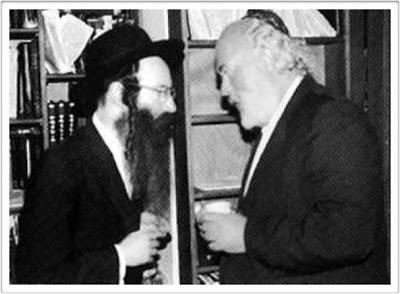







 is clearly a scholar and has tackled difficult issues, such as
  was in Melbourne last Shabbos. Rabbi Wolpe is a big Talmid Chacham but known for his very extreme Meshichist ideology and his uncompromising attitude to the return of any territories beyond the Green Line. There are many Chabad institutions who are wary of allowing him to occupy a pulpit because of the unpredictability of what he will say. In point of fact, Rabbi Wolpe roused the anger of the LR himself when he published a Meshichist treatise against the express wishes of his Rebbe.
 could do so by writing their names and any message or request they might have. It is not my intention in this post to enter a halachic excursus about אין דורשים על המתים. Let’s assume that what the girls were asked to do is acceptable from a Halachic ground (yes, we are well aware that the Rambam is opposed to such practices).
 I am no grammarian. I know almost nothing about grammar. I do harbour a trenchant fidelity towards Mesorah/Tradition, however. This is one of the rare cases where the אחרונים say one thing and the Minhag (Ashkenaz) is not to follow these אחרונים and to follow the סידור אוצרות התפילה
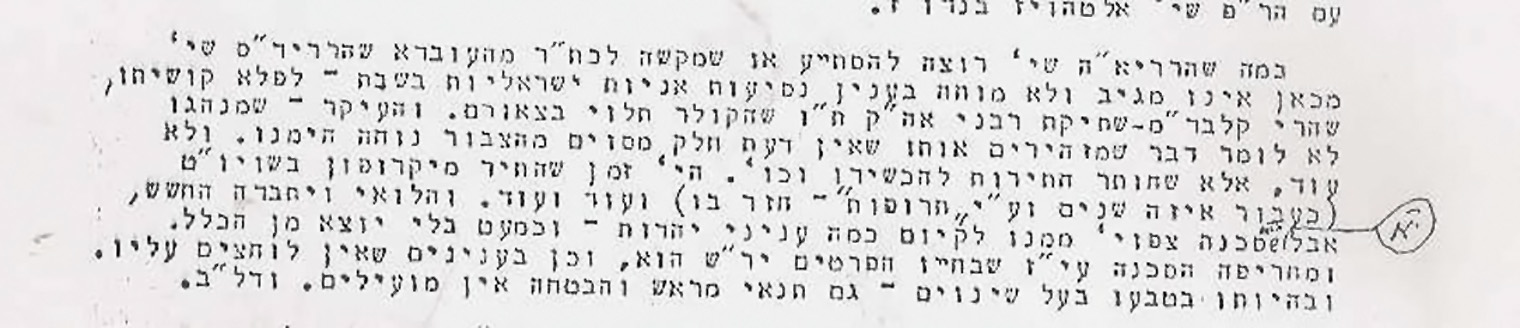

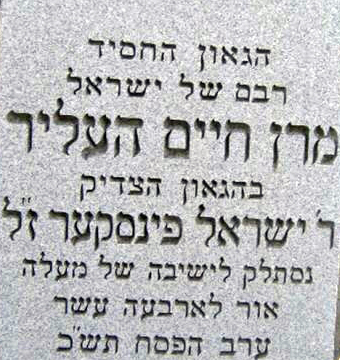


 pitputim
You must be logged in to post a comment.