Further on Religion and Labor

Elliott, the author, also sent me this article, apropos of my earlier pitput.

Israel’s Next Chief Rabbi Has Illustrious Shoes To Fill—From Long Ago

The author, Elliott Horowitz, sent me this link. It’s definitely worth reading.

The good work of Rabbis is often invisible

The reality is that newspapers and reporters are seemingly more likely to report and aggrandise horror stories and mistakes than they are to report excellent outcomes and outstanding effort, especially when it comes to Orthodox Rabbinic work. Sure, if a philanthropist donates money, they will report that as a big story with a nice picture spread. You won’t, however, find the headline on the front cover

“Reform rabbi speaks in favour of the anti-zionist BDS-supporting AJDS”

The “passionate” support of the Reform rabbi happened. It was mentioned in an article about the meeting of the ECAJ. I’d suggest such a view and display of passion has bigger ramifications for the reform movement and the opinion of many Jews than a Zablo that was screwed up and set aside by a NSW court. We should have had a transcript of what she had said.

As Rabbis Ullman and Moshe Gutnick noted in their letters to the Australian Jewish News, the focus on positive work and outcomes of Orthodox Rabbis seems to occupy no space in the AJN.

I wonder how the left-wing, and Limmud Oz supporters would react if it was suggested that they invite the following Neturei Karta people to speak about why we should be appeasing Ahmadinajad and dismantle the State in favour of Palestinian Arabs. After all, it’s all about tolerance, diversity and giving everyone a fair go to express their views?

No, Limmud Oz wouldn’t ever invite Neturei Karta, even remotely by video conference. Why not? I wonder if the AJDS would support them being invited? I imagine they would. After all, democracy is their religion. And yet, Limmud Oz invited Slezak! I don’t see much difference. In retrospect, there is a significant difference. Slezak is taken more seriously, especially by the young and green, and the young and green are mainly behind Limmud Oz.

People like Jeremy Stowe-Lindner, principal of Bialik College in Melbourne, writing in an article in the Australian Jewish News that amounts to a whitewash of a serious error by Limmud Oz in inviting Slezak, should now support Neturei Karta using his own arguments. Would Stowe-Lindner also use an error of inviting Neturei Karta to promote his agenda of sidelining denominational issues to the category of personally baked pareve cheese cake?

I know of recent cases where the Victorian Rabbinate, through the Beth Din, have solved very serious and long running cases of recalcitrant husbands not giving a Get. Was that a front page story? Heck, no.

It’s also the Rabbinate’s fault. They need a PR person in this day and age. In addition, they should have supplied statistics about the number of mediations they have overseen over the last few years which have been successful and not been challenged and compare those with  secular mediations and arbitrations that have been challenged.

No, you won’t see any of this in our Australian Jewish News. They are in the business of selling papers, and horror stories especially about Orthodoxy are better.

[AJDS really should rename themselves ADJS because I struggle to find Judaism in their politics. Left-wing democracy would seem to be their religion.]

The new Ashkenazi Chief Rabbi of the State of Israel?

Based on what is reported in this article, I’d be pleased with Rabbi Stav. We had a Rav Stav at KBY when I was learning there. Was that his father or uncle? Does anyone know? I don’t mean Rav Moshe Stav. Actually, I take that back, it was Rav David Kav who I remembered. Kav, Stav 🙂


Rav Stav (from cjnews.com)

Leave Haredi enlistees alone!

Picture the scene. Terrorists are at loose in an area of Israel. The Army is conducting searches, door-to-door. The door of an apartment opens and some of the soldiers have dangling payos and scraggly beards. They are frum; they are Haredim who chose to enlist. The owners of the apartment themselves are Haredim. Would they protest? Would they tell the soldiers to go to the Beis Hamedrash instead, and leave it to the “chiloni” or “druze” enlistees to conduct the search and/or protect the apartment block from an incursion? I’d hope not. Why must they conclude that anyone with Peyos is רך הלבב? I’d say the opposite, these are גיבורי חיל.

Ah, but that’s at a time when people are thinking clearly. They can feel the palpable danger around them. In fact, I’ll bet they actually feel proud that Frum soldiers are performing a Kiddush Hashem by acting to protect the lives of their fellow Yidden.

What happens before that? These soldiers can’t just jump out of a Ketzos HaShulchan, with little to no training and assume an important protective or attacking role. There is training. It takes years. The training has been catered to be sensitive towards Haredi requirements. Haredim want the outcome, the protection, but they don’t want the training? Who learns a Ketzos before knowing Shulchan Aruch and the Gemora behind it? Do you introduce R’ Chaim Naeh to year three students? No, of course not. There is a period of preparation. In Torah it does take longer, but in the military, you also need an acceptable period of training, unless Haredim want to see keystone cops, so to speak, acting on their behalf?

I see this current period as one of re-alignment. It is no different to the current phenomenon of frum kids who are doing University courses on-line. Yes, University was not allowed for various reasons, but you can now do a program on-line if you can’t or won’t go to University and are not going to be a business person (IDB=In Dad’s Business). Not everyone is cut out, let alone has the acumen to become a Dayan, or Magid Shiur, or Rav of a Kehilla, let alone a great Melamed. How many people have we seen cause a Chillul Hashem, despite their long years in Yeshivos, because innately, they are simply not leaders suited to their jobs, and should be pursuing a different style of work, albeit remaining an ehrliche yid.

The shoemaker, R’ Yochanan HaSandler, wasn’t considered any less a giant because he was engaged in Olom Hazeh in an honourable way. We are meant to follow such Tanoim. He was R’ Akiva’s student, no less, and a contemporary of Rashbi.

This is why I find reports such as this one, utterly repugnant. Will Haredi incitement and pressure  solve any problems? Will that create more Torah more love between Jew and Jew? Just leave these boys alone. חנוך על פי דרכו is ever so critical and perhaps our failure to do so is part of why some leave the fold? Respect them!

I don’t see an Israeli government specifying that students study Spinoza or Amos Oz. They are specifying  studying the basics, and the basics  constitute a study of the Borei Olom and his Beriah. That’s what Science and Math are.

As Rav Kook said: on its own the basic sciences etc are just that. However, when coupled with Kodesh, they transform Kodesh to Kodesh Kodoshim, because they complete and enhance our understanding of the world. You wouldn’t make a Birkas HaTorah on them alone, but when coupled with  Kodesh, they lift Kodesh to Kodesh Kodoshim. I believe this idea is expressed by many in different ways. Mekubalim would probably refer to it as breaking down klipos, but I’m an ignoramus in the field of Kabbalah and Chassidus.

In a State, yes, it is a State, despite the reticense of so many to utter such a word,  you need garbage collectors, and police officer and nurses, as well as accountants and doctors and social workers, journalists with ethics, and psychologists. Especially when you are surrounded on all four sides by people who are literally an embodiment of

עומדים עלינו לכלותינו

It is only the foolish person who doesn’t learn from history (wasn’t yesterday Chaf Sivan?) who thinks they can hide under a rock or in a cave like Rashbi and make Yahadus thrive.

I have every confidence that Torah learning will continue to grow in quality levels and in measure. Those who want to fund institutions that won’t enforce the three R’s, go right ahead. It’s your right. I inclined to help a place that actually realises that it “lives in this world” both BeGashmius and BeRuchnius.

Why do people sanitise history?

It doesn’t diminish in the slightest that the Lubavitcher Rebbe זי’’ע had a brother who became secular. What does one have to do with the other? I was accustomed to Artscroll being the kings of whitewashing history.

This last Shabbos, I had 20 minutes before Mincha. My wife wasn’t well and a kindred soul had passed her some magazines to read. The magazines seemed to be oriented towards the N’Shei Chabad. I saw one article was about R’ Yisroel Aryeh Leib Schneersohn. Everyone knows that he, for reasons best known by himself and probably his illustrious brother, became secular. Yet, when I finished reading the article, there wasn’t a single word mentioned about that, let alone all the other facts that are known.

To be sure, I am not in the business of speaking ill of the dead, and what R’ Yisroel Aryeh Leib decided to do or not do was his own business, and none of mine. But why, oh why, do people need to be brainwashed through the method of simply omitting fundamental facts. Sure, his father Reb Levik said that he had inherited the brain of the Tzemach Tzedek. By all means, mention such things, as well as his obviously great intellect, but where was the directive that the Rebbe told his Chassidim to “leave him alone” and not to try and be Mekarev him, so to speak? Why should a child of Chabad, male or female, not read the truth? Will it cause them to go off the derech?

When you tell half-truths, you create more problems than you solve?

Finally, American-style Haredism makes incursions into Israel

I’ve been impressed with what I’ve read about and from Rabbi Dov Lipman (an alumnus of Ner Yisrael in Baltimore) and a member of the Yesh Atid party. Watching the back and forth between him and members of Aguda and the like in the Knesset has been interesting. Recently, he was condemned by his Rosh Yeshivah in Baltimore. Here is Lipman’s letter in response (from the Baltimore Jewish Life).

To the Baltimore Jewish Community:

I owe so much to Ner Yisrael and want to be clear from the outset that my words are not against the yeshiva. Tremendous damage for me and the yeshiva has been caused by an audio tape in which I am quoted as saying something which I never said and anyone who knows me knows I would never say. I was quoted as saying that “all yeshiva ketanos in Israel should be closed” and then for all intents and purposes I was called a rasha and equated with Amalek and Haman. The following is what I actually have said and what my political party Yesh Atid is working for:

1) The Israeli government should not fund institutions which don’t teach basic math and English. Yeshivos which don’t do so will not be closed down but they won’t receive government funding. It should be pointed out that there are numerous yeshivos which already take zero government money and continue to flourish. Adina Bar Shalom, Rav Ovadiah Yosef’s daughter appeared before the Knesset task force to help Haredim enter the work force which I founded and begged us to implement math and English because 50 percent of the boys in her chareidi college drop out due to their lack of math and English. I meet regularly with chareidi young men who are still completely in the chareidi world and they tell me that the one thing which is necessary is some basic math and English. I believe it is a sound decision for a government to make and look forward to seeing the yeshiva ketanos flourish and continue producing gedolei Torah while teaching basic math and English. Ironically, the basis for my supporting this plan knowing that gedolei Torah can still be produced if general studies are taught is actually Ner Yisrael which produces.

2) Comparing me or anyone in my party to Amalek and Haman who wanted to kill all Jews including “children and women” is simply incomprehensible. We are going to help Chareidim sustain their families – literally feed their children – and we are compared to murderers??? On the spiritual level, we are proposing that 1,800 elite Torah scholars per year be recognized as serving the state and the Jewish people through their Torah study (the first time in history that a government will pay Jewish boys for their learning from a fundamental which says they are providing us with a service), the rest can study Torah uninterrupted until age 21 and then serve in military or national service geared specifically to chareidim and their lifestyle – and we are compared to Amalek and Haman?

3) I would have never joined this party without meeting its leaders first and really understanding who they are and their intentions. The ministers and Knesset members in my party have no hate towards anyone and are not hoping that anyone becomes less religious. Yair Lapid openly declared that the religious side in Israel has shown the secular side that our basis to be in this land is G-d and our Tanach. The driving force behind our policies regarding the Chareidim is to generate unity and most importantly to get Chareidim to the work force. Money will be flowing to programs to help Chareidim get to work. My dream is to see the hi-tech corridors of Raanana, law and accounting firms in Tel Aviv, and government offices in Yerushalayim filled with Chareidim. Most young Chareidi young men are not cut out to learn Torah day and night for their entire lives and this will empower them to be Talmidei Chachamim, Bnei Torah, and also supporting their families with dignity. This will also have an immensely positive effect on Israeli society which will finally see the beautiful values and people in the Chareidi world. My e-mail in-box is filled with letters of support from Chareidim who say they finally see a future for their children – they will remain Chareidi but also not be impoverished. I must also note that our party started the first ever Beis Midrash for Knesset members in the history of the Knesset. Every Tuesday at 3:00p.m. we stop our busy schedules and sit in a committee room and learn Torah together – religious and secular MK’s. Is this a group of people who deserve to be called reshayim, Haman, and Amalek?

I certainly hope the misquote will be acknowledged and that the comparison to Amalek and Haman will be taken back. Misunderstandings happen and can always be corrected.

Let us all learn the lesson of the dangers of the rumor mill and misquotes and let’s work together to strengthen Torah study, the spreading of Torah values, and unity amongst the Jewish people.

Dov Lipman

More on R’ Schachter’s views on Mesirah and Dina D’Malchuso

At the suggestion of מו’ר R’ Schachter’s מקורבים, readers who seek more than a 10 minute grab, would do well to read his written word on these topics, well before the scourge of hidden child abuse arose.

Firstly, there is a brief note on Torah Web here from 2007.

A more expansive and learned paper can be read here from RJJ Volume one which I believe is from 1981.

Enjoy.

Raglayim LeDavar (i.e. prima facie case to answer)

In an amongst a previous post, I received the following comment (which I have slightly edited) … and no, there was nothing at all wrong with the comment, which is why I am not ignoring it (I’ve just been incredibly busy).

Rabbi Hershel Shachter provoked a storm of criticism for using the word shvartze. As far as I am concerned that is the least of it. The much bigger problem is that he propounded several insidious arguments for not dealing with sex abuse. He gave with one hand and took away with the other. He said there is no issue of mesirah (snitching) per se in reporting a known molester. Great. But then he said it is takah (actually) mesirah if the offender will be sent to state prisons where wardens could harm you by placing you in a cell with a member of Farakkan’s Nation of Islam. Yes I think that is racism. Why does he believe a Jew should fear a Black Muslim more than a member of the Aryan Nation? But never mind.

It’s important to note that R’ Schachter has given many Shiurim on this topic, and I’ve heard some of them well before the sound bite you refer to. In fact, the shiurim on mesirah were also well before the issue of child abuse became the grave topic of concern for all of us. His view, has not changed. He speaks Halacha, as he sees it. He is a Posek.

Whilst you acknowledge that R’ Schachter is strongly against those who hide behind Mesira and is in fact concerned with the safety of a community and ובערת הרע מקרבך, and yes, I have heard him say both of these things explicitly over and over, he is also concerned about safety in jails for those who are incarcerated. Halachically, R’ Schachter contends that nobody should be in a type of jail where they are beaten and/or gang raped (and all the horrible things that we hear). In a previous shiur, R’ Schachter described different types of prisons in the USA, and said he was concerned about one type as opposed to the other. If we are to be true to Halacha and indeed true to the country we live in, what we should also be doing is ensuring that those who are incarcerated go to a “normal” prison or a system where such things are very unlikely to happen. All over the world, we have read many times of the “mysterious” death of an inmate. Chazal most certainly would never approve of such a thing in their own prison systems.

R’ Schachter often interludes with urbane language. In a number of shiurim, he called the reasonable prisons “Glatt Kosher/Daf HaYomi style prisons”. People giggled when he said that. Perhaps Daf HaYomi learners or Glatt Kosher eaters might take umbrage; I doubt it. When R’ Schachter said a shvartze, he immediately expanded on that, and anyone listening knew he was giving an example, that is, of one of those Army of Farrakhan types who might be sharing a cell with a Yid (albeit a sinning Yid). Criticising him for this is unfair.

The real issue is that almost all sex abuse prosecutions are in the state courts. So he has now precluded virtually all prosecutions.

No he doesn’t. He actually says that (Frum) Lawyers and Law Makers should try to influence the powers that be to make sure that all those incarcerated are put in a situation where their rights are actually protected and they aren’t subject to jail abuse.

He also insists on vetting by a mental health professional who is also a talmid chacham (rabbinical scholar).

Knowing what he has said elsewhere, let me explain. He strongly encourages that any educational institution should not just have Rabbonim on staff, but also Rabbonim who are trained professionals. As opposed to a teacher/Rabbi who hasn’t lived in the real world, and is fresh-faced out of Yeshivah/Kollel and is confronted by an allegation, he would insist that the professionally trained Rabbi/teacher be one to hear the allegation and then pass it onto the authorities as the case almost always is (now). What you don’t know, is that R’ Schachter was very upset about a respected Rav/Teacher whose life was destroyed when it turned out that their pictures was published as a molester and in fact it was a complete case of mistaken identity. The teacher wasn’t even remotely connected to the allegation. Apologies were made, and the incorrect picture was removed, but, and I’ve heard R’ Schachter speak about it, that teacher’s life had been ruined. They are depressed, unable to work when in fact they had nothing what to do with the incident. They weren’t even in the same institution if I remember correctly. It was a case of “man with a beard who looks like this” but it was the wrong person whose picture was put up. I surmise that this also concerned R’ Schachter.

There definitely is such thing as a recidivist liar, who as a student has a reputation for lying on all manner of issues in the past (I’ve known such people and I suggest we all have) . It is best that a trained psychologist be on staff and ensure that a proper process is followed. That means, the person who makes the allegation makes it in front of someone who is skilled and trained, not someone who knows Shas and Poskim.

He obsesses about the terrible damage of a false allegation. I too find a false allegation a terrible thing. But the professionals most capable of such an evaluation are the ones inside the criminal justice system.

I’ve explained what worried him, based on cases he had known. I’m sure that the professionals in the criminal justice system will do a good job. Having a professional on staff to hear an allegation, is a good idea. Remember, this is not at all the Aguda proposal that a board of Rabonim examine each case and decide. R’ Schachter is not only part of the RCA, he is probably their venerated Posek, and as such, you really need to understand his point of view from the RCA stand point.

If I can make it a bit clearer. Where I work, and where many/most of us work, we have line managers. However, we also have HR (Human Resources). If a line manager or staff have issues with each other, HR (who have trained professionals) do get involved, before actions arising. Sometimes those actions are indeed a referral to the police! For example, if someone alleges they were sexually harassed or racially vilified. In the context of R’ Schachter, I believe he is suggesting that Schools and similar, davka need to have a quasi-HR through having professionals as he suggested and not just people with Yoreh Yoreh and a Yeshivah Teaching certificate.

Prior interrogations contaminate evidence and alert suspects who can then hoof it. More than that, most such prior screenings end up discouraging reporting.

Picture the scene. A student makes an allegation. They go the headmaster. The headmaster  immediately calls in Rabbi Dr So and So, who is a psychologist on staff. What’s wrong with that?

It is true that if the Headmaster is corrupt and/or the psychologist is a psycho then we are in trouble. But, we would have been in trouble anyway, in that situation. No system can help here, unless a kid goes directly to the police or tells their parents and the parents are not indoctrinated to keep shtum. On the contrary, there isn’t a culture of “run away from Mesira” with R’ Schachter. We need to also ensure that the kid is not fobbed off and the issue buried (as it has been tragically, and in some places still will be).

I recognize that false allegations do happen, usually in the context of divorce custody battles. Folks in the criminal justice system are quite adept at recognizing them and screening them out.In the end, the decision to support reporting involves balancing the danger to children versus the danger to someone falsely accused. In a situation of uncertainty I would rather leave an adult with the problem of undoing damage to his reputation then subject children to damaging abuse. It is much harder for children to recover. Children need more protection than adults. But that is me. Rabbi Shachter thinks in terms of adult and institutional interests.

He is talking to Rabbonim and this is a grab from a speech he gave. He cares greatly about children, and that is why he is advising the Rabbonim to change things so that they have staff who are also skilled and are professionally qualified to deal with abuse allegations and related matters that arise (eg bullying and harassment). This is my understanding based on more than the particular 10 minute sound bite I heard.

I could be wrong, of course, and will stand corrected if that is the case.

[ R’ Schachter is incredibly busy at the moment. I waited for 1 month before I could get an answer to some questions I asked repeatedly. I expect that he will make his views clearer in the near future, given the thoughts you expressed and which no doubt others have also expressed or thought. Let’s wait and see. ]

Remembering Rav Menachem Froman ז’ל

Recently, I learned of the tragic petirah of HaRav Menachem Froman. He was well-known in the press over many years. Ironically, a founder of Gush Emunim, and described with the pejorative title of “settler”, Rav Froman was the driving force behind the city of Tekoa.

Rav Froman was a thinker, who worked outside the box. He had his own controversial views on how to relate to the Palestinian Arabs (and even known terrorists ימח שמם וזכרם) and many if not most like-minded souls who also moved, with מסירות נפש to far-flung corners of our Holy land, disagreed with his approach.

In his own words:

“My premise is that for Jews to live in all of Eretz Yisrael, they have to create a network of life with the Arabs”, says Rav Froman. “In the Holy Land, you can’t make peace without attending to the issue of holiness”.

“Isn’t it only fitting that Jerusalem be the seat of the United Nations’ cultural bodies, human rights organizations, scholarly forums? Isn’t it only proper that Jerusalem be the place where members of all faiths convene to renounce their breeding of prejudice, hostility, and war?”

Rav Froman truly believed that conciliation and peace lay only through the spreading of Kedusha through faith-based meetings and respect for adherents of Islam. If I’m not mistaken, Tekoa doesn’t have one of those security fences surrounding it. He wanted Tekoa and its residents to feel comfortable with their neighbours. When some Jewish crazies attacked a mosque and set fire, he came to the village and brought replacement texts of the Koran as a gesture of regret and respect.

My cousin, Effrat (née Balbin) (that’s how she spells her first name) and her husband Rabbi David Fialkoff are idealists who live in a caravan in Tekoa. The caravan now houses their bevy of children. They are inspiring and selfless people. David is also a big chassid of Rav Steinsaltz and has impeccable midos tovos. On Shabbos, I used to sing Chabad Nigunim especially for David, who participated with Dveykus.

In 2006, I had the Zchus to attend their wedding. It was then that I first laid eyes on Rav Froman. He was one of those people whose eyes were alive, and who had this aura surrounding him. You could just feel his presence. He had such a peaceful and happy demeanour. I remember he sporadically began a dance before the Chuppa with my Uncle Hershel Balter. He personified Ahavas Yisroel and a love for others. I tried to talk to him and engage him on some of his views, and he simply wasn’t interested. He undoubtedly felt that I was attempting to cajole him into a controversial discussion. He wasn’t having a bar of it. We were at a wedding, and he probably sensed that I wasn’t really at the level of having a meaningful conversation on the topic. After all, I was from Melbourne, Australia. What business of mine was there in talking to someone who was an inspiration to the entire community of Tekoa.

You couldn’t help liking him. If he had worn a Rebbishe Spodik he would have fit the part of a  Jew who had this burning attraction to another Yid’s Neshoma Elokis, and who was attracted to them like a magnet.

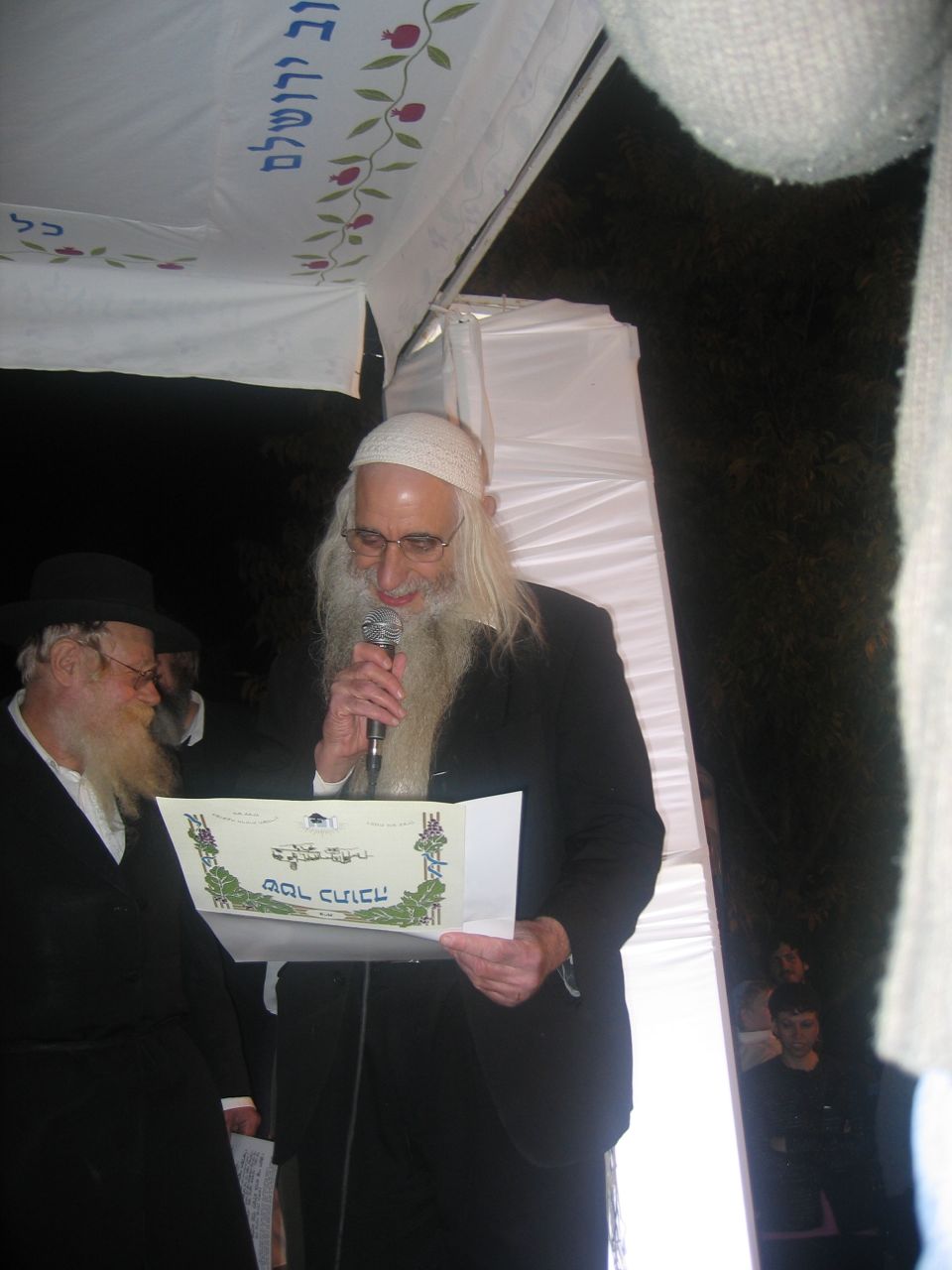
I’m told that Tekoa is in severe grief and mourning. It is very difficult for the to cope with the loss of their inspirational leader. In the picture below, which I took back then, Rav Froman is reading the Kesuba while Rav Shteinsaltz looks on.

I liked the man, lots.

יהי זכרו ברוך

Rav Froman (on the right) and Rav Steinsaltz on the left.

The Honeymoon is over (part 2)

HaRav Chaim Drukman, who was awarded the Israel Prize for Lifetime Achievement in 2012, was interviewed regarding his reaction to the boycott I pitputed about yesterday. He was in charge of the Israel Conversion Authority, and was the subject of a now maligned opinion from Rabbi Avraham Sherman regarding his conversions, where Rabbi Sherman had attempted to anul conversions on the basis that the Beth Din members were not “kosher”.

Rav Drukman is a holocaust survivor who was part of the establishment of Gush Emunim. He is known as an Ish HaChesed. As Rav Aviner wrote

By contrast, “if the Torah scholar scrupulously makes sure to greet all people gently, humbly and graciously, and he suffers insult without insulting in return, if he treats others with respect, even those that treat him lightly, and if he radiates integrity in his business dealings… until everyone praises him and loves him and appreciates his deeds, then he has sanctified G-d’s name. Of him it says, ‘You are My servant, Israel in whom I glory’ (Yeshayahu 49:3).”

Indeed, Rav Druckman is amongst those who suffer insult without insulting in return.

He really does get insulted and hurt a great deal. It is impossible to describe just how much, and it really does hurt him, but he never returns an insult.

Such is the humble person under discussion. He is an open saint, but a secret saint as well. In other words, his personality is so open, it radiates so fully, it has such a great influence, that one could think that what we see is all there is. Yet that is not the case. There is to his modesty much more than what we see. Don’t ask me what. I don’t know. Because Rav Chaim is a humble, modest person, who doesn’t often reveal what’s inside of him.

Watch the video interview with Rav Druckman. Turn on the English captions if you can’t understand Ivrit too well. He accurately notes the disdain that Charedim have held Religious Zionists in, as a matter of perpetuity. You see, for Charedim, Rav Druckman isn’t “frum enough”. Period.

The Honeymoon is over

Let’s face it. Charedim have never considered any religious zionists—Mizrachisten) “frum enough”. That’s a generalisation, of course. Notable exceptions, such as Rav Shlomo Zalman Auerbach ז’ל or indeed his son-in-law, Rav Zalman Nechemia Goldberg שליט’’א never saw things in black and white (sic). Rav Shlomo Zalman’s son, Rabbi Shmuel Auerbach, however, is most extreme in his views.

The Charedim were considered “black” (in keeping with their attire) and the religious zionists (with their white crocheted Shabbos Yarmulkes were the white ones). In truth, the right-wing of religious zionists, such as those from Yeshivat Mercaz HaRav, are easily “as frum” as the frummest Charedim, across the board, although they didn’t wear the uniform of hats and jackets or follow the dictates of Agudisten or “Daas Torah”. It’s no different in Melbourne.

We have four kollelim:

  1. The Chabad Kollel
  2. The Lakewood Kollel (Litvishe Misnagdim)
  3. The Adass Kollel (various Hungarian and other Chassidim)
  4. The Mizrachi Kollel MiTziyon (Religious Zionists)

The Chabad Kollel is an arm of the general Chabad movement. People learn there for a couple of years and then go into Chinuch, the Rabbinate, or the general work force. It’s not a life time job to sit in Kollel. The Kollel is interested in people outside of Chabad, in the same way that Chabad is interested in anyone (with the exception of farbrente Misnagdim with whom they share no love).

The Lakewood Kollel was split asunder by a massive disagreement between its own constituents which saw one Rosh Kollel go back to the USA and the other remain in his position. Many important Ba’aley Batim left the Lakewood Kollel, never to return. For many of the full timers, it’s a lifetime job, to “sit in Kollel”. The Lakewood Kollel isn’t really interested in Religious Zionists. It is mainly a common ruse to attract such people to attract funding to support their activities. Behind the scenes, religious zionists are not considered “frum enough”. This is no different to any other such institution around the world.  It is not unique to Melbourne.

The Adass Kollel keeps completely to itself. It is made up of people who have retired as well as young and not so young marrieds. It isn’t interested in the wider melbourne jewish world outside of its own hermetically sealed group and it certainly has no time for Religious Zionist types from a Torah perspective.

Kollel Mitziyon, isn’t really a Kollel. It’s a quasi yeshivah and does a good job continuing the type of learning program that those who studied at religious zionist style yeshivas experienced before returning to Australia. It normally imports a Rosh Kollel and Israeli Hesder Bachurim; their Rabonim though are simply not treated with any respect by the other Kollelim or their constituents.

So what honeymoon is over? Has there ever been a marriage? There has been a “quiet peace” between Charedim and Religious Zionists. While the latter learned in Yeshivos and went to the army, the former generally avoid the army at all costs because they see their torah learning as protecting Jews, and many also see it as a full time, life-long vocation.

Until now.

The new style Mizrachi party, Habayit HaYehudi no longer supports a carte blanche arrangement where significant numbers of Charedim are able to avoid going to the army and sit in Kollel for the rest if their lives. The retribution has been swift. Incredibly, joining the anti-semites and anti-zionists of the world, the Charedi parties have decided to no longer support produce from the “settlements” beyond the green line!

I find this disgraceful. That they could give strength to the types of boycotts imposed by both Jewish and non-Jewish anti-semitic anti-zionists is simply breathtaking, but not surprising. They will stop at nothing to make sure that their sole vocation remains Torah study. To put it in other words, it would be akin to the Lakewood and Kollel Beis Yosef deciding that they would no longer use any businesses associated with the Mizrachi (religious zionists), here in Melbourne. Chabad, of course supports settlement activity given that the last Rebbe was staunchly against returning land for peace.

Idle threats aside: I do not understand why the Charedim do not institute a Hesder system like the Mizrachi did so many years ago. Let them have a ten year Hesder program, where they do 3 years of army interspersed with an extra 7 years of Torah study. What would be so bad? But to boycott any place over the green line in the way they are proposing makes me sick in the gut, and convinces me even more that it was only ever a platonic “marriage”, and the honeymoon is now well and truly over.

Answering Amen before Krias Shema

I daven in the morning in a Beis Medrash which allows the Shliach Tzibbur to daven in their own Nusach, with a few “universal” compromises.

For example:

  • There is always a gap in time to enable those (Ashkenaz and Sefard) who say Baruch Hashem Lo’Olom before Shmoneh Esreh at Ma’ariv to do so
  • Tachanun is said in a way to accomodate those (Ashkenaz) who fall immediately onto their arm and not start with Ashamnu, by leaving the parts from Ashamnu until then said quietly.
  • Yehalelu is said immediately after Hagba but before Ashrei at Shacharis (with no loud U’Venucho Yomar)

It is well known that there are three practices in respect of the Bracha immediately before Krias Shema at Shacharis and Ma’ariv.

  • Chazan says the Bracha in its entirety out loud, and the Kahal say that Bracha word for word with the Chazan, and so they don’t answer Amen
  • Chazan says the Bracha in its out loud, and the Kahal answer Amen
  • Chazan breaks off that Bracha at the end by reciting it inaudibly (Chabad)

Now, I say the Bracha out loud, as Chazan.

The issue is briefly sourced in Brachos 45b.

Sefardi Rishonim consider it fine to answer Amen after your own Bracha (eg Rambam Brachos 1:16). Ashkenazi Rishonim, such as Rabbenu Tam (see Shulchan Aruch OC 215:1, 188:1,2) holds that the only Bracha we answer Amen to, even though we say it, is Boneh B’Rachamov Yerushalayim Amen (in Benching).

For the Bracha before Shema, the Rishonim say that since this is the second of the Birchas Krias Shema we do not need to say Amen. Shema is integrated, and the final Bracha (for Shacharis) is Go-al Yisroel. It’s not clear why one couldn’t, however, say Amen. For example, after Yotzer Or U’Voreh Choshech, one may say Amen, and many are careful to do so.

Minhag Chabad is not to say Amen for any of these Brachos. My question is as follows: if you daven according to Minhag Chabad in the Beis Medrash that I daven in, and I say the first of the Birchas Krias Shema out loud, (Yotzer Or U’Voreh Choshech) should you stay silent and choose not to answer Amen to this Bracha? In addition, if the Chazan says “Habocher B’Amo Yisroel Behava” loudly, should you say Amen. Clearly, Chabad Minhag seems concerned about it, because they say the second bracha quietly and don’t say any part of the first Bracah out loud.

So what do Chabad do? Do they simply say no Amen? Do they try to say the Bracha with the Chazan? Does anyone know?

[Apologies I fixed the last sentence … I was a bit off colour yesterday and my last sentence was almost random letters]

Where Rabbi Manis Friedman got it wrong

There is a controversy regarding comments over the Rabbinic role in helping a victim of molestation, made in a lecture by Rabbi Manis.

I disagree with Rabbi Harry Maryles’s take as described in the above link. If you watch the video alone, without knowing what he said in the first audio recording linked there, I don’t think there is anything objectionable in the video per se (viewed alone). The audio of the first lecture is another thing, however.

It is true that the “role” of the Rabbi must be different to a psychologist. It is true that Rabbis should not assume the role of police or psychologist. The Rabbi (here I assume Friedman means the pulpit or town Rabbi, as opposed to the Rabbinic member of a Beis Din or a Rosh Yeshivah both of whom generally don’t deal with a particular community or its membership in this way) needs to deal with the victim vis-a-vis stressing and fortifying their status as a valued member of Klal Yisrael. The victim’s membership, under such circumstances is inviolate and axiologically grounded. The central issue to me is how you communicate this fact and serve to intercept the sense of possible alienation a victim may feel.

Rabbi Manis’s audio presentation does this in a crass and unrealistic manner. It assumes that a person will feel alienated more by the fact that they have been the victim of a crime whose perpetrator’s punishment is Kores as opposed to say Malkus. In my opinion, this is a nonsense and is a most unsophisticated metric for measuring such factors. The Chacham, wise person, has eyes in his head. He observes, tailors, and reacts according to what he sees. Surprisingly to me, Rabbi Manis is a Chabadnik. Of all people, they are expert in stressing the inherent holiness of the soul, asserting that it can be found in every Jew, and are experienced in helping remove the “layers” of baggage of many varieties which may cloud the vision and experiential manifestation of this soul. Instead, Rabbi Manis, in the audio version, sounds like an old-fashioned, fire and brimstone, B’aal Mussar. Sure, there was a time where you could scare or influence someone to repent based on the technical halachic severity of the sin. Sure, there may have been a time where you could convince a certain type of victim in a certain era that the technico/halachic punishment of what had been perpetrated wasn’t as “severe”, say, as a crime deserving of the death penalty.

No, the approach, ironically, ought to be to give strength by stressing the positive contribution that even continued orthopraxic practice can serve. Importantly, it may well also be beyond the Rabbi. A given community (Kehila) can quickly undo even the appropriate response and support of a Rabbi.

If I was Rabbi Manis, I would apologise, and stress that his words and argument were not formulated in an acceptable manner, and stick to the thoughts that he expressed in the video. Even if he isn’t an official spokesman for Chabad, he’s considered important enough to be ascribed such attention. If he apologised, he’d be no less a person. In fact, he’d come across as more human and thereby more equipped to help people using his undeniable God-given gifts.

We all make mistakes and express ourselves poorly. It seems it’s harder though to admit when we do.

The right to pray is sacrosanct

You won’t see the bleeding left, especially those on Galus Australis and the feel-good New Israel Fundniks and the like upholding the inalienable democratic right of a person to pray. No, they will bleat and scream, while complaining that Moshe Feiglin (whose political views I have not studied in detail) is breaking Israeli Law and offending our peaceful Muslim brethren. What is his new sin? According to the Jerusalem Post

According to police spokesman Shmuel Ben-Ruby, Feiglin, who is No. 23 on the joint Likud Beytenu list, prostrated himself in the plaza and tried to pray out loud. Praying aloud, going through ritual motions or using any type of traditional prayer objects such as tefillin, tallitot or prayer books, are forbidden for Jews at Judaism’s holiest site due to tensions with Muslim worshipers at the Aksa Mosque.

Or according to Ha’aretz (try and register and you will see you have an optional “country” called Palestinian Territories (occupied))

Police plan to recommend charging right-wing Likud politician Moshe Feiglin for obstructing them in the line of duty, inappropriate behavior in a public place and violating a legal order. Police detained Feiglin Tuesday for attempting to pray on the Temple Mount. “We expected that the closer the campaign got to Election Day, the more provocations we would see whose purpose is to influence the outcome of the election,” Police Commissioner Yohanan Danino said yesterday. “I have said and I say again: We have no intention of allowing anybody to disturb the peace or break the law.”

Ha’aretz conveniently forgot to mention that Feiglin goes there on the 19th of every month, as omitted by Commissioner Danino, quoted ad loc. As far as I am concerned, if a Muslim can pray there, then so can a Jew. There cannot be one law for the Muslim in Israel. If they can’t control themselves when they see a Jew davening on Har HaBayis, then they should take a bus to Mecca to the Kaaba instead. I am not making a statement regarding the Halachic issue of whether it is permitted or not to stand on Har Habayis. Most hold that it is forbidden, or delineate carefully where one can go. I assume Moshe Feiglin is following his Rabbinic Psak. Let them arrest him. I can’t think of a more stupid act, if they do. Oh, and for the bleeding green left, davening in this way also constitutes the ubiquitous neo-mantra of “Tikun Olam” especially B’Malchus Shadee”.

The Weberman Trial: my prediction

The papers and internet are discussing the infamous Satmar Weberman Trial.

Satmar and their ilk are outraged that such an issue should go before a goyishe court. They contend it should only have been dealt with by a Beis Din. Be that what it may, you can bet that if the court will find Weberman guilty they will continue this line and scream that it’s a blood libel.

I believe that Weberman will be found innocent, or guilty of a minor misdemeanour because the onus of proof from the court will ironically be greater than that required by a Beis Din. Weberman’s attorney argued that there was no evidence, no DNA etc. He is right. DNA and body fluids are not required to prove guilt according to Halacha.

My prediction is that they will be hypocritical. They will claim that the court found him not guilty in the main, and they will use this as proof that he “did nothing”. Proof from a goyishe court? Yes, that’s acceptable, but only if they do not find you guilty.

Let Eliyahu decide our questions

The Talmud, when faced with a conundrum that cannot be solved, uses the phrase

יהא מונח עד שיבוא אליהו

Let the issue rest until Eliyahu HaNavi comes (back) and advises us of the Halacha

or

תשבי יתרץ קושיות ואבעיות

ֵEliyahu (HaTishbi) will answer all the questions.

The question is asked: since Moshe Rabbenu was our greatest teacher, why do we wait for Eliyahu (who never died) to answer the questions, surely we should wait for Moshe (who will be resurrected when Mashiach comes) and ask Moshe Rabbenu to Pasken/decide the Halachic conundrums.

Rav Yissacher Shlomo Teichtalהי’’ד

R’ Teichtal הי’’ד

in his celebrated אם הבנים שמחה, explains that to be a Posek, a Halachic decisor, a Rabbi needs to be immersed in the world. A Rosh Yeshivah, for example, who only interacts with the surreal world of his Yeshivah, is not equipped to be a Posek for the masses. All his answers are designed for the שומר נפש, the Yeshivah or Kollel Jew, for whom being יוצא לכל הדעות, acting according to all stringencies, is the norm. Accordingly, since Moshe has not been interacting in our world for thousands of years, he is not suited to be the Posek when the Mashiach comes. Eliyahu HaNovi, however, who did not die, and lives amongst us, so to speak, is more suitable to answer our questions.

It is also for this reason that the משנה ברורה was not considered as acceptable to normative Psak, as the ערוך השלחן. The Chafetz Chaim was considered like the Rosh Yeshivah who lived in his world, and his method of Psak certainly was biased towards accommodating as many opinions as possible. The ערוך השלחן however was also someone who interacted deeply with his community, and for whom the sight of a woman brandishing a chicken to discover whether there was an issue of Kashrus with that chicken, was not unusual. Similarly, although R’ Chaim Soloveitchik ז’ל also known as R’ Chaim Brisker

R’ Chaim Brisker ז’ל

was considered the genius of his generation in terms of learning and innovation, R’ Chaim wasn’t a Posek. When people came to R’ Chaim to ask a question, he referred them to R’ Simcha Zelig Reiger ז’ל,

R’ Simcha Zelig, Av Beis Din of Brisk

the Dayan of Brisk.  (Incidentally, R’ Hershel Jaeger once told me that some descendants of R’ Simcha Zelig live in Melbourne).

Rav Teichtal, takes this one step further. He considers it immaterial that earlier Gedolim, such as the Satmar Rav or R’ Elchanan Wasserman had a negative view of an en masse Aliya to Israel. Rav Teichtal claims that they, like Moshe Rabenu, were not there to witness the changes in the world, and so their Psak, for today, is irrelevant.

R’ Elchanan Wasserman, May God avenge his murder

With whom do you share more commonality?

Picture the scene. It’s Yeshivat Hat Etzion, known as the “Harvard’ of the Yeshivot Hesder in Israel. It is considered somewhat more ‘liberal’ than the more mainstream/right-wing Kerem B’Yavneh or Sha’alavim. The Rosh Yeshiva, R’ Aron Lichtenstein, a son-in-law of the Rav ז’ל knows Shas off by heart and is a tremendous Talmid Chacham, but he has a PhD in English Literature from Harvard. It’s a press conference, and someone asks R’ Aron

“Who do you have more in common with: the Jew from Meah Shearim or the Jew from North Tel Aviv”

R’ Aron answers quickly:

The Jew from Meah Shearim

I’d like to ask the question now of a new Rosh Yeshiva. Let’s take a Rosh Yeshivah from Benei Berak or Kiryat Sefer or Meah Shearim. If they were asked

With whom do you share more in common: the Dati Leumi (Nationalistic Religious) Jew or the secular Jew from North Tel Aviv

What would they answer? In case you are thinking they would be likely to say the Dati Leumi Jew, consider that in the binary system of many (most) Charedim, the Dati Leumi person is considered an apostate as well, on account of his/her “krum” (crooked) views and Halachic/Hashkafic approach.

And yes, I realise that if you asked a Chabadnik or a Breslover the question, they would likely answer

We love all Jews the same. They were all created in the image of Hashem and have a Chelek Eloka Mima’al (a piece of God, so to speak).

Rabbinic abuse of power

[Hat tip to Benseon]

I agree mostly with the article, although, I reject the notion that it is about Kabbalists per se. They are but one category of people in a position of power/influence/mystique some of whom may be taken in by the God given gift and basically go off the Derech. Almost each time I am in Israel I go to a Mekubal (and no, please don’t ask me who, as he is not interested in seeing more people and keeps very much to himself) who frankly scares me out of my wits. He can literally “see” things in the future. He doesn’t ask for money. He sleeps on the floor and fasts. He works a Bank Clerk, if you can believe it. He has impeccable lineage from a Kabbalistic perspective, being a direct descendants of the Akeidas Yitzchak (R’ Yitzchak Arama). I don’t like to ask him too much, as I am by nature and training a rationalist and try to deal with life as it unfolds. On the occasions where I have succumbed, and especially when my dear wife has “instructed” me to call him, he has been scarily accurate.

Jerusalem – Opinion: Abuse Of Holy Power

 
News Source: Opinion Dr. Haim Shine, Israel Hayom
 
Jerusalem – There is nothing more embarrassing than revered rabbis and kabbalists being suspected of stealing Torah scrolls or bribing police officers. No amount of water can extinguish a fire that rages in God’s vineyard. What will naive, God-fearing Jews say when they see corrupt rabbis striving to retain their positions as leaders of communities, and when the homes of the grandchildren of the righteous become their prisons?
One of the greatest kabbalists of the past generations lived in the Shabazi neighborhood in Tel Aviv for decades. He was known as the “holy cobbler,” and he lived in a small apartment beside his shop. Each night, pious sages would gather there to learn, pray and offer formulas of “tikkun olam” meant to repair a fractured world. They were all poor Jews who supported themselves through menial labor. Each of them had a nickname that reflected his profession — the cobbler, the builder, the painter, the milkman and the street cleaner. They did not have titles of honor and their yards were always filled with hungry cats rather than important businessmen.
During those years, Rabbi Mordechai Sharabi, of blessed memory, lived in Jerusalem. Sharabi, a great kabbalist and founder of Yeshivat Nahar Shalom, a yeshiva for the study of kabbalah in the neighborhood of Nachlaot, was visited by many students eager to learn the secrets of Jewish mysticism. Hundreds paid him a visit each night, and the rabbi patiently blessed each of them. Every cent of the charity donations he received was transferred immediately to the needy, while he himself never took interest in monetary gain. Most of his life was spent in affliction, shunning worldly materials. He viewed the world as a narrow passageway to the world of the afterlife.
Years passed and the ever-growing material world took its toll on rabbis studying and teaching kabbalah, the holy crown of Jewish wisdom. Materialism began to affect rabbis who were viewed as role models — rabbis who were supposed to be modest, humble and devoid of material desires. Jewish mysticism, which transcends the mundane world, was gradually taken over by a few characters who proceeded to transform it into nothing more than a lucrative business venture. Those people purchased palaces, luxury cars and other envy-inspiring items with the money they obtained. A genuine sage told me years ago that a kabbalist has never emerged from a five-room apartment.
 
The unholy alliance between the tycoons looking for something to help them deal with their consciences, rabbis under the influence of material desire and media agents who constantly chase the ratings, created a difficult reality that tarred the image of religious Judaism and the kabbalah. God, as we know, is upright and loathes corruption, even when it is done in the name of heaven.
The common response to the charges of corruption is that it was perpetrated by rabbinical aides, without the knowledge of the rabbi himself. But if a rabbi is unaware of what his aides are doing right under his nose, how can he know what is being done by Jews who seek his advice?
Everyone has the right to approach his trusted rabbi and donate money to him, even if the money constitutes the person’s entire life savings or his or her accumulated pension funds. But the line is crossed when the act involves a desecration of God’s name, something for which there can never be any restitution.
It is important for rabbis, kabbalists and public servants to internalize the significance of being a personal example. It is unfortunate that the splendid image of Judaism is being held captive by a few unholy people who exploit the heritage of our forefathers and abuse their special God-given abilities.

Achdus=Unity or Sloganeering?

We have emerged from an intense month. Starting from the Ellul lead in, through Rosh Hashona and Yom Kippur, onto Succos/Hoshana Rabba and culminating in Shmini Atzeres/Simchas Torah. I use the word culminating, because in a pristine existence, it is meant to be a culmination after which ויעקב הלך לדרכו, the newly inspired and invigorated Jew “goes on his way”.

In the days of old, when distractions of worldy existence were minor and inconsequential, and when tomorrow was simply a new day, it was arguably less of an issue to exult in finishing the leyning of the Torah. (It wasn’t always the case that we completed the Torah each year, but I digress).

I fondly remember dancing the night away at (the Religious Zionist) Mizrachi Shule only to arrive in the late evening at (the Chabad) Yeshivah Centre. We were young, restless and more daring back then and attempted to hijack the singing by introducing “Tziyon Halo Tishali” (a Satmar tune for those interested in trivia, and one which connotes sadness vis-a-vis Kinos on Tisha B’Av). This song, was akin to a Religious Zionist anthem, and we were determined to show that “we have arrived” and perhaps, just perhaps, we could all sing together. We got away with it, and the singing and dancing continued in the usual uplifting vein.

Rabbi Groner ז’ל  together with other “elder”  Chassidim, hosted all with a classic Farbrengen on Shmini Atzeres. Regaling us with stories of his youth, and more, we sat spell-bound for hours. Snippets of Chassidus were spoken, and anyone could pipe up and say something. Some interloping comments were interesting whilst others displayed the result of someone who was less able to hold their liquor. There was, however, a feeling of Achdus and inspiration.

In later years, Rabbi Groner would be wheeled in, but the Farbrengen continued as long as he had an ounce of strength left in his body. To be sure, there were other significant iconic Chassidim of yore, R’ Zalman, R’ Nochum, R’ Chaim Serebryanski,  to name a few. It was like a pseudo-pantomine. They often criticised each other, under the influence of some Mashke (alcohol) and although we sometimes witnessed Rischa D’Orayso (heated interchange, for want of a better description) it was never acrimonious and, importantly, nobody pulled rank. Indeed, Chabad is a binary system as far as people go. There was the Rebbe and then the rest. It was, as in the beginning of Parshas Nitzavim: from the Rosheichem, the leaders, right through to the water drawers.

Mashke was a lubricant. It released the inhibitions. It facilitated an ability to dispense with the Tirdos (worries) of Olam Hazeh, the world we live in, and temporarily immerse in something more corporeal. In short, it was a means to an end. It was never an end of itself. Personally, I found that as I got older, Mashke helped me to “lose” the relative trivia that might be occupying my neurones and focus. It sounds contradictory, but it’s the reality. Mashke is sufficient, but it is by no means necessary, so to speak.

Fast forward. It’s Shmini Atzeres. Nusach Sfard and Chassidim perform Hakofos in Chutz La’aretz. There is a Kiddush (in the Chabad Yeshivah Shule where I have davened for eons) and many said kiddush (in the Succa) ostensibly to resume Hakaofos, somewhat liberated by the Mashke. In the last few years, I have felt decidedly uncomfortable going into the Succa for this preparatory libation. I do not refer to the issue of under age drinking. That is a separate item and not the topic in this post. The atmosphere of late, especially this year, seems to have become one more akin to a tavern/pub (lehavdil). Many never return to Hakofos, and the kiddush on mashke, has become an end, and not a means to an end. It is true, that my attention was also somewhat “distracted” as I was learning about Cohanim, Air Planes, Tumah, Moving Tents and floating carpets, and came to the realisation that I was close to clueless about the intricate Dinim of Tumas Ohel and Kelim, so I could be described as “preoccupied”.

The next day, as a Cohen, I duchened. I was somewhat psychologically affected by a Halachic question I had been reading from R’ Oshry ז’ל regarding a Cohen in the Ghetto whose voice box had been dismembered by the Nazis, may their memory be blotted forever. I felt strangely inspired to “give it my all”. I had a voice box. I wasn’t tormented. All I needed to do is have thoughts of אהבה and ask Hashem to give everyone everything they needed.

We then retired to the Shmini Atzeres farbrengen. I made kiddush, and then a little more, and waited with pregnant excitement to hear words of wisdom. It was probably me. All I heard was sloganeering and seemingly parroted thoughts that I had heard so many times before. There was no “git vort”, no “geshmake mayse”, not even a new Chassidic insight into the day we were meant to be only happy.

I began to question things being said our of sheer frustration. Perhaps if I hadn’t been exposed to the “good times” or had been more tolerant towards this somewhat more mediocre experience, I would have stayed silent.

I wanted to say something. It was to be my attempt to steer the ambient discussion towards some Tachlis. It had been on my mind during davening, and while there could have been an opportunity to do so in the good old days, and did, it sadly had no place anymore.

The shutters were up. The Arba Minim are meant to signify a unity and tolerance of all types of people and philosophies. Call it a symbol of Achdus or Unity, the personification of ואהבת לרעך כמוך. I felt that it was relegated to sloganeering. There was no action. One kind soul, attempted to assuage me

Isaac, if you were sitting in a Belzer Succah, do you think they would allow a non Belzer to say a Dvar Torah?

It was then that I realised he was right. This is, sadly, what we have become (in most places). We have compartmentalised to an extent where everyone thinks they have the (sole) mortgage on the truth. It’s my way or the highway. There seemingly can no longer be more than one path to serving Hakadosh Baruch Hu. Eventually I left.

As I walked home, I reflected on the words of the first Amshinover Rebbe, R’ Yaakov Dovid ז’ל

The Rebbe asked about the well-known Passuk in Tehillim:

הנה מה טוב ומה נעים שבת אחים גם יחד

Behold it is good and pleasant when brothers are sitting also together

The verse should have read:

הנה מה טוב ומה נעים שבת אחים יחד

Behold it is good and pleasant when brothers are sitting together

The word גם—also—is superfluous and misplaced. The Rebbe explained that there are many occasions where brothers (and sisters) sit together. However, it’s only good and pleasant when they are also together, sharing a commonality.

I wondered how each original Rebbe, who was a student of the Magid of Mezeritch sat around the same table. They had nuanced differences in their outlooks. Were they together? Of course they were. In our day, each Chassidic group is basically in its own cocoon. The same is true of non Chassidim.

On Shmini Atzeres/Simchas Torah, one would have thought that the uniting element, the Torah itself, would have the pulling power to create the גם יחד.

Maybe next year. I’ll be positive. There is no other choice.

Should certain people not join the army of the State of Israel

We have all been reading with interest about the expiration of the Tal Law, which had afforded “Kollel Yungerleit” the opportunity to avoid military service in the State of Israel on account of their extended and continued full time study of Torah. We have also heard many Gedolim say that this is a situation of יהרג ועל יעבור … that people should give up their lives rather than join the army.

Parshas Shoftim describes the process whereby the Cohen, משוח מלחמה explains the procedures before warfare. First he encourages the troops and tells them that they only should fear Hashem and not the enemy, then he describes the categories of soldier (male soldiers, of course) who are exempt from battle (anyone is engaged but yet to marry a woman, anyone who has built a house but did not move in, anyone who has planted a vineyard but has yet to reap a harvest, and anyone who feels afraid). The Shotrim (policemen/miitary staff) then repeat this to groups of soldiers, according to Rashi.

There are two broad categories of war: the Milchemes Mitzvah (loosely described as a war where one defends the very existence/populace) and a Milchemes Reshus (a type of warfare which is waged for other reasons). A Milchemes Mitzvah is obviously a more serious, life threatening situation, and so we fine that the Mishne in Sotah (8:7) states that the aforementioned exemptions do not apply to a Milchemes Mitzvah. In other words, when it comes to defending the very existence of the people/State, it’s “all hands on the deck”.

Strangely, the Rambam at the beginning of the seventh chapter of Hilchos Melachim, states that the Cohen also announces these exemptions for a Milchemes Mitzvah. How can the Rambam contradict a clear Mishna? One explanation I read from Rav Schachter in the name of the Rav is that there is a dual obligation when anyone goes to war. One obligation is a national obligation. The person is part of the כלל and in the sense that the כלל is threatened in a Milchemes Mitzvah, the Torah does not provide an opportunity for exemption. There is also an individual obligation, the obligation of the פרט, the potential soldier who signs up for military service or considers doing so. In a Milchemes Reshus, the Cohen explains that someone who is in one of the aforementioned categories is strongly urged to stay home. They aren’t needed, and furthermore it could be argued that they may even damage morale by virtue of their preponderant thoughts.

According to the Rav, the Rambam is saying that even in a Milchemes Mitzvah, the Cohen explains the laws of the פרט being absolved from joining the armed forces before they defend the nation. It is necessary to explain the difference, and stress that this is only an exemption in as much as they are private individuals, however, since they are about to embark on a life and death battle for the defence of the people and the State, the aspect of the כלל affords them no exemption.

Of course, there are other explanations. Reflecting on this on Parshas Shoftim, I have great difficulty understanding how those who ostensibly don’t feel politically part of the State, give themselves the right to also not feel existentially part of the כלל.

Certainly, as I sit in Melbourne, Australia, I’m not exactly entitled to criticise the life and death decisions taken by those who live in Eretz HaKodesh. I am, however, entitled, I believe to ask for an explanation in light of the above.

Is “Modern” Orthodoxy comfortable with this?

See this article

Fraudulent collector

Alexandr Shteyn was recently in Cleveland. He was mistakenly allowed to stay in the Hachnosis Orchim for two days and then asked to leave. He claimed to be collecting for his wife’s medical bills, but it was believed he was collecting for what he claimed to be Chabad/Lubavitch of MilwaukeeWisconsin. He was not authorized to collect on behalf of Chabad/Lubavitch of MilwaukeeWisconsin.

He carries Certificate No. 212231 from the Vaad Harabonim Shlit”a of Florida valid from 6/13 – 6/27/2012. Interestingly, this certificate bears the declaration, “This is not an endorsement of any person, organization or cause” but rather bears a personal declaration signed by Alexandr Shteyn that he is collecting for his wife’s medical bills. He is also carrying a Permission to Collect Funds from the Va’ad HaRabanim of Greater Seattle valid from 12/12 – 12/19/2011 also for his wife’s medical treatments.

To all Shluchim and friends of Chabad Lubavitch,
It has come to my
attention that Alexander (Sasha) Milschtein – who is an “elokist”, rachamana litzlan, and who “celebrates” Tisha B’av with a public barbeque (complete with an announcement r”l in his published calendar) – has been traveling all over the world, fraudulently presenting himself as an affiliate of Chabad Lubavitch of Milwaukee/Wisconsin.
He and his representatives, Yevgeny (Shlomo) Seskutov and Aleksander Shteyn, appeal to people in your community and are being supported by unsuspecting, rachamonim bnei rachamonim.
It is my unpleasant duty, as a Jew and a Shaliach, to bring this to your attention in order to prevent you from supporting a fraudulent and a r”l… operation. Needless to say, it is an absolute prohibition, an isur chomur, to say the least, to offer any support to anyone of his camp. It is every Jew’s duty to prevent his constituency and acquaintances from R”L supporting the above, per these letters by Vaad Rabonei Anashand Beis Din of Crown Heights:
Letter by Vaad Rabonei Anash concerning Milschtein
Letter by Beth Din of Crown Heights about Milschtein
[I call your attention below to r”l similar letters from rabbonim.]
May the Al-mighty cause them to do teshuvah immediately.
Sincerely,
Rabbi Yisroel Shmotkin
Director, Lubavitch of Wisconsin

R’ Nochem Zalman Gurewicz ז’ל


This last Shabbos, I was in two minds concerning which Shule to attend. Generally, I daven at Elwood Shule every second week, and the main Chabad Yeshivah Shule in Melbourne on the other week. Recently, I have davened at Elwood more often, feeling the need to show support.

The plan was to daven at Elwood, and like many, follow davening with an in-house Kiddush, Mincha, and eventually to a late lunch leading into the Taanis. After reading Emmanuel Althaus’s excellent e-mail of community events, it was apparent that Shabbos was R’ Nochem’s Yohr Tzeit on Tisha B’Av, and that a Kiddush/Farbrengen would be held at Yeshivah after davening given that the fast was moved to Sunday. R’ Nochem was one of my teachers; I had to attend the Kiddush.

R’ Nochem left an indelible mark on me (and others, of course). In what way does a teacher of year 11 and year 12 do that? Was it just because he was a good teacher? Why indelible? Let me be up front. R’ Nochem was not a Geonic teacher who dazzled the class with exquisitely crafted Pilpulim on the Gemora. He’d usually sit at the front of the class, stroking his beard, while uttering an elongated “Yeh”. We knew that during this time he was dealing with the Pshat in the Gemora or the Pshat in a Tosfos. We saw him struggle with these at times. That’s not to say that he had any unnatural difficulty learning. Rather, what we witnessed was an honest and open interaction between R’ Nochem and the Gemora. He hadn’t spent hours in preparation.

How was this helpful? Surely a student ought to see their teacher in absolute control of their material? Teaching a new subject this semester at University, one of the things terrifying me is not being in “complete” control of the material. Will a student ask a question for which there is no apparent response? Will I become tongue-tied at one of my bullet points because a mental blank clouds the ability to convey meaning and intention adequately? It’s not merely an egotistical fear; subconsciously, as a University professor, we are expected to know what we are talking about. It need not be that way, however. R’ Nochem had no such tickets on himself. His was an exercise: a journey of educational engagement. It was as if he was saying

I’m learning the Gemora and Tosfos, and you will learn it with me. We will make mistakes together, but we will learn and eventually come to an understanding.

Pedagogically, there is nothing second-rate about this mode of learning and teaching. Indeed, provided that a student is mature, some would consider it superior. There was more, however, to R” Nochem’s classes than Gemora and Tosfos.

Reb Nochem Zalman Gurewicz ז’ל

R’ Nochem came across, primarily, as an ordinary human being; a Tomim (simple and humble personage). Whether he did so consciously, I’ll never know, but his stories entranced and regaled. In a moment, we were transported from a difficult piece of Talmudic logic into the world of a Jewish soldier in the Soviet communist army. Pursued by the NKVD or “EnKaVehDeh” as he pronounced it, we were at once in Soviet Russia feeling his challenges, his pain and his hunger. R’ Nochem didn’t talk about himself exclusively by any stretch of the imagination. There were a wide array of personalities that somehow, almost star trek like, entered the door of that simple class room at 92 Hotham Street in Melbourne, Australia.

R’ Nochem’s Lubavitch was somewhat different to the one many of us are exposed to today. His was not a pastuerised and homogenised existence. Like Rabbi Groner ז’ל there was a keen reverence for Rebbes and Tzadikim of other groups. We heard stories about R’ Meir Premishlaner and R’ Zushe extending to contemporaries about whom he conjured an almost personal interaction. He showed great joy when expounding a good vort, even if it wasn’t derived from traditional Lubavitch sources. Yet, he was also a real Chosid. He knew his personal faults and never hid them. He was self-effacing and paradoxically charming at the same time. This contradictory infusion only increased a charismatic magnetism, discussion of which he would find most embarrassing.

As youngsters, we knew he “schnorred” for the Yeshivah. He had worked in knitwear earlier. He mixed with the Smorgons and other paragons of the community. Yet, that job description connoted a pariah-like existence to young teenagers and was considered derogatory. Today, employees are known by the more professional and acceptable title of “fund-raisers”.

R’ Nochem toiled as a worker. Rising well before the crack of dawn, he seemed to be davening in every minyan: from the first through to the last. No word in the siddur escaped his attention, and each was lovingly given due reverence. In R’ Nochem’s “spare” time, and this included his infamous vehicular conveyancing, an undercurrent of Tehillim was murmured in that idiosyncratic tone. Every time his car was fixed by the panel beater, we placed bets on how long it would be before it once more looked like he’d been in a serious accident. Without exaggeration, if you were “lucky” enough to hitch a ride with R’ Nochem, benching Gomel, B’Sheim U’Malchus was assuredly advised.

I remember once when in early high school, he called for volunteers to help on a mission to Carlton. I put my hand up. It was certainly a better proposition than the boring three R’s. The ride took an eternity. R’ Nochem meandered through many wrong turns. Finally we arrived outside an old Edwardian half-house in a quiet Carlton side street. We wondered what our task was to be. The deceased had apparently left his “estate” to the Yeshivah, and our job was to assist in loading a clapped out panel van with anything that appeared to be of value. I don’t remember many things impressing us as being any real value, although we did enjoy an interesting time rummaging through draws, finding ancient writing implements and the like. Of course, we also shlepped. We made it back in one piece, but it wasn’t always clear on that return journey that this would indeed be the case.

R’ Nochem was the “pinchy man”. He adored children, and the level of this adoration extended to an often painful pinch of the cheek. Ironically, in our more enlightened society, he would probably have been charged with harassment and battery, but what would they know about genuine affection. At least one of my children, Tzvi Yehuda, experienced this form of “love” and I’m glad he did!

R’ Nochem was spotless. This was a man whose suits, shirts, shoes and ubiquitous beige cardigan were at all times salubrious. His beard was always “clean”, his breath never unpleasant. We took these things for granted but when one looks around today and sees people in respected positions, with their shirts out, tzitzis dangling wildly in unkempt and gay abandon, jackets barely able to enclose an extended girth, pockets filled with the days takings, squished, dusty, off-colour fedoras and more, one comes to appreciate that N’Kiyus, cleanliness, is not anathema to a Chosid. I should add, that both R’ Zalman, R’ Isser and others were also immaculately groomed at all times.

It wasn’t all smooth sailing. At times, R’ Nochem would blow up unceremoniously at a recalcitrant Talmid. These were not “ordinary” Talmidim. They were children of holocaust survivors whose parents essentially “deposited” their sons and daughters at the doors of the Yeshivah, praying that an educational experience be imparted. These parents worked 24/7 and mostly had neither the time, patience or Menuchas HaNefesh to cope or deal with children in a new country, let alone in a more modern era. One colourful character, whose name will remain anonymous, had a tendency to incessantly disturb the pervasively calm class ambience. Enraged, R’ Nochem grabbed his black umbrella hurling it towards the back of the class and almost impaling the said Talmid. Well, it was funny at the time, but yes, we know it could have ended badly. With R’ Nochem, you saw what you got and you got what you saw.

I was rebellious but not in the sense that I didn’t want to learn. Rather, I became somewhat estranged from the curriculum on Fridays. I didn’t have the presence of mind or a mature appreciation of Friday’s chassidic sicha. I used to slink off to the back of the class and learn basic Chumash/Rashi together with a little Sefer written in the style of “Itturei Torah” whose ditties on psukim I quite enjoyed. Determined to “do my own thing”, I put my black bag (“techke”) on the desk in front of me, effectively cutting myself off from what others were learning. Okay, okay, I hear your pseudo-psychological assessment of my behaviour and your assertion that not much has changed since then …. this article isn’t about me, though. R’ Nochem in his wisdom, accepted my position. He said:

As long as you are learning, it’s okay with me

How many teachers, including myself would tolerate such insolence? These days, when I lecture and see a student seemingly not paying attention because they are peering at an open laptop, I gravitate towards their seat and say

If you are looking at my overheads, they are in front of you on the screen, so please close your laptop or you will miss important information

In a word, R’ Nochem was tolerant. He had a clear sense of mission. His mission was simply to build the organisation. He worked tirelessly. He didn’t live in a grandiose setting and was humble until his last days in our world. R’ Nochem was always the first person at someone else’s Minyan when there was a Shivah. He was a source of comfort to so many people. I recall going to his flat in Alexandra Road when he was sitting Shivah—I don’t remember for whom. I was struck by the absolute simplicity of his flat. There were no trappings. This was a humble existence. He wasn’t “Rabbi” Nochem Zalman. Alas, I didn’t know his Rebbetzin. I firmly believe, though, that behind every good man, there is an even better woman.

His son, Mulik, otherwise known as Mr G, in keeping with the education imparted by both of his parents began his delivery at the kiddush by speaking not about his father, but about the other co-sponsor of the Kiddush, who also had a Yohr Tzeit. This struck me at the time as consonant with the example set by his parents. Somebody else always came first. Mulik mentioned (and I’ve heard this from him many times) that his father was very frum and a big medakdek b’mitzvos. I surmise that one of the reasons why Mulik refuses to be called “Rabbi” is because he couldn’t possibly see himself as being seen to be “more” than his father.

In the words of one of R’ Nochem’s grandchildren, as relayed to me yesterday

They don’t make them like that anymore

יהי זכרו ברוך

The latest chumra for Shidduchim

[Hat tip to my ex-room mate at Kerem B’Yavneh]

There will be other developments, no doubt, which include an opaque perspex divider when these seats become part of the norm in parks and gardens. There will also be super bus terminals built around this design in certain neighbourhoods, where the Yetzer Hora is too powerful. I’d insert a smiley in this post, except that it might be misplaced.

The Shidduch Bench (c)

Guest counsellor in Melbourne

The Australian Jewish News included an advertisement from Kollel Beth HaTalmud featuring Rabbi Dovid Goldwasser. Rabbi Goldwasser is described as an expert in matters of addiction and is widely respected as a counsellor. I do not know if Rabbi Goldwasser has any formal qualifications. Certainly in Australia, you can be an accountant, and advertise and perform the role of counsellor and not have your advice or counsel subject to any peer review or peer oversight. My view is that all counsellors should not only have formal training, but that they should be answerable to a counselling peer body if there are complaints about their para-professional counsel. A psychologist can lose their registration if they are found to be guilty of breaching the standards expected of their peer body. It seems that counsellors, for some reason, are not bound by peer based standards because they do not need formal qualifications.

I guess it’s buyer beware. There is advice, and there is counselling. They are two different things. Rabbonim have long given advice. Some of them are also incredibly good counsellors and possess the “wisdom of Solomon” by virtue of their acumen and life experience, laced with the values of Halacha. Rabbis Chaim Gutnick ז’ל and Yitzchok Dovid Groner ז’ל were both revered as advisers and counsellors in Melbourne, and rightly so.

A Rabbi with requisite wisdom will also know when something is outside their range of expertise and refer a congregant to professionals when that appears to be warranted.

This is not to cast any aspersions on Rabbi Dovid Goldwasser. He is highly visible on the internet, and would seem to have a very good reputation achieving lots of good.

That being said, he is also someone who was issued with a Ksav Siruv by Chabad on account of allegations that he wilfully mistranslated the memoirs of an elderly paragon of Russian Jewry by omitting all and every reference to Chabad! I’m not breaking any new story here. The issue is well documented here and here

Thank God, apart from my addiction to Herring, Tzibbeles, and Bromfen on Shabbos, I have no need to see the good Rabbi; although if he can tell me how to lose some of my tummy I’d be obliged. If someone does attend, it might be interesting to ask why he chose not to appear before Rav Osdoba to answer the complaints directed against him about the book.

Staying grounded in Halacha

I’m a big fan of Professor Marc Shapiro. I have some of his books, and enjoy his online Torah in Motion lectures, as well as his semi-regular posts on the Seforim blog. Marc’s erudition and clear thinking are exemplary. He is a controversial figure, to be sure. Some consider him to be on the left of the Modern Orthodox continuum. His first claim to fame was his PhD thesis on the famed R’ Yechiel Ya’akov Weinberg ז’ל, the Sridei Aish, which was subsequently published as a book.

In a recent post on the Seforim blog where he discusses “The Future of Israeli Haredi Society”, he states:

On p. 406 Adler tells us that one cannot sell or rent an apartment in a religious neighborhood to a non-religious person. Will the author then complain when the non-religious don’t want to sell or rent to haredim (especially if they think that these haredim might hold the same views as Adler)? If it is OK for haredim not to want to live together with secular Jews because of  the “atmosphere” the latter bring, why have the haredi Knesset members cried racism when secular residents don’t want an influx of haredim for exactly the same reason? In a democracy one can’t have it both ways.
Adler is part of a growing trend in haredi writings not to see the secularists as tinok she-nishbah, with all the halakhic implications this entails. While Adler acknowledges the existence of tinok she-nishbah as a category, note what he puts in brackets which pretty much empties the category of any meaning (p. 31):
ולענין הלכה, מכיון שאין בנו כח להכריע, במחלוקות אלו, וגם אין כל הענינים שוים, מתי נקרא בשם “תנוק שנשבה” ומתי לא, ובפרט קשה ההכרעה המציאותית של “שיעור ידיעת כל אחד ואחד” בזמנינו, לכן, בכל הנוגע לדיני תורה, יש להחמיר ולנהוג כלפי מחלל שבת בפרהסיא [שלא ידוע ככופר] ככל דיני “אחיך”, כגון לענין דיני גמילות חסד, לבקרו בחוליו, לתת לו צדקה, להלוות לו, להשיא לו עצה טובה. וכן יש להצילו ולהחיותו.
But when it comes to Shabbat, Adler states that it is absolutely forbidden to violate the Sabbath to save a non-religious person, even if he is a tinok she-nishbah! (p. 556).
I realize that, with only some exceptions, Adler hasn’t made up any of the material in his book, and even the most extreme rulings can be found in earlier traditional sources. So what does it say about so much of contemporary Orthodoxy, be it haredi, Habad, or Modern Orthodox, that its adherents would never dream of relating to the non-Orthodox the way Adler prescribes?
[Emphasis below is from me]
The reason they wouldn’t dream of relating to the non-Orthodox this way is not because they can point to other halakhic sources that disagree with the ones Adler cites (although the scholars among them can indeed point to these sources). There is something much more basic at work, namely, the moral intuition of people which even when it comes into conflict with what appears in halakhic texts does not agree to simply be pushed aside. Most Orthodox Jews of all stripes refuse to believe that what Adler is advocating is what God wants. It is impossible for them to accept that the Judaism they know and cherish, which has been taught to them by great figures, would have such a negative outlook, and all the halakhic texts in the world won’t be able to change their minds.
While I have sympathy for the attitude underpinning these statements, it troubles me that there can be something other than the vehicle of Halacha that dictates “what God wants”. It troubles me that there can be something more “basic” possessing a “moral intuition” that seemingly orients direction.
It comes down to this, and herein I believe is the essential difference between the left and right-wing among modern orthodoxy.
  • The more left-wing variety have a view and they seek to buttress that view with Halachic sources. At times, when their view cannot be reconciled with credible Halachic sources, they submit to Halacha.
  • The more right-wing variety begin with halachic sources and not some “moral intuition”. They will, however, include the realities of the modern world as a vital halachic ingredient in coming to their eventual conclusion. In the end, however, they recognise that they may become the lonely man of faith, possibly at odds with their moral intuition.

A new challenge to Reform?

Many things that materialise in the USA eventually find their way into Australia years later. I hope and pray that this phenomenon does not. The Australian Jewish News has had a number of letters from Reform/Progressive apologists claiming that their communities enjoy the largest affiliated numbers. If affiliation is anything like the description below, then God help us. [Hat tip Reuven]

But in a growing number of intentional interfaith communities, parents are raising children who are deeply engaged with religion. Let me describe our family’s Jewish engagement, which strikes me as anything but “weak.” We always host a Passover Seder, light Hanukkah candles, go to High Holy Day services. We also light Shabbat candles, and celebrate other holidays like Purim and Sukkot. My children learned Hebrew, recited the blessings over the Torah when they turned 13, and know and use essential Jewish prayers. They have a warm and personal relationship with more than one rabbi. They are quick to identify themselves as Jewish when they encounter anti-Semitism. Oh, and we have shlepped our children to Jewish Museums on more than one continent (visiting Jewish museums is one of the forms of Jewish engagement measured in the New York study).

But we also embrace our entire family tree. We celebrate Christian holidays, go to church with extended family. And we put our children through nine years of study about both Judaism and Christianity — about the common ground and the essential differences and the points of historical connection.

It is true that my family feels alienated from the state of Israel, since none of us would be legally accepted as Jews there, and there is a troubling correlation between religious identity and civil rights in Israel. And Birthright will not take my children on a free trip to Israel unless they sign away their right to interfaith identity.

And it is true that our family would score low on connections to institutional Judaism. My children aren’t accepted as Jews by many of those institutions, and that, frankly, decreases our desire to belong to them. Our insistence that our children be educated about Christianity, our openness to the possibility that our children will get spiritual sustenance from Christian traditions, and that they have the right to choose a Christian (or for that matter Buddhist or Hindu) identity someday, is wholly unacceptable to most Jewish institutions. Interfaith families that seek to educate their children in more than one religion are expressly barred, by policy, from most synagogue classrooms.

Nonetheless, I am cautiously optimistic that this new acknowledgement of our existence represents progress towards understanding that many interfaith children both want to stay connected to Judaism and also want access to learning about both of their ancestral religions. I am hopeful that researchers will now seek to understand all that is positive about interfaith education for interfaith families. We engage the whole child, the whole family, and embrace our bothness. We don’t mind being called unconventional. We embrace that label, too.

An outrageous Dvar Torah on Korach

Rabbi Pinchos Lipschutz is the editor of Yated Neeman, a mouth piece for the Aguda. He is the Rabbi of Kehal Ahavas HaTorah in Monsey, and authors a blog in which he publishes weekly “Divrei Torah”.
This week’s Dvar Torah on Korach. It’s been a while since I read a facile piece which uses the Machlokes of Korach to silence alternate views. This is yet another such piece. It insults one’s intelligence to try and sell the line that:

  • Korach was a bad man because he questioned Daas Torah (Moshe)
  • Korach was motivated by jealousy
  • Issue X is contentious but since my Daas Torah says Y on issue X and you don’t agree, then you are a modern incarnation of Korach

So, what are issues X and the Daas Torah views Y in this week’s regurgitation of this illogical fallacy?

Issue X is:

The Aguda response as enunciated by Rabbi Lipschutz is

  • If you oppose Metzitza you are from Korach
  • If you don’t put your hands into Rabonim on abuse matters you are from Korach

Metzitza is a Halachic matter. It rises above petty Agudist politics. It is an old issue. There are many respected halachic opinions that contend that Metzitza B’Peh is absolutely forbidden. Do they not have a right to those views? Are they motivated only by anti-Agudist/Orthodox motives?

Do we not have enough evidence to suggest that Rabonim are not the best address when it comes to ascertaining whether there is a prima facie case of Abuse that should be referred to the Police? The implication here being that the RCA are like Korach?

I really dislike it when the Torah is abused and misused in this way to push a barrow that discredits the right to an opinion that is different even though it had a solid basis.

Anyway, you judge for yourself. Here is the Dvar Torah.

We learn this week’s parsha and are struck by how odd it seems that someone would challenge Moshe after all he had done for the Bnei Yisroel altruistically. This is compounded by the number of times Hashem defended Moshe. How could someone as smart as Korach do something so foolish and how could so many people be taken in by him and join the rebellion?

Miriam spoke against Moshe Rabbeinu and was promptly punished. The meraglim doubted the veracity of Moshe Rabbeinu’s promise and, again, their punishment was swift and harsh. In this week’s parsha, we are again presented with an account of rebellion against Moshe Rabbeinu.

Korach is Exhibit A in the teaching of Chazal that “hakinah, hataavah vehakavod motziim es ho’odom min ho’olam.” His ambition and lust fueled him in a way that totally altered his perception of reality and truth.

Rashi tells us that Korach fooled himself. His thirst for power and drive for recognition toxically combined with his ego to convince him that he was right. His ulterior motives tripped him up. Because of his negiah he thought that Moshe had appointed his brother Aharon to a high position and ignored the better candidate. Though Moshe had repeatedly proven that he was following the command of Hashem, Korach, like people who haven’t subjected their jealousy and bad middos, had lost his ability to think clearly.

Ambition is good. All around us are good people who have risen to leadership positions as a result of hard work and determination. However, in the dog-eat-dog world where everything goes and the ends justify the means, people think that by trampling over others, by lying, and by playing on people’s emotions instead of by targeting their intellect, they can become popular and powerful. However, such achievement is short-lived and flames out rather quickly.

Korach ran a quick and easy campaign, because hate spreads like a fire. “Did you know that…? Have you heard the truth? I’ll tell you the real story.” He used the same successful tactics, grievances and claims as today’s hate-mongers. All throughout history people have been susceptible to the machinations of demagogues.

Korach deluded himself into thinking that he would be different than those who previously had made the same mistake as he and doubting the Ish Elokim. He was operating from a position brought on by negius, and thus his view was altered and his thinking fatally flawed.

The Chazon Ish writes that a gadol baTorah does not make decisions based on negius and has no personal interest. Korach couldn’t face this fact. He refused to accept the reality that a true gadol doesn’t have an agenda.

Rav Elazar Shach zt”l explained the concept of daas Torah as such. When a great person who has no personal negiah and is totally absorbed with his Torah study is asked a question, it is as if the Torah itself is responding to the query.

Moshe Rabbeinu, the consummate humble person, the one who delivered them from slavery, virtually the only leader the Jews had known, and the man whose every word was Torah, was the person who Korach and his group accused of malfeasance.

The Mishnah in Avos states that a machlokes lesheim Shomayim is sofo lehiskayeim, while a machlokes shelo lesheim Shomayim has no kiyum.

The Mishnah tells us that the disputes between Hillel and Shamai were lesheim Shomayim, while the quarrel of Korach va’adaso was the quintessential machlokes shelo lesheim Shomayim, an argument that is sustained purely to serve a personal agenda.

A machlokes lesheim Shomayim is fueled by the desire of both antagonists to determine the truth. Hillel and Shammai shared the same goal, but they had differing methods of interpreting and understanding the words and concepts of the Torah to determine the will of the Ribbono Shel Olam. Hillel and Shammai are so much a part of our everyday life, because by studying their drashos and sevaros, and by understanding their discussions, we are able to arrive at a more illuminated understanding of Torah. Their teachings and words endure – sofo lehiskayeim.

When the machlokes is lo lesheim Shomayim, the other side is not interested in the truth. They are only interested in winning. There is nothing to be learned by dissecting their arguments, for they are illogical and obviously false.

A story is told about two friends who were talmidim in the great Volozhiner Yeshiva. Meir was exceptional, brilliant and driven, and had been considered one of the yeshiva’s most accomplished students. That was before he began reading and then becoming increasingly influenced by Haskalah literature which robbed our people of thousands of promising people such as Meir. The poisoned pens of the Maskilim which mocked and disdained the holy traditions and Torah leaders succeeded and Meir found himself unable to apply himself to learning and davening.

Chaim had been his chavrusah and best friend, but as Meir fell under the spell of Haskalah, their friendship fell apart. However, Meir was determined to take Chaim along with him. He sought to take his simple, unsophisticated friend by the hand and lead him into the great, big world beyond the walls of the Volozhiner Yeshiva. Chaim refused to hear his friend’s arguments, explaining that he derived all the intellectual and emotional stimulation he needed from the pages of the Gemara.

Meir didn’t give up and continued hammering at Chaim with the arguments he picked up in the beautifully poetic pamphlets of the Maskilim, who used their creative gifts to carefully compose tracts that brilliantly mocked everything and everyone holy.

Meir turned to Chaim and asked, “How can you learn Gemara all day and delve into the words of the Tannaim and Amoraim if you have no idea who they were and what they were all about? First you have to learn some history and connect with their era. Familiarize yourself with the geography of the great cities and yeshivos in which they learned, and then you will be able to begin a proper analysis of their words and teachings.”

It was to be Meir’s final argument. Chaim looked at him with pity and turned to head back in to the bais medrash. “You know Meir’l,” he said as he walked off, “you may know where Abaye and Rava died, but I know where they live.”

To paraphrase the Volozhiner bochur, Hillel and Shammai are alive and well in every bais medrash in the world. Moshe’s Torah is as fresh as the day it was given at Sinai, while Korach and his group are buried deep down in a wayward desert, crying out to be heard.

Hillel and Shammai pursued truth, not the argument. Their disputes were a means to arrive at the truth.

Those who engage in Korach-type debates and disputes are not interested in the truth. There is nothing to be gained by debating them or studying their arguments. They are simply baalei machlokes, heirs to Korach va’adaso.

Moshe Rabbeinu didn’t arrive at his leadership position by way of hubris, coup, terrorism, or taking advantage of people by forcing them to go along with him. In fact, he was the most humble person. He got there because Hashem put him there. He rose to the highest levels possible for a human. He led the Bnei Yisroel out of Mitzrayim, delivered the Torah to them, adjudicated their disputes, brought them close to Hashem, and gave them everything they needed, yet that wasn’t good enough for Korach, the members of the Sanhedrin, and the masses who followed him. It seems shocking, yet too often, today, we can hear the echoes of Korach’s cry.

Bnei Korach lo meisu.

Sinas am ha’aretz towards talmidei chachomim is all around us. Where there are Jews, there are rabble-rousers who covet positions of power and scheme to destroy the humble talmidei chachomim and leaders who spent decades of their lives in obscurity getting closer to Hashem while working on their middos and growing in Torah and everything that is important. They are people who don’t necessarily occupy official positions, yet they become recognized by Klal Yisroel for their gadlus. And there are people who mock and fight them.

It seems incompressible, but if you look back at our recent history, you see that there were people who fought against the Chofetz Chaim and called him a baal machlokes and troublemaker. Rav Chaim Ozer Grodzensky, who was not only one of the most brilliant minds the Jewish people ever saw, but also possessed the kindest and most gentle nature, was vilified by people who wanted his position. He was the rabbon shel kol bnei hagolah, father and mother of yeshivos, of the poor and forlorn, and of the almanos and yesomim, yet there were people in Vilna who fought him and ran an election to usurp his position.

Though Chazal warn, “Hizaharu begachaloson,” there are always those who become overcome with envy and jealousy and delude themselves into thinking that they are more worthy for the position. They rally other malcontents to their side and do what Korach did.

Today, we see people battling against time-honored practices such a metzizah and quietly encourage the government to intervene and interfere with our religion. They stoop to lies, pseudo-science and fabrications to portray us as baby killers. The media gobbles it up without a second thought. The people who care most about life are portrayed as inconsiderate of the lives of infants and more concerned about some ancient ritual. Such stories are permitted to fester, and only one or two among us has the courage to rise up from the machaneh and say, “Enough with the lies. We have suffered enough from being portrayed as people who don’t care about the lives of children. Tens of thousands of our brothers and sisters were murdered because of the lie that we are baby killers.”

The lie is permitted to gain hold and none of the proud Jewish spokesmen protest.

The same goes for the new focus on abuse. Rabbis who spend their days ministering to their flocks and delving into the eternal words of the Torah are portrayed as callously concerned strictly with maintaining their positions. The oft-repeated canard is that they care not about the sanctity of life. People who spend their lives caring for people are said to turn a blind eye to children who are abused.

It is high time we rose up and said that we have heard that sorry song enough times. Of course every responsible rabbi agrees that predators should be prosecuted to the fullest extent of the law. Of course religious Jews maintain that monsters should not be permitted to walk the streets and destroy lives.

No one who harms a child, in any way, with any type of abuse, should be coddled. Rabbis have been saying that for thousands of years, yet we are portrayed as being a group who doesn’t hear the cries of the victims. The nation that has spawned the greatest proliferation of chessed organizations, which the rest of the world never even attempts to emulate, is portrayed as uncaring and no one says anything. How can that be?

When the nations of the world were still offering up their children as sacrifices to pagan gods, the Torah was concerned about ensuring that our children remain safe and healthy.

Molesters are classified halachically as rodfim and are treated as such when they are caught and their reprehensible actions are proven. Yes, sometimes unfortunately, these evil people are not sufficiently punished, and those exceptions should be addressed, but how can we permit the minority to impugn the character of every rov, rosh yeshiva and frum Jew?

All around us, we see the koach of Korach va’adaso taking hold, pulling people in their direction, creating doubt in the hearts of many. Their target, as always, is still Moshe Rabbeinu and those who follow his teachings.

Therefore, four times a week, we rise to our feet and point towards the Sefer Torah and call out, “Vezos haTorah asher som Moshe lifnei Bnei Yisroel al pi Hashem beyad Moshe.” We proclaim our allegiance to the Torah, which guides our every step and shapes our opinions. We restate that we received it from Moshe.

We point at the Torah and say, “This is timeless. This is enduring. This is real and lasting. It is the honest truth.” We received it from Moshe Rabbeinu, the humblest and greatest leader, and in every generation, the Moshes of the dor transmit the heritage to us as they lead us to grow in the lives the Torah demands of us.

This Shabbos is the 30th yahrtzeit of the great Lakewood rosh yeshiva, Rav Shnuer Kotler zt”l. His father, Rav Aharon zt”l, breathed life into dry bones, creating a European-style yeshiva in a place no one thought it possible, working with superhuman energy and dedication, experiencing extraordinary siyata diShmaya.
When Rav Aharon passed away, it was feared that his many accomplishments and the yeshiva he had established would be lost. Yet, providentially, Rav Shneur led Lakewood into its glory era, increasing the numbers and the breadth of limudim, and leading the kollel movement in its spread across America.

Rav Aharon’s talmidim spread out across America and around the world, imparting his message and adding legions to the forces of Torah. Their success and his in transmitting Torah, yiras Shomayim and ahavas Yisroel to the succeeding generations are proof that Toras Moshe never grows old or stale. It remains relevant and vibrant wherever Hashgachah guides Jews.

And so it was with many of the Holocaust-era Chassidic and yeshiva leaders who arrived here, penniless. They had lost their families, friends and students, but they were not alone. They clung to the Toras Moshe and it sustained them. It was their oxygen and lifesaver and they were buffeted about in strange, choppy seas. They never despaired or wavered. Today we harvest the fruits of their labors. Every week, there are more people pointing to the Sefer Torah and proclaiming, “Vezos haTorah.”

Those who follow Moshe Rabbeinu and his successors are growing and tipping the population scales. A just completed survey of New York’s Jews showed, once again, that intermarriage is on the rise. The Conservative and Reform, who a few decades ago thought they had the Orthodox beat, continue to lose adherents despite all the games they have played, from patrilineal descent to counting anyone who claims to be a Jew as a Jew.

The media is surprised. The entrenched liberal power brokers are fearful. New York’s organizational leaders are worried about their future. They fret over the calamitous future predicted by the finding that 64% of New York’s Jewish children are Orthodox.

The only group that is experiencing growth is the one that adheres to Toras Moshe and whose offspring is educated in the Torah way. The only guarantee for our future is provided by learning and observing the Torah. Yet, they refuse to accept that bare fact and instead engage in desperate battles against us.

As they and the other modern-day Korachs use emotion, hyperbole and every tool at their disposal to get our attention and detour us from the path which led from Sinai to Yerushalayim, Yavneh, Pumpedisah, Gerona, Sefard, Ashkenaz, Volozhin, Warsaw, Slabodka, Vilna, Liadi, Berditchev, Morocco, Brisk, and so many other stations until it led to us, we need to stay focused on the truth of Moshe Rabbeinu and his modern-day successors. We dare not fall for gimmicks, charlatans and those who would lead us down the path of oblivion.

We are approaching the twelve-month mark of last summer’s terrible tekufah, the weeks when we sustained blow after crippling blow. As their yahrtzeits arrive, we should focus on whom we lost and what sort of people walked amongst us in Rav Michel Yehuda Lefkowitz, Rav Yitzchok Dov Koppelman, Rav Chaim Stein and Rav Elazar Abuchatzeirah, zichronam livracha, among others. When we think about them and the lives they led, and the giants whom we merit having among us, we will be reminded even in our day that the Torah is as vibrant as ever, al pi Hashem beyad Moshe.

May this summer be one of happiness and brocha, as we asked this past Shabbos in Rosh Chodesh bentching for a month of “chaim shetehei bonu ahavas Torah veyiras Shomayim,” coupled with shemuos tovos and besoros tovos for everyone, everywhere.

When Chassidim became religious zionists

The following is a nice article from Ha’aretz of all places, by Mordechai I. Twersky. [hat tip Moshe]

Could Yochanan Twersky, had he chosen to follow the footsteps of his rabbinic-Hasidic forefathers, have transformed, or at least bridged, between modern-day Hasidism and religious Zionism in Israel as we know it?

He was my distant relative, and the thought still occupies my mind, two months after Twersky – scion-turned-Israeli underground member, IDF soldier, and Israeli Trade Ministry official – died in Jerusalem at the age of 87 following a protracted illness.

“You simply have to meet him,” my brother Yitzchock – the meticulous researcher of the Twersky family genealogy for nearly 25 years — urged me back in 1999, after I made aliyah from New York. “You’ll see. He is one of a kind.”

He was a bearded man with a rabbinic countenance, and he was affectionately known as “Yochanan.” He was not a close relative of ours; a glance at the Twersky family tree shows that four long generations ago, his paternal great-grandfather and namesake, Rabbi Yochanan of Rachmastrivka (1816-1895), and my paternal grandfather, Rabbi Aaron of Chernobyl (1770-1837), were brothers.

But I was irresistibly drawn to this warm, affable man and his repository of age-old stories. Over time it became very clear: I was in the presence of our family’s last witness to a union now rendered extinct, if not totally unfathomable.

“My father was a Hasidic rabbi,” Yochanan told me during our first meeting at his Jerusalem apartment 13 years ago, in his deep, distinctive baritone voice and his British-Austrian English. He pointed to a wall where framed pictures of bearded Hasidic men hung alongside an image of Theodor Herzl. “And he was a Zionist.”

Yochanan’s father, Jacob Joseph Twersky, was a fervent Zionist among a small cadre of Austrian Hasidic rabbis influenced by Herzl and Laurence Oliphant, the British author and diplomat. Twersky led Vienna’s religious-Zionist Mizrachi movement and aided Israel’s early pioneers, among them the father of Israeli Supreme Court, Justice Yaacov Bazak, as they set sail for the Land of Israel from the Italian port of Trieste.

“We constantly had chaluztim in our home,” recalled Yochanan, using the Hebrew word for pioneers. “There was never enough room. They slept four across in my bed, and my mother cooked. I slept in the bathtub.”

Yochanan’s father bought shares in Bnai Zion, a turn-of-the-century company that purchased tracts of land near Hebron for Jewish farming and cultivation. At the annual Zionist march in Vienna, Rabbi Twersky walked with other Hasidic rabbis, waving an Israeli flag.

“My father wore his best holiday clothing when he visited Herzl’s grave in Vienna,” Yochanan, who bore a striking resemblance to his great-grandfather, told me.

In a long line of rabbis, a sudden twist

His grandfather, Nachum, was the first Hasidic Grand Rabbi to settle in Palestine, in 1924. Jacob Joseph visited him briefly that year and even considered settling there, before his poor health forced him to return to Vienna.

One can only wonder what would have become of Jacob Joseph’s variety of Hasidic-religious-Zionism had he settled in Palestine – and had Yochanan, his only son after three marriages, succeeded him.

In 1931, when Yochanan was 6 years old, his father collapsed and died while praying. Seven years later, during Kristallnacht – the Nazi pogrom known as the “Night of Broken Glass” — the Nazis broke into the Twersky home, ransacking it and dragging 13-year-old Yochanan from his bed.

“They ordered me to tear up our holy books and they beat me,” Yochanan told me. He said that he watched in horror from his window as the Nazis forced Jews to clean the streets with their beards.

In the aftermath of that atrocity, he salvaged one scorched volume from the flames, which he would later bring to Israel. He pleaded with his mother, Miriam Frieda, to abandon the family’s sole source of income — her late husband’s pension — and flee via an illegal transport to Belgium, and then to England.

“We just wanted to get to Palestine, but we couldn’t get a certificate from the British to enter Palestine,” said Yochanan. In a 1999 interview about the rise of Austria’s extremist politician, Jorg Haider, Yochanan recalled his childhood memory of the annexation of Vienna on March, 15, 1938, and the Austrians’ enthusiastic welcome of the Nazis.

In an unpublished family memoir, “Life’s Incarnations,” which he co-authored in Hebrew with his wife of 58 years, Ruchama, Yochanan described how Vienna’s Jews were pelted with stones and rotten fruit for years during its annual Rosh Hashana Tashlich ritual on the banks of the River Danube. The attacks only ceased after a group of 200 of Vienna’s local Betar Youth organization fought back, “beating the anti-Semites with bats and clubs so severely that they had to be hospitalized.”

Yeshiva student by day, revolutionary by night

In England, Yochanan studied at a yeshiva in Manchester and later earned his matriculation from the University of London before obtaining work as a diamond cutter. Stunned by continued reports of atrocities against Jews, and eager pry open the doors of immigration to Palestine, Yochanan joined a local branch of the LEHI — the underground Zionist movement founded in Palestine by Avraham (“Yair”) Stern.

“It’s a pity I wasn’t there [in Palestine], but at least I could do something in London,” recalled Yochanan, who under the code name, “Yehuda,” kept a stash of weapons and explosives beneath the floor of his London apartment. “I made some contacts, secretly, and I joined the LEHI. There I did what I could. I did all kinds of activities against the British, and we succeeded.”

In 1949, he and his mother set sail for Israel on the vessel “Negba.”

For his underground and IDF service, Yochanan later earned two medals. He was offered a senior rabbinic position in the Israeli Air Force, but declined.

“I came to Israel to be a soldier just like everyone else and to defend the land,” said Yochanan, who served in the Imports Department of Israel’s Ministry of Industry and Trade for 38 years. “I didn’t want the rabbinate.”

Yochanan wasn’t ordained. But as a learned man with charisma and compassion he could have been a contender of the Hasidic variety. Instead, he did things his way. He decided to forgo the Hasidic garb of his father, opting instead for a knitted yarmulke and placing himself firmly in the religious-Zionist camp. “My father most certainly would have led the religious-Zionists, had he made it to Israel,” Yochanan told me in an interview a year before his death.

“Might you have, too?” I asked.

“I wasn’t worthy,” he said after a deep sigh, recalling that at the time of his father’s death he was given a black fur hat and told to sit in his father’s synagogue chair. He only 6 years old at the time. “They tried, they pushed me. But it wasn’t for me,” he said.

Yochanan was modest, but he was also a pragmatist. Arriving as a refugee in the new-born state of Israel at the age of 24, he knew he had a life to build. In 1949, his Haredi uncle and Grand Rabbi was already cementing the family’s 25-year-old Hasidic court – although he was also concerned about his children’s future leanings.

“Thank God my children are not members of [the anti-Zionist] Neturei Karta, and they’re not Communists,” Yochanan’s uncle, Rabbi Dovid of Rachmastrivka, once confided to him. “But I fear my grandchildren will one day become [religious] zealots.”

“It was quite an eye-opener for my Haredi relatives that a member of their family walked around in an Israeli uniform, wore a knitted yarmulke, and placed an Israeli flag outside his home on Israel Independence Day,” Yochanan once told me. “But they didn’t dare say anything.”

Are trousers holier than soldiers?

Though he enjoyed praying in the synagogues of Israel’s diverse ethnic congregations, Yochanan refused to daven at a synagogue that omitted the prayer for the State of Israel and the welfare of its soldiers. “It’s a defamation, an ingratitude, not to say it,” he once told me. “If you can praise God for a new pair of pants, you can bless Him for Israel’s rebirth.”

Asked in 1999 to discuss Haredi draft exemptions from the IDF, Yochanan preferred instead to recall an era when the majority of Israel’s right-wing underground members were religious. But in his last interview more than a decade later, Yochanan would not conceal his feelings toward draft-dodgers.

“I am embarrassed that there are Jews of this kind,” he said.

I pressed Yochanan further, and went back to the issue of succession. Did he feel a sense of guilt over severing the family’s rabbinic line?

“I have 21 grandchildren and 22 great-grandchildren, and all of them are religious-Zionists who performed their army and national service,” said Yochanan, ever the straight-shooter. “I, too, felt I am continuing the path of my father. I have nothing to be ashamed about. I have no regrets.”

He remained optimistic that Jews would one day “overcome their differences and unite,” citing a number of examples when Jews came together “in the face of real danger.” But he tempered his statement with realism, adding: “I’m sure that even when the Messiah arrives there will be Jews who won’t accept him.”

In one of his last recorded statements, Yochanan acknowledged that Israel “needed some miracles.” But he remained ever hopeful.

“If we look at our past, it gives us hope that we can succeed again. We can have peace and success in all of our efforts,” he told me.

Last year, when I asked Yochanan whether his brand of religious-Zionism had, in essence, replaced his father’s class of Hasidic Zionism, he didn’t miss a beat.

“It didn’t replace it,” he said. “It renewed it.”

Hellish Education?

[Hat tip Ezra]

I understand I’m exposed. I understand that I am secularly educated. I understand that I’m not cloistered in Lakewood. I understand that there is more than one nuanced path in Judaism. Alas, I do not understand what the following approach to “encouraging” Tzniyus amongst the girls in a Lakewood Girls School can possibly achieve. To be sure, this approach focusses more on fear than love, but surely this is just too extreme?

Read the article here

The Matisyahu saga unravels

It would appear that Matisyahu’s adherence to Torah and Mitzvos is in recess. There are reactions a plenty. First, we have the pop chassid who wrote:

Last night, Matisyahu went onto Facebook “live” (as it were) to speak up about some of the issues that have been swirling around him recently.

And although he didn’t exactly explain why he was in a picture with a dude smoking pot, or why he wasn’t wearing a kippah, he did hint that he was into a much more “universalist” philosophy. Where we are all one and united.

Okay then.

What I’ve found most fascinating about this whole Matisyahu thing is that so many people, people that are either OTD, not religious, etc etc etc, have come out of the woodwork to accuse us religious folks of being “judgmental” of not caring about Matisyahu’s personal journey and allowing him to be “real”. If he’s trying to be healthy then, so what, right? Heshy Fried brought it up in one of the first blogs about Matisyahu’s “Kippah-Gate”. He argued that some people need to go off the derech. For their own health. Many others have made this assertion.

I would agree. I would agree if I thought what Matisyahu was doing was healthy. But it’s not.

Although he may not be doing drugs in a physical form, he’s turned religion and spirituality into a drug.

What do I mean?

There is a thing in the baal teshuva world known as the “flaming baal teshuva”. This often happens in the first phase of their returning to Judaism, and can be identified by extreme amounts of kavanah (passion and focus) in prayer, being extremely judgmental of other Jews, and taking on lots of mitzvahs super fast. This happens because at first, being religious is a drug. It is something that gets one high. This isn’t a bad thing, inherently. It gives one the energy one needs to launch into an entire lifestyle. However, its power takes you up to the stratosphere and shakes your entire being in a very physical way.

Becoming a baal teshuva is a very delicate process, and unfortunately there is a whole huge contingent of “kiruv professionals” dedicated to the idea that as long as a person becomes frum, any means justify their ends. These kiruv people are drug pushers, some so bad that they should be locked up. They feed their subjects the parts of Judaism that get them high, while forgetting that Judaism, at its core, is a very grounded religion. A religion that requires us to dig deep, focus on each individual action, and slowly improve.

I’ll never forget when I was thinking that perhaps Chabad wasn’t for me and I started shopping around for other yeshivas in Israel, and I went in to speak with the rosh yeshiva of another baal teshuva yeshiva. I was sitting around waiting for him when I overheard a rabbi talking to a baal teshuva that looked to be no more than eighteen years old. He was describing what would happen when Moshiach comes. “The goyim, they’ll be hanging by our tzitzit! They’ll pay for years of oppressing us! They’ll be our slaves!”

I was in shock, and walked straight out the door. I realized that this yeshiva was about the drugs, about stuffing kids full of intense propaganda.

The worst thing that happens with this process is when these “professionals” then throw these drugged up, confused kids, into early marriages, marriages they are not close to being prepared for.

Now, I know that some of you would criticize me for saying someone has an “issue” with drugs if all they did was pot. So let me explain what I mean.

Drugs are a funny thing. And so is addiction. It can take many different forms. A person can be addicted to crack, of course, but they can also be addicted to video games. They can be addicted to writing. Yes, they can be addicted to pot. Or they could be addicted to religion.

The point is, some of us need to get high. We need something in our lives to escape from the world. To deal with the difficulties in our lives by throwing ourselves full out into. For some, this comes out healthily. We exercise, we do art, we do a hobby. We’re all addicted to something.

But some people use addiction to try to fill an imaginary hole within. They get high so that they don’t have to face their own issues. They’re addicted not because of some physical addiction, although that can come into play, but because if they let go of the thing that’s getting them high, they have to face their own lives, lives that are imperfect, confusing and painful.

If we religious folks are honest with ourselves, we can admit that many in our community have chosen to become religious just because it gets them high. They do it more for themselves than for G-d. And almost all of us, especially baal teshuvas, have had some phase in our religious lives that has been marked by this desire to get high.

The problem, though, occurs when the high becomes more important than G-d. More important than our beliefs. And so, we’ll do anything to get that next fix.

What happens in any drug addiction is that eventually our drug stops being quite as effective. We start to get used to it, and then we have to go on to the next thing. The next substance that will help us escape our existence.

Unfortunately, this means that for some people who are addicted to religion, they need to move onto whatever is next. Because at the end of the day, Judaism is not a drug. It’s the experience of Judaism that a baal teshuva has that is a drug. But Judaism, as I said, is a grounded religion, focused on action and practicality, for all the high flying ideas that surround it.

What I found so interesting about the Facebook conversation Matisyahu conducted last night was how many people were so happy for him. They loved what he wrote and felt so moved. They were gushing about how inspiring he was, how he was moving them to be more honest in their own lives, how he helped them connect to spirituality.

And Matisyahu thanked them all for being so positive. He was inspired in turn.

On its face, this was an uplifting turn of events.

In reality, what was happening was that a bunch of people who used spirituality for a high were getting high off of what Matisyahu had written. These people don’t care about Matisyahu any more than the people who were defending him on my article in the Huffington Post. What they cared about was their experience.

People who claim to be “spiritual” are often just looking to get high. Religion and spirituality offer a convenient escape from day to day life, and a person like Matisyahu is the perfect person to throw their desires at.

I challenge anyone who has been following this whole ordeal to show me proof that Matisyahu is in, or is going to, a healthy place. Prove to me that he’s not going down the same road so many other celebrities have gone down before. The one that leads to (and is caused by) unhealthy addictions, deep emotional issues, hurting the ones they love, and, G-d forbid… it’s unnecessary to explain where it usually leads.

I challenge the people that are “defending” Matisyahu to prove to me that they aren’t hurting him even more, contributing to the problem, and acting like every fan that has contributed to a celebrity’s decline by worshiping him into the ground. That they’re not just like every druggy’s friend who encourage his descent to justify their own.

I challenge the kiruv professionals to prove to me that they aren’t actively destroying people’s lives with their silly propaganda. To prove that implying that a person cannot be happy or healthy unless they are religious, and doing everything to get someone to that place, is not an incredibly destructive agenda.

I challenge everyone who is a part of this conversation to look within themselves and decide if they really care about another Jew or whether they are only pushing their own agenda.

The internet is a world where words seem to have no consequences, where we can rant and cry and scream about the things that plague us without having to deal with the results of our actions.

But words have just as much power on the internet as in real life, and sometimes more when they become spread enough. We all have a responsibility to deal with the difficulties of the Jewish world with care and delicacy.

And in our daily lives we have a responsibility to transform our beliefs from drugs into reality. Getting high lasts for a moment. But until we internalize Judaism into our souls, especially through the study of Chassidus, we are all just pundits.

In summary, pop chassid, felt it was too fast too soon and like a drug hit, only the people who were administering the dose of Judaism were unrealistic and pumping him full of unrealistic expectation. Matisyahu was fed a dose of elements of Judaism that made him high. He didn’t get the real thing, so to speak.

Next,  we have Guravitzer’s view:

The descent of Matisyahu is a direct lesson for people in power, especially Shluchim who need programs to promote to their communities. The lesson: Never sacrifice an individual for community inspiration. Maybe that’s a slight paraphrase of, “When working for Klal Yisroel, don’t forget Reb Yisroel” – or in this case, Reb Matisyahu. Shluchim gave Matisyahu his platform. Not just his first platform, but year after year of platforms, which translated into press, and then Sony noticed him. Shluchim on campus noticed his attraction to their college-age crowds and started the trend, then communities picked up on it. Shluchim may believe that they have no responsibility to think through who they bring to entertain or lecture for their community beyond checking that the person is kosher. Shluchim may believe that they have no reason to consider the impact on the performer or lecturer themselves. They are wrong, wrong, wrong.

The first question every Shliach should have asked is the same question they would have asked about their own Baalei Teshuvah and community members – is this right for the Baal Teshuvah, for the person, not is this right for my community. Did no Shliach notice that he was back to doing drugs almost immediately? Did no Shliach realize they were propping him up as an example for their communities, and Lubavitch in general, when he had barely acquired anything of his own to give? The message became, don’t follow Torah, Mitzvos and Chassidus, follow the celebrity and Sony contract. Shluchim vet visitors to their Chabad houses from other towns carefully. As they should, there are crazies out there. Witness the firebombing of the California Chabad house. Phone calls, references, some chatting to feel the visitor out, whatever it is, Shluchim check. The same vetting should apply to entertainment, not only for its value to the community, but for the value to the person performing. Matisyahu isn’t the first person to inappropriately join the Chabad house circuit, only the most prominent. The problem takes other shapes as well, such as the direction given staff – bochurim or bochurettes – when they come to a community to run camps or programs. I don’t know how far down the responsibility goes – rumor had it back then when Matisyahu started his career that his mashpia encouraged him in his path of celebrity, which is outrageous – but we are each responsible for every yid, not only the ones we want to take charge of.

In summary, he felt that some in Chabad were opportunistic in using Matisyahu’s talents without doing due diligence on where he was at, and what he needed.

The only thing I have in common with Matisyahu is that we are musicians and singers. I remember the first time I saw him perform. I couldn’t relate to what he was doing. I don’t like rap. My first attempt at doing “Jerusalem” live was an abject failure. I remember the moment to this day. It’s just not me. When I listen to song it’s never about the lyrics. It’s always about the tune. There is no melody in rap music; I hear nothing, it is a vacant dirge. [I do admit to being an unabashed fan of Adele’s songs, but let’s not go there now].

I’ve often felt that both extremes: Misnagdim and Chassidim (viz Chabad given they are the only one’s who genuinely give a damn) are too extreme and inflexible when it comes to the menu for Ba’alei Tshuva. Misnagdim over focus on unrealistic ‘Moredik’ stories. It’s ironic given that this used to be the purvey of Chassidim of yore. Misnagdim are more likely to use the infamous Bible codes and similar discredited devices to “prove” that someone should be frum. There are no proofs for belief in God. Get over it. It’s belief, no more and no less. At the same time, their brand of Judaism is so void of Ga’aguim that I find it soulless. Yes, I’m generalising. There are exceptions; notable ones.

Chabad, however, use the powerful armoury of their sublime metaphysical meaning of life. The Alter Rebbe was a genius. One can see that just from the beauty of his language in his Shulchan Aruch. If only he had met the Gaon on that fateful day. These were the two giants of that generation. I’m not sure if we have seen two like that since then. I have always viewed Chassidus as a sufficient but not necessary part of Torah. It works very well for some, but less so for others. In many cases, though, it seems that the only thing Ba’alei Tshuva seem to become pseudo-expert in is Chassidus. What’s wrong with exposing the more cerebrally inclined to the beauty of a Tosfos, a Rambam and a Reb Chaim, or a Tshuva from R’ Shlomo Zalman? Was Matisyahu only fed a diet of Chassidus? What of Chochmas HaTorah? Given his esoteric leanings, would it perhaps also have been an idea to feed him a good does of Nigleh (to use Chabad parlance)? Surely he needed something else to anchor him, so to speak.

At one stage, I used to learn Maharal instead of Mussar during Mussar Seder. I liked it a lot more. Mussar did nothing for me. It wasn’t a big dose of Maharal, but I gravitated to it because of its accessibility. I could just pick it up and learn. Maharal was another incredible genius. What a tall and majestic figure he was.

Once Matisyahu left Chabad, there was no doubt (to me) that he wouldn’t find joy elsewhere. Let’s face it. Amongst Chassidim, apart from the Sfas Emes  and a few selected Seforim, there isn’t a lot out there.

I’m sad that he has gone down the current track. I’m even sadder for his wife and children. Life will not be easy for them. Let’s not be pointing fingers at him. If you live in the states and see him, invite him and his family for a meal. Don’t pontificate or ever be judgemental.

We never tread the roads he travelled.

An important contribution to Chabad after the Rebbe’s passing

[Hat tip to R’ Dovid]

This is an erudite and honest (in my opinion) analysis and critique of  “the Rebbe is Moshiach” within elements of Chabad by R’ Yechezkel Sofer. He was vilified for taking this position, and was rudely called “Yechezkel Kofer” by the lunatic fringe. Apparently, R’ Shalom Dov Ber Wolpe wrote a rejoinder entitled “Sefer, Sofer, Sippur” but I have not seen this.

R’ Yechezkel Sofer

R’ Sofer is a distinguished educator whose online Shiurim in Sefer Hatanya, are popular. I’m not sure, but I think he may also the same Rabbi cited here as controversially allowing polygamy?

At any rate, his viewpoint isn’t a solitary one by any stretch. Other well-known Chabad Rabbis who have similar views include:

  • Rabbi Berel Levin, the chief editor of the new edition of the Shulchan Aruch Harav
  • Rabbi Leibell Shapiro, Rosh Yeshiva in Miami & his son Rabbi Chaim Shapiro, Rosh Beis Medresh Lehora’a in Morristown
  • Rabbi Yosef Avrohom Heller, Rosh Kollel of Crown Heights and arguably the most prominent Posek in Chabad today
  • Rabbi Ezra Shochet, the brilliant rosh yeshiva of Ohr Elchanan of LA
  • Rabbi Chaim Rappaport, who needs no introduction

I particularly enjoyed his analysis of the Rambam’s position in Hilchos Melachim. It was common place and still is, to hear people misappropriate some phrases therein (viz Neherag).

I gave away a copy last night to a Meshichist Meshulach from India who recoiled upon seeing that it didn’t say שליט’א … but נשמתו בגן עדן מקדם or נשמתו בגנזי מרומים

Agudas Yisrael and Yom Ha’atzmaut: then and now

[Hat tip to Mark]
The letter below was penned by famed Rosh Yeshivah of Telz in Cleveland and member of the Moetzes Gedolai HaTorah in the USA, Rav Eliyahu Meir Bloch ז’ל. I had heard about the sentiments, but it is all the more powerful when one reads the actual letter. Well, not quite the actual letter, but a translation of the letter, which I lifted from the following article.


With God’s help, Sunday, Parashat Bechukosai, 5714

My respected friend, Mr. David Ulman, Shalom and with eternal blessing!

First I would like to express my gratitude to you for contacting me to request clarification with regard to the holiday of Independence without judging or criticising from afar. Now let me respond to the matter with clarity.

  • The copy of the advertisement that you sent to me is indeed correct. Furthermore, this event was attended by the Women of Agudath Israel and Pirchei Agudath Israel. The reason that their attendance was not mentioned [in the ad] is simply due to the fact that they decided to attend later [after the flyer was published], and they became an official part of the evening’s program.
  • Before we discuss the actual matter we must first clarify the following questions:
    1) Is Yom ha-Atzma’ut a worthy matter for the Ultra- Orthodox community to deliberate and to express a stance regarding it[s celebration]?
    2) Is it worthy of celebration?
    3) Is it worthy for the members of Agudath Israel to unite with the members of Mizrachi in a fashion which allows us to express our approach and influence others to act according to the spirit of Agudath Israel?

In my humble opinion, one must respond to these questions as follows:

  1. The independence of Israel and the establishment of the State are important events in the life of our nation. It is worthy for members of Agudath Israel to participate when there is a possibility to express their thoughts and views before a large forum in order to influence them regarding the approach of the Agudah and to refute the negative sentiments against Agudath Israel.
  2. In my opinion, despite all of the defects and deficiencies in the leadership of the State of Israel, its mere existence, which happened via revealed miracles, is of great significance that deserves recognition and appreciation. This recognition must be publicly expressed for two reasons: First, because the truth must be expressed. Second, that all should know and recognise that our war against the Government of Israel is not targeted against the existence of the State.
  3. Participation with Mizrachi in a fashion that Agudath Israel is free to express its views was recognised as the correct approach by creating a religious front that Agudath Israel is always willing to renew. Although I know that we disagree with Mizrachi on our fundamental beliefs, and in no way are our views consistent with each other, and consequently our actions are totally different, still there are many issues on which we can work together and, through this, strengthen the ultra-religious and its influence on the life of the nation.

After this preface let’s discuss the issue of our participating in the celebration of Yom ha-Atzma’ut. The collective meeting for Yom ha-Atzma’ut was not particularly festive; it was simply a symposium conducted by all the Orthodox factions and gave everyone the opportunity to express their views. Of course, if we would not have attended, the meeting would have turned into a platform focused on criticising Agudath Israel and its leaders who are the “Gedolei ha-Torah.” Our participation on the other hand caused the speakers to speak politely and allowed Agudath Israel to express its views in front of more than one thousand people. Hence even if we would not have related to the State of Israel in a positive fashion, our participation would still have been of value. However, in my view since the creation of the State of Israel is indeed an important milestone in the life of our nation, our relationship to it, therefore, is positive, and our participation is obligatory.

Our participation together with Mizrachi is despite the fact that the religious political front was canceled. In Cleveland there is a religious front by the name “Orthodox Jewish Association” comprised of representatives of ultra-orthodox synagogues, Agudath Israel, Mizrachi, Young Israel and representatives of the educational institutions of the ultra-orthodox. A condition was established that if there is any issue with which one of the participants disagrees, the organisation cannot act. For example when rabbi… came here as the representative of the so-called Jewish Agency’s Torah Department, during their month of propaganda, and most of the organisation’s members were willing to participate in an open forum, Agudath Israel and our educational institutes did not agree, despite our personal relationships with rabbi…. Of course Mizrachi acted independently, but not in the name of our joint religious organisation. Due to this organisation, thank God, we were able to eliminate non-kosher at United Jewish Appeal banquets and gatherings and accomplish other positive outcomes that strengthened the religious position and its respect in the community. Therefore, if we would not have agreed to organise the Yom ha-Atzma’ut gathering of course we could have stopped the organisation from attending. However, our view is positive [towards Yom ha-Atzma’ut] and therefore we did attend. It is noteworthy that nothing was done without consulting with us. We oversaw all preparations to insure all would be in accordance with our interests. For example, no irreligious attended and all women sat in a separate section behind a Mechitzah etc….

To summarise, I feel it correct to clarify why this was conducted this year and not in previous years. The reason did not emanate from our side but from the side of the other factions. In past years all the Zionist factions would conduct the gathering in accordance with their approach and of course we are neither part of them nor their ways. But this time they approached us with a proposal that the gathering would be only with religious people in accordance with the spirit of Torah and asked us if under these conditions we would be willing to participate. And thus, despite the fact that this year we are actually at war with the Mizrachi even more so than in previous years, we still feel it was the correct approach to demonstrate to them that on issues on which we are in agreement we can work together.

In general, I already expressed my view that we lost a great deal by refraining from recognising correct issues just because the irreligious and those manipulated by them, the Mizrachi, agreed to them, because through agreeing with them we would have strengthened their false opinions. In my opinion, our views did not find receptive hearts within the nation not because of our stance against their incorrect views; rather it is because of our negative position against the correct views such as learning Bible, speaking Hebrew and Eretz Yisrael. The populace cannot understand our concerns and, moreover, when we emphasise our positive views they will accept us and allow us to fight the falsehoods. In addition, I must express that this attitude of ours is not unique to our life in America. We acted this way in Lithuania as well despite the fact that then, as now, we were totally zealous concerning anything that, God forbid, is not in accordance with the spirit of Torah. We did not regress because of persecution, denouncement and sometimes even suffering, sorrow and much damage to our holy Yeshiva.

With this I am your friend, I respect you and bless you, 

Eliyahu Meir Bloch

They must be excommunicated

Are there billboard announcements all around Meah Shearim denouncing this Nidetrechtige Oysvoorf? Are we only going to see announcements about the denier level of stockings, or could we perhaps have the Satmar Rebbe’s come out and openly disassociate themselves from this mohammedan brown tongue?

Watch this video (in his polished Ivrit no less-another example of hypocrisy). If it doesn’t bother you, then perhaps you need to take another look at yourself and ask why you are desensitised to such debasement and such a profound חילול השם.

Question: Is there a group in Melbourne’s Adass community who support this guy and his philosophy and approach? Who are they? Here we are on the eve of the great day that Hashem wrought open miracles and allowed us to re-unite Yerushalayim Ir Hakodesh, and this low life calls it “al-quds”. I’m profoundly sickened by people who harbour such philosophies and spread them around the world in the way that this חזיר does.

«Hat tip to Krakovian Ezra»

From spitting on young girls to burning Chabad Houses

I saw this on YWN

Rabbi Moti Koenig of Chabad in Modi’in Illit has grown accustomed to the fact that many residents would prefer if he and his Bet Chabad would vanish. Nevertheless, he remains determined in his mission, to bring Chabad chassidus to the predominately Litvish torah community.

On Monday, the Chabad library was targeted by an arsonist. He was summoned during the early hours Monday morning (Sunday night to Monday morning) and told to come to the building, horrified to find that the site used to deliver shiurei torah and spread chassidus was targeted by arson. Anti Chabad graffiti was also visible at the site along with graffiti against the planned Lag B’Omer event sponsored by the children of the community later in the week.

Rav Koenig explained that this was not the work of “children or shabavnikim”, but by those who label themselves “avreichim” and “bnei torah”, questioning how they can set such a site ablaze, a location containing so many sifrei kodesh.

Rav Koenig added that he remains more committed to make this year’s Lag B’Omer event in the city the biggest ever, hoping to double the number of children taking part.

On the one hand, should I be shocked? If they shout and spit on girls who they deem to be non tzniusdik in Ramat Beit Shemesh, why should I be surprised that these ‘Misnagdim’ set fire to a Makom Torah and HarBotzas HaTorah. We’ve also seen that it’s not limited to Misnagdim. In Skver, despite the Rebbe over there saying that his house boy would not go to prison, that lad was sentenced to 8 years in prison for attempting to burn down the house of another Skverrer Chosid who wasn’t towing the line.

This is all a gross perversion of Torah. These people do not keep Torah and Mitzvos. To use their own phraseology, they keep a religion that has elements in common with Judaism. These violent Kanoim should be found and put into prison. Anyone who perpetrates violence against their fellow Jew “in the name of Torah” should be put into prison and left to stew there for many years.

Predictably, those whose IQ approaches room temperature commented and diverted the attention of the arson to the fact that Chabad were Meshichisten. Sigh. Even if what they said was true, and most Chabadniks were Meshichisten, since when does that justify arson? How sick are people who attempt to justify one by the other. At worst, Meshichisten wilfully misread the plain reading of the Rambam in Hilchos Melochim, but to imply that this is Kefirah is a long long bow. Sure, there are some loo loos who are Boristen and the like, but they are a tiny outlier, and in my experience ought to be seeing a psychiatrist for other manifestations of their meshugass.

The entire world wept when the Chabad House in Mumbai was attacked, and those Kedoshim were murdered by Islāmic Terrorists. Now, we have so called Yidden who come to burn a Chabad House because it happens to be in a Litvishe area. Sick, sick, sick.

It cuts across boundaries, sadly.

The following article (hat tip Daas Torah) appeared regarding a B’nei Akiva person who learned for two years in Yeshivat Hakotel. The illness/proclivity/predilection to either abuse of children or child pornography knows no boundaries. Some smug individuals have assumed that it appears to be mainly a Charedi manifestation. From my perspective, the only significance to the Charedi manifestation is that they are more likely to get away with it due to the cocoon.

I can only hope that this person only looked at images and no more. At least from my perspective, that’s orders of magnitude less than full on abuse.

The FBI announced today the arrest of Evan Zauder  for possessing child pornography.

26-year-old Evan Zauder is a Dual Masters student and a Jim Joseph Fellow in Education and Jewish Studies at NYU. After high school graduation from CHAT in Toronto, Canada, he went on for two years of study at the renowned Yeshivat HaKotel in Jerusalem’s Old City. He continued his education at Yeshiva University, achieving a BA  in Political Science and a minor in Hebrew Language.

Upon his arrival in New York, he began working for Bnei Akiva of New York as a Regional Director, and quickly moved his way up the ranks at Bnei Akiva to director of the In-School Programming division. He is the Director of Youth Programming at The Hebrew Institute of Riverdale, and he spends his summers working for Bnei Akiva of North America, most recently directing a post-tenth grade summer program in Israel. Evan is also founding and current Director of the Yeshivat HaKotel Alumni Association of America.

According to the complaint, Zauder possessed child pornography that had been downloaded from the Internet and saved onto his computer. During a search of Zauder’s residence conducted on Monday, May 1, 2012, a computer containing hundreds of images and videos of minor children engaging in sexually explicit conduct was seized.

Zauder is charged with one count of possessing child pornography, which carries a maximum sentence of 10 years in prison and a maximum fine of $250,000 or twice the gross gain or loss from the offense.

Manhattan U.S. Attorney Preet Bharara stated: “As a teacher, Evan Zauder was supposed to help children not, as alleged, contribute to their xploitation. Protecting children from harm is an important priority shared by our Office and the FBI, and we will continue to work tirelessly to
pursue and prosecute individuals who prey on the innocent.”

FBI Assistant Director-in-Charge Janice Fedarcyk stated: “The FBI remains committed to protecting children from exploitation. The market for child pornography creates demand for production of images, and every photo and video is a record of abuse

Are the Agudah Zionists after all?

In an emotional outburst against Tzipi Livni, MK, Rabbi Yisrael Eichler MK is reported by Arutz Sheva as having stated that

“It is only because of the ultra-Orthodox, here in Israel, that today we are in our beloved homeland of three-thousand years dating back to God’s promise to Abraham that ‘to your seed I shall give the land’,”

What does this mean? Surely the meaning is that as a reward for Limud HaTorah and Shmiras HaMitzvos, Hashem is supporting the continued existence and security of a Jewish State. But what of the three oaths, which are quoted by Satmar, Neturei Karta, Shomrei Emunim and the like? Does it mean that according to United Torah Judaism, these are superseded by the protection of Torah? What then is the view of Satmar et al? Do they contend that irrespective of the amount of Torah in the State of Israel, the “State” entity itself, as opposed to the land, is enough to cause much of the manifest problems we experience? I’ve never understood, then, why they don’t leave the State. It’s one thing to say I don’t take “anything” from the Government of the State, but how does this make any difference. Why are they living there? After all, the Satmar Rebbe chose not to live there. Could they not all go to Williamsburg or Brussels and live the same lives without infuriating Satan by their living and expanding in the State they should not be part of?

So you say it’s forbidden to leave Israel, that’s why they don’t leave. The reality though is that they have left in the past and do leave. Is Torah protecting the State, as per the comment of Rabbi Eichler? Perhaps they contend that their Limud HaTorah only protects their own.

My comments, above, should be seen as largely tongue-in-cheek. The point I am trying to make is what purpose is there in making statements like this, especially in a parliament where some members are anti-religious or ambivalent towards the religious. What is served by such an outburst? Will the Israeli public all of a sudden take their side? I just don’t get it. These type of comments, as well as comments in the past, where Eichler stated

“Reform Jews are worse than our enemies. They are anti-semites who hate Israel”

achieve very little. Okay, I know that Reform is gravely problematic, but anti-semites? I haven’t met a Reform Jew who wants to kill me. They are misguided, certainly.

It is true that there are elements of the Israeli press who actively seek to ridicule Charedim. That phenomenon must be condemned. But it is equally true that the Charedim do themselves no good at all when they exude

  • angry and vitriolic hate
  • physical aggression against those who aren’t up to their standards
  • supremacist invective
  • an “us” versus “them” divide

Perhaps it’s the Chabad upbringing in me and/or the extreme love philosophy of Rav Kook, but I just don’t see how this style of negativity achieves anything, except more ridicule and a lowering of Kavod HaTorah.

I’m probably living in a fool’s paradise. Closeted in Australia, I still see the role of a frum politician as an opportunity. It’s an opportunity not to behave in the same way as those who haven’t benefited from Torah. It is an opportunity to always behave with decorum and speak respectfully. It is an opportunity to reject anti-Torah legislation through powerful speeches laden with an ambience that will trigger the Nefesh Elokis in most parliamentarians (Rav Lau comes to mind).

Do you know why the so-called “slut walk” is planned to take place Rachmono Litzlan in Yerusholayim? It’s not just because the walkers don’t comprehend the Kedusha therein. It’s also because Kedusha has to be radiated. If the proverbial fans of this radiation are seen to be vituperative pariahs on account of spiteful mouths and a lack of support for the physical safety of the country, the Kedusha finds it harder to permeate and is concealed.

There is no point being triumphalist. דברי תורה בנחת נשמעין

Tachanun on Yom Ha’atzmaut

I understand but do not accept the view of Hungarian Satmar, Toldos Aron, Shomer Emunim and similar, that the establishment of a State for Jews is the work of Satan and should be rejected. Such a view, in the opinion of many great sages is not justifiable, and its tenuous reliance on the three oaths is seen as an halachic fiction.

I understand, but do not agree with the view of Chabad and some other Chassidim and Misnagdim, that “it is what it is”. They contend that the establishment of the state wasn’t a necessary event in the development of events leading to the Mashiach. However, given that the State is a reality, they will support the people within the State. Chabad, for example, refrain at all costs from saying the State of Israel. Listen carefully. They will always say Eretz Yisroel, following the practice of the last Rebbe, who I believe only referred to it as the “State of Israel” but once.

I understand and accept the position of those who see the State of Israel as being an eschatological reality created by Hakadosh Baruch Hu, and that it will eventually lead to ובא לציון גואל, but who will either

  • not say hallel
  • will say hallel without a bracha
  • will say hallel with a bracha

They do not disagree with the metaphysical importance of the State, but have halachic techno-legal reasons for their particular practice. For example, the Rav didn’t say Hallel and at Kerem B’Yavneh we said Hallel without a Bracha.

I do not understand why people who do not agree that the establishment of a State for Jews is the work of Satan (e.g. Satmar) or who are passively ambivalent about the eschatological significance of a State (e.g. Chabad) not only say Tachanun, but insist on saying Tachanun. It is related that the Chazon Ish, who was saved from the events of the Holocaust by no less than the efforts of Harav Kook ז’ל, insisted on saying Tachanun.

In Melbourne, a number of years ago, when a Bris occurred at the ultra-orthodox Adass Yisrael congregation, Rabbi Beck insisted that Tachanun be said davka because it was Yom Ha’atzmaut and that it would be entirely wrong for someone to come away with the impression that Tachanun might not have been said on Yom Ha’atzmaut.

It is well-known, that Chizkiyahu the great King, in whose generation the Gemora tells us (in Sanhedrin from memory) that Torah study and knowledge was in a high and unprecedented state, failed to materialise the Geula because Chizkiyahu became too haughty and felt that it was unnecessary to utter special praise (Shira) to Hashem and thank him for the miracles that Hashem wrought on Am Yisrael.

Shira, praise and thanksgiving, is the power to see the illumination of the future in the present. It is the power to perceive our existence as a link between the past and the present, and the power to raise everything towards an all-encompassing Geula.

Therefore after crossing the Red Sea, in “Shirat Ha’Yam” – it states: “Az” Yashir. Az– “Then,” past tense, is a reflection on the past, “Yashir” – “will sing praise” in the future tense. There is the joining and encapsulation of the past and the future, thereby giving meaning to the present.

The Torah is also referred to as “shira.” We seek to find Hashem in every nook and cranny and aspect of life—in every corner. This is the approach to Torah that elevates the world. Torah that creates a superficial division between the Yeshivah and the external, real world, is not the ideal.  Yahadus desires to interpret everything, and of course, especially the manifestation of God’s name

It is possible to study Torah as in the days of Chizkiyahu, to the extent that even the children are expert at the laws of tumah and tahara, yet still the Geula is hindered and delayed.

Yeshayahu expected Chizkiyahu to offer praise, and sing shira to elevate the entirety of reality. Chizkiyahu failed and the world was set back in reaching its goal.

One’s individual Torah, despite it’s great value and benefits, is not termed Shira. Only the transcendent Torah that strives to see how everything is bound to Hakadosh Baruch Hu is described as shira.

Those who separate the Torah from the State as if they are two entities are not singing.  This is how Rav Kook explained the criticism of Chizkiyahu. “That in his days briers and thorns covered Eretz Yisra’el,” for Chizkiyahu did not demonstrate how the Torah is also connected to the land.

In justifying Chizkiyahu, some have posited that the miracle of his victory over Sancherev was not as great as the sun standing still (in the days of Yehoshua) and that is why Chizkiyahu didn’t sing Hashem’s praises. Mortals, however, are not qualified to  judge which miracle is greater or more substantial. Judging such things is an expression of haughtiness, and this is what Chazal meant.

Shira dissolves the temporal manifestation of ingratitude, as supplied by the Yetzer Horah.

What is most puzzling to me is that even those who don’t recognise the need to especially sing to Hashem still insist on making this a day like any other and continue saying Tachanun. Yet, on their own days of celebration (e.g. a special day in a Chassidic court), they suspend the saying of Tachanun.

Why?

Distasteful, Disrespecting and simply wrong

The following poster has begun to appear

I am on record as vigorously opposed to the antics, utterances and public displays of Meshichisten. I will also go on record here as vigorously opposed to posters, such as the one above. The last Lubavitcher Rebbe ז’ל was an undeniable Tzadik, Gaon and led a highly successful Chassidic movement that is still buzzing along. To equate the antics of a section of his Chassidim as “dangerous” or proposing an “existential threat” to Judaism is an insulting canard and materialistically false. I am most saddened when I see his visage plastered on billboards; it is demeaning.

One thing is clear: this is not the work of Chabadniks. It is the work of co-religionists who were and always have been opposed to Chabad, with or without Meshichism. This is the work of so-called Misnagdim. Like Meshichisten, they too should get a life and visit us on our planet.

The connection between Chabad and the establishment of Adass Israel in Melbourne

This is a great little piece of research by Rabbi Dr Aryeh Solomon of Sydney. Hat tip to Moshe. Enjoy. If you can’t read it below click here

Redressing the Charedi imbalance

I received a link to a video which explicates the positive acts performed by Charedim (hat tip Moshe)

It’s important to not fall into the trap that sees all or even most Charedim as lazy parasites who spit on little girls. We all know that it only takes one group of extremists to tar many others. In Melbourne, although our own Adass community has many more extreme Neturei Karta, Toldos Aharon extremists than 30 years ago, one has to say that there are exemplary icons who are more visible and who also contribute to a positive image for Charedim. Icons like Izzy Herzog ז’ל come to mind immediately. I know from many people, including my Uncle, that Izzy was magnanimous with his Chesed. He didn’t check to see if the recipient was ‘truly‘ frum before he interacted with them in exactly the same way that he would react with members of his own community. The Charedi volunteers from Hatzola are an incredible group of people. I know some of them personally after having performed at their children’s weddings. They are Mentchen in the true sense of the word and still stand poles apart from the growing extremist fringe that questions every Eruv string and Animal Sinew, but won’t bother saying “good morning” if they see you in the street because you might infect them. So while we should be positive and proud of the special Chesed acts performed in our own Charedi community, we should not be afraid to voice our opinions.

Last night, in a matter of ten minutes, two young men came to our house. One was a Vizhnitzer Sofer Stam, who needed help with his children, and the other was the son of the Stropkova Rebbe who was collecting for a Kollel for “off the derech” types. I could have just pulled out my wallet and given them something, but I was in somewhat of a fiesty mood. After ascertaining that they weren’t Satmar, I asked them about their attitudes to the Sikrikim. Both condemned them as a Chillul Hashem. I suggested to the Sofer that he find a new gig so that he doesn’t have to feel so bad as to have to knock on people’s doors for a crust. I felt sorry for him. What can he do? A Melamed? He’s a prisoner of his system. Mind you, he had “married off” three kids, and looked a lot younger than me (no smart comments please).

The second guy said that his father the Stropkova davka lived in Kiryat Moshe because he wanted to live amongst a range of “normal” people. I asked him why a Kollel was appropriate for “shvacher” people? Perhaps they should be taught a trade. I asked him what intervention was in place for people like this when they were in Cheder. At any rate, I gave them both. I felt I did the right thing. If you travel out to Australia, I’ll tell you what I think of the extremists who are associated with your dress code.

Who runs the Edah Charedis?

The news out of Israel is that the Av Beis Din of the Edah, together with some of his fellow Dayanim issued a letter requesting that their community daven for a Refuah Shelema for the critically ill R’ Elyashiv. R’ Elyashiv is described by non Chassidic Ashkenazim as the “Posek HaDor”. However, R’ Elyashiv is seen by the Neturei Karta and their ilk as tainted on account of his previous employment and relationship with the Rabanut.

The Beis Din of the Edah Charedis took the sensible view that when a man of this stature and learning is critically ill, one should cast aside any aspersions and genuinely pray for his recovery. The “Askanim” or Committee of the Edah, like Askanim in many groups have their own agenda. They parade and market allegiance to “Daas Torah” but they pick and choose when they listen to their own Daas Torah. This is a very dangerous situation and further marginalises the importance of Rabbis in our world.

Daas Torah is a new invention: an outgrowth of the chassidification of Jewry post Holocaust. Ironically, Daas Torah isn’t under threat from those who don’t subscribe to that weltanshaung. Rather, it is being undermined by the very people who created and now misuse it like a political football to further their own often sinister agendas.

Marriageable age in Chabad

An interesting set of letters has appeared regarding the phenomenon of boys who seek to get married around the age of 23 or more. The gist of the letter is that this is not spiritually healthy, especially in our day where there are many forms of attraction. They state that if a person is as mature and ready at 20 as they will be at 23+ then they should not delay the process of seeking a partner until later. There are numerous ramifications. Time will tell if this advice is efficacious or established.

Shule to court controversy

It is difficult for mainstream Shules to survive in their earlier form.  A powerful method of attracting people back to Shule membership is to court iconoclasts and embellish them with a podium. A Melbourne Shule is seizing the moment, so to speak, as I understand they are sponsoring a visit from Rabbi Shmuley Boteach.

Rabbi Boteach is a controversial figure. Ostracised by Chabad, I haven’t  noticed him gaining traction with Modern Orthodox organisations. let alone right wing or ultra orthodox. He is visible amongst non-Jews and those outside the pale of traditional orthodoxy. I expect he is also motivated by a wish to influence Jews to become more devout as well as inspiring non-Jews to commit to the seven noachide laws. Is he the best man to do so? Boteach did himself no favours when he poorly debated Christopher Hitchens. That debate was embarrassing, to put it mildly.

Boteach described himself thus:

… then the Rebbe died and I had a major falling-out with the Chabad leadership because of my outreach to non-Jews. Ever since then, I have reconciled myself to the somewhat lonely status of being a Lubavitcher without a community. I compensated for my sense of isolation by becoming integrated into the mainstream Jewish community

It came then as little surprise when a senior figure in Chabad, Rabbi Dr Immanuel J. Schochet branded Boteach’s most recent book as heresy. R’ Schochet forbids the provision of a platform for Boteach to promote this book. R’ Schochet’s words are chosen in the context of the book. R’ Boteach, in his response to R’ Schochet, sought to popularise being banned by stating

We Jews are the people of the book, not the people who ban books.

This statement is shallow. There are Halachos about heresy. Books have been banned because they are deemed heretical. He can argue that his book is not heresy, but this “people of the book” line is something that might appeal more to Madonna and Michael Jackson. We are the people of the book even without including books that are deemed heretical. To be sure, R’ Schochet’s statement is an Halachic one. I do not see the category of “people of the book” influencing Halacha. Schochet chooses not to elaborate on his reasons, but I surmise that they be based on Rambam Hilchos Tshuva, 3:6-8

המורדים, ומחטיאי הרבים, והפורשין מדרכי צבור

Shmuley Boteach and Michael Jackson

Boteach expresses the view that he does not understand how Schochet could argue against missionary activity and at the same time choose not to discuss Boteach’s book in any detail.

Rabbi Schochet seems to have significantly changed his approach to Judaism and Christianity since his lectures under my auspices. Back then he orated openly on Jesus and the New Testament, rebutting missionary claims and engaging missionaries in public dialogue and exchange. There are hundreds of his tapes that attest to this fact.

R’ Schochet undoubtably considers it more difficult to engage in dialogue with missionaries and/or those who are ensnared by them precisely because of Boteach’s new book. Boteach admits as much himself quoting this review  [light editing from me]:

“Kosher J” is, after all, a book which Publisher’s Weekly — the platinum standard in book reviews — called an “informed and cogent primer on J. … a brave stab at re-evaluating J through an intensive look at the Xtian Testament and historical documents … and a well-researched analysis that will certainly reopen intrafaith and interfaith dialogue.”

R’ Schochet may or may not agree that it is “well-researched” but he too clearly feels that it will reopen intra and interfaith dialogue. Does Boteach expect us to be convinced that his book can’t be heretical because of the review by Publisher’s Weekly?

R’ Schochet’s son, R’ Yitzchak Schochet, is also a prominent Rabbi in the UK and has been considered a possible future Chief Rabbi of the Commonwealth. He had this to say about R’ Boteach

I question whether Rabbi Boteach has brought even one Jew involved in Christianity back to their roots through his debates, and suggest that it is little more than image and soundbite.

R’ Boteach reacted with:

Indeed, his father [R’ Schochet], who wrote this bizarre attack on me out of the blue calling me a heretic,

I don’t see anything in the letter that calls Boteach a heretic. Rather, R’ Schochet carefully crafted his words to refer to Boteach’s book as problematic.

Boteach has a liberal view of Apikorsus/Heresy in general. In the September 2000 issue of Nishma, Boteach stated in response to R’ Avi Weiss (who is considered a paragon of left wing modern orthodoxy, and who ordained the first female rabba)

I know that for Rabbi Weiss, even the willingness to be open to talking to apikorsim is a risk. But when the goal of the discussion is already a foregone conclusion, the conversation isn’t very risky.

Rabbi Boteach might not think it’s risky; others clearly do, and they do not feel an obligation to elaborate and give Boteach more airtime, as this would simply provide fuel for the fire.

Let’s be under absolutely no illusions here. R’ Boteach is not a Rabbi Slifkin. Rabbi Slifkin’s books were banned by people who couldn’t read English, let alone who had read Slifkin’s books. R’ Slifkin is an author of erudite and learned Jewish books based on Rishonim and Acharonim. Time will show that Rabbi Slifkin’s approach to documenting an orthodox perspective on Evolution eminently sound and commendable. I’m a fan of Rabbi Slifkin and his essays.

Boteach isn’t a Rabbi Kamenetsky either. Kamanetsky’s book “the Making of a Gadol” was unfairly banned and later modified because it was seen to embarrass R’ Aron Kotler ז’ל and other Lithuanian Rabbis look “too human”.

The audience for Boteach’s book, however, is mainly the non-Jewish world and perplexed Jewish fringe dwellers. Is the correct approach to attempt to re-educate our co-religionists that they should see themselves as derivatives of Judaism? They worship J, and see him as “above Judaism”. What will Boteach achieve through this passively aggressive attack on their well-seated belief system?  Will the world become happier and a pluralistic paragon of peace? Does Boteach think that he’s the first who realised that Saul of Tarsus was the man who fashioned what that religion is today?

I have a religious colleague at work who likes to regale me daily with his “inspiration”. I’m quite tired of it, to be honest. In the last week I asked him to come back to me with the historical record of when Shabbos became Sunday, who initiated this, and why. It has quieted him. I don’t see any value whatsoever in challenging his belief system (he thinks he can speak in tongues) and I don’t expect him to challenge mine.

The Rav, in his famous 1964 essay “Confrontation” was firmly opposed to theological disputation or cooperation with the Church, except when dialogue was limited to shared societal values such as feeding the poor, helping the sick etc and where Jews needed to be partners with all people in advancing such activities. His grandson, R’ Meir Soloveitchik put it thus:

The Rav’s opposition to communal, and organizational interfaith dialogue was partly predicated upon the prediction that in our search for common ground — a shared theological language — Jews and Christians might each sacrifice our insistence on the absolute and exclusive truth of our respective faiths, blurring the deep divide between our respective dogmas. In an essay titled “Confrontation,” Rabbi Soloveitchik argued that a community’s faith is an intimate, and often incommunicable affair. Furthermore, a faith by definition insists “that its system of dogmas, doctrines and values is best fitted for the attainment of the ultimate good.” In his essay, the Rav warned that sacrificing the exclusive nature of religious truth in the name of dialogue would help neither Jews nor Christians. Any “equalization of dogmatic certitudes, and waiving of eschatological claims, spell the end of the vibrant and great faith experiences of any religious community,” he wrote.

A left-wing organisation known as YCT—Yeshivat Chovevei Tora—a brainchild of R’ Avi Weiss, has over the years promoted a stance which sees Rabbi Soloveitchik’s ruling as no longer binding in our time. YCT planned to join the Rabbinic Council of America (RCA) but withdrew those plans when they realised they would not be acceptable to the RCA.  In a learned panel discussion on this topic, Rabbi Dr David Berger, one of the outstanding academics in this field, said:

Rabbi Soloveitchik worried that theological dialogue would create pressure to “trade favors pertaining to fundamental matters of faith, to reconcile ‘some’ differences.”  He argued against any Jewish interference in the faith of Christians both on grounds of principle and out of concern that this would create the framework for reciprocal expectations.  Now, the changes in Catholic attitudes detailed by Dr. Korn are real, welcome, and significant, but they do not undermine these concerns.  Quite the contrary.  The trajectory of dialogue to our own day has confirmed the validity of Rabbi Soloveitchik’s analysis to an almost stunning degree.

With this background clearly in mind, perhaps the Melbourne Shule that has now invited R’ Boteach to speak has also broken ranks with the Rav and the RCA and embraced the views of YCT. As noted above, R’ Boteach’s views are seen to be even more left-wing than YCT. It should make for a controversy that will occupy the Jewish News and further seek to redefine the relevance of Shules and methods for attracting and retaining membership.

Light and Darkness II: Guest post from P. Hasofer

The following was posted as a comment to my earlier blog post on this topic by P. Hasofer. He hasn’t asked for a guest post, but I am posting it as it is a little long for a comment, and worth reading. Yes, I have little knowledge of Chassidus in general, including Chabad Chassidus. Allow me to bring to the table, a different perspective (similar to that of R’ Hershel Schachter  and no doubt from where he derived it) by R’ Chaim Volozhiner ז’ל (the successor and lead student of the Vilna Gaon) in his Nefesh Hachaim. See the words of the Nefesh Hachaim  here.

Dear R’ Isaac Balbin:

To understand what the Rebbe, Zechusoi yogen oleinu. is explaining here, please let me give you a short introduction with which will make things more understood, You have written in the past that you don’t have much knowledge in Chabad Chassidus, so this will hopefully help you understand this Inyan.

This idea is explained at length in Chabad Chassidus starting from the Alter Rebbes Tanya.

There are 3 general elements in our world. 1. Kedusha 2. Klipas noga 3. Sholosh Klipas Hatmeos:

Kedusha doesn’t really need to much explanation I hope, its basically anything holy, Torah and Mitzvos, Shabbos, Tefillin etc.

Klipas Noga, is the middle area, which includes everything mundane, anything that is kosher, or just simply not Kedusha, for example – all kosher foods etc, which can be elevated to Kedusha, by either using it Leshem Shomayim, or Making a brocho before eating the food, and having the intention to use the energy derived from the food, for Torah study or the keeping of Mitzvos.

Sholosh Klipos Hatmeos are all those things which are forbidden or Not Kosher, and cannot be elevated or used for Kedusha, or Lesham Shomayim, we are prohibited to have anything to do with them, and through pushing it away, that is its redemption and purpose. “Ibudo zehu tikuno”

The second level, Klipas Noga, is clearly not Kedusha at all, and can be used against Kedusha, or be elevated to the realm of Kedusha, it is therefore our mission to elevate the “nitzus” (holy spark) which is inside these creations, and bring them to the realm of Kedusha.

Now onto our subject, the transformation or effect that Kedusha – light can have on Klipa – darkness.

Lets separate this into 3 parts:

  1. The effect the light of Torah “Or Hashemesh” has on the darkness – “klipa” in the world that surrounds us.
  2. The effect Mitzvos “Or Haner” has on the darkness (Klipa).
  3. The effect a Baal Tshuvah has on the darkness (Klipa).

“Ki Ner Miztva VeTorah Or”

The effect of the light of the sun – Or Hashemesh on the darkness – it pushes away the darkness, when the sun comes up, it disperses the darkness. It does not transform the darkness into light, it merely pushes it away, and overpowers it, by its mere existence and nature.
On the other hand, the light of a candle is quite different by its mere nature, not only does it disperse the darkness, depending of course how big the candle is, but it has another advantage. As explained above, the sun light pushes away the darkness. The candle however not only pushes away the darkness, but it also transforms the wick and oil etc, into light, it transforms what is not light, into light.

So too, in our Discussion:

Torah is like the sunlight, it pushes away and disperses any darkness in reach, it pushes away the Darkness and Klipas around us, and inside us.
Mitzvos have the same effect, but with an additional advantage, Mitzvos do not only push away the darkness and klipa, but with its intense light it has the power to transform that which is not light – that which is not holy, the mundane, the Klipas Noga. It transforms the Physical objects and energy used in the fulfillment of the Mitzva into Light, into Kedusha. (it must be noted that Torah also transforms the persons energy used to study Torah, into Kedusha, but it is specifically the Mitzvas Talmud Torah which has that effect.)
When affecting or transforming the Darkness – the Klipas, the light can only have an effect on the darkness which has the capability to be transformed into light – into Kedusha. Just like the candle can only burn and transform into light those materials which are possible to burn and become light, the oil and wick etc. must be suitable to burn. Meaning: Torah and Mitzvos can only have an effect on Klipas noga, which has the ability, and is suitable to become Kedusha, one cannot elevate Sholosh Klipas Hatmeos into Kedusha.

A Baal Teshuva though, through their Teshuva (and each of us as well, with our own Aveiros, in which we are can be a Baal Teshuva in our own way) not only transforms the mundane, the Klipas Noga, but effects the Sholosh Klipas Hatmeos, they with the power of Teshuva, transforms their sins – the ultimate darkness and Klipa, into Kedusha, “zdonos nasu lo Kezochios”

To Summarize: there are 3 ways of effecting the darkness – Klipas.

Torah: Pushes away the darkness – Klipas, but only that which is possible to push away – Klipas Noga.

Mitzvos: Transforms the Klipas Noga, and elevates it into the realm of Kedusha.

A Baal Teshuva: Transforms even the lowest darkness – Sholosh Klipas Hatmeos into Kedusha.

Lighting up the darkness

It is a long-standing Chabad metaphor, repeated by the last Lubavitcher Rebbe, that his Chassidim need to be lamp lighters. One of their tasks is to create light in a dark world, so to speak. In advice allegedly also given to Binyamin Netanyahu, he had said

“even in the darkest hall, the light of a single candle can be seen from a great distance”

Netanyahu had taken to using this metaphor in many speeches and discussions. If I’m not mistaken, he also used this metaphor in his famous recent speech to the UN. The metaphor is apt an powerful, and certainly justifies the lighting of the Jewish soul, if you wish, by Chabad emissaries throughout the world.

Recently, I was listening to a shiur by R’ Hershel Schachter. He mentioned the Pasuk

כי נר מצוה ותורה אור

For Mitzvos are a candle and Torah is light

He made the point (unrelated to Chabad) that whilst its true that a little light can illuminate “big” darkness, that Mitzvos are limited in that they are but the light of the candle. It is not effective on the larger scale, so to speak, of vast darkness. They light up the immediate surround, but are pretty limited as one moves away. Torah, however, is light itself. Accordingly, says R’ Schachter, if one wants to really illuminate and disperse the darkness, one needs to increase in Torah learning, whose light is Or itself.

Lock these vermin out

I’m sorry, there is no other way than to describe them. They are vermin. If this story is accurate, or even mostly accurate, I hope they have video footage. There should be video surveillance cameras installed in every single road in Beth Shemesh where these vermin hang out. Catch them, put them in prison for 5 years, and then lets see where it takes us. Are we going to wait and wait and wait for the never resultant condemnation from their Rabbinic mentors? The lunatics are out of the asylum.

Watch this video of the girl, Natalie Mashiach, recounting her horrible experience.

And, for something different, a Breslover reaction.

Natalie Mashiach, assaulted in Beth Shemesh

The parents should be fined

More disgraceful acts in Beth Shemesh. Read it here

The Eda Charedis is imploding

Hat tip to Dovid, reports coming to hand indicate that there have been a series of arrests at 4:30am in Meah Shearim involving the Shamash of the Av Beis Din, R’ Tuvia Weiss. After a long investigation, it would seem that there has been a massive money laundering operation happening through the offices of the Shamash, Amram Shapira. Also arrested were Shmuel Lubatzki who ran the “charity” known as HaVaad HaArtzi as well as Yossele Sheinberger and Ya’acov Eisenbach. The charges are serious and involve many millions. Through their representative, Yitzchak Shlomo Blau, the Eda have sent a message to the Israeli police that all bets are off, and communication lines are now closed.

I expect that there will be a new ferocious round of violence, tyre and rubbish burning and mass demonstrations. Worse, our friends at Satmar, who are philosophically aligned with the Eda, have suggested that Chassidim demonstrate in the USA against the “religious persecution” of minorities. Will they demonstrate in Australia too?

In the meanwhile, one of the two Satmar Rebbes, R’ Zalman Leib?, has condemned the Belzer Rebbe because the latter dared to suggest that violence may not be the way to deal with the issues being faced. In a rambling tirade, lacking  Torah sources or halachic veracity, the Satmar Rebbe basically said that you can’t fight a lack of kedusha (read Tumah) by adding Kedusha elsewhere. He suggested that one had to “confront” the Tumah. He’s right, but he hasn’t explained why confronting can’t be achieved by increasing Kedusha. He seems to think that Kedusha can’t permeate. We know that is simply wrong! We live in times where the most powerful method to deal with the opposite of kedusha is to bring kedusha to it! You can’t mandate Kedusha through fiat. That’s a medieval approach, at best. It doesn’t work in the free world. Period.

Next time you consider Satmar, remember that although they do great things in Chesed, they are aligned with the Eda Charedis in no uncertain fashion.They are implacably against Israel and their world view is one that is increasingly aggressive against anyone who doesn’t allow their spreading tentacles to transform and supplant an existing landscape with their definitions of Tzniyus etc. It’s in our midst too. Today, in East St. Kilda, as I got out of my car, 3 little boys from the Adass offshoot school said “look the Tziyoni is here” after which they quickly scuttled back up their drive way. Who is teaching these kids such disgraceful hate laden invective? Am I also the Tumah that the Satmar Rebbe and the Eda Charedis wants to “attack”? Are the women wearing Sheytels and Tichels and little girls going to School in Bet Shemesh, the Kochos HaTumah?

We are in big trouble. These extremists have gone way too far. The market needs a correction.