The Mesorah Of Chesed

[Hat tip to Marek]

Article by Barry Jacobsen

A beautifully arranged presentation, graciously hosted by the Wolfson family, was held this past Motzaei Shabbos regarding the upcoming plan in Eretz Yisrael to conscript yeshiva bachurim into the IDF. Sadly, at the conclusion, I left with a feeling of disappointment.

No questions were permitted from the floor. I had the opportunity to speak with one of the speakers afterwards, who generously listened to me. But that was not the same as a full discussion of a difficult issue.

I am grateful to Rabbi Bender for his infinite chassadim to my family in numerous areas. Any comments I make are in no way intended to minimize the tremendous feelings of respect I have for him. Similarly, I had the opportunity to know the father of Rabbi Ginzberg from my days in yeshiva.

He was a paragon of seiver panim yafos, friendship, kindness, and concern about the welfare of all the bachurim. Any points I raise here are only intended as an exchange of ideas and an expression of deep pain for what I and many others see in the current state of affairs.

I was inspired to devote a number of years to learning in my early youth.

The warm feelings towards Torah, Yiddishkeit, and a Shabbos table filled with ruach will never be dimmed. The desire to maximize that path motivated me to send my kids to chareidi yeshivos where they were given a warm and meaningful Torah education. However, I am deeply disturbed at what has been happening on a wider level in the klal as a whole. I believe I speak for many others, and I know my chaverim have discussed these issues with me, as well.

After introductions by Rabbi Kobre, Rabbi Bender opened with a discussion of the importance of Torah in protecting the klal. He quoted the Gemara in Cheilek that one who says “Mai ahanu lan rabbanan, ldidhu karu ldidhu tanu,” is an apikorus. (One who says, ‘What do the rabbis help us? They only learn for themselves.’ He is considered an apostate.) Rabbi Bender discussed how there were a certain number of yeshiva bachurim learning, while the soldiers fought, during the times of Tanach. He also mentioned how the chareidim have a much lower rate of incarceration in Israeli jails than the general population, thus demonstrating that the Torah teaches good behavior. Finally, he mentioned that there are a number of chareidi organizations which do much chesed for the klal as a whole in Israel, not just for the frum segment, such as supporting the poor and providing assistance with medical issues.

Rabbi Ginzberg focused on why even people who had respect for gedolim in the past, such as those of the stature of Reb Moshe Feinstein, now seem to have wavered, and why questioning daas Torah has become more widespread, particularly on blogs.

Rabbi Eli Paley focused on some of the technical issues, such as how many soldiers the army really needs, and some of his own experiences in the army which seemed to be difficult for a chareidi lifestyle. He seemed to imply that the army is used in some ways as a form of indoctrination and acculturation with the secular viewpoint, rather than as an absolute necessity for security.

Rabbi Kobre mentioned some of the problems chareidi soldiers have recently faced, including medical exams which intruded upon their sense of privacy, and that even in the newer chareidi programs, 25% of the alumni come out non-frum. He took umbrage with a statement from a high level army chief that the chareidim are a worse problem than Ahmadinejad. Rabbi Kobre concluded that this is a state of emergency, and we all need to cry out for salvation.

All of this is true. But it is totally beside the point. The main problem that needed to be addressed, but was totally ignored, is why the chiloni sector has turned on the chareidim at this point in time. It is my belief that we are largely to blame. If it were only a matter of logistics, with the enrollment of more chareidim, suitable infrastructure would be set up so as to better serve them. But that is not at all the point of this article.

For the past 100 years, the chareidi world has been fighting Zionism like it is some kind of poison. They coined fiery slogans such as the Zionists didn’t become frei in order to build a state; they built a state in order to become frei. Aside from being totally foolish, as one can become frei by going to the McDonalds down the block without going through the backbreaking effort of building a state, it is an insult to the downtrodden Jewish people. After suffering 2,000 years of persecution, poverty, plagues, and pogroms at the hands of their host countries, which caused the spirits of many to break, is there no understanding why the status quo was unbearable? Many were converting and leaving Judaism in droves because they couldn’t take the anti-Semitism, discrimination, and misery. Many fled to America or wherever else they could get into.

Theodore Herzl warned that things would only get worse, and his prophecy was 100% correct, as we saw in the Holocaust. He knew the answer was for the Jews to get a place of their own, and he tried his best to help his suffering brethren, despite whatever personal failings he may have had. He did magnificent work. Think about how hard it is to organize a shul dinner, and then imagine how hard it is to organize a country. He had to rally the Jews, raise funds, meet with countless heads of state. The chareidim totally vilified Herzl and forbade any hazkarah in his honor within the city of Brisk after he passed away. The rav of the main shul in town locked the doors to prevent it. But the population was undeterred and broke the lock and held a massive service with thousands of people in attendance. To this day the vilification continues.

In 1923, the Moetzes Gedolei HaTorah passed a resolution condemning the efforts of the Zionists and vowed to fight any attempt to set up a state with all means at their disposal. This was 25 years before the saga of the Yemenite children whose peyos were allegedly cut off. This fighting and denigration of the medinah continues until this day. Chareidim refuse to say the tefillah for the medinah or for the chayalim in their shuls, citing all kinds of Kaballistic reasons, or because we don’t have power to write new tefillos (despite that we say new kinnos on Tishah B’Av for the

Shoah) or other creative points. However, in the old siddur Otzar HaTefilos, written about 100 years ago, there is a tefillah for Czar Nikolai, his wife, his parents, and children, mentioning them all by name, with effusive praise for each. We are allowed to say a tefillah for this individual who was no friend of the Jews, but for our brethren in the Israeli government, it would somehow ruin the davening.

The average Jew is tired of this stuff already. When a Jew goes to Israel and is greeted at the airport by the sign, Bruchim Habaim L’eretz Yisrael, his heart soars. When he enters Yerushalayim and sees the beautiful floral arrangement spelling out Bruchim Habaim LiYerushalayim, and sees the Old City and the Kotel, his heart is torn with emotion. When he sees young soldiers guarding the streets with dangerous weapons, the same age as our kids, who are often roaming the pizza shops, he is amazed at the level of responsibility and maturity they have achieved at such a young age. When he sees how advanced the country has become technologically, such that it exports its know-how all over the world, in areas such as military technology, water management, agriculture, medicine, electronics, software, and nanotechnology, his heart bursts with pride. When he realizes that there is freedom to set up as many shuls and yeshivos as he pleases, without any fear of pogroms or anti-Semitism, he is overjoyed and dumbfounded that for the first time in 2,000 years, this is possible.

Medinas Yisrael is the biggest berachah the Jews have received since the destruction of the Beis Hamikdash.

Now we run into a problem. When somebody tells us that daas Torah is opposed to this, or that the founders of the state were wrong, or bad people, or that we should not say the tefillah for the Medinah, should not celebrate Yom HaAtzamaut, should not sing Hatikvah, should not stand for the memorial sirens on Yom HaZikaron and Yom HaShoah, the average Jew becomes rather confused and torn, with his heart telling him one thing, and all kinds of yeshivishe propaganda that has been drummed into his head telling him another thing.

A little while ago, there was a picture on the front page of the 5TJT of a young child hugging his father’s grave at the military cemetery. The father died so we can enjoy the freedom and the shuls, yeshivos, and mekomos hakedoshim of Eretz Yisrael that we now have. Can chareidim not give this poor child respect for two minutes and stand still while he cries? How dare any leader not emphasize basic decency in his yeshiva.

When a frum IDF soldier is stoned and rained with trash when he enters Meah Shearim, the rest of the country is sickened. We often hear that it is one meshugeneh. Totally wrong. When verbal violence is preached at the top levels, physical violence results at the lower levels.

All the chesed that the chareidim do, while certainly well appreciated (as it is here in the Five Towns, as well), it doesn’t come to a drop in the ocean of the chesed that the Medinah does. The chareidim may provide transportation, food, or advice to people in need of medical treatment.

But who provides the hospitals, medical training, medicines, instruments, research, universities where training and innovation is carried out, and roads to transport the patients and medicines, etc. They also pay for the care, to begin with.

The chareidim give generously to the poor, but how many mouths does the government of Israel feed? Who ensures that the economy runs smoothly, that there is electricity, and engineering training to design a power grid, and water, and chemists who know how to test its safety? Who protects this vast infrastructure, and provides army personnel to stand watch day and night? The Medinah dwarfs all chesed organizations put together. Where is the hakaras hatov?

The klal craves achdus and warmth. The constant anti-Zionist propaganda spewed forth by chareidim is causing giyul nefesh (utter disgust) in me and many of my chaveirim who learned in chareidi yeshivos, not to mention the chilonim themselves.

Rabbi Ginzberg asks why there is a reduction in respect for gedolim. Well, Sunday following parashas Korach there was a massive demonstration where two warring brothers found that they don’t hate each other more than anything else in the world, as previously believed. It turned out that they hate the State of Israel even more. And the entire ideology is based on some obscure aggadeta (Shalosh Shevuos) not brought down in any of the classic codifiers, which is itself based on a verse in Tanach, from which we don’t generally derive halacha, anyway. Incidentally, a possible message of the Shalosh Shevuos is not to rebel against one’s hosts, out of derech eretz. Would that, perhaps, be applicable as well to Jewish hosts, or are they less deserving than King Henry VIII or Queen Isabella? This movement often resorts to outright lies, such as that the Zionists colluded with the Nazis, when letters have recently become available that Ben Gurion begged the British government to allow Jewish fighters to go to Europe to fight the Nazis. They also claim that enormous numbers of Jews have died as a result of the Medinah, when the number is 25,000 in 150 years, far less than in many other similar eras in Jewish history.

Another rav Rabbi Ginzberg is fond of quoting spewed forth the same type of anti-Zionist vitriol for years. One can open up a book of his transcribed speeches in English. This same rav also founded new political parties. One would think some important ideology was at stake. But it was his dislike of a certain rebbe. For some unknown reason, despite this rebbe’s incredible erudition, breadth, and kindness to all segments, this rav considered the rebbe to be inferior to himself. He disliked that rebbe so much that when that rebbe’s wife passed away, he told other rabbanim not to pay a shivah call. The klal is mortified and tired of this. These types of things have led to a weakening of faith in daas Torah.

Is it telling that the preceding two-brother chassidic movement, and the preceding rav’s yeshiva are now both torn asunder by internal machlokes?

Walls have had to be built and smoke bombs have been thrown in the beis medrash of one of the world’s most prestigious yeshivas in Israel. Midah kneged midah? Perhaps. But maybe just the natural progression of things.

When multiple generations have been raised on hatred and sinas chinam, the imbibed hatred is then used on each other, as well.

A few years ago, there was a major chinuch protest demonstration, with all chareidim in Israel urging their followers to attend. What was the issue?

The Israeli government was upset that a certain school was separating the Sephardic girls from the Ashkenazic girls by means of a fence in the middle of the school building, and down the middle of the playground.

Personally, even if a thousand gedolim held a demonstration with a million followers urging people to be cruel to young Sephardic girls, I would follow my heart and simply ignore it, and instead welcome them with open arms. The hamon am is disgusted.

Torah has become an exercise in mental gymnastics, with the primary message being ignored. When Rebbe Akiva said that v’ahavta l’rei’acha kamocha is klal gadol baTorah, he meant it. It supersedes all other considerations. Am I ignoring or denigrating daas Torah? I hope not. Rabbi Ginzberg has mentioned on more than one occasion the importance of keeping mesorah. There is one mesorah we have which is even older than the mesorah of learning—by about 500 years. It is the mesorah of chesed. It was taught by Avraham Avinu. When three individuals who he actually thought were idol worshippers (see Rashi) showed up at his door, he did not spit, as some chareidim now do, at priests of other religions. Rather, he served them a delicious meal and gave them a place to rest, before sending them on their way. Chesed comes before ideology.

When Avraham was told that anshei Sdom were going to be punished, he didn’t smirk that they deserved it, but he screamed to the Ribbono Shel Olam, “Hashofet kol ha’aretz lo ya’aseh mishpat!?” Will the judge of the entire world not do justice!? He was our father, and the father of all peoples of the world. Av hamon goyim.

One of the speakers mentioned that we are experiencing a war against Torah Judaism, an oft-heard refrain of the last hundred years, that the chilonim and Zionists are aiming to destroy Torah and see the chareidim as its symbol. This is needlessly inflammatory (but admittedly effective as a way to rally the troops) and simply false. Reb Aryeh Levine dressed chareidi.

Yet the Knesset dedicated a special day in his honor and made a special plaque which was awarded to him in a major presentation. He worked with all his might to help the fighters in the early days before the state.

After davening, he walked tens of miles on Shabbos to the prisoners in jail to tell the families how their loved ones were doing. He cried out on Rosh Hashanah, mentioning each by name, when they were sentenced to the gallows. The chilonim recognized that he loved them with all of his pure heart. The chilonim, in turn, loved him with all of theirs. If we acted like Reb Aryeh, and gave the chilonim the slightest bit of hakaras hatov and warmth and appreciation for the amazing achievement they accomplished (bsiyata deshmaya), not just as a condescending ruse to be mekarev them, but with a sincere and full understanding of the miracle they created and the intense effort they put in; and if we offered to move our yeshivos to the army bases to keep them company in times of war and be mechazek them with kindness; and if we stopped our foolish and angry (and baseless) rhetoric, they would never think of drafting a single yeshiva bachur. We have only ourselves to blame for this miserable situation. Let us try to rectify it before things get worse.

For now we need to know that there is nothing more to Yiddishkeit than simple kindness and mutual love and respect. In the words of Hillel, idach perusha hi—all else is just commentary. Perhaps it is not the chilonim who have gone off the derech. Perhaps it is us. I am not rejecting daas Torah, rather I am relying on the daas Torah of Reb Aryeh Levine which goes straight back to Avraham Avinu.

The author may be reached at bdj@alum.mit.edu.

Yair Lapid goes too far

I don’t feel programmed to reject everything Yair proposes, nor do I feel that I should accept his proposals because “democracy is a religion”. With that in mind, the article below from Yediot, if reported accurately, demonstrates poor arguments. Using Grandad as an example, is nice emotive politics but it doesn’t make it a better argument.

  • Yair, what you need to tell us is what Sabbath does mean in the context of a Jewish State albeit in a Secular neighbourhood.
  • Does it mean that children can’t pick up their grandfather?
  • Does it mean that grandparents should come over and stay with their families and vice versa on Sabbath
  • Does it mean that in a Secular area Sabbath is no different to any other day when one walks out on the Street?
  • Does it mean that in a country where there is no Sunday, [I am a very strong supporter of a Sunday in Israel, as this not only will enhance Shabbos, but will give families a chance to bond better] Shabbat needs to morph to a Xtian Sunday in some neighbourhoods?
  • Does it mean that Israel is to become like a restaurant we have opening up in Melbourne, “Kosher” in the morning on weekdays and Trayf the rest of the time and shabbos! That is, a chameleon state depending on which street one walks into? Everyone can see through that style of “opportunity” and “strategy”
  • What are the Ghetto creating implications of your proposal?
  • Do you not want Religious and not-yet-Religious living in the same area? I think that is an absolute must for Israel’s character.
  • I don’t agree with forcing people to do Mitzvos, but I do think that the State needs some red lines which define its Jewish character. These lines cannot be of the morning kosher, afternoon trayf variety. That is just opportunism engendered by politics or money.
  • The argument about the grandfather “with funds” versus the grandfather “without funds”, and their State right to do something equal is a very slippery slope which, if I was in the Knesset, would use against you in many debates. Don’t use the “equality” card, when it doesn’t exist! You don’t have a bill of rights, but we do have a document which defines the Jewish people.

Here is the article:

“We need public transportation on Shabbat in secular neighborhoods and in secular cities,” Finance Minister Yair Lapid said Thursday evening during a live chat on Facebook. However, he said, more time was needed to sense the changes regarding this issue and economic issues.

“I think there should be public transportation on Shabbat. I said this during my (election) campaign and I’m saying it again – not in religious areas, but in secular neighborhoods and secular cities – because this issue is not related to religion and state; it is a simple social matter,” the Yesh Atid chairman wrote on Facebook.

“There is no reason that a grandfather who has money is able to take a taxi to visit his grandchildren while a grandfather who does not have money cannot because there is no bus to take him to his grandchildren,” Lapid said. “Everything cannot happen in three months. We will fight for this cause; there will be wars we will win and wars that we won’t (win), but we’ll have to wait until we win.”

According to Lapid, the Israeli economy is transitioning from a culture of stipends to a culture of work. “If you work and do not earn (money) then you should be offered help; if you do not work because you don’t feel like it, we should make certain that Israeli society tells you: Not in our house. It is not decent and it is not fair. The working man is at the center of the financial plan,” he said.

Perhaps the thing that upsets me the most about views similar to Yair Lapid, and for the record, he doesn’t upset me with the things that he says most of the time, nor do I harbour any hate whatsoever towards him, is that we, the religious community, have effectively created many Lapids.

We (both in Israel and abroad) use language that divides and not unites. We rarely invite our not-yet-religious neighbours. We don’t say hello in the street and often don’t act civilly. We don’t make an extra special effort to be inclusive. If we were all lit with the powerful atomic fuse of Ahavas Yisrael that burned so fiercely inside Rav Kook ז’ל I sense there would be less division in Israel.

Yes, outside of Israel, Chabad do a great job. They have their agenda, it’s true, but that agenda doesn’t worry me. It’s results that matter. It’s ironic, though, that so many Talmidim and Talmidim of Talmidim of Rav Kook, many became hermetic Charedi Leumi types than those who embraced the Klal, quite literally. Alternatively, they would hold onto a clod of soil with their lives, but not do the same for a Jewish soul.

I hope the new Chief Rabbis are able to re-ignite the fire of Rav Kook and spread the Ahavas Chinam, unadulterated love of a fellow Jew, throughout Israel (and beyond).

We need to move well beyond the cartoon below

Israel’s Next Chief Rabbi Has Illustrious Shoes To Fill—From Long Ago

The author, Elliott Horowitz, sent me this link. It’s definitely worth reading.

The new Ashkenazi Chief Rabbi of the State of Israel?

Based on what is reported in this article, I’d be pleased with Rabbi Stav. We had a Rav Stav at KBY when I was learning there. Was that his father or uncle? Does anyone know? I don’t mean Rav Moshe Stav. Actually, I take that back, it was Rav David Kav who I remembered. Kav, Stav 🙂


Rav Stav (from cjnews.com)

The Honeymoon is over (part 2)

HaRav Chaim Drukman, who was awarded the Israel Prize for Lifetime Achievement in 2012, was interviewed regarding his reaction to the boycott I pitputed about yesterday. He was in charge of the Israel Conversion Authority, and was the subject of a now maligned opinion from Rabbi Avraham Sherman regarding his conversions, where Rabbi Sherman had attempted to anul conversions on the basis that the Beth Din members were not “kosher”.

Rav Drukman is a holocaust survivor who was part of the establishment of Gush Emunim. He is known as an Ish HaChesed. As Rav Aviner wrote

By contrast, “if the Torah scholar scrupulously makes sure to greet all people gently, humbly and graciously, and he suffers insult without insulting in return, if he treats others with respect, even those that treat him lightly, and if he radiates integrity in his business dealings… until everyone praises him and loves him and appreciates his deeds, then he has sanctified G-d’s name. Of him it says, ‘You are My servant, Israel in whom I glory’ (Yeshayahu 49:3).”

Indeed, Rav Druckman is amongst those who suffer insult without insulting in return.

He really does get insulted and hurt a great deal. It is impossible to describe just how much, and it really does hurt him, but he never returns an insult.

Such is the humble person under discussion. He is an open saint, but a secret saint as well. In other words, his personality is so open, it radiates so fully, it has such a great influence, that one could think that what we see is all there is. Yet that is not the case. There is to his modesty much more than what we see. Don’t ask me what. I don’t know. Because Rav Chaim is a humble, modest person, who doesn’t often reveal what’s inside of him.

Watch the video interview with Rav Druckman. Turn on the English captions if you can’t understand Ivrit too well. He accurately notes the disdain that Charedim have held Religious Zionists in, as a matter of perpetuity. You see, for Charedim, Rav Druckman isn’t “frum enough”. Period.

The Honeymoon is over

Let’s face it. Charedim have never considered any religious zionists—Mizrachisten) “frum enough”. That’s a generalisation, of course. Notable exceptions, such as Rav Shlomo Zalman Auerbach ז’ל or indeed his son-in-law, Rav Zalman Nechemia Goldberg שליט’’א never saw things in black and white (sic). Rav Shlomo Zalman’s son, Rabbi Shmuel Auerbach, however, is most extreme in his views.

The Charedim were considered “black” (in keeping with their attire) and the religious zionists (with their white crocheted Shabbos Yarmulkes were the white ones). In truth, the right-wing of religious zionists, such as those from Yeshivat Mercaz HaRav, are easily “as frum” as the frummest Charedim, across the board, although they didn’t wear the uniform of hats and jackets or follow the dictates of Agudisten or “Daas Torah”. It’s no different in Melbourne.

We have four kollelim:

  1. The Chabad Kollel
  2. The Lakewood Kollel (Litvishe Misnagdim)
  3. The Adass Kollel (various Hungarian and other Chassidim)
  4. The Mizrachi Kollel MiTziyon (Religious Zionists)

The Chabad Kollel is an arm of the general Chabad movement. People learn there for a couple of years and then go into Chinuch, the Rabbinate, or the general work force. It’s not a life time job to sit in Kollel. The Kollel is interested in people outside of Chabad, in the same way that Chabad is interested in anyone (with the exception of farbrente Misnagdim with whom they share no love).

The Lakewood Kollel was split asunder by a massive disagreement between its own constituents which saw one Rosh Kollel go back to the USA and the other remain in his position. Many important Ba’aley Batim left the Lakewood Kollel, never to return. For many of the full timers, it’s a lifetime job, to “sit in Kollel”. The Lakewood Kollel isn’t really interested in Religious Zionists. It is mainly a common ruse to attract such people to attract funding to support their activities. Behind the scenes, religious zionists are not considered “frum enough”. This is no different to any other such institution around the world.  It is not unique to Melbourne.

The Adass Kollel keeps completely to itself. It is made up of people who have retired as well as young and not so young marrieds. It isn’t interested in the wider melbourne jewish world outside of its own hermetically sealed group and it certainly has no time for Religious Zionist types from a Torah perspective.

Kollel Mitziyon, isn’t really a Kollel. It’s a quasi yeshivah and does a good job continuing the type of learning program that those who studied at religious zionist style yeshivas experienced before returning to Australia. It normally imports a Rosh Kollel and Israeli Hesder Bachurim; their Rabonim though are simply not treated with any respect by the other Kollelim or their constituents.

So what honeymoon is over? Has there ever been a marriage? There has been a “quiet peace” between Charedim and Religious Zionists. While the latter learned in Yeshivos and went to the army, the former generally avoid the army at all costs because they see their torah learning as protecting Jews, and many also see it as a full time, life-long vocation.

Until now.

The new style Mizrachi party, Habayit HaYehudi no longer supports a carte blanche arrangement where significant numbers of Charedim are able to avoid going to the army and sit in Kollel for the rest if their lives. The retribution has been swift. Incredibly, joining the anti-semites and anti-zionists of the world, the Charedi parties have decided to no longer support produce from the “settlements” beyond the green line!

I find this disgraceful. That they could give strength to the types of boycotts imposed by both Jewish and non-Jewish anti-semitic anti-zionists is simply breathtaking, but not surprising. They will stop at nothing to make sure that their sole vocation remains Torah study. To put it in other words, it would be akin to the Lakewood and Kollel Beis Yosef deciding that they would no longer use any businesses associated with the Mizrachi (religious zionists), here in Melbourne. Chabad, of course supports settlement activity given that the last Rebbe was staunchly against returning land for peace.

Idle threats aside: I do not understand why the Charedim do not institute a Hesder system like the Mizrachi did so many years ago. Let them have a ten year Hesder program, where they do 3 years of army interspersed with an extra 7 years of Torah study. What would be so bad? But to boycott any place over the green line in the way they are proposing makes me sick in the gut, and convinces me even more that it was only ever a platonic “marriage”, and the honeymoon is now well and truly over.

The right to pray is sacrosanct

You won’t see the bleeding left, especially those on Galus Australis and the feel-good New Israel Fundniks and the like upholding the inalienable democratic right of a person to pray. No, they will bleat and scream, while complaining that Moshe Feiglin (whose political views I have not studied in detail) is breaking Israeli Law and offending our peaceful Muslim brethren. What is his new sin? According to the Jerusalem Post

According to police spokesman Shmuel Ben-Ruby, Feiglin, who is No. 23 on the joint Likud Beytenu list, prostrated himself in the plaza and tried to pray out loud. Praying aloud, going through ritual motions or using any type of traditional prayer objects such as tefillin, tallitot or prayer books, are forbidden for Jews at Judaism’s holiest site due to tensions with Muslim worshipers at the Aksa Mosque.

Or according to Ha’aretz (try and register and you will see you have an optional “country” called Palestinian Territories (occupied))

Police plan to recommend charging right-wing Likud politician Moshe Feiglin for obstructing them in the line of duty, inappropriate behavior in a public place and violating a legal order. Police detained Feiglin Tuesday for attempting to pray on the Temple Mount. “We expected that the closer the campaign got to Election Day, the more provocations we would see whose purpose is to influence the outcome of the election,” Police Commissioner Yohanan Danino said yesterday. “I have said and I say again: We have no intention of allowing anybody to disturb the peace or break the law.”

Ha’aretz conveniently forgot to mention that Feiglin goes there on the 19th of every month, as omitted by Commissioner Danino, quoted ad loc. As far as I am concerned, if a Muslim can pray there, then so can a Jew. There cannot be one law for the Muslim in Israel. If they can’t control themselves when they see a Jew davening on Har HaBayis, then they should take a bus to Mecca to the Kaaba instead. I am not making a statement regarding the Halachic issue of whether it is permitted or not to stand on Har Habayis. Most hold that it is forbidden, or delineate carefully where one can go. I assume Moshe Feiglin is following his Rabbinic Psak. Let them arrest him. I can’t think of a more stupid act, if they do. Oh, and for the bleeding green left, davening in this way also constitutes the ubiquitous neo-mantra of “Tikun Olam” especially B’Malchus Shadee”.

Let Eliyahu decide our questions

The Talmud, when faced with a conundrum that cannot be solved, uses the phrase

יהא מונח עד שיבוא אליהו

Let the issue rest until Eliyahu HaNavi comes (back) and advises us of the Halacha

or

תשבי יתרץ קושיות ואבעיות

ֵEliyahu (HaTishbi) will answer all the questions.

The question is asked: since Moshe Rabbenu was our greatest teacher, why do we wait for Eliyahu (who never died) to answer the questions, surely we should wait for Moshe (who will be resurrected when Mashiach comes) and ask Moshe Rabbenu to Pasken/decide the Halachic conundrums.

Rav Yissacher Shlomo Teichtalהי’’ד

R’ Teichtal הי’’ד

in his celebrated אם הבנים שמחה, explains that to be a Posek, a Halachic decisor, a Rabbi needs to be immersed in the world. A Rosh Yeshivah, for example, who only interacts with the surreal world of his Yeshivah, is not equipped to be a Posek for the masses. All his answers are designed for the שומר נפש, the Yeshivah or Kollel Jew, for whom being יוצא לכל הדעות, acting according to all stringencies, is the norm. Accordingly, since Moshe has not been interacting in our world for thousands of years, he is not suited to be the Posek when the Mashiach comes. Eliyahu HaNovi, however, who did not die, and lives amongst us, so to speak, is more suitable to answer our questions.

It is also for this reason that the משנה ברורה was not considered as acceptable to normative Psak, as the ערוך השלחן. The Chafetz Chaim was considered like the Rosh Yeshivah who lived in his world, and his method of Psak certainly was biased towards accommodating as many opinions as possible. The ערוך השלחן however was also someone who interacted deeply with his community, and for whom the sight of a woman brandishing a chicken to discover whether there was an issue of Kashrus with that chicken, was not unusual. Similarly, although R’ Chaim Soloveitchik ז’ל also known as R’ Chaim Brisker

R’ Chaim Brisker ז’ל

was considered the genius of his generation in terms of learning and innovation, R’ Chaim wasn’t a Posek. When people came to R’ Chaim to ask a question, he referred them to R’ Simcha Zelig Reiger ז’ל,

R’ Simcha Zelig, Av Beis Din of Brisk

the Dayan of Brisk.  (Incidentally, R’ Hershel Jaeger once told me that some descendants of R’ Simcha Zelig live in Melbourne).

Rav Teichtal, takes this one step further. He considers it immaterial that earlier Gedolim, such as the Satmar Rav or R’ Elchanan Wasserman had a negative view of an en masse Aliya to Israel. Rav Teichtal claims that they, like Moshe Rabenu, were not there to witness the changes in the world, and so their Psak, for today, is irrelevant.

R’ Elchanan Wasserman, May God avenge his murder

With whom do you share more commonality?

Picture the scene. It’s Yeshivat Hat Etzion, known as the “Harvard’ of the Yeshivot Hesder in Israel. It is considered somewhat more ‘liberal’ than the more mainstream/right-wing Kerem B’Yavneh or Sha’alavim. The Rosh Yeshiva, R’ Aron Lichtenstein, a son-in-law of the Rav ז’ל knows Shas off by heart and is a tremendous Talmid Chacham, but he has a PhD in English Literature from Harvard. It’s a press conference, and someone asks R’ Aron

“Who do you have more in common with: the Jew from Meah Shearim or the Jew from North Tel Aviv”

R’ Aron answers quickly:

The Jew from Meah Shearim

I’d like to ask the question now of a new Rosh Yeshiva. Let’s take a Rosh Yeshivah from Benei Berak or Kiryat Sefer or Meah Shearim. If they were asked

With whom do you share more in common: the Dati Leumi (Nationalistic Religious) Jew or the secular Jew from North Tel Aviv

What would they answer? In case you are thinking they would be likely to say the Dati Leumi Jew, consider that in the binary system of many (most) Charedim, the Dati Leumi person is considered an apostate as well, on account of his/her “krum” (crooked) views and Halachic/Hashkafic approach.

And yes, I realise that if you asked a Chabadnik or a Breslover the question, they would likely answer

We love all Jews the same. They were all created in the image of Hashem and have a Chelek Eloka Mima’al (a piece of God, so to speak).

When Chassidim became religious zionists

The following is a nice article from Ha’aretz of all places, by Mordechai I. Twersky. [hat tip Moshe]

Could Yochanan Twersky, had he chosen to follow the footsteps of his rabbinic-Hasidic forefathers, have transformed, or at least bridged, between modern-day Hasidism and religious Zionism in Israel as we know it?

He was my distant relative, and the thought still occupies my mind, two months after Twersky – scion-turned-Israeli underground member, IDF soldier, and Israeli Trade Ministry official – died in Jerusalem at the age of 87 following a protracted illness.

“You simply have to meet him,” my brother Yitzchock – the meticulous researcher of the Twersky family genealogy for nearly 25 years — urged me back in 1999, after I made aliyah from New York. “You’ll see. He is one of a kind.”

He was a bearded man with a rabbinic countenance, and he was affectionately known as “Yochanan.” He was not a close relative of ours; a glance at the Twersky family tree shows that four long generations ago, his paternal great-grandfather and namesake, Rabbi Yochanan of Rachmastrivka (1816-1895), and my paternal grandfather, Rabbi Aaron of Chernobyl (1770-1837), were brothers.

But I was irresistibly drawn to this warm, affable man and his repository of age-old stories. Over time it became very clear: I was in the presence of our family’s last witness to a union now rendered extinct, if not totally unfathomable.

“My father was a Hasidic rabbi,” Yochanan told me during our first meeting at his Jerusalem apartment 13 years ago, in his deep, distinctive baritone voice and his British-Austrian English. He pointed to a wall where framed pictures of bearded Hasidic men hung alongside an image of Theodor Herzl. “And he was a Zionist.”

Yochanan’s father, Jacob Joseph Twersky, was a fervent Zionist among a small cadre of Austrian Hasidic rabbis influenced by Herzl and Laurence Oliphant, the British author and diplomat. Twersky led Vienna’s religious-Zionist Mizrachi movement and aided Israel’s early pioneers, among them the father of Israeli Supreme Court, Justice Yaacov Bazak, as they set sail for the Land of Israel from the Italian port of Trieste.

“We constantly had chaluztim in our home,” recalled Yochanan, using the Hebrew word for pioneers. “There was never enough room. They slept four across in my bed, and my mother cooked. I slept in the bathtub.”

Yochanan’s father bought shares in Bnai Zion, a turn-of-the-century company that purchased tracts of land near Hebron for Jewish farming and cultivation. At the annual Zionist march in Vienna, Rabbi Twersky walked with other Hasidic rabbis, waving an Israeli flag.

“My father wore his best holiday clothing when he visited Herzl’s grave in Vienna,” Yochanan, who bore a striking resemblance to his great-grandfather, told me.

In a long line of rabbis, a sudden twist

His grandfather, Nachum, was the first Hasidic Grand Rabbi to settle in Palestine, in 1924. Jacob Joseph visited him briefly that year and even considered settling there, before his poor health forced him to return to Vienna.

One can only wonder what would have become of Jacob Joseph’s variety of Hasidic-religious-Zionism had he settled in Palestine – and had Yochanan, his only son after three marriages, succeeded him.

In 1931, when Yochanan was 6 years old, his father collapsed and died while praying. Seven years later, during Kristallnacht – the Nazi pogrom known as the “Night of Broken Glass” — the Nazis broke into the Twersky home, ransacking it and dragging 13-year-old Yochanan from his bed.

“They ordered me to tear up our holy books and they beat me,” Yochanan told me. He said that he watched in horror from his window as the Nazis forced Jews to clean the streets with their beards.

In the aftermath of that atrocity, he salvaged one scorched volume from the flames, which he would later bring to Israel. He pleaded with his mother, Miriam Frieda, to abandon the family’s sole source of income — her late husband’s pension — and flee via an illegal transport to Belgium, and then to England.

“We just wanted to get to Palestine, but we couldn’t get a certificate from the British to enter Palestine,” said Yochanan. In a 1999 interview about the rise of Austria’s extremist politician, Jorg Haider, Yochanan recalled his childhood memory of the annexation of Vienna on March, 15, 1938, and the Austrians’ enthusiastic welcome of the Nazis.

In an unpublished family memoir, “Life’s Incarnations,” which he co-authored in Hebrew with his wife of 58 years, Ruchama, Yochanan described how Vienna’s Jews were pelted with stones and rotten fruit for years during its annual Rosh Hashana Tashlich ritual on the banks of the River Danube. The attacks only ceased after a group of 200 of Vienna’s local Betar Youth organization fought back, “beating the anti-Semites with bats and clubs so severely that they had to be hospitalized.”

Yeshiva student by day, revolutionary by night

In England, Yochanan studied at a yeshiva in Manchester and later earned his matriculation from the University of London before obtaining work as a diamond cutter. Stunned by continued reports of atrocities against Jews, and eager pry open the doors of immigration to Palestine, Yochanan joined a local branch of the LEHI — the underground Zionist movement founded in Palestine by Avraham (“Yair”) Stern.

“It’s a pity I wasn’t there [in Palestine], but at least I could do something in London,” recalled Yochanan, who under the code name, “Yehuda,” kept a stash of weapons and explosives beneath the floor of his London apartment. “I made some contacts, secretly, and I joined the LEHI. There I did what I could. I did all kinds of activities against the British, and we succeeded.”

In 1949, he and his mother set sail for Israel on the vessel “Negba.”

For his underground and IDF service, Yochanan later earned two medals. He was offered a senior rabbinic position in the Israeli Air Force, but declined.

“I came to Israel to be a soldier just like everyone else and to defend the land,” said Yochanan, who served in the Imports Department of Israel’s Ministry of Industry and Trade for 38 years. “I didn’t want the rabbinate.”

Yochanan wasn’t ordained. But as a learned man with charisma and compassion he could have been a contender of the Hasidic variety. Instead, he did things his way. He decided to forgo the Hasidic garb of his father, opting instead for a knitted yarmulke and placing himself firmly in the religious-Zionist camp. “My father most certainly would have led the religious-Zionists, had he made it to Israel,” Yochanan told me in an interview a year before his death.

“Might you have, too?” I asked.

“I wasn’t worthy,” he said after a deep sigh, recalling that at the time of his father’s death he was given a black fur hat and told to sit in his father’s synagogue chair. He only 6 years old at the time. “They tried, they pushed me. But it wasn’t for me,” he said.

Yochanan was modest, but he was also a pragmatist. Arriving as a refugee in the new-born state of Israel at the age of 24, he knew he had a life to build. In 1949, his Haredi uncle and Grand Rabbi was already cementing the family’s 25-year-old Hasidic court – although he was also concerned about his children’s future leanings.

“Thank God my children are not members of [the anti-Zionist] Neturei Karta, and they’re not Communists,” Yochanan’s uncle, Rabbi Dovid of Rachmastrivka, once confided to him. “But I fear my grandchildren will one day become [religious] zealots.”

“It was quite an eye-opener for my Haredi relatives that a member of their family walked around in an Israeli uniform, wore a knitted yarmulke, and placed an Israeli flag outside his home on Israel Independence Day,” Yochanan once told me. “But they didn’t dare say anything.”

Are trousers holier than soldiers?

Though he enjoyed praying in the synagogues of Israel’s diverse ethnic congregations, Yochanan refused to daven at a synagogue that omitted the prayer for the State of Israel and the welfare of its soldiers. “It’s a defamation, an ingratitude, not to say it,” he once told me. “If you can praise God for a new pair of pants, you can bless Him for Israel’s rebirth.”

Asked in 1999 to discuss Haredi draft exemptions from the IDF, Yochanan preferred instead to recall an era when the majority of Israel’s right-wing underground members were religious. But in his last interview more than a decade later, Yochanan would not conceal his feelings toward draft-dodgers.

“I am embarrassed that there are Jews of this kind,” he said.

I pressed Yochanan further, and went back to the issue of succession. Did he feel a sense of guilt over severing the family’s rabbinic line?

“I have 21 grandchildren and 22 great-grandchildren, and all of them are religious-Zionists who performed their army and national service,” said Yochanan, ever the straight-shooter. “I, too, felt I am continuing the path of my father. I have nothing to be ashamed about. I have no regrets.”

He remained optimistic that Jews would one day “overcome their differences and unite,” citing a number of examples when Jews came together “in the face of real danger.” But he tempered his statement with realism, adding: “I’m sure that even when the Messiah arrives there will be Jews who won’t accept him.”

In one of his last recorded statements, Yochanan acknowledged that Israel “needed some miracles.” But he remained ever hopeful.

“If we look at our past, it gives us hope that we can succeed again. We can have peace and success in all of our efforts,” he told me.

Last year, when I asked Yochanan whether his brand of religious-Zionism had, in essence, replaced his father’s class of Hasidic Zionism, he didn’t miss a beat.

“It didn’t replace it,” he said. “It renewed it.”

It cuts across boundaries, sadly.

The following article (hat tip Daas Torah) appeared regarding a B’nei Akiva person who learned for two years in Yeshivat Hakotel. The illness/proclivity/predilection to either abuse of children or child pornography knows no boundaries. Some smug individuals have assumed that it appears to be mainly a Charedi manifestation. From my perspective, the only significance to the Charedi manifestation is that they are more likely to get away with it due to the cocoon.

I can only hope that this person only looked at images and no more. At least from my perspective, that’s orders of magnitude less than full on abuse.

The FBI announced today the arrest of Evan Zauder  for possessing child pornography.

26-year-old Evan Zauder is a Dual Masters student and a Jim Joseph Fellow in Education and Jewish Studies at NYU. After high school graduation from CHAT in Toronto, Canada, he went on for two years of study at the renowned Yeshivat HaKotel in Jerusalem’s Old City. He continued his education at Yeshiva University, achieving a BA  in Political Science and a minor in Hebrew Language.

Upon his arrival in New York, he began working for Bnei Akiva of New York as a Regional Director, and quickly moved his way up the ranks at Bnei Akiva to director of the In-School Programming division. He is the Director of Youth Programming at The Hebrew Institute of Riverdale, and he spends his summers working for Bnei Akiva of North America, most recently directing a post-tenth grade summer program in Israel. Evan is also founding and current Director of the Yeshivat HaKotel Alumni Association of America.

According to the complaint, Zauder possessed child pornography that had been downloaded from the Internet and saved onto his computer. During a search of Zauder’s residence conducted on Monday, May 1, 2012, a computer containing hundreds of images and videos of minor children engaging in sexually explicit conduct was seized.

Zauder is charged with one count of possessing child pornography, which carries a maximum sentence of 10 years in prison and a maximum fine of $250,000 or twice the gross gain or loss from the offense.

Manhattan U.S. Attorney Preet Bharara stated: “As a teacher, Evan Zauder was supposed to help children not, as alleged, contribute to their xploitation. Protecting children from harm is an important priority shared by our Office and the FBI, and we will continue to work tirelessly to
pursue and prosecute individuals who prey on the innocent.”

FBI Assistant Director-in-Charge Janice Fedarcyk stated: “The FBI remains committed to protecting children from exploitation. The market for child pornography creates demand for production of images, and every photo and video is a record of abuse

Tachanun on Yom Ha’atzmaut

I understand but do not accept the view of Hungarian Satmar, Toldos Aron, Shomer Emunim and similar, that the establishment of a State for Jews is the work of Satan and should be rejected. Such a view, in the opinion of many great sages is not justifiable, and its tenuous reliance on the three oaths is seen as an halachic fiction.

I understand, but do not agree with the view of Chabad and some other Chassidim and Misnagdim, that “it is what it is”. They contend that the establishment of the state wasn’t a necessary event in the development of events leading to the Mashiach. However, given that the State is a reality, they will support the people within the State. Chabad, for example, refrain at all costs from saying the State of Israel. Listen carefully. They will always say Eretz Yisroel, following the practice of the last Rebbe, who I believe only referred to it as the “State of Israel” but once.

I understand and accept the position of those who see the State of Israel as being an eschatological reality created by Hakadosh Baruch Hu, and that it will eventually lead to ובא לציון גואל, but who will either

  • not say hallel
  • will say hallel without a bracha
  • will say hallel with a bracha

They do not disagree with the metaphysical importance of the State, but have halachic techno-legal reasons for their particular practice. For example, the Rav didn’t say Hallel and at Kerem B’Yavneh we said Hallel without a Bracha.

I do not understand why people who do not agree that the establishment of a State for Jews is the work of Satan (e.g. Satmar) or who are passively ambivalent about the eschatological significance of a State (e.g. Chabad) not only say Tachanun, but insist on saying Tachanun. It is related that the Chazon Ish, who was saved from the events of the Holocaust by no less than the efforts of Harav Kook ז’ל, insisted on saying Tachanun.

In Melbourne, a number of years ago, when a Bris occurred at the ultra-orthodox Adass Yisrael congregation, Rabbi Beck insisted that Tachanun be said davka because it was Yom Ha’atzmaut and that it would be entirely wrong for someone to come away with the impression that Tachanun might not have been said on Yom Ha’atzmaut.

It is well-known, that Chizkiyahu the great King, in whose generation the Gemora tells us (in Sanhedrin from memory) that Torah study and knowledge was in a high and unprecedented state, failed to materialise the Geula because Chizkiyahu became too haughty and felt that it was unnecessary to utter special praise (Shira) to Hashem and thank him for the miracles that Hashem wrought on Am Yisrael.

Shira, praise and thanksgiving, is the power to see the illumination of the future in the present. It is the power to perceive our existence as a link between the past and the present, and the power to raise everything towards an all-encompassing Geula.

Therefore after crossing the Red Sea, in “Shirat Ha’Yam” – it states: “Az” Yashir. Az– “Then,” past tense, is a reflection on the past, “Yashir” – “will sing praise” in the future tense. There is the joining and encapsulation of the past and the future, thereby giving meaning to the present.

The Torah is also referred to as “shira.” We seek to find Hashem in every nook and cranny and aspect of life—in every corner. This is the approach to Torah that elevates the world. Torah that creates a superficial division between the Yeshivah and the external, real world, is not the ideal.  Yahadus desires to interpret everything, and of course, especially the manifestation of God’s name

It is possible to study Torah as in the days of Chizkiyahu, to the extent that even the children are expert at the laws of tumah and tahara, yet still the Geula is hindered and delayed.

Yeshayahu expected Chizkiyahu to offer praise, and sing shira to elevate the entirety of reality. Chizkiyahu failed and the world was set back in reaching its goal.

One’s individual Torah, despite it’s great value and benefits, is not termed Shira. Only the transcendent Torah that strives to see how everything is bound to Hakadosh Baruch Hu is described as shira.

Those who separate the Torah from the State as if they are two entities are not singing.  This is how Rav Kook explained the criticism of Chizkiyahu. “That in his days briers and thorns covered Eretz Yisra’el,” for Chizkiyahu did not demonstrate how the Torah is also connected to the land.

In justifying Chizkiyahu, some have posited that the miracle of his victory over Sancherev was not as great as the sun standing still (in the days of Yehoshua) and that is why Chizkiyahu didn’t sing Hashem’s praises. Mortals, however, are not qualified to  judge which miracle is greater or more substantial. Judging such things is an expression of haughtiness, and this is what Chazal meant.

Shira dissolves the temporal manifestation of ingratitude, as supplied by the Yetzer Horah.

What is most puzzling to me is that even those who don’t recognise the need to especially sing to Hashem still insist on making this a day like any other and continue saying Tachanun. Yet, on their own days of celebration (e.g. a special day in a Chassidic court), they suspend the saying of Tachanun.

Why?

Women singing in the Israeli Army

It is well-known that during the British Mandate, there was an important event held in the presence of the two leading religious figures of that time, R’ Avraham Yitzchak HaCohen Kook z”l, and R’ Yosef Chaim Sonnenfeld z”l. The former, of course, became the 1st Chief Rabbi whereas the latter was ideologically opposed to him and Av Beth Din of the Edah Charedis. At this event, in the presence of the British dignitaries, a woman began to sing. To be sure, they undoubtedly had no idea that religious men may not hear live singing of the female variety. The reaction of each of them is interesting:

  1. Rav Kook, a lofty man possessed with an ultra sensitive neshama, stood up in shock and made a quick exit. Nothing else existed at that moment. He instinctively removed himself.
  2. Rav Sonnenfeld put his head down and covered his ears with his hands.

None of us approach the lofty spiritual stature of these holy men. I dare say the same applies to Israeli army conscripts who find themselves at an event where women sing as part of the entertainment/process.

How would/should a Jewish conscript behave if they were part of a non-Jewish army and this occurred? I doubt that they would make a commotion or threaten to “die” rather than stay at the performance. It is likely they would put their head down and/or attempt to block the voice out. Why then in the Israeli army do Jewish soldiers behave differently, as reported in the press? Why do Rabbis of the Charedi Leumi variety demand the most extreme response? The answer is that one expects an Israeli army to be more attuned to the needs of religious Jews. That is a reasonable expectation. However, the reality is that respect is earned. Respect may not be demanded and it is not a byproduct of being genetically related.

We know that דברי תורה בנחת נשמעים, words of Torah are best delivered in a gentle manner. “We demand” is only going to make matters worse, especially in a society which is already alienated by religious jews on account of their not being seen to be pulling their weight in a State sense, and featuring prominently in various cases of moral and ethical malfeasance.

Dogma is part and parcel of our religion; coercion is not. Our purpose is to imitate God—Imitatio dei—והלכת בדרכיו. God, himself, gave us free choice.  What right then do we have to remove that בחירה from a fellow Jew? We are expected to be holy. Holiness means separation. We saw two expressions of that separation above: Rav Kook and Rav Sonnenfeld. What is the appropriate approach then for an ordinary soldier?

It’s obvious to me, sitting here in Australia, from the distance.

  1. Put your head down/close your eyes. Many poskim hold that if you do not see the person singing it’s not ערווה
  2. Bring your fingers up to your ear lobes and block what you can. You can even hum to yourself.
  3. Gently speak to your commander after the event pointing out that it was uncomfortable for you to be in this situation.
  4. Increase Torah and Derech Eretz in your military group.

I’m not sure what else one can or should be expected to do. Walking out en masse and creating a furore simply germinates the same enmity that has transported people to a situation where they already don’t respect each other.

It’s a short step from reacting in a virulent manner to tearing down posters and having Tznius police. Ironically, R’ Kook who did walk out, didn’t do so out of protest. His was but an ultra pure soul that literally fled from a remote smell of  איסור. His Rabbinic leadership was all about gentle enfranchisement and tolerance for those who were not yet observant. None of us are R’ Kook, including the conscripts who perhaps  imitate his reaction.

They have a chip on their shoulders, and much of this is due to unrelenting Charedi delegitimisation of their ideology. Years of Charedi attempts to delegitimise Mizrachi or Torah Im Derech Eretz type Jews are now manifest in less than diplomatic approaches to dealing with the reality of a State before the Geula. Dogma is expressed in virulent and uncaring tones.

We are all worse off as a result. I couldn’t see any קידוש ה’ ברבים

To think or not to think

On theologically Jewish issues, especially those that pertain to matters of faith, there are two diametrically opposed positions. At one end, let’s call it the rationalist end, Jews seek to understand the meaning of life and the answers to questions using their intellect and through the study of Seforim that take this approach. The Rambam’s Moreh Nevuchim and Rav Yosef Albo’s Sefer HaIkkarim are examples. The approach is known in some circles as חקירה. Others call it an intellectual approach to Judaism. That does not mean other approaches are lacking intelligence. of course.

At the other end is the approach of simple faith, אמונה פשוטה. This approach realises the limitations of man’s intellect and seeks a distance from the pursuit of the purely rational. That’s not to imply that there is no use of intellect, but the intellect is only used to buttress an existing unqualified acceptance of sublime submission through metaphysical or mystical notions.

What path should a student of יהדות choose? Is one preferred over another? Is one guaranteed of a successful outcome in terms of meaningful adherence to Torah and Mitzvos while the other is contraindicated?

Rabbi Dr. Benny Lau, who is considered by some as a religious left winger/moderate and an independent thinker, is reported in the paper as slamming “blind obedience to Rabbis”. Rabbi Lau, a nephew of ex-Chief Rabbi Yisrael Lau, was speaking at a symposium held at the Sha’arei Mishpat College where he apparently expressed the view that blind obedience to Rabbis—which I see as an extension to אמונה פשוטה—can result in problems because many who need to ask are not able to. In order to ask, they have to leave the fold, because asking—the sense of intellectual or rationalist enquiry—is considered anathema. In that environment, questions connote doubt/ ספקות באמונה and doubt is diametrically opposed to אמונה פשוטה . Without being at Rabbi Benny Lau’s talk, I surmise that he was also referring to the growing tendency to ask one’s Rabbi everything—even things which a mature human being ought to work out for themselves, albeit in a Jewish context.

My own view has always been that prescriptive formulae are problematic. They focus on a נשמה but at the expense of the individuality of the שכל. We are different. We have different intellects, modes of appreciation, and more. Two children from the same parents have potentially differing intellectual outlooks and needs. I’ve always felt that for every person for whom אמונה פשוטה and all that goes with it, there is another for whom עבודת השכל is the hot button.

I do not understand why Rabbi Lau has seemingly advised the national religious movement, as if that is some structured body walking in a single direction with only one mind. I would have thought that movement has matured to include a congruence of different approaches under an amorphous umbrella of trying to support the State of Israel through a meaningful engagement with Torah and Mitzvos.

There are people of high intelligence and great skill who choose to leave many if not most major decisions in their life to a Rabbi/Rebbe/Rav/Manhig. They may also choose not to engage in understanding rationalist explanations on the meaning of conundrums and leave their brains “in park”. Some call this self-effacement ביטול, while others call it a cop-out. Pejoratives are contraindicated. It’s a personal choice, surely. Does the Torah not give us this choice?

Equally there are people of different intelligence who choose to struggle with the questions of life, through the prism of יהדות. Often, the struggle is life-long and may not reap much fruit despite unending effort. Rabbis in such a world are consulted for questions for which a known answer isn’t easily reachable. Herman Cohen or Aristotle don’t scare. They are opportunities to synthesise or be rejected.

My mantra is “each to their own”. If a type A person achieves meaning in life through one approach, then the alternative approach is contraindicated. It is only when we assume that everyone needs to follow one approach, that we are proverbially enchained. Ironically, the approach that Rabbi Lau is suggesting to the national religious group is one approach and yet he seems to be supporting one size fits all. I don’t see his view as more emancipated than the alternative approach which relies on ביטול and a more extreme leaning on Rabbis to make day-to-day life choices.

I’m happy if Rabbi Lau reminds people that there is a valid path where people choose to engage and deal with the secular and that this doesn’t mean a doomsday descent. At the same time, if he is implying that confronting the world through questions and fronting the secular is the only way, then I humbly disagree.

Disclaimer: My blog post is based on a newspaper report. That’s always a tendentious proposition 🙂

Yom Ha’atzmaut: Remembering Rav Yissachar Shlomo Teichtal הי’ד

If you have not heard of Rav Teichtal,

A younger Rav Teichtal, הי''ד

may Hashem avenge his murder by the Nazis, I suggest you borrow or buy a copy of אם הבנים שמחה Eim Habanim Semecha (EHS) which has also been translated into English. Rav Teichtal is known throughout the world of Halacha, as the famous Posek and author of  Responsa שאלות ותשובות משנה שכיר. In fact, I’d venture to say that many Rabbis, save the centrist or religious zionist, would only know of him because of his שאלות ותשובות משנה שכיר. Most certainly, when I was a lad, most people, including centrist and religious Zionist Rabbis hadn’t heard of  אם הבנים שמחה because the Charedi anti Zionist world banned the book and exerted extreme pressure on the family not to republish it.
When I was learning in Israel, there was never a time that I went into a bookshop without asking whether they had a copy. The closest I got, was just before I left, when someone gave me the address of a family member, and suggested I might try knocking at their door. I didn’t have the guts to do that. How pleased I was, some twenty years later, when it was republished. When it appeared in English, I was both surprised and not surprised. I was surprised that something I couldn’t lay my hands on appeared in English, but given the compelling nature of the Sefer, I was not surprised that others sought fit to translate it with haste.

Rav Teichtal was the long term Av Beis Din and Rav of  Piešťany, in Western Slovakia.


On the 10th of Shvat 1945, as Rav Teichtal was transported to the concentration camp in Mathhausen. Rav Teichtal’s son related (see introduction to EHS)

After starving their victims for a number of days, the oppressors tossed each of them a meager crust of bread, with the evil intent of having them fight pathetically for their paltry allotment. Indeed, one of the Ukrainians grabbed the portion of a Jew – my father’s neighbor – who was desperate for this crust of bread. This angered my father, who demanded the return of the theft. The other travelers begged my father not to get involved, since it might cost him his life. But he said “How can I stand by when the wronged man’s life depends on this food?” Indeed he insisted on taking a stand, and the Ukrainians, with the cooperation of the Nazi soldiers, rose against him and killed him, after torturing him mercilessly.

Prior to the the outbreak of World War 2, Rav Teichtal was as anti-zionist as his mentor, the Minchas Elazar of Muncasz. Rav Teichtal had written anti-zionist polemics like the majority of his Hungarian Charedi colleagues. Describing the views of the Muncazer, Rav Teichtal wrote (EHS):

 “The Minchas Elazar opposed resettling and rebuilding the Land [and] based his entire opposition on the idea that salvation must happen with miracles and wonders. In his opinion, anyone who tries to [bring salvation naturally] denies the redemption which will occur miraculously.”

Rav Teichtal הי''ד later in life

During the war, while hiding in Budapest, he wrote (EHS):

“A large portion of our Israelite [European Jewish] brethren who
were killed would have been saved if they had already been in Eretz
Yisrael. And now, who will accept the responsibility for the pure
blood which has been spilled in our time? Similarly, all those who
deterred the Israelites from going to Eretz Yisrael and participating
with those building [the land] cannot purify themselves and say:
‘Our hands have not shed this blood.’
“Those [anti-Zionists] who have a predisposition on this matter
[fleeing to Palestine] will not see the truth and will not concede to
our words. All of the evidence in the world will not affect them, for
they are smitten with blindness, and their inner biases cause them
to deny even things which are as clear as day. Who amongst us is
greater than the [twelve] spies [meraglim]? The Torah testifies that
they were distinguished, righteous individuals. Nonetheless, since
they were influenced by their desire for authority, they rejected the
desirable Land, and led others astray, causing this bitter exile…
[These] spies were prejudiced by hidden motives. The same holds
true in our times, even among rabbis, rebbes, and Chassidim. This
one has a good rabbinical position; this one is an established Admor,
and this one has a profitable business or factory, or a prestigious
job which provides great satisfaction. They are afraid that their
status will decline if they go to Eretz Yisrael. People of this sort are
influenced by their deep-rooted, selfish motives to such an extent
that they themselves do not realize that their prejudice speaks on
their behalf. People of this sort will not be convinced to accept the
truth, even if they are shown thousands of proofs from the Torah…
The holy kabbalist [Rabbi Eliyahu of Greidetz] who resembles
an angel of the Lord of Hosts states explicitly that the reason
there are tzadikim who oppose [aliyah] is because the kelipot [evil
forces] have become strong within them. It entices them to nullify
this great matter for which the Holy One Blessed Be He constantly
longs. He longs for us to return to our forefathers’ inheritance, for
every Jew has an obligation to strive to return to our Holy Land, as
I will prove unequivocally from the words of our Sages.

The מקובל Rav Eliyahu Greidez, mentioned above, was none other than Rav Eliyahu Gutmacher, ז’ל to whom many Jews in Poland flocked, to receive ברכות and advice, and in whose memory Kibbutz Sde Eliyahu was named.

The Kabbalist, Rav Eliyahu Guttmacher ז’ל, one of the theological founders of Religious Zionism

Perhaps the most heart-rending story that served to motivate Rav Teichtal to be transformed from an anti-Zionist into a religious Zionist was (see here) :

“What can we say; how can we speak, and how shall we justify ourselves? God has found the sin of your servant.” I shall tell you a story.

In a small town there was a shamash (sexton) of a synagogue who died, leaving behind a widow. The people of the community thought about how they could provide her some financial support, for at that time there was no pension for widows. Perhaps it would be possible to allow her to continue the work of her late husband. On the other hand – it is not proper for a woman to serve as the shamash of a synagogue. Eventually it was decided that she would carry out those activities that could be performed outside the synagogue, while the tasks of the shamash during prayer times would be filled by the worshippers themselves, on a voluntary basis. Thus the woman would be able to continue earning the salary that her husband had received.

It came time for “selichot,” and as part of her job the woman had to get up and go about from house to house in the village, waking the people for selichot. She took the special “selichot stick” in her hand and headed for the most distant house in the village – the home of Weiss Shendor. When she knocked on the door, Weiss Shendor awoke, alarmed at the disturbance at such an unusual hour. When he opened the door and saw the wife of the shamash, he asked what she wanted. She explained that as part of her duties she had to go from house to house, waking everyone for selichot. When Weiss Shendor heard this, he tried to persuade her that it was not seemly for a woman to go about outside so early in the morning, in such cold and wet weather, and that it would be better if he did the job in her stead. The woman accepted the offer and handed him the “selichot stick,” and Weiss Shendor set off to waken the people.

Upon knocking at the first house he was asked to identify himself. He answered, “I am Weiss Shendor, and I have taken it upon myself to waken the people for selichot.”

The house owner was incensed. “Weiss Shendor? A pork-eater like you isn’t going to wake me forselichot!” With that he slammed the door and went back to sleep.

He went off to the second house and again came the question, “Who is it?” Again he gave the same reply, and again the same response: “Weiss Shendor? A Shabbat desecrator like you will not come and wake me for selichot!” Again a door was slammed in his face.

The same thing happened at the next house: “A swindler and gambler like you will not wake me forselichot!” – and so on, at every house throughout the entire village. The wake-up round ended with nothing more to show for itself than a trail of scorn and disdain. Not a single person got up for selichot.

When the congregation was gathered for the morning prayers, the rabbi asked: “What happened this year, that no one came to the synagogue for selichot?” The people started justifying themselves and explaining that it was all Weiss Shendor’s fault. He was a shady character who was notorious throughout the village; it was he who had come to awaken them for selichot, and that was why none of them had come.

“Fools!” responded the rabbi. “It’s true that Weiss Shendor is guilty of everything that you’ve accused him of, but this time he was waking you for selichot; he wasn’t doing any of the bad things that he’s known for. So why didn’t you get up?”

[Here Rabbi Teichtal burst into tears and shouted:] It’s true that the Zionists desecrate Shabbat and so forth, but it was they who awakened the nation and shouted, “Get out of the rubble; the gentiles hate us, there is no place for us except in Eretz Yisrael” – and we didn’t listen!

Let us only hope to be worthy of correcting the distortion and having God accept us in the promised land”

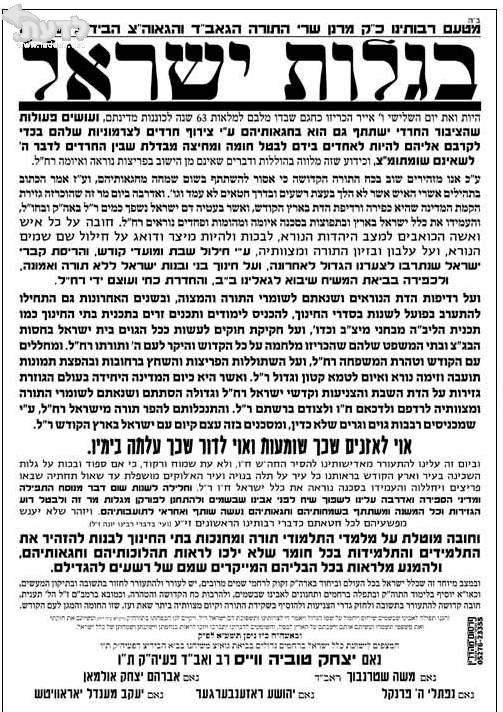
These days, alas, not much has changed in respect of the Hungarian ultra-Charedi establishment and the State of Israel, as seen by the following Pashkevil (click to enlarge), appearing now in Jerusalem.

Pashkevil condemning Yom Ha'atzmaut: 2011