Farewell Rabbi Yaakov Sprung

Please note: there will be no comments on this post.

I am not a member of Mizrachi. I used to be, about three decades ago, and my Rav was the saintly Rav Boruch Abaranok ז’’ל. Rav Abaranok was a Tzadik Gamur. He wasn’t a Beinoni. He was the real thing. He received his Smicha from the Chafetz Chaim and was friendly with Rav Elchonon Wasserman הי’’ד. He didn’t wear a Kippa Sruga (knitted yarmulka) and wore a dark suit and homburg hat. He wasn’t a great orator, but his words in a one on one situation, penetrated the heart more than any orator could achieve. He was also a staunch zionist, and supported the State of Israel in a genuine fashion. I have written about him here. When he paskened, he would subsequently invite you to come the next day or that night, to his office or home, and have all the Seforim open and prepared, and would explain from inside how he had come to his Psak Din.

Our son, Tzvi Yehuda, now famous for his incredible and successful chasing kosher side venture, was fortunate to have Rav Abaranok as his Sandek. I remember being flabbergasted when he arrived at the door for both the Bris and subsequent Upsherin, each time carrying a gift of Seforim. Our younger son, Yosef Dov who is learning in Israel presently, was also lucky to get a set of Seforim from Rav Abaranok ז’ל.

On Shabbos he wore a black litvishe kapote much like the dress of the Ashkenazi Chief Rabbis of Israel.

I used to bring our children (two back then) to Rav Abaranok almost every Sunday morning. His children and grandchildren were all overseas, and his wife nebach, was with him but not 100% due to her horrid experience in the Holocaust.

Rav Abaranok became very sick after a fall (as I recall). I had a strange sense that he was about to leave this world. It was too difficult for me to absorb emotionally, so I started visiting less often. He would ask me, if he saw me, “Yitzchok, what did I do. Why don’t you come anymore?”. He never realised that I couldn’t cope with seeing him slip away.

On his first Yohr Tzeit, I went and stood outside his house (which is no longer there) and just cried.

While he was still at Mizrachi, the community decided to appoint a new Rabbi. I stopped going because my father ע’’ה asked me to (the reason for which is immaterial to this post)

That Rabbi was replaced by the recently deceased and well-known, Rabbi J. Simcha Cohen ז’ל. Many members of our family still daven at Mizrachi and my brother-in-law is now the President. I was fortunate to have occasions to interact with him. My interactions were always of a Torah/Halachic nature and I enjoyed speaking “in learning” with him. He had a pleasant disposition and was a professional American style Rabbi with lots of grandeur.

Rabbi Cohen eventually left (I believe of his own accord, but I can’t recall), and was replaced by Rabbi Sprung.

Rabbi Sprung will complete 10 years of Rabonus at Mizrachi in August. I went to his home every Purim (even though he stopped serving scotch after the first year :-), and we shared divrei torah and halachic discussions. On one occasion, when there was an  injustice in the community, he was the Rabbi who was prepared to stand up, by ringing overseas, properly ascertaining facts, when he could easily have avoided the issue. He made a difference.

My wife loved his Shabbos Shiurim, and went every Shabbos to hear these. She said that he put so much preparation into each Shiur. He seemed to always be giving Shiurim. He went from minyan to minyan at Mizrachi and gave droshos. He enjoyed good relationships with the Roshei Kollel of Mizrachi’s Kollel and other Rabbinic staff.

His pastoral support was incredible. He would visit the sick, comfort the mourner or the forlorn, and his door was open. Recently, one post was perhaps too revealing about my state of mind. He doesn’t read blogs, but someone had mentioned it to him. On the next morning, I got a phone call wherein he expressed concern for me, and stressed that whenever I needed or wanted to discuss anything with him, to do so, and that his door was always open. My father ע’’ה was in hospital several times. Rabbi Sprung always visited him amongst many others. I know my father greatly appreciated Rabbi Sprung’s visits. He was in fact the only Rabbi to visit him.

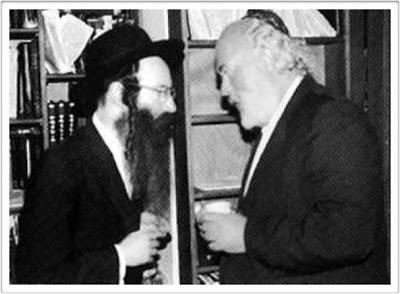
Rabbi Sprung on the far left. [picture from melbourne eruv website]
On Simchos (Smachot if you want to use Ivrit) he would meticulously prepare by interviewing everyone, and then weave a wonderful Drosha where he paid tribute to the attributes of the Ba’alei Simcha and their families. I heard such Droshas many a time. We invited him and his Rebbetzin to our own Simchos, as I considered him a Choshuve Rav with whom I had developed a relationship.

Mizrachi is not like other Kehillos. There are a lot of “leaders” of other organisations who are highly opinionated who daven there as well as many highly educated professionals and “machers”. Rabbi Sprung’s fidelity to Halacha was unquestionable. He wasn’t afraid to state his firm halachic view on a range of issues, including those who led services at the conservadox Shira Chadasha (an identical view with which Mori V’Rabbi Rav Hershel Schachter agrees). These types of issues may have made him be seen as too “right-wing”, but I can’t know that with certainty. I can only describe my interaction. Perhaps Mizrachi will now employ a hatless, Kipa Sruga type. Time will tell.

Towards the end of his Rabbonus contract in August, Mizrachi decided that it would only extend the contract after a democratic vote of all members. I can’t recall whether they had a democratic vote to appoint him, but I do recall there were a few candidates. One can surmise that after 10 years in the role, some no longer appreciated what he offered.

I am sad to see Rabbi Sprung’s tenure at Mizrachi Melbourne come to an end. Knowing him, he will see it as Hashgocho (divine providence) and depart as gracefully as when he arrived. I know he was widely respected by the Melbourne Rabbinate, and he avoided politics when  possible. I’m guessing Rebbetzin Naomi Sprung may feel somewhat blessed that she has an opportunity to relocate to an area closer to her children and grandchildren. Melbourne, isn’t exactly close by, and to be dislocated from family would be a strain for anyone.

I wish Rabbi and Rebbetzin Sprung immediate future success, together with lots of Nachas and joy.

We now wait to see who the (democratically elected?) new Rabbi will be.

Mesora and Psak: How it may differ between Chassidim/Mekubalim and others

The closeness to Mesora has always been primary. Halacha LeMoshe Misinai is immutable. Torah Shebaal Peh as written is a record of Mesora including contradictions and attempts to disambiguate and show through the Midos SheHatorah Nidreshes BoHem, including Sevara (which isn’t listed but is clearly a Midda as testified by the Gemora in many cases). As time advanced through Tanaim, Amoraim, Geonim, Rishonim we move to latter generations known as Acharonim. To be sure, there are some Acharonim, who on occasion would argue with Rishonim. Two well known examples are the Vilna Gaon and the Rogachover. They were guided by what they felt was Emes L’Amito.

When it comes to Acharonim, there  are those, depending on which group you align yourself with, who are considered “the last word” and there are others, such as the Chazon Ish in respect of electricity where everyone seems to be Chosesh to some extent to his opinion. That being said, others will say he was an Acharon in B’Nei Brak and if he was your Rav and/or you lived there you need to follow his Psokim.

The Brisker Shitta, is different. Whilst they are beholden to Beis HoRav (Volozhin/Soloveitchik) they were never afraid to disagree with each other. Of course, there is a group that follows every word of Reb Meshulam Soloveitchik, son of the Griz (Uncle of the Rav) in the same way that Chassidim follow their Rebbe. He’s just not called a Rebbe, and he doesn’t fir tish etc.

We saw that as a Posek became more recognised, people came for Brachos. Some were averse, and others would give a general Brocha to be Yotze. I sensed this from Videos of R” Shlomo Zalman.

The Rishonim (and here there is some difference amongst Ashkenazim) and certainly Sephardim, are untouchable. If you want to innovate=bring something consonant with Menorah you need to bring a Rishon.

I remember well, some 40 years ago when my zeyda bought a copy of the Meiri. At the time it was very controversial. Beautifully put together, it was ignored somewhat for years. Now, it seems nobody has a problem quoting a Meiri. The Meiri was a Bar Mitzvah present for my cousin Ya’akov Balbin and while it sat in my house for many years after he went on Aliya, I sent it to him at his request.

There have been plenty examples of Ziyuf. There was the fake Yerushalmi on Kodshim, and more.

The common denominator was that to qualify for Psak,  especially the style of Psak (especially Hungarian) where one joins different Kulos, you had to have a Rishon (or early Acharon who quoted a Rishon given that some had access to Rishonim we don’t have, or a Girsa we don’t have.

There are stories where the Rav’s Talmidim, would say but Rebbe it’s an open Maharsho that contradicts your Pshat. When he was younger, he angrily banged the Gemora and said, “and I’m not an Acharon”? This was not haughty. This was what he felt. He felt his Pshat was more correct than the Maharsho and was ready to debate it with anyone.

Many Acharonim either didn’t own, or look at other Acharonim. That’s not to lessen their importance. But, it’s a derech.

Where Chassidim/Mekubalim are different, I feel is that they would consider that when there is no clear way forward or where there are different views, Kabbola, whether from the Zohar or Ari on occasion trumps and guides the Psak. A pure non Chossid/Mekubal would note such opinions but would be less likely to PASKEN based on them.

Do people agree with me or have I over simplified. Drush is another class. One has license to extrapolate and certainly doesn’t need a Rishon to find a nice Pshat.

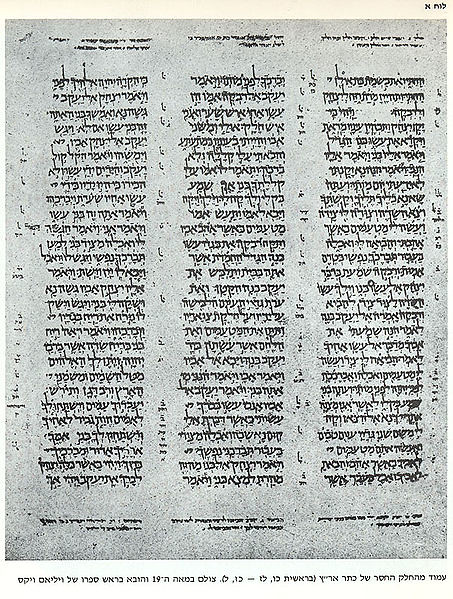
Aleppo Codex - Genesis

Rabbi Riskin on the conversion issue

[Hat tip MD]

Original in hebrew is here

Rabbi Riskin: Haredim are the greatest reformers

Rabbi Shlomo Riskin came out strongly against the ultra-Orthodoxas a result of their opposition to the law, saying “The Haredim are the greatest reformers. Justifying only one way is to Catholicism and the Pope”

Rabbi Shlomo Riskin, Rabbi of Efrat and founder of Ohr Torah Stone institutions, has slammed the haredi opposition to the law after the conversion  waves on Israel Radio. “I do not understand the thing. Yes, I  there is a commandment of “love the convert. “Yes, I think that the Chief Rabbinate until now did not know what it means is to convert properly with love and care. How do they have the audacity to say the conversions I perform are not in accordance with  Jewish law? “said Rabbi Riskin.

“Their behavior regarding conversion law is contrary to Halacha. Unfortunately, the Haredim are the greatest reformers, on many  things. Including enlisting in the IDF, because there is no section in the Talmud, where it says there Torah in respect of the laws of saving people’s lives in action. There is room for dissenting opinion in Judaism. One who claims there is only one way this is not not Judaism, but Catholicism and the Pope. ”

“The government has taken a bold step in favor of the unity of Israel, a move that will prevent a split into two peoples: Jews and Israelis,” said Rabbi Riskin. “I hope the Chief Rabbinate understands that we, city rabbis, are completely dedicated to Halacha and as in all generations there were dissenting students of Hillel and Shammai offering a different interpretation. We unite and will not split, we will talk and not boycott. This is about the lives of human beings and the future of our people.”

Tamar Ariel: an inspirational humbling young lady

I’ve struggled with understanding the myriad of Israelis who after their army service make their way to Nepal, and India, then sometimes down to Australia. Nepal and India have their significant risks. I’ve only been able to understand it in terms of a need to “come down” from the psychological experience of being in the army. In this regard, I think that whilst having Chabad Houses to support these Israelis is great, the IDF needs to do lots more to develop their post IDF program, especially given the spiritual vacuity that so many seem to experience as soon as they are confronted with life after training and/or combat.

Tamar Ariel is a hero though. I don’t know why she went to Nepal, and I don’t fit her shoes so am hardly in a position to proffer opinion, but a frum girl, who was a pilot, wore a skirt to her ankles, didn’t even shake hands with commanders, is someone who had much more to her than the Chitzoniyus of Tznius. This was a lady who internally was probably more modest than her external fidelity to Halacha. She was one of a kind.

יהי זכרה ברוך

Tamar Ariel ע’ה (picture from Yediot Achronot)

The article can be found here, by Mitch Ginzburg. I reproduce it below.

Cpt. Tamar Ariel, Israel’s first female religious air force pilot, a rear-seat, F-16D navigator, was buried on Tuesday, several days after she died high in the Himalayas. Hundreds of people, including dozens of IAF pilots and commanders, accompanied her on her final journey. Ariel was 25 years old.

She loved motorcycles and fighter jets and wore an ankle-length skirt to her IAF Flight School graduation in December 2012. When Maj. Gen. Amir Eshel, the commander of the air force, came down the line of new graduates, he nodded her a greeting, rather than clasping her hand; she nodded vigorously in return and beamed him a smile.

She was a modest and unassuming woman who resented being put on a pedestal. Her aunt, speaking over her grave, said that she did not want to pose for the photo op with Prime Minister Benjamin Netanyahu at the flight school graduation ceremony because she felt it overshadowed the achievement of her fellow pilots. And though in her life she went to great lengths to state that she was not a role model, she will likely be remembered as such by many in the modern Orthodox community in Israel, which is split by the competing values of army service for all, particularly among the younger generation, and the deep-seated social conservatism that spurred rabbis to press the state, since its inception, to grant all religious Jewish women the right to bypass army service with an oath of Orthodoxy.

Ariel was raised on a cooperative farming community, Moshav Masuot Yitzhak, in a home on the edge of an avocado orchard. She was the third of six children, born to a father who was second generation on the moshav and a mother who made Aliya from Puerto Rico, Yedioth Ahronoth reported in 2012.

She went to a co-ed local school as a child and to an ulpana, or yeshiva for girls, as an adolescent. In 11th grade, she received her first army summons and was found suitable for flight school. After taking several preliminary tests, she decided, in 12th grade, to fall in line with what most of the ulpana girls were doing – national civilian service. “I was afraid of ‘becoming rotten’ from a religious perspective,” she told the Yedioth daily. “I thought that serving within the framework of religious institutions was more protected and safe in that regard.”

She stated that she was Orthodox, received an exemption from army service on the spot, and served for two years as a Bnei Akiva youth leader and a counselor in her former school.

Upon completion, she decided that she still had not fulfilled her potential and turned back to the army, rescinding her earlier statement. In April 2009 she passed the week-long physical exam and was accepted to the prestigious course.

Nighttime navigation drills, when paired off with a man, were awkward, she said, but not “something that anyone dies from.”

After several months in the course and after being placed in the combat fighter section of her class, she flew her first solo flight. As she lined up the landing, wheels already on the tarmac, she felt that she was losing control of the plane and that it might spin off the runway. She pulled the eject cord, according to protocol, was rocketed skyward, and broke a vertebra in her back.

After months in an elastic body cast, the army took her back to the course but moved her into the navigator track.

In December 2012, she graduated, making history. “I don’t think that women need to go to flight school — I think that they can,” she told The Times of Israel at the time. “I recommend that any woman, religious or not, give it a shot. If they call you in, if you pass the tests, it means that the army thinks you can do it. So go ahead — try.”

During Operation Protective Edge this summer she flew the most combat missions in her squadron, her commander said earlier this week.

And then, seeking some R and R, she went, along with another pilot, to vacation in Nepal, to walk the Around Annapurna circuit at what is considered the optimal time of the year. “I didn’t worry during the trip to Nepal,” her mother, Anat, told Army Radio. “The trip was planned to the minute and I had faith in her and in The Holy One, blessed be He.”

Last week, though, a highly unusual storm blew through region, pelting the high mountain passes with snow. Ariel and dozens of other trekkers encountered the brunt of the storm on the Thorong La pass, the highest point on the circuit. Sapped of strength by the altitude and the cold and the fast-accumulating snow, Ariel could no longer walk as afternoon turned to evening and the clusters of trekkers tried to make their way down from the pass to safety.

She died in the snow along with Agam Luria, Nadav Shoham, Michal Charkesky, and 36 other people, half of whom were Nepali.

“You became a public leader,” moshav rabbi Meir Nehorai reportedly said at the funeral, “the object of admiration from all around.”

That admiration is likely to endure and to serve as a beacon to many young Orthodox women charting their path in life.

The kittel during Tefillas Geshem and Tal

We can all easily work out the sense in the Shaliach Tzibbur wearing one. A sense of extreme humility and awe should envelop the Chazzan while he recites such critical requests on behalf of the congregation.

On Erev Succos, an acquaintance of mine discussed the concept with me and asked me what the SOURCE of this MINHAG is. I said I’d look and email. I don’t have access to the Bar Ilan program because they refused my offer to port the program to a Mac or an iPad. I was hoping it might run under a PC virtual machine on my Mac. They have progressed from the time warp of DOS and XP and now like you to subscribe to online access.

Either way, I searched and searched and couldn’t find it. I was sure that if I looked at the Nitei Gavriel he was bound to find SOME primordial source for this. Alas, even he stated that he didn’t know of a source as pointed out to me by a Zurba Derabonnon.

I did find in my limited research that the Minhag in Frankfurt (and perhaps Hamburg and other parts of Germany) was NOT to wear a Kittel!

There was an older Minhag, about which I’m unsure why it ceased, to wear a special white gown cum kittel as one’s Bigdei Yom Tov. Many seem to forget that one should wear something extra special on Yom Tov.

Perhaps, just perhaps, this is the real reason why people wore it at the seder. I don’t really know and I’ve read many of the reasons including Rav Moshe Soloveitchik’s (R Chaim Brisker’s son who married into the Feinsteins) reason, and who was the Rav’s father.

Anyway, I’m throwing the question out to the Oilom who read my blog. I guess that someone like Rav Sraya Deblicki might know, but if Rav Tzinner, the author of Nitei Gavriel and Rav Hamachshir of Melbourne’s Eruv doesn’t know ….

Of course the kittel didn’t appear to exist amongst the Sephardim.

It’s a pity Rav Ovadya has left us, as he was a walking encyclopaedia kipshuto.

Full of twaddle

There is a fellow who sits proximate to me, whose Yechi Yarmulke annoys me. Actually, its not his yechi yarmulke, it’s all Yechi yarmulkes that upset me, because I consider the implied message as non halachic bunkum. And yes, I’d be happier if there was no sign at the back of the Shule, but if it means people don’t blurt it out at every opportunity during, before and after davening, like they used to, I tolerate it.

Anyway, he’s a new comer, so today he informed me that he had “asked about me”. He was perplexed. How can someone daven at a Chabad Shule and dislike the advertising hoardings around a handful of skulls.

He then told me that he was advised that I was a Misnaged who has been thrown out of every Shule I had davened at, and that’s why I now often daven in Lubavitch.

Well I have news for this Johnny-come-lately, and for the geniuses who informed him.

I have been “encouraged” to leave one Shule only in my life. It was the nascent Beit Haroeh at Mizrachi, decades ago. Two others, Anthony Waller and David Meerkin, both fine upstanding people and friends, who now live in Israel, were also so encouraged, all by Mizrachi Board Askonim at the instigation of the infamous Rabbi Baruch Zaichyk, then Rabbi of Mizrachi. I carry that episode as a badge of honour. Quite apart from some serious halachic issues I had with Rabbi Zaichyk which I raised privately with him (and I don’t refer to the Eruv that wasn’t) he publicly imitated Mori V’Rabbi Harav Baruch Abaranok ז’’ל and that was a line that was beyond the pale for me. I revered and continue to revere Rav Abaranok to this day. I could have fought Zaichyk, especially in those youthful days, and believe me I have a dossier of properly researched material in a file which I had prepared to defend my position in the event that a need would arise. My father ע’’ה who was a lot wiser than me, told me to just stay away. I have no desire to reveal this information today and long ago took the decision not to do so. I enjoyed a good relationship with Rabbi J. Simcha Cohen ז’’לֹ and get on extremely well with the impressive Rabbi Ya’akov Sprung, both Rabbis of Mizrachi since that time.

So Mister Smart Aleck, proud wearer of the Yechi Yarmulke, your “facts” have zero credibility. I think you need to wake up and realise that there are even Chabad Shules, such as the one run by my class mate Rabbi Yossi New in Atlanta, who wouldn’t even let you in, wearing one of these skull caps.

PS. Anyway, although I don’t follow any Chassidic group, I am not opposed to Chassidism per se, Lubavitch or otherwise. I have three sons-in-law and a son who consider themselves Lubavitch! I do have different views on matters: e.g. the rabid anti-Zionism of Satmar, Meshichism of Chabad, etc but they hardly qualify someone as a Misnaged!

Slichos with a guitar and other shticks?

Call me old-fashioned, but the איש ההלכה, the quintessential בעל מסורה, cannot digest a ceremonial alternative indie style of davening. This is not supported by the Rav, Rav Soloveitchik who was implacably opposed to innovations which essentially mimic the אומות העולם at the expense of מסורה.

Yes, there are clearly delineated sections of davening where one is permitted to innovate musically and use a tune of choice. This is a positive thing. However, הלכה does not tolerate the decimation of נוסח and I am vehemently opposed to anyone who feels that reinventing נוסח is even in their purvey.

Personally, when I was a boy, I didn’t enjoy Selichos at Elwood even though people came from everywhere to hear my teacher Chazan Adler (Selichos allowed anyone to drive and listen). It was a tad too operatic for me, and no doubt I was tired and wanted to go to sleep. Later, I preferred listening to Rabbi Groner ז’ל with his Nusach derived from רעים אהובים in Brownsville, NY, where he davened as a youth. חבל על דאבדין ולא משתכחין

I copy a piece from Rav Gedalia Dov Schwartz (recently retired Av Beis Din of America). There is plenty of other material, including a description of exactly which sections are “free” and which may simply not be changed.

The diversity of Jewish communities in different parts of the world has had its effect on the application of halakhah and the establishment of minhagim particular to each community. Especially in the matter of customs relating to the nusah and modes of prayer there are many distinct differences. We are all aware of the main streams of nusah known as Ashkenaz and Sephard and the reality that even in these two divisions there are nuances and changes that are ascribed to the different groups of each respective general nusah. Ofttimes a hazzan is caught in the center of controversy over proper nusah or sequence of tefillot and even in the matter of traditional tunes acceptable to the congregation. During the course of this article an attempt will be made to give some guidelines and insights relating to minhag regarding niggunim in their traditional forms and whether changes are permitted to be made. The major source cited by Poskim regarding the fixing of the norms of tefillah is from the Talmud Yerushalmi (Eruv. III, 9.),’ “Rabbi Yose sent and wrote to them (i.e. to the people dwelling in the Diaspora), although they (Le. the sages in the land of Israel) wrote to you the order of the prayers of the holidays, do not change the custom of your fathers whose souls repose in place.” This is the version cited by the Haga’ot Maimoniot (Seder Tefillot Kol Hashanah, 5) and the Magen Avraham 68. However, another version reads: “… although they wrote to you the order of the holidays do not change the custom of your fathers, etc.” In this textual change the meaning refers to the observance of the two days of Yom Tov outside of Eretz Yisrael. This textual variance is extremely important due to the divergent opinions which arose concerning the possibility of changing from one nusah to the other. This divergence is pointed out by the Gaon R. Yisroel of Shklov, one of the great talmidim of the Vilna Gaon, in his work Pe’at Hashulhan.( Hilkhot Eretz Yisrael III, 31.) He cites the responsum of R. Shmuel Demedina of Salonika (She’eilot u-Teshuvot Marashdom, Orah Hayyim, 35.) who ruled that any community may change its nusah of tefillah if the majority so desires because the prohibition of Shinui Minhag only applies to the category of issur, that is, prohibitory laws etc., and not in regard to such a category as tefillah. Consequently he ruled that the Ashkenazic community in Salonika may change to Sephard if the majority of its constituents are in favor of the change. Yisroel of Shklov comments that according to the version in Yerushalmi that prohibits the change in the mode of prayer, this ruling is not acceptable. He quotes the aforementioned Magen Avraham and the Ari Hakadosh who were opposed to any change based primarily on the Yerushalmi, especially since the Haga’ot Maimoniot mentions the text as restricting any change in prayers. The Pe’at Hashulhan attributes Meharashdom’s decision to allow such a change because he must have had the version proscribing any change in the status of the two days of Yom Tov in the Diaspora. It is interesting to note that R. Menachem Hame’iri of the thirteenth century preceded R. Shmuel Demedina in stating that there is no prohibitory regulation for changing the nusah of tefillot for the individual, and publicly if the minhag was different he should not pray differently than the tzibbur, implying that if it was the will of the congregation to change, they could. (Teshuvat Hame’iri, Magen Avot, II.) However, since the Magen Avraham also mentions in his above statement that the verses one says in the piyyutim should be sung in the matter one sings the kerovot (I.e. the piyyutim chanted in the Amidah), he is indicating that he is including within the context of not changing any nusah that one should not change the tune also. This inclusion of niggun as part of the rules prohibiting shinui or change in nusah is in keeping with the clearly stated ruling of the Maharil cited by Rema, (Orah Hayyim 619,1.) “One must not change from the custom of the city even in regard to the melodies and piyyutim that are recited there.” However, the Magen Avraham comments on the Maharil, saying that such a change should not be made because the change of tune will “confuse the congregation.” It would seem from this observation of the Magen Avraham on the Maharil’s ruling that if the tzibbur were not confused or upset by any change in niggun by the hazzan, there would not be any restriction. This raises the question on the Magen Avraham himself who has accepted the version of the Yerushalmi, as mentioned, rigorously opposing any change in tefillot. Perhaps the Magen Avraham interprets the Yerushalmi as meaning that if one is certain about the minhag of his forefathers then he is not permitted to deviate, but if there is uncertainty then it would be permissible. Thus, in communities where doubt and even prevailing ignorance as to the mode of prayer exists as to any definite tradition, changes would be acceptable as long as no violation of halakhah takes place and there are no consequences of bilbul da’at hakahal (confusion in the congregation). (Cf. Teshuvat Minhat Eliezer I, 11, for a novel interpretation of the Yerushalmi and an extensive discussion of changes from Ashkenaz to Sephard, etc.) However, where a change of niggun for example, would cause upheaval, then the words of Maharil and Magen Avraham would apply to all services and not necessarily for Yamim Nora’im, since the primary sources do not differentiate in regard to any particular season. Tangential to this, may I mention an interesting incident which happened to the Ga’on and Tzaddik Reb Zalman Bardn of Yerushalayim of blessed memory, who, once, while attending a Shabbat Minhah tefillah in a shul that had no regular hazzan, heard someone davening as the sheliach tzibbur using a chant that had no relationship whatsoever with the known niggun for the Shabbat Minhah. After waiting for the hazzan to finish, he left the shul and entered another shul to hear the repetition of the Amidah in the traditional mode. He went so far as to say that the “niggun of Shabbat should not be the niggun of the weekdays”! (Paraphrasing the statement of: “Your speech on Shabbat should not be for weekday speech”).(Shabo 113; Macy Nulman apprised me of this excerpt from Eliyahu Kitov’s Hassidim and Anshe Ma’aseh, Sefer Revi’i, p. 160.) This would perhaps be an example of an aspect of bilbul da’at hakahal because of the reaction incurred. As to the type of niggun introduced into prayer that would not cause any bilbul da’at hakahal, it definitely cannot be one that is identified with any non Jewish worship. This is clearly prohibited by many Poskim (Darkhay Teshuvah, Yoreh De’ab 142,27 citing several sources.) Even a tune that, although not connected to any non-Jewish worship, but is recognizable as belonging to a prevailing non-Jewish culture, would not be acceptable. This would be indicated as improper, especially in the synagogue, based on the Talmud’s criticism of Elisha ben Abuya or “Acher” as constantly singing Greek tunes, even when not in the synagogue. (Hag. 15b, viz. Rashi also.) If a shul is faced with the question ofengaging a cantor who does not know the traditional niggunim, known as scarbova nusah, if the makeup of the congregation is such that they willaccept the prayer leadership of such a hazzan and if there is no controversy regarding his being engaged, then it would be permissible to do so. The principle of merutzah lekahal (acceptable to the community) is enumerated by the Rema (Orah Hayyim 581,1.) regarding the qualifications of a sheli’ah tzibbur, although he may not meet the high standards of piety and sincerity demanded for this position. Disputes over this must be avoided. (Cf. Mishneh Berurah, ibid., 11). It is most interesting to note that in the enumeration of conditions pertaining to a sheli’ah tzibbur, the emphasis is placed on the individual’s piety, sincerity, and Torah knowledge and no mention is made of knowledge of niggunim or musical inflection. (Eleph Hamagen to Matteh Ephra’im 581,54.) However, knowledgeable congregations should seek the combination of piety and a mastering of traditional musical nusah which is part of the spiritual fabric of tefillah, particularly on the Yamim Nora’im. The absence of these hallowed niggunim during the davening would be unthinkable to any worshiper who has an inbred affinity for the feelings and stirrings of the heart, rendered by the proper nusah. Just as the Avodah in the Bet Hamikdash was accompanied by a certain order of shir or music, primarily vocal. (Ar. 11a.) so must our Avodah in the synagogue maintain a proper contact and order of shir, of niggun and nusan as we, in our way, make our offerings of prayer.

מי כעמך ישראל גוי אחד בארץ

I don’t know where Thisbe from, my daughter in law sent it. Uplifting!

A soldier on the border writes:

What’s happening here in the staging area [area where soldiers prepare to enter Gaza] is beyond comprehension, not rationally, not emotionally and begs the imagination.

Almost every hour a car shows up overflowing with food, snacks, cold drinks, socks, underwear, undershirts, hygiene supplies, wipes, cigarettes, v backgammon and more. They’re coming from the North and the Center, from manufacturers, from companies and private businesses, from prisons, Chareidim and Settlers, from Tel Aviv and even Saviyon.

Every intersection on they way down here we get stopped, not by the police, but be residents giving out food. What is amazing is that the entire situation b organized and everyone is coming on their own without coordination between the folks coming.

They’re writing letters and blessings, how they’re thinking of us all the time. There are those who spent hours making sandwiches, so they’re as perfect and comforting as possible.

Of course representatives of Chabad are here to help soldiers put on Tefillin and distributing Cha’Ta’Ts (Chumash, Tehillim, Tanya) for every troop transport and Breslov are showing up to the border and dancing with the soldiers with great joy.

The Chareidim are coming from their yeshivot to ask the names of the soldiers with their mothers’ names so that the whole yeshiva can pray for them. It should be mentioned that all of this is done under the threat of the terrorist tunnels and rockets in the area.
Soroka Hospital (in Be’er Sheva) today looks like a 5 star hotel. A wounded friend who was recently discharged told us how the MasterChef truck is parked outside and is preparing food for the wounded.

It goes without saying the amount of prayer services that are going on. On the religious front as well, there are lectures and Torah classes, all the food is obviously Kosher. Shachrit, Mincha, and Maariv with Sifrei Torah. They’re giving out tzitzit and Tehilim by the hundreds. It’s become the new fashion! The Rabbi of Maglan [Special Forces unit] told me that almost the entire unit has started wearing them, because the Army Rabbinate has been giving out tzitzit that wick away sweat. They’re gaining both a Mitzva and a high quality undershirt. We’ve started calling them “Shachpatzitzti” (a portmanteau of the Hebrew term for body armor and tzitzit). We’re having deep conversations late into the night without arguments, without fights and we find ourselves agreeing on most stuff.

We’re making lots of jokes at Hamas’s expensive and without politics. There’s lots more to add but my battery is running low and the staff has been requesting someonekm give a class on Likutei MoharaN (Breslov).

How happy is the nation that is like this.

Give us back our boys (Part 2)

After the Caulfield Shule event there was much murmuring from sections of the community about aspects that they didn’t like. This is not to imply they had a problem with the event. The feeling was positive.

I’d like to consider each one (that I know of) and that have been broadly canvassed, and offer my view, for what it’s worth. These are in no particular order.

  1. Umbrage was expressed that the Rabbinic President of the RCV and ORA was using his phone from the daïs to take panoramic pictures/videos from his place while people were involved in the event.
    My view is that this was ill-advised, and not in keeping with the solemnity and angst of the event. There were adequate photographers and the ubiquitous Channel 31 fellow quite able to take pictures and video as need be.
  2. Offence was expressed that some Rabbinic figures failed to sing HaTikva
    My view on HaTikva was formed many decades ago when I discussed the matter with a Rav from Mercaz HaRav, as a young Yeshivah Bochur during the summer break at Moshav Keshet. That is a story in of itself. The Rav was fiercely Religious Zionist, and our site was literally on the border with Syria. When we threw a rock over the barbed wire fence near where we worked each day, it was common for a mine or some other incendiary device to detonate. The Rav was obviously very spiritual. I remember waiting twenty minutes for him to finish davening Mincha after we had all finished to engage him in discussing the matter. His view was that it was unfortunate that God’s name is not mentioned therein and that there was no seeming connection to Torah. Nonetheless, he felt that when in a place where people were singing it as an anthem, not doing so, would likely cause some to make the wrong reading, and that this itself could estrange Jews from Judaism, so to speak. He told me that he made one substitution when he sang it in such situations. Instead of Lihyot Am Chofshi, he used Lihyot Am Torah B’Artzenu and suggested I focus on Hashem’s hand and Ein Lecha Ben Chorin Ela Mi Sheosek BaTorah. Since that time, I have tried to do so. Chofshi, can mean many things, but to secularists this can range from freedom to possibly freedom of the yoke of religion/heaven (from the vantage of a more Charedi reading). As my own children grew up, they noticed me making this substitution. Whether they do, is a matter for themselves. 
    That being said, it is unwise to be standing there in public view without one’s lips moving even if someone is theologically opposed. I understand that some might turn their back so nobody would notice. I understand that some have other objections. I could even foresee the bleeding left-wing objecting to the anthem on the grounds that it is difficult for an Arab Israeli to sing (this has been in the news in fact). Either way, one should absent oneself in an inconspicuous manner so as not to create heat. I saw one Rabbi leave as soon as Tehillim was over. That’s his right. It’s for his congregation to interpret. Nobody forces a Rabbi to sit anywhere they don’t want to.

    In of itself, there is nothing holy about an anthem, of course. This does not imply that one is opposed in some way to the notion that the birth of the State was Yad Hashem and a miraculous event. Let’s face facts. The majority of the RCV are not Religious Zionists, including the President nor do they need to be in terms of any constitution or mandate that I am aware of.

  3. Some from the more Charedi spectrum, who made an effort to attend in name of unity, felt that the Tefilla Lishlom HaMedina was contentious.
    It is true that Charedim, Chabad, Litvaks et al do not agree that the birth of the state implied that one should say Reishit Tzmichat Geulateynu. Some add the word “Shtehe” (rumoured to be R’ Moshe Feinstein’s suggestion) or Smichat Geulatenu.Having finished a book about the Rosh Yeshiva, Rav Amiel ז’ל, of the Gush, a holocaust survivor himself and ardent Zionist, and having a copy of his seminal book המעלות ממעמקים which I read decades ago, it is clear that even some Religious Zionists (like Rav Amiel) have problems with the issue of certainty when it comes to predictions of redemption. It is also for this reason also that I am uncomfortable when people say that XYZ is Mashiach. This type of eschatology, to me, is unimportant. The end is the goal. Exactly who and when and how things happen, as noted by the Rambam in Hilchos Melachim is unpredictable. Having said that, one wasn’t forced to say this prayer. One could easily have just stood like everyone while it was being said. Those who felt that it was just too theologically uncomfortable, could have attended a Tehillim event that was apparently held at Adass Israel on a previous day, although it would be good if they publicised these things in a better manner: they know how.
  4. There were comments about allowing a Conservative Cantor recite Tehillim.
    To be honest, I didn’t know who the (Sefardi) Cantor was. I only noticed the errors in Tehillim that he had made and wondered whether he had bad eye sight. Either way, unless the person is a Kofer/Apikorus, I don’t see an issue with saying Tehillim after him (I haven’t asked my Rav). I would assume the President of ORA checked this out and was satisfied that he wasn’t a Kofer/Apikorus.

To end on a positive note, [Hat tip BA] listen to this excellent speech from the Chief Rabbi in London.

How much time do Rabbis put into their Drashos?

I have had recent and distinct pleasure reading the magnificently articulated and profoundly original drashos of Rabbi Dr Norman Lamm (may he have a speedy recovery). It struck me that I’ve probably never heard that style of quality Drosho in Melbourne. I was exposed to the emotionally laden but never judgemental tantalising drashos of Rabbi Chaim Gutnick ז’ל and the fire and brimstone and sometimes judgementally powerful drashos of Rabbi Yitzchak Dovid Groner ז’ל. I listen to their sons, and there are semblances of their father’s styles (this is natural), but in essence I haven’t experienced true uniqueness.

I enjoy the care, research and effort that Rabbi Sprung puts into his Drashos (on the occasions that I hear them). I am not attracted to the style of Rabbi Genende. It’s almost apologetically left-wing and seems to use external sources for no other reason than to show that they have been read and incorporated. Rabbi Lamm also uses external sources, but it flows ever so naturally and augments his broad Rabbinic knowledge.

Many other Rabbis effectively parrot or paraphrase a nice thought from the Lubavitcher Rebbe or the Baalei Mussar, which whilst authentic, I sometimes find lazy. Some like to use cute stories. Unfortunately, many of them are hagiographic. I have heard Rabbi Kennard once and found him succinct, clinical and well-organised, but perhaps (at least for me) lacking an element of emotion, call it fire-power. No doubt that’s a natural stylistic phenomenon. If I am to hear a Drasha that isn’t emotionally laden, then I’m awaiting a brilliant unique insight. I don’t have time for the joke a minute style of Drosha either.

To be fair, I am an outlier. Most people are probably very happy with the Drashos they hear. I like to ask myself two questions:

  1. Have I been inspired to actually do or try to do something that I haven’t done, or being doing well, after the Drasha
  2. Have I been inspired to research the topic myself after the Drasha

If the answers are no, then those Drashos disappear like a distant memory.

Perhaps I have been spoiled by the internet. My iPhone brims with super quality drashos and insights. If we are to grow as a community, I feel that some Rabbis perhaps need to put much more time into their Drashos, and, yes, even publish these. They also have to realise we aren’t dumb. I know when I’ve heard it a few years before 🙂

How much world-standard Torah is actually published in Melbourne? Do we have a ‘Chief Rabbi’ in Australia capable of such or are we more caught up in Askonus.

It is true, that not all Shule Rabbis are born orators. Do they have to be in today’s day and age, or is it more important to excel in pastoral care and impart that “feel good” image?

I admit, I undoubtedly have a bias. I like a Chidush, a new insight. In the least, I enjoy being mesmerised by the sheer breadth of halachic knowledge that some impart on a weekly basis emanating from the Parsha (e.g. Rav Schachter or Rav Usher Weiss). Undoubtedly, I am an outlier and atypical.

Don’t even get me started on the lack of simple manners (forget Kavod) that exist primarily at religious functions when a Rabbi/Rov/Roov gets up to speak for a few minutes.

My thoughts on the Rav and the Rebbe event

When I became aware that this event was being planned, I quietly contacted the organisers, and asked that either the Chabad speakers (I didn’t know who they might be) and/or the YU speakers might address the telling letter where the Rebbe זצ’ל chose to write some of his personal thoughts about the Rav.

I felt that the YU speakers were generally “polite”, reminiscing and respectful. There is and was no problem (to my knowledge) in a pluralist place like YU to condemn anyone who decided to learn Chassidus (of any type) that I am aware of. In the same way, although Mussar was not seen as a useful use of one’s time according to the Beis HoRav (through R’ Chaim) it would be hard to imagine YU or the Rav condemning or putting a stop to someone for whom learning Mussar was part of their daily regimen. Talmidim had to know all about the Shiurim that they attended, and in particular, those who went to the Rav’s shiur, say, as opposed to those of R’ Dovid Lifshiz ז’ל were exposed to the method of trying to learn what is in-between the lines. R’ Dovid, the Suvalker Gaon, had a different approach. The Yeshivah co-existed with different viewpoints, but the Rav’s charisma and enormous depth in learning, naturally attracted many now esteemed Talmidim.

I received some replies from the organisers about the source of the letter I presented in an earlier blog post in which the Rebbe clearly expressed a form of misgiving about what he considered to be character traits of the Rav. I responded that if this was to be a true event where the relationship was to be studied openly and honestly, that the organisers should approach Chabad about the authenticity of the letter (not that this can be questioned, it’s very clearly the Lubavitcher Rebbe’s handwriting) and be ready to analyse and comment on it.

I didn’t hear back for months, and I just assumed that the organisers would pass the letter onto the Chabad speakers, and we’d hear a perspective, at least, in due course. Perhaps the organisers did pass on the letter, and Rabbis Krinsky and Jacobsen decided that they wouldn’t “touch it” because it might introduce controversy. I don’t know. I may email the organisers and ask them.

I’m an academic. If this was a colloquium or extended seminar and it failed to discuss the contents of the letter (they are of course entitled to disagree entirely with my personal interpretation) then it was deficient because it seemed to be ignored.

Perhaps I am oversensitive because the Rav has become such an important ingredient in my ability to make sense of the world through the prism of Yahadus, but I felt that Rabbi Krinsky, continually referring to him as “Rabbi” Soloveitchik was (perhaps unwittingly) derogatory. The Rav described himself as a Melamed, but given the number of Rabbinic folk in Chabad who get Smicha and call themselves “Rabbi” XYZ, I felt this was a come down. He could have been called “the Rav”, or even R’ Yoshe Ber, especially since the event was being held at YU. (I find those who refer to him as “J.B” rude). Can you imagine for one minute if someone from YU spoke at a Chabad event at 770 and referred to the Rebbe as Rabbi Schneersohn? I know people are even sensitive to the acronym Ramash, because acronyms are usually applied once someone has passed away and is in גן עדן מקדם or in עדן itself. I found Rabbi Krinsky’s anecdotes interesting, but I didn’t find them academically incisive or revealing. Certainly his recollection of the Rambam in Pirush Hamishnayos when the Rav came to be Menachem Avel to the Rebbe, was enhanced by Rabbi Jacobson and more detailed than what I head read in (I think) Nefesh HoRav.

Rabbi JJ Schechter, not to be confused with the Rav’s Talmid Muvhak, R’ Hershel Schachter שליט’’א  is a fine scholar, and I have read a number of his articles, books, and listened to his talks. However, here, I felt he (perhaps diplomatically, or influenced by his late father, the other Rabbi Hershel Schechter ז’ל) provided more of a sociological talk which, while entertaining, wasn’t overly enlightening (at least to me).

I felt the most dynamic speaker was Rabbi Jacobson. His reputation as a speaker precedes him. He, at least, tried to link the contents of the Sichos which the Rav heard, with his interpretation that they were an “answer” to the Rav’s lonely man of faith, halachic man, etc. Nobody seemed to mention that the Rav went to the farbrengen as an expression of HakoRas HaTov as described by close Talmidim. To look at Rabbi Jacobson’s thesis, and he was second guessing his own Rebbe, one would have to study those Sichos and see whether in the gamut of other Sichos or Ma’amorim at farbrengens, these were indeed somewhat out of left field, and directed as a theological approach by the Rebbe to assuage the original thoughts of the Rav, as expressed in his published works to date. I certainly am not in a position to comment on that thesis, as I do not have the knowledge of the Rebbe’s general style and content at such a Farbrengen, let alone those Sichos.

I am surprised that nobody took the opportunity to mention that the Rav wrote a Pirush on the Tanya in Ksav Yad, that remains unpublished, as claimed by Rabbi Kenneth Brander on his recent visit to Melbourne. It’s certainly indicative of the Rav’s attitude to Chabad, as opposed to the Rebbe in particular.

To summarise, what I considered, a few years ago, to be a letter which provided potentially important insight, was seemingly wilfully? ignored. As such, I felt it was a “feel good” evening in American style, where the YU people stressed that the Rav had enormous respect for the Rebbe (which needs to be tempered by statements recorded in Rabbi Holtzer’s book, and statements attributed to the Rav’s own son Prof Chaym Soloveitchik)

So, in conclusion, congratulations on a great idea, but I would have preferred a more academically inclined approach than the “slap on the back” style which seemed to permeate most speaker’s style of delivery. Then again, maybe that was the aim of the organisers, and my issues are misplaced in context.

Adass vs Mizrachi

The following correspondence is making the rounds of email on the internet. It sheds light on the basis of the disagreement.

Disclaimer: Ian is my brother-in-law

First, we have a letter from Adass

Dear Ian
I am receipt of your email statement of behalf of the Mizrachi Organisation.
I am astounded that you would issue such a notice without the courtesy of enquiring about the aim of this gathering
You labelled this “a protest” which was “designed to attract the attention of the general community and the media” organised by opponents of the state of Israel
Unfortunately your statement is totally incorrect.
This was not a “protest” but rather a gathering of Jews – Shomrei Torah uMitzvos from most communities – to say Tehilim and Tefillos against recent decrees aimed at harming the Torah world.
We mirrored the call of the ENTIRE Torah leadership worldwide – Chassidim and Litvaks, Ashkenazim and Sfardim.
The Gedolei Hador are pained at new legislation which further erodes Achdus and Shalom between fellow Jews.
How can anyone sit back and watch as a Jewish State legislates that one Jew will put another Jew into jail for studying Torah?
This is something that saddens all of us and we pray that Hashem should bring us together as one people.

This was not a protest. No one spoke, there was no speeches. No banners or signs – Just tehillim and tefila

It was most specifically NOT done to attract the media. It took place inside a Shul – the most appropriate place for prayer.
There was no contact with the media and no street signs.

You have stated the exact opposite of what we were aiming.   We came for prayer for unity peace and you interpreted it as the opposite.

I think you owe the organisers a public apology for your words.
Wishing you a Good Shabbos and Simchas Purim
BINYOMIN KOPPEL
President
Adass Israel
 
PS Please note that I am responding on behalf of our Shul.
Mizrachi’s response is produced below
Dear Binyomin,
I refer to your email of 14 March 2014.
Your letter raises a number of complaints concerning the statement I made on 13 March 2014 which I will attempt to deal with.
First, you say that you are astounded that I would issue such a notice without the courtesy of enquiring about the aim of this gathering.
The aim of the gathering was readily apparent from the poster that was widely distributed. The poster depicted a Sefer Torah wrapped in barbed wire conjuring up the very worst images from our recent history. It called upon men, women and children aged 9 and over to “show solidarity with our embattled brethren in Eretz Yisrael regarding the proposed new law”. It contained images of large outdoor rallies held in Jerusalem and New York.  Although you assert that I should have made enquiries about the aim of the gathering before making any statement, no attempt was made to consult with the Mizrachi Organisation (or to obtain Rabbi Sprung’s signature) prior to organising the event. Presumably that was because it was anticipated by the organisers that Mizrachi would have objected in the strongest terms to what was being planned.
Secondly, you say that I mischaracterised the event by calling it a protest.
When people are called upon to assemble in large numbers to voice their opposition to legislation enacted by a democratically elected government, they are in effect being called upon to protest. A protest need not involve speeches or banners, although I note that similar events held in other cities included such features. You say that the event “took place inside a Shul – the most appropriate place for prayer”. However the poster announced that the rally would take place in the Adass Gutnick Hall.
Thirdly, you state that in organising the gathering you “mirrored the call of the ENTIRE Torah leadership worldwide”.
It is disappointing and troubling that you do not consider Mizrachi and our ideological affiliates around the world, who did not participate in any such events, as part of the Torah leadership community.
Fourthly, you assert that the legislation will mean that “one Jew will put another Jew into jail for studying Torah”.
A cursory reading of the legislation or the available summaries of it will reveal that the law has no such purpose or effect. Its intent is to gradually implement a more equitable sharing of the responsibility for protecting and defending the State of Israel and all of its inhabitants. The law does not come into effect until at least 2017. In the meantime, there is a full exemption for anyone over 26 who did not register in the past and an exemption for anyone aged between 22-26. There will be an option to perform national service rather than serve in the armed forces. Exceptional students will be completely exempt.
Fifthly, you write “We came for prayer for unity (and) peace and you interpreted it as the opposite”.
Scheduling the event on Ta’anit Esther and using the words “Gezeirot Kashot” (ie. harsh decrees) to describe the legislation recently enacted by the State of Israel plainly sought to equate that legislation and those responsible for it with with the terrible edicts decreed against the Jews by Ahasuerus at the instigation of Haman. Actions and statements such as these are plainly calculated to erode achdut. Referring to the Government of the State of Israel as “Shevet HaRasha” (the evil tribe) erodes achdut. How can you claim that you were seeking “unity” and “peace” when you describe fellow Jews in these terms.
I note that, since receiving your letter, two of the seven Rabbis who signed the poster have since expressed deep regret and emphatically dissociated themselves from the document.
You conclude your letter by saying that I owe the organisers of the event a public apology. For the reasons set out above I am not able to apologise for the statement that I made on behalf of the Mizrachi Organisation.
Yours sincerely,
Ian
__________________
Ian Waller SC
President
Mizrachi Organisation

Excellent article on the IDF exemption issue

This is from Rabbi Slifkin (whose wife is a distant relative of ours)

It is well worth reading.

A non Chabad response to Rabbi Kennard

I was sent this, presumably from Rabbi Kennard’s facebook page. I will take the liberty of interspersing what I think answers might be.

Rabbi James Kennard Rabbi Schochet introduces his second piece by making clear that he was asked to become involved “at the behest of the Chabad Leadership of Australia” (as stated on his FB page and on collide.com).

This raises three questions:

1. If the Chabad leadership of Australia wanted a response to my first piece, why could they not find any Chabad rabbi in the whole country to write it? Why was no-one as suitable for this task as someone on the other side of the world?

I would have thought the answer to this question was obvious. Each Chabad Rabbi has their constituency and is dependent on it. Most/many would not seek to become actively involved in a debate on such a topic as it may cause heat and/or discussion in their constituency. They would see their roles as Rabbi Kennard has noted, as bringing Moshiach, and would not see debating this topic as helping to do so. On the other hand, some, presumably younger? or perhaps more likely to want to defend the Chabad brand, sought out a well-known Rabbi, Davka, who is not on these shores in the (ill-advised in my opinion) hope that he could “argue the case with Rabbi Kennard and defend the brand”.

2. If Rabbi Schochet’s piece was written at the behest of the Chabad Leadership, will they agree to what was written in response to their request? In particular, are they of the opinion that Chabad rabbis are uniquely dedicated to their shuls, in a way that non-Chabad rabbis are not?

No doubt they have opinions or even a single opinion on this, however, I don’t expect them to comment as they will feel it won’t achieve anything in practice (B’Poel, as they put it). They will likely exercise their right to silence and not respond (further directly or indirectly through an agent). Followers of the disagreement will  make up their own minds about the lack of response and what that means to them, in practice.

3. Of course there is another possibility. I have been informed that Rabbi Schochet’s article was not written at the behest of the Chabad Leadership in Australia. That would render questions 1 and 2 above moot. However, that would imply that Rabbi Schochet’s statement was incorrect. Since he accused me, repeatedly of “peddling lies” and repeating “falsehoods”, it couldn’t be that his article was factually inaccurate. Or could it?

I don’t expect Rabbi Schochet or anyone will tell you whether he was were asked, cajoled, encouraged, and/or by whom. Accordingly, my advice is to continue to focus on the important issue of pluralism within Orthodoxy, something I wholeheartedly support, and the advantages of alternative approaches for certain congregations. And yes, I repeat, I support the presumption of different approaches/diversity.

A clear response from either the Chabad Leadership, or from Rabbi Schochet, will clear the matter up.

As I said before, I can’t see that happening.

I’d move on.

R’ Shmuley Boteach, R’ James Kennard, and Diversity within Chabad

I am not a supporter of R’ Boteach’s approach. I am not a Chabadnik, and for reasons which I won’t go into, I most certainly don’t advocate the glamour and glitz approach of R’ Boteach. Recently, R’ Boteach spoke at Caulfield Shule. I am told it was a packed house and many enjoyed his talks. Yoshke isn’t Kosher in my eyes, and in the eyes of many, but came they did to hear Boteach’s messages on that and “Kosher Sex” and more.

Enter an Ashkenaz Shule, Sydenham, in South Africa. Yes, my Mechutan is the Rav of the Shule and a Chabadnik. He’s actually moderate for what it’s worth. They, for whatever reason, also had R’ Boteach speak. I don’t know how it went, but I’d imagine it was popular. R’ Groner in Melbourne spoke firmly, personally and with gentle persuasion to R’ Boteach to use his talents in other ways. That did not work.

Now Caulfield Shule is led by an arguably left-wing modern Orthodox Rabbi, who I believe is from Rhodesia? Either way, he allowed the talk to go ahead.

The Shule in South Africa, led by a Chabad Chosid, also allowed the talk to go ahead. That’s not to say either Rabbi agreed with the approach of Boteach. I don’t know the circumstances.

If we are to accept that a large Ashkenaz, mainly non-observant Shule in South Africa ought to also have a more diverse Rabbinate (as in Melbourne, Australia) as alleged by Rabbi Kennard, then I ask, in practical terms: what was the difference between the Caulfield event and the one in Johannesburg?

I think the answer is that were the Rabbi of Caulfield someone who asked his Sheylos to R’ Hershel Schachter, the pre-eminent Posek of the Centrist Orthodox community, and senior Posek of the OU, then he may have been advised that it was unwise. On the other hand, the Rabbi in Joannesburg found himself criticised in the Jewish Press by  scions of Chabad in the guise of the respected R’ Ezra Shochet. No doubt though he discussed it with his trusted colleagues.

If there is one thing I’ve observed about Chabad, is that it’s a binary system. The Rebbe was it, and everyone else is at the same 0 level. That is, a 1 and many 0’s. Again, while I agree with R’ Kennard that we do need home-grown Rabbis and more diversity, Chabad cannot be painted (any longer, if at all) with one brush. I’d say the quality, honesty and energy of the personality  is at least if not more important than their Hashkafa (in our day and age)

What we need: some intellectual honesty coupled with outward perspective

We need intelligent, articulators of Toras HaShem across the board. No politics, no Chumros, no fancy hanhogos. Torah Lishmo. For every Shiur in Nistar (Kaballa which is not the same as Chassidus) there must be a Shiur in Torah, Nach, Meforshim, Shas, Halacha in a digestible way. The greatness of the wisdom and enternal truth of Torah must be exposed. Too many of our youth and middle-aged people keep a link to the past which is not based on Tachlis or based on consistent learning from Rabonim. A Shiurm/Sermon in  Shule or a Temple needs to be given by those trained; not academics in areas where they are bordering on ignorant and lacking the basic Tennet of Judaism—Emunah P’Shuta and Bittul HaYesh.

Each week in a Shule I go to, we have a ‘game’ where we try to spot the Chumra of the week from a well known shtiebel in Melbourne. I get upset. Others find it comical. The Rav is a big Talmid Chacham. Recently he discussed Memareach (smearing cream) on Shabbos. Did he quote the Shmiras Shabbos’s important Psak from R’ Shlomo Zalman Auerbach, no? Why? a lack of Intellectual dishonesty and perverse notion of Torah is my answer. Did he mention that it doesn’t apply to hard surfaces like teeth where it can not be absorbed even MiDerabonon? No. He can and may argue if course, and disagree, but not to mention it and not to argue the point is part if our compartmentalised Toras HaHelem (missing Torah). By all means conclude that you don’t recommend it for various reasons but you must also mention that those who do rely on Giants with shoulders as broad and broader than many of those quoted. This is a living Judaism of B’Nei Torah. It’s a perverse Judaism to omit such on purpose and effectively brainwash a Kehilla or Yereim and Sheleimim. To me. THIS is the difference between centrist orthodoxy and charedism. The former are open and intellectually honest and complete. The latter are cocooned in a hermetically sealed perversion of halachic consideration which buttresses a jaundiced view, at the cost of the vista of opinion. It’s almost cult like.

On Kennard, Shochet, Chabad and Modern Orthodoxy

The community in Melbourne, and abroad, has been buzzing about a series of articles/indirect interchanges between Rabbi James Kennard, principal of Mount Scopus College and Rabbi Yitzchok Shochet of the UK. I caught the tail end as we were heavily involved in planning and enjoying the wedding of our daughter! I had a moment after the Shabbos Sheva Brachos to quickly read Rabbi Kennard’s second article (I haven’t seen the first) in the Australian Jewish News, and formed some thoughts which I now have a moment to put down.

Firstly, the usual disclaimers and context:

  • Three of our children married into Chabad families. Our fourth will also do so in a month or so.
  • I attended a Chabad school, Yeshivah College in Melbourne
  • I did not attend a Chabad Yeshivah after year 12, I went to Kerem B’Yavneh, a religious zionist yeshivah (call it Chardal if you like)
  • I was Rosh Chinuch at B’nei Akiva for a few years, and my wife was a Meracezet in Sydney
  • None of our children attended a Chabad Yeshivah or Seminary after their Schooling.
  1. There is little doubt that a follower of Chabad, who considers themselves a Chosid, needs to effect the wishes and approach of the late and great Lubavitcher Rebbe, the Ramash נ’ע
  2. There is little doubt that the philosophy of Chabad is that the Geula (Moshiach) will be effected when Yidden will augment their Torah with Chassidus Chabad. אימתי קאתי מר
  3. There is little doubt that where a person has no known minhag because their family practices have lapsed, that Chabad will only introduce Chabad minhagim to that person, and will in general not make an effort to find out what a family practice might have been. This is because Chabad philosophy considers their approach as one which subsumes other approaches, and is superior at this time. שער הכולל
  4. There is little doubt that Chabad has indeed changed its approach to Zionism, in practice. Whereas the Rashab spoke with vitriol in a manner not too different to Satmar, the Ramash’s language became far more sanguine and displayed an acceptance? of historical reality (to use the words of the Rav, “History has paskened that the Aguda was wrong”)
  5. Chabad never saw the establishment of the State as the moment of the beginning of Geula. On the other hand, the establishment of the State certainly occurred during the time when the Geula was imminent, according to Chabad philosophy.
  6. In general, unlike many groups, Chabadniks do not spend their lives in Kollel. They either go out and get a job/study, or they become Shluchim. That’s not to say they embrace Torah Im Derech Eretz as a particular philosophy. Rather, it’s how one survives and lives.
  7. Chabad was and still is a leader in Jewish outreach, and this stems from extreme! Ahavas Yisroel, as stressed in Chassidus Chabad, where the Neshomo Elokis of a Yid is what counts, at the cost of all other considerations. This is a good thing!
  8. The Rav himself stated that Chabad taught the world how to bring Yiddishkeit into Reshus HoRabbim as opposed to Reshus HaYochid.
  9. The Rav noted that the differences between the Tanya and Nefesh Hachaim were semantic nuances that most did not and could not understand. The Rav did, of course. Indeed, Rabbi Brander mentioned that the Rav wrote a Pirush on Tanya which is still בכתב יד!

Until now, I have written about Chabad. Of course, like every group, there will always be a mismatch between the philosophy and some of the implementors (call them Chassidim) of that particular philosophy. Some Chassidei Chabad are what one might call “more tolerant” of difference, whereas others (often these are newer chassidim) range from less tolerant to downright intolerant of anything which isn’t in immediate accord with the Chabad approach to life. In this, one could argue that Chabad are no different to others. I would argue, however, that Chabad are different. Their difference lies in the fact that they absolutely revere and adhere to their approach to Yiddishkeit and do so with Mesiras Nefesh. Any student of history or sociology will have noticed that elements of this reverence have rubbed off on so called Misnagdim, who now have Rebbes in everything but name. “Gadol HaDor” anyone?

I agree with Rabbi Kennard that there isn’t only one way. I have always felt that way. Indeed, when I was a student and introduced to Tanya, I had a “stand up” with my teacher who said that Moshe Rabbeinu was a Lubavitcher. I said this was absurd and he called me a “Moshchas”. I think that’s where I started going down hill 🙂

It is a well-known Gemora (I think in Taanis) that says that Hashem will, in the future, create a circle of Tzaddikim (in plural) who will dance around him and point to the epicentre of truth, which IS Hashem, בעצמותו. Many have repeated the interpretation (two which readily come to mind are Rabbi Akiva Eiger (whose grandchildren were Chassidim) and Rav Kook (whose mother came from Chabad)) that a circle was chosen rather than a square or indeed a line (dance) because each Tzaddik represented a different but equal approach to Avodas Hashem: call it a different perspective.  The  point of this Gemora (I think it might even be a Mishna, but I’m writing without looking as I have little time at the minute) is that each approach is equidistant to Hashem. Each is valid. Each is correct.

How can they all be correct? Simply because it’s a matter of perspective. Two people can be in the same room and the same spot, and witness or observe the same thing from two perspectives. Both are right. Both see truth. One of my sons is very talented in design. I have zero talent in the area in which he excels. I will not see what he sees. At the same time, I’m perhaps extra-logical. My PhD intersected with formal logic. My son won’t see or be bothered by what I see or am influenced by. Undoubtedly, this also extends to the concept of education, where we are enjoined to teach each child according to that particular child’s needs and expectations, approach and ability. חנוך על פי דרכו

No doubt, the Chabad perspective on the Tzaddikim in the circle will be that they consist of the line starting from the Baal Shem Tov through to the Ramash, and the reason they are equidistant is that they represent the same spark of Moshe Rabeinu, and that is a super soul which incorporates the souls of all of us. (This is not entirely correct though because the Ramash inherited the greatness of the Rayatz who inherited the greatness of the Rashab etc)

Personally, despite my background, I have not developed an understanding or appreciation of Chassidus Chabad or any other Chassidus. When I was introduced to Mussar, I disliked the  almost “abusive” approach of reproach. I learned Kuzari (which Rabbi Kennard might be interested to know was originally something that Chabadniks had to know together with Moreh Nevuchim!) but found it outdated.

I was attracted to the Rav, and elements of Rav Kook, in the main. That’s just me. That being said, I don’t know if so-called “modern orthodoxy”, which is a term the Rav did not like, is what is “needed” by the congregants of the Great Synagogue. I do not know how Rabbi Kennard knows that either. If he does know it, then I would hope that he flew to Sydney and addressed the board and congregation of the Great Synagogue and explained to them why that style of philosophy was the correct one for the Great Synagogue.

Perhaps I am spoilt. I saw a Chabad at Elwood Shule in the frame of Rabbi Chaim Gutnick. The Shule davened Ashkenaz, and still does. In fact, I inserted that expectation into the constitution of the Shule! Rabbi Gutnick was a master orator and a Chabad Chossid, however, I never witnessed him pushing Chabad down the throats of his congregation. Occasionally, he would refer to his master and teacher, the Ramash, but in the end, he related to people כמות שהם, “as they were”. His son, R’ Mottel follows in exactly the same footsteps as his father, although he does mention the Ramash more often than his father. Some may call this “Chabad Light”, but I beg to differ. It’s what you achieve that matters. I know that Rabbi Chaim Gutnick discussed his approach and issues with the Ramash on several occasions, and the latter called him הכהן הגדול מאחיו

At the other end of the spectrum was the late and great Rabbi Groner. He wasn’t the Rabbi of a non Chabad Shule. He was the Rabbi of a Chabad Shule. He was the head Shaliach of the Rayatz and then the Ramash. He certainly projected Chabad through a more defined prism, however, at the end of the day, he too never shoved Chabad down my throat, and I was known to be vocal on issues  I might have. I often heard him give a drasha based on a vort he read from someone other than the Ramash (not that it contradicted Chabad philosophy).

I attend a great shiur by R’ Yehoshua Hecht. He has no problem with saying “the Rebbe Nishmoso Eden“. He is as strong a Chosid as anyone else, and speaks without fear or favour.

I am aware, though, of some who are “not as well read” or “not as exposed” to the different Jewish world views and people who exist. As such, they are certainly less tolerant, more narrow-minded, and frankly, less likely to succeed! (in my opinion).

The point I am making, of course, is that it is more about the Chosid him or herself, than the Chassidus itself.

I recall coming back from learning in Israel, and R’ Arel Serebryanski asked me at a Farbrengen (yes, I do enjoy a good farbrengen, but sadly there aren’t many good ones these days) to learn Tanya with him. I responded that I would do so if he agreed to learn Chazon HaGeula from Rav Kook with me in return. He promptly averred. That’s fine. R’ Arel has his Chassidim and his circle of influence, but I’m obviously some type of “Klipa” that is in the too hard basket 🙂

So, while I don’t learn Chabad Chassidus per se, I have to say that their approach of love and being non judgemental as a primary mode of returning Jews to their roots, is something that is inspiring and we all can learn from. Clearly, places like Aish HaTorah have adopted this approach. It’s the only approach that can work in my opinion. The days of chastisement  and admonition have long passed their expiry.

I did not like Rabbi Kennard introducing the issue of child abuse in the context of his article. I felt that this was completely out of context and in boxing terms a hit below the belt. Rabbi Kennard is not a fool, and he knows full well, as we all do, that actions speak louder than words, and words unfortunately seem to fall in the domain of lawyers and those who are litigious by nature. When the Labor Government came into power they promised an apology to the indigenous population of Australia. Speak to any indigenous person. They will tell you that an apology is meaningless in the context of a void of action. Action is the key, and like Rabbi Kennard, I have no doubt that action has and continues to be taken to make sure that world’s best practice of prevention is implemented in the School in question.

I think it was unwise for Rabbi Shochet to debate Rabbi Kennard on this matter. Did he really think that he could argue cogently with the points that Kennard had made?

I also think it was unwise for Rabbi Kennard to make a call on the Great Synagogue’s needs in the Australian Jewish News, when in my opinion there are much more important issues threatening all Orthodox approaches in the circle I mentioned above. The Jewish world is buzzing about “egalitarianism” and the actions arising out of that fever. There is a growing Shira Chadasha, a private Hechsher that is causing waves of discontent, Ramaz’s issues with Tefillin in the women’s gallery (will Rabbi Kennard allow that at Scopus?), the Maharat debate and more.

Yes, I agree with Rabbi Kennard that there is more than one way. Yes, I agree with Rabbi Kennard that Chabad (like others) think that their way is the best way, but I am interested to know where the issue of Chabad and the Great Synagogue’s choice of Rabbi sits in terms of importance to the Jewish world, vis-a-vis the issues I outlined above (and more).

“Modern” Orthodoxy faces an internal schism

Rav Schachter, Shilita, doesn’t like the term Modern Orthodox. Many don’t. If the term is to be used, it means the type of Orthodoxy that is ready to deal with modern issues using modern knowledge. Rav Schachter believes this is nothing new in the sense that dealing with modern issues is something most groups with Orthodoxy undertake. They have to. When a question comes before a Rav, he needs to either answer it, or send the questioner to a different Rav who may be more qualified to answer that type of question.

Whilst Rav Schachter is also a Rosh Kollel, and in general a Rosh Yeshivah or Rosh Kollel doesn’t make the “best” Posek for a Ba’al Habayis, because they often live in a surreal world which is cut off, at best from the vicissitudes facing the man and woman who are immersed in Olam HaZeh, and not looking at Daled Chelkei Shulchan Aruch for most of their day. Rav Schachter is different. His interaction with an ordinary Ba’al HaBayis is palpable when he speaks, although stylistically and on occasion his oratory is more Yeshivish. He has a modest and respectful charm, which I can testify is very much real and uplifting.

Like his own teacher, the renowned Rav, Rav Soloveitchik ז’ל, Rav Schachter has an enormous and unshakeable attachment to Mesora/tradition. Mesora isn’t always that clear, of course. For example, simply looking at last week’s Parsha, when discussing how the Jews had access to Shitim wood in a dessert, Rashi quotes a Tanchuma and Yerushalmi (from memory) that Ya’akov Avinu foresaw that the Jews would need Shitim to build the Mishkan and ensured that these were planted in Egypt and then transported. Yet, Ibn Ezra says words that

If these thoughts of the Amoraim and Geonim are a Kabolo (Mesora) in learning that they received, then we must accept it. If they are not, but rather constitute a more homlitic interpretation by Chazal, then we (he, the Ibn Ezra) has another suggestion. His view is that there was an Oasis near Har Sinai, and it was from there that they took Shitim Wood

What’s obvious to the Ibn Ezra is that he is completely respectful to the Mesora. He just doesn’t have (from his own teachers) a definite teaching that Rashi’s sources constitute a definite truth, as opposed to a possibility. He does not dismiss this view as “far-fetched” and not to be accepted. Rather, he qualifies his comments with an “If then else”.

In terms of dealing with new questions, or indeed old ones, in a “modern” framework, what makes Modern or Centrist Orthodoxy different is really two things

  1. A rejection of the Hungarian view espoused by the Chasam Sofer, that “all that is new is forbidden”. In other words, if you don’t know about a new proposal or approach, then in a void of Mesorah, it is safest to always pronounce that the answer is “NO”
  2. The use of modern knowledge to aid us in understanding and further bringing Kavod LaTorah.

The latter is scary for the Aguda and those to the right of the Aguda. It represents a precipice. There is no question, that when, ironically, it comes to questions of Kashrus, all agencies rely on modern science. Science is respected, and the knowledge of the food chemist is critical. When it comes to questions of electricity and Shabbos, the Posek again must understand the physics. The Posek of a certain generation will indeed Pasken according to the modern understanding of the Science of their time. However, the modern orthodox Posek will not be afraid to also PERMIT something which was once forbidden because of a faulty model that was understood in yesteryear.

Another divide can be seen in issues involving the types of items identified in the Sefer, Hilchos Shmiras HaGuf VeHaNefesh. This has a list of many things that should be avoided because they may be injurious to health. Some are from the Gemora, others are more Kaballistic.

Rav Schachter contends that on matters of health, for example, THE MESORA itself, was to use the best knowledge of doctors of the time. In reality, when we are sick we all do that. However, when it comes to some “dangerous” things, Rav Schachter will often say that we don’t need to worry about it, as it only represented the best medical/scientific knowledge at the time. Now, we know better. We, however, must according to the Torah, use the best knowledge available in coming to a cogent and relevant (read modern Psak) as opposed to taking the Hungarian/Chassidic line of forbidding more and not less.

That being said, there are lines, and there always have been lines. Some of these lines can be argued with on the basis of “modern NEEDS” as opposed to modern knowledge or science. This constitutes the basis of articles involving  R’ Haskel Lookstein.

It is ironic, that the vast majority of ladies who want to include male mitzvos, do not routinely keep female mitzvos. One only has to look at the practices of those in Shira Chadasha style prayer organisations (I can only speak somewhat about the Melbourne manifestation). If only, if only, egalitarianism wasn’t the petrol in their Jewish Car, and comprehensive attempts at all Torah and Mitzvos, especially those already germane to women and men, were adhered to scrupulously. Alas, they appear not to. The emphasis is on egalitarianism, the catch cry of the conservative, and the idea that people like the Rav, R’ Moshe warned about. These cannot and must not change the existing Mesora.

Yes, if there is a particularly enriched and scrupulous woman, who is like the women of yore, with Tehillim on their lips, Torah in their hands, and Yiras Shomayim in spades, who objects to such exceptions fulfilling a natural progression. Ashreichem, if you reach such a Madreyga. Men don’t need to. We are enjoined to do these things, even if we haven’t reached such heights. Woman, however, are enjoined to focus on their important orthogonal role, and if they are special, so be it.

Rav Schachter, and his colleagues, are debating these issues behind closed doors, and doing so in a spirit of Torah and not through the press with hot loaded statements, that really don’t constititute adequate Tshuvos on the topic(s) (especially when they have erroneous sources, but let’s not go there).

I pray that Rav Schachter and his Chaverim are able to peacefully negotiate the issues with Ramaz and the like, and keep true to the firm and unshakeable weltanshauung of Rav Soloveitchik when it comes to “ceremony” and Shule. Shule was never about a mode of ceremony for the Rav. It was all about Hilchos Tfilla, and the Lonely Man of Faith, never lost sought of this.

I see no renaissance in female Jewish observance surging through the modern orthodox world. On the contrary, they seem to struggle with “why is sending sms’s on shabbos forbidden”.

Enough. I don’t want to cast aspersions on many good people.

Modern Orthodox High School in New York Allows Girls to Wear Tefillin

[Hat tip from Krakover]

This is from the forward.

Two SAR Students Break Ritual Barriers

Published January 20, 2014.

SAR High School, a Modern Orthodox institution in Riverdale, New York, is now allowing girls to wear tefillin.
Rabbi Tully Harcsztark, head of the school, sent out an email explaining that two girls were granted permission to wrap tefillin at the school’s daily all-girls meeting,reports the Boiling Pot, the online student newspaper of Shalhevet High School in LA.
 
“I have given permission to two female students… to put on tefillin during tefilah,” Rabbi Harcsztark wrote Dec. 8, in an email to the school’s faculty, obtained by The Boiling Point. “They do so every day and have not been permitted to do so in school until now. “I believe that it is halachically permissible although it is a communally complicated issue.”
 
Ronit Morris (‘15) and Yael Marans (‘16) will now be wearing tefillin every day, the SAR Buzz reported.

“(This mitzvah) has been very important to me for a very long time and I’m really glad to be doing it at SAR,” Morris (‘15 told the Buzz. “I started putting on tefillin after my bat mitzvah. I lay tefillin for three years straight at [Solomon] Schechter every morning, and then I came to SAR and it did not seem like that was a thing that the school was going to go for at the time, and we put it off for a while.”
 
Marans (‘16) told a similar story, adding that her mother also wore tefillin every day. “Just before my bat mitzvah, I began putting on tefillin. It was just what my mom did, and, of course, what my brothers did,” she explained. “But I was one of a few girls in my grade that did. It made me think a lot about individuality, and eventually, when I wasn’t so overwhelmed by this new ritual, I realized it was making me think about God. I’m not going to say that every time I lay tefillin I feel a renewed awe of God, but sometimes it really makes me think. It’s just something in my day that makes me really conscious and concentrated.”
 
According to a Ricki Heicklin, a senior at SAR, meetings with every grade were held to address the reasoning behind the controversial decision.
 
“There were a handful of students who saw tefillin as something strongly correlated with the Conservative movement.” Heicklen told The Boiling Point, adding: “I strongly support the girls and I think it’s absurd that anybody would be upset about Rabbi Harcsztark’s decision.”
 
“Regardless of my personal choices, I think everyone at SAR should be allowed to connect to Hashem in whatever way they find meaningful, as long as it falls within the scope of halacha, which this clearly does,” Heicklen said.
 
Praying with tefillin — boxes containing the Shema prayer that are wrapped around the head and arm — is an obligatory mitzvah for boys. 
 
Girls are not forbidden to do so by halacha, but rabbis from different streams of Judaism disagree as to whether or not they should.
My opinion on this and similar matters has remained steadfast over many years. It is greatly influenced by the views of the Rav and R’ Moshe Feinstein.
There will always be people who do things which are permitted according to Jewish Law, when performed in earnest, not as a temporal manifestation of a Jerusalem Syndrome or the like, and most certainly not motivated in any shape of form by the populist egalitarianism and equality arguments bandied about by the left, as if they are the two missing links of the ten commandments.
Let’s call it as it is. Men and Women are existentially different. Period. The Torah  also provides for different roles and responsibilities. This is a legally grounded Mesora.
There are degrees of freedom. They are applied, also based on Mesora, to those who have attained a certain level of kedusha. That’s not the same as saying that every man already has that kedusha when they are born, of course. They do not.
There have been female Rebbes. Read about it. There have been and are women who put on Tefillin. Maybe some want to wear Tzitzis etc. Those who are at that level, consult a Rav, and act accordingly. Judaism hasn’t censored these acts or hidden them. It is condoned, but it is controlled.
What I do object to, is the institutionalisation of such practices. No school or similar should allow these things to be done with the style of pomp and ceremony implied by the article above. Those girls are quite capable of doing these things, in a modest way, without their school or they advertising their predispositions.
I don’t say Tikun Chatzos. If I did, frankly, I’d be a complete joke. Why? I’m simply not at a level that I could meaningfully sit and cry each night at midnight about the Churban. Those who do, do so in private. Sure, some of their family will know, but they do not make it known, nor do they announce a Tikun Chatzos evening.
One of my daughters who attended Lindenbaum (Brovenders) started to get sick and tired of her Halacha class. I asked her why. She said, because they were learning the laws of Tzniyus and most of the girls (from the USA) who are extremely bright, were attempting every which way to argue with the Rav, about sleeve lengths, hem lines, and neck lines. They started with the premise that the lines (sic) were too long, and then tried to argue their way through the sources to find support for their views. The Rav who taught, engaged them, quite correctly, explaining the various views etc. Eventually, my daughter stood up in the class (as an Aussie would) and said
“Hey, I came to learn Halacha. I didn’t come to spend months arguing about skirt length and pants etc. Many of you don’t keep these Dinim anyway, and you argue. Just accept what the Halacha is, and if you can’t/don’t keep it, then it’s your business with Hashem. Can we move onto other topics please.”
I was proud of her. That’s not to imply that my daughter was a paragon of Tzniyus etc. Rather, her balance was there, and she was more comfortable knowing what Halacha and Mesora were, and their parameters, than trying to somehow stretch and play with it so that they matched her parameters of comfort.
Ten females will never be considered a Minyan. That’s another halachic axiom. If you have Yiras Shomayim, you accept it. If your religion is egalitarianism/equality, you won’t.
It reminds me of words my father ע’’ה used to say in Yiddish when I asked him a question he didn’t think he should answer:
Do you have to know, or do you need to know

Powerful speech by Rabbi Riskin on kiruv

This is well worth WATCHING

[hat tip DM]

Johannesburg and Melbourne

I have never been to South Africa. If you would have asked me 3 months ago whether I would have two future sons-in-law both born and bred in South Africa, I would have looked strangely at you.

My connection to South Africa commenced over 30 years ago when I was learning at Kerem B’Yavneh. Naturally, I found them “closer” to Australians, followed by the English, and the non New York, Americans: New Yorkers were another species altogether, as removed as Israelis. One of my Chavrusas back then was a young earnest Masmid (always learning) named Stanley Moffson, now known and loved throughout South Africa as Rabbi Shmuel Moffson of Ohr Someach fame. There were other South Africans, but I don’t even remember their names.

We could share cricket with the South Africans and Poms, but that was it. On Thursday nights we had Mishmar, where traditionally one would endeavour to learn all night. We didn’t learn all night, in general. By about 1am our brains were mush, and the words really just spun on the page (at least that’s true of me). We had a tradition of going to the basketball court, and playing 5 a side soccer for the rest of the night. Here again, the Poms and South Africans, Aussies, and Europeans studying at KBY would “go for it” as if we were representing our country. I still remember one mature English guy who used to play as sweeper and he had me on a string. I couldn’t ever get passed him: the memory still frustrates.

By the time my older son went to learn at KBY, they had a gym. This was a great idea. You need to have outlets, especially for the kids of our day, but I digress.

So, here I was an Avel no longer saying Kaddish, and our youngest daughter is engaged to a nice young man from J’Burg. We try to organise dates, but my wife is in New York for the engagement of our middle daughter, also to a J’Burger who has been in the States for a while. It was nigh on impossible to re-route and change things for my wife so she could also make the J’Burg engagement. I offered to try to book a flight which would take me to NY and then to J’Burg so I could be at both, but my wife insisted that if I’m at both, then she has to be at both. Fair enough too.

It was high season. I managed to get a flight on a full plane via Perth. On the way back I travelled on Kratzmech, and that was a Mechaye because there was plenty of room (and it was Qantas).

Arriving just after 5am in the morning, I was picked up by my daughter and the future Chosson. We dropped my daughter off, and I went to Shule on the Thursday. I didn’t realise it but I had sat (as I usually do) in the back of the Shule (the Chabad house in Sandton under Rabbi Yossi Hecht who was overseas), and the regulars thought that I was a Schnorrer. Now, if they had only had given me some Tzedoko!

I was called up to the Torah as Cohen, and although I’m uncomfortable saying HaGomel (according to the view of the Rav, Rav Soloveitchik given how relatively safe flying is), I did so and not become controversial. The Mechutan was also sitting in a back corner, and I didn’t notice him and hadn’t approached.

Davening ended and everyone shook my hand and said Sholom Aleichem and that was that. They remarked later that they were expecting me to pull out a few sheets of paper testifying that I was a genuine collector.

The thing that struck me was that apart from two dressed in dark suits, the rest of the Minyan looked “ordinary”. They weren’t bearded, were casually dressed, etc. I wondered what the attraction was to coming so early to Shule so early during the holidays. I know that mainstream Shules in Melbourne struggle to get a Minyan each day. The Mispallelim come three times a year and if you are lucky to a Yohr Tzeit. These guys, as I saw came for Shacharis and Mincha/Ma’ariv and I was to learn that this was not unusual.

As I was still technically an Avel, I did not allow myself to go touring and made do with the gym/jacuzzi/shvitz facilities at my hotel. That was therapeutic, and was a Menuchas HaNefesh and Guf which I really needed. My wife needed it as well, but she was in the snow of New York, wearing out the American Express card.

In my travels, I noticed that there seemed to be one and one only Kashrus organisation. There were no maverick entrepreneurial Rabbis who went off on their own for “utopian interests” which were really for “our” benefit. The result was that I could go into Woolworths and pick out items and find a stamp, a single stamp, in much the same way as the OU operates. What a Mechaye. Why was it happening here and in Melbourne we seem to have two Kashrus organisations: Kosher Australia and Adass, as well as the more recent  smaller maverick operation run by R’ Rabi. I won’t even start writing about the mess in Sydney where they simply can’t get their act together and separate Kashrus from Money, and agree on a single operation for all, without even a smell of self-interest.

I then asked where the so-called Charedi community “hung out”. I was to learn that J’Burg was pretty much void of (Hungarian) Chassidim. There was no “highest standard” Hechsher run by a separate Beis Din, where OO is EE, and separatism is a way of life. No, here, the Rabbinic institutions were set up by Litvaks. Even the Chief Rabbi claimed to be a Telzer, even though he apparently had learned only in South Africa.

What of Chabad? They certainly existed and were everywhere with really professional Chabad Houses augmenting the large choir-style Shules. I bumped into the charismatic R’ Sholom Ber Groner, who I knew in Melbourne. In fact, he gave me goose bumps each time I spoke with him in learning because so many of his mannerisms reminded me of his saintly father. He told me that the Ramash נ’’ע had written a letter to the Rabbonim many years ago that they should always work within the existing Rabbinical organisations and not separate themselves into another group. The Ramash was of course quite brilliant, and it came as no surprise that such sage advice was given. The result was that the Litvaks and Lubavitchers had mutual respect and genuine Chavivus. They worked together. The Beis Din is Litvak heavy but universally respected. There was a time when Chalav Yisrael was difficult to obtain, but they managed. They have “Mehadrin” Shechita which effectively means Chassidishe Shechitah. You can find that on menus in fleishig restaurants.

I guess the overall feeling had been of peace and fraternity between Rabonim, and I would argue that this is South Africa’s secret. There are no fifth columnists and private hashgochas and certainly no aspersions being cast around that “I’m frumer than you”.

The “Yavneh College” style school also impressed me. The primary school is mixed, but the high school is separate between males and females, and the males who want, have a Mesivta program where they can come back at 7pm for more learning. I was gob smacked. If something like this existed in Melbourne, with non Charedi teachers, I think Yavneh would really differentiate itself and move to a higher level of Chinuch. Again, I digress.

Yet, despite all this, many Jews from SA left. The apartheid was horrible and I detected racist feelings amongst Afrikaaners. When I suggested that it would take a generation or two of education and opportunity for reform (on the criminal level) to materialise, I was told “No, it will never change”. I loved watching the B’Nei Cham, with their ultra thick hair and perfect teeth walking around the Mandela mall. As someone who came from a persecuted people, I felt a natural affinity. I spoke with anyone who would talk to me. I could have done this for weeks. I loved them, I just felt that I had a duty to lift their morale and make them feel entirely comfortable. I tipped them too much, but what the heck. Their names were just wonderful. Names like Romeo, Delicious, Precious, etc were common place. The ones who worked in the Chabad houses were very well looked after and respected as human beings and I just loved being in that type of morality. The pejorative “Shvartzer” never passed my lips. What was Tzippora? What about Batsheva? What about our Sephardi brothers and sisters. Who are we to comment about any such things.

IMG_3058

Where was the Reform and Conservative movements, let alone the neo conservadox style movements? They barely existed. Why? In a place where Orthodoxy exudes peace, friendship and a typically Chabad and Ohr Sameach non judgemental approach to human relations, this is the most powerful antidote to counter these inaccurate and inauthentic branch offs from authentic traditional Judaism.

I came away with a great feeling. Yes, there are some security issues. Yes, you need to not go on your own without advice etc. There are challenges. As a community, though, I have to say that in general, although we might have more Kollels, their institutions achieve so much more and are more outward looking and manage to enfranchise individuals.

Disclaimer: I was only there for a week, and no doubt I was on a high, and perhaps ignorant and oblivious to various issues. This is my overall impression, however. In Melbourne, if you pass someone from a different “caste” you’d be lucky if they acknowledged you with a Good Shabbos when passing them. We have much to learn, not the least of which is learning to mind our own business and not whispering about every “bad” thing that happens in someone else’s family.

The Shule/Beis Medrash/Shteibel vs the outdoors

[Apologies as this may seem like a repost for some readers. WordPress seemed to get confused, so I have re-published as a new article]

There is seemingly a trend that has taken hold in the last 12 months or more. We’ve seen it employed by Orthodox Jews, some Orthodox Shules, and the Conservadox Shira Chadasha. The trend is to move out of the Shule and into the outdoors, presumably for a heightened, perhaps more “spiritual” davening. To be sure, it’s not (yet) regular, and is something that is utilised at chosen times. Many of these services revolve around music, and “nature”.

I am a musician. I’m not a “mathematical” musician in the sense of analysing a score and declaring it a piece of genius. Rather, I was blessed (I guess) to have a special חוש/sense for music to the extent that I can play a piece after I have listened to it.

I am inspired by music. I find that it touches my Neshama. It’s something that can uplift me, or just as importantly it can solemnise my feelings to the extent that I’m “at one” with those ambient feelings. Feeling melancholy I may choose Rachmaninov, for example; I love Russian classical music as it seems to accurately reflect the oeuvre of the tragedy of much of Jewish history. On Yom HaShoah, when I hear the ‘Partisan Song’, it never fails to stir and uplift.

Halacha discusses what type of music is acceptable. Obviously, love songs, as mentioned by the Rambam, aren’t in the frame. Some, such as R’ Moshe Feinstein based on the fact that he felt the Pshat in a Gemora was more in tune with the R’ Yosef Karo, the Mechaber, than the Ramo) went as far as prohibiting pleasurable music all year around as an expression of זכר לחורבן. This view is not widely accepted.

As I always reiterate, my pitputim are just that. Ask your own Rov if you have any questions or concerns. Rav Ovadya also had interesting Teshuvos on this (I can’t recall whether it was in Yabia Omer or Yechave Daas). If my memory serves me correctly, he even permitted muslim prayer tunes to be set to Jewish words and used as part of Tefilla!

I’m a traditionalist, especially when it comes to authentic Jewish expressions of connection with Hashem and preserving the Mesora via modes of accepted expression, additions and location.

I’m lucky enough to also feel exhilaration when learning, and I prefer delving than more surface-oriented coverage. The latter is instructive and important, in the sense of המעשה אשר יעשון but it doesn’t perhaps titillate me when compared to the combination of intellect/neshama as elicited by חכמת התורה. That for me, provides a tangible connection to אלוקות. Your mileage will vary, of course, and that’s perfectly fine. There have always been at least two approaches. הרבה דרכים למקום

Many of our current youth seek tangible and immediately perceived connection through their senses. Some are limited in their ידיעת התורה armoury, and the soul-like, metaphysical connection through song, works effectively as a catalyst. A catalyst towards what, one might ask? Is it a means or an end? Effectively in my Weltanschauung, is when this leads one to the level that they can meditate on Shmoneh Esreh in the very least, and through that seek to “connect”. Shmoneh Esreh is Tefilla.

As Rav Soloveitchik always pointed out, Judaism has never been reactive or temporally focussed on modes of pomp and ceremony and new forms of worship: these cross the line of Mesora. We are bound, happily, through our Mesora. To Chazal, Mesora is Halacha, and it regulates accepted methods and modes of Tefilla and delineates the unacceptable.

We don’t make up new integral prayers (as opposed to תחנות and בקשות) or modes of prayer. We follow the Nusach of our Mesorah, and we do not deviate. It is, of course, well-known, that when faced with the rising influence of conservative temples in the USA, the Rav stood steadfast, and would only allow “innovation” that didn’t step beyond Mesora and Halacha. Sometimes, protective mechanisms were needed to entrench a barrier against a temporal but threatening breach. These need to be approved by an expert Posek. One does not innovate on the basis of a more academically inclined analysis of sections culled from the Bar Ilan responsa DVD. That does not a Psak make.

There is the story recorded by Mori V’Rabbi, Rav Schachter, of a Baal Teshuva who would have offended his family by not attending the Bar Mitzvah of his brother. The Bar Mitzvah was to be held in a conservative temple. The Rav, whose Psokim one may not generally extend to their own situation, ruled that the Baal Teshuva should attend so as not to cause Agmas Nefesh and Machlokes on the strict proviso that in respect of the conservative service he:

  1. Daven in a proper Orthodox Minyan beforehand
  2. Sit when they stood
  3. Stand when they sat
  4. Not answer Amen

In no way, should he give the impression that he was participating in davening per se at a conservative temple. Each situation is different, of course, and a Posek needs to be appraised of the complete circumstance before issuing their Psak Din.

R’ Shlomo Carlebach, a controversial figure, is in vogue, especially in sing/song style prayer. Allegations, about him, abound. Some are most concerning and sinister. Yet he was also proffered love by the Amshinover Rebbe שליט’’א, widely considered as one of the “holiest Rebbes” of our generation.

A young Amshinover Rebbe with R’ Shlomo Carlebach

At the same time, in Igros Moshe, Even HoEzer (in the middle of a Tshuva), Reb Moshe Feinstein intimated that nigunnim performed before a certain period in Reb Shlomo’s life were acceptable, but those after that date were not to be played or sung.

Rabbi Groner ז’ל personally told me that he was a chavrusa/learning partner of R’ Shlomo. He asked the Lubavitcher Rebbe, after Reb Shlomo diverted to a more controversial path, how to interact with him. The Lubavitcher Rebbe answered that Rabbi Groner should be Mekarev R’ Shlomo, but never under the umbrella or Mosdos of Chabad per se.

I once used a Carlebach melody at Yeshivah Shule in Melbourne, and Rabbi Groner advised me not to do it again, for these reasons. He, of course, told me this privately and quietly after Shule, as I walked out after ravening. I know that Rabbi Groner’s son, Rabbi Chaim Tzvi also adheres to this approach in the Chabad House where he is Rabbi.

Many of our youth seem to seek spirituality. Authentic Jewish spirituality can be achieved in a number of Masoretic ways. I’m not sure, though, whether home-grown techniques of spirituality lead towards מעשה בפועל or if they are all permitted anyway. One would hope so, even if contraindicated, as per Reb Moshe or others. We should assume that seekers are earnest in their quest for interaction with אלוקות. The method of T’filla and the place of T’filla however, must remain the mainstream Chazal-mandated approach. Yes, there is a place for התבוננות, reflection and meditation. The Breslaver Chassidim require it once a day, the Baal Shem Tov himself did it—each to their own.

Lately, I’ve noticed various Orthodox groups (I consider Shira Chadasha conservadox in my nomenclature despite spirited sound-bites on a Melbourne TV show attempting to convince us that they are Orthodox) seek to leave the sanctuary of Shules and Shteiblach, or even house-minyanim and seek the outdoors through the aegis of an open area/park or similar setting.

I am not enamoured halachically by house minyanim on a regular basis during, say, summer months. There are shules close by.

ברוב עם הדרת מלך

is not a platitude. It is a halachic requirement.

Sometimes, perhaps mostly, so-called alternate services are accompanied by a Carlebachian inspired sing-song. As a musician, I know this can stir the heart. The effect is amplified when there is a knowledge of Pirush Hamilos. [ I cringe if the wrong style of tune is used for a passage or chapter. I even cringe when commas are placed at the wrong places: a sure indication that a basic understanding of the structure of Tefilla and Pirush Hamilos needs serious attention. ]

But what does Halacha say about davening in an outdoor setting? I’m assuming that Dina D’Malchusa is followed and council permits are obtained. Parks are not normally designated as places of worship. Imagine if Muslims, Xtians and Buddhists also decided to utilise parks for their places of worship. I, for one, do not think it is appropriate.

The encounter with Hashem is a private one (in the sense of occurring in a house of God), that should be constructed through the agency of a quorum of ten males and a suitable separation of males and females. Dogs, children playing, plain schmutz and the like, do not appear environmentally appropriate. As summarised in Shulchan Aruch Siman 90 S

לא יתפלל במקום פרוץ כמן בשדה

Shulchan Aruch (‘סע’ ה) rules that one should not daven in an open area, for example, a field. The rationale he gives for this halacha is that when one davens in a place that is closed one will have more awe for the King and will have a broken heart which is advantageous for davening. Mishnah Berurah writes that if a place is surrounded by walls it is an acceptable place (ס”ק י”ב מובא דבריו בחיי משה) to daven even if there is no roof.

Shulchan Tahor maintains that l’chatchila, ideallyone should daven in a place that has a roof in addition to walls. However, if the walls extend ten tefachim higher than the average person’s height, one could daven there in a pressing circumstance.

Eshel Avrohom adopts a more lenient approach and contends that it is sufficient if there is a wall in front of the person davening even if there are no walls on his sides. He also adds that this requirement is only for shemone esrei but for pesukei d’zimra one may even daven in an open area.

Sefer Toras Chaim (סק”ז) asserts that this halacha applies when someone davens by himself but it is acceptable for a tzibbur to daven in an open place since the experience of davening with a tzibbur will cause him to have a broken heart and awe of the King. Kaf HaChaim (אות ל”א) cites Ritva who rules that if a minyan is davening together this issue does not apply.

Sha’arei Teshuvah (סק”א) implies, however, that this issue applies to a tzibbbur the same way it applies to an individual.

So, while there is room to be lenient I would think, and this is borne out by opinion, that praying in a park/field is perhaps a stepping stone to the ideal, which is to pray in an ascribed place, viz, a Shule with all its concomitant Kedusha (ironically) and regulation. At the end of the day, it is the iconic Mikdash M’at, a miniature of the Beis Hamikdash itself. See especially the Kitzur Minyan HaMitzvos from the Rambam where he clearly describes this as a D’Orayso, a Torah imperative. We are enjoined to simulate the Beis Hamikdash through both the prayer, the behaviour and the building structure!

A certain man rushed to daven Maariv but missed borchu. Naturally, he wished to daven with a minyan that was just beginning so that he could answer borchu in the beginning of the tefillah. There actually was another Maariv which began a few minutes later but the minyan was outside the sanctuary, in a place without walls. This man wondered what he should do. On the one hand, he knew that it is preferable to daven in a place with walls as we find on today’s amud. On the other hand, he was loath to miss borchu. When this question reached Rav Yosef Shalom Eliyashiv, shlit”a, he ruled that davening in the shul with walls is preferable. “Even if you will miss borchu it is still better to daven with the minyan inside. Even though the davening outside is complete with borchu, davening without mechitzos is less than ideal.” אבני ישפה, תפילה, פי”א, ס”ו, ובהערה ז

In another place they would pray Minchah in a largish stairwell. Although a minyan always stayed inside, some of the people would wind up joining them outside the building. Since there were no functional walls out of doors, one of the group protested. ”The Shulchan Aruch rules that it is forbidden to daven in a place without mechitzos. It is therefore b’dieved to daven outside.” But those who stood outside disagreed. “As long as you are part of a minyan which davens inside it shouldn’t matter what you yourself do. It is not as though I have less kavanah, so why assume that inside is superior for every individ- ual?” When this question reached Rav Yosef Shalom Eliyashiv, he ruled that they should indeed pray with the minyan inside. “Those who daven in a stairwell should remain together inside, and not have some people davening inside the building while others are outside.” תפילה כהלכתה, פ”ב, הערה פ”ה

Pardon the pun, but we need to see the wood from the trees. If it is desirable in our age to enfranchise those who would otherwise not seek to daven, through Carlebachian/Breslav, outdoor or “spirit grow style” techniques, then that is an intermediate level, and an expert Posek must be consulted. However, it should always be understood that this level is a stepping stone to the ideal. The ideal is to daven in a Shule or Beis Medrash and to be become a Doogma Chaya, a living example, of how one should comport oneself in a Mikdash Me’at, a miniature version of the Beis Hamikdash. The laws of a Beis Knesses and Beis Medrash are directly derived, according to many, such as R’ Chaim Brisker, from the Beis Hamikdash itself. The Rav gave many examples of this in his Torah.

In a tangential way, even though there is leeway to innovate in respect of melodies during the Nusach HaTefilla, one must remember that some elements are inviolate. Can anyone imagine singing Kol Nidrei to another tune? Cantor Be’er from YU’s Belz School of Music has written a wonderful article where he delineates the Tefillos and categorizes those which one may innovate, tune-wise.

I remember as a boy that both L’cha Dodi and Kel Adon were sung, but this took place in the Masoretic mode of the Chazan and congregation pausing between stanza in the form of “saying and answering” (Davar Shebikdusha, as expounded by the Rav)

Mesora must be protected and cherished.

שמע בני מוסר אביך ואל תטוש תורת אמך

Mesora must be protected and cherished. It alone provides the protective borders within which we can serve through an authentic Jewish service.

Carlebach in prayerful bliss: From Ha’aretz

Israel and Soldiers

[Hat tip to DM]

Mirrer Rosh Yeshiva Rav Yerucham Levovitz: “..regarding those who currently sacrifice their lives so we can be saved, no one in the entire world can stand in their presence…and our obligation to pray on their behalf is limitless…”

Nothing is to be achieved from the negative messages, prevalent in the hareidi/hassidic world about Israel. It is time for a change in approach so that new generations learn about what Israel is and not what it is not. Then the madim (uniform) and kelei ha’mikdash, the sanctified vessels and tools used daily to rebuild our Promised Land and safeguard all of its citizens, will be seen in a proper light..

The revered Mirrer Rosh Yeshiva Rav Yerucham Levovitz, who commented in his Sichos Mussar regarding those who were killed in Lod in Talmudic times [ha’rugei Lod ein kol briya yechola la’amod be’mechitzatan]. “No mortal can be in their presence” because they have sacrificed their life on behalf of Israel. Likewise,“regarding those who currently sacrifice their lives so we can be saved, no one in the entire world can stand in their presence [no one can measure up to their level]. And our obligation to pray on their behalf is limitless…”

Rav Aharon Lichtenstein, head of Har Etzion hesder yeshiva, related that once, when he returned to America and was visiting with his father in law, Rav Yosef Dov Soloveitchik, he posed a series of questions he had received from students serving in the IDF. One student worked in the tanks division and his job was cleaning out and maintaining the tanks. Often his uniform got covered in oil and grime and he wanted to know if he needed to change before afternoon prayer,davening Mincha, something that would be terribly inconvenient and difficult. The Rav looked at Rav Lichtenstein and wondered out loud, “why would he need to change? He is wearing bigdei kodesh, holy garments.

These sacred garments have restored Jewish pride, faith and fortitude… these bigdei kodesh safeguard and secure all that is holy and worthwhile in G-d’s Promised Land and throughout the world.

No lesser voice than HaRav Tzvi Yehuda Hacohen Kook shared the regard and reverence for Israel’s soldiers and the uniform they wear. In Sichot Rabbenu, Yom Ha’atzmaut 5727, he wrote:

“A student of our Yeshiva approached me. I said to him: ‘At first I did not recognize you.’ He was wearing the army uniform. You know that I relate to this uniform in holiness. A lovely and precious man, full of G-d-fearing and holiness was approaching, and he was wearing an army uniform. At that occurrence I mentioned what I said at one wedding [of Ha-Rav She’ar Yashuv Cohen, chief rabbi of Haifa], when the groom came dressed in an army uniform.

There were some who were pointing out that it is inappropriate for a groom to stand under the chuppah with an army uniform. In Yerushalayim, the Holy City, it was customary that they came with Shabbat clothing, holy clothing, like a streimel (fur hat worn by hassidim on the Sabbath, ed.).

” I will tell you the truth. The holiness of the streimel – I do not know if it is one-hundred percent clear. It was made holy after the fact. Many righteous and holy Geonim (great rabbis) certainly wore it. There is certainly so much trembling of holiness before them, and we are dirt under the souls of their feet, and on account of this fact, the streimel was made holy.

“Also Yiddish, the language of Exile, was made holy because of its great use in words of holiness. But from the outset – it is not so certain. In comparison, the holiness of the army uniform in Israel is fundamental, inherent holiness. This is the holiness of accessories of a mitzvah, from every perspective…”

Rabbi Yehoshua Zuckerman relates [inIturei Yerushalaim] about Rav Tzvi Yehuda “teaching a class and a student, who was on leave from the army, was standing next to him. During the entire time, our Rabbi rested his hand on the student’s arm. At the end of the shiur, another student asked about this. Our Rabbi explained,“It is simple. He was wearing a Tzahal uniform and I was touching holiness the entire time.”

Thankfully, there are also those in the hareidi community willing to speak out against the angry and misguided radicalism that would diminish the glory of the IDF. Writing on Behadrey Hareidim,Rabbi David Bloch, founder of Nahal Hareidi, expressed his resentment at Rabbi Tzaurger’s words.

“We have been told by our ancestors: ‘Anyone who opposes the good in his friend may end up opposing the good of Hashem’, anyone who is not grateful towards the soldier for his defense of the Jews in Israel, so he can live here in relative peace, is an ingrate.” Rabbi Bloch continues: “There is no connection between the Zionist ideology and gratitude to those who physically make it possible with God’s help so each resident can live here, and manage his life as he sees fit. Even if we were living in exile and there are enemies who want to destroy us – we must be grateful to those who are working to save lives. One could be anti-Zionist and still be grateful to those who risked saving lives. Such a call is a serious failure of values.”

The most basic Jewish value is that of expressing Hakarat ha’tov, gratitude, to anyone and everyone who does anything which is of benefit for me and certainly for society at large.

Every Orthodoxy has radical elements. To be radical in one’s love of Torah and of God is not a sin. However, when one’s embrace of Torah is expressed as hatefulness towards IDF soldiers and a damning of the bigdei kodesh that they wear, then it is a radicalism that has lost sight of true Torah.

RCA position on Chacham Ovadya’s statement

I had pitputted on this topic 2 weeks ago, when it arose, and I’m pleased that the RCA has adopted a similar view, as reported by Kobi Nachshoni in Yediot. [Hat tip DS]

The Rabbinical Council of America (RCA) is standing by Rabbi David Stav and slamming Rabbi Ovadia Yosef, who called him “evil.”

In a letter published Monday night, the organization’s leaders, on behalf of more than 1,000 members, expressed their “encouragement and support” for the moderate chief rabbi candidate, while harshly criticizing Shas’ spiritual leader for lashing out at him during his weekly sermon on Saturday night.

“We trembled upon hearing the terrible things Rabbi Ovadia Yosef said in regards to his honor,” RCA President Shmuel Goldin and Vice President Leonard Matanky wrote in Hebrew to Rabbi Stav, “and also when we heard of the events in Bnei Brak at the wedding of the daughter of Rabbi Rabinowitz,” referring to a verbal and physical assault on Stav by ultra-Orthodox teens Sunday evening.

This is the most significant support Stav has received so far following the attacks against him, as the RCA is the largest organization of Orthodox rabbis in America.

‘Woe to his rabbi who taught him Torah’

The letter praised Rabbi Stav, quoting Chazal (our Sages of Blessed Memory): “Look at how pleasant his ways are, how proper his deeds are.”

Yet in regards to Rabbi Yosef, the US rabbis quoted contradicting statements: “Is this Torah and are these its scholars? Woe to so-and-so who learned Torah, woe to his father who taught him Torah, woe to his rabbi who taught him Torah. So-and-so who learned Torah—look at how destructive his deeds are, and how ugly his ways are.”

They concluded by telling Stav that they were grateful for everything he had done “for the good of all the people of Israel, the Land of Israel and the State of Israel.” They said they expected to work with him for many years “to expand and glorify the Torah, and to bring hearts closer to our Father in Heaven.”

During his weekly sermon on Saturday night, Rabbi Yosef said that Stav, chairman of the national-religious rabbinical association Tzohar, was “an evil man” and that appointing him to the Chief Rabbinate was like bringing idolatry into the Temple.

“I don’t know Stav, I don’t know this man, I haven’t seen him, but all his friends the National Religious Party leaders come to me and say: ‘Beware, this man is a danger to Judaism…’ People in his party testified that this man is a danger to Judaism, a danger to the Rabbinate, a danger to Torah – and I should keep silent? They want to make him a chief rabbi? This man unworthy of anything! Can they do such a thing?”

The Tzohar rabbinical association issued a statement a harsh statement in response, referring to Rabbi Yosef’s remarks as “incitement” and calling on him to “repent and ask for forgiveness after humiliating a person in public.”

Prominent religious-Zionist Rabbi Chaim Druckman told Ynet that Rabbi Yosef had gone too far and that he was “extremely shocked by the blatant remarks” against Rabbi Stav.

Attack during wedding

The battle against Rabbi Stav escalated on Sunday evening when he was attacked during the wedding of Western Wall Rabbi Shmuel Rabinowitz’s daughter.

Rabbi Stav arrived at the wedding and was even seated on the dignitaries’ stage alongside other rabbis, but when he got up to join the dancing circle, several haredi teens tried to get him to trip and kept swearing at him, calling him “evil” and “abomination.”

When he turned to leave the banquet hall they continued to harass him, shoving him and splashing water.

Yisrael Beiteinu Chairman Avigdor Lieberman, whose faction announced its support for Rabbi Stav as chief rabbi, said in response to the attack: “We expect a spiritual leadership, regardless of its outlook, to condemn decisively – and certainly not encourage – harm caused to a another religious leader.”

According to Lieberman, “It’s a shame that as part of a political race, and certainly for the position of chief rabbi, there are those leading the public to such dark corners. The Torah has 70 faces, and not a single one of them is of violence and incitement by one rabbi against another rabbi.”

The Mesorah Of Chesed

[Hat tip to Marek]

Article by Barry Jacobsen

A beautifully arranged presentation, graciously hosted by the Wolfson family, was held this past Motzaei Shabbos regarding the upcoming plan in Eretz Yisrael to conscript yeshiva bachurim into the IDF. Sadly, at the conclusion, I left with a feeling of disappointment.

No questions were permitted from the floor. I had the opportunity to speak with one of the speakers afterwards, who generously listened to me. But that was not the same as a full discussion of a difficult issue.

I am grateful to Rabbi Bender for his infinite chassadim to my family in numerous areas. Any comments I make are in no way intended to minimize the tremendous feelings of respect I have for him. Similarly, I had the opportunity to know the father of Rabbi Ginzberg from my days in yeshiva.

He was a paragon of seiver panim yafos, friendship, kindness, and concern about the welfare of all the bachurim. Any points I raise here are only intended as an exchange of ideas and an expression of deep pain for what I and many others see in the current state of affairs.

I was inspired to devote a number of years to learning in my early youth.

The warm feelings towards Torah, Yiddishkeit, and a Shabbos table filled with ruach will never be dimmed. The desire to maximize that path motivated me to send my kids to chareidi yeshivos where they were given a warm and meaningful Torah education. However, I am deeply disturbed at what has been happening on a wider level in the klal as a whole. I believe I speak for many others, and I know my chaverim have discussed these issues with me, as well.

After introductions by Rabbi Kobre, Rabbi Bender opened with a discussion of the importance of Torah in protecting the klal. He quoted the Gemara in Cheilek that one who says “Mai ahanu lan rabbanan, ldidhu karu ldidhu tanu,” is an apikorus. (One who says, ‘What do the rabbis help us? They only learn for themselves.’ He is considered an apostate.) Rabbi Bender discussed how there were a certain number of yeshiva bachurim learning, while the soldiers fought, during the times of Tanach. He also mentioned how the chareidim have a much lower rate of incarceration in Israeli jails than the general population, thus demonstrating that the Torah teaches good behavior. Finally, he mentioned that there are a number of chareidi organizations which do much chesed for the klal as a whole in Israel, not just for the frum segment, such as supporting the poor and providing assistance with medical issues.

Rabbi Ginzberg focused on why even people who had respect for gedolim in the past, such as those of the stature of Reb Moshe Feinstein, now seem to have wavered, and why questioning daas Torah has become more widespread, particularly on blogs.

Rabbi Eli Paley focused on some of the technical issues, such as how many soldiers the army really needs, and some of his own experiences in the army which seemed to be difficult for a chareidi lifestyle. He seemed to imply that the army is used in some ways as a form of indoctrination and acculturation with the secular viewpoint, rather than as an absolute necessity for security.

Rabbi Kobre mentioned some of the problems chareidi soldiers have recently faced, including medical exams which intruded upon their sense of privacy, and that even in the newer chareidi programs, 25% of the alumni come out non-frum. He took umbrage with a statement from a high level army chief that the chareidim are a worse problem than Ahmadinejad. Rabbi Kobre concluded that this is a state of emergency, and we all need to cry out for salvation.

All of this is true. But it is totally beside the point. The main problem that needed to be addressed, but was totally ignored, is why the chiloni sector has turned on the chareidim at this point in time. It is my belief that we are largely to blame. If it were only a matter of logistics, with the enrollment of more chareidim, suitable infrastructure would be set up so as to better serve them. But that is not at all the point of this article.

For the past 100 years, the chareidi world has been fighting Zionism like it is some kind of poison. They coined fiery slogans such as the Zionists didn’t become frei in order to build a state; they built a state in order to become frei. Aside from being totally foolish, as one can become frei by going to the McDonalds down the block without going through the backbreaking effort of building a state, it is an insult to the downtrodden Jewish people. After suffering 2,000 years of persecution, poverty, plagues, and pogroms at the hands of their host countries, which caused the spirits of many to break, is there no understanding why the status quo was unbearable? Many were converting and leaving Judaism in droves because they couldn’t take the anti-Semitism, discrimination, and misery. Many fled to America or wherever else they could get into.

Theodore Herzl warned that things would only get worse, and his prophecy was 100% correct, as we saw in the Holocaust. He knew the answer was for the Jews to get a place of their own, and he tried his best to help his suffering brethren, despite whatever personal failings he may have had. He did magnificent work. Think about how hard it is to organize a shul dinner, and then imagine how hard it is to organize a country. He had to rally the Jews, raise funds, meet with countless heads of state. The chareidim totally vilified Herzl and forbade any hazkarah in his honor within the city of Brisk after he passed away. The rav of the main shul in town locked the doors to prevent it. But the population was undeterred and broke the lock and held a massive service with thousands of people in attendance. To this day the vilification continues.

In 1923, the Moetzes Gedolei HaTorah passed a resolution condemning the efforts of the Zionists and vowed to fight any attempt to set up a state with all means at their disposal. This was 25 years before the saga of the Yemenite children whose peyos were allegedly cut off. This fighting and denigration of the medinah continues until this day. Chareidim refuse to say the tefillah for the medinah or for the chayalim in their shuls, citing all kinds of Kaballistic reasons, or because we don’t have power to write new tefillos (despite that we say new kinnos on Tishah B’Av for the

Shoah) or other creative points. However, in the old siddur Otzar HaTefilos, written about 100 years ago, there is a tefillah for Czar Nikolai, his wife, his parents, and children, mentioning them all by name, with effusive praise for each. We are allowed to say a tefillah for this individual who was no friend of the Jews, but for our brethren in the Israeli government, it would somehow ruin the davening.

The average Jew is tired of this stuff already. When a Jew goes to Israel and is greeted at the airport by the sign, Bruchim Habaim L’eretz Yisrael, his heart soars. When he enters Yerushalayim and sees the beautiful floral arrangement spelling out Bruchim Habaim LiYerushalayim, and sees the Old City and the Kotel, his heart is torn with emotion. When he sees young soldiers guarding the streets with dangerous weapons, the same age as our kids, who are often roaming the pizza shops, he is amazed at the level of responsibility and maturity they have achieved at such a young age. When he sees how advanced the country has become technologically, such that it exports its know-how all over the world, in areas such as military technology, water management, agriculture, medicine, electronics, software, and nanotechnology, his heart bursts with pride. When he realizes that there is freedom to set up as many shuls and yeshivos as he pleases, without any fear of pogroms or anti-Semitism, he is overjoyed and dumbfounded that for the first time in 2,000 years, this is possible.

Medinas Yisrael is the biggest berachah the Jews have received since the destruction of the Beis Hamikdash.

Now we run into a problem. When somebody tells us that daas Torah is opposed to this, or that the founders of the state were wrong, or bad people, or that we should not say the tefillah for the Medinah, should not celebrate Yom HaAtzamaut, should not sing Hatikvah, should not stand for the memorial sirens on Yom HaZikaron and Yom HaShoah, the average Jew becomes rather confused and torn, with his heart telling him one thing, and all kinds of yeshivishe propaganda that has been drummed into his head telling him another thing.

A little while ago, there was a picture on the front page of the 5TJT of a young child hugging his father’s grave at the military cemetery. The father died so we can enjoy the freedom and the shuls, yeshivos, and mekomos hakedoshim of Eretz Yisrael that we now have. Can chareidim not give this poor child respect for two minutes and stand still while he cries? How dare any leader not emphasize basic decency in his yeshiva.

When a frum IDF soldier is stoned and rained with trash when he enters Meah Shearim, the rest of the country is sickened. We often hear that it is one meshugeneh. Totally wrong. When verbal violence is preached at the top levels, physical violence results at the lower levels.

All the chesed that the chareidim do, while certainly well appreciated (as it is here in the Five Towns, as well), it doesn’t come to a drop in the ocean of the chesed that the Medinah does. The chareidim may provide transportation, food, or advice to people in need of medical treatment.

But who provides the hospitals, medical training, medicines, instruments, research, universities where training and innovation is carried out, and roads to transport the patients and medicines, etc. They also pay for the care, to begin with.

The chareidim give generously to the poor, but how many mouths does the government of Israel feed? Who ensures that the economy runs smoothly, that there is electricity, and engineering training to design a power grid, and water, and chemists who know how to test its safety? Who protects this vast infrastructure, and provides army personnel to stand watch day and night? The Medinah dwarfs all chesed organizations put together. Where is the hakaras hatov?

The klal craves achdus and warmth. The constant anti-Zionist propaganda spewed forth by chareidim is causing giyul nefesh (utter disgust) in me and many of my chaveirim who learned in chareidi yeshivos, not to mention the chilonim themselves.

Rabbi Ginzberg asks why there is a reduction in respect for gedolim. Well, Sunday following parashas Korach there was a massive demonstration where two warring brothers found that they don’t hate each other more than anything else in the world, as previously believed. It turned out that they hate the State of Israel even more. And the entire ideology is based on some obscure aggadeta (Shalosh Shevuos) not brought down in any of the classic codifiers, which is itself based on a verse in Tanach, from which we don’t generally derive halacha, anyway. Incidentally, a possible message of the Shalosh Shevuos is not to rebel against one’s hosts, out of derech eretz. Would that, perhaps, be applicable as well to Jewish hosts, or are they less deserving than King Henry VIII or Queen Isabella? This movement often resorts to outright lies, such as that the Zionists colluded with the Nazis, when letters have recently become available that Ben Gurion begged the British government to allow Jewish fighters to go to Europe to fight the Nazis. They also claim that enormous numbers of Jews have died as a result of the Medinah, when the number is 25,000 in 150 years, far less than in many other similar eras in Jewish history.

Another rav Rabbi Ginzberg is fond of quoting spewed forth the same type of anti-Zionist vitriol for years. One can open up a book of his transcribed speeches in English. This same rav also founded new political parties. One would think some important ideology was at stake. But it was his dislike of a certain rebbe. For some unknown reason, despite this rebbe’s incredible erudition, breadth, and kindness to all segments, this rav considered the rebbe to be inferior to himself. He disliked that rebbe so much that when that rebbe’s wife passed away, he told other rabbanim not to pay a shivah call. The klal is mortified and tired of this. These types of things have led to a weakening of faith in daas Torah.

Is it telling that the preceding two-brother chassidic movement, and the preceding rav’s yeshiva are now both torn asunder by internal machlokes?

Walls have had to be built and smoke bombs have been thrown in the beis medrash of one of the world’s most prestigious yeshivas in Israel. Midah kneged midah? Perhaps. But maybe just the natural progression of things.

When multiple generations have been raised on hatred and sinas chinam, the imbibed hatred is then used on each other, as well.

A few years ago, there was a major chinuch protest demonstration, with all chareidim in Israel urging their followers to attend. What was the issue?

The Israeli government was upset that a certain school was separating the Sephardic girls from the Ashkenazic girls by means of a fence in the middle of the school building, and down the middle of the playground.

Personally, even if a thousand gedolim held a demonstration with a million followers urging people to be cruel to young Sephardic girls, I would follow my heart and simply ignore it, and instead welcome them with open arms. The hamon am is disgusted.

Torah has become an exercise in mental gymnastics, with the primary message being ignored. When Rebbe Akiva said that v’ahavta l’rei’acha kamocha is klal gadol baTorah, he meant it. It supersedes all other considerations. Am I ignoring or denigrating daas Torah? I hope not. Rabbi Ginzberg has mentioned on more than one occasion the importance of keeping mesorah. There is one mesorah we have which is even older than the mesorah of learning—by about 500 years. It is the mesorah of chesed. It was taught by Avraham Avinu. When three individuals who he actually thought were idol worshippers (see Rashi) showed up at his door, he did not spit, as some chareidim now do, at priests of other religions. Rather, he served them a delicious meal and gave them a place to rest, before sending them on their way. Chesed comes before ideology.

When Avraham was told that anshei Sdom were going to be punished, he didn’t smirk that they deserved it, but he screamed to the Ribbono Shel Olam, “Hashofet kol ha’aretz lo ya’aseh mishpat!?” Will the judge of the entire world not do justice!? He was our father, and the father of all peoples of the world. Av hamon goyim.

One of the speakers mentioned that we are experiencing a war against Torah Judaism, an oft-heard refrain of the last hundred years, that the chilonim and Zionists are aiming to destroy Torah and see the chareidim as its symbol. This is needlessly inflammatory (but admittedly effective as a way to rally the troops) and simply false. Reb Aryeh Levine dressed chareidi.

Yet the Knesset dedicated a special day in his honor and made a special plaque which was awarded to him in a major presentation. He worked with all his might to help the fighters in the early days before the state.

After davening, he walked tens of miles on Shabbos to the prisoners in jail to tell the families how their loved ones were doing. He cried out on Rosh Hashanah, mentioning each by name, when they were sentenced to the gallows. The chilonim recognized that he loved them with all of his pure heart. The chilonim, in turn, loved him with all of theirs. If we acted like Reb Aryeh, and gave the chilonim the slightest bit of hakaras hatov and warmth and appreciation for the amazing achievement they accomplished (bsiyata deshmaya), not just as a condescending ruse to be mekarev them, but with a sincere and full understanding of the miracle they created and the intense effort they put in; and if we offered to move our yeshivos to the army bases to keep them company in times of war and be mechazek them with kindness; and if we stopped our foolish and angry (and baseless) rhetoric, they would never think of drafting a single yeshiva bachur. We have only ourselves to blame for this miserable situation. Let us try to rectify it before things get worse.

For now we need to know that there is nothing more to Yiddishkeit than simple kindness and mutual love and respect. In the words of Hillel, idach perusha hi—all else is just commentary. Perhaps it is not the chilonim who have gone off the derech. Perhaps it is us. I am not rejecting daas Torah, rather I am relying on the daas Torah of Reb Aryeh Levine which goes straight back to Avraham Avinu.

The author may be reached at bdj@alum.mit.edu.

Yair Lapid goes too far

I don’t feel programmed to reject everything Yair proposes, nor do I feel that I should accept his proposals because “democracy is a religion”. With that in mind, the article below from Yediot, if reported accurately, demonstrates poor arguments. Using Grandad as an example, is nice emotive politics but it doesn’t make it a better argument.

  • Yair, what you need to tell us is what Sabbath does mean in the context of a Jewish State albeit in a Secular neighbourhood.
  • Does it mean that children can’t pick up their grandfather?
  • Does it mean that grandparents should come over and stay with their families and vice versa on Sabbath
  • Does it mean that in a Secular area Sabbath is no different to any other day when one walks out on the Street?
  • Does it mean that in a country where there is no Sunday, [I am a very strong supporter of a Sunday in Israel, as this not only will enhance Shabbos, but will give families a chance to bond better] Shabbat needs to morph to a Xtian Sunday in some neighbourhoods?
  • Does it mean that Israel is to become like a restaurant we have opening up in Melbourne, “Kosher” in the morning on weekdays and Trayf the rest of the time and shabbos! That is, a chameleon state depending on which street one walks into? Everyone can see through that style of “opportunity” and “strategy”
  • What are the Ghetto creating implications of your proposal?
  • Do you not want Religious and not-yet-Religious living in the same area? I think that is an absolute must for Israel’s character.
  • I don’t agree with forcing people to do Mitzvos, but I do think that the State needs some red lines which define its Jewish character. These lines cannot be of the morning kosher, afternoon trayf variety. That is just opportunism engendered by politics or money.
  • The argument about the grandfather “with funds” versus the grandfather “without funds”, and their State right to do something equal is a very slippery slope which, if I was in the Knesset, would use against you in many debates. Don’t use the “equality” card, when it doesn’t exist! You don’t have a bill of rights, but we do have a document which defines the Jewish people.

Here is the article:

“We need public transportation on Shabbat in secular neighborhoods and in secular cities,” Finance Minister Yair Lapid said Thursday evening during a live chat on Facebook. However, he said, more time was needed to sense the changes regarding this issue and economic issues.

“I think there should be public transportation on Shabbat. I said this during my (election) campaign and I’m saying it again – not in religious areas, but in secular neighborhoods and secular cities – because this issue is not related to religion and state; it is a simple social matter,” the Yesh Atid chairman wrote on Facebook.

“There is no reason that a grandfather who has money is able to take a taxi to visit his grandchildren while a grandfather who does not have money cannot because there is no bus to take him to his grandchildren,” Lapid said. “Everything cannot happen in three months. We will fight for this cause; there will be wars we will win and wars that we won’t (win), but we’ll have to wait until we win.”

According to Lapid, the Israeli economy is transitioning from a culture of stipends to a culture of work. “If you work and do not earn (money) then you should be offered help; if you do not work because you don’t feel like it, we should make certain that Israeli society tells you: Not in our house. It is not decent and it is not fair. The working man is at the center of the financial plan,” he said.

Perhaps the thing that upsets me the most about views similar to Yair Lapid, and for the record, he doesn’t upset me with the things that he says most of the time, nor do I harbour any hate whatsoever towards him, is that we, the religious community, have effectively created many Lapids.

We (both in Israel and abroad) use language that divides and not unites. We rarely invite our not-yet-religious neighbours. We don’t say hello in the street and often don’t act civilly. We don’t make an extra special effort to be inclusive. If we were all lit with the powerful atomic fuse of Ahavas Yisrael that burned so fiercely inside Rav Kook ז’ל I sense there would be less division in Israel.

Yes, outside of Israel, Chabad do a great job. They have their agenda, it’s true, but that agenda doesn’t worry me. It’s results that matter. It’s ironic, though, that so many Talmidim and Talmidim of Talmidim of Rav Kook, many became hermetic Charedi Leumi types than those who embraced the Klal, quite literally. Alternatively, they would hold onto a clod of soil with their lives, but not do the same for a Jewish soul.

I hope the new Chief Rabbis are able to re-ignite the fire of Rav Kook and spread the Ahavas Chinam, unadulterated love of a fellow Jew, throughout Israel (and beyond).

We need to move well beyond the cartoon below

Leave Haredi enlistees alone!

Picture the scene. Terrorists are at loose in an area of Israel. The Army is conducting searches, door-to-door. The door of an apartment opens and some of the soldiers have dangling payos and scraggly beards. They are frum; they are Haredim who chose to enlist. The owners of the apartment themselves are Haredim. Would they protest? Would they tell the soldiers to go to the Beis Hamedrash instead, and leave it to the “chiloni” or “druze” enlistees to conduct the search and/or protect the apartment block from an incursion? I’d hope not. Why must they conclude that anyone with Peyos is רך הלבב? I’d say the opposite, these are גיבורי חיל.

Ah, but that’s at a time when people are thinking clearly. They can feel the palpable danger around them. In fact, I’ll bet they actually feel proud that Frum soldiers are performing a Kiddush Hashem by acting to protect the lives of their fellow Yidden.

What happens before that? These soldiers can’t just jump out of a Ketzos HaShulchan, with little to no training and assume an important protective or attacking role. There is training. It takes years. The training has been catered to be sensitive towards Haredi requirements. Haredim want the outcome, the protection, but they don’t want the training? Who learns a Ketzos before knowing Shulchan Aruch and the Gemora behind it? Do you introduce R’ Chaim Naeh to year three students? No, of course not. There is a period of preparation. In Torah it does take longer, but in the military, you also need an acceptable period of training, unless Haredim want to see keystone cops, so to speak, acting on their behalf?

I see this current period as one of re-alignment. It is no different to the current phenomenon of frum kids who are doing University courses on-line. Yes, University was not allowed for various reasons, but you can now do a program on-line if you can’t or won’t go to University and are not going to be a business person (IDB=In Dad’s Business). Not everyone is cut out, let alone has the acumen to become a Dayan, or Magid Shiur, or Rav of a Kehilla, let alone a great Melamed. How many people have we seen cause a Chillul Hashem, despite their long years in Yeshivos, because innately, they are simply not leaders suited to their jobs, and should be pursuing a different style of work, albeit remaining an ehrliche yid.

The shoemaker, R’ Yochanan HaSandler, wasn’t considered any less a giant because he was engaged in Olom Hazeh in an honourable way. We are meant to follow such Tanoim. He was R’ Akiva’s student, no less, and a contemporary of Rashbi.

This is why I find reports such as this one, utterly repugnant. Will Haredi incitement and pressure  solve any problems? Will that create more Torah more love between Jew and Jew? Just leave these boys alone. חנוך על פי דרכו is ever so critical and perhaps our failure to do so is part of why some leave the fold? Respect them!

I don’t see an Israeli government specifying that students study Spinoza or Amos Oz. They are specifying  studying the basics, and the basics  constitute a study of the Borei Olom and his Beriah. That’s what Science and Math are.

As Rav Kook said: on its own the basic sciences etc are just that. However, when coupled with Kodesh, they transform Kodesh to Kodesh Kodoshim, because they complete and enhance our understanding of the world. You wouldn’t make a Birkas HaTorah on them alone, but when coupled with  Kodesh, they lift Kodesh to Kodesh Kodoshim. I believe this idea is expressed by many in different ways. Mekubalim would probably refer to it as breaking down klipos, but I’m an ignoramus in the field of Kabbalah and Chassidus.

In a State, yes, it is a State, despite the reticense of so many to utter such a word,  you need garbage collectors, and police officer and nurses, as well as accountants and doctors and social workers, journalists with ethics, and psychologists. Especially when you are surrounded on all four sides by people who are literally an embodiment of

עומדים עלינו לכלותינו

It is only the foolish person who doesn’t learn from history (wasn’t yesterday Chaf Sivan?) who thinks they can hide under a rock or in a cave like Rashbi and make Yahadus thrive.

I have every confidence that Torah learning will continue to grow in quality levels and in measure. Those who want to fund institutions that won’t enforce the three R’s, go right ahead. It’s your right. I inclined to help a place that actually realises that it “lives in this world” both BeGashmius and BeRuchnius.

Finally, American-style Haredism makes incursions into Israel

I’ve been impressed with what I’ve read about and from Rabbi Dov Lipman (an alumnus of Ner Yisrael in Baltimore) and a member of the Yesh Atid party. Watching the back and forth between him and members of Aguda and the like in the Knesset has been interesting. Recently, he was condemned by his Rosh Yeshivah in Baltimore. Here is Lipman’s letter in response (from the Baltimore Jewish Life).

To the Baltimore Jewish Community:

I owe so much to Ner Yisrael and want to be clear from the outset that my words are not against the yeshiva. Tremendous damage for me and the yeshiva has been caused by an audio tape in which I am quoted as saying something which I never said and anyone who knows me knows I would never say. I was quoted as saying that “all yeshiva ketanos in Israel should be closed” and then for all intents and purposes I was called a rasha and equated with Amalek and Haman. The following is what I actually have said and what my political party Yesh Atid is working for:

1) The Israeli government should not fund institutions which don’t teach basic math and English. Yeshivos which don’t do so will not be closed down but they won’t receive government funding. It should be pointed out that there are numerous yeshivos which already take zero government money and continue to flourish. Adina Bar Shalom, Rav Ovadiah Yosef’s daughter appeared before the Knesset task force to help Haredim enter the work force which I founded and begged us to implement math and English because 50 percent of the boys in her chareidi college drop out due to their lack of math and English. I meet regularly with chareidi young men who are still completely in the chareidi world and they tell me that the one thing which is necessary is some basic math and English. I believe it is a sound decision for a government to make and look forward to seeing the yeshiva ketanos flourish and continue producing gedolei Torah while teaching basic math and English. Ironically, the basis for my supporting this plan knowing that gedolei Torah can still be produced if general studies are taught is actually Ner Yisrael which produces.

2) Comparing me or anyone in my party to Amalek and Haman who wanted to kill all Jews including “children and women” is simply incomprehensible. We are going to help Chareidim sustain their families – literally feed their children – and we are compared to murderers??? On the spiritual level, we are proposing that 1,800 elite Torah scholars per year be recognized as serving the state and the Jewish people through their Torah study (the first time in history that a government will pay Jewish boys for their learning from a fundamental which says they are providing us with a service), the rest can study Torah uninterrupted until age 21 and then serve in military or national service geared specifically to chareidim and their lifestyle – and we are compared to Amalek and Haman?

3) I would have never joined this party without meeting its leaders first and really understanding who they are and their intentions. The ministers and Knesset members in my party have no hate towards anyone and are not hoping that anyone becomes less religious. Yair Lapid openly declared that the religious side in Israel has shown the secular side that our basis to be in this land is G-d and our Tanach. The driving force behind our policies regarding the Chareidim is to generate unity and most importantly to get Chareidim to the work force. Money will be flowing to programs to help Chareidim get to work. My dream is to see the hi-tech corridors of Raanana, law and accounting firms in Tel Aviv, and government offices in Yerushalayim filled with Chareidim. Most young Chareidi young men are not cut out to learn Torah day and night for their entire lives and this will empower them to be Talmidei Chachamim, Bnei Torah, and also supporting their families with dignity. This will also have an immensely positive effect on Israeli society which will finally see the beautiful values and people in the Chareidi world. My e-mail in-box is filled with letters of support from Chareidim who say they finally see a future for their children – they will remain Chareidi but also not be impoverished. I must also note that our party started the first ever Beis Midrash for Knesset members in the history of the Knesset. Every Tuesday at 3:00p.m. we stop our busy schedules and sit in a committee room and learn Torah together – religious and secular MK’s. Is this a group of people who deserve to be called reshayim, Haman, and Amalek?

I certainly hope the misquote will be acknowledged and that the comparison to Amalek and Haman will be taken back. Misunderstandings happen and can always be corrected.

Let us all learn the lesson of the dangers of the rumor mill and misquotes and let’s work together to strengthen Torah study, the spreading of Torah values, and unity amongst the Jewish people.

Dov Lipman

More on R’ Schachter’s views on Mesirah and Dina D’Malchuso

At the suggestion of מו’ר R’ Schachter’s מקורבים, readers who seek more than a 10 minute grab, would do well to read his written word on these topics, well before the scourge of hidden child abuse arose.

Firstly, there is a brief note on Torah Web here from 2007.

A more expansive and learned paper can be read here from RJJ Volume one which I believe is from 1981.

Enjoy.

Raglayim LeDavar (i.e. prima facie case to answer)

In an amongst a previous post, I received the following comment (which I have slightly edited) … and no, there was nothing at all wrong with the comment, which is why I am not ignoring it (I’ve just been incredibly busy).

Rabbi Hershel Shachter provoked a storm of criticism for using the word shvartze. As far as I am concerned that is the least of it. The much bigger problem is that he propounded several insidious arguments for not dealing with sex abuse. He gave with one hand and took away with the other. He said there is no issue of mesirah (snitching) per se in reporting a known molester. Great. But then he said it is takah (actually) mesirah if the offender will be sent to state prisons where wardens could harm you by placing you in a cell with a member of Farakkan’s Nation of Islam. Yes I think that is racism. Why does he believe a Jew should fear a Black Muslim more than a member of the Aryan Nation? But never mind.

It’s important to note that R’ Schachter has given many Shiurim on this topic, and I’ve heard some of them well before the sound bite you refer to. In fact, the shiurim on mesirah were also well before the issue of child abuse became the grave topic of concern for all of us. His view, has not changed. He speaks Halacha, as he sees it. He is a Posek.

Whilst you acknowledge that R’ Schachter is strongly against those who hide behind Mesira and is in fact concerned with the safety of a community and ובערת הרע מקרבך, and yes, I have heard him say both of these things explicitly over and over, he is also concerned about safety in jails for those who are incarcerated. Halachically, R’ Schachter contends that nobody should be in a type of jail where they are beaten and/or gang raped (and all the horrible things that we hear). In a previous shiur, R’ Schachter described different types of prisons in the USA, and said he was concerned about one type as opposed to the other. If we are to be true to Halacha and indeed true to the country we live in, what we should also be doing is ensuring that those who are incarcerated go to a “normal” prison or a system where such things are very unlikely to happen. All over the world, we have read many times of the “mysterious” death of an inmate. Chazal most certainly would never approve of such a thing in their own prison systems.

R’ Schachter often interludes with urbane language. In a number of shiurim, he called the reasonable prisons “Glatt Kosher/Daf HaYomi style prisons”. People giggled when he said that. Perhaps Daf HaYomi learners or Glatt Kosher eaters might take umbrage; I doubt it. When R’ Schachter said a shvartze, he immediately expanded on that, and anyone listening knew he was giving an example, that is, of one of those Army of Farrakhan types who might be sharing a cell with a Yid (albeit a sinning Yid). Criticising him for this is unfair.

The real issue is that almost all sex abuse prosecutions are in the state courts. So he has now precluded virtually all prosecutions.

No he doesn’t. He actually says that (Frum) Lawyers and Law Makers should try to influence the powers that be to make sure that all those incarcerated are put in a situation where their rights are actually protected and they aren’t subject to jail abuse.

He also insists on vetting by a mental health professional who is also a talmid chacham (rabbinical scholar).

Knowing what he has said elsewhere, let me explain. He strongly encourages that any educational institution should not just have Rabbonim on staff, but also Rabbonim who are trained professionals. As opposed to a teacher/Rabbi who hasn’t lived in the real world, and is fresh-faced out of Yeshivah/Kollel and is confronted by an allegation, he would insist that the professionally trained Rabbi/teacher be one to hear the allegation and then pass it onto the authorities as the case almost always is (now). What you don’t know, is that R’ Schachter was very upset about a respected Rav/Teacher whose life was destroyed when it turned out that their pictures was published as a molester and in fact it was a complete case of mistaken identity. The teacher wasn’t even remotely connected to the allegation. Apologies were made, and the incorrect picture was removed, but, and I’ve heard R’ Schachter speak about it, that teacher’s life had been ruined. They are depressed, unable to work when in fact they had nothing what to do with the incident. They weren’t even in the same institution if I remember correctly. It was a case of “man with a beard who looks like this” but it was the wrong person whose picture was put up. I surmise that this also concerned R’ Schachter.

There definitely is such thing as a recidivist liar, who as a student has a reputation for lying on all manner of issues in the past (I’ve known such people and I suggest we all have) . It is best that a trained psychologist be on staff and ensure that a proper process is followed. That means, the person who makes the allegation makes it in front of someone who is skilled and trained, not someone who knows Shas and Poskim.

He obsesses about the terrible damage of a false allegation. I too find a false allegation a terrible thing. But the professionals most capable of such an evaluation are the ones inside the criminal justice system.

I’ve explained what worried him, based on cases he had known. I’m sure that the professionals in the criminal justice system will do a good job. Having a professional on staff to hear an allegation, is a good idea. Remember, this is not at all the Aguda proposal that a board of Rabonim examine each case and decide. R’ Schachter is not only part of the RCA, he is probably their venerated Posek, and as such, you really need to understand his point of view from the RCA stand point.

If I can make it a bit clearer. Where I work, and where many/most of us work, we have line managers. However, we also have HR (Human Resources). If a line manager or staff have issues with each other, HR (who have trained professionals) do get involved, before actions arising. Sometimes those actions are indeed a referral to the police! For example, if someone alleges they were sexually harassed or racially vilified. In the context of R’ Schachter, I believe he is suggesting that Schools and similar, davka need to have a quasi-HR through having professionals as he suggested and not just people with Yoreh Yoreh and a Yeshivah Teaching certificate.

Prior interrogations contaminate evidence and alert suspects who can then hoof it. More than that, most such prior screenings end up discouraging reporting.

Picture the scene. A student makes an allegation. They go the headmaster. The headmaster  immediately calls in Rabbi Dr So and So, who is a psychologist on staff. What’s wrong with that?

It is true that if the Headmaster is corrupt and/or the psychologist is a psycho then we are in trouble. But, we would have been in trouble anyway, in that situation. No system can help here, unless a kid goes directly to the police or tells their parents and the parents are not indoctrinated to keep shtum. On the contrary, there isn’t a culture of “run away from Mesira” with R’ Schachter. We need to also ensure that the kid is not fobbed off and the issue buried (as it has been tragically, and in some places still will be).

I recognize that false allegations do happen, usually in the context of divorce custody battles. Folks in the criminal justice system are quite adept at recognizing them and screening them out.In the end, the decision to support reporting involves balancing the danger to children versus the danger to someone falsely accused. In a situation of uncertainty I would rather leave an adult with the problem of undoing damage to his reputation then subject children to damaging abuse. It is much harder for children to recover. Children need more protection than adults. But that is me. Rabbi Shachter thinks in terms of adult and institutional interests.

He is talking to Rabbonim and this is a grab from a speech he gave. He cares greatly about children, and that is why he is advising the Rabbonim to change things so that they have staff who are also skilled and are professionally qualified to deal with abuse allegations and related matters that arise (eg bullying and harassment). This is my understanding based on more than the particular 10 minute sound bite I heard.

I could be wrong, of course, and will stand corrected if that is the case.

[ R’ Schachter is incredibly busy at the moment. I waited for 1 month before I could get an answer to some questions I asked repeatedly. I expect that he will make his views clearer in the near future, given the thoughts you expressed and which no doubt others have also expressed or thought. Let’s wait and see. ]

The right to pray is sacrosanct

You won’t see the bleeding left, especially those on Galus Australis and the feel-good New Israel Fundniks and the like upholding the inalienable democratic right of a person to pray. No, they will bleat and scream, while complaining that Moshe Feiglin (whose political views I have not studied in detail) is breaking Israeli Law and offending our peaceful Muslim brethren. What is his new sin? According to the Jerusalem Post

According to police spokesman Shmuel Ben-Ruby, Feiglin, who is No. 23 on the joint Likud Beytenu list, prostrated himself in the plaza and tried to pray out loud. Praying aloud, going through ritual motions or using any type of traditional prayer objects such as tefillin, tallitot or prayer books, are forbidden for Jews at Judaism’s holiest site due to tensions with Muslim worshipers at the Aksa Mosque.

Or according to Ha’aretz (try and register and you will see you have an optional “country” called Palestinian Territories (occupied))

Police plan to recommend charging right-wing Likud politician Moshe Feiglin for obstructing them in the line of duty, inappropriate behavior in a public place and violating a legal order. Police detained Feiglin Tuesday for attempting to pray on the Temple Mount. “We expected that the closer the campaign got to Election Day, the more provocations we would see whose purpose is to influence the outcome of the election,” Police Commissioner Yohanan Danino said yesterday. “I have said and I say again: We have no intention of allowing anybody to disturb the peace or break the law.”

Ha’aretz conveniently forgot to mention that Feiglin goes there on the 19th of every month, as omitted by Commissioner Danino, quoted ad loc. As far as I am concerned, if a Muslim can pray there, then so can a Jew. There cannot be one law for the Muslim in Israel. If they can’t control themselves when they see a Jew davening on Har HaBayis, then they should take a bus to Mecca to the Kaaba instead. I am not making a statement regarding the Halachic issue of whether it is permitted or not to stand on Har Habayis. Most hold that it is forbidden, or delineate carefully where one can go. I assume Moshe Feiglin is following his Rabbinic Psak. Let them arrest him. I can’t think of a more stupid act, if they do. Oh, and for the bleeding green left, davening in this way also constitutes the ubiquitous neo-mantra of “Tikun Olam” especially B’Malchus Shadee”.

With whom do you share more commonality?

Picture the scene. It’s Yeshivat Hat Etzion, known as the “Harvard’ of the Yeshivot Hesder in Israel. It is considered somewhat more ‘liberal’ than the more mainstream/right-wing Kerem B’Yavneh or Sha’alavim. The Rosh Yeshiva, R’ Aron Lichtenstein, a son-in-law of the Rav ז’ל knows Shas off by heart and is a tremendous Talmid Chacham, but he has a PhD in English Literature from Harvard. It’s a press conference, and someone asks R’ Aron

“Who do you have more in common with: the Jew from Meah Shearim or the Jew from North Tel Aviv”

R’ Aron answers quickly:

The Jew from Meah Shearim

I’d like to ask the question now of a new Rosh Yeshiva. Let’s take a Rosh Yeshivah from Benei Berak or Kiryat Sefer or Meah Shearim. If they were asked

With whom do you share more in common: the Dati Leumi (Nationalistic Religious) Jew or the secular Jew from North Tel Aviv

What would they answer? In case you are thinking they would be likely to say the Dati Leumi Jew, consider that in the binary system of many (most) Charedim, the Dati Leumi person is considered an apostate as well, on account of his/her “krum” (crooked) views and Halachic/Hashkafic approach.

And yes, I realise that if you asked a Chabadnik or a Breslover the question, they would likely answer

We love all Jews the same. They were all created in the image of Hashem and have a Chelek Eloka Mima’al (a piece of God, so to speak).

Is “Modern” Orthodoxy comfortable with this?

See this article

Staying grounded in Halacha

I’m a big fan of Professor Marc Shapiro. I have some of his books, and enjoy his online Torah in Motion lectures, as well as his semi-regular posts on the Seforim blog. Marc’s erudition and clear thinking are exemplary. He is a controversial figure, to be sure. Some consider him to be on the left of the Modern Orthodox continuum. His first claim to fame was his PhD thesis on the famed R’ Yechiel Ya’akov Weinberg ז’ל, the Sridei Aish, which was subsequently published as a book.

In a recent post on the Seforim blog where he discusses “The Future of Israeli Haredi Society”, he states:

On p. 406 Adler tells us that one cannot sell or rent an apartment in a religious neighborhood to a non-religious person. Will the author then complain when the non-religious don’t want to sell or rent to haredim (especially if they think that these haredim might hold the same views as Adler)? If it is OK for haredim not to want to live together with secular Jews because of  the “atmosphere” the latter bring, why have the haredi Knesset members cried racism when secular residents don’t want an influx of haredim for exactly the same reason? In a democracy one can’t have it both ways.
Adler is part of a growing trend in haredi writings not to see the secularists as tinok she-nishbah, with all the halakhic implications this entails. While Adler acknowledges the existence of tinok she-nishbah as a category, note what he puts in brackets which pretty much empties the category of any meaning (p. 31):
ולענין הלכה, מכיון שאין בנו כח להכריע, במחלוקות אלו, וגם אין כל הענינים שוים, מתי נקרא בשם “תנוק שנשבה” ומתי לא, ובפרט קשה ההכרעה המציאותית של “שיעור ידיעת כל אחד ואחד” בזמנינו, לכן, בכל הנוגע לדיני תורה, יש להחמיר ולנהוג כלפי מחלל שבת בפרהסיא [שלא ידוע ככופר] ככל דיני “אחיך”, כגון לענין דיני גמילות חסד, לבקרו בחוליו, לתת לו צדקה, להלוות לו, להשיא לו עצה טובה. וכן יש להצילו ולהחיותו.
But when it comes to Shabbat, Adler states that it is absolutely forbidden to violate the Sabbath to save a non-religious person, even if he is a tinok she-nishbah! (p. 556).
I realize that, with only some exceptions, Adler hasn’t made up any of the material in his book, and even the most extreme rulings can be found in earlier traditional sources. So what does it say about so much of contemporary Orthodoxy, be it haredi, Habad, or Modern Orthodox, that its adherents would never dream of relating to the non-Orthodox the way Adler prescribes?
[Emphasis below is from me]
The reason they wouldn’t dream of relating to the non-Orthodox this way is not because they can point to other halakhic sources that disagree with the ones Adler cites (although the scholars among them can indeed point to these sources). There is something much more basic at work, namely, the moral intuition of people which even when it comes into conflict with what appears in halakhic texts does not agree to simply be pushed aside. Most Orthodox Jews of all stripes refuse to believe that what Adler is advocating is what God wants. It is impossible for them to accept that the Judaism they know and cherish, which has been taught to them by great figures, would have such a negative outlook, and all the halakhic texts in the world won’t be able to change their minds.
While I have sympathy for the attitude underpinning these statements, it troubles me that there can be something other than the vehicle of Halacha that dictates “what God wants”. It troubles me that there can be something more “basic” possessing a “moral intuition” that seemingly orients direction.
It comes down to this, and herein I believe is the essential difference between the left and right-wing among modern orthodoxy.
  • The more left-wing variety have a view and they seek to buttress that view with Halachic sources. At times, when their view cannot be reconciled with credible Halachic sources, they submit to Halacha.
  • The more right-wing variety begin with halachic sources and not some “moral intuition”. They will, however, include the realities of the modern world as a vital halachic ingredient in coming to their eventual conclusion. In the end, however, they recognise that they may become the lonely man of faith, possibly at odds with their moral intuition.