Statement from מו’’ר, Rav Hershel Schachter שליט’’א

This puts an end to R’ Meir Rabi’s attempts to use Rav Schachter’s name in support of his Laffa. I hope he has the good sense to remove Rav Schachter from his marketing and information websites.

In English:

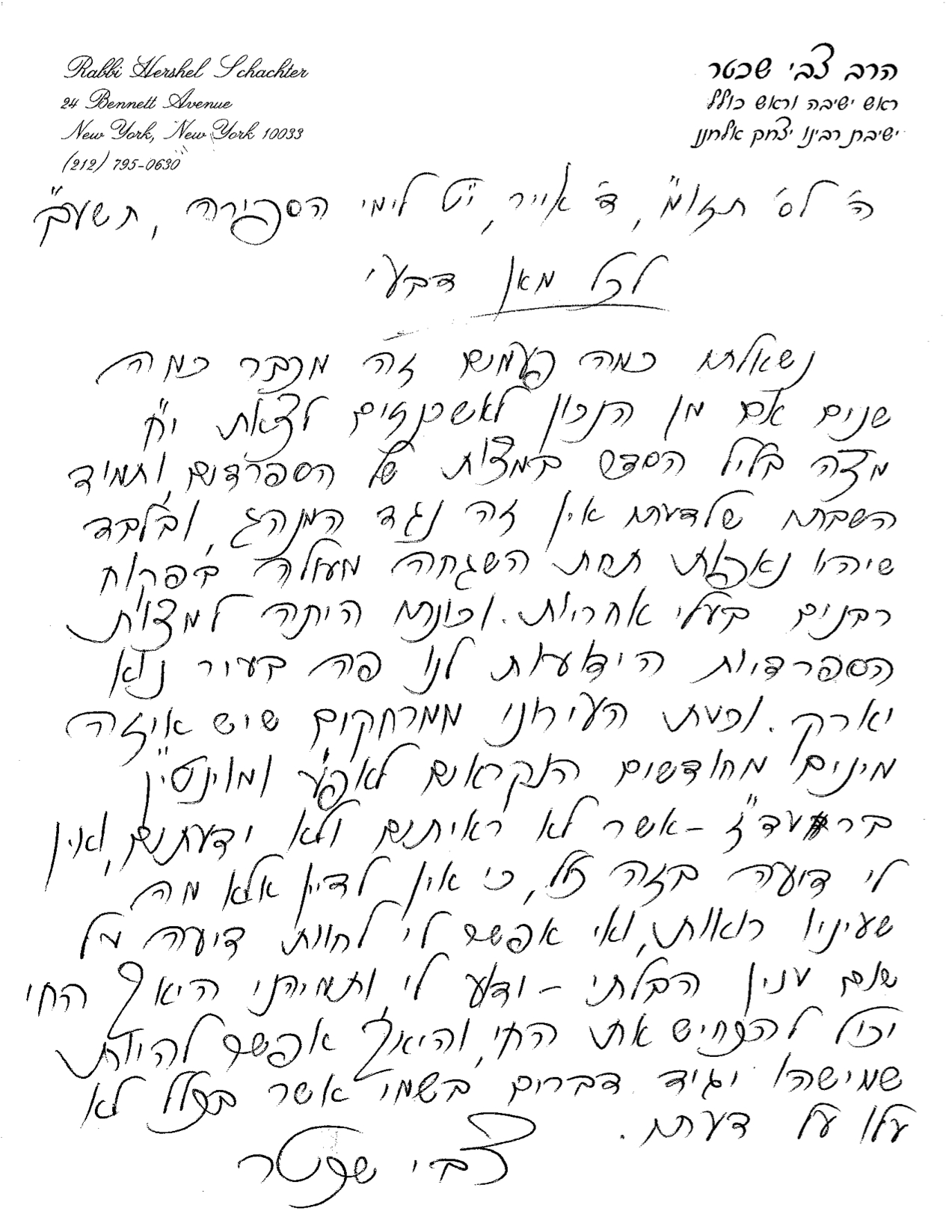
TO WHOM IT MAY CONCERNI have been asked many times over the past years if it is correct for Ashkenazi Jews to fulfill their obligation to eat Matza on the night of Pesach with Sephardic Matza. I have always answered that, in my opinion, this is not against custom provided that the Matza is produced under expert supervision and under the strict guidance of reliable and responsible Rabbinic authorities. My intention was in strict reference to the Sephardic Matzas that are known to us here in New York. I have now been informed from afar that there are new varieties called Laffa and Mountain Bread that I have never seen and know nothing about and I have not expressed any opinion concerning them, for one may only rule on what one’s eyes have seen. It is impossible to give my opinion on anything that I am not familiar with. I am greatly astonished how a “living person can contradict a living person” and how it is possible that anyone can say things in my name that have totally never entered my mind.Signed: Tzvi Schachter

I’m closing the Kosher V’Yosher vs other Rabonim comment stream

I posted an article about Diet drinks on Pesach. The comments section was respectfully filled with important information from Rav Moshe Gutnick of NSW and others. I found myself eventually having to tone down some of the comments of interlocutors through editing. Rabbi Rabi of Kosher V’Yosher sent me a comment last night and it is not one that I can edit in the way that I wanted to. I would have removed the misleading Gravatar. Seemingly unable to find a picture of himself alone, Rabbi Rabi continues to use conjunctions of his image with a famous Posek (in this case Rav Belsky, may he have a Refuah Shelemah). In my opinion, this is G’neyvas D’aas as it may well constitute a transparent attempt to ascribe importance and respectability to his business and hechsher. It’s most unbecoming. I’m not going to be a mouthpiece for marketing of business/hechsherim. So, I’ll reproduce his comment below (lightly edited) without his gravatar and that’s the end of this issue for me unless I see written information either to his business/hechsher from Rabonim which contradicts the information that is issued by the Rabbinic Council of Victoria/NSW or if Rabbis from Victoria or NSW produce written information to them which contradict’s Rabi’s information.

In our first year we did not have flour that was Shemurah from Ketzira, harvest, but only Shemurah from milling. An alert was placed upon the Matza packets of that year – suggesting that people use Matza that is Shemurah from Ketzirah for their Mitzva of Motzi Matza. There was no ambiguity that would lead any reasonable person to think that regular flour was used. If there is anyone who has a record indicating otherwise, I urge them to bring this immediately to my attention. Failing that, all remarks and those on this site saying/suggesting otherwise ought to be removed.In the same vein, quite a few postings here have been edited, the same courtesy and moral fibre dictates that all unsubstantiated remarks that reflect negatively upon my work and reputation should also be removed.A remarkable claim has been made, that HaRav Schachter rules that soft Matza may only be made by those with a Mesora; however, Rabbi Lebowitz has written that “I spoke to Rav Schachter about this several times. He holds it is completely permissible and has nothing to do with mesorah.” SEE full email http://www.realmatza.com/r-a-lebowitz-email.html Rabbi Moshe Gutnick emailed me that HaRav Schachter’s ruling can be found on the web. Can anyone assist me to locate this? We have not been able to locate it.

Anisakis, copepods, kitniyos shenishtaneh? Not in Satmer Matzas

ThE New York post reports about the new secret ingredient to keep your gut lined with pathogens, and all Mehadrin to boot.

Diet Drinks: Kitniyos that have undergone a process of change

[Disclaimer: everything I write is not להלכה and not למעשה. In this case, my knowledge of food science is also, at best, cursory. Do discuss this issue with your Rabbi and don’t be influenced in practice by my pitputim]

In Halacha, legumes which have been traditionally not used over Pesach for a number of well-known reasons, are forbidden. This is the Ashkenazi prohibition of Kitniyos. Some, like Rabbi David Bar Chaim (who I remember as David Mandel when he was in Melbourne many moons ago, and who went to study at BMT/Hakotel at around the same time that I went to KBY 🙂 asserts that it’s not a blanket Ashkenazi prohibition, but rather one that is an Ashkenazi prohibition outside of Israel. His view is that Minhag Eretz Yisrael was never to adopt the minhag not to eat Kitniyos. I would assume, that Rabbi Bar Chaim, should he find himself in Chutz La’aretz over Pesach, would adopt the Minhag of Ashkenazim in Chutz La’aretz and not partake of Kitniyos. My assumption may not be true, of course, as he would appear to have a renaissance-style agenda for reinstating what he sees as Minhag Eretz Yisrael, even prior to Mashiach coming, rejecting any imported Minhagim from those who have made Aliya over the last 3-400 years.

What is the הלכה if Kitniyos is an admixture of a food stuff? Do we assume that it is Batel B’Rov, nullified by the majority of the ingredients which are fine, and bought before Pesach? This is a disagreement amongst the Poskim, however, where there is any semblance of a medical need, given that the issue of mixtures isn’t black and white, Poskim are certainly lenient across the board.

What about the derivatives of Kitniyos? This is known as מי קטניות? Famously, Rav Kook ז’ל declared that they were completely acceptable, because Ashkenazim never had a Minhag not to consume this, and the process negated all the issues that Kitniyos came to protect in the first place. Rav Kook’s permissive ruling is halachically sound, however, Charedim rejected it and as such it has become a default “not to rely on this Hetter”. Having said that, I well recall that even in Melbourne, as the outsiders “infiltrated” our midst, certain Kitniyos or questionably Kitniyos derived oils (מי קטניות) were definitely used by almost everyone. Peanut oil is a good example. It is highly unlikely (as per R’ Moshe ז’ל) that peanuts were ever included in the ban on Kitniyos. If we couple that doubt together with the fact that we aren’t dealing with peanuts per se, but rather a product derived from peanuts, and prepared before Pesach with a Hechsher, it can cogently be argued that there should be absolutely no problem. However, we have a long-standing custom to choose something with zero doubt over Pesach: that is, we are Machmir. Being Machmir (stringent) seems to be a long-standing Minhag. In a similar way, during Aseres Yemei T’Shuva we have a custom to be Machmir on Pas Palter and perhaps Chalav Stam even though we aren’t Machmir a whole year around.

Enter the Diet Drink. Our society loves their Diet Coke, Diet Pepsi, Diet Prigat etc. When you pick up a bottle of these at your local Kosher greengrocer, you will see that the Coke has at least one “Charedi” Hashgacha, such as from the Chug Chasam Sofer, or Rav Lande from B’nei Brak. Yet, the diet version has a Hashgacha from the Rabanut. What gives? Artificial sweeteners are often derived from Kitniyos. They are another level away from מי קטניות. Why? Because they have been chemically altered/processed. This is known as קטניות שנשתנו, Kitniyos that have undergone a process (chemical) change/development. Again, the Poskim are divided on this issue. Unlike Kitniyos derived oils, however, on this issue even Charedi Poskim stand on either side of the debate. One cannot just dismiss it because it emanated from the “Zionist” Rav Kook (did you know, by the way, that Rav Kook refused to join a religious zionist political party). On this issue, we have very respected Kashrus authorities who permit it: such as Rav Belski (senior Posek of the OU and a Charedi Rosh Yeshiva) and Rav Gedalya Dov Schwartz of cRc—not to be confused with the anti-zionist CRC—(who I was fortunate to meet and speak with when he came for a wedding I played at in Melbourne) and others. Rav Schwartz is well-balanced and respected by all. The model of co-operation in Chicago is an icon for the rest of the world.

With this in mind, I’d like to quibble with the wording that was sent out by our own Kosher Australia recently. Yankel Wajsbort, who does a fantastic job, and is partly responsible for bringing our lists to the modern world of communication wrote:

A reminder that all the Diet drinks (Coke, Pepsi, Prigat) available in Australia use kitniyos sweeteners (a check of the label will show that the regular Kosher certification does not cover Pesach).

I have three problems with this statement, especially in the context of the later comments about Hommous and Techina products being Kitniyos for Ashkenazim.

  1. This is not, in the main, Kitniyos. Rather it is Kitniyos that has undergone a process change, as above.
  2. It is not true that the label will show that the “regular” certification doesn’t cover Pesach. There is a different certifying body that approves of Diet drinks, as above. At least, that is true for Prigat. I haven’t looked at Coke.
  3. Kosher Australia has three ways of issuing a pronouncement on the issue of Kitniyos that has undergone change: It either takes its own stand on the issue, which I assume would be accompanied by a formal Tshuva, or it decides to follow one group of opinions on the matter (the strict one) given that it is a body that needs to certify for a range of groups across Melbourne, or it lists the two sides of the coin and suggests that people check with their local orthodox Rabbi (LOR).

My preference, similar to what I wrote about Quinoa, is that Kosher Australia briefly list the major Kashrus organisations on both sides of this halachic divide, and then suggest that one should consult with their LOR. The approach taken in the communication above is just too black and white for my tastes (sic).

Kosher Australia acknowledged that the wording could have been better, and their consistent policy is to follow R’ Lande on these matters. They prefer, apparently,  not to get into the intricacies, as above, as this may confuse. Fair enough.

Disclaimer: I don’t use Diet drinks on Pesach, only because I’m somewhat of a Machmir over Pesach, and if I ever want to be lenient, my wife steps in and puts a halt to it 🙂

PS. I discovered that Georgio Armani products seems also not to have Chametzdik alcohol in their liquid perfumes/after shaves. I saw this on one of the major hechsher websites. Anyone checked on it? Seems that the American one is fine. Not sure if Armani produce it anywhere else and/or differently.

PPS. Does anyone know why Chabadniks who avoid all processed food on Pesach, seem to rely on Hechsherim for wine these days (but not, for example, Vodka)

When is not approved not kosher?

The word kosher, alone, doesn’t mean too much. It needs to be qualified. It is not an absolute unless each and every authority agrees. That is rare. Even with something as mundane as water, we know that because of micro-organisms (copepods) in various countries, some authorities recommend filtration. If your Posek recommends that you filter, then it may also be that your Rabbi considers unfiltered water not kosher. On the other hand, your Posek may consider it Kosher B’Shaas HaDchak or B’Dieved. It depends on the issue at hand and its halachic severity in the eyes of your Posek.

There are a myriad of so-called Kosher Certifications. Does that make them all Kosher? That’s a loaded question; it’s in the eyes of the particular consumer and their Posek. For one Posek a particular certification is not recommended, and how you translate not recommended in general, may mean it’s simply not Kosher any time under any circumstance. Triangle K and Rav Abadi’s Kashrus rulings are but one example of certification that is not relied upon by other agencies and communities. It is relied upon by others. They aren’t on the Kosher Australia list, and are not on many lists around the world. If your Posek says that you may not rely on it, then for you, it is not Kosher. It is not fit. Kosher means fit for halachic consumption; your halachic consumption. If you rely on an agency, such as Kosher Australia, then it’s the same deal. If they do not recommend it, it is not fit for your kosher consumption. However, saying that someone else whose Posek or Kashrus Agency does allow, Triangle K for example, is eating non kosher, is none of your business.

If I don’t use the Melbourne Eruv because my Posek advises me not to, I am not going to say that Jews who do rely on it, based on their Posek or Agency, are carrying on Shabbos!

In context then, there was a harmless post on the Kosher Australia Facebook page where a subscriber to Kosher Australia, who follows Kosher Australia asked on the Kosher Australia Facebook page whether the “It’s Kosher” supervision is Kosher. In context, that clearly is asking whether food under the auspices of “It’s Kosher” is permitted to be eaten. The answer is of course No! The reason, as provided by Yankel Wajsbort of Kosher Australia is that it is not recommended. There are no surprises here, and I was flabbergasted to learn that one of those heavily associated with “It’s Kosher” took great umbrage at the question. It is perfectly valid to ask if something is Kosher to a Kosher Agency. That’s how questions are asked. Nobody asked “if I am served something from “It’s Kosher” at someone’s house, am I permitted to eat it, or should I find a reason to make a quick exit. That’s a different question. Kosher is Lechatchila; in the first instance. In the first instance, if you are served, for example, Soft Matza from “It’s Kosher” can you eat it according to Kosher Australia. The answer is no. The folks from “It’s Kosher” are a bit too sensitive from what I can detect. You can’t stymie valid questions and answers and most importantly, attempting to stymie such discussion is definitely not going to ingratiate “It’s Kosher” in the eyes of the Kosher consumer.

“It’s Kosher” and its network of consumers ought just follow their Rabbi (Meir Rabi), and leave others to follow Kosher Australia and/or their own Posek. Threats are silly in the context.

One of a kind

One of my mentors was Rav Baruch Abaranok ז’ל. In the early days, he was in New Zealand at the Dexton home for orphans. At other stages he was a grocer and a מוכר ספרים. Eventually he came to Melbourne, where he became the מרא דאתרא of Mizrachi Shule. I used to try to visit him on Sundays, bringing my children Talya and then Tzvi Yehuda with me. My visits coincided with the days when I stopped going to Mizrachi for reasons I won’t go into. If I didn’t visit Rav Abaranok regularly, he would express surprise and I felt bad.

When he got quite ill, I went rarely. I know he couldn’t understand it, but I couldn’t tell him; in fact, I coudn’t tell anyone. I was consciously trying to stop myself getting too close because I feared the emotional chasm that would materialise should he leave this world due to ill-health. This was a selfish motive; a display of weakness on my behalf. I don’t expect anyone to understand or accept what I did, but that’s what happened and why.

When we were married, I learned that my father-in-law had been a Talmid of Rav Abaranok in New Zealand, and they knew each other well. One story my father-in-law related was that in his grocery store, Rav Abaranok had a set of scales. When he sold, say, some sugar he weighed the sugar with the bag, and then weighed the bag separately. This, of course, is צדק צדק תרדוף … Rav Abaranok, as per Torah law, did not want to charge for any extra weight derived from the bag.

His honesty and integrity were not limited to the grocery store. All who knew him readily testified to his great morality and ethical virtue. I recall that when Talya was born, he came to our door with a gift. I had never experienced a Rabbi coming to my door in this way, and giving a gift. When Tzvi Yehuda had his Bris, Rav Abaranok was the Sandek. He, of course, tried every which way to give this honour to someone else. Again, I was stunned when he brought a gift of a Hebrew/English set of Mishnayos. On Yossi’s Bris, he presented a beautiful Mishna Brura, as authored by his teacher, the Chafetz Chaim. Rav Abaranok was the Rabbinic Posek for Mizrachi Kashrus, the precursor to Kosher Australia. Only someone of his integrity was acceptable to most.

These days, I am accustomed to seeing a different phenomenon. Some Rabbi cum Mashgiach comes into a food establishment from time to time to check the kosher bona fides. After the regulatory check, he sits down, and then waits, departing with a stack of food for his family! Something isn’t quite right. Yes, I know, he has an account …

As they say,

חבל על דאבדין ולא משתכחין

Kashrus Agendas

One of my earlier posts was mentioned in my old classmate’s now ubiquitous posts on kashrus. There is a constant refrain to these posts and unless I am not accurately reading between the lines, the theme is:

  • the Rabbis in Melbourne make oodles of money from Kashrus
  • the organisations in Melbourne make oodles of money from Kashrus
  • the standards of Kashrus in Melbourne are too extreme and designed to support a monopoly and those standards cost us money and are unnecessary anyway
  • some kosher good suppliers are making a fortune from profiteering on kashrus.

Enter the proverbial iconoclast, clad in fire-proof armour:

  • I will assume standards of kashrus which are different
  • I will market my standards incessantly across the internet and elsewhere
  • My motive is to bring the price of Kosher food down because I believe (anecdotally) that there are people who eat Treyf because they can’t afford the price of Kosher goods (meat?) that have assumed an OU-like standard
  • My finances and business dealings with partners on these matters are none of anyone’s business
  • My financial books are closed
  • I am answerable to nobody but Hashem
  • London bridge is falling down.

Assuming the motives are earnest and with honourable intent, the line of argument used is rather straw man like. Yes, we would like to see all Kashrus under a central body. Yes, we like to see a collegiate Rabbinate and not isolated breakaways running their own kashrus supervisions/business. Yes, we would like to see the financial aspects of Kashrus provision (where relevant) under the financial supervision of a communal lay body. Yes, we would like to see Rabbis and Chemists and Mashgichim paid properly for their professional hard work. Yes, we would like to see shysters purporting to offer a kashrus service outed.

I assume my erstwhile colleague is serious about his concerns about the price of chickens and more, so I suggest that he invite Rabbis and owners to an independent Dayan. I’d recommend R’ Hershel Schachter.

Vacillating on the internet is okay for musicians like me, but I’d suggest it isn’t a productive path for a Rabbi attempting to convince his colleagues through earnest debate. Some would say it’s a populist agenda like the socialists who put up “Viva La Revolution posters” near my office and all around RMIT. I don’t think they achieve much thereby.

Dampening potential

In this week’s Parsha, we learn that when Pharoah’s daughter was bathing on the banks of the Nile, she caught sight of baby Moshe in the ark his mother had prepared to save him from the decree her father had enacted. Moshe was crying and understandably hungry. Rashi quotes a Midrash (שמות רבה א, כה) where Chazal inform us that Moshe refused to breast feed from Egyptian mothers. Moshe’s spiritual sensitivity did not allow him to drink breast milk that was nutritionally influenced by a mother who had ingested non kosher food. The mouth that was to speak directly with God was not to be tainted by drinking milk that was derived from such a source.

Halachically, there is nothing whatsoever wrong with breast milk of any human variety. It makes no difference whether the mother had previously eaten a glatt kosher schnitzel or a ham sandwich with cheese. Breast milk is kosher and is unaffected by the source of nutrition. This Halacha is clear in Shulchan Aruch, Yoreh Deah. Yet, in a departure from unadulterated (sic) halacha, the Ramo (סימן פא ס”ז), clearly influenced by the Chazal  in that Midrash,  (see the Gro  (ביו”ד שם ס”ק לא) ) paskens that it is a מדת חסידות to avoid “spiritually tainted” food. Similarly, although one is permitted to take pills that include non Kosher ingredients, where it is possible to obtain a Kosher version (e.g. Vitamins and the like) R’ Moshe ז’ל paskens (without providing a source) that it’s better to do so. R’ Hershel Schachter is of the opinion that R’ Moshe’s source is probably this same Midrash and Ramo.

R’ Yaakov Kamintesky ז’ל asks a pertinent question. One can well understand that a holy mouth which was destined to speak directly with God would be sensitised and indeed expected to observe a מדת חסידות which would preclude even the smell of non kosher food (see פרק ב דחגיגה ירושלמי about Elisha Ben Abuya) or breast milk derived from non kosher food to be ingested. This is the level of Moshe Rabeinu, רבן של כל ישראל, but what about the rest of us? We have no expectation that our mouths will be used to speak פה אל פה with God. Why should we at all be concerned about such a consideration? R’ Yaakov answers that we have no right to deny potential from our children, irrespective of their ability. Every child has a growth potential that often exceeds the expectation of parents and educators. If we over focus on IQ or learning challenges then we effectively cheat the child because we deny them their opportunity to attain the seemingly unattainable.

Often, it is assumed that to become a high level Talmid Chacham (in today’s parlance a “Gadol HaDor”) one must have a very high level of intelligence. This is untrue. There were certainly many highly intelligent Rabbis over the generations, however, it is false to imagine that they were all that way. Many had average or above intelligence. It is known, for example, that the famed Chazon Ish, was not known for being particularly “sharp”. The Chazon Ish applied himself with a very high level of diligence and התמדה. If you revise a Mishna 100 times, you will achieve the level of truly understanding what it’s about.

The life lesson is to never minimise the potential of a child and to nurture and provide the environment which will help them meet their highest level. This can only occur if we don’t over categorise our children according to the abundant metrics and conditions that they are associated with. Even the so-called average child can be stymied by assuming that their level will not ever grow to one in tune with the aforementioned מדת חסידות described by the Ramo.

It seems that we can almost never rely on people anymore for kashrus?

Check out this story.

Have things changed? Is commercialism and making an extra buck overtaking honesty despite government laws? I wonder what those who “eat fish out” say. It’s scary.

Sydney Kashrus Authority responds

Dear Reb Yitzchok

Thanks for sending me the article.

You mentioned that you were unsure as to the standards employed by ‘Sydney Kashrus’ (The Kashrut Authority). I will do my best to clarify for you our position as follows:

We basically have three levels.

  1. The first level are certified products such as Teal Lake wine , Jenbray Tuna, cholov yisroel dairy products etc, made to a standard similar to that of such bodies as the Eida Chareidis . Any difficult shailois in this regard I ask HoRav HaGaon R’ Yakov Blau Shlit”a of the Eida with whom I have done a lot of work over the years.
  1. Then there are certified products made to the OK and OU standard. This may include dairy products that are not cholov yisroel. All of our certified products are to that standard as a minimum. I have a very close working relationship with the OU and the OK and with both Rav Belsky Shlit”a and Rav Shachter Shlit”a. It should be noted that all our licensed facilities including caterers follow that same standard as a minimum.
  1. We have a third level (a level that does not exist in the USA).These are what we call “approved” products manufactured by non-jews. I have wriiten an article explaining the halachic rationale and resultant differences and you can find it on our website www.ka.org.au in the halachic policies section. It is in relation to this “level” that we indeed follow the London Beth Din, The Manchester Beth Din, The Johannesburg Beth Din, and all who list “approved” products.

Many might be tempted to say that the approved products are ‘less kosher’ than certified products – such a statement is in my opinion wrong. The reality is that they fall under a different halachic paradigm.

An analogy to illustrate: It is without question forbidden to add a drop of milk to chicken soup. If one did so on purpose one would not be permitted to eat the soup. However, if it fell in by accident, and was botul b’shishim, the Halocho is that one is permitted to eat the soup. Two apparently identical occurrences, yet there are two opposite outcomes. The reason for this is that we are dealing with two completely different paradigms – the meizid (purposeful intent) paradigm and the shogeg (unintentional/accidental) paradigm.

Similarly there are two distinct paradigms in relation to kosher foods. The certification paradigm, when a company comes to you, pays you for your services and markets to Jews; and the approval paradigm, where you initiate the visit to the company, you are not paid by them and they are not specifically interested in the Kosher market. The OU/OK, etc ONLY deal with the first paradigm. This is largely because of the size of the kosher market and the Jewish population of the USA. There are sufficient certified products so it is not necessary to have approvals. Furthermore, halachically, as companies are specifically marketing for the Kosher consumers it may not be possible to employ the approval paradigm. However jn other countries, such as the UK and Australia, there are insufficient products and the relative size of our kosher consuming market enables us to employ the approval paradigm.

Products manufactured at level 1 or 2 are all marked K or C in our directory. They are all formally certified or made to that standard and are colloquially called “mehadrin”. [Though some would argue as to whether a chalav-stam product – albeit certified to OU/OK standard – should be called “mehadrin”]. Products that are level 3 or “approved” are listed without notation. The consumer has the choice to be mehader or not, and we are transparent with the information we provide allowing them that choice. We believe that this way we maximise the opportunities for people to keep kosher.

Kosher Australia has announced that it is moving to only use the certification paradigm. That is their choice, which should be respected by those under their jurisdiction. The rabbis of the Kashrut Authority (comprising the rabbis of The Sydney Beth Din and the Yeshiva Rabbinate here in NSW) are of the view that it is still necessary to retain the approvals paradigm. We feel it would be both erroneous and onerous of us to impose on the general kosher consumer the stringency of only eating certified products when the approved products are 100% kosher l’chatchila. See Tur Orach Chaim Siman 110 , where we are instructed to pray upon entry to the Beis HaMidrash that “I do not err in a matter of halacha … and  pronounce on … that which is permitted that it is forbidden”. If the consumer wishes to eat only ‘mehadrin’ products that is the consumer’s choice but not a Halachic necessity.

Simply put, the availability and cost of Kosher here in Australia cannot be compared to that in the USA. Only listing certified products would place an added burden on the kosher consumer; and could cause those who are on the periphery of keeping kosher to turn away from kashrus observance. Of course, if it was halachically unacceptable to list approved products then the above rationale would bear no weight – the fact however is that the approved products are  kosher l’chatchila to be consumed. It is on that basis that we have left the choice in the hands of the consumer whether to be mehader or not.

I hope this clarifies the issues from our perspective.

All the best

Rabbi Moshe D Gutnick
Rabbinic Administrator
The Kashrut Authority
Kosher Certification in Australia New Zealand
and the Asia Pacific

Rabbi Gutnick asked me to preserve formatting. Just in case, I have included a PDF of the Sydney KA Response

Improving the management of Kashrus in Melbourne

The Mizrachi Organisation is to be congratulated and commended for the incredible amount of time and money that they have put into Kashrus in Australia. Starting from מורי ורבי,   Rav Abaranok ז’ל the move over time to align standards with the world respected and renowned OU is something we should all celebrate and not criticise. Rabbi Mordechai Gutnick, and his team, of late, together with the lay committee are responsible for the thick booklet we now have.

It is true that life would be a lot easier if all Australian products had a Universal Symbol for Kashrus, and if the Sydney Kashrus Authority also adopted the OU standards across the board. My feeling is, and I haven’t discussed this with Rabbi Moshe Gutnick and could be completely wrong, that Sydney tend to adopt the standards of the London Beth Din. These are legitimate, of course, but, to me, the OU is the best hechsher in the world. To appreciate the quality of OU, one only needs to listen to the OU Kashrus Q and A videos from both Poskim, Rav Hershel Schachter and Rav Yisroel Belsky and listen to the array of shiurim from the Kashrus experts across a wide array of issues.

I have spoken to both Poskim in the past, and I am in awe of their ידיעת התורה (knowledge of Torah). In the case of Rav Schachter (only because I have had a little more interaction and listen to his shiurim regularly) his גדלות in מדות טובות (moral fibre) is also inspiring. Rav Schachter is eminently approachable. It is one of my disappointments that nobody sponsors a Kollel Week of nightly Shiurim in Melbourne with someone like a Rav Schachter. Chabad, understandably invite their own, and I don’t even know if Beis HaTalmud does these sorts of things much since Rabbi Nojowitz departed and the new regime took over. Any  גבירים  (financially comfortable people) out there want to sponsor something like this? Melbourne would be bedazzled by the Halachic clarity that Rav Schachter transmits. He isn’t the only one, of course. I’d be equally happy to hear Rav Zalman Nechemia Goldberg or Rav Usher Weiss. The latter travels to South Africa and the States quite often for lectures. I have also spoken with Rav Usher Weiss, and he too is an עניו (humble) and a גדול בתורה (great knowledge of Torah) who is most unassuming. I’d say he is less likely though to stand out on some issues, even though his analysis often makes you think he thinks something is indeed מותר (permitted) when he finally paskens it’s אסור (forbidden).  Rav Schachter, however, seems to have a more Brisker approach to Psak and concludes according to his understanding:  for example, he  has said that showering on Yom Tov is permitted (albeit not using very hot water), something I have personally felt was מותר for over 30 years, but I am digressing (as usual).

A personal testimony.

I was a fill in representative for Elwood Shule many moons ago at the Council of Orthodox Synagogues of Victoria. The topic of the then Mizrachi Kashrus arose. Indeed, it was brought to the table by Mizrachi. There was also a prior proposal around the same time, I believe it may have even been authored by (now) Adjunct Professor Harry Reicher, then of Melbourne, where the lay body was to take over the financial and administrative oversight of  kashrus, beis din and involve all groups (even Adass). Without going into the details of the plan, I clearly recall the Mizrachi delegate, Mr John Kraus, speak to details depicting the financial loss incurred by the Mizrachi Organisation in continuing to run Kashrus. He was very keen for the COSV to take over. The COSV debated the issue, did its sums, and came back with a positive response. I remember feeling that this was going to be a momentous outcome for the community. Why, indeed, should Mizrachi have to bear the burden? Inexplicably, just as the “deal was to be done”, Mr Kraus returned to the COSV and suddenly and surprisingly announced that Mizrachi had withdrawn the offer and would continue to oversee the operation. I am not privy to Mizrachi’s thinking at that point.

I don’t see Adass as a practical partner in any future Kashrus organisation or Beth Din or anything of that sort. They are separatist, and have a right to stay that way. They don’t change. They are effectively a hamlet and organisation to themselves. Each to their own.

All non Adass shules, including Shteiblach and the like, should join the COSV and pay dues. There is an important role for a COSV and it’s not satisfactory that some congregations contribute, while others do not.

My brother-in-law, Romy Leibler, did a great job reforming the lay (financial) arm of the Beth Din together with Meir Shlomo Kluwgant. I think it’s way past the time for the COSV to do the same through quiet diplomacy with Mizrachi. Melbourne will grow when this happens. In my opinion, such a move is more important than dealing with alternative, and so deemed “enlightened” kashrus supervision that we have seen sprouting lately and which is diverting us from the main game of communal accountability and reform.

What say you?

PS. Some of you may know that there is an esteemed Kashrus Organisation called the cRc (Chicago Rabbinic Council), which is headed by the respected Av Beis Din of the Beth Din of America,  Rav Gedalya Dov Schwartz. They were in the press recently with their analysis of the Kashrus of Starbucks. On Pesach, you may have notice another organisation, who name themselves CRC (Central Rabbinic Congress which I think is more than cheeky), who approve various products, including the “Glicks” line of products from overseas. CRC is not cRc. CRC is affiliated with Satmar and the Eida Charedis. They feature, infamously, on this page under Jews against Zionism. Pick your products in my view. If I have a choice, I will always use OU and avoid the anti zionist Eida Charedis and their ilk.

Let’s expunge the “ladies”

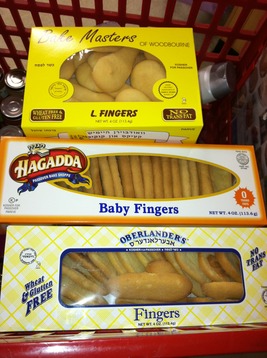
Hat tip to Anon who sent me the picture below. It’s outrageous. They were afraid it would be a breach of Tzniyus to call these things Lady Fingers, which is what they are. What next, a podgy version of these called Rebbishe Fingers made by a company called Shirayim?

Removing the Lady from the Finger

Interestingly, even the Wikipedia entry for Lady Fingers mentions Pesach. I’m just waiting for the Charedipedia—pasteurised and homogenised at boiling point, with multiple hechsherim and plombes on each page. Some pages may get through only as gebrochts, but that would be configurable in the options section.

If it wasn’t so sad it might be funny.

Quinoa revisited

Commendably, Kosher Australia has revised its earlier information and now tells us:

Subsequent to the printing of the 2011 KAPG, we noted that both the OU and the Star-K have altered their respective positions regarding the acceptability of quinoa. The OU now recommend consulting with one’s Rav and the Star-K now require formal Pesach supervision due to the concern of likely contamination from chometz. However, the London Beth Din and the Eidah Charedis, among others, maintain that quinoa is kitniyos. Based on information from the OK, those people who use quinoa on Pesach may purchase Eden brand quinoa which we have confirmed is free of cross-contamination with Chometz.

This is good. The Eidah Charedis’ stance isn’t surprising. For them, חדש אסור מן התורה and so there is no need to even find out what Quinoa is.

I still take issue with Kosher Australia’s wording in respect of the Star K position. The Star K did not state that Quinoa is likely to be contaminated by Chametz! What they did say, was that it was possible that Quinoa came into contact with Chametz. That’s true. Guess what, though, that applies to just about everything we buy because of the nature of food lines and cross contamination. In particular, we also get Potato flour with a Hechsher! The salient point is that the Star K do NOT consider Quinoa to be Chametz. Here is what they do say:

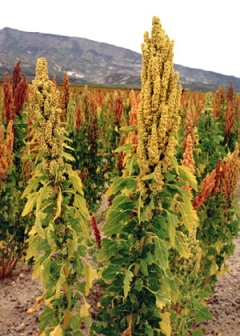
Tired of potatoes, potatoes, potatoes for Pesach? Try quinoa (“Keen-Wa”), a sesame-seed-sized kernel first brought to the United States from Chile nineteen years ago, according to Rebecca Theurer Wood. Quinoa has been cultivated in the Andes Mountains for thousands of years, growing three to six feet tall despite high altitudes, intense heat, freezing temperatures, and as little as four inches of annual rainfall. Peru and Bolivia maintain seed banks with 1,800 types of quinoa.

Quinoa was determined to be Kosher L’Pesach. It is not related to the chameishes minei dagan-five types of grain products, nor to millet or rice. Quinoa is a member of the “goose foot” family, which includes sugar beets and beet root. The Star-K tested quinoa to see if it would rise. The result was as Chazal termed, sirchon; the quinoa decayed – it did not rise. However, recent investigations have found that there is a possibility that Quinoa grows in proximity to certain grains and processed in facilities that compromise Quinoa kosher for Passover status. Therefore, Quinoa should only be accepted with reliable Kosher for Passover supervision

The Psak from the Star K mirrors the Psak from my wife 🙂 Although, I had noted, as per the advice from OK, that Eden Quinoa has no Chashash of Chametz because it is an organic company that has nothing to do with wheat as per the OK checking including the milling.

The bottom line is that it’s best to either have a Hechsher on any ground Quinoa. Then again, some of you also boil your sugar 🙂

For Chabad I’d say no Rebbe ever found grains in their Quinoa, but since none except for perhaps the last Rebbe  z’l, was exposed to Quinoa you’d better not use it 🙂 I wonder what Chabad would say about someone who washed Quinoa before Pesach and checked there was no inadvertent grain therein?

R’ Moshe Feinstein ז’ל unlike the Edah Charedis, held that we do not create new types of Kitniyos.

I hasten to add that in my opinion, which is not להלכה nor למעשה (ask your Rabbi), it is desirable to use (certified or at least Eden) Quinoa for babies and little children who have a hard time eating on Pesach, let alone the unfortunate ones who are gluten intolerant and elderly people who have issues with their digestion and stomach.

Regards from Kuala Lumpur where I haven’t seen any Quinoa as yet 🙂

Are we being misled by Kashrus Authorities-Quinoa revisited

Quinoa (pronounced Kin-wa). It’s not a grain; it is related to spinach. Its ברכה is האדמה. Its seeds may or may not be ground in the same way as Potatoes maybe ground and everyone eats potatoes (despite the חיי אדם trying to make them אסור on פסח because of Kitniyos). There are, of course, others, who assert that the גזרה of Kitniyos on Pesach doesn’t apply in Israel, but we won’t go there in this article. Let’s just look at Kosher Australia.

Quinoa

Recently, a letter was circulated by Kosher Australia, explaining the reasons for food items becoming non kosher “suddenly” together with an explanation denying a sudden lurch to “the right.” It was a well written letter and I am a supporter of Kosher Australia aligning their standards with the OU. The OU, in my opinion, is the premier and most trusted Kashrus Authority in the world. Okay, I’m  biased because I ask (major) questions to Rav Schachter, who happens to be one of the two Poskim for the OU.

On the matter of Quinoa on Pesach, Kosher Australia advised us that it was following the practice of the OU and that as a result Kitniyos were not to be used. Coincidentally, I had printed out the 2011 OU Pesach Guide and was reading it. I found that the assertion by Kosher Australia vis a vis Quinoa and Kitniyos was false! In earlier years, the OU had been negative, but this year they decided (quite correctly in my opinion) that the issue of whether to use Quinoa was a matter for individual kehilos.

Let’s face some facts. Determining whether something is or isn’t Kitniyos is not the same as telling us whether treyf is used as an ingredient in foodstuff. Kitniyos is in many ways a more complex question and one that requires a Psak from one’s own Rabbi who I believe will consult with his own Posek Muvhak given the nature of the question. I think the OU got it right. If you want to use Quinoa you should ask your Rav unless you happen to also have a family Minhag of חדש אסור מן התורה. This was also the basis for Rav Moshe’s permissive ruling on peanuts, but of course it didn’t matter if it was Rav Moshe, the Machmirim on the right eventually squeezed out a universal issur on peanuts (and peanut oil). I can remember in the old days we had oils that eventually “became” kitniyos. And no, we never had those nuts in Poland!

Kosher Australia has no business determining what is and what is not Kitniyos.

In fact, they have done a good thing by listing a table of items which some consider Kitniyos. This is the way it should be with Quinoa as well. This episode is a very subtle way that Rabonim are attempting to create a Minhag in Australia by default, by “trying to be all things to all people”. Yes, we are Machmir on Pesach. But even Rabonim said not to be Machmir on Potatoes. I know, Potatoes are a European staple and this avant-garde  Quinoa stuff is something Charedim can’t spell or say, let alone know how to integrate into an oily cholent.

Yes, it is true that the London Beth Din don’t allow Quinoa, equally, the  Star K and Chicago cRc do allow it. Kosher Australia should have adopted the stance of the OU and kept out of this. Rabbi Sprung in Melbourne paskened for Mizrachi that it was fine as long as it was supervised.

By the way, the list of “maybe Kitniyos” listed in Kosher Australia’s booklet is also wrong. It claims that carrots are not Kitniyos according to all. That’s not true. I understand that Belzer don’t eat carrots.

PS. My wife over-ruled me and she won’t let me use Quinoa unless it has a hechsher. I tried to tell her that Eden were certified as one of the brands that had no grain whatsoever in the fields or processing plants and, therefore, it was okay. She wouldn’t hear of it. “Where is the Kosher stamp?”.

Ah, for Shalom Bayis ….

We are what we eat?

There are clear effects on a Jewish soul. The effects, both positive and negative, stem from actions and environment. We normally understand actions as constituting the performance of Mitzvos and good deeds (מעשים טובים). Mitzvos include the principal Mitzvah of Talmud Torah that underpins all Mitzvos and leads one to action (ideally).

Kabbalistically inclined Jews amplify claims that there are effects on the spiritual Neshama (טמטום הלב) stemming from the physical food we put into our mouths.  Jews who are inclined towards rational interpretations of Judaism, are less likely to be concerned about meta side-effects to a soul from a physical item. Let’s take a concrete example. These days we mostly eat Glatt meat. Glatt means that the internal membranes of the animal are “cleaner” and, therefore, don’t attract attendant questions about whether a particular type of faulty membrane renders the animal Treyf. So called pious Jews prefer not to confront the question in the first place. If the animal is Glatt, then it is squeaky clean,  there is no question about its kashrus, and one can be 100% sure that it’s Kosher לכל הדעות. Continuing this theme,  the pious Jew may also contend that even if there is a questionable membrane that is considered kosher by 99% of Poskim, since 1% of Poskim consider the animal Treyf, then there is a 1% likelihood that it’s not kosher and one ought not take the 1% risk of damaging one’s soul by ingesting Treyf.

Rationalists or Halachic purists will dismiss such pious concerns. They may argue that the Torah presented a divine mandate for a Posek to decide Halacha. If a Posek then determines that the animal is kosher, then it is 100% kosher. This is a binary system; it’s either kosher or it’s not. There is no statistical likelihood of a soul being damaged by opinions which the Posek has determined do not influence his Halachic decision.

To put it a different way: the more kabbalistically inclined Jew considers that there is an empirical truth about the kashrus of each item we put in our mouths. Rabbis determining Halacha are mortal and do their best to decide whether that food item is kosher or otherwise. They “get it right” some times and they may “get it wrong” other times perhaps because they dismissed a minority opinion which may well represent the empirical kashrus status of the item. The more rationally inclined Jew will contend that this line of reasoning is baloney (sic). Food with a questionable status isn’t empirically kosher or otherwise. It is rendered Kosher by the decision of the Posek. The Halacha is famously not in  heaven: לא בשמים היא and once food has the halachic kashrus imprimatur of a Posek, eat it gezindt aheit.

Machmirim milk products (yes, it's real) with 4 Hechsherim.

In keeping with Brisker Lomdus, there is another way to view this conundrum. The kabbalistically inclined may consider that Kosher is only ever about the food item itself (the חפצא). Even if a Posek (a גברא) declares that the food is Kosher, as long as  a solitary opinion of note contends it is not Kosher, the חפצא cannot be transformed into Kosher by the Halachic determination of a גברא, and remains on the outer. On the other hand, those who adopt a solely rational approach to Halacha may argue that the חפצא has no independent status. The גברא imparts a status to the חפצא through determining Halacha according to the tradition, learning and shimush (apprenticeship) of the Posek. Once the גברא decides, the חפצא takes on an identity. It cannot have a dual identity vis-a-vis the single Posek.

The Ramo writes in יו”ד סי` פ”א ס”ז that when a baby ingests unquestionably non-kosher food, the food has a negative effect on the spiritual development and character traits of the child (See the Shach ס”ק כו). This is also mentioned in Shulchan Aruch but only in the context of a baby drinking milk of a nursing woman who has consumed non-kosher food. The Vilna Gaon (ibid) teaches that we learn this from baby Moshe who refused to nurse from a non-Jewish source (שמות רבה א, כה). The Yerushalmi at the beginning of the second perek of  חגיגה relates that Elisha ben Abuye (Acher) went off the derech because Elisha’s mother had once succumbed to a sweet smell from Avoda Zara and this had permeated Elisha’s body and tainted his character traits. I just found a nice summary of  the issue of the after effects from eating Treyf, on page 3 and onwards here.

A question arises on the Pasuk in Parshas Ekev, “על כל מוצא פי ה’ יחיה האדם” where the implication is that through the spiritual emission of Hashem, man lives. How does man live from spirit? Man lives from food. The Ari ז’ל explains that all things physical also have a spiritual component. Therefore, when a human ingests Treyf, the spiritual aspect of that food is also ingested by the Neshama of the person. As the Pasuk in Parshas Ekev goes on to say “כי לא על הלחם לבדו יחיה האדם” Man does not live just from bread alone. That is, man is not only sustained by the physical aspect of bread. After ingestion, Treyf will also nurture the soul.

What motivated me to blog on this topic, was a story I read last night about R’ Shlomo Zalman Auerbach ז’ל (as an aside the disgraceful revisionist artscrollesque wikipedia article about R’ Shlomo Zalman carefully avoids mentioning Rav Kook even though R’ Shlomo Zalman said, “When I say Maran or Der Rav, you should know that I only use this term to describe R’ Kook”. It is useful to compare the Hebrew wikipedia article which prominently mentions R’ Kook!)

Someone approached R’ Shlomo Zalman with a question on behalf of Seminary girls who are commonly invited to various houses for meals, especially over Shabbos and Yom Tov. Should the girls seek out houses which they know only rely on chosen Hechsherim? It is known that some houses will use Hechsherim which some will not touch with a barge pole.  R’ Shlomo Zalman replied that God forbid we should suspect that Yidden are eating Treyf. As long as these are Frum people who use a Hechsher from a Rav who is a Yirei Shomayim, the girls should eat there. The questioner went on to ask, “but some people will not eat from some of the out-of-town Rabanut Hechsherim”?. R’ Shlomo Zalman replied in the same way: as long as the Rav Hamachshir is a Yirei Shomayim, the girls should eat from such Hechsherim. The questioner persisted and with more than a touch of Chutzpah asked, would you eat from such Hechsherim? At this point, R’ Shlomo Zalman became agitated and said

“definitely yes. If I go to a Bris or other Simcha and there is a Rav Hamachshir who is a Yorei Shomayim, even though I don’t personally use that Hechsher in my own home, I will even eat chicken from this Rav Hamachshir at the Simcha. חס ושלום to publicly cast aspersions on the kashrus of food being eaten at a Simcha let alone insult the בעלי שמחה. I know that even R’ Yosef Chaim Sonenfeld  ז’ל ate meat from Sefardim at a Bris even though this was not his Ashkenazic tradition.”

This was R’ Shlomo Zalman. This was why he was one of few universally acclaimed personalities of the previous generation, despite the fact that he issued some controversial and innovative Piskei Din.

I asked myself after reading the story, wasn’t R’ Shlomo Zalman worried about the effect on his Neshama (טמטום הלב) after eating under the authority of a Hechsher that he didn’t normally use? The Kabbalistically inclined would perhaps have to agree with the more rationally inclined and answer that the food was Kosher מעיקר הדין so there could not be any damage to the Neshomo?

Perhaps the only danger would be to human beings who might be hurt by the implication that they were damaging their Neshomos after they see a Rav refusing to eat at their Simcha?