The attack on Bris Milah and Halacha

There are numerous reports in the press (see here) and on the internet describing Governmental and Human Rights Advocates opposing the practice of  ברית מילה  ,חס ושלום. This is a disturbing phenomenon and is something I’d like to see a world conference of leaders, yes even including Reform and Conservative, address. My view is that there needs to be representation across every group so that a consistent, cogent, well-argued, statistically supported and sensitive protocol of responses developed. The arguments need to be generic, and should be as accessible to the Aguda advocate, the Israel Rabbinate, the RCA, et al as well as the Reform advocate. This is a matter of extreme importance, and כלל ישראל assuming its loosest definition needs to unite and defend with vigour, professionalism, not to mention localised quiet diplomacy (at least at first).

This is an issue where most Yidden can unite, and I’d hope that the Eybishter would feel positively that we defend this attack on a most fundamental element of our identity. There are scholars, for example, who contend that the real reason for the Bar Kochba revolt against the Roman emperor Publius Aelius Hadrianus, was due to the ban on ברית מילה.

There is a “side-issue”, however. That side-issue is Metzitza B-Feh מציצה בפה (immediate post oral suctioning after the cut). Look at the disgraceful description of this process here, for example. I call it a side issue not because I am taking sides and declaring oral suctioning unimportant or irrelevant to the Halachic process. I’m calling it a side issue because by over-focussing on this aspect, many un-diplomatic and emotive outbursts are now finding voice and providing uninvited fodder. These comments are not part of an over-arching considered, diplomatically crafted and complete strategy, as I’ve advocated above. Certainly it is an aspect of a ברית that will be used by those with a genuine concern about the methodology, and those who are against Milah, with or without oral suctioning. It’s important to remember that. There are even grossly distasteful “Jewish” blogs, that sound triumphant every time there is even a distant piece of uncorroborated information that suggests oral suctioning causes illness, or even death. Balanced individuals do ascribe genuine concern. However, anyone who emerges from the quagmire of those loshon-hora laden and defamatory blogs, knows that a quick shower followed by immersion in a mikvah is needed to remove the shmutz therein as a sanity starting point. ה ירחם

My own views:

Both my sons’ Brissen involved מציצה בפה (as did my grandsons). I didn’t ask questions at that time nor was it uppermost in my mind. On an halachic scale, I consider the oral practice as sufficient but not necessary. Doing so via a tube, is more in keeping with how I see the issue from a halachic point of view. It’s terrible though, that both sides of the מציצה argument (which is as old as the hills) are now again into name calling and delegitimisation. It is not helpful to say that it is forbidden by the Torah not to have מציצה בפה. In the same way, it is not helpful to say that it is forbidden to do so. There are very healthy (sic) and weighty halachic giants on both sides of the argument.

There is a tendency for each side to publicly belittle and malign the other’s valid halachic position. Above all, however, if there are sound and health-related concerns which are beyond statistical dispute and which may well be due to changing circumstances and new realities, such that the practice ought to now be forbidden using direct oral suctioning because this can be shown to be a direct or event contributory cause towards danger to the infant, then and only then, should there be a meeting of all Orthodox Rabonim, from around the world to re-examine the issue and indeed ban it across the board in favour of a tube.

My fear is that, at the minute, discussion of this is on a public world-stage and it only fuels those נכרים and נדחים who are impurely motivated against מילה in the first place.

I do hear the argument that in the current world climate, or at least in some countries, אפילו לשנויי ערקתא דמסאנא, we even resist even dicta to wear particular types of shoe laces (see סנהדרין עד) and, accordingly, as above, unless there is a genuine health issue, even those who are opposed to the need for oral suctioning without a tube, should get behind those who contend that such oral suctioning is an integral part of מילה. We are facing, in my estimation, new attacks. שחיטה is another.

In keeping with my view, I would argue that even those who are halachically or non halachically vegetarian, should cease that practice and insist on now eating meat (as opposed to the view expressed here), since there is a חשש that the אומות העולם are acting in a manner which is questionable and which threatens our rights and freedom to practice כללי הדת.

Meir Rabi’s latest attention seeking news bite

One side of me said to stay silent and not blog since blogging would serve his purpose. The other side said to blog but only in order to encourage people NOT to get involved in facebook and other forums where the human headline will purvey his latest feather salvo. Don’t engage him in discourse; you waste your time.

Just forget about it and remember
ורם לבביך ושכחת את ה אלוקיך
is a real syndrome.

Don’t react and don’t provide fodder for next week’s ‘screaming headline’ in the AJN.

Neutered correctness gone mad?

Am I getting old(er) to the extent that I simply cannot fathom the sentiments expressed in this article?

I have been working at University for over two decades. I have seen all manner of extremism, exhibitionism, sexism, racism … you name it, I’ve seen it. One expects this at a University where there is (or at least there ought to be) a license for free thought, wrapped up in a veritable cornucopia of wildly differing personalities amongst both the student and staff body.

Nonetheless, this quote floored me:

Men were also continuously and unnecessarily sexist, waiting for me to walk through doors and leave the elevator before them.”

I looked up the term sexism to refresh my understanding, and found:

1. Discrimination based on gender, especially discrimination against women.
2. Attitudes, conditions, or behaviors that promote stereotyping of social roles based on gender.

I think there are three key terms here:

  • discrimination
  • stereotyping
  • inferiority
  • Now, discrimination on its own isn’t a pejorative term. It connotes difference. I’d argue that if the difference leads to an act or comment which implies that women are promoted as inferior in any way, then it is wrong. In this instance, surely an act of chivalry or good manners need not be interpreted as an expression of inferiority, weakness or the like?

    I understand that stereotyping is a dangerous weapon in the mouth of someone consciously or subconsciously motivated to demean, demote or demography the “role” of a woman in society. Again, I have difficulty understanding how a gesture which could also be understood as consciously or subconsciously honouring and elevating the stature of the feminine gender, should solely be interpreted as an act of sexism.

    I’m unconvinced why such an act need also be interpreted as ascribing an inferior feminine position.

    Of course, I wasn’t there. It’s possible that she was sufficiently riled by other incidents to the extent that she had become over-sensitised by her feminine identity.

    If a man (or woman) suggested that an older person enter or leave a lift first, or opened the door for that older person, would this also be seen as ageism?

    Students commonly suggest I enter a lift first, or wait for me to leave a door. My response is either to say “thank you” or “please, there is no need, after you”.

    Surely a better approach than to criticise this type of “etiquette” is to say

    “Thanks, but there is no need. I’m quite comfortable not being treated differently to males.

    Your thoughts?

    Guest counsellor in Melbourne

    The Australian Jewish News included an advertisement from Kollel Beth HaTalmud featuring Rabbi Dovid Goldwasser. Rabbi Goldwasser is described as an expert in matters of addiction and is widely respected as a counsellor. I do not know if Rabbi Goldwasser has any formal qualifications. Certainly in Australia, you can be an accountant, and advertise and perform the role of counsellor and not have your advice or counsel subject to any peer review or peer oversight. My view is that all counsellors should not only have formal training, but that they should be answerable to a counselling peer body if there are complaints about their para-professional counsel. A psychologist can lose their registration if they are found to be guilty of breaching the standards expected of their peer body. It seems that counsellors, for some reason, are not bound by peer based standards because they do not need formal qualifications.

    I guess it’s buyer beware. There is advice, and there is counselling. They are two different things. Rabbonim have long given advice. Some of them are also incredibly good counsellors and possess the “wisdom of Solomon” by virtue of their acumen and life experience, laced with the values of Halacha. Rabbis Chaim Gutnick ז’ל and Yitzchok Dovid Groner ז’ל were both revered as advisers and counsellors in Melbourne, and rightly so.

    A Rabbi with requisite wisdom will also know when something is outside their range of expertise and refer a congregant to professionals when that appears to be warranted.

    This is not to cast any aspersions on Rabbi Dovid Goldwasser. He is highly visible on the internet, and would seem to have a very good reputation achieving lots of good.

    That being said, he is also someone who was issued with a Ksav Siruv by Chabad on account of allegations that he wilfully mistranslated the memoirs of an elderly paragon of Russian Jewry by omitting all and every reference to Chabad! I’m not breaking any new story here. The issue is well documented here and here

    Thank God, apart from my addiction to Herring, Tzibbeles, and Bromfen on Shabbos, I have no need to see the good Rabbi; although if he can tell me how to lose some of my tummy I’d be obliged. If someone does attend, it might be interesting to ask why he chose not to appear before Rav Osdoba to answer the complaints directed against him about the book.

    The impending gathering about the Internet at Citi Field (Part 3)

    [Hat Tip Abe] Another interesting post on what the Internet Asifa achieved and why these people just can’t be taken seriously. See here.

    The impending gathering about the Internet at Citi Field (Part 2)

    Couldn’t resist this one.

    The impending gathering about the Internet at Citi Field

    Most of us will be aware that certain sections of Charedi Judaism (who call themselves כלל ישראל) are organising an enormous gathering of males (no women allowed) to conjure strength and provide direction in the fight against the iniquity of the internet.

    Many pixels will be excited by this event as it unfolds. The following is a guest post by the pseudonymous  “Yosef Drimmel” on Rabbi Slfkin’s blog. It is a brilliant piece and I reproduce it here for comment. I couldn’t agree more with Drimmel.

    May 20, 2012, Flushing, NY – A gathering of Ultra-Orthodox Jews from the New York tri-state area was held today at Citi Field. 40,000 men gathered here as approximately 40,000 women followed the events in their neighborhoods via satellite connection. This remarkable event filled with excitement and optimism offered a unique reflection on almost twenty years of Internet use and its effects on a generation.

    Leading Rabbis spoke passionately about the various problems facing the community today and urged people to use the Internet and any tools available to address them. An introspective atmosphere was created that united laymen and leadership fostering a commitment to truth and transparency.

    The leaders acknowledged they were short-sighted and unrealistic when in the past they attempted to ban the Internet entirely and that methods such as forced signatures on school applications were inappropriate and ineffective. Instead they expressed that many schools need to focus more on the academic and social growth of their students and less on their ability to conform to exclusive rules.

    In a humbling manner, some rabbis went so far as to suggest that in the past they felt threatened by the dissemination of information and opinions over the Internet. But in the end they realized that transparency and open dialogue are in the greater interests of Klal Yisroel.

    Perhaps the most moving moment of the day was the public apology issued by the leadership in the name of the entire community to the victims of decades of sexual abuse that occurred within our community, noting that it was the Internet that gave a voice to those who had none in the face of the establishment. A new covenant was drawn promising complete cooperation with law enforcement and advocating tougher laws to prevent and report child abuse. A number of enablers were removed from their positions and a new fund to support victims was created.

    Some of the speakers also brought attention to the problems of Internet addiction. Expert psychologists and social workers discussed the pathways and pitfalls of excessive use of the Internet, a human challenge more than a religious one. Emphasis was made for teachers and clergy to be aware of individuals suffering from emotional problems of all sorts and to understand the best ways to help people. The disastrous stories of well-meaning but incompetent rabbis who offered counseling proved to be very enlightening to many in the field.

    Some attention was paid to the unfortunate availability of pornography on the Internet. While no rabbi wanted to make a fire-and-brimstone rant against basic human instinct, even-keeled advice was offered regarding coping with this distraction and enjoying a healthy lifestyle and fulfilling relationships. A new program was presented to educate brides and grooms on the subject of positive attitudes about intimacy, mutual love and respect.

    In the final remarks, the rabbis pledged to move forward with the continuous forging of new ideas. Future gatherings will probably be at a lower cost and scale but focused on actual changes and improvements the community will need to make. Future agendas will include problems and questions such as attitudes towards education and employment, proper allocation of charity funds, funding Jewish education as a community, today’s shidduchim system, agunos, extremism and intolerance, segregation of Ashkenazim and Sefaradim, participation in the Israeli workforce and armed forces, the system of Halachic rulings in Israel and America, reliance on subsidies, and integrity and honesty.

     Many of the attendees left the event feeling invigorated about their future and that of their children and grandchildren, echoing the sentiment that through justice and kindness we may merit the coming of the Messiah.

    See also here for another excellent critique.

    I’m closing the Kosher V’Yosher vs other Rabonim comment stream

    I posted an article about Diet drinks on Pesach. The comments section was respectfully filled with important information from Rav Moshe Gutnick of NSW and others. I found myself eventually having to tone down some of the comments of interlocutors through editing. Rabbi Rabi of Kosher V’Yosher sent me a comment last night and it is not one that I can edit in the way that I wanted to. I would have removed the misleading Gravatar. Seemingly unable to find a picture of himself alone, Rabbi Rabi continues to use conjunctions of his image with a famous Posek (in this case Rav Belsky, may he have a Refuah Shelemah). In my opinion, this is G’neyvas D’aas as it may well constitute a transparent attempt to ascribe importance and respectability to his business and hechsher. It’s most unbecoming. I’m not going to be a mouthpiece for marketing of business/hechsherim. So, I’ll reproduce his comment below (lightly edited) without his gravatar and that’s the end of this issue for me unless I see written information either to his business/hechsher from Rabonim which contradicts the information that is issued by the Rabbinic Council of Victoria/NSW or if Rabbis from Victoria or NSW produce written information to them which contradict’s Rabi’s information.

    In our first year we did not have flour that was Shemurah from Ketzira, harvest, but only Shemurah from milling. An alert was placed upon the Matza packets of that year – suggesting that people use Matza that is Shemurah from Ketzirah for their Mitzva of Motzi Matza. There was no ambiguity that would lead any reasonable person to think that regular flour was used. If there is anyone who has a record indicating otherwise, I urge them to bring this immediately to my attention. Failing that, all remarks and those on this site saying/suggesting otherwise ought to be removed.In the same vein, quite a few postings here have been edited, the same courtesy and moral fibre dictates that all unsubstantiated remarks that reflect negatively upon my work and reputation should also be removed.A remarkable claim has been made, that HaRav Schachter rules that soft Matza may only be made by those with a Mesora; however, Rabbi Lebowitz has written that “I spoke to Rav Schachter about this several times. He holds it is completely permissible and has nothing to do with mesorah.” SEE full email http://www.realmatza.com/r-a-lebowitz-email.html Rabbi Moshe Gutnick emailed me that HaRav Schachter’s ruling can be found on the web. Can anyone assist me to locate this? We have not been able to locate it.

    The influence of religion on University life

    I am unashamedly a fan of the separation of Religion and State, as per the US Constitution. In my life at University, I have felt uncomfortable when certain religious practices or traditions are loosely enmeshed with university life. Ironically, I’d prefer to see University as a secular home of enquiry. As a home, it could also provide facilities for its inhabitants. Therefore, a ski group, a soccer club, rooms for worship, a gymnasium and swimming pool, are all extras which are nice, but by no means mandatory.

    Just before Xmas, our central office is decked out with Xtian imagery. This is inappropriate. This is a central office. It was not designated as a public manifestation of the celebratory imagery associated with a conspicuous time of the year. Privately, if a staff member wishes to involve the trappings of their beliefs or otherwise in their office, then as long as its their own private property and is not a reasonable cause for students or fellow staff feeling reluctant to enter that office for consultation, I do not object.

    Last Friday, our morning tea consisted of hot cross buns. Given most people in our Department are comfortable with that, it of course doesn’t concern me. I obviously didn’t go and for 20+ years have never partaken in morning tea apart from having a cup of tea. Eating Kosher food is my private affair and I don’t expect the University to service my need.

    Consider, this development. It disturbs me.

    Professor Malcolm Gillies, vice-chancellor of London Metropolitan University, said the selling of alcohol was an issue of “cultural sensitivity” at his institution where a fifth of students are Muslim.

    Speaking to a conference of university administrators in Manchester, he said that for many students, drinking alcohol was “an immoral experience”.

    “Because there is no majority ethnic group [at London Metropolitan], I think [selling alcohol] is playing to particular parts of our society much more [than to others],” he was reported as saying in the Times Higher Education magazine.

    He said he saw little reason for the university to subsidise a student bar on campus when there were “at least half a dozen pubs within 200m”.

    He told the Guardian the makeup of his institution had changed considerably over the past few decades. In the past it had been “substantially Anglo Saxon – now 20% of our students are Muslim,” he said.

    “We therefore need to rethink how we cater for that 21st-century balance. For many students now, coming to university is not about having a big drinking experience. The university bar is not as used as it used to be.”

    Gillies also told the conference that universities needed to be more cautious in their portrayal of sex than in the past.

    “We’ve got a younger generation that are often exceedingly conservative, and we need to be much more cautious about sex too,” he said. Many female Muslim students were taken to university by a close male relative. “Their student experience is going to be different from someone who is gorging out in the Chocoholics Society or someone who is there to have a … libidinous time.

    If I was a Muslim, and people were drinking at a University event, then I could either choose not to drink, or not attend. There is no reason whatsoever for others not to engage in their normal practices. It is ridiculous to wake up all of a sudden and claim there are pubs 100-200 meters away when that has always been the case. There is a bar at our University which sells cut price bear on Thursday afternoon. We are in the Central Business District. Should it be closed down because people can go across the road?

    These are very dangerous moves. They impinge not on the freedom of Muslims to adhere to their own religion, but on the rights of others to act in a way which the law specifically permits and ought to protect.

    Kashrus Agendas

    One of my earlier posts was mentioned in my old classmate’s now ubiquitous posts on kashrus. There is a constant refrain to these posts and unless I am not accurately reading between the lines, the theme is:

    • the Rabbis in Melbourne make oodles of money from Kashrus
    • the organisations in Melbourne make oodles of money from Kashrus
    • the standards of Kashrus in Melbourne are too extreme and designed to support a monopoly and those standards cost us money and are unnecessary anyway
    • some kosher good suppliers are making a fortune from profiteering on kashrus.

    Enter the proverbial iconoclast, clad in fire-proof armour:

    • I will assume standards of kashrus which are different
    • I will market my standards incessantly across the internet and elsewhere
    • My motive is to bring the price of Kosher food down because I believe (anecdotally) that there are people who eat Treyf because they can’t afford the price of Kosher goods (meat?) that have assumed an OU-like standard
    • My finances and business dealings with partners on these matters are none of anyone’s business
    • My financial books are closed
    • I am answerable to nobody but Hashem
    • London bridge is falling down.

    Assuming the motives are earnest and with honourable intent, the line of argument used is rather straw man like. Yes, we would like to see all Kashrus under a central body. Yes, we like to see a collegiate Rabbinate and not isolated breakaways running their own kashrus supervisions/business. Yes, we would like to see the financial aspects of Kashrus provision (where relevant) under the financial supervision of a communal lay body. Yes, we would like to see Rabbis and Chemists and Mashgichim paid properly for their professional hard work. Yes, we would like to see shysters purporting to offer a kashrus service outed.

    I assume my erstwhile colleague is serious about his concerns about the price of chickens and more, so I suggest that he invite Rabbis and owners to an independent Dayan. I’d recommend R’ Hershel Schachter.

    Vacillating on the internet is okay for musicians like me, but I’d suggest it isn’t a productive path for a Rabbi attempting to convince his colleagues through earnest debate. Some would say it’s a populist agenda like the socialists who put up “Viva La Revolution posters” near my office and all around RMIT. I don’t think they achieve much thereby.

    Where is the outrage and condemnation?

    Hats off to Rabbi Telsner on Shabbos. In his Drosha at the Chabad Yeshivah Shule in Melbourne, he briefly vent his spleen regarding the Chillul Hashem being perpetrated in parts of Israel by the offshoots, weeds and seeds of the Eda Charedis. Rabbi Telsner’s point was that any “Chassidim” in those groups were not. They didn’t have or display the approach of the Baal Shem Tov on loving each Jew irrespective of the questionable activities those Jews were involved in. R’ Teslner added that the zealots couldn’t be learning Chassidus, and if they claimed that they were, nothing was internalised. Rabbi Telsner was scathing. He said that “all they seem to do is a Chilul Hashem and then they come Schnorring to our doors”. He’s right.

    What is the reaction in Adass or Beis HaTalmud? Did Rabbis Beck or Wurzburger have anything to say about these issues? If not, why not? If yes, was it to a cloistered private circle or was it a public comment. If anyone knows, please do inform us. I’m sure many in the community would like to know where these organisations stand on this massive Chillul Hashem malaise.

    Humanitarian Tikun Olamniks

    It’s always interesting to read the articles on the Galus Australis blog. One article bemoaned the fact that Orthodox Rabbis had the audacity to state their view about marriage. The article purported to suggest that since marriage is effectively a matter of private ritual, Rabbis should have nothing to say about ritual in a western pluralist society. As usual, those Tikun Olamniks remove the words “BeMalchus Shakay”. It’s uncomfortable to mention those two words; they don’t fit a pre-conceived agenda.

    The reason that Tikun Olamniks like to separate “ritual” from “ethics and morality” is sometimes related to the issue of separation of Church and State. There is a fear that if ritual is permitted to impregnate western laws, those who pine for a Godless or a progressively self-reforming and evolutionary morality will be stymied and forced to tow a particular religious line.

    I am a supporter of separation of religion and state. A primary consideration for me is that religion is better served and internalised when it isn’t canonised by our political paragons of purity.

    Ironically, that right of free speech doesn’t extend to an organisation whose name bothers some. So let’s fix a few things:

    1. lets call them the Organisation of non Reform, Conservative, Reconstructionist, Humanist Rabbis
    2. lets assume they have been elected to their positions in a formal ballot
    3. lets assume that the laws of the land permit such a group to make statements outside of ritual.

    What are we left with? We are left with the objection that since civil marriage isn’t ritual but a form of contract/commitment between two people, a group representing the major strand of Judaism should not comment about the nature of the parties to that commitment, if and when that issue is brought to the parliament and public eye.

    Just imagine, if you will: parliament is drafting the parameters of IVF law. Should ORA not make a submission? If the IVF laws are problematic to ORA, should they make no statement? Or perhaps the issue of IVF isn’t as sensitive to the tikun olamniks as commenting about the institution of marriage?

    Red herrings exist everywhere; sometimes even with a hechsher. One of the big red herrings at present is the statement which implies that there ever was some policy explicit or implicit to be “insensitive and non inclusive” to those with a disposition towards the same gender. I have read about not giving an Aliyah to someone who has married a non jew. I have read about not giving an Aliyah to someone who publicly desecrates shabbos. I have also read about not giving an Aliyah to those who have been accused of despicable crimes and await their day in court. I have never read that one should refrain from according standard honour to someone with a disposition towards the same gender. I have seen those with such a disposition get called up to the Torah.  Still, it is a positive step to make explicit that one should not discriminate/hate people because they have a gender disposition.

    It is entirely appropriate for the Rabbinate to make comment and provide input regarding the authentic Jewish view of marriage. It is also churlish to call upon the Rabbinate to therefore also make pronouncements about idol worship and the like because these are noachide laws. I’m not sure I see a law being proposed that suggests that idols be formally enshrined as valid gods for the purpose of worship. You can assume, though, that if such legislation was ever proposed, the Rabbis would and should have something to say about that.

    Being a Rabbi doesn’t mean one can’t be incautious

    I have never met Rabbi Chaim Steinmetz, aka the Happiness WarriorIn the following article republished in the Jewish Week, Rabbi Steinmetz shows an alarming level of imprudence. In Melbourne we face concerns over Shechitah, Shechitah was just banned by the Danes. Now we have Steinmetz quoting Russell Crowe. If I was on his board, I’d seek to have him cautioned. Yes, עד כדי כך.

    Consider these snippets

    Circumcision is unsettling. As the actor Russell Crowe wrote on Twitter: “I love my Jewish friends, I love the apples and the honey and the funny little hats but stop cutting yr babies.” Despite the politically incorrect tone, Crowe reminds us why the anti-circumcision movement is here to stay: circumcisions are bloody and make babies cry. Even the committed among us are uncomfortable, and we look down nervously when the mohel begins the ceremony. It’s painful to enter the Covenant of Abraham.

    Yes Rabbi. Do you think that stating the obvious and being “one of us” will make your views more palatable or do you think that the anti-Semite, tree hugger, or militant vegan will clasp your every word and mangle it to fit their cause?

    I’m a Modern Orthodox rabbi who talks a great deal about the place of Judaism in the 21st century. But increasingly I’ve come to realize that circumcision is incompatible with the times, as is much of Judaism.

    Your “honesty” is breathtaking Rabbi, but what do you hope to achieve by acceding to moralistic arguments of the world by effectively saying “you are right. It is a barbaric act, but I’m Jewish, and because of that please let me continue perform barbaric acts. I’m inspired by them.”

    I know the Rabbi means well, but he has little idea how to frame his prose effectively. He seems to also not know how to confront modernity in anything but a left-wing apologetic manner which gives strength to those who don’t enjoy his level of commitment to acts of “barbarism” in the name of an ancient religion.

    New Square arson victim to file lawsuit tomorrow challenging grand rebbe’s power

    The lawyer for Aron Rottenberg, the New Square man seriously burned in an arson attack on his home, said this afternoon that he will file a lawsuit tomorrow contending that New Square’s grand rebbe is responsible for a campaign of intimidation against Rottenberg that sparked the attack.

    Lawyer Michael Sussman said that Rottenberg is committed to breaking Grand Rebbe David Twersky’s hold on power over everything that happens in the ultra-insular Hasidic village.

    “That control, if it is going to be exerted as it has been, has to end,” Sussman said.

    …more…

    Charedi misinformation, disinformation and downright distortion Part 3

    But wait, there’s more. In noting the continued campaign of obstructing the truth and blackwashing what really happens, I can advise that Yated Ne’eman has moved from the sublime to the ridiculous. Yated Ne’eman is a mouthpiece of the Litvishe Misnagdic world. Originally created by R’ Schach ז’ל and the Steipler Gaon ז’ל, the paper is now under the editorial control of R’ Elyashiv, R’ Shteinman and R’ Karelitz.

    One popular magazine, entitled Mishpacha, has recently been embroiled in controversy because it dared to publish articles that didn’t simply cover the singular life which starts at Cheder, moves to Yeshivah, and then to Kollel for each and every male Jew. Women, of course, can’t be mentioned in papers with or without pictures, unless they have just passed away. For more on the ban, see here, for example.

    Mishpacha is quite popular, especially amongst Western style Agudisten and Right Wing Modern Orthodox. It even had the guts to pubish stories that mentioned R’ Hershel Schachter, the esteemed Rosh Kollel at YU. That is a big no-no. Never mind that R’ Schachter is one of the most respected Poskim today. Yated Ne’eman, however, was apparently losing readers. It needed to muzzle Mishpacha. Fast forward and Mishpacha was banned. The magazine was considered outside the pale of normative (thus used) Charedi Judaism. I’ve seen a few copies of Mishpacha Magazine and it didn’t strike me as being heresy, but what do I know.

    So, what happens when a group of people go to visit the famed Yeshivah of Radin, of the Chafetz Chaim ז’ל? Well, of course, Yated publishes a picture of the group outside the Beis Hamedrash. There’s only one problem with the picture. You see, the editor of Mishpacha magazine was present, so what does one do. Doesn’t the Torah say

     and thou shalt photoshop evil from your midst … ובערת הרע מקרבך

    And so it came to pass. Exhibit one is the Yated picture, with the editor of Mishpacha photoshopped from the picture so that the Yated readers remain blackwashed. Exhibit two is the original. Hat tip to R’ Segal and the report in Chadrei Charedim.

    Exhibit 1: Yated Doctored Image
    Exhibit two: Original picture. Where has the man with the multi colored lines gone?

    How will the apologists explain this latest nonsense? Whose little world is going to be infected if the editor of Mishpacha remains in the picture?

    Charedi misinformation, disinformation and downright distortion

    I despair sometimes at the simple lack of intellectual honesty, nay, let’s call it גניבת דעת, an attempt to pull the wool over everyone’s eyes and pasteurise and homogenise the world we live in. One of the more infamous cases involved the Artscroll “My Uncle the Netziv”, which was sent out by Lakewood as a gift/inducement by the organisation to garner donations. When Lakewood discovered that, ה’ ירחם, the great Volozhiner Rosh Yeshiva, the Netziv z”l read the newspaper and the original Artscroll edition mentioned that fact, it quickly wrote to all the recipients of the book and asked that the book be returned or disposed of. I kid you not. Artscroll, of course, discovered their “terrible” error and under a cloud of humbug, withdrew the original edition.

    So, what has this to do with today?

    מענין לענין באותו ענין

    There was a recent shocking story about an 18-year-old Skverrer chasid who set fire to the house of another Skverer Chasid, a Ba’al Koreh, because the latter refused to stop davening and layning in an old age home, as opposed to listening to the Skverer Rebbe’s dictate that all Chassidim daven only in the central Skverer Shule (in New Square).  The story was widely reported. Vos iz Neis which was being attacked by Charedim by asking people not to advertise therein, reported the story. We now see why they don’t like such publications. I searched and couldn’t find a single report of this attack in the other two prominent internet publications, Yeshivah World News and Matzav.com. I couldn’t even find a call to say Tehilim for the poor victim! Why? Sweeping under the carpet once more? More blackwashing? Do they not want people to learn that attempted murder through arson is an unspeakable איסור דאורייתא and gross חילול השם? The world now waits to hear from the Skverer Rebbe himself. I hope he goes to visit the burn victim, who has a critical first five days according to his doctors.

    השם ירחם

    Victim of the attempted murder with 50% burns to his body.

    Pushing your own barrow

    Rabbi Ralph Genende issued an opinion (hat tip to Ezra May) about Di Tzeitung’s photoshopping of women in an uncelebrated manner.  There is a way to criticise this Satmar newspaper but Rabbi Genende has not simply sought to do that. Rabbi Genende has used this as an opportunity to trumpet modern orthodoxy and contrast it with ultra orthodoxy.

    Let’s look at how he made his arguments, and ask some questions.

    While modern Orthodoxy has long-championed the greater inclusion of women in Jewish public life, the Chareidi (ultra-Orthodox) world still struggles with, if not out rightly rejects.

    In what way do Charedim struggle with the inclusion of women? My observation is that each group within the Charedi world has their own halachic interpretation which they pursue.

    In what way are the modern Orthodox championing inclusion of women? The Rav forbade the inclusion of women on Synagogue boards and the RCA issued their displeasure with Rabbi Avi Weiss’ attempts to ordain women.

    they don’t have the right to impose this on others as the “Torah-true way”

    In context, only readers of their paper are ‘forced’ to see this picture through their lenses. Is that not their free choice?

     I do have a problem with their zealotry, their conviction that they have the G-d given right to make women sit at the back of the bus or pressure them to move out of their allotted seats on an El AL plane because they don’t want to sit next to them.

    I agree that women on a public bus should not be forced to move, but is this because of a lack of respect for women per se? I would have thought it was all about separation of sexes. I suspect that they would drag a man from the women’s section if he wandered over there.

    More to the point, what has this to do with Di Tzeitung’s editorial policy unless one is simply trying to make the facile point that if they are extreme with one thing they must be extreme with others. Is Rabbi Genende implying that all those who choose not to publish pictures of women push women to the back of buses? Clearly that’s not the case.

    To airbrush out pictures of women (which is done regularly not only in Di Tzeitung but also in other Chareidi publications) is a distortion of the truth which in Halacha is called gneivat da’at (being deceitful) and midvar sheker tirchak (keep away from falsehood).

    How so? It is Gneivas Daas or Sheker if there is an expectation that they do not airbrush woman out of pictures. Is Rabbi Genende seriously suggesting that the readership of these papers is not aware of the editorial policy to do so? Come now.

    The readership of the Tzeitung believe that women should be appreciated for who they are and what they do, not for  what they look like”. I am not assured by this because the Tzeitung producers and readers are ‘fine-print’ shmekkers; they often focus on the most stringent minutiae of Halachik practise

    So the implication is that anyone who aspires, as policy, to be a so-called בעל נפש must be telling a lie if they miss the fine print?  Maybe yes, maybe no, but how does Rabbi Genende know?

    Equally, it is sciolistic to suppose that the difference between Charedim and  modern orthodox relates to the fine print. Is Rabbi Genende aware, for example, that the Rav, as scion of Brisk acted in Psak in a manner which tried to accommodate all opinions!  Is this the difference between Charedim and Modern Orthodox? I think not. Was Rav Hirsch dismissive of the fine print? What about the Sridei Eish?

    And I am not assured by their reverence for what women do because this is usually restricted to a very narrow area

    Is Rabbi Genende now questioning the appreciation of all Charedim for their wives because their lives are less outward and worldly (in his parlance narrow) than his? What sociological study is he leaning on to support this assertion?

    More worrying is the attitude of a large segment of the Chareidi world towards women and modesty in general. A group of Chareidi women and girls in Bet Shemesh have begun to wear Muslim garb covering their whole body (including their heads and faces) with rabbinic approval.

    We are all aware of this radical group. We are also all aware that they have also been condemned by Charedim. What license did Rabbi Genende use to define this phenomena as a large segment. Is he engaging in hyperbole to push his own barrow?

     There is an increasing tending in the Orthodox world to separate the sexes at schools, weddings, funerals and shule events. This was not the norm in the Orthodox world in the past.

    Rabbi Genende has now moved from Charedi and Modern Orthodox to “Orthodox” in general. Do his claims stack up? Orthodox Schools were always segregated. Even the Rav who allowed it at Maimonides felt that once that community was able, that males and females should learn Torah in separate classes. On weddings, I’m not sure how this practice has increased in vacuo. Is Rabbi Genende also claiming that the level of immodesty has stayed constant during time? It has not. The levels of Tzniyus in clothing has greatly decreased over time. Indeed, the Rav refused to perform a wedding for a Chasan who was not wearing a hat, and did not perform weddings when the Kallah was wearing a plunging neck line  etc. Once when the Rav was caught out performing Siddur Kiddushin for a bride who was immodestly dressed, the story is related that he kept asking for a bigger  and biggur siddur until he was unable to see the Kallah past the siddur! There are also explicit sources which forbid the mingling of genders during funerals, including the Shura.

     While modest, respectful, appropriate behaviour between men and women is what the Torah expects, it does not expect a total separation of the sexes.

    Rabbi Genende is entitled to his opinion, but I’m not sure why he thinks he is entitled and they are not entitled to follow a contrary view?

    As the wise rabbis of Pirkei Avot advised long ago: “Be careful with your words”.

    I agree with this 🙂

    Let us in the modern-Orthodox world encourage them to be more inclusive in their ways and views. You need fences for protection but you also need gateways and openings so that you can grow and move freely in Hashem’s varied and colourful world.

    I am not sure if Rabbi Genende speaks for modern Orthodoxy, but I don’t see his article as encouragement! Nay, he is playing to his audience; his congregation.

    Disclaimer: Let me be clear that I do think that what Di Tzeitung did was careless and gross and lacked an awareness of the world, but I do not agree with using this as a platform to bash and/or push one’s own barrow; something I contend is what Rabbi Genende achieved with his article.

    Improving the management of Kashrus in Melbourne

    The Mizrachi Organisation is to be congratulated and commended for the incredible amount of time and money that they have put into Kashrus in Australia. Starting from מורי ורבי,   Rav Abaranok ז’ל the move over time to align standards with the world respected and renowned OU is something we should all celebrate and not criticise. Rabbi Mordechai Gutnick, and his team, of late, together with the lay committee are responsible for the thick booklet we now have.

    It is true that life would be a lot easier if all Australian products had a Universal Symbol for Kashrus, and if the Sydney Kashrus Authority also adopted the OU standards across the board. My feeling is, and I haven’t discussed this with Rabbi Moshe Gutnick and could be completely wrong, that Sydney tend to adopt the standards of the London Beth Din. These are legitimate, of course, but, to me, the OU is the best hechsher in the world. To appreciate the quality of OU, one only needs to listen to the OU Kashrus Q and A videos from both Poskim, Rav Hershel Schachter and Rav Yisroel Belsky and listen to the array of shiurim from the Kashrus experts across a wide array of issues.

    I have spoken to both Poskim in the past, and I am in awe of their ידיעת התורה (knowledge of Torah). In the case of Rav Schachter (only because I have had a little more interaction and listen to his shiurim regularly) his גדלות in מדות טובות (moral fibre) is also inspiring. Rav Schachter is eminently approachable. It is one of my disappointments that nobody sponsors a Kollel Week of nightly Shiurim in Melbourne with someone like a Rav Schachter. Chabad, understandably invite their own, and I don’t even know if Beis HaTalmud does these sorts of things much since Rabbi Nojowitz departed and the new regime took over. Any  גבירים  (financially comfortable people) out there want to sponsor something like this? Melbourne would be bedazzled by the Halachic clarity that Rav Schachter transmits. He isn’t the only one, of course. I’d be equally happy to hear Rav Zalman Nechemia Goldberg or Rav Usher Weiss. The latter travels to South Africa and the States quite often for lectures. I have also spoken with Rav Usher Weiss, and he too is an עניו (humble) and a גדול בתורה (great knowledge of Torah) who is most unassuming. I’d say he is less likely though to stand out on some issues, even though his analysis often makes you think he thinks something is indeed מותר (permitted) when he finally paskens it’s אסור (forbidden).  Rav Schachter, however, seems to have a more Brisker approach to Psak and concludes according to his understanding:  for example, he  has said that showering on Yom Tov is permitted (albeit not using very hot water), something I have personally felt was מותר for over 30 years, but I am digressing (as usual).

    A personal testimony.

    I was a fill in representative for Elwood Shule many moons ago at the Council of Orthodox Synagogues of Victoria. The topic of the then Mizrachi Kashrus arose. Indeed, it was brought to the table by Mizrachi. There was also a prior proposal around the same time, I believe it may have even been authored by (now) Adjunct Professor Harry Reicher, then of Melbourne, where the lay body was to take over the financial and administrative oversight of  kashrus, beis din and involve all groups (even Adass). Without going into the details of the plan, I clearly recall the Mizrachi delegate, Mr John Kraus, speak to details depicting the financial loss incurred by the Mizrachi Organisation in continuing to run Kashrus. He was very keen for the COSV to take over. The COSV debated the issue, did its sums, and came back with a positive response. I remember feeling that this was going to be a momentous outcome for the community. Why, indeed, should Mizrachi have to bear the burden? Inexplicably, just as the “deal was to be done”, Mr Kraus returned to the COSV and suddenly and surprisingly announced that Mizrachi had withdrawn the offer and would continue to oversee the operation. I am not privy to Mizrachi’s thinking at that point.

    I don’t see Adass as a practical partner in any future Kashrus organisation or Beth Din or anything of that sort. They are separatist, and have a right to stay that way. They don’t change. They are effectively a hamlet and organisation to themselves. Each to their own.

    All non Adass shules, including Shteiblach and the like, should join the COSV and pay dues. There is an important role for a COSV and it’s not satisfactory that some congregations contribute, while others do not.

    My brother-in-law, Romy Leibler, did a great job reforming the lay (financial) arm of the Beth Din together with Meir Shlomo Kluwgant. I think it’s way past the time for the COSV to do the same through quiet diplomacy with Mizrachi. Melbourne will grow when this happens. In my opinion, such a move is more important than dealing with alternative, and so deemed “enlightened” kashrus supervision that we have seen sprouting lately and which is diverting us from the main game of communal accountability and reform.

    What say you?

    PS. Some of you may know that there is an esteemed Kashrus Organisation called the cRc (Chicago Rabbinic Council), which is headed by the respected Av Beis Din of the Beth Din of America,  Rav Gedalya Dov Schwartz. They were in the press recently with their analysis of the Kashrus of Starbucks. On Pesach, you may have notice another organisation, who name themselves CRC (Central Rabbinic Congress which I think is more than cheeky), who approve various products, including the “Glicks” line of products from overseas. CRC is not cRc. CRC is affiliated with Satmar and the Eida Charedis. They feature, infamously, on this page under Jews against Zionism. Pick your products in my view. If I have a choice, I will always use OU and avoid the anti zionist Eida Charedis and their ilk.

    Matzav.com: they must live on another planet

    From the sometimes sycophantic website matzav.com

    There’s “help wanted” and then there’s “help wanted.” In a demonstration of the ahavas haTorah and bikkush ha’emes that reflects the atmosphere found amongst the talmidim of America’s largest yeshiva, a sign found hanging on a wall at Beth Medrash Govoha in Lakewood, NJ, shows the desire of its talmidim to uncover the truth behind often-overlooked or taken-for-granted portions of Torah, mesorah, or, in this case, tefillah.

    The sign, which can be seen at the link below, has a simple heading: “Help Wanted!” But it is not just a “Help Wanted” sign seeking assistance or a job. It’s a “Help Wanted” sign seeking the emes – literally. The emes behind Emes Vetaziv, the tefillah we say each day in tefillas Shacharis.

    The sign-hanger, assumed to be a yungerman at Beth Medrash Govoha, asks whether the phrase “Ein Elokim zulasecha,” is kodesh, meaning holy and referring to the Ribono Shel Olam, or chol, mundane, meaning referring to other gods. To further elaborate on the writer’s analysis and question regarding this phraseology in tefillah is beyond the purview of this post, and readers are welcome to read it in its entirety below in Lashon Kodesh. Perhaps printing it out will aid the reader.

    Nevertheless, it is inspiring to witness the pure, unpretentious desire for truth of bnei Torah. We often look past these things, not giving it a second glance. It’s a sign on the wall; who cares? We should care. Let us appreciate and pay homage to those whose bikkush ha’emes and love of Torah usually fly under the radar – unless, that is, someone decides to make a Matzav out of it….

    May we merit the day when those words, “Ein Elokim zulasecha,” are recognized by all of humanity. May that day arrive speedily.

    Okay, what’s wrong with this? There is nothing wrong with the question and issue. It’s עמלה של תורה and who can be critical of that? What irritates me is that this online, web-based news source gets so excited about this as if it’s some new phenomenon. Well, hello there Mr Matzav. Did you ever go online? Have you seen the myriad of people who raise issues like this on blogs, and lomdishe forums, let alone audio shiurim and the like? Surely you have. Are these people who do so somehow lesser than the Lakewood yungerman? I’m just surprised they didn’t use the customary appelation of “Moiredik”.

    Sheesh. Get with it. The internet is gushing with Torah and you get excited only because someone asks on a piece of paper and hangs in at the back of the Beis Medrash? Perhaps what you could have done Mr Matzav, was to start encouraging Lakewood to start recording their shiurim and putting them online; heaven forbid.

    But wait, there is more. The readers of Matzav (yes, the internet folk who shouldn’t be reading it) answer online.

    Perhaps I’m beyond cynical.

    שבת שלום from Singapore

    Are we being misled by Kashrus Authorities-Quinoa revisited

    Quinoa (pronounced Kin-wa). It’s not a grain; it is related to spinach. Its ברכה is האדמה. Its seeds may or may not be ground in the same way as Potatoes maybe ground and everyone eats potatoes (despite the חיי אדם trying to make them אסור on פסח because of Kitniyos). There are, of course, others, who assert that the גזרה of Kitniyos on Pesach doesn’t apply in Israel, but we won’t go there in this article. Let’s just look at Kosher Australia.

    Quinoa

    Recently, a letter was circulated by Kosher Australia, explaining the reasons for food items becoming non kosher “suddenly” together with an explanation denying a sudden lurch to “the right.” It was a well written letter and I am a supporter of Kosher Australia aligning their standards with the OU. The OU, in my opinion, is the premier and most trusted Kashrus Authority in the world. Okay, I’m  biased because I ask (major) questions to Rav Schachter, who happens to be one of the two Poskim for the OU.

    On the matter of Quinoa on Pesach, Kosher Australia advised us that it was following the practice of the OU and that as a result Kitniyos were not to be used. Coincidentally, I had printed out the 2011 OU Pesach Guide and was reading it. I found that the assertion by Kosher Australia vis a vis Quinoa and Kitniyos was false! In earlier years, the OU had been negative, but this year they decided (quite correctly in my opinion) that the issue of whether to use Quinoa was a matter for individual kehilos.

    Let’s face some facts. Determining whether something is or isn’t Kitniyos is not the same as telling us whether treyf is used as an ingredient in foodstuff. Kitniyos is in many ways a more complex question and one that requires a Psak from one’s own Rabbi who I believe will consult with his own Posek Muvhak given the nature of the question. I think the OU got it right. If you want to use Quinoa you should ask your Rav unless you happen to also have a family Minhag of חדש אסור מן התורה. This was also the basis for Rav Moshe’s permissive ruling on peanuts, but of course it didn’t matter if it was Rav Moshe, the Machmirim on the right eventually squeezed out a universal issur on peanuts (and peanut oil). I can remember in the old days we had oils that eventually “became” kitniyos. And no, we never had those nuts in Poland!

    Kosher Australia has no business determining what is and what is not Kitniyos.

    In fact, they have done a good thing by listing a table of items which some consider Kitniyos. This is the way it should be with Quinoa as well. This episode is a very subtle way that Rabonim are attempting to create a Minhag in Australia by default, by “trying to be all things to all people”. Yes, we are Machmir on Pesach. But even Rabonim said not to be Machmir on Potatoes. I know, Potatoes are a European staple and this avant-garde  Quinoa stuff is something Charedim can’t spell or say, let alone know how to integrate into an oily cholent.

    Yes, it is true that the London Beth Din don’t allow Quinoa, equally, the  Star K and Chicago cRc do allow it. Kosher Australia should have adopted the stance of the OU and kept out of this. Rabbi Sprung in Melbourne paskened for Mizrachi that it was fine as long as it was supervised.

    By the way, the list of “maybe Kitniyos” listed in Kosher Australia’s booklet is also wrong. It claims that carrots are not Kitniyos according to all. That’s not true. I understand that Belzer don’t eat carrots.

    PS. My wife over-ruled me and she won’t let me use Quinoa unless it has a hechsher. I tried to tell her that Eden were certified as one of the brands that had no grain whatsoever in the fields or processing plants and, therefore, it was okay. She wouldn’t hear of it. “Where is the Kosher stamp?”.

    Ah, for Shalom Bayis ….

    Am I over-reacting?

    If you have never noticed, there are two traditions about how to pronounce לזמן  at the end of the Bracha of Shecheyanu. Most Ashkenzic Jews in my experience pronounce it as Lazman with a patach under the Lamed (ל). This is also what you will find in most standard Nusach Ashkenaz Siddurim today. The other pronunciation, which is supported by the משנה ברורה and the ערוך השלחן based on the opinion of the רמ”א and מגן אברהם is to pronounce it as Lizman with a chirik under the Lamed. Apparently, this latter form is more grammatically correct. The same is apparently true of Bazman and Bizman.

    I am no grammarian. I know almost nothing about grammar. I do harbour a trenchant fidelity towards Mesorah/Tradition, however. This is one of the rare cases where the אחרונים say one thing and the Minhag (Ashkenaz) is not to follow these אחרונים and to follow the סידור אוצרות התפילה
    Chabad, amongst others, say Lizman and Bizman.

    Picture the scene. It’s an Ashkenazi Shule, always has been. It uses an Ashkenazi Siddur (these days Artsroll but in times gone by Singer). The Rabbi of the Shule is a Chabadnik. He decides to direct the reader of the מגילה on Purim to say Lizman Hazeh and not Lazman Hazeh. When challenged, he says “innocently” that this is the opinion of the מגן אברהם etc.

    Will the Lizman vs Lazman kill me? No. Will it make a huge difference in עולם האמת … I doubt it. But it works both ways. If it won’t make that much of a difference, why insist on a מנהג which clearly seems to not be מנהג אשכנז and use the paradox of אחרונים who are Ashkenazim as support? After all, for a Chabadnik, when there is a contradiction between their Siddur and the שולחן ערוך הגרש’’ז they follow the Siddur 🙂

    It’s the thin edge of the wedge; that’s what bothers me. You just don’t go about lancing an established Mesorah with a chirik.

    Disclaimer: I don’t daven Nusach Ashkenaz myself. I have always said Lazman, but I’ve noticed lately that my father seems to say Lizman, so I may well have to change to Lizman myself.

    It’s not about the internet, Rabbi Ginzberg

    In an article reprinted in Matzav.com, Rabbi Aryeh Ginzberg admirably goes to lengths to show how comments on articles on the internet can be so horribly insensitive. He is right. He then calls them “digital murder”. Rabbi Ginzberg is on the money when he notes that comments can be off and grossly insensitive. So what do I object to? After all, he’s urging people to be more sensitive and nice?

    I don’t disagree with the notion of people displaying a more civil and generous tone when they address topics, but what has this to do with being “digital?”. I discern the spectre of  a new ogre. Yes, that big bad internet is responsible for all this digital loshon hora and digital rechilus and proverbial digital murder.

    Hello? This has little to do with the internet. If people make these comments on blogs they make them at home, at school, in the yeshivah or in the alley way.  Is this the first time we have met people making snide remarks behind other people’s backs? It’s really about poor chinuch, fake chinuch, corrupt chinuch found in our “holy” schools and our “holy” homes. If we or our children are making insensitive remarks then it is deflective to focus on the vehicle that enables the promulgation of those remarks, as if  in some way the vehicle might be (partly) responsible. The vehicle changes from generation to generation. The problem is ubiquitous.

    Pen and Paper. Yes, they can be used to write chidushei torah but they can also be used to promulgate insensitive remarks and yes, even pornography. Ban the pen, ban the paper?

    Telephones. Yes, they can be used to carry nice messages and blessings and Torah and all things good. They can also carry the worst loshon horah that can destroy someone’s life. Ban the phone?

    And now we have the Internet. Well, the internet can be used as a kiddush hashem. Will we ever read about an askan or gadol praising the incredible harbotzas hatorah that has occurred because of the internet? I doubt it. People will just concentrate on the negative side and seek to ban it. This “digital murder” is another attempt to put a nail in the internet coffin. It won’t work.

    The web is here to stay. We should worry about our children making such comments, not the type of paper they use.

    PS. Starting a chabura in mussar is  not the answer to this general problem. It’s about חינוך at an early stage and an example at home.

    Have the courage of your convictions

    People do not agree. This is a fact of life. There are, and always will be, emotive issues which evoke strong disagreement. Sometimes the disagreement can result in feelings of aggression even hate between antagonists. Jews are no different. If anything, because there are many issues of substance lingering around our Daled Amos, there is perhaps more opportunity, perhaps even propensity, to viscerally agree to disagree.

    Rav Dov Lior, Chief Rabbi of Kiryat Arba and Hevron

    Two recent examples of differing approaches to courage and expressing the truth of one’s convictions confronted me this week. The first involved Rav Dov Lior, Chief Rabbi of Kiryat Arba and Hevron, and Rosh Yeshiva and head of the Rabbinic Council for Judea and Samaria. Rav Lior is considered to be a star pupil of Rav Tzvi Yehuda HaCohen Kook, z”l, and one of the  brightest among Gush Emunim style adherents of the concept of a greater Israel. Born into a Belzer family and subsequently orphaned, Rav Lior was touted as an Illuy even amongst the Charedi population of the State of Israel. Rav Lior and others gave their Haskama to a book which was considered to be “inciting” by the police and other authorities. Refusing to back down, Rav Lior is now likely to be arrested. Rav Lior claims that the arrest warrant interferes with his right to offer religious approbation to a book related to Torah thoughts and principles.

    You can agree or disagree with Rav Lior, but you will never die wondering what his views are on a particular topic. He says it like it is, and his views are like he says. There is no diplomatic licence employed to bury his thoughts or camouflage his principles for fear of a physical or financial backlash. Rav Lior, his supporters and students, do not cower underneath rocks like proverbial green moss, afraid of the consequential glare of sunlight. Rav Lior subscribes to a philosophy that sees the hand of God in the creation of the State of Israel.

    Diametrically opposed to his views are those who endorse the position of the late Rebbe of Satmer, Rav Yoel Teitelbaum z”l. Rav Teitelbaum held that the primary (perhaps only) reason for the Holocaust was God’s “retribution” against the actions of zionists who dared transgress the 3 oaths. These views, largely held by the Hungarian charedi population, are considered utterly abhorrent by many. It is simply beyond comprehension to fathom the concept of 6 million Jews murdered, gassed and burned and amongst them תנוקות של בית רבן who were hurled against walls to have their skulls fractured, all because God was angry that they dared defy British anti-semites and seek to re-inhabit ארץ אבותינו. Whatever the case may be, we know where the Satmer Rebbe stood on this issue in the same way that we know the views of people like the Neturei Karta’s  R’ Moshe Beck.

    In summary, one will not die wondering what Rav Dov Lior or להבדיל R’ Moshe Beck’s views on issues are. They have the courage of their convictions to openly state their opinions. Fast forward now to the following video of a local identity, the brother of R’ Moshe Beck, Rav A. Z. Beck, the Hungarian Rabbinic leader of a separatist Haredi group in Melbourne.

    STOP PRESS:

    It seems the video above was removed from youtube. In some sense that says plenty. Those of you who wish to see the video, may download it

    What are their views? Do they think Hitler and the SS were sent by Hashem because of the Zionists and their rebellion against the Shalosh Shavuos? Is this the view of that community as a whole? To be sure, there are exceptions, but is this the mainstream view? Do they contend that since most Jews in Melbourne consider themselves Zionist or pro State of Israel that these Jews are all Kofrim (apostates)? Is it permitted to engage in business with regular Jews in Melbourne, or is there some blanket overarching permission when it comes to making money? It is alleged that the Melbourne Rav Beck distanced himself from his brother. To what extent? Is it only the fact that the brother openly states his opinions and demonstrates the courage of his convictions? Is it only because the Monsey brother kissed Ahmadinajad ימח שמו? Is what is said in private also said in public?

    Standing for a מכתב ברכה?

    Like me, I’d imagine that many readers have found themselves at a Simcha of some sort, where the בעל שמחה directs that a letter conveying blessings (מכתב ברכה) is read at a pre-determined moment. I’ve only seen this at Chabad Simchas; perhaps it happens elsewhere. Of course, the so called letter, today, is not real in the sense that it was written to the בעל שמחה by a living person, כמלא המובן. That is not the issue, however, that I’d like to discuss here. Let’s rewind the clock to the days when the Lubavitcher Rebbe ז’ל was in good health and the בעל שמחה had received a personal מכתב ברכה.

    What happens, in my experience, is that all those present at the Simcha are requested to stand as a measure of respect. Someone is then chosen (it is considered a כיבוד) to read the letter and (usually) translate it. The person who reads the letter will generally don a hat and jacket, and will often gird himself with a Gartel. I surmise that this is because they see the ברכה from a Rebbe as being on par with the formal utterance of a תפילה, for which they would also normally be attired with hat, jacket and (once married) gartel.

    What about the rest of us? How should we relate to this phenomenon? Is it like להבדיל when people are asked to stand for the national anthem at a Simcha? What occurs when we hear the audio of the Torah/Bracha of a great Rav, or even see the video of the same? Do we also stand? In my experience, we do not stand. Indeed, after the last Rebbe of Chabad passed away,many Chabad Shules play videos of the Lubavitcher Rebbe, immediately after Havdala. I am happy to stand corrected, but I haven’t seen too many people standing at attention throughout the presentation of such videos. So, it can’t be the mere fact that a Bracha is heard or a Rebbe is seen. There is more to it than that. Why is it different at a Simcha?

    I postulate that the person reading the letter is a quasi-shaliach of the (Lubavitcher) Rebbe, and, as such, since שלוחו של אדם כמותו, they perceive a level of holiness in delivering a message and dress appropriately. Those who hear the message imagine that the (Lubavitcher) Rebbe himself is standing there and delivering the ברכה to the בעל שמחה.

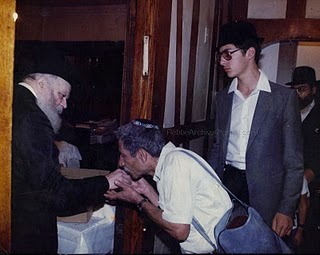
    Sephardim have a custom to kiss the hands of a Talmid Chacham

    It might then be considered rude then for others to choose not to stand at such a time if they are specifically requested to stand. One could, of course, argue that now that things have changed, and the ברכה is no longer explicitly written for the purposes of the particular שמחה and בעל שמחה that by standing one is perpetuating denial, at best. Some might argue that one should davka sit to make this point and attempt to cajole people into accepting a reality that they are understandably uncomfortable with.

    I have always had a different issue. Not for any reason of present צדקות but simply because it’s a הנהגה that I accepted בימי חרפי when I was learning in Israel, I stand during קריאת התורה. Yes, it’s a חומרה and doesn’t match what I’ve become since those days, but I digress. I wonder, then, how could it be that those people who don’t stand during קריאת התורה do stand during the reading of a מכתב ברכה?

    The גמרא in :מכות כב says אמר רבא כמה טפשאי שאר אינשי דקיימי מקמי ספר תורה ולא קיימי מקמי גברא רבה. The message from that Gemora is that there are silly people who stand for a Sefer Torah but don’t stand for a great person (Talmid Chacham).  The Beis Halevi in his introduction to his Tshuvos, הקדמה לשו”ת בית הלוי states דהת”ח לא הוי בבחינת תשמיש קדושה רק בבחינת עצם הקדושה

    In the words of the Beis Halevi, certainly not a Chassid, the Talmid Chacham is to be considered Kedusha personified. I imagine that this perhaps explains why there is a specific mitzvah to stand in the presence of a Talmid Chacham in the same way that one would stand in front of a Sefer Torah. It is true that a Talmid Chacham can be Mochel on that Kavod and tell you not to stand for him, and there is no such concept of Mechila for the honour of a Sefer Torah, but that is parenthetical.

    An explanation then is perhaps that when a Chassid reads/hears a letter and then “sees” his Rebbe,  he or she stands in the “presence” of their Rebbe, כביכול.

    I wonder then whether it might also be proper to stand for קריאת התורה on this basis. At least one should be able to see (the original) Moshe Rabenu in front of one’s eyes, transmitting Hashem’s word, and standing thereby accordingly?

    Bias of the right wing?

    In a post at Matzav.com, Rabbi Adlerstein seemingly bemoans a new trend whereby Rabbis seek to garner support for their opinion on brain stem death vis-a-vis organ transplants. He argues, cogently, that rather than seeking to gain popular votes for their views, those Rabbis who oppose the RCA’s published  position would do better if they presented a learned halakhic discourse to counter the views of the RCA (and indeed other Poskim).

    Whilst his point is well made, I can’t help but ask why Rabbi Adlerstein doesn’t equally speak out against all those who keep advising us that we have to follow a Psak on item X, because the “Gedolim” follow that Psak and  it alone is Daas Torah.

    Let me take a recent example: that of fish worms. Whilst Rabbi Adlerstein has noted elsewhere that this issue is indeed a matter of halakhic debate, I have not seen him or others emerge and criticise the myriad of posters and opinion-machers who decry those who follow the so-called lenient view (eg that of Rabbi Belsky) that such worms pose no problem. Despite Rabbi Belsky satisfying the criteria of Rabbi Adlerstein in publishing his views in a halakhic discourse, we don’t find Rabbi Adlerstein condemn the populist pressure applied by the right which seeks to disenfranchise and delegitimise all those who follow so-called lenient views, irrespective of whether those views do include and are buttressed by  a published halakhic stance.

    What is the difference between so-called left-wing Rabbis suggesting that people follow the views of say Rabbi Tendler, an approach that Rabbi Adlerstein decries, and that of right-wing Rabbis and Askonim who seek to actively squash all opinions which are to the left of theirs (as in Anisakis worms) despite the fact that יש להם על מה לסמוך?

    Why is this populist style pressure bad if it emanates from left wing Rabbis, but it’s perfectly okay if it comes from right wing Rabbis?

    Have I missed his point?