The press are out to sell papers

Don’t forget it. They rarely care about morals and ethics. They don’t care. If it generates heat it sells papers. They often have empty guns and fire without bullets. I hope Rabbi Glick retains his demeanour and doesn’t allow those who can sometimes be caught up in their own misguided triumphalism.

The press protect their sources (sometimes) that’s their only ethic. The rest is just money, money, money.

Read this account for a perspective.

In the same way that perpetrators must be outed at all costs and victims identities never published and always be helped, the innocent caught in the inevitable crossfire of lies and hyperbole have a right to their well established and famous dignity.

ABC Trampling on the rights of Yeshivah Students

[received from various]

SIGN THE PETITION!

ABC Australian Broadcasting Corporation: Remove video and photographic footage taken outside Yeshivah College for the use in Compass’ upcoming documentary ‘The Whistleblowers’ – Sign the Petition!

I’m no lawyer but I think we deserve to know?

It’s seems strange that when someone is accused of horrible crimes, these are made known. Yet, when the person is completely cleared and apparently there isn’t even recourse to an appeal via the DPP by the accuser we don’t get to learn what was missing or fictitious or particular about the false accusations that caused damage and was unfounded. What if an accuser had a screw loose? What if he or she was found to be convinced that things happened when they didn’t? Are such people a danger to society?

I think we need to uphold a standard where a grossly false and shameful accuser is scrutinised. They may well be calculating liars with psychological conditions. They are entitled to privacy but if they come out and accuse, the police should go into proper detail regarding why they consider the accusation a Booba Mayse. If not, then the accused is subject to a different level of privacy than the accuser. I would have thought both deserve the same?

There are some people out there who should be subjected to sanity tests before allowed to make gross claims. They should be noted as such in the press if so found by the police. How do people stay away from them lest they inadvertently fall into some baseless and stupid allegation?

Here is the article from the Age

By STEPHEN CAUCHI AND BARNEY SCHWARTZ
A respected rabbi who was stood down from Melbourne’s Yeshivah College over allegations that he raped a student in the 1970s has had charges against him dropped.

Rabbi Avrohom Glick, 67, was then deputy principal and later principal of the College. He was head of religious studies when he was stood down last December.

Rabbi Glick, of Balaclava, was arrested and interviewed in December and released pending further inquiries.

Yeshivah College principal Yehoshua Smukler said at the time that although “Rabbi Glick is a highly respected staff member and community figure”, he would be immediately stood down.

Rabbi Glick has not attended the campus or had contact with students since.

Chevi Levin, a niece of Rabbi Glick, said on her facebook page on Friday that “after conducting a thorough investigation, Victoria Police has decided NOT to press charges against Rabbi Avrohom Glick.

“This is NOT a case of no evidence or stale evidence. Rather, police have rejected the allegations, which were vexatious and wholly without substance. Police have further denied the accuser avenues of furthering his fictitious claim to the DPP.

“Unfortunately, there is little which can be done to prevent false accusers from making claims against ANYONE (a scary thought indeed!) Yet today, justice has triumphed. Today, Hashem’s help and guidance has set an innocent man free. Today, community support has warmed our hearts. And today- well, today is the day that Rabbi Glick gets his life back.

The victim told police he was lured to the worship centre when he was eight and raped “in front of the Sefer Torah”, the scroll of the Torah, Judaism’s sacred text.

He said he was raped several times and forced to perform oral sex, and that the man also abused another victim.

“After I was raped I was in shock and I went to the office and I was shivering and crying.

“I didn’t know what rape was because I was eight years old. I didn’t know what sex was, so I didn’t have the words to say what happened,” the man said.

The arrest was made by Task Force Sano, set up to work with the Victorian inquiry into how religious organisations responded to child sexual abuse.

All we hear about is controversy and conspiracy theories about “Chesed”

I was gob-smacked to once more learn about (in general terms) the constant and consistent help being given by  http://www.jewishtaskforce.com.au to all sectors of the community.

This voluntary group has been quietly doing a great job behind the scenes, and in public view with their education programs. It seems to have one agenda, and that is the protection and education of those encountering current and potential violence.

People would be shocked to find out that this violence occurs throughout the gamut of our “holy” and not so holy communities. Who helps them? The Jewish Task Force. Who else?

What is their reward? It will be from above. The Vivien Resofskys of this world  seem to criticise almost every initiative taken by any organisation, quoting chapter and verse of sometimes obtuse theoretical approaches to how it “should be done” and dissecting every word that is uttered in a press release. I’d be happier to read about the good deeds and results as opposed to theory.

This cross-sectional committee of the Jewish community are to be commended. They are great women and by the nature of their work, not too many survivors of such violence will feel comfortable to express their public thanks. I understand that. There are people who deal with issues, effectively, and seek no limelight, let alone a salary.

I have conferred with the task force for advice when I knew of an unsavoury situation or two, on an unofficial basis, and found them thoughtful and sage in their advice.

חזק וברוך

The sorry plight of the victims of abuse

This academic paper may be of interest to some. It describes the victim of the “victim syndrome”. Although it is a working paper, it has attracted lots of interest


From the preamble:

People who suffer from the victim syndrome are always complaining about the ―bad things that happen in their lives. Because they believe they have no control over the way events unfold, they don’t feel a sense of responsibility for them.

One moment, they present themselves dramatically as victims; the next, they morph into victimisers, hurting the people trying to help them and leaving would be helpers with a sense of utter frustration.

People with a victim mentality display passive-aggressive characteristics when
interacting with others. Their behavior has a self-defeating, almost masochistic quality. The victim style becomes a relational mode—a life affirming activity:

I am miserable therefore I am.

In this article, I present three examples of people with this syndrome and a checklist that can be used to identify sufferers. I also discuss the concept of secondary gain—the “benefits” people get from perpetuating a problem and the developmental origins of the victim mind set.

The article ends with advice on how to help people who suffer from the victim syndrome.

Rabbi Smason on the Kramer Case

Another Chilul Hashem?

This is from the New York Post. I’m waiting for Charedi condemnation and money collections on his behalf

Rabbi held for allegedly hiding monstrous sex crime record

Rabbi held for allegedly hiding monstrous sex crime record

An ultra-Orthodox rabbi from Israel is being held in New York without bail for allegedly hiding his monstrous sex crime record in order to get a US visa and come to New York.

Yakov Yitzchak Roth — a “rebbe” in the Hasidic group Shomrei Emunim — was arrested Tuesday in Borough Park by cops with the NYPD Special Victim’s Squad.

He had flown here from Tel Aviv in late August after swearing in a visa application that he had never been arrested or convicted, according to the federal complaint against him.

In reality, just six months earlier he had finished serving a 16-year sentence on his 1997 conviction in the District Court of Tel Aviv for raping, sodomizing and sexually assaulting a child relative, the complaint said.

Roth’s attorney, Shulamis Peltz, declined to comment on the case, except to say, “The current allegations are just allegations and have not been proven.”

Roth, whose father, Rabbi Avraham Chaim Roth, led a small congregation of 200 followers in Jerusalem before his death in August, 2012, is due back in Brooklyn Federal Court for a bail hearing on Monday.

Nice post from Boca Raton

This is worth reading.

I must say that I enjoyed the visits of Rabbi Brander and Dr Pelcowitz. I spoke to each of them and found them refreshingly genuine and “with it”.

Kudos to COSA for their work in bringing out Rabbi Brander, and to the Jewish Taskforce for bringing out Dr Pelcowitz. One can only hope that the apparent improvement in education and awareness continues to grow and that this scourge weakens to the extent that any child can be assured to be safe while participating in a Jewish organisation.

To move forward, we must not only improve education, but recognise the past; that goes without saying.


We, who have a holy moral investiture, must show the way. Our record hasn’t been good to say the least, and with more alleged perpetrators unmasked, shock and disbelief at the extent of horrid events and the criminal sickness of perpetrators continues to grow and make me feel low. I simply find it hard to fathom why “people” would do such things.

I have lost faith in Rav Druckman

I waited. I was hoping to be enlightened. R’ Moti Elon, who is likely to appeal charges against him, and for all anyone knows may not be found guilty, was condemned by Takana, a highly respected group of Modern Orthodox Rabbis and learned women. The court re-affirmed their findings.

In a case like this, one must be careful. Elon does have rights, and one must write alleged. At the same time, there is absolutely no Chiyuv that I know of, which would make it necessary to invite him specifically to give a Torah lecture while this very real cloud hangs over Elon.

Rav Druckman had invited him, and whilst nobody can be anything but impressed by his achievements as a human being and as an educator par excellence, one must question his judgement in this case. I waited for an explanation, but either I’ve missed it, or there is none.

Accordingly, I have suspended my faith in his judgement. It’s a pity we don’t have a body like Takana here in Melbourne. There are some dubious individuals, about which there is a raft of evidence that hasn’t yet seen the courts, circulating with clear ramifications that call for an enquiry. I see no need to INVITE such people to  speak on topics given the very dark cloud that surrounds their past. Yes, they are innocent until proven guilty, but we can do better than choosing people who seem to be moral and upright and don’t have such clouds accompanying them. If and when they clear their name, בבקשה.

It reminds me of the sad story re-told by Rabbi Riskin:

“Let me tell you a true incident which for me is a metaphor of our times. A young man attended a yeshiva in Safed.

“The first morning, he arrived a bit late for breakfast and there was no milk left for his coffee. He went to the grocery, purchased a container of milk and placed the container in the yeshiva refrigerator with a sign, ‘Private property.’

“The next morning, the container was gone.

“He bought another container, on which he added to the previous sign, ‘Do not steal.’

“The next morning, that container, too, was missing.

“He purchased a new container, adding to the sign, ‘Questionable gentile milk’ (halav akum). This time no one took his container; he left the yeshiva.”

At the risk of sounding like an Orthodox basher, let me say that far too little is written about the lack of leadership on morality and ethics on the left side of our divide. I did notice criticism of Macabbi in the 2000’s for allegedly not doing enough to separate someone wth a grey cloud over their head, from Macabbi kids. In general, the left leadership is moribund except when it sees an Orthodox target. They includes the reform and the conservatives and the “unaligned” (Shira Chadasha, who for some reason market themselves as Orthodox but are not considered as such by 99% of the Orthodox community).

Jews are a strange group. That’s why we have the crazy notion of people who want to “celebrate” Rosh Hashana and Yom Kippur without God. They advertised in the paper. I would imagine they sit around in Yoga type trances and moments of thought, and make “new year resolutions” while consuming apples dipped in honey. Ultimately, they are celebrating with God, for He ordained the concepts and their meaning. They just have a pintele yid, which is clouded by secularist, do good, and tikkun olam (the modern socialist mantra). They are good concepts in the main, but whether they like it or not, God is part of our tradition! Rosh Hashana isn’t “Happy New Year”. Why not run it on December 31st with the others? Isn’t that more inclusive and likely to break down the “barriers”.

It’s actually God’s coronation. It’s not about making “commitments” per se, although one should use these times to improve.

Anyway, I digress, as usual, given this is (as always) an unedited conscious stream …

Rav Druckman (courtesy jewish community watch)

I’d hate to see Tzedek disappear

I have a lecture to prepare. I don’t really have the time to deal with scurrilous nonsense, so I will be brief.

Tzedek was set up with the best intentions. I am confident that the financial and non financial backers are good people whose final and laudable aim is to help our society deal with past ills and (perhaps even more importantly) create an awareness so that the horrible crime of abuse is seriously minimised etc

Organisations, though, need to be very careful with their words and claims. It is relatively easy to lose credibility very quickly. That’s not to say they shouldn’t speak out. That’s an entirely different matter.

I don’t allow ad hominem attacks on this blog. The purpose of this blog is multifarious as can be seen by the range of topics I choose to write about.

In trying to discredit me, however, I had to laugh with angst at claims and  descriptions put out by Tzedek.

  1. I’m ultra-orthodox. Well, let’s see. Where do I start. My Rabbi isn’t. He advises me on halachic matters. He is shunned by the ultra-orthodox and described as modern orthodox or centrist orthodox. He is a world-class Talmid Chacham but the Aguda don’t even let him speak or sit on a dias at Daf Hayomi Siyumim. He sits at the back on a normal table. It’s a bizayon Talmidei Chachomim. He can learn better than most of them on the dias, but because he is not considered ultra-orthodox, he has no place! I have a PhD, which means I spent many years of my life studying in a University. That’s a no no. Worse, I’m still there. I teach secular topics—Science. I even use the internet, constantly. I use social media. I have a blog. All these are forbidden by ultra orthodox. But wait, it gets even worse. I run a band which plays non-Jewish music and this is to crowds who are mixed dancing. Guests aren’t dressed modestly either, especially in the warmer months. Read my posts on Israel and related matters and see if I’m closer to Zionism than “non” or “anti” Zionism—hallmarks of ultra orthodox. Read my critique of the extreme groups. Yes, I have to unashamedly try to keep Torah and Mitzvos, but if that’s the definition of ultra-orthodox, then I guess many of us are damned by Tzedek. Tzedek’s CEO’s own father is “ultra-orthodox”. Does he describe him as “my ultra orthodox father”. Why do I say, “damned”? Because it is entirely irrelevant what shade of white, black or grey somebody is unless you believe in strange conspiracy theories that people who are lumped by Tzedek into some category (which they don’t define) are likely to be so dumb and stupid, that they will hide the truth or protect people from that same  “Tzedek category”. Sorry, this type of characterisation is Grade 1 level. Does the CEO preface his remarks about someone defending homosexuality as saying “Homosexual Joe Jones said …” that’s simply boorish. It has no credibility as far as debating logic is concerned, let alone, in my case any resemblance to fact. It is a transparent and poor attempt to deflect from the lack of research conducted by Tzedek on the matter of Rabbi Brander’s visit to our shores. Did Tzedek actually ring a roof body, all of whom reacted with probity after reading some of the toilet blog posts and their comments? At the risk of repeating myself, there is no such thing as a Gzera Shava for people, to the extent that if one  does belong to a group, that they are thereby tarnished ipso facto and have lost their independence of thought and action. There is no better proof of that than Tzedek’s CEO’s own father. Is he tarnished because he is Chabad? Why not? Answer: he has his own views and expresses them. A contradiction to the implied thesis in the CEO’s hyperbole. But …. maybe I am ultra orthodox in Galus Australis style, simply because I don’t eat at Lord of the Fries or similar establishments? The mind boggles.
  2. I’ve been criticised because I sit on a Shule board, one of whose ex-members is now facing proceedings. I understand that the CEO of Tzedek is alleged to be one of the victims of said ex-member. Well, hello there Tzedek. Your CEO and his father (and indeed readers of my blog) know very well that it was me who initiated the removal of said ex-member from the board. Do you not remember my father הכ’’מ asking me to take a post down because he thought I should not get involved! Let’s go further. I even had an attempted intervention order (later withdrawn) placed out on me by the aforementioned ex-board member now facing trial, because I was “in his face” so to speak. Tzedek, you have the wrong address. But it’s worse than simply having the wrong address. What’s really worrying, is that (a) you actually know you have the wrong address on such matters, and (b) had you even bothered to ring a single board member of my Shule, they would have told you this. Indeed, ring the accused’s father! Go on, do us all a favour and return with your findings.
  3. On the matter of the COSV and the accused’s membership, again, Tzedek is so far off the mark, it’s really sad that this fact demeans Tzedek terribly. I was present when the conundrum was raised, and frankly, Tzedek ought to have been proud, of the attitude of each member of that executive and individual Shule Presidents. But, let us not let the truth get in the way of Tzedek’s tirades, hyperbole, and one liners in the press.

A pattern is emerging with Tzedek, and it’s a very sad one. It is turning people off Tzedek; people who used to look up to them. Their raison detre is brave and important, but their execution (sic) due to poor research, questionable leadership and the emotive untruths expressed by its leader(ship) is damaging its credibility. That would be a great shame.

I don’t have a clue if any member of Tzedek’s board read my blog, so my words may be in vain. By all means, someone please pass on this blog post to each and everyone of Tzedek’s board members. I would be most happy to meet them in my house at a time of their choosing, and properly explain what is wrong and my thoughts on how it can be fixed.

Have a nice day, everyone. I hope to!

Tzedek shouldn’t be in the business of besmirching honourable people

Rabbi Kenneth Brander is beyond reproach. He has done probably 1000 times more for victims of abuse and beyond than our own Captains of Morality, and is well-known to be absolutely rock solid on moral issues, such as abuse. Yet, we have the Tzedek organisation, in a move which can only be described as approaching the level of the disgraced site run by Scott Rosenberg, expressing “concern”. To be sure, Rosenberg’s site, like Tzedek, performs some good; but it is an amoeba with an anti-Orthodox (especially Chabad) agenda. It isn’t at all dispassionate about fact finding, and is often twisting and sensationalising headlines like a desperate journalist trying to bring down organisations. Unlike Rosenberg, though, I would have expected Tzedek to have done its own solid research before they dare cast any real “concern” about Rabbi Brander. Tzedek have been tardy. If they have anything of substance, apart from discredited articles from the Forward and elsewhere which we can and have all read, then they should put up. Otherwise, let them shut up, and spend their time in the holy task of supporting victims and unmasking actual predators and their supporters.

Does Tzedek think the community are a pack of fools who need their imprimatur in order to determine moral issues? Do they think that the community and individual Shules haven’t seen the badly researched, journalistic hooey, flashing in neon lights? Rest assured, that members of this community involved in overseeing this visit include many people and Rabbis who are at least as moral, sensitive and aware as Tzedek, but perhaps less inclined to hang people on the basis of unproven innuendo or use over-inflammatory language. Yes, it is true, that some have not (thank God) been victims themselves, but you do not have to be a victim to loathe predators or support those who might come to you for help.

I have personally seen current correspondence from arguably the most respected professional experts in this arena, who are very well acquainted with a situation in which they support Rabbi Brander unequivocally based on personal knowledge of the facts.

Rabbi Brander is not only to be looked up to; he has demonstrated many times that he has zero tolerance for those who wish to sweep such issues under the carpet. He has demonstrated this many times in his career, well before it became de jure to do so. Tzedek would do a lot better to actually engage Rabbi Brander in an hour of private discussion. They would be most surprised, and less inclined to issue their “letters of concern”. I have every confidence that they will be most impressed and enthused.

Life isn’t that simple though, and forming a “connection” between Rabbi Brander and the current civil  proceedings over past issues at YU is, frankly, beneath contempt. Is everyone at the Yeshivah Center a supporter of predators because of past sins and ills? Of course not. If they are, then there are people who are directly or indirectly affiliated with Tzedek that can equally dubiously be accused of such “sins of association”.

Tzedek—many in this community do not consider you as our soul or sole moral compass, even though we admire many things you do. We do not consult you in respect of who we should and should not invite to our shores. We have our own access to facts and research, that you simply may not have, nor have discovered. As long as you sit on the outside and do not work within roof bodies all of whom equally abhor abuse, you are in danger of eventually becoming less relevant.

I urge anyone who can attend any and all of Rabbi Branders’ Shiurim and colloquia to do so, and this includes members of Tzedek. This is a unique opportunity.

Disclaimer: it was originally my idea to have the Centre for the Jewish Future  invited to Melbourne to aid Orthodox congregations and organisations in order to re-enfranchise ever increasing Jewishly unaffiliated youth to the holy covenant of Torah and Judaism.

This is how an honourable leader bows out

Rabbi Dr Norman Lamm has been a powerhouse. A true intellectual giant, whose books, learned articles,  shiurim and leadership at Yeshivah University will stand the test of time, Rabbi Lamm has now retired as Chancellor of YU. Amongst his words of farewell, this section stood out. It shows tremendous honesty and courage. It is a commentary of what was, but is also a statement of what needs to be.

Jacob’s blessing to his son Judah, Yehudah, attah yodukha achekha (Gen. 49:8) literally means “Judah, your brothers will recognize you (as their leader).” However, the word yodukha, they will recognize you, is etymologically related to the word vidui, confession and therefore teaches us that only those who can, like Judah, confess, are those who can be acknowledged as real leaders.

And it is to this I turn as I contemplate my response to allegations of abuse in the Yeshiva community. At the time that inappropriate actions by individuals at Yeshiva were brought to my attention, I acted in a way that I thought was correct, but which now seems ill conceived. I understand better today than I did then that sometimes, when you think you are doing good, your actions do not measure up. You think you are helping, but you are not. You submit to momentary compassion in according individuals the benefit of the doubt by not fully recognizing what is before you, and in the process you lose the Promised Land. I recognize now that when we make decisions we risk, however inadvertently, the tragedy of receiving that calamitous report: tarof toraf Yosef, “Joseph is devoured,” all our work is in vain, all we have put into our children has the risk of being undone because of a few well intentioned, but incorrect moves. And when that happens—one must do teshuvah. So, I too must do teshuvah.

True character requires of me the courage to admit that, despite my best intentions then, I now recognize that I was wrong. I am not perfect; none of us is perfect. Each of us has failed, in one way or another, in greater or lesser measure, to live by the highest standards and ideals of our tradition — ethically, morally, halakhically. We must never be so committed to justifying our past that we thereby threaten to destroy our future. It is not an easy task. On the contrary, it is one of the greatest trials of all, for it means sacrificing our very egos, our reputations, even our identities. But we can and must do it. I must do it, and having done so, contribute to the creation of a future that is safer for innocents, and more ethically and halakhically correct.

A stress-laden day

In response to my occasional blog posts about an event in the news involving abuse, my father הכ’’מ always used to ask me in Yiddish

Okay, Okay, but why does it have to be YOU. Leave it to someone else

This is a good question. I’m also enjoined to keep כיבוד אב after his פטירה which some Rishonim link to writing הכ’’מ (as above) during the first year.

I write my blog posts because my mind bubbles. In fact, I sometimes wish I had more down time with my mind, especially at night. Since my father was נפטר I have been unable to have a natural night’s sleep. I wake in the morning as if I’ve been in a fight with עשיו and I’m very tense. It is my nature when faced with certain challenges. It was my father’s nature. Call it a family trait—Nerven. Others would say, it’s simply because I’m a Cohen and come from Pinchas.

I really envy those who can meditate or those who can sublimate during davening. My wife is so much calmer than me and I thank God for that! I’m pretty sure that I’ve always liked a tipple simply because it takes the edge off. Oh, and all whisky, even in wine casks are kosher (more on that in a follow-up post when I get some time).

So, on Sunday morning, at around 4am when I found myself “awake”, I clicked on the Age and was horrified that we, Yidden, were again on the front page, and that there was yet another alleged pervert from yester-year closeted away somewhere, and that a Rov was quoted in most undignified fashion. I reacted, and was critical of the statements attributed to the Rov. Yesterday (or was it the day before) I was sent a statement from the Rov. On face value, based on the available evidence, he had explained what had happened, and claimed that he was quoted out of context of the thrust of the original article. I still questioned some of his remarks and do. I’d like him to withdraw them, and wrote thus.

I have a day job. My phone didn’t stop ringing yesterday about this issue. My blog got a spike in hits. Sadly, if I write Torah which I think is interesting from a Halachic point of view, it doesn’t seem to attract the same interest 😦

After all the calls, some with conflicting information, I’m not going to comment further on the issue at hand. I will close with one thing:

Dear alleged perpetrator. If you are reading this or someone shows you this post, face the music. I remember you. Come back to Australia and be a man. I truly believe that  past wrongs must be dealt with. Together with education, it’s our only way forward. Do it quietly, with humility, and face justice. Do Tshuva. You know what you have done. If it was your own child, you would be going after the perpetrator with all your might.

Did you succeed Vivien?

In an article on abuse, social worker, Vivien Resofsky, wrote:

I first saw a Rabbi about child sexual abuse in 2004 while I was working at Jewish Care. A terrible example of child sexual abuse was the catalyst. The abuse had gone on for years and finally the girl had the courage to ask for help. She went to a teacher she trusted at Beth Rivkah Ladies College but the teacher did not help her. Instead she told her student that she was not a pure diamond because her parents were not born into Ultra Orthodox families and had become Ultra Orthodox by choice. (Baal Teshuvah).
Despite the fact that the teacher was mandated to report disclosures of abuse she did nothing and consequently nothing in the girl’s life changed. So the girl did something she could do by herself and began to hurt herself physically. Luckily, she came across a doctor who not only knew how to respond but had the confidence and conviction to respond responsibly.
There were other referrals about child sexual abuse and in my opinion, many people who were working with children weren’t sufficiently educated and confident to deal with child sexual abuse.

I realise that social workers are trained to refer and support. They do a magnificent job. My daughter is a great social worker, but as far as I know they don’t treat per se. Perhaps Vivien can also tell us whether she or others associated with the case that she lists, convinced the girl to report the alleged abuser(s)? I hope they did. Vivien is associated with Tzedek, I believe.

Cheap shots

I was sent a post from Tzedek where its founder wrote (amongst other things)

Rabbi Hershel Schachter, the Rosh Yeshiva of Yeshiva University’s rabbinical school, who said he didn’t try to stop child sex abuse at the high school because he could not be sure the allegations met halackic threshold for truth;

This is a gross lie and misinterpretation of the facts designed to besmirch a respected Rabbi whose position on these matters has been published in writing many times. What R’ Schachter did do, was suggest the kid go immediately to see the School psychologist.

But let’s not let truth get in the way of those whose agenda, while noble, sometimes impedes their Yashrus.

Tzedek Tzedek Tirdof

The report below by Jeane Macintosh,  from the New York Post, may result in an exoneration. If so, it will send shock waves throughout the (Jewish) world. I can’t get my head around it. While we must pursue each and every abuser and encourage the abused to speak up, it seems beyond belief that so many people would seemingly “gang up” to put someone away without any truth to the accusations. Everyone has rights, and at the same time, it is equally not acceptable to issue a guilty plea (bargain) if/when one knows they have been set up.

If someone knows more about this case and can explain to me what the heck happened, please let us know. It’s a potential shrek, really. Fourteen people?

‘Capturing the Friedmans’ convict Jesse Friedman awaits DA’s report that could expose wrongful conviction – 25 years later

Twenty-five years after his controversial Long Island child-molestation conviction, the subject of an Oscar-nominated movie about the controversial case may get an apology from prosecutors.

Nassau County DA Kathleen Rice will soon release a report that could exonerate Jesse Friedman, who spent 13 years in prison after pleading guilty in 1998 to abusing 14 kids in his father’s home-computer class.

The case was chronicled in the 2003 documentary “Capturing the Friedmans.”

The convict has contended all along that he was railroaded into a bogus confession by overzealous cops and prosecutors, and nearly all of the alleged victims have backed him up.

“When we really win this thing, it will hopefully inspire a lot more people,” Friedman told The Village Voice in an interview posted online yesterday.

Friedman has been out of jail since 2001.

Rice ordered the review three years ago — after previously refusing to do so — because new evidence emerged.

Last month, another critical witness broke a quarter-century of silence, walked into Rice’s offices and recanted his accusations.

“I know how much exonerating evidence has been presented to the DA’s office,” Friedman said.

Friedman and his father, Arnold, who taught the classes from the family’s Great Neck home, were charged with the abuse after cops found that kiddie porn was delivered to Arnold at the house.

Additional reporting by Kieran Crowley

jeane.macintosh@nypost.com

What would her sentence have been if she had not pleaded guilty?

Consider the article below reprinted in the age newspaper. She has apparently shown contrition and has undergone extensive rehabilitation. Had she pleaded not guilty, I’d suggest she may have found herself behind bars? Given the evidence was apparently damning, at least she undertook some rehabilitative action.

Sex abuse teacher walks from court

A Melbourne teacher who sexually assaulted a teenage student after using shared religious beliefs to win her family’s trust has walked free from court.

Victorian County Court Judge Christopher Ryan said Yolanda Lyons had undertaken a long-running rehabilitation as she continued to teach in the years after her crimes, committed over a year in the 1980s.

Judge Ryan on Wednesday sentenced Lyons, 58, to three years in jail but suspended the sentence.

Lyons, of Rowville, pleaded guilty to two counts of gross indecency and two counts of indecent assault on a person under the age of 16.

Judge Ryan said the mother of two had manipulated and committed grave offences against a vulnerable victim.

“You breached the trust of the complainant, who was a child in your care,” he said.

“The harm done to the complainant by your offending is serious and long lasting.”

He said Lyons had exploited the religious beliefs she shared with the victim and her family to gain their trust and take the girl away on holiday with her own family, where she sexually abused her.

But he said Lyons had gone on to work as a dedicated teacher at a special school.

Lyons stood down from her role at the school when she was charged with the offences in 2011.

Judge Ryan said the school where Lyons had been teaching at the time of her offending was informed of the crimes but did not report them to police.

The victim contacted police in 2011.

Judge Ryan read character references from Lyons’ former colleagues who described her as an “exceptional educator” and “a person who put other people’s needs before her own”.

“Since the offences you have not only led a blameless life … but contributed greatly to the lives of others,” Judge Ryan told Lyons.

“By your work and care for others, you have undertaken a lengthy process of rehabilitation.”

Lyons’ three-year prison term was wholly suspended for 36 months.

AAP

More on R’ Schachter’s views on Mesirah and Dina D’Malchuso

At the suggestion of מו’ר R’ Schachter’s מקורבים, readers who seek more than a 10 minute grab, would do well to read his written word on these topics, well before the scourge of hidden child abuse arose.

Firstly, there is a brief note on Torah Web here from 2007.

A more expansive and learned paper can be read here from RJJ Volume one which I believe is from 1981.

Enjoy.

Raglayim LeDavar (i.e. prima facie case to answer)

In an amongst a previous post, I received the following comment (which I have slightly edited) … and no, there was nothing at all wrong with the comment, which is why I am not ignoring it (I’ve just been incredibly busy).

Rabbi Hershel Shachter provoked a storm of criticism for using the word shvartze. As far as I am concerned that is the least of it. The much bigger problem is that he propounded several insidious arguments for not dealing with sex abuse. He gave with one hand and took away with the other. He said there is no issue of mesirah (snitching) per se in reporting a known molester. Great. But then he said it is takah (actually) mesirah if the offender will be sent to state prisons where wardens could harm you by placing you in a cell with a member of Farakkan’s Nation of Islam. Yes I think that is racism. Why does he believe a Jew should fear a Black Muslim more than a member of the Aryan Nation? But never mind.

It’s important to note that R’ Schachter has given many Shiurim on this topic, and I’ve heard some of them well before the sound bite you refer to. In fact, the shiurim on mesirah were also well before the issue of child abuse became the grave topic of concern for all of us. His view, has not changed. He speaks Halacha, as he sees it. He is a Posek.

Whilst you acknowledge that R’ Schachter is strongly against those who hide behind Mesira and is in fact concerned with the safety of a community and ובערת הרע מקרבך, and yes, I have heard him say both of these things explicitly over and over, he is also concerned about safety in jails for those who are incarcerated. Halachically, R’ Schachter contends that nobody should be in a type of jail where they are beaten and/or gang raped (and all the horrible things that we hear). In a previous shiur, R’ Schachter described different types of prisons in the USA, and said he was concerned about one type as opposed to the other. If we are to be true to Halacha and indeed true to the country we live in, what we should also be doing is ensuring that those who are incarcerated go to a “normal” prison or a system where such things are very unlikely to happen. All over the world, we have read many times of the “mysterious” death of an inmate. Chazal most certainly would never approve of such a thing in their own prison systems.

R’ Schachter often interludes with urbane language. In a number of shiurim, he called the reasonable prisons “Glatt Kosher/Daf HaYomi style prisons”. People giggled when he said that. Perhaps Daf HaYomi learners or Glatt Kosher eaters might take umbrage; I doubt it. When R’ Schachter said a shvartze, he immediately expanded on that, and anyone listening knew he was giving an example, that is, of one of those Army of Farrakhan types who might be sharing a cell with a Yid (albeit a sinning Yid). Criticising him for this is unfair.

The real issue is that almost all sex abuse prosecutions are in the state courts. So he has now precluded virtually all prosecutions.

No he doesn’t. He actually says that (Frum) Lawyers and Law Makers should try to influence the powers that be to make sure that all those incarcerated are put in a situation where their rights are actually protected and they aren’t subject to jail abuse.

He also insists on vetting by a mental health professional who is also a talmid chacham (rabbinical scholar).

Knowing what he has said elsewhere, let me explain. He strongly encourages that any educational institution should not just have Rabbonim on staff, but also Rabbonim who are trained professionals. As opposed to a teacher/Rabbi who hasn’t lived in the real world, and is fresh-faced out of Yeshivah/Kollel and is confronted by an allegation, he would insist that the professionally trained Rabbi/teacher be one to hear the allegation and then pass it onto the authorities as the case almost always is (now). What you don’t know, is that R’ Schachter was very upset about a respected Rav/Teacher whose life was destroyed when it turned out that their pictures was published as a molester and in fact it was a complete case of mistaken identity. The teacher wasn’t even remotely connected to the allegation. Apologies were made, and the incorrect picture was removed, but, and I’ve heard R’ Schachter speak about it, that teacher’s life had been ruined. They are depressed, unable to work when in fact they had nothing what to do with the incident. They weren’t even in the same institution if I remember correctly. It was a case of “man with a beard who looks like this” but it was the wrong person whose picture was put up. I surmise that this also concerned R’ Schachter.

There definitely is such thing as a recidivist liar, who as a student has a reputation for lying on all manner of issues in the past (I’ve known such people and I suggest we all have) . It is best that a trained psychologist be on staff and ensure that a proper process is followed. That means, the person who makes the allegation makes it in front of someone who is skilled and trained, not someone who knows Shas and Poskim.

He obsesses about the terrible damage of a false allegation. I too find a false allegation a terrible thing. But the professionals most capable of such an evaluation are the ones inside the criminal justice system.

I’ve explained what worried him, based on cases he had known. I’m sure that the professionals in the criminal justice system will do a good job. Having a professional on staff to hear an allegation, is a good idea. Remember, this is not at all the Aguda proposal that a board of Rabonim examine each case and decide. R’ Schachter is not only part of the RCA, he is probably their venerated Posek, and as such, you really need to understand his point of view from the RCA stand point.

If I can make it a bit clearer. Where I work, and where many/most of us work, we have line managers. However, we also have HR (Human Resources). If a line manager or staff have issues with each other, HR (who have trained professionals) do get involved, before actions arising. Sometimes those actions are indeed a referral to the police! For example, if someone alleges they were sexually harassed or racially vilified. In the context of R’ Schachter, I believe he is suggesting that Schools and similar, davka need to have a quasi-HR through having professionals as he suggested and not just people with Yoreh Yoreh and a Yeshivah Teaching certificate.

Prior interrogations contaminate evidence and alert suspects who can then hoof it. More than that, most such prior screenings end up discouraging reporting.

Picture the scene. A student makes an allegation. They go the headmaster. The headmaster  immediately calls in Rabbi Dr So and So, who is a psychologist on staff. What’s wrong with that?

It is true that if the Headmaster is corrupt and/or the psychologist is a psycho then we are in trouble. But, we would have been in trouble anyway, in that situation. No system can help here, unless a kid goes directly to the police or tells their parents and the parents are not indoctrinated to keep shtum. On the contrary, there isn’t a culture of “run away from Mesira” with R’ Schachter. We need to also ensure that the kid is not fobbed off and the issue buried (as it has been tragically, and in some places still will be).

I recognize that false allegations do happen, usually in the context of divorce custody battles. Folks in the criminal justice system are quite adept at recognizing them and screening them out.In the end, the decision to support reporting involves balancing the danger to children versus the danger to someone falsely accused. In a situation of uncertainty I would rather leave an adult with the problem of undoing damage to his reputation then subject children to damaging abuse. It is much harder for children to recover. Children need more protection than adults. But that is me. Rabbi Shachter thinks in terms of adult and institutional interests.

He is talking to Rabbonim and this is a grab from a speech he gave. He cares greatly about children, and that is why he is advising the Rabbonim to change things so that they have staff who are also skilled and are professionally qualified to deal with abuse allegations and related matters that arise (eg bullying and harassment). This is my understanding based on more than the particular 10 minute sound bite I heard.

I could be wrong, of course, and will stand corrected if that is the case.

[ R’ Schachter is incredibly busy at the moment. I waited for 1 month before I could get an answer to some questions I asked repeatedly. I expect that he will make his views clearer in the near future, given the thoughts you expressed and which no doubt others have also expressed or thought. Let’s wait and see. ]

What happened to that post?

My blog is not and was not designed to attract the type of comment that my last blog post about a critique of some of the approaches of otherwise well-meaning people to the issue of abuse, did. Unfortunately, many of the comments were not on the level that I want or need to digest. There is clearly a tit for tat mentality that has invaded people’s head spaces to the extent that they seem unable to take a backward step and re-look at things.

When I saw myself having to respond to those who started ad hominem attacks, I decided that it’s best not to waste my time responding to such a level of commentary or spending my time responding via email to get “sanitised (sic) versions” of the comments.

I could have turned comments off, but that wouldn’t have stopped some people commenting about it on other blogs, and I have better things to do with my time than deal with unedifying froth. Indeed, I shouldn’t have responded either. Perhaps, I should have listened to my father’s הכ’’מ advice—Nyerusz Guvno Bo Szmerji.

My post ended with a fervent call to increase education on this issue as the prime method to prevent (God forbid) future events. I can only hope this will continue to happen in the positive ways that have already begun, and that together with helping those who have and are still in need of therapy, becomes the challenge for this community; a challenge I am confident it will handle in a professional and proper manner.

I won’t be taking comments on this blog post, so don’t waste your time by trying to send them.

* One person wrote a dreadful comment which I did not publish. The comment not only was grossly and demonstrably untrue, but contradicted everything he knows about me. He will need to apologise personally and earnestly if I am to forgive him before Yom Kippur. I expect he has the integrity and menchlichkeit to do so.

Haredim addressing pedophilia issues

This interesting post is from the Jerusalem Post. [emphases are mine] by Melanie Lidman.

It is refreshing to hear about Rabbi Cohen, who seems to work diplomatically behind the scenes, and yet seemingly doing so effectively.

But there is a long way to go on other issues, especially the moronic mechalelei hashem who attack women and the low-life (who should get a real beating) who has avoided giving his wife a divorce.

Those of us who don’t consider ourselves as card carrying Haredim, also have a job to perform. Whenever possible, speak to them, don’t avoid them. Engage them respectfully and ask them what they are doing about issues. I think this is a very useful approach to take. I have been doing it of late, and have been astounded to find that so many are completely oblivious. When you tell them, they are in a state of shock.

It seems like a weekly occurrence – bold headlines splayed across the pages of newspapers: “Haredi man arrested for sexually abusing daughter”; “Haredi bus driver molested children for 6 years”; “Haredi community attempted to cover up serial pedophile.”

Despite the prevalence of these stories, Rabbi Avinoam Cohen, the director of the Welfare and Social Services Ministry’s Torah-Observant Prisoner Rehabilitation Program, believes the haredi community is doing a better job of dealing with the issue of pedophilia.

“Slowly they’re starting to understand, there’s a type of movement,” said Cohen, who deals with around 60 ultra- Orthodox prisoners at a time who have agreed to go through a personalized rehabilitation process. “It’s not like it was five or eight years ago. They’re not going to leave their children with someone like this [who is known to have a problem], or they will go to the police.”

While the more extreme sects, including Toldot Aharon or Natorei Karta, refuse to deal with police or any secular authorities, awareness of the issue and the proper response is getting better among mainstream haredim, said Cohen in a recent interview.

“The victims [of sexual abuse] caused this movement,” he said. “They feel it in their bones that it’s getting better. The awareness has increased because of the publicity about the incidents, and the children who are failing out of school and no one understands why.”

Cohen works to implement successful rehabilitation programs for pedophiles to ensure they don’t re-offend, a difficult struggle given the large numbers of unsupervised children in haredi neighborhoods.

T., 38, says he sexually abused over 20 children in Jerusalem during a six-year period. T., who has mild developmental disabilities, tried to tell his family what was going on, but they dismissed it as “total fantasy.” It was the same response they gave him when, as a nine-year-old boy, he told them that an older man from another haredi sect had tried to rape him on the way to an evening study session.

“[My father] said it’s my imagination. They never believed me at home. I had no one to talk to,” he said during an interview in Cohen’s Jerusalem office.

According to Cohen, more than 70 percent of men who sexually abuse children were victims of sexual assault themselves.

The haredi community’s refusal to deal with the problem in the past has created generations of victims.

T. said he had been confused after the attack, and had no guidance.

“If an older person is allowed to do this to me, then maybe I can do this to others,” he said.

“I didn’t know if it was forbidden or not. But someone did it to me, so I thought I could do it to someone else.”

Cohen, who was raised secular but has been haredi for over 20 years, explained that some haredi parents are so overwhelmed by the number of children they have that they can’t adequately deal with the needs of each one, especially if one requires special assistance following abuse.

Additionally the fact that a child has been sexually abused can sometimes harm the matchmaking chances of other siblings.

“People say, ‘Maybe the family isn’t modest, and this kid was doing something immodest, and that’s why this child was abused,’” Cohen explained.

But a trusted adult or parent ignoring a child who says they were sexually abused, or, as in T.’s case, trying to convince him it didn’t happen, “is worse than the original abuse,” the rabbi continued.

That attitude, at least among the less extremist haredi communities, is changing. Cohen spares no words in his anger over rabbis who allow known sex offenders to move to another community, rather than deal with police.

“They need to put rabbis who don’t go to police in prison,” he said. “I can think of at least 20 religious commandments that they’re breaking.”

Another remaining challenge is dealing with convicted offenders who have served jail time and then return to the community. Even if they don’t return to their own community, they will still likely be in a neighborhood with many children.

“Now I’ve been out [of prison] for a year, and I have supervision,” said Y., 43, who was convicted for abusing two girls over a number of months.

“Every day the struggle is renewed. Especially in the haredi areas, there’s small girls and teenage girls everywhere. You can’t get away from this. And you need to know how to be a human being and walk among the community,” he said.

“Sometimes I have no control over it – I’m going through an alleyway and suddenly a bus lets off, like, 100 girls,” he continued. “Every day is a test. Every hour of the morning and night. I have to deal with this all the time.”

Cohen explained that this was the part where a religious upbringing could actually assist offenders in their rehabilitation.

In halfway houses and private or group therapy, convicted sex offenders learn both tools to overcome their inclinations, and religious texts that promote the ideas of inner strength, not harming others, willpower and asking for forgiveness. Often, the former prisoners are able to relate strongly to the idea of text study, something with which they grew up, and find it the most influential part of their therapy.

Y., who lost custody of his five children after he was convicted, said that haredim also strongly subscribe to the idea of teshuva, or repentance and subsequent forgiveness.

“There’s compassion in our community, even for people who did things in the past,” he said.

Not all prisoners receive rehabilitation. Prison rabbis must recommend a prisoner as a good candidate for rehabilitation in the last third of their prison sentence. Cohen, along with another three staff members, is responsible for coordinating a personalized program for each prisoner, which can include stays in halfway houses, therapy or drugs – including monthly injections known as chemical castration, which work to remove any sexual inclinations. Most sexual offenders have regular supervision for a year, but afterward have no assistance.

Also, a limited budget from the Welfare and Social Services Ministry means that Cohen only has enough staff to deal with around 60 prisoners or ex-prisoners at a time – a small percentage of the number of people who could use the services.

Jerusalem police don’t keep statistics about haredi sex offenders versus non-haredi sex offenders. But in 2012, there were 823 complaints of sexual abuse across the capital – a 23.6% increase from 666 incidents in 2011. Part of the dramatic increase could be due to more people reporting incidents to the police that they would previously have hidden within their communities, though it is difficult to tell.

“There is an improvement with the reactions to the incidents,” said Cohen.

“They’re saying, ‘We won’t allow this here.’ It’s the start. We’re still far from breaking the cycle, but we’re starting to break it.”

The Modiin Illit mother was apparently lying

In this article, I asked how it was possible for a woman to fake claim that her 5-year-old was raped and then withdraw the charge. Complicating matters was the apparent refusal of Charedi Medical offices to cooperate.

It turns out now that the Police do believe that the woman was lying. One can only presume she has psychological problems herself and needs treatment. That being said, surely this is yet another reason the Charedi community should not fear police investigations, and makes a mockery of their decision to stay mum and not assist the police with their inquiries!

Anonymity and the Internet

Never assume that you are “anonymous” on the internet. You can go through hoola hoops to hide your identity if you know your stuff, but 99.9% of people don’t know how to do this. Is it worth it? The only time I can think of someone wanting to post an anonymous comment is if they have something that is so important to tell but simply are unable to reveal their name. This is an exception. It should happen in very few cases. One example might be a real victim of crime. Even in that situation, you would hope that the person doesn’t just use the internet, but actually goes to the police and makes a formal complaint. If they cannot bring themselves to make a formal complaint, then depending on the nature of what they have written, we make a value judgement call on whether it is reasonable that they remain anonymous in the context. There are far too many weasels, sock-puppets, and malingerers on the net who make “anonymous” comments which are demonstratively false and hurtful. That’s not what anonymity is about. That’s just offensive cowardice. Some websites are simply magnets for these toilet-like comments: Scott Rosenberg’s blog is one example where there is much horrible comment and back stabbing.

Sometimes, it is unfair. There is no effective right of reply because of smoke and daggers and innuendo. When we say things, just like in our daily speech, we need to be careful that there is a positive purpose in what we say or write, and that we are very sure about the veracity of our statement.

When I started blogging, it was for my benefit, so to speak. I enjoyed and enjoy the opportunity to express what’s on my mind, or something I have learned. In doing so, I have been (or tried to be) very conscious of not allowing ad hominem attacks via comments, and have edited and rejected comments accordingly. I don’t force people to login to show their identity; they could use a fake email, but anyone who thinks that authorities can’t trace them, should think again. I know a little about these things as a computer scientist. That being said, I’ve only once wanted to find out someone’s identity, and that’s when that person made threats to my family through this blog. In the end, I let it go. If it would have occurred more than once, that person may have found me on their door step, with an officer in tow.

It comes then, as little surprise that the “anonymous” blogger “ifyoutickleus” who has been trying to out R’ Chaim Halpern of London, is now under attack. R’ Halpern’s supporters have applied to find out “who he or she is” via google (who host that blog). This is not new. We have such cases in Australia as well.

It will be an interesting unfolding episode. If R’ Halpern is found guilty of an infraction of Jewish Law, then as I understand it, the anonymous blogger may not be found guilty of defamation?  But who will determine if R’ Halpern allegedly did what he is purported to have done (which I understand may not be against Secular Law)? Will it involve the courts summoning the new Beis Din that has been formed to judge this case, and about which I understand very few women trusted enough to come forward? Will they subpoena the Rabbis who have publicly called on R’ Halpern to resign? This is going to get very messy, and I think R’ Halpern’s advisors have made a poor call. They may end up knowing who is publicising the material “anonymously” if google cough up the information, but that won’t cleanse R’ Halpern, surely, except in the eyes of one-eyed supporters. One needs to look at these issues with both eyes. If R’ Halpern has nothing to answer for, so be it. If, on the other hand, some allegations are true, then he should do the honourable thing, and step aside.

The mere fact that there was already an exposé on Channel 4, in which R’ Padwa did not emerge in a very good light as far as the issue of Mesira is concerned, would tend to suggest that this new subpoena will only cause a brighter torch to shine on the Charedi community in London, and Jews as a whole. Not good. It is true that R’ Halpern has a right to defend himself. Did the Beis Din who is sitting on this case, give permission to R’ Halpern to apply to the secular courts? Who did?

In the meanwhile, the rest of us sit back and ask ourselves, “why is this happening?”

Woman withdraws complaint about girl’s rape

The article below is Itamar Fleishman from Yediot

I just don’t get it. People don’t all of a sudden suspect that a 5-year-old has been raped. If they do, then on what basis do they magically decide it was a figment of their imagination? As to the “local haredi (sic) Medical Facility” refusing to cooperate, they should be closed down simply on that basis. Modi’in Ilit has featured on my blog elsewhere. It sounds like a great place to live.

Several days after the police opened an investigation into an alleged rape of a five-year-old girl in Modiin Illit, the woman who filed the complaint has withdrawn it.

Nevertheless, the police have not suspended the investigation despite admitting that there are doubts as to whether a rape had indeed taken place.

On Monday, the police confirmed it was investigating suspicions that a girl at the age of five was raped by a man in the haredi settlement of Modiin Illit. The probe was launched following reports of medical treatment the girl had undergone.

The local haredi medical facility refused to cooperate with the investigation as did other residents who were reportedly instructed to keep mum. Neither the child nor the suspect have been located as of yet.

Rumor of the incident started spreading in the town last weekend, and according to residents, an anonymous complaint was filed with the police Friday.

Police questioned several residents who were warned they would be charged with obstruction of justice if they fail to cooperate.

According to the few details investigators have managed to gather, it is suspected that sometime in the past two weeks a man approached a five-year-old girl he saw on the street, took her to a warehouse at a nearby synagogue where he abused her for two hours.

Police said: “The investigation is rigorous, but we’re running into walls of silence from everyone. We’re utilizing all the resources we have in order to trace all those involved. I hope we can do so soon.”

courtesy YWN

Another case of child abuse cover up?

Direct responsibility for not dealing with these issues is with the Rabbinate of Modiin Ilit. The scourge must be removed and all alleged perpetrators surrendered to police. It’s incomprehensible that there is a “better way”. There isn’t.

Police are investigating the alleged rape of a five-year-old girl in the haredi city of Modiin Ilit that occurred two weeks ago.

It is suspected that the girl was on her way to kindergarten, when a haredi youth grabbed her and took her to an unknown location close by, possibly a storage room or an empty communal building, where he raped and abused her.

He then release the girl who arrived at her kindergarten bruised an injured. The kindergarten teachers contacted the girl’s parents to collect their daughter and she was subsequently taken to hospital.

It appears that communal leaders have attempted to cover up the incident and have pressured anyone involved and the broader community not to cooperate with the police investigation; neither the parents nor anyone else involved in the incident reported it and residents are reluctant to speak to the police or media about it.

Army Radio, which first exposed the allegations, revealed that the incident was only finally reported last Friday by an anonymous tip off sent by SMS to an officer.

A police investigation is currently underway. Investigators went to the hospital where the child was treated but were not able to see her due to family objections.

Police officers from the Judea and Samaria District Police also went to the kindergarten in question but no-one was prepared to cooperate with the investigation.

A Modiin Ilit resident whose child attends the same kindergarten said on Channel 2 News that the kindergarten management was silencing the incident, specifically accusing the director of the kindergarten association.

The above article is from the Jerusalem Post by Jeremy Sharon.

Rabbi Manis Friedman apologises

It is never too late, and it is usually the sign of a good person when they publicly apologise. I received a copy of the apology

I want to apologize for my completely inappropriate use of language when discussing sexual abuse. I have always believed in the importance of empowering victims of all kinds to move forward in building their lives. In my zeal to reinforce that belief, I came across as being dismissive of one of the worst crimes imaginable.

For that I am deeply sorry.

Molestation is a devastating crime, violating the intimacy and innocence of the pure and defenseless. The victim is left feeling that there is something wrong with the world in which they live. Perpetrators of molestation should be reported to the police and prosecuted appropriately. Any person, organization or entity that stands by silently is abetting in the crime.

From now on, I will make sure to make those points absolutely clear. This is about more than regret. The subject can’t be neglected.

I hope over time to earn the forgiveness of those who were hurt by my words.

I also received some comments attributed to Manny Waks of Tzedek where Manny was alleged to have said:

It is regrettable that Rabbi Friedman waited until now to issue this apology – but it is nonetheless a welcome development.

I do not understand this back-hander. If it takes a week of world-wide condemnation for someone to realise their wrong and express it, why focus on that week and give them a slap? People don’t always act immediately for a variety of reasons. There is all manner of reason for this, but I see absolutely no value whatsoever in being hypercritical about such. When victims take years and years to realise that going to the police is the right thing to do, would anyone dare say, “Oh that’s a good first step, but we regret that you took so long?”. Rabbi Friedman is not a victim. One week really isn’t an eternity, and Manny’s attack over this aspect really is unnecessary and mean-spirited.

I have no issue with Manny’s organisation Tzedek pursuing the issue, and I am on record as being critical of Rabbi Friedman. That being said, he was very foolish, but he isn’t a fool. I have every confidence that he will turn this incident into a launching pad to assist in shaking out the cobwebs and helping those who have experienced trauma. Sadly, some groups, such as Satmar and the supporters of Rabbi Halpern and Rabbi Padwa are not within cooee of even coming close to changing their attitude to the (correct) Torah view, let alone addressing the issue properly within their communities. Hopefully, Manny’s organisation can make some incursions into these two topical infamous cases. I’d encourage Tzedek and other similar organisations, however, to be a little more temperate in their language. When someone apologises, don’t give them a back-hander; it serves nothing.

Beth Din for Rabbi Manis Friedman?

Someone pointed me to an extract which described a purported letter from Manny Waks of Tzedek, where Manny’s organisation calls on two Botei Din to censure Rabbi Friedman. I hadn’t seen this alleged letter when I posted my thoughts on the topic. Let’s assume the letter is legitimate.

Let’s also assume that the purpose of the letter is to ask Rabbi Manis to retract the what I described as “crass and unsophisticated” comments he had made. In two paragraphs, Manny allegedly wrote (I’ve emboldened some key words)

Most concerning, he is having a direct, damaging impact on victims and survivors of child sexual abuse and their families. Some of those who have not yet addressed their abuse will think twice before taking any measures to obtain justice and to alleviate their pain and suffering. And some of those who have already taken measures will be self-critical.

I can only hope and pray that Rabbi Friedman’s remarks do not cause victims additional trauma, potentially leading to extreme consequences.

I do not believe for one minute that a Beth Din making an order to Rabbi Manis, and he acting on this order will cease “causing victims additional trauma.” It could be equally argued that victims will look at both the comments made by Rabbi Manis and any retraction or apology as being in the same category: “simply too far-fetched to be believed or taken seriously”.

If I am beaten black and blue by a thug, and spend 2 years in hospital, and end up with a prosthetic device all my life to help me walk, and somebody says “be happy you didn’t die” or “you know some people are worse off than you” then I may be very upset, very angry, very hurt and more. I might even curse the person as being over simplistic. If that person is then called to a Beth Din by an organisation responsible for helping those who have been mugged recover from their mental trauma and that person is forced to apologise, then I’m not likely to consider it real or likely to “feel better” or feel more inclined to report a previously unreported attack on me. Would you?

Let’s be clear: I’m not making comparisons of the psychological after-effects of different trauma-causing cataclysms. They will differ by trauma and victim. I am commenting on what I think is common human nature.

There are other ways to address Rabbi Manis’s offensive words. The Beth Din, in the context, would not have been my chosen approach. I’m baffled as to what the local sydney beth din has to do with it. As far as I know, Manny lives in Melbourne, and there are victims in many countries. Perhaps a group approach would have been better?

Either way, this issue is really one that should be dealt with by those who Rabbi Manis considers as his Mashpiim. After all, the last Lubavitcher Rebbe ז’ל issued a clear missive that each Chossid should have three Rabbonim/Mashpiim who they should turn to when/if they face issues that need advice or experience conundra and the like. The Lubavitcher Rebbe was clearly talking about the period after his own passing, and made this request first after the Shiva of his own wife, on Motzei Shabbos in a hidden (but now published Sicha) entitled בואו ונחשוב חשבונו של עולם. I don’t have a link to it, but I know it’s available and now published at the back of Toras Menachem. I believe there is an audio and possibly a video of this Sicha. If I recall he said it at the bottom of the stairs in 770. Allegedly, the LR asked for this Sicha to be sent to him for correction, but his Askanim refrained from doing so because? it implied there was a process after he passed away.

Anyway, Good Shabbos to all.

Where Rabbi Manis Friedman got it wrong

There is a controversy regarding comments over the Rabbinic role in helping a victim of molestation, made in a lecture by Rabbi Manis.

I disagree with Rabbi Harry Maryles’s take as described in the above link. If you watch the video alone, without knowing what he said in the first audio recording linked there, I don’t think there is anything objectionable in the video per se (viewed alone). The audio of the first lecture is another thing, however.

It is true that the “role” of the Rabbi must be different to a psychologist. It is true that Rabbis should not assume the role of police or psychologist. The Rabbi (here I assume Friedman means the pulpit or town Rabbi, as opposed to the Rabbinic member of a Beis Din or a Rosh Yeshivah both of whom generally don’t deal with a particular community or its membership in this way) needs to deal with the victim vis-a-vis stressing and fortifying their status as a valued member of Klal Yisrael. The victim’s membership, under such circumstances is inviolate and axiologically grounded. The central issue to me is how you communicate this fact and serve to intercept the sense of possible alienation a victim may feel.

Rabbi Manis’s audio presentation does this in a crass and unrealistic manner. It assumes that a person will feel alienated more by the fact that they have been the victim of a crime whose perpetrator’s punishment is Kores as opposed to say Malkus. In my opinion, this is a nonsense and is a most unsophisticated metric for measuring such factors. The Chacham, wise person, has eyes in his head. He observes, tailors, and reacts according to what he sees. Surprisingly to me, Rabbi Manis is a Chabadnik. Of all people, they are expert in stressing the inherent holiness of the soul, asserting that it can be found in every Jew, and are experienced in helping remove the “layers” of baggage of many varieties which may cloud the vision and experiential manifestation of this soul. Instead, Rabbi Manis, in the audio version, sounds like an old-fashioned, fire and brimstone, B’aal Mussar. Sure, there was a time where you could scare or influence someone to repent based on the technical halachic severity of the sin. Sure, there may have been a time where you could convince a certain type of victim in a certain era that the technico/halachic punishment of what had been perpetrated wasn’t as “severe”, say, as a crime deserving of the death penalty.

No, the approach, ironically, ought to be to give strength by stressing the positive contribution that even continued orthopraxic practice can serve. Importantly, it may well also be beyond the Rabbi. A given community (Kehila) can quickly undo even the appropriate response and support of a Rabbi.

If I was Rabbi Manis, I would apologise, and stress that his words and argument were not formulated in an acceptable manner, and stick to the thoughts that he expressed in the video. Even if he isn’t an official spokesman for Chabad, he’s considered important enough to be ascribed such attention. If he apologised, he’d be no less a person. In fact, he’d come across as more human and thereby more equipped to help people using his undeniable God-given gifts.

We all make mistakes and express ourselves poorly. It seems it’s harder though to admit when we do.

Who is a therapist?

These are people with formal secular training who have degrees, and keep up with and understand the latest literature.. They can be psychologists, psychiatrists, social workers and the like.

When they are frum, this helps in providing an insight into particular issues relating to frum people and directions that may be more palatable.

When qualified, they are answerable to a professional board. If there is a complaint of misconduct, they must face that board. They must be accredited and re-accredited.

What they cannot be, is people with either no degree, or people with a degree in geography or history or economics or whatever, who suddenly become “experts” in dealing with social issues and call themselves therapists. There are creeps out there who do this. They are silver-tongued and charismatic. Beware.

Admittedly, there is the occasional very good one (e.g. Rabbi Yanki Horowitz), but there are some deeply troubled and sinister ones, who are answerable (currently) to nobody, some of whom will face their day, sooner than later.

It remind me of the apocryphal story of the big maven who built a succa according to all the shittos. His Succa fell down and he came to complain to his Rav. The Rav, said “Nu, Tosphos asks the same question”.

Beware of fraudsters parading as therapists. Don’t go to them or give them a podium to speak. Let them get an education and be answerable to a board.

Once again, the OU and YU shows how it should be handled

[As always, my views are my own. Not that of my employer or any organisation I am affiliated with or a member of]

The action below, doesn’t conflict with the notion of innocent until proven guilty but at least it means that some people have the good sense to either remove themselves or allow themselves to be removed pending investigations. Compare and contrast this with the other unresolved example currently in the news.  It also is another example of the thinking of the ’80’s and before, when the world was a very different place. The problem is to drag some, kicking and screaming into the world of truth.

Below is the article from the forward.

By Paul Berger and Nathan Jeffay

Published December 16, 2012.

Rabbi George Finkelstein has resigned his position at the Great Jerusalem Synagogue after the Forward reported that he had sexually abused students at Yeshiva University High School for Boys in Manhattan during the 1970s and ‘80s.

“He sent us an email saying he’s resigning because he does not want to expose the Great Synagogue to embarrassment,” Zalli Jaffe, the synagogue’s vice president, said in an interview. Finkelstein had served as the institution’s executive director since 2001; last month, he began serving as its ritual director.

Jaffe said that the resignation was received on Thursday, “immediately following the publication” of the Forward’s investigation. The correspondence came from France, where Finkelstein is currently vacationing.

Around the same time as Finkelstein resigned, senior staff of the Orthodox Union in America and Jerusalem held a teleconference regarding the position of the other Y.U. high school staff member investigated by the Forward, Rabbi Macy Gordon. They decided to impose a “leave of absence” on Gordon’s teaching duties at the OU Israel Center in Jerusalem, where he gives a weekly class on the laws of the Sabbath, Tzvi Hersh Weinreb, OU executive vice president emeritus, told the Forward on December 16.

He said that the unilaterally-imposed leave of absence will last until the OU can “clarify exactly what happened.” This is in spite of the fact that the OU has “to presume that he’s innocent until we find out more about it.”

Weinreb said: “When we became aware of the news article we felt we had to investigate ourselves to see what kind of credence to give [the claims].” He stressed that the allegations were dated to a time before Gordon started teaching at the OU.

He said of Gordon: “I know that he has no memory of the alleged incident whatsoever.”

The dramatic news came as five more men have stepped forward to say they were inappropriately touched and suffered emotional and sexual abuse at the high school.

In its investigation published online December 13, The Forward described the claims of three former students who said that they were abused by Finkelstein, who rose to become principal of the high school. Another former student said he was sodomized with a toothbrush by Gordon, a Talmud teacher.

Three of the former students said that their subsequent appeals to Y.U. to take action were ignored.

While denying that he knew about the severity of the allegations against the staff members, Norman Lamm, the chancellor of Y.U., told the Forward on December 7 that the school dealt with allegations of “improper sexual activity” against staff members by quietly allowing them to leave and find jobs elsewhere. Lamm was president of Y.U. from 1976 to 2003.

In particular, Lamm said that he did not report anything about the allegations against Finkelstein when he left after 27 years at the high school for a position at a Jewish school in Florida. Finkelstein was dean of the Samuel Scheck Hillel Community Day School in North Miami Beach, Fla. until moving to Israel.

Now, the Forward has heard from five more men who say they were harassed by Finkelstein and Gordon during the 1970s and ’80s.

The claims included description of how both men thrust their hands under boys’ shirts to check whether they were wearing tzitzit, the tasseled undershirts required under Orthodox Jewish law.

Finkelstein and Gordon, interviewed by the Forward in Israel where both men now live, denied the initial allegations. Efforts to reach them to respond to the latest allegations were unsuccessful.

“Macy Gordon was malevolence personified,” said Barry Singer, who graduated from Y.U.’s Manhattan High School for Boys in 1975, “whereas George Finkelstein was a more complicated, disturbed individual.”

“I fought these guys tooth and nail the entire time I was in school,” Singer added. “I had no idea that what was being done to me was sexual abuse or any abuse, I merely knew I didn’t want these guys touching me and I did my best to keep them away from me.”

Singer, now a New York City journalist and bookseller, recalled walking into a school stairwell one day and being grabbed by Finkelstein who thrust him over the railings and “groped me looking to see if I was wearing tzitzit.” “It went under the shirt to the skin and below the waistline,” Singer said. “Hanging over the stairwell I didn’t understand what was being done to me, I just knew I hated him for it.”

Singer said Gordon emotionally abused him. “I believe that Macy Gordon found a way to emotionally abuse and intimidate any student that ever crossed his path,” Singer said. “He conducted tzitzit checks under my shirt that made me very uncomfortable.”

Singer, along with two other former students, also described being wrestled by Finkelstein in his office. “I was 6 foot tall and a basketball player,” Singer said. “I didn’t know I was fighting someone off sexually, I just knew I was fighting someone off I didn’t want near me.”

Zack Belil, who graduated from Y.U. in the early 1980s, said that he was forced to wrestle with Finkelstein for four years, at his home or in an office at the high school. Often, Belil said, Finkelstein would initiate the wrestling by asking Belil a question he could not answer and then wrestle him as a form of punishment. “It was very rough for an adult and a child…You can feel an erection through someone’s pants rubbing up against you. That was the most horrifying part,” Belil told the Forward.

Belil, now a New York real estate developer, said that during school hours Finkelstein could appear at the classroom door at any time of day and pull him out of class. On one occasion, Belil said Finkelstein led him to a staircase behind a closed door and asked him a question that he knew Belil could not answer.

“[Finkelstein] slapped me,” Belil said, “And then he said, ‘Aren’t you going to slap me back?’

“What are you to do at that age when this man of authority says something like this to you?” Belil said he gave Finkelstein a light slap on the cheek hoping that it might make Finkelstein stop, but Finkelstein replied, “Harder!” Belil said.

Belil, like other Y.U. high school alumni, said Finkelstein often called him at home. “I think that my parents actually felt honored that he took such an interest,” Belil said.

A fourth man, aged 57, contacted the Forward to describe months of emotional abuse by Finkelstein that drove the man out of Y.U. high school and away from Judaism for more than a decade.

“As soon as I saw the picture [of Finkelstein in the Forward] I got nauseous,” the man said. “I wasn’t touched by him, but he emotionally almost destroyed me.”

The fifth man said Finkelstein and Gordon put their hands under his shirt to check for tzitzit. The man, who had been abused by a rabbi at his elementary school, said he did his best to give both men a wide berth. After the Forward submitted a list of questions to Y.U. on November 26, detailing allegations of abuse against Finkelstein and Gordon, the University said that it would look into the claims.

Asked how the investigation was progressing on December 14, a spokesman for Y.U. said: “I can’t offer you any update beyond the fact we are conducting an investigation and when we have something to share we will do so at the proper time.”

Asked who was leading the investigation, how many people were involved and how it was being conducted, the spokesman said: “I’m not the right person to speak to about that.”

In a statement released December 13 Y.U. President Richard Joel said the “inappropriate behavior and abuse alleged by The Forward…and described in statements attributed by The Forward to Dr. Lamm, are reprehensible.”

The statement continued: “The thought that such behavior could have occurred at our boys’ high school, or anywhere at this institution, at any time in its past, is more than sufficient reason to express on behalf of the University, my deepest, most profound apology.”

Contact Paul Berger at berger@forward.com or follow him on Twitter, @pdberger

The Weberman Trial: my prediction

The papers and internet are discussing the infamous Satmar Weberman Trial.

Satmar and their ilk are outraged that such an issue should go before a goyishe court. They contend it should only have been dealt with by a Beis Din. Be that what it may, you can bet that if the court will find Weberman guilty they will continue this line and scream that it’s a blood libel.

I believe that Weberman will be found innocent, or guilty of a minor misdemeanour because the onus of proof from the court will ironically be greater than that required by a Beis Din. Weberman’s attorney argued that there was no evidence, no DNA etc. He is right. DNA and body fluids are not required to prove guilt according to Halacha.

My prediction is that they will be hypocritical. They will claim that the court found him not guilty in the main, and they will use this as proof that he “did nothing”. Proof from a goyishe court? Yes, that’s acceptable, but only if they do not find you guilty.

A response to Vivian Resofsky

I came across a post where Ms Resofsky presented her views on how to deal better with the phenomenon of child abuse and invoke methods of protecting such children through education. I’m not at all critical of her contribution in the sense that she makes valid points and would appear to be academically and clinically qualified to make those points. However, I’m not at all in favour with the rather vicious pen that she points at the Jewish Taskforce against Family Violence. That aspect, in my view is uncalled for.

Ms Resofsky had written:

I have been attempting to engage The Jewish Taskforce Against Family Violence and Sexual Assault (The Taskforce) since 2006, both directly and in the pages of The Australian Jewish News because I am deeply worried by their approach – particularly by their assertion that children can and should be taught to protect themselves against adult predators. The truth is, they can’t.

I am so concerned that I have also submitted complaints to the JCCV, Jewish Care and the Rabbinical Council of Victoria about what I believe is The Taskforce’s dangerously misguided approach to a very complex issue; however, nothing has changed.

The best evidence indicates that we cannot leave children to protect themselves; however, The Taskforce refuses to acknowledge this. The Protecting our Vulnerable Children Inquiry Report (Feb 2012), weighed up all the worldwide research and evidence about the effectiveness of teaching children personal safety to prevent abuse. It accepted Finkelhor (2009 ),Smallbone et al. (2008) “There is little convincing evidence for the effectiveness of these programs for preventing sexual abuse.”

Ms Weiner, who has no degree or equivalent in any field related to child protection does not agree with the research. She states that, “Giving a child the tools to say NO denies the perpetrator the opportunity to abuse.”

Why would Ms Weiner advocate a position that goes against the best evidence? Unfortunately, Ms Weiner’s position is echoed by Mrs Balfour, head of The Early Learning Centre at Beth Rivkah, who believes The Taskforce – that schools do not need to educate parents, because children under the age of five can protect themselves!

Alongside Debbie Weiner, Taskforce board member, Sheiny New, also speaks publicly on behalf of the group and about child abuse. Ms New has spoken and written extensively about this issue, however, like Ms Weiner, she has no degree or equivalent in the area.

This information, however, is not available on The Taskforce website. In fact, much information about who comprises the Taskforce and their work with children is absent from their website. There is a serious lack of transparency that characterises the group. It is usual practice for a group that purports to protect children to articulate this and to clearly state it as part of their vision; however, the word, “child,” is hardly mentioned on The Taskforce site.

While The Taskforce has existed for 17 years, it only first acknowledged the issue of child abuse in 2006. It then moved to gain a monopoly on the protection of our children despite its lack of experience and the lack of qualifications of Taskforce volunteers.

In 2006, The Taskforce emailed Di Hirsh of the NCJW, strongly requesting that Ms Hirsh and her organisation withdraw their support from a community child protection awareness and education campaign. The Taskforce’s reasoning for this demand was that they wanted to present an efficient and unified communal response to such a sensitive subject in The Taskforce’s forthcoming forum.

In doing this, The Taskforce successfully removed support for a campaign that included child welfare professionals so that a group of volunteers could be the sole providers of communal education on child abuse.

It is important to remember that The Taskforce is a voluntary organisation whose members are not professionals in the area of child protection; however, The Taskforce have positioned themselves as the community’s authority on the matter.

Because they have worked for 17 years to raise awareness of family violence, they believe that qualifies them to advise on child abuse. Not only is this a logical problem, it also requires a real leap of faith because The Taskforce has only spoken out against child abuse in the last 6 years.

The Taskforce personnel also base their credibility on the training they receive from experts. Many of these experts are highly respected in their fields; however, educational seminars that last for a couple of hours, or at most, a couple of days, can not qualify people to do the work of trained professionals. The Taskforce should not therefore position itself as able to give advice on a par with professional advice.

The Taskforce’s lack of professional personnel leads it to offer poor advice (such as the idea that children can protect themselves). Ms New’s public statement that with the right treatment, victims of child sexual abuse will be, “just fine,” goes against research that demonstrates that only 1 in 10 cases of abuse is even reported. Many abused children cannot get help at all, because their abuse is unknown. Educating parents to spot signs of abuse can address this issue. This is not, however, what The Taskforce is doing.

This makes Ms Weiner’s claim that The Taskforce is, “tackling abuse head on,” difficult to believe. Ms Weiner’s and The Taskforce’s refusal to support parent-directed education is evidence that best practice is not in place. Parents need guidance to help them learn how to assess whether or not good child protection procedures are in place in schools and other institutions. They need to know what to look for. For example, does the organization train staff about child sexual abuse? Does the organization have a code of conduct for adults working with children? Does it outline clear expectations about boundaries between staff and children? How is staff misconduct handled?

It is difficult to understand why The Taskforce relies on extremely out of date ideas of child self protection. We used to think programs that teach children to identify and refuse inappropriate touch would prevent child sexual abuse. Personal safety programs for children have been in existence for over 25 years but experts now advise that children can’t fend off would-be abusers by themselves.

The Protecting our Vulnerable Inquiry 2012, weighed up all the worldwide research and evidence about the effectiveness of teaching children personal safety to prevent abuse. It agreed with Finkelhor 2009 and Smallbone et al. 2008: “There is little convincing evidence for the effectiveness of these programs for preventing sexual abuse.” (The Protecting our Vulnerable Children’s Inquiry Report 2012)

Telling parents that something will prevent abuse when it clearly will not puts children at unacceptable risk. Sexual abuse is most commonly a gradual process of desensitization, further complicated by the power imbalance between the victim and perpetrator. Would-be abusers use a grooming process to gain trust and acceptance.

Grooming can be described as a psychological process that breaks down a child’s resistance by using techniques such as gift giving, engaging the child in peer like activities, desensitizing the child to touch, isolating the child and then making the child feel responsible for the abuse. Grooming can take place over months or longer. Those who would offend try to get themselves into a situation where they are alone with a child who trusts them. The abused child is then caught in a web of confusion, guilt, deceit and mistrust and a child commonly feels overwhelmed and powerless to stop the abuse.

Ms New, however, advises that parents should educate themselves and then educate their children. The Child Protection Inquiry, however, does not expect parents to educate themselves. It recommends that efforts should focus on raising public awareness of child sexual abuse and providing parents of all school-aged children with education.

Parents need to become aware and even trained in the defence of their children. They can create a barrier between those who would abuse and their children. They need to discuss matters with their children in language that is not threatening and gives the child age-appropriate references. Parents can vet situations when they leave their children in the care of others and ensure that stringent screening, monitoring, training and reporting policies are in place. They need to know the steps they can take when they suspect something is not right. Schools should continue to teach children about personal safety, but the responsibility for protecting children should be placed on adults.

Finally, we must ask ourselves if it is appropriate for a single group to address matters of abuse in both the Ultra Orthodox and less religious communities. The differences in attitudes, values, and culture are enormous between the extremely religious and the less religious sub-groups in our community. Can and should a single group be charged with such a broad agenda?

According to Ms New there are “Jewish” specific factors that impact on why victims of child sexual abuse don’t report. When she refers to “Jewish” factors, are these applicable across the board or only to the Ultra-Orthodox community?

When The Taskforce makes statements like, “We consider ourselves to be a light unto other nations, and if we start talking about violence and abuse in what we consider a perfect Jewish family that light will be dimmed just a little bit and she (the victim) did not want to be the cause of more anti-Semitism…”
or
“Living in a host country we would prefer not to create anti Semitism.”
or
(referring to the Shidduch system)“…The first question asked is: “Is it a nice family?” sexual assault does not a nice family make. Don’t be judgemental. If your brother had to choose between two equally lovely girls but one had been raped 6 months ago which would you choose?”

Do any of these statements apply to non-religious Jews who are the vast majority in the community?

Why then have the JCCV and Jewish Care welcomed The Taskforce’s attempt to be the sole organisation dealing with abuse in the community? Many non-religious Jews are horrified by such attitudes and might wonder why The Taskforce is not doing more to combat them. Meanwhile Ms New asks us not to be judgmental of that belief system. Surely such a group cannot represent our entire community.

My response to Ms Resofsky is:

Dear Ms Resofsky,

Have you read Dr Pelcovitz’s book? Have you listened to his on-line lectures?
I have. No doubt Ms Polin has some concerns that you mention, however, the educated reader may want to make up their own mind by doing what I did (well before this came on the horizon).

Have you personally engaged Dr Pelcovitz with your concerns? I would suggest that a modicum of academic respect behooves you to do so. I would further suggest that you do this on the record so that Dr Pelcovitz can respond in kind on the record and isn’t interpreted or misunderstood.

In respect of your comments regarding Ms New (I know her as Sheiny, and she is a personal friend), let me say that you need to have a coffee with her. Your assessment based on a talk(s) that you attended simply doesn’t capture the approach that she has, which most definitely does include those aspects you believe she elides (out of supposed ignorance).

Having said that, the taskforce isn’t Sheiny, and Sheiny isn’t the task force. It is much bigger than that. I interact with them when I seek an opinion (in an informal way) and they have never pretended to be something they are not. They are a very determined group of people who seek to do much good, and have done much good, and will continue to do so. That being said, I have no doubt that they would welcome (and I don’t speak for them in anyway) volunteers—both professional like you and Talya, and others who are well meaning (and may have suffered directly or indirectly) to help them refine and progress what they are all about.

Perhaps you can let us know whether you have ever sought to meet with the group without the public/blogosphere headlights and passed on your thoughts? Have they rejected your ideas? Were they aware of what you were professing?

As to those who continue to denigrate the Task Force/and or Sheiny through simply because Sheiny is married to a member of the YC Board of Management, I find that beneath contempt. These women work hard and tirelessly for the community. By all means try and improve and enrich their approach and support their work, but this public castigation leaves me with a very sour taste.

I noticed that Ms Resofsky gives five points to prevent child sexual abuse:

1) Learn about it – you need knowledge about abuse before you can protect your children

2) Minimise risk – Know the adults and teens in your children’s lives.

3) Talk about it – Talk to your kids about personal safety rules.

4) Teach your children that these safety rules apply to everyone.

5) Start early with your children, in an age appropriate way.

Nobody can argue with these five points, however, it is important to note that (especially in certain groups which are secularly insular and/or ignorant) that the School and the Synagogue (via Rabbis) can be great contributors in fostering points 1 through 5.

I am reminded of an interesting question raised by Professor Marc Shapiro (who is certainly not an ultra-orthodox apologist, for those who are aware of his scholarly output). Marc asked why there seemed to be more abuse in ultra-orthodox circles. Why was it that a child who ate Treyf or broke the Shabbos was given more “attention” than a child who came home and accused their teacher of fondling? He answered, and I believe he is right, that these communities understand Treyf and they understand Shabbos. They simply have no understanding, let alone a sophisticated understanding, of what the effect of such abuse can be and why it ought to be considered with at least the same level of abhorrence as transgressions between Man and God. They (wrongly) think that this is something that will “go away” with time. They have not understood that this is a pattern, and that the perpetrator rarely if ever has just “one” victim.

The answer to that needs to start (especially in such communities) with those who are charged with imbuing education: the Rabbis and the Teachers. They must be educated. In such communities, you simply can’t call a meeting of parents as a first step, and “educate” them with seminars. They won’t come! They will think it has nothing to do with them, or their kids. Of course, they are wrong. But the one key, doesn’t fit every lock. Ms Resofsky certainly is correct to hone in on parental education, but I’d suggest (from a lay perspective) that the science of this approach needs to be implemented in a different manner for each group. Is anyone seriously suggesting that the awareness and understanding of a group of say Yavneh or Mt Scopus parents is at a similar level to that of Adass parents (who we know are, by choice cut off from the external world)?

Let’s be positive. I don’t like it when we “attack” those who are actually on the same side.

Rabbinic abuse of power

[Hat tip to Benseon]

I agree mostly with the article, although, I reject the notion that it is about Kabbalists per se. They are but one category of people in a position of power/influence/mystique some of whom may be taken in by the God given gift and basically go off the Derech. Almost each time I am in Israel I go to a Mekubal (and no, please don’t ask me who, as he is not interested in seeing more people and keeps very much to himself) who frankly scares me out of my wits. He can literally “see” things in the future. He doesn’t ask for money. He sleeps on the floor and fasts. He works a Bank Clerk, if you can believe it. He has impeccable lineage from a Kabbalistic perspective, being a direct descendants of the Akeidas Yitzchak (R’ Yitzchak Arama). I don’t like to ask him too much, as I am by nature and training a rationalist and try to deal with life as it unfolds. On the occasions where I have succumbed, and especially when my dear wife has “instructed” me to call him, he has been scarily accurate.

Jerusalem – Opinion: Abuse Of Holy Power

 
News Source: Opinion Dr. Haim Shine, Israel Hayom
 
Jerusalem – There is nothing more embarrassing than revered rabbis and kabbalists being suspected of stealing Torah scrolls or bribing police officers. No amount of water can extinguish a fire that rages in God’s vineyard. What will naive, God-fearing Jews say when they see corrupt rabbis striving to retain their positions as leaders of communities, and when the homes of the grandchildren of the righteous become their prisons?
One of the greatest kabbalists of the past generations lived in the Shabazi neighborhood in Tel Aviv for decades. He was known as the “holy cobbler,” and he lived in a small apartment beside his shop. Each night, pious sages would gather there to learn, pray and offer formulas of “tikkun olam” meant to repair a fractured world. They were all poor Jews who supported themselves through menial labor. Each of them had a nickname that reflected his profession — the cobbler, the builder, the painter, the milkman and the street cleaner. They did not have titles of honor and their yards were always filled with hungry cats rather than important businessmen.
During those years, Rabbi Mordechai Sharabi, of blessed memory, lived in Jerusalem. Sharabi, a great kabbalist and founder of Yeshivat Nahar Shalom, a yeshiva for the study of kabbalah in the neighborhood of Nachlaot, was visited by many students eager to learn the secrets of Jewish mysticism. Hundreds paid him a visit each night, and the rabbi patiently blessed each of them. Every cent of the charity donations he received was transferred immediately to the needy, while he himself never took interest in monetary gain. Most of his life was spent in affliction, shunning worldly materials. He viewed the world as a narrow passageway to the world of the afterlife.
Years passed and the ever-growing material world took its toll on rabbis studying and teaching kabbalah, the holy crown of Jewish wisdom. Materialism began to affect rabbis who were viewed as role models — rabbis who were supposed to be modest, humble and devoid of material desires. Jewish mysticism, which transcends the mundane world, was gradually taken over by a few characters who proceeded to transform it into nothing more than a lucrative business venture. Those people purchased palaces, luxury cars and other envy-inspiring items with the money they obtained. A genuine sage told me years ago that a kabbalist has never emerged from a five-room apartment.
 
The unholy alliance between the tycoons looking for something to help them deal with their consciences, rabbis under the influence of material desire and media agents who constantly chase the ratings, created a difficult reality that tarred the image of religious Judaism and the kabbalah. God, as we know, is upright and loathes corruption, even when it is done in the name of heaven.
The common response to the charges of corruption is that it was perpetrated by rabbinical aides, without the knowledge of the rabbi himself. But if a rabbi is unaware of what his aides are doing right under his nose, how can he know what is being done by Jews who seek his advice?
Everyone has the right to approach his trusted rabbi and donate money to him, even if the money constitutes the person’s entire life savings or his or her accumulated pension funds. But the line is crossed when the act involves a desecration of God’s name, something for which there can never be any restitution.
It is important for rabbis, kabbalists and public servants to internalize the significance of being a personal example. It is unfortunate that the splendid image of Judaism is being held captive by a few unholy people who exploit the heritage of our forefathers and abuse their special God-given abilities.

When has a purpose been served?

An event is advertised as follows:

What: On July 8 2011, Jewel Topsfield wrote a story naming prominent Community leader, Manny Waks as a victim of sexual abuse at a Melbourne Jewish school. The report gave a name and a face to the victims of the abuse, and was instrumental in enabling other victims to come forward with their stories. Inevitably the coverage also ignited debate about the way the Jewish Community handles sexual abuse and about Manny’s decision to take his story to the press.Shira is pleased to be hosting a forum with Manny

Waks and Jewel Topsfield where they will explain their roles in the breaking of the story and issues surrounding the treatment of child sexual abuse in the Jewish Community and the media. The session will be facilitated by Ashley Browne.When: Lunch will be held following the conclusion of Services at 12pm and the forum will begin at 12:30pm.—-
Manny Waks was born in Israel but raised mostly in Melbourne, Australia. He is the second oldest of 17 children in a Chabad family. Manny voluntarily served in an elite unit in the Israel Defence Forces and subsequently returned to Australia where he obtained a degree in international relations. In 2006 he was appointed Executive Officer at the B’nai B’rith Anti-Defamation Commission. He commenced his current position in the Australian Government’s Office of Transport Security in 2009.Manny is Immediate Past President of the Canberra Jewish Community, former Vice President of the Executive Council of Australian Jewry and former Governor of the New South Wales Jewish Communal Appeal Board of Governors. Manny is the Founder and President of the Capital Jewish Forum and a Director of the Online Hate Prevention Institute. He is also a member of the PresenTense 2012 Global Institute Committee, He is a public campaigner against child sexual abuse within the ultra-Orthodox community. Manny is married and has three children.Jewel Topsfield is the education editor at The Age. She has been a journalist at The Age since 2004, reporting on education, immigration, the environment and Indigenous affairs. She also spent three years in the Press Gallery in Canberra reporting on federal politics. Prior to The Age, Jewel worked as a journalist for Australian Associated Press, the Melbourne Times and various publications in South Australia.Ashley Browne has worked as a journalist and editor in newspapers, online media, books and magazines for more than twenty years. He was national editor of the Australian Jewish News from March 2007 until August 2009. Ashley is now a senior writer with AFL Media and is a teaching associate at the journalism school at Monash University’s Caulfield campus.

Now, I have some credibility on the issue of Jewish Abuse. Manny certainly is aware of my work behind the scenes in attempting to make sure that
  • (most importantly) children are safe(r)
  • perpetrators of abuse are brought to justice
  • all those in a supervisory position are (re)educated about the importance of immediately referring alleged abuse to the correct authorities
  • the community is desensitised to the stigma that is inevitably attached to both victims and those who are brave enough to refer perpetrators to the authorities
  • all support and encouragement is given to those who have been victims and indeed those (very few) who have been accused but cleared of wrongdoing

All those points aside, my opinion is simply just that; an opinion. You can take it or leave it, as always.

I am confident that our community has reached a cross-road. When I say, our community, I refer to all groups with the possible exception of two related Charedi sub-groups, in the sense that they have not yet been able to face the demons created by the despicable Malka Laufer. The word on the street is that the police are very much pursuing this woman, and one would hope that she is brought to justice soon(er).
I have witnessed incredible change within the Yeshivah Centre. Here I am not referring to issues of formal apologies and the disenfranchisement of people/families. Those issues are complex and most certainly will not be addressed or helped by such forums. As important as those issues are, my number one concern is that Schools, all schools, now have proper procedures in place, and that they educate and re-educate all their staff and students about dangers of potential child molestation. Having personally been privy to programs put in place by Rabbi Smukler, for example, I am confident that a new broom has been inaugurated, and as a parent (and soon grandparent) of children attending those Schools, a repeat of the type of incident currently before the courts is most unlikely to recur.
It’s important that we focus on the main issue. It isn’t just an issue with one perpetrator, as heinous as his alleged crimes would indicate. It’s about the future, and ensuring that those accused who have not been brought to justice, face their demons. Sadly, in the case before the courts, and of which Manny is one of the victims, the alleged perpetrator still lives in a fool’s paradise and still doesn’t realise the gravity of the allegations. His poor parents and wider family unnecessarily suffer because of his single-minded Akshanus. I’m no expert, but I wonder whether this is also part of his illness. The first step towards dealing with one’s sins is being able to give voice, formal voice, to the wrongs one has done. That is embodied in Hilchos T’Shuva in the Rambam, and as we have started blowing Shofar today on Rosh Chodesh Ellul, it is particularly timely and germane.
To be fair, there is a purpose to airing dirty linen. The purpose should be, in my view, to allow the aforementioned bullet points become a reality. When abuse remains hidden, many of those bullet points cannot adequately be addressed. Of course, it’s certainly not a “feature” of one group alone.
What about other types of dirty linen?
How many mothers and fathers have had extra-marital affairs which have resulted in the children of such marriages suffering for the rest of their lives because those marriages have decomposed? Will these forums also highlight the grave and current problem we have dealing with one of the ten commandments? I’m decidedly not saying that indirect abuse is the same as direct abuse, but such sexual encounters
  • cause life changing, and immeasurable pain
  • are a scourge that must be addressed

Will we see forums which encourage children whose lives have been subject to upheaval because one or both of their parents succumbed to moments of weakness resulting in the destruction of their previously safe, happy and nurturing family life? Will a set of men and women who have perpetrated such sins be named? Will their dirty linen be aired? I think not. Furthermore, I don’t think it would serve any positive purpose. Note: that’s not to say all forums don’t have a purpose, a useful purpose. I’m just asking whether in this particular instance, whether that purpose has been served many times over, in the press and on radio.

In a different way, I do not think forums like this, especially given the state of where we are at, will serve the most useful outcome. Education, education and more education: I mean formal programs. These are the challenges that we must now confront. Each School, each Shule, each youth movement, and of course each home must ensure that educators, children and leaders are empowered to “do the right thing” and if and when God forbid, some low life attempts to do harm, we have a well-oiled mechanism created by educational programs which will deal with the issue quickly and fairly.
Groups such as the Jewish Taskforce against Violence to Women (whose job encompasses education as a major mantra) are fantastic, and they should be praised for their hard and thankless work. It is these groups, and others like them, that ought to be our focus. Join them. Donate to them. Support them.
Our dirty linen has been aired. We now await justice. Justice from the courts will have an enormous impact, and our linen will be aired once more as a side effect.
FInally, be warned if you comment on this issue. I am unlikely to allow names to be mentioned. Be respectful.

Most Brooklyn Abuse Cases Involve Kin

[Hat tip to Dad]

The following is by Paul Berger of the forward.

Recent media accounts of child sexual abuse in Brooklyn’s Orthodox community have highlighted the threat victims face from teachers, rabbis and yeshiva staff as perpetrators, and the special pressures — even intimidation — they face from community leaders not to report such cases to secular law enforcement.

But a list of child sexual abuse cases in that community suggests that another source of pressure, even closer to home, may be at least as important.

The list, released by Brooklyn District Attorney Charles Hynes earlier this year, describes 97 abuse cases that Hynes says he prosecuted over the last three years. According to the data, 20% of these cases involved family members — usually fathers, brothers or uncles — and another 37% involved a perpetrator who was a friend or acquaintance.

By contrast, only about 12% of the cases appeared to involve rabbis, bar mitzvah tutors, counselors or yeshiva employees, including janitors and security guards. The next largest group of perpetrators consisted of strangers, who accounted for about 17% of Hynes’s Orthodox-related prosecutions.

The information from Hynes’s list must be treated with caution for a number of reasons. Some cases — Hynes’s office won’t say which — include adult victims while others involved non-Jewish perpetrators or victims. But according to Rhonnie Jaus, the head of Hynes’s sex crimes division, the “vast majority” of cases described are those of Orthodox children.

Hynes has also refused to release the names of the perpetrators, making an assessment of the professional positions of those described as family members impossible. Also, rabbis and other authority figures may make up a larger proportion of offenders than the list indicates, but not be present on it simply because people are too scared to report them.

Nevertheless, according to specialists in the field of child abuse, the data are consistent with what is known about such abuse more broadly. Cases involving ultra-Orthodox authority figures dominate headlines, as do those involving clergy members, football coaches and schoolteachers, because they often tend to have large numbers of victims. In terms of victims per perpetrator, such figures constitute concentrated sources of threat to children. But Hynes’s chart indicates that the general threat from family members cannot be ignored.

“You tend to expect that the majority of offenders are not people in a high-profile position,” said David Finkelhor, director of the Crimes Against Children Research Center at the University of New Hampshire. “They are brothers and uncles, fathers and neighbors.”

Just as secular victims often struggle to bring charges against people close to them, ultra-Orthodox families also grapple with the implications of accusing friends and relatives, these experts say.

“The family doesn’t want the breadwinner to be jailed and the income cut off,” Finkelhor said of secular victims’ families. “They don’t want the rest of the family turning against them because the kid’s fingered the grandparent.”

While the incidence of child sexual abuse within the circle of family and close acquaintances may be no greater than in secular society, ultra-Orthodox families do face special issues when wrestling with the challenge of reporting such people to the police.

Judy Braun, an author who was raised in the ultra-Orthodox community, said the distinction between family and non-family cases may be only partially useful when examining the ultra-Orthodox community. Braun, whose recent novel, “Hush,” is based on her experience of witnessing a friend being abused by a family member, said that because the community is like an extended family, there is often little perceived difference between family members and non-family members. “The [perpetrator] is a third cousin, or a friend of the family, or a son-in-law of a [family member],” Braun said. “It’s like a spider web.”

Further, even without direct and explicit interference from rabbinic authorities or the pressure of ruining a relative’s life, Braun said, parents are under intense pressure not to risk their children being tarnished as impure. “The attitude is a bit like Muslims,” Braun said. “It’s a stain on the [victims] themselves.”

Mesirah — a religious prohibition against informing on a fellow Jew to the secular authorities — is often blamed for dissuading victims from reporting abusers to the police. But there is anecdotal evidence that even in cases where the perpetrator is a non-Jew, ultra-Orthodox families struggle to go to police.

According to Jaus, in one recent case two ultra-Orthodox girls were separately abducted and sexually assaulted. A DNA sample linked a non-Jewish man to the crimes. But both families refused to cooperate, in part, said Jaus, because they feared that an investigation could tarnish the girls’ marriage chances as well as their siblings’ ability to get into school and get married. (Law enforcement sources confirmed that an indictment has finally been filed after one of the families agreed to cooperate.)

Such cases stand or fall on fears of stigma and shame, rather than intimidation. Marci Hamilton, a law professor at Yeshiva University, said victims who cooperate with police risk their future on the hope that they will not be identified. “I’ve heard a number of victims who told me that their lives are literally destroyed, ruined,” Hamilton said. “They will never marry if anyone finds out they were assaulted.”

Even in cases not involving rabbis or other respected community figures, leaders within Brooklyn’s ultra-Orthodox community still often pressure families, according to Jaus. “It’s not just well respected rabbis or someone from school” acting as a perpetrator that sparks community pressure, she said.

Teresa Huizar, executive director of the National Children’s Alliance, said such concerns are typical of conservative religious communities. “The shame created around abuse ought to be exclusively carried on the shoulders of the abuser,” Huizar said. Instead, shame is displaced onto victims and their families, representing “a shifting of moral responsibility and weight from the offender to the victim.”

Hannah Rubin contributed reporting for this story.

After 28 Years in Tulkarm, Dina Is Rescued With Her Children

A good news story from matzav.

She was born 48 years ago to a traditional Jewish family in Lod, a poor city near Tel Aviv where Jews and Arabs mix easily. Severe emotional distress led her to sever ties with her family and, at the age of 20, to make a hasty decision that condemned her to a life of severe abuse and unbearable suffering.

For the past 28 years, Dina bat Leah lived in an Arab village on the outskirts of Tulkarm, a Palestinian city located in northern Samaria. In Israel, she was listed as “missing.” At one point, her parents were summoned to the Abu Kabir Forensic Institute to identify what was believed to be her body. They were of course unable to do so and the mystery surrounding their daughter’s whereabouts continued.

Three weeks ago, in a stunning development, Dina contacted a relative in Israel. It was the first sign of life from her in 28 years. The relative called Yad L’Achim’s hotline and provided operators with Dina’s phone number and whatever information she had gleaned from her conversation with her.

Yad L’Achim wasted no time in setting up a team to plan her rescue. The sense of urgency, and emotion, was particularly strong in light of this poor woman’s name: Dina bat Leah, whose biblical namesake had been held captive by Arabs in Shechem (Nablus), and who was ultimately rescued by her two brothers Shimon and Levi.

The team gathered evidence that shook even veteran social workers who had seen it all. Dina was being subjected to horrific abuse, to the point where, recently, her husband tied her to a tree for 13 hours, during which he forbade anyone from offering her even a glass of water.

“Everyone should see what will happen to you if you dare leave again without permission,” he spat at her.

Yad L’Achim succeeded in contacting her directly, and heard a desperate plea help. “I can’t take it anymore,” she cried. “Please rescue me from this place. I beg of you: Return me to my people.”

Yad L’Achim completed its rescue plan for Dina and her two young children, an eight-year-old son and a 10-year-old daughter. Her older children would have to remain behind, for now. Contact was made with a senior official in the office of the IDF’s Coordinator of Government Activities in Yehudah and Shomron, who agreed to issue Dina and her children a special visa to enter Israel. Soldiers at the border crossing were given instructions to open the gates to the rescue car.

The opportunity for rescue came this week, on Monday morning. The night before, Dina received a valuable gift from her Arab husband: NIS 12, to be used to take with her two children by cab to Tulkarm for a doctor’s visit (Yad L’Achim had instructed her to use the doctor visit as a pretext for leaving).

Acting according to the plan drawn up by Yad L’Achim, Dina boarded the cab with her children and left the village. Two minutes later, long before she reached Tulkarm, she ordered the cab to stop and got out. After he drove away, she boarded a rescue car driven by a “collaborator” that was waiting for her on the side of the road. The car sped off toward the border crossing, for a trip that seemed to take an eternity.

In keeping with a tradition begun by Yad L’Achim’s legendary founder, Hagaon Harav Shalom Dovber Lifschitz, zt”l, the moment Dina called to say she was in the rescue car, all of Yad L’Achim activists stopped what they were doing to recite Tehillim on behalf of Dina bat Leah and her two children, who were in desperate need of a yeshuah (salvation).

When the call came from the soldiers at the border crossing – “We see her with the children!” – a weight was lifted from the shoulders of those manning the command room at Yad L’Achim.

After the car crossed into Israel and came to a stop, Dina emerged with her children. She burst into tears at the realization that her nightmare of 28 years was finally over. She and her children were home and could begin the journey back to their people.

They were welcomed at the checkpoint by social workers from Yad L’Achim, headed by S, who was Dina’s liaison in the weeks prior to the rescue. The two maintained ties under the nose of the hostile Arab husband.

Dina related that during their drive in the rescue car, when she revealed to her children that they were on a one-way trip to Israel, the children, who had themselves suffered from their father’s abuse, shouted in excitement: “Promise us that we won’t ever go back there!”

At the checkpoint, while they sipped from glasses of cold water and calmed down from their stress of recent weeks, Dina removed her jalabiya and scarf and asked a Yad L’Achim staffer to “thrown it in the garbage.”

In that moment, she shed her Arab dress and took on the appearance of a Jewish woman taking her first steps back to her people and birthplace. There wasn’t a dry eye at the checkpoint; even hardened soldiers cried unashamedly.

Dina was taken to the police to file a complaint against her abusive Arab husband. The Israel Police sent the information to the Tulkarm Police, not in the expectation that the Palestinian police would act on it, but because an official report would make it possible for them to arrest him if he infiltrated into Israel in pursuit of his wife and children.

Dina and her children are now living in a safe house in the center of Israel. “Our professionals have a long way to go before Dina bat Leah and her children are on the road to success,” a Yad L’Achim official said this week. “Meanwhile, we are giving them lots of love and providing them with everything they need to live. We’re helping them make their way back to Am Yisrael gradually.”

Yad L’Achim hailed the efforts of Interior Minister Rabbi Eli Yishai who got involved and cut through the bureaucracy to help facilitate the rescue.

“This week’s emotional rescue is a reminder that there are thousands of Jewish girls who are at this very moment being held captive in Arab villages and who are desperate to be rescued,” said one Yad L’Achim official. “We will continue to use all the tools at our disposal to redeem them. At the same time, we will continue with our PR campaign to educate the public and uproot the phenomenon.”

A clear Psak requiring Reporting is needed to stop Abuse

I am reblogging  this one from Daas Torah, as it’s important, and yet another tragic story.

I just finished a long trans-Atlantic call with an American rav whose grandson was recently abused in a shul in Europe during davening. He was distressed by a number of developments besides the fact that his grandson had been abused. 1) the community rav who had been consulted said that the perpetrator had suffered enough embarrassment already and thus nothing more should be done. The rav stated clearly that the matter should be dropped and if the police were involved it would be mesira. He was clearly ignorant of the rulings of Rav Eliashiv and other gedolim on the matter. 2) Despite this the parents reported the abuse  the police  – but they didn’t seem interested in getting involved either.  3) To make the matter more distressing the family has been informed that the alleged abuser has been observed  in the past – touching kids inappropriately in the mikveh – but nothing was done. 4) The parents of the child are now being harassed and threatened by the community as trouble makers and informants.

This American rav is well aware of the halachic and psychological issues and suggested something which is very simple – but should be very effective in changing the dynamics of the situation. Most people would have no problem of reporting if they witnessed a child being raped or severely beaten. In fact they probably would physically intervene to stop the abuse. The events of Penn State have hopefully taught us that good people don’t act unless they know that they must act and are informed in advance what constitutes abuse. Similarly most rabbonim today acknowledge the importance of reporting abuse – to the local rabbi or police – but they would not necessarily recognize that inappropriate touching or fondling is abuse

Therefore the American rav suggested that the community needs that important poskim publicly proclaim in a written declaration what actions constitute abuse that we need to report. The  proclamation must state clearly and unambiguously that abuse is wrong – even if it doesn’t involve rape. It must list the halachic requirements to prevent harm by reporting. And finally it needs a clear and unambiguous list of specific actions that constitute abuse that need to be reported.

Here is a tentative text regarding what is abuse:

You must report the following to your rav and/or police department. If you see a child being touched  inappropriately in the mikveh, playground, summer camp or school or neighbor’s home. Not only must you report inappropriate adult fondling of a child – but also such actions between  children – even if they are the same age. You must report not only what you yourself observe but also when you hear rumors or your children tell you – it needs to be reported in order to verify and stop it. In sum – all awareness of abuse that you know about –  must be reported to someone. However it is not enough to just report that you witnessed or heard about abuse. If the person you report to doesn’t follow through – whether it is a parent, teacher, principal, rav or police – you must persist either with that authority or find someone else who will listen and act. It is clear that a child’s well being is not to be sacrificed to avoid chilul hashem, financial loss to a yeshiva or synagogue, or the embarrassment to the family of the abuser or even a prison sentence for the perpetrator. There is no prohibition of lashon harah to report these issues, nor is there a prohibition of mesira. A Rav or community leader is obligated to listen to any and all alleged incidents of abuse. Every member of the community is obligated to make sure that children are protected and that perpetrators are stopped.

ה’ ירחם

Why is this alleged child abuser running free?

We live in a strange world. Sometimes, stupid laws get in the way of good sense. Here we have a so-called “Rabbi” and “Dr” who has been shown to be a fraud, and is accused of the heinous crime of sodomising children and young adults, and he lives in Nachlaot, Jerusalem, as if nothing has every happened, and he has nothing to account for. Nachlaot is not a religious bastion. It is overwhelmingly secular. This episode is a scar on the pursuit of Justice. The story appears here

If there’s any story inside the Jewish community that closely parallels the sexual abuse cover-up inside the Catholic Church, it’s the story of Avrohom Mondrowitz. Posing as both a rabbi and a therapist, Mondrowitz was accused of molesting several boys in his Brooklyn neighborhood in the mid-1980’s. The listed victims were all non-Jewish, mostly because Mondrowitz’s alleged Jewish victims, estimated to be between 100-300 never came forward. Mondrowitz was charged with eight counts of child abuse and five counts of sodomy. Hours before he was arrested he fled the country, first to Canada and then to Israel. He was rumored to have been tipped off about his pending arrests by local rabbis. He was not extradited since homosexual rape, strangely, was not an extraditable offense in Israel. When the extradition treaty was altered, the Israeli Supreme Court ruled in 2010 that too much time had elapsed for Mondrowitz to receive a fair trial. The New York Times, in a series of articles on the Brooklyn DA Charles Hynes’ cozy relationship with the Haredi establishment in his district, last week published the results of a FOIL request by activist Michael Lesher. Lesher has been attempting to find out what happened in the intervening years and whether Hynes did everything in his power to bring Mondrowitz to justice. The answer, according to the Times, seems to be, No. “There isn’t a single e-mail, a single letter, a single memo, either originating from the D.A.’s office or addressed to it, that so much as mentions any attempt by the D.A. to seek a change in the extradition treaty,” Lesher told the Times. “It’s just inconceivable that such important negotiation on such a detailed issue could have taken place and not left a trace in the documentary record.” Jerry Schmetterer, a spokesperson for the Brooklyn DA, told the Jewish Press: “Over all these years, we worked tirelessly with the US Department of Justice and the Israeli Ministry of Justice to get Mondrowitz extradited back to Brooklyn. We were prepared to prosecute him and it was only a decision by the Israeli Supreme Court which ordered that he would not be extradited.” Rhonnie Jaus, chief of the DA’s sex crime unit, claims that there are more documents that show the DA’s efforts, though the Times says that those were “mainly internal agency documents.” Schmetterer also acknowledged the 300 documents that were not turned over to Lesher. “It was always in the front of our minds and we made many many phone calls to the State Department about it,” he told the Jewish Press. “A local prosecutor does not have the power to get a treaty changed.” It is clear by now that Mondrowitz will not be brought to justice in the U.S. . In the last few years he was even involved in teaching children-at-risk. He lives in the Nachlaot neighborhood in Jerusalem and davens in a posh shul. Reportedly, his neighbors like him and are unaware or deny the allegations about his past. Despite some up-coming high profile cases inside the Haredi community, such as the arrest of four Haredi menfor allegedly offering a $500,000 bribe to a sexually abused teenager to get her to drop charges against a popular community counselor, or the case of Nechemya Weberman, a Haredi rabbi charged with molesting a 12-year old girl over three years, the legacy of the 77-year-old Brooklyn DA Charles Hynes will be one of enabling the tendency of some Haredim to blame the victim in sexual abuse cases, and failing, in the end, to bring Avrohom Mondrowitz to justice.

An outrageous Dvar Torah on Korach

Rabbi Pinchos Lipschutz is the editor of Yated Neeman, a mouth piece for the Aguda. He is the Rabbi of Kehal Ahavas HaTorah in Monsey, and authors a blog in which he publishes weekly “Divrei Torah”.
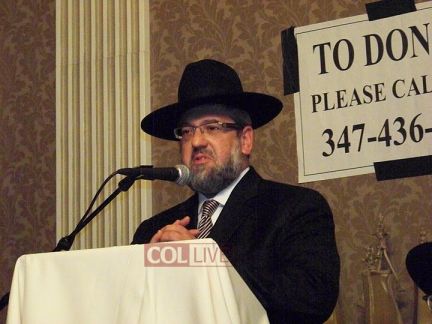
This week’s Dvar Torah on Korach. It’s been a while since I read a facile piece which uses the Machlokes of Korach to silence alternate views. This is yet another such piece. It insults one’s intelligence to try and sell the line that:

  • Korach was a bad man because he questioned Daas Torah (Moshe)
  • Korach was motivated by jealousy
  • Issue X is contentious but since my Daas Torah says Y on issue X and you don’t agree, then you are a modern incarnation of Korach

So, what are issues X and the Daas Torah views Y in this week’s regurgitation of this illogical fallacy?

Issue X is:

The Aguda response as enunciated by Rabbi Lipschutz is

  • If you oppose Metzitza you are from Korach
  • If you don’t put your hands into Rabonim on abuse matters you are from Korach

Metzitza is a Halachic matter. It rises above petty Agudist politics. It is an old issue. There are many respected halachic opinions that contend that Metzitza B’Peh is absolutely forbidden. Do they not have a right to those views? Are they motivated only by anti-Agudist/Orthodox motives?

Do we not have enough evidence to suggest that Rabonim are not the best address when it comes to ascertaining whether there is a prima facie case of Abuse that should be referred to the Police? The implication here being that the RCA are like Korach?

I really dislike it when the Torah is abused and misused in this way to push a barrow that discredits the right to an opinion that is different even though it had a solid basis.

Anyway, you judge for yourself. Here is the Dvar Torah.

We learn this week’s parsha and are struck by how odd it seems that someone would challenge Moshe after all he had done for the Bnei Yisroel altruistically. This is compounded by the number of times Hashem defended Moshe. How could someone as smart as Korach do something so foolish and how could so many people be taken in by him and join the rebellion?

Miriam spoke against Moshe Rabbeinu and was promptly punished. The meraglim doubted the veracity of Moshe Rabbeinu’s promise and, again, their punishment was swift and harsh. In this week’s parsha, we are again presented with an account of rebellion against Moshe Rabbeinu.

Korach is Exhibit A in the teaching of Chazal that “hakinah, hataavah vehakavod motziim es ho’odom min ho’olam.” His ambition and lust fueled him in a way that totally altered his perception of reality and truth.

Rashi tells us that Korach fooled himself. His thirst for power and drive for recognition toxically combined with his ego to convince him that he was right. His ulterior motives tripped him up. Because of his negiah he thought that Moshe had appointed his brother Aharon to a high position and ignored the better candidate. Though Moshe had repeatedly proven that he was following the command of Hashem, Korach, like people who haven’t subjected their jealousy and bad middos, had lost his ability to think clearly.

Ambition is good. All around us are good people who have risen to leadership positions as a result of hard work and determination. However, in the dog-eat-dog world where everything goes and the ends justify the means, people think that by trampling over others, by lying, and by playing on people’s emotions instead of by targeting their intellect, they can become popular and powerful. However, such achievement is short-lived and flames out rather quickly.

Korach ran a quick and easy campaign, because hate spreads like a fire. “Did you know that…? Have you heard the truth? I’ll tell you the real story.” He used the same successful tactics, grievances and claims as today’s hate-mongers. All throughout history people have been susceptible to the machinations of demagogues.

Korach deluded himself into thinking that he would be different than those who previously had made the same mistake as he and doubting the Ish Elokim. He was operating from a position brought on by negius, and thus his view was altered and his thinking fatally flawed.

The Chazon Ish writes that a gadol baTorah does not make decisions based on negius and has no personal interest. Korach couldn’t face this fact. He refused to accept the reality that a true gadol doesn’t have an agenda.

Rav Elazar Shach zt”l explained the concept of daas Torah as such. When a great person who has no personal negiah and is totally absorbed with his Torah study is asked a question, it is as if the Torah itself is responding to the query.

Moshe Rabbeinu, the consummate humble person, the one who delivered them from slavery, virtually the only leader the Jews had known, and the man whose every word was Torah, was the person who Korach and his group accused of malfeasance.

The Mishnah in Avos states that a machlokes lesheim Shomayim is sofo lehiskayeim, while a machlokes shelo lesheim Shomayim has no kiyum.

The Mishnah tells us that the disputes between Hillel and Shamai were lesheim Shomayim, while the quarrel of Korach va’adaso was the quintessential machlokes shelo lesheim Shomayim, an argument that is sustained purely to serve a personal agenda.

A machlokes lesheim Shomayim is fueled by the desire of both antagonists to determine the truth. Hillel and Shammai shared the same goal, but they had differing methods of interpreting and understanding the words and concepts of the Torah to determine the will of the Ribbono Shel Olam. Hillel and Shammai are so much a part of our everyday life, because by studying their drashos and sevaros, and by understanding their discussions, we are able to arrive at a more illuminated understanding of Torah. Their teachings and words endure – sofo lehiskayeim.

When the machlokes is lo lesheim Shomayim, the other side is not interested in the truth. They are only interested in winning. There is nothing to be learned by dissecting their arguments, for they are illogical and obviously false.

A story is told about two friends who were talmidim in the great Volozhiner Yeshiva. Meir was exceptional, brilliant and driven, and had been considered one of the yeshiva’s most accomplished students. That was before he began reading and then becoming increasingly influenced by Haskalah literature which robbed our people of thousands of promising people such as Meir. The poisoned pens of the Maskilim which mocked and disdained the holy traditions and Torah leaders succeeded and Meir found himself unable to apply himself to learning and davening.

Chaim had been his chavrusah and best friend, but as Meir fell under the spell of Haskalah, their friendship fell apart. However, Meir was determined to take Chaim along with him. He sought to take his simple, unsophisticated friend by the hand and lead him into the great, big world beyond the walls of the Volozhiner Yeshiva. Chaim refused to hear his friend’s arguments, explaining that he derived all the intellectual and emotional stimulation he needed from the pages of the Gemara.

Meir didn’t give up and continued hammering at Chaim with the arguments he picked up in the beautifully poetic pamphlets of the Maskilim, who used their creative gifts to carefully compose tracts that brilliantly mocked everything and everyone holy.

Meir turned to Chaim and asked, “How can you learn Gemara all day and delve into the words of the Tannaim and Amoraim if you have no idea who they were and what they were all about? First you have to learn some history and connect with their era. Familiarize yourself with the geography of the great cities and yeshivos in which they learned, and then you will be able to begin a proper analysis of their words and teachings.”

It was to be Meir’s final argument. Chaim looked at him with pity and turned to head back in to the bais medrash. “You know Meir’l,” he said as he walked off, “you may know where Abaye and Rava died, but I know where they live.”

To paraphrase the Volozhiner bochur, Hillel and Shammai are alive and well in every bais medrash in the world. Moshe’s Torah is as fresh as the day it was given at Sinai, while Korach and his group are buried deep down in a wayward desert, crying out to be heard.

Hillel and Shammai pursued truth, not the argument. Their disputes were a means to arrive at the truth.

Those who engage in Korach-type debates and disputes are not interested in the truth. There is nothing to be gained by debating them or studying their arguments. They are simply baalei machlokes, heirs to Korach va’adaso.

Moshe Rabbeinu didn’t arrive at his leadership position by way of hubris, coup, terrorism, or taking advantage of people by forcing them to go along with him. In fact, he was the most humble person. He got there because Hashem put him there. He rose to the highest levels possible for a human. He led the Bnei Yisroel out of Mitzrayim, delivered the Torah to them, adjudicated their disputes, brought them close to Hashem, and gave them everything they needed, yet that wasn’t good enough for Korach, the members of the Sanhedrin, and the masses who followed him. It seems shocking, yet too often, today, we can hear the echoes of Korach’s cry.

Bnei Korach lo meisu.

Sinas am ha’aretz towards talmidei chachomim is all around us. Where there are Jews, there are rabble-rousers who covet positions of power and scheme to destroy the humble talmidei chachomim and leaders who spent decades of their lives in obscurity getting closer to Hashem while working on their middos and growing in Torah and everything that is important. They are people who don’t necessarily occupy official positions, yet they become recognized by Klal Yisroel for their gadlus. And there are people who mock and fight them.

It seems incompressible, but if you look back at our recent history, you see that there were people who fought against the Chofetz Chaim and called him a baal machlokes and troublemaker. Rav Chaim Ozer Grodzensky, who was not only one of the most brilliant minds the Jewish people ever saw, but also possessed the kindest and most gentle nature, was vilified by people who wanted his position. He was the rabbon shel kol bnei hagolah, father and mother of yeshivos, of the poor and forlorn, and of the almanos and yesomim, yet there were people in Vilna who fought him and ran an election to usurp his position.

Though Chazal warn, “Hizaharu begachaloson,” there are always those who become overcome with envy and jealousy and delude themselves into thinking that they are more worthy for the position. They rally other malcontents to their side and do what Korach did.

Today, we see people battling against time-honored practices such a metzizah and quietly encourage the government to intervene and interfere with our religion. They stoop to lies, pseudo-science and fabrications to portray us as baby killers. The media gobbles it up without a second thought. The people who care most about life are portrayed as inconsiderate of the lives of infants and more concerned about some ancient ritual. Such stories are permitted to fester, and only one or two among us has the courage to rise up from the machaneh and say, “Enough with the lies. We have suffered enough from being portrayed as people who don’t care about the lives of children. Tens of thousands of our brothers and sisters were murdered because of the lie that we are baby killers.”

The lie is permitted to gain hold and none of the proud Jewish spokesmen protest.

The same goes for the new focus on abuse. Rabbis who spend their days ministering to their flocks and delving into the eternal words of the Torah are portrayed as callously concerned strictly with maintaining their positions. The oft-repeated canard is that they care not about the sanctity of life. People who spend their lives caring for people are said to turn a blind eye to children who are abused.

It is high time we rose up and said that we have heard that sorry song enough times. Of course every responsible rabbi agrees that predators should be prosecuted to the fullest extent of the law. Of course religious Jews maintain that monsters should not be permitted to walk the streets and destroy lives.

No one who harms a child, in any way, with any type of abuse, should be coddled. Rabbis have been saying that for thousands of years, yet we are portrayed as being a group who doesn’t hear the cries of the victims. The nation that has spawned the greatest proliferation of chessed organizations, which the rest of the world never even attempts to emulate, is portrayed as uncaring and no one says anything. How can that be?

When the nations of the world were still offering up their children as sacrifices to pagan gods, the Torah was concerned about ensuring that our children remain safe and healthy.

Molesters are classified halachically as rodfim and are treated as such when they are caught and their reprehensible actions are proven. Yes, sometimes unfortunately, these evil people are not sufficiently punished, and those exceptions should be addressed, but how can we permit the minority to impugn the character of every rov, rosh yeshiva and frum Jew?

All around us, we see the koach of Korach va’adaso taking hold, pulling people in their direction, creating doubt in the hearts of many. Their target, as always, is still Moshe Rabbeinu and those who follow his teachings.

Therefore, four times a week, we rise to our feet and point towards the Sefer Torah and call out, “Vezos haTorah asher som Moshe lifnei Bnei Yisroel al pi Hashem beyad Moshe.” We proclaim our allegiance to the Torah, which guides our every step and shapes our opinions. We restate that we received it from Moshe.

We point at the Torah and say, “This is timeless. This is enduring. This is real and lasting. It is the honest truth.” We received it from Moshe Rabbeinu, the humblest and greatest leader, and in every generation, the Moshes of the dor transmit the heritage to us as they lead us to grow in the lives the Torah demands of us.

This Shabbos is the 30th yahrtzeit of the great Lakewood rosh yeshiva, Rav Shnuer Kotler zt”l. His father, Rav Aharon zt”l, breathed life into dry bones, creating a European-style yeshiva in a place no one thought it possible, working with superhuman energy and dedication, experiencing extraordinary siyata diShmaya.
When Rav Aharon passed away, it was feared that his many accomplishments and the yeshiva he had established would be lost. Yet, providentially, Rav Shneur led Lakewood into its glory era, increasing the numbers and the breadth of limudim, and leading the kollel movement in its spread across America.

Rav Aharon’s talmidim spread out across America and around the world, imparting his message and adding legions to the forces of Torah. Their success and his in transmitting Torah, yiras Shomayim and ahavas Yisroel to the succeeding generations are proof that Toras Moshe never grows old or stale. It remains relevant and vibrant wherever Hashgachah guides Jews.

And so it was with many of the Holocaust-era Chassidic and yeshiva leaders who arrived here, penniless. They had lost their families, friends and students, but they were not alone. They clung to the Toras Moshe and it sustained them. It was their oxygen and lifesaver and they were buffeted about in strange, choppy seas. They never despaired or wavered. Today we harvest the fruits of their labors. Every week, there are more people pointing to the Sefer Torah and proclaiming, “Vezos haTorah.”

Those who follow Moshe Rabbeinu and his successors are growing and tipping the population scales. A just completed survey of New York’s Jews showed, once again, that intermarriage is on the rise. The Conservative and Reform, who a few decades ago thought they had the Orthodox beat, continue to lose adherents despite all the games they have played, from patrilineal descent to counting anyone who claims to be a Jew as a Jew.

The media is surprised. The entrenched liberal power brokers are fearful. New York’s organizational leaders are worried about their future. They fret over the calamitous future predicted by the finding that 64% of New York’s Jewish children are Orthodox.

The only group that is experiencing growth is the one that adheres to Toras Moshe and whose offspring is educated in the Torah way. The only guarantee for our future is provided by learning and observing the Torah. Yet, they refuse to accept that bare fact and instead engage in desperate battles against us.

As they and the other modern-day Korachs use emotion, hyperbole and every tool at their disposal to get our attention and detour us from the path which led from Sinai to Yerushalayim, Yavneh, Pumpedisah, Gerona, Sefard, Ashkenaz, Volozhin, Warsaw, Slabodka, Vilna, Liadi, Berditchev, Morocco, Brisk, and so many other stations until it led to us, we need to stay focused on the truth of Moshe Rabbeinu and his modern-day successors. We dare not fall for gimmicks, charlatans and those who would lead us down the path of oblivion.

We are approaching the twelve-month mark of last summer’s terrible tekufah, the weeks when we sustained blow after crippling blow. As their yahrtzeits arrive, we should focus on whom we lost and what sort of people walked amongst us in Rav Michel Yehuda Lefkowitz, Rav Yitzchok Dov Koppelman, Rav Chaim Stein and Rav Elazar Abuchatzeirah, zichronam livracha, among others. When we think about them and the lives they led, and the giants whom we merit having among us, we will be reminded even in our day that the Torah is as vibrant as ever, al pi Hashem beyad Moshe.

May this summer be one of happiness and brocha, as we asked this past Shabbos in Rosh Chodesh bentching for a month of “chaim shetehei bonu ahavas Torah veyiras Shomayim,” coupled with shemuos tovos and besoros tovos for everyone, everywhere.

What makes a pedophile tick?

See this.

Abuse: Halachic and Ethical Dilemmas (2)

Thanks to all who commented on the first scenario. Consider, now, a new scenario.

Your daughter is showing signs of strain. She has not been herself for some time. You have tried all manner of parental approach: the stick and the carrot and you can’t seem to manage to cajole her to be on the same page as you and your husband. She is also not performing to her ability at school.

You become aware of rumours that a male associated with your daughter’s school has been exposing himself and may well have fondled or even forced himself on some girls. When you hear these rumours you are in a state of disbelief. You cannot imagine that this apparently fine and upstanding individual would do such things. If he did, then you conclude that he must be sick or have experienced some trauma that has scrambled his moral compass.

One day your daughter casually mentions that the said person approached her and attempted to interfere with her. You aren’t sure whether actual interference has taken place. On the other hand, this may well explain her unusual behaviour and lack of focus. Given the rumours, you run to the School and meet with the powers that be. They tell you that there have been issues with this person and that he is receiving treatment and the strong indications are that this earlier behaviour will no longer be manifest. It’s a close-knit school where each parent knows the other and shares strong common ideals. The school did not contact the police because they felt they were dealing with it internally through professionals. Their Rabbi forbade “Mesira” anyway and there was no mandatory reporting in place.

You are concerned. The said perpetrator is still “at large” in the sense that he is able to find ways to continue to interact with the children in the School. You are told he has done Teshuva. What do you do?

  1. Do you allow any of your children to continue to be enrolled in the School?
  2. Do you have a halachic responsibility to inform as many parents as possible about what happened to your daughter? (What about her shidduch chances and those of the siblings, given the close-knit community)
  3. Should you go to the press or post on a blog, even anonymously.
  4. If you fail to advise other parents and the police, and another child is interfered with are you halachically or ethically culpable?
  5. Did you transgress לפני עיוור לא תתן מכשול and/or לא תעמוד על דם רעך?
  6. Can parents now sue you for damages, both halachically and civilly?
  7. Can your children sue you if you didn’t remove them from the School?

“Reality looks much more obvious in hindsight than in foresight. People who experience hindsight bias misapply current hindsight to past foresight. They perceive events that occurred to have been more predictable before the fact than was actually the case”. Hersh Shefrin

Abuse: Halachic and Ethical Dilemmas

Consider this scenario

The family of a victim of sexual abuse approaches the abuser and their family. The family of the abused has not yet reported the said abuse to the police; instead they initially confront the abused and their family. The situation becomes complicated and lawyers are brought in. Lawyers for both sides settle on an agreement involving some “compensation.” In return the abuser agrees to plead guilty to a somewhat lesser offence without recording a conviction.

The lawyer of the abuser is under no doubt that her client is a dangerous pedophile. She had a choice. She could have refused to take the case. In the end, whether she was the lawyer who accepted the brief, or a lawyer who turned the case down, she is unable to remove thoughts from her head. She is convinced that the abuser is a dangerous person and that he may continue on his misadventure and sexually abuse others. She is bound by client confidentiality; we understand that. 

My question relates to the Halachic imperative. Is a lawyer/person in such a case permitted to remain silent? Is there not a real problem of contravening a Torah command:

לא תעמוד על דם רעך

Unfortunately, the abuser commits further crimes. Is the lawyer somehow responsible? If they are not directly responsible, are they indirectly culpable?  Later victims, upon learning that a lawyer knew about the abuse and stayed silent, decide to summons the lawyer to a בית דין. They seek at least financial compensation for the years of medical treatment and the lost opportunity that a victim must carry all their life.

  • Is the lawyer permitted to stay silent from a Jewish point of view?
  • If the lawyer isn’t culpable from a Western legal point of view, how should the family of the lawyer respond to their vilification by elements of the community who are disgusted that their mother didn’t pass on her very real fears to the authorities?

Re-architecting our Mikvaos

The scourge of male perverts, pedophiles and sickos is challenging communities across the globe. The Halachos of a Mikva are complex and need expert Rabbinical advice and architectural nous. Our Mikvaos are cleaner and more acceptable than in times gone by. My father’s description of the scene at the Mikva in Rawa Mazowiecka in Poland before World War 2 was, how do I put it delicately, “off-putting” especially by today’s standards.

I recall when I was learning in Israel that, before Pesach, I sought out a Mikvah near Rechov Har Sinai in Ra’anana. I was the only person there apart from the Mikvah Warden. After completing my spiritual oblution, I opened the door to leave the Mikvah proper only to find the warden “too close to the door”. I had the distinct impression that he may have peered through the key hole. You don’t forget scenes like that.

I do realise that it is only Chassidim who dip in the Mikva daily today. Some, like me, have the custom to do so before the שלש רגלים. Most will do so on Erev Yom Kippur. Strictly speaking, one could also dip in a swimming pool (heated, one would hope 🙂

It’s perhaps worth considering a few changes to future or renovated Mikvaos. My suggestions are:

  1. The change area no longer be a common open area. Rather, there should be a series of say 10 little cubicles with a swinging door behind them where one undresses and then girds a towel.
  2. Showers must have self-closing doors behind them
  3. In high use communities, for example, Chassidim, a total of four consecutive mikva pools should be available. Each pool should be fully enclosed so that nobody can peer in.
  4. There should be a maximum of one person in a pool at a time, unless it is an older or incapacitated man who brings someone to assist them.
  5. The absolute maximum time for an individual to be in the Mikvah should be 60 seconds. There should be an LED timer on the back of the self-closing door which should start warning that time is elapsing, from 30 seconds into the process.
  6. There should be a separate entry door and exit door to each pool. The entry door should be accessible from the shower area. Only when a person has exited through the exit door, should the entry door unlock and indicate that the pool is available.
  7. If a person has not emerged after 120 seconds an alarm should sound.

It is important that we not only strengthen Tzniyus in our community by focussing on the translucency of female stockings (which is only a matter of Minhag) but return to fundamentals. Some reformation of Mikva architecture, based loosley on my suggestions above, would seem to be necessary in our times.

To report or not to report? There is no question.

Aguda has played with words on this issue for a long time. It seems they are all words and no action. The Law, however, has different and more transparent standards. See this article.

The impending gathering about the Internet at Citi Field

Most of us will be aware that certain sections of Charedi Judaism (who call themselves כלל ישראל) are organising an enormous gathering of males (no women allowed) to conjure strength and provide direction in the fight against the iniquity of the internet.

Many pixels will be excited by this event as it unfolds. The following is a guest post by the pseudonymous  “Yosef Drimmel” on Rabbi Slfkin’s blog. It is a brilliant piece and I reproduce it here for comment. I couldn’t agree more with Drimmel.

May 20, 2012, Flushing, NY – A gathering of Ultra-Orthodox Jews from the New York tri-state area was held today at Citi Field. 40,000 men gathered here as approximately 40,000 women followed the events in their neighborhoods via satellite connection. This remarkable event filled with excitement and optimism offered a unique reflection on almost twenty years of Internet use and its effects on a generation.

Leading Rabbis spoke passionately about the various problems facing the community today and urged people to use the Internet and any tools available to address them. An introspective atmosphere was created that united laymen and leadership fostering a commitment to truth and transparency.

The leaders acknowledged they were short-sighted and unrealistic when in the past they attempted to ban the Internet entirely and that methods such as forced signatures on school applications were inappropriate and ineffective. Instead they expressed that many schools need to focus more on the academic and social growth of their students and less on their ability to conform to exclusive rules.

In a humbling manner, some rabbis went so far as to suggest that in the past they felt threatened by the dissemination of information and opinions over the Internet. But in the end they realized that transparency and open dialogue are in the greater interests of Klal Yisroel.

Perhaps the most moving moment of the day was the public apology issued by the leadership in the name of the entire community to the victims of decades of sexual abuse that occurred within our community, noting that it was the Internet that gave a voice to those who had none in the face of the establishment. A new covenant was drawn promising complete cooperation with law enforcement and advocating tougher laws to prevent and report child abuse. A number of enablers were removed from their positions and a new fund to support victims was created.

Some of the speakers also brought attention to the problems of Internet addiction. Expert psychologists and social workers discussed the pathways and pitfalls of excessive use of the Internet, a human challenge more than a religious one. Emphasis was made for teachers and clergy to be aware of individuals suffering from emotional problems of all sorts and to understand the best ways to help people. The disastrous stories of well-meaning but incompetent rabbis who offered counseling proved to be very enlightening to many in the field.

Some attention was paid to the unfortunate availability of pornography on the Internet. While no rabbi wanted to make a fire-and-brimstone rant against basic human instinct, even-keeled advice was offered regarding coping with this distraction and enjoying a healthy lifestyle and fulfilling relationships. A new program was presented to educate brides and grooms on the subject of positive attitudes about intimacy, mutual love and respect.

In the final remarks, the rabbis pledged to move forward with the continuous forging of new ideas. Future gatherings will probably be at a lower cost and scale but focused on actual changes and improvements the community will need to make. Future agendas will include problems and questions such as attitudes towards education and employment, proper allocation of charity funds, funding Jewish education as a community, today’s shidduchim system, agunos, extremism and intolerance, segregation of Ashkenazim and Sefaradim, participation in the Israeli workforce and armed forces, the system of Halachic rulings in Israel and America, reliance on subsidies, and integrity and honesty.

 Many of the attendees left the event feeling invigorated about their future and that of their children and grandchildren, echoing the sentiment that through justice and kindness we may merit the coming of the Messiah.

See also here for another excellent critique.

It cuts across boundaries, sadly.

The following article (hat tip Daas Torah) appeared regarding a B’nei Akiva person who learned for two years in Yeshivat Hakotel. The illness/proclivity/predilection to either abuse of children or child pornography knows no boundaries. Some smug individuals have assumed that it appears to be mainly a Charedi manifestation. From my perspective, the only significance to the Charedi manifestation is that they are more likely to get away with it due to the cocoon.

I can only hope that this person only looked at images and no more. At least from my perspective, that’s orders of magnitude less than full on abuse.

The FBI announced today the arrest of Evan Zauder  for possessing child pornography.

26-year-old Evan Zauder is a Dual Masters student and a Jim Joseph Fellow in Education and Jewish Studies at NYU. After high school graduation from CHAT in Toronto, Canada, he went on for two years of study at the renowned Yeshivat HaKotel in Jerusalem’s Old City. He continued his education at Yeshiva University, achieving a BA  in Political Science and a minor in Hebrew Language.

Upon his arrival in New York, he began working for Bnei Akiva of New York as a Regional Director, and quickly moved his way up the ranks at Bnei Akiva to director of the In-School Programming division. He is the Director of Youth Programming at The Hebrew Institute of Riverdale, and he spends his summers working for Bnei Akiva of North America, most recently directing a post-tenth grade summer program in Israel. Evan is also founding and current Director of the Yeshivat HaKotel Alumni Association of America.

According to the complaint, Zauder possessed child pornography that had been downloaded from the Internet and saved onto his computer. During a search of Zauder’s residence conducted on Monday, May 1, 2012, a computer containing hundreds of images and videos of minor children engaging in sexually explicit conduct was seized.

Zauder is charged with one count of possessing child pornography, which carries a maximum sentence of 10 years in prison and a maximum fine of $250,000 or twice the gross gain or loss from the offense.

Manhattan U.S. Attorney Preet Bharara stated: “As a teacher, Evan Zauder was supposed to help children not, as alleged, contribute to their xploitation. Protecting children from harm is an important priority shared by our Office and the FBI, and we will continue to work tirelessly to
pursue and prosecute individuals who prey on the innocent.”

FBI Assistant Director-in-Charge Janice Fedarcyk stated: “The FBI remains committed to protecting children from exploitation. The market for child pornography creates demand for production of images, and every photo and video is a record of abuse

David Kramer will face charges

See the article from the Age.

Condemned because he reported abuse

See this sad story. Yet another episode.

Repulsive Mormons at it again

See this story, reproduced below.

Daniel Pearl, the Jewish Wall Street Journal reporter kidnapped and beheaded by terrorists in Pakistan in 2002, has been baptized posthumously at a Mormon temple in Idaho, the Boston Globe reported on Wednesday.

Pearl’s Mormon baptism is one of several reports of prominent, deceased Jews being subjected to the Mormon ritual. In recent months, Anne Frank, Simon Wiesenthal, and parents of Holocaust survivor and Nobel Prize winner Elie Wiesel were all the targets of proxy baptisms.

The Mormon tradition of baptizing deceased Jews and those of other religions is meant to give them access to salvation. But Pearl’s parents are now joining the chorus of criticism against the practice, telling the Boston Globe that the report of the baptism was “disturbing news.”

“To them we say: We appreciate your good intentions but rest assured that Danny’s soul was redeemed through the life that he lived and the values that he upheld,” the Pearls wrote in an email to the newspaper. “He lived as a proud Jew, died as a proud Jew and is currently facing his creator as a Jew, blessed, accepted and redeemed. For the record, let it be clear: Danny did not choose to be baptized, nor did his family consent to this uncalled-for ritual.”

Earlier this month, Elie Wiesel blasted U.S. Republican presidential candidate Mitt Romney for staying mum on the posthumous baptism of Wiesenthal. The Mormon church had issued an apology the previous day.

The posthumous baptisms were performed in Mormon churches in Utah, Arizona and Idaho, according to the Simon Wiesenthal Center, a Jewish human rights organization named after the man who hunted down more than 1,000 Nazi war criminals including Adolf Eichmann in the years following the Holocaust.

In a televised interview with MSNBC, Wiesel, a Holocaust survivor who went on to become a prolific author and Nobel laureate, said of Romney, “How come that he hasn’t spoken up after all? I’m sure he’s not involved in that. But nevertheless, the moment he heard about this, he should have spoken up, because he is running for the presidency of the United States, which means it’s too serious of an issue for him not to speak up,” he added.

Wiesel said he was disgusted when he heard of the conversions, saying, “I’m a Jew. I was born a Jew and I live as a Jew … That they should do it to me? Then of course they must have done it to my parents, who were killed in Auschwitz … It’s unforgivable.”

The Church of Jesus Christ of Latter Day Saints, in its written apology, suggested that the action was the work of one member whom they said has since been disciplined.

“We sincerely regret that the actions of an individual member of the church led to the inappropriate submission of these names,” church spokesman Michael Purdy said in a statement emailed to Reuters. “The policy of the church is that members can request these baptisms only for their own ancestors. Proxy baptisms of Holocaust victims are strictly prohibited.”

Wiesenthal’s mother Rosa died at the Belzec concentration camp in Poland in 1942. His father, Asher, died during the First World War.

The apology, said Rabbi Abraham Cooper of the Simon Wiesenthal Center, will not fix things.

“A heartfelt apology is certainly appropriate, but it rings hollow if it keeps happening again and again,” Cooper told Reuters.

Pearl was killed in Karachi, Pakistan on Feb. 1, 2002. His widow, Marianne, is strongly opposed to the baptism. “It’s a lack of respect for Danny and a lack of respect for his parents,” she said.

Daniel Pearl הי’’ד

Gender segregation in psychological or psychiatric treatment

The question is not a new one. If one needs to undergo an extended and deep treatment regime, where there is much fundamental discussion about one’s life circumstances and all the confidential issues surrounding such, is it permitted to see a therapist of the opposite gender.

Some poskim will not permit any gender if the medical provider is an “apikorus” or not religiously inclined, as they fear that the treatment may well eventually involve the religious patient being influenced to unburden themselves from the yoke of Torah and Mitzvos. I have witnessed this therapy being applied to another individual. Such therapies sometimes assume that if a patient’s life circumstances have brought them into a spiralling and uncontrolled level of descent, that one must rebuild afresh and cast away all and every vestige of the former life to avoid these. This can mean ceasing to adhere to a religion-based lifestyle and/or cutting oneself off from the familial environment.

On the matter of gender separation, other Poskim contend that since there is a tendency, and indeed a need, to unload all of one’s deepest secrets and intimate feelings, it is best not to do so with a medical therapist of the opposite gender, as this may place both people in a position where they are sexually vulnerable. Such an opinion was recently published by R’ Yitzchak Zilbershtein, an expert in Halachic Medical Ethics,

R' Zilbershtein

and the Posek for the Ma’aynei Hayeshua hospital in Bnei Brak. R’ Zilbershtein is a son-in-law of R’ Elyashiv, grandson of the saintly R’ Aryeh Levin ז’ל, and brother-in-law of the famed R’ Chaim Kanievsky.

The ruling was countersigned by eminent Poskim, including R’ Ovadya Yosef, R’ Yisrael Belski, R’ Vosner and R’ Karelitz.  It concludes with the observation that if there is a clinical need to engage someone of the opposite gender because of their expertise, one should first ask the Rabbi of the Hospital. Presumably, the Rabbi of the hospital will be in a position to reflect on the medical therapist in question and whether there is a risk of a developing intimacy versus the immediate need of the patient.

It can be expected that many will howl with derision about such a Psak, as it suggests that there is professional compromise at play. On the other hand, it can also be viewed as a sensible suggestion because it engenders הרחקה, a distance between situations that may be likely to involve deep intimacy of thought. At the end of the day, it would, in my opinion, be wrong to compromise on the efficacy of treatment and possible cure on account of gender issues. I am presupposing that the “best” person for some treatment, or even the person who has a record of great success might be of the opposite gender.

החכם עיניו בראשו

“The wise man has eyes in their head”, and acts accordingly. For the masses, especially in B’nei Brak where gender separation is extensive and where seeking  a psychologist or psychiatrist (and not a Rabbi) to deal with one’s innate problems is rarer, this is a Psak that will hopefully encourage people to seek a medically qualified therapist.

Having recently read a book by a religious psychologist whose domain of expertise is Child Molestation, it was interesting to note that in most cases it was he who discovered that molestation had occurred. Parents usually have no idea. This is especially so in a frum community where feelings are taboo and extreme conformance is a way of life. It was only because parents sought professional help for “strange behaviour” that he discovered the tell-tale signs of molestation. Let’s hope that this Psak encourages the religious community to also deal with the myriad of psychological ailments and propensities that our generation is facing by referring these to experts.