לעילוי נשמת אבי מורי הכ’’מ ר’ שאול זעליג בן יהודה הכהן
As we stated in the previous post, from the language of Maseches Sofrim, which is quoted by the Mechaber in Shulchan Aruch verbatim, it would seem that the proper action of the congregation would be to bow one’s head during Hagba—לכרוע. Rabbi Moshe Isserles, (1500’s) otherwise known as the Ramoh, doesn’t make any comment and one might ask, if it was not the Minhag in Ashkenaz to bow one’s head during הגבה he may have mentioned this in his addenda to the Mechaber. Perhaps the opposite is true. The Ramo also authored the דרכי משה on the טור and in 147:4 the Ramo is happy to mention the minhag recorded by the Maharil (mid 1300’s) which was not just to bow, but also to prostrate oneself at the time of הגבה (and to follow the Torah back to its Aron). The Maharil was the celebrated and authoritative recorder of Ashkenazi Minhagim. It would seem, possibly, that the Ramo in quoting the Maharil, had no issue with the more sedate suggestion of the Mechaber to simply bow during הגבה. The Ramo begins that section ad loc. by noting that
In the Mordechai, at the end of Hilchos Tefilin, page 98b, he quotes that the Maharam used to lift the Torah in order to show it to all the people, and this was the opinion of the Kol Bo who stated “in Masechta Sofrim, when the Chazan was on on the Bima he opened the Sefer Torah and showed the text to both men and women, and then they said “Vzos HaTorah” etc. And from this is a source for why women would commonly push themselves forward at that time, although they (the women) often didn’t know why they were doing so. And from Maseches Sofrim it appears that this occurred before layning (as per the times of the Gemora and Minhag HaSefardim) but we (the Ashkenazim, notes the Ramo) perform Hagba after layning.
The Ramo in Darkei Moshe goes also notes that a community is entitled to sell the Kavod of passing the Torah cover to the Golel (the one who rolls the Torah back from the unwound Hagba) and the person who was given the honour of Gelila, cannot complain, as he only purchased the right to rewind the Torah. Someone else can purchase the right to pass on the Torah’s clothing to the Golel.
I looked up the Kol Bo and, as quoted by the Darkei Moshe and he is quoted accurately by the Ramo. Importantly, although he purports to be quoting Maseches Sofrim he doesn’t use the word ולכרוע—that the people should bow. Was that intentional?
The “plot” thickens when we examine the language of the קיצור שלחן ערוך. Again, the author, Rav Shlomo Ganzfried, intentionally appears to omit the word ולכרוע—that the people should bow.
לאחר קריאת התורה, אומרים חצי קדיש, ומגביהין את הספר-תורה. המגביה פותח את הספר-תורה שיהיו שלושה עמודיט מן הכתב גלוי, ומראהו לימינו ולשמאלו, לפניו ולאחריו, כי מצווה על כל האנשים לראות את הכתב, ואומרים “וזאת התורה” וכו’.
Why? In his introduction to the קיצור Rav Ganzfried
R’ Shlomo Ganzfried ז’ל (wikipedia)
explains the primary sources upon which he bases his decisions. I haven’t got an edition of the Kitzur with that introduction (nor could I find one), however, R’ Shea Hecht told me that the Kitzur bases himself on three other Seforim and sides with the majority if there is a dispute between. The three are:
Shulchan Aruch HoRav (from the Ba’al HaTanya)
Siddur Derech Hachaim (the Chavas Daas)
Chayei Adam
Sadly, there is no existing Shulchan Aruch HoRav on this section, as it was lost or burnt. Incredibly, the Chayei Adam says absolutely nothing about Hilchos Hagba. That means, the Chayei Adam doesn’t even present a Seif about Hilchos Hagba. This in of itself is very strange.
In the authoritative Siddur Derech Hachaim by R’ Ya’akov MiLissa (late 1700’s) who is well-known as the author of the Chavas Daas on Yoreh Deah and the Nesivos HaMishpat on Choshen Mishpat, writes
When he lifts up the Sefer Torah he should show the lettering to the people and say וזאת התורה …
It could be argued that the Kitzur is therefore just copying the words of the Siddur Derech Hachaim. On the other hand, the directions at that point in the Siddur are for the person lifting the Torah, that is to say, the notes are directed at the person performing Hagba as opposed to the people who are witnessing the Hagba. He doesn’t, for example, say that the people should say וזאת התורה. It is not conclusive, perhaps, then to draw a conclusion from these words of the Chavas Daas. In point of fact, in the Halacha section, the Derech Hachaim explicitly says:
ויש מדקדקים לראות האותיות עד שיוכל לקרותם ולכרוע ולומר וזאת התורה
The Maharikash, R. Ya’akov Kastro (mid 1500’s) in his Tshuvos אהלי יעקב, 57 states
Whoever doesn’t bow, because he thinks (bowing) is forbidden, should be put in Cherem!
The Siddur of the Shulchan Aruch HoRav makes no comment about the need to bow during Hagba. This point bothered the Ketzos HaShulchan, HaRav Avraham Chaim Naeh ז’ל
Rav Chaim Naeh ז’ל (wikipedia)
who wrote in his בדי השלחן, אות נ’ה in סימן כה
Why didn’t the Admor (Ba’al HaTanya) mention the imperative to bow in his Siddur? Furthermore, it isn’t mentioned in the Kitzur Shulchan Aruch either. We (Chabad?) also don’t have a custom to bow …. I haven’t seen anyone raise this issue. Later on, I saw that in R’ Ya’akov Emden’s Siddur (Yaavetz) on the word לכרוע, R’ Emden refers us to the Shyorei Knesses HaGedola, but I (R’ Chaim Naeh) don’t have that Sefer with me to look into the matter.
At the suggestion of מו’ר R’ Schachter’s מקורבים, readers who seek more than a 10 minute grab, would do well to read his written word on these topics, well before the scourge of hidden child abuse arose.
Firstly, there is a brief note on Torah Web here from 2007.
A more expansive and learned paper can be read here from RJJ Volume one which I believe is from 1981.
In an amongst a previous post, I received the following comment (which I have slightly edited) … and no, there was nothing at all wrong with the comment, which is why I am not ignoring it (I’ve just been incredibly busy).
Rabbi Hershel Shachter provoked a storm of criticism for using the word shvartze. As far as I am concerned that is the least of it. The much bigger problem is that he propounded several insidious arguments for not dealing with sex abuse. He gave with one hand and took away with the other. He said there is no issue of mesirah (snitching) per se in reporting a known molester. Great. But then he said it is takah (actually) mesirah if the offender will be sent to state prisons where wardens could harm you by placing you in a cell with a member of Farakkan’s Nation of Islam. Yes I think that is racism. Why does he believe a Jew should fear a Black Muslim more than a member of the Aryan Nation? But never mind.
It’s important to note that R’ Schachter has given many Shiurim on this topic, and I’ve heard some of them well before the sound bite you refer to. In fact, the shiurim on mesirah were also well before the issue of child abuse became the grave topic of concern for all of us. His view, has not changed. He speaks Halacha, as he sees it. He is a Posek.
Whilst you acknowledge that R’ Schachter is strongly against those who hide behind Mesira and is in fact concerned with the safety of a community and ובערת הרע מקרבך, and yes, I have heard him say both of these things explicitly over and over, he is also concerned about safety in jails for those who are incarcerated. Halachically, R’ Schachter contends that nobody should be in a type of jail where they are beaten and/or gang raped (and all the horrible things that we hear). In a previous shiur, R’ Schachter described different types of prisons in the USA, and said he was concerned about one type as opposed to the other. If we are to be true to Halacha and indeed true to the country we live in, what we should also be doing is ensuring that those who are incarcerated go to a “normal” prison or a system where such things are very unlikely to happen. All over the world, we have read many times of the “mysterious” death of an inmate. Chazal most certainly would never approve of such a thing in their own prison systems.
R’ Schachter often interludes with urbane language. In a number of shiurim, he called the reasonable prisons “Glatt Kosher/Daf HaYomi style prisons”. People giggled when he said that. Perhaps Daf HaYomi learners or Glatt Kosher eaters might take umbrage; I doubt it. When R’ Schachter said a shvartze, he immediately expanded on that, and anyone listening knew he was giving an example, that is, of one of those Army of Farrakhan types who might be sharing a cell with a Yid (albeit a sinning Yid). Criticising him for this is unfair.
The real issue is that almost all sex abuse prosecutions are in the state courts. So he has now precluded virtually all prosecutions.
No he doesn’t. He actually says that (Frum) Lawyers and Law Makers should try to influence the powers that be to make sure that all those incarcerated are put in a situation where their rights are actually protected and they aren’t subject to jail abuse.
He also insists on vetting by a mental health professional who is also a talmid chacham (rabbinical scholar).
Knowing what he has said elsewhere, let me explain. He strongly encourages that any educational institution should not just have Rabbonim on staff, but also Rabbonim who are trained professionals. As opposed to a teacher/Rabbi who hasn’t lived in the real world, and is fresh-faced out of Yeshivah/Kollel and is confronted by an allegation, he would insist that the professionally trained Rabbi/teacher be one to hear the allegation and then pass it onto the authorities as the case almost always is (now). What you don’t know, is that R’ Schachter was very upset about a respected Rav/Teacher whose life was destroyed when it turned out that their pictures was published as a molester and in fact it was a complete case of mistaken identity. The teacher wasn’t even remotely connected to the allegation. Apologies were made, and the incorrect picture was removed, but, and I’ve heard R’ Schachter speak about it, that teacher’s life had been ruined. They are depressed, unable to work when in fact they had nothing what to do with the incident. They weren’t even in the same institution if I remember correctly. It was a case of “man with a beard who looks like this” but it was the wrong person whose picture was put up. I surmise that this also concerned R’ Schachter.
There definitely is such thing as a recidivist liar, who as a student has a reputation for lying on all manner of issues in the past (I’ve known such people and I suggest we all have) . It is best that a trained psychologist be on staff and ensure that a proper process is followed. That means, the person who makes the allegation makes it in front of someone who is skilled and trained, not someone who knows Shas and Poskim.
He obsesses about the terrible damage of a false allegation. I too find a false allegation a terrible thing. But the professionals most capable of such an evaluation are the ones inside the criminal justice system.
I’ve explained what worried him, based on cases he had known. I’m sure that the professionals in the criminal justice system will do a good job. Having a professional on staff to hear an allegation, is a good idea. Remember, this is not at all the Aguda proposal that a board of Rabonim examine each case and decide. R’ Schachter is not only part of the RCA, he is probably their venerated Posek, and as such, you really need to understand his point of view from the RCA stand point.
If I can make it a bit clearer. Where I work, and where many/most of us work, we have line managers. However, we also have HR (Human Resources). If a line manager or staff have issues with each other, HR (who have trained professionals) do get involved, before actions arising. Sometimes those actions are indeed a referral to the police! For example, if someone alleges they were sexually harassed or racially vilified. In the context of R’ Schachter, I believe he is suggesting that Schools and similar, davka need to have a quasi-HR through having professionals as he suggested and not just people with Yoreh Yoreh and a Yeshivah Teaching certificate.
Prior interrogations contaminate evidence and alert suspects who can then hoof it. More than that, most such prior screenings end up discouraging reporting.
Picture the scene. A student makes an allegation. They go the headmaster. The headmaster immediately calls in Rabbi Dr So and So, who is a psychologist on staff. What’s wrong with that?
It is true that if the Headmaster is corrupt and/or the psychologist is a psycho then we are in trouble. But, we would have been in trouble anyway, in that situation. No system can help here, unless a kid goes directly to the police or tells their parents and the parents are not indoctrinated to keep shtum. On the contrary, there isn’t a culture of “run away from Mesira” with R’ Schachter. We need to also ensure that the kid is not fobbed off and the issue buried (as it has been tragically, and in some places still will be).
I recognize that false allegations do happen, usually in the context of divorce custody battles. Folks in the criminal justice system are quite adept at recognizing them and screening them out.In the end, the decision to support reporting involves balancing the danger to children versus the danger to someone falsely accused. In a situation of uncertainty I would rather leave an adult with the problem of undoing damage to his reputation then subject children to damaging abuse. It is much harder for children to recover. Children need more protection than adults. But that is me. Rabbi Shachter thinks in terms of adult and institutional interests.
He is talking to Rabbonim and this is a grab from a speech he gave. He cares greatly about children, and that is why he is advising the Rabbonim to change things so that they have staff who are also skilled and are professionally qualified to deal with abuse allegations and related matters that arise (eg bullying and harassment). This is my understanding based on more than the particular 10 minute sound bite I heard.
I could be wrong, of course, and will stand corrected if that is the case.
[ R’ Schachter is incredibly busy at the moment. I waited for 1 month before I could get an answer to some questions I asked repeatedly. I expect that he will make his views clearer in the near future, given the thoughts you expressed and which no doubt others have also expressed or thought. Let’s wait and see. ]
I have pitputed about this in the past. At the OU, the two senior Poskim are Rav Hershel Schachter and Rav Yisroel Belsky. They agree on most things. Let me state first, that my personal posek (on matters that are complex and/or not clear in Shulchan Aruch etc) is Rav Schachter, so I do have a bias. On very rare occasions, I have not “understood” the reasoning of a Psak, but I am not a Posek, and he is, and so I listen. That’s our Mesora. That’s what we are meant to do.
As the article from the JTA below shows, they disagree on Quinoa. My earlier views on this matter happily are consonant with Rav Schachter’s Psak. The OU however as a policy will follow the stricter opinion of the two Rabonim disagree. There is in fact a private kuntres, in the spirit of Milchamto Shel Torah, where the two give formal Psokim and their reasoning, for the occasions where they disagree. I haven’t seen it. The kuntres is only available to recognised Rabonim who are formally or informally affiliated with the OU standards.
Kosher Australia (correctly in my opinion) advises people to check with their own Rabbi about Kitniyos, and notes that it doesn’t approve/use Quinoa in any of its own supervised products for Pesach.
Personally, if someone in Melbourne, brought in supervised Quinoa (eg from the Star K), I’d have absolutely no problem consuming it.
By Chavie Lieber · March 11, 2013
NEW YORK (JTA) — On any given day, a wind might blow through the farmlands of South America, pick up an errant grain of barley and deposit it nearby among the vast rows of cultivated quinoa. If that barley manages to make its way into a sifted batch of quinoa, and avoid detection during repackaging, it could wind up gracing your seder table on Passover night.
However dubious it might seem, the scenario is among the reasons that the world’s largest kosher certification agency is refusing to sanction quinoa for Passover consumption, potentially depriving Jewish consumers of a high-fiber, protein-rich staple that many have come to rely on during the weeklong holiday.
The Orthodox Union announced last year that it would not certify quinoa as kosher for Passover out of concern that quinoa falls into the category of kitniyot, a group of legumes forbidden because they look similar to grains proscribed on the holiday.
Menachem Genack, the CEO of O.U. Kosher, also cited the danger of quinoa crops grown in close proximity to wheat and barley fields.
Star-K, a rival kosher certification company based in Baltimore, has been certifying quinoa as Passover-friendly for years and dismisses what it sees as an outlandish prohibition.
“Rav Moshe Feinstein said we weren’t to add on to the rules of kitniyot, so I don’t know why anyone would,” said Rabbi Tzvi Rosen of Star-K, referring to the esteemed decisor of Jewish religious law who died in 1986. “And what’s more telling of this ridiculous debate is that quinoa is a seed, not a legume.”
Long a staple of the Andean diet, quinoa has earned a reputation as “the mother of all grains,” celebrated for its high nutrient quality and as an alternative for those following a gluten-free diet. But quinoa is not a grain at all. It’s a member of the goosefoot family, and closely related to spinach and beets.
On Passover — when wheat, oats, rye, spelt and barley are all prohibited — quinoa has emerged as a popular substitute.
That could change, however, with the world’s major kosher certifier refusing to give quinoa its Passover seal of approval.
“We can’t certify quinoa because it looks like a grain and people might get confused,” Genack said. “It’s a disputed food, so we can’t hold an opinion, and we don’t certify it. Those who rely on the O.U. for a kashrut just won’t have quinoa on Passover.”
The O.U.’s non-endorsement is the result of a debate within the organization’s own ranks.
Rabbi Yisroel Belsky, the head of Brooklyn’s Yeshiva Torah Vodaas and a consulting rabbi for the O.U., maintains that quinoa qualifies as kitniyot because it’s used in a manner similar to forbidden grains. Rabbi Hershel Schachter, one of the heads of Yeshiva University’s rabbinical school and also an O.U. consultant, agrees with Rosen that the category of kitniyot should not be expanded.
Rosen said the Star-K certifies only the quinoa that has no other grains growing nearby. This year, for the first time, the company sent supervisors to South America to supervise the harvesting, sifting and packaging of the product.
“Whenever there’s a new age food, there’s always a fight between kosher factions,” Rosen said. “But we should be worrying about other things, like all the cookies, pizzas and noodles that are Passover certified but appear to be chametz. Quinoa is the least of our problems.”
The O.U. is recommending that kosher consumers look to their local rabbis for guidance on the quinoa question. But for Eve Becker, risking a rabbinic prohibition on a staple food probably won’t sit too well in her house. A Jewish food blogger who maintains a strictly gluten-free kitchen because her daughter has Celiac disease, Becker said quinoa is one of the most important foods.
“It’s a tiny powerhouse packed with protein, vitamins and minerals, and it’s an important grain alternative, especially on Passover,” Becker said. “It’s great to have it on Passover instead of the usual potatoes, potatoes, potatoes. Most of the Passover foods just end up tasting like Passover, so we rely on quinoa to be that side staple.”
Ilana S., a mother of two who lives on Manhattan’s Upper West Side, said she trusts the O.U. and will refrain, begrudingly, from buying quinoa this Passover.
“These rabbis are always changing their minds, so I’m confident they’ll have a new statement next year,” she said. “Until then, its only eight days.”
“If the New Science brags that it has been liberated from Theology, it must know that by the same token, Theology has been freed of Science, which bound her in human chains. However, certainly a new name is required for the sublime subject, not a name coined by men, but a new name given by God.
Theology freed of the fetters of Science is Prophecy, the treasure of Israel, which will be revealed to us soon”
I’ve always liked a [good] Chabad Nigun. Maybe it’s גירסא דינקותא, my childhood memories, but there is also a musical element. I’m partial to the more haunting Russian-inspired musical oeuvre. The morose underpinnings appeal to my darker side, especially if I’m melancholy.
Lehavdil, that’s why I’m also a fan of Rachmaninov, for example.
I enjoyed this video on the 200th Yohr Tzeit/Hillula of the B’aal HaTanya, the great Gaon and Tzadik, R Shneur Zalman Ben Baruch, at his grave site.
The Talmud, when faced with a conundrum that cannot be solved, uses the phrase
יהא מונח עד שיבוא אליהו
Let the issue rest until Eliyahu HaNavi comes (back) and advises us of the Halacha
or
תשבי יתרץ קושיות ואבעיות
ֵEliyahu (HaTishbi) will answer all the questions.
The question is asked: since Moshe Rabbenu was our greatest teacher, why do we wait for Eliyahu (who never died) to answer the questions, surely we should wait for Moshe (who will be resurrected when Mashiach comes) and ask Moshe Rabbenu to Pasken/decide the Halachic conundrums.
in his celebrated אם הבנים שמחה, explains that to be a Posek, a Halachic decisor, a Rabbi needs to be immersed in the world. A Rosh Yeshivah, for example, who only interacts with the surreal world of his Yeshivah, is not equipped to be a Posek for the masses. All his answers are designed for the שומר נפש, the Yeshivah or Kollel Jew, for whom being יוצא לכל הדעות, acting according to all stringencies, is the norm. Accordingly, since Moshe has not been interacting in our world for thousands of years, he is not suited to be the Posek when the Mashiach comes. Eliyahu HaNovi, however, who did not die, and lives amongst us, so to speak, is more suitable to answer our questions.
It is also for this reason that the משנה ברורה was not considered as acceptable to normative Psak, as the ערוך השלחן. The Chafetz Chaim was considered like the Rosh Yeshivah who lived in his world, and his method of Psak certainly was biased towards accommodating as many opinions as possible. The ערוך השלחן however was also someone who interacted deeply with his community, and for whom the sight of a woman brandishing a chicken to discover whether there was an issue of Kashrus with that chicken, was not unusual. Similarly, although R’ Chaim Soloveitchik ז’ל also known as R’ Chaim Brisker
R’ Chaim Brisker ז’ל
was considered the genius of his generation in terms of learning and innovation, R’ Chaim wasn’t a Posek. When people came to R’ Chaim to ask a question, he referred them to R’ Simcha Zelig Reiger ז’ל,
R’ Simcha Zelig, Av Beis Din of Brisk
the Dayan of Brisk. (Incidentally, R’ Hershel Jaeger once told me that some descendants of R’ Simcha Zelig live in Melbourne).
Rav Teichtal, takes this one step further. He considers it immaterial that earlier Gedolim, such as the Satmar Rav or R’ Elchanan Wasserman had a negative view of an en masse Aliya to Israel. Rav Teichtal claims that they, like Moshe Rabenu, were not there to witness the changes in the world, and so their Psak, for today, is irrelevant.
The article below, is from the brilliant Rabbi Nathan Lopez-Cardozo. My take on his article is that he is expressing exasperation that some who were recently “crowned” with the mantle of Posek HaDor were lacking in their interaction with society and as such were compromised in some decision-making. In addition, those Poskim responded to questions from Askanim and others on matters that were perhaps not halachic. Although I understand where Rabbi Cardozo is coming from, I don’t agree with the need to somehow define the characteristics of a Posek HaDor as it can overly paint Rabonim today in a negative light.
It would be more important to define the Dor, the generation that this Posek is addressing. If one does that, it is clear to me that some more recent Poskei HaDor, who were Halachic geniuses, utterly righteous and as close as humanly possible to spiritual perfection, never saw themselves as paskening for the wider Dor. The wider Dor includes those in Chutz La’aretz, let alone communities in Israel who are not aligned with that Posek’s political Weltanschauung.
Two outstanding Poskim, who in my estimation were Poskei HaDor were R’ Moshe Feinstein ז’ל and R’ Shlomo Zalman Auerbach ז’ל. The latter used to answer questions from well outside his Sha’arei Chesed and Kol Torah spheres of influence. R’ Aharon Lichtenstein, a son-in-law of the Rav, a PhD in English Literature and Rosh Yeshivah of a Hesder Yeshivah, considered R’ Shlomo Zalman as the Posek he consulted for his own Sheylos. R’ Aharon came to him. R’ Shlomo Zalman didn’t seek questioners, let alone Rabbonim like R’ Aharon, who are themselves conversant with Kol HaTorah and spend every spare moment learning Torah and teaching.
R’ Shlomo Zalman with R’ Aharon Lichtenstein
R’ Telsner told me that he knew R’ Aharon in the USA, and while R’ Aharon was studying his PhD in English Literature at Harvard, he never spent less than eight hours a day, every day, deep in learning Torah. R’ Telsner said that he was known as an incredible Masmid. Yet, R’ Aharon went to R’ Shlomo Zalman like a Talmid Lifnei Rabo. The same is true of R’ Avigdor Nevenzahl (immediate past Rabbi of the Old City of Jerusalem) and others.
Why did this happen? I believe it happened because they satisfied the criteria of R’ Lopez-Cardozo, but not necessarily using the experiential techniques that R’ Lopez-Cardozo advocates. Both R’ Shlomo Zalman and R’ Moshe knew about the pain of the widow and Aguna, as well as the abused child. Their Neshomos were special and sensitised to the plight of others. They also understood their audience. Many times, R’ Shlomo Zalman would refer the questioner to their own Rav or Rosh Yeshivah. Their greatness has been shown time and time again, without the need to resort to Artscroll-style hagiography. Yet, while both were considered Poskei HaDor, it was not uniform. Satmar, for example, attacked R’ Moshe unceasingly and the Eda Charedis never considered R’ Shlomo Zalman to be their Posek, as he was too much of a “Zionist”. Ironically, both R’ Moshe and R’ Shlomo Zalman often referred questioners from outside of their countries of residence to the “Great Rabonim of Israel” or the “Great Rabonim of the USA”. They had no tickets on themselves.
R’ Nebenzahl (c) Sha’ar Hashomayim
Rabbi Lopez-Cardozo’s article follows below.
Nothing is more difficult than being a “Posek HaDor,” the foremost leading halachic arbiter of the Jewish people, in our complicated and troublesome days. The Posek HaDor is the man whose halachic knowledge is greater than anyone else’s, and furthermore, is considered to have “da’as Torah,” divine inspiration. Consequently he has to decide on issues of life and death, literally and figuratively. He is seen as someone who can make judgments about political matters, both local and international, especially in and concerning the Land of Israel. Such a person must have a kind of wisdom surpassing anything that ordinary mortals could ever dream of. He is asked to singlehandedly decide matters which will affect hundreds of thousands of orthodox Jews, and by extension, millions of secular Jews. What are the conditions under which a person is able to fulfill such a task? And does Judaism truly want one person to have such a task?
Never has the Posek HaDor been confronted with so many challenges. It was the establishment of the State of Israel that threw all Jews around the globe into a new world-order and created a need for unprecedented religious leadership. Social and economic conditions have changed radically, creating major upheavals in Jewish life. Unprecedented opportunities have arisen that need to be translated in reality. Will the Posek HaDor grasp those opportunities and turn them into major victories, and inspire his people? Or will he close himself up and live in denial and continue as if nothing has changed? Will he be aware that he needs to lead religious Jewry in and through a new world-order? That his views will not only affect Jews but even gentiles, as his voice will be heard far beyond the Jewish community, transmitted via the Internet? Will he realize that he may have to give guidance to an often extremely secular and troubled world which is in great need of hearing the words of a Jewish sage? Will he realize that his decisions must reflect the fact that Jews are asked to be a light unto the nations—a light which must shine everywhere? Or will he only focus on the often narrow world of orthodoxy, and look down on or ignore the gentile or secular world?
Most Jews today are no longer observant and are not inspired by Judaism. To them, Judaism has become irrelevant and outdated. The reasons for this tragedy are many, but no doubt the failure to convey halacha as something exciting and ennobling like the music of Mozart or Beethoven is a large component. Only when a Jew is taught why it is that halacha offers him the musical notes with which he is able to play his soul’s sonata will he be able to hear its magnificent music. Just as great scientists are fascinated when they investigate the properties of DNA or the habits of a tiny insect under a microscope, so should even a secular Jew be moved to his depths when he encounters the colors and fine subtleties of the world of halacha. But does the posek realize this himself, and does he convey that message when he deals with halachic inquiries?
Are not many orthodox Jews nearsighted and in dire need of a wider vision? Is making sure that a chicken is kosher all that there is to kashrut? Or are the laws of kashrut just one element of a grand Weltanschauung which defines the mission of the people of Israel; a mission whose importance surpasses by far the single question of a chicken’s kashrut? Should such inquiries not be one small component of larger questions concerning the plague of consumerism and mankind’s obsessive pursuit of ever-increasing comfort? Should the posek who is asked about the kashrut of somebody’s tefillin not ask the questioner: And what about the kashrut of your much-too-expensive and ostentatious car? Is he not first of all an educator? Or does he still believe that only hard-line rulings will do the job and create the future for a deeply religious Judaism?
Is it not the first requirement of the posek to live in radical amazement, and to see God’s fingers in every dimension of human existence, whether it is the Torah, Talmud, science, technology and, above all, in the constant changing of history which may quite well mean that God demands different decisions than those of the past? Today’s halachic living is being deeply disrupted by observance becoming mere habit. Outward compliance with externalities has taken the place of the engagement of the whole person with God. The jewel has got lost in the setting. Over the years this problem has become exacerbated because everything in Judaism is now turned into a halachic issue. It is the task of the posek to make sure that Judaism does not get identified only with legalism. There is a whole religious world beyond halacha. One of aggadah, philosophy, deep emotional experiences, devotion and often un-finalized beliefs. Should these not enter in the very process of how halacha is to be applied? The task of halacha was to ensure that Judaism did not evaporate into an utopian reverie; some kind of superficial spiritualism. But what happened on the ground? Did not Judaism develop into something different because this delicate balance was lost; a kind of sacred behaviorism? Judaism was never supposed to become a religion that is paralyzed in its awe of rigid tradition. Halacha is supposed to be the practical upshot of un-finalized beliefs. Judaism is a fluid liquid that must be transformed into a solid substance. It needs to chill the heated steel of exalted ideas and turn them into pragmatic deeds without allowing the inner heat to be cooled off entirely.
Should halacha not be a midwife which gives birth not only to answers, but also to profound spiritual questions created by that very halacha? If so, shouldn’t we make sure not to turn the Posek HaDor into somebody who needs to give on the spot answers as if one presses a button?
Would it not be wise, for example, for a group of women, and above all, the wife of the posek, to be deeply involved in certain halachic decisions when they touch upon emotions and social conditions that they may understand better than the posek/husband? Why do we almost never hear about the spouse of the Posek HaDor, of her wisdom, and above all the sacrifice entailed in being married to such a great man, who is needed by so many and often has so little time for his own family?
Is it possible to be a Posek HaDor if one is absolutely sure of the truth of one’s religion but not informed or aware of the many challenges today’s world presents to religious faith and Judaism? How could such a person be able to understand the many issues of people who live in doubt? Will he understand the sincere troubles of the confused teenager; the Jewish Ethiopian; the bereaved parent; the struggling religious homosexual; the child of a mixed marriage with only a Jewish father; even the Christian or Buddhist who has an affinity for Judaism and asks for guidance? Is there anybody in this world who has all the qualities necessary to singlehandedly rule on these matters? Is it not highly unfair and extremely dangerous to ask one human being, however pious and wise, to adequately respond to all these issues? Would this not require teamwork with fellow poskim who may not be as learned in halacha but are much more familiar with many of the problems of which the Posek HaDor may not be aware? Should the Posek HaDor not be advised by a team of highly experienced professionals, such as psychologists, social workers and scientists, before giving a ruling, so as to prevent major pitfalls? Is halacha not to be decided by consensus, instead of by one person, even when he is the greatest?
Should poskim not encourage new Torah ideas and shun the denunciation of books which try to bring religion and science into harmony, instead of banning them, as the Vatican used to do in bygone times? Is it not a tragedy and a Chilul Hashem, a desecration of God’s name, that such bans appear in secular newspapers, and are then ridiculed, since they so often prove the total lack of scientific knowledge on the part of those who sign the bans? Would it not be better that some of the greatest rabbis themselves offer scientific and philosophical solutions to possible conflicts between Torah and science, as has always been done throughout Jewish history, instead of simply calling something heresy? Inquisitions have no place in Judaism.
Should the Posek HaDor not have broad enough shoulders to be able to appreciate different worldviews, including Zionist, non-Zionist, ultra-orthodox and modern-orthodox and make sure that all these denominations feel that the posek is impartial, making space for their varied ideologies? Could he not even have an open ear for Reform and Conservative Judaism and realize that many of their adherents are serious about their Judaism, even though he will not agree with these movements? Could he explain to them adequately why he disagrees?
A real Posek should go down to women’s shelters, speak personally with abused children, perhaps deny himself food and drink so that he feels the real terror of poverty. Unless he is a very sensitive soul, should he not get himself “hospitalized” and spend time observing the lives of sick people? They are in the hands of doctors and nurses who do not always deal with their patients in an adequate way, whether through lack of time, insensitivity, or some other reason.
Before dealing with the question of agunot and the refusal of husbands to give a get, a writ of divorce, to their wives, would it not be a good idea to leave one’s wife (with her consent) for a long period and live in total loneliness, to understand what it means to live in utter silence and having no life partner?
Is the Posek HaDor not responsible for narrowing the serious gap between the ultra-orthodox and the rest of Israeli society, and coming up with creative halachic solutions which will boggle the minds of all sections of Jewry?
The new Posek HaDor must be somebody who will propose unprecedented solutions for dealing with the status of the tens of thousands of non-Jews of Jewish descent living in the State of Israel. He needs to make sure that courses on Judaism are so attractive that halacha becomes irresistible. He should instruct his students to welcome these people with open arms, knowing quite well that otherwise we will be confronted with a huge problem of intermarriage in the State of Israel. This is now a halachic problem which can no longer be solved on an individual level and threatens the very existence of the Jewish State. His prophetic and long term view must ensure that debacles such as the present one concerning the exemption of yeshiva students from army service, which is now exploding in front of our eyes, will never take place again.
For nearly two thousand years, Jewish Law has been developed into a “waiting mode” in which it became the great “preserver” of the precepts. It was protective and defensive, and mainly committed to conformity, so as to make sure that Judaism and Jews would survive while surrounded by a non-Jewish society which was hostile most of the time. It became a “galut halacha”— an exilic code — in which the Torah sometimes became too stultified. It may have worked in the Diaspora, but can no longer give sufficient guidance in today’s world.
Who, after all, will deny that Jews today live in utterly different circumstances despite all the anti-Semitism? The State of Israel is the great catalyst for this new situation, a situation which we had not experienced during the past two thousand years. Are we not therefore in dire need of a new kind of prophetic halacha, in which is presented not only the strict rules of halacha but also the perspectives of our prophets, speaking of burning social and ethical issues from the perspective of a deep religiosity? Has the time not come to leave the final codification of Jewish law behind us; to unfreeze halacha and start reading between the lines of the Talmud to recapture halacha’s authentic nature?
To be an arbitrator of Jewish law is to be the conductor of an orchestra. It is not coercion but persuasion which makes it possible for the other to hear the beauty of the music, and to accept a halachic decision as one would listen, willingly, to the final interpretation of a conductor—because one is deeply inspired.
To be a posek means to be a person of unprecedented courage. A person willing to initiate a spiritual storm which will shake up the whole of the Jewish community. A storm which will prove that conventional/codified halacha has freed itself from the sandbank in which it has been stuck. In a completely unprecedented shift, poskim should lead the ship of Torah with full sails right into the heart of the Jewish nation, creating such a shock that it will take days, weeks, or months before it is able to get back on its feet. With their knives between their teeth, just like the prophets of biblical days, these great halachic arbiters, with their impeccable and uncompromising conduct, should create a moral-religious uproar which will scare the moral wits out of both secular and religious Jews and weigh heavily on their souls.
Poskim should not be “honored,” “valued,” or “well respected,” as they are now, but—as men of truth—they should be both feared and deeply loved.
Jews of all backgrounds should be shivering in their shoes at the thought of meeting them, but simultaneously incapable of staying away from their towering, fascinating and warm personalities.
Halachic decision making is a great art. The posek should never forget that he is the soil on which the halacha is to grow, while God is the sun and the Torah is the seed.**
Above all, it is the task of the Jewish people to greatly revere this person, but never to extol him to the extent that this reverence touches on idol worship.
Let us pray that we will soon meet this personality and make sure that once more Judaism and the Torah will be the great love of all Jews and even of mankind.
****
* With thanks to my friend M.M. van Zuiden.
** See Samuel H. Dresner, Heschel, Hasidism, and Halakha, Fordham University Press 2002, p. 108
We have all been reading with interest about the expiration of the Tal Law, which had afforded “Kollel Yungerleit” the opportunity to avoid military service in the State of Israel on account of their extended and continued full time study of Torah. We have also heard many Gedolim say that this is a situation of יהרג ועל יעבור … that people should give up their lives rather than join the army.
Parshas Shoftim describes the process whereby the Cohen, משוח מלחמה explains the procedures before warfare. First he encourages the troops and tells them that they only should fear Hashem and not the enemy, then he describes the categories of soldier (male soldiers, of course) who are exempt from battle (anyone is engaged but yet to marry a woman, anyone who has built a house but did not move in, anyone who has planted a vineyard but has yet to reap a harvest, and anyone who feels afraid). The Shotrim (policemen/miitary staff) then repeat this to groups of soldiers, according to Rashi.
There are two broad categories of war: the Milchemes Mitzvah (loosely described as a war where one defends the very existence/populace) and a Milchemes Reshus (a type of warfare which is waged for other reasons). A Milchemes Mitzvah is obviously a more serious, life threatening situation, and so we fine that the Mishne in Sotah (8:7) states that the aforementioned exemptions do not apply to a Milchemes Mitzvah. In other words, when it comes to defending the very existence of the people/State, it’s “all hands on the deck”.
Strangely, the Rambam at the beginning of the seventh chapter of Hilchos Melachim, states that the Cohen also announces these exemptions for a Milchemes Mitzvah. How can the Rambam contradict a clear Mishna? One explanation I read from Rav Schachter in the name of the Rav is that there is a dual obligation when anyone goes to war. One obligation is a national obligation. The person is part of the כלל and in the sense that the כלל is threatened in a Milchemes Mitzvah, the Torah does not provide an opportunity for exemption. There is also an individual obligation, the obligation of the פרט, the potential soldier who signs up for military service or considers doing so. In a Milchemes Reshus, the Cohen explains that someone who is in one of the aforementioned categories is strongly urged to stay home. They aren’t needed, and furthermore it could be argued that they may even damage morale by virtue of their preponderant thoughts.
According to the Rav, the Rambam is saying that even in a Milchemes Mitzvah, the Cohen explains the laws of the פרט being absolved from joining the armed forces before they defend the nation. It is necessary to explain the difference, and stress that this is only an exemption in as much as they are private individuals, however, since they are about to embark on a life and death battle for the defence of the people and the State, the aspect of the כלל affords them no exemption.
Of course, there are other explanations. Reflecting on this on Parshas Shoftim, I have great difficulty understanding how those who ostensibly don’t feel politically part of the State, give themselves the right to also not feel existentially part of the כלל.
Certainly, as I sit in Melbourne, Australia, I’m not exactly entitled to criticise the life and death decisions taken by those who live in Eretz HaKodesh. I am, however, entitled, I believe to ask for an explanation in light of the above.
This is a sobering letter from R’ Yitzchak Hutner ז’ל. He was a very interesting, non-standard, Charedi Rosh Yeshivah, who considered Rav Kook ז’ל as his Rav HaMuvhak for many years; R’ Kook’s picture used to hang prominently in his Succah. The Rayatz of Lubavitch ז’ל arranged for him to have a personal Chavrusa in Chassidus with the last Rebbe ז’ל before he became Rebbe. He was Rosh Yeshivah of Chaim Berlin, and Rabbi Groner ז’ל was also influenced by him and spoke about him. He is best known for his Sefer Pachad Yitzchak, something that’s on my “need to learn properly” list; a list that seems to be getting longer and longer. A generally fiery and charismatic character who some considered to be almost Rebbe like given the Tishes he used to host, R’ Hutner wrote a letter (no. 128) to presumably a Talmid. This letter was translated and published in the Jewish Observer in December 1981.
Unfortunately, as we all know, the Artscrolls and HaModias of the Charedi world tend to never portray the full picture of Gedolim, making them all appear perfect in every possible way. This is of course an exercise in Sheker and a great shame. Furthermore, it can put unrealistic pressure on the ordinary person. Our task is to clone ourselves, but that cloning is to the Middos of Hakadosh Baruch Hu, through adherence to Halacha. We know that we cannot reach that level of perfection. We strive and struggle, but should be under no illusions that we can achieve the type of perfection described by Charedi Hagiography. A dose of realism never hurt anyonw.
Given that we are in Ellul, it’s also a fortuitous moment to re-publish the excerpt below.
…A failing many of us suffer from is, that when we consider the
aspects of perfection of our sages, we focus on the ultimate level of
their attainments… while omitting mention of the inner struggles
that had previously raged within them. A listener would get the
impression that these individuals came out of the hand of their
Creator in full-blown form.
Everyone is awed at the purity of speech of the Chofetz Chaim,
z.t.l., considering it a miraculous phenomenon. But who knows of the
battles, struggles and obstacles, the slumps and regressions that
the Chofetz Chaim encountered in his war with the yetzer horo (evil
inclination)? There are many such examples, to which a discerning
individual such as yourself can certainly apply the rule.
The result of this failing is that when an ambitious young man
of spirit and enthusiasm meets obstacles, falls and slumps, he
imagines himself as unworthy of being ‘planted in the house of
Hashem.’ According to this young man’s fancy, flourishing in the house
of Hashem means to repose with calm spirit on ‘lush meadows’ beside
‘tranquil waters’ (Tehilim-Psalm 23) delighting in the yetzer hatov
[good inclination], in the manner of the righteous delighting in the
reflection of the Shechina [Divine Presence], with crowns on their
heads, gathered in Gan Eden [Garden of Eden]. And at the same time,
untroubled by the agitation of the yetzer hora….
Know, however, my dear friend, that your soul is rooted not in
the TRANQUILITY of the yetzer tov, but rather in the BATTLE of the
yetzer tov. And your precious warm-hearted letter ‘testifies as one
hundred witnesses’ that you are a worthy warrior in the battalion
of the yetzer tov. The English expression, ‘Lose a battle and win
a war’ applies. Certainly you have stumbled, and will tumble again
(a self-fulfilling prophecy is not intended) and in many battles
you will fall lame. I promise you, though, that after those losing
campaigns you will emerge from the war with the laurels of victory
upon your head…. Lose battles but win wars.
In his typically brilliant style, Rav S.R. Hirsch explains the meaning of a Mezuza as mentioned in this weeks Parshas Ekev, Devarim 6:9
The mezuzah is not an amulet; in and of itself, it does not protect the
house. Only insofar as they shape their lives in accordance with the mezuzah’s
content can the people within the house expect help and protection
from God, the “All-Sovereign and All-Sufficing,” in all the vicissitudes
of domestic life. With this intent it is our custom to adorn the
outside of the mezuzah with the Name shin-daled-yud.
Yitzy Sprung referred to this nice article in context of my earlier article.
Rav Elyashiv retired from the Rabbanut, as mentioned. He had only one interest after that: to learn Torah. As R Schachter explains, when you are a Dayan for the State, your context is as wide as your constituency. You will necessarily consider certain leniencies in keeping with the audience of your opinion. The decisions back then are published by Heichal Shlomo.
Once he retired, he didn’t put out an advertisement which said “Psaks-R-us” or seek a new appointment. Rather, because of his reputable erudition, people gravitated to him. His home became a magnet over time for major questions, and eventually the not so major. His audience was now very different and the strictness in his approach consistent with that.
In that context it made absolutely no sense to appoint a “successor”
He knew there were other Poskim that people could and did turn to. He chose not to impose a successor.
I would argue that this might have been one of the most profound Psak/legacy that he left us!
It was a sad day, indeed, when I read about this event. I had two occasions where I turned to him to answer Shaylos that I had. Both times my letters were passed on by Rav Yossi Efrati, who is a tremendous and fiery Gaon, and who delivered a Thursday night Halacha Shiur to ‘Chutznikim’ at Kerem B’Yavneh. In both cases, I received detailed answers with sources.
This occurred well before he became the leader of Lithuanian style Charedim in Israel.
There is no Rabbi or human being who has not had their share of controversy. Rav Elyashiv famously split from the Rabbanut as a senior Dayan, when he vigorously opposed Rav Goren’s solution to the Langer case. Ironically, it would seem that Rav Elyashiv, or at least his minions also engaged in attempts to anul some conversions; eg. The view of Rav Avraham Sherman.
He also paskened that where there was a reasonable suspicion of abuse one should go directly to the authorities. Aguda twisted his words, and sadly in the last ten years many of his words were twisted and he was drip fed information by ‘Askanim’.
He didn’t write much, sadly, although I do have his Kovetz Tshuvos at home.
I don’t think he will be remembered in the same light as Reb Moshe or Reb Shlomo Zalman or Rav Waldenburg, however, If there is one thing that we can inspirationally derive from his life, it would have to be his incredible continuous learning of Torah. He could be described as a conservative Posek. Im not familiar with all his Psakim of course, but i cant recall a big noted Heter. Whether it was 16 hours a day or slightly different is immaterial. What is known is that he simply learned almost all day, and lived a humble life in a tiny apartment in Meah Shearim. It is said that he knew all four sections of shulchan aruch with all the commentaries, by heart.
He was an admirer of his shadchan, Rav Kook ז״ל and was not afraid to defend Rav Kook. See here for example.
The Australian Jewish News included an advertisement from Kollel Beth HaTalmud featuring Rabbi Dovid Goldwasser. Rabbi Goldwasser is described as an expert in matters of addiction and is widely respected as a counsellor. I do not know if Rabbi Goldwasser has any formal qualifications. Certainly in Australia, you can be an accountant, and advertise and perform the role of counsellor and not have your advice or counsel subject to any peer review or peer oversight. My view is that all counsellors should not only have formal training, but that they should be answerable to a counselling peer body if there are complaints about their para-professional counsel. A psychologist can lose their registration if they are found to be guilty of breaching the standards expected of their peer body. It seems that counsellors, for some reason, are not bound by peer based standards because they do not need formal qualifications.
I guess it’s buyer beware. There is advice, and there is counselling. They are two different things. Rabbonim have long given advice. Some of them are also incredibly good counsellors and possess the “wisdom of Solomon” by virtue of their acumen and life experience, laced with the values of Halacha. Rabbis Chaim Gutnick ז’ל and Yitzchok Dovid Groner ז’ל were both revered as advisers and counsellors in Melbourne, and rightly so.
A Rabbi with requisite wisdom will also know when something is outside their range of expertise and refer a congregant to professionals when that appears to be warranted.
This is not to cast any aspersions on Rabbi Dovid Goldwasser. He is highly visible on the internet, and would seem to have a very good reputation achieving lots of good.
That being said, he is also someone who was issued with a Ksav Siruv by Chabad on account of allegations that he wilfully mistranslated the memoirs of an elderly paragon of Russian Jewry by omitting all and every reference to Chabad! I’m not breaking any new story here. The issue is well documented here and here
Thank God, apart from my addiction to Herring, Tzibbeles, and Bromfen on Shabbos, I have no need to see the good Rabbi; although if he can tell me how to lose some of my tummy I’d be obliged. If someone does attend, it might be interesting to ask why he chose not to appear before Rav Osdoba to answer the complaints directed against him about the book.
On Wednesday nights, the Rav ז’ל used to give a Chumash Shiur. How did this Shiur originate? R’ Ari Kahn relates that one evening the Rav looked around his apartment and asked his Shamoshim (an entourage who assisted the Rav with his needs) why they were there: didn’t they have families, and if they didn’t why weren’t they looking. Some of the Shamoshim responded that life was not easy. They didn’t feel at ease interacting with the Shadchanim industry; equally, they were loath to “hang out” in the front of the Stern College for Women as if they were “on the prowl”.
The Rav responded that he would begin a Shiur for both young ladies and young men. He, the Rav, would make sure that the young ladies would attend; he’d leave the rest up to them. With that, the new Shiur commenced.
Of course, the right-wing would only see a “mixed” Shiur, so to speak, and condemn.
A number of years ago, while listening to one of R’ Schachter’s Shiurim, I came away with the distinct impression that he had a serious issue in regards the Kashrus of any Milk in the USA because of the prevalence of Halachically damaged milk cows aka Treyf cows.
I discussed the issue with Rabbi Mordechai Gutnick of Kosher Australia and he advised me that the veterinary procedures extant in the USA were not germane here in the same way on account of the different feeding practices which obviated the potentially Treyf inducing condition common in the USA.
I also asked Rabbi Tzvi Telsner Dayan of of the Chabad Yeshivah Shule in Melbourne whether in light of Rav Schachter’s views, there was a problem with Chalav Yisrael in the USA. Rabbi Telsner claimed that the conditions in Chalav Yisrael production in the USA were much better than the general USA dairy industry and did not have this problem.
To understand this issue, please see the following article
[hat tip Moshe]
Medical research into sleep apnea and what it can be responsible for is established and continuing to develop. Sleep apnea can cause:
Heart arrhythmias
Heart failure
High blood pressure
Stroke
Depression
Hyperactivity
The use of CPAP (or these days APAP machines) is now widespread and the relief that the devices provide is real, including:
Restoration of normal sleep patterns.
Greater alertness and less daytime sleepiness.
Less anxiety and depression and better mood.
Improvements in work productivity.
Better concentration and memory.
Patients’ bed partners also report improvement in their own sleep when their mates use CPAP, even though objective sleep tests showed no real difference in the partners’ sleep quality.
Current machines are turned on by pressing a button and then “wait” for you to start breathing. Once you breathe, air is pumped into you (at a pre-set measured level depending on whether you are moderately or severely impaired) and this keeps a flap open so that the air you breathe during the night is unobstructed. The obstruction is also one cause of snoring. The machines are relatively quiet. Some machines build up to the required pressure gradually. There is an LCD or LED style readout on the machine that is activated once it is turned on. There is no “visible” fire/filament. Some patients also use a humidifier which is attached to the machine. This warms and wets the pumped air in patients who are unable to breathe through their nose, and whose mouths become dry and irritated as a result.
Can these machines be used on Shabbos/Yom Tov? Let’s note first that the accepted opinion is that of R’ Shlomo Zalman Auerbach ז’ל that Electricity is forbidden מדרבנן unless there is flame involved (or filament, as opposed to incandescence). The Chazon Ish isn’t disregarded, but his opinion that all electricity is forbidden דאורייתא is not followed when it comes to medical issues.
What about the status of the patient? Is he (most patients are men 40+) a חולה at the time he is using the machine? What type of חולה is he? Is he a חולה שיש בו סכנה or שאין בו סכנה? Is he considered “sick all over”, that is חולה של כל הגוף? Perhaps he is a ספק סכנה? The answer to these questions will probably depend on the severity of the apnea. For example, it might be questionable if the patient was only “mild” as opposed to moderate or severe. On such matters, one needs to consult with experts, that is, Doctors. Preferably, one should see a Sleep Physician.
Using a shabbos clock doesn’t really help. It can’t turn on the machine. Furthermore, many machines turn off automatically anyway if left on.
I am pretty sure that if you asked a Brisker Posek, they would tell you that there was no שאלה and to go ahead and use it. There is a tradition from R’ Chaim Volozhiner through to R’ Chaim Brisker, the Griz and the Rav, that the Brisker way is to be מחמיר when it comes to looking after health and avoiding illness. There are many stories told in this regard. One that comes to mind was R’ Chaim making his eldest son R’ Moshe Soloveitchik (the father of the Rav) absolutely swear that he would never ever be מחמיר on issues of סכנת נפשות or ספק סכנת נפשות. Only after R’ Moshe did that, was he given permission from his father to take up his first Rabbonus.
There have been a few articles written on this topic. R’ Moshe Heineman (who was close to R’ Moshe Feinstein) from the Star K, is lenient, see here. See the opinion of R’ Halperin and R’ Prof. Abraham over here and here who are also lenient.
One is required to turn on the machine with a שינוי (change) to minimise any infraction. [I also think one could consider getting two people to turn it on together].
I rang R’ Hershel Schachter to ask his opinion. He stated that if there is no choice but to use such a machine, then what can one do. He quoted the שולחן ערוך of the Baal HaTanya who is lenient in Dinim of a חולה and said that this opinion is defended by the אגלי טל from Sochatchow (the Kotzker Rebbe’s son-in-law). He also suggested turning it on with a Shinui.
Some might argue that “what is one night” although this year we know it can be three nights as it is this evening. It seems that the Poskim are wary about interrupting medical treatment and consider such interruptions as contributing cumulatively to the danger (סכנה).
I haven’t considered the issue of the humidifier and whether it boils the water to יד סולדת and if there are ramifications thereby.
Does anyone out there know of other Psakim?
Disclaimer: The above is not L’Halacha and not L’Maaseh. Ask your own Rabbi for advice if you have an issue.
R’ Shteinman recently made news because of a speech that he gave which spoke unkindly of the אומות העולם.
R’ Shteinman שליט’’א
A translation of his speech is available. One should read it in context.
The purpose of creation is for the torah! As long as there was no Torah, there were all sorts of no good things, until Avraham came. From Avraham began the spark of what began the Torah, Avraham then Yitzchak and Yaakov, Yosef and the Tribes. but without torah the world could not exist. And it was a great chessed that 26 generations until the torah was given, in the merit of chessed, because they waited for the torah. But without torah there is no world! So the purpose of the world, one must know, is the torah. And today they say there are 8 billion people in the world. And what are they all? murderers and thieves, people without seichel .. but for whom is the purpose of the world? did Hashem create it for these murderers, for those evil people? Only for the tzadikim, those who learn torah, people who learn and keep torah. that is the purpose of the creation. And with parnassa Hashem helps. Most of the time the richest people specifically are not people of such great education. Why? because that is not the main thing. It depends on Hashem supporting all His creations. The mian thing is that a Jew should learn torah…Klal Yisrael are connected to the roah. The gentiles have no connection to the torah. the nations of the world don’t have anything, not security, not good deeds, and whatever klal yisrael has is only with the torah. […]
I’m not in a position to understand these thoughts. I’m not sure if R’ Shteinman realised that his words would be broadcast around the world. If he did not, then that itself is problematic as it implies that one may be too removed. My problem with what he said is:
It was possible to make the comment that people without Torah values have been seen to be involved in all manner of atrocities throughout History. This includes those who are Jewish without Torah and those who are “frum” without (real) Torah. However, given the bad press that frum Jews are getting, it might have been better to appeal to statistics which clearly show that Mentchliche values and proper behaviour in our society go hand in hand with Torah observance. That being said, I’m not sure that’s the best approach to show the beauty of Torah, anyway.
There were and are חסידי אומות העולם. This speech doesn’t logically admit them.
There are ישמעאלים who are non violent and were and are happy to live peacefully. Why wouldn’t they be classed as בני נח?
What is wrong with a בן נח anyway? It’s a halachic category. It has a purpose and a reward. Should it be sneered at? Is the בן נח somehow culpable for being born?
Later in his talk he mentioned the Chayei Adam. The Chayei Adam worked for a living.
I’m not sure how the Rav knows that rich people aren’t bright. Why would he say that anyway? Again, the point that we require a Bracha from Hashem can be made cogently without saying that.
At the risk of being accused of Charedi bashing, similar comments have been made by Sefardi Chachamim and Rabbis from יהודה and שומרון. Let’s segue to today’s news from Yediot.
“If the wife of a Knesset member would have been raped, this whole mess would have been sorted out, but no one cares about us” one of the demonstrators who were arrested told Ynet.
The protesters waved signs reading “South Tel Aviv a refugee camp” and “Infiltrators, leave our home.”
One of the demonstrators who spoke during the rally urged Prime Minister Benjamin Netanyahu to “decide whether we live in Israel or Sudan.”
Smaller protests against the illegal immigration phenomenon were held in Bnei Brak, Ashdod, Ashkelon and Eilat.
Residents of the south Tel Aviv neighborhoods Shapira and Kiryat Shalom held another rally on Chahmei Yisrael Street. They waved signs reading, “Our streets are no longer safe for our children,” “The craziness of our life: Neglect, crime, rape and violence,” “Yesterday it was my daughter, tomorrow it will be your daughter,” and “Yishai was right.”
So one doesn’t have to be an elderly Charedi Gadol to make similar points in a demonstrative manner.
Do Israelis have a right to protest? Of course they do. Can they argue that there are too many immigrants from amongst the אומות העולם? Yes, they can. Every country has limits, and Israel has a right to preserve its raison d’être as a Jewish State. Leftists will counter that the Shoah implies Israel should take any and all refugees. Should they? Perhaps they should deport anyone who breaks the law?
These are weighty issues, and they require very careful language and associated action. There is much more to write, but this isn’t the time.
Let me close with an allied observation about the manner in which we do interact with the אומות העולם.
It is common in non Charedi Schools to sing the National Anthem on chosen days. It is common in non Charedi Schools to have a flag of Australia. It is common in non Charedi Shules to have a prayer devoted to the Government. We know הוי מתפלל לשלמה של מלכות. When a group specifically chooses not to
sing the Anthem
fly the flag
devote a special prayer for the Government
I am puzzled. Why? Does it mean that automatically it provides legitimacy to the more sordid elements of society? Is there a danger that through doing so people will become less Jewish (whatever that means)? You take the money but don’t show gratitude in the accepted way?
It seems to me, that being careful not to להתגרות and aggravate is a Jewish value, as is הכרת הטוב. Can someone explain why the rhetoric and the lack of material acts has become so negative and at times so embarrassing?
Are these lyrics problematic?
Australians all let us rejoice
For we are young and free
We’ve golden soil and wealth for toil,
Our home is girt by sea:
Our land abounds in nature’s gifts
Of beauty rich and rare,
In history’s page let every stage
Advance Australia fair,
In joyful strains then let us sing
Advance Australia fair.
This puts an end to R’ Meir Rabi’s attempts to use Rav Schachter’s name in support of his Laffa. I hope he has the good sense to remove Rav Schachter from his marketing and information websites.
In English:
TO WHOM IT MAY CONCERNI have been asked many times over the past years if it is correct for Ashkenazi Jews to fulfill their obligation to eat Matza on the night of Pesach with Sephardic Matza. I have always answered that, in my opinion, this is not against custom provided that the Matza is produced under expert supervision and under the strict guidance of reliable and responsible Rabbinic authorities. My intention was in strict reference to the Sephardic Matzas that are known to us here in New York. I have now been informed from afar that there are new varieties called Laffa and Mountain Bread that I have never seen and know nothing about and I have not expressed any opinion concerning them, for one may only rule on what one’s eyes have seen. It is impossible to give my opinion on anything that I am not familiar with. I am greatly astonished how a “living person can contradict a living person” and how it is possible that anyone can say things in my name that have totally never entered my mind.Signed: Tzvi Schachter
I understand but do not accept the view of Hungarian Satmar, Toldos Aron, Shomer Emunim and similar, that the establishment of a State for Jews is the work of Satan and should be rejected. Such a view, in the opinion of many great sages is not justifiable, and its tenuous reliance on the three oaths is seen as an halachic fiction.
I understand, but do not agree with the view of Chabad and some other Chassidim and Misnagdim, that “it is what it is”. They contend that the establishment of the state wasn’t a necessary event in the development of events leading to the Mashiach. However, given that the State is a reality, they will support the people within the State. Chabad, for example, refrain at all costs from saying the State of Israel. Listen carefully. They will always say Eretz Yisroel, following the practice of the last Rebbe, who I believe only referred to it as the “State of Israel” but once.
I understand and accept the position of those who see the State of Israel as being an eschatological reality created by Hakadosh Baruch Hu, and that it will eventually lead to ובא לציון גואל, but who will either
not say hallel
will say hallel without a bracha
will say hallel with a bracha
They do not disagree with the metaphysical importance of the State, but have halachic techno-legal reasons for their particular practice. For example, the Rav didn’t say Hallel and at Kerem B’Yavneh we said Hallel without a Bracha.
I do not understand why people who do not agree that the establishment of a State for Jews is the work of Satan (e.g. Satmar) or who are passively ambivalent about the eschatological significance of a State (e.g. Chabad) not only say Tachanun, but insist on saying Tachanun. It is related that the Chazon Ish, who was saved from the events of the Holocaust by no less than the efforts of Harav Kook ז’ל, insisted on saying Tachanun.
In Melbourne, a number of years ago, when a Bris occurred at the ultra-orthodox Adass Yisrael congregation, Rabbi Beck insisted that Tachanun be said davka because it was Yom Ha’atzmaut and that it would be entirely wrong for someone to come away with the impression that Tachanun might not have been said on Yom Ha’atzmaut.
It is well-known, that Chizkiyahu the great King, in whose generation the Gemora tells us (in Sanhedrin from memory) that Torah study and knowledge was in a high and unprecedented state, failed to materialise the Geula because Chizkiyahu became too haughty and felt that it was unnecessary to utter special praise (Shira) to Hashem and thank him for the miracles that Hashem wrought on Am Yisrael.
Shira, praise and thanksgiving, is the power to see the illumination of the future in the present. It is the power to perceive our existence as a link between the past and the present, and the power to raise everything towards an all-encompassing Geula.
Therefore after crossing the Red Sea, in “Shirat Ha’Yam” – it states: “Az” Yashir. Az– “Then,” past tense, is a reflection on the past, “Yashir” – “will sing praise” in the future tense. There is the joining and encapsulation of the past and the future, thereby giving meaning to the present.
The Torah is also referred to as “shira.” We seek to find Hashem in every nook and cranny and aspect of life—in every corner. This is the approach to Torah that elevates the world. Torah that creates a superficial division between the Yeshivah and the external, real world, is not the ideal. Yahadus desires to interpret everything, and of course, especially the manifestation of God’s name
It is possible to study Torah as in the days of Chizkiyahu, to the extent that even the children are expert at the laws of tumah and tahara, yet still the Geula is hindered and delayed.
Yeshayahu expected Chizkiyahu to offer praise, and sing shira to elevate the entirety of reality. Chizkiyahu failed and the world was set back in reaching its goal.
One’s individual Torah, despite it’s great value and benefits, is not termed Shira. Only the transcendent Torah that strives to see how everything is bound to Hakadosh Baruch Hu is described as shira.
Those who separate the Torah from the State as if they are two entities are not singing. This is how Rav Kook explained the criticism of Chizkiyahu. “That in his days briers and thorns covered Eretz Yisra’el,” for Chizkiyahu did not demonstrate how the Torah is also connected to the land.
In justifying Chizkiyahu, some have posited that the miracle of his victory over Sancherev was not as great as the sun standing still (in the days of Yehoshua) and that is why Chizkiyahu didn’t sing Hashem’s praises. Mortals, however, are not qualified to judge which miracle is greater or more substantial. Judging such things is an expression of haughtiness, and this is what Chazal meant.
Shira dissolves the temporal manifestation of ingratitude, as supplied by the Yetzer Horah.
What is most puzzling to me is that even those who don’t recognise the need to especially sing to Hashem still insist on making this a day like any other and continue saying Tachanun. Yet, on their own days of celebration (e.g. a special day in a Chassidic court), they suspend the saying of Tachanun.
I am on record as vigorously opposed to the antics, utterances and public displays of Meshichisten. I will also go on record here as vigorously opposed to posters, such as the one above. The last Lubavitcher Rebbe ז’ל was an undeniable Tzadik, Gaon and led a highly successful Chassidic movement that is still buzzing along. To equate the antics of a section of his Chassidim as “dangerous” or proposing an “existential threat” to Judaism is an insulting canard and materialistically false. I am most saddened when I see his visage plastered on billboards; it is demeaning.
One thing is clear: this is not the work of Chabadniks. It is the work of co-religionists who were and always have been opposed to Chabad, with or without Meshichism. This is the work of so-called Misnagdim. Like Meshichisten, they too should get a life and visit us on our planet.
Sometimes I think that I really am living in a different world. Yet, I am generally quite comfortable around more Charedi types. That is, as long as they look at me, don’t mumble, and are happy to engage in intelligent conversation and normal social interaction.
We’ve all heard about the “Shidduch Crisis“. This is the phenomenon where:
completely holy young men seek women 3-4 years younger than them (and fathers-in-law/yerusha) who are able to sustain them in a surreal life where they learn Torah and schnorr for a living
Girls of age 21+ are placed in the “old pile” and spend demeaning years in the shidduch system, never to graduate with a Shtar Eirusin.
All sorts of remedies for this malady have been proposed. I think they all miss the point. It isn’t about the Shidduch system per se. Shidduchim after all are an introduction agency. It’s a business; big business. The Shadchonim market their goods in a way that reflects the needs of their clientele, or at least they try to. They would like to see all these single and pure angelic girls married “off” (I dislike that Yinglish phrase). In the least, it means more business and perhaps a better seat in Olam Habo. Pardon my cynicism, I’ve become old(er) and more hoary. The issue is not the system, it’s the life style. It’s simply unreal and unnatural. Sure, Eliezer was sent to choose Yitzchak’s wife. Eliezer had a helping hand, and there was a good deal of Godly intervention there. I think they call it Hashgocho Protis, although today it’s become “bashert”. You can’t “fix” Charedi society with quick fixes. It’s got to be a gradual transmogrification over a generation. You see, we have too many “holy young men” who aren’t. They aren’t geniuses. They aren’t paragons of virtuosity. Many will also be ill-suited to education or leadership. They will not become “Gedolim” or even “Askonim”. They will stay back benchers, occupying the hallowed halls of Mir and Lakewood, forever and a day. They remain removed from Olam Hazeh.
They do not see the norm to be one where one earns an honest living, has set times for Torah, brings up a sound family with good values, and become a living beacon to all those who interact with them. No, in our world, this is a second-rate existence. Forget about the Yissachar and Zevulun nexus; that is a marriage of convenience. You know, it’s B’Shaas Hadchak. The money ideally should fall from Heaven, like Manna, and each and every one of us should spend our days dissecting a R’ Chaim or a R’ Baruch Ber. Sorry guys, that situation is called Moshiach’s times. In the meanwhile, we are in Olam Hazeh, the real world.
It comes as no surprise that a new bizarre method of connecting prospective brides with grooms has been implemented, where the prospective brides get to meet an array (or should that be a gaggle) of prospective mothers-in-law. How natural is that? What a great and “unpressured” cupid pressure cooker that must have been. The green house emissions must have been sky-high. Those poor girls. What are they expected to do, show that they can make a potato-free latke in 1 minute, or bake a triple braided inside out, gluten-free and protein enriched challah, or perhaps stay awake for 8 days in a row and still smile happily when asked to change a poo nappy?
Many of the problems with society are linked to its leaders. It is they who direct the circus that this has become, and who have produced this surreal environment. Contrast this with the wise counsel of R’ Ahron Soloveichik ז’ל. A group of his holy students came to ask his advice about a wedding they had been invited to. This wedding was, shock horror, not segregated and the boys wanted to know whether they were permitted halachically to attend. R’ Ahron, in his inimical Soloveichik style of clear thinking responded with words to the effect:
What is your question? You must go! I hope they seat you on a table with nice eligible girls. This is a perfect way for you to interact with a future partner. You can talk, you can look and after that, if either of you are interested, arrangements can be made for a continuation. I would say that this is the best way. It’s in a public place, there are no questions of Yichud, and you will see each other naturally.
I can’t imagine too many Gedolim espousing such a view. R’ Ahron was no left-wing neo-orthodox type. Like all the Briskers, he was thoroughly uncompromising when it came to Halacha, and called it as he saw it.
With this background, you can read this wondrous post from Yitta Halberstam (hat tip to Talya) in the Jewish Press. The writer, a prospective mother-in-law, bemoans the fact that at the Shidduch meetings I mentioned above, the girls don’t doll up. They are plain jane, with little to no attempt to make themselves look stunning. We are even told the “moredik” story of how the Satmer Rebbe recognised that a girl with no teeth would find it hard to find a husband. Do you need the Satmer Rebbe to tell you this?
Yitta tells us:
Since most of the young women at chasunas seem quite presentable, I couldn’t shake off my sense of disbelief as I looked around now. What were they thinking? How had their mothers allowed them to leave their homes with limp hair and unadorned faces? With just a little blush, eyeliner and lip-gloss, they could have gone from average to pretty. There are very few women who can’t use a little extra help. Even the most celebrated magazine models can look downright plain when stripped of all cosmetics, al achas kamah v’kamah girls who are not born with perfect features. So what was going on? Were they in denial about the qualities young men are seeking in future wives? Yes, it is somewhat disillusioning that men dedicated to full-time Torah learning possess what these girls might perceive are superficial values, but brass tacks: they want a spouse to whom they are attracted. The young men themselves might be too shy or ashamed to admit it, but their mothers won’t hesitate to ask what for some is the deal maker/deal breaker question, namely: “Is she pretty?”
Thankfully, every one’s conception of attractiveness is different; beauty is in the eyes of the beholder, and a woman’s intellect, personality and soul can have a tremendous bearing on the way in which her beauty is perceived. Still, there is trying, and then there is not trying. The mystery perplexed me: Why hadn’t some of the girls gone overboard in presenting themselves in the best possible light? I felt like shaking them in despair. As I further scanned the room (I had started assuming the role of disembodied observer once I realized that I was at the wrong event; my son is learning full time now, but plans to pursue a Ph.D so he wasn’t appropriate for this particular group), I could not help but notice the number of girls who could have vastly improved their appearances–gone from plain Jane to truly beautiful–if they simply made some effort. The truth of the matter is, I mulled, one way of looking at the story of Purim (and there are so many different prisms through which itcan be viewed) is to see it as the narrative of the tyranny of beauty ruling every society in which Man (and woman) has ever lived. Vashti incurred Ahachshverosh’s wrath because he wished to parade her beauty and she refused (bad skin day). The women of the kingdom who vied for the Queen’s throne were given twelve months to prepare for the beauty pageant – why hadn’t some of the girls at the shidduch event taken a mere half hour?
Some women who are deeply religious or intellectually inclined may delude themselves into thinking that their male counterparts will only see, appreciate and cherish their inner beauty, and that will (or should) be their overriding priority. All other surface qualities will be secondary, subordinate to the place where their neshoma stands. Truly, it is an ideal that I passionately share with them–the yearning to be seen in a soulful way, visible to the heart but not necessarily the naked eye– but unfortunately we are not living in an ideal world.
Many years ago, I had a conversation with Georgie, the internationally renowned hair stylist andsheitelmacher, who brought a certain new aesthetic to the frum world when she first launched her business. Georgie told me then that she wished she could persuade young women in shidduchim to participate in “make-over” sessions with hairstylists, cosmetologists and wardrobe consultants, who would help them achieve their best possible look. “I am often shocked by how little these girls do for themselves,” I vividly remember her saying. “How will they ever find a shidduch?”
In one sense, Yitta is right. However, these girls are just reflecting the spiritual values that deplore Olam Hazeh, and which their presumed Bashert has just as categorically rejected as part of his life aim to sit on the back bench.
Rav Kook gave the following Dvar Torah in his Siddur, עולת ראי’’ה :
The Talmud in Megillah 12a states that the near destruction of the Jews in the time of Ahasuerus was a punishment for participating in the royal banquet and bowing down to the Persian idols. What led them to perform these disloyal acts?
The Jews of that era thought that the root cause of anti-Semitism was due to xenophobic hatred of their distinct culture and religion. As Haman explained his rationale for destroying them:
“There is a certain people scattered and dispersed among the peoples in all the provinces of your kingdom. Their laws are different from those of every other people; neither do they keep the king’s laws.” (Esther 3:8)
In order to overcome this hatred, the Jews decided it would be prudent to adopt the customs of their idolatrous neighbors. They demonstrated their allegiance as loyal Persian subjects by attending the royal banquet and bowing down to the Persian idols.
However, the Jews soon discovered that their efforts were futile. They were dismayed to learn of Haman’s plot to annihilate them, despite their best attempts at integrating into the local culture.
Accepting the Torah Again
With the realization that assimilation was not the answer, and that their only true protection from enemies is God’s providence, the Jewish people reaffirmed their commitment to keep the Torah and its laws.
“‘They confirmed and took upon themselves’ (Esther 9:27) — they confirmed what they had accepted long before” (Shabbat 88a).
The Talmud teaches that the renewed commitment to Torah at Shushan complemented and completed the original acceptance of Torah at Sinai. What was missing at Sinai? The dramatic revelation at Mount Sinai contained an element of coercion. Alone and helpless in the desert, the Jewish people could hardly refuse. The Midrash portrays this limited free choice with the threat of burial beneath the mountain, had they refused to accept the Torah. In the days of Ahasuerus, however, they voluntarily accepted the Torah, in a spirit of love and pure free will, thus completing the acceptance of Torah at Sinai.
Effusion of Good Will
This appears to be the explanation for the unusual rabbinic requirement to become inebriated on Purim (Megilah 7b). It is ordinarily forbidden to become drunk, since without the intellect to guide us, our uncontrolled desires may turn to immoral and destructive acts.
But on Purim, the entire Jewish people was blessed with an outburst of good will to accept the Torah. On this special day, every Jew who respects the Torah finds within himself a sincere yearning to embrace the Torah and its ways. For this reason, we demonstrate on Purim that even when intoxicated, we do not stray from the path of Torah, since our inner desires are naturally predisposed to goodness and closeness to God. Even in a drunken state, we are confident that we will not be shamed or humiliated with the exposure of our innermost desires. As we say in the “Shoshanat Ya’akov” prayer on Purim,
“To make known: that all who place their hope in You will not be shamed; and all who take refuge in You will never be humiliated.”
We can ask a few questions here. It is understandable that drink and merriment caused the Jews of that time to try to become more like the Nochrim of that generation. We understand this. That attitude, or mistaken belief, was at the root cause of the enlightenment in Germany and elsewhere. Jews thought that they could behave like Nochrim in the street, and like Yidden at home. They falsely relived what the Jews of Persia already found out. A Jew is a Jew is a Jew. You cannot escape from that. Your pin tele Yid will shine somewhere, sometime. There will be a descendant of Amalek who will resent that countenance. That descendant will threaten your physical and/or spiritual existence.
What is the response? One response is that of extremes. Chassidim have decided that they will adopt measures which go beyond Halacha. Halacha does not mandate that Jews are forbidden to wear the same style clothes as non-Jews. A male Jew fulfils a positive command if he wears Tzitzis, and according to some Acharonim, fulfils a Rabbinic command if he wears a Yarmulke. Both males and females should guard the laws of Tzniyus in their attire (and demeanour). Some Chassidim, however, don’t consider this enough. They would like to look “like Jews” (as in a Uniform) in the street. This is an extreme reaction in the same vein as those who take the opposite extreme and dress to look specifically like Nochrim.
What does drinking achieve? Far be it from me to claim that I don’t know. Drinking is a poisoned chalice. It can be liberating, in that it removes inhibition. It can be liberating, in that it unburdens one’s stress and worries. It is an artificial time-bound expediency. How much does one drink? Unlike all other Mitzvos, we are specifically not given an amount. Why? Is it a Reviis, is it ten Reviis? It is neither. The amount one drinks is subjective. It is precisely the amount that leaves a person free to the extent that they are unstressed by the fact that they are not troubled by the concept of a blessed Haman. How can a person not be troubled by that? Surely, the thought of God looking favourably upon the Hamans of this world is distressing in the extreme?
That depends on where one’s feet are. If one is sober, one’s feet are planted in this Earth at this time, in the Golus leading to Geula state that we are in. Inebriated, one is able to rise above that sunken reality and levitate, albeit for only a short period, into a Utopian reality where וראו כל עמי הארץ כי שם השם נקרא עליך … that even the Nochrim will see that God’s name is inscribed on our foreheads.
How though do we understand the idea that we can confuse Mordechai as being cursed? My understanding of this is that it is only in our sober state that we mistakenly only see our perfection, only occasionally focussing on those cursed areas of our free will which cause us to stray off the Holy path. We know only too well, that once a person has their veneer lifted, when they have had a few shots, they often become very willing to introspect and describe their failings and indeed seek to consider them afresh.
I feel that this is a meaning of עד דלא ידע in the context. But, like everything in our world, שם שמברכים על הטוב, כך מברכים על הרע, in the same way that one can bless over good things, one blesses over bad things. Alcohol can also be abused. If a person is already in a state where they do not appreciate the difference between a blessed Mordechai and a cursed Mordechai, because they have diluted Mordechai, or they already don’t understand the difference between a cursed Haman or a blessed Haman, then that person will gain nothing by drinking the Alcohol except a headache and an unwanted expectoration. Alas, these types of people need to have a Purim party, but only when they understand the Purim in the party. If there is no Purim, it’s just another party; a Goyishe party. ודו’’ק
It is proper and laudable when concerned brothers and sisters pray for those who are dangerously ill. We say private prayers in the Amida, make a Mishebeyrach, say an extra chapter of Tehillim, sometimes privately, and other times as a collective group.
Recently, several prominent Rabbis continue to be dangerously ill. These include: R’ Ya’akov Yoseph, R’ Yisroel Belsky, and R’ Yosef Shalom Elyashiv. Rav Aviner recently addressed a question about R’ Elyashiv, who is 100+, and as I understand, on a ventilator and in need of רחמי שמים.
R Ya'akov Yosef
The question was:
Should we pray for Ha-Rav Yosef Shalom Elyashiv to heal from his illness, or – as one Rabbi suggested – should we pray for Hashem to take his soul on High since he is suffering so much?
This is a very bold question to ask (I think that most people who ask such questions either are on an exceedingly high level or are asking להלכה and not למעשה.
Rav Aviner’s answer was:
It is correct that the Ran writes in Nedarim (40a d.h. Ain. And see Baba Metzia 84) that if a person is suffering terribly and seems to have no hope of recovery, it is permissible to pray for him to die. The source for this idea is the Gemara at the end of Ketubot (104a), where it is told that Rebbe Yehudah HaNasi was suffering terribly; his maidservant saw and prayed that he should die. Even though she was not a Torah scholar, but a maidservant, the Sages greatly respected her and the Ran rules according to her example. In Shut Tzitz Eliezer (vol. 5 Ramat Rachel #5, 7:49 Kuntres Even Yaakov chap. 13, 9:47), it is written that this applies only if one is davening for the benefit of the sick person who is suffering a fatal illness, and not in order to lighten our own burden. It is clear that our intent in this case it is to lighten the burden on Ha-Rav Elyashiv.
The Ran writes that it is permissible to pray for a person’s end in such a situation, but he does not write that one is obligated to do so. After all, the Gemara itself relates that while the maidservant prayed that Rebbe should die, the Sages prayed that he should not die. In the book “Midbar Shur,” in his eulogy for Ha-Rav Yitzchak Elchanan (pp. 332-336), Maran Ha-Rav Kook asks: Why did the Sages pray that he should not die? Their view is difficult to understand. After all, Rebbe Yehudah Ha-Nasi was bed-ridden, suffering, could not teach or give halachic rulings, and was seemingly of no benefit to this world. If he would ascend on High, he would continue to teach Torah there. So why didn’t they pray for him to die? Maran Ha-Rav Kook explains that the influence of a great Torah scholar is not only through his teaching, halachic rulings, etc., but also in the presence of his holy soul in this world. The fact that his soul is located in this world brings blessing, even when he is unable to provide practical benefit, is closed in a room and cannot converse with others. This is similar to the Vilna Gaon, who for many years was closed in a room learning Torah. This world with Rebbe Yehudah Ha-Nasi is not the same as a world without Rebbe Yehudah Ha-Nasi.
When Rabbenu Ha-Rav Tzvi Yehudah taught us this idea, he would say that Maran Ha-Rav Kook also suffered greatly, and he told him: Each and every moment that Abba is in this world, despite the suffering, he brings it light. And our Rabbenu would relate this with tears in his eyes.
If so, the same applies in our case. This world with the Ha-Tzadik, Ha-Gaon, Ha-Gadol, Ha-Rav Elyashiv is not the same as a world without him, even though he is currently unable to teach, give rulings, etc. The Rabbis who called on us to pray for Ha-Rav Elyashiv’s healing are therefore correct, and we hope that he will truly be healed and will once again actively bring the blessing of Torah and holiness to this world.
May Hashem send him a speedy and complete recovery.
R’ Hershel Schachter recently discussed the question of davening for a Refuah Shelema for someone who is close to being a גוסס—basically on their deathbed with no hope of survival, short of a miracle. R’ Schachter notes that the Mishna in Brachos is clear that one is forbidden to pray for a revealed miracle. As an example, he describes a man rushing home from work after being told that there is a major fire burning around his house. While driving, the man prays that his house is not one of those engulfed by flames. R’ Schachter notes that such a תפלה is ridiculous. Either the house is, God forbid, in flames or it is not in flames. Asking that it not be in flames is tantamount to praying for an overt miracle to transform a readily observable occurence.
R' Shmuel Rozovsky ז'ל
R’ Schachter then to retells a story that he experienced when visiting the Ponovitzer Yeshiva in B’nei Brak, during the time that Reb Chatzkel Levenstein ז’ל was the Mashgiach. Apparently, someone was very sick due to a certain cancer, רחמנא לצלן, and there was a request that everyone say Tehillim for a Refuah Shelema. Reb Chatzkel, who was sitting in Mizrach, refused and exclaimed that it was forbidden. The mood was incredulous; who would refuse such a request? At that time, the famed Rosh Yeshivah, R’ Shmuel Rozovsky ז’ל was seen leaning over to Reb Chatzkel and talking to him. Tehillim commenced. R’ Schachter was to subsequently learn that R’ Shmuel had explained to R’ Chatzkel that there were people who were successfully treated for the particular cancer afflicting the person for whom Tehillim had been requested, and it wasn’t one where there was “no hope” because the doctors had no more new ideas or one where the patient was effectively in palliative care. Had it been someone in palliative care, R’ Chatzkel would have been right.
Importantly, R’ Schachter explains that it is still proper to say Tehillim. However, one does not ask for a רפואה שלמה. Rather, one should ask for רחמי שמים, mercy from Heaven.
In reflecting on the question to R’ Aviner, in light of R’ Schachter’s insight, I think it’s most appropriate, when someone is effectively in a palliative state, to ask for רחמי שמים and not assume that we should suggest to Hashem how that רחמנות should be manifest (e.g. by death חס ושלום).
Let’s hope that we don’t need to say Tehillim for anyone because we have merited the realisation of the pasuk of אני ה’ רופאיך, “I am God your Healer”.
R’ Yosef Shalom Elyashiv, may he have a רפואה שלמה, is still critically ill, although reports today suggest that he has emerged from a medically induced coma and is gesturing with his hands and eyes. R’ Elyashiv is a widely acclaimed Posek who is over 100 years of age. I have asked two Shaylos to him in the past. These were over 20 years ago and before he was named or considered the “Posek HaDor”.
Recently, various Charedi press outlets have reported that a young man allegedly bequeathed one year of his life to R’ Elyashiv. Symbolically, this is a nice gesture. However, it troubles me on a few fronts.
It is reported that the young man went to speak about his proposal to a range of Poskim and Rabonim and that they advised the young man to speak to his family first. I gather that he sought to find out if it was “possible” to do so, from a halachic perspective.
If it is indeed possible to do so, which is what is implied in the press, then I’d be interested to be educated as to which section of Shulchan Aruch discusses this phenomenon. In particular, where does it suggest in our Mesora/tradition that we have the right to dispense with a year of our lives, even for a so-called noble cause? It also troubles me that the young man didn’t discuss this proposition with his own family before he asked permission from the Poskim. I’d imagine that the young man checks with his wife (and not his Posek) about the details of the bread and milk order. Why wouldn’t you discuss this minor matter with her first, as well?
Another aspect troubles me. It seems to imply that we have the ability, as opposed to the permission, to enact such an extension of life. How many people have had, and continue to have, parents and children who are critically ill and who wouldn’t do the same thing if it was indeed possible?
What about 20 people donating a year each. Does that mean the person will live another 20 years?
Are we going to see jewbay sales where people auction a year of their lives to the lucky winner, together with a “Buy it now” clause?
If it wasn’t so sad, it would be funny. I see this as the natural outgrowth of the unreasonable and non halachic veneration accorded to human beings, albeit great human beings. Ironically, this time it isn’t occurring amongst Chassidim, who have generally owned the mortgage on this level of veneration. Rather, it is coming from the newer Misnagdic forms of veneration, where “the Rebbe” is replaced by a “Posek HaDor” or “Gadol HaDor” or “Manhig HaDor” or “Zekan Roshei HaYeshivos” et al.
The following was posted as a comment to my earlier blog post on this topic by P. Hasofer. He hasn’t asked for a guest post, but I am posting it as it is a little long for a comment, and worth reading. Yes, I have little knowledge of Chassidus in general, including Chabad Chassidus. Allow me to bring to the table, a different perspective (similar to that of R’ Hershel Schachter and no doubt from where he derived it) by R’ Chaim Volozhiner ז’ל (the successor and lead student of the Vilna Gaon) in his Nefesh Hachaim. See the words of the Nefesh Hachaim here.
Dear R’ Isaac Balbin:
To understand what the Rebbe, Zechusoi yogen oleinu. is explaining here, please let me give you a short introduction with which will make things more understood, You have written in the past that you don’t have much knowledge in Chabad Chassidus, so this will hopefully help you understand this Inyan.
This idea is explained at length in Chabad Chassidus starting from the Alter Rebbes Tanya.
There are 3 general elements in our world. 1. Kedusha 2. Klipas noga 3. Sholosh Klipas Hatmeos:
Kedusha doesn’t really need to much explanation I hope, its basically anything holy, Torah and Mitzvos, Shabbos, Tefillin etc.
Klipas Noga, is the middle area, which includes everything mundane, anything that is kosher, or just simply not Kedusha, for example – all kosher foods etc, which can be elevated to Kedusha, by either using it Leshem Shomayim, or Making a brocho before eating the food, and having the intention to use the energy derived from the food, for Torah study or the keeping of Mitzvos.
Sholosh Klipos Hatmeos are all those things which are forbidden or Not Kosher, and cannot be elevated or used for Kedusha, or Lesham Shomayim, we are prohibited to have anything to do with them, and through pushing it away, that is its redemption and purpose. “Ibudo zehu tikuno”
The second level, Klipas Noga, is clearly not Kedusha at all, and can be used against Kedusha, or be elevated to the realm of Kedusha, it is therefore our mission to elevate the “nitzus” (holy spark) which is inside these creations, and bring them to the realm of Kedusha.
Now onto our subject, the transformation or effect that Kedusha – light can have on Klipa – darkness.
Lets separate this into 3 parts:
The effect the light of Torah “Or Hashemesh” has on the darkness – “klipa” in the world that surrounds us.
The effect Mitzvos “Or Haner” has on the darkness (Klipa).
The effect a Baal Tshuvah has on the darkness (Klipa).
“Ki Ner Miztva VeTorah Or”
The effect of the light of the sun – Or Hashemesh on the darkness – it pushes away the darkness, when the sun comes up, it disperses the darkness. It does not transform the darkness into light, it merely pushes it away, and overpowers it, by its mere existence and nature.
On the other hand, the light of a candle is quite different by its mere nature, not only does it disperse the darkness, depending of course how big the candle is, but it has another advantage. As explained above, the sun light pushes away the darkness. The candle however not only pushes away the darkness, but it also transforms the wick and oil etc, into light, it transforms what is not light, into light.
So too, in our Discussion:
Torah is like the sunlight, it pushes away and disperses any darkness in reach, it pushes away the Darkness and Klipas around us, and inside us.
Mitzvos have the same effect, but with an additional advantage, Mitzvos do not only push away the darkness and klipa, but with its intense light it has the power to transform that which is not light – that which is not holy, the mundane, the Klipas Noga. It transforms the Physical objects and energy used in the fulfillment of the Mitzva into Light, into Kedusha. (it must be noted that Torah also transforms the persons energy used to study Torah, into Kedusha, but it is specifically the Mitzvas Talmud Torah which has that effect.)
When affecting or transforming the Darkness – the Klipas, the light can only have an effect on the darkness which has the capability to be transformed into light – into Kedusha. Just like the candle can only burn and transform into light those materials which are possible to burn and become light, the oil and wick etc. must be suitable to burn. Meaning: Torah and Mitzvos can only have an effect on Klipas noga, which has the ability, and is suitable to become Kedusha, one cannot elevate Sholosh Klipas Hatmeos into Kedusha.
A Baal Teshuva though, through their Teshuva (and each of us as well, with our own Aveiros, in which we are can be a Baal Teshuva in our own way) not only transforms the mundane, the Klipas Noga, but effects the Sholosh Klipas Hatmeos, they with the power of Teshuva, transforms their sins – the ultimate darkness and Klipa, into Kedusha, “zdonos nasu lo Kezochios”
To Summarize: there are 3 ways of effecting the darkness – Klipas.
Torah: Pushes away the darkness – Klipas, but only that which is possible to push away – Klipas Noga.
Mitzvos: Transforms the Klipas Noga, and elevates it into the realm of Kedusha.
A Baal Teshuva: Transforms even the lowest darkness – Sholosh Klipas Hatmeos into Kedusha.
It is a long-standing Chabad metaphor, repeated by the last Lubavitcher Rebbe, that his Chassidim need to be lamp lighters. One of their tasks is to create light in a dark world, so to speak. In advice allegedly also given to Binyamin Netanyahu, he had said
“even in the darkest hall, the light of a single candle can be seen from a great distance”
Netanyahu had taken to using this metaphor in many speeches and discussions. If I’m not mistaken, he also used this metaphor in his famous recent speech to the UN. The metaphor is apt an powerful, and certainly justifies the lighting of the Jewish soul, if you wish, by Chabad emissaries throughout the world.
Recently, I was listening to a shiur by R’ Hershel Schachter. He mentioned the Pasuk
כי נר מצוה ותורה אור
For Mitzvos are a candle and Torah is light
He made the point (unrelated to Chabad) that whilst its true that a little light can illuminate “big” darkness, that Mitzvos are limited in that they are but the light of the candle. It is not effective on the larger scale, so to speak, of vast darkness. They light up the immediate surround, but are pretty limited as one moves away. Torah, however, is light itself. Accordingly, says R’ Schachter, if one wants to really illuminate and disperse the darkness, one needs to increase in Torah learning, whose light is Or itself.
I applaud R’ Metzger for this initiative, although, I believe that this was originally the journey undertaken by Rav Kook ז’ל in 1913. Bridging gaps is efficacious; spitting and sending to the back of the bus, breeds resentment. Just to name drop, R’ Metzger sat a few rows behind me at Kerem B’Yavneh, although he was in fifth year, as I recall.
The story is told of how Rav Kook, upon one of his visits to an anti-religious kibbutz, was approached by one of the leaders who greeted him as follows: “With all due respect Rabbi, you shouldn’t waste your time trying to convince us to be religious. It’s not that we don’t know what Torah is, most of us were raised in observant homes. We know Torah, rabbis, mitzvot and we don’t like them!” Rav Kook questioned,”Why?” The kibbutznik replied: “We simply can’t stand your old-fashioned, meaningless, outdated rituals!” Exclaimed Rav Kook, “I agree”. “What?”, asked the surprised rebel. Explained the Rav, “I also hate the “religion” that you describe. But the dynamic, idealistic and deep Torah is so beautiful that anyone who is exposed to it cannot but love it!”.
In this week’s Parsha, we learn that when Pharoah’s daughter was bathing on the banks of the Nile, she caught sight of baby Moshe in the ark his mother had prepared to save him from the decree her father had enacted. Moshe was crying and understandably hungry. Rashi quotes a Midrash (שמות רבה א, כה) where Chazal inform us that Moshe refused to breast feed from Egyptian mothers. Moshe’s spiritual sensitivity did not allow him to drink breast milk that was nutritionally influenced by a mother who had ingested non kosher food. The mouth that was to speak directly with God was not to be tainted by drinking milk that was derived from such a source.
Halachically, there is nothing whatsoever wrong with breast milk of any human variety. It makes no difference whether the mother had previously eaten a glatt kosher schnitzel or a ham sandwich with cheese. Breast milk is kosher and is unaffected by the source of nutrition. This Halacha is clear in Shulchan Aruch, Yoreh Deah. Yet, in a departure from unadulterated (sic) halacha, the Ramo (סימן פא ס”ז), clearly influenced by the Chazal in that Midrash, (see the Gro (ביו”ד שם ס”ק לא) ) paskens that it is a מדת חסידות to avoid “spiritually tainted” food. Similarly, although one is permitted to take pills that include non Kosher ingredients, where it is possible to obtain a Kosher version (e.g. Vitamins and the like) R’ Moshe ז’ל paskens (without providing a source) that it’s better to do so. R’ Hershel Schachter is of the opinion that R’ Moshe’s source is probably this same Midrash and Ramo.
R’ Yaakov Kamintesky ז’ל asks a pertinent question. One can well understand that a holy mouth which was destined to speak directly with God would be sensitised and indeed expected to observe a מדת חסידות which would preclude even the smell of non kosher food (see פרק ב דחגיגה ירושלמי about Elisha Ben Abuya) or breast milk derived from non kosher food to be ingested. This is the level of Moshe Rabeinu, רבן של כל ישראל, but what about the rest of us? We have no expectation that our mouths will be used to speak פה אל פה with God. Why should we at all be concerned about such a consideration? R’ Yaakov answers that we have no right to deny potential from our children, irrespective of their ability. Every child has a growth potential that often exceeds the expectation of parents and educators. If we over focus on IQ or learning challenges then we effectively cheat the child because we deny them their opportunity to attain the seemingly unattainable.
Often, it is assumed that to become a high level Talmid Chacham (in today’s parlance a “Gadol HaDor”) one must have a very high level of intelligence. This is untrue. There were certainly many highly intelligent Rabbis over the generations, however, it is false to imagine that they were all that way. Many had average or above intelligence. It is known, for example, that the famed Chazon Ish, was not known for being particularly “sharp”. The Chazon Ish applied himself with a very high level of diligence and התמדה. If you revise a Mishna 100 times, you will achieve the level of truly understanding what it’s about.
The life lesson is to never minimise the potential of a child and to nurture and provide the environment which will help them meet their highest level. This can only occur if we don’t over categorise our children according to the abundant metrics and conditions that they are associated with. Even the so-called average child can be stymied by assuming that their level will not ever grow to one in tune with the aforementioned מדת חסידות described by the Ramo.
Back in the days when I began the musical element of my life, I was bemused to see the primarily non-Jewish bands, such as the Los Latinos or Volares respectfully wearing brightly coloured silk yarmulkes. In those days, the façade of the נכרי singing יבריכך ה’ מציון wasn’t complete unless the cap fit and he wore it. Most likely, the haute couture generated supplementary mirth at an already happy and refreshed שמחה. The boldy-coloured yarmulkes, perched precariously on thick, black, amply lubricated and coiffured Italian scalps were not solely the respectful masquerade of a musician. The non-Jewish videographer or photographer, (if Mr Cylich or Herbert Leder weren’t available) also donned the Jewish millinery uniform.
Schnapps’ keyboard player, Peter, is one of the חסידי אומות העולם. A respectful and sensitive man, Peter initially asked whether he was required to wear a Kippa. I quickly responded in the negative, and ensured that the other band members knew there was no expectation whatsoever that they do so. In the words of my percussionist, also named Peter, “We are just a pack of goyim anyway”.
Back then, in my young and lest restless years, I felt it was critical not to encourage the portrayal of a misleading repose. I didn’t want to be responsible for a single person being misled by an exterior גניבת דעת. That was then. Today, regrettably, many Jews choose not to wear one even when these are provided by בעלי שמחה as part of a theme or memento.
I fondly recall my old friend Mr Yisrael Tuvia Blass ז’ל posing the question (in Yiddish) “Why is Yom HaKipurim considered like Purim?” His answer was “on Purim, Yidden masquerade as goyim (e.g. Haman) and on Yom Hakipurim, “goyim” masquerade as Yidden. (It sounds even better in Mame Loshen).
Should non-Jewish teachers be required to wear them at Jewish Schools? This question arose several years ago in the USA and was posed to three leading Rabbis of their generation: the Rav ז’ל, R’ Moshe Feinstein ז’ל and R’ Aaron Kotler ז’ל. The Rav responded with a simple “no” (the Rav had a policy of not providing the reasons for a Psak). R’ Moshe answered that “he should do as everyone does”. In other words, the non-Jewish teacher should wear a yarmulke. R’ Aaron Kotler answered that the non-Jew should not wear a Yarmulke. Explaining his Psak, R’ Aaron opined that the idea of והבדלתם, that a Jew should be separate, extends to the notion that a non-Jew should not be encouraged to adopt Jewish customs and, therefore, בדווקא, the teacher should not don a Yarmulke.
I read this on שבת in R’ Hershel Schachter’s דברי הרב, and it rang true to me, justifying the position I took with Schnapps, so many years ago.
Notes from a shiur given in Boston on January 6, 1979. (מוצאי שבת)
Insight 1
I try to answer one question halachically. When the brothers come to Mitzraim for the first time to buy food and presented themselves before Joseph, were accused of espionage and denied the charges, Judah’s name is not mentioned. No matter where you look, he isn’t mentioned. We find in the conversation between the brothers and the Viceroy the word, “Vayomru” — (and they said) but it doesn’t mention “Who said.” “Vayomru” is mentioned in fact several times but not specifically who. Where does Yehudah appear?
In his debate with Jacob (where he appeals to his father to let them go a second time to buy food and to take along their youngest brother Benyamin as requested by the Viceroy). At first, it is Reuven – the oldest brother who intervenes right away and is rejected by the father. Much later, it is Yehuda. Scripture tells us there was no food and then Yehuda repeated basically what his brother spoke before him. Suddenly, he emerges from the shadows to the forefront. Apparently, his appeal was irresistible and was accepted. He could have said it before the food was consumed but waited till the point of starvation. When they come to Joseph’s house Yehuda again disappears in the background. When they were caught with the silver chalice in Benjamin’s possession, again, Yehuda is not mentioned. The turning point is where Yehuda is singled out in a solemn manner. Yehuda took over the leadership. The fact that Joseph couldn’t contain himself any longer is due to Yehuda’s appeal. Yehuda takes over when the situation becomes grave. Thus, it was grave when the food became low. Before the goblet was found they thought it was a joke on the part of Joseph. When the goblet was found however, disaster threatened. Yehuda takes over in the time of crisis. Technically, Reuven’s power still had not been removed till Jacob’s blessings in Sedra “Vaychi”. Yehuda takes over in the time of despair.
“Chazal” (Sages) says, “Reuven bchor shota” – Reuven is a fool for he speaks of “Jacob killing his children if he fails to return Benjamin – Aren’t his children Jacob’s also? Yehuda however, wins over with his oration. When Yehuda takes over, the mission will be implemented. The reason is: Yehuda will be Melech. From him will arise the kingship. I want to quote Rambam about the mission of a king. If a “novi” – prophet appoints a king, even if not from the house of David, and he follows the right path, he will be accepted. His ability must be to fight a war. He should think of one objective – to raise the standard – to establish justice, to break the arms of the wicked and to engage in a holy war because the whole purpose of appointing a king is to implement justice, to march ahead of the armies and to emerge victorious over our enemies.
The job of the king is two-fold: to enforce justice and fight the war. The word war, however, has to be interpreted. The word milchama (war) by Rambam is in a much wider sense than the literal meaning. I would say, “milchama” means time of crisis — military, economic, or spiritual. When there is a war it is a critical time. When times are normal there is no need for such unity. In times of war, we need unified, collected leadership. He is responsible for the well-being of the people and their continued existence. Secondly, the king is responsible for the principles of justice. The courts were composed of three, twenty-three, or seventy-one justices — and found in all the cities. But the king is necessary when justice is being trampled in time of crisis and is in danger of disappearing. When the principles of justice are being desecrated, where the people make mockery, the Bes Din (court) is not sufficient. For example, the Hashmonayim lived in critical times. They fought against the “mishyavnim” — the revisionists in combat and the power was seized by Yehuda Hamaccabee. He had the courage and ability of a king.
These are the two objectives which a Melech should pursue: general crises and justice. When the brothers first come to Joseph and he accused them of espionage, they thought he was irritated but not critical. After all, he acted like a gentleman, was handsome and in general conducted himself exemplary. When they finished the food, Yehuda smelled danger. His conscience was affected. “I must come forward at once, it is a crisis!” Later, he withdraws because again there is no crisis. He becomes humble, modest, withdrawn. When he comes before Joseph, they exchange gifts etc. Again he withdraws and his name is not mentioned. When the goblet is discovered and they tear their clothes in despair, now he must emerge. It is a critical time. They all come to Joseph’s house and Joseph understands very well that he’ll have to deal with them, but he thought it would be collective bargaining. However, “Vayigash Yehuda” — Yehuda stepped forth. Joseph had an intuitive feeling that he’ll have to fight with Yehuda and this he’d want to avert. Of course, they were aroused by the initial charge of espionage for it is wrong to be suspicious. But this was a conspiracy. “This Egyptian is out to destroy the house of Jacob.” After all, many nationalities came to Egypt and Joseph didn’t receive them personally. Here he singles out the house of Jacob. He is a fiend interested in destroying the house of Jacob and he will go on provoking and provoking. The possibility that the house of Jacob will be destroyed aroused the “Lion of Judah”.
It is time for the King Yehuda to come forth. Medrash says that the “Shvotim” (tribes) were not involved at all. It is a confrontation of 2 kings. The Torah characterizes Yehuda as a “lion”. Often, the lion sleeps and is unaware of what is happening outside. This “lion” slept when Joseph was sold. In time, when courageous action was desired the “lion” aroused to defend the principles of justice and to defend Jacob’s house. Yehuda appears courageous twice: — once in the affair with Tamar when she returned his goods for identification (when he accused her of harlotry and sentenced her to death. He could have remained silent but chose to forego his honor and publicly admitted his guilt). Secondly, was his defense of Benyamin. Yehuda was successful on both occasions. Why was he tested twice? Because there are two problems! Does he have power as an individual? Does he have power as a leader? Some people can only do one. Some have leadership but as an individual (over their own conscience) they have no power. Here he was tested on both levels. It was not easy to lower himself for an unknown girl. The second time he called the Viceroy of Egypt a liar.
Insight 2
There is another problem which is bothersome. When Yehuda came over to Joseph and wanted to engage in an argument what was the substance of his argument? He told him a story which Joseph knew very well. Basically, it seems strange to think that Joseph would change his position and let Benjamin go free. He merely told Joseph all which he already previously knew. He didn’t argue; he merely related a story. Therefore, what is the idea?
I believe that Yehuda told Joseph something new — something he didn’t know! It is like a lawyer telling a judge that which he already knows. Yet, he must have told him something which caused Joseph to break down and reveal his identity. Why did Joseph torture his brothers — charge them with espionage? I believe that Joseph pursued a double objective. First, Joseph wanted to make up his mind, “should I be loving and forgiving or should I be vindictive? Shall I be a brother or an Egyptian tyrant? The answer is: “It depends on them! Are they the wild Bedouins who sold me or have they grown up? Has the morality of Abraham taken hold of them? Are they or aren’t they ‘B’alay T’shuvah’ (repentant)? Have they changed in the course of time?”
Judah’s appearance changed his mind. He remembered Judah on that awesome day when he sold him. How Jacob would suffer to such a message. He had no compassion for his father’s feelings. Now we are told by medrash that Judah grasped the columns of the palace and shook them. He was ready to give his life. The one who repents is willing to give his life. I believe that Judah felt, Joseph will give in if he repeats the story. Here Judah shows his feeling for his father.
Deep down in his heart, Joseph wanted something which no one could give him. Joseph dreamt twice! Once he dreamt of the surrounding sheaves and the prostration of the sheaves. This was fulfilled! When the brother’s came and bowed there was no doubt about the reality in such a fantastic manner. His ego was satisfied. His brothers are beggars and prostrate themselves. Was the second dream a reality or is it a vision waiting to be recognized. Joseph wanted not only that the sheaves should prostrate themselves but also the celestial bodies! He was mainly interested in the second dream. This is related to the spiritual leadership which the “shvotim” (tribes) will prove. He wanted “malchus” (kingship) not in Egypt but in the Eternal City — the “Messiah”. He wanted all to prostrate themselves and recognize that from him will the Messiah issue forth.
In order to have all this he had to have one condition. When Joseph beheld the second vision, this is the one which he revealed to Jacob. Jacob declared, “Do you expect me to bow to you?” Jacob is the sun! In order to recognize fulfillment of the second condition, Jacob must bow. Jacob had the key – the control. Jacob will never accept and Joseph can never lay claim to “malchus”. His problem was, “How can he make Jacob prostrate himself?” Thus, he contrived the following plan. He will contain or retain Benjamin — fully knowing that Jacob will not remain in Canaan if Benjamin doesn’t return. He will come to Egypt, bow just once to the “Egyptian Viceroy” as a matter or protocol and the “malchus” will come to him. Judah did not understand all this but he felt that the strange Egyptian leader had an interest in making Jacob leave Canaan and come to Egypt. “Jacob will come without knowing the identity.” Should he know, he surely will not bow and Joseph cannot take over “malchus”.
What did Judah tell Joseph? “You are making a mistake. Jacob will never come. You cannot achieve your objective. If you keep Benjamin, Jacob will die but not in Mitzraim. You have lost your game! You’ll never force Jacob to come! “This is when Joseph broke down and realized that “Hashgocha” (providence) has different plans. Now he no longer could control his emotions!
Insight 3
“Vayigash alov Yehuda” (And Yehuda drew near to him). It should have said, “Vayigash Yehuda el Yosef”. This would have been perfectly acceptable Hebrew grammar. What is the difference semantically? In order to understand “alov”, we must study the end of Sedra “miketz” to find out to whom. The brothers didn’t understand the Egyptian. They really didn’t believe he was an Egyptian. “What could we really have said about him had we been exposed to him? We he brutal, capricious? He never engaged anyone else in conversation — the thousands who came to buy. The others bought, they loaded – they departed. Here he asked them all sorts of personal questions. Also they couldn’t understand Shimon’s treatment. Having seen him arrested and bound before their very eyes when they first departed from home, yet when they returned and Shimon was released and was questioned, “How were you treated?,” he answered “Better than ever!” When they come to Joseph’s house, they were wined and dined and exchanged gifts. It was strange!
Even after the charge against Benjamin they were not brought to jail or to the executioner, but to his own house. It was customary even at the time of accusation to throw all into jail. Here the text reads, “Cholilah” (far be it from me to take you all as slaves). In that era, a Yehuda rebuttal against Pharaoh (as he did) would have led to the gallows. Therefore, “alov” is Joseph — the cryptical figure; on one hand an Egyptian — on the other hand, a different kind of person. Even the word, “Baso” (his house) had the opulence of a king but the reminiscence of the quality of their own home. Even when they were apprehended, they were not assaulted and he didn’t shout. He used the language of Avraham, Yitzchak and Yaakov. It is more of a complaint person, not the language of a despot. Joseph was still the cryptic, mysterious figure which no one could describe. He was the man of their family!
The Gemara פסחים נא ע”ב, states—שלא ישנה אדם מהמנהג—when there is a custom in a particular city to behave in a certain manner, it is forbidden to acquit oneself in an alternative way. In particular, if there is an opinion to be stringent or indeed lenient in respect of a particular Halacha in a given town, it is forbidden to effectively inhabit that town and alter the Minhag.
The Ramo in his responsa (שו”ת סי’ נד) considers the question of barrels that had previously been smeared with lard, and were now used to store olive oil. Was one permitted to use the olive oil if it sold in these used barrels? The Ramo decides that it’s permitted without qualification to buy the olive oil, and furthermore, this is a long and established convention. The status of this practice being a custom, not only means that it is limited to a permissive ruling. The Ramo expresses the view that someone who desires to be stringent based on the opinion of their own Rabbi, should not do so, even if that person is a בעל נפש—a punctilious individual.
On the category of בעל נפש, It is common for contemporary Poskim to decide Halacha, and then provide additional direction to the בעל נפש. This is found in the משנה ברורה and אגרות משה. (See also (חולין מד ע”ב) for a more fundamental source). Yet, in the case of the barrels, the Ramo specifically directs the בעל נפש to not be מחמיר. Why so? Surely one is always entitled to adopt a stringency? The Ramo’s reasoning is that since it is permitted and בני ישראל behave in consonance with that היתר, their practice should not be indirectly questioned in any way through the stringent actions of those who wish to take upon themselves an alternative ruling. There is much more to say on the general issue of חומרות. For example, in יו”ד סימן פט ס”ק יז, the Shach cites the earlier opinion of the Maharshal who considers those who wait six hours after hard cheese before consuming meat as not only “simpletons”—the Maharshal coins them as apostates (דברי מינות)! Not every חומרה is sensible, and one who is really a בעל נפש will be cognisant of not offending others or foisting their private practice upon the masses. המחמיר יחמיר על עצמו
The Maharashdam who was a contemporary Rishon at the time of both the Ramo and Beis Yosef, limits the aforementioned rule of the Ramo (יו”ד סי’ קצג) to
a Psak which involves a דין דרבנן, a Rabbinic law. However, if one wants to be מחמיר because they fear an infraction of a דין דאורייתא, a Torah law, they may do so.
a situation where the act of being מחמיר is not assumed by the existing population who settled and live in the city. Newcomers to a town, may not exert their חומרא on the townspeople. (Note that majority or minority is not the consideration here; מנהג המקום is the determining factor and we do not say חוזר וניעור).
There are groups of people in Israel, known by many names, who
assume levels of צניעות which can only be described as חומרות
settle in existing cities, such as בית שמש, and not only wish to practice their own חומרות, but seek to force others to adhere to those same חומרות.
To be sure, members of these communities falsely claim that their standards are
not extreme,
involve איסורים דאורייתא, and
may even imply the need to act in a manner of יהרג ואל יעבור.
Such claims are false.
The actuality is that צניעות is, by definition, a set of lines followed by a grey area. The grey area is defined and governed by societal practice. Societal practice cannot be determined by fiat, violent or otherwise; it is also relative to time and place.
Ironically, when extremist women commenced wearing black Burkas as an “extra” level of צניעות, even the usually strict Edah Charedis exclaimed that “enough is enough”. To add to the irony, the Edah objected despite the fact that one could cogently show that were one to live among Muslim women, it might well be a Rabbinic imperative to match their levels of צניעות! I don’t expect we will find such a judgement emanating from the Beis Din of the Edah even though I contend that such a ruling could quite cogently be constructed.
A line was drawn. Grey areas exist in every city, town or village. I do not hold the view that, for example, in Melbourne, one can talk about מנהג מלבורן unless it is something that all the religious communities have practiced and continue to practice. If Adass, the Litvaks, Ger or Chabad or whoever do things uniformly in a particular way, then it is a matter for those communities. They cannot and should not ever impose their practice on anyone else. Ironically, it may well be דינא דמלכותא that preserves the halachic status quo outside of the State of Israel.
Bet Shemesh, on the other hand, is and was, an established city and it had its lines and grey areas. Those areas were amorphous and pluralist but never included the consideration that men and women walk on either side of a road. (This was also not the practice in Poland, for example, except allegedly in Kelm). The line never extended to the disgraceful dehumanisation and targeting of women who wear Tichels and skirts down to their knees. The line didn’t consider a woman who “heaven forbid” displayed her toes through sandals as licentious and through whose toes was causing lustful thoughts in these less than holy בעלי נפש thereby “polluting” the atmosphere with such פריצות. (Yes, one lady wearing a long skirt and sandals was indeed set upon by unruly ruffians for this most trivial reason).
I have been disturbed for days by the sad picture of that little girl holding her mother’s hand while trembling on her way to school because she feared the modern zealots would spit and accost her. שומו שמים … how far have we strayed from דרכיה דרכי נועם.
If zealots feel the need to build their own עיר מקלט city, where they can enact all level of stringency, that’s their business. If they are permitted to do so by the law of the land, then let them go ahead. If a person wants to live or visit, it would be a good idea to follow those stringencies within the boundaries of that city. This is not different from להבדיל Mecca, where Muslims have accepted certain extra practices only within that city. This would not ever imply though that mindless automatons are justified in resorting to spitting and other forms of violence if someone does not follow their city-based dicta. A city whose Rabbi encourages such practices of violence either directly or indirectly will face a דין וחשבון in due course. I would call such a city that duly practices such abominable acts a modern-day example of an עיר הנדחת.
For a little more perspective, let me conclude with a rather prophetic and incisive psak from no less a גאון than Rav Chaim Berlin ז’ל.
Rav Chaim Berlin was the son of the famed Netziv (from the Netziv’s first wife) and a half-brother of R’ Meir Bar Ilan. He was Rosh Yeshivah in Volozhin, Chief Rabbi of Moscow, and at the end of his life became Chief Rabbi of Jerusalem after R’ Shmuel Salant ז’ל.
R’ Chaim Berlin’s halachic responsa were published posthumously by alumni of Yeshivas Chaim Berlin in the USA. In Even Ha-Ezer, R’ Chaim was asked by a former student now in the USA what to do in the event that a woman stretched out her hand to him as part of common business practice. R’ Chaim answers that according to the letter of the law עיקר הדין there is no איסור because the act is not occurring בדרך חיבה—amorously—and since the student is visibly religious and is expected to be doing so simply as part of business etiquette, it is permitted. Interestingly, and this is the part that I found very impressive, R’ Chaim quotes the Gemara יומא פו:א
ואהבת את ה’ אלוקיך – שיהא שם שמים מתאהב על ידך
You shall love Hashem your God—[implies that] Heaven should become beloved [by others] on account of your hands [actions]
R’ Chaim contends that the person who is clearly a religious Jew, and is visibly seen as such, and who does not behave with common business etiquette is likely to encourage Non-Jews to think that Jews and their Rabbis are fanatical madmen! Accordingly, he says that failing to shake the hand, in the case of that student, would constitute a חילול שם שמים!
These are powerful words. I’m not a Posek suggesting that anyone simply make their own halachic conclusions based on this insight. However, it is quite clear, that we have witnessed over the last few weeks is exactly what R’ Chaim Berlin was warning us against.
The actions of an ungainly ugly tail of extremist Jews have through their own prescribed grey areas caused Judaism to be seen by many as no different to the Taliban or Salafist Wahhabis. My accusation extends to the imbeciles who berated a blind woman when she sat at the front of one of those new separate buses.
It is well-known that during the British Mandate, there was an important event held in the presence of the two leading religious figures of that time, R’ Avraham Yitzchak HaCohen Kook z”l, and R’ Yosef Chaim Sonnenfeld z”l. The former, of course, became the 1st Chief Rabbi whereas the latter was ideologically opposed to him and Av Beth Din of the Edah Charedis. At this event, in the presence of the British dignitaries, a woman began to sing. To be sure, they undoubtedly had no idea that religious men may not hear live singing of the female variety. The reaction of each of them is interesting:
Rav Kook, a lofty man possessed with an ultra sensitive neshama, stood up in shock and made a quick exit. Nothing else existed at that moment. He instinctively removed himself.
Rav Sonnenfeld put his head down and covered his ears with his hands.
None of us approach the lofty spiritual stature of these holy men. I dare say the same applies to Israeli army conscripts who find themselves at an event where women sing as part of the entertainment/process.
How would/should a Jewish conscript behave if they were part of a non-Jewish army and this occurred? I doubt that they would make a commotion or threaten to “die” rather than stay at the performance. It is likely they would put their head down and/or attempt to block the voice out. Why then in the Israeli army do Jewish soldiers behave differently, as reported in the press? Why do Rabbis of the Charedi Leumi variety demand the most extreme response? The answer is that one expects an Israeli army to be more attuned to the needs of religious Jews. That is a reasonable expectation. However, the reality is that respect is earned. Respect may not be demanded and it is not a byproduct of being genetically related.
We know that דברי תורה בנחת נשמעים, words of Torah are best delivered in a gentle manner. “We demand” is only going to make matters worse, especially in a society which is already alienated by religious jews on account of their not being seen to be pulling their weight in a State sense, and featuring prominently in various cases of moral and ethical malfeasance.
Dogma is part and parcel of our religion; coercion is not. Our purpose is to imitate God—Imitatio dei—והלכת בדרכיו. God, himself, gave us free choice. What right then do we have to remove that בחירה from a fellow Jew? We are expected to be holy. Holiness means separation. We saw two expressions of that separation above: Rav Kook and Rav Sonnenfeld. What is the appropriate approach then for an ordinary soldier?
It’s obvious to me, sitting here in Australia, from the distance.
Put your head down/close your eyes. Many poskim hold that if you do not see the person singing it’s not ערווה
Bring your fingers up to your ear lobes and block what you can. You can even hum to yourself.
Gently speak to your commander after the event pointing out that it was uncomfortable for you to be in this situation.
Increase Torah and Derech Eretz in your military group.
I’m not sure what else one can or should be expected to do. Walking out en masse and creating a furore simply germinates the same enmity that has transported people to a situation where they already don’t respect each other.
It’s a short step from reacting in a virulent manner to tearing down posters and having Tznius police. Ironically, R’ Kook who did walk out, didn’t do so out of protest. His was but an ultra pure soul that literally fled from a remote smell of איסור. His Rabbinic leadership was all about gentle enfranchisement and tolerance for those who were not yet observant. None of us are R’ Kook, including the conscripts who perhaps imitate his reaction.
They have a chip on their shoulders, and much of this is due to unrelenting Charedi delegitimisation of their ideology. Years of Charedi attempts to delegitimise Mizrachi or Torah Im Derech Eretz type Jews are now manifest in less than diplomatic approaches to dealing with the reality of a State before the Geula. Dogma is expressed in virulent and uncaring tones.
We are all worse off as a result. I couldn’t see any קידוש ה’ ברבים
Yeshivah World News is reporting that R’ Kanievsky, widely regarded by everyone as a holy man and Talmid Chacham of the highest order, has issued an order banning the internet to the extent of יהרג ועל יעבור. Now, we have not seen this advice written explicitly and it should, therefore, be ignored as purporting to be R’ Kanievsky’s view until such time as R’ Kanievsky writes and signs his opinion in his own clear sentences.
But we don’t need Yeshivah World News to report such things (via the internet) to be convinced that there are and will continue to be eminent Rabbis who issue blanket bans on various modes of modern technology, such as the internet. What does this mean for the בעל הבית? I’m not referring to someone who does business via the internet. I’d be surprised if there was even a single Rav of stature who would issue a ban on business activities using the internet. I’m referring to the rest of us: we who use the internet to interact with family and friends; we who use the internet to read and pass on articles of interest; we who use the internet to find out what is happening in the world; we who use the internet to have a laugh; and we who use the internet to discover Torah in an unprecedented manner.
I heard R’ Schachter speak last week. He amusingly pointed out that the Yekkes (Frankfurters vs Hamburgers) have a מחלוקת about what פרשה one should speak about on מוצאי שבת. One group holds that until Tuesday you speak about last week’s Parsha, and the other group opines that from מוצאי שבת you speak about next week’s Parsha. In order to satisfy both opinions, he spoke about both חיי שרה and תולדות.
R’ Schachter noted that finding yourself a Rabbi very much depended on where you were at a particular stage of your life. When younger and learning in a seminary, it is natural and correct that the Rabbi is your Rosh Yeshivah. That Rabbi, like R’ Kanievsky, lives in a particular world, a refined idealistic world. They live in the world of the Yeshivah where consideration of halachic questions is inherently contextual. While spending formative years in a בית המדרש, it may very well be halachically correct to not interact with the internet. One’s interaction should be solely with our holy texts. One is able to learn תורה לשמה with relative ease, coupled with והגית בו יומם ולילה. Eventually, one leaves this environment. Some may return to חוץ לארץ others to their homes in Israel, but most assume and are consumed by a new and changing environment together with different challenges and expectations.
R’ Schachter asks: should that Rosh Yeshivah still be your Rebbe? He answers, probably not. The Rosh Yeshivah lives in a different world. It is not your world. Psak and halachic advice requires the Posek to appreciate and understand your new context. Some do and others don’t. Certainly, it might have been correct to Pasken one way when addressing a Yeshivah or Seminary student. Certainly, it is correct to Pasken in a particular way for certain types of towns, environments and shielded cities. That Psak may, however, no longer be relevant to someone’s new situation and challenges and expectations. R’ Schachter mentions that we find that the Malochim of חוץ לארץ departed and were replaced by the Malochim of ארץ ישראל. They served different roles in different contexts. They weren’t mixed. יצחק אבינו was not אברהם אבינו. He was מקודש by virtue of the עקידה and he was the only one of the אבות who was commanded not to leave ארץ ישראל and descend to the context of the טומאה of חוץ לארץ.
I’d like to suggest that we look at certain Piskei Din, such as those bandied around the internet as דעת תורה in the same light. A strict ban may well be appropriate for certain people at a certain place and in certain times. Such a Psak, however, can be entirely misplaced for someone in a different place in a different environment and facing another reality. Does this make the R’ Kanievsky’s of this world any less authoritative? Certainly not. He is and remains a holy man, one of the giants of our generation. Does it mean that one is ignoring דעת תורה? I would also say certainly not. So called, דעת תורה is what your Rebbe or Rav tells you today, for you, in your time, and in your place, and in your environment.
The bottom line is that you should respect these Psakim but understand their context.
The following is an adaptation of a talk by the Rav in the 1970s on חיי שרה based on the original 1998 copyrighted version from Dr Israel Rivkin and Josh Rapps.
There were 2 covenants between Hashem and בני ישראל. The first was the ברית אבות (Patriarchal Covenant) between אברהם, יצחק and יעקב and Hashem. The second was the Covenant at הר סיני.
The Rav explained that, on the surface, the ברית אבות is an enigmatic covenant, with only one commandment contained within it, circumcision. What did this covenant accomplish, what does it demand from the Jew and what is its relevance to us today?
The Torah mentions the ברית אבות when it first mentions the Covenant at הר סיני in Parshas Bechukosai, referring to it as Bris Rishonim. The dual covenant notion is expressed in Mussaf on Rosh Hashonah, as both are mentioned in the Beracha of Zichronos. Apparently the two covenants are complementary. The ברית אבות is the background and pre-requisite for the establishment of the Covenant at הר סיני . The Covenant at הר סיני relates to human deed and performance. It teaches us how to act in all situations. The ברית אבות addresses human personality and character as a whole, the essence of the I-awareness, teaching man who they should be. The Covenant at הר סיני teaches man how to act and what to do as a member of the Covenantal Community. The ברית אבות tells the Jew how to feel as a member of that Covenantal Community, and how to experience being a Jew. It is wonderful to be a Jew, unfortunately not everyone knows how to appreciate this experience.
The covenant was reached with two people: man and woman. From the time of creation, and their first rendezvous, Hashem addressed Himself to both man and woman. Both were created together. In plural, they were they called אדם and endowed with the greatest of gifts, the humanity of צלם אלוקים. Human reality connotes a duality. At creation the human condition transcended physiological gender differentiation and extended into the metaphysical level. The very statement of creation, where man and woman were created together and in the image of Hashem, contradicts the perverse notion that Judaism ascribes an inferior status to women. At the same time, it also absolutely contradict the false notion that there is no metaphysical distinction between man and woman.
Man and woman differ existentially, but they do not differ in terms of values (axiological existence), as both share the image of God, their humanity. Hashem created a dual existence, man and woman, as they complement each other. The two existential beings together represent one perfect destiny.
This complementary nature and single destiny is the basis of the Covenantal Community. We see this through the relationship of אברהם and שרה. Both were equal parties to the covenant with Hashem. Indeed, at times we might be tempted to think that שרה was the central figure (see רש’’י on the verse telling אברהם to listen to the voice of שרה, that אברהם was on a lower level, in terms of prophecy, than שרה was).
The defining essence of the Covenantal Community, as requiring both שרה and אברהם, man and woman, is also seen at the end of לך לך. Avraham asks Hashem to pass the covenant on to ישמאל, resigning himself a childless existence with שרה. Hashem answers that שרה, his wife, will bear him a child to be called יצחק, and this child, the product of both שרה and אברהם, will be the recipient and next progenitor of the covenant. ישמאל cannot be the recipient of the covenant, because he represented only one side of the Covenantal Community, אברהם, but not שרה. Hagar was inadmissible as the second half of the covenantal union with אברהם.
When Hashem appears to אברהם and changes his name to indicate that he is now the father of all the nations of the world. Hashem informs him that the change is effective from the time of notification. Later, when Hashem informs אברהם that שרה’s name has been changed, it is mentioned in terms of having previously been changed. Why? The covenantal community requires the dual involvement of man and woman. Since the Covenantal Community required both אברהם and שרה, it was impossible to change the name of one without automatically affecting the name of the other. שרה’s name was changed automatically at the same time אברהם’s name was changed. Hashem later simply informs אברהם that her name has already been changed as well. Only together, could they achieve covenantal sanctity.
After שרה dies, אברהם realises that with the death of the mother of the Covenantal Community, his mission as father of the Covenantal Community is drawing to a close. All that is left is to act out the last part and walk the historical stage, making way for others to pick up the mantle. אברהם survived שרה by 38 years. Yet, after the death of שרה the Torah tells us just two stories involving אברהם (in relation to his role as father of the Covenantal Community). The first is the purchase of the burial plot for שרה, the מערת המכפלה, the second is the story of finding a wife for יצחק. The latter story is more important in the context of the Covenantal Community given the progenitorial relationship of רבקה and יצחק. The Torah relates that יצחק brought רבקה into the tent of his mother. She filled the gap left by the death of the mother in respect of one half of the Covenantal Community.
The Torah says that אברהם came to eulogise שרה and (then) to cry for her. Human nature suggests that one cries and then eulogises. Crying is not mourning. It is the spontaneous release of tension to a (usually destructive) surprise. On the other hand, a eulogy is a rational, intellectual performance requiring clarity of mind to evaluate and appraise the loss, and discover how reality has consequently been changed. אברהם suffered a double loss with the death of שרה. The first was the loss of his wife and partner as they met the challenges of life. No one understands the bleak loneliness and destructive nostalgia felt by a surviving mate. אברהם felt that his whole world had been dislocated. The second sense of loss was the uncertainty of the fate of the Covenantal Community. אברהם understood that the covenant was entrusted to both a man and a woman. Now that the mother of the Covenantal Community had died, would Hashem trust him to continue? Perhaps he had sinned and was no longer worthy to be the father of the Covenantal Community.
The first thing that אברהם did was to appraise שרה’s contributions to the growth of the Covenantal Community, and to put in place a future plan. After all, אברהם was not alone in this loss. As the Rambam writes, that they had brought tens of thousands of followers into the covenant. These people also felt the loss of the mother of their community. First אברהם oriented himself to the loss of שרה in terms of the community. Afterwards he broke down and cried over the loss of his soul mate.
What was שרה’s assigned role within the Covenantal Community? What kind of person was she? The first (enigmatic) verse (and רש’’י) in the Parsha answers these questions. The repetition of the word שנה after each digit in the number 127 is strange, as well as the clause שני חיי at the end of the verse. רש’’י quotes the מדרש that the reason for the repetition is to emphasise that when she was 100 she was as free of sin as a woman of 20, and as a woman of 20 she was as beautiful as a girl of 7‡.
What kind of life did she lead? What was the essence and substance of her personality? The Torah answers these questions by stressing that indeed שרה was a unique individual. She was a 7-year-old innocent child, with the beauty of a 20-year-old girl at the age of 100. רש’’י stresses that even though she was ripe in years (100), she was still a young vivacious girl. The whole biography of שרה can be summed up in these three closing words of the first verse שני חיי שרה.
The Rav mentioned that he would associate the opening רש’’י in Chayei שרה with (להבדיל) the story of Peter Pan. Peter Pan refused to grow up and take his place in life. However, שרה did not suffer from a stymied, under–developed personality. She was a bold, daring and responsible person who, miraculously, did not allow the maturity of the adult in her to squash her inherent enthusiasm of an innocent child. She grew older and wiser with the passage of time, yet in times of need or crisis the young girl in her came to the fore. רש’’י is telling us that the three time periods of a member of the Covenantal Community, childhood, young adulthood and mature older person can coexist simultaneously; they are not mutually exclusive. The paradoxical confluence of all three in an individual is a sign of greatness necessary for leadership in the Covenantal Community.
There are 4 basic מצוות in the life of the Jew. Study of Torah, Faith in Hashem, Prayer and the Love of Hashem. One studies Torah with his intellect. Not everyone is endowed with the capabilities necessary to study Torah at a meaningful level. Intellectual endeavours are esoteric in nature. The more capable one is, the more time they have for study and the pursuit of knowledge and the more knowledge they accumulate. A wise person is called a זקן because intellectual wealth is usually associated with someone who has devoted much time to study, and this is typical in an older person. Maturity is required for the study of Torah. The immature mind cannot adequately grasp the concepts of study.
Torah scholarship, indeed scholarship in any field, requires intellectual curiosity and skepticism. The effective student questions everything the teacher offers, attempting to refute the lesson in order to achieve a clearer understanding of the topic. The Gemara (Baba Metziah 84a) relates the story that after the passing of Resh Lakish, the Rabbis sent Rabbi Elazar Ben Pedas to take his place as the study partner of Rav Yochanan. After a while he was sent back. Rav Yochanan explained that Resh Lakish would argue with him and force him to support his positions and opinions. Rabbi Elazar Ben Pedas would agree with Rav Yochanan and would not challenge him intellectually. Rav Yochanan had no use for a passive study partner. Some people become vindictive with old age. However old age that is accompanied with a discriminating skepticism is a very important quality for the study of Torah.
When it comes to prayer, skepticism is an undesirable quality §. The adult, with the skeptical mind does not know how to surrender himself in prayer. He does not know how to generate the mood of despair, helplessness, worthlessness necessary for prayer. If a man does not feel himself completely dependant on Hashem for his needs, he may not pray. The closer one comes to Hashem the more he realizes how insignificant he truly is. The Rambam speaks of man’s movement towards Hashem and with the sudden realization of how worthless he is, that he is someone here today and gone tomorrow, he recoils from Hashem. The Rambam refers to this experience as Yiras Hashem. This experience is the spring well of prayer.
The sophisticated intellectual cannot pray. Only a child, the naïve person who is capable of complete faith and trust in Hashem can pray. An infant has unlimited trust in his mother. King David expresses this concept when he says that he puts his faith in Hashem like the weaned child’s faith in his mother. A child instinctively feels protected in the arms of his mother, sensing that the mother would never allow any harm to come to him and would do anything to make his life more enjoyable. A child has absolute faith in his mother because she has never lied to or disappointed him. This same absolute, child-like faith in Hashem is required for prayer. In theological terms, faith cannot be applied to man. Faith is absolute, complete reliance without reservation that he will never be betrayed or disappointed. To have faith in man would contradict the statement of King David, Kol Haadam Kozev, all men lie. One can have confidence in man, but it is blasphemous to have faith in man.
Faith requires of the faithful the willingness from time to time to suspend his judgement, to surrender body and mind to Hashem. Faith sometimes requires irrational actions without providing an explanation for the action. The ability to surrender judgement requires the child within to help the intellectual adult surrender himself to God and pray.
The ability to suspend judgement was required of אברהם at the Akeida. Hashem had decreed that it was prohibited to murder another human being, including the abomination of human sacrifice. One who commits such an act is punishable with death. אברהם had spent much of his adult life engaging the priests who practiced human sacrifice in debate, attempting to convince them to stop this horrible practice, a practice that contradicts the very essence of humanity. אברהם built altars, but he never sacrificed anything on them, with the exception of the ram on Mount Moriah after the Akeida. Suddenly, Hashem commands אברהם to offer a human sacrifice. In this context, it was not important who he was to sacrifice, but rather that he was to offer a human sacrifice at all. אברהם could have protested to Hashem, how could he do the very thing that he had devoted so much of his energy and time to discredit and prevent! How could he suspend his humanity and offer a human sacrifice? אברהם never protested to Hashem. He suspended his judgement and humanity in order to fulfill the will of Hashem. אברהם acted as a child, showing complete faith in Hashem.
Hashem does not ask us to make the same leap of faith that He required of אברהם. All we are asked to do is to accept the Torah and the מצוות without trying to rationalize each Mitzvah. We have no right to rationalize the מצוות, our obligation is to accept and follow, and like אברהם show our complete faith in Hashem. It takes a great deal of Chutzpa to rationalize the מצוות, to make them fit in our view and mood of the minute.
The Rambam writes that אברהם deduced that Hashem was the guiding force behind creation. The Rambam describes אברהם as an intellectual giant who overcame the foolishness of the idolaters that surrounded him to recognize Hashem. Yet this intellectual giant was capable of suspending his judgement when he had to faithfully serve Hashem. אברהם was also the first person to pray to Hashem, because he was the first who was capable of suspending his intellect to express his complete reliance and child-like faith in Hashem. He was able to view himself as dust and ashes when praying to Hashem. He acted the same way when called to perform the Akeida. The Torah teaches us that man must be ready to act as both an adult and child, and to switch between them at a moments notice.
Both אברהם and שרה, the founders of the Covenantal Community, exhibited maturity and child-like behavior when called upon to do so. The Torah expects a member of the Covenantal Community to fight as a young man for his ideals, like אברהם did when called upon to save his nephew. אברהם was at least 75 years old at that time, probably older, yet he acted as a young warrior when it was time to fight and went into battle without hesitation. When אברהם studied the skies of Mesopotamia in search of Hashem he acted as a wise old man. When he prayed, he did so with the complete faith of a young child. And when called upon to fight, he did so as a young and vigorous man.
What is the covenant personality as defined by the patriarchs and matriarchs? One trait is the existential dialectic with which he/she is burdened, having an awareness of greatness as well as helplessness, of courage and self-doubt. The 3 fold personality that is so indicative of the Covenantal Community, that of child, youth and old person, is expressed in the opening verse of the Parsha, Shnay Chayei שרה, the biography of שרה. These three traits combined to form the essence of the covenant personality as exhibited by the patriarchs and matriarchs.
In addition to the covenant personality, the ברית אבות has also created a concept of covenant historical destiny that is distinct from historical experience. The covenant bestowed upon בני ישראל a destiny distinct from other historical processes in 2 ways: 1) causal determination and 2) dialectic covenant destiny.
The main distinction between universal historical and covenant dynamics lies in their view of the causality of events. Universal historical dynamics is based on the premise that an event in the present is caused by an event in the past. Event A begets event B. It is based on a mechanical notion of causality. The covenant event should be placed in a different causal context, that of teleology or purposiveness. The covenant dynamic is sustained by the covenant promise and the drive to attain a goal that temporarily lies outside the reach of the community.
Let us examine the relationship between the Jew and ארץ ישראל. The whole ארץ ישראל experience, including that of the state and the political pressures that it faces, cannot be explained in normal historical mechanistic terms. Rather it is a covenant event. The commitment of the Jew to the land is not based on events that happened in the past as much as on a promise of a miraculous future when the divine promise will be fulfilled. In covenant history, the future is responsible for the past. Covenantal events cannot be explained in terms of normal historical categorisation. One cannot explain in normal psychological terms the commitment of the Jew to ארץ ישראל. It is an irrational, yet unconditionally strong, commitment based on the covenantal promise.
The covenant has created a new concept of destiny. The word destiny conveys a notion of destination. The historical experience of the Jew is not based on the point of departure, but rather the destination towards which they are driving. The destination of the Jew is the ultimate eschatological redemption of the universe that will occur with the coming of Moshiach. The covenant is the force behind this destiny.
Historical destiny, however, can also be characterised by another trait: the contradiction inherent in our historical experience. There has never been a period in history where the Jew lived a completely covenantal existence. From the beginning, Jews have always lived among non-Jews. אברהם lived among the children of Ches; he dealt with them in economic matters. The modern Jew is certainly entangled and integrated into the general society. Consequently we share the universal historical experience. We have no right to tell society that societal ills like pollution, famine and disease are problems owned by the rest of society. These problems apply to the Covenantal Community as well. The Jew as a member of humanity, as someone endowed with צלם אלוקים, must contribute his part to the benefit of humanity, regardless of the terrible treatment accorded him throughout the ages. The patriarchs and matriarchs were buried together with Adam and Eve, the parents of all of society, in order to show that there is no gap between the Jew and the rest of society. There is no contradiction between laws based on human dignity of צלם אלוקים, and laws based on the sanctity of the Covenantal Community. The Covenantal Community adds additional responsibilities to the Jew beyond those already based on his humanity.
The non-Jewish world finds it difficult to understand this duality and therefore view us as an enigmatic people. For example, they view our commitment to ארץ ישראל as irrational because they do not comprehend the nature of the covenantal commitment that is the foundation upon which this attachment is based. The extra commitment that the Jew has that they do not share or understand creates existential tension between the Jew and non-Jew. אברהם described this tension when he instructed אליעזר and ישמאל to remain behind while he and יצחק travelled on to another point. The Jew and non-Jew have common cause up to the point of פה, “here”. However the Jew has an additional commitment beyond that of society. He cannot remain “here” as אברהם said. He must go further, to כה, to fulfil his additional covenantal commitment and destiny. This tension is worth enduring in order to be the maintainers of the destiny and legacy of אברהם.
__________________
‡ Parenthetically, the Rav noted 2 questions here. We know that a woman is punishable from the age of 12, so why was she compared to a woman of 20 in terms of purity from sin, which implies that a woman of 20 is not liable for her actions. Also, we know that the prime age of beauty for a woman is not 7, but closer to 20. The Rav noted that while he does not like to alter texts, he felt that this מדרש would read better if it was inverted to say that she was as beautiful at the age of 100 as a woman of 20 and as free from sin as a young girl of 7.
§ The Rav noted that the Jewish people discovered prayer, taught the world how to pray, and unfortunately many of us have forgotten how to pray. The Rav emphasised the importance of the Siddur in the life of the Jew. He related the story of the first Lubavitcher Rebbe, the Baal Hatanya, who as a young boy in White Russia reached the age where he had to choose where to continue his studies. He was presented with 2 choices. The first, Vilna, was the centre and pinnacle of Talmudic study. The second was the town of Mezeritch, where the Maggid of Mezeritch concentrated on the study of prayer and the Siddur. The Baal Hatanya was an accomplished Talmudist already, but he felt that he knew nothing about the Siddur and how to pray, so he decided to go to Mezeritch.
To become a posek, at least a recognised posek, it is not enough to pass exams on Yoreh Deah and Choshen Mishpat. In addition, it is important to add practice to theory. What does practice consist of? Traditionally, doing Shimush meant that the young Rabbi sat for some time (perhaps a year) in close proximity to a Posek or Dayan or Av Beis Din and observed the range of questions that were being asked and learned how to answer, when to answer, when not to answer, when to ask for more information and more.
A Rabbi who wanted to be qualified to pasken Nidah questions, would see the artefacts that the supervising Posek would see. A Rabbi who wanted to pasken about kashrus, would see the chicken or the innards of an animal and learn in a practical fashion. These days, one can find augmentation via multi-media. I have seen video lectures in full colour given by experts in Nikkur, for example. The posek who wishes to learn the complex aspects of Gittin or Chalitza, would be well served sitting in on, or observing the work of an established Beis Din.
The notion of shimush is sound. Without shimush, one is locked somewhat into a theoretical world. A Rosh Yeshivah or Rosh Kollel often doesn’t have shimush. That’s a generalisation, of course, and is intended to be. They will have a profound knowledge of texts but may not have experienced the so-called “real world” around them, and “real world” questions.
Poskim, and indeed qualified communal Rabbis, will be exposed to aspects of the real world that they learn from and adapt to. The Debreciner z”l, whose brother the בצל החכמה was a Rabbi in Adass many years ago, was rumoured to have a resident (religious) psychiatrist or psychologist close at hand to assist him with issues of mentoring and advice. The Posek or qualified communal Rabbi will often be called upon to provide sage advice and counsel.
At RIETS, after ordinary Smicha graduands complete their text-based examinations, they are subjected to a series of scenarios that are simulated out by qualified actors. In those scenarios, a husband and wife may play out marital problems, or a congregant may come to complain about another congregant’s behaviour etc. Each graduand interacts with the actors’ scenarios and is then provided with feedback by both their fellow graduands and their experience Smicha Rebbeim.
The value of practical exposure is well-known in general educational circles. At my own university, RMIT, it is now compulsory for each student to be exposed to a semester of “Work integrated learning”. Simulation has a place, but the “real thing” is even better. Even at the more informal level, I recall when we were learning Chullin in Daf HaYomi, that Reverend Velvel Krinsky z”l, who was a shochet and bodek, would bring various innards to enhance the learning experience. Given my limited spatial imagination, this certainly helped to lift the words off the page.
What of today? In an article recently published by the Jerusalem Post, it was reported that:
On October 31, Chief Ashkenazi Rabbi Yonah Metzger informed Israel Radio, Reshet Bet, that he had visited a shelter for battered Orthodox women in Beit Shemesh and was horrified to hear of their suffering.
Apparently the chief rabbi had not been aware that Orthodox women were victims of domestic violence and expressed sincere compassion for their plight.
He described how he spoke with the women and listened to their stories. This eloquent spiritual leader pointed out that Jewish law (Halacha) does not condone violence in the home and that good Jewish husbands honor their wives and treat them with dignity and respect. He was so impressed by the experience that he is now going to recommend that all dayanim (religious judges) visit this shelter.
I have no doubt that a visit to the victims of spousal abuse would at least allow a Dayan or Posek to approach the concept of אל תדין את חברך עד שתגיע למקומו. Statistically, I do not know whether abuse is more rampant that it was, but there can be no doubt that with the advent of instant modern communication, we are more acutely aware of their prevalence, often in disturbingly graphic portrayals.
But this type of shimush, or worldly experience, should not be limited to emotional or spousal abuse. I am of the strong view that society in general, especially cloistered societies, and Rabbis in particular, are not sufficiently sensitised and exposed to the trauma of victims of abuse. The stigma attached to these issues is grave.
My words are but a miniscule digital imprint in a sea of platters and NAND based memory in the blogosphere. Contrary to the views of some, my words serve no self-aggrandising cause, but are a (semi) conscious stream of thought emanating from my cerebral cortex, often in a seemingly sporadic form.
If there was one thing I’d like to add to the shimush of Rabonim, it would be that they each attend ten to twenty secular court cases where they will be exposed to the harrowing impact statements and testimony of victims across a range of abuse, including sexual abuse and inappropriate contact. I feel that through this experience, they will better understand the comments of a person who comes to them, sometimes after an extended period of time, and says “I was violated”. Until they do, despite the various well-meaning courses that some undertake, I don’t think they will have had “real shimush”.
Looking around the world, and seeing reported incidents on a daily basis, it’s high time this became part of a mandated curriculum. Is it less important than the sircha on a lung?
Many Jews react in extremes because they don’t understand the mandated existential aloneness of the Jew. The reaction is usually at two extremes: some become left-leaning, tree-hugging, egalitarian-seeking, über humanitarians whose mantra is “Tikkun Olam”. They believe they can somehow meld into the world and become accepted by showing exemplary humanity and a tamer more palatable hold on their heritage. Others become rabid, angry, and even violent proponents of the “Malchus Shakai” concept. They are impatient. They believe in completely cutting themselves off from the seventy nations and either living on an island, or engaging in an often violent Milchamos Hashem, fighting for Shabbos or an expanded Israel.
None of this is new. It has manifested itself throughout history. The German approach of being a Jew “in the four corners of one’s house”, whilst an “elegant man of the street” when outdoors was also an ill-fated attempt at becoming “accepted” and “acceptable” in the eyes of the seventy nations.
The reality is that עם לבדד ישכון: we are a nation destined to loneliness. We can never look at this loneliness as a problem that we can or must “solve”. That approach is flawed and has proven to be flawed throughout history because it contradicts the very nature of Hashem’s covenant with Bnai Yisrael.
We certainly have a responsibility to be Mentchen, Torah Observant, good citizens, and Holy. These are immutable responsibilities. When they are, however, hijacked by motives to solve the “loneliness” problem, radicalism is born. Over time, only the shades of “reactionism” change through the prism of society’s expectations.
In understanding the nature of our covenant and our loneliness, I adapt a copyrighted (by Dr. Israel Rivkin and Josh Rapps) version of part of a talk from the Rav on Parshas Lech Lecha delivered in 1973.
The Rav noted that Parshas Lech Lecha and the story of Avraham is as current today as it was many years ago. The struggle between Jews and the Egyptian continued throughout the ages.
In Parshas Lech Lecha, Avraham is commanded to differentiate himself from the nations of the world. Avraham is the progenitor of the process of the separate nation. Avraham, the first Jew, encounters Egyptians soon after he enters Eretz Yisrael. Ironically, Avraham is blamed for the tension because he had claimed that Sara was his sister and did not declare that she was his wife. Had she been his sister, would that have given the Egyptians the right to take her? [Apologists would blame Avraham, of course]
Egypt constantly surfaces throughout Tanach as the antagonist of the Jewish Nation. Avraham was not the only ancestor to have dealings with the Egyptians. Yosef was enslaved in Egypt, after which the Jewish Nation was enslaved there. During the time of the first and second Temples there was constant friction with Egypt. Why?
The prophet Zechariah says that all the nations will gather against Jerusalem and Hashem will come to battle them on behalf of His nation. In the Messianic period Egypt will be singled out for special punishment in that it will not celebrate the festival of Succos.
Parshas Lech Lecha lays down the everlasting principle that the Jew must be separate and alone from other nations of the world. Bilaam [and latter-day Bilaams] recognised this and said that the Jewish Nation dwells alone and does not count itself among the other nations of the world. This separation began with Avraham, culminating with the Mitzvah of Bris Milah. [In our time, the holocaust denier, Mahmoud Abbas, is allegedly “comfortable” with a State, but specifically will not accept a State for Jews. This is the behaviour of a latter-day deceitful Bilaam]
The Torah (Breishis 17:1) says that Hashem commands Avraham to “walk before Him and to be complete” so that Hashem will grant The covenant between Avraham and his descendants. Rashi comments that Hashem tells Avraham that He is all-powerful and all-capable to administer each and every creature. Accordingly, “you shall walk before Me and I will be a God and protector for you”. Based on this interpretation, what is the connection between this statement of Hashem and the Bris Milah itself?
The Midrash says that after he was commanded to perform the Bris Milah, Avraham was concerned that this separate act of Milah would cause a fundamental change in his relationship with the rest of the world. Until that point, all people sought out Avraham, and he was able to influence them. [Tikkun Olam was easy. There were no obstacles]. Even though they knew that Avraham ascribed to a different philosophy, there was enough in common with the nations of the world to the extent that they sought Avraham out.
Avraham protested. With the inception of the Bris Milah, they would no longer associate with him and he would be alone. The Torah describes that Avraham sat at the door of his tent, at the height of the heat of the day, searching for guests, yet none passed by. The people did indeed boycott him. Hashem reassured Avraham that he should not worry about his loneliness, Hashem will always be with and protect him.
Milah and Shabbos (and Yom Tov) are both classified as Osos (signs) from Hashem to Bnai Yisrael. The Rav pointed out that although they share the concept of sign, they symbolise different aspects of the relationship between Hashem and Bnai Yisrael. Shabbos symbolises the unique Kedushas Yisrael; the sanctity of the Jew. The Jew has to follow a path of Kedusha and be separate from the other nations of the world.
The essence of Mila, however, is that the Jew is inherently different from the other nations. He has a different, unique destiny. The non-Jew can understand that there is a concept of sanctity. He might grasp that there is a concept of performing Mitzvos. However he has a hard time grasping this unique separation between the destiny of the Jew and the destiny of the rest of the world. He finds it especially difficult to grasp the connection between the Jew and Eretz Yisrael; the embodiment of this destiny.
Avraham understood that with the Mitzvah of Mila, the Jew will now embark on a separate, unique life style and destiny from the rest of the world. After Mila there will no longer be seventy-one nations. Rather there will be seventy nations on one side and one nation on the other. The Jew will always be excluded from the “United Nations”, throughout the ages. Avraham was afraid to be alone and separate from the rest of the nations. [Others still seek the approval and acceptance of the United Nations as the panacea]
Hashem promised Avraham that should he perform the Mila He will protect him and always be with him. Hashem promised that Ani Kel Shakay, He will be the God and protector of Avraham. Hashem’s alliance with Avraham will be far superior to the alliance between Avraham and the other nations of the world. And it is through the merit of the Mila that Avraham and his descendants were also granted Eretz Yisrael, for this is the destiny.
It is these two linked concepts, Mila and Eretz Yisrael, that define the Jew while causing him to remain an enigma to the rest of the world.
It’s no secret that despite never having seen him face to face, I have felt very comfortable asking (what I thought were) difficult questions of Halacha to R’ Hershel Schachter. R’ Schachter’s father, R’ Melech Schachter ז’ל was a prominent Rabbi in Philadelphia and a Rosh Yeshivah at RIETS. Recognising that his son’s education was paramount, R’ Melech gave up a large pulpit job and moved his entire family to take up a small job as a Rav in the Bronx. He knew his son, R’ Hershel was a genius and that R’ Hershel was destined to greatness. R’ Hershel began studying in the Salanter School in New York. In those times, this was one of the few decent schools that combined Torah with a proper secular education. During the Mathematics classes, little R’ Hershel was inattentive. This was not a once off. R’ Hershel seemed pre-occupied with something else during these classes. Finally, the irate teacher had enough.
“Schachter, I’m tired of having to constantly try to get your attention. Will you please concentrate. These subjects are very important and you need them for life”
The young Hershel stood up and responded:
My father moved our family here so that I would learn more Torah. He didn’t send me away from Philadelphia so I would excel in Maths
R' Hershel Schachter שליט’’א
This story was promulgated by one of the students in the class at that time.
By the age of 26 he was appointed as a Rosh Yeshivah at YU’s Yeshivas Yitzchak Elchanan Theological Seminary (RIETS) the same year that he received his Smicha from the Rav ז’ל, having been an assistant to the Rav at the age of 22.
To me, one of the things that sets R’ Hershel apart is not just his enormous בקיאות in הלכה which has seen him as a major Posek for the OU together with R’ Belsky. His ability to completely distance himself from שקר becomes clear through his שיעורים. His candour is breathtakingly transparent and all based on firm מקורות. His moral fibre and ethics are completely derived from הלכה.
He doesn’t impose himself in any way. He talks with a genuine humbleness, not someone who assumes a facile text-book based humbleness. R’ Hershel basically teaches. He is constantly teaching Torah. YU have some 3000+ of his shiurim online. He is a veritable מעיין הנובע. R’ Schachter says “I don’t know” with ease. I remember the first time he said it to me, I thought
“what the heck, he didn’t say, I need to check and be מעיין and get back to you. He had no problems saying ‘I don’t know’ and when I tried to push him he repeated ‘I don’t know'”.
In each case when he said that, it took me some time to realise that his answer was calculated, and there was more behind it than simply saying “I don’t know”.
It was, therefore, no surprise to me that a I came across (hat tip Anon) a typically candid interview where R’ Schachter’s plain unadulterated clear thinking was there for all to see. His advice on reforming the Beis Din System is a clarion call. Privately, many Charedim love R’ Schachter and consider him one of the Gedolim. R’ Schachter, though, will never formally be considered a Gadol by the Aguda or Charedi world. After all, his Rebbe was the Rav, and he still teaches at that “treyf” institution known as YU.
The בזיון התורה that Aguda demonstrates towards R’ Schachter is typified by their seating of him at an anonymous table amongst the crowd during the Siyumim of Daf HaYomi. R’ Schachter doesn’t care. He genuinely doesn’t take himself seriously. He doesn’t complain.
I reproduce two questions and answers from R’ Schachter’s interview about the reforms needed for the Beis Din System. These comments say it all. On second thoughts, the entire interview just needs to be read. I’m reproducing it all here without permission. It is from Ami Magazine as reprinted with permission by Voz Is Nayes.
Q: Unfortunately many kehillos in the charedi community are taking their disputes not to bais din, but to court. That seems to say that there is a problem with the way people perceive batei din, a crisis. You have been outspoken about the bais din system. What is your assessment? A: The present system is terrible. There is a Mishna in Pirkei Avos that the oilam says a vort on. It says, “K’sheyihiyu habaalei dinim lifanecha, yihiyu b’einecha k’resha’im. K’she’yaamdu m’lifanecha yihiyub’einecha k’tzaddikim, shekiblu aleihem es hadin.” [“When the litigants stand before you (the judges), they should be in your eyes like wicked people. When they stand up from being in front of you, they should be in your eyes like righteous people, because they have accepted the judgment.”] They say from a few different dayanim that they would put a tallis over their face, to not see the face of a rasha. But that is wrong; part of the din Torah is to look at the person and see from his facial expression and how he talks…whether or not he is saying the truth. You have to be able to detect whether he is telling the truth. Any judicial panel must get to the underlying facts and the truth in order to render a proper decision. Unfortunately that is not always the case in the present-day bais din system.
Q: Did you come to this conclusion from personal experience? A: I was once asked to sit in on a din Torah to see that there wouldn’t be any shenanigans. I believe that it was a yeshiva against an administrator. The administrator just sat there while the toain [lawyer in bais din] presented the whole case. You have to hear from the administrator himself! How can the toain present the case? The toain can say all sorts of shekarim [lies], because he just says whatever the baal din told him. If the baal din himself says it, he’d be scared; he’d be shaking. You can tell if he’s telling the truth; nikarim divrei emes, nikarim divrei sheker. I thought it was terrible. What kind of a din Torah was that?
Q: Is that experience indicative of dinei Torah today? A: Certainly. I remember another case where a widow had died and she had no children. The question had become who would get the yerusha [estate]. One of her relatives probably thought that, just as in the case of a geir shemais v’ain lo yorshim [a convert who dies without inheritors], the nichasim [property] become hefker (the property becomes ownerless), so too in the case of this almanah everything would become hefker [which is not true]. This relative, I believe it was a great-nephew, pocketed all the money. The other members of the family wanted a din Torah. Someone asked me to watch. The head of the bais din asked the great nephew, “How many bankbooks were there when your great-aunt asked you to take care of her finances?”He answered, “Four.”The dayan asked, “How much money was there in each account?”Suddenly the toain screamed out, “Don’t answer! You’re not mechuyav [obligated] to answer!”That was the end of the case. Had this been a secular court, they would have thrown him out the window. What do you mean, you don’t have to answer? A chutzpah! The dayanim want to find out the facts. But that was the end; there was nowhere to go after that.
Q: Are you saying that this is nowadays the general trend to obfuscate the facts? A: There are countless similar instances when the toain instructs his client not to respond to a question. It also became the style now that when a couple is getting divorced, the toanim tell the husband to say that he wants shalom bayis, so that the bais din assumes that she is a moredes (rebellious wife), and she doesn’t get the kesuba. Ridiculous. One of the latest pieces of shtick was where a wife had apartment buildings, and the husband wanted a heter meah rabbanim so that he could have peiros nichsei milug [proceeds from a wife’s property], even after he was living with the second wife. This was written up in the New York Times and the non-Jewish lawyers were laughing at us. Such a chillul Hashem! This is what our religion stands for? Now they tell the husband to take peiros nichsei milug, even though he never took peiros during the marriage. He doesn’t know about it, so why tell him? Even if he knows that there are nichsei milug, but he doesn’t know that the husband gets peiros nichsei milug, Rav Moshe Feinstein says in his teshuvos that they are considered nichasim she’sinam yiduim [unpublicized property] and the Gemara in Kesubos says that the husband doesn’t get peiros from that property. So why are the toanim telling the husband that he is entitled? Just to make more agmas nefesh (aggravation)?
Q: Would you call then the problem in the bais din system a crisis? A: It’s worse than a crisis. They tell me that there is a prominent talmid chacham in Flatbush who tells his baalei battim to go to a secular court because they stand a better chance of yoshor [justice] in a goyishe [non-Jewish] court than in a din Torah. If you ask him, he’ll deny it, but that’s what he tells people. Unfortunately, I think that the comment about yoshor is true.
Q: Is the problem because of the toanim? A: They drei a kup and obstruct the proceedings. They keep repeating the same things over and over. Rabbi Belsky says that they get paid by the hour, so….I asked Rabbi Belsky, “How do you allow toanim in your bais din?” He said that if he didn’t allow toanim, no one will go to him. They will go to a weaker batei din than his. Here in our yeshiva, when a baal habos wants to have a din Torah, we never allow toanim. One time a person did want to have a toain. We told him, “Stay in the other room. We’ll know what the din is; just tell us what the facts are.”
Q: But isn’t that a problem? Once there is a toain system, people feel that they have a better chance with a toain, so, like Rabbi Belsky said, if you have a bais din without toanim, everyone will go to other batei din? A: Yes. It’s terrible.
Q: How old is this toain system? A: Very recent. In the Shulchan Aruch it says that you’re not allowed to have a toain.
Q: But if the litigant doesn’t know how to express himself, can’t the toain present his claims for him? A: If he can’t express it for himself, thereis a rule of psach picha l’ilaim [“speakingfor the mute”]. But what can’t he express? Tell us what the facts of the case are. Often there is no argument about what the facts are.
Q: When do you believe this system started? A: I think it started in America. I wasn’t there in Europe, but I don’t think they had it years ago.
Q: If you would make a takana, you would say to abolish the entire toain system? A: Absolutely. You don’t need a toain. If you have a katan (minor) or someone who doesn’t know the facts, you have to have psach picha l’ilaim; you have to help him out a little. But the bais din, who is learned, can do that. Tayninan l’yisomim;tayninan l’likuchos. Whenever the baal din doesn’t know the facts, we have to helpthem.
Q: When many people come to bais din, they are not coming because they are having a shaila l’halacha; they are coming to win. So they want a toain for that, don’t they? A: It’s terrible. Bais din should tell them that every penny that they have shelo k’din [wrongly] is gezel [theft].Regarding the case I told you about the toain screaming out, “Don’t answer them,” I recently asked someone whether anything changed in the situation. They told me that no, nothing changed, but that the great-nephew who got the money had to spend it all on a relative who was very sick. That’s always the case.
Q: There is a recent case involving two kehillos that have been fighting for five years in bais din and have no psak. The proceedings are going on and on. Is this the norm today? A: Rabbi Belsky told me that, in the case you are referring to, they’ve had over two hundred sessions. He told me, in this language, that why does someone have to go to graduate school and become an engineer? Just become a toain and you can make a fortune of money. Have unlimited sessions, and get paid by the hour. A shanda and a cherpa. [It’s a shame and repulsive matter.]
Q: How do we bring public awareness to these problems? A: Rabbonim should speak about it. Why is there so much cheating in business? Rabbonim should get up once a year in shuls and speak about Lo sigzol, that you’re not allowed to cheat in business, and that you’re not allowed to cheat on your income tax. If you talk about it long enough it will have an effect on some of the baal habattim. Rabbonim have certain topics that they talk about in hashkafa. Let them give chizuk about gezel.
Q: Do you have a problem with the borerim system [in which two of the dayanim are chosen by the litigants and the two dayanim choose a third]? A: The borerim system is also a shanda. A lot of the borerim act like toanim. I was involved in a din Torah. The borer took shochad (bribes). I had to resign from the case. He felt insulted. It was before Rosh Hashanah, and he told me that he was not going to be mochel [forgive] me. I told him, “I don’t need mechila. You took shochad. You’re pasul to be a dayan.”It says in Shulchan Aruch that you can’t have one litigant pay his dayan and the other pay his dayan, unless, which Reb Moshe writes in a teshuva, it is clear that both are being paid the same amount, in which case each one can pay his dayan and they both pay the third. But that isn’t what happens. They don’t pay the same amount. The payment depends on how long each one bothers the dayan. So they don’t pay the same amount and it is true shochad.
Q: You mean that they are not allowed to charge for the private sessions, as well? A: Of course not. That’s shochad! They pay more money for the private sessions, and then the dayan, instead of talking like a dayan, talks like a toain. I was once involved in a din Torah. One of the dayanim was making up his mind: “This side is wealthier than the other, so let him pay.” What way to talk is that? A din Torah of a penny has to be treated like a din Torah of a million dollars.
Q: Are you saying there is a problem with the dayanim? A: Of course. Do you think that all of the dayanim are honest? Many are acting like toanim; many of the toanim are acting like criminals. They make up their minds in advance that their side has to win. I don’t walk into a din Torah with the attitude that my side always has to win. If I think my side is wrong, I’ll pasken against them. The Rosh in the beginning of Perek Zeh Borer says that people think that their dayan always has to side with them. He has to explore their position; that’s true. But not to invent reasoning out of nowhere. Once we had a din Torah here. It was over real estate in California where they had invested a couple of million dollars. We asked them, “Do you want a din Torah, or would you rather have a peshara [compromise]?”We told them that a peshara is not a fifty-fifty split. It is whatever yoshor dictates. They agreed. The din of peshara in this case turned out to be one hundred percent in favor of one person. That was the peshara. They thanked us. They shook hands with us, shook hands with each other. That’s the way it should be. Regrettably, dayanim today don’t judge with yoshor.
Q: An individual person is affected by this greatly. The big groups can go to a court, because they aren’t worried about any social repercussions. If a regular person did that, he would not be able to get a shidduch for his children, because he would be called a rasha. A: It’s terrible. The dayanim themselves are misusing the system. Someone told me that he was divorcing his wife. He gave the get (divorce) first; he didn’t want to hold it up. So now every time there is a question about custody, his wife goes to court with impunity. Each time he goes to court for anything, the bais din sends him a seruv [summons]. They misuse the seruv. They vilify him, and if there would be a seruv against him, he would lose his job. He is a rabbi.
Q: Could there be a watchdog group, with rabbanim getting together to examine how the batei din are behaving? A: It’s a safek sakana [possible danger] for the watchdog group; they’re going to be killed.
Q: Meaning physically? A: Yes. These people are chashud [suspected] on shifichas damim [murder].Many years ago, Rav Dovid Cohen from Gvul Yaavetz visited me in the summertime. He said that he wanted to set up a dayanim system from all the yeshivos. Whenever someone would want to have a din Torah, they would have to pick three dayanim from the group. They wouldn’t be able to pick a professional who would act like a toain. They would get paid from an outside source, not by the baalei dinim at all. He asked me if I would join, and I said,” Fine.” He said that he would be working on it. It never got off the ground. I don’t know what happened. That we can’t have a bais din system that works is an embarrassment, a shanda and a cherpa.
Q: What should a person who has a claim do, other than go to secular court? A: People who have a dispute should find an honest rav to make a din Torah between them. I remember that the Mirrer Yeshiva in Yerushalayim had an arrangement with a headhunter in New York. They ended up having a din Torah between them. The headhunter was Modern Orthodox. Mir wanted a veryyeshivish bais din; he wanted a Modern Orthodox bais din. Somehow they both agreed on me. So they came and presented both sides, and I paskened that the yeshiva owed him the money. But then I took out my checkbook and wrote the yeshiva a check. Everybody knows that the Mirrer Yeshiva needs money. So the baal habayis also realized that he should give the yeshiva money. I think that he gave up all his claims.
Q: Are you saying it is preferable to go to one upstanding rav? A: If you can find one trustworthy person, that would be the best. The zabla system [of choosing dayanim by each party choosing one judge] is no good. The borer will sometimes say things that are not true. The party tells him something in the private session, where he is being paid by the hour, and he repeats what he has been told, and then in the next session we find out that it’s not true. Better to just have one person that both trust.
Q: Is it common to choose one dayan to hear a case? A: I remember one time there was a chassidishe rebbe who died and was buried in Eretz Yisrael. There was a plot next to him and the question became who would get it. His oldest son was in business, though he had semicha. The second had taken over the title of rebbe, so he felt that he should get it, but the oldest said that he should get it because he was the bechor [firstborn]. They both came to Rav Soloveitchik. He told them that kol hakodem zacha; whoever would die first would get it. Eventually the oldest son died first, but he had realized that his brother was right and before he died he asked to be buried in another cemetery.
Q: Do you want to share another personal anecdote? A: I remember that I was in a din Torah, and the toain was acting so nastily that I said, “Reb So-and-so, you’re a genius!” He didn’t realize that I meant a chacham l’ra [an evil genius] and he went around saying that Rabbi Schachter had said that he was a genius.
Q: But doesn’t a toain assist a litigant in the halachic research related to his case? A: The toanim will quote a line from Shulchan Aruch or a line from a teshuva sefer out of context. They quote it out of context because they know that it will be beneficial for their case.
Q: Any solution? A: The rabbanim should give drashos and tell people that if they take money shelo k’din, Hakadosh Baruch Hu will see to it that they lose that money.
End of Interview
Postscript: My father told me that after the war he was in dispute with another Jew over a business deal in Berlin. They went to Beis Din. My father hired a Toyen (his advocate). When my father began briefing the Toyen as to why he thought he was right, the Toyen said to him (it’s much better in Yiddish)
I had an unexpected surprise when the 9th Volume arrived for me at Uni on Friday. I admit to being a שאלות ותשובות junkie, especially the high quality stuff. Since Reb Moshe Feinstein’s passing, one of the late and great original Poskim is no longer publishing his decisions.
Rav Moshe ז’ל
Thankfully, his illustrious family, in concert with other Talmidei Chachamim have now published two posthumous volumes. The first one (and no doubt this one) attracted derision with claims of inauthenticity. I don’t buy those arguments. These two volumes (volumes 8 and 9) are, in my opinion, the authentic opinions of Reb Moshe ז״ל. The introduction to this volume describes the very careful process involved and provides an answer to those who rashly dismissed תשובות simply because the writing style was not that of Reb Moshe. They somehow forgot that towards the end of his life, R’ Moshe was old.
I’ll share one Psak which I found interesting and perhaps counterintuitive.
The question is found in אורח חיים ט:ז
Consider the case of someone who has davened in a Shule regularly for over 12 months and now wishes to claim that he is entitled to lead the davening because he has become ל״ע a mourner. Is the person entitled to this privilege if they are not a formal paid-up member, as opposed to a regular מתפלל?
Reb Moshe differentiates between a poor person and Shules which don’t have an established policy on the matter. Clearly it is not proper to consider a poor person who cannot afford a paid membership as a “non-member,” R’ Moshe quotes in the name of the Shach. An interesting case is one where a Shule wants to set up a rule saying that it is really only the right of financial members as opposed to non-financial regulars who may lay claim to the right of leading the davening.
Reb Moshe makes the point that a new policy cannot be enacted by the board of the Shule! Furthermore, it should be determined by a democratic vote such that the votes of each NON financial but permanent member is counted! In other words, even an AGM or extraordinary meeting of all financial members is invalid in determining policy unless it counts the votes of regulars who are not financial members! Reb Moshe explains that this process is only necessary when there are non trivial numbers of regulars who are non financial members in the daily davening.
What about someone who has been refused membership but is a regular? Reb Moshe says that he does have a right to lead the davening even though he isn’t a financial member, because he is in fact a regular who has been excluded from the ability to pay.
Reading between the lines, it seems to me that each Shule that has a constitution, might want to run a copy past a recognised Posek!
We have credible information that Rabbis Shem Tov et al, have initiated the serving of new writs to the Crown Heights 770 Meshichisten (including the Gabbai) with a view to having this group permanently removed from the Lubavitcher Rebbe’s ז’ל original headquarters.
The divide between the Meshichisten and regular Chabadniks is set to widen. Even if not successful, this new action is likely to cause many closet Meshichisten (who are outwardly silent for reasons of diplomacy and financial consideration) to become more public and outspoken.
Yeshivah College in Melbourne remains hopelessly contradictory and continues to allow the daily morning thrice recital of “Yechi” followed by “Ad Mosai” (now prior to T’kias Shofar) in the School’s Beis Medrash and Mesivtah Minyan and openly flouts the clear Psak of Rabbi Groner ז’ל.
Not to be outdone, Rabbi Moshe Kahn of Melbourne’s Chabad Youth takes this two steps further by allowing the recital of Yechi thrice, three times a day at camps (at a minimum) although Rabbi Kahn is not a Meshichist himself.
It is hoped that Chabad, led by what I consider to be the more realistic types, returns to its roots as a once glorious movement that inspires the world-over with overflowing love and a commitment to reconnecting all Jews with Torah and Mitzvos (yes, they also want them to connect to Chassidus, and that doesn’t bother me in the slightest even though I know zero Chassidus).
Meanwhile in Melbourne two of the four individuals seem to no longer dance and prance like a ridiculous Bananas in Pyjamas parody, on the corner of Balaclava and Hotham. Only the “father and son” tag-team remains to be out of control and active. Not much can be done to rein them in, however.
Many members of the Vaad Ruchni in Melbourne are overt and covert Meshichisten. I wonder with whom they will side when the news of the new writ hits the airways?
In that general context, I’ll sign off with the wise words of R’ Aharon Soloveichik ז’ל (HaRebbi Melech HaMoshiach, David Berger, Urim Publications, 2005. p.75, note 7)
To my great dismay. . . publications affiliated with the Lubavitch movement have persisted in stating that I validate their belief that a Jewish Messiah may be resurrected from the dead. I completely reject and vigorously deny any such claim. As I have already stated publicly. . . such a belief is repugnant to Judaism and is the antithesis of the truth. My intent in signing the original letter . . . was merely to express my opinion that we should not label subscribers to these beliefs as heretics. Any statements in that letter which imply an endorsement of their view were not shown to me at the time I signed and I once again repudiate any such ridiculous claim
The following is an adaptation of small part of a Yohr Tzeit Shiur given by the Rav in 1966. It is strongly based on the transcription copyrighted in 2001 by Josh Rapps and Israel Rivkin. I have made minor stylistic changes.
Ezra enacted a rule that we should read the ברכות וקללות of ויקרא in פרשת בחוקותי prior to Shavuos and the ברכות וקללות in דברים) פרשת כי תבוא) before ראש השנה (Megila 31b). The Rav ז’ל asked:
According to our order of reading the Torah, במדבר is always read the Shabbos prior to Shavuos and נצבים is always read the week prior to ראש השנה. Why do we deviate from the Takanas Ezra?
The גמרא distinguishes between the ברכות וקללות in תורת כהנים) ספר ויקרא) and ספר דברים —משנה תורה (for example, in the ברכות וקללות of תורת כהנים, one person reads the entire set, while the ברכות וקללות in משנה תורה may be subdivided among several people). Why is there a distinction between them?
The Rav explained based on a רש’’י דברים 14:2
… כי עם קדוש אתה להשם אלוקיך
רש’’י explains כי עם קדוש as קדושת עצמך מאבותיך, you possess inherited sanctity from your forefathers. However there is another type of sanctity that Moshe mentions:
בך בחר ה’ אלוקיך להיות לו לעם סגולה
describes an amazing principle, that a Jew has two forms of sanctity, קדושת ישראל through יחוס מאבות. There is a second individual קדושה granted to each Jew, קדושת עצמך, your individual holiness, based on our selection as בני ישראל by Hashem.
The Rav asked what is the status of a משומד (someone who has become an apostate)? Does he retain complete קדושת ישראל or not? On the one hand there are sources in the גמרא that he remains a complete Jew (for instance his Kiddushin is valid, see Yevamos 47b). On the other hand, there are other sources that exclude him from various religious tasks (Shechita, Kesivas Stam and others, see Gittin 45b).
Which קדושה does the משומד lose? The Rav said that the inherited קדושה of a descendant of the patriarchs is irrevocable. However, the Rav felt that a משומד forfeited the second קדושה that is based on their personal selection as the chosen people of the Jewish nation.
A convert has both קדושות, as the הלכה says, he recites the פרשת ביכורים and he says אלוקינו ואלוקי אבותינו based on Abraham being called the father of a multitude of nations, אב המון גויים. He has an inherited קדושה from Abraham and he acquires the קדושת ישראל when he converted.
If there are two קדושות inherent in Jews, and every generation has these two קדושות, they must be based on two separate כריתת ברית (enacted covenants). קדושה is based on the obligation to fulfil מצוות. The Rambam (הלכות מלכים 9:1) describes the observance of מצוות among the generations prior מתן תורה as the historical map of sanctity among the Jewish people. Each higher level of sanctity could be attained only through the acceptance of additional מצוות. Even though they underwent Milah and Tevila in Egypt prior to the Korban Pesach and the Exodus, בני ישראל needed an additional Tevila at Sinai. The Rambam says that since they attained new מצוות at Sinai, they had to undergo another conversion process. In short, Mizvos are built upon כריתת ברית, the enactment of a covenant with all the obligations therein.
Har Grizim and Har Avol
A Jew has two distinct sources of obligation. The first is based on the original ברית at הר סיני that derived from the patriarchs and was then expressed through Moses. This covenant obligates all successive generations, through our lineage connection—Yichus—to fulfil the מצוות. There is a second כריתת ברית that is based on individual קדושה and is entered into by each and every generation.
Where do we find these two covenants? The first covenant is in בחוקתי and the second is in כי תבוא. Why do we need both covenants*?
פרשת נצבים is the continuation of the ברית in כי תבוא (according To Rabbeinu Nissim Gaon). At מתן תורה, Moshe read the ספר הברית while the Jews stood at הר סיני. What did Moshe read to them? חז’’ל tell us that he read the Torah from Breishis through the story of the Exodus. The Sinaitic covenant was built on the Exodus that was in turn built on the covenant with the Patriarchs. In תורת כהנים, Hashem mentions that He will recall the original covenant with Jacob, Isaac and Abraham. In other words, the entire Sinaitic covenant is based on, and is the continuation of, the covenant of the forefathers and transfers from generation to generation.
Therefore Shavuos, the holiday of Matan Torah, is associated with the ברכות וקללות in בחוקתי that were given at הר סיני. Even though the ברכות וקללות are recorded in בחוקתי, they are referred to and are connected to פרשת משפטים, when Moshe sprinkled the people and read the ספר הברית to them. These ברכות וקללות were part of the ברית enacted with the Patriarchs. We read פרשת במדבר prior to Shavuos, because the entire concept of Yichus, Jewish lineage, is based on פרשת במדבר. The entire concept of counting the people derives from the sanctity of the Patriarchs and the lineage of the 12 tribes who trace that lineage back to Abraham. As it says in the Parsha,
למשפחותם ולבית אבתם, ויתילדו על משפחותיהם
חז’’ל say that each one brought his lineage documentation (Shtar Yuchsin) proving that he descended from the patriarchs and their children.
The different levels of sanctity attained by each of the twelve tribes was derived from their connection to the קדושת אבות of the previous generations. This is the Kedusha of כי עם קדוש אתה להשם אלוקיך. In Bris Atzeres read on Shavuos, we find the fulfillment of the statement כי עם קדוש אתה להשם אלוקיך, the sanctity of each Jew based on his lineage. The Midrash says on the verse זה קלי ואנויהו, that Moshe emphasised that the קדושה did not begin with him (Moshe), but rather it began long ago through our forefathers, Abraham, Isaac and Jacob, as expressed in אלוקי אבי וארוממנהו. This is the essence of Shavuos, מתן תורה and ברכות וקללות of בחוקותי. Ezra established that they should read about this covenant, the covenant that mentions the patriarchs and the exodus from Egypt that led to קבלת התורה at Sinai, before Shavuos each year.
The Rav lecturing at Stern College
How do I know that this covenant extends to subsequent generations? I would not know it from פרשת בחוקתי alone. The Yichus, lineage described in פרשת במדבר teaches that the covenant also extends to me based on that Yichus.
The covenant based on ברכות וקללות in נצבים was not only given to the generation that stood before Moses prior to his death. Rather, this set of ברכות וקללות was, and is, given to each and every individual generation. We are not bound to this covenant through lineage, or through the patriarchs. It is our own responsibility. As רש’’י explains ובך בחר השם אלוקיך, Hashem has selected you and endowed each generation with a קדושה that is separate and distinct from the קדושה of the Avos.
רש’’י explains the verse ואת אשר איננו פה עומד עמנו היום (and those who are not with us this day) that the oath obligates the future generations of Klal Yisrael. Targum Yonasan Ben Uziel says explicitly that it binds all future generations. All succeeding generations stood before the Ark and Moshe and accepted the oath to observe the מצוות of Hashem. Therefore ראש השנה is a יום הזכרון for ברית, not only for the ברית אבות but also for the ברית that Hashem makes with each generation. ברכות וקללות in משנה תורה must be read prior to ראש השנה, however the story would be incomplete without also reading פרשת נצבים, since the connection to each generation, לא איתכם לבדכם אנוכי כורת הברית הזאת (not with you alone am I forging this covenant), is not found in כי תבוא, but rather in נצבים. Therefore, reading נצבים prior to ראש השנה is in total agreement with Takanas Ezra, as it is the continuation of the ברכות וקללות in משנה תורה.
The Sinaitic covenant that was built on the patriarchs was a covenant created with the entire עם ישראל. Everyone, each and every יחיד, is included and responsible, because each of us belongs to the עם, to the רבים. כי עם קדוש אתה, the basis of the sanctity, is the עם, the רבים. That’s why the ברכות וקללות in בחוקותי are written in לשון רבים, plural, as it was given to the entire nation. However the כריתת ברית in נצבים was given in the singular form, to each and every יחיד. It is not just a כריתת ברית with each successive generation, but rather it is a covenant with each and every individual within those generations.
Each of us stood before Moshe and the Ark and we accepted the oath administered by Moshe. Moshe is talking about each individual who might say in his heart שלום יהיה לי, I will go my own way. Moshe warns such an individual, that the retribution for this sin will be great. He is talking to each and every Jew, throughout all the generations.
* Really there were 3 covenants, with the third at Mount Grizim. But that was a different type of covenant based on Arayvus, acceptance of mutual responsibility for fellow Jews.
The Amshinover Rebbe is a controversial figure. Amshinov descended from the famed R’Yitzchak Vurka ז’ל who was linked to R’ Simcha Bunim of P’Shischa (whose disciples included the Kotzker, Chiddushei HaRim of Ger, Alexander and more) right back to the Magid of Mezritch.
Early complaints against Chassidim in general were about their reported lack of respect for certain aspects of Halacha and strange practices during davening. One of these, but by no means the only one, was their seeming disdain for davening within the mandated halachic time frame: the Zman. Some, such as Rabbi Dr Norman Lamm described this behaviour as “antinomianism”. It was as if there was a “higher imperative” that surpassed the halachic imperative. These complaints fuelled early litvak/misnagdic distaste for Chassidic Rebbes and the Chassidic lifestyle. Many Rebbes were comparatively unlearned. Unlike their misnagdic brethren, Rebbes were often not experts in many facets of Jewish learning, and concentrated on simple drashos, one liners, and seemingly fanciful stories.
These days, the number of Rebbes has by no means subsided. Elements of Chassidism, such as the reverence for an uber Rabbi, have invaded the misnagdic Weltanschauung. Most Rebbes are respected solely by their Chassidim, save for a chosen few whose learning and well-known middos and deeds are universally acknowledged.
Acknowledged by both the Chassidic and Misnagdic/Litvak world, there is an unobtrusive Rebbe in Bayit Vegan,
The Amshinover Rebbe שליט’’א
who is uniformly respected. Many an itinerant Yeshiva student who slept in, knew they could go to the Rebbe’s Beis HaMedrash because they would always catch the Minyan “on time”, even well after the Zman. The Rebbe’s davening and preparation for davening meant that time was an irrelevant imposition in his quest for nearness to Hashem.
Yes, my great-grandfather and name-sake was a simple Amshinover Chosid who lived in Boguszyce, and delivered chalav yisrael and cheese goods from his small farm by horse and buggy to nearby towns and villages. Yes, I have tried on two occasions to see the Rebbe given that I am somewhat of a pseudo-Polish romantic (others would describe my malady as extreme second generation post holocaust syndrome). I have been unsuccessful (maybe there is a message there). I also felt somewhat “wrong” to seek Yechidus and waste the Rebbe’s time given that I didn’t have a particular problem or issue that I felt I needed to discuss. That’s probably due to the part Brisker in me on my grandmother’s side and the influence of the Rav on my outlook.
Recently, someone emailed me a comment post from a hebrew web site. I thought it might be useful to loosely translate the comment and post it below.
There are some Rebbes, Rabonim and Roshei Yeshivos from this and past generations, about whom many believed and believe that they are Tzadikim and holy. Sometimes this belief comes about because of the (biased) education imparted in the house, other times this belief is purely a political imperative.
It is only very few, about whom one can sense with one’s own eyes, irrespective of earlier biases, their true righteousness, and pure Avodas Hashem.
The Amshinover Rebbe is the Rebbe about whom one does not need to believe that he is a Tzadik. This can be readily observed every minute and hour of the day, each day, over many years.
Without minimising the importance of others, I do not think there is anyone in our generation who approaches the Amshinover Rebbe’s stature as a Tzadik, and who serves Hashem in his holy way and through pure Avodas Hashem.
I’m talking about a person who is ascetic in the extreme. He barely eats (he drinks a natural juice concentrate), sleeps 5-6 hours in a week and lives a life of extreme simplicity. He doesn’t have the trappings of many “grand” Rebbes. He doesn’t have a fancy car at his disposal. He wears basic clothing. On the door of his apartment of three rooms, on the second floor, there is a sign which simply reads “Family Milekowski”. In this apartment of three rooms, twelve children were brought up. He literally runs away from any smell of honour, has no special honoured seat for Davening and at a Tish, he sits on a plain bench. He has no use for extravagant silver utensils or accoutrements.
His love for fellow Jews is unparalleled, spending many hours each day helping people from all around the world. He cares for each Jew irrespective of which group they may belong to. Whoever hasn’t experienced his love, cannot understand what I mean. Even when he talks to fifteen year old children he uses words of respect and speaks in the third person.
He is the only Rebbe, in my opinion, who has never allowed a word to cross his lips without careful forethought. He doesn’t unload on anyone. This is someone who trembles with a countenance revealing his genuine fear of Hashem. Each time he even makes the most “mundane” of brachos the trepidation in saying Hashem’s name is palpable . The Rebbe never sits during davening, even if that davening takes him 10 hours.
The Amshinover Rebbe is possessed with unique strength. There are innumerable stories and testimonies from people who will support what I have written above. To give you a feel, I’ll relate one.
A few years ago, on Rosh Hashana, after two entire days without sleep and being involved with intensive davening that included a 7 hours personal Shmone Esreh, the Rebbe proceeded to wish a “Git Yohr” for four hours as people passed in front of him. After aTish, just before T’kias Shofar, the Rebbe informed his Gabbay that he needed to leave for some sleep. Before he entered his room, the Rebbe requested that the Gabbay wake him in nine minutes. After nine minutes, as the Gabbay entered, the Rebbe immediately jumped up and re-entered the Beis Medrash as if he has enjoyed a complete sleep. The Rebbe had minimised his bodily needs.
In respect of the Rebbe’s knowledge of Torah, he was never “caught out” on any topic: Bavli, Yerushalmi, Shulchan Aruch, Poskim, Kabbala, Chassidus or Sheylos U’Tshuvos (many tried to catch him out, but were unsuccessful). Even to this day, the Rebbe maintains Chevrusos studying all these topics.
I could go on and on about the Rebbe’s greatness, but it would be unnecessary if one takes the above into their hearts with seriousness. Nobody seriously questions the Rebbe because he is a giant of giants who serves Hashem constantly, and surely won’t err in Halacha.
I will finish with one story, which admittedly I heard second-hand. That being said, “well known things don’t require proof”.
R’ Shlomo Zalman Auerbach ז’ל, loved and respected the Rebbe. Once, R’ ShlomoZalman was asked how it was possible that the Rebbe seemingly didn’t follow Halacha (on account of the Rebbe davening after the Zman). R’ Shlomo Zalman answered:
“The Mishna in Pirkei Avos says that one Mitzvah causes another Mitzvah and an Aveirah causes another Aveirah. There are two ways of understanding this double meaning. When a man does a good deed, but isn’t sure whether what he did was indeed a good deed, look and see if the Yetzer Hora stirs the man or whether the Yetzer Hora is sidelined and leaves him alone. The obvious way to answer this is to look at the next action, after the Mitzvah. If the next action is good, then this is proof that the first action was also good.
When the Amshinover Rebbe does something which isn’t easily understood, we don’t know if he is doing Mitzvos or Aveyros ח’ו. Have a look at what his next actions are. They are Mitzvos … “
It’s important to note that the Rebbe studied for several years in Yeshivas Brisk. He grew up in an authentic “Litvak” home (his father was the Gaon R’ Chaim Milekovski). In all aspects of his life the Rebbe is a Machmir and punctilious, even more than the Briskers and the Chazon Ishnikes. This extends to all aspects of Kashrus, Pesach Chumros, Succos, Daled Minim, giving honour and respect to another human being, avoiding Machlokes, not speaking Lashon Hara etc. Do you know another Rebbe who has not had a single Machlokes with anyone?
The Rebbe is always on the go, rushing around with his eyes perched downwards. Everything the Rebbe does is with great care and Zrizus.
One more last story will serve to elucidate how much we don’t really know about him or appreciate his greatness.
A few years ago, on the Hillula of a previous Rebbe, his great-grandfather R’ Shimon Sholem ז’ל (Rabbi Shimon Sholem was a major driving force behind the exodus of thousands of young men in Mir, Kletzk, Radin, Novhardok, and other yeshivas via Japan to Shanghai at the outbreak of World War II and was also widely respected by the Rayatz of Chabad) on the 19th of Av,
R’ Shimon Sholem of Amshinov (and Otwock)
the Rebbe went to R’ Shimon Sholem’s grave site in the old city of T’verya. On the way, he davens Shachris at the Kever of R’ Meir Ba’al HaNes. In that year, the Rebbe arrived very early at the Kever of R’ Meir Ba’al HaNes, and the Chassidim were sure that the Rebbe would manage to daven by the Zman. The Chassidim were astonished. The Rebbe paced around the Beis Medrash at the Kever of R’ Meir Ba’al HaNes deep in thought, occasionally glancing at the ticking clock. The Rebbe continued to pace back and forth, sweating profusely in the Tiberian heat. In the end, the Rebbe paced deep in thought for a full six hours, preparing himself for the eventual T’filla. What was the Rebbe thinking about? What was he waiting for? Everyone watched in astonishment. We will never know.
“The purpose of knowing, is that we will never know”
The following is republished without permission from OROT Vol. 1 5751/1991 by Joshua Hoffman
In March, 1924, Rav Avraham Yitzhak Hakohen Kook came to America as part of a rabbinic delegation whose purpose was to raise funds for Torah institutions in Eretz Yisrael and Europe. The other members of the delegation were, Rav Moshe Mordechai Epstein,
Rav Moshe Mordechai Epstein ז’’ל
head of the Slabodka Yeshiva, and Rav Avraham Dov Baer Kahana Shapiro, the Rav of Kovno (Kaunas) and president of the Agudat Ha-Rabbanim of Lithuania. The three rabbis were brought to America by the Central Committee for the Relief of Jews Suffering Through the War, better known as the Central Relief Committee (CRC).
The Central Relief Committee was founded by leaders of the Agudat Ha-Rabbanim, the Union of American Orthodox Congregations, and other Orthodox Jews on October 8, 1914, to raise funds for the assistance of the masses of Jews overseas left homeless and impoverished as a result of the upheavals of World War I. On October 25, 1914, the American Jewish Relief Committee was formed by a more heterogeneous religious group1 The committees decided to pool the funds they collected into the joint Distribution Committee, formed on November 27,1914 to act as a disbursing agency. In mid-1915, the labor groups formed the People’s Relief committee, which also joined the JDC. In 1922, the JDC decided that each of its three committees take over the obligation of supporting those overseas educational institutions which they aligned with. Accordingly, the CRC supported all the Orthodox institutions previously funded by the JDC2.
Rav Avraham Dov Ber Kahana Shapira, the Kovno Rav
Many European yeshivot and talmud torahs had been exiled during World War I and were now in the process of returning to their original homes, some of which had to be rebuilt, or of reopening at new locations, and the cost involved in these operations was tremendous. Funds were also needed to support the students attending these institutions. By 1923, the CRC realized that to continue functioning, it must launch an emergency fund-raising campaign, and for this purpose, began plans, late that year, to bring to America a group of the most prestigious rabbis of the time, to help encourage Jews to contribute3. Rav Kook, being Chief Rabbi of Palestine, was an obvious choice. Because of the many duties which his office demanded, he requested that someone else be found, but the CRC convinced him of the necessity of his participation, and so, in February 1924, after a mass send-off, he sailed for America4. The major leaders of European Jewry-the Hafetz Hayyim and Rabbi Hayyim Ozer Grodzinski-were unable to come5. Instead, Rabbis Epstein and Shapiro, both outstanding figures in their own right, were asked to join the delegation.
Rabbi Epstein arrived in New York on January 30, 19246, accompanied by Rabbi Ya’akov Lessin, a founder of the Slabodka Kollel, and later the Mashgiah Ruhani (Spiritual Advisor) of the Rabbi Isaac Elhanan Theological Seminary (RIETS) in New York7. Rabbi Epstein arrived early in order to raise funds for his own yeshiva. He spent part of his time in Chicago, where his brother, Rabbi Ephraim Epstein, was spiritual leader of the Knesset Israel synagogue. Rabbi Shapiro, accompanied by Rabbi Avraham Faivelson, secretary of the Agudat Ha-Rabbanim of Lithuania8, met Rav Kook in Cherbourg, France, from where they sailed together on the S.S. Olympic to America. They arrived in New York on the evening of March 18, 1924.
On the morning of March 19, the two rabbis were greeted by thousands of Jews, among them hundreds of rabbis, singing HaTikvah. This being Rabbi Kook’s first trip to America, his appearance provoked great excitement. When he stepped off the ship, the impression he made was so striking that it led one non-Jewish reporter, not content with giving him the title “Chief Rabbi of Palestine,” to dub him, “the Jewish pope”. He was, however, quickly informed the Jews don’t have such a position9.
The two rabbis were met by Rabbi Epstein, and the three of them were then driven at the head of an automobile procession to City Hall, where they were officially received by Mayor John P. Hylan and other public dignitaries. An enthusiastic reporter wrote that this was probably the greatest honor given a rabbi by a public official since Rabbi Menasseh ben Israel visited London and was greeted by Oliver Cromwell! Mayor Hylan made a short welcoming speech, and presented the rabbis with the “Freedom of the City”. Rabbi Kook then delivered a message in Hebrew, which was translated by Rabbi Herbert S. Goldstein. In his message, he thanked the American People for supporting the Balfour Declaration. He was referring to a resolution passed by both houses of Congress and signed by President Harding in 1922, recognizing the Declaration. Rabbi Kook also told the mayor that the honor being shown the rabbinic delegation was really an expression of honor towards the Jewish People and its Torah, which is the light of the world. This expression of honor, he added, was an indication that America was holding true to its ideals of equality and brotherly love. The mayor then shook hands with Rabbi Kook, who proceeded, to the mayor’s surprise, to converse with him in proper English. The rabbis were then taken to their quarters at the Hotel Pennsylvania10. They stayed at that location for a few weeks, and then relocated to a private home on West 76th Street, which Mr. Harry Schiff had put at their disposal. That house was their headquarters for the duration of their stay in America11.
During their eight months in America, the rabbinic delegation visited ten major cities, several smaller ones, and various neighborhoods throughout the metropolitan New York area. The basic pattern of their reception in New York was followed in all the cities they visited. There was a large crowd greeting them on their arrival, followed by an automobile procession to City Hall, where they were received by local officials and given the key to the city. During their stay in the city, the rabbis would visit the local talmud torahs or yeshiva and attend rallies and banquets, where they would speak of the CRC’s relief efforts and appeal for funds. Invariably, Rav Kook received the most attention and generated the most enthusiasm12
Rav Kook’s predominance in the delegation, despite the tremendous stature of his two colleagues, was partially engineered by the CRC itself. The committee had designated him as the spokesman for the group and the other two rabbis agreed to this move. Simply as a fund-raising tactic, the CRC felt that emphasizing the appearance of Rav Kook, the first chief rabbi of Palestine, in America, would create a greater response and lead to a larger contribution of funds. When the CRC asked prominent public officials including President Coolidge, to send greetings to the rabbinic delegation to be read at major fund-raising events, they pointed out that it was especially important to mention Rav Kook13. There was a great deal of Jewish pride aroused by the phenomenon of the Chief Rabbi’s visit, and the CRC tried to utilize it to the utmost in the interest of the Torah institutions of Europe and Palestine.
There was, however, more behind Rav Kook’s predominance, beyond the significance of his rabbinical position. His personality and intellect were unique even among such rabbinic giants as Rabbis Shapiro and Epstein, and this was immediately perceived by those who came in contact with him or heard him speak14. His reputation for demonstrating love and appreciation for all Jews, even those estranged from tradition, was well known. As early as 1912, a writer for the Boston Jewish Advocate had suggested that Rav Kook, then Chief Rabbi of Jaffa, come to Boston to serve as chief rabbi, to replace Rabbi Gavriel Ze’ev (Velvel) Margolis, who had moved to New York in 1911. The writer felt that Rav Kook’s ability to appeal to all segments of Jewry in Palestine, would enable him to unite the various elements of Boston Jewry15. By 1924, many of Rav Kook’s works had already been published, and he was known as a poet and philosopher who incorporated elements of modern, secular thought into his Jewish world-view, a rare occurrence among Orthodox rabbis of his time16.
The special attention which Rav Kook received in America was highlighted by a reporter for the Jewish Daily Forward, who went to the Hotel Pennsylvania to interview the rabbi. When the reporter approached the information desk in the lobby, he was immediately asked, “Are you here to see the rabbi?” He received the same query from members of the hotel staff on the fifth floor, where the delegation was staying. At their suite, it was Rav Kook who was surrounded by reporters and visitors, although all three rabbis were staying there17. Rav Kook himself had an ambivalent attitude towards the honor shown him. In a letter to his son, R. Zevi Yehuda, he wrote that he was suffering from afflictions of honor, which involve loss of time from prayer and Torah study18. In another letter, however, he wrote that the honor shown him by public officials as a representative of the rabbinate, was a positive development, which could be used to advantage by the American Jewish community in the future19.
On April 2, at the Hotel Astor, a reception was held for the rabbinical delegation, officially launching the Torah Fund campaign. All three rabbis addressed the gathering, with Rav Kook being the last speaker. He spoke of Zion and Jerusalem in a manner so deep, noted one observer, that many listeners had a difficult time understanding him. He also noted that one could ascribe to Rav Kook what the sages ascribed to Queen Esther, namely, that he had a special appeal for each group present. Members of Mizrahi, Agudat Yisrael, Hasidim, Zionists and others, all felt that Rav Kook’s remarks supported their particular philosophy20. Another reporter wrote that the speech projected an unusual, superhuman love for Eretz Yisrael, one which only Rav Kook, the chief rabbi of the land, could display21.
On April 3, Rav Kook began a series of shi’urim at RIETS. The content of the shi’urim was not transcribed, but it was noted that he discussed the nature of court testimony, the laws of Eretz Yisrael, and Jewish culture. One of the concepts he developed was that of the corporate, metaphysical entity of Israel, i.e., its “zibbur” aspect22. One commentator was astonished by Rav Kook’s ability to deliver a traditional-style Talmudic lecture, including all the elements of in-depth analysis, in a fluent Hebrew. He then submitted Rav Kook’s shi’ur as an argument for the use of the Ivrit be-Ivrit system in American Hebrew schools!23 Another writer noted the fusion of halakha and aggadah in Rav Kook’s shi’ur, as well as the great love he expressed for Jews, Torah and Eretz Yisrael. Sitting in New York, listening to Rav Kook, he wrote, one felt he had been transported to Jerusalem, because Rav Kook brought Jerusalem with him to New York24.
On April 15, Rav Kook met with President Calvin Coolidge at the White House. Although the President had a meeting with his cabinet that same day, and it wasn’t his usual day for receiving visitors, he considered it a great honor to meet with the chief rabbi of the Holy Land, and therefore broke with his usual custom and granted him an audience25. At the meeting, Rav Kook thanked the President for his government’s support of the Balfour Declaration, and told him that the return of the Jews to the Holy Land will benefit not only the Jews themselves, but all mankind throughout the world. He quoted the Talmudic sages as saying that no solemn peace can be expected unless the Jews return to the Holy Land, and therefore their return is a blessing for all the nations of the earth. Rav Kook also expressed the gratitude of Jews throughout the world towards the American government for aiding in relief work during the war. He said that America has always shown an example of liberty and freedom to all, as written on the Liberty Bell, and that he hoped that the country will continue to uphold these principles and render its assistance whenever possible. The speech, written in Hebrew, was delivered in English by Rabbi Aaron Teitelbaum, executive secretary of the CRC. Rav Kook answered “Amen”, and explained that since he wasn’t fluent in English, he had Rabbi Teitelbaum read his message. By answering “Amen”, he indicated that he consented to every word that had been read. The President responded that the American government will be glad to assist Jews whenever possible26. Before leaving Washington, Rabbis Kook and Teitelbaum held a meeting of local rabbis and community leaders to raise money for the Torah Fund27.
Rav Kook’s remarks to President Coolidge on the universal significance of the Jews’ return to their homeland are typical of remarks he made to public officials throughout his stay in America. As mentioned, he told Mayor Hylan that the Torah is the light of the world. While in Montreal, he told the mayor of that city that “the ultimate return of the Hebrews to Jerusalem will not only be for their good, but for the good of the world at large28.” Towards the end of his stay in America, he met, in New York, with the President-elect of Mexico, and expressed his hope that Jews would continue to prosper in his country. He added that all countries which have favored Jews have enjoyed prosperity and Mexico, by welcoming the wandering Jews, would now also prosper29. Rav Kook’s practice of publicly expressing Jewish pride was earlier displayed in England in 1917, after the Balfour Declaration was passed by the British Parliament. At a public gathering celebrating the event, rather than thanking the British government, Rav Kook congratulated it for having been privilege to assist the Jews in returning to Palestine30. The dynamic relation between Israel and the other nations of the world which Rav Kook referred to in speaking to government officials, was elaborately formulated by him in his writings31.
The image of the Liberty Bell and the verse engraved upon it, evoked by Rav Kook in his message to the President, was again referred to by him in a speech on June 22 at Independence Hall in Philadelphia, where the bell is located. Rav Kook said that the bell was one which rang out the freedom of America. He explained that the verse engraved on the bell, “And you shall proclaim liberty throughout the land for all its inhabitants,” spoke of liberty achieved after forty-nine years of work. Freedom is so important, he said, that one must work forty-nine years to achieve it. This is true for the individual, to whom the verse is addressed, and much more so for a nation. He then placed a wreath of flowers on the bell and said that freedom can be a crown of thorns or a crown of flowers, depending upon how it is used. In America, freedom is used properly, and therefore, it is a crown of flowers32.
Rav Kook’s praise of American freedom may have been more than mere rhetoric. In his philosophical writings, freedom is a central conccpt32a. He writes that the creation of the world is grounded. in the notion of divine freedom of action, and Man’s task is to link himself to this freedom and thereby actualize his inner essence33. Rav Kook may have felt that the freedom enjoyed in America would enable its citizens to realize this wider sense of the concept. As we will see, Rav Kook, shortly before his departure from America, discussed his view of the country’s Jewish community. When he first came to the country, he wrote to his son that it was a difficult exile for the Jews, despite its outer amenities34. As he saw more of the country and its Jewry, however, his views began to change. In one city, he told his audience that America is the best exile for the Jews, because of its concept of liberty. He added, however, that it is still better to be in Eretz Yisrael, because, elsewhere, the Jew is ultimately a stranger, while in Eretz Yisrael he is in his own land35.
Rav Kook himself, as we have seen, was very reluctant to travel to America. Besides the fact that he had many pressing matters to attend to in Palestine, his strong attachment to the land made it very difficult to leave. In New York, he told a reporter that Eretz Yisrael was part of his very soul, and leaving it was akin to having part of his soul removed36. This feeling was apparently so strong that it projected itself onto Rav Kook’s visage. One reporter, describing his impressions of Rav Kook when he first arrived in New York, wrote that he was a very outgoing person, very eager to meet people and involved in the world, yet, at the same time, looked like a stranger, really wanting to be somewhere else37.
Despite Rav Kook’s physical distance from Eretz Yisrael during his stay in America, the land was uppermost in his thoughts. He urged American Jews to buy land and build industry there, and, if possible, to emigrate38. He also attended to Palestine affairs while in this country. A major issue of importance at that time was the effort of the chief rabbinate of Palestine to gain the right to decide on matters of constitution and administration of wakfs, or properties donated for religious purposes in Palestine. Rav Kook had been working on this matter before leaving for America, but the official decision was still pending. While in Washington, he discussed the matter with the British ambassador39. In May, 1924, an ordinance was passed giving the chief rabbinate the control they sought. This ordinance strengthened the power of the chief rabbinate and was vigorously opposed by both leftist, anti-religious factions, and by the old community of Jerusalem, led by Rabbi Hayyim Sonnenfeld. Rabbi Sonnenfeld sent a cable to the British Colonial Office, asking that the right of decision concerning the wakfs should remain with the Moslem Religious Court, as it had until then, rather than with the “Zionist Chief Rabbinate”. The Colonial Office, however, rejected the appeal, saying that the ordinance could not be annulled40.
While in America, Rav Kook also spoke of the yeshiva he was in the process of creating in Jerusalem. In 1922, a small group of young Talmudic scholars began to study in his bet ha-midrash. From this core group, he hoped to develop a Torah institution which, together with the institution of the chief rabbinate, would turn Jerusalem into the spiritual center of world Jewry. The group was referred to as “Merkaz Ha-Rav”, because Rav Kook felt it was not large enough to merit the title of “yeshiva”. He hoped to name it eventually the Central Universal Yeshiva, to which young scholars from all parts of the world would come to study. The physical aspect of Eretz Yisrael, Rav Kook said, constituted Zion, while its spiritual aspect constituted Jerusalem. He insisted that Zion has significance only if it culminates in Jerusalem. He called his campaign to realize this goal of developing the spiritual nature of Jerusalem, Degel Yerushalayim, “Banner of Jerusalem”, a movement which he actually started during his years in London, from 1917 to 1919. In interviews and public addresses he gave during his stay in America, he spoke enthusiastically of this project41. At an OU convention, he said that he envisioned joint cooperation between his projected yeshiva and RIETS, including exchange of faculty, the sending of RIETS students to his yeshiva for a certain period of time, and contributions of RIETS students and faculty to a future Torah journal42. In a letter to his son, he wrote that his central purpose in coming to America was to gain support for the yeshiva43. However, because of his obligations to the CRC, he did not make a formal effort to raise funds for his own yeshiva until a few days before he left the country, when the business of the Torah Fund had already been concluded. At that time, he set up an American committee to aid the yeshiva, headed by Rabbis Aaron Teitelbaum, Israel Rosenberg, Bernard Levinthal, and others44.
Yeshivat Mercaz HaRav (from wikipedia)
Although the rabbinical delegation was in America primarily to raise funds for Torah institutions overseas, they dealt with other issues, as well. Rabbi Shapiro, for example, made an appeal-through the politically active Rabbi Simon Glazer of New York-to Secretary of State Charles Evan Hughes, to permit prospective haluzot entrance to America, despite recently passed laws which severely limited foreign immigration45. The delegation was often called upon to arbitrate conflicts between rabbis and rabbinical organizations. Rav Kook was again the spokesman for the group in these cases. Their efforts in this area met with mixed success. In Pittsburgh, a peace agreement adopted through the mediation of the delegation by two rabbis in the city, made front-page headlines in the local Yiddish press46. In Montreal, on the other hand, the delegation was unable to find a solution to a conflict involving kashrut supervision, as one of the factions refused to submit to their authority47. In Newark, Rav Kook proposed a rapprochement between two rabbis who had been disputing the rights to supervision of certain slaughterhouses in the city. When one of the rabbis refused to make peace, Rav Kook in turn refused to attend his installation as spiritual leader of a local synagogue. Rabbi Shapiro also declined the invitation, while Rabbi Epstein, having been the teacher of that rabbi in Slabodka, did attend. He went, however, only as a private individual, not in his official capacity as a member of the rabbinical delegation48. The importance of rabbinic unity was constantly stressed by the delegation while they were in America49. Rav Kook felt that Jerusalem should serve as a unifying factor in this area. By establishing a universal rabbinic organization there, such unity could, he felt, be achieved50.
A difficulty encountered by the CRC in its Torah Fund was its convergence with the campaign of the Keren Hayesod, the financial arm of the World Zionist Organization. In connection with this campaign, Hayyim Weizmann had come to America around the same time as the rabbinical delegation. The coincidence provoked wide-scale criticism. The Hebrew weekly Hadoar, for example, wrote that despite the importance of the Torah institutions of Europe and Palestine, they felt the campaigns for the Tarbut schools overseas and for the Keren Hayesod, both already underway, should take precedence, and that the CRC should delay the beginning of its Torah Fund campaign until the others are completed51. Other voices suggested that the conflict in scheduling was a deliberate attempt by the CRC and the Agudat Ha-Rabbanim which helped coordinate the campaign, to undermine the Keren Hayesod because of it irreligious character52. Whether or not this allegation was true, the conflict worked to the detriment of the Torah Fund, which fell short of its one million dollar goal53.
The irreligious nature of the Keren Hayesod was, indeed, an issue being raised in Orthodox circles in America at the time. In 1923, Rabbi Simon Glazer, an ardent Zionist worker, who had almost single-handedly brought about the joint congressional resolution recognizing the Balfour Declaration54, sharply criticized the Keren Hayesod at the 1923 convention of the Knesset Ha-Rabbanim, a rabbinic organization run by Rabbi G.Z. Margolis together with Rabbi Glazer. The result of this criticism was the organization’s withdrawal of support for the Keren Hayesod, and its official alignment with the Agudat Yisrael World Organization55. In 1924, the Morgen Journal ran a series of articles critical of the Keren Hayesod, and at the Agudat Ha-Rabbanim convention in May of that year, one participant suggested a move similar to that of the Knesset Ha-Rabbanim. Rav Kook, who was present at the convention, spoke against the proposal, and vigorously defended the work of pioneers in Eretz Yisrael, who were selflessly dedicated to rebuilding the land. He also warned the rabbis not to engage in overhasty zealousness56. It is possible that some of the rabbis present knowing of Rav Kook’s recent protest against public Sabbath violation in Palestine57, and his support of a law in Tel Aviv making such violation a civil crime58, felt that the rabbi would approve of withdrawal of support for the Keren Hayesod. In actuality, they totally misread Rav Kook’s position. One reporter, present at the convention, wrote that he had spoken to many of the rabbis present there about Rav Kook, and discovered that they really knew very little about his views59.
Rav Kook’s support of the Tel Aviv Sabbath legislation provoked quite a different reaction from the previously cited reporter for the Forward. He wrote with anger that Rav Kook wanted to impose religious rule in Palestine, and that such an approach was in opposition to the ideals of democracy, socialism and free thought60. This criticism was echoed in other Jewish socialist papers and reflected that movement’s attitude towards religion. As spelled out in one of the papers of the time, they were willing to tolerate religious Jews as long as they did not attempt to impose their religion on others61. The reporter for the Forward, in fact, also interviewed Rabbi Shapiro, and was much more satisfied with his remarks than with Rav Kook’s. Rabbi Shapiro told him that, although he was not happy with the Jewish cultural schools being built in Lithuania, he would never complain to the government about them, since it was an internal Jewish issue. The reporter felt that it was this approach, rather than Rav Kook’s, which had enabled the Jewish people to survive throughout its long period of exile62.
Because of the conflict with the Keren Hayesod campaign, the CRC cancelled its original plan to have the rabbis visit Chicago near Pesah time and make appeals in synagogues during that holiday. The CRC had hoped that a generous response in Chicago would serve as an example for the other cities which the rabbis were to visit. However, the Keren Hayesod, which had already designated the last day of Pesah as a day to make appeals for their campaign in Chicago, protested the projected appearance of the rabbis, and prevailed upon the CRC to arrange a different date for their Chicago campaign. They decided that the rabbis would visit other cities first, and come to Chicago for Shavuot63.
The first major city visited by the rabbis as a group was Montreal. On their arrival in the city on May 5, they were greeted by more than two thousand Jews at the train station. From there, they were driven in an automobile procession to City Hall, where they were greeted by Mayor Duquette. The mayor spoke highly of the Montreal Jewish community, and wished the rabbis success on their mission. Rav Kook, in his reply, referred to Montreal as one of the greatest British cities outside of England. He said that Canada was a sister country of his, since Palestine was under British protectorate rule, and that he was, therefore, a British subject. He praised the British government for helping the Jews build a home of their own. He added that, “When all is said and done, the difference of religious belief is only on the surface, the fundamentals being, to do good to all mankind, live up to the teachings of the Bible and carry out the precepts of the Golden Rule.” At a fund-raising banquet the next evening, Rav Kook said that the Torah is the source of the Jew’s past and future. A reporter present wrote that the speech revealed a wealth of scholarship and erudition, and that hearing it was like watching the flow of a placid stream, whose source is inexhaustible. Six thousand dollars were pledged that evening to the Torah Fund64.
The next city visited by the rabbis was Pittsburgh. They were in the city on May 18 and 19. While there, they visited the Hebrew Institute, where Rav Kook addressed the children in Hebrew. As mentioned earlier, the delegation was able to make peace among the local rabbis. One Pittsburgh resident, Mr. Charles Levin, was so pleased with this development that, in appreciation, he gave one hundred dollars to Rav Kook, to use for the Institute for the Blind in Jerusalem65.
The next stop for the rabbis was Cleveland, which they visited from May 20 to 22. Although there was a large reception for them at the train station when they arrived in the city, there was a very poor turnout at the banquet held the next evening, at which only $1,500 was raised for the Torah Fund. Before leaving, the rabbis criticized the community for its poor response, and suggested that a fund be set up in the city to help support the CRC66. Interestingly, the Cleveland Plain Dealer, in describing Rav Kook, noted that he had a reddish beard, wore a squirrel cap, and spoke the Hebrew which Jews in Palestine had spoken two thousand years before.
The rabbis next visited Detroit, from May 27 until June 2. At a banquet on May 29, Rav Kook spoke of the essence of Jewish nationality, and the essential unity in moral purpose of the various elements among the Jewish People. In discussing the significance of the galut, he said, “The past, present and future form a constant stream of the history of our people, and constitute one process. “The redemption of our people,” he said, “both in a physical and spiritual sense is determined by the manner in which the Jewish will asserts itself . . . American Jewry constitutes that phase of present Jewish life which makes possible the necessary adjustment in life of our people as a whole. The present sufferings of the Jewish People in Eastern Europe, on the one hand, and the Zionist activities, on the other, are the signs of the coming Jewish rebirth67.”
One Detroit reporter, in describing his impressions of Rav Kook, wrote of the importance of his rabbinic position and his impeccable scholarly credentials. However, he wrote, the rabbi was most of all a poet-philosopher, whose large, kind eyes contained a suggestion of the mystic, and that his sympathy for his people and for the world, dominates his outlook upon the problems of the Jewish People, the strangeness of its historical evolution, its sufferings and its efforts to achieve a more or less cohesive adjustment. Like an ancient prophet, wrote the reporter, Rav Kook sees a final resolution of his people’s and humanity’s problems on the basis of reason, justice and enlightenment. The reporter, Abraham Caplan, concluded that, “as close as Rav Kook is to his people, whom he loves with such a love few others have, he moves in a lofty mental sphere and detaches himself from the maddening crowd68.”
After leaving Detroit, the delegation went to Chicago, arriving there on June 2, and remaining there for a week, through Shavuot. Chicago was their major stop outside of New York City, and they raised over fifty thousand dollars there, of which the local press was very proud69. While in the city, Rabbis Kook and Epstein delivered shi’urim to the students and faculty of the Hebrew Theological College.
From June 2 to 24, the rabbis visited Philadelphia. Speaking at Independence Hall on June 22, Rav Kook expressed his hope that the freedom and equality of humanity, which the Liberty Bell proclaimed, might continue to be the inspiring message of America70. At a mass rally held at the Academy of Music on June 24, Rav Kook said that the Jewish religion is the hope of the world, and Jerusalem the hope of the Jewish People. “We do not forget our bond with Zion,” he said, “and we do not permit the world to forget it71.”
From Philadelphia, the delegation proceeded, on June 25, to St. Louis, and from there to Boston, where they arrived on July 1. A local Boston reporter, writing on Rav Kook’s speech at a banquet held in the city, noted that when he spoke of Zion and Jerusalem, one felt that he really meant what he said, and even those who couldn’t understand the speech itself sensed the holiness of his words72.
The rabbis next visited Baltimore, from July 6 to 8. The local Jewish press wrote enthusiastically of their cause, and urged the city’s Jews to contribute73. Rabbi Israel Miller of Yeshiva University, recalled Rav Kook’s visit to the local talmud torah which he was then attending. After he addressed the student body in Yiddish, the students filed past him individually to receive his blessing. Rabbi Miller particularly remembered the kindness projected through Rav Kook’s eyes74, a feature also mentioned as we have seen by Abraham Caplan of Detroit.
On July 8, the rabbis returned to Chicago, where they remained for a few more days, and then finally returned to New York, in anticipation of their departure from America. They did not personally travel to cities further west, but representatives of the CRC went to cities such as Denver, Kansas City, Los Angeles and San Francisco to raise money for the Torah Fund75. In addition, the Agudat HaRabbanim had its members pledge to spend two weeks each, traveling to smaller cities which did not have rabbis, in order to raise funds76.
Throughout their stay in New York, special receptions were held for the rabbinical delegation in various communities of the city, including Brownsville, East New York, Harlem, Boro Park, and others. They also occasionally visited private individuals. For example, the delegation visited the home of Rabbi Israel Rosenberg, a leader of the Agudat Ha-Rabbanim and the CRC, where a special meal was prepared in their honor77. This was one of the few places where Rav Kook ate anything other than what was prepared for him by his private cook, or by his son-in-law, Rabbi Israel Rabinowitz Teomim, who had accompanied him on his trip to America78. Another home in which Rav Kook consented to eat, was that of Dr. Samuel Friedman, popularly known as “Shabbos” Friedman, because of his rare status as a Sabbath-observing physician. Dr. Friedman’s son, in his biography of his father, described an interesting incident that occurred while Rav Kook was visiting his parents’ home in Edgemere, New York. A distraught man interrupted a conversation between Rabbi Kook and Dr. Friedman, and told the doctor that his ailing daughter had no chance to live, and that, therefore, Dr. Friedman was her only hope for survival. Rav Kook told the man to pray, but the man said he couldn’t, because he was a Sabbath-violator. Rav Kook told him that if he wanted his child to live, he must repent and decide to observe the Sabbath. He then told Dr. Friedman to tend to the child, who, in the end, survived79.
The rabbis had originally planned to stay in America for about three months80. However, because their fund-raising efforts were not as successful as had been hoped, they remained for eight months. In the end, they raised a little over $300,000, far short of the one million dollar goal which the CRC had set. Before leaving, the rabbis helped set up a membership drive for the CRC, which it was hoped, would bring in more funds81. In any case, in May, 1925, the executive committee of the JDC decided to reorganize its work for all spheres of relief, and thus, the CRC rejoined the organization, thereby considerably relieving themselves of fund-raising burdens. The money raised by the rabbis, therefore, proved to be quite helpful for the short period of time during which it was needed82.
The rabbinical delegation left America on November 12,1924. During their last few days in the country, farewell receptions were given them by various organizations. At a banquet held on Sunday evening, November 9, by the CRC, the rabbis thanked American Jewry for its help in saving the Torah centers in Europe and Palestine. Rav Kook, in his speech, said that the CRC campaign should not be taken in isolation from other campaigns, because all Jewish spiritual efforts are interconnected, and lead to Israel’s ultimate redemption83.
On Tuesday afternoon, November 11, a special farewell ceremony for Rav Kook was held by the Zionist Organization and the Keren Hayesod. The event was attended by about five hundred of the leading Zionist and Keren Hayesod workers of Greater New York. The famed orator, Reverend Zevi Hirsch Masliansky, opened the ceremonies by praising Rav Kook for his spirit of tolerance towards people with whose religious views and practices he differed most radically. Another speaker Gedaliah Bublick, editor of the Yiddish daily, the Tageblatt, declared that Rav Kook represented the inseparable union of the Jewish religion and Jewish nationalism. In his farewell address, Rav Kook spoke of recent events in Jewish history, of the first steps in the great redemption, and predicted that “in the final structure, the material and the spiritual will be harmoniously blended in truth to the fundamental character of the Jewish People.” He also spoke of the haluzim, the Jewish pioneers in Palestine, and predicted that the workers for the spiritual redemption of Palestine and they will ultimately say “Amen” to each other, united in common purpose84.
On November 12, at 9:00 A.M., the rabbinical delegation was met at Pier 59 by thousands of Jews, wishing them a safe journey. The rabbis issued a letter of farewell to American Jewry, wishing them the blessings of the Torah, and asking them to become members of the CRC and thereby continue to support Torah institutions over-seas. Their ship, the Mauretania, departed at 11:00 that morning85.
Reporters were very interested in the impression the rabbis had of America, and especially in those of Rav Kook. In an exclusive interview he had with the Morgen Journal, Rav Kook referred to American Jewry as a hidden treasure, and enumerated three qualities they had which, if developed, could make them one of the most important Jewries in history. These qualities were a deep feeling for religiosity, a sense of Jewish nationalism, and a sense of social responsibility. He attributed the last quality to the excellent human material of which the Jewish communities consist, as well as to the civil liberties enjoyed by American Jews as free citizens of a republic under a generous and democratic government. He also noted the importance of the civic education which American Jews receive through their unhampered participation in their country’s political affairs. In order for American Jews to develop their potential, Rav Kook said, it is necessary for them to provide a proper Jewish education for their youth. To this end, he felt that parochial schools should be built by the Jewish community. He felt that American Jewry would eventually surpass Jewries in other lands of the diaspora and serve as an example for them, and ultimately, would be able to transfer its talents to Palestine to help rebuild the Jewish homeland86. These last remarks echoed those he made at an OU convention in June, where he said that, just as in the past, there were two great centers of Jewry, Palestine and Babylonia, so today, there are two great centers of Jewry, Palestine and America87.
Rav Kook maintained contact with the American Jewish community after returning to Eretz Yisrael, largely in connection with the committee he had set up in New York to aid his yeshiva. He planned a return trip to this country to raise funds for the yeshiva, but was never able to make it88. He was occasionally asked for his opinion of events on the American Jewish scene89, and one of his last acts before he died, was to send a telegram to the Agudat HaRabbanim of America expressing his opposition to proposed changes in the ketubah sponsored by the Conservative movement90.
Rav Kook’s trip to America came at a watershed period in Jewish history. Immigration laws passed in 1921 and 1924 had in effect put an end to the mass influx of Eastern European Jews to America, a process which had begun in the 1880’s. A time for consolidation had come, and Rav Kook’s visit with his two colleagues gave American Jewry an opportunity to take stock of itself, and consider its strengths and weaknesses. The appearance of the rabbinic delegation in America helped bolster the community’s self-image, and the honor shown the rabbis by public officials greatly strengthened Jewish pride. The message received from the rabbis, and especially Rav Kook, was that America, which had been considered earlier a “treife medinah”, was now beginning to emerge as a major center of Jewish religious life. It was widely felt that the rabbis’ visit did more for American Jewry than for anyone else91. Rav Kook’s unique contribution was his promotion of love for Eretz Yisrael and support for its physical upbuilding, especially at a time when voices of opposition were beginning to be heard in the religious community.
What follows are the impressions a writer for the English section of the Tageblatt, Jean Jaffen had of Rav Kook upon meeting him at the Hotel Pennsylvania.
“It is impossible to speak of Chief Rabbi A. I. Kook without becoming sentimental, at times even maudlin.
“I witnessed the hardy reception tendered to the rabbi by Mayor Hylan of New York. I was moved by the occasion for, literally speaking, his patriarchal countenance and prophetic mien brought tears not only to the eyes of his fellow rabbis present, but to the eyes of many a transient street gamin as well as the municipal officials.
“I read of Rav Kook’s versatility. I heard of his rare spirit. I knew of his literary work. I heard of the numerous titles conferred upon him. I was familiar with the rabbi’s achievements in the spiritual and physical development of Palestine. When I went to meet him I therefore awaited a spiritual bulwark, a gigantic mind. And I found much more.
“I was admitted into an attractive reception room at the Hotel Pennsylvania where a host of people, from indifferent newspapermen to rabid enthusiasts and disciples of the rabbi, were eagerly awaiting him. I admit that my short knowledge of Hebrew, to which I immediately resorted, made me feel more at ease (I was the only woman present) and made my presence more desirable.
“Rabbi Kook was ushered in from the adjacent room. I sincerely hoped that it were possible for me to remain silent throughout. I wanted to sit, look and listen.
“I managed to be the last one confronted, so that I might have time to stay. I looked at the calm, celestial face illuminated by the large, Semitic eyes, which spoke of sorrow and impression, of poetry and hope-and of wisdom. I noticed his white, well-kept hands as he removed his massive headgear to the surface of a skullcap. I looked at his beautiful, immaculate garb, black velvet and white. I followed up closely his consistent resort to the Talmud which he brought in under his arm and from which he would raise his eyes only to answer questions, which were provoked by his own replies.
“It is quite a revelation to hear a well-constructed, well-modulated English come from so aged a man (Rabbi Kook is about sixty) who has spent his life in Russia and Palestine. He later accounted for it by saying that frequent meetings with Herbert Samuel led him to make a study of the language. He did it by a thorough study of an English translation of the Bible92. Rabbi Kook speaks German, Russian, French and Chaldean, besides Hebrew and English.
“His tone was quite jovial for he mostly answered questions about the things nearest to him, the Torah and Palestine. But when putting questions, his tone was grave, for he asked of the galut, of the desecration of the Bible, of the violation of the Sabbath. He would often abandon the topic under discussion and with the intellect of a father would ask personal questions of each respective guest. He was able to discuss freely modern phenomena and types and phases of modern life.
“Rabbi Kook was most impressive when he struck the lyric chords. He turned poet in expression and ardor when he spoke of the great number of Jewish colonies springing up in Palestine, of the development of industry and natural resources. Then his face beamed all the more as he told of a railroad between Tel-Aviv and Lod, which is not operated on the Sabbath.
“The words ‘enthusiasm’ and ‘inspiration’ constantly echo in his conversation. “Jewish children must be inspired to the Bible and by the Bible,” was one of his frequent remarks. Another was, “The building up of Palestine must be with dignity and religion.”
“I came away from this venerable man with a vision of all that I ever knew and heard of the Jewish race, with an intense feeling for the things he conveyed and with a feeling of annoyance against all the pettiness of everyday life which surrounded me upon my departure93.”
Notes
1 The Sefer Ha-Yavel shel Agudat Ha-Rabbanim: 1902-1927 (New York; Agudat Ha-Rabbanim, 1928), p.125, states that the AJRC was started by “reformed Jews” who called for a general meeting, led by bankers and leaders of the American Jewish Committee. This group asked the CRC to join with them to form one united relief committee; The CRC, however, insisted on retaining its separate existence, in order to assure that the needs of the Orthodox world would be attended to. Oscar Hardlin, in The Continuing Task (New York, 1964), p.25, writes that the American Jewish Committee had asked forty national organizations to meet in October, 1914. At that meeting, Oscar S. Strauss, Julian V. Mack, Louis D. Brandeis, Harry Fischel and Meyer London were charged to select one hundred people to act as the AIRC, with Louis Marshall serving as president and Felix M. Warburg as treasurer. Harry Fischel also served as treasurer of the CRC, while Louis Kamicky, publisher of the Yiddish daily, the Tageblatt (Jewish Daily News), served as its President. See also Aaron Rothkoff’s article, “The 1924 Visit of the Rabbinical Delegation to the United States of America,” in Ha-Masmid (New York, 1959), p.122. Rothkoff incorrectly identifies Kamicky as publisher of the daily, Morgen Journal.
2 Yeshiva University Archives, records of the Central Relief Committee, 198/8.
3 Ibid. 140/1.
4 Iggerot Rayah, vol.4, p.177, no.1212, and CRC, 140/2.
5 The Hafetz Hayyim was in his eighties, and too ill to travel, while Rav Hayyim Ozer had recently lost his wife. Rav Kook wrote R. Hayyim Ozer a letter of condolence shortly before leaving for America. See Iggerot Rayah, vol.4, p.185, no.1222. Until then, he had tried to convince R. Hayyim Ozer to join him in the trip. See, for example, Iggerot Rayah, vol.4, p.175, no.1207. The Morgen Journal, April 16,1924, published a letter from R. Hayyim Ozer, expressing his regret that he couldn’t come, and referring to the members of the delegation as being the greatest geonim of the generation.
6 Morgen Journal, Jan.31, 1924, p.1. That paper reported that 150 rabbis attended a reception for Rabbi Epstein.
7 Rothkoff, op. cit., p.123.
8 Ibid.
9 Morgen Journal, March 21, 1924, p.9.
10 Ibid, March 20, 1924, pp.1 and 2, and Tageblatt, March 20, p.1. The Tageblatt article included a Yiddish translation of Rav Kook’s Hebrew speech.
11 Rothkoff, op. cit., p.124.
12 See, for example, Der Tag, April 3, 1924.
13 Y. U. Archives, CRC, 140/6.
14 See, for example, the report in the Tageblatt, March 20, 1924, p.1.
15 Boston Jewish Advocate, March 1, 1912, p.6.
16 Tageblatt, March 20,1924, p.1. See also The Jewish Forum, March, 1924, pp.173-176 (and also June, 1924, p.367, for corrections of errata in the March article).
17 Forward, March 26, 1924, p.7.
18 Iggrerot Rayah. vol. 4, p.189, no.1229. Rav Kook was referring to the passage in Talmud Bavli, Berakhot 5a which states that afflictions can be identified as “chastisements of love”, if they do not cause loss of time from prayer or Torah study. See also the quotation in Rothkoff, op. cit., p.125. Rabbi Israel Tabak, who came to America on the Olympic at the same time as Rabbis Kook and Shapiro, related his impressions of these rabbis in his memoirs. Of Rav Kook he wrote, “Rav Kook impressed me as particularly serious, steadfast of purpose, and always deep in thought; he invariably held a sefer close to him, and was constantly engaged in study or contemplation. His face reflected his strong character, his determination to get things done, to make every day count. In spite of his fame and his important position as Chief Rabbi, he was modest and reserved and never assumed an air of superiority.” (Three Worlds, A Jewish Odyssey, by Rabbi Israel Tabak, Jerusalem, 1988, p.93). Rabbi Tabak erroneously states (ibid.) that Rabbi Epstein was on the Olympic together with the other two rabbis.
19 Ibid, pp.195-196, no.1241.
20 Das Yiddishe Licht, April 18, 1924, p.19.
21 Tageblatt, April 3, 1924, p: i
22 Ibid, April 6, 1924, p.7
23 Das Yiddishe Licht, May 2 1924 pp.4-5
24 Tageblatt, April 3, 1924 p 1
25 Morgen Journal, April 16 ‘924 p 1
26 CRC, 140/7. The CRC records contain an English translation of Rav Kook’s entire speech, and fragments of President Coolidge’s speech.
27 Morgen Journal, April 16 1924 p 2
28 Canadian Jewish Chronicle, May 9, 1924, p.5.
29 Jewish Daily Bulletin, Oct. 30,1924.
30 Alexander Carlebach, Men and Ideas (Jerusalem, 1982), p.109.
31 See, for example, Orot. pp.15-17.
32 The Philadelphia Jewish World (Yiddish), June 23, 1924.
32a. See e.g. Eder Ha-Yeqar, p.28; Iggerot Rayah, vol.1, p.53; no.44; Orot ha-Qodesh, vol.3, p. 40; vol.4, p.423; Arpiley Tohar, bot. p.57; Eretz: Tzvi [Tzvi Glatt Memorial Volume] (Jerusalem, 1989) p.183, par. 2; Rabbi M.Z. Neriyah, Sihot ha-Rayah (Tel -Aviv, 5739) note bottom p.342.
33 Orot Ha-Qodesh, vol.3, p.26.
34 Iggerot Rayah, vol.4. p.190, no.1231: “Galut kevedah hi, ela she-me’uteret bi-zehuvim” (“It is a heavy exile, but adorned with gold coins”).
35 Philadelphia Jewish World, June 23, 1924, and Baltimore Jewish Times, May 23, 1924. See also, Orot, p.11(6).
36 St. Louis Jewish Record (Yiddish), June 13,1924.
37 Morgen Journal, March 23, 1924, p.4
38 Ibid, March 20, 1924, p.2.
39 Ibid, April 16, 1924, and CRC, 140/6.
40 Chicago Chronicle, June 13, 1924, and Morgen Journal, June 10,1924, p.9, which carries a report from Jerusalem, dated May 10. See also Iggerot LaRayah (Jerusalem, 5750) p.257.
41 Morgen Journal, April 29,1924, p.6; Das Yiddishe Licht, July 25 and August 8,1924.
42 Das Yiddishe Licht, May 30,1924, English section, p.12, and sources in note 40. See also Iggerot La-Rayah (second, enlarged edition, Jerusalem, 5750) pp. 325-326, no.215.
43 Iggerot Rayah, vol.4 p.190, no.1231.
44 YU Archives, CRC, 124/1 and 5.
45 The Glazer Papers, American Jewish Archives, Cincinnati, Ohio. The prospective haluzot were widows whose husbands had died childless, and were survived by a brother. The woman could not remarry unless halizah was performed with the surviving brother. Often, the brother was in America and the widow overseas.
46 The Jewish Indicator (Yiddish), May 11, 1924, and Der Tag, May 23.
47 The Canadian Eagle (Yiddish), May 11, 1924, and Der Tag, May 23. On the entire controversy, see Ira Robinson, “The Kosher Meat War and the Jewish Community Council of Montreal, 1922-1925,” in Canadian Ethnic Studies, Vol. XXII, No.2, November 30, 1990.
48 Ya’akov Mendelssohn, Mishnat Yavetz (Newark, 1925), p. 72. Rav Kook is referred to as “rosh ha-medabrim’; the spokesman of the group.
49 See, for example, Morgen Journal, May 14, 1924 and Nov. 10,1924, p.1. Rav Shapiro attributed the failure to reach the CRC’s one million dollar goal to the lack of unity among American Jewry.
50 See sources in note 40.
51 Hadoar, March 21,1924, p.2, and March 28, p.1. In its Nov.14 issue, the journal further criticized the delegation for not having rebuked American Jewry on account of its low level of religious observance.
52 Newspaper article by B.Z. Goldberg, dated March 24, 1924. The article is included in a collection of press clippings in CRC, 206. The newspaper is not identified, but appears to be Der Tag.
53 In a letter to the Chief Rabbi of South Africa (CRC, 124/5) Rav Kook wrote, that despite all the honor shown him in America, he was unable to raise enough money to establish a firm foundation for the yeshivot.
54 See his work, The Palestine Resolution (Kansas City, Mo., 1922). He sent a copy of it to Rav Kook. See Iggerot Rayah, vol.4, pp.155-156, no.1169.
55 Das Yiddishe Licht, July 27, 1923, p.8
56 Der Tag, May 20,1924 (in CRC, 205).
57 Das Yiddishe Licht, April 4, 1924, English section. p.10.
58 Forward, March 26, 1924, p.7, and Iggerot Rayah, vol.4, p.160, no.1179.
59 Der Tag, May 20, 1924. Also, see Ha-Doar, May 30 and June 6. The article in the May 30 issue gave the impression that many members of the Agudat Ha-Rabbanim backed the proposal in question. In a letter to the editor in the June 6 edition, R. Hayyim Hirschenson explained that it was the proposal of only one person, who himself was an outsider, and not a member of the Agudat Ha-Rabbanim. The article in Der Tag seems to corroborate the May 30 Ha-Doar version. Later, in the winter of 5686 (1925-1926), Rav Kook was criticized by a group of Hasidic rabbinic leaders for his support of the Keren Ha-Yesod. See article by R. Ya’akov Filber in Ha-Zofeh, 3 Ellul, 5750, p. 8 and Iggerot La-Rayah (Jerusalem, 5750) pp.303-306, no.199.
60 Forward, March 26, 1924, p.7.
61 Der Wecker, April 12, 1924 (in CRC, 206).
62 Op. cit.
63 CRC, 140/9 and 11.
64 Canadian Jewish Chronicle, May 9,1924, pp.5 and 9.
65 The Jewish Indicator, May 27, 1924.
66 The Cleveland Jewish World (Yiddish), May 23, 1924.
67 Detroit Jewish Chronicle, June 6, 1924.
68 Ibid.
69 Chicago Jewish Courier, June 11,1924. In an article on June 4, the Courier suggested that the rabbinic delegation meet with the directors of Chicago’s Hebrew Theological College (now located in Skokie) to determine the direction the institute should take, and what balance should exist in the curriculum between Talmud and other Jewish studies.
70 The Philadelphia Jewish World (Yiddish), June 23, 1924.
71 Ibid. June 25, 1924.
72 Clipping from a Boston Yiddish newspaper, in CRC, 206, dated July 3,1924. Rav Kook was accompanied on his trip to Boston by Rabbi Yehiel Mikhel Charlop, who had come to New York to deliver the money collected during a Shavuot appeal for the Torah Fund in four synagogues in Omaha, Nebraska, which he served as rabbi. See the Omaha Jewish Press, July 10, 1924, and Mikhtevei Marom (Jerusalem, 5748) p.63. That work contains letters sent to Rabbi Charlop by his father, R. Ya’akov Moshe, who was a very devoted student of Rav Kook. In a conversation (Nov.14, 1990) Rabbi Zevulun Charlop of RIETS, a son of R. Yehiel Mikhel, related that in an unpublished letter, his grandfather prompted R. Yehiel Mikhel to make the trip from Omaha to New York. In other unpublished letters, R. Ya’akov Moshe wrote to his son of his attempts to dissuade Rav Kook from traveling to America, and of Rav Kook’s attempts to persuade Rav Charlop to accompany him on the trip.
73 Baltimore Jewish Times, July 4, 1924, p.10.
74 Conversation, September, 1990.
75 Denver Jewish Times, August 14, 1924.
76 Sefer Ha-Yovel shel Agudat Ha-Rabbanim, p.62.
77 Conversation with J. Mitchell Rosenberg (Rabbi Rosenberg’s son) on December 17, 1989. Mr. Rosenberg recalled that Rav Kook told him of a meeting he once had with President Wilson (sic). Rav Kook said that he had explained to the President the Jewish concept of the Messiah, and that the President had understood what he was told.
78 Leonard Seymour Friedman, in The Angel Cometh (New York, 1986), p.136, mentions this precaution taken by Rav Kook. The other members of the rabbinic delegation also seem to have acted in this manner. See CRC, 140/11, telegram from Rabbi Teitelbaum to B. Horwich, dated April 17, 1924.
79 Ibid. pp.113-115.
80 Morgen Journal, March 21, 1924, p.9.
81 CRC, 124.
82 CRC, 198/8.
83 Morgen Journal, Nov.10, 1924, p. 1
84 The New Palestine, Nov.14, 1924, p.323. See also Ma’amrey Ha-Rayah Jerusalem, 5744) pp.94-99.
85 Morgen Journal, Nov.13, 1924.
86 Ibid, Nov. 12, 1924, p.2, and Jewish Daily Bulletin, Nov. 13, 1924, p.2. See also The Jewish Forum, September, 1924, p.558, and Iggerot Rayah, vol.4, p.201, no.1149.
87 Das Yiddishe Licht, May 30, 1924, English section. p.12.
88 CRC, 124/6.
89 Ibid.
90 See London Jewish Chronicle, Sept. 6, 1935, p.12, and Hayyim Karlinsky, Divrei Yosef (New York, 1947), introduction, p.39. The proposal provided for an authorization by the husband, at the time of marriage, to allow his wife to appoint an agent to write a get and another agent to deliver it. This authorization was to be spelled out in the text of the ketubah. The proposal was made by Rabbi L. Epstein, who claimed that Rav Kook approved it, In his telegram, Rav Kook expressed his opposition to the proposal. In a letter to R. Hayyim Ozer Grodzinski, also cited by Karlinsky, Rav Kook wrote that he had never heard of Epstein. An account of the proposal and the Agudat Ha-Rabbanim’s campaign against it, is given in Karlinsky’s work, introduction, pp.31-44, and in the work Le-Dor Aharon, published by the Agudat Ha-Rabbanim in New York, 1937.
91 Editorials in newspapers at the time of the delegations’ departure.
92 Rav Kook received English instruction while a resident of London. In a letter to the London Jewish Chronicle, Sept. 13,1935, p.12, Rabbi Dr. S. M. Lehrman writes: “It was my never-to-be-forgotten privilege to be his disciple in Talmud and Poskim and also to become his first English tutor. A more brilliant pupil could not be imagined. Together we read also the classics of other European languages, of which he possessed such an excellent knowledge.”
A clear difference between chassidic and non chassidic groups used to be the importance attached by the former to stories. Whether these were ‘Ba’al Shemsker’ Mayses or ‘Booba’ Mayses, the promulgation of stories about the wondrous acts and מופסים accredited to Rebbes was and remains a powerful ingredient in the glue known as אמונת חכמים
In the other extreme, due to the unreliable nature of many stories, anti chassidic groups often conclude a לא היה ולא נברא approach to any story; they don’t believe any of them.
The Rav used to treat chassidic stories with a large grain of salt. He would even assume a mirthful tone about these. In Brisk, there was a general feeling of derision towards describing the mundane. There was no room to read about someone’s יחוס or similar. They disdained the concept of biographies or תולדות אנשי שם. If there was something to learn about another person this was achieved through learning Torah. If they had not published Torah, then learn Torah. In Brisk, Torah was everything. Torah subsumed Mussar, and there was not even a Mussar Seder as part of the curriculum (let alone Chassidus).
Ultimately, Briskers would say למאי נפקא מינה, why do you need to know? If you seek inspiration, derive this from Torah itself.
Times have changed. Whereas once upon a time, תולדות אנשי שם was the purview of Chassidim, this is no longer the case. Stories and Biographies of Gedolim are no longer limited to Chassidic Rebbes. The emergence of Artscroll and Feldheim (in response to the needs of the masses) has meant that the non and anti chassidic student can now derive similar חיזוק from stories about the life of an arch Misnaged. Gone are the days that מופסים only happened among Rebbes. Now we have stories which are “moredik” among the misnagdim and non chassidim. We read about R’ Aryeh Levin ז’ל and are inspired. He wasn’t a Rebbe. We read about R’ Kook ז’ל and are inspired, and he was derided by anti Zionist elements common to Chassidim and Misnagdim. Books about R’ Shlomo Zalman ז’ל and others abound. Do they do any harm? I doubt it; as long as they tell the whole truth and only the truth.
Ironically, large volumes are written about people like R׳ Velveler Brisker ז’ל, the Rav’s own uncle, a scion and paragon of Brisk. It is difficult to see R’ Velvel approving of volume 1, let alone a volume 2, about him.
There have also been the so-called controversial books, such as ״the making of a gadol” by the now maligned Rosh Yeshivah, R’ Noson Kaminetzky. From the episode of banning his book, we see the opposite effect: as long as books never ever show a gadol in a human or fallible way, they are kosher. If they also tell the whole truth, this can mislead or deflate readers and the book then gets shelved in the Apikorsus Cabinet or burned.
Applying the yardstick used in our day and age towards the Torah itself, one might well imagine many sections would be banned. Who would publish the story of Moshe Rabbeinu and the rock, or the pilegesh B’Givah or indeed Shir HaShirim? Luckily, these were authored through Ruach HaKodesh and stay unimpeachable and impervious to bans.
This brings me to my point. It is one thing for the students or followers of a Rabbi or Rebbe to write a biography about him (or her, as was the case with Nechama Leibovitz and ‘Tales of Nechama‘) but what about an auto biography? Biographies, especially today, are sanitised and homogenised so that the subject of the biography is painted in only a positive (and often unrealistic) light.
Autobiographies are much rarer (see “Jewish Autobiography: The Elusive Subject,” Jewish Quarterly Review 95:1 (Winter 2005): 16-59 by Mosely). There is the well researched edition of R’ Yehuda Aryeh of Modena‘s auto biography, Chayei Yehuda. More recently, there was the scandal surrounding the editing of the second edition of R’ Kook’s (first) father in law, the Aderes‘s autobiography, Seder Eliyahu. Questioning the “real audience” of the auto biography, family members contrived to edit and remove crucial elements of the auto biography.
Some have claimed that this wasn’t an autobiography written by R’ Emden, as seen in this book. Serious researchers, however, pay no credence to that attempted besmirching. Indeed, as I understand it noted historian, R’ J. J. Schacter (not to be confused with R’ Hershel) is completing a scholarly work on Megilas Sefer in the not too distant future. The Ya’avetz, as he was commonly known, was a famous son of the equally famous Chacham Tzvi. R’ Emden is known for his fierce opposition to the alleged neo-sabbatean R’ Yonasan Eybeshutz. What struck me, though, about the autobiography was how human R’ Emden was and yet, how much of a Tzadik and upright example he was despite the revelation that he was a fallible human being, albeit a Rabbinical Giant. To give you a feel for what I mean, I’ve copied a few random pages from the translated version. Ask yourself when the last time you read a biography from Artscroll or Feldheim which basically told the whole truth. Does our generation need only sanitised versions of human beings? Are we likely to have less יראת שמים if we read that someone was angry, jealous, sad, moaning, groaning, in pain, in fear or the like? Our generation is crying out for more אמונת חכמים. We do ourselves a great disservice if we don’t tell the whole truth and instead portray them all as מלאכים.
כי אדם אין צדיק בארץ אשר יעשה טוב ולא יחטא
is not a statement of weakness! It is a statement of human condition.
I have to thank my students. They allowed me to change my lecturing schedule through Sunday lectures so that I could dash off to the Holy Land for my cousins daughter’s wedding. My cousin Jackie z”l after whom our grandson is also named, passed away a year ago and I had promised to attend a wedding should it eventuate: and here I am. It was weird yet comforting to stand in line to board an El Al flight. It’s not Singapore Airlines, but the food is better, even the Hamasbia (I’m frumer than you) meals.
The airline crew work with what I can best describe as “ruthless efficiency”. It’s almost like a military operation. They are quick to serve, and before you can say boo, the tea and coffee is coming. I mucked up my flight plans (typical) and ended up in Hong Kong for the fast, and boarded a few hours before the fast finished. At least on EL Al, without asking, the hostess offered to give me my meal at the end of the fast. I should have asked her to Pasken for me 🙂
There were two other frumaks on the flight, wearing green crocs, and one tried to give me a knowing smile. I don’t know why, but I prefer that people don’t see me as “Charedi”. How could I be. I listen to Jazz (there were billboards today in Meah Shearim saying that it was forbidden to go to frum concerts let alone listen to Jazz); I am a University lecturer; I am comfortable with all manner of people, and don’t see the world in terms of us vs them. Indeed, my refrain since arriving has been to stop people using the word “Chiloni”. It’s a pejorative. I dislike it. The only person who is בוחן לב האדם is Hashem. Sounds cliched but that’s how I view things.
Rav Kook z”l had a famous observation. The Gemara בבא מציעא נז ע”ב says:
בונים בחול ואחר כך מקדישים
You don’t use the money from Hekdesh for the building blocks of the Beis Hamikdash, otherwise the builders may come to do aveyros (Meilah). Instead, you use normal building blocks bought from non holy money. Rav Kook said that during the time of building, even the least holy person could stand in the Kodesh Kodoshim! Where are we now? Are we built or are we building? We are building, surely? Even anti or non Zionists would say we are far from built. Based on this insight, which I took to heart many years ago, I look at everyone, including myself, as potential. If we see the potential, we might have a chance to spread kedusha. If we only see the negatives, what’s the point? We create division and hatred. Didn’t Yishmael do Teshuva even though Hashem said to look at him באשר הוא שם?
I feel at home here. It’s surreal and utopian. Yes, I’m only in a Hotel and a typical tourist. I don’t struggle like the builders who live here; but I feel at home. No place on earth fills me with the feelings that I experience in this Holy Land, in the Holiest city on Earth, Hashem’s chosen place.
Yes, I know, some people, even great people, think that you can make Eretz Yisrael “here”. All that you can hope for is that at the time of Binyan Beis Hamikdash borders will expand and holiness will spread like the proverbial tsunami. In the meanwhile, we live in a second best infrastructure. We may have Kedushas HaTorah and we can seek out Kedushas Yisrael, but we do not have Kedushas Ha’aretz. Combine the three, and you have that winning elusive formula?
Regards from the hypocrite who lives in Melbourne.
My cousin Ya’acov Balbin ז’ל was an ardent student and חסיד of R’ Zalman. It was R’ Zalman who approached my Uncle, Meir Balbin ז’ל to entrust Ya’acov into his care so that he attended the Yeshivah College in Melbourne, as opposed to Mt Scopus College. Ya’acov would not stop speaking about R’ Zalman or R’ Groner (whose Yohr Tzeit is tomorrow) as formative influences in his life. I was younger and R’ Zalman was a smiling elderly חסיד with a rasping cough who always projected warmth and love, but about whom I was too young to call my teacher.
Sitting next to me at Shule is R’ Shimon Allen, an equally devout חסיד of R’ Zalman. Shimon’s eyes well with tears each time he tells me a story about R’ Zalman and the profound effect he had on his life and the life if his wife Adina. I used to feel that I was regaled about R’ Zalman in stereo: Shimon in my left ear and Ya’acov ז’ל in my right. I asked Shimon (in response to emails from readers in respect of recounting my experiences with elder Chabad Chassidim of my youth) to consider writing something about R’ Zalman. Shimon referred me to a speech he had given at Monash University which I reprint below (with light editing) on this day, the 20th Yohrtzeit. May his memory be a blessing.
It is an honour to speak to you this evening, regarding the years I was privileged to spend as a Talmid, a student, of Moreinu HaRav Reb Y’hoshua Schneur Zalman Serebryanski zichrono livrocha.
Reb Zalman is, and will always be, an important part of my life. Chaim Serebryanski, Reb Zalman’s son, once called out loudly at a farbrengen: ‘Der Rebbe is mein tatte!’ I was sitting close to Reb Zalman who laughed very heartily at hearing this. I can say, ‘Reb Zalman is mein tatte’ and though Reb Zalman would probably laugh heartily at this also, I am sure he would know where both those feelings emanate from.
Tonight we are gathered here in the Jewish Museum to relate some aspects of Reb Zalman’s life. However, a museum is a building used for storing and exhibiting objects illustrating antiquities, natural history and art. The truth however, is that our yiddishkeit, our Judaism is not represented by buildings. Yiddishkeit is the transmission of a mesorah—tradition—which is handed down from generation to generation, from time immemorial.
If we view yiddishkeit – Judaism – objectively, our tradition – our mesorah – has really existed throughout the eon only because of the continuation of Torah values. Jewish culture on the other hand, varied with the geography, but the real linkage between the Jewish people, wherever they might be, throughout the ages, is that spark which manifests itself in the mores, morals, values and commandments of our Torah.
So while we are gathered here in a building presenting antiquities, the building of itself cannot capture those heavenly, sublime values of Torah which were intrinsic to the life of Reb Zalman.
For Reb Zalman embodies, and bridges, the mesorah – traditions – from earlier generations, until the end of time. Reb Zalman’s life spanned the generations from horse and cart, to the landing of man on the moon. His mores, morals, values and adherence to the commandments of the Torah remained constant throughout his life, in what was certainly the most cataclysmic time in world history. Reb Zalman’s life is, of itself, proof of the existence of Hashem, for the way he conducted his life, links us inextricably to the giving of the Torah some 4000 years ago on Har Sinai – Mount Sinai.
Although I am nowhere near to Reb Zalman’s spiritual standing or intellect, I would like to relate a few personal experiences and from that, I hope you can have some inkling, some hint of the depth of Reb Zalman’s persona.
We who were fortunate enough to know Reb Zalman well, came to understand from the manner in which he conducted his life, the true meaning of humility, wisdom, sincerity, understanding, graciousness, love, a sense of humour and humaneness.
Reb Zalman was short in stature, but what I remember most vividly, what always struck me were his eyes – that sparkle, that twinkle, that gleam lifted my spirits and simply made everything light and bright. Other times when discussing matters of importance … well it felt as if he was able to see into the deepest recess of my heart and mind, to know what was really bothering me. And when he laughed, his cheeks would lift high on his face, turn bright red and his bushy eyebrows lowered and his eyes seemed to almost disappear.
He was always, even in his years of old age, immaculately dressed. A black hat, his suit or kapota was spotless, a sharp crease in his trousers and his shoes always polished. Never a mark. Never a stray hair. Always a picture of order and cleanliness. Even when walking around his home, in shirt sleeves, his shirt, and I can still see the pattern of it in my mind’s eye, was the whitest of white and his tzizit always appeared as though they were being worn for the first time. There was an elegance about Reb Zalman.
I first saw Reb Zalman on Simchas Torah, 35 years ago. We had davenned shachris and celebrated the hakafos in Katanga shul As usual there was a Kiddush in shul, and as is customary on Simchas Torah we went from one Kiddush to another, eventually making our way down to the home of Reb Nosson and Mrs Nechama Werdiger. the son-in-law and daughter of Reb Zalman, who at that time were living in Springfield Avenue. I entered their home, and for those who remember, the living room was immediately on the left. There, directly opposite the living room doorway was Reb Zalman, sitting beside the coffee table with a small glass of vodka, the bottle beside, other filled glasses on the table and in a circle around him was a group of unmarried young men.
I did not know at that precise moment who Reb Zalman was, but that first encounter is forever etched in my mind. The phrase ‘hadras ponim’ a shining countenance, is not a cliché or exaggeration. Reb Zalman had the most wonderful eyes which were totally ‘lit up.’ He was speaking very quietly, very softly, and those young men gathered around, were concentrating carefully on what he said. I could not hear what Reb Zalman was saying, suffice to say that first impression is everlasting.
The following year I entered Yeshiva Gedolah, and there began a relationship, which is cherished, beyond words, I was introduced to a world of Rav Perlov and limud hatorah; of Reb Shmulik Althaus and nigun; of Reb Nochum Zalman Gurewicz and gemillus chassodim; Reb Isser Kluwgant and kibud hatorah, and most importantly I came to know Reb Zalman.
We are now in the days of sefirah – counting the 49 days from Pessach until Shavuos – the time of the revelation of matan torah – and if I may, as an aside, I note that if we will count 49 days from today, for everything is hashgocha prot’e’us, we will arrive at Reb Zalman’s yahrzeit and there will be an aliyah, a revelation for his neshoma which on the yahrzeit moves, to a higher spiritual level – and it is customary on Shabbos to recite each week a perek – chapter – of Pirkei Avos – Ethics of the Fathers. The Torah tells in the first perek, the 6th mishnah stating “asay lecha rav – provide yourself with a teacher— uh’k’nay lecha chover – acquire for yourself a friend, “ve’he’vay don es kol ho’odom le’chaf zechos” – and judge every person favourably. Each of these statements is a separate concept. And we all know the dictum … she’loh le’shmo – bo le’shmo – that, which is not for the sake of heaven will become for the sake of heaven, because Reb Zalman was my Rov – that ‘asay lecha rav’ of Pirkei Avos —and I found in him a friend and he taught me to judge every person favourably.
Reb Zalman was a chassid, and a Rov, and a melamed – a teacher, and a mashpia – mentor, and a mechanech – educator, and a Rosh Yeshivah, and a baal hasogah – a man of ideas, a baal da’as – a man of deep understanding. Reb Zalman was appointed by the Lubavitcher Rebbe as menahel – the director of Lubavitch and depending on the situation, each of these roles were carried out, always, with great equanimity.
Reb Zalman loved and feared Hashem — and there is no question that Reb Zalman was a great chossid of Lubavitch – totally iber g’geben to the Rebbeim. But I would like to relate an incident which occurred which showed how much people revered Reb Zalman. Yeshiva Gedolah had moved from its home in Meadow Street to its present home in Alexandra Street. I was amongst a group of bochurim walking into Yeshiva Gedolah via Wavenhoe Street., together with Chaim Ber Wilshansky. For Chaim Ber to be there, then it must have been for a fabrengen, for he always helped prepare, with food, from Nasheray. As if from nowhere, an elderly lady approached us, and from her appearance she did not look close to yiddishkeit, but she asked us, in Yiddish— ‘Voss macht der rebbe?’ We looked at each other wondering what this elderly lady’s connection was to the Lubavitcher Rebbe. Of course as Chaim Ber was a balalbos, the eldest in the group, we naturally let him answer. Chaim Ber smiled, lifted his hands and replied in Yiddish ‘mstoma der Rebbe iz gut Boruch Hashem.’ This elderly lady looked at us, with a slight smile as if to say ‘thank you for this information,’ sighed and said in Yiddish ‘oiy, der rebbe Reb Zalman’ and walked away.
What can one say? Perhaps that elderly ladies ‘oiy’ was a reflection of the ahavas yisroel shown to her by Reb Zalman, or to whomever else he came in contact with. This was often experienced by the placing of his hand on your shoulder, on even the tallest man, and the question ‘nu, voss machst du ?’ When Reb Zalman asked me how I was, I used to answer, ‘Boruch Hashem.’ He once quizzed me, ‘Boruch Hashem gut?’ And he explained to me that as we both have to praise Hashem for the good, we must also praise him for the opposite, ‘chas v’sholem.’ He wanted to know where ‘I was at’. From that time on I always replied ‘Boruch Hashem good’ or ‘Boruch Hashem bad’ and that more accurate description pleased him.
Each day, among the Hallelukas of the p’sukei di’zimroh of davenning, in k’pital ‘kuf mem zayin,’ – Hallelukah kitov zamroh elokaynu — we daven —’hanoh’sain sheleg ka’tzomare – He gives snow like fleece; and the m’forshim – our sages – explain that wool and snow have significant similarities. Wool is noted for its quality of insulation – to keep the body warm. Snowflakes are shaped in such a way that air spaces are created in them and when they fall, they too, insulate. Ahavas yisroel is like she’leg ka’tzomare – snow like fleece —which covers and insulates / and which gives warmth. Reb Zalman showed true ahavas yisroel – no matter what the my’mid u’matzev – situation – of the person he was speaking with; man or woman, rich or poor, scholar or not, I felt / people felt ‘insulated’, you could feel his warmth, it was palpable. One felt that he, or she, is important, that there was no need to put up a barrier, and that Reb Zalman accepted you unconditionally. A snowflake has the ability to insulate us, but we know that we cannot touch / we cannot have an effect on a snowflake – it is so aiydel, so refined, that if we try to touch it / if we try to ‘influence’ it simply melts. Reb Zalman was that snowflake, he would insulate us / he would warm us – but if for some reason we could not reciprocate that love, if we tried to ‘touch’ that love he showed us / to influence that love, it did not matter, because Reb Zalman’s ahavas yisroel was true, it was aiydel, it was refined and unable to be affected.
Reb Zalman was a very humble man. A yeshiva is a place of learning. Yeshiva Gedolah is a place of learning and here I learnt not only Torah, but humility from Reb Zalman. While I learnt with many bochurim during seder, the most cherished times, the sweetest times of learning was always with Reb Zalman. Reb Zalman understood lofty concepts of Torah. He was able to break down a complex gemorrah, or a section of chassidus to its component parts, but Reb Zalman always before delving deeply into a topic would ask ‘nu, voss mainst du ?’ – what do youthink? He wanted to find out how much I had grasped and how much I didn’t understand. And then he would begin to ‘chazir iber’ – go over the gemorrah or chassidus and I remember many wonderful times learning, literally spending an hour, on one or two words, but every facet and nuance that was contained in the words, became so clear and precise, that I felt that I had achieved something wonderful. When we as bochurim were in a group learning with Reb Zalman and he asked the question directed to everyone ‘voss mainst du?,’ if someone answered with pride, trying to show off how much he understood, more than the others, to try and impress Reb Zalman, well, a pity on that Talmid, Reb Zalman would quizzically ask ‘you know? you understand?what do you understand?’ and Reb Zalman would then ask a series of questions which showed how much the Talmid did not understand and when that person became contrite, Reb Zalman would start again, from the beginning to explain, so that each Talmid really and truly understood the learning. This point was even further pressed if we were studying chassidus, where the concept of bittle hametzios, the nullification of ‘ich’ was a paramount lesson. So if R.Z. received an answer ‘I think’ with an explanation, he raised his eyebrows at the Talmid and said ‘ich ? vere bist du?’ – ‘who are you to think?’
In the early years of Yeshiva Gedolah, we learnt in the Yeshivah in Hotham Street On one occasion a small group of us were learning chassidus in shul with Reb Zalman and Reb Aryl, Reb Zalman’s son, whom we all know to be a Talmid chocham, came over to where we were sitting to tell Reb Zalman that he now understood something that they must have previously discussed or learnt, Reb Zalman said ‘nu, loh mere hearen.’ Reb Aryl gave his explanation and Reb Zalman concentrated, listening carefully, and then quietly explained to Reb Aryl were he was incorrect and explained the piece of chassidus once again – a young Talmid, or an older Talmid, his son – it did not matter. Everyone received a correct explanation of what they were studying so as to be able to reach the next level of learning. Reb Zalman was patient, the most amazing and wonderful mashpia, b’chesed el’yon.
Another lesson in Reb Zalman humility; after the birth of our first child, Avrumki, we were of course elated. Every parent feels the tremendous joy, the miracle of birth, Boruch Hashem, and wishes to share that simcha with those people who are nearest and dearest. I was a Talmid of Reb Zalman. Adina and I were always welcome in his home and for us it was the most natural thing that Reb Zalman should be sandek. I approached Reb Zalman and told him we would be greatly honoured if he would be sandek. Without hesitation he looked me straight in the eye and asked ‘Shimonke?’ – and truth be said, I don’t remember when Reb Zalman began calling me Shimonke, but it was always that. Nobody else refers to me as Shimonke – so I understood this as a term of endearment. Shimonke, did you ask Rav Perlov first? If he will not, then ok. My head was spinning . For us it was a foregone conclusion that he would accept. We were as close to Reb Zalman as one could imagine and even now at this momentous occasion in our lives he was teaching me a lesson, the lesson of koved hatorah – Rav Perlov was sandek for our first-born child.
I have another memory to share with you which reflects Reb Zalman’s constant care. After our chasana we moved into our first home, a small flat in Westbury Street, opposite Reb Isser and Rebbitzin Kluwgant aleihem hasholem. Reb Zalman popped in to see how we were settling in and when we greeted him at the door, he didn’t even hesitate, but walked straight into the kitchen, opened the refrigerator door, looked inside to see if we had sufficient food and exclaimed ‘I want to make sure Adina is feeding you well!’
All the years I knew Reb Zalman he lived either at number 96 Hotham Street, or on the corner of Hotham Street and Balaclava Roads. We all know this to be a busy intersection, trams, buses, cars and trucks. But on entering Reb Zalman’s home there was a serenity. For some reason the outside did not intrude into the daled amahs of Reb Zalman, and his Rebbetzin Brocha Serebryanski’s oleho hasholem’s, home. Their home was modest. Spotlessly clean. Sometimes the radio was on in the kitchen, softly playing classical music. Rebbetzin Serebryanski was the akares habayis, supporting and fussing over Reb Zalman and when I was in their home she always offered me a cup of tea, or fruit and when she felt that everything was organised and under control she would then leave us. In Rebbitzen Serebryanski’s old age, Reb Zalman would often remain at home to assist her with whatever was necessary and he once commented to me, with a little smile and a hidden message … ‘un dos iz neet a za geferlecha zach tzu helfen der frau’ – it is not such a terrible thing to help your wife!
Often I would see Reb Zalman bend over and pick off the carpet some piece of lint, whether at home or in the Yeshiva Gedolah, which my eye never saw. His home was immaculate and here time took on a different dimension. Sometimes I was there for a seudah – a meal, but the food always seemed unimportant. Other times to learn a little. And other times to simply talk. Reb Zalman when listening to me, cocked his head ever so slightly to the side, with eyes downward looking, holding his reading glasses between his fingers in a particular manner and obviously concentrating – it seemed to me as if he was praying that whatever my concern was, it should be removed. Reb Zalman advised and counseled and encouraged and when I left their home there was an inner calmness and confidence to move forward.
Reb Zalman had a mischievous sense of humour – please let me explain. A Shabbos morning, Reb Zalman’s davenning was always a picture of bittul and concentration. He sat at his mokam k’vua – his place – on the left hand side of the aron hakodesh a few rows from the front – his tallis covering his head, his moustache was so thick it was difficult to see his lips moving. There was hardly a movement of his body and then suddenly he was off – carrying a small silver box of tabac – snuff, in his hand, which he tapped in a certain way before opening. Often he would circulate in the shul, ‘working the crowd’ so to speak, at a time when he , according to halacha, was unable to speak. I sat on the right hand side of shul and watched Reb Zalman as he approached numerous balabattim, Mr. Josefberg, Mr. Ross, who was hard of hearing, Mr. Tessler, Mr. Schechter, Mr. Selzer, Mr. Gedalia Segal, Mr. Nessanel Slonim and many others, with that beautiful big smile, often gently pushing them on the shoulder as a ‘hello’, or shaking hands, offering them a shmek tabac and of course they would say ‘Good Shabbos Reb Zalman.’ He loved them and they in turn loved him, and by his presence he encouraged them to talk, or perhaps they simply wanted to talk with him – I’m not sure. Of course Rabbi Groner would be shushing to maintain the decorum of the shul – but Reb Zalman took no notice still not talking himself, but with his eyes and facial expression encouraging others to!! And he would laugh as someone got into ‘trouble’ and then he would move onto the next balaboss and caused further mischief and all the while those eyes were gleeful and laughing. Those were amazing moments.
Reb Zalman was a baal hasogah – a man of vision. He often mentioned to me the necessity to have a keren – a fund – that with the interest earned, and only the interest, for the principal should never be touched, would be provided to the day schools, to subsidise the cost of education. He saw how fees escalated and put tremendous strains, financially and emotionally on families, in some cases causing parents to remove their child from a Jewish school. If our community, and we do have the ko’ach b’yodo – the strength in our hand, to bring this vision to fruition, then I can think of no more appropriate, no finer naches ruach for Reb Zalman.
In the pesukei d’zimroh of Shabbos davenning, the Hallelukah of kipital ‘kuf lamed hay’, we daven: peh loh’hem v’lo y’da’bay’ruh, Ö ayenayim loh’hem v’loh yir’ooh, oznayim loh’hem v’loh ya’a’zeenu. They have a mouth, but cannot speak, they have eyes but cannot see, they have ears but cannot hear. There is an English phrase: I have been able to view distant horizons, because I sat on the shoulders of a giant! Now I can say that I too have seen distant horizons. My eyes have been opened because I sat on the shoulders of a giant, Reb Zalman, who taught me how to think and speak Torah thoughts, who taught me how I should behave with my eyes, and ‘tuned my ear’ to what I should be listening to.
We have been speaking about Reb Zalman, a chassid and Talmid chocham and it is appropriate to finish with words from Sefer Malachi, perek shaynee, possuk hay, which epitomises his life: ‘Brisee hoysaw eetoe ha’chaim v’ha’sholem vo’etname loh mo’roh va’ya’roh’ain’nee uh’mip’nay sh’mee nee’chas hu. Toras e’mes hoy’sow b’fee’hu v’av’loh loh nim’tzoh v’so’foh’sov b’sholem uh’v’me’shor ho’lach ee’tee v’ra’beem hay’sheev may’oh’von. My covenant was with him of life and peace; and I gave them to him for the fear wherewith he feared me, and was afraid before my name. The law of truth was in his mouth, and iniquity was not found in his lips; he walked with me in peace and equity and did turn many away from unrighteousness.
Rabbi Yosef Shalom Elyashiv, the chief posek for the Charedi non Chassidic community, especially in Israel, issued the following ruling in 2004 in Yeshurun. The translation below is from Rabbi Dr Asher Lipner. The original question and answer is here.
BS”D Fast of the Tenth (Month) 5764
To my friend etc. Rabbi Shraga Feivel Cohen etc.
I received his letter in its time and was unable to respond until “a day on which scholars take a holiday.” The essence of the letter: one knows that someone is sexually abusing a boy or a girl in a manner in which we are incapable of stopping him from continuing his evil deeds, is it permissible to report such a matter to a government official?
This is the language of the Rashba (Rabbi Shlomo ben Aderet, Spain, 1235-1310, one of the foremost authorities in Jewish law) in his Responsa, III no. 393, “It appears to me that if the witnesses are believed by the selected judges, [these judges] are permitted to impose a monetary fine or corporal punishment, all in accord with their evaluation; and this maintains society. Because if you will adjudicate based only on the laws established by the Torah, society will be destroyed… And, therefore, those judges who did this, if they saw that the situation required [such action] for communal welfare, they acted legally, and certainly when they have been authorized by the government (to impose such punishment)…”
From the words of the Rashba we learn that in matters that concern societal welfare the Sages of Israel of every generation have the authority to make fences (to extend their authority and decide matters according to their best judgment) and to stand in the breach, even without government authorization. And concerning that which the Rashba wrote in his novel insights to Baba Metzia (84b) implies that this is (based on) governmental authority: “If they say to him ‘Arrest him,’ and we are dealing in a case in which there are no witnesses or forewarning and in which there is no Sanhedrin (Supreme Court that has the authority to impose capital punishment) [and therefore according to strict Jewish law a Jewish Court cannot convict such a person], this case is different because they (the members of the Jewish Court) are agents of the king (government) and the king’s law allows for capital punishment even without witnesses and forewarning, in order to discipline the world…” Accordingly, in matters of societal welfare it is not necessary to receive prior governmental approval.
The permission to report (an abuser) to the government is when one is certain that he transgressed, in this there is benefit to society. However, when there is no substance or foundation [to the allegation] but merely a dimyon (presumption), if we would allow (reports to the government) not only is this not for societal welfare, but this is societal destruction. It is possible that [a student may make false allegations] because of some bitterness that the student holds against the teacher or for some meaningless presumption that causes a person to think that his death is better than life—through no fault of [the teacher]. I do not see any permission in the matter.
Yosef Shalom Elyashiv
Rav Elyashiv’s willingness to permit cooperation with authorities diminishes when it comes to parental abuse of children. This has to do with the concern that the child will be removed from the parental home and given to a foster family that is either xtian or secular. “There is no doubt that this would harm the soul of the child, even if for a short while,” in such a situation, R’ Elyashiv stated that qualified Rabbis must be consulted in each case of parental abuse.
None of the above is new. What is new, however, is the recent Charedi Agudas Yisrael pronouncement:
But at a panel discussion titled “Molestation Issues and Reporting: Current Halachic Thinking,” the panel’s leader, Rabbi Shlomo Gottesman, cautioned that Elyashiv never explained what constitutes “reasonable suspicion.” To establish this, Gottesman said, a person should consult a rabbi “who has experience in these issues” before going to secular authorities.
“If [the rabbi] thinks reasonable suspicion has been met, then you would be allowed to overcome mesirah and report,” said Gottesman, a board member of Torah Umesorah, the National Society for Hebrew Day Schools.
Rabbi David Zwiebel, Agudah’s executive vice president, told the conference that even mandated reporters — teachers, social workers and people in certain other professions who are required by law to promptly report any suspected cases of sexual abuse — should consult a rabbi before going to the police.
This qualification by Agudas Yisrael brings us back to square one! In fact, it might be worse because even they acknowledge that nobody knows who the so-called qualified Rabbis are, Rabbi Yosef Blau of Yeshivah University, who was originally involved in the ill-fated case involving the guilty Baruch Lanner stated:
“There is no decent justification why anybody in their right mind should think rabbis are qualified to make that judgment”
Indeed, check out this recent farcical case in Lakewood, where the Beis Din had to call a social worker to make the detemination and wasn’t even available to later hear what the social worker had unearthed!
Agudas Yisrael’s pronouncement has caused justifiable consternation (see also here).
Melbourne has its share of alleged predators, some of whom walk around in our community with impunity. Yes, it is true that in most cases victims will not formally go to a court of law and press charges. I am not here to judge them. However, I do have the following question, which is bothering me.
If I am a Rabbi, and I have undergone specialist training on abuse and I have seen victims who have testified to me about crimes a Melbourne predator has allegedly committed, and I believe those victims but I cannot convince the victims to go to the police, would I do everything in my power to make sure that those alleged predators
are not given opportunities to address youth in our community
are not able to sit on boards of community organisations
Sadly, in our own Melbourne community, there are alleged predators who continue to speak to our youth in both formal and informal manners presenting as some sort of “expert” as well as alleged predators who continue to sit on the boards of community organisations. Should those people be encouraged to remove themselves from such positions? The predators need to seek help. They need to admit what they have done and be under a supervised treatment regimen. We must protect society in whatever way we can. Some of these predators masquerade as if they never perpetrated any crime.
Surely, if we can’t get victims to press charges, removing alleged predators from positions of power or influence is the least we can do to protect the vulnerable ones in society?
Rabbi Mark Dratch of JSafe is a source of inspiration.
as is Dr Asher Lipner
Perhaps it’s time to open up a Melbourne Chapter of JSafe?
On the 3rd of Iyar, שבת פרשת אמור, the Yeshivah centre saw fit to commemorate the anniversary of Rabbi Groner’s birth with a themed date of unity. All shules and institutions financially affiliated with the centre Davened together. This was also the Yohr Tzeit of Moshe Zalman Feiglin ז’ל described by Rabbi Telsner as the “Avraham Avinu” of the community.
Rabbi Groner was always prepared to go the extra mile, even when gravely ill, to wish Happy Birthday to someone else.
It was nice to sit in a packed shul where a wide cross-section of ages was represented. In addition, rather than a normal shabbos, this shabbos was designed to promote cooperation and tolerance. I attended Shule and a little of the Kiddush/Farbrengen afterwards. I would have liked to have heard the guest speaker Farbreng first, but I understand why they did it in this way, inviting representatives of each Minyan to speak.
While I was standing during קריאת התורה two things struck me:
The number of people who were מחמיר to stand during קריאה
The silence and decorum.
One of the things Rabbi Groner ז’ל used to constantly bemoan was the incessant chatter and “wandering” that took place in Shule. I cannot help but think that he was smiling from above to see that, without anyone having to Clapp on the Bimah, the קהילה naturally assumed a proper level of decorum.


 Rav Avraham Yitzchak HaCohen Kook ז’ל, ‘Arpiley Tohar’, page 40.


 On Wednesday nights, the Rav ז’ל used to give a Chumash Shiur. How did this Shiur originate? R’ Ari Kahn relates that one evening the Rav looked around his apartment and asked his Shamoshim (an entourage who assisted the Rav with his needs) why they were there: didn’t they have families, and if they didn’t why weren’t they looking. Some of the Shamoshim responded that life was not easy. They didn’t feel at ease interacting with the Shadchanim industry; equally, they were loath to “hang out” in the front of the Stern College for Women as if they were “on the prowl”.


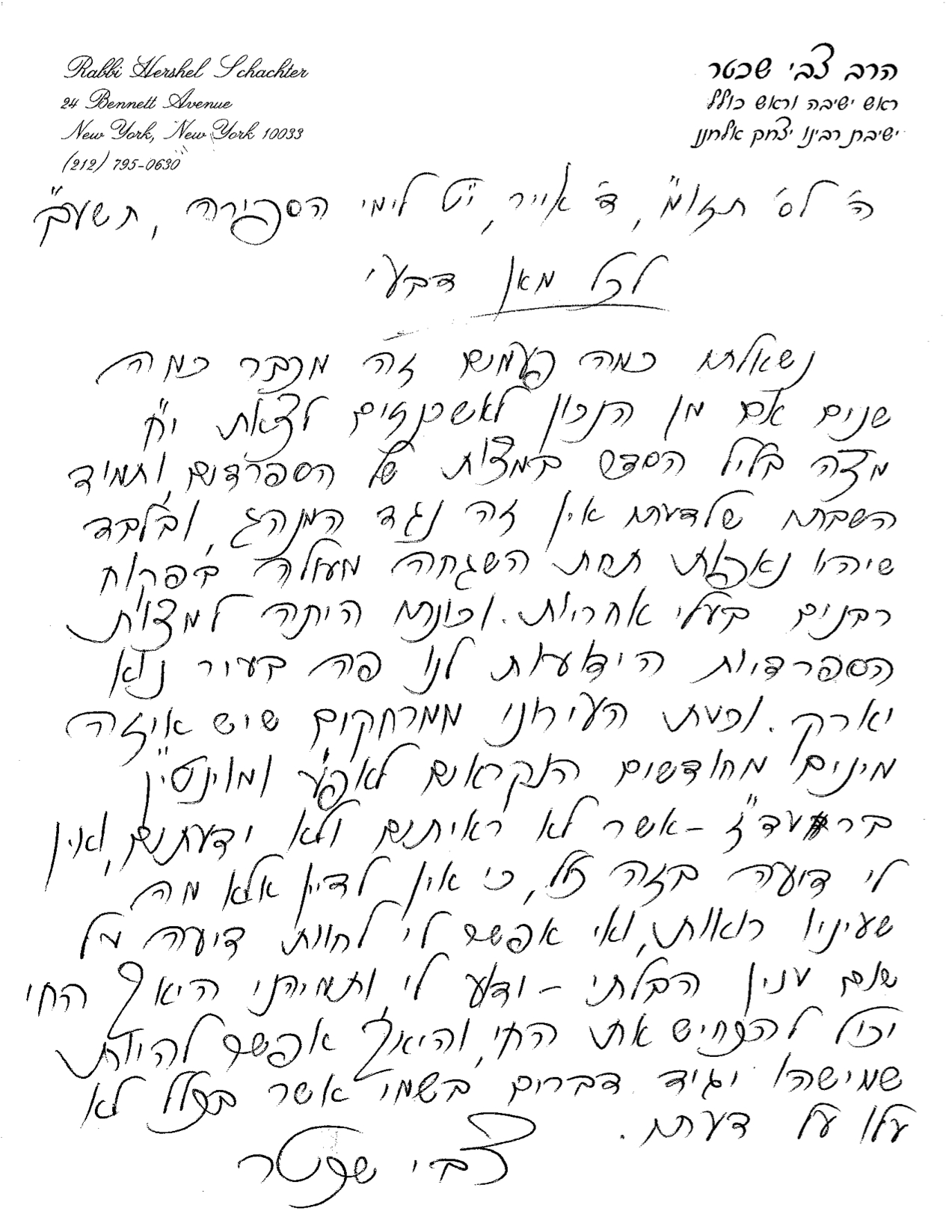


 Shidduchim after all are an introduction agency. It’s a business; big business. The Shadchonim market their goods in a way that reflects the needs of their clientele, or at least they try to. They would like to see all these single and pure angelic girls married “off” (I dislike that Yinglish phrase). In the least, it means more business and perhaps a better seat in Olam Habo. Pardon my cynicism, I’ve become old(er) and more hoary. The issue is not the system, it’s the life style. It’s simply unreal and unnatural. Sure, Eliezer was sent to choose Yitzchak’s wife. Eliezer had a helping hand, and there was a good deal of Godly intervention there. I think they call it Hashgocho Protis, although today it’s become “bashert”. You can’t “fix” Charedi society with quick fixes. It’s got to be a gradual transmogrification over a generation. You see, we have too many “holy young men” who aren’t. They aren’t geniuses. They aren’t paragons of virtuosity. Many will also be ill-suited to education or leadership. They will not become “Gedolim” or even “Askonim”. They will stay back benchers, occupying the hallowed halls of Mir and Lakewood, forever and a day. They remain removed from Olam Hazeh.
 No, in our world, this is a second-rate existence. Forget about the Yissachar and Zevulun nexus; that is a marriage of convenience. You know, it’s B’Shaas Hadchak. The money ideally should fall from Heaven, like Manna, and each and every one of us should spend our days dissecting a R’ Chaim or a R’ Baruch Ber. Sorry guys, that situation is called Moshiach’s times. In the meanwhile, we are in Olam Hazeh, the real world.


 Schnapps’ keyboard player, Peter, is one of the חסידי אומות העולם. A respectful and sensitive man, Peter initially asked whether he was required to wear a Kippa. I quickly responded in the negative, and ensured that the other band members knew there was no expectation whatsoever that they do so. In the words of my percussionist, also named Peter, “We are just a pack of goyim anyway”.
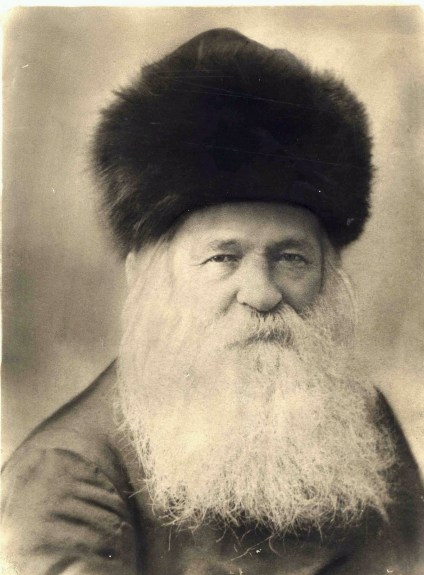


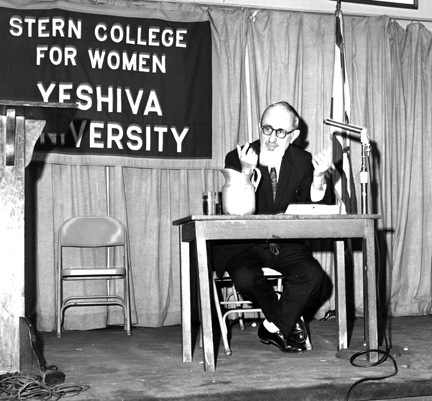




 pitputim
You must be logged in to post a comment.