The latest chumra for Shidduchim

[Hat tip to my ex-room mate at Kerem B’Yavneh]

There will be other developments, no doubt, which include an opaque perspex divider when these seats become part of the norm in parks and gardens. There will also be super bus terminals built around this design in certain neighbourhoods, where the Yetzer Hora is too powerful. I’d insert a smiley in this post, except that it might be misplaced.

The Shidduch Bench (c)

A clear Psak requiring Reporting is needed to stop Abuse

I am reblogging  this one from Daas Torah, as it’s important, and yet another tragic story.

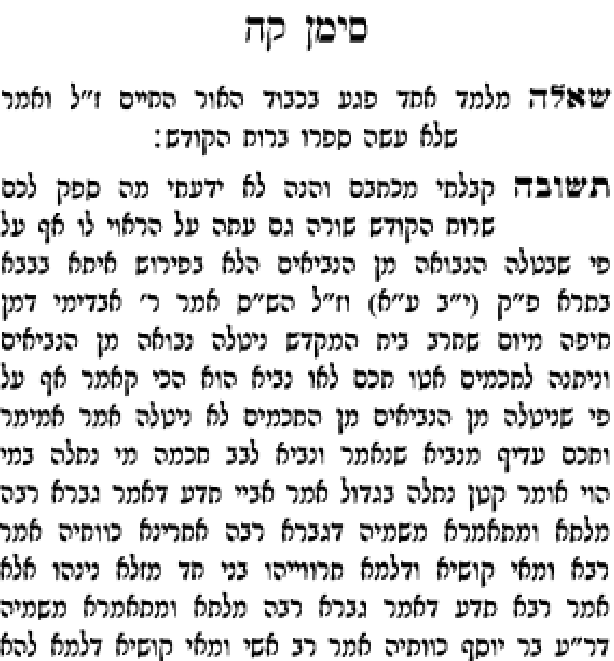
I just finished a long trans-Atlantic call with an American rav whose grandson was recently abused in a shul in Europe during davening. He was distressed by a number of developments besides the fact that his grandson had been abused. 1) the community rav who had been consulted said that the perpetrator had suffered enough embarrassment already and thus nothing more should be done. The rav stated clearly that the matter should be dropped and if the police were involved it would be mesira. He was clearly ignorant of the rulings of Rav Eliashiv and other gedolim on the matter. 2) Despite this the parents reported the abuse  the police  – but they didn’t seem interested in getting involved either.  3) To make the matter more distressing the family has been informed that the alleged abuser has been observed  in the past – touching kids inappropriately in the mikveh – but nothing was done. 4) The parents of the child are now being harassed and threatened by the community as trouble makers and informants.

This American rav is well aware of the halachic and psychological issues and suggested something which is very simple – but should be very effective in changing the dynamics of the situation. Most people would have no problem of reporting if they witnessed a child being raped or severely beaten. In fact they probably would physically intervene to stop the abuse. The events of Penn State have hopefully taught us that good people don’t act unless they know that they must act and are informed in advance what constitutes abuse. Similarly most rabbonim today acknowledge the importance of reporting abuse – to the local rabbi or police – but they would not necessarily recognize that inappropriate touching or fondling is abuse

Therefore the American rav suggested that the community needs that important poskim publicly proclaim in a written declaration what actions constitute abuse that we need to report. The  proclamation must state clearly and unambiguously that abuse is wrong – even if it doesn’t involve rape. It must list the halachic requirements to prevent harm by reporting. And finally it needs a clear and unambiguous list of specific actions that constitute abuse that need to be reported.

Here is a tentative text regarding what is abuse:

You must report the following to your rav and/or police department. If you see a child being touched  inappropriately in the mikveh, playground, summer camp or school or neighbor’s home. Not only must you report inappropriate adult fondling of a child – but also such actions between  children – even if they are the same age. You must report not only what you yourself observe but also when you hear rumors or your children tell you – it needs to be reported in order to verify and stop it. In sum – all awareness of abuse that you know about –  must be reported to someone. However it is not enough to just report that you witnessed or heard about abuse. If the person you report to doesn’t follow through – whether it is a parent, teacher, principal, rav or police – you must persist either with that authority or find someone else who will listen and act. It is clear that a child’s well being is not to be sacrificed to avoid chilul hashem, financial loss to a yeshiva or synagogue, or the embarrassment to the family of the abuser or even a prison sentence for the perpetrator. There is no prohibition of lashon harah to report these issues, nor is there a prohibition of mesira. A Rav or community leader is obligated to listen to any and all alleged incidents of abuse. Every member of the community is obligated to make sure that children are protected and that perpetrators are stopped.

ה’ ירחם

Guest counsellor in Melbourne

The Australian Jewish News included an advertisement from Kollel Beth HaTalmud featuring Rabbi Dovid Goldwasser. Rabbi Goldwasser is described as an expert in matters of addiction and is widely respected as a counsellor. I do not know if Rabbi Goldwasser has any formal qualifications. Certainly in Australia, you can be an accountant, and advertise and perform the role of counsellor and not have your advice or counsel subject to any peer review or peer oversight. My view is that all counsellors should not only have formal training, but that they should be answerable to a counselling peer body if there are complaints about their para-professional counsel. A psychologist can lose their registration if they are found to be guilty of breaching the standards expected of their peer body. It seems that counsellors, for some reason, are not bound by peer based standards because they do not need formal qualifications.

I guess it’s buyer beware. There is advice, and there is counselling. They are two different things. Rabbonim have long given advice. Some of them are also incredibly good counsellors and possess the “wisdom of Solomon” by virtue of their acumen and life experience, laced with the values of Halacha. Rabbis Chaim Gutnick ז’ל and Yitzchok Dovid Groner ז’ל were both revered as advisers and counsellors in Melbourne, and rightly so.

A Rabbi with requisite wisdom will also know when something is outside their range of expertise and refer a congregant to professionals when that appears to be warranted.

This is not to cast any aspersions on Rabbi Dovid Goldwasser. He is highly visible on the internet, and would seem to have a very good reputation achieving lots of good.

That being said, he is also someone who was issued with a Ksav Siruv by Chabad on account of allegations that he wilfully mistranslated the memoirs of an elderly paragon of Russian Jewry by omitting all and every reference to Chabad! I’m not breaking any new story here. The issue is well documented here and here

Thank God, apart from my addiction to Herring, Tzibbeles, and Bromfen on Shabbos, I have no need to see the good Rabbi; although if he can tell me how to lose some of my tummy I’d be obliged. If someone does attend, it might be interesting to ask why he chose not to appear before Rav Osdoba to answer the complaints directed against him about the book.

Uniforms are everything (part 2)

[Sheitel tip to the anonymous one]

This is too funny not to post. Enjoy!


and the obligatory response

Uniforms are everything

See this article.

I’m waiting for a Chassidic Machon for Textile Research where clothes are crafted in a way to provide a cooling experience, like an ice vest and thereby preserve the look, but not the feel, of the mandated uniform.

As time goes by, and we over-focus on form, content seems to suffer. When I was a boy, R’ Zalman Serebryanski ז’ל used to wear a mid-grey Kapoteh. Yes, it wasn’t black. His hat had a very short upturned brim. But then, again, he was a Chassid in content and seemingly less troubled by form.

It’s interesting to note that during the weekdays, other Chassidim, such as Ger, often don a standard fedora. Unless I’m mistaken, in the days of yore, they wore a Poilishe Hittel-one of those Donny Osmond style caps. I’m also skeptical whether the standard Chosid always wore a white shirt during the week. Did they?

Curiously, the Sefardim (at least those of them that don’t try to emulate Ashkenazim) didn’t have a dress code that required them to either all dress the same, or wear something akin to the Chacham.

And finally, we did change our names, clothes and language after we left Mitzrayim. Maybe that’s the answer: let’s go back to what Moshe Rabbenu wore?

A novel approach to shadchanus

On Wednesday nights, the Rav ז’ל used to give a Chumash Shiur. How did this Shiur originate? R’ Ari Kahn relates that one evening the Rav looked around his apartment and asked his Shamoshim (an entourage who assisted the Rav with his needs) why they were there: didn’t they have families, and if they didn’t why weren’t they looking. Some of the Shamoshim responded that life was not easy. They didn’t feel at ease interacting with the Shadchanim industry; equally, they were loath to “hang out” in the front of the Stern College for Women as if they were “on the prowl”.

The Rav responded that he would begin a Shiur for both young ladies and young men. He, the Rav, would make sure that the young ladies would attend; he’d leave the rest up to them. With that, the new Shiur commenced.

Of course, the right-wing would only see a “mixed” Shiur, so to speak, and condemn.

Is Milk Kosher in Melbourne?

A number of years ago, while listening to one of R’ Schachter’s Shiurim, I came away with the distinct impression that he had a serious issue in regards the Kashrus of any Milk in the USA because of the prevalence of Halachically damaged milk cows aka Treyf cows.

I discussed the issue with Rabbi Mordechai Gutnick of Kosher Australia and he advised me that the veterinary procedures extant in the USA were not germane here in the same way on account of the different feeding practices which obviated the potentially Treyf inducing condition common in the USA.

I also asked Rabbi Tzvi Telsner Dayan of of the Chabad Yeshivah Shule in Melbourne whether in light of Rav Schachter’s views, there was a problem with Chalav Yisrael in the USA. Rabbi Telsner claimed that the conditions in Chalav Yisrael production in the USA were much better than the general USA dairy industry and did not have this problem.

To understand this issue, please see the following article
[hat tip Moshe]

An outrageous Dvar Torah on Korach

Rabbi Pinchos Lipschutz is the editor of Yated Neeman, a mouth piece for the Aguda. He is the Rabbi of Kehal Ahavas HaTorah in Monsey, and authors a blog in which he publishes weekly “Divrei Torah”.
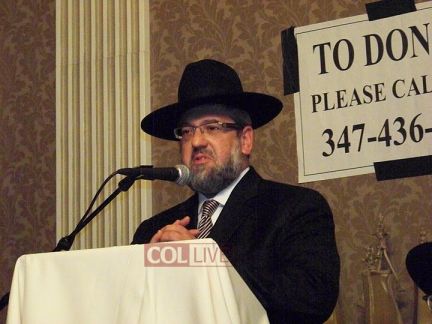
This week’s Dvar Torah on Korach. It’s been a while since I read a facile piece which uses the Machlokes of Korach to silence alternate views. This is yet another such piece. It insults one’s intelligence to try and sell the line that:

  • Korach was a bad man because he questioned Daas Torah (Moshe)
  • Korach was motivated by jealousy
  • Issue X is contentious but since my Daas Torah says Y on issue X and you don’t agree, then you are a modern incarnation of Korach

So, what are issues X and the Daas Torah views Y in this week’s regurgitation of this illogical fallacy?

Issue X is:

The Aguda response as enunciated by Rabbi Lipschutz is

  • If you oppose Metzitza you are from Korach
  • If you don’t put your hands into Rabonim on abuse matters you are from Korach

Metzitza is a Halachic matter. It rises above petty Agudist politics. It is an old issue. There are many respected halachic opinions that contend that Metzitza B’Peh is absolutely forbidden. Do they not have a right to those views? Are they motivated only by anti-Agudist/Orthodox motives?

Do we not have enough evidence to suggest that Rabonim are not the best address when it comes to ascertaining whether there is a prima facie case of Abuse that should be referred to the Police? The implication here being that the RCA are like Korach?

I really dislike it when the Torah is abused and misused in this way to push a barrow that discredits the right to an opinion that is different even though it had a solid basis.

Anyway, you judge for yourself. Here is the Dvar Torah.

We learn this week’s parsha and are struck by how odd it seems that someone would challenge Moshe after all he had done for the Bnei Yisroel altruistically. This is compounded by the number of times Hashem defended Moshe. How could someone as smart as Korach do something so foolish and how could so many people be taken in by him and join the rebellion?

Miriam spoke against Moshe Rabbeinu and was promptly punished. The meraglim doubted the veracity of Moshe Rabbeinu’s promise and, again, their punishment was swift and harsh. In this week’s parsha, we are again presented with an account of rebellion against Moshe Rabbeinu.

Korach is Exhibit A in the teaching of Chazal that “hakinah, hataavah vehakavod motziim es ho’odom min ho’olam.” His ambition and lust fueled him in a way that totally altered his perception of reality and truth.

Rashi tells us that Korach fooled himself. His thirst for power and drive for recognition toxically combined with his ego to convince him that he was right. His ulterior motives tripped him up. Because of his negiah he thought that Moshe had appointed his brother Aharon to a high position and ignored the better candidate. Though Moshe had repeatedly proven that he was following the command of Hashem, Korach, like people who haven’t subjected their jealousy and bad middos, had lost his ability to think clearly.

Ambition is good. All around us are good people who have risen to leadership positions as a result of hard work and determination. However, in the dog-eat-dog world where everything goes and the ends justify the means, people think that by trampling over others, by lying, and by playing on people’s emotions instead of by targeting their intellect, they can become popular and powerful. However, such achievement is short-lived and flames out rather quickly.

Korach ran a quick and easy campaign, because hate spreads like a fire. “Did you know that…? Have you heard the truth? I’ll tell you the real story.” He used the same successful tactics, grievances and claims as today’s hate-mongers. All throughout history people have been susceptible to the machinations of demagogues.

Korach deluded himself into thinking that he would be different than those who previously had made the same mistake as he and doubting the Ish Elokim. He was operating from a position brought on by negius, and thus his view was altered and his thinking fatally flawed.

The Chazon Ish writes that a gadol baTorah does not make decisions based on negius and has no personal interest. Korach couldn’t face this fact. He refused to accept the reality that a true gadol doesn’t have an agenda.

Rav Elazar Shach zt”l explained the concept of daas Torah as such. When a great person who has no personal negiah and is totally absorbed with his Torah study is asked a question, it is as if the Torah itself is responding to the query.

Moshe Rabbeinu, the consummate humble person, the one who delivered them from slavery, virtually the only leader the Jews had known, and the man whose every word was Torah, was the person who Korach and his group accused of malfeasance.

The Mishnah in Avos states that a machlokes lesheim Shomayim is sofo lehiskayeim, while a machlokes shelo lesheim Shomayim has no kiyum.

The Mishnah tells us that the disputes between Hillel and Shamai were lesheim Shomayim, while the quarrel of Korach va’adaso was the quintessential machlokes shelo lesheim Shomayim, an argument that is sustained purely to serve a personal agenda.

A machlokes lesheim Shomayim is fueled by the desire of both antagonists to determine the truth. Hillel and Shammai shared the same goal, but they had differing methods of interpreting and understanding the words and concepts of the Torah to determine the will of the Ribbono Shel Olam. Hillel and Shammai are so much a part of our everyday life, because by studying their drashos and sevaros, and by understanding their discussions, we are able to arrive at a more illuminated understanding of Torah. Their teachings and words endure – sofo lehiskayeim.

When the machlokes is lo lesheim Shomayim, the other side is not interested in the truth. They are only interested in winning. There is nothing to be learned by dissecting their arguments, for they are illogical and obviously false.

A story is told about two friends who were talmidim in the great Volozhiner Yeshiva. Meir was exceptional, brilliant and driven, and had been considered one of the yeshiva’s most accomplished students. That was before he began reading and then becoming increasingly influenced by Haskalah literature which robbed our people of thousands of promising people such as Meir. The poisoned pens of the Maskilim which mocked and disdained the holy traditions and Torah leaders succeeded and Meir found himself unable to apply himself to learning and davening.

Chaim had been his chavrusah and best friend, but as Meir fell under the spell of Haskalah, their friendship fell apart. However, Meir was determined to take Chaim along with him. He sought to take his simple, unsophisticated friend by the hand and lead him into the great, big world beyond the walls of the Volozhiner Yeshiva. Chaim refused to hear his friend’s arguments, explaining that he derived all the intellectual and emotional stimulation he needed from the pages of the Gemara.

Meir didn’t give up and continued hammering at Chaim with the arguments he picked up in the beautifully poetic pamphlets of the Maskilim, who used their creative gifts to carefully compose tracts that brilliantly mocked everything and everyone holy.

Meir turned to Chaim and asked, “How can you learn Gemara all day and delve into the words of the Tannaim and Amoraim if you have no idea who they were and what they were all about? First you have to learn some history and connect with their era. Familiarize yourself with the geography of the great cities and yeshivos in which they learned, and then you will be able to begin a proper analysis of their words and teachings.”

It was to be Meir’s final argument. Chaim looked at him with pity and turned to head back in to the bais medrash. “You know Meir’l,” he said as he walked off, “you may know where Abaye and Rava died, but I know where they live.”

To paraphrase the Volozhiner bochur, Hillel and Shammai are alive and well in every bais medrash in the world. Moshe’s Torah is as fresh as the day it was given at Sinai, while Korach and his group are buried deep down in a wayward desert, crying out to be heard.

Hillel and Shammai pursued truth, not the argument. Their disputes were a means to arrive at the truth.

Those who engage in Korach-type debates and disputes are not interested in the truth. There is nothing to be gained by debating them or studying their arguments. They are simply baalei machlokes, heirs to Korach va’adaso.

Moshe Rabbeinu didn’t arrive at his leadership position by way of hubris, coup, terrorism, or taking advantage of people by forcing them to go along with him. In fact, he was the most humble person. He got there because Hashem put him there. He rose to the highest levels possible for a human. He led the Bnei Yisroel out of Mitzrayim, delivered the Torah to them, adjudicated their disputes, brought them close to Hashem, and gave them everything they needed, yet that wasn’t good enough for Korach, the members of the Sanhedrin, and the masses who followed him. It seems shocking, yet too often, today, we can hear the echoes of Korach’s cry.

Bnei Korach lo meisu.

Sinas am ha’aretz towards talmidei chachomim is all around us. Where there are Jews, there are rabble-rousers who covet positions of power and scheme to destroy the humble talmidei chachomim and leaders who spent decades of their lives in obscurity getting closer to Hashem while working on their middos and growing in Torah and everything that is important. They are people who don’t necessarily occupy official positions, yet they become recognized by Klal Yisroel for their gadlus. And there are people who mock and fight them.

It seems incompressible, but if you look back at our recent history, you see that there were people who fought against the Chofetz Chaim and called him a baal machlokes and troublemaker. Rav Chaim Ozer Grodzensky, who was not only one of the most brilliant minds the Jewish people ever saw, but also possessed the kindest and most gentle nature, was vilified by people who wanted his position. He was the rabbon shel kol bnei hagolah, father and mother of yeshivos, of the poor and forlorn, and of the almanos and yesomim, yet there were people in Vilna who fought him and ran an election to usurp his position.

Though Chazal warn, “Hizaharu begachaloson,” there are always those who become overcome with envy and jealousy and delude themselves into thinking that they are more worthy for the position. They rally other malcontents to their side and do what Korach did.

Today, we see people battling against time-honored practices such a metzizah and quietly encourage the government to intervene and interfere with our religion. They stoop to lies, pseudo-science and fabrications to portray us as baby killers. The media gobbles it up without a second thought. The people who care most about life are portrayed as inconsiderate of the lives of infants and more concerned about some ancient ritual. Such stories are permitted to fester, and only one or two among us has the courage to rise up from the machaneh and say, “Enough with the lies. We have suffered enough from being portrayed as people who don’t care about the lives of children. Tens of thousands of our brothers and sisters were murdered because of the lie that we are baby killers.”

The lie is permitted to gain hold and none of the proud Jewish spokesmen protest.

The same goes for the new focus on abuse. Rabbis who spend their days ministering to their flocks and delving into the eternal words of the Torah are portrayed as callously concerned strictly with maintaining their positions. The oft-repeated canard is that they care not about the sanctity of life. People who spend their lives caring for people are said to turn a blind eye to children who are abused.

It is high time we rose up and said that we have heard that sorry song enough times. Of course every responsible rabbi agrees that predators should be prosecuted to the fullest extent of the law. Of course religious Jews maintain that monsters should not be permitted to walk the streets and destroy lives.

No one who harms a child, in any way, with any type of abuse, should be coddled. Rabbis have been saying that for thousands of years, yet we are portrayed as being a group who doesn’t hear the cries of the victims. The nation that has spawned the greatest proliferation of chessed organizations, which the rest of the world never even attempts to emulate, is portrayed as uncaring and no one says anything. How can that be?

When the nations of the world were still offering up their children as sacrifices to pagan gods, the Torah was concerned about ensuring that our children remain safe and healthy.

Molesters are classified halachically as rodfim and are treated as such when they are caught and their reprehensible actions are proven. Yes, sometimes unfortunately, these evil people are not sufficiently punished, and those exceptions should be addressed, but how can we permit the minority to impugn the character of every rov, rosh yeshiva and frum Jew?

All around us, we see the koach of Korach va’adaso taking hold, pulling people in their direction, creating doubt in the hearts of many. Their target, as always, is still Moshe Rabbeinu and those who follow his teachings.

Therefore, four times a week, we rise to our feet and point towards the Sefer Torah and call out, “Vezos haTorah asher som Moshe lifnei Bnei Yisroel al pi Hashem beyad Moshe.” We proclaim our allegiance to the Torah, which guides our every step and shapes our opinions. We restate that we received it from Moshe.

We point at the Torah and say, “This is timeless. This is enduring. This is real and lasting. It is the honest truth.” We received it from Moshe Rabbeinu, the humblest and greatest leader, and in every generation, the Moshes of the dor transmit the heritage to us as they lead us to grow in the lives the Torah demands of us.

This Shabbos is the 30th yahrtzeit of the great Lakewood rosh yeshiva, Rav Shnuer Kotler zt”l. His father, Rav Aharon zt”l, breathed life into dry bones, creating a European-style yeshiva in a place no one thought it possible, working with superhuman energy and dedication, experiencing extraordinary siyata diShmaya.
When Rav Aharon passed away, it was feared that his many accomplishments and the yeshiva he had established would be lost. Yet, providentially, Rav Shneur led Lakewood into its glory era, increasing the numbers and the breadth of limudim, and leading the kollel movement in its spread across America.

Rav Aharon’s talmidim spread out across America and around the world, imparting his message and adding legions to the forces of Torah. Their success and his in transmitting Torah, yiras Shomayim and ahavas Yisroel to the succeeding generations are proof that Toras Moshe never grows old or stale. It remains relevant and vibrant wherever Hashgachah guides Jews.

And so it was with many of the Holocaust-era Chassidic and yeshiva leaders who arrived here, penniless. They had lost their families, friends and students, but they were not alone. They clung to the Toras Moshe and it sustained them. It was their oxygen and lifesaver and they were buffeted about in strange, choppy seas. They never despaired or wavered. Today we harvest the fruits of their labors. Every week, there are more people pointing to the Sefer Torah and proclaiming, “Vezos haTorah.”

Those who follow Moshe Rabbeinu and his successors are growing and tipping the population scales. A just completed survey of New York’s Jews showed, once again, that intermarriage is on the rise. The Conservative and Reform, who a few decades ago thought they had the Orthodox beat, continue to lose adherents despite all the games they have played, from patrilineal descent to counting anyone who claims to be a Jew as a Jew.

The media is surprised. The entrenched liberal power brokers are fearful. New York’s organizational leaders are worried about their future. They fret over the calamitous future predicted by the finding that 64% of New York’s Jewish children are Orthodox.

The only group that is experiencing growth is the one that adheres to Toras Moshe and whose offspring is educated in the Torah way. The only guarantee for our future is provided by learning and observing the Torah. Yet, they refuse to accept that bare fact and instead engage in desperate battles against us.

As they and the other modern-day Korachs use emotion, hyperbole and every tool at their disposal to get our attention and detour us from the path which led from Sinai to Yerushalayim, Yavneh, Pumpedisah, Gerona, Sefard, Ashkenaz, Volozhin, Warsaw, Slabodka, Vilna, Liadi, Berditchev, Morocco, Brisk, and so many other stations until it led to us, we need to stay focused on the truth of Moshe Rabbeinu and his modern-day successors. We dare not fall for gimmicks, charlatans and those who would lead us down the path of oblivion.

We are approaching the twelve-month mark of last summer’s terrible tekufah, the weeks when we sustained blow after crippling blow. As their yahrtzeits arrive, we should focus on whom we lost and what sort of people walked amongst us in Rav Michel Yehuda Lefkowitz, Rav Yitzchok Dov Koppelman, Rav Chaim Stein and Rav Elazar Abuchatzeirah, zichronam livracha, among others. When we think about them and the lives they led, and the giants whom we merit having among us, we will be reminded even in our day that the Torah is as vibrant as ever, al pi Hashem beyad Moshe.

May this summer be one of happiness and brocha, as we asked this past Shabbos in Rosh Chodesh bentching for a month of “chaim shetehei bonu ahavas Torah veyiras Shomayim,” coupled with shemuos tovos and besoros tovos for everyone, everywhere.


When Chassidim became religious zionists

The following is a nice article from Ha’aretz of all places, by Mordechai I. Twersky. [hat tip Moshe]

Could Yochanan Twersky, had he chosen to follow the footsteps of his rabbinic-Hasidic forefathers, have transformed, or at least bridged, between modern-day Hasidism and religious Zionism in Israel as we know it?

He was my distant relative, and the thought still occupies my mind, two months after Twersky – scion-turned-Israeli underground member, IDF soldier, and Israeli Trade Ministry official – died in Jerusalem at the age of 87 following a protracted illness.

“You simply have to meet him,” my brother Yitzchock – the meticulous researcher of the Twersky family genealogy for nearly 25 years — urged me back in 1999, after I made aliyah from New York. “You’ll see. He is one of a kind.”

He was a bearded man with a rabbinic countenance, and he was affectionately known as “Yochanan.” He was not a close relative of ours; a glance at the Twersky family tree shows that four long generations ago, his paternal great-grandfather and namesake, Rabbi Yochanan of Rachmastrivka (1816-1895), and my paternal grandfather, Rabbi Aaron of Chernobyl (1770-1837), were brothers.

But I was irresistibly drawn to this warm, affable man and his repository of age-old stories. Over time it became very clear: I was in the presence of our family’s last witness to a union now rendered extinct, if not totally unfathomable.

“My father was a Hasidic rabbi,” Yochanan told me during our first meeting at his Jerusalem apartment 13 years ago, in his deep, distinctive baritone voice and his British-Austrian English. He pointed to a wall where framed pictures of bearded Hasidic men hung alongside an image of Theodor Herzl. “And he was a Zionist.”

Yochanan’s father, Jacob Joseph Twersky, was a fervent Zionist among a small cadre of Austrian Hasidic rabbis influenced by Herzl and Laurence Oliphant, the British author and diplomat. Twersky led Vienna’s religious-Zionist Mizrachi movement and aided Israel’s early pioneers, among them the father of Israeli Supreme Court, Justice Yaacov Bazak, as they set sail for the Land of Israel from the Italian port of Trieste.

“We constantly had chaluztim in our home,” recalled Yochanan, using the Hebrew word for pioneers. “There was never enough room. They slept four across in my bed, and my mother cooked. I slept in the bathtub.”

Yochanan’s father bought shares in Bnai Zion, a turn-of-the-century company that purchased tracts of land near Hebron for Jewish farming and cultivation. At the annual Zionist march in Vienna, Rabbi Twersky walked with other Hasidic rabbis, waving an Israeli flag.

“My father wore his best holiday clothing when he visited Herzl’s grave in Vienna,” Yochanan, who bore a striking resemblance to his great-grandfather, told me.

In a long line of rabbis, a sudden twist

His grandfather, Nachum, was the first Hasidic Grand Rabbi to settle in Palestine, in 1924. Jacob Joseph visited him briefly that year and even considered settling there, before his poor health forced him to return to Vienna.

One can only wonder what would have become of Jacob Joseph’s variety of Hasidic-religious-Zionism had he settled in Palestine – and had Yochanan, his only son after three marriages, succeeded him.

In 1931, when Yochanan was 6 years old, his father collapsed and died while praying. Seven years later, during Kristallnacht – the Nazi pogrom known as the “Night of Broken Glass” — the Nazis broke into the Twersky home, ransacking it and dragging 13-year-old Yochanan from his bed.

“They ordered me to tear up our holy books and they beat me,” Yochanan told me. He said that he watched in horror from his window as the Nazis forced Jews to clean the streets with their beards.

In the aftermath of that atrocity, he salvaged one scorched volume from the flames, which he would later bring to Israel. He pleaded with his mother, Miriam Frieda, to abandon the family’s sole source of income — her late husband’s pension — and flee via an illegal transport to Belgium, and then to England.

“We just wanted to get to Palestine, but we couldn’t get a certificate from the British to enter Palestine,” said Yochanan. In a 1999 interview about the rise of Austria’s extremist politician, Jorg Haider, Yochanan recalled his childhood memory of the annexation of Vienna on March, 15, 1938, and the Austrians’ enthusiastic welcome of the Nazis.

In an unpublished family memoir, “Life’s Incarnations,” which he co-authored in Hebrew with his wife of 58 years, Ruchama, Yochanan described how Vienna’s Jews were pelted with stones and rotten fruit for years during its annual Rosh Hashana Tashlich ritual on the banks of the River Danube. The attacks only ceased after a group of 200 of Vienna’s local Betar Youth organization fought back, “beating the anti-Semites with bats and clubs so severely that they had to be hospitalized.”

Yeshiva student by day, revolutionary by night

In England, Yochanan studied at a yeshiva in Manchester and later earned his matriculation from the University of London before obtaining work as a diamond cutter. Stunned by continued reports of atrocities against Jews, and eager pry open the doors of immigration to Palestine, Yochanan joined a local branch of the LEHI — the underground Zionist movement founded in Palestine by Avraham (“Yair”) Stern.

“It’s a pity I wasn’t there [in Palestine], but at least I could do something in London,” recalled Yochanan, who under the code name, “Yehuda,” kept a stash of weapons and explosives beneath the floor of his London apartment. “I made some contacts, secretly, and I joined the LEHI. There I did what I could. I did all kinds of activities against the British, and we succeeded.”

In 1949, he and his mother set sail for Israel on the vessel “Negba.”

For his underground and IDF service, Yochanan later earned two medals. He was offered a senior rabbinic position in the Israeli Air Force, but declined.

“I came to Israel to be a soldier just like everyone else and to defend the land,” said Yochanan, who served in the Imports Department of Israel’s Ministry of Industry and Trade for 38 years. “I didn’t want the rabbinate.”

Yochanan wasn’t ordained. But as a learned man with charisma and compassion he could have been a contender of the Hasidic variety. Instead, he did things his way. He decided to forgo the Hasidic garb of his father, opting instead for a knitted yarmulke and placing himself firmly in the religious-Zionist camp. “My father most certainly would have led the religious-Zionists, had he made it to Israel,” Yochanan told me in an interview a year before his death.

“Might you have, too?” I asked.

“I wasn’t worthy,” he said after a deep sigh, recalling that at the time of his father’s death he was given a black fur hat and told to sit in his father’s synagogue chair. He only 6 years old at the time. “They tried, they pushed me. But it wasn’t for me,” he said.

Yochanan was modest, but he was also a pragmatist. Arriving as a refugee in the new-born state of Israel at the age of 24, he knew he had a life to build. In 1949, his Haredi uncle and Grand Rabbi was already cementing the family’s 25-year-old Hasidic court – although he was also concerned about his children’s future leanings.

“Thank God my children are not members of [the anti-Zionist] Neturei Karta, and they’re not Communists,” Yochanan’s uncle, Rabbi Dovid of Rachmastrivka, once confided to him. “But I fear my grandchildren will one day become [religious] zealots.”

“It was quite an eye-opener for my Haredi relatives that a member of their family walked around in an Israeli uniform, wore a knitted yarmulke, and placed an Israeli flag outside his home on Israel Independence Day,” Yochanan once told me. “But they didn’t dare say anything.”

Are trousers holier than soldiers?

Though he enjoyed praying in the synagogues of Israel’s diverse ethnic congregations, Yochanan refused to daven at a synagogue that omitted the prayer for the State of Israel and the welfare of its soldiers. “It’s a defamation, an ingratitude, not to say it,” he once told me. “If you can praise God for a new pair of pants, you can bless Him for Israel’s rebirth.”

Asked in 1999 to discuss Haredi draft exemptions from the IDF, Yochanan preferred instead to recall an era when the majority of Israel’s right-wing underground members were religious. But in his last interview more than a decade later, Yochanan would not conceal his feelings toward draft-dodgers.

“I am embarrassed that there are Jews of this kind,” he said.

I pressed Yochanan further, and went back to the issue of succession. Did he feel a sense of guilt over severing the family’s rabbinic line?

“I have 21 grandchildren and 22 great-grandchildren, and all of them are religious-Zionists who performed their army and national service,” said Yochanan, ever the straight-shooter. “I, too, felt I am continuing the path of my father. I have nothing to be ashamed about. I have no regrets.”

He remained optimistic that Jews would one day “overcome their differences and unite,” citing a number of examples when Jews came together “in the face of real danger.” But he tempered his statement with realism, adding: “I’m sure that even when the Messiah arrives there will be Jews who won’t accept him.”

In one of his last recorded statements, Yochanan acknowledged that Israel “needed some miracles.” But he remained ever hopeful.

“If we look at our past, it gives us hope that we can succeed again. We can have peace and success in all of our efforts,” he told me.

Last year, when I asked Yochanan whether his brand of religious-Zionism had, in essence, replaced his father’s class of Hasidic Zionism, he didn’t miss a beat.

“It didn’t replace it,” he said. “It renewed it.”

More violence in Beit Shemesh

The latest bout of disgraceful violence in Beit Shemesh sickens me and defies desensitisation. Read it here

The animals who did this should be locked up for a few years. They could have killed the unsuspecting and innocent mother of those twins.

The so called holy life style they lead is a sham. It is as close to Har Sinai as a pig is to Tahara. What do their teachers and Roshei Yeshiva say? What are they doing to disarm these low lives?
Zu Torah?

You couldn’t profane God’s name any worse if you tried.

Beautiful Story

I once played at a wedding where the Groom was seriously ill. The Bride refused to untie their love and insisted that she wanted the marriage to go ahead. The wedding took place, and I recall it vividly. It was at the Hilton Hotel. Each time the Groom passed or was lifted near the band stand, a lump entered my throat. The speeches were uplifting.

Alas, after a few years, and a child, I learned that the Groom had passed away. I attended one of the minyanim. The pure and clear vision of this special Bride and Groom left a mark on me.

Fast forward to a similar story here. If your Ivrit isn’t wonderful, you might try the translation here.

The part I have most difficulty with is the need to go to a Beis Din. When you are faced with such a righteous girl, with exemplary Midos, why would you go to a Beis Din and try and force the issue? Rav Wosner recognised this and thankfully put the issue into perspective.

Rav Wosner (Center)

Hellish Education?

[Hat tip Ezra]

I understand I’m exposed. I understand that I am secularly educated. I understand that I’m not cloistered in Lakewood. I understand that there is more than one nuanced path in Judaism. Alas, I do not understand what the following approach to “encouraging” Tzniyus amongst the girls in a Lakewood Girls School can possibly achieve. To be sure, this approach focusses more on fear than love, but surely this is just too extreme?

Read the article here

Definitions of Religious Zionism

I saw this comment from Chardal who said:

A religious zionist is:
Someone who either made aliya out of a sense of religious obligation OR someone who feels the need to find a valid religious excuse as to why they have not yet made aliya (ie, why they are patur). On a national level, this person feels that Jews should en-masse settle the land of Israel.

A religious non-zionist is:
Someone whose aliya is based on non-halachic religious considerations OR someone who feels no need to excuse their living in chu”l. On a national level, this person feels that there is inherent religious/pragmatic value in a large exile community and does not connect to any national project designed to move Jewry to Zion.

A religious anti-zionist is:
Someone who has to find a heter for making aliya and considers those who do so to be putting themselves in a spiritually dangerous position. If this person already lives in Israel, they are connected to the vestiges of the old yeshuv and consider themselves to be in a religious struggle against the state. On a national level, this person considers any national project to move Jews to Israel to be delaying the redemption.

Thoughts?

Honouring Talmidei Chachamim

This story is from Rav Aviner. I dare say it’s instructive.

Ha-Gaon Rav Avraham Dov Auerbach, Av Beit Din (Head of the Rabbinic Court) of Tiveria, once told me about an incident that occurred there in the past: it once happened that the “eruv” was damaged, but the Rav of Tiveria ruled that it was kosher. There was a great Torah scholar who lived there and he bumped into the Rav of the city after Shabbat. They talked, the Torah scholar walked him home, and then they sat and chatted some more. The Torah scholar said, “Let’s learn some Torah.” The Rav of the city obviously agreed. The Torah scholar took Massechet Eruvim and they learned. Suddenly, the Rav of the city said, “Oy va-voy! If so, I ruled incorrectly today!” The Torah scholar said, “It appears so.” The Rav of the city asked, “Did his honor announce in his shul not to carry on Shabbat?” “No,” he responded, “since carrying in this place is a rabbinic prohibition, but honoring a Torah scholar is a Torah mitzvah. I therefore did not say anything.”

Even if the Mara De-atra errs, you cannot proclaim that he has erred. You can argue gently and try to persuade him’

שו’ת דברי חיים

Abuse: Halachic and Ethical Dilemmas (2)

Thanks to all who commented on the first scenario. Consider, now, a new scenario.

Your daughter is showing signs of strain. She has not been herself for some time. You have tried all manner of parental approach: the stick and the carrot and you can’t seem to manage to cajole her to be on the same page as you and your husband. She is also not performing to her ability at school.

You become aware of rumours that a male associated with your daughter’s school has been exposing himself and may well have fondled or even forced himself on some girls. When you hear these rumours you are in a state of disbelief. You cannot imagine that this apparently fine and upstanding individual would do such things. If he did, then you conclude that he must be sick or have experienced some trauma that has scrambled his moral compass.

One day your daughter casually mentions that the said person approached her and attempted to interfere with her. You aren’t sure whether actual interference has taken place. On the other hand, this may well explain her unusual behaviour and lack of focus. Given the rumours, you run to the School and meet with the powers that be. They tell you that there have been issues with this person and that he is receiving treatment and the strong indications are that this earlier behaviour will no longer be manifest. It’s a close-knit school where each parent knows the other and shares strong common ideals. The school did not contact the police because they felt they were dealing with it internally through professionals. Their Rabbi forbade “Mesira” anyway and there was no mandatory reporting in place.

You are concerned. The said perpetrator is still “at large” in the sense that he is able to find ways to continue to interact with the children in the School. You are told he has done Teshuva. What do you do?

  1. Do you allow any of your children to continue to be enrolled in the School?
  2. Do you have a halachic responsibility to inform as many parents as possible about what happened to your daughter? (What about her shidduch chances and those of the siblings, given the close-knit community)
  3. Should you go to the press or post on a blog, even anonymously.
  4. If you fail to advise other parents and the police, and another child is interfered with are you halachically or ethically culpable?
  5. Did you transgress לפני עיוור לא תתן מכשול and/or לא תעמוד על דם רעך?
  6. Can parents now sue you for damages, both halachically and civilly?
  7. Can your children sue you if you didn’t remove them from the School?

“Reality looks much more obvious in hindsight than in foresight. People who experience hindsight bias misapply current hindsight to past foresight. They perceive events that occurred to have been more predictable before the fact than was actually the case”. Hersh Shefrin

Abuse: Halachic and Ethical Dilemmas

Consider this scenario

The family of a victim of sexual abuse approaches the abuser and their family. The family of the abused has not yet reported the said abuse to the police; instead they initially confront the abused and their family. The situation becomes complicated and lawyers are brought in. Lawyers for both sides settle on an agreement involving some “compensation.” In return the abuser agrees to plead guilty to a somewhat lesser offence without recording a conviction.

The lawyer of the abuser is under no doubt that her client is a dangerous pedophile. She had a choice. She could have refused to take the case. In the end, whether she was the lawyer who accepted the brief, or a lawyer who turned the case down, she is unable to remove thoughts from her head. She is convinced that the abuser is a dangerous person and that he may continue on his misadventure and sexually abuse others. She is bound by client confidentiality; we understand that. 

My question relates to the Halachic imperative. Is a lawyer/person in such a case permitted to remain silent? Is there not a real problem of contravening a Torah command:

לא תעמוד על דם רעך

Unfortunately, the abuser commits further crimes. Is the lawyer somehow responsible? If they are not directly responsible, are they indirectly culpable?  Later victims, upon learning that a lawyer knew about the abuse and stayed silent, decide to summons the lawyer to a בית דין. They seek at least financial compensation for the years of medical treatment and the lost opportunity that a victim must carry all their life.

  • Is the lawyer permitted to stay silent from a Jewish point of view?
  • If the lawyer isn’t culpable from a Western legal point of view, how should the family of the lawyer respond to their vilification by elements of the community who are disgusted that their mother didn’t pass on her very real fears to the authorities?

The impending gathering about the Internet at Citi Field (Part 3)

[Hat Tip Abe] Another interesting post on what the Internet Asifa achieved and why these people just can’t be taken seriously. See here.

Sefer Shimush Tehillim

My cousin’s husband, Reuven Brauner has another worthwhile compilation published. You may download it here.

What is it? The introduction states:

Sefer Shimush Tehillim is a short and relatively little-known treatise attributed to Rav Hai Gaon (according to the Sedei Chemed) which describes the Kabbalistic uses of particular chapters and verses from the Book of Psalms for prophylactic or healing purposes. These selections are meant to be either recited alone, frequently multiple times, or in conjunction with some other action or prayer. Shimush Tehillim is mentioned in Teshuvas HaRashba (413), by the Chida, and others. This work is not to be confused with bibliomancy which is the use of Biblical verses for predicting the future.

There are numerous instances cited in the Talmud and other sources regarding the utilization of Biblical verses to ward off demons and the Evil Eye, against bad dreams, against the effects of drinking water uncovered at night, and other more serious calamities. Verses were employed to lighten the pain at childbirth, as protection against danger on a journey, fierce dogs, bleeding and wounds, and the effects of fire and fever. Verses were recited to gain favor or improve one’s memory, and so on. (See Sanhedrin 101a and Shulchon Oruch, Yoreh Deoh 179:8-10, et al.)

Yet, it must be noted, there was great opposition to use of the Torah for magical, curative purposes. The Rambam, the Tur (Yoreh Deoh 179), and the Shulchon Oruch (Yoreh Deoh 179:10) forbade such usage. The Rambam in Hilchos Avodas Cochavim 11:12 pointedly writes:

“Regarding one who incants over a wound or reads a verse from the Torah, and so one who reads verses to calm a frightened child or places a Sefer Torah or Tefilin on a child so that he will sleep – it is not bad enough that these people are numbered among the sorcerers and diviners, but they are also counted as heretics to the Torah by using words of the Torah to heal the body. The (words of the) Torah are for healing the soul only, as it is written, ‘and they shall be life for your soul’. However, it is permitted to recite verses and chapters from Tehillim for protection against troubles and harm – by merit of their recitation.”

Protection – yes, curing – no.

Since Tehillim, more than any other Sefer from Tanach, was used to defend against the effects of all types of predicaments and saving from danger, as recorded in Shimush Tehillim, I thought that it might be interesting to prepare the following table1 to illustrate which chapters it suggests be used for which ailment and condition. For the convenience of the reader, I have also added a cross-referencing index.

Nevertheless, since this monograph is meant for general educational purposes only and not practical application, and in deference to the dissenting opinions, I have only provided a selection of chapter usage from the book, and did not list the use of single verses nor what other actions are required in addition to the recitation of the chapter to affect the desired results. For such purposes, the interested reader must consult an actual edition of Shimush Tehillim and ask his rabbi as to how to employ it, if at all. All this aside, it is commendable to recite Tehillim anyway for the efficacy of it as prayer is well-known.

Finally, I made no attempt at trying to determine why each chapter has the effect claimed, as there is no indication of this in Shimush Tehillim itself.

Re-architecting our Mikvaos

The scourge of male perverts, pedophiles and sickos is challenging communities across the globe. The Halachos of a Mikva are complex and need expert Rabbinical advice and architectural nous. Our Mikvaos are cleaner and more acceptable than in times gone by. My father’s description of the scene at the Mikva in Rawa Mazowiecka in Poland before World War 2 was, how do I put it delicately, “off-putting” especially by today’s standards.

I recall when I was learning in Israel that, before Pesach, I sought out a Mikvah near Rechov Har Sinai in Ra’anana. I was the only person there apart from the Mikvah Warden. After completing my spiritual oblution, I opened the door to leave the Mikvah proper only to find the warden “too close to the door”. I had the distinct impression that he may have peered through the key hole. You don’t forget scenes like that.

I do realise that it is only Chassidim who dip in the Mikva daily today. Some, like me, have the custom to do so before the שלש רגלים. Most will do so on Erev Yom Kippur. Strictly speaking, one could also dip in a swimming pool (heated, one would hope 🙂

It’s perhaps worth considering a few changes to future or renovated Mikvaos. My suggestions are:

  1. The change area no longer be a common open area. Rather, there should be a series of say 10 little cubicles with a swinging door behind them where one undresses and then girds a towel.
  2. Showers must have self-closing doors behind them
  3. In high use communities, for example, Chassidim, a total of four consecutive mikva pools should be available. Each pool should be fully enclosed so that nobody can peer in.
  4. There should be a maximum of one person in a pool at a time, unless it is an older or incapacitated man who brings someone to assist them.
  5. The absolute maximum time for an individual to be in the Mikvah should be 60 seconds. There should be an LED timer on the back of the self-closing door which should start warning that time is elapsing, from 30 seconds into the process.
  6. There should be a separate entry door and exit door to each pool. The entry door should be accessible from the shower area. Only when a person has exited through the exit door, should the entry door unlock and indicate that the pool is available.
  7. If a person has not emerged after 120 seconds an alarm should sound.

It is important that we not only strengthen Tzniyus in our community by focussing on the translucency of female stockings (which is only a matter of Minhag) but return to fundamentals. Some reformation of Mikva architecture, based loosley on my suggestions above, would seem to be necessary in our times.

Milchigs on Shavuos and Kiddush Wine

Most people observe a well-known minhag to eat Milchigs. Some have their cheese blintzes or cheese cake prior to a main meal (avoiding halachic hard cheese which would necessitate a 6 or 5 and a bit hour wait). Others have one Milchig meal on the first day. The Minhag in my father’s house is to have only Milchigs for the entire Shavuos; others from Poland also share this Minhag. If and when I mention this to others, they look incredulous. Sometimes, they will say, “But you have to eat meat on Yom Tov” while others will say  “אין שמחה אלא בבשר ויין”.

I mentioned the Minhag to Rav Schachter, and he confessed that he too had never heard of it. He did note that according to the Chafetz Chaim, though, wine was now the main ingredient for שמחה and so he felt that יש על מי לסמוך and I was entitled to continue this practice.

The relevant sources are Pesachim קיט and  ,ביאור הלכה, או”ח תקכ”ט ב

תניא רבי יהודה בן בתירא אומר: בזמן שבית המקדש קיים אין שמחה אלא בבשר שנאמר “וזבחת שלמים ואכלת שם ושמחת לפני ה’ אלהיך”, ועכשיו שאין בית המקדש קיים, אין שמחה אלא ביין, שנאמר ויין ישמח לבב אנוש

והאנשים, בזמן שבהמ”ק היה קיים כשהיו אוכלין בשר השלמים… ועכשיו שאין בהמ”ק קיים אין יוצאין ידי
חובת שמחה אלא ביין… אבל בשר אין חובה לאכול עכשיו כיוון שאין לנו בשר שלמים, ומ”מ מצוה יש גם באכילת בשר כיון שנאמר בו שמחה [כן מתבאר מדברי הב”ח וש”א], והמחבר שלא הזכיר בשר אזיל לשיטתיה בב”י ע”ש, ולענין יין סמך על מה     שהזכיר בס”א שצריך לקבוע סעודה על היין

In summary, the meat (not chicken) that is originally referred to is the meat of Korbanos. In the absence of Korbanos, men were required to institute their שמחה through the consumption of wine at the meal. [Women on the other hand obtain this through a Yom Tov gift].

My reading of the above leads me to a number of conclusions.

  1. If you make Kiddush on Yom Tov with Grape Juice and consume no wine, it would seem you have not fulfilled Chazal’s happiness requirement
  2. Kiddush wine does not constitute the type of drink, in my opinion, that Chazal were referring to. The sweet thick molasses that parades as Kiddush wine may serve the purpose of Kiddush because it has a name/שם of wine. However, I don’t see how anyone could consider it as an ingredient for שמחה. I’d go further, if it wasn’t called “יין” it could be cogently argued that it was not חמר מדינה (a regular drink of choice in one’s locale) because nobody but nobody would casually serve this to a guest who occasioned one’s house.
    If it wasn’t for קידוש would anyone drink the stuff?

CPAP Machines on Shabbos/Yom Tov

Medical research into sleep apnea and what it can be responsible for is established and continuing to develop. Sleep apnea can cause:

  • Heart arrhythmias
  • Heart failure
  • High blood pressure
  • Stroke
  • Depression
  • Hyperactivity

The use of CPAP (or these days APAP machines) is now widespread and the relief that the devices provide is real, including:

  • Restoration of normal sleep patterns.
  • Greater alertness and less daytime sleepiness.
  • Less anxiety and depression and better mood.
  • Improvements in work productivity.
  • Better concentration and memory.
  • Patients’ bed partners also report improvement in their own sleep when their mates use CPAP, even though objective sleep tests showed no real difference in the partners’ sleep quality.

Current machines are turned on by pressing a button and then “wait” for you to start breathing. Once you breathe, air is pumped into you (at a pre-set measured level depending on whether you are moderately or severely impaired) and this keeps a flap open so that the air you breathe during the night is unobstructed. The obstruction is also one cause of snoring. The machines are relatively quiet.  Some machines build up to the required pressure gradually. There is an LCD or LED style readout on the machine that is activated once it is turned on. There is no “visible” fire/filament. Some patients also use a humidifier which is attached to the machine. This warms and wets the pumped air in patients who are unable to breathe through their nose, and whose mouths become dry and irritated as a result.

Can these machines be used on Shabbos/Yom Tov? Let’s note first that the accepted opinion is that of R’ Shlomo Zalman Auerbach ז’ל that Electricity is forbidden מדרבנן unless there is flame involved (or filament, as opposed to incandescence). The Chazon Ish isn’t disregarded, but his opinion that all electricity is forbidden דאורייתא is not followed when it comes to medical issues.

What about the status of the patient? Is he (most patients are men 40+) a חולה at the time he is using the machine? What type of חולה is he? Is he a חולה שיש בו סכנה or שאין בו סכנה?   Is he considered “sick all over”, that is חולה של כל הגוף? Perhaps he is a ספק סכנה? The answer to these questions will probably depend on the severity of the apnea. For example, it might be questionable if the patient was only “mild” as opposed to moderate or severe. On such matters, one needs to consult with experts, that is, Doctors. Preferably, one should see a Sleep Physician.

Using a shabbos clock doesn’t really help. It can’t turn on the machine. Furthermore, many machines turn off automatically anyway if left on.

I am pretty sure that if you asked a Brisker Posek, they would tell you that there was no שאלה and to go ahead and use it. There is a tradition from R’ Chaim Volozhiner through to R’ Chaim Brisker, the Griz and the Rav, that the Brisker way is to be מחמיר when it comes to looking after health and avoiding illness. There are many stories told in this regard. One that comes to mind was R’ Chaim making his eldest son R’ Moshe Soloveitchik (the father of the Rav) absolutely swear that he would never ever be מחמיר on issues of סכנת נפשות or ספק סכנת נפשות. Only after R’ Moshe did that, was he given permission from his father to take up his first Rabbonus.

There have been a few articles written on this topic. R’ Moshe Heineman (who was close to R’ Moshe Feinstein) from the Star K, is lenient, see here. See the opinion of R’ Halperin and R’ Prof. Abraham over here and here who are also lenient.

One is required to turn on the machine with a שינוי (change) to minimise any infraction. [I also think one could consider getting two people to turn it on together].

I rang R’ Hershel Schachter to ask his opinion. He stated that if there is no choice but to use such a machine, then what can one do. He quoted the שולחן ערוך of the Baal HaTanya  who is lenient in Dinim of a חולה and said that this opinion is defended by the אגלי טל from Sochatchow (the Kotzker Rebbe’s son-in-law). He also suggested turning it on with a Shinui.

Some might argue that “what is one night” although this year we know it can be three nights as it is this evening. It seems that the Poskim are wary about interrupting medical treatment and consider such interruptions as contributing cumulatively to the danger (סכנה).

I haven’t considered the issue of the humidifier and whether it boils the water to יד סולדת and if there are ramifications thereby.

Does anyone out there know of other Psakim?

Disclaimer: The above is not L’Halacha and not L’Maaseh. Ask your own Rabbi for advice if you have an issue.

To report or not to report? There is no question.

Aguda has played with words on this issue for a long time. It seems they are all words and no action. The Law, however, has different and more transparent standards. See this article.

The impending gathering about the Internet at Citi Field (Part 2)

Couldn’t resist this one.

The impending gathering about the Internet at Citi Field

Most of us will be aware that certain sections of Charedi Judaism (who call themselves כלל ישראל) are organising an enormous gathering of males (no women allowed) to conjure strength and provide direction in the fight against the iniquity of the internet.

Many pixels will be excited by this event as it unfolds. The following is a guest post by the pseudonymous  “Yosef Drimmel” on Rabbi Slfkin’s blog. It is a brilliant piece and I reproduce it here for comment. I couldn’t agree more with Drimmel.

May 20, 2012, Flushing, NY – A gathering of Ultra-Orthodox Jews from the New York tri-state area was held today at Citi Field. 40,000 men gathered here as approximately 40,000 women followed the events in their neighborhoods via satellite connection. This remarkable event filled with excitement and optimism offered a unique reflection on almost twenty years of Internet use and its effects on a generation.

Leading Rabbis spoke passionately about the various problems facing the community today and urged people to use the Internet and any tools available to address them. An introspective atmosphere was created that united laymen and leadership fostering a commitment to truth and transparency.

The leaders acknowledged they were short-sighted and unrealistic when in the past they attempted to ban the Internet entirely and that methods such as forced signatures on school applications were inappropriate and ineffective. Instead they expressed that many schools need to focus more on the academic and social growth of their students and less on their ability to conform to exclusive rules.

In a humbling manner, some rabbis went so far as to suggest that in the past they felt threatened by the dissemination of information and opinions over the Internet. But in the end they realized that transparency and open dialogue are in the greater interests of Klal Yisroel.

Perhaps the most moving moment of the day was the public apology issued by the leadership in the name of the entire community to the victims of decades of sexual abuse that occurred within our community, noting that it was the Internet that gave a voice to those who had none in the face of the establishment. A new covenant was drawn promising complete cooperation with law enforcement and advocating tougher laws to prevent and report child abuse. A number of enablers were removed from their positions and a new fund to support victims was created.

Some of the speakers also brought attention to the problems of Internet addiction. Expert psychologists and social workers discussed the pathways and pitfalls of excessive use of the Internet, a human challenge more than a religious one. Emphasis was made for teachers and clergy to be aware of individuals suffering from emotional problems of all sorts and to understand the best ways to help people. The disastrous stories of well-meaning but incompetent rabbis who offered counseling proved to be very enlightening to many in the field.

Some attention was paid to the unfortunate availability of pornography on the Internet. While no rabbi wanted to make a fire-and-brimstone rant against basic human instinct, even-keeled advice was offered regarding coping with this distraction and enjoying a healthy lifestyle and fulfilling relationships. A new program was presented to educate brides and grooms on the subject of positive attitudes about intimacy, mutual love and respect.

In the final remarks, the rabbis pledged to move forward with the continuous forging of new ideas. Future gatherings will probably be at a lower cost and scale but focused on actual changes and improvements the community will need to make. Future agendas will include problems and questions such as attitudes towards education and employment, proper allocation of charity funds, funding Jewish education as a community, today’s shidduchim system, agunos, extremism and intolerance, segregation of Ashkenazim and Sefaradim, participation in the Israeli workforce and armed forces, the system of Halachic rulings in Israel and America, reliance on subsidies, and integrity and honesty.

 Many of the attendees left the event feeling invigorated about their future and that of their children and grandchildren, echoing the sentiment that through justice and kindness we may merit the coming of the Messiah.

See also here for another excellent critique.

From spitting on young girls to burning Chabad Houses

I saw this on YWN

Rabbi Moti Koenig of Chabad in Modi’in Illit has grown accustomed to the fact that many residents would prefer if he and his Bet Chabad would vanish. Nevertheless, he remains determined in his mission, to bring Chabad chassidus to the predominately Litvish torah community.

On Monday, the Chabad library was targeted by an arsonist. He was summoned during the early hours Monday morning (Sunday night to Monday morning) and told to come to the building, horrified to find that the site used to deliver shiurei torah and spread chassidus was targeted by arson. Anti Chabad graffiti was also visible at the site along with graffiti against the planned Lag B’Omer event sponsored by the children of the community later in the week.

Rav Koenig explained that this was not the work of “children or shabavnikim”, but by those who label themselves “avreichim” and “bnei torah”, questioning how they can set such a site ablaze, a location containing so many sifrei kodesh.

Rav Koenig added that he remains more committed to make this year’s Lag B’Omer event in the city the biggest ever, hoping to double the number of children taking part.

On the one hand, should I be shocked? If they shout and spit on girls who they deem to be non tzniusdik in Ramat Beit Shemesh, why should I be surprised that these ‘Misnagdim’ set fire to a Makom Torah and HarBotzas HaTorah. We’ve also seen that it’s not limited to Misnagdim. In Skver, despite the Rebbe over there saying that his house boy would not go to prison, that lad was sentenced to 8 years in prison for attempting to burn down the house of another Skverrer Chosid who wasn’t towing the line.

This is all a gross perversion of Torah. These people do not keep Torah and Mitzvos. To use their own phraseology, they keep a religion that has elements in common with Judaism. These violent Kanoim should be found and put into prison. Anyone who perpetrates violence against their fellow Jew “in the name of Torah” should be put into prison and left to stew there for many years.

Predictably, those whose IQ approaches room temperature commented and diverted the attention of the arson to the fact that Chabad were Meshichisten. Sigh. Even if what they said was true, and most Chabadniks were Meshichisten, since when does that justify arson? How sick are people who attempt to justify one by the other. At worst, Meshichisten wilfully misread the plain reading of the Rambam in Hilchos Melochim, but to imply that this is Kefirah is a long long bow. Sure, there are some loo loos who are Boristen and the like, but they are a tiny outlier, and in my experience ought to be seeing a psychiatrist for other manifestations of their meshugass.

The entire world wept when the Chabad House in Mumbai was attacked, and those Kedoshim were murdered by Islāmic Terrorists. Now, we have so called Yidden who come to burn a Chabad House because it happens to be in a Litvishe area. Sick, sick, sick.

Are the Agudah Zionists after all?

In an emotional outburst against Tzipi Livni, MK, Rabbi Yisrael Eichler MK is reported by Arutz Sheva as having stated that

“It is only because of the ultra-Orthodox, here in Israel, that today we are in our beloved homeland of three-thousand years dating back to God’s promise to Abraham that ‘to your seed I shall give the land’,”

What does this mean? Surely the meaning is that as a reward for Limud HaTorah and Shmiras HaMitzvos, Hashem is supporting the continued existence and security of a Jewish State. But what of the three oaths, which are quoted by Satmar, Neturei Karta, Shomrei Emunim and the like? Does it mean that according to United Torah Judaism, these are superseded by the protection of Torah? What then is the view of Satmar et al? Do they contend that irrespective of the amount of Torah in the State of Israel, the “State” entity itself, as opposed to the land, is enough to cause much of the manifest problems we experience? I’ve never understood, then, why they don’t leave the State. It’s one thing to say I don’t take “anything” from the Government of the State, but how does this make any difference. Why are they living there? After all, the Satmar Rebbe chose not to live there. Could they not all go to Williamsburg or Brussels and live the same lives without infuriating Satan by their living and expanding in the State they should not be part of?
So you say it’s forbidden to leave Israel, that’s why they don’t leave. The reality though is that they have left in the past and do leave. Is Torah protecting the State, as per the comment of Rabbi Eichler? Perhaps they contend that their Limud HaTorah only protects their own.

My comments, above, should be seen as largely tongue-in-cheek. The point I am trying to make is what purpose is there in making statements like this, especially in a parliament where some members are anti-religious or ambivalent towards the religious. What is served by such an outburst? Will the Israeli public all of a sudden take their side? I just don’t get it. These type of comments, as well as comments in the past, where Eichler stated

“Reform Jews are worse than our enemies. They are anti-semites who hate Israel”

achieve very little. Okay, I know that Reform is gravely problematic, but anti-semites? I haven’t met a Reform Jew who wants to kill me. They are misguided, certainly.

It is true that there are elements of the Israeli press who actively seek to ridicule Charedim. That phenomenon must be condemned. But it is equally true that the Charedim do themselves no good at all when they exude

  • angry and vitriolic hate
  • physical aggression against those who aren’t up to their standards
  • supremacist invective
  • an “us” versus “them” divide

Perhaps it’s the Chabad upbringing in me and/or the extreme love philosophy of Rav Kook, but I just don’t see how this style of negativity achieves anything, except more ridicule and a lowering of Kavod HaTorah.

I’m probably living in a fool’s paradise. Closeted in Australia, I still see the role of a frum politician as an opportunity. It’s an opportunity not to behave in the same way as those who haven’t benefited from Torah. It is an opportunity to always behave with decorum and speak respectfully. It is an opportunity to reject anti-Torah legislation through powerful speeches laden with an ambience that will trigger the Nefesh Elokis in most parliamentarians (Rav Lau comes to mind).

Do you know why the so-called “slut walk” is planned to take place Rachmono Litzlan in Yerusholayim? It’s not just because the walkers don’t comprehend the Kedusha therein. It’s also because Kedusha has to be radiated. If the proverbial fans of this radiation are seen to be vituperative pariahs on account of spiteful mouths and a lack of support for the physical safety of the country, the Kedusha finds it harder to permeate and is concealed.

There is no point being triumphalist. דברי תורה בנחת נשמעין

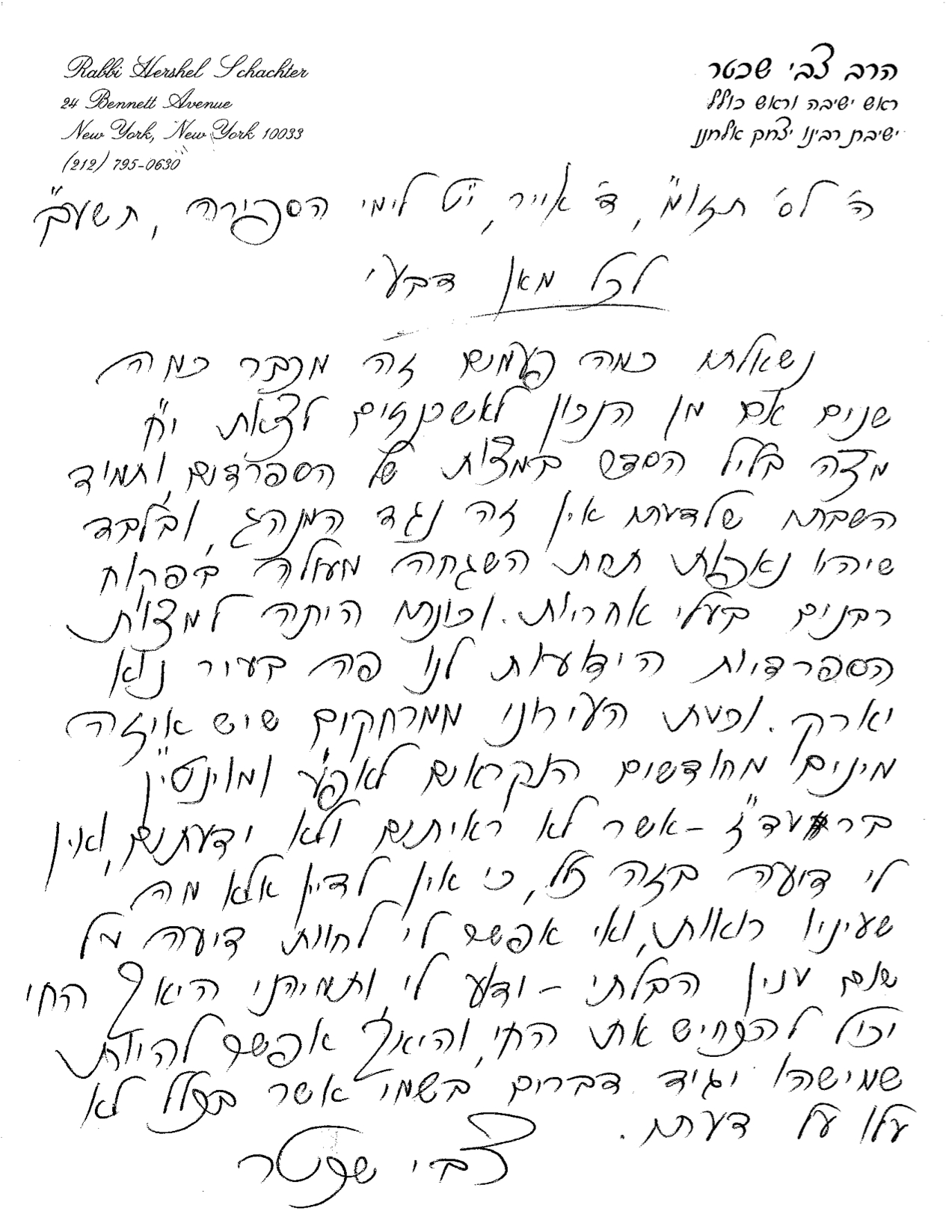
Statement from מו’’ר, Rav Hershel Schachter שליט’’א

This puts an end to R’ Meir Rabi’s attempts to use Rav Schachter’s name in support of his Laffa. I hope he has the good sense to remove Rav Schachter from his marketing and information websites.

In English:

TO WHOM IT MAY CONCERNI have been asked many times over the past years if it is correct for Ashkenazi Jews to fulfill their obligation to eat Matza on the night of Pesach with Sephardic Matza. I have always answered that, in my opinion, this is not against custom provided that the Matza is produced under expert supervision and under the strict guidance of reliable and responsible Rabbinic authorities. My intention was in strict reference to the Sephardic Matzas that are known to us here in New York. I have now been informed from afar that there are new varieties called Laffa and Mountain Bread that I have never seen and know nothing about and I have not expressed any opinion concerning them, for one may only rule on what one’s eyes have seen. It is impossible to give my opinion on anything that I am not familiar with. I am greatly astonished how a “living person can contradict a living person” and how it is possible that anyone can say things in my name that have totally never entered my mind.Signed: Tzvi Schachter

Diet Coke on Pesach (segue)

In a previous article, I was critical of the wording and approach to this issue by Kosher Australia. In particular, they announced that people should not buy these diet drinks as they were Kitniyos. I argued that they were likely Kitniyos Shenishtane and therefore a matter of disagreement among Poskim and Kashrus Agencies and that people should ask their local orthodox rabbi (who would presumably liaise with Kashrus Authorities and advise their congregant as to the Halacha). I did not feel that Kosher Australia should make a certain pronouncement on the matter.

It is true that the Diet products have a Hechsher of the Rabbanut. It is equally true that some will rely on such a Hechsher and some will not. Some may rely on it during the year, but not on Pesach. Others may never rely on it. Some will only rely on a specific Rabbanut Hechsher: e.g. Yerushalayim.

I have also learned that R’ Lande has issues with one variety of Diet Coke preparation even during the year (let alone Pesach). It seems then that those who follow R’ Lande’s hashgacha need to investigate this fully with his office, depending on where in the world they find themselves wishing to drink Diet Coke and the like.

I asked the OU about the Israeli Diet Coke which doesn’t have a Mehadrin Hechsher, and only bears a Rabbanut Hechsher. The reply I received from the OU stated:

“Diet Coke from Israel is certified by OU. However, the OU symbol is not used on Coke products in Israel. One of the issues involved is kitniyos shenishtane”

In other words, like other Mehadrin standards, the OU does have some issues with this production which prevented them placing their Mehadrin OU stamp, however, the product is certified for use (clearly for those who do not necessarily seek Mehadrin).

Unsurprisingly, my attempts at eliciting further details failed. The OU are not about to provide me with details of changes that ought to take place before they put an OU on the product. I understand that  the OU have instigated some changes in USA production and therefore are able to place their imprimatur on that production line. Whether they rely on Bitul for Kitniyos Shenishtane when they have their OU imprimatur, I do not know.

So, in summary, if I was a Kosher Supplier of groceries in Melbourne, I’d either

  • approach the OU to see if they are able to instigate a process whereby the Israeli product gets the OU stamp, or
  • import the diet drinks from the USA with the OU stamp

Clearly the former is better, as we support Israel and Israeli goods.

The other contentious issue is that of Quinoa. As I mentioned, there was a finding by a respected Kashrus Agency that some Quinoa was proximate to Chametz during production. This is a concern. I notice that Eden has a Quinoa that is certified year-round by the OK. If I was a Jewish greengrocer, I’d be approaching the OK to see if they can ensure that Eden Quinoa is certified as OK Kosher for Pesach as well and stamp it as such. That way, those who use Quinoa because it is not Kitniyos, will be confident and free to do so.

Disclaimer: I must stress again, that all my comments on Halachic topics should be deemed pitputim b’almo. In other words, they are not L’Halacha, and not L’Maaseh. Discuss the matter with your local orthodox Rabbi.

I’m closing the Kosher V’Yosher vs other Rabonim comment stream

I posted an article about Diet drinks on Pesach. The comments section was respectfully filled with important information from Rav Moshe Gutnick of NSW and others. I found myself eventually having to tone down some of the comments of interlocutors through editing. Rabbi Rabi of Kosher V’Yosher sent me a comment last night and it is not one that I can edit in the way that I wanted to. I would have removed the misleading Gravatar. Seemingly unable to find a picture of himself alone, Rabbi Rabi continues to use conjunctions of his image with a famous Posek (in this case Rav Belsky, may he have a Refuah Shelemah). In my opinion, this is G’neyvas D’aas as it may well constitute a transparent attempt to ascribe importance and respectability to his business and hechsher. It’s most unbecoming. I’m not going to be a mouthpiece for marketing of business/hechsherim. So, I’ll reproduce his comment below (lightly edited) without his gravatar and that’s the end of this issue for me unless I see written information either to his business/hechsher from Rabonim which contradicts the information that is issued by the Rabbinic Council of Victoria/NSW or if Rabbis from Victoria or NSW produce written information to them which contradict’s Rabi’s information.

In our first year we did not have flour that was Shemurah from Ketzira, harvest, but only Shemurah from milling. An alert was placed upon the Matza packets of that year – suggesting that people use Matza that is Shemurah from Ketzirah for their Mitzva of Motzi Matza. There was no ambiguity that would lead any reasonable person to think that regular flour was used. If there is anyone who has a record indicating otherwise, I urge them to bring this immediately to my attention. Failing that, all remarks and those on this site saying/suggesting otherwise ought to be removed.In the same vein, quite a few postings here have been edited, the same courtesy and moral fibre dictates that all unsubstantiated remarks that reflect negatively upon my work and reputation should also be removed.A remarkable claim has been made, that HaRav Schachter rules that soft Matza may only be made by those with a Mesora; however, Rabbi Lebowitz has written that “I spoke to Rav Schachter about this several times. He holds it is completely permissible and has nothing to do with mesorah.” SEE full email http://www.realmatza.com/r-a-lebowitz-email.html Rabbi Moshe Gutnick emailed me that HaRav Schachter’s ruling can be found on the web. Can anyone assist me to locate this? We have not been able to locate it.

The influence of religion on University life

I am unashamedly a fan of the separation of Religion and State, as per the US Constitution. In my life at University, I have felt uncomfortable when certain religious practices or traditions are loosely enmeshed with university life. Ironically, I’d prefer to see University as a secular home of enquiry. As a home, it could also provide facilities for its inhabitants. Therefore, a ski group, a soccer club, rooms for worship, a gymnasium and swimming pool, are all extras which are nice, but by no means mandatory.

Just before Xmas, our central office is decked out with Xtian imagery. This is inappropriate. This is a central office. It was not designated as a public manifestation of the celebratory imagery associated with a conspicuous time of the year. Privately, if a staff member wishes to involve the trappings of their beliefs or otherwise in their office, then as long as its their own private property and is not a reasonable cause for students or fellow staff feeling reluctant to enter that office for consultation, I do not object.

Last Friday, our morning tea consisted of hot cross buns. Given most people in our Department are comfortable with that, it of course doesn’t concern me. I obviously didn’t go and for 20+ years have never partaken in morning tea apart from having a cup of tea. Eating Kosher food is my private affair and I don’t expect the University to service my need.

Consider, this development. It disturbs me.

Professor Malcolm Gillies, vice-chancellor of London Metropolitan University, said the selling of alcohol was an issue of “cultural sensitivity” at his institution where a fifth of students are Muslim.

Speaking to a conference of university administrators in Manchester, he said that for many students, drinking alcohol was “an immoral experience”.

“Because there is no majority ethnic group [at London Metropolitan], I think [selling alcohol] is playing to particular parts of our society much more [than to others],” he was reported as saying in the Times Higher Education magazine.

He said he saw little reason for the university to subsidise a student bar on campus when there were “at least half a dozen pubs within 200m”.

He told the Guardian the makeup of his institution had changed considerably over the past few decades. In the past it had been “substantially Anglo Saxon – now 20% of our students are Muslim,” he said.

“We therefore need to rethink how we cater for that 21st-century balance. For many students now, coming to university is not about having a big drinking experience. The university bar is not as used as it used to be.”

Gillies also told the conference that universities needed to be more cautious in their portrayal of sex than in the past.

“We’ve got a younger generation that are often exceedingly conservative, and we need to be much more cautious about sex too,” he said. Many female Muslim students were taken to university by a close male relative. “Their student experience is going to be different from someone who is gorging out in the Chocoholics Society or someone who is there to have a … libidinous time.

If I was a Muslim, and people were drinking at a University event, then I could either choose not to drink, or not attend. There is no reason whatsoever for others not to engage in their normal practices. It is ridiculous to wake up all of a sudden and claim there are pubs 100-200 meters away when that has always been the case. There is a bar at our University which sells cut price bear on Thursday afternoon. We are in the Central Business District. Should it be closed down because people can go across the road?

These are very dangerous moves. They impinge not on the freedom of Muslims to adhere to their own religion, but on the rights of others to act in a way which the law specifically permits and ought to protect.

Anisakis, copepods, kitniyos shenishtaneh? Not in Satmer Matzas

ThE New York post reports about the new secret ingredient to keep your gut lined with pathogens, and all Mehadrin to boot.

Diet Drinks: Kitniyos that have undergone a process of change

[Disclaimer: everything I write is not להלכה and not למעשה. In this case, my knowledge of food science is also, at best, cursory. Do discuss this issue with your Rabbi and don’t be influenced in practice by my pitputim]

In Halacha, legumes which have been traditionally not used over Pesach for a number of well-known reasons, are forbidden. This is the Ashkenazi prohibition of Kitniyos. Some, like Rabbi David Bar Chaim (who I remember as David Mandel when he was in Melbourne many moons ago, and who went to study at BMT/Hakotel at around the same time that I went to KBY 🙂 asserts that it’s not a blanket Ashkenazi prohibition, but rather one that is an Ashkenazi prohibition outside of Israel. His view is that Minhag Eretz Yisrael was never to adopt the minhag not to eat Kitniyos. I would assume, that Rabbi Bar Chaim, should he find himself in Chutz La’aretz over Pesach, would adopt the Minhag of Ashkenazim in Chutz La’aretz and not partake of Kitniyos. My assumption may not be true, of course, as he would appear to have a renaissance-style agenda for reinstating what he sees as Minhag Eretz Yisrael, even prior to Mashiach coming, rejecting any imported Minhagim from those who have made Aliya over the last 3-400 years.

What is the הלכה if Kitniyos is an admixture of a food stuff? Do we assume that it is Batel B’Rov, nullified by the majority of the ingredients which are fine, and bought before Pesach? This is a disagreement amongst the Poskim, however, where there is any semblance of a medical need, given that the issue of mixtures isn’t black and white, Poskim are certainly lenient across the board.

What about the derivatives of Kitniyos? This is known as מי קטניות? Famously, Rav Kook ז’ל declared that they were completely acceptable, because Ashkenazim never had a Minhag not to consume this, and the process negated all the issues that Kitniyos came to protect in the first place. Rav Kook’s permissive ruling is halachically sound, however, Charedim rejected it and as such it has become a default “not to rely on this Hetter”. Having said that, I well recall that even in Melbourne, as the outsiders “infiltrated” our midst, certain Kitniyos or questionably Kitniyos derived oils (מי קטניות) were definitely used by almost everyone. Peanut oil is a good example. It is highly unlikely (as per R’ Moshe ז’ל) that peanuts were ever included in the ban on Kitniyos. If we couple that doubt together with the fact that we aren’t dealing with peanuts per se, but rather a product derived from peanuts, and prepared before Pesach with a Hechsher, it can cogently be argued that there should be absolutely no problem. However, we have a long-standing custom to choose something with zero doubt over Pesach: that is, we are Machmir. Being Machmir (stringent) seems to be a long-standing Minhag. In a similar way, during Aseres Yemei T’Shuva we have a custom to be Machmir on Pas Palter and perhaps Chalav Stam even though we aren’t Machmir a whole year around.

Enter the Diet Drink. Our society loves their Diet Coke, Diet Pepsi, Diet Prigat etc. When you pick up a bottle of these at your local Kosher greengrocer, you will see that the Coke has at least one “Charedi” Hashgacha, such as from the Chug Chasam Sofer, or Rav Lande from B’nei Brak. Yet, the diet version has a Hashgacha from the Rabanut. What gives? Artificial sweeteners are often derived from Kitniyos. They are another level away from מי קטניות. Why? Because they have been chemically altered/processed. This is known as קטניות שנשתנו, Kitniyos that have undergone a process (chemical) change/development. Again, the Poskim are divided on this issue. Unlike Kitniyos derived oils, however, on this issue even Charedi Poskim stand on either side of the debate. One cannot just dismiss it because it emanated from the “Zionist” Rav Kook (did you know, by the way, that Rav Kook refused to join a religious zionist political party). On this issue, we have very respected Kashrus authorities who permit it: such as Rav Belski (senior Posek of the OU and a Charedi Rosh Yeshiva) and Rav Gedalya Dov Schwartz of cRc—not to be confused with the anti-zionist CRC—(who I was fortunate to meet and speak with when he came for a wedding I played at in Melbourne) and others. Rav Schwartz is well-balanced and respected by all. The model of co-operation in Chicago is an icon for the rest of the world.

With this in mind, I’d like to quibble with the wording that was sent out by our own Kosher Australia recently. Yankel Wajsbort, who does a fantastic job, and is partly responsible for bringing our lists to the modern world of communication wrote:

A reminder that all the Diet drinks (Coke, Pepsi, Prigat) available in Australia use kitniyos sweeteners (a check of the label will show that the regular Kosher certification does not cover Pesach).

I have three problems with this statement, especially in the context of the later comments about Hommous and Techina products being Kitniyos for Ashkenazim.

  1. This is not, in the main, Kitniyos. Rather it is Kitniyos that has undergone a process change, as above.
  2. It is not true that the label will show that the “regular” certification doesn’t cover Pesach. There is a different certifying body that approves of Diet drinks, as above. At least, that is true for Prigat. I haven’t looked at Coke.
  3. Kosher Australia has three ways of issuing a pronouncement on the issue of Kitniyos that has undergone change: It either takes its own stand on the issue, which I assume would be accompanied by a formal Tshuva, or it decides to follow one group of opinions on the matter (the strict one) given that it is a body that needs to certify for a range of groups across Melbourne, or it lists the two sides of the coin and suggests that people check with their local orthodox Rabbi (LOR).

My preference, similar to what I wrote about Quinoa, is that Kosher Australia briefly list the major Kashrus organisations on both sides of this halachic divide, and then suggest that one should consult with their LOR. The approach taken in the communication above is just too black and white for my tastes (sic).

Kosher Australia acknowledged that the wording could have been better, and their consistent policy is to follow R’ Lande on these matters. They prefer, apparently,  not to get into the intricacies, as above, as this may confuse. Fair enough.

Disclaimer: I don’t use Diet drinks on Pesach, only because I’m somewhat of a Machmir over Pesach, and if I ever want to be lenient, my wife steps in and puts a halt to it 🙂

PS. I discovered that Georgio Armani products seems also not to have Chametzdik alcohol in their liquid perfumes/after shaves. I saw this on one of the major hechsher websites. Anyone checked on it? Seems that the American one is fine. Not sure if Armani produce it anywhere else and/or differently.

PPS. Does anyone know why Chabadniks who avoid all processed food on Pesach, seem to rely on Hechsherim for wine these days (but not, for example, Vodka)

Walking between two women/men

In an earlier post, I remained בצריך עיון without an adequate understanding of how a certain bad spirit רוח רעה could cease to be a concern for the Rambam and Shulchan Aruch, Ramo and others, and yet become an issue again over the last 200 years. I wondered whether the particular manifestation of רוח רעה might have disappeared for a period of time, and if so, how and why later poskim decided that the cause of such harm had returned. Alternatively, perhaps from a bland rational stance, an increase in צרות and bad happenings to Jews caused Poskim to re-examine possible causes and re-introduce once discarded so-called הלכות.

Onto the matter at hand: there are two places in Shas which discuss whether (amongst a range of other things) a male/female is permitted to pass between two females/males: one is in Horayos, and the other in Pesachim. The source in Horayos describes the practice less in terms of being forbidden, but more in terms of the action as being a “cause of forgetting” one’s Torah learning. In other words, passing between two women has (or potentially has?) the effect that it can cause the male/female to forget what they have learned. Is this like the prohibition of unpeeled eggs overnight , another instance of a particular metaphysical effect that is beyond our physical discernment, and that we would be well advised to stay away from? To be sure, the Gemora also lists a series of “antidotes” in the sense that these promote a heightening of one’s ability to remember what they have learned. The antidotes include consumption of particular food stuff. I think that my own inability to remember things that used to roll off my tongue is simply due to me not doing חזרה revision. I have a tendency to read things that I have never studied, rather than things that I once had studied. That’s probably the academic in me. Here is a list of items designed to help ones memory.

1. Eating bread baked on coals (and all the more so, the coals themselves);
2. Eating a scrambled egg without salt;
3. Frequent consumption of olive oil;
4. Frequently drinking wine and smelling spices;
5. Drinking water left over from kneading a dough;
i. Some say, also sticking one’s finger in salt and using that finger to eat.

One side of me is tempted to adopt the approach of R’ Schachter on the issue of eating Fish and Meat together. R’ Schachter contends that not eating fish and meat together was the “best medicine of the time” but that we are enjoined to follow the best medicine of our time. Accordingly, that is the reason why many Poskim do not consider there to be any issue today in eating fish and meat together. In our case of walking between to humans of the same gender, could it be argued that the list of 5 (from Horayos 13b) constituted the best medical advice of the time (given the primitive understanding of medicine back then) and that in our day, we should only follow evidence-based, and medically sound treatment?

The items which stymie one’s ability to function well in their Torah (only?) learning, the Gemora lists:

1. Passing under the reins of a camel, and all the more so under a camel itself;
2. Passing between two camels; passing between two women; and a woman who passes between two men (causes difficulties for the men);
3. Passing where one can smell a carcass; passing under a bridge which has not had water under it for 40 days;
4. Eating bread that was not fully baked; eating the froth that accumulates on the spoon used to stir cooking meat; drinking from a stream that passes through a cemetery;
5. Looking at the face of a corpse;
i. Some say, also reading what is written on a tombstone.

I haven’t done the due research to find out if it was commonplace for medics in those times to also include non physiological causes, but I suspect that it was indeed common.

Interestingly and strikingly, it would appear that the Rambam and Shulchan Aruch, again decided not to include the advice that one should not walk between two women/men. I am sure that there are Acharonim that discuss the reasons for this. I regret to say that I haven’t done adequate research. I understand that Rav Aviner does indeed permit it in his גן נעול.  Rav Aviner’s “right hand man” contacted me to clarify that Rav Aviner asks the same question as I do in his גן נעול and remains בצריך עיון but he doesn’t permit the practice להלכה except using well known leniencies. Unfortunately, being Erev Pesach, I was unable to procure a copy of the relevant pages in גן נעול.

It was with interest then, that I was reading on Shabbos, the newly published Piskei Halacha of R’ Yisroel Belsky who together with R’ Schachter are the senior poskim of the OU (may R’ Belsky continue with a Refuah Shelema). In this book it states:

Most poskim maintain that women may perform actions that cause forgetfulness of Torah (Shemiras HaGuf V’Hanefesh pages 98-99). Practically speaking, though they should l’chatchillah be stringent (R’ Belsky).

The halacha of not walking between two women applies whether a man is walking between two women that are stationary (R’ Belsky, Minchas Yitzchak 10:68:3) or if a man walks between two walking women. Certain poskim question whether this issue applies to one walking between non-jewish women (Maharsham 4:148). Practically speaking one should be stringent (R’ Beslsky, Shmiras HaGuf VeHanefesh 111:9, Beis Baruch 1:39).

One should not walk between his wife and his daughter (R’ Belsky, Shmiras HaGuf VeHanefesh page 33. Refer to Shevet HaKehasi 2:325 who permits if the girls are under 12).

There is a misconception that one who eats the end piece of a loaf of bread is susceptible to forget his Tora knowledge. However, there is no real source for this minhag, and one is permitted to eat it (Orchos Rabeinu 3, page 104 states that the Steipler did not eat the end of the loaf).

It seems to me, that the problem exists only if the two women or men (or beasts!) are companions. Otherwise, no one could go anywhere, since there are enough men and women in the world that one is always passing between them?

The aforementioned stricture of a male/female passing between two females/males is brought in Kitzur Shulchan Aruch Siman 3:8 and the Chazon Ish is known to have been very careful with this (as quoted by R’ Kanievsky in Ta’ama D’Kra page 108 (6th edition)). So the Kitzur Shulchan Aruch mentions it, but the Rambam and main Shulchan Aruch ignore it. Do you understand that? I don’t.

The Magen Avraham סעיף קטן ג בשם כוונות also notes that one should not put on two clothing items together for the same reason. This is perhaps germane when one puts a hat on, together with the yarmulka inside the hat. In Rivevos Efrayim from Memphis, Tennessee (ח”ח סימן רצא) R’ Greenblatt was asked whether a man who is walking with his wife in the street (on his right) and then passes another woman to the man’s left, if the man is transgressing. He answers that this is okay, because the Gemara talks about two stam women, not a woman and a wife! I’m not sure whether this is a Litvish piece of hermeneutics which seeks to avoid an uncomfortable issue, or not. The Ben Ish Chai שנה ב’ (פרשת פינחס אות יז) qualifies this general Halacha to when the three people (man and two women or woman and two men) are in a straight line, and when there is less than four Amos between them.

Is this Halacha similar to the eggs overnight or meat and fish issue? Is this a Halacha that stems from medical advice, or is it one that derives from metaphysical considerations, such as Shedim or Spirits? If it is the latter, then I ask again, why the Rambam and Shulchan Aruch didn’t include it. The latter, R’ Yosef Caro certainly was deeply steeped in Kaballah as is well-known. Today is also the Mechaber’s Yohr Tzeit. May he have a Lichdige Gan Eden.

The Sefer Leket Yosher (d. 1490) who was a Talmid of the Terumas Hadeshen perhaps enlightens us on the general issue. He states

עיין בשער המצות (ס׳ וילך) וז״ל: צריך לזהר במאד מאד שלא לאכול שום לב בהמה וחיה ועוף, חכלית שרש התקשרות נפש הבהמית, ואם יאכלהו האדם מחקשר בו נפש הבהמית ההיא לגמרי, והיצה״ר מתקשר בו. ומטע״ז ג״כ ארז״ל שהאוכל לב בהמה גורם לו שכחה וטפשות הלב. עכ״ל.

Incredible stuff. He states that eating the heart of an animal (one of the other things one should not do for the same reason) is dangerous because one is effectively eating the soul (life source) of the animal, and as such he eats the source of גשמיות and יצר הרע, the Animal Soul or the Nefesh Habehamis. It seems to me to show that this is not a medical piece of advice (at least for this item) but a more metaphysical/kaballistic piece of advice. Note also, quite interestingly and perplexingly for those who forbid these things, that the Ramoh in Yoreh Deah at the end of Siman 11, says explicitly about Shochtim (who generally must be more punctilious with Mitzvos than the rest of us)

“And it is customary to eat from the heart”

On that note, I’ll sign off and wish everyone a Freilich’n and Kosher’n Pesach … חג שמח

When is not approved not kosher?

The word kosher, alone, doesn’t mean too much. It needs to be qualified. It is not an absolute unless each and every authority agrees. That is rare. Even with something as mundane as water, we know that because of micro-organisms (copepods) in various countries, some authorities recommend filtration. If your Posek recommends that you filter, then it may also be that your Rabbi considers unfiltered water not kosher. On the other hand, your Posek may consider it Kosher B’Shaas HaDchak or B’Dieved. It depends on the issue at hand and its halachic severity in the eyes of your Posek.

There are a myriad of so-called Kosher Certifications. Does that make them all Kosher? That’s a loaded question; it’s in the eyes of the particular consumer and their Posek. For one Posek a particular certification is not recommended, and how you translate not recommended in general, may mean it’s simply not Kosher any time under any circumstance. Triangle K and Rav Abadi’s Kashrus rulings are but one example of certification that is not relied upon by other agencies and communities. It is relied upon by others. They aren’t on the Kosher Australia list, and are not on many lists around the world. If your Posek says that you may not rely on it, then for you, it is not Kosher. It is not fit. Kosher means fit for halachic consumption; your halachic consumption. If you rely on an agency, such as Kosher Australia, then it’s the same deal. If they do not recommend it, it is not fit for your kosher consumption. However, saying that someone else whose Posek or Kashrus Agency does allow, Triangle K for example, is eating non kosher, is none of your business.

If I don’t use the Melbourne Eruv because my Posek advises me not to, I am not going to say that Jews who do rely on it, based on their Posek or Agency, are carrying on Shabbos!

In context then, there was a harmless post on the Kosher Australia Facebook page where a subscriber to Kosher Australia, who follows Kosher Australia asked on the Kosher Australia Facebook page whether the “It’s Kosher” supervision is Kosher. In context, that clearly is asking whether food under the auspices of “It’s Kosher” is permitted to be eaten. The answer is of course No! The reason, as provided by Yankel Wajsbort of Kosher Australia is that it is not recommended. There are no surprises here, and I was flabbergasted to learn that one of those heavily associated with “It’s Kosher” took great umbrage at the question. It is perfectly valid to ask if something is Kosher to a Kosher Agency. That’s how questions are asked. Nobody asked “if I am served something from “It’s Kosher” at someone’s house, am I permitted to eat it, or should I find a reason to make a quick exit. That’s a different question. Kosher is Lechatchila; in the first instance. In the first instance, if you are served, for example, Soft Matza from “It’s Kosher” can you eat it according to Kosher Australia. The answer is no. The folks from “It’s Kosher” are a bit too sensitive from what I can detect. You can’t stymie valid questions and answers and most importantly, attempting to stymie such discussion is definitely not going to ingratiate “It’s Kosher” in the eyes of the Kosher consumer.

“It’s Kosher” and its network of consumers ought just follow their Rabbi (Meir Rabi), and leave others to follow Kosher Australia and/or their own Posek. Threats are silly in the context.

One of a kind

One of my mentors was Rav Baruch Abaranok ז’ל. In the early days, he was in New Zealand at the Dexton home for orphans. At other stages he was a grocer and a מוכר ספרים. Eventually he came to Melbourne, where he became the מרא דאתרא of Mizrachi Shule. I used to try to visit him on Sundays, bringing my children Talya and then Tzvi Yehuda with me. My visits coincided with the days when I stopped going to Mizrachi for reasons I won’t go into. If I didn’t visit Rav Abaranok regularly, he would express surprise and I felt bad.

When he got quite ill, I went rarely. I know he couldn’t understand it, but I couldn’t tell him; in fact, I coudn’t tell anyone. I was consciously trying to stop myself getting too close because I feared the emotional chasm that would materialise should he leave this world due to ill-health. This was a selfish motive; a display of weakness on my behalf. I don’t expect anyone to understand or accept what I did, but that’s what happened and why.

When we were married, I learned that my father-in-law had been a Talmid of Rav Abaranok in New Zealand, and they knew each other well. One story my father-in-law related was that in his grocery store, Rav Abaranok had a set of scales. When he sold, say, some sugar he weighed the sugar with the bag, and then weighed the bag separately. This, of course, is צדק צדק תרדוף … Rav Abaranok, as per Torah law, did not want to charge for any extra weight derived from the bag.

His honesty and integrity were not limited to the grocery store. All who knew him readily testified to his great morality and ethical virtue. I recall that when Talya was born, he came to our door with a gift. I had never experienced a Rabbi coming to my door in this way, and giving a gift. When Tzvi Yehuda had his Bris, Rav Abaranok was the Sandek. He, of course, tried every which way to give this honour to someone else. Again, I was stunned when he brought a gift of a Hebrew/English set of Mishnayos. On Yossi’s Bris, he presented a beautiful Mishna Brura, as authored by his teacher, the Chafetz Chaim. Rav Abaranok was the Rabbinic Posek for Mizrachi Kashrus, the precursor to Kosher Australia. Only someone of his integrity was acceptable to most.

These days, I am accustomed to seeing a different phenomenon. Some Rabbi cum Mashgiach comes into a food establishment from time to time to check the kosher bona fides. After the regulatory check, he sits down, and then waits, departing with a stack of food for his family! Something isn’t quite right. Yes, I know, he has an account …

As they say,

חבל על דאבדין ולא משתכחין

Kashrus Agendas

One of my earlier posts was mentioned in my old classmate’s now ubiquitous posts on kashrus. There is a constant refrain to these posts and unless I am not accurately reading between the lines, the theme is:

  • the Rabbis in Melbourne make oodles of money from Kashrus
  • the organisations in Melbourne make oodles of money from Kashrus
  • the standards of Kashrus in Melbourne are too extreme and designed to support a monopoly and those standards cost us money and are unnecessary anyway
  • some kosher good suppliers are making a fortune from profiteering on kashrus.

Enter the proverbial iconoclast, clad in fire-proof armour:

  • I will assume standards of kashrus which are different
  • I will market my standards incessantly across the internet and elsewhere
  • My motive is to bring the price of Kosher food down because I believe (anecdotally) that there are people who eat Treyf because they can’t afford the price of Kosher goods (meat?) that have assumed an OU-like standard
  • My finances and business dealings with partners on these matters are none of anyone’s business
  • My financial books are closed
  • I am answerable to nobody but Hashem
  • London bridge is falling down.

Assuming the motives are earnest and with honourable intent, the line of argument used is rather straw man like. Yes, we would like to see all Kashrus under a central body. Yes, we like to see a collegiate Rabbinate and not isolated breakaways running their own kashrus supervisions/business. Yes, we would like to see the financial aspects of Kashrus provision (where relevant) under the financial supervision of a communal lay body. Yes, we would like to see Rabbis and Chemists and Mashgichim paid properly for their professional hard work. Yes, we would like to see shysters purporting to offer a kashrus service outed.

I assume my erstwhile colleague is serious about his concerns about the price of chickens and more, so I suggest that he invite Rabbis and owners to an independent Dayan. I’d recommend R’ Hershel Schachter.

Vacillating on the internet is okay for musicians like me, but I’d suggest it isn’t a productive path for a Rabbi attempting to convince his colleagues through earnest debate. Some would say it’s a populist agenda like the socialists who put up “Viva La Revolution posters” near my office and all around RMIT. I don’t think they achieve much thereby.

Saying Tehillim for the sick

It is proper and laudable when concerned brothers and sisters pray for those who are dangerously ill. We say private prayers in the Amida, make a Mishebeyrach, say an extra chapter of Tehillim, sometimes privately, and other times as a collective group.

Recently, several prominent Rabbis continue to be dangerously ill. These include: R’ Ya’akov Yoseph, R’ Yisroel Belsky, and R’ Yosef Shalom Elyashiv. Rav Aviner recently addressed a question about R’ Elyashiv, who is 100+, and as I understand, on a ventilator and in need of רחמי שמים.

R Ya'akov Yosef

The question was:

Should we pray for Ha-Rav Yosef Shalom Elyashiv to heal from his illness, or – as one Rabbi suggested – should we pray for Hashem to take his soul on High since he is suffering so much?

This is a very bold question to ask (I think that most people who ask such questions either are on an exceedingly high level or are asking להלכה and not למעשה.

Rav Aviner’s answer was:

It is correct that the Ran writes in Nedarim (40a d.h. Ain. And see Baba Metzia 84) that if a person is suffering terribly and seems to have no hope of recovery, it is permissible to pray for him to die. The source for this idea is the Gemara at the end of Ketubot (104a), where it is told that Rebbe Yehudah HaNasi was suffering terribly; his maidservant saw and prayed that he should die. Even though she was not a Torah scholar, but a maidservant, the Sages greatly respected her and the Ran rules according to her example. In Shut Tzitz Eliezer (vol. 5 Ramat Rachel #5, 7:49 Kuntres Even Yaakov chap. 13, 9:47), it is written that this applies only if one is davening for the benefit of the sick person who is suffering a fatal illness, and not in order to lighten our own burden. It is clear that our intent in this case it is to lighten the burden on Ha-Rav Elyashiv.
The Ran writes that it is permissible to pray for a person’s end in such a situation, but he does not write that one is obligated to do so. After all, the Gemara itself relates that while the maidservant prayed that Rebbe should die, the Sages prayed that he should not die. In the book “Midbar Shur,” in his eulogy for Ha-Rav Yitzchak Elchanan (pp. 332-336), Maran Ha-Rav Kook asks: Why did the Sages pray that he should not die? Their view is difficult to understand. After all, Rebbe Yehudah Ha-Nasi was bed-ridden, suffering, could not teach or give halachic rulings, and was seemingly of no benefit to this world. If he would ascend on High, he would continue to teach Torah there. So why didn’t they pray for him to die? Maran Ha-Rav Kook explains that the influence of a great Torah scholar is not only through his teaching, halachic rulings, etc., but also in the presence of his holy soul in this world. The fact that his soul is located in this world brings blessing, even when he is unable to provide practical benefit, is closed in a room and cannot converse with others. This is similar to the Vilna Gaon, who for many years was closed in a room learning Torah. This world with Rebbe Yehudah Ha-Nasi is not the same as a world without Rebbe Yehudah Ha-Nasi.
When Rabbenu Ha-Rav Tzvi Yehudah taught us this idea, he would say that Maran Ha-Rav Kook also suffered greatly, and he told him: Each and every moment that Abba is in this world, despite the suffering, he brings it light. And our Rabbenu would relate this with tears in his eyes.
If so, the same applies in our case. This world with the Ha-Tzadik, Ha-Gaon, Ha-Gadol, Ha-Rav Elyashiv is not the same as a world without him, even though he is currently unable to teach, give rulings, etc. The Rabbis who called on us to pray for Ha-Rav Elyashiv’s healing are therefore correct, and we hope that he will truly be healed and will once again actively bring the blessing of Torah and holiness to this world.
May Hashem send him a speedy and complete recovery.

R’ Hershel Schachter recently discussed the question of davening for a Refuah Shelema for someone who is close to being a גוסס—basically on their deathbed with no hope of survival, short of a miracle. R’ Schachter notes that the Mishna in Brachos is clear that one is forbidden to pray for a revealed miracle. As an example, he describes a man rushing home from work after being told that there is a major fire burning around his house. While driving, the man prays that his house is not one of those engulfed by flames. R’ Schachter notes that such a תפלה is ridiculous. Either the house is, God forbid, in flames or it is not in flames. Asking that it not be in flames is tantamount to praying for an overt miracle to transform a readily observable occurence.

R' Shmuel Rozovsky ז'ל

R’ Schachter then to retells a story that he experienced when visiting the Ponovitzer Yeshiva in B’nei Brak, during the time that Reb Chatzkel Levenstein ז’ל was the Mashgiach. Apparently, someone was very sick due to a certain cancer, רחמנא לצלן, and there was a request that everyone say Tehillim for a Refuah Shelema. Reb Chatzkel, who was sitting in Mizrach, refused and exclaimed that it was forbidden. The mood was incredulous; who would refuse such a request? At that time, the famed Rosh Yeshivah, R’ Shmuel Rozovsky ז’ל was seen leaning over to Reb Chatzkel and talking to him. Tehillim commenced. R’ Schachter was to subsequently learn that R’ Shmuel had explained to R’ Chatzkel that there were people who were successfully treated for the particular cancer afflicting the person for whom Tehillim had been requested, and it wasn’t one where there was “no hope” because the doctors had no more new ideas or one where the patient was effectively in palliative care. Had it been someone in palliative care, R’ Chatzkel would have been right.

Importantly, R’ Schachter explains that it is still proper to say Tehillim. However, one does not ask for a רפואה שלמה. Rather, one should ask for רחמי שמים, mercy from Heaven.

In reflecting on the question to R’ Aviner, in light of R’ Schachter’s insight, I think it’s most appropriate, when someone is effectively in a palliative state, to ask for רחמי שמים and not assume that we should suggest to Hashem how that רחמנות should be manifest (e.g. by death חס ושלום).

Let’s hope that we don’t need to say Tehillim for anyone because we have merited the realisation of the pasuk of אני ה’ רופאיך, “I am God your Healer”.

Gender segregation in psychological or psychiatric treatment

The question is not a new one. If one needs to undergo an extended and deep treatment regime, where there is much fundamental discussion about one’s life circumstances and all the confidential issues surrounding such, is it permitted to see a therapist of the opposite gender.

Some poskim will not permit any gender if the medical provider is an “apikorus” or not religiously inclined, as they fear that the treatment may well eventually involve the religious patient being influenced to unburden themselves from the yoke of Torah and Mitzvos. I have witnessed this therapy being applied to another individual. Such therapies sometimes assume that if a patient’s life circumstances have brought them into a spiralling and uncontrolled level of descent, that one must rebuild afresh and cast away all and every vestige of the former life to avoid these. This can mean ceasing to adhere to a religion-based lifestyle and/or cutting oneself off from the familial environment.

On the matter of gender separation, other Poskim contend that since there is a tendency, and indeed a need, to unload all of one’s deepest secrets and intimate feelings, it is best not to do so with a medical therapist of the opposite gender, as this may place both people in a position where they are sexually vulnerable. Such an opinion was recently published by R’ Yitzchak Zilbershtein, an expert in Halachic Medical Ethics,

R' Zilbershtein

and the Posek for the Ma’aynei Hayeshua hospital in Bnei Brak. R’ Zilbershtein is a son-in-law of R’ Elyashiv, grandson of the saintly R’ Aryeh Levin ז’ל, and brother-in-law of the famed R’ Chaim Kanievsky.

The ruling was countersigned by eminent Poskim, including R’ Ovadya Yosef, R’ Yisrael Belski, R’ Vosner and R’ Karelitz.  It concludes with the observation that if there is a clinical need to engage someone of the opposite gender because of their expertise, one should first ask the Rabbi of the Hospital. Presumably, the Rabbi of the hospital will be in a position to reflect on the medical therapist in question and whether there is a risk of a developing intimacy versus the immediate need of the patient.

It can be expected that many will howl with derision about such a Psak, as it suggests that there is professional compromise at play. On the other hand, it can also be viewed as a sensible suggestion because it engenders הרחקה, a distance between situations that may be likely to involve deep intimacy of thought. At the end of the day, it would, in my opinion, be wrong to compromise on the efficacy of treatment and possible cure on account of gender issues. I am presupposing that the “best” person for some treatment, or even the person who has a record of great success might be of the opposite gender.

החכם עיניו בראשו

“The wise man has eyes in their head”, and acts accordingly. For the masses, especially in B’nei Brak where gender separation is extensive and where seeking  a psychologist or psychiatrist (and not a Rabbi) to deal with one’s innate problems is rarer, this is a Psak that will hopefully encourage people to seek a medically qualified therapist.

Having recently read a book by a religious psychologist whose domain of expertise is Child Molestation, it was interesting to note that in most cases it was he who discovered that molestation had occurred. Parents usually have no idea. This is especially so in a frum community where feelings are taboo and extreme conformance is a way of life. It was only because parents sought professional help for “strange behaviour” that he discovered the tell-tale signs of molestation. Let’s hope that this Psak encourages the religious community to also deal with the myriad of psychological ailments and propensities that our generation is facing by referring these to experts.

Giving a year of one’s life

R’ Yosef Shalom Elyashiv, may he have a רפואה שלמה, is still critically ill, although reports today suggest that he has emerged from a medically induced coma and is gesturing with his hands and eyes. R’ Elyashiv is a widely acclaimed Posek who is over 100 years of age. I have asked two Shaylos to him in the past. These were over 20 years ago and before he was named or considered the “Posek HaDor”.

Recently, various Charedi press outlets have reported that a young man allegedly bequeathed one year of his life to R’ Elyashiv. Symbolically, this is a nice gesture. However, it troubles me on a few fronts.

It is reported that the young man went to speak about his proposal to a range of Poskim and Rabonim and that they advised the young man to speak to his family first. I gather that he sought to find out if it was “possible” to do so, from a halachic perspective.

If it is indeed possible to do so, which is what is implied in the press, then I’d be interested to be educated as to which section of Shulchan Aruch discusses this phenomenon. In particular, where does it suggest in our Mesora/tradition that we have the right to dispense with a year of our lives, even for a so-called noble cause? It also troubles me that the young man didn’t discuss this proposition with his own family before he asked permission from the Poskim. I’d imagine that the young man checks with his wife (and not his Posek) about the details of the bread and milk order. Why wouldn’t you discuss this minor matter with her first, as well?

Another aspect troubles me. It seems to imply that we have the ability, as opposed to the permission, to enact such an extension of life. How many people have had, and continue to have, parents and children who are critically ill and who wouldn’t do the same thing if it was indeed possible?

What about 20 people donating a year each. Does that mean the person will live another 20 years?

Are we going to see jewbay sales where people auction a year of their lives to the lucky winner, together with a “Buy it now” clause?

If it wasn’t so sad, it would be funny. I see this as the natural outgrowth of the unreasonable  and non halachic veneration accorded to human beings, albeit great human beings. Ironically, this time it isn’t occurring amongst Chassidim, who have generally owned the mortgage on this level of veneration. Rather, it is coming from the newer Misnagdic forms of veneration, where “the Rebbe” is replaced by a “Posek HaDor” or “Gadol HaDor” or “Manhig HaDor” or “Zekan Roshei HaYeshivos” et al.

R' Elyashiv, שליט’’א

Homeopathy and Alternative Medicine against Halacha?

The Torah tells us Vayikra (19:26)

לא תנחשו ולא תעוננו

which means that a Jew is not permitted to participate in (loosely translated) omens and superstitions. We normally associate that with things like the red “kaballah” string which some Poskim rule, based on a Tosefta, is forbidden to be worn as a Torah prohibition of the above.

Perhaps more interestingly, poskim such as R’ Hershel Schachter contend that not following evidence-based (scientific) medicinal practices and treatments also contravenes this biblical command. They claim this is why the Rambam (and Magen Avraham and others) omitted the prohibition of easting fish and meat all together. If Science (peer reviewed evidence based research) indicates that something does not pose a health danger, then it is prohibited to adopt a former practice that relies on faulty medicine of the time.

It could be argued that homeopathy and its cognate areas, elements of whose treatments have not been scientifically evaluated for efficacy, pose a similar Torah prohibition. That is not to imply that all alternate medicine (now also known as complementary medicine) falls under this prohibitive rubric. Rather, unless there is a known, scientific, evidence-based peer-reviewed study which shows that a homeopathic or alternate approach is indicated as a complementary approach to a medical condition, it could be cogently argued that it is forbidden to use these alternate approaches.

RMIT has a research group in Complementary Medicine. I don’t think Halacha has any problem with that, nor would it have a problem with going to a regular doctor who is also well-read and skilled with alternative, evidence-based, scientifically-sound, complementary alternative approaches to medical conditions.

Beit Rafael Bikur Cholim

R’ Shimon Allen and his wife Adina are to be commended for this incredible gesture of Gemilas Chesed on behalf of the community. Shimon sits near me at Shule, and I know of many examples of his generosity. He would not want me to highlight it, however, I am doing so as an expression of הכרת הטוב—acknowledging good deeds.

Of course, it would be far better if there were no sick children and this facility was not needed. Unfortunately, the reality is otherwise.

A bikur cholim home is now available in North Melbourne to assist Jewish parents who have children receiving treatment at the Royal Children’s Hospital. Beit Rafael Bikur Cholim is a non profit organisation dedicated to easing the physical and emotional challenges endured by parents whilst their child is hospitalised.

Established in 2011, by Shimon and Adina Allen, Beit Rafael offers a quiet place where family members can relax and recover their emotions in a private setting, by providing accommodation, at no charge, directly across the road from the hospital.

A fully furnished and serviced, two bedroom apartment will be at your disposal to enable you to be close to your child, and will remove the need for you to commute back and forth to your home. A pantry stocked with kosher non perishables and a freezer containing kosher meals will be in the apartment.

The challenges of remaining with your hospitalised child during the week and over Shabbat and Yom Tov will be minimised.

Beit Rafael will be available to all members of the Jewish community, and parents will be welcome to stay at Beit Rafael for the duration of the child’s treatment, at any given day or time. When a child is hospitalised their greatest comfort is the presence of family.

It is suggested you enter the telephone number for Beit Rafael in to your telephone – emergencies do not give us warning.

Beit Rafael appreciates and respects your need for privacy and confidentiality is assured.

Please call the number below to verify availability and to arrange access to this apartment. You will be given the address and security code to enter the Beit Rafael apartment.

Telephone:  0421 408 522

On Shabbat  or Yom Tov please call:  0421 327 859

Shule to court controversy

It is difficult for mainstream Shules to survive in their earlier form.  A powerful method of attracting people back to Shule membership is to court iconoclasts and embellish them with a podium. A Melbourne Shule is seizing the moment, so to speak, as I understand they are sponsoring a visit from Rabbi Shmuley Boteach.

Rabbi Boteach is a controversial figure. Ostracised by Chabad, I haven’t  noticed him gaining traction with Modern Orthodox organisations. let alone right wing or ultra orthodox. He is visible amongst non-Jews and those outside the pale of traditional orthodoxy. I expect he is also motivated by a wish to influence Jews to become more devout as well as inspiring non-Jews to commit to the seven noachide laws. Is he the best man to do so? Boteach did himself no favours when he poorly debated Christopher Hitchens. That debate was embarrassing, to put it mildly.

Boteach described himself thus:

… then the Rebbe died and I had a major falling-out with the Chabad leadership because of my outreach to non-Jews. Ever since then, I have reconciled myself to the somewhat lonely status of being a Lubavitcher without a community. I compensated for my sense of isolation by becoming integrated into the mainstream Jewish community

It came then as little surprise when a senior figure in Chabad, Rabbi Dr Immanuel J. Schochet branded Boteach’s most recent book as heresy. R’ Schochet forbids the provision of a platform for Boteach to promote this book. R’ Schochet’s words are chosen in the context of the book. R’ Boteach, in his response to R’ Schochet, sought to popularise being banned by stating

We Jews are the people of the book, not the people who ban books.

This statement is shallow. There are Halachos about heresy. Books have been banned because they are deemed heretical. He can argue that his book is not heresy, but this “people of the book” line is something that might appeal more to Madonna and Michael Jackson. We are the people of the book even without including books that are deemed heretical. To be sure, R’ Schochet’s statement is an Halachic one. I do not see the category of “people of the book” influencing Halacha. Schochet chooses not to elaborate on his reasons, but I surmise that they be based on Rambam Hilchos Tshuva, 3:6-8

המורדים, ומחטיאי הרבים, והפורשין מדרכי צבור

Shmuley Boteach and Michael Jackson

Boteach expresses the view that he does not understand how Schochet could argue against missionary activity and at the same time choose not to discuss Boteach’s book in any detail.

Rabbi Schochet seems to have significantly changed his approach to Judaism and Christianity since his lectures under my auspices. Back then he orated openly on Jesus and the New Testament, rebutting missionary claims and engaging missionaries in public dialogue and exchange. There are hundreds of his tapes that attest to this fact.

R’ Schochet undoubtably considers it more difficult to engage in dialogue with missionaries and/or those who are ensnared by them precisely because of Boteach’s new book. Boteach admits as much himself quoting this review  [light editing from me]:

“Kosher J” is, after all, a book which Publisher’s Weekly — the platinum standard in book reviews — called an “informed and cogent primer on J. … a brave stab at re-evaluating J through an intensive look at the Xtian Testament and historical documents … and a well-researched analysis that will certainly reopen intrafaith and interfaith dialogue.”

R’ Schochet may or may not agree that it is “well-researched” but he too clearly feels that it will reopen intra and interfaith dialogue. Does Boteach expect us to be convinced that his book can’t be heretical because of the review by Publisher’s Weekly?

R’ Schochet’s son, R’ Yitzchak Schochet, is also a prominent Rabbi in the UK and has been considered a possible future Chief Rabbi of the Commonwealth. He had this to say about R’ Boteach

I question whether Rabbi Boteach has brought even one Jew involved in Christianity back to their roots through his debates, and suggest that it is little more than image and soundbite.

R’ Boteach reacted with:

Indeed, his father [R’ Schochet], who wrote this bizarre attack on me out of the blue calling me a heretic,

I don’t see anything in the letter that calls Boteach a heretic. Rather, R’ Schochet carefully crafted his words to refer to Boteach’s book as problematic.

Boteach has a liberal view of Apikorsus/Heresy in general. In the September 2000 issue of Nishma, Boteach stated in response to R’ Avi Weiss (who is considered a paragon of left wing modern orthodoxy, and who ordained the first female rabba)

I know that for Rabbi Weiss, even the willingness to be open to talking to apikorsim is a risk. But when the goal of the discussion is already a foregone conclusion, the conversation isn’t very risky.

Rabbi Boteach might not think it’s risky; others clearly do, and they do not feel an obligation to elaborate and give Boteach more airtime, as this would simply provide fuel for the fire.

Let’s be under absolutely no illusions here. R’ Boteach is not a Rabbi Slifkin. Rabbi Slifkin’s books were banned by people who couldn’t read English, let alone who had read Slifkin’s books. R’ Slifkin is an author of erudite and learned Jewish books based on Rishonim and Acharonim. Time will show that Rabbi Slifkin’s approach to documenting an orthodox perspective on Evolution eminently sound and commendable. I’m a fan of Rabbi Slifkin and his essays.

Boteach isn’t a Rabbi Kamenetsky either. Kamanetsky’s book “the Making of a Gadol” was unfairly banned and later modified because it was seen to embarrass R’ Aron Kotler ז’ל and other Lithuanian Rabbis look “too human”.

The audience for Boteach’s book, however, is mainly the non-Jewish world and perplexed Jewish fringe dwellers. Is the correct approach to attempt to re-educate our co-religionists that they should see themselves as derivatives of Judaism? They worship J, and see him as “above Judaism”. What will Boteach achieve through this passively aggressive attack on their well-seated belief system?  Will the world become happier and a pluralistic paragon of peace? Does Boteach think that he’s the first who realised that Saul of Tarsus was the man who fashioned what that religion is today?

I have a religious colleague at work who likes to regale me daily with his “inspiration”. I’m quite tired of it, to be honest. In the last week I asked him to come back to me with the historical record of when Shabbos became Sunday, who initiated this, and why. It has quieted him. I don’t see any value whatsoever in challenging his belief system (he thinks he can speak in tongues) and I don’t expect him to challenge mine.

The Rav, in his famous 1964 essay “Confrontation” was firmly opposed to theological disputation or cooperation with the Church, except when dialogue was limited to shared societal values such as feeding the poor, helping the sick etc and where Jews needed to be partners with all people in advancing such activities. His grandson, R’ Meir Soloveitchik put it thus:

The Rav’s opposition to communal, and organizational interfaith dialogue was partly predicated upon the prediction that in our search for common ground — a shared theological language — Jews and Christians might each sacrifice our insistence on the absolute and exclusive truth of our respective faiths, blurring the deep divide between our respective dogmas. In an essay titled “Confrontation,” Rabbi Soloveitchik argued that a community’s faith is an intimate, and often incommunicable affair. Furthermore, a faith by definition insists “that its system of dogmas, doctrines and values is best fitted for the attainment of the ultimate good.” In his essay, the Rav warned that sacrificing the exclusive nature of religious truth in the name of dialogue would help neither Jews nor Christians. Any “equalization of dogmatic certitudes, and waiving of eschatological claims, spell the end of the vibrant and great faith experiences of any religious community,” he wrote.

A left-wing organisation known as YCT—Yeshivat Chovevei Tora—a brainchild of R’ Avi Weiss, has over the years promoted a stance which sees Rabbi Soloveitchik’s ruling as no longer binding in our time. YCT planned to join the Rabbinic Council of America (RCA) but withdrew those plans when they realised they would not be acceptable to the RCA.  In a learned panel discussion on this topic, Rabbi Dr David Berger, one of the outstanding academics in this field, said:

Rabbi Soloveitchik worried that theological dialogue would create pressure to “trade favors pertaining to fundamental matters of faith, to reconcile ‘some’ differences.”  He argued against any Jewish interference in the faith of Christians both on grounds of principle and out of concern that this would create the framework for reciprocal expectations.  Now, the changes in Catholic attitudes detailed by Dr. Korn are real, welcome, and significant, but they do not undermine these concerns.  Quite the contrary.  The trajectory of dialogue to our own day has confirmed the validity of Rabbi Soloveitchik’s analysis to an almost stunning degree.

With this background clearly in mind, perhaps the Melbourne Shule that has now invited R’ Boteach to speak has also broken ranks with the Rav and the RCA and embraced the views of YCT. As noted above, R’ Boteach’s views are seen to be even more left-wing than YCT. It should make for a controversy that will occupy the Jewish News and further seek to redefine the relevance of Shules and methods for attracting and retaining membership.

The Nazi Flag in Melbourne

See this article in the Sun. I thought I had a pretty good grasp over who is who in Melbourne. I’ve never heard of Chayim Ben Ariel and had not seen the use of this Kabbalistic אלד which is meant to ward off the Ayin Hora and ostensibly stands for  אנא למדני דתך

Chayim Ben Ariel (pic from the Sun)

I haven’t heard of this person or his mate. Does anyone know who they are?

One more Simcha peeve

In a previous blog post, I mentioned four simcha peeves. Unfortunately, I was reminded of another one recently: the intrepid minyan seekers (sic). Consider the two possible scenarios:

  1. The Ba’alei Simcha remembered to insert a specific time in the seder hasimcha specifically devoted to the davening of Ma’ariv.
  2. The Ba’alei Simcha either forgot or had not intended to insert a specific time slot for davening.

In both case 1 and case 2, the Mentshlich thing to do is to quietly approach the Ba’alei Simcha (or you could even come to the Band Leader) and ask if there is a preferred time for davening Ma’ariv. If there is a time, the case is closed, that’s when you daven. Ask whether an announcement will be made, of course. What do you do if you are one of the people who leave Simchas early because you have a difficult Tosfos that you just have to rush home for, or perhaps you have a sick child at home etc? I suggest that you do not disturb the Simcha. That means, do not make a minyan if it means that you will not be in the hall while someone is saying a Dvar Torah or giving a Hakoras HaTov speech. Sacrifice your own dinner. Eat it quickly. See if you can find another nine people who have also finished eating. Explain that you have to leave early, as above, and see if they will join you in the foyer while the rest of the guests continue eating their Dinner (or Dessert). Do not do this during a dance bracket. Why should the dance floor suddenly become barren and decrease the Simchas Choson V’Kallo because you preferred to choose your own time for davening?

If the B’aal Simcha forgot, try and minimise their already frazzled state of mind, and suggest a neutral time, at your expense, and your cheshbon, during eating time (when you are normally saying Mishnayos Baal Peh). Don’t choose speeches or dancing! I know this seems obvious, but I’m so frustrated seeing the arguably selfish and insensitive herding of the “cattle” davka during a speech or dance bracket.

At one Simcha, I was so embarrassed, I wanted to hide under a rock. One fellow organised a minyan, during a father’s speech of Hakoras HaTov. Not only were tables empty, but you could hear the bellowing of the “Borchu es Hashem HaMevoroch” reverberating inside the hall during the comparative silence of the speech. In my mind, יצא שכרו בהפסדו, and it was bordering on a חילול ה.

In summary, if you see this type of thing happening, approach the organiser of the minyan and ask if they have considered proper manners in executing their minyan for davening.

The truth versus the whole truth

In a previous blog post, I cross referenced a story relayed by R’ Lazer Brody. At least one of my readers was a tad skeptical about the stories veracity. In the meanwhile, I received an email which suggested that the story never happened. True enough, the story didn’t happen in the way it was described. Here is what R’ Lazer Brody apparently writes about that story

Dear Rahel,
The story is actually a composite of three stories, all of which happened. The activists on the 350 bus, with the Breslever’s comment about the value of riding a mehadrin bus was one incident that occurred 2 weeks ago. A Breslever’s invitation of egalitarian activist for Shabbat and the revelation that many Haredi men and women are university graduates and army veterans was a second incident. The explanation about the rationale of shmirat eynayim to a hostile feminist was a third incident that happened to me personally in Manhattan. I turned all three into one incident to show how Rabbi Shalom Arush teaches his students to react in such a situation – ahavat Yisrael and Kiddush Hashem. Blessings always, LB

Some have reacted to this admission by saying that it was Gneyvas Daas. Others use this story to show that one must always check the veracity of such nice tales because they may well never have happened. I am as skeptical as the others. I’ve often been accused of having too much skepticism. Either way, I have absolutely no problems with the

  • story itself
  • use of the story in context

The story is made up of three sections, all of which are true according to R’ Brody. They happened to three different Breslaver Chassidim. To combine these into one story is to say that it is both conceivable that this could occur to one Chassid, but most importantly, that this is one approach to pursue when confronted with such a situation.

It isn’t the whole truth, but it is certainly truthful. I’m okay with it.

R' Lazer Brody (left) with his teacher R' Shalom Arush

Lock these vermin out

I’m sorry, there is no other way than to describe them. They are vermin. If this story is accurate, or even mostly accurate, I hope they have video footage. There should be video surveillance cameras installed in every single road in Beth Shemesh where these vermin hang out. Catch them, put them in prison for 5 years, and then lets see where it takes us. Are we going to wait and wait and wait for the never resultant condemnation from their Rabbinic mentors? The lunatics are out of the asylum.

Watch this video of the girl, Natalie Mashiach, recounting her horrible experience.

And, for something different, a Breslover reaction.

Natalie Mashiach, assaulted in Beth Shemesh

Some klezmer and more

Hat tip to Abe. I enjoyed this performance though I’m not the world’s greatest Klezmer fan. While I was watching, I had positive thoughts about these guys thinking “heck, normal frumaks, using their God-given talents and not spooked because a lady or ten are behind them or in the audience”. Compared to the images we have seen lately, I almost felt relieved!

At the same time, I wondered, how many kids are there who should be

  • musicians
  • tailors
  • cabinet makers
  • shoemakers

Unfortunately, the image our “Gedolim” or the so-called “Daas Torah” that is “approved” for the masses, resonates with the view that everyone, or almost everyone is somehow born with a God-given talent for learning; that is, תורתם אומנותם. In the words of R’ Zishe, we won’t be asked why we “weren’t Moshe Rabennu”, we will be asked why we didn’t achieve our potential.

It is true, that many are seeking “computer work” and the like, and training for this. Each to their own. Our education systems need to nurture the simple message of each to their own. We won’t fully achieve that unless we also formerly teach respect for every type of Yid; yes the tinker and the tailor and candlestick maker. It must start at Kindergarten and be a developing theme with a formal curriculum. It must be treated with no less application than an anti-abuse or bullying policy. Somehow, through the tomes of Talmud and the pages of Chumash and Meforshim, we’ve come to develop children who have the most selective forms of אהבת ישראל. We, the Yidden who try to be frum, yes, each group, from the white left to the black right, needs to sit down and infuse this into the schools. We’ve become elitist. We are not an elitist religion. We are מחוטב עציך עד שואב מימיך.

The parameters of social responsibility

Companies need to abide by the law and should follow a moral and ethical line even beyond the law when dealing with their employees. However, companies should never ever be in the business of making social comment, especially when it involves matters such as whether same gender marriage is appropriate. Is this Apple or Microsoft’s domain? I am quite disturbed when they attempt to set a legislative agenda by doing so. Yes, I am aware that the business savvy among you will say they don’t really care, all they want to do is ensure that homosexuals and lesbians are attracted to their products and “feel good” about the company. There are limits to this brazen business agenda.

Read the report here.

Small community, small minds, big actions

There is a story in the Jerusalem Post about the City of Amsterdam firing its Chief Rabbi Aryeh Ralbag. The Ralbag family are very famous. They are big Talmidei Chachamim and oversee the controversial Triangle K Hechsher, which is not widely accepted.

Rabbi Ralbag signed onto a statement that homosexuals have an inclination that “can be modified and healed.” There is no doubting that they have an inclination towards the same gender. It appears though that Rabbi Ralbag aligning himself with a view that suggests that this can be modified is considered both disrespectful and irritating to the extent that he can no longer function as the Rabbi of Amsterdam.

This is not my area of expertise, nor do I imagine that it is Rabbi Ralbag’s area of expertise. There are, however, respected practitioners such as Dr Elan Karten, who tend towards that view. I haven’t got any insight into the veracity of the claims. As expected, the politically correct in Amsterdam have jumped and howled and sacked their Rabbi because he is seen as disrespectful.

He apparently apologised if his comments hurt anyone, but I’m not sure what his hangable offence was. Perhaps there was something more offensive in the document he signed? That document has an “Agudist” tinge to it, as witnessed by the signatories. Certainly, I prefer the RCA’s position. It is more constructively written. I would have preferred to sign the RCA version myself, but I don’t agree that Rabbi Ralbag should have been sacked.

The parents should be fined

More disgraceful acts in Beth Shemesh. Read it here