It’s easier to execute blessings than to represent a congregation

This might seem to be an odd topic to discuss but I will do so briefly as it comes up from time to time. The interested reader really should learn the laws in Orach Chaim 128 about a Cohen and Orach Chaim 53 about one who wishes to become a Chazan and lead the prayers.

A fundamental difference between the two is that the male who leads the prayers is a representative of the entire congregation. As such, if this is someone who is known to have sinned and has not repented faithfully then they should not be asked to lead the service. Of course, there is nobody who doesn’t sin. We are humans. The Halacha however focusses on someone who isn’t fit by virtue of them being known as doing the wrong thing when that “thing” is a more grave infraction. For example, someone who profanes Shabbos in public is not a person who we allow to be our chosen representative to lead the prayers. (I’m aware that there are Poskim who say that our generation is different and their breaking the Shabbos should not be seen as in the days of yore, however, this does not mean that we choose that person to lead the prayers!) There are many examples: someone who is married and is known to frequent other women is not permitted to lead the prayers; someone who has stolen money and not returned it, should not lead the prayers; someone who is unscrupulous in business etc. The list goes on. In general, the Gabbai (beadle) of a Shule chooses people who have requisite qualities (fear of heaven, being over 30, ideally married, understand what they say and be able to say it well, are capable of growing a beard, have children etc) as opposed to those with a serious question mark. Where there is an issue, one chooses a learned and pious person to lead the prayers, even if they have a poor (but not annoying) voice. Ideally, the voice should also be pleasant to listen to, unless there is nobody else. There is some subjectivity, and this is often an issue where a Gabbay must diplomatically consult the Rabbi. If someone questionable, who has not genuinely repented, insists on leading the prayers in honour of a Yohr Tzeit, this can become most unpleasant. Indeed, our Rabbis teach us that if the person leading the prayers has a serious question mark  concerning them, then all the blessings they make on behalf of the congregation metamorphose into curses (God forbid).

The Cohen is also performing a mini-leading of sorts. The Cohen, however, represents God in the Cohen’s positive Torah command to bless the congregation.  He and his fellow Cohanim are bound by various laws that pertain to their suitability. For example, they should not have killed. [ An interesting question arises about the Cohen who is a soldier in the army. In Israel today, there is in my mind no doubt that each war is a מלחמת מצווה, a war where Israel’s very survival is at stake, and for which even a Groom joins in the defence effort. Defence however entails attack and attack inevitably leads to killing another person.] Another issue is Cohanim with physical defects, but it is not my intent to agglomerate all the laws here.

One interesting qualifier of the Cohen is that when he blesses the congregation, this should be through a blessing of Ahavah; that is a love of their fellow Jew/congregation. A congregation that is unable to remove negative thoughts about a particular Cohen needs to make sure that this Cohen not bless them as part of a group of Cohanim who are blessing. The Aruch Hashulchan (128:21) explains the love pre-requisite of the priestly blessing based on the Zohar.

“Any Cohen who can’t bring himself to have Rachmonus (mercy) on the congregation that he blesses, or about whom the congregation can not muster Rachmonus on him” (should find another community to bless.)

This is brought by the Magen Avraham in his gloss 18 ibid.

In other words, without being able to feel Rachmonus on a community there can be no bounded blessing based on love between the Cohen as God’s representative and that community and that Cohen should bless a community where he does find himself comfortable. Rachmonus is needed because it is rare to discover a congregation where there isn’t a single congregant about whom a Cohen has some doubts, and vice versa.

It is likely a truism, that most people, including Cohanim, feel odium towards the behaviour of some of their fellow congregants. It may even be directly mutual. The key, however, is whether a Cohen is able to concentrate on a community and have positive feelings while he acts as a conduit to blessing the people on behalf of God. If he finds himself unable to muster Rachmonus, most certainly, he should try to remove this impediment in his character. If he cannot stop his thoughts wandering negatively, and the positive feelings do not envelope his blessings, then it is better that he not bless that congregation. At the end of the day, the Cohen is blessed by God himself, on account of the Cohen blessing the people.

He who leads prayers, however, is a single person, who must represent, all the people. In this way, his acts and past acts can serve to invalidate him from performing such representation.

Those who were not born with a voice that is appreciated by others generally don’t get asked and therefore don’t face this challenge of representative acceptance. Fobbing off the Gabbai when trying to avoid being chosen to lead the congregation, as its chosen representative, is also not encouraged.

What should a congregant do if he is convinced that a particular Shaliach Tzibbur is of dubious character? One should consult their Local Competent Orthodox Rabbi for advice.

What should a congregant do if they loathe a particular Cohen who is blessing the congregation? Again, they should ask, although they do have the option of leaving the Synagogue at that time.

These are most uncomfortable situations. Ideally, someone who has not performed as God would want, will confess and repent. A(n angry) Cohen who is unable to muster a feeling of congregational positivity-call it an attachment to the Tzelem Elokim of each Jew if you like-should also ask themselves whether they should be one of the group blessing that congregation.

[Please remember: nothing I write should be misconstrued as a replacement for consulting one’s Halachic decisor/Posek]

How do you deal with the name Zelig זעליג?

This sounds like a strange heading for a blog post. Let me explain. In the last few months, we merited having two grandsons born to my younger two daughters. They and their husbands named both their sons Shaul Zelig, שאול זעליג after my dear father ז׳ל. I was honoured and, of course, this was due to my father’s very close relationship with each and every one of his grandchildren.

In the 1600’s, Rav Eliyahu Shapira in his famous work Eliyahu Rabo, quotes the Beis Yosef, Rav Yosef Karo, author of the Shulchan Aruch, that just before saying the Oseh Shalom עושה שלום of Shemoneh Esreh, one should say a Pasuk from Tanach whose first letter corresponds to the first letter of one’s  name, and such that the passuk ends with the last letter of one’s name.

One of my sons-in-law, had quickly taken on the custom to say his new son’s Pesukim for both שאול and זעליג as well as his own, until his son was old enough to do so. The other soon followed. I did not know but he had asked some Rabonim in Shule because he could not find a single Passuk in Tanach which started with letter Zayin and ended with a Gimmel. Eventually, it was concluded, thanks to computers, that there was no such Passuk. The question then arose, so what does one say if they practice this custom?

The Arizal and the Shelah Hakadosh both write about this concept and the latter mentions in his Sefer, that it is a tool or device to help one after 120 years, when facing God, and when asked their name (this would be something mystical that is beyond me). We will be in fear and the saying of this Passuk will jog our memory from its expected momentary freeze. (Some say the Passuk 18 times by the way). It is clearly a Kabbalistic/Mystical notion, however, I am accustomed to saying my name as well, because that’s what I was taught when I was a boy, and assumed this was mainstream practice. I don’t know whether Germanic, Oberlander or other Ashkenazic traditions also have this Minhag/practice. I would imagine that Sephardim do.

Either way, the advice one son-in-law was given was a bit of a compromise. He was to say a passuk that had a word in it that began with zayin and ended in gimmel. That’s not to say it wouldn’t work. I saw some opinions that indeed suggest this.

I was intrigued when I learned about this reality and started scouring (I don’t have Bar Ilan or Otzar HaChochma databases though). I found that some have a custom to say one passuk which would starts with a Shin for Shaul and ended with a Gimel for Zelig. This was legitimately sourced, however, both my sons-in-law both follow the Chabad custom, so I set about to find out what, if anything, Chabad does in such a situation (or indeed any group that says two Pesukim for two names).

I immediately thought to ring Dayan Usher Zelig Weiss, Rav of Shaarei Tzedek Hospital and a world-famous Posek. After all, his middle name is Zelig, and I have spoken to him before. I got an answer almost immediately that the Passuk that should be used is:

זָרַח בַּחשֶׁךְ אוֹר לַיְשָׁרִים חַנּוּן וְרַחוּם וְצַדִּֽיק

which is from Tehillim (112:4)

The reasoning is because in pronunciation the Gimel actually sounds like a Kuf. Indeed it does. I can still hear my father say it that way unwittingly.

Certainly, in Hilchos Gittin, where names and nicknames are most critical, I could see this as being significant. There are various theories about the origin of the name Zelig. In my father’s case (I surmise Dayan Usher Zelig Weiss, the Zelig was considered a coupled/translation of Osher (Usher) as in Dov Ber, Yehuda Aryeh Leib, Menachem Mendel, etc. I knew my father’s middle name came from his grandfather who was also called Osher (who was Yitzchak Osher Amzel or Reb Yitzchak Bogoshitzer) but since my father’s other grandfather was named Yitzchak, and was still alive, he couldn’t get the name Yitzchak Osher. I got the name Yitzchak later, as did my cousin Ya׳akov Yitzchak Balbin ז׳ל.

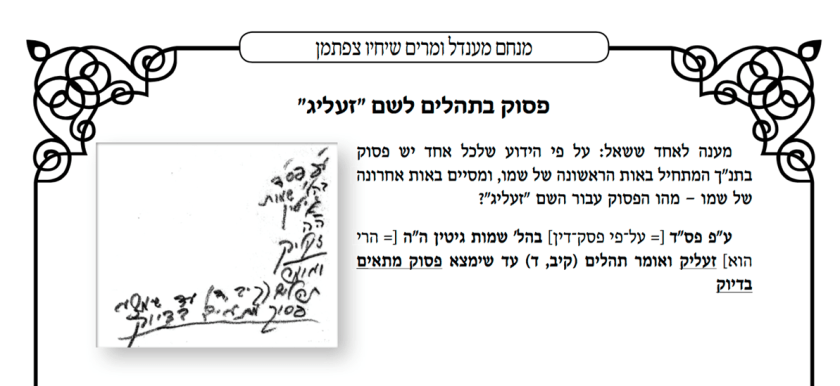
An oracular friend in the USA, Rabbi Michoel Seligson, sent me the following letter from the Lubavitcher Rebbe in response to someone who asked exactly this question (it’s reprinted from a couple’s wedding booklet gift to their guests).

image001And to add, see
where the Kav Noki quotes the Mahari Mintz (need time to look at that) supporting equivalence as in soundex. Clearly, soundex was extended to the Possuk as well, as a device for memorisation.

Zelig more  recently was the same as Germanic Selik or Selig. Rabbi Selig Baumgarten comes to mind. Again, accents/pronunciation are evident. Zelig seems to be derived from Old German meaning “chosen” or “blessed”. It is also found in Old English and may have become the word “select“.

We also find it in Yiddish with this meaning  as in “a zointz un a zelig(ch)s”

Back to the Lubavitcher Rebbe.

I am intrigued by the last words of the Lubavitcher Rebbe above which state that this is the Pasuk “until you find an exact pasuk”. I thought to myself, there are a finite number of Pesukim. Either it exists or it doesn’t exist. What possibly could the Lubavitcher Rebbe have meant “until you find“. You’d never find it! One could surmise he was hinting that when saying Pesukim in general, never stop paying careful attention to each letter of each Passuk.

I had another thought, for which I have no support. The tradition is that when the Moshiach comes a “new Torah” will sprout תורה חדשה. Perhaps, given the Lubavitcher Rebbe’s single-minded focus on causing Moshiach to come sooner, he was hinting that such a Passuk may come into existence in times to come? I don’t know. I’m certainly not qualified to double guess what he meant. It might be an explanation.

Either way, I found it an interesting tidbit, especially for those who have the name זעליג!

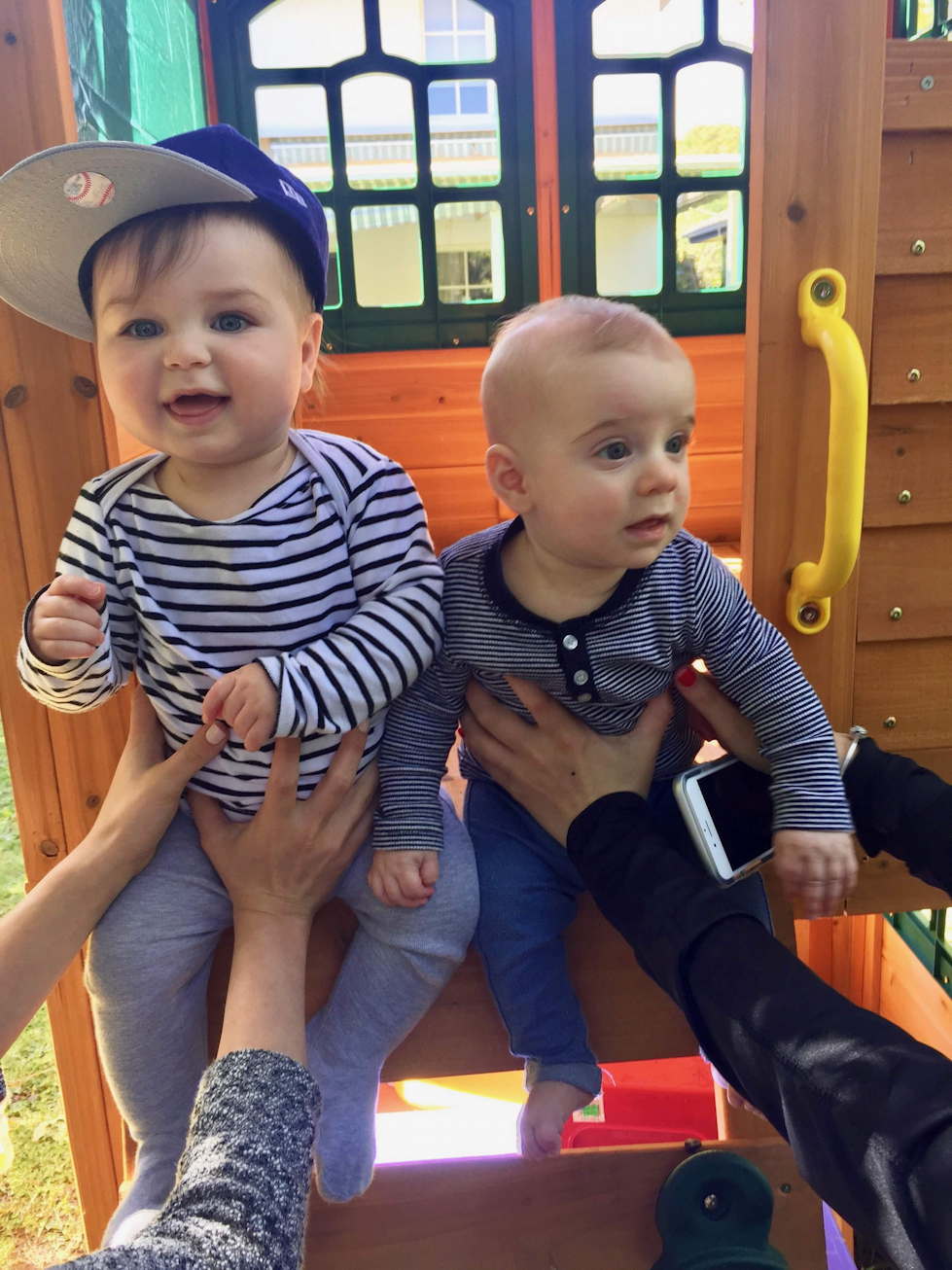
Oh, and here are our two treasures:

img_5315

More on the Chief Rabbinate vs Beth Din of America on Conversions

I had posted on this.

The Jerusalem Post indicates that Rabbi David Lau is not opposed to the conversions performed by the Beth Din of America, however, Rabbi Yitzchak Yosef prefers to treat each convert individually. I do not understand the rationale from Rabbi Yosef. Unless the Beth Din is Pasul, the conversion has occurred (except in very extenuating circumstances which would have been in existence before the conversion). I am not at all sure Rabbi Yosef’s father, Chacham Ovadia ז׳ל would agree with his son.

For the record: All Geirim need to go through a proper process of learning and should be accepting of the yoke of Mitzvos. That is independent. I believe this would certainly be the case for the Beth Din of America.

Here is the article.

Understandings reached in 2008 between the Chief Rabbinate and the Rabbinical Council of America stated that an Orthodox conversion performed in America and given formal approval by a rabbinical judge from the Beth Din of America would be recognized as valid in Israel by the Chief Rabbinate.

However, this agreement has been unraveling in recent years, as numerous cases have occurred in which conversion approvals from the Beth Din of America and its most senior judge, Rabbi Gedalia Dov Schwartz, have been rejected.

It is the rabbinate’s Department of Marriage and Conversion, run by Rabbi Itamar Tubul, which has been directly responsible for these rejections.

The department is under the authority of Yosef in his position as president of the Supreme Rabbinical Court, and sources in the Chief Rabbinate have indicated that he is responsible for instructing Tubul to adopt this new approach.

On Monday, an aide to Lau wrote a letter to Tubul, obtained by The Jerusalem Post, in which he stated that Lau had asked him to clarify to Tubul “once again” that “approvals issued by the Beth Din of America and signed by Rabbi Gedalia Dov Schwartz should be recognized, and that they should be relied upon for the purposes of approving [conversion] certificates which are received from the US.”

Yosef’s office declined to answer an inquiry made by the Post as to whether the chief rabbi considers the understandings of 2008 as still operative.

On Sunday, a spokesperson for the Chief Rabbinate said that every case requiring conversion verification from the US “is examined on an individual basis,” and that “there are no all-inclusive approvals or rejections,” indicating that the Chief Rabbinate, under Yosef’s direction, no longer considers the 2008 agreement to be binding.

Lau and Yosef have had a high-profile quarrel for several months over various issues.

The ITIM religious services advisory group, which has represented many of the converts requiring recognition by the Chief Rabbinate, welcomed Lau’s comments to Tubul, but was critical of the fight between the two chief rabbis.

“The internal bickering in the rabbinate is taking place while converts are suffering. This is un-halachic and inhuman,” said ITIM director Rabbi Seth Farber.

“We call upon the Chief Rabbinate to immediately disband the department and issue a statement that all conversions done under the auspices of rabbis from halachic institutions will be automatically recognized. This is what was always accepted in traditional Jewish society and this should be today’s standard.”

לשנה טובה תכתבו ותחתמו

A Bizayon (slur) on Kavod HaTorah by the Israeli Chief Rabbinate

[Hat tip NB]

The Chief Rabbinate has had the temerity, and I used this word with intent, to turn down some conversions of the Av Beis Din of the Beis Din of America, Rav Gedalia Dov Schwartz. I had the opportunity to speak with Rav Gedalia, when he came to Melbourne for the wedding of one of his students. I was merely the singer of our band Schnapps, but I took every opportunity to approach him at the head table and talk. I found a humble, knowledgeable, worldly, Talmid Chacham. He is ill at present and we wish him a Refuah Shelema.

The Chief Rabbinate which has been mired in corrupt controversy over the last few years and is a pale comparison to the greats who occupied the Chairs in days gone by, would do better to ensure that the Kashrus of their products throughout Israel were acceptable. As most people know, it is not a simple matter to walk into a restaurant under the Rabbanut and actually eat supervised food of an acceptable standard. I encourage people not to say “Ah well, it’s their sin, they have a certificate” but rather to ask to see and speak with the Mashgiach. Many times, you won’t find the Mashgiach. Let them get their house in order before they have the unmitigated Chutzpa to reject a conversion from the universally respected Av Beis Din of America. By contrast Rav Schwartz oversees the cRc, the Chicago Rabbinical Council’s Kashrus, upon which everyone relies. Indeed, their app, is the one you consult when it comes to the Kashrus of alcoholic beverages, as an aside.

Ironically, the Chief Ashkenazi Rabbi David Lau, spoke in honour or Rav Schwartz’s 90th birthday.

Males who refuse a Gett; an appropriate response

The Rabbinic Council of America again leads the way on this matter. The pioneering work by noted Posek, Rav Mordechai Willig on this matter, will now become compulsory for member Rabbis. Rav Willig had discussed his method with leading Rabbis around the world some years ago and received  their Halachic agreement. In Victoria, Australia, I understand there are some local legal impediments preventing this method ‘having teeth’. I trust that the RCV, the Rabbinic Council of Victoria are working overtime with both parties to make sure this is overcome. It is high time the Rabbanut in Israel enforced the same on all its Rabbis. I don’t know what other Rabbinic groups such as the Aguda opine, but given the number of very public issues in that sphere of late, it would be nice to see them follow suit.

The text of the RCA Resolution reads:

A Powerful Advance to Prevent Using Jewish Law to Cause Human Suffering

Sep 22, 2016 — “The Rabbinical Council of America today takes a major step forward toward alleviating the suffering of those who cannot successfully end marriages due to the refusal of one of the parties to participate in effecting a Jewish divorce,” said Rabbi Shalom Baum, president of the RCA. A resolution adopted by the RCA now requires “each of its members [to] utilize, in any wedding at which he is the officiant (mesader kiddushin), in addition to a ketubah, a rabbinically-sanctioned prenuptial agreement, where available, that aids in our community’s efforts to ensure the timely and unconditional issuance of a get.”

According to Jewish law, both the husband and the wife must participate willingly in the delivery and acceptance of a get, a Jewish divorce document, without which neither party can remarry. Most divorcing couples understand the need for the get, and are cooperative and respectful of the process. In some cases, however, one spouse inappropriately uses the get as a bargaining chip to gain concessions in other areas surrounding the divorce such as financial settlements or child custody, or as a tool to torment a former spouse. This is an abuse of Jewish law as well as a form of spousal abuse that uses religious practice as a tool of manipulation and control. A rabbinic tribunal often does not have the authority or capability of forcing a recalcitrant spouse to cooperate, and there are those whose marriages have functionally ended but who tragically cannot remarry due to their religious convictions. A woman who cannot remarry is referred to as an agunah; a man is an agun.

One effective way to prevent get-abuse is the “Halachic Prenup.” Drafted by Rabbi Mordechai Willig, Sgan Av Beth Din of the Beth Din of America and a Rosh Yeshiva at the Rabbi Isaac Elchanan Theological Seminary (RIETS) of Yeshiva University, in consultation with halachic and legal experts, the Halachic Prenup has been advocated by the RCA since 1993. The agreement received wide-spread endorsement of leading rabbinic authorities in Israel and the United States, and is based on much older documents, dating back hundreds of years. This prenuptial agreement both designates the rabbinic forum in which claims for a get will be adjudicated and creates financial incentives for both parties to effect the Jewish divorce in a timely manner. There are other prenuptial agreements that are used as well.

Rabbi Shlomo Weissmann, Director of the Beth Din of America maintains that “”we have seen, over and over again, that the existence of a halachic prenup dramatically changes the dynamics of contentious divorce cases and virtually eliminates the risk that the get will be improperly used as a tool for leverage or extortion.”

Rabbi Jeremy Stern, Executive Director of The Organization for the Resolution of Agunot (ORA), a group that seeks to eliminate abuse from the Jewish divorce process and which was instrumental in drafting and advocating for this resolution, reports that in well over 1,000 contentious Jewish divorce cases with which his organization has been involved, “we have never seen a case of get-refusal in which the halachic prenup did not work. In numerous divorce cases in which the husband began to posture that he would refuse to issue a get, the halachic prenup secured the issuance of a timely and unconditional get.”

While until now the vast majority of RCA rabbis have counseled their congregants to enter into halakhic prenuptial agreements, and while many of them refused to officiate at weddings in which these documents were not first signed, this new resolution now requires all RCA-member rabbis to require the use of prenuptial agreements. There is reason to believe that this new mandate will help to prevent or alleviate many agunah cases. Most importantly, it will remove any perceived stigma associated with signing the agreement. Requiring rabbis to officiate only at weddings with halachic prenups eliminates the concern often expressed by about-to-be married couples that signing a prenup casts aspersions on their characters or their marriage.

With the adoption of this new resolution, signing the prenup is now no longer about the couple and the expectations that its rabbi has of them, but is about the rabbi and the professional standards that he must maintain. Rabbi Shalom Baum announced that the RCA will embark on a number of initiatives to help rabbis better implement this new mandate, as well as community programs to encourage the understanding and signing of prenups.

Rabbi Elazar Muskin, Vice President of the RCA said, “Seeing that there is a halakhic prenup at every wedding is everybody’s responsibility. Mothers and fathers should not walk their children to the chuppah unless a prenup has been signed. Friends should not let friends get married unless a prenup is signed.”

Rabbi Mark Dratch, Executive Vice President of the RCA said, “Supporting members of the community and relieving their distress are among the top priorities of rabbis. If the definition of a religious scholar is one who increases peace in the world (Berachot 64a), then rabbis must certainly step into the forefront when use of halachically acceptable tools are available to prevent the abuse of the vulnerable. Otherwise, we forfeit our claim to the title ‘rabbi.’

Pure Tipshus (stupidity)

[Hat tip BA]%d7%a9%d7%92%d7%a2%d7%95%d7%9f-%d7%9e%d7%a9%d7%99%d7%99%d7%97%d7%99%d7%a1%d7%98%d7%99-%d7%97%d7%93%d7%a9

I thought I’d seen just about everything, but this just goes from the sublime to the ridiculous. Oh, and if you are wondering whether I’d call out a Tallis that had a Magen Dovid or something woven in the same way on the back, I would do so, if the purpose wasn’t decorative.

In my opinion, and I know this is shared by others in the main Yeshivah Shule in Melbourne, the sign up the back has passed its use by date. Indeed, I heard Rabbi Telsner last week in a speech refer to the Lubavitcher Rebbe as Nishmoso Eden נ׳׳ע … given he is a Meshichist, my ears were sensitised. The final decision rests with Rabbi Chaim Tzvi Groner in my opinion, and it’s time the Shule was normalised to look like Shules always looked, without placards etc.

On my sole visit to 770, I didn’t go downstairs because that Minyan, the main minyan, is just surrounded by placards. Chabad agonise about putting a Tefilla on a wall as it’s not considered Minhag Chabad. Enough of this. If he turns out to be Moshiach, it doesn’t bother me. If it turns out that he’s not, then it doesn’t bother me. In the meanwhile can we give all this constant advertising and chanting a rest? If someone really feels that removing these things is tantamount to a cutting off of their Hiskashrus (connection) to the Rebbe and/or not recognising him as their Manhig, I’d suggest that they concentrate on being a proper Chassid and not being part of all this Chitzoniyus (external stuff) which you are more likely to find in the non-Jewish world, or on bill boards daily in Meah Shearim.

Move on. Bring Moshiach, but move on.

Gneivas Daas and “Political Spin”

Geneivas Da’as in Hebrew involves the theft of one’s mind, thoughts, wisdom, or knowledge (Choshen Mishpat, 228: 6). By causing someone to have a mistaken assumption, or impression it includes fooling someone In other words, it is akin to deception, cheating, creating a false impression, and/or acquiring goodwill through false impressions/words and the like. It goes beyond blatant lying; which is a separate sin.

A clever choice of words or actions that cause others to form incorrect conclusions may be considered a violation of this Issur. The Torah does not allow us to reduce the ability of another person, (Jew or Non-Jew), to make a fair and honest evaluation. This crosses business, interpersonal relations, or other areas where one may be deceived.

It is common place in our politically correct world, as well as in competitive environments where people want to minimise damage to reputation to carefully craft statements describing a situation that has occurred. Details and purposeful ambiguity are employed. In particular, when it is known that there has been a wilful use of such “spin” to deflect from what actually transpired, I think that this forms Gneivas Da’as.

The Tosefta in Baba Kama (7:3) considers the worst type of theft is the one that “steals the minds” of people.  The Tosefta, Baba Metzia 3: 15, quoted by the Magen Avraham states that a storekeeper is not permitted to sprinkle their store with wine or oil because they “steals the minds” of people given that it may fool customers into believing that all the wine sold in the store is of the same high quality. This doesn’t involve a financial loss, so financial loss is not a necessary condition.

Of course, there is a situation where one is fooling themselves and actually believes they are correct and don’t intentionally set out to “spin” or deceive. In such a case Chullin 94b we don’t apply Gneivas Da’as.

I have seen some statements of late which in my opinion are simply Gneivas Da’as Kipshuto bordering on blatant lying. As it is Elul, I won’t take the opportunity to use one example and show explicitly how false and misleading it is to the extent that it steals the minds of those who are not in the know.

Many frum organisations now have public affairs employees, and some of their staff are adept at producing spin. The purpose of this post is to alert people that they should actually ask a Rav whether they may be transgressing Gneivas Da’as. It is not always the case that the sole expert in a matter is the professional wordsmith.

Guest post from R’ Meir Deutsch in response to my post on R’ Cardozo on Tisha B’Av

R Meir’s reactions to my original post (which is in italicised black) are in red. My reactions to R’ Meir are in blue

About your article concerning Tischa b’Av, here are some of my observations.
About your AL CHETs (“Who can” and “Who cannot”); you mention daily events at present, not Tisha B’Av ones. Maybe we should read it on Yom Ha’Atzmaut or on its eve, Yom Ha’Zikaron to remind us that we were a nation before and take care at present that we remain one?

These are just my thoughts.

I see all terrible things, whether remembered or not remembered encapsulated in the overarching Galus. Galus, is of course not just a geographical location. It certainly includes geographic considerations which are reflected by more than 200 Mitzvos which only apply, many Rabbinically at the moment, only in our Holy Land. I stress our Holy Land because it remains Holy to this day according to Halacha. However, even with the Second Beis Hamikdosh, while some Jews lived in the Diaspora (something I find difficult to comprehend) and others actually defiled it in horrible ways that are beyond belief (as described in the Medrash), my personal feeling has always been that whilst steps are taken, miracles happen, and renaissance occurs, all of that is secondary to the eschatological final redemption. On Tisha B’Av, bdavka, I can’t help but think that גלינו מארצינו has both aspects, and is a sad reality. It is one day of mourning, akin to Shiva, where we remember עטרת ראשינו which is not perched in its proper place. And while we have דומה דודי כצבי and are sometimes seemingly teased in directions of euphoria, we then find ourselves, yes even the second-rate ones like me sitting in Australia, depressed about the state of our existence. It extends through the trio: תורת ישראל, עם ישראל and ארץ ישראל all of which portray levels of Galut which should not make it sensible to join our fellow Jews, and recite Eicha together, in a low light, and mournful tone. The qualitative aspect cannot be seen to be ideal today, and just like one doesn’t read Bereishis literally, someone of the stature of Rabbi Cardozo, would surely be able to see between lines, and interpret poetically and midrashically, without the feelings of (not a quote) “what am I doing in Shule with everyone saying Eicha, let me say it alone at home, as it’s challenging to swallow”

I read with incredulity the continuing slide to the left

What do you mean by that? .ימין ושמאל תפרוצי. What is meant by left. by respected people, such as Rabbi Dr Nathan Lopez Cardozo

Rabbi Dr Cardozo is a thinker. This is a hallmark of those with intellect. At the same time intellect may preclude a level of Bittul. I don’t have his intellect, but I’m often accused of not being able to exhibit Bittul. Indeed, this week’s parsha includes a wonderful vort from Rav Soloveitchik which sums up this concept. I wrote it for another forum and will put it up before Shabbos. It tends to be those who are more inclined to mould judaism into new trends, that I refer to as the left. Open Orthodoxy and Partnership Minyanim, and things of that nature (as opposed to Yoatzot Halacha) are the types of things which I call “left” wing. Rabbi Benny Lau is another who I see sometimes express himself this way. I don’t see Rabonim who live in this world and are not cloistered in an attic, like Mori V’Rabbi Rav Hershel Schachter, as ‘right wing fundamentalists’. He is at YU and heads Psak at the OU, and in all my correspondence with him, I have found him to be as straight as an arrow, and moderate, maintaining the strong Menorah base transmitted to him from Rav Soloveitchik. One thing he isn’t, is a philosopher.

Who can not find a day to be sad when a Jew from Jerusalem is called up to the Torah and is asked “what is your name”, and they answer “Chaim”. And after being asked “Ben?” they say “Ben Esrim V’shmoneh”? It’s not funny.

On the other hand, a relative of mine was called up in the diaspora. He said his name: Ra’anan Lior ben Avraham, the Gabai said: not your secular name, your Hebrew name.

I find that just as sad. It’s not a contest. It’s a reflection of the poor quality of Jewish Education that the Mapai have managed to infuse into Israeli society and which the religious zionists ignored for too long while they were perhaps over focussed on outposts at the expense of spreading good Jewish education in Tel Aviv etc

I am not sure how Rabbi Cardozo qualitatively defines the Messianic era, but it seems to me, if he enunciated that, he’d have no issue, on the saddest day of the year, to join in the Shiva, that we all take part in. Don’t we eat meat and drink wine during the Shiva? On Yahrzeit we have a Kiddush (not our minhag). It is true, that our Rabbis also promised us that this will be transformed to a day of Yom Tov. We still do not have a Temple, but we have a Yerushalayim. Is it the time to transform it to a Yom Tov?

We changed the “l’Shana ha’Ba’a Bi’Yrushalayim” to “l’Shana ha’Ba’a Bi’Yrushalayim HABNUYA” the addition is for the Temple – we already are in Yerushalayim.

I feel this is syntactic and in fact supports my comments and not opposes them. Halachically, it is true, that there are ramifications being in Yerushalayim: for example Korban Pesach.

Rabbi Cardozo, surely you aren’t suggesting you see the Yom Tov, but are blind to the myriad of reasons to be sad?

I attend Yom Hashoa out of solidarity, but my real Yom Hashoa tacks onto Tisha B’Av. Each one with his own feelings and customs.

I ask myself: Why would G-d destroy HIS home? It was a place where the Jews worshiped G-d, and not a home of his people. I do not know G-d’s intentions, but shall try my understandings or reasoning. Can one imagine anyone bringing today sacrifices? How would Judaism look if they did? Can it be that G-d’s intention was to stop those sacrifices, and the best way was to destroy the building? ונשלמה פרים שפתינו.

These are questions beyond our human understanding. The Rambam who to my knowledge is the only one who codifies the Halachos of Beis Habechirah and the times of the Mashiach, is certainly not suggesting that there won’t be sacrifices. I know there are those who interpret Rav Kook as implying there may be Korbanos Mincha. At the end of the day, as the Rambam notes, we lack a certain Mesora for these times, because they were hidden from us, and could not have been passed down. He says explicitly words that “all these details we will truly properly know at the time when they happen”

About Yom Hashoa: I was interviewed by GINZACH KIDUSH HASHEM (the Charedi Yad Vashem), and asked: how can you explain the Shoah? My reply was:

We have quite a limited view of the world and its future, as against G-d who has a wider one. At the destruction of the Temple, the Jews were driven out of their city Jerusalem, many were killed others dispersed among the Nations, and many were sold to slavery. They did not enjoy those days, they suffered quite a bit. They probably said Kinot. But G-d had a wider view; my children are going to dwell all over the globe, learn different trades and cultures. Had we stayed in our country, with the Temple, I (or probably also you) would surely dwell in my tent in the Negev as a shepherd looking after my flock – just like a Bedouin. The same with the holocaust, I can still not see the whole picture, but one is that the Jews, after the terrible holocaust, are again a NATION with their own country. Would the world grant us a piece of land if there was no holocaust? Would the Jews come to Eretz Yisrael, the land of desert and camels? Maybe it isn’t yet a full Geula, but surely a beginning. Why did we need six million sacrifices? Would not one million or fewer be enough? Please do not put this question to me. I am not G-d’s accountant.

By the way, in one of the Agudat Yisrael Knesiot (5679 Zurich) there was a discussion whether Jews are a Mosaic sect or a Nation! Because of such a question my father in law, and other German Rabbis left Agudat Yisrael. I thought that Yetziat Mitzraim was our transformation from a nomadic tribe into a Nation. Was I wrong?

I’m a second generation holocaust generation, but feel it acutely, likely due to the fact that for most of my life, I was surrounded only by holocaust survivors, who would challenge my religiosity, even when I was 10 years of age and ask me questions that I could not and dared not answer. It is certainly the case that history would record that an outcome of the holocaust was the re-establishment of a Jewish homeland. These are happenings that I don’t understand either. Do I have to pay 6 million lives to acquire something that we have already been promised? Did God not have other more gentle ways to somehow not interfere and yet interfere in the ways of the world so we would have the same outcome? Why didn’t he send Eliyahu down before the final solution and say ENOUGH. ושבו בנים לגבולם. I don’t know and I don’t believe anyone knows, despite the Satmar and other rhetoric. Indeed, on Tisha B’Av, as we sit on the eve of the full redemption, we can only sit exasperated while more human korbanos occur, and anti-Zionism is the new anti-Semitism, and Tisha B’Av encompasses all that.

Sure, on Yom Ha’atzmaut and on Yom Yerushalayim, when I was a student in Israel, I celebrated. I went to Yeshivat Mercaz HaRav, and euphorically danced all the way to the Kosel, and for the entire night danced until we davened Vatikin. We know how important it is to sing and give praise. Chizkiyahu Hamelech would have been Mashiach if he had sung, as openly stated by the Gemora in Sanhedrin (from memory).

I just expressed my humble thoughts.

And I thank you so much for sharing them. I heard second-hand, that Rabbi Cardozo felt I had not understood his points. That maybe so. As it is the Yohr Tzeit of the famed R’ Chaim Brisker now, I’d like to express that his Neshomo should have an Aliya. He revolutionised Torah learning.

Satmar in Melbourne. Is it different?

I’m accused by what I suspect to be elements of the Adass Israel Congregation of being “anti charedi”. Let’s be clear. The term “anti charedi” use used to maximise the impression of an irrational opposition to a specific approach to Judaism. It should be noted that Rav Kook זצ׳ל was definitely also Charedi. Whilst there is a common element encapsulated in the term Charedi, and that is something that sociologists observe, as well as halachists, the use of catch calls like “anti charedi” is creating a diversion from the specificity of philosophies and actions which occur among specific groups, that may be described as Charedi.

The Adass Israel community in Melbourne is unique,  I believe, in our current Jewish world. Borne by founders who may not recognise some of the direction that it has now taken, it represented a specific firm adherence to religious tenets and approaches that were brought from Europe to Melbourne. It was very common that the children of the founders of Adass, were encouraged to obtain secular education. If my memory serves me correctly, a number attended Prahran Technical School in order to obtain certifications required to make a living which didn’t require seeking handouts in order to survive. I see some  of those people, today, and  interact with them freely and in a friendly manner. They tend to understand the world and the different types of people comprising the world, not to mention the Chochma BaGoyim (the wisdom of a gentile population) as opportunities as opposed to hindrances to their development. Certainly, many of the original members were clean shaven (often with a moustache) and their children, often sport a neat beard, or no beard. Some have morphed into Litvaks. They do respect the Chassidic Adass community that eventually integrated into Adass, but they don’t necessarily share the more extreme range of views expressed by elements of that community. They generally, and sometimes diplomatically, keep their thoughts to themselves. For reasons of cohesiveness, and indeed economic survival, this may well be a necessarily formula, and a secret of success.

The relatively smaller size of the Melbourne Community, together with the economic reality of needing to live within such a community, means that Adass incorporates a cornucopia of different types. The reverence for Rav Beck is a hallmark and something to be admired. There have been a number of leaders ranging from the charismatic Rav Ashkenazi to the Genius Halachist Rav Betzalel Stern, the B’Tzel Hachochma.

Bearing this in mind, we read about different communities around the world where there is homogeneity. Especially in the USA, and to some extent the UK, particular Chassidic groups are grouped entirely amongst themselves. There will be a Satmar, Belz, Munkatcher, Vishnitzer, et al community. They will have their own organisations and pray in their own Shules and Shteiblach.

Melbourne is unique in that all these groups are housed and cooperate together, and the economic reality perhaps dictates that they must remain so, at least for the foreseeable future. It is true there has been one more radical breakaway (Divrei Emina). This may portend future developments, although I prefer an eschatological reality, where we are united in Yerusholayim Ir HaKodesh, well before such events occur.

A number of my readers sent me the article where young groups of both Satmar Chassidim (there are two Rebbes who are brothers) were displaying acts of loathing and violence towards anything to do with the State of Israel. I had seen these and found them a repeat of many other regrettable approaches to education that are used to channel children into a line of thinking where the love of a fellow Jew, dissipates into a hate-filled, dark room of horror. On occasion when I’ve been at Adass, I’ve discretly listened in to lessons to young children and have been disturbed by the time spent on running down the “sinners” and effectively sending them to a fiery hell.

Would the acts reported in the electronic media happen in Melbourne? My answer is that while there may be small pockets of like-minded people, it is unlikely that the collective whole, which comprises Adass, would allow this to occur. Let us not forget that many are also reliant on business dealings with the very same people they consider beyond the pale. There is no doubt this is at least one reason why a documentary featuring especially chosen people from Adass featured on Melbourne Television. (I didn’t watch it; about the only television I watch is a St Kilda or Liverpool game or cricket). Economic reality is a potent force. In addition, Melbourne has been a veritable bastion of pro-Israel sentiment, especially due to the sadly dwindling, but once enormous group of charismatic and determined Holocaust survivors, many of whom sported long payos, and untouched beards before the war.

Adass, like any community, has its occasional crisis or issue. At the moment, there is a concern about the number of divorces and, to their credit, Adass have brought out two experts, to address issues related to this as a means to stem the tide. These experts would have been chosen in the context of meeting the specific environment that Adass couples live within.

If Adass were to splinter, and say, a Satmar group became self-sufficient and had its own organisations, I expect that the same sort of offensive behaviour we have seen splashed over web pages, of children throwing eggs and more, may indeed become part of the Melbourne landscape.

I think its in everyone’s interests that Adass stays together. One group has a grounding and moderating effect on the other; it’s like a semi-forced integration. The concept of being true to one’s ideals and yet be able to compromise on things that are not seriously important, is a plus.

I wouldn’t like to see Adass splinter. Indeed, I have the same view of the Chabad offshoot “Cheder Levi Yitzchok”. In my own dealings with a paraprofessional who helped me health wise when I sustained some serious ankle injury, I am amazed, that due to our respectful interaction, he now sees me as his “oracle” on matters Jewish. I will receive texts out of the blue asking me questions, and where I am able to answer without consulting expert Rabbi’s I do so. I am able to do so because I know him. I know his way of thinking, and I know his challenges. This comes through interaction. At the same time, I also know and recognise some of his qualities. Splintering means the side effect of cutting oneself off from the broader community. With apathy and assimilation from the children and grandchildren of challenged and sometimes disturbed holocaust survivors, it has been my view that one needs to find “kosher” ways of reaching out and incorporating people into Yahadus. I feel this is essentially the process of Teshuva, and indeed, the formula for Geulah. It is clearly stated in Shas and the Rambam. We can sit on our hands, and focus on Bein Odom Lamokom, but I have a sneaking suspicion that the Aybishter is quite interested in our ability to relate to Chavero, their fellow Jew. We don’t know how to admonish, and in any case, admonishments have zero effect today.

The answer is not, of course, to make plasticine out of Judaism, and find academic loop holes, some of which are questionable, in order to make Judaism fit the modern world, the world of Science, the world of Philosophy, the world of Linguistics, etc none of which I see as a threat to my belief system and the practices that flow from it. Rather, the answer is to mould people,  and that can only done by engagement, interaction, and above all setting an example. That example has been damaged through the open world we live in, which is able to promulgate every act of every crooked religious person, and thereby lesson Kavod HaTorah. It is easy for the not yet committed Jew to feel let down by people they thought were respectable.

Especially in a world which looks at religion as the cause of all terror and misery, it is critical that we, as Jew, work in the opposite direction.

How many of us, will pass a Jew, let alone a gentile, and simply not say Good Morning? Why not? These small acts, have potentially great outcomes.

Modern Cholov Yisroel: A blunder of nomenclature

The Halacha of needing supervised kosher milk (Chalav Yisrael) is clear. It applies today, as it applied yesteryear. Every single Jew is enjoined to only drink Milk that was supervised by a Jew. (there are different approaches to supervision). There are different reasons between the Bavli and Yerushalmi as quoted by Tosfos in Avoda Zara, but what is inescapable is that:

There is no permission whatsoever not to drink Chalav Yisrael.

This is a famous law, and we (Orthodox Jews, ranging from Charedi to Centrist/Modern Orthodox) have no permission to drink anything other than Chalav Yisrael. The prime reason given is that we are concerned that non Kosher Milk was also mixed in. Without going into the details of whether non Kosher Milk looks different (greenish) and whether Camel’s milk today is in fact white now, and whether there are no non Kosher animals in the flock, the reality is that there is no Orthodox Posek in the world that ever abrogated the need for Cholov Yisroel. They cannot! They are powerless to annul this (nor would they want to annul it in the many lawless parts of the world).

The Pri Chadash and others suggested that the decree only existed where there was a possibility that there was non kosher milk mixed in. Where no such possibility existed, then the milk is considered at the level of Cholov Yisroel. Some reject the Pri Chadash and want to say that the entire country has to have no non-Kosher milk-bearing animals, but here is not the place to delve into the topic in respect to those details. The Acharonim in Yoreh Deah and after that, are troubled by the Pri Chadash’s observation.

We then have the two great permissive analyses of the Chazon Ish and Reb Moshe Feinstein. Neither of these argue that every single Jew need not drink Cholov Yisrael. For those who believe the Chazon Ish was not lenient, I have a wonderful analyses which I can make available once I ask permission.

The difference is what is considered SUPERVISION. According to R’ Moshe (and we rely on such considerations right throughout the Kashrus Industry) Dairies generally have cow’s milk only, and they fear being shut down and/or sued for presenting non Cow’s milk as cow’s milk, and this constitutes the necessary level of Mirtas (fear) by the non-Jew, to the extent that he will not destroy his business. Accordingly, what R’ Moshe and the Chazon Ish (and others) are telling us is that this particular style of fear is equal to the fear or if you prefer ‘halachic efficacy’ of being supervised by a Jew, (who may have washed out any buckets for exactitude at the beginning) and then being in a place near the flock to be able to stand up at any time and see what is happening. Accordingly, they were lenient, and note: this is not a leniency when people travel through China, India, Russia, and many countries where no such “fear of being sued” or “fear of being caught doling out adulterated products exists (I’m not even going to mention places like Africa and Asia). There is a case mentioned in the Aruch Hashulchan (a Giant Navardoker Misnagdish Posek ) where he relates that the Milk in some famous café was in fact Treyf as it was mixed with non Kosher fats to give it an “edge”).

What’s been the wash up of all of this? We now have a generation of people who say

No, we don’t keep Chalav Yisrael

This is plainly wrong. Everyone must keep Cholov Yisroel at all times. What they are really saying, is that they are keeping the Chalav Yisrael as defined by the promulgation of companies producing cow’s milk and the concomitant fear that their businesses will be ruined if they do not adhere to the standards set by Government. [ Imagine the court case, God forbid, of a child who is allergic to milk other than Cow’s milk who is found to have been given tainted milk, that had camel’s milk mixed suffering anaphylactic shock. The outcry would reverberate. This is why many companies say “may contain traces of nuts and dairy” when in fact this is so remote as to be halachically insignificant and basically a clause inserted by legal insurance to protect themselves.]

It’s not just milk. Generally speaking in most areas of Kashrus, one can find an ‘accepted norm’ and then those who (mainly for Kabbalistic reasons, especially with milk — and yes, both the Ramoh and the Mishnah Brura and the Aruch Hashulchan were affected by these considerations) expect more.

If I was an American Rabbi at that time, I would have visited R’ Moshe and asked that he announce that all observant Jews drink Chalav Yisroel. Some (the Ba’al Nefesh, as R’ Moshe was himself but not for his family or his guests) will assume the traditional mode of supervision, with the eye of Mashgiach.

In summary, I would have liked to have seen CHALAV YISRAEL divided up into two categories, just like much Kosher food (and here I do not include the outlier, unaccepted rogue authorities in many cities around the world)

  1. Chalav Yisrael Mehadrin
  2. Chalav Yisrael Stam (where this is known to be considered supervised through another Halachic method)

You might say I’m picky. I don’t believe I am. I’ve spoken inter-alia on this topic with many people over the years, and I have always been floored by the fact that they think that they are drinking NON CHALAV YISRAEL. Chas V’Shalom to think that a Jew doesn’t have this obligation TODAY, and that they are lax and not fulfilling it. No, they are fulfilling it, because it must be fulfilled. Nobody had nullified the degree. Reb Moshe didn’t “do away” with Chalav Yisrael!!!

By sadly calling them either

  1. Chalav Stam (a new extra halachic phrase that never existed) or Chalav HaCompanies (which was not used by R’ Moshe to defined a new type of milk,  but rather an innovative mode of supervision that renders the milk Chalov Yisrael.
  2. Chalav Yisrael

they have created generations of people who actually think that Cholov Yisroel is a Chumra and isn’t Halacha Lechatchilla. I believe this has done damage and created falsehood.

I would urge, certainly Kosher Australia, to use Mehadrin for Cholov Yisroel which is eyeballed by a Mashgiach, as there is a market for this type of supervision, Halachically and Kabbalistically. True, most local milk produced in Melbourne is under the Hungarian Adass Charedim, and they won’t drink non-eyeballed supervision. Kosher Australia uses Mehadrin for many things. The Charedim in Melbourne follow Kosher Australia’s Mehadrin as does the Badatz in Yerusholayim.

A simple paragraph by Koshe Australia explaining when they use Mehadrin for Cholov Yisroel achieves everything and does not passively cause people to err (and dare I say sin God forbid) and think that they don’t have to have Chalav Yisroel and that Chalav Yisrael is something just for people with bushy beards or long peyos. Sorry, Shulchan Aruch was written for all. People do err and they must understand that at all times and at all places Chalov Yisrael is a must! (I’m not going to discuss cheese or butter here)

[ Yes, with bread, which is a staple, the Gezeira of Pas Yisroel wasn’t accepted and there are leniencies, but without going into the different situations when and if these leniencies can be applied, this isn’t paralleled with Chalav Yisrael. ]

I should hasten, unlike the times of the Shulchan Aruch, we also need to be sure the bottled product is actually Kosher (ditto, the bread in a place where Jewish bread, is not available and there is a bakery (Pas Palter). Food production has changed markedly.

Sharing a coffee for social reasons in a non supervised non-Jewish coffee shop when a Kosher one is available, is something I would suggest people ask their Halachic decisor. I’m not comfortable with it.

[ For work, when I think it is necessary: I have black coffee in a glass, and have my own sweetener in a sachet, if theirs is not kosher, or I just drink water].

The Gay Pride March in Jerusalem

If one is Orthodox and as a matter of belief, the Torah is the word of God, then one cannot escape that certain acts of sexual relations are forbidden, including some of those being exposed through a march.

In Halacha, there are several categories of people who perform acts which constitute sin, many unrelated to sexual acts, where their capacity to act as Torah ordained witnesses is diminished. There are some who do this out of want, and others who do this out of rebellion against the Torah.

I have no doubt that there are many people who struggle with the fact that their desires, sexually, are considered a matter of shame to the extent that they don’t wish to disclose this information, except in trusted (safe) environments. Berating someone for having such desires, or call it a disposition (research on this will emerge over the next ten years, have no doubt), is not of value in this day. Indeed, it could cause someone to feel that they are so hopeless, that they make take their own life in the worst case, or become so depressed that they cannot function as a human being.

It is known that many contemporary sages have said that we no longer have the skill of “telling someone off” for straying from Torah. I believe this is true. The best way to influence someone is to be a living and shining example of what a Jew with unconditional belief, and intellectual submission to the Torah means, and that such a person can be pleasant and sensitive, as can the Judaism they practice.

Intellectual submission to Torah in the form of Emunah is something that is axiomatic for the practicing Orthodox Jewish person. Belief, by its nature transcends intellect. Reasons for commands are there primarily to explore the “what can be derived” from Judaism, as Rav Soloveitchik explained, however, reasons, do not have a place in the “why must I do this command”. The why question exists only when there isn’t submission. In Chassidic terminology this may be termed Bitul.

I understand, and I am happy to be corrected that there may be two motives for a parade of this sort:

  1. To promote the life style as being acceptable
  2. To express the view that nobody should live in fear, or be cut off, as a result of their orientation.

Promotion of such a life style is not compatible with Torah. To put it crudely, one would also be against a march which said “It’s okay to do away with Shabbat”. The common element is that they are immutable Torah imperatives, and the quest to seek adherents to such views is anathema to a Torah observant Jew. Indeed, we find great Halachic difference in the Jew who breaks the Sabbath in private versus the one who honks the horn when passing the Rabbi walking to Shule, with the aim of showing that “I don’t care about Sabbath”, or the person who eats prawns because they “just love the taste”.

In terms of the Gay Pride march, if the aim is point 2 above, then I think its existence transcends religion. There are various types of people who don’t accept this reality for other reasons. It is important to make sure that all those who have predilections and quandaries, are not made to feel that they are “outside the tent”. They are in the tent. A more sophisticated approach would be how to engage them, should they personally wish to be engaged on the topic, and make them feel that there are hundreds of Mitzvos that are applicable to them, as much as anyone else. On this point, it would be useful if Rabbis of skill got together and devised some guidelines.

With that in mind, I felt the statements of some 300 Religious Zionist Rabbis achieved nothing positive in respect of the marchers, except for Nir Barkat choosing to remain Pareve and not attend for what he called “sensitivity” reasons. If those Rabbis thought that there was a lack of knowledge about various sins and how they are treated in Judaism, then there are other ways to interact with the various groups. The religious group need a different approach than the one of the non practicing variety. Those approaches need to be advanced and not simple. Quoting a verse, for which the irreligious marchers have no regard, is a waste of time. Do they not know this already?

Point 1 though is something that I do not think should happen from a Halachic viewpoint. I do not see a reason to seek recruits to swell the numbers engaging in such a life style.

The gay pride movement is not without blame here, either. They have much to answer for. Jerusalem is the Holiest City, as such, sensitivity, indeed the same sort of sensitivity they demand when respecting their sexual orientation, should imply that this is definitely not the City where one chooses to march. In the process, they are trampling on sensitivities that they do not understand and in some cases are antagonistic towards. Why do this? It only creates antipathy and division. Of course, this does not mean that there are people in Jerusalem who are confronted with the issue of being gay (or GBLTIQ). They are in Rishon LeTzion, Haifa, and not confined to some geographic point in Israel.

If they have had an Israel march in Tel Aviv, then it’s happened. It can be marketed as such: the location of the march doesn’t signify that it is only for those who live in Tel Aviv. There is no need to offend the Torah based sensibilities in Jerusalem, the Holy City, when sensible alternatives which achieve the same aim are possible. Some of the responsibility for the rhetoric that has occurred, rests with those who also wish to remove the notion that Jerusalem is any holier a place, in Israel. Ironically, that’s what the Arabs do. It is not what Jews do: be they practicing orthodox or otherwise. If they throw a spark into flammable material, then expect a raging fire.

I would have liked to have seen two outcomes from the march:

  1. Jerusalem is considered a no go zone for such marches as the outcome is to cause more antipathy, and that’s precisely what they are trying to overcome. It will actually heighten the problem for GBLTIQ people who will feel minimised.
  2. The Rabbis, need to be more sophisticated in the statements that they put out in response to such events. There should have been meetings beforehand between the organisers and Rabbinic leaders and I expect that a better outcome would have occurred. Of course any Orthodox Rabbi will quote the Torah here if asked. The Torah’s views are not hidden, nor are they unknown. However, I do not know what is achieved by calling such people names as a method to reduce the occurrence of people performing forbidden acts of the Torah.

It is a democracy. That also implies that the Jews of Jerusalem should have a say about the compatibility of the event occurring also in Jerusalem. If the motive is to preach secularism, then it is secularism, not being Gay, that is the issue here. Silent peaceful marches against creeping secularism where Israelis are identifying as nothing different to a non-Jew who lives in Israel (and sees Israel as their secular home country). This may even come to resemble the French Republican model.

It is at times like this, that we need the wise counsel of the lover of all Jews in Israel, Rav Kook. He knew how to ignite the spark of Judaism in Jews who were adopting other isms in Israel and he did so through positive acts. It is time the Rabbis examined their methods of protest and became more advanced in their way of expounding the real basis and foundation for which Jews live in Israel in the first place.

Some will sophomorically claim that this is just the Charedi Leumi section of Religious Zionism, and that they are no different to other Charedim in 90% of their outlook. Rav Kook was a Charedi; there is no doubt about that. One does not have to become a wishy-washy, left-wing, tree-hugging, apologetic Rabbi with a community of people who are lax in increasing numbers, to be qualified to respond to these events.

Unfortunately, our generation doesn’t have a Rav Kook. It doesn’t have a Lubavitcher Rebbe or a Rav Soloveitchik. Apart from Rabbi Sacks who is wonderfully adept at expressing Torah views without causing others to become anti-Torah, we are lacking Rabbinic leaders who understand people, and not only the four sections of the Shulchan Aruch.

On the nature of interfaith relationships

Many years ago, the indisputable Rabbinic Doyen of Centrist Orthodoxy (call it Modern or Torah U’Maddah if you like), Rav Yosef Dov HaLevi Soloveitchik, issued clear rulings under which interdenominational activities must be underpinned. Note, unlike, more right-wing streams of Orthodoxy, Rav Soloveitchik, was not an extremist advocating zero contact. At the time, the Rav’s focus was on Xtianity, as this was the prevailing pressure in the USA. To think that his advice would not equally apply to other religions, such as Islam, or Hinduism, or Buddhism is a non sequitur.

Rav Soloveitchik stated (emphasis is mine):

1. “We are a totally independent faith community. We do not revolve as a satellite in any orbit.” Jews must not concede at all to the notion that their covenant with God has been superseded. This refusal should be recognised by all participants as an ongoing point of disagreement between the faith communities, not an issue to be ironed out by apologetics or revisionism.

2. “The logos, the word in which the multifarious religious experience is expressed does not lend itself to standardization or universalisation. The confrontation should occur not at a theological, but at a mundane human level. There, all of us speak the universal language of modern man.” Because the theological language of the respective faith communities expresses religious sensations too intimate to be comprehended by those of another faith, dialogue must remain in the realm of the “secular orders.”

3. “Non-interference is a conditio sine qua non for the furtherance of good-will and mutual respect.”No Jew must ever suggest changes or emendations to Christian rituals or texts, and the converse is a requirement as well.

4. Any response to Christian overtures that even hints toward a willingness to compromise the fundamental matters over which millions of Jewish martyrs were sacrificed is an affront to their memory. To willingly equivocate where they stood firm demonstrates utter insensitivity to the “sense of dignity, pride, and inner joy” that their memory ought to inspire.

With this in mind, let us examine a letter from Rabbi Ralph Genende (emphasis is mine) of Caulfield Shule as an Orthodox Rabbinic member and President of JCMA

To Our Muslim Sisters And Brothers

Jewish Christian Muslim Association of Australia Statement

11th July 2016

We watched with sadness and horror the tragic events of the last days of Ramadan and can’t imagine how difficult they were for you.

We know that there is wide consensus that these terrorist attacks are largely political and that Islam is being distorted and manipulated for political and ideological purposes.

The victims, the families and friends of the victims, are all in our prayers.

In Australia, we heard with pain the divisive and hurtful comments of Pauline Hanson about Islam and Muslims.

Know that we share in your sorrow and distress and that we stand with you in the struggle for love and compassion.  May they overcome bigotry and hatred and violence.

May the blessings of peace, Shalom, Salam speedily grace our planet.

Rabbi Ralph Genende

President JCMA on behalf of JCMA

I have a number of questions of Rabbi Genende.

  1. Does he accept Rav Soloveitchik’s principles as outlined above? If he does, I am comfortable with that. If he does not, I posit that he is acting outside the boundaries set by Rav Soloveitchik for the RCA. [ Yes, I am aware of revisionists from both sides (left/right) who want to strengthen or weaken what Rav Soloveitchik ruled, but I treat these as speculation of little substance]. We have what the Rav said explicitly. It is clear and unambiguous.
  2. If he accepts the Rav’s views, did he formally write the parameters to his colleagues through which dialogue could proceed, as enunciated by the Rav above. In particular, did he write words to the effect that“As Jews we will never concede at all to the notion that our covenant with God has been superseded by other religions and we formally seek your acknowledgement of this point before any dialogue can proceed. You may have your viewpoint, but I seek your explicit agreement that you acknowledge that we will never see our covenant as superseded by other religions, and there can be no apologetics or revisionism in this regard.”
  3. Can Rabbi Genende tell us whether he received condolence style letters of apology from his Muslim colleagues ever. If not, why might that be? If yes, surely, it is critical that he actually publish those letters. Such letters, more than Rabbi Genende’s letter, act as a counter balance to incitement.
  4. We experienced the recent murder of Rabbi Marks and the stabbing of the young girl Hallel Ariel about whom the State Department made no statement despite her being a US citizen, let alone a human being. I assume Rabbi Genende heard the brave tear-jerking speech at the grave by Hallel’s mother. Muslim men of the cloth, in such a forum, need to distance themselves from Arab politics, and issue unambiguous condemnation of cruel, disgustingly opportunistic cold-blooded murders. Surely, one basis of this group is that violence is to be condemned at all times, except if attacked in a war situation where one is defending oneself.
  5. If Rabbi Genende received no such letter of condolence from his Muslim friends of the cloth, then I see no reason for him to continue with letters of “Salaam”. What is the point? The only outcome from such things is  Queens Day honours for the committee for their tolerant platitudes and joint acts of breaking bread.
  6. I am not an expert on Pauline Hanson’s platform, however, a significant number of Australians voted for her viewpoint. In a democracy, this counts for votes in determining how we are governed. There is rhetoric and views from Hanson’s acolytes that are to be condemned. There are other statements that state the obvious, but neither the Labor Party or the Liberals would ever say those for fear of losing votes.  Whatever Hanson’s views are, I do not see it as the role of this committee via Rabbi Genende to make pronouncements about a political party unless Hanson’s party has a platform which is universally considered amoral. Rabbi Genende doesn’t mention which comments of Pauline Hanson he as our representative objects to, but I think that should be the focus and not Hanson herself. He should focus on what was said that is offensive, and if need be, condemn such statements where they offend common human decency. In a vacuum though, the letter simply reads as a political rejection of everything Hanson’s party stands for. It’s not the party per se. It is explicit policies, which may emanate from any party, including the Greens, that might be horribly objectionable to all three religions because they breach a basic covenant of morality. The issues, not the parties, should be the focus.
  7. I invite Rabbi Genende to publish letters initiated by either Xtian, Muslim or other colleagues in respect to violence against civilians in the wider world, including Israel. Paris anyone?
  8. I invite Rabbi Genende to ask his colleagues to openly condemn the current outrageous UNESCO proposal where they brazenly rewrite history, announcing the Temple Mount in Jerusalem is an exclusive Muslim holy place which has no connection to the Jewish people or their religion whatsoever! Does Rabbi Genende not remind his co-religionists that this is blatant lying, and lying is a common mundane human act that all religions should condemn? It is precisely the type of pronouncement (from UNESCO) about which Rabbi Soloveitchik warned.Last week UNESCO adopted a resolution which refers to Israel as the “occupying power” in Jerusalem and on, what UNESCO calls, the al-Haram al-Shariff (Temple Mount). The Western Wall (Wailing Wall) that is today Judaism’s holiest site is referred to as “Al-Buraq Plaza” in the resolution.The UNESCO resolution claimed “Israel is planting Jewish fake graves! in other spaces of the Muslim cemeteries” near the Temple Mount and falsely accused Israel of “the continued conversion of many Islamic and Byzantine remains into the so-called Jewish ritual baths or into Jewish prayer places.”. Will Rabbi Genende’s committee distance themselves from such lies publicly? If not, why not? How does one sit on a committee with anyone who denies the Jewish foundation of Jerusalem?UNESCO especially mentioned the damage caused by Israeli Forces since Aug. 23 “to the gates and the windows of the so-called Qibli Mosque inside al-Aqsa Mosque.”. The organisation claimed that Israel doesn’t respect the integrity, authenticity and cultural heritage of al-Aqsa Mosque as “a Muslim Holy Site of worship and as an integral part of a World Cultural Heritage Site.” Rabbi Genende knows this is an abhorrent rewriting of history, or to use the words of Rav Soloveitchik,“Jews must not concede at all to the notion that their covenant with God has been superseded.”

    Given that this implicitly and explicitly concedes our covenant, let alone provable history, on what religious basis is Rabbi Genende continuing dialogue unless his co-religionists openly reject the notion in a letter initiated by them?

    Aug. 23 is the date that 67 Jews were murdered in Hebron in 1929 during riots that began after similar lies about a Jewish threat to al-Aqsa ignited the Arab street in British-ruled Palestine. Talmudic Geniuses from the Yeshiva in Hebron were among those murdered. Will Rabbi Genende not also focus on this parallel or does he confine himself to personhood statements of grief when one group of Muslims murders another group of Muslims?

    The UNESCO resolution doesn’t utter a word about the daily riots that already started on the Temple Mount in the summer of 2015 and continued into the autumn after the Palestinian Authority and Hamas spread false rumors that Israel intended to change the status quo on the mount. There is overwhelming video evidence of who started the fighting at the Temple Mount and of Muslims barricading themselves in the al-Aqsa mosque. Video evidence doesn’t count in a world of lies, and if men of the cloth don’t condemn such lies, why are we sitting with them on one table?

  9. One has to wonder: apart from appeasement in the name of “we are all one” what Rabbi Genende’s involvement on this committee actually achieves. I’d argue that sending all Victorian students to the holocaust centre achieves much more than such letters.

I also read the growing trend of experiencing the religious practices of other religions in moments of “unity”, with nice accompanying pictures (Rabbi Genende amongst them). I ask again, how is this consonant with Rav Soloveitchik’s ruling that things be restricted to secular orders. Rav Soloveitchik, effectively meant, looking after the poor, the needy, and Noachide-style edicts of having proper courts, order, etc.

I have no doubt that Rabbi Genende has the best intentions, but I believe that unless we see letters initiated by his co-religionists of this committee, then we are not getting a proper picture of what this committee does or what it hopes to achieve, and whether it achieves it or whether its terms of reference should be refined or changed.

I, for one, would have no regret in condemning  those Jews in Israel who burnt the Palestinian youth and criticising it as an act which is contrary to Halacha and normal moral law. Did Rabbi Genende write such a letter? We all know that  such Jews are minuscule in numbers, and that the Shin Bet is on their heads and tails, sometimes with justification and sometimes without. Jews act to quell violent radicalism.

Be under no illusion, Rabbi Genende. Even today, Xtians believe that all Jews should convert to Xtianity and Muslims believe that all Jews should convert to Islam. Under that factoid, it seems to me that confining activities to joint acts of the more secular, as enunciated by Rav Soloveitchik is the correct and only approach to take. Any more is platitudes that achieve very little.

The politics and policing of curbing incitement is the domain of politicians and the law, not a religious committee that ought to work together to foster those secular good acts that benefit society.

How many mashgichim?

I run a popular band. [ Yes, we still play and are recognised by those with discerning taste. End plug. ]

As part of my decades of experience at Simchas I’ve seen the sublime to the ridiculous. I will leave my stories either untold or for a book I may write one day. One thing though concerns me now, as it has for many years. For some reason, irrespective of whether it is Kosher Australia or whether it is the Adass, Rabonim seem non reactive.

Some venues are incredibly complicated and the ability for an error to sneak in is amplified. Some venues are simpler but the sheer number of people who are at a Simcha means that the operation in the kitchen and out of the kitchen is a major logistic undertaking. Others have both concerns.

In my uneducated view there should be a ratio of mashgichim which is correlated with both the number of guests, the type of kitchen, and even the complexity of given menus, and the method of preparation.

I know many mashgichim are considered ‘good’ because they also help out in the kitchen. I’d suggest their job though is to have eyes in the back of their heads and not be involved in the manual operations of the preparation and to be actively vigilant.

I would ask the two agencies to consider a standard ratio system in the least. Perhaps 75 people equals one Mashgiach and increase these according the number of guests and perhaps some of the more complex kitchens, especially at hotels where 3 functions may be held simultaneously. I’ve witnessed nightmarish scenarios.

I’ve incredulously watched one Mashgiach oversee a complex venue with 600 guests in a very complex set up.

Whilst waiter numbers are increased, a sole Mashgiach has to see everything. Frankly I don’t know how it can be done, and I’ve seen many ways where things could go awry without anyone noticing.

I’ve also been to many kiddushim where there isn’t a Mashgiach to be seen? Why not? It’s Shabbos and more. Simply depositing boxes of taped food packages means that the moment those tapes are removed and the prep setting takes place, any meat, for example, may become forbidden!

At one Shule, the so called Yotze VeNichnas, the person who arrives unannounced a number of times, is also the Gabbay of the Shule. This is a nonsense and I don’t understand how it is permitted.

I’ve also been to Charedi functions where there is no Mashgiach to be found. This has improved but needs to be treated more uniformly and seriously.

I’ve seen a Mashgiach crack eggs for hours (technically uneccesary in my non Rabbinic opinion) and spend the rest of the night worryingly about his own meals. In one case I saw a Mashgiach dancing! I kid you not. This was not one of respected Hashgochos so you can breathe easier. 

I’ve had to call the Mashgiach to properly set up the Kashrus of band meals. The best place to place a band is inside the hall in a dead spot. If I wasn’t frum and it was just another band, almost anything goes when the band is remote in some hole in the bowels of a hall.

Whilst the investigation of products has improved significantly I feel  Hashocho at venues needs improvement and more care.

Ironically, I’ve seen some of the ‘less frum’ caterers do things exactly by the book as opposed to those who are fully shomer Torah and Mitzvos.

As a related aside, it is ironic that drink bars sometimes have signs saying they are not covered by the hashgocho. It’s a cute disclaimer but I don’t see how such a practice can work with

לפני עיוור לא תיתן מכשול

and less discerning guests. They also have a נפש אלוקית … Not just when they pay.

It rests most uneasily with me. I have my theories as to why, but if I state them I will be accused of Charedi bashing.

How many Jewish parliamentarians are there in the Australian parliament?

I do not know the answer to this question, but non orthodox feminists may be upset to find out that males do not pass on the irrevocable portion of membership of the Jewish religion.

The press tells us there are 5 Jewish members. Of course, there may be some who have legitimately converted in orthodox tradition. Others and/or their mothers may not have.

As I recall this was a Machlokes Tanoim?, and tradition/Mesora has unquestionably gone via the mother. I guess the egalitarians should be up in arms and demand equality: viz both parents should be jewish.

Of course those who follow the modern egalitarian/equality religion with sprinklings of traditional Judaic practice, you know, the one Moses didn’t bring down from Sinai, ought to really be arguing that being a Cohen or Levi should be a matter of choice for the child, just like male circumcision. Where the mother is the daughter of Cohen and the father is a Levi, say, you’d leave it to the child to decide, and I guess they could also change their mind depending on their spiritual development at a given point in time? Come to think of it they should call up their women as cohenet or levitate, or …  I’m of course tongue in cheek, but it follows for those for whom equality is their religion and Judaism is their cultural affiliation. I haven’t got the foggiest idea what their pronouncements are in such matters with respect to Trans or fluid genders. 

There are some in the USA who are intellectually honest enough to do away with Cohen, Levi and Yisrael and make them all equal. Then again, these are also the same Bernie Sanders types, who had every mention of Zion removed from prayer books (Reform Judaism).

I know Michael Danby gets Aliyos at Elwood where the Head of the Beth Din of Melbourne is the religious authority, and is Jewish, and that Josh Frydenberg is also halachically one of the tribe, but I don’t know enough about the other three to make claims either way with the same confidence that the ‘Beth Din’ of the Jewish News does. Does the Jewish News use the Nazi definition or the ‘I fought in the IDF definition’ or I have ‘latkes and dreidels with Father Xmas rule’? I’m not sure they have ever defined Jew.

I do know that Lee Rhiannon of the anti Zionist Greens is Halachically Jewish and her surname is/was Brown. Perhaps she should have called herself Lee Green. The worst political types are often fully Jews. Jon Faine the left wing national radio personality, of course is Jewish, but unlike his mate Waleed makes every effort to distance himself from the tradition of his parents ostensibly in the name of leftist equality. We Jews are very good at apologising for our identity by running away from it.

In the Victorian State parliament there maybe one person?  I guess the Australian Jewish News is the arbiter on such matters and promulgates its pronouncements to be gobbled up by the non Jewish Press as gospel. They may in fact be gospel!

I heard or read that Malcolm Turnbull may actually be Jewish? Is that true? I don’t know what the Beth Din of the Australian Jewish News has determined, as they don’t seem to have a formal responsa on the matter.

As a side note the great modern sages: Rabbi Yosef Dov HaLevi Soleveitchik and the Lubavitcher Rebbe, Rabbi Menachem Mendel Schneersohn both foresaw the issue of Yichus as critical in a nation prone to assimilation and encouraged men to always note in their names that they were a Cohen or Levi.

Rabbi Stav of Tzohar is visiting Melbourne this week. Perhaps someone can inform him and ask him for an authentic halachic ruling as opposed to the ‘feel good’ or ‘kosher style’ approach of the Australian Jewish News where almost anything flies.

Chalav Yisrael by Video Surveillance

Contrary to what many may have assumed, this issue, and allied issues of non direct eye-ball supervision, have pervaded in various guises in Halacha.

Some examples include:

  1. Testimony of the appearance of the new moon through a reflection (Rosh Hashono 24a. the Rambam 2:5 Kiddush Hachodesh and Acharonim)
  2. Sound waves for promulgation of Brachos or Megila reading (Igros Moshe (vol 2 and 4, Rav Shlomo Zalman Auerbach, Minchas Shlomo 1:9), Minchas Elozor and more.
  3. Amen to a Brocho (Rav Kook in Orach Mishpot 48)
  4. Gett via webcam (Beis Yitzchok Even HoEzer 2:13)
  5. Photographs and Aguna (Rav Yitzchok Elchonon Spector, Ein Yitzchok Even Hoezer Vol 1:31)
  6. “Digital witnesses” for Kiddushin (See Ketzos (241:1)
  7. Webcam based Chalitza to release a lady from marrying the brother of a dead husband (Shevus Ya’akov (Breish, 126)
  8. Brachos over Royalty via a TV (Chida 22 regarding through a glass view)
  9. Protection against Yichud

Consider though why one would do this in the context of Chalav Yisrael. Let’s assume, which it is according to some authorities (cf Chasam Sofer Yoreh Deah 107), a valid substitute for a human being watching the milking. Even Reb Moshe who is one of the two prime permissive positive rulings in respect of Milk from Companies, explicitly says that a Baal Nefesh, (someone who is extra punctilious) should be Machmir.

In Melbourne at least, and I assume throughout the world, it is mainly Chassidim who are careful and do consider themselves as Baalei Nefesh  not relying on the permissive rulings of the Chazon Ish and Reb Moshe Feinstein regarding government supervised milk. Those people, will follow their Poskim. Their poskim have shown in allied issues that they are often not prepared to rely on video surveillance as a halachic mechanism. Note: just as there is Chemical Halacha, Kashrus Chemistry, Shabbos Chemistry, there are also Kashrus stringencies. These are adopted by communal organisations so that there is a unified acceptable standard. On several occasions Rav Schachter of the OU disagreed with Rav Belsky ז’ל of the OU on matters of Psak, however, when it came to Paskening for the OU, something which a mega-community could rely on, they adopted the less inventive stance. This is sensible unless one wishes to branch off. Branching off may mean less supported Kashrus ends up not being accepted and then it creates situations where people are forced not to eat at houses where the non standard form of supervision or maverick schemes are adopted. A pirud, a limitation of joining one’s friends at the table ensues. This only benefits those non standardised more maverick supervisory bodies, many of which are also run as personal financial fiefdoms.

The only application I can think of is export. But those Hashgachos don’t export. Note, for example, if you go to Costco, you will find the plain Lay’s chips with an OU, but the barbecue do not have an OU. Instead the triangle K is the Hashgocho (this is also true of other products with Triangle K; be careful) . In general, the frum world does not trust the standards of the triangle K (and we don’t bring it in the house). It has a place. Where there is a need to find leniency so that people have access to food! This is similar to the law of Pas Palter, if you will.

Let us not forget that Chassidim ascribe a supernatural concern with ingestion of questionable milk and will be unlikely to consider compromise. The others simply rely on the Chazon Ish or Reb Moshe anyway!

I remain baffled by the motives behind the venture, its clientele, and the motive of those who seek such innovations when the prospective clientele are already the Baal Nefesh and won’t accept the Psak. Is this just grandstanding?

Peeled Eggs, Onion or Garlic overnight: Part 2

I had written a blog post on this in 2011. You can see it here.

Recently, the OU in their emails sent the following:

May I dice onions and place them in sealed packaging to avoid the sakana (danger) of eating peeled onions that were left overnight?
(A subscriber’s question)

The Gemara (Nida 17a) writes that there is a sakana to eat peeled onions that were left overnight, even if they were placed in sealed packaging. The only exception that the Gemara mentions is if part of the roots or the peel is left on the onion. Tosfos (Shabbos 141a s.v. Hani) writes that the sakana applies to diced onions as well. However, if there are other ingredients mixed in to the onions, Rishonim already discuss that one can be lenient. Igros Moshe (Y.D. III: 20) writes that industrial produced products are not subject to this sakana. So one may purchase frozen packages of diced onions.

as well, the OU wrote:

Q. Does the halacha of not eating onions which were peeled and left overnight apply to the following: red onions, white onions, scallions, shallots and leeks? (A subscriber’s question)
A. Rav Belsky, zt”l said the halacha applies to both red and white onions and shallots, but not to leeks and scallions.

I sent my article to the OU for their feedback. It was sent onto the Safra D’Dayna Rabbi Eli Gersten, who responded that:

You are correct that the topic of ru’ach ra’ah is certainly unclear.

I don’t have an explanation as to why earlier poskim (Shulchan Aruch, Maharshal, Rema…) where seemingly unconcerned about this type of ruach ra’ah and yet later generations again began to be choshesh.

Rabbi Yosef Grossman of the OU offered to send me an article from the Daf Hakashrus of 2005 on the topic, which I copy below. I am chuffed that my thoughts were somewhat aligned with Mori V’Rabbi R’ Hershel Schachter שליט׳א (though I didn’t know of him in 2005).

Garlic1

Garlic2

75th Holocaust Memorial Event

Melbourne was and probably still is a predominantly Polish refugee influenced community largely due to the 2nd largest group of Polish refugees coming to Australia. We are all the richer for that wide tapestry of different components which, I guess Warsaw alone represented. I don’t remember the number, but the sheer volume of different views and newspapers and groups therein was just astounding.

On the other hand we have had valuable refugees from the then Soviet Union who suffered also from the vicissitudes of the Holocaust and associated political atrocities committed there. Chabad, which is really a Lita (Litvishe) / White Russian movement that withstood the attempted erosion of Jewish identity in Russia was an early important element, but in more recent times many Russian Jews have enriched our community with their own contribution having escaped the so-called “Union” of Soviet Republics led by Stalin ימח שמו וזכרו.

Due to the hard work of Mordechai Oyberman and others Elwood Shule is commemorating the 75th memorial and I attach the flier and encourage those who are able to attend. Whilst it’s a pity that we haven’t fully united in commemoration (save for Tisha B’Av which consumes us with Jewish tragedy over the ages) I think it’s important that Jews of all “colours” make an effort to offer Tfilla, Kaddish and Kel Moleh Rachamim for the holy souls consumed by the sub-human element that comprises society.

Flier for 75 years from 22 June 1941 final eng

How long till we get support for this from “progressive” Reform groups?

Sandra Lawson

Check this out from Times of Israel. [ Hat tip Magyar.]

You’d NEVER get an editorial from the Australian Jewish News on this. Might be a Magid legacy? Maybe newly honoured Jeffery Kamins would comment?

PHILADELPHIA (JTA) — Sandra Lawson didn’t expect to perform a public benediction at her local pub in this city’s Roxborough neighborhood.

But when her friend Jay, who was entering firefighter training, asked her for a blessing earlier this year, she stood with him in the middle of the room and put her rabbinical school training into action.

“Abraham, Isaac and Jacob, please bless Jay on his journey of being a firefighter,” she said, placing her hand on his shoulder. “Come back and have a beer with me.”

For Lawson, a bar is a natural place to create a Jewish ceremony. As a rabbi in training who herself is breaking barriers, Lawson is eager to take Jewish practice outside the traditional bounds of the synagogue.

Lawson, 45, lives at the intersection of several communities while being in a small demographic within the American Jewish world. As an African-American lesbian who converted to Judaism, eats vegan and is now studying to be a rabbi at the Reconstructionist Rabbinical College, Lawson believes American Jews need to rethink how their community looks and where it should congregate.

“Redefining or helping people understand what the Jewish community looks like today is something I want to do,” Lawson told JTA in a vegan cafe where she holds Friday night services.

‘People can deal with a female rabbi, a queer rabbi. But, “Oh, you’re black, too? That’s too much to deal with in one day”‘
“In the US, people can deal with a female rabbi, a queer rabbi,” she continued. “But, ‘Oh, you’re black, too? That’s too much to deal with in one day.’ When you put those identities together, it’s too much to handle.”

Lawson grew up in a military family and, while Christian, wasn’t raised religious. Her first exposure to Judaism came in an Old Testament course at St. Leo University in Florida while she was serving in the Army as a military police officer. Following military service, Lawson became a personal trainer in Atlanta, where one of her clients was Joshua Lesser, a Reconstructionist rabbi and local activist for racial justice. She began attending services at his Congregation Beth Haverim, a synagogue for the LGBT community, and converted in 2004.

Sandra Lawson with her wife, Susan Hurrey. Lawson is due to receive her rabbinic ordination in 2018. (Courtesy of Lawson/via JTA)

She decided to become a rabbi after representing the Jewish community at a LGBT memorial service for Coretta Scott King, the Rev. Martin Luther King Jr.’s wife. She realized there that being an African-American Jew could allow her to strengthen connections among communities. She’s on track to graduate from rabbinical school in 2018.

“I was able to help make those connections and build some of those bridges by being someone who wants to be clergy and help build more trust around interfaith stuff,” Lawson said. She wants to get to a point where “when I Google ‘rabbi,’ I see someone other than a bearded white guy.”

(Indeed, when you Google “rabbi,” all you see initially are bearded white men.)

Lawson says “nobody’s been horrible to me,” but she has encountered different challenges to her identity, depending on where she is. At one synagogue, she was standing in a prayer shawl and kippah with a friend when a congregant approached her friend and asked him if she was Jewish.

‘Every community has their own idea of who is a Jew and what does a Jew look like’
“I don’t know anyone who goes to a synagogue, wears a kippah and a talit Saturday morning who is not Jewish,” she said. “Every community has their own idea of who is a Jew and what does a Jew look like. If you don’t fit that framework, they don’t think you’re Jewish.”

Studying last year in Israel, Lawson said she would encounter trouble when visiting the Western Wall. Attendants saw her haircut and told her on three separate occasions to go to the men’s section. Once she had to grab her breasts to show she was a woman.

Diane Tobin, founder of Be’chol Lashon, a group that advocates for Jews of color, says that in many cases, white Jews address race crudely because they lack the language skills to talk sensitively about it. Lawson, she says, “is the embodiment of a younger generation of Jews who have intersecting identities.”

Lawson wants to expand the Jewish conversation in part by taking it outside its traditional setting. She would rather lead services in a park, or address the concerns of Jews and non-Jews in inner cities, than be a full-time pulpit rabbi. Every month she runs a Friday night service at Arnold’s Way, a vegan cafe and health store near Philadelphia, which she begins with a song she wrote based on a verse from Psalms.

‘If you’re going to wait for people to come to your synagogue, your JCC, you’ll be waiting a long time’
Lawson also uses social media and live video feeds to spread Jewish content. On Mondays, Thursdays and Saturdays, traditionally the days when the Torah is read, she will put out a stream of video content on Snapchat featuring Torah study interspersed with humorous images. On June 16, her thoughts about the weekly Torah portion came after images of her face overlaid with dog ears and her cheeks inflated.

“The model of the synagogue, where you have to pay large dues, pay to come to High Holidays, is not a model I want to duplicate,” she said. “We live in a different world now. If you’re going to wait for people to come to your synagogue, your JCC, you’ll be waiting a long time.”

Lawson’s personal Jewish practice also happens at unexpected places. Because her iPod has pop music interspersed with Jewish liturgy — like “Modeh Ani,” the prayer said upon waking up — she’ll sometimes find herself praying while working out. Because she also plays a zombie game on the device while she runs, things can become confusing. But she doesn’t let that faze her.

“I have the Bee Gees on my iPod, and the next thing is Modeh Ani,” she said. “I’m being chased by zombies and the Shema would come on. It’s Saturday morning, [I’m] wearing a Superman shirt, running, being chased by zombies, and I sing along.”

Cassius Clay and the Tree Hugging New Israel Fund and leftist tree hugging Rabbis

Do we have any in Melbourne? Non Rabbis we certainly do. They are so so morally decrepit… Like the NEW Israel Fund which should be cremated according to Reform Judaism rights (where they removed all references to Zion from their prayer books because they were so ‘enlightened’ and PROGRESSIVE.

This article from the Algemeiner is nice

A Message to Michael Lerner:

Tolerance only works if it goes both ways.
At Muhammad Ali’s funeral, Rabbi Michael Lerner, founder of Tikkun Magazine and the Network of Spiritual Progressives, gave a stirring speech that was roundly applauded. I agree with almost everything he said. We must stop victimizing, generalizing and hating people who are different in color, creed and practice. We live in a world where power corrupts. Inequality and exploitation are everywhere and infiltrate every ideology, religion and creed. Racism, victimization, greed and violence pervade every society. Obviously, some more than others. Otherwise, no one would ever want to move to a different country for a better quality of life and greater freedom.
The message that Rabbi Lerner advocated was the message of every idealist. We must love our neighbors. Do unto others as we would be done by. Yet for some reason, despite technological, scientific and humanitarian progress, despite a reduction in poverty, an increase in food production, welfare systems, huge charitable enterprises and benevolence, we are still way, way off from achieving what we have been preaching. We still live in a world of either imperfect or evil regimes. But we still yearn for freedom, equality, friendship and benevolence. We like the good. But we are not all capable of pursuing it.
Muhammad Ali was a remarkable character, as well as a brilliant athlete. No one is perfect. Not even he. He picked up too many anti-white and anti-Zionist hate tropes from mentors Malcolm X and Louis Farrakhan. But he fought for his people and for freedom. How ironic that he had a Jewish grandson and went to his bar mitzvah. But still, it is so important, and after Orlando even more so, to use every opportunity to speak out against racism and prejudice, and that was what Rabbi Lerner rightly did.
I was pleased that he went to the funeral. It was, in its way, a kiddush hashem (sanctifying of the name of God), even if he had absolutely no right to say he was representing American Jewry. It seems any rabbi who gets exposure claims that nowadays. But I am sorry he so overtly politicized his message by spouting left-wing Bernie nostra as if they would solve the problems of the world, let alone America.
Governments that want to create a utopia often have to concede that they either do not have the financial means or the population to achieve it. We all want it in theory, on our terms. Since the days of Plato and his Republic, we have dreamed and planned, but we are still a long way off. With our societies we have the idealists and the pragmatists, the capitalists and the socialists, and no one system is perfect or has ever been. But still we must dream, we should dream, and we need to be reminded of our dreams.
In all my days in the rabbinate, whenever I was stuck for a sermon I knew I could always fall back on preaching ideals, excoriating those who betray our ideals and standing against hypocrisy. And after every such sermon someone would always come up to me and say, “Rabbi, great sermon, you really gave it to them today.” Or words to that effect. It was always, “You told them.” It was never, “You told me.”
On the same day as Ali’s funeral, an American Muslim wrote in the New York Times about how his young daughter was picked on in a restaurant for wearing a headscarf. He ended by wondering why we hate people for their religion or race. Yes, of course, I agreed, because I wonder why so many Muslims and Christians still hate Jews for being Jews, or hate people of different sexual orientation. We are so good at seeing the mote in the eyes of others, but not the beam in our own. Or as the Talmud says (Bava Batra 15b), “Don’t tell me to do something about my toothpick when you have a whole plank of wood to deal with.”
So I ask myself, why in his speech did Lerner have to focus on Israel’s treatment of the Palestinians and not Sunni-Shia internecine conflicts (which Ali felt equally strongly about), human rights in China and Russia, occupation in Tibet, Kashmir, or West Sahara, or Turkey’s treatment of Kurds, or North Korea? Why did he not excoriate the left-wing ideology that Chavez and Maduro have destroyed Venezuela with? Or indeed Cuba? Does he think there is no need for self-examination other than for Jews? Why no reciprocity? Did Israel start the wars? Do Israelis really not want peace desperately? Is there no other side to the argument?
We now live in a world of rights. Do not Jews have rights, too? Were Rabbi Lerner’s comments about Netanyahu just to pander to an audience that, at core, is now sadly so anti-Israel and antisemitic as to deny rights to Jews to defend themselves? He could have said that almost half of Israel opposes many of his policies and rhetoric. He spoke about how once Jew stood shoulder-to-shoulder with black civil rights leaders. He did not speak about why today antisemitism is so prevalent in black societies. Why Black Lives Matter has chosen to add Palestine to their agenda rather than any one of the other humanitarian causes with far greater casualties elsewhere in the world today. If Martin Luther King had been present, he would not have been so one-sided.
Of course, the Israeli Left, indeed any Left, has the right and should have the right to take whatever side it wants to. Of course, excess, corruption and inhumanity must be addressed. But one who excoriates Jews wherever they are, should have the honesty and morality to point out another point of view others political correctness and one-sidedness simply debases the debate. Why does no one mention the protests in Palestinian territory against the policies of their dogmatists and kleptocracy? When you pick on just one example, on just one argument, that is pure prejudice.
Not only, but look at how Lerner’s speech was reported — not as a critique of racism or prejudice wherever it comes from. Instead, look on the internet and see the headlines, “Rabbi Slams Israel in Muhammad Ali Funeral Speech.” Yes, just more fodder for the Jew-haters. He could have made all his major ethical points without having to pander to the tub-thumping anti-Israel, anti-Jewish amen chorus that has now taken over the Left (not to mention the Right) wherever it exists.
The same trope. Remove Israel and the Middle East will be peaceful. Sunni and Shia will love each other, as well as lesbians, gays, bisexuals and transsexuals. The Left has always had rose-colored spectacles. Remove the Kulaks, then the aristocrats, then the bourgeoisie, then the Jews and Russia will be paradise. Remove capitalists, and we will live in heaven. Remove religion, and we will get in with each other, make love, and we will all live happily ever after.
Life is not like that. I am glad Rabbi Lerner stands for what he stands for. We need contrarians and prophets. But my experience tells me that any dogma can be dangerous, and that any one sided argument is doomed.
All I seek is balance. By all means, criticize Netanyahu if you also criticize Abu Mazen. By all means, attack Israel if you also attack Hamas, Hezbollah and all the others who put war above human needs and human rights. Rabbi Lerner can and should demand rights. But I can demand mine, too.

Advertisements on the Jerusalem Post App

I have a daily habit of looking at the app (which is one of the more annoying ones as you are bombarded every which way … the Israelis know how to annoy you so 🙂

Last night and this morning, I come across advertisements for the rabidly anti Zionist Adam Bandt of the Australian Greens Party. What the Heck? Do I have to see his Partzuf (visage) on the Jerusalem Post? Does he really think even Jewish lefties are going to support this BDS supporter and his fanatical anti Israel party?

I have taken the opportunity to report the advertisement as inappropriate with a few clicks. Consider the same?

I imagine the Android app is similar (I don’t use Android. There is too much Mamzerus in the operating system, and yes, I know it’s cheaper and the S7 is a nice phone; but Steve Jobs, who wasn’t an Israel lover, did revolutionise the Computer World unless you still wear blinkers and are happy with the South East Asian Engineering version of the plagiarism.

Anyway, click the advertisement, and tell Google (more Yidden) to send these advertisements to Azazel.

In the meanwhile, I  encourage people to vote for Michael Danby in Melbourne Ports. My hip pocket may be better in the long run under Malcolm Turnbull, who is a wonderful friend of Israel and a competent person, but Michael needs to remain in Parliament as a strong voice, and for that reason alone, I feel it’s important to support him. Saul Same AM ( Avshalom Shmulewitz was his real name; an Elwood Shule Mispallel who came from a Shochet in Western Australia, but I digress) would agree, but for more partisan reasons.

It’s raining women

No. they can’t tell you about mundane issues like “chicken” and Kashrus and Issurei D’Orayso.

Here is the new breed [Hat tip NB]

To me, these are the new “Chiropractors of Medicine”. They call themselves Dr as well and they are as well qualified but not as well paid as unskilled labourers in Melbourne.

What is it with titles, self-esteem, and the feeling that anything whatsoever will change that is outside millennium old Mesora.

Nothing will change. Like Reform and Conservative, either Geulah will be upon us, or they will be relegated to the politically charged Women of the Wall and the Bernie Sanders New Israel Fund types.

On Tuesday night, according to a report by Ynet, eight women received certificates of Orthodox Jewish ordination in Jerusalem and selected for themselves various equivalents to the commonly used “Rav” or “Rabbi” by males: some picked “Rav,” instantly making the title unisex; others went with “Rabba,” which would be the female conjugation of the male title, although the term is not in everyday use; some went with “Rabbi,” which in the genderless English grammar has been a common title for Reform and Conservative women clergy for decades.

One preferred to go with “Doctor,” possibly recalling the shamanist attributes for which some Jewish scholars were once renowned.

No one went with the prevalent “Rebbetzin,” presumably because to become Rebbetzin one doesn’t need to study, just marry well.

The ordination was given personally by Rabbi Daniel Landis, a YU graduate who is the head of the Pardes Institute, an open, co-ed and non-denominational Jewish learning community, based in Jerusalem and operating programs worldwide. Landis is also a senior member of Rabbi Shlomo Riskin’s Center for Jewish-Christian Understanding and Cooperation (CJCUC).

In his message to the freshly ordained Orthodox female rabbis, Landis explored the fact that his graduates are different from ordinary ordained Orthodox rabbis not merely because of their sex, but in their emphasis on Jewish studies, and on any studying at all for that matter:

“I very quickly abandoned the ambition to achieve only rabbinic expertise, and moved on to the more important initiative of promoting you as creative scholars, with integrity, sensitivity and courage, who have access to the members of their generation,” Landis said.

“Yes, but can they paskin on a chicken?” you might ask. It appears that ruling on the mundane needs of rank and file Orthodox Jews was not the top priority of this ordination, which is not a comment on the quality of scholarship of the graduates. They simply appear to put a different emphasis on their future roles in the Jewish community:

Rav Avital Campbell-Hochstein, one of the graduates, said at the ordination ceremony: “Receiving the ordination is not merely a score for knowledge. Ordination, or permission, like halkha itself, is focusing on human beings, on the image of God. Human beings must be seen and heard. The halakha and the Torah are sensitive to the slimmest signs of humanness.” And so, she continued, “in order for halakha, which is an emanation of the will of God, to be relevant and applicable, we must first and foremost be attentive. Human dignity is our driving force. Halakha can be a divider and it can be a meeting ground. It can be a wall and it can be a bridge. Choosing between those component depends on the human beings who use it, and who represent it.”

So, basically, no paskining on chickens for now. Instead, there was a lot of talk about advancing the status of women in halakha and in Orthodox society. You may have to rely on someone else for your kashrut decisions, but in areas of marriage, conversion, and burial, these ordained female rabbis will make sure, as Rav Naama Levitz-Applbaum put it, “that women will be counted, in the full meaning of the word, and to feel as full partners along the path.”

Perhaps as the number of ordained Orthodox female rabbis grows and as each ordination ceases to be viewed as a revolution and starts to be more commonplace (as has been the case in every profession women have entered over the past two centuries) we’ll start hearing about women Orthodox rabbis who are not so heavily invested in the feminist politics of their role but in caring for their congregations. At which point we should be able to assess this fledgling but growing movement not based on our political views but instead on the concrete scholarship and the halakhic contribution of these female rabbis. Because, let’s face it, Orthodox Jews need rabbis to interpret halakha for them. They have plenty of social workers doing everything else

Tree Huggers: You voting Green in Melbourne Ports?

Consider this:

Local Greens candidate Stephanie Hodgins-May has announced she will pull out of the only Melbourne Ports candidates’ debate, after having agreed to participate “because one of the co-hosts” was the Jewish community roof body, Zionism Victoria.

Michael Danby, Member for Melbourne Ports, said:
“This is shameful. The Greens Party mask is finally off. The Greens boycott of the Jewish community shows their deep and intractable antagonism towards the Australian Jewish community.

Zionism Victoria is a roof body organisation of cross-spectrum groups which support Israel, including pluralistic Australian Union of Jewish Students (AUJS), which operates across Australian universities, the international affiliate of the Israeli Labour Party, Ameinu Australia, and includes socialist Zionist youth movements like Hashomer Hatzair and Habonim Dror.

“The Greens Party candidate from Daylesford, an advisor to Greens Leader Di Natale, is unfit to represent Melbourne Ports. Nearly a third of the electorate is of Jewish heritage. Refusing to address this public forum on the bigoted grounds that she has is an insult to the local community.”

“Approximately 71% of Australian Jewish residents of Melbourne Ports have family in Israel”, Danby recounted. “If she doesn’t want to represent our local Jewish community, or even speak to them, she cannot be their local Member. Greens leader Richard Di Natale must sack her.”

“Her excuse that candidates shouldn’t address politically active groups makes no sense. She is a political candidate and political staffer for the Green Political Party. She wants to be a representative of a diverse Melbourne Ports community – candidates for such a position speak to all kinds of groups, whether or not they agree with them,” Danby said.

Green Party hypocrisy and bigotry is underlined by the activity in the neighbouring seat of Melbourne, where Green Member for Melbourne Adam Bandt will address a forum held by the Australian Palestinian Advocacy Network,” Danby said. “This is a purely political group that is not a community organisation, nor does it represent tens of thousands of local residents, unlike the Jewish group the Greens are boycotting in Melbourne Ports.”

Michael Danby said Party leader Richard Di Natale, who cloaks himself as more moderate than other Green Senators such as Lee Rhiannon, will replace Hodgins-May with someone who will speak freely to all groups in Melbourne Ports.

Centrist (Modern) Orthodoxy will die in Melbourne

Chabad are everywhere except where they aren’t. They work hard at it, and some are very good at it. They are entitled to the fruits of many years of work.

Those remaining Rabbis who aren’t Chabad, are almost exclusively left-wing. You can’t be modern if you aren’t left-wing. Consider that the Rabbinic Council of Victoria cannot make a statement about Open Orthodoxy (which is today’s incarnation of Conservative Judaism, except, in the words of Mori V’Rabbi Rav Hershel Schachter, “they can’t learn and perverted Yahadus”.)

The Rabbinic Council, led by (Chabad) Rabbi Mordechai Gutnick knew about the issue in Melbourne before it occurred, but have chosen silence. This is misguided as it won’t go away. If you are a Chabad Rabbi, then you don’t really care. You only care about the Jew, not the labels. You perform the tasks you believe will cause the Lubavitcher Rebbe’s return from on high to lead the Jews out of Golus. In my view that is why the Rabbinic Council is toothless. Shules are there because they include Jews who need to have their Klipos removed. I don’t include mavericks like M.G. Rabi in this; he has no community, only kashrus businesses.

Case 1: Rabbi Shamir Caplan (who is a lovely soft person) of Beit Aharon invites a “Maharat” whose title then morphs in other later advertising to “Rabbi”.

Case 2: Rabbi Ralph Genende of Caulfield Shule (who seems to have a penchant for quoting non Torah literature in his speeches) has decided to host the cutely misnamed Rabbi Ysoscher Katz from YCT. YCT is the left-wing break away from YU which has been considered beyond the pale by the Rabbinic Council of America.

Who in Melbourne cares? If it isn’t obvious, Shules in Melbourne will be led by young “I’m your friend style, Chabad Rabbis OR left wingers like Rabbis Caplan and Genende.

Rabbi Ralph Genende, second from the left at the well. Greens’ leader Di Natale is third from the right.

In truth, Jews actually need knowledgeable centrist Rabbis who live in this world, and don’t have an agenda and who give Shiurim on a range of topics. Rabbis need to become educators again, not feel good functionaries. I can see Melbourne in 10 years deprecating into an architectural abyss of a former era. I’d rather Moshiach came NOW!

I haven’t mentioned Mizrachi because they are in their own category. They consider themselves as the only real religious zionist shule. I think it is true that more B’nei Akiva graduates go on Aliya, than any other congregation, but I’ve never been comfortable with them “owning” Yom Haatzmaut and Yom Yerushalayim services. I feel these should be held in a different Shule each year. That is a more positive thing to do.

Who is there to talk to? The moribund Council of Orthodox Synagogues of Victoria (COSV)-The “lay body”? Don’t waste your time. There are lots of old furniture still running that group and the meetings are thoroughly uninspiring. If there wasn’t an Eruv, they would be dead, ironically.

The Council of European Orthodox Rabbis agrees with the Rabbinic Council of America on this issue, and the general issue of YCT, and rabbi Avi Weiss et al. I don’t imagine the congregants of Caulfield Shule give a tinker’s cuss. These days, you do whatever you can to “bring them in”. How do they measure success? Seat Payments or regular Shabbos attendance or …

Here is a view from the RCA

Rabbinical Council of America (RCA)

Oct 31, 2015 — Formally adopted by a direct vote of the RCA membership, the full text of “RCA Policy Concerning Women Rabbis” states:
Whereas, after much deliberation and discussion among its membership and after consultation with poskim, the Rabbinical Council of America unanimously passed the following convention resolution at its April 2010 convention:
The flowering of Torah study and teaching by God-fearing Orthodox women in recent decades stands as a significant achievement. The Rabbinical Council of America is gratified that our members have played a prominent role in facilitating these accomplishments.
We members of the Rabbinical Council of America see as our sacred and joyful duty the practice and transmission of Judaism in all of its extraordinary, multifaceted depth and richness – halakhah (Jewish law), hashkafah (Jewish thought), tradition and historical memory.
In light of the opportunity created by advanced women’s learning, the Rabbinical Council of America encourages a diversity of halakhically and communally appropriate professional opportunities for learned, committed women, in the service of our collective mission to preserve and transmit our heritage. Due to our aforesaid commitment to sacred continuity, however, we cannot accept either the ordination of women or the recognition of women as members of the Orthodox rabbinate, regardless of the title.
Young Orthodox women are now being reared, educated, and inspired by mothers, teachers and mentors who are themselves beneficiaries of advanced women’s Torah education. As members of the new generation rise to positions of influence and stature, we pray that they will contribute to an ever-broadening and ever-deepening wellspring of talmud Torah (Torah study), yir’at Shamayim (fear of Heaven), and dikduk b’mitzvot (scrupulous observance of commandments).
And whereas on May 7, 2013, the RCA announced:
In light of the recent announcement that Yeshivat Maharat will celebrate the “ordination as clergy” of its first three graduates, and in response to the institution’s claim that it “is changing the communal landscape by actualizing the potential of Orthodox women as rabbinic leaders,” the Rabbinical Council of America reasserts its position as articulated in its resolution of April 27, 2010… The RCA views this event as a violation of our mesorah (tradition) and regrets that the leadership of the school has chosen a path that contradicts the norms of our community.
Therefore, the Rabbinical Council of America
Resolves to educate and inform our community that RCA members with positions in Orthodox institutions may not
Ordain women into the Orthodox rabbinate, regardless of the title used; or
Hire or ratify the hiring of a woman into a rabbinic position at an Orthodox institution; or
Allow a title implying rabbinic ordination to be used by a teacher of Limudei Kodesh in an Orthodox institution; and,
Commits to an educational effort to publicize its policy by:
Republishing its policies on this matter; and,
Clearly communicating and disseminating these policies to its members and the community.
This resolution does not concern or address non-rabbinic positions such as Yoatzot Halacha, community scholars, Yeshiva University’s GPATS, and non-rabbinic school teachers. So long as no rabbinic or ordained title such as “Maharat” is used in these positions, and so long as there is no implication of ordination or a rabbinic status, this resolution is inapplicable.

Some have broader shoulders than the OU :-)

Q. Is video supervision of milk adequate to establish a Cholov Yisroel status or must a Yisroel be physically present?

A. This is a matter of dispute among contemporary Poskim. The rabbinic requirement of Cholov Yisroel (milk that was produced in the presence of a Yisroel) was enacted to ensure that kosher milk was not adulterated with milk from non-kosher animals. Those who allow the use of video cameras maintain that the Yisroel who oversees the milking does not have to be physically present. As proof, Halacha allows the Yisroel to verify that only kosher animals are in the milking barn.  After doing so, the Yisroel can stand guard outside the barn while the milking occurs.  Thus, we see that verification is sufficient even without physical presence.  In fact, video supervision is even better than standing outside the barn, as the Yisroel can view the inside of the barn with the video camera.

Other Poskim argue that the rabbinic requirement of Cholov Yisroel mandates that a Yisroel must be physically present.  Checking the barn and then standing outside is a form of physical presence, while video observation is not.  The OU follows the latter opinion, and OU Cholov Yisroel products are not supervised with video connections.

[But the OU Poskim’s pictures are still holy, of course והמבין יבין. And no, they aren’t of the ilk of [חדש אסור מן התורה]

Hard Cheese, Shavuos and the wait

The Shach and others discuss the criteria for waiting between cheese and a meat meal. Many have a Minhag on Shavuos to start with milchiks and then (some even bench after washing) and then have a Fleishig meal. Some only eat Milchigs (and yes, we don’t have Bsar Shlomim so wine fulfills Simchas Yom Tov. In addition it’s also a question of personal proclivity: you wouldn’t pasken that someone who dislikes meat should eat it on Yom Tov any more than you would ask someone who is lactose intolerant to suffer stomache aches with milchiks … Some Acharonim take the ‘meat’ ads general but not compulsory component to Simchas Yom Tov)

Without getting into the issue of gevinas akum (about which Rav Soloveitchik has a Chiddush) this year in Melbourne the new fancy Italian Cheeses have hit the stores. 

Generally, ‘Hard Cheese’ like Parmesan is considered strict and 6 hours is the norm. Cheese with holes via worms also present problems.

If one has milchig then Fleishig it is important to change table cloths, use different bread etc

But what of the cheeses that have arrived on our shores from Italy. I admit to a glutton-like penchant for quality cheese (the smellier the better) washed down with nice Red wine. Oh such Gashmiyus Golus.

Parmigiano Reggiano
The OU through its expert Rav Gordimer has a short summary for how long cheeses take to make. six months (although some are lenient if the cheese is melted and used sparingly) are

Bleu: 2-4.5 months

Brie: 3-6 weeks

Camembert (French-made): 3-5 weeks

Cheddar: 2 months to 2 years or longer 

Colby: 1-3 months

Edam: 3 months

Emental (Swiss Cheese-Switzerland): 6-14 months

Feta (from cow milk): brined 2-3 months

Feta (from goat or sheep milk): brined 3-6 months

Gouda: 3 months

Gruyere: 7 weeks-3 months

Monterey: 2 months

Mozzarella: 30 Days 

Muenster: 5-7 weeks

Parmesan: 10-24 months or more

Provolone: 3-12 months

Romano: 5-12 months

Swiss Cheese/American-Made: 3-4 months

See also HERE

Can I humbly suggest that before Shavuos check any Quality cheese you may have purchased with a knowledgeable Posek lest during the short winter you find yourself having benefit from meat and milk!

If you use Chalav Yisroel don’t be afraid to ask Tempo.

Leifer again, sigh

[Hat tip NB]

Adass Yisroel “unaware” of Leifer funding

by Henry Benjamin

A member of Melbourne’s Adass Yisroel community has told J-Wire that no-one is aware of anyone within the community funding Malka Leifer who lives in Israel but is wanted by authorities in Australia to face 74 charges of child sexual abuse.

The offences took place when Leifer was employed by the Adass Yisroel school as its principal . She fled Melbourne in 2008 when allegations were surfacing and has avoided extradition on ten occasions to Australia failing to appear in court on psychiatric grounds.

Melbourne’s “The Herald Sun” has reported that it “can reveal a bank account linked to Mrs Leifer is being topped up by Adass community members here”.

The report stated that “deposits are being made over the counter at a bank in Elsternwick”. Elsternwick borders the suburb of Ripponlea, home to the Adass community.

Leifer has been ordered to undergo psychiatric assessment in Israel…a process which could take up to ten years. The court has ordered assessments to be produced every six months.

Malka Leifer
Shlomo Abelesz, featured in the recent SBS documentary on Melbourne’s Adass community Untold Story – Strictly Jewish.

He told J-Wire: “No-one I have spoken to within Adass is aware of this and we are as shocked as the rest of the community. If someone is doing it privately, it is possible. We would be surprised if it is true.”

Ablest said that if it were true someone, somewhere “had broken privacy laws”. He added: “I haven’t heard of one person within Adass who has heard of this account. Mrs Leifer was not very popular. There would be very people who would be wanting to support her within Adass. The story sounds to me like fabrication and until I see proof of it I would say it’s a beat-up. Everyone is disgusted with her. No-one in any official position in Adass has ever heard of this account.”

It’s interesting to see secular privacy laws of the country allegedly being mentioned. Torah Law may say something else. Check with your own Rabbi.

Prayers for Malka Leifer

If you haven’t read ‘she’s free to go’ in Israel until she gets better.

I’m waiting for the Adass Israel community to call for a day of prayer, so that Leifer, accused of 72 accounts of pedophilia gets better sooner so that her continued existence in this sick mental state subsides and the daily profanation of God’s name doesn’t continue to recur.

Does anybody want to take betting odds that this prayer day won’t occur and that it didn’t occur on the last prayer-filled event last week at the Hungarian Ultra Orthodox Haredi establishment in Melbourne? 

I will bet her name wasn’t even mentioned in a prayer for a Refuah Shelema.

Let justice take its path.

If she God forbids, lures a victim, now that she is free to roam, I’d be applying to have her institutionalised in an asylum with appropriate mental care.

The USA and Israel. Full of it

I noticed this article by David Horowitz in the Times. I don’t understand why people don’t call a spade a spade. America likes to antagonise Israel’s “right” (sic) as anti peace. It’s the same in Melbourne with the left wing of the New (sic) Israel Fund, “Ameinu”, Habonim or Hashomer HaTzair.

Israel’s right isn’t anti peace. Who doesn’t want peace? It will not, however, kowtow to one approach, Obama politics.

Iran? Of course there is nothing to talk about. Fact: they are anti-Semitic. Fact: they deny Israel’s right to exist. Fact: they don’t give a damn about “Palestinians”. Fact: they emblazoned “destruction of Israel” on their missiles. We are in fact the Indigenous people of Israel.

Barack Hussein Obama knows he can’t do anything to Iran unless they step over an “imaginary line”. If that line is crossed, and it may be crossed, then Hilary will adopt Kissinger-like zero-result diplomacy, Trump may well make decisions that cause Americans on the ground to die (as opposed to Obama’s Pareve drone attacks which do nothing except knock off a head which grows again on another body) and Bernie Sanders will always be the darling Jewish talking head of the darlings.

It never ceases to amaze me that the left-wing (who THINK they are the owners of any and all peace proposals) condemn the democratic process. Are they denying Netanyahu and Lieberman to join? This is the Israeli democratic system.

The left wing is full of it. They always have been. Look at Russia and our countryman who invented their “philosophy” of life. If the world was serious, and the world is not serious, then it would allow equal time for prayer according to their sacred democracy and equal rights on the temple mount. I won’t go there for Halachic reasons, but the secular Israeli parliament has legislated that Jews must stay mute. sacré bleu!

Avigdor Liberman and Naftoli Bennet call their spades. People seem to not like spades.

Maybe they prefer the editor of Melbourne’s Australian Jewish News who disgracefully allowed a big feature of an INTER-marriage (read non Jewish marriage) also performed by a נכרי  “celebrant” and chose not to publish letters decrying this תואבה. Don’t get me wrong. People have free choice. They can do as they like. Why doesn’t the aJn tell us what Jewish means in the J  “celebrating” an marriage of assimilation ר’ל . What a disgraceful piece of Jewish journalism. I may as well read the Age.

By the way, Communist/Socialist Lee Brown (Rhiannon) of the Greens (and God help any sane person who votes for that party) is actually halachically Jewish.

[As an aside: I admit to recently finding out that my father’s cousin ע׳ה, with whom he played in the streets of Rawa Mazowiecka before the war decided that the answer to Jewish Persecution was to become a Communist. He became a high-ranking officer and always was surrounded by body guards. His father and brothers were frum, but he “knew” the answer. After the war, he still tried to bribe my father ע’ה to stay in Poland and become a communist as that was the future! Why go to Australia he said. He gave my father an expensive gold coin which my father promptly returned to him. My father ע׳ה didn’t fall for Hitler. He wasn’t going to fall for gold. I never knew of him (except for a reference once my father made in passing) and my father ע’ה didn’t know what happened to him. As השגחה פרטית would have it, his granddaughter was courting an Australian Jew she met in the USA, and she came to a wedding of a friend in Australia. To cut a long story short, I invited her to our house so she could meet her Jewish family. I showed her pictures of her lineage. I told her she was my cousin etc. Her mother advised me via email (they left Poland) that her father (my father’s cousin) regretted his courtship with the left. After the war, teaching himself, he was admitted to a Bachelor of Economics. He finished that and completed a Masters of Economics. He then did a PhD in Economics. Then he discovered what it means to be a Jew, even if you tried to hide it. He was not permitted to submit his thesis for some five years because he was Jewish by none other than his Socialist friends. Yes, after the war. Finally his thesis was defended and he became Dr Balbin. All this time, I thought I was the “first” Dr Balbin (big deal). I was wrong. He then went on and did something beyond a doctorate. I don’t know the details of the Polish University system. Whatever it was, he achieved it. After that, he was ignored.

Disillusioned, he travelled to Vietnam during that war, and helped out on a humanitarian mission, literally giving away the clothes he had, to those who didn’t. He returned with no suitcase. I was told by his daughter, that he knew of his relatives in Melbourne, and he tried to ring them from Vietnam. Unfortunately, that didn’t succeed in those days. He returned to Poland a broken and disillusioned man, but one who now understood the farce of contemporary  Communism and Socialism. He passed away. His wife outlived him, and when she was on her death-bed with cancer, her treating doctor, a famous professor, made an anti-semitic remark. She had no strength, but suddenly found it. Yelling loudly she screamed that “this doctor will never ever go near me again. He is an anti-Semite. I would rather die today than be treated by that toad”.

A few days later she was dead.

Some of my family were “annoyed” I had rediscovered this small branch. I stay in touch. Here is a picture. My father ע’ה is pictured on the bottom left, and the Polish, now American, granddaughter is on the top right. My Aunt and Uncle are also pictured.
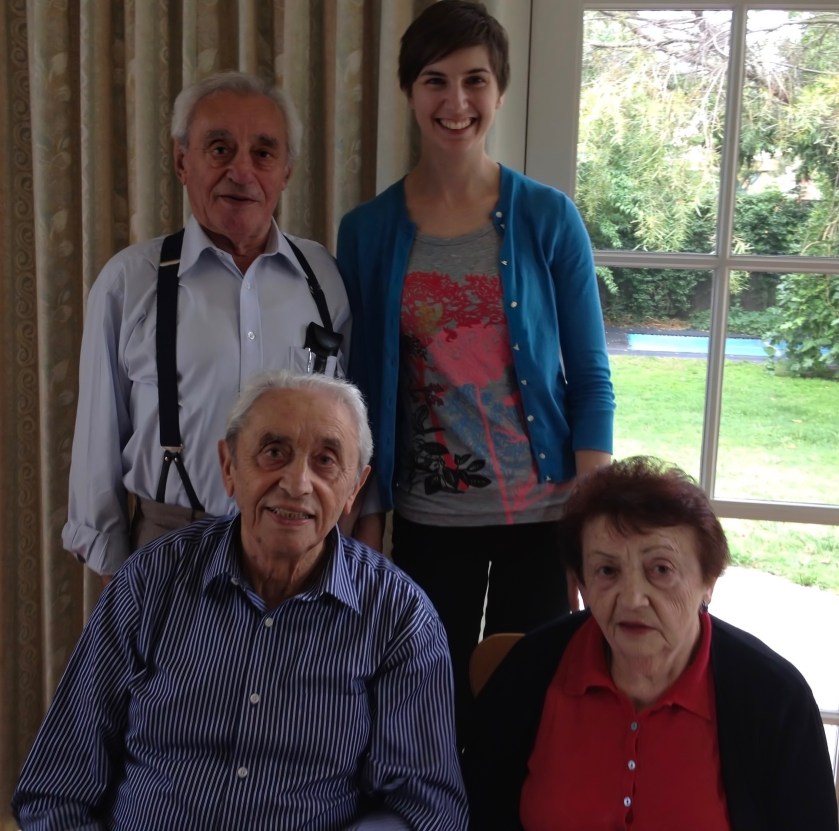
IMG_2467

Open your eyes people. The USA Government has a love/hate relationship with us. It does not have true love. It’s what’s known in הלכה as אהבה שתלויה בדבר …. In this case, the דבר, is the דבר אחר.

Most American Jews are so assimilated they don’t know their Krutzmich (scratch me) from the light of a Menorah. I don’t hold out that they will give a Patch (pronounced putch in Yiddish) to the Democrats, but they damn well should. The only reason Israel doesn’t go to the Jewish (on both sides, yes really) Vladimir Putin, is because he hasn’t got the money to give them billions in military aid and Berel Lazar isn’t that important to him. Remember, though, Russia were the first to recognise the State of Israel: there is Jewish blood running thick in the veins of Russia.

The only reason the USA supports us is because of the messianic lobby and real politick and the so-called disappearing Jewish “lobby”.

Do you delude yourself like Horowitz that anyone really cares? They don’t. The slither, ממש, that is ארץ אבותינו doesn’t mean anything to them in real terms.

אבינו מלכינו אין לנו מלך אלא אתה

David’s article follows. Why does he bother?

According to unnamed senior politicians referenced by Israel’s Channel 10 news on Friday night, Prime Minister Benjamin Netanyahu’s bid to stabilize his coalition by bringing in Yisrael Beytenu, with Avigdor Liberman taking over the Defense Ministry, is likely to have the opposite effect. The government may well collapse, and we could be heading to “new elections in the next six months,” these anonymous top polls predicted.

This is Israeli politics, where every new hour can make a mockery of what you thought you knew the hour before, so it would be wise not to get carried away by such anonymous predictions. But, it’s easy to understand the assessment. The brutal ousting of capable, temperate and loyal Moshe Ya’alon, in favor of the inexpert, intemperate and disloyal Liberman, has caused dismay across the spectrum, and not only in opposition circles.

The Jewish Home coalition party has manufactured a crisis over it, demanding an overhaul of the process by which the key security cabinet is provided with information in times of war and conflict, vowing otherwise to block Liberman’s appointment.

Kulanu’s Environmental Protection Minister Avi Gabbay has followed Ya’alon’s lead in resigning from government in protest at one cynical political maneuver too many; like Ya’alon a week before, Gabbay on Friday slammed the door on his way out with a warning that, under this increasingly extremist coalition, Israel is heading down the path to destruction.

Prime Minister Benjamin Netanyahu and Yisrael Beytenu leader Avigdor Liberman announce their coalition agreement, May 25, 2016 (Yonatan Sindel/FLASH90)
Prime Minister Benjamin Netanyahu and Yisrael Beytenu leader Avigdor Liberman announce their coalition agreement, May 25, 2016 (Yonatan Sindel/Flash90)

Kulanu, a party crucial to Netanyahu’s Knesset majority, is plainly discomfited by the unfolding events, and is trying to persuade Zionist Union’s Isaac Herzog to enter the government — ludicrously, since Herzog was so badly burned by his last effort to negotiate terms for a unity deal with Netanyahu that his party leadership is under unprecedented threat.

In Netanyahu’s own Likud ranks, the wave of criticism rolls on. MK Benny Begin immediately pronounced himself horrified by the Ya’alon-for-Liberman trade. On Saturday, deputy minister Ayoub Kara declared that ex-corporal Liberman, who never served in an IDF combat role, is simply not fit to succeed ex-chief of staff Ya’alon.

Herzog has claimed that he held talks with Netanyahu, at great risk to his own political career, because Israel currently has a rare opportunity to make headway toward regional peace, but that the prime minister, in jilting him for blunt, bleak, settler Liberman, “ran away” from the compromises and domestic political battles seizing such an opportunity would have entailed.

And even the United States has weighed in, with the State Department articulating concerns over Israel’s direction. Asked about incoming defense minister Liberman hours after the new coalition deal was signed on Wednesday, spokesman Mark Toner stressed that the administration would, of course, “work with this government as we have with every Israeli government that preceded it, with the goal of strengthening our cooperation.”

But he allowed himself a little foray into what might be considered internal Israeli politics. Said Toner: “We’ve also seen reports from Israel describing it as the most right-wing coalition in Israel’s history. And we also know that many of its ministers have said they opposed a two-state solution. This raises legitimate questions about the direction it may be headed in, and what kind of policies it may adopt, but ultimately we’re going to judge this government based on its actions.”

I have written two columns in recent days criticizing the ouster of Ya’alon and his imminent replacement by Liberman, and I wouldn’t be surprised if the Netanyahu gambit does come to be regarded as a turning point when it comes to the electorate’s opinion of the prime minister.

But I’m struck, nonetheless, by the criticism from Washington — issued even though Liberman pledged at the coalition signing ceremony that he was “committed to a balanced policy that will bring stability to the region and to our country”; he even switched to English to pledge his commitment to “peace and to a final status agreement, and to understanding between us and our neighbors.”

What’s perhaps most telling about the response from Washington is that it was so very different to the administration’s response, one day earlier, to dramatic political developments in Iran — where, coincidentally, a hard-liner was being elevated in somewhat different circumstances to a yet more powerful position.

On Tuesday, a day before Netanyahu and Liberman signed their deal, Iran’s Assembly of Experts chose Ayatollah Ahmad Jannati as its new chairman. The Assembly oversees the actions of Supreme Leader Ali Khamenei, and come the day, will select Khamenei’s successor. That makes Jannati one of the most powerful figures in Iran, arguably the most powerful.

Ahmad Jannati, widely described as the most radical of Iran’s senior clerics, is not a nice man. He opposes any notion of Iranian political reform. He backs the execution of political dissidents. He insists that Iran’s women cover up beneath the hijab. Needless to say, he loathes Israel. And he loathes the United States.

Here’s Jannati in 2007: “At the end of the day, we are an anti-American regime. America is our enemy, and we are the enemies of America. The hostility between us is not a personal matter. It is a matter of principle.”

In 2008: “You cried: ‘Death to the Shah,’ and indeed, he died. You cried: ‘Death to Israel,’ and it is now on its deathbed. You cry: ‘Death to America,’ and before long, Allah [he’s not my God] willing, the prayer for the dead will be recited over it.”

And in 2014: “‘Death to America’ [is] the first option on our table… This is the slogan of our entire people without exception. This is our number one slogan.”

In this photo released by the official website of the office of the Iranian Presidency, hard-line Iranian cleric Ayatollah Ahmad Jannati speaks during an inaugural meeting of the Assembly of Experts in Tehran, May 24, 2016. Jannati was chosen on Tuesday as speaker of the Assembly of Experts, a clerical body that is mainly tasked with selecting the country’s supreme leader. The official IRNA news agency said 89-year-old Ayatollah Ahmad Jannati won 51 votes in the 88-seat Assembly and would serve as speaker for the next two years. (Iranian Presidency Office via AP)
In this photo released by the official website of the office of the Iranian Presidency, hard-line Iranian cleric Ayatollah Ahmad Jannati speaks during an inaugural meeting of the Assembly of Experts in Tehran, May 24, 2016. (Iranian Presidency Office via AP)

Given that the United States last year led the diplomatic process that culminated in an agreement to rein in (but not dismantle) Iran’s rogue nuclear program; given that President Barack Obama has been urging Iran to “move toward a more constructive relationship with the world community”; given that Iran is a state sponsor of terrorism and a regional troublemaker; given that Iran continues to develop its ballistic missile program… you might be forgiven for thinking that the selection of the radically hostile Jannati would raise “legitimate questions about the direction” in which Iran may be headed, “and what kind of policies it may adopt.”

And indeed, a day before he was asked about Liberman, the State Department’s Mark Toner was questioned at his daily press briefing about Jannati. Did he express his dismay at the selection of an official viciously hostile to the US and Israel to so prestigious a role? Did he communicate America’s concern about the grim message that the choice of Jannati represented? He did not.

Here’s the full exchange:

Question: “You’ll have seen, I’m sure, the reports that Ahmad Jannati, a 90-year-old anti-Western cleric, has been chosen as the head of Iran’s new Assembly of Experts, which is in charge of selecting the new or whomever will be the next supreme leader. Is this a good thing? Is this a bad thing? And does this suggest that Iran may be moving toward a more pro-Western, more open-toward-the-West stance?”

Question: “Or do you have faith in Iran’s internal democratic procedures?” (Laughter.)

Mark Toner: “Let me see if I have anything pithy to say about that.”

Question: “And do you regard Iran as an ally in the fight against terrorism?” (Laughter.)

Toner: “You’re talking about – yeah, no. Have at it, guys. (Laughter.) We follow domestic events in Iran closely, as you know, but we don’t have any comment at this point on the outcome of the leadership elections of the Assembly of Experts.”

Raising questions about Israel’s direction, after Liberman, promising a commitment to peacemaking, joins the coalition. But staying silent about Iran’s direction, after Jannati, a man who declaredly seeks the destruction of the United States, is elected to head the Assembly of Experts.

Have at it, guys.


Congratulations to Rabbi Danny Mirvis and his family

Danny Lamm has not taken long before his committee (how many Lamms are on that committee, and people complain about Yeshiva!) has offered the position of Senior Rabbi to Rabbi Mirvis.

He ticks the boxes.

  1. He is a Religious Zionist from a Hesder Yeshiva
  2. He isn’t a Chabadnik (yes, I don’t believe Mizrachi would ever appoint a Chabadnik)
  3. He was educated in the more politically moderate Yeshivat Har Etzion
  4. He and his wife are charming and seem to be well-liked
  5. He will likely complete a four-year stint before returning to Israel (preferably the stint will be a lot less due to Geulah being in place)
  6. I have only shared a few lines of conversation with him, and heard him speak twice. He does his homework and is a likeable person. I do not know how he traverses the philosophies of Rav Amital vs Rav Lichtenstein, the former apparently having more of an influence on his outlook. Rav Amital and Rav Lichtenstein had enormous respect for each other but were very different, with Rav Amital having his own strong disagreements with R’ Tzvi Yehuda Kook on Rav Kook’s approach and the approach needed today.
  7. Perhaps most tellingly 🙂 when I introduced myself he said “Oh, Jackie Bassin’s Zayda”. I was expecting, “Oh, Adina Waller’s brother”. I learned from that, that he obviously had exposure to our grandson, and appreciated him, and that this was perhaps more my Yichus than being my sister’s brother :-). If he’d known my father and not mentioned that I was his son, I might have had some misgivings. Rabbi Sprung knew my father and often asked him what his secret was. Sadly, Rabbi Mirvis won’t, but happily he will see some of my parents’ great grandchildren one on one.
  8. He will give a more meaningful approach to Judaism than the more tree hugging, Tikun Olam, we embrace everything style of leadership or the “I do it different and I will shock you style from ARK”, and will respect Kashrus and support established authorities and ignore the communal maverick.

Prior to that, the name “Mirvis” only registered with me in respect of his Uncle Johnny. Johnny who is no doubt also a Rabbi, was in fifth year of Hesder at Yeshivat Kerem B’Yavneh, when I joined Kerem B’Yavneh. I didn’t have much to do with him, partly because of my reclusive nature, and partly because he concentrated on the English and American Bochurim, for whom he was given a particular mashpia style role. I only knew of his father when he was appointed Chief Rabbi of the Commonwealth, although I need to declare that I am not a Monarchist, and consider both Philip and Elizabeth anti semites. The latter would visit a toilet in Ghana before stepping into Israel, and the former cantankerous oddity only goes to visit his mother’s grave, in a private capacity. Charles is hardly pro-Jewish either. Let me repeat what I have stated in other posts. If one claims to be against anti-Semitism and can’t call Israel the JEWISH State, they are an anti-Semite in my eyes, irrespective of where one sets borders.

Good luck. It’s not an easy community. You will be pushed around (older generation) by pseudo-Mevinim, but the youth will rally around you, and in that way, you will be successful. Now, if you can get the grandfathers and great grandfathers out of “Beit Haroeh” and hand it over to Ohr David, that would be a great start. Beit Haroeh has passed its used by date long ago and its time they grew up and moved into the Main Shule.

I also hope they let you influence Yavneh in respect to its Torah learning programs, and not write you out of that equation as they did with previous Rabbis.

From an interview at Har Etzion:

After numerous years as Director of the Yeshivat Har Etzion Center for Torah Leadership (CTL), Danny Mirvis is stepping down ahead of moving to Australia to assume a new position at the Mizrachi community in Melbourne. Dublin-born and London-raised, Danny has held numerous positions in the Yeshiva including Madrich of MTA, Racaz of the Overseas Program and most recently, Director of CTL. We asked him some questions about his time with CTL and plans for the future.

How has CTL changed over the years?

CTL started off as an exciting dream with many great ideas. Over the years, those ideas have been developed and organized to create three focused areas of activity:

1) Partner Projects – Supporting a broad range of educational and social initiatives of alumni from Yeshivat Har Etzion and Migdal Oz, including a focus on women’s learning.

2) Torah Leadership – Developing the connection with alumni actively involved in the Rabbinate and Chinuch across the world through ongoing contact, regular conferences and supporting different Torah publications.

3) Future Leaders – Identifying and investing in students and alumni with significant leadership potential, through leadership programs and CTL’s Winter Fellowships.

What have been the highlights of your time with CTL?

Rabbi Doniel Schreiber, the Dean and Founder of CTL, is a man of tremendous passion and vision. To work together with him and see how that vision has become a reality has been a privilege and pleasure.

For me, CTL’s proudest achievements have been the partner projects we identified and supported in their early stages, which have gone on to blossom and thrive on their own two feet. To give just a few examples, Garinei Ayala is now three times the size it was when they first came to our office to ask for assistance. The Shiurim in Givat Shmuel and Katamon are now self-sufficient and continue to grow and attract large crowds. The late night Beit Midrash at Penn turned to us for assistance at its inception and has gone on to become a fully-fledged part of Penn’s learning program.

How do you see CTL developing in the future?

CTL’s primary area of focus – the alumni of Yeshivat Har Etzion and Migdal Oz – is a talented, dynamic and growing group. It is through these alumni that CTL aims and hopes to make a positive impact and genuine contribution to the world around us. As our alumni progress and grow in number, new opportunities will develop for CTL to expand its programs and activities.

The same can be said for our alumni in Chinuch and the Rabbinate. I see great potential for CTL to increase its interaction with this group as it continues to grow in influence and number.

You have held numerous positions in the Yeshiva. How does it feel that your next position will be on the other side of the world?

Though I have held numerous positions in the Yeshiva, they have all shared the sense of mission of working towards the Yeshiva’s goals of being immersed in Torah and engaged with the world.

Mizrachi in Melbourne is a wonderful community with strong ties to the Yeshiva, a genuine appreciation for Torah and a deep love of Israel. Though it could not be much further away geographically from the Yeshiva, I see my role there as a continuation of the same mission.

What will you be able to take with you from your experiences with CTL to assist you with your future role?

First of all, thanks to CTL, I will belong to a global network of Rabbinic alumni from Yeshivat Har Etzion, which I will be able to draw on for ideas and advice.

I also hope to employ CTL’s educational and organizational philosophy in my new position. At CTL, we have not aimed to build our target audience around our programs and activities, but to build our programs and activities around our target audience. This is something I hope to continue in the future.”

PS. I had promised to show him my Shas, printed in Dublin on linen paper. He was astounded that such a thing existed. I suggested his father would know. It even has Chiddushim of the Satmar Rebbe at the back, and yes, there are still pages stuck together in my Shas, I never used it for Daf HaYomi 🙂

Missing the point about Jews, Judaism and Zionism

We are used to worrying about the BDS boycott, and various academic boycotts and the like. There has been no talk of boycotts in my University. If the National Tertiary Education Union went down those stairs and/or the University, there would be mayhem.

What attracted my attention today is a statement we hear over and over, in various guises and contexts. The statement is attributed in the Jerusalem to former Chief Rabbi Sacks, a brilliant speaker and writer. He is alleged to have said

Speaking to The Jerusalem Post, Sacks said that some politicians in the British Labour Party had courted the Muslim vote and had adopted anti-Israel attitudes which have morphed into anti-Semitism.

I could not DISagree more. Where is the clear thinking. Anti-Israel attitudes expressed in the context of ‘we must solve the problem of Palestinian Arabs’ is nothing more than anti-Semitism. This is not anti-Zionism. The logic is exceedingly simple. There is no body, none, that will agree that Jews deserve a homeland, and that homeland is Israel. This narrative is elided too often. Some will quibble over the definition of borders and security provisions and so forth. They are issues that should be discussed. However, since 1948 and before that, there is still no recognition that Jews need a homeland. In this I include the entire spectrum of Jews in Israel except for the hand full of lunatics led by Moshe Ber Beck, the Iranian nuzzler. He is welcome to live there, and be happy. They are not religious Jews. They have seen that all their sycophantic activities amount to nothing but Bitul Torah while protesting and travel.

No, Rabbi Sacks. Nothing has “morphed“. This is classic fallacy filled British diplomacy . The anti-Semitic Ken Livingstone types of this world should be dethroned, but to allow the semblance of thought that Jews are not entitled to their homeland, as above, and call this entitlement Zionism, is bizarre, I find it difficult to comprehend. Nay, this is an attack on Judaism 101. We assert our right to live in peaceful boundaries. Those who seek to deny this right, whether emanating from explicit charter, whispering, obfuscation or diplobabble (the French Connection) are anti-Semites.

As Rav Kook so eloquently put it:

“It is only the anticipation of redemption that preserves Judaism in Exile, while Judaism in the Land of Israel is the redemption itself.”

This redemption is what we aspire to.

[ Only an ignorant would interpret this to mean Rav Kook’s Judaism in Exile was not infused with Torah. ]


What exactly is the problem?

The Jerusalem Post, a middle to right wing paper, commented on some recent statistics in Israel. One that drew my attention was (emphasis is mine)

This year’s report also revealed a trend reversal in that transfers between educational streams show a move away from religiosity.

Among the Jewish population, the report noted, recent years have seen net migration from more religious to less religious school systems.

As such, more students have moved from haredi schools to state-religious and state- secular schools, and from state-religious schools to state-secular schools than in the opposite direction.

The largest number of transfers was from state-religious schools to state-secular schools, where in 2014/15, 14,700 pupils transferred.

The researchers called this “remarkable” since the national-religious population constitutes the smallest sector at 14-15% of the population.

We first note that the Jerusalem Post as opposed to any study that I am aware of concludes that this is a move away from religiosity. While that may be true, it is by no means a foregone conclusion.

  1. Have they measured, for example, whether the hours saved (presumably) at the State School, are being used “more productively” through daily shiurim at yeshivas and the like?
  2. Have they looked at the reasons given for the school moves?
    • A Charedi person may be just as frum, but may simply not be able to be burden costs
    • They have not discussed National Religious Charedi. There are many in this category and different approaches.
    • Have they defined religiosity
    • Is full observance in a State School a move away? Perhaps the longer term trend is that many of these students will influence more students to move toward “religiosity”?
  3. Looking at it with a pessimistic slant, one may wish to consider whether
    • Parents being left of center in religious observance are more likely to have children who move further to the left  than parents who have one or more “off the derech” children (I dislike the terminology and I do not know why we give it a classification category. Such categories can slur, and may become entrenched as something to feel more comfortable with. Let us not forget that the Torah itself did not like using negative language: animals that may not be consumed are called “not pure” as opposed to “trayf “.
    • How many teachers who practice orthodoxy are there in the State School system
    • How good is teacher training, especially in respect of pastoral care among State Religious teachers? Do they understand their pupils? It is far easier to simply teach in a State School in respect of the qualitative aspects of religion given a purely cultural/historical approach is most likely.
  4. The Rambam preached the middle ground. Life has taught me that very few start and stay on the middle ground. Indeed moving further in observance and understanding of Yahadus when younger, is not a negative trait. It would seem that as people age, and I do not remove myself from any such consideration, their level of Jewish observance moves left. To lead a life in the middle ground may well mean an early foundational right of middle experience. I specifically do not include those who learn for a living, do not publish, are not gifted intellectually, and are a burden to those who work for a living.
  5. Having not seen the statistical study and only read the Jerusalem Posts reporting on it, some of my comments may portray ignorance.


Whatever the case, what I took out of this, ostensibly, is that we need to increase in Torah Observance and Learning. In terms of observance, we must seek to minimise any negative proclivities. Those who have habituated a Chilul Hashem seen by the eyes of their children, are the greatest destroyers of  Yahadus, and the continued promoters of a perverted Judaism of the worst shameful order.

Challenges

There are a number in Melbourne. I won’t elaborate but 

חיה ביילא בת לאה בתיה 

Is one which hits home personally and she should get back to full health quickly.

I was at a Simcha tonight, and all I heard was ‘it’s terrible what’s going on in Melbourne lately’

Then somebody sent me THIS CHILLUL HASHEM

If I was there I would take the parents and teachers and air drop them into Gaza. That’s obviously their home. Disgraceful low lives.

Chabad Principal Rabbi Smukler attends and dances at Yom Ha’aztmaut service

The yearly prayer event which coincides with Ma’ariv is something I have attended for more years than I care to share. I do not recall but I believe I was unable to attend last year. In some years I was lecturing at the time, but I have attended almost every year.

I learned in a Hesder Yeshivah of note; the first Hesder Yeshiva in Israel. The Rosh Yeshiva, Rav Chaim Yaakov Goldvicht had the written and personal approval of the Chazon Ish. We dressed in our better finery and had a special dinner celebration of thanks. I lost my two Israeli room mates to War. I think about them often: Chovav Landau and Ze’ev Roitman HY’D. Chovav Landau’s wife was pregnant with their only child at the time. They were both in their fourth year of the five year program when I met them. I was closer to Ze’ev than Chovav. Ze’ev had lost his father to Yellow Fever, because a Doctor in Rechovot, had not changed needles after injecting an Arab patient. I felt his tragedy acutely. They both had machine guns locked in our room, and both perished when their tank was hit during the first Lebanon war.

The text of Ma’ariv in our Yeshiva was not the one adopted by the Kibbutz HaDati Movement (there was one next door) nor was it the text of newly published Koren Yom Haatzmaut Machzor. It was standard  Ma’ariv.

The Yeshivah formally followed the ruling that full hallel be said in the morning but without a blessing. There was no Tachanun.  This was not a statement of ‘less’ religious zionism. Rather, it represented delicate rulings related to liturgy and halacha.

As I recall, Ma’ariv had no additions. There was no Shofar etc I’m happy to be corrected. I do not know what current practice is followed. The Yeshivah did not affiliate with Bnei Akiva formally because of a concern for mixed gender functions. In my day Bnei Akiva in Jerusalem was gender separated.

Halachically, what one says before Ma’ariv and after the concluding Aleinu prayer is of lesser importance. When said in a Shule proper, there is also halachic  import.

That being said, I was to learn, later in life that the famed Rav Yosef Dov HaLevi Soloveitchik, otherwise known warmly as ‘the Rav’ was implacably opposed to additions to liturgy. This extended to the Holocaust and Kinos. He famously stormed out of RIETS when some ignored his ruling on Yom Haatzmaut.

Chabad’s Yeshivah and Beth Rivka Schools follow their choice. Chabad make no liturgical change and do say Tachanun. Whilst certainly not religious Zionist, they are not noted for the extreme anti Zionist rulings of the Adass Israel Congregation where Tachanun is especially said on Yom Ha’atzmaut even in the presence of a Bris Milah lest someone conclude that Adass saw any religious importance  in the State of Israel’s Independence Day.

For decades, Chabad’s boys school principal would not attend the Chabad dominated Rabbinical Council of Victoria’s gazetted service at Mizrachi. Thee council is, I believe dominated by Chabad Rabbis. This is not surprising in Melbourne where the survival and resurgence of Judaism is due in major part to Chabad.

I have been opposed to the service only being held at Mizrachi as I do not consider Mizrachi to be the ‘owner’ of this style of service. I am certain, that, for example, Caulfield Shule would gladly offer their Synagogue.

Chabad now has only one Principal: the controversial Rabbi Yehoshua Smukler.

It was then interesting for me to note Rabbi Smukler’s  front row appearance at Mizrachi last night, including his dancing circomvolution around the Bima. I concede that this may not have constituted halachic dancing (during Sefiras Haomer). He didn’t clap like Rabbi Cowen of Mizrachi’s Elsternwick Shule (Rabbi Cowen is considered a Chabad Chassid) nor did he sit on the Mizrachi wall like Rabbi Mordechai Gutnick, who spoke as President of the Rabbinical Council of Victoria (and who is also a Chabad Chasid) and R Leor Broh (also a Chabad Chasid) of Mizrachi’s Beit Haroeh Shule (populated by once young marrieds, now grandfathers :-).

To be complete, unlike a general Yom Tov or a Chabad Yom Tov such as Yud Tes Kislev, I didn’t notice any Chabad Rabbi in attendance wearing their longer black Kappote).

We live in very interesting times.

May the State of Israel metamorphose into the Eretz Yisrael of our redemption, speedily, in our days, with the continued grace of God.

An Eruv in Crown Heights?

There is an existing Eruv supervised by Rabbi Unsdorfer which covers North Crown Heights. This doesn’t include Chabad. While there have been Eruvin in Chabad (in Liadi and Lubavitch itself) times have changed, and the last Lubavitcher Rebbe זי’’ע stated clearly that he was against Eruvin today and an example is Melbourne. Let me qualify that. One cannot be against Kosher Eruvin in the sense that they think an Eruv is an unnecessary concept. That is a view likely held by Reform or “reconstructionist/new age” Jews. I would like to think that those who are less practicing but when they do practice, do so, according to traditional Orthodox Judaism also have no issue with the concept of a Kosher Eruv and would consider supporting such.

I was privy to details of the first (unkosher) Eruv constructed in Melbourne many years ago through the office of the then Mizrachi Organisation’s Rabbi (not the venerable Rav Abaranok ז’ל), and heard the tapes of Rabbi Groner ז’ל discussing the issue forcefully with Rabbi M.D. Tendler and read booklets from Rabbi M. Krasnjanski and Rabbi Yosef Bechoffer and more.

Melbourne now has a world-class Kosher Eruv, which is, I believe, under the supervision of Rav Gavriel Tzinner (who has mashgichim here through the Council of Orthodox Judaism of Victoria) and visits these shores from time to time. It is trusted by those who avail themselves of its facility, and this includes the ultra orthodox, generally secessionist, Adass Israel Congregation.

The Lubavitcher Rebbe did not issue Halachic decisions as a rule, but did do so from time to time if he felt it was important to identify and/or stress a Chabad custom, or if he deemed the matter to be of a level of importance to the extent that he did so.

On the issue of Eruvin, as I understand it, the Lubavitcher Rebbe preferred to build a quiet unannounced but strictly Kosher Eruv for the purposes of minimising the possibility of someone carrying by accident. I understand that he was concerned that, in our day, a proliferation of Eruvin would imply that ordinary Jews would forget there was a prohibition to carry. Indeed, on several occasions I have witnessed Jews, especially from Israel where there are Eruvin all over the place, not even be aware that one should not carry on Shabbos, as a matter of Torah law.

Since the Lubavitcher Rebbe passed away, as I saw in videos and written material, and as affirmed in the book by Rabbi Eliezrie which I happened to finish one week prior to this post, the LR specified that issues in “the future” for Chabad Chassidim (which undoubtedly included the possibility that he would not live to see the redemption before he passed away)  should be decided by Vaad Rabbonei Lubavitch or Mercaz etc depending on the type of issue. I do not recall reading or hearing the notion that one decides based on opening a random page of his Torah, a practice which many Rabbis forbid or do not encourage, including some Chabad-ordained Rabbis, since even the Goral HaGro (and yes there is also a Gemora גיטין דף סח)  was only used with Tanach.

I therefore close with my opinion that those who are now starting a public campaign to raise money for a more expansive Eruv in Crown Heights, Brooklyn, should only be doing so if they are not Chabad Chassidim, or they have express permission from the aforementioned Beis Din of Lubavitch.

I am not here to discuss the merits of an Eruv. In days gone by Eruvin were critical. They allowed one to bring home the pot of choolent, which was warming in the baker’s oven (I presume the baker had a fleshig section or the heavy pots never had enough to overflow 😦 ) for lunch after davening. It is a halakhic requirement to have something warm on Shabbos, and from there, Choolent, Chamin and the like emerged (in my opinion). As an aside, PLEASE don’t use the term Pareve Choolent. There is no such thing. Call it Potato Stew or slow cooked Potato or whatever. A choolent without meat, was unfortunately something which the poor suffered who couldn’t even get bones to put in their choolent.

Back to the issue. My view on the online appeal for money to support a wider Eruv in Crown Heights are:

  1. It should not be supported publicly by Rabbonei Lubavitch
  2. It should not be used by Chasidim of Chabad
  3. It should be constructed by a Rabbi of world-renowned expertise in Eruvin
  4. Others should follow their own Posek, and if their Posek allows it, by all means, use it
  5. Those who are not of Chabad persuasion who want to be personally stringent should only do so for themselves. They should not impose the stringency on their family. If they wish to change their mind and use the Eruv later on, they will need Hatoras Nedorim (annulment of vows, given the views of the Rambam on Reshus HoRabbim D’Orayso, which is also a Chumra of Briskers and I believe the Rav was also reluctant to use Eruvin)

In summary, it would have been better, given the relative paltry sum required from the vantage point of a Gvir, to have done this without fanfare, if one followed the late and great Lubavitcher Rebbe. Indeed, who knows if an Eruv was built in secret. It’s not in any book I’ve read (and I have read four relatively good ones on Chabad in the last year, especially when compared with the poor book by Heilman et al which was taken apart by Rabbi Rapoport of England)

Disclaimer: I aspire to be an ordinary Jew. I am not a card-carrying member of any group, although  I would be most inclined to follow Rav Soloveitchik if he were בעולם דידן. One can only surmise if the Lubavitcher Rebbe would have a different opinion. Those who try to second guess him, should give up now. There is no ability to do that. Like the Rav, the Lubavitcher Rebbe was a super genius.

Interesting article—Working does not contradict Torah

[Hat tip Kracower]

Yehuda Meshi Zahav

ZAKA chairman Yehuda Meshi Zahav describes sparingly and with restraint the things he and thousands of his volunteers at ZAKA do. ZAKA is a haredi (ultra-Orthodox Jewish) organization that rescues, identifies, and traces Jewish disaster victims in Israel and all over the world under sometimes virtually impossible conditions. Such a mission requires love of one’s fellow man, great empathy, faith, and a belief that good will come of it. It requires Zahav, a man with impeccable curly white payess (sidecurls).

Two months ago, following a four-year struggle, ZAKA won recognition as an official UN consultant and observer. The eventual decision was taken unanimously by a special UN committee composed of representatives of 19 countries, including Iran, Sudan, Venezuela, Cuba, Turkey, China, Russia, Pakistan, Uruguay, Burundi, Greece, the US, and Israel.

“Globes”: Did Iran and Pakistan also vote in favor?

Zahav: “There was no opposition, not even one country. We sent our representative, who met with every one of the committee members. The Iranians asked us if the report that ZAKA treats Jews first and Arabs later at terrorist events was true. We said that they hadn’t read it correctly. We treat the victim first, and then the murderer, regardless of nationality. They realized this, and voted in favor.”

About-face: From extremist haredi operations officer to national hero

Once upon a time, Zahav was the operations officer of the Eda Haredit extremist haredi group. He led demonstrations against Sabbath desecration, burnt Israeli flags, fasted and wore mourning clothes on Israel Independence Day, illegally removed dead bodies from the Abu Kabir Forensic Institute to prevent autopsies from being performed and put mice into the pathologists’ rooms, and sneaked onto archeological sites in order to prevent archeological excavations. Since then, however, Zahav has been honored by being asked to light a torch on Mt. Herzl while calling aloud in a clear voice, “For the glory of the state of Israel.” His grandfather, Rabbi Yosef Sheinberger, the mythological leader of the Eda Haredit and a fanatical opponent of the founding of Israel, refused to speak with Zahav for the last four years of his life. For Sheinberger, what Zahav did was a desecration of God’s name.

The change in Zahav began on July 6, 1989, when a terrorist blew up a bus on the 405 route from Tel Aviv to Jerusalem. It happened on a road in front of the Telz-Stone yeshiva (Jewish religious seminary) in Neva Ilan. Zahav and his friends wanted to see what was happening, “and then, when the dismembered bodies were laid out before my eyes, when the sirens were echoing among the smoky fragments of the bus, when the bloodstained clothes were scattered over the area, when entire families were broken and erased in an instant, I realized that the quarrels between us were meaningless. The type of skullcap you wear and the kind of clothes you wear pale in comparison with the real war we’re faced with. The Arab enemy doesn’t distinguish between the blood of a haredi, a secular person, and someone who’s modern Orthodox. We’re all connected. There’s no right or left. Everyone’s pain is the same. That was the moment when I crossed the lines and abandoned the ideology of haredi Judaism,” he later said, just before lighting the torch in honor of the ZAKA volunteers in 2003.

“Since then,” he says today, “I have been repenting. I put my efforts in the right place.” That also includes severe criticism of the leaders of the community he is identified with. “I didn’t see the haredi leaders with the bereaved families,” he said during one of the IDF campaigns in the Gaza Strip. “There were 20,000 people at the funeral, but I didn’t see black clothes there. There might have been haredim here or there, but when we want to, we can fill any place with black clothes.”

….

To read the full article click globes.

Published by Globes [online], Israel business news – www.globes-online.com – on April 27, 2016

© Copyright of Globes Publisher Itonut (1983) Ltd. 2016

Women singing at public events or commemorations

The following is from the Jerusalem Post.

“A row has broken out after Bar-Ilan University earlier this week banned women from singing during its Holocaust Remembrance Day ceremony on Wednesday night.

Female students were told they would be allowed to read passages of text for the ceremony and play musical instruments.

Rabbi Shlomo Shefer, Bar- Ilan’s campus rabbi who is responsible for the ceremony, told Channel 10, which first reported the story, the decision was made because women singing in ceremonies on campus was not the customary practice at the university. Jewish law, in general, prohibits men from listening to women sing in person, although some rabbinic authorities are more lenient on this issue.
The university faced criticism from several quarters, including the national-religious organization Ne’emanei Torah V’Avodah (NTA), which said that singing at national ceremonies is an Israeli custom and stringencies in Jewish law should not be imposed on the general, non-religious public.

“Even if within Jewish law there are different opinions regarding women singing at public events, there are enough opinions [in Jewish law] that do not prohibit this at public ceremonies, for religious ceremonies and other events,” the organization said.

“NTA holds that women can and should appear on stage at public events. Those who have a stricter approach are free not to attend these events, but they cannot impose their strictures on the general public.”

Separately, NTA also criticized the Israel Association of Students for inviting singer Eyal Golan to perform at its annual Student Day celebrations.

Golan was accused, in 2014, of having sexual relations with underage girls, although the police investigation against him was closed due to lack of evidence. During the investigation, the singer had told the police that there was a difference between sleeping with a girl of 17 compared to a girl of 16, saying the latter was a criminal act and the former was not.

“It is difficult to accept the indifference in which performers who are caught up in moral controversy are invited to such events,” said NTA.”

My view (Note very carefully that I am not stating any more than an opinion. Halachic rulings should only be given by Rabbis of recognised high calibre unless they are an “open and shut” case as per Shulchan Aruch, which this is not, as per the parameters in Responsa on similar questions e.g. Women singing Zmiros in the Sridei Eish 2:8 especially near the end of that responsa, and reciting Krias Shma in front of a female who is not wearing a head covering these days as per the Aruch Hashulchan (Orach Chaim 75:7) cf. Mishna Berura (Orach Chaim 75:10) who disagrees.

Rav Yechiel Michel Epstein ז’ל, the Aruch HaShulchan
  1. It is proper for a University of this type to have a Rabbi to whom it refers Halachic questions and advice.
  2. It is proper for such a Rabbi to proffer his opinion on such matters, as well as providing these to students who consult him.
  3. On weighty halachic issues, I would expect any Rabbi, unless he is a recognised Posek and/or who writes Responsa which leave them open to peer review, to confer with Poskim of note who already have no halachic issue with attending this type of University establishment
  4. I think I have been at Bar Ilan once; I do not know the University except for some academic Computer Science issues (e.g. its responsa project) and some academics who publish Judaism-oriented articles.
  5. The issue of women singing (many consider this a Rabbinic prohibition) together with men at a formal ceremony, as in a remembrance ceremony or the singing of an anthem, is one which is not new. Although one may be sitting or standing relatively close to a female and hear her particular voice clearly despite a group setting (מגילה כא, ב), I would be inclined to respond as follows (assuming the questioner was free to make their own decision 🙂 ):
    1. If this issue is one which you personally feel is halachically problematic, do not attend.
    2. If your own Posek has advised you that you may attend or may not attend, then follow his Psak Din.
    3. I would consult with a renowned Posek and suggest to that Posek that, perhaps based on the Aruch Hashulchan and those who quote his interpretation, it can be argued that it is highly unlikely that anyone who is already attending Bar Ilan, and today might be sexually aroused from this group form of singing, might be permissible.
      Either way, I would suggest though that they look straight ahead or up at the sky while singing, or close their eyes (looking and “staring” are two different things halachically). In my opinion, any permissive ruling should be accompanied by a qualifier to remind the person of the fact that there is always a prohibition of a male listening to a female singing. [I was privy to a permissive ruling for my band, Schnapps, from Rav Moshe Feinstein ז’’ל. Schnapps offered a male singer only for many years, but over the last few years (in my opinion this changed when certain Rabbis did not, and some still do not, leave a Simcha when a female was singing) now offers either a younger new male singer or a male and female combination).]
    4. I would offer to discuss parameters that are inviolable according to Orthodox opinion (I exclude Open Orthodoxy and Shira Chadasha from such, as they are not considered Orthodox by Orthodoxy.)
    5. An interesting sub-question that came to mind is the case of a male who had a homosexual disposition and קול באישה ערווה. I’m reminded of one of my teachers of Halacha, Rav Yosef Efrati שליט’’א  many years ago who would answer such questions when asked publicly (on Thursday evenings when he gave his packed Halacha Shiur at Yeshivat Kerem B’Yavneh) with: “Nu, Is this a question להלכה ולמעשה?” I don’t doubt that it is a question for some, however, my inclination is that it would be not advised to advertise such a disposition, despite the reality that those in this category are more vocal, and ask for acceptance. On the issue of acceptance, there should be no barrier placed which causes them to feel disenfranchised to the extent that they feel uncomfortable in a largely heterosexual Shule.

What would I do personally? I come across this each year at Yom Hashoa events where the partisan song and the Israel national anthem are sung (according to a Psak I received many years ago, I replace להיות עם חפשי with להיות עם תורה). I do not leave the Hall. I sing these, and usually concentrate on the lyrics, looking straight ahead. On the other hand, if a female sings alone, which is much rarer these days, I look to leave the hall earlier (there is a printed program) as if I need a bathroom break, and return some time after. I have found myself in the company of Orthodox Rabbis who attend such events and do not enjoy bothering people in the row that I sit if I don’t get an aisle seat. I attend because my father ע׳ה, a survivor, attended and my children attended with him together with my mother, עמו׳ש, who is also a survivor. I won’t digress into a discussion of forms of commemoration and Halacha, though, there are substantive views on this from Mori, VeRabbi, Rav Yosef Dov Halevi Soloveitchik ז’’ל.

I want to repeat: please do not under any circumstance treat this blog post as anymore than Pitputim. In practice, if you have such a question, please consult your Posek.

This story from Colombia is beautifully written and a “must read”

[Hat tip BA]

Read the article here

Amazing is a word that comes to mind.

That being said, the theological conundrum of “what quality of  Neshama does a Ger Tzedek have/acquire”, is a deep question that involves the likely diametrically held views of the Kabalistic Zohar vs the  Rational Rambam (according to many) and their takes on various Talmudic/Aggadic texts. A wonderful article by Rabbi Chanan Balk should be read if you are interested in that topic as well.

Two excellent articles, in summary, that are well worth your time reading in full.

[ I note that Reuven Hammer, a favoured rabbi of conservative/masorti types, recently made waves about equality of neshamos in a different context. In that, he opposed the Zohar and Baal Hatanya and others, and used the alternative view given that it aligns with Western sensibilities of “equality at all costs”—a concept which has been the (warning the hyper-link points to a conservative response) catalyst of many non Orthodox groups.]

from jewishness.co.il

Strident words on the limits of inclusion

The following is from Rav David Rosen, Dean of the Zomet Institute.

The Torah spoke of four sons: One who is wise, one who is evil, one who is simple, and one who does not know how to ask. What does the evil one say? What is this service to you – to you and not to him. And since he removed himself from the community he has rejected the essence. Dull his teeth… If he had been there, he would not have been redeemed.” [From the Haggada of Pesach].

Family Inclusion

Homiletic experts from all the generations have delved into and analyzed the four sons: the essence of their questions, the suitability of the replies we give, and mainly the fact that they have all been invited to the same place – our Seder table. Speakers of the last generation have added a fifth chair, meant for a son who doesn’t even make it to the Seder. Not only doesn’t he know how to ask the questions, in fact he has no interest in asking, and he might well block his ears so as not to hear anything. And even so, our speakers tell us, and rightly so – we maintain a warm corner in our hearts for him. “For as I speak of him, I will yet remember him. Therefore my insides pine for him, I will have pity on him…” [Yirmiyahu 31:19]. Women speakers of the last generations, who are working hard to translate the Torah into a feminized format, will also present a group of four daughters, in an effort to maintain equality. (What do you call the bad daughter? Evil? A shrew?)

Sermons will be made, and I will make my own attempt to add my words to the issue which is called “inclusion” – that is, everything can be included, everything is treated in the same way. This word, which comes from the realm of psychology, is today used to denote acceptance of and compassion for the “other” – whether he or she is different, strange, and even a bit eccentric – just a s they are, without any hint of rejection, without preaching to them, and without trying to make them change their behavior or their outlook. I can partially identify with this concept, but with one important limitation: The “other” must be aware that he or she is different and that his behavior is wrong as far as I am concerned. In this case, there is indeed room for friendship, a partnership, a combination, and a conversation. From my point of view I do not flatter him but act in accordance with the definition: “inclusion.”

Let us return to the Seder table and to family containment. Many religious and Torah-true families find it difficult to accept sons and daughters who have strayed from the path, and who have removed the yoke of the mitzvot (partially or completely). However, the Seder table calls out to all of them and “includes” them, placing special emphasis on the “evil one” who sits on the sidelines. We must have only praise for the communities of the east, who during many generations have developed the techniques of “including” those who stray from the path of Torah – people who come to the synagogue on Shabbat and then continue as on a weekday, but they still define themselves as “traditional.” Reform Jews, on the other hand, who parted in anger from the Ashkenazi communities, do not exist in the eastern communities, and they are certainly not “included” in the communities of Ashkenaz.

Community Inclusion?

I have in front of me a document with the title “Halacha and Inclusion,” by the “rabbis of Beit Hillel and their wives,” which was distributed in the synagogues on Shabbat Hagadol. (Since containment in Hebrew is “hachala,” the Hebrew title is a play on words: ” Hachala V’Halacha.”) The rabbis of this modern-Orthodox enterprise produced a “position paper in the spirit of halacha,” as they put it, which calls for opening the hearts and the gates of the communities to people with a homosexual orientation. If I understand correctly, this would even include same-sex “marriages” of either men or women. Well, the son might ask, but in this case the father totally rejects such “inclusion” using the building tool in his hand, as Shammai once did under other circumstances!

I am not opposed to some simple elements included in the document about the need and the positive effect of outreach to sinners and not to reject them, and about the positive halachic attitude towards those who sin because of an innate urge, and about such things as “spiritual rape,” and more. 

However, I have sharp criticism about subjects that do not appear and as a result about the inclusion approach, which has evidently led to instability of the 14 rabbis (including some I know personally, and whom I do not understand) and the 7 women who signed the “ruling,” as it is called. (I note in passing that the title “ruling” on a halachic position which is mainly based on a world outlook reminds me very much of the rulings of the “Conservative Rabbinical Court.”)
Just what is missing in this document? As is noted in the Haggada, we should “remove from the community” all those who pride themselves in sporting a peacock’s tail in order to make their sins into a banner for all to see . We cannot “include” one who is proud of his or her sin and is a member of a sinful organization. The goal of such a declared organization is to draw other people into the circle of sin, and to provide legitimization of a forbidden pathway. Anybody who is part of such an ostentatious group cannot be accepted, and they should not be “included” in any of our communities (the family or the Seder table is different, and this should be discussed separately). This absolute diagnosis is totally missing from the above “ruling,” and it is clear from publicized material that the purpose of the document is to show appreciation for the progressive approach of Beit Hillel, which knows how to “include” everybody!

Here is the main point in summary: It is not possible to “include” institutionalized single-sex “families” within a community (and it is unclear whether this applies to a family grouping around a Seder table). “Chessed hu – It is a sinful act” [Vayikra 20:17]. “Tevel hu – it is an abomination” [18:23]. And it is also “hevel” – a vain approach. 

I wonder: Will these people react in the same way to men who marry Gentile women? Perhaps the answer is yes, who can know the spiritual depths of Beit Hillel? I want to note for the authors of this “ruling” that even among the abominations of Egypt, they never stooped to “writing a Ketuva for men” [Chulin 92b].

(Written after the end of Shabbat Hagadol.)

Pesach and the Jewish Calendar

Guest Post from R’ Meir Deutsch (c) [lightly edited by me]

© מאיר דויטש ניסן ה’תשע”ו
את חג המצות תשמור […] למועד חודש האביב
The Hebrew calendar is based on a combination of the lunar and solar calendars, as written in Bereshit:

“יהי מאורות ברקיע השמיים להבדיל בין היום ובין הלילה, והיו לאותות ולמועדים ולימים ושנים.” 

Our calendar is based on the Babylonian one. The names of the months are very similar, and the Babylonian calendar has also a leap year with ADARO SHENI. The Hebrew Calendar, according to Rav Ada (lived in the third century in Pumbedita) has a cycle of 19 years to merge the lunar and solar years. In his calendar we have:

365 days

5 hours

55 minutes

25 seconds.

The length of a year as known today is: 365 days, 5 hours, 48 minutes and 46 seconds, a difference of just 6 minutes and 39 seconds.

For order’s sake, I want to mention, that according to Shmuel  in Eruvin 56a the solar year is 365 days and 6 hours.

ואין בין תקופה לתקופה אלא תשעים ואחד יום ושבע שעות ומחצה.

In HALACHA Shmuel’s calendar was adopted. According to his calendar the ברכת החמה is fixed. Shmuel’s calendar is based on the Julian calendar. As the HALACHA is based on Shmuel’s calendar, the calendar of Rav Ada is not mentioned in the Talmud, but most of the calculations are based on his calendar.         

Today we are in the Jewish year 5776 = ה’תשע”ו, and it is a leap year. When do we add another Adar to our calendar to match the two calendars? According to the formula of the Hebrew calendar the leap years in the 19 year circle are גו”ח אדז”ט, meaning that the 3rd, 6th, 8th, 11th, 14th, 17th and 19th years are leap years.

What do our sages say in that matter? The Talmud in Sanhedrin 12a says:

“תנו רבנן: אין מעברין את השנה לא בשביעית, ולא במוצאי שביעית.”

Don’t we have a problem this year with that? Last year we had a Shmitta year, if so, how come that the current year is a leap year? This problem can be solved by the Yerushalmi:

מסכת פאה פרק ה הלכה א: “ר’ יונתן ברי’ דר’ יצחק בר אחא שמע לה מן הדא אין מעברין את השנה לא בשביעית ולא במוצאי שביעית ואם עברוה הר”ז מעוברת.”

We mentioned earlier which years are leap years according to the formula. Does this formula match the learning of out sages?

Let us have a look at Sanhedrin 11b:

“ת”ר על שלושה דברים מעברין את השנה: על האביב, ועל פירות האילן, ועל התקופה”.

Why do we have to make a year a leap year?

We are ordered to celebrate Passover. We have a date on which we should celebrate it, but we have a condition for fixing the date – the season. The Torah, in Shmot (23, 16) says:

“את חג המצות תשמור […] למועד חודש האביב”

And in Devarim (16, 1) we find written:

“שמור את חודש האביב ועשית פסח לה’ א-לוהיך”

The dates are; for the Pesach sacrifice the 14th of the month (Nissan), and Chag Hamatzot the following day. These dates are according the lunar calendar, but the condition that it should be in the [first] month of spring is determined by the solar calendar. The Rambam writes on this matter:

(רמב”ם הלכות קידוש החודש פרק ד הלכה א): “ולולא הוספת החדש הזה היה הפסח בא פעמים בימות החמה ופעמים בימות הגשמים.”

We have four seasons, Autumn/fall, winter, spring and summer, we call them:

תקופת תשרי, תקופת טבת, תקופת ניסן ותקופת תמוז.

As we are dealing with seasons, they are fixed by the solar calendar.

Tkufat Nissan – 21st March (length of day and night equal)

Tkufat Tamuz – 21st June (the longest day)

Tkufat Tishrei   – 23rd September (length of day and night equal)

Tkufat Tevet – 21st December (the shortest day).

Rashi in Mesechet Rosh Hashana 21a explains the saying of Rav Huna:

“ואביב הוא יום תקופת ניסן, שניסן של חמה נכנס בו, שניסן קרוי אביב על שם בישול התבואה, ובישול התבואה אינו אלא לחשבונה של חמה, שהקיץ והחורף אחר חשבון החמה הם, […] ואילו היה תקופת ניסן ביום חמשה עשר – לא היינו צריכין לעבר את השנה, אלא נעבר אדר ונדחה את ניסן יום אחד, ותפול התקופה ביום ארבעה עשר, אבל כשהיא באה ביום ששה עשר בניסן – לא די לן בעיבורו של אדר, וצריכה השנה להתעבר […].”

And the Rambam writes on this matter:

(רמב”ם הלכות קידוש החודש פרק ד הלכה ב)

“על שלשה סימנין מעברין את השנה, על התקופה ועל האביב ועל פירות האילן, כיצד? בית דין מחשבין ויודעין אם תהיה תקופת ניסן בששה עשר בניסן או אחר זמן זה מעברין אותה השנה, ויעשו אותו ניסן אדר שני כדי שיהיה הפסח בזמן האביב [שהוא 30 יום הראשונים של תקופת ניסן], ועל סימן זה סומכין ומעברין ואין חוששין לסימן אחר.” 

Tkufat Nisan starts on 21st March must start by the 14th of Nisan. If it starts on the 15th we add one day to Adar, and if it starts on the 16th or later we make it a leap year and add the second Adar, otherwise Passover will not be celebrated in the spring, which is the first month of Tkufat Nisan.

Let us take for example this year – 5776. If we did not add the second Adar, the 14th of Nisan, would fall on the 24th of March, which is within the first month of Tkufat Nisan, and Passover would be celebrated in the month of spring. Did we have to add, according to Rashi, the Rambam or the Talmud, the second Adar to the calendar this year? Do we celebrate Passover this year in the first month of spring? 

חג מצות שמח.

Meir Gershon Rabi fired from Ben Pekuah Meats

Screen Shot 2016-04-15 at 11.29.13 AM Screen Shot 2016-04-15 at 11.29.24 AM

Rabbi Dr Nathan Lopes-Cardozo on the Hagodo

I’m amazed at Dr Cardozo’s  latest piece. You can read it. I found it facile. I will summarise my reaction

  1. We are the people of the book. It is called the Torah. It can’t be “read” away. It is immutable.
  2. There purposely has always been an oral component, handed down at Sinai. We don’t need Plato for the insight of reading and understanding.
  3. The text is called HAGODO which means “telling/saying”. In other words, the point is dialogue. The text is the starting point. Not having a locus to commence from leads to the neo style evenings which turn Pesach into yet another commemoration of the Holocaust, something Rav Soloveitchik railed against vociferously. The left will of course humanise the story of Jews and turn it into “the evening of social justice” where we commemorate Darfur, Slavery, and what have you. Sorry. This is about Yetzias Mitzrayim which is indelibly woven both rationally and Kabbalistically  with Matan Torah. Matan Torah is what it’s all about. The former, Pesach, is the journey.
  4. Reading doesn’t require verbalising. The Hagodo does as he notes, but doesn’t amplify
  5. Rebbi Yehuda Hanosi wasn’t concerned with pharmakon! He was concerned that the oral discussions not be lost. Learning Gemora is the quintessential exercise in trying to piece together any contradictory mesoras that were transmitted
  6. I’m not at all clear what Dr Cardozo’s message means in the context of an audience that doesn’t understand the basics of what was written, and to expand that into dialogue. As I alluded to above, this is not ab nihilo. The Baal Hagodo gave us a starting point. If one isn’t even at the level of the starting point, then the starting point becomes exactly what should be taught this year, so that new insights are introduced in the following year. The beginning is most definitely reading and more reading and more reading. We most definitely do start from a point. It is called Mesora.
So much for Plato


Cutting corners for “honoured” guests. Who are they?

I came across a rather astonishing Pischei Tshuva from the 1800’s by Rav Avraham Eisenstadt of Bialystok in Yoreh Deah Chapter 69:13 in the Pischei Teshuva. The issue at hand is preparing meat for guests at the last-minute some compromises in the preparation of the kashrus process of the meat may be required to make sure that the guests are looked after and not hungry and waiting. The Pischei Tshuva quotes Rav Yaakov Reisher  in his Soles LeMincha, circa late 1600’s who in turn quotes the Toras Ho-oshom from (I believe) the Tosfos Yom Tov of the same era who define the type of people one is meant to honour as guests (and take short cuts in the context of that chapter in Yoreh Deah for the purposes of Kashrus preparation). I quote:

In places where it mentions “for the honour of guests” these are people of Torah knowledge, and people of repute who are known for their good deeds, or a poor person from the “good ones”, or rich people who are fit to afford them honour because they don’t indulge in evil, but not the “lower types”, or the misers and devourers, who go from place to seek food. And they are not called guests unless they are guests of one’s house, as opposed to friends who are invited [for a meal].

I don’t know about you, but I found this rather astounding and I wonder how far the limits extend. Is it just the definition of those who one is permitted to cut corners בדיעבד for or does this extend to other areas of הלכה?

Rabbi Dr. Nathan Lopes Cardozo: lurching to the left

Rabbi Nathan Lopes Cardozo is a man of fine intellect, however, I believe that like many from the left in Judaism, he does not start from clean Halacha, but rather from his understanding of what a Halacha may mean and then form conclusions. From there he issues moral statements which can be seen as the domain of “open orthodoxy” or “conservadox Jews” and then attempts to refashion a Halacha that he envisions.

Let’s look at his latest blog post where he writes about Shechita.

This is also true on a very practical level. There is little doubt that one of the functions of the kashrut laws is to protect the animal from pain even during the slaughtering.

Where does Rabbi Cardozo obtain his view expressing “little doubt”. There is not a hint that the purpose of Shechita relates to a quick humane death. It is easy to disprove Rabbi Cardozo’s thesis. The Simla Chadasha, “the bible” for Hilchos Shechita, makes it clear that a Shochet who has rather dull knife, as long as he isn’t applying “push pressure” or
“ripping style pressure” but uses the (dull) Shechita only in knife back and forth fashion, provided the knife is without notches, the Shechita is Kosher! In theory a Shechita could take  2 hours. Does that sound humane? In reality, of course, that doesn’t happen. Shochtim pride themselves on the ultra sharpness and lack of imperfection in their knives. What it does tell us though, in theory, is that Halacha isn’t guided by Rabbi Cardozo’s reason for Shechita.

To be fair, Rabbi Cardozo has repeated an oft used reason that Shechita should be sanctioned by Governments. As Jews though. we do not know the reason for Shechita let alone “one of the functions” of Shechita. One can certainly interpret Shechita in this way, but the issue of “reasons” for Halacha is a matter dealt with and beautifully expounded by the Maharal, who he brings his own view and contrasts it with the diametric views of the Rambam and Ramban. If my memory serves me correctly this centres around the Mishna in Brachos regarding someone who says may God have mercy on this nest.

My opinion on reasons for Mitzvos, is that they are the “sprinkles on the ice cream”. I heard this phraseology from Rabbi Nachman Wilhelm. One can focus and enjoy the sprinkles. The sprinkles, be they chocolate, vanilla or other source, may enhance one’s experience with the ice cream. Despite this, the sprinkles are not the reason the ice cream exists, or is there. They are adornments. One person’s sprinkles are not those of another. The appreciation of the reasoning behind a Mitzvah is subjective. Objectively, though. Halacha has only one reason: רצון עליון … it is the will of Hashem. One may, and should seek meaning and understanding for Mitzvos, but these are not the start, let alone “one of the functions” of a Mitzvah unless explicitly stated (for example, Kibud Am Va’eim tells us one outcome of doing the Mitzvah, and even then we don’t know if that’s the entire story). Reasons are an addendum, they will also inspire many. They will suit some but not others. שבעים פנים בתורה informs us that one may look at a religious concept from a variety of stances. Those stances, however, are not a single truth. They are one of a multitude of ways to understand.

This is accomplished by the many strict laws of shechita in accordance with Halacha. Attacks on this method, by several European countries or political parties, are nothing but expressions of anti-Semitism camouflaged by so-called animal rights arguments. In fact, we see constant and severe violations of these rights in their own abattoirs, where animals are horribly mistreated and sometimes mercilessly killed. In short, this is flagrant hypocrisy.

Rabbi Cardozo is correct here. Anyone who has witnessed Governments that insist on stunning animals at the abattoir knows that there is nothing humane about stunning. Indeed, even the practice of shooting an animal 3-6 seconds after Shechita is rather inane. The animal is dead. It is simply bleeding out the דם הנפש and דם התמצית, after death.

Still, we cannot deny that in our own slaughterhouses, where proper shechita is done, there have been serious violations of another law –- tza’ar baalei chayim (the Torah’s prohibition against inflicting unnecessary pain on animals).

Which “our” is Rabbi Cardozo talking about. I’m not aware of Tzaar Baalei Chayim in Melbourne, Australia. If Rabbi Cardozo wants to point the figure at some Batei Shechita, then Rabbi Cardozo ought to go there and report what he sees to the Rav Hamachshir. I do not know a reputable Rav Hamachshir who would suddenl permit Tzaar Baalei Chayim if they were made aware of it.

How are these animals handled just before the shechita takes place? Are they treated with mercy when they are put on their backs so as to make the shechita easier?

What does “treated with mercy” mean? We are asked not to cause unnecessary pain and cruelty, but I don’t know how one can be merciful when one is about to shecht an animal. The word mercy seems so misplaced. Does Rabbi Cardozo want them to be given a valium shot before they are shechted, in the same way that humans are given various similar drugs prior to surgery? I’m serious here. They will be very calm if they are given such an injection. Does that make the trip to the shechita spot merciful?

(This can easily be accomplished with the known Weinberg Pen, or by other methods.)

Excuse me Rabbi Cardozo, but even Temple Grandin (Grandin is a prominent and widely cited proponent for the humane treatment of livestock for slaughter) states that the Weinberg Pen induces more cortisol in an animal prior to slaughter. On which literature, therefore,  is Rabbi Cardozo basing his comment on?

Grandin states

Stress levels for inverted slaughter with devices known as the Weinberg pen (which are less stressful than shackling and hoisting) have yielded the highest average stress ratings ever published (almost 300% higher than cattle killed in upright pens).

It seems to me that the positioning of the animal and the method of containment prior to Shechita are not the focus of Halacha unless they could induce anything but a quick and clean shechita which does not cause broken bones and the like (e.g. a particular method will likely make the Cow Trayf). It isn’t in the interest of Shechita establishments to have such occurrences. They want to maximise the Kashrus. By all means, if Rabbi Cardozo has a better suggestion than Grandin, he should advise. Here in Melbourne, my understanding is that the cow enters a confined area, its head is raised, shechted, slumps to the ground and then the humanitarian rules of Government state they must be shot in the head (even though they are dead!). This is done by a gentile from a higher vantage point as the Shochet moves to the next animal.

Shechita is slaughter. Those who don’t like it should consider being vegans or vegetarians (except on Shabbos). Rav Kook is rumoured to only have eaten chicken on Shabbos but refrained from meat during the week . Slaughter will never be pristine or pretty. Cortisol levels of any animal that is confined in any way will rise. You can’t give them a Gin and Tonic and expect them to walk into a pen for slaughter with a smile on their face when they would rather be wandering in a paddock.

What if chickens or other fowl are kept under the most unacceptable conditions, such as in overcrowded containers? Are these animals and chickens still kosher, even if the shechita was 100% accurate?

This is a rather dubious halachic statement. One could ask whether the people who manufacture such are transgressing Tzaar B’alei Chaim, but unless Rabbi Cardoso has moved to the conservative camp, everyone knows, that this has no bearing on the kashrus of an animal.

I asked  Mori V’Rabbi Rav Schachter in respect of battery versus free range eggs. He replied that it was permitted to use battery eggs and that this did not qualify halachically as Tzaar. I note though in the same breath that Rav Schachter doesn’t eat the meat of young animals (veal) and I believe Rav Moshe also had issues with such. It doesn’t make them non kosher though!

Since when is the actual shechita more important than the laws of tza’ar baalei chayim?

Since when is Rabbi Cardozo able to decide which halacha is more important? Open up Shulchan Aruch and one will find that the laws of Shechita and the consumption of blood occupy many complex chapters. Does Rabbi Cardozo decide relative importance? It’s not a trade-off. Tzaar B’aalei Chaim is forbidden as is Trayf. It is ingenuous to pitch the two against each other in any way. They are in fact Halachically independent. Neither need be connected in any way to the other.

It seems self-righteous and duplicitous on the part of very religious Jews to insist on glatt kosher shechita, with all its stringencies, when the animals are badly treated prior to shechita, in defiance of Halacha’s requirements.

Glatt is a stringency about the level of perfection of the animal. It is not a necessity. It has absolutely no connection to bad treatment unless that bad treatment would cause it to be non Glatt (unlikely). This is a straw man argument if I’ve ever seen one. Is Rabbi Cardozo going to suggest that those who are happy with non Glatt ultra frum in respect of Tzaar Baalei Chaim?

Are they not as treif (non-kosher) as any other animal that is not slaughtered according to Halacha?

Rabbi Cardozo needs to bring sources not sentiment. The word Treyf is technically defined. The parameters of Tzaar B’aalei Chaim are also listed. They are independent. If Rabbi Cardozo is wanting to link the two, then I suggest he perhaps extrapolates and insists that all Bar Mitzvas where people will drive to Shule on Shabbos be abolished and now be held on Mondays and Thursdays. I hope he isn’t riding on the more populist issues of vegetarianism or veganism. I have a few past students who call me a murderer because I eat meat. They mean it, with vehemence.

Can we hide behind the laws of shechita and then look the other way when the laws of tza’ar baalei chayim are violated? Is that any less hypocritical?

What evidence is there of hiding behind the laws of Shechita! If anything, Rabbi Cardozo is bemoaning the apparent need of people to have meat each day which induces pressures on businesses to have production lines that work quicker. Shechita is a set of confined laws. Tzara Ba’alei Chaim its also a set of confined laws which do not necessarily have anything to do with Shechita. The reality is that there is nothing nice about visiting an abattoir and watching cows shechted for human consumption. It’s not any nicer when they are killed by shooting in the head. Underlying all of Rabbi Cardozo’s writing, is, I believe, this revulsion.

Since the massive growth of the meat industry, in which thousands and thousands of animals are slaughtered daily, it has become more and more difficult, if not impossible, to treat animals humanely, as Jewish law requires.

If this is the case, Rabbi Cardozo, please publish a responsa where you list those abattoirs that you believe use questionable methods. I’m not suggesting you become the Rebbe of PETA, but do to it למען קידוש שמו. Or, set up your own Shechita which is efficient and doesn’t contravene your understanding of Tzaar Baalei Chaim (something you have curiously not elaborated on, from an halachic angle)

The laws of shechita and tzaar ba’alei chayim were meant for Jewish communities who would eat meat occasionally, not for the huge industry we have today where these laws can no longer be properly applied. That being the case, wouldn’t it be appropriate and advisable for religious Jews to become vegetarians?

Where do we see that Shechita was for communities who ate meat occasionally. Did the Torah not foresee advances in animal husbandry and paleo diets? Finally we come to the underlying thesis. Nobody is forced to eat meat! By all means, become vegetarian. Unless you have evidence of Tzaar Ba’alei Chaim according to Halacha, then I’d suggest that casting aspersions on meat eaters is not becoming and furthermore puts them all in the class of sinners. This is a most egregious allegation.

In all honesty, how many of our “glatt kosher” kitchens, including my own, are still truthfully kosher? A haunting question, from which we cannot hide!

Rabbi Cardozo:  don’t hide. Glatt has nothing to do with the issue, and you know it. If you want to start a movement for vegetarianism or veganism because you believe that the scale of slaughter and egg production is unsustainable in a halachically acceptable way, please go ahead. If you want to reduce meat consumption, again, go ahead. There is no problem with that Halachically. Even on Yom Tov, the meat should be fit for Korbanos, so wine is probably what you are left with for Simchas Yom Tov. In the meanwhile, I’d prefer if you didn’t have the quill to suggest that the Rabbi’s I rely on for my meat are transgressing the rules of Tzaar Ba’alei Chaim, when the law of the land is being followed meticulously!

Visit a non Kosher abattoir and see if you feel much better there. It’s not about Glatt. I doubt you’d feel comfortable seeing animals killed, period, for human consumption. That’s fine with me. But … please don’t dress this up in Halachic garb. If you do, without anymore than “feelings” then your blog post will be accused of being a conservative or reform view of Judaism, something which is shallow from an Orthodox intellectual perspective.

J-Street: the fifth column

They have concerns when a “settler leader” is appointed to a diplomatic post? Why? Why not have concerns when someone who is so left-wing that they have little connection with the Jewish dynamic of Israel is appointed to a position?

J-Street talk about two State solutions. The problem with them is that their starting point is not that any such discussion should be based on Israel as the State for JEWS. Would they accept talks that spoke of a State for Palestinians which was Judenrein? The answer is yes, they would. Their hypocrisy knowns no bounds and is consistent with the rhetoric of the left wing Reform movement which shares many practices with traditional Judaism, but is a tangential religion. I’d say that Shiites and Sunnis have more in common than Reform/J-Street and traditional orthodox Judaism. We are different though: we don’t kill each other over differences.

J-Street state:

 In the last year several Israeli officials in the US have “sent the message that Israel’s government is far more serious about legitimizing and entrenching settlements than they are about the two-state solution.”

Why can’t they be? Mahmoud Abbas is more serious about legitimising and entrenching hatred, incitement and terrorism than he is about a two state solution. He might want a two state solution, but every Palestinian leader knows that he or she will end up with their head blown to smithereens by their own if they ever signed an agreement with Israel, even if it was based on the indefensible 1967 borders.

As the Jerusalem Post noted:

The organization cited the appointment of Danny Danon as Israel’s Ambassador to the United Nations, Ambassador Ron Dermer’s decision to send out gift packages filled with settlement products to officials and Tzipi Hotovely’s call for Israeli diplomats to tell the world that “this country is all ours. We didn’t come here to apologize for that” as examples.

Clearly J-Street have not read the EU declaration on its labelling policy. There is nothing illegal about the products. They simply must be labelled because they don’t fall under the EU’s definition of Israel and the free trade agreement.

J-Street are so left-wing, I do not know how they could cope with the following truisms of David Ben Gurion which are as true then as they are now, let alone Isaac Herzog’s doctrine of walled separation.

If your Ivrit isn’t good, it is well worth watching this with someone who can translate. One can guess what Ben Gurion would have thought of J-Street and their unwelcome incursions into Israeli diplomatic appointments. J-Street forget that they do not vote for the Prime Minister of Israel of his coalition. If they want to grand stand, they do harm. If they want to influence, then I’d suggest discussing issues with Israel directly is an approach that is more positive.

J-Street quote a Conservative “Rabbi” as support against Trump when he says

Donald Trump’s words weren’t the worst part of his appearance before the world’s largest annual Jewish gathering, the AIPAC Policy Conference in Washington, DC. The standing ovations from many in the Verizon Center when he attacked the President of the United States were.

The last time I looked one was permitted to express disdain for the policies of a President. Isn’t it time any group who feel badly done by are not attacked by J-Street for doing so? Goodness only knows, J-Street would be doing so if Donald Trump became president. The move to the right by the USA is entirely linked to the extreme move to the left and the inactive diplomacy of Obama. He is widely seen as ineffective. This is also borne out by the fact that all of a sudden Saudi Arabia has formed a large coalition of Arab countries file under its direction, and declared Hezbollah a terrorist organisation. This would never have happened if Obama had been seen as pro-active, as opposed to a fence-sitter and drone-user. Obama has been trumped (sic) in Syria by Putin and Iran, and his strategies are most difficult to fathom. His one achievement has been to “stay out of trouble”. It is as if he is spooked by leadership. Leadership means that there are times when you must lead and not stand back and talk ad nausea.

J-Street were emboldened by Obama. They would not be emboldened by Hillary Clinton but would love the Jew who avoid his Jewishness, Bernie Sanders. Sanders would be an unmitigated socialist disaster for the USA and Israel.

Why all the brouhaha about Mikvaos in Israel for Reform

The laws of a Mikva are of the most complex that exist. They are riddled with minutiae and disagreement among even later day Rabbis. Reform has never shown an interest in archaic Rabbinic tradition, their arguments, Talmudic or otherwise; it’s about a ritual. As such, I don’t see why a Hot Pool of any type can’t be used for Reform conversions (I am unaware of them ever ruling that the minutiae of “old archaic” Rabbinic tradition should be upheld). It would be much cheaper.

Reform Judaism’s governing bodies dropped the requirement for immersion more than a century ago. The Pittsburgh Platform of 1885 stated: “We recognize in the Mosaic legislation a system of training the Jewish people for its mission during its [ancient] national life in Palestine, and today we accept as binding only the moral laws, and maintain only such ceremonies as elevate and sanctify our lives, but reject all such as are not adapted to the views and habits of modern civilization.” Thus did the Reform rabbinic authorities renounce – without banning – any and all requirements for ritual, including those involving mikveh. In 1977 Rabbi Walter Jacob commented that “the custom has fallen into disuse….Ritual immersion has completely ceased to be practiced for niddah [separation of spouses during menstruation] and is followed only by a small percentage within the Orthodox community” [Contemporary American Reform Responsa].

If they want to revive it, , perhaps in keeping with Reform philosophy, it’s time to invent an up to date,  modern “equivalent”.
If for some reason they would like a specific set of pools for this purpose, then let it be a user-pays situation.

Reform Jews are using mikvaot today in a wide variety of alternative ways: to mark lifecycle events or a change of personal status, to celebrate joy or sanctify grief. Immersions before a bat or bar mitzvah, to mark divorce or the death of a loved one, to celebrate graduation or a trip to Israel, as gratitude after recovery from a serious illness are increasingly common. And while mikveh is traditionally practiced in privacy, some liberal mikvaot are hosting groups, including women marking the onset of menopause and men taking their sons before the High Holidays.

See here for more

Sarah Hatsman, Reform Clergy, introduces new hand washing procedures with the Mikvah, and mindfulness.


The Mikvah is used by Orthodox women monthly. It is most likely that it is only used for a Reform Conversion and perhaps? before a wedding. On that basis, the State should withdraw funding from all Mikvaos and make admission based on a user pays affiliation to the type of Mikva.

Would the State fund Baptism Pools as well?

The same if true of Conservative (Masorti). There are plenty of US donors who would pay for these customised pools and rules.

Separation of Religion and State needs to occur in Israel. The Chief Rabbinate no longer is respected and has managed to descend a level each time there are new appointees.

Which Mikveh does the transexual, or fluid sexual go to?

The majority of people are aligned with traditional orthodoxy and will always be and have little to do with Reform  or Conservatives. These are mainly American phenomena that has been imported in small quantities into Israel.

Finally note the inequality. Male Orthodox Jews do not have the same requirements of a Mikva as a female. As such, according to many authorities they may be ritually cleaned in a swimming pool or a 4-5 minute shower. Certainly, it doesn’t have the “feel” and “preparation” of going to a Male Mikva, however, there is much that needs to be improved in the lack of Tznius in Male Mikvaos, which unfortunately isn’t being addressed by anyone it would seem.

Nobody complains about that. Perhaps feminists should argue they should have the easier rules as per men?

PS. The “diplobabble from some Shas MPs makes me cringe”.

The worst candidate isn’t Donald Trump, it’s Bernie Sanders

I once spoke to someone who described himself eventually as an antisemitic Jew. That is, someone who wasn’t happy that he’d been born with all the baggage of being Jewish. This is common among lefties: socialist and communist.

Bernie Sanders is a real leftie. His Jewishness is just an accident of circumstance. Here is what he would have said if AIPAC had allowed him to appear remotely (the Jewish man had no time for AIPAC)

Still, Sanders stressed that he understands the stumbling blocks Israel faces in its efforts towards peace saying:  “Peace requires the unconditional recognition by all people of Israel’s right to exist… and an end to attacks of all kinds against Israel. Peace will require that organizations like Hamas and Hezbollah renounce their efforts to undermine the security of Israel. It will require the entire world to recognize Israel.”

Note. Unlike other candidates who call for Israel to be the JEWISH homeland, Bernie Sanders does not state that. He only talks of its right to exist. Exist as what? Another Muslim majority country?

He calls on Hamas and Hezbollah to RENOUNCE their efforts. I don’t know how you renounce an effort unless you can’t say the word disarm. Who is attacking Hamas? Answer: only those who Hamas attacks. Hezbollah are terrorists. Bernie has made them a legitimate player.

Bernie sounds like a very moral and ethical man. Problem is he doesn’t accept that we are the chosen people. Chosen for what? Lots of things. One of them is our need to defend our identity and faith, neither of which Bernie seems to have.

You could have replaced the word Israel with Plutonia. I don’t believe it makes any difference to Bernie

More on Open Orthodoxy and Shira Chadasha

I have a number of Rabbi Shmuel Goldin’s books and I have thoroughly enjoyed them. 

In an op-ed in January in the Jerusalem post he convincingly buttresses the views of the Rabbinical Council of America in a rebuttal of a pro open orthodox opinion by Baruch Stein. I have been meaning to reproduce Rabbi Goldin’s piece for some time.

Absent, as well, is any acknowledgment of the complexities involved; complexities notably evident in the complete positions of the same authorities whom Stein chooses to selectively quote.

Consider an astounding pattern that has appeared over and over again in recent Jewish experience. Individuals or groups advocate radical change in Jewish tradition and then have the temerity to deride those who simply refuse to accept their unilateral “suggestions.”

Until now, this phenomenon has primarily been evidenced in interdenominational debates. Today, however, it is clearly occurring within the Orthodox community, as adherents of “open orthodoxy” move to unilaterally challenge the boundaries of Jewish practice and then publicly attack those unwilling to follow their lead as out of touch, misguided and obstinate.

Baruch Stein’s recent op-ed in the pages of this paper is a classic example of this disingenuous pattern of attack. Through an amalgam of disconnected quotes, statements, inaccurate comparisons and half-truths, Stein proceeds to make a case against the Rabbinical Council of America, Agudath Israel and others for failing to fall in line with the drive toward modernization of Jewish practice. Quoting a series of clearly partisan sources, including Rabbi Asher Lopatin, president of Chovevei Torah, the flagship seminary of the Open Orthodox community; Rabba Meesh Hammer-Kossoy, one of the “newly ordained women”; Meira-Welt Maarek, a graduate of the Susi Bradfield Institute for Halachic Leadership; and Shlomo Riskin, Chief Rabbi of Efrat, Stein makes the case that the RCA’s rejection of the ordination of women and other halachic changes “is extra-halachic,” lacks a textual frame of reference and is, in fact, “PR stunt by the rightwing membership of the RCA in order to further deepen the dividing lines among orthodoxy.”

Absent in Stein’s piece is the admission that many of these changes are based upon minority opinions within the halachic world and that the majority of Modern Orthodox decisors in America reject these changes at this time. Absent is any recognition of the real possibility that the “divisions” in the Orthodox community today are deliberately being created by the very groups pushing the envelope of change, with full cognizance that their advocated policies will not be accepted by many. Absent is the honest acknowledgment of the use of these familiar tactics: create unilateral change and then attack those who fail to fall in line.

Absent, as well, is any acknowledgment of the complexities involved; complexities notably evident in the complete positions of the same authorities whom Stein chooses to selectively quote.
Rabbi Riskin, for example, cited by Stein as an advocate for change in women’s role in orthodoxy, himself opposes the full ordination of women as rabbis. In a recent letter to members of the RCA leadership, Rabbi Riskin wrote: “We do not wish our women [graduates] to use the title of Rabbi or Rabbah, especially because the Synagogue is largely devoted to Communal Prayer and Communal Torah Reading, two areas in which women may not serve in the capacity of ba’alot tefillah [leaders of the prayer service] and ba’alot keriyah [Torah readers]; neither may they be Assistant or Associate Rabbis, who may be called upon as the sole religious leader in the absence of the official Synagogue Rabbi.”
Would Stein maintain that Rabbi Riskin is caving in to the haredi (ultra-Orthodox) world because of his opposition to full women rabbis? Even more egregious is Stein’s conflation of legitimate opposition to unilateral halachic change with the apparent acceptance of all sorts of horrible excesses, including, and I quote: unwanted marriages, systematic corporal punishment in schools, vigilante attacks on those suspected of listening to radio and reading secular magazines, the unwillingness to participate in the halachic imperative of self-defense, the abuse of halachic converts, the abuse of government programs intended to help the underprivileged, and more.
In Stein’s world black and white world, if you’re against women rabbis, you are guilty of all the above, because of “misguided rejections of modern unknowns.”
In a recent column in another forum, I bemoaned the looming split (some would say the already irrevocable split) in the Modern Orthodox world. What makes this split even more devastating, I argued, is that it didn’t/doesn’t have to be.
Much positive movement is already taking place in the Modern Orthodox community in the areas deemed critical by proponents of change today.
Increased Jewish education and the creation of appropriate leadership roles for women; resolutions concerning ethics within the Jewish community; studies of the conversion process and advocacy on behalf of halachic converts; discussions of greater inclusion into the Orthodox community and more are all unfolding in many forums and settings.
Halachic change can be prodded, but it must eventually occur through evolution and consensus, so that our Judaism will be recognizable as the Judaism of our grandparents and our children’s Judaism will be recognizable as our own. The mandate of every Jewish generation is to fashion a critical balance: a Judaism that enfranchises as many of the generation as possible, yet remains true to the traditions of our people. That balance can only be struck through honest, thoughtful discussion and debate – not through simplistic and unwarranted accusation and attack.
In the final analysis, there is something that Stein and I can agree upon: he claims that now is the time for the RCA “to take a stand.” I agree. The parameters of that “stand,” however, will be determined both by halachic guidelines and by the approach of those around us. If the proponents of “change” are willing to work together in mapping the path of modern orthodoxy towards the future, guided by Halacha and halachic process, they will find many willing partners within the RCA. If their expectation is, however, that change can be determined by minority opinion and summarily mandated and forced upon orthodoxy, they will indeed find that the RCA “will take a stand.” In the judgment of history, the resultant split within the Orthodox community will be on their ledger, not ours.
The author has served as rabbi of Congregation Ahavath Torah in Englewood, New Jersey, for over three decades. He is past president of the Rabbinical Council of America and currently chairman of its review committee on conversions. His articles have appeared in The Jerusalem Post and numerous other publications.

Shira Chadasha’s “Modern” Orthodox appointee

Let’s dispense with this rotund canard. Shira Chadasha is not considered part of (modern/centrist) and certainly not mainstream Orthodoxy. It is part of the break away left wing “Open Orthodoxy”. The appointee (who was the first from Avi Weiss’s program who insisted on being called “Rabbi”) worked at “Mount Freedom Jewish Center” in New Jersey which is intellectually honest and describes itself as Open Orthodox. Open Orthodoxy, through  Chovevei Torah, is definitely not considered Modern/Centrist Orthodox. As Rav Schachter told me, Am Horatzus is absolutely rife therein; none of them know Mesora and Mesoras HaPsak.

It  is well to the far left. Some within Modern Orthodoxy don’t want to cut them off, but it is inevitable. It will happen. The RCA made this very clear when it stated:

Oct 31, 2015 — Formally adopted by a direct vote of the RCA membership, the full text of “RCA Policy Concerning Women Rabbis” states:

  • Whereas, after much deliberation and discussion among its membership and after consultation with poskim, the Rabbinical Council of America unanimously passed the following convention resolution at its April 2010 convention:
    1. The flowering of Torah study and teaching by God-fearing Orthodox women in recent decades stands as a significant achievement. The Rabbinical Council of America is gratified that our members have played a prominent role in facilitating these accomplishments.
    2. We members of the Rabbinical Council of America see as our sacred and joyful duty the practice and transmission of Judaism in all of its extraordinary, multifaceted depth and richness – halakhah (Jewish law), hashkafah (Jewish thought), tradition and historical memory.
    3. In light of the opportunity created by advanced women’s learning, the Rabbinical Council of America encourages a diversity of halakhically and communally appropriate professional opportunities for learned, committed women, in the service of our collective mission to preserve and transmit our heritage. Due to our aforesaid commitment to sacred continuity, however, we cannot accept either the ordination of women or the recognition of women as members of the Orthodox rabbinate, regardless of the title.
    4. Young Orthodox women are now being reared, educated, and inspired by mothers, teachers and mentors who are themselves beneficiaries of advanced women’s Torah education. As members of the new generation rise to positions of influence and stature, we pray that they will contribute to an ever-broadening and ever-deepening wellspring of talmud Torah (Torah study), yir’at Shamayim (fear of Heaven), and dikduk b’mitzvot (scrupulous observance of commandments).
  • And whereas on May 7, 2013, the RCA announced:

    In light of the recent announcement that Yeshivat Maharat will celebrate the “ordination as clergy” of its first three graduates, and in response to the institution’s claim that it “is changing the communal landscape by actualizing the potential of Orthodox women as rabbinic leaders,” the Rabbinical Council of America reasserts its position as articulated in its resolution of April 27, 2010… The RCA views this event as a violation of our mesorah (tradition) and regrets that the leadership of the school has chosen a path that contradicts the norms of our community.

Therefore, the Rabbinical Council of America

  • Resolves to educate and inform our community that RCA members with positions in Orthodox institutions may not
    1. Ordain women into the Orthodox rabbinate, regardless of the title used; or
    2. Hire or ratify the hiring of a woman into a rabbinic position at an Orthodox institution; or
    3. Allow a title implying rabbinic ordination to be used by a teacher of Limudei Kodesh in an Orthodox institution; and,
  • Commits to an educational effort to publicize its policy by:
    1. Republishing its policies on this matter; and,
    2. Clearly communicating and disseminating these policies to its members and the community.

This resolution does not concern or address non-rabbinic positions such as Yoatzot Halacha, community scholars, Yeshiva University’s GPATS, and non-rabbinic school teachers. So long as no rabbinic or ordained title such as “Maharat” is used in these positions, and so long as there is no implication of ordination or a rabbinic status, this resolution is inapplicable.

As for what drives the new clergy Lila Kagedan at Shira Chadasha, this quote from Lila is very telling.

“I was drawn to ritual. I felt committed to the halachic process, but to be honest, I became absolutely disgruntled several times growing up,”.

One of those times was when her 13-year-old brother was permitted to sit on a beit din for the annulment of vows before Yom Kippur. “Meanwhile, I felt like I had no status.”

Need one say anymore about what motivates such females as opposed to Yoatzot Halacha? I suppose she also feels upset that she can’t Duchen because she’s not a male Cohen? Let’s get real here.

Call a spade a spade and dispense with the charade. If they think they uphold Halacha, good luck to them. I hope they do and may it improve, but the need to force their modes of worship over well established nomenclature that rejects such modes, only indicates they have no respect for established Rabbinic Poskim and leadership. Reform don’t call themselves Orthodox, and neither do Conservative. I don’t see why putting the adjective “Open” before Orthodox is anymore than a not so clever ruse. There are many learned Jewish Orthodox women in Melbourne who exercise their scholarship and feel empowered to do so.

They don’t feel “I had no status”. The existential imperatives of Judaism come second to them as they academically dance around terminology (hopefully with a Mechitza).

Anyone who even remotely thinks this is the model of Rav Yosef Dov HaLevi Soltoveitchik is simply an intellectual fraud.

I wonder what Caulfield’s Rabbi Genende’s stance on this is? I wrote to the RCV that this would happen over a year ago. It’s time the RCV not only put out stance like the RCA, I’d be happy if they formally affiliated with it.

How many Jews in Melbourne hold these perverted views?

Does the Adass breakaway, “Divrei Emineh”?

Do Satmar and the Neturei Karta in Adass?

How many only disagree in as much as they shouldn’t be saying this (out loud), but actually subscribe to this discredited view of R’ Yoelish of Satmar? Emphasis is mine. Text is from my Mashgiach, Rav Rivlin שליט’’א

The Gemara in Ketubot (111a) derives from the triple mention of the pasuk, “I have bound you in oath, O daughters of Jerusalem” (Shir Hashirim), that Hashem bound Am Yisrael and the nations of the world with three oaths. The first oath is, “shelo yaalu bachoma,” that the Jews should not forcibly, “break through the wall,” and enter Eretz Yisrael. The second is that the Jews should not rebel against the nations. The third is that the nations of the world should not oppress Yisrael too much over the course of the exile. According to R. Zera, there are three additional oaths which relate to the ultimate redemption. The Gemara concludes with the threat that if Israel violates these oaths, their flesh will be made free like wild animals in the field, i.e., Hashem would bring upon them great suffering and physical destruction.

The Satmar Rebbe, Rav Yoel Teitelbaum, claims in “Vayoel Moshe” that Hashem brought about the Holocaust because the Zionist movement caused the Jews to violate the “Three Oaths.” Since the Jewish people forcefully went to resettle Eretz Yisrael, Hashem brought upon them massive destruction, as the Gemara warns in its conclusion. Rav Shlomo Aviner compiled thirteen answers to this claim, amongst them the following:

1) Rav Teitelbaum’s claim rests on the fact that there was a “choma,” that the nations of the world prohibited the Jews from settling in the land of Israel. The Avnei Nezer writes that this oath does not apply when the nations give Yisrael permission to return. Following the Balfour Declaration and the San Remo Conference, in which the nations of the world determined that the Jewish people have a right to settle the land of Israel, the oaths do not apply. The Midrash hints to this idea, that if Bnei Yisrael have permission to enter the land they do not violate the oaths.

2) Another answer is that once there is a sign from Hashem to return to the land, the oaths no longer apply. In addition to the permission given by the nations, the national reawakening and birth of modern Zionism can be viewed as a sign from Hashem that it is permissible to return to the land. The oaths were not an “issur” (absolute prohibition), but rather national tendencies that Hashem instilled within Klal Yisrael which would cause them to remain unmotivated to return to their land. Also, throughout most of the exile, it was very difficult physically for Jews to return to Eretz Yisrael. Once a wide scale movement with an objective to return to Eretz Yisrael began, and it was physically possible to begin Aliya to Eretz Yisrael, it became clear that the oath was no longer in effect.

3) The Gemara in Sanhedrin (98a) says that when Eretz Yisrael gives forth fruit abundantly, it is a sure sign that the redemption is coming. Eretz Yisrael, in the time of the Zionist movement, began blooming and giving forth fruits unlike any previous time since the destruction of the land. This sign of redemption showed that the oath was no longer in effect.

3) Rav Teichtal, in his work, “Em Habanim Smeicha,” offers another explanation. Although the Jews were sworn not to enter Eretz Yisrael forcefully, the nations of the world were also sworn not to persecute the Jews too much. Over the course of the exile, the Jews were severely persecuted by the gentiles. Because the gentiles violated their oath, the Jews were no longer bound by their oath.

4) According to some opinions, the only way to violate the oath would be if people came to Eretz Yisrael in very large groups. Since the Jews entered the land slowly, and over the course of many years, they did not violate the oath.

5) The author of the “Hafla’ah” maintains that the oaths only apply to those who are in the exile of Bavel, and not in other lands.

6) R’ Chaim Vital explains that the oath only applied for 1000 years, not longer.

7) The Gra writes that the oath applies only to building the Beit Hamikdash, not to entering Eretz Yisrael.

8) Elsewhere in the Gemara there are other, conflicting, sources. Furthermore, the Gemara regarding the “Three Oaths” is aggada, and we do not decide halacha based on aggada. [I add that this isn’t even from Torah and Neviim, but from Kesuvim, the weakest link in determining Halacha]

Based on all of these explanations, there is ample basis to say that the movement to return to Eretz Yisrael was a positive, not a negative, one. In fact, others maintain just the opposite, that the Holocaust was because Jews became entrenched in galut and did not return to Eretz Yisrael. Since we are not living in a generation of prophecy, it is very difficult for us to determine exactly why Hashem brings specific punishments to the world. However, the Gemara does teach us that when we are afflicted with punishment, we should look into our actions, and try to fix our bad deeds. By looking at the Akeida, we may gain some insight regarding the Holocaust.

One of the most famous tests of Avraham was Akeidat Yitzchak. We constantly mention the Akeida in our prayers, and we still reap the benefits of this test. The question is asked, what is so special about this test? Avraham did not even do any great action of sacrifice, because in the end he did not slaughter his son. There were many other tests which Avraham actually fulfilled which are not so commonly mentioned!

Furthermore, Rav Dessler questions the very concept of “zechut Avot” (merit of the Patriarchs). If two criminals violated the same law, one coming from a dysfunctional family and one from a normal background, logic dictates that the one from a normal background should be punished more severely. When we come to Hashem and tell Him that we are descendants of Avraham, Yitzchak and Yaakov, this should work against us! Why is there zechut? In fact, Rabbeinu Bachya says that sometimes it is best not to mention zechut avot. After the sin of the spies, Moshe pleaded to Hashem and did not mention that Hashem is “notzer chesed la’alafim,” that He rewards for good deeds for generations to come. Moshe did not want Hashem to say, “If Bnei Yisrael came from such great people, why did they sin?”

Perhaps this insight can explain why we ask Hashem to remember the Akeida, as opposed to other tests of Avraham. Many times Am Yisrael does not live up to the other tests which Avraham was tested with. Through our entire history, however, Am Yisrael lived up to the test of the Akeida, and on many occasions Jews were willing to die “al kiddush Hashem” (in sanctification of G-d’s name).

The Torah introduces the story of the Akeida with the phrase, “It happened after these things.” (Bereishit 22:1) The parsha directly before the Akeida is the story in which Avraham makes a peace-covenant with Avimelech. The Rashbam explains that Avraham was tested with the Akeida because he did not have a sufficiently strong connection with Eretz Yisrael, and was willing to make a pact with Avimelech, thereby forfeiting some of his right to the land. The Tanna D’vei Eliyahu writes that any nation which has a serious conflict with Yisrael, does so only because of the pact which Avraham signed with Avimelech. Hashem always had a two-part covenant with Yisrael: descendants and Eretz Yisrael. Because Avraham was willing to give part of Eretz Yisrael, Hashem said, “I will take the other half of the pact — your son.”

Although we are not prophets, and we cannot determine which punishments correspond to which sins, we must try to learn lessons from events which happen in this world. Today it is clear that our bond to Eretz Yisrael still needs strengthening. If we pray and strengthen our connection to Eretz Yisrael, there will be an end to all of the Akeidot.

For those who want to seriously understand why Satmar and these clowns are dead wrong, read this from the Seforim Blog.

I note they don’t mention Gog and Magog, and the Jewish Redemption where their friends will be beholden to the Beis Hamikdash and Elokus. Politically, they don’t mention that, because they are of course afraid. These are the Jews about which the Torah says “stay home, you are afraid to go to war and you are an impedance”. Help your wives with the washing, cooking and food provision.

I notice Issy Weiss of Neturei Karta wears the palestinian scarf. Why doesn’t he put a Kaffiyeh on and add tzitzis to the corners. Now there’s solidarity.


Shira Chadasha’s new spiritual dynamo (a female): some questions

They might ask:

  1. whether she answers Men’s Shaylos?
  2. why shira chadasha doesn’t have daily minyanim
  3. whether vegan and vegetarian restaurants are kosher (of course they are not!)
  4. which side of the “mechitza” members of LGBTI who identify as such should sit
  5. whether Avi Weiss is considered a world-renowned posek
  6. whether she consider herself open orthodox (and not part of the Orthodox community, as affirmed by the RCA (and should be affirmed with the RCV)
  7. whether a woman should wear a head covering to shule and if so, why?
  8. What length sleeves are halachically mandated as covering Erva
  9. Whether dresses should cover the knee even when a woman sits
  10. Whether she encourages Shira Chadasha men to wear a Tallis Kotton
  11. Whether she will eat from RMG Rabi’s kashrut business
  12. Whether supervising Rabbis should be involved in their Kashrus as a business concern
  13. Whether she supports Rav Soloveitchik’s view on interfaith dialogue
  14. Whether she considers Prof Sperber as a Gadol HaDor
  15. How much of the female chest should be revealed in a t-shirt. Up to the breast bone, or below? Is cleavage permitted?
  16. Whether men could take on the lighting of Shabbos candles if they felt strongly they wanted to do it
  17. Whether tight jeans/pants are permissible?
  18. Whether women should dispense with Tichels and hats as they are anachronistic today … 
  19. Whether she believes that Carlebach is guilty of any of the crimes alleged against him
  20. Whether mixed swimming is permitted
  21. Whether mixed dancing without a mechitza is permitted
  22. Whether a man or woman who exposes Erva should be given an honour in Shule
  23. Whether she believes that every word of the Torah is directly from God
  24. What her understanding of Mesora is
  25. Whether she believes the Jews accepted the Oral Law at Sinai
  26. What makes up the Oral Law.
  27. Whether she considers Reform or Conservative conversions valid
  28. Whether she would lie when reading a Ksuba and say a bride was a virgin if she knew she was not?
  29. Whether she would change the Ksuba so it states whether the groom is a virgin
  30. Whether she follows R’ Moshe Feinstein’s view that women who are attracted to such groups and who do so for equality and/or feminism are doing so for foreign reasons
  31. Whether she will decide Nida questions
  32. Whether she considers herself a witness at a wedding ceremony
  33. Whether entering a Reform Temple is permitted
  34. Whether Open Orthodoxy will really emerge as the new Conservative movement
  35. Whether there is anyone at Avi Weiss’s institution with the level of knowledge as Rabbi Shaul Liberman?
  36. Does a woman have to wear tzitzis on a large body scarf
  37. Should a man wear a Yarmulka all day
  38. Should a woman wear a Yarmulka all day
  39. Should a man wear a Yarmulka if he is eating in a Vegetarian restaurant? Should he may a bracha?
  40. Does she think settlements are an impediment to peace
  41. Does she think any Israeli prime minister should sit down with a Palestinian leader unless the latter agrees Israel is THE JEWISH homeland?
  42. Is Donald Trump racist?
  43. Whether a female should sing in a band such that her voice is clearly heard
  44. ……..