Rabby Benny Lau on LGBT

Rabbi Benny Lau, a cousin of the more famous Lau family, has written an article in the Jerusalem Post which has two glaringly obvious errors.

a) He claims that if a person has a Gay sexual proclivity that this person has no free choice. This is arrant nonsense. The Rambam opens up with people who have “tendencies” inborn and what they should do about them. Never does he claim they have no choice. He suggests didn’t activities.

b) Proclivity does not mean imperative. They are different words with different meanings

c) The Shulchan Aruch clearly PROHIBITS Yichud between two men where there is a high chance of hanky panky. I do not understand how Rabbi Lau didn’t folliow Shulchan Aruch when he proposed “Couple Partnerships” – the Clayton’s Marriage. Does he not see this is Lifnei Iver or Mesayeah L’idvar Aveyroh as well.

d) I do agree that these people should not be subject to any ridicule. At the same time they invite such by forming cloisters which are only for the LGBT movement. I have no problem with Gay people. They are Jews like everyone else.

Rabbi Lau tries to be all things to all people. He ends up not playing the role of Rabbi, populist or commentator. He strikes me as a man torn.

He has failed in my opinion.

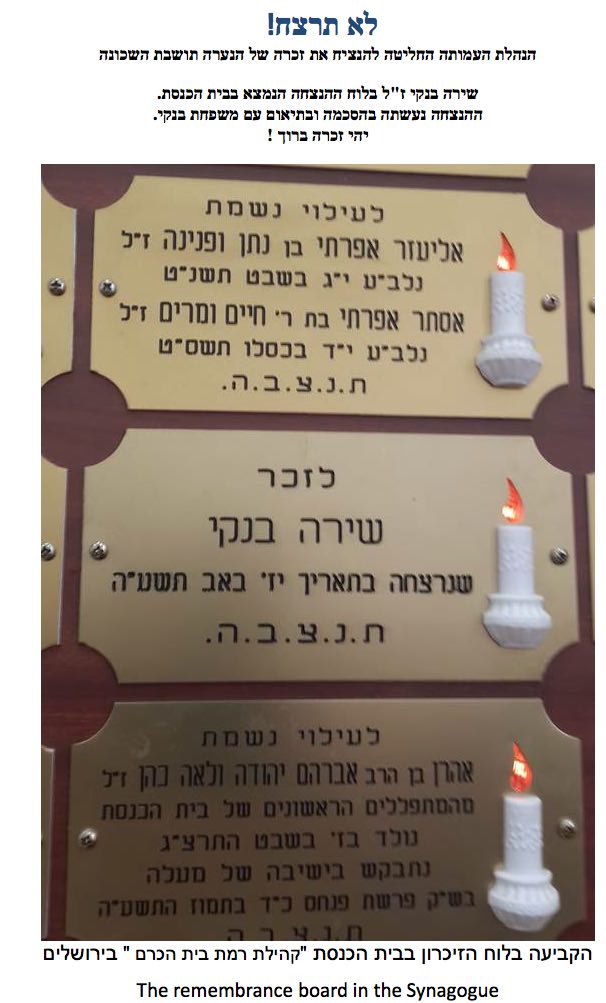
Remembering Shira Banky הי’’ד

To refresh memories, this unfortunate 16 year old girl was murdered because she attended a rally. It is true that the rally’s agenda was against the ethic and laws of the Torah, without any question. This is to my knowledge the position of all Orthodox Movements. I would imagine the more right-wing Conservative and Conservadox movements (such as Shira Chadasha) also share this view. Reform of course don’t believe the Torah was the word of God, dictated to Moshe, let alone the primacy of Mesora through Tannoim, Amoraim, Geonim, Rishonim and now Acharonim so it’s undoubtedly not an issue for them.

Shira Banky attended the rally to support the views of a friend. She was 16. I might not agree with Shira’s views and condemn those views with vigour, but the minute feelings translate to violence and in this case an unnecessary murder which created nothing more than more hatred for Orthodoxy, especially Ultra Orthodoxy is there anything more that Orthodox Jews can do to palpably show their distance from despicable murder which is not only against the laws of Israel, they are against the laws of the Torah. Her murderer, Mr Shlissel, is a recidivist. In my view, he should never be released and treated in a home for psychopaths. Apparently a number of Shules have performed the following to express their revulsion at murder “in the name of God”

My thanks to R’ Meir Deutsch for drawing this to my attention. Wouldn’t it be a great expression of regret if every Shule in Melbourne did the same? I call on the RCV to recommend such an action. The picture says it all.

ShiraBanky

Rabbi Telsner resigns

He has made a few mistakes, and it makes interesting reading seeing the different reports from the Age Newspaper versus the Sun. They obviously have different sources whispering in their ears. The anti-Jewish News will have the story just in time to splash on the front page and triumphantly blow its horn as the harbinger of morality (sic).

The Yeshivah Centre is undergoing change, no doubt. However, I’m not going to say any thing on the Rabbi Telsner issue because if I do, some will certainly misunderstand my words and it will make no different how I state them.

I am sure Rabbi Telsner has learned from this, and will contribute in a way using the gifts God gave him.

Rabbi Telsner is a card carrying Meshichist, as is his brother in law, R’ Chaim Tzvi Groner. There is no place in a Shule for screaming signs that no longer belong. There is no Mesora for placards in Shules, and it’s also a failure of Maimonides 13 principles of faith which clearly imply that we believe in Mashiach coming. Mashiach is a term for someone God chooses, it is not a euphemism for one and only one holy person in the Garden of Eden. Denying God this choice is in my opinion Kefirah. Meshichisten will not, cannot, and do not believe it is remotely possible for God to decide whomsoever He chooses from the physically living. That is pretty close to Kefirah. It is also a pseudo Kefirah for them to even entertain that there may well be someone else chosen because they won’t appear as a loyal Lubavitcher.

As for me, as I have said many times I couldn’t care less who it is. Eliyahu HaNavi will tell us.

Yeshivah has lurched to the right. It needs to bounce back to the centre and concentrate on quality education. It cannot afford to be a front for a Mesivta. There is obviously a need for a Mesivta. Let them find premises and build themselves on certain backers finances. The School itself needs to stress the qualities unique in Chabad, and there are many. Let the students be known for being fine examples of the Midos that are imparted by this philosophy. By all means it needs to stay a Chabad school, but one grounded in the realities of Melbourne. Failing that it should stop marketing itself as a community school.

Ironically, the School failed dismally to effectively educate Russian immigrants, years ago, and no longer does it serve many who are not religious. That’s their raison detre!

Too many New Yorkers have infiltrated and married in and tried to turn it into a fancier version of Oholei Torah in Brooklyn. Bad mistake. This is not New York.

I think it’s also time to pull down the rather pointless Yechi sign at the back of the Shule. Those who feel the need to scream this message to the world can bounce on the corner of the street, or wear a yarmulka (which they can’t then wear in a bathroom) wave yellow flags, wear cheap badges and all manner of paraphernalia not mentioned in Shulchan Aruch.

It does turn people off, and I include people from outside the Yeshivah centre. Those who really want to experience that type of experience can just go down the road to Dudu Leider’s Israeli Chabad house. They will love it. I’m told they chant Yechi more times than Shma Yisroel, over there, by a factor of 100.


Is it a Mitzvah vs a meritorious act to say Kaddish?

Most kids are only too quick to grab the Yerusha (inheritance) from their parent(s). It’s not a Mtizvah to do so, but if you do, then you must give Tzedaka from it (that’s a Mitzvah).

They take Shiva (SEVEN days) and convert it to one minyan or two. That’s not seven days mourning. Don’t worry, they will take seven or six or five figure inheritance without asking the Rabbi much quicker. It’s just “too much” to sit for seven days and mourn the loss of a parent etc

With this in mind, I noticed the Jewish News had an advertisement stating it was a MITZVAH to say Kaddish. I’m not learned, but I don’t know of any Mitzvah to say Kaddish. It’s a well known Minhag to say it at least once a day. I don’t like the idea of taking money for Kaddish when that doesn’t also include trying to educate and carry out the idea that Shiva and Shloshim are Halochos Beruros (clear Mitzvah) and teach these. Earn your money.

Perhaps this is an old-fashioned approach, it needs to be a less opportunistic “chasing coffin” exercise and actually involve doing something about teaching people the Jewish way in Death and Mourning. It’s a Dying Minhag, unfortunately. “Give a few dollars to someone to say Kaddish” and all is good.

Oh yeah, Minhag Yisroel, Din. You can do better than that.

Manipulation of elderly Rabbis

Thanks to the Internet we have all witnessed the disgraceful use and abuse of holy Rabbis who sit all day learning and can barely walk or talk while being cajoled to make statements which are blown out of all proportion by those who seek their approbation.These Rabbis often have no idea what they are getting into. They are being used.

We saw this with Rav Elyashiv. We see this with Rav Kanievsky.

Hagaon Rav Kanievsky Shlita One of the Tzadikei HaDor

We saw this with Rav Steinman, although despite his age, the latter has seen through the political chutzpah of many who have tried to manipulate his words.

His words of

Ga’avah, Ga’avah, Ga’avah

Were very powerful and showed he was a compassionate man who understood that those who had come to him were not the real McCoy but haughty people with Hats and  Peyos.

Be very wary when the best someone can do is quote an elderly Rabbi far removed from the world, but someone who can quote every saying of Chazal. As Rav Schachter says:

when you are in Yeshivah, your Posek may be your Rosh Yeshiva.

When you leave the Yeshivah, find a Posek who lives in your world and understands it,  so he can Pasken realistically and not in the world of a Beis Midrash


R’ Meir Rabi, Ben Pekuah Commercial Kashrus Venture and Mori V’Rabbi Rav Schachter

I am not here to discuss the laws of a Ben Pekuah. Look in Shulchan Aruch. Those who do not know about it (I’ve found it rather gross personally), let alone a commercialised farm of these, should discuss a commercialisation venture directly with their Rav who I expect will likely speak to a world-renowned kashrus expert.

I have mentioned R’ Rabi’s trips to various Rabbonim around the world, where he seeks their agreement to commercial projects he and his investors are involved in.

I have mentioned that the renowned world posek Mori V’Rabbi R’ Hershel Schachter, Chief Posek of the OU (with Rav Belsky) was displeased when I showed him a picture of himself and R’ Rabi from the day before, disbursed via the internet, as he had asked this not to be distributed via the net.

There is a danger that people would conclude that Rav Schachter was endorsing in any way R’ Rabi’s commercial kashrus projects or his stature. Rav Schachter is too nice a man to refuse a picture.

In that vein, I issue the following.

I have been in direct contact with Mori V’Rabbi Rav Schachter Shlita today, and he indicated that R’ Rabi had approached him about R’ Rabi’s plans for a commercial Ben Pekuah farm. Rav Schachter advised R’ Rabi clearly that in no way can Rav Schachter be involved or seen to be involved in such a venture, nor should anyone conclude such involvement by virtue of Rav Schachter’s picture appearing on web pages (without permission) or otherwise. The same applies to future communication that may be published by R’ Rabi with any pointer implied or otherwise regarding Rav Schachter.

Mori V’Rabbi advised R’ Rabi that he was in no way giving a Hechsher or even implied Haskomo to the concept. Nobody should conclude, therefore, that Mori V’Rabbi R’ Schachter is in anyway involved or has given approval to R’ Rabi’s commercial Ben Pekuah venture. There are many intricate and complex concerns about such a commercial project and these need very close and careful hands-on supervision by a knowledgeable expert, world-renowned Rav, who agrees specifically with each and all the details of R’ Rabi’s methodologies and particular supervision regime.

Rav Schachter does not endorse in any way, Rabbi  Rabi’s commercial Ben Pekuah farm, and encourages those who do wish to avail themselves of produce from such a farm, to discuss that issue directly with a world-renowned expert Posek who is fully across all the details of the commercial farm.

The exact above words were read to Rav Schachter and he thanked me for ensuring that people would not be misled in any way.

Honour to Rabonim

One of the things that has struck me between the generation of holocaust survivors, most of whom are in עולם האמת and the generation today is the distinct lack of כבוד for a Rav.

Now, I can hear you saying, ah, but the Rabonim of today are not the Rabonim of yesteryear. I agree. It is also true of the generation before that and the generation before that. This is amplified to the extent that Babylonian Scholars of Talmudic academies were not referred to as Rabbi XYZ but Rav XYZ. Why? there was no Semicha in Bavel/Babylonia.

Yet, we are also asked to make for ourselves a Rav. Even though someone become a Rav, he should still have his own Rav Hamuvhak (mentor Rabbi). There are many stories. Even someone as great as Rav Lichtenstein ז’’ל and Rav Nevenzahl used to look up to Rav Shlomo Zalman as their decisor on matters on the razor’s edge. There is a cute story that Rav Lichtenstein’s daughter wanted one more piercing than her father was comfortable with. Of course, they learned the relevant halachos, and then it was proposed that they will go to Rav Shlomo Zalman, and let him decide. They both agreed to be bound by his Psak. Rav Shlomo Zalman, being more than a Posek par excellence, also had the “feel of the nation” at his fingertips. He turned to Rav Aharon, and basically told him to leave his daughter alone. There was ample precedent for it, and much more important issues to worry about. Rav Lichtenstein was worried about Chabolo.

In our day, there is certainly a mix of good, great, not so good and downright embarrassing clergy. Some can learn, some can’t. Some can speak, other cannot. Some have sensitivity to politics and diplomacy and others hide behind it or don’t realise how their words can be interpreted and hurt. The Torah doesn’t have a concept called “Daas Torah”. That’s a new term post holocaust, largely invented by Hungarians who politically infiltrated the Yishuv in Israel, and then subsequently spread to the States.

One should have a Rav HaMuvhak, a special mentor. Some Chassidic types may call it the spiritual mentor without the halachic clout. Whatever. There are people who have both.

I’ve complained about this elsewhere, but I think one of the biggest Chillulei Hashem is when one chooses to daven at a particular shule AND partake of the Kiddush and then chatter incessantly throughout the Rav’s few words. Maybe what he is saying isn’t startling. Maybe he’s not even your Rav, but you can’t explain why you daven and eat there. It matters not. When someone knows much more than you, you should shut your mouth and listen for the ten minutes so that the “speech” isn’t a shouting match of the wild and wooly versus versus those without Kavod Rabonim and Kavod Habriyos.

I watched for decades as holocaust survivors, who had driven to shule would hide their driving from the Rabbi. They had Kavod, they had a sense of חרפה because this is the mimetic tradition they received from their own fathers. They had reason not to believe. I don’t know what they believed. These are the types of people who, if they saw a Rabbi in the distance on shabbos while smoking, would quickly hide around the corner and butt it out. Hypocritical? I will leave that to God. Lurking underneath though was a sense of Kavod. Don’t like your Shule or your Rabbi? There are many alternatives. You can even lie on a bean bag and pay nothing in some meditative Orthodox minyanim.

Find who and what jives with you, but please, do not come to the Kiddush each week and fail to wait for the Rabbi to make Kiddush first? Why? I don’t eat cake before breakfast (as per halacha) and I’m quite comfortable waiting 5 minutes till the Rabbi has finished dealing with congregants on his way out of Shule. I find it offensive to watch people who are not paupers or hunger stricken by any stretch, shovelling food down their mouths well before the Rabbi arrives. It makes no sense to me. The words Zolel V’Sova come to mind.

Each of the Holocaust survivors who had lots of reasons not to believe, climbed wearily up the stairs (and it was often not easy) just to shake the Rov’s hand and say Good Shabbos. Their kids would have seen this. I saw it. Alas, our generation doesn’t see much of this. They see little. We are creating a new sick tradition of

I am for me, and I couldn’t care about any hierarchy, God ordained or otherwise, because the world is imperfect.

When did you last see someone stand up for an older man in Shule as they passed? That happens to be a Din D’Orayso.

Are we full of Am Horatzim or is it just selfish Davkaniks with an overinflated ego of their less than fulsome achievements. I forgive Am Horatzim. I don’t understand inflated egos that over-ride Kavod HaTorah, even if the Rav isn’t your favourite. Again, no one forces you to come, do they?

Why do I write about it? Because it bothers me. If we don’t set any example, what will our children and grandchildren see and do. Yes, brothers and sisters, the future is in our hands. Can you overcome your need to chatter or to eat 5 minutes earlier? Is it that hard?

Can you also shut up at a Simcha during a speech, or do you contribute to the constant murmuring so that the speaker has to yell? It’s a sick malady. I see it when the speaker talks for 5 minutes, so don’t tell me “it’s because he’s been rambling for 20”. These are unholy excuses. Given Neshamos come down for the Simcha, who are you to disturb a Simcha while they are there?

Meir Gershon Rabi’s latest venture: From Flesh to Milk

I heard about this probably a year ago or longer. The concept is far from new and has appeared in many halachic issues. For example: Dinei Yichud (being alone with someone of the opposite gender (or indeed same gender for someone who is Gay!).

First, an admission. In our family, we only drink mashgiach supervised Chalav Yisrael. Ditto for milk products, with the exception of a chocolate bar that is known to be from Milk powder (see Rav Frank in Har Tzvi, which is also accepted as normative in Israel by the Rabbinate).

The reason my family does this now is because I did it for about 7 years before I got married. Why did it I do it then? It wasn’t because I was a frumak who had returned from learning overseas and overturned his parent’s house and insisted on them making a range of changes because things weren’t “up to scratch”.

Absolutely not. I had and have no doubt so ever about any aspect of Kashrus in my parents’ home, where standard Australian Milk is and was used. Rather, in those days, in the early eighties, there were a group of people who did not accept the permission of the famed Chazon Ish*, R’ Moshe Feinstein, and others, that Milk in the US, and countries like Australia can be assumed as “supervised” as a non-Jew would be loath to breach Government regulations and introduce non cow’s milk. In Australia, they are particularly strict, as any visitor to this country trying to bring in an apple will know. Accordingly, I approached my mother, and asked permission if she minded that we have one bottle of milk that is humanly supervised by an assumed reputable Mashgiach in the house. I told her that my motive was to be another person who bought such products, so that the nascent business which was trying to produce traditional Chalav Yisrael would survive. I was somewhat altruistic, and even agreed to support Hungarians 🙂 so that an alternative view could also exist from a business perspective by my small gesture. My mother accepted, and would make things Chalav Yisrael as she wanted me to be able to eat them, after I mentioned this.

What started as an altruistic notion, was also expressed explicitly at the time, and even now, in terms of the fact that I do not consider, based on reliable world-renowned Poskim, the Government milk (Chalav HaCompanies) as any less Kosher. I did not take a blanket Neder (vow). As such, I never had or have a question of Keilim (vessels). I simply do not consider such vessels Treyf in any way or form.

Unfortunately, come companies, such as Cadbury’s do use real milk, so the milk powder view mentioned above loses much value! In Israel the Rabbinate notes when overseas chocolates are made with Milk Powder.

Enter Meir Gershon Rabi (MGR). He wants to produce Chalav that is supervised, using a web cam style supervision. The supposition is that in addition to Government regulation, one could “see” (although technically that can be faked easily enough) that its real milk from a Cow. Now, of course, as is well-known, MGR, runs a private BUSINESS  from his Kashrus together with other investors. I would call them business entrepreneurs who use kashrut as their commodity. I have no doubt that MGR and his family did not rely on the Chazon Ish or R’ Moshe Feinstein, and instead bought the fresh Chalav Yisrael from Adass or the long life version.

So, MGR announces that he has put into place a series of cameras for surveillance of a farm or two so that “more” confidence in the source of the milk can be ascertained. I assume he either considers this as more Mirtas or real Hashgocho. Whatever.

I don’t understand the business model. People who are quite comfortable with the Chazon Ish and R’ Moshe Feinstein can buy any milk on the Kosher Australia app or web sites or publications. These are Kosher. They are not mehadrin according to those who don’t follow the Chazon Ish or R’ Moshe. Those who know, make their mind up.

Presumably, MGR wants to increase the “confidence” in the mehadrin status of the milk through cameras. My prediction is that those who need a physical set of eyes via a Yotzeh V’Nichnas (surprise occasional visit from Mashgichim) or a full-time Mashgiach (who also examined the cans before milking—ask whether MGR’s web cams do that). Those people, and there are many, will not engage in MGR’s supervision of anything. They don’t eat from his Hashgacha anyway, and I’d love to know if MGR will now bring this new milk (which is used in this way in Israel but not accepted as mehadrin by the OU and others) into his own house for his own wife and children and grandchildren.

The others who are happy with milk as listed in Kosher Australia don’t need to be bothered with his innovation. The milk in the Kosher Australia list is already deemed Kosher Milk. Why do they need MGR’s Camera Milk suddenly? Did he tell them they needed traditional Chalav Yisroel before his got his surveillance by video working?

At the end of the day I am puzzled by this from a business perspective (although there is an initial outlay). Who are the potential buyers of such milk? MGR and his business partners must feel there is a new market?  At the end of the day MGR’s business is a private company, and they will not allow the community to see their books or the money made from his Kashrus “innovations”.

I just don’t get it. There seems to be no money in it!

A much more pressing issue is the Kashrus of cows in general! One must ascertain that they haven’t had their lungs punctured because of stomach problems, by veterinarians, because their Milk would be Treyf even with human eyes. Perhaps MGR also uses web cams to scrutinise the veterinary procedures and records. [I’m told that in Australia these procedures are less likely than in the USA due to the quality and type of feed]

What have I missed?

* There have been revisionists who claim the Chazon Ish wasn’t serious about his view. He most definitely was. The rest is the type of revisionism beautifully described by Marc Shapiro in his “Changing the Immutable” and documented with great precision by HaGaon R’ Dovid Segal.

From Greenberg Art


More on Same Gender issues

There is an interesting piece in Tablet Magazine where Rabbi Benny Lau, considered a moderate by many, makes a powerful speech.

Like many, I am horrified that anyone should seek to murder another over this (or indeed any other reason except for self-defence). I wonder, though, what his speech would have been had nobody been murdered. He would have needed to “tip toe through the tulips”. Indeed, one wonders whether he would directly answer the question of whether such marches are appropriate in the Holiest City of Jerusalem? Would he approve of these at the Kotel or Har Habayis? Would he speak at a March there?

Make no mistake. I do not conjure hatred or invoke enmity against those with disposition towards the same gender. At the same time, I am completely bound to the Torah prohibition regarding the actualisation of such a disposition. That is inescapable for any Orthodox Jew. Though Rabbi Benny Lau certainly agrees with that, I think he would choose not to mention it. He would have halachic precedent to not mention it. The command to admonish is not in effect:

  1. Where one will definitely not be listened to; and
  2. Unless someone knows “the way” to admonish.

On the second point, many Acharonim say that we do not know the way to admonish any longer. That should not be equated with silence. This post is not silence. In any democracy, the only way to foster love of Torah is to teach authentic Torah according to one’s audience’s level. This is inescapable.

Ironically, Religious Zionists in Israel as opposed to Centrist/Modern Zionists around the world, are far less equipped to deal with the new generation. I have witnessed a profound lack of sophistication in their educational approach. The preponderance of attention to land over people is only partially to blame. The other part is the feeling that they need to strive to be “like” Charedim. There is no need to do so and there never has. One ought not be concerned by what cloistered enclaves choose to do or not do. That is their approach.

One does as the Torah commands, and speaks בדרכי נועם.

As Chacham Ovadya Yosef taught:

אין טעם כלל לזעוק בקריאות כל שהן כלפי מחללי שבת בפרהסיא, הנוסעים במכוניתם בשבת, שהרי בקריאות “שבת! שבת!” כנגדם לא מתקיימת מצות תוכחה, אם מפני שאינם מבינים כלל את דברי הזועק, ואם מפני שחונכו בדרך לא טובה, ועל כן לא השכילו להבין את חומרת הדבר של חילול שבת. וכל שכן אם הם אנשים יודעי תורה, ואף על פי כן הם מרשיעים ונוסעים בשבת, שבודאי אין חיוב כלל להוכיחם

Same gender group in the Jewish Community Council of Victoria

I am implacably against anyone hurling vitriol or discriminating against someone because of sexual proclivity/preference, but my take on such a council as the Jewish Community Council of Victoria (JCCV) is that groups with sub-philosophies within Judaism are members representing a given approach within a broader philosophic cum cultural definition of Judaism. For example, Bund, Orthodox, Sephardim, Conservative, Reform, Secular Zionist etc

I don’t know how sexual preference defines a sub culture or philosophy of Jews or Judaism per se given it crosses all groups anyway.

They should be afforded full support by the JCCV and indeed the Council of Orthodox Synagogues of Victoria (COSV) in the face of issues which they face, and pastoral/other assistance but their membership extends across the existing sub groups, I would have thought. Services to assist I fully understand and support, but I don’t understand a grouping that defines itself by its sexual preference.

For this reason I don’t understand why they need or want a formal membership separate from existing groups.

As far as Orthodox Shules are concerned, I’ve personally not encountered anyone being called out or excluded or insulted because of a sexual preference. Of course, I stand to be corrected if that has occurred especially in the last ten years.

It comes therefore as a surprise to me that apparently  Caulfield, Brighton, Blake Street, North Eastern, East Melbourne and Kew Shules will all be voting in favor. I imagine the others will either not be present or abstain or go on ‘walk about’. The COSV is pretty much a toothless tiger, and on a matter such as this, they should consult the Rabbinic Council of Victoria as well.

For an Orthodox group(s) I would express disdain for acts which highlight someone’s sexuality and/or take action verbally or otherwise against such people. I think that’s a given in our society. Is it not?

That being said same gender KIDDUSHIN cannot and will not ever be supported by Orthodoxy. That also needs to be made clear, and certainly by Sam Tatarka, Danny Lamm and other orthodox members of the JCCV. There can be no hiding or diplomatic sweeping under the carpet of this axiom  by simply not mentioning it.

More on T’cheles from Mori V’Rabbi Rav Schachter

By chance I came across this. I had written another piece here.

I haven’t heard of anyone who ties their tzitzis this way. I had asked one of Rav Schachter’s sons but he hadn’t got back to me. His father just went on a Heritage Tour of Morocco where he gave six shiurim on Morocco depending on where they visited. Unbelievable. I will have to find time to listen!

Here is the video. Enjoy.

Enjoy

The Australian Labor Party and Israel

We are in Australia. We don’t live the life of an Israeli. It was reported yesterday that the majority of Israelis were and are against the previous evacuation of Gush Katif (Aza or Gaza).

Are we, as Jews not living there going to tell them they are wrong, while we lounge in the relative comfort of Melbourne?

And so, I will confine my views to those emanating from the Australian political landscape,

I am friendly with Michael Danby, a stalwart within the Labor Party and a shining star. Mark Dreyfus or his office never respond to my communication.

At the end of the day, to talk about a two state solution as observers in Australia is complete and utter baloney, and grossly misses the point.

There is currently NO PARTNER FOR PEACE. I do not think it is necessary to justify such a fact. It is self-evident and is the view of the Israeli Government.

IF AND ONLY IF there is partner, one can begin to talk about two states.

That reality is lost in the labor party’s discussions where the left clearly hold sway.

The transparent remarks as typified by the weekly letters to the Australian Jewish News, that we should be applauding Michael (and Mark) and two others is correct, however, the suggestion that THIS is the front page news is an attempt to deflect from the primary issue. The primary issue is not about two states. It is about whether there is a partner for peace, and what the Labor party did not say.

In my opinion statements which elide this primary issue as enunciated by the elected Government of Israel are defective and deflective of reality.

I do not know what the Liberals will say, but the Greens already have shown their lying yellow colour, when their leader changed his mind a few days after being elected. The Greens are the up and comers and the most dangerous party in respect of support for the only true democracy in the region. They are the Marmara of Australia, often wearing the clothing of the mujahideen under their vegetable-derived suits.

An Apt Tisha B’Av Message


(Hat tip RC)

matos masei 

After Jewish men illegally consorted with Midianite women, we find a strange offer from the sinners. Instead of the usual animal or flour/incense based sacrifices, they suggest that atonement for their sins should be granted by bringing the jewellery and concealed body ornaments proudly adorning the Midianite women and used to cajole them to a sordid bed of iniquity. This is a most strange and irregular “sacrifice”. From whence did they assume that such a notion would be acceptable? The sons of Aaron died for bringing a “strange fire” as a sacrifice! There was no Torah precedent for this style of offering to atone for the injunction against iniquitous cohabitation.

Precious Jewellery represents the enticement embodied by the physical being. Man and Woman are attracted to beauty. This, in of itself, is not necessarily a bad thing. Indeed, without appreciation of such, there might be no procreation. The danger is born when physicality alone conceals and constricts the spiritual essence and striving of the holy Jewish soul. The soul is rendered wounded by the attack of physicality (or excessive materialism).
Rav Kook explains that the sinners had recognised that they allowed bodily desires influenced by external considerations to overtake the essence of their spiritual and religious imperative. The shell of the egg, if you will, conceals the yolk and albumen. In such situations, our role is to break the shell, and find the essential truth which nourishes the soul. We have witnessed the shell of a deal with Iran. The devil is in the detail concealed therein. May we merit to see true peace in our country, Israel, and may all Jews be safe from the scourge of the misleading and tempestuous storm of deception and violence enveloping our world—especially now—during the nine days of mourning for the destruction of our beloved Temple.

T’cheles (likely authentic blue) Tzitzis

The Shulchan Aruch includes a disagreement between the Mechaber (R Yosef Karo) and the (Ashkenazi) Ramo. The Mechaber’s view is that the strings should be the same colour as the four cornered garment they are attached to. In that vein someone wearing a Kapote which is black and has four square edges, would need to wear black Tzitzis. That’s my understanding of the Mechaber. The Ramo states that Minhag Ashkenazim is different. Ashkenazim don’t look at the colour of the garment as determinant, rather they always wear white. Undoubtedly this is not a Minhag from the time immemorial. Rather, when the Jews had preserved the tradition of Tcheles from generation to generation it is reasonable to conclude that the strings were not all white. Indeed, we see even amongst Sefardim like the Rambam, and others such as the Ra’avad and Tosfos different ways to utilise and incorporate the Techeles string.

The tradition of Identifying/finding Techeles was lost. There is the famous Radziner Rebbe who thought he identified Tcheles, and the subsequent debunking of the Radziner Techeles by Chief Rabbi Herzog and others. About 15 years ago the murex trunculus (as I recall, I could be mistaken with the exact name) enjoyed very strong halachic and scientific support as being authentic T’cheles.

Rav Soloveitchik opposed attempts to identify and conclude what T’cheles was as he was very much the Masoretic Jew from Beis HoRav (stretching to the Vilna Gaon). As such, where a mesora/tradition was lost, that was the end of the story, and one would need a Novi/Melech HaMoshiach to confirm the source of the T’cheles blue.

According to Kaballah, the Sefer Hachasidim related that he saw in a prophetic image that God wore white Tzitzis on a completely white garment.

The Mishna Brura opines that it is best to wear a pure white garment and white Tzitzis, as in this way one fulfills both the opinion of the Ramoh and the Mechaber.

It is rumoured that the last Lubavitcher Rebbe’s father, Reb Levi Yitzchok הי׳ד who was an accomplished Kabbalist, wore a plain white Tallis and white Tzitzis.

Mori V’Rabbi Rav Hershel Schachter argues that today, based on the Gemora in Menachos 40a, that the Gemora states explicitly that someone who wears Indigo coloured strings as a substitute for Techeles is fulfilling the Torah command of Tzitzis. Therefore since in our day we have something which can be called ספק תכלת, possibly Techeles, there is a cogent argument to no longer follow the Ramoh’s custom, and to wear modern T’cheles, since it’s a ספק דאורייתא, a Torah doubt, for which we normally are careful to be concerned about.

Clearly, Rav Schachter, arguably the most accomplished of the Rav’s Talmidim, doesn’t agree with his Rebbe, Rav Soloveitchik (during which time this T’cheles wasn’t yet (re)discovered.

Rav Schachter opines that Rav Elyashiv’s view that one should continue wearing white, must be based on a reason that Rav Schachter didn’t merit to understand. I seem to recall Rav Schachter meeting with Rav Elyashiv and this was one of their conversations.

I have a set of the first T’cheles of the new type that have been sitting in my cupboard for many years. I haven’t looked into the matter since I read Rav Soloveitchik’s view.

I’m interested in any views which may differ from the rather compelling logic and psak of Rav Schacter. I know that Chassidim (and today’s Litvaks are no different) look to their Master and follow their Rebbe/Daas Torah behaviour and practices.

I’m interested in halachic arguments against Rav Schachter’s logic.

Kashrus and a higher level

The following is from Rabbi Yisrael Rosen, Dean, Machon Tzomet. The mind boggles in regards those who approve the lowest level AND run it as an entrepreneurial private business with closed books, wealth accumulation and a dishonest attempt to work with Halal on the grounds that they might imagine they are the ‘authority’ to represent the majority of kosher consumers, most of whom reject such supervision.

A hearing will soon take place in the Supreme Court in Israel on a request for an injunction by some restaurant owners in Jerusalem against the Chief Rabbinate, which fined them based on the Kashrut Fraud Prevention Law that gives the Rabbinate (and the IDF) exclusive control over the concept of “kashrut” in Israel. These restaurants are “approved by the community” in the framework of “private supervision,” headed by Rabbi Aharon Leibowitz, who is challenging the local Rabbinates and the Chief Rabbinate. The approval certificates are worded in a sophisticated way, in order to avoid using the protected word “kosher” – (for example “this place is supervised,” and other roundabout hints). And just in case somebody might think that the supervision involves other issues, such as health, ecology, or security, he can check his assumptions at their website, kashrut.org.il. The State Attorney as usual sets his eyes on the strict letter of the law, and he has therefore expressed support for the petitioners. The judges of the court scolded him, trying to “pay attention to how the people normally behave” [Berachot 45a], and demanded to hear from him the position of the Chief Rabbinate. The future result is not easy to guess. Will it depend on the specific judges who are called upon to rule? (As an aside: the kashrut approvals of the “Badatz” organizations are evidently provided in addition to regular approval by the Rabbinate. They have branded themselves as “Mehadrin,” holding to an especially stringent level of kashrut, and it seems that there is a demand for this.)

I agree with the feeling that the time has come for privatization in the realms of kashrut and other religious services (such as has been done with medical insurance and public transportation…). This would place the Chief Rabbinate in a regulatory role, “higher-level” supervision, giving approvals to those who directly supervise the kashrut, attesting to their honesty and their authority . Perhaps the Rabbinate should also be involved in setting the work conditions of the kashrut supervisors. With respect to the new organization in Jerusalem, I would insist on one other precondition – only groups that have proven experience in the field and that have attained public trust would be able to enter the arena as independent supervisors of kashrut. And there is another prerequisite: Transparency – the organization must prominently display the “kashrut elements” on which they depend, and which rabbis give them approval. For example, there might be room to accept rabbis who are willing to give kashrut approval to firms which do not observe Shabbat, while some people might reject them. Some would prefer to be stringent with respect to cooking in a restaurant by a Gentile, in accordance with the opinion of Rabbi Mordechai Eliyahu, while others may be more lenient, following the opinion of the RAMA (see Rabbi Ovadia Yosef, Yechaveh Dei’ah, 5, 54). Some will be willing to accept the “heter mechirah” for Shemitta, while others will not. Some will be stringent about milk of Gentiles. Many examples can be given. But the main point is that there should never be any room for deception and misleading claims.

In the petition in Jerusalem, as long as the current law remains in effect and there is no regulatory mechanism, and as long as there is no “higher-level” supervision over the “private supervision,” the situation is indeed one of deception and misleading claims. The normal citizen, who is not aware of the ins and outs of all the power fights against recognized institutions, will tend to accept any “certificate of supervision” as if it was given by the officially recognized kashrut authority. Would we tolerate such sophisticated wording with respect to the ingredients of our food? Would the relevant government authorities allow “approvals” of this type with respect to health, security, or ecology, using very tricky wording?

Professionalization

Let me add that rabbis who are not expert in the issues involved should refrain from giving Shabbat approval to eg hot water heaters or samovars, or to ovens. And this reminds me of the recent scandal of the “kosher switch” which is being promoted by a group in the United States. This “kosher for Shabbat switch” has received approvals by some very low-level rabbis but is rejected by all the rabbis of recognized authority.

Just as it is unthinkable that approval by an amateur will be accepted in matters of security or health, so caution is needed for religious approvals.

Consider sending this to your non Jewish friends who might appreciate it

(It’s also one of my all time favourite ballads 🙂

Beit Raphael in Melbourne

Adina and Shimon Allen are amazing with this triple chesed. I’m in awe of their tzedoko.

Efraim Finch: he’s also a living treasure

Win some, lose some. Chabadnik dons Tefillin on ex-Charedi lady

Some find this funny. For me it epitomises גלות. Here we have a well-meaning boy, who is trying to ignite a spark within Jews. His mode, is that of his Rebbe זי’’ע and that includes igniting the Neshoma through a Mitzvah, the Mitzvah of Hanochas Tefillin.

The only problem is, in this case it was a woman. She had buzzed hair, and to top it off had a strong Charedi broken English accent, full of the usual errors. She obviously enjoyed her moment in the sun of egalitarianism.

I feel sad that she obviously hates her heritage so much, that she is ready to mislead this well-meaning בחור. She’s no daughter of Rashi.

אוי מה היה לנו

Woe unto what we have become

IMG_2800

He’s really doing us a favour, truly altruistic!

So, all the treyf gelatin that has been around for ages is suddenly acceptable! The company that makes the Gelatin have never been interested in Kashrus.

Look at the list from “It’s kosher?

PK®Blue Mint

Hubba Bubba®Strawberry Original

Extra® Peppermint Spearmint Strawberry,

EXTRA® Active™ Peppermint Spearmint

ECLIPSE® Peppermint Spearmint Cool Breeze Berry

ECLIPSE® Chewy mints Spearmint Fruit Trio Peppermint Watermelon & Strawberry

EXTRA® Professional Lemon Lime Bubblemint Peppermint

AIRWAVES® Menthol Eucalyptus 5gum® Cobalt (peppermint) Electro (spearmint) Tempest (watermelon)

Strawberry. SKITTLES® Fruits

Sours and Tropical

Now what I want to see is

  1. Each overseas Posek, who he likes to be photographed with happily munching on these based on his authoritative Psak
  2. His wife and children doing likewise.

Forget about either. It’s a business. Those who eat out, also follow this “authority”.

Open your books and stop taking the community on a rodeo.

The bottom line: if they still have a taste after 3 minutes, they are trayf.

The internet and the streets simply must open up the world to Charedim

Here is a fascinating story of the grandson of the Satmar Rebbe who joined the Israeli army. Yes, it’s true, that there is no family that is immune from a child taking a different direction. This is a fact of life.

I don’t like the word blame in the context. I prefer to think that the concept where ‘one size fits all’ and clueless teachers and/or parents cause much of this reality. חנוך על פי דרכו teach according to their acuities, is something harder to achieve in a “my way or the highway” approach.

You should read the article HERE [hat time CMW]

Another article, of interest, describes what appears to be a growing phenomenon is from the Huffington Post, and reproduced here [Hat tip Krakower]

I Escaped Hasidic Judaism and Went From Living on the Streets to Being a Hollywood Actor

In June 2008, exactly three years after I got married, I decided to get a divorce. I didn’t fall out of love with my wife. In fact, I never fell in love with her in the first place. I simply no longer wanted to have the life I had with her and everyone surrounding her.

My wife was a Hasidic Jew, and when I married her, so was I. But that was no longer the case. I was a 22-year-old man with a long beard and side curls (payes) and all the other markings of a Hasid, but I was an atheist. An atheist surrounded by Orthodox Hasidic Jews. Surrounded by their certainty, their food, their self-righteousness and their minivans.

I hated all of it, so I left and entered a world full of uncertainty and a broad spectrum of ideas about right and wrong.

I had no idea what I was going to do. I had no education beyond Jewish Talmudic studies. I had no friends outside of the Hasidic world beyond a few I met at Footsteps, an organization that supports Orthodox Jews attempting to escape. I had no marketable skill beyond being able to charm your pants off. I had never been on a date. I had never heard of The Beatles. And I thought, “May the Force be with you” meant “May God be with you.”

“For most of my life, I believed that all non-Jews hate us and want to kill us.”

After leaving the Hasidic world, I spent seven years in various stages of decay. I slept in a tent in Bushwick for several months, lived in a rented Volkswagen Jetta for as long as my credit card limit allowed and crashed with friends. I starved in the harsh street of New York City. When I used my last subway fare to make my way to my sister’s (one of eleven siblings) house for leftovers from Shabbat meals, she wouldn’t let me in the house because I was wearing jeans.

When I went on dates, I had nothing in common with the women. I knew nothing about their culture, and they knew nothing about mine. I thought all shiksas were prostitutes, and they thought all Hasidim were landlords and diamond dealers.

Let me answer some revealing questions about Hasidic Judaism. Does it withhold a broad education from their children in order to keep the children narrow-minded and uneducated? Yes. Does it vilify the outside world in order to keep its members from joining it? Definitely. Does it have a fear and/or doomsday element to it? Of course. Is there ex-communication for those who dare to leave? Oh yeah.

I still have not received anything past a 5th grade education. In fact, since I never attended a regular school, I don’t actually know what a 5th grade education is — I just picked a grade that seemed right. I don’t know what algebra is; I know I can Google it but I wasn’t made to care enough to do so.

“After leaving the Hasidic world, I spent seven years in various stages of decay.”

For most of my life, I believed that all non-Jews hate us and want to kill us. I believed that all goyim are murderers, rapists, degenerates and dirty second-class citizens. Of course, they/we aren’t but I was taught that in order to make the secular lifestyle less appealing. I was told horrible things would happen to me in this world and the “next world” if I leave. I was told I would end up a criminal or drug addict. Many members of my family refuse to speak to me to this day.

I have had to transition both out of Hasidism and transition into mainstream culture. I have had to find a replacement for the void left by the lack of community and warmth. I had to replace my family, my friends and my moral compass. It was hard leaving everything behind but it was even harder to find something to replace it all with.

Thankfully, as an actor, my professional community is very friendly and inclusive (albeit competitive). I’ve replaced my biological family with actors and Footsteps members. I have managed to date, to have my heart broken, to have broken some hearts and to grow because of all of it.

I get asked all the time: “Are you happy now?” The answer is an unequivocal, “Yes!” I have friends who love me for who I am, for who I was and for who I am trying to become.

“I had to replace my family, my friends and my moral compass.”

Career-wise, it seems I have sought the path of most resistance, deciding to work in a field full of multi-talented human specimens with high cheekbones and jaguar physiques. I’m five foot seven inches, unathletic and have a heavy Yiddish accent. And yet, I’ve been getting work. My latest film, “Felix and Meira,” just beat David Cronenberg at the Toronto International Film Festival for “Best Canadian Feature Film,” and I won “Best Actor” at the Torino Film Festival. Next, I will appear in a recurring role in the upcoming season of “Transparent” on Amazon Prime.

But those achievements pale in comparison to the responses I get from people within the Hasidic community who have snuck out to go see the film. They have been yearning to break away but have been told that if they do, they will end up in jail or in rehab, and they believed it. But now, they can counter that with success stories like mine and those of others like me.

The Hasidic community isn’t what it used to be even five years ago. With the Internet, every person has access to every flavor of every forbidden fruit his or her heart desires, including my story. It won’t be long before the Empire falls. It might not fall completely, but it certainly will be forced to adapt to the 21st century.

The Empire won’t go down easy. The Empire will strike back. For evidence, watch the comments section below.

Follow Luzer Twersky on Twitter: www.twitter.com/@twersky

In my opinion unless subtle changes are introduced into Charedi education this will become more prevalent. It is nigh on impossible to live in a Cocoon these days. I know of schools that redact every book with pen or gluing pages together. The effect is that the students are more certain to find the original text and be exposed. I’m not sure that approach works. Kids are far more connected than they ever were.

Indeed, there has been a new (undesirable) ban now on whatsapp [Hat tip BA]. I surmise this is because the kosher filters cannot filter such messages. whatsapp is wonderful, it keeps families closer and informed, especially when they are spread around the world. Anything can be used for bad or for good. That is the central tenet in my understanding.

Shabbos clean up

I saw this cute story on Rav Aviner’s web post:

There was once a young couple who was very close to the Bostoner Rebbe and Rebbetzin. The couple was also close to Ha-Rav Yosef Solovietchik, who was Rav in Boston, along with teaching at Yeshivat Rabbenu Yitzchak Elchanan. The couple was once invited to Rav Soloveitchik’s home for a Shabbat meal. The Bostoner Rebbetzin asked the young woman: What did you see there? She answered: It was quite similar to what you do but there was one difference: They use disposable utensils. The reason is that Rav Soloveitchik’s wife wants to participate in her husband’s Motzaei Shabbat class, and if she needed to wash dishes, she wouldn’t be able to do so. The Bostoner Rebbetzin went to her husband and told him this practice of Rav and Rebbetzin Solovietchik and asked: I am willing to eat on China every meal, but we have 30-40 guests every Shabbat and I wash dishes until Tuesday. Why can’t I use disposable dishes? The Bostoner Rebbe said: You can use disposable dishes. The Bostoner Rebbetzin said that she is so grateful to this young woman who told her what she saw at the house of Rav and Rebbetzin Soloveitchik (The Bostoner Rebbetzin Remembers pp. 165-166).

Undoubtedly this was before the days of dishwashers, but even so, there is plenty to do Motzei Shabbos, and the salient lesson was that Rav Soloveitchik’s wife Rebbetzin Tonya, has more of a תשוקה, a strong desire to hear her husband’s shiur, than washing up dishes. The Rav, however, had a duty to give his superlative shiurim.

I have to admit, I was brought up in a very old-fashioned way. I don’t ever recall my father ע’’ה doing these sorts of things. He worked extremely hard, going to work at the crack of dawn and coming home in the evening when it was dark, including a good half day on a Sunday. I am an only son, and inherited this tendency, although I have improved in minuscule ways, and never worked as hard as my father. In reality, there really is no excuse to help unless you have the means to hire some home help.

I plead guilty as charged.

More on the Rav Riskin Conversion issue

Rav Riskin has suggestions about making it easier for giyur because of the problem with the volumes of non Jewish Russians in Israel.

He has written these in a book. This is the way of Torah.

He has conditioned his suggestions on the agreement of other major poskim.
The information that I have is that he has not actually acted on any of his proposals with respect to Giyur, although, as I mentioned in a previous post, there are a myriad of instances where Charedi Batei Din do quicky conversions which are quite obviously based on marriage considerations!

One of the issues with Rabbi Gil Student’s post is that he doesn’t deal with the suggestions that Rav Riskin puts forward.
Instead of arguing with his suggestions some rabbis prefer to just silence him.

I’m aware that Rabbi Yoram Ullman of the Sydney Beth Din, did deal with some of the proposals, however, I was not in a state to be at his talk. If he has published a Tshuva, or anyone can encourage him to do so and pass it onto me, then I’d be obliged.

If I was Rav Riskin, I’d take my arguments to Rav Zalman Nechemia Goldberg and Rav Hershel Schachter (but that’s just me). If they both gave approbation to one of his suggestions, I’d accept it with 100% confidence. If they don’t then I would not. Neither of these Gedolim have an agenda (although Rav Hershel may adopt the approach of his teacher Rav Soloveitchik and be unwilling to Pasken for Israel specifically)


Rav Yuval Cherlo on the Rabbi Riskin controversy

[the following is an edited, summary of a talk by Rav Cherlo, from Rabbi Dr Eli Turkel and is printed here with permission]

Who is Rav Yuval Cherlo?

He speaks English. He is a Posek of note from the centrist camp, who writes Tshuvos. He is a Rosh Yeshivah in Petach Tikvah. He was a founder of the moderate Tzohar. He served in the army and attended Har Etzyon. He is considered a sound moderate religious Zionist who sits in the centre and is widely respected. He is inclusive but maintains strict fidelity to authentic Halacha.

Rav Yuval Cherlow שליט’’א

During the controversy between the politically puppeteered Chief Rabbinate about extending the tenure of Rabbi Riskin of Efrat (see here and here) Rav Cherlo made the following comments. These need to be considered seriously considering the source.

Rav Cherlow gave a 1 1/2 hour talk last night on the chief rabbinate and R Riskin.
Rav Cherlow is the head of a hesder yeshiva and very active in medical ethics on several government committees.
Enclosed is a brief (from 90 min) summary.


There are 2 main purposes to the Rabbinate in Israel:

1) represent the Jewish Religion to the nation; and

2) halachic decisions – involving mainly kashrut and marriage & divorce (conversion is not officially listed as being done by the rabbinic courts)
The beginning of the end of the chief rabbinate began with the fight between Rav Goren and Rav Ovadya Yosef,  which brought the chief rabbinate to an effective stand still and more of a titular position.

Today the majority of non-religious Jews have little interest in the rabbinate. The Charedim mainly want to weaken and control the rabbinate but don’t respect it. That leaves only the Dati Leumi (Religious Zionists) who potentially care.
The low point was the election of Rabbi Meltzer over Rav Ariel in the previous election. The two are not in the same ballfield with Rav Ariel a far superior candidate on all fronts, but Rabbi Meltzer won on political grounds [me: he had a deal with his old friend from Kerem B’Yavneh, Rav Yossi Efrati who was the right hand man of Rav Elyashiv, to follow the views of Rav Elyashiv ז’ל. Rabbi Meltzer used to sit not far away from me in the Beis Midrash, but he was older and in 5th year as I recall when I arrived.]
I don’t really want to talk about chief rabbis that are being prosecuted.

Rabbi David Lau the current Ashkenazi chief rabbi is extremely capable, but won’t take any controversial stand. When asked about pushing for organ transplants he says Rabbi X objects to it. In terms of influence in the country his cousin, Rabbi Benny Lau has a greater presence. Rabbi Riskin is also an inspiration to others (when the radio wants a spokeman or there is a public debate Rabbi Benny Lau or Rav Cherlow are usually chosen).

To my surprise Rav Cherlow claims that the largest public religious events in Israel are the various programs on Shavuot night!
The chief rabbinate is slowly losing all of its power. Today some 100,000 Non-Jews are Israeli citizens recognised by the Law of Return (chok hashvut) with no hope or interest in converting.

In Cyprus the wedding places are all set up for those Israelis who can’t or don’t wish to marry through the rabbinate. This is in addition to all the couples living together without formal marriage. Soon, a minority of couples living together will have been married through the Rabbinate. This obviously means that they also will not be divorced through the rabbinical courts when they separate.
Hence, conversion causes less of a problem as they marry elsewhere and being Jewish isn’t important to them. Rav Cherlow brought a story that a brother of the Rav from Ponovezh was intending to marry a non Jewess. A conversion was arranged for the woman within 3 days!

According to Israeli law only the rabbinate can give a certificate of kashrut. Presently the various badatzim (Charedi Batei Din) only claim supervision without actually stating that it is kosher. There is a movement of other local groups that will start their own kashrut supervision. There is currently a case in front of the court requesting that any Rabbi be able to give a kashrut certificate.

In general many functions of the rabbinate are being taken over by Tzohar which not only performs marriages but also organizes many events for the public.
Many of the Dati Leumi Knesset members are in parties other than bayit hayehudi (the Religious Zionist party). Many of them are willing to dissolve the rabbinate as they feel it does more harm than good. An example is Rabbi Shai Piron who is a leading member of Yesh Atid. Others are in the Likud.

What about the future: There are two options:

1) dissolve the rabbinate and have a situation similar to the US [of separation of religion and state] (however the government will still fund religious events). This will happen by law or informally over time

2) make the current Rabbinate more inclusive and serving larger elements of the population.

Rav Cherlow personally is in favor of the second option. Now, much of Israeli society is traditional. They go through the Rabbinate because it is the accepted way and they have no problems. Once the rabbinate loses its monopoly many of these will choose other options.
The rabbinate claims to have problems with R Riskin because he criticises the Rabbinate and doesn’t always follow the rules. However, many town rabbis from the charedi side do the same thing but are never criticised for their actions. In fact two sets of religious courts have recently released agunot on very controverisal and contradictory reasons.

Town rabbis officially have no retirement age – the only government workers with that rule. Recently a law was passed requiring town rabbis to prove they are healthy at the age of 75 to continue. Until now that law was a formality. Rabbi Riskin is the first town rabbi to be called in for a formal hearing!

R Cherlow says that he has many disagreements with R. Riskin. However, should the chief rabbinate decide that they have the power to say that an orthodox rule is illegitimate (not just wrong on certain issues) then that is the straw that would force Rav Cherlow to object to the entire establishment. Many town rabbis just collect a salary and don’t do anything. To take a rabbi who is an inspiration to many and throw him out because he is too liberal, is simply too much for Rav Cherlow.

Interestingly the chief rabbinate announced that they will not be swayed by public opinion. That itself is a symbol of their problem. What the people of Efrat feel is irrelevant. In the end the Dati Leumi population will vote with the feet and already the other groups have no respect for the rabbinate. That institution will be left with zero support.

Beautiful D’var Torah on Shlach

[hat tip MT]

“And [the spies] began to speak badly about the land that they had explored.” (Num. 13:32)
A dispirited discussion took place at Beit HaRav, Rav Kook’s house in Jerusalem, not long after the end of World War II. The Chief Rabbi had passed away ten years earlier; now it was his son, Rabbi Tzvi Yehudah Kook, who sat at the head of the table.
One participant at the Sabbath table had brought up a disturbing topic: the phenomenon of visitors touring Eretz Yisrael and then criticising the country after returning to their homes. These visitors complain about everything: the heat, the poverty, the backwardness, the political situation – and discourage other Jews from moving here, he lamented.
Rav Tzvi Yehudah responded by telling the following parable, one he had heard in the name of the famed Rabbi Shmuel Mohilever, the rabbi of Bialystok.
The Failed Match
There was once a wealthy man who sought the hand of a certain young lady. She was the most beautiful girl in town, and was blessed with many talents and a truly refined character. Her family was not well-off, so they were eager about a possible match with the prosperous fellow.
The young woman, however, was not interested in the match. Rich or not, the prospective suitor was known to be coarse and ill-mannered. She refused to meet with him.
The father asked her to at least meet with the young man in their home, so as not to embarrass him. After all, one meeting doesn’t obligate you to marry him! To please her father, the young woman agreed.
The following Sabbath afternoon, the fellow arrived at the house as arranged, and was warmly received by the father. Shortly afterwards, his daughter made her entrance. But her hair was uncombed, and she wore a faded, crumpled dress and shabby house slippers. Appalled at her disheveled appearance, it did not take long before the young man excused himself and made a hurried exit.
What everyone says about this girl – it’s not true, exclaimed the astonished young man to his friends. She’s hideous!
Rav Tzvi Yehudah stopped briefly, surveying the guests seated around the table. Superficially, it would appear that the brash young fellow had rejected the young woman. But in fact, it was she who had rejected him.
The same is true regarding the Land of Israel, the rabbi explained. Eretz Yisrael is a special land, only ready to accept those who are receptive to its unique spiritual qualities. The Land does not reveal its inner beauty to all who visit. Not everyone is worthy to perceive its special holiness. It may appear as if the dissatisfied visitors are the ones who reject the Land of Israel, he concluded. But in fact, it is the Land that rejects them!
A thoughtful silence pervaded the room. Those present were stunned by the parable and the rabbi’s impassioned delivery. Then one of the guests observed, Reb Tzvi Yehudah, your words are suitable for a son of your eminent father, may his memory be a blessing!
Seeing the Goodness of Jerusalem
Rav Tzvi Yehudah’s response was indeed appropriate for Rav Kook’s son. When visitors from outside the country would approach the Chief Rabbi for a blessing, Rav Kook would quote from the Book of Psalms, “May God bless you from Zion” (128:5).
Then he would ask: What exactly is this blessing from Zion? In fact, the content of the blessing is described in the continuation of the verse: “May you see the goodness of Jerusalem.”
The rabbi would explain: The verse does not say that one should merit seeing Jerusalem; but that one should merit seeing ‘the goodness of Jerusalem.’ Many people visit Jerusalem. But how many of them merit seeing the inner goodness hidden in the holy city?
And that, he concluded, is God’s special blessing from Zion.

Parshas Shelach

from Rav Motti Greenberg, Rosh Yeshivah, Kerem B’Yavneh

“We cannot rise up against the nation because it is stronger than us… And the whole nation that we saw there are very big.” [Bamidbar 13:32]. Rashi explains this to mean that the people were tall and large. However, the SHELAH brings a surprising interpretation: that the people had good traits. (This is also brought by the Kli Yakar.) However, why should the scouts want to praise the moral traits of the Canaanites, to tell us that they behave in a righteous and proper way? Evidently this is meant to imply that “the sin of the Emorites is not complete” [Bereishit 15:16], and it will be difficult for Bnei Yisrael to conquer them and take the land. And that is why the scouts added, “We were in our eyes like grasshoppers” [Bamidbar 13:33]. Not as Rashi explains, that the scouts felt as small as grasshoppers, rather that they felt the opposite of those “people with good traits,” for they were honest and good while we were like locusts and grasshoppers which come and steal away the produce of honest owners of the fields. As is written in the Talmud, “If one steals a field which is then ravaged by locusts” [Bava Kama 11 6b] he can give it back to the original owner (see the Talmud and Rashi’s commentary). Thus, the claim of the scouts was that the current residents were behaving in a proper way, and that Bnei Yisrael had come to steal their land (does this sound familiar to our ears?).


This claim can be countered by the words of Rabbi Yitzchak quoted by Rashi in the beginning of Bereishit. “Why did the Torah begin with Bereishit? The answer is because of the verse, ‘He told the nation about the power of His deeds, to give them the heritage of the other nations’ [Tehillim 111:6]. If the nations claim that you are robbers in that you conquered the lands of the Seven Nations, you can reply: The entire land belongs to the Holy One, Blessed be He, He created it and gives it to whomever He sees fit. When He wanted to He gave it to them, and when He wants to He takes it from them and gives it to us.”


At first glance, this reply is hard to understand and even sounds unjust. Every robber can use this claim, to say that the Master of the World took possession of an object and gave it to him. If this is so, how can any sense of order be maintained?


The answer to the above question is that the claim of Divine intervention is only valid when it is absolutely clear that the Holy One, Blessed be He, is the one who took the land from them and gave it to us. When it can be seen that we who are small and weak, a nation which was just freed from slavery, who conquered “a great and mighty people, children of giants” [Devarim 9:2], it is clear that we are not robbers, and that the Master of the World took the land from them and gave it to us. As Rachav said to the scouts sent by Yehoshua, “We have heard that G-d dried out the waters of the Red Sea before you… And what you did to the two kings of the Emorites… And we heard this and our hearts melted… For your G-d is the G-d of heaven above and of the earth below.” [Yehoshua 1:10-12].


In our generation too, it is impossible to deny that the hand of G-d has wrought all that has taken place. On one hand Jews were led to slaughter, but a magnificent nation was established right after the tragic events. Rabbi Amital wrote that if the world would have been destroyed and later on studied by historians in the distant future they would certainly have come to the conclusion that many hundreds of years passed between the two events, the Holocaust and the establishment of the State of Israel.


A hundred years ago, when Theodor Herzl asked for help from the Pope to return to Eretz Yisrael, he replied that he could not agree to our return to the land because this was against the Xristian religion. If only we could uncover the eyes of that Pope and show him that when his successor visited our land a few months ago he placed a bouquet of flowers on Herzl’s grave – almost as if to say: You were right and we were wrong.

Belzer chassidim cave in to secular pressure

Make no mistake, this was not about Judaism. It wasn’t about דינא דמלכותה it was about keeping their school open. I had blogged about the issue here. They have caved in and shown less guts than the days of yore when the Gedolim of Europe had to deal with the issue of introducing secular studies into Yeshivos. If they really followed their Rebbe, then they should have gone on Aliya to Kiryas Belz or something and followed his ruling. Instead, they decided Golus in Stamford Hill under מלכות של חסד was preferable.

From the Jerusalem Post

Plans by leaders of the Belz hassidic community in north London’s Stamford Hill to expel pupils if they were driven to school by their mothers have been countermanded by the school governors, after a strong warning Education Secretary Nicky Morgan that it was “completely unacceptable” and her instigation of an inquiry into the controversial policy.

The issue arose after the head of two junior schools – Talmud Torah Machzikei Hadass, for boys, and Beis Malka, for girls – sent out a note threatening to institute the new policy from the beginning of the new school year in August. The note stated that the edict conformed with the ruling of the leader of the Belz Hassidim, Rabbi Yissachar Dov Rokeach, that women adherents must not drive.

Headlines about bans on women driving led to close attention on the Belz community in particular and hassidic Jews in general, with parallels being drawn with Saudi Arabia, where women are not allowed to drive. Jewish communal leaders – including Britain’s Chief Rabbi Ephraim Mirvis and Rabbi Joseph Dwek, the head of the Spanish and Portuguese community – distanced themselves from the ruling.

Morgan, who also serves as women’s and equalities minister, said the government would take any necessary action to “address the situation.”

Faced with negative reaction, Ahron Klein, chief executive of the boys school, issued a statement at the end of last week in which he stated that the head teacher had “sent out the letter on behalf of the spiritual heads of the community, who had not taken into account the implications of such a policy.”

He added that Neshei Belz, the community’s women’s organization, had also issued a statement saying that Belz women’s values may be compromised in driving a vehicle, although they added that they respect individual choices made in this matter.

Klein pointed out that the message that children would be excluded had not come from the school’s board of governors, “who did not approve the letter in advance.” And he clarified that the schools believe that women have a choice about whether they want to drive, “and our policy is to accept all children who are members of our community, which we have been doing for the last 40 years.”

Klein confirmed to The Jerusalem Post that, indeed, women driving their children to school would not be faced with their children being turned away, though he emphasized it was generally accepted by hassidic Jews – and not just by the 700 families of the Belz community in the UK – that for reasons based on their form of Judaism, women do not drive.

While welcoming the clarification, the Equalities and Human Rights Commission, which declared the policy “unlawful and discriminatory,” announced it had written to the schools demanding further clarification that they were complying with UK law and seeking confirmation no pupils driven by their mothers to school would be subjected to sanctions.

I wonder which היתר they used and whether it was sanctioned by their Rebbe? Whatever, they have come out of this looking quite silly.

Mixed Gender Functions

[Hat tip MD]

Recently, a question was asked of the Charedi Leumi Posek, Rav Aviner, about a 50 year reunion of a group of couples who had been part of a youth group 50 years prior. They would be attending, were frum, all with their wives, and the idea was that they would recollect memories and have an enjoyable evening. The question asked to him was

Is such a reunion permitted according to Halacha

I guess the mere fact that they asked Rav Aviner the question before going ahead with their reunion is testament to their frumkeit and fidelity to Halacha. Those who are not so beholden to their Rabbi, would not even ask a question.

At any rate, Rav Aviner’s answer was

“חלילה. זו מכבסת מילים לפעילות מעורבת. זה איסור חמור גם אם אלו יראי שמים. ולצערנו יש פעמים רבות פעילות המשך

In other words, definitely not permitted and is a serious halachic infraction even if the participants are frum! Rav Aviner opines that unfortunately, there are sometimes serious outcomes from such events.

In other words, age makes no difference, and one would assume, a fortiori, that this would be forbidden for younger couples. I won’t extrapolate to mixed tables of singles at a wedding who are looking for Shidduchim. Rav Aviner may have the same opinion as R’ Aron Soltoveitchik that this isn’t just permitted but desirable. It is dangerous to extrapolate in Halacha.

Upon hearing of this Psak, respected Rav Amnon Bazak (whose writings I am acquainted with and if I am not mistaken he may have visited Melbourne) of Har Etzyon, disagreed with Rav Aviner on three grounds.

  1. The attitude of the Rishonim and Acharonim on issues such as this, was and is tightly connected with the practices in such communities. In other words, if it was common place for men and women to meet, then Poskim such as the Bach, opined that it is permitted (if you want to read more about this examine the issue of whether to say שהשמחה במעונו at a mixed Sheva Brachos. If my memory serves me correctly, the Kitzur Shulchan Aruch is Machmir and says no). The point of Rav Bazak was that this is something which may well change from community to community. I wouldn’t expect this to happen in Satmar, or Belz, where the women aren’t even allowed to drive cars, of course.
  2. If one wants to say “those who are stringent will get a blessing”, this leaves is a sour taste because the idea that they get a blessing on account of people who really are not doing anything wrong according to plain Halacha.
  3. What’s the point in putting out words like ‘absolutely forbidden’ when this happens all the time, at tables, which involve Chachomim and Roshei Yeshivah at their meals?

There is also the question of when you have two long tables at a Sheva Brachos one with men and the other with women without a Mechitza. Some will still say this is “mixed” other will not, even according to those who argue with the Bach.

Mori V’Rabbi, R’ Hershel Schachter relates that R’ Moshe Feinstein ז’ל and R’ Yaakov Kaminetzy ז’ל  and others made weddings and there were mixed tables. He does however caution that times have changed somewhat to those days. He doesn’t use Rav Bazak’s arguments but notes that

  1. Women tend not to wear the ornate thick dresses that they wore in yesteryear, and sometimes, perhaps too often, are on the boundary of Tzniyus with flimsy clothing which leaves little to the imagination
  2. The music in those days was much slower and it was rare to find a women or man return to the table shvitzing with all that comes from that phenomenon and fine cloth.

Accordingly, he suggests caution at weddings.

Your views? I believe this is societal and something according to הרגלם and will change from group to group to the extent that a blanket opinion is elusive and probably not advised.

There is a lot of “Ess Past Nisht” and I’m not arguing. I’m just quoting and adding to this article

בענין סתירת הרמבם שלא יתערבו או שלא יסתכלו זה את זה,  כבר דשו ביה רבים

Support for Rabbi Riskin

I had blogged on this Here

(hat tip nb) Rav Melamed is considered one of the leading Poskim for the Chareidi Leumi group (right wing religious zionists)


I’m writing to update you on events surrounding the Israeli Chief Rabbinical Council’s refusal to automatically renew Rabbi Shlomo Riskin’s tenure as Chief Rabbi of Efrat. As I wrote last week, Rabbi Riskin has instead been summoned for a hearing, at which the Council will examine his qualifications and credentials for continuing the work to which he has devoted his life since the very establishment of the city.

I am delighted to report that Rabbi Riskin has been blessed with an incredible groundswell of support, which testifies to the meaningful, lasting impact he has had on world Jewry. 

He has been especially touched by the solidarity and encouragement expressed in letters, emails, phone calls, tweets and facebook posts from individuals spanning the globe. 

In addition, prominent members of Knesset and Israeli government ministers, communal and spiritual leaders in Israel and the Diaspora and countless organizations have spoken and written eloquently on his behalf, demonstrating the highest levels of respect he has earned from a broad cross-section of the Jewish world. 

Below is one such article, authored by Rabbi Eliezer Melamed, spiritual leader of the community of Har Bracha and a leading figure in the “Chardal” (ultra-Orthodox Zionist) community. In addition to beautifully encapsulating so much of what has been written and said over the past week, the poignancy of his heartfelt advocacy stems precisely from the fact that he holds fundamentally differing views from Rabbi Riskin on many issues. 

I invite you to read and be inspired by Rabbi Melamed’s expression of steadfast support on behalf of our beloved rabbi.

With warmest regards and Shabbat Shalom

David Katz

International Director, Ohr Torah Stone

 Op-Ed: On the Rabbi Riskin Saga:

Don’t Disqualify the Torah Scroll (from Arutz Sheva)

by Rabbi Eliezer Melamed 

Rabbi Shlomo Riskin is a man who raised himself from poverty to dedicate his life to Torah and more – differences in philosophical or even halakhic approaches should not be used to disqualify one rabbi or another. 

It was recently reported that the Council of the Chief Rabbinate has expressed doubt as to whether to permit Rabbi Shlomo Riskin from staying on as chief municipal rabbi of Efrat despite recently turning 75.

The hearing ordinarily would have been nothing more than a procedural matter. But several members of the council evidently aimed to prevent Rabbi Riskin from continuing in his capacity as a result of their objections.

This, then, is the appropriate time to take a stand and praise Rabbi Riskin, a righteous, wise leader who has done extraordinary things.

Rabbi Riskin was born into a non-religious, poverty-stricken family. But from a young age, of his own free will and with the help of his grandmother, he began making his way toward the Torah and religious observance. Being a prodigy and an outstanding student, he was accepted to Harvard, the most prestigious university in the world, with a full scholarship. By choosing to study there, he would have guaranteed his professional and financial future: no door is closed to Harvard graduates.

It was a once in a lifetime opportunity, a temptation that few could resist. Yet Rabbi Riskin declined the scholarship and instead made his way to Yeshiva University, which also took notice of his abilities and granted him a full scholarship.

Since then, he has dedicated his life to Torah.

As a young, gifted, and charismatic rabbi, a captivating speaker with the ability to lift up the souls of his audience and draw them near to Torah and religious observance, Rabbi Riskin earned special esteem in the United States. Successful, educated individuals also found meaning in his words of Torah and were privileged to become acquainted with Jewish tradition under his guidance. “There was truthful Torah in his mouth, and he brought many back from sin.” The future that awaited him was that of a leader of the American-Jewish community.

Yet before even turning 40, inspired by pure faith in God and His Torah, he gave up his position in the United States and made a decision to immigrate to Israel.

In so doing, he gave up what had been his main skill in his work: his command of the English language, which had brought him the success he enjoyed in the United States. True, he learned to speak Hebrew excellently. but they say that in English few can parallel his rhetorical skills. Thanks to his vision, abilities, and leadership, he was able to bring many members of his community to Israel in his wake. He established an Israeli city at the heart of whose cultural life are the study of Torah and religious observance, whose residents enjoy a high standard of living and contribute to the economic, scientific, and social development of the State of Israel.

His ‘aliyah’ to Israel was felt by hundreds, even thousands, who followed in his footsteps to new homes in Efrat and throughout Israel, while also benefiting from the enhanced religious life implicit in such a change. Never slowing, Rabbi Riskin successfully established yeshivot and educational institutions for boys and girls in Gush Etzion and Jerusalem. Drawing on incredible sources of energy, he still makes his way to all of these institutions, where he teaches, speaks, illuminates, and imparts to his students the excitement of a life centered on Torah and Judaism.

Yet when he arrived in Israel, he was guaranteed nothing. He came with little more than the shirt on his back.

Western Aliyah to Israel

Unfortunately, though we are not always aware of it, the vast majority of those who have immigrated to Israel in modern times have come from countries where Jews were subject to persecution and poverty. Immigration from Western countries, particularly the United States, is perhaps the most impressive of all.

I therefore have a deep appreciation of Rabbi Riskin as well as all other immigrants from the United States.

A Difference of Approach

There are most definitely different approaches to various issues in Jewish law. This always has been the case in Jewish discourse, whether between the sages of the Mishnah, those of the Gemara, the luminaries of Geonic Babylonia, the scholars of the medieval era, or those of the modern period. Sometimes the differences stem from people’s different characters, as with Shammai and Hillel. Other times they stem from differences in background or intellectual method. Concerning these issues, our sages said (Ḥagigah 3b), “‘Masters of assemblies’ are those scholars who sit, some in this faction and some in that, and occupy themselves with the Torah. Some say it is impure; others say it is pure. Some forbid; others permit. Some declare it invalid; others declare it valid.

Lest a person say, ‘Then how can I study the Torah?’ the verse states that all were ‘given by a single shepherd’: a single God gave them, a single leader said them, from the mouth of the Lord of all creatures, blessed is He, as is stated, ‘God stated all of these things.’ So you, too, make your ears a funnel and develop a discerning heart so that you can hear the words of those who say it is impure and the words of those who say it is pure, the words of those who forbid and the words of those who permit, the words of those who declare it invalid and the words of those who declare it valid.

American Jewry

Rabbi Riskin’s American background plays an important part in his pursuits: American Jews and immigrants from the United States stand at the forefront of the struggle with Western culture and its principles of liberalism and equality, including feminism.

Out of their faithfulness to the Torah, Rabbi Riskin and his colleagues have forged a path to contend with these major and important questions. Among American rabbis, too, there are different approaches: how much to open up and how much to close, what to bring near and what to keep distant.

Sometimes, other rabbis, including myself, prefer other solutions. Sometimes this preference stems from habits of observance to which we are devoted, sometimes from the fact that we believe a certain way is more appropriate. For the most part, these differences of opinion and practice pertain to questions of education and society, rather than to questions of practice per se. Time will tell what advantages and disadvantages each path contains. In any event, we must not seek to delegitimize Rabbi Riskin’s path, which is one of the most important approaches to religious observance in our day. 

A Whole Torah Scroll

If a single letter is missing from a Torah scroll, it is unfit for use, and the same holds true for the pan-Jewish religious world: every true Jewish scholar has a letter in the Torah, and any person who excludes one of these scholars makes his own Torah scroll unfit for use. Any offense against Rabbi Riskin’s service in the rabbinate is equivalent to the obliteration of whole sections of the Torah.

I imagine that it was only out of ignorance that the Council of the Chief Rabbinate entertained doubts with regard to Rabbi Riskin. I am confident that once they have heard a bit of his reverence, erudition, and rectitude, the majority of the members of the rabbinical council will take his side.

If, heaven forbid, they reach a contrary decision, Rabbi Riskin’s dignity will not be harmed. His standing in his community and his institutions will keep rising, and his influence will become even greater. However, the public standing of the Chief Rabbinate as the public representative of the Torah of all Jews will be weakened when it becomes known that the Torah scroll it represents is deficient and unfit.

Policy of the Chief Rabbinate

Some have argued that the Chief Rabbinate should draw a line that all rabbis must follow, and Rabbi Riskin is not following the line that was drawn concerning such issues as conversion.

True, it is desirable that the Rabbinate take a position in pressing matters of public importance-but in order to do so, it must engage in a deep, serious discussion of each of these issues, a discussion of Talmudic, medieval, and modern literature that analyzes the reality of the matter at hand in all its dimensions. In order to expedite such a discussion, rabbis who are active in the given area would have to study various books and articles ahead of time, and then the discussion of every issue would continue for at least a few whole days.

Unfortunately, today no serious discussion is held concerning any important matter, whether in the Rabbinate or in any other religious entity. For instance, when it comes to conversion, Rabbi Ḥaim Amsalem wrote a very respectable book that is deserving of discussion. True, I draw different conclusions from his, but in objecting to what he wrote most of his opponents offer worthless arguments that rely on violence such as is accepted in Haredi circles.

I must add that despite the great value of arriving at a consensual position on every issue, such a position must not come at the expense of rabbinic discretion. Even when the Great Sanhedrin held session, local courts enjoyed a certain degree of authority, because fundamentally this position is not a thin line, but a divinely sanctioned field, a field in whose scope there are different practices and approaches thanks to which the Oral Torah becomes richer and greater.

All the more so today, when there is no Great Sanhedrin that traces its authority directly to Moses, must the Rabbinate not set a rigid line that seeks to disqualify religious perspectives of substance. The lesser the standing and authority of the Chief Rabbinate, the more it must take the various perspectives into consideration in arriving at its position. This is how the rabbis of the Jewish people carried themselves in previous generations.

“One Law Shall There Be for You All”

Aside from anything else, a single law must apply to all. When the Council of the Chief Rabbinate declines to react to profound challenges to its views and its dignity on the part of rabbis belonging to the haredi stream, who violently reject its kashrut supervision and treat the chief rabbis and municipal and neighborhood rabbis with contempt, it must also act tolerantly and fondly toward rabbis such as Rabbi Riskin, who respect the Chief Rabbinate but sometimes take a different track.

In today’s reality, the Rabbinate does not go out of its way immediately to dismiss rabbis who, contrary to the rules of Jewish law, disqualify conversions performed by representatives of the Rabbinate. It continues to recognize kosher supervision services, marriages, and conversions by “rabbis” who have the gall to publicly dismiss commandments of the Torah, such as the duty to settle the Land of Israel and defend the nation of Israel through military service, or deprecate the good that God bestowed on us with the establishment of the state and denigrate those who recite the Psalms of Praise on Independence Day.

In such with today’s reality, the Rabbinate must restrain itself from taking action against a rabbi whose reverence, deeds, and erudition are greater than those Haredi “rabbis” whom it is overly careful not to slight. 

Same gender marriage

My first point is a Jewish one. Marriage does not equal Kiddushin. It is a civil concept. Were it not a civil requirement for certain privileges, many Jews would simply not be involved in secular marriage.

Kiddushin is well defined. It is JEWISH marriage. On that front, there is no compromise and there can not be a change. The Torah is explicit. Those who find an opening can call it what they like, but it’s not KIDDUSHIN, and anyone who calls it Kiddushin belongs to the Reform movement and is not considered part of mainstream Judaism.

How should Jews then react to the Civil contract of Marriage? I look at these issues through the eyes of Halacha. The Halacha which is germane, is that of B’nei Noach. The reality is that we cannot be seen to be supporting something contrary to the Noachide laws. Those people, however, have free choice. When they live in a union, which they already do, without the civil contract, they are technically in breach, although one wonders whether Tinok Shenishba applies 🙂 I do not think the Jewish vote classifies as Mesayea Lidvar Aveyra or that this even applies because they already do it without the contract.

So, what would I say if asked? I would say that Judaism does not support same gender  marriage contracts. Judaism doesn’t proselytise, and whilst we have our views we recognise that the non Judaic world are governed by the laws of that land. We adhere to the laws of the land, but our personal stance as a religion is that there should be no change. At the same time, we do not support making someone an outcast because of their proclivities. Those are personal matters. We also feel that should the civil concept be legalised, all groupings based on gender preference should dissipate as this only causes animosity.

This parliamentarian is right on the money

I like her straight views. Having witnessed many protests around RMIT for BDS, I can tell you it is the same motley bunch of unwashed socialists who actually know close to NOTHING about the middle east. When I’ve engaged them in discussion, apart from their yelling, they actually can’t answer a single sensible question. It’s plain old anti-Semitism driving them. Of course, they are accompanied by some locals of another faith and many of them are just extremists under watch.

This snippet is from Yediot

Shaked: BDS is anti-Semitism under new guide

The Knesset held a special session Wednesday about the Boycott, Divestment and Sanctions (BDS) campaign against Israel after the UK’s National Union of Students voted in favor of joining the movement.

“This is anti-Semitism under new guise with the same symptoms,” said Justice Minister Ayelet Shaked. Shaked’s speech was accompanied by a lot of vocal comments from the other MKs. “There is a de-legitimization campaign against Israel happening right now. These are ephemeral organizations and we need to stop cooperating with them and cut ties, have them pay for their boycotts,” Shaked said.

She then turned to members of the opposition saying, “Open your eyes and ears. In 2012, the UN General Assembly approved 22 resolutions against Israel compared to four against the rest of the world countries. This is a campaign of lies and threats and you (Meretz MKs) were standing at the podium reading quotes from Breaking the Silence, an organization which is slandering Israel and damaging it.”

Shaked speaking at the Knesset.Shaked speaking at the Knesset.

“Today, it’s ‘super in’ to be anti-Israel,” she continued. “If someone thinks withdrawals will help, they are wrong. The biggest diplomatic attacks against the State of Israel were all done because of Israel’s operations in Gaza, from which we withdrew until the last centimeter. Are we also occupiers in the Negev? Israel’s boycotts seek to erase the State of Israel, not divide it.” Minister Ofir Akunis took the podium next, aiming his attack at Meretz Chairwoman Zehava Galon. “The most contemptible acts in human history started with boycotts against the Jews,” he said. Galon responded with, “You think you can stand there and preach us and we will remain quiet? Come to 2015 already.”

“We cannot bear this victimization policy of yours, Ministers Shaked and Akunis,” Galon said. “Calm down, because those who work in the service of this boycott are members of the Netanyahu government. They are those who impose separation on buses and release videos of Arabs ‘going in droves’ (to the polls) and claims Arabs are playing games. You will have to decide: Either settlements or international legitimacy.

Two Views on Rabbi Riskin

It was predictable, that the hard-hitting and often “on the money” Isi Leibler would come out in full support of Rabbi Riskin. Isi, if I’m not misquoting him, is also a supporter of Rabbi Benny Lau, who is a controversial figure.

What Isi fails to notice is that Rav Soltoveitchik was a Charedi in his outlook on Torah and Mitzvos. The difference was that Rav Soltoveitchik could make a Psak (many were often contradictory for good reasons) and “take on” any Gadol BaTorah in the entire world and flatten him with his learning and brilliance. His use of the philosophical world was to broaden the understanding of Torah.

Rabbi Riskin is a very impressive man. I enjoyed his latest book immensely. One thing that was clear though that Rabbi Riskin, when in doubt, always went to seek advice from some mentors. He used to go to Rav Soltoveitchik and then to the Lubavitcher Rebbe (especially when the latter enfranchised him to work underground for Soviet Jewry).

Now, Rabbi Riskin is his own man. He is not young. He got one-off Hetterim from both Rav Soltoveitchik and the Lubavitcher Rebbe for certain activities. In his fantastic book he is clearly in awe of them, and if you asked him today whether he reached either of their ankles, he would tell you “No way in the world”. That being said, unlike another moderates like Rav Aharon Lichtenstein ז’ל, Rav Aharon actually also had a posek. That Posek was none other than Rav Shlomo Zalman Auerbach ז’ל, a cousin of Isi’s wife, Naomi. The saintly Rav Avigdor Nevenzahl also went to discuss difficult matters with Rav Shlomo Zalman. Why? Because whilst being a Charedi, Rav Shlomo Zalman was not behoved to any politics or political machinations. He was an independent, a pure soul, who understood both Rav Aharon, and Rav Avigdor (and like Rav Elyashiv would get angry at anyone who remotely said anything negative about Rav Kook ז’ל)

I feel that Rabbi Riskin is now missing his mentors. Who isn’t? His last few more controversial steps are argued among the real students of Rav Soloveitchik, of whom I consider Rav Hershel Schachter שליט’’א, the carrier of Rav Soloveitchik’s Torah Mesora and דרך הלימוד ופסק par excellence.

Far be it from me to be one to proffer advice to Rabbi Riskin, (I don’t come to his ankles) but the one Rabbi I would go to discuss issues of grave halachic import in Israel with, is actually Rav Shlomo Zalman’s son in law, Rav Zalman Nechemia Goldberg. He is very much attuned with the real world, as was Rav Shlomo Zalman himself. He is a wise man, very attuned to the real world, and void of politics.

I’ll close with Isi’s article, and that of Rabbi Gil Student. You decide. Regarding the Chief Rabbinate, I agree. The calibre of Rabbi is not what it should be. Rav Ovadya Yosef was recently described as מיוסף עד יוסף לא קם כיוסף where the first Yosef is R’ Yosef Caro the author of the Shulchan Aruch. I agree with this whole heartedly. Sadly, political appartchiks are now in the seat.

Indeed, reading what Rav Soltoveitchik wrote about the Chief Rabbinate, is as true now as it was 30 years ago. He was utterly opposed to the concept.

Here is Isi’s article, followed by R’ Gil Student.

The despicable effort by the haredi-controlled Chief Rabbinate to purge Rabbi Shlomo Riskin because he does not conform to their stringent halachic approach may prove to be a blessing in disguise. The anger this outrageous initiative generated could be the final straw needed to dissolve this corrupt institution, which is held in contempt by most Israelis — including, ironically most haredim.

Rabbi Riskin is one of the outstanding role models of the religious Zionist community. I am privileged to have known him for over 30 years and consider him one of the greatest and most beloved Modern Orthodox rabbis of our generation. He is also an extraordinary creator of Jewish institutions.

A student of the great Rabbi Joseph Soloveitchik, in 1964 Riskin became the rabbi of Manhattan’s Lincoln Square Synagogue, which he transformed into one of New York’s most successful Orthodox religious centers.

In 1984, at the peak of his career, he moved to Israel and became founding chief rabbi and a leading developer of Efrat, which is today a highly successful community.

In addition to acting as a communal rabbi, he launched the Ohr Torah Stone institutions, which include one of the best networks of Modern Orthodox schools in Israel, ranging from junior high school through to graduate programs. He also created a special program to inculcate young men with the knowledge and skills to be effective rabbis and educators throughout the Jewish world.

He displayed innovation by seeking to blend Halachah with the requirements of a modern industrial Jewish state.

He strove to upgrade the status of women and to this effect launched Midreshet Lindenbaum, a college designed to educate religious women. He also created a five-year program designed to train women to act as religious advisers paralleling rabbis. This and his efforts to address the issue of agunot (women in unwanted marriages whose husbands are unwilling or unable to grant them divorces) outraged the ultra-Orthodox.

Rabbi Riskin also had a major impact in the field of marriage, divorce and above all, conversion, where he established independent conversion courts that were bitterly challenged by the haredi establishment. Riskin considers the issue of conversion — especially related to immigrants from the former Soviet Union — as one of the greatest religious, national and societal challenges facing Israel.

He was at the forefront of efforts by the moderate Tzohar Rabbinical Council to decentralize the appointment of rabbis and provide Israelis with choices beyond the extremist ultra-Orthodox candidates appointed by the Chief Rabbinate.

When at the age of 75, Rabbi Riskin’s tenure came up for a five-year extension — an automatic procedural formality, the Chief Rabbinical Council took the unprecedented step of refusing to reappoint him. It was only due to a plea from the recently elected chief rabbi of Jerusalem, Rabbi Aryeh Stern, that the council reluctantly agreed to interview him. He only learned about his provisional rejection from the media.

This was not merely an attempt to publicly humiliate one of the doyens of Modern Orthodoxy. It was a ploy by the ultra-Orthodox fanatics to assume unprecedented total centralized control of religious leadership and to marginalize those with different approaches.

But choosing to impose their agenda on Efrat, a bastion of national religious Zionism, is likely to backfire and the crude effort to oust Rabbi Riskin against the wishes of his community, exposes crude agenda of the Chief Rabbinate.

As far back as the Mishnah, there were robust debates in the interpretation of Halachah between the more liberal Beit Hillel and more stringent Beit Shamai schools. And this process of debating the “70 faces” of Torah ensured that a plurality of interpretations prevailed at all times. Now even the ultra-Orthodox compete among themselves to impose the most stringent interpretations of implementing Jewish laws.

This is being extended to the Diaspora with the Israeli Chief Rabbinate insisting that that conversions to Judaism by Orthodox rabbis lacking their endorsement should no longer be recognized as Jews by the government of Israel and thus ineligible for aliya.

This is outrageous and entirely beyond the jurisdiction of the Israeli Chief Rabbinate. Former chief rabbis like Rabbi Isaac Herzog, Rabbi Shlomo Goren and others were outstanding religious scholars, moderate and devoted religious Zionists in stark contrast to the mediocrities and corrupt individuals who succeeded them when the haredim hijacked the Chief Rabbinate.

It is significant that the current Ashkenazi Chief Rabbi David Lau ensured his election by giving an unqualified undertaking to haredi groups that he would resist any proposed reforms relating to conversions or rabbinical administration without their prior approval.

To make matters worse, the level of corruption and scandals associated with the Chief Rabbinate reached bedrock when the former chief rabbi (whose appointment was orchestrated by the haredim to block a national religious candidate of genuine stature) was arrested and charged with purloining millions of dollars from illegal activities and corrupt practices.

Not surprisingly, the attempts to humiliate Rabbi Riskin created enormous outrage. The Tzohar Rabbinical Association stated that “above any effort to depose Rabbi Riskin flies a clear red flag of revenge directed against his positions and halachic decisions” and accused the rabbinical council of initiating this solely “for political considerations and to enable them to appoint insiders in his place.”

Education Minister Naftali Bennett, who heads the religious Zionist Habayit Hayehudi party, stated that the Chief Rabbinate was behaving in an “unacceptable” manner and that he would not stand by and permit this.

Jewish Agency head Natan Sharansky, described Riskin as “a Jewish leader and an Israeli patriot,” insisting that there can be “no questions about his qualifications for his continued service.”

The Efrat municipal council unanimously voted to extend the rabbi’s tenure and condemned the intervention. Rabbi Riskin made it clear that if necessary, he would appeal to the Supreme Court but that so long as the Efrat community wished to retain him, he would continue to serve them as rabbi without payment.

The abject silence of Diaspora Orthodox institutions was disappointing, encouraging Rabbi David Stav, the head of Tzohar, to call on Jewish communities in the U.S. to stop inviting Chief Rabbis David Lau and Yitzhak Yosef as their guests if the Riskin provocation is not withdrawn.

The Rabbinical Council of America, once a robust Modern Orthodox group, expressed the hope that the differences would be amicably settled. One of its executive officers, Rabbi Avrohom Gordimer, actually accused Rabbi Riskin “of violating the trust of his employer and contravening the rulings of the most pre-eminent halachic authorities of this and previous generations,” alleging that “the employer had more than ample reason to maintain that his employee was not adhering to the policies and values that he was hired to uphold.” This obscene depiction of Riskin as an employee of the Chief Rabbinate reflects the distorted mentality of those currently controlling the institution.

In view of the waves of protest, there is every probability that the Chief Rabbinate will back down. But now is the time for Israelis and Orthodox Jews throughout the world to raise their voices and say enough is enough. Despite the repercussions of a division, breaking away and setting up independent religious courts directed by moderate Zionists is the only means by which to terminate the exclusive control of the haredim.

Throughout the Exile, the rabbinate never imposed centralized religious control and there was always a plurality of differing halachic interpretations. The issue is not whether we should be more or less stringent in the application of Jewish law. Any Orthodox community should be entitled to select its choice of spiritual leader. Haredim are entitled to practice their religion as they see fit. Indeed, there are aspects of their spirituality and lifestyle that our hedonistic society could benefit by emulating. But that does not provide a license to enable the most extreme elements to impose their limited worldview on Israeli society.

The Chief Rabbinate is regarded with contempt and despair by the vast majority of Israelis, including most haredim, who merely exploit the institution for their own purposes. The greatest impediment to the current religious revival is the deplorable status of the rabbinical bureaucracy, which alienates rather than attracts Israelis to their Jewish heritage. The scandalous effort to degrade one of the most beloved and successful Orthodox rabbis of our generation should be a wake-up call to introducing highly overdue, radical changes in the rabbinate.

Here is Rabbi Gil Student’s take:

If you want to know why Rabbi Shlomo Riskin is apparently being forced into retirement by the Israeli Chief Rabbinate, you have to read his recent book, The Living Tree: Studies in Modern Orthodoxy. I don’t claim any insight into the complex politics of Israel’s governmental organizations, of which the Chief Rabbinate is one. I don’t know enough to understand the power struggle that is occurring. However, in terms of ideology, I see why the Chief Rabbinate Council would express concern over R. Riskin. His book is more radical than many might expect. This is not the same Rabbi Riskin you may remember from the 60’s and 70’s.

The most surprising thing about the book is what is missing from it. On multiple occasions, R. Riskin wrote programmatic essays about what Modern Orthodoxy needs to do to succeed. These were essays full of passion, exhorting both faith in God and Torah as well as devoted observance of the commandments. While the book consists almost entirely of previously published articles, these programmatic essays were replaced with a new introduction titled “What is Modern Orthodoxy?” This introduction is a call for radical change in halakhic decision-making. For example (p. xiv):

The Modern Orthodox decisor must orchestrate the interplay between both of these directives, taking into account the guiding principles used by the sages of the Talmud in their religio-legal discussions, the meta-halakhic principles such as, “for the sake of the perfection of the world,” “in order to respect the integrity of the human being created in the divine image,” “for the sake of freeing a wife chained to an impossible marriage the sages found leniency,” “in order to provide spiritual satisfaction for women,” and “you must love the stranger and the proselyte.”

If you are familiar with rabbinic literature of the past century, you will immediately recognize that these are legitimate principles that can and have been (ab)used to overturn wide swaths of Jewish law. The essays in the book provide many examples of R. Riskin’s applications of these principles. There are two things going on here. First, R. Riskin is promoting his own fairly radical agenda, as would be expected. Second, he is setting the stage for future rabbis to make even more changes to Jewish practice according to their own understanding of what is needed, regardless of what traditional texts allow.

Another troubling trend I find in this book seems to be the result of an editorial oversight. Most of the essays were written over the course of decades, as R. Riskin’s experiences and outlook changed. While the essays were edited for consistency and maybe updated a little, the conclusions were largely left intact. Here we see a troubling difference in how R. Riskin reaches conclusions. Regarding changing the daily blessing “Who has not made me a woman,” R. Riskin writes: “I would not permit even so minor a change without the approval and approbation of several leading halakhic authorities” (p. 159). While R. Riskin advocates annulling marriages, he does not plan on doing so unilaterally. Rather, “this should be effectuated by a special Beit Din for agunot in Jerusalem with impeccable halakhic credentials who would render judgments, and rule on urgent issues of mesuravot get throughout the world” (p. 188). In his call for theological interfaith dialogue with Christians, R. Riskin repeatedly invokes Rav Soloveitchik, albeit in what I believe is a twisting of his words but at least as an appeal to an eminent authority.

However, in his essay on women halakhic scholars and judges, R. Riskin does not submit his proposal to leading authorities. The most he does is quote a responsum of Rav Eliyahu Bakshi Doron, who is alive and well and could be consulted. Instead, R. Riskin started a program for ordaining women on his own. (R. Riskin writes that his program’s first two graduates published a book of responsa that “has received much praise, and — at least to my knowledge — no negative reviews” (p. 132). We published a negative review by Rav Yosef Gavriel Bechhofer to which one of the authors responded.)

When it comes to women dancing with a Torah scroll on Simchas Torah–which I acknowledge lacks the gravity of some other issues under discussion–R. Riskin likewise does not mention consulting with other scholars. When discussing establishing a Hesder yeshiva for women–a matter of great communal importance–R. Riskin also omits discussion with great authorities.

What I see is a rabbi whose agenda has become increasingly radical. Realizing that he was engaging in activities for which he would not gain approval of his elders, he stopped asking. Instead, he moved forward on his own authority. A young R. Shlomo Riskin regularly consulted with Rav Soloveitchik, Rav Moshe Feinstein and the Lubavitcher Rebbe. When they passed away, he was no longer restrained.

In America, R. Riskin was a defender of Orthodoxy against the Conservative movement and a defender of Judaism against Christian missionaries. That is not the R. Riskin you will find in this book. Maybe in Israel he found himself in a different situation which has given him a new perspective. He now has Christian supporters in his role as a defender of modernity against Charedi Judaism. Maybe he simply underwent a personal evolution.

However, this is all speculation. Regardless of why, R. Riskin has taken some communally radical actions and created surprisingly unorthodox institutions entirely on his own initiative. Some people love him for it. We should not be surprised that others believe he has gone too far on too many issues. Whether that is cause for him to be forced into retirement I leave to his employers and constituents.

Disclaimer: Isi’s son is my brother-in-law.

The Charedi Male Burka

10425356_1590666974515418_1164827599723612175_nHeaven forfend. In my opinion they are transgressing the Torah command of לא תלבש גור שמלת אישה

If they had Tzniyus as their concern, they should have come wearing their Tallis over their heads (which ironically is known mechanically as עטיפת ישמאלים)

It’s almost certain they are Chassidim and not Litvaks.


Rehabilitation Scooter on Shabbos

I know this all sounds self-indulgent, but that’s not the purpose. As I’ve always said, I post what happens to be “invading my head space”. One can see Chassidishe Rebbes, especially the rotund ones, or the graceful Ruzhiner types, walking with a fancy walking stick, which may have gold or silver on the handle. Looking back at old footage, there was a preponderance of people using plain old walking sticks. They were far more in use than today.

I believe the major reason was that a common injury, such as a medial meniscal tear, which isn’t operated on, will allow you to walk, but with a limp. There was also lots more Tragers (carriers) who bore loads which would breach our Occupational, Health and Safety Regulations.

If someone broke an ankle, as I did, I would imagine the resultant pain and arthritis would be life-long, and, again, the ubiquitous walking stick would make it’s entry.

What happens on Shabbos? One can’t carry of course. Is using a walking stick considered carrying? It’s certainly not a “garment”. This is an old question which Acharonim have discussed variously. My feeling is that the consensus is that it is permitted. The reason being that, if the person needed the stick to get around inside the house, it becomes part and parcel of that person’s being, and is permitted also outside the house.

I can well remember my late Zeyda Yidel Balbin ע’ה

I believe this picture was at the setting of the stone for Katanga
I believe this picture was at the setting of the stone for Katanga. My Zelda is in the front on the right, with Rabbi Chaim Gutnick looking into his Tehillim

and his reluctance to use the stick, even though he needed to. I could feel the “guilt” he seemed to exude, even as a little boy.

This now brings me to my situation. I no longer have a cast; I’m in that moon boot contraption. I’m not allowed to put weight on the foot (and boy did I break those rules at a recent Simcha and feel it after) and indeed putting weight on the foot, actually hurts. It makes no difference whether I am inside or outside. The situation is the same.

I also have fractured ribs, which B”H are improving, but this, and my general clumsiness meant that crutches were not an option for me. Enter the rehab scooter

Rehab ScooterThe idea is that I place my damaged leg horizontally on the “seat” and use the other leg to push me to my destination. There is a brake.

As well as I recollect, it is forbidden to ride a bike on Shabbos, Miderabonnon, because there is a concern the chain may come off, and various maintenance activities may be necessary.

I started to wonder whether this scooter, was included (perhaps it is not included because it wasn’t originally and the chances of any maintenenance being needed are close to zero) or whether it had the same Din as a stick. My feeling was that on Shabbos, even in a Reshus HoRabbim D’Orayso, it would be permitted, but I wasn’t about to pasken for myself, despite my self-assuredness.

Mori V’Rabbi, Rav Hershel Schachter paskened I could use the contraption (his words).

Please note: I did not ask, nor did he comment about the use of scooters in a place which has an Eruv. That may involve עובדין דחול as well, and people need to ask their Moreh HoRo’oh.

Undoubtedly one of the most special weddings you will ever see

Even if your Ivrit is not great, you will get the gist of what is going on. The Chosson also has Smicha!

This is an incredible wedding in every sense of the word.

Watch Here

Halachic implications of a ‘Moon Boot’

Well, thank God, I’m out of the cast and am now in a moon boot (see below)

It was Thursday, and as my wife drove me home from the Hospital, I mentioned to her that there is now a question about me Duchening on Shavuos in one of these. My wife said “what could be wrong”.

Well, the issues as I saw them were

  1. I am in no physical condition to remove the boot. It’s early days, and I’m still in a fair bit of pain and can’t just stand on my socked foot
  2. Normally, I do the directional turns during Duchening as laid out in Shulchan Aruch. I don’t believe they are strictly necessary though
  3. There is some conjecture about non leather shoes and duchening. Rishonim hold that non leather shoes need not be removed (which is why some don’t remove their shoes on Yom Kippur Duchening)
  4. Some agree that one doesn’t need to remove non leather shoes, however, if the show has laces, then one could trip and miss duchening (and hurt oneself) so it’s better to remove shoes even on Yom Kippur
  5. This moon boot (or air cast as some call it) uses velcro so it is not going to undo itself by accident, and it’s not made of leather, so it would seem that one could leave the boot on during Duchening
  6. One of the reasons that a Cohen who has a blemish (בעל מום) doesn’t duchen, and is ineligible for the Avoda, is that people will turn their attention to the blemish and not properly concentrate on the Blessing itself.

My wife didn’t like reason 6, and said that she couldn’t understand why that should disqualify a Cohen. I noted that according to Rav Soloveitchik the success of the Bracha is through direct links between the Cohen and the congregation. For that reason we don’t say שומע כעונה (one Cohen can say the blessing on behalf of other Cohanim). Anyway, she wasn’t convinced, but I felt there was enough doubt about it to merit asking Mori V’Rabbi Rav Hershel Schachter his view. Thankfully, he replied before Shavuos.

In essence his answer was

  1. One could duchen in a moon boot
  2. Much depended on how freely the Cohen could move
  3. There is an issue of the Tararum (cacophony) such a Cohen could cause becoming a “celebrity” standing out from the other Cohanim. Again, that depended on the level of movement they could cope with.

In the end, he felt that it was probably best I didn’t duchen given I just got the contraption and was really unable and not permitted to walk freely without support. He suggested I leave the Shule without much fanfare, and I was able to do that easily as I sit in the back row of the Shteeble around the corner from me.

Excitedly, I mentioned to my wife (and to Rav Schachter) that these were my thoughts as well. Your Posek may have another view, but I felt it was important to put this down for the record. Hopefully, it’s never למעשה for another כהן!

(c) Yeshivah World. Rav Elyashiv ז’’ל on the left in discussion with Rav Schachter on the right.

Guest Post: on the misrepresentation of pictures

Thanks to Reb Meir Deutsch for his copyrighted contribution.

Why should only women be blurred in pictures? Do not women have HIRHURIM? The whole thing of ERVA originates from SHIR HASHIRIM. The description of the Shepherd by the NOTERET are (her הרהורים ):
דודי צח ואדום

ראשו כתם פז קבוצותיו תלתלים שחורות כעורב

עיניו כיונים על אפיקי מים רוחצות בחלב

לחייו כערוגות הבושם

שפתותיו שושנים נוטפות מור עובר

ידיו גלילי זהב ממולאים בתרשיש

מעיו עשת שן מעולפות ספירים

שוקיו עמודי שש מיוסדים על אדני פז.
Is it less HIRHURIM than the Shepherd’s ( his הרהורים):
עינייך יונים מבעד לצמתך

שערך כעדר העיזים שגלשו מהר גלעד

שינייך כעדר הקצובות שעלו מן הרחצה

כחוט השני שפתותיך

כפלח הרימון רקתך מבעד לצמתך

כמגדל דוד צווארך

שני שדייך כשני עופרים

אפך כמגדל הלבנון צופה פני דמשק – בטח, הרי זה אף יהודי

ראשך עלייך ככרמל

חמוקי ירכייך כמו חלאים מעשי ידי אומן

בטנך ערימת חיטים סוגה בשושנים

Blur them both. Is there an ERVA only in women? Let us see:

בספר חסידים (מרגליות) סימן תריד. “מכל מה שכתוב בשיר השירים צריך להיזהר שלא ישמע קול אישה והוא הדין שלא תשמע [האישה] קול איש, שמכל שהאיש מוזהר האישה מוזהרת. […] וגם אם שער ראשו יפה ואינו נזהר בו לוקה כאבשלום שנתלה בשערו.” 

There are many POSKIM, but I would like to quote Rabbi Ovadia Yosef. He writes:

בזמנם [של חז”ל], שלא היו רואים אשה בחוץ שכל כבודה בת מלך פנימה, ובראיית אשה מיד באים לידי הרהור במחשבה שבלב, משא”כ עתה שהנשים עוסקות במשא ומתן, ומורגלות בינינו, ואין האדם מתפעל בראייתן ובשיחתן לבוא לידי הרהור

ומעתה י”ל שגם לענין ק”ש כנגד נשים שהורגלו לצאת לרה”ר בגילוי הראש, וכל אדם העובר ברה”ר יראה כהנה וכהנה, ואין הרהור מצוי כ”כ בזה מרוב הרגלן בינינו, אין בזה משום שער באשה ערוה אע”פ שעושות כן שלא ברצון חכמים, דלגבי דידן הו”ל כבתולות שרגילות בכך. ושו”ר הלום להגאון מהר”ר משה פיינשטיין שליט”א בשו”ת אגרות משה (חאו”ח ס”ס לט), בד”ה ולכן, שכתב: וכבר הורה זקן הגאון ערוך השלחן שבזה”ז מותר לברך ולהתפלל כנגד שער נשים הרגילות לצאת פרועות ראש.

Let us have pictures of landscapes, oceans and famous buildings. Why do we need pictures of people, if they are showing nothing (all blurred), or showing a picture made up and not a genuine one.

See: http://www.calcalist.co.il/local/articles/0,7340,L-3659853,00.html

The beautiful custom of greening the Shule on Shavuos

This is an old custom that is, thank God, still kept by many. Here you can see in typical Yekke style the care and result of the decorations from Kehal Adas Jeshurun (KAJ) aka Breuer’s Shule in the United States. Of course it’s not the exclusive domain of Yekkes, but certainly a hallmark of Shules that daven Nusach Ashkenaz. It is absent in Chabad and elsewhere, and I missed it, being limited in my movements due to my broken ankle and ribs.

Watch and enjoy

More on blurring out women from the world

I had written about this here.

Check this out from Agudas Yisrael.

(from kolbishaerva blog)

and compare to pre-war picture of graduating class of Beis Yaakov

Graduating Class of Beis Yaakov. Clear faces!
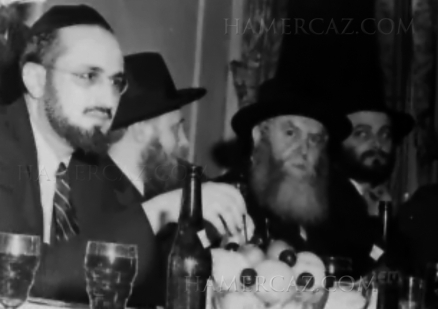
Beautiful words from Rabbi Sprung on the passing of Dr Kloot and Shavuos

You can watch the 10 minutes here.

Letter from Lubavitcher Rebbe נ’ע to the Rav נ׳ע before Shavuos

(hat tip Sh)

The letter and beautiful explanation is Here

I don’t have time to translate it but the Rebbe wishes Rav Soloveitchik a good Yom Tov using the language of his father in law the Rayatz which included accepting the Torah happily. When he came to sign the letter he explained the word happily ie בשמחה

The difficulty is we are meant to be in fear. What does the emotion of happiness have here. Based on a Gemora in Brachos, Rishonim and the language of the Shulchan Aruch HoRav, it is explained that fear most certainly has its place during learning Torah, but at three other stages the emotion of happiness is appropriate. One of these is on Shavuous when we accept the Torah.

The Rav, the Rashag, the Rayatz, and the Ramash (the future and last Lubavitcher Rebbe)


The charedi press distorts Judaism

They, and I explicitly exclude myself from their interpretations of Judaism, have a right to publish their own newspapers (even though they fight anyone who brings historical proof that the Netziv, R Chaim Soloveitchik and many more Gedolei Torah read the newspapers).

They don’t need to have pictures, and here I find myself in agreement with Uri Regev when they distort the image of a female. In a bizarre way they are in fact using what is new to present a distorted world.

Now, you might ask why it bothers me? Well it bothers me because I try to follow Torah, not some new invention. As such if it was a picture of Amalek there might be a positive command to erase him etc (practically we don’t know who Amalek is Lehalocho). Charedim might cogently argue that they won’t publish a picture that shows knees. Ok. If their clientele prefer digital burkas covering the face, that’s not ok. It’s not halachic and those people should never leave their houses let alone read any newspaper. 

So, in summary, the Charedim have created a mitzvas aseh (a positive command) to digitally distort women in pictures so they are not there, where in fact there only exist negative commandments. Such negative commandments can be fulfilled by not including the picture.

Ah, but it’s got nothing to do with Halacha in fact. It has everything to do with POLITICS. They must somehow show that they are in government visually, so they want to show their male members of the government of the state of Israel.

I have no time for such false religiosity.

I said it would happen, and it will become more common

With militant anti-specist vegans growing in numbers, and the charismatic Peter Singer’s of this world, it’s only a matter of time before:

  1. Someone starts pushing for legality because the animal is enjoying it and not showing signs of distress ( definition of “no” will have to be proven) and is therefore not rape
  2. The human has a genetic predilection to such things called zoophilia, so it can’t be called an illness
  3. Jews will lead the way in arguing for marriage to בהמות with Reform leading the way, followed by tree-huggers
  4. Others will claim it goes against the Judeo/Xtian ethic (but that has little clout now)

Warning: this is a disgusting story. See here if you can stomach it.

I once debated this issue with one of my alumni, and whilst she wouldn’t engage in such behaviour,  she was absolutely militant about the issue, calling me all sorts of names etc because I dared eat meat, or drink milk etc. She even called on people to be killed on sight for eating meat and she wasn’t kidding. I knew her when she was quiet and would never have dreamed that she would become a priestess of this movement.

How different is their indoctrination?

these oh so sweet boys share views held by Melbourne’s Shomer Emunim School, a break away from Adass. How sick, sick sick

Watch this

When does a Woman not exist?

its old news that Adass chassidic will not write even the first initial of a lady. My wife would be known as ‘mrs I Balbin’ this is certainly a hall mark of Hungarian chassidic practice as well as some Russian/Polish chassidic.

contrast this to the wedding invitation that R Chaim Brisker used for his son Mishe’s wedding (Moshe Soloveitchik was the father of the Rav. He had signed it as ‘Chaim and Lifshe Soloveitchij’. No appellations and her name was ‘out in the wild’, heaven forfend. 

I’m not getting into the latest abomination any further

It’s become a horribly repetitive and deflating refrain. Children abused, abused unfairly treated and often ostracised, all sorts of Askonim and Rabonim are accused and shown to have done the wrong thing. Papers such as the AJN have a field day.

Some get away with it, others are punished accordingly. Psychologically, the Chillul Hashem is all too heavy to carry at the minute. I feel embarrassed to be a Jew in רשות הרבים when it’s pasted all over the Sun and AJN.

One thing though: if anyone even remotely tries to pressure the courageous girl who came forward and lifted the lid on probably the most closed community in Melbourne, they should be sent לעזאזל with due legislated gusto.

I’m not taking comments on this post. The matter is before the courts and will be decided appropriately.

Incredible Charedi woman

(Hat tip krakower)

It won’t change overnight nor is it for everyone. Clearly she has talent to burn, but that talent can’t and shouldn’t be bottled up. The common denominator she follows Halacha and that’s the key.

Watch this Video and be inspired whether you are male or female.

A very useful website

I remember in the old days when I played in the band for Adass weddings, before Yumi’s band took over 99.9% of those gigs. Rav Beck was a lot younger and many times I was asked to see if my microphone could reach the head table. Rav Beck is a holy man, he barely looked up, and when I handed him the microphone it was as if it was a foreign object not to be used. He had no technique and didn’t realise that one had to speak directly into the microphone. Nevertheless, I noticed that even on a microphone stand, he was hesitant to get close to it. Some explained to me that it was a Tumeneh Keyleh. I didn’t understand, although these days I notice he at least holds it. Why do I mention this? I do so because for particularly Hungarian types where anything new is forbidden חדש אסור מן התורה so much of the modern world is not rehabilitative. Many examples about: a modern phone, is more likely to be used for sin; phones themselves were originally forbidden as they ’caused’ Lashon Hora. Eventually, things normalise, and solutions are found.

For me, just about everything I do, except if I’m in front of a Sefer, is something I can potentially turn into bad. It’s my view that there is a single world, an imperfect world, and our job is to turn חול into קדש and not run away from everything that may divert.

Can a person in Summer in Melbourne, Ripponlea, or Miami, or … not find themselves seeing women dressed for the weather, and not wearing thick black seamed Satmar socks? It’s unavoidable to the normal person, let alone those who work in the work force. It is for this reason that the ערוך השלחן stated that saying שמע in front of a woman who wasn’t wearing a head covering wasn’t an issue because we are used to this now as a norm.

I mention all this because my iPhone, as much as I love gadgets and technology, is so full of Torah, and a source of Torah, it’s literally mind-boggling. I hear and sometimes see Shiurim from people I never would have been exposed to. In my world, this IS Hashem’s plan. Like all of them, I could use the internet for the wrong things, and that is a real problem especially in closed societies (Rabbi Professor Twersky has spoken of this many times). For me, I sometimes feel it’s inappropriate to have my phone in the toilet in my pocket as it is so full of Kedusha!

With this in mind, here is yet another example of a wonderful website that can be used by those who appreciate it.

Check it out here and enjoy (if your Rov lets you). Remember, I am not Lehalacha or LeMaaseh. I just dilly dally at the edges of what interests me. By the way, those of you with iPhones check out this app. It’s an absolute beauty and is constantly being updated. I believe there is a google play version but it’s not as developed. I don’t know because I don’t use Android.

Enjoy making Kedusha use out of Tomei Keilim. The number of people who snuck TVs into their houses by asking the TV shop to place the TV into a refrigerator box so the neighbours wouldn’t realise was and is a regular ruse in Israel. TV cards were also highest per head sales in Yerusholayim. Go figure.

Ironically (is there such a word in Judaism) the first Lubavitcher to see opportunities to spread Torah through the internet was Rabbi Yosef Yitzchak Kazen ז’ל. I used to be in touch with him as one of the few other Jews on the net before it was called the internet so to speak. Little was I to know that one day he would be the (late) Uncle of my daughter.

Computers are forbidden

AJN got it right for once

I must say that the AJN treated the King David (Reform) School respectfully and in a journalistically responsible way. First they reported what were allegations but wouldn’t name the school. The week after they followed up with the name of the School. I found the issue of staying in touch with alumni during the two years after they leave school a very interesting one. I imagine civil libertarians might argue that this is over the top because the student is no longer a student, and presuming they are of adult age, what could the school do if the student contacted a teacher. Yes, one could write it into a teacher’s contract, but I wonder if civil libertarian lawyers would be able to take up a case against it. I see the sense in it, but I’m just wondering from a legalistic point of view as someone who doesn’t understand the law.

Certainly, I have a rule that I don’t keep in touch with my students on Facebook until they graduate. I have found this an enormous resource, and frankly I get נחת seeing where they have gotten to. They often ask me for counsel 10 years after they have left University and visit me in my office. These are nice moments.

If only the Jewish news was less sensationalist in reporting in general. Then again, they have to sell papers, so that’s their business.

From Calvin and Hobbs

Recently there was an article floating (pardon the pun) that there was plenty of poo in beards. This morning I read a responsible journalist analyse it and realise they had made a story (a false one) out of nothing. Journos seem to be less likely to be wholesome in their analyses than they used to be.

Dealing with the false Messianists in Israel

[Hat tip Bobby]

See here and here and here and here for news coverage.  The following is a first hand account

I attended.

From 8:30 am to 10:30 am, I was present at a mass Tefillah protest against this mass false messianic movement. Unlike these reports, I estimated that there were between 2000-3000 people there, and very few non-Shomer Shabbos people, if any. Maybe they came later. We all Davened on a large grassy area outside the Metro-West complex at the far end of which, and blocked by numerous police, was a building where the Meshumads and their friends were doing their Christian thing.

Chairs were provided and tables set up for Bimas, some Sefardi and Nusach Sfard ad hoc “Siddurim” which were printed just for the occasion by Yad L’Achim were available, although most people came prepared with their own Siddurs and Chumashim.

Due to the largeness of the crowd, and the desire of the Sephardim and the Yemenites to have their own Minyans, not to mention a large group that wanted to Daven with or close to the Clevelander Rebbe or one around Rabbi Peretz, the mass subdivided into some dozen or so Minyanim.

The biggest problem was that there were only a limited number of Sifrei Torah and so when it came to the layning, Minyanim united.

I did not see any violence whatsoever, however, later I heard of a boy who crossed the police lines, was arrested and then followed by his father who tried to save him and was also arrested, were both beat up and bloodied in the police van. There was only one Meshugener there who walked around for a couple of minutes yelling out “kill them” (in English, Davke) but he quickly disappeared.

The Davening was very peaceful, albeit it noisy at times when some of the multiple Minyanim would call out things like “Shma Yisroel” and similar key verses, just as a protest or those closer to the Meshumad building would scream with catcalls and boos. In a way it was very difficult to get any real Kavana because of the loud Sephardim and Yemenites, not to mention the outdoorsy, disorganized, circuslike atmosphere at such events. Fortunately, there were a few relatively normal Ashkenazi minyanim, too, where I ended up.

Towards the end of Mussaf, some people began setting up a minimum Kiddush with wine and rokalach, but I was already packed up and ready to leave.

I did not see or hear any anyone speak to the crowd or was there any attempt to get everyone to say Tehillim together or anything like that.

There are no overt signs of the media there and I only saw one person taking a photo with his cellphone. I did not see TV cameras or microphones.

For the most part, the protest went by unnoticed by the mainstream press.

Rachel was there, too, on the other side of a sheet-strung ad hoc Mechitza.