Kosher LePesach Eggs

Some are concerned that the ink stamps, when boiled, will permeate the pot, and the allegedly chametz part of the ink will make the food Chametz.

Is this a scam?

The international beis din lohoroh notes:

The Shulchan Aruch (442:10) writes that there is no problem in using ink made from chametz, and the Mishnah Berurah (44) explains that the ink is inedible and that there is therefore no problem in using it.

The Mishnah Berurah writes that one must not intentionally eat the ink, but eggs that are stamped will not be considered “intentionally eating ink” even if they are cooked with the ink (see also Shulchan Aruch HaRav 442:34).

The London Beth Din notes:

The ink used to print on eggs is made from two components, a colouring agent and the solvent. The colouring agent is purely synthetic and does not present a problem for Passover.

The solvents most commonly employed are isopropanol, ethanol or a combination of both. The solvent is of such nature, that within a fraction of a second after applying the stamp, it completely evaporates. A moist stamp would lead to unwanted smudges.
It is therefore very safe to assume, that not a trace of solvent remains within a short time of application to the egg. To sum up:
It is not certain if ethanol is used in stamping eggs. Even if ethanol is used, it is not certain that it is wheat derived.
Even if wheat derived ethanol was used, none of it remains after the ink has dried and it no longer constitutes part of the ink.

The OU have paskened:

Q. Is there a problem to use eggs that have a stamp on them on Pesach?

A. One can use eggs with a stamp on them on Pesach without concern.

And yet, we hear about people looking for unstamped eggs, or in Israel, eggs made with KLP ink and a Mashgiach watching each stamp occur, thereby raising the price. Why? Is this an example of a Shtus Chumra?

What should we be doing during the lifting of the Torah (Part 3)

לעילוי נשמת אבי מורי הכ’’מ ר’ שאול זעליג בן יהודה הכהן

There is a Gemora in Kiddushin 33B, after discussing the laws of standing up for an Talmid Chacham asks whether one needs to stand up for a Sefer Torah. The Gemora answers (with incredulity) that it’s obvious one stands for a Sefer Torah, a fortiori. If one stands for those who learn Torah, surely one must stand for the Torah itself!

The Shiltei Hagiborim (1500’s) has a commentary on the Rif (14B) on this Gemora where he quotes the Riaz, ריא’’ז, a Rishon from the (1200’s). The Riaz states that the Gemora is giving license to stand before a Sefer Torah, but not to prostrate oneself (להשתחוות) in front of the Sefer Torah. He goes onto further state that we have not seen anywhere in Torah that we prostrate ourselves, except in front of the Aron HaKodesh. Prostrating is the act of going down completely and extending one’s feet and hands (as we do on Yom Kippur during certain parts of Musaf) as opposed to לכרוע to bow (eg one’s head or head and back)

The Riaz, seeing that he is a Rishon, could also possibly be interpreted to imply that is not be comfortable with bowing either. If so, then this might be a source to prohibit bowing during Hagbah and perhaps explains why we don’t seem to see bowing at Hagbah much.

The Riaz is discussed at length in the Chida’s (1700’s) Birkei Yosef, Orach Chaim 144:3 who quotes the Knesses Hagedola in Yoreh Deah רפ’’ב. One implication from that discussion is that we don’t follow the Riaz, and people do prostrate themselves (I mentioned the Maharil in the earlier post, as an example). The Birkei Yosef states that it’s impossible: even if we follow the Riaz, that the Halacha should be interpreted as also forbidding mere bowing, this contradicts the Gemora in Sofrim (as quoted in Shulchan Aruch) where it clearly states that we do bow.

Normally, we don’t pay halachic attention to the Ramban on Chumash (as this is his Drush) and defer to his Sifrei Halacha (eg תורת האדם) for Halacha, but on Parshas Ki Savo on the words “אשר לא יקום” the Ramban explicitly quotes Sofrim that one does a bow to a Sefer Torah during Hagba and says וכן נוהגין … and this is the Minhag. Accordingly, the Chida states that the Riaz is not at all discussing the issue of bowing during Hagba when the Sefer Torah is open, rather, the Riaz refers to a situation where the Torah is closed and clothed and someone wishes to fully prostrate themselves.

In his own Sefer לדוד עבדו on Hilchos Krias Shma, the Chida states 4:3 this clearly להלכה

אין לכרוע ולומר וזאת התורה אלא כשהספר תורה פתוח נגדו ואז יכרע נגד הכתב ויאמר וזאת התורה

One should not bow and say Vezos HaTorah until the Sefer Torah has been opened up in front of him and then he should bow towards the lettering and say Vzos HaTorah

In the Sefer Chesed Loalofim (135:4) the author, R’ Eliezer Papo, (late 1700’s) who is famous for his Sefer Pele Yoetz, states that the Mitzvah to bow as per the Chida, is for both men and women, and

ומצווה לנשק הספר תורה

It’s a Mitzvah to kiss the Sefer Torah.

So where are we? Most communities that I have seen rush to the Sefer Torah and kiss it when it is brought out, and yet, despite all the evidence and opinions, I haven’t seen anyone bow during Hagba.

Rav Tzvi Pesach Frank also wrote in his commentary on the Tur (134)

I have seen many people are not careful about this (bowing during Hagba) and I do not know on what basis they are not bowing until I saw the Shiltei Hagiborim (ad loc) This, however, contradicts the Shulchan Aruch as stated, and isn’t how others have understood the Riaz. Furthermore, based on the Zohar, those who say Brich Shmei explicitly say דסגידנא קמיה which means that we definitely do bow to the Torah.

Now, I haven’t done a comprehensive search on the Bar Ilan CD and there may be much more to this. After all, it seems that in Ashkenazi Shules people don’t bow. If people don’t do something there is likely to be a good reason. Jews have a habit of doing the right thing. There are at least two possibilities to explain this conundrum:

  • the halacha is like the Kitzur Shulchan Aruch, as I mentioned in the earlier post, where he would Pasken like the Siddur Derech HaChaim from the Chavas Daas or
  • the halacha remains that one does need to bow, but people have become lax

I’d like to suggest, though, a different reason why this practice isn’t seen much now. I believe that it centers on how one reads the words of the authoritative Siddur Derech Hachaim who writes in 134

שמצווה על כל האנשים לראות הכתב, ויש מדקדקים לראות האותיות עד שיכול לקרותם ולכרוע

It is a mitzvah to see the lettering (of the Sefer Torah during Hagbah) and there are those who are careful to see the letters to the extent that they can (actually) read the words and bow

In my opinion, the simple meaning is that it’s not those who are careful who bow (period), rather it’s those who are careful to get close enough to read the letters who should bow. I believe that this was natural at the time of the Gemora when they did Hagba before Layning, and like the Sephardim either carried an open Sefer Torah around the Shule pointing to the spot where they were going to begin the layning, or stood up close to the people in front of the Aron with the Sefer Torah open as everyone filed past and approached. I certainly saw this happening in Sephardi shules where I davened. I didn’t notice the bowing, but I did notice the better accessibility that everyone had to actually seeing the lettering of the Sefer Torah, and as per my reading of the Siddur Derech Chaim, would be obliged to bow as per the Shulchan Aruch based on Maseches Sofrim.

Ashkenazim, however, do Hagbah now differently. The Torah is lifted up in a fairly brisk manner and rotated 360 degrees after leyning. Unless you are on the Bima, or very close, it’s nigh on impossible to make out the actual lettering from one’s seat, and perhaps in such a situation one does not bow. My understanding is that bowing is intrinsically linked to seeing the words, which Holy Seforim tell us emit their own special light.

The Kitzur Shulchan Aruch, however, perhaps read the Siddur Derech Chaim differently. I assume that he held that מדקדקין was a general statement that the concept of bowing was only for the punctilious, and his Kitzur Shulchan Aruch wasn’t in the business of noting down anything other than the mainstream. For this reason, he perhaps omitted the need to bow.

That’s my understanding. I’d be interested in hearing other opinions, or practices in other Shules around the world. I’m told that R’ Chaim Kanievsky and others treat it as a דבר פשוט that one should bow. When I asked R’ Schachter, he also said that it’s a דין in Shulchan Aruch and should be kept, and people simply aren’t aware.

PS. Related to Hagbah, if you perform it in a Chabad Shule, where you are meant to lift, rotate and then place the Torah back on the Bima and roll it up before sitting down, the person who dresses the Torah is not doing Gelila, and in my opinion shouldn’t be described as such in the Misheberach. Using the Chabad method, the person who does Hagba also does Gelila! The second honour, is “dressing the Torah”. Does anyone know the source for this variation of Hagba, by the way?

PPS. While looking at the Shiltei Hagiborim, I noticed that he suggests that an Avel should not write (הריני כפרת משכבו (הכ’’מ after their father and instead should write ז’ל because one’s writing lasts longer than a year of Aveylus. Instead, one should only say it in speech. Ce la vie. I’ve written it now three times for this post.

What should we be doing during the lifting of the Torah (Part 2)

לעילוי נשמת אבי מורי הכ’’מ ר’ שאול זעליג בן יהודה הכהן

As we stated in the previous post, from the language of Maseches Sofrim, which is quoted by the Mechaber in Shulchan Aruch verbatim, it would seem that the proper action of the congregation would be to bow one’s head during Hagba—לכרוע. Rabbi Moshe Isserles, (1500’s) otherwise known as the Ramoh, doesn’t make any comment and one might ask, if it was not the Minhag in Ashkenaz to bow one’s head during הגבה he may have mentioned this in his addenda to the Mechaber. Perhaps the opposite is true. The Ramo also authored the דרכי משה on the טור and in 147:4 the Ramo is happy to mention the minhag recorded by the Maharil (mid 1300’s) which was not just to bow, but also to prostrate oneself at the time of הגבה (and to follow the Torah back to its Aron). The Maharil was the celebrated and authoritative recorder of Ashkenazi Minhagim. It would seem, possibly, that the Ramo in quoting the Maharil, had no issue with the more sedate suggestion of the Mechaber to simply bow during הגבה. The Ramo begins that section ad loc. by noting that

In the Mordechai, at the end of Hilchos Tefilin, page 98b, he quotes that the Maharam used to lift the Torah in order to show it to all the people, and this was the opinion of the Kol Bo who stated “in Masechta Sofrim, when the Chazan was on on the Bima he opened the Sefer Torah and showed the text to both men and women, and then they said “Vzos HaTorah” etc. And from this is a source for why women would commonly push themselves forward at that time, although they (the women) often didn’t know why they were doing so. And from Maseches Sofrim it appears that this occurred before layning (as per the times of the Gemora and Minhag HaSefardim) but we (the Ashkenazim, notes the Ramo) perform Hagba after layning.

The Ramo in Darkei Moshe goes also notes that a community is entitled to sell the Kavod of passing the Torah cover to the Golel (the one who rolls the Torah back from the unwound Hagba) and the person who was given the honour of Gelila, cannot complain, as he only purchased the right to rewind the Torah. Someone else can purchase the right to pass on the Torah’s clothing to the Golel.

I looked up the Kol Bo and, as quoted by the Darkei Moshe and he is quoted accurately by the Ramo. Importantly, although he purports to be quoting Maseches Sofrim he doesn’t use the word ולכרוע—that the people should bow. Was that intentional?

The “plot” thickens when we examine the language of the קיצור שלחן ערוך. Again, the author, Rav Shlomo Ganzfried, intentionally appears to omit the word ולכרוע—that the people should bow.

לאחר קריאת התורה, אומרים חצי קדיש, ומגביהין את הספר-תורה. המגביה פותח את הספר-תורה שיהיו שלושה עמודיט מן הכתב גלוי, ומראהו לימינו ולשמאלו, לפניו ולאחריו, כי מצווה על כל האנשים לראות את הכתב, ואומרים “וזאת התורה” וכו’.

Why? In his introduction to the קיצור Rav Ganzfried

R’ Shlomo Ganzfried ז’ל (wikipedia)

explains the primary sources upon which he bases his decisions. I haven’t got an edition of the Kitzur with that introduction (nor could I find one), however, R’ Shea Hecht told me that the Kitzur bases himself on three other Seforim and sides with the majority if there is a dispute between. The three are:

  1. Shulchan Aruch HoRav (from the Ba’al HaTanya)
  2. Siddur Derech Hachaim (the Chavas Daas)
  3. Chayei Adam

Sadly, there is no existing Shulchan Aruch HoRav on this section, as it was lost or burnt. Incredibly, the Chayei Adam says absolutely nothing about Hilchos Hagba. That means, the Chayei Adam doesn’t even present a Seif about Hilchos Hagba. This in of itself is very strange.

In the authoritative Siddur Derech Hachaim by R’ Ya’akov MiLissa (late 1700’s) who is well-known as the author of the Chavas Daas on Yoreh Deah and the Nesivos HaMishpat on Choshen Mishpat, writes

When he lifts up the Sefer Torah he should show the lettering to the people and say וזאת התורה …

It could be argued that the Kitzur is therefore just copying the words of the Siddur Derech Hachaim. On the other hand, the directions at that point in the Siddur are for the person lifting the Torah, that is to say, the notes are directed at the person performing Hagba as opposed to the people who are witnessing the Hagba. He doesn’t, for example, say that the people should say וזאת התורה. It is not conclusive, perhaps, then to draw a conclusion from these words of the Chavas Daas. In point of fact, in the Halacha section, the Derech Hachaim explicitly says:

ויש מדקדקים לראות האותיות עד שיוכל לקרותם ולכרוע ולומר וזאת התורה

The Maharikash, R. Ya’akov Kastro (mid 1500’s) in his Tshuvos  אהלי יעקב, 57 states

Whoever doesn’t bow, because he thinks (bowing) is forbidden, should be put in Cherem!

The Siddur of the Shulchan Aruch HoRav makes no comment about the need to bow during Hagba. This point bothered the Ketzos HaShulchan, HaRav Avraham Chaim Naeh ז’ל

Rav Chaim Naeh ז’ל (wikipedia)

who wrote in his בדי השלחן, אות נ’ה in סימן כה

Why didn’t the Admor (Ba’al HaTanya) mention the imperative to bow in his Siddur? Furthermore, it isn’t mentioned in the Kitzur Shulchan Aruch either. We (Chabad?) also don’t have a custom to bow …. I haven’t seen anyone raise this issue. Later on, I saw that in R’ Ya’akov Emden’s Siddur (Yaavetz) on the word לכרוע, R’ Emden refers us to the Shyorei Knesses HaGedola, but I (R’ Chaim Naeh) don’t have that Sefer with me to look into the matter.

To be continued.

What should we be doing during the lifting of the Torah (Part 1)

לעילוי נשמת אבי מורי הכ’’מ ר’ שאול זעליג בן יהודה הכהן

The lifting of the Torah is known as Hagba, הגבהת התורה. It has become quite accepted, in Ashkenzi circles to point one’s little finger at the sight of the Torah’s lettering; some kiss their little finger afterward. This custom of pointing at the lettering of the Torah, is of Sephardic origin (Meam Loez (Ki Savo, 27:26)). Lifting the Torah is different to rolling the Torah גלילה. The rolling occurs twice: once when the Torah is rolled open to at least three columns, before it is swung around for all to see by the מגביה, and then rolled closed, when the Torah is re-dressed, with its covering mantle and any other adorning silverware.

An early source describing this process is found in Maseches Sofrim. This tractate forms one of the minor tractates of the Talmud (another Minor Tractate is Avos D’ Rabi Noson) and is considered to contain the laws as per the Yerushalmi (as opposed to Babylonian) tradition. Although it is a minor tractate, some Halachos, such as making a Bracha before reading the Megilla, are only found there, and are considered accepted Halacha. It is widely held that this tractate was written between the 6th and 8th centuries by the Geonim, that is, prior to the period of the Rishonim. An example of an early Rishon, is Dunash Ben Labrat, who apparently studied under R’ Saadya Gaon and who is quoted by Rashi (himself a Rishon). In other words, these minor tractates were edited based on practical halachos following soon after the time of the Amoraim and Savoraim. Savoraim are mentioned in the Talmud Bavli (for example Rav Achai) and some contend that the Savoraim put together the final touches of the Talmud, as we know it today. Either way, Minor Tractates such as Sofrim were compiled very soon after and are therefore re-printed at the back of many editions of the Talmud. They have a more halachic feel to them, and are more “ordered” than a standard Masechta of the Bavli.

There is another smaller minor tractate dealing with the same laws of a Sefer Torah, known as Masechta Sefer Torah. The Gaon R’ Shmaryahu Yosef Chaim Kanievski (nephew of the Chazon Ish, son of the Steipler Gaon, and son-in-law of R’ Elyashiv) completes a siyum on the entire Torah, including Tanach, Shas Bavli and Yerushalmi, Midrash, Shulchan Aruch, and Rambam each year on Erev Pesach, claims that the Minor Masechta of Sefer Torah preceded Maseches Sofrim, and the latter is simply an expanded version of the former.

In general, Sefardim and the original Chassidim of Israel, perform Hagbah before the reading of the Torah. The Torah is, in the case of Sefardim, a type of enclosing box, and is opened up and sometimes taken around the entire Shule. Everyone approached to see the letters of the Torah. The Aruch Hashulchan claims that there is a special light that emanates from the letters of the Torah (for those who are worthy of receiving such light). Often a Yad, a pointer is used to show the start point from which the Baal Koreh will read the portion of the week. The Aruch Hashulchan claimed ad loc. that in the times of the Gemora this was also the prevalent custom: to perform Hagba before Layning. Ashkenazim, who have a different enclosure for the Sefer Torah, two Amudim/Atzei Chaim (wooden rollers) and a material “coat”, now perform the Hagbah after layning. Some sephardim do another Hagba after layning, but the Sefer Torah is not taken around at that time and is merely lifted and rotated. I saw this practice in the Sefardi Shule in Singapore, for example.

The description of Maseches Sofrim )14:7 (the edited version from Kisvei Yad by Dr Michael Higer) for Hagba is as follows:

 מיד גולל ספר תורה עד שלשה תפין, ומגביהו ומראה פני כתיבתו לעם העומדים לימינו ולשמאלו, ומחזירו לפניו ולאחריו. שמצוה על כל אנשים ונשים לראות הכתב ולכרוע

Immediately he rolls open the Sefer Torah until three columns are visible, and he reveals/shows the lettering to the people who stand to his left and right, and then he swivels to show it to those behind and in front of him, because there is a Mitzvah for both men and women to see the lettering and to bow.

The wording in the Maseches Sofrim is repeated almost verbatim by the Mechaber (R’ Yosef Karo) in Shulchan Aruch Orach Chaim 137.

מראה פני כתיבת ספר תורה לעם העומדים לימינו ולשמאלו ומחזירו לפניו ולאחריו שמצוה על כל אנשים ונשים לראות הכתב ולכרוע ולומר וזאת התורה וגו’ תורת ה’ תמימה וגו’.
הגה: ונהגו לעשות כן אחר שקראו בתורה אבל כשמוציאין אותו אומר השליח ציבור גדלו והקהל אומרים רוממו כו’ אב הרחמים הוא ירחם עם עמוסים וכו’ ויש אומרים לומר על הכל יתגדל (מסכת סופרים פרק י”ג וטור ומהרי”ל) וכן נוהגים ביום טוב ובשבת ויש להחזיק התורה בימין (מהרי”ל). וכשעולה הראשון לקרות אומרים ברוך שנתן תורה כו’ (כל בו)
הלכות קריאת ספר תורה

Now, I don’t recall seeing anybody bow during Hagba, whether they be Sefardim or Ashkenazim. Have you? The Ramo on the spot, does not mention, for example, “and it is not our custom to bow” or anything of that sort.

The question is now obvious: what has happened to the custom of bowing, as recorded in the earliest source of Maseches Sofrim and brought LeHalacha in Shulchan Aruch by the Mechaber?

To be continued in Part 2.

or in Chabad Style (where the person dressing the Torah is described as performing Gelila (which I believe is incorrect, but more on that later)

Shiurim for a K’Zayis

At Shule on Friday night, I read most of the pamphlet put out by Rav Moshe Donenbaum, a Talmid Chacham of note. At the back of the pamphlet there are a series of charts which are meant to simplify the determination of how much Matzah one should consume: related to the size of a Zayis—olive. Expectedly, and it is his right, Rav Donenbaum focusses on the Shiur of the Chazon Ish (the largest) and notes that this is the “best, or most mehudar”. That may well be the case, we aren’t in a position to argue with the great Chazon Ish, let alone any of the other well-known shiurim of R’ Chaim Naeh or the Igros Moshe etc

What does strike me about these pamphlets though is that they seem to completely ignore newer insights into what a Zayis is, based on evidence. There are some incredibly compelling arguments of late which suggest that a Zayis was a lot smaller than what Ashkenazi Poskim (who likely never saw an olive) surmised.

As R’ Bar Chaim put it

Rashi almost certainly never saw an olive. The same goes for other medieval authorities in Ashk’naz (Germany-Northern France). This little-known but indisputable fact should matter to you. It has everything to do with the following question: Is Halakhic Judaism rational and rooted in reality, or is it a hypothetical construct unconducive to engaging the real world?

It is a simple matter to ascertain, or describe to another, the volume of an average olive, a ‘k’zayit’…provided you have olives. But what if you have never seen an olive? How would you understand the concept? How would you describe it to someone unfamiliar with olives?

This was the reality in Ashk’naz in the Middle Ages, and there is no mystery as to why. The olive tree is native to the Mediterranean basin, from Israel in the East to Spain in the west; it does not naturally grow elsewhere. In Roman times, due to the trade routes which crisscrossed the Empire, olives may have made their way to Germany and beyond. The collapse of Rome, however, led to a breakdown of law and order, and therefore trade.

Medieval Ashk’nazim were unfamiliar with olives, a fact confirmed by R. Eliezer b. Yoel’s (d. circa 1225) discussion of the minimal amount required for a b’rakha aharona: “Wherever a k’zayith is required, one needs a sizeable amount of food, because we are unfamiliar with the size of an olive…” (Ra’avya, B’rakhoth 107).

Some Ashk’nazi authorities concluded that an olive was half the volume of an egg, while others demonstrated, based on Talmudic sources, that it must be less than one third of an egg. How much less they could not say. The truth, of course, is different, as was clearly perceived by one 14th century authority who actually made it to Eretz Yisrael. Responding to the proposition that a person could swallow three k’zaytim at once (which is quite impossible if one assumes a k’zayit to be half of an egg in volume) he wrote: “As for me, the matter is plain, for I saw olives in Eretz Yisrael and Yerushalayim, and even six were not equal to an egg.” S’pharadi authorities, on the other hand, had no such difficulties. One wrote that an olive is “much less” than a quarter of an egg (Rashba), while another mentions in passing that a dried fig is equal to “several olives” (Rittba). The last three statements, made by sages who saw olives, are entirely accurate.

In present day Halakhic practice, predicated on opinions rooted in the aforementioned lack of knowledge and experience, a k’zayit is often said to be 30 cc, while others say 60 cc. These figures bear no relation to the real world olives of Eretz Yisrael which average 3-5 cc. It is claimed by some that once upon a time olives were much larger. This claim is false. Olives and olive trees have not changed, as evidenced by the fact that there are over 70 olive trees in Israel ranging between 1,700-2000 years old, and 7 are approximately 3000 years old. These trees continue to produce fruit identical to the olives of younger trees. Halakhic responsa from the G’onic period echo these facts, stating plainly that olives do not change. Some would have you believe that there are two kinds of olives: real olives and ‘Halakhic’ olives. In their view, Halakha need not reflect reality; it exists in an alternate reality of its own. This is a tragedy because it paints Judaism as divorced from reality and irrelevant to a rational person. This is a lie because Torah was intended by Hashem as our handbook for operating in the real world.

An even better analysis, is provided by the unnecessarily derided R’ Natan Slifkin in his excellent article here. I recommend you read it.

Now, I’m aware of the hierarchy of Poskim, and I am aware that one has to have “Breite Pleytzes” but when we are dealing with facts on the ground, we need to re-examine things according the clear scientific knowledge unearthed in our time. This isn’t evolution and a challenge to Ma’aseh B’reishis. It is simply about the humble olive. Was it bigger and did it shrink of late?

Is this any different from the Gemaros in Horayos quoted in Shmiras HaGuf VeHanefesh and Kitzur Shulchan Aruch, which list foods that are claimed to make one forget things, as well as foods which harm other parts of one’s body. If not for the Ari Zal, we wouldn’t even be permitted to eat Chopped Liver! What are the Tannoim telling is in these Gemoras? Are they telling us that this is Halacha L’Moshe MiSinai and avoiding these foods is immutable? No! Perhaps they are actually doing us a great service by informing us what the best medical knowledge of that time was, and it’s our duty to ignore the parts which are discredited and follow the best medical practice of our time? This is certainly R’ Schachter’s strong view. Do we follow the Rambam’s medicine? Decidedly not. If it contradicts evidence-based current medical advice, it might even be forbidden to do so!

So, in our age of the somewhat cryogenic halachic process, where disagreement might be seen tosignal that someone doesn’t have Emunas Chachomim, I wouldn’t expect the types of publications put out by certain institutions to even bother to examine and respond to the cogent arguments suggesting that an olive is an olive is an olive and they simply haven’t changed, given the archeological evidence. We owe it to the pursuit of Emes, though, to be part of our world and also interact with Poskim who are brave enough to put their views on paper for open scrutiny. By all means, disagree, but bring proofs. Simply putting up only a  traditional view derived from sefekos and chumros on the matter without even spilling one ounce of ink on refuting the powerful contrary views, frustrates me. Some would even call it a style of indoctrination which creates a new Mesorah based on Safek cum Chumrah.

On the contrary, perhaps those who follow the approach to sizing an olive based on what we can see, are the ones who follow the original Mesorah, while the others are working in a vaccum of Safek and being Machmir accordingly, given it is D’Orayso?

PS. I was baffled to find a quote attributed to R’ Elyashiv that we don’t need to check the inside of our pockets using a candle during bedikas chametz. Is there a Hava Amina that Chazal would want us to potentially cause fires in our houses, or am I missing something?

More on R’ Schachter’s views on Mesirah and Dina D’Malchuso

At the suggestion of מו’ר R’ Schachter’s מקורבים, readers who seek more than a 10 minute grab, would do well to read his written word on these topics, well before the scourge of hidden child abuse arose.

Firstly, there is a brief note on Torah Web here from 2007.

A more expansive and learned paper can be read here from RJJ Volume one which I believe is from 1981.

Enjoy.

A fantastic shiur

I guess people might have time during Chol Hamoed to listen. It’s well worth it. It’s given by Rabbi Wallerstein, on the topic of Shovavim, but is intriguing as he recounts his own interactions with an addictive vice. A refreshingly honest shiur. He sounds like a great teacher.

Make sure you have an hour to listen. I heard it in the car, on the way to work and then back home.

Download it here

Raglayim LeDavar (i.e. prima facie case to answer)

In an amongst a previous post, I received the following comment (which I have slightly edited) … and no, there was nothing at all wrong with the comment, which is why I am not ignoring it (I’ve just been incredibly busy).

Rabbi Hershel Shachter provoked a storm of criticism for using the word shvartze. As far as I am concerned that is the least of it. The much bigger problem is that he propounded several insidious arguments for not dealing with sex abuse. He gave with one hand and took away with the other. He said there is no issue of mesirah (snitching) per se in reporting a known molester. Great. But then he said it is takah (actually) mesirah if the offender will be sent to state prisons where wardens could harm you by placing you in a cell with a member of Farakkan’s Nation of Islam. Yes I think that is racism. Why does he believe a Jew should fear a Black Muslim more than a member of the Aryan Nation? But never mind.

It’s important to note that R’ Schachter has given many Shiurim on this topic, and I’ve heard some of them well before the sound bite you refer to. In fact, the shiurim on mesirah were also well before the issue of child abuse became the grave topic of concern for all of us. His view, has not changed. He speaks Halacha, as he sees it. He is a Posek.

Whilst you acknowledge that R’ Schachter is strongly against those who hide behind Mesira and is in fact concerned with the safety of a community and ובערת הרע מקרבך, and yes, I have heard him say both of these things explicitly over and over, he is also concerned about safety in jails for those who are incarcerated. Halachically, R’ Schachter contends that nobody should be in a type of jail where they are beaten and/or gang raped (and all the horrible things that we hear). In a previous shiur, R’ Schachter described different types of prisons in the USA, and said he was concerned about one type as opposed to the other. If we are to be true to Halacha and indeed true to the country we live in, what we should also be doing is ensuring that those who are incarcerated go to a “normal” prison or a system where such things are very unlikely to happen. All over the world, we have read many times of the “mysterious” death of an inmate. Chazal most certainly would never approve of such a thing in their own prison systems.

R’ Schachter often interludes with urbane language. In a number of shiurim, he called the reasonable prisons “Glatt Kosher/Daf HaYomi style prisons”. People giggled when he said that. Perhaps Daf HaYomi learners or Glatt Kosher eaters might take umbrage; I doubt it. When R’ Schachter said a shvartze, he immediately expanded on that, and anyone listening knew he was giving an example, that is, of one of those Army of Farrakhan types who might be sharing a cell with a Yid (albeit a sinning Yid). Criticising him for this is unfair.

The real issue is that almost all sex abuse prosecutions are in the state courts. So he has now precluded virtually all prosecutions.

No he doesn’t. He actually says that (Frum) Lawyers and Law Makers should try to influence the powers that be to make sure that all those incarcerated are put in a situation where their rights are actually protected and they aren’t subject to jail abuse.

He also insists on vetting by a mental health professional who is also a talmid chacham (rabbinical scholar).

Knowing what he has said elsewhere, let me explain. He strongly encourages that any educational institution should not just have Rabbonim on staff, but also Rabbonim who are trained professionals. As opposed to a teacher/Rabbi who hasn’t lived in the real world, and is fresh-faced out of Yeshivah/Kollel and is confronted by an allegation, he would insist that the professionally trained Rabbi/teacher be one to hear the allegation and then pass it onto the authorities as the case almost always is (now). What you don’t know, is that R’ Schachter was very upset about a respected Rav/Teacher whose life was destroyed when it turned out that their pictures was published as a molester and in fact it was a complete case of mistaken identity. The teacher wasn’t even remotely connected to the allegation. Apologies were made, and the incorrect picture was removed, but, and I’ve heard R’ Schachter speak about it, that teacher’s life had been ruined. They are depressed, unable to work when in fact they had nothing what to do with the incident. They weren’t even in the same institution if I remember correctly. It was a case of “man with a beard who looks like this” but it was the wrong person whose picture was put up. I surmise that this also concerned R’ Schachter.

There definitely is such thing as a recidivist liar, who as a student has a reputation for lying on all manner of issues in the past (I’ve known such people and I suggest we all have) . It is best that a trained psychologist be on staff and ensure that a proper process is followed. That means, the person who makes the allegation makes it in front of someone who is skilled and trained, not someone who knows Shas and Poskim.

He obsesses about the terrible damage of a false allegation. I too find a false allegation a terrible thing. But the professionals most capable of such an evaluation are the ones inside the criminal justice system.

I’ve explained what worried him, based on cases he had known. I’m sure that the professionals in the criminal justice system will do a good job. Having a professional on staff to hear an allegation, is a good idea. Remember, this is not at all the Aguda proposal that a board of Rabonim examine each case and decide. R’ Schachter is not only part of the RCA, he is probably their venerated Posek, and as such, you really need to understand his point of view from the RCA stand point.

If I can make it a bit clearer. Where I work, and where many/most of us work, we have line managers. However, we also have HR (Human Resources). If a line manager or staff have issues with each other, HR (who have trained professionals) do get involved, before actions arising. Sometimes those actions are indeed a referral to the police! For example, if someone alleges they were sexually harassed or racially vilified. In the context of R’ Schachter, I believe he is suggesting that Schools and similar, davka need to have a quasi-HR through having professionals as he suggested and not just people with Yoreh Yoreh and a Yeshivah Teaching certificate.

Prior interrogations contaminate evidence and alert suspects who can then hoof it. More than that, most such prior screenings end up discouraging reporting.

Picture the scene. A student makes an allegation. They go the headmaster. The headmaster  immediately calls in Rabbi Dr So and So, who is a psychologist on staff. What’s wrong with that?

It is true that if the Headmaster is corrupt and/or the psychologist is a psycho then we are in trouble. But, we would have been in trouble anyway, in that situation. No system can help here, unless a kid goes directly to the police or tells their parents and the parents are not indoctrinated to keep shtum. On the contrary, there isn’t a culture of “run away from Mesira” with R’ Schachter. We need to also ensure that the kid is not fobbed off and the issue buried (as it has been tragically, and in some places still will be).

I recognize that false allegations do happen, usually in the context of divorce custody battles. Folks in the criminal justice system are quite adept at recognizing them and screening them out.In the end, the decision to support reporting involves balancing the danger to children versus the danger to someone falsely accused. In a situation of uncertainty I would rather leave an adult with the problem of undoing damage to his reputation then subject children to damaging abuse. It is much harder for children to recover. Children need more protection than adults. But that is me. Rabbi Shachter thinks in terms of adult and institutional interests.

He is talking to Rabbonim and this is a grab from a speech he gave. He cares greatly about children, and that is why he is advising the Rabbonim to change things so that they have staff who are also skilled and are professionally qualified to deal with abuse allegations and related matters that arise (eg bullying and harassment). This is my understanding based on more than the particular 10 minute sound bite I heard.

I could be wrong, of course, and will stand corrected if that is the case.

[ R’ Schachter is incredibly busy at the moment. I waited for 1 month before I could get an answer to some questions I asked repeatedly. I expect that he will make his views clearer in the near future, given the thoughts you expressed and which no doubt others have also expressed or thought. Let’s wait and see. ]

Remembering Rav Menachem Froman ז’ל

Recently, I learned of the tragic petirah of HaRav Menachem Froman. He was well-known in the press over many years. Ironically, a founder of Gush Emunim, and described with the pejorative title of “settler”, Rav Froman was the driving force behind the city of Tekoa.

Rav Froman was a thinker, who worked outside the box. He had his own controversial views on how to relate to the Palestinian Arabs (and even known terrorists ימח שמם וזכרם) and many if not most like-minded souls who also moved, with מסירות נפש to far-flung corners of our Holy land, disagreed with his approach.

In his own words:

“My premise is that for Jews to live in all of Eretz Yisrael, they have to create a network of life with the Arabs”, says Rav Froman. “In the Holy Land, you can’t make peace without attending to the issue of holiness”.

“Isn’t it only fitting that Jerusalem be the seat of the United Nations’ cultural bodies, human rights organizations, scholarly forums? Isn’t it only proper that Jerusalem be the place where members of all faiths convene to renounce their breeding of prejudice, hostility, and war?”

Rav Froman truly believed that conciliation and peace lay only through the spreading of Kedusha through faith-based meetings and respect for adherents of Islam. If I’m not mistaken, Tekoa doesn’t have one of those security fences surrounding it. He wanted Tekoa and its residents to feel comfortable with their neighbours. When some Jewish crazies attacked a mosque and set fire, he came to the village and brought replacement texts of the Koran as a gesture of regret and respect.

My cousin, Effrat (née Balbin) (that’s how she spells her first name) and her husband Rabbi David Fialkoff are idealists who live in a caravan in Tekoa. The caravan now houses their bevy of children. They are inspiring and selfless people. David is also a big chassid of Rav Steinsaltz and has impeccable midos tovos. On Shabbos, I used to sing Chabad Nigunim especially for David, who participated with Dveykus.

In 2006, I had the Zchus to attend their wedding. It was then that I first laid eyes on Rav Froman. He was one of those people whose eyes were alive, and who had this aura surrounding him. You could just feel his presence. He had such a peaceful and happy demeanour. I remember he sporadically began a dance before the Chuppa with my Uncle Hershel Balter. He personified Ahavas Yisroel and a love for others. I tried to talk to him and engage him on some of his views, and he simply wasn’t interested. He undoubtedly felt that I was attempting to cajole him into a controversial discussion. He wasn’t having a bar of it. We were at a wedding, and he probably sensed that I wasn’t really at the level of having a meaningful conversation on the topic. After all, I was from Melbourne, Australia. What business of mine was there in talking to someone who was an inspiration to the entire community of Tekoa.

You couldn’t help liking him. If he had worn a Rebbishe Spodik he would have fit the part of a  Jew who had this burning attraction to another Yid’s Neshoma Elokis, and who was attracted to them like a magnet.

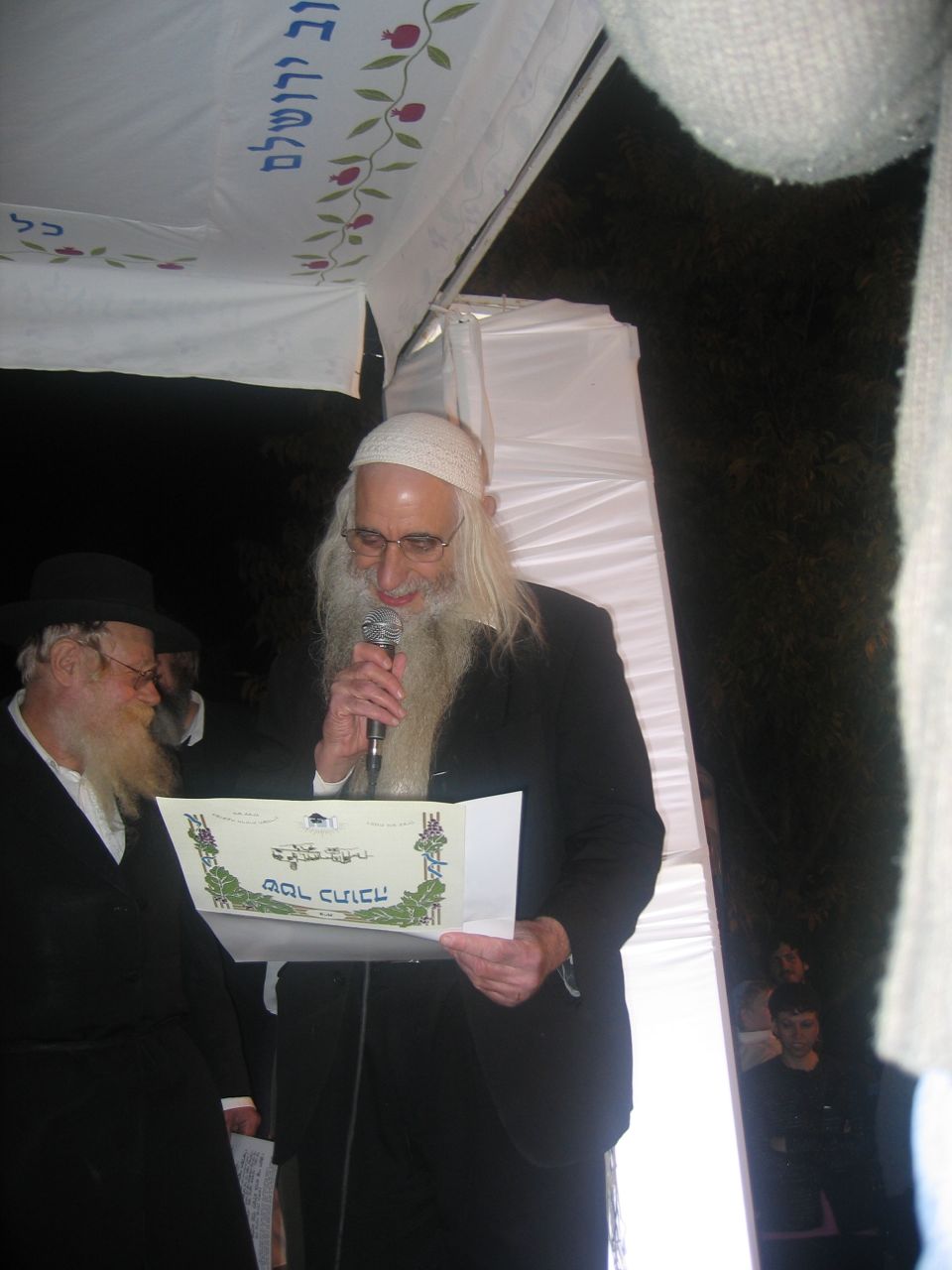
I’m told that Tekoa is in severe grief and mourning. It is very difficult for the to cope with the loss of their inspirational leader. In the picture below, which I took back then, Rav Froman is reading the Kesuba while Rav Shteinsaltz looks on.

I liked the man, lots.

יהי זכרו ברוך

Rav Froman (on the right) and Rav Steinsaltz on the left.

Quinoa on Pesach (again)

I have pitputed about this in the past. At the OU, the two senior Poskim are Rav Hershel Schachter and Rav Yisroel Belsky. They agree on most things. Let me state first, that my personal posek (on matters that are complex and/or not clear in Shulchan Aruch etc) is Rav Schachter, so I do have a bias. On very rare occasions, I have not “understood” the reasoning of a Psak, but I am not a Posek, and he is, and so I listen. That’s our Mesora. That’s what we are meant to do.

As the article from the JTA below shows, they disagree on Quinoa. My earlier views on this matter happily are consonant with Rav Schachter’s Psak. The OU however as a policy will follow the stricter opinion of the two Rabonim disagree. There is in fact a private kuntres, in the spirit of Milchamto Shel Torah, where the two give formal Psokim and their reasoning, for the occasions where they disagree. I haven’t seen it. The kuntres is only available to recognised Rabonim who are formally or informally affiliated with the OU standards.

Kosher Australia (correctly in my opinion) advises people to check with their own Rabbi about Kitniyos, and notes that it doesn’t approve/use Quinoa in any of its own supervised products for Pesach.

Personally, if someone in Melbourne, brought in supervised Quinoa (eg from the Star K), I’d have absolutely no problem consuming it.

By Chavie Lieber · March 11, 2013

NEW YORK (JTA) — On any given day, a wind might blow through the farmlands of South America, pick up an errant grain of barley and deposit it nearby among the vast rows of cultivated quinoa. If that barley manages to make its way into a sifted batch of quinoa, and avoid detection during repackaging, it could wind up gracing your seder table on Passover night.

However dubious it might seem, the scenario is among the reasons that the world’s largest kosher certification agency is refusing to sanction quinoa for Passover consumption, potentially depriving Jewish consumers of a high-fiber, protein-rich staple that many have come to rely on during the weeklong holiday.

The Orthodox Union announced last year that it would not certify quinoa as kosher for Passover out of concern that quinoa falls into the category of kitniyot, a group of legumes forbidden because they look similar to grains proscribed on the holiday.

Menachem Genack, the CEO of O.U. Kosher, also cited the danger of quinoa crops grown in close proximity to wheat and barley fields.

Star-K, a rival kosher certification company based in Baltimore, has been certifying quinoa as Passover-friendly for years and dismisses what it sees as an outlandish prohibition.

“Rav Moshe Feinstein said we weren’t to add on to the rules of kitniyot, so I don’t know why anyone would,” said Rabbi Tzvi Rosen of Star-K, referring to the esteemed decisor of Jewish religious law who died in 1986. “And what’s more telling of this ridiculous debate is that quinoa is a seed, not a legume.”

Long a staple of the Andean diet, quinoa has earned a reputation as “the mother of all grains,” celebrated for its high nutrient quality and as an alternative for those following a gluten-free diet. But quinoa is not a grain at all. It’s a member of the goosefoot family, and closely related to spinach and beets.

On Passover — when wheat, oats, rye, spelt and barley are all prohibited — quinoa has emerged as a popular substitute.

That could change, however, with the world’s major kosher certifier refusing to give quinoa its Passover seal of approval.

“We can’t certify quinoa because it looks like a grain and people might get confused,” Genack said. “It’s a disputed food, so we can’t hold an opinion, and we don’t certify it. Those who rely on the O.U. for a kashrut just won’t have quinoa on Passover.”

The O.U.’s non-endorsement is the result of a debate within the organization’s own ranks.

Rabbi Yisroel Belsky, the head of Brooklyn’s Yeshiva Torah Vodaas and a consulting rabbi for the O.U., maintains that quinoa qualifies as kitniyot because it’s used in a manner similar to forbidden grains. Rabbi Hershel Schachter, one of the heads of Yeshiva University’s rabbinical school and also an O.U. consultant, agrees with Rosen that the category of kitniyot should not be expanded.

Rosen said the Star-K certifies only the quinoa that has no other grains growing nearby. This year, for the first time, the company sent supervisors to South America to supervise the harvesting, sifting and packaging of the product.

“Whenever there’s a new age food, there’s always a fight between kosher factions,” Rosen said. “But we should be worrying about other things, like all the cookies, pizzas and noodles that are Passover certified but appear to be chametz. Quinoa is the least of our problems.”

The O.U. is recommending that kosher consumers look to their local rabbis for guidance on the quinoa question. But for Eve Becker, risking a rabbinic prohibition on a staple food probably won’t sit too well in her house. A Jewish food blogger who maintains a strictly gluten-free kitchen because her daughter has Celiac disease, Becker said quinoa is one of the most important foods.

“It’s a tiny powerhouse packed with protein, vitamins and minerals, and it’s an important grain alternative, especially on Passover,” Becker said. “It’s great to have it on Passover instead of the usual potatoes, potatoes, potatoes. Most of the Passover foods just end up tasting like Passover, so we rely on quinoa to be that side staple.”

Ilana S., a mother of two who lives on Manhattan’s Upper West Side, said she trusts the O.U. and will refrain, begrudingly, from buying quinoa this Passover.

“These rabbis are always changing their minds, so I’m confident they’ll have a new statement next year,” she said. “Until then, its only eight days.”

The Honeymoon is over

Let’s face it. Charedim have never considered any religious zionists—Mizrachisten) “frum enough”. That’s a generalisation, of course. Notable exceptions, such as Rav Shlomo Zalman Auerbach ז’ל or indeed his son-in-law, Rav Zalman Nechemia Goldberg שליט’’א never saw things in black and white (sic). Rav Shlomo Zalman’s son, Rabbi Shmuel Auerbach, however, is most extreme in his views.

The Charedim were considered “black” (in keeping with their attire) and the religious zionists (with their white crocheted Shabbos Yarmulkes were the white ones). In truth, the right-wing of religious zionists, such as those from Yeshivat Mercaz HaRav, are easily “as frum” as the frummest Charedim, across the board, although they didn’t wear the uniform of hats and jackets or follow the dictates of Agudisten or “Daas Torah”. It’s no different in Melbourne.

We have four kollelim:

  1. The Chabad Kollel
  2. The Lakewood Kollel (Litvishe Misnagdim)
  3. The Adass Kollel (various Hungarian and other Chassidim)
  4. The Mizrachi Kollel MiTziyon (Religious Zionists)

The Chabad Kollel is an arm of the general Chabad movement. People learn there for a couple of years and then go into Chinuch, the Rabbinate, or the general work force. It’s not a life time job to sit in Kollel. The Kollel is interested in people outside of Chabad, in the same way that Chabad is interested in anyone (with the exception of farbrente Misnagdim with whom they share no love).

The Lakewood Kollel was split asunder by a massive disagreement between its own constituents which saw one Rosh Kollel go back to the USA and the other remain in his position. Many important Ba’aley Batim left the Lakewood Kollel, never to return. For many of the full timers, it’s a lifetime job, to “sit in Kollel”. The Lakewood Kollel isn’t really interested in Religious Zionists. It is mainly a common ruse to attract such people to attract funding to support their activities. Behind the scenes, religious zionists are not considered “frum enough”. This is no different to any other such institution around the world.  It is not unique to Melbourne.

The Adass Kollel keeps completely to itself. It is made up of people who have retired as well as young and not so young marrieds. It isn’t interested in the wider melbourne jewish world outside of its own hermetically sealed group and it certainly has no time for Religious Zionist types from a Torah perspective.

Kollel Mitziyon, isn’t really a Kollel. It’s a quasi yeshivah and does a good job continuing the type of learning program that those who studied at religious zionist style yeshivas experienced before returning to Australia. It normally imports a Rosh Kollel and Israeli Hesder Bachurim; their Rabonim though are simply not treated with any respect by the other Kollelim or their constituents.

So what honeymoon is over? Has there ever been a marriage? There has been a “quiet peace” between Charedim and Religious Zionists. While the latter learned in Yeshivos and went to the army, the former generally avoid the army at all costs because they see their torah learning as protecting Jews, and many also see it as a full time, life-long vocation.

Until now.

The new style Mizrachi party, Habayit HaYehudi no longer supports a carte blanche arrangement where significant numbers of Charedim are able to avoid going to the army and sit in Kollel for the rest if their lives. The retribution has been swift. Incredibly, joining the anti-semites and anti-zionists of the world, the Charedi parties have decided to no longer support produce from the “settlements” beyond the green line!

I find this disgraceful. That they could give strength to the types of boycotts imposed by both Jewish and non-Jewish anti-semitic anti-zionists is simply breathtaking, but not surprising. They will stop at nothing to make sure that their sole vocation remains Torah study. To put it in other words, it would be akin to the Lakewood and Kollel Beis Yosef deciding that they would no longer use any businesses associated with the Mizrachi (religious zionists), here in Melbourne. Chabad, of course supports settlement activity given that the last Rebbe was staunchly against returning land for peace.

Idle threats aside: I do not understand why the Charedim do not institute a Hesder system like the Mizrachi did so many years ago. Let them have a ten year Hesder program, where they do 3 years of army interspersed with an extra 7 years of Torah study. What would be so bad? But to boycott any place over the green line in the way they are proposing makes me sick in the gut, and convinces me even more that it was only ever a platonic “marriage”, and the honeymoon is now well and truly over.

Parshas Ki Sisa and the Golden Calf

[לעילוי נשמת אבי מורי הריני כפרת משכבו, ר ‘ שאול זעליג בן ר’ יהודה הכהן]

According to the Ramban, no less, it is a Mitzvah MiDeorayso to read the section from the Torah once a year. All compilers of the list of 613 Mitzvos, don’t agree with each other, and this is one of those (there are about 18) where the Ramban has a different Mitzvah to the Rambam. The Gemora says that the sin of the golden calf is important to be remembered because it teaches us that the jews as a whole, even when they have sinned in a terrible way, Avoda Zara (idol worship) have a formula for Tshuva which includes specific special words, which we use in our davening.

Everyone asks the obvious question, how could the Jews however go from such a lofty state after receiving the Torah and commit such a grievous sin. There are a myriad of answers, and as in all things Torah, some of them click more than others depending on the individual.

I was walking back from Elwood Shule today, feeling rather alone and lonely, because I always walked with my father; it used to take him 40 minutes because his knee was bone on bone, and he had heart issues. He did it, though, rain, hail or heat wave. As I walked, I was thinking about this question, and the following thought materialised.

It is not a big gap between praying directly to Hashem versus praying through an Idol. Man innately has a need for Mamoshus (some physical manifestation). The Jews had just seen and heard stuff which was “out of this world.” Does it mean that in using an Idol, they repudiated what they had seen and heard? I now don’t think so. I think they took a small, but very dangerous step in seeking some level of Mamoshus. It’s a grave sin, but perhaps it’s really a small step and not necessarily one which means they abandoned fundamentals. Perhaps that’s why some leaders (incorrectly) cast a blind eye. Probably, someone says this, and even more probably I may have even read it some time, but what do you think?

I know, for example, that many/most? Hindus believe there is still one God, yet they use these getchkes to “help them” focus. We aren’t meant to do that. It’s a grave sin, even if the intentions are honourable.

Batei Din today

This week, we have heard of a case in Sydney was heard by a Beth din of three melbourne Rabbis. One of the Dayanim of that Beth Din, ruled that since the Sydney person who lost the case should be marginalised for not following the ruling. Apparently, as part of putting this marginalisation it was decreed that the Sydney litigant’s offspring should be denied access to a Jewish School. I’m assuming this is all true and accurate (it came from the Australian Jewish News, so I don’t know how correct it is, of course).

Next, there is the Cherem published by the Sydney Beth Din on a well known Melbourne Toen (halachic advocate) because the Toen is alleged to have besmirched (according to the Sydney Beth Din) one of their Dayanim. Toanim are paid. They can be quite aggressive and often lack the correct demeanour to make sure the process is calm, and properly dealt with, in an atmosphere of heat reduction.

Now, I’m not getting into the rights and wrongs of either case.

What has been clear to me, though, for a long time, is that if people truly want to have a Beth Din deal with a civil matter, they need to

  1. Use Dayanim outside of Australia (it’s too politicised here already)
  2. Use Dayanim who live or have lived in the western world in a real sense (eg American Dayanim, such as the Beth Din of America)
  3. Ensure that it’s an Australian court approved arbitration process so that both litigants sign that they will adhere to this form of arbitration
  4. Don’t allow any Toanim. Have it so that both litigants (and any witnesses) alone, interact with the Beth Din. If they want to have a private meeting with a Toen before the Din Torah that’s fine, but they need to keep the Toanim as simply an advisory service. In the end, the Dayanim should know what to ask and see through any halachically unsound claims.
  5. Or agree on a lone judge with impeccable halachic standing, such as Rav Hershel Schachter or Rav Usher Weiss (both of who know and interact with the western world)

At the moment, we have an unedifying situation where the honour of Rabonim in Melbourne and Sydney is besmirched. Halachic Judaism is besmirched. Public campaigns to show that some Rabbis disapprove are needed to smooth the waters in the press. It’s not what we are about. We need to restore Kavod HaTorah.

Rav Hershel Schachter
Dayan Usher Weiss, the Minchas Asher

Mishloach Manos and Aveylus

As everyone knows, an Avel (mourner) is still required to give Mishloach Manos, but is not meant to be given Mishloach Manos. What is the essential difference? Clearly, an Avel is still someone who must do good deeds, including Chesed (kindness) and acts of goodness. This is claimed to not only be good for the Avel, so to speak, but is something the Neshama (my father, הכ”מ) gets an Aliya/Nachas from. So far so good.

We can understand why someone should not be involved in giving to an Avel. Likely, the Mishloach Manos is (meant to be) a contribution to the Avel’s Purim Seuda. The Avel’s Purim Seuda, though, in a year of Aveylus, isn’t what it normally is. One isn’t supposed to go (based on the Ramoh) to someone else’s Seuda. Rather, it should be a relatively “quiet” and home-bound one, much like the rest of Aveylus of the 12 months, which is characterised by an avoidance of more public modes of enjoyment and celebration.

An interesting question arises in regards to a family Seuda. What is the Halacha, if customarily, the wider family, including siblings, who are also Aveylim, get together each year for Purim Seuda under normal circumstances. Should they also get together in a year of Aveylus? You can always argue that the “Niftar would prefer that”, but it’s not that simple. Like many laws of Aveylus, one may well get two different answers from two Rabonim. We also say that הלכה כמיקל באבילות. There is also a fair amount of grey area. If you open up a Nitei Gavriel you can probably find every type of a הנהגה under the sun, but that doesn’t really help when you seek direction and clear Psak. Telling me that in the community of “bochunovich” they did XYZ doesn’t offer Psak. Nitei Gavriel is a wonderful “encyclopedia”. It’s often difficult to “pasken” from unless of course one is from “bochunovich”.

So, I was pretty convinced that it should be okay: Aveylim with Aveylim at a Purim Seuda, without the usual dancing and banter, what could be wrong. I asked the question to מו’’ר Rav Hershel Schachter, and he replied that it is better during the year of Aveylus, that the Aveylim have their seudos individually in their own homes.

Purim, being a Yom Tov from the Rabbis, somehow places itself in this Halachic “no man’s land”. It’s not a Torah Yom Tov, nor is it a normal Yom Chol. You are meant to drink, be merry, etc to a level of עד דלא ידע. This means that although it’s a happy day with certain Mitzvos it’s perhaps not quite as important enough in terms of Toraitic שמחה. It’s a day of perhaps “wanton” happiness for want of a better word. This isn’t the natural domain of the Avel. Instead, they should partake of this סעודה meal at their own home with one’s direct family, in the first instance.

Ironically, as I delivered some Mishloach Manos today, I was pleased in a macabre way that some people could not give me Mishloach Manos in return. You know the scene, you give, and then they scurry out the back and give you one “in return”. This time, I had pure giving. I was the initiator. I didn’t need anything in return (thank God). It might sound weird, but that’s how I felt. I actually got some strange comfort out of it.

I can’t stomach this attitude

Is it any wonder that people are so sensitised and seem to have more of a propensity to abuse? The Rambam advocated a middle road. This is an extreme position, largely influenced by the influx of Hungarian Charedim to our Holy Land. It needs to be seen for what it is, a crazy chumra which serves no halachic purpose and if anything is an abuse of Halacha in the sense that it places a (future) stumbling block before the “blind”. The day somebody gets excited or over-refreshed by such “brazen imagery” is the day they need to see a psychiatrist.

I don’t see it as some attitude against women. I see it as a complete and wanton abuse of men.

From yediot:

PurimNonsense

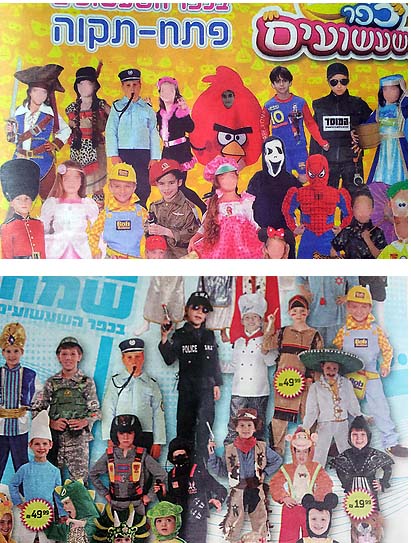
No Queen Esther in Purim costume ads

What does one do in order to avoid blurring the faces of little girls in Purim costume ads? Very simple: Show boys only.

After being criticized in recent years for concealing girls’ faces for “modesty reasons” or replacing them with dolls, this year some Israeli toy stores have decided to completely remove pictures of girls from their advertisements.

Ads published by some chains in ultra-Orthodox newspapers in recent weeks are surprisingly missing costumes which were included in their ads in the past, although these costumes are still on sale.

For example, the biblical matriarch Rachel and even Queen Esther are absent from the ads this year, as part of an ongoing trend in the haredi media not to publish pictures of women or feminine clothing items

Last year, girls were blurred (upper photo) – this year, they’re gone

Religious Jews belonging to moderate factions are protesting the haredi press’ radicalization, which they say has reached the “exclusion of four-year-old girls,” but are also criticizing ads showing young girls in revealing costumes in the general press, which they say “border on pornography.”

Religious-Zionist movement Ne’emanei Torah Va’Avodah, for example, responded cynically to the two extreme phenomena: “It appears that there are those who prefer to read only the parts related to Ahasuerus’ feasts in the Book of Esther, while on the other hand there are those who completely hide Esther.

“The despicable treatment of women, on both sides, strengthens extremism and creates a public domain which ranges between over-conservatism and over-permissiveness. The public is responsible for designing a road in the middle, which respects human beings and does not see them as an object.”

Making sense of Slichos Timing

Tomorrow morning, for example, we say Selichos for Taanis Esther. There are various minhagim about when you say the Selichos. I am not sure anyone says it before davening?

During Davening, it’s said at the time of Tachanun, and yet it looks like Tachanun is embedded within it. I’ve almost got the feeling that perhaps (and I have to admit gross ignorance on this topic as I’ve not had the time to look into it, nor have I done so in the past) it was meant to be a substitute for the standard Tachanun. I say that because at least for Nusach Sfard and Chabad and I think Sefaradim, we already say Oshamnu and Nefilas Apayim. For Ashkenaz it makes more sense as an add on because they don’t ordinarily say Ashamnu. I believe Chabad say it just before the last stanza of Tachanun, immediately after Nefilas Apayim?

Has anyone looked into this and made sense of it? It’s like spaghetti …

Answering Amen before Krias Shema

I daven in the morning in a Beis Medrash which allows the Shliach Tzibbur to daven in their own Nusach, with a few “universal” compromises.

For example:

  • There is always a gap in time to enable those (Ashkenaz and Sefard) who say Baruch Hashem Lo’Olom before Shmoneh Esreh at Ma’ariv to do so
  • Tachanun is said in a way to accomodate those (Ashkenaz) who fall immediately onto their arm and not start with Ashamnu, by leaving the parts from Ashamnu until then said quietly.
  • Yehalelu is said immediately after Hagba but before Ashrei at Shacharis (with no loud U’Venucho Yomar)

It is well known that there are three practices in respect of the Bracha immediately before Krias Shema at Shacharis and Ma’ariv.

  • Chazan says the Bracha in its entirety out loud, and the Kahal say that Bracha word for word with the Chazan, and so they don’t answer Amen
  • Chazan says the Bracha in its out loud, and the Kahal answer Amen
  • Chazan breaks off that Bracha at the end by reciting it inaudibly (Chabad)

Now, I say the Bracha out loud, as Chazan.

The issue is briefly sourced in Brachos 45b.

Sefardi Rishonim consider it fine to answer Amen after your own Bracha (eg Rambam Brachos 1:16). Ashkenazi Rishonim, such as Rabbenu Tam (see Shulchan Aruch OC 215:1, 188:1,2) holds that the only Bracha we answer Amen to, even though we say it, is Boneh B’Rachamov Yerushalayim Amen (in Benching).

For the Bracha before Shema, the Rishonim say that since this is the second of the Birchas Krias Shema we do not need to say Amen. Shema is integrated, and the final Bracha (for Shacharis) is Go-al Yisroel. It’s not clear why one couldn’t, however, say Amen. For example, after Yotzer Or U’Voreh Choshech, one may say Amen, and many are careful to do so.

Minhag Chabad is not to say Amen for any of these Brachos. My question is as follows: if you daven according to Minhag Chabad in the Beis Medrash that I daven in, and I say the first of the Birchas Krias Shema out loud, (Yotzer Or U’Voreh Choshech) should you stay silent and choose not to answer Amen to this Bracha? In addition, if the Chazan says “Habocher B’Amo Yisroel Behava” loudly, should you say Amen. Clearly, Chabad Minhag seems concerned about it, because they say the second bracha quietly and don’t say any part of the first Bracah out loud.

So what do Chabad do? Do they simply say no Amen? Do they try to say the Bracha with the Chazan? Does anyone know?

[Apologies I fixed the last sentence … I was a bit off colour yesterday and my last sentence was almost random letters]

Introductory words for the Shloshim of my father הכ’’מ

We had decided that in keeping with my father’s modest comportment and innate sense of unpretentiousness, that we’d keep his Shloshim, “low key” and a family affair. My mother had a few of her closest friends, but apart from that, it was a sombre and less public event. I know many people would have attended if it had been a different way; we hope you can appreciate the approach we took, however.

In truth, it is very difficult at a time of Aveylus to once more “confront the public gaze”. The Avel often craves solitude and is struggling with their sense of loss and grief. Indeed, Halacha encourages a detachment from the more public aspects of life during the year of Aveylus.

I had spoken at the Levaya, and was somewhat “grateful”, if I can use that word in context, that I was voicing introductions and context, as well as a Siyum Mishnayos.

The following is most of what I said to introduce the Shloshim.

Tonight we have gathered on the night of the Shloshim, the thirty-day period after the departure of our dear father, ר’ שאול זעליג הכהן הריני כפרת משכבו from the world as we know it, to the mysterious and exalted world of Souls. The Jewish people have a firm foundational framework which is rooted in Torah and through which we live and after which we depart this world. That framework does not evolve in the sense that it takes on new manifestations of populist modes of worship. Rather, like the foundations of a building that has been constructed to withstand an earthquake, Halacha is designed to move a given and acceptable number of degrees to the left or to the right, to remain intact, eventually returning to a proper and upright posture.

Following on from the Kevurah, where we tear our clothes, mourners observe seven days where there are major restrictions on the mourners and a responsibility for others to attempt to comfort the mourners.

Emerging from Shiva is a strange feeling. It is akin to letting go of certain practices; practices that directly and indirectly affect both the mourner and the comforter. It can sometimes be seen as an expression of “recovery”, and the notion of recovery is somewhat “offensive” to a mourner who is convinced that they will never recover, and perhaps should be sitting for two weeks and not one. Halacha is clear, however. A secondary period of mourning commences after the Shiva. Essentially, many of the restrictions are removed, providing a gentle but steady integration into society. It is far from a complete re-entry.

Some technical restrictions remain, and these represent visible signs that a person is very much still in a state of mourning. The aim of these restrictions is not to cause pain to the mourner. Rather, like all tenets of Judaism, there must be a tangible materialisation of the existential feeling of loneliness and aloneness that uniquely defines the state of mind of a mourner. Judaism has not ever been only a religion of the heart. One cannot reduce Judaism to “I am a Jew at heart”. Judaism is a religion of action emanating from feelings and belief.

From tomorrow morning, the Shloshim period ends and the mode of mourning is relaxed further, although there are still some clear strictures in place.

Jews have always had these three types of mourning: the Shiva, the Shloshim and the 12 months, and the customs and laws that go with each of these categories.

Each year, on Tisha B’Av, we mourn the fact that our true independence in the land of Israel, together with our Temple and all its accoutrements were removed from us. Even today, when we are blessed with our own country, we are far from independent, and find ourselves constantly bullied by our so-called friends and enemies. The commemoration of this loss follows three stages: the three weeks, the nine days, and then Tisha B’Av itself.

Unsurprisingly, Judaism is innately consistent. The customs surrounding the mourning of the three weeks are derived from those of the 12 month period of mourning after a parent. The customs of the nine days corresponds to the period of Shloshim. Finally, on Tisha B’Av, when we also sit on low chairs, the customs of mourning are based on the period of Shiva. Note though that the order is reversed. First it’s the 12 months, followed by the Shloshim and finally on Tisha B’Av it’s the Shiva. Rav Soloveitchik explained that this is an Aveilus Yeshana, and older event that we are mourning. We can’t simply start with the Shiva minhagim. Rather, there needs to be a gradual build up, culminating through Slichos and Kinnos to the Shiva, which is the last stage of mourning.

In the case of mourning after a human being, however, the wounds are red raw. The Aveilus is termed Chadasha, a new experience: both shocking and harrowing. The mourning commences from Shiva, the most intense period, and over time moves to Shloshim, and then finally onto the 12 months. Eventually, it becomes a Yohr Tzeit as well as special Rabinically enacted Yizkor prayers.

What then is the nature of the particular 12 month period that we are moving into?

Consider the following Halachic conundrum. A boy’s parent passed away when he was under Bar Mitzvah age. The boy became Bar Mitzvah during the Shiva period. He commences mourning. Does his choice of observing the remainder of the Shiva and Shloshim constitute the technical fulfilment חיוב of the Rabbinic enactment of the Customs of Shiva and Shloshim or do we say that since he was a minor at the time of the parent’s passing, he is doing a normal and good thing, but he couldn’t have been commanded to do this by the Rabbis because he was a minor at the time of death. Without argument, the Shulchan Aruch concludes that the unfortunate child is performing Minagim of mourning, but he cannot be considered as one who was commanded, or had to do so (בר חיובא).

I was learning the Chochmas Odom last Shabbos at Elwood Shule; the Shule where my father and his father davened, and where I have been leading the prayers each day in his honour. The Chochmas Adam (later cited by the Pischei Tshuva) made the following observation: in respect of the mourning after the Shloshim, that is, the mourning of the 12 months, the boy is actually doing what he was commanded even though he was a minor at the time. How so? The Chochmas Odom explains that the mourning after the Shloshim is essentially connected to the Mitzvah of Kibud Av V’Eim, honouring one’s parents. In this case, honouring a parent through acts that are undertaken which will bring them Nachas Ruach in another world, is something that he is now expected to do. This can commence as soon as the boy turns Bar Mitzvah.

It is this new period that we as children move into from tomorrow morning. It is also something that grandchildren may participate in, since the Gemara tells us that בני בנים הרי הם כבנים (grandchildren are like children). This insight might also explain why curiously, for our dear mother and aunt, the formal mourning laws and minhagim cease tomorrow morning. It is only children who are commanded in the Mitzvah of Kibud Av V’Eim.

The human process of grieving and missing someone, of course, is another thing entirely, and that is something that each person deals with in their own way, and their own time, and hopefully with well-meaning friends and family, especially those who have gathered here tonight and who have been so loyal and supportive to all of us.

ר' שאול זעליג הכהן בלבין הכ’מ
ר’ שאול זעליג הכהן בלבין הכ’מ

Anonymity and the Internet

Never assume that you are “anonymous” on the internet. You can go through hoola hoops to hide your identity if you know your stuff, but 99.9% of people don’t know how to do this. Is it worth it? The only time I can think of someone wanting to post an anonymous comment is if they have something that is so important to tell but simply are unable to reveal their name. This is an exception. It should happen in very few cases. One example might be a real victim of crime. Even in that situation, you would hope that the person doesn’t just use the internet, but actually goes to the police and makes a formal complaint. If they cannot bring themselves to make a formal complaint, then depending on the nature of what they have written, we make a value judgement call on whether it is reasonable that they remain anonymous in the context. There are far too many weasels, sock-puppets, and malingerers on the net who make “anonymous” comments which are demonstratively false and hurtful. That’s not what anonymity is about. That’s just offensive cowardice. Some websites are simply magnets for these toilet-like comments: Scott Rosenberg’s blog is one example where there is much horrible comment and back stabbing.

Sometimes, it is unfair. There is no effective right of reply because of smoke and daggers and innuendo. When we say things, just like in our daily speech, we need to be careful that there is a positive purpose in what we say or write, and that we are very sure about the veracity of our statement.

When I started blogging, it was for my benefit, so to speak. I enjoyed and enjoy the opportunity to express what’s on my mind, or something I have learned. In doing so, I have been (or tried to be) very conscious of not allowing ad hominem attacks via comments, and have edited and rejected comments accordingly. I don’t force people to login to show their identity; they could use a fake email, but anyone who thinks that authorities can’t trace them, should think again. I know a little about these things as a computer scientist. That being said, I’ve only once wanted to find out someone’s identity, and that’s when that person made threats to my family through this blog. In the end, I let it go. If it would have occurred more than once, that person may have found me on their door step, with an officer in tow.

It comes then, as little surprise that the “anonymous” blogger “ifyoutickleus” who has been trying to out R’ Chaim Halpern of London, is now under attack. R’ Halpern’s supporters have applied to find out “who he or she is” via google (who host that blog). This is not new. We have such cases in Australia as well.

It will be an interesting unfolding episode. If R’ Halpern is found guilty of an infraction of Jewish Law, then as I understand it, the anonymous blogger may not be found guilty of defamation?  But who will determine if R’ Halpern allegedly did what he is purported to have done (which I understand may not be against Secular Law)? Will it involve the courts summoning the new Beis Din that has been formed to judge this case, and about which I understand very few women trusted enough to come forward? Will they subpoena the Rabbis who have publicly called on R’ Halpern to resign? This is going to get very messy, and I think R’ Halpern’s advisors have made a poor call. They may end up knowing who is publicising the material “anonymously” if google cough up the information, but that won’t cleanse R’ Halpern, surely, except in the eyes of one-eyed supporters. One needs to look at these issues with both eyes. If R’ Halpern has nothing to answer for, so be it. If, on the other hand, some allegations are true, then he should do the honourable thing, and step aside.

The mere fact that there was already an exposé on Channel 4, in which R’ Padwa did not emerge in a very good light as far as the issue of Mesira is concerned, would tend to suggest that this new subpoena will only cause a brighter torch to shine on the Charedi community in London, and Jews as a whole. Not good. It is true that R’ Halpern has a right to defend himself. Did the Beis Din who is sitting on this case, give permission to R’ Halpern to apply to the secular courts? Who did?

In the meanwhile, the rest of us sit back and ask ourselves, “why is this happening?”

Sam Lipski gets it wrong about the Australian election date

[Disclaimer: as always, these views are my own. They do not represent my employer or any organisation with which I am affiliated or a member of]

In an article in the Australian Jewish News, the erudite and respected figure editorialised that it didn’t bother him that the Australian Labor Party through the Prime Minister Julia Gillard had chosen Yom Kippur as the election date, despite having other possibilities. Amongst his points Lipski argues that as far as he knew Halacha knew no difference between the voting on Shabbos and the voting on Yom Kippur. Despite Sam’s Orthodox roots and his current alleged membership of the (small) Conservative Jewish Community, it shocks me that he would make such statements. Granted, the job of an editorial is to be somewhat left (sic) field and sensationalist, but in this case he has taken his license too far.

The implication that once you drive on Shabbos, you may as well drive on Yom Kippur is a nonsense, and Sam knows it. Yom Kippur is the holiest day of the year, and even those who might infract on other days, attempt to refrain from doing so on Yom Kippur.


On Yom Kippur evening after davening at Elwood Shule, there are many people who walk back to their homes even though they drive on Shabbos. Are we expecting Sam to knock on their window and say “Hey Buddy, what’s the point, you already drove last Shabbos”. It is well-known that the Conservative movement’s attempt to purify driving on Shabbos was an abject failure. Even its own leaders now acknowledge this fact.

No Sam, your role isn’t to find special meaning on the “wonderful” conjugation of the election and Yom Kippur. That, is distasteful, disrespectful, and frankly grandstanding. You already have a good name. There is no need to engage in this populist, sensationalist nonsense that strikes at the holiest day of the Jewish Calendar.

Michael Danby a Labor MP, a member of Elwood Shule, put it respectfully and rightly when he expressed disappointment over the date and announced that extra polling days would be available in Jewish areas.

I urge all people to not even remotely consider the possibility of casting your ballot on Yom Kippur. Do it before, or by postal vote. All Orthodox Shules should contact their members in this regard, in my opinion. I’d venture to say that even the Conservadox, Conservative or Reform movements should do the same.

I’m told that on another blog, there is an article whose title suggests it is “Great” that an election is held on Yom Kippur. Whether this is sarcasm, wit or a real opinion, it’s a great shame that writers and thinkers even have the temerity, let alone the Jewish vacuity, to evince a view that is remotely positive about such a sad conjunction.

Where Rabbi Manis Friedman got it wrong

There is a controversy regarding comments over the Rabbinic role in helping a victim of molestation, made in a lecture by Rabbi Manis.

I disagree with Rabbi Harry Maryles’s take as described in the above link. If you watch the video alone, without knowing what he said in the first audio recording linked there, I don’t think there is anything objectionable in the video per se (viewed alone). The audio of the first lecture is another thing, however.

It is true that the “role” of the Rabbi must be different to a psychologist. It is true that Rabbis should not assume the role of police or psychologist. The Rabbi (here I assume Friedman means the pulpit or town Rabbi, as opposed to the Rabbinic member of a Beis Din or a Rosh Yeshivah both of whom generally don’t deal with a particular community or its membership in this way) needs to deal with the victim vis-a-vis stressing and fortifying their status as a valued member of Klal Yisrael. The victim’s membership, under such circumstances is inviolate and axiologically grounded. The central issue to me is how you communicate this fact and serve to intercept the sense of possible alienation a victim may feel.

Rabbi Manis’s audio presentation does this in a crass and unrealistic manner. It assumes that a person will feel alienated more by the fact that they have been the victim of a crime whose perpetrator’s punishment is Kores as opposed to say Malkus. In my opinion, this is a nonsense and is a most unsophisticated metric for measuring such factors. The Chacham, wise person, has eyes in his head. He observes, tailors, and reacts according to what he sees. Surprisingly to me, Rabbi Manis is a Chabadnik. Of all people, they are expert in stressing the inherent holiness of the soul, asserting that it can be found in every Jew, and are experienced in helping remove the “layers” of baggage of many varieties which may cloud the vision and experiential manifestation of this soul. Instead, Rabbi Manis, in the audio version, sounds like an old-fashioned, fire and brimstone, B’aal Mussar. Sure, there was a time where you could scare or influence someone to repent based on the technical halachic severity of the sin. Sure, there may have been a time where you could convince a certain type of victim in a certain era that the technico/halachic punishment of what had been perpetrated wasn’t as “severe”, say, as a crime deserving of the death penalty.

No, the approach, ironically, ought to be to give strength by stressing the positive contribution that even continued orthopraxic practice can serve. Importantly, it may well also be beyond the Rabbi. A given community (Kehila) can quickly undo even the appropriate response and support of a Rabbi.

If I was Rabbi Manis, I would apologise, and stress that his words and argument were not formulated in an acceptable manner, and stick to the thoughts that he expressed in the video. Even if he isn’t an official spokesman for Chabad, he’s considered important enough to be ascribed such attention. If he apologised, he’d be no less a person. In fact, he’d come across as more human and thereby more equipped to help people using his undeniable God-given gifts.

We all make mistakes and express ourselves poorly. It seems it’s harder though to admit when we do.

The right to pray is sacrosanct

You won’t see the bleeding left, especially those on Galus Australis and the feel-good New Israel Fundniks and the like upholding the inalienable democratic right of a person to pray. No, they will bleat and scream, while complaining that Moshe Feiglin (whose political views I have not studied in detail) is breaking Israeli Law and offending our peaceful Muslim brethren. What is his new sin? According to the Jerusalem Post

According to police spokesman Shmuel Ben-Ruby, Feiglin, who is No. 23 on the joint Likud Beytenu list, prostrated himself in the plaza and tried to pray out loud. Praying aloud, going through ritual motions or using any type of traditional prayer objects such as tefillin, tallitot or prayer books, are forbidden for Jews at Judaism’s holiest site due to tensions with Muslim worshipers at the Aksa Mosque.

Or according to Ha’aretz (try and register and you will see you have an optional “country” called Palestinian Territories (occupied))

Police plan to recommend charging right-wing Likud politician Moshe Feiglin for obstructing them in the line of duty, inappropriate behavior in a public place and violating a legal order. Police detained Feiglin Tuesday for attempting to pray on the Temple Mount. “We expected that the closer the campaign got to Election Day, the more provocations we would see whose purpose is to influence the outcome of the election,” Police Commissioner Yohanan Danino said yesterday. “I have said and I say again: We have no intention of allowing anybody to disturb the peace or break the law.”

Ha’aretz conveniently forgot to mention that Feiglin goes there on the 19th of every month, as omitted by Commissioner Danino, quoted ad loc. As far as I am concerned, if a Muslim can pray there, then so can a Jew. There cannot be one law for the Muslim in Israel. If they can’t control themselves when they see a Jew davening on Har HaBayis, then they should take a bus to Mecca to the Kaaba instead. I am not making a statement regarding the Halachic issue of whether it is permitted or not to stand on Har Habayis. Most hold that it is forbidden, or delineate carefully where one can go. I assume Moshe Feiglin is following his Rabbinic Psak. Let them arrest him. I can’t think of a more stupid act, if they do. Oh, and for the bleeding green left, davening in this way also constitutes the ubiquitous neo-mantra of “Tikun Olam” especially B’Malchus Shadee”.

January 1 as the new Year

I’m sure many of you who interact with gentiles, commonly face a situation where wishes for a “Safe, healthy etc new year” are conveyed. There are poskim who still forbid writing a non-Jewish date on correspondence. General practice is to be lenient, especially outside Israel.

Tosfos in Avoda Zara 11a describe two different styles of custom forbidden by the prohibition of imitating non-Jewish customs as described in Vayikra 18:3 vis-a-vis the Gemora in Sanhedrin 52b. The Ramo, who we follow, in Yoreh Deah 178:1 is lenient and writes that as long as a custom has no pagan origins, and makes some common sense, it is permitted. On the other hand, the Vilna Gaon ad loc takes the opposite view: unless a custom has a specific Jewish origin, it is always forbidden. In general we don’t follow the stringent view of the Gaon.

According to wikipedia:

The Romans dedicated New Year’s Day to Janus, the god of gates, doors, and beginnings for whom the first month of the year (January) is also named. After Julius Caesar reformed the calendar in 46 BC and was subsequently murdered, the Roman Senate voted to deify him on the 1st January 42 BC[2] in honor of his life and his institution of the new rationalized calendar.[3] The month originally owes its name to the deity Janus, who had two faces, one looking forward and the other looking backward. This suggests that New Year’s celebrations are founded on pagan traditions. Some have suggested this occurred in 153 BC, when it was stipulated that the two annual consuls (after whose names the years were identified) entered into office on that day, though no consensus exists on the matter.[4] Dates in March, coinciding with the spring equinox, or commemorating the Annunciation of Jesus, along with a variety of Christian feast dates were used throughout the Middle Ages, though calendars often continued to display the months in columns running from January to December.[citation needed]

Among the 7th century pagans of Flanders and the Netherlands, it was the custom to exchange gifts at the New Year. This was a pagan custom deplored by Saint Eligius (died 659 or 660), who warned the Flemings and Dutchmen, “(Do not) make vetulas, [little figures of the Old Woman], little deer or iotticos or set tables [for the house-elf, compare Puck] at night or exchange New Year gifts or supply superfluous drinks [another Yule custom].” The quote is from the vita of Eligius written by his companion, Ouen.

Most countries in Western Europe officially adopted January 1 as New Year’s Day somewhat before they adopted the Gregorian calendar. In England, the Feast of the Annunciation on March 25, was the first day of the new year until the adoption of the Gregorian calendar in 1752. The March 25 date was known as Annunciation Style; the January 1 date was known as Circumcision Style,[5] because this was the date of the Feast of the Circumcision, considered to be the eighth day of Christ’s life, counting from December 25 when his birth is celebrated. This day was christened as the beginning of the New Year by Pope Gregory as he designed the Liturgical Calendar.[6]

Accepting this historical record would imply that the notion of celebrating January 1 as a “New Year” is forbidden even according to the lenient view of the Ramo. Indeed, the idea of Yidden getting together for a New Year’s eve party, may be forbidden according to Torah law, as above. Without trying to sound too judgemental, if a Yid wishes me a “Happy New Year” or something similar, I respond that our new year is not at this time. How though does one respond to a gentile?

It seems to me, and I repeat, that my view is not LeHalacha and not LeMaaseh and just pitputim, and each person really needs to ask their own Local Orthodox Rabbi: that there would be nothing wrong with issuing a pareve style response along the lines of

“I hope that the ensuing new calendar year is a successful one for you, yadadayada”

This is not just a throw away line. I think we do want our non-Jewish associates and friends to be healthy, wealthy and wise. Mipnei Darchei Shalom and Mishum Eyvo (that is, just to be a diplomatic mentch in a non-Jewish society) I think it is appropriate to make such statements, but to leave it at that.

Chas V’Shalom to ascribe any special meaning to the day, however, even if it has now become secular. The roots are pagan, and therefore forbidden in practice. Some believe it corresponds to the Yom HaMila of אותו איש, which of course it wasn’t, but even if they think that, it’s enough.

Beit Raphael: An act of Chessed from Adina and R’ Shimon Allen

I sit next to Shimon Allen at Yeshivah Shule, in Melbourne Australia. I have done so for many years, as has my father. We’ve developed a rapport and he teases me about the fact that my wife doesn’t offer Griven (a heart attack causing, cholesterol laden morass of congealed and fried chicken fat, which happens to be delicious (think of it as real chicken bisli). I’ve mentioned it before. I point out that whilst he has herring on occasion, his isn’t the real McCoy because there aren’t copious lashings of Tzibelle (onion). We also share our “delight” that when invited to modernishe houses, they serve copious amounts of rabbit food, and one is expected to force a smile through the mountains of lettuce leaves, broccoli, pine nuts and every meshugass they find at the vegetable shop. Yes, they are “healthy for you” but when was the last time that you felt “full” one hour after such a meal? Why do our bodies require this gas-forming roughage. Is this Oneg Shabbos, let alone Kavod Shabbos? Sometimes I feel the right response is “Moo” while eating, as opposed to a hearty greps after a good choolent, washed down by some Bromfen, and followed by an antacid (pareve of course) and two cholesterol tablets.

Enough of the mirth.

Erev Shabbos, and my father took gravely ill due to a series of life threatening blood infections. I rushed from work to be at his bed side, as were my siblings and all our children. I was still in my work clothes, and asked many to say Tehillim, while I did so myself. We rang R’ Shimon and his wife, and immediately the key to their apartment across the road was made available to us. After davening Mincha and then Kabolas Shabbos, my stomache reminded me that I had not had anything all day other than a single cup of coffee. Baruch Hashem, I asked my incredible wife to organise 24 Vurst Sandwiches so that team Balbin, Leibler and Waller would not go hungry. Diana and Yirmi Loebenstein, for whom my parents are like a second set of parents (they live across the road and are very close) brought a stack of Schnitzels and some Challah etc. My own incredible wife even managed to buy little electric incandescent lights and relying on (at least) R’ Chaim Ozer, we made brachos over the licht.

Words cannot describe the effort that Adina and R’ Shimon have put into the unit directly across the road from Cabrini. Every last thing was available. The fridge was stocked a plenty. There was wurst, and drinks, and beer and nash, you name it, it was there. It was on the bottom floor. The key had already been made into a shabbos belt. There was a Shabbos light next to the beds. I can go on and on. None of us should ever need to use such a facility, but it gave us a dose of menuchas hanefesh and meant my father had more support than he could ever have dreamed about. It was also a rather hot day, and yet we didn’t feel any heat. We only felt true warmth.

Baruch Hashem, my father is slowly but surely improving, albeit slightly, each day.

Shaul Zelig HaCohen Ben Toba Frimet, may he have a Refuah Shelema B’Karov.

All the grandchildren brought sleeping bags, and were able to sleep in the lounge room. It was amazing, really. I’ll stop here because Shimon and Adina will be angry that I have written the above anyway and mentioned them explicitly.

That they are able to use their financial resources and care for the community in such a way is simply inspirational. I’m sure that in Gan Eden, their teacher and mentor, R’ Zalman Serbryansky is alerting HaKadosh Baruch Hu to their Mitzvah and is lobbying for appropriate Brachos to come their way.

Shimon and Adina Allen are pleased to advise of the opening of Malvern Beit Rafael Hospital Accommodation.

All members of the community are welcome to avail themselves of this fully furnished apartment which is situated close to Cabrini Hospital, whilst they have family members receiving treatment at the hospital.

A pantry stocked with kosher non-perishables and a fridge/ freezer containing kosher meals will be at your disposal.

Beit Rafael continues to offer accommodation at North Melbourne assisting families with loved ones receiving treatment at the Royal Children’s Hospital,

Royal Melbourne Hospital and the Royal Women’s Hospital.

Please enter the contact numbers into your telephone:

0421 408 522 – Shabbat: 0421 327 859

Beit Raphael

A prank that went badly wrong

By now, at least Australian and British people are aware of the tragic story regarding a prank call initiated by two Australian radio jockeys, after which a nurse committed suicide.

The papers are full of condemnation, in the main, although there are others who have a different perspective. Former Victorian premier, Jeff Kennett of Beyond Blue stated

“When they did this they had no intention to cause harm, it was a harmless prank,” he said.

“Now they will be under extraordinary pressure and I just hope that they get our support and that their employer provides them with the professional support to help them get through what will be a terrible few weeks.”

I have certainly pranked and I would guess that many of us have done likewise. Who can forget the “Smile, you’re on candid camera” TV series. Those who us who are old enough were glued to the set to see how the “victim” would react when they realised that had been duped.

There is no doubt whatsoever that the two Radio hosts were convinced that their prank call was utterly without malice and could not cause any harm. Yet, as sometimes happens, sadly, one person took it to heart, and committed suicide.

We know that people who commit suicide generally suffer from a psychological malaise. In Halacha, this fact is also used to allow such sad people to be buried amongst the rest of the community. I understand that psychologists estimate that over 80% of those who commit suicide had a pre-existing condition (which may or may not have been manifest to others).

The nurse who committed suicide may have been from the 80% or may have been from the 20%. One thing is certain, the radio hosts did not perform an act that people would have called outrageous. Until the Nurse committed suicide, it was considered a funny episode. Nobody complained. I understand that even the Royal Couple thought it was funny.

One person didn’t think it was funny, and she killed herself.

What would Halacha say about this? Again, I’m no Posek, however, using the dicta of מדבר שקר תרחק and גניבת דעת one could conclude that their actions were not acceptable. That being said, I do not know if the damages, the נזק, which resulted, viz the loss of life is something they would be responsible for. I’d have though that at worst, they would be able to live in an ערי מקלט, a city of refuge for those who accidentally caused the death of another through some negligence. We’d need to show negligence, however, as opposed to a lack of truthfulness.

Your thoughts?

Vayeishev

This is something I wrote for David Werdiger’s excellent “Jews of the CBD” organisation, so it’s reproduced here, for posterity.


We pine to know what the future brings. Yet, there is no prophecy in our day. Why? Prophecy provides a temporal glimpse or mirroring of the essence of God and His message. By definition, that transmission must be imperfect, for we are imperfect vessels. What of dreams and their interpretation? In this week’s portion, we see that even Yosef’s interpretation of his famous dream was not accurate because his mother Rachel did not bow down to him. Does this make Yosef a charlatan? Can there be a half truth? We know that the remainder of Yosef’s dream did come true.
Rav Kook explains that the essence was true. The essence is immutable. If Rachel had been alive, then she indeed would have bowed down to Yosef in the same way that Ya’acov did. A dream’s message relates to what potentially could or should have occurred given the confines of human imperfection and condition. Rav Hisda in Brachos 55a says this explicitly. Although we seek advice from the special leaders of our generation, sometimes we find that their predictions are not 100% accurate. But, it needs to be that way because man is an imperfect vessel for the transmission of God’s will. The challenge is to deal with and act on the messages of our time.
For this reason, those who cannot bring themselves to acknowledge that the State of Israel may well be the “beginning” of our redemption because certain minutiae are challenging to reconcile, miss the transcendent and essential message of our time.

Metzitza: Who are we kidding?

I’ve written about this topic here and here.

Hungarian Poskim were prominent among those who considered Metzitza ּB’Peh as an integral part of the Mitzvah of Milah. For example, the Maharam Shick (Orach Chaim 152) in his responsa goes as far as claiming it’s a Halacha L’Moshe MiSinai! This statement had far-reaching ramifications. It would mean that no Metzitza B’Peh implies no fulfilment of the Mitzvah of Milah. This view is now common.

The problem with this approach is that I don’t think anyone actually agrees with it, and here I include those who follow the Maharam Shick (who incidentally made this claim even though his teacher, the Chasam Sofer did not).

What happens when there is a Bris performed by a Charedi Mohel who normally performs Metzitza for members of his kind, and that Bris is for say a non-frum (or “overly modernishe” orthodox) couple? I’ve been at such Brissen, and I’m sure many of you have as well. Guess what. There is no Metzitza B’Peh. Some estimate that 90% of Brissen in Israel amongst this group do not have Metzitza B’Peh even though the Bris is performed by a Charedi Mohel. If it is Halacha L’Moshe MiSinai, how can that be? Isn’t the Mohel transgressing the Torah prohibition of misleading the blind?

Ergo, we just don’t accept the view that it’s Halacha L’Moshe MiSinai. I think it’s that simple.

What is Halacha, however, is never to enter into Safek Pikuach Nefesh. That’s why they did Metzitza in the first place and that’s why it’s no longer necessary!

Murderous mengele: another Melbourne conjunction

We have all regrettably heard about the infamously cruel and barbaric Nazi murderer, (Dr) Josef Mengele, ימח שמו וזכרו. This low-life “drew a line on the wall of the children’s block 150 centimetres (about 5 feet) from the floor and children whose heads could not reach the line were sent to the gas chambers”.

In Melbourne, we know that the Weiss sisters, Eva and Marta were subjected to Mengele’s experiments and have retold their stories. They were not alone.

The purpose of this blog post is to retell a story that has not (to my knowledge) been told. I know the story because a Doctor of a particular survivor recently related it to me. The survivor had submerged the experience throughout his life and had only shared it with his wife and the Doctor. He related his experience to the Doctor because of the oath of confidentiality meant that it would stay a secret. The survivor’s directive was that it remain confidential until he passed away. Sadly, the survivor is no longer with us.

This survivor, let’s call him Kadosh, was sent to Auschwitz. Like others, he stood precariously between life and death. Unlike others, however, his face was recognisable. He had been a World Champion in a certain sport, and had competed at the Olympic Games. The Nazi guards recognised him immediately, and considered that it would be a good idea if Kadosh taught them the finer parts of the sport. Kadosh was, after all, a world-renowned expert. Jews were just disposable commodities, and this one had some extraneous value. It would enrich their leisure time.

And so it unfolded. Kadosh was training the guards and improving their game. This kept him alive. The arrangement continued until one day, the dreaded Mengele eyed Kadosh. Kadosh wasn’t a twin and had no particular interest to Mengele from a “medical” or “anthropological” perspective. No, perhaps unknown to many, Mengele was a molester, a molester of young males. Mengele took a liking to Kadosh, and each day sexually forced himself on Kadosh. This was another example of the self-contradictory nature of the “superior race”. The Nazis persecuted homosexuals, and yet, for his own sick sexual gratification, the murderous Mengele, hypocritically and perversely “gratified” himself by repeatedly raping Kadosh in his office.

Kadosh was also given other duties. I won’t describe them here for a number of reasons.

There was a period of two weeks when Mengele didn’t force himself on Kadosh. One day, in front of the officers, Kadosh had enough and resisted by cursing Mengele, and telling him “Go kiss my backside”. Mengele instructed the officers to give Kadosh a beating that he would not forget but to make sure that Kadosh didn’t die. When he recovered from the beating, Mengele resumed raping Kadosh.

Kadosh eventually immigrated to Australia and married. His wife moved to an old age home after Kadosh died. She only had one wish which she relayed to the same Doctor

Please, when I die, make sure they don’t bury me in a white casket”

The significance of a white casket is like that of a white bridal dress. It signifies a certain virginal purity. Alas, Kadosh had never been able to physically consummate his marriage. Kadosh was affected for life. His wife silently accepted the life-long psychological curse that transformed her husband into a virtual eunuch.

Kadosh’s wife wasn’t Jewish.

The story shook me up and once more infused me with perspective. Next time you are feeling low, think of Kadosh and his “life”. Think of the lady that looked after him all those years. In fact, think of him at other times, too. It’s the least we can do.

This type of interview is creepy

[Hat tip to Abe]

They get a nice-looking scarf-less, american-accented mouthpiece to spout plain untruths. Many in the “cultured” western world, especially left-leaning tree-huggers will conclude that even though the interviewer caught her out, there is another narrative out there, and the only narrative that should be disregarded is the American/Israeli line.

The mighty and powerful aggressors are wantonly attacking the helpless ones, whose rocket-propelled “sling shots” don’t cause damage.

This is an Olam HaSheker, a world of lies. Those who think that propaganda will overcome this intense hatred towards us, would do better to re-read history and re-focus on

תשובה ותפילה וצדקה

Which doesn’t mean we “deserve” anything. What it means is that we need to increase our good acts and the quality of our personal and Godly interaction, especially when under fire.

By all means, write letters, twitter to your heart’s content, spread across facebook, share Friday night bread with co-religionists, but remember, that this alone does not, has not, and never will be sufficient to cause an attitudinal sea-change.

הלכה עשיו שונא ליעקב

It’s a Midrash, but for some reason it rings as true now as it did in 1939. That’s not all of them, but far too many. We’ve seen it before, and sadly, we will continue to see it until ובא לציון גואל.

Disclaimer: My private views, as always, should not be construed as associated with anyone but me, and me alone.

How do you respond to sirens?

Benseon in Jerusalem described the following scene

In the middle of the Alenu of Minchah on erev Shabbos the sirens sound in Jerusalem. Everyone in the shul stops davening and starts looking around unsure of where to go or what to do. Suddenly, someone starts shouting at the chazan telling him to finish Alenu so he can say kaddish! And then, while some of us are leaving the shul to go to the bomb shelter, the rest act as if nothing has happened and proceed with Kabbolos Shabbos!

I’m not quite sure whether they were realists and decided that the rockets from Gaza had little chance of reaching central Jerusalem, or if they had supreme emunah that HaShem would protect them from the rockets if they continued with their davening!

Suffice it to say, those of us who went to the shelter returned later on feeling a bit sheepish that we had missed half the davening!

The description was disturbing to me. Does “Emunah” mean that people make some judgement call on whether Hashem could not possibly allow a situation where Hamas terrorists procured and sent a missile that just happened to hit their shul?

Is this Emunah or arrogance? The Levush in Yoreh Deah 116 clearly understands that the command of

ונשמרתם מאוד לנפשותיכם

Includes the consideration of physical danger. This is only suspended for Avoda Zara, Giluy Arayos, and Shfichus Damim. In addition it has no place when one is involved in physically fighting in a Milchemes Mitzvah. I seem to recall there is a Tshuva from Reb Moshe about the danger of playing baseball … in case one gets hit in the head.

I don’t think there is a Mitzvah to become a statistic. Tefilla is important, but it would be a fool who assumed that Hashem couldn’t hear his Tefilla in a bunker or that saying Kaddish with a minyan was worth ignoring a directive from the IDF.

Those who returned may have felt sheepish, they would have felt very different if a (stray) missile had hit the Shule and their colleagues died.

Lack of Emunah? I think not. Perhaps those who chose not to run to the bunker have too much Emunah in the Iron Dome or the proclivities of Hamas.

Ask them if they got a Psak to ignore the siren. Do tell us which Posek answered them.

Let Eliyahu decide our questions

The Talmud, when faced with a conundrum that cannot be solved, uses the phrase

יהא מונח עד שיבוא אליהו

Let the issue rest until Eliyahu HaNavi comes (back) and advises us of the Halacha

or

תשבי יתרץ קושיות ואבעיות

ֵEliyahu (HaTishbi) will answer all the questions.

The question is asked: since Moshe Rabbenu was our greatest teacher, why do we wait for Eliyahu (who never died) to answer the questions, surely we should wait for Moshe (who will be resurrected when Mashiach comes) and ask Moshe Rabbenu to Pasken/decide the Halachic conundrums.

Rav Yissacher Shlomo Teichtalהי’’ד

R’ Teichtal הי’’ד

in his celebrated אם הבנים שמחה, explains that to be a Posek, a Halachic decisor, a Rabbi needs to be immersed in the world. A Rosh Yeshivah, for example, who only interacts with the surreal world of his Yeshivah, is not equipped to be a Posek for the masses. All his answers are designed for the שומר נפש, the Yeshivah or Kollel Jew, for whom being יוצא לכל הדעות, acting according to all stringencies, is the norm. Accordingly, since Moshe has not been interacting in our world for thousands of years, he is not suited to be the Posek when the Mashiach comes. Eliyahu HaNovi, however, who did not die, and lives amongst us, so to speak, is more suitable to answer our questions.

It is also for this reason that the משנה ברורה was not considered as acceptable to normative Psak, as the ערוך השלחן. The Chafetz Chaim was considered like the Rosh Yeshivah who lived in his world, and his method of Psak certainly was biased towards accommodating as many opinions as possible. The ערוך השלחן however was also someone who interacted deeply with his community, and for whom the sight of a woman brandishing a chicken to discover whether there was an issue of Kashrus with that chicken, was not unusual. Similarly, although R’ Chaim Soloveitchik ז’ל also known as R’ Chaim Brisker

R’ Chaim Brisker ז’ל

was considered the genius of his generation in terms of learning and innovation, R’ Chaim wasn’t a Posek. When people came to R’ Chaim to ask a question, he referred them to R’ Simcha Zelig Reiger ז’ל,

R’ Simcha Zelig, Av Beis Din of Brisk

the Dayan of Brisk.  (Incidentally, R’ Hershel Jaeger once told me that some descendants of R’ Simcha Zelig live in Melbourne).

Rav Teichtal, takes this one step further. He considers it immaterial that earlier Gedolim, such as the Satmar Rav or R’ Elchanan Wasserman had a negative view of an en masse Aliya to Israel. Rav Teichtal claims that they, like Moshe Rabenu, were not there to witness the changes in the world, and so their Psak, for today, is irrelevant.

R’ Elchanan Wasserman, May God avenge his murder

Achdus=Unity or Sloganeering?

We have emerged from an intense month. Starting from the Ellul lead in, through Rosh Hashona and Yom Kippur, onto Succos/Hoshana Rabba and culminating in Shmini Atzeres/Simchas Torah. I use the word culminating, because in a pristine existence, it is meant to be a culmination after which ויעקב הלך לדרכו, the newly inspired and invigorated Jew “goes on his way”.

In the days of old, when distractions of worldy existence were minor and inconsequential, and when tomorrow was simply a new day, it was arguably less of an issue to exult in finishing the leyning of the Torah. (It wasn’t always the case that we completed the Torah each year, but I digress).

I fondly remember dancing the night away at (the Religious Zionist) Mizrachi Shule only to arrive in the late evening at (the Chabad) Yeshivah Centre. We were young, restless and more daring back then and attempted to hijack the singing by introducing “Tziyon Halo Tishali” (a Satmar tune for those interested in trivia, and one which connotes sadness vis-a-vis Kinos on Tisha B’Av). This song, was akin to a Religious Zionist anthem, and we were determined to show that “we have arrived” and perhaps, just perhaps, we could all sing together. We got away with it, and the singing and dancing continued in the usual uplifting vein.

Rabbi Groner ז’ל  together with other “elder”  Chassidim, hosted all with a classic Farbrengen on Shmini Atzeres. Regaling us with stories of his youth, and more, we sat spell-bound for hours. Snippets of Chassidus were spoken, and anyone could pipe up and say something. Some interloping comments were interesting whilst others displayed the result of someone who was less able to hold their liquor. There was, however, a feeling of Achdus and inspiration.

In later years, Rabbi Groner would be wheeled in, but the Farbrengen continued as long as he had an ounce of strength left in his body. To be sure, there were other significant iconic Chassidim of yore, R’ Zalman, R’ Nochum, R’ Chaim Serebryanski,  to name a few. It was like a pseudo-pantomine. They often criticised each other, under the influence of some Mashke (alcohol) and although we sometimes witnessed Rischa D’Orayso (heated interchange, for want of a better description) it was never acrimonious and, importantly, nobody pulled rank. Indeed, Chabad is a binary system as far as people go. There was the Rebbe and then the rest. It was, as in the beginning of Parshas Nitzavim: from the Rosheichem, the leaders, right through to the water drawers.

Mashke was a lubricant. It released the inhibitions. It facilitated an ability to dispense with the Tirdos (worries) of Olam Hazeh, the world we live in, and temporarily immerse in something more corporeal. In short, it was a means to an end. It was never an end of itself. Personally, I found that as I got older, Mashke helped me to “lose” the relative trivia that might be occupying my neurones and focus. It sounds contradictory, but it’s the reality. Mashke is sufficient, but it is by no means necessary, so to speak.

Fast forward. It’s Shmini Atzeres. Nusach Sfard and Chassidim perform Hakofos in Chutz La’aretz. There is a Kiddush (in the Chabad Yeshivah Shule where I have davened for eons) and many said kiddush (in the Succa) ostensibly to resume Hakaofos, somewhat liberated by the Mashke. In the last few years, I have felt decidedly uncomfortable going into the Succa for this preparatory libation. I do not refer to the issue of under age drinking. That is a separate item and not the topic in this post. The atmosphere of late, especially this year, seems to have become one more akin to a tavern/pub (lehavdil). Many never return to Hakofos, and the kiddush on mashke, has become an end, and not a means to an end. It is true, that my attention was also somewhat “distracted” as I was learning about Cohanim, Air Planes, Tumah, Moving Tents and floating carpets, and came to the realisation that I was close to clueless about the intricate Dinim of Tumas Ohel and Kelim, so I could be described as “preoccupied”.

The next day, as a Cohen, I duchened. I was somewhat psychologically affected by a Halachic question I had been reading from R’ Oshry ז’ל regarding a Cohen in the Ghetto whose voice box had been dismembered by the Nazis, may their memory be blotted forever. I felt strangely inspired to “give it my all”. I had a voice box. I wasn’t tormented. All I needed to do is have thoughts of אהבה and ask Hashem to give everyone everything they needed.

We then retired to the Shmini Atzeres farbrengen. I made kiddush, and then a little more, and waited with pregnant excitement to hear words of wisdom. It was probably me. All I heard was sloganeering and seemingly parroted thoughts that I had heard so many times before. There was no “git vort”, no “geshmake mayse”, not even a new Chassidic insight into the day we were meant to be only happy.

I began to question things being said our of sheer frustration. Perhaps if I hadn’t been exposed to the “good times” or had been more tolerant towards this somewhat more mediocre experience, I would have stayed silent.

I wanted to say something. It was to be my attempt to steer the ambient discussion towards some Tachlis. It had been on my mind during davening, and while there could have been an opportunity to do so in the good old days, and did, it sadly had no place anymore.

The shutters were up. The Arba Minim are meant to signify a unity and tolerance of all types of people and philosophies. Call it a symbol of Achdus or Unity, the personification of ואהבת לרעך כמוך. I felt that it was relegated to sloganeering. There was no action. One kind soul, attempted to assuage me

Isaac, if you were sitting in a Belzer Succah, do you think they would allow a non Belzer to say a Dvar Torah?

It was then that I realised he was right. This is, sadly, what we have become (in most places). We have compartmentalised to an extent where everyone thinks they have the (sole) mortgage on the truth. It’s my way or the highway. There seemingly can no longer be more than one path to serving Hakadosh Baruch Hu. Eventually I left.

As I walked home, I reflected on the words of the first Amshinover Rebbe, R’ Yaakov Dovid ז’ל

The Rebbe asked about the well-known Passuk in Tehillim:

הנה מה טוב ומה נעים שבת אחים גם יחד

Behold it is good and pleasant when brothers are sitting also together

The verse should have read:

הנה מה טוב ומה נעים שבת אחים יחד

Behold it is good and pleasant when brothers are sitting together

The word גם—also—is superfluous and misplaced. The Rebbe explained that there are many occasions where brothers (and sisters) sit together. However, it’s only good and pleasant when they are also together, sharing a commonality.

I wondered how each original Rebbe, who was a student of the Magid of Mezeritch sat around the same table. They had nuanced differences in their outlooks. Were they together? Of course they were. In our day, each Chassidic group is basically in its own cocoon. The same is true of non Chassidim.

On Shmini Atzeres/Simchas Torah, one would have thought that the uniting element, the Torah itself, would have the pulling power to create the גם יחד.

Maybe next year. I’ll be positive. There is no other choice.

Gartels on Yom Kippur

It is questionable during the year whether one needs to wear a Gartel. Let’s assume that it is your family minhag or acquired minhag to continue to do so even today. This article is not about the need to wear one.

On Yom Kippur, certainly those who wear a Gartel also wear a Kittel. Almost every Kittel I have seen, includes a white gartel, made of the same material as the kittel. If so, on a day when we are meant to wear white (via a Kittel) largely because it reminds us of the deathly shrouds (which is why Shulchan Aruch paskens that even women can wear a Kittel) why is it that people also put their black gartel on top of their kittel. That is, a gartel on a gartel?

On Rosh Hashana, when I am the Ba’al Tefila for Musaf, I wear a Kittel. I don’t wear an extra Gartel. On Yom Kippur, I confess that I also wear a black gartel over my kittel. The reason that I do so has nothing to do with Halacha. It is an emotional expression. My Zeyda Yidel Balbin passed away on Yom Kippur. As a young man, when I entered the room that he was in when he passed away on Motzoei Yom Kippur (he had already been removed by the Chevra Kadisha). I stood there alone for quite some minutes feeling the emptiness of the room. His hat and walking stick were in the room. As I walked around, I also found his Gartel. I took that Gartel and I wear it on his Yohr Tzeit (Yom Kippur).

Why do others wear a black gartel on top of their kittel? If they do so because their Rebbes did so, then why did the Rebbes do so?

Along these lines, why don’t some Chassidim substitute their black yarmulkas for white yarmulkas?

Does anyone know?

Typical Kittel

The attack on Bris Milah and Halacha (Part 2)

In a previous  post, I presented my views on the Metziza B’Feh controversy. I see that the Rabbinic Council of America (RCA) have just issued a statement. I couldn’t agree more with their statement, and it entirely reflects my views.


“Many Jewish legal authorities have ruled that direct oral suction is not an integral part of the circumcision ritual, and therefore advocate the use of a sterile tube to preclude any risk of infection. The RCA has gone on record as accepting the position of those authorities. Nevertheless, the RCA respects the convictions and sensitivities of those in the Orthodox Jewish community who disagree with this ruling and joins in their deep concern about government regulation of religious practices. The RCA urges these groups to voluntarily develop procedures to effectively prevent the unintended spread of infection.


“The RCA supports the recent call of the Agudath Israel of America to New York Mayor Michael Bloomberg and the New York Health Department that, instead of unilaterally imposing regulations, they collaborate with Orthodox Jewish leadership to develop protocols to address health concerns.


“Rabbi Shmuel Goldin, the RCA President, summarized his organization’s position. ‘The act of circumcision is a precious and cherished ritual for the Jewish community, one which initiates our sons into the religious covenant. The RCA maintains that parents should use methods, in strict conformity with Jewish law, which enable them to hand down our religious legacy to a new generation safely and appropriately.’”


The attack on Bris Milah and Halacha

There are numerous reports in the press (see here) and on the internet describing Governmental and Human Rights Advocates opposing the practice of  ברית מילה  ,חס ושלום. This is a disturbing phenomenon and is something I’d like to see a world conference of leaders, yes even including Reform and Conservative, address. My view is that there needs to be representation across every group so that a consistent, cogent, well-argued, statistically supported and sensitive protocol of responses developed. The arguments need to be generic, and should be as accessible to the Aguda advocate, the Israel Rabbinate, the RCA, et al as well as the Reform advocate. This is a matter of extreme importance, and כלל ישראל assuming its loosest definition needs to unite and defend with vigour, professionalism, not to mention localised quiet diplomacy (at least at first).

This is an issue where most Yidden can unite, and I’d hope that the Eybishter would feel positively that we defend this attack on a most fundamental element of our identity. There are scholars, for example, who contend that the real reason for the Bar Kochba revolt against the Roman emperor Publius Aelius Hadrianus, was due to the ban on ברית מילה.

There is a “side-issue”, however. That side-issue is Metzitza B-Feh מציצה בפה (immediate post oral suctioning after the cut). Look at the disgraceful description of this process here, for example. I call it a side issue not because I am taking sides and declaring oral suctioning unimportant or irrelevant to the Halachic process. I’m calling it a side issue because by over-focussing on this aspect, many un-diplomatic and emotive outbursts are now finding voice and providing uninvited fodder. These comments are not part of an over-arching considered, diplomatically crafted and complete strategy, as I’ve advocated above. Certainly it is an aspect of a ברית that will be used by those with a genuine concern about the methodology, and those who are against Milah, with or without oral suctioning. It’s important to remember that. There are even grossly distasteful “Jewish” blogs, that sound triumphant every time there is even a distant piece of uncorroborated information that suggests oral suctioning causes illness, or even death. Balanced individuals do ascribe genuine concern. However, anyone who emerges from the quagmire of those loshon-hora laden and defamatory blogs, knows that a quick shower followed by immersion in a mikvah is needed to remove the shmutz therein as a sanity starting point. ה ירחם

My own views:

Both my sons’ Brissen involved מציצה בפה (as did my grandsons). I didn’t ask questions at that time nor was it uppermost in my mind. On an halachic scale, I consider the oral practice as sufficient but not necessary. Doing so via a tube, is more in keeping with how I see the issue from a halachic point of view. It’s terrible though, that both sides of the מציצה argument (which is as old as the hills) are now again into name calling and delegitimisation. It is not helpful to say that it is forbidden by the Torah not to have מציצה בפה. In the same way, it is not helpful to say that it is forbidden to do so. There are very healthy (sic) and weighty halachic giants on both sides of the argument.

There is a tendency for each side to publicly belittle and malign the other’s valid halachic position. Above all, however, if there are sound and health-related concerns which are beyond statistical dispute and which may well be due to changing circumstances and new realities, such that the practice ought to now be forbidden using direct oral suctioning because this can be shown to be a direct or event contributory cause towards danger to the infant, then and only then, should there be a meeting of all Orthodox Rabonim, from around the world to re-examine the issue and indeed ban it across the board in favour of a tube.

My fear is that, at the minute, discussion of this is on a public world-stage and it only fuels those נכרים and נדחים who are impurely motivated against מילה in the first place.

I do hear the argument that in the current world climate, or at least in some countries, אפילו לשנויי ערקתא דמסאנא, we even resist even dicta to wear particular types of shoe laces (see סנהדרין עד) and, accordingly, as above, unless there is a genuine health issue, even those who are opposed to the need for oral suctioning without a tube, should get behind those who contend that such oral suctioning is an integral part of מילה. We are facing, in my estimation, new attacks. שחיטה is another.

In keeping with my view, I would argue that even those who are halachically or non halachically vegetarian, should cease that practice and insist on now eating meat (as opposed to the view expressed here), since there is a חשש that the אומות העולם are acting in a manner which is questionable and which threatens our rights and freedom to practice כללי הדת.

Meir Rabi’s latest attention seeking news bite

One side of me said to stay silent and not blog since blogging would serve his purpose. The other side said to blog but only in order to encourage people NOT to get involved in facebook and other forums where the human headline will purvey his latest feather salvo. Don’t engage him in discourse; you waste your time.

Just forget about it and remember
ורם לבביך ושכחת את ה אלוקיך
is a real syndrome.

Don’t react and don’t provide fodder for next week’s ‘screaming headline’ in the AJN.

The light of the Havdala Candle (Part 2)

In my previous post, I mentioned the question of the nature of the ברכה of בורא מאורי האש. There are two candidate that can be used to categorise this ברכה. It is either a member of the family of

  1. ברכת הנהנין where we benefit from something in this world and before we benefit we make a ברכה. For example: before we eat a strawberry, we either make a על האדמה or העץ (depending on which ברכה your Rabbi/Posek applies to strawberries.
  2. ברכת השבח where we witness something which shows God’s majesty, so to speak, after witnessing this manifestation of God’s majesty, we praise God and make a ברכה. For example, in Nisan (in Israel) when one sees the flowers sprouting forth for the first time, one makes ברכת אילנות as described in או’’ח סימן רכ”ו.  ָAnother example, is Benching Gomel. Again, we do that after we have experienced something.

Where does the Bracha on the candles/torch/flame at Havdala fit in? If it’s a ברכת הנהנין then first we would make a ברכה and then benefit from the light (using the מנהג to bring one’s nails close to the flame so that the flame bring a benefit via its light (and is sufficient to differentiate between two coins). If, however, it is a ברכת השבח then we would make the ברכה after we have symbolically benefitted from the flame and praised Hashem for (re)creating light on  Motzei Shabbos (as that was when this light was created).

If you watch carefully, you can see some people who seem to do it at the same time that they are flashing their fingernails against the flame. I’m not sure that this practice makes much sense. It seems to try and deliberately be vague on what type of ברכה it is, and have a bet each way. The problem with this approach is that it doesn’t appear to satisfy either category. I’m certainly not here to advise anyone how to order the ברכה and the act. Remember all my posts are not להלכה and not למעשה. They are just פיטפוטים.

The Mishna in Brachos at the beginning of the eighth chapter, according to the plain reading which states

אין מברכין אל האור עד שיאותו לאורו

We don’t make the Bracha until we have benefitted from the light.

appears to be clearly saying that first one benefits from the light and only then makes the Bracha. This implies that it is a ברכה השבח. Indeed, the Rishonim claim that it couldn’t possibly be a ברכת הנהנין because then we would need to make a ברכה every day when we “created” a new light and benefitted from it (just before benefitting from the light). The ערוך השלחן who was the major posek for non Chassidic Ashkenzi Jewry, suggests that we could still consider the ברכה to be a ברכת הנהנין however we would not have to make a new ברכה since we make a bracha everyday יוצר אור ובורא חושך. Other counter that it doesn’t make sense. We should have to make it many times during the day before we benefit from (new) light. One could also argue that as long as a person isn’t מסיח דעת—forgets about the ברכה they had made––then one ברכה per day would suffice.

The consensus is not like the ערוך השלחן and that the ברכה on the Havdala flame is a ברכה השבח and therefore first one reflects the light on one’s nails (and/or palms) with that wristy twist and  only after then would you make the ברכה of בורא מאורי האש.

There is some confusion as to whether you use your right hand to do this, and transfer the כוס to your left hand, and then return the כוס to your right hand and make the ברכה, or you just use your left hand and leave the כוס in your right hand. Ask your Rabbi/Posek.

Interestingly, in the additions to the שולחן ערוך הרב in the שער הכולל, Rav Yehuda Herzl Henkin points out that the implication is that מנהג חב’’ד is to make the ברכה first and then to reflect the nails on the flame (as in a classical ברכת הנהנין).  The source for this practice is quoted as being in the name of the Maharil. A problem is that there is no such Maharil. On the contrary, the Maharil in Hilchos Tisha B’Av explicitly says that on Tisha B’Av that is on מוצאי שבת (as it was this year) first you shine the light on your nails and only then do you make the ברכה.

I read that R’ Aharon Lichtenstein performs the finger nail movement both before and after the Bracha.

Should certain people not join the army of the State of Israel

We have all been reading with interest about the expiration of the Tal Law, which had afforded “Kollel Yungerleit” the opportunity to avoid military service in the State of Israel on account of their extended and continued full time study of Torah. We have also heard many Gedolim say that this is a situation of יהרג ועל יעבור … that people should give up their lives rather than join the army.

Parshas Shoftim describes the process whereby the Cohen, משוח מלחמה explains the procedures before warfare. First he encourages the troops and tells them that they only should fear Hashem and not the enemy, then he describes the categories of soldier (male soldiers, of course) who are exempt from battle (anyone is engaged but yet to marry a woman, anyone who has built a house but did not move in, anyone who has planted a vineyard but has yet to reap a harvest, and anyone who feels afraid). The Shotrim (policemen/miitary staff) then repeat this to groups of soldiers, according to Rashi.

There are two broad categories of war: the Milchemes Mitzvah (loosely described as a war where one defends the very existence/populace) and a Milchemes Reshus (a type of warfare which is waged for other reasons). A Milchemes Mitzvah is obviously a more serious, life threatening situation, and so we fine that the Mishne in Sotah (8:7) states that the aforementioned exemptions do not apply to a Milchemes Mitzvah. In other words, when it comes to defending the very existence of the people/State, it’s “all hands on the deck”.

Strangely, the Rambam at the beginning of the seventh chapter of Hilchos Melachim, states that the Cohen also announces these exemptions for a Milchemes Mitzvah. How can the Rambam contradict a clear Mishna? One explanation I read from Rav Schachter in the name of the Rav is that there is a dual obligation when anyone goes to war. One obligation is a national obligation. The person is part of the כלל and in the sense that the כלל is threatened in a Milchemes Mitzvah, the Torah does not provide an opportunity for exemption. There is also an individual obligation, the obligation of the פרט, the potential soldier who signs up for military service or considers doing so. In a Milchemes Reshus, the Cohen explains that someone who is in one of the aforementioned categories is strongly urged to stay home. They aren’t needed, and furthermore it could be argued that they may even damage morale by virtue of their preponderant thoughts.

According to the Rav, the Rambam is saying that even in a Milchemes Mitzvah, the Cohen explains the laws of the פרט being absolved from joining the armed forces before they defend the nation. It is necessary to explain the difference, and stress that this is only an exemption in as much as they are private individuals, however, since they are about to embark on a life and death battle for the defence of the people and the State, the aspect of the כלל affords them no exemption.

Of course, there are other explanations. Reflecting on this on Parshas Shoftim, I have great difficulty understanding how those who ostensibly don’t feel politically part of the State, give themselves the right to also not feel existentially part of the כלל.

Certainly, as I sit in Melbourne, Australia, I’m not exactly entitled to criticise the life and death decisions taken by those who live in Eretz HaKodesh. I am, however, entitled, I believe to ask for an explanation in light of the above.

Is “Modern” Orthodoxy comfortable with this?

See this article

Working with נכרים

Last Friday, I met up for coffee with an alumnus of mine. She is also the Head tutor for a subject I teach. Even though she has spoken to me hundreds of times, she had never raised these issues on her mind, even though we are in close contact. She already knew that I only eat Kosher (we had coffee at Glicks) and she knew that I was uncontactable on Friday afternoons until Motzei Shabbos, and lots more. I’ve had dinner with her and her boy friend, mother and grandmother, and yet, she hadn’t raised these issues about Judaism until now. I’ve known her for about ten years, and vividly recall giving her a scholarship in New Delhi, many moons ago.

One evening, we spent an hour planning the tutorial sessions she was going to run, and I drove her home on my way home from University. Suddenly, she opened up with a few issues that had been playing on her mind.

  1. Why is it that when Jews eat with us at a function or restaurant and they order their own food, that they sit at a different table, or at a distance from the rest of us.
    I wasn’t sure what the circumstances were, but I noted that there was no reason that I could think of precluding a Jew eating at the table with everyone else. I explained that sometimes it was a little embarassing when one’s food arrived in a double-sealed container that was messy to remove, but other than this, I was mystified.

    More to the point (and I didn’t relay this thought) such behaviour creates an uunecessary enmity between the Jew and נכרי. They might think we are elitist. חז”ל certainly didn’t encourage social fraternising, as witnessed by Halachos such as סתם יינם, בישול עכו”ם and more, however, if one is in a work environment and such interaction is important, well … you’re either there and behave like a mench, or change jobs! Presumably, if the Jew had already agreed to eat special meals, the issue of מראית עין was not extant, especially according to contemporary Poskim. If their Rov had paskened that they should eat separately, it would seem that any benefit keeping כשרות is counterbalanced by unecessary enmity. It isn’t always possible to miss important lunches, and I’d urge people to carefully consider the ramifications of their behaviour.

  2. She knew that I always left early on a Friday and so did this fellow-employee. She asked why her fellow Jewish workmate was seen having a drink on a Friday afternoon when he should have been home for Sabbath. I explained that it was probably summer time when Sabbath comes in later.

    Now, although there is an איסור to teach Torah to נכרים, I think it’s a good idea to explain to fellow employees (let alone one’s boss) the mechanics of when Shabbos starts. Like many of us, I am in a mad rush, especially in Winter, to finish work and jump inתו the shower just before Shabbos. My fellow workmates know all about me leaving for Shabbos, and in Summer, they will often say when passing my office, “don’t you have to be leaving now.” They even correct themselves and note that sunset is later in Summer. It’s important not to be too precious about our rules. Explain them, adhere to them, and people will respect you. Take the time to do so. If you do, questions like the above will not arise.

  3. Once the Jewish employee received their Kosher meal without eating implements. This can happen and is embarassing. It’s probably happened to most of us. Thankfully, for me, Unger’s Catering (shameless plug) always provide implements, and metal ones at that. The employee was lucky as there was an IGA across the road and they ducked out and bought plastic knives and forks. The non-Jews were bemused, however, because he was drinking Coke from a glass. They asked him why he used the glass and didn’t use a knife and fork. He apparently mumbled that he was a Rabbi and had special rules.

    Again, it’s not too difficult to explain the difference. People can understand absorption. Unfortunately, rather than doing so, the Jew advised his fellow work mates that he had special strict rules. This only made matters worse. My alumnus countered that she was a Priest (Brahman), and she also had rules (vegetarian) but what made him different to other religious Jews. They started asking him which Temple he presided over, and it became uncomfortable. They felt he was a strange fraud.

    There is no need to obfuscate. Be clear, precise, and do your best to explain. They even scoffed at his Rabbinic claim by stating (presumably because he had told them) that he had studied laws which may have been unrelated to his behaviour.

  4. On birthdays, the company had the nice practice of buying a cake and celebrating an employees special day. This is quite common. When such a celebration happens in my workplace, I come to the “round table” event where they sing Happy Birthday, but I don’t eat the cake. These days, my fellow work mates say “Have some cake, and then correct themselves with “Oh yeah, you only eat Kosher cake”, and sometimes they ask, “what can be non-kosher in a cake”. There are even nice side effects. I regularly inform one staff member who is lactose intolerant about products which are pareve.

    Unfortunately, this Jew not only organised a Kosher cake for his birthday (which is, of course, perfectly reasonable) he asked everyone how it compared, and they responded “it tastes nice”. He then approached the person responsible for overall cake purchases in the company and asked whether perhaps they could always buy Kosher cakes. I certainly wouldn’t do that, however, it got worse. He noted that he could get a “good deal” for the company because it was his relative who actually made the cake, and she was also able to cater in-house for all manner of event. This left a very bad taste. He didn’t realise it at the time, but other employees heard about this shameless pursuit of business for one of his family members and were unimpressed/span>;;;

The end result is that many of us are also looked upon as being somewhat strange(r) and worse, opportunistic. Before you counter that there is always at least one person who will “muck up” and there’s not much we can do about it, I know the person involved in this case. He’s no fool. He is quite capable of explaining and able to act in a proper and Mentchlich manner. I would rather not have to defend the rest of us and say that this person acted beyond the pale of normal decency.

My appeal, therefore, is to please be careful. We attract enough attention when we are visibly Jewish and observant. This is something חז”ל intended. At the same time, when we do so, it should be an opportunity to act in a manner which promotes the true essence of our religion and its moral standards.

We need to all try harder, me included, to remember that we are a דוגמא and how we conduct ourselves can be קידוש שם שמים, or חס ושלום the opposite.

And no, I’m not inviting others to tell me more horror stories, let alone name anyone.

The light of the Havdala candle

There are a number of interesting issues about this candle. In this post, I’ll focus on one. In a future post, I’ll discuss another aspect:  whether it is a Birchas HaShvach or Bircas HaNehenin as described in ברכות נ’’א.

How much light is considered “enough”? Shulchan Aruch Orach Chaim  רצח:ז advises that the light should be sufficient to allow us to differentiate between two coins of equal size, but who differ only in the design on their face. I’ve heard some people claim “so that you can see the difference between a nickel and a dime”, but that doesn’t seem correct because those coins have different size and less light would easily show the difference.

We don’t actually use coins per se, and another rule of thumb (pardon the pun) is to differentiate between the nail portion of a finger and the membrane supporting the nail bed. There are kabbalistic hints regarding the use of the nail, but that is parenthetical to the qualitative issue at hand. The Vilna Gaon in his ביאור הג”א in רצ”ה mentions that the use of the nails is part of the fulfillment of כל עצמותי תאמרנה (together with פריה and מליקה) as a purpose for the creation of nails. In terms of definition, though, it is the quality of light (lumens) that permits one to differentiate two coins which are almost identical except for the design on their face. The light of Havdalah is not for כבוד as in say לויית המת or as used in a סיום ספר תורה or חופה. It’s use is להאיר, which by implication connotes a certain quality of light. Two coins mentioned are the סלע and פונדיון and one examination of these (by R’ Schachter at a Museum) show that they are indeed identical except that one has a horse motif and the other has the same horse motif but with “antlers”. The סלע weighed more than a פונדיון, and I imagine that the designs changed, so I’m not sure about that.

Fluorescent lights, LED lights and even incandescent globes which are frosted and do not permit seeing a visible filament, are not acceptable according to most/all? Poskim. Many Poskim allow standard incandescent globes, however, לכתחילה we use the standard method of creating an אבוקה (a decent flame). R’ Chaim Ozer Grodzenski ז’ל, the famous Dayan of Vilna, was one of the first who was positive about electrical light bulbs with a filament. The required אבוקה (torch-like flame) is often achieved by using a special candle which had intertwined/multiple wicks and thereby increased the amount of light. Technically, one can minimally  have two candles next to each other and use those. Although some say that it is necessary to bring the two wicks together, R’ Schachter proves from the gloss of R’ Akiva Eiger in Hilchos Shechitah יו”ד י”א at night (where אבוקה is defined by the רמ”א) , that it is not necessary for the definition of an אבוקה for the wicks of those two candles to be conjoined, so to speak, by bending the candles into each other (and causing a good old mess with the melted wax). In fact, those who seek to do so on Motzei Shabbos leading to Yom Tov may unwittingly cause one or both of the candles to be extinguished by the flowing wax, and that certainly is not permitted! I am aware that some  אחרונים do suggest bringing the two wicks together also on account of the language of the Bracha which is plural as in מוארי האש.

At any rate, whether you have a nice Havdala candle, or you use two candles bent towards each other, or just use two candles which are next to each other, how much light should they emit? This question is further complicated by the fact that in many/most shules/homes there are lights on in the house/shule. If so, the candle/s may not physically contribute very much light wise! If so, is one making a ברכה on the electrical lights unintentionally? Many Shules have fluorescent lights, and this further complicates matters for those who are יוצא at Shule, let alone the person making the הבדלה at Shule.

Perhaps the best thing to do then is

  1. Turn off the electric lights
  2. Ensure that the candle(s) are lowered to just below eye level as the ברכה is being made (usually the מנהג is for an unmarried female to hold it up high corresponding to the height of her future חתן 🙂
  3. Ensure that the flame is visible (sometimes it is surrounded by a wax form over time while the candle burns over time but the outer wax membrane stays in place as in the picture below.
  4. Get close enough (or even pass it around)

At our home, over the last two years or so, we have changed our practice, and now purposefully turn off the lights just prior to making the בורא מאורי האש.

What do you do?

Fraudulent Collector (Part 2)

Dear all,

I have been reliably informed that this gentleman

Alexander Shtayn (elohist)

About whom I previously posted, is in Melbourne and davened at the 7am Minyan at Ohel Dvorah.

Attached is another letter regarding him.

He has not recanted

One of the Mispallelim, wrote to me as follows:

I questioned him quite strongly, he was being very evasive, took me ages to get his last name out of him, and that he was from Milwaukee.
He told us a convoluted story about a kollel for children and elderly in S. Petersburg and in US. Overall he appeared to be a very strange guy.

Make up your own mind. Indications are that

  1. He is a Kofer B’Ikar
  2. A fraud

As we no longer have the once excellent Chesed service, can I suggest that readers pass this blog post around?

Real or imagined?

I got this story from yeshivah world news. See below. My questions are:

  • What percentage of errors exactly like this did not cause problems with Sons? Surely this isn’t the first example that Machon Pe’er found of this error?
  • Would Hakadosh Baruch Hu condemn the sons because the father’s T’efillin were faulty?
  • I thought Mezuzos provided Shmirah specifically, not Tefillin
  • Does Hakadosh Baruch Hu act according to mistakes in our Tefillin? At worst, we aren’t performing a Mitzvas Aseh, surley
  • Don’t misread me. I’m not suggesting that people shouldn’t have their Tefillin checked based on the advice of their Rav regarding how often to do so. I’m also not suggesting that Hakadosh Baruch Hu acts in strange and mysterious ways. I’m just trying to get my head around the concept of tragedy manifest on children due to a Sofer error in the Tefillin of the father.

    The following story is circulating in the chareidi media throughout Eretz Yisrael.

    A well-known Yerushalayim talmid chacham bought a pair of tefillin 18 years ago. After 12 years, after one of his sons-in-law lost his own tefillin the rav gave his pair to him (the son-in-law) and he used them for six years.

    The talmid chacham used the tefillin for 12 years, during which time he lost two sons, one 6 and the second 12. While the son-in-law used the tefillin he experienced a number of “incidents” involving a son, which almost ended in disaster. One of the “incidents” involved the son being badly burned.

    This week, the tefillin were checked by the sofer and then sent to מכון פער to check for additional or missing letters/words and they discovered that in the second parsha of the של ראש the posuk וכל בכור… was missing the word בני.

    The computer checking lab, מכון פער, asked to have the story circulated as widely as possible in the hope of encouraging people to have their tefillin check, by a sofer and by computer.

    Neutered correctness gone mad?

    Am I getting old(er) to the extent that I simply cannot fathom the sentiments expressed in this article?

    I have been working at University for over two decades. I have seen all manner of extremism, exhibitionism, sexism, racism … you name it, I’ve seen it. One expects this at a University where there is (or at least there ought to be) a license for free thought, wrapped up in a veritable cornucopia of wildly differing personalities amongst both the student and staff body.

    Nonetheless, this quote floored me:

    Men were also continuously and unnecessarily sexist, waiting for me to walk through doors and leave the elevator before them.”

    I looked up the term sexism to refresh my understanding, and found:

    1. Discrimination based on gender, especially discrimination against women.
    2. Attitudes, conditions, or behaviors that promote stereotyping of social roles based on gender.

    I think there are three key terms here:

  • discrimination
  • stereotyping
  • inferiority
  • Now, discrimination on its own isn’t a pejorative term. It connotes difference. I’d argue that if the difference leads to an act or comment which implies that women are promoted as inferior in any way, then it is wrong. In this instance, surely an act of chivalry or good manners need not be interpreted as an expression of inferiority, weakness or the like?

    I understand that stereotyping is a dangerous weapon in the mouth of someone consciously or subconsciously motivated to demean, demote or demography the “role” of a woman in society. Again, I have difficulty understanding how a gesture which could also be understood as consciously or subconsciously honouring and elevating the stature of the feminine gender, should solely be interpreted as an act of sexism.

    I’m unconvinced why such an act need also be interpreted as ascribing an inferior feminine position.

    Of course, I wasn’t there. It’s possible that she was sufficiently riled by other incidents to the extent that she had become over-sensitised by her feminine identity.

    If a man (or woman) suggested that an older person enter or leave a lift first, or opened the door for that older person, would this also be seen as ageism?

    Students commonly suggest I enter a lift first, or wait for me to leave a door. My response is either to say “thank you” or “please, there is no need, after you”.

    Surely a better approach than to criticise this type of “etiquette” is to say

    “Thanks, but there is no need. I’m quite comfortable not being treated differently to males.

    Your thoughts?

    A respectable hechsher doesn’t need misleading approbations

    20120808-104320.jpg

    Fraudulent collector

    Alexandr Shteyn was recently in Cleveland. He was mistakenly allowed to stay in the Hachnosis Orchim for two days and then asked to leave. He claimed to be collecting for his wife’s medical bills, but it was believed he was collecting for what he claimed to be Chabad/Lubavitch of MilwaukeeWisconsin. He was not authorized to collect on behalf of Chabad/Lubavitch of MilwaukeeWisconsin.

    He carries Certificate No. 212231 from the Vaad Harabonim Shlit”a of Florida valid from 6/13 – 6/27/2012. Interestingly, this certificate bears the declaration, “This is not an endorsement of any person, organization or cause” but rather bears a personal declaration signed by Alexandr Shteyn that he is collecting for his wife’s medical bills. He is also carrying a Permission to Collect Funds from the Va’ad HaRabanim of Greater Seattle valid from 12/12 – 12/19/2011 also for his wife’s medical treatments.

    To all Shluchim and friends of Chabad Lubavitch,
    It has come to my
    attention that Alexander (Sasha) Milschtein – who is an “elokist”, rachamana litzlan, and who “celebrates” Tisha B’av with a public barbeque (complete with an announcement r”l in his published calendar) – has been traveling all over the world, fraudulently presenting himself as an affiliate of Chabad Lubavitch of Milwaukee/Wisconsin.
    He and his representatives, Yevgeny (Shlomo) Seskutov and Aleksander Shteyn, appeal to people in your community and are being supported by unsuspecting, rachamonim bnei rachamonim.
    It is my unpleasant duty, as a Jew and a Shaliach, to bring this to your attention in order to prevent you from supporting a fraudulent and a r”l… operation. Needless to say, it is an absolute prohibition, an isur chomur, to say the least, to offer any support to anyone of his camp. It is every Jew’s duty to prevent his constituency and acquaintances from R”L supporting the above, per these letters by Vaad Rabonei Anashand Beis Din of Crown Heights:
    Letter by Vaad Rabonei Anash concerning Milschtein
    Letter by Beth Din of Crown Heights about Milschtein
    [I call your attention below to r”l similar letters from rabbonim.]
    May the Al-mighty cause them to do teshuvah immediately.
    Sincerely,
    Rabbi Yisroel Shmotkin
    Director, Lubavitch of Wisconsin

    Cohen marrying a “divorcee”

    We say that everything happens through Hasghacha Pratis. Today is the Yohr Tzeit of HaRav Yosef Eliyahu Henkin z”l, who was universally accepted as the most important Posek in the USA prior to R’ Moshe. While Rav Henkin was still alive, the veneration of R’ Moshe towards R’ Henkin was palpable and reflected in his Tshuvos in Igros Moshe. It was not uncommon to find R’ Moshe write a long T’shuva wherein it is clear that R’ Moshe’s opinion is to be lenient. At the conclusion of the Tshuva, R’ Moshe will write that “since Rav Henkin does not agree, one should follow R’ Henkin’s opinion.” There were a number of issues, however, where R’ Moshe stood his ground, so to speak, and Paskened differently to R’ Henkin.

    Rav Henkin, z”l

    One of the main issues, perhaps even the main issue was the question of the status of a Reform or Civil marriage. Was such a marriage binding in the sense that it concluded and was considered an act of Kiddushin? R’ Moshe was lenient. He held, and I believe that this is the widely held view today, that for a number of reasons, such as the fact that there were no Kosher witnesses, we should not consider such ceremonies as connoting a formal kiddushin/marriage. R’ Henkin on the other hand, basically held that if it looks like a fish, smells like a fish and tastes like a fish, it is a fish. Since the said couple had a ceremony and are known to be cohabiting, then it must be a marriage in the sense that if one or both subsequently sought a divorce, they would be required to obtain a formal Get. In addition, one ramification of R’ Henkin’s view was that if the woman in such a civil or reform marriage didn’t obtain a Get, and bore a child with another man, that child would be considered a Mamzer.

    This was a critical Machlokes between the two, and in their and our day, it is just as important.

    I was interested then in this article  published in Yediot on R’ Henkin’s Yohr Tzeit, which described an alleged sham civil marriage in which the couple lived together for 4 months for the purposes of a Visa. The Rabbanut paskened that since there was no real marriage, as per R’ Moshe’s Psak, above, the lady would not require a Get and could therefore now marry a Cohen (a Cohen is forbiidden to marry a divorcee).

    It is difficult to extrapolate whether R’ Henkin would agree that in this case there was no formal marriage either. Perhaps even R’ Henkin would agree that there was no marriage L’Chatchila and therefore no Get was required, thereby permitting the lady to marry a Cohen?

    Brushing teeth on Tisha B’Av

    I know that most Poskim forbid it. If my hands are dirty, then I am permitted to remove the dirt with water and soap if necessary, preferably up to the knuckles if possible.

    Now that we know that our teeth are actually dirty with plaque.

    From Wikipedia

    Components of plaque

    Plaque consists of microorganisms and extracellular matrix.
    The microorganisms that form the biofilm are mainly Streptococcus mutans and anaerobes, with the composition varying by location in the mouth. Examples of such anaerobes include fusobacterium and actinobacteria.
    The extracellular matrix contains proteins, long chain polysaccharides and lipids.
    The microorganisms present in dental plaque are all naturally present in the oral cavity, and are normally harmless. However, failure to remove plaque by regular tooth brushing means that they are allowed to build up in a thick layer. Those microorganisms nearest the tooth surface convert to anaerobic respiration; it is in this state that they start to produce acids.
    Acids released from dental plaque lead to demineralization of the adjacent tooth surface, and consequently to dental caries. Saliva is also unable to penetrate the build-up of plaque and thus cannot act to neutralize the acid produced by the bacteria and remineralize the tooth surface.
    They also cause irritation of the gums around the teeth that could lead to gingivitis, periodontal disease and tooth loss.
    Plaque build up can also become mineralized and form calculus (tartar).

    I understand that on Yom Kippur we have an additional issue of Inuy, afflicting oneself.

    ילמדינו רבינו
    Why isn’t plaque considered like “dirt” that may be removed?
    It could be argued that nobody, even a dog, would swallow tooth paste let alone listerine.
    Why not allow brushing with a half a cupful of listerine or similar?

    To meat or meet?

    What would or should you do?
    You are one of a bunch of madrichim/counsellors at an American style summer camp for young primary age kids, many of whom have limited exposure to Judaism.
    To show their gratitude and hospitality, the parents of one child, who keep a kosher home, invited the counsellors to dinner, during the nine days.
    Unfortunately, they didn’t consider the need for milchigs, and a nice meat meal was served.

    Do you politely decline, and all claim to be vegetarians?
    Can attending a Siyum after the event help?
    Should you consider that embarrassing the hostess is worse than keeping one part of Minhag Aveylus?
    I’m aware that there are leniencies when one encounters royalty and the like during the nine days; does this count?

    I hear some of you quoting the “fifth” chelek of Shulchan Aruch which encourages you to be a mensch at all times.

    I haven’t looked into this. Any insights?

    Is this how respected Poskim decide Halacha

    In the comments section on a rather bizarre post on another blog, Rabbi Meir Rabi made the following statement:

     I suspect that erudition is important, but not as important as the Posek’s mental posture, the landscape he sees himself operating in. If the Posek has already made up his mind about the style of Pesak that he is inclined to follow, the erudition will select those perspectives that suit and block out those that do not. It is the Talmid Chacham’s Placebo effect.”

    All I can add is that if Rabbi Rabi paskens according to his self-declared “placebo effect”, he certainly need not explain his decisions to anybody.

    I wonder if he’d pass this theory of Psak to the great Poskim of our generation for their הסכמה.