I’m still waiting …

Where was the evening and large gathering of “all” Gedolay Torah in the World against the low life scum who kissed the rectum of Ahmadinajad?

Where were the public posters and condemnations?

Did Rabbi Beck put his brother in Cherem, or does he still visit him quietly when he travels?

No, these low life scum who kiss the Iranians, continue in their Chillul Hashem while those frum charedim who wish to do national service or army are beaten up by the “holy” ones, protecting them for their own good.

Let’s not kid ourselves. This was a Charedi juggernaut and Charedim do not equal the “entire” Torah World. Rabbis Telsner and Groner made a poor judgement and some type of apology. I think they were politically naïve.

How many Mizrachi types will still frequent the professional Kollel “olderleit” at Beth Hatalmud after their Rosh Kollel still refuses to apologise for his participation in this Tefilla/Protest and the posters rude and offensive description.

I went to Kerem B’Yavneh,he first Hesder Yeshivah. We learned hard, at least as hard as the black garbed holier ones. It always shocked me how motivated the boys were in their learning and their defence of the country. The difference was that during the first Lebanon wars, my two room mates Zev Roitman and Chovav Landau הי’’ד (whose wife was pregnant with a boy at the time) were incinerated in their tank after a direct hit. They were the only two in a Yeshivah of 500+ who were killed. The Malach HaMoves was in my room, clearly.

Maybe someone will tell me that they should not have manned their tanks, and should have learned Boba Metzia instead, but my Torah doesn’t tell me that.

The word around town is that Rabbi Donenbaum from Heichal HaTorah felt he was “forced” to sign. Perhaps he could explain why in his weekly few pages of halacha.

Incredibly, when Gush Katif, Ashdod, Ashkelon etc were under fire, it was the Charedi Yeshivas, those whose learning protect us with their constant high class learning who ran away.

I’m ashamed of their action. They could have called for a half day Taanis in their own Shules. That’s at least private and could be timed for the same time. Instead they chose the emotive time of Ta’anis Esther, when they didn’t need to do any extra fasting, and will have us try to believe they had no thought of the connection between Haman and the democratically elected government of the “Treyfe Medina” whose money hand outs they covet and which has a duty to defend all its citizens and ask all to contribute to the Mitzvah of Milchama.

The imagery of barbed war around a Torah on the Melbourne Poster was positively inciteting and spewing with a brand of hatred that sickened me to my core. Maybe they should have davened solely for peace

Achinoam Nini: a good singer but naive and simple

With the world sponsoring BDS campaigns and the like, where there are attempts to dilegitemise anyone with a bent that implies that they are pro Yehuda and Shomron, it was a really childish but dangerous act that Achinoam Nini refused to accept an award because another award was to someone with views on the opposite spectrum.

By doing this she gains only one thing: notoriety. If she thinks that she will sell more tracks as a result of this act, she is mistaken.

The only thing her act will achieve is to display that the left is militaristic and anti-democracy and does not respect the State. Perhaps she is a Marxist in disguise, but she’s completely lost me.

Read about it here

Very Poor attempt at besmirching the IDF and Nachal Charedi

[Hat Tip AN]

There are so many falsehoods in this video, it is beneath contempt. A straw man is created and then attempts are made to turn all those who fight these “secularists” whose aim is to uproot Torah as the enemy that one has to fight. When I got to the part about Bar Kochba, I literally laughed. This is brought by the Rambam in Hilchos Melachim as someone who Rav Akiva thought was Chezkas Moshiach, no less! I guess they would have stoned Rabbi Akiva! Yet, they carried swords and fought. They didn’t fight with a shas. A Shas doesn’t stop a katyusha. Sure, one cannot descend to pure secularism, that is an extreme. We do not subscribe to Kochi V’Otzem Yodi, but the clear message is that is if we DO subscribe to the fact that Hakadosh Baruch Hu OSO es Hachayil hazeh, then it is halachically mandated, either as a Milchemes Mitzvah or Milchemes Reshus.

I don’t see the Rabbi addressing the inordinate number of bench warmers who have no business assuming leadership or positions of influence, and instead, running around the world to collect money for themselves. You’ve got to DO something. Kol Torah Shein Imo Derech Eretz, Sofo Lehisbatel.

These are the archetypical Yoreh V’Rach HaLevov. These are the one’s you could never rely on in times of war. These are the spineless ones who would rather send out their brother to be killed in defending their lives.

To be sure, there are certainly an élite that must be supported. They are the leaders, and they have specific outcomes from their learning. They don’t use their entire lives to play pilpul with no end in sight.

They do not engage in any way. Not in the army, and not in society. Their ability to answer the Apikorus is so banal, they should be hidden. Who of them can assume the role of the Ramban, as needed. Which of them could sit in a Polish Government like R’ Meir Shapira. Next to none.

This isn’t a war of culture. Recalling Jabotinsky and Ben Gurion is living in a time warp. These aren’t our problems. Kibbutzim barely exist. Life has changed. The question is, if they DO want to live in a Jewish homeland, then they should follow the rules. If they do not, then then they should leave en masse and go to Gibraltar or the the Congo.

They want Kedusha and Avoda, but they think that defending fellow Yidden, whoever, that might be can never be done by using a gun. Go tell the next Palestinian Terrorist that one.

Torah is critical. Torah however includes being a part of society, and unless you are a protected person because you are part of an élite intelligentsia, so many are just pre-programmed robots without an original thought in their heads, and with spite filled agenda based on 100 years ago.

A nice production on the Internet (no less) which one is not allowed to look at. They use and abuse the internet when it suits them, and put people in Cherem for having a “smart” phone. Hypocrites personified.

Jewish Spite filled Anti Semites

[Hat tip SH]

The Heimlich family is an honourable family in Adass Yisrael, full of Talmidei Chachomim, born and bred in the Charedi (hungarian) community in Melbourne, Australia. One of the sons, is a renowned Posek to whom most Adass folk turn to for their Sheylos today. He sits in the Gerrer Shitibel daily and learns, and is a fine man.

One brother Nachum is a Rosh Kollel in Satmar. You can hear his vituperative and spite filled anti zionist/jewish speech on youtube, where he tells the non Jews that we don’t need a country, we don’t need an army etc and publicly criticises Israel. To Nachum I say, come back to Australia. Your place isn’t in Israel. Why torture yourself by staying there.

Pull out, I say. Get your kinsman out of Israel. Cross the border into Ramallah. Go live there in peace and harmony. Get the heck out of Israel. It’s really Avi Avos HaTumah for you and means nothing to you. Get lost!

Shame on you Rabbi Nochum Tzvi Heimlich on the youtube (listen at about 10:42) The Australian accent is unmistakeable. What a Chillul Hashem. Remove your sackcloth, and come wear Australian sheepskin.

Screen Shot 2013-12-26 at 11.23.41 pm

I call on his brother in Melbourne to condemn his statements. I doubt it will happen any more than the clandestine visits of Rabbi Beck to his infamous extremist brother.

We in Melbourne are fools for supporting and allowing these extremist elements to take our money through their various businesses. Next time you deal with one, ask him whether he supports Satmar and Toldos Aron or similar. This is a Shandeh.

I call on Adass to distance itself explicitly in the press from these extremists and condemn them and their sentiments.

Satmar think they bring Moshiach by meeting with these people?

[Hat tip to Dovid]

I almost choked on my breakfast when I saw that the Teitlebaums, the warring Satmar brothers, both of whom claim to be “Rebbe” of the anti-zionist, Satmar Chassidic Sect had met with, and engaged with Arab billionaires who could hardly be described as lovers of Jews or the State of Israel. To claim it was “Torah Law”, which I understand to be D’ORayso, that one must oppose the state, is simply a Torah furphy, as shown over and over.

I just ask the question: halachically, should one now tell a Satmar collector to go to Sydney Road Coburg (where many Arabs live) to collect funds for their next child’s wedding or should one do otherwise?

I know the Rav always gave them Tzedaka. I do not think they engaged in this, however, in those days. The Rav used to say that the only people you could “trust” in Israel were them and their ilk. They never changed their spots.

Use a Hebrew to English Web translator, if your Hebrew isn’t good enough to understand the gist of the article above.

Dvar Torah for Shoftim

Tomorrow, is Rav Kook’s ז’ל Yohr Tzeit, so it is fitting that the Dvar Torah includes his thoughts, The Dvar Torah is from one of the Roshei Yeshivah of Kerem B’Yavneh (my alma mater), Rav Motti Greenberg.

Ironically, last night at Ma’ariv, there were a few international Tzedoka collectors from Israel in Shule. I was in my usually “straight ahead” mood, and asked one of them (a Chossid, with peyos)

What are your thoughts on Nachal Charedi

His responded with a pained look and said

Anyone who supports Nachal Charedi should not be allowed to enter a Shule

The problem with people like that is that they think that when they go to the toilet, it doesn’t stink. They live in la la land.

He effectively stated that I had no place davening Ma’ariv in Shule if I thought Nachal Charedi was a valid approach.  I said,

well, I support them, and you don’t come up to the level of their shoe laces, with a hateful comment like that

I don’t expect he will visit me for a donation. His paid driver heard the interchange.

Anyway, the D’var Torah … 

As part of the laws of warfare, it is written, “What man is afraid and fainthearted? Let him go away and return home.” [Devarim 20:8]. According to Rabbi Yossi Hagelili, this refers to a man who is afraid because of the sins in his hands. However, this seems backwards – to be afraid because of sins is a good trait and not a bad one, why should the man be sent away?

In Chassidic texts it is written that one time there was a delay in the construction of the succah of the Rebbe, the author of Beit Aharon. In the end, one of the Rebbe’s followers made a great effort and finished building the succah the day before the holiday, thus giving the Rebbe great pleasure. As a reward, the Rebbe offered the man his choice – he could either sit next to the Rebbe in the world to come, or he could become very wealthy. The man chose wealth. He explained to the astonished Chassidim who asked about his decision that to want to spend the world to come close to the Rebbe is a matter of selfishness, but if he had great wealth he would be able to help many other people.

Rabbi Shimon Shkop wrote in the introduction to his book Shaarei Yosher, “The foundation and the root of the goal of our lives is that all of our labors should always be geared and dedicated to the good of the community.” Rav A.Y. Kook wrote, “A person must always extricate himself from the private frameworks which fill his entire being, such that all of his ideas are centered on his own fate. This brings a person down to the depths of being small, and there is no end to the physical and spiritual suffering that comes about as a result. Rather, his thoughts, desires, his will, and the foundation of his ideas must always take into account the general – the world, mankind, Yisrael as a whole, and the entire universe. And this will also establish his personal status in the proper way.” [Orot Hakodesh volume 3, page 147].

To be “afraid of the sins in his hands” means that the person is concerned with his own sins and not with the sins of others. This is a man who lives only for himself. This is similar to what the sages taught us: “Why is it [the stork] called a ‘chassidah’ (one who is kind)? It is because it is kind to its companions.” [Chulin 63a]. But a question is asked: The Rambam teaches us that the reason birds are considered impure is because they are cruel, why then is the stork an impure bird? Chidushei Harim explains that this bird is kind, but only to its own friends.

The soldiers in King David’s army would give their wives a divorce before going out to battle. Rav Kook explains that the reason was not only to avoid a woman being “chained” to h er husband if he would be lost in battle. The Gentiles would bring their wives and children to the battlefield in order to give the soldiers greater courage, as if to say, look for whom you are fighting. But in David’s army the men would divorce their wives in order to disassociate themselves from any personal interests and to fight for the good of Yisrael as a whole. This is as the Rambam wrote, that a soldier must stop thinking about his own family and be aware that he is fighting in a Divine war. Anyone who is afraid only because of his own individual sins and does not think of the general public during the war is not worthy of fighting in the Army of G-d.

When a dead body is found abandoned on the roads, the community elders declare, “Our hands did not spill this blood” [Devarim 21:7]. “Would anybody even consider that the elders of the Beit Din are murderers? Rather, they are declaring that they did not see him and send him away unaccompanied, witho ut any food.” [Sotta 45b].

As the month of Elul begins, we should remember the hint of the month’s name, an acronym of “I belong to my lover and my lover belongs to me” [Shir Hashirim 6:3]. This is a hint of the relationship between man and the Holy One, Blessed be He. But the letters of Elul are also an acronym for another verse, “Every man gave to his colleague, and also gifts to poor people” [Esther 9:22]. This refers to concern for other people.

In connection with the above, we note that all the prayers of the Days of Awe refer to the needs of the community as a whole and not to personal requests.

Israel and Soldiers

[Hat tip to DM]

Mirrer Rosh Yeshiva Rav Yerucham Levovitz: “..regarding those who currently sacrifice their lives so we can be saved, no one in the entire world can stand in their presence…and our obligation to pray on their behalf is limitless…”

Nothing is to be achieved from the negative messages, prevalent in the hareidi/hassidic world about Israel. It is time for a change in approach so that new generations learn about what Israel is and not what it is not. Then the madim (uniform) and kelei ha’mikdash, the sanctified vessels and tools used daily to rebuild our Promised Land and safeguard all of its citizens, will be seen in a proper light..

The revered Mirrer Rosh Yeshiva Rav Yerucham Levovitz, who commented in his Sichos Mussar regarding those who were killed in Lod in Talmudic times [ha’rugei Lod ein kol briya yechola la’amod be’mechitzatan]. “No mortal can be in their presence” because they have sacrificed their life on behalf of Israel. Likewise,“regarding those who currently sacrifice their lives so we can be saved, no one in the entire world can stand in their presence [no one can measure up to their level]. And our obligation to pray on their behalf is limitless…”

Rav Aharon Lichtenstein, head of Har Etzion hesder yeshiva, related that once, when he returned to America and was visiting with his father in law, Rav Yosef Dov Soloveitchik, he posed a series of questions he had received from students serving in the IDF. One student worked in the tanks division and his job was cleaning out and maintaining the tanks. Often his uniform got covered in oil and grime and he wanted to know if he needed to change before afternoon prayer,davening Mincha, something that would be terribly inconvenient and difficult. The Rav looked at Rav Lichtenstein and wondered out loud, “why would he need to change? He is wearing bigdei kodesh, holy garments.

These sacred garments have restored Jewish pride, faith and fortitude… these bigdei kodesh safeguard and secure all that is holy and worthwhile in G-d’s Promised Land and throughout the world.

No lesser voice than HaRav Tzvi Yehuda Hacohen Kook shared the regard and reverence for Israel’s soldiers and the uniform they wear. In Sichot Rabbenu, Yom Ha’atzmaut 5727, he wrote:

“A student of our Yeshiva approached me. I said to him: ‘At first I did not recognize you.’ He was wearing the army uniform. You know that I relate to this uniform in holiness. A lovely and precious man, full of G-d-fearing and holiness was approaching, and he was wearing an army uniform. At that occurrence I mentioned what I said at one wedding [of Ha-Rav She’ar Yashuv Cohen, chief rabbi of Haifa], when the groom came dressed in an army uniform.

There were some who were pointing out that it is inappropriate for a groom to stand under the chuppah with an army uniform. In Yerushalayim, the Holy City, it was customary that they came with Shabbat clothing, holy clothing, like a streimel (fur hat worn by hassidim on the Sabbath, ed.).

” I will tell you the truth. The holiness of the streimel – I do not know if it is one-hundred percent clear. It was made holy after the fact. Many righteous and holy Geonim (great rabbis) certainly wore it. There is certainly so much trembling of holiness before them, and we are dirt under the souls of their feet, and on account of this fact, the streimel was made holy.

“Also Yiddish, the language of Exile, was made holy because of its great use in words of holiness. But from the outset – it is not so certain. In comparison, the holiness of the army uniform in Israel is fundamental, inherent holiness. This is the holiness of accessories of a mitzvah, from every perspective…”

Rabbi Yehoshua Zuckerman relates [inIturei Yerushalaim] about Rav Tzvi Yehuda “teaching a class and a student, who was on leave from the army, was standing next to him. During the entire time, our Rabbi rested his hand on the student’s arm. At the end of the shiur, another student asked about this. Our Rabbi explained,“It is simple. He was wearing a Tzahal uniform and I was touching holiness the entire time.”

Thankfully, there are also those in the hareidi community willing to speak out against the angry and misguided radicalism that would diminish the glory of the IDF. Writing on Behadrey Hareidim,Rabbi David Bloch, founder of Nahal Hareidi, expressed his resentment at Rabbi Tzaurger’s words.

“We have been told by our ancestors: ‘Anyone who opposes the good in his friend may end up opposing the good of Hashem’, anyone who is not grateful towards the soldier for his defense of the Jews in Israel, so he can live here in relative peace, is an ingrate.” Rabbi Bloch continues: “There is no connection between the Zionist ideology and gratitude to those who physically make it possible with God’s help so each resident can live here, and manage his life as he sees fit. Even if we were living in exile and there are enemies who want to destroy us – we must be grateful to those who are working to save lives. One could be anti-Zionist and still be grateful to those who risked saving lives. Such a call is a serious failure of values.”

The most basic Jewish value is that of expressing Hakarat ha’tov, gratitude, to anyone and everyone who does anything which is of benefit for me and certainly for society at large.

Every Orthodoxy has radical elements. To be radical in one’s love of Torah and of God is not a sin. However, when one’s embrace of Torah is expressed as hatefulness towards IDF soldiers and a damning of the bigdei kodesh that they wear, then it is a radicalism that has lost sight of true Torah.

Yair Lapid goes too far

I don’t feel programmed to reject everything Yair proposes, nor do I feel that I should accept his proposals because “democracy is a religion”. With that in mind, the article below from Yediot, if reported accurately, demonstrates poor arguments. Using Grandad as an example, is nice emotive politics but it doesn’t make it a better argument.

  • Yair, what you need to tell us is what Sabbath does mean in the context of a Jewish State albeit in a Secular neighbourhood.
  • Does it mean that children can’t pick up their grandfather?
  • Does it mean that grandparents should come over and stay with their families and vice versa on Sabbath
  • Does it mean that in a Secular area Sabbath is no different to any other day when one walks out on the Street?
  • Does it mean that in a country where there is no Sunday, [I am a very strong supporter of a Sunday in Israel, as this not only will enhance Shabbos, but will give families a chance to bond better] Shabbat needs to morph to a Xtian Sunday in some neighbourhoods?
  • Does it mean that Israel is to become like a restaurant we have opening up in Melbourne, “Kosher” in the morning on weekdays and Trayf the rest of the time and shabbos! That is, a chameleon state depending on which street one walks into? Everyone can see through that style of “opportunity” and “strategy”
  • What are the Ghetto creating implications of your proposal?
  • Do you not want Religious and not-yet-Religious living in the same area? I think that is an absolute must for Israel’s character.
  • I don’t agree with forcing people to do Mitzvos, but I do think that the State needs some red lines which define its Jewish character. These lines cannot be of the morning kosher, afternoon trayf variety. That is just opportunism engendered by politics or money.
  • The argument about the grandfather “with funds” versus the grandfather “without funds”, and their State right to do something equal is a very slippery slope which, if I was in the Knesset, would use against you in many debates. Don’t use the “equality” card, when it doesn’t exist! You don’t have a bill of rights, but we do have a document which defines the Jewish people.

Here is the article:

“We need public transportation on Shabbat in secular neighborhoods and in secular cities,” Finance Minister Yair Lapid said Thursday evening during a live chat on Facebook. However, he said, more time was needed to sense the changes regarding this issue and economic issues.

“I think there should be public transportation on Shabbat. I said this during my (election) campaign and I’m saying it again – not in religious areas, but in secular neighborhoods and secular cities – because this issue is not related to religion and state; it is a simple social matter,” the Yesh Atid chairman wrote on Facebook.

“There is no reason that a grandfather who has money is able to take a taxi to visit his grandchildren while a grandfather who does not have money cannot because there is no bus to take him to his grandchildren,” Lapid said. “Everything cannot happen in three months. We will fight for this cause; there will be wars we will win and wars that we won’t (win), but we’ll have to wait until we win.”

According to Lapid, the Israeli economy is transitioning from a culture of stipends to a culture of work. “If you work and do not earn (money) then you should be offered help; if you do not work because you don’t feel like it, we should make certain that Israeli society tells you: Not in our house. It is not decent and it is not fair. The working man is at the center of the financial plan,” he said.

Perhaps the thing that upsets me the most about views similar to Yair Lapid, and for the record, he doesn’t upset me with the things that he says most of the time, nor do I harbour any hate whatsoever towards him, is that we, the religious community, have effectively created many Lapids.

We (both in Israel and abroad) use language that divides and not unites. We rarely invite our not-yet-religious neighbours. We don’t say hello in the street and often don’t act civilly. We don’t make an extra special effort to be inclusive. If we were all lit with the powerful atomic fuse of Ahavas Yisrael that burned so fiercely inside Rav Kook ז’ל I sense there would be less division in Israel.

Yes, outside of Israel, Chabad do a great job. They have their agenda, it’s true, but that agenda doesn’t worry me. It’s results that matter. It’s ironic, though, that so many Talmidim and Talmidim of Talmidim of Rav Kook, many became hermetic Charedi Leumi types than those who embraced the Klal, quite literally. Alternatively, they would hold onto a clod of soil with their lives, but not do the same for a Jewish soul.

I hope the new Chief Rabbis are able to re-ignite the fire of Rav Kook and spread the Ahavas Chinam, unadulterated love of a fellow Jew, throughout Israel (and beyond).

We need to move well beyond the cartoon below

Remembering Rav Menachem Froman ז’ל

Recently, I learned of the tragic petirah of HaRav Menachem Froman. He was well-known in the press over many years. Ironically, a founder of Gush Emunim, and described with the pejorative title of “settler”, Rav Froman was the driving force behind the city of Tekoa.

Rav Froman was a thinker, who worked outside the box. He had his own controversial views on how to relate to the Palestinian Arabs (and even known terrorists ימח שמם וזכרם) and many if not most like-minded souls who also moved, with מסירות נפש to far-flung corners of our Holy land, disagreed with his approach.

In his own words:

“My premise is that for Jews to live in all of Eretz Yisrael, they have to create a network of life with the Arabs”, says Rav Froman. “In the Holy Land, you can’t make peace without attending to the issue of holiness”.

“Isn’t it only fitting that Jerusalem be the seat of the United Nations’ cultural bodies, human rights organizations, scholarly forums? Isn’t it only proper that Jerusalem be the place where members of all faiths convene to renounce their breeding of prejudice, hostility, and war?”

Rav Froman truly believed that conciliation and peace lay only through the spreading of Kedusha through faith-based meetings and respect for adherents of Islam. If I’m not mistaken, Tekoa doesn’t have one of those security fences surrounding it. He wanted Tekoa and its residents to feel comfortable with their neighbours. When some Jewish crazies attacked a mosque and set fire, he came to the village and brought replacement texts of the Koran as a gesture of regret and respect.

My cousin, Effrat (née Balbin) (that’s how she spells her first name) and her husband Rabbi David Fialkoff are idealists who live in a caravan in Tekoa. The caravan now houses their bevy of children. They are inspiring and selfless people. David is also a big chassid of Rav Steinsaltz and has impeccable midos tovos. On Shabbos, I used to sing Chabad Nigunim especially for David, who participated with Dveykus.

In 2006, I had the Zchus to attend their wedding. It was then that I first laid eyes on Rav Froman. He was one of those people whose eyes were alive, and who had this aura surrounding him. You could just feel his presence. He had such a peaceful and happy demeanour. I remember he sporadically began a dance before the Chuppa with my Uncle Hershel Balter. He personified Ahavas Yisroel and a love for others. I tried to talk to him and engage him on some of his views, and he simply wasn’t interested. He undoubtedly felt that I was attempting to cajole him into a controversial discussion. He wasn’t having a bar of it. We were at a wedding, and he probably sensed that I wasn’t really at the level of having a meaningful conversation on the topic. After all, I was from Melbourne, Australia. What business of mine was there in talking to someone who was an inspiration to the entire community of Tekoa.

You couldn’t help liking him. If he had worn a Rebbishe Spodik he would have fit the part of a  Jew who had this burning attraction to another Yid’s Neshoma Elokis, and who was attracted to them like a magnet.

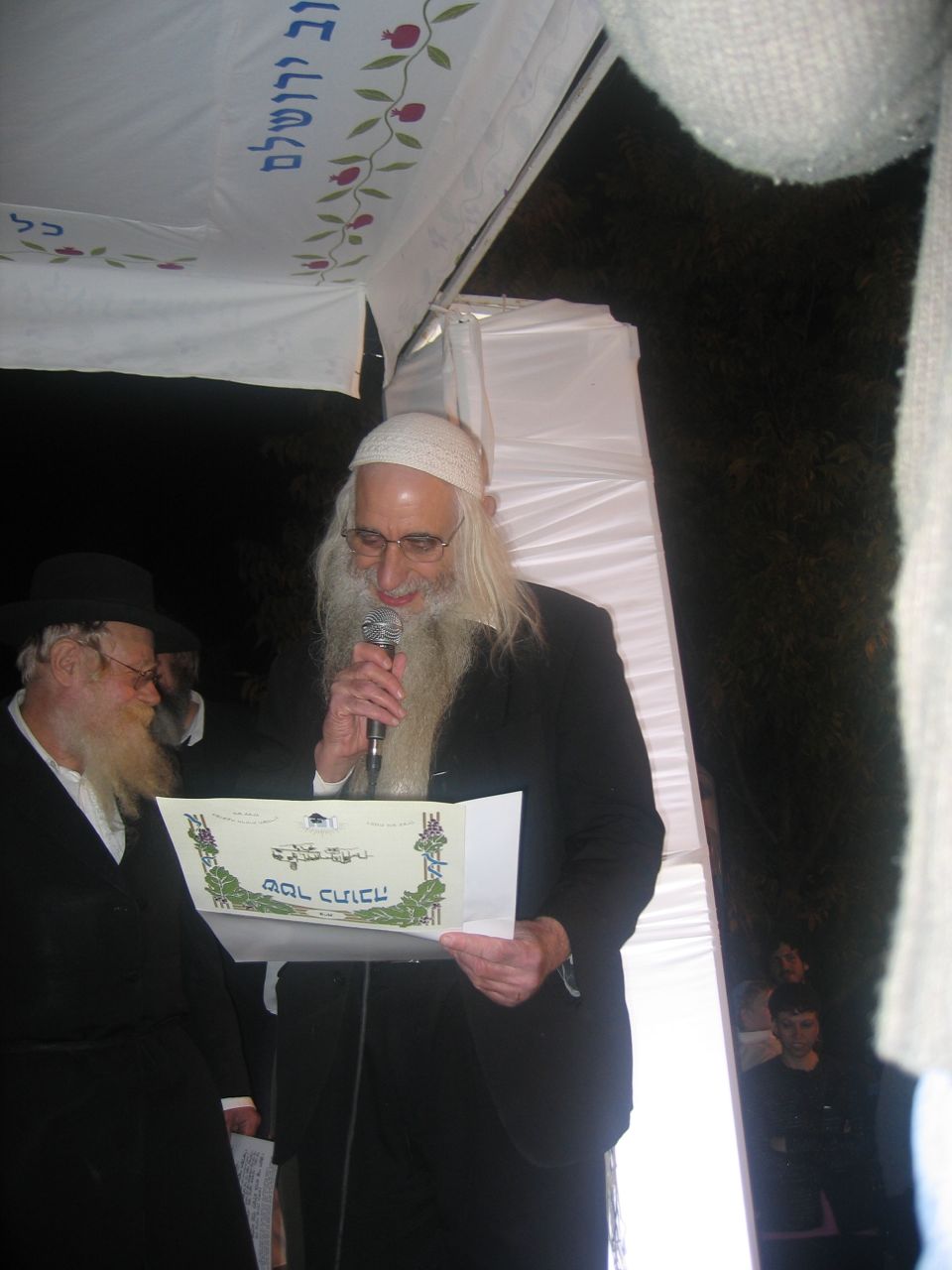
I’m told that Tekoa is in severe grief and mourning. It is very difficult for the to cope with the loss of their inspirational leader. In the picture below, which I took back then, Rav Froman is reading the Kesuba while Rav Shteinsaltz looks on.

I liked the man, lots.

יהי זכרו ברוך

Rav Froman (on the right) and Rav Steinsaltz on the left.

The right to pray is sacrosanct

You won’t see the bleeding left, especially those on Galus Australis and the feel-good New Israel Fundniks and the like upholding the inalienable democratic right of a person to pray. No, they will bleat and scream, while complaining that Moshe Feiglin (whose political views I have not studied in detail) is breaking Israeli Law and offending our peaceful Muslim brethren. What is his new sin? According to the Jerusalem Post

According to police spokesman Shmuel Ben-Ruby, Feiglin, who is No. 23 on the joint Likud Beytenu list, prostrated himself in the plaza and tried to pray out loud. Praying aloud, going through ritual motions or using any type of traditional prayer objects such as tefillin, tallitot or prayer books, are forbidden for Jews at Judaism’s holiest site due to tensions with Muslim worshipers at the Aksa Mosque.

Or according to Ha’aretz (try and register and you will see you have an optional “country” called Palestinian Territories (occupied))

Police plan to recommend charging right-wing Likud politician Moshe Feiglin for obstructing them in the line of duty, inappropriate behavior in a public place and violating a legal order. Police detained Feiglin Tuesday for attempting to pray on the Temple Mount. “We expected that the closer the campaign got to Election Day, the more provocations we would see whose purpose is to influence the outcome of the election,” Police Commissioner Yohanan Danino said yesterday. “I have said and I say again: We have no intention of allowing anybody to disturb the peace or break the law.”

Ha’aretz conveniently forgot to mention that Feiglin goes there on the 19th of every month, as omitted by Commissioner Danino, quoted ad loc. As far as I am concerned, if a Muslim can pray there, then so can a Jew. There cannot be one law for the Muslim in Israel. If they can’t control themselves when they see a Jew davening on Har HaBayis, then they should take a bus to Mecca to the Kaaba instead. I am not making a statement regarding the Halachic issue of whether it is permitted or not to stand on Har Habayis. Most hold that it is forbidden, or delineate carefully where one can go. I assume Moshe Feiglin is following his Rabbinic Psak. Let them arrest him. I can’t think of a more stupid act, if they do. Oh, and for the bleeding green left, davening in this way also constitutes the ubiquitous neo-mantra of “Tikun Olam” especially B’Malchus Shadee”.

Vayeishev

This is something I wrote for David Werdiger’s excellent “Jews of the CBD” organisation, so it’s reproduced here, for posterity.


We pine to know what the future brings. Yet, there is no prophecy in our day. Why? Prophecy provides a temporal glimpse or mirroring of the essence of God and His message. By definition, that transmission must be imperfect, for we are imperfect vessels. What of dreams and their interpretation? In this week’s portion, we see that even Yosef’s interpretation of his famous dream was not accurate because his mother Rachel did not bow down to him. Does this make Yosef a charlatan? Can there be a half truth? We know that the remainder of Yosef’s dream did come true.
Rav Kook explains that the essence was true. The essence is immutable. If Rachel had been alive, then she indeed would have bowed down to Yosef in the same way that Ya’acov did. A dream’s message relates to what potentially could or should have occurred given the confines of human imperfection and condition. Rav Hisda in Brachos 55a says this explicitly. Although we seek advice from the special leaders of our generation, sometimes we find that their predictions are not 100% accurate. But, it needs to be that way because man is an imperfect vessel for the transmission of God’s will. The challenge is to deal with and act on the messages of our time.
For this reason, those who cannot bring themselves to acknowledge that the State of Israel may well be the “beginning” of our redemption because certain minutiae are challenging to reconcile, miss the transcendent and essential message of our time.

This type of interview is creepy

[Hat tip to Abe]

They get a nice-looking scarf-less, american-accented mouthpiece to spout plain untruths. Many in the “cultured” western world, especially left-leaning tree-huggers will conclude that even though the interviewer caught her out, there is another narrative out there, and the only narrative that should be disregarded is the American/Israeli line.

The mighty and powerful aggressors are wantonly attacking the helpless ones, whose rocket-propelled “sling shots” don’t cause damage.

This is an Olam HaSheker, a world of lies. Those who think that propaganda will overcome this intense hatred towards us, would do better to re-read history and re-focus on

תשובה ותפילה וצדקה

Which doesn’t mean we “deserve” anything. What it means is that we need to increase our good acts and the quality of our personal and Godly interaction, especially when under fire.

By all means, write letters, twitter to your heart’s content, spread across facebook, share Friday night bread with co-religionists, but remember, that this alone does not, has not, and never will be sufficient to cause an attitudinal sea-change.

הלכה עשיו שונא ליעקב

It’s a Midrash, but for some reason it rings as true now as it did in 1939. That’s not all of them, but far too many. We’ve seen it before, and sadly, we will continue to see it until ובא לציון גואל.

Disclaimer: My private views, as always, should not be construed as associated with anyone but me, and me alone.

Let Eliyahu decide our questions

The Talmud, when faced with a conundrum that cannot be solved, uses the phrase

יהא מונח עד שיבוא אליהו

Let the issue rest until Eliyahu HaNavi comes (back) and advises us of the Halacha

or

תשבי יתרץ קושיות ואבעיות

ֵEliyahu (HaTishbi) will answer all the questions.

The question is asked: since Moshe Rabbenu was our greatest teacher, why do we wait for Eliyahu (who never died) to answer the questions, surely we should wait for Moshe (who will be resurrected when Mashiach comes) and ask Moshe Rabbenu to Pasken/decide the Halachic conundrums.

Rav Yissacher Shlomo Teichtalהי’’ד

R’ Teichtal הי’’ד

in his celebrated אם הבנים שמחה, explains that to be a Posek, a Halachic decisor, a Rabbi needs to be immersed in the world. A Rosh Yeshivah, for example, who only interacts with the surreal world of his Yeshivah, is not equipped to be a Posek for the masses. All his answers are designed for the שומר נפש, the Yeshivah or Kollel Jew, for whom being יוצא לכל הדעות, acting according to all stringencies, is the norm. Accordingly, since Moshe has not been interacting in our world for thousands of years, he is not suited to be the Posek when the Mashiach comes. Eliyahu HaNovi, however, who did not die, and lives amongst us, so to speak, is more suitable to answer our questions.

It is also for this reason that the משנה ברורה was not considered as acceptable to normative Psak, as the ערוך השלחן. The Chafetz Chaim was considered like the Rosh Yeshivah who lived in his world, and his method of Psak certainly was biased towards accommodating as many opinions as possible. The ערוך השלחן however was also someone who interacted deeply with his community, and for whom the sight of a woman brandishing a chicken to discover whether there was an issue of Kashrus with that chicken, was not unusual. Similarly, although R’ Chaim Soloveitchik ז’ל also known as R’ Chaim Brisker

R’ Chaim Brisker ז’ל

was considered the genius of his generation in terms of learning and innovation, R’ Chaim wasn’t a Posek. When people came to R’ Chaim to ask a question, he referred them to R’ Simcha Zelig Reiger ז’ל,

R’ Simcha Zelig, Av Beis Din of Brisk

the Dayan of Brisk.  (Incidentally, R’ Hershel Jaeger once told me that some descendants of R’ Simcha Zelig live in Melbourne).

Rav Teichtal, takes this one step further. He considers it immaterial that earlier Gedolim, such as the Satmar Rav or R’ Elchanan Wasserman had a negative view of an en masse Aliya to Israel. Rav Teichtal claims that they, like Moshe Rabenu, were not there to witness the changes in the world, and so their Psak, for today, is irrelevant.

R’ Elchanan Wasserman, May God avenge his murder

When Chassidim became religious zionists

The following is a nice article from Ha’aretz of all places, by Mordechai I. Twersky. [hat tip Moshe]

Could Yochanan Twersky, had he chosen to follow the footsteps of his rabbinic-Hasidic forefathers, have transformed, or at least bridged, between modern-day Hasidism and religious Zionism in Israel as we know it?

He was my distant relative, and the thought still occupies my mind, two months after Twersky – scion-turned-Israeli underground member, IDF soldier, and Israeli Trade Ministry official – died in Jerusalem at the age of 87 following a protracted illness.

“You simply have to meet him,” my brother Yitzchock – the meticulous researcher of the Twersky family genealogy for nearly 25 years — urged me back in 1999, after I made aliyah from New York. “You’ll see. He is one of a kind.”

He was a bearded man with a rabbinic countenance, and he was affectionately known as “Yochanan.” He was not a close relative of ours; a glance at the Twersky family tree shows that four long generations ago, his paternal great-grandfather and namesake, Rabbi Yochanan of Rachmastrivka (1816-1895), and my paternal grandfather, Rabbi Aaron of Chernobyl (1770-1837), were brothers.

But I was irresistibly drawn to this warm, affable man and his repository of age-old stories. Over time it became very clear: I was in the presence of our family’s last witness to a union now rendered extinct, if not totally unfathomable.

“My father was a Hasidic rabbi,” Yochanan told me during our first meeting at his Jerusalem apartment 13 years ago, in his deep, distinctive baritone voice and his British-Austrian English. He pointed to a wall where framed pictures of bearded Hasidic men hung alongside an image of Theodor Herzl. “And he was a Zionist.”

Yochanan’s father, Jacob Joseph Twersky, was a fervent Zionist among a small cadre of Austrian Hasidic rabbis influenced by Herzl and Laurence Oliphant, the British author and diplomat. Twersky led Vienna’s religious-Zionist Mizrachi movement and aided Israel’s early pioneers, among them the father of Israeli Supreme Court, Justice Yaacov Bazak, as they set sail for the Land of Israel from the Italian port of Trieste.

“We constantly had chaluztim in our home,” recalled Yochanan, using the Hebrew word for pioneers. “There was never enough room. They slept four across in my bed, and my mother cooked. I slept in the bathtub.”

Yochanan’s father bought shares in Bnai Zion, a turn-of-the-century company that purchased tracts of land near Hebron for Jewish farming and cultivation. At the annual Zionist march in Vienna, Rabbi Twersky walked with other Hasidic rabbis, waving an Israeli flag.

“My father wore his best holiday clothing when he visited Herzl’s grave in Vienna,” Yochanan, who bore a striking resemblance to his great-grandfather, told me.

In a long line of rabbis, a sudden twist

His grandfather, Nachum, was the first Hasidic Grand Rabbi to settle in Palestine, in 1924. Jacob Joseph visited him briefly that year and even considered settling there, before his poor health forced him to return to Vienna.

One can only wonder what would have become of Jacob Joseph’s variety of Hasidic-religious-Zionism had he settled in Palestine – and had Yochanan, his only son after three marriages, succeeded him.

In 1931, when Yochanan was 6 years old, his father collapsed and died while praying. Seven years later, during Kristallnacht – the Nazi pogrom known as the “Night of Broken Glass” — the Nazis broke into the Twersky home, ransacking it and dragging 13-year-old Yochanan from his bed.

“They ordered me to tear up our holy books and they beat me,” Yochanan told me. He said that he watched in horror from his window as the Nazis forced Jews to clean the streets with their beards.

In the aftermath of that atrocity, he salvaged one scorched volume from the flames, which he would later bring to Israel. He pleaded with his mother, Miriam Frieda, to abandon the family’s sole source of income — her late husband’s pension — and flee via an illegal transport to Belgium, and then to England.

“We just wanted to get to Palestine, but we couldn’t get a certificate from the British to enter Palestine,” said Yochanan. In a 1999 interview about the rise of Austria’s extremist politician, Jorg Haider, Yochanan recalled his childhood memory of the annexation of Vienna on March, 15, 1938, and the Austrians’ enthusiastic welcome of the Nazis.

In an unpublished family memoir, “Life’s Incarnations,” which he co-authored in Hebrew with his wife of 58 years, Ruchama, Yochanan described how Vienna’s Jews were pelted with stones and rotten fruit for years during its annual Rosh Hashana Tashlich ritual on the banks of the River Danube. The attacks only ceased after a group of 200 of Vienna’s local Betar Youth organization fought back, “beating the anti-Semites with bats and clubs so severely that they had to be hospitalized.”

Yeshiva student by day, revolutionary by night

In England, Yochanan studied at a yeshiva in Manchester and later earned his matriculation from the University of London before obtaining work as a diamond cutter. Stunned by continued reports of atrocities against Jews, and eager pry open the doors of immigration to Palestine, Yochanan joined a local branch of the LEHI — the underground Zionist movement founded in Palestine by Avraham (“Yair”) Stern.

“It’s a pity I wasn’t there [in Palestine], but at least I could do something in London,” recalled Yochanan, who under the code name, “Yehuda,” kept a stash of weapons and explosives beneath the floor of his London apartment. “I made some contacts, secretly, and I joined the LEHI. There I did what I could. I did all kinds of activities against the British, and we succeeded.”

In 1949, he and his mother set sail for Israel on the vessel “Negba.”

For his underground and IDF service, Yochanan later earned two medals. He was offered a senior rabbinic position in the Israeli Air Force, but declined.

“I came to Israel to be a soldier just like everyone else and to defend the land,” said Yochanan, who served in the Imports Department of Israel’s Ministry of Industry and Trade for 38 years. “I didn’t want the rabbinate.”

Yochanan wasn’t ordained. But as a learned man with charisma and compassion he could have been a contender of the Hasidic variety. Instead, he did things his way. He decided to forgo the Hasidic garb of his father, opting instead for a knitted yarmulke and placing himself firmly in the religious-Zionist camp. “My father most certainly would have led the religious-Zionists, had he made it to Israel,” Yochanan told me in an interview a year before his death.

“Might you have, too?” I asked.

“I wasn’t worthy,” he said after a deep sigh, recalling that at the time of his father’s death he was given a black fur hat and told to sit in his father’s synagogue chair. He only 6 years old at the time. “They tried, they pushed me. But it wasn’t for me,” he said.

Yochanan was modest, but he was also a pragmatist. Arriving as a refugee in the new-born state of Israel at the age of 24, he knew he had a life to build. In 1949, his Haredi uncle and Grand Rabbi was already cementing the family’s 25-year-old Hasidic court – although he was also concerned about his children’s future leanings.

“Thank God my children are not members of [the anti-Zionist] Neturei Karta, and they’re not Communists,” Yochanan’s uncle, Rabbi Dovid of Rachmastrivka, once confided to him. “But I fear my grandchildren will one day become [religious] zealots.”

“It was quite an eye-opener for my Haredi relatives that a member of their family walked around in an Israeli uniform, wore a knitted yarmulke, and placed an Israeli flag outside his home on Israel Independence Day,” Yochanan once told me. “But they didn’t dare say anything.”

Are trousers holier than soldiers?

Though he enjoyed praying in the synagogues of Israel’s diverse ethnic congregations, Yochanan refused to daven at a synagogue that omitted the prayer for the State of Israel and the welfare of its soldiers. “It’s a defamation, an ingratitude, not to say it,” he once told me. “If you can praise God for a new pair of pants, you can bless Him for Israel’s rebirth.”

Asked in 1999 to discuss Haredi draft exemptions from the IDF, Yochanan preferred instead to recall an era when the majority of Israel’s right-wing underground members were religious. But in his last interview more than a decade later, Yochanan would not conceal his feelings toward draft-dodgers.

“I am embarrassed that there are Jews of this kind,” he said.

I pressed Yochanan further, and went back to the issue of succession. Did he feel a sense of guilt over severing the family’s rabbinic line?

“I have 21 grandchildren and 22 great-grandchildren, and all of them are religious-Zionists who performed their army and national service,” said Yochanan, ever the straight-shooter. “I, too, felt I am continuing the path of my father. I have nothing to be ashamed about. I have no regrets.”

He remained optimistic that Jews would one day “overcome their differences and unite,” citing a number of examples when Jews came together “in the face of real danger.” But he tempered his statement with realism, adding: “I’m sure that even when the Messiah arrives there will be Jews who won’t accept him.”

In one of his last recorded statements, Yochanan acknowledged that Israel “needed some miracles.” But he remained ever hopeful.

“If we look at our past, it gives us hope that we can succeed again. We can have peace and success in all of our efforts,” he told me.

Last year, when I asked Yochanan whether his brand of religious-Zionism had, in essence, replaced his father’s class of Hasidic Zionism, he didn’t miss a beat.

“It didn’t replace it,” he said. “It renewed it.”

Definitions of Religious Zionism

I saw this comment from Chardal who said:

A religious zionist is:
Someone who either made aliya out of a sense of religious obligation OR someone who feels the need to find a valid religious excuse as to why they have not yet made aliya (ie, why they are patur). On a national level, this person feels that Jews should en-masse settle the land of Israel.

A religious non-zionist is:
Someone whose aliya is based on non-halachic religious considerations OR someone who feels no need to excuse their living in chu”l. On a national level, this person feels that there is inherent religious/pragmatic value in a large exile community and does not connect to any national project designed to move Jewry to Zion.

A religious anti-zionist is:
Someone who has to find a heter for making aliya and considers those who do so to be putting themselves in a spiritually dangerous position. If this person already lives in Israel, they are connected to the vestiges of the old yeshuv and consider themselves to be in a religious struggle against the state. On a national level, this person considers any national project to move Jews to Israel to be delaying the redemption.

Thoughts?