
This person, used to have a grocery shop in Carlisle Street, Melbourne. Always seemed an affable and likeable person. Money is a Tayva that’s difficult to control, even for the best of us.
Category: Uncategorized
Save the holy herring
There are some things that are above politics. Tree huggers and gun toters are able to unite in a communion for the sake of mankind. The sustenance of the Messianic Leviathan is at stake here. Thankfully, at times like these, when the good oil, the Omega 3, is in danger, humanity has arisen from its slumber and exclaimed “enough is enough”
What would Shabbos be without Eyeh Kichel and Bromfen, suitably set off by that salubrious, smelly, soul of the sea, species?
Read on and rejoice. Salvation is near.

Uniforms are everything
See this article.
I’m waiting for a Chassidic Machon for Textile Research where clothes are crafted in a way to provide a cooling experience, like an ice vest and thereby preserve the look, but not the feel, of the mandated uniform.
As time goes by, and we over-focus on form, content seems to suffer. When I was a boy, R’ Zalman Serebryanski ז’ל used to wear a mid-grey Kapoteh. Yes, it wasn’t black. His hat had a very short upturned brim. But then, again, he was a Chassid in content and seemingly less troubled by form.
It’s interesting to note that during the weekdays, other Chassidim, such as Ger, often don a standard fedora. Unless I’m mistaken, in the days of yore, they wore a Poilishe Hittel-one of those Donny Osmond style caps. I’m also skeptical whether the standard Chosid always wore a white shirt during the week. Did they?
Curiously, the Sefardim (at least those of them that don’t try to emulate Ashkenazim) didn’t have a dress code that required them to either all dress the same, or wear something akin to the Chacham.
And finally, we did change our names, clothes and language after we left Mitzrayim. Maybe that’s the answer: let’s go back to what Moshe Rabbenu wore?

Burning Mosques must be condemned
Holding onto all of Israel is important, however, in a democracy, one simply must accept the reality. The reality is that certain outposts and mini-towns will become political footballs. It’s tragic. But this, is just not on. It is an outrage.
Just how bad is child abuse in Chassidic circles?
The following is from Harry’s blog:
I had a hard time falling asleep last night. I received an e-mail from a friend who is intimately familiar with the Chasidic world of hard-core Chasidus like Satmar, Ger and Sqvere. This letter came from the heart. This fellow is no spreader of LaShon Hara. He is a modest and gentle person; responsible and intelligent; a loving and caring Charedi Jew of impeccable integrity. He is as straight as they come.
He has always been reluctant to tell his story – the story of rampant sex abuse in the Chasidic world. But I guess keeping all that inside has gotten to him. So in a moment of extreme candor he spoke out in an e-mail.After reading his letter, I was speechless. I found it impossible to believe. And yet he practically swears to me that it is so. If what he says is true, there is an incredible level of cruelty and inhumanity shown by Chasidic leaders who either allow or perhaps even encourage the intimidation of victims while tolerating abusers in their midst.Apparently the rate of abuse among Chasidim is horrible beyond words. According to some of the mental health professionals who deal with them – estimates of child sex abuse and molestation among the hard-core Chasidim is as high as 33%!I can only imagine the kind of “torture” used against the poor families who come forward. Why do they torture them? I guess because they feel they have no choice since all Hell will break loose if the truth comes out. There would be many hundreds of arrests.Lest anyone think this description of their behavior is not true, I remind you of the case of accused serial molester Avreimal Mondrowitz. He is a Gerrer Chasid. His extradition from Israel to stand trial in the United States was successfully fought by the Ger Chasidic community there. I would also remind you that nothing like this is ever done without the approval of the Gerrer Rebbe himself. He either explicitly or implicitly approved of it. Mondrowitz currently roams the streets of Israel freely.Just to give an example of another “Mondrowitz”- this one in Skvere. I have been told that a top Chasid of the Rebbe molested and raped hundreds and hundreds of children in 3 generations. And everyone there knew about it! He too has fled to Israel.And then there is what is currently going on in the case of accused molester Rabbi Nechemia Weberman. The trial keeps being postponed because of witness intimidation according to my sources.That intimidation tactics exist is not even a question. I direct you to the words of the Brooklyn DA, a man who has been accused of enabling abuse by being unduly influenced by this very same community:“I haven’t seen this kind of intimidation in organized-crime cases or police-corruption cases”
In other words, they are worse than the Mafia!
See the rest here
Calling on ALL Melbournians

It is important that we keep the Jewish in “Jewish Care” alive, vibrant, and uppermost.
Jewish Care Survey
Attitudes To Mental Health Issues
Jewish Care Victoria is exploring the extent to which Jewish community
beliefs inform attitudes to mental health issues. No such research has been conducted within the
Jewish Community of Melbourne.
To this end, we ask that you click on the surveymonkey
link to complete the short survey.
Please do this no later than Thursday 14 June 2012.
Surveymonkey is a secure site and all responses provided by you
including ratings, information and comments can only be accessed by Community
Services Staff within Jewish Care Victoria . Data generated will be aggregated and
reported on as a whole so that you cannot be identified. After the conclusion of the research, surveymonkey data will be destroyed.
For further information about this research, please contact the
Jewish Care Victoria Mental Health Program
Team Leader, Bronwen Taylor on 8517 5983 or the
Policy and Research Manager, Rachael Bajayo on 8517 5743.
Bronwen Taylor
Mental Health Team Leader
Individual and Family Support
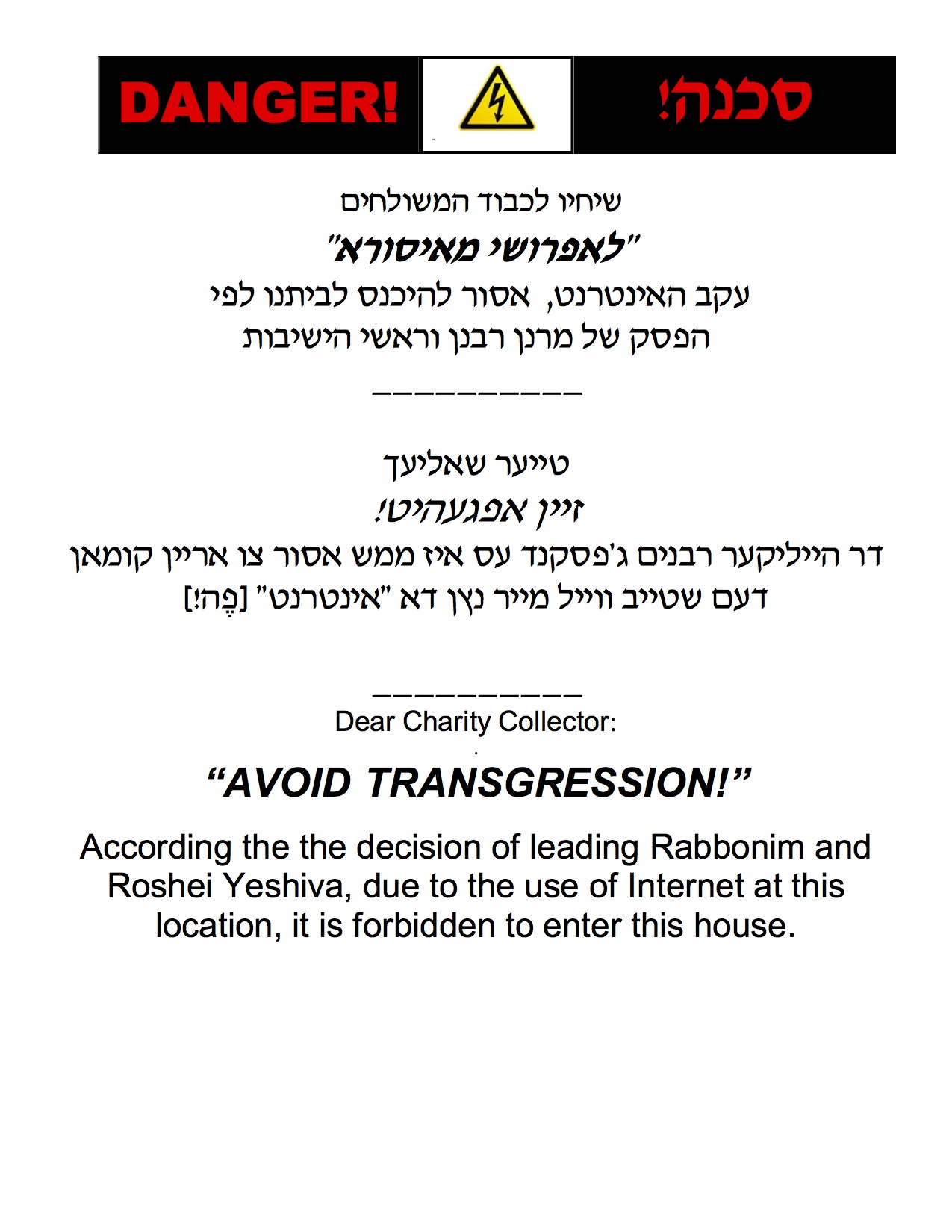
Helping people not to transgress Daas Torah
[Hat tip Abe]
What’s the deal with these protestors?
[The following is re-blogged from Rabbi Horowitz’s excellent site. Hat tip to Moshe]
Tuesday evening, a charming and sincere young man who is a survivor of childhood abuse shared with me that he had driven seven hours each way in order to attend a protest at the “Internet Asifa” in CitiField. He mentioned how gratifying it was and how pleased he was to have made the trip. This was the second rally recently organized by abuse victims – the first was held at a Williamsburg fundraiser for an individual who is under indictment for allegedly molesting a child over a period of 4 years.
These protests have elicited a wide range of emotions among members of our community along a continuum ranging from sorrow and sympathy to bewilderment and bemusement and even to hostility and anger.
Moreover, many members of our community have been asking those of us who are advocates for abuse survivors, “What’s the deal with these protests? What exactly do they [the survivors] want?
Others are asking more basic questions, like, “Why can’t they just move on with their lives?” or “Someone messed around with a friend of mine, and he got over it. Why can’t they?”
Well, my friends, it will serve us well to better understand the survivors and what exactly it is they want. We ought to because this conversation is very long overdue. But in a practical sense, it is imperative that we do because in all likelihood these protests will grow and intensify in the weeks and months ahead. The survivors are finding their voices and they will only gain traction now that the national and even international media is covering the abuse matter as it relates to our community.
To begin with, one needs to really understand why abuse is so destructive to its victims. For that, a careful and thorough review of Abraham Maslow’s Hierarchy of Needs might be a good place to start.
In a nutshell, Maslow divided all human needs into 5 groups and suggests that they are sequential in nature — meaning that until all Level 1 needs are met, it is impossible to move on to Level 2 needs, and that Level 3 needs cannot be realized until Level 2 needs are met.
Here are the groups of needs as Maslow sees things:
Level 1 – [The Most] Basic Needs (such the need for food, water and shelter)
Level 2 – Safety and Security (the need to feel protected from danger)
Level 3 – Socialization (the need to bond with family and friends)
Level 4 – Self Esteem (the need to feel self-confident and respected)
Level 5 – Self Actualization (the need to “be all you can be.”)
For a practical example of Maslow’s theory in action; just imagine that your car breaks down on the wrong side of the tracks and you are fearful for your safety. Just then a childhood friend calls and says, “Hi, Yankie, I’m in town for the week. Can we get together and catch up on things?” However, much as you would love to enjoy the Level 3 need of socialization under regular conditions, your brain quite literally cannot even contemplate engaging in that pleasure when your life is in danger.
Child abuse destroys innocent children’s lives in so many ways. But perhaps the most damaging component of all, is the fact that is that it totally destroys their Level 2 security — without which it is quite literally impossible for them to rebuild their lives. How can they ever feel safe again after they were violated? Just imagine what it would be like having a childhood where you were living 24/7 like that fellow in the dangerous neighborhood who had a broken-down car noted above? And this is all the more damaging when it is perpetrated by a family member, friend, or educator whom the children were depending on to keep them safe. For if the adults in whose care they rely on are hurting them, who in the world can they ever fully trust again?
It is also important to note that just like people celebrate sports victories and/or losses in diverse manners, so too do they have different time frames in which they can successfully recover from the incredible trauma of childhood abuse.
All of this is exacerbated when the children come forward and are not believed, or worse yet punished or threatened for reporting their molester. It is quite literally a second round of abuse and it just reinforces their feeling of being rootless and wind-driven. In fact, so many victims report that they were more devastated by not being believed than they were from the original abuse.
Speaking of not believing the victim, research indicates that the overwhelming majority of children who come forward with abuse allegations were telling the truth. Think about it. Why would anyone in their right mind come forward with a claim of being abused if it didn’t happen? (The exception to this rule is in messy custody battles where one party clearly stands to gain if the other is maligned.) All the more so in our community where there is unfortunately a stigma attached to those who do so and to their families. Going public and helping to get the perpetrator apprehended, in order to protect the lives of other innocent children, often comes at great personal cost to the survivors and their families.
About five years ago, as awareness in our community about the matter of child abuse began to rise, many of the long-suffering victims began to hope against hope that things would finally change. People would finally “get it” they believed, and they would once again feel welcome and nurtured instead of being treated as pariahs who ruined the sterling reputations of their abusers. Who knows, they might even get their Level 2 security back again.
Then they pick up a charedi publication one weekend and see a picture of a group of distinguished rabbis visiting a monster in a Virginia jail cell, who was serving a 31-year prison sentence for raping his daughter in three continents over a period of many years. More than 10 survivors contacted me as soon as that picture ran in the paper. “How could they do that to us?” they asked me. “Don’t they know that by supporting the molestor they are stabbing us in the heart?” they cried. Well, they are. They really are.
And what in the world should survivors in our community think when they see a huge fundraiser for someone accused of molesting a child? Many of them viewed the very public nature of this effort as clear warning of what is in store in the future for anyone else who might dare report a predator to the authorities.
For many of the survivors, though, the final straw was the Internet Asifa. Why were they so upset? Let me count the ways for them.
To begin with, the kids in the street know the truth — that the Internet is a firecracker compared to the atom bomb of abuse as far as going off the derech is concerned. Just ask any of them — or any of the adults in our community who work with the at-risk teen population, what the main reason is for children leaving Yiddishkeit.
Moreover, many of these kids credit the connectivity of the Internet for finally raising awareness of abuse in our community, and as we all know, there is more than a kernel of truth there. “Why are the people running the Asifa blaming the Internet for causing children to go off the derech and saying nothing about the matter of child safety?” they wonder.
Bottom line, there are hundreds and hundreds of abuse victims and survivors who were once part of our kehilos. Some left completely while others exist on the fringes – misunderstood, marginalized, and hurting.
Trust me, the vast, overwhelming majority of them are nice kids who want neither vengeance nor revenge. They do, however, want to see that today’s children don’t suffer the way they did and they desperately want to see that things are changing as it relates to child safety.
Now that the lid has blown off, these young men and women, who had their innocent childhoods stolen from them, by vicious predators masquerading as upstanding members of the community, will have their voices heard and their stories told. We have two stark choices. We can reach out, engage them and really listen to what they have to say. Or we can continue to give them the back of our hands, and then we will hear their tortured messages through the front pages of the newspapers and under the glaring lights of television cameras.
Recommended reading:
L’maan Hashem – What Will It Take? Let’s start protecting our children

Sefer Shimush Tehillim
My cousin’s husband, Reuven Brauner has another worthwhile compilation published. You may download it here.
What is it? The introduction states:
Sefer Shimush Tehillim is a short and relatively little-known treatise attributed to Rav Hai Gaon (according to the Sedei Chemed) which describes the Kabbalistic uses of particular chapters and verses from the Book of Psalms for prophylactic or healing purposes. These selections are meant to be either recited alone, frequently multiple times, or in conjunction with some other action or prayer. Shimush Tehillim is mentioned in Teshuvas HaRashba (413), by the Chida, and others. This work is not to be confused with bibliomancy which is the use of Biblical verses for predicting the future.
There are numerous instances cited in the Talmud and other sources regarding the utilization of Biblical verses to ward off demons and the Evil Eye, against bad dreams, against the effects of drinking water uncovered at night, and other more serious calamities. Verses were employed to lighten the pain at childbirth, as protection against danger on a journey, fierce dogs, bleeding and wounds, and the effects of fire and fever. Verses were recited to gain favor or improve one’s memory, and so on. (See Sanhedrin 101a and Shulchon Oruch, Yoreh Deoh 179:8-10, et al.)
Yet, it must be noted, there was great opposition to use of the Torah for magical, curative purposes. The Rambam, the Tur (Yoreh Deoh 179), and the Shulchon Oruch (Yoreh Deoh 179:10) forbade such usage. The Rambam in Hilchos Avodas Cochavim 11:12 pointedly writes:
“Regarding one who incants over a wound or reads a verse from the Torah, and so one who reads verses to calm a frightened child or places a Sefer Torah or Tefilin on a child so that he will sleep – it is not bad enough that these people are numbered among the sorcerers and diviners, but they are also counted as heretics to the Torah by using words of the Torah to heal the body. The (words of the) Torah are for healing the soul only, as it is written, ‘and they shall be life for your soul’. However, it is permitted to recite verses and chapters from Tehillim for protection against troubles and harm – by merit of their recitation.”
Protection – yes, curing – no.
Since Tehillim, more than any other Sefer from Tanach, was used to defend against the effects of all types of predicaments and saving from danger, as recorded in Shimush Tehillim, I thought that it might be interesting to prepare the following table1 to illustrate which chapters it suggests be used for which ailment and condition. For the convenience of the reader, I have also added a cross-referencing index.
Nevertheless, since this monograph is meant for general educational purposes only and not practical application, and in deference to the dissenting opinions, I have only provided a selection of chapter usage from the book, and did not list the use of single verses nor what other actions are required in addition to the recitation of the chapter to affect the desired results. For such purposes, the interested reader must consult an actual edition of Shimush Tehillim and ask his rabbi as to how to employ it, if at all. All this aside, it is commendable to recite Tehillim anyway for the efficacy of it as prayer is well-known.
Finally, I made no attempt at trying to determine why each chapter has the effect claimed, as there is no indication of this in Shimush Tehillim itself.
Cellphone vibration syndrome and other signs of tech addiction
See this article.
I have to admit that I have had the odd phantom vibration only to find it was a figment of my imagination.

Attitudes towards the אומות העולם
R’ Shteinman recently made news because of a speech that he gave which spoke unkindly of the אומות העולם.

A translation of his speech is available. One should read it in context.
The purpose of creation is for the torah! As long as there was no Torah, there were all sorts of no good things, until Avraham came. From Avraham began the spark of what began the Torah, Avraham then Yitzchak and Yaakov, Yosef and the Tribes. but without torah the world could not exist. And it was a great chessed that 26 generations until the torah was given, in the merit of chessed, because they waited for the torah. But without torah there is no world! So the purpose of the world, one must know, is the torah. And today they say there are 8 billion people in the world. And what are they all? murderers and thieves, people without seichel .. but for whom is the purpose of the world? did Hashem create it for these murderers, for those evil people? Only for the tzadikim, those who learn torah, people who learn and keep torah. that is the purpose of the creation. And with parnassa Hashem helps. Most of the time the richest people specifically are not people of such great education. Why? because that is not the main thing. It depends on Hashem supporting all His creations. The mian thing is that a Jew should learn torah…Klal Yisrael are connected to the roah. The gentiles have no connection to the torah. the nations of the world don’t have anything, not security, not good deeds, and whatever klal yisrael has is only with the torah. […]
I’m not in a position to understand these thoughts. I’m not sure if R’ Shteinman realised that his words would be broadcast around the world. If he did not, then that itself is problematic as it implies that one may be too removed. My problem with what he said is:
- It was possible to make the comment that people without Torah values have been seen to be involved in all manner of atrocities throughout History. This includes those who are Jewish without Torah and those who are “frum” without (real) Torah. However, given the bad press that frum Jews are getting, it might have been better to appeal to statistics which clearly show that Mentchliche values and proper behaviour in our society go hand in hand with Torah observance. That being said, I’m not sure that’s the best approach to show the beauty of Torah, anyway.
- There were and are חסידי אומות העולם. This speech doesn’t logically admit them.
- There are ישמעאלים who are non violent and were and are happy to live peacefully. Why wouldn’t they be classed as בני נח?
- What is wrong with a בן נח anyway? It’s a halachic category. It has a purpose and a reward. Should it be sneered at? Is the בן נח somehow culpable for being born?
- Later in his talk he mentioned the Chayei Adam. The Chayei Adam worked for a living.
- I’m not sure how the Rav knows that rich people aren’t bright. Why would he say that anyway? Again, the point that we require a Bracha from Hashem can be made cogently without saying that.
At the risk of being accused of Charedi bashing, similar comments have been made by Sefardi Chachamim and Rabbis from יהודה and שומרון. Let’s segue to today’s news from Yediot.
“If the wife of a Knesset member would have been raped, this whole mess would have been sorted out, but no one cares about us” one of the demonstrators who were arrested told Ynet.
The protesters waved signs reading “South Tel Aviv a refugee camp” and “Infiltrators, leave our home.”
One of the demonstrators who spoke during the rally urged Prime Minister Benjamin Netanyahu to “decide whether we live in Israel or Sudan.”
Smaller protests against the illegal immigration phenomenon were held in Bnei Brak, Ashdod, Ashkelon and Eilat.
Residents of the south Tel Aviv neighborhoods Shapira and Kiryat Shalom held another rally on Chahmei Yisrael Street. They waved signs reading, “Our streets are no longer safe for our children,” “The craziness of our life: Neglect, crime, rape and violence,” “Yesterday it was my daughter, tomorrow it will be your daughter,” and “Yishai was right.”
So one doesn’t have to be an elderly Charedi Gadol to make similar points in a demonstrative manner.

Do Israelis have a right to protest? Of course they do. Can they argue that there are too many immigrants from amongst the אומות העולם? Yes, they can. Every country has limits, and Israel has a right to preserve its raison d’être as a Jewish State. Leftists will counter that the Shoah implies Israel should take any and all refugees. Should they? Perhaps they should deport anyone who breaks the law?
These are weighty issues, and they require very careful language and associated action. There is much more to write, but this isn’t the time.
Let me close with an allied observation about the manner in which we do interact with the אומות העולם.
It is common in non Charedi Schools to sing the National Anthem on chosen days. It is common in non Charedi Schools to have a flag of Australia. It is common in non Charedi Shules to have a prayer devoted to the Government. We know הוי מתפלל לשלמה של מלכות. When a group specifically chooses not to
- sing the Anthem
- fly the flag
- devote a special prayer for the Government
I am puzzled. Why? Does it mean that automatically it provides legitimacy to the more sordid elements of society? Is there a danger that through doing so people will become less Jewish (whatever that means)? You take the money but don’t show gratitude in the accepted way?
It seems to me, that being careful not to להתגרות and aggravate is a Jewish value, as is הכרת הטוב. Can someone explain why the rhetoric and the lack of material acts has become so negative and at times so embarrassing?
Are these lyrics problematic?
Australians all let us rejoice
For we are young and free
We’ve golden soil and wealth for toil,
Our home is girt by sea:
Our land abounds in nature’s gifts
Of beauty rich and rare,
In history’s page let every stage
Advance Australia fair,
In joyful strains then let us sing
Advance Australia fair.

The prayer of the SheLah HaKadosh
1565-1630 (11 Nisan, 5391) ISAIAH BEN ABRAHAM HA-LEVI HOROWITZ (SheLah Hakadosh) (Prague, Bohemia-Tiberias, Eretz Israel) Rabbi, kabbalist, and Jewish leader known as the SheLah Hakadosh for his major work “Shnai Luchot Habrit” (Two Tablets of the Covenant) which combines Halachah and Kabbalah as a way of life.
He moved to Eretz Israel in 1621 after the death of his wife. In 1625 he was arrested with many other Rabbis and held for ransom. The SheLah served as leader and Ashkenazi Rabbi in Jerusalem. He used his personal wealth to financially support the community. The SheLaH strongly believed that he was privileged to be able to observe the commandments tied to the land of Israel. He is buried next to the Rambam in Tiberias.
Many observe the practice of saying this T’filla (link includes English translation) for their children. Some couple this practice with fasting on Erev Rosh Chodesh Sivan.

An exciting new translation of Shas
See here for a review.

Stunning Imax 3D movie of ירושלים עיר הקודש
Hat tip to Abe.
Rav Schachter on Soft Matza
It has been claimed in various quarters that R’ Schachter has no issue in principle with “soft” matza. His name has been used, making such claims, and through a long bow, trying to associate R’ Schachter with the acceptability of particular types of ashkenazi machine made soft laffa style matza.
I heard R’ Schachter speak on this topic, and I came away with the distinct understanding that
- Soft Matza was certainly used in the past by Ashkenazim
- There are some Sephardim who have maintained their Mesora on how to make the traditional soft matza
- An Ashkenazi who wishes to eat from a Sephardi Soft Matza and rely on a particular Sephardi Mesora on how to make these matzos may do so if they wish, but they are relying on that well-known and accepted Sephardi hechsher.
- R’ Schachter in no way endorses any particular Matzos (hard or soft)
- Ashkenazim over the last 200 years have reverted to thin hard matzos. (R’ Shlomo Zalman Auerbach disagrees with R’ Schachter and says that an Ashkenazi should therefore only ever have hard matzos)
- R’ Schachter had absolutely nothing to say about new laffa style, some of which has also found its way into Melbourne, Australia, under R’ Rabi, and in no way should R’ Schachter’s comments be used to ascribe any acceptability to the kashrus thereof.
I understand that R’ Schachter has very recently made the above views known explicitly in response to queries about the use of his name on R’ Meir Rabi’s Kosher Business/Hechsher, which promotes Rabi’s soft laffa style product. I also understand that R’ Rabi is now aware of these clarifying comments.
There is a solution to this conundrum. R’ Rabi should open himself up to an overseas kashrus expert, such as Rav Moshe Heineman or indeed the OU or similar to come and oversee his laffa production before next Pesach, and formally put their imprimatur on his production. Heck, if it’s good, he can export it too, presumably.
Mehadrin only
Hat tip to Daniel F. Seeing is believing!

When is not approved not kosher?
The word kosher, alone, doesn’t mean too much. It needs to be qualified. It is not an absolute unless each and every authority agrees. That is rare. Even with something as mundane as water, we know that because of micro-organisms (copepods) in various countries, some authorities recommend filtration. If your Posek recommends that you filter, then it may also be that your Rabbi considers unfiltered water not kosher. On the other hand, your Posek may consider it Kosher B’Shaas HaDchak or B’Dieved. It depends on the issue at hand and its halachic severity in the eyes of your Posek.
There are a myriad of so-called Kosher Certifications. Does that make them all Kosher? That’s a loaded question; it’s in the eyes of the particular consumer and their Posek. For one Posek a particular certification is not recommended, and how you translate not recommended in general, may mean it’s simply not Kosher any time under any circumstance. Triangle K and Rav Abadi’s Kashrus rulings are but one example of certification that is not relied upon by other agencies and communities. It is relied upon by others. They aren’t on the Kosher Australia list, and are not on many lists around the world. If your Posek says that you may not rely on it, then for you, it is not Kosher. It is not fit. Kosher means fit for halachic consumption; your halachic consumption. If you rely on an agency, such as Kosher Australia, then it’s the same deal. If they do not recommend it, it is not fit for your kosher consumption. However, saying that someone else whose Posek or Kashrus Agency does allow, Triangle K for example, is eating non kosher, is none of your business.
If I don’t use the Melbourne Eruv because my Posek advises me not to, I am not going to say that Jews who do rely on it, based on their Posek or Agency, are carrying on Shabbos!
In context then, there was a harmless post on the Kosher Australia Facebook page where a subscriber to Kosher Australia, who follows Kosher Australia asked on the Kosher Australia Facebook page whether the “It’s Kosher” supervision is Kosher. In context, that clearly is asking whether food under the auspices of “It’s Kosher” is permitted to be eaten. The answer is of course No! The reason, as provided by Yankel Wajsbort of Kosher Australia is that it is not recommended. There are no surprises here, and I was flabbergasted to learn that one of those heavily associated with “It’s Kosher” took great umbrage at the question. It is perfectly valid to ask if something is Kosher to a Kosher Agency. That’s how questions are asked. Nobody asked “if I am served something from “It’s Kosher” at someone’s house, am I permitted to eat it, or should I find a reason to make a quick exit. That’s a different question. Kosher is Lechatchila; in the first instance. In the first instance, if you are served, for example, Soft Matza from “It’s Kosher” can you eat it according to Kosher Australia. The answer is no. The folks from “It’s Kosher” are a bit too sensitive from what I can detect. You can’t stymie valid questions and answers and most importantly, attempting to stymie such discussion is definitely not going to ingratiate “It’s Kosher” in the eyes of the Kosher consumer.
“It’s Kosher” and its network of consumers ought just follow their Rabbi (Meir Rabi), and leave others to follow Kosher Australia and/or their own Posek. Threats are silly in the context.

It’s nice to be nice
I don’t know who the lady is. She works in the Tempo shop in Melbourne, off Carlisle Street. She’s of Russian origin, judging by her accent. I’m there almost each Sunday morning to pick up some Milk, and whatever else my wife asks me to buy. Without fail, for each customer, she behaves in a most friendly way. She always says please and thank you, never seems flustered, and always wishes customers a nice day or Good Yom Tov or whatever is relevant. Sure, she’s not the only person who does this, but given the clientele and the environment, I think she is extremely genuine, and not the product of a short course in client management. It’s natural. She’s always immaculately presented and an asset to the shop, and never looks like she’s doing you a favour by serving you. As I left the shop yesterday and she wished me Good Yom Tov for Pesach, I stopped and reflected on how agreeable she was, and thought that I should mention it as הכרת הטוב.
 There is much to be learnt from all types of people. I certainly could use a dose of her natural conviviality.
Uncovering Abuse
Do you moan, cry, do Tshuva or praise Hashem?
It’s unfortunate. Of late, many of our wisest and respected Rabonim have passed away. These deaths have occurred in close proximity. A number of others have been seriously ill, some remaining so, and others recovering Baruch Hashem. In almost all cases, however, the Rabonim have been old men; in some recent cases, over 100 years of age.
Nobody enjoys seeing their mentor seriously ill, or worse, passing away. It is understandable that feelings of sadness diffuse and displace an otherwise more positive disposition.  The Vizinitzer Rebbe, a holocaust survivor, had suffered from Alzheimers and passed away at 95. He left a legacy of Torah and Chesed, and his sons and sons-in-law are considered paragons in their own right.
 Yesterday, R’ Chaim Pinchas Scheinberg, who I met when he visited Melbourne some years ago, passed away at the age of 101. Reportedly, he was also experiencing Alzheimers. Sadly, R’ Yosef Shalom Elyashiv, who is aged 101, is still comatose in a critical situation due to life threatening illnesses. I hope he recovers quickly and resumes his earlier activities with renewed vigour. R’ Chaim Kanievsky who is in his mid-eighties, and R’ Aharon Leib Shteinman who is 100, I believe, and may they both be well, both were taken to hospital recently.
How should we react to this? I’ve noticed that almost all reaction is of the variety:
Oh Hashem, we have sinned, we have to do T’shuva … please stop this, we are sorry
Look, we have sinned. We also sinned while they were well, and all was good. We do have to do T’shuva. There is a tendency, however, for everyone to gratuitously assume that they know why Hashem does what he does. Why is it so clear to all that someone who is elderly passed away because of us or because of Tznius or Lashon Hora problems or … Is it heretical to say that Hashem has a plan which we do not understand. That plan includes a life span. Even Moshe Rabenu passed away. The physical body, short of a miracle, has a use by date. We all have it. Unless Mashiach comes, or Hashem decides to bestow an Eliyahu Hanovi style miracle on us, we all will eventually complete our task on this world. What about a different reaction?
Yes, we mourn. Aveylus is mandated by Halacha. Aveylus, however, is categorised by a period of silence, followed by positive discussion about the niftar and acts designed to elevate their soul in heaven. Is it anathema to thank Hashem for having had the opportunity to learn from, learn with, interact with, be led by … the great Rav who has passed away at the end of his life? Do we have to associate the death of an old person with our sinning?
The phenomenon is not just one with the Misnagdim. When the Lubavitcher Rebbe passed away, I recall the moment vividly. I was on the way to play at a Simcha. I was in a state of complete shock. He was, in my mind, one of the pillars of our generation. He and his father-in-law were directly responsible for my education. My mind was numb. To be honest, I didn’t at all feel like playing at a wedding. The MBD song “Mashiach Mashiach” was a great hit, and I recall singing it with a lump in my throat. I had no problem with the concept that the last Rebbe may have been a candidate for Mashiach, but now, after he had passed away, I sang that song in the knowledge that Hashem had chosen someone else. It was a negative feeling that was meant to be tinged with a positive thought. Not easy! I didn’t feel at that moment that I or we had done something wrong, that we had sinned, and because of our sins, this great Torah Sage completed his mission on our Earth. Clearly, the continuation of his institutions and mode of Yahadus is still felt, and in this way, he is “alive”. This is the positive side I was alluding to above. On Chabad blogs, instead of the “We have to do Tshuva” style responses, you get the “Oh, Mashiach Now, how long do we have to wait”. It is a different style of response, I admit, but again, it doesn’t recognise when someone has gone to another world because their “time is basically up” and they have completed their Shlichus (to use Chabad parlance).
When a truly great Rabbi passes away into the next world, his legacy remains. His teachings bubble along, and people stay inspired. We see this with the great luminaries, such as the last Rebbe from Chabad, R’ Kook ז’ל, the Rav ז’ל, R’ Moshe ז’ל, R’ Shlomo Zalman ז’ל, the Chazon Ish ז’ל … their indelible mark remains and seems to grow well after their passing.
In contradistinction, we have also witnessed the unspeakable tragedy in Toulouse, which hit me even harder when it was revealed that one of the Kedoshim, Gavriel Sandler הי’ד was named after my friend, R’ Gavriel Holzberg הי’ד who was murdered in Mumbai. True, these people “fulfilled” their Shlichus, but we are disturbed by their death in a profound way. We ask why their days were not filled. If they could achieve so much in so little time, how much more could they fulfil if they had lived to 80 or 90 or 100+? We do reflect on this, and some of us are inspired to improve ourselves (Tshuva) and others wring their arms and cry out for Geula (We want Mashiach now). These are “normal” responses. With this in mind, let us remember the Pasuk in Mishlei:
אין חכמה ואין תבונה ואין עצה לנגד ה
there is no wisdom, or understanding or counsel over Hashem
Panacea: A call to unmarried girls to doll up
Sometimes I think that I really am living in a different world. Yet, I am generally quite comfortable around more Charedi types. That is, as long as they look at me, don’t mumble, and are happy to engage in intelligent conversation and normal social interaction.
We’ve all heard about the “Shidduch Crisis“. This is the phenomenon where:
- completely holy young men seek women 3-4 years younger than them (and fathers-in-law/yerusha) who are able to sustain them in a surreal life where they learn Torah and schnorr for a living
- Girls of age 21+ are placed in the “old pile” and spend demeaning years in the shidduch system, never to graduate with a Shtar Eirusin.
All sorts of remedies for this malady have been proposed. I think they all miss the point. It isn’t about the Shidduch system per se.  Shidduchim after all are an introduction agency. It’s a business; big business. The Shadchonim market their goods in a way that reflects the needs of their clientele, or at least they try to. They would like to see all these single and pure angelic girls married “off” (I dislike that Yinglish phrase). In the least, it means more business and perhaps a better seat in Olam Habo. Pardon my cynicism, I’ve become old(er) and more hoary. The issue is not the system, it’s the life style. It’s simply unreal and unnatural. Sure, Eliezer was sent to choose Yitzchak’s wife. Eliezer had a helping hand, and there was a good deal of Godly intervention there. I think they call it Hashgocho Protis, although today it’s become “bashert”. You can’t “fix” Charedi society with quick fixes. It’s got to be a gradual transmogrification over a generation. You see, we have too many “holy young men” who aren’t. They aren’t geniuses. They aren’t paragons of virtuosity. Many will also be ill-suited to education or leadership. They will not become “Gedolim” or even “Askonim”. They will stay back benchers, occupying the hallowed halls of Mir and Lakewood, forever and a day. They remain removed from Olam Hazeh.
They do not see the norm to be one where one earns an honest living, has set times for Torah, brings up a sound family with good values, and become a living beacon to all those who interact with them.  No, in our world, this is a second-rate existence. Forget about the Yissachar and Zevulun nexus; that is a marriage of convenience. You know, it’s B’Shaas Hadchak. The money ideally should fall from Heaven, like Manna, and each and every one of us should spend our days dissecting a R’ Chaim or a R’ Baruch Ber. Sorry guys, that situation is called Moshiach’s times. In the meanwhile, we are in Olam Hazeh, the real world.
It comes as no surprise that a new bizarre method of connecting prospective brides with grooms has been implemented, where the prospective brides get to meet an array (or should that be a gaggle) of prospective mothers-in-law. How natural is that? What a great and “unpressured” cupid pressure cooker that must have been. The green house emissions must have been sky-high. Those poor girls. What are they expected to do, show that they can make a potato-free latke in 1 minute, or bake a triple braided inside out, gluten-free and protein enriched challah, or perhaps stay awake for 8 days in a row and still smile happily when asked to change a poo nappy?

Many of the problems with society are linked to its leaders. It is they who direct the circus that this has become, and who have produced this surreal environment. Contrast this with the wise counsel of R’ Ahron Soloveichik ז’ל. A group of his holy students came to ask his advice about a wedding they had been invited to. This wedding was, shock horror, not segregated and the boys wanted to know whether they were permitted halachically to attend. R’ Ahron, in his inimical Soloveichik style of clear thinking responded with words to the effect:
What is your question? You must go! I hope they seat you on a table with nice eligible girls. This is a perfect way for you to interact with a future partner. You can talk, you can look and after that, if either of you are interested, arrangements can be made for a continuation. I would say that this is the best way. It’s in a public place, there are no questions of Yichud, and you will see each other naturally.
I can’t imagine too many Gedolim espousing such a view. R’ Ahron was no left-wing neo-orthodox type. Like all the Briskers, he was thoroughly uncompromising when it came to Halacha, and called it as he saw it.
With this background, you can read this wondrous post from Yitta Halberstam (hat tip to Talya) in the Jewish Press. The writer, a prospective mother-in-law, bemoans the fact that at the Shidduch meetings I mentioned above, the girls don’t doll up. They are plain jane, with little to no attempt to make themselves look stunning. We are even told the “moredik” story of how the Satmer Rebbe recognised that a girl with no teeth would find it hard to find a husband. Do you need the Satmer Rebbe to tell you this?
Yitta tells us:
Since most of the young women at chasunas seem quite presentable, I couldn’t shake off my sense of disbelief as I looked around now. What were they thinking? How had their mothers allowed them to leave their homes with limp hair and unadorned faces? With just a little blush, eyeliner and lip-gloss, they could have gone from average to pretty. There are very few women who can’t use a little extra help. Even the most celebrated magazine models can look downright plain when stripped of all cosmetics, al achas kamah v’kamah girls who are not born with perfect features. So what was going on? Were they in denial about the qualities young men are seeking in future wives? Yes, it is somewhat disillusioning that men dedicated to full-time Torah learning possess what these girls might perceive are superficial values, but brass tacks: they want a spouse to whom they are attracted. The young men themselves might be too shy or ashamed to admit it, but their mothers won’t hesitate to ask what for some is the deal maker/deal breaker question, namely: “Is she pretty?”
Thankfully, every one’s conception of attractiveness is different; beauty is in the eyes of the beholder, and a woman’s intellect, personality and soul can have a tremendous bearing on the way in which her beauty is perceived. Still, there is trying, and then there is not trying. The mystery perplexed me: Why hadn’t some of the girls gone overboard in presenting themselves in the best possible light? I felt like shaking them in despair. As I further scanned the room (I had started assuming the role of disembodied observer once I realized that I was at the wrong event; my son is learning full time now, but plans to pursue a Ph.D so he wasn’t appropriate for this particular group), I could not help but notice the number of girls who could have vastly improved their appearances–gone from plain Jane to truly beautiful–if they simply made some effort. The truth of the matter is, I mulled, one way of looking at the story of Purim (and there are so many different prisms through which itcan be viewed) is to see it as the narrative of the tyranny of beauty ruling every society in which Man (and woman) has ever lived. Vashti incurred Ahachshverosh’s wrath because he wished to parade her beauty and she refused (bad skin day). The women of the kingdom who vied for the Queen’s throne were given twelve months to prepare for the beauty pageant – why hadn’t some of the girls at the shidduch event taken a mere half hour?
Some women who are deeply religious or intellectually inclined may delude themselves into thinking that their male counterparts will only see, appreciate and cherish their inner beauty, and that will (or should) be their overriding priority. All other surface qualities will be secondary, subordinate to the place where their neshoma stands. Truly, it is an ideal that I passionately share with them–the yearning to be seen in a soulful way, visible to the heart but not necessarily the naked eye– but unfortunately we are not living in an ideal world.
Many years ago, I had a conversation with Georgie, the internationally renowned hair stylist andsheitelmacher, who brought a certain new aesthetic to the frum world when she first launched her business. Georgie told me then that she wished she could persuade young women in shidduchim to participate in “make-over” sessions with hairstylists, cosmetologists and wardrobe consultants, who would help them achieve their best possible look. “I am often shocked by how little these girls do for themselves,” I vividly remember her saying. “How will they ever find a shidduch?”
In one sense, Yitta is right. However, these girls are just reflecting the spiritual values that deplore Olam Hazeh, and which their presumed Bashert has just as categorically rejected as part of his life aim to sit on the back bench.
Revulsive antipathy to the mormons
I object when someone approaches me and suggests
you need to be saved
I object when someone approaches me and suggests that my grandparents and great grandparents right up to Aaron the Cohen Gadol,
all need to be saved
I object when someone feels the need to attempt to convert a Jew to their belief system, either in this world or posthumously.
One of my colleagues at work likes to drop in almost each day to discuss his bible reading. He is what you’d call an Erliche Xtian. The problem is that it’s not simply about his bible reading. Subliminally, he feels that somewhere along the line he might be able to interest me in his parroted interpretations.
Yes, I could say “live and let live” in the way that Rabbi Levi Brackman suggested in this article. I have been too nice; that’s why he still comes. From now on, I will put a stop to it, in very genial terms, but he will know exactly why.
I reject Brackman’s view in the context of that article, in the strongest possible terms. I cannot accept that Brackman wants us to turn a blind eye to their shenanigans simply because the souls they seek, are in another world.
I agree with live and let live. My colleague can both
- go on practicing his xtian beliefs and wag his tongue in tongues
- try to discuss his ideas with me
But, and this is my limit, if I recommend him that I do not wish to discuss his beliefs and I do not want him to approach me anymore in this regard, then he must desist—that is also live and let live.
The Mormons are a rather odd Xtian cultic sect. They have great power and are expanding. They are rejected as lunatics by the mainstream Xtian Church. Mormons love genealogy. They love family trees because they can examine your family tree and then conduct services to baptise your relatives after they have passed away. Indeed, here is an interesting Halachic question: is one permitted to make their family tree accessible on the internet to anybody, given that Mormons may use this and perform idolatrous practices (at least D’Rabbonon) because of the information that you passively allow them to see. I will ask R’ Schachter this question next time I speak with him.
Rabbi Levi Brackman is entitled to his opinion, however, I reject it in the strongest terms. Every Jewish soul is precious. They are precious both in this life time and in the world to come. Some souls, such as those belonging to those who were murdered in the Holocaust and other anti-semitic events through our history, are special: they are Kedoshim. Whether the souls are Kedoshim, or just the normal variety like you and I, it is offensive in the extreme for any religion to leech onto their souls, so to speak, and attempt to involve those souls in a “religious” service which converts them to Mormonism (against their will).
The symbolism of such conversion post death, is enormous, when and if Jews remain silent about it, or adopt the Brackman approach of turning his right cheek and exclaiming “live and let live”.
Yes, it’s about “live and let live”. That dictum demands that they leave people alone, both in life and in death.
I agree with the calls to Mitt Romney (a card carrying Mormon) to disavow this protest and to suggest that they leave Holy Jewish Souls out of their rituals.
How dare they attempt to touch the soul of Anne Frank, or any other Kodosh?

Four Simcha Peeves
I don’t know what the rest of you think, but these irritate me, in no particular order.
The “floating handshakers”
You are in Shule on Shabbos for a call-up or a Bar Mitzvah. Suddenly, usually during Krias HaTorah and thereafter, pockets of people come into shule and either walk straight up to the Bima and/or to the Ba’alei Simcha and extend their hands to say Mazel Tov. If you are lucky, they will finish their circumvolution of the Shule and then exit. Mostly, they or someone else who ought to be listening or davening, will find a reason to begin a new conversation. They have already davened. The Ba’al Simcha wasn’t special enough for them to actually daven in the Shule/Minyan where the simcha was taking place. A “Groise Toyve”, they perform and in the process they thoroughly disrupt any semblance of decorum that might have existed prior to their bold entry. I’ve seen people who object to Schnorrers disturbing the Davening. I reckon the “a bi yotze tzu zein” do-gooders who come for a hand shake are equally disturbing. What should you do? I suggest saying, “Good Shabbos, Oh, you must have had another Simcha to attend?”
The “never on timers”
People spend a lot of time, effort, not to mention money, on trying to create a good party for a Wedding or Bar/Bat Mitzvah. They often set cocktails+finger food for 6:30 with entry at 7:15 ish. Why is it that at frum functions, almost exclusively, people turn up just before the main course, between 8 and 8:30pm? Isn’t this rude? Is it nice when half the hall is empty because every shlepper and shlepperen can’t bring themselves to rock up on time? I’m not talking about some ludicrous functions where Chossen and Kallah turn up at 8:30pm because they have driven around Melbourne in a limousine for hours. I don’t know about you, but a Simcha starts when they enter. Before that, it is just weird to start washing and participating in Simchas Chossen V’Kallah (entree) with no Chossen or Kallah in sight! At non frum functions, people have good manners and come on time.
The “incessant chatters”
This group of people, both men and women, talk and talk and talk. It doesn’t matter who is speaking or what they are saying, 99% of the time (and yes, I do know) they yap and display shocking manners at frum simchas. I hasten to add, that it’s also a big chillul hashem. Why? Because there is always someone at the Simcha who is not yet frum, or even a goy. They look at this behaviour and wonder why “these people” have no manners whatsoever. (Thanks to Bet Shemesh, they will now call them “Charedim”) By the way, this behaviour is almost exclusively at Simchas where there is a Mechitza for the seating. Why so? Some surmise it’s because if you place a pack of “boys only” or “girls only” around a table, that’s what happens. When they sit together, for some reason, they don’t behave that way. Perhaps the husband or wife kick their partner under the table, I don’t know.
The “entrance mob”
There are people who do the Ba’alei Simcha a great favour, even after they come late. No sooner have they had their meal and a drink or two, and they exit, standing around in the entrance. It is literally teeming with the same people, who do so at every simcha. Are they so depressed that they cannot bring themselves to just be nice and dance the first 10 minutes of each bracket? And before you start telling me “it’s because the music is too loud”, get a life. These people hang out jn the entrance when there is no music. It makes absolutely no difference. Sure, some will step out for a fag, but it isn’t about that. This is about bad manners again. Oh, and if you are wondering, it doesn’t happen at non frum Simchas.
What gives?
The amorality of the press
Software has bugs. That’s a given unless you have a formal proof of correctness with respect to specifications, something that doesn’t happen except in some areas of defence and health.
Facebook had a bug which allowed you to pretend that you were reporting inappropriate pictures and thereby gain access to a person’s private pictures. It’s a story, yes. It should be reported, yes, again. But, someone exploited this bug and then sequestered Mark Zuckerberg’s pictures. Zuckerberg is the man behind Facebook. Okay, that’s also a story. But, pray tell, what right does the newspaper have to print these pictures (even if they aren’t offensive)? Quite apart from legal consideration, is there any morality that deems it proper to publish someone’s pictures without their permission?
I find this repugnant. Who gives the press the moral right to (further) publish private pictures? Linking to the pictures as opposed to housing and publishing them is no better. It stinks.
Attacking Steve Jobs: an ill-directed pursuit
Let me be up front. I’m an Apple fan boy. My reasons are somewhat different to others. You see, my main operating system has always been Unix. Accordingly, I couldn’t and wouldn’t use Windows. For me, as a Computer Scientist, Windows was summarised by
sorry, you can’t do that
we don’t speak to other computers
I’ve used the internet for longer than probably any of my readers. I was using it in the early 80’s. I still dislike using Microsoft Word because I find myself wasting time wrestling with it. It’s better than it was, but the only reason it exists on my computer is because sometimes I have to read or pass on documents in that format.
That didn’t change when Apple came on the block. I still stuck to Unix, and I typeset my documents in troff using vi and then moved to LaTeX and used to get excited setting up my .xwindowsrc files. Don’t even ask how happy I was when motif came on the horizon and how I’d come to my office early just so I could get onto the Blit terminal. Yes, we had one.
Apple Computers though were a curiosity. They were cute, they were innovative. They broke the mould (sic). There were aspects that I didn’t like, but increasingly they represented the wellsprings of salvation from the Microsoft Coultergeist. For a number of years when I worked at CITRI, I inherited a Mac and started playing with it. It never replaced my usual computer. That was until … OSX was born (Cheetah to be precise).
All of a sudden, I had the best of both worlds. I had Unix as the underbelly (no pun intended) and an appealing interface. When the first Palm Pilot was released, I was so excited, I imported one from the USA. I hated the idea of a paper diary. With my band, I’d often get asked are you available for a wedding a year later, or a Bar Mitzvah two years later. My diary didn’t go that far, and I was terrified that if I lost it, I’d double book.

Then came the iPod. I had the first one. I had to have it. My music (or part of it) was in my hands. No more using a decca_record_brush and special fluids to keep my vinyl in tip-top condition. Now the i in iPod was about the i in internet. It was about connectivity and new network technology.
The rest is history. We moved to iMacs, iPhones, and now iPads. They happen to be great gadgets and for me, also tools of my trade.
The Chief Rabbi, Lord Sacks, in an article decrying the i-need generation, stated:
“The consumer society was laid down by the late Steve Jobs coming down the mountain with two tablets, iPad one and iPad two, and the result is that we now have a culture of iPod, iPhone, iTune, i, i, i.”
“When you’re an individualist, egocentric culture and you only care about ‘i’, you don’t do terribly well.”
He went on: “What does a consumer ethic do? It makes you aware all the time of the things you don’t have instead of thanking God for all the things you do have.
“If in a consumer society, through all the advertising and subtly seductive approaches to it, you’ve got an iPhone but you haven’t got a fourth generation one, the consumer society is in fact the most efficient mechanism ever devised for the creation and distribution of unhappiness.”
I normally find myself in complete agreement with Rabbi Sacks’ elegant and thought-provoking essays and books. He is one of the most profound expositors of our tradition to the outside world and is respected outside of Judaism. On this issue, however, I disagree.
There is scant evidence to suggest that Steve Jobs “laid down” the consumer society. If this was true, then why did Rabbi Sacks wait for Jobs to die before he made this allegation? The consumer society is ubiquitous. Some do it better than others. To say that it was “laid down” by one company is, in my estimation an exercise in posthumous polemic. I understand that the Chief Rabbi is unhappy that we are apparently so consumed by what we perceive we need, and that many of us are not sensitised to what others need, but I feel that his argument is facile.
When I started with computers, I had one run per day. I agonised over a set of punch cards that was to represent my best attempt at making something happen. A single error, and I had to wait for the next day. Things improved. First there were multiple runs per day and I received instant feedback and became more productive. I used to come into University early so that I could “hog” one of the terminals. Was this an iHog or was this the normal progression of a society that provided answers and opportunities quicker and better?
I became more contactable when the mobile phone was invented. This helped my music business. Clients were able to contact me immediately and find out whether they could get the best band for their simcha! I wasn’t entirely happy though. I had a palm pilot in one pocket, and a mobile phone in the other. I couldn’t synchronise my palm pilot unless I was tethered to a single computer. When the Palm Treo came out, I was ecstatic. It had an annoying bulging aerial, but it meant that finally I could have one piece of electronics in my pocket. Things didn’t synchronise as well with my Apple computer, but I didn’t mind. It was my choice. I liked Apple’s operating system and I liked my Treo. Those who used Windows had better connectivity and a wider range of software and devices. I was an idealist. In fact most Apple fan boys were likewise. They knew that archaic hebrew formats didn’t render in microsoft’s version of word for mac, but they persisted. If, as Rabbi Sacks would have it, we i-Consumed fan boys and girls wanted the quickest and best, perhaps we would have gone for the Windows-based solutions; after all, they were also a lot cheaper.
No, people who chose Apple looked for excellence and an uncompromising approach. Steve Jobs’ company philosophy represented that pursuit. When Jobs decided there would be no floppy drives on a computer, they thought he was mad. He was right. When he said that the flash plug-in was a poor piece of software that wore batteries down, was a security nightmare, and was ill-conceived for mobile devices the big boys went into battle. But he was right again. Adobe Flash is now a goses. It is dying and will be replaced by JavaScript based HTML5 sooner than later.
No, Rabbi Sacks. Those of us who followed Steve Jobs’ products did so because they were simply the best and he represented the pursuit of excellence to the most minute, and mostly anal detail.
It’s a nice Drosha, and maybe some will like your populist inferences, but on this occasion Rabbi Sacks, I think you’ve missed the mark and chosen a target that can’t answer you.
Even the windows fan boys and girls begrudgingly admit to the efficacy of Jobs’ vision of elegance, connectivity and “it just works”. If not for Jobs, they wouldn’t even have their sub-standard el-cheapo Android devices 🙂
Do we really think the Zune failed because it wasn’t called i-Zune?
Sholom Rubashkin’s sentence remains outrageously harsh
I have previously blogged about this issue here.
The latest appeal failed. However, there would appear to be a “people’s” based approach which may influence the American administration to review the case. Technically, one needs to be an American. I used my google mail address to register (rather than an email address which ends in “.au” and then sign the petition. It’s a tad irregular given that one ought to be an American, however, I’m prepared, even in Ellul, to be found guilty of the עבירה of parading as an American. God only knows it will be nothing compared to the big ones he will judge me on.
Accordingly, I would have no hesitation in asking each and every one of you to please do likewise by clicking here, after which it would also be great if you could pass this onto others by simply clicking one of the options near Share this: attached to the end of this blog post.
Whatever he did, he did, but the punishment meted out is just way over the top.

Oh my, they didn’t pick up their yarmulkes
This one has caused a storm
A humbling lesson of perspicacity and divine providence
I know Judy.
This is an amazing story.
Alternative piety, Holistic medicine and all that jazz
It is my custom, when I am fortunate enough to be in Israel, to spend half a day at the כותל in the covered alcove to the left. I sit in the same place, and simply say תהילים. I’m not a תהילים זאגער but I’m drawn to it at the כותל. Some years are more inspirational than others. I surmise that lack of inspiration is due to my shortcomings.
On Monday, as I said תהילים, a gentleman who looked to be about 45 years of age, came up behind me with four American tourists in tow. He carefully asked each of them their names and the name of their fathers, after which he began making a special מי שברך for each. As he finished, he informed them that his own son was becoming בר מצווה and that given that he needed to buy two sets of תפילין, would they be kind enough to help out with some financial assistance. An awkward silence ensued. Two of the guys wandered away and one of them must have obliged. I resumed my תהילים and after a few moments he returned with another set of dewy-eyed tourists.
The scene troubled me. Even assuming he needed the money for his son, I felt uneasy. At a time when each religious Jew needs to stand and be counted, and try to counteract negative images, this scene came across as opportunistic.
Do one’s prayers get answered more readily at the כותל than 10 miles away from that spot? We have no tradition that this is the case today. Is a מי שברך from a gentleman with Payos, long black coat and hat more likely to find favour in Hashem’s eyes than if these tourists had personally felt inspired enough to issue their own prayer from the heart?
I’m tired of the fiscal opportunism. Can we leave our religion pure and holy? Are we able to refocus on a less predatory approach? The commercialisation of religion is disturbing. The booming business of the red kabbala string is void of meaning. Being addressed as ‘צדיק’ as a method of getting one’s attention and inflating their ego is self-defeating; if anything, I found it annoying. Why all this focus on paying someone to pray for you? Call me a cynic, but will a set of kabbalists davening at Amuka for shiduchim help?
Jews have a direct line to God. If we are sincere, we improve our chances of being heard. On Erev Shabbos, there was a group of about 60 individuals all chanting some Kabbalistic prayer for removing this and the other. I had never seen the prayer. I do know though that it wasn’t authored by the אנשי כנסת הגדולה. If someone took the trouble to compile all these special prayers and varying segulos (which the spell checker wanted to correct as “seagulls”), they could probably fill an Airbus A380. אם כן אין לדבר סוף
Can we get back to basics perhaps?

This phenomenon is not restricted to Jews or orthodoxy. In desperately seeking non standard or scientific solutions to health problems, alternatives are being pursued more and more radically. Some Rabbis, as pointed out in this article, have begun warning about the possibly עבודה זרה based “holistic/alternative” approaches to health care. Perhaps there is a parallel here, להבדילֹ. It is natural (sic) for people to try something different when all the normal possibilities have been exhausted:
- If you weren’t listened to after 3 Yom Kippur’s of solemn davening and תשובה why not try going to the Oomba Poomba and tie a green thread on your little toe while reciting a passage of a fragment of a תפילה found in the Cairo Geniza
- If conventional medicine isn’t working, and the doctors have “given up”, why not mix some partick thistle and cats paw and cook it in a bunsen burner, smearing the mixture on your forehead as a רפואה.
More seriously, when people become desperate, they use desperate measures, but we are in trouble when we ignore and avoid the standard approaches, be they basic, Torah and Mitzvos, or להבדיל basic Medical Science and supplant them with hip alternatives that often do much more harm than good.
Israel can never do anything right!
Respecting your elders
My experience has been that the older I get, the easier I find it to listen to my parents. It’s paradoxical in one sense. When you are younger and less mature, you might expect to be more in need of the sage counsel of parents. At the same time, while one develops their own firm views of life, there is a tendency to perhaps discount alternate suggestions. After marriage, one ought to learn the art of joint decision-making. Someone who ignores the views of their spouse, may also ignore the requests from their parents. There are pathological extremes, but they aren’t in my purview. When one is more “independent” that doesn’t mean they don’t show כבוד or יראה to their parents. There is perhaps something missing: the element of being able to be מבטל one’s approach and adopt the (sensible) wishes of one’s parents. Graphically, I’d present it like this. Your mileage may vary. The cosine coefficient varies for different people of course.
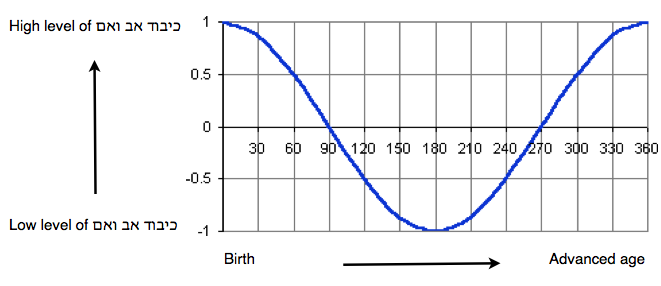 Interestingly, I’ve found that as I get older, and perhaps finds it easier to be מקיים this מצווה, at least as far as minimising personal views on a given matter, the level of inherent joy in following a missive is enhanced. It’s a cause to celebrate even though it is ironically a voir dire. I find that the older I become, the more joy I derive from quashing my own predilections and views and submitting to those of a well-meaning (and sensible) parent. You might say this is all so obvious and no חידוש. Perhaps so, but my blog isn’t about חידושים per se; it’s about giving expression to those things that temporally invade my head space.
והמבין יבין
The making of a mentch
Within יהדות there are probably four major groups:
- Chassidim
- Misnagdim
- Sefardim
- Centrist
Each of these groups are broad and have sub-groups with their own nuanced approach.
Chassidim
Originally, Chassidism was an approach that courageously and creatively enfranchised the high numbers of uneducated and simple folk through a growing set of charismatic, often brilliant leaders, who had ostensibly embraced a more metaphysical understanding of תורה and מצוות laced with שמחה. The hierarchical strata existent in other groups, was disposed of. There was only a binary system: the Rebbe and Chassidim. Chassidim were guided by their Rebbe and he acted as a chosen mediator between them and הקדוש ברוך הוא on matters of grave importance and direction. Within Chassidism there were different approaches: from the uplifting שמחה of Breslav, to the admirable concentration on חסד from Satmar, the focus on תפילה by a range of groups, to the intellectual, inclusivist and non judgemental approach of חבד.
Misnagdim
Probably an outgrowth of Ashkenazi ascetic Chassidim (not to be confused with commonly understood Chassidim) this group focussed on the study of Ethical texts (מוסר). There are many approaches within this group ranging from the ‘you are just a nothing’ to ‘the world was created just for you’ psychology. The texts are supported by Torah verses and sayings of חז”ל. The percentage of מוסר studied during a day depended on the sub-group. Led by charismatic mentors, the Mussar Shmuess became an important session where chosen students were cajoled into refining their moral and ethical behaviour. Unlike Chassidism, this group was mainly located amongst the intellectual élite, although its Charismatic leaders had a wider universal impact.
Sefaradim
They share at least one common element with Chassidim in that they were greatly influenced by the Zohar, Kabbala and the Ari. The so-called man in the street wasn’t necessarily a Talmudic Scholar but knew much more Torah than his or her common Ashkenazi counterpart: they could often recite Nach by heart. Reverence for the Chacham (Chief Rabbi) was, and remains, indelibly strong. With a proud heritage of luminaries such as the Rambam, they are a dignified group who have now embraced Western Society, for better and, sometimes, for worse.
Centrist
This is a group which had roots in German Orthodoxy where Torah and the modern western world were not seen as antithetical. It has been called Torah Im Derech Eretz or Torah uMaddah. Having a stronger link with more rationalist approaches to Judaism, this group were not aligned with Kabbala or Mussar. Ostensibly they was ready to face the changing requirements of the world front on through Torah and Halacha without viewing the world as an evil force that is to be distanced from at all times. It is perhaps the most free of the groups in that individualism and personal choice is not contraindicated. As such, it also presents perhaps the most risk. Adherents can sometimes become over-influenced by non Halachic values and as a result other groups triumphally decry this approach as too dangerous.
Being a Mentch
Whatever approach is taken, ultimately they all endeavour to grow people in the צלם אלוקים. A person for whom שויתי ה’ לנגדי תמיד is more than a fleeting moment, is motivated and empowered to act like a Mentch. Theologically, and consonant with the human psyche, most groups tend to not only follow their path but also delegitimise the approach of other groups. This notion presents a constant challenge to Jewish unity. It can be constructive and sometimes destructive.
My mantra has always been “nobody has a mortgage on the truth”. Call it שבעים פנים לתורה or י’ב שערים. I have always felt that we ought to learn from each group. At the same time, especially over the last 20 years, I’m probably most aligned with Centrist Orthodoxy, as reflected particularly through the Brisker cum Halachic Man tinge of the Rav ז’ל.
Yet despite the differences in syllabi amongst each group, and their insistence that this syllabus or approach will transform people into Mentchen, we find that within each group whilst there are many who are fulfilling the syllabus, yet they are far from being considered Mentchen. How can this be? We could conclude that only the real adherents of a given approach are reflective of the efficacy of that approach. While this may be true, for an approach to יהדות to be considered as effective, my point in this post is that at least today, there is something over-arching and even more important than the nuanced differences of the various approaches loosely outlined above. In a word, that is the דוגמה חיה, the living personification of any of the above approaches. We need, yes each of us, to strive to become the personification of imitatio dei, a concept whose roots are in the מצווה of והלכת בדרכיו and something the Rav stressed over and over. It is why the חסיד who has a Rebbe, a Rebbe they respect not for social for familial reasons, but for genuine spiritual reasons, is inspired to be a better person—a mentch—a צלם דמות תבניתו. It is this, in my opinion, which precedes and is the motivating factor before a syllabus or weltanschauung. It is why the מתנגד who may say they reject the potentially antinomian tendencies displayed by some Chassidim, now also attach themselves to the ’פוסק הדור’ or the ‘זקן ראשי הישיבות’ or to their ראש כולל. It is why the Sefardim revered the Baba Sali and other מקובלים and drank every spoken and unspoken word. It is why many Centrists, after the passing of the Rav, are searching and seeking senior figures after whom they can model their lives. In my life, on a more personal level, Rav Abaranok ז’ל was a person I could only describe by the abstraction that ‘the שכינה reflected from his forehead’ in a way that we know Moshe Rabbenu appeared after he came down from Har Sinai.
We lead busy lives. We have incessant interruption. It’s harder to know what our children do and what they don’t do without proverbially locking them up. The cocoon is not a long-term or viable approach for many of us. What we can do, is seek out the real Mentchen, be inspired by them, whether they are female or male, and try to harness that inspiration so that we can also become Mentchen.
Use your particular syllabus or pathway by all means. My main contention is that the particular syllabus is not as important as the true and real motivation behind its manifestation in how we play out our lives, and that motivation must only be והלכת בדרכיו, to go in His ways.
Fundamentalist Religion gone very very wrong
The following is an email I received, via a second party, from Dr AriehEldad, who is now a member of the Knesset. He is a secular right-wing politician. Dr Eldad is world-renowned as a Burns Physician having won the Evans Award from the American Burns Treatment Association.

“I was instrumental in establishing the Israeli National Skin Bank, which is the largest in the world. The National Skin Bank stores skin for every day needs as well as for war time or mass casualty situations.
This skin bank is hosted at the Hadassah Ein Kerem University hospital in Jerusalem where I was the Chairman of plastic surgery. This is how I was asked to supply skin for an Arab woman from Gaza, who was hospitalized in Soroka Hospital in Beersheva, after her family burned her.
Usually, such atrocities happen among Arab families when the women are suspected of having an affair. We supplied all the needed Homografts for her treatment. She was successfully treated by my friend and colleague, Prof. Lior Rosenberg and discharged to return to Gaza. She was invited for regular follow-up visits to the outpatient clinic in Beersheva.
One day she was caught at a border crossing wearing a suicide belt. She meant to explode herself in the outpatient clinic of the hospital where they saved her life. It seems that her family promised her that if she did that, they would forgive her.
This is only one example of the war between Jews and Muslims in the Land of Israel. It is not a territorial conflict. This is a civilizational conflict, or rather a war between civilization and barbarism.
Bibi (Netanyahu) gets it, Obama does not.
I have never written before asking to please forward onwards, so that as many as possible can understand radical Islam and what awaits the world if it is not stopped.”
Eldad is a professor and head of the plastic surgery and burns unit at the Hadassah Medical Center hospital in Jerusalem. He studied medicine at Tel Aviv University, where he earned his doctorate. He served as the chief medical officer and was the senior commander of the Israeli Defense Forces medical corps for 25 years, and reached a rank of Tat Aluf (Brigadier General). He is renowned worldwide for his treatment of burns and won the Evans Award from the American Burns Treatment Association. He also lives in Kfar Adumim a settlement on the West Bank.
Pass this link on, please. You can use the Share via Email button below.
The Shaytel controversy in Mother England
This question occupied the minds of some in England in 1890. You might wish to look at this beautifully entertaining post, which I hope you will enjoy as much as I did.
אין חדש תחת השמש
PS. I’ve always known (from my father) that a Peruke (Peh-roo-keh) is another name for a wig, although I’ve only ever heard him use it in the context of a toupee for a male.

My take on the Rubashkin issue
In studying the laws of דינא דמלכותא, I heard a shiur from R’ Schachter. In one of his comments he stated that if the law of the land meted out a form of judgement that far exceeded the expected outcome of a prosecution under a formal פסק דין from a סנהדרין, this implied a situation where there is a clear conflict between Torah Law and the Law of the Land, and creates Halachic tension.
We are limited in what we can do in such a situation since we live under שלומה של מלכות and, in the main, are very appreciative of the system of laws enacted, even if they aren’t completely motivated by satisfying the requirements of the דין of a בן נח.
Accordingly, in this case, based on what I have read, there may have been a miscarriage of justice in that (amongst other things) the presiding Judge exercised irregular behaviour. This would then imply a new court case after which, presumably, justice would take its course. Given that Rubashkin is widely known as an איש צדקה it seems to me that his efforts for a new trial should be supported in any way that people are able: either through דורון or תפילה.
In summary: until the judicial process is fully exhausted, he is the proverbial חצי עבד וחצי בן חורין in my eyes. There is a ספק and in the case of a ספק we help someone seek a just outcome. At the end of the day, he may well be found guilty in a new trial, or may receive a lesser/larger sentence, or may get off on a technicality. Que Sera Sera.
Until and if that happens, those who are uncomfortable with supporting the effort—and I understand their viewpoint—should simply adopt שתיקה. There is no חיוב to protest against your fellow Jew until the process has ended and something else unfolds.
צדק צדק תרדוף
By now, everyone will have read about the court case involving Sholom Mordechai Rubashkin. In the worst case scenario that he committed a crime under US Law, there is no moral or ethical justification for the extreme punishment that is being exacted on him. I am not here to comment or decide on what he is alleged to have done; that topic has been done to death by others. Be that as it may, it is simply not acceptable for any legal system to mete out a judgement (27 years) which is more than harsh; it is downright cruel in its exorbitant length.
You may wish to download or watch a video tracing the history of this case. An alternative site for the video is here.
It’s a boy
Born on Shabbos, יאירו הנרות, to our daughter Talya and Zalman Bassin in Melbourne.
Help Pay For Billboard Near U.N. About Gilad Shalit
 For almost five years, the Gilad Shalit has been held captive illegally, in isolation, in unknown conditions. Hamas has forbidden him contact with the outside world, communication with his family, and basic humanitarian access from the Red Cross. These are clear violations of International Law, the Geneva Conventions and common human decency.
As we approach the five year anniversary of his capture, the Palestinians are seeking approval from the United Nations to establish a state of their own. It is time for us to remind the world that no state should be established upon such crimes. We must exert pressure on the international community for Gilad’s immediate release. Any further legitimization of the Palestinian push for statehood will only serve to allow the continuation of Shalit’s unlawful detainment and encourage other such terrorist acts.
Let’s put this billboard up to remind the U.N. that they cannot continue to ignore these terrorist actions, bypass the peace process, and legitimize Hamas.
Please donate to help erect this billboard near the U.N. headquarters: link
Jerusalem Post article about the project: link
Website about Gilad: link
Haftora from Parshas Naso: Dan, Yehuda and Mashiach
by Harav Avraham Rivlin, Mashgiach, Yeshivat Kerem B’Yavneh
Copyright Yeshivat Kerem B’Yavneh

Our haftara notes at both its beginning and conclusion that Shimshon was from Shevet Dan: “There was a man from Tzira from a family of Dan (Shoftim 13:2); “And the spirit of Hashem began to beat within him in the camp of Dan” (13:25). The shevet origin is not stressed regarding many other Shoftim,[1] indicating that the connection between Shimshon and his shevet is important. The fruit reflects the tree on which it grew; Shimshon’s tests somehow reflect the essence of Shevet Dan.
Chazal say some rather uncomplimentary things about Shevet Dan: “There is no shevet as great asShevet Yehuda, and none as lowly as Shevet Dan.”[2] In their interpretation of the pasuk, “And they trailed the weak ones behind you” (Devarim 25:18), Chazal explain: “[This refers to] Shevet Dan, who were expelled from the cloud because they were all idol worshipers.”[3] Rav Dessler explained, “The fact that the cloud had expelled them was not obvious from the outside, but rather within their hearts; for th ey lacked the sense of distinction from the ways of the nations, the ways of the material world.”[4] The Midrash further explains: “‘Lest there is among you a man…or family or shevet[5] whose heart turns today away from Hashem our God…to go and serve the gods of the nations’ (Devarim 29:17) – this refers to Shevet Dan, in which the idol of Micha stood.”[6]
The fact that Shevet Dan travelled at the back of the camp was interpreted both to its credit and against it. In the same spirit as the quotes cited above, the Ba’al Ha-Turim writes on the pasuk, “They shall travel last (le-achrona)” (Bamidbar 2:31): “The word le-achrona appears twice [in Tanach] – “They shall travel le-achrona” and “There will be no remembrance of them, though they be le-achrona” (Kohelet 1:11). For Amalek cut off the place of their milah due to the sin of Micha’s idol that was among them.”[7]
Rashi, on the other hand, interprets the place of Shevet Dan’s camp as a credit to them: “The Talmud Yerushalmi teaches that because Shevet Dan was very large, they would travel last, and if anyone lost an object, the member of this shevet would return it to him.”[8] Chazal further interpret: “‘The children of Dan – Chushim’ – They were industrious and sharp, as they were involved in digging up (chorsha) of nests.”[9] The Targum Yonatan adds, “And there is no end to their number”[10] – they were chosen to be the “me’asef le-chol ha-machanot” because of their large size.
The Chasidic literature explains that the “lost objects” that Shevet Dan would return were not material things. It is related in the name of Rav Nachman of Breslov:
What were these lost objects? These were the lost and souls who no one cares about, as the pasuk says, “My nation was like lost sheep” (Yirmiyahu 50:6) and “O, shepherds of Israel… the wandering you have not returned and the lost you have not sought… and they wander without a shepherd” (Yechezkel 34:2-5). But Shevet Dan would take care of them and return them to the good… And behold, this is the way of the world – those who occupy themselves with connecting to evildoers in the attempt to return them to the right path are often suspected themselves. Abominations are attributed to them and they are ostracized by the nation.”[11]
Rav Dessler writes similarly about Shevet Dan:
They are called the “me’asef le-chol ha-machanot” because they would occupied themselves with returning those who had been expelled back into the protection of the cloud, bringing them back to the high level of holiness… This reveals a deep insight. It was precisely because Shevet Dan possessed some small element of downfall (and is thus termed “the lowliest of shevatim”) that it was able to save those expelled by the cloud. As is well-known, in order for the tzaddik to raise the impure souls from their casks, he must lower himself to them, but this entails great danger to one who is not entirely pure. The fact that Ha-Kadosh Baruch Hu gave this task to Shevet Dan reveals their greatness.[12]
On this basis, we can understand the statements of Chazal that elaborate on Shimshon’s holiness:
“Dan will judge his nation like one (ke-echad) of the tribes of Yisrael” (Bereishit 49:16) – this refers to Shimshon ben Manoach, who was comparable to the Unique One. Just as the Unique One requires no assistance, so Shimshon ben Manoach required no assistance… For Yaakov Avinu saw him and assumed that he was Mashiach. When he saw that he died, he declared, “He also died! For your salvation I hope,Hashem.”[13]
Rav Dessler adds:
Shimshon repaired the sin of the snake, as Yaakov said in his blessing: “Dan is like a snake on the path.”… He is like a holy snake, who will change even the evil into good… Due to his great holiness, Shimshon was able to leave the element of “the cloud” – protection – and descend to the weak ones and the places of impurity without stumbling…
This further explains the connection of Shimshon and Shevet Dan to Shevet Yehuda. Despite the difference between the two Shevatim, which was noted above, Chazal stress that the two are joined together in the building of the Mishkan and Mikdash.[14] Moreover,
“Dan will judge his nation like one of the tribes of Yisrael” – like the most special tribe, Yehuda. “From the family of Dan” – it does not say “from the tribe.” This teaches that Manoach’s father was from Dan, but his mother was from Yehuda. Similarly, Manoach was from Dan, but his wife was from Yehuda.[15]
Shimshon was capable, apparently, of descending to the depths, just as Mashiach descends to raise up the sparks of holiness. It was only when Shimshon became haughty as a result of his greatness that he fell. “Shimshon was punished through what he became arrogant about. He said, ‘Take her for me, for she is proper in my eyes’ – they therefore gauged out his eyes.”[16] Involvement in impurity requires such a high degree of holiness and complete lack of personal identification that the role was too difficult even for Shimshon. “The pasuksays, ‘And Shimshon went down to Timna’ and it says [regarding Yehuda], ‘Behold, your father-in-law is going up to Timna.’ Rabbi Elazar said: By Shimshon, who became haughty there, it uses the language of descent. By Yehuda, who was raised there, it uses the language of ascent.”[17]
On the path to Mashiach, Yehuda ascends and Shimshon descends.
—————————
[1] See, for example, Shamgar ben Anat (3:31), Devora (4:4), and Yiftach (11:1).
[2] Shemot Rabbah 31:6.
[3] Yalkut Shimoni 938.
[4] Michtav Mei-Eliyahu, vol. 2, p. 267. Further quotes regarding the low stature of Shevet Dan, and particularly its attachment to idolatry, can be found there and in the book of Rav Shlomo Fisher, shlita, Beit Yishai, vol. 1, p. 243.
[5] The only shevet that contained a single family was Shevet Dan – “And the sons of Dan – Chushim” (Bereishit 46:23). This is why our haftara writes that Manoach was “from the family of Dan,” and not “from Shevet Dan.” Similarly, the midrash interprets the Torah’s reference to “a family or shevet” as implying Shevet Dan.
[6] Sifri, Devarim 29:17.
[7] The Ba’al Ha-Turim relates to an idea quoted in the name of the Ari: “‘They trailed the weak ones (ha-necheshalim) behind you’ – the letters of ha-necheshalim spell ‘nachash-mila.’ For Dan was compared to a snake, and they are they were the ones who were trailed (va-yezanev becha) – they were hit by the ‘tail,’ as Amalek cut off their mila.” (See Beit Yishai, ibid.) The Ba’al Ha-Turim writes a similar idea on the pasuk, “The flag of the camp of Dan travelled as the gatherer (me’asef)of all of the camps” (Bamidbar10:25) – “The word me’asef appears three times [in Tanach] – here; ‘And no one brought them home (me’asef otam)’ in the context of the story of the Pilegesh ba-Giva; ‘Like the bundle that falls behind the harvester and no one gathers it in (ve-ein me’asef),’ referring to Shevet Dan because the idol of Micha was among them. As a result, no one gathered them in, for the cloud expelled them and Amalek killed them; they fell like the bundles behind the harvester, and no one gathered them in.”
[8] Rashi, Bamidbar 10:25. Shevet Dan was the second largest shevet after Yehuda, numbering 62,700. The camp of Dan was similarly the second largest. Given that the entire shevet was made up of only one family (Chushim), it was the largest family in the entire nation.
[9] Bava Batra 143b.
[10] Targum Yonatan, Bereishit 46:23.
[11] Beit Yishai, vol. 1, p. 244.
[12] Michtav Mei-Eliyahu, vol. 2, pp. 268-9.
[13] Bereishit Rabbah 98:18-19.
[14] The Mishkan was built by Betzalel, of Yehuda, and Ohaliav, of Dan. See Rashi, Shemot 35:34: “Ohaliav was from Shevet Dan, one of the lowliest tribes of the sons of the maidservants, and he was placed on equal footing with Betzalel, who was from the one of the greatest tribes.” The Mikdash was built by Shlomo, of Shevet Yehuda, and “Chiram, the son of a woman of Dan” (Divrei Ha-Yamim II 2:13).
[15] Bamidbar Rabba 10:5. Rav Dessler emphasizes: “He was thus ¾ from Yehuda, the tribe of Mashiach.”
[16] Tanchuma, Beshalach 12.
[17] Sota 10a.
To think or not to think
On theologically Jewish issues, especially those that pertain to matters of faith, there are two diametrically opposed positions. At one end, let’s call it the rationalist end, Jews seek to understand the meaning of life and the answers to questions using their intellect and through the study of Seforim that take this approach. The Rambam’s Moreh Nevuchim and Rav Yosef Albo’s Sefer HaIkkarim are examples. The approach is known in some circles as חקירה. Others call it an intellectual approach to Judaism. That does not mean other approaches are lacking intelligence. of course.
At the other end is the approach of simple faith, אמונה פשוטה. This approach realises the limitations of man’s intellect and seeks a distance from the pursuit of the purely rational. That’s not to imply that there is no use of intellect, but the intellect is only used to buttress an existing unqualified acceptance of sublime submission through metaphysical or mystical notions.
What path should a student of יהדות choose? Is one preferred over another? Is one guaranteed of a successful outcome in terms of meaningful adherence to Torah and Mitzvos while the other is contraindicated?
Rabbi Dr. Benny Lau, who is considered by some as a religious left winger/moderate and an independent thinker, is reported in the paper as slamming “blind obedience to Rabbis”. Rabbi Lau, a nephew of ex-Chief Rabbi Yisrael Lau, was speaking at a symposium held at the Sha’arei Mishpat College where he apparently expressed the view that blind obedience to Rabbis—which I see as an extension to אמונה פשוטה—can result in problems because many who need to ask are not able to. In order to ask, they have to leave the fold, because asking—the sense of intellectual or rationalist enquiry—is considered anathema. In that environment, questions connote doubt/ ספקות באמונה and doubt is diametrically opposed to אמונה פשוטה . Without being at Rabbi Benny Lau’s talk, I surmise that he was also referring to the growing tendency to ask one’s Rabbi everything—even things which a mature human being ought to work out for themselves, albeit in a Jewish context.
My own view has always been that prescriptive formulae are problematic. They focus on a נשמה but at the expense of the individuality of the שכל. We are different. We have different intellects, modes of appreciation, and more. Two children from the same parents have potentially differing intellectual outlooks and needs. I’ve always felt that for every person for whom אמונה פשוטה and all that goes with it, there is another for whom עבודת השכל is the hot button.
I do not understand why Rabbi Lau has seemingly advised the national religious movement, as if that is some structured body walking in a single direction with only one mind. I would have thought that movement has matured to include a congruence of different approaches under an amorphous umbrella of trying to support the State of Israel through a meaningful engagement with Torah and Mitzvos.
There are people of high intelligence and great skill who choose to leave many if not most major decisions in their life to a Rabbi/Rebbe/Rav/Manhig. They may also choose not to engage in understanding rationalist explanations on the meaning of conundrums and leave their brains “in park”. Some call this self-effacement ביטול, while others call it a cop-out. Pejoratives are contraindicated. It’s a personal choice, surely. Does the Torah not give us this choice?
Equally there are people of different intelligence who choose to struggle with the questions of life, through the prism of יהדות. Often, the struggle is life-long and may not reap much fruit despite unending effort. Rabbis in such a world are consulted for questions for which a known answer isn’t easily reachable. Herman Cohen or Aristotle don’t scare. They are opportunities to synthesise or be rejected.
My mantra is “each to their own”. If a type A person achieves meaning in life through one approach, then the alternative approach is contraindicated. It is only when we assume that everyone needs to follow one approach, that we are proverbially enchained. Ironically, the approach that Rabbi Lau is suggesting to the national religious group is one approach and yet he seems to be supporting one size fits all. I don’t see his view as more emancipated than the alternative approach which relies on ביטול and a more extreme leaning on Rabbis to make day-to-day life choices.
I’m happy if Rabbi Lau reminds people that there is a valid path where people choose to engage and deal with the secular and that this doesn’t mean a doomsday descent. At the same time, if he is implying that confronting the world through questions and fronting the secular is the only way, then I humbly disagree.
Disclaimer: My blog post is based on a newspaper report. That’s always a tendentious proposition 🙂

Appropriate discussion at a cemetery
Regrettably, I’ve attended a number of funerals of late. It would seem to be common place for one person to wish the other person
“אויף שמחות’’ “oif simches”
This is a Yiddish phrase designed to express a wish that people next meet at Simches (or שמחות in Hebrew). It is also customary for a male whose ציצית are worn outside his pants to conceal these when visiting the בית החיים because it is considered somewhat mocking of the dead when one shows that they are able to openly keep מצוות as in וראיתם אותם.
I’ve wondered whether it’s perhaps inappropriate to be saying אויף שמחות at the בית החיים for a similar reason. In the midst of performing the sombre מצווה of לויית המת about which we say אין לה שיעור isn’t it inappropriate to be wishing each other opportunities to see each other at שמחות?
Indeed, is this said in other countries? What is the source for this practice? I haven’t looked it up, as I avoid such topics. I think it’s fine to say it at one of the מניינים to one another, although I think it’s perhaps not right to say that in earshot of the אבלים
Another מנהג which is common is the one to learn some משניות for the deceased after which a קדיש דרבנן is recited. It is known that an אבל (may none of us experience this, and בלע המוות לנצח) is not permitted to learn Torah since Torah makes one potentially happy. I’ve not understood why we publicly learn משניות given that in doing so, we force the אבל to hear Torah. I do know that the Rav was against this practice, and he also felt that it is a דין for the actual house of the אבל and not just the אבל. Not withstanding that, what is the common reason for this ruling? I am pretty sure this one is discussed by Poskim, but again, I have no wish to learn those הלכות, so if anyone can enlighten me, I’d be obliged.
A difficult few weeks
There are many ways that people deal with their feelings. Some internalise, others exude emotion, and still others speak calmly and quietly. I tend to be extreme. I mostly internalise but easily become (over) emotional. I’ve been privy to a few comments of late, from both friends and acquaintances who say words to the effect of
“I really enjoy your blog, but how do you find the time. Have you lost your job?”
Our Rabbis tell us (in the Midrash to Megilas Esther) that Hashem first provided “the cure’” and only then allowed “the illness” to invade our world.
הקב’’ה הקדים רפואה למכה
More often that not, we seek to become healed and find it elusive. Sometimes, what appears not to be a cure per se, in time, serves only to effect the mending of a broken body or soul. Writing is a cathartic experience for me. I don’t agonise over posts or polish my words.
I consider myself very fortunate. The evil Nazi empire ימח שמם וזכרם sought to terminate our people. They decimated the great nation of Israel and, in so doing, implanted and engraved an indelible emotional scar into the psyche of our race and religion. This scar is worn by survivors together with the offspring of some survivors.
Many years ago, as a boy, I observed the survivors, the שארית הפליטה, resident in our Jewish old age homes. There were entire floors housing those who had quite literally “gone out of their minds.” I heard them talking to themselves, or yelling accusatively at me as if I was the dreaded SS, or hugging me with love because they mistakenly thought I was that little lost brother who had been savaged by the Nazis ימח שמם וזכרם. I consider myself fortunate and enriched because I also rub shoulders and have rubbed shoulders with those survivors whose mental faculties were left largely intact. Whether through my parents’ friends or members of Elwood Shule, I experienced and continue to experience the gamut of colourful personalities who picked themselves up from the ground, dragged their battered bodies and souls through the challenges of a new life in strange countries with foreign cultures and languages, and literally renovated their lives.
Over the last few weeks, three such dear souls met their maker and were transported directly to Gan Eden, גן עדן.
Yossel Gelbart ע”ה
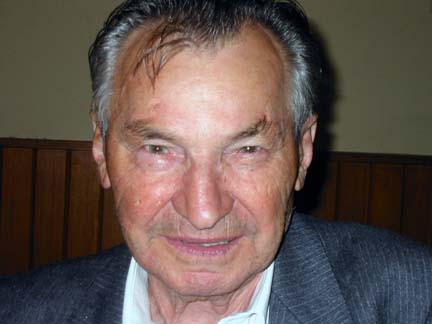
Yossel was commonly known by the fond moniker Gandhi. Emerging emaciated from Buchenwald, Yossel’s features resembled those of Gandhi. The nick name stuck. Yossel was born in the famous town of Ostrowice, better known in Yiddish as Ostrovtzer. The town was famous because it was the seat of the revered Rav Meir Yechiel HaLevi Haltzshtok ז’ל, the ascetic Ostrovtzer Rebbe, who fasted most of his life. My Uncle Hershel יבל’ח also hails from this town and both he and Yossel knew each other before the war.
Yossel was fond of describing the scene on Erev Yom Kippur in Ostrovtzer. The Rebbe rarely ventured out in the middle of the day. On Erev Yom Kippur, however, the Rebbe and his entourage walked to the Mikvah, in the time old tradition. Yossel recalled watching the Rebbe walk through the main street on his way back from the Mikvah. Completely bedecked in regal white, R’ Meir Yechiel’s countenance radiated קדושה to the extent that even the non-Jews of the town “fainted” in gripping awe at the sight of the Tzaddik’s visage.
Yossel was forever happy. He sat about 10 rows behind us at Elwood Shule. Exceedingly humble, he could best be described as a Poshiter Yid, the iconic simple Jew. When there were plenty of seats closer to the “front”, Yossel refused to move closer. He had his seat, his מקום קבוע, and he reminded me that he never missed paying for that seat!
Yossel was always happy בשמחה. He sang at the top of his voice, and attended Shule each Shabbos, without fail. If he was missing, we knew he was sick. Alas, I had intended to visit him in hospital on the Sunday before he passed away, but circumstances arose which prevented me from doing so.
Yossel was fond of telling anyone that he was the son of the “Blinde Noosen” because his father R’ Noosen ז’ל was visually impaired. In those days, people were kindly described by their impairments. In my father’s town of Rawa Mazowiecka (also my spiritual birthplace) they had Doovid Meshigeneh (crazy David) , der Loomer Doovid (Lame David), der Shvartze Noach, Moshe Aron Kopeh Yayeh and so on.
You could never wipe the smile off Yossel’s face. He was a Jew who was שמח בחלקו—happy with his lot in life. A staunch Zionist, he donated beyond his means. On Rosh Hashana and Yom Kippur, as I trudged wearily down the steps of the Bimah after leading the Shule in the Musaf davening, Yossel was always one of the first to shake my hand and exclaim יישר כח. I used to grab his hands at that point, and my children stand testament to the scene of Yossel and I enjoying a little dance together. His happiness was infectious. When I asked him why he was always so happy, he replied:
“When I was a little boy hiding from the Nazis, and lying next to my mother, my mother prophetically informed me that I, her youngest son, would be the only member of the family who would survive the War. She was right, unfortunately. I was scared, but I knew then that I had to survive, and despite being shot and wounded by the Nazis, I undertook to sing my way through the war. I sang in Auschwitz and Buchenwald. I sang at all times. I still sing today”
I am sure, that in Heaven above, Yossel is reunited in the bosom of his dear mother and wider family, singing with the Angels in an exalted גן עדן.
David Felzen ע’’ה
It has barely been a week since David Felzen’s passing. The Felzens and Balbins have been inseparable family friends from as early as I can remember. His dear wife, Mrs Sally Felzen, may she be spared a long and healthy life, is a powerhouse for WIZO and Magen David Adom. I fondly remember all the functions they arranged and the Tzedoko they were involved in, especially for the State of Israel. Mrs Felzen always called him David, but in our house, he was always Doovid Felzen.
Mr Felzen was different to many of my father’s friends. As a boy, I remember being impressed by his physical countenance. This was not an emaciated shrinking violet. Mr Felzen impressed me as a man who possessed the trait of גבורה strength and fortitude together with an abundance of חסד, kindness. In the parlance of ספירת העומר he was חסד שבגוברה, kindness in strength.
A builder, and in keeping with my image of him, he drove a ute, laden with all manner of building supplies. He wasn’t a neo-developer who pored over spreadsheets and dealt with sections of the planning act and VCAT. This was a hands-on, ” I do it with my hands”, builder. Those two hands and those two feet, supported by his wife and family, literally built the פרנסה livelihood that saw them emerge from a modest fruit shop after the war.
Mr Felzen was one of the “men” who I referred to in a previous article. We regularly walked together from Elwood Shule, snaking a path through Carlisle Street, together with my father יבל’ח, Uncle Ya’akov ז’ל, Mr Sharf ז’ל, occasionally R’ Chaim Yaffe ז’ל and Yankel the קצב. Mr Felzen wasn’t “into” shmattes and the shmatte talk. Rather, he was one of the mayvens who solved the existential problems the State of Israel was facing. This august group of personages had a penchant to provide an answer for every impenetrable conundrum. I guess they believed they were immortal and super wise on account of the fact that even the Nazis couldn’t touch them.
Mr Felzen distinguished himself to this young lad. In comparison to his fellow travellers (shleppers), Mr Felzen had an acute sense of humour. So many survivors had trouble mustering their latent sense of mischief and mirth—not so Mr Felzen. I’d often be “in stitches” when he described one of the characters on the street who was walking in the opposite direction to us. These characters were repainted and architected into Yiddish parlance in a way that only he could concoct. Some of those rather succinct caricatures, are probably best not published, although I am happy to share a memorable one with anyone who should so desire 🙂
On a more personal front, I won’t forget his kindness in pin pointing a property in Lumeah Rd, a מציאה, just prior to our wedding. I remember him helping to negotiate a deal with Hiam Sharp, and then renovating the back section of the house, which included an uninhabitable kitchen, and which served as the foundation stone for my wife’s legendary culinary skills. His hands, with those thick stubby fingers bearing witness to the physical toil in which he engaged, were an icon of the self-sacrifice that he bore to build up a house לשם ולתפארת, which has seen new generations of committed Jews, proud of their people, religion and country and a credit to him and Mrs Felzen.
Mr Felzen had a love for singing. Towards the end of his life, his memory failed on occasion. I’m proud to say that during the times that I visited him with my father and wife, he always recognised us. No sooner than seeing him seemingly morose in hospital, I’d start singing with him. He never failed to participate despite his illness. His eyes shone with brightness as he belted out the traditional tunes that occupied the more permanent parts of his mind.
May his memory be a blessing.
Yankel Sperling ע’’ה
On Shabbos, my father and I spoke about visiting Yankel. Alas, that was not to be. Mr Sperling passed away this morning. My father was a regular visitor, although of late this was less frequent due to my father’s “on again, off again” colds. I never missed bringing him משלוח מנות and he always obliged with a nice bottle of scotch in return.
Mr Sperling was born in Tomashov Mazowiecka, a sister (and larger) city to my father’s home town of Rawa Mazowiecka. The Sperlings knew the Balbins from before the war. My Grandmother’s brother, R’ Mordechai Amzel ז’ל (Fetter Mordechai) lived near the Sperling and Hoppe families in Tomashov. Fetter Mordechai was a Radoshitze Chasid, Mr Sperling’s parents were traditionally religious Jews but not of any Chasidic persuasion as I recall, whilst the Hoppe family were Alexander Chasidim. The Sperling family was like many in Poland at that time. Although the parents were devoutly traditional, some of the children were influenced by various youth groups and “isms” and found meaning in life through different outlets. Mr Sperling would always retell, what I thought was one of his favourite stories. He loved to tell stories and we loved to hear them.
“One of my brothers, became a communist. My Tatte and Mame were not at all pleased, but he was very independent and there was not much they could do about it. We all did a few things which my parents were not so happy about. One thing I will tell you, despite these differences, all of us had enormous respect for our parents. We worshipped the ground that they walked on. I remember an incident on Kol Nidrei night. My brother, the communist, came to Shule out of respect for my father. I stood next to my brother in Shule during Kol Nidrei. When the Chazan started saying אור זרוע לצדיק in a powerful and meaningful tone, my brother’s left leg started to shake uncontrollably. I nudged my brother and told him, you see, on Yom Kippur, even a Communist like you is in awe and fears God.
Mr Sperling used to tell me this story each Yom Kippur after I led the davening on Kol Nidrei night. He sat directly behind us, and I know it would be his fervent wish that his beloved grand-children and great-grandchildren occupy that hallowed row in the future.
In contrast to Yossel and Mr Felzen, Mr Sperling had a stern demeanour. Some people misunderstood thinking that he was perhaps remote or unfriendly. After more than forty years sitting in front of him, I knew that this was utterly false. Mr Sperling was a man of truth. He wasn’t into pleasantries or pandering (חניפה). He called a spade a spade.
A very successful business man, Mr Sperling would note, without fear or favour, that some of his friends resented the fact that he had made more money than them. That was their problem, he used to say, not his. For Mr Sperling and his late dear wife, family was their main focus. Mrs Sperling suffered greatly in her struggle with illness, and Mr Sperling used to always glance up to the ladies gallery to see that she was okay.
When Mr Sperling came into Shule, I began a custom of helping him secure his Tallis in a way that would avoid the inevitable “slip off the shoulders”. He used to expect this from me as a boy and then as a young man. Our sons Tzvi Yehuda and Yossi continued this tradition when they came into the world of Elwood Shule. He was almost always honoured with an Aliyah on the High Holidays, and never missed an opportunity to donate money with a משברך in honour of my father and I. He would sometimes buy the Aliya of Maftir and give it to me, just so that he could say “Now that’s how a Maftir should be said”. He was always very loyal to me and my wider family.
There are two aspects of his character that endure in my memory. The first was the utter delight that he had for his grand-children and great-grandchildren. Starting off from a young Victoria, who used to sit on my lap as a little girl, when any grand-child entered Shule sitting beside him, his eyes lit up. He was so proud to be part of Jewish continuity especially as manifested in a Synagogue service. Later, when great-grandchildren joined the parade, even Mr Sperling’s usually stern demeanour transformed into an enormous smile. The joy of having the זכות merit of being part of their lives was palpable on his face. The second aspect was the constant infusion of a respect for Yiddishkeit that he worked tirelessly to instill into his grandsons and Tal. I observed this, year after year. He never missed coming to Shule on Yom Tov or a Yohr Tzeit, let alone Yizkor. He patiently explained, to the best of his ability, what was occurring during davening. In return, the two grandsons exhibit an enormous respect for their Zayda,
He too will be sorely missed.
Improving the management of Kashrus in Melbourne
The Mizrachi Organisation is to be congratulated and commended for the incredible amount of time and money that they have put into Kashrus in Australia. Starting from מורי ורבי, Rav Abaranok ז’ל the move over time to align standards with the world respected and renowned OU is something we should all celebrate and not criticise. Rabbi Mordechai Gutnick, and his team, of late, together with the lay committee are responsible for the thick booklet we now have.
It is true that life would be a lot easier if all Australian products had a Universal Symbol for Kashrus, and if the Sydney Kashrus Authority also adopted the OU standards across the board. My feeling is, and I haven’t discussed this with Rabbi Moshe Gutnick and could be completely wrong, that Sydney tend to adopt the standards of the London Beth Din. These are legitimate, of course, but, to me, the OU is the best hechsher in the world. To appreciate the quality of OU, one only needs to listen to the OU Kashrus Q and A videos from both Poskim, Rav Hershel Schachter and Rav Yisroel Belsky and listen to the array of shiurim from the Kashrus experts across a wide array of issues.
I have spoken to both Poskim in the past, and I am in awe of their ידיעת התורה (knowledge of Torah). In the case of Rav Schachter (only because I have had a little more interaction and listen to his shiurim regularly) his גדלות in מדות טובות (moral fibre) is also inspiring. Rav Schachter is eminently approachable. It is one of my disappointments that nobody sponsors a Kollel Week of nightly Shiurim in Melbourne with someone like a Rav Schachter. Chabad, understandably invite their own, and I don’t even know if Beis HaTalmud does these sorts of things much since Rabbi Nojowitz departed and the new regime took over. Any גבירים (financially comfortable people) out there want to sponsor something like this? Melbourne would be bedazzled by the Halachic clarity that Rav Schachter transmits. He isn’t the only one, of course. I’d be equally happy to hear Rav Zalman Nechemia Goldberg or Rav Usher Weiss. The latter travels to South Africa and the States quite often for lectures. I have also spoken with Rav Usher Weiss, and he too is an עניו (humble) and a גדול בתורה (great knowledge of Torah) who is most unassuming. I’d say he is less likely though to stand out on some issues, even though his analysis often makes you think he thinks something is indeed מותר (permitted) when he finally paskens it’s אסור (forbidden). Rav Schachter, however, seems to have a more Brisker approach to Psak and concludes according to his understanding: for example, he has said that showering on Yom Tov is permitted (albeit not using very hot water), something I have personally felt was מותר for over 30 years, but I am digressing (as usual).

A personal testimony.
I was a fill in representative for Elwood Shule many moons ago at the Council of Orthodox Synagogues of Victoria. The topic of the then Mizrachi Kashrus arose. Indeed, it was brought to the table by Mizrachi. There was also a prior proposal around the same time, I believe it may have even been authored by (now) Adjunct Professor Harry Reicher, then of Melbourne, where the lay body was to take over the financial and administrative oversight of kashrus, beis din and involve all groups (even Adass). Without going into the details of the plan, I clearly recall the Mizrachi delegate, Mr John Kraus, speak to details depicting the financial loss incurred by the Mizrachi Organisation in continuing to run Kashrus. He was very keen for the COSV to take over. The COSV debated the issue, did its sums, and came back with a positive response. I remember feeling that this was going to be a momentous outcome for the community. Why, indeed, should Mizrachi have to bear the burden? Inexplicably, just as the “deal was to be done”, Mr Kraus returned to the COSV and suddenly and surprisingly announced that Mizrachi had withdrawn the offer and would continue to oversee the operation. I am not privy to Mizrachi’s thinking at that point.
I don’t see Adass as a practical partner in any future Kashrus organisation or Beth Din or anything of that sort. They are separatist, and have a right to stay that way. They don’t change. They are effectively a hamlet and organisation to themselves. Each to their own.
All non Adass shules, including Shteiblach and the like, should join the COSV and pay dues. There is an important role for a COSV and it’s not satisfactory that some congregations contribute, while others do not.
My brother-in-law, Romy Leibler, did a great job reforming the lay (financial) arm of the Beth Din together with Meir Shlomo Kluwgant. I think it’s way past the time for the COSV to do the same through quiet diplomacy with Mizrachi. Melbourne will grow when this happens. In my opinion, such a move is more important than dealing with alternative, and so deemed “enlightened” kashrus supervision that we have seen sprouting lately and which is diverting us from the main game of communal accountability and reform.
What say you?
PS. Some of you may know that there is an esteemed Kashrus Organisation called the cRc (Chicago Rabbinic Council), which is headed by the respected Av Beis Din of the Beth Din of America, Rav Gedalya Dov Schwartz. They were in the press recently with their analysis of the Kashrus of Starbucks. On Pesach, you may have notice another organisation, who name themselves CRC (Central Rabbinic Congress which I think is more than cheeky), who approve various products, including the “Glicks” line of products from overseas. CRC is not cRc. CRC is affiliated with Satmar and the Eida Charedis. They feature, infamously, on this page under Jews against Zionism. Pick your products in my view. If I have a choice, I will always use OU and avoid the anti zionist Eida Charedis and their ilk.
Visiting Kever Avos in Syria
The Jerusalem Post reports on an invitation to Rabbi Pinto. Would you go? I would politely say I was too ill to travel and daven that the רשע ומרושע Assad should have a מיתה משונה בקרוב, ימח שמו וזכרו
Let’s expunge the “ladies”
Hat tip to Anon who sent me the picture below. It’s outrageous. They were afraid it would be a breach of Tzniyus to call these things Lady Fingers, which is what they are. What next, a podgy version of these called Rebbishe Fingers made by a company called Shirayim?

Interestingly, even the Wikipedia entry for Lady Fingers mentions Pesach. I’m just waiting for the Charedipedia—pasteurised and homogenised at boiling point, with multiple hechsherim and plombes on each page. Some pages may get through only as gebrochts, but that would be configurable in the options section.
If it wasn’t so sad it might be funny.
Pictures at the exhibition: personal reflections of Elwood Shule
A version of this article was written for Elwood’s 75th anniversary.
Chazan Levy z”l did not look at all well. Despite his ubiquitous gentle smile, he suddenly assumed a worrying demeanour that was a portent to his passing on Rosh Hashono over a year later. A year prior to his Petira, Elwood approached me to assume the role of chazan over the high holidays. The persistence of Fred Antman and my father eventually swayed me. Leading the prayers is more than putting on a Tallis and indulging in an operatic odyssey through traditional liturgy. One becomes the shaliach (messenger) of the congregation and on these days of awe, that responsibility continues to rest heavily. Acclimatisation to the role is probably contraindicated.
As a member of second-generation holocaust survivors, my psyche is hopelessly infused with the existential tragedy of Jewish history. Elwood Shule was and remains a potent source of concentrated post-holocaust trauma that cannot be excised from my id. Booba Toba ע’’ה had posed the first halachic question to the newly inducted Rabbi Chaim Gutnick z”l, standing at his door with a freshly slaughtered chicken in tow. Over 50 years ago, the young un-bearded Rabbi Gutnick’s first official wedding at Elwood was that of my parents. He later also served as the sandek on my bris. Our familial ties to Elwood are entwined through a vibrant tradition.
Those were the days.
On the high holidays, holocaust survivors packed the shule. It was standing room only. A veritable cornucopia of characters paraded like “pictures at the exhibition”, as they ascended to shake Rabbi Gutnick’s hand, followed by that of my beloved teacher Chazan Adler z”l. It seemed that an assessment of each persons success, health and nachas over the past year was dissected among those hallowed pews, mimicking the judgement that was ironically taking place in heaven at that same moment. From the ostentatious, to the miserly gvir, and from the nebach to the do-gooder, we trembled as Chazan Adler

intoned those ancient tunes. Rabbi Chaim Gutnick expertly captured the moment with his unique emotion-laden oratory. In those days, congregants had an innate sense of holiness, irrespective of their level of observance, having been infused with a quality traditional Jewish education that equipped them to comfortably navigate the words of the machzor with sincerity and conviction. On a regular Shabbos, the array of characters was no less interesting to this lad.
Pacing back and forth in the Beis Medrash the tall, hunched and sad man who seemed to sleep at Shule, was engaged in a frightening, surreal, and animated discussion with an SS officer threatening to abduct his wife and children. I was to learn that this traumatic experience was true and had led a once highly intelligent man to be reduced to a haunting figure who “talked to himself.” An indelible picture was etched.
The shorter man, dressed in a stained, dark, and sombre suit, lived in a bungalow behind the shule. Davening with the aid of a magnifying glass, we were terrified with his angry countenance, not to mention the acidic yiddish invective that materialised if we got “too close”.
The “political cabinet” consisting of a set of quasi ministers (aka mispallelim) sat at the back of the shule. The State of Israel and its geopolitical place was the inescapable weekly topic. From the mayvens who were never wrong, to the quiet observers who occasionally piped up with a solution to the problems of the world, shabbos davening functioned as a social event, where survivors from different parts of Europe were drawn together at the back of a Shule in Elwood, in free Australia.
My public singing probably began at Chedva. I vividly recall Reb Shmuel Althaus z”l himself an accomplished Baal T’filla, encouraging me to sing “Moscow Nights” as I was hoisted onto a table to the delight of a fashionable array of diners. Rabbi Groner z”l was another source of inspiration, and I was to become a soloist in the Yeshivah Choir. My first “gig” was singing with the Italian band Los Latinos at my cousin Leiba’s wedding, perched on my Uncle Ya’acov’s ז’ל shoulders.
It was time to begin the preparation for my Bar Mitzvah. I could never have imagined how that experience would unfold. My father, knowing that I was blessed with a voice, approached Chazan Adler ז’ל to instruct me. I had learned to play violin for several years and acquired an appreciation of music. Many of Chazan Adler’s tunes had found a home in my subconscious iTunes library. We used to meet in the boardroom. The lessons were uneventful. Somehow, as Yom Tov approached, I found myself having lessons at Chazan Adler’s flat in Dickens Street. It was small and cosy. The Chazente, Mrs Adler ע’’ה was always cooking something aromatic. We seemed to run through the Bar Mitzvah lesson quickly. After that, Chazan Adler would search among his folders of chazonus. He never used his “full” voice, always practising in falsetto. On occasion, he would insert magic spray into his throat. For a little boy, this scene bordered on the comical. The Bar Mitzvah lesson had effectively ended; what was I still doing there?
After setting the key with his pitchfork, Chazan Adler would begin. Peering over his shoulder, I became aware that he was singing directly from notes. As if I hadn’t had enough of violin lessons; I was now confronted with another musical challenge. I learned how to warm-up my voice (although I use less conventional methods these days before and during a Simcha) and how to practice breathing properly. I was blessed with a decent musical memory and still remember Chazan Adler singing Hasom Nafsheinu with the band at my own Bar Mitzvah. Although this was a new song that I haven’t heard since, I still vividly hear him. On one occasion, Chazan Adler began singing Odom Yesodo Me-ofor. I recognised the tune, as it had been used in the previous year. Instinctively, I began to harmonise, after which a broad smile broke out on his face. Mrs Adler was also listening at the doorway. Sadly, the Chazan and his wife were childless and I was to later learn from Rabbi Groner ז’ל, that this was a source of great pain for the Adlers. Rabbi Groner recalled he once covered for Rabbi Gutnick when the latter was overseas, and that Chazan Adler had indulged in a lengthy piece during Ahava Raba wherein the Chazan poured out his soul with bitter tears because they were childless. Rabbi Groner remarked that he could still feel the hairs on his neck standing during that piece.
After cajoling and parental encouragement, I found myself at the Bima singing a few pieces with the Chazan on the high holidays. Chazan Adler was clever. I remember how he had me commence Unesane Tokef in my as yet unbroken voice. Normally this would have been at his lower register because of the octave jump at Ki Hu Noiro. Because I started the stanza, I could also sing the beginning at the top of my register, after which Chazan Adler could take over in a more comfortable key. During my own davening each year I still use this same tune, although I have to always remember to start low to achieve the octaval bump.
My Bar Mitzvah arrived. The Shule faced a different direction in those days. Putting on my Zeyda Yidel’s ז’ל Tallis, I nervously ascended to the bima standing on a wooden step so that my small frame was able to see the words of the Torah. My job was somewhat easier because there were many extra aliyos, I had time to look at the next few verses and revise. It was only natural that our sons Tzvi Yehuda and most recently Yossi would also have their Bar Mitzvahs in the same shule and on the same bima. Happily, they both didn’t require that wooden step, being taller.
After my Bar Mitzvah I sang with Chazan Adler for one more year. Much to my father’s disappointment, I didn’t want to continue with singing lessons. Apart from lessons involving violin, school, gym and swimming, I couldn’t understand why I had to be different to other boys. Did they have singing lessons? Did they have to accompany the Chazan on high holidays? Footy, soccer and cricket beckoned. Chazan Adler was to later remind my father “I could have taught him more.” It never remotely occurred to me, back then, that I would be enlisted some 30 years later as the Chazan on high holidays. I still hear my father reminding me of Chazan Adler’s words as we walked the “long way” home every second shabbos.
Those walks were an experience.
We’d start with Kiddush at my great-uncle Avrohom’s ז’ל house in Avoca Court. We’d then snake our way to Zevke’s house. Zevke z”l, whose daughter was a pop singer, sold toys and if I was a “good” boy at Shule my father allowed me to go into Zevke’s house and see what was “new”. Every now and again, a toy found its way into our home, first at “The Avenue” and then at “Rockbrook Road”. After Zevke’s, we’d drop off the famed butcher Mr Kramer, and the entourage would continue towards Carlisle Street.
The pace could only be described as “leisurely”.
Apart from the fact that my Uncle Ya’acov z”l had sore legs on account of poor blood flow, Carlisle Street presented shop-after-shop selling shmattes. We’d stop, and the entourage would peer at the stock and prices nisht shabbes geret and then take a few more steps. I was so bored! Why didn’t we go home directly? It was a privilege, in retrospect, when the unassuming Tzadik Reb Chaim Yaffe z”l would accompany us on those walks. He was a profound Talmid Chochom but he was an even bigger mench. As I reminisce, he reminds me very much of Rav Abaranok z”l another teacher of mine who was also a giant when it came to exemplary and unassuming menchlichkeit.
My last conversation with Chazan Adler occurred only a few days before his passing. Chazan Adler was living in a Jewish old-age home in Vienna. Rabbi Chaim Gutnick had just passed away a few weeks earlier. Sitting in my office at RMIT, I impulsively rang the Chazan. After a few failed attempts we spoke. He was overjoyed to speak with me and asked about the well being of a host of congregants. It became clear in the course of our conversation that he had not heard of Rabbi Gutnick’s passing, so I had the odious duty to inform him. The Chazan’s pained krechtzing in response to the news forms another picture at the exhibition. Eerily, it was only a few short days after the phone conversation that I was to learn of Chazan Adler‘s own passing.
Chazan Adler lives on! I almost exclusively sing his tunes each year. These and other “pictures at the exhibition” influenced and continue to shape the thoughts that go through my mind.
Regards from Kuala Lumpur where Lehavdil someone is doing chazonus through a loudspeaker for a different religion and driving me bonkers.
Where is a Jew?
Hello from Jakarta. I gave a lecture today at the University of Indonesia. In my introduction, I was talking about Australian multiculturalism and how there isn’t a “typical look” for an Australian. I slipped in one of my favourite questions: “So, where do you all think I was born?” They looked at me in bewilderment. My accent is clearly Aussie (although not as ‘strain as our Julia Gillard) but my Yarmulke will confuse. Usually, they think I’m some sort of special muslim, a mufti of sorts who wears a black and not white cap. Wait for it, after a period of indeterminate silence, a fellow up the back says
Are you from Libya, sir?
Oy vey. Conclusion: there is no anti-semitism here. They wouldn’t know what a Jew was in a pink fit.
I guess when Moshiach does come, he’s gonna have a decent job first convincing:
- some that he isn’t yoshke
- other that he isn’t mohammed, and
- others why he doesn’t wear a Shtreimel and white socks
Anyway, there aren’t any problems with Kashrus here. There is no kashrus 🙂
Regards

The importance of being outwardly Jewish
I work in a University environment at RMIT. I’ve noticed over the last few years an increasing number of Jewish students. Traditionally, Jews populate Melbourne and Monash Universities because of their stature and that they house both Law and Medicine. Jewish kids are diversifying now. It’s no longer the case that parents kvell solely when they can say “my son is doing medicine” or “my daughter is doing law”. The modern parent knows that the age-old dictum of חנוך על פי דרכו — educate according to the needs/capabilities of the student/child — is critical. Furthermore, the old notion of one degree, one profession is stale. Commonly, people move not only from one employer to another, but often from one profession to another. Generic skills and capabilities, such as clear thinking, problem solving and social aptitude are important.

RMIT has world-class strength in Design (Art, Architecture, etc), Computer Science & IT and Engineering so I am not surprised that we are now seeing more Jews at RMIT. But how do I know there are Jews? Sure, I could fool myself that nobody will notice me and stand near a Chabad student stand, or an AUJS stand or similar, but hey, I’m more likely to be accused of being a schnorrer or pervert at my age if I hang out over there! No, the reason I know there are Jews relates to my office door. This story has happened more than once; especially over the last few years.
Many years ago, I wrote to R’ Yosef Shalom Elyashiv (through his right hand man R’ Yossi Efrati, and this was well before he assumed the Litvish mantle of Posek or Gadol HaDor) and asked whether my office door needed to have a מזוזה. I argued that I basically “lived” in my office from the early morning, till the evening. I ate there, I davened there, and sometimes I even learned Torah there. It wasn’t my office per se in the sense that I was the only person who had a key (there always being a master-key, as in any organisation) but I was the only person with a personal key. I can go through all the reasoning upon request, together with R’ Elyashiv’s answer. Let me know. R’ Elyashiv replied that I should affix a מזוזה but that I should do so without making a ברכה because of the doubt.
It’s 10am on a Friday morning and I am coming and going through my office door, and notice a curly-haired, blue-eyed, student who is sort of hanging around. I don’t think anything of it. There is a lecture theatre near my office and students often meander the corridor waiting for a lecture. I enter my office and leave the door ajar. I often do that, especially on a Friday, when traditionally there aren’t as many students and it is quieter. After a few moments he appears in the doorway and says:
“Excuse me, I couldn’t help but notice your מזוזה, do you mind if I come in”
He asked where there was a Shule nearby for Shabbos! I informed him that East Melbourne was the closest but that I’d put him in contact with Rabbi Daniel Ravin (the Chabad Shaliach on campus). Ha! The student was from Venezuela, and had been to Rabbi Ravin’s house for lunch the previous Shabbos. Anyway, I looked up and found a mobile number for Rabbi Dovid Gutnick of East Melbourne and passed it on. He then said:
“is there any way that I can go to Rabbi Ravin’s house without driving on shabbos”
I was taken aback. I wouldn’t have picked him as a Yid as he stood near my office, and now he’s trying not to drive on Shabbos! It touched me. Unfortunately, I am not allowed to fraternise with students on a social level according to University rules, so I’m out of the picture. I responded that he should speak to Rabbi Ravin about this problem. I suggested he was living in the wrong end of town; he is only here for a semester, though.
He kissed my מזוזה as he left.
So, I’m a somewhat a sentimentalist—I looked up at my מזוזה and thought how different this morning might have been if there was nothing on my door. ‘ברוך ה
Against Bans, Harassment and Threats
 A little over a month ago, a number of rabbis signed onto a ban that forbade advertising on or otherwise working with the website VosIzNeias. This ban singled out one website without addressing other websites or public forums like newspapers or magazines. The singling out of a solitary website raises many questions, particularly when newspapers in the same community regularly publish arguably libelous stories and online discussion forums for the community are essentially unbounded by civility. Additionally, VosIzNeias has publicly stated that it has already raised its standards and is willing to do even more with rabbinic guidance, provided the same guidelines are applied to its competitors.
Bans of this nature are generally brought into fruition by activists and this one is attributed to a specific activist who seems to have business and political interests in this ban. He ignored VosIzNeias’ request to meet with the rabbis in order to explore ways to satisfy their concerns. With this ban, the activist is threatening the commercial viability of the VosIzNeias business.
We have now received reports of continued harassment by this activist, who is threatening to publicly denounce people, companies and charitable organizationswho continue to cooperate with the website. He has also reportedly threatened to remove the kosher certification of companies that fail to adhere to the ban. However, on being contacted, the activist behind the ban denied all knowledge of this harassment and attributed it to someone acting without authorization. We are, therefore, making no formal accusation as to who is conducting this campaign of harassment.
To the best of our understanding, this activity is illegal. One individual told us he reported that harassment to the police.
Harassing good people with threats is illegal and inexcusable. We call on rabbis and people of good faith to denounce this behavior, and we encourage victims to respond to this activist as follows:
If he calls or e-mails you or your organization, thank him for bringing the ban to your attention and say that you will decide how to proceed after consulting with your rabbi or other advisor. And because there are rumors that there is harassment involved in this matter, add that if he contacts you or anyone else in your organization again, you will have to report him to the police.
There is a copy of an e-mail forwarded by people involved, which includes a pseudonym and phone number, and we have been told of intimidating phone calls. Note that at this time we are withholding this activist’s identity. If he continues harassing people, we will have to be less discrete.
Signed,
pitputim and other bloggers
(please sign your own name and post this to your blog if you agree)
The Rav and Chabad and the Rebbe
My sweeping and largely postulating interpretations are that:
- The Rav appreciated the emotional and warm element of old-time and simple chassidim, the emotional part of which was missing from his own upbringing and its purely intellectual approach to Yahadus
- Chabad chassidus is an intellectual branch (Tanya in particular) and the Rav could more likely associate with some elements.
- The Rav had no time for “incredulous” chassidic stories of mofsim and pilei ploim. The Rav thought that most were exaggerated at best.

Alter Rebbe - The Rav was closer to the Rayatz than he was to the last Rebbe.
- The Rayatz respected the Rav greatly.
- The Rav had a great appreciation of the Ba’al HaTanya and thought that the Alter Rebbe was the equal of the Gaon and the greatest of all the Chabad Rebbes.
- The Rav felt that the Rebbe thought he was Mashiach and was delusional in this regard.
- The Rav felt that much of the so called machlokes between the Gaon and the Alter Rebbe and others was due to “askonim” on both sides who were basically clueless and had an agenda (what has changed?)
- The Rav felt that the Rebbe wasn’t able to be as effective as he could have been because he simply lacked enough quality chassidim and had failed to produce these.
- The Rav felt that many if not most chasidim didn’t really understand Tanya let alone were in a position to teach it to the masses
- The Rebbe felt that the Rav was wishy-washy because he was susceptible to changing his mind on issues based on political or societal pressure. As such, he felt the Rav could not be relied upon.
- The Rebbe had a very high regard for the Rav’s intellect and personal yiras shomayim
- The Rav held that the Rebbe had a Geonishe Kop and was the icon of a manhig
- The Rav was a follower of elements of both the Vilna Gaon and the Alter Rebbe, but in the end was his own man.
Vilna Gaon - The Rav felt the differences between the Nefesh HaChaim and Tanya were not significant, and most people didn’t have the acumen to properly understand the differences.
- The Rebbe was implacably against the concept of a “State” of Israel vis-a-vis any religious connotation. For the Rebbe, any part of the world could be transformed into “Israel”.
- The Rav was against the State being seen as the “beginning” of the redemption, but was a strong supporter of the State as a religious entity embodying the “psak” of hakadosh baruch hu.
- The Rav and Rebbe had wives who were both strong and unique people in their own right.
- Both the Rav and the Rebbe were severely affected after their wives passed away.


 pitputim

You must be logged in to post a comment.