Can or should an Avel perform Bircas Cohanim (part 3)

I was touched, and appreciated by the fact that the Dayan, with whom I am having a respectful Torah discussion on this issue decided to read and follow up my previous blog in a publication dedicated to Yud Tes Kislev: the Yom Hillula of Rav Dov Ber of Mezeritch, the father of all Chassidic Rebbes, and the occasion of the freedom from a short incarceration by the great Acharon, the Shulchan Aruv HoRav and Ba’al Hatanya.

The Dayan felt compelled to respond because a failure to do so might imply that he agreed with me. Chas VeShalom! Much of the material presented was a previous listing of the same Mekoros brought prior,  which are well known. We know from whence the Ramoh recorded the Minhag Ashkenaz, and we are well aware that this is related to the the Maharam MiRotenbug and the subsequent line of students after him, who had had identified this same minhag during their time.

We are also well aware that Minhag can uproot Halacha; the implication being that the Tri-Torah command of Bircas Cohanim can theoretically be supplanted by a Minhag. None of this is new and added no more to the discussion in my opinion. It is not a universally accepted anyway in this issue, despite the quotation of chosen latter day Acharonim. I’m surprised the Kitzur was quoted as a source. From the Hakdama of the Kitzur, we know his methodology of Psak, based on three acharonim. In my opinion, that adds nothing either.

It is important to note that the Dayan misquoted some of the sources in his original article. Indeed, a careful reading of these shows an omission of important facts. This will be expounded upon in due course. Much to my sorrow, I don’t have the time in the day to do such things in the proper academic way. I would have liked to be בבית ה׳ כל ימי חיי but it’s not my current Goral. I can’t wait till I can spend more time learning, and conducting shiurim. I have seen some of the material in its full form, and not the quoted parts in the Dayan’s original article, and it is clear and compelling and is somewhat not consonant with the Dayan’s proof.

As pointed out by the Gaon R’ Yekusiel Farkash in his Klolei Piskei Admor HaZoken, where there is no minhaga individuals need not  follow or adopt a Minhag (even quoted by Admor HaZoken). Perhaps the Dayan will consider Rav Farkash’s comments as invalid. I don’t know. Rav Farkash is a very widely accepted expert. Having heard his Shiurim, and read some of his Sforim, he is clearly a deep and careful thinker. If so, perhaps the Dayan should write to him. I might.

Ironically, the Dayan garnered some support from the Giant, R’ Yosef Dov HaLevi Soloveitchik inter alia. What the Dayan didn’t tell us is that the Rav Soloveitchik himself stated that an Avel should Duchen! This was also the opinion of his illustrious and legendary grandfather, the famed and revered Gaon, R’ Chaim Brisker. These are giants of the last few generations who knew the Ramoh and those who preceded him, very well. Admittedly, they aren’t as influenced by Acharonim, but this is an accepted mode of Psak. As the Rav once said when someone tried to tell him that his Psak was not the same as the Mishne Brura.

“Nu, I am an Acharon, and I have a license and may certainly argue. I don’t force anyone to accept my Psokim. If you want to follow the Mishne Brura, go right ahead.

Indeed, we don’t need to look to Brisk/Lita. We can simply list many examples where the Ramash (R’ Menachem Mendel Schneerson) instituted Minhogim against the explicit ruling of the Admor HaZoken. A famous example is the Ramash’s campaign to ask females to light Shabbos candles before they were married. We all understand why he did this, and what a wonderful initiative it was, however, if we are to remain unfaltering fidelity to the Admor HaZoken and the Rishonim and Acharonim who preceded him, this is against the Psak of the Admor HaZoken and yet is accepted. One couldn’t imagine the Dayan quoting the Ramoh or similar to the Ramash and saying “you are contradicting an open Admor HaZoken”. Sure, all manner of justification has been tended about that Takono, but if we are to be intellectually honest, the Psak of the Ramash, which he is most entitled to enact as a Gadol B’Yisrael of the last generation, amounted to an expression consonant with exactly what Rav Farkash expressed. The Dayan knows there are many other examples of this type.

It is simply amazing when one reads that the Dayan is untroubled about the fact that the Avel can be involved, no, is enjoined to be involved in public expressions of Simcha during a Yom Tov, and yet on the matter of a blatant and obvious example of Aveylus D’farhesya, the Dayan resorts to a quasi-Hungarian mode of Psak, which is as immovable as Chadash Assur Min HaTorah, even if we don’t understand the reason. I am reminded of the (incorrect, according to many Poskim) Psak of the B’eer Moshe, the Debreciner, who said that any form of Bat Mitzvah celebration is Chukas Ho’akum and the act of Reshoim! This is of course plain wrong on many accounts, and has been shown to be so by many Acharonim, but it is indicative of the type of lack of response that the Dayan tended in respect of this issue. To say that once a Cohen leaves the Shule before Retzeh, there isn’t Farhesya, is incomprehensible! Farhesya has nothing to do with Akiras Raglov and the technical ramifications of someone who didn’t leave. Well before that, people ask me for special requests, and of course Cohanim leave the Shule to wash their hands! Everyone, especially in Lubavitch where they are Makpid to bring babies to get Birkas Cohanim, are most serious about this Mitzvah. To me, it not only allows me to be a conduit, but my ability to obtain a Bracha, something one especially craves in a year of Aveylus, is negated if I don’t perform it! Now that makes me sad!

Interestingly, Rav Marlow paskened explicitly that a Cohen Avel who finds himself in Shule at Birkas Cohanim, and was unable, or perhaps forgot, or was pre-occupied, MUST Duchen on Yom Tov. I heard this directly from a completely trustworthy source. It would be Aveylys D’Farhesya. Now, Crown Heights is a different scene to Melbourne’s comparatively empty Yeshiva Shule where there were only four Cohanim. The Cohanim are like rare movie stars! How could the Avel Dyuchen? He isn’t (can never be) B’Simcha UveTuv Levov! According the the Dayan, this alone seems to be the only relevant factor!

Next we need to consider the Dayan waving his hand regarding my argument that someone who has already Duchened multiple times, according to the Psak of (Chabad) Rabbonim who do not agree with the Dayan, imbues no important ingredient to the situation. Really? Imagine the following scenes:

A Cohen sits in the Dayan’s Shule, and has the well-supported custom not to sit in his usual seat. Should the Dayan instruct the Avel to go back to his seat as it is Minhag Chabad? I witnessed no such thing at Yeshivah. I saw some who did and some who did not. It was up to the Minhag of the Avel. Aveylus, is most definitely tied to subjectivity and personal Minhag. To dismiss those because there exists another Minhag not favoured by the Ramo, is ingenuous.

What of an Avel who dances B’Simha on Friday nights around the Bima during L’Cha Dodo (a minhag I haven’t seen brought in the Ramoh or indeed the Shulchan Aruch HoRav). Chadoshim LaBekorim? Should a Dayan intercede and advise the Avel that he is doing the wrong thing? What if the Avel retorted that he does this every Shabbos, and if he stopped it would be Aveylus D’Farhesya? Maybe we can use a guitar for Kabolas Shabbos if we raven early enough?

(Personally I don’t understand the new hanhogo of dancing in the middle of davening, even if it is before Barchu. Is this what Admor HaZoken paskened or approved?)

What of an Avel who refuses to do Hakofos as brought by many Acharonim. He saw this from his own father. I personally witnessed the Dayan’s father in law and brother in law encourage Hakofos by suggesting that they do so together with a few people who surround him. If the Avel doesn’t feel comfortable adopting this approach would the Dayan say that the Avel has done wrong and that he must adopt Minhag Chabad?

Dismissing the powerful arguments of the Gaon as not being necessarily consonant with Admor HaZoken, is fair enough, although I didn’t appreciate the tone of the sentence in the Dayan’s article. (On the other hand, for example Zman Krias Shema the Gra and Admor HaZoken do agree). One may choose not to follow the Gro and the Beis HoRav after him, as mentioned above, that is, those who share the Gra’s insistence that there is a Bitul of three positive Torah commands. But it becomes somewhat different when someone insists that in his Shule, a Minhag HaGro on Hilchos Aveylus cannot be practiced by an individual! Are we still in the time of the Cherem on Chassidim? Perhaps there is now a Cherem on Beis HoRav? Was it not the Ramash himself who said to the Rav (on Yud Tes Kislev?) that when they two got together as the Dor Hashevii of each of their illustrious lines of Beis HoRav that Moshiach would come?

Is there indeed a “Minhag Chabad”. We know very well that the psak of the Shulchan Aruch Admor HaZoken, doesn’t necessarily constitute Minhag Chabad at all. Many Chabad Rabonim duchen! It is a hazy issue, at best. Those Rabonim cannot be dismissed. They include Rav Hendel of Migdal Emek, and he writes about Chu”l.

Indeed, the Ramash expressly said that he would like to re-institute Bircas Cohanim each day in Chutz La’aretz, like Sephardim, but he doesn’t have the “ability” to do so. That in of itself is a puzzling comment. He could have instituted it in all Chabad owned/led Minyanim? Perhaps he felt he needed the agreement of other Gedolei Yisrael. I do not know.

Next, we move to the issue of “what if”. What if a Cohen Avel does duchen. He may have done so because he assumed it was Minhag Chabad anyway in that Shule, or he may have done so because he knew it was most definitely a valid approach as quoted (and ignored by the Dayan) in the Nitei Gavriel where he states that “most chassidim DO Duchen in Chutz La’aretz as Aveylim on Yom Tov. I wonder whether the Dayan will respond in a vitriolic fashion and raised voice against such Chassidim and tell them “It’s an open “din” in Shulchan Aruch HoRav or the Ramo”. To use the style of argument the Dayan has used “they know the Ramoh’s opinion” and yet they Duchen! How can this be? It’s a Minhag the Ramoh quotes, remember.

Next we move to the issue of: okay, an Avel just does it. Nu, so what happens to the Birkas Cohanim. Is it invalidated? If he is the only Cohen and does so, is it a Bracha Levatala. According to the Mishna Brura it most certainly is not. Does the Alter Rebbe say that a Cohen who does so is making a Bracha Levatala and/or his Bracha is useless?

The Dayan sets the Halachos of a Shule and answers the questions of those who seek his Psak. It isn’t at all clear, however, to me that the Dayan should seek to impose a Minhag, albeit based clearly on the Ramoh on someone who has Duchened, and castigate a person for doing so! Is there a Din Macho-oh here? I think not.

Hilchos Aveylus have limits on their objectivity. Much is subjective, and changed and changes with time, person and circumstance. As I pointed out to the Dayan, why didn’t he issue a Psak saying that Aveylim should not attend the Simchas Beis HaShoeva Farbrengens each night, with food and drink and great merriment. Furthermore, if an Avel did not do so, would he approach them and say that it’s “Minhag Chabad” to attend, and therefore you should attend. What is the Avel doesn’t feel comfortable! Is he saying that they aren’t B’Simcha? Shomu Shomayim!

Finally let me open up the can of worms which relate to an unmarried man (who is also NOT considered B’Simcha according to Shas Bavli and Yerushalmi because he isn’t married). The Dayan is well aware that this is a Minhag in Hilchos Aveylus which has definitely fallen by the way side, ואין פוצץ פה with convincing argument. The Shulchan Aruch HoRav has chosen not to give credence to the Kabala on this issue (and on the issue of Duchening). That of itself requires elucidation and an article of its own. He is of course perfectly entitled to do so as a most respected Acharon.

There is more, but this will do, for now. I am no Posek, but on such touchy issues, where the הלכה is כמיקל באבילות and there are many bluff procedures in place to enable simcha participation, I would (as has always been the case at Yeshiva) leave each Cohen to do as they see fit (unless they ask for a formal Psak Din from the Dayan/Rav, as was the case of the Rosh Yeshivah, Rabbi Cohen, for whom there couldn’t be a bigger Aveylus D’Farhesya!).

I’m afraid I didn’t see answers to the powerful arguments laid out by R’ Shlomeleh Vilner despite the claim from the Dayan, that they were answered. Perhaps its my ignorance.

PS. If one can’t see the connection between happiness and the ability to proffer love in a Bracha, then I’d have to say they were somewhat Misnagdic; it’s not a chassidic approach.

PPS. I followed the Psak of Mori V’Rabbi R’ Schachter, and avoided the Shule on Shmini Atzeres and Simchas Torah so as not to cause a Machlokes, and so in no way did I ignore the practice the Dayan wanted to see uniformly applied to all decreed unhappy Cohanim. As such, this really is a theoretical discussion, LeTorah U’Lehadira.

The Shule/Beis Medrash/Shteibel vs the outdoors

[Apologies as this may seem like a repost for some readers. WordPress seemed to get confused, so I have re-published as a new article]

There is seemingly a trend that has taken hold in the last 12 months or more. We’ve seen it employed by Orthodox Jews, some Orthodox Shules, and the Conservadox Shira Chadasha. The trend is to move out of the Shule and into the outdoors, presumably for a heightened, perhaps more “spiritual” davening. To be sure, it’s not (yet) regular, and is something that is utilised at chosen times. Many of these services revolve around music, and “nature”.

I am a musician. I’m not a “mathematical” musician in the sense of analysing a score and declaring it a piece of genius. Rather, I was blessed (I guess) to have a special חוש/sense for music to the extent that I can play a piece after I have listened to it.

I am inspired by music. I find that it touches my Neshama. It’s something that can uplift me, or just as importantly it can solemnise my feelings to the extent that I’m “at one” with those ambient feelings. Feeling melancholy I may choose Rachmaninov, for example; I love Russian classical music as it seems to accurately reflect the oeuvre of the tragedy of much of Jewish history. On Yom HaShoah, when I hear the ‘Partisan Song’, it never fails to stir and uplift.

Halacha discusses what type of music is acceptable. Obviously, love songs, as mentioned by the Rambam, aren’t in the frame. Some, such as R’ Moshe Feinstein based on the fact that he felt the Pshat in a Gemora was more in tune with the R’ Yosef Karo, the Mechaber, than the Ramo) went as far as prohibiting pleasurable music all year around as an expression of זכר לחורבן. This view is not widely accepted.

As I always reiterate, my pitputim are just that. Ask your own Rov if you have any questions or concerns. Rav Ovadya also had interesting Teshuvos on this (I can’t recall whether it was in Yabia Omer or Yechave Daas). If my memory serves me correctly, he even permitted muslim prayer tunes to be set to Jewish words and used as part of Tefilla!

I’m a traditionalist, especially when it comes to authentic Jewish expressions of connection with Hashem and preserving the Mesora via modes of accepted expression, additions and location.

I’m lucky enough to also feel exhilaration when learning, and I prefer delving than more surface-oriented coverage. The latter is instructive and important, in the sense of המעשה אשר יעשון but it doesn’t perhaps titillate me when compared to the combination of intellect/neshama as elicited by חכמת התורה. That for me, provides a tangible connection to אלוקות. Your mileage will vary, of course, and that’s perfectly fine. There have always been at least two approaches. הרבה דרכים למקום

Many of our current youth seek tangible and immediately perceived connection through their senses. Some are limited in their ידיעת התורה armoury, and the soul-like, metaphysical connection through song, works effectively as a catalyst. A catalyst towards what, one might ask? Is it a means or an end? Effectively in my Weltanschauung, is when this leads one to the level that they can meditate on Shmoneh Esreh in the very least, and through that seek to “connect”. Shmoneh Esreh is Tefilla.

As Rav Soloveitchik always pointed out, Judaism has never been reactive or temporally focussed on modes of pomp and ceremony and new forms of worship: these cross the line of Mesora. We are bound, happily, through our Mesora. To Chazal, Mesora is Halacha, and it regulates accepted methods and modes of Tefilla and delineates the unacceptable.

We don’t make up new integral prayers (as opposed to תחנות and בקשות) or modes of prayer. We follow the Nusach of our Mesorah, and we do not deviate. It is, of course, well-known, that when faced with the rising influence of conservative temples in the USA, the Rav stood steadfast, and would only allow “innovation” that didn’t step beyond Mesora and Halacha. Sometimes, protective mechanisms were needed to entrench a barrier against a temporal but threatening breach. These need to be approved by an expert Posek. One does not innovate on the basis of a more academically inclined analysis of sections culled from the Bar Ilan responsa DVD. That does not a Psak make.

There is the story recorded by Mori V’Rabbi, Rav Schachter, of a Baal Teshuva who would have offended his family by not attending the Bar Mitzvah of his brother. The Bar Mitzvah was to be held in a conservative temple. The Rav, whose Psokim one may not generally extend to their own situation, ruled that the Baal Teshuva should attend so as not to cause Agmas Nefesh and Machlokes on the strict proviso that in respect of the conservative service he:

  1. Daven in a proper Orthodox Minyan beforehand
  2. Sit when they stood
  3. Stand when they sat
  4. Not answer Amen

In no way, should he give the impression that he was participating in davening per se at a conservative temple. Each situation is different, of course, and a Posek needs to be appraised of the complete circumstance before issuing their Psak Din.

R’ Shlomo Carlebach, a controversial figure, is in vogue, especially in sing/song style prayer. Allegations, about him, abound. Some are most concerning and sinister. Yet he was also proffered love by the Amshinover Rebbe שליט’’א, widely considered as one of the “holiest Rebbes” of our generation.

A young Amshinover Rebbe with R’ Shlomo Carlebach

At the same time, in Igros Moshe, Even HoEzer (in the middle of a Tshuva), Reb Moshe Feinstein intimated that nigunnim performed before a certain period in Reb Shlomo’s life were acceptable, but those after that date were not to be played or sung.

Rabbi Groner ז’ל personally told me that he was a chavrusa/learning partner of R’ Shlomo. He asked the Lubavitcher Rebbe, after Reb Shlomo diverted to a more controversial path, how to interact with him. The Lubavitcher Rebbe answered that Rabbi Groner should be Mekarev R’ Shlomo, but never under the umbrella or Mosdos of Chabad per se.

I once used a Carlebach melody at Yeshivah Shule in Melbourne, and Rabbi Groner advised me not to do it again, for these reasons. He, of course, told me this privately and quietly after Shule, as I walked out after ravening. I know that Rabbi Groner’s son, Rabbi Chaim Tzvi also adheres to this approach in the Chabad House where he is Rabbi.

Many of our youth seem to seek spirituality. Authentic Jewish spirituality can be achieved in a number of Masoretic ways. I’m not sure, though, whether home-grown techniques of spirituality lead towards מעשה בפועל or if they are all permitted anyway. One would hope so, even if contraindicated, as per Reb Moshe or others. We should assume that seekers are earnest in their quest for interaction with אלוקות. The method of T’filla and the place of T’filla however, must remain the mainstream Chazal-mandated approach. Yes, there is a place for התבוננות, reflection and meditation. The Breslaver Chassidim require it once a day, the Baal Shem Tov himself did it—each to their own.

Lately, I’ve noticed various Orthodox groups (I consider Shira Chadasha conservadox in my nomenclature despite spirited sound-bites on a Melbourne TV show attempting to convince us that they are Orthodox) seek to leave the sanctuary of Shules and Shteiblach, or even house-minyanim and seek the outdoors through the aegis of an open area/park or similar setting.

I am not enamoured halachically by house minyanim on a regular basis during, say, summer months. There are shules close by.

ברוב עם הדרת מלך

is not a platitude. It is a halachic requirement.

Sometimes, perhaps mostly, so-called alternate services are accompanied by a Carlebachian inspired sing-song. As a musician, I know this can stir the heart. The effect is amplified when there is a knowledge of Pirush Hamilos. [ I cringe if the wrong style of tune is used for a passage or chapter. I even cringe when commas are placed at the wrong places: a sure indication that a basic understanding of the structure of Tefilla and Pirush Hamilos needs serious attention. ]

But what does Halacha say about davening in an outdoor setting? I’m assuming that Dina D’Malchusa is followed and council permits are obtained. Parks are not normally designated as places of worship. Imagine if Muslims, Xtians and Buddhists also decided to utilise parks for their places of worship. I, for one, do not think it is appropriate.

The encounter with Hashem is a private one (in the sense of occurring in a house of God), that should be constructed through the agency of a quorum of ten males and a suitable separation of males and females. Dogs, children playing, plain schmutz and the like, do not appear environmentally appropriate. As summarised in Shulchan Aruch Siman 90 S

לא יתפלל במקום פרוץ כמן בשדה

Shulchan Aruch (‘סע’ ה) rules that one should not daven in an open area, for example, a field. The rationale he gives for this halacha is that when one davens in a place that is closed one will have more awe for the King and will have a broken heart which is advantageous for davening. Mishnah Berurah writes that if a place is surrounded by walls it is an acceptable place (ס”ק י”ב מובא דבריו בחיי משה) to daven even if there is no roof.

Shulchan Tahor maintains that l’chatchila, ideallyone should daven in a place that has a roof in addition to walls. However, if the walls extend ten tefachim higher than the average person’s height, one could daven there in a pressing circumstance.

Eshel Avrohom adopts a more lenient approach and contends that it is sufficient if there is a wall in front of the person davening even if there are no walls on his sides. He also adds that this requirement is only for shemone esrei but for pesukei d’zimra one may even daven in an open area.

Sefer Toras Chaim (סק”ז) asserts that this halacha applies when someone davens by himself but it is acceptable for a tzibbur to daven in an open place since the experience of davening with a tzibbur will cause him to have a broken heart and awe of the King. Kaf HaChaim (אות ל”א) cites Ritva who rules that if a minyan is davening together this issue does not apply.

Sha’arei Teshuvah (סק”א) implies, however, that this issue applies to a tzibbbur the same way it applies to an individual.

So, while there is room to be lenient I would think, and this is borne out by opinion, that praying in a park/field is perhaps a stepping stone to the ideal, which is to pray in an ascribed place, viz, a Shule with all its concomitant Kedusha (ironically) and regulation. At the end of the day, it is the iconic Mikdash M’at, a miniature of the Beis Hamikdash itself. See especially the Kitzur Minyan HaMitzvos from the Rambam where he clearly describes this as a D’Orayso, a Torah imperative. We are enjoined to simulate the Beis Hamikdash through both the prayer, the behaviour and the building structure!

A certain man rushed to daven Maariv but missed borchu. Naturally, he wished to daven with a minyan that was just beginning so that he could answer borchu in the beginning of the tefillah. There actually was another Maariv which began a few minutes later but the minyan was outside the sanctuary, in a place without walls. This man wondered what he should do. On the one hand, he knew that it is preferable to daven in a place with walls as we find on today’s amud. On the other hand, he was loath to miss borchu. When this question reached Rav Yosef Shalom Eliyashiv, shlit”a, he ruled that davening in the shul with walls is preferable. “Even if you will miss borchu it is still better to daven with the minyan inside. Even though the davening outside is complete with borchu, davening without mechitzos is less than ideal.” אבני ישפה, תפילה, פי”א, ס”ו, ובהערה ז

In another place they would pray Minchah in a largish stairwell. Although a minyan always stayed inside, some of the people would wind up joining them outside the building. Since there were no functional walls out of doors, one of the group protested. ”The Shulchan Aruch rules that it is forbidden to daven in a place without mechitzos. It is therefore b’dieved to daven outside.” But those who stood outside disagreed. “As long as you are part of a minyan which davens inside it shouldn’t matter what you yourself do. It is not as though I have less kavanah, so why assume that inside is superior for every individ- ual?” When this question reached Rav Yosef Shalom Eliyashiv, he ruled that they should indeed pray with the minyan inside. “Those who daven in a stairwell should remain together inside, and not have some people davening inside the building while others are outside.” תפילה כהלכתה, פ”ב, הערה פ”ה

Pardon the pun, but we need to see the wood from the trees. If it is desirable in our age to enfranchise those who would otherwise not seek to daven, through Carlebachian/Breslav, outdoor or “spirit grow style” techniques, then that is an intermediate level, and an expert Posek must be consulted. However, it should always be understood that this level is a stepping stone to the ideal. The ideal is to daven in a Shule or Beis Medrash and to be become a Doogma Chaya, a living example, of how one should comport oneself in a Mikdash Me’at, a miniature version of the Beis Hamikdash. The laws of a Beis Knesses and Beis Medrash are directly derived, according to many, such as R’ Chaim Brisker, from the Beis Hamikdash itself. The Rav gave many examples of this in his Torah.

In a tangential way, even though there is leeway to innovate in respect of melodies during the Nusach HaTefilla, one must remember that some elements are inviolate. Can anyone imagine singing Kol Nidrei to another tune? Cantor Be’er from YU’s Belz School of Music has written a wonderful article where he delineates the Tefillos and categorizes those which one may innovate, tune-wise.

I remember as a boy that both L’cha Dodi and Kel Adon were sung, but this took place in the Masoretic mode of the Chazan and congregation pausing between stanza in the form of “saying and answering” (Davar Shebikdusha, as expounded by the Rav)

Mesora must be protected and cherished.

שמע בני מוסר אביך ואל תטוש תורת אמך

Mesora must be protected and cherished. It alone provides the protective borders within which we can serve through an authentic Jewish service.

Carlebach in prayerful bliss: From Ha’aretz

Does this rest easily?

[hat tip Cracower]

http://forward.com/articles/187462/israels-richest-rabbi-on-forbes-list-is-m-man/

Israel’s Richest Rabbi on Forbes List Is $367M Man
Pinchas Abuhatzeira Is Tops — Pinto Comes In No. 7

The rabbinate is not known as a path to riches. But for several Israeli rabbis, it is just that. The ten wealthiest Israeli rabbis own a combined fortune of over $620 million, according to a recent ranking by Forbes Israel.

Rabbi Pinchas Abuhatzeira is Israel’s richest rabbi by a long shot, with an estimated net worth of about $367 million. At 36 years old, he is also the youngest rabbi on the list. He inherited a massive fortune and a large following from his father, Rabbi Elazar Abuhatzaeira, who was murdered in 2011. The elder Abuhatzeira was stabbed to the death by a mentally disturbed follower to whom he had previously given marital advice. Superstar rabbis like Abuhatzeira can collect large sums in return for advice, blessings, amulets, and attending their followers’ family events.

The father and son aren’t the only wealthy members of the family. Pinchas’ uncle Rabbi Yekutiel Abuhatzeira is Israel’s ninth wealthiest rabbi, with over $7 million, and his uncle David Hai Abuhatzeira appeared on the list last year. His cousin, rabbi and kabbalist Yoshiyahu Yosef Pinto (No. 7 on the list), is one of Israel’s most highly sought-after rabbis and directs an international network of yeshivas and charities. The police have also taken an interest in Pinto, investigating his finances and questionable real estate deals. Pinto and the three Abuhatzeiras are direct descendants of the famed Sephardi religious leader, the Baba Sali, who died in 1984 but is still widely revered in Israel.

The Abuhatzeiras are not the only wealthy rabbinic family in Israel. Two members of the Ifargan family made it onto Forbes’ list: Rabbi Yaakov Israel Ifargan (No. 5) and his sister Rebbetzin Bruria Zvuluni (No. 10), the sole woman on the list. Popularly known as the “X-ray” rabbi, Ifargan supposedly can read people’s minds. Like Rabbi Pinto, Ifargan advises some of Israel’s most important businessmen and politicians – for a fee. The “X-ray” rabbi and his sister, who is sometimes known as “the CT”, collectively own for than $30 million.

Two Hasidic leaders also made it onto the list: the Gur Rebbe (No. 2) and the Belz Rebbe (No. 3). Both lead powerful Hasidic movements that were decimated during the Holocaust, but are now growing in population – and wealth.

While a few ultra-Orthodox rabbis have done quite well for themselves, the majority of their flock lives below the poverty line. Nor are all Israeli rabbis as wealthy as these 10 well-heeled rabbis – most make modest salaries.

No word yet on when we can expect a list of America’s wealthiest rabbis.

http://m.forbes.co.il/rating/list.aspx?en6v0tVq=EE

1

Rabbi Pinchas Abuchatzeira
Value: 1.3 billion
Age 36
Marital Status Married +5
Residence Beer Sheva
Value are in 1.3 billion

2

Gerrer Rebbe Yaakov Aryeh Alter
Value: 350 million
Age 73
Marital Status Married +9
Residence Bnei Brak
Value are in 350 million

3

Belzer Rebbe, Rabbi Issachar Dov Rokeach
Value: 180 million
Age 65
Residence Jerusalem
Value are in 180 million

4

Rabbi Nir Ben Artzi
Value: 100 million
Age 55
Marital Status Married +4
Residence Session furrows
Value are in 100 million

5

Rabbi Jacob (Israel) Ifergan, “X-ray”
Value: 90 million
Age 46
Marital Status Married +4
Residence Netivot
Value are in 90 million

6

Rabbi Josiah Pinto
Value: 75 million
Age 38
Marital Status Married +3
Residence Ashdod
Value are in 75 million

7

Rabbi Reuven Elbaz
Value: 40 million
Age 68th
Residence Jerusalem
Value are in 40 million
8

Rabbi Yoram Abergel
Value: 35 million
Age 55
Marital Status Father to 5
Residence Netivot
Value are in 35 million

9

Rabbi Yekutiel Abuchatzeira
Value: 25 million
Age 51
Marital Status Married
Residence Ashdod
Value are in 25 million
10th

Rebbetzin Bruriah Zevuluni
Value: 20 million
Age 51
Marital Status Married +8
Residence Jerusalem
Value are in 20 million

Can or should an Avel perform Bircas Cohanim: Part 2

Following on from what I had blogged here, a learned article appeared in הערות התמימים ואנ’’ש regarding this issue. A copy of this article was given to me בכתב prior. The author traces back the sources of the Minhag not to duchen as described by the רמ’’א. There are no surprises there, as there are no surprises in naming two students of Maharam of Rottenburg describing the same Minhag.

Unfortunately, whilst the learned author wrote about the general question, he chose not to consider the specific question that initiated the discussion and the article.

[By the way, the editors of that publication do no service when they are careless in their production. There are many printing errors in the article]

  1. What should a Cohen/Avel who has already duchened 9 times as an Avel for halachically valid reasons in a non Chabad Shule do when entering a Chabad Shule for Davening on Yom Tov? Given that the Gavra already has found himself in a position of Simchas Yom Tov that enabled him to Duchan with no issue, and with love, should he dispense with his existential Simchas Yom Tov, and assume he isn’t psychologically capable of a Bracha KiPshuto?
  2. When the entire Shule is aware of the specific issue, and there is no greater Farhesya, than 25% of the Cohanim effectively leaving in the guise of a single person, with everyone knowing the reason, how can that at all be reconciled with Hilchos Aveylus! How are we to understand Aveilus D’Farhesya? I note that Rabbis Feldman, Blesofsky and all the Gutnicks, did Duchan because they are Rabbonim, and if they had snuck out of  Shule, it could be argued that this is forbidden explicitly on account of Aveilus D’Farhesya, a basic tenet of all Hilchos Aveylus on Shabbos and Yom Tov.
  3. In a situation where a Cohen did Duchan, because he was not aware of “Minhag Chabad” (something that is not clear ) is it correct that the Rabbi explcitly not issue forth “Yasher Koach” in the same way that he always does?
  4. It cannot be argued that “one doesn’t pasken against a Minhag mentioned by the Ramoh”. We all know that not only do Acharonim do that even with a Din! Even within Chabad, the Shulchan Aruch HoRav refined his Psak through the aegis of the Siddur. One can play with words and say that the Shulchan Aruch HoRav didn’t change anything, but he most certainly didn’t always “go with the Ramoh/Magen Avraham” alone on each and every issue.
  5. The last Lubavitcher Rebbe himself found it appropriate, in our day and age to encourage, for example, younger girls to light Shabbos Candles, even though this is against the Shulchan Aruch HoRav. How so? I’m sure it’s discussed, but in the end he did decree thus, for what he saw were good reasons.
  6. I heard from an extremely reliable Rav, that Rabbi Marlow of Chabad ז’ל had paskened that if the Cohen leaving would cause Aveylus D’Farhesya (be noticed, or that he found himself in the Shule at that time) then he should duchen. If on the other hand, he could “slip out unnoticed” as a regular Cohen who perhaps required Tevilah would do, then he should.
  7. In what way is there a proof that the situation of Cohanim is the same as at the times of the Ramoh and thereabouts? How many Shules have so many Cohanim that you simply don’t notice if one is at Shule and doesn’t go up?
  8. I’ve been to the Ramoh’s Shule, and no doubt they didn’t Duchen. It’s tiny. Then again, I’d imagine the Shule was packed to the rafters and various Cohanim who weren’t necessarily regulars turned up, especially on Shmini Atzeres and Simchas Torah.
  9. Despite the fact that Chabad owes no “allegiance” to the opinions of the Vilna Gaon in his glosses on Shulchan Aruch, the Gaon does opine that one should duchan and not annul three D’Oraysos, despite the Minhag described by the Ramoh. The Gaon’s  opinion (which is identical to the Mechaber) is identical to R’ Chaim Brisker, and R’ Yosef Dov Soloveitchik. The Nefesh HoRav, who is Mori V’Rabbi, R’ Hershel Schachter, and is mentioned in the article, was simply quoting these views as well as the incredibly deep and vast Tshuva on this matter from the Dayan of Vilna, R’ Shlomoleh ז’ל in his Responsa.
  10. The author “bet me” that the Nefesh HoRav held that one should not Duchen. I disagreed and took the bet. What the Nefesh HoRav did tell me was to avoid Machlokes, and so I stayed away on Shmini Atzeres and Simchas Torah (and duchened elsewhere) where ironically I was one of three Cohanim!
  11. Finally, I’d be interested to know whether according to the author, it is proper that Cohanim aren’t happy enough on Yom Tov to be a conduit for Bircas Cohanim, and yet, as Avelim, they are permitted to attend parties known as Simchas Beis HaShoayvo, where there is food, drink, merriment and Torah. Is this a Chiyuv for an Avel? When I asked this question, I was met with anger. Sure, any Seuda can be turned into a Seudas Mitzvah with Divrei Torah (and according to some opinions just singing). Would one conclude that the Ramoh et al and the Shulchan Aruch HoRav would say it’s fine to attend a Mishteh V’Simcha as an Avel, but despite the fact that the person has Bosor V’Yayin, one should assume each and every Cohen has a level of sadness that they couldn’t possibly bench B’Ahava?
  12. If they can’t be B’Simcha, I guess the Basar and Yayin are also a waste of time?
  13. What is the Minhag in Chabad when there is only one Cohen (an Avel)? Is there no Duchening? Why yes? What about the Aveylus/Sadness. It’s existential, no?
  14. What is the Minhag in Chabad when there are only two Cohanim (one who is an Avel) (See Mishne B’Rura 575:159)

In the end, like most Hilchos Aveylus, as explained to me by Rav Schachter, most are about intentions and feelings and motivation. If a person intends to immerse, for example, in a Simcha event, or similar, for the purposes of getting “happy” and/or “enjoying oneself” then it is forbidden (except where there are matters of Tzaar — pain — involved through acts, and only in certain situations). The Halacha of Aveylus is deeply personal, and I would have no problem with a Cohen/Avel who just didn’t feel right not doing duchening. Some refrain from Aliyos! Yet, others, run for Maftir each week and seek to Leyn as well.

I don’t need to mention the Nitei Gavriel who says that most Chassidim do Duchan.

Would it be so far fetched for a Shule to have the policy:

  • it’s not our minhag to Duchan, but if you feel up to it, go for it

or

  • it is our minhag to Duchan, but if you don’t feel up to it, slip out unobtrusively if you are able.

They certainly find workarounds for the parade of Hakafos!

I spoke with a number of Rabonei Chabad who said that even in the diaspora, they did not enforce any Minhag not to Duchan.

Enough on this topic from me.

Disclaimer: it is not at all my intention in any way to give the impression that I am detracting from the Psak of the author or his right to do so. This is Torah, however, and we are committed to learning and understanding from the one who chooses all his people ּבאהבה.

Same gender marriage

I was reading the Australian Jewish News, and I noted a letter from my cousin, Rabbi Yaron Gottlieb. In that letter, Yaron argued that whilst the Torah explicitly forbade homosexual acts, it said nothing about marriage.

I’m not too sure what to make of his statement. Yaron isn’t a Karaite, who only follows Torah SheBichsav, sans the Mesora of Torah Shebaal Peh. Accordingly, I must assume that he either heard this opinion from his Rabbis/Poskim or that he was Moreh HoRaah himself on this issue. The final possibility is that he isn’t saying anything at all regarding his opinion on that matter, rather, he was simply point scoring on a technicality.

If it is the latter, there is no more to say. I find such a response hollow and unenlightening as far as practice is concerned.

The other possibility is that he has a Psak which he relies on, as above, which concludes that there is no issue of marital union alone sans the homosexual act. If this is the case, I call upon Yaron to name the Posek. If it Yaron himself, then a learned Tshuva written by him, should be constructed and sent to the Poskim in Gush, or perhaps R’ Yehuda Herzl Henkin, men with a Bar Samcha for Psak on such important issues.

From my non-Rabbinic point of view, the Jew who finds themselves attracted to the same gender, is forbidden to be alone (Hilchos Yichud) with a person of the same gender. This is a clear Torah She Baal Peh in the Shulchan Aruch. That being the case, the formality of a union ceremony can only logically be seen as a contributor to such events as opposed to a fence which might help someone with such desires from acting on those desires. It is Lifnei Iver, or perhaps M’Sayeah LiDvar Averya? I think the former. It’s not as if there are oodles of Orthodox Rabonim who would perform a “marriage union” of this variety.

I think it’s time for Yaron to come clean. Tell us exactly what you believe is permitted and not permitted according to Orthodoxy, in this domain, and name your sources. Please ensure your Psak has been agreed to by a recognised experienced Posek. This means someone who has also done Shimush, and Yodin Yodin.

If, on the other hand, Yaron is referring to non-Jewish unions, then I’d suggest that perhaps we could go back to Sodom or Charan, and find out if they needed to formalise such unions before engaging in the forbidden act, or whether there was no such formalisation.

Yes, marriage is not Kiddushin. However, the legitimacy ascribed to such, cannot be something which will aid the couple to avoid sin, surely!

Satmar think they bring Moshiach by meeting with these people?

[Hat tip to Dovid]

I almost choked on my breakfast when I saw that the Teitlebaums, the warring Satmar brothers, both of whom claim to be “Rebbe” of the anti-zionist, Satmar Chassidic Sect had met with, and engaged with Arab billionaires who could hardly be described as lovers of Jews or the State of Israel. To claim it was “Torah Law”, which I understand to be D’ORayso, that one must oppose the state, is simply a Torah furphy, as shown over and over.

I just ask the question: halachically, should one now tell a Satmar collector to go to Sydney Road Coburg (where many Arabs live) to collect funds for their next child’s wedding or should one do otherwise?

I know the Rav always gave them Tzedaka. I do not think they engaged in this, however, in those days. The Rav used to say that the only people you could “trust” in Israel were them and their ilk. They never changed their spots.

Use a Hebrew to English Web translator, if your Hebrew isn’t good enough to understand the gist of the article above.

The prepositions אֵת vs. אֶת

The pronunciation of these two words is the bane of many a Ba’al Koreh. You sense everyone waiting to pounce on the wrong pronunciation (which itself its wrong, because it should come from the Rav or his designated “corrector” on the Bima. Some Parshiyos are a breeze, and others are a nightmare. This is compounded by some Ashkenazit pronunciation where one can barely discern the difference between a Tzeyrey and a Segol.

I was very interested to read, in the newly published Mesoras Moshe, where a particular Ba’al Koreh was layning with R’ Moshe Feinstein in attendance. He had made a few errors between the two words, and yet R’ Moshe declined to correct him.

Afterwards, he approached R’ Moshe and asked for the reason behind the lack of correction. Reb Moshe answered that the difference between the two words in the context of layning, is that one has a musical trope (cantillation) while the other does not. Reb Moshe then viewed the error as being one of trope! As such, according to many opinions, trope errors need not be corrected, let alone re-read.

It was fascinating. Your mileage may vary. Certainly wherever I’ve been, the “vultures” have always been ready to pounce. Reb Moshe’s greatness and individuality shone forth, and I enjoyed his observation!

R’ Moshe (from Eichler’s website)

The Gneivas Daas perpetrated on Chachmei Yisrael

I have written about this topic before, in respect of R’ Elyashiv and his minders, aka מתעסקים, and Rabbi Rosen was pointed in the way R’ Ovadya was sheltered from the real world by those who had their agendas.

There is a power struggle amongst the “Litvishe” style Chachmei Yisrael: R’ Yehuda Leib Shteinman and his supporter, the venerable R’ Chaim Kanievsky versus the more outspoken and bombastic R’ Shmuel Auerbach, a son of R’ Shlomo Zalman who is very unlike his father.

R’ Shteinman is elderly and very frail. He was also recently assaulted by an alleged psychotic person who is now being assessed in a mental institution. What disturbed me last night was an article which referred to the following video [Hat tip Benseon]

Watch carefully. R’ Shteinman is fed all manner of lies about the non Charedi candidate for mayor in the hotly divided embarrassment, otherwise known as Beth Shemesh. R’ Shteinman, who is known for having a more sanguine outlook on life and those who are not yet frum, is basically bullied with lies, to condemn Eli Cohen. I found the video most disheartening. There can never be כפייה תדית, that is, the forced charedisation of people whom Hashem provided with free choice. Yet, the agenda is clearly to mistranslate the phrase ’לתקן עולם’ to be one of violent and unremitting pressure designed to “rid” Beth Shemesh of people who happen to choose their own way of life.

Everybody knows that such facile attempts to “convince” people to follow a particular path is but a charade. It’s a charade in the sense that many protagonists act out the charade, and others follow suit simply to remain unbranded. Branding can and will mean ostracisation at least, and the leper-like treatment of their children in the future.

I do not think that we can do much about it, except hope that any fraud in that election is revealed and that fraudsters are imprisoned. We must also interact with those who do live peacefully in Beth Shemesh, and who want nothing of the emigration of Neturei Karta to their city where that emigration denies them basic civil rights.

It is important to bear all this in light of the so-called proclamations issued by the Chachmei Yisroel. They are being fed a litany of lies and untruths. אוי מה היה לנו

On another note:

I  watched a wonderful video of R’ Ovadya’s youngest daughter-in-law, Yehudit Yosef. Again, I was thunderstruck by her description of his powers of concentration as he was learning. Even if there is a touch of hyperbole, I don’t doubt the story of her two year old son.

Alas, I can’t find where I saw it. She was interviewed by a female student and it was broadcast on an Israeli Television station.

Shloshim for Chacham Ovadya זצ’’ל

Major communities around the world, Ashkenazi and Sephardi, have had memorial evenings, or dedicated a special Shiur in memory of this ’Torah Giant’ (I dislike that artscroll term, but in the case of Rav Ovadya, it’s an apt description). It would not be an exaggeration to say that  after Rav Yosef Caro, the Mechaber and Beis Yosef, the author of the Shulchan Aruch, Sephardim have not had a greater Chacham. I’m not sure people realise how incredible Chacham Ovadya’s Halachic expertise was. Stories abound. Yes, there were some unfortunate remarks, but in that regard, I found it very enlightening to read the powerful article from Rav Yisrael Rosen from Machon Zomet, below. A similar scenario occurred with Rav Elyashiv ז’ל. The so called “political apparatchiks” who take advantage of a Gaon, and start to control who comes to see him, his level of interaction with real world, let alone what is going on, have a lot to answer for. These Misaskim, the self-made “important ones” manage to present a fake world to the Chachmei HaTorah by hiding the world from them as they advance in age,  feeding them all manner of untruth.

What about Melbourne? Chacham Ovadya was a Chief Rabbi of the State of Israel. I would like to think that despite the fact that he disagreed with the Lubavitcher Rebbe on the issue of “Land for Peace” and subsequently changed that view after the Gaza fiasco, that our community could get together for an evening of Torah, in memory of his soul. 850,000 or so attended his funeral. If Melbourne, through the RCV, or the JCCV/ZFA, or the COSV or whatever, can’t or won’t organise an evening for his Shloshim, then it is a sign that we are a very disconnected and remote community. I include here even those who are normally at the fringes: Adass, and Beth HaTalmud. They know only too well that Chacham Ovadya was a once in 10 generations genius, with a Hasmada for learning, that was incredible.

R’ Shlomo Zalman Auerbach was once sitting next to Rav Ovadya and remarked that he couldn’t find a Rashi that he was looking for. Rav Ovadya asked him what Rashi said. When Rav Shlomo Zalman told him, Rav Ovadya replied that it wasn’t a Rashi, rather it was a Korban Nesanel on the Rosh in Masechta Rosh Hashona, and opened it up to the spot.

When in his thirties, a set of defaced seforim arrived from Morroco. The librarian of Porat Yosef couldn’t make head or tale of 20 of the seforim. He didn’t know what they were, let alone who wrote them or when. Rav Ovadya looked at them, and after perusing the first few lines of each sefer, he identified 17 of the 20, including the authors and the date and place of publication.

I hope you enjoy the strident view of Rabbi Rosen (re-published below without permission) as much as I did. Much light is shed, and he speaks his mind. [I admit to some pride that Rav Rosen is also an alumnus of Kerem B’Yavneh 🙂 ]

As one who from the very beginning has spent my time on questions of the practical aspects of modern halacha, I grew up on the halachic rulings of the late Rabbi Ovadia Yosef. His image was always before me as one of the ancients – a fearless knight, with a talent to delve into realistic rulings, based on (and in spite of) his intimate knowledge of an amazing abundance of sources which sprawled over the “oceans” of halacha throughout all the generations.

Rabbi Yosef’s works contributed greatly to molding my own path into the field of creative halacha, appropriate for modern times. In preparation for ordination, in the first kollel in the Yeshivat Hesder at Kerem B’Yavne, we visited and were tested by a number of rabbis, crossing over the lines of the different sectors. Among my papers, I have Semicha – an ordination – signed by “the young one, Ovadia Yos ef, S.T., a member of the great Beit Din and previously the head of the Beit Din in Egypt” (5726 – 1966). In his own pearl-like script, he wrote, “He came before me… His name is oil poured forth (see Shir Hashirim 1:3), and he was tested by me… and answered everything correctly… Anybody who wants to can depend on him.”

Zomet Institute was founded (in 5736, 1976) during the time that the rabbi served in Rishon Letzion (4733-5743, 1973-1983). The halachic support that we received from Rabbi Yosef and from his colleague Rabbi Shlomo Goren (together with others, such as Rabbi Shaul Yisraeli, Rabbi Chaim David Halevi, and Rabbi Shlomo Zalman Auerbach) provided us with “support of bread and water” (see Yeshayahu 1:3). Rabbi Yosef’s door was always open to us. As an example, take one of our earliest developments – the “Shabbatphone,” a telephone operating on the principle of “gramma,” for the use of medical staff and for security needs. We presented i t to the rabbi and received detailed approval, which in a way can be viewed as acceptance in principle of the many “gramma” devices which followed. (Rabbi Yosef’s responsa was printed in volume 1 of Techumin, together with the approval by Rabbi Goren. Rabbi Yosef noted that he asked the advice of “Torah giants.” Thirty years later we found that the “Torah giant” whom he consulted was Rabbi Shaul Yisraeli. His reply to Rabbi Yosef was given to us from his papers, and it was published in volume 31 of Techumin.)

While the rabbi held his position in Rishon Letzion, I visited him at home now and then at lunchtime. The rabbi – with the permission of his wife, who was serving soup – was kind enough to answer the questions of the pesky visitor, in a pleasant manner and with great love for “halacha and reality.” His halachic approach, which was widely discussed on the occasion of his passing, was – and remains – a guiding light for us, together with that of other halachic experts who went and continue to go in the same path.

Blockade

All of this was true until the Shas movement was formed as a political entity and entered the Knesset (5744, 1984). In a short time, step by step, the way to the rabbi was blocked for people like me, and possibly for the entire community of rabbis (or perhaps only the Ashkenazim). I checked with friends and colleagues, halachic experts and practicing rabbis, and clearly they too were not allowed to have any contact with the illustrious rabbi and author of the multi-volume responsa, Yavia Omer.

Rabbi Yosef was “locked” for many years in a palace whose doors (and the pathways of incoming information) were controlled by people with vested political and social interests. It seems to me that most if not all of his rulings which were so “revolutionary, dramatic, public-oriented, and considerate” were written in the period before all of this happened. Such matters were blocked at the time, because of the formation of the Shas movement. I admit that if the rabbi had continued exclusively on his halachic path he might well have had a funeral attended by a mere 300,000 people, similar to the number who came to pay their respects to Rabbi Shlomo Zalman Auerbach. The additional half a million people who came were there because of his sectorial and political activities. But the world of Torah and halacha suffered a great loss…

I remember attempting to catch up with the rabbi, after he finished his term at Rishon Letzion, to discuss possible solutions for the Shabbat desecration at the “Shabbat-tarbut” (cultural meetings on Shabbat) in the Habima Theater in Tel Aviv. My efforts were in vain! Similarly, I was unable to reach the rabbi when I was encouraged by the Chief Sephardi Rabbi Bakshi-Doron to establish the Conversion Authority (5755, 1995). On the other hand, I note that as a halachic expert Rabbi Yosef had a fondness for the volumes of Techumin and kept them in a prominent place in his library. He evidently wrote comments in the margins of the books. Every few years his people allowed me a short visit in order to give the rabbi the latest volume and to accept a compliment and his blessings, but never to ask any questions about the issues that interest us at Zomet Institute.

Missed Opportunities

My feeling of a missed opportunity is not only with respect to the matter of halachic rulings. It is even greater with respect to the realm of politics and the various sectors. In spite of the love that Rabbi Yosef had for rabbis and men of halacha, such men were systematically culled from the list of Shas in the Knesset. And of course this was always done in the name of the rabbi and with his approval. We can name a number of such men whom I remember now, some of them alive and others who ha ve passed on: Rabbis Yitzchak Peretz, Shalom Ben Shimon, Yaacov Yosef (the rabbi’s son), Yosef Azran, Aryeh Gamliel, Moshe Maya, and Chaim Amsalem. And there may have been others. The Council of Wise Men of the Torah, which could have included first-rate men of halacha from the Sephardi sector, is made up today of two or three yes-men who are not in this category at all. The council lacks names of prominent men with authority, and I will not name any of them here. Was it Rabbi Yosef who pushed them away, or was it politicians who have a controlling interest in the party? You can make your own guess.

The missed opportunity that is most widespread, in my opinion, is the way that the rabbi’s heart and the Shas movement were pointed in the direction of the Chareidi-Lita’i path. The ultimate proof of the failure of Rabbi Yosef to bring back the old glory and to lift up the banner of Torah of the Sephardim is the fact that most of the children of the Shas MK’s study in the schools connected to Ashkenaz and Lita…

Chacham Ovadya Yosef זצ’’ל

Can or should an Avel perform Bircas Cohanim?

The laws of mourning are those which one customarily does not teach their child in respect of the Torah command to teach Torah to one’s children. It is not part of a School curriculum, and is normally the domain of a Rabbinic curriculum, as these laws often need instant answers with unfortunately little warning.

God should make sure that all those who know nothing about the laws of mourning remain clueless and  בלע המוות לנצח—may death be disposed of from our world, for ever. Indeed, let me take this opportunity to wish all those in need of a רפואה שלמה that therapeutic redress be imminent and complete.

In my personal situation, after the passing of my dear father הכ’’מ, I was in the somewhat unusual situation of needing to lead the congregation on Yomim Tovim. This is permitted by the Poskim in certain situations. In my case, there were at different times three separate reasons to permit it. I did not find leading services on Pesach or Shavuous as difficult as Rosh Hashono/Yom Kippur. Some of this was due to my state of mind. Specific piyyutim, not limited to בראש השנה יכתבון and אדם יסודו מאפר, represented a challenge in terms of me maintaining a controlled comportment. On the other hand, I have been less in control of my emotions during Tefillos during years when I was not a mourner, so it wasn’t anything too unexpected. It is not contraindicated, and if anything, perhaps, just perhaps, God, above, may consider me a worthy representative of the congregation whose prayers I led and lead.

A sad fact about our congregation is that those Cohanim, for whom the opportunity to bless the people באהבה with love was something they would never miss, have now departed this world, especially of late. My father was one of these. Apart from the Rabbi who is also a Cohen, and one or two others, the Duchan for Cohanim was an expansive area. I remember where, pardon the pun, it was “standing room only”. In the early days, I’d snuggle between my father, Mr Blass ע’ה and Mr Erdi ע’ה. Later, my sons, Tzvi Yehuda and Yossi would do likewise. These days, there is easily enough room for another 50 Cohanim to stand on the Duchan and bless the people, as per the Torah command (some say that it’s 3 Torah commands, corresponding to each specific formulaic blessing that should not be said in another language, and should not be changed one iota). I reiterate that many Poskim contend that it’s a Torah command to bless the people (הגר”י עמדין, במור וקציעה סי’ קכ”ח, כתב שנשיאת כפיים בזמן הזה היא מדרבנן). Indeed it is important that the volume of the Bracha be something that binds the Cohanim with the people. A large crowd with few Cohanim means they really should “belt out” the Bircas Cohanim (according to the Beis Halevi if I’m not mistaken, when discussung a pilpul of Shomea K’Oneh and Bikurim and Duchening). Originally, the Beracha was said after the bringing of the Korbanos on the Shmini LaMiluim; today we daven instead of bringing Korbanos).

Outside of Israel, many/most Ashkenazi communities only do so on Yomim Tovim. Some Sephardim also do so each Shabbos. When I used to visit Bombay, I was the celebrity Cohen. None of the native Bene Yisrael were Cohanim, and the remaining elderly Jews of Iraqi descent were also not from B’nei Levi, let alone Cohanim. Similarly, when I was in Singapore for Shabbos, the custom was to perform Bircas Cohanim on Shabbos as well. In Singapore, the Ashkenazi Cohanim performed the Priestly Blessings, even though it was a Sephardi Custom. We were, after all, in a Sephardi Shule. One could cogently argue that this was also the “custom of the place” מנהג המקום. Singapore (like Amsterdam, for example) has always had the custom to Duchen on Shabbos as well as Yom Tov.

It would be an interesting question whether a new Shule made up of those of Ashkenazic descent, should continue Minhag Singapore or refrain from Duchening on Shabbos.

Getting back to me leading the davening as a Cohen, there is a disagreement among the Poskim whether a Cohen leading the service should stay silent or whether he should join the other Cohanim and utter the priestly blessings during the repetition of the Amida. One can find both opinions, and much has to do whether the Cohen will get mixed up switching roles. In our Shule, the Cohen does Duchen, and in fact, I find it an opportune moment to actually catch my breath. On Rosh Hashono and Yom Kippur, I’m exhausted at that stage, and having a regular Yisrael leading the calling of the special blessings, and only having to answer, is something I find quite easy. The Rabbi of our Shule does likewise, and he is a Cohen. This seems to be even more important now, where there is a veritable dearth of Cohanim.

In summary then, during the year of Aveylus after my father, I had already duchened on Pesach, Shavuos, Rosh Hashana and Yom Kippur.

Over the last few weeks I’ve endured a stubborn virus (at least that’s what I think it was) which thankfully only affected my voice in a minor way on Yom Kippur. I didn’t fancy the longer trek to where I normally davened, and instead attended services at a closer Shule which follows Minhag Chabad. I daven Sefard anyway, and have a seat there, and am certainly no stranger to that Shule. Well before Retzeh, as is the custom among some fellow Mispallelim at this Shule, I am asked “have me in my mind please” and so on. In fact, the revered Rabbi Groner ז’ל always asked me to remember יצחק דוד בן מנוחה רחל and I had the merit of being the last Cohen to give him ברכת כהנים before he passed away from our world. I mention this, because there is and was already an expectation that I was to Duchen, well before uprooting myself prior to Retzeh, let alone upon hearing the clarion call “Cohanim”.

So, up I went on Day one of Succos. Even though this was the major Chabad Shule in Melbourne, there were only a paltry four Cohanim, of which I was one. I didn’t think twice about it. It is one of the joys of my life to be chosen, al pi chazaka as a Cohen, to use those specific words to bless everyone באהבה with love. Furthermore, I was one of a number; I wasn’t the only Cohen. In fact on Simchas Torah, I also give Bircas Cohanim to anyone who has missed it (although the Dayan once told me that it was B’aal Tosif, which after checking  I could not understand in any form). It’s Ba’aal Tosif is you add a new ברכה, not if you repeat the same formula, but I digress.

Normally, when I descend, there is the usual cacophonous יישר כח כהן and this extends to Rabbinic authorities in the Shule whom I pass on the way back to my seat. This time, however, it was different. The Dayan of the Shule, instead chose to alert me to his view as was “an open din in Shulchan Aruch” that an Avel shouldn’t Duchan on Yom Tov. I asked how it was possible for me to have already duchened on earlier Yom Tovim and been expected to duchen only to now bow out in a manner which could only be described as a דבר בולט, or in other words, an explicit אבילות דפרהסיה, לכאורה. He said that was another Shule.

The so-called “open din” in Shulchan Aruch או’’ח קכח didn’t appear that way to me, when I looked at it at lunch time. Instead, it looked as if the Mechaber was describing the Minhag in Israel (which obviously also affected Sephardim on Shabbos outside of Israel) whereas the Ramoh described the custom במקומות אלו, which one presumes to be the Minhag that the Ramoh experienced in Ashkenaz. What was the reason for the Minhag in Ashkenaz, as also paskened in the Mishna Brura and of course the Shulchan Aruch HoRav (with just a very slight difference)? I will leave side-reasons of immersion before Duchaning to one side. Of course, Chabadniks immerse every day (or ought to). Others, such as בעל כנסת יחזקאל םי׳ י״ב (see also (ליסא) דרך החיים)) disagree with the Ramoh.

The Kitzur Shulchan Aruch was more emphatic

אבל תוך שנים עשר חודש על אביו ואמו או תוך שלשים על שאר קרובים אינו נושא את כפיו, וצריך לצאת מבית הכנסת קודם רצה עד אחר נשיאת כפים. ואם אין בבית הכנסת שני כהנים אחרים, מותר לאבל לישא את כפיו תוך שנים עשר חודש על אביו ואמו ותוך שלשים על שאר קרובים, אבל תוך שבעה, כגון הקובר מתו ברגל, אפילו אם אין שם שני כהנים אחרים אינו נושא את כפיו.

The primary reason for not allowing the Cohen to Duchan, was because as an Avel I’m not considered שרוי בשמחה (steeped in שמחת יום טוב see מטה משה סי’ קצ”ח) to the extent that I would be able to effectively make a Brocha באהבה and repeat the Bircas Cohanim together with the three other Cohanim.

בתשובת מהר”ם מינץ כתב: “וכן ראיתי בחנוכה, בלילה הראשונה מתפלל האבל, אך להדלקת הנרות שיש בהן ברכת שהחיינו שראוי לברך מתוך שמחה, יש מהנזהין ואמרין דאחר דלאו אבל ידליק הנרות, וכן זכרוני בהיותי במענץ שהיה מהר”ר זוילין ז”ל אבל על אביו והתפלל בערב חנוכה, והיינו נושאים ונותנים בדבר אם האבל ידליק ג”כ הנרות או אחר שאינו אבל, ונשאר המסקנא שראוי ונכון שאחר ידליק הנרות, וכן נהגתי אח”כ בכל מקום מתוך אגודת חבריי ורבותיי”. ועיי”ש שדימיהו לאבל באמירת הלל בר”ח. ולפי”ז הרי הוא הדין בכל מקום שמוציא אחרים ידי חובתם וכגון במקרא מגילה.

This Mahari Mintz on which the Magen Avraham סימן תקנ”א ס”ק מב  appears to be  based, restricted his view to when the Cohen was a Sh’liach Tzibbur who alone was מוציא אחרים, as opposed to the Magen Avraham in Hilchos Nesius Kapaim, as referred to in Shulchan Aruch HoRav and the Mishne Brura.

בשו”ת מנחת אלעזר (ח”ב סימן לב) כותב בתו”ד “ורק לענין הדלקת נרות בבית הכנסת בחנוכה שזה אינו חיוב כלל על עצמו של כל אחד ואחד, רק משום פרסומי הנס בצבור נהגו כן, והמצוה העיקר להדליק בביתו, על כן כיון שברכת שהחיינו בנר חנוכה בביכ”נ הוא רק בעד הציבור לשמחה ולזכר הנס, הנהיגו שיברך אחר שהוא בשמחה, משא”כ האבל שאינו בשמחה, אבל בקריאת המגילה שהוא חיוב על כל אחד ואחד לקרות בציבור דוווקא, והברכת שהחיינו על המגילה בצבור גם האבל מחוייב בה בביהכ”נ בקריאת המגילה, והוי כמו הדלקת הנרות בביתו דלכולי עלמא מברך האבל בביתו כמבואר בשו”ע שם, וגם יוצאים בני ביתו בברכת שהחיינו שיברך בביתו בנר חנוכה, וכן הכא [במגילה] אם אחר יברך והוא האבל שומע כעונה ועונה אמן , הוי הוא גם כן המברך, וכיון שהאבל מחוייב בעצמו לברך הברכה בביהכ”נ במגילה, גם האחרים יוכלו לצאת בתורת שומע כעונה, ודו”ק”, ומסיים בענין שאלתו אודות זה “שהוא רגיל ומוחזק לקרוא את המגילה בצבור בביהמד”ר דקהלתו, ועתה שהוא תוך י”ב חודש על אביו ע”ה ונפשו בשאלתו כדת מה לעשות, ואם יברך שהחיינו”, ע”ז מסיים בהמשך להנ”ל, “ע”כ הבו דלא להוסיף עלה במה שמצינו בט”ז סי’ תרעא לענין ברכת שהחיינו רק בחנוכה, ולא לענין פורים כנזכר, ובפרט שהוא קורא תמיד בכל שנה ושנה”, ועיי”ש מה שכתב עוד שגבי הרגיל בקריאת המגילה בכל שנה, הרי כשלא יקרא הוה אבילות בפרהסיא דיש לחוש ע”ז מדינא.

I was to learn that a number of Chabadniks in חו’’ל had duchened while they were in Aveylus, and that was according to Piskei Din of Chashuvei Rabonnei Chabad. I tried to remember what Rabbi Groner ז’ל had paskened for my father, and I do recall him being uncomfortable with my father standing alone during Hakofos, and suggested that someone go around with him in a type of Mechitza so that he wouldn’t technically be part of the Hoshanos Parade. To the best of my ability, I cannot, however,  recall what my father  have did for Duchening. Certainly the Rav of my father’s Shule, who was also a Cohen, and his own children, who were also Rabonim, duchened during their Aveylus.

On the next morning, the second day of Succos, I approached the Dayan of the Shule, and asked him whether it was true that he paskened that Chassidiei Chabad could attend Farbrengens for Simchas Beis HaShoeva during their year of Aveylus, and whether he agreed that it was incongruous for Simchas Beish Hashoeva Farbrengens, with the singing, merriment and drink (and Toras Hachassidus) there was no impediment for a Chasid who was an Avel, and yet for the Avel who felt that he had absolutely no problem expressing אהבה through the Bracha, and for which the זכות resulting from Hashem was ואני אברכם he would theoretically deny me the opportunity to perform Bircas Cohanim. I asked him, that despite the Minhag quoted by the Ramoh, whether there was  actually an established Minhag in the Shule Itself where the Rav would make it his business to inform Avelim that they should disappear early enough before so that they would not have to be in the Shule for Duchening. He was not happy with my line of questioning, and gave vociferous voice thereto. In the end, he passed on a message through a Gabbay that he would “prefer I would not Duchen”.

At that point, I decided to do what my father would have done—run away from Machlokes, and leave early enough so that people wouldn’t even mention “have me in mind”. I know that many were disappointed and that they felt that, like הושענות and many dinim of Aveylus, this was a personal הרגשה, and that it was not quite right to tell someone effectively, your level of שמחה (even with בשר ודגים and ביום שמחתחם) wasn’t enough to effect Brachos as an agent of Hashem.

I did find that the Aruch Hashem of Navardok seemed to be equally troubled by the concept of being מבטל an עשה or three over such a matter, and to paraphrase him, he could not understand what was wrong. Perhaps this is a Litvishe thing. The Biur HaGro (who also saw the “open Shulchan Aruch”) as did the פרי חדש and others also felt that one should not interfere with the Avel and let him go his way depending on how he felt. According to the encyclopaedic Rav Gavriel Tzinner, this is also the practice of “all” chassidim and the view of the Griz, although he doesn’t bring a specific Mekor for those assertions. When he is next in Melbourne to examine the Eruv here under his Hashgacha I may well seek him out for sources for these statements.

I was unable to unearth a specific מנהג חבד on this matter, save the Shulchan Aruch HoRav quoting the Ramoh and then Magen Avraham in his usual manner. That per se, however, doesn’t mean it is  מנהג חב’’ד as is well know from later glosses in his Siddur and elsewhere (or the later comments of the last Rebbe זי’’ע on issues of Minhag Chabad)

I do not know whether Rabbi Groner ז’ל would have gone up to an אבל after the act, and said, “don’t duchen tomorrow”. The Dayan finally said it was his “preference” that Aveylim not Duchan in the central Chabad Shule of Melbourne.

I will have opportunity to Duchen on Shmini Atzeres, and in sobriety during Shachris on Simchas Torah, before my year of aveylus ends. I think it prudent to avoid Machlokes and being too evocative with the Dayan by davening there on these days (even I have done so for at least 40 years).

I have absolutely no hard feelings. It’s Torah, and we need to learn and understand and follow it. I just don’t understand how I’m considered unable to bless באהבה. If anything, and I think this is mentioned by Acharonim, the אבל is more sensitised to the needs of others and able to express genuine blessing to all (despite מדת הדין hanging around an אבל during the year). I thought that the pre-requisite (כלי המקבל) for Kabolas Brachos was HaSholom, Peace!

נשיאת הכפיים קדימה מבטאת את העתיד, שהרי הידיים מתקדמות אל מעבר למקום שאליו הגיע הגוף. ועל-כן הכהנים נושאים את כפיהם, לבטא את הכמיהה והתפילה המובעות בברכת כהנים, אל עולם שלם ומתוקן  –– עולת ראיה ח”א רפד).

Postscript: I just received this from a good friend with excellent access to מנהגי חב’’ד who quoted

Minhag Chabad Avelylus Bircas Cohanim

Shape of the Menora

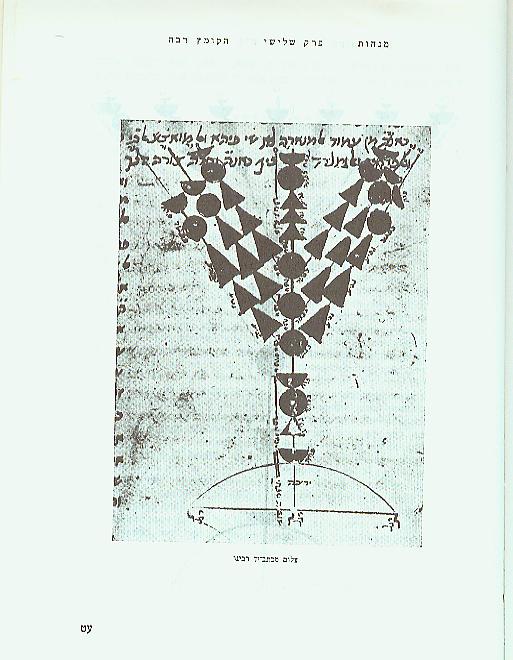
In more recent times, Chabad have pushed the line based on a sketch from the Rambam (and a possible interpretation of Rashi), that the (main) Menora didn’t have curved arms, but looked like this (with straight arms)

Chabad style Menora

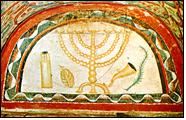
The common view however has always been that these sketches were not exact and that the Menora’s shape is as per the traditional Jewish Mesorah and looks like this:

Traditional Menora

There have been various archeological discoveries which support the traditional Menora, but perhaps the most significant one was just discovered in Jerusalem.

Hebrew University of Jerusalem archaeologist Dr. Eilat Mazar displays the 10-cm gold medallion discovered at the foot of the Temple Mount in Jerusalem. Picture: Ouria Tadmor Source: Supplied

Dr Mazar said he believes the gold was abandoned during a Persian conquest of Jerusalem in 614AD.

She has called the find “a breathtaking, once-in-a-lifetime discovery.”

“We have been making significant finds from the First Temple Period in this area, a much earlier time in Jerusalem’s history, so discovering a golden seven-branched Menorah from the seventh century AD at the foot of the Temple Mount was a complete surprise.”

The 10cm medallion is etched with the Temple’s logo a menorah candelabrum as well as other religious iconography such as a shofar (ram’s horn) and a Torah scroll. Attached to a gold chain, its discoverers believe the medallion was an ornament attached to a Torah.

I recall Rabbi Seth Mandel writing on this topic. Here is what he wrote:

The subject of the exact shape and structure of various kelim used in
the Beis haMiqdosh (BhM) has not been traditionally a matter of much
concern to Jews who learned. In most communities, Jews concentrated on
the sections of the g’moro that had practical relevance, such as
B’rakhot, Seder Mo’ed, Seder Nashim, Seder N’ziqin, Hullin, and sections
of M’nahot. The rules of z’ra’im, qodoshim, and taharot were mostly
abandoned, left, as the Rambam says, as a stone that no one turns over.
Included in qodoshim were the rules of the qorbanot and the rules of the
structure of the BhM, its kelim, and bigdei k’hunna. This was true of
all communities, including the S’faradim and Teimanim. There were only a
few in K’lal Yisra’el who bothered with the issues, mostly chaburos (in
all the communities) who learned mishnayos, or the Teimanim, who
traditionally had a seder limmud every day in the Mishneh Torah, or
individual talmidei chachomim who learned the entire Torah, regardless
of practical relevance.

Indeed, there seems to be little practical relevance nowadays to the
dinim of k’lei haMiqdosh. Without the prospect of rebuilding the BhM,
there is no need for the kelim or the bigdei k’hunna. There was a short
period of excitement before the founding of the State of Israel, when
there was a lively discussion among the g’dolim of Y’rushalayim about
the possibility of renewing the offering of at least some qorbanot.
Outside of that time, the halokhos of the BhM were never discussed from
a practical point of view, either because some held that the Third
Temple would be and could be set up only miraculously, or because
political realities seem to preclude any foreseeable prospect of
rebuilding.

However, about 20 years ago, the late Lubavitcher Rebbe ob’m instituted
a seder limmud of the Mishneh Torah among his chasidim. He periodically
gave shmuessen about certain sections of the Rambam that was being
learned. In one, in 1982, he explained to his chasidim that according to
the Rambam the Menorah of the BhM did not have rounded arms, as
traditionally depicted, but had straight arms, going up from the side of
the main pole of the menorah at a 45 degree angle to vertical. This
still would have remained within the area of his chiddushim on the
Rambam and of only theoretical interest, were it not for the idea that
the holders for chanuka candles, called Chanuka menoras or, in modern
Hebrew, khanukiyot, should be in the shape of the Menorah of the BhM. In
Likkutei Sichos vol. 21, p. 169 the Lubavitcher Rebbe said, “Based on
this, the menoros used on Chanuka should also be diagonal.” A Lubavitch
web site claims that some of the Rebbe’s chasidim built a new menorah
based on what their Rebbe had said and put it into 770 Eastern Parkway
during Hanukka 1982 (prior to that time, the Rebbe had used a wooden
menorah, which had arms that went out horizontally and then bent up at
90 degrees to the vertical). In any event, I do not know the source for
the idea that the taqqono of Hazal of neros Hanukka in any way derives
from the halokhos of the Menorah of the BhM; it has no source in the
g’moro nor in the rishonim. Neither the time of lighting, nor the place
of lighting, nor method of lighting, nor the substance to be lit, nor
the holders of the candles are derived by Hazal from the rules of the
Menorah of the BhM. Indeed, regarding the last item, namely the holders
of the candles/oil, there are no halokhos at all. According to Hazal and
the rishonim, you could light in whatever you chose: 8 separate candle
holders, one large bowl with 8 carefully distinguished wicks (by placing
a cover over the bowl), or with one object with 8 holders for candles or
oil. Archeological evidence seems to support the idea that most Jews in
the time of Hazal lit by putting out the appropriate number separate
clay oil holders. But Jewish communities from the medieval period on
used various mostly standardized forms that held candles, made out of
tin, brass, or pottery. Jewish museums hold hundreds of these; it is
very easy to establish that although various depictions, such as a lion,
were common, none that anyone has ever discovered were designed to
imitate any shitta of how the Menorah of the BhM was shaped. Such an
idea, that whatever is used to hold the lights in the house should
imitate the BhM, has no basis either in Jewish tradition nor in Jewish
law. (The g’moro says explicitly that whereas certain oils are preferred
and certain forbidden for Shabbos, there is no preference whatsoever for
Hanukka. There was a custom of some to light with olive oil (not minhag
Ashk’naz, which was to light with wax), but some rishonim interpret that
as having to do with the brightness of the flame. I plan to discuss this
at greater length in a subsequent post, b’n).

Ignoring that for the moment, the question I would like to discuss is
the shape of the Menorah of the BhM.

Rashi, on Sh’mot 25:32 says “Yotz’im mitziddeha: l’khan ul’khan
ba’alakson, nimshakhim v’olim.” Since ba’alakson means “diagonally,”
Rashi appears to indicate that the arms of the Menorah were straight.

However, Ibn ‘Ezra (ha’arokh) says on Sh’mot 25:32 “qanim: ‘agulim
‘arukkim,” and in 25:37 (haqatzar) “hashisha ne’erakhim zeh ‘ahar zeh
bahatzi ‘iggul.” So it is clear that he thought that the arms were
round. That indeed was the traditional idea, as far as I can tell, for
most people. The fact that the famous arch of Titus depicts a menorah
with semi-circular arms may have something to do with that, but it is
simply a fact that all Jewish drawing of menorahs from the time of
printing (and they were printed in hundreds of s’farim) had not
straight, but curved arms. (See, for example, 4 Medieval drawings of the
Menorah in the BhM in vol. 5 of R. Daniel Sperber’s Minhagei Yisrael,
pp. 69-72.)

The Rambam drew a picture of the menorah in Perush haMishnayot (“PhM:)
(M’nahot 3:7) and in the Mishneh Torah (Hil. Bet haB’hirah 3:10) as well
(in both places the original text says “and this is its form”), but
these were not known in the European Jewish world. The printed versions
of the Mishneh Torah omitted the drawing and even excised the words
“v’zo hi tzuratah”, and the printers of the PhM made up a picture based
on their own ideas of what the menorah looked like (with round arms,
because, as I said, it was accepted that the arms were round). More
accurate representations of the Rambam’s own drawings, however,
continued to be reproduced by the Yemenite scribes in their copies.

The turn in the European Jewish world came when European scholars and
talmidei chachomim started looking in mss. of the Rambam, in old mss. of
the Mishneh Torah, in his writings in the original Arabic, and in
writings of his son R. Avraham, which also were also in Arabic (all of
this happened in the mid-19th Century). All of the above sources showed
that the Rambam drew the Menorah as having straight arms. Yemenite and
very old mss. of the Mishneh Torah, all the copies of the PhM in Arabic
(which were again either Yemenite or old) and a mss. of the PhM which
apparently is was written and drawn by the Rambam himself also shows
that. And in R. Avraham’s Perush on the Torah, he specifically says that
the arms were “straight, as my father and teacher drew it, not circular
as others have drawn” (e.g. Ibn ‘Ezra, which R. Avraham was aware of,
but I am sure there were many others). Originally only scholars and
talmidei chachomim were aware of the new information, but gradually it
spread. In particular this was thanks to R. Yosef Qafih’s edition of PhM
(originally with the Arabic original and the Hebrew translation, but the
Hebrew translation published alone was widely accepted, even in chareidi
circles, because R. Qafih was accepted in the chareidi world and because
his Hebrew was so much clearer than earlier translations). R. Qafih
published a picture from the Rambam’s own ms. of the PhM, reproduced
here at http://www.aishdas.org/avodah/faxes/menorahRambam.jpg (my thanks
to R. Shlomo Goldstein and R. Micha Berger for setting it up). Once this
idea of straight arms became known and accepted people then looked at
Rashi and said “he must agree” (although that does not seem to have
occurred to anyone that I have seen before the Rambam’s drawings were
promulgated in the mid 19th Century: one would have thought that one of
the many g’dolim who published books with pictures of the Menorah would
have noted that that is not according to Rashi).

There is no direct qashya with believing that the Rambam held that the
arms of the Menorah were straight. Indeed, the description in the T’NaKh
concentrates mostly on the numbers and placement of the arms and the
various g’vi’im, kaftorim and p’rahim, but does not describe any of them
in detail. The G’mara adds measurements and more halakhot about the
Menorah (such as “what if one gavia’ is missing”), but also does not
describe them in detail. So the Rambam’s description of the arms, or his
description of a gavia’ as a “makhrut ustuwaana,” a cone, contradicts no
sources that we know of.

However, there are 2 main problems with the standard interpretation of
the Rambam and his drawing.

1.. Virtually all drawings of the Menorah from ancient sources show
rounded arms.
2.. It is impossible that the Rambam’s own drawing represents
accurately the shape of the Menorah (even according to the Rambam
himself).
Let me discuss each of these problems, and then we shall see that the
solution to one will solve the other.

1.. Virtually all drawings of the Menorah from ancient sources show
rounded arms.
Long before the Magen David (originally a decorative emblem and a
magical symbol used by both Gentiles and Jews) became a specifically
Jewish symbol (probably starting in the 14th Century), the Menorah was
one of the primary Jewish symbols. In hundreds of coins, synagogue
paintings and mosaics, and ossuary decorations from the time of the
Hasmoneans through the Byzantine period the primary Jewish symbols were
the Menorah, a lulav and etrog, sometimes a shofar. So there are many,
many drawings and paintings of the Menorah from Jewish sources; we
cannot blame this on a Gentile Roman artist who sculpted the Arch of
Titus. Virtually all show the Menorah with curved arms.

Let me confine my discussion to examples that are the most readily
accessible to people (which I assume the Jewish Encyclopedia [“JE”]and
R. Daniel Sperber’s Minhagei Yisrael [“MY”, all citations from his
volume 5] are), I will discuss the following examples:

1.. the coin of Mattitya Antigonos, JE 11:1357 (= MY pp. 172, 174, 176
2.. wall drawing from a house in the Old City, JE 11:1358 (= MY p.178 #4)
3.. paintings from the walls of the Dura-Europos Synagogue, 1) JE 6:301, plate 6 (= MY p. 192), 2) JE 6:277, fig. 3, 3) JE 6:285, fig. 15 (= 6:300, plate 8 = MY p. 183)
4.. a drawing found in a catacomb in Venosa, Italy, dating back to the
first century, at http://www.aishdas.org/avodah/faxes/menorahVenosa.jpg
5.. the Arch of Titus, JE 6:1355 (= MY pp. 185-187, 189-190) My remarks will be applicable to other drawings as well.

a) and b) in this regard (as well as the rough sketches at the Tomb of
Jason in MY p. 178 #5) are the most important for our purposes, because
they were made by Jews at the time when the BhM was still standing. e)
is next in chronological order, sculpted either in 81 or 94 of the
Common Era, according to MY p. 184: at least a decade after the
destruction, but soon enough after that the sculptor can be assumed to
have seen the original. The pictures at Dura-Europos, OTOH, are from 275
of the Common Era, a couple of centuries later, but they are done by
Jews (the JE brings other representations from the 3rd Century in 6:1357
fig. 3 and 1360-1361). The picture from Venosa may date to the first
century or may be somewhat later.

The first and most crucial question to be addressed is whether the
Menorah in the drawings is indeed supposed to be the Menorah in the
Hekhal of the BhM. R. Qafih is forced to argue that it is not, and is
either a different menorah used somewhere in the BhM or a menorah not
used there at all.

Regarding a) (from 37 BCE, a century before the destruction!), the
political background of the coin is crucial to understand. As R. Sperber
notes on p. 173 note 5, Matitya Antigonos is the successor to Yonatan
Hyrkanos II, who did _not_ claim to title of king (basileus), just to be
the Kohen Gadol. The inscription on the coin, however, says on one side
Matitya haKohen haGadol v’Haver haY’hudim (the latter, literally meaning
“friend of the Jews,” at that time had a specific political meaning,
something like “Head of the Jewish Protectorate”). On the other side it
says Basileoos Antigonou [transliterating omega as a double o], Greek
for “of the King Antigonos,” meaning the coin was coined under the rule
of King Antigonos (the nominative, “King Antigonos,” would normally be
accompanied by a visage or other representation of Antigonos). Matitya
Antigonos (which is the combination of his Hebrew and his Greek name,
although he would never have been called that, any more than R. Velvel
Brisker would have been called Yitzhaq Z’ev Velvel) was emphasizing his
claim to kingship on the coin. It only makes sense, then, for him to use
symbols representing Jewish sovereignty over the Temple. In that
context, he would not use Jewish symbols, say a lulav and etrog, found
on other coins, but only artifacts that represented the BhM. If there
had been another menorah in the BhM that would prove sovereignty other
than the Menorah in the Hekhal, we know nothing about it, and surely
Hazal would have mentioned it somewhere were it so important. In
particular, the Menorah had acquired the connotation of Jewish
sovereignty at the time of the Matitya ben Yohanan and the Hanukka
miracle; Matitya Antigonos, named after his ancestor and a Hasmonean,
would naturally have used the Menorah in the Hekhal as THE symbol of
Jewish sovereignty.

So menorah must be intended to represent the Menorah in the Hekhal. To
be sure, this is a coin, and there is no room for details, like
kaftorim. But, as R. Sperber points out, this is not just a schematic
representation: its dimensions match the dimensions that Hazal gave to
the Menorah in terms of the ratio between the area with the arms vs. the
base below. And what is the shape of the arms? Curved, but by no means
circular like the ones on the Arch of Titus. Rather, they are more like
the arc of an ellipse: they curve most sharply at the bottom and then,
about a third of their length, they become almost straight. You can see
this by comparing the space between the tops of the 7 arms, where the
candles were. On the coin, the tops are all equidistant from each other,
most importantly the two curved arms on either side of the central arm
are the same distance from the central arm as all the other arms are
from each other.. Compare this to e), where the arms are semicircular,
and so the two curved arms nearest the center are further away from the
central arm than the other arms are from each other, and to the Rambam’s
drawing (and any other with straight arms, e.g. c3).

The base itself may have had three legs, like both Rashi and the Rambam
say, and all Jewish representations show (see a discussion in MY pp.
177-183), but the coin is rubbed out at the bottom. In any event, it is
clear that it did not have the double-hexagonal base shown in e).

Next is b). This is from a house in the very wealthy, upper class area
of the Upper City of Y’rushalayim, one from which the BhM was actually
visible; the house was destroyed at the time of the Destruction of the
Temple from all indications. Thus it is a representation from the time
that the Menorah still existed. The fact that it is depicted next to a
representation of the Shulhan of the Lehem haPanim proves that it is
meant to be the Menorah in the Hekhal, as do the decorations of
elliptical (egg-shaped) objects on the arms, presumably the kaftorim.
Again, it is not completely detailed (the numbers of the g’vi’im and
kaftorim are not correct, and there are no p’rahim), but the same
comments about a) apply: its relative dimensions are exactly correct; it
shows the same relative size of the tripod base to the arms as does a),
both in terms of height and width, and the arms are curved, but not
semicircular. In fact, they are remarkably similar in shape to those
depicted in a): they are all equidistant from each other, they curve at
the bottom, and about a third of the way up they become almost straight.

Thus we have two depictions, one from a Hasmonean king and one, done 40
to 100 years later, from a man residing in the most prestigious part of
Y’rushalayim overlooking the BhM, both from the time when the Temple
existed, that agree almost exactly in terms of relative dimensions and
the shape of the arms. For this to be a coincidence strains the
imagination.

Proceeding to c), from a synagogue (i.e. Jewish) 200 years later, we
find 3 different drawings. c1) and c2) are virtually identical. The
relative dimensions of the height of the menorah are almost the same as
in a) and b). The base is very clearly much like the Rambam’s depiction
(with the caveats that I shall discuss below about the latter) and the
description of Rashi in Sh’mot 25:31, showing three legs underneath a
small dome-shaped base supporting the central arm. The arms are
decorated with knobs and some other things, presumably a representation
of the g’vi’im and kaftorim (and perhaps the p’rahim, although it is
difficult to make out precise details), although, as in b), the numbers
are not correct and they cover the entire arm, whereas in reality the
decorations would only have covered the upper part of the outer arms.
Although the arms are more semicircular than in a) and b), that is true
only of the outermost arms. The arms closer to the central arm are
clearly not semicircular, and, indeed, are very like the shape in a) and
b): curved sharply at the bottom and then almost straight toward the
upper part. c3), OTOH, is very different. Its arms are almost straight
(but are _not_ completelystraight, and the two inner arms are further
from the central arm than the other arms are from each other. The
decorations on the arms are different (although again they do not match
the number of g’vi’im and kaftorim given in the Torah). The base has
three podes, but they seem to be composed of balls. Most importantly,
the central arm does not extend to the base. Rather, it stops partway
down and has a rather large bottom part, consisting of a vase-shaped
part and below it four circular disks, each bigger than the one above.
It is also noteworthy that it is placed next to a lulav and etrog, in
contradistinction to c1) and c2), which are both shown standing before
the entrance to a hall with no lulav and etrog. I would argue that c1)
and c2) are meant to be depictions of The Menorah in the Hekhal
(particularly since c2) is next to a depiction of a figure labeled
Aroon, the Greek version of Aharon), whereas c3) is a stylized Jewish
symbol, based on the Menorah, to be sure, but not meant to be an exact
depiction. I would make the same remark about most of the hundreds of
other drawings of menorahs meant as Jewish symbols: although probably
based on the Menorah in the Hekhal, they are not drawn as accurate
sketches, but as stylized drawing of a symbol. See, for instance, d), a
picture discovered in a catacomb in Verona, Italy, that dates back to
the first Century of the Common Era. To the right of the menorah are a
shofar and a lulav, to its left an etrog and something else. The lulav
is obviously a stylized representation of one; no palm fronds curve
around as that one does. Similarly, we can say that the drawing of the
menorah shows that the arms are curved, that it has a tripod for a base,
that the base is smaller than the rest of the menorah. Possibly we could
use relative sizes of the elements as a general indication. But it would
be foolish to measure the arcs of the arms, count the knobs on the arms,
or any other details, since the artist was not interested in making an
architectural sketch.

d), OTOH, is clearly different from a), b), and any of the c)s. The base
is entirely different, and out of proportion with the rest of the
menorah. The arms are all semicircular (as they are in some 3rd – 4th
Century representations from Jewish synagogues shown in JE 11:1357-1361)
and therefore the space between the inner arms and the central arm is
noticeably greater than the distance between the other arms. It has
clear kaftorim and p’rahim, although in the wrong number (not covering
the entire arms, but a greater number on the outside, longer arms). It
is not clear what the g’vi’im are meant to be: they seem to be flattened
bowl-shaped objects above and below the kaftorim, but the concave faces
of each face the kaftor, so that the concave part of the upper bowl
faces down and the concave face of the one below faces up. The central
arm appears to be wrapped with some decoration below the outer arms, and
the base is two giant hexagons, the top one larger than the lower one,
with decorations on the side panels. Examination of the panels of the
hexagons shows that the central one on the upper hexagon has a picture
of two eagles holding a (laurel?) crown. To its left and right are
panels showing a ketos, a aquatic monster usually with a serpent body
and the head of a bird or other animal. In the lower hexagon are three
panels with various kete (plural of ketos). A ketos is called drakon by
Hazal; in the Mishna Avodah Zara 3:3 it shows that a drakon was suspect
of being a symbol of AZ. How would that get into the Temple? Even worse,
the eagle was the symbol of Imperial Rome, and as such was an anathema
to Jews longing to be free of Roman rule.

However, the picture cannot be simply an invention of a Roman artist.
The arms are are equidistant from each other, and the distance equals
the width of the arms (another universal characteristic of Jewish
sources), they all go up to an equal height, and even the ratio of the
distance from the base to the lower arms to the rest of the height
matches the ratio given by Hazal. And there are clear g’vi’im, kaftorim
and p’rahim on the arms. This must be a representation of the Menorah of
the Hekhal. So how can we explain the base?

R. Daniel Sperber gives the correct answer, IMHO. He notes that usually
a ketos has a nymph perched on its back, and scales on its neck, and
shows pictures of a very similar from a Roman temple in Didyma with such
a nymph. In e), there is no nymph and no scales on the neck. He quotes
the g’moro AZ 43a that a drakon that is osur has scales on its neck, and
the Tosefta in AZ that says “if the neck was smooth, it is muttar.” This
evidence, that the base was made showing the symbol of Imperial Rome and
avoiding AZ, matches Herod the Great. He was put in his position, after
Matitya Antigonos, by the Roman, and Josephus in Antiquities of the Jews
tells us that he erected a great golden eagle over the gates of the
Temple, an act that angered the Jews. OTOH, he always was careful to
portray himself as King of the Jews and avoided any outright AZ. So, R.
Sperber concludes, it must have been Herod who put on the base. Why
would he have monkeyed around with the Menorah? Probably because shortly
before his reign the Parthians entered Y’rushalayim and plundered it.
The Menorah may well have been broken at its weakest point, its small
base, at that time, and Herod, whose mark was large construction
projects many of which were for the benefit of the Jews while at the
same time reminding everyone of Roman sovereignty (as he did in his
reconstruction of the BhM), would naturally have made a large new base,
for the good of the Jewish Temple but with Roman symbols.

So it is extremely probable that e) was actually drawn from someone who
saw the Menorah as it was paraded through Rome in 71 and perhaps later,
wherever it ended up. But some of the exact details, like the exact
number of kaftorim, or the exact curve of the arms, is wrong, because
the sculptor no longer had the Menorah in front of him.

In summary, all depictions of the Menorah in the Hekhal, from Jewish and
Roman sources from the time of the BhM and the following couple of
centuries (as well as medieval Jewish sources) show the Menorah with
rounded arms. (It is worth mentioning that the 4 Medieval Jewish
drawings of the Menorah in MY pp. 69-72 all show arms like in a) and b):
curved at the bottom, but straight in the upper part.)

1.. It is impossible that the Rambam’s own drawing represents
accuragtely the shape of the Menorah (even according to the Rambam
himself).
Let me begin by quoting him in PhM [my translation from the original]:
“it had three legs. A gavia’ is the form of a solid [i.e. not hollow]
cup, except that it gets narrow toward the bottom, or, if you wish, [it
has] the shape of a cone whose tip has been cut off. A kaftor is the
form of a sphere that is not exactly circular, but somewhat elongated,
close to the shape of a bird’s egg. A perah is the form of the blossom
of a lily. And now I will draw for you in this drawing the g’vi’im in
the shape of a triangle and the kaftorim as a circle and the perah as a
semicircle in order to make the drawing easier, since my intent in this
drawing is not that you should know the exact form of a gavia’, since I
have just explained it to you. Rather my intent is to show you the
number of the g’vi’im, the kaftorim and the p’rahim, and their
placement, and the length of places of the arms of the Menorah that are
empty and that of the places that have kaftorim and p’rahim, and its
general appearance [lit.: how its generality was]. And here is the
drawing of all of these.” He says explicitly that you should not pay too
much attention to all the details of the drawing. On the contrary, he
says it is a schematic drawing, representing the kaftorim and other
parts by geometric shapes that are easy to draw. In particular, note his
last words here: “w’aljumlah kayfa kaanat,” “its general appearence.” I
believe that that applies not just to the shapes of the kaftorim etc.,
but to the entire drawing: it is schematic, and was meant only to be
schematic.

But if the arms weren’t exactly straight, why did the Rambam draw them
that way? Well, why did he draw the kaftorim as a circle? Because he
drew everything with a ruler, a compass and a protractor (much as an
electrical schematic drawing is done with straight lines). Note that all
the kaftorim are drawn not as free-form circles, but are perfectly round
(even though the real kaftorim were not). Similarly, the top of the
base, above the three legs, is a perfect arc clearly drawn with a
compass. The distances are also schematic: the space occupied by the
gavia’, kaftor and perah above the base are one tefah, as the note on
the drawing next to them states, whereas the empty space above them and
below them are both two t’fahim, also clearly noted (“t’fahayim”) on the
drawing, yet those latter spaces in the drawing are much less than the
space taken by the g’via’, kaftor and perah.

As a matter of fact, the drawings of Yemenite scribes, their attempts to
reproduce the Rambam’s drawing, most clearly differ in the fact that
whereas the Rambam used a ruler, compass and protractor for everything,
the Yemenite scribes made free-hand drawings. Their triangles are not
exactly triangular, their circles are not exactly circular, and their
straight lines are not exactly straight, including the shape of the
arms. See one of them reproduced by R. Qafih in his edition of the
Mishneh Torah, page 54.

Another proof that the Rambam’s drawing is not meant to be schematic and
not accurate in its details is the placement of the g’vi’im, kaftorim
and perahim on the arms. The Rambam, again for ease of drawing, put them
all at the bottom of the arms, and since the outside arms are longer
than the inside ones, these items were not lined up next to each other.
Everyone knew that this was not meant to be accurate, and so even the
Yemenite scribes changed it in their free-hand drawings, putting the
g’vi’im, kaftorim and perahim at the very top of all of the arms. R.
Qafih knew this as well; in his “corrected” drawing in his edition of
PhM he not only drew these items on the tops of the arms, he also
thought that the Rambam drew the g’vi’im upside down: the Rambam drew
them with the narrow end pointing up, whereas R. Qafih redrew them with
the narrow end pointing down (as is the common view, that these “cups”
were on the Menorah with the “bottom” of the cup down). Although R.
Qafih changed his mind about the direction of the pointed end by the
time he put out his edition of the Mishneh Torah, my point is not which
way is correct, but that he himself thought that the Rambam did not
necessarily mean that all details of the drawing were accurate, and so
did not consider minor changes to be against the Rambam’s view.

As for the comments of R. Avraham, the son of the Rambam, that the arms
were straight, let me note that he says explicitly “as my father and
teacher drew them.” Not “as my father told me” or “as my father said.” I
believe that R. Avraham was basing himself on the drawings of the
Rambam, rather than having had a discussion with his father about the
subject. This is not the only time that R. Avraham made statements based
on what his father had written that may not accurately reflect his
father’s exact view, and most scholars agree that R. Avraham’s
statements about his father’s view must be treated cautiously. There is
little question about his transmission of things that he says he heard
from his father, but things he read from his father he may not know more
about than anyone else.

Now even in a schematic drawing, if the arms were semicircular arcs, as
they are on the Arch of Titus, the Rambam would have surely drawn them
that way, using a compass. But what if the arms were not semicircular,
but were curved somewhat? What, as a matter of fact, if they were like
the arms shown in a), the coins of Matitya Antigonos or the arms shown
in b), the drawing on the wall of the house discovered in the Old City,
that were partially curved and partially straight or almost straight? I
would argue that in his schematic drawing, the Rambam would see nothing
wrong with drawing them with a ruler as a straight line. After all, as
he says, “my intent in this drawing is not that you should know [i.e. I
should draw] the exact form. Rather my intent is to show you the number
of the g’vi’im, the kaftorim and the p’rahim, and their placement, and
the length of places of the arms of the Menorah that are empty and that
of the places that have kaftorim and p’rahim, and its general
appearance.”

In the Mishneh Torah, the Rambam does not discuss all of the details of
his drawing that he did in the PhM; he does not even explain that the
triangles are g’vi’im and the circles are kaftorim. So the Mishneh Torah
does not add anything new.

I would also argue that Rashi’s statement of alakson could also fit the
drawings Medieval Jewish sources, discussed above. As I have said, it is
inconceivable to me that rabbonim drawing pictures of the Menorah in the
14th Century would not have noted that Rashi disagrees.

One may ask: why am I even trying to reconcile the Rambam to the
historical drawings. Is it not possible that the Rambam was simply wrong
about historical facts?

The Rambam may have been in error about historical facts; he dealt with
the best information available to him, and he did not have all the
knowledge we do now. He did not know Greek, for example, as far as we
can tell, and so does not realize when some words are Greek. But the
Rambam was well aware of archeological findings and did not dismiss
them. In one of his t’shuvos he even gives an ingenious explanation of
why all the inscriptions on coins are in K’tav ‘Ivri, rather than K’tav
Asshuri, when he holds that the Torah was given in K’tav Asshuri. It is
highly likely that the Rambam saw some of the many drawings of the
Menorah on coins and other artifacts, and since there is no clear
evidence from the g’moro or other Rabbinic texts that we know of, he
would not have rejected the drawings out of hand as all being a mistake.
Furthermore, the Rambam is one of the greatest of the Rishonim and the
only one who paskens lahalokho about the structure of the BhM; coins and
pictures are halakhic sources. I believe it is proper methodologically
to reconcile the g’dolei rishonim with non-halakhic depictions as much
as possible.

In conclusion, I have argued that no one thought that the arms were
exactly straight; that the idea came into being only in the 20th Century
after the Rambam’s drawing became common knowledge, but does not have a basis in a careful reading of the Rambam and a comparison to Jewish
depictions ranging from the time of the Temple to centuries later.

I shall defer a detailed discussion of the idea that the shape of
Hanukka menorahs should be based on the shape of the Menorah in the BhM
for another time. However, I repeat again that it has no basis in Hazal
or in the rishonim or in common Jewish practice for hundreds of years in
the construction of menorahs used to fulfill the mitzva of neros
Hanukka.

For the Chabad view, please see here

Of course, for Chanuka, one doesn’t need a Menora, one can just use silverfoil as a base, for example.

Some questions for Yaron

Yaron Gottlieb is my cousin. We get on well, so  don’t read this as some attack. His wife, Alex is currently editing Galus Australis, and we share mutual respect and admiration. [ Every time I hear the term Galus, I wonder why anyone would want to have it as a heading on a web site: Galus is the worst situation to be in … such a depressing word … why would one want to be reminded, but I digress.]

Yaron found that Michael Danby had two different how to vote cards. One of these was tailored towards his (largely Orthodox) Jewish constituency. If his constituency was different, he might even have had three. Nu.

Question 1: Is this a sin, Yaron?
My Answer: No. It’s a suggestion on how to vote. Would it be better that he suggests, for example, that Orthodox voters choose the anti-zionist Greens? [Okay, it’s a straw man] I’m not sure who is worse, Bob Carr or the Greens. Perhaps, Yaron or Alex would prefer a green vote for the Jewish How to Votes, but crikey, it’s Michael’s call. If you want to get into politics yourselves, go for it, but there is no rule or ethic that says one can’t tailor suggestions.

Question 2: Is it a sin for Michael to suggest that a second best vote would be for Danny Nallah’s “Rise up Australia Party”?
My Answer: No. We all know this party is an ultra-conservative Xtian party. That means, they aren’t afraid to note that the homosexual act is against the Torah (Bible) and is described as an abomination. You agree with that, I expect, Yaron? Make sure Barney in the Age doesn’t know, otherwise you’ll be his next headline. I hope you can see that this viewpoint would resonate with any Jew who believes that the Torah is the word of God. Does that make you homophobic? (that was your word). We all know that Rise up are Climate Change skeptics/deniers. They are not alone; that’s not a matter of “belief” by the way. Let’s assume that they are opposed to approaches that attempt to better the climate. I don’t think anyone would say that damaging the climate prospects of the world is a pro-Torah stance, but the matter is often seen as one which requires a consistent world approach, and as such, it might well be Halachically more relevant to lobby the major polluters of our World, than Michael’s how to vote suggestion. The party is described as anti-Islam. Guess what? I’m anti-extremist Islam. I’m opposed to streams of Islam that think I should be under Shariah law. Did you ever read about dhimma? I’m assuming, and I am happy to be corrected, that the said party isn’t against any form of Islam which doesn’t seek to dominate the world and is happy to treat those of other religions (or no religion for that matter) with respect and equanimity. They aren’t my idea of an ideal party, and some of their views are over the top and loopy. Those who vote solely based on how to vote cards, however, aren’t going to change their approach because of your revelation.

Politics is politics. Things are never black or white. In the case of green, we’ve seen that tree-huggers and marxists are mostly also virulent anti-zionists. I see them at Uni all the time. They are the ones who join extreme Muslims who protest about Israel, demonise the USA, and never say a word about the slaughter of Arabs or the oppression in North Korea, let alone the Russians. They are also some of the most ignorant people I’ve ever engaged with.

Is there a single party whose stance on each and every matter we can agree with? Nope. It’s a best fit proposition tempered by clever but obvious number games on how to vote cards.

Ho hum. What a storm in a tea cup.

Jews who vote for Michael will do so because they are either:

  • Labor supporters
  • People who recognise his efforts on behalf of our community and Israel

I can’t see how either of those two categories of people will change their vote because of this revelation.

A Git Yur.

I have lost faith in Rav Druckman

I waited. I was hoping to be enlightened. R’ Moti Elon, who is likely to appeal charges against him, and for all anyone knows may not be found guilty, was condemned by Takana, a highly respected group of Modern Orthodox Rabbis and learned women. The court re-affirmed their findings.

In a case like this, one must be careful. Elon does have rights, and one must write alleged. At the same time, there is absolutely no Chiyuv that I know of, which would make it necessary to invite him specifically to give a Torah lecture while this very real cloud hangs over Elon.

Rav Druckman had invited him, and whilst nobody can be anything but impressed by his achievements as a human being and as an educator par excellence, one must question his judgement in this case. I waited for an explanation, but either I’ve missed it, or there is none.

Accordingly, I have suspended my faith in his judgement. It’s a pity we don’t have a body like Takana here in Melbourne. There are some dubious individuals, about which there is a raft of evidence that hasn’t yet seen the courts, circulating with clear ramifications that call for an enquiry. I see no need to INVITE such people to  speak on topics given the very dark cloud that surrounds their past. Yes, they are innocent until proven guilty, but we can do better than choosing people who seem to be moral and upright and don’t have such clouds accompanying them. If and when they clear their name, בבקשה.

It reminds me of the sad story re-told by Rabbi Riskin:

“Let me tell you a true incident which for me is a metaphor of our times. A young man attended a yeshiva in Safed.

“The first morning, he arrived a bit late for breakfast and there was no milk left for his coffee. He went to the grocery, purchased a container of milk and placed the container in the yeshiva refrigerator with a sign, ‘Private property.’

“The next morning, the container was gone.

“He bought another container, on which he added to the previous sign, ‘Do not steal.’

“The next morning, that container, too, was missing.

“He purchased a new container, adding to the sign, ‘Questionable gentile milk’ (halav akum). This time no one took his container; he left the yeshiva.”

At the risk of sounding like an Orthodox basher, let me say that far too little is written about the lack of leadership on morality and ethics on the left side of our divide. I did notice criticism of Macabbi in the 2000’s for allegedly not doing enough to separate someone wth a grey cloud over their head, from Macabbi kids. In general, the left leadership is moribund except when it sees an Orthodox target. They includes the reform and the conservatives and the “unaligned” (Shira Chadasha, who for some reason market themselves as Orthodox but are not considered as such by 99% of the Orthodox community).

Jews are a strange group. That’s why we have the crazy notion of people who want to “celebrate” Rosh Hashana and Yom Kippur without God. They advertised in the paper. I would imagine they sit around in Yoga type trances and moments of thought, and make “new year resolutions” while consuming apples dipped in honey. Ultimately, they are celebrating with God, for He ordained the concepts and their meaning. They just have a pintele yid, which is clouded by secularist, do good, and tikkun olam (the modern socialist mantra). They are good concepts in the main, but whether they like it or not, God is part of our tradition! Rosh Hashana isn’t “Happy New Year”. Why not run it on December 31st with the others? Isn’t that more inclusive and likely to break down the “barriers”.

It’s actually God’s coronation. It’s not about making “commitments” per se, although one should use these times to improve.

Anyway, I digress, as usual, given this is (as always) an unedited conscious stream …

Rav Druckman (courtesy jewish community watch)

Why the sudden fuss about “it’s kosher”?

I noticed the following issued by the Rabbinic Council of Victoria

It has recently been brought to the attention of The Rabbinical Council of Victoria (RCV) that claims made by the local business ‘It’s Kosher’ on its website that its hechsher is endorsed by the Chief Rabbanut of Israel are both false and misleading.

The Rabbanut has clarified that no such endorsement has been issued, and while it did approve one specific product some four years ago, this does not constitute an endorsement of the “It’s Kosher” hechsher.

The Rabbanut further clarified that it has a policy not to approve any products under the supervision of this Hechsher.

“Leaving aside the concerns expressed to the RCV relating to the Halachic standards adopted by the said business,” RCV President Rabbi Meir Shlomo Kluwgant said, “this misleading statement about the Israeli Rabbanut is deeply concerning to the RCV. If it is the case that the false statement was made to mislead and deceive the public by claiming that its Hechsher is supported by the Israeli Rabbinate, this would call into question the integrity of those running the ‘It’s Kosher’ business”.

Anyone who visits the “it’s kosher” website knows that it is chock full of controversial attempts to convince the public into respecting the rulings of its halachic authority. We are told that this authority was “compelled” to undertake his work by Rabbi Rudzki ז’ל for the benefit of us all.

Perhaps we can hear a little but about the separation? of finances and kashrus in his organisation. Does the supervising Rabbi/authority receive a wage which varies with the number of hechsherim/products for which he gives the nod? Where are the books? Are they open for all to see? Is there a lay board with no financial interest? Who are the financial beneficiaries of this business? Did R’ Rudzki also run his own supervision business this way?

This gives new meaning to the term השגחה פרטית.

There is more to be said about this business. Did its halachic authority seek (unwittingly?) to give a financial boost to Jews who have a half treyf shop which is also open on shabbos when simple yashrus would have dictated that this is a basic unfair advantage over Jews who try to provide a similar product which is kosher and only kosher and is not profiting from Trayf on Shabbos. Is this the meaning of “Yosher”?

Remember, the website for that authority claims in the FAQ that there are no Divine Laws, only Divine Principles.

PS. There is no halachic difference that I can understand between writing God, Gd and G-d. I am not sure why people persist on doing that (eg on their kashrus business website)? Enlighten me.

Have we strayed on Sheva Brachos?

The following was from Rav Aviner. These days, it seems to have become de jure, and it’s almost as if you feel “sorry” for someone who doesn’t have them each day. Would we be better off giving Tzedaka? It’s a difficult question as it can’t be generalised, of course.

Q: Is there an obligation to have Sheva Berachot all 7 days?

A: No. Whatever is most comfortable for the groom and bride. After all, it is to bring them joy and not to burden them (Re’im Ahuvim pp. 165-169. And Ha-Rav Moshe Feinstein related that when he got married they only had Sheva Berachot on Shabbat, and not on all 7 days as is customary today. Reshumei Aharon Volume 1, p. 18. And Ha-Rav Shlomo Zalman Auerbach once lamented this practice and quoted what the Chatam Sofer wrote in his responsa Even Ha-Ezer #122: “That someone once had Sheva Berachot on Shabbat and the entire community mocked him”, and that the Aruch Ha-Shulchan wrote in Hilchot Sukkah #640 that we do not have the custom to have Sheva Berachot every day. Meged Givot Olam Volume 2, p. 72).

Hilchos Aveylus: Attending Weddings of a close relative

When I wrote to Rav Schachter about various questions, he opined that he was unhappy with the leniency of “being a waiter” in order to participate in the wedding of close family. His view was that it was a Halachic bluff because nobody was really a waiter, and they weren’t working for the organisation, and he couldn’t imagine the mother or father of a Chosson/Kallah donning an apron or similar in the kitchen and really “working”. He noted that there was no need to look for specific devices like this given that there was a clear leniency from no less than R’ Yaakov Emden in Sheilas Yaavetz, and that those who wanted to rely on this, should do so (in such cases) and not “play games”.

He said that he felt that it was like the special shabbos phones introduced in Israel for Doctors involved in Pikuach Nefesh. He couldn’t understand why people were even trying to create such devices given that it was a MITZVAH to be Mechallel Shabbos for Pikuach Nefesh. He felt that people were losing their clarity of what Halacha was about.

I had reason to discuss this with nebech a father from the USA who was an Avel and travelled to Melbourne for the wedding of his son. I asked him how he would conduct himself and he said that he had asked R’ Schwei, a highly respected Posek in Chabad, who had advised using the waiter device. I mentioned that I thought it strange that someone would travel all the way from the USA to be a waiter, and I couldn’t understand the reasoning.

I, of course, work as a musician and there is no issue (as long as I’m paid 🙂 working at a wedding. Recently, I played at my nephew’s wedding, and I was careful to ensure that I was paid as usual. That, of itself, however, didn’t give me permission, to dance, however!

Of course, the issue of dancing, and eating in the hall, is separate. I may write about this in another post. In general, R’ Schachter explained to me that Aveylus was a state of mind. One needed to make sure that one wasn’t engaged in activities which invoked Simcha in the Avel. Where, however, an Avel would be causing real Tzaar (pain) by not being present, and their motive was not to disturb a Simcha by causing such Tzaar to a Choson and Kallah, he felt that this was not what Aveylus was every about. Of course, Halacha K’Meikel B’Aveylus, but it’s a state of mind, and one needs to be careful to make sure correct motivation and behaviour.

L’Dovid Ori

[Hat tip Benson]

This is from here.

Starting from Rosh Chodesh Ellul till Shmini Atzeres , there is a Minhag to say twice a day

”Ledovid Hashem Ori”.

This Minhag is not mentioned in Shas, Shulchan Aruch, Kisvi Ha’ari Zal or in the original Machzorim.

One of the first Poskim who brings this Minhag, is the Mateh Efrayim. (R. Efrayim Zalmen Margulios).

There were Chasidic dynasties who didn’t follow this Minhag. (Choze Milublin , Zidichoiv, Apte, Sanz & Ropshitz.

The Ma’ase Rav writes that the Vilna Gaon didn’t say it. Today almost all Yeshivishe and
Chasidishe Minyonim, do say it. The one exception is, Chasidim from the Sanzer dynasty.
(Bobov, Klausebburg etc.)

There are different reasons given for not saying it. The true reason is, because
The first mention of this Minhag, is brought down in a Sefer called “ Chemdas Yomim”.
The Chemdas Yomim was probably the one who started this Minhag.
The Sefer Chemdas Yomim has no name of the Mechaber (Author) on the Shar Blatt.
The Yavetz and many Chassidic Rebbes, claimed that the Mechaber was Nosson Hoazosi

(Nathan from Gaza). Nosson Hoazosi was Shabsai Zvi’s Novi Sheker and right hand man.

Jewish Arbitration?

Here is a suggestion from Dov Silberman, as originally appeared in the Australian Jewish News in letters to the Editor.

” I would like to bring to your readers’ attention a set of draft rules that I have created for general public discussion regarding a Jewish form of arbitration.

The arbitrator must be Jewish and of good repute.

Nevertheless, the arbitrator is expected to act according to the Commercial Arbitration Act (Victoria) 2011 so as to produce an enforceable award.

I believe that these draft rules satisfy halachic and civil legal criteria. They are designed to publicly demonstrate a transparent and fair process, and to restore the confidence and trust in the Torah method of solving disputes.

It is based on a purely voluntary agreement between the parties, and therefore does not deal with many issues that I believe would confront attempts to create a commercial Beis Din with coercive powers to summons people to it.

I commend the rabbis for attempting that herculean task, and trust that they will be able to achieve that end in the near future.

In the meantime, I would like to start a truly communal and constructive debate about what people actually want.

You can read my introduction at http://www.dovsilberman.biz/arbitration/jewish-arbitration/ and the actual rules at http://www.dovsilberman.biz/arbitration/jewish-arbitration-rules/

DOV SILBERMAN
Lawyer and Nationally Accredited Mediator
Associate ACICA (Australian Centre for
International Commercial Arbitration)
Email: mail@dovsilberman.biz

Dvar Torah for Shoftim

Tomorrow, is Rav Kook’s ז’ל Yohr Tzeit, so it is fitting that the Dvar Torah includes his thoughts, The Dvar Torah is from one of the Roshei Yeshivah of Kerem B’Yavneh (my alma mater), Rav Motti Greenberg.

Ironically, last night at Ma’ariv, there were a few international Tzedoka collectors from Israel in Shule. I was in my usually “straight ahead” mood, and asked one of them (a Chossid, with peyos)

What are your thoughts on Nachal Charedi

His responded with a pained look and said

Anyone who supports Nachal Charedi should not be allowed to enter a Shule

The problem with people like that is that they think that when they go to the toilet, it doesn’t stink. They live in la la land.

He effectively stated that I had no place davening Ma’ariv in Shule if I thought Nachal Charedi was a valid approach.  I said,

well, I support them, and you don’t come up to the level of their shoe laces, with a hateful comment like that

I don’t expect he will visit me for a donation. His paid driver heard the interchange.

Anyway, the D’var Torah … 

As part of the laws of warfare, it is written, “What man is afraid and fainthearted? Let him go away and return home.” [Devarim 20:8]. According to Rabbi Yossi Hagelili, this refers to a man who is afraid because of the sins in his hands. However, this seems backwards – to be afraid because of sins is a good trait and not a bad one, why should the man be sent away?

In Chassidic texts it is written that one time there was a delay in the construction of the succah of the Rebbe, the author of Beit Aharon. In the end, one of the Rebbe’s followers made a great effort and finished building the succah the day before the holiday, thus giving the Rebbe great pleasure. As a reward, the Rebbe offered the man his choice – he could either sit next to the Rebbe in the world to come, or he could become very wealthy. The man chose wealth. He explained to the astonished Chassidim who asked about his decision that to want to spend the world to come close to the Rebbe is a matter of selfishness, but if he had great wealth he would be able to help many other people.

Rabbi Shimon Shkop wrote in the introduction to his book Shaarei Yosher, “The foundation and the root of the goal of our lives is that all of our labors should always be geared and dedicated to the good of the community.” Rav A.Y. Kook wrote, “A person must always extricate himself from the private frameworks which fill his entire being, such that all of his ideas are centered on his own fate. This brings a person down to the depths of being small, and there is no end to the physical and spiritual suffering that comes about as a result. Rather, his thoughts, desires, his will, and the foundation of his ideas must always take into account the general – the world, mankind, Yisrael as a whole, and the entire universe. And this will also establish his personal status in the proper way.” [Orot Hakodesh volume 3, page 147].

To be “afraid of the sins in his hands” means that the person is concerned with his own sins and not with the sins of others. This is a man who lives only for himself. This is similar to what the sages taught us: “Why is it [the stork] called a ‘chassidah’ (one who is kind)? It is because it is kind to its companions.” [Chulin 63a]. But a question is asked: The Rambam teaches us that the reason birds are considered impure is because they are cruel, why then is the stork an impure bird? Chidushei Harim explains that this bird is kind, but only to its own friends.

The soldiers in King David’s army would give their wives a divorce before going out to battle. Rav Kook explains that the reason was not only to avoid a woman being “chained” to h er husband if he would be lost in battle. The Gentiles would bring their wives and children to the battlefield in order to give the soldiers greater courage, as if to say, look for whom you are fighting. But in David’s army the men would divorce their wives in order to disassociate themselves from any personal interests and to fight for the good of Yisrael as a whole. This is as the Rambam wrote, that a soldier must stop thinking about his own family and be aware that he is fighting in a Divine war. Anyone who is afraid only because of his own individual sins and does not think of the general public during the war is not worthy of fighting in the Army of G-d.

When a dead body is found abandoned on the roads, the community elders declare, “Our hands did not spill this blood” [Devarim 21:7]. “Would anybody even consider that the elders of the Beit Din are murderers? Rather, they are declaring that they did not see him and send him away unaccompanied, witho ut any food.” [Sotta 45b].

As the month of Elul begins, we should remember the hint of the month’s name, an acronym of “I belong to my lover and my lover belongs to me” [Shir Hashirim 6:3]. This is a hint of the relationship between man and the Holy One, Blessed be He. But the letters of Elul are also an acronym for another verse, “Every man gave to his colleague, and also gifts to poor people” [Esther 9:22]. This refers to concern for other people.

In connection with the above, we note that all the prayers of the Days of Awe refer to the needs of the community as a whole and not to personal requests.

And one more thing …

Anyone who doubts the childishness and the lack of ethics and decency of Scott Rosenberg’s blog, should note (as I was advised last night by my children) that this person purposefully wrote my surname as Baalbin.

Ho Ho Ho.

Don’t think this was an innocent mistake.

Why? Because Scott thinks he is being clever by referring to the “prophets” of Baal.

Well, Scott, this isn’t clever, and it is indecent, and if I could be bothered, I’d report you to some journalistic ethics board. This is why your blog, especially the unfettered disgraceful comments you purposefully allow (and disallow) is considered contemptible.

But, you will get hits using these little tricks, and make money from this activity. I guess it pays your bills, Scott?

I have a day job (and night job).

I’d hate to see Tzedek disappear

I have a lecture to prepare. I don’t really have the time to deal with scurrilous nonsense, so I will be brief.

Tzedek was set up with the best intentions. I am confident that the financial and non financial backers are good people whose final and laudable aim is to help our society deal with past ills and (perhaps even more importantly) create an awareness so that the horrible crime of abuse is seriously minimised etc

Organisations, though, need to be very careful with their words and claims. It is relatively easy to lose credibility very quickly. That’s not to say they shouldn’t speak out. That’s an entirely different matter.

I don’t allow ad hominem attacks on this blog. The purpose of this blog is multifarious as can be seen by the range of topics I choose to write about.

In trying to discredit me, however, I had to laugh with angst at claims and  descriptions put out by Tzedek.

  1. I’m ultra-orthodox. Well, let’s see. Where do I start. My Rabbi isn’t. He advises me on halachic matters. He is shunned by the ultra-orthodox and described as modern orthodox or centrist orthodox. He is a world-class Talmid Chacham but the Aguda don’t even let him speak or sit on a dias at Daf Hayomi Siyumim. He sits at the back on a normal table. It’s a bizayon Talmidei Chachomim. He can learn better than most of them on the dias, but because he is not considered ultra-orthodox, he has no place! I have a PhD, which means I spent many years of my life studying in a University. That’s a no no. Worse, I’m still there. I teach secular topics—Science. I even use the internet, constantly. I use social media. I have a blog. All these are forbidden by ultra orthodox. But wait, it gets even worse. I run a band which plays non-Jewish music and this is to crowds who are mixed dancing. Guests aren’t dressed modestly either, especially in the warmer months. Read my posts on Israel and related matters and see if I’m closer to Zionism than “non” or “anti” Zionism—hallmarks of ultra orthodox. Read my critique of the extreme groups. Yes, I have to unashamedly try to keep Torah and Mitzvos, but if that’s the definition of ultra-orthodox, then I guess many of us are damned by Tzedek. Tzedek’s CEO’s own father is “ultra-orthodox”. Does he describe him as “my ultra orthodox father”. Why do I say, “damned”? Because it is entirely irrelevant what shade of white, black or grey somebody is unless you believe in strange conspiracy theories that people who are lumped by Tzedek into some category (which they don’t define) are likely to be so dumb and stupid, that they will hide the truth or protect people from that same  “Tzedek category”. Sorry, this type of characterisation is Grade 1 level. Does the CEO preface his remarks about someone defending homosexuality as saying “Homosexual Joe Jones said …” that’s simply boorish. It has no credibility as far as debating logic is concerned, let alone, in my case any resemblance to fact. It is a transparent and poor attempt to deflect from the lack of research conducted by Tzedek on the matter of Rabbi Brander’s visit to our shores. Did Tzedek actually ring a roof body, all of whom reacted with probity after reading some of the toilet blog posts and their comments? At the risk of repeating myself, there is no such thing as a Gzera Shava for people, to the extent that if one  does belong to a group, that they are thereby tarnished ipso facto and have lost their independence of thought and action. There is no better proof of that than Tzedek’s CEO’s own father. Is he tarnished because he is Chabad? Why not? Answer: he has his own views and expresses them. A contradiction to the implied thesis in the CEO’s hyperbole. But …. maybe I am ultra orthodox in Galus Australis style, simply because I don’t eat at Lord of the Fries or similar establishments? The mind boggles.
  2. I’ve been criticised because I sit on a Shule board, one of whose ex-members is now facing proceedings. I understand that the CEO of Tzedek is alleged to be one of the victims of said ex-member. Well, hello there Tzedek. Your CEO and his father (and indeed readers of my blog) know very well that it was me who initiated the removal of said ex-member from the board. Do you not remember my father הכ’’מ asking me to take a post down because he thought I should not get involved! Let’s go further. I even had an attempted intervention order (later withdrawn) placed out on me by the aforementioned ex-board member now facing trial, because I was “in his face” so to speak. Tzedek, you have the wrong address. But it’s worse than simply having the wrong address. What’s really worrying, is that (a) you actually know you have the wrong address on such matters, and (b) had you even bothered to ring a single board member of my Shule, they would have told you this. Indeed, ring the accused’s father! Go on, do us all a favour and return with your findings.
  3. On the matter of the COSV and the accused’s membership, again, Tzedek is so far off the mark, it’s really sad that this fact demeans Tzedek terribly. I was present when the conundrum was raised, and frankly, Tzedek ought to have been proud, of the attitude of each member of that executive and individual Shule Presidents. But, let us not let the truth get in the way of Tzedek’s tirades, hyperbole, and one liners in the press.

A pattern is emerging with Tzedek, and it’s a very sad one. It is turning people off Tzedek; people who used to look up to them. Their raison detre is brave and important, but their execution (sic) due to poor research, questionable leadership and the emotive untruths expressed by its leader(ship) is damaging its credibility. That would be a great shame.

I don’t have a clue if any member of Tzedek’s board read my blog, so my words may be in vain. By all means, someone please pass on this blog post to each and everyone of Tzedek’s board members. I would be most happy to meet them in my house at a time of their choosing, and properly explain what is wrong and my thoughts on how it can be fixed.

Have a nice day, everyone. I hope to!

Davening etiquette/halacha (Part 2)

In Part 1, I wondered about someone who was consistently finding that they were not able to be with the Minyan at Shmoneh Esreh for a variety of reasons, such as davening slowly or coming late to the extent that they can’t get to Shmoneh Esreh whether they follow the Mishna Brura or the Ari (based on the Zohar) about davening in order without skipping. See details in Mishna Brura Orach Chaim 52: 1.

There is a Sha’arei Tshuva (ad loc) that writes in אות א, that if someone finds themselves davening with Kavono and can’t achieve the above, that they should not skip in any case. That, however, is clearly not the issue of someone who does this on a daily basis.

It is, in my opinion (not LeHalacha and not LeMaaseh) that if one finds oneself davening in such a minyan on a daily basis that they have three choices

  1. Come earlier so that they reach Tefilla B’Tzibbur with the rest of the Minyan, so that nobody is waiting for them (see Rav Stern in Be’er Moshe 4:9 where he permits starting early not to miss a Kaddish, Yabea Omer O.C. 2:7, Also Lekach Hakemach Hachodosh 90:66.
  2. Skip parts if they can’t make it earlier
  3. Daven elsewhere

I also saw this sentiment confirmed by R’ Moshe Feinstein in Igros Moshe Chelek Daled, Orach Chaim, as quoted in Tefila Kehalacha by Rav Fuchs, and this is also understood as the opinion of R’ Elyashiv in Avnei Yushfeih. See also Chayei Adom 19:1,  Halichos Shlomo Tefilla 8:7, Dinim V’hanhogos of the Chazzon Ish 4:5

In conclusion, it is logical to conclude that if you are one of basically ten or eleven or twelve, in a minyan that davens at a non Yeshivish pace, so that people can get to work then you are simply not entitled to impose your slower davening pace (as well-intentioned as it may be) or following the Ari/Zohar (Shulchan Aruch HoRav) about not skipping Psukei Dzimra or entitled to constantly come such that you aren’t one of the 6 who are commencing Shmoneh Esreh (six is the opinion of a vast array of Poskim).

Davening etiquette/halacha

Being in Aveylus, of course, sensitises me to such issues. I am sure I am not the first nor am I the last. It’s not a unique situation, of course, so I’m interested to hear others views. Disclaimer: I haven’t reviewed the halachos, which I will hopefully on the weekend, and am working off memory.

The Mishna B’rura (and others) point out that if someone comes late to Shule (let’s say Shachris), then depending on how late they come, they should skip certain pre-tefillos, and make sure that ultimately, they commence Shmoneh Esreh with the Chazan. Shmoneh Esreh is Tfilla, and all else is a preamble, although we have to say Krias Shma before its appointed time. In such a situation, one who has skipped sections, ideally should return to them and complete them later.

Shachris often presents a dichotomy, especially in older established Shules. Some Mispallelim work for a living. They daven, then may go home to eat breakfast, help out with the kids and then ensure that they are at their workplace on time. Many start work at 9am, some start earlier. There are others, who either don’t work (perhaps they are retired or unemployed or incapacitated) or have less of an issue about being at the workplace at a particular time.

It is not always possible to have a Minyan that davens relatively slowly and starts at the crack of dawn. Many different issues come into play. It is quite common to find minyanim that daven at a brisk rate. When I say brisk rate, I don’t mean a pun on the city of Brisk. Rather, I mean, at a rate where one can say each work, but do so quickly, and without much time to meditate on words/phrases. Shma and Shmone Esreh tend to be different. Shma is meant to be said so that one can audibly hear oneself and ideally said with the Trop. Shmoneh Esreh (the silent one) usually is a bit slower, as I pointed out above, it IS Tefillah, ultimately.

Now, this view of the Mishna Brura and others is not universal. Minhag Chabad based on the Alter Rebbe, the Baal HaTanya and Shulchan Aruch HoRav, is to always daven in order. That is, not to skip. If that means that one isn’t up to the minyan at Shmoneh Esreh, so be it.

I’m not sure, however, that the view of the Alter Rebbe was that if one finds oneself davening in such a minyan, that one should never say Tefillah B’Tzibbur. Perhaps, and I am stretching with no Mekor, he would argue that in such a situation one should begin davening privately and come earlier so that when Shmoneh Esreh came along, one was with the rest of the Minyan. Either that, or he’d say find a Minyan that davens at your pace.

On the flip side of the coin, the Yeshivish/Litvishe types who tend to say each work aloud (not just Shma) and/or extend their own quiet Shmoneh Esreh for a longish time, may cause those who have to go to work, to wait for them to have a minyan answering Amen. Perhaps, they too should come earlier to Minyan so that they can “kill two birds with one stone” so to speak?

I discussed this issue with one Mispallel where I daven, who happens to learn in a Kollel each day, and he said to me that he saw somewhere that the Mishna Brura’s advice of skipping is only when one comes late. But, if someone didn’t come late, then he should daven at his normal pace, even if this means that the rest of the Minyan might be waiting for him so that they can start Shmoneh Esreh (quietly) or for Chazoras HaShatz. He couldn’t recall where he had seen this difference.

Given that I daven for the Amud, as an Avel, I’m acutely aware that those who have come to the minyan include people who need to leave by a certain time, and I try to keep things moving.

The above two categories of Mispallelim can sometimes cause angst in that it makes it harder for the Minyan to be “worker friendly”.

Your thoughts?

Image from shulcloud.com

Talkers and Do-ers

When I perform at a wedding as a singer/band leader, my job is not to moralise or give social commentary. Band leaders have developed techniques and share them, to overcome those who feel they just “have to tell you what you should be doing”. Twice in over 3 decades I’ve succumbed, and said something, albeit for less than a minute.

Last week, I performed at a nice wedding. It was lebedik, and all was going well until suddenly, the Mechitza started to come down down. One end of the Mechitza (lightish white curtain material) started to come down, because one end had become unattached.

It was the height of Simchas Choson V’Kallah. The band were playing, both sides were dancing. Some hadn’t realised it had come down. Others quickly noticed, and attempted to assist in whatever way they could. Some quickly picked up the Mechitza and stood there holding sections aloft, while others quickly attempted to re-attach the end that had come loose and bring it to its previously taut and supportive state.

Suddenly, two well-meaning gentlemen approached the band stage and effectively “suggested I stop playing immediately”. I doubt either had license from the Ba’alei Simcha but that’s a side issue. Halachically, they were correct. One should not continue dancing without a Mechitza. Halachically, however, there was another solution. Instead of merely being talkers, those two people could have added to the group of do-ers and held sections of the Mechitza up, so that it was temporarily functional while others were re-attaching it. 

In five minutes time, or less. The Mechitzah was back up, and all resumed as before. At the end of the music bracket, I was quietly seething. This was a reflection of our society. There were those in our community who were only too quick to “advise us” of the halachic impropriety of the descended Mechitza. They were the talkers. They are well-intentioned, and no doubt very earnest. I know both men, and they are the “real thing” in the sense that they are יראי שמים. Neither, however, was ever going to become the Rav of people.

A Rav has to (in my mind) at least find halachic solutions that are more creative. What would have been wrong with those two fine men both lending their own hands to hold up the Mechitza, and at the same time calling for 4 more volunteers? They could have proverbially killed two birds with one stone. Both Halacha would have been satisfied, and those who were actually involved in fixing the Mechitza could have continued their job, quietly and efficiently.

We are too quick to impose and pass cold and less than innovative commentary on situations. Worse, we are quick to act with our mouths, as opposed to our hands.

Today is the Yohr Tzeit of R’ Chaim Brisker ז’ל. On his Matzeyva, the words רב החסד are enscribed. Why? There are many reasons. When Brisk burned down, R’ Chaim refused to sleep in his own rebuilt house until the simple poor people had their own homes rebuilt. There was no hierarchy for him, despite the fact that he was the undisputed Torah genius of his generation. R’ Chaim ז’ל had no problem playing with little children. He would sometimes be found tied up to a tree while the children ran around with glee. This was someone who was at home with the Rambam, Ramban, Rishonim and Shas, in the same way that we breathe air. And yet, R’ Chaim was a do-er. Oh yes, he spoke, but he did.

The same people who cry עד מתי should perhaps also look at some of the answers to this question. There are some very easy things we can all do, ואני בתוכם.

Act! Don’t just talk.

Israel and Soldiers

[Hat tip to DM]

Mirrer Rosh Yeshiva Rav Yerucham Levovitz: “..regarding those who currently sacrifice their lives so we can be saved, no one in the entire world can stand in their presence…and our obligation to pray on their behalf is limitless…”

Nothing is to be achieved from the negative messages, prevalent in the hareidi/hassidic world about Israel. It is time for a change in approach so that new generations learn about what Israel is and not what it is not. Then the madim (uniform) and kelei ha’mikdash, the sanctified vessels and tools used daily to rebuild our Promised Land and safeguard all of its citizens, will be seen in a proper light..

The revered Mirrer Rosh Yeshiva Rav Yerucham Levovitz, who commented in his Sichos Mussar regarding those who were killed in Lod in Talmudic times [ha’rugei Lod ein kol briya yechola la’amod be’mechitzatan]. “No mortal can be in their presence” because they have sacrificed their life on behalf of Israel. Likewise,“regarding those who currently sacrifice their lives so we can be saved, no one in the entire world can stand in their presence [no one can measure up to their level]. And our obligation to pray on their behalf is limitless…”

Rav Aharon Lichtenstein, head of Har Etzion hesder yeshiva, related that once, when he returned to America and was visiting with his father in law, Rav Yosef Dov Soloveitchik, he posed a series of questions he had received from students serving in the IDF. One student worked in the tanks division and his job was cleaning out and maintaining the tanks. Often his uniform got covered in oil and grime and he wanted to know if he needed to change before afternoon prayer,davening Mincha, something that would be terribly inconvenient and difficult. The Rav looked at Rav Lichtenstein and wondered out loud, “why would he need to change? He is wearing bigdei kodesh, holy garments.

These sacred garments have restored Jewish pride, faith and fortitude… these bigdei kodesh safeguard and secure all that is holy and worthwhile in G-d’s Promised Land and throughout the world.

No lesser voice than HaRav Tzvi Yehuda Hacohen Kook shared the regard and reverence for Israel’s soldiers and the uniform they wear. In Sichot Rabbenu, Yom Ha’atzmaut 5727, he wrote:

“A student of our Yeshiva approached me. I said to him: ‘At first I did not recognize you.’ He was wearing the army uniform. You know that I relate to this uniform in holiness. A lovely and precious man, full of G-d-fearing and holiness was approaching, and he was wearing an army uniform. At that occurrence I mentioned what I said at one wedding [of Ha-Rav She’ar Yashuv Cohen, chief rabbi of Haifa], when the groom came dressed in an army uniform.

There were some who were pointing out that it is inappropriate for a groom to stand under the chuppah with an army uniform. In Yerushalayim, the Holy City, it was customary that they came with Shabbat clothing, holy clothing, like a streimel (fur hat worn by hassidim on the Sabbath, ed.).

” I will tell you the truth. The holiness of the streimel – I do not know if it is one-hundred percent clear. It was made holy after the fact. Many righteous and holy Geonim (great rabbis) certainly wore it. There is certainly so much trembling of holiness before them, and we are dirt under the souls of their feet, and on account of this fact, the streimel was made holy.

“Also Yiddish, the language of Exile, was made holy because of its great use in words of holiness. But from the outset – it is not so certain. In comparison, the holiness of the army uniform in Israel is fundamental, inherent holiness. This is the holiness of accessories of a mitzvah, from every perspective…”

Rabbi Yehoshua Zuckerman relates [inIturei Yerushalaim] about Rav Tzvi Yehuda “teaching a class and a student, who was on leave from the army, was standing next to him. During the entire time, our Rabbi rested his hand on the student’s arm. At the end of the shiur, another student asked about this. Our Rabbi explained,“It is simple. He was wearing a Tzahal uniform and I was touching holiness the entire time.”

Thankfully, there are also those in the hareidi community willing to speak out against the angry and misguided radicalism that would diminish the glory of the IDF. Writing on Behadrey Hareidim,Rabbi David Bloch, founder of Nahal Hareidi, expressed his resentment at Rabbi Tzaurger’s words.

“We have been told by our ancestors: ‘Anyone who opposes the good in his friend may end up opposing the good of Hashem’, anyone who is not grateful towards the soldier for his defense of the Jews in Israel, so he can live here in relative peace, is an ingrate.” Rabbi Bloch continues: “There is no connection between the Zionist ideology and gratitude to those who physically make it possible with God’s help so each resident can live here, and manage his life as he sees fit. Even if we were living in exile and there are enemies who want to destroy us – we must be grateful to those who are working to save lives. One could be anti-Zionist and still be grateful to those who risked saving lives. Such a call is a serious failure of values.”

The most basic Jewish value is that of expressing Hakarat ha’tov, gratitude, to anyone and everyone who does anything which is of benefit for me and certainly for society at large.

Every Orthodoxy has radical elements. To be radical in one’s love of Torah and of God is not a sin. However, when one’s embrace of Torah is expressed as hatefulness towards IDF soldiers and a damning of the bigdei kodesh that they wear, then it is a radicalism that has lost sight of true Torah.

matzav.com stands condemned

matzav.com reports news. It allows comments, and disallows comments. It has some “editorial policy” in this regard. No problem so far. I have sometimes not had my comments printed (using my real name) but I have no problem with that. It’s their website. They went way too far though the other day and showed themselves to be irresponsible, heartless and downright stupid.

There was the tragic article of the drowning of little Zev Aryeh Glick ע’’ה in the USA. I know the grandparents, and feel for them. Matzav then had the gross and sickening temerity to allow the following comment from a nameless and gutless non-entity. For those who don’t understand Hebrew, pop the text into google translate.

In short, it includes a diatribe against the evil zionists in Israel who are stopping the redemption (and of course the need to improve Tznius etc).  Lock the commenter and editor up in a mental home until they understand that this is an inappropriate statement to make now.  Apart from the fact that I can’t imagine my Aybishter “decreeing” that a toddler should drown because of Zionists in the State of Israel who (for example) want to provide funding to schools only if Talmidim who accept such funds learn the basics of Reading, Riting and Rithmetic.

Where does matzav.com get off? What “editor” would allow such a comment in this context. The only comments that should have been allowed at a time like this are condolence messages and the like. Who the heck are we to pretend to know why Hashem didn’t step in and stop a kid from drowning? The parents will  live an internal hell for their whole lives. Give them space. Spare them this disgraceful style of commenting.

This makes me sick in the stomach (once more) and I guess given that it’s the nine days, is probably the way I’m meant to feel anyway. Sorry, “Mark Spicer”, I don’t have anything uplifting to say (yet),  given that complete fools allow this to be printed in its entirety. I did try to highlight the Yohr Tzeits of the Ari Zal and R’ Chaim Ozer last night at Ma’ariv, but nobody seemed interested.

אוי מה היה לנו

אתם חושבים שיהא הסוף עם הגזרות הקשות בארצינו הקדושה מהרשעים הארורים, שאין להם יראת שמים, ואני לא מקנא בגיהנום שלהם על החילול השם שהם עושים כל הזמן,

כל בעל דעת יודע שלא צריכים לפתוח את העיניים הרבה, בשביל להבין שכל העולם מתהפך בשנים האחרונות, בצורה מטורפת לקראת בואו של משיח צדקנו, שתפקידו יהיה להביא שעבוד מלכויות, ובית המקדש השלישי וכו’, ואז ידעו כי ד’ אחד ושמו אחד….בלי הציונים.

וּבְכֵן צַדִּיקִים יִרְאוּ וְיִשְׂמָחוּ וִישָׁרִים יַעֲלזוּ. וַחֲסִידִים בְּרִנָּה יָגִילוּ. וְעולָתָה תִּקְפָּץ פִּיהָ. וְהָרִשְׁעָה כֻּלָּהּ כְּעָשָׁן תִּכְלֶה. כִּי תַעֲבִיר מֶמְשֶׁלֶת זָדון מִן הָאָרֶץ: וְתִמְלךְ אַתָּה הוּא ד’ אֱלהקינוּ מְהֵרָה לְבַדֶּךָ עַל כָּל מַעֲשֶׂיךָ. בְּהַר צִיּון מִשְׁכַּן כְּבודֶךָ. וּבִירוּשָׁלַיִם עִיר קָדְשֶׁךָ. כַּכָּתוּב בְּדִבְרֵי קָדְשֶׁךָ. יִמְלךְ ד’ לְעולָם אֱלקיִךְ צִיּון לְדר וָדר………

שותפי ממשלת השמד והשנאה – יתנו את הדין. היום יום עצוב לעם ישראל. אבל לזכור, “והיא שעמדה לאבותינו ולנו.. שבכל דור…והקב”ה מצלינו מידם” “עוצו עצה ותופר דברו דבר ולא יקום כי עמנו קל”

אנחנו גם חייבים להתחיל לשפר מעשינו המצות ומעשים טובים, ולהתעורר מיד, ולשוב ולבקש על נפשינו מהקב”ה, זה חייב להיות “‘הנושא היחידי” שלנו, זה חייב לבעור בעצמותינו יומם ולילה, ואז בודאי ישמע אותנו בורא העולם, ויחון אותנו לפליטת עולמים ויגאלנו גאולת עולם בקרוב ממ”ש אמן ואמן

שותפי ממשלת-מדינת איזראיל-השמד והשנאה – יתנו את הדין בקרוב. הצילני נא מיד אחי מיד עשו, אבל אנחנו צריכים להמשיך לקדש שם שמים. הזמן הגיע להתפלל בכונה, ולשפר הצניעות בכל הארץ, ובזכות זה יהיה ישועות גדולות לכל עם ישראל בכל העולם כולו, אמן.

הטרדות שמקיפות כל אחד ואחד, מסיטות ומונעות מאיתנו האמת הנכון, לבקש ולצפות באמת גמור, לגאולה שלמה, למשיח, “לבית המקדש השלישי”, לאושר הנפלא הזה השמחה האמיתית בעולם הזה.

לוּ באמת היינו צועקים והיינו כואבים את חסרוננו זה, בודאי היינו כבר נגאלים,

וזאת על פי דברי המדרש (ילקוט איכה פרשה א’): “אמר יצחק לפני הקדוש ברוך הוא: שמא אין חזרה לבנים?! אמר לו: אל תאמר כן, (אם) יש דור שהוא מצפה למלכותי – מיד הם נגאלים, שנאמר ויש תקוה לאחריתך נאום ה’ ושבו בנים לגבולם”.

חייבים להכניס זאת טוב טוב למוחנו ולליבנו: אין לנו פתרון אחר, זהו הפתרון האמיתי היחידי!

אנחנו חייבים להתעורר מיד, ולבקש על כך מהקב”ה, זה חייב להיות ‘הנושא’ שלנו, זה חייב לבעור בעצמותינו יומם ולילה, ואז בודאי ישמע אותנו בורא העולם ויחון אותנו לפליטת עולמים ויגאלנו גאולת עולם בקרוב ממש אמן ואמן!

כשנשאל ר’ יששכר דוב רוקח זצ”ל על מי צריך לכוון בברכת ולמלשינים, הוא ענה כי יש לכוון על הציונים ועל המזרחים. וכמה שהוא צדק !!! כמובן שיש הרבה מה להרחיב בנושא, אך לא כאן המקום.

רק אציין עוד עניין אחד – ר’ אלחנן וואסרמן הי”ד טען כי אלו הלוקחים כסף מן הציונים כפופים ומשועבדים להם לעשות רצונם. ואני מוסיף שכל הצרות וגזרות בגלל הפאות והפריצות החרדית. נשות החרדים נראות כגויות זו התוצאה

What SIN did he perpetrate?

The story (there have been a few) in Yediot, of yet another Charedi soldier being lynched by those who supposedly sit all day in the Beis Medrash protecting everyone with their Torah, learning as a substitute, is sickening.

What aveyra has he done? Visiting a relative?

In anyone’s language it is at least a Safek Milchemes Mitzvah. If he believes it’s a Milchemes Mitzvah what business is it of anybody else to lynch him? Go your own way. Does he hurt you? He protects you too. Do you really think the Arab spring give a damn about you because you have lange peyos and kiss their feet. Did you every hear about Dhimma? You like it? Go there.

Is this what the Torah meant when it said to give Tochacha if you felt someone was doing wrong?

Where is the permission to hit another Jew for this? You sit in a Beis Medrash all day, so bring me the clear proof that this person is some sort of Apikorus from yesteryear? I don’t want to hear about your Shalosh Shvuos. Sorry to tell you, they aren’t what makes the world go around, and they are not taken seriously by any self-respecting Posek, today.

What about the Chillul Shem Shomayim? Even if you think he is wrong. The best you can do is go to his house and try and convince him that he should be sitting in the Beis Medrash instead, or selling shoelaces in the Shuk. What have you achieved with this violence? Only one thing. You have encouraged your own youth to think that they are all Pinchas, and that this defender of your country is some sort of Zimri. I have news for you all. You are as far way from Pinchas as he is from Zimri. Maybe you are descendants of the Erev Rav.

Where is your Moshe Rabenu? Has he protested against your wanton violence?

What sort of Emuna and Bitachon do you have in your own educational systems if you think that they will crumble because of Nachal Charedi and the like? Was all the learning earlier just a sham? Doesn’t it protect you? Take a look at yourselves.

This section of the Charedi world, with its mostly extreme element, causes people to be turned off Torah and Mitzvos. How many people will not care about Yahadus, because they will say “Zu Torah?”

In the nine days, this is a most depressing incident.

Gevalt. Where are your Gedolim? Where are their Pashkevilim? Why aren’t their Batei Din rounding up these violent people and putting them in Cherem? Why aren’t their faces plastered everywhere?

You try to talk to a Yid, who isn’t yet frum. You face a modern world with all manner of issues and questions. How much longer are we forced to say “ah, they are extremists”. We don’t need extremism. We need the middle derech, the Darchei Noam. If they don’t like it, let them go to Williamsburg.

The word  נועם has disappeared from the vernacular of so many of these Meah Shearim Charedim.

Then they wonder about people like Yair Lapid? They are responsible for it, not his father.

A haredi soldier was attacked by dozens of haredim in Jerusalem‘s ultra-Orthodox Mea Shearim neighborhood. The soldier ran into a nearby building and called in police forces, which managed to rescue him unharmed.

Police said that the soldier, a resident of central Israel, arrived in the Mea Shearim neighborhood to visit relatives. When he was attacked, he fled to a nearby structure, where he changed into civilian attire and contacted police to report the assault.

After clashes subsided, haredim gathered in the area, crying out against haredi soldiers and calling police ‘Nazis.’

Following the incident, Prime Minister Benjamin Netanyahu condemned the attack and said that “we will take a hard line against whoever tries to intimidate the citizens who are fulfilling their duty to the State.”

Netanyahu added that “the best answer for these lawbreakers is the number of haredi recruits, which has increased significantly in the past few years and will continue to grow.”

Defense Minister Moshe Ya’alon also referred to the event and said: “The attack is despicable and abhorrent, and requires serious treatment. We cannot allow violent hooligans to threaten the peace of young haredim who choose to join the IDF .”

Ya’alon further added: “They should be brought to justice with zero tolerance and we will fight this trend with severity. I call on the leaders of the haredi public to condemn the violence and vigorously eradicate such phenomena.”

Nahal Haredi rabbis condemned the attack, saying it was “an act of hatred that is un-Jewish and un-Orthodox”, “blasphemy” and “shame and disgrace”.

An exceptional statement by the rabbis read that “the fact we are at the nine-day period before Tisha B’Av, in which we commemorate the destruction of the Temple, places this act of hatred in a shameful light. It is time for the haredi public to denounce the attackers.”

In response to the riots, Finance Minister Yair Lapid said that “The ongoing incitement against these violent attacks of haredi recruits, such as the grave incident that took place in Jerusalem tonight, are appalling and should be condemned by everyone.”

Lapid added that he intended to hold an emergency meeting with Internal Security Minister Yitzhak Aharonovich in order to see what police can do to prevent such incidents from recurring.

Knesset Committee for Promoting Equal Share of the Burden Chairman Yaakov Peri fiercely condemned the attack and said that “any attempt to physically or spiritually harm soldiers should be dealt with harsh penalties by the State.”

Peri further added that “such event should not be tolerated by the authorities. I ask the leaders of the haredi community to take responsibility before a disaster occurs.”

Shas Chairman Aryeh Deri also condemned the assault, saying “I’m appalled of the deeds of extremist teens who shamelessly hurt a Jewish soldier.”

Violence against haredi soldiers has recently seen a marked rise, possibly due to the public dispute over the draft reform, set to conscript the previously largely exempt haredi sector.

In May, it was revealed that the IDF Advocate General was assembling cases of violence, incitement and assault targeting haredi soldiers, with the purpose of filing indictments against those behind the attacks.

Can a Rabbi know everything?

I saw an interesting question and answer from Rabbi Aviner’s web page. I’d describe Rabbi Aviner as Charedi Leumi, but unlike regular Charedim, he is acquainted somewhat more with the real world. Here is the question and answer

Q: Sometimes when a Rabbi is asked a question, he responds: “I don’t know” or “I am not familiar with that”. Is this and answer, or a was of avoiding taking a position?

A: It is a type of answer and of taking a position (The Chazon Ish said: ‘I don’t know” is also part of the Torah, meaning that when a person reviews his learning, he need to points out I know this and I don’t know that. Sha’arei Aharon vol. 1, p. 44 in Kuntres Sha’arei Ish. And the Steipler complained to a great Rabbi: When I say that I don’t know, the world explains it as if it is a doubt. Orchot Rabbenu vol. 1, p. 38 in the additions at the end. And Ha-Rav Chaim Kanievski was asked: When Ha-Rav answers a question with “I haven’t heard”. Does this mean that he does not agree with that position? He answered: It is the simple meaning of the words. She’eilat Rav Vol. 1, p. 22 #8. Segulot Raboteinu, p. 257 note #319).

I recall being taken aback when Mori V’Rabbi, Rav Hershel Schachter occasionally said to me over the phone “I don’t know”. This to me is Gadlus, otherwise known as intellectual integrity as opposed to papal infallibility (lehavdil). It could have lots of meanings

  1. I don’t know you well enough to make a determined ruling
  2. I need more facts, and based on what you’ve told me, “I don’t know”
  3. I never had a Mesora on how to decide this issue, and I don’t pasken without a Mesora (this is a Hungarian trait), others (like Dayan Usher Weiss isn’t afraid to say Libi Omer Li)
  4. I can’t answer you on the spot, I need to look into it very carefully (the Rav told all his Talmidim to never answer immediately, and to always say you have to check, and to look in Shulchan Aruch and call back, even if you know)
  5. Rav Hershel always encourages his Musmachim to discuss every Shayla with a Chaver (Rav) before answering
  6. He’s not convinced I’ll listen to him, so and not say something, he says I don’t know.

As opposed to Poskim, I would posit, that most Rebbes, and Rebbalach, never seem short of an answer. Similarly, the same can be said of Mekubalim (the real ones, and the shyster money grabbers).

Book-13-18
Right to left Rav Abaranok ז’ל, Rabbi Tzvi Yehuda Balbin, and me, on the Upsherin.

I’ve never seen it as a negative! Moshe Rabenu needed to consult what to do with Zelafchad, the Mekoshesh Etzim. Consultation is a good thing, and human frailty to me is Gadlus. Mori, V’Rabi Rav Abaranok, always said his “tentative opinion” then invited you to his office or house, where he went through the Mekoros and explained his Psak (or withdrew it!). They say ( I think in the name of R’ Moshe Tendler) that R’ Moshe when asked a question would answer at the bottom of the stairs, and by the time he got to the top of the stairs, reviewing everything out loud, he either kept his Psak or changed it.


What did they achieve?

Matzav.com reports

The chief rabbis of Tzfas shlita, Rabbi Shmuel Eliyahu and Rabbi Mordechai Bistritzky are working to close a pool operating in the holy city on Shabbos, “Tzfas Country”. As a result of the efforts of the rabbonim, calling on the tzibur not to use the pool because of its chilul Shabbos, more than a few members of the pool have cancelled their membership in protest.

In a local Tzfas newspaper the pool operator writes “I am alone, all alone in this battle. The few chilonim who remain in Tzfas are not taking part nor is the mayor. The chareidim are canceling their planned pool rental for groups. This has resulted in significant loss and the need to lay off workers. At moments of despair I ask myself why bother – who needs this when you can just close on Shabbos. However, when I return to clarity of mind I tell myself that I must continue and I mustn’t give them a victory. They won’t dictate to us how to live here”.

Pashkavilim are appearing on the streets informing residents that anyone supporting the pool is working against efforts to close it down on Shabbos. (The pashkavilim are not from the local rabbonim). “A bit more and we will succeed in closing the pool on Shabbos” reads the pashkavilim.

City Hall has released a statement regarding the effort to close the pool. “It is unfortunate that of late extremist chareidim are doing their utmost so that the upcoming local elections will surround a confrontation between the religious and secular”, BaKehilla reports.

Let’s analyse. Those who want to swim, will find an alternative. Swimming on Shabbos, isn’t the worst aveyrah in the world. It can be mitigated. Maybe it would be better to organise a Seudas Shabbos with Torah at a particular time knowing that the swimmer will attend? Recognise what you can achieve and what you can’t. Closing down their pool will make it much more likely that they won’t attend your Seudas Shabbos. You achive ZERO. Wake up Yidden!

Women’s Prayer Protests at Western Wall Are Just Childish Provocation

[Hat tip to MT]

This is from the Forward. I’ve always enjoyed Hillel Halkin’s articles. I think I used to read them in the Jerusalem Report. Article reproduced below.

I am, in my religious behavior, somewhere between what Israelis would call ahiloni or “secular” Jew and a masorti or “traditional” one. My wife and I light candles on Shabbat, we celebrate the Jewish holidays with our children and grandchildren, and now and then, for one reason or another, I find myself in a synagogue. (Preferably, an Orthodox one. It’s the only kind I know how to pray in.) On the whole, though, the religious customs and rituals that I don’t observe vastly outnumber those that I do. And of course, I don’t bother going around with my head covered, as observant Jews do, unless it’s raining.

Why am I telling you this? Because in certain places — on a rare visit to the Western Wall in Jerusalem, for example — I’ll put on a kippah even though I resent having to do it. As a Jew and an Israeli, I feel that the Wall is as much mine as anyone else’s; being forced to place a round piece of fabric on my head, or the ridiculous cardboard substitute that’s handed to me if I’ve forgotten to bring one, irritates me.

Why do I have to meet religious standards that aren’t mine for the right to stand in a public place that resonates with my people’s history and that I respond to with genuine emotion?

Why am I telling you this? Because if someone were, improbably, to come to me and say, “Listen, next week there’s going to be a demonstration of bare-headed Jewish men at the Wall; we’re going to pray and sing and keep coming back every month until our rights are recognized — and we’d like you to join us,” I’d politely tell him to get lost.

First, though, I might say: “What kind of stupidity is that? I don’t like having to wear a kippah at the Wall any more than you do. But we have the whole world to go around bareheaded in — why insist on doing it in the one place where it’s going to offend the sensibilities of hundreds or thousands of people and perhaps even cause a riot? If you need to go to the Wall, just cover your head and don’t indulge in childish provocations.”

The Women of the Wall, as they’re called, are childish provocateurs. They have all of Israel in which to pray with tefillin and tallitot. Doing it demonstratively at a site that is and always has been heavily frequented by observant Jews who find the spectacle of women in traditionally male ritual garb repugnant has nothing to do with religious freedom. It has nothing to do with any sane kind of feminism. It has nothing to do with rational political protest. It has to do only with the narcissism of thinking that one’s rights matter more than anyone else’s feelings or the public interest.

This is a narcissism that’s typical of our me-first age. An Orthodox Jew is hurt by how I behave in his presence? That’s his problem. (If he were black, gay or transsexual, of course, it would be very much my problem — but that’s another story.) Large numbers of Jews coming to pray at the Wall have their experience spoiled by me? That’s their problem. I’m besmirching an Israeli government that’s simply trying to keep the peace by portraying it throughout the world as reactionary and misogynist? That’s its problem. I have my rights! And indeed, the Women of the Wall do have their rights, because Israel’s Supreme Court has ruled that there’s no legal hindrance to their singing and dancing at the Wall in tallitot and tefillin all they want. In democratic countries, we all have our rights. I have the right to stand with a group of evangelicals outside a Catholic Church during Sunday mass and sing Baptist hymns. I have the right to make insulting remarks to a woman walking in my ultra-Orthodox neighborhood with bare arms. I have the right to publish a dumb cartoon making fun of the Prophet Muhammad in a country with millions of Muslims. These rights are important. The police and courts should protect them. But does that mean I have to flaunt every one of them?

The Women of the Wall believe that the cause of Judaism can be advanced by abolishing all traditional Jewish gender distinctions. Many Jews agree with them. Many (of whom I happen to be one) do not. The argument is a legitimate one, but the Western Wall should not be its venue. It isn’t, despite what many American Jews seem to think, Selma or Montgomery. No woman who tries to turn it into that can really care about it as much as she pretends to.

Hillel Halkin is an author and translator who has written widely on Israeli politics and culture and was the Forward’s Israel correspondent from 1993 to 1996.

Transportation company nixes extra-terrestrial depiction from bus banners for fear of offending ultra-Orthodox passengers

[Hat tip to DS who pointed out the original article in Yedioth]

It was also published by Times of Israel, and reproduced below. I’m not clever enough to understand what is bothering them. Can someone explain? 

The Egged transportation company has barred ads bearing a depiction of an extra-terrestrial from being featured on company buses in Jerusalem, for fear that the peculiar advertisement may be offensive to some passengers.

The ad campaign, produced by Kiddum — a company that offers psychometric preparation courses for future university students —  features an image of a harmless-looking alien with the sentences “Advanced intelligence discovered on Earth” and “They are like us, only more advanced” written beneath him. The campaign aims to convince youngsters that Kiddum graduates are able to produce exceptional, ‘unearthly’ scores on their exams.

The ad series was launched a short while ago and was run in many major cities across Israel, including Jerusalem. Egged, however, decided to pull the ad from buses in the capital because they deemed the picture of the creature from outer space offensive to ultra-Orthodox travelers.

The Cnaan advertising company, which handles advertising for the Egged bus company, explained that Egged had decided to nix images of all people — male, female — and apparently non-humans as well, from its campaigns on Jerusalem buses.

“According to the concession agreement between Egged and the Cnaan company, characters may not be featured at all in Jerusalem, and that is why the campaign was not approved by Egged,” a spokesperson for the company said.

Ads with photos of women, and more recently men, have gradually disappeared from advertisements on buses in Jerusalem over the past years, and activists say there has been a similar, though less dramatic, trend in cinema advertisements. The advertising companies have said they are afraid of vandalism by religious extremists, and of hurting people’s feelings as a result of posting pictures of women.

[Hat tip to DS]

Yedioth had this story.

Ask your Posek and report back

It is my strong halachic opinion (I am not a posek, and my comments are not LeHalacha and not L’Maaseh) that any male who is (also) attracted to the same gender, should be absolutely forbidden to go to the Mikvah, other than in exceptional circumstances where it is necessary and only then, when they are the only person in the Mikvah, and supervised from outside, to be so (in a quiet tzniusdik way so as not to embarrass)

Ask your Rav for his Psak on such a matter. Point out that Shulchan Aruch already wrote that it is forbidden to stay alone (Yichud) with a male, if there is a concern that they have proclivity towards same gender attraction. Your Rav may not want to reveal his name (everyone seems to want to go under the radar today) but I’d be interested to know what your Posek, anywhere in the world, feels is the Halacha for someone in the class above.

(If Mikvaos are re-architectured, things may change. I’ve argued they should be)

Good article on the Warsaw Ghetto Uprising

I received this article from Monica Krawczyk, with whom I have been working on an issue to do with my the restoration of the cemetery of Rawa Mazowiecka, my father’s הכ’’מ hometown.

The fight against the German Nazis in the Warsaw ghetto was of three kinds: civil resistance (the activities of the population, which strove to survive by various means, organizing food supplies, medical care), military resistance – based on the activity of underground organizations; and spiritual resistance – based on the attitude of religious Jews, for whom the fight against the Germans consisted in remaining true to their religious principles.

Little is known of this last group; few written sources have been preserved, and survivor testimonies are rare. Because they refused to conform to the occupant’s regulations, keeping their beards, sidelocks and traditional attire, often also refusing to wear armbands with the Star of David, they were the first to be targeted by the Germans. Yet paradoxically, the tactics they had adopted since the establishment of the ghetto – i.e. non-cooperation with the Judenrat insofar as registration for any type of duties was concerned, produced a significant representation of this group, in contrast to those saved from the Grossaktion of July 22, 1942. The remainder of the population preferred to register in order to obtain work, which meant getting food rations. Religious Jews (today we would probably call them orthodox) preferred to rely on accidental and charitable opportunities, but did not take part in the ghetto’s bureaucratic system. Shutting themselves off in apartments (they tried not to be out in the streets in order not to provoke anyone with their traditional dress), then cellars and bunkers, they studied the Torah and led spiritual lives – at the same time being moral beacons to others. Some were also unwilling to have anything to do with being in the Judenrat services, and therefore forced to take part in repressions against other Jews. Dr. Hillel Seidman wrote: “Whoever wanted to forget the horror of life in the ghetto – the hunger, suffering, pain – found his way to Rabbi Awraham Weinberg. In spite of horrible conditions, Rabbi Weinberg continued to teach the Torah in his home until the Germans carried out a brutal operation in his street. He and his students were literally dragged from their study to the Umschlagplatz and deported to Treblinka on September 2, 1942. Volumes of the Talmud remained on the tables, open at the treatise Bikkurim, about which Weinberg had written a work entitled Reshit Bikkurim. The aban-doned books bore testimony to those tireless Torah scholars.” Deportations continued. Seidman relates: “I visited the underground world today. From afar, I heard the melodic recitation of the Talmud. The Talmud here? In the ghetto?! About a dozen boys were sitting at a table, avidly discussing the text. They considered ancient laws, completely plunged into another world. Their faces were pale, their eyes aflame. Most no longer had mothers or fathers. They only had their rabbi – Yehuda Leib Landau, who taught night and day.” Another story: Rabbi Itzchak Meir Kanal was 82 in 1942. He had been a member of the Warsaw Rabbinate for several years, and the deputy president of the Agudas Yisroel Rabbinical Council. His apartment, along with his huge library, burned down during the Nazi bombardments of September 1939. He had no illusions as to what the deportations meant. During a roundup, he refused to go to the Umschlagplatz, while according to another version he refused to get on the train at the Umschlagplatz, saying “whatever happens, at least I will die like a Jew.” He was shot on the spot and was in fact buried at the Jewish cemetery in Okopowa St., or, as it was then called, “on Gęsia.”

We will return to this group further on in this article.

The great deportation Aktion of July 22, 1942, begun on Tisha B’Av, dealt a fatal blow to the ghetto population. About 300 000 Jews were deported to Treblinka and murdered.

After these events, the ghetto was no longer the same. First of all, Jews shed the illusion that deporta-tions “to the East” meant anything other than brutal murder. Many, especially young people active in underground organizations, who escaped deportation, lost their entire families. This made them determined and eager to fight. All those remaining in the ghetto were now certain that they were sentenced to death.

Second of all, the ghetto no longer resembled a residential district. Its inhabitants now officially num-bered 35 000 (in fact, about 60 000 people). As Prof. Engelking and Prof. Leociak write in The Warsaw Ghetto. A Guide to the Perished City, “it resembled more of a labor camp than a residential district. It was made up of separate enclaves inhabited by the workers of the official shops [i.e. workshops – M. K.] put in barracks, and the uninhabited areas between them, where it was forbidden to stay (…). The Jews remaining in the ghetto had to work in German factories and workshops.” One of the most thriving was Walter Többens’ shop, the “Többens Werke”, which – according to Franz Konrad, head of the company charged with “reclaiming” valuables from the ghetto, the “Werterfassung” – produced 60% of all the winter clothing for the eastern front. Workers were escorted to and from work by the German Werkschutz. About 2500 people worked for the Judenrat, whose significance as an administrative body in the ghetto was gradually fading.

The account of Rabbi Awraham Ziemba, the nephew of Rabbi Menachem: “The leaders of the resistance movement knew that there was a widespread understanding of the approaching catastrophe for the [Jewish] society. People naturally gathered at my uncle, Rabbi Menachem Ziemba’s house, looking for counsel and support. My uncle had already declared a while back that whoever could escape the ghetto on Aryan papers, should do so. Whoever could not, should seek a hiding place in the ghetto. In line to see the rabbi was a young man, who said that he had arranged a place for his mother on the Aryan side, but only on condition that she would convert to Catholicism. His mother had refused, claiming she would rather die as a Jew than live without her Jewish identity. What was he to do? Rabbi Menachem looked at him and said: how can I change her decision? If your mother has decided that she wants to be a Jew, how can I take that privilege away from her? Next in line was a young couple: they wanted a get (divorce). They had gotten Aryan papers, but the wife was afraid, she had strikingly Jewish looks and suspected they might be caught if they remained together. But she wanted her husband to survive. When Többens and Schutz announced that their “shops” would be transferred to Lublin and offered their workers the “opportunity” to leave, these people came to Rabbi Menachem. Should they go? The rabbi didn’t want to take personal responsibility for their decision. After consulting other rabbis and social activists he said that he thought the Germans were lying….”

Coming back to military resistance: in the fall of 1942 Jews began to rebuild and reinforce their under-ground. Traitors and collaborators were sentenced to death and executed. Those killed included Jakub Lejkin, the chief of the Jewish police who oversaw the police during the Grossaktion; Israel First, who collaborated with the Gestapo, and others. The second wave of assassinations took place between January-March 1943 – preventive measures against any potential leaks.

Contact was established with the Polish underground. On request from Leon Feiner of the Bund, Jan Karski (a courier of the Polish government-in-exile in London) visited the ghetto twice before embarking on his London mission in 1942 in order to see personally what the conditions were like and to meet with the leaders of the resistance.

The Jews’ appeal for help, or at least to make the fate of Polish Jewry known, was not only directed to the Polish government-in-exile, but to all of the “free world” and “Jewish leaders.” Jan Karski delivered this message faithfully, both in London, and later in the United States. Unfortunately the world did not react to this tragedy.

In London, Karski reported the situation to the Polish government and spent a long time explaining it to Szmuel Zygielbojm, the representative of the Bund on the London National Council, who – along with the other Jew on the Council – Dr. Ignacy Schwarzbart, who represented the Zionists – took up intensive efforts to persuade the Allies as well as Jewish communities in the free countries to come to the aid of the Jews being murdered by the Germans in Poland and Nazi-occupied Europe. Their efforts met with no real response. Paradoxically, a meeting of the American and British governments had been scheduled for April 19, 1943, in Hamilton, Bermuda, to discuss the war with Germany. The situation of the Jews in occupied Europe appeared on the agenda.

In Warsaw, meanwhile, as information was prepared for Jan Karski, talks continued with the Polish underground. Arie Wilner was nominated for the talks with the Home Army and to establish permanent contacts with the Polish resistance. Wilner made contact with Henryk Woliński, nom de guerre Wacław, from the Jewish Department of the Bureau of Information and Propaganda of the Home Army Command. Wacław was a Righteous among the Nations – during the war, he hid 25 Jews in his apartment, for which he was awarded the Yad Vashem medal after the war. The Polish side responded positively to the initiative, suggesting that it preferred to work with a unanimous representation of all the under-ground organizations active in the ghetto. The Jews (in spite of ideological differences) also recognized such a need. On November 9, 1942, the unanimous (without the ŻZW – more on this, below) ŻOB rep-resentation informed the authorities of the Underground State of its establishment, and appealed for help in acquiring weapons. General Stefan “Grot” Rowecki responded positively to these declarations. In December, 10 (sic!) pistols were delivered to the ghetto.

The Jewish Combat Organization (ŻOB) was comprised of: Hashomer Hatzair, the Dror, Akiba, Gordonia, Poale Zion Left, Poale Zion Right, HaNoar HaTzioni and the PPR. The revisionists (and Betar) remained unaffiliated with these structures. The Jewish National Committee was the political wing of the ŻOB. A Social Committee was also formed, whose mission was to collect funds and bring together authorities supporting the military initiative. The ŻOB had about 600 members.

Next to the ŻOB, another military organization was active in the ghetto, led by Paweł Frenkel and Dawid Apfelbaum, and connected with the Revisionist Zionists and Betar as well as the Jewish Military Union – Jewish Combat Organization. The ŻOW was much better armed than the ŻOB and enjoyed the support (amongst others, probably) of the Security Corps, a Polish secret organization (subordinated to the Home Army General Command since 1942), one of whose units, led by Maj. Henryk Iwański, nom de guerre Bystry, fought a battle against the Germans, shoulder to shoulder with the ŻOW, in the area of Muranowski Square on April 27, 1943. A German tank was burned during this operation. It is in Muranowski Square that two flags were flown from a roof – a Polish and a Jewish one. All of the fighters of the Jewish Military Union perished in the ghetto, along with ten heroic combatants from Bystry’s unit. After the war, due to communist propaganda which supported the leftist Bund (which also came to dominate history on account the political makeup of the ŻOB and the prevalence of Zionists in the organization), the contribution of the ŻOW and of Maj. Bystry’s troops was completely omitted. Poles fighting in the ghetto are mentioned by SS general J. Stroop in his report on the quenching of the uprising, as well as by Stefan Korboński.

The outbreak of the uprising in April 1943 was preceded by the so-called January self-defense. Himmler visited the closed district on January 9, 1943, and noted that there were still “too many” Jews in the ghetto, ordering their “liquidation.” This was resisted by the German entrepreneurs who were not con-tent at the idea of reducing their work force. They soon came to an agreement with the SS that their companies would be transferred to the labor camps at Trawniki and Poniatowa together with the work-ers. At this point, people no longer believed the German assurances that they would be sent to work. Summons to assemble were boycotted. It was only after 5 days that the Germans managed to catch about 5000 people – on January 18, 1943, the SS entered the ghetto and carried out a classic roundup. Many of the ŻOB activists thought they were dealing with the final liquidation of the ghetto, and fighting broke out in a number of places. Sixty Bund activists were shot at the Umschlagplatz – they had refused to get onto trains.

Based on the contacts established between the ŻOB and the AK (December 4, 1942), the Żegota Council to Aid Jews was founded on the Aryan side at the initiative of individuals and various underground groups. The Council obtained documents, arranged food aid, medical care and hiding places for Jews, with special efforts made to protect Jewish children. The operations of Żegota were financed by the Polish government-in-exile in London, Jewish organizations and numerous private donors. This is a beautiful chapter in Polish-Jewish relations and it is a pity that it is so often ignored. The Council was made up of a dozen individuals, both Poles and Jews. Its best known members include Prof. Władysław Bartoszewski, Irena Sendler, Adolf Berman and Leon Feiner. Every member of the Council was aided by his or her own network of collaborators.

Sometime between January and April 1943, a meeting of the last three surviving members of the War-saw Rabbinate – R. Menachem Ziemba, R. Szimszon Stockhammer and R. Dawid Szapiro – was held in the ghetto. The Catholic Church had offered to help them. R. Szapiro spoke first: “I am the youngest of us. What I say is not binding for you. It is clear that there is no way we can help the Jews remaining in the ghetto. However, the fact that we have not abandoned them can lend some moral support. I cannot abandon the people.” After a moment of silence, Rabbi Ziemba said: “There is nothing to discuss.” And they all went their separate ways.

Rabbi Menachem Ziemba (1883-1943) was one of Warsaw’s greatest rabbis. During the interwar period, he was the rabbi of Warsaw’s Praga district and a member of the city Rabbinate. He was a great halachic authority. In Praga, he lived at 34 Brukowa St. (today’s Okrzeja St.), just a few steps away from the no longer extant synagogue on Szeroka St. (today’s Kłopotowski St.). In the ghetto, he lived on Kupiecka St. – the area of the fighting of the ŻOW.

There is debate about his factual and clear support for the ghetto combatants. Although as a public fig-ure he could not become actively involved in preparing for armed resistance, he is supposed to have been one of the first people to have contributed funds for the purchase of weapons. At a meeting on January 14, 1943, he gave his rabbinical approval to an uprising. He said: “out of necessity we must stand up to our enemy on all fronts… we will no longer obey his orders… the sanctification of the Name takes various forms. During the first crusade in the eleventh century the Halacha defined one way of reacting to the situation of the Jews in France and Germany, and in the middle of the twentieth century, during the liquidation of Jews in Poland, it requires us to take a wholly different approach. In the past, faced with religious persecution, we were required to lay down our lives. Now, when we are faced with an archenemy whose unbelievable brutality and program of destruction knows no bounds, the Halacha would have us fight and resist until the very end with unvanquished determination and will in order to sanctify the Divine Name.”

The fighting in January made it possible to improve the organization of the combatants. Most im-portantly, it was decided that units would reside in the same or in adjacent apartments in various key locations throughout the ghetto. A certain mental barrier was also overcome – the Jews were now capa-ble of raising their heads and fighting. “The Home Army Information Bulletin” stated: “the heroic stance of those who have not lost their sense of honor in the saddest moments of Jewish reality, elicits respect and is a beautiful chapter in the history of Polish Jews.”

At that moment, no one could doubt any longer that the days of those still alive in the ghetto were numbered. The ghetto population engaged in feverish preparations: food was stockpiled, secret passages and tunnels were prepared as well as hiding places (bunkers) for long – as was thought – months of resistance. Those who had put off escape to prearranged shelters on the “Aryan side” did so immediately. The prices of food and building materials smuggled into the ghetto, or weapons sold to Jews, in-creased. The last were the most difficult to obtain.

In spite of agreements with the AK the ŻOB still lacked weapons. Following the December shipment, which seems only to have been symbolic, the AK delivered a further 50 pistols, 50 grenades and 4 kg of explosives at the end of January. In March 1943, the ŻOB wrote to the AK: (…) right now we have ten bullets for every gun. This is catastrophic. Giving us guns without ammunition gives the impression of cynical mockery of our fate and confirms the suspicion that the poison of anti-Semitism still consumes the circles of those who rule Poland in spite of the cruel, tragic experience of the last three years… I ask for at least 100 grenades, 50 pistols, 10 guns, and a few thousand ammunition of any caliber.”

Apart from the abovementioned underground groups of the ŻOB and ŻOW there were other armed groups unaffiliated with the above structures, which also prepared for armed resistance. Fragments of information from survivors seem to indicate that there were groups of religious Jews who decided to take up arms. We know of a group led by a certain “Matys” Matetiahu Gelman, who was a Chassid, a follower of the tzadik of Góra Kalwaria, and Rabbi Josef Aleksander Zemelman from Przedecz, who, according to accounts collected by the Michlal Institute in Jerusalem, fought actively in the ŻOB and was killed at 44 Zamenhof St.

Meanwhile religious Jews prepared for the holiday of Pesach, whose eve was on April 19, 1943. Clean-ing was probably not a priority, but an attempt was made to prepare small matzos and wine from raisins or beets (it exists – I checked!). Rumors of an uprising or a new liquidation operation intensified, and all were at the end of their nerves. Knowing the habits of the Germans, a new Aktion was expected to take place at daybreak.

“During the evening hametz hunt (on April 18), news spread that the Polish police was gathering at the entrances to the ghetto,” Rabbi Awraham Ziemba relates. “Everyone went home to take the most essen-tial things down to the bunkers. The atmosphere was very tense. Members of the underground assumed their posts.”

And indeed the tradition of disrupting holidays was maintained. The Germans entered the ghetto in the evening of April 19. This time, although they always perversely planned their operations on Jewish holidays, it was not about Pesach, but about Hitler’s birthday, which fell on April 20. The SS wanted to make their boss a nice gift, reporting that Warsaw was “Judenrein.” A German column advanced from the side of Gęsia/Zamenhof Sts. and down Nalewki. It was greeted by a shower of bullets and Molotov cocktails, thrown from ŻOB positions. The civil population were already for most part down in the bunkers and shelters.

Interestingly, the ŻOB had prepared no bunkers, shelters or ways out of the ghetto for its members… because they were not thinking about the future. As Itzchak “Antek” Cukierman wrote in his memoirs: “We did not seek ways to survive, our goal was to fight… we prepared no shelters… We prepared no plans of rescue because we did not take into account that any of us would remain alive.” In the end, as the uprising raged, it was the civil population who admitted the fighters into their bunkers.

Bela Szapec-Bar recalls the first day of the insurgency: “The uprising began on the evening of Pesach. We could hear bullets whistling by, and explosions, but Rabbi Herszel Rappaport said that we were to continue preparing for the seder. Nearly 70 people sat down to the table. Most were Gur Chassidim (followers of the tzadik of Góra Kalwaria), mostly young people, but 20 neighbors from the same courtyard also joined in. Among them was a well-known doctor who had never been religious, but had recently joined the Chassidim because he wanted his soul to depart with those of the holy men. Rabbi Herszel led the seder, but rapidly mounting gunfire forced us out to our hiding place in the attic. Rabbi Herszel remembered to take a small Torah scroll with him. Outside, fires raged, while inside we prayed and sang Chassidic songs. When the smoke grew thick, Rabbi Herszel said to us: “It is time. At this very moment we must be strong in order to keep from thinking that God has abandoned us… we want to live so badly, but at this moment His will is that we sanctify His Name, and we accept our fate with joy.” The SS finally found us. They took us outside, took away all of our valuables, and asked R. Rappaport if he was a rabbi….”

Rabbi Ziemba’s hiding place was located in an attic at 7 Kupiecka St. As many as 100 people had gath-ered there in the evening. He asked if everyone had matzos. In the preceding days he had advised eve-ryone to bake k’zait matzos – the minimal size acceptable by Jewish law (a bit larger than half a palm) – and to keep them in their pockets. Who knows where one will be spending the evening? Shooting sub-sided after nightfall. The seder was begun, the Haggadah read. In the morning, fighting resumed, and the Germans began to burn down house after house, rounding up survivors. On Shabbat, neighboring tenements caught fire, and everyone from 7 Kupiecka St. had to evacuate. During the escape, Rabbi Menachem was shot dead along with his five-year-old grandson. He was given a provisional burial in the courtyard at 4 Kupiecka St. After the war the grave was found (thanks to the efforts of Awraham Ziemba and Rabbi Menachem’s daughter, Rebetsin Rojza Weidenfeld, who witnessed his death), and the remains of this illustrious man were transferred to Jerusalem. It is is a pity that there is no street named after him in Warsaw.

The German command was well aware of the existence of shelters, and adopted a suitable strategy: their inhabitants were to be systematically “smoked out” by setting fire to and blowing up building af-ter building. The drama of those days is witnessed by a photograph from Stroop’s album, showing a mother with a baby on her arm, holding on to a balcony railing. She is hanging on the outer side of the balcony, located on the second floor. Flames and smoke blaze out from inside the apartment. How many such mothers and children were there?

On April 22, 1943, Stroop reported: “At night, the fire we had set forced the Jews to come out of resi-dential buildings in order to avoid the flames. Until then, they had remained hidden in cellars, apartments, attics and other places which our searches had not revealed. In great numbers, whole families of Jews, engulfed in flames, jumped from windows or lowered themselves on sheets tied together. Efforts were made to liquidate all of them immediately.” The account of a ghetto fighter: “The situation in the bunkers is tragic and hopeless. Air, water and food are in short supply. Days pass. Ten days after the beginning of the Aktion [here: the outbreak of the uprising], the ghetto is burned. There are charred remains everywhere. In the streets, courtyards, cellars – people buried alive.”

On April 30, 1943, a paid advertisement placed by the Zionist Committee for a Jewish Army (a non-formal organization) appeared in the New York Times, condemning the ineffectualness of the Bermuda Conference. Senator Henry S. Truman, who, as President of the United States, will support the United Nations resolution approving the establishment of the state of Israel, resigns from the American delega-tion’s negotiation committee.

On May 8, 1943, the last ŻOB bunker putting up armed resistance is destroyed. 18 Miła St. becomes the last fortress, the eternal resting place of Mordechaj Anielewicz and his comrades, a grave, a mausoleum to this day. It was not until 2008 that this place was registered as a national monument and grant-ed legal protection thanks to the efforts of the Foundation for the Preservation of Jewish Heritage and the Jewish Community of Warsaw.

On May 12, 1943, Szmuel Zygielbojm commits suicide in London. He finds out that his wife and son have been killed in the Warsaw ghetto. In a letter to the president of the Polish Republic, Raczkiewicz, he writes: “The responsibility for the crime of the murder of the whole Jewish nationality in Poland rests first of all on those who are carrying it out, but indirectly it falls also upon the whole of humanity, on the peoples of the Allied nations and on their governments, who up to this day have not taken any real steps to halt this crime.” The letter was kept secret for several years. The press was informed of a “tragic death.”

When Stroop sends his famous report to Hitler on May 16, 1943 (“Es gibt sinen judischen Wohnbezirk in Warschau mehr!”), Adolf has other matter to tend to – on that and the following day the Allies bombed 3 dams in the Ruhr Valley as part of the famous Operation Chastise. The destructive power of water caused enormous losses. On May 15-16, four German submarines were sunk.

In the United States, it was only on October 6, 1943, that a march of rabbis took place – an appeal for help for the Jews in Europe. The march was organized by the Union of Orthodox Rabbis and the Vaad Hatzalah (Rescue Committee), formed in November 1939, which attempted to rescue Jewish religious luminaries (in particular) from Europe. It was thanks to its efforts that in 1940 the entire Mir yeshiva was able to escape Lithuania. The president of the United States, Roosevelt, did not meet with the delegates.

Fifteen more months pass and the Warsaw uprising breaks out. Meanwhile the history of Warsaw’s Jews has already come to an end. The Germans have a plan to turn the former ghetto area into a park once the ruins have been sifted in search of reusable materials. For the moment, it is the site of KL Warschau, where Jews from Greece, Yugoslavia and France, mainly brought from Auschwitz, are hard at work.


Monika Krawczyk

RCA position on Chacham Ovadya’s statement

I had pitputted on this topic 2 weeks ago, when it arose, and I’m pleased that the RCA has adopted a similar view, as reported by Kobi Nachshoni in Yediot. [Hat tip DS]

The Rabbinical Council of America (RCA) is standing by Rabbi David Stav and slamming Rabbi Ovadia Yosef, who called him “evil.”

In a letter published Monday night, the organization’s leaders, on behalf of more than 1,000 members, expressed their “encouragement and support” for the moderate chief rabbi candidate, while harshly criticizing Shas’ spiritual leader for lashing out at him during his weekly sermon on Saturday night.

“We trembled upon hearing the terrible things Rabbi Ovadia Yosef said in regards to his honor,” RCA President Shmuel Goldin and Vice President Leonard Matanky wrote in Hebrew to Rabbi Stav, “and also when we heard of the events in Bnei Brak at the wedding of the daughter of Rabbi Rabinowitz,” referring to a verbal and physical assault on Stav by ultra-Orthodox teens Sunday evening.

This is the most significant support Stav has received so far following the attacks against him, as the RCA is the largest organization of Orthodox rabbis in America.

‘Woe to his rabbi who taught him Torah’

The letter praised Rabbi Stav, quoting Chazal (our Sages of Blessed Memory): “Look at how pleasant his ways are, how proper his deeds are.”

Yet in regards to Rabbi Yosef, the US rabbis quoted contradicting statements: “Is this Torah and are these its scholars? Woe to so-and-so who learned Torah, woe to his father who taught him Torah, woe to his rabbi who taught him Torah. So-and-so who learned Torah—look at how destructive his deeds are, and how ugly his ways are.”

They concluded by telling Stav that they were grateful for everything he had done “for the good of all the people of Israel, the Land of Israel and the State of Israel.” They said they expected to work with him for many years “to expand and glorify the Torah, and to bring hearts closer to our Father in Heaven.”

During his weekly sermon on Saturday night, Rabbi Yosef said that Stav, chairman of the national-religious rabbinical association Tzohar, was “an evil man” and that appointing him to the Chief Rabbinate was like bringing idolatry into the Temple.

“I don’t know Stav, I don’t know this man, I haven’t seen him, but all his friends the National Religious Party leaders come to me and say: ‘Beware, this man is a danger to Judaism…’ People in his party testified that this man is a danger to Judaism, a danger to the Rabbinate, a danger to Torah – and I should keep silent? They want to make him a chief rabbi? This man unworthy of anything! Can they do such a thing?”

The Tzohar rabbinical association issued a statement a harsh statement in response, referring to Rabbi Yosef’s remarks as “incitement” and calling on him to “repent and ask for forgiveness after humiliating a person in public.”

Prominent religious-Zionist Rabbi Chaim Druckman told Ynet that Rabbi Yosef had gone too far and that he was “extremely shocked by the blatant remarks” against Rabbi Stav.

Attack during wedding

The battle against Rabbi Stav escalated on Sunday evening when he was attacked during the wedding of Western Wall Rabbi Shmuel Rabinowitz’s daughter.

Rabbi Stav arrived at the wedding and was even seated on the dignitaries’ stage alongside other rabbis, but when he got up to join the dancing circle, several haredi teens tried to get him to trip and kept swearing at him, calling him “evil” and “abomination.”

When he turned to leave the banquet hall they continued to harass him, shoving him and splashing water.

Yisrael Beiteinu Chairman Avigdor Lieberman, whose faction announced its support for Rabbi Stav as chief rabbi, said in response to the attack: “We expect a spiritual leadership, regardless of its outlook, to condemn decisively – and certainly not encourage – harm caused to a another religious leader.”

According to Lieberman, “It’s a shame that as part of a political race, and certainly for the position of chief rabbi, there are those leading the public to such dark corners. The Torah has 70 faces, and not a single one of them is of violence and incitement by one rabbi against another rabbi.”

The Mesorah Of Chesed

[Hat tip to Marek]

Article by Barry Jacobsen

A beautifully arranged presentation, graciously hosted by the Wolfson family, was held this past Motzaei Shabbos regarding the upcoming plan in Eretz Yisrael to conscript yeshiva bachurim into the IDF. Sadly, at the conclusion, I left with a feeling of disappointment.

No questions were permitted from the floor. I had the opportunity to speak with one of the speakers afterwards, who generously listened to me. But that was not the same as a full discussion of a difficult issue.

I am grateful to Rabbi Bender for his infinite chassadim to my family in numerous areas. Any comments I make are in no way intended to minimize the tremendous feelings of respect I have for him. Similarly, I had the opportunity to know the father of Rabbi Ginzberg from my days in yeshiva.

He was a paragon of seiver panim yafos, friendship, kindness, and concern about the welfare of all the bachurim. Any points I raise here are only intended as an exchange of ideas and an expression of deep pain for what I and many others see in the current state of affairs.

I was inspired to devote a number of years to learning in my early youth.

The warm feelings towards Torah, Yiddishkeit, and a Shabbos table filled with ruach will never be dimmed. The desire to maximize that path motivated me to send my kids to chareidi yeshivos where they were given a warm and meaningful Torah education. However, I am deeply disturbed at what has been happening on a wider level in the klal as a whole. I believe I speak for many others, and I know my chaverim have discussed these issues with me, as well.

After introductions by Rabbi Kobre, Rabbi Bender opened with a discussion of the importance of Torah in protecting the klal. He quoted the Gemara in Cheilek that one who says “Mai ahanu lan rabbanan, ldidhu karu ldidhu tanu,” is an apikorus. (One who says, ‘What do the rabbis help us? They only learn for themselves.’ He is considered an apostate.) Rabbi Bender discussed how there were a certain number of yeshiva bachurim learning, while the soldiers fought, during the times of Tanach. He also mentioned how the chareidim have a much lower rate of incarceration in Israeli jails than the general population, thus demonstrating that the Torah teaches good behavior. Finally, he mentioned that there are a number of chareidi organizations which do much chesed for the klal as a whole in Israel, not just for the frum segment, such as supporting the poor and providing assistance with medical issues.

Rabbi Ginzberg focused on why even people who had respect for gedolim in the past, such as those of the stature of Reb Moshe Feinstein, now seem to have wavered, and why questioning daas Torah has become more widespread, particularly on blogs.

Rabbi Eli Paley focused on some of the technical issues, such as how many soldiers the army really needs, and some of his own experiences in the army which seemed to be difficult for a chareidi lifestyle. He seemed to imply that the army is used in some ways as a form of indoctrination and acculturation with the secular viewpoint, rather than as an absolute necessity for security.

Rabbi Kobre mentioned some of the problems chareidi soldiers have recently faced, including medical exams which intruded upon their sense of privacy, and that even in the newer chareidi programs, 25% of the alumni come out non-frum. He took umbrage with a statement from a high level army chief that the chareidim are a worse problem than Ahmadinejad. Rabbi Kobre concluded that this is a state of emergency, and we all need to cry out for salvation.

All of this is true. But it is totally beside the point. The main problem that needed to be addressed, but was totally ignored, is why the chiloni sector has turned on the chareidim at this point in time. It is my belief that we are largely to blame. If it were only a matter of logistics, with the enrollment of more chareidim, suitable infrastructure would be set up so as to better serve them. But that is not at all the point of this article.

For the past 100 years, the chareidi world has been fighting Zionism like it is some kind of poison. They coined fiery slogans such as the Zionists didn’t become frei in order to build a state; they built a state in order to become frei. Aside from being totally foolish, as one can become frei by going to the McDonalds down the block without going through the backbreaking effort of building a state, it is an insult to the downtrodden Jewish people. After suffering 2,000 years of persecution, poverty, plagues, and pogroms at the hands of their host countries, which caused the spirits of many to break, is there no understanding why the status quo was unbearable? Many were converting and leaving Judaism in droves because they couldn’t take the anti-Semitism, discrimination, and misery. Many fled to America or wherever else they could get into.

Theodore Herzl warned that things would only get worse, and his prophecy was 100% correct, as we saw in the Holocaust. He knew the answer was for the Jews to get a place of their own, and he tried his best to help his suffering brethren, despite whatever personal failings he may have had. He did magnificent work. Think about how hard it is to organize a shul dinner, and then imagine how hard it is to organize a country. He had to rally the Jews, raise funds, meet with countless heads of state. The chareidim totally vilified Herzl and forbade any hazkarah in his honor within the city of Brisk after he passed away. The rav of the main shul in town locked the doors to prevent it. But the population was undeterred and broke the lock and held a massive service with thousands of people in attendance. To this day the vilification continues.

In 1923, the Moetzes Gedolei HaTorah passed a resolution condemning the efforts of the Zionists and vowed to fight any attempt to set up a state with all means at their disposal. This was 25 years before the saga of the Yemenite children whose peyos were allegedly cut off. This fighting and denigration of the medinah continues until this day. Chareidim refuse to say the tefillah for the medinah or for the chayalim in their shuls, citing all kinds of Kaballistic reasons, or because we don’t have power to write new tefillos (despite that we say new kinnos on Tishah B’Av for the

Shoah) or other creative points. However, in the old siddur Otzar HaTefilos, written about 100 years ago, there is a tefillah for Czar Nikolai, his wife, his parents, and children, mentioning them all by name, with effusive praise for each. We are allowed to say a tefillah for this individual who was no friend of the Jews, but for our brethren in the Israeli government, it would somehow ruin the davening.

The average Jew is tired of this stuff already. When a Jew goes to Israel and is greeted at the airport by the sign, Bruchim Habaim L’eretz Yisrael, his heart soars. When he enters Yerushalayim and sees the beautiful floral arrangement spelling out Bruchim Habaim LiYerushalayim, and sees the Old City and the Kotel, his heart is torn with emotion. When he sees young soldiers guarding the streets with dangerous weapons, the same age as our kids, who are often roaming the pizza shops, he is amazed at the level of responsibility and maturity they have achieved at such a young age. When he sees how advanced the country has become technologically, such that it exports its know-how all over the world, in areas such as military technology, water management, agriculture, medicine, electronics, software, and nanotechnology, his heart bursts with pride. When he realizes that there is freedom to set up as many shuls and yeshivos as he pleases, without any fear of pogroms or anti-Semitism, he is overjoyed and dumbfounded that for the first time in 2,000 years, this is possible.

Medinas Yisrael is the biggest berachah the Jews have received since the destruction of the Beis Hamikdash.

Now we run into a problem. When somebody tells us that daas Torah is opposed to this, or that the founders of the state were wrong, or bad people, or that we should not say the tefillah for the Medinah, should not celebrate Yom HaAtzamaut, should not sing Hatikvah, should not stand for the memorial sirens on Yom HaZikaron and Yom HaShoah, the average Jew becomes rather confused and torn, with his heart telling him one thing, and all kinds of yeshivishe propaganda that has been drummed into his head telling him another thing.

A little while ago, there was a picture on the front page of the 5TJT of a young child hugging his father’s grave at the military cemetery. The father died so we can enjoy the freedom and the shuls, yeshivos, and mekomos hakedoshim of Eretz Yisrael that we now have. Can chareidim not give this poor child respect for two minutes and stand still while he cries? How dare any leader not emphasize basic decency in his yeshiva.

When a frum IDF soldier is stoned and rained with trash when he enters Meah Shearim, the rest of the country is sickened. We often hear that it is one meshugeneh. Totally wrong. When verbal violence is preached at the top levels, physical violence results at the lower levels.

All the chesed that the chareidim do, while certainly well appreciated (as it is here in the Five Towns, as well), it doesn’t come to a drop in the ocean of the chesed that the Medinah does. The chareidim may provide transportation, food, or advice to people in need of medical treatment.

But who provides the hospitals, medical training, medicines, instruments, research, universities where training and innovation is carried out, and roads to transport the patients and medicines, etc. They also pay for the care, to begin with.

The chareidim give generously to the poor, but how many mouths does the government of Israel feed? Who ensures that the economy runs smoothly, that there is electricity, and engineering training to design a power grid, and water, and chemists who know how to test its safety? Who protects this vast infrastructure, and provides army personnel to stand watch day and night? The Medinah dwarfs all chesed organizations put together. Where is the hakaras hatov?

The klal craves achdus and warmth. The constant anti-Zionist propaganda spewed forth by chareidim is causing giyul nefesh (utter disgust) in me and many of my chaveirim who learned in chareidi yeshivos, not to mention the chilonim themselves.

Rabbi Ginzberg asks why there is a reduction in respect for gedolim. Well, Sunday following parashas Korach there was a massive demonstration where two warring brothers found that they don’t hate each other more than anything else in the world, as previously believed. It turned out that they hate the State of Israel even more. And the entire ideology is based on some obscure aggadeta (Shalosh Shevuos) not brought down in any of the classic codifiers, which is itself based on a verse in Tanach, from which we don’t generally derive halacha, anyway. Incidentally, a possible message of the Shalosh Shevuos is not to rebel against one’s hosts, out of derech eretz. Would that, perhaps, be applicable as well to Jewish hosts, or are they less deserving than King Henry VIII or Queen Isabella? This movement often resorts to outright lies, such as that the Zionists colluded with the Nazis, when letters have recently become available that Ben Gurion begged the British government to allow Jewish fighters to go to Europe to fight the Nazis. They also claim that enormous numbers of Jews have died as a result of the Medinah, when the number is 25,000 in 150 years, far less than in many other similar eras in Jewish history.

Another rav Rabbi Ginzberg is fond of quoting spewed forth the same type of anti-Zionist vitriol for years. One can open up a book of his transcribed speeches in English. This same rav also founded new political parties. One would think some important ideology was at stake. But it was his dislike of a certain rebbe. For some unknown reason, despite this rebbe’s incredible erudition, breadth, and kindness to all segments, this rav considered the rebbe to be inferior to himself. He disliked that rebbe so much that when that rebbe’s wife passed away, he told other rabbanim not to pay a shivah call. The klal is mortified and tired of this. These types of things have led to a weakening of faith in daas Torah.

Is it telling that the preceding two-brother chassidic movement, and the preceding rav’s yeshiva are now both torn asunder by internal machlokes?

Walls have had to be built and smoke bombs have been thrown in the beis medrash of one of the world’s most prestigious yeshivas in Israel. Midah kneged midah? Perhaps. But maybe just the natural progression of things.

When multiple generations have been raised on hatred and sinas chinam, the imbibed hatred is then used on each other, as well.

A few years ago, there was a major chinuch protest demonstration, with all chareidim in Israel urging their followers to attend. What was the issue?

The Israeli government was upset that a certain school was separating the Sephardic girls from the Ashkenazic girls by means of a fence in the middle of the school building, and down the middle of the playground.

Personally, even if a thousand gedolim held a demonstration with a million followers urging people to be cruel to young Sephardic girls, I would follow my heart and simply ignore it, and instead welcome them with open arms. The hamon am is disgusted.

Torah has become an exercise in mental gymnastics, with the primary message being ignored. When Rebbe Akiva said that v’ahavta l’rei’acha kamocha is klal gadol baTorah, he meant it. It supersedes all other considerations. Am I ignoring or denigrating daas Torah? I hope not. Rabbi Ginzberg has mentioned on more than one occasion the importance of keeping mesorah. There is one mesorah we have which is even older than the mesorah of learning—by about 500 years. It is the mesorah of chesed. It was taught by Avraham Avinu. When three individuals who he actually thought were idol worshippers (see Rashi) showed up at his door, he did not spit, as some chareidim now do, at priests of other religions. Rather, he served them a delicious meal and gave them a place to rest, before sending them on their way. Chesed comes before ideology.

When Avraham was told that anshei Sdom were going to be punished, he didn’t smirk that they deserved it, but he screamed to the Ribbono Shel Olam, “Hashofet kol ha’aretz lo ya’aseh mishpat!?” Will the judge of the entire world not do justice!? He was our father, and the father of all peoples of the world. Av hamon goyim.

One of the speakers mentioned that we are experiencing a war against Torah Judaism, an oft-heard refrain of the last hundred years, that the chilonim and Zionists are aiming to destroy Torah and see the chareidim as its symbol. This is needlessly inflammatory (but admittedly effective as a way to rally the troops) and simply false. Reb Aryeh Levine dressed chareidi.

Yet the Knesset dedicated a special day in his honor and made a special plaque which was awarded to him in a major presentation. He worked with all his might to help the fighters in the early days before the state.

After davening, he walked tens of miles on Shabbos to the prisoners in jail to tell the families how their loved ones were doing. He cried out on Rosh Hashanah, mentioning each by name, when they were sentenced to the gallows. The chilonim recognized that he loved them with all of his pure heart. The chilonim, in turn, loved him with all of theirs. If we acted like Reb Aryeh, and gave the chilonim the slightest bit of hakaras hatov and warmth and appreciation for the amazing achievement they accomplished (bsiyata deshmaya), not just as a condescending ruse to be mekarev them, but with a sincere and full understanding of the miracle they created and the intense effort they put in; and if we offered to move our yeshivos to the army bases to keep them company in times of war and be mechazek them with kindness; and if we stopped our foolish and angry (and baseless) rhetoric, they would never think of drafting a single yeshiva bachur. We have only ourselves to blame for this miserable situation. Let us try to rectify it before things get worse.

For now we need to know that there is nothing more to Yiddishkeit than simple kindness and mutual love and respect. In the words of Hillel, idach perusha hi—all else is just commentary. Perhaps it is not the chilonim who have gone off the derech. Perhaps it is us. I am not rejecting daas Torah, rather I am relying on the daas Torah of Reb Aryeh Levine which goes straight back to Avraham Avinu.

The author may be reached at bdj@alum.mit.edu.

Chacham Ovadya, Efshar Livrurei!

I read some disturbing words allegedly by Chacham Ovadya in his weekly sermon. His sermons have been controversial, however, when he makes statements based on hearsay, statements of a serious nature which seem to allege that Rav Stav, one of the candidates for Chief Rabbi, is evil, then I look to try to understand.

Unfortunately, I have failed to understand, even in the context of a politically charged atmosphere influencing these words.

  1. If you really care, and you are worried about the future leadership of the State from a Rabbinic perspective, and you hear that a candidate is God forbid “Not God-fearing“, then find out for yourself. Before you go off demonising such a person further, why not invite Rav Stav over for an hour’s shmuess. See what you can discern with your own very learned brain.
  2. If the criteria for a Rabbi being unacceptable is that “even” the “seculars” like him, then I’m afraid this is nothing more than that incredible Chillul Hashem that those who were opposed to Rav Kook ז’ל are guilty of. Au contraire, if the not yet frum, like a proposed Chief Rabbi, and he is (which he is) a Yorei Shomayim who has respect for Mesora etc this is the biggest positive that one can imagine in our Rabbi-spited society, where websites (such as Scott Rosenberg’s horrid site) specialise in minutely extracting every single foible or worse committed by a frum person and highlighting them in bold to besmirch Yahadus as a primary aim.

A symptom of one of the things very wrong with our society is the speed with which we condemn without checking further; public comments that should be carefully considered by a Manhig of the status as Chacham Ovadya; and the dreaded power of Askanim—the political appartchiks—both Ashkenazi and Sefardi, who relish feeding exaggerated fodder to enrage Manhigim and mislead them. The latter are quite literally infracting “Lo Siten Michshol” …. don’t put a stumbling block before the blind.

All that aside, an authentic Manhig, will not allow themselves to be swayed by politically charged, second-hand, exaggerated information.

Invite him over for a cup of tea!

פוק חזי

Yair Lapid goes too far

I don’t feel programmed to reject everything Yair proposes, nor do I feel that I should accept his proposals because “democracy is a religion”. With that in mind, the article below from Yediot, if reported accurately, demonstrates poor arguments. Using Grandad as an example, is nice emotive politics but it doesn’t make it a better argument.

  • Yair, what you need to tell us is what Sabbath does mean in the context of a Jewish State albeit in a Secular neighbourhood.
  • Does it mean that children can’t pick up their grandfather?
  • Does it mean that grandparents should come over and stay with their families and vice versa on Sabbath
  • Does it mean that in a Secular area Sabbath is no different to any other day when one walks out on the Street?
  • Does it mean that in a country where there is no Sunday, [I am a very strong supporter of a Sunday in Israel, as this not only will enhance Shabbos, but will give families a chance to bond better] Shabbat needs to morph to a Xtian Sunday in some neighbourhoods?
  • Does it mean that Israel is to become like a restaurant we have opening up in Melbourne, “Kosher” in the morning on weekdays and Trayf the rest of the time and shabbos! That is, a chameleon state depending on which street one walks into? Everyone can see through that style of “opportunity” and “strategy”
  • What are the Ghetto creating implications of your proposal?
  • Do you not want Religious and not-yet-Religious living in the same area? I think that is an absolute must for Israel’s character.
  • I don’t agree with forcing people to do Mitzvos, but I do think that the State needs some red lines which define its Jewish character. These lines cannot be of the morning kosher, afternoon trayf variety. That is just opportunism engendered by politics or money.
  • The argument about the grandfather “with funds” versus the grandfather “without funds”, and their State right to do something equal is a very slippery slope which, if I was in the Knesset, would use against you in many debates. Don’t use the “equality” card, when it doesn’t exist! You don’t have a bill of rights, but we do have a document which defines the Jewish people.

Here is the article:

“We need public transportation on Shabbat in secular neighborhoods and in secular cities,” Finance Minister Yair Lapid said Thursday evening during a live chat on Facebook. However, he said, more time was needed to sense the changes regarding this issue and economic issues.

“I think there should be public transportation on Shabbat. I said this during my (election) campaign and I’m saying it again – not in religious areas, but in secular neighborhoods and secular cities – because this issue is not related to religion and state; it is a simple social matter,” the Yesh Atid chairman wrote on Facebook.

“There is no reason that a grandfather who has money is able to take a taxi to visit his grandchildren while a grandfather who does not have money cannot because there is no bus to take him to his grandchildren,” Lapid said. “Everything cannot happen in three months. We will fight for this cause; there will be wars we will win and wars that we won’t (win), but we’ll have to wait until we win.”

According to Lapid, the Israeli economy is transitioning from a culture of stipends to a culture of work. “If you work and do not earn (money) then you should be offered help; if you do not work because you don’t feel like it, we should make certain that Israeli society tells you: Not in our house. It is not decent and it is not fair. The working man is at the center of the financial plan,” he said.

Perhaps the thing that upsets me the most about views similar to Yair Lapid, and for the record, he doesn’t upset me with the things that he says most of the time, nor do I harbour any hate whatsoever towards him, is that we, the religious community, have effectively created many Lapids.

We (both in Israel and abroad) use language that divides and not unites. We rarely invite our not-yet-religious neighbours. We don’t say hello in the street and often don’t act civilly. We don’t make an extra special effort to be inclusive. If we were all lit with the powerful atomic fuse of Ahavas Yisrael that burned so fiercely inside Rav Kook ז’ל I sense there would be less division in Israel.

Yes, outside of Israel, Chabad do a great job. They have their agenda, it’s true, but that agenda doesn’t worry me. It’s results that matter. It’s ironic, though, that so many Talmidim and Talmidim of Talmidim of Rav Kook, many became hermetic Charedi Leumi types than those who embraced the Klal, quite literally. Alternatively, they would hold onto a clod of soil with their lives, but not do the same for a Jewish soul.

I hope the new Chief Rabbis are able to re-ignite the fire of Rav Kook and spread the Ahavas Chinam, unadulterated love of a fellow Jew, throughout Israel (and beyond).

We need to move well beyond the cartoon below

Litvishe/Misnagdishe poor taste

I chanced upon Matzav.com yesterday. As always, they had a piece on the Yohr Tzeit of R’ Schneur Kotler ז’ל, complete with pictures of him beardless. I looked further down the page, and found it was also the Yohr Tzeit of

Rav Yaakov Sapir, author of Even Sapir (A Journey to Yemen), a collection of stories of his travels through India, Australia, and Yemen”

I was flabbergasted that they seemingly couldn’t bring themselves to note that it was also the Yohr Tzeit of the last Lubavitcher Rebbe זי’’ע

I commented on the blog and asked why they didn’t report it. My comment was not published: silly censorship.

I made a further comment about kosher bourbon production in another article, and that got through Matzav’s censors.

Now, to be fair, I don’t think Chabad would ever mention R’ Kotler’s Yohr Tzeit either, but what about the Emes and Kavod HaTorah. Can’t people be civil?

The Lubavitcher Rebbe was an exalted Gaon, a Manhig, and a source of inspiration for many. How can one simply “forget” he existed on his Yohr Tzeit?

Is this what the Torah wants and advocates? Matzav call themselves the voice of “World Jewry”. Hardly. Och und Vey.

Even Yeshivah World News, which is usually more right wing than Matzav, had a feature.

Both also reported the sad Petira of R’ Neuwirth, the author of Shmiras Shabbos K’Hilchoso, which revolutionised the presentation and psak of Hilchos Shabbos in an unparalleled manner.

Politics=Sinah

So as not to end on a negative. One of the Mispallelim in Elwood Shule, has his birthday today on Daled Tamuz. He is one of two emigres from Russia who devote themselves to the Shule 24/7 and are regular daily attendees. His name is Alex (aka Chanan aka Sasha) Livshiz. There was a Kibbud on the table after  davening, and I asked  aloud “who has yohrtzeit today”. Alex was in the middle of davening (I assume Krias Shma) and put his hand up. It transpired that it was his birthday and he had decided to wear Rabbeinu Tam’s T’fillin for the first time. I pointed out that Daled Teves is also the Yohr Tzeit of Rabbeinu Tam himself! Hashgocho Protis?

Of course, in Melbourne, it is also known widely as the Yohr Tzeit of R’ Yitzchok Dovid Groner ז’ל who devoted his entire life to building up the community and was held in the highest esteem by most, including me.

Israel’s Next Chief Rabbi Has Illustrious Shoes To Fill—From Long Ago

The author, Elliott Horowitz, sent me this link. It’s definitely worth reading.

The Ba’alei Din–we–are also to blame

Sometimes I randomly call people when my phone is quickly inserted in my pocket (yes, I’m a tad overweight at the moment). My kids have a humorous name for this phenomenon, but I won’t mention it here 🙂

Yesterday, before I got in the car to drive home, instead of me unwittingly ringing someone, I suddenly heard a voice, the voice of Mori V’Rabi Rav Schachter. Realising that iTunes had been activated in my pocket, a random Shiur had commenced. I paused the playback, got into the car, and listened on the way home to daven Mincha.

The topic of the Shiur was the Beis Din process for דיני ממונות financial disputes. Ironic? Hashgacha? Whatever. Rav Schachter went through the Machlokes of the Tannoim in the first chapter of Sanhedrin regarding the concept of Peshara פשרה. If you look this word up in a dictionary it is

nf. compromise, arbitrement, conciliation

Rav Schachter quoted  the Rav who said that it was wrong to define פשרה as “compromise”.  For example, one person claims “you owe me one million dollars” and the other claims “I owe you nothing”, and so the Dayan says let’s split it 50/50 as a פשרה compromise. That’s definitely not the definition of פשרה. Halacha did not recognise such a class of judgement. Rather, quoting, the Mesora passed from R’ Chaim Brisker through to the Rav, R’ Schachter explained that פשרה means ישרות, Yashrus, which the dictionary defines as

nf. straightness; directness; honesty

Furthermore, it is a positive command, a מצוה that a Rav/Dayan pursue פשרה over Din (Halacha). פשרה is a concept wherein you “know in your heart of hearts that this is the right thing to do”. The concept is perplexing, especially in today’s world where the message that “Strict Clean Halacha” so to speak is the only way to go ahead and the highest level to strive for. How can a different process, which may result in פשרה based on ישרות ever supersede unadulterated Halacha, so to speak?

R’ Schachter gave two examples, one from R’ Chaim Brisker (Soloveitchik) and one from the Rav. In R’ Chaim Brisker’s case, a housewife had asked to borrow some jewellery from her maid for a Simcha. The maid had worked faithfully and it was a beautiful piece and the only one she owned. The maid was only too happy to lend it to housewife (boss). Alas, at the wedding, the jewellery disappeared/was lost. Technically, the housewife is known as a שאול a borrower, and is not required to recompense for an accident such as this אונס. The housewife and maid went to R’ Chaim, and he suggested that he settle the dispute based on פשרה. Both the Ba’alei Din, the boss and the maid agreed (technically both sides have to agree to פשרה, it can’t be forced on them). R’ Chaim paskened that according to Din, the housewife didn’t have to pay back the value of the jewellery because the maid was in her employment (בעליו עמו) however based on פשרה the housewife needed to pay the full amount of the jewellery to the maid. This is Yashrus. This is the right thing, so to speak, and that’s what happened.

Sometimes, R’ Schachter explained one knows that they could technically win a Din Torah but equally, in one’s heart of hearts one also knows that it’s a Chutzpa (ie lack of Yashrus) to take the case to a Din Torah.

R’ Schachter described a fascinating mode of Psak that they employed in RIETS (YU Kollel). There was one incident where two people had a dispute over property ownership. Their Rabbi did not want to get involved because he knew them both. Instead, he took them to the Kollel. Randomly, they pulled out three unknown Kollel Rabbis (all of whom had Yoreh/Yoreh and Yadin/Yadin, ie they were qualified) and went into a side room with the two litigants. They asked that the litigants agree to פשרה as well as normative Psak Din, and this was accepted. The three judges heard the case (in quick time as it turned out) and unanimously decided in favour of one person both from a Halachic and a פשרה point of view. The litigants shook hands, accepted the judgement, and went their own way.

How many of us, have the יראת שמים to be involved in such a process as בעלי דין? It’s true that we wiggle the finger at Rabbis, and often deservedly so, but at the same time, where is our own Yashrus.

I’m not involved in business per se, but I do run a band and a few times in my career, I have definitely been diddled by some people. Each time, I decided that I would not pursue them. My reason? Those people didn’t care about Halacha or Yashrus, so what was the point. Thank God, in 99.9% of cases I’ve had, people have been true to their word.

On the dangers of being a singer at weddings

I’m not sure if I could be insured for this type of situation, but it happens all to often. Maybe playing in a cage would be safer.

Hat tip to frusk

You can picture the scene. Benny Friedman was invited to do a guest spot by both Mechutonim/Chosson-Kalla. It’s not cheap. He starts, together with the existing singer, and all of a sudden an overweight “holy man” who can’t cope with the “modernishe” sound of the song, keeps approaching and eventually takes the microphones away.

מי שמך לראש?

Who gave him the right. No, he wasn’t a Mechutan. He was a guest from Israel who felt that, like many extremist Charedim he had the right to dictate what could or could not be played.

It is a very horrible situation to be in. In my case, it’s even worse, because my band are Nochrim and they see it as grossly unacceptable and unprofessional—read, חילול השם ברבים

I have had my share of these “situations”. The most infamous one was where I met with Chasan and Kallah and one Mechutan and went through what should/should not be played. I followed it to the letter. I have always done so. I proffer advice, but at the end of the day, it is the client who chooses. Suddenly, while playing a Shwekey Mizrachi style song, I was approached by a group of angry zealots, who turned out to be the Mechutan from overseas (a highly extreme and opinionated Rosh Yeshivah, and his Hefty holy sons). They tried to pull out the electrical chords. I asked them to confer with the other Mechutan and to come back, but he was having nothing of it.

I don’t know how I stayed cool, but I gracefully stopped the bracket, and tried to explain later that Shwekey was far from a Goy, but nothing helped.

Ah, for the old days. Holocaust survivors had another approach. They used to come up to the band stage waving $100 bills and asking whether we could play a particular song next. Suffice it to say that I never took the money, and always played within the rules provided to me. I told them to speak to the Mechutanim first.

Indeed, I played at a wedding last week, and someone wanted me to do something extra and brandished some $100 bills. I told him to give them to Tzedaka, but I’d do as I was professionally bound to do.

What should that Ferd (horse) who attacked Benny Friedman have done? If he was a mentch and didn’t like the song, he should have gone to the foyer, eaten a few more knishes and come back.

You might be giggling, but I can tell you, it’s a horrible scene. Everyone has an opinion. Only one opinion counts, however, and that is the Mechutanim in concert with Chosson Kallah.

One of my acquaintances in New York, has gone as far as specifying a contract which states that nobody is permitted to approach the band stage with their narishe requests except through the Mechutonim. I’m not sure if that helps, but it’s another approach.

Leave Haredi enlistees alone!

Picture the scene. Terrorists are at loose in an area of Israel. The Army is conducting searches, door-to-door. The door of an apartment opens and some of the soldiers have dangling payos and scraggly beards. They are frum; they are Haredim who chose to enlist. The owners of the apartment themselves are Haredim. Would they protest? Would they tell the soldiers to go to the Beis Hamedrash instead, and leave it to the “chiloni” or “druze” enlistees to conduct the search and/or protect the apartment block from an incursion? I’d hope not. Why must they conclude that anyone with Peyos is רך הלבב? I’d say the opposite, these are גיבורי חיל.

Ah, but that’s at a time when people are thinking clearly. They can feel the palpable danger around them. In fact, I’ll bet they actually feel proud that Frum soldiers are performing a Kiddush Hashem by acting to protect the lives of their fellow Yidden.

What happens before that? These soldiers can’t just jump out of a Ketzos HaShulchan, with little to no training and assume an important protective or attacking role. There is training. It takes years. The training has been catered to be sensitive towards Haredi requirements. Haredim want the outcome, the protection, but they don’t want the training? Who learns a Ketzos before knowing Shulchan Aruch and the Gemora behind it? Do you introduce R’ Chaim Naeh to year three students? No, of course not. There is a period of preparation. In Torah it does take longer, but in the military, you also need an acceptable period of training, unless Haredim want to see keystone cops, so to speak, acting on their behalf?

I see this current period as one of re-alignment. It is no different to the current phenomenon of frum kids who are doing University courses on-line. Yes, University was not allowed for various reasons, but you can now do a program on-line if you can’t or won’t go to University and are not going to be a business person (IDB=In Dad’s Business). Not everyone is cut out, let alone has the acumen to become a Dayan, or Magid Shiur, or Rav of a Kehilla, let alone a great Melamed. How many people have we seen cause a Chillul Hashem, despite their long years in Yeshivos, because innately, they are simply not leaders suited to their jobs, and should be pursuing a different style of work, albeit remaining an ehrliche yid.

The shoemaker, R’ Yochanan HaSandler, wasn’t considered any less a giant because he was engaged in Olom Hazeh in an honourable way. We are meant to follow such Tanoim. He was R’ Akiva’s student, no less, and a contemporary of Rashbi.

This is why I find reports such as this one, utterly repugnant. Will Haredi incitement and pressure  solve any problems? Will that create more Torah more love between Jew and Jew? Just leave these boys alone. חנוך על פי דרכו is ever so critical and perhaps our failure to do so is part of why some leave the fold? Respect them!

I don’t see an Israeli government specifying that students study Spinoza or Amos Oz. They are specifying  studying the basics, and the basics  constitute a study of the Borei Olom and his Beriah. That’s what Science and Math are.

As Rav Kook said: on its own the basic sciences etc are just that. However, when coupled with Kodesh, they transform Kodesh to Kodesh Kodoshim, because they complete and enhance our understanding of the world. You wouldn’t make a Birkas HaTorah on them alone, but when coupled with  Kodesh, they lift Kodesh to Kodesh Kodoshim. I believe this idea is expressed by many in different ways. Mekubalim would probably refer to it as breaking down klipos, but I’m an ignoramus in the field of Kabbalah and Chassidus.

In a State, yes, it is a State, despite the reticense of so many to utter such a word,  you need garbage collectors, and police officer and nurses, as well as accountants and doctors and social workers, journalists with ethics, and psychologists. Especially when you are surrounded on all four sides by people who are literally an embodiment of

עומדים עלינו לכלותינו

It is only the foolish person who doesn’t learn from history (wasn’t yesterday Chaf Sivan?) who thinks they can hide under a rock or in a cave like Rashbi and make Yahadus thrive.

I have every confidence that Torah learning will continue to grow in quality levels and in measure. Those who want to fund institutions that won’t enforce the three R’s, go right ahead. It’s your right. I inclined to help a place that actually realises that it “lives in this world” both BeGashmius and BeRuchnius.

Yet another Zablo fails the test

In what is now breaking news, a judge has ruled that there was likely bias on the part of some Dayonim in a recent case between Amzalak and Koncepolski. It makes for very sad reading. One of the Borerim, unfortunately has form, having been named in quite a few controversies over the years.

I call on the Rabbinical Council of Victoria in concert with the Melbourne Beth Din to ensure that

  • there is an accreditation process for Borerim. In my opinion, that should be set up under the aegis of the Beth Din of America. Accreditation should include formal Shimush. If that means someone sits in on cases for six months in a Western country, then so be it.
  • further professional development (as opposed to an external Dayan coming to Melbourne to deal with the “odd” commercial dispute) must be instituted. My advice is to invite Rav Yona Reiss who is on the Beth Din of America (and who is also an attorney) to review the last ten-fifteen years of involvement between Batei Din/Zablo and the courts and together with Jewish members of the legal profession, conduct a week-long formal course to develop the expertise of Rabbonim and potential Borerim vis-a-vis the process of Secular Law and its intersection with the constraints of Jewish Law.
  • an open heter arkaos be issued such that litigants should go to a secular court to resolve their differences until such time that the Rabbinate develops the expertise to handle cases in a professional and respected manner.

As a Jew, I do not want to read criticism of Rabbonim about bias and procedure. This is an unmitigated חילול שם שמים that far outweighs (in my unlearned opinion) the permission required to proceed to secular court before attempting to use a local Rabbinic arbitration/zablo/formal beth din process.

We have a long way to go before some כבוד התורה is restored after the damage of such proceedings.

To be fair, the secular system can sometimes be stupefying. See, for example this case where feather-fine technicalities were used at a huge cost to attempt to find fault in one line of a fair ruling by a respected former Jewish judge with a clean and universally respected reputation. No system is perfect, but what we currently have (or should I say don’t have) is terrible.

Disclaimer: My opinions are mine alone. They are not in any way linked to any entity with which I have a formal or informal relationship or employment.

Is this how we should relate to a Ben Noach?

I have a colleague. He is a homosexual. I didn’t know for over 15 years. I wasn’t close to him. He was about 10 years younger than me. Several years ago, he “came out of the closet”. I had just merited having our first grandson born, and there were pictures all over my office. He popped his head in one day, and said (like most staff)

“Don’t tell me you’ve had another kid, how many is that now?”

After explaining that despite my youthful countenance, I wasn’t engaged in that particular pursuit any longer, he suddenly volunteered that he had just had a baby as well. I congratulated him. Asking how the birth had been,  mentioning that I had no prior inkling that he was expecting a child (so to speak). He nonchalantly stated that he and his husband  were ecstatic. Obviously I showed no untoward outward reaction. He was comfortable enough in my responses. After further questioning he seemed happy to engage me in conversation about this personal topic. I even went as far as to ask him how he and his boyfriend/partner decided on which sperm was to be used with the donor egg (that was then carried by a different mother). Did they toss a coin?

Time went by. Pictures of my grandson, and then baruch hashem another grandson were updated on my office wall. He’d pop his head in, and we’d chat about kids, and colds and tempers etc

At no time did I sense that he was uncomfortable with me, despite him knowing that I was visibly Orthodox and (hopefully) acted that way.

Oh, if you are thinking, this is a “you are so special, isaac” story; keep reading.

Recently, he and his so-called husband had another child. He cheekily told me that he was taking maternity leave! I giggled and said that our current boss (very conservative) wouldn’t know what to do with the application, and would probably gag.

Last week he returned from leave, said hi, and as he left my office I started to wonder, whether I was doing the right thing? He told me he had been at a place full of Israelis who were also obtaining babies (not necessarily homosexuals) through this surrogate method, and they had invited him for Pesach, and that he didn’t think much of Maror …

Should a Ben Noach feel that comfortable talking about such things with a frum Yid? Should I feel comfortable simply being civil and non-judgemental? I certainly had nothing against him on a personal level. On the other hand, the act of homosexual sex is abhorrent in the extreme, and I recoil innately  at the very thought. There is also the modernistic view which goes hand in hand with the fakers who call themselves “Jewish Tikun Olamniks” that one should never be judgemental.

Perhaps I’ve become too soft cuddly and socially left in my older age, I don’t know. I guess it’s also a symptom of living in two worlds that should be one.

I wonder if I have any Halachic obligation to behave in a particular way here? Is זניפה going to achieve anything?

It couldn’t happen could it?

Could you imagine the poor city of Melbourne, where Nebach, you “can’t” find a kosher place to eat breakfast on a Sunday morning using a Gangnam-style Rabbi who will give a “hechsher” for breakfast only in a Treyf restaurant?

Come right in. Would you like bacon on your egg, then go to that table, if you want a kosher knish, go to the other table. You can have Glick’s bagels or Haymishe.

I’m hoping it isn’t true. [Hat tip anonymous]

Then again, I’m sure there is a very “sound” non judgemental purist approach being taken here, to make sure that our boichen aren’t deprived? Or perhaps it will be cheaper?

Let’s hope this rumour isn’t true. Then again, if it is true, mainly those who also eat Treyf out anyway would go there. More senseless corruption of our religion.

Rabbi Brackman’s arguments are not convincing

Rabbi Levi Brackman, in an article in Yediot (reproduced below) is at best attempting to be Melamed Zechus (find some merit) in the alleged misrepresentations by Rabbi Broyde, and Rabbi Metzger. Using the argument that authors such as the Rambam or the Ba’al HaTanya didn’t cite their sources is not convincing. There is a world of difference between Halachic excursus and philosophical writing. An argument could be mounted that Rabbis could have listed each of their sources in a bibliography, even without referencing them in the text. It was not the norm then, though, to do so. Rather, one either quoted directly, or in the introduction, listed the main sources. It might well be true that the ideas expressed may have been devalued if all sources were explicitly footnoted. Not withstanding that, I don’t see the parallel to Rabbi Broyde’s case.

Could one imagine the Rambam extolling the virtues of his Moreh Nevuchim by falsifying a letter from a non-existent Rabbi? Could one imagine the Ba’al HaTanya justifying his ideas by penning a letter under a pseudonym, praising his work and providing additional proof of his ideas? I’m not sure I could imagine that.

I do understand that Jews in particular have a terrible habit of looking at who is saying something as opposed to the veracity of their argument. Ultimately, it is this phenomenon, which has given rise to the practices of the Broydes of this world. Rabbi Metzger’s case is entirely different. Although it is a work where he collects halachic opinions, I do think that in the cases where he quotes someone word for word, that he should footnote each such case. I have his Miyam HaHalacha at home. He was never considered a Posek of note, and I bought it some 20 years ago for two reasons:

a) He sat near me at Kerem B’Yavneh

b) It was a nice compendium, especially before the world of the internet.

I think that Rabbi Brackman has made a contribution in his article, but he has failed to defend Rabbi Broyde in any shape or form, in my opinion.

Here is the article. What do you think? I once wanted to prepare a shiur on this topic based on האומר דבר בשם אומרו מביא גאולה לעולם … and ask what about the גניבה … alas, like many things buzzing around in my head, they don’t see the light of day (yet) while I’m gainfully employed as a University academic and find myself neuronally spent by nightfall.

Rabbinic plagiarism and scholarly integrity

There have been a number of serious scandals recently involving rabbis who have been less than honest when it comes to their scholarly work. First, Chief Rabbi of France Gilles Bernheim was forced to resign because he plagiarized work from multiple authors, including famous post-modern philosopher Jean-François Lyotard.

Hot on the heels of that controversy, we in America had the scandal involving Rabbi Michael Broyde, a senior rabbi and rabbinic judge on one of America’s top rabbinical courts. Rabbi Broyde misrepresented himself in order to gain entry to a rival rabbinic organization, the International Rabbinic Fellowship (of which I am a member). He also used fake names to write letters and comments to bolster ideas he was disseminating. Broyde, like Bernheim, was forced to resign from his position as rabbinic judge at the Beth Din of America.

Stolen Literature?

Even more recently, an article in Israeli daily newspaper Maariv accused Rabbi Yona Metzger, the chief rabbi of Israel, of plagiarism in his book “Mayim HaHalacha.” Metzger maintains his position as chief rabbi of Israel.

So what is it with rabbinic plagiarism and scholarly integrity?

Being truthful about the origins of any idea is a Jewish value. The sages tell us that “whenever something is repeated in the name of the person who originally said it redemption is brought into the world” (Avot, 6:6, Nida, 19b). Yet citing a source for an idea is not seen as obligatory within Jewish tradition.

Hidden ideas

The great medieval Jewish codifier and philosopher Maimonides, for example, is somewhat loose with quoting his sources. In fact Maimonides himself admits that many of the ideas he brings are not his own, yet he balks at giving the proper attribution to the original sources of the ideas. In explaining this position Maimonides says that “there is no evil in this, and I am not glorifying myself for what a previous person said because I have already admitted to it” (Introduction to Shmona Perakim).

Maimonides goes on to give the main reason he does not reveal the names of the sources he brings. “It is possible that, had I brought the name of this person (who originally said the given idea, the reader) who does not find (that name) palatable, will lose the (entire idea and will see) negativity in it and will therefore not understand (the larger concept). And since my intention is to benefit the reader, to clarify for him hidden ideas within this tractate, I saw it fit not to cite my sources.”

Not all medieval Jewish scholars believed that this was the correct thing to do. One prominent example of this is Jacob Anatoli (1194–1256) who disagrees with Maimonides. In the introduction to his book “Malamad HaTalmidim,” he says that he will even cite non-Jews, specifically Michael Scot (1175–1232), from whom he heard “words of wisdom.”

His reasons for citing all his sources are as follows. First, he does not want to bring glory to himself by using “borrowed vessels.” Second, he says it is important for a wise person to see wisdom for what it is and not write it off just because it originated from a source they don’t like. He adds that if Moses saw it fit to quote a gentile, Jethro, in the Torah, he should follow that example in his books. Finally he says that he follows the way of the Torah which is to always give attribution to his sources.

Yet, many authors have followed Maimonides lead. Here are two prominent examples of this, both books that have had a large impact on modern-day Judaism. The classic Chassidic text “Tanya,” written by Shneur Zalman of Liadi (1745–1812), borrows heavily from the ideas of medieval Jewish philosophers, specifically Maimonides’ “Guide to the Perplexed,” but from many others as well. He writes on the opening page that the book “has been gathered from holy books and authors,” yet he does not cite or credit the actual “holy books and authors” he takes ideas from.

The classic Mussar movement text “Chesbon HaNefesh” by Menahem Mendel Levin (1749–1826) seems to have taken entire concepts from Benjamin Franklin without any acknowledgement or citations whatsoever. I surmise that both of these authors, Shneur Zalman of Liadi and Menahem Mendel Levin, shared Maimonides’ concern that if they divulged their sources, the ideas would be devalued in the eyes of their very conservative religious readers. They therefore intentionally kept the sources of their ideas a secret.

In fact Jacob Anatoli, who insisted on citing all of his sources including those that came from non-Jews, had his worked banned by prominent medieval Jewish scholar and Talmudist Shlomo ben Aderet, also known as The Rashba (1235–1310). It is possible that other later scholars took note of this and decided that it was better if they hid their sources rather than have their work potentially banned and derided by the masses.

In the final analysis we have two competing values here. Concern that the idea be accepted to the reader and academic and scholarly integrity that insists on citing every source. When academic integrity causes the reader to become prejudiced towards the ideas presented, Maimonides is willing to compromise and not cite his sources. Jacob Anatoli, conversely, would like to educate the reader to see past the person saying the ideas and judge the ideas for what they are. He is not willing to compromise academic and scholarly integrity because readers may be too shallow to do this.

Literary tactics

It seems that the view of Maimonides dominated over time. We therefore have books like the “Tanya” and “Chesbon HaNefesh” by Menahem Mendel Levin which obscure the sources of the ideas they contain, and have thereby obtained a much wider ranging readership and influence. Is this dishonest? Maimonides would argue that because a book is written for the benefit of the reader, as long as hiding the source of the ideas is positive for the reader it is acceptable. Others disagree.

There is however, another element to all of this which is pseudepigrapha, where a book is attributed by its author to a more prominent figure from the past. A classic example of this is the Kabbalistic work known as Sefer Yetzirah which was attributed to the Patriarch Abraham. Although it is clear that Abraham did not write the book. In addition, many argue, in my view convincingly, that the magnum opus of the Kabbalah “The Zohar” is pseudepigraphical and was not actually written by the Talmudic scholar Rabbi Shimon bar Yochia in 70 EC. There are many other examples, like the commentary on Tractate Nidarim that is attributed to Rashi (1040–1104) but is known to have been written by someone else. Yet the importance of these works and their respectability has not been diminished in the eyes of most people.

One may argue that the reason pseudepigrapha was an acceptable literary tactic in previous eras was similar to why it was permissible to quote ideas without citing sources. Authors of important works used these tactics as a way to get readers to take their ideas seriously. They would either hide their own authorship or hide the sources of the ideas they presented, whichever worked better for the particular text and subject matter, in order to get the reader to take the ideas seriously. It was then up to the reader to either accept or reject the ideas based on their own merit. In other words, the value of disseminating ideas was seen as paramount, and scholarly integrity was secondary in importance.

All this brings us back to the recent scandals. It is first important that I make it clear that I am personally strongly opposed to any type of plagiarism or scholarly forgery in all its forms. In this sense I side with Jacob Anatoli. However, when taken from a historical perspective, the matter is far from clear.

If Rabbis Broyde, Bernheim and Metzger employed unorthodox literary strategies as a means to disseminate ideas that would otherwise not be accepted by their audience, they are standing on strong ground in doing so. Whilst I do not like it, if such a crime truly warranted their firing from their positions of prominence, there are bookshelves full of classical works we should be throwing out with them.

Rabbi Levi Brackman is co-founder and executive director of Youth Directions , a non-profit organization that helps youth find and succeed at their unique positive purpose in life

Populist revisionist excursions into Jewish ritual

As per the web page of “Uri Letzedek”,

Rabbi Ari Hart is a co-founder of Uri L’Tzedek and rabbinical student at Yeshivat Chovevei Torah. A leader of several initiatives that bring together Orthodoxy, the Jewish community, and the world at large to make positive change, Ari launched Or Tzedek, the Teen Institute for Social Justice, served on multiple community boards and social justice organizations, and has taught at schools, synagogues, and summer camps around the country. He also served as a Nadiv Social Justice Fellow for the Jewish Council on Urban Affairs and as Court Appointed Special Advocate for neglected and abused children in Cook County. Ari was recently selected by the Jewish Week as one of the 36 under 36, a list of “forward-thinking young people who are helping to remake the Jewish community,” and his work bringing the Hispanic and Jewish communities of Northern Manhattan together was profiled by the Jerusalem Post. Ari learned at Yeshivat HaKotel, Machon Pardes, and graduated from Grinnell College in 2004 with a bachelor’s degree in music theory and composition.

The controversial figure, Rabbi Avi Weiss, stated

Yeshivat Chovevei Torah Rabbinical School, as an Orthodox institution, requires that its students daven only in synagogues with mechitzot [partitions for the separation of men and women]. The phenomenon of women receiving aliyot in a mechitza minyan is currently being debated on both a halachic and communal level within the Modern Orthodox community. YCT Rabbinical School does not currently take a position on this issue.”

Well excuse me Rabbi Weiss, why don’t you take a position. You are either for it halachically or against it. You may qualify your response if you wish, but in Halacha, Shtika KeHoda’a, silence is acquiesence.

It is little wonder then that YCT alumni are refused membership of the Rabbinic Council of America (the RCA). The history of Rabbi Weiss’s on again, off again Rabbinic ordination of a woman by any other name, is well documented. He is entitled to his opinion, but his opinion is not in accord with Rov Binyan and Rov Minyan of the Gedolay HaTorah of even the RCA (who the Aguda consider to be too left wing and accord no status).

As Rav Soloveitchik expressed so eloquently many times, there is an existential truth and a halachic boundary within the sinaitic transcendental framework which can not and may not be discarded or dislodged. Although one may find meaning through the prism of modern thought, and the catch phrase of “Social Justice” aka “Or LaGoyim”, these are not Halachic terms, and the meaning one finds cannot rerospectively metamorphose fundamentals of Halacha. In particular, on matters of  most enormous ramification, one must have exceedingly broad Halachic shoulders, to assume a new solitary position. We are not beholden to some quasi Daas Torah, but we are beholden to a hierarchy in the reputation of a Posek and their arguments.

Another example is the Nuevo Shira Chadasha style service. In my observation, the frumkeit exhibited through the gymnastic attempts to equalise female participation in davening one day each week, is contraindicated. This is the opinion of Gedolay HaPoskim, including the head of Nishmat, HaRav Yehuda Herzl Henkin (whom nobody would describe as misogynist artefact of yesteryear)

So, it comes as no surprise that the Huffington Post of all places, has a piece from Rabbi Ari Hart [Hat tip to RYL]. I will copy Ari’s short huff and puff, and intersperse my own quick reaction.

“Blessed are you, Lord our God, Ruler of the Universe, who has not made me a woman.” — Morning Blessings, Artscroll Siddur, p. 12.

I’m supposed to say that each morning. If I were a woman, I would recite this instead: “Blessed are you, Lord our God, Ruler of the Universe, who has made me according to Your will.”

These difficult, even painful blessings are a part of a series of otherwise beautiful meditations thanking God for the everyday gifts of sight, clothes and freedom.

Difficult? Painful? So the Anshei Knesses Hagdola instituted difficult pain and “supposed” us to recite it each morning? Would Ari have been happier if they had formulated it as “thank you for making me a man?” Nope. He wouldn’t have been happier. Ari would only be happy if the blessing was couched in the neo-humanistic style of “Blessed are you good for having created me a Human who is equal to all other Humans, Jewish or otherwise”.

Well, clearly they chose not to do so. Why? To use Ari’s subsequent logic, perhaps one could bless Hashem that one was chosen for their particular role, which is to be the prayer spokesperson for their family in a daily minyan?

Does he want a new prayer added “Asher Kideshanu BeMitzvosav VeTzivany Lihyos Or LaGoyim“.

It’s all fine. The Reform movement would probably do that for the infinitesimally few days that they frequent their temples.

Those other blessings roll easily off my tongue, the praise genuine and sincere. But for years I’ve struggled with praising God for not making me a woman. And I’m not the only Orthodox rabbi who struggles with it.

And if you were the only Orthodox rabbi who struggled with it, would your remarks be any less valid? If you use that logic, then the vast majority of Rabbis do not struggle with it, so perhaps there is something deficient in your understanding of this Bracha. But no, there can’t be anything deficient in one’s own logic, it must be that there is some misogynist agenda at play here. What else could it be? (And yes, I am aware of different versions of the  Brachos)

As a committed Orthodox Jew, I have accepted the entirety of halacha — the Jewish path of law and tradition — upon myself. This includes guidelines on rituals, holidays, charity, legal matters, sex and, yes, prayers. Not only do I accept it on myself, but as a rabbi, I teach it to others.

There are parts of halacha that I love, and parts that I struggle with. This blessing though, this blessing is really tough. Written by male rabbis nearly 2,000 years ago,

There you go: the argument of age. Funny, when it suits us we are ancient, and when we don’t like something ancient is an evil word. It was written 2000 years ago. Forget the fact that  other parts codified 2000 years ago roll nicely off Ari’s tongue. Forget the fact that they were also written by males, that’s okay. What would Ari do if it was written by a committee of males and females 30 years ago, and they decided that it was appropriate for the male who was “encumbered” with a myriad of different responsibilities to never ever show disdain for the fact that he happened to be born into his gender and associated role and bless God in a similar vein to blessing God with Dayan HaEmes when God forbid someone passes away. Oh yeah, Ari, don’t forget this same group of men, 2000 years ago, also agreed universally that if God forbid a little girl or little boy was murdered in some anti-semitic attack while trying to distribute charity to a group of homeless refugees from Africa, that the parents have to bless God with Dayan HaEmes. Should we do away with that blessing? Should we come up with some new interpretation? Or is the correct approach to study the metaphysical meaning behind such statements if and when we have trouble rolling such off our tongues.

I didn’t want my father הכ’’מ to pass away. I could not understand why he “deserved” to leave this world in the quick and sudden way that he did, thereby causing so many of us to grieve in the most painful of ways. Yet, I knew, that I was in a chain, a continuing chain, and that although I am by definition limited, I must recite and bless a truthful and righteous God and find the strength and meaning therein. How more misplaced can that prayer be to the fragile human motif?

these words evoke for me the sexism too prevalent in the Orthodox world and beyond.

That’s your problem Ari. You’ve understood that the Anshei Knesses Hagedola were a set of “men” who caused you through this blessing to think about sexism. Wanton discrimination on the basis of gender, race and colour is not permitted, though. To be sure, discrimination is most definitely part of the Jewish religion. A King who witnesses a murder cannot testify. A woman cannot be Moshiach. Are you comfortable with the 12th Ani Maamin Ari? Perhaps they should be rewritten. Maybe the Cohen Gadol’s wife should share turns in entering the Kodesh Kodashim? If they had an operation which caused Ari to menstruate through his genitals would he feel more equal by also being Tameh for seven days and decree it incumbent on males to do so in the name of equality? If and when Medicine makes it possible for men to carry a fetus in a sterile implanted bag, will people do so in order to feel the pain of Eve? What about justice for the snake? After all, he did us all a great favour by causing us to have free choice. Shouldn’t he get his legs back so he doesn’t slither like some criminal in the night?

These words have echoes of the religious misogynists who throw chairs at a woman for praying at the Western Wall or force women to sit at the back of Israeli buses.

You can do a whole lot better than that Ari. What about the Satmar maniacs who kiss Ahmadinajad? I guess your esteemed colleagues at YU don’t count. Are they a pack of bigots? But wait, what argument would you use if the women prayed at the wall, and throwing chairs was outlawed. Where would you run to in order to try and make us feel guilty for being a male Orthodox adherent?

This blessing helps enable the religious sexism that silences women’s voices, keeps them from positions of communal leadership, and denies them study of our sacred texts.

Oh Ari, such lines are really poor. Women’s voices where I come from are most certainly never silent. Yes, I’m not meant to hear them sing individually in public. Are you? Or has that changed? Yes, there is the Din of Serara which we can debate. But, I know many boards which have female representation, even in 50/50 divisions, and you know, I don’t know how many men are part of the Woman’s Mikvah Committee.

Do I want any part of that sexism? No.

Judaism isn’t. What religion are you railing against?

So do I say the blessing? Yes.

Here’s why:

Sadly, there are some excellent reasons to be grateful for not being a woman in this world. For example:
As a man, I will most likely make more money working at a job than if I were a woman. And as an Orthodox rabbi, I couldn’t have my job if I were woman.

Great, but where I work, my boss is a female who makes almost ten times as much as me. Shall I stop saying the blessing?

Being a Rabbi is not a job. It is a role. Understand the difference.

So long as I stay out of jail, the odds that I will be raped are very low.

Not if you are in prison, kiddo. You will be attacked from the rear in ways you wouldn’t believe. Maybe men should take drugs so that they are no longer physically stronger than women. Would you take them if available?

If I were raped, I probably wouldn’t be blamed for it.

We need Rabbis to continue to ensure that Jews never attempt such that modern defence.

I can be ambitious professionally and no one will question my gender.

They may well question your religion. Why not abandon it?

Most political, religious and cultural leaders are guys, just like me!

Then quit? There will be one less. Give your wife? a go?

In most prayerbooks and Bibles, God and I share a gender.

Don’t read those Bibles. Read the ones which tell you God has no gender.

There aren’t billions of dollars spent every year trying to make me feel bad about how I look and selling me things to change my appearance.

That’s business. You think the hair restoration folk for males and the viagra peddlers are doing things for equalities sake, or some religious imperative. Get real.

I get to be a hero if I change a diaper or spend time with my kids, and most people won’t look down on me if I don’t.

Really? You should read about the number of people who send their kids off to childcare at an early age so as to enable both parents to earn enough to get by. I know a few Mr Mums. They often get snickered at. Funnily Mrs Mums don’t. Fix that.

Saying this blessing every day challenges me to face these and other difficult facts about men and women in today’s world. It forces me to remember that work as a spiritual leader in the Orthodox community would not be possible if I were a woman (though that is changing thanks to the pioneering work of Yeshivat Maharat, but not without a fight).

Nonsense. My cousin is a spiritual leader. She is a woman. She learns Shas and Poskim better than I do, is a Yoetzet Halacha and graduated from Nishmat. Difference is, she isn’t a feminist. She wouldn’t even be bothered with these meaningless titles. She isn’t there for “equality”. She is there because she has a spiritual role to play, entirely within the gamut of Halacha, and what is more she is more than comfortable in her own skin. Oh, and her husband changes nappies.

This blessing calls me to recommit to building a world where inequality and oppression do not exist.

What about male oppression? How do you recommit to that. Yes, it does exist. What about introducing a special additional prayer for the homosexual? What about the handicapped man? What should he say? What about the Cohen who cannot duchen? That’s not fair. What about Orei Miklat? Surely, harmless criminals should be repatriated within the same society? We can go on and on and on.

It calls me to recommit each day to building a world where saying “thank you God for not making me a woman” will disappear, not because it is offensive, but because it is meaningless.

If it is meaningless, then you have simply not understood the axiological basis of Orthodox Judaism which is founded on differing roles. Why not call yourself conservative? Why bother with affiliation with the RCA.

On intellectual fraud and prison

The concept of prison and Halacha is an interesting one. Certainly, their purpose is different to that of some Western systems. That’s not to say Halacha doesn’t recognise prison systems. Ultimately, the Law of the Land is the determinant (provided the prison isn’t some racially motivated institution as it has sadly been throughout our History.


In the context of the Broyde scandal, some commenters have been firm that those who commit a “large” intellectual fraud should serve time. In the end, that is a matter for judges and a particular set of laws. One thing is certain: if one’s actions result in or potentially would result in harm to another person, there can be no lessening of the seriousness of the misguided action: do the crime, suffer the consequences.

I thought this article, reproduced from University World News would be of interest.

And no, this is not a plague, nor is it a rod for those who don’t want to send their children to University to use as justification that University is an Olom HaSheker. Humans are humans are humans.

Scientists sent to prison for fraudulent conduct

Geoff Maslen

Every year around the world, scientists and other researchers are found to have committed various acts of fraud, often after they were discovered to have manipulated research findings. But rarely do they suffer any more severe punishment than being dismissed and, occasionally, having their reputations irreparably damaged in the media.

Sometimes, though, a fraudster is actually sent to jail – as happened last month when a British scientist was convicted of scientific fraud after falsifying research data. Steven Eaton became the first person to serve time under the UK’s 1999 Good Laboratory Practice Regulations and was sentenced to three months in jail.

Eaton had tampered with data from pre-clinical trials of an anti-cancer drug while working at the now-closed Edinburgh branch of US pharmaceutical company Aptuit.

The BBC reported that in handing down the sentence, Sheriff Michael O’Grady said had the fraud not been discovered, Eaton could have caused cancer patients “unquestionable harm”.

The case began in 2009 when the pharmaceutical company noticed irregularities in Eaton’s data while conducting quality control procedures.

The company notified the UK Medicines and Healthcare Products Regulatory Agency which, after conducting an investigation, found Eaton had been falsifying results of experiments to make them appear successful as far back as 2003.

Ivan Oransky, a clinical assistant professor at New York University and co-author of the blog Retraction Watch, which collates notices of retractions and scientific fraud, said it was unusual to see researchers jailed for professional misconduct.

Oransky said that in the past five years, the US Office of Research Integrity had found more than 40 researchers guilty of misconduct but only two had served any time in prison.

One was Eric T Poehlman, a scientist in the field of human obesity and ageing, who was jailed for six months for falsifying data in a grant application. He also published fraudulent research alleging that hormone replacement injections could serve as a therapy for menopause when it had no proven medical benefits at all.

Another researcher to face a term in jail was Luk van Parijs, an associate professor of biology at MIT’s centre for cancer research. He was sacked for misconduct after fabricating and falsifying research data in a paper, several unpublished manuscripts, and grant applications.

In March 2011, Van Parijs pleaded guilty in a US court to making a false statement on a federal grant application. The government called for a six-month jail term because of the seriousness of the fraud, which involved a US$2-million government grant.

After several prominent scientists, including Van Parijs’ former post-doc supervisor, pleaded for clemency, Van Parijs was sentenced to six months of home detention with electronic monitoring, plus 400 hours of community service and a payment to MIT of US$61,117 – restitution for the already-spent grant money that MIT had to return to the National Institutes of Health.

In another instance, in 2010, an anesthesiologist named Scott Reuben was sentenced to six months in prison for healthcare fraud. This followed the revelation that he had fabricated data and had committed “related misdeeds” in six drug trials.

Reuben, a former chief of the acute pain clinic at a medical clinic in Springfield, Massachusetts, was also ordered to pay a $5,000 fine, to pay $361,932 in restitution to the drug companies that funded his research and to forfeit $50,000 in assets. After serving time in prison, Reuben had to undergo three years of supervised release, the Justice Department said.

These researchers, however, remain among the few of an undoubtedly large number of crooked scientists to face a court and be punished for their crimes.

Rabbi Broyde saga appears to have gone from bad to worse

My defence of Rabbi Broyde in the context of understanding why some people assume pseudonymous identities may be misplaced. Time and evidence will tell.

See the article (reproduced below) by Steven I. Weiss at the Jewish Channel.

A new investigation by The Jewish Channel suggests a deception related to Rabbi Michael Broyde’s academic work that academic ethics experts say would represent a much greater breach of academic ethics than the revelations from a previous investigation published by The Jewish Channel on April 12.

The Jewish Channel has previously revealed that Rabbi Michael Broyde — a prominent rabbi who was reportedly on the shortlist to be chief rabbi of England and is a law professor at U.S. News & World Report’s 23rd-ranked law school at Emory University — created a fake professional identity, Rabbi Hershel Goldwasser, that Broyde used over the course of nearly 20 years. The Goldwasser character joined a rival rabbinic group and gained access to its members-only communications, to argue with other members of that group under the fake identity, to submit letters to scholarly journals that in some cases touted his own work, and engage in other scholarly deceptions.

But a second identity uncovered by The Jewish Channel might have gone farther down the road of academic misconduct than did the Goldwasser character. The second identity, claiming to be an 80-something Ivy League graduate and Talmud scholar in 2010, alleged he’d had conversations with now long-dead sages in the late 1940s or early 1950s. The alleged conversations were used to produce a manufactured history of statements from long-dead scholars that buttressed an argument that Broyde had made in a highly-touted article published in a peer-reviewed scholarly journal. Broyde, in a later publication, subsequently quoted this second identity’s alleged findings as further proof of his original argument.

The consequences for Broyde in creating the Goldwasser character have been greater in his role as rabbi than in his role as a law professor. Broyde has already taken an “indefinite leave of absence” from his position as a judge on the largest rabbinical court in the United States, as well as from his role as a member in the rabbinic professional association with which it is affiliated. The president of that rabbinical group, the Rabbinical Council of America, has called Broyde’s conduct “extremely disturbing.”

But whereas numerous rabbis have explained to The Jewish Channel that the requirements of a rabbinical court judge include having a reputation for unquestioned integrity and honesty, several academic ethics experts have explained that the standards for university professors are different. Broyde’s conduct revealed in The Jewish Channel’s previous reporting thus far is less clear as a violation of academic standards for professors, these experts say.

However, if Broyde created this second identity and alleged historical evidence, that would “clearly be false scholarship” and “clearly require disciplinary review,” according to Professor Celia Fisher of Fordham University, where she is director of the Center for Ethics Education.

Broyde’s conduct as Hershel Goldwasser could be “defensible” if it was used “to stimulate discussion or even controversy,” said the director of the Center for Academic Integrity at Clemson University, Professor Teddi Fishman, but “Making up a supposedly real person to prop up one’s own positions does just the opposite and undermines scholarly integrity.”

Broyde did not reply to multiples e-mails or to multiple voicemails at both his office and mobile phone numbers requesting comment for this story.

Another Character

This second identity involves a 179-page article by Broyde published as a special supplement of the scholarly journal Tradition in the fall of 2009. A prefatory note to special supplement expresses thanks from the editors of Tradition to two entities, one of which is Broyde’s employer, the Center for the Study of Law and Religion at Emory University, where Broyde is a senior fellow. The two entities “funded this special supplement, thereby enabling Tradition to publish a worthy article that we would not otherwise have been able to print because of considerations of space,” the editors write.

Broyde’s article generated significant controversy within the Orthodox rabbinate and in Jewish scholarly circles for its detailed historical argument suggesting that the dominant view of past rabbinic sages was that married women might not need to cover their hair in public in order to conform to Orthodox Jewish law.

Tradition received multiple letters in response to the article, both supporting and opposing Broyde’s argument. Two of the letters supporting Broyde’s argument aroused editors’ suspicions about their authenticity.

Someone claiming to be David Tzvi Keter wrote one of those letters to Tradition from a Gmail account, establishing a biography in which he claimed he had “moved to Israel in 1949 after graduating from Columbia,” and that he then went on to learn at one of the most prestigious yeshivas in the world at the time, Jerusalem’s Etz Chaim yeshiva, under a major sage of the time, Rabbi Isser Zalman Meltzer.

The Keter character then goes on to provide a history in which he gathered the oral testimony of several prominent sages of the mid-20th-century on the topic of women’s hair covering. His letter provides their comments 60 years later to add them to the historical record Broyde had been analyzing in the Tradition article.

After Tradition declined to publish the letter, Broyde succeeded in getting the letter published on the Orthodox Jewish scholarship website Hirhurim. Broyde then wrote a follow-up to his Tradition article at Hirhurim, in which he responded to critics and cited the Keter letter as one of three “additional sources that support my position which have come to light since my article came out.”

Finding David Keter

The Jewish Channel has been unable to find any evidence of David Keter’s existence.

Columbia University has no records of a student named David Keter in the 1940s, nor does it have a record for any student having an English version of that name, David Crown, in that era.

The Association of Americans & Canadians in Israel, founded in 1951, as “the primary support organization for immigrants to Israel from North America,” has no record of David Keter in its database. According to a director of the organization, Josie Arbel, “in the early years [membership] was very inexpensive & automatic,” and “all olim [immigrants] arrival info from the Jewish Agency went into our database.” However, it’s possible that someone from 1949 never made contact with the organization, despite the relatively few such immigrants who were in Israel at the time of the organization’s founding.

All but one of the four men named David Keter listed in Israeli phone directories going back to 2003 told The Jewish Channel that they were born in Israel. The family of the David Keter who could not be reached told The Jewish Channel that he died more than 8 years ago, and was also born in Israel.

The only public record The Jewish Channel could find of a David Keter who was not born in Israel was a 1961 Hebrew newspaper article about a lawyer and yoga aficionado who had just emigrated to the country from the United States. The article said that the David Keter who was a subject of their article had changed his name from Isaac Dowd. Columbia University has no records of an Isaac Dowd attending Columbia University in the 1940s, either.

Brandeis University Professor Jonathan Sarna told The Jewish Channel that new immigrants to Israel were frequently featured in the English-language Jerusalem newspaper of the time, The Palestine Post. A search of the online archive for the newspaper produced no mentions of anyone with the last name of Keter.

The Jewish Channel was unsuccessful in trying to get government sources to determine whether David Keter ever received a national identity card, which Israeli law requires every resident of Israel over the age of 16 to carry at all times. Without more identifying information about Keter, the sources said, a search could not be completed.

No One Home

The Keter character provided a fake home address to Tradition editors when they sought to engage him in follow-up correspondence to his original letter.

After Tradition editors initially became suspicious of the Keter letter, they reached out to Keter on January 11, 2010, asking for an address and phone number to contact him. The Keter character wrote back eight days later, apologizing for the delay in response, which he said was because “I had what they tell me is a mini-stroke and I am only now able to read email at all.”

Keter responded with an address and phone number, but Tradition’s editor, Professor Shalom Carmy of Yeshiva University, did not recall doing anything with this information.

The Jewish Channel investigated Keter’s phone number and mailing address in 2013.

The phone number Keter provided to Tradition in 2010 today leads to a message that it is a non-working phone number. The Jewish Channel has been unable to obtain records for the phone number going back to 2010 to determine who, if anyone, once held that number.

Regarding Keter’s alleged address, while the Keter character’s letter claimed to have lived in Jerusalem in the mid-20th-century, he responded to Tradition’s 2010 e-mail inquiry by saying “I live in Maalot Tarshisha now, all the way up north, in 16 Shlomo Hamelech.”

That address the Keter character provided to Tradition consists of two lots. According to property records obtained by The Jewish Channel, the current owners of the two lots have owned those properties since 2002 and 2007. Owners of both properties told The Jewish Channel that they have resided there since their purchases and have never met anyone named David Keter, nor any man living in the area who was Orthodox or born in the United States. A next-door neighbor who told The Jewish Channel she has lived in her home since 1996 said that for as long as she has lived in her home, no one named David Keter, nor anyone born in the United States or who is an Orthodox Jew has lived nearby.

The small town of Maalot Tarshisha, population 20,000, consists mostly of secular Jewish Russian immigrants, with an additional 20% of the population being Arab. The head of the local religious committee for the time period Keter claimed to have lived there, Michael Hazan, told The Jewish Channel that he’d never heard of a David Keter.

Connections With Broyde

Unlike the Hershel Goldwasser character revealed by The Jewish Channel in an earlier investigation, the David Keter character does not claim to know Broyde — but Broyde did claim to have spoken to Keter.

In the months after Tradition chose not to run the Keter letter in January 2010, various outlets were publishing responses to Broyde’s controversial article.

In September 2010, the Jerusalem-based Rabbi Yehuda Herzl Henkin sent a response to the proprietor of the Orthodox Jewish scholarship website Hirhurim, Gil Student, that was critical of Broyde’s article, declaring in part that “Rabbi Broyde’s core position…is untenable.” Henkin told Student that he had originally sent the letter to Tradition, and that the journal had not published it.

Student forwarded Henkin’s letter to Broyde before publishing, and Broyde replied “I have no problem with this — just make sure he knows that Tradition will certainly not publish it if you do.” Broyde then brought up the Keter letter, asking “Can I send you in a more favorable letter to the editor that Tradition declined to publish? Can you publish that also under some section of letters tradition [sic] did not publish?”

Upon Student’s assent, Broyde then forwarded the Keter letter to Student, explaining that he had obtained it when the editor of Tradition “sent it to me as an FYI.” Broyde then requested, “Please do publish it.” The Tradition editor, Carmy, told The Jewish Channel that he has no record of sending Broyde the letter from Keter, but that he regularly deletes old e-mails and that “I had no reason to keep it from Broyde.”

Student wrote to Keter’s e-mail address asking for permission to publish the letter, and Keter replied less than two hours later, writing “That is fine with me. It is an incident that is more than 50 years old now.”

In the days after The Jewish Channel’s investigation of Broyde was published on April 12th of this year, Student specifically asked Broyde whether Keter was a real person. Broyde responded that Keter is real, as Broyde had personally spoken to him by phone.

In a later conversation, Broyde told Student that Keter had given Broyde access to Keter’s Gmail account, and that Broyde had edited Keter’s original letter before sending it to Tradition.

Gmail accounts, unlike the Hotmail account used by the Goldwasser character, do not include the Internet Protocol, or IP, addresses of those sending messages from Gmail in their metadata.

How Could Keter Exist?

Student published Keter’s letter on Hirhurim in September 2010, and soon thereafter heard from readers, including editors at Tradition, about the factual concerns regarding Keter’s letter.

The overall biography for Keter is extraordinary. He claims to have graduated Columbia University in the 1940s, an era when being an Orthodox Jew in an Ivy League school was extremely rare, according to Brandeis University Professor Jonathan Sarna. “You still had quotas in the 1940s,” Sarna said in a phone interview, where rules existed such that “Jews are not more than 10 percent [of those enrolled as students], usually less, at top universities, and of those Jews, the vast majority tended to be non-Orthodox, since it was especially difficult to be an Orthodox Jew on most Ivy League campuses.”

Keter then claims to have moved to Israel in 1949, just after Israel’s war of independence and before many of the basic government services — including immigrant absorption — had been established in the Jewish State. “Back in 1949, aliyah [immigration to Israel] from America was highly unusual,” Sarna wrote in an e-mail to The Jewish Channel, adding “Orthodox American college students were no exception to that rule.” Sarna noted that “many of whose who did make aliyah returned after a few years,” because “Israel was a third-world country in 1949, and Americans did not find living there easy.” Sarna concluded that, “I am not aware of any precise figures concerning American Orthodox olim with college educations, but I suspect that you could count their numbers on your fingers and toes.”

Once in Israel, Keter claims to have studied at one of the most prestigious yeshivas of its era, which would usually require years of high-level Talmud study instead of schooling on secular subjects at an Ivy League University. While Meltzer’s yeshiva “certainly had taken American students” in the first half of the twentieth century, “they would tend to be people who went to Yeshiva Etz Chaim in America or another yeshiva, and then gone off,” instead of having gone to university.

Asked about the possibility of an Orthodox Jew doing all of these things — attending Columbia University in the 1940s or earlier, then moving to Israel in 1949, and studying in Meltzer’s yeshiva — Sarna answered in the phone interview, “Whoa, that’s unusual.” Sarna added, “I’m not going to say the facts are impossible,” but “I would ask a lot of questions.”

That such an exceptional figure would then never be heard from in the field of Jewish scholarship, until he wrote a single letter 60 years later, struck many scholars contacted by The Jewish Channel as extremely odd.

Presenting a New Narrative

The story Keter relayed also struck editors at Tradition as odd. The premise of the Keter letter as a response to Broyde’s article is that, while learning at the exclusive Jerusalem yeshiva under the sage Rabbi Isser Zalman Meltzer, “I was engaged to a woman who would not cover her hair and I spoke to the Rav Meltzer about this matter at some length.”

Keter relates that Meltzer was initially dismissive of Keter’s inquiry: “He told me that it was better not to marry someone who would not cover her hair.” But Keter was able to get the sage to refer the question elsewhere by citing the power of love: “After I told him that I really loved this woman and wanted to marry, he graciously gave me permission to speak to three of his students, Rabbi Yehuda Gershuni, Rabbi Elazar Shach and Rabbi Shlomo Zalman Auerbach.”

“So off I went” to meet those rabbis, Keter declares.

Keter’s letter then cites responses from Gershuni and Auerbach that are broadly consistent with what the historical record reveals.

Where Keter’s letter goes into completely new territory, and the portion which Broyde cited in a later publication, is in Keter’s testimony about Shach. “[I]t was Rav Shach who startled me with his halachic [rabbinic legal] view,” Keter wrote. After discussing the issue in detail, “Rav Shach told me that it was better to be strict on this matter, but one who was makil [lenient], yesh al ma lismoch [he has what to rely upon].”

It is this paragraph about Shach’s attitudes that Broyde cites in an article on Hirhurim, declaring that “a recollection by David Keter of a conversation he had with Rav Shach,” is one of three “additional sources that support my position which have come to light since my article came out.”

A Story That Couldn’t Have Happened

As improbable as scholars find the overall narrative of the man named David Tzvi Keter, the letter itself contains a false detail that suggests Keter’s story is untrue.

Scholars suggest it was extremely unusual that an Orthodox Jew would have attended Columbia University in the 1940s, and indeed Columbia University has no records of this man. They also find it extremely unlikely that a man who was so well-versed in secular learning that he could attend Columbia could also develop the Talmudic skills to be immediately accepted into an exclusive yeshiva just after graduating college.

But the stories about the new history provided by Keter raised questions, as well. Scholars questioned whether the chronology suggested by the letter was consistent with recorded history, and whether the historical statements Keter provided were reflective of the long-dead rabbis’ actual attitudes — especially those regarding Shach.

And indeed, in one detail in the letter, Keter includes a historical inaccuracy that reveals his narrative could not have happened as Keter claims it did. The author says he “moved to Israel in 1949″ before his rabbinic adventure began. All four rabbis Keter claims to have spoken to were in Israel then, but Gershuni left Israel for the United States shortly thereafter, in 1950, according to a 2005 memorial book edited by Itamar Warhaftig, Afikei Yehuda.

However, the conversation with Shach that Keter relates could not have happened until 1952, two years after Gershuni left Israel.

Keter tells of Shach saying that “his wife had not covered her hair in Europe or while he was learning at Etz Chaim,” but that things changed for Shach when he became an instructor at a different yeshiva. “Now that he was at Ponevitch she certainly did cover her hair,” Keter claims Shach said. Shach only started teaching at the Ponevitch yeshiva in 1952, according to a 1989 biography of the rabbi by Moshe Horovitz, HaRav Shach Shehamaphteach Beyado.

Gone

In October 2010, Student, the Hirhurim editor, gathered various of the factual objection to Keter’s letter and asked Keter about them in an e-mail. Student also mentioned in the e-mail a result of Student’s correspondence with editors of Tradition after he published the letter, that a nephew of a Tradition editor then studying in Israel wanted to meet Keter.

Student, trying not to appear accusatory, concluded, “I apologize if these request [sic] offends you. You have already been generous with sharing your experience and any further information you give is at your discretion.”

Keter never replied.

Why do some people assume false identities?

One of the by products of the internet, is that it is easier to hide behind a screen and comment. This presents a challenge. I doubt there is anyone who hasn’t succumbed on rare or not so rare occasion to issuing an “Anonymous” comment, or a comment from “Yogi Bear”. That is one level. A lower level is when you imitate somebody else’s identity, and the someone else actually exists. This is clearly far more insidious, because not only is one hiding their true identity, or assuming a fictitious identity, they are pretending to be someone else. This is clearly universally unacceptable.

Academics, in particular, face perhaps more pressure to hide behind a screen. Gone are the days when an academic was free to express their opinion on any matter, especially those in which they have expertise, without fear of repercussions. Furthermore, the newly focussed environment of publish or perish has created its own unnatural Yetzer Hora for academics.

I vividly recall a fellow PhD student who had managed to publish about ten academic papers by the time he was ready to hand in his PhD. I had published 2 Journal papers and 2 Conference papers, and I thought I had been doing well. I recall looking at some drafts on his desk, and perusing these. What I saw was the “one” result, recast in different and deceptive ways, and sent to different forums, where neither forum would be aware of the other, let alone previous papers ostensibly in that area. I thought he was engaging in an academic fraud. My view was shared by other PhD students, but we didn’t say anything.

Bravely, when he went to submit his PhD, the checks and balances were applied, the University refused to allow him to submit his PhD, despite that he had ten publications to his name. His supervisor was oblivious and also at fault, no doubt.

Pressure builds on intelligent people. They have important things that they want to say, and they await reaction with a sharpened pen to defend themselves or their standpoint. They often find it more difficult to remain silent. The bubbling of the intellect is a force that sometimes forces its way through.

I am reminded of the story about R’ Chaim Brisker ז’ל, which was repeated in real life again by his Yoresh in genius and chesed, the Rav ז’ל. Both were profoundly attached to Emes in the purest sense. Their egos and academic genius were a clear second to Emes, truth. When they had both given a profound shiur that was roundly commended, they both had the integrity to front the same crowd, and declare

“What I said yesterday was wrong (faulty)”

This is an ethical value derived from an attachment to Torah. That’s not to say, of course, that others are unable to be similarly ethical without having learned Torah, but for the Soloveitchik family, abhorrence any  of falsehood was in their DNA. At the end of the day, one could argue, what would it have mattered. Unless someone proved that there were errors in the R’ Chaim or the Rav’s logical analysis  one might be tempted to “let it go” and take the attitude “It doesn’t matter, it doesn’t change anything”.

Academic life has changed enormously. While once we could pursue what was of interest to us, and do so with all the tenacity (and sometimes vitriol) we could muster because we believed in what we had written, today, elements of government ineptitude have imposed themselves on many academics. These budgetary pseudo-justifications are premised on dubious metrics and so-called “quality” outcomes, most of which are simply untrue.

Academics will now often not speak out, for fear of upsetting their line manager, or someone higher up.  They may accept papers that they should not have accepted for ulterior motives. They often adopt the attitude of “you do me a favour and give me a glowing reference, and I’ll do likewise”. This has happened because they are now under the same KPI-driven system which in essence is anathema to a free intellect that finds expression best when they are unencumbered. An obsession with metrics and management layers has introduced an unnecessary bureaucratic yoke.

Witness the growth of a metric system designed to measure one University against another, and one academic against another. Frankly, in most cases, I and most others find these metrics faulty, inconclusive and game-playing. There are academics I know who have written a seminal paper that appears as a standard reference in every text book, and are otherwise not considered “influential”. Yet, there are others who have published hundreds of papers, and if one tried to summarise in one paragraph what they had contributed to the field, it is too hard because it can’t be written down.

I have met and had dinner with Rabbi Professor Michael Broyde. He is a  quiet and unassuming gentlemen who portrays almost no ego. I found and find him to be committed to Torah-learning in a profound way. Yet, he was identified in a recent imbroglio and caught sock-puppeting over a number of years by using the alias of “Rabbi Hershel Goldstein”. The part of his sock-puppeting that disturbed me was the alleged praise by Hershel of Broyde’s essays or comments. This aspect reveals a man who either  has a low self-esteem or is full of himself. I suspect the former based on my observation.

That he has been suspended from the Beth Din of America is appropriate. I would like to think, though, that in time, he will return there, after Teshuva. If HKBH accepts Teshuva when it comes from the heart via action, then so should we.

I hope his University doesn’t come out too viciously in dealing with his actions. Yes, he did the wrong thing, and yes, he should be counselled.

I do not, however, want to see the disappearance of Rabbi Broyde from the landscape of Torah learning and academia over these issues.

He hasn’t stolen from or abused anyone. He made some very poor errors of judgement. This can be corrected. He isn’t the first or the last. Consider: John Locke, Voltaire, Lawrence Sterne, Benjamin Franklin and many more. Raphael Golb is a more recent example.