The extreme charedim, such as Satmar and their ilk do not support the State of Israel. They do not want to take a cent from the Government. After all, this is not a Government made up of Shomer Shabbos people, and in addition, they consider the State as undermining and stopping the progress of the Geula. So what do they do? They prefer to quietly live amongst non-Jews. They don’t, however, just live in a spread out manner. They prefer homogenous enclaves within the non-Jewish States. As they get bigger, they also want to control those cities. They ask that other don’t ride on their bikes in an immodest manner while passing through their neighbourhoods and they take people to task for offending their principles whilst in what they term their neighbourhood.
How much longer can this last? A recent report suggests that Kiryas Yoel, may well be experiencing some fireworks in the not too distant future. Ironically, they might have been better off in the State of Israel.
Dissident leaders from Kiryas Joel filed a federal lawsuit Monday accusing the Satmar Hasidic community’s majority faction of abusing its control over municipal affairs and demanding the 34-year-old village be dissolved.
The 59-page complaint catalogs grievances dating back a decade and depicts a religious faction exercising uncontested power in the secular realm. The case, brought by Goshen attorney Michael Sussman, calls Kiryas Joel a “theocracy” that violates the First Amendment’s prohibition against the establishment of religion.
“Religion is wonderful,” Sussman said at a press conference in his office Monday, seated beside Joseph Waldman, a plaintiff and longtime dissident leader. “But it cannot dominate the state. And that is what is happening in Kiryas Joel.”
The case alleges discrimination against dissidents — estimated in court papers to comprise 40 percent of the village’s roughly 20,000 residents — in various facets of public life, from tax exemptions for synagogues to election improprieties to selective enforcement of village noise ordinances.
Among the most serious allegations is that Kiryas Joel’s Public Safety Department, a quasi-police agency, has acted as enforcers for the main congregation and tolerated acts of violence and intimidation against dissidents by unruly crowds of young supporters of Satmar Grand Rebbe Aron Teitelbaum, the leader of Kiryas Joel’s majority faction.
In one incident in August 2010, a mob of screaming boys — angry about a marriage held in a dissident wedding hall — allegedly hounded relatives of one of the newlyweds as they walked home from a synagogue after midnight. The complaint says the boys punched, kicked and threw bottles and eggs at the family, which included a pregnant woman.
The suit alleges that public safety officers passed by during the harassment and did nothing. Later, when the family members approached their destination, an officer parked nearby allegedly refused to escort them home.
The plaintiffs are asking a federal judge to dissolve the Village of Kiryas Joel, which would effectively remove its leaders, lift its laws and place it under the governance of the surrounding Town of Monroe. The village was incorporated in 1977 as a satellite of the Brooklyn-based Satmar sect.
If the judge won’t do that, the suit asks for the removal of the current village leaders, including the mayor, trustees and administrator.
The lawsuit comes in the wake of a much-publicized attack against a dissident in New Square, a Hasidic community in Rockland County roiled by the same sort of internal rift as the Satmar Hasidim. In that May 22 incident, a 43-year-old man suffered severe burns fighting off a young man who tried to burn down his home.
Sussman, who’s also representing the burn victim, Aron Rottenberg, announced Monday that he had filed a $36 million lawsuit in state court against New Square’s grand rebbe, David Twersky, and the 18-year-old aide suspected of starting the fire.
By now, everyone will have read about the court case involving Sholom Mordechai Rubashkin. In the worst case scenario that he committed a crime under US Law, there is no moral or ethical justification for the extreme punishment that is being exacted on him. I am not here to comment or decide on what he is alleged to have done; that topic has been done to death by others. Be that as it may, it is simply not acceptable for any legal system to mete out a judgement (27 years) which is more than harsh; it is downright cruel in its exorbitant length.
You may wish to download or watch a video tracing the history of this case. An alternative site for the video is here.
The lawyer for Aron Rottenberg, the New Square man seriously burned in an arson attack on his home, said this afternoon that he will file a lawsuit tomorrow contending that New Square’s grand rebbe is responsible for a campaign of intimidation against Rottenberg that sparked the attack.
Lawyer Michael Sussman said that Rottenberg is committed to breaking Grand Rebbe David Twersky’s hold on power over everything that happens in the ultra-insular Hasidic village.
“That control, if it is going to be exerted as it has been, has to end,” Sussman said.
I guess it must have been about 20 years ago, when I sat at the Seudas Bris of a baby who had just been named Avrohom. For some reason, I can vividly remember the scene, including the exact table and seat where I was sitting. I don’t normally remember such things in this way. Rabbi Groner ז’ל was speaking in his renowned powerful and emotive manner; a style which many of his students have naturally if not genetically assumed in their own delivery.
“Let me tell you about R’ Avrohom Mayor” he thundered. “In Melbourne, you don’t know who he was nor are you aware of his greatness. R’ Avrohom was an עובד who learned Chassidus for many hours before davening only to then daven for another 4 hours each day. You could see him at lunchtime in 770, draped in Tallis and Tefillin, in deep contemplation while still davening שחרית. But one thing I will tell you, despite his עבודת התפילה, R’ Avrohom would never peform his daily עבודה before he had made sure each of his children had had their breakfast, and food was on the table. R’ Avrohom was completely בטל to the זולת. First it was somebody else, and only then was it R’ Avrohom Mayor.”
I do not know why, but I remember these words with remarkable clarity. The little baby was a great-grandson born through R’ Avrohom’s daughter’s family (Rubin). We were and remain close friends of the then little Avrohom’s parents and family. Subsequently, I saw a large photo of R’ Avrohom Mayor and was awe-struck by the holy הדרת פנים of his countenance. That was then.
Recently, I read that a book had been published by his grandson (Moshe Yosef Rubin) which could be described as a biography of R’ Avrohom. Lately, I have been caught up buying lots of books, and wanted to add this one to the long list of books I intended to read. Not finding the book at bookdespository.com or amazon.com made the purchase less than automatic, so I expedited the process by borrowing a copy.
Over Shavuos, I finished reading the book and it left me feeling both inspired and inadequate. The book is nicely referenced and footnoted, and even allowing for the natural license of a grandson to possibly exalt his Zeyde or omit the odd narrative, it was inescapable that I had read about an impressive and incredible human being.
In my travels, I have been to the USA several times, but only twice to New York. Despite my school years in Chabad, I felt no specific desire to visit 770 Eastern Parkway, and, in point of fact, I have never been there. I am not a Chosid, and have never been in Yechidus with any Rebbe, let alone the Lubavitcher Rebbe ז’ל. I never felt I had anything meaningful to say, and all that I asked for, I tried to achieve through my poor but personal davening. For reasons of familial nostalgia, I did want to visit the Amshinover Rebbe, if only to tell him that I was attending on behalf of my late namesake, who was an Amshinover Chasid, but alas, each time I attempted to see him, it didn’t work out. Maybe that’s the way it was meant to be. After reading this book, however, at this stage of my life, I would have liked to have spent a weekend participating in one of R’ Avrohom Mayorer’s apparently intimate and uniquely inspiring farbrengens.
Elderly Russian Chassidim were not a new phenomenon to me. Rav Perlov ז’ל and Rav Betzalel Wilshansky ז’ל were originally Chassidim of the Rashab ז’ל and even a young non conforming and fiercely individualised lad like me could not help but be intrigued by their הנהגות, demeanour and countenance.
Rav Perlov seemed to be ancient. We were davening שחרית at the school’s 7am minyan, and he seemed to have been there from the crack of dawn. Watching him slowly removing his Rashi Tefillin and don Rabeinu Tam’s tefillin was like a slow motion movie. The world seemed remotely removed from Rav Perlov. Time was an irrelevance. He was seemingly hovering above time. His קריאת שמע took an eternity. R’ Perlov’s wife was no less daunting. I can still vividly see her face, as she walked across the school yard while we played football. She held up her hands, shielding her face, slowly shuffling across the yard, concerned that a ball might hit her. We, of course, froze, and halted our sport until she had safely passed.
Rav Betzalel, with his rounded enormous hat and greyish kapote, was a picture of יראה. I feared looking at him. He seemed thoroughly gripped and enveloped by דע לפני מי אתה עומד. It was as if he was acutely aware of אלקות at each moment, while we were remotely meandering through a confused sea of גשמיות with the odd sprinkle of רוחניות. One Tisha B’Av stands out. R’ Betzalel was called up to say the Haftora of אסוף אסיפם and his loud wailing and sincere crying left me speechless and in awe that someone could so acutely feel the words of the נביא. It is also one of those moments where I can vividly remember exactly where I was standing, as I watched R’ Betzalel literally go to pieces.
R’ Zalman Serebryanski ז’ל was the warm and smiling, intellectual, Rosh Yeshivah and R’ Isser Kluwgant ז’ל carried himself with the dignity of מלכות. R’ Betzalel Althaus ז’ל epitomised שירה וזמרה and התעוררות, but it was R’ Nochum Zalman Gurewicz ז’ל who was the master story-teller. It was R’ Nochum, who interrupted our Gemora classes to tell us about the NKVD and his time in the army. It was he who attempted to regale us with stories of near escapes from the clutches of the evil Soviet empire. But I, and many others, were the sons of Holocaust survivors.
As second generation survivors, stories of Soviet persecution didn’t leave me with the type of indelible tattooed watermark of the שארית הפליטה. This was not the archetypical definition of death and destruction: the evil Amalekite Nazi regime. Put in simple terms, I was brought up surrounded by Holocaust survivors and their harrowing tales. I could not make room to digest the stories of Soviet Jewry, despite being surrounded by the aforementioned respected, impressive and honourable older Chassidim.
Fast forward to this new book. I have a new-found understanding. To put it simply, the stories in this book captured important elements of the attempted destruction of Judaism in the Soviet archipelago, whereas the Holocaust was about the attempted destruction of the Jewish Nation. The Nazis didn’t care if one was frum, half-jewish, a bundist or fascist. If you were Jewish, you were to be exterminated: end of story. The Soviets, however, would leave you alone, and indeed embrace you, if you cast off your Judaism and adopted the communist oath of allegiance to Stalin ימח שמו and his evil socialist ideology.
Enter R’ Avrohom Mayorer and others of his kind. These were Chabad Chassidim who fought with all their might to stave off the attempt to kill Judaism. Story after story of immense bravery, courage and conviction is retold expertly and one is left in wonderment and disbelief. How much easier would it have been to stay alive, unpersecuted, and in comparative safety, simply by compromising and exclaiming יעבור ואל יהרג?
The inspiration for this struggle against the Soviets was the fulfilment of the direction from the Rashab and the Rayatz ז’ל. These Rebbes loomed large in the hearts of the Chassidim who risked their lives, daily, to make sure that the נכשלים אחריך didn’t give up their souls to Godless Soviet atheism. But this was not just a story about the Soviet Union.
R’ Avrohom continued with the same fervour to build up Chabad institutions in the new State of Israel. Whether it was Lod or Kfar Chabad or Tel Aviv, R’ Avrohom Mayorer was devoted to his task of ensuring that Torah (and Chassidus Chabad) flourished in the most difficult and challenging times during the formation of the Yishuv. Life was physically challenging and these were a different style of pioneer in the newly growing, but constantly challenged State.
In his later years, R’ Avrohom finally moved to New York where he was united with the family he so dearly loved. It would seem from all accounts that the last Rebbe ז’ל preferred that R’ Avrohom spend all his days in Israel. R’ Avrohom, was R’ Avrohom. You could take the man out of any country, but you couldn’t take his care and support for Chabad and indeed any Jew, out of the man. You could transplant him into Uganda, and he would find a way to spread Yiddishkeit בכלל and Chabad חסידות בפרט. The issue of R’ Avrohom not remaining in Israel isn’t covered in the book, nor would one expect such a private issue to be discussed in the context of a book written by his great-grandson. Notwithstanding this fact, in my view, it can only be the small-minded, gratuitous, simplistic and ignorant חסיד who failed and fails to see the wood from the trees and appreciate the immense impact and personality of this major תלמיד חכם. It is not a matter of chance that arguably the Rebbe’s greatest חסיד, R’ Yoel Kahn, spent many long hours in deep conversation with R’ Avrohom. Like the Chassidim I encountered in my youth, this book vividly painted the picture of a man who was larger than life.
R' Avrohom with his partner in life R'n Sarah.
On Rosh Hashono and Yom Kippur, I am emotionally exhausted and distraught when I sing the chilling words:
כי לא תחפוץ במות המת
What does it mean? Hashem doesn’t want the death of a dead person? If he doesn’t want it, then why let man die? And so what if כי אם בשובו מדרכו וחיה—even after תשובה man dies. R’ Avrohom Mayorer explained this in a brilliant way. What Hashem doesn’t want, is במות המת. When we leave this world after 120 years, Hashem doesn’t want us to leave as a מת, someone whose time was already up; someone who was retired and no longer active; someone whose strengths and abilities were no longer manifest; someone who was physically there but who had effectively ceased their living task. No, on the contrary, we are exhorted to work and live until our last breath and try to bring more קדושה into this world through the מצווה of והלכת בדרכיו. This also epitomised the עבודה of R’ Avrohom Mayorer.
For this vort alone, the book was well worth reading. I will always remember this vort. May his memory be a blessing.
But wait, there’s more. In noting the continued campaign of obstructing the truth and blackwashing what really happens, I can advise that Yated Ne’eman has moved from the sublime to the ridiculous. Yated Ne’eman is a mouthpiece of the Litvishe Misnagdic world. Originally created by R’ Schach ז’ל and the Steipler Gaon ז’ל, the paper is now under the editorial control of R’ Elyashiv, R’ Shteinman and R’ Karelitz.
One popular magazine, entitled Mishpacha, has recently been embroiled in controversy because it dared to publish articles that didn’t simply cover the singular life which starts at Cheder, moves to Yeshivah, and then to Kollel for each and every male Jew. Women, of course, can’t be mentioned in papers with or without pictures, unless they have just passed away. For more on the ban, see here, for example.
Mishpacha is quite popular, especially amongst Western style Agudisten and Right Wing Modern Orthodox. It even had the guts to pubish stories that mentioned R’ Hershel Schachter, the esteemed Rosh Kollel at YU. That is a big no-no. Never mind that R’ Schachter is one of the most respected Poskim today. Yated Ne’eman, however, was apparently losing readers. It needed to muzzle Mishpacha. Fast forward and Mishpacha was banned. The magazine was considered outside the pale of normative (thus used) Charedi Judaism. I’ve seen a few copies of Mishpacha Magazine and it didn’t strike me as being heresy, but what do I know.
So, what happens when a group of people go to visit the famed Yeshivah of Radin, of the Chafetz Chaim ז’ל? Well, of course, Yated publishes a picture of the group outside the Beis Hamedrash. There’s only one problem with the picture. You see, the editor of Mishpacha magazine was present, so what does one do. Doesn’t the Torah say
and thou shalt photoshop evil from your midst … ובערת הרע מקרבך
And so it came to pass. Exhibit one is the Yated picture, with the editor of Mishpacha photoshopped from the picture so that the Yated readers remain blackwashed. Exhibit two is the original. Hat tip to R’ Segal and the report in Chadrei Charedim.
Exhibit 1: Yated Doctored ImageExhibit two: Original picture. Where has the man with the multi colored lines gone?
How will the apologists explain this latest nonsense? Whose little world is going to be infected if the editor of Mishpacha remains in the picture?
What group do you belong to? Are you a Chasid or a Misnaged? Are you Chassidic Lite or a Snag? Are you Satmar or Belz? Are you a Meshichist or anti? Are you Dati Leumi or Charedi Dati Leumi? Are you Zionist or anti-Zionist? Do you support the left or the right? Do you wear a hat and jacket for davening or don’t you? Do you wear a Tichel or Sheitel? Do you wear thick stockings or normal stockings? Do you wear open toes or only closed shoes? Do you drink Chalav Yisrael or is Chalav HaCompanies your Chalav Yisrael? Will you send your children to University or will they only do courses via correspondence?
Some of these questions, if not all of them, are used by potential Shadchonim to match people up. If it is indeed necessary to have a one to one match between the answers to these questions before a meeting takes place, then I wonder how many of those issues are really fundamental? This is a deeper question which I am not dealing with in this post.
Societal pressure to conform has negative and positive aspects. The positive aspect is that people feel part of a community. The negative aspect is that a level of individuality or existing family minhag is lanced.
On Shavuos, there is an Ashkenazi custom to sing Akdamus. In my youth, there were probably only two occasions each year when I heard Rabbi Chaim Gutnick ז’ל lead the davening in some form. One was Neilah, where his authentic Nusach was no doubt the one he heard in Telz as a Yeshivah Student, and elsewhere in Poland and London. I will never forget him reciting “Enkas Mesaldecha”. (As an aside, I can’t grok the “man made, popular hit songs” approach to Nusach. How can one sing Enkas Mesaldecha to “a little bird is crying!?!) . The other time I heard Rabbi Chaim Gutnick lead, was on Shavuos when he was called up for the first Aliya, and before commencing, he sang the ancient Akdamus Milin to its authentic tune.
In the main Shule at the Yeshiva, for many years, R” Hershel Klein ז’ל used to say the Akdamus. Those were the days when there were a significant number of Baal HaBatim who davened in the Shule who were not Chabad Chasidim. The Shule had no problem accommodating these customs and didn’t feel it had to follow the practice at 770. When R’ Hershel Klein was ill, he asked me to say it on his behalf. These days, R’ George Marcus has taken on the role but he passes the baton to me because I have a louder voice.
Interestingly, I read that the last Lubavitcher Rebbe ז’ל did say Akdamus, but he did so in between the Aliyos. Apparently, his father, R’ Levik ז’ל had the custom to say Akdamus as in normative minhag ashkenaz (as did other branches of Chabad) but his father-in-law, the Rayatz z”l did not say Akdamus loudly in a responsive manner as per minhag Ashkenaz. In order to somehow satisfy both practices, the last Rebbe said Akdamus quietly. This is reported in the name of people who stood close enough to hear it.
Why did he do so? Was it because of respect for his father or was it because it was a minhag and we are enjoined אל תטוש תורת אמך and לא תגדודדו? I suspect that the last Rebbe was not ready to completely cancel his own father’s Minhag even if it was not the Minhag of his father-in-law the previous Rebbe, whom he revered, all his life.
In trying to become “accepted” by a particular group or feel like a card-carrying member of that group, how many family minhagim are discarded in the process? Does membership of a particular group mean you have to throw away all or most family minhagim which are not known by that particular group?
We have a Minhag to only eat Milchig on Shavuos. Yes, there is such a Minhag, and no, it’s not in contradiction to שמחת יום טוב. I guarantee that my wife or mother’s milchig dishes will leave you completely בשמחה. To me, as a second generation holocaust survivors’ child, I feel that it is even more important to ensure that what Hitler ימ’ש didn’t manage to destroy, doesn’t get erased in the process of “becoming part of something”.
For almost five years, the Gilad Shalit has been held captive illegally, in isolation, in unknown conditions. Hamas has forbidden him contact with the outside world, communication with his family, and basic humanitarian access from the Red Cross. These are clear violations of International Law, the Geneva Conventions and common human decency.
As we approach the five year anniversary of his capture, the Palestinians are seeking approval from the United Nations to establish a state of their own. It is time for us to remind the world that no state should be established upon such crimes. We must exert pressure on the international community for Gilad’s immediate release. Any further legitimization of the Palestinian push for statehood will only serve to allow the continuation of Shalit’s unlawful detainment and encourage other such terrorist acts.
Let’s put this billboard up to remind the U.N. that they cannot continue to ignore these terrorist actions, bypass the peace process, and legitimize Hamas.
Please donate to help erect this billboard near the U.N. headquarters: link
Jerusalem Post article about the project: link
Website about Gilad: link
Our haftara notes at both its beginning and conclusion that Shimshon was from Shevet Dan: “There was a man from Tzira from a family of Dan (Shoftim 13:2); “And the spirit of Hashem began to beat within him in the camp of Dan” (13:25). The shevet origin is not stressed regarding many other Shoftim,[1] indicating that the connection between Shimshon and his shevet is important. The fruit reflects the tree on which it grew; Shimshon’s tests somehow reflect the essence of Shevet Dan.
Chazal say some rather uncomplimentary things about Shevet Dan: “There is no shevet as great asShevet Yehuda, and none as lowly as Shevet Dan.”[2] In their interpretation of the pasuk, “And they trailed the weak ones behind you” (Devarim 25:18), Chazal explain: “[This refers to] Shevet Dan, who were expelled from the cloud because they were all idol worshipers.”[3] Rav Dessler explained, “The fact that the cloud had expelled them was not obvious from the outside, but rather within their hearts; for th ey lacked the sense of distinction from the ways of the nations, the ways of the material world.”[4] The Midrash further explains: “‘Lest there is among you a man…or family or shevet[5] whose heart turns today away from Hashem our God…to go and serve the gods of the nations’ (Devarim 29:17) – this refers to Shevet Dan, in which the idol of Micha stood.”[6]
The fact that Shevet Dan travelled at the back of the camp was interpreted both to its credit and against it. In the same spirit as the quotes cited above, the Ba’al Ha-Turim writes on the pasuk, “They shall travel last (le-achrona)” (Bamidbar 2:31): “The word le-achrona appears twice [in Tanach] – “They shall travel le-achrona” and “There will be no remembrance of them, though they be le-achrona” (Kohelet 1:11). For Amalek cut off the place of their milah due to the sin of Micha’s idol that was among them.”[7]
Rashi, on the other hand, interprets the place of Shevet Dan’s camp as a credit to them: “The Talmud Yerushalmi teaches that because Shevet Dan was very large, they would travel last, and if anyone lost an object, the member of this shevet would return it to him.”[8]Chazal further interpret: “‘The children of Dan – Chushim’ – They were industrious and sharp, as they were involved in digging up (chorsha) of nests.”[9] The Targum Yonatan adds, “And there is no end to their number”[10] – they were chosen to be the “me’asef le-chol ha-machanot” because of their large size.
The Chasidic literature explains that the “lost objects” that Shevet Dan would return were not material things. It is related in the name of Rav Nachman of Breslov:
What were these lost objects? These were the lost and souls who no one cares about, as the pasuk says, “My nation was like lost sheep” (Yirmiyahu 50:6) and “O, shepherds of Israel… the wandering you have not returned and the lost you have not sought… and they wander without a shepherd” (Yechezkel 34:2-5). But Shevet Dan would take care of them and return them to the good… And behold, this is the way of the world – those who occupy themselves with connecting to evildoers in the attempt to return them to the right path are often suspected themselves. Abominations are attributed to them and they are ostracized by the nation.”[11]
Rav Dessler writes similarly about Shevet Dan:
They are called the “me’asef le-chol ha-machanot” because they would occupied themselves with returning those who had been expelled back into the protection of the cloud, bringing them back to the high level of holiness… This reveals a deep insight. It was precisely because Shevet Dan possessed some small element of downfall (and is thus termed “the lowliest of shevatim”) that it was able to save those expelled by the cloud. As is well-known, in order for the tzaddik to raise the impure souls from their casks, he must lower himself to them, but this entails great danger to one who is not entirely pure. The fact that Ha-Kadosh Baruch Hu gave this task to Shevet Dan reveals their greatness.[12]
On this basis, we can understand the statements of Chazal that elaborate on Shimshon’s holiness:
“Dan will judge his nation like one (ke-echad) of the tribes of Yisrael” (Bereishit 49:16) – this refers to Shimshon ben Manoach, who was comparable to the Unique One. Just as the Unique One requires no assistance, so Shimshon ben Manoach required no assistance… For Yaakov Avinu saw him and assumed that he was Mashiach. When he saw that he died, he declared, “He also died! For your salvation I hope,Hashem.”[13]
Rav Dessler adds:
Shimshon repaired the sin of the snake, as Yaakov said in his blessing: “Dan is like a snake on the path.”… He is like a holy snake, who will change even the evil into good… Due to his great holiness, Shimshon was able to leave the element of “the cloud” – protection – and descend to the weak ones and the places of impurity without stumbling…
This further explains the connection of Shimshon and Shevet Dan to Shevet Yehuda. Despite the difference between the two Shevatim, which was noted above, Chazal stress that the two are joined together in the building of the Mishkan and Mikdash.[14] Moreover,
“Dan will judge his nation like one of the tribes of Yisrael” – like the most special tribe, Yehuda. “From the family of Dan” – it does not say “from the tribe.” This teaches that Manoach’s father was from Dan, but his mother was from Yehuda. Similarly, Manoach was from Dan, but his wife was from Yehuda.[15]
Shimshon was capable, apparently, of descending to the depths, just as Mashiach descends to raise up the sparks of holiness. It was only when Shimshon became haughty as a result of his greatness that he fell. “Shimshon was punished through what he became arrogant about. He said, ‘Take her for me, for she is proper in my eyes’ – they therefore gauged out his eyes.”[16] Involvement in impurity requires such a high degree of holiness and complete lack of personal identification that the role was too difficult even for Shimshon. “The pasuksays, ‘And Shimshon went down to Timna’ and it says [regarding Yehuda], ‘Behold, your father-in-law is going up to Timna.’ Rabbi Elazar said: By Shimshon, who became haughty there, it uses the language of descent. By Yehuda, who was raised there, it uses the language of ascent.”[17]
On the path to Mashiach, Yehuda ascends and Shimshon descends.
—————————
[1] See, for example, Shamgar ben Anat (3:31), Devora (4:4), and Yiftach (11:1).
[4]Michtav Mei-Eliyahu, vol. 2, p. 267. Further quotes regarding the low stature of Shevet Dan, and particularly its attachment to idolatry, can be found there and in the book of Rav Shlomo Fisher, shlita, Beit Yishai, vol. 1, p. 243.
[5] The only shevet that contained a single family was Shevet Dan – “And the sons of Dan – Chushim” (Bereishit 46:23). This is why our haftara writes that Manoach was “from the family of Dan,” and not “from Shevet Dan.” Similarly, the midrash interprets the Torah’s reference to “a family or shevet” as implying Shevet Dan.
[7] The Ba’al Ha-Turim relates to an idea quoted in the name of the Ari: “‘They trailed the weak ones (ha-necheshalim) behind you’ – the letters of ha-necheshalim spell ‘nachash-mila.’ For Dan was compared to a snake, and they are they were the ones who were trailed (va-yezanev becha) – they were hit by the ‘tail,’ as Amalek cut off their mila.” (See Beit Yishai, ibid.) The Ba’al Ha-Turim writes a similar idea on the pasuk, “The flag of the camp of Dan travelled as the gatherer (me’asef)of all of the camps” (Bamidbar10:25) – “The word me’asef appears three times [in Tanach] – here; ‘And no one brought them home (me’asef otam)’ in the context of the story of the Pilegesh ba-Giva; ‘Like the bundle that falls behind the harvester and no one gathers it in (ve-ein me’asef),’ referring to Shevet Dan because the idol of Micha was among them. As a result, no one gathered them in, for the cloud expelled them and Amalek killed them; they fell like the bundles behind the harvester, and no one gathered them in.”
[8] Rashi, Bamidbar 10:25. Shevet Dan was the second largest shevet after Yehuda, numbering 62,700. The camp of Dan was similarly the second largest. Given that the entire shevet was made up of only one family (Chushim), it was the largest family in the entire nation.
[14] The Mishkan was built by Betzalel, of Yehuda, and Ohaliav, of Dan. See Rashi, Shemot 35:34: “Ohaliav was from Shevet Dan, one of the lowliest tribes of the sons of the maidservants, and he was placed on equal footing with Betzalel, who was from the one of the greatest tribes.” The Mikdash was built by Shlomo, of Shevet Yehuda, and “Chiram, the son of a woman of Dan” (Divrei Ha-Yamim II 2:13).
[15]Bamidbar Rabba 10:5. Rav Dessler emphasizes: “He was thus ¾ from Yehuda, the tribe of Mashiach.”
On theologically Jewish issues, especially those that pertain to matters of faith, there are two diametrically opposed positions. At one end, let’s call it the rationalist end, Jews seek to understand the meaning of life and the answers to questions using their intellect and through the study of Seforim that take this approach. The Rambam’s Moreh Nevuchim and Rav Yosef Albo’s Sefer HaIkkarim are examples. The approach is known in some circles as חקירה. Others call it an intellectual approach to Judaism. That does not mean other approaches are lacking intelligence. of course.
At the other end is the approach of simple faith, אמונה פשוטה. This approach realises the limitations of man’s intellect and seeks a distance from the pursuit of the purely rational. That’s not to imply that there is no use of intellect, but the intellect is only used to buttress an existing unqualified acceptance of sublime submission through metaphysical or mystical notions.
What path should a student of יהדות choose? Is one preferred over another? Is one guaranteed of a successful outcome in terms of meaningful adherence to Torah and Mitzvos while the other is contraindicated?
Rabbi Dr. Benny Lau, who is considered by some as a religious left winger/moderate and an independent thinker, is reported in the paper as slamming “blind obedience to Rabbis”. Rabbi Lau, a nephew of ex-Chief Rabbi Yisrael Lau, was speaking at a symposium held at the Sha’arei Mishpat College where he apparently expressed the view that blind obedience to Rabbis—which I see as an extension to אמונה פשוטה—can result in problems because many who need to ask are not able to. In order to ask, they have to leave the fold, because asking—the sense of intellectual or rationalist enquiry—is considered anathema. In that environment, questions connote doubt/ ספקות באמונה and doubt is diametrically opposed to אמונה פשוטה . Without being at Rabbi Benny Lau’s talk, I surmise that he was also referring to the growing tendency to ask one’s Rabbi everything—even things which a mature human being ought to work out for themselves, albeit in a Jewish context.
My own view has always been that prescriptive formulae are problematic. They focus on a נשמה but at the expense of the individuality of the שכל. We are different. We have different intellects, modes of appreciation, and more. Two children from the same parents have potentially differing intellectual outlooks and needs. I’ve always felt that for every person for whom אמונה פשוטה and all that goes with it, there is another for whom עבודת השכל is the hot button.
I do not understand why Rabbi Lau has seemingly advised the national religious movement, as if that is some structured body walking in a single direction with only one mind. I would have thought that movement has matured to include a congruence of different approaches under an amorphous umbrella of trying to support the State of Israel through a meaningful engagement with Torah and Mitzvos.
There are people of high intelligence and great skill who choose to leave many if not most major decisions in their life to a Rabbi/Rebbe/Rav/Manhig. They may also choose not to engage in understanding rationalist explanations on the meaning of conundrums and leave their brains “in park”. Some call this self-effacement ביטול, while others call it a cop-out. Pejoratives are contraindicated. It’s a personal choice, surely. Does the Torah not give us this choice?
Equally there are people of different intelligence who choose to struggle with the questions of life, through the prism of יהדות. Often, the struggle is life-long and may not reap much fruit despite unending effort. Rabbis in such a world are consulted for questions for which a known answer isn’t easily reachable. Herman Cohen or Aristotle don’t scare. They are opportunities to synthesise or be rejected.
My mantra is “each to their own”. If a type A person achieves meaning in life through one approach, then the alternative approach is contraindicated. It is only when we assume that everyone needs to follow one approach, that we are proverbially enchained. Ironically, the approach that Rabbi Lau is suggesting to the national religious group is one approach and yet he seems to be supporting one size fits all. I don’t see his view as more emancipated than the alternative approach which relies on ביטול and a more extreme leaning on Rabbis to make day-to-day life choices.
I’m happy if Rabbi Lau reminds people that there is a valid path where people choose to engage and deal with the secular and that this doesn’t mean a doomsday descent. At the same time, if he is implying that confronting the world through questions and fronting the secular is the only way, then I humbly disagree.
Disclaimer: My blog post is based on a newspaper report. That’s always a tendentious proposition 🙂
On this day, many Jews refrain from saying תחנון and replace this with psalms of הלל, some with a ברכה and others without. On this day, those Jews who have no problem with praising ה’ יתברך for the ניסים he afforded עם ישראל do so. On this day, those Jews who are capable of “forgiving” the fact that הקב’ה wrought his ניסים despite the fact that some of his שלוחים were מחללי שבת and members of secular Zionist groups, do so, and praise Him for this wonderful step towards our pregnant גאולה. On this day, those Jews who can rise above petty politics and pent-up hangups over historical maskilic Zionists do so, and visually touch the יד ה’ extant on this wonderful day. On this day, those who not only crow about not giving back territories, but actually go out there and live in those territories, celebrate the feeling of immense קדושה which emanates from the Holiest city in the world. On this day, those Jews who are able to feel that even under exile, ירושלים is מקודשת from all other cities, increase in their Tefilla, and exclaim הודו לה’ כי טוב.
On this day, Rav Kook ז’ל also arrived in Israel to take up his position as Chief Rabbi of Tel Aviv-Jaffa. The press (Ha-Hashkafah) described it thus:
“On Friday, the 28th of Iyar, our new rabbi made his appearance in our town. … He was received with great honor by residents of the community from all sections of the population. Messengers came from Jerusalem, to welcome him in the name of Rabbi Shmuel Salant and the Aderet. Delegates also came from the villages of Rishon Letzion, Petach Tikvah, and so on, to receive their new rabbi.”
“Important representatives from the Sephardic community also arrived, and he spoke with them in pure Hebrew. It is rare to find an (Ashkenazic) rabbi who can speak such a pure, flowing Hebrew. On the Sabbath morning, the rabbi spoke well with a clear, unadulterated Hebrew, and the Sephardic Jews also understood his words and enjoyed the sermon.”
“Even the Chabad Chasidim expressed their opinion that they consider the new rabbi to be the best possible choice. They concluded that such a rabbi was on par with the rabbis of the greatest cities of the world, due to his great wisdom and erudition…. They also consoled themselves, that even though the new rabbi was educated in non-Chasidic yeshivas, on his mother’s side he is descended from Chabad Chasidim, and is endowed with several Chasidic qualities.”
On this day, I attended the communal יום ירושלים evening service, as I do each year. Personally, I do not think that this day belongs to the Mizrachi Organisation. I would like to see the service rotated among the mainstream Shules of Melbourne. I would like each Shule to ensure that when the service is hosted in their Shule, that they enfranchise their membership to attend. I don’t subscribe to the particular נוסח currently used. We never did anything like that at כרם ביבנה and I know that the Rav was against additions to the נוסח unless they were after עלינו and were simply couched in terms of הלל והודיה.
On this day, we see most of the Chabad Rabbis attend each year (with the exception of the Yeshivah Centre itself) despite there being a tension between such a service and the view of successive Lubavitcher Rebbes. I was personally very impressed that for the first time, on this day, not only was the Principal of Beth Rivkah in attendance, but the new Principal of Yeshivah College was also in attendance. This, to me, is an expression of real participation in a communal sense, something that the previous principal would never have entertained. Congratulations on this initiative.
Rabbi Yosef Shalom Elyashiv, the chief posek for the Charedi non Chassidic community, especially in Israel, issued the following ruling in 2004 in Yeshurun. The translation below is from Rabbi Dr Asher Lipner. The original question and answer is here.
BS”D Fast of the Tenth (Month) 5764
To my friend etc. Rabbi Shraga Feivel Cohen etc.
I received his letter in its time and was unable to respond until “a day on which scholars take a holiday.” The essence of the letter: one knows that someone is sexually abusing a boy or a girl in a manner in which we are incapable of stopping him from continuing his evil deeds, is it permissible to report such a matter to a government official?
This is the language of the Rashba (Rabbi Shlomo ben Aderet, Spain, 1235-1310, one of the foremost authorities in Jewish law) in his Responsa, III no. 393, “It appears to me that if the witnesses are believed by the selected judges, [these judges] are permitted to impose a monetary fine or corporal punishment, all in accord with their evaluation; and this maintains society. Because if you will adjudicate based only on the laws established by the Torah, society will be destroyed… And, therefore, those judges who did this, if they saw that the situation required [such action] for communal welfare, they acted legally, and certainly when they have been authorized by the government (to impose such punishment)…”
From the words of the Rashba we learn that in matters that concern societal welfare the Sages of Israel of every generation have the authority to make fences (to extend their authority and decide matters according to their best judgment) and to stand in the breach, even without government authorization. And concerning that which the Rashba wrote in his novel insights to Baba Metzia (84b) implies that this is (based on) governmental authority: “If they say to him ‘Arrest him,’ and we are dealing in a case in which there are no witnesses or forewarning and in which there is no Sanhedrin (Supreme Court that has the authority to impose capital punishment) [and therefore according to strict Jewish law a Jewish Court cannot convict such a person], this case is different because they (the members of the Jewish Court) are agents of the king (government) and the king’s law allows for capital punishment even without witnesses and forewarning, in order to discipline the world…” Accordingly, in matters of societal welfare it is not necessary to receive prior governmental approval.
The permission to report (an abuser) to the government is when one is certain that he transgressed, in this there is benefit to society. However, when there is no substance or foundation [to the allegation] but merely a dimyon (presumption), if we would allow (reports to the government) not only is this not for societal welfare, but this is societal destruction. It is possible that [a student may make false allegations] because of some bitterness that the student holds against the teacher or for some meaningless presumption that causes a person to think that his death is better than life—through no fault of [the teacher]. I do not see any permission in the matter.
Yosef Shalom Elyashiv
Rav Elyashiv’s willingness to permit cooperation with authorities diminishes when it comes to parental abuse of children. This has to do with the concern that the child will be removed from the parental home and given to a foster family that is either xtian or secular. “There is no doubt that this would harm the soul of the child, even if for a short while,” in such a situation, R’ Elyashiv stated that qualified Rabbis must be consulted in each case of parental abuse.
None of the above is new. What is new, however, is the recent Charedi Agudas Yisrael pronouncement:
But at a panel discussion titled “Molestation Issues and Reporting: Current Halachic Thinking,” the panel’s leader, Rabbi Shlomo Gottesman, cautioned that Elyashiv never explained what constitutes “reasonable suspicion.” To establish this, Gottesman said, a person should consult a rabbi “who has experience in these issues” before going to secular authorities.
“If [the rabbi] thinks reasonable suspicion has been met, then you would be allowed to overcome mesirah and report,” said Gottesman, a board member of Torah Umesorah, the National Society for Hebrew Day Schools.
Rabbi David Zwiebel, Agudah’s executive vice president, told the conference that even mandated reporters — teachers, social workers and people in certain other professions who are required by law to promptly report any suspected cases of sexual abuse — should consult a rabbi before going to the police.
This qualification by Agudas Yisrael brings us back to square one! In fact, it might be worse because even they acknowledge that nobody knows who the so-called qualified Rabbis are, Rabbi Yosef Blau of Yeshivah University, who was originally involved in the ill-fated case involving the guilty Baruch Lanner stated:
“There is no decent justification why anybody in their right mind should think rabbis are qualified to make that judgment”
Indeed, check out this recent farcical case in Lakewood, where the Beis Din had to call a social worker to make the detemination and wasn’t even available to later hear what the social worker had unearthed!
Agudas Yisrael’s pronouncement has caused justifiable consternation (see also here).
Melbourne has its share of alleged predators, some of whom walk around in our community with impunity. Yes, it is true that in most cases victims will not formally go to a court of law and press charges. I am not here to judge them. However, I do have the following question, which is bothering me.
If I am a Rabbi, and I have undergone specialist training on abuse and I have seen victims who have testified to me about crimes a Melbourne predator has allegedly committed, and I believe those victims but I cannot convince the victims to go to the police, would I do everything in my power to make sure that those alleged predators
are not given opportunities to address youth in our community
are not able to sit on boards of community organisations
Sadly, in our own Melbourne community, there are alleged predators who continue to speak to our youth in both formal and informal manners presenting as some sort of “expert” as well as alleged predators who continue to sit on the boards of community organisations. Should those people be encouraged to remove themselves from such positions? The predators need to seek help. They need to admit what they have done and be under a supervised treatment regimen. We must protect society in whatever way we can. Some of these predators masquerade as if they never perpetrated any crime.
Surely, if we can’t get victims to press charges, removing alleged predators from positions of power or influence is the least we can do to protect the vulnerable ones in society?
Rabbi Mark Dratch of JSafe is a source of inspiration.
as is Dr Asher Lipner
Perhaps it’s time to open up a Melbourne Chapter of JSafe?
What has changed? The situation at New Square gets worse (hat tip to Steven)
The Chilul Hashem grows daily. The Skeverer Rebbe stays silent; he doesn’t visit the victim of the arson attempt nor has he put this arsonist house boy into Cherem for this act, to my knowledge. Check out the video above. Can you imagine if they were Muslims saying this is “MuslimLand” and not “JewLand” as expressed by the Skverer Chasid?
All that aside, what also irks me is that the two internet based news sites, matzav.com and www.theyeshivaworld.comremain completely silent on the matter. Nothing has happened in New Square that’s worth reporting? How can this be? This is the same type of blackwashing that takes place in Artscroll and other Charedi publications. Why are they hiding it? Is it because they want their kids to do such things or because they don’t want their kids to do such things? If the latter, why not show it, and issue condemnation?
Here are the front page topics on Yeshivah World News which were considered more news worthy than an arson attack on a family of 5 by Skeverer Chasidim:
Bloomberg Compares Same-Gender Marriage To Slavery
Google Announces Mobile Payment System: Google Wallet
Burglars Stealing Silver Sefer Torah Crowns Busted After Investigation By Metropolitan Police & Shomrim London NW
New Jersey State Police: 18 Percent Increase In Fatal Traffic-Accidents This Year
Wisconsin Union Law Struck Down By County Circuit Judge
Here are the topics that matzav considered more newsworthy than an arson attack on a family of 5 by Skeverer Chasidim:
Bloomberg Makes Case For NYC Same-Gender Marriage Law, Compares It To Slavery
RCA Examining Its Guidelines For Individual Membership of Yeshiva Chovevei Torah
Lakewood Officials and Askanim Visit Bnei Brak On Chizuk Mission
Lakewood Cheder Closes On 13-Acre Campus
17% of Lakewood Residents Are Under Age 5
OU Kosher: Building Bridges to the World of Yeshivos
NYC to Save Money by Increasing Class Sizes for Special Education Kids
New York City Health Department Wants All ‘Alcopops’ Banne
New National Rubashkin Campaign
שומו שמים
Why is the story from New Square clearly under censorship by Matzav and Yeshivah World News. Pitputim have a few commenters who come across as apologists for Charedim, would any like to respond with a guest post justifying this practice of שקר?
I despair sometimes at the simple lack of intellectual honesty, nay, let’s call it גניבת דעת, an attempt to pull the wool over everyone’s eyes and pasteurise and homogenise the world we live in. One of the more infamous cases involved the Artscroll “My Uncle the Netziv”, which was sent out by Lakewood as a gift/inducement by the organisation to garner donations. When Lakewood discovered that, ה’ ירחם, the great Volozhiner Rosh Yeshiva, the Netziv z”l read the newspaper and the original Artscroll edition mentioned that fact, it quickly wrote to all the recipients of the book and asked that the book be returned or disposed of. I kid you not. Artscroll, of course, discovered their “terrible” error and under a cloud of humbug, withdrew the original edition.
So, what has this to do with today?
מענין לענין באותו ענין
There was a recent shocking story about an 18-year-old Skverrer chasid who set fire to the house of another Skverer Chasid, a Ba’al Koreh, because the latter refused to stop davening and layning in an old age home, as opposed to listening to the Skverer Rebbe’s dictate that all Chassidim daven only in the central Skverer Shule (in New Square). The story was widely reported. Vos iz Neis which was being attacked by Charedim by asking people not to advertise therein, reported the story. We now see why they don’t like such publications. I searched and couldn’t find a single report of this attack in the other two prominent internet publications, Yeshivah World News and Matzav.com. I couldn’t even find a call to say Tehilim for the poor victim! Why? Sweeping under the carpet once more? More blackwashing? Do they not want people to learn that attempted murder through arson is an unspeakable איסור דאורייתא and gross חילול השם? The world now waits to hear from the Skverer Rebbe himself. I hope he goes to visit the burn victim, who has a critical first five days according to his doctors.
השם ירחם
Victim of the attempted murder with 50% burns to his body.
Regrettably, I’ve attended a number of funerals of late. It would seem to be common place for one person to wish the other person
“אויף שמחות’’ “oif simches”
This is a Yiddish phrase designed to express a wish that people next meet at Simches (or שמחות in Hebrew). It is also customary for a male whose ציצית are worn outside his pants to conceal these when visiting the בית החיים because it is considered somewhat mocking of the dead when one shows that they are able to openly keep מצוות as in וראיתם אותם.
I’ve wondered whether it’s perhaps inappropriate to be saying אויף שמחות at the בית החיים for a similar reason. In the midst of performing the sombre מצווה of לויית המת about which we say אין לה שיעור isn’t it inappropriate to be wishing each other opportunities to see each other at שמחות?
Indeed, is this said in other countries? What is the source for this practice? I haven’t looked it up, as I avoid such topics. I think it’s fine to say it at one of the מניינים to one another, although I think it’s perhaps not right to say that in earshot of the אבלים
Another מנהג which is common is the one to learn some משניות for the deceased after which a קדיש דרבנן is recited. It is known that an אבל (may none of us experience this, and בלע המוות לנצח) is not permitted to learn Torah since Torah makes one potentially happy. I’ve not understood why we publicly learn משניות given that in doing so, we force the אבל to hear Torah. I do know that the Rav was against this practice, and he also felt that it is a דין for the actual house of the אבל and not just the אבל. Not withstanding that, what is the common reason for this ruling? I am pretty sure this one is discussed by Poskim, but again, I have no wish to learn those הלכות, so if anyone can enlighten me, I’d be obliged.
Rav Shlomo Levenstein, a gabbai of Rav Aharon Leib Shteinman, recently spoke at a bar mitzvah of twin boys whose father was niftar over Pesach. Rav Levenstein related the following incident. A young man who lacked interest in limud haTorah went to Rav Shteinman and asked him, “Would the rov like a steak or ice cream?” Rav Shteinman, apparently not knowing what either of these items are, asked the young man what he meant. The young man replied that these items are delicious foods. Rav Shteinman responded that he doesn’t want them. The young man, with a streak of wit, said to the senior gadol that he is offering him foods that all people consider to be delicious and appetizing and yet Rav Shteinman does not have any interest in them. “If so,” said the man, “I, who have no interest in learning Torah, can feel that way even though everyone says that Torah is sweet and enjoyable. So why must I be forced to learn Torah?” Rav Shteinman smiled at the young man and told him, “If you give someone honey and they tell you that it is bitter, then he has sores in his mouth.”It is not the honey that is lacking sweetness, explained Rav Shteinman. It is the person’s mouth that is the cause of the bitterness. “The same is with learning Torah,” said Rav Shteinman. Those who do not want to learn Torah have sores – i.e., lashon hara – in their mouth, and they therefore have no desire to learn Torah.”
Of course, the follow up comments were along the lines of “Gevaldik!” — the sort of line you’d hear down at a Lakewood Kollel and the like. After reading it I had four thoughts:
Take the story with a grain of salt (I think that might burn the mouth too) as it might well be untrue
Are there not upstanding individuals who do not speak Lashon Hara or use bad language and for whom Torah is not a subject of interest?
Did this clever retort have a positive outcome. Would the person have thought “Yes, he’s right, now I’ll learn Torah”. I think not
A different form of Kiruv (Chabad Style) would have invited the guy to indeed share some Steak and (parve) Ice Cream and farbrenged with him trying to make him feel better about himself.
It’s times like these when I’m convinced that I’m either on another planet or (perhaps more likely) I am so far removed from such levels of spirituality that I can’t digest them.
One of the more famous Midrashim (Sifra Bechukotai 2) is quoted by Rashi at the beginning of this Parsha. In explaining the concept of “walking with Chukim”
“Im bechukosai telechu – If you will follow My decrees, and observe My commandments and perform them.”
Rashi: שתהיו עמלים בתורה that you will toil in Torah.
When R’ Chaim Brisker (Soloveitchik) z”l
R' Chaim Brisker ז’ל
was considered for the exalted position of Rosh Yeshivah of Volozhin alongside the (much older) Netziv, Rav Naftali Tzvi Yehuda Berlin, a group of 3 great Rabbis came to Volozhin, to hear his “tryout shiur” delivered to the entire Yeshivah, Rosh Yeshiva and Ramim. I can’t recall, but I believe that one of the 3 was R’ Chaim Ozer Grodzenski ז’ל. R’ Chaim proceeded to present a typically dazzling Shiur using his newfound architecture for navigating a Sugya, which resulted in all initial questions being answered with ease. Suddenly, in the midst of the Shiur, R’ Chaim stopped and was silent for a few moments. He then announced
Everything that I have said is false
At that point, R’ Chaim left the Beis Medrash. As we know, R’ Chaim was appointed as Rosh Yeshivah because of his intellectual integrity and brilliance.
The Gemora in Baba Kama 41b relates a story about Shimon Ha’amsoni. He was famous for investigating and expounding every את in the Torah. His students were gathered around him listening to the brilliant explanations for each את. Suddenly, when he came to the Pasuk in Eikev of
”את ה’ אלוקיך תירא” You should fear Hashem your God
Shimon Ha’amsoni inexplicably stopped. He was unwilling to attempt to compare or add to the concept of fear of Hashem with anything. Going further, Shimon Ha’amsoni regretted all the את explanations that he had given, to date. Expressing incredulity, his students asked why Shimon had abandoned the other explanations—what about all the toil in Torah that he had exerted and now seemingly abandoned, was this all for nought? Shimon Ha’amsoni answered that just as he had received reward for teaching, he would receive a reward for quitting!
The Maharal in his Chidushei Agados on Bava Kama ibid asks an obvious question: one can understand that he would be rewarded for quitting because that would entail not providing incorrect information, but what about all the previous explanations of את, given that they are wrong why should he get a reward for these? The Maharal explains that from this story we say that עמלה של תורה, the intellectual exertion involved in trying to nut out pieces of Torah, is important as an exercise in of itself.
I reminisce to the days when I joined Kerem B’Yavneh and was learning with my Chavrusa in the morning. I had learned Gemora before at School but had never experienced trying to nut out the Pshat myself. It was hard. The only thing I allowed myself access to was a Jastrow dictionary (something I hadn’t known existed). Thankfully, the Shiur itself progressed at a snail’s pace. I found it easier to understand the intricacies of Shiur because these were pre-packaged, pre-digested brilliant expositions around the Gemora, Rashi, Tosfos, Rishonim and Achronim. For me, though, understanding a Tosfos after the Gemora was sometimes impossible. My biggest enemy was the dreaded “short Tosfos”. They were often the most challenging. Initially I also feared a large Tosfos, but soon learned that these were the “good ones”. We had a Shoel U’Mayshiv (someone who would answer questions we might have) sitting near were we learned, but there was no way I was going to ask them simple Pshat in a Gemora or Tosfos. That would be giving up and finding a short cut. I couldn’t do that. I recall sitting there for hours and hours agonising over one line in silence.
One weekend, when I went to Yerusholayim for Shabbos, there was a lingering Tosfos that I couldn’t crack and it was playing on my mind. I had heard that there were a series of new Seforim called מי מנוחות that expounded Tosfos on selected Yeshivishe Mesechtos, in easy-to-read Ivrit. Standing in the book shop in Meah Shearim, I crumbled with weakness and asked the shop owner if he stocked מי מנוחות on the first Perek of כתובות. He pointed it out to me, and I quickly leafed to the Tosfos that was eating me alive. I read the explanation and smiled, thinking, how easy is this! I resisted the temptation to buy the Sefer, and went on my way. By Sunday morning, I had forgotten the fine points I had read, and I was back to almost square one.
I didn’t realise it then, but I found out later that each phrase or sentence or paragraph that I sweated over, stayed with me. I gained life skills and confidence and was able to assimilate more and varied Seforim as time passed. This period, regrettably, comprised only a comparatively short part of my life, but the mode of learning left an indelible mark. In retrospect, I’d identify that experience as עמלה של תורה, the intrinsic toil involved in learning Torah.
R’ Chaim Brisker and Shimon Ha’amsoni toiled in the Torah that they had expounded. There is a reward and that reward is not always apparent. Perhaps for this reason the word חוקה a deep engraving is also used in the opening of the Parsha. When ones toils, the resultant imbues neurones in a more indissoluble manner.
Fast forward to our new world of Artscroll-translated Gemoras. This is an unequivocally wonderful and masterful production. What it has also provided is a “quick fix” for the student of Torah. The world of instant sms, facebook, twitter, whatsapp, viber and so on precipitate an immediate and pressing connectivity—an unending, snappy provision of information . There is no need to wait or wonder. Today’s youth is perhaps less willing to “sit and struggle” with a text when there is a ready-made, pre-cooked, “just warm me up in the microwave” solution. Perhaps what we have lost is potential עמלה של תורה.
Parshas Bechukosai opens with the promise that if you do toil in Torah, then
ונתתי גשמכם בעתם ונתנה הארץ יבולה, ואכלתם לחמכם לשובע, וישבתם לבטח בארצכם, ונתתי שלום בארץ, ורדפתם את אויביכם, ונתתי משכני בתוככם
I will provide timely rain, and ample produce for the Land, and you will eat your bread and be satiated, and you will dwell in safety in your Land, and I will cause peace in the Land, and you will chase your enemies, and I will plant my sanctuary amongst you.
The עמלה של תורה creates reward for all the nation of Israel, in plural, and not just a singleton. An explanation of this will need to wait for another post.
The past is remote, the future has not yet occurred, the present is fleeting, why, then, should one be concerned?
For those musically inclined, this aphorism was used as lyrics for Yossi Green’s funky tune, as famously sung by Mordechai Ben David. I’ve always loved the song, and my band also loves performing it ( number 164 on the Schnapps list for those who wish to pre-book 🙂 The author of this aphorism is a source of conjecture amongst scholars.
Why did the Rav dislike this aphorism?
Bechukosai includes the infamous section known as the תוחכה, the admonishment of בני ישראל on account of sinning, together with a short section describing the blessings they would attain if they acted with fidelity. In Vaykikra 26:42, the pasuk states
‘וזכרתי את בריתי יעקב וגו’ וזכרתי להם ברית ראשונים וגו
And I remembered my covenant with Jacob … and I remembered my original covenant
The תוכחה can be viewed as a ברית—covenant. The ברית of the תוכחה employs the same phraseology as the ברית enacted on Har Sinai when we received the Torah. How so? Regarding the Siniatic ברית the Torah says:
אלה החוקים והמשפטים והתורות אשר נתן ה’ בינו ובין בני ישראל בהר סיני ביד משה
These are the statutes, judgements, and laws that Hashem transmitted between Him and B’nei Yisrael on the mountain of Sinai through the hand of Moshe.
Compare this to the phrasing of the תוכחה as described in the version in Parshas Ki Savo:
אלה דברי הברית אשר־צוה ה’ את־משה לכרת את־בני ישראל בארץ מואב מלבד הברית אשר־כרת אתם בחרב
These are the words of the covenant which Hashem commanded Moshe to enact with B’nei Yisrael in the land of Moav, beside the covenant He enacted with them in Chorev.
The ברית at Chorev was the giving of the Torah at Sinai and the ברית at Moav was the תוכחה.
We see from here that the promise in Bechukosai וזכרתי את בריתי יעקב וגו’ וזכרתי להם ברית ראשונים, the ברית אבות mentioned above, is linked to the ברית of the תוכחה, and the ברית of the תוכחה is linked to the ברית at Sinai. In other words the ברית at Har Sinai is connected to the ברית of our forefathers, ברית אבות. What is the meaning of the covenantal connection between these seemingly disparate Psukim?
The essence of the ברית at Sinai was a process of acquisition קנין whereby B’nei Yisrael committed to the קנין—the commitment—to keep all 613 Mitzvos. What about the ברית אבות? We can say that through the ברית אבות (which was prior to the formal keeping of Torah and Mitzvos) Jews tacitly appreciated the feeling of being Jewish and what the experience of keeping the Mitzvos would effect. Furthermore, we can learn from this how history plays out in the life of B’nei Yisrael.
In secular circles, a mechanical understanding of history is such that the past gives birth to the present and the present gives birth to the future. In Jewish history, it is often the case that the future gives birth to the present. This is certainly so in our own days, wherein our anticipation for the future ביאת המשיח fuels our present attachment to the Holy Land of Israel.
In a similar way, we can explain the language used at the עקידה when Avraham says:
שבו לכם פה עם החמור, wait here with the donkeys
ואני והנער נלכה עד כה, and the lad and I will go until there
What is the difference between פה and כה? In the annals or interpretations of secular history, the present פה influences the כה future. Whereas in Jewish History, the future, the פה, influences the present.
This then, explains the Rav, is the connection between the Psukim and the covenants. When we look at the covenant and promise to the Avos, which was in the past, we could assume that at that time, the feeling of being Jewish and the anticipation of keeping Mitzvos implied and gave birth to a process which resulted in the future covenant at Sinai. This wasn’t the case. Rather it was the future, the concept of Kabolas Hatorah which caused the inspiration and the “feeling of being Jewish” by the Avos at that time. Similarly, one might think that the ברית of Sinai was the precursor to convincing us that if we did the wrong thing we would be admonished and suffer terrible things. This wasn’t the case. Rather it was the subsequent reward and punishment as described by the תוכחה which was the inspiration behind the קנין at Har Sinai in the form of Kabolas HaTorah.
This is a subtle, but inspirational difference. It doesn’t accept the vacuity inherent in העבר אין, והעתיד עדיין, והווה כהרף אין
Mount Gerizim on the left and Mount Avol on the right
Disclaimer: I am not a Rabbi and my pitputim on Halachic matters should always be viewed as such: not להלכה and not למעשה. In all instances, I recommend investigating the issue yourself (if possible) and then approaching your local orthodox Rabbi.
Are you permitted to make plunger coffee on shabbos? I was asked this question a while back. The term “plunger coffee” isn’t universally known. The device is more commonly known as a French Press.
French Press with screen filter on stem
The method employed to make plunger coffee is
Obtain ground coffee (not instant)
Insert ground coffee into an empty french press
Pour in boiled water
Place the lid with stem/screen onto the top of the press
Allow to sit for some time
Slowly plunge the stem down to the bottom of the press
Pour out the resultant coffee into a coffee cup
The stem and mesh screen assembly can move up and down while the lid remains in place. The first halachic issue is that of cooking on shabbos, that is, cooking the roasted ground beans. This aspect isn’t a problem on Yom Tov. More accurately, in this instance, the coffee has already undergone one form of ‘cooking’ which we can call אפיה (roasting/baking). There is a dispute whether there is indeed halachic cooking after a prior process of some form of cooking (roasting or baking, for example). The practical ashkenazi consensus is that we are concerned about the possible infraction of halachic cooking after a prior cooking. To mitigate this possibility, halachic cooking is not considered to be germane if the boiled water is not directly from an primary source כלי ראשון but is derived from a ternary source כלי שלישי. This leniency is not universally held, but is far and away the most common position (approved by the משנה ברורה and שמירת שבת כהלכתה) and is utilised by many if not most Shabbos observers, in general. In practical terms:
The shabbos urn is the primary source כלי ראשון
After pouring the water from the urn into a dry cup, the cup is considered a secondary source כלי שני
Water poured from the כלי שני is considered ערוי מכלי שני and some define the resultant boiled water as not being halachically capable of cooking, but we will assume a further step
Water poured from the כלי שני into a second dry cup is considered a כלי שלישי a ternary source, and such water is not considered halachically capable of cooking, as mentioned above. This water can, it would seem, be poured onto roasted ground coffee at the bottom of the plunger.
There is another consideration in respect of the ground coffee. Halacha defines a concept called קלי הבישול these are food items that are eminently susceptible to cooking. The הלכה of קלי הבישול is a גזרה Rabbinic decree. The Gemara lists foods that are not susceptible: meat (as opposed to chicken), salt, spices, water and oil. According to some ראשונים (notably the יראים) anything which the Gemorah does not list is considered as קלי הבישול. This is also the opinion of the משנה ברורה. Some opinions, such as the חזון איש, contend that any food that our eye sees is cooked very quickly should pose a halachic concern. In other words, the issue of קלי הבישול is one of מציאות according to the חזון איש and others.
What sets קלי הבישול apart is that they are deemed to become halachically cooked even in a secondary source כלי שני. Notwithstanding this, it could be argued that since coffee beans have been roasted (and thereby undergone a halachic process of cooking prior to Shabbos) they are not considered קלי הבישול. Some Poskim allow קלי הבישול in a כלי שלישי while others do not. As an aside, an interesting question pertains to spearmint or peppermint tea leaves which are generally considered קלי הבישול as they are unprocessed from a cooking perspective and are either susceptible to easy cooking or not listed in the גמרא. There are authorities who allow קלי הבישול in a ternary source, a כלי שלישי. Others, such as the חזון איש and חיי אדם disagree. The point of disagreement relates to how we view the process of halachic cooking. If we look at it as a מציאות a quasi-scientific observation, then there ought to be no difference between a כלי שני and a כלי שלישי. On the other hand, if we look at it as a pure דין in בישול then there is a difference between the כלי שני and כלי שלישי perhaps on account of the latter being removed from the a halachic definition/concern of cooking. The Rav was of the opinion that the הלכה of כלי שלישי is derived from דין and is a pure halachic determination as opposed to an observational phenomenon מציאות that might otherwise lend itself to scientific conjecture.
The next issue that needs to be considered is the one known as בורר selecting. The laws of בורר are very complex and also apply to non-food stuff. On both Shabbos and Yom Tov (although the latter has some leniencies close to a meal/consumption) the הלכה permits the removal of the desirable from the undesirable. If someone removes the undesirable from the desirable, however, then the הלכה considers this to be forbidden as an אב מלאכה a primary shabbos Torah prohibition.
An example close to the one we are looking at. Consider an old-fashioned tea-pot which is sitting on the shabbos blech or a covered source of fire. The pot contains tea leaves and water. Over time, the tea leaves tend towards the bottom of the pot. As the water boils the tea essence seeps into the liquid. The tea leaves themselves are undesirables; people do not eat them. Assume this pot was placed on the blech on Erev Shabbos on a low heat with the intention of drinking freshly brewed tea at the end of the friday night סעודת שבת meal. Nobody wants to find bits of undesirable tea leaves in their cup. Is there a permitted way to serve the tea without the leaves. This question was particularly burning (sic) before the advent of tea bags.
Based on the above, one is forbidden to remove the undesirable tea leaves from the desirable tea essence/brew. This is בורר. So, if there was a thought of inserting a big spoon to removing only the tea remnants and subsequently placing the pot on the table so that people can be served, this is not allowed. On the other hand, if the desired liquid/essence/brew is removed from the pot, and the tea leaves remain in the pot, then one is separating the good from the bad, and separating the good from the bad is permitted and not בורר. To enable separation of the good liquid from the bad tea leaf remnants, some pots have a spout which contains a wire mesh. As one pours, the wire mesh prevents any tea leaves that have risen from leaving the pot and thereby facilitates a permitted form of separation. This is the opinion of the חזון איש in הלכות שבת סימן נ’ג towards the end . The חזון איש if I have understood him correctly, feels that since there remains a mixture of some liquid with tea leaves (at the bottom of the pot) effectively, the liquid that emerges through the spout is a separate entity and only if the leaves were floating all about and hadn’t settled would this technically be forbidden as בורר. On the other hand, the Sefardic posek, the בן איש חי (parshas Beshalach 18) prohibits this methodology. The reason for the בן איש חי is that the actual tea-pot contraption which includes the mesh, is considered a specific vessel for the purpose of separation, כלי המיוחד לבורר. Sefardim generally follow the בן איש חי although Rav Ovadya sometimes disagrees with him and has the broad shoulders to do so.
The Mishnah in :שבת קלט discusses devices that can be used to effect separation/straining/בורר it discusses this in the context of משמר. Specifically, the removal of grape dregs from wine. We mentioned that separating desirable from undesirable is one requirement for a permissive ruling for בורר. The other two requirements are that it be done
close to consumption
by hand
In the case of a coffee plunger, we are confident that the coffee will be consumed almost immediately after being poured from the plunger. The more vexing question is whether the device per se can be considered by hand. Chazal proscribed the use of an implement כלי המיוחד לבורר. Use of a specific device falls under the rubric of עובדין דחול and is a Rabbinic prohibition as opposed to the act of separation בורר which is a Torah prohibition. At first and second glance it would seem that clearly the handle of the plunger, with its attached mesh screen, is a classical כלי המיוחד לבורר device for separation and should be prohibited, at least Rabbinically. This is the opinion of R’ Moshe Heinemann, the Posek of Star K, based on my communication on this issue. Tangentially, R’ Moshe Heinemann is also the long-term Posek consulted by Melbourne’s Lakewood Rosh Kollel for non-standard questions. A respected Posek, Rabbi Heinemann was the author of the controversially lenient Psak regarding Shabbos Ovens (for Yom Tov use) which was the target of Rabbinic protest.
I have some questions on R’ Heinemann’s view regarding the French Press. For the stem to be considered a prohibited בורר device it would seem to me that one has to first ascertain that the stem is being used for בורר. If the stem is being used for something that is permitted, then in my limited understanding the device doesn’t fall under the category of עובדין דחול.
Consider two distinct stages in the birth of the final coffee product. The first is when the stem is pushed down into the glass press, thereby forcing the ground coffee to the bottom of the glass. What act is being performed during this stage. In my opinion, this is an act of סילוק diversion/casting aside. The coffee is moved down to the bottom, but at no time does has it become separated from the coffee liquid above. For there to be an act of בורר, I understand that the undesirable needs to be removed from the desirable. I would argue that it has not been removed, but has been forced into a new section of the glass environment. I have mentioned my סברה to some local Rabbis and haven’t yet received a rejoinder.
The next act involves the pouring out of the liquid into the coffee cup. This is certainly involving the desirable leaving the environment of the undesirable through the act of pouring whilst aided and abetted by the static barrier of the screen. I am working on the assumption that the plunger is pushed down in a way that there is always some liquid remaining together with the lower section of ground coffee even after the top most liquid has been poured into the coffee cup.
Following my logic סברה, we are perhaps now in the same situation as that described by the חזון איש in respect of the tea-pot with the mesh screen at the spout which the חזון איש permits on Shabbos. In discussion, I learned (I haven’t seen this inside) that the ארחות שבת testifies that many have difficulty understanding the permissible ruling of the חזון איש (which as I said above is not the view of the Sephardic בן איש חי. I saw the בן איש חי quoted in ילקוט יוסף when I was in the Sephardic Singapore Shule a few months back—ילקוט יוסף is an amazing sefer). The ארחות שבת goes onto quote R’ Shmuel Auerbach (one of the sons of the late and great R’ Shlomo Zalman Auerbach ז’ל) to the effect that R’ Shmuel cannot understand the lenient opinion of the חזון איש and feels that since we are dealing with a ספק דאורייתא Torah doubt, we should be מחמיר and forbid the tea-pot/strainer device.
For reference, Rav Aviner does permit a coffee plunger on Shabbos and agreed with my reasoning (I didn’t send all my thoughts at that stage). Rav Heinemann doesn’t permit it, as described above. Rabbi Michael Broyde in a series of communications to me, contends that there is a problem of בישול even in a כלי שלישי because following the roasting of beans, they are not edible. I’ve been back and forth with him on this, but I’m not sure I fully understand Rabbi Broyde’s reasoning. The famed Eretz Chemda sent me the following (at that stage, I hadn’t sent them my fuller analysis including the חזון איש).
1. Regarding the use of a French press on Shabbat
The Shulchan Aruch (Orach Chaim 319: 10) writes that it is permissible to filter on Shabbat something that must people do not bother filtering. This applies even to one who would not drink without filtering. Some say that use of the French press is comparable to this citation in the Shulchan Aruch and therefore may be used on Shabbat. Nevertheless, this is on condition that one waits the duration of time in which the majority of coffee grounds will become submerged in the water and only a few coffee grounds will remain. However, some Rabbis say that the cited halakha applies only to drinks that most people don’t mind drinking what is being filtered. But in the case of coffee, many drink without filtering, but none drink the actual grains, and therefore the use of the French press is prohibited on Shabbat.
The reasons that you mentioned are good reasons. However, they’re insufficient. First of all, the Issur that we’re dealing with is Meshamer , not Borer, that applies regardless of what is being removed. Secondly, pressing the grains down is considered removing the waste material. The fact that a bit of the waste remains isn’t enough, since the removal is what rendered it drinkable.
2. Regarding roasted items
One can be lenient and place them into a third-degree vessel. Despite the Ramah’s stringency stating that there is cooking after baking and roasting lechatchilah in a secondary vessel, the Mishnah Berurah (sif katan 47) writes that everyone agrees that it is permissible in a third-degree vessel. There is no practical difference between coffee grounds and a large item.
I’m not sure I still understand what Eretz Chemda are saying vis-a-vis משמר versus בורר because the act occurs inside the vessel with everything still joined. That is likely to be my lack of understanding. If any of you have asked this question before and/or have some contributions to make to the topic, I’d love to hear from you. I will ask Rav Schachter soon. I’m not expecting that he will permit it.
Disclaimer: I am not a Rabbi and my pitputim on Halachic matters should always be viewed as such: not להלכה and not למעשה. In all instances, I recommend investigating the issue yourself (if possible) and then approaching your local orthodox Rabbi.
Two items on the news caught my eye, and both upset me in their own way.
The first was a visit to Iran, yes, yet again, by members of Neturei Karta. What do they hope to achieve? I cannot understand a mindset that thinks that they are bringing the Geula closer by kissing the neck of Esav. Look at the smirks. Feh.
Grovelling to Sonei Yisrael Yimach Shemom (Photo from Reuters)
The second is another NK protest designed to protect the Satmar enclave of Williamsburg (why is one guy shockeling?) about a new Shaytel place opening up in Crown Heights. Do they really think that a single person is going to pay attention to this? What will they achieve except some newspaper coverage that might link these clowns to the photoshopping incident. What a Kiddush Hashem. Feh.
Rabbi Ralph Genende issued an opinion (hat tip to Ezra May) about Di Tzeitung’s photoshopping of women in an uncelebrated manner. There is a way to criticise this Satmar newspaper but Rabbi Genende has not simply sought to do that. Rabbi Genende has used this as an opportunity to trumpet modern orthodoxy and contrast it with ultra orthodoxy.
Let’s look at how he made his arguments, and ask some questions.
While modern Orthodoxy has long-championed the greater inclusion of women in Jewish public life, the Chareidi (ultra-Orthodox) world still struggles with, if not out rightly rejects.
In what way do Charedim struggle with the inclusion of women? My observation is that each group within the Charedi world has their own halachic interpretation which they pursue.
In what way are the modern Orthodox championing inclusion of women? The Rav forbade the inclusion of women on Synagogue boards and the RCA issued their displeasure with Rabbi Avi Weiss’ attempts to ordain women.
they don’t have the right to impose this on others as the “Torah-true way”
In context, only readers of their paper are ‘forced’ to see this picture through their lenses. Is that not their free choice?
I do have a problem with their zealotry, their conviction that they have the G-d given right to make women sit at the back of the bus or pressure them to move out of their allotted seats on an El AL plane because they don’t want to sit next to them.
I agree that women on a public bus should not be forced to move, but is this because of a lack of respect for women per se? I would have thought it was all about separation of sexes. I suspect that they would drag a man from the women’s section if he wandered over there.
More to the point, what has this to do with Di Tzeitung’s editorial policy unless one is simply trying to make the facile point that if they are extreme with one thing they must be extreme with others. Is Rabbi Genende implying that all those who choose not to publish pictures of women push women to the back of buses? Clearly that’s not the case.
To airbrush out pictures of women (which is done regularly not only in Di Tzeitung but also in other Chareidi publications) is a distortion of the truth which in Halacha is called gneivat da’at (being deceitful) and midvar sheker tirchak (keep away from falsehood).
How so? It is Gneivas Daas or Sheker if there is an expectation that they do not airbrush woman out of pictures. Is Rabbi Genende seriously suggesting that the readership of these papers is not aware of the editorial policy to do so? Come now.
The readership of the Tzeitung believe that women should be appreciated for who they are and what they do, not for what they look like”. I am not assured by this because the Tzeitung producers and readers are ‘fine-print’ shmekkers; they often focus on the most stringent minutiae of Halachik practise
So the implication is that anyone who aspires, as policy, to be a so-called בעל נפש must be telling a lie if they miss the fine print? Maybe yes, maybe no, but how does Rabbi Genende know?
Equally, it is sciolistic to suppose that the difference between Charedim and modern orthodox relates to the fine print. Is Rabbi Genende aware, for example, that the Rav, as scion of Brisk acted in Psak in a manner which tried to accommodate all opinions! Is this the difference between Charedim and Modern Orthodox? I think not. Was Rav Hirsch dismissive of the fine print? What about the Sridei Eish?
And I am not assured by their reverence for what women do because this is usually restricted to a very narrow area
Is Rabbi Genende now questioning the appreciation of all Charedim for their wives because their lives are less outward and worldly (in his parlance narrow) than his? What sociological study is he leaning on to support this assertion?
More worrying is the attitude of a large segment of the Chareidi world towards women and modesty in general. A group of Chareidi women and girls in Bet Shemesh have begun to wear Muslim garb covering their whole body (including their heads and faces) with rabbinic approval.
We are all aware of this radical group. We are also all aware that they have also been condemned by Charedim. What license did Rabbi Genende use to define this phenomena as a large segment. Is he engaging in hyperbole to push his own barrow?
There is an increasing tending in the Orthodox world to separate the sexes at schools, weddings, funerals and shule events. This was not the norm in the Orthodox world in the past.
Rabbi Genende has now moved from Charedi and Modern Orthodox to “Orthodox” in general. Do his claims stack up? Orthodox Schools were always segregated. Even the Rav who allowed it at Maimonides felt that once that community was able, that males and females should learn Torah in separate classes. On weddings, I’m not sure how this practice has increased in vacuo. Is Rabbi Genende also claiming that the level of immodesty has stayed constant during time? It has not. The levels of Tzniyus in clothing has greatly decreased over time. Indeed, the Rav refused to perform a wedding for a Chasan who was not wearing a hat, and did not perform weddings when the Kallah was wearing a plunging neck line etc. Once when the Rav was caught out performing Siddur Kiddushin for a bride who was immodestly dressed, the story is related that he kept asking for a bigger and biggur siddur until he was unable to see the Kallah past the siddur! There are also explicit sources which forbid the mingling of genders during funerals, including the Shura.
While modest, respectful, appropriate behaviour between men and women is what the Torah expects, it does not expect a total separation of the sexes.
Rabbi Genende is entitled to his opinion, but I’m not sure why he thinks he is entitled and they are not entitled to follow a contrary view?
As the wise rabbis of Pirkei Avot advised long ago: “Be careful with your words”.
I agree with this 🙂
Let us in the modern-Orthodox world encourage them to be more inclusive in their ways and views. You need fences for protection but you also need gateways and openings so that you can grow and move freely in Hashem’s varied and colourful world.
I am not sure if Rabbi Genende speaks for modern Orthodoxy, but I don’t see his article as encouragement! Nay, he is playing to his audience; his congregation.
Disclaimer: Let me be clear that I do think that what Di Tzeitung did was careless and gross and lacked an awareness of the world, but I do not agree with using this as a platform to bash and/or push one’s own barrow; something I contend is what Rabbi Genende achieved with his article.
There are many ways that people deal with their feelings. Some internalise, others exude emotion, and still others speak calmly and quietly. I tend to be extreme. I mostly internalise but easily become (over) emotional. I’ve been privy to a few comments of late, from both friends and acquaintances who say words to the effect of
“I really enjoy your blog, but how do you find the time. Have you lost your job?”
Our Rabbis tell us (in the Midrash to Megilas Esther) that Hashem first provided “the cure’” and only then allowed “the illness” to invade our world.
הקב’’ה הקדים רפואה למכה
More often that not, we seek to become healed and find it elusive. Sometimes, what appears not to be a cure per se, in time, serves only to effect the mending of a broken body or soul. Writing is a cathartic experience for me. I don’t agonise over posts or polish my words.
I consider myself very fortunate. The evil Nazi empire ימח שמם וזכרם sought to terminate our people. They decimated the great nation of Israel and, in so doing, implanted and engraved an indelible emotional scar into the psyche of our race and religion. This scar is worn by survivors together with the offspring of some survivors.
Many years ago, as a boy, I observed the survivors, the שארית הפליטה, resident in our Jewish old age homes. There were entire floors housing those who had quite literally “gone out of their minds.” I heard them talking to themselves, or yelling accusatively at me as if I was the dreaded SS, or hugging me with love because they mistakenly thought I was that little lost brother who had been savaged by the Nazis ימח שמם וזכרם. I consider myself fortunate and enriched because I also rub shoulders and have rubbed shoulders with those survivors whose mental faculties were left largely intact. Whether through my parents’ friends or members of Elwood Shule, I experienced and continue to experience the gamut of colourful personalities who picked themselves up from the ground, dragged their battered bodies and souls through the challenges of a new life in strange countries with foreign cultures and languages, and literally renovated their lives.
Over the last few weeks, three such dear souls met their maker and were transported directly to Gan Eden, גן עדן.
Yossel Gelbart ע”ה
Yossel Gelbart ע’’ה
Yossel was commonly known by the fond moniker Gandhi. Emerging emaciated from Buchenwald, Yossel’s features resembled those of Gandhi. The nick name stuck. Yossel was born in the famous town of Ostrowice, better known in Yiddish as Ostrovtzer. The town was famous because it was the seat of the revered Rav Meir Yechiel HaLevi Haltzshtok ז’ל, the ascetic Ostrovtzer Rebbe, who fasted most of his life. My Uncle Hershel יבל’ח also hails from this town and both he and Yossel knew each other before the war.
Yossel was fond of describing the scene on Erev Yom Kippur in Ostrovtzer. The Rebbe rarely ventured out in the middle of the day. On Erev Yom Kippur, however, the Rebbe and his entourage walked to the Mikvah, in the time old tradition. Yossel recalled watching the Rebbe walk through the main street on his way back from the Mikvah. Completely bedecked in regal white, R’ Meir Yechiel’s countenance radiated קדושה to the extent that even the non-Jews of the town “fainted” in gripping awe at the sight of the Tzaddik’s visage.
Yossel was forever happy. He sat about 10 rows behind us at Elwood Shule. Exceedingly humble, he could best be described as a Poshiter Yid, the iconic simple Jew. When there were plenty of seats closer to the “front”, Yossel refused to move closer. He had his seat, his מקום קבוע, and he reminded me that he never missed paying for that seat!
Yossel was always happy בשמחה. He sang at the top of his voice, and attended Shule each Shabbos, without fail. If he was missing, we knew he was sick. Alas, I had intended to visit him in hospital on the Sunday before he passed away, but circumstances arose which prevented me from doing so.
Yossel was fond of telling anyone that he was the son of the “Blinde Noosen” because his father R’ Noosen ז’ל was visually impaired. In those days, people were kindly described by their impairments. In my father’s town of Rawa Mazowiecka (also my spiritual birthplace) they had Doovid Meshigeneh (crazy David) , der Loomer Doovid (Lame David), der Shvartze Noach, Moshe Aron Kopeh Yayeh and so on.
You could never wipe the smile off Yossel’s face. He was a Jew who was שמח בחלקו—happy with his lot in life. A staunch Zionist, he donated beyond his means. On Rosh Hashana and Yom Kippur, as I trudged wearily down the steps of the Bimah after leading the Shule in the Musaf davening, Yossel was always one of the first to shake my hand and exclaim יישר כח. I used to grab his hands at that point, and my children stand testament to the scene of Yossel and I enjoying a little dance together. His happiness was infectious. When I asked him why he was always so happy, he replied:
“When I was a little boy hiding from the Nazis, and lying next to my mother, my mother prophetically informed me that I, her youngest son, would be the only member of the family who would survive the War. She was right, unfortunately. I was scared, but I knew then that I had to survive, and despite being shot and wounded by the Nazis, I undertook to sing my way through the war. I sang in Auschwitz and Buchenwald. I sang at all times. I still sing today”
I am sure, that in Heaven above, Yossel is reunited in the bosom of his dear mother and wider family, singing with the Angels in an exalted גן עדן.
David Felzen ע’’ה
Mr Felzen ע’’ה seated while dancing at an eynikel's wedding
It has barely been a week since David Felzen’s passing. The Felzens and Balbins have been inseparable family friends from as early as I can remember. His dear wife, Mrs Sally Felzen, may she be spared a long and healthy life, is a powerhouse for WIZO and Magen David Adom. I fondly remember all the functions they arranged and the Tzedoko they were involved in, especially for the State of Israel. Mrs Felzen always called him David, but in our house, he was always Doovid Felzen.
Mr Felzen was different to many of my father’s friends. As a boy, I remember being impressed by his physical countenance. This was not an emaciated shrinking violet. Mr Felzen impressed me as a man who possessed the trait of גבורה strength and fortitude together with an abundance of חסד, kindness. In the parlance of ספירת העומר he was חסד שבגוברה, kindness in strength.
A builder, and in keeping with my image of him, he drove a ute, laden with all manner of building supplies. He wasn’t a neo-developer who pored over spreadsheets and dealt with sections of the planning act and VCAT. This was a hands-on, ” I do it with my hands”, builder. Those two hands and those two feet, supported by his wife and family, literally built the פרנסה livelihood that saw them emerge from a modest fruit shop after the war.
Mr Felzen was one of the “men” who I referred to in a previous article. We regularly walked together from Elwood Shule, snaking a path through Carlisle Street, together with my father יבל’ח, Uncle Ya’akov ז’ל, Mr Sharf ז’ל, occasionally R’ Chaim Yaffe ז’ל and Yankel the קצב. Mr Felzen wasn’t “into” shmattes and the shmatte talk. Rather, he was one of the mayvens who solved the existential problems the State of Israel was facing. This august group of personages had a penchant to provide an answer for every impenetrable conundrum. I guess they believed they were immortal and super wise on account of the fact that even the Nazis couldn’t touch them.
Mr Felzen distinguished himself to this young lad. In comparison to his fellow travellers (shleppers), Mr Felzen had an acute sense of humour. So many survivors had trouble mustering their latent sense of mischief and mirth—not so Mr Felzen. I’d often be “in stitches” when he described one of the characters on the street who was walking in the opposite direction to us. These characters were repainted and architected into Yiddish parlance in a way that only he could concoct. Some of those rather succinct caricatures, are probably best not published, although I am happy to share a memorable one with anyone who should so desire 🙂
On a more personal front, I won’t forget his kindness in pin pointing a property in Lumeah Rd, a מציאה, just prior to our wedding. I remember him helping to negotiate a deal with Hiam Sharp, and then renovating the back section of the house, which included an uninhabitable kitchen, and which served as the foundation stone for my wife’s legendary culinary skills. His hands, with those thick stubby fingers bearing witness to the physical toil in which he engaged, were an icon of the self-sacrifice that he bore to build up a house לשם ולתפארת, which has seen new generations of committed Jews, proud of their people, religion and country and a credit to him and Mrs Felzen.
Mr Felzen had a love for singing. Towards the end of his life, his memory failed on occasion. I’m proud to say that during the times that I visited him with my father and wife, he always recognised us. No sooner than seeing him seemingly morose in hospital, I’d start singing with him. He never failed to participate despite his illness. His eyes shone with brightness as he belted out the traditional tunes that occupied the more permanent parts of his mind.
May his memory be a blessing.
Yankel Sperling ע’’ה
Yankel Sperling ע’’ה (on the right)
On Shabbos, my father and I spoke about visiting Yankel. Alas, that was not to be. Mr Sperling passed away this morning. My father was a regular visitor, although of late this was less frequent due to my father’s “on again, off again” colds. I never missed bringing him משלוח מנות and he always obliged with a nice bottle of scotch in return.
Mr Sperling was born in Tomashov Mazowiecka, a sister (and larger) city to my father’s home town of Rawa Mazowiecka. The Sperlings knew the Balbins from before the war. My Grandmother’s brother, R’ Mordechai Amzel ז’ל (Fetter Mordechai) lived near the Sperling and Hoppe families in Tomashov. Fetter Mordechai was a Radoshitze Chasid, Mr Sperling’s parents were traditionally religious Jews but not of any Chasidic persuasion as I recall, whilst the Hoppe family were Alexander Chasidim. The Sperling family was like many in Poland at that time. Although the parents were devoutly traditional, some of the children were influenced by various youth groups and “isms” and found meaning in life through different outlets. Mr Sperling would always retell, what I thought was one of his favourite stories. He loved to tell stories and we loved to hear them.
“One of my brothers, became a communist. My Tatte and Mame were not at all pleased, but he was very independent and there was not much they could do about it. We all did a few things which my parents were not so happy about. One thing I will tell you, despite these differences, all of us had enormous respect for our parents. We worshipped the ground that they walked on. I remember an incident on Kol Nidrei night. My brother, the communist, came to Shule out of respect for my father. I stood next to my brother in Shule during Kol Nidrei. When the Chazan started saying אור זרוע לצדיק in a powerful and meaningful tone, my brother’s left leg started to shake uncontrollably. I nudged my brother and told him, you see, on Yom Kippur, even a Communist like you is in awe and fears God.
Mr Sperling used to tell me this story each Yom Kippur after I led the davening on Kol Nidrei night. He sat directly behind us, and I know it would be his fervent wish that his beloved grand-children and great-grandchildren occupy that hallowed row in the future.
In contrast to Yossel and Mr Felzen, Mr Sperling had a stern demeanour. Some people misunderstood thinking that he was perhaps remote or unfriendly. After more than forty years sitting in front of him, I knew that this was utterly false. Mr Sperling was a man of truth. He wasn’t into pleasantries or pandering (חניפה). He called a spade a spade.
A very successful business man, Mr Sperling would note, without fear or favour, that some of his friends resented the fact that he had made more money than them. That was their problem, he used to say, not his. For Mr Sperling and his late dear wife, family was their main focus. Mrs Sperling suffered greatly in her struggle with illness, and Mr Sperling used to always glance up to the ladies gallery to see that she was okay.
When Mr Sperling came into Shule, I began a custom of helping him secure his Tallis in a way that would avoid the inevitable “slip off the shoulders”. He used to expect this from me as a boy and then as a young man. Our sons Tzvi Yehuda and Yossi continued this tradition when they came into the world of Elwood Shule. He was almost always honoured with an Aliyah on the High Holidays, and never missed an opportunity to donate money with a משברך in honour of my father and I. He would sometimes buy the Aliya of Maftir and give it to me, just so that he could say “Now that’s how a Maftir should be said”. He was always very loyal to me and my wider family.
There are two aspects of his character that endure in my memory. The first was the utter delight that he had for his grand-children and great-grandchildren. Starting off from a young Victoria, who used to sit on my lap as a little girl, when any grand-child entered Shule sitting beside him, his eyes lit up. He was so proud to be part of Jewish continuity especially as manifested in a Synagogue service. Later, when great-grandchildren joined the parade, even Mr Sperling’s usually stern demeanour transformed into an enormous smile. The joy of having the זכות merit of being part of their lives was palpable on his face. The second aspect was the constant infusion of a respect for Yiddishkeit that he worked tirelessly to instill into his grandsons and Tal. I observed this, year after year. He never missed coming to Shule on Yom Tov or a Yohr Tzeit, let alone Yizkor. He patiently explained, to the best of his ability, what was occurring during davening. In return, the two grandsons exhibit an enormous respect for their Zayda,
See this. In our own Age newspaper. Who is peddling this stuff to the Age. Feh!
Am I the only one embarrassed? They got this from the infamous failedmessiah who lifted it from Hirshel Tzig’s blog and got the name of the paper slightly wrong.
In the words of one of the blogsters, if someone has a יצר הרע for Hilary Clinton, they have bigger issues than Di Tzeitung.
On the 3rd of Iyar, שבת פרשת אמור, the Yeshivah centre saw fit to commemorate the anniversary of Rabbi Groner’s birth with a themed date of unity. All shules and institutions financially affiliated with the centre Davened together. This was also the Yohr Tzeit of Moshe Zalman Feiglin ז’ל described by Rabbi Telsner as the “Avraham Avinu” of the community.
Rabbi Groner was always prepared to go the extra mile, even when gravely ill, to wish Happy Birthday to someone else.
It was nice to sit in a packed shul where a wide cross-section of ages was represented. In addition, rather than a normal shabbos, this shabbos was designed to promote cooperation and tolerance. I attended Shule and a little of the Kiddush/Farbrengen afterwards. I would have liked to have heard the guest speaker Farbreng first, but I understand why they did it in this way, inviting representatives of each Minyan to speak.
While I was standing during קריאת התורה two things struck me:
The number of people who were מחמיר to stand during קריאה
The silence and decorum.
One of the things Rabbi Groner ז’ל used to constantly bemoan was the incessant chatter and “wandering” that took place in Shule. I cannot help but think that he was smiling from above to see that, without anyone having to Clapp on the Bimah, the קהילה naturally assumed a proper level of decorum.
Yom Hazikaron remembers Israeli martyrs who gave their lives in the various wars and outgrowths of violence. They fell protecting their land and their people. Without doubt each and every one of them is in Gan Eden in an exalted place. Spare a moment, give some Tzedaka, do a good deed, or say some Tehillim, לעלוי נשמות הקדושים
This video, put together by Melbourne’s Dalia Lederberger, Michal Faraday, and Noa Bloch (hat tip from Rebecca) is timely
may Hashem avenge his murder by the Nazis, I suggest you borrow or buy a copy of אם הבנים שמחה Eim Habanim Semecha (EHS) which has also been translated into English. Rav Teichtal is known throughout the world of Halacha, as the famous Posek and author of Responsa שאלות ותשובות משנה שכיר. In fact, I’d venture to say that many Rabbis, save the centrist or religious zionist, would only know of him because of his שאלות ותשובות משנה שכיר. Most certainly, when I was a lad, most people, including centrist and religious Zionist Rabbis hadn’t heard of אם הבנים שמחה because the Charedi anti Zionist world banned the book and exerted extreme pressure on the family not to republish it.
When I was learning in Israel, there was never a time that I went into a bookshop without asking whether they had a copy. The closest I got, was just before I left, when someone gave me the address of a family member, and suggested I might try knocking at their door. I didn’t have the guts to do that. How pleased I was, some twenty years later, when it was republished. When it appeared in English, I was both surprised and not surprised. I was surprised that something I couldn’t lay my hands on appeared in English, but given the compelling nature of the Sefer, I was not surprised that others sought fit to translate it with haste.
Rav Teichtal was the long term Av Beis Din and Rav of Piešťany, in Western Slovakia.
On the 10th of Shvat 1945, as Rav Teichtal was transported to the concentration camp in Mathhausen. Rav Teichtal’s son related (see introduction to EHS)
After starving their victims for a number of days, the oppressors tossed each of them a meager crust of bread, with the evil intent of having them fight pathetically for their paltry allotment. Indeed, one of the Ukrainians grabbed the portion of a Jew – my father’s neighbor – who was desperate for this crust of bread. This angered my father, who demanded the return of the theft. The other travelers begged my father not to get involved, since it might cost him his life. But he said “How can I stand by when the wronged man’s life depends on this food?” Indeed he insisted on taking a stand, and the Ukrainians, with the cooperation of the Nazi soldiers, rose against him and killed him, after torturing him mercilessly.
Prior to the the outbreak of World War 2, Rav Teichtal was as anti-zionist as his mentor, the Minchas Elazar of Muncasz. Rav Teichtal had written anti-zionist polemics like the majority of his Hungarian Charedi colleagues. Describing the views of the Muncazer, Rav Teichtal wrote (EHS):
“The Minchas Elazar opposed resettling and rebuilding the Land [and] based his entire opposition on the idea that salvation must happen with miracles and wonders. In his opinion, anyone who tries to [bring salvation naturally] denies the redemption which will occur miraculously.”
Rav Teichtal הי''ד later in life
During the war, while hiding in Budapest, he wrote (EHS):
“A large portion of our Israelite [European Jewish] brethren who
were killed would have been saved if they had already been in Eretz
Yisrael. And now, who will accept the responsibility for the pure
blood which has been spilled in our time? Similarly, all those who
deterred the Israelites from going to Eretz Yisrael and participating
with those building [the land] cannot purify themselves and say:
‘Our hands have not shed this blood.’
“Those [anti-Zionists] who have a predisposition on this matter
[fleeing to Palestine] will not see the truth and will not concede to
our words. All of the evidence in the world will not affect them, for
they are smitten with blindness, and their inner biases cause them
to deny even things which are as clear as day. Who amongst us is
greater than the [twelve] spies [meraglim]? The Torah testifies that
they were distinguished, righteous individuals. Nonetheless, since
they were influenced by their desire for authority, they rejected the
desirable Land, and led others astray, causing this bitter exile…
[These] spies were prejudiced by hidden motives. The same holds
true in our times, even among rabbis, rebbes, and Chassidim. This
one has a good rabbinical position; this one is an established Admor,
and this one has a profitable business or factory, or a prestigious
job which provides great satisfaction. They are afraid that their
status will decline if they go to Eretz Yisrael. People of this sort are
influenced by their deep-rooted, selfish motives to such an extent
that they themselves do not realize that their prejudice speaks on
their behalf. People of this sort will not be convinced to accept the
truth, even if they are shown thousands of proofs from the Torah…
The holy kabbalist [Rabbi Eliyahu of Greidetz] who resembles
an angel of the Lord of Hosts states explicitly that the reason
there are tzadikim who oppose [aliyah] is because the kelipot [evil
forces] have become strong within them. It entices them to nullify
this great matter for which the Holy One Blessed Be He constantly
longs. He longs for us to return to our forefathers’ inheritance, for
every Jew has an obligation to strive to return to our Holy Land, as
I will prove unequivocally from the words of our Sages.
The מקובל Rav Eliyahu Greidez, mentioned above, was none other than Rav Eliyahu Gutmacher, ז’ל to whom many Jews in Poland flocked, to receive ברכות and advice, and in whose memory Kibbutz Sde Eliyahu was named.
The Kabbalist, Rav Eliyahu Guttmacher ז’ל, one of the theological founders of Religious Zionism
Perhaps the most heart-rending story that served to motivate Rav Teichtal to be transformed from an anti-Zionist into a religious Zionist was (see here) :
“What can we say; how can we speak, and how shall we justify ourselves? God has found the sin of your servant.” I shall tell you a story.
In a small town there was a shamash (sexton) of a synagogue who died, leaving behind a widow. The people of the community thought about how they could provide her some financial support, for at that time there was no pension for widows. Perhaps it would be possible to allow her to continue the work of her late husband. On the other hand – it is not proper for a woman to serve as the shamash of a synagogue. Eventually it was decided that she would carry out those activities that could be performed outside the synagogue, while the tasks of the shamash during prayer times would be filled by the worshippers themselves, on a voluntary basis. Thus the woman would be able to continue earning the salary that her husband had received.
It came time for “selichot,” and as part of her job the woman had to get up and go about from house to house in the village, waking the people for selichot. She took the special “selichot stick” in her hand and headed for the most distant house in the village – the home of Weiss Shendor. When she knocked on the door, Weiss Shendor awoke, alarmed at the disturbance at such an unusual hour. When he opened the door and saw the wife of the shamash, he asked what she wanted. She explained that as part of her duties she had to go from house to house, waking everyone for selichot. When Weiss Shendor heard this, he tried to persuade her that it was not seemly for a woman to go about outside so early in the morning, in such cold and wet weather, and that it would be better if he did the job in her stead. The woman accepted the offer and handed him the “selichot stick,” and Weiss Shendor set off to waken the people.
Upon knocking at the first house he was asked to identify himself. He answered, “I am Weiss Shendor, and I have taken it upon myself to waken the people for selichot.”
The house owner was incensed. “Weiss Shendor? A pork-eater like you isn’t going to wake me forselichot!” With that he slammed the door and went back to sleep.
He went off to the second house and again came the question, “Who is it?” Again he gave the same reply, and again the same response: “Weiss Shendor? A Shabbat desecrator like you will not come and wake me for selichot!” Again a door was slammed in his face.
The same thing happened at the next house: “A swindler and gambler like you will not wake me forselichot!” – and so on, at every house throughout the entire village. The wake-up round ended with nothing more to show for itself than a trail of scorn and disdain. Not a single person got up for selichot.
When the congregation was gathered for the morning prayers, the rabbi asked: “What happened this year, that no one came to the synagogue for selichot?” The people started justifying themselves and explaining that it was all Weiss Shendor’s fault. He was a shady character who was notorious throughout the village; it was he who had come to awaken them for selichot, and that was why none of them had come.
“Fools!” responded the rabbi. “It’s true that Weiss Shendor is guilty of everything that you’ve accused him of, but this time he was waking you for selichot; he wasn’t doing any of the bad things that he’s known for. So why didn’t you get up?”
[Here Rabbi Teichtal burst into tears and shouted:] It’s true that the Zionists desecrate Shabbat and so forth, but it was they who awakened the nation and shouted, “Get out of the rubble; the gentiles hate us, there is no place for us except in Eretz Yisrael” – and we didn’t listen!
Let us only hope to be worthy of correcting the distortion and having God accept us in the promised land”
These days, alas, not much has changed in respect of the Hungarian ultra-Charedi establishment and the State of Israel, as seen by the following Pashkevil (click to enlarge), appearing now in Jerusalem.
This story originally appeared in שבת בשבתו in 2001 in a weekly Parsha sheet put out by מכון צומת and was retold by Rav Aviner.
During the 1929 riots, on Friday, the 17th of Av, rioters ran wild throughout the country, cruelly ransacking and murdering. In the afternoon, thousands of inflamed Arabs stormed out of the Mosque of Omar after being saturated with the hateful incitement of the Mufti, Haj Amin Al-Huseini, and marched forward, armed with knives and clubs. Most of them advanced towards the neighborhoods of Meah Shearim and Beit Yisrael, with cries of “Slaughter the Jews.” At the head of the inflamed throng marched an Arab sheik, waving a long sword and firing up the rioters not to have pity on men, women or children, since it was a holy war — a jihad.
Jaffa Gate
When the rioters reached the Italian hospital, two Charedi youths emerged from the flour mill at the southern edge of Meah Shearim and advanced towards the rioters. One of them, who had curly side-locks flowing from under his hat, pulled out a pistol and shot straight into the mouth of the sheik walking in front, and he died on the spot. The inflamed masses were seized with fright and they began to flee in the direction of Damascus Gate, while the two youths chased after them, throwing a hand grenade which killed three more rioters. Moreover, the rioters trampled one another to death during their escape.
That same bearded youth who fired the pistol was the saintly Rabbi Aharon Fisher, father of the illustrious Rabbi Yisrael Ya’akov Fisher,
Rav Yisrael Ya'akov Fisher ז'ל
Chief Rabbinic Justice of Edah HaCharedit in our own times [now ז’ל, this was correct in 2001].
The next day, the great Rabbi Yosef Chaim Sonnenfeld,
Rav Yosef Chaim Sonnenfeld ז'ל
who lived in the Old City, had to go to Meah Shearim as a Mohel [circumciser]. His family and friends were terribly worried about him, and they begged him not to go, but he insisted. He would not forego the mitzvah.
The eighty-year-old rabbi, clad in his tallit, walked to Meah Shearim not by way of Jaffa Gate, but by way of Damascus Gate, a troublesome spot even in normal times. He walked calmly along the same route where thousands of murderers had walked, in order to fulfill the mitzvah of circumcision, and he returned by way of Jaffa Gate. When he was later asked why he went precisely by way of Damascus Gate, he responded, “So that the Arabs would not think that they had succeeded in banishing the Jews from even one corner or street in Jerusalem.” And why had he returned by way of Jaffa Gate? “Such is my regular custom, in order to fulfill the words, “Walk around Zion. Circle her” (Psalm 48:13) (BeDor Tahapuchot, Rabbi Shlomo Zalmen Sonnenfeld, pages 226-229;393-396).
It is well-known that the illustrious Rabbi Yosef Chaim Sonnenfeld was not a Zionist. Quite the contrary, he ascribed to the opposite view. He was the most Charedi of Charedim, and an opponent of Rabbi Abraham Isaac Kook.
To say that the Charedim did not sacrifice themselves for this land is a severe libel.
Meah Shearim was established on a spot where people were afraid of bandits.
The Charedim sacrificed themselves for the Land, or more precisely, for the word of G-d, who commanded us to settle the Land.
“When you come to the land that I am giving you… you shall bring the first omer of your harvest to the kohen” (Vayikra 23:10). Chazal explain:
Through what merit did Yisrael merit to inherit the land? Through the merit of the mitzva of the omer, about which it says, “When you come to the land…”… The mitzva of the omer should never be light in your eyes, for it was through the mitzva of the omer that Avraham merited to inherit the land of Canaan. This is the meaning of the pasuk, “And I will give it to you and to your children after you” in order that “and you will observe my covenant.” Which [covenant]? This is the mitzva of the omer.1
The connection that this midrash makes between the mitzva of the omer and that of brit mila – the simple reference of the pasuk, “and you will observe my covenant” – is certainly interesting,2 but we will focus on the midrash’s connection between the mitzva of the omer and our rights to Eretz Yisrael. It is notable that the right to this inheritance is not mentioned regarding any other mitzva ha-teluya ba-aretz. Why is the omer in particular connected to our right to the Land?
Entering Eretz Yisrael is likely to lead to a weakening in belief in Hashem and placement of man at the center of activity. The Torah repeatedly warns of this danger before the nation enters the Land:
When you say in your heart, “These nations are greater than me. How shall I conquer them?” Do not fear them. You shall surely remember what Hashem your God did to Pharaoh and to all of Egypt… For Hashem your God is in your midst, a great and awesome God… And He will give their kings into your hands… No man shall stand before you.3
Remember the path on which Hashem your God guided you for these forty years… And He afflicted you and made you hungry and fed you the mann… in order to teach you that man does not live on bread alone… For Hashem your God is bringing you to a good land, a land of streams of water… And you will eat and be satisfied, and you shall bless Hashem your God… Beware lest you forget Hashem your God and do not observe His mitzvot and his laws and his ordinances… Lest you eat and become satiated and you build good houses and settle in them… And your heart becomes haughty and you forget Hashem your God… And you say in your heart, “My strength and the power of my hand have brought me this success.” And you should remember Hashem your God, for He is the one who gives you strength to succeed.4
The Ran notes that the pasuk does not say that Hashem gives us success, but rather that He gives us the strength to succeed – “koach la-asot chayil.”5
How do we remember that it is Hashem our God who gives us the strength to succeed? Through the korban ha-omer, the korban that expresses gratitude and acknowledges the Ribbono Shel Olam’s constant guidance and providence over Yisrael. Chazal teach us:
“And you shall bring the first omer of your harvest to the kohen”… Rav Yanai says: In the normal way of the world, when a person takes one litra of meat from the market, how hard he must work! How much labor he must endure until it is cooked [and ready to eat]. The creations sleep in their beds and Ha-Kadosh Baruch Hu blows the winds and raises the clouds and makes the plants sprout and makes the fruits sweet – and all we give him is the reward of the omer!6
Conquering Eretz Yisrael and ruling over it may cause us to lose sight of the message of Hashem’s guidance, the hand of Hashem behind all the processes that lead to victory. While we use our strength and power to conquer the land and govern it, we must always recall who gave us the koach to achieve this chayil. When we were in the desert, the mann fulfilled this role, as it taught us that “man does not live on bread alone, but man lives through the command of Hashem.”7 In Eretz Yisrael, the omer took over this role. The Torah therefore stresses that upon entering the Land, “They ate from the crop of the Land on the day following the Pesach; and the mann ceased on the next day as they ate from the crop of the land, and there was no longer any mann for Bnei Yisrael.”8 Rashi explains that “the day following the Pesach” refers to the day that the omer was offered. After entering Eretz Yisrael, Bnei Yisrael first offered the omer – and only then did the mann stop. Once we have a korban omer to remind us to be grateful to Hashem, there was no longer any need for the mann.
You mentioned that you were unsure as to the standards employed by ‘Sydney Kashrus’ (The Kashrut Authority). I will do my best to clarify for you our position as follows:
We basically have three levels.
The first level are certified products such as Teal Lake wine , Jenbray Tuna, cholov yisroel dairy products etc, made to a standard similar to that of such bodies as the Eida Chareidis . Any difficult shailois in this regard I ask HoRav HaGaon R’ Yakov Blau Shlit”a of the Eida with whom I have done a lot of work over the years.
Then there are certified products made to the OK and OU standard. This may include dairy products that are not cholov yisroel. All of our certified products are to that standard as a minimum. I have a very close working relationship with the OU and the OK and with both Rav Belsky Shlit”a and Rav Shachter Shlit”a. It should be noted that all our licensed facilities including caterers follow that same standard as a minimum.
We have a third level (a level that does not exist in the USA).These are what we call “approved” products manufactured by non-jews. I have wriiten an article explaining the halachic rationale and resultant differences and you can find it on our website www.ka.org.au in the halachic policies section. It is in relation to this “level” that we indeed follow the London Beth Din, The Manchester Beth Din, The Johannesburg Beth Din, and all who list “approved” products.
Many might be tempted to say that the approved products are ‘less kosher’ than certified products – such a statement is in my opinion wrong. The reality is that they fall under a different halachic paradigm.
An analogy to illustrate: It is without question forbidden to add a drop of milk to chicken soup. If one did so on purpose one would not be permitted to eat the soup. However, if it fell in by accident, and was botul b’shishim, the Halocho is that one is permitted to eat the soup. Two apparently identical occurrences, yet there are two opposite outcomes. The reason for this is that we are dealing with two completely different paradigms – the meizid (purposeful intent)paradigm and the shogeg (unintentional/accidental) paradigm.
Similarly there are two distinct paradigms in relation to kosher foods. The certification paradigm, when a company comes to you, pays you for your services and markets to Jews; and the approval paradigm, where you initiate the visit to the company, you are not paid by them and they are not specifically interested in the Kosher market. The OU/OK, etc ONLY deal with the first paradigm. This is largely because of the size of the kosher market and the Jewish population of the USA. There are sufficient certified products so it is not necessary to have approvals. Furthermore, halachically, as companies are specifically marketing for the Kosher consumers it may not be possible to employ the approval paradigm. However jn other countries, such as the UK and Australia, there are insufficient products and the relative size of our kosher consuming market enables us to employ the approval paradigm.
Products manufactured at level 1 or 2 are all marked K or C in our directory. They are all formally certified or made to that standard and are colloquially called “mehadrin”. [Though some would argue as to whether a chalav-stam product – albeit certified to OU/OK standard – should be called “mehadrin”]. Products that are level 3 or “approved” are listed without notation. The consumer has the choice to be mehader or not, and we are transparent with the information we provide allowing them that choice. We believe that this way we maximise the opportunities for people to keep kosher.
Kosher Australia has announced that it is moving to only use the certification paradigm. That is their choice, which should be respected by those under their jurisdiction. The rabbis of the Kashrut Authority (comprising the rabbis of The Sydney Beth Din and the Yeshiva Rabbinate here in NSW) are of the view that it is still necessary to retain the approvals paradigm. We feel it would be both erroneous and onerous of us to impose on the general kosher consumer the stringency of only eating certified products when the approved products are 100% kosher l’chatchila. See Tur Orach Chaim Siman 110 , where we are instructed to pray upon entry to the Beis HaMidrash that “I do not err in a matter of halacha … and pronounce on … that which is permitted that it is forbidden”. If the consumer wishes to eat only ‘mehadrin’ products that is the consumer’s choice but not a Halachic necessity.
Simply put, the availability and cost of Kosher here in Australia cannot be compared to that in the USA. Only listing certified products would place an added burden on the kosher consumer; and could cause those who are on the periphery of keeping kosher to turn away from kashrus observance. Of course, if it was halachically unacceptable to list approved products then the above rationale would bear no weight – the fact however is that the approved products are kosher l’chatchila to be consumed. It is on that basis that we have left the choice in the hands of the consumer whether to be mehader or not.
I hope this clarifies the issues from our perspective.
All the best
Rabbi Moshe D Gutnick Rabbinic Administrator The Kashrut Authority Kosher Certification in Australia New Zealand and the Asia Pacific
Rabbi Gutnick asked me to preserve formatting. Just in case, I have included a PDF of the Sydney KA Response
Several months ago, I performed at a wedding in Melbourne, where the father of the חתן was Rabbi Chaim Rapoport. I originally met Rabbi Rapoport when he was a member of the Chabad Kollel. Subsequently, I have read a number of articles authored by him in a well-known learned blog. One is immediately impressed by both the quality of his writing and the material he presents. Rabbi Rapoport is clearly a scholar and has tackled difficult issues, such as Homosexuality with both erudition and compassion. He is also an accomplished “defender” of Chabad having written a book in response to Rabbi Berger’s critique of Chabad Meshichism, and, more recently, a series of responses to the controversial book by Samuel Heilman and Menachem Friedman.
Rabbi Rapoport is also respected outside Chabad, as reflected by his status and place in Chief Rabbi Sacks’ cabinet, with responsibility for Jewish Ethics. This is a fairly unique position, as Chabad scholars tend, in my opinion, to be more respected inside Chabad and marketed to the outside world as opposed to being also respected outside Chabad with minimal Chabad marketing or “control”. Rabbi Rapoport is by no means at all comparable to Rabbi Shmuley Boteach, the latter having been effectively ostracised by Chabad over actions he took which went beyond those of even a left-leaning, card-carrying, member of Chabad.
It might be said, then, that Rabbi Rapoport’s personal status and place as a Chabad Chasid with a less fettered mind, results in him not being seen as a “pure” paragon of the official party line. Equally, there are those who strongly assert that he represents authentic Chabad, unfettered by a Meshichism born out of the passing of the last Rebbe. I am convinced that Rabbi Rapoport is a very committed Chabad Chasid. What perhaps sets him apart, and worries some quarters, is that he is not a propounder of the classic Meshichist line: the last Rebbe ז’ל is Moshiach waiting to be revealed. Rather, Rabbi Rapoport contends that the LR might be the Mashiach, and if he is, he’d be happy to see him in that role. Rabbi Rapoport perhaps controversially contends that most Chabadniks are not Meshichisten and that Chabad receives bad press as a result of a lunatic fringe, a minority of whom go further than identifying Mashiach.
With this background in mind, it would seem there should be no so-called control over what Rabbi Rapoport might speak about should he be invited to do so in the main Chabad Shule in Melbourne or indeed at any other official Chabad activities in Melbourne in private houses and elsewhere. My very firm advice is that this was not the case. Rabbi Rapoport was fettered. He was advised in clear language not to speak about certain controversial (read Mashiach) topics. Remarkably, a person of this stature didn’t feature prominently in the official activities of Melbourne Chabad despite him spending a week of Sheva Brachos in Melbourne.
Why was this the case? Is the main Chabad Shule and leadership at ease with a sign at the back of the shule stating the LR is Mashiach but uncomfortable with a Chabadnik who may well argue that the LR might be Mashiach?
Fast forward. Another prominent Chabadnik, Rabbi Sholom Dov Ber Wolpe was in Melbourne last Shabbos. Rabbi Wolpe is a big Talmid Chacham but known for his very extreme Meshichist ideology and his uncompromising attitude to the return of any territories beyond the Green Line. There are many Chabad institutions who are wary of allowing him to occupy a pulpit because of the unpredictability of what he will say. In point of fact, Rabbi Wolpe roused the anger of the LR himself when he published a Meshichist treatise against the express wishes of his Rebbe.
I came across his writing, more recently, when researching the question of Indian Sheytels (wigs) for women, and whether they ought to be considered Avoda Zara (benefitting from Idol worship). I was struck by two things when I read Rabbi Wolpe’s response to this question.
Rabbi Wolpe claimed in his introduction defending the use of Hindu Sheytels, that it is impossible that the Sheytels were from Avoda Zara because the LR would have detected this as women passed by the LR as he handed out “dollars”
Rabbi Wolpe then justified his view on Halachic grounds
I came away with the view that point number 1, was his starting point, and point number 2, was the halachic-justification. I always thought that a Posek or Talmid Chacham should be involved in point number 2, first, and do so with a clear and uncluttered mind.
Rabbi Wolpe is a founder of SOS Israel. He published a radical responsa saying that it was forbidden for Israelis to study from text books which did not extend Israel beyond the green line! Rabbi Wolpe has also written polemics against Rav Schach and his views. The wikipedia article is a good summary.
Contrast the two speakers: Rabbi Wolpe is considered an extreme Meshichist, and nobody within Chabad or outside of Chabad would deny that. Rabbi Rapoport represents a more moderate Chabad. Rabbi Wolpe was apparently not fettered in any way. He could speak about any topic that he wished. The main Chabad shule did not issue him with any advice in this regard. Rabbi Rapoport, however, was muzzled somewhat.
Does this issue show that the new leadership of Chabad in Melbourne, have deftly transformed Chabad to be more Meshichist than when Rabbi Groner ז’ל was directing policy?
The Mizrachi Organisation is to be congratulated and commended for the incredible amount of time and money that they have put into Kashrus in Australia. Starting from מורי ורבי, Rav Abaranok ז’ל the move over time to align standards with the world respected and renowned OU is something we should all celebrate and not criticise. Rabbi Mordechai Gutnick, and his team, of late, together with the lay committee are responsible for the thick booklet we now have.
It is true that life would be a lot easier if all Australian products had a Universal Symbol for Kashrus, and if the Sydney Kashrus Authority also adopted the OU standards across the board. My feeling is, and I haven’t discussed this with Rabbi Moshe Gutnick and could be completely wrong, that Sydney tend to adopt the standards of the London Beth Din. These are legitimate, of course, but, to me, the OU is the best hechsher in the world. To appreciate the quality of OU, one only needs to listen to the OU Kashrus Q and A videos from both Poskim, Rav Hershel Schachter and Rav Yisroel Belsky and listen to the array of shiurim from the Kashrus experts across a wide array of issues.
I have spoken to both Poskim in the past, and I am in awe of their ידיעת התורה (knowledge of Torah). In the case of Rav Schachter (only because I have had a little more interaction and listen to his shiurim regularly) his גדלות in מדות טובות (moral fibre) is also inspiring. Rav Schachter is eminently approachable. It is one of my disappointments that nobody sponsors a Kollel Week of nightly Shiurim in Melbourne with someone like a Rav Schachter. Chabad, understandably invite their own, and I don’t even know if Beis HaTalmud does these sorts of things much since Rabbi Nojowitz departed and the new regime took over. Any גבירים (financially comfortable people) out there want to sponsor something like this? Melbourne would be bedazzled by the Halachic clarity that Rav Schachter transmits. He isn’t the only one, of course. I’d be equally happy to hear Rav Zalman Nechemia Goldberg or Rav Usher Weiss. The latter travels to South Africa and the States quite often for lectures. I have also spoken with Rav Usher Weiss, and he too is an עניו (humble) and a גדול בתורה (great knowledge of Torah) who is most unassuming. I’d say he is less likely though to stand out on some issues, even though his analysis often makes you think he thinks something is indeed מותר (permitted) when he finally paskens it’s אסור (forbidden). Rav Schachter, however, seems to have a more Brisker approach to Psak and concludes according to his understanding: for example, he has said that showering on Yom Tov is permitted (albeit not using very hot water), something I have personally felt was מותר for over 30 years, but I am digressing (as usual).
A personal testimony.
I was a fill in representative for Elwood Shule many moons ago at the Council of Orthodox Synagogues of Victoria. The topic of the then Mizrachi Kashrus arose. Indeed, it was brought to the table by Mizrachi. There was also a prior proposal around the same time, I believe it may have even been authored by (now) Adjunct Professor Harry Reicher, then of Melbourne, where the lay body was to take over the financial and administrative oversight of kashrus, beis din and involve all groups (even Adass). Without going into the details of the plan, I clearly recall the Mizrachi delegate, Mr John Kraus, speak to details depicting the financial loss incurred by the Mizrachi Organisation in continuing to run Kashrus. He was very keen for the COSV to take over. The COSV debated the issue, did its sums, and came back with a positive response. I remember feeling that this was going to be a momentous outcome for the community. Why, indeed, should Mizrachi have to bear the burden? Inexplicably, just as the “deal was to be done”, Mr Kraus returned to the COSV and suddenly and surprisingly announced that Mizrachi had withdrawn the offer and would continue to oversee the operation. I am not privy to Mizrachi’s thinking at that point.
I don’t see Adass as a practical partner in any future Kashrus organisation or Beth Din or anything of that sort. They are separatist, and have a right to stay that way. They don’t change. They are effectively a hamlet and organisation to themselves. Each to their own.
All non Adass shules, including Shteiblach and the like, should join the COSV and pay dues. There is an important role for a COSV and it’s not satisfactory that some congregations contribute, while others do not.
My brother-in-law, Romy Leibler, did a great job reforming the lay (financial) arm of the Beth Din together with Meir Shlomo Kluwgant. I think it’s way past the time for the COSV to do the same through quiet diplomacy with Mizrachi. Melbourne will grow when this happens. In my opinion, such a move is more important than dealing with alternative, and so deemed “enlightened” kashrus supervision that we have seen sprouting lately and which is diverting us from the main game of communal accountability and reform.
What say you?
PS. Some of you may know that there is an esteemed Kashrus Organisation called the cRc (Chicago Rabbinic Council), which is headed by the respected Av Beis Din of the Beth Din of America, Rav Gedalya Dov Schwartz. They were in the press recently with their analysis of the Kashrus of Starbucks. On Pesach, you may have notice another organisation, who name themselves CRC (Central Rabbinic Congress which I think is more than cheeky), who approve various products, including the “Glicks” line of products from overseas. CRC is not cRc. CRC is affiliated with Satmar and the Eida Charedis. They feature, infamously, on this page under Jews against Zionism. Pick your products in my view. If I have a choice, I will always use OU and avoid the anti zionist Eida Charedis and their ilk.
I have just returned from Monash University where the Melbourne Jewish Community commemorated Yom Hashoa, remembering the 6 million Jews who were murdered by the Nazis, may their names be blotted. Many families were seen attending together with a parent or grandparent, who are holocaust survivors. What person would not join their parent or grandparent on such an occasion? Sadly, I witnessed some families attend, as they always did, only this time without the Holocaust survivor in tow. Alas, the survivor had gone to meet their maker.
When I was a boy, attending this event was almost a punishment. It used to be held at Dallas Brooks Hall and maybe even Festival Hall before that. It tarried for what seemed an eternity. One could barely hear a non-Yiddish phrase. The evening was full of long speeches by people who spoke only the Queen’s Yiddish—the Litvishe style Yiddish so consummately enunciated by Bundists. I used to pray for the choir of old men and heaving women to emerge, for I knew that when they plodded onto the stage, it was time to sing the famous Partisan Song, that haunting melody forever etched in my mind. The lyrics were composed by Hirsh Glick, and tonight in Melbourne, we heard from Glick’s friend, Phil Maisel, formerly incarcerated in the Vilna Ghetto, who personally related the scene when Glick wrote the poem, thereafter describing how Glick was murdered by Estonian prison guards after trying to escape with a group of 40 inmates.
The Rav said that every time a Jew stops and remembers the Holocaust he fulfills the positive Torah command of remembering Amalek, זכור את אשר עשה לך עמלק. Times have changed. We no longer endure the long and winding speeches mainly from members of the Bund. We have also lost the heart-rending and eloquent speech from Rav Chaim Gutnick ז’ל who captivated every heart on these occasions, often on the theme of the dry bones coming to life, the עצמות היבישות of the נביא יחזקאל. Instead, the devices of multi-media are intermeshed with chosen personal testimony, interesting narrative, and soulful choirs. The commemoration does not take long, is usually very powerful, and serves the purpose of transporting many of us, back in time, amongst the Nazi killing fields.
The traditional universal day of mourning to remember and mourn Jewish tragedy is Tisha B’Av. The Rav strongly felt that Tisha B’Av should also be the day when the Holocaust is remembered. When Menachem Begin, then Prime Minister of the State of Israel, visited the Rav, one of the topics they discussed was contemporary modes of Holocaust commemoration. The Begin and Soloveitchik families were very close in Brisk, with Menachem Begin’s father being R’ Chaim Brisker’s Gabay. The Rav reportedly convinced Begin to press the Knesset to adopt Tisha B’Av as the (correct) day to also commemorate the Holocaust. A young Rabbi Shlomo Riskin, was also present at the Rav’s house at that meeting, as he describes in his wonderful collection of essays entitled “Listening to God” (I highly recommend his book). Upon returning to Israel, Begin, however, faced oppostion to this concept on practical grounds, because Israeli school children would be on holidays on Tisha B’Av and Ministers felt that the commemoration would be largely uneventful with the secular public.
Ironically, whilst the Kinos on Tisha B’Av are literally crying out for a Kina related to the Holocaust, and I have been personally moved by the Kina authored by the Bobover Rebbe ז’ל, the Rav (like his Uncle R’ Velvel ז’ל but for a different reason) was opposed to us adding new Kinos since we don’t have the ability to write with the requisite authority and style. The Chassidic genre, like the Bobover Rebbe, had no trouble adding a Kina and neither did the German-derived Rabbi Schwab ז’ל of Breuer’s Shule.
An interesting question can be asked: during the time of the second beis hamikdash, did the Jews fast on Tisha B’Av? On the one hand, the first temple was destroyed, and the level of miracles was lower in the second beis hamikdash. On the other hand, is it not anachronistic to mourn the destruction of the Beis Hamikdash whilst the second Beis Hamikdash is standing and in use? It appears that both Rashi and the Ritva in Gemora Rosh Hashono 18B held that during the second beis hamikdash they did not fast on Tisha B’Av. On the other hand, the Rambam in his Pirush Hamishnayos to the first perek of Rosh Hashono, in the third Mishna, opines that the Jews did observe Tisha B’Av even during the time of the second Beis Hamikdash. The reason would seem to be, that although we regained the right to bring Korbanos (sacrifices) in the second Beish Hamikdash, after the destruction of the first Beis Hamikdash, there has been and there is no end to the tragedies that befell and continued to befall our people. The Rambam held that until the Redemption, there is a direct link beginning from the destruction of the first Beis Hamikdash extending until our times. Tisha B’Av essentially commemorates the beginning of, and the continuation of, Jewish suffering. The second beis hamikdash was a temporary hiatus; it did not signal an end to Jewish suffering and so the Jews, according to the Rambam continued to fast.
The Rav, perhaps following the Rambam, felt that no new mournful days should be added and that Tisha B’Av was more than just the destruction of the Temple. Tisha B’Av signified both the beginning and the continued suffering of the Jewish nations, reaching the contemporary unfathomable holocaust of our generation.
The Gemora in Avoda Zara 17A relates the famous story of R’ Elazar Ben Durdaya. R’ Elazar performed an intense level of repentance after an encounter with a famous harlot. This lady had indicated that R’ Elazar’s Teshuva would never be accepted in Heaven. R’ Elazar tried to summon all manner of help to effect T’shuva, after which he finally came to the realisation that the only way he could do T’shuva would be through his own efforts. With that cognisance, he sat down on top of a mountain and cried until his soul left him. A Heavenly voice proclaimed that Rav Elazar Ben Durdaya had entered Olam Habo –the World to Come. When Rebbi heard this story, he began crying and remarked,
“There are some who acquire their share of Olom Habo in just a moment.”
יש קונה עולמו בשעה אחת
Many ask why Rebbi cried. Surely he should have been happy that R’ Elazar Ben Durdaya had been accepted to Heaven with a “clean slate”. Reb Chaim Shmulevitz ז’ל explains that Rebbi cried in recognition of universal human frailty. Each one of us potentially experiences a gripping moment in our lives that is capable of transforming our thoughts and deeds. Rebbi cried because so few of us are able to recognise or “seize the moment”. Our generation lives with that moment. It’s in our blood.
In terms of the Mitzvah to remember and not forget Amalek, our generation was cursed through the cataclysmic and inhuman tragedy of the Holocaust. If this remembrance though means that some, especially in our generation, choose a different date to remember, or different devices to remember, so be it. I will live with their choice, and join them.
The Jerusalem Post reports on an invitation to Rabbi Pinto. Would you go? I would politely say I was too ill to travel and daven that the רשע ומרושע Assad should have a מיתה משונה בקרוב, ימח שמו וזכרו
Over Pesach I heard this story directly from the Levi.
He had travelled to receive Brachos from the Lubavitcher Rebbe ז’ל and to bring his son around the time of his Bar Mitzvah. He is a Levi and was called up as a Levi in 770. The next Aliyah, Shlishi, went to the Lubavitcher Rebbe. The Rebbe faltered and instead of starting with ברכו he began the ברכה of אשר בחר בנו. Nobody said anything to correct or interrupt the ברכה. At the end of the Aliyah, after the Rebbe said the second ברכה of אשר נתן לנו, he then said ברכו. Of course, one can say ברכו at any time and have ten people answering.
Upon returning to Melbourne, the Levi mentioned this story to members of the Chabad Kollel. The reaction was
“You’ve misunderstood. The Rebbe did it on purpose. He wanted to teach people what the Halacha was”
Unfortunately, these were also very high quality אבריכים from the USA (from several years ago). It’s somewhat sad that they couldn’t see the Rebbe as a human being, as well as a great צדיק and מנהיג ישראל (or נשיא)
Hat tip to Anon who sent me the picture below. It’s outrageous. They were afraid it would be a breach of Tzniyus to call these things Lady Fingers, which is what they are. What next, a podgy version of these called Rebbishe Fingers made by a company called Shirayim?
Removing the Lady from the Finger
Interestingly, even the Wikipedia entry for Lady Fingers mentions Pesach. I’m just waiting for the Charedipedia—pasteurised and homogenised at boiling point, with multiple hechsherim and plombes on each page. Some pages may get through only as gebrochts, but that would be configurable in the options section.
The Parsha of Kedoshim includes the famous statement:
הוכח תוכיח את עמיתך
You shall surely reprove your friend [who is doing the wrong thing]
The גמרא in :יבמות סה tells us:
אמר רבי אילעא משום ר’ אלעזר בר’ שמעון: כשם שמצוה על אדם לומר דבר הנשמע, כך מצוה על אדם שלא לומר דבר שאינו נשמע
In the same way that it is a Mitzvah to say something that will be listened to, it is also a Mitzvah not to say something that will not be listened to.
The word כשם—in the same way—seems obscure. Apart from the simplistic notion that they are both מצוות, what is the similarity between the two situations? What is the common thread between a person who does tell another off and one who refrains from doing so?
The purpose of the מצווה of תוכחה—admonishing—distances one’s friend from the possibility of sin. That is, the admonishment potentially maintains one’s friends status to remain as that of a צדיק, someone who has not sinned. Similarly, the גמרא in .ביצה ל tells us that
מוטב שיהיו שוגגין ואל יהו מזידין
It is better that [people] remain accidental sinners as opposed to sinners with intent
Why is it better? By refraining from admonishment, the accidental sinner does not lose their status quo of צדיק by virtue of what will remain an accidental sin. No intent or knowledge of sin implies that, in the eyes of God, the sinner remains a צדיק—there was never an intention to wilfully sin. If the accidental sinner will not listen to one’s admonishment, then by not informing them of the fact that their act is a sin, one maintains the status quo, and the person remains a צדיק.
This then is the connection between the two cases and the use of the word כשם—in the same way. In both instances: actively admonishing and refraining from telling someone off, one is directly or indirectly responsible for ensuring that the potential sinner remains a צדיק.
Notwithstanding this explanation, which depicts the simple meaning of the Pasuk—פשוטו של מקרא—Halacha tells us, as mentioned by the משנה ברורה in סימן תריב in the name of אחרונים that included in הוכח תוכיח את עמיתך is the notion of an expressed negative reaction when someone is intentionally sinning, even if we know they will not listen to us. The Halacha includes the need to express outrage. Accordingly, why would we not then extend this idea to the case of someone who is accidentally sinning? If the idea is to also express displeasure at the sight of a sinful act, why not express this when a sin is perpetrated accidentally?
The Rav explains that when there is a contradiction between the simple meaning of the Pasuk—פשוטו של מקרא—as expressed through the word כשם which implies that one must attempt to maintain the status of צדיק in a friend, and the מצווה to react when someone is sinning, then the הלכה is that in such a case we stand by the simple meaning of the Pasuk—פשוטו של מקרא—and refrain from reacting.
In contemporary society, even when we do feel compelled to react, and feel that this is dictated by Halacha, it is also important to know how to express this reaction. The often violent and disruptive manner chosen by Charedim, especially in Israel, and some who live in יהודה ושומרון has no place in a civilised society, let alone Halacha.
On the issue of child abuse, I recently read an excerpt from notes formally approved by Rabbi Moshe Shternbuch of the Eida Charedis in Jerusalem.
One frequently encountered problem is when there is clear evidence of child abuse and yet the rabbi consulted says not to go to the police. He might say that the molester promised never to do it again or that the molester’s family or community or yeshiva might suffer significant financial losses or embarrassment. In other words if the rabbi is saying to sacrifice children for the sake of money or embarrassment or the disgrace to the community, it is clear however that this view has no basis in Jewish law. We don’t sacrifice innocent people for the sake of negative consequences to others. Rav Moshe Sternbuch commented that any rav who would say such a thing is not practicing as a rav. A rabbi has an obligation to provide protection to the victim. By definition it seems it is an unjust ruling. Any rabbi who makes such a ruling may be ignorant of either the halacha or he doesn’t understand what the molesting or wife abuse causes. Therefore if there is time – another rabbi should be consulted.
However an alternative reason that a rabbi might say not to report the molester is that he feels he can guarantee protection for children against the molester. For example he might threaten the molester with a severe beating or provides supervision or he claims the molester has repented and won’t abuse again. He might also claim he can provide therapy equal or better to a psychologist. While these seem to be logically equivalent to the police, the likelihood that they will be effective is not very high. Therefore one should find a competent rabbi who agrees that the police should be informed in the case of actual abuse. Rav Sternbuch commented that only a known talmid chachom posek can posken these problems.
After reading these comments, (with which some Rabonim disagree and consider too lenient) my mind wandered back to the unresolved case of Malka Leifer
In short, there were strong allegations that Mrs Malka Leifer, a then principal of the Charedi Adass Israel School, sexually molested her female pupils. It was further alleged that two Charedi communal Rabbis knew about the allegations for some time.
Molestation and Pedophilia know no boundaries and are not restricted to Charedi circles, although it would appear that Charedim are more likely to cover up such incidents. In my opinion, the reason Charedim may be more likely to suppress such incidents has little to do with the laws of Mesira and Halacha. Rather, the process of washing one’s linen behind sealed doors is more likely to be a syndrome of a closed society, where everyone lives in each other’s proverbial pocket and nobody wants any remote smell of “a stain” (פגם) to waft from their house (even if they are an actual victim). There would be concerns that knowledge of any allegation will diminish the dignity of a family in the eyes of Shadchonim and the community.
We noted that in the Leifer case, strong indications are that two Melbourne Charedi Rabbis are alleged to have known about the allegations for quite some time. In the well-known YU Lanner case, the Beis Din that had protected Lanner initially, finally apologised and announced that they were wrong. Rabbi Blau, in particular, has been so profoundly affected by the Lanner error that he is now an active campaigner against Rabbinic cover-ups and a profound supporter of alleged victims.
Has anyone in Melbourne ever apologised in respect of the Leifer case? Is anyone seriously still pretending that “nothing happened?” Even if Leifer cannot be prosecuted, given that two well known Rabbis were allegedly privy to complaints for some time (almost a year according to some sources), and now know, in retrospect, that they ought to have acted promptly, why do they not admit their error of judgement in the same way that the Beth Din in the Lanner case did? Yes, Lanner was convicted and Leifer ran away, but whose fault is that?
Where is Leifer now? Do people around her know the allegations against her? I shudder to think if she is involved in Chinuch in any way.
Thankfully, the Rabbinic Council in Victoria and others, notably the Jewish Taskforce against Family Violence, have taken on the general issue in a serious and responsible way, liaising with the Melbourne Rabbinate including the Charedi Rabbinate, schools, victims and authorities respectively, with education being a critical focus.
One can only pray that any Rabbis who were allegedly “in the know” in respect of the Leifer case, have attained the wisdom to realise that they are decidedly not experts and that the authorities are the correct point of contact when an allegation of molestation arises and the victim, or their parent/s, come forth.
Over Yom Tov, I went to the main Chabad Shule as well as Elwood, as is my practice. At Chabad, some people who I respect voiced their opinion that if it’s a “Chabad School” what right do I have to criticise the teachers actively promoting that all children write to the Ohel requesting a Bracha. If that is part of the School’s ethos and practice, I should live with it.
This is a fair point. It misses a very important nuance, however. It is true that
if we sent our children to a non chassidic (some would say anti chassidic) school like Yesodai Hatorah I would have little traction if I suggested that my children would be better off studying chassidus than musar.
if we sent our children to Yavneh College, I’d might be considered a tad silly if I suggested that my children should miss Yom HaAtzmaut davening because I wanted them to say Tachanun.
if we sent our children to Adass, I’d be foolish to suggest they make sure the girls learn Chumash with Meforshim and Mishnayos
In Israel (and in some parts of the USA) there is a reality. Schools specify their philosophies and rules explicitly. They also enforce them (mostly without fear and sometimes without favour). In some schools if there is a TV in the house, the kids won’t be admitted ditto if the mother wears a fancy sheitel or ditto if the kids wear coloured shirts. I contend that Yeshivah/Beth Rivkah in Melbourne is different (or at least they were different). How so?
The Schools are marketed as community schools. What does a community school mean? I am not sure that this has been clearly enunciated. It has been experienced, however. There is no doubt (and yes, this irritates some shpitz Chabad parents) that Beth Rivkah is more tolerant to Zionism and teaches in Sfaradit. In Yeshivah, this was never the case. Both Schools always allowed irreligious children to be admitted despite the “danger” of their kids possibly being influenced. They absorbed the children of the holocaust generation (me and my ilk), then the Russian immigration, and more recently Israelis who wanted to send their children to Jewish Schools without necessarily being able to pay the fees. All good.
I like the Schools. I like them because my children get to see people who are committed. This is a most positive educational lesson. If they see people who are wishy-washy, then I consider this to be a negative educational experience. They do not go to a School where the parents run the School. There are such schools in Melbourne and I think those schools are worse off as a result. I don’t think parents should “run” Schools.
There was a Manhig Ruchani (Rabbi Groner ז’ל) and when he needed to take advice he took it from the last Rebbe ז’ל. He was a tolerant man. He understood what the position of Chabad was vis-a-vis the wider community. Being outward for Rabbi Groner and his band of teachers was more than just putting on T’fillin outside Glick’s. There was a degree of tolerance. Some of my own teachers were very tolerant of my meshugass. They represent positive memories for me.
I remember in my last year of high school, on Fridays, we used to learn a Sicha on the Parsha. I didn’t want to. Why? Because I felt I lacked fundamental skills. I didn’t think my textual skills were developed adequately. I sat on my own in the class room and learned Chumash Rashi etc. My teacher, R’ Nochum Zalman Gurevich ז’ל whom I respected, tolerated me. That left me with a positive feeling about Chabad! He, however, was the real McCoy. He had Mesiras Nefesh and it showed. His tears and Tehillim were real. These are the types of teachers I wanted my kids to experience. There are some great new teachers now, but there are also fossils and some very ordinary ones. The ones that irritate me are the ones who are really Chabad B’Chitzoniyus and not B’Pnimius. The Pnimius style teacher doesn’t count how many sheets they collected from their students to send to the Ohel or think their main purpose in life is shouting yechi at davening each day.
I can list a whole range of issues where the two Schools differ and issues where there are contradictory messages. That’s not the purpose of this blog post. Rather, I simply wanted to justify why I felt I not only want my kids to go to the Schools, but that I also felt comfortableexpressing my concern when a practice appeared to be beyond the original intent of a so-called community school. If I am wrong, then let’s hear some clear and unadulterated statements about what a community school does mean in 2011.
I remember that when “they” first wanted to set up a Mesivta, Reb Zalman Serebryanski ז’ל allegedly gave it his blessing but indicated that it should be a different school, because Yeshivah Beth Rivkah were set up to be community schools.
It is well-known that in Melbourne, Beth Rivkah College, the sister School to the boy’s Yeshivah College is more moderate. It does not seek to distance itself from the State of Israel; it has no problem engendering feelings for the love of Israel, appreciating the חיילים who risk their lives for their State and their people. This traditional, more moderate, attitude of Beth Rivkah has meant that non-Chabad families, who are otherwise traditional or even frum, feel comfortable sending their daughters to Beth Rivkah. Much of the credit for this lies at the feet of earlier principals of Beth Rivkah, including the current principal, Mr Gurewicz, who was a soldier in the Israeli Army and whose wife is an Israeli who also exudes a love of the land. Mr Gurewicz isn’t going to be principal for ever, and if Beth Rivkah goes down the track of Yeshivah, latent, triumphalist hard-line Meshichist elements may well take over Beth Rivkah. They have begun chipping away at Sepharadit as their first effort.
Beth Rivkah, unlike its brother school Yeshivah College, would not allow Meshichist chanting or signs of this variety that appear in the Mesivtah room at the Yeshivah. Indeed, in a possibly significant or unrelated move, Rabbi Gurewicz just resigned from the Va’ad Ruchni of Chabad in Melbourne (the Vaad was devised to replace Rabbi Groner ז’ל as the source of spiritual direction) for what has been described as “personal reasons”.
It is with this backdrop that I feel compelled to describe a recent incident involving my young niece. She’s not from a Chabad home. Her mother attended Beth Rivkah, as did her sister and Aunties and cousins. She’s very bright and a respectful if not precocious little girl; she is also very perceptive.
Just before Pesach, one of her teachers suggested that girls who wanted to write a note that would be personally delivered to the grave site of the last Rebbe, ז’ל could do so by writing their names and any message or request they might have. It is not my intention in this post to enter a halachic excursus about אין דורשים על המתים. Let’s assume that what the girls were asked to do is acceptable from a Halachic ground (yes, we are well aware that the Rambam is opposed to such practices).
One would expect that an intelligent and sensitive teacher would realise that there is some tension about this practice. I’m not sure how clever one has to be in order to be aware that there are those who do not feel that it is appropriate to make requests of a holy person who now resides in Gan Eden. There are others who are comfortable with such requests, provided that the request is cast in language which beseeches the dead person to make a representation to Hashem, using their proximity to Hashem and their exalted status in Hashem’s eyes in Gan Eden. Finally, there are others, who are simply not comfortable sending letters to a grave, period. Some such people are uncomfortable sending letters to Hashem via the Kosel.
What about the teacher? She is both an educator and a chasid. Do the two roles clash? Is there a tension between these two roles? I do not think that there need ever be a clash between the two roles. In my estimation it is a primitive Chasid or an unsophisticated Teacher whose involvement will inevitably cause a tension between the two roles.
In the case at hand, in the spirit of positive criticism, here is what I would have done, if I was the teacher in a Chabad School (also marketed ostensibly as a community School—Beth Rivkah College).
I would have explained the מצווה of visiting the dead at their graves (using simple sources)
I would explain the opinions of those who lie on grave sites cry and moan versus the opinion of those who consider it wrong to even visit a grave site because it is a place of Tumah (using simple sources)
I would explain what the position of Chabad was, in the context of the two aforementioned opposing views, and then enunciate the different practices of Rebbes up to and including the last Rebbe who spent long periods at the gravesite of his father-in-law, the Rayatz ז’ל (I’d use some audio visual support if available)
I would then suggest that those who felt inclined to pass on written requests to be read at the grave of the last Rebbe ז’ל that they could do so by filling out a form. (I’d show some examples of things that are appropriate or inappropriate)
I would suggest that those who wanted to pass on a written request to a different Rebbe or indeed to Hashem via the Kosel, could do so.
Finally, I would ask the girls who did not feel inclined to write any request, to say some Tehillim while other girls filled their forms. I’d explain that Tehillim is an equally acceptable way to beseech Hashem.
I would try to discern if I was successful in encapsulating the language of tolerance and if there was any latent tension, I’d deal with it.
If a teacher did the above, I think it is appropriate, and I am not sure one could say this teacher is a bad or failed chasid if a few girls choose not to fill in a form and say Tehillim instead!
Alas, before Pesach, at least one educator at Beth Rivkah decided that she was not going to be considered a good Chasid unless each girl filled out a form. So, how did she get around the issue of some girls feeling uncomfortable writing anything? She simply advised them that they didn’t have to write a specific request. Instead, all they needed to do was write their name and their mother’s name on the form.
The teacher thought she was clever. She wasn’t. She thought she was now a perfect 100% chasid because she got a 100% hit-rate and was able to go to the Kever and tell her Rebbe that she managed to achieve 100%. Does she think that Hashem is a fool? What she didn’t realise is that each and every girl who was cajoled into filling out a blank form has potentially experienced a negative educational experience. They have gone home and told their parents. They have felt forced. They have felt distance from the Rebbe ז’ל and their likelihood to have a positive attitude to Chabad down the track, is diminished by every such incident.
It’s an asinine approach, but what would I know. I’m just an educator, I’m not a Chabadnik.
I have to acknowledge credit, where credit is due. chabad.org has a calendar which describes auspicious days. I was taken aback to see this entry
Passing of Rabbi Joseph Ber Soloveichik (1993)
On the 18th of Nissan, 5753 (April 9, 1993), Rabbi Joseph Ber Soloveichik, a scion of the illustrious Volozhin-Brisk rabbinic dynasty, passed away at the age of 90.
Rabbi Soloveichik, known to many as “The Rav,” was the Rosh Yeshivah (dean) of the Rabbi Isaac Elchanan Theological Seminary at Yeshiva University in New York City. He was a great thinker who authored many volumes on Jewish thought and law, and a great Talmudic scholar and educator.
His regular classes were attended by hundreds, and many thousands still enjoy their recordings. He inspired many students to delve into the study of the Talmud and Jewish law.
Whatever the motive, I was pleasantly surprised and pleased to see someone whose name wasn’t Schneersohn make it into the Chabad calendar. I am happy to be wrong!
My only regret is that I didn’t have an evening of learning in my house on the Rav’s Yohr Tzeit. Next year, God willing, I will organise it and have some guest speakers.
I received the following loose transcript of an oral shiur given by the Rav on the 31st March 1999. It isn’t clear when the Rav actually delivered this shiur.
Sippur, as in Sippur Yetzias Mitzrayim, comes from the word Saper, the same root that includes Sofer, which is Hebrew for scribe. A scribe is not the same as a simple writer. Throughout Tanach the word Sofer is used to indicate that the position of scribe was one of importance, for example Sofrei Hamelech in Megilas Esther. In Talmudic parlance, Sofer means a Talmid Chacham, a scholar. In contrast to Divray Torah we have the term Divrei Sofrim, which are the teachings of the scholars. There are many examples in the Talmud where the word Sofer refers to the scholar. Apparently the Hebrew language scribe or scholar is distinguished by his ability to write. A Talmid Chacham must be capable of writing. Historically, when a Jew showed the ability to write, he was accepted as a scholar. The statements of the transmitters of learning, the Maatikay Hashemuah, are referred to as Divray Sofrim.
The definition of Sippur goes beyond simple oral story telling, but it includes the ability to tell a story through writing it down. The word Sefer, book, derives from the same root, L’Saper, to tell a story. In Hebrew, writing and oral communication are both included in the framework of the root word Saper. The Gemara says that Megilas Esther refers to itself first as an Igeres, letter, and later as a Sefer, a book. There are significant differences between these 2 forms of writing. A letter is written for a short term purpose. It does not need to be written on parchment; it can be missing letters and may not be complete yet it still conveys the gist of the story. In contrast, a Sefer is intended to transmit the story to future generations. It requires parchment and if even one little letter is missing it is halachically voided. For example, the prophet commanded the people to write contracts on their land in a Sefer and place them in earthen vessels so that they may last a long time. Sefer documents an event for present and future generations. Another example: Hashem commanded Moshe to document the eternal conflict between God and Amalek in the Sefer and transmit it to Joshua. This message could only be transmitted through a Sefer.
Chazal note that a major Kabbalah principle is that Hashem created the world through acts of Kesiva, writing. For example, the notion of writing is found by the 10 commandments that were written Betzba Elokim, K’vayachol, by the finger of God. The Sefer Hayetzira maintains that the world was created through 3 Seforim (forms of the word Saper): B’sfor, B’sippur U’Bsefer, through counting, relating a story and through the book. We know from the Torah that Hashem wrote the Luchos, but how does the Sefer Yetzira know that the world was created through these 3 forms of the word Saper? According to the Kuzari, when the Torah repeatedly mentions Vayomer Elokim, it is referring to the act of Sippur by Hashem. The result of this Sippur was the Sefer, all of creation. It was the word of God that created the world and is embedded in nature and continues to drive it. At the same time, nature must obey the will of Hashem. If the flowers bloom, the birds fly, man walks and the heavenly bodies remain in motion it is because this is the Ratzon Hashem, the will of God. The manifestation of the will of God was inscribed into every function of nature. According to the Baal Shem Tov, the word of God, the Vayomer Elokim, that created everything is as real and ongoing today as it was at the time of creation, Udvarcha Emes Vkayam Load, and Your words are true and everlasting.
Chazal valued very highly of the ability to write. Chazal say that Ksav Vmichtav were among the miraculous things that were created at twilight of the sixth day prior to the onset of the Shabbos. Chazal recognized the amazing gift in the ability of man to to record events that happened thousands of years ago in such a way as to allow subsequent generations to identify with, understand and appreciate the thoughts and feelings that moved the author so many years before. The events of past generations are alive for us today. For example, when we read in the Torah the stories of the patriarchs and the 12 tribes, we feel as if we are part of the actual events that are unfolding before us. We cry with Joseph when he is sold into slavery by the brothers and we rejoice with him when he is elevated to the position of Viceroy of Egypt. We travel with Abraham as he leaves Charan for the unknown land of Canaan and our hearts skip a beat as Yaakov narrowly departs with the blessings before Esau enters his father’s room. Reading the written word allows us to span generations in an instant and to identify with our ancestors. Educators today must make the stories of the Torah come alive for their students and make them feel as if they are part of the story and not some impartial bystander.
In contrast, the Rav noted that today, unfortunately, parents and children can’t communicate across a gap of a single generation. Children of today can’t understand or relate to the experiences of their parents. To many Jews today, the Lech Lecha of their parents, their life experiences and their Judaism, means nothing to them. In order for us to inject meaning into the stories that we write during our lives, we must do more than simply put words on paper. We have to create a climate through which we appreciate all the events that shaped Jewish history, for example to feel the pain of the destruction of the Beis Hamikdash or to understand other events in Jewish history. Today we have many aids to study, unprecedented numbers of translations of the various texts are readily available to the masses to assist them in study. However in too many cases, we have words written on paper, but we lack the atmosphere of involvement and participation in the events we study. The greatest Sofer, scribe, is not one who can write on parchment or paper, but rather the one who can write on the hearts of living beings and influence their lives. The great scribe is the one that can transmit a living Torah that passes on the Torah world of Rabbi Akiva, the Rambam and the Vilna Gaon to the next generation. This is Torah Shbeal Peh, which is dependant on the ability of each generation to make these experiences come alive for the subsequent generation to ensure that the flame of Torah burns for eternity. The scholars were called Sofrim because they were the transmitters of the tradition between generations. Their greatest accomplishment was not the writing of Torah on paper, but rather etching Torah into the hearts and souls of their students to keep it alive for subsequent generations, creating living Seforim.
One need not write tomes during his life to earn the title of Sofer. For example, we have no recorded writings from the Baal Shem Tov. Yet his vast Torah was spread throughout the world by his living Seforim, the many students that he taught during his life. Moshe Rabbeinu was called Safra Rabba D’Yisrael, the great scribe of Israel. Did Moshe spend his time as a scribe of Sifrei Torah, Tefilin and Mezuzos (STAM)? We find that Moshe wrote a Sefer Torah towards the end of his life. Yet he earned the title as the great scribe in Israel because of the Torah he taught all Bnay Yisrael and how he inscribed it into the parchment of their hearts and souls so that they might act as the scribes that would teach the next generation. Just as the original word of God continues to drive nature, so to the Torah that Moshe gave Bnay Yisrael in the desert is as alive for us today as it was thousands of years ago. It is the ability to transmit from generation to generation, despite great difficulties, without diluting the message that makes Bnay Yisrael unique.
Sippur Yetzias Mitzrayim is more than telling a story. Vhigadta L’Bincha means that the father must write the book that will become his son. It is the obligation of the father to view his son as a Sefer to be carefully written and not as an Igeres. The obligation to be the scribe of this book extends well beyond the Seder night to encompass all of life. Bchal Dor V’dor Chayav Adam Liros Es Atzmo K’ilu Hu Yataza M’Mitzrayim, in every generation the Jew must view himself as if he has just left Egypt. Man must feel that he has participated in the entire, collective Jewish experience and he must inscribe this knowledge into the book that is his child. Sippur Yetzias Mitzrayim is the book of Jewish existence. The greatest accomplishment is when a father carefully transmits his experiences so that he may pass it on intact to his child before he passes on.
There were many great scholars who were not able to permanently inscribe themselves into the Sefer that was their children. They were only able to write an Igeres, a short term note, that their children quickly erased when they left home. Yet there are simple parents who succeeded in making a permanent inscription into their children’s personality. They were able to write on the hearts of their children their Seder, their feelings on Tisha Bav, the beauty of their Shabbos, the solemnity of their Yom Kippur and their blessing of their children before Kol Nidrei in a way that made a lasting impression on the child, an impression that stayed with him throughout many years of separation and struggle. The Rav asked why should the scholar fail where the simple person succeeds?
Chazal say that there are 10 synonyms for prophecy, one of which is the word Masa. There are 2 explanations why Masa refers to prophecy. The first is that the prophet would raise his voice when presenting the message of God to the people. The second is the Rambam in the Guide (Moreh Nvuchim) who explains that Masa is used to indicate that prophecy was a heavy load for the prophet to bear. The essence of prophecy is that it is a truth entrusted only to the specific prophet. He is the only one privileged to know this truth communicated to him by Hashem. The vision is a burden that does not let him rest. He has a need to spurt forth spontaneously and a desire to share it with others. For example, when someone is entrusted with a secret they have a difficult time maintaining the confidence. They find themself constantly struggling to refrain from blurting it out. The prophet seeks to unburden himself by telling the message of God to others.
When it comes to a prophecy or to Torah that a Jew knows, the only relief from his load comes through sharing it with others. The Rambam says that the prophet is required to tell his prophecy to others even when he knows that his intended audience is not interested in the message and may seek to harm him as a result of it, even if it costs him his life. Jeremiah was an example of a prophet who wanted to hold back his prophecy when the scoffers opposed him but he could not hold it back. When the Jew has a prophecy or Torah to transmit, he must view it as a Masa, a heavy burden, that in order to endure must be transmitted with great care and exactness as a Sefer to the next generation and not as an Igeres.
The ability of the Jewish parent to sacrifice themself for their child is so great that it approaches the point of self negation. How can such a person refrain from transmitting to his child the beauty of Shabbos, Yom Tov, Tanach or Torah Shebal Peh and the great Jewish personalities? Like the prophet of old, he can’t control himself, he must blurt out the message. If he does not transmit it to his child, the reason must be because he himself is lacking the feeling for these things. In order to be a successful scribe, you yourself must feel the burden of prophecy, the Masa Dvar Hashem.
In essence, this is the Mitzvah of Sippur Yetzias Mitzrayim, V’Higadta L’Bincha, and you shall instruct your children. A Jew must present his child with a Sefer and not an Igeres. Inscribing such a Sefer for the next generation is the way for every Jew to attain the level of prophecy in his lifetime. If you would ask what is the greatest characteristic of Knesses Yisrael, it is the great wonder of Jewish History, the ability to engage in Sippur Yetzias Mitzrayim not just on Pesach night. It is the ability for one generation to turn the subsequent generation into its carefully written Sefer.
The Rav noted that the night of Pesach is a symbol for this inter-generational transmission process. We are all familiar with the story of the great rabbis that were assembled in Bnay Brak and were involved in Sippur Yetzias Mitzrayim all that night till dawn. The Rav asked which night was it? The Rav interpreted the night as extending beyond that immediate night of Pesach. The “Night” refers to the long and dark exile period that we have endured for 2 thousand years. It is the long night of pogroms and blood libels and crusades and inquisitions and holocaust that we have endured. Not only were Rabbi Eliezer, Rabbi Akiva, Rabbi Tarfon and Rabbi Yehoshua at that table, but Gedolei Rishonim and Achronim who lived through the rain of Jewish blood and misery throughout the ages were there as well. Yet despite all these difficulties, Gedolei Yisrael recognized that they had a mission to be the scribes of the their generation, not in terms of writing books but as scribes that engrave a love of Torah in the heart of each Jew. Gedolei Yisrael carried the burden, the Masa Hashem, and transmitted their Torah as an inter-generational Sefer and not as a fleeting Igeres. They seized on the method Hashem uses, the Sippur Bsefer, writing on the book of creation, to ensure the continuity of faith in Hashem and the eternity of the Jewish people. The Torah remains alive to us today because of them. If not for their efforts, we would not be able to sit at our Seder table and discuss the exodus on the night of Pesach. Jews are called the Am Hasefer, the people of the book, not because they are avid readers, but because each and every Jew is a living book that has been authored by the previous generations.
How long must we function as Sofrim, as scribes? When does the Jew complete his assignment of studying Torah? How long must we emulate the ways that Hashem created the world, through Sfor, Sippur and Sefer? Until we see that the next generation is ready to shoulder the load and assume its role in this never ending chain. Until the students knock on their teachers’ door and say “Our Teachers, the time to recite the morning Shema has arrived”, that they are now ready to assume the leadership role. The essence of Sippur Yetzias Mitzrayim is to create the living books, the Seforim, that will ensure the continuity of Torah and Judaism, is not limited to the night of Pesach. It is an eternal mission.
Copyright 1999, Josh Rapps and Israel Rivkin, Edison, NJ. Permission to reprint this Shiur, with this notice, is granted.
Seek out that fine “Americanishe” vaybel, or the Yisroo-ldike vaybel or indeed the second or third generation Oystralishe vaybel. Ask them if there is a Minhag to eat certain types of food at lunchtime prior to the Seder. I’m betting that apart from some hungarian charedi circles the Minhag is in a grave (sic) state of decline bordering on extinction. More people know about the connection between Quinoa and Pesach than Gribbenes and Oylom Habo let alone its holy role in our Pesachdike folklore.
Minhag Avosaynu needs to be re-established, re-publicised, re-JEWvinated, and re-envigorated. If you speak to today’s urban, upwardly mobile, modernishe husband, he is so far gone, he isn’t even aware there are specific delicacies gracing culinary Jewish tables from the days of the snake, that he is missing out on.
Yes, it’s a very busy time—the proverbial calm before the storm. The women are exhausted. The men are buying the Yom Tov gift for their wives and heading off to the Mikvah. All is ready for the Seder, or it should be by now. Breakfast had been a quick gulp and greps, any itinerant kids are carefully corralled so they don’t bring or spread chametz into the house. The last bit of unsold chametz is burnt.
You look at your 2011 “new” Haggada with a “Moiredik” set of new pirushim that will finally have you acknowledged (by ignorant guests) as the true genius of the Pesach Seder, worthy of the mantle of the חכם פון דער מה נשתנה.
Lunchtime approaches. It’s been a hectic day. You won’t be eating till after מגיד, and if those pesky know it alls start showing off, and the Ba’al HaSeder loses control of time or is himself a know it all, you’ll be tipsy and famished by the time that coveted salt water and hard-boiled egg dish makes its annual academy award appearance from the bowels of the kitchen.
But what did you eat for lunch on Erev Pesach?
There is no מצה and normally your wife isn’t going to cook any special פלייש … so let me guess, you were given this anemic bowl of green rabbit food carefully checked to make sure that worms or quasi kitniyos were nuked. Maybe you were lucky and were thrown a shtickle fish (you know, the piece that looks a bit “off” or anorexic and shouldn’t be served to the guests at the seder)
Rabosay! That’s not the way it was, nor was it the way it’s meant to be. Let’s return to our roots. Begin the revolution.
שמע בני מוסר אביך ואל תיטוש תורת אימך
The minhag is easy, nutricious, filling and is common across all different groups: chassidic, misnagdic, sefardic, centric, and I-Don’t-Know-nic. All Major Poskim have re-approved the Minhag, and even has a tick from the Heart Foundation as long as you begin with a cholesterol pill and finish with another cholesterol pill (yes, to be sure even your neighbours meshigenneh dog won’t eat the pills, wrap them in kosher lepesach glad wrap, as approved by the gastroenterological guild of gubernia)
Note: Some modernishe houses have now invested in chip making machines (Rachmono Litzlan). Please note that this was never allowed in Europe as it didn’t exist, and חדש אסור מן התורה and in any case, it’s questionable whether such devices can fry in a way that allows the Nefesh Elokis to puff with real Ruchniyus. Rumour has it that the Nefesh HaBehamis, the Yetzer Hora, is strengthened by these chip machines. To be safe and keep up fealty use a simple cooked Kartofle, with lashings of fried onion and schmaltz.
Borscht
Roiten Borscht
Listed by the Gemora to be good for pimples, there are some who prefer the greeny/white schuv borscht extracted from lip-smacking sorrel leaves. Me? I vomit after a mere glimpse of schuv borscht as it reminds me of my first ever enema. Well, I didn’t know it was an enema until my Booba cajoled it past my epiglottis using the same wristy technique employed to stuff the gizzard of the gantz.
The Shule sends out a notice for the coming week. It lists important days. Eg the Tzemach Tzedek’s Yohr Tzeit; that’s fair enough. Whose Yohr Tzeit does it fail to mention? Yitzchok Avinu, Reuven ben Ya’akov Avinu and Levi Ben Ya’akov Avinu. Okay, I guess we’ve forgotten about them and they weren’t Chassidic Rebbes.
Ah, but on the 18th of Nissan, we are told that it’s the birthday of Rabbi Levi Yitzchak Schneersohn ז’ל (often called a “kabbalist” trying to gloss over the fact that he said Chassidus at the same time as the Rayyatz ז’ל was Rebbe, which is a big no-no); that’s not to diminish his stature and achievements, but his birthday gets a tick, and Yitzchok Avinu doesn’t rate a mention?
Rav Elyashiv is considered by many to be the most important current Posek. Israeli Litvaks and Misnagdim certainly follow his Piskei Halacha to the letter. Sefardim turn to Chacham Ovadya Yosef, whereas Chassidim have an array of Poskim they consult. The most important Posek for the so-called Centrist Orthodox is Rav Hershel Schachter.
I have one volume of R’ Elyashiv’s פסקי תשובות at home. Apparently, many are in fact תשובות for cases R’ Elyashiv was involved with when he was a member of the Rabbanut of the State of Israel. Those who know much more than I, advise that many of the תשובות are drawn from פסקי-דין של בתי הדין הרבניים האיזוריים בישראל.
R' Shlomo Elyashiv ז’ל
The מסדר קידושין at R’ Elyashiv’s own wedding was none other than R’ Kook ז’ל who was also the שדכן. R’ Elyashiv’s grandfather, R’ Shlomo Elyashiv ז’ל was the בעל לשם שבו ואחלמה a very famous מקובל (of all things). When Rav Kook became Rav of Yerushalayim, R’ Shlomo Elyashiv wrote:
To my dear, long-time friend, the brilliant rabbi, the great luminary whose name is renowned for praise and glory, our venerable master and teacher, R. Avraham Yitzchak HaKohen Kook shlita…
I was [just] informed that Your Eminence has been appointed Chief Rabbi of Jerusalem, and I was very happy to hear this. Let me, therefore, have the honor of blessing Your Eminence: May you hold this rabbinic post for a long time, and may your good name reach [near and] far, and may you go higher and higher. Amen, so may it be G-d’s will.
It is clear that both R’ Elyashiv and his father had a very close connection to Rav Kook. R’ Elyashiv also worked for the State of Israel’s Rabanut. He can be seen here fourth from the right on the top row at the opening of Heichal Shlomo (click to enlarge).
R' Yosef Sholom Elyashiv שליט’’א at the inauguration of Heichal Shlomo
It has been widely reported that R’ Elyashiv issued a Psak as follows:
until now the public, as well as seminaries and other educational institutions, had been instructed not to visit places that desecrate Shabbos, but now that the chareidi public has grown and unfortunately the major sites in the country desecrate Shabbos while those that do keep Shabbos cannot accommodate the larger groups. Thus if they stand firm in not going to places that desecrate Shabbos, trips and weekends of the major schools may have to be canceled, despite their vital importance in maintaining a proper framework for students during the summer.
When presented with the dilemma, HaRav Eliashiv said, “Since a directive not to visit places that desecrate Shabbos has been established and it is widely known that this is to keep a distance from ugly and unseemly things, this wall should not be breached by contravening the takonoh in any way.”
The rabbonim then pointed out that having schools and seminaries arrange summer programs to safeguard girls is also an important takonoh and if they are not in these programs they could spend their time at other, unsuitable places. “Since we are in a state of war against those who breach the walls of Shabbos,” replied Maran, “we must continue with the battle, which is more important than this concern, and not allow breaches in a time of war to uphold the sanctity of Shabbos.”
“Even in the case of a place that is not publicly known to be a Shabbos desecrater,” he continued, “if we know that Shabbos desecration takes place there, `ein tevunoh ve’ein chochmoh’ – and it should not be patronized.”
To be sure, R’ Elyashiv is often misquoted. I know some people who do not listen to anything said in R’ Elyashiv’s name. Instead, they seek to see things in writing only. Be that as it may, I read the above, and was somewhat נבוך—perplexed. R’ Elyashiv was perhaps suggesting that for בני and בנות ישיבות it was fitting that they not only not be מסייע לדבר עבירה (help someone indirectly commit a sin) but also that they not תומך עוברי עבירה (support those who sin) and thereby distance themselves from non conducive environments. What of Israeli society? R’ Elyashiv’s alleged view could perhaps be summarised by the command to נח that he should enter the ark and separate himself and his family from the sinners around him. The isolationist approach is certainly self-preserving. It’s a pretty safe approach.
I feel that ironically, Rav Kook’s approach was diametrically opposed. R’ Kook would have echoed the command of צא מן התיבה go forth from the ark. Is it a sin to visit an establishment whose owners don’t keep Shabbos? That is the salient question. R’ Hershel Schachter in his shiurim explains that a Cohen who is a Shabbos desecrator is (these days) commanded to Duchan (ברכת כהנים), even though Shulchan Aruch states that such a Cohen isn’t eligible to perform this Mitzvah. The reasoning is that unless the congregation is repulsed by the fact that someone desecrated Shabbos, the Shabbos desecrator is no longer the classical מחלל שבת בפרהסיא and it is better that he keeps one more Mitzvah (to bless the people with love) than to sit on the sidelines and be estranged and do nothing.
Certainly, the environment addressed by R’ Elyashiv is nothing like the environment addressed by R’ Schachter. The type of people R’ Elyashiv is talking to are indeed repulsed by and revile those who commit Shabbos desecration.
How does one classify the people who live and God forbid die for the State of Israel and their people? R’ Kook had, I would suggest, a different approach. Let’s use just one well-known and hugely controversial example. This example was used by the opponents of R’ Kook to suggest that he associated with sinners and promoted secular studies.
Just imagine. The fledgling Yishuv in Israel was opening up the Hebrew University. Who would attend such a University? Surely, the Shabbos desecrators and those who do not sit in Yeshivos. Based on the sentiments attributed to R’ Elyashiv, the very thought of an important Rabbi, let alone a Chief Rabbi, attending and speaking at such a ceremony would be anathema. Surely, הלא משנאיך ה’ אשנא—ascribe scorn and hate to the sinner! R’ Kook saw the light among the darkness. R’ Kook, ironically, in contrast to R’ Elyashiv, took a different view (admittedly at a different time).
R’ Kook perceived opportunity in these Jews and the institution. R’ Kook discerned the sliver of light, as encapsulated by their adherence to קדושת הארץ, to attempt to influence them in a way that would be for the good. Did R’ Kook delude himself to the extent that he thought that after his speech, they would listen to him? I doubt it. Did he expect that Hashem would shine his countenance on the people and aid them to stay loyal to our מסורה despite the fact that they were immersing themselves in the Weltanschauung of the modern world? I would say he definitely did.
I can’t express the sentiments anywhere nearly as beautifully as R’ Kook did. Accordingly, I present a translated excerpt from his speech at the opening of the Hebrew University. After you’ve read it, ask yourself whether R’ Kook should have been condemned by the Charedim? After that, ask yourself whether R’ Kook would have wanted religious Jews in Israel to avoid the establishments of those who transgress and miss the opportunity to also create a kiddush hashem, as opposed to locking oneself up in the proverbial Ark of Noah.
Rav Kook speaking at the opening of the Hebrew University
There are two paths to the spirit of Israel.
One path goes inward, entirely holy, serving in its entirety to deepen its spirit and shine the light of its Torah deep within. This was the function of all of the Torah institutions that ever existed, the spiritual fortresses of Israel, the yeshivas of the past, present and future, serving amongst us to magnify and glorify the Torah, in the full meaning, greatness and richness of this holy yearning of the Jews in every generation. This path of the spirit is entirely confident-“great peace to those who love Your Torah and they will never stumble.” Yet, even with all of this confidence, Rabbi Nechunia ben Hakaneh would pray when entering the beit medrash that no error may come about through him.
The second path of the spirit in the nation serves not only to deepen the holiness of the Torah within deep within, but also serves as a path for a two-way traffic: to bring concepts and values of Judaism from our private domain to the public domain of the world in general, since it is for this that we stand as a light to the nations; and to bring in the general sciences from the breadth of humanity, and adapt that which is good and elevated to the treasure of our life in its purity; for ultimately doing so makes it possible for us to bring forth a logical and lovely expression from our world to the world at large.
To this end, this university can serve as a great and elevated tool.
But here, my friends, is the place for fear.
We had experience in previous days when our most valued and holy concepts were exported from our realm to the public domain. That is what occurred with the translation of the Torah into Greek. At that time, two paths in Judaism grew clear in regard to this issue. The Judaism of the land of Israel was afraid, and its world grew dark (Masechet Sofrim). But the Judaism of the Greek world experienced a happiness of heart and greeted this work with great joy.
We have also had the experience of importing streams of various cultures, Greek wisdom and other cultures of the nations of the world that we have encountered in the course of our history, which penetrated deeply into us. And this absorption has also been met with fear in many circles and with happiness of heart in others.
When now, after these eras have passed, we come to evaluate them, we see that the fear was not without cause-even though the happiness of heart was also not without cause. Although we gained from those streams in some ways, we also forfeited a great deal.
And it is clear that of those who exported the streams of [our culture] and imported those of [gentile culture] without any fear but solely with an optimistic, banal joy and happiness of heart only, very few of their grandchildren are partners at this time with us in our difficult and holy work of building our land and supporting the renaissance of our nation, for most of them were assimilated amongst the nations and swept away by the “richness of the nations.”
Only those who sat confidently in our inner fortresses, in the tents of Torah, in the holiness of the mitzvot and divine decrees, and those who, while exchanging values and concepts via the spiritual pathway linking Israel to the nations, maintained an attitude not only of happiness of heart but also of a fear that accompanied the happiness of heart and joy of the spirit which came from the power of that great vision of oncoming “richness of the nations” brought forth all of those faithful powers of creativity that are being applied to our great building [of the Holy Land] with our entire heart and soul, and the entire great bloc of the Jewish nation that is faithful to the banner [of this movement].
And so the prophet justifiably said, “Then you will see and be radiant, and fear, and your heart will be happy, for the wealth from the west will be will cast upon you, the richness of nations shall come to you.”
But how can we silence the fear? How do we assure the that the Jewish people will withstand that great current [of gentile influence]?
In regard to this, sirs, I stand as an representative of the public on this honorable stage, and transmit to you the expression of the heart of faithful Judaism, as expressed by many of its parts, which are its finest parts.
We must know that this university will not, by itself, encapsulate all that is necessary for our national life. That comes, first and foremost, from the great and strong yeshivas of Torah, those that exist and those that are yet to be created (amongst them the Central Yeshiva-Merkaz Harav-which we are struggling to establish, with the help of God, may He be blessed, in Jerusalem, to act as a shining light in the light of the Torah of Israel in all of its topics, in halachah and aggadah, in wisdom of deeds and wisdom of mind), yeshivas that, as their name implies, that now, as they did in the past, will establish the spirit of the nation in its full confidence.
And alongside that, this university must function at a level where it will cause God, the Jewish people and the land of Israel to be publicly sanctified and not profaned in any manner-whether by the administration, the teachers, or students. And this applies in particular to those who will teach Judaic studies-from the book of books, Tanach (the light of our life) to the breadth of the Babylonian and Jerusalem Talmud and all of their branches, as well as the wisdom of Israel and its history. These must be people who, in addition to their great knowledge in their respective fields, will be completely committed to the faith of Israel in their views, in their feelings and in the way that they conduct their lives. This will indicate a “happiness of heart” and the greatness of the purified expression of the intellectual disciplines. Then our fear, together with our great sight of the “glorious” vision of this day, and together with the illumination shining upon our souls from the radiance of the lights of the various and multi-hued currents of spirit that pass over us, will bring us to that very “happiness of heart” that we seek, and which contains a blessing within itself.
And we hope that this institution, which is crowned today in the glory of Israel, will take on that character, as it receives the “wealth of the gentiles,” and that we may be assured that, as Rabbi Nechuniah ben Hakaneh prayed, “that no error will come about because of me.”
“My nation will sit in the field of peace and in tranquil resting places and in secure homes” (Isaiah 32:18). And may we merit to see the joy of our nation, and the building of our Temple and its beauty, to which all the nations will stream to take Torah from Zion and the word of Hashem from Jerusalem. Amen.
A version of this article was written for Elwood’s 75th anniversary.
Chazan Levy z”l did not look at all well. Despite his ubiquitous gentle smile, he suddenly assumed a worrying demeanour that was a portent to his passing on Rosh Hashono over a year later. A year prior to his Petira, Elwood approached me to assume the role of chazan over the high holidays. The persistence of Fred Antman and my father eventually swayed me. Leading the prayers is more than putting on a Tallis and indulging in an operatic odyssey through traditional liturgy. One becomes the shaliach (messenger) of the congregation and on these days of awe, that responsibility continues to rest heavily. Acclimatisation to the role is probably contraindicated.
As a member of second-generation holocaust survivors, my psyche is hopelessly infused with the existential tragedy of Jewish history. Elwood Shule was and remains a potent source of concentrated post-holocaust trauma that cannot be excised from my id. Booba Toba ע’’ה had posed the first halachic question to the newly inducted Rabbi Chaim Gutnick z”l, standing at his door with a freshly slaughtered chicken in tow. Over 50 years ago, the young un-bearded Rabbi Gutnick’s first official wedding at Elwood was that of my parents. He later also served as the sandek on my bris. Our familial ties to Elwood are entwined through a vibrant tradition.
Those were the days.
On the high holidays, holocaust survivors packed the shule. It was standing room only. A veritable cornucopia of characters paraded like “pictures at the exhibition”, as they ascended to shake Rabbi Gutnick’s hand, followed by that of my beloved teacher Chazan Adler z”l. It seemed that an assessment of each persons success, health and nachas over the past year was dissected among those hallowed pews, mimicking the judgement that was ironically taking place in heaven at that same moment. From the ostentatious, to the miserly gvir, and from the nebach to the do-gooder, we trembled as Chazan Adler
Chazan Avraham Adler ז’ל
intoned those ancient tunes. Rabbi Chaim Gutnick expertly captured the moment with his unique emotion-laden oratory. In those days, congregants had an innate sense of holiness, irrespective of their level of observance, having been infused with a quality traditional Jewish education that equipped them to comfortably navigate the words of the machzor with sincerity and conviction. On a regular Shabbos, the array of characters was no less interesting to this lad.
Pacing back and forth in the Beis Medrash the tall, hunched and sad man who seemed to sleep at Shule, was engaged in a frightening, surreal, and animated discussion with an SS officer threatening to abduct his wife and children. I was to learn that this traumatic experience was true and had led a once highly intelligent man to be reduced to a haunting figure who “talked to himself.” An indelible picture was etched.
The shorter man, dressed in a stained, dark, and sombre suit, lived in a bungalow behind the shule. Davening with the aid of a magnifying glass, we were terrified with his angry countenance, not to mention the acidic yiddish invective that materialised if we got “too close”.
The “political cabinet” consisting of a set of quasi ministers (aka mispallelim) sat at the back of the shule. The State of Israel and its geopolitical place was the inescapable weekly topic. From the mayvens who were never wrong, to the quiet observers who occasionally piped up with a solution to the problems of the world, shabbosdavening functioned as a social event, where survivors from different parts of Europe were drawn together at the back of a Shule in Elwood, in free Australia.
My public singing probably began at Chedva. I vividly recall Reb Shmuel Althaus z”l himself an accomplished Baal T’filla, encouraging me to sing “Moscow Nights” as I was hoisted onto a table to the delight of a fashionable array of diners. Rabbi Groner z”l was another source of inspiration, and I was to become a soloist in the Yeshivah Choir. My first “gig” was singing with the Italian band Los Latinos at my cousin Leiba’s wedding, perched on my Uncle Ya’acov’s ז’ל shoulders.
It was time to begin the preparation for my Bar Mitzvah. I could never have imagined how that experience would unfold. My father, knowing that I was blessed with a voice, approached Chazan Adler ז’ל to instruct me. I had learned to play violin for several years and acquired an appreciation of music. Many of Chazan Adler’s tunes had found a home in my subconscious iTunes library. We used to meet in the boardroom. The lessons were uneventful. Somehow, as Yom Tov approached, I found myself having lessons at Chazan Adler’s flat in Dickens Street. It was small and cosy. The Chazente, Mrs Adler ע’’ה was always cooking something aromatic. We seemed to run through the Bar Mitzvah lesson quickly. After that, Chazan Adler would search among his folders of chazonus. He never used his “full” voice, always practising in falsetto. On occasion, he would insert magic spray into his throat. For a little boy, this scene bordered on the comical. The Bar Mitzvah lesson had effectively ended; what was I still doing there?
After setting the key with his pitchfork, Chazan Adler would begin. Peering over his shoulder, I became aware that he was singing directly from notes. As if I hadn’t had enough of violin lessons; I was now confronted with another musical challenge. I learned how to warm-up my voice (although I use less conventional methods these days before and during a Simcha) and how to practice breathing properly. I was blessed with a decent musical memory and still remember Chazan Adler singing Hasom Nafsheinu with the band at my own Bar Mitzvah. Although this was a new song that I haven’t heard since, I still vividly hear him. On one occasion, Chazan Adler began singing Odom Yesodo Me-ofor. I recognised the tune, as it had been used in the previous year. Instinctively, I began to harmonise, after which a broad smile broke out on his face. Mrs Adler was also listening at the doorway. Sadly, the Chazan and his wife were childless and I was to later learn from Rabbi Groner ז’ל, that this was a source of great pain for the Adlers. Rabbi Groner recalled he once covered for Rabbi Gutnick when the latter was overseas, and that Chazan Adler had indulged in a lengthy piece during Ahava Raba wherein the Chazan poured out his soul with bitter tears because they were childless. Rabbi Groner remarked that he could still feel the hairs on his neck standing during that piece.
After cajoling and parental encouragement, I found myself at the Bima singing a few pieces with the Chazan on the high holidays. Chazan Adler was clever. I remember how he had me commence Unesane Tokef in my as yet unbroken voice. Normally this would have been at his lower register because of the octave jump at Ki Hu Noiro. Because I started the stanza, I could also sing the beginning at the top of my register, after which Chazan Adler could take over in a more comfortable key. During my own davening each year I still use this same tune, although I have to always remember to start low to achieve the octaval bump.
My Bar Mitzvah arrived. The Shule faced a different direction in those days. Putting on my Zeyda Yidel’s ז’ל Tallis, I nervously ascended to the bima standing on a wooden step so that my small frame was able to see the words of the Torah. My job was somewhat easier because there were many extra aliyos, I had time to look at the next few verses and revise. It was only natural that our sons Tzvi Yehuda and most recently Yossi would also have their Bar Mitzvahs in the same shule and on the same bima. Happily, they both didn’t require that wooden step, being taller.
After my Bar Mitzvah I sang with Chazan Adler for one more year. Much to my father’s disappointment, I didn’t want to continue with singing lessons. Apart from lessons involving violin, school, gym and swimming, I couldn’t understand why I had to be different to other boys. Did they have singing lessons? Did they have to accompany the Chazan on high holidays? Footy, soccer and cricket beckoned. Chazan Adler was to later remind my father “I could have taught him more.” It never remotely occurred to me, back then, that I would be enlisted some 30 years later as the Chazan on high holidays. I still hear my father reminding me of Chazan Adler’s words as we walked the “long way” home every second shabbos.
Those walks were an experience.
We’d start with Kiddush at my great-uncle Avrohom’s ז’ל house in Avoca Court. We’d then snake our way to Zevke’s house. Zevke z”l, whose daughter was a pop singer, sold toys and if I was a “good” boy at Shule my father allowed me to go into Zevke’s house and see what was “new”. Every now and again, a toy found its way into our home, first at “The Avenue” and then at “Rockbrook Road”. After Zevke’s, we’d drop off the famed butcher Mr Kramer, and the entourage would continue towards Carlisle Street.
The pace could only be described as “leisurely”.
Apart from the fact that my Uncle Ya’acov z”l had sore legs on account of poor blood flow, Carlisle Street presented shop-after-shop selling shmattes. We’d stop, and the entourage would peer at the stock and prices nisht shabbes geret and then take a few more steps. I was so bored! Why didn’t we go home directly? It was a privilege, in retrospect, when the unassuming Tzadik Reb Chaim Yaffe z”l would accompany us on those walks. He was a profoundTalmid Chochom but he was an even bigger mench. As I reminisce, he reminds me very much of Rav Abaranok z”l another teacher of mine who was also a giant when it came to exemplary and unassuming menchlichkeit.
My last conversation with Chazan Adler occurred only a few days before his passing. Chazan Adler was living in a Jewish old-age home in Vienna. Rabbi Chaim Gutnick had just passed away a few weeks earlier. Sitting in my office at RMIT, I impulsively rang the Chazan. After a few failed attempts we spoke. He was overjoyed to speak with me and asked about the well being of a host of congregants. It became clear in the course of our conversation that he had not heard of Rabbi Gutnick’s passing, so I had the odious duty to inform him. The Chazan’s pained krechtzing in response to the news forms another picture at the exhibition. Eerily, it was only a few short days after the phone conversation that I was to learn of Chazan Adler‘s own passing.
Chazan Adler lives on! I almost exclusively sing his tunes each year. These and other “pictures at the exhibition” influenced and continue to shape the thoughts that go through my mind.
Regards from Kuala Lumpur where Lehavdil someone is doing chazonus through a loudspeaker for a different religion and driving me bonkers.
Commendably, Kosher Australia has revised its earlier information and now tells us:
Subsequent to the printing of the 2011 KAPG, we noted that both the OU and the Star-K have altered their respective positions regarding the acceptability of quinoa. The OU now recommend consulting with one’s Rav and the Star-K now require formal Pesach supervision due to the concern of likely contamination from chometz. However, the London Beth Din and the Eidah Charedis, among others, maintain that quinoa is kitniyos. Based on information from the OK, those people who use quinoa on Pesach may purchase Eden brand quinoa which we have confirmed is free of cross-contamination with Chometz.
This is good. The Eidah Charedis’ stance isn’t surprising. For them, חדש אסור מן התורה and so there is no need to even find out what Quinoa is.
I still take issue with Kosher Australia’s wording in respect of the Star K position. The Star K did not state that Quinoa is likely to be contaminated by Chametz! What they did say, was that it was possible that Quinoa came into contact with Chametz. That’s true. Guess what, though, that applies to just about everything we buy because of the nature of food lines and cross contamination. In particular, we also get Potato flour with a Hechsher! The salient point is that the Star K do NOT consider Quinoa to be Chametz. Here is what they do say:
Tired of potatoes, potatoes, potatoes for Pesach? Try quinoa (“Keen-Wa”), a sesame-seed-sized kernel first brought to the United States from Chile nineteen years ago, according to Rebecca Theurer Wood. Quinoa has been cultivated in the Andes Mountains for thousands of years, growing three to six feet tall despite high altitudes, intense heat, freezing temperatures, and as little as four inches of annual rainfall. Peru and Bolivia maintain seed banks with 1,800 types of quinoa.
Quinoa was determined to be Kosher L’Pesach. It is not related to the chameishes minei dagan-five types of grain products, nor to millet or rice. Quinoa is a member of the “goose foot” family, which includes sugar beets and beet root. The Star-K tested quinoa to see if it would rise. The result was as Chazal termed, sirchon; the quinoa decayed – it did not rise. However, recent investigations have found that there is a possibility that Quinoa grows in proximity to certain grains and processed in facilities that compromise Quinoa kosher for Passover status. Therefore, Quinoa should only be accepted with reliable Kosher for Passover supervision
The Psak from the Star K mirrors the Psak from my wife 🙂 Although, I had noted, as per the advice from OK, that Eden Quinoa has no Chashash of Chametz because it is an organic company that has nothing to do with wheat as per the OK checking including the milling.
The bottom line is that it’s best to either have a Hechsher on any ground Quinoa. Then again, some of you also boil your sugar 🙂
For Chabad I’d say no Rebbe ever found grains in their Quinoa, but since none except for perhaps the last Rebbe z’l, was exposed to Quinoa you’d better not use it 🙂 I wonder what Chabad would say about someone who washed Quinoa before Pesach and checked there was no inadvertent grain therein?
R’ Moshe Feinstein ז’ל unlike the Edah Charedis, held that we do not create new types of Kitniyos.
I hasten to add that in my opinion, which is not להלכה nor למעשה (ask your Rabbi), it is desirable to use (certified or at least Eden) Quinoa for babies and little children who have a hard time eating on Pesach, let alone the unfortunate ones who are gluten intolerant and elderly people who have issues with their digestion and stomach.
Regards from Kuala Lumpur where I haven’t seen any Quinoa as yet 🙂
Check this out. One of the Satmer Rebbes, R’ Zalman Leib, organised the purchase of the Divrei Chaim’s alleged Sefer Torah, which was in the hands of other (jewish) Yorshim, for $1,000,000!
Am I alone in thinking this money could have been spent in a more productive manner? Is there a mitzvah to spend money for such a purpose? Perhaps it’s actually אסור given what the alternatives could have been?
There’s “help wanted” and then there’s “help wanted.” In a demonstration of the ahavas haTorah and bikkush ha’emes that reflects the atmosphere found amongst the talmidim of America’s largest yeshiva, a sign found hanging on a wall at Beth Medrash Govoha in Lakewood, NJ, shows the desire of its talmidim to uncover the truth behind often-overlooked or taken-for-granted portions of Torah, mesorah, or, in this case, tefillah.
The sign, which can be seen at the link below, has a simple heading: “Help Wanted!” But it is not just a “Help Wanted” sign seeking assistance or a job. It’s a “Help Wanted” sign seeking the emes – literally. The emes behind Emes Vetaziv, the tefillah we say each day in tefillas Shacharis.
The sign-hanger, assumed to be a yungerman at Beth Medrash Govoha, asks whether the phrase “Ein Elokim zulasecha,” is kodesh, meaning holy and referring to the Ribono Shel Olam, or chol, mundane, meaning referring to other gods. To further elaborate on the writer’s analysis and question regarding this phraseology in tefillah is beyond the purview of this post, and readers are welcome to read it in its entirety below in Lashon Kodesh. Perhaps printing it out will aid the reader.
Nevertheless, it is inspiring to witness the pure, unpretentious desire for truth of bnei Torah. We often look past these things, not giving it a second glance. It’s a sign on the wall; who cares? We should care. Let us appreciate and pay homage to those whose bikkush ha’emes and love of Torah usually fly under the radar – unless, that is, someone decides to make a Matzav out of it….
May we merit the day when those words, “Ein Elokim zulasecha,” are recognized by all of humanity. May that day arrive speedily.
Okay, what’s wrong with this? There is nothing wrong with the question and issue. It’s עמלה של תורה and who can be critical of that? What irritates me is that this online, web-based news source gets so excited about this as if it’s some new phenomenon. Well, hello there Mr Matzav. Did you ever go online? Have you seen the myriad of people who raise issues like this on blogs, and lomdishe forums, let alone audio shiurim and the like? Surely you have. Are these people who do so somehow lesser than the Lakewood yungerman? I’m just surprised they didn’t use the customary appelation of “Moiredik”.
Sheesh. Get with it. The internet is gushing with Torah and you get excited only because someone asks on a piece of paper and hangs in at the back of the Beis Medrash? Perhaps what you could have done Mr Matzav, was to start encouraging Lakewood to start recording their shiurim and putting them online; heaven forbid.
But wait, there is more. The readers of Matzav (yes, the internet folk who shouldn’t be reading it) answer online.
I have always felt that in learning Torah, once a person starts to earn a living and engage with wife and family, enjoying what you learn is paramount. There is one invariant; Halacha. Each person must have a working knowledge of basic Halacha and should aim to revise this every now and again; yes, 30 days before a Chag.
Personally, I have always been captivated by study of the Halachic process. I am roused when reading שאלות ותשובות especially when the Posek takes the trouble to map out his thoughts from fundamental sources through to his final decision. Pilpul and conjecture aka תורה לשמה—for the sake of it—was also gripping. some 30 years ago. Nowadays, unless it leads to Halachic import, I tend to look at it as an exercise in עמלה של תורה more akin to an intellectual odyssey that may not lead to any change or understanding in Halacha.
During my school years, I was exposed to rudimentary Chassidus. I don’t think I was mature enough, emotionally or intellectually, to properly engage. The study of a Jewish metaphysical realm was parenthetical to my “needs” at that time. Perhaps it’s different and more meaningful for others, even during those early and teenage years. I feel strongly, however, that it ought not be compartmentalised as compulsory curriculum unless one wants to engage—it could be a case of יצא שכרו בהפסדו. Similarly, we have a tradition that Zohar and Kabbalah should not be studied until one has reached 40—the age of attaining בינה. I imagine there are people who have “reached” 40 when they are 20, and other who will not have reached 40 even though they are 70. To each his or her own (are women allowed to learn Zohar, I don’t mean bits of Tzena U’Rena … I imagine they would be, if they were at the level of spiritual nourishment that requires it?)
I had never learned Mussar until I studied in Yeshivat Kerem B’Yavneh. I tried. The first thing I noticed about it was that it was an intensely personal introspection. One had to psyche oneself to be in the proper mood. I couldn’t understand why one would learn Mussar with a Chavrusa, a learning partner. To me, Mussar or Jewish Ethics was almost the type of study where the entire Beis Medrash should be enveloped in an eery silence.
Mussar was studied for half an hour a day, just before Ma’ariv and Dinner, except for Shabbos. There are many different styles of Mussar Seforim. There are those that take the severe admonishment line (which never appealed to me) and are others which were written by Rishonim themselves. More recent varieties, such as the quasi mussar approach of Michtav Me’Eliyahu were really a cross between Mussar and Jewish thought. I did enjoy studying כוכבי אור (not the sefer by R’ Nachman MiBratslav) by R’ Itzele Blaser (a famed student of R’ Yisroel Salanter) during Tishrei but I think this was because it was more of a Lomdishe Mussar Sefer where there was a great question and answer leading to a mussar message. Others had a different approach, like Daas Tevunos from the Ramchal. I liked those, but didn’t feel they were hard-core Mussar seforim. Brisk had no place for Mussar. It felt that Mussar was unnecessary. If you needed to study ethics, it meant that your study of Shas was not proper.
I ended up abandoning Mussar after 6 months (I did gravitate to another Sefer called Ma’alos HaMidos) and started learning Sefer HaKuzari on my own. I know this raised eyebrows, but the Yeshivah were clever and one day an Israeli Chavrusa “appeared” and told me that he’d like to learn it with me. I appreciated that in as much as it helped me with vocabulary and I knew that the Yeshivah was tolerating my nuanced needs. I think that’s important in any Yeshivah. Too often Seder becomes an indoctrination of sorts.
Kuzari was good for my general knowledge, but I didn’t really feel confident with some of the answers in the sense that I could use them in the 21st Century. That was probably my fault. It was fascinating trying to get my head around Sechel HaPoel and Sechel HaNifal. I later discovered Maharal, and fell in love. It was written in a way which I could understand and all the hidden messages, such as 8 being higher than 7 and what that meant across Shas and Halacha was intriguing.
We have a link to Amshinov back in time, but they don’t write many Seforim. A few years ago a friend in Israel saw a short booklet put together by the Rebbe in Borough Park (not widely seen as THE Rebbe as distinct from the well known and renowned Amshinover Tzadik in Bayit Vegan). I read it, and I was astonished to see that the Amshinover Rebbeim, starting from the first Rebbe, R’ Ya’akov Dovid ז’ל said words that
There is only one book for Chassidus, and that is Sefer HaTanya. If there was only one Sefer left in my house it would be Sefer HaTanya. Everything else is subsumed by it
They were powerful words. I gave the book to R’ Groner ז’ל as he was very excited to read it. R’ Groner, whom I miss greatly, was a walking encyclopaedia. He told me everything I wanted to know about Amshinov through to a vivid description of the size of R’ Shimon’s Shulem’s nose ז’ל 🙂 Subsequently, I told R’ Groner to keep the book, and I’m glad I did.
Fast forward. My soul became inexorably attached to the Rav. I don’t know why. Perhaps it was my head that became intertwined. I discovered early on that the Rav knew Tanya like the proverbial back of his hand, as well as Likutei Torah from the Alter Rebbe. The Rav was a romantic (not personally, but in respect of his life memories). He was also unique in that he actually wrote and told you about his feelings and struggles. I love that candour. It only makes me pine to interact with him even more. It is one of my regrets. I remember when the first group of students from the YU Kollel came to Kerem B’Yavneh. The Rosh Yeshivah immediately began interrogating them so that they could relate the latest Chidushim from the Rav. One of the Rav’s best Talmidim (certainlywith respect to Psak as opposed to Philosophy) is R’ Hershel Schachter, the Posek of OU. I have downloaded and listened to many of R’ Hershel’s shiurim, and he is literally like a sprouting fountain that gushes forth with an enormous ידיעת התורה. I noticed that he too had studied Tanya and would quote it.
I don’t know any Tanya. I know some of the basics of Chassidus—very very basics—and it’s safe to say I’m an ignoramus. The Gaon’s prime Talmid also wrote a critically important and widely read Sefer, akin to Tanya, and apparently written as the Misnagdic equivalent, called Nefesh HaChaim. I have this at home, and read Rabbi Norman Lamm’s PhD thesis comparing the Tanya and Nefesh HaChaim.
My beautiful, much beloved, and much missed cousin, R’ Ya’acov Yitzchak HaCohen Balbin ז’ל, whose soul was as pure and holy as I have ever come across, and to whom I dedicate this post less than a year after his sudden Petirah that he should have an Aliyos Neshoma and a Lichtige Gan Eden, was a Chosid of R’ Zalman Serebryanski ז’ל and despite having gone to live in the State of Israel some 30 years ago, still asked his difficult questions to R’ Groner ז’ל. I well remember my father, myself and Ya’acov visiting R’ Groner, literally less than 48 hours before his Petirah and Ya’akov asking R’ Groner what was to be R’ Groner’s last Halachic question in this world. One year, Ya’acov bought me a copy of the Steinsaltz Tanya. Ya’acov’s son-in-law, somewhat of a Chabakooknik, is a Chosid of R’ Steinsaltz who was Mesader Kidushin at his wedding (I attended).
Yet, despite all of this, I can’t open Sefer HaTanya and I remain ignorant. Why?
Because there is this big sign at the back of the Shule at Yeshivah in Melbourne which (rightly or wrongly) bothers me to the depth of my soul. If it has a place, that sign should be in the Chasid’s heart. Having such a sign in a Shule (and in the Mesivta in the School my sons attended) let alone bellowing this out daily, simply turns me off.
Call it irrational, call me full of myself, call me whatever you want. I’m sure I’ve been called worse. But, these are the facts. I feel it, and I feel it deeply. I’d like to learn, as I feel it has become an important and accepted sefer.
I can’t. I feel negativity which I cannot erase. The marketing has gone mad and it is pervasive in the extreme.





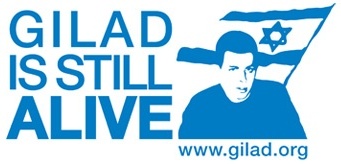


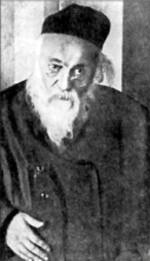



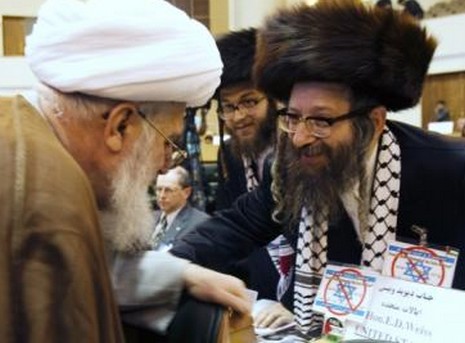


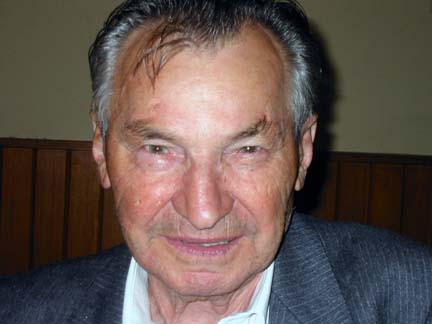

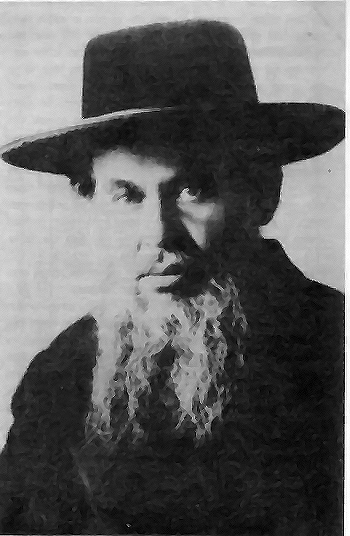

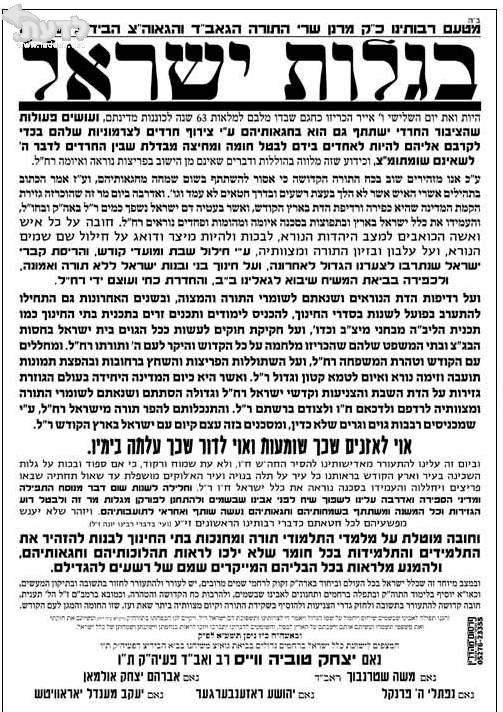


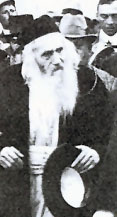

 is clearly a scholar and has tackled difficult issues, such as
  was in Melbourne last Shabbos. Rabbi Wolpe is a big Talmid Chacham but known for his very extreme Meshichist ideology and his uncompromising attitude to the return of any territories beyond the Green Line. There are many Chabad institutions who are wary of allowing him to occupy a pulpit because of the unpredictability of what he will say. In point of fact, Rabbi Wolpe roused the anger of the LR himself when he published a Meshichist treatise against the express wishes of his Rebbe.




 could do so by writing their names and any message or request they might have. It is not my intention in this post to enter a halachic excursus about אין דורשים על המתים. Let’s assume that what the girls were asked to do is acceptable from a Halachic ground (yes, we are well aware that the Rambam is opposed to such practices).




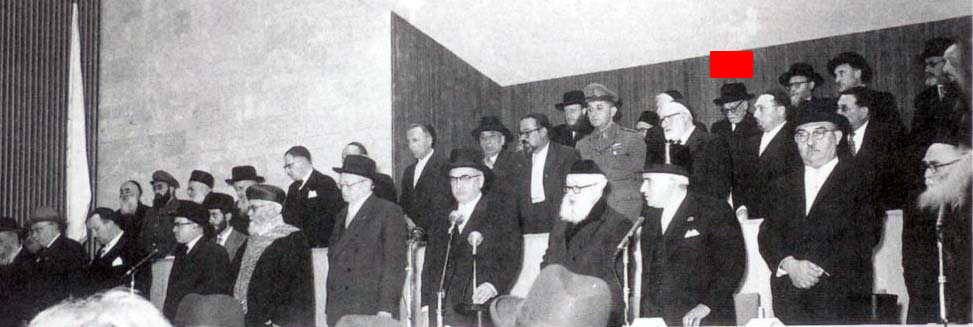
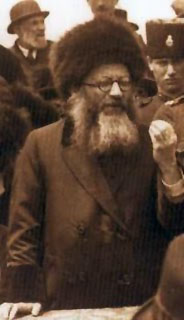

 They were powerful words. I gave the book to R’ Groner ז’ל as he was very excited to read it. R’ Groner, whom I miss greatly, was a walking encyclopaedia. He told me everything I wanted to know about Amshinov through to a vivid description of the size of R’ Shimon’s Shulem’s nose ז’ל 🙂 Subsequently, I told R’ Groner to keep the book, and I’m glad I did.
 pitputim
You must be logged in to post a comment.