Finally a sophisticated positive way to deal with חילול שבת

You don’t have to be Einstein to work out that throwing rocks, shouting shabbos, spitting, overturning Rubbish bins and every bit of meshugass the paleontological neanderthals  attempt to “increase holiness” is a complete ביטול זמן and serves to sever them more from the rest.

Here, is an approach I like. Hats off, as they say

The Admor of Amshinov, Rav Sholom Shimon Kalisch זצ’’ל

In another blog I was asked to post the picture by a commentator, but I can’t recall the article! Anyway, I have in our dining room a picture of the Rebbe זי’’ע. I just took a picture of it with my iPhone. He was very well-known. In Lubavitch he is known because the Rayatz instructed his Chassidim, when the Rayatz was in hiding from the authorities, and unable to respond to their questions to only ask R’ Sholom Shimon. In addition, at the wedding of the last Rebbe, R’ Sholom Shimon walked into the Simcha in the wee hours of the morning while the Rayatz was saying a Ma’amar Chassidus. He must have sensed R’ Sholom Shimon had come in, because in a very rare occurrence, he actually stopped saying the Ma’amar Chassidus until the Rebbe from Amshinov had sat down. In Amshinov, there is also a tradition which I have seen written, that says there is only one sefer that has to be learned to understand all Chassidus, and that is the Tanya of the first Lubavitcher Rebbe.

Interestingly, I heard Rav Schachter saying that a Scholar is now working on an important Sefer comparing the Tanya to the Nefesh Hachaim of R’ Chaim Volozhin, the prime student of the Vilna Gaon (who did not sign the Cherem against Chassidim). The word is that he finds the thoughts and approaches close to identical. I also heard the Rav (Soloveitchik) say this, although he qualified it by saying that the differences are advanced and he doubts many actually understand the differences. The Rav was unique of course in the sense that he knew both those Seforim inside out, and had been taught Tanya by his Lubavitcher Melamed when a boy (but that didn’t matter because the Rav had a superior intellect, as is well known).

As for me, I know nothing about either! The current Amshinover Rebbe in Bayit Vegan,  is well-known as one of the Tzadikei HaDor. He doesn’t get involved in politics, and is a truly incredible Oved Hashem. My only connection is a nostalgic familial one, because my grandmother, Toba Frimet Balbin ע’’ה (née Amzel), who I loved very much and was the engine behind the Balbin family, was from Amshinover Chassidim. She and my Zeyda Yidel are buried in Israel, and I still remember Rabbi Yitzchok Dovid Groner ז’’ל speaking about her before her coffin left from Essendon Airport. Rabbi Chaim Gutnick ז’’ל told me that she used to bring him a present every Purim. I never knew that, and he told me they were all around his house!

PS.  I got this picture from Chayi Glick (nee Rotter), whose mother I believe stems from Amshinov and whom I cajoled incessantly to bring back the picture from New York.

IMG_0773

Hygienic toilet flushing additives on Shabbos

As I generally do, I read the Heichal HaTorah publication, with sections from Rav Donenbaum, the respected Brisker Moro D’Asro of Heichal HaTorah on Friday nights. In last week’s section, he discusses the issue of the different types of toilet cleansers available on the market designed to keep the bowl/water fresh and clean. As I recall, the article started off with an assumption which I question, and which I believe is a key point in the analysis. Specifically, he assumes that a resultant colouring that may emanate from these solid chemical inserts adds to the hygienic “feel” of a toilet after flushing: Rav Donenbaum put the word hygienic in inverted commas.

My personal feeling, and I stress I am not a Posek, is that the colour itself adds absolutely nothing to any hygiene or feeling of such. In fact, from my perspective, it’s actually more of a divergence from the real state of the cleanliness of the toilet bowl as it serves to camouflage! I know many people who refuse to use it during the week because it’s horrid to look at, and really doesn’t tell you much.

If and when I go to a toilet, and the water looks crystal clear, I have far more confidence in the cleanliness, than when I see some dark blue (or other colour) water which may well be masking. Indeed, there are products that don’t have colour that are just as efficacious. Therefore, I would say that it’s hardly a situation of ניחא ליה based on ‘hygiene’ as Rav Donenbaum assumes and if you want to argue that it is ניחא or then go down a path of גרמא when it’s in the cistern then I’d say that in the least one should not make an objective ruling on an aspect which is entirely subjective.

The Halacha is clear. There is no prohibition in colouring food or liquid foods. This is the overwhelming opinion, as held by both the Mechaber and the Rama. Yes, it is true that the Sha’ar HaTziyun of the Chafetz Chaim says that someone who is punctilious should seek to avoid these situations. Others, such as the Aruch Hashulchan, Tzitz Eliezer, Chacham Ovadia and many more disagree and blankly permit it as noted in a footnote by Rav Donenbaum.

The same permission is applied to Molid Reach (creating a smell) especially when that smell is hardly lasting even if you buy a rolls royce version of such products. The cohanim used to use perfumed water on Shabbos when they washed their hands. This is an open Gemora (which I can’t remember the source of). Putting a smell on clothes or hair is a different category, because it lasts. A Melocho that doesn’t last, is considered by Rishonim and Acharonim as not a Melocho.

There is some discussion about the different types of devices and certainly the ones where the chemical device is placed in the uppermost bowl is argued as less problematic, as the water is already coloured, and it could be argued that one doesn’t care about what happens next and it is Gromo, rather than an intentional colouring. I am not sure that this argument is correct.

I don’t believe that the colouring serves the purpose that Rav Donenbaum is working with, namely, to give the feel that the bowl is now “hygienic”.

As a musician and frequent traveller, I have been to many putrid toilets in hotels and function rooms, where the water in the bowl is a “fresh” blue or green. I have never felt it cleaner simply because of the colour. They are often foul and stink. One might argue that if hygiene and smell was an issue, then using a toilet brush is the way to go, followed by another flush (I assume that Rav Donenbaum permits flushing toilets, although some Poskim are against it full stop).

If my memory serves me correct, some Chazon Ish types prefer to line the bowl with cotton wool so no “noise” is created (or is that one of those apocryphal jokes?)

I discussed the matter with Mori V’Rabbi Rav Schachter who felt that it was not permitted but for the simple reason that it is ניחא ליה whether it’s in the cistern or below because the colour shows whether the device is still working and hasn’t lost it’s efficacy. When one sees the colour fade, one knows they have to replace it.

I asked Rav Schachter whether I should speak to one of the companies, such as Harpic, and ask them why their blue module colours the water blue and to use the argument of מסיח לפי תומו and he said this was a very good idea. I went to the harpic site and lo and behold they stated explicitly

Let’s you know when it needs replacing by fading

Accordingly we see this mentioned explicitly. There is no doubt in my mind, that a chemical doesn’t have to be blue (coloured) to deodorise and kill germs and emit a pleasant smell. The primary purpose is to tell you when it needs replacing and is therefore forbidden. Rav Schachter mentioned this was different to a cup of tea, where the colour and colouring is immaterial.

Of course, I haven’t paskened in any way, I have quoted from my personal discussion with Mori Rav Schachter. תורה היא וצריכים ללמוד

Farewell Rabbi Yaakov Sprung

Please note: there will be no comments on this post.

I am not a member of Mizrachi. I used to be, about three decades ago, and my Rav was the saintly Rav Boruch Abaranok ז’’ל. Rav Abaranok was a Tzadik Gamur. He wasn’t a Beinoni. He was the real thing. He received his Smicha from the Chafetz Chaim and was friendly with Rav Elchonon Wasserman הי’’ד. He didn’t wear a Kippa Sruga (knitted yarmulka) and wore a dark suit and homburg hat. He wasn’t a great orator, but his words in a one on one situation, penetrated the heart more than any orator could achieve. He was also a staunch zionist, and supported the State of Israel in a genuine fashion. I have written about him here. When he paskened, he would subsequently invite you to come the next day or that night, to his office or home, and have all the Seforim open and prepared, and would explain from inside how he had come to his Psak Din.

Our son, Tzvi Yehuda, now famous for his incredible and successful chasing kosher side venture, was fortunate to have Rav Abaranok as his Sandek. I remember being flabbergasted when he arrived at the door for both the Bris and subsequent Upsherin, each time carrying a gift of Seforim. Our younger son, Yosef Dov who is learning in Israel presently, was also lucky to get a set of Seforim from Rav Abaranok ז’ל.

On Shabbos he wore a black litvishe kapote much like the dress of the Ashkenazi Chief Rabbis of Israel.

I used to bring our children (two back then) to Rav Abaranok almost every Sunday morning. His children and grandchildren were all overseas, and his wife nebach, was with him but not 100% due to her horrid experience in the Holocaust.

Rav Abaranok became very sick after a fall (as I recall). I had a strange sense that he was about to leave this world. It was too difficult for me to absorb emotionally, so I started visiting less often. He would ask me, if he saw me, “Yitzchok, what did I do. Why don’t you come anymore?”. He never realised that I couldn’t cope with seeing him slip away.

On his first Yohr Tzeit, I went and stood outside his house (which is no longer there) and just cried.

While he was still at Mizrachi, the community decided to appoint a new Rabbi. I stopped going because my father ע’’ה asked me to (the reason for which is immaterial to this post)

That Rabbi was replaced by the recently deceased and well-known, Rabbi J. Simcha Cohen ז’ל. Many members of our family still daven at Mizrachi and my brother-in-law is now the President. I was fortunate to have occasions to interact with him. My interactions were always of a Torah/Halachic nature and I enjoyed speaking “in learning” with him. He had a pleasant disposition and was a professional American style Rabbi with lots of grandeur.

Rabbi Cohen eventually left (I believe of his own accord, but I can’t recall), and was replaced by Rabbi Sprung.

Rabbi Sprung will complete 10 years of Rabonus at Mizrachi in August. I went to his home every Purim (even though he stopped serving scotch after the first year :-), and we shared divrei torah and halachic discussions. On one occasion, when there was an  injustice in the community, he was the Rabbi who was prepared to stand up, by ringing overseas, properly ascertaining facts, when he could easily have avoided the issue. He made a difference.

My wife loved his Shabbos Shiurim, and went every Shabbos to hear these. She said that he put so much preparation into each Shiur. He seemed to always be giving Shiurim. He went from minyan to minyan at Mizrachi and gave droshos. He enjoyed good relationships with the Roshei Kollel of Mizrachi’s Kollel and other Rabbinic staff.

His pastoral support was incredible. He would visit the sick, comfort the mourner or the forlorn, and his door was open. Recently, one post was perhaps too revealing about my state of mind. He doesn’t read blogs, but someone had mentioned it to him. On the next morning, I got a phone call wherein he expressed concern for me, and stressed that whenever I needed or wanted to discuss anything with him, to do so, and that his door was always open. My father ע’’ה was in hospital several times. Rabbi Sprung always visited him amongst many others. I know my father greatly appreciated Rabbi Sprung’s visits. He was in fact the only Rabbi to visit him.

Rabbi Sprung on the far left. [picture from melbourne eruv website]
On Simchos (Smachot if you want to use Ivrit) he would meticulously prepare by interviewing everyone, and then weave a wonderful Drosha where he paid tribute to the attributes of the Ba’alei Simcha and their families. I heard such Droshas many a time. We invited him and his Rebbetzin to our own Simchos, as I considered him a Choshuve Rav with whom I had developed a relationship.

Mizrachi is not like other Kehillos. There are a lot of “leaders” of other organisations who are highly opinionated who daven there as well as many highly educated professionals and “machers”. Rabbi Sprung’s fidelity to Halacha was unquestionable. He wasn’t afraid to state his firm halachic view on a range of issues, including those who led services at the conservadox Shira Chadasha (an identical view with which Mori V’Rabbi Rav Hershel Schachter agrees). These types of issues may have made him be seen as too “right-wing”, but I can’t know that with certainty. I can only describe my interaction. Perhaps Mizrachi will now employ a hatless, Kipa Sruga type. Time will tell.

Towards the end of his Rabbonus contract in August, Mizrachi decided that it would only extend the contract after a democratic vote of all members. I can’t recall whether they had a democratic vote to appoint him, but I do recall there were a few candidates. One can surmise that after 10 years in the role, some no longer appreciated what he offered.

I am sad to see Rabbi Sprung’s tenure at Mizrachi Melbourne come to an end. Knowing him, he will see it as Hashgocho (divine providence) and depart as gracefully as when he arrived. I know he was widely respected by the Melbourne Rabbinate, and he avoided politics when  possible. I’m guessing Rebbetzin Naomi Sprung may feel somewhat blessed that she has an opportunity to relocate to an area closer to her children and grandchildren. Melbourne, isn’t exactly close by, and to be dislocated from family would be a strain for anyone.

I wish Rabbi and Rebbetzin Sprung immediate future success, together with lots of Nachas and joy.

We now wait to see who the (democratically elected?) new Rabbi will be.

Rebbetzin Bashi Twersky speaks

In a earlier blog post, I felt that we need to be more nuanced in the way we express our opinions on why God allows/does things. One of the Seforim I learned back in days gone by was ספר העיקרים by one of the Rishonim, Rav Yosef Albo. It “spoke to me” at the time, and I used to learn it during Mussar Seder. I remember the Mashgiach noticed what I was doing, but he (sensibly) “let me be” and learn what my heart desired. He said nothing. I don’t know if they have reprinted this Sefer, but my original one seems to have gone walk about. If I remember correctly, it was in the second perek where he wrote a phrase which has stuck with me since

לו ידעתיו – הייתיו

If I knew Him (God), then I’d be Him.

In other words, attempts to know exactly why, are axiomatically impossible.

That doesn’t mean to say that one can’t surmise, one can’t draw lessons, or one can’t initiate a Drush. But, one can’t say this is why X happened, unless God himself, or a Navi is commanded to tell us.

I think her point below is excellent and salient. Some would say I’m even guilty of promoting it, which may be true, but isn’t and wasn’t ever my intention. My only quibble with what she says relates to the cause/effect nature of her statement which implies that we know for sure.

Again, I do not disagree with her point. She is clearly an intelligent lady. This is a snippet from the Jerusalem Post

Bashi Twersky, the widow of Rabbi Mosheh Twersky – who was killed in the Har Nof terrorist attack last week – said the internal divisions within the ultra-Orthodox community that have developed over the last two years were the (my emphasis) reason why her husband and three other members of the community died in the brutal incident.

Speaking at the mass prayer rally and ceremony held in the Jerusalem neighborhood on Tuesday night for the end of the shiva mourning period for the victims, Twersky said the dispute had become increasingly acrimonious over the last year in particular.

She was alluding to the establishment of a new political movement and party that is in competition with the traditional Degel Hatorah non-hassidic haredi party.

She said that the attack had been particularly brutal, and asked how such a death could befall those praying in synagogue, “how did the sanctity of the synagogue and prayer not defend us,” she asked.

“The fire of dispute has been burning among us for a year now, and this dispute became terrible, and every day it gets worse.”

“Someone who listens to a great rabbi different from the one I listen to, someone who belongs to a different camp from me is commanded to be cruel to them, is commanded to humiliate and disgrace them, to harass them with terrible brutality.

“When we behave with cruelty to our brothers, God sends a punishment with cruelty, measure for measure.

“In synagogues and study halls they persecuted, disgraced and humiliated those who think differently from me, and therefore we were struck by the attribute of strict justice in a synagogue at the time of prayer,” the rabbi’s wife said.

She added that strengthening religious observance, as has been advised by many rabbis, was not a good enough reaction, and that rather a “drastic change” was required.

Being a Shaliach for Bircas HaGomel

This question came up for me recently. Note, unlike a Bircas Hanehenin which is optional in the sense that it only comes to be if you want to benefit from something, this is a Bircas Hanehenin that is a Chiyuv, It was about someone in a car accident and his mother (in Israel of all places) begged me to be the Shaliach for Bircas Hagomel. Whilst this appears to be against the Rama, and I have looked a little, a few local Rabonim replied in the negative immediately. I have seen some contrary opinions but alas haven’t studied them in enough detail (yet) to feel confident about them. I have asked Rav Schachter but I’ll need to ring him, as I have a few unanswered questions. Has anyone come across this one. It’s different of course to the husband and wife situation if one uses the argument of אשתו כגופו but I note many women had and  have the minhag to say it themselves anyway (either with a minyan in their house — I think it’s a peculiar minyan which has to have two Talmidei Chachomim) or they say it in Shule from the women’s gallery provided it’s not a Chassidic or neo-Litvak Shule of today. Some women, for a Bris,  say it at the Bris.


Mesora and Psak: How it may differ between Chassidim/Mekubalim and others

The closeness to Mesora has always been primary. Halacha LeMoshe Misinai is immutable. Torah Shebaal Peh as written is a record of Mesora including contradictions and attempts to disambiguate and show through the Midos SheHatorah Nidreshes BoHem, including Sevara (which isn’t listed but is clearly a Midda as testified by the Gemora in many cases). As time advanced through Tanaim, Amoraim, Geonim, Rishonim we move to latter generations known as Acharonim. To be sure, there are some Acharonim, who on occasion would argue with Rishonim. Two well known examples are the Vilna Gaon and the Rogachover. They were guided by what they felt was Emes L’Amito.

When it comes to Acharonim, there  are those, depending on which group you align yourself with, who are considered “the last word” and there are others, such as the Chazon Ish in respect of electricity where everyone seems to be Chosesh to some extent to his opinion. That being said, others will say he was an Acharon in B’Nei Brak and if he was your Rav and/or you lived there you need to follow his Psokim.

The Brisker Shitta, is different. Whilst they are beholden to Beis HoRav (Volozhin/Soloveitchik) they were never afraid to disagree with each other. Of course, there is a group that follows every word of Reb Meshulam Soloveitchik, son of the Griz (Uncle of the Rav) in the same way that Chassidim follow their Rebbe. He’s just not called a Rebbe, and he doesn’t fir tish etc.

We saw that as a Posek became more recognised, people came for Brachos. Some were averse, and others would give a general Brocha to be Yotze. I sensed this from Videos of R” Shlomo Zalman.

The Rishonim (and here there is some difference amongst Ashkenazim) and certainly Sephardim, are untouchable. If you want to innovate=bring something consonant with Menorah you need to bring a Rishon.

I remember well, some 40 years ago when my zeyda bought a copy of the Meiri. At the time it was very controversial. Beautifully put together, it was ignored somewhat for years. Now, it seems nobody has a problem quoting a Meiri. The Meiri was a Bar Mitzvah present for my cousin Ya’akov Balbin and while it sat in my house for many years after he went on Aliya, I sent it to him at his request.

There have been plenty examples of Ziyuf. There was the fake Yerushalmi on Kodshim, and more.

The common denominator was that to qualify for Psak,  especially the style of Psak (especially Hungarian) where one joins different Kulos, you had to have a Rishon (or early Acharon who quoted a Rishon given that some had access to Rishonim we don’t have, or a Girsa we don’t have.

There are stories where the Rav’s Talmidim, would say but Rebbe it’s an open Maharsho that contradicts your Pshat. When he was younger, he angrily banged the Gemora and said, “and I’m not an Acharon”? This was not haughty. This was what he felt. He felt his Pshat was more correct than the Maharsho and was ready to debate it with anyone.

Many Acharonim either didn’t own, or look at other Acharonim. That’s not to lessen their importance. But, it’s a derech.

Where Chassidim/Mekubalim are different, I feel is that they would consider that when there is no clear way forward or where there are different views, Kabbola, whether from the Zohar or Ari on occasion trumps and guides the Psak. A pure non Chossid/Mekubal would note such opinions but would be less likely to PASKEN based on them.

Do people agree with me or have I over simplified. Drush is another class. One has license to extrapolate and certainly doesn’t need a Rishon to find a nice Pshat.

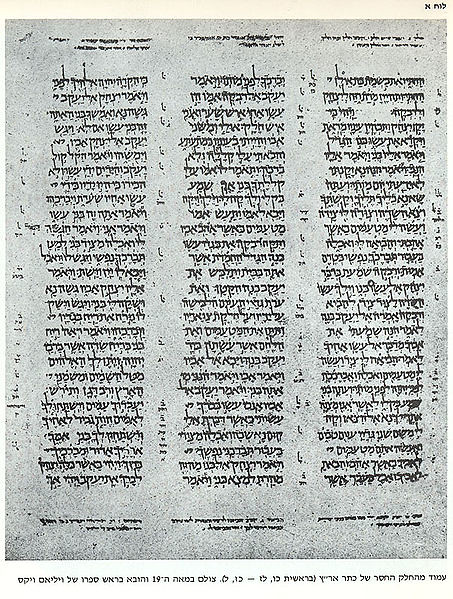
Aleppo Codex - Genesis

Rabbi Riskin on the conversion issue

[Hat tip MD]

Original in hebrew is here

Rabbi Riskin: Haredim are the greatest reformers

Rabbi Shlomo Riskin came out strongly against the ultra-Orthodoxas a result of their opposition to the law, saying “The Haredim are the greatest reformers. Justifying only one way is to Catholicism and the Pope”

Rabbi Shlomo Riskin, Rabbi of Efrat and founder of Ohr Torah Stone institutions, has slammed the haredi opposition to the law after the conversion  waves on Israel Radio. “I do not understand the thing. Yes, I  there is a commandment of “love the convert. “Yes, I think that the Chief Rabbinate until now did not know what it means is to convert properly with love and care. How do they have the audacity to say the conversions I perform are not in accordance with  Jewish law? “said Rabbi Riskin.

“Their behavior regarding conversion law is contrary to Halacha. Unfortunately, the Haredim are the greatest reformers, on many  things. Including enlisting in the IDF, because there is no section in the Talmud, where it says there Torah in respect of the laws of saving people’s lives in action. There is room for dissenting opinion in Judaism. One who claims there is only one way this is not not Judaism, but Catholicism and the Pope. ”

“The government has taken a bold step in favor of the unity of Israel, a move that will prevent a split into two peoples: Jews and Israelis,” said Rabbi Riskin. “I hope the Chief Rabbinate understands that we, city rabbis, are completely dedicated to Halacha and as in all generations there were dissenting students of Hillel and Shammai offering a different interpretation. We unite and will not split, we will talk and not boycott. This is about the lives of human beings and the future of our people.”

On the Aruch Hashulchan

A reader asked me what “caused” the Aruch Hashulchan not to remain the primary acharon for Psak, arranged according to the Shulchan Aruch but then be “overtaken” by the Mishna Brura as a source for final psak by many. (Mind you they don’t accept the Mishna Brura on skirt length and more, even if they accept him for Hilchos Shabbos)

This is largely due to the Hungarian Charedim.

They couldn’t accept

  1. His Psak that it was permitted to say Krias Shma in front of woman with revealed hair because today such a thing no longer titillates a male
  2. His Psak that Dina D’Malchuso Dina, following the laws of the land, especially vis-a-vis Mesira, are not germane because in many cases we live in a Malchus shel Chessed.

Of course, number 1 is factually true unless one is hermetically sealed. Unfortunately, number 2 is not only factually true but is the problem with today’s society in fearing going to authorities over especially heinous crimes and is infamous. There are those who want to claim that the Aruch Hashulchan was forced to write as in 2. to assuage the authorities and avoid the censor. I don’t know. But I do know, that if you live in a Malchus Shel Chessed, you have no excuses.

I like the Aruch Hashulchan very much because he starts with primary sources and for a very much part time learner like me, that is helpful.

The Mishna Brura has some issues which many still won’t acknowledge: it wasn’t all written by the Chafetz Chaim. Some sections were written by family, who openly acknowledge they didn’t agree with the Chafetz Chaim and therein is the source of some contradictions in the Chafetz Chaim. I have seen tomes trying to reconcile contradictions in the Chafetz Chaim, but they failed to realise that it was from two sources!

The Shulchan Aruch HoRav, who mainly basis his Psak on the Magen Avraham, is a masterpiece of prose. It is a pleasure to read and every word needs to be weighed carefully. Furthermore, he doesn‘t always pasken for Lubavitch, although he follows the Kzots and not the Gra in respect of shiurim and the like. His Siddur will often say what is for Lubavitch. The Chafetz Chaim has a strange habit of not quoting Shulchan Aruch HoRav in many instances for some reason, even though he easily outweighed those Acharonim who were quoted.Then again, I don’t know who is  responsible for that.

As a more modern sefer, I do like the Shearim Metzunoyim B’Halacha, and I bought it 32 years ago. I understand he’s a relative of Rabbi Braun, formerly of Tzemach Tzedek in Sydney and now on the Beis Din in Crown heights. He wasn’t a Lubavitcher. The Kitzur remains an essential part of anyone’s library.

The Chayei and Chochmas Adam are good but a little too brief for me and seem to have parts missing.

In a nutshell, that’s my answer to the reader. By the way, you can find Aruch Hashulchan online, re-typeset.

For Sephardim, it’s another matter. You have the Ben Ish Chai or you follow Rav Ovadya as in Yalkut Yosef.

And, anyone who doesn’t know, do yourself a favor and download the free ובלכתך ודרך from the Apple Store for your iPhone or iPad (you have to type it in Hebrew). It’s great. I know it sits on my iPhone but haven’t got a clue about Android.

Finally, while I have no affiliation with Rusty Brick, I like their products. They cost a little, and are vastly superior to the free versions of various things available from Lubavitch web sites. It’s important to support software companies who are trying to write good things of use!

Rav Schochet – prominent Chabad rabbi – bans Telushkin Book For Heresy Content

If there is one thing that any chossid or reader of the works and episodes of the last Rebbe זי’ע is that while he was firm and unwavering, his responses during yechidus were often unexpected. There is a need for a person to imagine how is Rav HaMuvhak would have behaved, but once you get into the realms of the greats, you are a brave man extrapolating from the general to the particular. This is what Rav Schochet and many others do. They are well intentioned but in my opinion show disrespect by double guessing their Rebbe. Based on Schochets comments below we could never have seen the wonderful interchange between the LR and a reform rabbi who wrote 9 1/2 steps which the LR ALLOWED him to publish. I say take a step back and remember to be מקבל the אמת from whoever tells you. If he has problems with certain views or assumptions then let him state these; he otherwise falls in the category of the ubiquitous protests stuck on the walls of Yerushalayim which not many pay attention to.

Here is the article from CHABAD.info

Make up your own mind. I found the book excellent. I think that calling Telushkin out in this way achieves zero kiruv.

In a letter written a few weeks ago, Rabbi Gershon Elisha Schochet, Av Beis Din of Toronto, asks Rabbi YY Shusterman, Rov in Beverly Hills California, if he permitted the reading and disseminating of the Telushkin book.
After a response was not forthcoming, he chose to publish the letter:
I have heard a rumor, that you have supposedly approved the book of Telushkin, and additionally, you have ruled, in your capacity as a Rov More Hora’ah for Chabad, that Shluchim should encourage the distribution of the book.
I am sure you are aware of the Rebbe’s opinion prohibiting the use of books which were written by unscrupulous individuals, even when there is no inherent problem with the content of the book. And the Rebbe held the same regarding books which only referenced such publications.
Also, you are surely aware of the Rebbe’s extensive correspondence regarding the Conservative movement, it’s “Rabbis” and leaders – that the Halacha is they are considered heretics.
You are surely aware of the famous ruling by Rabbi Moshe Feinstein, that a Conservative “Rabbi” is not trusted for testimony in Jewish court just by the mere fact that he is affiliated with said movement, and he doesn’t need any prior warning before being disqualified…
Regarding the author, Telushkin – there is no need to do any research, for it is clearly known to anyone who searches the internet that he serves as a “Rabbi” in a Conservative temple, where a woman serves as a “Chazanit” and his assistant “Rabbi” is from the Reform movement,
Although this would have been enough for someone who is a G-d fearing Jew, and even more so for a Chossid of the Rebbe, and even more so for one who presents himself as a Rov who rules according to the directives of the Rebbe – to completely prohibit the above book.
More so, in this case (without even discussing the issue of the author), when many people who are considered G-d fearing Jews, and known around the world as smart people who are busy with spiritual issues (I am not talking about those “leaders” who are well-versed in politics, PR and monetary issues) – have said that the book has some terrible ideas which constitute a Chilul Hashem, so much so that anyone who has any inkling of a connection to the Rebbe, and more so if he has an iota of Hiskashrus, would immediately denounce this book.
I therefore turn to you and ask you, in the name of Anash and their descendants which are here and those that will come, that you please tell me that this rumor is a lie, and there is no inkling of truth in this matter.
If G-d forbid there is some truth to this rumor, I demand you tell me what the reasoning behind your ruling is, and if you made your decision independently or after consulting with other Lubavitcher Rabbonim and Mashpiim, and tell me their names and reasons.
With a blessing for a Ksiva V’chasima Tova,
Rabbi Gershon Elisha Schochet

Blotting out women

I have a little “shiur” each Sunday with my grandsons. I looked for a set of books which were considered better than “little midrash says”. Short enough to keep their attention and informative. It’s been fine, and I notice that the pictures are a great incentive for their concentration.

One grandson today, after I mentioned that Sarah was hidden in a box by Avraham, (Sorai, Avram), asked me “where is Sarah”. I said she’s in the box in the illustration. He persisted but where is Sarah. There are pictures of Avraham, Moshe and Yehoshua etc and admittedly the illustrators tended to not show faces of these people, but it dawned on me that women seemed to have disappeared from every Parsha as far as illustrations were concerned. Now Sarah was good looking. That’s why she was hidden. That’s essential to the story. How you capture that in an illustration is not my problem.

The solution however is heavy-handed. The other ridiculous aspect is that everyone seems to have peyos. From where  do they know this? Ironically the evil people during Noach’s time, look like common criminals in our time.

I’m very strongly attached to the truth. That doesn’t mean to say that one needs to breach Torah Law to tell the truth or draw the truth. They did illustrate idols, ironically! It reminds me of wedding invitations where the female is lowered to the level of רעיתו and her name has disappeared into thin air. Let me note, that R’ Chaim Brisker (Soltoveitchik) signed his son’s wedding invitation as

Chaim and Lipsha Soloveitchik. He didn’t even call himself HoRav, even though he was undeniably one the Torah geniuses of all generations.

Picture from vos is neias

Tamar Ariel: an inspirational humbling young lady

I’ve struggled with understanding the myriad of Israelis who after their army service make their way to Nepal, and India, then sometimes down to Australia. Nepal and India have their significant risks. I’ve only been able to understand it in terms of a need to “come down” from the psychological experience of being in the army. In this regard, I think that whilst having Chabad Houses to support these Israelis is great, the IDF needs to do lots more to develop their post IDF program, especially given the spiritual vacuity that so many seem to experience as soon as they are confronted with life after training and/or combat.

Tamar Ariel is a hero though. I don’t know why she went to Nepal, and I don’t fit her shoes so am hardly in a position to proffer opinion, but a frum girl, who was a pilot, wore a skirt to her ankles, didn’t even shake hands with commanders, is someone who had much more to her than the Chitzoniyus of Tznius. This was a lady who internally was probably more modest than her external fidelity to Halacha. She was one of a kind.

יהי זכרה ברוך

Tamar Ariel ע’ה (picture from Yediot Achronot)

The article can be found here, by Mitch Ginzburg. I reproduce it below.

Cpt. Tamar Ariel, Israel’s first female religious air force pilot, a rear-seat, F-16D navigator, was buried on Tuesday, several days after she died high in the Himalayas. Hundreds of people, including dozens of IAF pilots and commanders, accompanied her on her final journey. Ariel was 25 years old.

She loved motorcycles and fighter jets and wore an ankle-length skirt to her IAF Flight School graduation in December 2012. When Maj. Gen. Amir Eshel, the commander of the air force, came down the line of new graduates, he nodded her a greeting, rather than clasping her hand; she nodded vigorously in return and beamed him a smile.

She was a modest and unassuming woman who resented being put on a pedestal. Her aunt, speaking over her grave, said that she did not want to pose for the photo op with Prime Minister Benjamin Netanyahu at the flight school graduation ceremony because she felt it overshadowed the achievement of her fellow pilots. And though in her life she went to great lengths to state that she was not a role model, she will likely be remembered as such by many in the modern Orthodox community in Israel, which is split by the competing values of army service for all, particularly among the younger generation, and the deep-seated social conservatism that spurred rabbis to press the state, since its inception, to grant all religious Jewish women the right to bypass army service with an oath of Orthodoxy.

Ariel was raised on a cooperative farming community, Moshav Masuot Yitzhak, in a home on the edge of an avocado orchard. She was the third of six children, born to a father who was second generation on the moshav and a mother who made Aliya from Puerto Rico, Yedioth Ahronoth reported in 2012.

She went to a co-ed local school as a child and to an ulpana, or yeshiva for girls, as an adolescent. In 11th grade, she received her first army summons and was found suitable for flight school. After taking several preliminary tests, she decided, in 12th grade, to fall in line with what most of the ulpana girls were doing – national civilian service. “I was afraid of ‘becoming rotten’ from a religious perspective,” she told the Yedioth daily. “I thought that serving within the framework of religious institutions was more protected and safe in that regard.”

She stated that she was Orthodox, received an exemption from army service on the spot, and served for two years as a Bnei Akiva youth leader and a counselor in her former school.

Upon completion, she decided that she still had not fulfilled her potential and turned back to the army, rescinding her earlier statement. In April 2009 she passed the week-long physical exam and was accepted to the prestigious course.

Nighttime navigation drills, when paired off with a man, were awkward, she said, but not “something that anyone dies from.”

After several months in the course and after being placed in the combat fighter section of her class, she flew her first solo flight. As she lined up the landing, wheels already on the tarmac, she felt that she was losing control of the plane and that it might spin off the runway. She pulled the eject cord, according to protocol, was rocketed skyward, and broke a vertebra in her back.

After months in an elastic body cast, the army took her back to the course but moved her into the navigator track.

In December 2012, she graduated, making history. “I don’t think that women need to go to flight school — I think that they can,” she told The Times of Israel at the time. “I recommend that any woman, religious or not, give it a shot. If they call you in, if you pass the tests, it means that the army thinks you can do it. So go ahead — try.”

During Operation Protective Edge this summer she flew the most combat missions in her squadron, her commander said earlier this week.

And then, seeking some R and R, she went, along with another pilot, to vacation in Nepal, to walk the Around Annapurna circuit at what is considered the optimal time of the year. “I didn’t worry during the trip to Nepal,” her mother, Anat, told Army Radio. “The trip was planned to the minute and I had faith in her and in The Holy One, blessed be He.”

Last week, though, a highly unusual storm blew through region, pelting the high mountain passes with snow. Ariel and dozens of other trekkers encountered the brunt of the storm on the Thorong La pass, the highest point on the circuit. Sapped of strength by the altitude and the cold and the fast-accumulating snow, Ariel could no longer walk as afternoon turned to evening and the clusters of trekkers tried to make their way down from the pass to safety.

She died in the snow along with Agam Luria, Nadav Shoham, Michal Charkesky, and 36 other people, half of whom were Nepali.

“You became a public leader,” moshav rabbi Meir Nehorai reportedly said at the funeral, “the object of admiration from all around.”

That admiration is likely to endure and to serve as a beacon to many young Orthodox women charting their path in life.

Shmuley Boteach’s confused understanding of the Jewish World

The (I’m advised sincere) but confused article by Shmuley Boteach should not remain without counter-comment.

I will copy his article below and intersperse my comments.

The magnetism of Chabad messianism

Messianism is the world’s most powerful idea, humanity’s most compelling vision.

Messianism, which presumably is a word used because it over-focuses on WHO may be the Messiah, as opposed to the condition of the world at such a time, is not the world’s most powerful idea nor humanity’s most compelling vision.

The redemption itself, but more nuanced than that, the condition extant at the time of the redemption are a vision which we pray for three times a day. The days when the wolf will live with the lion, and the temple and it’s influence of unity and concentration and holiness are the reality, not vision, which Jews pray for every day. I do know that there are multifarious views of other religions now. I am not terribly interested in these, except in as much as דע משתשיב

Not only is it the underpinning of the world’s most populous religion, Christianity, it is also the engine for human progress itself.

If Jesus is the underpinning of the world’s most populous religion, that person (as opposed to the euphemistic messianism) then that is what it is. It is no more than that. If it means that people act in a certain way, which can be considered moral and ethical, and most importantly not missionary, then that is good. There is no evidence in Boteach’s statement that it is the engine for human progress. This is a statement without a presentation of any illustrative proof.

Only through a belief that history is not cyclical but linear, that positive steps in human advancement are cumulative rather than short-lived, that as a race we can step together out of the shadows and into the light, can there hope for collective human progress.

There are some mixed metaphors here. History is indeed cyclical. Boteach’s mistake is that if one proceeds in a circle, one cannot increase energy. This is of course demonstrably wrong. It is as wrong as assuming that one who travels in a line, is “growing”. They may in fact be dying, and reaching their end point.

Boteach again uses the term progress. He calls it “collective human progress.” He has not, however, seemingly made any effort to define what he means.

It is therefore fascinating to witness – once a year – the tremendous energy unleashed by the Chabad messianic movement as it congregates and detonates at world Chabad headquarters in Brooklyn.

Having never been there, I have heard that it certainly used to detonate a special extended holiness, however, anyone who has been in the State of Israel, and experienced Succos in Jerusalem, Hevron and the surrounds cannot help but know that they are actually on holy ground, enveloped by a sweeping holiness. that is unleashed and detonated. The same can be said for the “second hakafos” in Israel. That being said, I would posit that even Boteach acknowledges that Brooklyn now, is not the Brooklyn of 25 years ago, and the shining star that illuminated that section of the world, is sadly in another place. There is now much binge drinking where people either drown their sorrows or try to reach moments of detached ecstasy as a substitute. In Melbourne, I haven’t heard a good farbrengen, for example, since Rabbi Groner and those before him departed. Let me know where one is, and I’d love to be enthused by an outpouring of the Torah of Simcha.

The Jewish festival of Sukkot brings together two very different strands of the global Chabad movement. On the one hand, there is mainstream Chabad comprised of residents of Crown Heights – the global hub – together with the worldwide network of Chabad emissaries. Their strength is their professionalism, dedication, and impact.

On the other hand there are the Chabad messianists, a minority to be sure, but vocal, visible, determined, and brimming with life.

Here I assume Boteach defines a Chabad Messianist as either a chanter of one line mantras, or one who imagines he is receiving wine from nobody, or perhaps one who refuses to believe there is a filled grave. It would be helpful if Boteach defined his terms. There are many silent ones who pine for redemption. Some will internally hope that by some Divine rule it will be their Rebbe. Others (a very very small minority) will think this issue of identifying the Messiah, is actually a thorough and useless waste of time. I assume he speaks not about the elohisten.

Mainstream Chabad is uncomfortable with the messianists, believing they give both the movement and the Rebbe himself a bad name. The messianists are millennial, apocalyptic, and, to many minds, irrational. They want to push both Chabad and Judaism into the end of days.

I don’t see them as irrational (but note, I don’t know which category Boteach refers to). I see many of them as post-justifiers. They will cut and dismember Jewish tradition as espoused by the Rambam and acknowledged by the rest of Jewry. Those who think there is nothing in the grave, need psychiatric help.

But there can be no denying that they have tapped into an energy source that appears near infinite.

I do not know what “near infinite” means, let alone in this context.

When I was a young Chabad student in Crown Heights what I remember most was the limitless energy we all experienced in the Rebbe’s court. On Sukkot we could dance nine days running without tiring. We could go for a week with barely any sleep. The Rebbe – then in his eighties – set the pace with superhuman strength and inexplicable vigor.

Although I was not and am not a Chabadnik, I agree, based on the books I have recently read and some videos that I have watched, that it would have been an experience to remember.

That was more than twenty years ago.

Since then, Chabad has conquered the world and gone mainstream, sprouting educational centers in every point of the globe. My wife and I recently spent Shabbat with Chabad of Korea right after I spoke at Seoul’s Olympic Stadium at a global peace summit. A few weeks earlier I had spoken at Chabad of Aspen, Colorado. The local Chabad centers in these two very different places had in common the outstanding young Chabad rabbis, true soldiers of the Jewish people. Watching their impact on their respective communities was inspiring.

I think that Chabad has sprouted and grown, but I don’t know about conquered the world. If there was one word that I was left with after reading the three recent books about the Lubavitcher Rebbe, it was either the word dedication or positivity. I think Chabad has influenced many in that direction.

But for all that, Chabad today – as a movement that has now gone mainstream – has learned to eschew controversy. Gone are the days when Chabad agitated for the territorial integrity of the State of Israel and public stands against trading land for a fraudulent peace.

Those days aren’t gone!?! I hear this message constantly and unwaveringly today.

Gone too are the Chabad emphasis on messianism as being central to Judaism and the Jewish future.

This depends on the Shaliach. Some have adapted to their clientele while others will unwaveringly soldier on with the original message in all it’s vigour and yellow paraphernalia.

Chabad today is effective if not conventional, essential if not somewhat predictable.

It is predictable because it is a continuation of a message. There is no more central figure to initiate new ideas that are to be brought to the world. That is sad; but true. At the same time, there is an enormous corpus that may be applied to today’s world, without change.

Its focus: opening nurseries and day schools, synagogues and mikvehs, looking after special needs children (Friendship Circle) and the elderly, running Sunday schools and day camps. And to quote Carly Simon, nobody does it better.

This is also necessary for the mainstream. Jews are abandoning Shules. The latter can’t survive. They must generate income from nurseries etc simply to survive financially!

It is to this side of Chabad that I adhere and this vision for the building of Jewish life that I am dedicated. Chabad justly evokes in every Jew on earth a feeling of both awe and gratitude.

Which side exactly does Boteach not adhere to? Those that yell Yechi, or those that think it, or someone else?

Without Chabad the Jewish world would be up a creek without a paddle.

I don’t second guess God, nor do I know what he would have done, but there can be no doubt Chabad’s influence has been very significant.

But even as someone who prides himself on his rationality,

I do not know how a Chabad Chossid prides himself on rationality. My understanding is that there is higher level, called Bittul.

I cannot help but be somewhat jealous of the go-for-broke mentality of the other side of the movement, the messianists. The belief that humankind can attain an age of perfection, a belief that Judaism has a global, universal vision that is not limited to Jews, a dismissal of money and materialism in favor of a purely spiritual calling, and placing faith in a great leader who prompts us to embrace that era.

I am not jealous of them. Those that think that they have a minyan with two people and eight pictures, or eat on Tisha B’Av have broken with Jewish Mesorah. If Boteach is saying that he admires their perspicacity, ok.

To be sure, I follow the ruling of Maimonides that the Messiah must be a living man who fulfills the Messianic prophecies which rules out anyone – however great – that has passed from this world without ushering in an age of universal peace, rebuilt the Temple, and gathered in all Jewish exiles. That would exclude my Rebbe as it would exclude all the other great leaders of the Jewish people through the ages however much they have devoted their lives to our people.

It does, but that same Maimonides said, we don’t really know how things will unfold exactly. Which means I agree with Boteach, but I think he may be selective as a Chabadnik.

But that does not change my clear memory of the Rebbe’s incessant and unyielding public calls for Jews to work toward a messianic future, to dedicate every positive deed toward his coming, and to never fear controversy in the pursuit of every aspect of Jewish belief.

I once wanted to visit him for a Yechidus when I was younger. However, I felt that I was not worthy of saying anything of substance nor did I have a particular issue that I wanted to raise. As a Cohen, I also knew that if I blessed Jews with love, God himself would bless me. Not withstanding that fact, after reading the three books, I probably would have gone in if I had my chance again, and simply asked for “an appropriate brocho” Those three words. No more, and no less.

The kittel during Tefillas Geshem and Tal

We can all easily work out the sense in the Shaliach Tzibbur wearing one. A sense of extreme humility and awe should envelop the Chazzan while he recites such critical requests on behalf of the congregation.

On Erev Succos, an acquaintance of mine discussed the concept with me and asked me what the SOURCE of this MINHAG is. I said I’d look and email. I don’t have access to the Bar Ilan program because they refused my offer to port the program to a Mac or an iPad. I was hoping it might run under a PC virtual machine on my Mac. They have progressed from the time warp of DOS and XP and now like you to subscribe to online access.

Either way, I searched and searched and couldn’t find it. I was sure that if I looked at the Nitei Gavriel he was bound to find SOME primordial source for this. Alas, even he stated that he didn’t know of a source as pointed out to me by a Zurba Derabonnon.

I did find in my limited research that the Minhag in Frankfurt (and perhaps Hamburg and other parts of Germany) was NOT to wear a Kittel!

There was an older Minhag, about which I’m unsure why it ceased, to wear a special white gown cum kittel as one’s Bigdei Yom Tov. Many seem to forget that one should wear something extra special on Yom Tov.

Perhaps, just perhaps, this is the real reason why people wore it at the seder. I don’t really know and I’ve read many of the reasons including Rav Moshe Soloveitchik’s (R Chaim Brisker’s son who married into the Feinsteins) reason, and who was the Rav’s father.

Anyway, I’m throwing the question out to the Oilom who read my blog. I guess that someone like Rav Sraya Deblicki might know, but if Rav Tzinner, the author of Nitei Gavriel and Rav Hamachshir of Melbourne’s Eruv doesn’t know ….

Of course the kittel didn’t appear to exist amongst the Sephardim.

It’s a pity Rav Ovadya has left us, as he was a walking encyclopaedia kipshuto.

The Heter Mechira in Shmitta

This may come as a surprise to the nidertrechtikte soinim of Rav Kook, but the common fallacy is that when he became Chief Rabbi of Yaffo-Tel Aviv, he introduced the Heter Mechira.

This is of course one of a string of lies and distortions that Israel/ZIONIST hating so called Frummer Hungarians in Israel would have you gullibly swallow to this day.

But their world isn’t a world of Torah even remotely approaching the supreme and holy Tzadik that Rav Kook was, so I am not surprised that they peddled and continue to peddle their outright lies and disrespect for a very holy Rov.

Full of twaddle

There is a fellow who sits proximate to me, whose Yechi Yarmulke annoys me. Actually, its not his yechi yarmulke, it’s all Yechi yarmulkes that upset me, because I consider the implied message as non halachic bunkum. And yes, I’d be happier if there was no sign at the back of the Shule, but if it means people don’t blurt it out at every opportunity during, before and after davening, like they used to, I tolerate it.

Anyway, he’s a new comer, so today he informed me that he had “asked about me”. He was perplexed. How can someone daven at a Chabad Shule and dislike the advertising hoardings around a handful of skulls.

He then told me that he was advised that I was a Misnaged who has been thrown out of every Shule I had davened at, and that’s why I now often daven in Lubavitch.

Well I have news for this Johnny-come-lately, and for the geniuses who informed him.

I have been “encouraged” to leave one Shule only in my life. It was the nascent Beit Haroeh at Mizrachi, decades ago. Two others, Anthony Waller and David Meerkin, both fine upstanding people and friends, who now live in Israel, were also so encouraged, all by Mizrachi Board Askonim at the instigation of the infamous Rabbi Baruch Zaichyk, then Rabbi of Mizrachi. I carry that episode as a badge of honour. Quite apart from some serious halachic issues I had with Rabbi Zaichyk which I raised privately with him (and I don’t refer to the Eruv that wasn’t) he publicly imitated Mori V’Rabbi Harav Baruch Abaranok ז’’ל and that was a line that was beyond the pale for me. I revered and continue to revere Rav Abaranok to this day. I could have fought Zaichyk, especially in those youthful days, and believe me I have a dossier of properly researched material in a file which I had prepared to defend my position in the event that a need would arise. My father ע’’ה who was a lot wiser than me, told me to just stay away. I have no desire to reveal this information today and long ago took the decision not to do so. I enjoyed a good relationship with Rabbi J. Simcha Cohen ז’’לֹ and get on extremely well with the impressive Rabbi Ya’akov Sprung, both Rabbis of Mizrachi since that time.

So Mister Smart Aleck, proud wearer of the Yechi Yarmulke, your “facts” have zero credibility. I think you need to wake up and realise that there are even Chabad Shules, such as the one run by my class mate Rabbi Yossi New in Atlanta, who wouldn’t even let you in, wearing one of these skull caps.

PS. Anyway, although I don’t follow any Chassidic group, I am not opposed to Chassidism per se, Lubavitch or otherwise. I have three sons-in-law and a son who consider themselves Lubavitch! I do have different views on matters: e.g. the rabid anti-Zionism of Satmar, Meshichism of Chabad, etc but they hardly qualify someone as a Misnaged!

Where is the sense in left wing Israeli Politics?

I just don’t get it. Even the ultra left humanitarian tree huggers of J-Street saw what happened in Gaza, and were shocked with the plan for a massive Rosh Hashana action that would have devastated all Jewry. Settlers? These were Kibbutzim in line.

We have the physics master telling us God doesn’t exist (do we believe him because he is disabled and we tend to subconsciously ascribe more genius to him as a result out of Rachmonus) Where is his cure for cancer, he could have turned to that, it might have been more useful than models that don’t seem to stand more than ten years before a better model emerges.

We have a President in his last stage, whose entire path seems to be that he “won’t repeat Bush’s mistakes”. In  pursuing this one-minded agenda he has deluded himself that he actually has friends in the Arab world and that they don’t ultimately treat him as a denier. He has failed to apply proportionality. Why doesn’t he take a prisoner from Guantanamo Bay (that he was desperate to close down) and behead him on TV. Now, that’s proportionality. A head for a head. Even the Bible doesn’t say that, so he can’t be accused of being partial. I see that civilians are killed in his bombings. Isn’t his army perfect?

He knows full well that the aged Shimon Peres, our picture/news seeking missile, that Mahmoud Abbas hasn’t got the strength or the political belief to make peace ever. Abbas just wants to go to his grave as a “great leader” like Arafat, ימ’’ש and not be shot in the head by Hamastan.

Yerusholyaim is not for sale, in the words of Mordechai Ben David, except where Arabs sell their land to the Jews and even then we are “settlers”. It’s a pejorative. Settling the City of David is a pejorative?

We buy it legally and live therein. Is there something particularly historically Arab about Silwan. Any honest historian knows the Palestinians are at best nothing to do with a long history, but an existentialism (no different to Jordan, Saudi Arabia, Syria et al) that were “created” ex nihilo by the Turks and British. Is that some sort of Klipa that we have to honour?

No, there is only one answer, and that is a strong, unforgiving, determined, and lasting Israel. No compromise on anything. If you give an inch, they take a mile. There is no Rambam that says that the COMMENCEMENT of the ingathering of the exiles can’t preclude Moshiach.

בונים בחול ואחר כך מקדישים

Our politicians are a disgrace. No sooner than the rockets have stopped temporarily, and we are surrounded by the biggest threats since the establishment of the State and they pretend like political marionettes that they have a “peace” partner in Abu Mazen, the infamous holocaust belittler. They have no morals. Even Yair Lapid has more morals than they, and Tzippi Livni seems to have finally come to her senses.

The only way forward is the no nonsense and unambiguous approach of Naftali Bennett. Don’t like him? He’s more moderate than the Iranians, and the Qataris and all the riffraff that Obama and his side kick and delicately coiffured Kerry pretend they have respect for.

The word diplomacy needs to be rested. It has no place in the current climate. The only thing that will change the status quo is the realisation of those who want to eradicate us, that we are not budging. We are expanding on all fronts, and their time for farnarkling through multiple processes where they could have built a viable demilitarised state is running out. They must make the move. The UN is just a prostitute.

On Yom Hashoah we say “Never Again”. I wouldn’t trust those words with the left-wing in Israeli politics. The Meretz types, the opportunists and the seat piners and liners. This is no joke.

Let me say it in plain English.

They do NOT accept a Jewish State. End of Story. No Jewish State, means we have NOBODY to talk to. If you put deodorant on a stinging wound, it will still stink to high hell, and will likely also hurt. No deodorants, no more, pardon my language, it’s all bull dust. Close the doors and open them when someone normal is standing at the gate. Two State Solution? They don’t recognise one state!

If Hezbollah have a notion of starting with us, then we must not dillydally. We must ignore the world, and destroy them for their aggression in a very aggressive quick and no-nonsense all out attack. THIS is “Never Again”, not the lovely poetry and fancy speeches on Yom Hashoa.

Wake up Yidden! Stop falling for all the diplo-crap. We might be going into temporary dwellings over Succos, but those observing most of the Mitzvos of the Torah deserve quiet and solid dwellings for the rest of the year.


Why is the JNF apparently Treyf?

Look carefully, there are kosher establishments in Melbourne wherein you will not see a JNF charity box in the shop. I’m advised that it’s not for want of not trying. They tend to be refused? by Ultra Orthodox owners. There are often a myriad of other charity boxes, but no JNF. Ask why.

Why do I mention this now? I just read this truly uplifting article and noticed that the JNF were behind it.

Go figure. Why wouldn’t you want your money to go there?

Not sure why, but this Selichos is enchanting

There is something so genuine about Sephardic davening. I was most exposed to it in Bombay. (I once was in Bombay on Selichos on Motzei Shabbos in the original old Chabad House of R’ Gavriel and Rivki הי’’ד.

I guess if I had to put my finger on it, it is the constant involvement of individual Mispallelim (or should that be Mitpallelim) and less of a focus on the Hazan. The latter, of course, is more like the leader and not a sole performer, operatic or otherwise, and will not necessarily stand at the front like Ashkenazim. (Hat tip MT). There is also more audience participation, from all types, and there are colours other than black.

Certainly beats the rushed reading of the sets of Anenu’s, as you hit the home stretch before finishing.

Slichos with a guitar and other shticks?

Call me old-fashioned, but the איש ההלכה, the quintessential בעל מסורה, cannot digest a ceremonial alternative indie style of davening. This is not supported by the Rav, Rav Soloveitchik who was implacably opposed to innovations which essentially mimic the אומות העולם at the expense of מסורה.

Yes, there are clearly delineated sections of davening where one is permitted to innovate musically and use a tune of choice. This is a positive thing. However, הלכה does not tolerate the decimation of נוסח and I am vehemently opposed to anyone who feels that reinventing נוסח is even in their purvey.

Personally, when I was a boy, I didn’t enjoy Selichos at Elwood even though people came from everywhere to hear my teacher Chazan Adler (Selichos allowed anyone to drive and listen). It was a tad too operatic for me, and no doubt I was tired and wanted to go to sleep. Later, I preferred listening to Rabbi Groner ז’ל with his Nusach derived from רעים אהובים in Brownsville, NY, where he davened as a youth. חבל על דאבדין ולא משתכחין

I copy a piece from Rav Gedalia Dov Schwartz (recently retired Av Beis Din of America). There is plenty of other material, including a description of exactly which sections are “free” and which may simply not be changed.

The diversity of Jewish communities in different parts of the world has had its effect on the application of halakhah and the establishment of minhagim particular to each community. Especially in the matter of customs relating to the nusah and modes of prayer there are many distinct differences. We are all aware of the main streams of nusah known as Ashkenaz and Sephard and the reality that even in these two divisions there are nuances and changes that are ascribed to the different groups of each respective general nusah. Ofttimes a hazzan is caught in the center of controversy over proper nusah or sequence of tefillot and even in the matter of traditional tunes acceptable to the congregation. During the course of this article an attempt will be made to give some guidelines and insights relating to minhag regarding niggunim in their traditional forms and whether changes are permitted to be made. The major source cited by Poskim regarding the fixing of the norms of tefillah is from the Talmud Yerushalmi (Eruv. III, 9.),’ “Rabbi Yose sent and wrote to them (i.e. to the people dwelling in the Diaspora), although they (Le. the sages in the land of Israel) wrote to you the order of the prayers of the holidays, do not change the custom of your fathers whose souls repose in place.” This is the version cited by the Haga’ot Maimoniot (Seder Tefillot Kol Hashanah, 5) and the Magen Avraham 68. However, another version reads: “… although they wrote to you the order of the holidays do not change the custom of your fathers, etc.” In this textual change the meaning refers to the observance of the two days of Yom Tov outside of Eretz Yisrael. This textual variance is extremely important due to the divergent opinions which arose concerning the possibility of changing from one nusah to the other. This divergence is pointed out by the Gaon R. Yisroel of Shklov, one of the great talmidim of the Vilna Gaon, in his work Pe’at Hashulhan.( Hilkhot Eretz Yisrael III, 31.) He cites the responsum of R. Shmuel Demedina of Salonika (She’eilot u-Teshuvot Marashdom, Orah Hayyim, 35.) who ruled that any community may change its nusah of tefillah if the majority so desires because the prohibition of Shinui Minhag only applies to the category of issur, that is, prohibitory laws etc., and not in regard to such a category as tefillah. Consequently he ruled that the Ashkenazic community in Salonika may change to Sephard if the majority of its constituents are in favor of the change. Yisroel of Shklov comments that according to the version in Yerushalmi that prohibits the change in the mode of prayer, this ruling is not acceptable. He quotes the aforementioned Magen Avraham and the Ari Hakadosh who were opposed to any change based primarily on the Yerushalmi, especially since the Haga’ot Maimoniot mentions the text as restricting any change in prayers. The Pe’at Hashulhan attributes Meharashdom’s decision to allow such a change because he must have had the version proscribing any change in the status of the two days of Yom Tov in the Diaspora. It is interesting to note that R. Menachem Hame’iri of the thirteenth century preceded R. Shmuel Demedina in stating that there is no prohibitory regulation for changing the nusah of tefillot for the individual, and publicly if the minhag was different he should not pray differently than the tzibbur, implying that if it was the will of the congregation to change, they could. (Teshuvat Hame’iri, Magen Avot, II.) However, since the Magen Avraham also mentions in his above statement that the verses one says in the piyyutim should be sung in the matter one sings the kerovot (I.e. the piyyutim chanted in the Amidah), he is indicating that he is including within the context of not changing any nusah that one should not change the tune also. This inclusion of niggun as part of the rules prohibiting shinui or change in nusah is in keeping with the clearly stated ruling of the Maharil cited by Rema, (Orah Hayyim 619,1.) “One must not change from the custom of the city even in regard to the melodies and piyyutim that are recited there.” However, the Magen Avraham comments on the Maharil, saying that such a change should not be made because the change of tune will “confuse the congregation.” It would seem from this observation of the Magen Avraham on the Maharil’s ruling that if the tzibbur were not confused or upset by any change in niggun by the hazzan, there would not be any restriction. This raises the question on the Magen Avraham himself who has accepted the version of the Yerushalmi, as mentioned, rigorously opposing any change in tefillot. Perhaps the Magen Avraham interprets the Yerushalmi as meaning that if one is certain about the minhag of his forefathers then he is not permitted to deviate, but if there is uncertainty then it would be permissible. Thus, in communities where doubt and even prevailing ignorance as to the mode of prayer exists as to any definite tradition, changes would be acceptable as long as no violation of halakhah takes place and there are no consequences of bilbul da’at hakahal (confusion in the congregation). (Cf. Teshuvat Minhat Eliezer I, 11, for a novel interpretation of the Yerushalmi and an extensive discussion of changes from Ashkenaz to Sephard, etc.) However, where a change of niggun for example, would cause upheaval, then the words of Maharil and Magen Avraham would apply to all services and not necessarily for Yamim Nora’im, since the primary sources do not differentiate in regard to any particular season. Tangential to this, may I mention an interesting incident which happened to the Ga’on and Tzaddik Reb Zalman Bardn of Yerushalayim of blessed memory, who, once, while attending a Shabbat Minhah tefillah in a shul that had no regular hazzan, heard someone davening as the sheliach tzibbur using a chant that had no relationship whatsoever with the known niggun for the Shabbat Minhah. After waiting for the hazzan to finish, he left the shul and entered another shul to hear the repetition of the Amidah in the traditional mode. He went so far as to say that the “niggun of Shabbat should not be the niggun of the weekdays”! (Paraphrasing the statement of: “Your speech on Shabbat should not be for weekday speech”).(Shabo 113; Macy Nulman apprised me of this excerpt from Eliyahu Kitov’s Hassidim and Anshe Ma’aseh, Sefer Revi’i, p. 160.) This would perhaps be an example of an aspect of bilbul da’at hakahal because of the reaction incurred. As to the type of niggun introduced into prayer that would not cause any bilbul da’at hakahal, it definitely cannot be one that is identified with any non Jewish worship. This is clearly prohibited by many Poskim (Darkhay Teshuvah, Yoreh De’ab 142,27 citing several sources.) Even a tune that, although not connected to any non-Jewish worship, but is recognizable as belonging to a prevailing non-Jewish culture, would not be acceptable. This would be indicated as improper, especially in the synagogue, based on the Talmud’s criticism of Elisha ben Abuya or “Acher” as constantly singing Greek tunes, even when not in the synagogue. (Hag. 15b, viz. Rashi also.) If a shul is faced with the question ofengaging a cantor who does not know the traditional niggunim, known as scarbova nusah, if the makeup of the congregation is such that they willaccept the prayer leadership of such a hazzan and if there is no controversy regarding his being engaged, then it would be permissible to do so. The principle of merutzah lekahal (acceptable to the community) is enumerated by the Rema (Orah Hayyim 581,1.) regarding the qualifications of a sheli’ah tzibbur, although he may not meet the high standards of piety and sincerity demanded for this position. Disputes over this must be avoided. (Cf. Mishneh Berurah, ibid., 11). It is most interesting to note that in the enumeration of conditions pertaining to a sheli’ah tzibbur, the emphasis is placed on the individual’s piety, sincerity, and Torah knowledge and no mention is made of knowledge of niggunim or musical inflection. (Eleph Hamagen to Matteh Ephra’im 581,54.) However, knowledgeable congregations should seek the combination of piety and a mastering of traditional musical nusah which is part of the spiritual fabric of tefillah, particularly on the Yamim Nora’im. The absence of these hallowed niggunim during the davening would be unthinkable to any worshiper who has an inbred affinity for the feelings and stirrings of the heart, rendered by the proper nusah. Just as the Avodah in the Bet Hamikdash was accompanied by a certain order of shir or music, primarily vocal. (Ar. 11a.) so must our Avodah in the synagogue maintain a proper contact and order of shir, of niggun and nusan as we, in our way, make our offerings of prayer.

Are we unique in crime stats?

There are and will always be bad eggs within any group, be it chassidic or otherwise. I do not know if anyone has done a statistical analysis of crime amongst orthodox people to see if they are in fact under the normal number occurrences of such things, with statistical reliability. I’d be surprised if they were not.

In that vein, I was sent this (hat tip DS) from the New York Post. It had been published in Ivrit earlier in an Israeli forum.

High holy days, indeed!
A crew of Hasidic Jews from Crown Heights who dreamed of fancy Hawaiian getaways tried to score 50 pounds of potent pot from an FBI agent posing as a Texas drug dealer, according to court papers.
Wearing traditional yarmulkes and tzitzits, Boruch “Barry” Rapoport, 47, Moshe “Mony” Horenshtein, 27, and Menachem Jacobson, 30, were all arraigned in Brooklyn federal court on Wednesday and will have their cases transferred to Texas to face drug raps there.
Rapoport, who is married with kids and lives on public assistance, met an agent posing as a El Paso drug honcho in April and said he needed a staggering 50 pounds of pot a week, according to a criminal complaint.
The leery Lubavitcher asked that he be kept away from the marijuana trove because he and his cohorts “won’t be going to Hawaii for many years” if they were ever busted with the haul, according to court papers.
“Rapoport stated that he didn’t want to be in the same room as the ‘s–t,’ ” the complaint states.
Rapoport also demanded that they use the code words “alfalfa” and “vegetables” for marijuana.
The undercover told Rapoport that his marijuana mountain was located in El Paso and that he would have to have it transported by truck to Brooklyn.
The two agreed to have the pot delivered to a warehouse on Atlantic and Nostrand avenues on Tuesday and that they would close the deal the next day, according to court papers.
Rapoport met the undercover at a Brooklyn hotel to hand over the cash on Wednesday while Horenshtein and Jacobson arrived at the warehouse to inspect the pot and talk business, court papers state.
Jacobson, whose bail was posted by Hunter College Chabad Rabbi Boruch Jacobson, was pleased that the weed was high quality because “you can’t sell that Mexican stuff around here,” according to the complaint.
“Jacobson then stated that he knew about ‘hydro’ and the requirements for growing it because he was asked to grow some before,” the suit states.
Horenshtein, who plays in a Hasidic music band, handed over $3,000 to the agent to cover transport costs and selected two marijuana bricks as samples before the agents pounced. Rapoport — who pays $108 in rent for his subsidized $1,400 apartment — produced $95,000 in cash to pay for the pot before he was arrested.
All three men were released on $500,000 bond and will appear in court in Texas federal court on Sept. 26.
Horenshtein’s bail was posted by members of the powerful Rubashkin family of Crown Heights.
The clan owns a host of businesses — including the a massive kosher-food outfit — and is heavily influential in the Lubavitch community.
Horenshtein’s attorney, Zaki Tamir, did not return a call for comment. Jacobson’s lawyer, Albert Dayan, declined to comment.

חמירא סכנתא מאיסורא

I was alerted to this post (hat tib NB) from the brilliant Rabbi Slifkin. Mori V’Rabbi R’ Hershel Schachter contends that there is a חיוב to consult the experts in healthcare before even attempting to make halachic pronouncements on issues. One can see this partially in the evolution of R’ Moshe’s Psakim on Cigarette Smoking. They progressed from a lack of direct evidence to שומר פתאים השם to a full blown איסור to commence or continue as agreed by modern Poskim today based on current scientifically proven medical knowledge. There is, in my estimation an anarchist element in the attempts to discredit inoculation. It beggars belief that גדולים as mentioned by Rabbi Slifkin should take a dangerous and scientifically dubious lax view toward inoculation. I do not begin to understand it. In addition to being plainly against רוב מנין and רוב בנין of expert medical advice, it is at least a מסייע לדבר עבירה to wantonly expose other children to disease. I simply do not understand these alleged Psokim. I say, alleged, because there is a tendency to misquote Rabonim. Why R’ Shmuel Kaminetsky would say such a thing is something I do not begin to understand. I hope he is being badly misunderstood and/or misquoted.

Here is the piece from Rabbi Slifkin.

Following the previous discussion of how some people deny the potentially fatal risks involved in metzizah b’peh, I was sad to see a new report about another way in which certain frum people endanger the wellbeing and lives of their (and our) children. The Baltimore Jewish Times reports (p. 1, 2) on the phenomenon of people who refuse to vaccinate their children. It was depressing to see that no less a figure than Rav Shmuel Kamenetzky, the most moderate and least anti-rationalist Gadol B’Torah in the charedi world, is supporting these people:
According to Dr. Linda Grossman, bureau director for clinical services at the Baltimore County Department of Health, independent schools that operate under Maryland laws have the same policy. She says that some Jewish day school parents claim religious exemptions to avoid vaccinating their children.
“I’m not aware though of any religious reasons not to vaccinate in Judaism,” she said. Beginning this fall, two additional vaccines are being phased in statewide. Kindergarteners will now be required to receive an additional dose of the chicken pox vaccine, and seventh-grade students must receive the vaccine against diphtheria, tetanus and pertussis as well as one dose of a vaccine against meningitis.

“There are far worse consequences to not vaccinating as compared with vaccinating,” said Grossman, reiterating her hope that parents do not claim religious exemptions to avoid vaccinating their children.
R.B. encountered significant difficulties when she claimed a religious exemption at a local boys’ day school. Before her son began school, she contacted someone at the state Department of Health and Mental Hygiene, as well as the state attorney general’s office, to inquire about Maryland’s laws regarding religious exemptions.
“They said that the school could not refuse to accept a religious exemption,” she related. “But then school started and the nurse called. She said the school didn’t accept religious exemptions. I told her they had to accept them so she said I would have to speak with the principal.”
R.B. reached out to Rabbi Shmuel Kamenetzky, founder and dean of the Talmudical Academy of Philadelphia, whose wife, Temi, speaks out against vaccinating children. The rabbi wrote a letter on R.B.’s behalf, leading to her son’s principal relenting and apologizing.
When reached by phone, both Kamenetzkys confirmed their belief that vaccinations, not the diseases they prevent, are harmful.
“There is a doctor in Chicago who doesn’t vaccinate any of his patients and they have no problem at all,” said the rabbi. “I see vaccinations as the problem. It’s a hoax. Even the Salk vaccine [against polio] is a hoax. It is just big business.”
Kamenetzky says he follows the lead of Israeli Rabbi Shmaryahu Yosef Chaim Kanievsky, who rules that schools “have no right to prevent unvaccinated kids from coming to school.”

Normally, I don’t mind if people have views that run counter to modern science. It doesn’t really affect or bother me that Rav Chaim Kanievsky says that Jews and non-Jews have a different number of teeth. But in the case of inoculation, it’s everyone else’s children who are put at risk.

Well it bothers me because they do have the same number of teeth, and it does bother me that established Science is discarded by “a doctor in Chicago”. I’m clearly not smart enough or knowledgeable enough to understand these views. The Worlds health organisations are enough of a Sanhedrin on such matters for some Rabbinic leaders, allegedly.

Rabbi Shmuel Kaminetsky

The Red Bendel (thread). Is it a Jewish custom?

Mori V’Rabbi R’ Hershel Schachter שליט’’א forbids the red bendel (unless I misheard him on several occasions). As I recall he said it was an open Tosefta in Shabbos 7:1

Yet, many of our Boobas and Elter Boobas tied this on a little child’s wrist, not to mention the “pooi pooi” sound that is common when a kid cries. If the first is Darkei Emori should it not be forbidden?

There is apparently another Girsa of that Tosefta that says it is NOT Darkei Emori. I’m not sure if Rav Shaul Liberman has something to say about this issue.

Until I heard R’ Hershel forbid it a few years ago, I always thought it was permitted based on mimetic tradition. It seems R’ Hershel isn’t interested in mimeticism in this arena if there is a Tosefta and considers it an Issur D’Orayso!

What does your Rav say? Does he pasken like the Tosefta, or does he just cast a blind eye, as this is something that was done for centuries. I have a feeling that Sefardim do this as well, as Ayin Hora seems to feature more regularly in their Kabalistically inspired practices.

Of course, if you pay for these at the Kotel etc you are being ripped off if it is claimed they are “special”.

PS. We know that there is an idea of והיו עיניך רואות את מוריך but for how long has there been a practice of placing a picture of a great Rav in a perambulator (let alone a Hamsa)

How can you write “against” a Tzadik like R’ Yoel of Satmar ז’ל

Some people sent me private messages saying I had a “chutzpa” to make any inferences about the actions of the Satmar Rebbe during the Shoah. Well, I was sent a very illuminating and detailed study [hat tip NB]. It’s not my work, it has been researched painstakingly and in incredible detail by others.

I would suggest that there are three types of frum Yidden who react to such articles

  1. Those who don’t read this history, and aren’t bothered by it because they follow the Rebbe irrespective
  2. Those who don’t read this history, and aren’t bothered by it because they never follow Satmar anyway
  3. Those like me, who are fascinated by history and the facts and consider such articles as useful contributions to our understanding. At the end of the day, it’s up to Satmar Chassidim who don’t just follow based on Emunas Tzadikim but also wish to correct any errors of fact or misunderstandings to respond. I’m happy to publish their contributions and am very eager to read them, but I’m not publishing anonymous comments or fakely named comments. I’ve taken the view that if you have something to say, use your name. If you can’t state your name, then don’t write here.

I must urge people to read these two pieces from Tablet Magazine. They are erudite and detailed.

Part one is here

Part two is here

It matters not WHO is writing (from my vantage), but WHAT they are writing. If there are rejoinders, go for it. I’m happy to accept this is all inaccurate as long as those who respond do so with verifiable facts and not hagiography.

I’d like to add that I’m hardly in a position to criticise the action(s) of anyone at that time. These were horrid times, and really, not me nor anybody ought to be some “judge” or “God’s accountant”. Anyone who survived the holocaust in my opinion is a Kadosh. Why? Because they were separated as a Korbon. They retain their Kedusha. They suffered living hell.

Issues tangential to the tragic death of Aharon Sofer ז’’ל

I have been ill with a virus, consumed with the Gaza operation and all the news surrounding it, and yet, I most certainly knew that this 23-year-old Yeshivah student, who was hiking with friends near Yad Vashem, had disappeared in the Jerusalem forest. I had read it in the Israeli papers. I read it in the Jerusalem Post, Yediot, Times of Israel and I’m sure more.

Was it a secret? No? We all knew about it, and it was on the front page over a few days.

And yet, in another example of Charedi ignition, we are exposed to a shrill article in Matzav, which not only asserts that the Israeli media ignored the disappearance, but probably did so because he was Charedi. The first point is patently false. When I first heard about it, my immediate reaction, call it a gut feeling, was that he had lost his way and was dehydrated somewhere.

This is not the first time in recent times that a Charedi kid has tragically died in avoidable circumstances. Perhaps his phone battery was low, or it was a kosher phone unable to connect to the internet for a distress signal, but not having water when you hike appears to be more common among Charedim. Aharon may have had water. I don’t know. It’s baffling.

What I do expect though is that a proper educational approach take place where Yeshivah boys are warned and re-warned, that you don’t travel without a charged phone which has a way of sending a distress signal, and you must have water with you. Will such obvious advice be splashed on the walls all around Israel’s Charedi enclaves? I don’t know. I sure hope so. If they don’t it’s questionable whether the Rabonim should be held to account according to the Din of Egla Arufa that we just layned.

No doubt, we will hear one of “God’s accountants” who says that it happened because he wasn’t in the Beis HaMedrash. I sincerely hope not. The Rebbes and Rabbonim who went to Marienbad and similar to get some Menuchas HaGuf were also not in the Beis HaMedrash, and it is entirely acceptable to take a rest and have some fun Bein Hazmanim. In Israel of course, based on the Medrash?, walking 4 cubits suffices to acquire Olam Habo! I guess according to Satmar and other Hungarians that statement is whitened out.

I’d like to turn this issue on its head, from a Melbourne perspective. Yesterday, in light of the fact that a few days had passed and he hadn’t been found, it was planned to have an evening of Tehillim in the Adass Hall. The poster was politically correct. It also mentioned that the Tehillim was for the “matzav” in Eretz Yisroel. My questions were, for the “Matzav in Eretz Yisroel” there had previously been no such poster let alone a call to the Rabbinic Council to lend their approval.

A boy of 4, Daniel, had just tragically been killed in a mortar attack. The Rabbi of Adass will not allow a Tefilla for the welfare of the soldiers of the IDF (Tefila L’Chayalei Tzahal) to be said in his Shule! The automatons follow this ruling. Yet, when a boy from Lakewood, who tragically met his demise becoming lost while hiking, the “Matzav” in Eretz Yisroel gets a sudden call up. I ask, where was the picture of little Daniel whose parents were in the midst of Shiva. Where was a call to divide the learning of Mishnayos for Daniel’s soul? There was not. You see, Daniel, wasn’t wearing a Yarmulke and his parents were Kibbutzniks so his Neshama wasn’t important enough to make a brouhaha and cause a kiddush Hashem by using this night to also divide the learning of Mishnayos.

Why do the Rabbis of Lakewood in Melbourne and those from Adass ask for support from the Rabbinic Council of Victoria (RCV) if they consider that council to be something akin to a Chabad dominated circus of ignoramuses? Let’s not kid ourselves. They have no respect for the RCV.

Let’s get serious. Matzav.com had no business making such false accusations, and the Melbourne community really shouldn’t have had to wait till after a ceasefire and when this boy Aharon tragically lost his life before attempting to organise joint ventures in “good faith.”

Perhaps my cynicism is greater than ever, but for me, every soldier, child etc who is killed is a human tragedy. Whilst the RCV had an evening of prayer (twice, I believe) and whilst some Charedim attended, most did not and would not. No, Matzav.com, the argument goes the other way, why does it take the untimely tragic death of a Lakewood boy to spur the Charedi world to organise a special night of Tehillim for the community. The answer is, I believe, that Aharon was frum. He was learning. Soldiers protecting lives and little boys killed by mortar are on a “lower madrega”, one which doesn’t call for a special gathering.

Ironically, who visited family Sofer to give them encouragement? It was the Dati Leumi mother of one of the three boys kidnapped and murdered by terrorists.

In summary, who could have a problem with an Asifa to say Tehillim for a missing kid, but to effectively make differences between frum and not yet frum is distasteful.

Let me also remind my Charedi friends that there was a soldier who went missing for days and days and was ultimately found dead. The strong rumour is that abuse when he was a child led to his untimely death. Again, I can’t remember the Charedi Lakewood or Adass communities organising, let alone getting the RCV involved, to publicise their event for that tormented soldier.

I’m sorry for those Charedim who send me unnamed comments telling me I’m fostering Sinah. People, wake up. The Sinah is perpetrated palpably not by me, but by the actions of hypocrites who love non Charedi financial support in terms of business and donations, but think we are second-rate.

Well, I don’t accept being considered a second-rate citizen: neither Rav Shach or Rav Kotler was my Rav,  and I don’t follow the anti Israel views of R’ Yoel of Satmar.

We are in Ellul. A bit more Ahavas Yisroel is needed. Tonight there was meant to be a community Avos uBanim program. Adass not only said that they aren’t participating, but they actually removed the posters advertising the event, lest one of theirs is “led astray” and sits and learns with his son in a large room with those who don’t follow the closed Hungarian Charedi world. Shame on them!

I will finish with a most sincere wish that Aharon’s parent’s are blessed with nechama, and the resultant trauma doesn’t consume their lives, בתוך שאר אבילי ציון וירושלים. I can’t even begin to imagine their pain.

This is Satmar׳s R Aharon Teitlebaum’s חכמה

Today, while the IDF are performing the high mitzvah of mamash saving Jews kipshuto, being the eve of the anniversary of the passing of the original Satmar Rebbe, R Yoel, who I guess could be admired for being almost super stolz to his beliefs, it’s worth reflecting on what version of Torah could have brought someone to say this?

This ‘logic’ is akin to saying that the parents of a guy who sees nothing of the real world, and is closeted up in a hermetic tunnel, and who then gets excited when he walks down the street one day and is impulsed to do an Aveyra are responsible for closeting him up, instead of gently exposing him to Olam Didan in a manner that let’s him regulate his life al pi tora and his personality.

I am uninspired by isolationist hermit aka Amish-style communities. I am inspired by super heroes like Rabbi Dr Abraham Twersky, for instance, who has managed to raise chol to kodesh rather than hiding in an impenetrable tunnel all his life. He’s a true chernobyler chassid, lives in this world, doesn’t compromise and is an אור לגויים as well. There are some great interviews with him on YouTube and elsewhere and his self effacement is ever so natural. This is what it’s about.

דברה תורה כלשון בני אדם

The rest is the middle path of Dr Rambam, the horizontal love of R Yitzchok Worki. The harsher Kotzker-style derech is not applicable universalistically.

A civil interchange with a Satmar Chosid

Like many of us, I’m agitated. I actually feel quite guilty. I installed an app on my iPhone which alerts when a missile falls in Eretz HaKodesh, and shows the area etc

Last night the 160 rockets were horrible. I am currently in bed trying to get over a persistent cold which I thought I had overcome last week, and my sleep has been rather disturbed. I toyed with the idea of at least having my phone make a noise each time a missile was fired so as to try and share some pain in a comparatively insignificant manner. I can’t do it though because I have no right to cause it to wake my wife, of course.

Having come from the doctor I bumped into a lovely ehrliche fellow who is also a Satmar Chossid. Our eyes met and we exchanged pleasantries. I then felt I had to ask him the following question:

is what’s going on in Israel considered a Milchemes mitzvah and if not what is it

He answered that he wasn’t a Dayan, and he didn’t know how to learn etc. I responded that makes two of us, but we both know what the Rambam says etc

He closed his eyes (and I do admire his honesty) and gently answered that it was

milchemes Aveyra

I understood what he meant in the sense that he felt that this was an unnecessary war which Satmar would contend is brought about because Jews should not have ‘taken by force’ the Land of Israel, until Moshiach comes. In other words it’s a result (rachmono litzlan) of Jews acting against the “3 Oaths”.

I responded that I wasn’t aware of this category in Halacha worded in such a way. I asked which Rishon had coined such a phrase.

He responded that he didn’t know but would send me a booklet which explained it. True to his word, he sent it to me immediately. I haven’t got the concentration at the minute to go through the article, but it’s from a Satmar Kollel in Williamsburg. I will eventually get round to it.

In the meanwhile, does anyone know of such halachic terminology? Rabbi Google couldn’t help me and I don’t have the Bar Ilan program to search therein.

Who started World War 2?

According to Satmar indoctrination it was Zionists.

Satmar live in Adass in Ripponlea Melbourne.

If they agree with this they stand condemned

Is there a Shule in Melbourne that didn’t/couldn’t/wouldn’t say the משברך for צה’’ל

A nice story of Ahavas Chinam

[Hat tip MT … I don’t know where this is from]

A shiva call out of my comfort zone

ZEV SHANDALOV August 6, 2014, 9:21 pm

Zev Shandalov After living in Chicago for 50 years, the last 10 of which Zev Shandalov served as a shul Rav and … [More] teacher in local Orthodox schools, his family made Aliya to Maale Adumim in July 2009. Shandalov currently works as a teacher, mostly interacting with individual students. [Less]

I just returned from quite a surreal shiva visit. I decided to leave my comfort zone and venture deep into Meah Shearim where the family of Avraham Walles (hy”d) was sitting shiva. He is the man murdered in the terror attack the other day when an Arab overturned a bus, in Yerushalayim.

I have been in Meah Shearim hundreds of times, but pretty much on Rechov Meah Shearim, the main road. I had never ventured down any side streets–before today. Today was different, because today I needed, I wanted to share in the pain of the Walles family.

After receiving various sets of instructions from passersby as to how to locate the home, I finally found myself on Rechov Hevra Sha”s 40. A two story walk-up that belied the stereotype I had in my head of what apartments there “must” look like.

If I had been wearing a neon green shirt I could not have stuck out any more. I, in my kippa seruga (knitted kippa), non-white shirt and completely surrounded by black and white. The family is Toldos Aharon Chassidim (black and white striped frocks). While I had no true reason to feel uncomfortable, to be honest, I did feel a sense of unease.

When I arrived, I stood off to the side. Within seconds, one of the family members (a brother) motioned to me to take one of the empty chairs and to sit down. I sat and listened as people attempted to comfort the grieving family. As someone was speaking to him, the father kept glancing at me and, I assume, was asking himself “Who is this?”

The father then looked at me and, through his gaze, he “asked” me to speak. I told him that I came from Maale Adumim and as soon as I heard the terrible news about his son, I felt I wanted to come and be menachem avel (offering condolences). I said that it makes no difference about what one wears on the outside because INSIDE we are ALL part of the same Jewish family. He began to cry and say that indeed, we are all one family and Hashem’s children.

When one of his brothers heard I was from Maale Adumim, he asked me about the condition of the security guard who was stabbed soon after the incident with his brother! When I said the HaMakom Yenachem to them, the father rose slightly, looked me in the eye and said “Thank you for coming. We all appreciate it so much.”

By stepping out of my comfort zone, I saw such a valuable lesson put into practice: Ahavat Yisrael truly breaks down barriers.

Am Yisrael Chai! May Hashem comfort the Walles family and all bereaved families among other mourners of Zion and Yerushalayim

. . . . . . . . . . . . . . . . . . . . . . . . . . . . . . . . . . . . . . . . . .

Pick the two dogs

Doing the reverse Nazi Salute

20140806-232036-84036011.jpg

Why are they wearing one glove each? The picture was taken from a phone.

Haredim Enlist! Good stuff

This is from here by Elchanan Miller

An unusual advertisement appeared on a number of ultra-Orthodox websites at the end of last week. “A group of Yeshiva students is organizing to volunteer with the reserves. Want to join?” it read.

“We believe that the people of Israel are in the midst of an obligatory war against ruthless enemies who seek to annihilate us,” the ad continued, using biblical language for a battle that all Jews are obligated to fight.

“We believe it is a great privilege to join the military effort, in addition to our important contribution through Torah study. We too yearn for this precious mitzvah.”

The message was an outlier in a community where army service is still taboo. Israel’s ultra-Orthodox, or Haredi community, which comprises 10 percent of the country’s total population, has traditionally shied away from service. From the founding of Israel until this year, Haredi men could postpone their mandatory military conscription indefinitely, as long as they were registered for study in a high religious institution, or kolel. This de-facto exemption ended when a new universal conscription law drafted by Benjamin Netanyahu’s coalition passed in the Knesset on March 12. A three-year transitional period, ending in 2017, allows men exempted from service in the past to continue avoiding the draft.

The advertisement, published on two leading Haredi news sites, sends applicants to an online form inquiring about age, marital status and employment status.

“There is no risk of the army drafting you for service if you’re exempt, or that you will get stuck in the army against your will,” the advertisement reassures worried inquirers.

An ultra-Orthodox man walks past the army recruiting office in Jerusalem, July 22, 2013 photo credit: Yonatan Sindel/Flash 90)

Yossef, a 40-year-old father of six from Jerusalem who serves as the initiative’s publicity coordinator, told The Times of Israel that the online campaign has garnered 500 volunteers since the ad went online Friday, with new people stepping forward every day.

He estimated that a total of 1,500-2,000 will end up signing on for two possible tracks: a combat track for younger, unmarried men to be trained with new immigrants and to join existing fighting units; and a shorter track for older volunteers, comprising multiple-day basic training followed by a commitment to volunteer in the reserves 12 days a year for five years.

He said senior officers within the military have expressed excitement about the idea. A request to the IDF Spokesperson’s Unit for comment was not answered.

“The volunteer position must be significant, otherwise it’s pointless,” Yossef told The Times of Israel. “It’s not just something symbolic for us to check off and say, ‘Look, we came to serve in the army.’ People really want to contribute, and not simply as watchdogs in some remote installation. The volunteers also need satisfaction in their work.”

The initiative was the brainchild of five adult students based in Jerusalem, who have long debated the idea of volunteering for the army. The kidnapping and killing of three Israeli teenagers in June, and IDF Operation Brother’s Keeper, which ensued in the West Bank, spurred them into action.

‘The ultra-Orthodox see those giving their lives in battle and want to contribute too,’ Yossef said

“The ultra-Orthodox see those giving their lives in battle and want to contribute too,” he said. “It’s true we feel that the study of Torah is the greatest contribution we can make to the people of Israel, but one doesn’t replace the other. [Military service] doesn’t contradict our contribution through Torah study.”

But volunteering for the army is, Yossef acknowledged, also a show of defiance against a government that has decided to shove service down their throats. If Haredim were given a mass exemption from the army, many would volunteer to serve in the IDF and join the workforce, and “70 percent of yeshivot (religious institutions) would empty,” he said.

“We wanted to show both the army and our own public that there is a different way of doing things,” Yossef added, withholding his real name and the names of the other initiators, for fear of an angry backlash from hardliners within his community. “The forced draft is a big mistake on the part of the state, but no one — neither the rabbis, nor anyone else — can say anything against volunteering for the IDF reserves. It’s just like volunteering with the police, Magen David Adom (the Israeli ambulance service) or Zaka (the Haredi disaster victim identification organization). It doesn’t harm the Haredi lifestyle.”

Haredi recruits march during  a swearing-in ceremony  at Ammunition Hill, Jerusalem, May 26, 2012 photo credit: Miriam Alster/FLASH90)

The IDF has been trying to convince the ultra-Orthodox for years that military service and the Haredi way of life are not mutually exclusive. In 2002 it created the Netzah Yehuda Battalion, formerly known as Nahal Haredi, where ultra-observant men can volunteer to serve as combat soldiers in a unisex environment, eating strictly supervised kosher food and dedicating time for prayer and Torah study. But critics of the program say it caters to those on the fringes of Haredi society, not those at its heart.

Yossef believes that the volunteer track into the IDF will prove much more successful in the long run than the draft approved by the Knesset earlier this year. For that reason, he opined, some elements in the Haredi community fear this experiment. Dozens of hate messages have arrived with the online application forms over the past week.

“If we expose any names, those people’s children will be thrown out of their Haredi schools because the extremists will go threaten the schoolmasters,” he said.

“It’s not a simple thing we’re doing,” concluded Yossef, one of relatively few Haredim who served in the IDF and reserves. “But it’s very inspiring. Even though I’ve been discharged, I think I’ll join the first training course. This is something special.”

Open Orthodoxy-Conservative Orthodox by any other name

Don’t know what I’m talking about? See this article and this one. This is the “Orthodoxy” that is anything but Orthodox, but which Shira Chadasha subscribes to.

Yeshivat Chovevei Torah (YCT) There will be several people walking around the UT campus with the label “illegal immigrant” on their clothing. Any UT student who catches one of these “illegal immigrants” and brings them back to the YCT table will receive a $25 gift card.

ירך הלבב

This awe inspiring photo (hat tip mad) shows you can be very frum and ‘as holy’ as those who refuse to enlist. This is a milchemes mitzvah unless you practice a heathen religion related to Judaism as per Neturei Karta and their supporters, and the holy Litvaks who don’t follow Torah by defending Am Yisroel Lefi Pshuto shel Halocho Mefureshes ….

THESE guys are holy. They are our heroes and Shluchei HaKadosh Baruch Hu kipshuto

May they all come back healthy and all those who are injured should recover כהרף עין

20140727-232023-84023648.jpg

מי כעמך ישראל גוי אחד בארץ

I don’t know where Thisbe from, my daughter in law sent it. Uplifting!

A soldier on the border writes:

What’s happening here in the staging area [area where soldiers prepare to enter Gaza] is beyond comprehension, not rationally, not emotionally and begs the imagination.

Almost every hour a car shows up overflowing with food, snacks, cold drinks, socks, underwear, undershirts, hygiene supplies, wipes, cigarettes, v backgammon and more. They’re coming from the North and the Center, from manufacturers, from companies and private businesses, from prisons, Chareidim and Settlers, from Tel Aviv and even Saviyon.

Every intersection on they way down here we get stopped, not by the police, but be residents giving out food. What is amazing is that the entire situation b organized and everyone is coming on their own without coordination between the folks coming.

They’re writing letters and blessings, how they’re thinking of us all the time. There are those who spent hours making sandwiches, so they’re as perfect and comforting as possible.

Of course representatives of Chabad are here to help soldiers put on Tefillin and distributing Cha’Ta’Ts (Chumash, Tehillim, Tanya) for every troop transport and Breslov are showing up to the border and dancing with the soldiers with great joy.

The Chareidim are coming from their yeshivot to ask the names of the soldiers with their mothers’ names so that the whole yeshiva can pray for them. It should be mentioned that all of this is done under the threat of the terrorist tunnels and rockets in the area.
Soroka Hospital (in Be’er Sheva) today looks like a 5 star hotel. A wounded friend who was recently discharged told us how the MasterChef truck is parked outside and is preparing food for the wounded.

It goes without saying the amount of prayer services that are going on. On the religious front as well, there are lectures and Torah classes, all the food is obviously Kosher. Shachrit, Mincha, and Maariv with Sifrei Torah. They’re giving out tzitzit and Tehilim by the hundreds. It’s become the new fashion! The Rabbi of Maglan [Special Forces unit] told me that almost the entire unit has started wearing them, because the Army Rabbinate has been giving out tzitzit that wick away sweat. They’re gaining both a Mitzva and a high quality undershirt. We’ve started calling them “Shachpatzitzti” (a portmanteau of the Hebrew term for body armor and tzitzit). We’re having deep conversations late into the night without arguments, without fights and we find ourselves agreeing on most stuff.

We’re making lots of jokes at Hamas’s expensive and without politics. There’s lots more to add but my battery is running low and the staff has been requesting someonekm give a class on Likutei MoharaN (Breslov).

How happy is the nation that is like this.

Maybe it’s not just Beck and Neturei Karta?

I’m sure many of us are spending time defending Israel and its rightful inhabitants at work, in forums, in comments on various newspapers (I had a totally benign comment of mine censored by the Economist, no less)

These are TOUGH times. Jewish soccer players get attacked on the pitch. We read that a shop in Belgium hung a large sign saying ‘no entry to Zionists or dogs’ and then had Zionists replaced by the word Jews. Our people fight those who want to annihilate us every minute and protect Jewish lives. Is it Torah that doesn’t see a missile on Bnei Brak or is it the Enemy themselves who perceive such enclaves as their friends?

Many in Europe of all places are facing violence and huge barrages of protest which invariably link us to hitler Yimach Shemo Vezichro. There is a very clear approach being taken by haters of Jews.

This morning someone sent me a phone picture of a demonstration in Paris taken by a bystander. I don’t have words to describe how sick in the guts I felt seeing these low lives joining those who would be happy to see us wiped out.

I am thinking that we need a web page, a World-Wide page, of faces and names. Anyone from any country in the world who joins these protests, is made visible in their anti israel views and should be named alongside their picture.

Here is the picture that raised my blood pressure significantly.

20140724-090807-32887744.jpg

Polemic with Hamas/Palestinian supporters and Mr Moshe Ber Beck

I have argued Israel’s case strenuously in a number of internet forums during the current operation  to defend Israel from Hamas. It was incredible, that my Muslim interlocutors kept publishing videos of Mr Moshe Ber Beck showing me that even Jews are against Israel.

Oh yes, I can tell them that the disgraceful Beck is generally described as a fringe lunatic, but do you think they believe me? They point out that all the ones with long side locks and funny hats and beards are just like Moshe Ber Beck, and there are plenty of them.

I’m embarrassed that someone like Beck (whose voice sounds eerily but unsurprisingly similar to his Melbourne brother) can’t keep his mouth shut and hide in a deep hole somewhere in the Antarctica or Siberia. Perhaps he and his like-minded ilk should find the same hole that the two assassins used to murder the three boys הי’’ד are hiding in: Beck and Co are just one moral rung down from them.

I’d expect to see posters all over Israel, especially Meah Shearim condemning Beck, but the Mashiach will be here before that happens.

A sense of shame and חילול השם

It’s somewhat ironic that during the week of Parshas Pinchas, where the grandson of Aron HaKohen, failed to consult with the Manhig HaDor, Moshe Rabeinu, and murdered the two lust-filled people who were cavorting in a tent. I hear you say that Hashem gave Pinchas the Bris of שלום albeit with a shortened Vav and there are many explanations in this regard. I will leave it to readers to refresh their memories and check the myriad of diametrically opposed explanations of this act.

Fast forward. Three תנוקות של בית רבן, Yeshiva Students of the highest calibre were short and murdered because they were Jewish. Had they been Muslims, they would not have been shot or kidnapped. The perpetrators seem to be hiding in caves somewhere in the Chevron region. Time will tell. They will be caught and they will receive, hopefully, a life sentence behind bars, with no remission, and no luxuries.

It is now pretty clear that some,  overcome with the grief of this incident coupled with their sense of vengeance felt that they could take the law into their own hands and incinerate a Muslim boy in return. This is anathema. It is anathema not just in Jewish Law, but even B’nei Noach are meant to have proper courts of laws and systems. Society cannot exist while people are taking the law into their own hands. Did they even listen to the words of the parents of the slain קדושים’s parents? Did they think that the man hunt wasn’t on an enormous scale with the aim of catching the low lives who perpetrated this disgraceful act.

Yes, we can show that we didn’t demonstrate, burn tyres, cause all range of mass violence in reaction, but some, albeit a few, had been brought up and inculcated, no different to the murderer of Yitzchak Rabin, to take the law into their own hands.

This was an opportunity to demonstrate a Kiddush Hashem. The parents were inspiring. The world was watching, and then some wild ones קנאים decided that they owned the right to respond for the parents and for the State. They too must be brought to justice, and they too must be jailed for the rest of their lives, in an Israeli Jail, without the comforts of a good living. No “Glatt Kosher/Daf HaYomi” Jail for them. They should do physical labour and go to sleep each night exhausted. For they have defamed the name of Hashem Yisborach, and that in turn defames the name and kedusha of Am Yisrael.

From afar, I do not believe in territorial concessions. I believe one must be aggressive in expansion and only this will bring the Jordanian Palestinians to their senses. Either they want one state in Yehuda and Shomron, or they do not. Until they renounce violence and completely disarm, they cannot be partners for peace. Until that time, Jews have the same right to live in the previously declared Jordanian territory as anyone else. If they don’t like it, then they should negotiate. No Israeli Prime Minister from the left of the left to the right of the right has managed to find a partner for peace. Abbas is just a pretty western suit with a coiffured moustache. It’s only a matter of time before he dies of old age or sickness and then there is nobody else. He hasn’t got the guts to do anything because, unlike Sadat, he is afraid. He is afraid that someone will blow his head off. Let him go to his grave afraid. In the meantime, there is nobody with authority or credibility to talk to.

Then there is the enemy in our midst. If a Palestinian State was to be established, then Jews should be permitted to live there. If they are not, then all Palestinians within Israel should be asked to politely leave before they are forcibly removed. We live under the façade of a holy democracy. It is an incredible democracy but it has allowed people who are not genuine citizens to pretend that they are part of Israel. Anyone not ready to sing Hatikva, fight in the IDF, and do their civic duty is not a Citizen of the State. I don’t care who they are. It’s a free world. They can go to Jordan or Yehuda VeShomron or Williamsburg and live a free life over there if they hate Israel. Let’s face it, most loathe Israel.

Ironically, the words of Aharon of Satmer are but a pimple compared the acts of these Jewish young adults.

Extremists on both sides need to be sidelined. The Meretz Morons whose philosophies are astronomically in the realm of cosmology cause as much trouble as the right wing automatons who have grown out of the ill-fated Gush Emunim movement. Rav Amital would be turning in his grave.

The Chief Rabbis should have (maybe they did) attended the funeral of the Muslim Boy, and sought out his Imam, to apologise for the extremists who decided that price tag was some sort of Hetter to commit חילול שם שמים. We don’t say ה׳ ינקום דמם for no reason. Yes, we must bring them to justice, but Hashem will ultimately deal with their future, and if he sees his people behaving with similar savagery, will he be happy? I don’t know.

What I do know, is that we cannot be Hashem’s accountants. There are all sorts of Rebbalach and more who think they know why Hashem oversees certain things. They would do better by simply following והלכת בדרכיו

We don’t need more accountancy from self-appointed accountants of Hashem’s Cheshbonos. We can only deal with the here and now. The here and now is ugly and we must not let these חיות רעות invade the HOLINESS of our religion. Theirs is a profanation that cannot be countenanced.

They aren’t Pinchas. They have no Moshe. They certainly didn’t make בריתי שלום

It’s winter here and we can expect lots of visitors

The collectors normally come around Shiva Assar BeTamuz and Tisha B’Av because it’s cool and a shorter fast here in Melbourne.

Next time a collector comes, ask him if he is a supporter of Aharon of Satmar, one the Satmar Rebbes whose disgraceful comments have been publicised everywhere. If he says he is but he doesn’t support the comments, let him know you will take down his name and publicise it. If he doesn’t agree, give him a dollar and close the door.

I don’t have any time for someone who can castigate parents who are grieving. It is an Issur D’Orayso in my opinion, and heartless cruelty. I don’t care if it was for private consumption.

Will Adass Israel, that has many Aharoni Satmar adherents, come out and disassociate themselves from this outrage? What of Rabbi Beck and others? Will they speak out against Aharon of Satmar? Don’t hold your breath, people. You will hear nothing.

A rather honourable response appeared in the Jewish Press [Hat tip BA] by Rav Aviner

In the wake of our tremendous pain over the murder of the three innocent teens, a desire has arisen within the Nation to understand why this has happened. The Admor of Satmar, who dwells in the Exile, claims that it is a punishment for the teens learning in the “Settlements” and blames the parents for sending them to learn there.

We fear that assigning such blame may violate the prohibition of “Ona’at Devarim” (distressing others). As the Gemara in Baba Metzia (58b) says, one may not speak to one who is suffering affliction or illness, or whose children have died, the way Iyov’s friends spoke to him: “Surely your fear was your foolishness, your hope and the sincerity of your ways” (Iyov 4:6). And we can add that the Rishonim on this Gemara write that the problem is not only causing distress to another person but also arrogance in thinking that we can know the ways of Hashem.

This recalls the reciprocal placing of blame that occurred following the horrors of the Holocaust: Some said that it happened on account of Zionism, others said it was because there was not Zionism. Still others blamed it on the Enlightenment. Each group’s explanation came from its own biased outlook, with no regard for the idea: “For My thoughts are not your thoughts and My ways are not your ways” (Yeshayahu 55:8).

As is known, the uncle of the Admor of Satmar, Ha-Rav Yoel Teitelbaum, wrote a book “Va-Yoel Moshe” which is based on the idea that the murder of the holy one during the Holocaust was because of Zionism and the Return to Tzion.

But the great Rabbis of Israel have already answered that if the main transgression was Jews making Aliyah to Eretz Yisrael in an organized fashion, then the first Jews to make Aliyah should have been murdered. Yet those who came to Eretz Yisrael and “violated” the Three Oaths (according to the Satmar Rebbe’s opinion) were saved, and those who did not make Aliyah were the ones who were murdered! (See the book “Alo Naale” – Response to Va-Yoel Moshe #43).

The number of Jews murdered in Auschwitz alone was, in fact, higher than that of all of the Jews murdered in all of the wars and terror attacks since the beginning of the Return to Tzion. Today – with the kindnesses of Hashem upon us – there are almost half a million Jews who live in Yesha. Therefore the Admor of Satmar’s claim is not valid.

Regarding the question itself, whether learning in Yesha is permissible: this was already asked of Ha-Rav Yitzchak Zilberstein, Rabbi of “Ramat Elchanan” (neighborhood in Bnei Brak).

A student was learning in a Yeshiva in Yesha and his parents were opposed on account of the danger. Ha-Rav Zilberstein proves that “a frequent damage” (Pesachim 8b. See Mesilat Yesharim, end of Chapter 9) is five percent. Baruch Hashem, 5% of the residents in Yesha are not murdered! And Ha-Rav Yitzchak Isaac Herzog in Shut Heichal Yitzchak proved based on Shut Rabbi Akiva Eiger (#60) that a frequent danger is not five percent, but one in a thousand (Shut Ha-Rav Herzog Vol. 1, p. 269).

Baruch Hashem, one in a thousand Jews is not murdered in “Yeshe”.

The basic halachah is therefore that there is nothing to fear. Obviously, nothing is 100% certain, but nowhere in this world is 100% safe, not Yerushalayim and not Tel Aviv, and it is all based on the definition of “a frequent damage”.

We agree with the Admor of Satmar that there are many Arab murderers in Eretz Yisrael, but we must see things in proportion. We have already been living in Yesha for 40 years and the number of murders that occur there is extremely low. The same is true in all of Eretz Yisrael. We must remember that according to a report of the WHO, World Health Organization, 8 out of 100,000 Israeli citizens are murdered each year. That’s compared with 15 out of 100,000 citizens in France, and 25 out of 100,000 Americans. Therefore, it is more dangerous for the Admor of Satmar, may he live a long and good life, Amen!, to live in America than to live in the “Settlements”! We must thank Hashem, and his loyal agents – Tzahal, the police, the Mossad, the Shabak and the rest of the security establishment – day and night for the peace and quiet we merit in our Land.

In the Gemara in Chullin (63b), Rabbi Abayu asks: Why is there a bird called “Ra’ah” (the one who saw)? He answers: Because he sits in Bavel and sees a carcass in Eretz Yisrael. The great Rabbis explain that this is a parable to someone who dwells outside of Eretz Yisrael and see the deficiencies in Eretz Yisrael and speaks Lashon Ha-Ra against it…

This obviously in no way detracts from the incredible merits of the Admor of Satmar in strengthening Torah and fear of Hashem in America, and we pray regarding them: “May our eyes behold Your return to Tzion in compassion”.


A tribute night for the Lubavitcher Rebbe זי’’ע

Today was the יום הילולא of the last Lubavitcher Rebbe (LR). I’m presently ensconced in three books describing him and will offer my thoughts on these when I have finished.

They are certainly impressive pieces of work, each in their own way. In a recent private email exchange I had with Rabbi Yossi Jacobson in reference to this post, I mentioned that one of the things that attracted me to the Rav, Rav Y.D. Soloveitchik ז’ל was the refreshing ease with which he was able to write about his personal feelings on various matters, some of which were the result of his private life and the emotional struggles surrounding these. Rabbi Jacobson, if I’m not misquoting him, was of the opinion that the LR also expressed his personal feelings. I felt that the LR wasn’t expressing his own private issues, but was always focussed on what the movement and it’s Chassidim needed to achieve.

The Rav, however was not, and never saw himself, or his task in life, as that of a Manhig Yisrael. In his own words he was a מלמד. Certainly that was a self-deprecating description of someone, often described by others as the למדן הדור. We should all aspire to be such a “מלמד”! In other words, the Rav dedicated his life to interacting with the challenging American reality and transmitted the Brisker method of Lomdus and Mesora that he had digested from his illustrious  grandfather, R’ Chaim Brisker, father, R’ Moshe, and Uncle R’ Velvel, to a challenged generation for whom such sophisticated analysis of Torah, enmeshed in the vernacular of the day, was intellectually challenging and advanced in its conceptualism and oratory. The Rav ordained more Rabbonim than any other Rav in the history of Judaism (it would seem).

As time goes by, his greatness, like many who pass away, is amplified, and the fact that I “discovered” him relatively late in my life, is a source of sorrow. How I would have loved to have participated in a Shiur, or listened live to his majestic droshas.

Enter his famed University colleague from Berlin the LR. I couldn’t put my finger on it, until I (partly) read the books about the LR, but I now have a fuller appreciation of the LR’s role and personality. In many ways, they were both became fully equipped educationally and culturally to interact with the needs of American Youth in a so-called modern society. They had both studied at University level, and were aware of the so-called European/Western Culture and thought. I do not think either of them saw that culture as some sort of enlightening factor, but it enabled them to interact at the highest levels using the modern vernacular and conceptualisation of our times, within the context of acutely high levels of grey matter.

דברה תורה כלשון בני אדם

found a new home among these giants.

Whilst I was not brought up with a deep understanding of the “Torah Im Maddah” approach or YU, I found it easier,unsurprisingly, to speak and digest that language. A more universalistic approach to different paths has always appealed to me.

The Lubavitcher Rebbe, however, was an enigma. Here was this powerful genius with a photographic memory and acute ability to link and understand the seemingly disparate thoughts at his disposal, through the prism of the metaphysics of Chassidus, with brilliant insights and a paucity of notes. Yet, I guess I felt remote from him because there seemed to be no outward human frailty that he ever allowed to be shown, except when he was afflicted by that terrible stroke which ultimately led to his departure from our world and when his beloved wife passed away. Furthermore, while the elder Chassidim stressed the Chabad Chassidic approach, the younger Chassidim seemed more pre-occupied with his personage. To be sure, Chassidim would say “you must have a Yechidus”, “you have to immerse yourself in Chassidus to appreciate him” but that didn’t prick me into action. I never felt that I had anything meaningful to say or ask, and I wasn’t the type of tourist to invade an important Gadol’s time just because it was the done thing.

I have only been to the USA once, and I never went to 770. I simply didn’t know or comprehend what I might get out of it. These days, I’d be most apprehensive to go there given that it is controlled largely by the more radical Meshichist types, whose philosophy I do not consider to be Masoretic, but rather a backwards-pointing justification for an already concluded premise.

People will read what I have written and say, stop saying “I” … it’s not about you. One has to be בטל,  somewhat constricted within their personal ego to appreciate what was being effected in a Yechidus. Perhaps I was too ego-driven or cock-sure of where I stood in life vis-a-vis my Avodas Hashem and perspective on Torah. I may have even been wrong. It is what it was, and remains that way.

After reading most of these books, I have discovered through the über romantic, carefully chosen words of Rav Steinsaltz, and the meticulously researched tome of Rabbi Telushkin (Chaim Miller is next), that I have a better appreciation of this extraordinary leader. I didn’t learn much from earlier books, including those of academics and more. I felt that they started their books with a (negative) premise, and then sought to prove this premise, and not undertake a clean, academic unadulterated look at the facts.

Now, a leader can only try and do his best to make sure that his Chassidim conduct themselves in the way which he approves and/or legislates. The LR was no different. At times his exasperation was palpable.

One can certainly find a bevy of Shluchim who are seemingly pre-programmed automatons lacking the very gift that the LR had—the ability to connect individually with the person talking to them. There isn’t and wasn’t a magic formula. It was an action/reaction experience. Some have this gift; many, I dare say, do not.

Even last Shabbos, when I spoke to stranger who was wearing a Yechi Yarmulke, and asked why he wore that outward advertisement, he accused me of hating him simply for asking. I suggested that concluding that I hated someone because I asked a question was shallow, and when I referred to the classical work of R’ Yechezkel Sofer on the topic (which he described as “garbage”) this represented a problem with his own eyes, and not mine.

After reading the books I felt real sadness for the LR. He was clearly a very reluctant leader initially, almost a recluse whose favourite times were with his wife, father in law, parents or his seforim. His personal life was zealously guarded from the masses or even to the few in constant contact. He was a truly selfless man who pushed himself to extraordinary limits. He did not compromise on an iota, and mission, as summarised by Rabbi Sacks, was to ignite the soul of every person who the Nazis had attempted to extinguish and towards whom society was threatening with their often depraved value systems. He was as singularly minded in his pursuit of re-igniting souls to hasten the redemption as anyone we have seen.

As such, I find myself asking the question: what would he have said about a “tribute night” in his memory. Based on what I’ve read, I posit that he would be embarrassed by the word “tribute” to describe such a night. He would not want anyone to focus on him per se. He appeared to vehemently dislike cultish worship. Rather, the essential task was all about the missions and initiatives that he worked tirelessly to introduce and strengthen, all with the aim of bringing the redemption quicker.

It’s a paradox. On the one hand he was reaching out, and yet at the same time, he was enigmatically private.

So, why do his Chassidim engage in tribute nights? Certainly there is the practice that one should remember and talk about the deceased on the day of their Yohr Tzeit. One fasts, and learns Mishnayos. I don’t know how many Chassidim today do that today. But, it is more than that. In the absence of a leader to actively direct a movement in 2014, I feel he would only approve of such a gathering if it was about people taking strength and renewal and redoubling their efforts to carry out (genuinely) the tasks and processes that he had inaugurated.

In that vein, I will agree that a tribute evening potentially can invigorate. At the same time, it can also fail to do so—if people concentrate on the person and not the task to be achieved.

Are these Litvaks normal

http://www.ynet.co.il/articles/0,7340,L-4531710,00.html

Hat tip (DS)

The implication is that the boys were kidnapped as punishment for getting Charedim to do army or equivalent.

Morons. Maybe it should have been Lapids children. I can’t believe the idiocy.

Give us back our boys (Part 2)

After the Caulfield Shule event there was much murmuring from sections of the community about aspects that they didn’t like. This is not to imply they had a problem with the event. The feeling was positive.

I’d like to consider each one (that I know of) and that have been broadly canvassed, and offer my view, for what it’s worth. These are in no particular order.

  1. Umbrage was expressed that the Rabbinic President of the RCV and ORA was using his phone from the daïs to take panoramic pictures/videos from his place while people were involved in the event.
    My view is that this was ill-advised, and not in keeping with the solemnity and angst of the event. There were adequate photographers and the ubiquitous Channel 31 fellow quite able to take pictures and video as need be.
  2. Offence was expressed that some Rabbinic figures failed to sing HaTikva
    My view on HaTikva was formed many decades ago when I discussed the matter with a Rav from Mercaz HaRav, as a young Yeshivah Bochur during the summer break at Moshav Keshet. That is a story in of itself. The Rav was fiercely Religious Zionist, and our site was literally on the border with Syria. When we threw a rock over the barbed wire fence near where we worked each day, it was common for a mine or some other incendiary device to detonate. The Rav was obviously very spiritual. I remember waiting twenty minutes for him to finish davening Mincha after we had all finished to engage him in discussing the matter. His view was that it was unfortunate that God’s name is not mentioned therein and that there was no seeming connection to Torah. Nonetheless, he felt that when in a place where people were singing it as an anthem, not doing so, would likely cause some to make the wrong reading, and that this itself could estrange Jews from Judaism, so to speak. He told me that he made one substitution when he sang it in such situations. Instead of Lihyot Am Chofshi, he used Lihyot Am Torah B’Artzenu and suggested I focus on Hashem’s hand and Ein Lecha Ben Chorin Ela Mi Sheosek BaTorah. Since that time, I have tried to do so. Chofshi, can mean many things, but to secularists this can range from freedom to possibly freedom of the yoke of religion/heaven (from the vantage of a more Charedi reading). As my own children grew up, they noticed me making this substitution. Whether they do, is a matter for themselves. 
    That being said, it is unwise to be standing there in public view without one’s lips moving even if someone is theologically opposed. I understand that some might turn their back so nobody would notice. I understand that some have other objections. I could even foresee the bleeding left-wing objecting to the anthem on the grounds that it is difficult for an Arab Israeli to sing (this has been in the news in fact). Either way, one should absent oneself in an inconspicuous manner so as not to create heat. I saw one Rabbi leave as soon as Tehillim was over. That’s his right. It’s for his congregation to interpret. Nobody forces a Rabbi to sit anywhere they don’t want to.

    In of itself, there is nothing holy about an anthem, of course. This does not imply that one is opposed in some way to the notion that the birth of the State was Yad Hashem and a miraculous event. Let’s face facts. The majority of the RCV are not Religious Zionists, including the President nor do they need to be in terms of any constitution or mandate that I am aware of.

  3. Some from the more Charedi spectrum, who made an effort to attend in name of unity, felt that the Tefilla Lishlom HaMedina was contentious.
    It is true that Charedim, Chabad, Litvaks et al do not agree that the birth of the state implied that one should say Reishit Tzmichat Geulateynu. Some add the word “Shtehe” (rumoured to be R’ Moshe Feinstein’s suggestion) or Smichat Geulatenu.Having finished a book about the Rosh Yeshiva, Rav Amiel ז’ל, of the Gush, a holocaust survivor himself and ardent Zionist, and having a copy of his seminal book המעלות ממעמקים which I read decades ago, it is clear that even some Religious Zionists (like Rav Amiel) have problems with the issue of certainty when it comes to predictions of redemption. It is also for this reason also that I am uncomfortable when people say that XYZ is Mashiach. This type of eschatology, to me, is unimportant. The end is the goal. Exactly who and when and how things happen, as noted by the Rambam in Hilchos Melachim is unpredictable. Having said that, one wasn’t forced to say this prayer. One could easily have just stood like everyone while it was being said. Those who felt that it was just too theologically uncomfortable, could have attended a Tehillim event that was apparently held at Adass Israel on a previous day, although it would be good if they publicised these things in a better manner: they know how.
  4. There were comments about allowing a Conservative Cantor recite Tehillim.
    To be honest, I didn’t know who the (Sefardi) Cantor was. I only noticed the errors in Tehillim that he had made and wondered whether he had bad eye sight. Either way, unless the person is a Kofer/Apikorus, I don’t see an issue with saying Tehillim after him (I haven’t asked my Rav). I would assume the President of ORA checked this out and was satisfied that he wasn’t a Kofer/Apikorus.

To end on a positive note, [Hat tip BA] listen to this excellent speech from the Chief Rabbi in London.

The excruciating pain of the 3 kidnapped yeshivah boys and the disgrace of Neturei Karta

[Hat tip DS]

My children were near that spot on Thursday night. It is spine chilling. While we normally criticise Neturei Karta for a lack of Ahavas Yisrael, in this case, they have certainly done the wrong thing. They have written about three of their own who (שומו שמים) may have been drafted into the Holy Army defending our Nation.

I find it very hard to support these people. Someone at Shule said “respect their Shita”. Sorry, this poster makes me ill in context. They complain about “ZIONIST MURDERERS”

What Mashiach would want to walk through Meah Shearim? Not even Shabtai Tzvi the faker.

I call on the leaders of Adass Yisrael to disassociate themselves from this and to attend the Tehillim tonight at Caulfield Shule


I wish they put as much effort into protecting innocent children

[Hat tip BA]

From Yeshiva World News.

After Israel’s Supreme Court declared mehadrin buses illegal, we are introduced to mehadrin
elevators. The חן ארמונות simcha hall in Givat Shaul, Yerushalayim, has set up a mehadrin
elevator divided by a curtain that separates men and women in the elevator. The elevator is
optional, for guests who wish to offer this new mehadrin service. A nylon curtain is placed in
the elevator, permitting men and women to ride without seeking one another, in theory at
least.
Hall owner Yosef Cohen told Walla News that on the day of one’s chupah, many wish to be
especially careful regarding shmiras einayim and this is just another way of assisting them,
nothing more. Cohen adds that one hall in Bnei Brak has two elevators, one for men and a
second for women but he purchased the hall, which only has one elevator so this is the
solution for those wishing it.
When asked what he has to say to the critics, Cohen questions why anyone finds this
bothersome since it is only used upon request of a bal simcha.
It seems to me that some of them need Shmiras Yodayim and other Eyvorim, and as Rodfim, should be chemically castrated if they have a confirmed illness. I know I’ve jumped from one Chumra to another issue, but frankly the latter issue of disgraceful pedophiles worries me a whole lot more than someone who can’t stand in a lift looking straight ahead. The owner should have told them to use the stairs, and reminded them that they have to walk in front of women, not behind. Groise Tzaddikim. Not.
By the way, where is Malka Leifer? Still walking the streets or “educating” with impunity?
(Pic from Scientific American)

How much time do Rabbis put into their Drashos?

I have had recent and distinct pleasure reading the magnificently articulated and profoundly original drashos of Rabbi Dr Norman Lamm (may he have a speedy recovery). It struck me that I’ve probably never heard that style of quality Drosho in Melbourne. I was exposed to the emotionally laden but never judgemental tantalising drashos of Rabbi Chaim Gutnick ז’ל and the fire and brimstone and sometimes judgementally powerful drashos of Rabbi Yitzchak Dovid Groner ז’ל. I listen to their sons, and there are semblances of their father’s styles (this is natural), but in essence I haven’t experienced true uniqueness.

I enjoy the care, research and effort that Rabbi Sprung puts into his Drashos (on the occasions that I hear them). I am not attracted to the style of Rabbi Genende. It’s almost apologetically left-wing and seems to use external sources for no other reason than to show that they have been read and incorporated. Rabbi Lamm also uses external sources, but it flows ever so naturally and augments his broad Rabbinic knowledge.

Many other Rabbis effectively parrot or paraphrase a nice thought from the Lubavitcher Rebbe or the Baalei Mussar, which whilst authentic, I sometimes find lazy. Some like to use cute stories. Unfortunately, many of them are hagiographic. I have heard Rabbi Kennard once and found him succinct, clinical and well-organised, but perhaps (at least for me) lacking an element of emotion, call it fire-power. No doubt that’s a natural stylistic phenomenon. If I am to hear a Drasha that isn’t emotionally laden, then I’m awaiting a brilliant unique insight. I don’t have time for the joke a minute style of Drosha either.

To be fair, I am an outlier. Most people are probably very happy with the Drashos they hear. I like to ask myself two questions:

  1. Have I been inspired to actually do or try to do something that I haven’t done, or being doing well, after the Drasha
  2. Have I been inspired to research the topic myself after the Drasha

If the answers are no, then those Drashos disappear like a distant memory.

Perhaps I have been spoiled by the internet. My iPhone brims with super quality drashos and insights. If we are to grow as a community, I feel that some Rabbis perhaps need to put much more time into their Drashos, and, yes, even publish these. They also have to realise we aren’t dumb. I know when I’ve heard it a few years before 🙂

How much world-standard Torah is actually published in Melbourne? Do we have a ‘Chief Rabbi’ in Australia capable of such or are we more caught up in Askonus.

It is true, that not all Shule Rabbis are born orators. Do they have to be in today’s day and age, or is it more important to excel in pastoral care and impart that “feel good” image?

I admit, I undoubtedly have a bias. I like a Chidush, a new insight. In the least, I enjoy being mesmerised by the sheer breadth of halachic knowledge that some impart on a weekly basis emanating from the Parsha (e.g. Rav Schachter or Rav Usher Weiss). Undoubtedly, I am an outlier and atypical.

Don’t even get me started on the lack of simple manners (forget Kavod) that exist primarily at religious functions when a Rabbi/Rov/Roov gets up to speak for a few minutes.

The London Satmar celebration of Lag Baomer

Hitler would have been as proud as Arafat. How long till Satmar in Melbourne do likewise?

warning this may upset you

It’s a wedding and not Purim

Maybe I’m obsessed by Neturei Karta, but these pictures (hat dip DS) made me ill

See here

The extremism is out of hand?

Check out this post from the Litvishe leader Rav Steinman inter alia (hat tip hr)

A gross CHILLUL HaShem

We need Rabbis to speak out against this arrant dangerous nonsense. WE created the problems through our false sense of entitlement.

On the Mizrachi Side we have the disgraceful hill top youth. How many more Chilulei HaShem do we have to witness?

This isn’t Torah. It isn’t a Torah State. It’s what HaShem paskened we should have. As such we should seek to make it holier through darchei noam.

I have to commend Rabbi Rosen. I reproduce his forthright criticism of the hill-top youth below.

So, this is nothing for Rabonim in Melbourne to speak about? I beg to differ. When the Sabra and Shatilla massacres occurred the NRP was against an enquiry until the Rav, rang them up from the USA and berated them for their loss of basic Torah values. They were kafuf to the Rav, and they listened thank God.

Halacha clearly states that a Yid can’t be seen to be less ‘moral’ than the normal world even if you bring 100 proofs that an enquiry is not necessary. There were times when unmarried girls wore hats to shule because the Xtian girls wore them to Church lehavdil. I recall a Tshuva in Yabia Omer on this.

People who resort to a Chilul HaShem when there are clearly other ways, will need to deal with the Aybishter after 120 years; not a pleasant thought.

Someone lurking behind a fake name sent me a comment that I should take down the picture of Moshe Beck in my earlier post because the Rabbi of Adass isn’t responsible for his brothers actions. That is 100% true. I know about this phenomenon unfortunately. It has always been true. But if that lurker with the fake Hungarian name lotzi123 had any guts, he’d name himself AND he’d tell us if it’s true that the Moro D’Asra actually visited his brother and attended Simchos. Is that also untrue and just made up stories ‘Lotzi’

I vehemently disagree with the extremists at Adass. They created their own School. Are they tolerated with sniggles and not open condemnation or Cherem? There are many great and kind and good people at Adass. I speak with them and like them. They ALSO privately bemoan the lurch to Satmar and Skverer extremism. We are brothers, but as Holocaust survivors dwindle the voices of the extremists take over. Is this the Chutzpa Yasge of the Gemora in Sanhedrin portending the Geula? If so bring on the Geula now please. It hurts to see people openly flouting clear Halacha because they think Israel is not from God but from the Sitra Achra. Mimo Nifshach: if it’s Sitra Achra get OUT … why do they stay?

In the least, if you loathe the not yet frum Yidden in Israel (unless you can make a buck off them) keep your thoughts to yourself and stop poisoning the kids with a menu of Sinah and Nekoma and now violence. I heard it with my own ears recently when I listened in to a Melamed teaching children. The Melamed is a Dayan! He was fire and brimstone in his delivery. The next generation has no chance.

How nice it was for once to see Charedim stand silently in the Park on Yom HaZikaron and recite Tehillim while doing so. THAT was a simply executed Kiddush HaShem.

Where are the voices of Rav Kahaneman, Rav Shlomo Zalman and their ilk. They seem to be hiding.

Who are we kidding, the extremists didn’t approve of Rav Elyashiv because he was in Heichal Shlomo paskening Shaylos. Heaven forbid! what a horrible thing he must have done when he freed an Aguna

Here is what Rav Rosen wrote:

The “Tag” of Kayin / Rabbi Yisrael Rosen
Dean of the Zomet Institute
“‘And every man will stumble over his brother’ [Vayikra 26:37] – All the people are responsible for each other, they would have been able to protest but they did not” [Sanhedrin 27b].

“Those Ruffians”

Among other things, the destruction of the Second Temple can be “credited” to “those ruffians” – who wore the badge of the Sikarikim (see Gittin 56). They took swords into their hands, convincing themselves that they were taking the law and justice into their hands. And they set up a reign of terror over all that surrounded them, enemies and brothers alike.

What are we talking about? You have probably already guessed from the title of this article: the “Price Tag” ruffians who “fight” the Palestinians and the commanders of the IDF, in the mosques and on the tires of the jeeps – using fire, sharp spikes, and (mainly) graffiti. These thugs have taken on the role of “national irritants” against our enemies, against our lawful governm ent, and (mainly) against the security forces. I do not believe the claim that what we see is a provocation by the Palestinians, by leftist Jews, by the security forces, or by other dark forces. I strongly suspect that we are talking about irresponsible youths who are certain that we will win using an approach of thugs!

I know very well the story of the fanatical attack by Shimon and Levi in Shechem, but in this case I am in complete agreement with the pointed scolding by Yaacov, our father and theirs: “You have made me ugly and spoiled my odor among the inhabitants of the land… I am few in number, and they will gather around me and strike me, and I and my house will be destroyed” [Bereishit 34:30]. Yaacov’s complaint is not only a matter of dissatisfaction (“you have made me ugly”), it literally leads to a curse – “Let their anger be cursed” [49:7], which is accompanied by a punishment of exile, divisiveness and separation from each other – “I wil l divide them among Yaacov and I will disperse them among Yisrael” [ibid]. The best thing for fanatics and for the world is to keep them apart from each other!

“They Stabbed their Rabbi”

I am also well aware that the people bursting with fanaticism will not listen to ethical scolding, do not pay attention to rabbis, and certainly do not weigh their actions in terms of “profit and loss.” They are operating “from a gut feeling” or in response to messianic mysticism, and as far as they are concerned “let the world be consumed!” The proof of how much damage can be caused by such individual acts is provided by a fanatic who has been somewhat forgotten, a man who had a personal very noble record and was not an anonymous “hilltop youth.” I am talking about Dr. Baruch Goldstein from Kiryat Arba, who killed dozens of Arabs in the Machpeila Cave on Purim of 5754 (1994), thereby causing tremendo us damage “and making us ugly.” With what he did, he gave a double-edged sword to our Moslem enemies and to the world. Foolish fanaticism, hallucinatory and murderous, also contributed to the spoiling of the vision of expanded settlements among broad groups of our nation. And this is exactly what is happening before our very eyes as we watch the “Price Tag” events, shaking our heads and shedding tears out of pity: It is a pity that you should waste your youth for no good reason in prison, and it is a pity that you corrupt the righteousness of our path.

And this explains why the cries that are heard from every corner are futile: “Where are the rabbis who can calm them down? Why don’t the rabbis stop them?” We are told that “those ruffians” from the Second Temple era “stabbed their own rabbi!” [Gittin ibid]. They will not be deterred by having us turn our backs on them. In any case, if for no other reason than to reject the claim that we do not scold them, I hereby object loudly and without any limit to their actions. The need to voice an objection is also clear from the quote at the beginning of this article, in the commentary on a verse in this week’s Torah portion – that we are all responsible for each other, especially those who “were able to protest and did not.”

Fanaticism Cannot be Planned

We mentioned Shimon and Levi, the fanatics of Shechem, as providing an inspiration for the “Price Tag” fanatics. It is appropriate to repeat here some relevant points from our sources about the proper attitude towards fanaticism.

“Shimon and Levi were greatly upset by illicit sex, and they each took their swords and killed” [Pirkei D’Rebbe Eliezer 38]. And for this they were scolded by Yaacov. But they “took their swords” spontaneously, without any advance planning, without establishing an organization of fanatics, and w ithout declaring any public policy and designing a “tag” as a symbol of their activity. This is what the sages taught us: “They did not ask Yaacov for advice… and they did not take advice from each other” [Bereishit Rabba 80:9].

The same two brothers meet again in the arena of fanaticism, but in the second case they are on opposite sides. Pinchas the priest (from the tribe of Levi) kills Zimri, a family leader (in the tribe of Shimon) for the sin of immoral behavior with a daughter of Moav. “Pinchas acted against the will of the wise men. Rabbi Yuda said: They would have put a ban on him, if not for the fact that the Holy Spirit came out and said, ‘I hereby give him my covenant of peace, because of his fanaticism'” [Talmud Yerushalmi Sanhedrin 9:11]. The act of Pinchas was accepted because it was spontaneous and not the result of planning. The laws of fanaticism read as follows: “One who has sexual relations with an Aramite woman should be struck by fa natics” [Sandhedrin 81b]. But in the same breath, it is also written there, “One who comes to take advice is not told to do so.”

That is, fanaticism is by definition a spontaneous act, and at times it can be accepted, depending on the circumstances. Fanaticism is always the act of an individual, and establishing any organization or “taking advice from each other” is not fanaticism but the act of a “ruffian.”

Our country, our people, our struggle and extremism

I was not going to post about this topic because I know there are many at Adass Yisrael, the Melbourne Chassidic Charedi organisation, who were upset at what happened and I didn’t want to pour petrol on a raging fire.

Then I received the following video [hat tip MD]. It shocked me to my core. If you understand Ivrit, just a little it will likely do the same to you. Make sure you turn on annotations and captions in youtube for English.

The Palestinian Arab rendition of Hatikva

It is plain to see that they have butchered the words of Hatikva to issue calls for the destruction of our homeland and annihilation of our people. We are sixty short years away from a scourge that made no difference between a Rebbe or Mechalel Shabbos. A scourge that didn’t care if someone was from Satmar or from Mizrachi. The common theme is that

עם לבדד ישכון

But who is the עם?

Two incidents occurred with the approval of Rabbinic decree at Adass on Yom Haatzmaut. Now, nobody is saying that people have to give שבח והודאה to Hashem if they feel that the state is a cataclysm for עם ישראל but is this אחיך בלבביך?

Both incidents are outside the rules of Dinim Mefurashim in Shulchan Aruch according to all Rishonim.

  • We don’t say Tachanun at a Bris Mila (שו”ע, סימן קלא, סעיף ד). The Kaf Hachaim says that even other minyanim in that building don’t say Tachanun כה”ח, סימן קעז. The Mishna Brura says that even if the Ba’alei Simcha aren’t there  (משנ”ב, שם, ס”ק כב). Yet, when a recent Bris was held on the 5th of Iyyar (yes, we can assume that they didn’t accept the 6th of Iyyar this year because that was designed to lessen the chance of עבירות) yet at Adass, the Rabbi declared vocally that Tachanun had to be said. The SADNESS and CALAMITY of the establishment of a State overrode in his unpublished and unsourced opinion (I know about the Chazon Ish 60 years ago) the clear requirement not to say Tachanun because there was a Simcha. Perhaps they should have worn sack cloth at the Bris and said Kinos on the floor? When I look at this action in the context of the youtube link above, I feel sick in my stomach. Isn’t it clear to one and all that Tachanun would not have been said because of a Bris? Isn’t it known that the right-wing Satmar branch of Adass are closer to Neturei Karta and the breakaway than they are to the rest of the community and Adass has lurched to the right over the years, especially as the sane voices of holocaust survivors dwindle.  Would this happen at Chabad? No. Would this happen at Beis HaTalmud? I’d venture to say no. Even though Rav Kotler was no uber supporter, he had a fidelity to Halacha. Someone correct me if they say Tachanun at Lakewood on Yom Ha’atzmaut if there is a Bris.
  • There was a poor Adass fellow who was sitting Shiva for his father. During the Shiva,  the Halacha is clear that we do not say Tachanun. Nobody is talking about Hallel with or without a Brocho or anything like that. Tachanun is not said in the mourners house. Yet, because it was Yom Ha’atzmaut, they decided to say Tachanun in contrast to an open halacha שולחן עורך אורח חיים סעיף ד’ ובמשנה ברורה סק”כ. This is a time when the Midas HaDin is threatening and we dare NOT mention sin (Tachanun) in the house of an Avel. But here, the existence of a State of Israel and the possibility that this might be seen to be supporting Yom Ha’atzmaut, was seen (unpublished and unsourced) as more important than the fearful notion of מידת הדין מתוחה, וצריך ליזהר שלא להגביר מידת הדין עליו

So what does one do? My suggestion is that all who are friendly with people from Adass and who agree with my viewpoint express objection in strong terms and ask them why those who were not happy with the unhalachic ruling, decided to say Tachanun. This is not a הוראת שעה from a נביא.

במקום שיש חילול השם אין חולקים כבוד לרב

I fully accept that the Rabbi(s) who must have issued this ruling are careful with the minutest detail of Halacha and are honest and ehrliche Jews, but I simply cannot reconcile this alleged breach of Halacha in the context of that sickening youtube video.

Nobody says one has to agree with ראשית צמיחת גאולתינו … I know many Rabonim who cleverly say סמיכת when it is politically wise to do so, or who add the word שיהא. These are eschatological matters which really don’t concern me too much. I’m happy with plain גאולה as soon as possible.

I consider these actions as tantamount to matching the antics of the ערב רב who visit and visited those despots who seek to dismantle the only Jewish homeland we have, and have had for thousands of years.

It’s a Shame and a Shande ואין פוצץ פה

Visiting their “Rebbe” Arafat’s Tziyun
Holocaust survivor, Moshe Ber Halevi Beck, with Ahmadinajad, ימח שמו וזכרו

My thoughts on the Rav and the Rebbe event

When I became aware that this event was being planned, I quietly contacted the organisers, and asked that either the Chabad speakers (I didn’t know who they might be) and/or the YU speakers might address the telling letter where the Rebbe זצ’ל chose to write some of his personal thoughts about the Rav.

I felt that the YU speakers were generally “polite”, reminiscing and respectful. There is and was no problem (to my knowledge) in a pluralist place like YU to condemn anyone who decided to learn Chassidus (of any type) that I am aware of. In the same way, although Mussar was not seen as a useful use of one’s time according to the Beis HoRav (through R’ Chaim) it would be hard to imagine YU or the Rav condemning or putting a stop to someone for whom learning Mussar was part of their daily regimen. Talmidim had to know all about the Shiurim that they attended, and in particular, those who went to the Rav’s shiur, say, as opposed to those of R’ Dovid Lifshiz ז’ל were exposed to the method of trying to learn what is in-between the lines. R’ Dovid, the Suvalker Gaon, had a different approach. The Yeshivah co-existed with different viewpoints, but the Rav’s charisma and enormous depth in learning, naturally attracted many now esteemed Talmidim.

I received some replies from the organisers about the source of the letter I presented in an earlier blog post in which the Rebbe clearly expressed a form of misgiving about what he considered to be character traits of the Rav. I responded that if this was to be a true event where the relationship was to be studied openly and honestly, that the organisers should approach Chabad about the authenticity of the letter (not that this can be questioned, it’s very clearly the Lubavitcher Rebbe’s handwriting) and be ready to analyse and comment on it.

I didn’t hear back for months, and I just assumed that the organisers would pass the letter onto the Chabad speakers, and we’d hear a perspective, at least, in due course. Perhaps the organisers did pass on the letter, and Rabbis Krinsky and Jacobsen decided that they wouldn’t “touch it” because it might introduce controversy. I don’t know. I may email the organisers and ask them.

I’m an academic. If this was a colloquium or extended seminar and it failed to discuss the contents of the letter (they are of course entitled to disagree entirely with my personal interpretation) then it was deficient because it seemed to be ignored.

Perhaps I am oversensitive because the Rav has become such an important ingredient in my ability to make sense of the world through the prism of Yahadus, but I felt that Rabbi Krinsky, continually referring to him as “Rabbi” Soloveitchik was (perhaps unwittingly) derogatory. The Rav described himself as a Melamed, but given the number of Rabbinic folk in Chabad who get Smicha and call themselves “Rabbi” XYZ, I felt this was a come down. He could have been called “the Rav”, or even R’ Yoshe Ber, especially since the event was being held at YU. (I find those who refer to him as “J.B” rude). Can you imagine for one minute if someone from YU spoke at a Chabad event at 770 and referred to the Rebbe as Rabbi Schneersohn? I know people are even sensitive to the acronym Ramash, because acronyms are usually applied once someone has passed away and is in גן עדן מקדם or in עדן itself. I found Rabbi Krinsky’s anecdotes interesting, but I didn’t find them academically incisive or revealing. Certainly his recollection of the Rambam in Pirush Hamishnayos when the Rav came to be Menachem Avel to the Rebbe, was enhanced by Rabbi Jacobson and more detailed than what I head read in (I think) Nefesh HoRav.

Rabbi JJ Schechter, not to be confused with the Rav’s Talmid Muvhak, R’ Hershel Schachter שליט’’א  is a fine scholar, and I have read a number of his articles, books, and listened to his talks. However, here, I felt he (perhaps diplomatically, or influenced by his late father, the other Rabbi Hershel Schechter ז’ל) provided more of a sociological talk which, while entertaining, wasn’t overly enlightening (at least to me).

I felt the most dynamic speaker was Rabbi Jacobson. His reputation as a speaker precedes him. He, at least, tried to link the contents of the Sichos which the Rav heard, with his interpretation that they were an “answer” to the Rav’s lonely man of faith, halachic man, etc. Nobody seemed to mention that the Rav went to the farbrengen as an expression of HakoRas HaTov as described by close Talmidim. To look at Rabbi Jacobson’s thesis, and he was second guessing his own Rebbe, one would have to study those Sichos and see whether in the gamut of other Sichos or Ma’amorim at farbrengens, these were indeed somewhat out of left field, and directed as a theological approach by the Rebbe to assuage the original thoughts of the Rav, as expressed in his published works to date. I certainly am not in a position to comment on that thesis, as I do not have the knowledge of the Rebbe’s general style and content at such a Farbrengen, let alone those Sichos.

I am surprised that nobody took the opportunity to mention that the Rav wrote a Pirush on the Tanya in Ksav Yad, that remains unpublished, as claimed by Rabbi Kenneth Brander on his recent visit to Melbourne. It’s certainly indicative of the Rav’s attitude to Chabad, as opposed to the Rebbe in particular.

To summarise, what I considered, a few years ago, to be a letter which provided potentially important insight, was seemingly wilfully? ignored. As such, I felt it was a “feel good” evening in American style, where the YU people stressed that the Rav had enormous respect for the Rebbe (which needs to be tempered by statements recorded in Rabbi Holtzer’s book, and statements attributed to the Rav’s own son Prof Chaym Soloveitchik)

So, in conclusion, congratulations on a great idea, but I would have preferred a more academically inclined approach than the “slap on the back” style which seemed to permeate most speaker’s style of delivery. Then again, maybe that was the aim of the organisers, and my issues are misplaced in context.