Shmuley Boteach’s confused understanding of the Jewish World

The (I’m advised sincere) but confused article by Shmuley Boteach should not remain without counter-comment.

I will copy his article below and intersperse my comments.

The magnetism of Chabad messianism

Messianism is the world’s most powerful idea, humanity’s most compelling vision.

Messianism, which presumably is a word used because it over-focuses on WHO may be the Messiah, as opposed to the condition of the world at such a time, is not the world’s most powerful idea nor humanity’s most compelling vision.

The redemption itself, but more nuanced than that, the condition extant at the time of the redemption are a vision which we pray for three times a day. The days when the wolf will live with the lion, and the temple and it’s influence of unity and concentration and holiness are the reality, not vision, which Jews pray for every day. I do know that there are multifarious views of other religions now. I am not terribly interested in these, except in as much as דע משתשיב

Not only is it the underpinning of the world’s most populous religion, Christianity, it is also the engine for human progress itself.

If Jesus is the underpinning of the world’s most populous religion, that person (as opposed to the euphemistic messianism) then that is what it is. It is no more than that. If it means that people act in a certain way, which can be considered moral and ethical, and most importantly not missionary, then that is good. There is no evidence in Boteach’s statement that it is the engine for human progress. This is a statement without a presentation of any illustrative proof.

Only through a belief that history is not cyclical but linear, that positive steps in human advancement are cumulative rather than short-lived, that as a race we can step together out of the shadows and into the light, can there hope for collective human progress.

There are some mixed metaphors here. History is indeed cyclical. Boteach’s mistake is that if one proceeds in a circle, one cannot increase energy. This is of course demonstrably wrong. It is as wrong as assuming that one who travels in a line, is “growing”. They may in fact be dying, and reaching their end point.

Boteach again uses the term progress. He calls it “collective human progress.” He has not, however, seemingly made any effort to define what he means.

It is therefore fascinating to witness – once a year – the tremendous energy unleashed by the Chabad messianic movement as it congregates and detonates at world Chabad headquarters in Brooklyn.

Having never been there, I have heard that it certainly used to detonate a special extended holiness, however, anyone who has been in the State of Israel, and experienced Succos in Jerusalem, Hevron and the surrounds cannot help but know that they are actually on holy ground, enveloped by a sweeping holiness. that is unleashed and detonated. The same can be said for the “second hakafos” in Israel. That being said, I would posit that even Boteach acknowledges that Brooklyn now, is not the Brooklyn of 25 years ago, and the shining star that illuminated that section of the world, is sadly in another place. There is now much binge drinking where people either drown their sorrows or try to reach moments of detached ecstasy as a substitute. In Melbourne, I haven’t heard a good farbrengen, for example, since Rabbi Groner and those before him departed. Let me know where one is, and I’d love to be enthused by an outpouring of the Torah of Simcha.

The Jewish festival of Sukkot brings together two very different strands of the global Chabad movement. On the one hand, there is mainstream Chabad comprised of residents of Crown Heights – the global hub – together with the worldwide network of Chabad emissaries. Their strength is their professionalism, dedication, and impact.

On the other hand there are the Chabad messianists, a minority to be sure, but vocal, visible, determined, and brimming with life.

Here I assume Boteach defines a Chabad Messianist as either a chanter of one line mantras, or one who imagines he is receiving wine from nobody, or perhaps one who refuses to believe there is a filled grave. It would be helpful if Boteach defined his terms. There are many silent ones who pine for redemption. Some will internally hope that by some Divine rule it will be their Rebbe. Others (a very very small minority) will think this issue of identifying the Messiah, is actually a thorough and useless waste of time. I assume he speaks not about the elohisten.

Mainstream Chabad is uncomfortable with the messianists, believing they give both the movement and the Rebbe himself a bad name. The messianists are millennial, apocalyptic, and, to many minds, irrational. They want to push both Chabad and Judaism into the end of days.

I don’t see them as irrational (but note, I don’t know which category Boteach refers to). I see many of them as post-justifiers. They will cut and dismember Jewish tradition as espoused by the Rambam and acknowledged by the rest of Jewry. Those who think there is nothing in the grave, need psychiatric help.

But there can be no denying that they have tapped into an energy source that appears near infinite.

I do not know what “near infinite” means, let alone in this context.

When I was a young Chabad student in Crown Heights what I remember most was the limitless energy we all experienced in the Rebbe’s court. On Sukkot we could dance nine days running without tiring. We could go for a week with barely any sleep. The Rebbe – then in his eighties – set the pace with superhuman strength and inexplicable vigor.

Although I was not and am not a Chabadnik, I agree, based on the books I have recently read and some videos that I have watched, that it would have been an experience to remember.

That was more than twenty years ago.

Since then, Chabad has conquered the world and gone mainstream, sprouting educational centers in every point of the globe. My wife and I recently spent Shabbat with Chabad of Korea right after I spoke at Seoul’s Olympic Stadium at a global peace summit. A few weeks earlier I had spoken at Chabad of Aspen, Colorado. The local Chabad centers in these two very different places had in common the outstanding young Chabad rabbis, true soldiers of the Jewish people. Watching their impact on their respective communities was inspiring.

I think that Chabad has sprouted and grown, but I don’t know about conquered the world. If there was one word that I was left with after reading the three recent books about the Lubavitcher Rebbe, it was either the word dedication or positivity. I think Chabad has influenced many in that direction.

But for all that, Chabad today – as a movement that has now gone mainstream – has learned to eschew controversy. Gone are the days when Chabad agitated for the territorial integrity of the State of Israel and public stands against trading land for a fraudulent peace.

Those days aren’t gone!?! I hear this message constantly and unwaveringly today.

Gone too are the Chabad emphasis on messianism as being central to Judaism and the Jewish future.

This depends on the Shaliach. Some have adapted to their clientele while others will unwaveringly soldier on with the original message in all it’s vigour and yellow paraphernalia.

Chabad today is effective if not conventional, essential if not somewhat predictable.

It is predictable because it is a continuation of a message. There is no more central figure to initiate new ideas that are to be brought to the world. That is sad; but true. At the same time, there is an enormous corpus that may be applied to today’s world, without change.

Its focus: opening nurseries and day schools, synagogues and mikvehs, looking after special needs children (Friendship Circle) and the elderly, running Sunday schools and day camps. And to quote Carly Simon, nobody does it better.

This is also necessary for the mainstream. Jews are abandoning Shules. The latter can’t survive. They must generate income from nurseries etc simply to survive financially!

It is to this side of Chabad that I adhere and this vision for the building of Jewish life that I am dedicated. Chabad justly evokes in every Jew on earth a feeling of both awe and gratitude.

Which side exactly does Boteach not adhere to? Those that yell Yechi, or those that think it, or someone else?

Without Chabad the Jewish world would be up a creek without a paddle.

I don’t second guess God, nor do I know what he would have done, but there can be no doubt Chabad’s influence has been very significant.

But even as someone who prides himself on his rationality,

I do not know how a Chabad Chossid prides himself on rationality. My understanding is that there is higher level, called Bittul.

I cannot help but be somewhat jealous of the go-for-broke mentality of the other side of the movement, the messianists. The belief that humankind can attain an age of perfection, a belief that Judaism has a global, universal vision that is not limited to Jews, a dismissal of money and materialism in favor of a purely spiritual calling, and placing faith in a great leader who prompts us to embrace that era.

I am not jealous of them. Those that think that they have a minyan with two people and eight pictures, or eat on Tisha B’Av have broken with Jewish Mesorah. If Boteach is saying that he admires their perspicacity, ok.

To be sure, I follow the ruling of Maimonides that the Messiah must be a living man who fulfills the Messianic prophecies which rules out anyone – however great – that has passed from this world without ushering in an age of universal peace, rebuilt the Temple, and gathered in all Jewish exiles. That would exclude my Rebbe as it would exclude all the other great leaders of the Jewish people through the ages however much they have devoted their lives to our people.

It does, but that same Maimonides said, we don’t really know how things will unfold exactly. Which means I agree with Boteach, but I think he may be selective as a Chabadnik.

But that does not change my clear memory of the Rebbe’s incessant and unyielding public calls for Jews to work toward a messianic future, to dedicate every positive deed toward his coming, and to never fear controversy in the pursuit of every aspect of Jewish belief.

I once wanted to visit him for a Yechidus when I was younger. However, I felt that I was not worthy of saying anything of substance nor did I have a particular issue that I wanted to raise. As a Cohen, I also knew that if I blessed Jews with love, God himself would bless me. Not withstanding that fact, after reading the three books, I probably would have gone in if I had my chance again, and simply asked for “an appropriate brocho” Those three words. No more, and no less.

The Heter Mechira in Shmitta

This may come as a surprise to the nidertrechtikte soinim of Rav Kook, but the common fallacy is that when he became Chief Rabbi of Yaffo-Tel Aviv, he introduced the Heter Mechira.

This is of course one of a string of lies and distortions that Israel/ZIONIST hating so called Frummer Hungarians in Israel would have you gullibly swallow to this day.

But their world isn’t a world of Torah even remotely approaching the supreme and holy Tzadik that Rav Kook was, so I am not surprised that they peddled and continue to peddle their outright lies and disrespect for a very holy Rov.

Full of twaddle

There is a fellow who sits proximate to me, whose Yechi Yarmulke annoys me. Actually, its not his yechi yarmulke, it’s all Yechi yarmulkes that upset me, because I consider the implied message as non halachic bunkum. And yes, I’d be happier if there was no sign at the back of the Shule, but if it means people don’t blurt it out at every opportunity during, before and after davening, like they used to, I tolerate it.

Anyway, he’s a new comer, so today he informed me that he had “asked about me”. He was perplexed. How can someone daven at a Chabad Shule and dislike the advertising hoardings around a handful of skulls.

He then told me that he was advised that I was a Misnaged who has been thrown out of every Shule I had davened at, and that’s why I now often daven in Lubavitch.

Well I have news for this Johnny-come-lately, and for the geniuses who informed him.

I have been “encouraged” to leave one Shule only in my life. It was the nascent Beit Haroeh at Mizrachi, decades ago. Two others, Anthony Waller and David Meerkin, both fine upstanding people and friends, who now live in Israel, were also so encouraged, all by Mizrachi Board Askonim at the instigation of the infamous Rabbi Baruch Zaichyk, then Rabbi of Mizrachi. I carry that episode as a badge of honour. Quite apart from some serious halachic issues I had with Rabbi Zaichyk which I raised privately with him (and I don’t refer to the Eruv that wasn’t) he publicly imitated Mori V’Rabbi Harav Baruch Abaranok ז’’ל and that was a line that was beyond the pale for me. I revered and continue to revere Rav Abaranok to this day. I could have fought Zaichyk, especially in those youthful days, and believe me I have a dossier of properly researched material in a file which I had prepared to defend my position in the event that a need would arise. My father ע’’ה who was a lot wiser than me, told me to just stay away. I have no desire to reveal this information today and long ago took the decision not to do so. I enjoyed a good relationship with Rabbi J. Simcha Cohen ז’’לֹ and get on extremely well with the impressive Rabbi Ya’akov Sprung, both Rabbis of Mizrachi since that time.

So Mister Smart Aleck, proud wearer of the Yechi Yarmulke, your “facts” have zero credibility. I think you need to wake up and realise that there are even Chabad Shules, such as the one run by my class mate Rabbi Yossi New in Atlanta, who wouldn’t even let you in, wearing one of these skull caps.

PS. Anyway, although I don’t follow any Chassidic group, I am not opposed to Chassidism per se, Lubavitch or otherwise. I have three sons-in-law and a son who consider themselves Lubavitch! I do have different views on matters: e.g. the rabid anti-Zionism of Satmar, Meshichism of Chabad, etc but they hardly qualify someone as a Misnaged!

Can you daven with a seriously accused criminal or criminal?

There was an interesting article which appeared in Tablet Magazine (c) by Joshua Berman. In it he essentially questioned the opening stanza before Kol Nidrei wherein we accept all sinners to join us in prayer to God.

I reproduce the article below. Some time ago, I had a related problem. An accused and charged criminal, who was waiting for his day in court, and was on strict bail conditions, appeared in our Shule to daven. My personal feelings were that of revulsion. In the end, I convinced myself that perhaps if they sat in a back corner of the Shule, came and went quickly, and didn’t make  themselves conspicuous that it was questionable. I rang my Rav, for his opinion, and he felt that it was no worse than a Cohen who transgresses but still has to perform Mitzvos Bircas Cohanim (the positive command remains), and it is commonly the case in many Shules that Cohanim who are less than committed to Halacha, Duchen. There is a special law in respect of Bircas Cohanim but that depends on the particular kehilla. In essence then= this person shouldn’t be denied davening with a minyan. He stipulated however that if that person “extended his welcome”, then it would be better for him to Daven at home. With difficulty,  I accepted the Psak, and discussed it with the local Orthodox Rabbi, who agreed. Unfortunately, those who have been party to certain sinful proclivities rarely sit quietly minding their own business. It’s as if some מחלה has overtaken them and they are no longer in control of what we call common sensibility.

One day, I had a less than friendly interchange with said person, because I felt, as did others that he had exceeded his task thereby resulting in what might be called a less than quiet moment. He didn’t return after that. It’s a very difficult question from an emotional point of view, even for those who aren’t directly affected, and I was not one of these.

With the consent of the Almighty and with the consent of the congregation, in the assembly of the Heavenly Court and the assembly of the earthly court, we sanction prayer in the company of the delinquent.
I always took comfort in that line, the opening line of the prayers of Yom Kippur night. Despite my shortcomings — which seem to persist over time — the liturgy welcomed me to Yom Kippur. I was one of those “delinquents” with whom those around me could legitimately pray.

But this Yom Kippur eve, I’m experiencing that opening line of our liturgy in a more profound way. Friday night, I’ll be leading Kol Nidre services in my synagogue. Ask anyone who leads prayer services over the High Holidays what it’s like to prepare and they will report the same experience: When you rehearse the lines and the melodies in the days leading up to the service you commune with the rabbis, cantors and teachers who instructed or inspired you in the art of leading the service. You aren’t merely recalling a tune; you recall their voice, their passion, their expression. As you reach mid-age, these days of preparation can be more powerful than the actual synagogue service itself. Recalling the passion and personality of beloved teachers who have since passed on, you cherish the days of preparation as an opportunity to revel in their melodic presence in collective service of the Almighty.

In my mind’s choir I sing along with Rabbi Yehoshua Kreiser and Rabbi Avraham Weiser of blessed memory, the European born rabbis of the small congregation in which I grew up. And I sing along with my beloved Rosh Yeshiva, Rabbi Yehuda Amital of blessed memory, also of European birth. I sing and tear-up in disbelief that my children will probably never experience an old shtetl Jew leading the High Holiday services.

I also sing along with the cantor who prepared several hours of tapes for me when I first led services as a college student 30 years ago. Let’s call him Shlomo. Shlomo taught at the yeshiva day school I attended as a youngster. We were members of the same small congregation. Shlomo had a beautiful voice and everyone in the community felt it a treat when he lead the services.

As I communed this week with all the wonderful rabbis and teachers of my mind’s choir, I paused as I came to a particular bar of Kol Nidre that I identify as a “Shlomo” bar in my repertoire. I recalled the link an acquaintance sent me a few years back documenting that Shlomo had years later served time for sexually abusing young boys.

The Israel Philharmonic Orchestra boycotts the music of Wagner because of the role of his music in the rise of the Nazi regime. Should I now “boycott” the music, nay the high-holiday melodies, of a pedophile?

For me, Shlomo was a beloved teacher. In fact, the first time I ever experienced a full traditional Shabbat setting was in his home when I was 11. He had a bunch of boys over for Shabbat. Perhaps with today’s sensitivities such a gathering might never take place. But forty years ago, not much was thought of it. I still remember the chicken fricassee he prepared and the songs around the Shabbat table. But above all I remember his love for liturgy and his generosity in preparing hours of liturgy on tape cassette for me .

I have had no contact with Shlomo in several decades. I can’t imagine what such a meeting would feel like. Of course, I am sickened by the actions for which he has served time, and cannot begin to imagine the justified loathing felt toward him by his victims or by their parents. They were the victims of his darkest impulses. I was the fortunate recipient of his brightest. Shlomo gave me an exposure to Shabbat and a melodic path with which to relate to the Almighty on the High Holidays.

Thinking of Shlomo, the darkness of his personal struggles and the melodies he has passed on to me lead me to new insight into that opening line of the Yom Kippur evening service – “we sanction prayer in the company of the delinquent.” The liturgy does not say, “We sanction prayer in the company of sinners — chot’im. In Hebrew the word I’ve translated as “delinquent” is avaryanim, which is much stronger than just “sinners” — chot’im. Even in medieval rabbinic Hebrew, avaryanim comes much closer to its modern Hebrew meaning of “criminal.” And the term is even stronger, as it is paired here with the definite article, “the avaryanim, implying not merely those many who are imperfect, but those few guilty of the worst deeds.

On Yom Kippur there is no easy ethos of “forgive and forget.” The opening line of the liturgy affirms the functioning of a heavenly court and an earthly one. Each shall mute out justice in its respective realm. But that opening line speaks of a third body – that of the congregation. On Yom Kippur the congregation must find a way to include in its midst not only mere “sinners”, but indeed “the avaryanim.”

And it is in that spirit that through the inspiration of all my teachers I shall lead the services, confident in the knowledge that I ”have sanction to pray with the delinquent.”

Visiting the בית החיים on Erev Rosh Hashana

I have absolutely no doubt that I am still traumatised by the fact that my father ע’’ה has left this world. There is not only a vacuüm, but a set of shoes which I haven’t got a hope to fill. Yes, each person is an individual, and it is true that we all carve out our particular approach and niche in life. At the same time, whether via nature or nurture there are so very many aspects of the way my father conducted himself, I cannot even hope to reach his ankles.

I still do not sleep peacefully, and disturbingly, when I awake in the morning I am often in a state of nervous aggravation, as if I’ve fought some war during the night. I don’t remember any dreams, and I’m not sure if there were any. Maybe a subconscious stream has enveloped me. It can take me up to an hour to “get over it”.

Another symptom is forgetfulness. It is very easy for me to forget the most basic things, whereas prior to this event, I was not the classical absent-minded professor, just the remote eccentric and vocal type.

My wife has been a tower of strength often helping me to find most basic things. No doubt issues regarding her health (which Baruch Hashem is fine) haven’t exactly helped me heal overnight as my well as my mother’s poor health which is now Baruch Hashem improving.

Accordingly, unlike my mother and sisters, I avoided going to the cemetery when I could. They are no different to me, but had a need to be close to the grave. I understand that. As I Cohen, I could, however, only stand on the road and look at the back of the Matzeiva. I feared looking at my father’s grave, and coming face to face with the reality of my petty achievements in comparison with his and which had already overtaken my subconscious. Maybe it was better that way. I don’t know.

Maybe this is a part of second generation holocaust syndrome. I also do not know.

So, yesterday, I headed out with my mother to Springvale Cemetery. This is the Minhag in our family, even though Rav Schachter advised me it wasn’t his Minhag to ever go to a Cemetery, or the Minhag of Beis HoRav (Soloveitchik) or the Vilna Gaon. As I have mentioned before, Rav Schachter never would say “don’t go”. When it came to cemetery questions, he suggested I ask a Rav who has such Minhogim.

After visiting my father, we made the rounds of other relatives and friends, recounting aspects of their lives. I then felt a sudden feeling of warmth. Looking around all the Haymishe Yidden that I once knew, and were now in another world, I felt strangely “comfortable”. I thought, now this is a Kehilla. Look at this one, and that one, and so on. I know I am a tad eccentric, and maybe I am also a bissel meshigge, but I felt inspired by the names and what they had represented and achieved. Everywhere we went, there were great people, people I had loved, and people I had admired, and of course, just “plain” survivors.

So, what started as a trip laden with trepidation, ended with a feeling of a “visit to another world”, a world which was familiar to me. People who knew about Jewish tradition, how to daven, how to learn, how to do a kind favour, religious people and not so observant people: they were all in one spot.

You probably won’t understand, but never mind.

Slichos with a guitar and other shticks?

Call me old-fashioned, but the איש ההלכה, the quintessential בעל מסורה, cannot digest a ceremonial alternative indie style of davening. This is not supported by the Rav, Rav Soloveitchik who was implacably opposed to innovations which essentially mimic the אומות העולם at the expense of מסורה.

Yes, there are clearly delineated sections of davening where one is permitted to innovate musically and use a tune of choice. This is a positive thing. However, הלכה does not tolerate the decimation of נוסח and I am vehemently opposed to anyone who feels that reinventing נוסח is even in their purvey.

Personally, when I was a boy, I didn’t enjoy Selichos at Elwood even though people came from everywhere to hear my teacher Chazan Adler (Selichos allowed anyone to drive and listen). It was a tad too operatic for me, and no doubt I was tired and wanted to go to sleep. Later, I preferred listening to Rabbi Groner ז’ל with his Nusach derived from רעים אהובים in Brownsville, NY, where he davened as a youth. חבל על דאבדין ולא משתכחין

I copy a piece from Rav Gedalia Dov Schwartz (recently retired Av Beis Din of America). There is plenty of other material, including a description of exactly which sections are “free” and which may simply not be changed.

The diversity of Jewish communities in different parts of the world has had its effect on the application of halakhah and the establishment of minhagim particular to each community. Especially in the matter of customs relating to the nusah and modes of prayer there are many distinct differences. We are all aware of the main streams of nusah known as Ashkenaz and Sephard and the reality that even in these two divisions there are nuances and changes that are ascribed to the different groups of each respective general nusah. Ofttimes a hazzan is caught in the center of controversy over proper nusah or sequence of tefillot and even in the matter of traditional tunes acceptable to the congregation. During the course of this article an attempt will be made to give some guidelines and insights relating to minhag regarding niggunim in their traditional forms and whether changes are permitted to be made. The major source cited by Poskim regarding the fixing of the norms of tefillah is from the Talmud Yerushalmi (Eruv. III, 9.),’ “Rabbi Yose sent and wrote to them (i.e. to the people dwelling in the Diaspora), although they (Le. the sages in the land of Israel) wrote to you the order of the prayers of the holidays, do not change the custom of your fathers whose souls repose in place.” This is the version cited by the Haga’ot Maimoniot (Seder Tefillot Kol Hashanah, 5) and the Magen Avraham 68. However, another version reads: “… although they wrote to you the order of the holidays do not change the custom of your fathers, etc.” In this textual change the meaning refers to the observance of the two days of Yom Tov outside of Eretz Yisrael. This textual variance is extremely important due to the divergent opinions which arose concerning the possibility of changing from one nusah to the other. This divergence is pointed out by the Gaon R. Yisroel of Shklov, one of the great talmidim of the Vilna Gaon, in his work Pe’at Hashulhan.( Hilkhot Eretz Yisrael III, 31.) He cites the responsum of R. Shmuel Demedina of Salonika (She’eilot u-Teshuvot Marashdom, Orah Hayyim, 35.) who ruled that any community may change its nusah of tefillah if the majority so desires because the prohibition of Shinui Minhag only applies to the category of issur, that is, prohibitory laws etc., and not in regard to such a category as tefillah. Consequently he ruled that the Ashkenazic community in Salonika may change to Sephard if the majority of its constituents are in favor of the change. Yisroel of Shklov comments that according to the version in Yerushalmi that prohibits the change in the mode of prayer, this ruling is not acceptable. He quotes the aforementioned Magen Avraham and the Ari Hakadosh who were opposed to any change based primarily on the Yerushalmi, especially since the Haga’ot Maimoniot mentions the text as restricting any change in prayers. The Pe’at Hashulhan attributes Meharashdom’s decision to allow such a change because he must have had the version proscribing any change in the status of the two days of Yom Tov in the Diaspora. It is interesting to note that R. Menachem Hame’iri of the thirteenth century preceded R. Shmuel Demedina in stating that there is no prohibitory regulation for changing the nusah of tefillot for the individual, and publicly if the minhag was different he should not pray differently than the tzibbur, implying that if it was the will of the congregation to change, they could. (Teshuvat Hame’iri, Magen Avot, II.) However, since the Magen Avraham also mentions in his above statement that the verses one says in the piyyutim should be sung in the matter one sings the kerovot (I.e. the piyyutim chanted in the Amidah), he is indicating that he is including within the context of not changing any nusah that one should not change the tune also. This inclusion of niggun as part of the rules prohibiting shinui or change in nusah is in keeping with the clearly stated ruling of the Maharil cited by Rema, (Orah Hayyim 619,1.) “One must not change from the custom of the city even in regard to the melodies and piyyutim that are recited there.” However, the Magen Avraham comments on the Maharil, saying that such a change should not be made because the change of tune will “confuse the congregation.” It would seem from this observation of the Magen Avraham on the Maharil’s ruling that if the tzibbur were not confused or upset by any change in niggun by the hazzan, there would not be any restriction. This raises the question on the Magen Avraham himself who has accepted the version of the Yerushalmi, as mentioned, rigorously opposing any change in tefillot. Perhaps the Magen Avraham interprets the Yerushalmi as meaning that if one is certain about the minhag of his forefathers then he is not permitted to deviate, but if there is uncertainty then it would be permissible. Thus, in communities where doubt and even prevailing ignorance as to the mode of prayer exists as to any definite tradition, changes would be acceptable as long as no violation of halakhah takes place and there are no consequences of bilbul da’at hakahal (confusion in the congregation). (Cf. Teshuvat Minhat Eliezer I, 11, for a novel interpretation of the Yerushalmi and an extensive discussion of changes from Ashkenaz to Sephard, etc.) However, where a change of niggun for example, would cause upheaval, then the words of Maharil and Magen Avraham would apply to all services and not necessarily for Yamim Nora’im, since the primary sources do not differentiate in regard to any particular season. Tangential to this, may I mention an interesting incident which happened to the Ga’on and Tzaddik Reb Zalman Bardn of Yerushalayim of blessed memory, who, once, while attending a Shabbat Minhah tefillah in a shul that had no regular hazzan, heard someone davening as the sheliach tzibbur using a chant that had no relationship whatsoever with the known niggun for the Shabbat Minhah. After waiting for the hazzan to finish, he left the shul and entered another shul to hear the repetition of the Amidah in the traditional mode. He went so far as to say that the “niggun of Shabbat should not be the niggun of the weekdays”! (Paraphrasing the statement of: “Your speech on Shabbat should not be for weekday speech”).(Shabo 113; Macy Nulman apprised me of this excerpt from Eliyahu Kitov’s Hassidim and Anshe Ma’aseh, Sefer Revi’i, p. 160.) This would perhaps be an example of an aspect of bilbul da’at hakahal because of the reaction incurred. As to the type of niggun introduced into prayer that would not cause any bilbul da’at hakahal, it definitely cannot be one that is identified with any non Jewish worship. This is clearly prohibited by many Poskim (Darkhay Teshuvah, Yoreh De’ab 142,27 citing several sources.) Even a tune that, although not connected to any non-Jewish worship, but is recognizable as belonging to a prevailing non-Jewish culture, would not be acceptable. This would be indicated as improper, especially in the synagogue, based on the Talmud’s criticism of Elisha ben Abuya or “Acher” as constantly singing Greek tunes, even when not in the synagogue. (Hag. 15b, viz. Rashi also.) If a shul is faced with the question ofengaging a cantor who does not know the traditional niggunim, known as scarbova nusah, if the makeup of the congregation is such that they willaccept the prayer leadership of such a hazzan and if there is no controversy regarding his being engaged, then it would be permissible to do so. The principle of merutzah lekahal (acceptable to the community) is enumerated by the Rema (Orah Hayyim 581,1.) regarding the qualifications of a sheli’ah tzibbur, although he may not meet the high standards of piety and sincerity demanded for this position. Disputes over this must be avoided. (Cf. Mishneh Berurah, ibid., 11). It is most interesting to note that in the enumeration of conditions pertaining to a sheli’ah tzibbur, the emphasis is placed on the individual’s piety, sincerity, and Torah knowledge and no mention is made of knowledge of niggunim or musical inflection. (Eleph Hamagen to Matteh Ephra’im 581,54.) However, knowledgeable congregations should seek the combination of piety and a mastering of traditional musical nusah which is part of the spiritual fabric of tefillah, particularly on the Yamim Nora’im. The absence of these hallowed niggunim during the davening would be unthinkable to any worshiper who has an inbred affinity for the feelings and stirrings of the heart, rendered by the proper nusah. Just as the Avodah in the Bet Hamikdash was accompanied by a certain order of shir or music, primarily vocal. (Ar. 11a.) so must our Avodah in the synagogue maintain a proper contact and order of shir, of niggun and nusan as we, in our way, make our offerings of prayer.

The Israeli Flag in Halacha

The following is a question and answer posted to Rav Aviner. I hadn’t seen the Rav, Rav Soloveitchik’s beautiful חידוש on this topic (or had ale forgotten), so I am reposting.

Question: Is it permissible to throw away a worn Israeli flag or must it be placed in the Geniza?

Answer: It may be thrown away, but not in a disrespectful manner (In the book Nefesh Ha-Rav pp. 99-100, it is related that one year the Agudat Yisrael Conference was held in a hotel in Yerushalayim and there was an Israeli flag flying on the roof. Some of the participants, who were opposed to the State of Israel, were unhappy about this, but instead of requesting that the flag be removed they asked if all of the flags of the participants’ countries be flown as well. After this was publicized, Ha-Rav Yosef Soloveitchik stated at the Mizrachi Conference that while the Jewish People had flags in the desert, they were temporary and not for all generations. But the flag of Israel has a different significance.

There is a Minhag in the name of the Rishonim brought in the Shulchan Aruch, Yoreh Deah 366:4: “If a Jew is found murdered, he is to be buried as he was found [i.e. in his bloody clothes] without any shrouds.” The Shach #11 explains that the reason for this Minhag: to kindle Hashem’s wrath when He sees how this person was buried without shrouds. Hashem’s compassion will thus be aroused to avenge him. And the same applies to the Israeli flag.

Towards the end of the War of Independence, the UN set a specific time by which the Jews and Arabs could seize land. They established that all the territory in the hands of the Jews, as signified by raising the Israeli flag on that spot, would become part of the State of Israel, and all territory in Arab hands, would remain outside the State of Israel. And this is indeed what occurred. During this period, much Jewish blood was spilled in order to raise the Israeli flag over as much territory as possible. Many Jewish fighters were killed, displaying self-sacrifice for the sole purpose of raising the Jewish flag, the flag of Israel. Therefore, Rav Soloveitchik said, the flag of the State of Israel has the status of a murdered Jew’s clothing, a symbol of the spilled blood of the Jews. As a result, when the flag of Israel flies, it arouses Hashem’s compassion for Am Yisrael).

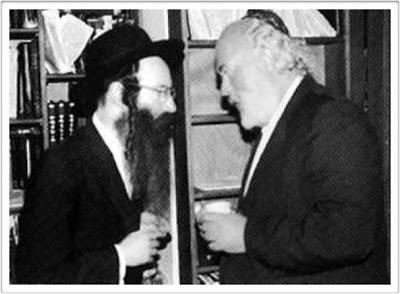
The Rav on the far left, seated next to Rabbi Gourarie, the Rayatz, and the last Lubavitcher Rebbe


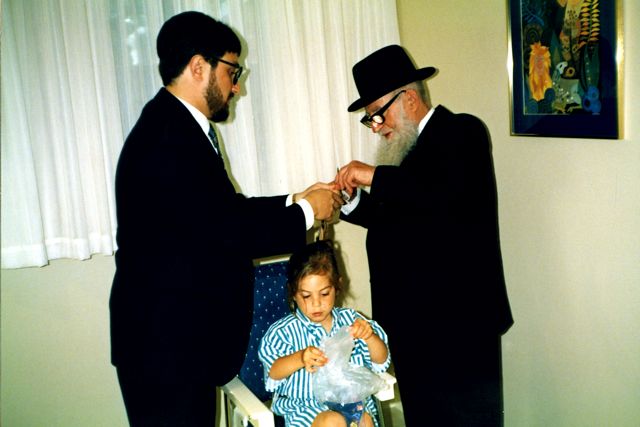
The Red Bendel (thread). Is it a Jewish custom?

Mori V’Rabbi R’ Hershel Schachter שליט’’א forbids the red bendel (unless I misheard him on several occasions). As I recall he said it was an open Tosefta in Shabbos 7:1

Yet, many of our Boobas and Elter Boobas tied this on a little child’s wrist, not to mention the “pooi pooi” sound that is common when a kid cries. If the first is Darkei Emori should it not be forbidden?

There is apparently another Girsa of that Tosefta that says it is NOT Darkei Emori. I’m not sure if Rav Shaul Liberman has something to say about this issue.

Until I heard R’ Hershel forbid it a few years ago, I always thought it was permitted based on mimetic tradition. It seems R’ Hershel isn’t interested in mimeticism in this arena if there is a Tosefta and considers it an Issur D’Orayso!

What does your Rav say? Does he pasken like the Tosefta, or does he just cast a blind eye, as this is something that was done for centuries. I have a feeling that Sefardim do this as well, as Ayin Hora seems to feature more regularly in their Kabalistically inspired practices.

Of course, if you pay for these at the Kotel etc you are being ripped off if it is claimed they are “special”.

PS. We know that there is an idea of והיו עיניך רואות את מוריך but for how long has there been a practice of placing a picture of a great Rav in a perambulator (let alone a Hamsa)

Issues tangential to the tragic death of Aharon Sofer ז’’ל

I have been ill with a virus, consumed with the Gaza operation and all the news surrounding it, and yet, I most certainly knew that this 23-year-old Yeshivah student, who was hiking with friends near Yad Vashem, had disappeared in the Jerusalem forest. I had read it in the Israeli papers. I read it in the Jerusalem Post, Yediot, Times of Israel and I’m sure more.

Was it a secret? No? We all knew about it, and it was on the front page over a few days.

And yet, in another example of Charedi ignition, we are exposed to a shrill article in Matzav, which not only asserts that the Israeli media ignored the disappearance, but probably did so because he was Charedi. The first point is patently false. When I first heard about it, my immediate reaction, call it a gut feeling, was that he had lost his way and was dehydrated somewhere.

This is not the first time in recent times that a Charedi kid has tragically died in avoidable circumstances. Perhaps his phone battery was low, or it was a kosher phone unable to connect to the internet for a distress signal, but not having water when you hike appears to be more common among Charedim. Aharon may have had water. I don’t know. It’s baffling.

What I do expect though is that a proper educational approach take place where Yeshivah boys are warned and re-warned, that you don’t travel without a charged phone which has a way of sending a distress signal, and you must have water with you. Will such obvious advice be splashed on the walls all around Israel’s Charedi enclaves? I don’t know. I sure hope so. If they don’t it’s questionable whether the Rabonim should be held to account according to the Din of Egla Arufa that we just layned.

No doubt, we will hear one of “God’s accountants” who says that it happened because he wasn’t in the Beis HaMedrash. I sincerely hope not. The Rebbes and Rabbonim who went to Marienbad and similar to get some Menuchas HaGuf were also not in the Beis HaMedrash, and it is entirely acceptable to take a rest and have some fun Bein Hazmanim. In Israel of course, based on the Medrash?, walking 4 cubits suffices to acquire Olam Habo! I guess according to Satmar and other Hungarians that statement is whitened out.

I’d like to turn this issue on its head, from a Melbourne perspective. Yesterday, in light of the fact that a few days had passed and he hadn’t been found, it was planned to have an evening of Tehillim in the Adass Hall. The poster was politically correct. It also mentioned that the Tehillim was for the “matzav” in Eretz Yisroel. My questions were, for the “Matzav in Eretz Yisroel” there had previously been no such poster let alone a call to the Rabbinic Council to lend their approval.

A boy of 4, Daniel, had just tragically been killed in a mortar attack. The Rabbi of Adass will not allow a Tefilla for the welfare of the soldiers of the IDF (Tefila L’Chayalei Tzahal) to be said in his Shule! The automatons follow this ruling. Yet, when a boy from Lakewood, who tragically met his demise becoming lost while hiking, the “Matzav” in Eretz Yisroel gets a sudden call up. I ask, where was the picture of little Daniel whose parents were in the midst of Shiva. Where was a call to divide the learning of Mishnayos for Daniel’s soul? There was not. You see, Daniel, wasn’t wearing a Yarmulke and his parents were Kibbutzniks so his Neshama wasn’t important enough to make a brouhaha and cause a kiddush Hashem by using this night to also divide the learning of Mishnayos.

Why do the Rabbis of Lakewood in Melbourne and those from Adass ask for support from the Rabbinic Council of Victoria (RCV) if they consider that council to be something akin to a Chabad dominated circus of ignoramuses? Let’s not kid ourselves. They have no respect for the RCV.

Let’s get serious. Matzav.com had no business making such false accusations, and the Melbourne community really shouldn’t have had to wait till after a ceasefire and when this boy Aharon tragically lost his life before attempting to organise joint ventures in “good faith.”

Perhaps my cynicism is greater than ever, but for me, every soldier, child etc who is killed is a human tragedy. Whilst the RCV had an evening of prayer (twice, I believe) and whilst some Charedim attended, most did not and would not. No, Matzav.com, the argument goes the other way, why does it take the untimely tragic death of a Lakewood boy to spur the Charedi world to organise a special night of Tehillim for the community. The answer is, I believe, that Aharon was frum. He was learning. Soldiers protecting lives and little boys killed by mortar are on a “lower madrega”, one which doesn’t call for a special gathering.

Ironically, who visited family Sofer to give them encouragement? It was the Dati Leumi mother of one of the three boys kidnapped and murdered by terrorists.

In summary, who could have a problem with an Asifa to say Tehillim for a missing kid, but to effectively make differences between frum and not yet frum is distasteful.

Let me also remind my Charedi friends that there was a soldier who went missing for days and days and was ultimately found dead. The strong rumour is that abuse when he was a child led to his untimely death. Again, I can’t remember the Charedi Lakewood or Adass communities organising, let alone getting the RCV involved, to publicise their event for that tormented soldier.

I’m sorry for those Charedim who send me unnamed comments telling me I’m fostering Sinah. People, wake up. The Sinah is perpetrated palpably not by me, but by the actions of hypocrites who love non Charedi financial support in terms of business and donations, but think we are second-rate.

Well, I don’t accept being considered a second-rate citizen: neither Rav Shach or Rav Kotler was my Rav,  and I don’t follow the anti Israel views of R’ Yoel of Satmar.

We are in Ellul. A bit more Ahavas Yisroel is needed. Tonight there was meant to be a community Avos uBanim program. Adass not only said that they aren’t participating, but they actually removed the posters advertising the event, lest one of theirs is “led astray” and sits and learns with his son in a large room with those who don’t follow the closed Hungarian Charedi world. Shame on them!

I will finish with a most sincere wish that Aharon’s parent’s are blessed with nechama, and the resultant trauma doesn’t consume their lives, בתוך שאר אבילי ציון וירושלים. I can’t even begin to imagine their pain.

Army Clothes for Davening

[Hat tip MD with my additions]

Rav Soloveitchik (the Rav) was very meticulous and stringent in every phase of Hilchot Tefillah, the laws of prayer. He often cited the Rambam (Tefillah 5:1) that eight specific aspects of prayer must be adhered to while standing for Shemoneh Esrei. The first four are:Amidah, standing; Nochach HaMikdash, facing Eretz YisraelTikun HaGuf, feet together and clean body; and Tikun HaMalbushim, proper and dignified attire.

This went to the extent that the Rav held that Chazoras HaShatz was Tefillas HATzibbur, and as such stood with his feet together facing the front. My own opinion is that this view of the Rav is even more relevant today in Shules where the majority simply cannot Daven, and are subject to a continuous set of announcements saying “we are on page number n in this edition, and page m in this edition etc”. The importance of the Shatz as being connected to and an actual Shaliach, as opposed to some performer seems to have been lost.

The Rav was once visited by a student who served in the Israel Defense Forces who asked the Rav the following question: He worked in the tank division and his job was cleaning and maintaining the tanks. Often, his uniform would get covered in oil and grime and he wanted to know if he needed to change clothing before davening Mincha. He emphasized that it would be possible to do so but it would be quite inconvenient and difficult. The Rav looked at him in amazement and said out loud,

“Why would you need to change? You are wearing bigdei Kodesh, holy clothes”!

That is how the Rav felt about someone serving in the Israel Defense Forces.

Parshas Va’eschanan: Love and fear of Hashem

The Rav זי’’ע, Rav Soloveitchik asked a basic question. We are accustomed to speaking about the term אהבת השם, loving God himself. This connoted an affinity, or rapport so to speak with God. Yet, the concept of fearing God, which whilst also described as יראת השם is used in the vernacular using the more common יראת שמים, fear of heaven. We don’t find our vernacular expressing the term אהבת שמים. Purely from a symmetric consideration, we would expect that to also be a term used in our speech and prayer.

Indeed, the Pasuk says explicitly

ואהבת את השם אלוקיך

The Rav explains this difference in terminology in terms of the Rambam in Hilchos Teshuva (10:6). There the Rambam explains that the level of love that the Jew can attain with God is proportional to his understanding of God’s essence. With a heightened and more sophisticated and fuller understanding of God, one is able to love him to a greater extent than before that understanding is understood, internalised and appreciated. The way in which one understand, and gains a further understanding of God has its own nuanced approaches by various sub-groups within Judaism.

The Rambam explains that a person needs to seclude themselves so to speak, and think deeply about his connection and the nature of that connection to achieve this love, and thereby closeness to Hashem himself. Love then is an effect that brings one closer to God. The more we delve, the closer and more  loving we become.

יראה fear, however is a feeling of distance. It is an awe-laden recognition of the distance between the power and majesty of God and a mere mortal. The more one cognates over this concept, the further and more fearful one becomes of the veneration and wonderment. It is for this reason that it is natural to use the term יראת שמים fear of heaven. As one develops their Jewish character, in respect of יראה, the human condition is seen to be afraid and fleeing in the same way that the sky is beyond us and hangs over us unpredictably from day-to-day.

One cannot, according to the Rav see as an outgrowth of love, אהבה, anything other than a  journey of closeness and approachability. יראה, as important as it is, is about the fearful distance which we can’t lessen, as שלמה המלך said

אחכמה והיא רחוקה ממני

As wise as one may become, there is the dichotomous distance through יראה and closeness through אהבה.

The Rav

A tribute night for the Lubavitcher Rebbe זי’’ע

Today was the יום הילולא of the last Lubavitcher Rebbe (LR). I’m presently ensconced in three books describing him and will offer my thoughts on these when I have finished.

They are certainly impressive pieces of work, each in their own way. In a recent private email exchange I had with Rabbi Yossi Jacobson in reference to this post, I mentioned that one of the things that attracted me to the Rav, Rav Y.D. Soloveitchik ז’ל was the refreshing ease with which he was able to write about his personal feelings on various matters, some of which were the result of his private life and the emotional struggles surrounding these. Rabbi Jacobson, if I’m not misquoting him, was of the opinion that the LR also expressed his personal feelings. I felt that the LR wasn’t expressing his own private issues, but was always focussed on what the movement and it’s Chassidim needed to achieve.

The Rav, however was not, and never saw himself, or his task in life, as that of a Manhig Yisrael. In his own words he was a מלמד. Certainly that was a self-deprecating description of someone, often described by others as the למדן הדור. We should all aspire to be such a “מלמד”! In other words, the Rav dedicated his life to interacting with the challenging American reality and transmitted the Brisker method of Lomdus and Mesora that he had digested from his illustrious  grandfather, R’ Chaim Brisker, father, R’ Moshe, and Uncle R’ Velvel, to a challenged generation for whom such sophisticated analysis of Torah, enmeshed in the vernacular of the day, was intellectually challenging and advanced in its conceptualism and oratory. The Rav ordained more Rabbonim than any other Rav in the history of Judaism (it would seem).

As time goes by, his greatness, like many who pass away, is amplified, and the fact that I “discovered” him relatively late in my life, is a source of sorrow. How I would have loved to have participated in a Shiur, or listened live to his majestic droshas.

Enter his famed University colleague from Berlin the LR. I couldn’t put my finger on it, until I (partly) read the books about the LR, but I now have a fuller appreciation of the LR’s role and personality. In many ways, they were both became fully equipped educationally and culturally to interact with the needs of American Youth in a so-called modern society. They had both studied at University level, and were aware of the so-called European/Western Culture and thought. I do not think either of them saw that culture as some sort of enlightening factor, but it enabled them to interact at the highest levels using the modern vernacular and conceptualisation of our times, within the context of acutely high levels of grey matter.

דברה תורה כלשון בני אדם

found a new home among these giants.

Whilst I was not brought up with a deep understanding of the “Torah Im Maddah” approach or YU, I found it easier,unsurprisingly, to speak and digest that language. A more universalistic approach to different paths has always appealed to me.

The Lubavitcher Rebbe, however, was an enigma. Here was this powerful genius with a photographic memory and acute ability to link and understand the seemingly disparate thoughts at his disposal, through the prism of the metaphysics of Chassidus, with brilliant insights and a paucity of notes. Yet, I guess I felt remote from him because there seemed to be no outward human frailty that he ever allowed to be shown, except when he was afflicted by that terrible stroke which ultimately led to his departure from our world and when his beloved wife passed away. Furthermore, while the elder Chassidim stressed the Chabad Chassidic approach, the younger Chassidim seemed more pre-occupied with his personage. To be sure, Chassidim would say “you must have a Yechidus”, “you have to immerse yourself in Chassidus to appreciate him” but that didn’t prick me into action. I never felt that I had anything meaningful to say or ask, and I wasn’t the type of tourist to invade an important Gadol’s time just because it was the done thing.

I have only been to the USA once, and I never went to 770. I simply didn’t know or comprehend what I might get out of it. These days, I’d be most apprehensive to go there given that it is controlled largely by the more radical Meshichist types, whose philosophy I do not consider to be Masoretic, but rather a backwards-pointing justification for an already concluded premise.

People will read what I have written and say, stop saying “I” … it’s not about you. One has to be בטל,  somewhat constricted within their personal ego to appreciate what was being effected in a Yechidus. Perhaps I was too ego-driven or cock-sure of where I stood in life vis-a-vis my Avodas Hashem and perspective on Torah. I may have even been wrong. It is what it was, and remains that way.

After reading most of these books, I have discovered through the über romantic, carefully chosen words of Rav Steinsaltz, and the meticulously researched tome of Rabbi Telushkin (Chaim Miller is next), that I have a better appreciation of this extraordinary leader. I didn’t learn much from earlier books, including those of academics and more. I felt that they started their books with a (negative) premise, and then sought to prove this premise, and not undertake a clean, academic unadulterated look at the facts.

Now, a leader can only try and do his best to make sure that his Chassidim conduct themselves in the way which he approves and/or legislates. The LR was no different. At times his exasperation was palpable.

One can certainly find a bevy of Shluchim who are seemingly pre-programmed automatons lacking the very gift that the LR had—the ability to connect individually with the person talking to them. There isn’t and wasn’t a magic formula. It was an action/reaction experience. Some have this gift; many, I dare say, do not.

Even last Shabbos, when I spoke to stranger who was wearing a Yechi Yarmulke, and asked why he wore that outward advertisement, he accused me of hating him simply for asking. I suggested that concluding that I hated someone because I asked a question was shallow, and when I referred to the classical work of R’ Yechezkel Sofer on the topic (which he described as “garbage”) this represented a problem with his own eyes, and not mine.

After reading the books I felt real sadness for the LR. He was clearly a very reluctant leader initially, almost a recluse whose favourite times were with his wife, father in law, parents or his seforim. His personal life was zealously guarded from the masses or even to the few in constant contact. He was a truly selfless man who pushed himself to extraordinary limits. He did not compromise on an iota, and mission, as summarised by Rabbi Sacks, was to ignite the soul of every person who the Nazis had attempted to extinguish and towards whom society was threatening with their often depraved value systems. He was as singularly minded in his pursuit of re-igniting souls to hasten the redemption as anyone we have seen.

As such, I find myself asking the question: what would he have said about a “tribute night” in his memory. Based on what I’ve read, I posit that he would be embarrassed by the word “tribute” to describe such a night. He would not want anyone to focus on him per se. He appeared to vehemently dislike cultish worship. Rather, the essential task was all about the missions and initiatives that he worked tirelessly to introduce and strengthen, all with the aim of bringing the redemption quicker.

It’s a paradox. On the one hand he was reaching out, and yet at the same time, he was enigmatically private.

So, why do his Chassidim engage in tribute nights? Certainly there is the practice that one should remember and talk about the deceased on the day of their Yohr Tzeit. One fasts, and learns Mishnayos. I don’t know how many Chassidim today do that today. But, it is more than that. In the absence of a leader to actively direct a movement in 2014, I feel he would only approve of such a gathering if it was about people taking strength and renewal and redoubling their efforts to carry out (genuinely) the tasks and processes that he had inaugurated.

In that vein, I will agree that a tribute evening potentially can invigorate. At the same time, it can also fail to do so—if people concentrate on the person and not the task to be achieved.

How much time do Rabbis put into their Drashos?

I have had recent and distinct pleasure reading the magnificently articulated and profoundly original drashos of Rabbi Dr Norman Lamm (may he have a speedy recovery). It struck me that I’ve probably never heard that style of quality Drosho in Melbourne. I was exposed to the emotionally laden but never judgemental tantalising drashos of Rabbi Chaim Gutnick ז’ל and the fire and brimstone and sometimes judgementally powerful drashos of Rabbi Yitzchak Dovid Groner ז’ל. I listen to their sons, and there are semblances of their father’s styles (this is natural), but in essence I haven’t experienced true uniqueness.

I enjoy the care, research and effort that Rabbi Sprung puts into his Drashos (on the occasions that I hear them). I am not attracted to the style of Rabbi Genende. It’s almost apologetically left-wing and seems to use external sources for no other reason than to show that they have been read and incorporated. Rabbi Lamm also uses external sources, but it flows ever so naturally and augments his broad Rabbinic knowledge.

Many other Rabbis effectively parrot or paraphrase a nice thought from the Lubavitcher Rebbe or the Baalei Mussar, which whilst authentic, I sometimes find lazy. Some like to use cute stories. Unfortunately, many of them are hagiographic. I have heard Rabbi Kennard once and found him succinct, clinical and well-organised, but perhaps (at least for me) lacking an element of emotion, call it fire-power. No doubt that’s a natural stylistic phenomenon. If I am to hear a Drasha that isn’t emotionally laden, then I’m awaiting a brilliant unique insight. I don’t have time for the joke a minute style of Drosha either.

To be fair, I am an outlier. Most people are probably very happy with the Drashos they hear. I like to ask myself two questions:

  1. Have I been inspired to actually do or try to do something that I haven’t done, or being doing well, after the Drasha
  2. Have I been inspired to research the topic myself after the Drasha

If the answers are no, then those Drashos disappear like a distant memory.

Perhaps I have been spoiled by the internet. My iPhone brims with super quality drashos and insights. If we are to grow as a community, I feel that some Rabbis perhaps need to put much more time into their Drashos, and, yes, even publish these. They also have to realise we aren’t dumb. I know when I’ve heard it a few years before 🙂

How much world-standard Torah is actually published in Melbourne? Do we have a ‘Chief Rabbi’ in Australia capable of such or are we more caught up in Askonus.

It is true, that not all Shule Rabbis are born orators. Do they have to be in today’s day and age, or is it more important to excel in pastoral care and impart that “feel good” image?

I admit, I undoubtedly have a bias. I like a Chidush, a new insight. In the least, I enjoy being mesmerised by the sheer breadth of halachic knowledge that some impart on a weekly basis emanating from the Parsha (e.g. Rav Schachter or Rav Usher Weiss). Undoubtedly, I am an outlier and atypical.

Don’t even get me started on the lack of simple manners (forget Kavod) that exist primarily at religious functions when a Rabbi/Rov/Roov gets up to speak for a few minutes.

My thoughts on the Rav and the Rebbe event

When I became aware that this event was being planned, I quietly contacted the organisers, and asked that either the Chabad speakers (I didn’t know who they might be) and/or the YU speakers might address the telling letter where the Rebbe זצ’ל chose to write some of his personal thoughts about the Rav.

I felt that the YU speakers were generally “polite”, reminiscing and respectful. There is and was no problem (to my knowledge) in a pluralist place like YU to condemn anyone who decided to learn Chassidus (of any type) that I am aware of. In the same way, although Mussar was not seen as a useful use of one’s time according to the Beis HoRav (through R’ Chaim) it would be hard to imagine YU or the Rav condemning or putting a stop to someone for whom learning Mussar was part of their daily regimen. Talmidim had to know all about the Shiurim that they attended, and in particular, those who went to the Rav’s shiur, say, as opposed to those of R’ Dovid Lifshiz ז’ל were exposed to the method of trying to learn what is in-between the lines. R’ Dovid, the Suvalker Gaon, had a different approach. The Yeshivah co-existed with different viewpoints, but the Rav’s charisma and enormous depth in learning, naturally attracted many now esteemed Talmidim.

I received some replies from the organisers about the source of the letter I presented in an earlier blog post in which the Rebbe clearly expressed a form of misgiving about what he considered to be character traits of the Rav. I responded that if this was to be a true event where the relationship was to be studied openly and honestly, that the organisers should approach Chabad about the authenticity of the letter (not that this can be questioned, it’s very clearly the Lubavitcher Rebbe’s handwriting) and be ready to analyse and comment on it.

I didn’t hear back for months, and I just assumed that the organisers would pass the letter onto the Chabad speakers, and we’d hear a perspective, at least, in due course. Perhaps the organisers did pass on the letter, and Rabbis Krinsky and Jacobsen decided that they wouldn’t “touch it” because it might introduce controversy. I don’t know. I may email the organisers and ask them.

I’m an academic. If this was a colloquium or extended seminar and it failed to discuss the contents of the letter (they are of course entitled to disagree entirely with my personal interpretation) then it was deficient because it seemed to be ignored.

Perhaps I am oversensitive because the Rav has become such an important ingredient in my ability to make sense of the world through the prism of Yahadus, but I felt that Rabbi Krinsky, continually referring to him as “Rabbi” Soloveitchik was (perhaps unwittingly) derogatory. The Rav described himself as a Melamed, but given the number of Rabbinic folk in Chabad who get Smicha and call themselves “Rabbi” XYZ, I felt this was a come down. He could have been called “the Rav”, or even R’ Yoshe Ber, especially since the event was being held at YU. (I find those who refer to him as “J.B” rude). Can you imagine for one minute if someone from YU spoke at a Chabad event at 770 and referred to the Rebbe as Rabbi Schneersohn? I know people are even sensitive to the acronym Ramash, because acronyms are usually applied once someone has passed away and is in גן עדן מקדם or in עדן itself. I found Rabbi Krinsky’s anecdotes interesting, but I didn’t find them academically incisive or revealing. Certainly his recollection of the Rambam in Pirush Hamishnayos when the Rav came to be Menachem Avel to the Rebbe, was enhanced by Rabbi Jacobson and more detailed than what I head read in (I think) Nefesh HoRav.

Rabbi JJ Schechter, not to be confused with the Rav’s Talmid Muvhak, R’ Hershel Schachter שליט’’א  is a fine scholar, and I have read a number of his articles, books, and listened to his talks. However, here, I felt he (perhaps diplomatically, or influenced by his late father, the other Rabbi Hershel Schechter ז’ל) provided more of a sociological talk which, while entertaining, wasn’t overly enlightening (at least to me).

I felt the most dynamic speaker was Rabbi Jacobson. His reputation as a speaker precedes him. He, at least, tried to link the contents of the Sichos which the Rav heard, with his interpretation that they were an “answer” to the Rav’s lonely man of faith, halachic man, etc. Nobody seemed to mention that the Rav went to the farbrengen as an expression of HakoRas HaTov as described by close Talmidim. To look at Rabbi Jacobson’s thesis, and he was second guessing his own Rebbe, one would have to study those Sichos and see whether in the gamut of other Sichos or Ma’amorim at farbrengens, these were indeed somewhat out of left field, and directed as a theological approach by the Rebbe to assuage the original thoughts of the Rav, as expressed in his published works to date. I certainly am not in a position to comment on that thesis, as I do not have the knowledge of the Rebbe’s general style and content at such a Farbrengen, let alone those Sichos.

I am surprised that nobody took the opportunity to mention that the Rav wrote a Pirush on the Tanya in Ksav Yad, that remains unpublished, as claimed by Rabbi Kenneth Brander on his recent visit to Melbourne. It’s certainly indicative of the Rav’s attitude to Chabad, as opposed to the Rebbe in particular.

To summarise, what I considered, a few years ago, to be a letter which provided potentially important insight, was seemingly wilfully? ignored. As such, I felt it was a “feel good” evening in American style, where the YU people stressed that the Rav had enormous respect for the Rebbe (which needs to be tempered by statements recorded in Rabbi Holtzer’s book, and statements attributed to the Rav’s own son Prof Chaym Soloveitchik)

So, in conclusion, congratulations on a great idea, but I would have preferred a more academically inclined approach than the “slap on the back” style which seemed to permeate most speaker’s style of delivery. Then again, maybe that was the aim of the organisers, and my issues are misplaced in context.

The Goral HaGro, Mekubalim, and advice for the unsure

Life has its ups and downs. Some people cope better than others with the downs while others simply can’t cope with the ups, even though they think they do. Every day presents new challenges and questions, as well as solutions and achievements.

It is common to see advertisements from so-claimed clairvoyants. These are people who seem to have an ability to foresee some future event or reflect on a past event.

The Torah is very explicit in its instructions. We are forbidden to be involved in things involving “foretelling the future” or in the words of the Torah  (Vayikra 19) לא תנחשו ולא תאוננו. I’m not happy with the phrase “foretelling the future” but it will do for this context. Of course, this is also explicit in Shulchan Aruch (Yoreh Deah קעט) as a Torah prohibition, quoting the Rambam.

Now the term Goral HaGro, which means the “lottery” of the Vilna Gaon, is almost certainly nothing to do with the Vilna Gaon. There is, to my knowledge, no provable record, of the Gaon ever performing a specific methodology which enabled one to make a future determination. Certainly though the term/technique has continued and is mentioned by those who identify themselves as followers of the Gaon. Fundamentally, on the Pasuk in Vayikra

‘תמים תהיה עם ה’ אלקיך’

Be complete/pure [in the path] with Hashem your God

Rashi says

התהלך עמו בתמימות ותצפה לו ולא תחקור אחר העתידות, אלא כל מה שיבוא עליך קבל בתמימות ואז תהיה עמו ולחלקו

Which plainly means that one should accept one’s lot and not seek to determine the path they will take based on seeking out the future before it happens.

Yet, despite this, we know that “lots” have a place in Judaism. For example, in deciding which of the two animals will be thrown off a cliff on Yom Kippur. Here, the lottery is part of the avoda and is commanded.

The Gemora tells us that when Tanoim were unable to decide what to do, and here I assume that this means not that they could not decide the Halacha, but rather whether one should do X or Y where both X and Y do not contradict a Halacha and cannot be determined via Psak, they asked young children פסוק לי פסוקיך … “Tell us what Pesukim [in the Torah] you are currently learning”. Based on what the children answered, if the Pasuk shed light on whether to pursue X or Y, they chose the one which was hinted at by the Pasuk. It isn’t clear to me whether that could always be determined by the Pasuk, but perhaps depending on the Wisdom of the person asking the children, they were able to derive X vs Y.

Does this Gemora contradict the aforementioned Halacha? It would seem not. There is no attempt to seek out the future through some supernatural (whatever that is) means, but rather, when something can be both X or Y and it is not a matter of Halacha (I presume) the Pasuk sheds light on those deserving and discerning such light.

There have been famous examples of the use of this method: viz, opening a Pasuk from the Tanach and using it when there seems to be no other approach to take. One, is the case of the famed R’ Aryeh Levin, the Tzadik of Yerushalayim and super Talmid of Rav Kook, who used this method to identify the corpses of 12 holy soldiers who were killed during the war of independence in Gush Etzyon. Using a particular format of the Chumash page flipping  eventually a particular verse was chosen. In each case, the verse chosen clearly identified a fallen soldier with a particular body (See “A Tzaddik in Our Time: The Life of Rabbi Aryeh Levin,” pp. 111-117).

Some commentators would term this a נבואה קטנה a minor prophecy (this is the opinion of the Shach ibid). There are other examples of course. R’ Aron Kotler wasn’t sure whether to go to Israel or the USA when escaping the Nazis. Clearly, if R’ Aron wasn’t sure, he must have held that Halacha didn’t have a clear answer for him. I can’t guess what his thoughts were, but one would imagine that on the one hand, there was Israel which involved a Mitzva of going there and building it up versus the USA where there was a Mitzva to build Torah. Both had issues. Israel was under siege and there was a Sakana and the USA would have presented a spiritual Sakana (danger). R’ Moshe Feinstein begged him to come to the USA. Apparently the Pasuk in Chumash was Shmos 4:27 which suggested he (R’ Kotler go to Moshe (Feinstein) in the desert (USA). It’s eery and scary, to say the least, at least for me!

While such devices will “work” for especially holy people it isn’t clear to me that it’s going to work for every Tom, Dick and Mary. Furthermore, knowing if one should use the device or not, is a major question itself. My understanding is that in keeping with  ‘תמים תהיה עם ה’ אלקיך’ one would need to consult a Rabbi of great stature first before embarking on this path.

There was a story reported that Rav Shteinman used this method to decide whether a Shiduch should go ahead when a Groom pressed him incessantly. On the other hand, the Steipler Gaon, suggested we stop using Goral HaGro because we don’t know how to do it exactly and it’s better to be consistent with the Pasuk of Tomim Tihye.

There is another story, and I don’t know if it’s true or a piece of historiography, that the Griz (Rav Chaim Brisker’s younger son and Rav Soloveitchik’s Uncle) once did this Tanach flipping (Goral HaGro) and the Pasuk he landed on was ‘תמים תהיה עם ה’ אלקיך’ !!!

There are a lot of things we don’t understand, and most of these are in the domain of the exalted ones.

I have to admit that for a time, at the behest of my wife, I spoke with a Kabbalist who is not known, does not take money, and has a very good “hit rate” seeing the future. In fact, the first time I called him, I was in Melbourne at 3am, and it was a “cold call” to him in Israel. Please don’t ask me his name, as he doesn’t seek notoriety or attention. He told me things about myself that literally made me convulse. I went to see him in his remote shanty house in the far north of Israel on a subsequent visit, and again he made some remarkable comments. I won’t go into details, but he noted, for example, that we had issues with some trees in our house and he drew the location. He was right. On the other hand, there are a number of things that he told me that one could say he wasn’t right. I asked him how he knew. He said he couldn’t explain it but that he saw things in the future like on Television (i.e. an external screen with events unfolding). There are lots more stories I can tell about him, but this suffices. My wife still wants me to call him when there is a really major extra-halachic issue, but I have quietly stopped doing so.

I spoke with Mori V’Rabi R’ Schachter, and of course I didn’t identify the Mekubal, and he responded that I should not consult and I should be guided by ‘תמים תהיה עם ה’ אלקיך’ alone.

Interestingly, over Pesach, I read a story from R’ Schachter where he retold how the Rav, R’ Soloveitchik set out one day to convince R’ Aron Kotler to change his mind about a particular issue, and went to visit R’ Aron. On the next day, during Shiur, the Talmidim noticed that the Rav had problems with his arm, and was in some pain. They asked him what was wrong. The Rav said that when he was on the way to Rav Aron Kotler, he slipped on the icy snow and fell on his arm and had hurt it. The Talmidim then asked the Rav, but we know that Shluchei Mitzvo Ainom Nizokin (those who are messengers for a Mitzvah are not harmed) and since the Rav felt the issue was important enough to approach R’ Aron Kotler he must have felt that the mission was a Mitzvah, and if so, how could he be hurt. The Rav immediately responded “Nu, that’s perhaps a sign that I was wrong on this particular issue and R’ Aron was right”!

In our days, it is commonplace since the passing of the Lubavitcher Rebbe that some of his Chassidim use this technique. They tend, as I understand it, not to do so using Tanach, but rather use letters that had been published in the past in volumes (אגרות קודש). I have heard various incredible stories in this regard, and I’m sure there are plenty of examples (although these won’t be publicised) where there was no clear indication of how to proceed. I know that R’ Schachter limited the definition of the Goral HaGro to Tanach per se and not Gemora, Medrash etc as he felt there was no Mesora/tradition to use anything other than explicit Psukim. Of course, a Pasuk could be quoted in a letter.

Either way, I tend to be of the view that one must first go and speak to an authoritative Rav/Posek before using this technique willy nilly (so to speak).

I probably haven’t elucidated much in this pitput, except to say that I tend to the view that where a matter is one of Halacha, one follows Shulchan Aruch (or asks a Rav if one cannot see the Halacha or it is not clear or a difficult question). For extra-halachic matters, I guess it’s a matter of what your own Rav HaMuvhak advises you in context of your family and circumstance and that may also be “no specific advice!”

As I finished writing this I found this video if the topic interests you, which I had heard driving in my car a few years ago, and which obviously influenced me!

Nice article by Shmully Hecht

See the original from the Times of Israel (which I reproduce) here. [hat tip MT]

I have no issue with Shmully’s thoughts except that

  1. R’ Chaim Volozhiner was not an opponent of R’ Schneur Zalman of Liadi. He in fact, while being the prime disciple of the Vilna Gaon, and the person who hand wrote the condemnation of Chassidim (Cherem) did not sign the Cherem!
  2. Rav Chaim Kanievsky is not a political person. He sits and learns and does little else. That this boor said “come and I will take you to Rav Chaim Kanievsky” does not mean that Rav Chaim was aware of agreed with the way he spoke or what he said. Rav Chaim is also a Mekubal who knows Kol HaTorah and if you look at what he signs, you will find dear Shmully, that he rarely if ever gives his own opinion. He is a humble man, who mostly says “if such a great person said X, then I (Rav Chaim, who he considers to be a “nothing” in his self-effacing way) join in. This is because he does not see himself as a leader.
  3. The one that you should be addressing is, in my opinion Rav Shmuel Auerbach, whose incredibly great father R’ Shlomo Zalman had more knowledge, feeling, sensitivity and greatness than his son by a country mile.
  4. As to the rest of them, and by “them” I mean ANYONE who can’t see the Godly soul of a Jew at all times (yes, this is something from Chabad that I am ingrained with) they will not change, not by your article or by our comments. The best thing that can be done is to work now with the Nachal Charedi and make sure it is the holiest battalion in the entire Army, and one which is a Kiddush Shem Shomayim BoRabbim. That, to me, is where ALL the effort should now go.
  5. The so-called “distaste” for those who aren’t yet frum (I loathe the word chilonim) is amongst the Religious Zionists as well. They too have much to answer for over the years in their preponderance with land over people. The two should have never been separated. Rav Froman ז’ל is an example of a Gush Emunimnik who was searing with love for others, just like Rav Kook. It seems though that hate is a catchy illness and love for others is an acquired and elusive taste.
  6. This has nothing to do with Brisk, save that R’ Meshulam Dovid Soloveitchik espouses similar views to that bigot on the plane, ironically his grandfather R’ Chaim Brisker was an even bigger Ba’al Chesed for a Jew than he was the Gaonic Genius of that generation. Check out his tombstone in the Warsaw Cemetery.

I write to you in your capacity as one of the leaders of the ultra-orthodox Jewish community of Israel, often referred to as the haredi movement.

On a flight last week from Israel to New York, I had a rather disturbing conversation with one of your of disciples. The individual was an ultra orthodox Jew and a successful Swiss real estate developer who resides in Jerusalem with his wife and seven children. He was on his way to New York for the wedding of a relative. I was returning home from Israel where I had spent the day attending the funeral of the father of a dear Israeli friend of mine from Yale, where I am the campus rabbi. I had met the deceased last year at his son’s wedding in Caesarea, where I was honored to officiate. On a subsequent trip to Israel I had put Tefillin on with this 77 year old man, preceded by an in-depth theological conversation about his Judaism and beliefs. On this return trip to Israel it was at the Shiva house where, upon meeting many of the members of my friend’s F16 squadron, a troubling conversation began. This was a conversation that crystallized on the flight back to New York while talking with your disciple.

Israeli air force pilots are in their mid-20s and 30s, a ripe time for young people to be seriously dating and in many instances newlyweds. It was ironic yet promising that despite being in the shiva house of my friend, we found ourselves discussing weddings and choices of rabbis. Here I was, surrounded by Israel’s bravest military officers, who held the most coveted spots reserved for only the brightest and best, that I began to hear about one particular pilot’s wedding. He had just returned from a trip to the US where he got married in a civil marriage ceremony in City Hall of NYC. He explained that he, like many of his friends, had done so because they had nothing in common nor any dialogue with the rabbis of Israel. I reminded him that on that particular morning we had witnessed three Israeli rabbis bury our friend’s father, a total stranger. I continued to point out some of the many great things rabbis were doing in Israel. In vain, I tried to shed some light on the rabbinate and build a bridge to this rather secular group of Israel’s elite.

Listening to him describe the gap that sadly divides the secular “chiloni“ and ultra-orthodox “haredi“ leaderships of Israel, I was dismayed and saddened by how far this split has actually wedged a division among our people. Could we have reached such a low point in our history that Jews living in our ancient homeland were flying across the world to avoid having to engage with our very own rabbis? How ironic I thought it was that I, an American rabbi, had flown to Israel first to marry and now bury a son and father of the most secular type of Israelis. Would this young pilot’s first encounter with an Israeli rabbi be at his own funeral?

Harav Kanievsky, I am convinced that the fault lies largely with us, the “religious,” and less so with them, the “secular. “ In fact I don’t believe there is an “us” and “them.” I was born a Chabadnik, where we are taught that there is only one Jew in the world. Yes, one Jew. But it wasn’t until the conversation with your disciple on my return flight that I began to comprehend the mindset that actually fuels this terrible divide. It is for this reason, and with hope of healing this terrible National wound, that I write you this letter.

“You look like a Chabadnik,” he started off, as he leaned across the aisle of our ElAL plane, “so tell me a story of your great Rebbe.” Not sure if I was sensing sarcasm or sincerity in his tone, I told him about my experience of once praying with the man I had just buried and how this person carried a photo of The Rebbe in his wallet for 20 years, despite claiming to be an agnostic. The truth is that “Rebbe miracle stories” were never really my forte, so I figured I would challenge him to a more serious theological debate in this final hour of our cross Atlantic flight. After all, I don’t get to meet many “haredis“ on the sprawling campus of Yale University. “What will you do about the pending proposed military draft?” I curiously asked my flight mate. “Well if it actually passes,” he said, “they will have to put a million of us in prison, for how can a pork eater, the son of a pork eater, tell us G-d fearing Jews to close the yeshivas and serve in the army? These Jews need to be despised and excommunicated for the way they treat the religious community.”

I was so shocked by the venom he was espousing in front of his wife and 16 year old son that I felt like stopping the conversation right there just to avoid embarrassing him. This verbal assault on the majority of Jews alive and the Jews who I consider my dearest constituents was not going to pass without a fatal blow. One, of course, I would have to deliver with love.

This man was by no means a Torah ignoramus, nor lacking in any level of sophistication. He was clearly a successful businessman, philanthropist, and learned Torah scholar. “I’m not sure you can blame a Jew for eating pork if that is what he was brought up eating,” I replied. It was an elementary response to such a loaded attack.

“After all,” I continued, “doesn’t your son [who was sitting next to him on the plane] eat what you eat?”

“How can you preach such hatred of a Jew,” I asked, “when the Torah explicitly says, ‘Thou shall not hate your brother in your heart’? Is that verse any less a part of the Torah you embrace?”

He replied, “well Esau, despite being the son of Isaac the patriarch, was the enemy of the Jews,” as if to suggest that any secular Jew had the status of an enemy. I explained that the Torah explicitly tells us that Esau and Ishmael had abandoned the ways of their parents’ home and clearly attained the status of another nation early in our history. To suggest that every non-observant Jew in Tel Aviv born to non-observant parents, or simply brought up in a non religious home, was now the enemy, was ludicrous.

His self-righteousness and arrogance was so revolting that I knew I needed to win this debate before we landed. I reminded him that the Jewish people were a family first and called over the flight attendant who was not wearing a kipa, and clearly the type of Jew he was critiquing. I asked the man if he believed we were all part of one family, to which he replied, “of course.” “If the plane went down at this moment,” I continued, “do you think your prayers would be any different than this gentleman? Do you really think your cry of Shema Yisroel would sound any different than his? Have you ever considered the probability of living parallel lifestyles should you have been born into his family, and he into yours?”

He would not concede. “The Finance Minister of Israel [he refused to mention him by name] is a pork eater, the son of a pork eater, and will suffer for the terrible anguish he is causing our community. He is no different than Jesus whom, though born to Jewish parents, is responsible for the murder of so many Jews through European history.” I reminded him that according to one account in the Talmud, Jesus left the seminary because of the lack of sensitivity of his Rabbi and perhaps that was why Christianity started to begin with. I reminded him of the commandment to love thy neighbor as you love yourself–to no avail. As I sat there I started to comprehend why my new friend from the squadron had flown to NY to have his wedding. How could he have any respect for Jewish leaders that did not officially declare this type of talk absolute heresy? Who could stomach this unapologetic self hatred by a “religious” Jew. All in the name of Torah and G-d!

But then I digressed and mentioned one of the greatest Rabbis in our collective history. Reb Chaim of Volozhin. He is, after all, the icon and example of Torah Judaism, who embodied the ultimate divine manifestation of Torah in a human being. In addition to being the crown disciple of the Gaon of Vilna and the author of Nefesh Hachaim, he was also the patriarch of the great Saloveitchik Talmudic family dynasty. So in a final attempt at reconciliation I asked:

What if I told you that the current President of Yale is named Peter Salovey, short for Saloveitchik? Though he is not particularly observant by your standards, he is a direct descendant of Reb Chaim. He is a dear friend of mine and despite being of the more secular type, he is extremely proud of his Judaism. In fact, he proudly quoted the great Mishnaic authors in his inaugural address as President of Yale. Do you know that he often engages in Talmudic discussions with me and others of the Yale community? Would you dismiss, excommunicate, and forsake the grandchild of the holy Reb Chaim of Volozhin in your self-righteous pursuit of an Israel that excommunicates the non-orthodox Jew?

It was at this moment that he got out of his seat and approached mine with an urgency. He finally realized what we were actually talking about. We were talking about that one Jew, the Jew that he could never forsake for it would mean forsaking Reb Chaim Volozhin. And so I got up and together we stood near the emergency exit door as he softly whispered these words into my ear, but more so into my heart and into my soul:

I envy you so much my dear Shmully, because in the merit of showing unconditional love to his grandson, I assure you that when you die, the great Reb Chaim of Volozhin will be waiting for you in heaven, and he will single-handedly open the gates of Gan Eden for you to enter.

These final moments of my flight were an absolute affirmation that there is hope for our people. I could not hold back my tears and replied, “how ironic, that upon my death, at the moment I would have to face my Maker, I would not be greeted, escorted, and defended by my Rebbe, Reb Schneur Zalman of Liaidi, the founder of Chabad, but rather by his opponent, the prize student of the Gaon of Vilna, Reb Chaim of Volozhin.”

And then he said, “You know, when you return to Israel, I’m going to take you to visit our leader the great Reb Chaim Kanievsky. I want you to tell him what we talked about.”

Rav Kanievsky, I don’t want to wait until my next trip to Israel. I will simply ask you what I asked him:

What would Israel look like this Pesach if you asked each and every one of your followers today to invite one non religious friend for Pesach? How amazing would it be if 1 million non orthodox Jews came home tonight and told their spouse that their religious friend or acquaintance invited them to their Seder? What if we reinterpreted, “all who are hungry may they come and eat, all who are needy may they come and enjoy Pesach,“ to mean, “not only the physically or materially poor but those less observant than us”?

Just as I’ve been assured that Chaim of Volozhin will be waiting for me in heaven, I sincerely hope Schneur Zalman of Lyadi is waiting for you. Let us hope there will be no need to imprison 1 million Jews but rather have 1 million more guests this year at the Seder.

I look forward to embracing you on my next trip to Israel.

Shmully Hecht is the Rabbinical advisor of Eliezer: the Jewish Society at Yale and can be reached at shmully@279crown.org

Who are the Gedolay HaTorah

The following is an editorial from Arutz Sheva in 2012 based on the view of Rav Eliezer Melamed, Rosh Yeshiva of Har Bracha

Rav Eliezer Melamed

Occasionally, people from the hareidi community question or attack my articles. Even though they are well aware that I strive to follow in the path of Maran Harav Kook zt”l, nevertheless they argue: “Why don’t you accept the authority of the Gedolei haTorah (eminent Torah scholars)?” The simple answer is: I don’t consider them Gedolei haTorah.

They definitely are important talmidei chachamim (Torah scholars) whose fear of sin precedes their wisdom, educate many disciples, and it is a mitzvah to respect them. But they are not Gedolei haTorah.

Gadlute beTorah (Torah greatness, eminence) necessitates an all-embracing, fully accountable handling of serious issues facing the generation, including: the attitude towards Am Yisrael in all its diversity and various levels – both religious, and non-religious; the attitude towards mitzvoth of yishuv haaretz (settling the Land) and the on-going war which has surrounded it for over a century; the attitude towards science and work, and the contemporary social and economic questions.

Technical Questions as Opposed to Fundamental Questions

It is important to note that merely addressing these questions is not sufficient, because it would be easy to settle for trivial answers offering technical ways in which an individual Jew could survive the changes and revolutions facing the nation and world in modern times. To accomplish this necessitates expertise, and the more complicated the situation, the greater the amount of competence required. But this does not demand gadlut beTorah.

The type of expertise leaders and public figures already possess is quite adequate; if they are loyal to the path of Torah as taught by their rabbis, and understand the social realities before them, they can find creative solutions to problems faced by different sectarian groups (hareidi or dati, Ashkenazic or Sephardic). This is presently the type of expertise required of Knesset members, ministers, and mid-level theorists. Clearly, they can take advice of rabbis who are familiar in this field, but this does not necessitate significant Torah input.

However, true Gedolei haTorah are required to deal with fundamental questions, in order to provide significant and important answers to the perplexities of the generation. They need not offer detailed plans for immediate implementation, but they must set a vision, thoroughly analyze the events and phenomena confronting them, distinguishing between the positive and negative points, and offer direction wherein the positive can triumph over the negative, and even rectify it.


What is Gadlute beTorah?

How this is determined is a weighty and important question indeed. Obviously, the mere fact that a person decides to tackle the important questions does not entitle him to the designation of gadol baTorah as long as he lacks the competence to do so. Likewise, it is clear that it is not determined by the degree of proficiency. Throughout all the generations there were talmidei chachamim famous for their great erudition, but nevertheless, their knowledge did not place them in the top row of gedolei haTorah, because that is determined by the degree of comprehension and penetration into the roots of the matter.

In very general terms, there are three levels of Gadlute beTorah:

The first level includes those who merit understanding the root of the svara (rational inference) of every individual halakha or agadah they learn – these are the regular talmidei chachamim.

The second level includes those who merit delving deeper, understanding the inner svara which clarifies several halakhot collectively, and thus know how to resolve various questions. For example, rabbis who present the important lectures in yeshivot, who are able to explain numerous sugiyot (issues in the Talmud) along the lines of one concept, and are great in lamdanut (erudition).

They can also be important poskim (Jewish law arbiters) who, out of their profound comprehension, understand numerous halakhot, and know how to contend with new questions, and usually are gedolim in a some fields of halakha. Some of those on this level merit comprehending the inner svara which clarifies various matters of aggadah, and they are gedolim in machshava (Jewish philosophic thought) and emunah (faith).

The third level includes those who delve deeper into the inner roots of the svarot, both in halakha, aggadah, and pnimiyut ha’Torah (the deepest aspects of Torah). Consequently, they understand the general rules of the Torah more profoundly, and as a result, the details of halakhot and midrashim are clearer to them; they know how to give comprehensive instruction and guidance in matters concerning the affairs of the clal (general public) and the prat (individual), the spiritual, and the practical. These are the true Gedolei haTorah. Naturally, there are also numerous intermediate levels, according to the extent of profound thought and inner orientation in the various areas of Torah.

Maran Harav Kook zt”l – The Gadol of Recent Generations

Maran Harav Kook zt”l was one of Israel’s unique Gedolei haTorah. He was gifted with tremendous natural talent and by means of his extreme diligence, righteousness, and virtue, merited delving into all areas of Torah to an inconceivable extent, particularly in general issues comprising both halakha and aggadah collectively, clal and prat, sacred and secular.

God performed an enormous act of kindness to His nation Israel, and the entire world, by sending us such a great and holy soul to illuminate our path in these extraordinary times – generations filled with highs and lows, tremendous scientific achievements and terrible moral confusion, the revealing of individual talents and the decay of national, societal, and family values.

In generations where all orders of life are shifting, it is essential to delve deeply into the Torah so as to instruct, correct, and redeem all that is continually revealed. In order to contend with such types of challenges, regular gadlute baTorah is not sufficient – not even of the third level. What is called for is the type of greatness of Moshe Rabbeinu and Ezra the Scribe.

Torah Scholars Who Do Not Understand the Teachings of Rav Kook

Needless to say, someone who does not understand the teachings of Maran Harav Kook zt”l cannot be considered one of the Gedolei haTorah of the generation. He can be an expert and well versed in numerous details from the technical side of halakha and aggadah. But he cannot truly be Gadol baTorah.

Even among those who understood Rav Kook’s teachings, there are two main distinctions. There are those who accepted his general instructions regarding the importance of Eretz Yisrael in our times – the generation of kibbutz galyiot( Ingathering of the Exiles) and atchalta degeulah (beginning of the Redemption). Also, they agree with his teachings in relation to science and work, and the fundamental attitude towards Jews who abandoned Torah but identify with the values of the nation and the Land, or universal values. Owing to their identification with his teachings and luminous character, such talmidei chachamim merit being spiritually connected to the third level.

And then there are a select few who delve deeper in understanding the ideas, which genuinely illuminate life, and pave a path to redemption via the light of Torah guidance.

It should be noted that among the elder rabbis of the previous generation, whom the hareidi community consider as Gedolei haTorah as well, there were many who were significantly influenced by Maran Harav Kook zt”l. And although they did not follow his path of public leadership, they accepted some of his ideas, remained admirers, and honored his image all their lives. Among them: Rabbi Frank zt”l, Rabbi Aeurbach zt”l, Rabbi Eliyashiv zt”l, Rabbi Wallenberg zt”l, and Rabbi Ovadia Yosef, shlita, may he live a long life.

The Words of Rabbi Charlop

Similarly, Rabbi Kook’s great disciple, Rabbi Yaacov Moshe Charlop zt”l, wrote in his book “Mayanei Hayishua” (Chap. 9), that at the present time, Gedolei haTorahmust engage in the general rules of the Torah.

In that chapter he explains that the prophets dealt with general rules for life, because when the general rules are set right, all the details fall into place. However, as a result of Israel’s transgressions, the general rules deteriorated and the Holy Temple was destroyed; consequently, our main task in galut (Diaspora) was rectifying the details themselves. But when the beginning of salvation occurs, and as the world gradually recovers, the longing for the general rules increases (and when the general rules from the source of the Torah are not provided, consequently, they are sought after in alien places, and chutzpah (audacity) and lawlessness intensify).

“Israel’s gedolim must be deeply aware of this yearning, and pay heed to speak inspiringly, at length and in brief, about rectifying the general rules. In a way that not only will speaking about the general rules not obscure the details, but rather, will add force and strength, yearning and enthusiasm for the details and their rectification…”

“At that time, if narrow-minded people come forward, assuming to hasten the final redemption by speaking only about rectifying the details alone, failing to speak favorably about correcting the general rules, they fall into the category of ‘a student who has not reached the level of teaching, but nevertheless teaches’, disarranging all the spiritual conduits, because the hidden light is best revealed through illuminating the general rules, and uplifting the worlds.

“It is appropriate to make vigorous efforts against such thoughts. The true gedolim wrap themselves with might and strength to stand at the head of the nation, guide them in the correct path, and know that truth and God are with them.”

The Chief Rabbinate

As a continuation to the vision of revealing Torah in its greatness, Rav Kook viewed the establishment of the Chief Rabbinate as a nucleus from which a significant and united Torah leadership could develop. However, after Rav Kook zt”l passed away, the independent status of the Chief Rabbinate steadily deteriorated. From a rabbinate which presented a vision emanating from a totally autonomous position, devoid of subordination to public institutions or to public circles, the rabbinate grew to be a subordinate public institutions, subject to the present legal establishment.

No longer was the focus on offering a comprehensive vision, but rather finding halakhic solutions for presented situations, shaped by public and political leadership. Even the attempt of Rabbi Herzog zt”l to suggest an alternative constitution for the State of Israel, was not an effort to propose an all-inclusive constitution, rather, to find ways to ‘kasher’ the norms of the country’s leaders, within the framework of halakha.

Still the Chief Rabbis and the members of the Rabbinical Council were for a long time,  the greatest talmidei chachamim of the time in Israel. Gradually, this status eroded, with the rabbinate recently becoming a supervisory department for a handful of religious matters, such as marriage, conversions, and kashrut.

In such a situation, although the rabbinate plays a very important role in managing these affairs, we are no longer talking about a supreme, moral, and spiritual Torah authority of mara d’atra (lit. “master of the house,” i.e. Israel’s authority in Jewish law). Rather, the role of the Chief Rabbi became at best similar to that of a director of religious affairs, and at worst – the spokesperson for religious affairs.

This  underscores just how much we must continue studying, delving, and identifying with the great vision of Maran Harav Kook zt”l, in order to increase and glorify the Torah and elevate the status of its bearers, so the light of the redeeming Torah can illuminate the entire world.

What aren’t there pluralist Shiurim in Melbourne?

I don’t mean pluralist in the sense of non Orthodox, or conservadox (aka Shira Chadasha).

I notice there are lots of Shiurim on Tanya. It is a very important work. I know that the Nefesh Hachaim came after it, and depending on who you ask it was written in response, or in parallel.

I’m interested in a Shiur from someone who knows both Tanya and Nefesh Hachaim inside out, and who is familiar with the Ramak, Tomer Dvora, and Maharal (of which much is based on).

My own knowledge is a rather old recollection of learning various Sifrei Maharal too many years ago.

Do such people in Melbourne exist, who are able to give such a Shiur, including comparative explanation, or is this the sort of thing which only happens along party lines.

I will note the Mori V’Rabbi R’ Schachter quotes both Tanya and Nefesh Hachaim at will and uses each in context as it relates to what he is saying (on other topics)

How may a bride and bridegroom converse (if at all) in the modern age

Like many people, we have a range of whatsapp (TM) groups that are most useful for select group conversations. They are like instantaneous sms’s through the Internet that are received by those who are permitted to be subscribed.

Before both my daughter’s weddings we had two special groups, one with one set of Mechutonim and the Chosson and Kallah, and another with the other Mechutonim and the the other Chosson and Kallah. We used it to exchange various operational and tactical approaches to putting the Chassuneh together, as well as exchanging a picture every now and again.

As the Chassunos approached, I wondered, in response to a question from one of my daughters whether they could remain on the whatsapp group, even if they didn’t contribute per se directly to the Chosson and vice versa or whether this was a type of conversation akin to a more old fashioned group telephone call.

With whatsapp, one does not see the participants, unlike say, FaceTime (TM) and Skype (TM). I promised to ask Mori V’Rabbi R’ Hershel Schachter. His response for those who are interested was:

this is not a real din – it is a new minhag that was invented in recent years. They should do whatever they feel is right…

Minhag Tzanz (from vosizneis)

Egalitarianism is Treyf and can’t be cooked

The following is a Dvar Torah from Mori V’Rabbi, R’ Hershel Schachter שליט’’א via Torah Web. Rav Hershel is not an Agudist, and is clear thinking Posek par excellence who importantly follows the methodology of Psak that he inherited from his teacher, the Rav, R’ Soloveitchik זצ’’ל and who is the Doyen Posek for the Poskim at YU, and co-chief Posek for the OU. He has been outspoken on a number of issues (and I have written about them in the past). For example:

  • He unambiguously says that suspected pedophiles be reported to the police and there is no Din of Mesira
  • He supports pressuring recalcitrant husbands who don’t want to give a Get, using Rabbeinu Tam’s method, and does so on a case by case basis

He is not an academic. He doesn’t need to look up Bar Ilan CDs or Otzar Hachochmo. He has Kol HaTorah Kulah at his finger tips. When one actually speaks to him, one is struck by his incredible humility and ehrlichkeit. He is softly spoken, and isn’t afraid to say “I don’t know”.

About fifty years ago the Yiddish press carried a news item that the Vaad Halacha of the conservative movement issued a “psak halacha” that one may drink Welch’s Grape Juice. Their reasoning was that Talmud states that there is no prohibition of stam yainom on yayin mevushal and the grape juice was cooked.

Rav Soloveitchick came into his class the next day, related to the students what he had read, and asked if anyone knows what was incorrect with the statement. The only one among the students who knew anything about the topic at the time was Rabbi Aharon Lichtenstein who had a smile on his face. The Rov asked him to explain to the other students where the error was. So R’ Aharon explained:

The main reason Chazal prohibited stam yainom was out of fear that it could possibly lead to intermarriage; the concern that perhaps the nochri may have been menasech the wine and then later allow someone to drink it was very farfetched. However, once Chazalinstituted the prohibition out of concern of chasnus, they extended the issur to include even kosher wine handled by a nochri lest the nochri was menasech it for avodah zora. In the event that the wine had previously been cooked, it would be even more unlikely that thenochri would be menasech it, and therefore in that case magah ha’nochri would not make the wine prohibited. But since in the case of Welch’s Grape Juice the wine was processed by nochrim before being cooked, the fact that they cooked it afterwards was irrelevant. The wine was forbidden because the concern of b’noseihem (intermarriage), which is the primary reason for the issur of stam yainom to begin with, still applied even though the farfetched concern of nissuch no longer applied.

The fatty parts of the sacrifices that have to be burnt on the mizbeach must to be raw; if they are first cooked, the kohein does not fulfill his mitzvah of haktorah. This haktorah lacks the element of raiach nichoach because the smell will simply not be the same. Similarly, the blood of a korban may not be cooked before being sprinkled upon the mizbeach; if it is cooked first, it’s not considered dam (blood) but merely the “juice of the meat”. It is for this reason we assume in Shulchan Aruch that eating dam shebishlo is only forbiddenm’dirabbonon – such blood would not be acceptable in a korban, and that is the entire basis for the biblical prohibition forbidding dam.

The same is true regarding wine. Yayin mevushal is considered inferior and would not be accepted for nisuch on the mizbeach. Since it would not be accepted on the mizbeach in the Beis Hamikdash, we assume that the nochrim would probably also not use it for their avodah zora. For that reason, if a nochri handled kosher wine where there is no issue of “binoseihem” but only the concern of nissuch, if the kosher wine had already been mevushal the chachomim never prohibited it.

One must remember that in the old days, the Conservative movement had a number of people who were Talmidei Chachomim. There were also a number of Orthodox Rabonim who worked in their JTA because it was a job, and it paid. Of course, their method of Psak via democratic vote doesn’t turn them into some quasi Sanhedrin.

In our day, we have the academic Professor, Rabbi Sperber who is cited as the authority to permit partnership minyanim. Tradition magazine recently featured a destruction of Sperber’s permissive ruling for places like Shira Chadasha, and their neo-modern egalitarian inspired mode of service by the famous erudite academic brothers, Professors Frimer, who have written on many of these topics over decades.

As far as I know, the Melbourne Shira Chadasha don’t have minyanim three times a day. Why? I guess one only has to be egalitarian on Friday Night and Shabbos? Whilst there are some misguided and ernest people who attend there, they stay outside the pale of normative Psak and Mesora and Orthodoxy. The majority from what I can tell, struggle with many of the normal non-egalitarian Mitzvos, that  Prof Sperber would say are non negotiable and would consider completely forbidden.

What is striking about the articles over the years on various egalitarian topics involving the “rights of women” in Judaism by the Professors Frimer, is that they undertake a painstaking analysis of topics, and then discuss these with Gedolei HaPoskim. They will quote R’ Shlomo Zalman Auerbach and his famed son-in-law R’ Zalman Nechemia Goldberg et al. These are not “immovable right-wing poskim” but innovators who call a spade a spade when it comes to Halacha, but who maintain adherence to Mesora that has been the link between generations since Moshe Rabbenu (whose Yohr Tzeit is tonight if you follow the opinion that you also commemorate the second Adar).

Like the Grape Juice, the issue of these partnership minyanim was Treyf Lechatchila. As R’ Moshe noted, it was born not from Judaism, but the modern feminist movements. It cannot and should never be decided by the Sperbers and Kaplans of this world. The former is famous for his erudite academic work on Minhagei Yisrael, but that does not catapult him into the position of a Posek, let alone one who is qualified to make far-reaching changes to the definition of Kvod HaTzibbur. His opinion has been negated by R’ Yehuda Herz Henkin as well, and Rav Henkin is not exactly a Posek who remains beholden to a dormant lack of momentum. He and his wife head Nishmas. My cousin, is a Yoetzet Halacha and knows a heck of a lot more than I do. Speaking to her many times, I find a woman who is not driven remotely by feminism or egalitarianism. She is a Torah Scholar who doesn’t need the Avi Weiss Maharat denomination, and is most effective helping and answering and referring questions for women, as need be.

Rabbis are torn on how to deal with Shira Chadasha. They all agree that this is not an Orthodox prayer service. It could be classed as a right-wing mode of Conservative prayer service. If the membership are attacked, this may strengthen their resolve. If they are ignored, they may grow unfettered. They latch onto anything “modern” and are happy to adopt Carlebach style sing-song (Davening is much more than a sing-song. Chazal mandated strict rules) or Eastern influenced forays into Parks to daven/meditate in concert with nature.

The correct mantra is חדש ימינו כקדם

On Kennard, Shochet, Chabad and Modern Orthodoxy

The community in Melbourne, and abroad, has been buzzing about a series of articles/indirect interchanges between Rabbi James Kennard, principal of Mount Scopus College and Rabbi Yitzchok Shochet of the UK. I caught the tail end as we were heavily involved in planning and enjoying the wedding of our daughter! I had a moment after the Shabbos Sheva Brachos to quickly read Rabbi Kennard’s second article (I haven’t seen the first) in the Australian Jewish News, and formed some thoughts which I now have a moment to put down.

Firstly, the usual disclaimers and context:

  • Three of our children married into Chabad families. Our fourth will also do so in a month or so.
  • I attended a Chabad school, Yeshivah College in Melbourne
  • I did not attend a Chabad Yeshivah after year 12, I went to Kerem B’Yavneh, a religious zionist yeshivah (call it Chardal if you like)
  • I was Rosh Chinuch at B’nei Akiva for a few years, and my wife was a Meracezet in Sydney
  • None of our children attended a Chabad Yeshivah or Seminary after their Schooling.
  1. There is little doubt that a follower of Chabad, who considers themselves a Chosid, needs to effect the wishes and approach of the late and great Lubavitcher Rebbe, the Ramash נ’ע
  2. There is little doubt that the philosophy of Chabad is that the Geula (Moshiach) will be effected when Yidden will augment their Torah with Chassidus Chabad. אימתי קאתי מר
  3. There is little doubt that where a person has no known minhag because their family practices have lapsed, that Chabad will only introduce Chabad minhagim to that person, and will in general not make an effort to find out what a family practice might have been. This is because Chabad philosophy considers their approach as one which subsumes other approaches, and is superior at this time. שער הכולל
  4. There is little doubt that Chabad has indeed changed its approach to Zionism, in practice. Whereas the Rashab spoke with vitriol in a manner not too different to Satmar, the Ramash’s language became far more sanguine and displayed an acceptance? of historical reality (to use the words of the Rav, “History has paskened that the Aguda was wrong”)
  5. Chabad never saw the establishment of the State as the moment of the beginning of Geula. On the other hand, the establishment of the State certainly occurred during the time when the Geula was imminent, according to Chabad philosophy.
  6. In general, unlike many groups, Chabadniks do not spend their lives in Kollel. They either go out and get a job/study, or they become Shluchim. That’s not to say they embrace Torah Im Derech Eretz as a particular philosophy. Rather, it’s how one survives and lives.
  7. Chabad was and still is a leader in Jewish outreach, and this stems from extreme! Ahavas Yisroel, as stressed in Chassidus Chabad, where the Neshomo Elokis of a Yid is what counts, at the cost of all other considerations. This is a good thing!
  8. The Rav himself stated that Chabad taught the world how to bring Yiddishkeit into Reshus HoRabbim as opposed to Reshus HaYochid.
  9. The Rav noted that the differences between the Tanya and Nefesh Hachaim were semantic nuances that most did not and could not understand. The Rav did, of course. Indeed, Rabbi Brander mentioned that the Rav wrote a Pirush on Tanya which is still בכתב יד!

Until now, I have written about Chabad. Of course, like every group, there will always be a mismatch between the philosophy and some of the implementors (call them Chassidim) of that particular philosophy. Some Chassidei Chabad are what one might call “more tolerant” of difference, whereas others (often these are newer chassidim) range from less tolerant to downright intolerant of anything which isn’t in immediate accord with the Chabad approach to life. In this, one could argue that Chabad are no different to others. I would argue, however, that Chabad are different. Their difference lies in the fact that they absolutely revere and adhere to their approach to Yiddishkeit and do so with Mesiras Nefesh. Any student of history or sociology will have noticed that elements of this reverence have rubbed off on so called Misnagdim, who now have Rebbes in everything but name. “Gadol HaDor” anyone?

I agree with Rabbi Kennard that there isn’t only one way. I have always felt that way. Indeed, when I was a student and introduced to Tanya, I had a “stand up” with my teacher who said that Moshe Rabbeinu was a Lubavitcher. I said this was absurd and he called me a “Moshchas”. I think that’s where I started going down hill 🙂

It is a well-known Gemora (I think in Taanis) that says that Hashem will, in the future, create a circle of Tzaddikim (in plural) who will dance around him and point to the epicentre of truth, which IS Hashem, בעצמותו. Many have repeated the interpretation (two which readily come to mind are Rabbi Akiva Eiger (whose grandchildren were Chassidim) and Rav Kook (whose mother came from Chabad)) that a circle was chosen rather than a square or indeed a line (dance) because each Tzaddik represented a different but equal approach to Avodas Hashem: call it a different perspective.  The  point of this Gemora (I think it might even be a Mishna, but I’m writing without looking as I have little time at the minute) is that each approach is equidistant to Hashem. Each is valid. Each is correct.

How can they all be correct? Simply because it’s a matter of perspective. Two people can be in the same room and the same spot, and witness or observe the same thing from two perspectives. Both are right. Both see truth. One of my sons is very talented in design. I have zero talent in the area in which he excels. I will not see what he sees. At the same time, I’m perhaps extra-logical. My PhD intersected with formal logic. My son won’t see or be bothered by what I see or am influenced by. Undoubtedly, this also extends to the concept of education, where we are enjoined to teach each child according to that particular child’s needs and expectations, approach and ability. חנוך על פי דרכו

No doubt, the Chabad perspective on the Tzaddikim in the circle will be that they consist of the line starting from the Baal Shem Tov through to the Ramash, and the reason they are equidistant is that they represent the same spark of Moshe Rabeinu, and that is a super soul which incorporates the souls of all of us. (This is not entirely correct though because the Ramash inherited the greatness of the Rayatz who inherited the greatness of the Rashab etc)

Personally, despite my background, I have not developed an understanding or appreciation of Chassidus Chabad or any other Chassidus. When I was introduced to Mussar, I disliked the  almost “abusive” approach of reproach. I learned Kuzari (which Rabbi Kennard might be interested to know was originally something that Chabadniks had to know together with Moreh Nevuchim!) but found it outdated.

I was attracted to the Rav, and elements of Rav Kook, in the main. That’s just me. That being said, I don’t know if so-called “modern orthodoxy”, which is a term the Rav did not like, is what is “needed” by the congregants of the Great Synagogue. I do not know how Rabbi Kennard knows that either. If he does know it, then I would hope that he flew to Sydney and addressed the board and congregation of the Great Synagogue and explained to them why that style of philosophy was the correct one for the Great Synagogue.

Perhaps I am spoilt. I saw a Chabad at Elwood Shule in the frame of Rabbi Chaim Gutnick. The Shule davened Ashkenaz, and still does. In fact, I inserted that expectation into the constitution of the Shule! Rabbi Gutnick was a master orator and a Chabad Chossid, however, I never witnessed him pushing Chabad down the throats of his congregation. Occasionally, he would refer to his master and teacher, the Ramash, but in the end, he related to people כמות שהם, “as they were”. His son, R’ Mottel follows in exactly the same footsteps as his father, although he does mention the Ramash more often than his father. Some may call this “Chabad Light”, but I beg to differ. It’s what you achieve that matters. I know that Rabbi Chaim Gutnick discussed his approach and issues with the Ramash on several occasions, and the latter called him הכהן הגדול מאחיו

At the other end of the spectrum was the late and great Rabbi Groner. He wasn’t the Rabbi of a non Chabad Shule. He was the Rabbi of a Chabad Shule. He was the head Shaliach of the Rayatz and then the Ramash. He certainly projected Chabad through a more defined prism, however, at the end of the day, he too never shoved Chabad down my throat, and I was known to be vocal on issues  I might have. I often heard him give a drasha based on a vort he read from someone other than the Ramash (not that it contradicted Chabad philosophy).

I attend a great shiur by R’ Yehoshua Hecht. He has no problem with saying “the Rebbe Nishmoso Eden“. He is as strong a Chosid as anyone else, and speaks without fear or favour.

I am aware, though, of some who are “not as well read” or “not as exposed” to the different Jewish world views and people who exist. As such, they are certainly less tolerant, more narrow-minded, and frankly, less likely to succeed! (in my opinion).

The point I am making, of course, is that it is more about the Chosid him or herself, than the Chassidus itself.

I recall coming back from learning in Israel, and R’ Arel Serebryanski asked me at a Farbrengen (yes, I do enjoy a good farbrengen, but sadly there aren’t many good ones these days) to learn Tanya with him. I responded that I would do so if he agreed to learn Chazon HaGeula from Rav Kook with me in return. He promptly averred. That’s fine. R’ Arel has his Chassidim and his circle of influence, but I’m obviously some type of “Klipa” that is in the too hard basket 🙂

So, while I don’t learn Chabad Chassidus per se, I have to say that their approach of love and being non judgemental as a primary mode of returning Jews to their roots, is something that is inspiring and we all can learn from. Clearly, places like Aish HaTorah have adopted this approach. It’s the only approach that can work in my opinion. The days of chastisement  and admonition have long passed their expiry.

I did not like Rabbi Kennard introducing the issue of child abuse in the context of his article. I felt that this was completely out of context and in boxing terms a hit below the belt. Rabbi Kennard is not a fool, and he knows full well, as we all do, that actions speak louder than words, and words unfortunately seem to fall in the domain of lawyers and those who are litigious by nature. When the Labor Government came into power they promised an apology to the indigenous population of Australia. Speak to any indigenous person. They will tell you that an apology is meaningless in the context of a void of action. Action is the key, and like Rabbi Kennard, I have no doubt that action has and continues to be taken to make sure that world’s best practice of prevention is implemented in the School in question.

I think it was unwise for Rabbi Shochet to debate Rabbi Kennard on this matter. Did he really think that he could argue cogently with the points that Kennard had made?

I also think it was unwise for Rabbi Kennard to make a call on the Great Synagogue’s needs in the Australian Jewish News, when in my opinion there are much more important issues threatening all Orthodox approaches in the circle I mentioned above. The Jewish world is buzzing about “egalitarianism” and the actions arising out of that fever. There is a growing Shira Chadasha, a private Hechsher that is causing waves of discontent, Ramaz’s issues with Tefillin in the women’s gallery (will Rabbi Kennard allow that at Scopus?), the Maharat debate and more.

Yes, I agree with Rabbi Kennard that there is more than one way. Yes, I agree with Rabbi Kennard that Chabad (like others) think that their way is the best way, but I am interested to know where the issue of Chabad and the Great Synagogue’s choice of Rabbi sits in terms of importance to the Jewish world, vis-a-vis the issues I outlined above (and more).

“Modern” Orthodoxy faces an internal schism

Rav Schachter, Shilita, doesn’t like the term Modern Orthodox. Many don’t. If the term is to be used, it means the type of Orthodoxy that is ready to deal with modern issues using modern knowledge. Rav Schachter believes this is nothing new in the sense that dealing with modern issues is something most groups with Orthodoxy undertake. They have to. When a question comes before a Rav, he needs to either answer it, or send the questioner to a different Rav who may be more qualified to answer that type of question.

Whilst Rav Schachter is also a Rosh Kollel, and in general a Rosh Yeshivah or Rosh Kollel doesn’t make the “best” Posek for a Ba’al Habayis, because they often live in a surreal world which is cut off, at best from the vicissitudes facing the man and woman who are immersed in Olam HaZeh, and not looking at Daled Chelkei Shulchan Aruch for most of their day. Rav Schachter is different. His interaction with an ordinary Ba’al HaBayis is palpable when he speaks, although stylistically and on occasion his oratory is more Yeshivish. He has a modest and respectful charm, which I can testify is very much real and uplifting.

Like his own teacher, the renowned Rav, Rav Soloveitchik ז’ל, Rav Schachter has an enormous and unshakeable attachment to Mesora/tradition. Mesora isn’t always that clear, of course. For example, simply looking at last week’s Parsha, when discussing how the Jews had access to Shitim wood in a dessert, Rashi quotes a Tanchuma and Yerushalmi (from memory) that Ya’akov Avinu foresaw that the Jews would need Shitim to build the Mishkan and ensured that these were planted in Egypt and then transported. Yet, Ibn Ezra says words that

If these thoughts of the Amoraim and Geonim are a Kabolo (Mesora) in learning that they received, then we must accept it. If they are not, but rather constitute a more homlitic interpretation by Chazal, then we (he, the Ibn Ezra) has another suggestion. His view is that there was an Oasis near Har Sinai, and it was from there that they took Shitim Wood

What’s obvious to the Ibn Ezra is that he is completely respectful to the Mesora. He just doesn’t have (from his own teachers) a definite teaching that Rashi’s sources constitute a definite truth, as opposed to a possibility. He does not dismiss this view as “far-fetched” and not to be accepted. Rather, he qualifies his comments with an “If then else”.

In terms of dealing with new questions, or indeed old ones, in a “modern” framework, what makes Modern or Centrist Orthodoxy different is really two things

  1. A rejection of the Hungarian view espoused by the Chasam Sofer, that “all that is new is forbidden”. In other words, if you don’t know about a new proposal or approach, then in a void of Mesorah, it is safest to always pronounce that the answer is “NO”
  2. The use of modern knowledge to aid us in understanding and further bringing Kavod LaTorah.

The latter is scary for the Aguda and those to the right of the Aguda. It represents a precipice. There is no question, that when, ironically, it comes to questions of Kashrus, all agencies rely on modern science. Science is respected, and the knowledge of the food chemist is critical. When it comes to questions of electricity and Shabbos, the Posek again must understand the physics. The Posek of a certain generation will indeed Pasken according to the modern understanding of the Science of their time. However, the modern orthodox Posek will not be afraid to also PERMIT something which was once forbidden because of a faulty model that was understood in yesteryear.

Another divide can be seen in issues involving the types of items identified in the Sefer, Hilchos Shmiras HaGuf VeHaNefesh. This has a list of many things that should be avoided because they may be injurious to health. Some are from the Gemora, others are more Kaballistic.

Rav Schachter contends that on matters of health, for example, THE MESORA itself, was to use the best knowledge of doctors of the time. In reality, when we are sick we all do that. However, when it comes to some “dangerous” things, Rav Schachter will often say that we don’t need to worry about it, as it only represented the best medical/scientific knowledge at the time. Now, we know better. We, however, must according to the Torah, use the best knowledge available in coming to a cogent and relevant (read modern Psak) as opposed to taking the Hungarian/Chassidic line of forbidding more and not less.

That being said, there are lines, and there always have been lines. Some of these lines can be argued with on the basis of “modern NEEDS” as opposed to modern knowledge or science. This constitutes the basis of articles involving  R’ Haskel Lookstein.

It is ironic, that the vast majority of ladies who want to include male mitzvos, do not routinely keep female mitzvos. One only has to look at the practices of those in Shira Chadasha style prayer organisations (I can only speak somewhat about the Melbourne manifestation). If only, if only, egalitarianism wasn’t the petrol in their Jewish Car, and comprehensive attempts at all Torah and Mitzvos, especially those already germane to women and men, were adhered to scrupulously. Alas, they appear not to. The emphasis is on egalitarianism, the catch cry of the conservative, and the idea that people like the Rav, R’ Moshe warned about. These cannot and must not change the existing Mesora.

Yes, if there is a particularly enriched and scrupulous woman, who is like the women of yore, with Tehillim on their lips, Torah in their hands, and Yiras Shomayim in spades, who objects to such exceptions fulfilling a natural progression. Ashreichem, if you reach such a Madreyga. Men don’t need to. We are enjoined to do these things, even if we haven’t reached such heights. Woman, however, are enjoined to focus on their important orthogonal role, and if they are special, so be it.

Rav Schachter, and his colleagues, are debating these issues behind closed doors, and doing so in a spirit of Torah and not through the press with hot loaded statements, that really don’t constititute adequate Tshuvos on the topic(s) (especially when they have erroneous sources, but let’s not go there).

I pray that Rav Schachter and his Chaverim are able to peacefully negotiate the issues with Ramaz and the like, and keep true to the firm and unshakeable weltanshauung of Rav Soloveitchik when it comes to “ceremony” and Shule. Shule was never about a mode of ceremony for the Rav. It was all about Hilchos Tfilla, and the Lonely Man of Faith, never lost sought of this.

I see no renaissance in female Jewish observance surging through the modern orthodox world. On the contrary, they seem to struggle with “why is sending sms’s on shabbos forbidden”.

Enough. I don’t want to cast aspersions on many good people.

Powerful speech by Rabbi Riskin on kiruv

This is well worth WATCHING

[hat tip DM]

Has the Kollel apogee been reached?

A few nights ago after Ma’ariv, a young and enthusiastic collector asked me for a few bucks. When I asked what for, he responded that he established a new Kollel for Ba’alei Tshuva who had learned there for 9 or so years, and that times were tough. Of course, that was the truth.

I asked him why they were still in Kollel? He said, because their Torah protects Am Yisrael?

I asked him whether there were any exemplary students therein or were they “run of the mill”.

He asked me “why? what does it matter”. I replied because in my view, if those of us who work for a living extend ourselves to support mediocrity then it’s highly questionable. I noted that at (lehavdil) University level, we were tested for entry most vigorously, and all our outputs are scrutinised. I asked  what level of scrutiny was applied given that there was a crisis, limited money, etc

He  re-iterated that my point wasn’t important because their Torah was protecting Am Yisrael. There is ample precedent in Kosvei Kodesh of that. I asked him what he thought of Nachal Charedi. It’s a litmus test for me, because I feel it offers so many of the more mediocre types the chance to gain a profession and make a living which has more self-esteem. I asked him whether he thought Israeli Soldiers (e.g. Nachal Charedi) were protecting his Kollel when they were policing borders and the surrounds.

He became agitated, and told me that Torah protects.

I then quoted an Aderes Eliyahu from the Vila Gaon (he being a Litvak) where the Gaon explained the Gemora in Brachos לה ע”ב that when הרבה (many) do like R’ Shimon Bar Yochai (devoted themselves solely to Torah Learning) לא עלתה בידם (it wasn’t successful). I argued that the problem is that we are not following the Gemora which makes it clear that as a general rule people should work (and then be Kovea Itim LaTorah) and not be poor in Kollel to the extent that there are myriads begging terribly for money simply to put bread on their empty tables. I feel very sad when people are in poverty because of this choice.

I fully understand that post Holocaust, there was an urgent need to rebuild, but we have rebuilt, and Torah is flourishing in the Holy Land like never before. I know of Tshuvos e.g. from R’ Moshe Shternbuch on the topic. He chuffed off and asked me to text him the Aderes Eliyahu מקור

I kept forgetting to look it up (I had seen it 30+ years ago) but unsurprising, when I was looking into the Nefesh Hachaim of the Saintly R’ Chaim Volozhiner, the Gaon’s prime pupil and yoresh, two nights ago, the Nefesh Hachaim says the exact same words.

Sure you can twist any which way with Girsaos in the Gemora, and I’ve seen lots of that, but you can see my line of thought in R’ Chaim’s classic Nefesh Hachaim from Shaar 1, No 8.

ואמרו הרבה עשו כרבי ישמעאל ועלתה בידם, והרבה עשו כרשב”י ולא עלתה בידם. היינו רבים דוקא, כי ודאי שלכלל ההמון כמעט בלתי אפשר שיתמידו כל ימיהם רק בעסק התורה, שלא לפנות אף שעה מֻעטת לשום עסק פרנסת מזונות כלל ועל זה אמרו באבות כל תורה שאין עמה מלאכה וכו’. אבל יחיד לעצמו שאפשר לו להיות אך עסוק כל ימיו בתורתו ועבודתו יתברך שמו ודאי שחובה מוטלת עליו שלא לפרוש אף זמן מועט מתורה ועבודה לעסק פרנסה חס ושלום וכדעת רבי שמעון בן יוחי…

The Maharsho on the spot is even stronger. Check it out.

Of course, it’s also in Shulchan Aruch, אורך חיים קנ’’ו

Your thoughts appreciated?

Ex-Kollel students training to be policemen (Jerusalem Post)

Can or should an Avel perform Bircas Cohanim (part 3)

I was touched, and appreciated by the fact that the Dayan, with whom I am having a respectful Torah discussion on this issue decided to read and follow up my previous blog in a publication dedicated to Yud Tes Kislev: the Yom Hillula of Rav Dov Ber of Mezeritch, the father of all Chassidic Rebbes, and the occasion of the freedom from a short incarceration by the great Acharon, the Shulchan Aruv HoRav and Ba’al Hatanya.

The Dayan felt compelled to respond because a failure to do so might imply that he agreed with me. Chas VeShalom! Much of the material presented was a previous listing of the same Mekoros brought prior,  which are well known. We know from whence the Ramoh recorded the Minhag Ashkenaz, and we are well aware that this is related to the the Maharam MiRotenbug and the subsequent line of students after him, who had had identified this same minhag during their time.

We are also well aware that Minhag can uproot Halacha; the implication being that the Tri-Torah command of Bircas Cohanim can theoretically be supplanted by a Minhag. None of this is new and added no more to the discussion in my opinion. It is not a universally accepted anyway in this issue, despite the quotation of chosen latter day Acharonim. I’m surprised the Kitzur was quoted as a source. From the Hakdama of the Kitzur, we know his methodology of Psak, based on three acharonim. In my opinion, that adds nothing either.

It is important to note that the Dayan misquoted some of the sources in his original article. Indeed, a careful reading of these shows an omission of important facts. This will be expounded upon in due course. Much to my sorrow, I don’t have the time in the day to do such things in the proper academic way. I would have liked to be בבית ה׳ כל ימי חיי but it’s not my current Goral. I can’t wait till I can spend more time learning, and conducting shiurim. I have seen some of the material in its full form, and not the quoted parts in the Dayan’s original article, and it is clear and compelling and is somewhat not consonant with the Dayan’s proof.

As pointed out by the Gaon R’ Yekusiel Farkash in his Klolei Piskei Admor HaZoken, where there is no minhaga individuals need not  follow or adopt a Minhag (even quoted by Admor HaZoken). Perhaps the Dayan will consider Rav Farkash’s comments as invalid. I don’t know. Rav Farkash is a very widely accepted expert. Having heard his Shiurim, and read some of his Sforim, he is clearly a deep and careful thinker. If so, perhaps the Dayan should write to him. I might.

Ironically, the Dayan garnered some support from the Giant, R’ Yosef Dov HaLevi Soloveitchik inter alia. What the Dayan didn’t tell us is that the Rav Soloveitchik himself stated that an Avel should Duchen! This was also the opinion of his illustrious and legendary grandfather, the famed and revered Gaon, R’ Chaim Brisker. These are giants of the last few generations who knew the Ramoh and those who preceded him, very well. Admittedly, they aren’t as influenced by Acharonim, but this is an accepted mode of Psak. As the Rav once said when someone tried to tell him that his Psak was not the same as the Mishne Brura.

“Nu, I am an Acharon, and I have a license and may certainly argue. I don’t force anyone to accept my Psokim. If you want to follow the Mishne Brura, go right ahead.

Indeed, we don’t need to look to Brisk/Lita. We can simply list many examples where the Ramash (R’ Menachem Mendel Schneerson) instituted Minhogim against the explicit ruling of the Admor HaZoken. A famous example is the Ramash’s campaign to ask females to light Shabbos candles before they were married. We all understand why he did this, and what a wonderful initiative it was, however, if we are to remain unfaltering fidelity to the Admor HaZoken and the Rishonim and Acharonim who preceded him, this is against the Psak of the Admor HaZoken and yet is accepted. One couldn’t imagine the Dayan quoting the Ramoh or similar to the Ramash and saying “you are contradicting an open Admor HaZoken”. Sure, all manner of justification has been tended about that Takono, but if we are to be intellectually honest, the Psak of the Ramash, which he is most entitled to enact as a Gadol B’Yisrael of the last generation, amounted to an expression consonant with exactly what Rav Farkash expressed. The Dayan knows there are many other examples of this type.

It is simply amazing when one reads that the Dayan is untroubled about the fact that the Avel can be involved, no, is enjoined to be involved in public expressions of Simcha during a Yom Tov, and yet on the matter of a blatant and obvious example of Aveylus D’farhesya, the Dayan resorts to a quasi-Hungarian mode of Psak, which is as immovable as Chadash Assur Min HaTorah, even if we don’t understand the reason. I am reminded of the (incorrect, according to many Poskim) Psak of the B’eer Moshe, the Debreciner, who said that any form of Bat Mitzvah celebration is Chukas Ho’akum and the act of Reshoim! This is of course plain wrong on many accounts, and has been shown to be so by many Acharonim, but it is indicative of the type of lack of response that the Dayan tended in respect of this issue. To say that once a Cohen leaves the Shule before Retzeh, there isn’t Farhesya, is incomprehensible! Farhesya has nothing to do with Akiras Raglov and the technical ramifications of someone who didn’t leave. Well before that, people ask me for special requests, and of course Cohanim leave the Shule to wash their hands! Everyone, especially in Lubavitch where they are Makpid to bring babies to get Birkas Cohanim, are most serious about this Mitzvah. To me, it not only allows me to be a conduit, but my ability to obtain a Bracha, something one especially craves in a year of Aveylus, is negated if I don’t perform it! Now that makes me sad!

Interestingly, Rav Marlow paskened explicitly that a Cohen Avel who finds himself in Shule at Birkas Cohanim, and was unable, or perhaps forgot, or was pre-occupied, MUST Duchen on Yom Tov. I heard this directly from a completely trustworthy source. It would be Aveylys D’Farhesya. Now, Crown Heights is a different scene to Melbourne’s comparatively empty Yeshiva Shule where there were only four Cohanim. The Cohanim are like rare movie stars! How could the Avel Dyuchen? He isn’t (can never be) B’Simcha UveTuv Levov! According the the Dayan, this alone seems to be the only relevant factor!

Next we need to consider the Dayan waving his hand regarding my argument that someone who has already Duchened multiple times, according to the Psak of (Chabad) Rabbonim who do not agree with the Dayan, imbues no important ingredient to the situation. Really? Imagine the following scenes:

A Cohen sits in the Dayan’s Shule, and has the well-supported custom not to sit in his usual seat. Should the Dayan instruct the Avel to go back to his seat as it is Minhag Chabad? I witnessed no such thing at Yeshivah. I saw some who did and some who did not. It was up to the Minhag of the Avel. Aveylus, is most definitely tied to subjectivity and personal Minhag. To dismiss those because there exists another Minhag not favoured by the Ramo, is ingenuous.

What of an Avel who dances B’Simha on Friday nights around the Bima during L’Cha Dodo (a minhag I haven’t seen brought in the Ramoh or indeed the Shulchan Aruch HoRav). Chadoshim LaBekorim? Should a Dayan intercede and advise the Avel that he is doing the wrong thing? What if the Avel retorted that he does this every Shabbos, and if he stopped it would be Aveylus D’Farhesya? Maybe we can use a guitar for Kabolas Shabbos if we raven early enough?

(Personally I don’t understand the new hanhogo of dancing in the middle of davening, even if it is before Barchu. Is this what Admor HaZoken paskened or approved?)

What of an Avel who refuses to do Hakofos as brought by many Acharonim. He saw this from his own father. I personally witnessed the Dayan’s father in law and brother in law encourage Hakofos by suggesting that they do so together with a few people who surround him. If the Avel doesn’t feel comfortable adopting this approach would the Dayan say that the Avel has done wrong and that he must adopt Minhag Chabad?

Dismissing the powerful arguments of the Gaon as not being necessarily consonant with Admor HaZoken, is fair enough, although I didn’t appreciate the tone of the sentence in the Dayan’s article. (On the other hand, for example Zman Krias Shema the Gra and Admor HaZoken do agree). One may choose not to follow the Gro and the Beis HoRav after him, as mentioned above, that is, those who share the Gra’s insistence that there is a Bitul of three positive Torah commands. But it becomes somewhat different when someone insists that in his Shule, a Minhag HaGro on Hilchos Aveylus cannot be practiced by an individual! Are we still in the time of the Cherem on Chassidim? Perhaps there is now a Cherem on Beis HoRav? Was it not the Ramash himself who said to the Rav (on Yud Tes Kislev?) that when they two got together as the Dor Hashevii of each of their illustrious lines of Beis HoRav that Moshiach would come?

Is there indeed a “Minhag Chabad”. We know very well that the psak of the Shulchan Aruch Admor HaZoken, doesn’t necessarily constitute Minhag Chabad at all. Many Chabad Rabonim duchen! It is a hazy issue, at best. Those Rabonim cannot be dismissed. They include Rav Hendel of Migdal Emek, and he writes about Chu”l.

Indeed, the Ramash expressly said that he would like to re-institute Bircas Cohanim each day in Chutz La’aretz, like Sephardim, but he doesn’t have the “ability” to do so. That in of itself is a puzzling comment. He could have instituted it in all Chabad owned/led Minyanim? Perhaps he felt he needed the agreement of other Gedolei Yisrael. I do not know.

Next, we move to the issue of “what if”. What if a Cohen Avel does duchen. He may have done so because he assumed it was Minhag Chabad anyway in that Shule, or he may have done so because he knew it was most definitely a valid approach as quoted (and ignored by the Dayan) in the Nitei Gavriel where he states that “most chassidim DO Duchen in Chutz La’aretz as Aveylim on Yom Tov. I wonder whether the Dayan will respond in a vitriolic fashion and raised voice against such Chassidim and tell them “It’s an open “din” in Shulchan Aruch HoRav or the Ramo”. To use the style of argument the Dayan has used “they know the Ramoh’s opinion” and yet they Duchen! How can this be? It’s a Minhag the Ramoh quotes, remember.

Next we move to the issue of: okay, an Avel just does it. Nu, so what happens to the Birkas Cohanim. Is it invalidated? If he is the only Cohen and does so, is it a Bracha Levatala. According to the Mishna Brura it most certainly is not. Does the Alter Rebbe say that a Cohen who does so is making a Bracha Levatala and/or his Bracha is useless?

The Dayan sets the Halachos of a Shule and answers the questions of those who seek his Psak. It isn’t at all clear, however, to me that the Dayan should seek to impose a Minhag, albeit based clearly on the Ramoh on someone who has Duchened, and castigate a person for doing so! Is there a Din Macho-oh here? I think not.

Hilchos Aveylus have limits on their objectivity. Much is subjective, and changed and changes with time, person and circumstance. As I pointed out to the Dayan, why didn’t he issue a Psak saying that Aveylim should not attend the Simchas Beis HaShoeva Farbrengens each night, with food and drink and great merriment. Furthermore, if an Avel did not do so, would he approach them and say that it’s “Minhag Chabad” to attend, and therefore you should attend. What is the Avel doesn’t feel comfortable! Is he saying that they aren’t B’Simcha? Shomu Shomayim!

Finally let me open up the can of worms which relate to an unmarried man (who is also NOT considered B’Simcha according to Shas Bavli and Yerushalmi because he isn’t married). The Dayan is well aware that this is a Minhag in Hilchos Aveylus which has definitely fallen by the way side, ואין פוצץ פה with convincing argument. The Shulchan Aruch HoRav has chosen not to give credence to the Kabala on this issue (and on the issue of Duchening). That of itself requires elucidation and an article of its own. He is of course perfectly entitled to do so as a most respected Acharon.

There is more, but this will do, for now. I am no Posek, but on such touchy issues, where the הלכה is כמיקל באבילות and there are many bluff procedures in place to enable simcha participation, I would (as has always been the case at Yeshiva) leave each Cohen to do as they see fit (unless they ask for a formal Psak Din from the Dayan/Rav, as was the case of the Rosh Yeshivah, Rabbi Cohen, for whom there couldn’t be a bigger Aveylus D’Farhesya!).

I’m afraid I didn’t see answers to the powerful arguments laid out by R’ Shlomeleh Vilner despite the claim from the Dayan, that they were answered. Perhaps its my ignorance.

PS. If one can’t see the connection between happiness and the ability to proffer love in a Bracha, then I’d have to say they were somewhat Misnagdic; it’s not a chassidic approach.

PPS. I followed the Psak of Mori V’Rabbi R’ Schachter, and avoided the Shule on Shmini Atzeres and Simchas Torah so as not to cause a Machlokes, and so in no way did I ignore the practice the Dayan wanted to see uniformly applied to all decreed unhappy Cohanim. As such, this really is a theoretical discussion, LeTorah U’Lehadira.

The Shule/Beis Medrash/Shteibel vs the outdoors

[Apologies as this may seem like a repost for some readers. WordPress seemed to get confused, so I have re-published as a new article]

There is seemingly a trend that has taken hold in the last 12 months or more. We’ve seen it employed by Orthodox Jews, some Orthodox Shules, and the Conservadox Shira Chadasha. The trend is to move out of the Shule and into the outdoors, presumably for a heightened, perhaps more “spiritual” davening. To be sure, it’s not (yet) regular, and is something that is utilised at chosen times. Many of these services revolve around music, and “nature”.

I am a musician. I’m not a “mathematical” musician in the sense of analysing a score and declaring it a piece of genius. Rather, I was blessed (I guess) to have a special חוש/sense for music to the extent that I can play a piece after I have listened to it.

I am inspired by music. I find that it touches my Neshama. It’s something that can uplift me, or just as importantly it can solemnise my feelings to the extent that I’m “at one” with those ambient feelings. Feeling melancholy I may choose Rachmaninov, for example; I love Russian classical music as it seems to accurately reflect the oeuvre of the tragedy of much of Jewish history. On Yom HaShoah, when I hear the ‘Partisan Song’, it never fails to stir and uplift.

Halacha discusses what type of music is acceptable. Obviously, love songs, as mentioned by the Rambam, aren’t in the frame. Some, such as R’ Moshe Feinstein based on the fact that he felt the Pshat in a Gemora was more in tune with the R’ Yosef Karo, the Mechaber, than the Ramo) went as far as prohibiting pleasurable music all year around as an expression of זכר לחורבן. This view is not widely accepted.

As I always reiterate, my pitputim are just that. Ask your own Rov if you have any questions or concerns. Rav Ovadya also had interesting Teshuvos on this (I can’t recall whether it was in Yabia Omer or Yechave Daas). If my memory serves me correctly, he even permitted muslim prayer tunes to be set to Jewish words and used as part of Tefilla!

I’m a traditionalist, especially when it comes to authentic Jewish expressions of connection with Hashem and preserving the Mesora via modes of accepted expression, additions and location.

I’m lucky enough to also feel exhilaration when learning, and I prefer delving than more surface-oriented coverage. The latter is instructive and important, in the sense of המעשה אשר יעשון but it doesn’t perhaps titillate me when compared to the combination of intellect/neshama as elicited by חכמת התורה. That for me, provides a tangible connection to אלוקות. Your mileage will vary, of course, and that’s perfectly fine. There have always been at least two approaches. הרבה דרכים למקום

Many of our current youth seek tangible and immediately perceived connection through their senses. Some are limited in their ידיעת התורה armoury, and the soul-like, metaphysical connection through song, works effectively as a catalyst. A catalyst towards what, one might ask? Is it a means or an end? Effectively in my Weltanschauung, is when this leads one to the level that they can meditate on Shmoneh Esreh in the very least, and through that seek to “connect”. Shmoneh Esreh is Tefilla.

As Rav Soloveitchik always pointed out, Judaism has never been reactive or temporally focussed on modes of pomp and ceremony and new forms of worship: these cross the line of Mesora. We are bound, happily, through our Mesora. To Chazal, Mesora is Halacha, and it regulates accepted methods and modes of Tefilla and delineates the unacceptable.

We don’t make up new integral prayers (as opposed to תחנות and בקשות) or modes of prayer. We follow the Nusach of our Mesorah, and we do not deviate. It is, of course, well-known, that when faced with the rising influence of conservative temples in the USA, the Rav stood steadfast, and would only allow “innovation” that didn’t step beyond Mesora and Halacha. Sometimes, protective mechanisms were needed to entrench a barrier against a temporal but threatening breach. These need to be approved by an expert Posek. One does not innovate on the basis of a more academically inclined analysis of sections culled from the Bar Ilan responsa DVD. That does not a Psak make.

There is the story recorded by Mori V’Rabbi, Rav Schachter, of a Baal Teshuva who would have offended his family by not attending the Bar Mitzvah of his brother. The Bar Mitzvah was to be held in a conservative temple. The Rav, whose Psokim one may not generally extend to their own situation, ruled that the Baal Teshuva should attend so as not to cause Agmas Nefesh and Machlokes on the strict proviso that in respect of the conservative service he:

  1. Daven in a proper Orthodox Minyan beforehand
  2. Sit when they stood
  3. Stand when they sat
  4. Not answer Amen

In no way, should he give the impression that he was participating in davening per se at a conservative temple. Each situation is different, of course, and a Posek needs to be appraised of the complete circumstance before issuing their Psak Din.

R’ Shlomo Carlebach, a controversial figure, is in vogue, especially in sing/song style prayer. Allegations, about him, abound. Some are most concerning and sinister. Yet he was also proffered love by the Amshinover Rebbe שליט’’א, widely considered as one of the “holiest Rebbes” of our generation.

A young Amshinover Rebbe with R’ Shlomo Carlebach

At the same time, in Igros Moshe, Even HoEzer (in the middle of a Tshuva), Reb Moshe Feinstein intimated that nigunnim performed before a certain period in Reb Shlomo’s life were acceptable, but those after that date were not to be played or sung.

Rabbi Groner ז’ל personally told me that he was a chavrusa/learning partner of R’ Shlomo. He asked the Lubavitcher Rebbe, after Reb Shlomo diverted to a more controversial path, how to interact with him. The Lubavitcher Rebbe answered that Rabbi Groner should be Mekarev R’ Shlomo, but never under the umbrella or Mosdos of Chabad per se.

I once used a Carlebach melody at Yeshivah Shule in Melbourne, and Rabbi Groner advised me not to do it again, for these reasons. He, of course, told me this privately and quietly after Shule, as I walked out after ravening. I know that Rabbi Groner’s son, Rabbi Chaim Tzvi also adheres to this approach in the Chabad House where he is Rabbi.

Many of our youth seem to seek spirituality. Authentic Jewish spirituality can be achieved in a number of Masoretic ways. I’m not sure, though, whether home-grown techniques of spirituality lead towards מעשה בפועל or if they are all permitted anyway. One would hope so, even if contraindicated, as per Reb Moshe or others. We should assume that seekers are earnest in their quest for interaction with אלוקות. The method of T’filla and the place of T’filla however, must remain the mainstream Chazal-mandated approach. Yes, there is a place for התבוננות, reflection and meditation. The Breslaver Chassidim require it once a day, the Baal Shem Tov himself did it—each to their own.

Lately, I’ve noticed various Orthodox groups (I consider Shira Chadasha conservadox in my nomenclature despite spirited sound-bites on a Melbourne TV show attempting to convince us that they are Orthodox) seek to leave the sanctuary of Shules and Shteiblach, or even house-minyanim and seek the outdoors through the aegis of an open area/park or similar setting.

I am not enamoured halachically by house minyanim on a regular basis during, say, summer months. There are shules close by.

ברוב עם הדרת מלך

is not a platitude. It is a halachic requirement.

Sometimes, perhaps mostly, so-called alternate services are accompanied by a Carlebachian inspired sing-song. As a musician, I know this can stir the heart. The effect is amplified when there is a knowledge of Pirush Hamilos. [ I cringe if the wrong style of tune is used for a passage or chapter. I even cringe when commas are placed at the wrong places: a sure indication that a basic understanding of the structure of Tefilla and Pirush Hamilos needs serious attention. ]

But what does Halacha say about davening in an outdoor setting? I’m assuming that Dina D’Malchusa is followed and council permits are obtained. Parks are not normally designated as places of worship. Imagine if Muslims, Xtians and Buddhists also decided to utilise parks for their places of worship. I, for one, do not think it is appropriate.

The encounter with Hashem is a private one (in the sense of occurring in a house of God), that should be constructed through the agency of a quorum of ten males and a suitable separation of males and females. Dogs, children playing, plain schmutz and the like, do not appear environmentally appropriate. As summarised in Shulchan Aruch Siman 90 S

לא יתפלל במקום פרוץ כמן בשדה

Shulchan Aruch (‘סע’ ה) rules that one should not daven in an open area, for example, a field. The rationale he gives for this halacha is that when one davens in a place that is closed one will have more awe for the King and will have a broken heart which is advantageous for davening. Mishnah Berurah writes that if a place is surrounded by walls it is an acceptable place (ס”ק י”ב מובא דבריו בחיי משה) to daven even if there is no roof.

Shulchan Tahor maintains that l’chatchila, ideallyone should daven in a place that has a roof in addition to walls. However, if the walls extend ten tefachim higher than the average person’s height, one could daven there in a pressing circumstance.

Eshel Avrohom adopts a more lenient approach and contends that it is sufficient if there is a wall in front of the person davening even if there are no walls on his sides. He also adds that this requirement is only for shemone esrei but for pesukei d’zimra one may even daven in an open area.

Sefer Toras Chaim (סק”ז) asserts that this halacha applies when someone davens by himself but it is acceptable for a tzibbur to daven in an open place since the experience of davening with a tzibbur will cause him to have a broken heart and awe of the King. Kaf HaChaim (אות ל”א) cites Ritva who rules that if a minyan is davening together this issue does not apply.

Sha’arei Teshuvah (סק”א) implies, however, that this issue applies to a tzibbbur the same way it applies to an individual.

So, while there is room to be lenient I would think, and this is borne out by opinion, that praying in a park/field is perhaps a stepping stone to the ideal, which is to pray in an ascribed place, viz, a Shule with all its concomitant Kedusha (ironically) and regulation. At the end of the day, it is the iconic Mikdash M’at, a miniature of the Beis Hamikdash itself. See especially the Kitzur Minyan HaMitzvos from the Rambam where he clearly describes this as a D’Orayso, a Torah imperative. We are enjoined to simulate the Beis Hamikdash through both the prayer, the behaviour and the building structure!

A certain man rushed to daven Maariv but missed borchu. Naturally, he wished to daven with a minyan that was just beginning so that he could answer borchu in the beginning of the tefillah. There actually was another Maariv which began a few minutes later but the minyan was outside the sanctuary, in a place without walls. This man wondered what he should do. On the one hand, he knew that it is preferable to daven in a place with walls as we find on today’s amud. On the other hand, he was loath to miss borchu. When this question reached Rav Yosef Shalom Eliyashiv, shlit”a, he ruled that davening in the shul with walls is preferable. “Even if you will miss borchu it is still better to daven with the minyan inside. Even though the davening outside is complete with borchu, davening without mechitzos is less than ideal.” אבני ישפה, תפילה, פי”א, ס”ו, ובהערה ז

In another place they would pray Minchah in a largish stairwell. Although a minyan always stayed inside, some of the people would wind up joining them outside the building. Since there were no functional walls out of doors, one of the group protested. ”The Shulchan Aruch rules that it is forbidden to daven in a place without mechitzos. It is therefore b’dieved to daven outside.” But those who stood outside disagreed. “As long as you are part of a minyan which davens inside it shouldn’t matter what you yourself do. It is not as though I have less kavanah, so why assume that inside is superior for every individ- ual?” When this question reached Rav Yosef Shalom Eliyashiv, he ruled that they should indeed pray with the minyan inside. “Those who daven in a stairwell should remain together inside, and not have some people davening inside the building while others are outside.” תפילה כהלכתה, פ”ב, הערה פ”ה

Pardon the pun, but we need to see the wood from the trees. If it is desirable in our age to enfranchise those who would otherwise not seek to daven, through Carlebachian/Breslav, outdoor or “spirit grow style” techniques, then that is an intermediate level, and an expert Posek must be consulted. However, it should always be understood that this level is a stepping stone to the ideal. The ideal is to daven in a Shule or Beis Medrash and to be become a Doogma Chaya, a living example, of how one should comport oneself in a Mikdash Me’at, a miniature version of the Beis Hamikdash. The laws of a Beis Knesses and Beis Medrash are directly derived, according to many, such as R’ Chaim Brisker, from the Beis Hamikdash itself. The Rav gave many examples of this in his Torah.

In a tangential way, even though there is leeway to innovate in respect of melodies during the Nusach HaTefilla, one must remember that some elements are inviolate. Can anyone imagine singing Kol Nidrei to another tune? Cantor Be’er from YU’s Belz School of Music has written a wonderful article where he delineates the Tefillos and categorizes those which one may innovate, tune-wise.

I remember as a boy that both L’cha Dodi and Kel Adon were sung, but this took place in the Masoretic mode of the Chazan and congregation pausing between stanza in the form of “saying and answering” (Davar Shebikdusha, as expounded by the Rav)

Mesora must be protected and cherished.

שמע בני מוסר אביך ואל תטוש תורת אמך

Mesora must be protected and cherished. It alone provides the protective borders within which we can serve through an authentic Jewish service.

Carlebach in prayerful bliss: From Ha’aretz

Does this rest easily?

[hat tip Cracower]

http://forward.com/articles/187462/israels-richest-rabbi-on-forbes-list-is-m-man/

Israel’s Richest Rabbi on Forbes List Is $367M Man
Pinchas Abuhatzeira Is Tops — Pinto Comes In No. 7

The rabbinate is not known as a path to riches. But for several Israeli rabbis, it is just that. The ten wealthiest Israeli rabbis own a combined fortune of over $620 million, according to a recent ranking by Forbes Israel.

Rabbi Pinchas Abuhatzeira is Israel’s richest rabbi by a long shot, with an estimated net worth of about $367 million. At 36 years old, he is also the youngest rabbi on the list. He inherited a massive fortune and a large following from his father, Rabbi Elazar Abuhatzaeira, who was murdered in 2011. The elder Abuhatzeira was stabbed to the death by a mentally disturbed follower to whom he had previously given marital advice. Superstar rabbis like Abuhatzeira can collect large sums in return for advice, blessings, amulets, and attending their followers’ family events.

The father and son aren’t the only wealthy members of the family. Pinchas’ uncle Rabbi Yekutiel Abuhatzeira is Israel’s ninth wealthiest rabbi, with over $7 million, and his uncle David Hai Abuhatzeira appeared on the list last year. His cousin, rabbi and kabbalist Yoshiyahu Yosef Pinto (No. 7 on the list), is one of Israel’s most highly sought-after rabbis and directs an international network of yeshivas and charities. The police have also taken an interest in Pinto, investigating his finances and questionable real estate deals. Pinto and the three Abuhatzeiras are direct descendants of the famed Sephardi religious leader, the Baba Sali, who died in 1984 but is still widely revered in Israel.

The Abuhatzeiras are not the only wealthy rabbinic family in Israel. Two members of the Ifargan family made it onto Forbes’ list: Rabbi Yaakov Israel Ifargan (No. 5) and his sister Rebbetzin Bruria Zvuluni (No. 10), the sole woman on the list. Popularly known as the “X-ray” rabbi, Ifargan supposedly can read people’s minds. Like Rabbi Pinto, Ifargan advises some of Israel’s most important businessmen and politicians – for a fee. The “X-ray” rabbi and his sister, who is sometimes known as “the CT”, collectively own for than $30 million.

Two Hasidic leaders also made it onto the list: the Gur Rebbe (No. 2) and the Belz Rebbe (No. 3). Both lead powerful Hasidic movements that were decimated during the Holocaust, but are now growing in population – and wealth.

While a few ultra-Orthodox rabbis have done quite well for themselves, the majority of their flock lives below the poverty line. Nor are all Israeli rabbis as wealthy as these 10 well-heeled rabbis – most make modest salaries.

No word yet on when we can expect a list of America’s wealthiest rabbis.

http://m.forbes.co.il/rating/list.aspx?en6v0tVq=EE

1

Rabbi Pinchas Abuchatzeira
Value: 1.3 billion
Age 36
Marital Status Married +5
Residence Beer Sheva
Value are in 1.3 billion

2

Gerrer Rebbe Yaakov Aryeh Alter
Value: 350 million
Age 73
Marital Status Married +9
Residence Bnei Brak
Value are in 350 million

3

Belzer Rebbe, Rabbi Issachar Dov Rokeach
Value: 180 million
Age 65
Residence Jerusalem
Value are in 180 million

4

Rabbi Nir Ben Artzi
Value: 100 million
Age 55
Marital Status Married +4
Residence Session furrows
Value are in 100 million

5

Rabbi Jacob (Israel) Ifergan, “X-ray”
Value: 90 million
Age 46
Marital Status Married +4
Residence Netivot
Value are in 90 million

6

Rabbi Josiah Pinto
Value: 75 million
Age 38
Marital Status Married +3
Residence Ashdod
Value are in 75 million

7

Rabbi Reuven Elbaz
Value: 40 million
Age 68th
Residence Jerusalem
Value are in 40 million
8

Rabbi Yoram Abergel
Value: 35 million
Age 55
Marital Status Father to 5
Residence Netivot
Value are in 35 million

9

Rabbi Yekutiel Abuchatzeira
Value: 25 million
Age 51
Marital Status Married
Residence Ashdod
Value are in 25 million
10th

Rebbetzin Bruriah Zevuluni
Value: 20 million
Age 51
Marital Status Married +8
Residence Jerusalem
Value are in 20 million

Can or should an Avel perform Bircas Cohanim: Part 2

Following on from what I had blogged here, a learned article appeared in הערות התמימים ואנ’’ש regarding this issue. A copy of this article was given to me בכתב prior. The author traces back the sources of the Minhag not to duchen as described by the רמ’’א. There are no surprises there, as there are no surprises in naming two students of Maharam of Rottenburg describing the same Minhag.

Unfortunately, whilst the learned author wrote about the general question, he chose not to consider the specific question that initiated the discussion and the article.

[By the way, the editors of that publication do no service when they are careless in their production. There are many printing errors in the article]

  1. What should a Cohen/Avel who has already duchened 9 times as an Avel for halachically valid reasons in a non Chabad Shule do when entering a Chabad Shule for Davening on Yom Tov? Given that the Gavra already has found himself in a position of Simchas Yom Tov that enabled him to Duchan with no issue, and with love, should he dispense with his existential Simchas Yom Tov, and assume he isn’t psychologically capable of a Bracha KiPshuto?
  2. When the entire Shule is aware of the specific issue, and there is no greater Farhesya, than 25% of the Cohanim effectively leaving in the guise of a single person, with everyone knowing the reason, how can that at all be reconciled with Hilchos Aveylus! How are we to understand Aveilus D’Farhesya? I note that Rabbis Feldman, Blesofsky and all the Gutnicks, did Duchan because they are Rabbonim, and if they had snuck out of  Shule, it could be argued that this is forbidden explicitly on account of Aveilus D’Farhesya, a basic tenet of all Hilchos Aveylus on Shabbos and Yom Tov.
  3. In a situation where a Cohen did Duchan, because he was not aware of “Minhag Chabad” (something that is not clear ) is it correct that the Rabbi explcitly not issue forth “Yasher Koach” in the same way that he always does?
  4. It cannot be argued that “one doesn’t pasken against a Minhag mentioned by the Ramoh”. We all know that not only do Acharonim do that even with a Din! Even within Chabad, the Shulchan Aruch HoRav refined his Psak through the aegis of the Siddur. One can play with words and say that the Shulchan Aruch HoRav didn’t change anything, but he most certainly didn’t always “go with the Ramoh/Magen Avraham” alone on each and every issue.
  5. The last Lubavitcher Rebbe himself found it appropriate, in our day and age to encourage, for example, younger girls to light Shabbos Candles, even though this is against the Shulchan Aruch HoRav. How so? I’m sure it’s discussed, but in the end he did decree thus, for what he saw were good reasons.
  6. I heard from an extremely reliable Rav, that Rabbi Marlow of Chabad ז’ל had paskened that if the Cohen leaving would cause Aveylus D’Farhesya (be noticed, or that he found himself in the Shule at that time) then he should duchen. If on the other hand, he could “slip out unnoticed” as a regular Cohen who perhaps required Tevilah would do, then he should.
  7. In what way is there a proof that the situation of Cohanim is the same as at the times of the Ramoh and thereabouts? How many Shules have so many Cohanim that you simply don’t notice if one is at Shule and doesn’t go up?
  8. I’ve been to the Ramoh’s Shule, and no doubt they didn’t Duchen. It’s tiny. Then again, I’d imagine the Shule was packed to the rafters and various Cohanim who weren’t necessarily regulars turned up, especially on Shmini Atzeres and Simchas Torah.
  9. Despite the fact that Chabad owes no “allegiance” to the opinions of the Vilna Gaon in his glosses on Shulchan Aruch, the Gaon does opine that one should duchan and not annul three D’Oraysos, despite the Minhag described by the Ramoh. The Gaon’s  opinion (which is identical to the Mechaber) is identical to R’ Chaim Brisker, and R’ Yosef Dov Soloveitchik. The Nefesh HoRav, who is Mori V’Rabbi, R’ Hershel Schachter, and is mentioned in the article, was simply quoting these views as well as the incredibly deep and vast Tshuva on this matter from the Dayan of Vilna, R’ Shlomoleh ז’ל in his Responsa.
  10. The author “bet me” that the Nefesh HoRav held that one should not Duchen. I disagreed and took the bet. What the Nefesh HoRav did tell me was to avoid Machlokes, and so I stayed away on Shmini Atzeres and Simchas Torah (and duchened elsewhere) where ironically I was one of three Cohanim!
  11. Finally, I’d be interested to know whether according to the author, it is proper that Cohanim aren’t happy enough on Yom Tov to be a conduit for Bircas Cohanim, and yet, as Avelim, they are permitted to attend parties known as Simchas Beis HaShoayvo, where there is food, drink, merriment and Torah. Is this a Chiyuv for an Avel? When I asked this question, I was met with anger. Sure, any Seuda can be turned into a Seudas Mitzvah with Divrei Torah (and according to some opinions just singing). Would one conclude that the Ramoh et al and the Shulchan Aruch HoRav would say it’s fine to attend a Mishteh V’Simcha as an Avel, but despite the fact that the person has Bosor V’Yayin, one should assume each and every Cohen has a level of sadness that they couldn’t possibly bench B’Ahava?
  12. If they can’t be B’Simcha, I guess the Basar and Yayin are also a waste of time?
  13. What is the Minhag in Chabad when there is only one Cohen (an Avel)? Is there no Duchening? Why yes? What about the Aveylus/Sadness. It’s existential, no?
  14. What is the Minhag in Chabad when there are only two Cohanim (one who is an Avel) (See Mishne B’Rura 575:159)

In the end, like most Hilchos Aveylus, as explained to me by Rav Schachter, most are about intentions and feelings and motivation. If a person intends to immerse, for example, in a Simcha event, or similar, for the purposes of getting “happy” and/or “enjoying oneself” then it is forbidden (except where there are matters of Tzaar — pain — involved through acts, and only in certain situations). The Halacha of Aveylus is deeply personal, and I would have no problem with a Cohen/Avel who just didn’t feel right not doing duchening. Some refrain from Aliyos! Yet, others, run for Maftir each week and seek to Leyn as well.

I don’t need to mention the Nitei Gavriel who says that most Chassidim do Duchan.

Would it be so far fetched for a Shule to have the policy:

  • it’s not our minhag to Duchan, but if you feel up to it, go for it

or

  • it is our minhag to Duchan, but if you don’t feel up to it, slip out unobtrusively if you are able.

They certainly find workarounds for the parade of Hakafos!

I spoke with a number of Rabonei Chabad who said that even in the diaspora, they did not enforce any Minhag not to Duchan.

Enough on this topic from me.

Disclaimer: it is not at all my intention in any way to give the impression that I am detracting from the Psak of the author or his right to do so. This is Torah, however, and we are committed to learning and understanding from the one who chooses all his people ּבאהבה.

The prepositions אֵת vs. אֶת

The pronunciation of these two words is the bane of many a Ba’al Koreh. You sense everyone waiting to pounce on the wrong pronunciation (which itself its wrong, because it should come from the Rav or his designated “corrector” on the Bima. Some Parshiyos are a breeze, and others are a nightmare. This is compounded by some Ashkenazit pronunciation where one can barely discern the difference between a Tzeyrey and a Segol.

I was very interested to read, in the newly published Mesoras Moshe, where a particular Ba’al Koreh was layning with R’ Moshe Feinstein in attendance. He had made a few errors between the two words, and yet R’ Moshe declined to correct him.

Afterwards, he approached R’ Moshe and asked for the reason behind the lack of correction. Reb Moshe answered that the difference between the two words in the context of layning, is that one has a musical trope (cantillation) while the other does not. Reb Moshe then viewed the error as being one of trope! As such, according to many opinions, trope errors need not be corrected, let alone re-read.

It was fascinating. Your mileage may vary. Certainly wherever I’ve been, the “vultures” have always been ready to pounce. Reb Moshe’s greatness and individuality shone forth, and I enjoyed his observation!

R’ Moshe (from Eichler’s website)

The Gneivas Daas perpetrated on Chachmei Yisrael

I have written about this topic before, in respect of R’ Elyashiv and his minders, aka מתעסקים, and Rabbi Rosen was pointed in the way R’ Ovadya was sheltered from the real world by those who had their agendas.

There is a power struggle amongst the “Litvishe” style Chachmei Yisrael: R’ Yehuda Leib Shteinman and his supporter, the venerable R’ Chaim Kanievsky versus the more outspoken and bombastic R’ Shmuel Auerbach, a son of R’ Shlomo Zalman who is very unlike his father.

R’ Shteinman is elderly and very frail. He was also recently assaulted by an alleged psychotic person who is now being assessed in a mental institution. What disturbed me last night was an article which referred to the following video [Hat tip Benseon]

Watch carefully. R’ Shteinman is fed all manner of lies about the non Charedi candidate for mayor in the hotly divided embarrassment, otherwise known as Beth Shemesh. R’ Shteinman, who is known for having a more sanguine outlook on life and those who are not yet frum, is basically bullied with lies, to condemn Eli Cohen. I found the video most disheartening. There can never be כפייה תדית, that is, the forced charedisation of people whom Hashem provided with free choice. Yet, the agenda is clearly to mistranslate the phrase ’לתקן עולם’ to be one of violent and unremitting pressure designed to “rid” Beth Shemesh of people who happen to choose their own way of life.

Everybody knows that such facile attempts to “convince” people to follow a particular path is but a charade. It’s a charade in the sense that many protagonists act out the charade, and others follow suit simply to remain unbranded. Branding can and will mean ostracisation at least, and the leper-like treatment of their children in the future.

I do not think that we can do much about it, except hope that any fraud in that election is revealed and that fraudsters are imprisoned. We must also interact with those who do live peacefully in Beth Shemesh, and who want nothing of the emigration of Neturei Karta to their city where that emigration denies them basic civil rights.

It is important to bear all this in light of the so-called proclamations issued by the Chachmei Yisroel. They are being fed a litany of lies and untruths. אוי מה היה לנו

On another note:

I  watched a wonderful video of R’ Ovadya’s youngest daughter-in-law, Yehudit Yosef. Again, I was thunderstruck by her description of his powers of concentration as he was learning. Even if there is a touch of hyperbole, I don’t doubt the story of her two year old son.

Alas, I can’t find where I saw it. She was interviewed by a female student and it was broadcast on an Israeli Television station.

An example of Chacham Ovadya’s broad shoulders

Most of us assume that when women make a bracha over candles before Yom Tov, that they make shecheyanu. It’s certainly what my mother does, and what my wife does. I can’t recall what my Booba on my father’s side did, as I wasn’t there when she performed this.

Readers may be surprised to know that this practice has no known source in the entire Gemora. (see for example (אור זרוע (ח”ב סי’ יא and (בלקט יושר (ח”א [או”ח] עמוד מט ענין ג). Probably the mosy strident view (unsurprisingly) is that of the R’ Yaakov Emden in his Sheilas Yavetz (ח”א סי’ קז)

“על כן אמרתי לעצמי הנח להן מנהגן שהוא ירושה להן מאבותיהן ועשו כן בפני גדולי עולם ז”ל, וביחוד הא דידן דברת מרי דעובדא היא

וטוב בעיני (ללמוד זכות בכך על המנהג) לברך. אם הייתי מוצא לי סעד וסמך בדברי הפוסקים ז”ל. אבל עדיין לא ראיתי בשום א’ מספרי הפסק המפורסמים שיזכירוהו. ולכן קשה בעיני שיעשו להם הנשים מנהג לעצמן בלי יסוד מוסד. ומה”ט מעיקרא לא שבקינן להו למעבד עובדא באתרא דלא נהוג

Therefore I say, let the women perform in the way they do (saying Shecheyanu, as this is an inheritance from their parents, and they have performed this already in front of important Torah authorities.

It would be good in my eyes if I could find a (single) supporting source in the Poskim for this, however I have not seen permission for saying Shecheyanu in the name of any well-known Posek. It is therefore troubling for me that women have assumed a minhag without any real source. Therefore, in the first instance, one should not allow them to do so, in a place where there is no such minhag

R’ Ya’akov Emden was a straight as they come. He spoke his mind, and was uninfluenced by   a “quasi” Daas Torah. Interestingly, he allowed his wife to do this (he had a number of wives, and miserable life) because of Shalom Bayis. He justifies that it’s not a Bracha L’Vatolo (a blessing in vain).

So the practice doesn’t appear anywhere in primary sources or poskim. Some claim there is a reference in the Yerushalmi, but it isn’t in any Yerushalmi version extant today. I haven’t checked whether R’ Shaul Liberman had any view on this, being a renowned expert in Yerushalmi, as was Rav Goren.

In Ashkenaz, my feeling is that we always assume that even if the Minhag is somewhat unsupported, since women have been performing this for generations, it must have some tradition/Mesorah, and we can’t just come along and say “they were wrong”. Modern day and not so Modern Day Poskim generally defend old minhagim and even Halacha even if they are not understood, unless it’s known to be a shtus and if it implies that what was done in “Der Heim” was questionable.

It’s not uniform, of course. The Vilna Gaon, and following him, the approach from Beis HoRav, the family of R’ Chaim Volozhiner, the method of psak was, how can I put it, “more daring, or had more degrees of freedom”. The Gaon had no issue, for example, going through a Sugya in depth and  deciding in favour of the Beis Yosef against the Ramoh, if he felt that the Beis Yosef’s conclusion fitted in better with the Gemora etc. Others would not do so, because the Ramoh was generally the last word for Ashkenazim whether one understood his opinion or had questions on it. Instead, when faced by such a conundrum, they would first accept that the Ramoh (or Aruch HaShulchan, Mishneh Brura, Shulchan Aruch HoRav etc) defines what we should do, even if we can’t understand it. The next step was to answer the difficulties, as pointed out by those such as the Gaon, and if this attempted resolution was too contorted, they would remain בצריך עיון and keep up the practice of the Ramoh/Magen Avraham etc.

Enter Chacham Ovadya, in Yechaveh Daas (ח”ג סי’ לד) where he writes:

“נשים שנהגו לברך שהחיינו בעת הדלקת הנרות של יום טוב, אין למנהגם כל יסוד בהלכה, ונכון שיפסיקו לנהוג כן, ויכוונו לצאת ידי חובת ברכת שהחיינו בקידוש של יום טוב, כתקנת חכמים”.

In other words, he concludes that since this is not a minhag that can be substantiated with any source (and if there was a source, HE is the one who would unearth it more than anyone else), women should “break this minhag” and cease making the Shehechayanu at kindling the lights.

This was his style and philosophy. He was never afraid to call a spade a spade, and had the shoulders to do so. Ashkenazim would ignore his view on the grounds that he has invalidated Toras Imecha, but he would counter that it was born out of a mistake, and simply isn’t Torah.

If it was anyone else, they might be attacked halachically, however, when you are dealing with the encyclopaedic knowledge of Rav Ovadya, you’d be unlikely to find something he hadn’t seen or known about. He was just the pinnacle of an oracle.

Shloshim for Chacham Ovadya זצ’’ל

Major communities around the world, Ashkenazi and Sephardi, have had memorial evenings, or dedicated a special Shiur in memory of this ’Torah Giant’ (I dislike that artscroll term, but in the case of Rav Ovadya, it’s an apt description). It would not be an exaggeration to say that  after Rav Yosef Caro, the Mechaber and Beis Yosef, the author of the Shulchan Aruch, Sephardim have not had a greater Chacham. I’m not sure people realise how incredible Chacham Ovadya’s Halachic expertise was. Stories abound. Yes, there were some unfortunate remarks, but in that regard, I found it very enlightening to read the powerful article from Rav Yisrael Rosen from Machon Zomet, below. A similar scenario occurred with Rav Elyashiv ז’ל. The so called “political apparatchiks” who take advantage of a Gaon, and start to control who comes to see him, his level of interaction with real world, let alone what is going on, have a lot to answer for. These Misaskim, the self-made “important ones” manage to present a fake world to the Chachmei HaTorah by hiding the world from them as they advance in age,  feeding them all manner of untruth.

What about Melbourne? Chacham Ovadya was a Chief Rabbi of the State of Israel. I would like to think that despite the fact that he disagreed with the Lubavitcher Rebbe on the issue of “Land for Peace” and subsequently changed that view after the Gaza fiasco, that our community could get together for an evening of Torah, in memory of his soul. 850,000 or so attended his funeral. If Melbourne, through the RCV, or the JCCV/ZFA, or the COSV or whatever, can’t or won’t organise an evening for his Shloshim, then it is a sign that we are a very disconnected and remote community. I include here even those who are normally at the fringes: Adass, and Beth HaTalmud. They know only too well that Chacham Ovadya was a once in 10 generations genius, with a Hasmada for learning, that was incredible.

R’ Shlomo Zalman Auerbach was once sitting next to Rav Ovadya and remarked that he couldn’t find a Rashi that he was looking for. Rav Ovadya asked him what Rashi said. When Rav Shlomo Zalman told him, Rav Ovadya replied that it wasn’t a Rashi, rather it was a Korban Nesanel on the Rosh in Masechta Rosh Hashona, and opened it up to the spot.

When in his thirties, a set of defaced seforim arrived from Morroco. The librarian of Porat Yosef couldn’t make head or tale of 20 of the seforim. He didn’t know what they were, let alone who wrote them or when. Rav Ovadya looked at them, and after perusing the first few lines of each sefer, he identified 17 of the 20, including the authors and the date and place of publication.

I hope you enjoy the strident view of Rabbi Rosen (re-published below without permission) as much as I did. Much light is shed, and he speaks his mind. [I admit to some pride that Rav Rosen is also an alumnus of Kerem B’Yavneh 🙂 ]

As one who from the very beginning has spent my time on questions of the practical aspects of modern halacha, I grew up on the halachic rulings of the late Rabbi Ovadia Yosef. His image was always before me as one of the ancients – a fearless knight, with a talent to delve into realistic rulings, based on (and in spite of) his intimate knowledge of an amazing abundance of sources which sprawled over the “oceans” of halacha throughout all the generations.

Rabbi Yosef’s works contributed greatly to molding my own path into the field of creative halacha, appropriate for modern times. In preparation for ordination, in the first kollel in the Yeshivat Hesder at Kerem B’Yavne, we visited and were tested by a number of rabbis, crossing over the lines of the different sectors. Among my papers, I have Semicha – an ordination – signed by “the young one, Ovadia Yos ef, S.T., a member of the great Beit Din and previously the head of the Beit Din in Egypt” (5726 – 1966). In his own pearl-like script, he wrote, “He came before me… His name is oil poured forth (see Shir Hashirim 1:3), and he was tested by me… and answered everything correctly… Anybody who wants to can depend on him.”

Zomet Institute was founded (in 5736, 1976) during the time that the rabbi served in Rishon Letzion (4733-5743, 1973-1983). The halachic support that we received from Rabbi Yosef and from his colleague Rabbi Shlomo Goren (together with others, such as Rabbi Shaul Yisraeli, Rabbi Chaim David Halevi, and Rabbi Shlomo Zalman Auerbach) provided us with “support of bread and water” (see Yeshayahu 1:3). Rabbi Yosef’s door was always open to us. As an example, take one of our earliest developments – the “Shabbatphone,” a telephone operating on the principle of “gramma,” for the use of medical staff and for security needs. We presented i t to the rabbi and received detailed approval, which in a way can be viewed as acceptance in principle of the many “gramma” devices which followed. (Rabbi Yosef’s responsa was printed in volume 1 of Techumin, together with the approval by Rabbi Goren. Rabbi Yosef noted that he asked the advice of “Torah giants.” Thirty years later we found that the “Torah giant” whom he consulted was Rabbi Shaul Yisraeli. His reply to Rabbi Yosef was given to us from his papers, and it was published in volume 31 of Techumin.)

While the rabbi held his position in Rishon Letzion, I visited him at home now and then at lunchtime. The rabbi – with the permission of his wife, who was serving soup – was kind enough to answer the questions of the pesky visitor, in a pleasant manner and with great love for “halacha and reality.” His halachic approach, which was widely discussed on the occasion of his passing, was – and remains – a guiding light for us, together with that of other halachic experts who went and continue to go in the same path.

Blockade

All of this was true until the Shas movement was formed as a political entity and entered the Knesset (5744, 1984). In a short time, step by step, the way to the rabbi was blocked for people like me, and possibly for the entire community of rabbis (or perhaps only the Ashkenazim). I checked with friends and colleagues, halachic experts and practicing rabbis, and clearly they too were not allowed to have any contact with the illustrious rabbi and author of the multi-volume responsa, Yavia Omer.

Rabbi Yosef was “locked” for many years in a palace whose doors (and the pathways of incoming information) were controlled by people with vested political and social interests. It seems to me that most if not all of his rulings which were so “revolutionary, dramatic, public-oriented, and considerate” were written in the period before all of this happened. Such matters were blocked at the time, because of the formation of the Shas movement. I admit that if the rabbi had continued exclusively on his halachic path he might well have had a funeral attended by a mere 300,000 people, similar to the number who came to pay their respects to Rabbi Shlomo Zalman Auerbach. The additional half a million people who came were there because of his sectorial and political activities. But the world of Torah and halacha suffered a great loss…

I remember attempting to catch up with the rabbi, after he finished his term at Rishon Letzion, to discuss possible solutions for the Shabbat desecration at the “Shabbat-tarbut” (cultural meetings on Shabbat) in the Habima Theater in Tel Aviv. My efforts were in vain! Similarly, I was unable to reach the rabbi when I was encouraged by the Chief Sephardi Rabbi Bakshi-Doron to establish the Conversion Authority (5755, 1995). On the other hand, I note that as a halachic expert Rabbi Yosef had a fondness for the volumes of Techumin and kept them in a prominent place in his library. He evidently wrote comments in the margins of the books. Every few years his people allowed me a short visit in order to give the rabbi the latest volume and to accept a compliment and his blessings, but never to ask any questions about the issues that interest us at Zomet Institute.

Missed Opportunities

My feeling of a missed opportunity is not only with respect to the matter of halachic rulings. It is even greater with respect to the realm of politics and the various sectors. In spite of the love that Rabbi Yosef had for rabbis and men of halacha, such men were systematically culled from the list of Shas in the Knesset. And of course this was always done in the name of the rabbi and with his approval. We can name a number of such men whom I remember now, some of them alive and others who ha ve passed on: Rabbis Yitzchak Peretz, Shalom Ben Shimon, Yaacov Yosef (the rabbi’s son), Yosef Azran, Aryeh Gamliel, Moshe Maya, and Chaim Amsalem. And there may have been others. The Council of Wise Men of the Torah, which could have included first-rate men of halacha from the Sephardi sector, is made up today of two or three yes-men who are not in this category at all. The council lacks names of prominent men with authority, and I will not name any of them here. Was it Rabbi Yosef who pushed them away, or was it politicians who have a controlling interest in the party? You can make your own guess.

The missed opportunity that is most widespread, in my opinion, is the way that the rabbi’s heart and the Shas movement were pointed in the direction of the Chareidi-Lita’i path. The ultimate proof of the failure of Rabbi Yosef to bring back the old glory and to lift up the banner of Torah of the Sephardim is the fact that most of the children of the Shas MK’s study in the schools connected to Ashkenaz and Lita…

Chacham Ovadya Yosef זצ’’ל

A very sad day in Jewish history

Over thirty years ago, I was listening to the radio in Israel, and was thunderstruck. People were ringing up with questions of halacha, and HaRav Ovadya Yosef ז’ל was answering in real-time. I was a young Yeshivah Bochur, who often simply struggled with a Tosfos, and this “machine” was speaking at a rate of knots, piling source after source after source into his sentences. I hadn’t even heard of half the Seforim he quoted, and Rav Ovadya didn’t just know of them or their opinions, but was quoting their sentences verbatim.

It was mesmerising. One could see his opinion unfolding in real-time, climaxing in a Psak Halacha, which he then often buttressed with more sources. Although he was a Sefardi Chacham, he would often say “אבל אחינו האשכנזים” and summarise how we (Ashkenazim) thought on the same issue, as opposed to Maran (the Beis Yosef and those who followed him).

I was so taken by the breadth of his Torah knowledge, that I just “had” to buy a copy of his first set of responsa (Yabia Omer) and later followed this with Yechave Daas. I loved reading responsa and was often exhilarated by the veritable encyclopaedic journey that Rav Ovadya led us on.

This was before the Bar Ilan CD came out. The Encylopaedia Talmudis still isn’t finished. For sciolists like me, though, the Teshuvos/Responsa constituted an incredible source of Torah that none of us would even remotely approach.

It is important to read the introduction to his Responsa. Based on tradition/Mesora, Chacham Ovadya followed a specific methodology. Some, mistakenly think (or perhaps this is one of those jokes I heard many times) that Rav Ovadya had 4000 opinions to say it was forbidden and then 10,000 that implied it was permitted and that’s how he came to his conclusions. This is overly simplistic, and is not respectful to such a genius and giant of Torah knowledge.

There is no doubt, in my mind, that we (Ashkenazim) created a situation (which could be described as racist) whereby we looked upon our brothers the Sefardim as “second-rate”. This was unfair. They didn’t emigrate from cultured Europe. They often came from third world Arab countries, and demonstrated many elements of that culture. Chacham Ovadya however, who was of Iraqi descent, and then went to Egypt (from memory) before coming to Israel, fought tooth and nail to lift the spirits of Sephardim and convince them that they were most certainly not second rate or second to anyone.

I remember the Sephardi taxi drivers back in those days. Unlike the “emancipated” Ashkenazim, these drivers were able to literally repeat Tanach off by heart. There was an Emunas Chachamim and Kavod HaTorah which was palpable, even among those who were less observant. One can still see this today, in my opinion.

This situation gave birth to the Sefardim seeking their own political party (Shas) and again I blame mainly ourselves (Ashkenazim) for this phenomenon. There was no reason to have a split in party politics just because of colour or because we follow the Ramah and they follow the Beis Yosef.

I am sure that Chacham Ovadya would have preferred not to be part of the politics, behind the scenes, but if not him, who would they turn to?

He was not swayed by the prestige of those who disagreed with his rulings. For instance, he was most often aligned with those who were in favour of “land for peace”. Jewish life was most sacred in his determinations. Sure, there was a judgement call, but he was entitled to that call. There is no doubt, this is what endeared him to even people like Shimon Peres.

Later in life, he changed his view. He did not trust Palestinian Arab intentions with respect to peace. Certainly he made some comments which were not “diplomatic” and unnecessary. I believe I blogged about some of these in the past.

Now that he left our world, a huge void is left. A giant of Torah learning has departed.

חבל על דאבדין ולא משתכחין

Can or should an Avel perform Bircas Cohanim?

The laws of mourning are those which one customarily does not teach their child in respect of the Torah command to teach Torah to one’s children. It is not part of a School curriculum, and is normally the domain of a Rabbinic curriculum, as these laws often need instant answers with unfortunately little warning.

God should make sure that all those who know nothing about the laws of mourning remain clueless and  בלע המוות לנצח—may death be disposed of from our world, for ever. Indeed, let me take this opportunity to wish all those in need of a רפואה שלמה that therapeutic redress be imminent and complete.

In my personal situation, after the passing of my dear father הכ’’מ, I was in the somewhat unusual situation of needing to lead the congregation on Yomim Tovim. This is permitted by the Poskim in certain situations. In my case, there were at different times three separate reasons to permit it. I did not find leading services on Pesach or Shavuous as difficult as Rosh Hashono/Yom Kippur. Some of this was due to my state of mind. Specific piyyutim, not limited to בראש השנה יכתבון and אדם יסודו מאפר, represented a challenge in terms of me maintaining a controlled comportment. On the other hand, I have been less in control of my emotions during Tefillos during years when I was not a mourner, so it wasn’t anything too unexpected. It is not contraindicated, and if anything, perhaps, just perhaps, God, above, may consider me a worthy representative of the congregation whose prayers I led and lead.

A sad fact about our congregation is that those Cohanim, for whom the opportunity to bless the people באהבה with love was something they would never miss, have now departed this world, especially of late. My father was one of these. Apart from the Rabbi who is also a Cohen, and one or two others, the Duchan for Cohanim was an expansive area. I remember where, pardon the pun, it was “standing room only”. In the early days, I’d snuggle between my father, Mr Blass ע’ה and Mr Erdi ע’ה. Later, my sons, Tzvi Yehuda and Yossi would do likewise. These days, there is easily enough room for another 50 Cohanim to stand on the Duchan and bless the people, as per the Torah command (some say that it’s 3 Torah commands, corresponding to each specific formulaic blessing that should not be said in another language, and should not be changed one iota). I reiterate that many Poskim contend that it’s a Torah command to bless the people (הגר”י עמדין, במור וקציעה סי’ קכ”ח, כתב שנשיאת כפיים בזמן הזה היא מדרבנן). Indeed it is important that the volume of the Bracha be something that binds the Cohanim with the people. A large crowd with few Cohanim means they really should “belt out” the Bircas Cohanim (according to the Beis Halevi if I’m not mistaken, when discussung a pilpul of Shomea K’Oneh and Bikurim and Duchening). Originally, the Beracha was said after the bringing of the Korbanos on the Shmini LaMiluim; today we daven instead of bringing Korbanos).

Outside of Israel, many/most Ashkenazi communities only do so on Yomim Tovim. Some Sephardim also do so each Shabbos. When I used to visit Bombay, I was the celebrity Cohen. None of the native Bene Yisrael were Cohanim, and the remaining elderly Jews of Iraqi descent were also not from B’nei Levi, let alone Cohanim. Similarly, when I was in Singapore for Shabbos, the custom was to perform Bircas Cohanim on Shabbos as well. In Singapore, the Ashkenazi Cohanim performed the Priestly Blessings, even though it was a Sephardi Custom. We were, after all, in a Sephardi Shule. One could cogently argue that this was also the “custom of the place” מנהג המקום. Singapore (like Amsterdam, for example) has always had the custom to Duchen on Shabbos as well as Yom Tov.

It would be an interesting question whether a new Shule made up of those of Ashkenazic descent, should continue Minhag Singapore or refrain from Duchening on Shabbos.

Getting back to me leading the davening as a Cohen, there is a disagreement among the Poskim whether a Cohen leading the service should stay silent or whether he should join the other Cohanim and utter the priestly blessings during the repetition of the Amida. One can find both opinions, and much has to do whether the Cohen will get mixed up switching roles. In our Shule, the Cohen does Duchen, and in fact, I find it an opportune moment to actually catch my breath. On Rosh Hashono and Yom Kippur, I’m exhausted at that stage, and having a regular Yisrael leading the calling of the special blessings, and only having to answer, is something I find quite easy. The Rabbi of our Shule does likewise, and he is a Cohen. This seems to be even more important now, where there is a veritable dearth of Cohanim.

In summary then, during the year of Aveylus after my father, I had already duchened on Pesach, Shavuos, Rosh Hashana and Yom Kippur.

Over the last few weeks I’ve endured a stubborn virus (at least that’s what I think it was) which thankfully only affected my voice in a minor way on Yom Kippur. I didn’t fancy the longer trek to where I normally davened, and instead attended services at a closer Shule which follows Minhag Chabad. I daven Sefard anyway, and have a seat there, and am certainly no stranger to that Shule. Well before Retzeh, as is the custom among some fellow Mispallelim at this Shule, I am asked “have me in my mind please” and so on. In fact, the revered Rabbi Groner ז’ל always asked me to remember יצחק דוד בן מנוחה רחל and I had the merit of being the last Cohen to give him ברכת כהנים before he passed away from our world. I mention this, because there is and was already an expectation that I was to Duchen, well before uprooting myself prior to Retzeh, let alone upon hearing the clarion call “Cohanim”.

So, up I went on Day one of Succos. Even though this was the major Chabad Shule in Melbourne, there were only a paltry four Cohanim, of which I was one. I didn’t think twice about it. It is one of the joys of my life to be chosen, al pi chazaka as a Cohen, to use those specific words to bless everyone באהבה with love. Furthermore, I was one of a number; I wasn’t the only Cohen. In fact on Simchas Torah, I also give Bircas Cohanim to anyone who has missed it (although the Dayan once told me that it was B’aal Tosif, which after checking  I could not understand in any form). It’s Ba’aal Tosif is you add a new ברכה, not if you repeat the same formula, but I digress.

Normally, when I descend, there is the usual cacophonous יישר כח כהן and this extends to Rabbinic authorities in the Shule whom I pass on the way back to my seat. This time, however, it was different. The Dayan of the Shule, instead chose to alert me to his view as was “an open din in Shulchan Aruch” that an Avel shouldn’t Duchan on Yom Tov. I asked how it was possible for me to have already duchened on earlier Yom Tovim and been expected to duchen only to now bow out in a manner which could only be described as a דבר בולט, or in other words, an explicit אבילות דפרהסיה, לכאורה. He said that was another Shule.

The so-called “open din” in Shulchan Aruch או’’ח קכח didn’t appear that way to me, when I looked at it at lunch time. Instead, it looked as if the Mechaber was describing the Minhag in Israel (which obviously also affected Sephardim on Shabbos outside of Israel) whereas the Ramoh described the custom במקומות אלו, which one presumes to be the Minhag that the Ramoh experienced in Ashkenaz. What was the reason for the Minhag in Ashkenaz, as also paskened in the Mishna Brura and of course the Shulchan Aruch HoRav (with just a very slight difference)? I will leave side-reasons of immersion before Duchaning to one side. Of course, Chabadniks immerse every day (or ought to). Others, such as בעל כנסת יחזקאל םי׳ י״ב (see also (ליסא) דרך החיים)) disagree with the Ramoh.

The Kitzur Shulchan Aruch was more emphatic

אבל תוך שנים עשר חודש על אביו ואמו או תוך שלשים על שאר קרובים אינו נושא את כפיו, וצריך לצאת מבית הכנסת קודם רצה עד אחר נשיאת כפים. ואם אין בבית הכנסת שני כהנים אחרים, מותר לאבל לישא את כפיו תוך שנים עשר חודש על אביו ואמו ותוך שלשים על שאר קרובים, אבל תוך שבעה, כגון הקובר מתו ברגל, אפילו אם אין שם שני כהנים אחרים אינו נושא את כפיו.

The primary reason for not allowing the Cohen to Duchan, was because as an Avel I’m not considered שרוי בשמחה (steeped in שמחת יום טוב see מטה משה סי’ קצ”ח) to the extent that I would be able to effectively make a Brocha באהבה and repeat the Bircas Cohanim together with the three other Cohanim.

בתשובת מהר”ם מינץ כתב: “וכן ראיתי בחנוכה, בלילה הראשונה מתפלל האבל, אך להדלקת הנרות שיש בהן ברכת שהחיינו שראוי לברך מתוך שמחה, יש מהנזהין ואמרין דאחר דלאו אבל ידליק הנרות, וכן זכרוני בהיותי במענץ שהיה מהר”ר זוילין ז”ל אבל על אביו והתפלל בערב חנוכה, והיינו נושאים ונותנים בדבר אם האבל ידליק ג”כ הנרות או אחר שאינו אבל, ונשאר המסקנא שראוי ונכון שאחר ידליק הנרות, וכן נהגתי אח”כ בכל מקום מתוך אגודת חבריי ורבותיי”. ועיי”ש שדימיהו לאבל באמירת הלל בר”ח. ולפי”ז הרי הוא הדין בכל מקום שמוציא אחרים ידי חובתם וכגון במקרא מגילה.

This Mahari Mintz on which the Magen Avraham סימן תקנ”א ס”ק מב  appears to be  based, restricted his view to when the Cohen was a Sh’liach Tzibbur who alone was מוציא אחרים, as opposed to the Magen Avraham in Hilchos Nesius Kapaim, as referred to in Shulchan Aruch HoRav and the Mishne Brura.

בשו”ת מנחת אלעזר (ח”ב סימן לב) כותב בתו”ד “ורק לענין הדלקת נרות בבית הכנסת בחנוכה שזה אינו חיוב כלל על עצמו של כל אחד ואחד, רק משום פרסומי הנס בצבור נהגו כן, והמצוה העיקר להדליק בביתו, על כן כיון שברכת שהחיינו בנר חנוכה בביכ”נ הוא רק בעד הציבור לשמחה ולזכר הנס, הנהיגו שיברך אחר שהוא בשמחה, משא”כ האבל שאינו בשמחה, אבל בקריאת המגילה שהוא חיוב על כל אחד ואחד לקרות בציבור דוווקא, והברכת שהחיינו על המגילה בצבור גם האבל מחוייב בה בביהכ”נ בקריאת המגילה, והוי כמו הדלקת הנרות בביתו דלכולי עלמא מברך האבל בביתו כמבואר בשו”ע שם, וגם יוצאים בני ביתו בברכת שהחיינו שיברך בביתו בנר חנוכה, וכן הכא [במגילה] אם אחר יברך והוא האבל שומע כעונה ועונה אמן , הוי הוא גם כן המברך, וכיון שהאבל מחוייב בעצמו לברך הברכה בביהכ”נ במגילה, גם האחרים יוכלו לצאת בתורת שומע כעונה, ודו”ק”, ומסיים בענין שאלתו אודות זה “שהוא רגיל ומוחזק לקרוא את המגילה בצבור בביהמד”ר דקהלתו, ועתה שהוא תוך י”ב חודש על אביו ע”ה ונפשו בשאלתו כדת מה לעשות, ואם יברך שהחיינו”, ע”ז מסיים בהמשך להנ”ל, “ע”כ הבו דלא להוסיף עלה במה שמצינו בט”ז סי’ תרעא לענין ברכת שהחיינו רק בחנוכה, ולא לענין פורים כנזכר, ובפרט שהוא קורא תמיד בכל שנה ושנה”, ועיי”ש מה שכתב עוד שגבי הרגיל בקריאת המגילה בכל שנה, הרי כשלא יקרא הוה אבילות בפרהסיא דיש לחוש ע”ז מדינא.

I was to learn that a number of Chabadniks in חו’’ל had duchened while they were in Aveylus, and that was according to Piskei Din of Chashuvei Rabonnei Chabad. I tried to remember what Rabbi Groner ז’ל had paskened for my father, and I do recall him being uncomfortable with my father standing alone during Hakofos, and suggested that someone go around with him in a type of Mechitza so that he wouldn’t technically be part of the Hoshanos Parade. To the best of my ability, I cannot, however,  recall what my father  have did for Duchening. Certainly the Rav of my father’s Shule, who was also a Cohen, and his own children, who were also Rabonim, duchened during their Aveylus.

On the next morning, the second day of Succos, I approached the Dayan of the Shule, and asked him whether it was true that he paskened that Chassidiei Chabad could attend Farbrengens for Simchas Beis HaShoeva during their year of Aveylus, and whether he agreed that it was incongruous for Simchas Beish Hashoeva Farbrengens, with the singing, merriment and drink (and Toras Hachassidus) there was no impediment for a Chasid who was an Avel, and yet for the Avel who felt that he had absolutely no problem expressing אהבה through the Bracha, and for which the זכות resulting from Hashem was ואני אברכם he would theoretically deny me the opportunity to perform Bircas Cohanim. I asked him, that despite the Minhag quoted by the Ramoh, whether there was  actually an established Minhag in the Shule Itself where the Rav would make it his business to inform Avelim that they should disappear early enough before so that they would not have to be in the Shule for Duchening. He was not happy with my line of questioning, and gave vociferous voice thereto. In the end, he passed on a message through a Gabbay that he would “prefer I would not Duchen”.

At that point, I decided to do what my father would have done—run away from Machlokes, and leave early enough so that people wouldn’t even mention “have me in mind”. I know that many were disappointed and that they felt that, like הושענות and many dinim of Aveylus, this was a personal הרגשה, and that it was not quite right to tell someone effectively, your level of שמחה (even with בשר ודגים and ביום שמחתחם) wasn’t enough to effect Brachos as an agent of Hashem.

I did find that the Aruch Hashem of Navardok seemed to be equally troubled by the concept of being מבטל an עשה or three over such a matter, and to paraphrase him, he could not understand what was wrong. Perhaps this is a Litvishe thing. The Biur HaGro (who also saw the “open Shulchan Aruch”) as did the פרי חדש and others also felt that one should not interfere with the Avel and let him go his way depending on how he felt. According to the encyclopaedic Rav Gavriel Tzinner, this is also the practice of “all” chassidim and the view of the Griz, although he doesn’t bring a specific Mekor for those assertions. When he is next in Melbourne to examine the Eruv here under his Hashgacha I may well seek him out for sources for these statements.

I was unable to unearth a specific מנהג חבד on this matter, save the Shulchan Aruch HoRav quoting the Ramoh and then Magen Avraham in his usual manner. That per se, however, doesn’t mean it is  מנהג חב’’ד as is well know from later glosses in his Siddur and elsewhere (or the later comments of the last Rebbe זי’’ע on issues of Minhag Chabad)

I do not know whether Rabbi Groner ז’ל would have gone up to an אבל after the act, and said, “don’t duchen tomorrow”. The Dayan finally said it was his “preference” that Aveylim not Duchan in the central Chabad Shule of Melbourne.

I will have opportunity to Duchen on Shmini Atzeres, and in sobriety during Shachris on Simchas Torah, before my year of aveylus ends. I think it prudent to avoid Machlokes and being too evocative with the Dayan by davening there on these days (even I have done so for at least 40 years).

I have absolutely no hard feelings. It’s Torah, and we need to learn and understand and follow it. I just don’t understand how I’m considered unable to bless באהבה. If anything, and I think this is mentioned by Acharonim, the אבל is more sensitised to the needs of others and able to express genuine blessing to all (despite מדת הדין hanging around an אבל during the year). I thought that the pre-requisite (כלי המקבל) for Kabolas Brachos was HaSholom, Peace!

נשיאת הכפיים קדימה מבטאת את העתיד, שהרי הידיים מתקדמות אל מעבר למקום שאליו הגיע הגוף. ועל-כן הכהנים נושאים את כפיהם, לבטא את הכמיהה והתפילה המובעות בברכת כהנים, אל עולם שלם ומתוקן  –– עולת ראיה ח”א רפד).

Postscript: I just received this from a good friend with excellent access to מנהגי חב’’ד who quoted

Minhag Chabad Avelylus Bircas Cohanim

Shape of the Menora

In more recent times, Chabad have pushed the line based on a sketch from the Rambam (and a possible interpretation of Rashi), that the (main) Menora didn’t have curved arms, but looked like this (with straight arms)

Chabad style Menora

The common view however has always been that these sketches were not exact and that the Menora’s shape is as per the traditional Jewish Mesorah and looks like this:

Traditional Menora

There have been various archeological discoveries which support the traditional Menora, but perhaps the most significant one was just discovered in Jerusalem.

Hebrew University of Jerusalem archaeologist Dr. Eilat Mazar displays the 10-cm gold medallion discovered at the foot of the Temple Mount in Jerusalem. Picture: Ouria Tadmor Source: Supplied

Dr Mazar said he believes the gold was abandoned during a Persian conquest of Jerusalem in 614AD.

She has called the find “a breathtaking, once-in-a-lifetime discovery.”

“We have been making significant finds from the First Temple Period in this area, a much earlier time in Jerusalem’s history, so discovering a golden seven-branched Menorah from the seventh century AD at the foot of the Temple Mount was a complete surprise.”

The 10cm medallion is etched with the Temple’s logo a menorah candelabrum as well as other religious iconography such as a shofar (ram’s horn) and a Torah scroll. Attached to a gold chain, its discoverers believe the medallion was an ornament attached to a Torah.

I recall Rabbi Seth Mandel writing on this topic. Here is what he wrote:

The subject of the exact shape and structure of various kelim used in
the Beis haMiqdosh (BhM) has not been traditionally a matter of much
concern to Jews who learned. In most communities, Jews concentrated on
the sections of the g’moro that had practical relevance, such as
B’rakhot, Seder Mo’ed, Seder Nashim, Seder N’ziqin, Hullin, and sections
of M’nahot. The rules of z’ra’im, qodoshim, and taharot were mostly
abandoned, left, as the Rambam says, as a stone that no one turns over.
Included in qodoshim were the rules of the qorbanot and the rules of the
structure of the BhM, its kelim, and bigdei k’hunna. This was true of
all communities, including the S’faradim and Teimanim. There were only a
few in K’lal Yisra’el who bothered with the issues, mostly chaburos (in
all the communities) who learned mishnayos, or the Teimanim, who
traditionally had a seder limmud every day in the Mishneh Torah, or
individual talmidei chachomim who learned the entire Torah, regardless
of practical relevance.

Indeed, there seems to be little practical relevance nowadays to the
dinim of k’lei haMiqdosh. Without the prospect of rebuilding the BhM,
there is no need for the kelim or the bigdei k’hunna. There was a short
period of excitement before the founding of the State of Israel, when
there was a lively discussion among the g’dolim of Y’rushalayim about
the possibility of renewing the offering of at least some qorbanot.
Outside of that time, the halokhos of the BhM were never discussed from
a practical point of view, either because some held that the Third
Temple would be and could be set up only miraculously, or because
political realities seem to preclude any foreseeable prospect of
rebuilding.

However, about 20 years ago, the late Lubavitcher Rebbe ob’m instituted
a seder limmud of the Mishneh Torah among his chasidim. He periodically
gave shmuessen about certain sections of the Rambam that was being
learned. In one, in 1982, he explained to his chasidim that according to
the Rambam the Menorah of the BhM did not have rounded arms, as
traditionally depicted, but had straight arms, going up from the side of
the main pole of the menorah at a 45 degree angle to vertical. This
still would have remained within the area of his chiddushim on the
Rambam and of only theoretical interest, were it not for the idea that
the holders for chanuka candles, called Chanuka menoras or, in modern
Hebrew, khanukiyot, should be in the shape of the Menorah of the BhM. In
Likkutei Sichos vol. 21, p. 169 the Lubavitcher Rebbe said, “Based on
this, the menoros used on Chanuka should also be diagonal.” A Lubavitch
web site claims that some of the Rebbe’s chasidim built a new menorah
based on what their Rebbe had said and put it into 770 Eastern Parkway
during Hanukka 1982 (prior to that time, the Rebbe had used a wooden
menorah, which had arms that went out horizontally and then bent up at
90 degrees to the vertical). In any event, I do not know the source for
the idea that the taqqono of Hazal of neros Hanukka in any way derives
from the halokhos of the Menorah of the BhM; it has no source in the
g’moro nor in the rishonim. Neither the time of lighting, nor the place
of lighting, nor method of lighting, nor the substance to be lit, nor
the holders of the candles are derived by Hazal from the rules of the
Menorah of the BhM. Indeed, regarding the last item, namely the holders
of the candles/oil, there are no halokhos at all. According to Hazal and
the rishonim, you could light in whatever you chose: 8 separate candle
holders, one large bowl with 8 carefully distinguished wicks (by placing
a cover over the bowl), or with one object with 8 holders for candles or
oil. Archeological evidence seems to support the idea that most Jews in
the time of Hazal lit by putting out the appropriate number separate
clay oil holders. But Jewish communities from the medieval period on
used various mostly standardized forms that held candles, made out of
tin, brass, or pottery. Jewish museums hold hundreds of these; it is
very easy to establish that although various depictions, such as a lion,
were common, none that anyone has ever discovered were designed to
imitate any shitta of how the Menorah of the BhM was shaped. Such an
idea, that whatever is used to hold the lights in the house should
imitate the BhM, has no basis either in Jewish tradition nor in Jewish
law. (The g’moro says explicitly that whereas certain oils are preferred
and certain forbidden for Shabbos, there is no preference whatsoever for
Hanukka. There was a custom of some to light with olive oil (not minhag
Ashk’naz, which was to light with wax), but some rishonim interpret that
as having to do with the brightness of the flame. I plan to discuss this
at greater length in a subsequent post, b’n).

Ignoring that for the moment, the question I would like to discuss is
the shape of the Menorah of the BhM.

Rashi, on Sh’mot 25:32 says “Yotz’im mitziddeha: l’khan ul’khan
ba’alakson, nimshakhim v’olim.” Since ba’alakson means “diagonally,”
Rashi appears to indicate that the arms of the Menorah were straight.

However, Ibn ‘Ezra (ha’arokh) says on Sh’mot 25:32 “qanim: ‘agulim
‘arukkim,” and in 25:37 (haqatzar) “hashisha ne’erakhim zeh ‘ahar zeh
bahatzi ‘iggul.” So it is clear that he thought that the arms were
round. That indeed was the traditional idea, as far as I can tell, for
most people. The fact that the famous arch of Titus depicts a menorah
with semi-circular arms may have something to do with that, but it is
simply a fact that all Jewish drawing of menorahs from the time of
printing (and they were printed in hundreds of s’farim) had not
straight, but curved arms. (See, for example, 4 Medieval drawings of the
Menorah in the BhM in vol. 5 of R. Daniel Sperber’s Minhagei Yisrael,
pp. 69-72.)

The Rambam drew a picture of the menorah in Perush haMishnayot (“PhM:)
(M’nahot 3:7) and in the Mishneh Torah (Hil. Bet haB’hirah 3:10) as well
(in both places the original text says “and this is its form”), but
these were not known in the European Jewish world. The printed versions
of the Mishneh Torah omitted the drawing and even excised the words
“v’zo hi tzuratah”, and the printers of the PhM made up a picture based
on their own ideas of what the menorah looked like (with round arms,
because, as I said, it was accepted that the arms were round). More
accurate representations of the Rambam’s own drawings, however,
continued to be reproduced by the Yemenite scribes in their copies.

The turn in the European Jewish world came when European scholars and
talmidei chachomim started looking in mss. of the Rambam, in old mss. of
the Mishneh Torah, in his writings in the original Arabic, and in
writings of his son R. Avraham, which also were also in Arabic (all of
this happened in the mid-19th Century). All of the above sources showed
that the Rambam drew the Menorah as having straight arms. Yemenite and
very old mss. of the Mishneh Torah, all the copies of the PhM in Arabic
(which were again either Yemenite or old) and a mss. of the PhM which
apparently is was written and drawn by the Rambam himself also shows
that. And in R. Avraham’s Perush on the Torah, he specifically says that
the arms were “straight, as my father and teacher drew it, not circular
as others have drawn” (e.g. Ibn ‘Ezra, which R. Avraham was aware of,
but I am sure there were many others). Originally only scholars and
talmidei chachomim were aware of the new information, but gradually it
spread. In particular this was thanks to R. Yosef Qafih’s edition of PhM
(originally with the Arabic original and the Hebrew translation, but the
Hebrew translation published alone was widely accepted, even in chareidi
circles, because R. Qafih was accepted in the chareidi world and because
his Hebrew was so much clearer than earlier translations). R. Qafih
published a picture from the Rambam’s own ms. of the PhM, reproduced
here at http://www.aishdas.org/avodah/faxes/menorahRambam.jpg (my thanks
to R. Shlomo Goldstein and R. Micha Berger for setting it up). Once this
idea of straight arms became known and accepted people then looked at
Rashi and said “he must agree” (although that does not seem to have
occurred to anyone that I have seen before the Rambam’s drawings were
promulgated in the mid 19th Century: one would have thought that one of
the many g’dolim who published books with pictures of the Menorah would
have noted that that is not according to Rashi).

There is no direct qashya with believing that the Rambam held that the
arms of the Menorah were straight. Indeed, the description in the T’NaKh
concentrates mostly on the numbers and placement of the arms and the
various g’vi’im, kaftorim and p’rahim, but does not describe any of them
in detail. The G’mara adds measurements and more halakhot about the
Menorah (such as “what if one gavia’ is missing”), but also does not
describe them in detail. So the Rambam’s description of the arms, or his
description of a gavia’ as a “makhrut ustuwaana,” a cone, contradicts no
sources that we know of.

However, there are 2 main problems with the standard interpretation of
the Rambam and his drawing.

1.. Virtually all drawings of the Menorah from ancient sources show
rounded arms.
2.. It is impossible that the Rambam’s own drawing represents
accurately the shape of the Menorah (even according to the Rambam
himself).
Let me discuss each of these problems, and then we shall see that the
solution to one will solve the other.

1.. Virtually all drawings of the Menorah from ancient sources show
rounded arms.
Long before the Magen David (originally a decorative emblem and a
magical symbol used by both Gentiles and Jews) became a specifically
Jewish symbol (probably starting in the 14th Century), the Menorah was
one of the primary Jewish symbols. In hundreds of coins, synagogue
paintings and mosaics, and ossuary decorations from the time of the
Hasmoneans through the Byzantine period the primary Jewish symbols were
the Menorah, a lulav and etrog, sometimes a shofar. So there are many,
many drawings and paintings of the Menorah from Jewish sources; we
cannot blame this on a Gentile Roman artist who sculpted the Arch of
Titus. Virtually all show the Menorah with curved arms.

Let me confine my discussion to examples that are the most readily
accessible to people (which I assume the Jewish Encyclopedia [“JE”]and
R. Daniel Sperber’s Minhagei Yisrael [“MY”, all citations from his
volume 5] are), I will discuss the following examples:

1.. the coin of Mattitya Antigonos, JE 11:1357 (= MY pp. 172, 174, 176
2.. wall drawing from a house in the Old City, JE 11:1358 (= MY p.178 #4)
3.. paintings from the walls of the Dura-Europos Synagogue, 1) JE 6:301, plate 6 (= MY p. 192), 2) JE 6:277, fig. 3, 3) JE 6:285, fig. 15 (= 6:300, plate 8 = MY p. 183)
4.. a drawing found in a catacomb in Venosa, Italy, dating back to the
first century, at http://www.aishdas.org/avodah/faxes/menorahVenosa.jpg
5.. the Arch of Titus, JE 6:1355 (= MY pp. 185-187, 189-190) My remarks will be applicable to other drawings as well.

a) and b) in this regard (as well as the rough sketches at the Tomb of
Jason in MY p. 178 #5) are the most important for our purposes, because
they were made by Jews at the time when the BhM was still standing. e)
is next in chronological order, sculpted either in 81 or 94 of the
Common Era, according to MY p. 184: at least a decade after the
destruction, but soon enough after that the sculptor can be assumed to
have seen the original. The pictures at Dura-Europos, OTOH, are from 275
of the Common Era, a couple of centuries later, but they are done by
Jews (the JE brings other representations from the 3rd Century in 6:1357
fig. 3 and 1360-1361). The picture from Venosa may date to the first
century or may be somewhat later.

The first and most crucial question to be addressed is whether the
Menorah in the drawings is indeed supposed to be the Menorah in the
Hekhal of the BhM. R. Qafih is forced to argue that it is not, and is
either a different menorah used somewhere in the BhM or a menorah not
used there at all.

Regarding a) (from 37 BCE, a century before the destruction!), the
political background of the coin is crucial to understand. As R. Sperber
notes on p. 173 note 5, Matitya Antigonos is the successor to Yonatan
Hyrkanos II, who did _not_ claim to title of king (basileus), just to be
the Kohen Gadol. The inscription on the coin, however, says on one side
Matitya haKohen haGadol v’Haver haY’hudim (the latter, literally meaning
“friend of the Jews,” at that time had a specific political meaning,
something like “Head of the Jewish Protectorate”). On the other side it
says Basileoos Antigonou [transliterating omega as a double o], Greek
for “of the King Antigonos,” meaning the coin was coined under the rule
of King Antigonos (the nominative, “King Antigonos,” would normally be
accompanied by a visage or other representation of Antigonos). Matitya
Antigonos (which is the combination of his Hebrew and his Greek name,
although he would never have been called that, any more than R. Velvel
Brisker would have been called Yitzhaq Z’ev Velvel) was emphasizing his
claim to kingship on the coin. It only makes sense, then, for him to use
symbols representing Jewish sovereignty over the Temple. In that
context, he would not use Jewish symbols, say a lulav and etrog, found
on other coins, but only artifacts that represented the BhM. If there
had been another menorah in the BhM that would prove sovereignty other
than the Menorah in the Hekhal, we know nothing about it, and surely
Hazal would have mentioned it somewhere were it so important. In
particular, the Menorah had acquired the connotation of Jewish
sovereignty at the time of the Matitya ben Yohanan and the Hanukka
miracle; Matitya Antigonos, named after his ancestor and a Hasmonean,
would naturally have used the Menorah in the Hekhal as THE symbol of
Jewish sovereignty.

So menorah must be intended to represent the Menorah in the Hekhal. To
be sure, this is a coin, and there is no room for details, like
kaftorim. But, as R. Sperber points out, this is not just a schematic
representation: its dimensions match the dimensions that Hazal gave to
the Menorah in terms of the ratio between the area with the arms vs. the
base below. And what is the shape of the arms? Curved, but by no means
circular like the ones on the Arch of Titus. Rather, they are more like
the arc of an ellipse: they curve most sharply at the bottom and then,
about a third of their length, they become almost straight. You can see
this by comparing the space between the tops of the 7 arms, where the
candles were. On the coin, the tops are all equidistant from each other,
most importantly the two curved arms on either side of the central arm
are the same distance from the central arm as all the other arms are
from each other.. Compare this to e), where the arms are semicircular,
and so the two curved arms nearest the center are further away from the
central arm than the other arms are from each other, and to the Rambam’s
drawing (and any other with straight arms, e.g. c3).

The base itself may have had three legs, like both Rashi and the Rambam
say, and all Jewish representations show (see a discussion in MY pp.
177-183), but the coin is rubbed out at the bottom. In any event, it is
clear that it did not have the double-hexagonal base shown in e).

Next is b). This is from a house in the very wealthy, upper class area
of the Upper City of Y’rushalayim, one from which the BhM was actually
visible; the house was destroyed at the time of the Destruction of the
Temple from all indications. Thus it is a representation from the time
that the Menorah still existed. The fact that it is depicted next to a
representation of the Shulhan of the Lehem haPanim proves that it is
meant to be the Menorah in the Hekhal, as do the decorations of
elliptical (egg-shaped) objects on the arms, presumably the kaftorim.
Again, it is not completely detailed (the numbers of the g’vi’im and
kaftorim are not correct, and there are no p’rahim), but the same
comments about a) apply: its relative dimensions are exactly correct; it
shows the same relative size of the tripod base to the arms as does a),
both in terms of height and width, and the arms are curved, but not
semicircular. In fact, they are remarkably similar in shape to those
depicted in a): they are all equidistant from each other, they curve at
the bottom, and about a third of the way up they become almost straight.

Thus we have two depictions, one from a Hasmonean king and one, done 40
to 100 years later, from a man residing in the most prestigious part of
Y’rushalayim overlooking the BhM, both from the time when the Temple
existed, that agree almost exactly in terms of relative dimensions and
the shape of the arms. For this to be a coincidence strains the
imagination.

Proceeding to c), from a synagogue (i.e. Jewish) 200 years later, we
find 3 different drawings. c1) and c2) are virtually identical. The
relative dimensions of the height of the menorah are almost the same as
in a) and b). The base is very clearly much like the Rambam’s depiction
(with the caveats that I shall discuss below about the latter) and the
description of Rashi in Sh’mot 25:31, showing three legs underneath a
small dome-shaped base supporting the central arm. The arms are
decorated with knobs and some other things, presumably a representation
of the g’vi’im and kaftorim (and perhaps the p’rahim, although it is
difficult to make out precise details), although, as in b), the numbers
are not correct and they cover the entire arm, whereas in reality the
decorations would only have covered the upper part of the outer arms.
Although the arms are more semicircular than in a) and b), that is true
only of the outermost arms. The arms closer to the central arm are
clearly not semicircular, and, indeed, are very like the shape in a) and
b): curved sharply at the bottom and then almost straight toward the
upper part. c3), OTOH, is very different. Its arms are almost straight
(but are _not_ completelystraight, and the two inner arms are further
from the central arm than the other arms are from each other. The
decorations on the arms are different (although again they do not match
the number of g’vi’im and kaftorim given in the Torah). The base has
three podes, but they seem to be composed of balls. Most importantly,
the central arm does not extend to the base. Rather, it stops partway
down and has a rather large bottom part, consisting of a vase-shaped
part and below it four circular disks, each bigger than the one above.
It is also noteworthy that it is placed next to a lulav and etrog, in
contradistinction to c1) and c2), which are both shown standing before
the entrance to a hall with no lulav and etrog. I would argue that c1)
and c2) are meant to be depictions of The Menorah in the Hekhal
(particularly since c2) is next to a depiction of a figure labeled
Aroon, the Greek version of Aharon), whereas c3) is a stylized Jewish
symbol, based on the Menorah, to be sure, but not meant to be an exact
depiction. I would make the same remark about most of the hundreds of
other drawings of menorahs meant as Jewish symbols: although probably
based on the Menorah in the Hekhal, they are not drawn as accurate
sketches, but as stylized drawing of a symbol. See, for instance, d), a
picture discovered in a catacomb in Verona, Italy, that dates back to
the first Century of the Common Era. To the right of the menorah are a
shofar and a lulav, to its left an etrog and something else. The lulav
is obviously a stylized representation of one; no palm fronds curve
around as that one does. Similarly, we can say that the drawing of the
menorah shows that the arms are curved, that it has a tripod for a base,
that the base is smaller than the rest of the menorah. Possibly we could
use relative sizes of the elements as a general indication. But it would
be foolish to measure the arcs of the arms, count the knobs on the arms,
or any other details, since the artist was not interested in making an
architectural sketch.

d), OTOH, is clearly different from a), b), and any of the c)s. The base
is entirely different, and out of proportion with the rest of the
menorah. The arms are all semicircular (as they are in some 3rd – 4th
Century representations from Jewish synagogues shown in JE 11:1357-1361)
and therefore the space between the inner arms and the central arm is
noticeably greater than the distance between the other arms. It has
clear kaftorim and p’rahim, although in the wrong number (not covering
the entire arms, but a greater number on the outside, longer arms). It
is not clear what the g’vi’im are meant to be: they seem to be flattened
bowl-shaped objects above and below the kaftorim, but the concave faces
of each face the kaftor, so that the concave part of the upper bowl
faces down and the concave face of the one below faces up. The central
arm appears to be wrapped with some decoration below the outer arms, and
the base is two giant hexagons, the top one larger than the lower one,
with decorations on the side panels. Examination of the panels of the
hexagons shows that the central one on the upper hexagon has a picture
of two eagles holding a (laurel?) crown. To its left and right are
panels showing a ketos, a aquatic monster usually with a serpent body
and the head of a bird or other animal. In the lower hexagon are three
panels with various kete (plural of ketos). A ketos is called drakon by
Hazal; in the Mishna Avodah Zara 3:3 it shows that a drakon was suspect
of being a symbol of AZ. How would that get into the Temple? Even worse,
the eagle was the symbol of Imperial Rome, and as such was an anathema
to Jews longing to be free of Roman rule.

However, the picture cannot be simply an invention of a Roman artist.
The arms are are equidistant from each other, and the distance equals
the width of the arms (another universal characteristic of Jewish
sources), they all go up to an equal height, and even the ratio of the
distance from the base to the lower arms to the rest of the height
matches the ratio given by Hazal. And there are clear g’vi’im, kaftorim
and p’rahim on the arms. This must be a representation of the Menorah of
the Hekhal. So how can we explain the base?

R. Daniel Sperber gives the correct answer, IMHO. He notes that usually
a ketos has a nymph perched on its back, and scales on its neck, and
shows pictures of a very similar from a Roman temple in Didyma with such
a nymph. In e), there is no nymph and no scales on the neck. He quotes
the g’moro AZ 43a that a drakon that is osur has scales on its neck, and
the Tosefta in AZ that says “if the neck was smooth, it is muttar.” This
evidence, that the base was made showing the symbol of Imperial Rome and
avoiding AZ, matches Herod the Great. He was put in his position, after
Matitya Antigonos, by the Roman, and Josephus in Antiquities of the Jews
tells us that he erected a great golden eagle over the gates of the
Temple, an act that angered the Jews. OTOH, he always was careful to
portray himself as King of the Jews and avoided any outright AZ. So, R.
Sperber concludes, it must have been Herod who put on the base. Why
would he have monkeyed around with the Menorah? Probably because shortly
before his reign the Parthians entered Y’rushalayim and plundered it.
The Menorah may well have been broken at its weakest point, its small
base, at that time, and Herod, whose mark was large construction
projects many of which were for the benefit of the Jews while at the
same time reminding everyone of Roman sovereignty (as he did in his
reconstruction of the BhM), would naturally have made a large new base,
for the good of the Jewish Temple but with Roman symbols.

So it is extremely probable that e) was actually drawn from someone who
saw the Menorah as it was paraded through Rome in 71 and perhaps later,
wherever it ended up. But some of the exact details, like the exact
number of kaftorim, or the exact curve of the arms, is wrong, because
the sculptor no longer had the Menorah in front of him.

In summary, all depictions of the Menorah in the Hekhal, from Jewish and
Roman sources from the time of the BhM and the following couple of
centuries (as well as medieval Jewish sources) show the Menorah with
rounded arms. (It is worth mentioning that the 4 Medieval Jewish
drawings of the Menorah in MY pp. 69-72 all show arms like in a) and b):
curved at the bottom, but straight in the upper part.)

1.. It is impossible that the Rambam’s own drawing represents
accuragtely the shape of the Menorah (even according to the Rambam
himself).
Let me begin by quoting him in PhM [my translation from the original]:
“it had three legs. A gavia’ is the form of a solid [i.e. not hollow]
cup, except that it gets narrow toward the bottom, or, if you wish, [it
has] the shape of a cone whose tip has been cut off. A kaftor is the
form of a sphere that is not exactly circular, but somewhat elongated,
close to the shape of a bird’s egg. A perah is the form of the blossom
of a lily. And now I will draw for you in this drawing the g’vi’im in
the shape of a triangle and the kaftorim as a circle and the perah as a
semicircle in order to make the drawing easier, since my intent in this
drawing is not that you should know the exact form of a gavia’, since I
have just explained it to you. Rather my intent is to show you the
number of the g’vi’im, the kaftorim and the p’rahim, and their
placement, and the length of places of the arms of the Menorah that are
empty and that of the places that have kaftorim and p’rahim, and its
general appearance [lit.: how its generality was]. And here is the
drawing of all of these.” He says explicitly that you should not pay too
much attention to all the details of the drawing. On the contrary, he
says it is a schematic drawing, representing the kaftorim and other
parts by geometric shapes that are easy to draw. In particular, note his
last words here: “w’aljumlah kayfa kaanat,” “its general appearence.” I
believe that that applies not just to the shapes of the kaftorim etc.,
but to the entire drawing: it is schematic, and was meant only to be
schematic.

But if the arms weren’t exactly straight, why did the Rambam draw them
that way? Well, why did he draw the kaftorim as a circle? Because he
drew everything with a ruler, a compass and a protractor (much as an
electrical schematic drawing is done with straight lines). Note that all
the kaftorim are drawn not as free-form circles, but are perfectly round
(even though the real kaftorim were not). Similarly, the top of the
base, above the three legs, is a perfect arc clearly drawn with a
compass. The distances are also schematic: the space occupied by the
gavia’, kaftor and perah above the base are one tefah, as the note on
the drawing next to them states, whereas the empty space above them and
below them are both two t’fahim, also clearly noted (“t’fahayim”) on the
drawing, yet those latter spaces in the drawing are much less than the
space taken by the g’via’, kaftor and perah.

As a matter of fact, the drawings of Yemenite scribes, their attempts to
reproduce the Rambam’s drawing, most clearly differ in the fact that
whereas the Rambam used a ruler, compass and protractor for everything,
the Yemenite scribes made free-hand drawings. Their triangles are not
exactly triangular, their circles are not exactly circular, and their
straight lines are not exactly straight, including the shape of the
arms. See one of them reproduced by R. Qafih in his edition of the
Mishneh Torah, page 54.

Another proof that the Rambam’s drawing is not meant to be schematic and
not accurate in its details is the placement of the g’vi’im, kaftorim
and perahim on the arms. The Rambam, again for ease of drawing, put them
all at the bottom of the arms, and since the outside arms are longer
than the inside ones, these items were not lined up next to each other.
Everyone knew that this was not meant to be accurate, and so even the
Yemenite scribes changed it in their free-hand drawings, putting the
g’vi’im, kaftorim and perahim at the very top of all of the arms. R.
Qafih knew this as well; in his “corrected” drawing in his edition of
PhM he not only drew these items on the tops of the arms, he also
thought that the Rambam drew the g’vi’im upside down: the Rambam drew
them with the narrow end pointing up, whereas R. Qafih redrew them with
the narrow end pointing down (as is the common view, that these “cups”
were on the Menorah with the “bottom” of the cup down). Although R.
Qafih changed his mind about the direction of the pointed end by the
time he put out his edition of the Mishneh Torah, my point is not which
way is correct, but that he himself thought that the Rambam did not
necessarily mean that all details of the drawing were accurate, and so
did not consider minor changes to be against the Rambam’s view.

As for the comments of R. Avraham, the son of the Rambam, that the arms
were straight, let me note that he says explicitly “as my father and
teacher drew them.” Not “as my father told me” or “as my father said.” I
believe that R. Avraham was basing himself on the drawings of the
Rambam, rather than having had a discussion with his father about the
subject. This is not the only time that R. Avraham made statements based
on what his father had written that may not accurately reflect his
father’s exact view, and most scholars agree that R. Avraham’s
statements about his father’s view must be treated cautiously. There is
little question about his transmission of things that he says he heard
from his father, but things he read from his father he may not know more
about than anyone else.

Now even in a schematic drawing, if the arms were semicircular arcs, as
they are on the Arch of Titus, the Rambam would have surely drawn them
that way, using a compass. But what if the arms were not semicircular,
but were curved somewhat? What, as a matter of fact, if they were like
the arms shown in a), the coins of Matitya Antigonos or the arms shown
in b), the drawing on the wall of the house discovered in the Old City,
that were partially curved and partially straight or almost straight? I
would argue that in his schematic drawing, the Rambam would see nothing
wrong with drawing them with a ruler as a straight line. After all, as
he says, “my intent in this drawing is not that you should know [i.e. I
should draw] the exact form. Rather my intent is to show you the number
of the g’vi’im, the kaftorim and the p’rahim, and their placement, and
the length of places of the arms of the Menorah that are empty and that
of the places that have kaftorim and p’rahim, and its general
appearance.”

In the Mishneh Torah, the Rambam does not discuss all of the details of
his drawing that he did in the PhM; he does not even explain that the
triangles are g’vi’im and the circles are kaftorim. So the Mishneh Torah
does not add anything new.

I would also argue that Rashi’s statement of alakson could also fit the
drawings Medieval Jewish sources, discussed above. As I have said, it is
inconceivable to me that rabbonim drawing pictures of the Menorah in the
14th Century would not have noted that Rashi disagrees.

One may ask: why am I even trying to reconcile the Rambam to the
historical drawings. Is it not possible that the Rambam was simply wrong
about historical facts?

The Rambam may have been in error about historical facts; he dealt with
the best information available to him, and he did not have all the
knowledge we do now. He did not know Greek, for example, as far as we
can tell, and so does not realize when some words are Greek. But the
Rambam was well aware of archeological findings and did not dismiss
them. In one of his t’shuvos he even gives an ingenious explanation of
why all the inscriptions on coins are in K’tav ‘Ivri, rather than K’tav
Asshuri, when he holds that the Torah was given in K’tav Asshuri. It is
highly likely that the Rambam saw some of the many drawings of the
Menorah on coins and other artifacts, and since there is no clear
evidence from the g’moro or other Rabbinic texts that we know of, he
would not have rejected the drawings out of hand as all being a mistake.
Furthermore, the Rambam is one of the greatest of the Rishonim and the
only one who paskens lahalokho about the structure of the BhM; coins and
pictures are halakhic sources. I believe it is proper methodologically
to reconcile the g’dolei rishonim with non-halakhic depictions as much
as possible.

In conclusion, I have argued that no one thought that the arms were
exactly straight; that the idea came into being only in the 20th Century
after the Rambam’s drawing became common knowledge, but does not have a basis in a careful reading of the Rambam and a comparison to Jewish
depictions ranging from the time of the Temple to centuries later.

I shall defer a detailed discussion of the idea that the shape of
Hanukka menorahs should be based on the shape of the Menorah in the BhM
for another time. However, I repeat again that it has no basis in Hazal
or in the rishonim or in common Jewish practice for hundreds of years in
the construction of menorahs used to fulfill the mitzva of neros
Hanukka.

For the Chabad view, please see here

Of course, for Chanuka, one doesn’t need a Menora, one can just use silverfoil as a base, for example.

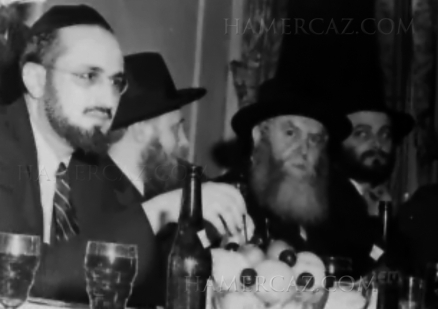
Have we strayed on Sheva Brachos?

The following was from Rav Aviner. These days, it seems to have become de jure, and it’s almost as if you feel “sorry” for someone who doesn’t have them each day. Would we be better off giving Tzedaka? It’s a difficult question as it can’t be generalised, of course.

Q: Is there an obligation to have Sheva Berachot all 7 days?

A: No. Whatever is most comfortable for the groom and bride. After all, it is to bring them joy and not to burden them (Re’im Ahuvim pp. 165-169. And Ha-Rav Moshe Feinstein related that when he got married they only had Sheva Berachot on Shabbat, and not on all 7 days as is customary today. Reshumei Aharon Volume 1, p. 18. And Ha-Rav Shlomo Zalman Auerbach once lamented this practice and quoted what the Chatam Sofer wrote in his responsa Even Ha-Ezer #122: “That someone once had Sheva Berachot on Shabbat and the entire community mocked him”, and that the Aruch Ha-Shulchan wrote in Hilchot Sukkah #640 that we do not have the custom to have Sheva Berachot every day. Meged Givot Olam Volume 2, p. 72).

Hilchos Aveylus: Attending Weddings of a close relative

When I wrote to Rav Schachter about various questions, he opined that he was unhappy with the leniency of “being a waiter” in order to participate in the wedding of close family. His view was that it was a Halachic bluff because nobody was really a waiter, and they weren’t working for the organisation, and he couldn’t imagine the mother or father of a Chosson/Kallah donning an apron or similar in the kitchen and really “working”. He noted that there was no need to look for specific devices like this given that there was a clear leniency from no less than R’ Yaakov Emden in Sheilas Yaavetz, and that those who wanted to rely on this, should do so (in such cases) and not “play games”.

He said that he felt that it was like the special shabbos phones introduced in Israel for Doctors involved in Pikuach Nefesh. He couldn’t understand why people were even trying to create such devices given that it was a MITZVAH to be Mechallel Shabbos for Pikuach Nefesh. He felt that people were losing their clarity of what Halacha was about.

I had reason to discuss this with nebech a father from the USA who was an Avel and travelled to Melbourne for the wedding of his son. I asked him how he would conduct himself and he said that he had asked R’ Schwei, a highly respected Posek in Chabad, who had advised using the waiter device. I mentioned that I thought it strange that someone would travel all the way from the USA to be a waiter, and I couldn’t understand the reasoning.

I, of course, work as a musician and there is no issue (as long as I’m paid 🙂 working at a wedding. Recently, I played at my nephew’s wedding, and I was careful to ensure that I was paid as usual. That, of itself, however, didn’t give me permission, to dance, however!

Of course, the issue of dancing, and eating in the hall, is separate. I may write about this in another post. In general, R’ Schachter explained to me that Aveylus was a state of mind. One needed to make sure that one wasn’t engaged in activities which invoked Simcha in the Avel. Where, however, an Avel would be causing real Tzaar (pain) by not being present, and their motive was not to disturb a Simcha by causing such Tzaar to a Choson and Kallah, he felt that this was not what Aveylus was every about. Of course, Halacha K’Meikel B’Aveylus, but it’s a state of mind, and one needs to be careful to make sure correct motivation and behaviour.

Dvar Torah for Shoftim

Tomorrow, is Rav Kook’s ז’ל Yohr Tzeit, so it is fitting that the Dvar Torah includes his thoughts, The Dvar Torah is from one of the Roshei Yeshivah of Kerem B’Yavneh (my alma mater), Rav Motti Greenberg.

Ironically, last night at Ma’ariv, there were a few international Tzedoka collectors from Israel in Shule. I was in my usually “straight ahead” mood, and asked one of them (a Chossid, with peyos)

What are your thoughts on Nachal Charedi

His responded with a pained look and said

Anyone who supports Nachal Charedi should not be allowed to enter a Shule

The problem with people like that is that they think that when they go to the toilet, it doesn’t stink. They live in la la land.

He effectively stated that I had no place davening Ma’ariv in Shule if I thought Nachal Charedi was a valid approach.  I said,

well, I support them, and you don’t come up to the level of their shoe laces, with a hateful comment like that

I don’t expect he will visit me for a donation. His paid driver heard the interchange.

Anyway, the D’var Torah … 

As part of the laws of warfare, it is written, “What man is afraid and fainthearted? Let him go away and return home.” [Devarim 20:8]. According to Rabbi Yossi Hagelili, this refers to a man who is afraid because of the sins in his hands. However, this seems backwards – to be afraid because of sins is a good trait and not a bad one, why should the man be sent away?

In Chassidic texts it is written that one time there was a delay in the construction of the succah of the Rebbe, the author of Beit Aharon. In the end, one of the Rebbe’s followers made a great effort and finished building the succah the day before the holiday, thus giving the Rebbe great pleasure. As a reward, the Rebbe offered the man his choice – he could either sit next to the Rebbe in the world to come, or he could become very wealthy. The man chose wealth. He explained to the astonished Chassidim who asked about his decision that to want to spend the world to come close to the Rebbe is a matter of selfishness, but if he had great wealth he would be able to help many other people.

Rabbi Shimon Shkop wrote in the introduction to his book Shaarei Yosher, “The foundation and the root of the goal of our lives is that all of our labors should always be geared and dedicated to the good of the community.” Rav A.Y. Kook wrote, “A person must always extricate himself from the private frameworks which fill his entire being, such that all of his ideas are centered on his own fate. This brings a person down to the depths of being small, and there is no end to the physical and spiritual suffering that comes about as a result. Rather, his thoughts, desires, his will, and the foundation of his ideas must always take into account the general – the world, mankind, Yisrael as a whole, and the entire universe. And this will also establish his personal status in the proper way.” [Orot Hakodesh volume 3, page 147].

To be “afraid of the sins in his hands” means that the person is concerned with his own sins and not with the sins of others. This is a man who lives only for himself. This is similar to what the sages taught us: “Why is it [the stork] called a ‘chassidah’ (one who is kind)? It is because it is kind to its companions.” [Chulin 63a]. But a question is asked: The Rambam teaches us that the reason birds are considered impure is because they are cruel, why then is the stork an impure bird? Chidushei Harim explains that this bird is kind, but only to its own friends.

The soldiers in King David’s army would give their wives a divorce before going out to battle. Rav Kook explains that the reason was not only to avoid a woman being “chained” to h er husband if he would be lost in battle. The Gentiles would bring their wives and children to the battlefield in order to give the soldiers greater courage, as if to say, look for whom you are fighting. But in David’s army the men would divorce their wives in order to disassociate themselves from any personal interests and to fight for the good of Yisrael as a whole. This is as the Rambam wrote, that a soldier must stop thinking about his own family and be aware that he is fighting in a Divine war. Anyone who is afraid only because of his own individual sins and does not think of the general public during the war is not worthy of fighting in the Army of G-d.

When a dead body is found abandoned on the roads, the community elders declare, “Our hands did not spill this blood” [Devarim 21:7]. “Would anybody even consider that the elders of the Beit Din are murderers? Rather, they are declaring that they did not see him and send him away unaccompanied, witho ut any food.” [Sotta 45b].

As the month of Elul begins, we should remember the hint of the month’s name, an acronym of “I belong to my lover and my lover belongs to me” [Shir Hashirim 6:3]. This is a hint of the relationship between man and the Holy One, Blessed be He. But the letters of Elul are also an acronym for another verse, “Every man gave to his colleague, and also gifts to poor people” [Esther 9:22]. This refers to concern for other people.

In connection with the above, we note that all the prayers of the Days of Awe refer to the needs of the community as a whole and not to personal requests.

Davening etiquette/halacha

Being in Aveylus, of course, sensitises me to such issues. I am sure I am not the first nor am I the last. It’s not a unique situation, of course, so I’m interested to hear others views. Disclaimer: I haven’t reviewed the halachos, which I will hopefully on the weekend, and am working off memory.

The Mishna B’rura (and others) point out that if someone comes late to Shule (let’s say Shachris), then depending on how late they come, they should skip certain pre-tefillos, and make sure that ultimately, they commence Shmoneh Esreh with the Chazan. Shmoneh Esreh is Tfilla, and all else is a preamble, although we have to say Krias Shma before its appointed time. In such a situation, one who has skipped sections, ideally should return to them and complete them later.

Shachris often presents a dichotomy, especially in older established Shules. Some Mispallelim work for a living. They daven, then may go home to eat breakfast, help out with the kids and then ensure that they are at their workplace on time. Many start work at 9am, some start earlier. There are others, who either don’t work (perhaps they are retired or unemployed or incapacitated) or have less of an issue about being at the workplace at a particular time.

It is not always possible to have a Minyan that davens relatively slowly and starts at the crack of dawn. Many different issues come into play. It is quite common to find minyanim that daven at a brisk rate. When I say brisk rate, I don’t mean a pun on the city of Brisk. Rather, I mean, at a rate where one can say each work, but do so quickly, and without much time to meditate on words/phrases. Shma and Shmone Esreh tend to be different. Shma is meant to be said so that one can audibly hear oneself and ideally said with the Trop. Shmoneh Esreh (the silent one) usually is a bit slower, as I pointed out above, it IS Tefillah, ultimately.

Now, this view of the Mishna Brura and others is not universal. Minhag Chabad based on the Alter Rebbe, the Baal HaTanya and Shulchan Aruch HoRav, is to always daven in order. That is, not to skip. If that means that one isn’t up to the minyan at Shmoneh Esreh, so be it.

I’m not sure, however, that the view of the Alter Rebbe was that if one finds oneself davening in such a minyan, that one should never say Tefillah B’Tzibbur. Perhaps, and I am stretching with no Mekor, he would argue that in such a situation one should begin davening privately and come earlier so that when Shmoneh Esreh came along, one was with the rest of the Minyan. Either that, or he’d say find a Minyan that davens at your pace.

On the flip side of the coin, the Yeshivish/Litvishe types who tend to say each work aloud (not just Shma) and/or extend their own quiet Shmoneh Esreh for a longish time, may cause those who have to go to work, to wait for them to have a minyan answering Amen. Perhaps, they too should come earlier to Minyan so that they can “kill two birds with one stone” so to speak?

I discussed this issue with one Mispallel where I daven, who happens to learn in a Kollel each day, and he said to me that he saw somewhere that the Mishna Brura’s advice of skipping is only when one comes late. But, if someone didn’t come late, then he should daven at his normal pace, even if this means that the rest of the Minyan might be waiting for him so that they can start Shmoneh Esreh (quietly) or for Chazoras HaShatz. He couldn’t recall where he had seen this difference.

Given that I daven for the Amud, as an Avel, I’m acutely aware that those who have come to the minyan include people who need to leave by a certain time, and I try to keep things moving.

The above two categories of Mispallelim can sometimes cause angst in that it makes it harder for the Minyan to be “worker friendly”.

Your thoughts?

Image from shulcloud.com

Talkers and Do-ers

When I perform at a wedding as a singer/band leader, my job is not to moralise or give social commentary. Band leaders have developed techniques and share them, to overcome those who feel they just “have to tell you what you should be doing”. Twice in over 3 decades I’ve succumbed, and said something, albeit for less than a minute.

Last week, I performed at a nice wedding. It was lebedik, and all was going well until suddenly, the Mechitza started to come down down. One end of the Mechitza (lightish white curtain material) started to come down, because one end had become unattached.

It was the height of Simchas Choson V’Kallah. The band were playing, both sides were dancing. Some hadn’t realised it had come down. Others quickly noticed, and attempted to assist in whatever way they could. Some quickly picked up the Mechitza and stood there holding sections aloft, while others quickly attempted to re-attach the end that had come loose and bring it to its previously taut and supportive state.

Suddenly, two well-meaning gentlemen approached the band stage and effectively “suggested I stop playing immediately”. I doubt either had license from the Ba’alei Simcha but that’s a side issue. Halachically, they were correct. One should not continue dancing without a Mechitza. Halachically, however, there was another solution. Instead of merely being talkers, those two people could have added to the group of do-ers and held sections of the Mechitza up, so that it was temporarily functional while others were re-attaching it. 

In five minutes time, or less. The Mechitzah was back up, and all resumed as before. At the end of the music bracket, I was quietly seething. This was a reflection of our society. There were those in our community who were only too quick to “advise us” of the halachic impropriety of the descended Mechitza. They were the talkers. They are well-intentioned, and no doubt very earnest. I know both men, and they are the “real thing” in the sense that they are יראי שמים. Neither, however, was ever going to become the Rav of people.

A Rav has to (in my mind) at least find halachic solutions that are more creative. What would have been wrong with those two fine men both lending their own hands to hold up the Mechitza, and at the same time calling for 4 more volunteers? They could have proverbially killed two birds with one stone. Both Halacha would have been satisfied, and those who were actually involved in fixing the Mechitza could have continued their job, quietly and efficiently.

We are too quick to impose and pass cold and less than innovative commentary on situations. Worse, we are quick to act with our mouths, as opposed to our hands.

Today is the Yohr Tzeit of R’ Chaim Brisker ז’ל. On his Matzeyva, the words רב החסד are enscribed. Why? There are many reasons. When Brisk burned down, R’ Chaim refused to sleep in his own rebuilt house until the simple poor people had their own homes rebuilt. There was no hierarchy for him, despite the fact that he was the undisputed Torah genius of his generation. R’ Chaim ז’ל had no problem playing with little children. He would sometimes be found tied up to a tree while the children ran around with glee. This was someone who was at home with the Rambam, Ramban, Rishonim and Shas, in the same way that we breathe air. And yet, R’ Chaim was a do-er. Oh yes, he spoke, but he did.

The same people who cry עד מתי should perhaps also look at some of the answers to this question. There are some very easy things we can all do, ואני בתוכם.

Act! Don’t just talk.

Israel and Soldiers

[Hat tip to DM]

Mirrer Rosh Yeshiva Rav Yerucham Levovitz: “..regarding those who currently sacrifice their lives so we can be saved, no one in the entire world can stand in their presence…and our obligation to pray on their behalf is limitless…”

Nothing is to be achieved from the negative messages, prevalent in the hareidi/hassidic world about Israel. It is time for a change in approach so that new generations learn about what Israel is and not what it is not. Then the madim (uniform) and kelei ha’mikdash, the sanctified vessels and tools used daily to rebuild our Promised Land and safeguard all of its citizens, will be seen in a proper light..

The revered Mirrer Rosh Yeshiva Rav Yerucham Levovitz, who commented in his Sichos Mussar regarding those who were killed in Lod in Talmudic times [ha’rugei Lod ein kol briya yechola la’amod be’mechitzatan]. “No mortal can be in their presence” because they have sacrificed their life on behalf of Israel. Likewise,“regarding those who currently sacrifice their lives so we can be saved, no one in the entire world can stand in their presence [no one can measure up to their level]. And our obligation to pray on their behalf is limitless…”

Rav Aharon Lichtenstein, head of Har Etzion hesder yeshiva, related that once, when he returned to America and was visiting with his father in law, Rav Yosef Dov Soloveitchik, he posed a series of questions he had received from students serving in the IDF. One student worked in the tanks division and his job was cleaning out and maintaining the tanks. Often his uniform got covered in oil and grime and he wanted to know if he needed to change before afternoon prayer,davening Mincha, something that would be terribly inconvenient and difficult. The Rav looked at Rav Lichtenstein and wondered out loud, “why would he need to change? He is wearing bigdei kodesh, holy garments.

These sacred garments have restored Jewish pride, faith and fortitude… these bigdei kodesh safeguard and secure all that is holy and worthwhile in G-d’s Promised Land and throughout the world.

No lesser voice than HaRav Tzvi Yehuda Hacohen Kook shared the regard and reverence for Israel’s soldiers and the uniform they wear. In Sichot Rabbenu, Yom Ha’atzmaut 5727, he wrote:

“A student of our Yeshiva approached me. I said to him: ‘At first I did not recognize you.’ He was wearing the army uniform. You know that I relate to this uniform in holiness. A lovely and precious man, full of G-d-fearing and holiness was approaching, and he was wearing an army uniform. At that occurrence I mentioned what I said at one wedding [of Ha-Rav She’ar Yashuv Cohen, chief rabbi of Haifa], when the groom came dressed in an army uniform.

There were some who were pointing out that it is inappropriate for a groom to stand under the chuppah with an army uniform. In Yerushalayim, the Holy City, it was customary that they came with Shabbat clothing, holy clothing, like a streimel (fur hat worn by hassidim on the Sabbath, ed.).

” I will tell you the truth. The holiness of the streimel – I do not know if it is one-hundred percent clear. It was made holy after the fact. Many righteous and holy Geonim (great rabbis) certainly wore it. There is certainly so much trembling of holiness before them, and we are dirt under the souls of their feet, and on account of this fact, the streimel was made holy.

“Also Yiddish, the language of Exile, was made holy because of its great use in words of holiness. But from the outset – it is not so certain. In comparison, the holiness of the army uniform in Israel is fundamental, inherent holiness. This is the holiness of accessories of a mitzvah, from every perspective…”

Rabbi Yehoshua Zuckerman relates [inIturei Yerushalaim] about Rav Tzvi Yehuda “teaching a class and a student, who was on leave from the army, was standing next to him. During the entire time, our Rabbi rested his hand on the student’s arm. At the end of the shiur, another student asked about this. Our Rabbi explained,“It is simple. He was wearing a Tzahal uniform and I was touching holiness the entire time.”

Thankfully, there are also those in the hareidi community willing to speak out against the angry and misguided radicalism that would diminish the glory of the IDF. Writing on Behadrey Hareidim,Rabbi David Bloch, founder of Nahal Hareidi, expressed his resentment at Rabbi Tzaurger’s words.

“We have been told by our ancestors: ‘Anyone who opposes the good in his friend may end up opposing the good of Hashem’, anyone who is not grateful towards the soldier for his defense of the Jews in Israel, so he can live here in relative peace, is an ingrate.” Rabbi Bloch continues: “There is no connection between the Zionist ideology and gratitude to those who physically make it possible with God’s help so each resident can live here, and manage his life as he sees fit. Even if we were living in exile and there are enemies who want to destroy us – we must be grateful to those who are working to save lives. One could be anti-Zionist and still be grateful to those who risked saving lives. Such a call is a serious failure of values.”

The most basic Jewish value is that of expressing Hakarat ha’tov, gratitude, to anyone and everyone who does anything which is of benefit for me and certainly for society at large.

Every Orthodoxy has radical elements. To be radical in one’s love of Torah and of God is not a sin. However, when one’s embrace of Torah is expressed as hatefulness towards IDF soldiers and a damning of the bigdei kodesh that they wear, then it is a radicalism that has lost sight of true Torah.

Can a Rabbi know everything?

I saw an interesting question and answer from Rabbi Aviner’s web page. I’d describe Rabbi Aviner as Charedi Leumi, but unlike regular Charedim, he is acquainted somewhat more with the real world. Here is the question and answer

Q: Sometimes when a Rabbi is asked a question, he responds: “I don’t know” or “I am not familiar with that”. Is this and answer, or a was of avoiding taking a position?

A: It is a type of answer and of taking a position (The Chazon Ish said: ‘I don’t know” is also part of the Torah, meaning that when a person reviews his learning, he need to points out I know this and I don’t know that. Sha’arei Aharon vol. 1, p. 44 in Kuntres Sha’arei Ish. And the Steipler complained to a great Rabbi: When I say that I don’t know, the world explains it as if it is a doubt. Orchot Rabbenu vol. 1, p. 38 in the additions at the end. And Ha-Rav Chaim Kanievski was asked: When Ha-Rav answers a question with “I haven’t heard”. Does this mean that he does not agree with that position? He answered: It is the simple meaning of the words. She’eilat Rav Vol. 1, p. 22 #8. Segulot Raboteinu, p. 257 note #319).

I recall being taken aback when Mori V’Rabbi, Rav Hershel Schachter occasionally said to me over the phone “I don’t know”. This to me is Gadlus, otherwise known as intellectual integrity as opposed to papal infallibility (lehavdil). It could have lots of meanings

  1. I don’t know you well enough to make a determined ruling
  2. I need more facts, and based on what you’ve told me, “I don’t know”
  3. I never had a Mesora on how to decide this issue, and I don’t pasken without a Mesora (this is a Hungarian trait), others (like Dayan Usher Weiss isn’t afraid to say Libi Omer Li)
  4. I can’t answer you on the spot, I need to look into it very carefully (the Rav told all his Talmidim to never answer immediately, and to always say you have to check, and to look in Shulchan Aruch and call back, even if you know)
  5. Rav Hershel always encourages his Musmachim to discuss every Shayla with a Chaver (Rav) before answering
  6. He’s not convinced I’ll listen to him, so and not say something, he says I don’t know.

As opposed to Poskim, I would posit, that most Rebbes, and Rebbalach, never seem short of an answer. Similarly, the same can be said of Mekubalim (the real ones, and the shyster money grabbers).

Book-13-18
Right to left Rav Abaranok ז’ל, Rabbi Tzvi Yehuda Balbin, and me, on the Upsherin.

I’ve never seen it as a negative! Moshe Rabenu needed to consult what to do with Zelafchad, the Mekoshesh Etzim. Consultation is a good thing, and human frailty to me is Gadlus. Mori, V’Rabi Rav Abaranok, always said his “tentative opinion” then invited you to his office or house, where he went through the Mekoros and explained his Psak (or withdrew it!). They say ( I think in the name of R’ Moshe Tendler) that R’ Moshe when asked a question would answer at the bottom of the stairs, and by the time he got to the top of the stairs, reviewing everything out loud, he either kept his Psak or changed it.


Litvishe/Misnagdishe poor taste

I chanced upon Matzav.com yesterday. As always, they had a piece on the Yohr Tzeit of R’ Schneur Kotler ז’ל, complete with pictures of him beardless. I looked further down the page, and found it was also the Yohr Tzeit of

Rav Yaakov Sapir, author of Even Sapir (A Journey to Yemen), a collection of stories of his travels through India, Australia, and Yemen”

I was flabbergasted that they seemingly couldn’t bring themselves to note that it was also the Yohr Tzeit of the last Lubavitcher Rebbe זי’’ע

I commented on the blog and asked why they didn’t report it. My comment was not published: silly censorship.

I made a further comment about kosher bourbon production in another article, and that got through Matzav’s censors.

Now, to be fair, I don’t think Chabad would ever mention R’ Kotler’s Yohr Tzeit either, but what about the Emes and Kavod HaTorah. Can’t people be civil?

The Lubavitcher Rebbe was an exalted Gaon, a Manhig, and a source of inspiration for many. How can one simply “forget” he existed on his Yohr Tzeit?

Is this what the Torah wants and advocates? Matzav call themselves the voice of “World Jewry”. Hardly. Och und Vey.

Even Yeshivah World News, which is usually more right wing than Matzav, had a feature.

Both also reported the sad Petira of R’ Neuwirth, the author of Shmiras Shabbos K’Hilchoso, which revolutionised the presentation and psak of Hilchos Shabbos in an unparalleled manner.

Politics=Sinah

So as not to end on a negative. One of the Mispallelim in Elwood Shule, has his birthday today on Daled Tamuz. He is one of two emigres from Russia who devote themselves to the Shule 24/7 and are regular daily attendees. His name is Alex (aka Chanan aka Sasha) Livshiz. There was a Kibbud on the table after  davening, and I asked  aloud “who has yohrtzeit today”. Alex was in the middle of davening (I assume Krias Shma) and put his hand up. It transpired that it was his birthday and he had decided to wear Rabbeinu Tam’s T’fillin for the first time. I pointed out that Daled Teves is also the Yohr Tzeit of Rabbeinu Tam himself! Hashgocho Protis?

Of course, in Melbourne, it is also known widely as the Yohr Tzeit of R’ Yitzchok Dovid Groner ז’ל who devoted his entire life to building up the community and was held in the highest esteem by most, including me.

Israel’s Next Chief Rabbi Has Illustrious Shoes To Fill—From Long Ago

The author, Elliott Horowitz, sent me this link. It’s definitely worth reading.

Rosh Chodesh at Elwood Shule: tale of twin survivors

Shabbos morning began in the usual way. I awoke, enjoying the extra hour afforded by Shabbos and headed quietly downstairs to the kitchen to enjoy a cup of coffee before davening. I usually read/learn a sefer with my coffee, and this Shabbos was no different. My concentration hasn’t been what it should and I can’t claim too much registered, even while I read “דברי הרב’’.

I experience various sources of stress at the minute, and I have come to realise that it’s more difficult to concentrate when one’s mind is somewhat diverted, even subconsciously. Nights can be the worst, as one is unable to consciously control the flight of mind and emotion.

Since my father הכ’’מ passed away, I’ve needed to cope with new and significant contributors to higher stress levels and, although I’ve always seen myself as relatively impervious to the rougher waves that life can dispense, I’m not as water-proof as I had previously imagined in delusion.

Stepping out into the brisk Shabbos morning air, I began the weekly long and lonely walk to Elwood Shule for Shachris. Elwood is but a shard when compared to its former exalted beauty and glory; but Elwood was my father’s Shule. It was our Shule. I am the Chazan on Rosh Hashono and Yom Kippur, and I daven there daily. My parents were married at Elwood. It was Rabbi Chaim Gutnicks ז’ל first wedding at Elwood. I was Bar Mitzvah’d there, as were my sons. It is, therefore, only natural, if not magnetic, that despite the almost empty and ghost-like pervading atmosphere, I continue this heritage; only now I speak to my father on the occassion, and ask why he isn’t walking with me. I don’t merit answers.

It hadn’t been a great week. Two friends recently lost their parents, one to the same dastardly illness as my father. In addition, my workplace is in some turmoil due to an internal managerial episode. I sense my wife and children see my ups and downs, and they are sensible enough to know when to speak and when to stay silent. I thank them for this.

As I approached the gates of the Shule, I recalled that it was the Lubavitcher Rebbe’s זי’ע Yohr Tzeit and no doubt the handful of Chabad Chassidim at Elwood would seek to be called up, as is the custom in Chabad. It was also R’ Zalman Serebryanski’s ז’ל yohr tzeit as well as Rabbi Groner ז’ל: a momentous ensuing week.

Elwood was rather more vacuous than usual. It seems that not too many had decided to come early. There was hardly a person under the age of 50. Where were all the young people? What is happening to our generation? Many attendees are “JFK” style attendees: that is, they arrive Just in time For Kiddush. What would happen if we didn’t have a delicious Kiddush catered by Peter Unger each week?

I’m not a contemplative davener. In fact, I’m now a poor davener. My dialogue with God is quick and lacks a previous more qualitative element. I usually grab a Sefer/Holy book from the Beis Medrash and learn while davening stretches out.

I sit in a barren area. It wasn’t always this way. There is nobody in my row, save a plaque remembering my dear father, and the ten rows behind me are void. I (now) make a point of going around the Shule and shaking each person’s hand. It’s what my father used to do. My father הכ’’מ was a far better person than me, though.

At that time, I noticed that one elderly gentleman, Mr Tuvia Lipson, had not yet arrived. Tuvia attends weekly. Apart from being a holy holocaust survivor, Tuvia enjoyed a stellar history after the war, joining the Israeli army, and rubbing shoulders with Shimon Peres and others. Tuvia remains an active and positive man. Despite losing his wife many years ago, he picked himself up and continued spreading the mantra that is emblazoned weekly in gold on his lapel, “זכור”-Remember.

At one stage of Layning, I noticed Tuvia entered Shule and I approached, wishing him Good Shabbos. Tuvia was shivering and complained that there was a cold breeze running across his back. Asking him to join me in my row, where the heating seemed to be more effective, he readily agreed. So, for the first time, Tuvia and I sat together, he sitting on my father’s seat alongside me. Tuvia whispered that my father used to call him “Pan Parantchik” which means “Mr Captain” in Polish, because Tuvia had apparently been a Captain in the Haganah.

Between Aliyos, Tuvia informed me that he had been in Bendigo for a few days. “Bendigo?”, I asked inquisitively. “Were you looking for gold? It’s cold over there”. Tuvia responded that he had visited the schools in the area and had spoken about his Holocaust memories and thereafter. This was part of his activities in the courage to care campaign. I shook my head in disbelief, after which he pulled out a wad of little notes and handed them to me. Korach suddenly became less significant, and I was mesmerised by the honesty and integrity of the short vignettes the school kids had penned in appreciation.

At that point, I thought to myself, this Shabbos, had already been more significant. It was then that Tuvia proffered another story: one that I had not yet heard.

Tuvia Lipson (centre) with three generations. Picture from jwire

Tuvia had decided one day to attend the “march of the living” with a son (Jack) and grandson (Jason). A former resident of Łódź, Tuvia suddenly informed his sons that they were going to try and see if his orginal family home was still standing. Tuvia had been born in that house, there being no hospital at the time for such events. Knocking on the door, an elderly woman answered and asked how she could help . Tuvia explained in Polish that he was born in that house, in a particular room, and if she would be so kind, he’d appreciate if she had no objection to him showing his son and grandson that particular room in which he was born. Rather surprisingly (based on other stories I had heard, where Polish owners are disquieted by the fact that “jews are returning to take back their houses”) this woman immediately ushered them in and agreed. As they walked towards the room, the woman stopped and said:

“I  know what you have been through and fully understand”

Tuvia was taken aback. How could she know what he had been through. Yes, she had the best intentions, and was willing to let them enter, but she wasn’t Jewish. She hadn’t been persecuted and subject to a policy of mass murder.

Tuvia retorted:

“With the greatest respect, you cannot know what I went through”

Upon returning from the room, they thanked the woman for her positive disposition and were about to leave when she said

“Would you like to have a cup of tea with me, so that I can explain why I do know what you went through?”

Inquisitively, Tuvia et al agreed and sat down to hear her story. She had been a little girl of 7 or 8 during the war, and her parents had concealed a little Jewish girl of the same age, under the floor boards of the house. Each day they would feed the young Jewish girl, and in the evening the little Jewish girl would emerge to wash. One day, after two years of hiding, word got out that the parents were hiding a Jew. That, of course, was a cardinal (sic) sin. Suddenly, out of the blue, there was a firm knock on the door, and two Nazi SS officers ימח שמם וזכרם entered demanding to know where the Jew was hiding. Frozen by fear, the lady’s father denied any knowledge of a Jew in his house. One of the Nazi officers became angry, and gave the father 10 seconds to reveal the location of the hiding little Jewess. During this episode, his own daughter, now the older lady, was hiding behind a wardrobe door and watched in horror at what was transpiring.

Suddenly a shot rang out and her father slumped to the floor—dead. The SS officer then turned to the girl’s mother and demanded

“now you tell me where the Jew is hidden, or I will kill you in the same way”

The lady’s mother also stood firm, and after a few moments another shot rang out, murdering her mother before her very own eyes.

At this point, the little girl ran out from behind the cupboard door and started attacking the two Nazi officers and cursing them for killing her parents. The officers were cruelly and clinically cold and ignored her entreaties and protest, as they walked imperiously towards the front door. Almost predictably, the Chief officer issued the chilling command to his underling:

Shoot the litte girl as well

They left through the front door and the underling trained his gun on the little girl and shot— only at the last-minute aiming his gun upwards to miss the target. The Chief Officer, thinking that she too had been eliminated left together with his underling, “satisfied” with his cruelty beyond human belief and sensibility.

At this point, the woman revealed to Tuvia, that she was the little girl who had experienced this near death experience. When the Nazis left the house, she descended below the floor boards and both she and the little Jewish girl escaped to a non-jewish relative and hid for a further two years until the war was over. At that point, Tuvia was taken aback and fully understood why she had originally stated

“I know how you feel”

Immediately, Tuvia approached Yad Vashem and had the story verified. In fact, the Jewish girl who survived was now living in Haifa and was in yearly personal and close contact with the woman, her saviour. Tuvia organised that a fitting memory  be established for the Polish mother and father, who had been murdered as חסידי אומות העולם—righteous gentiles and who are certainly occupying Gan Eden today.

I sat there both numb and cold. Had I not asked Tuvia to come and sit with me, perhaps I would never have learned this story. The last past of the Parsha failed to register as this story enveloped my psyche.

I don’t have any more to add. I remain in shock and awe. What was designated and planned as a standard walk to Elwood Shule, turned into (yet another) momentous privilege which perhaps served to help me place my own stressors into a more realistic context.

The good work of Rabbis is often invisible

The reality is that newspapers and reporters are seemingly more likely to report and aggrandise horror stories and mistakes than they are to report excellent outcomes and outstanding effort, especially when it comes to Orthodox Rabbinic work. Sure, if a philanthropist donates money, they will report that as a big story with a nice picture spread. You won’t, however, find the headline on the front cover

“Reform rabbi speaks in favour of the anti-zionist BDS-supporting AJDS”

The “passionate” support of the Reform rabbi happened. It was mentioned in an article about the meeting of the ECAJ. I’d suggest such a view and display of passion has bigger ramifications for the reform movement and the opinion of many Jews than a Zablo that was screwed up and set aside by a NSW court. We should have had a transcript of what she had said.

As Rabbis Ullman and Moshe Gutnick noted in their letters to the Australian Jewish News, the focus on positive work and outcomes of Orthodox Rabbis seems to occupy no space in the AJN.

I wonder how the left-wing, and Limmud Oz supporters would react if it was suggested that they invite the following Neturei Karta people to speak about why we should be appeasing Ahmadinajad and dismantle the State in favour of Palestinian Arabs. After all, it’s all about tolerance, diversity and giving everyone a fair go to express their views?

No, Limmud Oz wouldn’t ever invite Neturei Karta, even remotely by video conference. Why not? I wonder if the AJDS would support them being invited? I imagine they would. After all, democracy is their religion. And yet, Limmud Oz invited Slezak! I don’t see much difference. In retrospect, there is a significant difference. Slezak is taken more seriously, especially by the young and green, and the young and green are mainly behind Limmud Oz.

People like Jeremy Stowe-Lindner, principal of Bialik College in Melbourne, writing in an article in the Australian Jewish News that amounts to a whitewash of a serious error by Limmud Oz in inviting Slezak, should now support Neturei Karta using his own arguments. Would Stowe-Lindner also use an error of inviting Neturei Karta to promote his agenda of sidelining denominational issues to the category of personally baked pareve cheese cake?

I know of recent cases where the Victorian Rabbinate, through the Beth Din, have solved very serious and long running cases of recalcitrant husbands not giving a Get. Was that a front page story? Heck, no.

It’s also the Rabbinate’s fault. They need a PR person in this day and age. In addition, they should have supplied statistics about the number of mediations they have overseen over the last few years which have been successful and not been challenged and compare those with  secular mediations and arbitrations that have been challenged.

No, you won’t see any of this in our Australian Jewish News. They are in the business of selling papers, and horror stories especially about Orthodoxy are better.

[AJDS really should rename themselves ADJS because I struggle to find Judaism in their politics. Left-wing democracy would seem to be their religion.]

The new Ashkenazi Chief Rabbi of the State of Israel?

Based on what is reported in this article, I’d be pleased with Rabbi Stav. We had a Rav Stav at KBY when I was learning there. Was that his father or uncle? Does anyone know? I don’t mean Rav Moshe Stav. Actually, I take that back, it was Rav David Kav who I remembered. Kav, Stav 🙂


Rav Stav (from cjnews.com)

Rabbi Brackman’s arguments are not convincing

Rabbi Levi Brackman, in an article in Yediot (reproduced below) is at best attempting to be Melamed Zechus (find some merit) in the alleged misrepresentations by Rabbi Broyde, and Rabbi Metzger. Using the argument that authors such as the Rambam or the Ba’al HaTanya didn’t cite their sources is not convincing. There is a world of difference between Halachic excursus and philosophical writing. An argument could be mounted that Rabbis could have listed each of their sources in a bibliography, even without referencing them in the text. It was not the norm then, though, to do so. Rather, one either quoted directly, or in the introduction, listed the main sources. It might well be true that the ideas expressed may have been devalued if all sources were explicitly footnoted. Not withstanding that, I don’t see the parallel to Rabbi Broyde’s case.

Could one imagine the Rambam extolling the virtues of his Moreh Nevuchim by falsifying a letter from a non-existent Rabbi? Could one imagine the Ba’al HaTanya justifying his ideas by penning a letter under a pseudonym, praising his work and providing additional proof of his ideas? I’m not sure I could imagine that.

I do understand that Jews in particular have a terrible habit of looking at who is saying something as opposed to the veracity of their argument. Ultimately, it is this phenomenon, which has given rise to the practices of the Broydes of this world. Rabbi Metzger’s case is entirely different. Although it is a work where he collects halachic opinions, I do think that in the cases where he quotes someone word for word, that he should footnote each such case. I have his Miyam HaHalacha at home. He was never considered a Posek of note, and I bought it some 20 years ago for two reasons:

a) He sat near me at Kerem B’Yavneh

b) It was a nice compendium, especially before the world of the internet.

I think that Rabbi Brackman has made a contribution in his article, but he has failed to defend Rabbi Broyde in any shape or form, in my opinion.

Here is the article. What do you think? I once wanted to prepare a shiur on this topic based on האומר דבר בשם אומרו מביא גאולה לעולם … and ask what about the גניבה … alas, like many things buzzing around in my head, they don’t see the light of day (yet) while I’m gainfully employed as a University academic and find myself neuronally spent by nightfall.

Rabbinic plagiarism and scholarly integrity

There have been a number of serious scandals recently involving rabbis who have been less than honest when it comes to their scholarly work. First, Chief Rabbi of France Gilles Bernheim was forced to resign because he plagiarized work from multiple authors, including famous post-modern philosopher Jean-François Lyotard.

Hot on the heels of that controversy, we in America had the scandal involving Rabbi Michael Broyde, a senior rabbi and rabbinic judge on one of America’s top rabbinical courts. Rabbi Broyde misrepresented himself in order to gain entry to a rival rabbinic organization, the International Rabbinic Fellowship (of which I am a member). He also used fake names to write letters and comments to bolster ideas he was disseminating. Broyde, like Bernheim, was forced to resign from his position as rabbinic judge at the Beth Din of America.

Stolen Literature?

Even more recently, an article in Israeli daily newspaper Maariv accused Rabbi Yona Metzger, the chief rabbi of Israel, of plagiarism in his book “Mayim HaHalacha.” Metzger maintains his position as chief rabbi of Israel.

So what is it with rabbinic plagiarism and scholarly integrity?

Being truthful about the origins of any idea is a Jewish value. The sages tell us that “whenever something is repeated in the name of the person who originally said it redemption is brought into the world” (Avot, 6:6, Nida, 19b). Yet citing a source for an idea is not seen as obligatory within Jewish tradition.

Hidden ideas

The great medieval Jewish codifier and philosopher Maimonides, for example, is somewhat loose with quoting his sources. In fact Maimonides himself admits that many of the ideas he brings are not his own, yet he balks at giving the proper attribution to the original sources of the ideas. In explaining this position Maimonides says that “there is no evil in this, and I am not glorifying myself for what a previous person said because I have already admitted to it” (Introduction to Shmona Perakim).

Maimonides goes on to give the main reason he does not reveal the names of the sources he brings. “It is possible that, had I brought the name of this person (who originally said the given idea, the reader) who does not find (that name) palatable, will lose the (entire idea and will see) negativity in it and will therefore not understand (the larger concept). And since my intention is to benefit the reader, to clarify for him hidden ideas within this tractate, I saw it fit not to cite my sources.”

Not all medieval Jewish scholars believed that this was the correct thing to do. One prominent example of this is Jacob Anatoli (1194–1256) who disagrees with Maimonides. In the introduction to his book “Malamad HaTalmidim,” he says that he will even cite non-Jews, specifically Michael Scot (1175–1232), from whom he heard “words of wisdom.”

His reasons for citing all his sources are as follows. First, he does not want to bring glory to himself by using “borrowed vessels.” Second, he says it is important for a wise person to see wisdom for what it is and not write it off just because it originated from a source they don’t like. He adds that if Moses saw it fit to quote a gentile, Jethro, in the Torah, he should follow that example in his books. Finally he says that he follows the way of the Torah which is to always give attribution to his sources.

Yet, many authors have followed Maimonides lead. Here are two prominent examples of this, both books that have had a large impact on modern-day Judaism. The classic Chassidic text “Tanya,” written by Shneur Zalman of Liadi (1745–1812), borrows heavily from the ideas of medieval Jewish philosophers, specifically Maimonides’ “Guide to the Perplexed,” but from many others as well. He writes on the opening page that the book “has been gathered from holy books and authors,” yet he does not cite or credit the actual “holy books and authors” he takes ideas from.

The classic Mussar movement text “Chesbon HaNefesh” by Menahem Mendel Levin (1749–1826) seems to have taken entire concepts from Benjamin Franklin without any acknowledgement or citations whatsoever. I surmise that both of these authors, Shneur Zalman of Liadi and Menahem Mendel Levin, shared Maimonides’ concern that if they divulged their sources, the ideas would be devalued in the eyes of their very conservative religious readers. They therefore intentionally kept the sources of their ideas a secret.

In fact Jacob Anatoli, who insisted on citing all of his sources including those that came from non-Jews, had his worked banned by prominent medieval Jewish scholar and Talmudist Shlomo ben Aderet, also known as The Rashba (1235–1310). It is possible that other later scholars took note of this and decided that it was better if they hid their sources rather than have their work potentially banned and derided by the masses.

In the final analysis we have two competing values here. Concern that the idea be accepted to the reader and academic and scholarly integrity that insists on citing every source. When academic integrity causes the reader to become prejudiced towards the ideas presented, Maimonides is willing to compromise and not cite his sources. Jacob Anatoli, conversely, would like to educate the reader to see past the person saying the ideas and judge the ideas for what they are. He is not willing to compromise academic and scholarly integrity because readers may be too shallow to do this.

Literary tactics

It seems that the view of Maimonides dominated over time. We therefore have books like the “Tanya” and “Chesbon HaNefesh” by Menahem Mendel Levin which obscure the sources of the ideas they contain, and have thereby obtained a much wider ranging readership and influence. Is this dishonest? Maimonides would argue that because a book is written for the benefit of the reader, as long as hiding the source of the ideas is positive for the reader it is acceptable. Others disagree.

There is however, another element to all of this which is pseudepigrapha, where a book is attributed by its author to a more prominent figure from the past. A classic example of this is the Kabbalistic work known as Sefer Yetzirah which was attributed to the Patriarch Abraham. Although it is clear that Abraham did not write the book. In addition, many argue, in my view convincingly, that the magnum opus of the Kabbalah “The Zohar” is pseudepigraphical and was not actually written by the Talmudic scholar Rabbi Shimon bar Yochia in 70 EC. There are many other examples, like the commentary on Tractate Nidarim that is attributed to Rashi (1040–1104) but is known to have been written by someone else. Yet the importance of these works and their respectability has not been diminished in the eyes of most people.

One may argue that the reason pseudepigrapha was an acceptable literary tactic in previous eras was similar to why it was permissible to quote ideas without citing sources. Authors of important works used these tactics as a way to get readers to take their ideas seriously. They would either hide their own authorship or hide the sources of the ideas they presented, whichever worked better for the particular text and subject matter, in order to get the reader to take the ideas seriously. It was then up to the reader to either accept or reject the ideas based on their own merit. In other words, the value of disseminating ideas was seen as paramount, and scholarly integrity was secondary in importance.

All this brings us back to the recent scandals. It is first important that I make it clear that I am personally strongly opposed to any type of plagiarism or scholarly forgery in all its forms. In this sense I side with Jacob Anatoli. However, when taken from a historical perspective, the matter is far from clear.

If Rabbis Broyde, Bernheim and Metzger employed unorthodox literary strategies as a means to disseminate ideas that would otherwise not be accepted by their audience, they are standing on strong ground in doing so. Whilst I do not like it, if such a crime truly warranted their firing from their positions of prominence, there are bookshelves full of classical works we should be throwing out with them.

Rabbi Levi Brackman is co-founder and executive director of Youth Directions , a non-profit organization that helps youth find and succeed at their unique positive purpose in life

מו’’ר Harav Boruch Abaranok ז’ל

As per my about page and a previous post, Rav Abaranok, played a significant role in my Jewish development, especially after I returned from Israel after learning at KBY. I used to call him “Der Rov”. He was a wonderful role model with impeccable middos tovos.

Please enjoy this video from February, 1998 [Hat tip Graeme]

What should we be doing during the lifting of the Torah (Part 2)

לעילוי נשמת אבי מורי הכ’’מ ר’ שאול זעליג בן יהודה הכהן

As we stated in the previous post, from the language of Maseches Sofrim, which is quoted by the Mechaber in Shulchan Aruch verbatim, it would seem that the proper action of the congregation would be to bow one’s head during Hagba—לכרוע. Rabbi Moshe Isserles, (1500’s) otherwise known as the Ramoh, doesn’t make any comment and one might ask, if it was not the Minhag in Ashkenaz to bow one’s head during הגבה he may have mentioned this in his addenda to the Mechaber. Perhaps the opposite is true. The Ramo also authored the דרכי משה on the טור and in 147:4 the Ramo is happy to mention the minhag recorded by the Maharil (mid 1300’s) which was not just to bow, but also to prostrate oneself at the time of הגבה (and to follow the Torah back to its Aron). The Maharil was the celebrated and authoritative recorder of Ashkenazi Minhagim. It would seem, possibly, that the Ramo in quoting the Maharil, had no issue with the more sedate suggestion of the Mechaber to simply bow during הגבה. The Ramo begins that section ad loc. by noting that

In the Mordechai, at the end of Hilchos Tefilin, page 98b, he quotes that the Maharam used to lift the Torah in order to show it to all the people, and this was the opinion of the Kol Bo who stated “in Masechta Sofrim, when the Chazan was on on the Bima he opened the Sefer Torah and showed the text to both men and women, and then they said “Vzos HaTorah” etc. And from this is a source for why women would commonly push themselves forward at that time, although they (the women) often didn’t know why they were doing so. And from Maseches Sofrim it appears that this occurred before layning (as per the times of the Gemora and Minhag HaSefardim) but we (the Ashkenazim, notes the Ramo) perform Hagba after layning.

The Ramo in Darkei Moshe goes also notes that a community is entitled to sell the Kavod of passing the Torah cover to the Golel (the one who rolls the Torah back from the unwound Hagba) and the person who was given the honour of Gelila, cannot complain, as he only purchased the right to rewind the Torah. Someone else can purchase the right to pass on the Torah’s clothing to the Golel.

I looked up the Kol Bo and, as quoted by the Darkei Moshe and he is quoted accurately by the Ramo. Importantly, although he purports to be quoting Maseches Sofrim he doesn’t use the word ולכרוע—that the people should bow. Was that intentional?

The “plot” thickens when we examine the language of the קיצור שלחן ערוך. Again, the author, Rav Shlomo Ganzfried, intentionally appears to omit the word ולכרוע—that the people should bow.

לאחר קריאת התורה, אומרים חצי קדיש, ומגביהין את הספר-תורה. המגביה פותח את הספר-תורה שיהיו שלושה עמודיט מן הכתב גלוי, ומראהו לימינו ולשמאלו, לפניו ולאחריו, כי מצווה על כל האנשים לראות את הכתב, ואומרים “וזאת התורה” וכו’.

Why? In his introduction to the קיצור Rav Ganzfried

R’ Shlomo Ganzfried ז’ל (wikipedia)

explains the primary sources upon which he bases his decisions. I haven’t got an edition of the Kitzur with that introduction (nor could I find one), however, R’ Shea Hecht told me that the Kitzur bases himself on three other Seforim and sides with the majority if there is a dispute between. The three are:

  1. Shulchan Aruch HoRav (from the Ba’al HaTanya)
  2. Siddur Derech Hachaim (the Chavas Daas)
  3. Chayei Adam

Sadly, there is no existing Shulchan Aruch HoRav on this section, as it was lost or burnt. Incredibly, the Chayei Adam says absolutely nothing about Hilchos Hagba. That means, the Chayei Adam doesn’t even present a Seif about Hilchos Hagba. This in of itself is very strange.

In the authoritative Siddur Derech Hachaim by R’ Ya’akov MiLissa (late 1700’s) who is well-known as the author of the Chavas Daas on Yoreh Deah and the Nesivos HaMishpat on Choshen Mishpat, writes

When he lifts up the Sefer Torah he should show the lettering to the people and say וזאת התורה …

It could be argued that the Kitzur is therefore just copying the words of the Siddur Derech Hachaim. On the other hand, the directions at that point in the Siddur are for the person lifting the Torah, that is to say, the notes are directed at the person performing Hagba as opposed to the people who are witnessing the Hagba. He doesn’t, for example, say that the people should say וזאת התורה. It is not conclusive, perhaps, then to draw a conclusion from these words of the Chavas Daas. In point of fact, in the Halacha section, the Derech Hachaim explicitly says:

ויש מדקדקים לראות האותיות עד שיוכל לקרותם ולכרוע ולומר וזאת התורה

The Maharikash, R. Ya’akov Kastro (mid 1500’s) in his Tshuvos  אהלי יעקב, 57 states

Whoever doesn’t bow, because he thinks (bowing) is forbidden, should be put in Cherem!

The Siddur of the Shulchan Aruch HoRav makes no comment about the need to bow during Hagba. This point bothered the Ketzos HaShulchan, HaRav Avraham Chaim Naeh ז’ל

Rav Chaim Naeh ז’ל (wikipedia)

who wrote in his בדי השלחן, אות נ’ה in סימן כה

Why didn’t the Admor (Ba’al HaTanya) mention the imperative to bow in his Siddur? Furthermore, it isn’t mentioned in the Kitzur Shulchan Aruch either. We (Chabad?) also don’t have a custom to bow …. I haven’t seen anyone raise this issue. Later on, I saw that in R’ Ya’akov Emden’s Siddur (Yaavetz) on the word לכרוע, R’ Emden refers us to the Shyorei Knesses HaGedola, but I (R’ Chaim Naeh) don’t have that Sefer with me to look into the matter.

To be continued.