[received from various]
SIGN THE PETITION!
ABC Australian Broadcasting Corporation: Remove video and photographic footage taken outside Yeshivah College for the use in Compass’ upcoming documentary ‘The Whistleblowers’ – Sign the Petition!

[received from various]
SIGN THE PETITION!
It’s seems strange that when someone is accused of horrible crimes, these are made known. Yet, when the person is completely cleared and apparently there isn’t even recourse to an appeal via the DPP by the accuser we don’t get to learn what was missing or fictitious or particular about the false accusations that caused damage and was unfounded. What if an accuser had a screw loose? What if he or she was found to be convinced that things happened when they didn’t? Are such people a danger to society?
I think we need to uphold a standard where a grossly false and shameful accuser is scrutinised. They may well be calculating liars with psychological conditions. They are entitled to privacy but if they come out and accuse, the police should go into proper detail regarding why they consider the accusation a Booba Mayse. If not, then the accused is subject to a different level of privacy than the accuser. I would have thought both deserve the same?
There are some people out there who should be subjected to sanity tests before allowed to make gross claims. They should be noted as such in the press if so found by the police. How do people stay away from them lest they inadvertently fall into some baseless and stupid allegation?
Here is the article from the Age
By STEPHEN CAUCHI AND BARNEY SCHWARTZ
A respected rabbi who was stood down from Melbourne’s Yeshivah College over allegations that he raped a student in the 1970s has had charges against him dropped.
Rabbi Avrohom Glick, 67, was then deputy principal and later principal of the College. He was head of religious studies when he was stood down last December.
Rabbi Glick, of Balaclava, was arrested and interviewed in December and released pending further inquiries.
Yeshivah College principal Yehoshua Smukler said at the time that although “Rabbi Glick is a highly respected staff member and community figure”, he would be immediately stood down.
Rabbi Glick has not attended the campus or had contact with students since.
Chevi Levin, a niece of Rabbi Glick, said on her facebook page on Friday that “after conducting a thorough investigation, Victoria Police has decided NOT to press charges against Rabbi Avrohom Glick.
“This is NOT a case of no evidence or stale evidence. Rather, police have rejected the allegations, which were vexatious and wholly without substance. Police have further denied the accuser avenues of furthering his fictitious claim to the DPP.
“Unfortunately, there is little which can be done to prevent false accusers from making claims against ANYONE (a scary thought indeed!) Yet today, justice has triumphed. Today, Hashem’s help and guidance has set an innocent man free. Today, community support has warmed our hearts. And today- well, today is the day that Rabbi Glick gets his life back.
The victim told police he was lured to the worship centre when he was eight and raped “in front of the Sefer Torah”, the scroll of the Torah, Judaism’s sacred text.
He said he was raped several times and forced to perform oral sex, and that the man also abused another victim.
“After I was raped I was in shock and I went to the office and I was shivering and crying.
“I didn’t know what rape was because I was eight years old. I didn’t know what sex was, so I didn’t have the words to say what happened,” the man said.
The arrest was made by Task Force Sano, set up to work with the Victorian inquiry into how religious organisations responded to child sexual abuse.
I am not a supporter of R’ Boteach’s approach. I am not a Chabadnik, and for reasons which I won’t go into, I most certainly don’t advocate the glamour and glitz approach of R’ Boteach. Recently, R’ Boteach spoke at Caulfield Shule. I am told it was a packed house and many enjoyed his talks. Yoshke isn’t Kosher in my eyes, and in the eyes of many, but came they did to hear Boteach’s messages on that and “Kosher Sex” and more.
Enter an Ashkenaz Shule, Sydenham, in South Africa. Yes, my Mechutan is the Rav of the Shule and a Chabadnik. He’s actually moderate for what it’s worth. They, for whatever reason, also had R’ Boteach speak. I don’t know how it went, but I’d imagine it was popular. R’ Groner in Melbourne spoke firmly, personally and with gentle persuasion to R’ Boteach to use his talents in other ways. That did not work.
Now Caulfield Shule is led by an arguably left-wing modern Orthodox Rabbi, who I believe is from Rhodesia? Either way, he allowed the talk to go ahead.
The Shule in South Africa, led by a Chabad Chosid, also allowed the talk to go ahead. That’s not to say either Rabbi agreed with the approach of Boteach. I don’t know the circumstances.
If we are to accept that a large Ashkenaz, mainly non-observant Shule in South Africa ought to also have a more diverse Rabbinate (as in Melbourne, Australia) as alleged by Rabbi Kennard, then I ask, in practical terms: what was the difference between the Caulfield event and the one in Johannesburg?
I think the answer is that were the Rabbi of Caulfield someone who asked his Sheylos to R’ Hershel Schachter, the pre-eminent Posek of the Centrist Orthodox community, and senior Posek of the OU, then he may have been advised that it was unwise. On the other hand, the Rabbi in Joannesburg found himself criticised in the Jewish Press by scions of Chabad in the guise of the respected R’ Ezra Shochet. No doubt though he discussed it with his trusted colleagues.
If there is one thing I’ve observed about Chabad, is that it’s a binary system. The Rebbe was it, and everyone else is at the same 0 level. That is, a 1 and many 0’s. Again, while I agree with R’ Kennard that we do need home-grown Rabbis and more diversity, Chabad cannot be painted (any longer, if at all) with one brush. I’d say the quality, honesty and energy of the personality is at least if not more important than their Hashkafa (in our day and age)
We need intelligent, articulators of Toras HaShem across the board. No politics, no Chumros, no fancy hanhogos. Torah Lishmo. For every Shiur in Nistar (Kaballa which is not the same as Chassidus) there must be a Shiur in Torah, Nach, Meforshim, Shas, Halacha in a digestible way. The greatness of the wisdom and enternal truth of Torah must be exposed. Too many of our youth and middle-aged people keep a link to the past which is not based on Tachlis or based on consistent learning from Rabonim. A Shiurm/Sermon in Shule or a Temple needs to be given by those trained; not academics in areas where they are bordering on ignorant and lacking the basic Tennet of Judaism—Emunah P’Shuta and Bittul HaYesh.
Each week in a Shule I go to, we have a ‘game’ where we try to spot the Chumra of the week from a well known shtiebel in Melbourne. I get upset. Others find it comical. The Rav is a big Talmid Chacham. Recently he discussed Memareach (smearing cream) on Shabbos. Did he quote the Shmiras Shabbos’s important Psak from R’ Shlomo Zalman Auerbach, no? Why? a lack of Intellectual dishonesty and perverse notion of Torah is my answer. Did he mention that it doesn’t apply to hard surfaces like teeth where it can not be absorbed even MiDerabonon? No. He can and may argue if course, and disagree, but not to mention it and not to argue the point is part if our compartmentalised Toras HaHelem (missing Torah). By all means conclude that you don’t recommend it for various reasons but you must also mention that those who do rely on Giants with shoulders as broad and broader than many of those quoted. This is a living Judaism of B’Nei Torah. It’s a perverse Judaism to omit such on purpose and effectively brainwash a Kehilla or Yereim and Sheleimim. To me. THIS is the difference between centrist orthodoxy and charedism. The former are open and intellectually honest and complete. The latter are cocooned in a hermetically sealed perversion of halachic consideration which buttresses a jaundiced view, at the cost of the vista of opinion. It’s almost cult like.
At the door of Rabbi Kennards comments (and he wasn’t engaging in a debate with Rabbi Shochet, by the way), is the feeling that Rabonim are undervalued. Rabbi Kennard is certainly not undervalued, although I must admit to misgivings that he seems to have timed some of his Shiurim at the same time as Rabbi Sprung on Shabbos, and given the clientele I’m not sure that this has helped Rabbi Sprung’s position.
In my opinion, one of the outcomes of being non judgemental and displaying extreme Ahavas Yisroel, is the tendency to become an event organiser who portrays and executes feel good sessions. Certainly people need to feel good. Certainly people need to feel that they are Tzelem Eloki, and there is little doubt in my mind that they will not feel that acutely or even moderately (except through general mentchichkeit) through the Litvish/Misnagdish approaches, where they are, in the end, “not there” and really not valued (unless they have oodles of money to donate).
The key to respect is two words: Limud HaTorah. As much as one tries to enfranchise Jews in the experiential, one must remain grounded. There is so much, and such varied material in Chochmas HaTorah that our youth, young adults, and young marrieds that they have not been exposed to, it is critical that there is a renaissance in that arena. To be fair, Rabbi Kennard must not sleep. His contribution is outstanding and welcome.
At the same time, I know of countless Rabonim who do not engage in the basics of Limmud HaTorah. Sure, they are of the view that Tanya and Chassidus will open doors. They may, but they need a solid foundations. I am often astounded at the lack of basic knowledge many so called frum people have in common Yahadus. I stress common. The Ramash, for sure, never advocated the abrogation of Nigleh. Chassidus was the crème de la crème.
We can argue what you start from, but I would suggest חנוך על פי דרכו
If Rabonim were less functionaries and portrayed more real Chochma, there would never be the current scourge of
The RCV should get serious and set a basic set of benchmarks. Pre-packaged Shiurim are definitely not the answer either, as beautifully produced as they are. Nobody looks at Aleph Beis, and knows to point in a simple Kitzur Shulchan Aruch. Want it spicy? Add Sheorim Metzuyonim Bahalacho.
Where are the sessions of
“What does Judaism say about”
When I have guests, I get some great questions. I had a couple once who saw me come home from Shule wearing my Zeyda’s Gartel. I will cherish that all my life. They asked what it was. One could give the more esoteric answer of separating the top and the bottom, but the belt achieves that too. It would be better to start from the Gemora in Shabbos (I think) that introduces this custom, and explain how it is manifest, and eventually show that it is as dear to me as their grandmothers’s Gefilte fish.
If Children do not see their parents refer Rabonim for their Keser Torah as opposed to slap on the back “you are a great guy and we love you” solely, I fear we won’t achieve the respectful Mechallel Shabbos who ran with embarrassment and hid when he was smoking on Shabbos and saw the Rabbi in the distance.
The answer certainly isn’t in Beis HaTalmud, except for Yechidim. We need a charter in the RCV to adhere to. That charter should be debated and set, and private, and it, rather than the card a particular Rabbi is wearing, should be the secret to success,
I heard a drosha on Shabbos. It was nice, but I felt the use if secular writers on their own, to support a notion, was disingenuous. There were explicit Chazal that said these things well before, and they also expanded on them.
Let’s not be embarrassed about Chochmas HaTorah and it’s Kiyyum Hamitzvos. It is this which comprises the ultimate Mitzvah of והלכת בדרכיו and it is this which will see us in utopia כהרף עין.
Let’s not bicker. Lets contribute, as one.
The community in Melbourne, and abroad, has been buzzing about a series of articles/indirect interchanges between Rabbi James Kennard, principal of Mount Scopus College and Rabbi Yitzchok Shochet of the UK. I caught the tail end as we were heavily involved in planning and enjoying the wedding of our daughter! I had a moment after the Shabbos Sheva Brachos to quickly read Rabbi Kennard’s second article (I haven’t seen the first) in the Australian Jewish News, and formed some thoughts which I now have a moment to put down.
Firstly, the usual disclaimers and context:
Until now, I have written about Chabad. Of course, like every group, there will always be a mismatch between the philosophy and some of the implementors (call them Chassidim) of that particular philosophy. Some Chassidei Chabad are what one might call “more tolerant” of difference, whereas others (often these are newer chassidim) range from less tolerant to downright intolerant of anything which isn’t in immediate accord with the Chabad approach to life. In this, one could argue that Chabad are no different to others. I would argue, however, that Chabad are different. Their difference lies in the fact that they absolutely revere and adhere to their approach to Yiddishkeit and do so with Mesiras Nefesh. Any student of history or sociology will have noticed that elements of this reverence have rubbed off on so called Misnagdim, who now have Rebbes in everything but name. “Gadol HaDor” anyone?
I agree with Rabbi Kennard that there isn’t only one way. I have always felt that way. Indeed, when I was a student and introduced to Tanya, I had a “stand up” with my teacher who said that Moshe Rabbeinu was a Lubavitcher. I said this was absurd and he called me a “Moshchas”. I think that’s where I started going down hill 🙂
It is a well-known Gemora (I think in Taanis) that says that Hashem will, in the future, create a circle of Tzaddikim (in plural) who will dance around him and point to the epicentre of truth, which IS Hashem, בעצמותו. Many have repeated the interpretation (two which readily come to mind are Rabbi Akiva Eiger (whose grandchildren were Chassidim) and Rav Kook (whose mother came from Chabad)) that a circle was chosen rather than a square or indeed a line (dance) because each Tzaddik represented a different but equal approach to Avodas Hashem: call it a different perspective. The point of this Gemora (I think it might even be a Mishna, but I’m writing without looking as I have little time at the minute) is that each approach is equidistant to Hashem. Each is valid. Each is correct.
How can they all be correct? Simply because it’s a matter of perspective. Two people can be in the same room and the same spot, and witness or observe the same thing from two perspectives. Both are right. Both see truth. One of my sons is very talented in design. I have zero talent in the area in which he excels. I will not see what he sees. At the same time, I’m perhaps extra-logical. My PhD intersected with formal logic. My son won’t see or be bothered by what I see or am influenced by. Undoubtedly, this also extends to the concept of education, where we are enjoined to teach each child according to that particular child’s needs and expectations, approach and ability. חנוך על פי דרכו
No doubt, the Chabad perspective on the Tzaddikim in the circle will be that they consist of the line starting from the Baal Shem Tov through to the Ramash, and the reason they are equidistant is that they represent the same spark of Moshe Rabeinu, and that is a super soul which incorporates the souls of all of us. (This is not entirely correct though because the Ramash inherited the greatness of the Rayatz who inherited the greatness of the Rashab etc)
Personally, despite my background, I have not developed an understanding or appreciation of Chassidus Chabad or any other Chassidus. When I was introduced to Mussar, I disliked the almost “abusive” approach of reproach. I learned Kuzari (which Rabbi Kennard might be interested to know was originally something that Chabadniks had to know together with Moreh Nevuchim!) but found it outdated.
I was attracted to the Rav, and elements of Rav Kook, in the main. That’s just me. That being said, I don’t know if so-called “modern orthodoxy”, which is a term the Rav did not like, is what is “needed” by the congregants of the Great Synagogue. I do not know how Rabbi Kennard knows that either. If he does know it, then I would hope that he flew to Sydney and addressed the board and congregation of the Great Synagogue and explained to them why that style of philosophy was the correct one for the Great Synagogue.
Perhaps I am spoilt. I saw a Chabad at Elwood Shule in the frame of Rabbi Chaim Gutnick. The Shule davened Ashkenaz, and still does. In fact, I inserted that expectation into the constitution of the Shule! Rabbi Gutnick was a master orator and a Chabad Chossid, however, I never witnessed him pushing Chabad down the throats of his congregation. Occasionally, he would refer to his master and teacher, the Ramash, but in the end, he related to people כמות שהם, “as they were”. His son, R’ Mottel follows in exactly the same footsteps as his father, although he does mention the Ramash more often than his father. Some may call this “Chabad Light”, but I beg to differ. It’s what you achieve that matters. I know that Rabbi Chaim Gutnick discussed his approach and issues with the Ramash on several occasions, and the latter called him הכהן הגדול מאחיו
At the other end of the spectrum was the late and great Rabbi Groner. He wasn’t the Rabbi of a non Chabad Shule. He was the Rabbi of a Chabad Shule. He was the head Shaliach of the Rayatz and then the Ramash. He certainly projected Chabad through a more defined prism, however, at the end of the day, he too never shoved Chabad down my throat, and I was known to be vocal on issues I might have. I often heard him give a drasha based on a vort he read from someone other than the Ramash (not that it contradicted Chabad philosophy).
I attend a great shiur by R’ Yehoshua Hecht. He has no problem with saying “the Rebbe Nishmoso Eden“. He is as strong a Chosid as anyone else, and speaks without fear or favour.
I am aware, though, of some who are “not as well read” or “not as exposed” to the different Jewish world views and people who exist. As such, they are certainly less tolerant, more narrow-minded, and frankly, less likely to succeed! (in my opinion).
The point I am making, of course, is that it is more about the Chosid him or herself, than the Chassidus itself.
I recall coming back from learning in Israel, and R’ Arel Serebryanski asked me at a Farbrengen (yes, I do enjoy a good farbrengen, but sadly there aren’t many good ones these days) to learn Tanya with him. I responded that I would do so if he agreed to learn Chazon HaGeula from Rav Kook with me in return. He promptly averred. That’s fine. R’ Arel has his Chassidim and his circle of influence, but I’m obviously some type of “Klipa” that is in the too hard basket 🙂
So, while I don’t learn Chabad Chassidus per se, I have to say that their approach of love and being non judgemental as a primary mode of returning Jews to their roots, is something that is inspiring and we all can learn from. Clearly, places like Aish HaTorah have adopted this approach. It’s the only approach that can work in my opinion. The days of chastisement and admonition have long passed their expiry.
I did not like Rabbi Kennard introducing the issue of child abuse in the context of his article. I felt that this was completely out of context and in boxing terms a hit below the belt. Rabbi Kennard is not a fool, and he knows full well, as we all do, that actions speak louder than words, and words unfortunately seem to fall in the domain of lawyers and those who are litigious by nature. When the Labor Government came into power they promised an apology to the indigenous population of Australia. Speak to any indigenous person. They will tell you that an apology is meaningless in the context of a void of action. Action is the key, and like Rabbi Kennard, I have no doubt that action has and continues to be taken to make sure that world’s best practice of prevention is implemented in the School in question.
I think it was unwise for Rabbi Shochet to debate Rabbi Kennard on this matter. Did he really think that he could argue cogently with the points that Kennard had made?
I also think it was unwise for Rabbi Kennard to make a call on the Great Synagogue’s needs in the Australian Jewish News, when in my opinion there are much more important issues threatening all Orthodox approaches in the circle I mentioned above. The Jewish world is buzzing about “egalitarianism” and the actions arising out of that fever. There is a growing Shira Chadasha, a private Hechsher that is causing waves of discontent, Ramaz’s issues with Tefillin in the women’s gallery (will Rabbi Kennard allow that at Scopus?), the Maharat debate and more.
Yes, I agree with Rabbi Kennard that there is more than one way. Yes, I agree with Rabbi Kennard that Chabad (like others) think that their way is the best way, but I am interested to know where the issue of Chabad and the Great Synagogue’s choice of Rabbi sits in terms of importance to the Jewish world, vis-a-vis the issues I outlined above (and more).
I saw this interesting article. I guess whatsapp has a hechsher from the Badatz? Maybe they will no longer use it because the owner of facebook is allegedly a mechallel shabbos b’farhesya?
Rav Schachter, Shilita, doesn’t like the term Modern Orthodox. Many don’t. If the term is to be used, it means the type of Orthodoxy that is ready to deal with modern issues using modern knowledge. Rav Schachter believes this is nothing new in the sense that dealing with modern issues is something most groups with Orthodoxy undertake. They have to. When a question comes before a Rav, he needs to either answer it, or send the questioner to a different Rav who may be more qualified to answer that type of question.
Whilst Rav Schachter is also a Rosh Kollel, and in general a Rosh Yeshivah or Rosh Kollel doesn’t make the “best” Posek for a Ba’al Habayis, because they often live in a surreal world which is cut off, at best from the vicissitudes facing the man and woman who are immersed in Olam HaZeh, and not looking at Daled Chelkei Shulchan Aruch for most of their day. Rav Schachter is different. His interaction with an ordinary Ba’al HaBayis is palpable when he speaks, although stylistically and on occasion his oratory is more Yeshivish. He has a modest and respectful charm, which I can testify is very much real and uplifting.
Like his own teacher, the renowned Rav, Rav Soloveitchik ז’ל, Rav Schachter has an enormous and unshakeable attachment to Mesora/tradition. Mesora isn’t always that clear, of course. For example, simply looking at last week’s Parsha, when discussing how the Jews had access to Shitim wood in a dessert, Rashi quotes a Tanchuma and Yerushalmi (from memory) that Ya’akov Avinu foresaw that the Jews would need Shitim to build the Mishkan and ensured that these were planted in Egypt and then transported. Yet, Ibn Ezra says words that
If these thoughts of the Amoraim and Geonim are a Kabolo (Mesora) in learning that they received, then we must accept it. If they are not, but rather constitute a more homlitic interpretation by Chazal, then we (he, the Ibn Ezra) has another suggestion. His view is that there was an Oasis near Har Sinai, and it was from there that they took Shitim Wood
What’s obvious to the Ibn Ezra is that he is completely respectful to the Mesora. He just doesn’t have (from his own teachers) a definite teaching that Rashi’s sources constitute a definite truth, as opposed to a possibility. He does not dismiss this view as “far-fetched” and not to be accepted. Rather, he qualifies his comments with an “If then else”.
In terms of dealing with new questions, or indeed old ones, in a “modern” framework, what makes Modern or Centrist Orthodoxy different is really two things
The latter is scary for the Aguda and those to the right of the Aguda. It represents a precipice. There is no question, that when, ironically, it comes to questions of Kashrus, all agencies rely on modern science. Science is respected, and the knowledge of the food chemist is critical. When it comes to questions of electricity and Shabbos, the Posek again must understand the physics. The Posek of a certain generation will indeed Pasken according to the modern understanding of the Science of their time. However, the modern orthodox Posek will not be afraid to also PERMIT something which was once forbidden because of a faulty model that was understood in yesteryear.
Another divide can be seen in issues involving the types of items identified in the Sefer, Hilchos Shmiras HaGuf VeHaNefesh. This has a list of many things that should be avoided because they may be injurious to health. Some are from the Gemora, others are more Kaballistic.
Rav Schachter contends that on matters of health, for example, THE MESORA itself, was to use the best knowledge of doctors of the time. In reality, when we are sick we all do that. However, when it comes to some “dangerous” things, Rav Schachter will often say that we don’t need to worry about it, as it only represented the best medical/scientific knowledge at the time. Now, we know better. We, however, must according to the Torah, use the best knowledge available in coming to a cogent and relevant (read modern Psak) as opposed to taking the Hungarian/Chassidic line of forbidding more and not less.
That being said, there are lines, and there always have been lines. Some of these lines can be argued with on the basis of “modern NEEDS” as opposed to modern knowledge or science. This constitutes the basis of articles involving R’ Haskel Lookstein.
It is ironic, that the vast majority of ladies who want to include male mitzvos, do not routinely keep female mitzvos. One only has to look at the practices of those in Shira Chadasha style prayer organisations (I can only speak somewhat about the Melbourne manifestation). If only, if only, egalitarianism wasn’t the petrol in their Jewish Car, and comprehensive attempts at all Torah and Mitzvos, especially those already germane to women and men, were adhered to scrupulously. Alas, they appear not to. The emphasis is on egalitarianism, the catch cry of the conservative, and the idea that people like the Rav, R’ Moshe warned about. These cannot and must not change the existing Mesora.
Yes, if there is a particularly enriched and scrupulous woman, who is like the women of yore, with Tehillim on their lips, Torah in their hands, and Yiras Shomayim in spades, who objects to such exceptions fulfilling a natural progression. Ashreichem, if you reach such a Madreyga. Men don’t need to. We are enjoined to do these things, even if we haven’t reached such heights. Woman, however, are enjoined to focus on their important orthogonal role, and if they are special, so be it.
Rav Schachter, and his colleagues, are debating these issues behind closed doors, and doing so in a spirit of Torah and not through the press with hot loaded statements, that really don’t constititute adequate Tshuvos on the topic(s) (especially when they have erroneous sources, but let’s not go there).
I pray that Rav Schachter and his Chaverim are able to peacefully negotiate the issues with Ramaz and the like, and keep true to the firm and unshakeable weltanshauung of Rav Soloveitchik when it comes to “ceremony” and Shule. Shule was never about a mode of ceremony for the Rav. It was all about Hilchos Tfilla, and the Lonely Man of Faith, never lost sought of this.
I see no renaissance in female Jewish observance surging through the modern orthodox world. On the contrary, they seem to struggle with “why is sending sms’s on shabbos forbidden”.
Enough. I don’t want to cast aspersions on many good people.
With the world sponsoring BDS campaigns and the like, where there are attempts to dilegitemise anyone with a bent that implies that they are pro Yehuda and Shomron, it was a really childish but dangerous act that Achinoam Nini refused to accept an award because another award was to someone with views on the opposite spectrum.
By doing this she gains only one thing: notoriety. If she thinks that she will sell more tracks as a result of this act, she is mistaken.
The only thing her act will achieve is to display that the left is militaristic and anti-democracy and does not respect the State. Perhaps she is a Marxist in disguise, but she’s completely lost me.
Read about it here
I received this, and am passing it on.
Please can you take a few seconds to go on online and vote “no” to this criticism of Israel (poll at foot of article): http://www.theguardian.com/global-development-professionals-network/poll/2014/jan/28/communications
You will probably be aware of the controversy in recent days because of the actress Scarlett Johansson agreeing to be the advertising face of Sodastream, the manufacturer of machines for making carbonated drinks at home.Sodastream is an Israeli company which has a manufacturing facility in Area C of the West Bank, at a site which may well become part of Israel in any peace deal. Because it operates in the West Bank it is the subject of intensive boycott campaigning by anti-Israel protesters, including protests at its store in Brighton, here in the UK. The company employs hundreds of Palestinian workers, with pay and conditions well above the Palestinian average. Their livelihoods are at stake if the boycott succeeds. You can read more about Sodastream’s operations in the West Bank here: http://forward.com/articles/170873/boycott-israel-push-against-sodastream-could-hurt/
Scarlet Johansson is also a global ambassador for Oxfam. The boycott campaigners are calling for Oxfam to drop her from this role, in line with Oxfam’s critical position towards Israel.
The Guardian website is running an unscientific online poll about whether Oxfam should break its links with Scarlett Johansson.
At the moment it is running 85% in favour of this attack on Scarlett Johansson’s links to an Israeli company.
Please can you take a few seconds to go on online and vote “no” to this criticism:http://www.theguardian.com/global-development-professionals-network/poll/2014/jan/28/communications
Please then forward this email to your friends and family and ask them to vote “no”.
Michael Danby’s critique of OXFAM can be seen here
The issue of gelatine and the view of R’ Chaim Ozer is well-known and as old as the hills. Sure, the Oilom Goilom think that someone has suddenly leaped to R’ Chaim Ozer’s defence and set him back up on the pedestal of decisor for all. Well, R’ Chaim Ozer was and remains so! On the issue of Gelatine from Cows (not Pigs) however R’ Chaim Ozer’s Psak was not accepted.
So what next? You can expect Meir Rabi to scour every nash in order to ascertain that they definitely don’t use pig gelatine and then make a splash that the delicacy is now suddenly kosher after all.
Well, the facts are that all major world-respected Kashrus authorities didn’t and don’t accept R’ Chaim Ozer’s Psak. Those of you who want to follow Meir Rabi and his company (they curiously claim a”community service”, heck, it’s a private profit making business making money out of declaring things kosher) go right ahead.
For the rest of us, I suggest you read Rabbi Eli Gersten, here.
[Hat tip from Krakover]
This is from the forward.
Two SAR Students Break Ritual Barriers
Published January 20, 2014.
SAR High School, a Modern Orthodox institution in Riverdale, New York, is now allowing girls to wear tefillin.
Rabbi Tully Harcsztark, head of the school, sent out an email explaining that two girls were granted permission to wrap tefillin at the school’s daily all-girls meeting,reports the Boiling Pot, the online student newspaper of Shalhevet High School in LA.“I have given permission to two female students… to put on tefillin during tefilah,” Rabbi Harcsztark wrote Dec. 8, in an email to the school’s faculty, obtained by The Boiling Point. “They do so every day and have not been permitted to do so in school until now. “I believe that it is halachically permissible although it is a communally complicated issue.”Ronit Morris (‘15) and Yael Marans (‘16) will now be wearing tefillin every day, the SAR Buzz reported.
“(This mitzvah) has been very important to me for a very long time and I’m really glad to be doing it at SAR,” Morris (‘15 told the Buzz. “I started putting on tefillin after my bat mitzvah. I lay tefillin for three years straight at [Solomon] Schechter every morning, and then I came to SAR and it did not seem like that was a thing that the school was going to go for at the time, and we put it off for a while.”Marans (‘16) told a similar story, adding that her mother also wore tefillin every day. “Just before my bat mitzvah, I began putting on tefillin. It was just what my mom did, and, of course, what my brothers did,” she explained. “But I was one of a few girls in my grade that did. It made me think a lot about individuality, and eventually, when I wasn’t so overwhelmed by this new ritual, I realized it was making me think about God. I’m not going to say that every time I lay tefillin I feel a renewed awe of God, but sometimes it really makes me think. It’s just something in my day that makes me really conscious and concentrated.”According to a Ricki Heicklin, a senior at SAR, meetings with every grade were held to address the reasoning behind the controversial decision.“There were a handful of students who saw tefillin as something strongly correlated with the Conservative movement.” Heicklen told The Boiling Point, adding: “I strongly support the girls and I think it’s absurd that anybody would be upset about Rabbi Harcsztark’s decision.”“Regardless of my personal choices, I think everyone at SAR should be allowed to connect to Hashem in whatever way they find meaningful, as long as it falls within the scope of halacha, which this clearly does,” Heicklen said.Praying with tefillin — boxes containing the Shema prayer that are wrapped around the head and arm — is an obligatory mitzvah for boys.Girls are not forbidden to do so by halacha, but rabbis from different streams of Judaism disagree as to whether or not they should.
“Hey, I came to learn Halacha. I didn’t come to spend months arguing about skirt length and pants etc. Many of you don’t keep these Dinim anyway, and you argue. Just accept what the Halacha is, and if you can’t/don’t keep it, then it’s your business with Hashem. Can we move onto other topics please.”
Do you have to know, or do you need to know
Thanks to Meme.
Ramses Sukot Migdol Pi-Hachirot Sea Eitam Shur-Desert Mara Eilim Sin-Desert
This is not a map, just a schematic presentation.
שמות טו-טז
1. ויסעו מסוכות ויחנו באיתם בקצה המדבר
Going from Sukot to Eitam one has to cross the sea2. וישובו ויחנו לפני פי-החירות בין מידגול ובין הים
They returned and parked ahead of Pi-Hachirot between Migdol and the sea. Going back from Eitam to Pi-Hachirot they had to cross the sea in the opposite direction than before – they returned.3. ויסע משה את ישראל מים סוף ויצאו אל מדבר שור
To get to the Shur-Desert they had to cross the sea again.4. ויסעו מרתה, ויבואו אלימה, ויסעו מאלים […] אל מדבר סין.
We see here that BNE YISRAEL crossed the sea three time, one of the crossings was by going back toward Egypt.Now, let us look at the description in SEFER BAMIDBAR.
במדבר לג
1. ויסעו […] מרמסס ויחנו בסוכות. ויסעו מסוכות ויחנו באיתם בקצה המדבר
Going from Sukot to Eitam they had to cross the sea.2. ויסעו מאיתם וישב על פי החירות […] ויחנו לפני מיגדול
As we saw in SHMOT, Moshe took the folk back from Eitam to Pi-Hachirot. As there, also here they had to cross the sea in the opposite direction.3. ויסעו מפי החירות ויעברו בתוך הים המדברה […] במדבר איתם ויחנו במרה. ויסעו ממרה ויבואו אלימה
Now they have to cross the sea, but this time it says that they crossed it by going into the sea, and they eventually reach Eilim. Here they did not go as far as the Sin-Dessert as mentioned in Shmot, but instead:4. ויסעו מאלים ויחנו על ים סוף. ויסעו מים סוף ויחנו במדבר סין
Here we have another march back toward Egypt. It is not mentioned in Shmot. Did they cross the sea here or just stopped at the sea-shore? All the same, after looking at the sea for the last time they leave Yam-Suf and reach the Sin-Desert, which they did in Shmot going directly to it without returning to the sea.What we see is that the journeys of Israel, after leaving Egypt, was forward and backward. They cross the sea and reach the desert. Paroh says: the desert closed on them (not the sea). When Paroh dicides to go after Bne Yisrael, Moshe takes them back to the sea. What happened there at KRIAT YAM SUF we all know.
What is surprising is that in Shmot we have three crossings of the sea, one of them in the opposite direction. In Bamidbar we have also the three crossings, but before getting to the Sin-Deseret they go back to the sea once more.
At KRIAT YAM SUF we know how Moshe and Israel crossed the sea. I wonder how were the other sea crossings done?
[hat tip yw]
I enjoyed reading this article from commentary magazine.
Someone emailed me a posting from Meir G. Rabi, this time on Golus Australis (Hi Alex and Yaron, hope the bubba is well.).
Here we have the self-proclaimed Rabbi of a private profit-making business, mitzvah doing business that seeks to (surely) try and make/proclaim as many things as possible Kosher (within a solitary perception of halachic understanding) this time drawing Gzeiro Shavos from the London Beth Din web site and pasta production guidelines.
It’s a new Talmud? maybe it’s Tosefta D’R’Meir Gershon.
Meir still basks in the mystery of not telling anyone from where he got Smicha and where he did Shimush in Kashrus. Any other Rov I’ve asked, tells me immediately. Meir isn’t any other type of Rabbi. Maybe he’s more comfortable telling us about the unverifiable stories regarding Rabbi Rudzki’s pleas for him to to take over. I’m sure he won’t tell you about how the Abaranok family wanted every single mention of Rav Abaranok זצ’’ל and היס picture completely removed from that web site. Anyway, even if what Rabbi Ruszki said these things: (a) they are no longer relevant, and (b) they aren’t necessary to start your own business venture with a partner, in kashrus.
So, I am just ranting? Nope.
They quote the London Beth Din. Well they do have Slurpees there, except (typical Poms) they call them “slush puppies”.
Some tidbits:
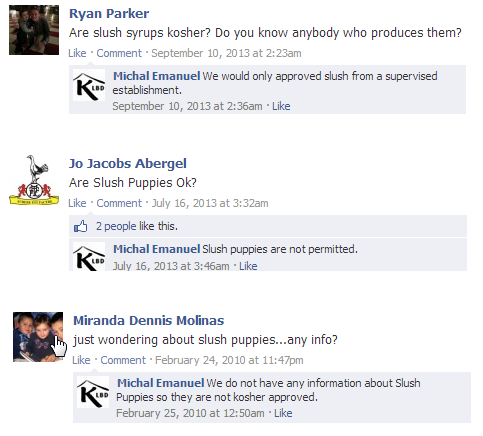
Alex and Yaron, and others, get off the bandwagon, and try and follow Emes
PS. Anyone who thinks the aim of the respected Kosher Australia is to make as much Kosher food acceptable, is quite correct. I had my own interaction with Schweppes, who used the law to tell me that they were not obliged to advise on what goes into their drinks. I missed their Diet Tonic Water. There is no Diet Tonic Water. Schweppes didn’t care about the Kosher market, even if it was kept confidential. Cocal Cola we can know, but the Heiliger Schweppes, won’t tell us anything.
I was sent this for comment (I’ve deleted most of the bits which aren’t relevant and may be legally problematic)
A Halal certification stamp?!?! Seriously???… It’s bad enough that sometimes I am eating an Australian owned product and I see the Halal symbol, and believe me I try very hard to avoid this ….
….
Most people would be concerned about the price of Kosher and Chalav Yisrael goods. Those for whom it is an issue (the price differential), with respect to the latter they may choose to rely on the Chazon Ish, R’ Moshe Feinstein, and the Pri Chadash and more to drink today’s Chalav Stam in a civilised country. An answer to prices is often competition.
On the issue of Halal, I have to say it doesn’t bother me in the slightest. I’d like to think that if it increases sales in any way, then this will be reflected in a reduction in price for those who cannot rely (for whatever reason) on those who think there is nothing wrong with Chalav Stam in Australia and elsewhere. They certainly have who to rely on. Those with a Kabbalistic bent have other considerations.
Rabbi Yisroel Rosen of Zomet, wrote the following. I disagree about the Tzeduki part. I do not believe for one minute that Ariel ever took his eye off the ball or that he didn’t do what he thought was best for his country and people. Rabbi Rosen, with respect, was never in the cauldron of international politics, but lies in Milchamta Shel Torah and Technology. As he lies in a very precarious state, I also believe it is in extremely poor taste for Rabbi Rosen to express these views while the Satan is Mekatreg. If you can’t say something good about someone on their death-bed, don’t say it.
As for the Chashmonaim, we knew they wouldn’t last. They were Cohanim.
“In the End He became a Tzeduki” / Rabbi Yisrael Rosen
Dean of the Zomet Institute“Yochanan the Kohen served as a High Priest for eighty years, and in the end he became a Tzeduki” [Berachot 29a].
From the Depths of the Expulsion…
As soon as Ariel Sharon, the Prime Minister at the time, fell into a sick bed eight years ago, I wrote an article in this bulletin with a title that is still relevant today: “One Tearful Eye and One That is Dry” (Issue 1100, Tevet 5766, January 2006). Here is the beginning of the article, written with tears in my eyes:
“One eye is ‘filled with tears’ for this glorious warrior, often decorated in the past for bravery and strength… He was a man who deserves credit for several of the victories during the past wars. It can be said that in his techniques of war he embodied the military approach of active deterrence, meaning that he moved the battlefield across the enemy lines, to the heart of their fortresses… Sharon educated generations of commanders in the spirit of ‘after me’… As a ‘man of the fields’ from his earliest days, as a ‘man of the land’ who clung to the concept of love of the land, based on his ingrained Mapai instinct, he knew to follow the principle of the Rambam, that settlement provides more of an act of possession than conquest (see Hilchot Beit Habechira 6:16)… in spite of his secular way of life he appreciated the traditions of old, and he insisted on the Jewish identity of the State of Israel.”
The weeping eye, on the other hand, is not for “Arik” the man but for his historical rejection of the principles of Zionism and of the security of Israel, which he had so strongly developed and defended. As far as all those “in the know” are concerned, this turnabout was meant to cover for crimes in the realms of finance and criminal activities. Thus, using transparent and crushing guile he quickly became the “darling of the left” by putting his massive weight behind the operation of evacuating Gush Katif and the Gaza Strip. He knew very well that there are judges in Jerusalem who read the newspaper Haaretz, where an article would be published with a headline along the lines of, “Democracy and Corruption can Wait their Turn.” Those who would destroy you from within were given immunity by the courts of the earth, down below! The deeper the expulsion went, the greater was the level of pardon available.
However, there is also a court in the heavens. And here is what I wrote in this column five months ago (issue 1483, Av 5773, July 2013:
“More than once I have asked myself and my readers what the Holy One, Blessed be He, is hinting at by the unpr ecedented act of suspending Arik Sharon as in a slingshot between heaven and earth, in an unprecedented coma between life and death, for so many years. Can it be that his body and soul will only come to final rest when all of his ‘partners in crime,’ both political and military, will apologize and repent for their actions? So far only a few have done so, and they were mostly lower-level participants. Recently, these people were joined by the deputy head of operations of the police at the time of the events and by one of the perpetrators who came to his senses, General Gershon Hakohen.”
A Commission of Inquiry Before and After
This accusation that has been brought against Arik Sharon, that the decree of expulsion was born as a result of his own personal interest, is based on strong circumstantial evidence, and is a very serious matter. The same is true of accusations of traitorous activity or worse. As time passes, I have been waiting for these matters to be thoroughly investigated by establishing a “Commission of Inquiry of the Motives of the Expulsion from Gush Katif and the Gaza Strip, and of the Results.” This should begin as soon as possible, while those who are privy to the information are still with us.
Another reason for the urgency of appointing such a commission is linked to the frequent repeated visits to our region by the American Foreign Minister, John Kerry. Everybody knows that in the balance Kerry holds the destruction of many settlements in Yehuda and the Shomron (and the Jordan Valley?), G-d forbid. I cannot be sure that a commission will accept the suggestion that the motivations for the previous expulsions were as explained above, perhaps it will leave room for an explanation that the motive was a real hope for and belief in “peace.” But one thing is certai n: In the summary section of the commission’s report, it will be written clearly, in black and/or red, that nothing was accomplished by this move. Just the opposite – on all fronts, we are in a worse situation than before – with respect to security, international relations, deterrence, and of course the values of Zionism and settlement activity.
Did a Chashmonai Warrior become a Tzeduki?
At the beginning of this article, we quoted the words of the sages about the possibility that even Yochanan the High Priest might have become a Tzeduki (who opposed the rule of the Perushim, the traditional rabbis). He might even pour the water of libation (on Succot) on his feet and dirty them, as required by the Tzedukim, instead of sanctifying the Altar of G-d.
In Chassidic lore (in the name of Rabbi Baruch of Mezhibezh, in the book Butzina Din’Hora), a remarkab le assertion is made – that “Yochanan the High Priest” who became a Tzeduki was none other than the father of Matityahu the Maccabee, who is known to us from the “Al Hanissim” prayer (“In the days of Matityahu Ben Yochanan, the High Priest…” – admittedly, many commentators insist that the two priests named Yochanan are not the same person). Thus, we see that even a Maccabee who fought valiantly and with great courage, the few against the many, is liable in the end to reject his status as a warrior.
Rabbi Tzvi Elimelech from Dinov, in the Chassidic book Bnei Issasschar (Kislev-Tevet number 4), also saw the two priests named Yochanan as the same person: “At the time, this great and holy man made a terrible mistake. But then his son Matityahu came and made a new oral mitzva (which the Tzedukim did not accept).”
Will the Matityahu (or is it Netanyahu) of our generation also correct the error of his predecessor?
Hi there,
Are you a private Kashrus business who has a more lenient (you will say pure) take on just about everything (yes we know about your comments re your Mashgiach Temidi at the mostly Treif Limor’s and how you are ‘better’ than KA) and are there for a combination of profit and wages for yourselves, together with a dose of ‘we are a God fearing service who are here to provide more options to the genuine kosher consumer’ and we are not getting rich from Kashrus
OR
Are you a business whose aim is NOT to make profit but to ‘benefit’ the we don’t eat treyf community with all manner of new delicacies like the Manna of yore.
Which is it? We know of your unsubstantiated claims re Rabbi Rudzki whose hechsher the frum world across the board did not rely on, but who was a fine man. We know of the attempts at legitimisation by rather transparently poor attempts at ‘association’ with respected Rabonim of the past and present. Those convince nobody. They are actually an insult to anyone with half a brain or half an honest approach to life. It’s good that you continue this line of pseudo self justification as opposed to telling us with whom you did Shimush in Kashrus.
Tell us about your financial policy. Are you profit makers through providing licences or are you jewish utopians who do favours with your expansionist views of what’s not treyf.
Meir, do your children and family eat at your establishments or have your food products in their houses? Does your wife eat Krispy Creme now? Is it only because of alignment with Beis HaTalmud or Adass that stops them trusting Daddy or Zeyda? You know the answers. Share them?
Do you drink Chalav Hacompanies?
You guys LOVE publicity … How about actually answering these questions or are we just going to see you visit Shule after Shule week after week, often talking (self promotion?) and not seemingly davening at many Shules? I watched you mysteriously turn up for Eicha I think it was at Elwood once. You were too late turned around and left. What’s the deal?
Oh, I see it as do the Oilom at large.
But I’m not a ‘Rav Hamachshir’ I’m just a regular from the Poshei Yisroel who wouldn’t touch ‘it’s not treyf’ with a barge pole.
In case you are wondering, what promoted this post was my experience in South Africa where things are done right.
This is well worth WATCHING
[hat tip DM]
I have written about this here.
I don’t always agree with Rav Aviner. For example, I disagree vehemently with his attitude towards Rabbi Elon. On the issue below [Hat tip NB] he is undoubtedly right. There isn’t any reason someone who knows Torah and continues to learn should be a pauper. If they do want that, perhaps they should set up a Kollel in Vietnam?
Prominent Dati Leumi Posek Rabbi Shlomo Ha-Cohain Aviner Shlit”a addressed a statistic reporting that 40% of Charedim do not work. The Rav stated that due to the economic realities in Israel today, an Avreich (married Yeshiva student) must learn a profession that permits him to support his family. “A Talmid Yeshiva cannot remain in Yeshiva indefinitely. He must earn a living and it is not enough to say ‘Hashem will take care of things and it will be fine’”.
He told students during a Shiur that there are Avreichim who go to soup kitchens daily, and that in some Charedi homes children regularly go hungry. That is why a husband must be able to earn a living. A Talmid can learn for a number of years as everyone must, but at some point one must reflect and determine if one will be a Rav or Rebbe and if not, it is time to look for work. The Rav added that not everyone is suited to be a Rav or Rebbe, though most believe they are, and while one may be a Talmid Chacham there is still the issue of earning a livelihood. Batei Medrashim are bursting with Talmidei Chacham that do not have work because all of the jobs in the Yeshivot are taken.
The Rav then addressed Avreichim who used to make do with the bare minimum. “Once upon a time, man slept on straw like Rabbi Akiva and this was fine. But today it is not possible to live like this. We may sleep on straw but how will one pay tuition for one’s children? One does not have to eat Prili (type of fruit yogurt) daily but even when living austerely there is a need for money to pay for different necessities. We cannot change reality with Pilpul. Perhaps in Vietnam one can survive on one dollar a day but in Israel it is impossible.”
(Guest Post)
I received this from a reader.
On 1 January Meir Rabi posted on his Facebook page and website that Krispy Kreme’s glazed doughnut is kosher (see http://www.kosherveyosher.com/products–services.html).
However, Krispy Kreme has NO KNOWLEDGE of Meir Rabi’s hechsher!
See my correspondence with them below.
Obviously, Meir Rabi did not contact the company for information, nor visit the production facilities.
Yet again, he has declared a product kosher without ANY investigation whatsoever!
> From: australia2@krispykreme.com.au
> To:
> Date: Wed, 8 Jan 2014 08:06:44 +1100
> Subject: RE: Contact form from krispykreme.com.au
>
> Hi xxx,
>
> Thank you for your enquiry.
>
> Unfortunately, Krispy Kreme Australia products are not Kosher certified.
>
> Kind Regards
I was gob-smacked to once more learn about (in general terms) the constant and consistent help being given by http://www.jewishtaskforce.com.au to all sectors of the community.
This voluntary group has been quietly doing a great job behind the scenes, and in public view with their education programs. It seems to have one agenda, and that is the protection and education of those encountering current and potential violence.
People would be shocked to find out that this violence occurs throughout the gamut of our “holy” and not so holy communities. Who helps them? The Jewish Task Force. Who else?
What is their reward? It will be from above. The Vivien Resofskys of this world seem to criticise almost every initiative taken by any organisation, quoting chapter and verse of sometimes obtuse theoretical approaches to how it “should be done” and dissecting every word that is uttered in a press release. I’d be happier to read about the good deeds and results as opposed to theory.
This cross-sectional committee of the Jewish community are to be commended. They are great women and by the nature of their work, not too many survivors of such violence will feel comfortable to express their public thanks. I understand that. There are people who deal with issues, effectively, and seek no limelight, let alone a salary.
I have conferred with the task force for advice when I knew of an unsavoury situation or two, on an unofficial basis, and found them thoughtful and sage in their advice.
חזק וברוך
I have never been to South Africa. If you would have asked me 3 months ago whether I would have two future sons-in-law both born and bred in South Africa, I would have looked strangely at you.
My connection to South Africa commenced over 30 years ago when I was learning at Kerem B’Yavneh. Naturally, I found them “closer” to Australians, followed by the English, and the non New York, Americans: New Yorkers were another species altogether, as removed as Israelis. One of my Chavrusas back then was a young earnest Masmid (always learning) named Stanley Moffson, now known and loved throughout South Africa as Rabbi Shmuel Moffson of Ohr Someach fame. There were other South Africans, but I don’t even remember their names.
We could share cricket with the South Africans and Poms, but that was it. On Thursday nights we had Mishmar, where traditionally one would endeavour to learn all night. We didn’t learn all night, in general. By about 1am our brains were mush, and the words really just spun on the page (at least that’s true of me). We had a tradition of going to the basketball court, and playing 5 a side soccer for the rest of the night. Here again, the Poms and South Africans, Aussies, and Europeans studying at KBY would “go for it” as if we were representing our country. I still remember one mature English guy who used to play as sweeper and he had me on a string. I couldn’t ever get passed him: the memory still frustrates.
By the time my older son went to learn at KBY, they had a gym. This was a great idea. You need to have outlets, especially for the kids of our day, but I digress.
So, here I was an Avel no longer saying Kaddish, and our youngest daughter is engaged to a nice young man from J’Burg. We try to organise dates, but my wife is in New York for the engagement of our middle daughter, also to a J’Burger who has been in the States for a while. It was nigh on impossible to re-route and change things for my wife so she could also make the J’Burg engagement. I offered to try to book a flight which would take me to NY and then to J’Burg so I could be at both, but my wife insisted that if I’m at both, then she has to be at both. Fair enough too.
It was high season. I managed to get a flight on a full plane via Perth. On the way back I travelled on Kratzmech, and that was a Mechaye because there was plenty of room (and it was Qantas).
Arriving just after 5am in the morning, I was picked up by my daughter and the future Chosson. We dropped my daughter off, and I went to Shule on the Thursday. I didn’t realise it but I had sat (as I usually do) in the back of the Shule (the Chabad house in Sandton under Rabbi Yossi Hecht who was overseas), and the regulars thought that I was a Schnorrer. Now, if they had only had given me some Tzedoko!
I was called up to the Torah as Cohen, and although I’m uncomfortable saying HaGomel (according to the view of the Rav, Rav Soloveitchik given how relatively safe flying is), I did so and not become controversial. The Mechutan was also sitting in a back corner, and I didn’t notice him and hadn’t approached.
Davening ended and everyone shook my hand and said Sholom Aleichem and that was that. They remarked later that they were expecting me to pull out a few sheets of paper testifying that I was a genuine collector.
The thing that struck me was that apart from two dressed in dark suits, the rest of the Minyan looked “ordinary”. They weren’t bearded, were casually dressed, etc. I wondered what the attraction was to coming so early to Shule so early during the holidays. I know that mainstream Shules in Melbourne struggle to get a Minyan each day. The Mispallelim come three times a year and if you are lucky to a Yohr Tzeit. These guys, as I saw came for Shacharis and Mincha/Ma’ariv and I was to learn that this was not unusual.
As I was still technically an Avel, I did not allow myself to go touring and made do with the gym/jacuzzi/shvitz facilities at my hotel. That was therapeutic, and was a Menuchas HaNefesh and Guf which I really needed. My wife needed it as well, but she was in the snow of New York, wearing out the American Express card.
In my travels, I noticed that there seemed to be one and one only Kashrus organisation. There were no maverick entrepreneurial Rabbis who went off on their own for “utopian interests” which were really for “our” benefit. The result was that I could go into Woolworths and pick out items and find a stamp, a single stamp, in much the same way as the OU operates. What a Mechaye. Why was it happening here and in Melbourne we seem to have two Kashrus organisations: Kosher Australia and Adass, as well as the more recent smaller maverick operation run by R’ Rabi. I won’t even start writing about the mess in Sydney where they simply can’t get their act together and separate Kashrus from Money, and agree on a single operation for all, without even a smell of self-interest.
I then asked where the so-called Charedi community “hung out”. I was to learn that J’Burg was pretty much void of (Hungarian) Chassidim. There was no “highest standard” Hechsher run by a separate Beis Din, where OO is EE, and separatism is a way of life. No, here, the Rabbinic institutions were set up by Litvaks. Even the Chief Rabbi claimed to be a Telzer, even though he apparently had learned only in South Africa.
What of Chabad? They certainly existed and were everywhere with really professional Chabad Houses augmenting the large choir-style Shules. I bumped into the charismatic R’ Sholom Ber Groner, who I knew in Melbourne. In fact, he gave me goose bumps each time I spoke with him in learning because so many of his mannerisms reminded me of his saintly father. He told me that the Ramash נ’’ע had written a letter to the Rabbonim many years ago that they should always work within the existing Rabbinical organisations and not separate themselves into another group. The Ramash was of course quite brilliant, and it came as no surprise that such sage advice was given. The result was that the Litvaks and Lubavitchers had mutual respect and genuine Chavivus. They worked together. The Beis Din is Litvak heavy but universally respected. There was a time when Chalav Yisrael was difficult to obtain, but they managed. They have “Mehadrin” Shechita which effectively means Chassidishe Shechitah. You can find that on menus in fleishig restaurants.
I guess the overall feeling had been of peace and fraternity between Rabonim, and I would argue that this is South Africa’s secret. There are no fifth columnists and private hashgochas and certainly no aspersions being cast around that “I’m frumer than you”.
The “Yavneh College” style school also impressed me. The primary school is mixed, but the high school is separate between males and females, and the males who want, have a Mesivta program where they can come back at 7pm for more learning. I was gob smacked. If something like this existed in Melbourne, with non Charedi teachers, I think Yavneh would really differentiate itself and move to a higher level of Chinuch. Again, I digress.
Yet, despite all this, many Jews from SA left. The apartheid was horrible and I detected racist feelings amongst Afrikaaners. When I suggested that it would take a generation or two of education and opportunity for reform (on the criminal level) to materialise, I was told “No, it will never change”. I loved watching the B’Nei Cham, with their ultra thick hair and perfect teeth walking around the Mandela mall. As someone who came from a persecuted people, I felt a natural affinity. I spoke with anyone who would talk to me. I could have done this for weeks. I loved them, I just felt that I had a duty to lift their morale and make them feel entirely comfortable. I tipped them too much, but what the heck. Their names were just wonderful. Names like Romeo, Delicious, Precious, etc were common place. The ones who worked in the Chabad houses were very well looked after and respected as human beings and I just loved being in that type of morality. The pejorative “Shvartzer” never passed my lips. What was Tzippora? What about Batsheva? What about our Sephardi brothers and sisters. Who are we to comment about any such things.

Where was the Reform and Conservative movements, let alone the neo conservadox style movements? They barely existed. Why? In a place where Orthodoxy exudes peace, friendship and a typically Chabad and Ohr Sameach non judgemental approach to human relations, this is the most powerful antidote to counter these inaccurate and inauthentic branch offs from authentic traditional Judaism.
I came away with a great feeling. Yes, there are some security issues. Yes, you need to not go on your own without advice etc. There are challenges. As a community, though, I have to say that in general, although we might have more Kollels, their institutions achieve so much more and are more outward looking and manage to enfranchise individuals.
Disclaimer: I was only there for a week, and no doubt I was on a high, and perhaps ignorant and oblivious to various issues. This is my overall impression, however. In Melbourne, if you pass someone from a different “caste” you’d be lucky if they acknowledged you with a Good Shabbos when passing them. We have much to learn, not the least of which is learning to mind our own business and not whispering about every “bad” thing that happens in someone else’s family.
Comments welcome.
ויהי בשלח פרעה את העם. שבט העבדים יוצא לעבוד את ה’ שלושת ימים במדבר. הוא לוקח עימו את הנשים, הילדים, הצאן והבקר וצידה לדרך. כאשר עברו אותם שלושת ימים מבין פרעה כי “ברח העם” והוא עומד להפסיד את עבדיו. העבדות של בני ישראל הייתה עבדות משונה. מצד אחד נוגשים ועבודת פרך, ומצד שני אותם עבדים הם הבעלים של צאן ובקר, שהם סמל הסטאטוס באותם ימים. זו הייתה מאין עבדות של עבדים קפיטליסטים. ייתכן שגם להם היו עבדים שטיפלו בצאן ובבקר שלהם כאשר הם עצמם עבדו בפרך.
בני ישראל נוסעים מסוכות ויחנו באיתם בקצה המדבר, ופרעה אומר: “סגר עליהם המדבר“. התורה ממשיכה ואומרת “וישובו” (על עקבותיהם) “ויחנו […] בין מיגדול ובין הים“. האם כבר עברו את הים והגיעו לקצה המדבר ונצטוו לשוב ולחצות את הים בכיוון ההפוך ולחנות ליד הים, בצידו המערבי, בצידה של מצריים? כבר אמרנו שפרעה אומר “סגר עליהם המדבר” ולא סגר עליהם הים. לאחר קריעת ים סוף הם ממשיכים אל מידבר שור ומשם מרתה, שם משליך משה עץ הממתיק המים המרים. משם אלימה עם 12 עינות מים ושבעים תמרים. האם יכלו להצטייד כאן במזון להמשך הדרך? האם שבעים עצי תמרים נותנים כמות פרי המספיקה לאותם 4 מיליון נפש יוצאי מצריים? מאלים נוסעים למדבר סין אליו מגיעים חודש לאחר יציאתם ממצרים, ב-15 לחודש השני.
אחר חודש של מסעות, במדבר סין, הם מרגישים רעב. אזלו המצות שנאפו בחיפזון, הצידה שלקחו עמם, והתמרים מנוה המדבר שבאלים. הם אומרים למשה ולאהרון:
“מי ייתן מותנו ביד ה’ בארץ מצריים בשיבתנו על סיר הבשר, באוכלנו לחם לשובע, כי הוצאתם אותנו אל המידבר הזה להמית את כל הקהל הזה ברעב.” טענה מוצדקת אחר הצמא של המים המרים ושהייה במדבר הצחיח. לא בכל מקום היה נווה מדבר עם תמרים. גם החלב מן הצאן והבקר שברשותם, החמאה הגבינות ואולי היוגורטים לא הספיקו. אבותינו היו כנראה אוכלי בשר, ולכן ביקשו בשר ולחם.
אז אומר ה’ למשה כי הוא “ממטיר […] לחם מין השמיים.” ה’ מבטיח למשה כי ייתן לעם לחם, אבל משה, על דעת עצמו, מרחיב את ההבטחה ואומר לבני ישראל:
“ויאמר משה בתת ה’ לכם בערב בשר לאכול, ולחם בבוקר לשבוע, בשמוע ה’ את תלונותיכם…”
תלונת בני ישראל על הרעב הייתה סיר הבשר ולחם לשובע שבמצריים. ה’ מבטיח לבני ישראל רק לחם משמיים. כדי לרצות את העם ולתת להם את כל מה שביקשו, משה מרחיב את ההבטחה לבשר וללחם. האם היה למשה סמכות או כיסוי להרחבת ההבטחה של ה’? בכל אופן, ה’ בא לקראת משה ואומר בהמשך:
“שמעתי את תלונות בני ישראל, דבר אליהם לאמור: בין הערביים תוכלו בשר ובבוקר תשבעו לחם וידעתם כי אני ה’ אלו-היכם.”
כאן ממשיכה התורה ומפרטת את המנה היומית של המן, עומר לגולגולת, וכדי שידייקו מציינת כי העומר הוא עשירית האיפה. התורה ממשיכה כי ביום השישי ייקחו מנה כפולה. אנו רואים פירוט רב על ההתעסקות במן. האם נאמר דבר על הבשר? כמה בשר עליהם לאסוף? האם גם את הבשר צריך להכין ביום השישי עבור שבת? האם ימצאוהו במחנה ביום השבת?
כאשר אני עובר מפרשתנו אל פרשת “בהעלותך” שבספר במדבר, אני נתקל בבעיה.
בפרשת “בהעלותך” שבספר במדבר נאמר:
“והאספסוף אשר בקרבו התאוו תאווה וישובו ויבכו גם בני ישראל ויאמרו: מי יאכילנו בשר? זכרנו את הדגה אשר נאכל במצריים חינם, את הקישואים ואת האבטיחים ואת החציר ואת הבצלים ואת השומים. ועתה נפשנו יבשה, אין כל בלתי את המן עינינו.” יש להדגיש שהתורה אומרת שהאספסוף התאווה, ואליו הצטרפו לאחר מכן גם בני ישראל.
משה פונה אל ה’ ואומר: “מאין לי בשר לתת לכל העם הזה…”. ה’ משיב: ” ואל העם תאמר: התקדשו למחר ואכלתם בשר כי בכיתם באוזניי […] לא יום אחד תוכלון ולא יומיים לא חמישה ימים ולא עשרה ימים ולא עשרים יום. עד חודש ימים, עד אשר יצא מאפכם…”
משה, כלא מאמין למשמע אוזניו, שואל את ה’: “600 אלף רגלי העם… ואתה אמרת בשר אתן להם ואכלו חודש ימים? הצאן והבקר ישחט להם ומצא להם? אם כל דגי הים יאסף להם ומצא להם?” ה’ משיב לו בשאלה: “היד ה’ תקצר? עתה תראה היקרך דברי אם לאו.” ה’ מביא רוח שבעקבותיה באים השלווים אל המחנה.
הבעיה שלי היא: אם בפרשתנו, פרשת בשלח, קיבלו בני ישראל, כבר כעבור חודש מיציאתם ממצריים, את הלחם – המן, ואת הבשר – שלווים, מדוע בכו בפרשת “בהעלותך” כי אין להם בשר “בלתי המן”? הרי יש להם שלווים כבר מהחודש הראשון ליציאתם ממצריים? יש שלווים ועדיין מבקשים בשר? אולי בשר אחר? אבל גם שם לא קיבלו בשר אחר אלא שלווים.
חיפשתי תשובה לשאלתי אצל מפרשי התורה. ה”בכור שור (רבנו יוסף)” רואה את השלו של פרשתנו כסיפור השייך לפרשת “בהעלותך”. לדעתו, שניהם סיפור אחד הם. ולמה נכתב כאן? כי פרשתנו מדברת על המן וגם ב”בהעלותך” מדובר על המן, הכניס הכתוב את השלווים לפרשתנו. פירוש זה נראה דחוק. בפרשתנו העם רעב ורוצה אוכל, מבקש בשר ולחם ומקבל מן ושלווים. בפרשת בהעלותך העם אוכל כבר מן ומתאווה לבשר. בפרשתנו אין העם הרעב נענש בבקשו מזון, שלא כן ב”בהעלותך”, שם “ויך ה’ מכה רבה מאוד” את העם המתאווה לבשר.
חזקוני אומר כי השלו של פרשתנו פסק אחר שנה. האומנם? בפרשתנו נאמר בערב יאכלו בשר ובבוקר לחם – מן. האם כתוב בתורה שהבשר פסק והמן המשיך? האם פסקו בני ישראל לאכול ארוחת ערב? חזקוני מסתמך על דעתו של יוסף קרא שבתוספות בערכין. על מה מסתמך אותו ר’ יוסף קרא לא פורש!
הרמב”ן, בהסתמכו על דברי רש”י במסכת ערכין (טו ב), ובניגוד לדעת יוסף קרא בתוספות שם, אומר “שהיה השלו עימהם מן היום ההוא והלאה כמו המן”. הרמב”ן הוא גם הפרשן היחיד שמצאתי שדן בשאלתנו. הוא זהיר בדבריו ואינו בא לקבוע אלא אומר כי ייתכן והבשר שקיבלו בני ישראל החל מהחודש השני ליציאתם ממצריים לא היה מספיק לכולם. לא נאמר שכל אחד אסף אותו ולא באיזו כמות לנפש הוא נאסף כמו במן. האספסוף כנראה לא הצליח לאסוף, וכאשר הם התלוננו הצטרפו אליהם גם מבני ישראל שלא הצליחו לאסוף מן השלו ולאכול בשר. לפי דבריו יוצא כי איזה מסכנים או חלשים שלא הצליחו להידחף ולאסוף “מהסוכריות שנזרקו על החתן”, בא כל הכעס של ה’ והוא הכה בהם מכה רבה מאוד. קברות התאווה.
זאת הייתה שאלתי הראשונה לפרשת הבשר שבפרשת “בהעלותך”. אסיים בתמיהה נוספת.
אם, כאן בפרשתנו, נותן ה’ בשר שלווים להאכיל את בני ישראל מידי יום, ומשה רואה זאת במו עיניו כדבר יום ביומו, מדוע בפרשת “בהעלותך” אינו מאמין אותו משה, או מפקפק, ביכולתו של ה’ לספק בשר, לא בכל יום אלא לחודש ימים בלבד ואומר: “הצאן והבקר ישחט להם ומצא להם? אם כל דגי הים יאסף להם ומצא להם?” בפרשתנו מרחיב משה על דעת עצמו את אספקת המזון ליוצאי מצריים. ה’ מבטיח לחם ומשה מרחיב את ההבטחה לבשר ולחם. לא זו בלבד שמשה מבטיח מה שה’ לא הבטיח, אין משה מפקפק כאן ביכולת להאכיל את העם בשר, ואין הוא שואל: “מאין לי בשר לתת לכל העם הזה…”.
Context:
Minhag Chassidim in general, and Minhag Chabad in particular.
Dayan Telsner, who is a good Yedid of mine, wrote a number of articles where he responded to my points in the local Chabad publications הערות התמימים ואנ’’ש
I am not challenging his right to pasken according to the minhag brought by the Ramoh, which he conflates as some universal practice throughout the Ashkenazic world, and for which he uses the ultra-strong words of מנהג עוקר הלכה,I believe out of context.
I will just post this excerpt from Chabad’s own התקשרות magazine, which is referred to religiously by Rabbonim and Chassidim in respect of how to behave על פי מנהג חב’’ד.
My translation follows:
It is written in the Shulchan Aruch HoRav (Ba’al Hatanya), “in our regions, where mourning extends until 12 months on a mother of father, and 30 days after another relative, the Cohen [Avel] does not Duchen, even if he is the only Cohen, and even on Yom Yov…”
But, in practice [despite the listing of the Ramoh by the Shulchan Oruch HoRav] I heard from many [important] Poskim in Chabad, and these include The Gaon and Chosid, R Osher Lemil HaCohen, of Beitar, and the Gaon and Chosid R’ Yisrael Yosef Hendel of Migdal Haemek, they they never saw [in Chabad] even outside Israel that an Avel would avoid Duchening.
They referred to the Nitei Gavriel [of R’ Gavriel Tzinner, who is the Rav HaMachshir of the Melbourne Eruv], who wrote that that the Custom of Chassidim is in accord with the Shulchan Aruch [and not the Ramoh] according to the practice of the Sephardim. He brings as support the view of the Kaf HaChaim, that according to mystical [kabbalistic] line of Judaic practice, one must Duchen even if he is a mourner. An in the responsa Mishnas Shlomo [R’ Shlomoeleh Vilna, the Dayan of Vilna] he brings that according to the Ari Zal, we are especially careful not to show any mourning on Shabbos and Yom Tov, and certainly no Cohen should refrain from Duchening because they are an Avel.
The Kaf HaChaim also quotes the [famous] Mekubal R’ Shalom Sharabi, that Duchening is from the “Great Lights”, and just like an Avel is permitted to wear the Tefillin of Rabenu Tam, which is also permitted because of the same concept as the “Great lights—מוחין דאבא’ a Cohen who is a mourner must also Duchen. He goes on further to write that that one should not even cause Duchening to be displaced during the Shiva itself, because Duchening is an integral part of Davening to the extent that if there is no Cohen, we use a different Nusach as said by the Shaliach Tzibbur.
Notwithstanding this opinion, during Shiva itself, Chassidim do not follow the practice of Duchening of an Avel, and neither do the Sephardim [despite the Kabalistic justification]
It is possible that the reason we do Duchen as an Avel, even in Chutz La’aretz, is because it becomes a very clear expression of public mourning if/when a Cohen who is an Avel purposefully avoids doing so. This is especially so in Chutz La’aratez where it is most noticeable because they (Ashkenazim) only duchen on Yom Tov.
I spoke about this with Dayan Telsner’s brother-in-law, Rav Sholom Ber Groner, and he told me that he would be lenient himself based on this Nitei Gavriel. Interestingly, on a number of issues where I mentioned to Rav Sholom Ber, that his father had a seemingly different opinion, that did not seem to worry him to the extent that he was ossified. He said, in fact, that some of his own opinions changed according to time and circumstance, and that was the way to Pasken.
I will close with two words which are ubiquitous in halacha נתפשט המנהג—the Minhag spread (or became established). These simple words imply as everyone know that despite the fact that there may well be competing MINHAGIM on a RANGE of item, an equilibrium often [but not always] emerges as the “prevalent minhag”.
I’m not here to change anything. I didn’t Duchen once Rabbi Telsner paskened that way in his Shule. I mention it one last time, because I disagree completely with the concept of ossification of quoted ancient minhagim when those are known not to be universally adopted!
Finally, if someone can actually point me to MINHAG CHABAD on this, I’d be obliged. I do not think it exists formally in the sense that it was ever enunciated. This lends more credence to my argument, I’d suggest!
Let me also note to anyone who had observed my exchanges with Rabbi Telsner, that this was ריתחה דאורייתא and God forbid that anyone should think that “bad blood” or “beleidung” would ever enter my head over such matters. I can’t think of a better way to spend time that talking and shouting Torah!
The following is from Israel National News. You would think that MK Stern is a tad naive. No Chabadnik would remotely consider themselves an emissary of anyone other than the Rebbe Ramash נ’’ע, in keeping with attempts to bring Geulah quicker.
That being said, he is suggesting that influencing Jewry to become more observant (albeit through the particular prism of the Chabad approach) is a formal State service. That, in of itself, is a significant development.
Wouldn’t it be deliciously ironic if someone who wasn’t going to go on Shlichus, now did so because they would (also) be serving the State’s needs in a different way to enlisting in the physical army?
Israel should recognize young adults who volunteer with the Chabad hassidic movement as having done national service, MK Elazar Stern (Hatnua) has proposed.
Stern’s proposal was accepted by the Committee for the Equal Burden of Service (Shaked Committee), the Knesset committee weighing Israel’s options regarding hareidi-religious military service.
Stern suggested that under certain circumstances, yeshiva students who volunteer with Jewish communities overseas should be recognized as having done national civilian service, an alternative to military service. Among those who would benefit under the criteria he proposed are Chabad youth, many of whom spend time overseas working with Chabad emissaries.
“There is an organization that is active around the world, on a purely voluntary basis, that does not get recognition from the state of Israel,” Stern said. “The Chabad movement sends people to every corner of the earth.”
Roughly 250-300 Israelis are volunteering with Chabad at any given moment, he said. Chabad emissaries engage in outreach and support to local people in places as diverse as Eastern Europe, Africa and the Far-East, and are often a welcome site for Jewish backpackers and tourists as well, providing them with kosher food and other services.
“There are many elements to the Chabad emissaries’ activity with clear parallels to civilian national service,” he said of Chabad’s social activism. “They do important work in Jewish communities around the world and we need to recognize their important work.”
“I want the Chabad emissaries out there to know they are emissaries of the state,” Stern declared.
This academic paper may be of interest to some. It describes the victim of the “victim syndrome”. Although it is a working paper, it has attracted lots of interest
From the preamble:
People who suffer from the victim syndrome are always complaining about the ―bad things that happen in their lives. Because they believe they have no control over the way events unfold, they don’t feel a sense of responsibility for them.
One moment, they present themselves dramatically as victims; the next, they morph into victimisers, hurting the people trying to help them and leaving would be helpers with a sense of utter frustration.
People with a victim mentality display passive-aggressive characteristics when
interacting with others. Their behavior has a self-defeating, almost masochistic quality. The victim style becomes a relational mode—a life affirming activity:I am miserable therefore I am.
In this article, I present three examples of people with this syndrome and a checklist that can be used to identify sufferers. I also discuss the concept of secondary gain—the “benefits” people get from perpetuating a problem and the developmental origins of the victim mind set.
The article ends with advice on how to help people who suffer from the victim syndrome.
I have long known about this rule of Islam and it never ceases to amaze me that “the west” remains deluded into thinking it will ever change
this is an excellent analysis and should be not only compulsory reading for all Jews, it should be compulsory reading for anyone.
I also reproduce it below from the Jerusalem Post in case the link moves.
The World From Here: Will Abbas defy Islam for peace with Israel?
by Dan Diker and Harold Rhode
“Can Israeli concessions influence the Palestinians to sign an historic peace deal that ends the Arab-Israeli conflict once and for all?”
Palestinian Authority President Mahmoud Abbas at a PLO meeting in Ramallah, October 2, 2013. Photo: REUTERS/Mohamad Torokman Israel’s release of convicted Palestinian terrorists and Prime Minister Binyamin Netanyahu’s reported agreement in principle to concessions in the Jordan Valley beg an important question: Can Israeli concessions influence the Palestinians to sign an historic peace deal that ends the Arab-Israeli conflict once and for all?The experience of former prime ministers Barak and Olmert with their Palestinian counterparts may be helpful in understanding that even the most far-reaching Israeli concessions have failed to end the conflict for an historically under-appreciated reason: Palestinian Authority chairman Mahmoud Abbas would be required to defy Islam’s view of territorial sovereignty to arrive at a compromise with Israel. In short, once Islam conquers territory, it remains Muslim forever.
Two recent historical examples illustrate the problem. Following the collapse of the ill-fated Camp David Accords in 2000, former prime minister Ehud Barak summed up his experience negotiating with former PA chairman Yasser Arafat and the PA leadership in a “tell all” interview with Israeli historian Benny Morris. Barak said, “What they [Arafat and his colleagues] want is a Palestinian state in all of Palestine….Arafat does not recognize the existence of a Jewish people or nation, only a Jewish religion.”
According to the Barak interview, “Arafat denied that any Jewish temple has ever stood on the Temple Mount in Jerusalem and this is a microcosm of his denial of the Jews’ historical connection and claim to the Land of Israel/ Palestine, which from his point of view has been Muslim since it was conquered by Islam in 637 CE. Hence, in December 2000, Arafat refused to accept even the vague formulation proposed by former US President Bill Clinton positing Israeli sovereignty over the earth beneath the Temple Mount’s surface area.” Dennis Ross also noted in his book, A Missing Peace, that Arafat even refused to concede the ancient Jewish Western Wall to Israel.
Abbas is also “claimed” by Islam’s view of territory. As Arafat’s loyal deputy at the time, and as Arafat’s successor, Abbas similarly denied the existence of Israel’s ancient temple as recently as July 2012, telling an Israeli Arab daily, “Anyone who wants to forget the [Islamic] past [i.e., the Israelis] cannot come and claim that the [Jewish] temple is situated beneath the Haram [the Muslim shrines].”
Abbas’s dedication to Islam’s uncompromising sovereignty over Muslim territory also explains his rejection of Olmert’s equally far-reaching peace offer in 2008. Olmert would later recall in a 2009 interview Abbas’s zerosum stance on Jerusalem, saying, “I would never agree to an exclusive Muslim sovereignty over areas that are religiously important to Jews and Christians.”
Barak and Olmert’s recollections provide context to Abbas’s approach to the current negotiations with Israel. The prime ministers’ post mortems also illustrate a tenet of Islam that has been frequently overlooked by western mediators and negotiators, but which claims fealty in the Muslim world regardless of personal levels of religious observance.
Islamic jurisprudence dictates that once Muslim lands have been conquered by non-Muslims, it is prohibited for Muslims to let non-Muslims rule those lands. Muslims must ultimately reconquer them.
Professor Bernard Lewis, the preeminent western scholar of Islam and the Near East, remarks in his most recent book, Notes on a Century, regarding the view of Islam on territorial rule, “that Muslims should rule over non-Muslims is right and normal. That non-Muslims should rule over Muslims is an offense against the laws of God and nature and this is true whether in Kashmir, Palestine, Lebanon, or Cyprus.”
Lewis recalled his own visit to a local Islamic Center in Cordoba whose members are still seeking to reconvert Spanish Christians to Islam and reconquer Spain that Islam lost over 500 years ago.
If after 521 years Islam still rejects Spain as Christian, It is unsurprising that 65 years of reestablished Jewish sovereignty in Israel collide with Abbas’s refusal to accept Israel as the nation state of the Jewish people. In Abbas’s view, Israel, like Spain, Lebanon, Cyprus and the other lands of the Middle East, remain Islam’s inheritance forever. If he were to concede territory to Israel, he would subject himself to the Middle Eastern concept of “eib” or humiliation and shame whereby others blame him for shaming the Palestinians, the Arab world and Islam as a whole by what is called “compromise” in the West.
Arafat claimed that he would be assassinated for signing a final peace deal with Israel. This is just as true for Abbas. As Egyptian commentator Ali Salim observed recently, “PA President Mahmoud Abbas undoubtedly knows that the minute he signs a peace deal with Israel, the Palestinian terrorist organizations will assassinate him.” Ironically perhaps, Saudi Arabia and Egypt had reportedly pushed Arafat to sign a deal with Israel in 2000. How is it possible that Arab Muslim leaders would seemingly compromise on this immutable Islamic principle that Muslim territory cannot be conceded to non-Muslims? Had he agreed to a peace deal with Israel, only Arafat personally would have been humiliated, which would not have mattered to the Saudis or the Egyptians. That is why they only pressured Arafat privately, not publicly. Otherwise Egypt and Saudi Arabia would have been shamed as well.
Peace process observers may remember a humiliated Hosni Mubarak calling Arafat “a dog” when Arafat balked at signing the Gaza Jericho agreement with Israel in Cairo in 1994.
In sum, Islam cannot permit non-Muslims to rule territories permanently that are or were once Muslim. Nevertheless, Muslims can make temporary agreements when they are weak, modeled after the agreement made by their prophet Muhammad made after his military loss at Hudaybiya in 629. Later, when Muhammad was stronger, he abrogated this agreement and defeated his enemies.
Hudaybiya therefore has ramifications, not only for Spain and Israel, as explained above, but also for other countries such as India and northwestern China which had been ruled by Muslims for centuries. Hudaybiya is equally relevant to Abbas. Like the Muslim prophet, he may agree to an interim accord due to his current weakness. But as former prime minister Barak noted in 2002, the Palestinians will always look for excuses to refrain from signing an end-of-conflict agreement.
As Israel Radio reported on December 31, 2013, Abbas now insists “all Palestinian prisoners must be released to reach an agreement.” He simply cannot agree to a permanent peace treaty that ends the conflict and all Palestinian claims and recognizes Jewish sovereignty over any part of what was British Mandatory Palestine.
Dan Diker is a Research Fellow at the International Institute for Counter Terrorism, IDC Herzelia, and a Foreign Policy Fellow at the Jerusalem Center for Public Affairs. Dr. Harold Rhode is an Islamic affairs expert.
The following made the rounds. Of course, most reported them irresponsibility and with the usual anti Jewish venom. Some salient points.

[Hat Tip AN]
There are so many falsehoods in this video, it is beneath contempt. A straw man is created and then attempts are made to turn all those who fight these “secularists” whose aim is to uproot Torah as the enemy that one has to fight. When I got to the part about Bar Kochba, I literally laughed. This is brought by the Rambam in Hilchos Melachim as someone who Rav Akiva thought was Chezkas Moshiach, no less! I guess they would have stoned Rabbi Akiva! Yet, they carried swords and fought. They didn’t fight with a shas. A Shas doesn’t stop a katyusha. Sure, one cannot descend to pure secularism, that is an extreme. We do not subscribe to Kochi V’Otzem Yodi, but the clear message is that is if we DO subscribe to the fact that Hakadosh Baruch Hu OSO es Hachayil hazeh, then it is halachically mandated, either as a Milchemes Mitzvah or Milchemes Reshus.
I don’t see the Rabbi addressing the inordinate number of bench warmers who have no business assuming leadership or positions of influence, and instead, running around the world to collect money for themselves. You’ve got to DO something. Kol Torah Shein Imo Derech Eretz, Sofo Lehisbatel.
These are the archetypical Yoreh V’Rach HaLevov. These are the one’s you could never rely on in times of war. These are the spineless ones who would rather send out their brother to be killed in defending their lives.
To be sure, there are certainly an élite that must be supported. They are the leaders, and they have specific outcomes from their learning. They don’t use their entire lives to play pilpul with no end in sight.
They do not engage in any way. Not in the army, and not in society. Their ability to answer the Apikorus is so banal, they should be hidden. Who of them can assume the role of the Ramban, as needed. Which of them could sit in a Polish Government like R’ Meir Shapira. Next to none.
This isn’t a war of culture. Recalling Jabotinsky and Ben Gurion is living in a time warp. These aren’t our problems. Kibbutzim barely exist. Life has changed. The question is, if they DO want to live in a Jewish homeland, then they should follow the rules. If they do not, then then they should leave en masse and go to Gibraltar or the the Congo.
They want Kedusha and Avoda, but they think that defending fellow Yidden, whoever, that might be can never be done by using a gun. Go tell the next Palestinian Terrorist that one.
Torah is critical. Torah however includes being a part of society, and unless you are a protected person because you are part of an élite intelligentsia, so many are just pre-programmed robots without an original thought in their heads, and with spite filled agenda based on 100 years ago.
A nice production on the Internet (no less) which one is not allowed to look at. They use and abuse the internet when it suits them, and put people in Cherem for having a “smart” phone. Hypocrites personified.
[Hat tip SH]
The Heimlich family is an honourable family in Adass Yisrael, full of Talmidei Chachomim, born and bred in the Charedi (hungarian) community in Melbourne, Australia. One of the sons, is a renowned Posek to whom most Adass folk turn to for their Sheylos today. He sits in the Gerrer Shitibel daily and learns, and is a fine man.
One brother Nachum is a Rosh Kollel in Satmar. You can hear his vituperative and spite filled anti zionist/jewish speech on youtube, where he tells the non Jews that we don’t need a country, we don’t need an army etc and publicly criticises Israel. To Nachum I say, come back to Australia. Your place isn’t in Israel. Why torture yourself by staying there.
Pull out, I say. Get your kinsman out of Israel. Cross the border into Ramallah. Go live there in peace and harmony. Get the heck out of Israel. It’s really Avi Avos HaTumah for you and means nothing to you. Get lost!
Shame on you Rabbi Nochum Tzvi Heimlich on the youtube (listen at about 10:42) The Australian accent is unmistakeable. What a Chillul Hashem. Remove your sackcloth, and come wear Australian sheepskin.

I call on his brother in Melbourne to condemn his statements. I doubt it will happen any more than the clandestine visits of Rabbi Beck to his infamous extremist brother.
We in Melbourne are fools for supporting and allowing these extremist elements to take our money through their various businesses. Next time you deal with one, ask him whether he supports Satmar and Toldos Aron or similar. This is a Shandeh.
I call on Adass to distance itself explicitly in the press from these extremists and condemn them and their sentiments.
[Hat tip BA]
A reader formally asked 7/11 in Melbourne about their slurpees. In Melbourne we have a reliable and respected kashrut authority where the finances are overseen by a lay body and a team of supervising Rabbis and applied chemists have no involvement or inducement via financial gain in regards what they approve or otherwise.
This was not the case in the days of yore when various communal Rabonim provided their own hechsher and benefitted financially from the activities. I remember, for example, that strictly kosher people did not eat from the then Melbourne Beth Din or Rabbis Rudzki or Lubofsky et al. Many times I would buy a shawarma before a gig because I did not have confidence in the hashgacha. Nowadays, it’s almost never the case.
Things have improved greatly. Kosher Australia is trusted locally and internationally. It is not a one Rabbi entrepreneurial organisation but has a board and includes a cross section of the community. Finances are audited etc
Here is the readers response from the 7/11 people. I will leave my readers to draw their own conclusions.
Unfortunately not all of the Slurpee flavours that we have are certified as Kosher, however we did receive an unprompted email out of the blue last week notifying us that kosher certification was awarded by “It’s kosher authority” for the following flavours this December.
1. Lemon Lime Bitters
2. Classic Lime
3. Zilched Fruit Salad
For various reasons, some halachic, I have not gone to the cemetery during my year of Aveylus except when we dedicated my father’s הכ״מ Matzeyva. Again, there are two sides to the coin. On the Friday I’m still an Avel, on the Sunday I won’t be. I asked Rav Schachter and the response was that he isn’t familiar with these minhogim as he doesn’t attend a cemetery. Of course, this is consistent with the Brisker way, which follows the Rambam, that it is a place of impurity because there are only bodies with their kedusha departed to a higher realm. I was impressed that he never sought to pasken according to his minhag and the manner of the response.
Accordingly, I then asked Dayan Usher Weiss (who is a chassid and would likely have a minhag to visit kever avos and tzaddikim) through his kollel of rabbonim who check with him as need be. The response I received is below
Question: I’m soon completing a year of Aveylus after my father הכ’מ His 1st Yohr Tzeit will be on Gimel Shvat. For reasons brought by Achronim, I have refrained from visiting his grave site. The Matzeyva was set up a number of months ago, and of course, I was there. I am a Cohen, although that’s not entirely relevant, as I don’t go close anyway. Gimel Shvat is a Shabbos. When should the family go according to Minhag. My father’s family originally stemmed from Amshinover Chassidim (my mothers from Brisk). Should we go Erev Shabbos while still in Aveylus technically, or is it preferable to go on the Sunday, which will be the first day after the Aveylus? Or, does it not matter much?
Answer: The custom to visit the grave of family members on the day of their “yortzeit” [the anniversary of their petirah], while being an ancient and universally accepted custom, it’s sources are somewhat obscure. Nowhere in the Talmud or Shulchan Aruch do we find a direct reference to this custom. Various sforim [see Shu’t Shem Aryeh O”C 14, Shu’t Ksav Sofer Y”D 179] point to the words of Rashi in Yevamos 122a [s.v. tilsa] who mentions a custom to visit the graves of great scholars and study Torah by their gravesites on the day of their yortzeit. Being that this is a practice rooted in custom, it would seem there is no strict preference on a yortzeit which falls out on Shabbos to visit the day before or after. In fact there are differing customs in this regard, to visit before or after. For one who does not have a specific family custom it would seem preferable to visit the day before the yortzeit, this being for 2 reasons. 1) See Shu”t Chasam Sofer [O”C 162] who explains that part of the reason for visiting the grave is to pray for the niftar, give charity and increase merit for the niftar, to protect them from any judgment which occurs on the yortzeit. If not possible on the yortzeit one should bring these zchusim before the day of the yortzeit and not when it has already passed. In fact most poskim quote this as the preferred minhag, see Kaf Hachaim 568:94, Ikrei Harav D. Terani Y:D 36:35 [found in back of shulchan aruch]. 2) While visiting on the day of the yortzeit is not recorded in Shulchan Aruch, another minhag is in fact recorded. In Y:D 344:20 Shulchan Aruch quotes from the Geonim a custom to visit the grave on the last day of the 12 months, which is the day before the first yortzeit. Although common practice is to visit on the yortzeit itself* it would seem here where this is not possible to preferably fulfill this other minhag of Shulchan Aruch. *[one reason suggested for the minhag to visit on the yortzeit and not in accordance with Shulchan Aruch, is the words of the Arizal [Sharei Hamitzvos Parshas Veychi] who explains that once the neshama goes up on the Shabbos before the end of the 12 months it doesn’t return for the remaining days. On the yortzeit however the Neshama returns to the gravesite.]
This isn’t a new question by any stretch. That being said, there are two sides of the coin. I am a Cohen muchzak, and will have Yohr Tzeit on a Shabbos. I asked Mori V’Rabi Rav Schachter, and this was his response.
Is it better to get Maftir on that day, or should I get the Aliya of Cohen, there also being a Minhag to “accumulate Maftirs during the year, something I have never sought to impose or ask for wherever I daven)”
Joe Alpert (niftar 2 years ago) told my father that the first year he had yartzeit he went to Rav Moshe on Friday morning on his way to work and asked which aliyah he should take in honor of his father’s yartzeit. rav Moshe said it is better to take one of the ז’ קרואים and not maftir. Later that afternoon when he came home from work he had a message that rav Moshe had called back and said that he made a mistake and more proper is to take maftir as there are more brachos, and it will be a bigger zchus when more brachos are recited.
To my readers et al who have wished Mazal Tov on the ‘quick fire’ double Brocha on the engagement of two of our daughters to chasanim from South Africa ( where I am at the minute)
Coupled with our soon to be married niece, I can only acknowledge חסדי השם כי לא תמנו. I’m soon to complete a year of aveylus after אבי מורי הכ״מ who no doubt has been involved and who I miss daily, especially at these auspicious occasions.
(Hat tip BA)
Read it here
A few nights ago after Ma’ariv, a young and enthusiastic collector asked me for a few bucks. When I asked what for, he responded that he established a new Kollel for Ba’alei Tshuva who had learned there for 9 or so years, and that times were tough. Of course, that was the truth.
I asked him why they were still in Kollel? He said, because their Torah protects Am Yisrael?
I asked him whether there were any exemplary students therein or were they “run of the mill”.
He asked me “why? what does it matter”. I replied because in my view, if those of us who work for a living extend ourselves to support mediocrity then it’s highly questionable. I noted that at (lehavdil) University level, we were tested for entry most vigorously, and all our outputs are scrutinised. I asked what level of scrutiny was applied given that there was a crisis, limited money, etc
He re-iterated that my point wasn’t important because their Torah was protecting Am Yisrael. There is ample precedent in Kosvei Kodesh of that. I asked him what he thought of Nachal Charedi. It’s a litmus test for me, because I feel it offers so many of the more mediocre types the chance to gain a profession and make a living which has more self-esteem. I asked him whether he thought Israeli Soldiers (e.g. Nachal Charedi) were protecting his Kollel when they were policing borders and the surrounds.
He became agitated, and told me that Torah protects.
I then quoted an Aderes Eliyahu from the Vila Gaon (he being a Litvak) where the Gaon explained the Gemora in Brachos לה ע”ב that when הרבה (many) do like R’ Shimon Bar Yochai (devoted themselves solely to Torah Learning) לא עלתה בידם (it wasn’t successful). I argued that the problem is that we are not following the Gemora which makes it clear that as a general rule people should work (and then be Kovea Itim LaTorah) and not be poor in Kollel to the extent that there are myriads begging terribly for money simply to put bread on their empty tables. I feel very sad when people are in poverty because of this choice.
I fully understand that post Holocaust, there was an urgent need to rebuild, but we have rebuilt, and Torah is flourishing in the Holy Land like never before. I know of Tshuvos e.g. from R’ Moshe Shternbuch on the topic. He chuffed off and asked me to text him the Aderes Eliyahu מקור
I kept forgetting to look it up (I had seen it 30+ years ago) but unsurprising, when I was looking into the Nefesh Hachaim of the Saintly R’ Chaim Volozhiner, the Gaon’s prime pupil and yoresh, two nights ago, the Nefesh Hachaim says the exact same words.
Sure you can twist any which way with Girsaos in the Gemora, and I’ve seen lots of that, but you can see my line of thought in R’ Chaim’s classic Nefesh Hachaim from Shaar 1, No 8.
ואמרו הרבה עשו כרבי ישמעאל ועלתה בידם, והרבה עשו כרשב”י ולא עלתה בידם. היינו רבים דוקא, כי ודאי שלכלל ההמון כמעט בלתי אפשר שיתמידו כל ימיהם רק בעסק התורה, שלא לפנות אף שעה מֻעטת לשום עסק פרנסת מזונות כלל ועל זה אמרו באבות כל תורה שאין עמה מלאכה וכו’. אבל יחיד לעצמו שאפשר לו להיות אך עסוק כל ימיו בתורתו ועבודתו יתברך שמו ודאי שחובה מוטלת עליו שלא לפרוש אף זמן מועט מתורה ועבודה לעסק פרנסה חס ושלום וכדעת רבי שמעון בן יוחי…
The Maharsho on the spot is even stronger. Check it out.
Of course, it’s also in Shulchan Aruch, אורך חיים קנ’’ו
Your thoughts appreciated?
This is from the New York Post. I’m waiting for Charedi condemnation and money collections on his behalf
Rabbi held for allegedly hiding monstrous sex crime record
An ultra-Orthodox rabbi from Israel is being held in New York without bail for allegedly hiding his monstrous sex crime record in order to get a US visa and come to New York.
Yakov Yitzchak Roth — a “rebbe” in the Hasidic group Shomrei Emunim — was arrested Tuesday in Borough Park by cops with the NYPD Special Victim’s Squad.
He had flown here from Tel Aviv in late August after swearing in a visa application that he had never been arrested or convicted, according to the federal complaint against him.
In reality, just six months earlier he had finished serving a 16-year sentence on his 1997 conviction in the District Court of Tel Aviv for raping, sodomizing and sexually assaulting a child relative, the complaint said.
Roth’s attorney, Shulamis Peltz, declined to comment on the case, except to say, “The current allegations are just allegations and have not been proven.”
Roth, whose father, Rabbi Avraham Chaim Roth, led a small congregation of 200 followers in Jerusalem before his death in August, 2012, is due back in Brooklyn Federal Court for a bail hearing on Monday.
A hardware store. Does anyone know an authentic phrase/word?
I was touched, and appreciated by the fact that the Dayan, with whom I am having a respectful Torah discussion on this issue decided to read and follow up my previous blog in a publication dedicated to Yud Tes Kislev: the Yom Hillula of Rav Dov Ber of Mezeritch, the father of all Chassidic Rebbes, and the occasion of the freedom from a short incarceration by the great Acharon, the Shulchan Aruv HoRav and Ba’al Hatanya.
The Dayan felt compelled to respond because a failure to do so might imply that he agreed with me. Chas VeShalom! Much of the material presented was a previous listing of the same Mekoros brought prior, which are well known. We know from whence the Ramoh recorded the Minhag Ashkenaz, and we are well aware that this is related to the the Maharam MiRotenbug and the subsequent line of students after him, who had had identified this same minhag during their time.
We are also well aware that Minhag can uproot Halacha; the implication being that the Tri-Torah command of Bircas Cohanim can theoretically be supplanted by a Minhag. None of this is new and added no more to the discussion in my opinion. It is not a universally accepted anyway in this issue, despite the quotation of chosen latter day Acharonim. I’m surprised the Kitzur was quoted as a source. From the Hakdama of the Kitzur, we know his methodology of Psak, based on three acharonim. In my opinion, that adds nothing either.
It is important to note that the Dayan misquoted some of the sources in his original article. Indeed, a careful reading of these shows an omission of important facts. This will be expounded upon in due course. Much to my sorrow, I don’t have the time in the day to do such things in the proper academic way. I would have liked to be בבית ה׳ כל ימי חיי but it’s not my current Goral. I can’t wait till I can spend more time learning, and conducting shiurim. I have seen some of the material in its full form, and not the quoted parts in the Dayan’s original article, and it is clear and compelling and is somewhat not consonant with the Dayan’s proof.
As pointed out by the Gaon R’ Yekusiel Farkash in his Klolei Piskei Admor HaZoken, where there is no minhaga individuals need not follow or adopt a Minhag (even quoted by Admor HaZoken). Perhaps the Dayan will consider Rav Farkash’s comments as invalid. I don’t know. Rav Farkash is a very widely accepted expert. Having heard his Shiurim, and read some of his Sforim, he is clearly a deep and careful thinker. If so, perhaps the Dayan should write to him. I might.
Ironically, the Dayan garnered some support from the Giant, R’ Yosef Dov HaLevi Soloveitchik inter alia. What the Dayan didn’t tell us is that the Rav Soloveitchik himself stated that an Avel should Duchen! This was also the opinion of his illustrious and legendary grandfather, the famed and revered Gaon, R’ Chaim Brisker. These are giants of the last few generations who knew the Ramoh and those who preceded him, very well. Admittedly, they aren’t as influenced by Acharonim, but this is an accepted mode of Psak. As the Rav once said when someone tried to tell him that his Psak was not the same as the Mishne Brura.
“Nu, I am an Acharon, and I have a license and may certainly argue. I don’t force anyone to accept my Psokim. If you want to follow the Mishne Brura, go right ahead.
Indeed, we don’t need to look to Brisk/Lita. We can simply list many examples where the Ramash (R’ Menachem Mendel Schneerson) instituted Minhogim against the explicit ruling of the Admor HaZoken. A famous example is the Ramash’s campaign to ask females to light Shabbos candles before they were married. We all understand why he did this, and what a wonderful initiative it was, however, if we are to remain unfaltering fidelity to the Admor HaZoken and the Rishonim and Acharonim who preceded him, this is against the Psak of the Admor HaZoken and yet is accepted. One couldn’t imagine the Dayan quoting the Ramoh or similar to the Ramash and saying “you are contradicting an open Admor HaZoken”. Sure, all manner of justification has been tended about that Takono, but if we are to be intellectually honest, the Psak of the Ramash, which he is most entitled to enact as a Gadol B’Yisrael of the last generation, amounted to an expression consonant with exactly what Rav Farkash expressed. The Dayan knows there are many other examples of this type.
It is simply amazing when one reads that the Dayan is untroubled about the fact that the Avel can be involved, no, is enjoined to be involved in public expressions of Simcha during a Yom Tov, and yet on the matter of a blatant and obvious example of Aveylus D’farhesya, the Dayan resorts to a quasi-Hungarian mode of Psak, which is as immovable as Chadash Assur Min HaTorah, even if we don’t understand the reason. I am reminded of the (incorrect, according to many Poskim) Psak of the B’eer Moshe, the Debreciner, who said that any form of Bat Mitzvah celebration is Chukas Ho’akum and the act of Reshoim! This is of course plain wrong on many accounts, and has been shown to be so by many Acharonim, but it is indicative of the type of lack of response that the Dayan tended in respect of this issue. To say that once a Cohen leaves the Shule before Retzeh, there isn’t Farhesya, is incomprehensible! Farhesya has nothing to do with Akiras Raglov and the technical ramifications of someone who didn’t leave. Well before that, people ask me for special requests, and of course Cohanim leave the Shule to wash their hands! Everyone, especially in Lubavitch where they are Makpid to bring babies to get Birkas Cohanim, are most serious about this Mitzvah. To me, it not only allows me to be a conduit, but my ability to obtain a Bracha, something one especially craves in a year of Aveylus, is negated if I don’t perform it! Now that makes me sad!
Interestingly, Rav Marlow paskened explicitly that a Cohen Avel who finds himself in Shule at Birkas Cohanim, and was unable, or perhaps forgot, or was pre-occupied, MUST Duchen on Yom Tov. I heard this directly from a completely trustworthy source. It would be Aveylys D’Farhesya. Now, Crown Heights is a different scene to Melbourne’s comparatively empty Yeshiva Shule where there were only four Cohanim. The Cohanim are like rare movie stars! How could the Avel Dyuchen? He isn’t (can never be) B’Simcha UveTuv Levov! According the the Dayan, this alone seems to be the only relevant factor!
Next we need to consider the Dayan waving his hand regarding my argument that someone who has already Duchened multiple times, according to the Psak of (Chabad) Rabbonim who do not agree with the Dayan, imbues no important ingredient to the situation. Really? Imagine the following scenes:
A Cohen sits in the Dayan’s Shule, and has the well-supported custom not to sit in his usual seat. Should the Dayan instruct the Avel to go back to his seat as it is Minhag Chabad? I witnessed no such thing at Yeshivah. I saw some who did and some who did not. It was up to the Minhag of the Avel. Aveylus, is most definitely tied to subjectivity and personal Minhag. To dismiss those because there exists another Minhag not favoured by the Ramo, is ingenuous.
What of an Avel who dances B’Simha on Friday nights around the Bima during L’Cha Dodo (a minhag I haven’t seen brought in the Ramoh or indeed the Shulchan Aruch HoRav). Chadoshim LaBekorim? Should a Dayan intercede and advise the Avel that he is doing the wrong thing? What if the Avel retorted that he does this every Shabbos, and if he stopped it would be Aveylus D’Farhesya? Maybe we can use a guitar for Kabolas Shabbos if we raven early enough?
(Personally I don’t understand the new hanhogo of dancing in the middle of davening, even if it is before Barchu. Is this what Admor HaZoken paskened or approved?)
What of an Avel who refuses to do Hakofos as brought by many Acharonim. He saw this from his own father. I personally witnessed the Dayan’s father in law and brother in law encourage Hakofos by suggesting that they do so together with a few people who surround him. If the Avel doesn’t feel comfortable adopting this approach would the Dayan say that the Avel has done wrong and that he must adopt Minhag Chabad?
Dismissing the powerful arguments of the Gaon as not being necessarily consonant with Admor HaZoken, is fair enough, although I didn’t appreciate the tone of the sentence in the Dayan’s article. (On the other hand, for example Zman Krias Shema the Gra and Admor HaZoken do agree). One may choose not to follow the Gro and the Beis HoRav after him, as mentioned above, that is, those who share the Gra’s insistence that there is a Bitul of three positive Torah commands. But it becomes somewhat different when someone insists that in his Shule, a Minhag HaGro on Hilchos Aveylus cannot be practiced by an individual! Are we still in the time of the Cherem on Chassidim? Perhaps there is now a Cherem on Beis HoRav? Was it not the Ramash himself who said to the Rav (on Yud Tes Kislev?) that when they two got together as the Dor Hashevii of each of their illustrious lines of Beis HoRav that Moshiach would come?
Is there indeed a “Minhag Chabad”. We know very well that the psak of the Shulchan Aruch Admor HaZoken, doesn’t necessarily constitute Minhag Chabad at all. Many Chabad Rabonim duchen! It is a hazy issue, at best. Those Rabonim cannot be dismissed. They include Rav Hendel of Migdal Emek, and he writes about Chu”l.
Indeed, the Ramash expressly said that he would like to re-institute Bircas Cohanim each day in Chutz La’aretz, like Sephardim, but he doesn’t have the “ability” to do so. That in of itself is a puzzling comment. He could have instituted it in all Chabad owned/led Minyanim? Perhaps he felt he needed the agreement of other Gedolei Yisrael. I do not know.
Next, we move to the issue of “what if”. What if a Cohen Avel does duchen. He may have done so because he assumed it was Minhag Chabad anyway in that Shule, or he may have done so because he knew it was most definitely a valid approach as quoted (and ignored by the Dayan) in the Nitei Gavriel where he states that “most chassidim DO Duchen in Chutz La’aretz as Aveylim on Yom Tov. I wonder whether the Dayan will respond in a vitriolic fashion and raised voice against such Chassidim and tell them “It’s an open “din” in Shulchan Aruch HoRav or the Ramo”. To use the style of argument the Dayan has used “they know the Ramoh’s opinion” and yet they Duchen! How can this be? It’s a Minhag the Ramoh quotes, remember.
Next we move to the issue of: okay, an Avel just does it. Nu, so what happens to the Birkas Cohanim. Is it invalidated? If he is the only Cohen and does so, is it a Bracha Levatala. According to the Mishna Brura it most certainly is not. Does the Alter Rebbe say that a Cohen who does so is making a Bracha Levatala and/or his Bracha is useless?
The Dayan sets the Halachos of a Shule and answers the questions of those who seek his Psak. It isn’t at all clear, however, to me that the Dayan should seek to impose a Minhag, albeit based clearly on the Ramoh on someone who has Duchened, and castigate a person for doing so! Is there a Din Macho-oh here? I think not.
Hilchos Aveylus have limits on their objectivity. Much is subjective, and changed and changes with time, person and circumstance. As I pointed out to the Dayan, why didn’t he issue a Psak saying that Aveylim should not attend the Simchas Beis HaShoeva Farbrengens each night, with food and drink and great merriment. Furthermore, if an Avel did not do so, would he approach them and say that it’s “Minhag Chabad” to attend, and therefore you should attend. What is the Avel doesn’t feel comfortable! Is he saying that they aren’t B’Simcha? Shomu Shomayim!
Finally let me open up the can of worms which relate to an unmarried man (who is also NOT considered B’Simcha according to Shas Bavli and Yerushalmi because he isn’t married). The Dayan is well aware that this is a Minhag in Hilchos Aveylus which has definitely fallen by the way side, ואין פוצץ פה with convincing argument. The Shulchan Aruch HoRav has chosen not to give credence to the Kabala on this issue (and on the issue of Duchening). That of itself requires elucidation and an article of its own. He is of course perfectly entitled to do so as a most respected Acharon.
There is more, but this will do, for now. I am no Posek, but on such touchy issues, where the הלכה is כמיקל באבילות and there are many bluff procedures in place to enable simcha participation, I would (as has always been the case at Yeshiva) leave each Cohen to do as they see fit (unless they ask for a formal Psak Din from the Dayan/Rav, as was the case of the Rosh Yeshivah, Rabbi Cohen, for whom there couldn’t be a bigger Aveylus D’Farhesya!).
I’m afraid I didn’t see answers to the powerful arguments laid out by R’ Shlomeleh Vilner despite the claim from the Dayan, that they were answered. Perhaps its my ignorance.
PS. If one can’t see the connection between happiness and the ability to proffer love in a Bracha, then I’d have to say they were somewhat Misnagdic; it’s not a chassidic approach.
PPS. I followed the Psak of Mori V’Rabbi R’ Schachter, and avoided the Shule on Shmini Atzeres and Simchas Torah so as not to cause a Machlokes, and so in no way did I ignore the practice the Dayan wanted to see uniformly applied to all decreed unhappy Cohanim. As such, this really is a theoretical discussion, LeTorah U’Lehadira.
[Apologies as this may seem like a repost for some readers. WordPress seemed to get confused, so I have re-published as a new article]
There is seemingly a trend that has taken hold in the last 12 months or more. We’ve seen it employed by Orthodox Jews, some Orthodox Shules, and the Conservadox Shira Chadasha. The trend is to move out of the Shule and into the outdoors, presumably for a heightened, perhaps more “spiritual” davening. To be sure, it’s not (yet) regular, and is something that is utilised at chosen times. Many of these services revolve around music, and “nature”.
I am a musician. I’m not a “mathematical” musician in the sense of analysing a score and declaring it a piece of genius. Rather, I was blessed (I guess) to have a special חוש/sense for music to the extent that I can play a piece after I have listened to it.
I am inspired by music. I find that it touches my Neshama. It’s something that can uplift me, or just as importantly it can solemnise my feelings to the extent that I’m “at one” with those ambient feelings. Feeling melancholy I may choose Rachmaninov, for example; I love Russian classical music as it seems to accurately reflect the oeuvre of the tragedy of much of Jewish history. On Yom HaShoah, when I hear the ‘Partisan Song’, it never fails to stir and uplift.
Halacha discusses what type of music is acceptable. Obviously, love songs, as mentioned by the Rambam, aren’t in the frame. Some, such as R’ Moshe Feinstein based on the fact that he felt the Pshat in a Gemora was more in tune with the R’ Yosef Karo, the Mechaber, than the Ramo) went as far as prohibiting pleasurable music all year around as an expression of זכר לחורבן. This view is not widely accepted.
As I always reiterate, my pitputim are just that. Ask your own Rov if you have any questions or concerns. Rav Ovadya also had interesting Teshuvos on this (I can’t recall whether it was in Yabia Omer or Yechave Daas). If my memory serves me correctly, he even permitted muslim prayer tunes to be set to Jewish words and used as part of Tefilla!
I’m a traditionalist, especially when it comes to authentic Jewish expressions of connection with Hashem and preserving the Mesora via modes of accepted expression, additions and location.
I’m lucky enough to also feel exhilaration when learning, and I prefer delving than more surface-oriented coverage. The latter is instructive and important, in the sense of המעשה אשר יעשון but it doesn’t perhaps titillate me when compared to the combination of intellect/neshama as elicited by חכמת התורה. That for me, provides a tangible connection to אלוקות. Your mileage will vary, of course, and that’s perfectly fine. There have always been at least two approaches. הרבה דרכים למקום
Many of our current youth seek tangible and immediately perceived connection through their senses. Some are limited in their ידיעת התורה armoury, and the soul-like, metaphysical connection through song, works effectively as a catalyst. A catalyst towards what, one might ask? Is it a means or an end? Effectively in my Weltanschauung, is when this leads one to the level that they can meditate on Shmoneh Esreh in the very least, and through that seek to “connect”. Shmoneh Esreh is Tefilla.
As Rav Soloveitchik always pointed out, Judaism has never been reactive or temporally focussed on modes of pomp and ceremony and new forms of worship: these cross the line of Mesora. We are bound, happily, through our Mesora. To Chazal, Mesora is Halacha, and it regulates accepted methods and modes of Tefilla and delineates the unacceptable.
We don’t make up new integral prayers (as opposed to תחנות and בקשות) or modes of prayer. We follow the Nusach of our Mesorah, and we do not deviate. It is, of course, well-known, that when faced with the rising influence of conservative temples in the USA, the Rav stood steadfast, and would only allow “innovation” that didn’t step beyond Mesora and Halacha. Sometimes, protective mechanisms were needed to entrench a barrier against a temporal but threatening breach. These need to be approved by an expert Posek. One does not innovate on the basis of a more academically inclined analysis of sections culled from the Bar Ilan responsa DVD. That does not a Psak make.
There is the story recorded by Mori V’Rabbi, Rav Schachter, of a Baal Teshuva who would have offended his family by not attending the Bar Mitzvah of his brother. The Bar Mitzvah was to be held in a conservative temple. The Rav, whose Psokim one may not generally extend to their own situation, ruled that the Baal Teshuva should attend so as not to cause Agmas Nefesh and Machlokes on the strict proviso that in respect of the conservative service he:
In no way, should he give the impression that he was participating in davening per se at a conservative temple. Each situation is different, of course, and a Posek needs to be appraised of the complete circumstance before issuing their Psak Din.
R’ Shlomo Carlebach, a controversial figure, is in vogue, especially in sing/song style prayer. Allegations, about him, abound. Some are most concerning and sinister. Yet he was also proffered love by the Amshinover Rebbe שליט’’א, widely considered as one of the “holiest Rebbes” of our generation.
At the same time, in Igros Moshe, Even HoEzer (in the middle of a Tshuva), Reb Moshe Feinstein intimated that nigunnim performed before a certain period in Reb Shlomo’s life were acceptable, but those after that date were not to be played or sung.
Rabbi Groner ז’ל personally told me that he was a chavrusa/learning partner of R’ Shlomo. He asked the Lubavitcher Rebbe, after Reb Shlomo diverted to a more controversial path, how to interact with him. The Lubavitcher Rebbe answered that Rabbi Groner should be Mekarev R’ Shlomo, but never under the umbrella or Mosdos of Chabad per se.
I once used a Carlebach melody at Yeshivah Shule in Melbourne, and Rabbi Groner advised me not to do it again, for these reasons. He, of course, told me this privately and quietly after Shule, as I walked out after ravening. I know that Rabbi Groner’s son, Rabbi Chaim Tzvi also adheres to this approach in the Chabad House where he is Rabbi.
Many of our youth seem to seek spirituality. Authentic Jewish spirituality can be achieved in a number of Masoretic ways. I’m not sure, though, whether home-grown techniques of spirituality lead towards מעשה בפועל or if they are all permitted anyway. One would hope so, even if contraindicated, as per Reb Moshe or others. We should assume that seekers are earnest in their quest for interaction with אלוקות. The method of T’filla and the place of T’filla however, must remain the mainstream Chazal-mandated approach. Yes, there is a place for התבוננות, reflection and meditation. The Breslaver Chassidim require it once a day, the Baal Shem Tov himself did it—each to their own.
Lately, I’ve noticed various Orthodox groups (I consider Shira Chadasha conservadox in my nomenclature despite spirited sound-bites on a Melbourne TV show attempting to convince us that they are Orthodox) seek to leave the sanctuary of Shules and Shteiblach, or even house-minyanim and seek the outdoors through the aegis of an open area/park or similar setting.
I am not enamoured halachically by house minyanim on a regular basis during, say, summer months. There are shules close by.
ברוב עם הדרת מלך
is not a platitude. It is a halachic requirement.
Sometimes, perhaps mostly, so-called alternate services are accompanied by a Carlebachian inspired sing-song. As a musician, I know this can stir the heart. The effect is amplified when there is a knowledge of Pirush Hamilos. [ I cringe if the wrong style of tune is used for a passage or chapter. I even cringe when commas are placed at the wrong places: a sure indication that a basic understanding of the structure of Tefilla and Pirush Hamilos needs serious attention. ]
But what does Halacha say about davening in an outdoor setting? I’m assuming that Dina D’Malchusa is followed and council permits are obtained. Parks are not normally designated as places of worship. Imagine if Muslims, Xtians and Buddhists also decided to utilise parks for their places of worship. I, for one, do not think it is appropriate.
The encounter with Hashem is a private one (in the sense of occurring in a house of God), that should be constructed through the agency of a quorum of ten males and a suitable separation of males and females. Dogs, children playing, plain schmutz and the like, do not appear environmentally appropriate. As summarised in Shulchan Aruch Siman 90 S
לא יתפלל במקום פרוץ כמן בשדה
Shulchan Aruch (‘סע’ ה) rules that one should not daven in an open area, for example, a field. The rationale he gives for this halacha is that when one davens in a place that is closed one will have more awe for the King and will have a broken heart which is advantageous for davening. Mishnah Berurah writes that if a place is surrounded by walls it is an acceptable place (ס”ק י”ב מובא דבריו בחיי משה) to daven even if there is no roof.
Shulchan Tahor maintains that l’chatchila, ideally, one should daven in a place that has a roof in addition to walls. However, if the walls extend ten tefachim higher than the average person’s height, one could daven there in a pressing circumstance.
Eshel Avrohom adopts a more lenient approach and contends that it is sufficient if there is a wall in front of the person davening even if there are no walls on his sides. He also adds that this requirement is only for shemone esrei but for pesukei d’zimra one may even daven in an open area.
Sefer Toras Chaim (סק”ז) asserts that this halacha applies when someone davens by himself but it is acceptable for a tzibbur to daven in an open place since the experience of davening with a tzibbur will cause him to have a broken heart and awe of the King. Kaf HaChaim (אות ל”א) cites Ritva who rules that if a minyan is davening together this issue does not apply.
Sha’arei Teshuvah (סק”א) implies, however, that this issue applies to a tzibbbur the same way it applies to an individual.
So, while there is room to be lenient I would think, and this is borne out by opinion, that praying in a park/field is perhaps a stepping stone to the ideal, which is to pray in an ascribed place, viz, a Shule with all its concomitant Kedusha (ironically) and regulation. At the end of the day, it is the iconic Mikdash M’at, a miniature of the Beis Hamikdash itself. See especially the Kitzur Minyan HaMitzvos from the Rambam where he clearly describes this as a D’Orayso, a Torah imperative. We are enjoined to simulate the Beis Hamikdash through both the prayer, the behaviour and the building structure!
A certain man rushed to daven Maariv but missed borchu. Naturally, he wished to daven with a minyan that was just beginning so that he could answer borchu in the beginning of the tefillah. There actually was another Maariv which began a few minutes later but the minyan was outside the sanctuary, in a place without walls. This man wondered what he should do. On the one hand, he knew that it is preferable to daven in a place with walls as we find on today’s amud. On the other hand, he was loath to miss borchu. When this question reached Rav Yosef Shalom Eliyashiv, shlit”a, he ruled that davening in the shul with walls is preferable. “Even if you will miss borchu it is still better to daven with the minyan inside. Even though the davening outside is complete with borchu, davening without mechitzos is less than ideal.” אבני ישפה, תפילה, פי”א, ס”ו, ובהערה ז
In another place they would pray Minchah in a largish stairwell. Although a minyan always stayed inside, some of the people would wind up joining them outside the building. Since there were no functional walls out of doors, one of the group protested. ”The Shulchan Aruch rules that it is forbidden to daven in a place without mechitzos. It is therefore b’dieved to daven outside.” But those who stood outside disagreed. “As long as you are part of a minyan which davens inside it shouldn’t matter what you yourself do. It is not as though I have less kavanah, so why assume that inside is superior for every individ- ual?” When this question reached Rav Yosef Shalom Eliyashiv, he ruled that they should indeed pray with the minyan inside. “Those who daven in a stairwell should remain together inside, and not have some people davening inside the building while others are outside.” תפילה כהלכתה, פ”ב, הערה פ”ה
Pardon the pun, but we need to see the wood from the trees. If it is desirable in our age to enfranchise those who would otherwise not seek to daven, through Carlebachian/Breslav, outdoor or “spirit grow style” techniques, then that is an intermediate level, and an expert Posek must be consulted. However, it should always be understood that this level is a stepping stone to the ideal. The ideal is to daven in a Shule or Beis Medrash and to be become a Doogma Chaya, a living example, of how one should comport oneself in a Mikdash Me’at, a miniature version of the Beis Hamikdash. The laws of a Beis Knesses and Beis Medrash are directly derived, according to many, such as R’ Chaim Brisker, from the Beis Hamikdash itself. The Rav gave many examples of this in his Torah.
In a tangential way, even though there is leeway to innovate in respect of melodies during the Nusach HaTefilla, one must remember that some elements are inviolate. Can anyone imagine singing Kol Nidrei to another tune? Cantor Be’er from YU’s Belz School of Music has written a wonderful article where he delineates the Tefillos and categorizes those which one may innovate, tune-wise.
I remember as a boy that both L’cha Dodi and Kel Adon were sung, but this took place in the Masoretic mode of the Chazan and congregation pausing between stanza in the form of “saying and answering” (Davar Shebikdusha, as expounded by the Rav)
Mesora must be protected and cherished.
שמע בני מוסר אביך ואל תטוש תורת אמך
Mesora must be protected and cherished. It alone provides the protective borders within which we can serve through an authentic Jewish service.

[hat tip Cracower]
http://forward.com/articles/187462/israels-richest-rabbi-on-forbes-list-is-m-man/
Israel’s Richest Rabbi on Forbes List Is $367M Man
Pinchas Abuhatzeira Is Tops — Pinto Comes In No. 7
The rabbinate is not known as a path to riches. But for several Israeli rabbis, it is just that. The ten wealthiest Israeli rabbis own a combined fortune of over $620 million, according to a recent ranking by Forbes Israel.
Rabbi Pinchas Abuhatzeira is Israel’s richest rabbi by a long shot, with an estimated net worth of about $367 million. At 36 years old, he is also the youngest rabbi on the list. He inherited a massive fortune and a large following from his father, Rabbi Elazar Abuhatzaeira, who was murdered in 2011. The elder Abuhatzeira was stabbed to the death by a mentally disturbed follower to whom he had previously given marital advice. Superstar rabbis like Abuhatzeira can collect large sums in return for advice, blessings, amulets, and attending their followers’ family events.
The father and son aren’t the only wealthy members of the family. Pinchas’ uncle Rabbi Yekutiel Abuhatzeira is Israel’s ninth wealthiest rabbi, with over $7 million, and his uncle David Hai Abuhatzeira appeared on the list last year. His cousin, rabbi and kabbalist Yoshiyahu Yosef Pinto (No. 7 on the list), is one of Israel’s most highly sought-after rabbis and directs an international network of yeshivas and charities. The police have also taken an interest in Pinto, investigating his finances and questionable real estate deals. Pinto and the three Abuhatzeiras are direct descendants of the famed Sephardi religious leader, the Baba Sali, who died in 1984 but is still widely revered in Israel.
The Abuhatzeiras are not the only wealthy rabbinic family in Israel. Two members of the Ifargan family made it onto Forbes’ list: Rabbi Yaakov Israel Ifargan (No. 5) and his sister Rebbetzin Bruria Zvuluni (No. 10), the sole woman on the list. Popularly known as the “X-ray” rabbi, Ifargan supposedly can read people’s minds. Like Rabbi Pinto, Ifargan advises some of Israel’s most important businessmen and politicians – for a fee. The “X-ray” rabbi and his sister, who is sometimes known as “the CT”, collectively own for than $30 million.
Two Hasidic leaders also made it onto the list: the Gur Rebbe (No. 2) and the Belz Rebbe (No. 3). Both lead powerful Hasidic movements that were decimated during the Holocaust, but are now growing in population – and wealth.
While a few ultra-Orthodox rabbis have done quite well for themselves, the majority of their flock lives below the poverty line. Nor are all Israeli rabbis as wealthy as these 10 well-heeled rabbis – most make modest salaries.
No word yet on when we can expect a list of America’s wealthiest rabbis.
http://m.forbes.co.il/rating/list.aspx?en6v0tVq=EE
1
Rabbi Pinchas Abuchatzeira
Value: 1.3 billion
Age 36
Marital Status Married +5
Residence Beer Sheva
Value are in 1.3 billion
2
Gerrer Rebbe Yaakov Aryeh Alter
Value: 350 million
Age 73
Marital Status Married +9
Residence Bnei Brak
Value are in 350 million
3
Belzer Rebbe, Rabbi Issachar Dov Rokeach
Value: 180 million
Age 65
Residence Jerusalem
Value are in 180 million
4
Rabbi Nir Ben Artzi
Value: 100 million
Age 55
Marital Status Married +4
Residence Session furrows
Value are in 100 million
5
Rabbi Jacob (Israel) Ifergan, “X-ray”
Value: 90 million
Age 46
Marital Status Married +4
Residence Netivot
Value are in 90 million
6
Rabbi Josiah Pinto
Value: 75 million
Age 38
Marital Status Married +3
Residence Ashdod
Value are in 75 million
7
Rabbi Reuven Elbaz
Value: 40 million
Age 68th
Residence Jerusalem
Value are in 40 million
8
Rabbi Yoram Abergel
Value: 35 million
Age 55
Marital Status Father to 5
Residence Netivot
Value are in 35 million
9
Rabbi Yekutiel Abuchatzeira
Value: 25 million
Age 51
Marital Status Married
Residence Ashdod
Value are in 25 million
10th
Rebbetzin Bruriah Zevuluni
Value: 20 million
Age 51
Marital Status Married +8
Residence Jerusalem
Value are in 20 million
What the heck is with this guy?
[hat tip benseon]
It becomes very ‘interesting’ at the 2:15 mark
I thought this type of meshugass only set in when someone was oiver-botel
Following on from what I had blogged here, a learned article appeared in הערות התמימים ואנ’’ש regarding this issue. A copy of this article was given to me בכתב prior. The author traces back the sources of the Minhag not to duchen as described by the רמ’’א. There are no surprises there, as there are no surprises in naming two students of Maharam of Rottenburg describing the same Minhag.
Unfortunately, whilst the learned author wrote about the general question, he chose not to consider the specific question that initiated the discussion and the article.
[By the way, the editors of that publication do no service when they are careless in their production. There are many printing errors in the article]
In the end, like most Hilchos Aveylus, as explained to me by Rav Schachter, most are about intentions and feelings and motivation. If a person intends to immerse, for example, in a Simcha event, or similar, for the purposes of getting “happy” and/or “enjoying oneself” then it is forbidden (except where there are matters of Tzaar — pain — involved through acts, and only in certain situations). The Halacha of Aveylus is deeply personal, and I would have no problem with a Cohen/Avel who just didn’t feel right not doing duchening. Some refrain from Aliyos! Yet, others, run for Maftir each week and seek to Leyn as well.
I don’t need to mention the Nitei Gavriel who says that most Chassidim do Duchan.
Would it be so far fetched for a Shule to have the policy:
or
They certainly find workarounds for the parade of Hakafos!
I spoke with a number of Rabonei Chabad who said that even in the diaspora, they did not enforce any Minhag not to Duchan.
Enough on this topic from me.
Disclaimer: it is not at all my intention in any way to give the impression that I am detracting from the Psak of the author or his right to do so. This is Torah, however, and we are committed to learning and understanding from the one who chooses all his people ּבאהבה.
I was reading the Australian Jewish News, and I noted a letter from my cousin, Rabbi Yaron Gottlieb. In that letter, Yaron argued that whilst the Torah explicitly forbade homosexual acts, it said nothing about marriage.
I’m not too sure what to make of his statement. Yaron isn’t a Karaite, who only follows Torah SheBichsav, sans the Mesora of Torah Shebaal Peh. Accordingly, I must assume that he either heard this opinion from his Rabbis/Poskim or that he was Moreh HoRaah himself on this issue. The final possibility is that he isn’t saying anything at all regarding his opinion on that matter, rather, he was simply point scoring on a technicality.
If it is the latter, there is no more to say. I find such a response hollow and unenlightening as far as practice is concerned.
The other possibility is that he has a Psak which he relies on, as above, which concludes that there is no issue of marital union alone sans the homosexual act. If this is the case, I call upon Yaron to name the Posek. If it Yaron himself, then a learned Tshuva written by him, should be constructed and sent to the Poskim in Gush, or perhaps R’ Yehuda Herzl Henkin, men with a Bar Samcha for Psak on such important issues.
From my non-Rabbinic point of view, the Jew who finds themselves attracted to the same gender, is forbidden to be alone (Hilchos Yichud) with a person of the same gender. This is a clear Torah She Baal Peh in the Shulchan Aruch. That being the case, the formality of a union ceremony can only logically be seen as a contributor to such events as opposed to a fence which might help someone with such desires from acting on those desires. It is Lifnei Iver, or perhaps M’Sayeah LiDvar Averya? I think the former. It’s not as if there are oodles of Orthodox Rabonim who would perform a “marriage union” of this variety.
I think it’s time for Yaron to come clean. Tell us exactly what you believe is permitted and not permitted according to Orthodoxy, in this domain, and name your sources. Please ensure your Psak has been agreed to by a recognised experienced Posek. This means someone who has also done Shimush, and Yodin Yodin.
If, on the other hand, Yaron is referring to non-Jewish unions, then I’d suggest that perhaps we could go back to Sodom or Charan, and find out if they needed to formalise such unions before engaging in the forbidden act, or whether there was no such formalisation.
Yes, marriage is not Kiddushin. However, the legitimacy ascribed to such, cannot be something which will aid the couple to avoid sin, surely!
[Hat tip to Dovid]
I almost choked on my breakfast when I saw that the Teitlebaums, the warring Satmar brothers, both of whom claim to be “Rebbe” of the anti-zionist, Satmar Chassidic Sect had met with, and engaged with Arab billionaires who could hardly be described as lovers of Jews or the State of Israel. To claim it was “Torah Law”, which I understand to be D’ORayso, that one must oppose the state, is simply a Torah furphy, as shown over and over.
I just ask the question: halachically, should one now tell a Satmar collector to go to Sydney Road Coburg (where many Arabs live) to collect funds for their next child’s wedding or should one do otherwise?
I know the Rav always gave them Tzedaka. I do not think they engaged in this, however, in those days. The Rav used to say that the only people you could “trust” in Israel were them and their ilk. They never changed their spots.
Use a Hebrew to English Web translator, if your Hebrew isn’t good enough to understand the gist of the article above.
The pronunciation of these two words is the bane of many a Ba’al Koreh. You sense everyone waiting to pounce on the wrong pronunciation (which itself its wrong, because it should come from the Rav or his designated “corrector” on the Bima. Some Parshiyos are a breeze, and others are a nightmare. This is compounded by some Ashkenazit pronunciation where one can barely discern the difference between a Tzeyrey and a Segol.
I was very interested to read, in the newly published Mesoras Moshe, where a particular Ba’al Koreh was layning with R’ Moshe Feinstein in attendance. He had made a few errors between the two words, and yet R’ Moshe declined to correct him.
Afterwards, he approached R’ Moshe and asked for the reason behind the lack of correction. Reb Moshe answered that the difference between the two words in the context of layning, is that one has a musical trope (cantillation) while the other does not. Reb Moshe then viewed the error as being one of trope! As such, according to many opinions, trope errors need not be corrected, let alone re-read.
It was fascinating. Your mileage may vary. Certainly wherever I’ve been, the “vultures” have always been ready to pounce. Reb Moshe’s greatness and individuality shone forth, and I enjoyed his observation!

I have written about this topic before, in respect of R’ Elyashiv and his minders, aka מתעסקים, and Rabbi Rosen was pointed in the way R’ Ovadya was sheltered from the real world by those who had their agendas.
There is a power struggle amongst the “Litvishe” style Chachmei Yisrael: R’ Yehuda Leib Shteinman and his supporter, the venerable R’ Chaim Kanievsky versus the more outspoken and bombastic R’ Shmuel Auerbach, a son of R’ Shlomo Zalman who is very unlike his father.
R’ Shteinman is elderly and very frail. He was also recently assaulted by an alleged psychotic person who is now being assessed in a mental institution. What disturbed me last night was an article which referred to the following video [Hat tip Benseon]
Watch carefully. R’ Shteinman is fed all manner of lies about the non Charedi candidate for mayor in the hotly divided embarrassment, otherwise known as Beth Shemesh. R’ Shteinman, who is known for having a more sanguine outlook on life and those who are not yet frum, is basically bullied with lies, to condemn Eli Cohen. I found the video most disheartening. There can never be כפייה תדית, that is, the forced charedisation of people whom Hashem provided with free choice. Yet, the agenda is clearly to mistranslate the phrase ’לתקן עולם’ to be one of violent and unremitting pressure designed to “rid” Beth Shemesh of people who happen to choose their own way of life.
Everybody knows that such facile attempts to “convince” people to follow a particular path is but a charade. It’s a charade in the sense that many protagonists act out the charade, and others follow suit simply to remain unbranded. Branding can and will mean ostracisation at least, and the leper-like treatment of their children in the future.
I do not think that we can do much about it, except hope that any fraud in that election is revealed and that fraudsters are imprisoned. We must also interact with those who do live peacefully in Beth Shemesh, and who want nothing of the emigration of Neturei Karta to their city where that emigration denies them basic civil rights.
It is important to bear all this in light of the so-called proclamations issued by the Chachmei Yisroel. They are being fed a litany of lies and untruths. אוי מה היה לנו
On another note:
I watched a wonderful video of R’ Ovadya’s youngest daughter-in-law, Yehudit Yosef. Again, I was thunderstruck by her description of his powers of concentration as he was learning. Even if there is a touch of hyperbole, I don’t doubt the story of her two year old son.
Alas, I can’t find where I saw it. She was interviewed by a female student and it was broadcast on an Israeli Television station.
Most of us assume that when women make a bracha over candles before Yom Tov, that they make shecheyanu. It’s certainly what my mother does, and what my wife does. I can’t recall what my Booba on my father’s side did, as I wasn’t there when she performed this.
Readers may be surprised to know that this practice has no known source in the entire Gemora. (see for example (אור זרוע (ח”ב סי’ יא and (בלקט יושר (ח”א [או”ח] עמוד מט ענין ג). Probably the mosy strident view (unsurprisingly) is that of the R’ Yaakov Emden in his Sheilas Yavetz (ח”א סי’ קז)
“על כן אמרתי לעצמי הנח להן מנהגן שהוא ירושה להן מאבותיהן ועשו כן בפני גדולי עולם ז”ל, וביחוד הא דידן דברת מרי דעובדא היא
וטוב בעיני (ללמוד זכות בכך על המנהג) לברך. אם הייתי מוצא לי סעד וסמך בדברי הפוסקים ז”ל. אבל עדיין לא ראיתי בשום א’ מספרי הפסק המפורסמים שיזכירוהו. ולכן קשה בעיני שיעשו להם הנשים מנהג לעצמן בלי יסוד מוסד. ומה”ט מעיקרא לא שבקינן להו למעבד עובדא באתרא דלא נהוג
Therefore I say, let the women perform in the way they do (saying Shecheyanu, as this is an inheritance from their parents, and they have performed this already in front of important Torah authorities.
It would be good in my eyes if I could find a (single) supporting source in the Poskim for this, however I have not seen permission for saying Shecheyanu in the name of any well-known Posek. It is therefore troubling for me that women have assumed a minhag without any real source. Therefore, in the first instance, one should not allow them to do so, in a place where there is no such minhag
R’ Ya’akov Emden was a straight as they come. He spoke his mind, and was uninfluenced by a “quasi” Daas Torah. Interestingly, he allowed his wife to do this (he had a number of wives, and miserable life) because of Shalom Bayis. He justifies that it’s not a Bracha L’Vatolo (a blessing in vain).
So the practice doesn’t appear anywhere in primary sources or poskim. Some claim there is a reference in the Yerushalmi, but it isn’t in any Yerushalmi version extant today. I haven’t checked whether R’ Shaul Liberman had any view on this, being a renowned expert in Yerushalmi, as was Rav Goren.
In Ashkenaz, my feeling is that we always assume that even if the Minhag is somewhat unsupported, since women have been performing this for generations, it must have some tradition/Mesorah, and we can’t just come along and say “they were wrong”. Modern day and not so Modern Day Poskim generally defend old minhagim and even Halacha even if they are not understood, unless it’s known to be a shtus and if it implies that what was done in “Der Heim” was questionable.
It’s not uniform, of course. The Vilna Gaon, and following him, the approach from Beis HoRav, the family of R’ Chaim Volozhiner, the method of psak was, how can I put it, “more daring, or had more degrees of freedom”. The Gaon had no issue, for example, going through a Sugya in depth and deciding in favour of the Beis Yosef against the Ramoh, if he felt that the Beis Yosef’s conclusion fitted in better with the Gemora etc. Others would not do so, because the Ramoh was generally the last word for Ashkenazim whether one understood his opinion or had questions on it. Instead, when faced by such a conundrum, they would first accept that the Ramoh (or Aruch HaShulchan, Mishneh Brura, Shulchan Aruch HoRav etc) defines what we should do, even if we can’t understand it. The next step was to answer the difficulties, as pointed out by those such as the Gaon, and if this attempted resolution was too contorted, they would remain בצריך עיון and keep up the practice of the Ramoh/Magen Avraham etc.
Enter Chacham Ovadya, in Yechaveh Daas (ח”ג סי’ לד) where he writes:
“נשים שנהגו לברך שהחיינו בעת הדלקת הנרות של יום טוב, אין למנהגם כל יסוד בהלכה, ונכון שיפסיקו לנהוג כן, ויכוונו לצאת ידי חובת ברכת שהחיינו בקידוש של יום טוב, כתקנת חכמים”.
In other words, he concludes that since this is not a minhag that can be substantiated with any source (and if there was a source, HE is the one who would unearth it more than anyone else), women should “break this minhag” and cease making the Shehechayanu at kindling the lights.
This was his style and philosophy. He was never afraid to call a spade a spade, and had the shoulders to do so. Ashkenazim would ignore his view on the grounds that he has invalidated Toras Imecha, but he would counter that it was born out of a mistake, and simply isn’t Torah.
If it was anyone else, they might be attacked halachically, however, when you are dealing with the encyclopaedic knowledge of Rav Ovadya, you’d be unlikely to find something he hadn’t seen or known about. He was just the pinnacle of an oracle.


 pitputim
You must be logged in to post a comment.