Same gender group in the Jewish Community Council of Victoria

I am implacably against anyone hurling vitriol or discriminating against someone because of sexual proclivity/preference, but my take on such a council as the Jewish Community Council of Victoria (JCCV) is that groups with sub-philosophies within Judaism are members representing a given approach within a broader philosophic cum cultural definition of Judaism. For example, Bund, Orthodox, Sephardim, Conservative, Reform, Secular Zionist etc

I don’t know how sexual preference defines a sub culture or philosophy of Jews or Judaism per se given it crosses all groups anyway.

They should be afforded full support by the JCCV and indeed the Council of Orthodox Synagogues of Victoria (COSV) in the face of issues which they face, and pastoral/other assistance but their membership extends across the existing sub groups, I would have thought. Services to assist I fully understand and support, but I don’t understand a grouping that defines itself by its sexual preference.

For this reason I don’t understand why they need or want a formal membership separate from existing groups.

As far as Orthodox Shules are concerned, I’ve personally not encountered anyone being called out or excluded or insulted because of a sexual preference. Of course, I stand to be corrected if that has occurred especially in the last ten years.

It comes therefore as a surprise to me that apparently  Caulfield, Brighton, Blake Street, North Eastern, East Melbourne and Kew Shules will all be voting in favor. I imagine the others will either not be present or abstain or go on ‘walk about’. The COSV is pretty much a toothless tiger, and on a matter such as this, they should consult the Rabbinic Council of Victoria as well.

For an Orthodox group(s) I would express disdain for acts which highlight someone’s sexuality and/or take action verbally or otherwise against such people. I think that’s a given in our society. Is it not?

That being said same gender KIDDUSHIN cannot and will not ever be supported by Orthodoxy. That also needs to be made clear, and certainly by Sam Tatarka, Danny Lamm and other orthodox members of the JCCV. There can be no hiding or diplomatic sweeping under the carpet of this axiom  by simply not mentioning it.

An Apt Tisha B’Av Message


(Hat tip RC)

T’cheles (likely authentic blue) Tzitzis

The Shulchan Aruch includes a disagreement between the Mechaber (R Yosef Karo) and the (Ashkenazi) Ramo. The Mechaber’s view is that the strings should be the same colour as the four cornered garment they are attached to. In that vein someone wearing a Kapote which is black and has four square edges, would need to wear black Tzitzis. That’s my understanding of the Mechaber. The Ramo states that Minhag Ashkenazim is different. Ashkenazim don’t look at the colour of the garment as determinant, rather they always wear white. Undoubtedly this is not a Minhag from the time immemorial. Rather, when the Jews had preserved the tradition of Tcheles from generation to generation it is reasonable to conclude that the strings were not all white. Indeed, we see even amongst Sefardim like the Rambam, and others such as the Ra’avad and Tosfos different ways to utilise and incorporate the Techeles string.

The tradition of Identifying/finding Techeles was lost. There is the famous Radziner Rebbe who thought he identified Tcheles, and the subsequent debunking of the Radziner Techeles by Chief Rabbi Herzog and others. About 15 years ago the murex trunculus (as I recall, I could be mistaken with the exact name) enjoyed very strong halachic and scientific support as being authentic T’cheles.

Rav Soloveitchik opposed attempts to identify and conclude what T’cheles was as he was very much the Masoretic Jew from Beis HoRav (stretching to the Vilna Gaon). As such, where a mesora/tradition was lost, that was the end of the story, and one would need a Novi/Melech HaMoshiach to confirm the source of the T’cheles blue.

According to Kaballah, the Sefer Hachasidim related that he saw in a prophetic image that God wore white Tzitzis on a completely white garment.

The Mishna Brura opines that it is best to wear a pure white garment and white Tzitzis, as in this way one fulfills both the opinion of the Ramoh and the Mechaber.

It is rumoured that the last Lubavitcher Rebbe’s father, Reb Levi Yitzchok הי׳ד who was an accomplished Kabbalist, wore a plain white Tallis and white Tzitzis.

Mori V’Rabbi Rav Hershel Schachter argues that today, based on the Gemora in Menachos 40a, that the Gemora states explicitly that someone who wears Indigo coloured strings as a substitute for Techeles is fulfilling the Torah command of Tzitzis. Therefore since in our day we have something which can be called ספק תכלת, possibly Techeles, there is a cogent argument to no longer follow the Ramoh’s custom, and to wear modern T’cheles, since it’s a ספק דאורייתא, a Torah doubt, for which we normally are careful to be concerned about.

Clearly, Rav Schachter, arguably the most accomplished of the Rav’s Talmidim, doesn’t agree with his Rebbe, Rav Soloveitchik (during which time this T’cheles wasn’t yet (re)discovered.

Rav Schachter opines that Rav Elyashiv’s view that one should continue wearing white, must be based on a reason that Rav Schachter didn’t merit to understand. I seem to recall Rav Schachter meeting with Rav Elyashiv and this was one of their conversations.

I have a set of the first T’cheles of the new type that have been sitting in my cupboard for many years. I haven’t looked into the matter since I read Rav Soloveitchik’s view.

I’m interested in any views which may differ from the rather compelling logic and psak of Rav Schacter. I know that Chassidim (and today’s Litvaks are no different) look to their Master and follow their Rebbe/Daas Torah behaviour and practices.

I’m interested in halachic arguments against Rav Schachter’s logic.

Beit Raphael in Melbourne

Adina and Shimon Allen are amazing with this triple chesed. I’m in awe of their tzedoko.

Efraim Finch: he’s also a living treasure

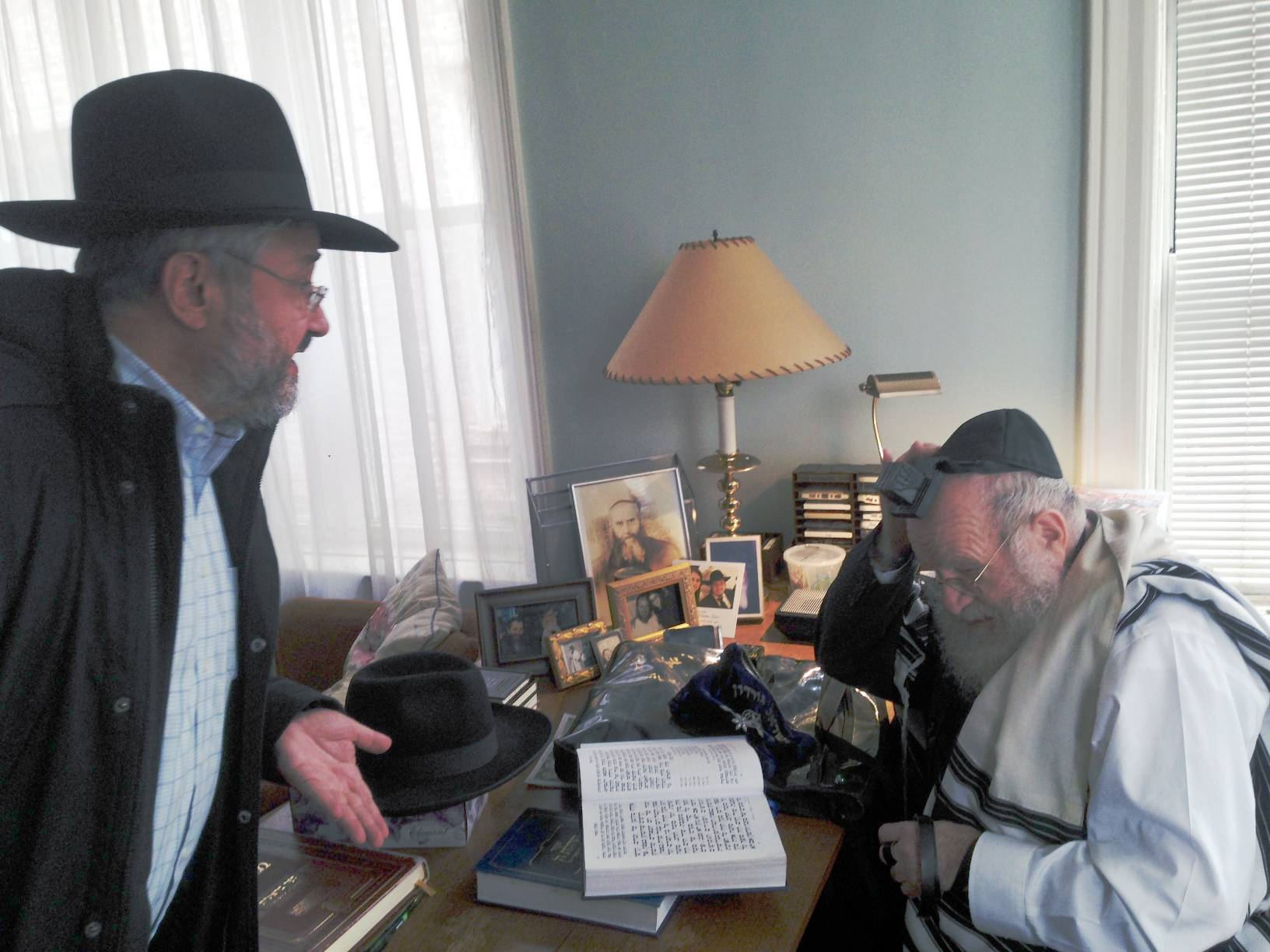
Win some, lose some. Chabadnik dons Tefillin on ex-Charedi lady

Some find this funny. For me it epitomises גלות. Here we have a well-meaning boy, who is trying to ignite a spark within Jews. His mode, is that of his Rebbe זי’’ע and that includes igniting the Neshoma through a Mitzvah, the Mitzvah of Hanochas Tefillin.

The only problem is, in this case it was a woman. She had buzzed hair, and to top it off had a strong Charedi broken English accent, full of the usual errors. She obviously enjoyed her moment in the sun of egalitarianism.

I feel sad that she obviously hates her heritage so much, that she is ready to mislead this well-meaning בחור. She’s no daughter of Rashi.

אוי מה היה לנו

Woe unto what we have become

IMG_2800

The internet and the streets simply must open up the world to Charedim

Here is a fascinating story of the grandson of the Satmar Rebbe who joined the Israeli army. Yes, it’s true, that there is no family that is immune from a child taking a different direction. This is a fact of life.

I don’t like the word blame in the context. I prefer to think that the concept where ‘one size fits all’ and clueless teachers and/or parents cause much of this reality. חנוך על פי דרכו teach according to their acuities, is something harder to achieve in a “my way or the highway” approach.

You should read the article HERE [hat time CMW]

Another article, of interest, describes what appears to be a growing phenomenon is from the Huffington Post, and reproduced here [Hat tip Krakower]

I Escaped Hasidic Judaism and Went From Living on the Streets to Being a Hollywood Actor

In June 2008, exactly three years after I got married, I decided to get a divorce. I didn’t fall out of love with my wife. In fact, I never fell in love with her in the first place. I simply no longer wanted to have the life I had with her and everyone surrounding her.

My wife was a Hasidic Jew, and when I married her, so was I. But that was no longer the case. I was a 22-year-old man with a long beard and side curls (payes) and all the other markings of a Hasid, but I was an atheist. An atheist surrounded by Orthodox Hasidic Jews. Surrounded by their certainty, their food, their self-righteousness and their minivans.

I hated all of it, so I left and entered a world full of uncertainty and a broad spectrum of ideas about right and wrong.

I had no idea what I was going to do. I had no education beyond Jewish Talmudic studies. I had no friends outside of the Hasidic world beyond a few I met at Footsteps, an organization that supports Orthodox Jews attempting to escape. I had no marketable skill beyond being able to charm your pants off. I had never been on a date. I had never heard of The Beatles. And I thought, “May the Force be with you” meant “May God be with you.”

“For most of my life, I believed that all non-Jews hate us and want to kill us.”

After leaving the Hasidic world, I spent seven years in various stages of decay. I slept in a tent in Bushwick for several months, lived in a rented Volkswagen Jetta for as long as my credit card limit allowed and crashed with friends. I starved in the harsh street of New York City. When I used my last subway fare to make my way to my sister’s (one of eleven siblings) house for leftovers from Shabbat meals, she wouldn’t let me in the house because I was wearing jeans.

When I went on dates, I had nothing in common with the women. I knew nothing about their culture, and they knew nothing about mine. I thought all shiksas were prostitutes, and they thought all Hasidim were landlords and diamond dealers.

Let me answer some revealing questions about Hasidic Judaism. Does it withhold a broad education from their children in order to keep the children narrow-minded and uneducated? Yes. Does it vilify the outside world in order to keep its members from joining it? Definitely. Does it have a fear and/or doomsday element to it? Of course. Is there ex-communication for those who dare to leave? Oh yeah.

I still have not received anything past a 5th grade education. In fact, since I never attended a regular school, I don’t actually know what a 5th grade education is — I just picked a grade that seemed right. I don’t know what algebra is; I know I can Google it but I wasn’t made to care enough to do so.

“After leaving the Hasidic world, I spent seven years in various stages of decay.”

For most of my life, I believed that all non-Jews hate us and want to kill us. I believed that all goyim are murderers, rapists, degenerates and dirty second-class citizens. Of course, they/we aren’t but I was taught that in order to make the secular lifestyle less appealing. I was told horrible things would happen to me in this world and the “next world” if I leave. I was told I would end up a criminal or drug addict. Many members of my family refuse to speak to me to this day.

I have had to transition both out of Hasidism and transition into mainstream culture. I have had to find a replacement for the void left by the lack of community and warmth. I had to replace my family, my friends and my moral compass. It was hard leaving everything behind but it was even harder to find something to replace it all with.

Thankfully, as an actor, my professional community is very friendly and inclusive (albeit competitive). I’ve replaced my biological family with actors and Footsteps members. I have managed to date, to have my heart broken, to have broken some hearts and to grow because of all of it.

I get asked all the time: “Are you happy now?” The answer is an unequivocal, “Yes!” I have friends who love me for who I am, for who I was and for who I am trying to become.

“I had to replace my family, my friends and my moral compass.”

Career-wise, it seems I have sought the path of most resistance, deciding to work in a field full of multi-talented human specimens with high cheekbones and jaguar physiques. I’m five foot seven inches, unathletic and have a heavy Yiddish accent. And yet, I’ve been getting work. My latest film, “Felix and Meira,” just beat David Cronenberg at the Toronto International Film Festival for “Best Canadian Feature Film,” and I won “Best Actor” at the Torino Film Festival. Next, I will appear in a recurring role in the upcoming season of “Transparent” on Amazon Prime.

But those achievements pale in comparison to the responses I get from people within the Hasidic community who have snuck out to go see the film. They have been yearning to break away but have been told that if they do, they will end up in jail or in rehab, and they believed it. But now, they can counter that with success stories like mine and those of others like me.

The Hasidic community isn’t what it used to be even five years ago. With the Internet, every person has access to every flavor of every forbidden fruit his or her heart desires, including my story. It won’t be long before the Empire falls. It might not fall completely, but it certainly will be forced to adapt to the 21st century.

The Empire won’t go down easy. The Empire will strike back. For evidence, watch the comments section below.

Follow Luzer Twersky on Twitter: www.twitter.com/@twersky

In my opinion unless subtle changes are introduced into Charedi education this will become more prevalent. It is nigh on impossible to live in a Cocoon these days. I know of schools that redact every book with pen or gluing pages together. The effect is that the students are more certain to find the original text and be exposed. I’m not sure that approach works. Kids are far more connected than they ever were.

Indeed, there has been a new (undesirable) ban now on whatsapp [Hat tip BA]. I surmise this is because the kosher filters cannot filter such messages. whatsapp is wonderful, it keeps families closer and informed, especially when they are spread around the world. Anything can be used for bad or for good. That is the central tenet in my understanding.

More on the Rav Riskin Conversion issue

Rav Riskin has suggestions about making it easier for giyur because of the problem with the volumes of non Jewish Russians in Israel.

He has written these in a book. This is the way of Torah.

He has conditioned his suggestions on the agreement of other major poskim.
The information that I have is that he has not actually acted on any of his proposals with respect to Giyur, although, as I mentioned in a previous post, there are a myriad of instances where Charedi Batei Din do quicky conversions which are quite obviously based on marriage considerations!

One of the issues with Rabbi Gil Student’s post is that he doesn’t deal with the suggestions that Rav Riskin puts forward.
Instead of arguing with his suggestions some rabbis prefer to just silence him.

I’m aware that Rabbi Yoram Ullman of the Sydney Beth Din, did deal with some of the proposals, however, I was not in a state to be at his talk. If he has published a Tshuva, or anyone can encourage him to do so and pass it onto me, then I’d be obliged.

If I was Rav Riskin, I’d take my arguments to Rav Zalman Nechemia Goldberg and Rav Hershel Schachter (but that’s just me). If they both gave approbation to one of his suggestions, I’d accept it with 100% confidence. If they don’t then I would not. Neither of these Gedolim have an agenda (although Rav Hershel may adopt the approach of his teacher Rav Soloveitchik and be unwilling to Pasken for Israel specifically)


Rav Yuval Cherlo on the Rabbi Riskin controversy

[the following is an edited, summary of a talk by Rav Cherlo, from Rabbi Dr Eli Turkel and is printed here with permission]

Who is Rav Yuval Cherlo?

He speaks English. He is a Posek of note from the centrist camp, who writes Tshuvos. He is a Rosh Yeshivah in Petach Tikvah. He was a founder of the moderate Tzohar. He served in the army and attended Har Etzyon. He is considered a sound moderate religious Zionist who sits in the centre and is widely respected. He is inclusive but maintains strict fidelity to authentic Halacha.

Rav Yuval Cherlow שליט’’א

During the controversy between the politically puppeteered Chief Rabbinate about extending the tenure of Rabbi Riskin of Efrat (see here and here) Rav Cherlo made the following comments. These need to be considered seriously considering the source.

Rav Cherlow gave a 1 1/2 hour talk last night on the chief rabbinate and R Riskin.
Rav Cherlow is the head of a hesder yeshiva and very active in medical ethics on several government committees.
Enclosed is a brief (from 90 min) summary.


There are 2 main purposes to the Rabbinate in Israel:

1) represent the Jewish Religion to the nation; and

2) halachic decisions – involving mainly kashrut and marriage & divorce (conversion is not officially listed as being done by the rabbinic courts)
The beginning of the end of the chief rabbinate began with the fight between Rav Goren and Rav Ovadya Yosef,  which brought the chief rabbinate to an effective stand still and more of a titular position.

Today the majority of non-religious Jews have little interest in the rabbinate. The Charedim mainly want to weaken and control the rabbinate but don’t respect it. That leaves only the Dati Leumi (Religious Zionists) who potentially care.
The low point was the election of Rabbi Meltzer over Rav Ariel in the previous election. The two are not in the same ballfield with Rav Ariel a far superior candidate on all fronts, but Rabbi Meltzer won on political grounds [me: he had a deal with his old friend from Kerem B’Yavneh, Rav Yossi Efrati who was the right hand man of Rav Elyashiv, to follow the views of Rav Elyashiv ז’ל. Rabbi Meltzer used to sit not far away from me in the Beis Midrash, but he was older and in 5th year as I recall when I arrived.]
I don’t really want to talk about chief rabbis that are being prosecuted.

Rabbi David Lau the current Ashkenazi chief rabbi is extremely capable, but won’t take any controversial stand. When asked about pushing for organ transplants he says Rabbi X objects to it. In terms of influence in the country his cousin, Rabbi Benny Lau has a greater presence. Rabbi Riskin is also an inspiration to others (when the radio wants a spokeman or there is a public debate Rabbi Benny Lau or Rav Cherlow are usually chosen).

To my surprise Rav Cherlow claims that the largest public religious events in Israel are the various programs on Shavuot night!
The chief rabbinate is slowly losing all of its power. Today some 100,000 Non-Jews are Israeli citizens recognised by the Law of Return (chok hashvut) with no hope or interest in converting.

In Cyprus the wedding places are all set up for those Israelis who can’t or don’t wish to marry through the rabbinate. This is in addition to all the couples living together without formal marriage. Soon, a minority of couples living together will have been married through the Rabbinate. This obviously means that they also will not be divorced through the rabbinical courts when they separate.
Hence, conversion causes less of a problem as they marry elsewhere and being Jewish isn’t important to them. Rav Cherlow brought a story that a brother of the Rav from Ponovezh was intending to marry a non Jewess. A conversion was arranged for the woman within 3 days!

According to Israeli law only the rabbinate can give a certificate of kashrut. Presently the various badatzim (Charedi Batei Din) only claim supervision without actually stating that it is kosher. There is a movement of other local groups that will start their own kashrut supervision. There is currently a case in front of the court requesting that any Rabbi be able to give a kashrut certificate.

In general many functions of the rabbinate are being taken over by Tzohar which not only performs marriages but also organizes many events for the public.
Many of the Dati Leumi Knesset members are in parties other than bayit hayehudi (the Religious Zionist party). Many of them are willing to dissolve the rabbinate as they feel it does more harm than good. An example is Rabbi Shai Piron who is a leading member of Yesh Atid. Others are in the Likud.

What about the future: There are two options:

1) dissolve the rabbinate and have a situation similar to the US [of separation of religion and state] (however the government will still fund religious events). This will happen by law or informally over time

2) make the current Rabbinate more inclusive and serving larger elements of the population.

Rav Cherlow personally is in favor of the second option. Now, much of Israeli society is traditional. They go through the Rabbinate because it is the accepted way and they have no problems. Once the rabbinate loses its monopoly many of these will choose other options.
The rabbinate claims to have problems with R Riskin because he criticises the Rabbinate and doesn’t always follow the rules. However, many town rabbis from the charedi side do the same thing but are never criticised for their actions. In fact two sets of religious courts have recently released agunot on very controverisal and contradictory reasons.

Town rabbis officially have no retirement age – the only government workers with that rule. Recently a law was passed requiring town rabbis to prove they are healthy at the age of 75 to continue. Until now that law was a formality. Rabbi Riskin is the first town rabbi to be called in for a formal hearing!

R Cherlow says that he has many disagreements with R. Riskin. However, should the chief rabbinate decide that they have the power to say that an orthodox rule is illegitimate (not just wrong on certain issues) then that is the straw that would force Rav Cherlow to object to the entire establishment. Many town rabbis just collect a salary and don’t do anything. To take a rabbi who is an inspiration to many and throw him out because he is too liberal, is simply too much for Rav Cherlow.

Interestingly the chief rabbinate announced that they will not be swayed by public opinion. That itself is a symbol of their problem. What the people of Efrat feel is irrelevant. In the end the Dati Leumi population will vote with the feet and already the other groups have no respect for the rabbinate. That institution will be left with zero support.

Beautiful D’var Torah on Shlach

[hat tip MT]

“And [the spies] began to speak badly about the land that they had explored.” (Num. 13:32)
A dispirited discussion took place at Beit HaRav, Rav Kook’s house in Jerusalem, not long after the end of World War II. The Chief Rabbi had passed away ten years earlier; now it was his son, Rabbi Tzvi Yehudah Kook, who sat at the head of the table.
One participant at the Sabbath table had brought up a disturbing topic: the phenomenon of visitors touring Eretz Yisrael and then criticising the country after returning to their homes. These visitors complain about everything: the heat, the poverty, the backwardness, the political situation – and discourage other Jews from moving here, he lamented.
Rav Tzvi Yehudah responded by telling the following parable, one he had heard in the name of the famed Rabbi Shmuel Mohilever, the rabbi of Bialystok.
The Failed Match
There was once a wealthy man who sought the hand of a certain young lady. She was the most beautiful girl in town, and was blessed with many talents and a truly refined character. Her family was not well-off, so they were eager about a possible match with the prosperous fellow.
The young woman, however, was not interested in the match. Rich or not, the prospective suitor was known to be coarse and ill-mannered. She refused to meet with him.
The father asked her to at least meet with the young man in their home, so as not to embarrass him. After all, one meeting doesn’t obligate you to marry him! To please her father, the young woman agreed.
The following Sabbath afternoon, the fellow arrived at the house as arranged, and was warmly received by the father. Shortly afterwards, his daughter made her entrance. But her hair was uncombed, and she wore a faded, crumpled dress and shabby house slippers. Appalled at her disheveled appearance, it did not take long before the young man excused himself and made a hurried exit.
What everyone says about this girl – it’s not true, exclaimed the astonished young man to his friends. She’s hideous!
Rav Tzvi Yehudah stopped briefly, surveying the guests seated around the table. Superficially, it would appear that the brash young fellow had rejected the young woman. But in fact, it was she who had rejected him.
The same is true regarding the Land of Israel, the rabbi explained. Eretz Yisrael is a special land, only ready to accept those who are receptive to its unique spiritual qualities. The Land does not reveal its inner beauty to all who visit. Not everyone is worthy to perceive its special holiness. It may appear as if the dissatisfied visitors are the ones who reject the Land of Israel, he concluded. But in fact, it is the Land that rejects them!
A thoughtful silence pervaded the room. Those present were stunned by the parable and the rabbi’s impassioned delivery. Then one of the guests observed, Reb Tzvi Yehudah, your words are suitable for a son of your eminent father, may his memory be a blessing!
Seeing the Goodness of Jerusalem
Rav Tzvi Yehudah’s response was indeed appropriate for Rav Kook’s son. When visitors from outside the country would approach the Chief Rabbi for a blessing, Rav Kook would quote from the Book of Psalms, “May God bless you from Zion” (128:5).
Then he would ask: What exactly is this blessing from Zion? In fact, the content of the blessing is described in the continuation of the verse: “May you see the goodness of Jerusalem.”
The rabbi would explain: The verse does not say that one should merit seeing Jerusalem; but that one should merit seeing ‘the goodness of Jerusalem.’ Many people visit Jerusalem. But how many of them merit seeing the inner goodness hidden in the holy city?
And that, he concluded, is God’s special blessing from Zion.

Belzer chassidim cave in to secular pressure

Make no mistake, this was not about Judaism. It wasn’t about דינא דמלכותה it was about keeping their school open. I had blogged about the issue here. They have caved in and shown less guts than the days of yore when the Gedolim of Europe had to deal with the issue of introducing secular studies into Yeshivos. If they really followed their Rebbe, then they should have gone on Aliya to Kiryas Belz or something and followed his ruling. Instead, they decided Golus in Stamford Hill under מלכות של חסד was preferable.

From the Jerusalem Post

Plans by leaders of the Belz hassidic community in north London’s Stamford Hill to expel pupils if they were driven to school by their mothers have been countermanded by the school governors, after a strong warning Education Secretary Nicky Morgan that it was “completely unacceptable” and her instigation of an inquiry into the controversial policy.

The issue arose after the head of two junior schools – Talmud Torah Machzikei Hadass, for boys, and Beis Malka, for girls – sent out a note threatening to institute the new policy from the beginning of the new school year in August. The note stated that the edict conformed with the ruling of the leader of the Belz Hassidim, Rabbi Yissachar Dov Rokeach, that women adherents must not drive.

Headlines about bans on women driving led to close attention on the Belz community in particular and hassidic Jews in general, with parallels being drawn with Saudi Arabia, where women are not allowed to drive. Jewish communal leaders – including Britain’s Chief Rabbi Ephraim Mirvis and Rabbi Joseph Dwek, the head of the Spanish and Portuguese community – distanced themselves from the ruling.

Morgan, who also serves as women’s and equalities minister, said the government would take any necessary action to “address the situation.”

Faced with negative reaction, Ahron Klein, chief executive of the boys school, issued a statement at the end of last week in which he stated that the head teacher had “sent out the letter on behalf of the spiritual heads of the community, who had not taken into account the implications of such a policy.”

He added that Neshei Belz, the community’s women’s organization, had also issued a statement saying that Belz women’s values may be compromised in driving a vehicle, although they added that they respect individual choices made in this matter.

Klein pointed out that the message that children would be excluded had not come from the school’s board of governors, “who did not approve the letter in advance.” And he clarified that the schools believe that women have a choice about whether they want to drive, “and our policy is to accept all children who are members of our community, which we have been doing for the last 40 years.”

Klein confirmed to The Jerusalem Post that, indeed, women driving their children to school would not be faced with their children being turned away, though he emphasized it was generally accepted by hassidic Jews – and not just by the 700 families of the Belz community in the UK – that for reasons based on their form of Judaism, women do not drive.

While welcoming the clarification, the Equalities and Human Rights Commission, which declared the policy “unlawful and discriminatory,” announced it had written to the schools demanding further clarification that they were complying with UK law and seeking confirmation no pupils driven by their mothers to school would be subjected to sanctions.

I wonder which היתר they used and whether it was sanctioned by their Rebbe? Whatever, they have come out of this looking quite silly.

Mixed Gender Functions

[Hat tip MD]

Recently, a question was asked of the Charedi Leumi Posek, Rav Aviner, about a 50 year reunion of a group of couples who had been part of a youth group 50 years prior. They would be attending, were frum, all with their wives, and the idea was that they would recollect memories and have an enjoyable evening. The question asked to him was

Is such a reunion permitted according to Halacha

I guess the mere fact that they asked Rav Aviner the question before going ahead with their reunion is testament to their frumkeit and fidelity to Halacha. Those who are not so beholden to their Rabbi, would not even ask a question.

At any rate, Rav Aviner’s answer was

“חלילה. זו מכבסת מילים לפעילות מעורבת. זה איסור חמור גם אם אלו יראי שמים. ולצערנו יש פעמים רבות פעילות המשך

In other words, definitely not permitted and is a serious halachic infraction even if the participants are frum! Rav Aviner opines that unfortunately, there are sometimes serious outcomes from such events.

In other words, age makes no difference, and one would assume, a fortiori, that this would be forbidden for younger couples. I won’t extrapolate to mixed tables of singles at a wedding who are looking for Shidduchim. Rav Aviner may have the same opinion as R’ Aron Soltoveitchik that this isn’t just permitted but desirable. It is dangerous to extrapolate in Halacha.

Upon hearing of this Psak, respected Rav Amnon Bazak (whose writings I am acquainted with and if I am not mistaken he may have visited Melbourne) of Har Etzyon, disagreed with Rav Aviner on three grounds.

  1. The attitude of the Rishonim and Acharonim on issues such as this, was and is tightly connected with the practices in such communities. In other words, if it was common place for men and women to meet, then Poskim such as the Bach, opined that it is permitted (if you want to read more about this examine the issue of whether to say שהשמחה במעונו at a mixed Sheva Brachos. If my memory serves me correctly, the Kitzur Shulchan Aruch is Machmir and says no). The point of Rav Bazak was that this is something which may well change from community to community. I wouldn’t expect this to happen in Satmar, or Belz, where the women aren’t even allowed to drive cars, of course.
  2. If one wants to say “those who are stringent will get a blessing”, this leaves is a sour taste because the idea that they get a blessing on account of people who really are not doing anything wrong according to plain Halacha.
  3. What’s the point in putting out words like ‘absolutely forbidden’ when this happens all the time, at tables, which involve Chachomim and Roshei Yeshivah at their meals?

There is also the question of when you have two long tables at a Sheva Brachos one with men and the other with women without a Mechitza. Some will still say this is “mixed” other will not, even according to those who argue with the Bach.

Mori V’Rabbi, R’ Hershel Schachter relates that R’ Moshe Feinstein ז’ל and R’ Yaakov Kaminetzy ז’ל  and others made weddings and there were mixed tables. He does however caution that times have changed somewhat to those days. He doesn’t use Rav Bazak’s arguments but notes that

  1. Women tend not to wear the ornate thick dresses that they wore in yesteryear, and sometimes, perhaps too often, are on the boundary of Tzniyus with flimsy clothing which leaves little to the imagination
  2. The music in those days was much slower and it was rare to find a women or man return to the table shvitzing with all that comes from that phenomenon and fine cloth.

Accordingly, he suggests caution at weddings.

Your views? I believe this is societal and something according to הרגלם and will change from group to group to the extent that a blanket opinion is elusive and probably not advised.

There is a lot of “Ess Past Nisht” and I’m not arguing. I’m just quoting and adding to this article

בענין סתירת הרמבם שלא יתערבו או שלא יסתכלו זה את זה,  כבר דשו ביה רבים

Support for Rabbi Riskin

I had blogged on this Here

(hat tip nb) Rav Melamed is considered one of the leading Poskim for the Chareidi Leumi group (right wing religious zionists)


I’m writing to update you on events surrounding the Israeli Chief Rabbinical Council’s refusal to automatically renew Rabbi Shlomo Riskin’s tenure as Chief Rabbi of Efrat. As I wrote last week, Rabbi Riskin has instead been summoned for a hearing, at which the Council will examine his qualifications and credentials for continuing the work to which he has devoted his life since the very establishment of the city.

I am delighted to report that Rabbi Riskin has been blessed with an incredible groundswell of support, which testifies to the meaningful, lasting impact he has had on world Jewry. 

He has been especially touched by the solidarity and encouragement expressed in letters, emails, phone calls, tweets and facebook posts from individuals spanning the globe. 

In addition, prominent members of Knesset and Israeli government ministers, communal and spiritual leaders in Israel and the Diaspora and countless organizations have spoken and written eloquently on his behalf, demonstrating the highest levels of respect he has earned from a broad cross-section of the Jewish world. 

Below is one such article, authored by Rabbi Eliezer Melamed, spiritual leader of the community of Har Bracha and a leading figure in the “Chardal” (ultra-Orthodox Zionist) community. In addition to beautifully encapsulating so much of what has been written and said over the past week, the poignancy of his heartfelt advocacy stems precisely from the fact that he holds fundamentally differing views from Rabbi Riskin on many issues. 

I invite you to read and be inspired by Rabbi Melamed’s expression of steadfast support on behalf of our beloved rabbi.

With warmest regards and Shabbat Shalom

David Katz

International Director, Ohr Torah Stone

 Op-Ed: On the Rabbi Riskin Saga:

Don’t Disqualify the Torah Scroll (from Arutz Sheva)

by Rabbi Eliezer Melamed 

Rabbi Shlomo Riskin is a man who raised himself from poverty to dedicate his life to Torah and more – differences in philosophical or even halakhic approaches should not be used to disqualify one rabbi or another. 

It was recently reported that the Council of the Chief Rabbinate has expressed doubt as to whether to permit Rabbi Shlomo Riskin from staying on as chief municipal rabbi of Efrat despite recently turning 75.

The hearing ordinarily would have been nothing more than a procedural matter. But several members of the council evidently aimed to prevent Rabbi Riskin from continuing in his capacity as a result of their objections.

This, then, is the appropriate time to take a stand and praise Rabbi Riskin, a righteous, wise leader who has done extraordinary things.

Rabbi Riskin was born into a non-religious, poverty-stricken family. But from a young age, of his own free will and with the help of his grandmother, he began making his way toward the Torah and religious observance. Being a prodigy and an outstanding student, he was accepted to Harvard, the most prestigious university in the world, with a full scholarship. By choosing to study there, he would have guaranteed his professional and financial future: no door is closed to Harvard graduates.

It was a once in a lifetime opportunity, a temptation that few could resist. Yet Rabbi Riskin declined the scholarship and instead made his way to Yeshiva University, which also took notice of his abilities and granted him a full scholarship.

Since then, he has dedicated his life to Torah.

As a young, gifted, and charismatic rabbi, a captivating speaker with the ability to lift up the souls of his audience and draw them near to Torah and religious observance, Rabbi Riskin earned special esteem in the United States. Successful, educated individuals also found meaning in his words of Torah and were privileged to become acquainted with Jewish tradition under his guidance. “There was truthful Torah in his mouth, and he brought many back from sin.” The future that awaited him was that of a leader of the American-Jewish community.

Yet before even turning 40, inspired by pure faith in God and His Torah, he gave up his position in the United States and made a decision to immigrate to Israel.

In so doing, he gave up what had been his main skill in his work: his command of the English language, which had brought him the success he enjoyed in the United States. True, he learned to speak Hebrew excellently. but they say that in English few can parallel his rhetorical skills. Thanks to his vision, abilities, and leadership, he was able to bring many members of his community to Israel in his wake. He established an Israeli city at the heart of whose cultural life are the study of Torah and religious observance, whose residents enjoy a high standard of living and contribute to the economic, scientific, and social development of the State of Israel.

His ‘aliyah’ to Israel was felt by hundreds, even thousands, who followed in his footsteps to new homes in Efrat and throughout Israel, while also benefiting from the enhanced religious life implicit in such a change. Never slowing, Rabbi Riskin successfully established yeshivot and educational institutions for boys and girls in Gush Etzion and Jerusalem. Drawing on incredible sources of energy, he still makes his way to all of these institutions, where he teaches, speaks, illuminates, and imparts to his students the excitement of a life centered on Torah and Judaism.

Yet when he arrived in Israel, he was guaranteed nothing. He came with little more than the shirt on his back.

Western Aliyah to Israel

Unfortunately, though we are not always aware of it, the vast majority of those who have immigrated to Israel in modern times have come from countries where Jews were subject to persecution and poverty. Immigration from Western countries, particularly the United States, is perhaps the most impressive of all.

I therefore have a deep appreciation of Rabbi Riskin as well as all other immigrants from the United States.

A Difference of Approach

There are most definitely different approaches to various issues in Jewish law. This always has been the case in Jewish discourse, whether between the sages of the Mishnah, those of the Gemara, the luminaries of Geonic Babylonia, the scholars of the medieval era, or those of the modern period. Sometimes the differences stem from people’s different characters, as with Shammai and Hillel. Other times they stem from differences in background or intellectual method. Concerning these issues, our sages said (Ḥagigah 3b), “‘Masters of assemblies’ are those scholars who sit, some in this faction and some in that, and occupy themselves with the Torah. Some say it is impure; others say it is pure. Some forbid; others permit. Some declare it invalid; others declare it valid.

Lest a person say, ‘Then how can I study the Torah?’ the verse states that all were ‘given by a single shepherd’: a single God gave them, a single leader said them, from the mouth of the Lord of all creatures, blessed is He, as is stated, ‘God stated all of these things.’ So you, too, make your ears a funnel and develop a discerning heart so that you can hear the words of those who say it is impure and the words of those who say it is pure, the words of those who forbid and the words of those who permit, the words of those who declare it invalid and the words of those who declare it valid.

American Jewry

Rabbi Riskin’s American background plays an important part in his pursuits: American Jews and immigrants from the United States stand at the forefront of the struggle with Western culture and its principles of liberalism and equality, including feminism.

Out of their faithfulness to the Torah, Rabbi Riskin and his colleagues have forged a path to contend with these major and important questions. Among American rabbis, too, there are different approaches: how much to open up and how much to close, what to bring near and what to keep distant.

Sometimes, other rabbis, including myself, prefer other solutions. Sometimes this preference stems from habits of observance to which we are devoted, sometimes from the fact that we believe a certain way is more appropriate. For the most part, these differences of opinion and practice pertain to questions of education and society, rather than to questions of practice per se. Time will tell what advantages and disadvantages each path contains. In any event, we must not seek to delegitimize Rabbi Riskin’s path, which is one of the most important approaches to religious observance in our day. 

A Whole Torah Scroll

If a single letter is missing from a Torah scroll, it is unfit for use, and the same holds true for the pan-Jewish religious world: every true Jewish scholar has a letter in the Torah, and any person who excludes one of these scholars makes his own Torah scroll unfit for use. Any offense against Rabbi Riskin’s service in the rabbinate is equivalent to the obliteration of whole sections of the Torah.

I imagine that it was only out of ignorance that the Council of the Chief Rabbinate entertained doubts with regard to Rabbi Riskin. I am confident that once they have heard a bit of his reverence, erudition, and rectitude, the majority of the members of the rabbinical council will take his side.

If, heaven forbid, they reach a contrary decision, Rabbi Riskin’s dignity will not be harmed. His standing in his community and his institutions will keep rising, and his influence will become even greater. However, the public standing of the Chief Rabbinate as the public representative of the Torah of all Jews will be weakened when it becomes known that the Torah scroll it represents is deficient and unfit.

Policy of the Chief Rabbinate

Some have argued that the Chief Rabbinate should draw a line that all rabbis must follow, and Rabbi Riskin is not following the line that was drawn concerning such issues as conversion.

True, it is desirable that the Rabbinate take a position in pressing matters of public importance-but in order to do so, it must engage in a deep, serious discussion of each of these issues, a discussion of Talmudic, medieval, and modern literature that analyzes the reality of the matter at hand in all its dimensions. In order to expedite such a discussion, rabbis who are active in the given area would have to study various books and articles ahead of time, and then the discussion of every issue would continue for at least a few whole days.

Unfortunately, today no serious discussion is held concerning any important matter, whether in the Rabbinate or in any other religious entity. For instance, when it comes to conversion, Rabbi Ḥaim Amsalem wrote a very respectable book that is deserving of discussion. True, I draw different conclusions from his, but in objecting to what he wrote most of his opponents offer worthless arguments that rely on violence such as is accepted in Haredi circles.

I must add that despite the great value of arriving at a consensual position on every issue, such a position must not come at the expense of rabbinic discretion. Even when the Great Sanhedrin held session, local courts enjoyed a certain degree of authority, because fundamentally this position is not a thin line, but a divinely sanctioned field, a field in whose scope there are different practices and approaches thanks to which the Oral Torah becomes richer and greater.

All the more so today, when there is no Great Sanhedrin that traces its authority directly to Moses, must the Rabbinate not set a rigid line that seeks to disqualify religious perspectives of substance. The lesser the standing and authority of the Chief Rabbinate, the more it must take the various perspectives into consideration in arriving at its position. This is how the rabbis of the Jewish people carried themselves in previous generations.

“One Law Shall There Be for You All”

Aside from anything else, a single law must apply to all. When the Council of the Chief Rabbinate declines to react to profound challenges to its views and its dignity on the part of rabbis belonging to the haredi stream, who violently reject its kashrut supervision and treat the chief rabbis and municipal and neighborhood rabbis with contempt, it must also act tolerantly and fondly toward rabbis such as Rabbi Riskin, who respect the Chief Rabbinate but sometimes take a different track.

In today’s reality, the Rabbinate does not go out of its way immediately to dismiss rabbis who, contrary to the rules of Jewish law, disqualify conversions performed by representatives of the Rabbinate. It continues to recognize kosher supervision services, marriages, and conversions by “rabbis” who have the gall to publicly dismiss commandments of the Torah, such as the duty to settle the Land of Israel and defend the nation of Israel through military service, or deprecate the good that God bestowed on us with the establishment of the state and denigrate those who recite the Psalms of Praise on Independence Day.

In such with today’s reality, the Rabbinate must restrain itself from taking action against a rabbi whose reverence, deeds, and erudition are greater than those Haredi “rabbis” whom it is overly careful not to slight. 

Two Views on Rabbi Riskin

It was predictable, that the hard-hitting and often “on the money” Isi Leibler would come out in full support of Rabbi Riskin. Isi, if I’m not misquoting him, is also a supporter of Rabbi Benny Lau, who is a controversial figure.

What Isi fails to notice is that Rav Soltoveitchik was a Charedi in his outlook on Torah and Mitzvos. The difference was that Rav Soltoveitchik could make a Psak (many were often contradictory for good reasons) and “take on” any Gadol BaTorah in the entire world and flatten him with his learning and brilliance. His use of the philosophical world was to broaden the understanding of Torah.

Rabbi Riskin is a very impressive man. I enjoyed his latest book immensely. One thing that was clear though that Rabbi Riskin, when in doubt, always went to seek advice from some mentors. He used to go to Rav Soltoveitchik and then to the Lubavitcher Rebbe (especially when the latter enfranchised him to work underground for Soviet Jewry).

Now, Rabbi Riskin is his own man. He is not young. He got one-off Hetterim from both Rav Soltoveitchik and the Lubavitcher Rebbe for certain activities. In his fantastic book he is clearly in awe of them, and if you asked him today whether he reached either of their ankles, he would tell you “No way in the world”. That being said, unlike another moderates like Rav Aharon Lichtenstein ז’ל, Rav Aharon actually also had a posek. That Posek was none other than Rav Shlomo Zalman Auerbach ז’ל, a cousin of Isi’s wife, Naomi. The saintly Rav Avigdor Nevenzahl also went to discuss difficult matters with Rav Shlomo Zalman. Why? Because whilst being a Charedi, Rav Shlomo Zalman was not behoved to any politics or political machinations. He was an independent, a pure soul, who understood both Rav Aharon, and Rav Avigdor (and like Rav Elyashiv would get angry at anyone who remotely said anything negative about Rav Kook ז’ל)

I feel that Rabbi Riskin is now missing his mentors. Who isn’t? His last few more controversial steps are argued among the real students of Rav Soloveitchik, of whom I consider Rav Hershel Schachter שליט’’א, the carrier of Rav Soloveitchik’s Torah Mesora and דרך הלימוד ופסק par excellence.

Far be it from me to be one to proffer advice to Rabbi Riskin, (I don’t come to his ankles) but the one Rabbi I would go to discuss issues of grave halachic import in Israel with, is actually Rav Shlomo Zalman’s son in law, Rav Zalman Nechemia Goldberg. He is very much attuned with the real world, as was Rav Shlomo Zalman himself. He is a wise man, very attuned to the real world, and void of politics.

I’ll close with Isi’s article, and that of Rabbi Gil Student. You decide. Regarding the Chief Rabbinate, I agree. The calibre of Rabbi is not what it should be. Rav Ovadya Yosef was recently described as מיוסף עד יוסף לא קם כיוסף where the first Yosef is R’ Yosef Caro the author of the Shulchan Aruch. I agree with this whole heartedly. Sadly, political appartchiks are now in the seat.

Indeed, reading what Rav Soltoveitchik wrote about the Chief Rabbinate, is as true now as it was 30 years ago. He was utterly opposed to the concept.

Here is Isi’s article, followed by R’ Gil Student.

The despicable effort by the haredi-controlled Chief Rabbinate to purge Rabbi Shlomo Riskin because he does not conform to their stringent halachic approach may prove to be a blessing in disguise. The anger this outrageous initiative generated could be the final straw needed to dissolve this corrupt institution, which is held in contempt by most Israelis — including, ironically most haredim.

Rabbi Riskin is one of the outstanding role models of the religious Zionist community. I am privileged to have known him for over 30 years and consider him one of the greatest and most beloved Modern Orthodox rabbis of our generation. He is also an extraordinary creator of Jewish institutions.

A student of the great Rabbi Joseph Soloveitchik, in 1964 Riskin became the rabbi of Manhattan’s Lincoln Square Synagogue, which he transformed into one of New York’s most successful Orthodox religious centers.

In 1984, at the peak of his career, he moved to Israel and became founding chief rabbi and a leading developer of Efrat, which is today a highly successful community.

In addition to acting as a communal rabbi, he launched the Ohr Torah Stone institutions, which include one of the best networks of Modern Orthodox schools in Israel, ranging from junior high school through to graduate programs. He also created a special program to inculcate young men with the knowledge and skills to be effective rabbis and educators throughout the Jewish world.

He displayed innovation by seeking to blend Halachah with the requirements of a modern industrial Jewish state.

He strove to upgrade the status of women and to this effect launched Midreshet Lindenbaum, a college designed to educate religious women. He also created a five-year program designed to train women to act as religious advisers paralleling rabbis. This and his efforts to address the issue of agunot (women in unwanted marriages whose husbands are unwilling or unable to grant them divorces) outraged the ultra-Orthodox.

Rabbi Riskin also had a major impact in the field of marriage, divorce and above all, conversion, where he established independent conversion courts that were bitterly challenged by the haredi establishment. Riskin considers the issue of conversion — especially related to immigrants from the former Soviet Union — as one of the greatest religious, national and societal challenges facing Israel.

He was at the forefront of efforts by the moderate Tzohar Rabbinical Council to decentralize the appointment of rabbis and provide Israelis with choices beyond the extremist ultra-Orthodox candidates appointed by the Chief Rabbinate.

When at the age of 75, Rabbi Riskin’s tenure came up for a five-year extension — an automatic procedural formality, the Chief Rabbinical Council took the unprecedented step of refusing to reappoint him. It was only due to a plea from the recently elected chief rabbi of Jerusalem, Rabbi Aryeh Stern, that the council reluctantly agreed to interview him. He only learned about his provisional rejection from the media.

This was not merely an attempt to publicly humiliate one of the doyens of Modern Orthodoxy. It was a ploy by the ultra-Orthodox fanatics to assume unprecedented total centralized control of religious leadership and to marginalize those with different approaches.

But choosing to impose their agenda on Efrat, a bastion of national religious Zionism, is likely to backfire and the crude effort to oust Rabbi Riskin against the wishes of his community, exposes crude agenda of the Chief Rabbinate.

As far back as the Mishnah, there were robust debates in the interpretation of Halachah between the more liberal Beit Hillel and more stringent Beit Shamai schools. And this process of debating the “70 faces” of Torah ensured that a plurality of interpretations prevailed at all times. Now even the ultra-Orthodox compete among themselves to impose the most stringent interpretations of implementing Jewish laws.

This is being extended to the Diaspora with the Israeli Chief Rabbinate insisting that that conversions to Judaism by Orthodox rabbis lacking their endorsement should no longer be recognized as Jews by the government of Israel and thus ineligible for aliya.

This is outrageous and entirely beyond the jurisdiction of the Israeli Chief Rabbinate. Former chief rabbis like Rabbi Isaac Herzog, Rabbi Shlomo Goren and others were outstanding religious scholars, moderate and devoted religious Zionists in stark contrast to the mediocrities and corrupt individuals who succeeded them when the haredim hijacked the Chief Rabbinate.

It is significant that the current Ashkenazi Chief Rabbi David Lau ensured his election by giving an unqualified undertaking to haredi groups that he would resist any proposed reforms relating to conversions or rabbinical administration without their prior approval.

To make matters worse, the level of corruption and scandals associated with the Chief Rabbinate reached bedrock when the former chief rabbi (whose appointment was orchestrated by the haredim to block a national religious candidate of genuine stature) was arrested and charged with purloining millions of dollars from illegal activities and corrupt practices.

Not surprisingly, the attempts to humiliate Rabbi Riskin created enormous outrage. The Tzohar Rabbinical Association stated that “above any effort to depose Rabbi Riskin flies a clear red flag of revenge directed against his positions and halachic decisions” and accused the rabbinical council of initiating this solely “for political considerations and to enable them to appoint insiders in his place.”

Education Minister Naftali Bennett, who heads the religious Zionist Habayit Hayehudi party, stated that the Chief Rabbinate was behaving in an “unacceptable” manner and that he would not stand by and permit this.

Jewish Agency head Natan Sharansky, described Riskin as “a Jewish leader and an Israeli patriot,” insisting that there can be “no questions about his qualifications for his continued service.”

The Efrat municipal council unanimously voted to extend the rabbi’s tenure and condemned the intervention. Rabbi Riskin made it clear that if necessary, he would appeal to the Supreme Court but that so long as the Efrat community wished to retain him, he would continue to serve them as rabbi without payment.

The abject silence of Diaspora Orthodox institutions was disappointing, encouraging Rabbi David Stav, the head of Tzohar, to call on Jewish communities in the U.S. to stop inviting Chief Rabbis David Lau and Yitzhak Yosef as their guests if the Riskin provocation is not withdrawn.

The Rabbinical Council of America, once a robust Modern Orthodox group, expressed the hope that the differences would be amicably settled. One of its executive officers, Rabbi Avrohom Gordimer, actually accused Rabbi Riskin “of violating the trust of his employer and contravening the rulings of the most pre-eminent halachic authorities of this and previous generations,” alleging that “the employer had more than ample reason to maintain that his employee was not adhering to the policies and values that he was hired to uphold.” This obscene depiction of Riskin as an employee of the Chief Rabbinate reflects the distorted mentality of those currently controlling the institution.

In view of the waves of protest, there is every probability that the Chief Rabbinate will back down. But now is the time for Israelis and Orthodox Jews throughout the world to raise their voices and say enough is enough. Despite the repercussions of a division, breaking away and setting up independent religious courts directed by moderate Zionists is the only means by which to terminate the exclusive control of the haredim.

Throughout the Exile, the rabbinate never imposed centralized religious control and there was always a plurality of differing halachic interpretations. The issue is not whether we should be more or less stringent in the application of Jewish law. Any Orthodox community should be entitled to select its choice of spiritual leader. Haredim are entitled to practice their religion as they see fit. Indeed, there are aspects of their spirituality and lifestyle that our hedonistic society could benefit by emulating. But that does not provide a license to enable the most extreme elements to impose their limited worldview on Israeli society.

The Chief Rabbinate is regarded with contempt and despair by the vast majority of Israelis, including most haredim, who merely exploit the institution for their own purposes. The greatest impediment to the current religious revival is the deplorable status of the rabbinical bureaucracy, which alienates rather than attracts Israelis to their Jewish heritage. The scandalous effort to degrade one of the most beloved and successful Orthodox rabbis of our generation should be a wake-up call to introducing highly overdue, radical changes in the rabbinate.

Here is Rabbi Gil Student’s take:

If you want to know why Rabbi Shlomo Riskin is apparently being forced into retirement by the Israeli Chief Rabbinate, you have to read his recent book, The Living Tree: Studies in Modern Orthodoxy. I don’t claim any insight into the complex politics of Israel’s governmental organizations, of which the Chief Rabbinate is one. I don’t know enough to understand the power struggle that is occurring. However, in terms of ideology, I see why the Chief Rabbinate Council would express concern over R. Riskin. His book is more radical than many might expect. This is not the same Rabbi Riskin you may remember from the 60’s and 70’s.

The most surprising thing about the book is what is missing from it. On multiple occasions, R. Riskin wrote programmatic essays about what Modern Orthodoxy needs to do to succeed. These were essays full of passion, exhorting both faith in God and Torah as well as devoted observance of the commandments. While the book consists almost entirely of previously published articles, these programmatic essays were replaced with a new introduction titled “What is Modern Orthodoxy?” This introduction is a call for radical change in halakhic decision-making. For example (p. xiv):

The Modern Orthodox decisor must orchestrate the interplay between both of these directives, taking into account the guiding principles used by the sages of the Talmud in their religio-legal discussions, the meta-halakhic principles such as, “for the sake of the perfection of the world,” “in order to respect the integrity of the human being created in the divine image,” “for the sake of freeing a wife chained to an impossible marriage the sages found leniency,” “in order to provide spiritual satisfaction for women,” and “you must love the stranger and the proselyte.”

If you are familiar with rabbinic literature of the past century, you will immediately recognize that these are legitimate principles that can and have been (ab)used to overturn wide swaths of Jewish law. The essays in the book provide many examples of R. Riskin’s applications of these principles. There are two things going on here. First, R. Riskin is promoting his own fairly radical agenda, as would be expected. Second, he is setting the stage for future rabbis to make even more changes to Jewish practice according to their own understanding of what is needed, regardless of what traditional texts allow.

Another troubling trend I find in this book seems to be the result of an editorial oversight. Most of the essays were written over the course of decades, as R. Riskin’s experiences and outlook changed. While the essays were edited for consistency and maybe updated a little, the conclusions were largely left intact. Here we see a troubling difference in how R. Riskin reaches conclusions. Regarding changing the daily blessing “Who has not made me a woman,” R. Riskin writes: “I would not permit even so minor a change without the approval and approbation of several leading halakhic authorities” (p. 159). While R. Riskin advocates annulling marriages, he does not plan on doing so unilaterally. Rather, “this should be effectuated by a special Beit Din for agunot in Jerusalem with impeccable halakhic credentials who would render judgments, and rule on urgent issues of mesuravot get throughout the world” (p. 188). In his call for theological interfaith dialogue with Christians, R. Riskin repeatedly invokes Rav Soloveitchik, albeit in what I believe is a twisting of his words but at least as an appeal to an eminent authority.

However, in his essay on women halakhic scholars and judges, R. Riskin does not submit his proposal to leading authorities. The most he does is quote a responsum of Rav Eliyahu Bakshi Doron, who is alive and well and could be consulted. Instead, R. Riskin started a program for ordaining women on his own. (R. Riskin writes that his program’s first two graduates published a book of responsa that “has received much praise, and — at least to my knowledge — no negative reviews” (p. 132). We published a negative review by Rav Yosef Gavriel Bechhofer to which one of the authors responded.)

When it comes to women dancing with a Torah scroll on Simchas Torah–which I acknowledge lacks the gravity of some other issues under discussion–R. Riskin likewise does not mention consulting with other scholars. When discussing establishing a Hesder yeshiva for women–a matter of great communal importance–R. Riskin also omits discussion with great authorities.

What I see is a rabbi whose agenda has become increasingly radical. Realizing that he was engaging in activities for which he would not gain approval of his elders, he stopped asking. Instead, he moved forward on his own authority. A young R. Shlomo Riskin regularly consulted with Rav Soloveitchik, Rav Moshe Feinstein and the Lubavitcher Rebbe. When they passed away, he was no longer restrained.

In America, R. Riskin was a defender of Orthodoxy against the Conservative movement and a defender of Judaism against Christian missionaries. That is not the R. Riskin you will find in this book. Maybe in Israel he found himself in a different situation which has given him a new perspective. He now has Christian supporters in his role as a defender of modernity against Charedi Judaism. Maybe he simply underwent a personal evolution.

However, this is all speculation. Regardless of why, R. Riskin has taken some communally radical actions and created surprisingly unorthodox institutions entirely on his own initiative. Some people love him for it. We should not be surprised that others believe he has gone too far on too many issues. Whether that is cause for him to be forced into retirement I leave to his employers and constituents.

Disclaimer: Isi’s son is my brother-in-law.

The Charedi Male Burka

10425356_1590666974515418_1164827599723612175_nHeaven forfend. In my opinion they are transgressing the Torah command of לא תלבש גור שמלת אישה

If they had Tzniyus as their concern, they should have come wearing their Tallis over their heads (which ironically is known mechanically as עטיפת ישמאלים)

It’s almost certain they are Chassidim and not Litvaks.


More on blurring out women from the world

I had written about this here.

Check this out from Agudas Yisrael.

(from kolbishaerva blog)

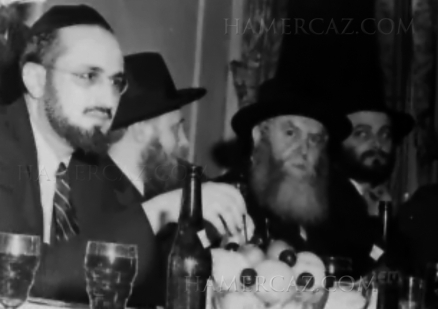
and compare to pre-war picture of graduating class of Beis Yaakov

Graduating Class of Beis Yaakov. Clear faces!
Beautiful words from Rabbi Sprung on the passing of Dr Kloot and Shavuos

You can watch the 10 minutes here.

Letter from Lubavitcher Rebbe נ’ע to the Rav נ׳ע before Shavuos

(hat tip Sh)

The letter and beautiful explanation is Here

I don’t have time to translate it but the Rebbe wishes Rav Soloveitchik a good Yom Tov using the language of his father in law the Rayatz which included accepting the Torah happily. When he came to sign the letter he explained the word happily ie בשמחה

The difficulty is we are meant to be in fear. What does the emotion of happiness have here. Based on a Gemora in Brachos, Rishonim and the language of the Shulchan Aruch HoRav, it is explained that fear most certainly has its place during learning Torah, but at three other stages the emotion of happiness is appropriate. One of these is on Shavuous when we accept the Torah.

The Rav, the Rashag, the Rayatz, and the Ramash (the future and last Lubavitcher Rebbe)


The charedi press distorts Judaism

They, and I explicitly exclude myself from their interpretations of Judaism, have a right to publish their own newspapers (even though they fight anyone who brings historical proof that the Netziv, R Chaim Soloveitchik and many more Gedolei Torah read the newspapers).

They don’t need to have pictures, and here I find myself in agreement with Uri Regev when they distort the image of a female. In a bizarre way they are in fact using what is new to present a distorted world.

Now, you might ask why it bothers me? Well it bothers me because I try to follow Torah, not some new invention. As such if it was a picture of Amalek there might be a positive command to erase him etc (practically we don’t know who Amalek is Lehalocho). Charedim might cogently argue that they won’t publish a picture that shows knees. Ok. If their clientele prefer digital burkas covering the face, that’s not ok. It’s not halachic and those people should never leave their houses let alone read any newspaper. 

So, in summary, the Charedim have created a mitzvas aseh (a positive command) to digitally distort women in pictures so they are not there, where in fact there only exist negative commandments. Such negative commandments can be fulfilled by not including the picture.

Ah, but it’s got nothing to do with Halacha in fact. It has everything to do with POLITICS. They must somehow show that they are in government visually, so they want to show their male members of the government of the state of Israel.

I have no time for such false religiosity.

How different is their indoctrination?

these oh so sweet boys share views held by Melbourne’s Shomer Emunim School, a break away from Adass. How sick, sick sick

Watch this

When does a Woman not exist?

its old news that Adass chassidic will not write even the first initial of a lady. My wife would be known as ‘mrs I Balbin’ this is certainly a hall mark of Hungarian chassidic practice as well as some Russian/Polish chassidic.

contrast this to the wedding invitation that R Chaim Brisker used for his son Mishe’s wedding (Moshe Soloveitchik was the father of the Rav. He had signed it as ‘Chaim and Lifshe Soloveitchij’. No appellations and her name was ‘out in the wild’, heaven forfend. 

I’m not getting into the latest abomination any further

It’s become a horribly repetitive and deflating refrain. Children abused, abused unfairly treated and often ostracised, all sorts of Askonim and Rabonim are accused and shown to have done the wrong thing. Papers such as the AJN have a field day.

Some get away with it, others are punished accordingly. Psychologically, the Chillul Hashem is all too heavy to carry at the minute. I feel embarrassed to be a Jew in רשות הרבים when it’s pasted all over the Sun and AJN.

One thing though: if anyone even remotely tries to pressure the courageous girl who came forward and lifted the lid on probably the most closed community in Melbourne, they should be sent לעזאזל with due legislated gusto.

I’m not taking comments on this post. The matter is before the courts and will be decided appropriately.

Incredible Charedi woman

(Hat tip krakower)

It won’t change overnight nor is it for everyone. Clearly she has talent to burn, but that talent can’t and shouldn’t be bottled up. The common denominator she follows Halacha and that’s the key.

Watch this Video and be inspired whether you are male or female.

A very useful website

I remember in the old days when I played in the band for Adass weddings, before Yumi’s band took over 99.9% of those gigs. Rav Beck was a lot younger and many times I was asked to see if my microphone could reach the head table. Rav Beck is a holy man, he barely looked up, and when I handed him the microphone it was as if it was a foreign object not to be used. He had no technique and didn’t realise that one had to speak directly into the microphone. Nevertheless, I noticed that even on a microphone stand, he was hesitant to get close to it. Some explained to me that it was a Tumeneh Keyleh. I didn’t understand, although these days I notice he at least holds it. Why do I mention this? I do so because for particularly Hungarian types where anything new is forbidden חדש אסור מן התורה so much of the modern world is not rehabilitative. Many examples about: a modern phone, is more likely to be used for sin; phones themselves were originally forbidden as they ’caused’ Lashon Hora. Eventually, things normalise, and solutions are found.

For me, just about everything I do, except if I’m in front of a Sefer, is something I can potentially turn into bad. It’s my view that there is a single world, an imperfect world, and our job is to turn חול into קדש and not run away from everything that may divert.

Can a person in Summer in Melbourne, Ripponlea, or Miami, or … not find themselves seeing women dressed for the weather, and not wearing thick black seamed Satmar socks? It’s unavoidable to the normal person, let alone those who work in the work force. It is for this reason that the ערוך השלחן stated that saying שמע in front of a woman who wasn’t wearing a head covering wasn’t an issue because we are used to this now as a norm.

I mention all this because my iPhone, as much as I love gadgets and technology, is so full of Torah, and a source of Torah, it’s literally mind-boggling. I hear and sometimes see Shiurim from people I never would have been exposed to. In my world, this IS Hashem’s plan. Like all of them, I could use the internet for the wrong things, and that is a real problem especially in closed societies (Rabbi Professor Twersky has spoken of this many times). For me, I sometimes feel it’s inappropriate to have my phone in the toilet in my pocket as it is so full of Kedusha!

With this in mind, here is yet another example of a wonderful website that can be used by those who appreciate it.

Check it out here and enjoy (if your Rov lets you). Remember, I am not Lehalacha or LeMaaseh. I just dilly dally at the edges of what interests me. By the way, those of you with iPhones check out this app. It’s an absolute beauty and is constantly being updated. I believe there is a google play version but it’s not as developed. I don’t know because I don’t use Android.

Enjoy making Kedusha use out of Tomei Keilim. The number of people who snuck TVs into their houses by asking the TV shop to place the TV into a refrigerator box so the neighbours wouldn’t realise was and is a regular ruse in Israel. TV cards were also highest per head sales in Yerusholayim. Go figure.

Ironically (is there such a word in Judaism) the first Lubavitcher to see opportunities to spread Torah through the internet was Rabbi Yosef Yitzchak Kazen ז’ל. I used to be in touch with him as one of the few other Jews on the net before it was called the internet so to speak. Little was I to know that one day he would be the (late) Uncle of my daughter.

Computers are forbidden

Dealing with the false Messianists in Israel

[Hat tip Bobby]

See here and here and here and here for news coverage.  The following is a first hand account

I attended.

From 8:30 am to 10:30 am, I was present at a mass Tefillah protest against this mass false messianic movement. Unlike these reports, I estimated that there were between 2000-3000 people there, and very few non-Shomer Shabbos people, if any. Maybe they came later. We all Davened on a large grassy area outside the Metro-West complex at the far end of which, and blocked by numerous police, was a building where the Meshumads and their friends were doing their Christian thing.

Chairs were provided and tables set up for Bimas, some Sefardi and Nusach Sfard ad hoc “Siddurim” which were printed just for the occasion by Yad L’Achim were available, although most people came prepared with their own Siddurs and Chumashim.

Due to the largeness of the crowd, and the desire of the Sephardim and the Yemenites to have their own Minyans, not to mention a large group that wanted to Daven with or close to the Clevelander Rebbe or one around Rabbi Peretz, the mass subdivided into some dozen or so Minyanim.

The biggest problem was that there were only a limited number of Sifrei Torah and so when it came to the layning, Minyanim united.

I did not see any violence whatsoever, however, later I heard of a boy who crossed the police lines, was arrested and then followed by his father who tried to save him and was also arrested, were both beat up and bloodied in the police van. There was only one Meshugener there who walked around for a couple of minutes yelling out “kill them” (in English, Davke) but he quickly disappeared.

The Davening was very peaceful, albeit it noisy at times when some of the multiple Minyanim would call out things like “Shma Yisroel” and similar key verses, just as a protest or those closer to the Meshumad building would scream with catcalls and boos. In a way it was very difficult to get any real Kavana because of the loud Sephardim and Yemenites, not to mention the outdoorsy, disorganized, circuslike atmosphere at such events. Fortunately, there were a few relatively normal Ashkenazi minyanim, too, where I ended up.

Towards the end of Mussaf, some people began setting up a minimum Kiddush with wine and rokalach, but I was already packed up and ready to leave.

I did not see or hear any anyone speak to the crowd or was there any attempt to get everyone to say Tehillim together or anything like that.

There are no overt signs of the media there and I only saw one person taking a photo with his cellphone. I did not see TV cameras or microphones.

For the most part, the protest went by unnoticed by the mainstream press.

Rachel was there, too, on the other side of a sheet-strung ad hoc Mechitza.

Satmar Zionists

the Geula must be getting near! See here !

Who attended Rav Lichtenstein’s funeral?

My nephew was there and I saw a few pictures, but I’m interested to know if senior representatives of his family, e.g. R’ Dovid Soloveitchik, senior members of Aguda and Shas or even the Badatz actually attended the Kevura of the Rav’s son in law.

He was one Rov, who didn’t antagonise. He held his views, supported them but one didn’t have to agree with him. He, עליו השלום, used to go R’ Shlomo Zalman Auerbach to pasken his own Sheilos  (that was a measure of his humbleness) in the same way that R’ Avigdor Nevernzahl שלי’טא did.

I heard the the Brisker Soleveitchiks descended from R’ Velvele ז’ל had enormous Derech Eretz for R’ Aharon. I hope/expect they attended.

Was anyone there who can confirm?

Where are the Charedi Luminaries?

[Hat tip DS]

The original (24/4/215) in Hebrew is here from Chadrei Charedim. I haven’t seen it elsewhere in English.

A Givati Brigade Commander went to see two of his Charedi soldiers who were in dire poverty in Meah Shearim. The Jewish Terrorists of Meah Shearim, then set on him and his car for daring to come and aid etc. The mother of the Brigade Commander noted that her husband was Rav Getz, the Rav of the Kotel, who had good relationships between these Meshugoim. About 50 of them, men and children lay on the road, smashed his car and wouldn’t let him leave. They knew he was too kind to do anything to them. Have we heard any voice of condemnation from the Charedi Badatz.

I’d take the 50, and put them on a farm in Beersheba and make them work for a year. They slept soundly at night while this brigade leader and his soldiers risked their lives and this is the thanks they get.

Enough is enough. We have to send a message to these extremists. When they come to my door, again, I will give them the least and tell them that instead of travelling the world they’d be better off enlisting in an old age home and helping people in Israel and earning a wage. They aren’t geniuses, they are not the chosen few who should be sitting and learning all their lives. That is the domain of the real McCoy.

These Jewish Terrorists are a gross Chillul Hashem, and they remind me of the Sunni vs Shiite war that is raging. They do not see the rest of us as useful or part of the Jewish Kehilla (unless of course you are flashing hundred-dollar bills).


Jewish Meah Shearim Thugs
וְשֹׁחַד לֹא תִקָּח כִּי הַשֹּׁחַד יְעַוֵּר פִּקְחִים וִיסַלֵּף דִּבְרֵי צַדִּיקִים


Hamodia’s grievous sin of G’Neivas Daas

I don’t have a subscription to Hamodia. Occasionally my wife buys it. One Erev Pesach I saw it at a shop and it looked so thick, I thought I might but it. In the worst, at least some might enjoy it.

The problem is that nothing has changed. The paper is Sheker VeChozov. It is chock full of lies and unbridled revisionism. It is a paper of indoctrination for the Oilom Goilom who follow in single file.

There was a wonderfully researched piece about R’ Yissochor Shlomo Teichtal הי’’ד whose Yohr Tzeit was around that time. I learned some interesting facts that I did not know. So far so good. Apart from his famous שאלות ותשובות משנה שכיר there were two enormous factors that made R’ Teichtal stand apart from other greats in his generation

  • Despite being probably the Talmid/Chossid Muvhak of the Munkatcher, he had not trouble saying “Rebbe, you were wrong, very wrong” about the holocaust and israel
  • He abandoned his Munkatch way of life, stayed frum and his אם הבנים שמחה which was hidden from the world by his family for decades is now a classic that everyone should read and has been translated into English.

But no. Hamodia told us everything up to that point. How could they mention the contents of that incredible ספר and the challenge it raised to the charedi establishment. So instead of reporting the truth, and teaching it the way it was from a גאון עולם a giant of the last generation, they decided “No, we won’t tell our readers that this man underwent an enormous transformation where he rejected the teaching than someone as great as the Munkatcher, and pointed out chapter and verse where he thought the Munkatcher was incorrect.

This is the problem with Hamodia and the problem with Artscroll. They have no fidelity to the truth. Artscroll in its newly published מקראות גדולות had the Chutzpa and temerity to refuse to publish words of the Rishon, the Rashbam! They censored him. Hamodia is no different. They take their stories put them through the ‘Aguda Cleaner Solution’ so that everyone can only read a sanitised lie or half truth.

There is nobody with any faults in Hamodia. Anyone who passes away was incredible, an impeccable Tzaddik.

Tell it the way it was. Stop the stupidity of banning books by R’ Nosson Kaminetszky, such as the ‘Making of a Gadol’. On the contrary, when we see that people are people and not Malochim we stand a better chance to aspire to their lofty heights.

Hamodia has created a monster: a self perpetuating ‘everything is beautiful’ monster in the frum world. It isn’t. There are pedophilles, adulterers, money launderers, fraudsters as well as the genuine article. Stop sanitising our underwear. Hamodia thinks we will be exposed to the real world and not get shocked at cattle prodding dayonim who take thousands to electrify someone till they give a gett. And they have the Chutzpa to complain about הגאון הגדול מאחיו מורי ורבי רב צבי שכטר when he invokes Rabbeinu Tam.

They talk about “off the Derech” and the “Shidduch Crisis”. Maybe they should start pursuing Emes and stop hiding behind transparent bushes.

I finished the article about R’ Teichtal and threw the paper away. I didn’t want to soil my hands with such blatant omissions which amount to ball faced lies and plain old indoctrination.

My Whys over Pesach?

The AJN target Yeshivah and are not at all even handed.

[UPDATED: I was not aware that my post (in good faith, by a friend) was published on Facebook. I don’t use Facebook except in a private professional capacity to stay in touch with my 450+ postgraduate alumni of nearly 3 decades as it is a most convenient forum.

I understand some people had nice, not nice, and some scathing comments to make about my “Whys”. It’s only a relatively a free country, however, and as author of my thoughts I reserve the right to publish and/or respond to anyone reacting to these. Accordingly, if you feel like it (and frankly it is not my aim to attract comments) and are ready to put a real name to your comment (unless you are, of course a victim of crime) I will moderate your comment according to my understanding of Halacha and common law. If such an arrangement does not suit you, go ahead and write a critique. I won’t be engaging in debate, as this is not why I write. If I want my blood pressure to rise, I have a myriad of better techniques at my disposal 🙂 ]

Onto the article, which I will now proof-read in anticipation of a wider audience than I would normally expect.

Both before and during Pesach I found myself full of pitputim that I needed to express. I held myself back for reasons that aren’t worth recording. One of these was that I didn’t think it was permitted on Chol Hamoed. Maybe I was the proverbial תם (simpleton) of the Hagadda and should have fired thoughts as soon as they occupied my neurones, but, for various reasons, I held back and wrote them immediately after Pesach (when I undoubtedly should have helped my wife). Undoubtedly that was not the right timing, but let’s not go there (thanks CBN).

Some of the responses to these questions need people to retrospect through new glasses; as such I was reticent. This is a hard job, Accordingly, I’m going to frame some of my thoughts as a series of why’s as opposed to proffering cheap advice.

  1. Why has the disgraceful Australian Jewish News continued to remain the mouthpiece of few, as opposed to a faithful unbiased reporter of Jewish news allowing for a wider range of reporting of fact. To give but one example, anyone on Facebook (and I am not on Facebook except with my University alumni although I have an account I originally set up to see pics of my grandchildren) can look up Avi Yemini and find most serious accusations which he apparently alleges will now be formalised via the police against his father Steven (aka Tzefania) Waks. Why Steve? Well, he has clearly shown a preference to a centrist orthodox way of life, dispensing with charedi garb and beard. For the record, I am often regarded as centrist and my name is Isaac. Some persist in calling me יצחק and from my perspective both are quite ok. Indeed, halachically speaking one cannot will away a name that one was called formally even if done via deed but lets not go to that area of Halacha. More to the point:Why is the Australian Jewish News seemingly ignorant of Avi Yemini and his siblings and their views of the father of Manny Waks? I met his siblings in Miami and it wasn’t a pretty description, and backed up Avi. Indeed, they don’t like to talk about it. Guess what AJN? That (comparative silence) in of itself is news, and should be reported. Why didn’t you do that? There is more, but I won’t write it.
  2. Why is Tzedek “off the map?” I did see an advertisement this week, which is good but there is no denying the demise of Tzedek and it worries me. At best, it served as an important encouragement to those who have been abused (earlier in their lives) to give voice to that abuse; and encourage others to give voice. This is critical to unveiling the mask of perpetrators and ensuring educational programs become de jure in organisations to recognise and prevent such perverts. We don’t hear comparatively less from Tzedek since their controversial CEO resigned, although I have absolutely nothing against those running it now and I am sure they are as committed to the cause as those who preceded them; irrespective of whether some were victims. I am not a victim of abuse, but I pursued Cyprys until his veil was lifted. I believe Kramer was after my time, and I certainly didn’t experience any abuse from any of my teachers, be they religious or secular in my 12 years in the School and neither did my siblings.
  3. Why are victims creating websites? The manifestation of private websites authored by professed victims serves good in my eyes only if it’s cathartic for them and not investigative. I’m not a psychiatrist but I’d hope their psychiatric advice would be to pursue such channels only if it was part of their healing. There are existing channels. I’m not sure why they aren’t apparently being used. Shouldn’t they channel their life long challenges to established professionals and professional organisations? I don’t think personabused.com.au is the best idea on the planet and furthermore many will see it as self-serving gold-digging. There are formal community and private bodies to help deal with these life long issues and give aid using the best professional methods, as they are developed. At worst it may give the impression that those abused seek to make a career from being abused and I doubt that this is their intention. Well, I hope not. If it indeed is their sublime intention, then I suggest they need even more professional help than they realise.
  4. Why is it that The Australian Jewish News seems to only report one school and institution-the Yeshivah Centre. We all know that the Yeshivah Centre and Chabad in general have done more than arguably any group for Torah observance, Kiruv, and the welfare of those in need. They are not judgemental. Their mantra is love albeit played through the love strings of their Rebbe’s violin. This is their great strength. They do, in the main follow, a system which was typified by their late and great Rebbe. They have rotten apples. No group is immune from that reality. The last Lubavitcher Rebbe (and his father in law) didn’t join groups (e.g. Aguda) and felt they could achieve their aims through an independent well-structured agenda: bringing Jews and Judaism to Torah and Mitzvos through spreading Chassidus Chabad. He rarely (to my knowledge) interfered with the nitty-gritty of problems in his myriad of institutions but was surely bombarded by such (indeed I once did so). He expected that same independence and intellectual purity to be demonstrated by his trained and faithful emissaries. Sure, they asked his advice, but he wasn’t aware of cleaners and locksmiths and groomers of kids in Mikvaos irrespective of the stories you hear of his greatness and vision.Now, it is clear to all, that the SCHOOLS, (Yeshivah and Beth Rivkah) which are really the raison d’être of the entire organisation are employing best practice, to the extent that they are perhaps overly strict. It is known that they are allegedly being sued by some employees who step out of a very strict line and who don’t allegedly practice world’s best standards. This was instituted before the Royal Commission and as soon as word of the criminals Cyprys and Kramer became love children for the reporters of “the Age”. The other love children of “the Age” are Israel and the “Palestinians”. I know some of the reporters from the Age. They hunkered for Jewish stories and used to call me (and read my blog) as I am straight on these matters and always tried to be. Indeed Mr Waks senior rang me almost daily in my pursuit of Cyprys. As a board member of Elwood Shule, I felt an extreme responsibility to stop this pariah from parading in the way he did.
  5. Why is Yeshivah singled out for its particular mode of governance, when all Chabad Houses still function in a similar way and have not been abandoned in any way. Few complain, because they trust the Rabbi and his advisors and they all benefit. Are some going to conduct an audit of a Rabbi Raskin/Engel/You-name-them and their specialised Chabad Houses, or, say Rabbi Lieder who works tirelessly for Israeli back packers (and ironically leave Melbourne with more knowledge of Judaism than what they learned when in Tel Aviv?) No. I don’t hear any call from the Jewish News or the holier than thou’s asking for a different form of transparent governance. Why not? Is it a matter of amount or principle? Don’t get me wrong here. I think they should all, without exception, including Adass’s offshoot extreme school, subscribe to the strictest codes especially given the Chillul Hashem we have endured. I also happen to disagree with the mode of governance but having grown up witnessing the hopeless squalor that Rabbi Groner lived in, I never considered him to have anything other than the institution in his mind. Indeed, when my father gave him some money before Pesach, the next day there was a receipt from the Yeshivah Centre.
  6. [Please note] The information about Heichal Hatorah (Rabbi Donnenbaum) was miscommunicated. It isn’t based on video surveillance. There is a policy, as I understand it being developed by professionals which as I am informed will be an approved policy that can stand up to accepted standards.  We apologise for that previous innacuracy.
  7. Why only Chabad? It’s not just Chabad. Rabbi Kohn, a controversial figure himself, runs what is effectively the identical model of a Chabad house, except that his is a private business like Meir Gershon Rabi. Will anyone ever know the finances? Cyprys went to Kohn’s minyan! I heard Rabbi Kohn say he learnt his craft from R’ Nochum Zalman Gurevich, who we all knew and loved. Well he learned some of it, the bits that garnered donations. Yes, Kohn’s bent could be described as non Hasidic or anti Hasidic, but who audits his books? What real governance exists? What standards do they use there? Is there a community list—even a Shomer Shabbos list—of every single place that has an acceptable verifiable standard. Let’s not forget, people like Cyprys would try to hire a Shule Hall or a Youth Hall and use that as their modus operandi. He worked for the CSG no less and they had no clue.2015 is not 1985 or 1995 or earlier. The world has changed we must completely eradicate this scourge of scum. It is in fact far worse overseas, if you can believe it because they are so much “holier” and use cattle prongs to elicit a gett as long as you pay through your teeth.
  8. Why are Adass Israel ignored? Peyos don’t make the man. Malka Leifer, has strangely not been a constant focus of those affected by Cyprys and/or Kramer and she runs free allegedly in Immanuel in Israel. Credible rumors abound that she is seeking to avoid extradition to face serious charges on the grounds that the “West Bank” where she resides is not Israel! and Australia has no extradition treaty. Can you believe such a Chutzpah? If true, this is a clever but grossly offensive defence by smart attorneys. I ask why the silence from the Adass Congregation that provides us with so many products and producers. Is it only about food and profit? You cannot get Adass to do anything until you hit their hip pocket. The rest of us are unwanted pimples of the Sitra Achra. Don’t be mistaken. This is what they are taught. I have heard it from the number 2 in the Rabbinic side of the organisation. The youth of Adass are not the old generation. They have little love and are taught thatAhavasYisroel only exists for aShomer Shabbos.There are some wealthy people in Adass. Why isn’t Leifer’s picture in the local Immanuel paper weekly saying “Beware of this person. There are serious allegations of lesbian pedophilia against her”. Should she be teaching or ever left alone even with her own children? Has she even admitted she was wrong, short of fleeing the next day. I asked arguably the third most senior Rabbi at Adass and he shrugged his shoulders saying “What can we do”. I urge you to ask them when you bump into them at various establishments. Ask at the bakeries, ask at the fish shops, ask at the next function you attend. You can do plenty Adass but you thumb your nose at the non charedi community and now also deny that many of your own are “off the derech” something you prided yourself with and now send away so “nobody will notice”.
  9. Why aren’t other schools in the frame? I was informed reliably by someone at the Royal Commission that there were n students of Mt Scopus abused some time ago and a then headmaster was approached and said “Shoosh” it will cause a Chillul Hashem. Sound familiar? I know the AJN were at the Royal Commission. Was there an order barring the names of other schools affected by the despicable reprehensible pedophiles to be reported. I had wondered about the timing of a later letter by Rabbi Kennard (who reads my blog). He didn’t reply. Why? Rabbi Kennards letter was correct and proper but should have been written at least 6 months earlier.
  10. Why don’t people re-internalise that Yeshivah was a one man band. An incredibly wonderful one-man band with more success than people could ever imagine. It was the late and great Rabbi Groner, who whilst consulting with professionals, would not today remotely repeat his approach if he had his time again. Is there anyone game enough to say he would? There was always a committee, but they were and are toothless tigers who took ultimate direction from Rabbi Groner. If he said “no” the committee could proverbially jump. He told them what he thought they needed to know. I have no doubt there were many private things he took his grave. Tonight is his birthday as I just saw from an email.Much was in his head and certainly never on paper. He was the Shaliach. People were only too happy to call him their friend and get his calls in hospital while he was in hospital himself, and come to functions in his honour and he is on the record as vociferously castigating some of the parents whose children became victims (and they ignored him on occasion). Is there a real need to destroy the man after his passing, together with his significant life work, now, while the place has initiated a process to modernise its governance when ill-timed votes threaten its existence financially? Sure, if their new governance is a façade, go for it, but for crying out loud, give them a chance to go through a process. It doesn’t happen over night.
  11. I know of another very well-known (real) clergy (not charedi) who the Jewish News chose NOT to name over allegations of past pedophilia. The name would shock. He was by no means “ultra” orthodox. In that case the AJN (correctly) did not name the person because he couldn’t defend himself against the odious claims. Why only Yeshivah? Because some Rabbis showed themselves to be second-rate and/or clever by half?
  12. Why are there so many (self-proclaimed) counsellors permitted to discuss all manner of most serious topics to congregations and groups “as if” they are experts. If you are a counsellor, then register with the Australian Counselling Association and/or other similar bodies. Your commerce degree isn’t enough. There are enough complaints about counsellors themselves but if, unlike psychologists, some can get away with a load of ill-advised counselling, and more, without being answerable to a formal board, then no Jewish organisation should let them into their four walls to speak and nobody should seek them for any advice except which chewing gum to buy. Some maybe okay, but others are straight out charlatans, Register! Did victims go to a psychiatrist and spill their guts out and get medication where indicated or did they run rings around the counselling option of people who don’t answer to a board of counsellors.
  13. Why are people skeptical about those who sit on Yeshiva’s board or sat on that board? I have emails from about a decade ago where (it now turns out) some victims and others were looking to change things while Rabbi Groner was alive. One hears all types of stories of “this board member” being stubborn, “that one” being nepotistic etc. Some of it is true especially in a vacuüm. I know three former board members and I don’t think they aligned with any of the above. I know they gave thousands of hours of their lives to keep the institutions above water and growing in a way that no Jewish child was ever turned away. Remember, I happen NOT to be a card-carrying member of the “Chabad only” approach to Judaism, although members of my family happen do. We live in peace and in harmony. It’s not hard.There is a review of governance allegedly taking place. It doesn’t and can’t take 5 minutes. Instead, I hear people saying “it’s a PR trick”. How do they know that? I know a serious person who is looking at the structure and they are definitely not looking at it from a PR point of view. Yeshivah is in transition. It had to happen after Rabbi Groner’s passing following that of his mentor. It’s a shock and terrible that the spectre of pedophilia needed to be the back-breaking catalyst, but in the words of a good friend “it is what it is”. So people why don’t you sit back and see what comes forth. By all means if it isn’t transparent and in keeping with the law, bleat and bleat and bleat. Until then, surely wait a little while.
  14. Why do people feel that beating Rabbi Telsner or Rabbi Glick is the answer? It isn’t. It’s 2015. I especially rang Rabbi Telsner because I wanted to know exactly what he said that got the Jewish news positively apoplectic on their front page and what was said to him. How the AJN could then say “tell us it’s not so Rabbi Telsner” is beyond me. Rabbi Telsner and I have a love/less love relationship. He doesn’t like it when I raise Chabad issues with him (halachic) and he’s not my Posek but he doesn’t deserve to be manipulated.
  15. Why isn’t the Association of Jewish Psychologists being used more. They respond. They don’t go looking for work. I went to a talk and was very impressed with Dr Dan Gordon. He is someone who every School should use for an in-service for their teachers. Why was this a well attended event by Rabbis and religious people and yet so poorly attended by others including headmasters and/or vice-principals? I have a feeling my wife may have been the only senior teacher there. These are specialist psychologists, with PhDs and experience; they have authority and wisdom and aren’t running shonky practices. Listen to their professional wisdom.
  16. Why is the AJN becoming more of a left-wing “Age” newspaper seemingly only haranguing religious institutions (except Adass who don’t buy their paper and buy Hamodia). Religious groups certainly deserve it in some cases, but as I’ve pointed out the AJN are transparently biased. I dislike Hamodia with a passion because it is such a fake fairy tale “feel good” paper full of omissions. I saw a new paper emerge over the break. I hope it takes form. To be honest, I wouldn’t be unhappy if the AJN disappeared if it didn’t seriously reform to become a properly neutral paper instead of a harbinger of an agenda together with pictures of who attended what. I’m tempted to cancel my subscription and my advertising. If it’s possible and the AJN is listening, let me know and I will cancel. Call me tomorrow. My blood pressure will be healthier without your articles and the predictable Henry Herzog et al propaganda that we all skip and are sick to death of.

A wonderful sight

I’ve performed at many weddings, some most special and others even tragic. I’ve seen the good, the bad and the ugly (with apologies to Sergio Leone). The other night I was a guest at a wedding and witnessed a scene that was a first for me in Melbourne.

I was ready and due to commence a dance set. However, at the head table, the father of the bride happens to also be a long-term Rosh Yeshivah also celebrating his 70th birthday. There were probably 50 or more of his Talmidim who gravitated to the head table in a line. Each of them wanted to say L’Chaim to their Rosh Yeshivah. One sees this in Israel and undoubtedly in the USA, but I hadn’t seen it in Melbourne.

Alcohol consumption was strictly controlled and likely based on the (oft ignored) teachings of the Lubavitcher Rebbe. I didn’t see a single person who was “sloshed”. Each Talmid, waited for their turn, and drank from a thimble full plastic cup saying L’Chaim to the Rosh Yeshivah.

There was no way I could interrupt this spontaneity by starting a dance set. I felt this was a unique moment, and sensed that the Rosh Yeshivah, Rabbi Binyomin Cohen, was in a heightened state and that his Talmidim wanted to share that moment.

I was touched, and dared not interrupt the process, marvelling at the order and respect and the way this wasn’t formally choreographed. The best parts of weddings are actually the spontaneous unchoreographed moments.

As it settled, I played what is known now as the Chabadzke Niggun, which ironically is definitely an old Chabad Nigun (sung then at a somewhat slower pace). It was made famous more recently by non Chabad people. I think Berry Webber was the one who put it on the map. It is a catchy tune and happened also to be one of Rabbi Cohen’s favourites and requests.

I commenced with that Nigun, and while I normally switch songs after a reasonable number of repetitions, in this case, I saw the דבקות in Rabbi Cohen’s eyes, and his entire body undulated with that Nigun. I kept it going until he had no more energy to continue, and only then, changed to the next tune.

It was an uplifting moment. I saw someone going through the motions because he had  much grief of late. I yelled out to him שמחה פורץ גדר … he acknowledged and nodded his head with intent and hauled himself into the moment.

In summary, this was a touching wedding.

PS. someone needs to drill these points

  • don’t come late if you can help it. People pay good money for your participation
  • don’t stand around the bar while there is dancing. Do a mitzvah and dance!
  • don’t speak during a dvar torah; control yourself for 5 minutes and remain silent.
  • dry red wine isn’t meant to be served chilled 🙂
Rabbi Binyomin Cohen, Rosh Yeshivah

Someone tell me Charedi Shules are also involved?

i saw the following from the RCV and whilst not knowing the program details I must admit that places chock full of children such as Adass and Rabbi Kohns Torah centre, Rabbi Donnenbaums Heichal HaTorah and Beth Hatalmud have not signed up (yet?)

It is one thing not to be part of the RCV but it’s another to have your head buried in the sand and assume you don’t have lurking pedophiles. We know it’s likely not true in some of above. One can only hope they have or will join but simply didn’t want to be listed on an RCV press release (small minded in my view given the gravity of the issue)

RCV LAUNCHES CHILD PROTECTION PROJECT IN SHULES


The Rabbinical Council of Victoria Inc (RCV) has just launched its Child Protection Policy Program in Shules 

in partnership with Australian Childhood Foundation. This vital project will prioritise the rights of children to protection from abuse by employees and volunteers in member shules across the state. Working closely with the Australian Childhood Foundation, each participating shule will formulate an effective child protection policy and system to cover all of its programs and activities. .  

The member shules will be participating in the Foundation’s Safeguarding Children Accreditation Program, which systematically builds the capacity of organisations to keep children and young people through

•enhancing and maintaining a collective culture that promotes the safety of children and young people;

•reviewing, designing and executing specific policies and procedures to protect children and young people;

•providing relevant training to management, staff and volunteers;

•engaging the involvement of children, young people and their parents/carers in safeguarding practices;

•implementing a consistent set of endorsed operational standards at every level; and,

•responding effectively to situations in which a child is abused or exploited by an individual involved in the management or delivery of a service or activity.

Dr Joe Tucci, CEO of the Australian Childhood Foundation applauded the RCV for taking this initiative. “It is an important commitment by any organisation to become accredited under the Safeguarding Children Program. It will help everyone involved in shules to understand their responsibilities to protect children and keep them safe”.   

Dr Tucci said that “Safeguarding Children accreditation will demonstrate that each shule has achieved and maintained best practice standards for protecting children and young people from abuse and exploitation whilst they participate in the shule’s services and programs”.

Throughout 2015 the shules will be attending monthly Safeguarding Children Workshops in order to develop their policies and procedures in line with the seven standards.  The inaugural workshop was held this week.

Rabbi Moshe Kahn, Executive member of the RCV stated “The RCV is committed to safe guarding children, making sure that each and every child that enters our shules is protected and that both the child and parent can know with confidence that best practice child protection is in place.”

The following shules have joined this program:

          Aish HaTorah

          Chabad Bentleigh

          Blake Street Hebrew Congregation

          Brighton Hebrew Congregation

          Chabad on Carlisle (FREE) Inc

          Chabad Carnegie

          Chabad House of Caulfield

          Daminyan

          Chabad Glen Eira

          Elwood Talmud Torah Congregation

          Hamerkaz Shelanu, Lamdeni and KaTeeny

          Chabad Malvern

          Melbourne Hebrew Congregation

          Moorabbin Hebrew Congregation,

          L’Chaim Chabad Kingston

          Sha’arei Tefillah

          Shnei Ohr Chabad North Caulfield

          South Caulfield Hebrew Congregation

          Yeshivah Shule, including Young Yeshivah and Kollel Menachem

          Caulfield Hebrew Congregation, including Ohr Chadash

          East Melbourne Hebrew Congregation

Meir Gershon Rabi wouldn’t serve this to his children or grandchildren 

Important posting by the administrator (Yankel Wajsbort) of the Ask Kosher Australia Facebook group…

We do not recommend this rennet set cheese. Please see here for a discussion about how to make cheese kosher https://oukosher.org/blog/consumer-kosher/kosher-cheese/

Coon & King Island cheeses are made by Lion Dairy – a non-Jewish company – and these mass-produced cheeses would be considered Gevinas Akum. The question is how “It’s Kosher” (the supervising Rabbi) makes these Coon & King Island cheeses Gevinas Yisrael. Normally, non-Jewish cheese companies schedule a special supervised run for kosher cheese with kosher symbol on the label. A mashgiach/Rabbi is present in the factory who will add the kosher rennet to the milk for each kosher batch (this is the opinion of the Shach, as explained in the OU document). We believe that Coon & King Island are made in different factories.

Happy to provide you some information how mass produced yellow rennet set cheese is made. These companies usually manufacture cheese 24 hours a day. Milk is pasteurised and cooled to the right temperature and fed into the cheese vats (at least 8). The cheese vats for cheddar and tasty style cheese (made by large dairy companies) have typically a capacity of 14,000 litres each. By the time that the eighth vat is full, the first one has been emptied, washed and is ready to fill again. Every time the mashgiach would need to add rennet to the milk in each cheese vat order to make all the cheese kosher. Curds from the cheese vats are combined and further processed on the continuous line into large blocks of cheese. Large blocks of cheese are then matured for a couple of months and finally sliced, cut, shredded, packed and labelled, possible in a different location than the cheese making and/or maturing. 

We suggest you ask the agency to explain, when and who they sent as a mashgiach to the factories to add the rennet, in order to consider all these cheeses Gevinas Yisrael and kosher.

http://www.kosherveyosher.com/uploads/6/6/8/7/6687170/2988467.jpg?879


Important Community Event on Recovering from Trauma

I am very supportive of professional psychologists, as they have a board which oversees their activities. If they do the wrong thing, they can be disbarred. It seems that so-called counsellors have an optional board. I’d recommend people never to see a counsellor whose ethics and practices aren’t overseen by a board which they subscribe to. There are some rotten counsellors out there, even criminal ones: avoid them like the plague. In general, go to a psychologist (or psychiatrist if you will need medication) but only interact with counsellors if they are moral enough to subscribe to a board that is able to disbar them for misdeeds.

So, in that spirit, I fully support attendance at the following event

Community Debrief flyer 150315

“Caring for our community and ourselves: recovering from the effects of Trauma”

Panel: Dr George Halasz, Dr Rob Gordon, Dr Nicky Jacobs

Chair: Nina Bassat AM

Date: Sunday MARCH 15

Time: 7:30pm to 9:30pm

Venue: St. Kilda Town Hall Auditorium, 99a Carlisle St, St. Kilda

Cost: (5$ to cover costs)

Contact: Fay Oberklaid FAPS, fayober@bigpond.net.au

This is very important. Many of us have been traumatised by recent events and Hashem has permission for professionals give advice and treat those in need.

Please spread the word

Don’t give Satmar a cent

From Ha’aretz. Be under NO illusion. There are many in Melbourne’s Adass Community who support this group completely. Others are even more right-wing.

Why would you say anything, even if you disagreed. They are the right-wing version of J-Street.

They live separate lives to the rest of us. They should not come to my door whether brought by master driver Osher Ehrlichster and others, all whom make a nice commission from these collectors. I will give them a dollar if they sing HaTikvah even with modified words (like I do).

If you expect a rebuttsl or disagreement with Rabbi Beck, forget it,

If it wasn’t for the fact that Yankel Unfanger was such a Tzadik, I’d have nothing to do with their products. He’s normal. Many of the rest are not. They are extreme zealots who should live on Gibraltar. They have a monopoly on Chalav Yisrael. That’s life.

Sicko Satmars

Some 3,000 followers of the Satmar Rebbe in Williamsburg took it to the streets of Manhattan Tuesday evening to protest Israeli Prime Minister Benjamin Netanyahu over his speech to Congress and his claim that he’s an emissary on behalf of world Jewry to warn of a nuclear Iran.

The protest, held outside the Israeli Consulate on 2nd avenue and 42nd street in Midtown Manhattan, was organized by the Central Rabbinical Congress of the USA and Canada and attended by the Satmar Rebbe, Rabbi Zalman Teitelbaum.

Signs at the protest included statements such as “Bibi – don’t drag American Jewry into your provocative politics”, “”Bibi Netanyahu does not speak for us”, and “we are ably represented, we don’t need a Bibi-sitter.”

“When Netanyahu professes to speak on our behalf, we have to speak out and say this is not the case,” Rabbi David Neiderman told the thousands assembled. “Benjamin Netanyahu, stop speaking on our behalf and directing us what to do.”

“We in America and Jews all over the world are loyal citizens in the respective countries we reside in, and no other foreign government can claim to represent us or speak on our behalf,” he proclaimed.

Rabbi Neiderman went on to thank President Obama – whose name mentioning drew thunderous cheers – together with the Republican congressional leadership. “We are well represented and don’t need Netanyahu and his government’s representation,” he stated.

The speakers preceding Rabbi Neiderman were harsher in their attacks against the Israeli leader. They called him “Haman” and Amalek” and accused him of igniting antisemitism by his ‘reckless’ actions. One Rabbi went a step further to claim that he’s sacrificing the well-being of world Jewry for his political survival. The Satmar Shita against Zionism and the formation of a state in the land of Israel was only mentioned as a secondary reason to protest.

Rabbi Yaakov Shapiro, a spokesperson for ‘Natruna’ and the “True Torah Jews” website, told JP that the protest was only aimed to contradict what Netanyahu said that he’s speaking in the name of all Jewish people. “Besides this being a lie, it’s a very dangerous thing for him to say,” Rabbi Shapiro asserted. “He wants to get into some brouhaha with the president, he’s a foreign minister, he can do whatever he wants. But why bring in the Jewish people into this? So, we are here contradicting what he said about us, and if somebody has a problem with what Netanyahu said he shouldn’t blame the Jewish people.”

“We are here to disassociate ourselves from the dangerous statements he’s making – statement that puts Jews in danger,” he added.

Rabbi Shapiro also lambasted those who compare Satmar – who is against Zionism – to Neturei Karta, who associate themselves with Iran and the Palestinians. “We don’t believe that Israel is the nation state of the Jewish people. And when a leader of a foreign country comes to America to trash the president and says he’s our representative, the question is not why us but where is everybody else?” he explained.

The AJN attack on Orthodox opinion

The AJN is perfectly entitled to have views. These are widely considered anti–religious for many years by many. In fact, each year we ask ourselves why we buy it.

Whatever the case may be, the AJN needs to acknowledge that nobody contends that homosexuality is an illness. It is a preference, call it a predilection. I don’t have it, so I can’t claim any expertise nor am I a therapist of any sort. The preference itself, as is well-known by the AJN is not considered sinful according to Torah Judaism (I don’t conclude man-made reformations of Judaism here as they are of minor interest if any). People are born with predilections. There is the nature vs nurture conundrum which is far from settled. Acting on the preference and performing the homosexual act is described as sinful by the Torah and Codifiers. There can be no argument about that fact in any form of Orthodoxy. Reformers have their own religion.

Now, many if not the vast majority of those professionals who see homosexuals professionally claim that the predilection is life long and cannot be altered. That may well be. There isn’t Science here, and extrapolation into the future is tenuous at best. Maimonides knew about predilections long ago.

The best counter case to nature, as quoted by arguably the most respected psychiatrist in the USA, Professor Abraham Twersky, and many others is the identical twin conundrum which has been studied extensively. All known biological markers were exactly the same, and yet one twin had a predilection and the other did not. There is currently no theory able to explain that. There is a minority view, and yes it is a minority (Dr Elon Karten comes to mind) that claims they have techniques which allow predilection change to materialise. Like Climate Skeptics they are attacked regularly. I’m not an expert, but as a Scientist, one would be a fool to think that in ten years time, our knowledge of these things will still be static. Accordingly, if Rabbi Telsner or anyone else subscribes to the view that predilection modification could occur, they do not deserve to be pilloried in the disrespectful tone of the AJN.

Pedophillia is also at least a predilection. Perhaps we will discover it is more likely a disease that is incurable except by using drastic means to make sure that those who seem to “enjoy” such things are simply incapable of (re)offending. In the meanwhile, one witnesses judges themselves releasing pedophiles back into the public after serving sentences, as if law makers believe they will be “safe” to society once  so released. Is that true? Evidence would suggest that re-offending is (too) common and perhaps techniques for rehabilitation are simply inadequate and not practical at this time.

Now, if Rabbi Telsner were to subscribe to an opinion that people with predilections can have them modified (and this could extend to those with life long fetishes), one can disagree, but one should not excoriate him in the way of the AJN, as a matter arising out of the Royal Commission.

Rav Schachter of the Modern Orthodox Yeshiva University always said that a “stock” Rosh Yeshivah or Rosh Kollel in general should not be a Posek (decisor) of Halacha because they sit in a cloistered environment and are often/mostly oblivious to the nuances of science and other disciplines. This was certainly the case in Lithuania where most Rabbi’s were not Halachic Decisors. There were some exceptions such as the Vilna Gaon and the Chazon Ish, but the late and great Chacham Ovadya Yosef did not consider the Chazon Ish a Posek of repute, because he sat cloistered and didn’t face the people, so to speak.

Either Rabbi Telsner has read some minority opinions or has been informed of such by some of his constituents. This can mean that the AJN, seeing itself to present current knowledge on such topics can disagree with the minority opinion, but it does not give then a license to excoriate a Rabbi for agreeing to such a minority opinion.

The last time I looked there were no Nobel Prize winners writing for the AJN, and aside from the occasional community brouhaha most of the news is stale, and unenlightening. Indeed we may have also recently witnessed an alleged breach of journalistic ethics which has allegedly resulted in a staff member being suspended initially. The mere fact that we are exposed to the weekly whining letters of Messrs Burd and Herzog, and others is bad enough. One could almost write their letter before reading it. I think the AJN do good things but there is room for improvement in some of its approaches. Yes, I know it’s good for selling papers, but Oilom Goilom believes everything.

The “what do you think” section is statistically unsound, and really just a copy of journalistic practice in low-level papers, like the Herald Sun and others. Is it going to make one iota of a difference if I know what the local butcher thinks of Bibi’s chances?

I’m digressing.

Back to the issue at hand. The AJN may not have liked elements of evidence tendered. As such, it should carefully analyse such in a calm and sanguine way. The majority of Rabbis are traumatised by the Royal Commission, and my sense is that things will never return to the situation before in respect to how they react if they are God forbid confronted with such information. We aren’t Catholics, and don’t have a box where one admits their sins and the Priest, Lehavdil, absolves the sin, says a few hail mary’s sends the perpetrator on their way and will never breach confidence.

It’s also not about Chabad. Don’t people read the internet? Modern Orthodox Rabbi Barry Freundel has pleaded guilty to secretly videoing some 57 women at the Mikva with secret cameras. Is he sick? Undoubtedly. Can he be rehabilitated? I don’t know. He will serve jail time. Does this paint all Rabbis as fetish-laden? Of course not.

Contrast this issue to the one about the “interfaith dialogue” we graphically saw and where Rabbi Ralph Genende as usual gushed forward with platitudes about how useful they were. Let’s look at the evidence AJN. What has ever changed because of these meetings. They were forbidden according to the scion of Modern Orthodoxy, Rabbi Yosef Dov Halevi Soltoveitchik for reasons which were absolutely sound then, and even more sound now. If it was a meeting to bring religions together to have a joint charity drive for the homeless,  or similar that’s fine. If it was about showing our religion to them and theirs to ours, what’s the point? Tolerance can be achieved without any interfaith dialogue as long as nobody considers us as monkeys behind trees that have to be killed. Was I blind, or did the AJN not notice that there was no muslim representative in the picture at that “feel good” meeting, or did I miss something.

Anyway, to make it clear, I usually do not agree with Rabbi Telsner but on some matters I don’t think he deserves the anti-religious excoriation meted out to him.

AJN and especially Rabbi Ralph Genende of the moderate left wing: check this out for a reality check while you read the Chazal quoted by Rashi הלכה עשיו שונה ליעקב. (Whiteout anyone?)

I’d love to hear the AJN and/or Rabbi Ralph’s commentary on this, or better still have his interfaith group muslim representative condemn this presentation from February 13th in Copenhagen as abominable in the extreme in the Western and Muslim Press.

Priorities warped on Haredi websites?

I was looking for an article in either the Yeshivah World News or in Matzav for some coverage of the faults identified in the Royal Commission into abuse. Both of these publications are hardly pro Chabad, and yet, unless I missed it, I failed to see a single mention. That of itself, if I am correct (and I’d be happy to proved wrong) is an inditement on the Haredi world, where Chabad is considered on the left fringe anyway.

In what way is this not news? Why shouldn’t Haredi readers know about what is public knowledge? It’s simple. They deal with their problems “in-house”. Here, I don’t mean the Rabbi Groner approach of seeking out experts and not being aware that the proclivity might be described as a disease. No, in these communities nothing at all has changed.

And yet, sorry folks, if you are a Litvak, I am Posul as a witness according to the following from YWN

Maran HaGaon HaRav Aaron Yehuda Leib Shteinman Shlita spoke out regarding persons using iPhones, stating they are pasul l’eidus.

HaGaon HaRav Moshe Yehuda Schneider tells of the gadol hador’s words in the weekly Pri Chaim publication. He explains “we merited hearing Maran’s opinion regarding iPhones, the impure device, and I am presenting these words after Rabbeinu questioned regarding a bochur that R”L fell victim as a result”.

He begins by stating the Rosh Yeshiva was made aware of the high cost of such a phone, resulting in his response that it is quite costly to sin and people are willing to pay a great deal of money – the main thing is to sin. He adds that a good esrog is less expensive and when he heard one person say that one who spends so much on an iPhone will not buy an expensive esrog, Rav Shteinman stated this is not necessarily so, for there are those who will pay for an esrog, as well as for an iPhone l’havdil.

Rav Shteinman was informed that HaGaon HaRav Shlomo Halevy Wosner Shlita ruled one who possesses an iPhone is ‘pasul l’eidus’ as Rav Wosner disqualified a witness at a chupah when learning of his phone. Rav Shteinman stated “The Klall is a prohibition that incurs malkos renders one pasul from d’oraissa and a prohibition that does not incur malkos only pasuls d’rabbonon. Hence, one with an iPhone is pasul from eidus d’rabbonon since malkos are not involved here.

This reminds me of the farcical situation when Rabbi Benyamin Wurtzburger, Rosh Kollel of the Lakewood Kollel who was Mesader Kiddushin at a wedding, publicly attempted to make Dayan Telsner, Pasul as a witness, because of his contention (which is probably correct) that Dayan Telsner is a Meshichist. Ironically, phone calls to Rabbi Beck from Adass to Wurtzurger were needed to make him understand that one is not Pasul for having some far-flung view, which is out of touch with the Rambam and Mesora.

Where are our priorities? Will Rav Shteinman be happy with cheap Samsungs or HTC or ? Does have the remotest clue what the difference between this is?

Rabbi Wurtzburger seated left, next to Rabbi Chaim Tzvi Groner


Sir Martin Gilbert ע’’ה

Sir Martin’s wikipedia entry states:

Gilbert was born in London to Peter and Miriam Gilbert; all four of his grandparents had been born in Tsarist Russia. Nine months after the outbreak of the Second World War, he was evacuated to Canada as part of the British efforts to safeguard children. Vivid memories of the transatlantic crossing from Liverpool to Quebec sparked his curiosity about the war in later years.

After the war he attended Highgate School, and then completed two years of National Service in the Intelligence Corps before going on to study at Magdalen College, Oxford, graduating in 1960 with a first-class BA in modern history. One of his tutors at Oxford was A.J.P. Taylor. After his graduation, Gilbert undertook postgraduate research at St Antony’s College, Oxford.

Career
Historian and academic
After two years of postgraduate work, Gilbert was approached by Randolph Churchill to assist his work on a biography of his father, Sir Winston Churchill. That same year, 1962, Gilbert was made a Fellow of Merton College, Oxford, and he spent the next few years combining his own research projects in Oxford with being part of Randolph’s research team in Suffolk, working on the first two volumes of the Churchill biography. When Randolph died in 1968, Gilbert was commissioned to take over the task, completing the remaining six main volumes of the biography.

Gilbert spent the next 20 years on the Churchill project, publishing a number of other books throughout the time. Each main volume of the biography is accompanied by two or three volumes of documents, and so the biography currently runs to 24 volumes (over 25,000 pages), with another 7 document volumes still planned. In the 1960s, Gilbert compiled some of the first historical atlases. Michael Foot, reviewing a volume of Gilbert’s biography of Churchill in the New Statesman in 1971 praised his meticulous scholarship and wrote: “Whoever made the decision to make Martin Gilbert Churchill’s biographer deserves a vote of thanks from the nation. Nothing less would suffice.”

His other major works include a definitive single-volume history on the Holocaust, as well as single-volume histories of The First World War and The Second World War. He also wrote a three-volume series called A History of the Twentieth century. Gilbert described himself as an “archival historian” who made extensive use of primary sources in his work. Interviewed by the BBC on the subject of Holocaust research, Gilbert said he believes that the “tireless gathering of facts will ultimately consign Holocaust deniers to history.” He wrote the foreword to Denis Avey’s The Man Who Broke Into Auschwitz which he described as “a most important book’ and stated that Avey’s “description of Buna-Monowitz is stark, and true.” The accuracy of certain aspects of Avey’s account have subsequently been challenged

In 1995, he retired as a Fellow of Merton College, but was made an Honorary Fellow. In 1999 he was awarded a Doctorate by Oxford University, “for the totality of his published work”. From 2002, he was a Distinguished Fellow of Hillsdale College, Michigan, and between 2006 and 2007 he was a professor in the history department at the University of Western Ontario. In October 2008, he was elected to an Honorary Fellowship at Churchill College.

Public service
Gilbert was appointed in June 2009 as a member of the British government’s inquiry into the Iraq War (headed by Sir John Chilcot). His appointment to this inquiry was criticised in parliament by William Hague, Clare Short, and George Galloway on the basis of neutrality, Gilbert having written in 2004 that George W. Bush and Tony Blair may in future be esteemed to the same degree as Roosevelt and Churchill.[8][9] In an article for The Independent on Sunday published in November 2009, Oliver Miles, the former British ambassador to Libya, objected to the presence of Gilbert and Sir Lawrence Freedman on the committee partly because of their Jewish background and Gilbert’s Zionist sympathies. In a later interview, Gilbert saw Miles attack as being motivated by antisemitism.

As the Iraq inquiry was to be conducted on Privy Council terms, Gilbert (who was not previously a Privy Counsellor) was appointed to the Council in order to take part in it.

Praise and criticism
Many laud Gilbert’s books and atlases for their meticulous scholarship, and his clear and objective presentation of complex events. His book on World War I is described as a majestic, single-volume work incorporating all major fronts — domestic, diplomatic, military — for “a stunning achievement of research and storytelling.” Catholic sources describe him as a “fair-minded, conscientious collector of facts.”

Gilbert’s portrayal of Churchill’s supportive attitudes to Jews (in his book Churchill and the Jews) has been criticised, for example by Piers Brendon. Also, Tom Segev writes that, although Gilbert’s book The Story of Israel is written with “encyclopedic clarity,” it suffers by the absence of figures from Arab sources.

Honours and awards
In 1990, Gilbert was made a Commander of the Order of the British Empire (CBE). In 1995, he was awarded a Knighthood “for services to British history and international relations”.

In 2003 Gilbert was awarded the Dr. Leopold Lucas Prize by the University of Tübingen. The Sir Martin Gilbert Library at Highgate School, where he was a pupil, was opened on 6 May 2014 by former Prime Minister Gordon Brown. “I know he helped Lady Thatcher, John Major and Tony Blair, but he also helped me a great deal with his insights into history,” said Mr Brown.“I know he advised Harold Wilson even before them, but at every point Martin was available and he wanted to believe that the best outcomes were possible. A genuine humanitarian, someone whose writing of history taught him we could always do better in the future if we are able to learn the lessons of history.”

Personal life
In 1963, he married Helen Constance Robinson, with whom he had a daughter. He had two sons with his second wife, Susan Sacher, whom he married in 1974. From 2005, he was married to the Holocaust historian Esther Gilbert, née Goldberg. Gilbert described himself [sic]as a proud practising Jew and a Zionist.

One Friday evening, I found myself sitting on the roof of the old Chabad House in Bombay prior to 2008. I wasn’t in a talkative mood, being really tired, and wanting to get back to the Taj Mahal Hotel to sleep. I was very tired from travelling the depth and breadth of India, being in an airplane each night, interviewing students in a different city from morning until evening, then travelling to the next city either late evening or very early morning.

There is a formula used in most Chabad Houses. This one was no different. There were  about 20-30 of us on the roof, in stifling humidity. We were asked by Rav Gavriel Holtzberg הי’’ד to introduce ourselves and then either tell a story, sing a song, or say a Dvar Torah. I was used to it, and always chose the Dvar Torah.

The person opposite me declined to say anything other than what his name was. I distinctly recall him saying “My name is Mordechai, and I come from England”. Mordechai had a thick English accent and persisted in making conversation with me, even though I must have looked disinterested and tired. Eventually after talking about various topics he told me that he was Martin Gilbert. Startled, I then introduced myself. Turning to him I said “you are not Sir Martin Gilbert, are you?” to which he answered, “I’m afraid so”.

For the next hour I found myself in private conversation with Sir Martin and his wife Esther (nee) Sacher. She was writing a set of books that served to record stories of Holocaust survivors. She described how she visited holocaust survivors and was writing volumes of their history based on their testimony. I do not know where she is up to, but I will send her a condolence message.

I asked Sir Martin what brought him to a Chabad House on a Friday evening in Mumbai, of all places. He mentioned that when he was in China he had also visited a Chabad House, and liked the informal and friendly atmosphere. He commented that unlike China, where he felt he was being watched by the authorities at every turn, Mumbai was gloriously emancipated. Neither of us was to expect that we might have been watched watched by the Pakistani terrorists who eventually gunned down Rav Gavriel, Rivki and those who were in the newer Nariman house, Chabad house.

I asked Sir Martin what brought him to India.

Sir Martin related that he had travelled through India as a young student and became very ill. His mother advised him that if he was ever to become ill, that he must visit an “Auntie Fori”. Auntie Fori’s husband, Mr B.K. Nehru was a famous and distinguished civil servant of India, also serving as Ambassador to the US and UK. He was a cousin of Prime Minister Nehru. This Auntie Fori had curiously avoided shaking the hand of the German Foreign Minister when she met him, and it transpired that she was in fact a Hungarian Jewess related to Sir Martin’s mother. After months of nursing Sir Martin back to health, Auntie Fori mentioned to Sir Martin that she knew nothing of her Jewish heritage but something told her not to touch the German Foreign Minister’s hand. Before he left, she begged Sir Martin to give her a history lesson about the Jews. He responded that he would write a series of letters to this effect, from England. These letters were later published as a book entitled Letters to Auntie Fori: the 5,000 Year History of the Jewish People and their faith.

I mentioned that I’d love to read the book and Sir Martin promised to send me a signed copy. It’s somewhere in the house or someone has borrowed it. I spoke to his wife Susan who told me that she came from Stoliner Chassidim. In return, I promised to send the music to some famous Stoliner Nigunim. Sir Martin and Susan left before everyone. I had surreptitiously revealed Sir Martin’s identity to Reb Gavriel during the meal, but he and Rivki were otherwise involved. Their focus was usually on the younger Israeli tourists. I know that if they had realised who he was, there would have been some fanfare, but I realised that Sir Martin preferred to be incognito, and I didn’t have the right to disclose his true identity.

After they left, I disclosed to Reb Gavriel who his guest was, and being a Yeshivah Bochur from Israel and then 770, he hadn’t heard of him. He believed me, of course, and for a number of years, Reb Gavriel would ask me to “tell the story about Sir Martin” to his guests. He was always proud of his visitors.

Everything is Hashgocho Protis. I wondered why I had met Sir Martin. I discovered this later. I received a phone call in Melbourne from an anguished Israeli mother who mentioned that her daughter was in prison in India awaiting a trial for alleged drug possession and asked me to do what I could to put pressure to facilitate her freedom. Indian prisons are not fun, and it can take two years or more until a trial is held. She was apparently pregnant, and they had one bucket of (horrid) water to share for drinking and washing amongst the female inmates in a cell. I knew a consul general in Melbourne representing India, as I had admitted his daughter to our course. That was one avenue.

It then dawned on me that perhaps this was a reason I had met Sir Martin. I knew he was far better connected than me! I sent him an email and described the situation and asked for his advice and help. I noted that perhaps this was the reason he and I had met that Friday night, and so it was now incumbent on both of us to get this girl out of the hell hole before she died prior to her ttrial. Sir Martin responded immediately and gave me the name of an international lawyer in Jerusalem who would work on the case at no cost. She told me that the system in India was riddled with corruption and delay and she didn’t know whether she could be effective but would try.

I couldn’t write this in email, so I rang Rav Gavriel and in Yiddish told him what I was trying to do. On a subsequent visit, I asked Rav Gavriel how the girl was doing. He told me with a glimmer in his eye, that she was in Israel. Incredulously, I asked how that happened. He took me aside and whispered a few things. Apparently, since she had escaped from prison, the Indian police had stalked the Chabad house daily, until one day Rivki הי’’ד came out with a broom, and told the plain clothes police officer that the girl was not in their house and they had no information to relay, and if he didn’t disappear she would use the broom on him.

With a smile, Rav Gavriel told me they didn’t come back.

I would describe Sir Martin as someone who towards the last 10-15 years of his life moved more and more towards traditional Judaism. I emailed him (in code) that the girl was now safe. Alas, he is is now with Rivki and Reb Gavriel in a higher plane.

יהי זכרם ברוך

A sensible start to Mikva reform

Dear Mispallelim,

Due to our concern for the safety of children, the Mikva will not be available for any children under 18 years old. This applies whether or not they are accompanied by an adult. Failure to adhere with this rule will result in the closure of our Mikva.

Mispalelim should remain cognizant of their responsibility to ensure their children’s safety. Parents are reminded to supervise and ensure the safety of their children while in our Chabad House

We would like to take this opportunity to again convey our unequivocal recommendation that anyone who has been abused, knows someone else who was abused or has concerns about inappropriate behaviour of an individual, should report it to the police immediately. If for any any reason, the individual is apprehensive about contacting the police directly, s/he may feel free to report it to myself or Rabbi Shmerling who will then pass on the information to the police, as we have indeed done recently.

With wishes for only good in the future,

Rabbi Y. Gutnick
Chabad House of Caulfield

I would say this is a proper position based on

  1. עת לעשות לה׳ הפירו תורתיך
  2. It’s a Middas Chassidus, which is outweighed by the scourge
  3. Some Poskim hold that a shower is a Mikva (for a male)
  4. They can get sound חינוך that they can’t go because of potential danger until they are older.
  5. It’s not a Chiyuv today anyway but a good הנהגה

On the Royal Commission in Melbourne on child abuse

To be honest, the whole thing has long made me sick in my stomach. I don’t have the time to watch it live. Maybe I will read the full transcripts later, but I’m likely to get upset for multiple reasons.

I am glad that the importance of the issue is at the forefront and one can only hope that those who haven’t reported in the past would not hesitate to do so in the future and out a lurking sick criminal.

Unfortunately there will always be pedophiles. Medicine may one day have something to curb the sub human tendencies of offenders. I don’t know. But having observed them at close quarters, they actually live in a world of self-denial and delusion. They are a danger and I’m not at all convinced that after a prison sentence they are even capable of suppressing abominable tendencies they seem to have been born with.

I’d also hope that despite the natural urge, people aren’t focussed on triumphalism or expressing it. I have seen that, and whilst I understand why this has occurred I don’t see it as a positive development.

The key is the future and how communities learn from past mistakes huge and smaller. Education of children and educators and Rabbis more is the key.

It is ironic that the whole Din of Mesira was based on the concept that old time courts were biased or anti Semitic or amoral. I could understand that today with respect to a court in Saudi Arabia or Iran or even the UN etc but in a Malchus shel Chesed like eg Australia, it is nonsensical and indeed a chillul Hashem to be lectured or even need to be advised on basic morality by אומות העולם given we have to behave at a higher level. There is a מצווה of והלכת בדרכיו and we have been given a wake up call to be moral beacons as opposed to shtetl oriented subterfuges.

I may write no more than this. It’s too upsetting, really, in so many different ways. I’ve always tried to be fair: you make enemies on both sides as a result. I’m not a person who has a burning need for mountains of friends but I don’t want to enter a snake pit either.

On the conundrum of mesora

(Guest post from R Meir Deutsch)

כך ראיתי בית אבא.

But many do not go in their father’s steps. You go to the synagogue and you see many praying in Nussach Sfarad/Sfard while having the Ashkenaz Tfilin. Is that what is meant by:

קשר תפילין הראה לעניו

Is that why we have the different Kesharim? In Keter/Kether I do not like the part אחרית כראשית .

Many left their father’s steps and went over to Chabad and say today only one Bracha/Broche when putting on Tfilin. Many today do not follow what they saw at home but follow a Rebbe or a Rabbi.

A friend of mine (not a Chossid) settled in the U.S. and made a Rabbi for himself עשה לך רב . He followed all his rulings till it came to Passover. The Rabbi told him not to eat GEBROCHTS / Shruya. He told the Rabbi I follow you up to here, but there is no Pessach without Kneidlach.

I wonder which one is the correct way.

On the lighter side.

One asked a Rabbi: Is G-d feminine or masculine?

The Rabbi replied: It depends; if you are Ashkenaz it is HASHEM HU HA’ELOKIM, if you are a Chossid it is HASHEM HE HA’ELOKIM.

Which accent in Ivrit/Ivris did Rav Kook prefer

It may come as a shock to some, but Rav Kook was vehemently against anyone changing their pronunciation. Rav Kook acutely felt that the issue of 12 gates/approaches to the Beis Hamikdosh, despite the concept of Shaar Hakolell (the 13th gate for those who knew not what their tradition was, and which the Ari felt was his Nusach, and which the B’aal HaTanya refined) was Kodesh Kodoshim.

If your father/grandfather pronounced things a certain way and/or followed a certain Nusach, Rav Kook was implacably against the Ben Yehuda approach of creating a universal style new pronunciation. This is known by anyone who spoke with Rav Kook.

Rav Kook preferred to speak in Loshon Kodesh. That’s another matter. I feel though that people need to understand that this icon of Jewish Rabbinic History was far less malleable despite his extreme and burning Ahavas Yisrael and Ahavas HaTorah and Eretz HaKodesh than people realise.

Certainly Poskim including Reb Moshe and the Minchas Elozor were authoritative in their machlokes and rulings on this matter, but it’s interesting to note Rav Kook’s view.

At Elwood Shule, I remember as a boy asking the older men (in Yiddish) what did your father say in Musaf, “Kesser or Nakdishach”. Invariably they said “Kesser” but once they moved to anglicised Melbourne, they simply went along with the English influenced Nusach of the regal Rabbinate. My father ע’’ה told me that he always said “Kesser” and a few times, I heard him mumble “Brich Hu L’Aylo Mikol Birchso Veshiroso” as opposed to Amen or Brich Hu. I keep this, and cherish the unadulterated Minhag Avoseynu.

Yud Shvat is also the Yohr Tzeit of the indefatigable Rav Yissochor Shlomo Teichtal הי’’ד

The Rayyatz was a holy man, and it is Yohr Tzeit. He is given deserved honour.

In the honour of the Gaon Rav Teichtal, I will reprint something I saw from Rav Aviner. I have written about Rav Teichtal before.

Teshuvah and Geulah

Q: Aren’t the Charedim correct that Am Yisrael will first perform Teshuvah and only then return to Zion in purity?

A: This was in fact one of the possibilities, but as it happened, Am Yisrael did not repent in the Exile but will do so here (In the newly released edition of the book “Eim Ha-Banim Semeichah” of Keren Re’em, it is written in the introduction [p. 12] that during the Tena’im ceremony held for the engagement between the granddaughter of Ha-Rav Yissachar Shlomo Teichtel, author of Shut Mishneh Sachir and Eim Ha-Banim Semeichah, and the eldest grandson of the present Belzer Rebbe, the Belzer Rebbe related that in the year 5703, Ha-Rav Teichtal came to his uncle and father [the previous Belzer Rebbe Ha-Rav Aharon and Ha-Rav Mordechai of Bilgoray] in Budapest to ask for a Haskamah for his book Eim Ha-Banim Semeichah. Rav Mordechai of Bilgoray said to him: There is a dispute in Mishnah Pesachim [10:6]: How far does one recite Hallel during the Pesach Seder prior to the meal? Bet Shammai says: Until [the verse] “Eim Ha-Banim Semeichah – As a joyous mother of children”, while Bet Hillel says: Until “The flint into a fountain of waters”. We currently follow the halachic rulings of Bet Hillel. In the future, the Halachah will follow Bet Shammai: “Eim Ha-Banim Semeichah” [- a play on the name of his book].

But apparently they were unaware that when the Belzer Rebbe – Ha-Rav Aharon -made Aliyah, he came to Reb Noson – Ha-Rav Shalom Natan Ra’anan Kook, Maran Ha-Rav Kook’s son-in-law – and said: You and I had differences regarding the way to bring Jews on Aliyah. We [much of the Haredi world] said that they should first be strengthened in Judaism outside of the Land and only then could they make Aliyah in order to build in holiness; you said that every one of them should quickly come on Aliyah without calculation. After the Holocaust, it has become clear to us that we erred, and we are greatly distressed over this fact. Sichot Ha-Rav Tzvi Yehudah – Eretz Yisrael pp. 57, 221-222. This story is also brought in Imrei Shefer on Ha-Rav Avraham Shapira, p. 37)

Klipas Nogah

What the heck is it? I use it in my iPhone email signature. One of my respectful readers asked me to explain what I meant by קליפת נוגה. To trace the concept historically, perhaps its earliest appearance is in the  זוהר חדש יתרו מ”ד ע”ב and I am happy to be corrected by those who live and learn these concepts regularly. I don’t understand Kabbalistic concepts and find them and Chassidus rather impenetrable. That’s just me. Nonetheless, we have Shulchan Aruch Orach Chaim 203 (hat tip RMS) telling us something very profound

אם אי אפשר לו ללמוד בלא שינת צהריים – יישן.

הגה: וכשניעור משנתו, אין צריך לברך “אלהי נשמה” (בית יוסף). ויש אומרים שיקרא קודם שיישן “ויהי נועם” (כל בו).

ובלבד שלא יאריך בה, שאסור לישן ביום יותר משינת הסוס, שהוא שיתין נשמי. ואף בזה המעט – לא תהא כוונתו להנאת גופו, אלא להחזיק גופו לעבודת השם יתברך.

וכן בכל מה שיהנה בעולם הזה, לא יכוון להנאתו אלא לעבודת הבורא יתברך, כדכתיב: “בכל דרכיך דעהו” (משלי ג ו), ואמרו חכמים: כל מעשיך יהיו לשם שמיים, שאפילו דברים של רשות, כגון האכילה והשתיה וההליכה והישיבה והקימה והתשמיש והשיחה וכל צרכי גופך, יהיו כולם לעבודת בוראך, או לדבר הגורם עבודתו. שאפילו היה צמא ורעב, אם אכל ושתה להנאתו – אינו משובח, אלא יתכוין שיאכל וישתה כפי חיותו לעבוד את בוראו.

וכן אפילו לישב בסוד ישרים ולעמוד במקום צדיקים ולילך בעצת תמימים, אם עשה להנאת עצמו – להשלים חפצו ותאותו – אינו משובח, אלא אם כן עשה לשם שמיים.

וכן בשכיבה, אין צריך לומר שבזמן שיכול לעסוק בתורה ובמצוות לא יתגרה בשינה לענג עצמו, אלא אפילו בזמן שהוא יגע וצריך לישן כדי לנוח מיגיעתו – אם עשה להנאת גופו אינו משובח; אלא יתכוין לתת שינה לעיניו ולגופו מנוחה לצורך הבריאות, שלא תיטרף דעתו בתורה מחמת מניעת השינה.

וכן בתשמיש האמורה בתורה, אם עשה להשלים תאוותו או להנאת גופו – הרי זה מגונה. ואפילו אם נתכוין כדי שיהיו לו בנים שישמשו אותו וימלאו מקומו – אינו משובח, אלא יתכוין שיהיו לו בנים לעבודת בוראו, או שתהיה כוונתו לעבודת הבורא או לדבר המביא לעבודתו.

כללו של דבר: חייב אדם לשום עיניו וליבו על דרכיו ולשקול כל מעשיו במאזני שכלו, וכשרואה דבר שיביא לידי עבודת הבורא יתברך – יעשהו, ואם לאו – לא יעשהו. ומי שנוהג כן, עובד את בוראו תמיד.

In other words there is a class of our actions that can be used for mundane/selfish or even sinful purposes but that group is not in of itself an irredeemable or innately bad category. It is a behavioural manifestation that depends on us. If we use it for good, it can be raised to holiness. If we misuse it, it can transform into a negative force.

When we consider many aspects of life, be they secular, seemingly mundane, or even holy, they can be a positive force or they maybe a negative sapping energy.
There are, of course, things which are innately evil or lacking קדושה and are simply impure. These are defined to us by Shulchan Aruch. But ultimately, many things are (in the words of a friend in Miami) Pareve. You can turn them into fleshig or milchig. What you do, depends on your intention and  actions: do you seek to have a positive emanating light or are you fooling yourself, or are you, God forbid, misusing what has been given to you.
iPhone, the internet, and other devices have been slammed by many righteous people and some Poskim. It is  my belief that they fall into the class of קליפת נוגה. In other words, they are not innately bad. They are a communication device but are able to aid in other ways. Of course, like many other appliances, they can be misused for the wrong thing(s). At the same time they can be a source of extreme קדושה.
In my own case the advent of the iPhone opened up a world to me that I would never have experienced. Although I am a musician, I have little music on my iPhone. I only insert the odd song that I need to learn for my band. Currently I have 50 Gigabytes of Shiurim on my iPhone. When I drive to work, and drive home, most commonly I am listening to a Shiur (and usually it’s from Rav Schachter). The internet as stored or accessible on my iPhone which is shining from a parve state to one which I have found  exalted. My own Posek was actually “sourced” from learning via my iPhone. I had the recent pleasure of spending a full day of Yarchei Kallah at YU, together my wife. and I had the merit of hearing two shiurim directly from Mori V’Rabbi Rav Schachter, and also spoke a little with him. The iPhone was the derech that I discovered him and his Torah.
Dayan Usher Weiss is another who I occasionally listen to. He knows me now. Just this week I spoke to him about a difficult Shayla which I became involved in, only because I was asked, and I knew that his standing would be able to influence those on the other end. (My son just brought back the second chelek of his Shaylos and Tshuvos for me).
To perhaps put the concept in more concrete terms. I will quote from a very good book I was given, named “GPS for the soul”, by Rabbi Nadav Cohen. It’s essentially a rewrite of Sefer HaTanya in a form that is palatable for simpletons like me. I haven’t read it from cover to cover, but do look therein when there is a concept that doesn’t cleanly penetrate my head due to the way it’s been explained to me before. Here is an embellished quote

From a verse in Yechezkel 1:4 “And I looked and  behold, a stormy wind came out of the north, a great cloud, a burst of flame, and a glistening (נוגה) around it, we learn there are four kinds of Kelipa (outer shell): “a stormy wind, a great cloud, a burst of flaming and a glistening (the latter is what I think is Klipas Noga)

These four Kelipot subdivide into two main groups: a lower level and a higher level. The lower level which is referred to as a stormy wind, a great cloud, and a burst of flame is called the three impure Klipot and they are responsible for infusing vitality into all forbidden things.

The remaining Kelipah (“a glistening“) is called kelipat nogah and  is responsible for infusing vitality into all permitted things-meaning, anything that isn’t forbidden or (already) a Mitzvah

Sefer Hatanya formally states (chapter 7)

קליפה רביעית הנקראת קליפת נוגה שבעולם הזה הנקרא עולם העשיה רובו ככולו רע רק מעט טוב מעורב בתוכה [שממנה באות מדות טובות שבנפש הבהמית שבישראל כמ”ש לעיל] והיא בחי’ ממוצעת בין שלש קליפות הטמאות לגמרי ובין בחי’ ומדרגת הקדושה ולכן פעמים שהיא נכללת בשלש קליפות הטמאות [כמ”ש בע”ח שער מ”ט ריש פ”ד בשם הזהר] ופעמים שהיא נכללת ועולה בבחי’ ומדרגת הקדושה דהיינו כשהטוב המעורב בה נתברר מהרע וגובר ועולה ונכלל בקדושה כגון ד”מ האוכל בשרא שמינא דתורא ושותה יין מבושם להרחיב דעתו לה’ ולתורתו כדאמר רבא חמרא וריחא כו’ או בשביל כדי לקיים מצות ענג שבת וי”ט אזי נתברר חיות הבשר והיין שהיה נשפע מקליפת נוגה ועולה לה’ כעולה וכקרבן. וכן האומר מילתא דבדיחותא לפקח דעתו ולשמח לבו לה’ ולתורתו ועבודתו שצריכים להיות בשמחה וכמו שעשה רבא לתלמידיו שאמר לפניהם מילתא דבדיחותא תחלה ובדחי רבנן. אך מי שהוא בזוללי בשר וסובאי יין למלאת תאות גופו ונפשו הבהמית שהוא בחי’ יסוד המים מארבע יסודות הרעים שבה שממנו מדת התאוה הנה ע”י זה יורד חיות הבשר והיין שבקרבו ונכלל לפי שעה ברע גמור שבשלש קליפות הטמאות וגופו נעשה להן לבוש ומרכבה לפי שעה עד אשר ישוב האדם ויחזור לעבודת ה’ ולתורתו כי לפי שהיה בשר היתר ויין כשר לכך יכולים לחזור ולעלות עמו בשובו לעבודת ה’ שזהו לשון היתר ומותר כלומר שאינו קשור ואסור בידי החיצונים

So, in summary, what I say in my “iPhone email sign off”, is that like the Television that is wheeled out each Motzei Shabbos in the Shule I daven at on Motzei Shabbos and is used to show DVDs of Torah, that TV is Klipas Nogah. It can glisten and shine and emerge from pareve.

Think of classical music, for example, it can be used to soothe nerves. It can’t be considered as forbidden in my world view.
I recognised the more right-wing sheltered types will see no glistening in such devices. הנח להם … I leave them to their philosophy with which I disagree.
Even the University education of the Lubavitcher Rebbe and the Rav, in my opinion was Klipas Noga. They used it to shed light and infuse the particular type of modern Jew for whom this was “the key”.

Our holiday. Part 4: Shabbos Leading to a visit to the Tziyun

Dear readers,

In some ways, this part of the trip afforded me with a most significant lesson in morality and middos.

On Friday night we were fortunate to be invited to a family home of the Chosson. The host is well-known to me as a fellow graduate of Yeshivah College in Melbourne. The hostess is a more recent person who I met in Melbourne a few times, and is somewhat more “reserved” but charming. I know many of their children, and with one of the husbands discussed his PhD, and if I can, I am hopeful to help him achieve some of dreams flowing from those ideas. He and his wife represent the essence of values that makes Chabad an attractive proposition to those who are searching and attuned to the spiritual. At subsequent Sheva Brachos my wife also discovered a common educational language. I was thrilled with that outcome.

The Dinner proceeded, and whilst I had been asked to pop in and meet the well-known Rebbetzin Henya Lane (a sister of my Mechuteniste) after Friday Night dinner, that didn’t happen because Friday night’s dinner ended late, partially due to wonderful hostessing and the happy, relaxed ambience. By that stage I wasn’t about to barge into someone’s house late on a Friday Night. Henya’s husband is also related to Avremy Raskin (who isn’t?), and is in need of a Refuah Shelema, since then. I understand he is on the mend, Boruch Hashem, but I don’t think I formally met him. My feeling is that he will return to full activity and vigour, and for whatever my Brocho is worth, R’ Chaim Dovid has it.

The “morning after” was Shabbos and it was time to go to Shule. Again, the combination of a windowless basement, remnants of jet lag, no alarm clock, and good food and drink the night before conspired to make me late to Shule. I’ve never been one to come late to Shule; I abhor it! I have to admit that on this occasion when I arrived at 770 for the aufruf upstairs, I felt thoroughly ashamed of myself for being late. The Aufruf was upstairs in the Yechidus room; the room where I felt very comfortable, and I again met some wonderful Talmidei Chachomim, including Rav Michoel Seligsohn, with whom I discussed various issues, and stay in touch. He is a very quick to respond, and I appreciate his perspicacity and learning. I had wanted to meet R’ Chaim Serebryanski who davens downstairs, and asked someone to see if he was there, but learned later that he finishes his seder learning and davening, early.

As davening came to a close, I initiated the process of remembering where my overcoat and hat were placed and thank God, I was still on the ball and found them. This is another weakness of mine. I’m prone to losing things. To many this is trivial. For me, it’s a major challenge. I still got lost merely negotiating the upper floor.

As I picked up my hat, I noticed the venerable Rav Yoel Kahn שליט’’א giving a shiur in Chassidus to the Bochurim of Tomchei Temimim. I felt I should experience this, as he is considered the doyen. Unfortunately, a combination of his accent, and compromised health, meant that from the distance, there was little chance for me to understand what he was saying. I waited for a moment wherein nobody noticed, and quietly slipped out, not wishing to offend.

My good friend, the Gaon, Rav Shea Hecht also has Yohr Tzeit around this time after his father R’ Peretz, and we shared much of the previous year at Ohel Devora in Melbourne saying Kaddish for our fathers. I had heard that Reb Shea was “around” and wanted to say Good Shabbos to him before I headed off to Getzel’s Shule for the Kiddusha Rabba. Someone advised me that he was in “that room” on the right, just down the hallway, otherwise known as the Cheder Sheni. I popped my head in and saw Shea and he greeted me warmly. As is his ebullient way, he introduced me to a packed room of people in the middle of a Kiddush, packed on benches like sardines.

Suddenly a colourful character named “Pinto” began speaking in a loud and boisterous and voice, challenging aspects of my views on various matters with a smile. This didn’t bother me, of course. Pinto was clearly refreshed and in a happy mood. I like happy people, as long as they haven’t left their brains parked at home, or don’t have any to find.

The next thing I knew, I was “magically” propelled onto one of the benkalach among this group of what I now know to be seasoned kiddush machers. They were generally my age and older and were a jolly group  for whom opinion flowed with un-alarming alacrity. They insisted I should make Kiddush as this was the real Kiddush. Pleas that I needed to go to attend a Kiddush for a Simcha seemed to be irrelevant.

Nu, so you will go after this kiddush.

I didn’t think too much of it, as I have a well known penchant for a drink after davening (I don’t eat before Shacharis which can make this dangerous), so I sat down thinking I’d spend 15 minutes or so and then head over to Getzel’s Shule. I was asked if I wanted wine, and answered that my preference was to make kiddush over mashke every shabbos, in the self-same way I did with my father ע’ה each week, and since. I asked for Scotch, and discovered that this colour didn’t seem to figure in the room at the time. There was herring and all manner of good Kiddush food (farbaysen), but it became obvious that I had stumbled into a Russian-Style Kiddush where everyone quaffed white liquid. At one stage, when I was told

we have everything

I challenged by asking for Galeh (pecha) and in an instant it was in front of me, and was really good (although not as good as my wife’s cuisine, of course 🙂

I don’t dislike white liquid, but suggested that the cup they had given me was three times the Shiur of the Chazon Ish, let alone R’ Chaim Naeh, and a usual 80-100ml cup would be plenty. Plastic sufficed, I didn’t follow Poskim who held you needed a more substantial material for a cup. Immediately, a cup of appropriate size was placed in front of me, brimming with “lighter fluid”, and I made Kiddush.

On my right was a friendly person who engaged in conversation. I was to learn later from R’ Shea that I had engaged anyone who

tried me out


and held my own with dignity, giving back anything I was dealt. Much of the conversation was “Have you been to the Ohel”. I explained my general feeling of uncomfortableness and inadequacy at visiting places like that, but this only spurred the crowd (rabble?) on more,  in the sense that they stated

well if that’s how you feel, you davka are the type of person who should go.

I was to discover that the “Vodka” I had consumed a number of subsequent times included the famed “Zeks und Ninetziger”, otherwise known as rocket fuel. My Zeyda Yitzchok after whom I was named, drank Zeks und Ninetziger every Shabbos, and I knew the secret was to pour and not allow it to touch the extremeties of one’s mouth. My father used to mention this to me.

Unsurprisingly, I don’t remember the details of conversations.

As I was about to leave, the gentleman on my right said to me

Nu, what time tomorrow shall I pick you up to go to the Ohel.

I hadn’t even agreed to do so let alone committed to such after Rabbi Kotlarky’s talk on that topic. By that stage, I felt somewhat “worn down”, and his ehrlichkeit penetrated. Knowing that we had lots to do on Sunday (including catching a flight later to Montreal), I thought I’d say 7am sharp, and this would surely prove to be too early for my interlocutor. He asked me where I was staying, and promised he’d be there at 7am. I had no contact number, and at that stage didn’t even know his surname. I didn’t know whether he was serious or not, but he was rather heartzig (heartfelt) and earnest and seemed to ooze chesed (kindness), so I took him at face value.

As I found out later, he was married to a lady I saw on our first evening in Crown Heights and whom I mistook for our good friend in Melbourne. Her mode of speaking and voice are almost identical and I had met a few years prior in Melbourne on Chanuka.

We left the Kiddush, and he accompanied me. We spiralled into a number of Chabad homes, while people were eating their lunch, and of course “had” to have a L’Chayim and some Gefilte fish at each such place. My “Chavruso” didn’t leave my side and directed me to all places. As we walked in, he was always greeted very warmly with

Good Shabbos Moshe.

Everyone seemed to know him and warmed  to him, seemingly magnetically. Moshe was very kind, and looked after me (I would have been lost without him, having no spatial skills whatsoever. Eventually we both finally made it to Getzel’s Shule for the Kiddush). I sensed the host would would have liked me to have come earlier, and he was very right. I still managed a L’Chaim or two. Thankfully I had davened Mincha at 770 beforehand.

It was really only then, when others asked me “where have you been” and I responded that I had been with Moshe Rubashkin, that I retraced my steps. It didn’t interest me to ask why people said

oooh, with Moshe

as if I had been with the King of England.

I woke on time, and sure enough, Moshe was also there on time. I had my Tallis and Tefillin and didn’t know if we’d daven before or after the visit to the ציון of the Rebbes. On the way we spoke, and although he was rather Russian, and I was an Aussie academic whose מהות (soul) was still planted in Rawa Mazowiecka, Poland, we had a curiously common language and got on very well. He kept saying I was “funny”. I don’t know what that meant, but I assume it meant that I was somewhat more unpredictable with my responses than he was used to.

When we arrived at Montefiore Cemetery, I didn’t know what to expect. We walked through a front door, and were confronted by the video of a past Sicha on a big screen. Somewhat fortuitously, sitting to the right and behind  the Lubavitcher Rebbe in a light suit, was Reb Yisroel New (whom I knew, as a great-grandfather of the Chosson). The topic was “holidays”. and the LR was fulminating that there could not be a holiday from Torah and that he couldn’t understand how Mosdos would close down completely. I was on holiday, but I didn’t feel I had stopped my small engagement with Torah, so took his words in context. Moshe stood there and listened באימה, and I didn’t move until he moved on.

At every stage, everyone seemed to greet him with warmth, and I realised he was a real personality amongst the populace. We moved into a large room where minyanim were taking place (and apparently a Bar Mitzvah was being prepared for) and then suddenly I came to a door.

I opened the door and tentatively entered and was confronted by the scene of two stark Matzeyvos filled with mounds of torn paper. I physically recoiled backwards. This was my natural reaction as a Cohen. Although there was a mechitzah around the Kvorim, it was not natural for me to be so close, and my Cohanic instincts made me take two backward steps.

I had the Maaneh Loshon with me, and after staring at the graves and scrutinising the words, noting the slight difference in language, my mind wandered to the contribution and responsibility these two Rebbes had played in my life, overseeing and supervising the establishment of the School that I was to attend for 12 years. People around me were saying Tehillim, and one lady was weeping audibly. Rain was dripping on my hat and Moshe was saying Tehillim. I didn’t write any note, nor did I take off my shoes or knock at the door. I didn’t feel disrespectful.

Eventually I started saying the Maaneh Loshon, but the words were floating around on the page, and I can’t say that they were at one with my mind and thoughts. I subconsciously decided that silent contemplation with my eyes shut was appropriate. It required great concentration not to commune directly with the Rebbes. I concentrated on asking their Neshomos to join me in beseeching Hashem for various things relating to others. Only at the end, did I venture into a short matter about me. I’m not sure how long I was standing there for, but was to learn that Moshe went 2 or 3 times a week, and normally said the entire Tehillim. I felt a little guilty, when after some time I felt I had ended my experience and tentatively started to leave. Moshe compromised his usual timing and joined me immediately. This was something I learned later.

A minyan was just starting, and I recognised the Ba’al Tefilla from 770 upstairs but had never asked his name (he was a gingy). During davening my mind occasionally wandered back to that sombre scene, and I understood why Chassidim felt drawn to visit their Rebbe’s resting place. Again, there was so much

Hello Moshe, how are you

I was amazed at the “celebrity status”. He asked someone walking along the muddy path if they needed a lift, and we drove back. He had no airs or graces.

When we returned, we sat in the car and continued talking for what seemed ages. Finally, there was this knock on the window, and I saw my wife with her hands up in the air, saying

I’ve tried to contact you for hours. I had no idea what happened to you, we have to go to X, Y and Z

She wasn’t angry, but had that look of “knowing her husband” and my proclivities. She said,

I see you seem to have found a soul mate.

I responded that we had a natural affinity to each other and could have spoken for another two hours without a problem, even though externally we are chalk and cheese.

Later, people told me about amazing acts of Chesed that Moshe was doing for many people, and I was not surprised.

I asked him to apologise to his wife for keeping him out for that long and mentioned that I had met his sister-in-law on the street when we arrived. He said

that was actually my galicianer wife

It was only then that I realised that Moshe and his wife were actually the bookends of our visit to crown heights: His wife when we arrived and Moshe when we left.

On my return, I obtained Moshe’s number and sent him a proper thank you. Should I return to Crown Heights, I will definitely seek him out. He helped make my visit to the ציונים of the Rebbes less stressful and dignified, and without pressure to conform in any way.

Our holiday. Part 2: 770 Eastern Parkway, Brooklyn New York

Dear Readers,

Herein part 2.

As stated in part 1, our trip, although planned, was somewhat up in the air awaiting various confirmations. As it turned out, Baruch Hashem these came through and we arrived on a Wednesday in Crown Heights, New York, for the first leg. I had never been to crown heights, nor, as I have stated did I ever have a great interest in visiting there. And this, despite the fact that I went to a Chabad School, and daven in Chabad. I’d heard things about the place, but admittedly, I really only listened with one ear, but for me, spending time in Yerusholayim, Ir HaKodesh, was and remains the focus of my heart and mind. Our son, Yossi is currently learning in Israel, and both my wife and I felt that despite our yearning to visit Israel once more, it would be better not to disrupt Yossi’s progress with our ever presence for a few weeks. So, based on my wife’s previous year’s experience, and her suggestion I acceded without rancour to a visit to Crown Heights en route to Montreal, and then our holiday in Miami.

It was difficult to pack because one encountered  the cold winter cold of Crown Heights and colder winter of Montreal and then the physical warmth of Miami; a contradiction in weather patterns, it say the least. My wife expertly found us what is known as a ‘basement’ for our lodging. Observing the architecture, it became clear that basements are a regular fixture of narrower houses that invariably are built on an incline. I was reminded of parts of Sydney. Down the steps we went, and into a basement. It was nightfall already, and the flight via Hong Kong had been longer than expected because our Melbourne to Hong Kong leg departed late, and we missed the connecting flight. I did enjoy a few scotches in the Cathay lounge in stuporous compensation. Marc Schachter was also present, and he was a more experienced flier to these regions, providing sound advice. It was impossible to get food into the airport, and while there was the usual sprinkling of OU Nash, that wasn’t exactly what we were after. This also meant there was no Kosher food on the long missed subsequent leg to New York, as they require 48 hours notice. That God, my wife had a few Wurst Sandwiches which we devoured early on the flight. I did contact Chabad close by, but there wasn’t enough time to effect any changes.

Arriving in Crown Heights, New York, the basement was neat and clean and had amenities for those who maintain a fidelity to Halacha. We quickly grabbed a sandwich from a 24 hour place near vt. It was overpriced, but tasty nonetheless and we were hungry. I mentioned to my wife, that despite sleeping on the plane, I had no idea what time I would wake in the morning and hopefully it wouldn’t be too late for a minyan.

As it turned out, I managed to wake in the morning hours at a reasonable time, grabbed my tallis and  tefillin and noticed lots of chassidim in the street walking in a particular direction. I followed them and then found myself literally 2 minutes later standing in front of 770. We were obviously very close to 770. I recognised it, ironically, from the 770 facade in Caulfield!

I wasn’t sure what to do. I am not comfortable davening with meshichisten, and I wondered if I would end up in a Shule therein bedraped with signs, people taking dollars from nobody, drinking Kos Shel Brocho from nobody, or pretending to make a pathway for nobody to walk through. These are scenes I don’t want to be ever be connected with. I become aggravated weekly from the unnecessary single sign at the back of Yeshivah in Hotham Street Melbourne which effectively states that there cannot be a Moshiach other than the late Lubavitcher Rebbe. This is a nonsense by any stretch of normative Judaism. There is nobody who can or should state who the Moshiach must be. It isn’t part of our Mesora to do that. I am not going to get into the issue from a learned perspective, but an interested and serious reader would do well to read the work of HaRav HaGaon R’ Yechezkel Sofer in his important Kuntress Yisboraru Veyislabnu, for which he was ridiculed and called R’ Yechezkel Kofer (a disgusting pejorative).

That sign grates on many people, but remains up because the Chassidim who run the Shule in Melbourne, including the clergy, don’t actually follow the Lubavitcher Rebbe’s directives which included the point that if such a thing causes one person not to come in or feel comfortable, then they should be discarded as they are not the essence of Chabad. Those people have their own rules for what is term Hiskashrus and that concept seems to supersede even what their own Rebbe stated clearly and plainly. I will stop there on that topic.

All these thoughts were in my mind as I stood at the doorway, wondering whether I should go in. I knew I’d be able to find another Shule, but my sense of direction is so woeful, I feared walking further. In addition, I had just finished reading the three recent books about the Lubavitcher Rebbe, and these had an effect on me. I decided to brave matters and enter.

Opening the door and there was a narrow corridor, and I noticed some people milling about. I recognised Rabbi Shem Tov; he has distinctive eye brows! He was rather self-effacing and pointed to a room and said a minyan would start there in 15 minutes. I searched for a place to put my coat, such that I might find it again and then the door opened and I walked in and readied myself for davening. I noticed that it was an office and that the bookshelves has been sealed. In front of me was a small desk, and it then became obvious that I was in the Lubavitcher Rebbe’s office, the room where many a famous yechidus/discussion took place. When a few men turned around and briefly eye-balled me, I realised that the Rebbes’s three secretaries were also in this minyan. My mind wandered to the many stories described in the three books (a draft review of which I have had for some time but have not managed to complete) It was a surreal experience finding myself in that very room. Some people strangely were davening just outside the room even though there was space therein. I was to learn later that this was their way of according respect, because they had no “permission” to enter. Not being a Chabad Chasid myself, I didn’t feel uncomfortable davening in the office and entered as I would in any circumstance.

I looked at the chair, and felt some sadness that there was nobody occupying it. At the same time I was made to feel very welcome. There were no shrieks of Yechi here, no emblazoned Yarmulkas, and no yellow lapel badges, all of which continue to annoy me as they are expressions of a false reality. Instead, call it by divine providence, my first encounter was with those who I consider “normal,  level-headed” Chassidim who were no less connected to their late Rebbe than the type who feel the need to advertise their views. We are lucky that tattoos are forbidden. If not, I would imagine Hiskashrus would be akin to tattooing the Rebbe on one’s back, forehead, and anywhere else.

Being a Thursday, there was layning. It was also Chanuka. The Gabbay, whose son-in-law is the Rabbi of Central Synagogue in Sydney, is a warm man, and when he called out “is there a Cohen”, I answered in the affirmative. I follow the Psak of Rav Soltoveitchik that these days, it is highly questionable whether one should make a Brocho of Gomel after flying as it happens to be safer than crossing a road (statistically). I am a stubborn type in the sense that I don’t like to deviate from what I have been taught to be clear halacha. Accordingly, I made the Brachos on an open sefer torah (and not closing it as per many including Chabad). The Baal Koreh didn’t interfere, and I respect him for that. I felt a bit cheeky doing so, but it is how I do it naturally. When I finished the second bracha, I decided that I would bench Gomel. When I think back why I did so, I think the primary reason was that it was a tad fortuitous and pre-ordained that I should immediately be in the Rebbe’s Yechidus Room, and I felt that Minhag Hamakom should prevail. I wasn’t consistent, because I used the Brocho of Gomel of Nusach Sfard instead of Chabad, but impressively, not a single person blinked an eye lid or issued any complaint. This seemed to be the type of inclusive environment I was used to as a youth, and although my actions were contradictory, I felt a feeling of “acceptance”. At the conclusion of davening, which was undoubtedly more meaningful for me because I was, where I was, and thereby able to commune more effectively with God, I was asked who I was etc.

I couldn’t really answer in any meaningful way except to say I was a Mechutan of Rabbi Yossy Goldman and Rabbi Shabsy Chaiton, both of whom everyone seemed to know. It probably sounded like I was trying to brandish Yichus, but that wasn’t my intention at all. Isaac Balbin, is a meaningless name, although I was to find out that a few people were readers of my blog and enjoyed it. That’s a bonus, but not the reason I write. Indeed, I am writing now, after visiting my father’s Tziyun at Springvale, and whilst I should be learning more Mishnayos, this post is what I am capable of doing at the minute  in my state of mind.

I continued returning to this Minyan later for Mincha etc. It seems it isn’t always available but being Chanuka, I was fortunate. I love the haunting Haneyros Halolu from Chabad, and enjoyed that immensely. Each time I noticed a few more rooms and then it dawned on me that one had to go downstairs to see the “main shule”. I forgot that everything is below ground here!

I didn’t want to go there. I had seen pictures. I had seen the Tzfatim outside, and that atmosphere as opposed to the one where I davened, provided no attraction to me. I didn’t go downstairs.

Shabbos was looming, and Ari Raskin’s aufruf was also to be upstairs, and that was lucky (for me at least). That day is a Parsha in of itself and will be Part 4 of the trip.

What can you “say” at a grave

לעילוי נשמת אבי מורי ר׳ שאול זעליג הכהן בן ר׳ יהודה הכהן,  מקדושי ניצולי השואה האיומה בשנה ב׳ להסתלקותו לרקיע השמימא

My father, Shaul Zelig HaCohen ז’’ל
My father, אבי מורי,  R’ Shaul Zelig HaCohen ז’’ל ּBalbin

(At least) One of my readers, is a Talmid Chochom, and a genius. I don’t have permission to publish his name so I will not do so. However, on this particular matter I disagree with him perhaps, and I believe that my opinion is the accepted one, and his thinking is somewhat skewed for whatever reason (which is generally not like him).

There is a הלכה that say אין דרורשין על המת one doesn’t “ask from” the dead.

It is an ancient tradition to visit the graves of Tzadikim. For example, Kalev prayed at Meoras ha-Machpeilah before confronting the meraglim (Sotah 34b). See also Ta’anis 23b.

There are also Minhagim brought in Shulchan Aruch and many other places to go on fast days, Erev Rosh Hashono, Yom Kippur etc since going at such times can affect the person to repent and minimise their own self-importance.

The Gemora in Taanis also mentions a second reason (16a) and that is to ask the dead to pray for mercy on our behalf. Reading this one would automatically assume one may ask a Tzadik to pray on our behalf  at auspicious times, according to various Minhagei Yisroel and Mesorah/tradition.

It would seem that according to this second explanation, one may pray to the dead in this fashion. Yet, we are also taught that it is strictly forbidden as a Torah Law! One who prays with such a singular intention transgresses the Torah command of “You shall not recognize the gods of others in my presence (see the authoritative Gesher ha-Chayim 2:26). One may also be transgressing the Torah command against “one who consults the dead” (see Shoftim 18:11 and Eliyohu Rabbah 581:4).

Now, the Pri Megadim Orach Chaim 581:16 (and others) explain this conundrum as meaning that  it is okay to speak directly to the dead to ask them to daven or beseech to Hashem on our behalf. This is in keeping with the style of Selichos that we recite and whose authors were not plain poets. Some also ask Malachim (intermediaries) to beseech Hashem on our behalf. The Melachim aren’t able to do anything but they can be a more effective mouth piece according to Mesorah/tradition. Others don’t accept this explanation and say that even this is forbidden (see Bach and Shach Yoreh Deah 179:15) and the authoritative Maharil, Hilchos Ta’anis as quoted in the Be’er Heitev Orach Chaim 581:17).

Instead, their take on this is we pray directly to Hashem that in the merit of the Tzadik/Dead person, Hashem should extend mercy to us. We are inspired to visit graves to “remind” Hashem of the holy tazddikim who are physically buried there. This view is accepted as normative Halacha by a bevy of Acharonim including the Kitzur Shulchan Aruch, Be’er Heitev, Chayei Adam, Mateh Efrayim and others.

The Chofetz Chaim in the Mishna Brura (581:27) says that we visit, because a cemetery where tzaddikim are buried is a place where Tefillos are more readily answered. But one should never place his trust in the dead themselves. He should instead just ask Hashem to have mercy on him in the merit of the tzaddikim who are interred here.

That being said, the Munkatcher Gaon, the great defender of Chassidishe Minhohim, the  Minchas Elozor, who was a great defender of Chassidic customs, and is commonly quoted by the Lubavitcher Rebbe, seeks to defend those who use a more direct discourse with the dead (see his Teshuva in 1:68). He, of course, makes reference to the Zohar and says that this is a positive practice.

Practically speaking, all opinions agree that it is strictly forbidden to daven directly to a dead person or Malach so that they should help us. The most that is permitted is to ask them to act as emissaries to Hashem, so that Hashem will look favourably upon us.

The Maharam Shick, Orach Chaim 293, and prime student of the Chasam Sofer, explains this nicely. He explains that there must be nothing between a Jew and Hashem. However, it is permissible for a Jew to ask another Jew to be an intermediary between him and Hashem.

The Maharam Shick goes on to  explain the apparent anomaly in the name of his teacher: When one Jew approaches another and tells of the pain he is suffering, the other Jew feels it just as he does. Now they are both in need of prayer. The Jew does not feel he is praying for an “other”–he is praying for himself.

In other words, all Yidden are Guf Echad (one body) so that if the toe is hurting, it needs the head and the heart to help it. So too, if we are in need, we can call upon all other Jews–and especially those who are the head and the heart of our people—to pray for us as well. Because if one Jew is hurting, we are all hurting.

According to the Talmud (and the Zohar), those righteous souls who have passed on from this world are still very much in touch with their students and family and care for them and their problems. We petition them to pray on our behalf—and they do and often their prayers are more effective than our own.

Praying at a gravesite does not mean you are asking the dead to rise from the grave and appear before you. That is the abomination to which the Torah refers. Neither are you, God forbid, praying to the dead—a practice that is most certainly forbidden. But you are able to connect with these souls, since, when it comes to the soul, all of us are truly one.

One is simply expressing faith that the Tzadikim never really completely die, and a grave cannot prevent one from connecting to their teacher. Just as this tzaddik cared and took care of others during his lifetim—not as “others” but as he cared for his own soul—so too now, his Neshoma still can feel your pain and pray with you but this is directly to Hashem.

The Zohar tells us that the tzaddik is here with us after his passing even more than before. In life, he ignored the boundaries of “I and you,” so now he can ignore the boundaries of life and afterlife.

This is the fundamental reasoning behind beseeching those in the grave to intercede on our behalf and assist. And this, in fact, has been the common practice in Jewish communities around the world (although not all, for example Beis HoRav (Soloveitchik)  based on the view of the Gaon that all this can be achieved in other ways and not in essentially a Makom Tumah.

Rabbi Chaim Paltiel of Magdeburg (Germany, fourteenth century) a Rishon, said that the burial-place of a Tzadik is Holy. Regarding Chabad in particular, I found this comprehensive piece which is of interest

In addition, some quotes from the last Rebbe זי’ע

אלו שביקרו באהלי צדיקים יודעים שישנם “אוהלים” שמעוררים קו מרירות וכיווץ, וישנם “אוהלים” שפועלים קו השמחה ועלי’. האוהל של כ”ק מו”ח אדמו”ר הוא מסוג זה, שבהגיע לאוהל, הנה עוד טרם שמתבונן, כבר פועל עליו האוהל עלי’ והגבהת הרוח ששייכת לשמחה מפני עבודתו שעבד בה כל ימי חייו הי’ באופן כזה שקירב והרים  כל יהודי אף הבריות, בדרכי קירוב ונועם, עם הכוונה לפעול בהם גם “ומקרבן לתורה” )לקו”ש ח”ב 50

The broadly respected Chabad Halachist and Chassidic Rebbe, the Tzemach Tzedek. said as per the testimony of the Rayatz, the previous Lubavitcher Rebbe that:

בדרך כלל יש ה’ מדריגות, הא’ מה שמבואר
בשו”ע או”ח הל’ ט”ב וז”ל ומה שנוהגים לילך על הקברות הוא כדי לעורר האבילות ולהכניע היצה”ר ולשוב בתשובה. והב’ הוא ג”כ נזכר בשו”ע הל’ ר”ה נוהגים ילך על הקברות ולהרבות שם בתחתנונים. ושם הטעם משום דבית הקברות הוא מקום מנוחת הצדיקים, ומתוך כך הוא מקום קדוש וטהור והתפלה מתקבלת שם ביותר כו’. והג’ מה שהולכים אל מקום מנוחת אביהם וכדומה שמעורר הבכי’ והספד ועושה פתיחות הלב לגמרי עד שיוכל לבכות על חטאיו ממש ג”כ בלב נשבר ונדכה ובבכי’ רבה ויכול לבוא לידי תשובה שלימה. והמדריגה הד’ הוא מה שהולכים על קברי צדיקים שהיו יודעים ומכירים אותם בהיותם חיים אזי מצד תוקף האמונה שהי’ מאמין בו בעודו בחיים חיותו שהוא איש אלקי וכמו”כ כשהולך על מקום מנוחת קדשו מתבטל שם

This morning, before Shachris, I briefly looked this issue up in the Encyclopaedia Talmudis, a Sefer that is also quoted extensively by the last Lubavitcher Rebbe and looked well worn in his Yechidus room when I was there. Rav Zevin emphatically classes Dorshin Al HaMeisim as a clear Issur. I won’t go through it, one can look it up. It’s under the second Chelek of  Daled and is beautifully set out as per Rav Zevin’s genius.

In summary, the way I see it, you ought not only go to a grave or write a letter and “speak” to the dead. This is pagan.

Sending a letter is long distance travelling to a grave, but the wording needs to include Hashem and comply with accepted Halacha

One can either ask for help from the Tzaddik or allow oneself to be either B’Yirah or B’Simcha to the extent that they are more enthused to engage separately or together with the Tzaddik, but this must always involve Hashem.

I haven’t read this article from Hakira Journal (yet), but just found it. It seems germane.

Finally, it’s aptl to close with the beautiful and apt prose of Rabbi Jakobovitz, the former Chief Rabbi of the British Commonwealth:

The Emeritus Chief Rabbi, Jakobovits, in the foreword to the then new Singers Prayer Book, contemplates “The Jewish idea of prayer” and disapproves of petitional prayers. He wrote “What purpose can be served by formulating our pleas to God? Does the all-knowing God, who knows our needs better than we do, require their articulation of what we feel in our hearts? Still more difficult theologically, how can we hope by prayer to change His will? Our very belief in the efficacy of our petitions would seem to challenge God’s immutability, and (they) even question His justice, since we should assume that whatever fate He decrees for man is essentially just; why, therefore, do we seek to reverse it?” “But such questions are based on a false, indeed pagan, understanding of prayer as a means of pacifying and propitiating the deity and thus of earning its favours. It was against these perverse notions that the Hebrew Prophets directed their denunciations so fiercely when they fulminated against the heathen form of sacrifices, the original form of worship later replaced by prayer.” “Like sacrifices, prayer is intended to change man not God. Its purpose is to cultivate a contrite heart, to promote feelings of humility and inadequacy in man, whilst encouraging reliance on Divine assistance. Through prayer, the worshipper becomes chastened, gains moral strength and intensifies the quest of spirituality, thereby turning into a person worthy of response to his pleas.

Our holiday. Part 3: 770 Eastern Parkway, Brooklyn New York

Dear Readers,

I’ve scribbled out part 1 (and thanks to a reader for the english correction wherein I learned that I had understood a word incorrectly all my life!)

I’m jumping to Part 3 before Part 2. Why am I doing so? Perhaps you will understand when I have finished writing. I apologise as always for errors but I don’t proof-read much if at all.

My dear father’s 2nd Yohr Tzeit is on Friday. Leading up to that has been somewhat teary. A way to cope is to try to divest from  thoughts and memories and ever presence. It only helps partly. Every which way life turns, the touch and influence of his Neshoma and memory is raw and palpable. Call it second generation holocaust survivor syndrome. It’s my existential reality; I can’t escape it.

This morning I had five injections in my feet (for plantar fascia) after enduring pain for way too long. The specialist kept saying, “this is going to hurt, this will hurt a lot more etc as he dug the needle and spread it around while squirting in places where needles don’t normally wander”. I answered each time. It doesn’t hurt. Just do what you have to do. When the procedure was finished and my feet felt like they had fallen asleep from the block used in my heels, he was ready to move on quickly (too quickly to his next patient). I stopped him and explained that nothing any doctor could do would cause me to show pain. He asked why? I replied that my parents are holocaust survivors in a world of insulting and sick denial, and their pain was far worse than anything I could ever imagine. Accordingly, I stridently refuse and refused to show visible pain; what I experienced was a drop in the ocean.

He stood there somewhat speechless. He asked me if my parents had passed away. I said my father had “just” passed away. That’s not true of course. His second yohr tzeit is in a few days and ברוך השם he is weaving his magic 2005-10-09_14-47-22 with השם and cajoling him to shower our family and wider family with Simcha after Simcha. To me though, it is like yesterday, and hence my instinctive but unintentionally dry incorrect answer.

So what has this to do with Crown Heights and Part 3 of a holiday? Is Isaac Balbin off on yet another emotional outpouring? Maybe he needs to see a shrink. Maybe I do need to see a shrink but not because of this 🙂

We were only in Crown Heights for a few days. The truly wonderful Tzirel Goldman led us on a walking tour of important places, and then our Mechutonim graciously took Leonie and I out to a very nice restaurant. Unfortunately due to a gig, I couldn’t make the wedding of their son, which had just taken place.

I felt an “agenda” happening yet I wasn’t in usual control. I was moving from place to place. The area was buzzing from Chanuka to Hey Teves (& silly meshichisten) and it was on for young and old. Let’s not forget to mention the aufruf I was looking forward to attending (oh and the Kiddush in Getzel’s Shule, someone I had heard lots about)

Suddenly, our Mechutonim, the Goldmans said, let’s go and introduce you to Rabbi Moshe Kotlarsky. I had momentarily forgotten he was their brother-in-law. I keep getting mixed up between Duchman and Kotlarsky for some reason, and Mendel Duchman (who I also met on this trip in Montreal) is also a Mechutan of the Chaitons.

Rabbi Moshe Kotlarsky

I recognised his face, had seen him in Melbourne, and was aware that he supervised the shlichus operations for the Lubavitcher Rebbe זי’’ע. “Fine, I responded thinking perhaps I might just say a few niceties and perhaps share a tiny piece of Torah”. We came into his room and he is a big man in several ways. His office looked organised and tidy. Emails were constantly flowing in. He looked tired and weary as if the world was on his shoulders. We shook hands and I sat in front of his desk, with Rabbi Yossy Goldman, and the lady folk including Rabbi Kotlarsky’s wife (who is my mechuteniste’s sister), Leonie et al on the side.

After the usual platitudes. I mentioned to him things he (made out he didn’t know) about Rav Gavriel and Rivkah Holtzberg הי’’ד

The horrid Holtzberg Kvura

and we immediately had a rapport based on our collective experiences with these special korbanos tehoros. He asked me if I had been back to see what they had done to Nariman House. My response was “no” and I wasn’t sure I could anyway. On my last trip, I somehow managed to get into the bullet-riddled, blood-stained building and took a video, which I won’t show, as it is nauseating. I mentioned my chelek in the miracle that is Moshe Holtzberg and he nodded, seemingly knowingly. I had the impression that this figure knew a heap more than he was letting on. Nonetheless, I told him how Rav Gavriel’s parents majestically appeared in Melbourne for our daughter Talya’s wedding to Zalman Bassin. The others were moved, but he seemed to show less emotion. I had the feeling that he was “used to” these types of happenings and for him, they were but another confirmation of what he had experienced and what was driving him with a sense of unstoppable purpose.

Suddenly he turned to me and asked “Have you been to the Ohel?” 

I answered truthfully. A בית החיים gives me the heebee geebies and I avoid them. As a Cohen I am somewhat cocooned but that came to an abrupt end when my father passed away and a scene I had never been close to, invaded me with shock. I mentioned the opinion of the Gro and Beis HoRav (Soltoveitchik) and Mori Rav Schachter and explained I was a soul with a foot from Brisk and a foot from Amshinov. It’s a contradiction in terms, which might explain my often ebullient meshugassen and eccentricity (well maybe not, but it’s a good try :-). I explained that I find it very difficult to go to my father. I unashamedly attend the least of my entire family. He asked me for the reason, and I explained that I was ממש a nothing compared to him and feel emotionally distraught even from the distance, after which I would be disturbed for days. He asked why? “That’s a good Midda to have. One should feel useless when standing next to giants”. I countered that the giants are around even outside the בית החיים and that is a fundamental. Why did one need to effectively go to a “sack of bones” which was even Tomei to experience their special presence. I suggested that maybe people can achieve things in different ways.

He cajoled me undoubtedly through his demeanour and presence, to “not” leave Crown Heights without a visit.

I launched into the issue of Doresh Al HaMeisim (I can make grown Rabbis scream, but he was very calm) and that I had no Minhag to go to Mikvah, wear slippers and knock on doors. He responded that’s all unnecessary. You can go in the way you feel “comfortable”. I said that DAVKA at a Tziyun, there is a natural tendency to “ask” from the Niftar, and tried to side track him with Brich Shmei and Shalom Aleichem which aren’t said by some for similar reasons. He then said, “Nu, take a simple Maaneh Loshon and say that”. I heard what he said, and understood him well. He had more than a touch of charismatic “Rabbi Groner” about him.

When I go to my father’s Tziyun, I say very specific Tehillim. I do that to stop myself from ASKING my father to do things. You can’t do that, but it’s a very natural tendency. I said I’d consider it seriously, but if I did go, it would be a very great mental strain to stop myself from lapsing into Doresh Al Hameisim when standing in front of two people who were responsible for my Torah education and much more.

In another part, I will explain what eventuated in terms of decision time.

I then mentioned that I had written but once to the Lubavitcher Rebbe yet had never received a reply. He didn’t ask what I had written, but I was comfortable saying it. I said that Melbourne was going through a particularly difficult and potentially splitting moment where two icons were jousting and Lubavitch was splitting. I had mentioned my family history, and made it clear that I could not be considered a Chosid in any shape, but I knew that the only person who could resolve the issue was the Rebbe himself and I asked him to. I never got an answer, and the Rebbe then had a stroke. I always assumed that the reason I hadn’t received an answer was because the Rebbe was B’Sakono and wasn’t in any position to respond with the same immediacy and wisdom as people were accustomed. I left it as a תשבי. One day I’d find out.

At that moment, Rabbi Kotlarksy said but you did get an answer, you just didn’t know it. I will now tell you what happened. As a result of the momentum of letters such as mine (I don’t claim any special powers!), he was summoned immediately to the Lubavitcher Rebbe who instructed him to travel to Melbourne and sort out the “mess”.

Rabbi Kotlarsky then told me how he sorted it out, and he did so quickly. I was very impressed by the ביטול of Rabbi Y.D. Groner ז’’ל about whom I could never imagine as “lower” than anyone, given his towering presence. That was a new greatness that I discovered. I was blown away by what Rabbi Groner had done. I was also blown away by the fact that on this particular trip after our daughter married into a well-known family, I had about an hour with someone who I never expected (or had a desire/need) to meet. I had no common business, so to speak.

But “the Aybishter Firt Der Velt”, and it was השגחה that I was to unravel a long mystery. I liked Rabbi Kotlarsky. He gave me the impression that he’s someone who I could sit for five hours listening to at a farbrengen. His finger was literally on the Chabad pulse.

We said our good byes, and I thanked him for allowing us to interrupt his very busy schedule. He was due to spend Shabbos at the Ohel for Hay Teyves and seemed to always be on planes, in cars and any vehicular transport, as he explained to me.

I’ve obviously not gone into all details, as they aren’t necessary and help nobody today.

So I come home to the Golus of Melbourne, and I’m due to now go the Tziyun of my dear father. I’ve had a practice run, so to speak, and it was mentally draining for me to keep my thoughts halachically sound and emotionally relevant.

I have to admit, that I am still implacably against people who write “to” the Rebbe as I noticed in many letters (even though they were torn) the people either didn’t know the Halacha, or were never taught it properly by some single-minded teachers who probably assumed something transcending Halacha. I don’t change my views on that and don’t apologise. I understand Chassidim emulate, but I am sure that the Lubavitcher Rebbe never ever was Doresh directly of his father in law. He was a Medakdek B’Mitzvos K’Chut Ha’saaroh and could not be questioned on such issues. I feel this was also why he had a common thread with the Rav, who is also known as the איש ההלכה.

So, until my next post, I will try to do the things one should do to give my dear father’s Neshoma nachas, although I can’t help but feel that there ought to be a motive to pile these up during the year, and just unload so to speak on the Yohr Tzeit when the Neshoma will go up a level (or levels).

I hope I haven’t bored you too much, but most of my posts are rather selfish. I heal myself through writing them.

Our holiday. Part 1: 770 Eastern Parkway, Brooklyn New York

Dear Readers,

I’m starting with some (self-indulgent) prose, as this will more fully inlay context.

As ought to be inferred from blog postings on pitputim, my tendency is to inspirationally respond to more rationalistic approaches of Judaism. I recognise of course that one size does not fit all.

This predilection isn’t for pre-conceived ulterior motives or להכעיס. It is perhaps a natural inclination of my id as opposed to some super-ego. Perhaps a PhD, based on formal logic and a grounding in science affected (or infected) a tendency to align myself with certain of the 70 faces of Torah. At the same time, I have always had a love for פשוטו של מקרא and that is a natural follow on.

I am certainly not the first or last to procure a comprehension and meaning through this particular prism. In some ways, it is the prism of Brisk, where my grandparents on one side were married and lived close by. Undoubtedly this is a reason for a veritable love affair with more halachic aspects, and a disdain for pilpul. I have modified my approach after realising that this isn’t the taste of Torah my kids want to hear at the table 🙂 Indeed neither do most unless one happens to know of a specific היתר. For example, I held for 30 years that showering on Yom Tov is permitted. Now many Poskim agree with that. I am far from a Posek, but I can detect when there is a hungarian-style inertia stopping the obvious 🙂

I am technically a תמים although in reality פסול is evident. Being classified a תמים means one learned in a Chabad Yeshivah. Chabad made Melbourne, irrespective of what Adass or Mizrachi or Johnny-come-latelys may claim or dream. The previous two groups have made enormous contributions, but these have been upon the shoulders and foundation of people sent by the Rayatz and last Lubavitcher Rebbe זי’’ע whose foresight was as prophetic as one can be, limited by the clouds of today’s גלות.

Many of us gained from the simple presence and הנהגות, primarily from the likes of (In no particular order) R’ Shmuel Betzalel Althaus, R’ Nochum Zalman Gurevitch, R’ Zalman Serebryanski, R’ Betzalel Wilshansky. Rav Perlov, R’ Isser Kluwgant (I never met R’ Abba Pliskin) and of course the late and great Rabbi Yitzchok Dovid Groner זכרונם לברכה. Although I didn’t notice it in an active learning sense (except with Rabbi Groner) most of the דמות תבניתם passively infused my soul and the lessons are indelibly etched. Understandably, I didn’t understand or realise much or most of this phenomenon until I was older and less of a one minded חריף. Indeed, the older I become, the more I miss “the real McCoy”.

One of the lessons passively learned over time is an extreme disinclination towards those who speak or act in a degrading way concerning another Jew because of a perceived lowly position that other Jew seems to occupy in the ladder of Torah and Mitzvos. Unfortunately this is a hallmark of some and their philosophy. I understand it, but I vociferously disagree with it.

Chabad are masters at seeing and seeking the good and never being judgemental. I have a spine chilling aversion to the word חילוני or even בעל תשובה. Neither of these words rest easily with me. I actually abhor them. When one truly does a דין וחשבון over oneself, I don’t understand how those words can enter anyones vernacular.

While I admit that when I was fresh out of Yeshivat Kerem B’Yavneh, a Yeshivah which I will forever be indebted because it imbued me with a sense of genuine התמדה and יגיעת התורה, I tended to be much more of a black and white person, a real loner. I would have no problem in those days sitting for three hours by myself on two lines of a Tosfos. I refused short cuts. Life and its experiences have taught me that the approach of compartmentalising people as  “Chofshi” or “Yeshiva Leit” or “Nisht Frim” make me uneasy.

I was super sensitised when I returned from Kerem B’Yavneh to the extent that I literally hid in my car between lectures so that I would not be amongst the אומות העולם. Upon returning home from University, I used to lie on the couch in a semi-state of depressive stupor and did little homework. My mother confided years later that she and my father ע’’ה wondered and worried greatly whether they had made the right decision asking me to come home when I wanted another period to advance my learning. I listened to my parents, however, not for halachic reasons but because they are and were giants in my eyes. In all honesty this was happening subconsciously. I was sensitised to an extreme level.

Life is hard enough for any of us to climb up the ladder, and the higher one manages, the bigger even a little fall can potentially cascade one downwards into a spiral. We’ve all seen this sadly.

I discovered a love of Israel while at Kerem B’Yavneh and being in ארץ אשר עיני ה בה מראשית השנה עד אחרית השנה was super special. This was not something that was imparted to me in Chabad in Melbourne. The “Medina” wasn’t a word that was used. ארץ ישראל was mentioned scantily and mainly in the context of גאולה. In Chabad there was basically 770 (or as they call it בית רבינו שבבבל). This was their epicentre until משיח took them out.

I was a lad when the technology of live Sichos beamed through the Shule, and our Torah classes were suspended. Although there was a live translation, I didn’t understand much, and frankly, for most of us, we saw it as an indulgence for our teachers and an opportunity to “wag” or play ball. In hindsight, the teachers could have listened to a recording, but I digress.

This year we not only wanted to go on holidays we needed to. My wife and I were exhausted physically and mentally. The mortal body and the soul need  some rest and relaxation (although I ironically heard the Lubavitcher Rebbe speak against this concept 40 years later when I entered a room leading to his קבר. There was a recording playing when one entered the ante-room, and this was part of his topic.) Was he telling me I didn’t need a holiday? I don’t think so. My understanding was that Torah could not stop because one was on holidays, and it didn’t for me anyway. I found myself in many discussions of interesting issues. The Lubavitcher Rebbe himself was somewhat supernatural in that respect. He was tied to his room and his Chassidim, except for the daily beautiful visit to his loving soul mate to enjoy a cup of tea and a chat. Medically, both my wife and I needed a holiday.

When my father ע’’ה was in this world he wanted us around him in Surfers Paradise, his favourite holiday destination. I didn’t go the beach or walk around bare-chested like those, for whom holidays affords an opportunity to be a little lax. For me, I strolled around mainly sharing “love and other bruises” with my father. I cherish those days and our nightly “farbrengens” which were catered in a way that superseded usual holiday-based epicure-centred  compromises. We danced, we sang, we shared special moments and we were light-headed through the addition of ubiquitous Tamdhu whisky. These moments are vividly captured in pictures and videos and cherished by the extended Balbin family.

The body, soul and brain do need a rest. My wonderful wife and I hadn’t been in a position to have a holiday for seven years. After my band Schnapps performed magnificently and professionally at Rabbi Yossel Gutnick’s magnanimous yearly “Chanukah in the Park” and once I knew all was well from a medical perspective, we booked to leave the very next morning.

770 was really not my destination of choice, to be honest, I had been in the States only once before, when presenting a paper in Texas and spent some days in Manhattan. I loved listening to Jazz late into the night. The quality was stupendous, and I knew some Jazz players, who used to play in my band Schnapps before they moved to live in the States. I could easily have stayed in Manhattan again and wiled my evenings at good fress outlets followed by Jazz; the latter being something my wife shares with me. However, things changed. Through our exuberant Mechutonim and our children and children-in-law there was a familial connection to Chabad now. There were now a range of people whom I now knew and knew of who lived there and importantly, my wife enjoyed the ambience and vibrancy she experienced the year before when she dashed there (while I was an Avel) to be at the engagement of our daughter Batsheva to Yisroel Goldman (aka izzinism) the son of well-known and Choshuve Chabad families. I had spoken to to Yisroel’s maternal grandmother, the well-known Mrs Shula Kazen,IMG_1097

IMG_1193
Batsheva, Rabbi Levin’s mother, my wife and Iwhose son

whose son Yosef Yitzchok ז’ל was curiously one of the first frum Jews I “met” on the internet back in the days of soc.culture.jewish and Aarnet. We developed a long distance relationship and neither he nor I could ever imagine that my daughter would marry his nephew. Shula, with her ultra clear head, is a true foot soldier of the last Rebbe and she continues what she understands to be her Shlichus into her 90’s. She has no holiday! She spoke with me many a time in Melbourne from the USA, apologising that she could not come to the wedding. At her house, I also met her sister, who is the mother of the acclaimed Gaon, R’ Feitel HaLevi Levin.

I wanted to also meet the famous Rabbi Shimon Goldman,IMG_1094 may he have a Refuah Shelemah, having read his book on Shedlitz. He shared that town with Professor Louis Waller, whose family were rooted in Shedlitz, and whose son Ian, president of Mizrachi Melbourne married my sister Adina.

I have a natural affinity for older people; they project Tachlis and חכמה with real stories that resonate. Accordingly, I promised Rebbetzin Shula that on my first opportunity I would visit her in her apartment and chat face-to-face. I wanted to meet Rabbi Goldman and at least give him Bircas Cohanim as well as Rebbetzin Rivka Groner’s father (Rabbi Gordon) who isn’t as well as he should be.

Rabbi Gordon
Rabbi Gordon

Our friends,Avremi andRifka Raskin’s son Ari, was getting married at that time in freezing Montreal. We watched Ari grow up from a babe, and Rabbi andRebbetzin Raskin, as I like to refer to them, had always been more than magnanimous when it came to our children’s weddings. Their home was and remains open for the entire community. Their hospitality is infectious.

IMG_1320


Over the last few years, we also had the Zechus to farbreng in our Succah with R’ Michel

R' Michel Raskin in vainglorious style
R’ Michel Raskin in vainglorious style

and Danya Raskin. Michel was very sick at one stage, and I could see it was affecting Avremy in a major way. I did what I could to cajole the Aybishter to give R’ Michel a lease of life. Thankfully Hashem had his plans for R’ Michel and these included a recovery and his famous crushing handshake. R’ Michel (and a line of traditionalists) love my wife’s Galeh (he calls it Pecha) and I love to hear his stories about Russia. It’s a natural extension of my life-long love of talking to older people. I found his stories and history much more interesting than the Booba Mayses and simple Shikrus that now pervades the Yeshivah Succa on Shemini Atzeres. Oh, for the times when Rabbi Groner farbrenged on Shmini Atzeres-I stayed the entire time.

In truth, from a halachic perspective I would move inside the house if it was cold or pitter pattering with rain on Shemini Atzeres, but out of respect for R’ Michel and other guests, I couldn’t do that, despite the Halacha being clear (to me). There is also the concept of כבוד הבריות and there was a certain romantic feeling about the rain pattering while being regaled with stories of awe.

So, logically, my wife suggested we spend a few days in Crown Heights before heading for a few days to Ari’s wedding and eventually enjoying a holiday in Miami on the way home (as it was the closest warm place where one could be Maaleh Gerah with gluttonous and fiscal abandon)

A three inch high fat free medium rare steak. Who could resist that!
A three-inch high fat-free medium rare steak. Who could resist that!

[to be continued]

Vaera, on the run from HK

[from Rav Greenberg, Rosh Yeshivah KBY]

The sages taught us at the end of the Tractate of Ketuvot that “anybody who lives outside of the land is like one who does not have a G-d.” The Baal Hahafla’ah writes that the use of the phrase “is like one” is problematic, because it seems to imply that one who lives abroad has a G-d and merely appears as if he does not have one, while one who lives in the land does not have a G-d but only appears to have one?!

The answer is that we are talking about two different people, a righteous one who lives abroad and an evil one who lives in the land. “The one who lives abroad, even though he studies Torah and performs mitzvot, is like one who does not have a G-d, since he is lacking the mitzva of living in the land, and outside of the land he is under the control of the government and the signs in the Zodiac. But the one who lives in Eretz Yisrael, even if the only mitzva that he has is that of living in the land, appears as if he does have a G-d, since his life is directly under the guidance of the Holy One, Blessed by He.”

The ‘phenomenon’ never sleeps

Fresh from his many years of strangulating a letter from Dayan Abraham for his benefit and refusing to take it down ….

Over here in the USA I met Mori VRabbi Rav Schachter. I showed him a picture of the Machshir and business partner of ‘it’s not treyf’ a day after said Person had been to see him and asked permission to take the picture. Rav Schachter agreed provided it wouldn’t be used on his websites. So, what did he do? He went against Rav Schachter and did post the picture on his Facebook page. Splitting hooves again? How much chutzpah can one have?

I was at a day long Yarchei Kalla at YU which was fantastic.

The machshir is going around getting support for his Bnei Pekuah farm.

Don’t be fooled. it’s all under his hashgocho only and not the Rabonim who he seeks to Hob nob with, and then publish his face with theirs together with their views on the theory (which is old and which he has been discussing on the net about for about 6 years)

I had to stop him using his picture as a Gravatar with Rav Belsky because It’s Gneivas Daas on my own blog. Why isn’t he in a picture with his mum and dad?

Anyway, the frum oilom don’t use his hechsher and many who do are those who …..

Git Voch from Crown Heights