I wish they put as much effort into protecting innocent children

[Hat tip BA]

From Yeshiva World News.

After Israel’s Supreme Court declared mehadrin buses illegal, we are introduced to mehadrin
elevators. The חן ארמונות simcha hall in Givat Shaul, Yerushalayim, has set up a mehadrin
elevator divided by a curtain that separates men and women in the elevator. The elevator is
optional, for guests who wish to offer this new mehadrin service. A nylon curtain is placed in
the elevator, permitting men and women to ride without seeking one another, in theory at
least.
Hall owner Yosef Cohen told Walla News that on the day of one’s chupah, many wish to be
especially careful regarding shmiras einayim and this is just another way of assisting them,
nothing more. Cohen adds that one hall in Bnei Brak has two elevators, one for men and a
second for women but he purchased the hall, which only has one elevator so this is the
solution for those wishing it.
When asked what he has to say to the critics, Cohen questions why anyone finds this
bothersome since it is only used upon request of a bal simcha.
It seems to me that some of them need Shmiras Yodayim and other Eyvorim, and as Rodfim, should be chemically castrated if they have a confirmed illness. I know I’ve jumped from one Chumra to another issue, but frankly the latter issue of disgraceful pedophiles worries me a whole lot more than someone who can’t stand in a lift looking straight ahead. The owner should have told them to use the stairs, and reminded them that they have to walk in front of women, not behind. Groise Tzaddikim. Not.
By the way, where is Malka Leifer? Still walking the streets or “educating” with impunity?
(Pic from Scientific American)

Yizkor—is it dead and buried?

The saying of Yizkor, apart from Yom Kippur (which is mentioned in the Medrash Tanchuma), is a more recent custom. It became part of the Ashkenazi liturgy probably during the time of the crusades in the 1400’s. The Rabbis specifically instituted it to be (outside of Israel) on the second day of Yom Tov. Why not the first day of Yom Tov? Clearly it was felt that by setting it the second day, this would encourage those who were vacillating about whether to attend the service on the second day to do so. Of course, Reform (who like to consider themselves and call themselves) progressive, just dismiss the second day of Yom Tov and banish it to an ordinary day no different in “holiness” to a non-Jewish ordinary day.

There is no requirement to say Yizkor with a minyan of ten males (or females I guess if you are Reformed). We don’t say Kaddish at Yizkor. It is a moment of vocal and silent contemplation during which one lists those who are to be remembered in one’s family and give charity in their merit.

There has always been a disagreement as to whether someone whose parents are alive leaves the Shule during Yizkor. Our family Minhag (like many) is to never stay inside during Yizkor if one’s parent(s) are alive.

During the first year of mourning after a parent, there are also divergent customs. Some say that the mourner stays inside for Yizkor but remains silent, whilst others leave the Shule until Yizkor has concluded and then re-enter (our Minhag)

Over time, special extra Yizkor prayers were added for those who were murdered during tragedies such as the Holocaust.

Jews of Sephardi origin never had the custom to say Yizkor, except on Yom Kippur. They were less influenced by their neighbours and I surmise their Rabbis didn’t need to insert Yizkor in order to cajole them to come to a Jewish service. They came anyway.

In truth, the first Yizkor (after my father ע’’ה) was on Pesach this year. I was planning to attend Elwood Shule, however, I was asked to make up a minyan (and be the sole Cohen for the priestly blessings) for someone who was too ill to attend Shule, and I said Yizkor in his house. My second Yizkor, the first in a formal Shule, was to be Shavuos, and I was planning on attending Elwood Shule again (my father’s Shule). However, I have bouts of plantar fasciitis which occasionally flair up, and had been at the Orthotist on Erev Shavuos because it had caused me pain. I went to Yeshivah Shule, which is closer, as a result. I stood there, while the Shule was engulfed in silence, each person uttering their personal Yizkors. My father used to daven there in the evenings, and had a seat there as well as Elwood.

Strangely, I was not moved. I had been more engrossed in refamiliarising myself with Megillas  Ruth!

I (over) think about my father regularly, either with tears, memories or laughter. For some reason, I could not focus at that ordained moment to make it especially meaningful.

One of my sisters undertook the very long walk to Elwood Shule specifically for this reason and came away quite sad. She mentioned that the Shule was morgue-like, with barely anyone in the women’s gallery and the same few familiar faces in the men’s gallery. She commented that Rabbi Gutnick had spoken well, but that looking at the Shule, she couldn’t get over a feeling of gross cavernous emptiness. It suited her mood though, and her Yizkor wasn’t mine. There is a custom to say Yizkor at the Shule where a parent used to pray.

These days most Jews don’t come to Shule on the first day of Yom Tov. You’d be lucky if they even said Kaddish on the day of the Yohr Tzeit. Perhaps they light a candle at home, I don’t know. Ironically, they went to Jewish Schools, and know what’s required. They aren’t complete ignoramuses. They are caught up in new-age Hedonism or “Tikun Olam”.

Even Yizkor seems to have lost its attraction to a generation that had and has no trouble accepting a financial inheritance, but plenty of trouble making time in a day to attend Shule and say a prayer like their parents, for their parent(s). Perhaps I’m over-harsh. It’s not the first time my blatant honesty has been interpreted as harshness and even offence. That’s just too bad. I call it as I see it. Word games are for U.N. Diplomats. They achieve nothing. Oslo accords anyone?

It’s so very sad but remembering is part of a much bigger picture. That picture has now been dumbed down and recreated in the image of modern fun events. Kids seem to come to Shule on the first day when you offer them ice cream. Great. Perhaps the second day should be “Whisky day” for the adults? It’s all very nice, but it isn’t Jewish Identity unless it leads somewhere. There can be no Jewish Identity without solid authentic Jewish Education, and I do not include the University style study of History, Poetry or the Arts in that category. Yep, you heard me right.

If you dumb Judaism down, reduce it to clichés or the spiritual, and over focus on the experiential and don’t achieve follow-up there is nothing to hold the house up in the future. That’s my view. Take it or leave it. If you are offended by my observation, do try to focus on the fact that my intention is always to call a spade a spade; and yes, some are offended by that. מה אפשר לעשות.

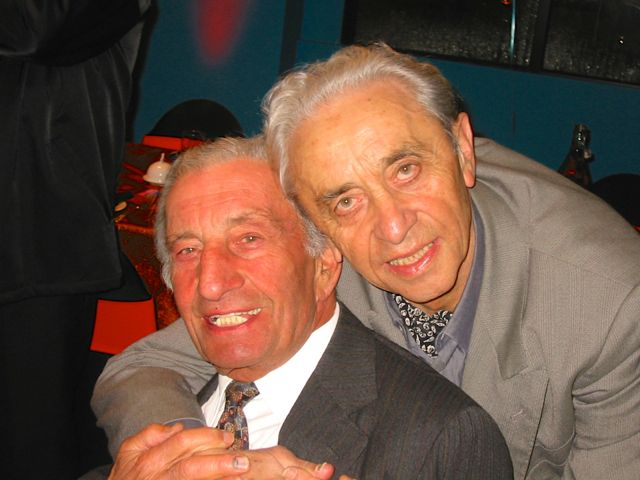
Pinchas Koplowicz ע’’ה

My memories of this man are larger than life. I attended his Levaya on Erev Shabbos. To us, the Balbin family, he was known as ‘Uncle Pinye’. We were brought up never to call more senior people by their first names. It wasn’t appropriate to call him Mr, in the same way that it wasn’t appropriate to use the Yiddish “Ir” instead of the closer version “Dir”. He, as usual, disliked Mr just as much, and always said he was “Peter Kay.”

Uncle Pinye was another long-time member of Elwood Shule after his family moved from Adelaide to Melbourne. He sat at the back-most row of the Shule in the last seat of the middle section on the left, leading into the Beis Medrash named after R’ Chaim Yoffe, where daily services are still conducted. Uncle Pinye didn’t sit there because the seats were cheaper. He sat there because he was enigmatic. On the one hand, he wasn’t short of a dollar, and was munificent when it came to Tzedoko for causes that were dear to him. He revelled in the happy social murmur pervading a brunch or event that he loved to host. On the other hand, he wasn’t a person who felt comfortable “standing out” in a Shule environment. The most comforting, perhaps compromising position for him was in the back row. If anything, I felt that he was always struggling when sitting in Shule, conjoined to a seat.

To be sure, there were other members of our family who also sat in that back row over the years, and this would also have contributed to feelings of relative comfort. I use the term ‘relative comfort’ because he was constantly in a state of inner and vocal philosophical turmoil.

All Holocaust survivors struggle to find meaning or justification (if I can use such a word) to describe what they experienced, but he was an Auschwitz survivor whose tattooed number one didn’t need to see. ‘Holocaust survivor and State of Israel lover‘ were evident in a virtual tattoo that was visible constantly on his forehead and literally manifested itself in every second line of conversation I and others had with him for almost 50 years.

A close friend of my father ע’’ה for seventy years, he and his wife Resi ע’’ה loved my mother equally.

Pinchas and my father עליהם השלום

He always told me that if I needed to study the definition of Yiddishe Mamme, I should simply look at my mother. I remember my band ‘Schnapps’ flying up to Sydney to play at his grandson’s wedding. I secretly wept at select moments when nobody was watching. I played Yiddishe Mamma at his request on my violin. For him, this was a surreal occasion. I feel he was riddled with the understandable guilt of enjoyment and Nachas. What do I mean by that? Although he merited seeing two daughters build families and played joyfully with great grandchildren, he was in a state of questioning at all times. His question was

“Why me? Why did I deserve to survive? What inherent quality did I possess that was not possessed by the millions who were butchered around me?

That was not his most powerful question or indeed his constant question. He traumatised me somewhat from a very young age whenever, and I mean whenever, he saw me. He would ask:

Hey youngster! Yitzchik, I know you are an intelligent boy, a religious boy, and a good son to your parents, but one day I’d like you to explain to me why 1,000,000 children deserved to die.

As I got older, and wiser, I subconsciously, and no doubt intentionally, tried to gently steer the conversation away from that and to the Nachas he was enjoying. He wasn’t simple, of course. He knew exactly what I was doing, and sometimes managed to reverse my strategy.

He wore a small Tallis, and usually that grey hat. I suspect that the late and great R’ Chaim Gutnick ז’’ל was someone whose expressed the pain of the holocaust and a genuine love of the State of Israel as manifested in his renowned drashos, affected Uncle Pinye in a manner that captivated his attention. Rabbi Gutnick didn’t have answers either. He never pretended to. Who does? He spoke about the dry bones, and how those dry bones came to life. I am sure that message resonated somewhat with Uncle Pinye, and it was probably for that reason, and the cajoling of my father and late Uncle Yaakov, that allowed him to feel semi-comfortable enough to attend Elwood in those days.

Last week, when his state of health state was undulating precariously like a yo-yo, between recovery and imminent end of life, I visited him. As a Cohen, it was a calculated decision. We donned gowns and gloves. He was lying listlessly in the bed, and when he realised that I had come with my mother, an enormous strength overcame him as reflected in his eyes and hands. Suddenly, he was the typical Uncle Pinye. I knew it, because he said , in his last words to me

Listen to me youngster (he was 93 and I have grandchildren!)  I do not intend to leave this world until I get an answer to why 1,000,000 children were allowed to be murdered.

I was frozen, as always when confronted with this style of questioning. I find it difficult to read books about the holocaust, let alone watch a movie. The latter stems from my experience as a boy, watching the Diary of Anne Frank and running out of the TV room when the Nazis ימ’’ש found her. I recall running to my room in Rockbrook Road, lying down on the bed, trembling and weeping. I don’t think I’ve ever recovered from that moment. But, this isn’t about me.

When we were young, his family lived in Adelaide. It was there that he built his livelihood. They would come (and it wasn’t cheap) for visits to Melbourne, and there was no question that his daughters were tantalised by the richer Jewish and social life in Melbourne, as well as the sense of family experienced through the wider Balbin family. Whenever they came, we were in their surrounds, enjoying many moments together. They were a permanent fixture though they lived in Adelaide. Eventually, daughters Dora and Belinda won. The family moved to Melbourne, but he used to commute because he couldn’t just leave his business interests to dissipate in wanton abandon.

He had used the name Peter Kay, because in a non-Jewish world it was easier. I recall his love of table tennis, gymnastics, hand-stands and sport, as well as the gregarious nature he oozed without tiring. He had no qualms dressing up, and his house just had to have a formal bar. The refrain

Can I offer you a drink?

still rings in my ear. It wasn’t an offer. It was essentially a command. He had it all behind that bar, and once a drink or two were quaffed, our discussion inevitably led to the Holocaust and how much he admired my parents and family.

He would enthuse that he didn’t have words for the honesty and integrity of my father and Uncle Yaakov who slaved upstairs in their factory cutting clothes and assembling them for production.

For her part, my mother knew that Uncle Pinye loved Choolent. Almost each Shabbos, especially when my father retired, we set aside the remainder to be delivered personally by my father (sometimes together with me) to his house on Sunday. If my father was ill, he and my mother would ask me to perform the delivery. I did so, willingly, of course, even if it meant a drink and talk session that lasted at least an hour. There was no such thing as a quick visit.

I remember a number of times he said to me, “Yitzchik, I have so many paintings, please choose a few and take them home for your lovely wife”. I have always felt uncomforable accepting gifts, and I kept replying that I had no art appreciation and he’d need to talk to my wife. His response was, of course, “so bring her, with pleasure”. My wife also visited on a number of occasions and he loved her too like family.

The root of this connection goes back many years. Although he was born in Lodz, he had relatives in my father’s home town of Rawa Mazowiecka. Immediately after the war,

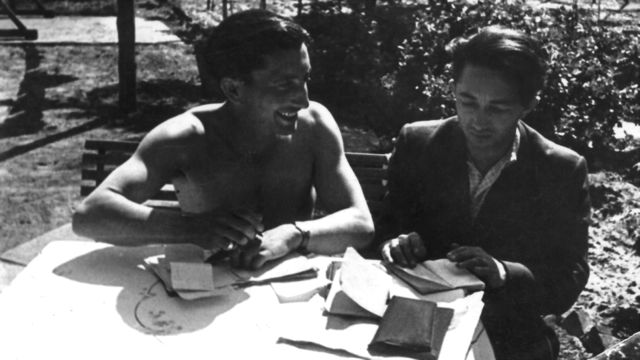
Pinchas Kay in Rawa on the left with my Uncle Yaakov soon after the war, עליהם השלום

when he imagined that nobody had survived, he found two of his sisters in my Booba and Zeyda’s house in Rawa. He never forgot that. I recall when the sisters (Zosia and Itka), who lived overseas, would come to Melbourne, the special bond that they too shared with my father. The kinsmanship and love were palpable. It was no problem for me to like them as well. It was a veritable hand in glove.

Like my parents, his family was his love and purpose and that kept a tortured soul focussed and grounded somewhat. The State of Israel was a miracle he was so very proud of and he never failed to be part of it, even when he wasn’t physically standing in the streets therein.

When my father ע’’ה passed away recently, he turned his attention to the isolation and melancholy that my mother understandably descended into. After her serious fall, he redoubled his efforts, even though he was physically frail. Almost a day wouldn’t go by without him incessantly ringing my mother, and then me and my sisters when he couldn’t elicit an answer from her phone. He wanted to take out the entire family for dinner. I tried to explain that we’d need to wait until the year was over, and he accepted that, but even after the year was over, my mother was and remains rather isolationist, rejecting invitations from her friends for the most simple of activities, such as sharing a cup of coffee. This will change, undoubtedly, in time, but alas, Uncle Pinye departed before she was able to bring herself to accept invitations with comfort.

He is now, no doubt, at peace. I use the term קדושי ניצולי השואה which whilst not common, cannot be seen as objectionable. For me, every survivor was and is holy. They were holy, because they had been “set aside” as a Korbon, literally a sacrifice on the altar. For reasons we do not comprehend, the Korbon survived, not because it was a בעל מום, חס ושלום, rather because

הנסתרות להשם אלוקינו והנגלות לנו ולבנינו עד עולם

The hidden mysteries are the domain of Hashem, but the revealed, is for us, our children and offspring, forever.

This is my only response, although it is not one that I ever used in discussion with Uncle Pinye. There could never be a response that would assuage his troubled, quixotic character.

He is now hovering above his grave on the journey to the Garden of Eden, at the end of the 12 months of mourning. His legacy, kindness, love, and gregarious nature, though, is set in stone in my psyche, and  in that of my mother, siblings, children and the wider Balbin family.

יהי זכרו ברוך

Postscript: at great expense and with much paper shuffling under the devoted hand of Ezra May, he decided to formally change his name back to Koplowicz. He had needed to function as “Kay” but he had never lost the Koplowicz, and that describes his essence in a single act. It isn’t surprising that Yom Yerushalayim will fall during his week of Shiva. That is also Hashgocho—the conundrum of issuing praise for the miracles Hashem wrought after the Holocaust, davka at a time of extreme mourning for an individual of this ilk.

Guest post on the propriety or otherwise of R’ Meir Rabi’s business practices

[The post is from EK, I have asked Meir and his business partner Kalman if they have any objections= to me posting this, and the answer from Meir was no.]

Several months ago, I brought to the attention of readers of “Galus Australis” that Rabbi Meir Rabi is responsible for the appropriation of the artwork of a famous Hungarian / Israeli / Australian graphic artist: Georg Hamori. Rabbi Rabi has not responded to the specific allegations. Unfortunately, Galus Australis is in the habit of removing all comments from articles that are inconvenient to its contributors. I have included some new comments together with an updated version that incorporates updates I made before Galus Australis obliterated them.

I regard all Australian “Kosher Authorities” as being equally interested in empire building and / or financial gain. Indistinguishable and multilateral examples of this include: “Laffa Matzo” brouhaha; non-direct and non-continuous supervision of “Kosher” eateries; bogus shechita by not observing Kohanic gifts. Even so, I like Rabbi Rabi and some of his positions on Kashrut.

To put my position in perspective for the readers, as far as we know, my family originally lived in Ottoman Palestine and Egypt, India and China. Rabbi Rabi is on the right track about soft matzos. The problem is that the wheat or barley should have been observed from harvest to grinding into flour. Then the dough must be rapidly prepared to prevent fermentation and immediately baked. Worldwide, there are many soft and hard flat types of bread that contain no leaven or aerating compounds and are thoroughly baked before fermentation occurs. I agree with Isaac Balbin that there should only be one Australian Hechsher. The board that operates the hechsher must be representative of all degrees of observance and must be transparent in all its operations.

I’m keenly interested in stamp collecting. Why is this relevant? The other week I was perusing Rabbi Rabi’s It’s Kosher website and found an image of the certificate he uses for providing to manufacturers and retailers. I am reliably informed the certificate is displayed at “It’s Kosher” retailers.

http://www.kosherveyosher.com/passage-certificate.html

The core image of the certificate is the APPROPRIATED design of the Israeli 150 Pruta stamp commemorating the “Memorial Day for the Fighters for Independence” and “The Seventh Independence Day” by the late; world famous, graphic artist George Hamori. He designed a vast number of stamps, many of which were issued by Australia and Israel. He was born in Hungary, survived the holocaust, immigrated to Israel and later moved to Australia. The Hamori family continue to live in Australia.

The Israel Post Office released this stamp on the 26 April 1955.

Records show that Israel Post had a license to produce a stamp design almost identical to the Israel State Emblem. Looking at the stamp gutter is more information. For comparison, an exact image of the Israel State Emblem is depicted. The stamp design differs to the Israel State Emblem in that the lighting angle is the opposite, the rounded base and stem of the menorah truly depicts the menorah on the Arch of Titus (not stylized as on the Emblem), the font for “Israel” is different and of course there is the addition of flames.

Fact: you or some one working for you must have acquired the image of the stamp and then used software to remove “Israel” in English and Arabic along with the denomination “150″. You should know that the Israel FLAG AND EMBLEM LAW 1949 (5709) ss(3) & (8) and possibly s5 would apply to you and what you have done. There are penalties specified by the Act.

I found this on the Kosher Ve Yosher website of Rabbi Rabi in the legal section:

“COPYRIGHT … We therefore grant permission to publish and disseminate any texts (NOT IMAGES) found in this website …without the prior written consent of Rabbi Meir Rabi.

Publishing information from this site requires:
• that it be used and presented such that it clearly pursues the same objectives as are presented on this website.
• that full credit be attributed to Kosher VeYosher or its Kosher! together with and on the same page as, the relevant texts.
• that the full internet address of the this website and the name of Rabbi Meir Gershon Rabi appear on the same page as the relevant texts. That these attributions be clearly observable on the relevant page.”

Your self-admission that you thought the copyright had expired is telling. This article provides a scholarly discussion of the Halacha in relation to appropriation.

Click to access NetanelNimme.pdf

Rabbi Rabi, I feel you are a hypocrite and have demonstrated zero respect for Mr Hamori. Using the State of Israel Emblem for the gain of your Hechsher is reprehensible. Why instead didn’t you create your own original artwork with a menorah? I feel very strongly that you need to discontinue the appropriation of Hamori’s design for the following reasons:

[1] The stamp was designed to commemorate the sacrifice of the Fighters for Independence, to establish a homeland and state for Jews and protect them in the shadow of the holocaust and earlier pogroms. It is entirely wrong that this ideal is vandalised for commercial or personal gain.

[2] Misappropriation of intellectual property: either belonging to the Hamori family or the Israel Post Office.

[3] No attribution was provided to George Hamori on the certificate.

[4] Shock to the Hamori family who might see the certificate image at an It’s Kosher certified retailer.

The Hamori family deserve an explanation and apology

It’s a wedding and not Purim

Maybe I’m obsessed by Neturei Karta, but these pictures (hat dip DS) made me ill

See here

Are they transgressing Lifnei Iver?

This has been brought up before, but I noticed it on Dov Ber’s blog. Have the Rabonim investigated this issue? Are they comfortable simply because there are those who go to Meron L’Kavod the Rashbi (the date of Lag B’aomer is also questionable as his Yom Hillula but we won’t go there).

The holidays invented by Zionist Rabbis (Yom Hazicharon and Yom Haatzmaut) were postponed this year because everyone understands that a national Yom Hazicharon ceremony can’t be produced on Saturday night without causing some Sabbath desecration.

In other news, the holiday invented by Hasidic Rabbis (Lag B’omer) falls on Sunday this year, and the national bonfire celebrations on Saturday night in Meron will also be impossible to prepare without causing some Sabbath desecration. At the very least, police and soldiers need to be put into position. Has the holiday been postponed? Of course not! (The lighting of the bonfire has been delayed, but its unclear how that delay eliminates the Sabbath desecration.)

Fun Fact to Know and Tell: The Sages canceled a biblical obligation (blowing the shofar on the first day of Rosh Hashana) out of fear of Sabbath desecration!

Interesting Yerushalmi in respect of Kashrus

This is from Terumos. צתרי is sometimes translated as thyme (e.g. the Rambam. The ערוך also calls it some type of hyssop that provides taste)

Basically, Rav held that the thyme which wasn’t tithed was forbidden but Shmuel disagreed. That of itself isn’t surprising. What is surprising is that when Rav visited Shmuel, Shmuel fed him the thyme that had been infused with other food (and had a taste which one would probably describe as נותן טעם לשבח, even though he knew that Rav held it was forbidden. The מראה פנים on the spot gives an explanation where he claims that Rav had changed his mind. That is, somewhat strained? The Chasam Sofer tries to deal with this Yerushalmi as well in חידושי חת”ס על פסחים, עו, ב

דף נב,א פרק י הלכה ב גמרא פליגא מתני’ על רב אין צולין שני פסחים בתנור אחד מפני התערובות לא אמרו אלא מפני התערובות הא שלא מפני התערובות לא מי צתרי רב אמר אסור ושמואל אמר מותר אייכיל שמואל לרב מי צתרי

I haven’t spent much time on this, but I’d be interested to hear any nice explanations about this surprising story from learned readers.

The extremism is out of hand?

Check out this post from the Litvishe leader Rav Steinman inter alia (hat tip hr)

A gross CHILLUL HaShem

We need Rabbis to speak out against this arrant dangerous nonsense. WE created the problems through our false sense of entitlement.

On the Mizrachi Side we have the disgraceful hill top youth. How many more Chilulei HaShem do we have to witness?

This isn’t Torah. It isn’t a Torah State. It’s what HaShem paskened we should have. As such we should seek to make it holier through darchei noam.

I have to commend Rabbi Rosen. I reproduce his forthright criticism of the hill-top youth below.

So, this is nothing for Rabonim in Melbourne to speak about? I beg to differ. When the Sabra and Shatilla massacres occurred the NRP was against an enquiry until the Rav, rang them up from the USA and berated them for their loss of basic Torah values. They were kafuf to the Rav, and they listened thank God.

Halacha clearly states that a Yid can’t be seen to be less ‘moral’ than the normal world even if you bring 100 proofs that an enquiry is not necessary. There were times when unmarried girls wore hats to shule because the Xtian girls wore them to Church lehavdil. I recall a Tshuva in Yabia Omer on this.

People who resort to a Chilul HaShem when there are clearly other ways, will need to deal with the Aybishter after 120 years; not a pleasant thought.

Someone lurking behind a fake name sent me a comment that I should take down the picture of Moshe Beck in my earlier post because the Rabbi of Adass isn’t responsible for his brothers actions. That is 100% true. I know about this phenomenon unfortunately. It has always been true. But if that lurker with the fake Hungarian name lotzi123 had any guts, he’d name himself AND he’d tell us if it’s true that the Moro D’Asra actually visited his brother and attended Simchos. Is that also untrue and just made up stories ‘Lotzi’

I vehemently disagree with the extremists at Adass. They created their own School. Are they tolerated with sniggles and not open condemnation or Cherem? There are many great and kind and good people at Adass. I speak with them and like them. They ALSO privately bemoan the lurch to Satmar and Skverer extremism. We are brothers, but as Holocaust survivors dwindle the voices of the extremists take over. Is this the Chutzpa Yasge of the Gemora in Sanhedrin portending the Geula? If so bring on the Geula now please. It hurts to see people openly flouting clear Halacha because they think Israel is not from God but from the Sitra Achra. Mimo Nifshach: if it’s Sitra Achra get OUT … why do they stay?

In the least, if you loathe the not yet frum Yidden in Israel (unless you can make a buck off them) keep your thoughts to yourself and stop poisoning the kids with a menu of Sinah and Nekoma and now violence. I heard it with my own ears recently when I listened in to a Melamed teaching children. The Melamed is a Dayan! He was fire and brimstone in his delivery. The next generation has no chance.

How nice it was for once to see Charedim stand silently in the Park on Yom HaZikaron and recite Tehillim while doing so. THAT was a simply executed Kiddush HaShem.

Where are the voices of Rav Kahaneman, Rav Shlomo Zalman and their ilk. They seem to be hiding.

Who are we kidding, the extremists didn’t approve of Rav Elyashiv because he was in Heichal Shlomo paskening Shaylos. Heaven forbid! what a horrible thing he must have done when he freed an Aguna

Here is what Rav Rosen wrote:

The “Tag” of Kayin / Rabbi Yisrael Rosen
Dean of the Zomet Institute
“‘And every man will stumble over his brother’ [Vayikra 26:37] – All the people are responsible for each other, they would have been able to protest but they did not” [Sanhedrin 27b].

“Those Ruffians”

Among other things, the destruction of the Second Temple can be “credited” to “those ruffians” – who wore the badge of the Sikarikim (see Gittin 56). They took swords into their hands, convincing themselves that they were taking the law and justice into their hands. And they set up a reign of terror over all that surrounded them, enemies and brothers alike.

What are we talking about? You have probably already guessed from the title of this article: the “Price Tag” ruffians who “fight” the Palestinians and the commanders of the IDF, in the mosques and on the tires of the jeeps – using fire, sharp spikes, and (mainly) graffiti. These thugs have taken on the role of “national irritants” against our enemies, against our lawful governm ent, and (mainly) against the security forces. I do not believe the claim that what we see is a provocation by the Palestinians, by leftist Jews, by the security forces, or by other dark forces. I strongly suspect that we are talking about irresponsible youths who are certain that we will win using an approach of thugs!

I know very well the story of the fanatical attack by Shimon and Levi in Shechem, but in this case I am in complete agreement with the pointed scolding by Yaacov, our father and theirs: “You have made me ugly and spoiled my odor among the inhabitants of the land… I am few in number, and they will gather around me and strike me, and I and my house will be destroyed” [Bereishit 34:30]. Yaacov’s complaint is not only a matter of dissatisfaction (“you have made me ugly”), it literally leads to a curse – “Let their anger be cursed” [49:7], which is accompanied by a punishment of exile, divisiveness and separation from each other – “I wil l divide them among Yaacov and I will disperse them among Yisrael” [ibid]. The best thing for fanatics and for the world is to keep them apart from each other!

“They Stabbed their Rabbi”

I am also well aware that the people bursting with fanaticism will not listen to ethical scolding, do not pay attention to rabbis, and certainly do not weigh their actions in terms of “profit and loss.” They are operating “from a gut feeling” or in response to messianic mysticism, and as far as they are concerned “let the world be consumed!” The proof of how much damage can be caused by such individual acts is provided by a fanatic who has been somewhat forgotten, a man who had a personal very noble record and was not an anonymous “hilltop youth.” I am talking about Dr. Baruch Goldstein from Kiryat Arba, who killed dozens of Arabs in the Machpeila Cave on Purim of 5754 (1994), thereby causing tremendo us damage “and making us ugly.” With what he did, he gave a double-edged sword to our Moslem enemies and to the world. Foolish fanaticism, hallucinatory and murderous, also contributed to the spoiling of the vision of expanded settlements among broad groups of our nation. And this is exactly what is happening before our very eyes as we watch the “Price Tag” events, shaking our heads and shedding tears out of pity: It is a pity that you should waste your youth for no good reason in prison, and it is a pity that you corrupt the righteousness of our path.

And this explains why the cries that are heard from every corner are futile: “Where are the rabbis who can calm them down? Why don’t the rabbis stop them?” We are told that “those ruffians” from the Second Temple era “stabbed their own rabbi!” [Gittin ibid]. They will not be deterred by having us turn our backs on them. In any case, if for no other reason than to reject the claim that we do not scold them, I hereby object loudly and without any limit to their actions. The need to voice an objection is also clear from the quote at the beginning of this article, in the commentary on a verse in this week’s Torah portion – that we are all responsible for each other, especially those who “were able to protest and did not.”

Fanaticism Cannot be Planned

We mentioned Shimon and Levi, the fanatics of Shechem, as providing an inspiration for the “Price Tag” fanatics. It is appropriate to repeat here some relevant points from our sources about the proper attitude towards fanaticism.

“Shimon and Levi were greatly upset by illicit sex, and they each took their swords and killed” [Pirkei D’Rebbe Eliezer 38]. And for this they were scolded by Yaacov. But they “took their swords” spontaneously, without any advance planning, without establishing an organization of fanatics, and w ithout declaring any public policy and designing a “tag” as a symbol of their activity. This is what the sages taught us: “They did not ask Yaacov for advice… and they did not take advice from each other” [Bereishit Rabba 80:9].

The same two brothers meet again in the arena of fanaticism, but in the second case they are on opposite sides. Pinchas the priest (from the tribe of Levi) kills Zimri, a family leader (in the tribe of Shimon) for the sin of immoral behavior with a daughter of Moav. “Pinchas acted against the will of the wise men. Rabbi Yuda said: They would have put a ban on him, if not for the fact that the Holy Spirit came out and said, ‘I hereby give him my covenant of peace, because of his fanaticism'” [Talmud Yerushalmi Sanhedrin 9:11]. The act of Pinchas was accepted because it was spontaneous and not the result of planning. The laws of fanaticism read as follows: “One who has sexual relations with an Aramite woman should be struck by fa natics” [Sandhedrin 81b]. But in the same breath, it is also written there, “One who comes to take advice is not told to do so.”

That is, fanaticism is by definition a spontaneous act, and at times it can be accepted, depending on the circumstances. Fanaticism is always the act of an individual, and establishing any organization or “taking advice from each other” is not fanaticism but the act of a “ruffian.”

Our country, our people, our struggle and extremism

I was not going to post about this topic because I know there are many at Adass Yisrael, the Melbourne Chassidic Charedi organisation, who were upset at what happened and I didn’t want to pour petrol on a raging fire.

Then I received the following video [hat tip MD]. It shocked me to my core. If you understand Ivrit, just a little it will likely do the same to you. Make sure you turn on annotations and captions in youtube for English.

The Palestinian Arab rendition of Hatikva

It is plain to see that they have butchered the words of Hatikva to issue calls for the destruction of our homeland and annihilation of our people. We are sixty short years away from a scourge that made no difference between a Rebbe or Mechalel Shabbos. A scourge that didn’t care if someone was from Satmar or from Mizrachi. The common theme is that

עם לבדד ישכון

But who is the עם?

Two incidents occurred with the approval of Rabbinic decree at Adass on Yom Haatzmaut. Now, nobody is saying that people have to give שבח והודאה to Hashem if they feel that the state is a cataclysm for עם ישראל but is this אחיך בלבביך?

Both incidents are outside the rules of Dinim Mefurashim in Shulchan Aruch according to all Rishonim.

  • We don’t say Tachanun at a Bris Mila (שו”ע, סימן קלא, סעיף ד). The Kaf Hachaim says that even other minyanim in that building don’t say Tachanun כה”ח, סימן קעז. The Mishna Brura says that even if the Ba’alei Simcha aren’t there  (משנ”ב, שם, ס”ק כב). Yet, when a recent Bris was held on the 5th of Iyyar (yes, we can assume that they didn’t accept the 6th of Iyyar this year because that was designed to lessen the chance of עבירות) yet at Adass, the Rabbi declared vocally that Tachanun had to be said. The SADNESS and CALAMITY of the establishment of a State overrode in his unpublished and unsourced opinion (I know about the Chazon Ish 60 years ago) the clear requirement not to say Tachanun because there was a Simcha. Perhaps they should have worn sack cloth at the Bris and said Kinos on the floor? When I look at this action in the context of the youtube link above, I feel sick in my stomach. Isn’t it clear to one and all that Tachanun would not have been said because of a Bris? Isn’t it known that the right-wing Satmar branch of Adass are closer to Neturei Karta and the breakaway than they are to the rest of the community and Adass has lurched to the right over the years, especially as the sane voices of holocaust survivors dwindle.  Would this happen at Chabad? No. Would this happen at Beis HaTalmud? I’d venture to say no. Even though Rav Kotler was no uber supporter, he had a fidelity to Halacha. Someone correct me if they say Tachanun at Lakewood on Yom Ha’atzmaut if there is a Bris.
  • There was a poor Adass fellow who was sitting Shiva for his father. During the Shiva,  the Halacha is clear that we do not say Tachanun. Nobody is talking about Hallel with or without a Brocho or anything like that. Tachanun is not said in the mourners house. Yet, because it was Yom Ha’atzmaut, they decided to say Tachanun in contrast to an open halacha שולחן עורך אורח חיים סעיף ד’ ובמשנה ברורה סק”כ. This is a time when the Midas HaDin is threatening and we dare NOT mention sin (Tachanun) in the house of an Avel. But here, the existence of a State of Israel and the possibility that this might be seen to be supporting Yom Ha’atzmaut, was seen (unpublished and unsourced) as more important than the fearful notion of מידת הדין מתוחה, וצריך ליזהר שלא להגביר מידת הדין עליו

So what does one do? My suggestion is that all who are friendly with people from Adass and who agree with my viewpoint express objection in strong terms and ask them why those who were not happy with the unhalachic ruling, decided to say Tachanun. This is not a הוראת שעה from a נביא.

במקום שיש חילול השם אין חולקים כבוד לרב

I fully accept that the Rabbi(s) who must have issued this ruling are careful with the minutest detail of Halacha and are honest and ehrliche Jews, but I simply cannot reconcile this alleged breach of Halacha in the context of that sickening youtube video.

Nobody says one has to agree with ראשית צמיחת גאולתינו … I know many Rabonim who cleverly say סמיכת when it is politically wise to do so, or who add the word שיהא. These are eschatological matters which really don’t concern me too much. I’m happy with plain גאולה as soon as possible.

I consider these actions as tantamount to matching the antics of the ערב רב who visit and visited those despots who seek to dismantle the only Jewish homeland we have, and have had for thousands of years.

It’s a Shame and a Shande ואין פוצץ פה

Visiting their “Rebbe” Arafat’s Tziyun
Holocaust survivor, Moshe Ber Halevi Beck, with Ahmadinajad, ימח שמו וזכרו

Yom Ha’atzmaut: I didn’t find it funny

As I was leaving Shule today, there was a function being held. I don’t know who the caterer was, but it was under Adass supervision. The door was open, and the Mashgiach (supervisor), a rather portly chap was munching on some soup nuts. He was a jovial type and we exchanged a few pleasantries. He then asked me (in Yiddish) do you know what day the Megadef (blasphemer) in today’s Parshas Emor committed his sin? [ The blasphemer who cursed God was the son of Shlomis Bas Divri  and his father was allegedly the Egyptian killed by Moshe Rabbenu (Shmos, second Perek) and he was punished with death for cursing God.]

This Mashgiach of the food (who was a Chossid of some sort, with long Payes, and his Tzitzis Beged on the outside) bellowed that it was the 5th of Iyar (i.e. Yom Ha’atzmaut). I have to admit that I didn’t know if he was telling me the truth in respect of the date and I just wasn’t aware or I was confused with the date of the Mekoshesh Etzim, but it doesn’t matter.

In other words, on the very the day that Hashem allowed the world to grant Israel the ability to be an independent nation, was according to this fellow the same day that the Megadef sinner was put to death for cursing God.

His point was clearly that there was a connection between the two. The notion of a new State for Jews wasn’t a cause célèbre but something akin to cursing God/sinning for which the death penalty was appropriate.

As is my way, I usually find a quick retort, and told him that the correct meaning was that anyone whose distorted weltanschauung saw the establishment of the new State of Israel as a sin/curse, was deserving the death penalty. He snorted, and didn’t respond, and I went on my way.

I simply cannot comprehend how people can speak this way about Israel. I struggle with it. Either they feel that immediately after the Holocaust God decided to “test us” and offer us a State and we should have said “NO”, or they think that the Hester Panim (concealment of God’s visage) during the Holocaust continued further and we shouldn’t have fallen for the “ruse” agreed to by the United Nations, or that we should simply have accepted the view of  R’ Yoel of Satmar, that it is (God forbid) a sin to make mass Aliyah to Israel before the Redemption (as expounded in VeYoel Moshe and discredited as an halachic argument by many Talmidei Chachomim of note).

Having been at the Yom Hashoa commemoration during the week, focussing on the destruction of Hungarian Jewry, and feeling the pain of that episode once more, I find it utterly incomprehensible that soon after 6 million holy people were murdered by the Nazis, that I am meant to see the establishment of a State as  a cataclysmic curse akin to the Megadef (the episode of which has some parallels to the Mekoshesh Etzim in Parshas Shlach).

It is times like this where I am profoundly challenged to consider such people and their views as brotherly. Not only did I not find it funny, I found it grossly offensive (he mistakenly thought I was a Chabadnik, as he had stated).

I am glad that I went home to have a nice Shabbos meal with my mother (a Holocaust survivor who lived, studied and found refuge in the new State of Israel immediately after the war) and managed to control my seething anger.

The flag of the State of Israel atop the Ponovezh Yeshivah on Yom Haatzmaut

The Goral HaGro, Mekubalim, and advice for the unsure

Life has its ups and downs. Some people cope better than others with the downs while others simply can’t cope with the ups, even though they think they do. Every day presents new challenges and questions, as well as solutions and achievements.

It is common to see advertisements from so-claimed clairvoyants. These are people who seem to have an ability to foresee some future event or reflect on a past event.

The Torah is very explicit in its instructions. We are forbidden to be involved in things involving “foretelling the future” or in the words of the Torah  (Vayikra 19) לא תנחשו ולא תאוננו. I’m not happy with the phrase “foretelling the future” but it will do for this context. Of course, this is also explicit in Shulchan Aruch (Yoreh Deah קעט) as a Torah prohibition, quoting the Rambam.

Now the term Goral HaGro, which means the “lottery” of the Vilna Gaon, is almost certainly nothing to do with the Vilna Gaon. There is, to my knowledge, no provable record, of the Gaon ever performing a specific methodology which enabled one to make a future determination. Certainly though the term/technique has continued and is mentioned by those who identify themselves as followers of the Gaon. Fundamentally, on the Pasuk in Vayikra

‘תמים תהיה עם ה’ אלקיך’

Be complete/pure [in the path] with Hashem your God

Rashi says

התהלך עמו בתמימות ותצפה לו ולא תחקור אחר העתידות, אלא כל מה שיבוא עליך קבל בתמימות ואז תהיה עמו ולחלקו

Which plainly means that one should accept one’s lot and not seek to determine the path they will take based on seeking out the future before it happens.

Yet, despite this, we know that “lots” have a place in Judaism. For example, in deciding which of the two animals will be thrown off a cliff on Yom Kippur. Here, the lottery is part of the avoda and is commanded.

The Gemora tells us that when Tanoim were unable to decide what to do, and here I assume that this means not that they could not decide the Halacha, but rather whether one should do X or Y where both X and Y do not contradict a Halacha and cannot be determined via Psak, they asked young children פסוק לי פסוקיך … “Tell us what Pesukim [in the Torah] you are currently learning”. Based on what the children answered, if the Pasuk shed light on whether to pursue X or Y, they chose the one which was hinted at by the Pasuk. It isn’t clear to me whether that could always be determined by the Pasuk, but perhaps depending on the Wisdom of the person asking the children, they were able to derive X vs Y.

Does this Gemora contradict the aforementioned Halacha? It would seem not. There is no attempt to seek out the future through some supernatural (whatever that is) means, but rather, when something can be both X or Y and it is not a matter of Halacha (I presume) the Pasuk sheds light on those deserving and discerning such light.

There have been famous examples of the use of this method: viz, opening a Pasuk from the Tanach and using it when there seems to be no other approach to take. One, is the case of the famed R’ Aryeh Levin, the Tzadik of Yerushalayim and super Talmid of Rav Kook, who used this method to identify the corpses of 12 holy soldiers who were killed during the war of independence in Gush Etzyon. Using a particular format of the Chumash page flipping  eventually a particular verse was chosen. In each case, the verse chosen clearly identified a fallen soldier with a particular body (See “A Tzaddik in Our Time: The Life of Rabbi Aryeh Levin,” pp. 111-117).

Some commentators would term this a נבואה קטנה a minor prophecy (this is the opinion of the Shach ibid). There are other examples of course. R’ Aron Kotler wasn’t sure whether to go to Israel or the USA when escaping the Nazis. Clearly, if R’ Aron wasn’t sure, he must have held that Halacha didn’t have a clear answer for him. I can’t guess what his thoughts were, but one would imagine that on the one hand, there was Israel which involved a Mitzva of going there and building it up versus the USA where there was a Mitzva to build Torah. Both had issues. Israel was under siege and there was a Sakana and the USA would have presented a spiritual Sakana (danger). R’ Moshe Feinstein begged him to come to the USA. Apparently the Pasuk in Chumash was Shmos 4:27 which suggested he (R’ Kotler go to Moshe (Feinstein) in the desert (USA). It’s eery and scary, to say the least, at least for me!

While such devices will “work” for especially holy people it isn’t clear to me that it’s going to work for every Tom, Dick and Mary. Furthermore, knowing if one should use the device or not, is a major question itself. My understanding is that in keeping with  ‘תמים תהיה עם ה’ אלקיך’ one would need to consult a Rabbi of great stature first before embarking on this path.

There was a story reported that Rav Shteinman used this method to decide whether a Shiduch should go ahead when a Groom pressed him incessantly. On the other hand, the Steipler Gaon, suggested we stop using Goral HaGro because we don’t know how to do it exactly and it’s better to be consistent with the Pasuk of Tomim Tihye.

There is another story, and I don’t know if it’s true or a piece of historiography, that the Griz (Rav Chaim Brisker’s younger son and Rav Soloveitchik’s Uncle) once did this Tanach flipping (Goral HaGro) and the Pasuk he landed on was ‘תמים תהיה עם ה’ אלקיך’ !!!

There are a lot of things we don’t understand, and most of these are in the domain of the exalted ones.

I have to admit that for a time, at the behest of my wife, I spoke with a Kabbalist who is not known, does not take money, and has a very good “hit rate” seeing the future. In fact, the first time I called him, I was in Melbourne at 3am, and it was a “cold call” to him in Israel. Please don’t ask me his name, as he doesn’t seek notoriety or attention. He told me things about myself that literally made me convulse. I went to see him in his remote shanty house in the far north of Israel on a subsequent visit, and again he made some remarkable comments. I won’t go into details, but he noted, for example, that we had issues with some trees in our house and he drew the location. He was right. On the other hand, there are a number of things that he told me that one could say he wasn’t right. I asked him how he knew. He said he couldn’t explain it but that he saw things in the future like on Television (i.e. an external screen with events unfolding). There are lots more stories I can tell about him, but this suffices. My wife still wants me to call him when there is a really major extra-halachic issue, but I have quietly stopped doing so.

I spoke with Mori V’Rabi R’ Schachter, and of course I didn’t identify the Mekubal, and he responded that I should not consult and I should be guided by ‘תמים תהיה עם ה’ אלקיך’ alone.

Interestingly, over Pesach, I read a story from R’ Schachter where he retold how the Rav, R’ Soloveitchik set out one day to convince R’ Aron Kotler to change his mind about a particular issue, and went to visit R’ Aron. On the next day, during Shiur, the Talmidim noticed that the Rav had problems with his arm, and was in some pain. They asked him what was wrong. The Rav said that when he was on the way to Rav Aron Kotler, he slipped on the icy snow and fell on his arm and had hurt it. The Talmidim then asked the Rav, but we know that Shluchei Mitzvo Ainom Nizokin (those who are messengers for a Mitzvah are not harmed) and since the Rav felt the issue was important enough to approach R’ Aron Kotler he must have felt that the mission was a Mitzvah, and if so, how could he be hurt. The Rav immediately responded “Nu, that’s perhaps a sign that I was wrong on this particular issue and R’ Aron was right”!

In our days, it is commonplace since the passing of the Lubavitcher Rebbe that some of his Chassidim use this technique. They tend, as I understand it, not to do so using Tanach, but rather use letters that had been published in the past in volumes (אגרות קודש). I have heard various incredible stories in this regard, and I’m sure there are plenty of examples (although these won’t be publicised) where there was no clear indication of how to proceed. I know that R’ Schachter limited the definition of the Goral HaGro to Tanach per se and not Gemora, Medrash etc as he felt there was no Mesora/tradition to use anything other than explicit Psukim. Of course, a Pasuk could be quoted in a letter.

Either way, I tend to be of the view that one must first go and speak to an authoritative Rav/Posek before using this technique willy nilly (so to speak).

I probably haven’t elucidated much in this pitput, except to say that I tend to the view that where a matter is one of Halacha, one follows Shulchan Aruch (or asks a Rav if one cannot see the Halacha or it is not clear or a difficult question). For extra-halachic matters, I guess it’s a matter of what your own Rav HaMuvhak advises you in context of your family and circumstance and that may also be “no specific advice!”

As I finished writing this I found this video if the topic interests you, which I had heard driving in my car a few years ago, and which obviously influenced me!

Bnei Brak rabbi calls for gefilte fish boycott

The following article is from Yediot. I’m assuming it’s correct as it quotes Hamodia, the Haredi newspaper.

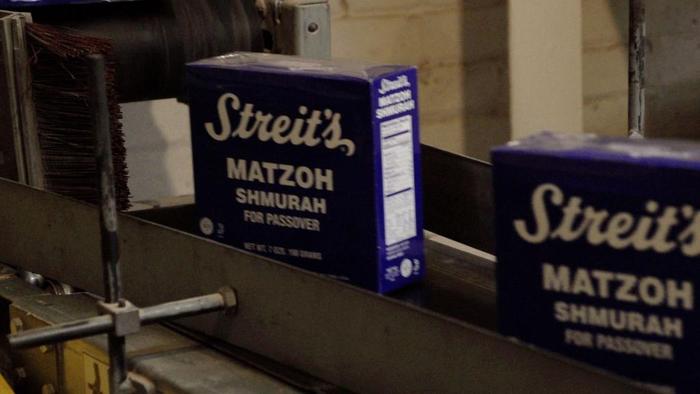
What’s holy about gefilte fish as opposed to Shmura Matza? The latter costs a fortune, and so many impoverished families struggle to find the money to buy them even with Maos Chittin contributions. In regards to Shmura Matza, even the [just as kosher, if not better] machine variety costs at least $11 a box in Melbourne. Why? I saw that in Johannesburg, Rakusen’s Machine Shmura Matza was going for some $3.50. Is it also under the BaDatz? Why the variance? Yes, it is meritorious to have meat (is chicken enough?) and wine on Yom Tov, but apart from the “Basar Vedagim Vchol Mataamim” is someone not Yotze Yom Tov (Pesach) without Gefilte fish?

In Melbourne, the cheapest way is to do it yourself, and buy whole fish from the market, but these days, everyone buys those logs (which you probably have to wash for, except on Pesach when they don’t add flour, which is perhaps why they are either more expensive or smaller). All this to avoid Hilchos Borer and bones in fish? Eat some veggies instead if it’s too expensive. or simple egg and onion (hopefully you aren’t paying a fortune for egg shells that don’t have ink on them)

Although I don’t have a problem with Rabonim getting involved in saving Jews money: Indeed, I think a number of Chassidic Rabbis have declared that one should not buy real fur Shtreimlach or Spodiks, I don’t buy all of this brouhaha until such time as the money side of Hashgochas are all managed by lay bodies of unimpeachable honest professionals. No Rav, especially today when Emunas Chachomim is at a low ebb, should be involved with money, except as part of a set wage and the books should be open to all. By all means, build in KPIs and reward, but never because you give a hechsher, as this is prone to corruption.

Where would the relatively tiny BaDatz be if they opened their books. What a ridiculous situation we have when you buy something and it has three hechsherim on it. Why? It’s all business, and not Kashrus. It’s the same with private hashgochas (as we regretably have in Melbourne, and which are not trusted by the majority of orthodox Jewry).

If people would worry at least as much about what comes out of their mouths, as what goes in them, we’d have a much happier world.

Rabbi Shmuel Eliezer Stern issues unusual halachic ruling in bid to prevent stores from charging exaggerated prices for carp fish ahead of Passover.
Akiva Novick
Published: 03.23.14, 01:41 / Israel Jewish Scene
An unusual halachic ruling published Wednesday calls for a consumer boycott on carp fish and the traditional gefilte fish dish, in a bid to prevent fish merchants from charging exaggerated prices ahead of the Passover Seder.

In about three weeks, the Jewish people will gather around the table for the Seder meals. Many homes, particularly Ashkenazi ones, will enjoy a dish of ground carp with a piece of carrot on top – also known as gefilte fish. Yet quite a few stores have the habit of raising the price of that particular fish right before the holiday.
A halachic ruling issued by Rabbi Shmuel Eliezer Stern of Bnei Brak seeks to prevent that from happening. The rabbi is calling for a gefilte fish boycott, stating that “all halachic rulers believe that the unfair exaggerated raising of prices must be stopped.”

The ruling, which was published in ultra-Orthodox newspaper Hamodia, explains that after receiving information on fish prices, the rabbi suggested “a regulation of the generation’s great sages to forbid the purchase of fish for a limited period of time, until all those involved understand that they must back down on the unjustified price hike and reduce the prices to a reasonable and appropriate level.”

The rabbi further describes how one of the rebbes of the Chabad Hasidic movement announced a fish boycott hundreds of years ago, which lasted about two months.

According to Yehuda Ashlag, who owns a Bnei Brak delicatessen called “Leibale,” gefilte fish sales soar every year ahead of Passover. “It’s really part of the holiday tradition,” he says. “Some people cannot do without gefilte on Passover, and the sellers use it to their advantage. I personally don’t raise the price,” he says.

Aviad Nurieli, a fishpond worker in northern Israel, says that “it’s all a matter of supply and demand, and these are the market rules.”

A concise guide to the basic laws of the Korban Pesach

This is one of many works by Reuven Brauner of Ra’anana (who is married to a cousin of ours on my mother’s side)

I recommend you download it, if you have an interest. It is in English and can be downloaded here

Dates in a Kesuba: response to my cousin, Rabbi Yaron Gottlieb

I don’t use Facebook except with my gentile alumni where I keep in touch and try to help them in their evolving lives.

And, so, I was not aware of a post from my cousin Yaron.

Yaron asks a question: if Scientists say the world is older than we know it to be, then perhaps we should leave out the date from a Kesuba completely.

Firstly, Yaron, in Shtar, we are not concerned with the various views of Scientists on the age of the world per se. You will be aware, of course, that there are various approaches that have been put to reconcile B’Reishis with those Scientific observations.

The point of a Ksuba Shtar is to give testimony that two Kosher witnesses attest to undertakings of a Chosson on the day of marriage to his better half. As such, saying we witnessed an undertaking on Thursday without any mention of a date, is a no brainer. Such a Kesuba is Posul, and I challenge you to find me a Rishon who says that such a Shtar has any status. Were these witnesses alive on the unstated date. I can’t even begin to think of a logical Svara that such an idea makes any sense, but do educate me.

For your reference, Yaron, please note the following:

  • The Mahari Mintz in note 109, comments that Ksubos of his time would count from the time of the reign of a given King. If you like, you might wish to approach a prominent expert like Rav Schachter and ask him, whether you could write instead “2 year’s into Obama’s second term” as an alternative.
  • It is for this reason that we use the words למנין שאנו מונים כאן. For that reason alone, and without any inference to Science and/or the allegory of Bereishis (the interested reader should do themselves and read Rabbi Slifkin’s book on this topic, in general) your question makes little sense to me. One needs an understood and oft-used point of reference for a date. Whether someone no longer write dates on  Shtaros as a result of difficulties reconciling Bereishis with various Scientific views is of no relevance whatsoever to דיני שטרות.
  • See also the נתיבות המשפט חידושים סק״ג in respect of חושן משפט  סימן מג ס״ב that not writing למנין שאנו מונים כאן does not Pasul a Ksuba because it is known and understand that this is now the Minhag of the Jewish world in terms of setting a date.
  • The english version says explicitly “corresponding to ” the gentile date. It’s about setting a known date system.

In conclusion, I do not understand why this was a question you posed.

Please note, that even the invalid Reform Kesuba, as produced below from Judaism.com has the traditional date. I guess we are lucky that Adam and Eve were born on the same day, or were they according to Science 🙂

A Reform Kesuba (which is INVALID for Orthodox Jews)


Nice article by Shmully Hecht

See the original from the Times of Israel (which I reproduce) here. [hat tip MT]

I have no issue with Shmully’s thoughts except that

  1. R’ Chaim Volozhiner was not an opponent of R’ Schneur Zalman of Liadi. He in fact, while being the prime disciple of the Vilna Gaon, and the person who hand wrote the condemnation of Chassidim (Cherem) did not sign the Cherem!
  2. Rav Chaim Kanievsky is not a political person. He sits and learns and does little else. That this boor said “come and I will take you to Rav Chaim Kanievsky” does not mean that Rav Chaim was aware of agreed with the way he spoke or what he said. Rav Chaim is also a Mekubal who knows Kol HaTorah and if you look at what he signs, you will find dear Shmully, that he rarely if ever gives his own opinion. He is a humble man, who mostly says “if such a great person said X, then I (Rav Chaim, who he considers to be a “nothing” in his self-effacing way) join in. This is because he does not see himself as a leader.
  3. The one that you should be addressing is, in my opinion Rav Shmuel Auerbach, whose incredibly great father R’ Shlomo Zalman had more knowledge, feeling, sensitivity and greatness than his son by a country mile.
  4. As to the rest of them, and by “them” I mean ANYONE who can’t see the Godly soul of a Jew at all times (yes, this is something from Chabad that I am ingrained with) they will not change, not by your article or by our comments. The best thing that can be done is to work now with the Nachal Charedi and make sure it is the holiest battalion in the entire Army, and one which is a Kiddush Shem Shomayim BoRabbim. That, to me, is where ALL the effort should now go.
  5. The so-called “distaste” for those who aren’t yet frum (I loathe the word chilonim) is amongst the Religious Zionists as well. They too have much to answer for over the years in their preponderance with land over people. The two should have never been separated. Rav Froman ז’ל is an example of a Gush Emunimnik who was searing with love for others, just like Rav Kook. It seems though that hate is a catchy illness and love for others is an acquired and elusive taste.
  6. This has nothing to do with Brisk, save that R’ Meshulam Dovid Soloveitchik espouses similar views to that bigot on the plane, ironically his grandfather R’ Chaim Brisker was an even bigger Ba’al Chesed for a Jew than he was the Gaonic Genius of that generation. Check out his tombstone in the Warsaw Cemetery.

I write to you in your capacity as one of the leaders of the ultra-orthodox Jewish community of Israel, often referred to as the haredi movement.

On a flight last week from Israel to New York, I had a rather disturbing conversation with one of your of disciples. The individual was an ultra orthodox Jew and a successful Swiss real estate developer who resides in Jerusalem with his wife and seven children. He was on his way to New York for the wedding of a relative. I was returning home from Israel where I had spent the day attending the funeral of the father of a dear Israeli friend of mine from Yale, where I am the campus rabbi. I had met the deceased last year at his son’s wedding in Caesarea, where I was honored to officiate. On a subsequent trip to Israel I had put Tefillin on with this 77 year old man, preceded by an in-depth theological conversation about his Judaism and beliefs. On this return trip to Israel it was at the Shiva house where, upon meeting many of the members of my friend’s F16 squadron, a troubling conversation began. This was a conversation that crystallized on the flight back to New York while talking with your disciple.

Israeli air force pilots are in their mid-20s and 30s, a ripe time for young people to be seriously dating and in many instances newlyweds. It was ironic yet promising that despite being in the shiva house of my friend, we found ourselves discussing weddings and choices of rabbis. Here I was, surrounded by Israel’s bravest military officers, who held the most coveted spots reserved for only the brightest and best, that I began to hear about one particular pilot’s wedding. He had just returned from a trip to the US where he got married in a civil marriage ceremony in City Hall of NYC. He explained that he, like many of his friends, had done so because they had nothing in common nor any dialogue with the rabbis of Israel. I reminded him that on that particular morning we had witnessed three Israeli rabbis bury our friend’s father, a total stranger. I continued to point out some of the many great things rabbis were doing in Israel. In vain, I tried to shed some light on the rabbinate and build a bridge to this rather secular group of Israel’s elite.

Listening to him describe the gap that sadly divides the secular “chiloni“ and ultra-orthodox “haredi“ leaderships of Israel, I was dismayed and saddened by how far this split has actually wedged a division among our people. Could we have reached such a low point in our history that Jews living in our ancient homeland were flying across the world to avoid having to engage with our very own rabbis? How ironic I thought it was that I, an American rabbi, had flown to Israel first to marry and now bury a son and father of the most secular type of Israelis. Would this young pilot’s first encounter with an Israeli rabbi be at his own funeral?

Harav Kanievsky, I am convinced that the fault lies largely with us, the “religious,” and less so with them, the “secular. “ In fact I don’t believe there is an “us” and “them.” I was born a Chabadnik, where we are taught that there is only one Jew in the world. Yes, one Jew. But it wasn’t until the conversation with your disciple on my return flight that I began to comprehend the mindset that actually fuels this terrible divide. It is for this reason, and with hope of healing this terrible National wound, that I write you this letter.

“You look like a Chabadnik,” he started off, as he leaned across the aisle of our ElAL plane, “so tell me a story of your great Rebbe.” Not sure if I was sensing sarcasm or sincerity in his tone, I told him about my experience of once praying with the man I had just buried and how this person carried a photo of The Rebbe in his wallet for 20 years, despite claiming to be an agnostic. The truth is that “Rebbe miracle stories” were never really my forte, so I figured I would challenge him to a more serious theological debate in this final hour of our cross Atlantic flight. After all, I don’t get to meet many “haredis“ on the sprawling campus of Yale University. “What will you do about the pending proposed military draft?” I curiously asked my flight mate. “Well if it actually passes,” he said, “they will have to put a million of us in prison, for how can a pork eater, the son of a pork eater, tell us G-d fearing Jews to close the yeshivas and serve in the army? These Jews need to be despised and excommunicated for the way they treat the religious community.”

I was so shocked by the venom he was espousing in front of his wife and 16 year old son that I felt like stopping the conversation right there just to avoid embarrassing him. This verbal assault on the majority of Jews alive and the Jews who I consider my dearest constituents was not going to pass without a fatal blow. One, of course, I would have to deliver with love.

This man was by no means a Torah ignoramus, nor lacking in any level of sophistication. He was clearly a successful businessman, philanthropist, and learned Torah scholar. “I’m not sure you can blame a Jew for eating pork if that is what he was brought up eating,” I replied. It was an elementary response to such a loaded attack.

“After all,” I continued, “doesn’t your son [who was sitting next to him on the plane] eat what you eat?”

“How can you preach such hatred of a Jew,” I asked, “when the Torah explicitly says, ‘Thou shall not hate your brother in your heart’? Is that verse any less a part of the Torah you embrace?”

He replied, “well Esau, despite being the son of Isaac the patriarch, was the enemy of the Jews,” as if to suggest that any secular Jew had the status of an enemy. I explained that the Torah explicitly tells us that Esau and Ishmael had abandoned the ways of their parents’ home and clearly attained the status of another nation early in our history. To suggest that every non-observant Jew in Tel Aviv born to non-observant parents, or simply brought up in a non religious home, was now the enemy, was ludicrous.

His self-righteousness and arrogance was so revolting that I knew I needed to win this debate before we landed. I reminded him that the Jewish people were a family first and called over the flight attendant who was not wearing a kipa, and clearly the type of Jew he was critiquing. I asked the man if he believed we were all part of one family, to which he replied, “of course.” “If the plane went down at this moment,” I continued, “do you think your prayers would be any different than this gentleman? Do you really think your cry of Shema Yisroel would sound any different than his? Have you ever considered the probability of living parallel lifestyles should you have been born into his family, and he into yours?”

He would not concede. “The Finance Minister of Israel [he refused to mention him by name] is a pork eater, the son of a pork eater, and will suffer for the terrible anguish he is causing our community. He is no different than Jesus whom, though born to Jewish parents, is responsible for the murder of so many Jews through European history.” I reminded him that according to one account in the Talmud, Jesus left the seminary because of the lack of sensitivity of his Rabbi and perhaps that was why Christianity started to begin with. I reminded him of the commandment to love thy neighbor as you love yourself–to no avail. As I sat there I started to comprehend why my new friend from the squadron had flown to NY to have his wedding. How could he have any respect for Jewish leaders that did not officially declare this type of talk absolute heresy? Who could stomach this unapologetic self hatred by a “religious” Jew. All in the name of Torah and G-d!

But then I digressed and mentioned one of the greatest Rabbis in our collective history. Reb Chaim of Volozhin. He is, after all, the icon and example of Torah Judaism, who embodied the ultimate divine manifestation of Torah in a human being. In addition to being the crown disciple of the Gaon of Vilna and the author of Nefesh Hachaim, he was also the patriarch of the great Saloveitchik Talmudic family dynasty. So in a final attempt at reconciliation I asked:

What if I told you that the current President of Yale is named Peter Salovey, short for Saloveitchik? Though he is not particularly observant by your standards, he is a direct descendant of Reb Chaim. He is a dear friend of mine and despite being of the more secular type, he is extremely proud of his Judaism. In fact, he proudly quoted the great Mishnaic authors in his inaugural address as President of Yale. Do you know that he often engages in Talmudic discussions with me and others of the Yale community? Would you dismiss, excommunicate, and forsake the grandchild of the holy Reb Chaim of Volozhin in your self-righteous pursuit of an Israel that excommunicates the non-orthodox Jew?

It was at this moment that he got out of his seat and approached mine with an urgency. He finally realized what we were actually talking about. We were talking about that one Jew, the Jew that he could never forsake for it would mean forsaking Reb Chaim Volozhin. And so I got up and together we stood near the emergency exit door as he softly whispered these words into my ear, but more so into my heart and into my soul:

I envy you so much my dear Shmully, because in the merit of showing unconditional love to his grandson, I assure you that when you die, the great Reb Chaim of Volozhin will be waiting for you in heaven, and he will single-handedly open the gates of Gan Eden for you to enter.

These final moments of my flight were an absolute affirmation that there is hope for our people. I could not hold back my tears and replied, “how ironic, that upon my death, at the moment I would have to face my Maker, I would not be greeted, escorted, and defended by my Rebbe, Reb Schneur Zalman of Liaidi, the founder of Chabad, but rather by his opponent, the prize student of the Gaon of Vilna, Reb Chaim of Volozhin.”

And then he said, “You know, when you return to Israel, I’m going to take you to visit our leader the great Reb Chaim Kanievsky. I want you to tell him what we talked about.”

Rav Kanievsky, I don’t want to wait until my next trip to Israel. I will simply ask you what I asked him:

What would Israel look like this Pesach if you asked each and every one of your followers today to invite one non religious friend for Pesach? How amazing would it be if 1 million non orthodox Jews came home tonight and told their spouse that their religious friend or acquaintance invited them to their Seder? What if we reinterpreted, “all who are hungry may they come and eat, all who are needy may they come and enjoy Pesach,“ to mean, “not only the physically or materially poor but those less observant than us”?

Just as I’ve been assured that Chaim of Volozhin will be waiting for me in heaven, I sincerely hope Schneur Zalman of Lyadi is waiting for you. Let us hope there will be no need to imprison 1 million Jews but rather have 1 million more guests this year at the Seder.

I look forward to embracing you on my next trip to Israel.

Shmully Hecht is the Rabbinical advisor of Eliezer: the Jewish Society at Yale and can be reached at shmully@279crown.org

Why do we have to count the Omer?

This a guest post from R’ Meir Deutsch. It is copyright and should not be used or copied in any form without Meir’s permission.


Why has Shavuoth no fixed day in the Bible? How did Shavouth turn out to be Chag Matan Toratenu?


These are some of the questions I asked myself. I shall try and find the answers below. Beside the sources mentioned, all the rest are my assumptions  – you can either accept them or disregard them, but would appreciate your opinions and comments.

I chose Hebrew as I think that mixing Hebrew with English sometimes confuses.

ספירת העומר
     מאיר דויטש ניסן תשע”ד
© כל הזכויות שמורות

התורה אומרת לנו: “וספרתם לכם ממחרת השבת…”

מהי ספירת העומר? מהי “ממחרת השבת”?

כל החגים שבתורה ניתן להם תאריך, כמו שאומרת התורה: “אלה מועדי ה’ מקראי קודש אשר תקראו אותם במועדם”:

“בחודש הראשון ב-14 לחודש בין הערביים פסח, וב-15 לחודש הזה חג המצות, שבעת ימים ביום הראשון מקרא קודש וביום השביעי מקרא קודש.” כך גם בחגים האחרים.

בפרשת אמור, מופיעה הנפת העומר בין חג הפסח לחג השבועות. מה נאמר שם:

וידבר ה’ אל משה לאמור. דבר אל בני ישראל ואמרת אליהם כי תבואו אל הארץ אשר אני נותן לכם וקצרתם את קצירה, והבאתם את עומר ראשית קצירכם אל הכהן. והניף את העומר לפני ה’ לרצונכם, ממחרת השבת יניפנו הכהן. […] ולחם וקלי וכרמל לא תאכלו עד עצם היום הזה…

וספרתם לכם ממחרת השבת מיום הביאכם את עומר התנופה, שבע שבתות תמימות תהיינה, עד ממחרת השבת השביעית תספרו חמישים יום.” לאחר אותן שבעה שבועות, ביום החמישים, אומרת התורה: “וקראתם בעצם היום הזה מקרא קודש יהיה לכם…”. חג שהתורה לא נותנת לו לא תאריך ולא שם. אתם תקבעו את היום בו יחול החג על ידי ספירה, ספירה שמתחילה ממחרת השבת.

ממחרת השבת קובעת:

א.    את יום הנפת העומר,

ב.     את תחילת הספירה לקביעת חג השבועות,

ג.      לפיכך את קביעת חג השבועות עצמו.

מה היא אותה שבת שממחרתה אנו מתחילים לספור? לפי הפשט שבת זו היא השבת הראשונה לאחר יום טוב ראשון של חג המצות, דהיינו יום א’ הראשון לאחר אותו יום טוב הוא היום הראשון לספירה. ספירה זו נותנת לנו גם כן שבע שבתות תמימות, שבועות המתחילים ביום א’ ומסתיימים ביום שבת.

ספירה זו אומצה על ידי הבייתוסים/צדוקים, ולאחריהם על ידי הקראים והשומרונים.

לעומתם, מסורת חז”ל היא כי ממחרת השבת פירושה ממחרת יום טוב ראשון של חג המצות [מנחות סה, ב], ולא חשוב באיזה יום בשבוע נופל אותו יום.

חכמינו ניסו להוכיח בדרכים שונות מדוע הבאת העומר היא לא ביום א’ הראשון אלא ממחרת יום טוב. לא אכנס לכולם אבל נבדוק כמה מהם.

 “אמרו להם חכמים [לבייתוסים] שבת בראשית קרויה שבת ויום טוב קרוי שבת…”. האומנם? הרי התורה אינה משתמשת במונח שבת כיום טוב בשום מקום, התורה משתמשת ליום טוב במונח “שבתון”, ביום הראשון שבתון…, מלבד ביום הכיפורים, וגם שם המונח הוא “שבת שבתון”. אם מאמצים ששבת היא יום טוב, מה פירוש שבת בהמשך “עד ממחרת השבת השביעית…”?

רבי יוחנן בן זכאי מקבל את הפירוש של הבייתוסים, ממחרת השבת זה מיום א’ בשבוע ולכן יש לנו שבעה שבועות תמימים. כל זה נכון לדבריו כאשר יום טוב חל בשבת. אבל אם יום טוב חל באחד הימים האחרים בשבוע  אז אין לנו שבעה שבועות תמימים ולכן אומר לנו הכתוב : “תספרו חמישים יום”. לפיכך נאמרו שני הדברים, שבועות וימים, כך שביום טוב שחל בשבת תספרו שבע שבתות תמימות, ביום טוב שחל בימי השבוע האחרים תספרו חמישים יום. [ראה רש”י שם].

רבי שמעון בן אלעזר מביא ראיה מהפרדוקס של פסח [מנחות סו, א]. “כתוב אחד [דברים טז] אומר ששת ימים תאכל מצות וכתוב אחד [שמות יב] אומר שבעת ימים מצות תאכלו. הא כיצד יתקיימו שני כתובים הללו? [והוא מסביר] מצה שאי אתה יכול לאוכלה כל שבעה, אוכלה ששה מן החדש.” כי ביום הראשון, לפני הנפת העומר, החדש אסור. מצות אוכלים שבעת ימים, יום ראשון מישן וששת הימים הבאים מחדש.

“רבי יוסי אומר [מנחות סו, א] ממחרת השבת ממחרת יום טוב, יכול ממחרת שבת בראשית? וכי נאמר ממחרת שבת בפסח? והלא לא נאמר אלא ממחרת השבת, והרי כל השנה מלאה שבתות צא וחשוב מאי זו שבת…”. הרמב”ן רואה בהוכחה זו “שזו גדולה שבראיות”.

בהנפת העומר מביאים קורבן ” ועשיתם ביום הניפכם את העומר כבש תמים בן שנתו לעולה לה’.” אם יום הנפת העומר משתנה ואינו ידוע אז מובן שאין אפשרות לתורה להכניסו בין קורבנות המוקרבים בשבעת ימי חג המצות. אבל אם ידוע כי הקורבן של כבש בן שנתו שבהנפת העומר הוא תמיד היום הראשון של חול המועד פסח, מדוע לא נאמר,לאחר קורבנות של אותו היום מלבד עולת הנפת העומר וניסכה? והוא יתווסף לשבעת הכבשים של חג המצות?

שאלה לגיטימית יכולה להיות: מדוע לא ניתן לא להנפת העומר ולא לחג השבועות תאריך כמו לשאר הימים טובים ועלינו לקבוע את חג השבועות לפי ספירה?

ושאלה שנייה:

אם חג השבועות נקבע לפי ספירה, האם הוא יחול מידי שנה בתאריך זהה, או שמא תאריכו אינו קבוע ולכן גם התורה לא יכולה לנקוב בתאריך

לשאלתנו הראשונה מצאתי את דבריו של רבינו בחיי, שכנראה שאל את אותה שאלה, ותשובתו מעניינת. הוא אומר:

רבינו בחיי (ויקרא פרק כג פסוק טז) אומר:

שלא הזכירה תורה חג שבועות ביחוד [במפורש] כשאר החגים ושיאמר כן: “בחדש השלישי בששי בו חג השבועות”, כמו שאמר בפסח: “בחמשה עשר יום לחדש הזה חג המצות”, בא ללמד כי הוא חג נגרר אחר מצות העומר, ומ”ט יום הספורים בין ראשון של פסח עד השבועות, הנה הם כחולו של מועד בין ראשון של סוכות ושמיני עצרת.

כוונתו היא כמו בסוכות ביום הראשון שבתון וביום השמיני שבתון וביניהם חולו של מועד, כך כאן ביום הראשון חג המצות ולאחר 49 ימים של מאין חול המועד, ביום החמישים חג הביכורים. אבל קשה, כי באמצע חול המועד הזה יש לנו את חג יום השביעי של חג המצות.

לשאלתנו השנייה, ברצוני להביא כאן את הברייתא במסכת ראש השנה (ו,ב) האומרת:

“תני רב שמעיה: עצרת [חג השבועות] פעמים חמישה, פעמים ששה, פעמים שבעה, הכיצד? שניהם מלאים [ניסן ואייר] חמישה, שניהם חסרים שבעה, אחד מלא ואחד חסר ששה.”

גם בתוספתא מסכת ערכין (פרק א הלכה ט)  [אחר הדיון על חודשים מעוברים] אנו מוצאים:

עצרת פעמים שחל להיות בחמשה ובששה ובשבעה לא פחות ולא יותר ריהודה אומר חל להיות בחמשה סימן רע לעולם בששה סימן בינוני בשבעה סימן יפה לעולם אבא שאול אומר כל זמן שיום טוב של עצרת ברור סימן יפה לעולם:

כאן אנו רואים כי לפני חכמי התלמוד עמד לוח שנה שונה מזה שלנו היום. לפי אותו לוח אין תאריך קבוע לחג השבועות. הוא אינו חל כל שנה ב-ו’ בסיוון. אם כן, לפי ברייתא זו, ברור כי אין התורה יכולה לקבוע תאריך לחג השבועות ועלינו לקבוע אותו לפי ספירה.

ידוע לנו כי לפי התורה חודש הוא בן 30 ימים. אנו רואים זאת אצל נח. המבול התחיל “בחודש השני ב-17 יום לחודש, ביום הזה נבקעו כל מעינות רבה…” ובהמשך “ותנח התיבה בחודש השביעי בשבעה עשר יום לחודש. ..” בדיוק 5 חודשים. מלבד תאריכים אלה נותנת לנו התורה גם את הימים: “מקצה חמישים ומאת יום”. דהיינו חודש הוא בן 30 ימים.

בספר היובלות (ו, כט) יש לנו לוח אחר: “חמישים ושנים שבועות ימים והם הוֹוִים שנה שלמה […] ואתה צו את בני ישראל לשמור את השנים לפי מספר זה, שלוש מאות וארבעה וששים יום הם שנה תמימה…”

ספר היובלות ממשיך: “ויהיו אלה אשר יביטו אל הירח והוא ישחית את הזמנים הקבועים ויקדים בכל שנה בעשרה ימים” [חודש בן 29 ימים וחודש בן 30 ימים לחילופין]. {שנת החמה ארוכה משנת הלבנה ב-10 ימים 21 שעות ו-204/1080 חלקי שעה.}

אם ניקח לוח זה שבספר היובלות, שהוא תמיד בן 52 שבועות שלמים, הרי נוכל לפתור את המחלוקת בין הבייתוסים לבין חז”ל. לפי לוח זה כל תאריך בלוח יחול תמיד באותו יום בשבוע בכל שנה, כך שייתכן ויום ראשון של חג המצות היה ביום שבת, ולמחרתו “ממחרת השבת” הונף העומר והחלה הספירה. כך כל שנה ושנה חל “ממחרת השבת” ביום א’ בשבוע.

אם נעבור לספר דברים (טז, ט) שם נאמר: “שבעה שבועות תספור לך מהחל חרמש בקמה תחל לספור שבעה שבועות”. כאן אין הספירה מתחילה “ממחרת השבת” אלא מזמן שקובעת החקלאות, הבשלת התבואה {שעורה}. הנפת העומר בתחילת הספירה בקציר שעורים, ובסיום הספירה שתי הלחם בחג השבועות בקציר החיטים. גם מלך בבל הביא בזמן קציר השעורים, בחודש ניסנוּ, מנחה לאלוהיו מראשית פירותיו. (לוח השנה הבבלי שימש כנראה את אבותינו שבעצם אימצו אותו. בלוח זה שמות החודשים דומים לחודשים שלנו, וגם הבבלים הוסיפו אדרו שני בלוח במחזור של 19 שנים.)

אנו גם רואים את ההבדל בין העלייה לרגל בחג הסוכות לבין זו של חג המצות. בסוכות נאמר (דברים טז, טו): “שבעת ימים תחוג לה’ אלוקיך במקום אשר יבחר…”, שבעת ימים בירושלים. לעומת זאת בפסח נאמר (שם, ה): “לא תוכל לזבוח את הפסח באחת שעריך […] ובישלת ואכלת במקום אשר יבחר ה’ אלוקיך בו [אבל עולי הרגל לחוצים לצאת לקציר התבואה שבשלה, והפסוק ממשיך] ופנית בבוקר והלכת לאוהליך”. חזור הביתה והחל בקציר.

ננסה לפתור את הבעיה. בהנפת העומר נאמר אומנם ממחרת השבת”, וגם “מהחל חרמש בקמה” אבל גם נאמר “והניף את העומר לפני ה’ לרצונכם…”, כאן אומר שד”ל: “והרשות בידנו להניף את העומר ביום שנרצה”. אבל כאשר נבחר את היום, נבחר כך שלא יהיה זה יום השבת אלא ממחרת השבת, שכאן נפרשו לאו דווקא ביום א’ בשבוע אלא בכל יום חול בשבוע. על פי זה קבעו חז”ל (לרצונם) את יום הנפת העומר ביום הראשון של חול המועד, ולפי “לא ב’ ד’ ו’ פסח” לא יחול יום ראשון של חולו של מועד לעולם ביום השבת.

לאחר כל הלוחות האלה, כדי להכניס אותנו לתלם, קבעו רבותינו עבורנו לוח שנה חדש, לוח מודרני, המשלב בתוכו את שנת הלבנה ואת שנת החמה וזאת כדי להביא לכך שפסח יהיה בחודש האביב (הם הצליחו בזה ברוב השנים אבל לא בכולם), ובלוח זה קבעו תאריך לחג השבועות שיחול תמיד ביום ו’ בסיוון ולא ינוע, כפי שנאמר בתלמוד, בין ה’, ו’, ו-ז’ בו.

כדי שחג השבועות יחול תמיד ביום ו’ בסיוון, הם קבעו את יום הנפת העומר למחרת היום הראשון של חג המצות, יום קבוע שלא ינוע יותר “לרצונכם”.

קביעת חג שבועות בששי בסיוון מאפשר לנו גם לומר בתפילת החג חג “זמן מתן תורתנו”, דבר שלא יכולנו כאשר החג היה נע בין ה, ו, או ז, בסיוון.

What we can see is that by fixing the date for the Omer and by that, the date for Shavuoth, our sages also transformed Chag HaShavuoth from a Chag without a name, Atzeret or Yom Habikurim to Chag Matan Toratenu.

חג כשר ושמח.

Rabbi Peysach Krohn’s visit to Melbourne

Everyone is entitled to an opinion, but if one of you will be attending Rabbi Krohn’s talks at the Beth HaTalmud affiliate Shule “Ohr Yisroel”asks him to elucidate a comment he has been reported to have made on radio, that one has to be “100%” certain of an allegation of pedophilia via a Rabbi before reporting to the police, that would be useful. I don’t know what 100% means nor which style of Rabbi he may have had in mind, and perhaps he can explain this. Perhaps he is following the Aguda line as opposed to the RCA.

Rabbi Krohn, who like most has some detractors, might also wish to comment on a video that has been around for some time

http://www.veoh.com/videos/v15548540jZsf9XYd

This might be a difficult bris or a once off where he has been unnecessarily smeared, although allegedly he has had letters banning him from doing Briss’n published by the BaDatz and others.

I’m hopeful there is a sanguine explanation for both, and, given he is visiting our shores, perhaps one of our readers who attends his now famous stories of R’ Shalom Schwadron and others, could advise what Rabbi Krohn’s response to both these matters is so that he can defend his reputation.

The glass holders used in Shabbos Leichters

You know the sort of thing I’m talking about. I reproduce it below. Many use these because it saves cleaning the wax from the Silver Leichter (candelabrum). Last week, my mother was in the kitchen reading and she heard a pop like an explosion. She was alone. Entering the dining room, she noticed nothing untoward. She returned to the kitchen to read, and then heard another pop which was like an explosion and discovered that her table and curtains were being burned by flames after one of these glasses had exploded. After questioning some who sell these items, we discovered that this is common although Baruch Hashem it hasn’t happened to us. This is a real concern and involved a danger to life, סכנת נפשות ממש. I surmise that it’s not glass per se that is the problem, but rather some manufacturers are sourcing cheaper glass from third world countries and may be oblivious to the extreme danger that these potentiate. I mentioned it to my Mechutan who told me that he used them on Succos for obvious reasons and never goes to bed until they have extinguished. I’d like to raise a real awareness about this issue. This community does NOT need a tragedy to occur before we become wise to such a danger. It behoves those who sell these items to investigate the relative safety of otherwise of the glass, and ensure that no cheap glass is used in the context. If you’ve had, or know of any such occurrences, please advise the various re-sellers. I’d rather see those that haven’t passed a rigorous set of testing removed from the market as a matter of ISSUR as this seems to be a clear cut case of LIFNEI IVER MIDEORAYSO. On the other hand, if you know of a brand that has been tested to International standards and is reliable, please recommend these to us all לטובת הכלל.

Glass Candle Receptacles

How may a bride and bridegroom converse (if at all) in the modern age

Like many people, we have a range of whatsapp (TM) groups that are most useful for select group conversations. They are like instantaneous sms’s through the Internet that are received by those who are permitted to be subscribed.

Before both my daughter’s weddings we had two special groups, one with one set of Mechutonim and the Chosson and Kallah, and another with the other Mechutonim and the the other Chosson and Kallah. We used it to exchange various operational and tactical approaches to putting the Chassuneh together, as well as exchanging a picture every now and again.

As the Chassunos approached, I wondered, in response to a question from one of my daughters whether they could remain on the whatsapp group, even if they didn’t contribute per se directly to the Chosson and vice versa or whether this was a type of conversation akin to a more old fashioned group telephone call.

With whatsapp, one does not see the participants, unlike say, FaceTime (TM) and Skype (TM). I promised to ask Mori V’Rabbi R’ Hershel Schachter. His response for those who are interested was:

this is not a real din – it is a new minhag that was invented in recent years. They should do whatever they feel is right…

Minhag Tzanz (from vosizneis)

How do you bench Rosh Chodesh?

I’ve seen two versions. My Nusach Sefard (Koren Edition) includes the word יהיה ביום as does Nusach Ashkenaz Sidurim and Yekkes (and the authoritative Siddur of the Gaon Rav Yaakov Emden). Other Nusach Sefard Siddurim, sometimes have יהיה ביום whilst others (including Nusach Chabad) have ביום which is language used by the Rokeach.

It would seem that the two Nusachaos have at their heart the purpose of this line:

  • if it’s to announce when Rosh Chodesh will be, which is consonant with also announcing the time in Yerusholayim, then it would seem that יהיה ביום is more appropriate

however,

  • if this is an expression of a  quasi Kiddush Hachodesh itself that is done some days before (in general) then ביום is more appropriate.

Has anyone come across a discussion on this?

I haven’t has a change to see what the various Nusachei Eidot HaMizrach say.

As it turns out, I just got the Sefer below on Friday! and so I will find some time to see what Rav Adler says.

Maos Chittin and the definition of requirements

Here is my question for today. We know that there is a Mitzvah on everyone of us (unless we are destitute so to speak) to donate money for Chittim before Pesach for the needy people of our city.

As we know, the price of Shmura Matza is going up each year. I’ve even heard that “Brisker” Matzos cost $50 a pound. This is perhaps a new definition of Lechem Oni, bread which makes one poor.

Now, technically, it’s the first night (and sometimes second) that Minhag Yisrael is to have Matza Shmura. Standard Kosher Matza suffices for the rest of Pesach, although there is no command to actually eat Matza if you don’t want to after that.

What does a Maos Chittin fund do if the recipient specifies that they will not eat anything but Matza Shmura for the entire Pesach, and they are accustomed to Matza X for this purpose. Do they have to provide this to the recipient as per Dinei Tzedaka, or do we say this is different?

It could be argued that if the recipient normally eats Matza Shmura and doesn’t on the later days of Pesach, then they might have to have Hatoras Nedorim (annul a vow) because after having a Chazaka of a Chumrah/practice, it becomes like a vow/Neder.

On the other hand, one might also argue that Matza Shmura does not need to be hand baked (some, as we know are machmir not to have hand baked for kashrus reasons, and others are machmir to only have hand baked for the reasons of Lishmo (for the Mitzvah of Matzo which they don’t feel is satisfied by utterances at the time of pushing a button on a machine)

Would it be acceptable halachically to use machine shmura for those in need for Chol Hamoed and the last days? After all, you don’t need Lishmo then, do you? Or do you say that the implicit Neder applies to the Cheftza of a particular style of Matzo? What if a fund could feed more people this way or provide more to a particular family this way?

Of course, one could annul their implicit vow, but we’d not want a person to do so unless there was no choice.

Poll: One-quarter of haredi youth see themselves as Zionist

This is from Yediot.

[Note: Davidi Perl was a B’nei Akiva Shaliach, in recent years, and is quoted therein. His father is Rov of Alon Shvut. and his wife Shomit, is a real Tzadeykes, a friend of my wife]

Ultra-Orthodox youth say they have no intention of joining the IDF or national service but are proud of being Israeli citizens and have a national-patriotic worldview, according to a survey conducted ahead of the Zionist Youth Congress, which opened Monday in Gush Etzion.

The survey, commissioned by the Zionist Council in Israel, further revealed that further revealed that high school students are against Israeli concessions in Jerusalem and that if they could vote in the Knesset elections – there would be a tie between Prime Minister Benjamin Netanyahu and Economy Minister Naftali Bennett.

The poll was conducted by the Midgam company among 501 members of Internet panel iPanel, who make up a representative national sample of the Hebrew-speaking Jewish population in the 15-18 age group.

Seventy percent of the youth see themselves as Zionist, but a breakdown according to religious definitions revealed that only 26% of haredi youth gave that answer. Eighty-nine percent of respondents said they define themselves as Israelis, including 68% of the haredim.

Seventy-six percent of Jewish Israeli youth, but only 13% of haredi respondents, plan on joining the IDF.

The level of identification with the saying “it’s worthwhile dying for our country” is 6.4 on average (on a scale of 1 to 10). It is higher among the religious (7.9) and traditional (7.2) respondents than among seculars (5.4) and haredim (4.4).

If the Knesset elections were held today, and youth aged 15 to 18 were given the right to vote, 18% of them would have voted for the Likud led by Netanyahu and another 18% would have voted for the Bayit Yehudi party led by Bennett. Five percent would have supported Yair Lapid’s Yesh Atid party and another 5% would have voted for right-wing party Otzma LeYisrael (Strength to Israel) led by former Knesset Members Aryeh Eldad and Michael Ben-Ari.

Two-thirds recite Kiddush prayer

Fifty-nine percent of the survey’s respondents said they would prefer to purchase products made in Israel, 75% visited Jerusalem in the past six months (including 68% of seculars) and 16% in the past year, and 85% are against any concessions in the capital – even in return for true peace between Israel and the Palestinians.

As for high school students’ Jewish identity level, the survey found that 60% make sure or try to eat in restaurants which have a kosher certificate. Ninety-two percent of the boys were called up to read from the Torah on their bar mitzvah (including 85% of seculars), and the families of 67% of the respondents recite the Kiddush prayer on Shabbat (only 31% among the secular public). And where does the Jewish Israeli youth want to live in the future? Nearly 35% prefer central Israel, only 17% want to settle in the Negev or Galilee, 9% in Jerusalem, 5% in Judea and Samaria, 1% in Eilat and 12% abroad. Among the seculars, 41% prefer central Israel and 23% want to live abroad.
Socially involved

About two-thirds of the teenagers engaged in voluntary activity in the past, with a particularly high rate of 81% recorded in the religious sector, and some 55% volunteered in the past year outside the school system – including 73% of the religious youth, 72% of Judea and Samaria residents and 62% of girls.

Moreover, three of four teens are willing to donate money – most of them say they are ready to give 5% of their income (pocket money or salary). Among the seculars and residents of the Tel Aviv district there is a relatively small percentage of donors, and one-third of the Jewish Israeli youth are unwilling to donate any sum. Yaakov Hagoel, head of the Department for Activities in Israel and Countering anti-Semitism of the World Zionist Organization, said in response to the survey results: “The vast majority of the youth are interested in establishing a life in Israel, and this year 1,000 teens will participate in a congress filled with Zionism. Our youth is showing an interest, and we are certain that Zionism is still alive and kicking among Israel’s youth.”
Davidi Perl, head of the Gush Etzion Regional Council which is hosting the congress, said that “Gush Etzion is a piece in the cultural mosaic and the place of birth of the Jewish people. The congress will be attended by hundreds of teenagers from all around the country who will get to know Gush Etzion, its story and heritage, and in addition will learn about Israeli heroism from the days of our forefathers to this day and age.”

A litmus test for Shules regarding the IDF vs Torah study issue

[Please note: I will keep this list updated as information comes in]


Phew. I’m physically wasted. Baruch Hashem, our daughter was married last night, and apart from the usual responsibilities of being the “father of the bride” and all that goes with it, I sang and danced during the evening with my great band, Schnapps. That’s not an advertisement. They were simply magnificent last night.

Someone drew my attention to an interesting point which then had me think of the following hypothetical:

If you received an Aliya on Shabbos, and asked the Gabbay to make a Misheberach for Tzahal (Tzva Hagana L’Yisrael) what would the different attitudes be in different Orthodox Shules. I will list those that I believe will have and do have no problem with such a benign (Zionistically speaking) request (and donation)

  • Elwood
  • Caulfield
  • Mizrachi
  • South Caulfield
  • St. Kilda
  • Kew
  • Brighton
  • Ohel Dvora
  • Yeshiva
  • Da Minyan
  • Moorabbin Shule
  • HaMerkaz Shelanu (Rabbi Liberow)
  • SpiritGrow

I do not know what the attitude would be at the following Shules. I accept of course that there may be differing practices within, say, some Chabad Houses

  1. Rabbi Kohn’s Shule
  2. Russian Chabad Shule (FREE)
  3. Central Chabad
  4. Chabad Sephardi Shule
  5. Glen Eira Chabad
  6. Malvern Chabad
  7. East Brighton Chabad
  8. Other Chabad Houses
  9. Rabbi Donnenbaum’s Heichal HaTorah
  10. Rabbi Berlin’s Shule
  11. Rabbi Wurtzberger’s Lakewood Kollel Beth HaTalmud

Perhaps readers can enlighten me on these and any that I inadvertently forgot. I haven’t mentioned Adass yet. I will relay, though, a true occurrence which was at a public gathering of prayer which might shed light on their view.

During the time when those three Charedi Yeshivah Bochurim were arrested and incarcerated in Japan, Adass organised a public gathering to say Tehillim to beseech God to release those boys. At that public gathering, it was suggested (quite vocally) that since Gilad Shalit was incarcerated by Hamas in Gazastan, that he also be included in the Tefillos. I’m advised that the response was like

You can organise your own Tehillim if you want to daven for him

If this is true, it’s an outrageous view. Now, I know this isn’t a universally held opinion. Adass certainly has various categories of views and it’s quite remarkable that those views can co-exist in the one place, however, if Adass President Binyomin Koppel could enlighten  the official view about such a Misheberach, I would be obliged.

Certainly, I have been at Chabad Shules, notably Yeshivah where special Tehillim is said for Israel when it faces many of its challenges.

I raise this because if a Shule does not allow a Misheberach or special Tehillim or similar for Tzahal, then, frankly, I do not want to hear about their special Torah learning protecting the Chayalim. It’s incongruous, is it not?

Similar questions could be asked in respect of Jewish Schools and their allowable activities.

picture from Haaretz

Adass vs Mizrachi

The following correspondence is making the rounds of email on the internet. It sheds light on the basis of the disagreement.

Disclaimer: Ian is my brother-in-law

First, we have a letter from Adass

Dear Ian
I am receipt of your email statement of behalf of the Mizrachi Organisation.
I am astounded that you would issue such a notice without the courtesy of enquiring about the aim of this gathering
You labelled this “a protest” which was “designed to attract the attention of the general community and the media” organised by opponents of the state of Israel
Unfortunately your statement is totally incorrect.
This was not a “protest” but rather a gathering of Jews – Shomrei Torah uMitzvos from most communities – to say Tehilim and Tefillos against recent decrees aimed at harming the Torah world.
We mirrored the call of the ENTIRE Torah leadership worldwide – Chassidim and Litvaks, Ashkenazim and Sfardim.
The Gedolei Hador are pained at new legislation which further erodes Achdus and Shalom between fellow Jews.
How can anyone sit back and watch as a Jewish State legislates that one Jew will put another Jew into jail for studying Torah?
This is something that saddens all of us and we pray that Hashem should bring us together as one people.

This was not a protest. No one spoke, there was no speeches. No banners or signs – Just tehillim and tefila

It was most specifically NOT done to attract the media. It took place inside a Shul – the most appropriate place for prayer.
There was no contact with the media and no street signs.

You have stated the exact opposite of what we were aiming.   We came for prayer for unity peace and you interpreted it as the opposite.

I think you owe the organisers a public apology for your words.
Wishing you a Good Shabbos and Simchas Purim
BINYOMIN KOPPEL
President
Adass Israel
 
PS Please note that I am responding on behalf of our Shul.
Mizrachi’s response is produced below
Dear Binyomin,
I refer to your email of 14 March 2014.
Your letter raises a number of complaints concerning the statement I made on 13 March 2014 which I will attempt to deal with.
First, you say that you are astounded that I would issue such a notice without the courtesy of enquiring about the aim of this gathering.
The aim of the gathering was readily apparent from the poster that was widely distributed. The poster depicted a Sefer Torah wrapped in barbed wire conjuring up the very worst images from our recent history. It called upon men, women and children aged 9 and over to “show solidarity with our embattled brethren in Eretz Yisrael regarding the proposed new law”. It contained images of large outdoor rallies held in Jerusalem and New York.  Although you assert that I should have made enquiries about the aim of the gathering before making any statement, no attempt was made to consult with the Mizrachi Organisation (or to obtain Rabbi Sprung’s signature) prior to organising the event. Presumably that was because it was anticipated by the organisers that Mizrachi would have objected in the strongest terms to what was being planned.
Secondly, you say that I mischaracterised the event by calling it a protest.
When people are called upon to assemble in large numbers to voice their opposition to legislation enacted by a democratically elected government, they are in effect being called upon to protest. A protest need not involve speeches or banners, although I note that similar events held in other cities included such features. You say that the event “took place inside a Shul – the most appropriate place for prayer”. However the poster announced that the rally would take place in the Adass Gutnick Hall.
Thirdly, you state that in organising the gathering you “mirrored the call of the ENTIRE Torah leadership worldwide”.
It is disappointing and troubling that you do not consider Mizrachi and our ideological affiliates around the world, who did not participate in any such events, as part of the Torah leadership community.
Fourthly, you assert that the legislation will mean that “one Jew will put another Jew into jail for studying Torah”.
A cursory reading of the legislation or the available summaries of it will reveal that the law has no such purpose or effect. Its intent is to gradually implement a more equitable sharing of the responsibility for protecting and defending the State of Israel and all of its inhabitants. The law does not come into effect until at least 2017. In the meantime, there is a full exemption for anyone over 26 who did not register in the past and an exemption for anyone aged between 22-26. There will be an option to perform national service rather than serve in the armed forces. Exceptional students will be completely exempt.
Fifthly, you write “We came for prayer for unity (and) peace and you interpreted it as the opposite”.
Scheduling the event on Ta’anit Esther and using the words “Gezeirot Kashot” (ie. harsh decrees) to describe the legislation recently enacted by the State of Israel plainly sought to equate that legislation and those responsible for it with with the terrible edicts decreed against the Jews by Ahasuerus at the instigation of Haman. Actions and statements such as these are plainly calculated to erode achdut. Referring to the Government of the State of Israel as “Shevet HaRasha” (the evil tribe) erodes achdut. How can you claim that you were seeking “unity” and “peace” when you describe fellow Jews in these terms.
I note that, since receiving your letter, two of the seven Rabbis who signed the poster have since expressed deep regret and emphatically dissociated themselves from the document.
You conclude your letter by saying that I owe the organisers of the event a public apology. For the reasons set out above I am not able to apologise for the statement that I made on behalf of the Mizrachi Organisation.
Yours sincerely,
Ian
__________________
Ian Waller SC
President
Mizrachi Organisation

I’m still waiting …

Where was the evening and large gathering of “all” Gedolay Torah in the World against the low life scum who kissed the rectum of Ahmadinajad?

Where were the public posters and condemnations?

Did Rabbi Beck put his brother in Cherem, or does he still visit him quietly when he travels?

No, these low life scum who kiss the Iranians, continue in their Chillul Hashem while those frum charedim who wish to do national service or army are beaten up by the “holy” ones, protecting them for their own good.

Let’s not kid ourselves. This was a Charedi juggernaut and Charedim do not equal the “entire” Torah World. Rabbis Telsner and Groner made a poor judgement and some type of apology. I think they were politically naïve.

How many Mizrachi types will still frequent the professional Kollel “olderleit” at Beth Hatalmud after their Rosh Kollel still refuses to apologise for his participation in this Tefilla/Protest and the posters rude and offensive description.

I went to Kerem B’Yavneh,he first Hesder Yeshivah. We learned hard, at least as hard as the black garbed holier ones. It always shocked me how motivated the boys were in their learning and their defence of the country. The difference was that during the first Lebanon wars, my two room mates Zev Roitman and Chovav Landau הי’’ד (whose wife was pregnant with a boy at the time) were incinerated in their tank after a direct hit. They were the only two in a Yeshivah of 500+ who were killed. The Malach HaMoves was in my room, clearly.

Maybe someone will tell me that they should not have manned their tanks, and should have learned Boba Metzia instead, but my Torah doesn’t tell me that.

The word around town is that Rabbi Donenbaum from Heichal HaTorah felt he was “forced” to sign. Perhaps he could explain why in his weekly few pages of halacha.

Incredibly, when Gush Katif, Ashdod, Ashkelon etc were under fire, it was the Charedi Yeshivas, those whose learning protect us with their constant high class learning who ran away.

I’m ashamed of their action. They could have called for a half day Taanis in their own Shules. That’s at least private and could be timed for the same time. Instead they chose the emotive time of Ta’anis Esther, when they didn’t need to do any extra fasting, and will have us try to believe they had no thought of the connection between Haman and the democratically elected government of the “Treyfe Medina” whose money hand outs they covet and which has a duty to defend all its citizens and ask all to contribute to the Mitzvah of Milchama.

The imagery of barbed war around a Torah on the Melbourne Poster was positively inciteting and spewing with a brand of hatred that sickened me to my core. Maybe they should have davened solely for peace

Excellent article on the IDF exemption issue

This is from Rabbi Slifkin (whose wife is a distant relative of ours)

It is well worth reading.

And now the “oh so frum” condemn a Purim skit

Not to be outdone, the holy tzaddikim who shouldn’t be reading the internet condemn this video, which was clearly done in the spirit of Purim to “connect” to the Oilom who aren’t connected, and the types of comments you read are reproduced below. They are so out of touch with how to reconnect with Yidden, it’s plainly embarrassing. The Dati Leumi community were also out of touch. At least they are now recognising that their absence created a vacuüm.

  1. geula says:

    scary! this is exactly what are grandkids can turn out to be chas vesholom. This is a result of embracing a bit of the amalek; there’s such a kaltkeit and zilzul in this video and the whole DL community. There are no gedarim or bounds. it’s selective judaism. and what they do do that is based on something is so twisted and made to fit. Complete complete busha.

Do you see light or darkness?

I saw this page on Matzav. There is a nice video there that is worth watching.

Soldiers in Israel’s Navy who set sail last week on a mission to stop an alleged Iranian weapons shipment from reaching Gaza terrorists celebrated Shabbos together by singing Shalom Aleichem and then making Kiddush and having a seudah.

“As Shabbat began last week, these soldiers had already set sail to stop Iran’s weapons shipment from reaching Gaza terrorists. In the middle of the sea, they all sang ‘Shalom Aleichem’ – a Shabbat song meaning ‘peace be upon you,’” the IDF said. “Days later, their successful mission brought peace upon the entire nation of Israel.”

The members of elite naval commando unit Shayetet 13 gathered below deck to sing together. The soldiers, who mostly wore yarmulkas, put their arms around each other’s shoulders and swayed back and forth as they prayed. After the song was over, one soldier stepped forward and made Kiddush.

Days later, the unit successfully intercepted the arms shipment in the Red Sea. The boat, named KLOSC, was headed to Sudan, 1,500 miles from Israel.

One of the weapons captured, the M-302 missile, is made in Syria and is based on Iranian technology, Israel’s Walla reported. IDF Chief of Staff, Lieutenant General Benny Gantz, oversaw the operation and gave the order to Major General Ram Rothberg, head of the Israeli Navy, to seize the KLOSC, the IDF said earlier this week.

What upset me were the comments section. The various commentators bemoaned the possibility that the video was taken on Shabbos, the last comment though captured how I felt. I didn’t even remotely think for one minute that it was taken on Shabbos. It looked pretty light to me, and it was entirely possible one person hadn’t been mekabel shabbos and took the video because he was so proud of the scene.

While these guys put their lives on the line, the bobbins who aren’t allowed to read the internet can only see darkness and sin. Their eyes are dim, they cannot see let alone imagine light. If they think that for one minute these guys are working on the basis of

כוחי ועוצם ידי עשה לי את החיל הזה

then this video is an Open Psak that they are wrong, wronger, and wrongest, but all they feel is that they are wronged. Even הכרת הטוב doesn’t enter their vernacular.

1. Comment from Shabbos?
Time March 9, 2014 at 11:45 AM

Wasn’t this video likely taken by a Yid on Shabbos?

2. Comment from anonymous
Time March 9, 2014 at 12:51 PM

who took the picture on shabbos???? nice

3. Comment from shayla
Time March 9, 2014 at 1:04 PM

They videoed on Shabbos?!
Are you allowed to watch something that came through Chillul Shabbos?!

4. Comment from shvigger
Time March 9, 2014 at 1:06 PM

This video makes me so sad.

5. Comment from Shomer Sha-bbos
Time March 9, 2014 at 1:09 PM

Why do you publicize a video made with chilul Shabb-os?

6. Comment from Radzhiner Chassid
Time March 9, 2014 at 1:28 PM

A video created on Shabboss is Maaseh Shabbos & shouldn’t be shown on a Frum Site! Also am I seeing things? Is the MeKadesh Hashabbos really NOT wearing a yarmulke?

7. Comment from mussar mensch
Time March 9, 2014 at 1:34 PM

What a kavod L’shamayim!

8. Comment from WOW
Time March 9, 2014 at 1:35 PM

I agree with all above (going on shabbos for pikuach nefesh etc), except for the guy doing the videoing!

9. Comment from niceguy
Time March 9, 2014 at 2:06 PM

was chilul Shabbos involved in taking this video?

10. Comment from omg
Time March 9, 2014 at 2:22 PM

Interesting…and heartwarming. Not too often do you get to see Shabbos videos!

11. Comment from Really!!
Time March 9, 2014 at 3:31 PM

Just a bit puzzled!
Who took the footage?
Are we enjoying something that came about through chilul shabbos?

12. Comment from joe
Time March 9, 2014 at 3:39 PM

beautiful. Who took the video?

13. Comment from Pintala yid
Time March 9, 2014 at 3:53 PM

We are an amazing people!

14. Comment from ChaimA
Time March 9, 2014 at 4:00 PM

The story is beautiful.
The video, however, may represent chillul Shabbos. Why would I want to watch it?

15. Comment from Observer
Time March 9, 2014 at 4:07 PM

Takeh, very nice. The Shaile is, who took the video on Shabbos?

16. Comment from Anonymous
Time March 9, 2014 at 4:28 PM

I’d like to point out this video was taken on Shabbos!

17. Comment from Mama
Time March 9, 2014 at 4:37 PM

I’m glad they sang Shalom Aleichem, but did they have to be michalel Shabbos by filming it?

18. Comment from Yakov
Time March 9, 2014 at 5:48 PM

so beautiful

19. Comment from mig
Time March 9, 2014 at 7:10 PM

to commenters 1 to 4:

Even though they filmed it, they are still considered tinokim venishba and their effort to recognize Shabbos gave Hashem tremendous nochas. In addition, no matter what anyone thinks about the IDF, they are holy people because they are putting their lives on the line to keep EY safe from our enemies with G-d’s help.

20. Comment from The Glass is Half Full
Time March 9, 2014 at 7:32 PM

Yasher Koach to Commentors no 1 & 5 who see the beauty in other Jews and ignoring the chisronos; 2-4 have what to work on; we all have warts and pimples!!!.. . I daven for the day that the Jewish world will be filled with more people like 1 & 5..

21. Comment from Ezra
Time March 9, 2014 at 7:47 PM

Maybe it was a Druze soldier who took video.

22. Comment from michali
Time March 9, 2014 at 10:26 PM

To all you cynics, take a chill pill. Instead of knocking them, see the good in their actions. Try to emulate the Berditchever Rebbe who saw only the good in each Jewish neshoma.

May the IDF continue to watch over Eretz HaKodesh with strength.

Where have all the crackers gone?

Recently I had occasion to be at Adass Yisrael Shule (the Charedi Shule in Melbourne) for Shabbos Davening, as we has some Simchos to attend. After Davening there is a nice Kiddush. Generally speaking, my taste buds have been infused with the cuisine from Poland, and proudly so. All I need is some Schmaltz Herring, Whisky, and crackers for Mezonos.

At Adass, I noticed for the second time, that there was no pure Mezonos except for the cakes (and no, I’ve never understood how cream cakes crept into our Kiddushim when there is Herring on offer 🙂

Nobody, not even a Hungarian born on the border with Czechoslovakia would eat herring with cake. Yuck She-Be-Yuck, you’d have to agree.

Looking for Mezonos, all I could find were baskets of this

Melba Toast

Now, there is nothing wrong with the taste of Melba Toast, and it would taste good with the Herring, no doubt. As my Mazel would have it, I was also sitting over the produces of this toast, and he overheard my whinge that there was no plain Mezonos that one could use. I couldn’t see a cracker anywhere. He, and others, responded that’s it’s fine, it’s not really bread, it’s “Mezonos” bread and so on. True enough, it isn’t a fresh roll, made with juice and not water, and it’s hard to tell the difference between these and a standard roll or wrap, but at the end of the day, I argued that these were bread masquerading as bread. I was advised that the Badatz allow it, and my memory recollects that this is indeed the case. I retorted that the OU (specifically Mori V’Rabbi Rav Schachter (and Rav Belsky) had problems with this produce and believes one should make HaMotzi.) For those interested, you can see why it’s called Melba toast (an Aussie connection!) and how it’s made here. This is, if I’m not mistaken also the position of Rav Gedalya Dov Schwartz of the cRc. I asked then, why Adass had to enter into a Safek Brachos, and didn’t use a true and tried standard cracker. Okay, I didn’t insist on Eyer Kichel (they are outrageously expensive).

I have to give credit where credit is due. Soon enough, someone had Rachmonus on me and  found a pack of crackers. This was magnanimous. My blood pressure lowered, and I enjoyed my interaction with the menagerie of different Chassidim and the non Chassidim.

PS. A pet peeve of mine is that people don’t wait for the Rabbi (Roov/Rov) to say Kiddush. This happens everywhere. I don’t understand why. So, you wait 5 minutes, at worst 10 minutes. This is Kavod HaTorah, especially for a clearly elderly Rov, who doesn’t exactly move in a sprightly fashion.

PPS. You will notice that Kosher Australia doesn’t take a stand on this (which I think is the right thing to do) on their airline meals and makes pareve statements in regards to this bread. Mind you, on a plane, I think one should be meikel because of Kavod Habriyos and not bother the fellow travellers.

Egalitarianism is Treyf and can’t be cooked

The following is a Dvar Torah from Mori V’Rabbi, R’ Hershel Schachter שליט’’א via Torah Web. Rav Hershel is not an Agudist, and is clear thinking Posek par excellence who importantly follows the methodology of Psak that he inherited from his teacher, the Rav, R’ Soloveitchik זצ’’ל and who is the Doyen Posek for the Poskim at YU, and co-chief Posek for the OU. He has been outspoken on a number of issues (and I have written about them in the past). For example:

  • He unambiguously says that suspected pedophiles be reported to the police and there is no Din of Mesira
  • He supports pressuring recalcitrant husbands who don’t want to give a Get, using Rabbeinu Tam’s method, and does so on a case by case basis

He is not an academic. He doesn’t need to look up Bar Ilan CDs or Otzar Hachochmo. He has Kol HaTorah Kulah at his finger tips. When one actually speaks to him, one is struck by his incredible humility and ehrlichkeit. He is softly spoken, and isn’t afraid to say “I don’t know”.

About fifty years ago the Yiddish press carried a news item that the Vaad Halacha of the conservative movement issued a “psak halacha” that one may drink Welch’s Grape Juice. Their reasoning was that Talmud states that there is no prohibition of stam yainom on yayin mevushal and the grape juice was cooked.

Rav Soloveitchick came into his class the next day, related to the students what he had read, and asked if anyone knows what was incorrect with the statement. The only one among the students who knew anything about the topic at the time was Rabbi Aharon Lichtenstein who had a smile on his face. The Rov asked him to explain to the other students where the error was. So R’ Aharon explained:

The main reason Chazal prohibited stam yainom was out of fear that it could possibly lead to intermarriage; the concern that perhaps the nochri may have been menasech the wine and then later allow someone to drink it was very farfetched. However, once Chazalinstituted the prohibition out of concern of chasnus, they extended the issur to include even kosher wine handled by a nochri lest the nochri was menasech it for avodah zora. In the event that the wine had previously been cooked, it would be even more unlikely that thenochri would be menasech it, and therefore in that case magah ha’nochri would not make the wine prohibited. But since in the case of Welch’s Grape Juice the wine was processed by nochrim before being cooked, the fact that they cooked it afterwards was irrelevant. The wine was forbidden because the concern of b’noseihem (intermarriage), which is the primary reason for the issur of stam yainom to begin with, still applied even though the farfetched concern of nissuch no longer applied.

The fatty parts of the sacrifices that have to be burnt on the mizbeach must to be raw; if they are first cooked, the kohein does not fulfill his mitzvah of haktorah. This haktorah lacks the element of raiach nichoach because the smell will simply not be the same. Similarly, the blood of a korban may not be cooked before being sprinkled upon the mizbeach; if it is cooked first, it’s not considered dam (blood) but merely the “juice of the meat”. It is for this reason we assume in Shulchan Aruch that eating dam shebishlo is only forbiddenm’dirabbonon – such blood would not be acceptable in a korban, and that is the entire basis for the biblical prohibition forbidding dam.

The same is true regarding wine. Yayin mevushal is considered inferior and would not be accepted for nisuch on the mizbeach. Since it would not be accepted on the mizbeach in the Beis Hamikdash, we assume that the nochrim would probably also not use it for their avodah zora. For that reason, if a nochri handled kosher wine where there is no issue of “binoseihem” but only the concern of nissuch, if the kosher wine had already been mevushal the chachomim never prohibited it.

One must remember that in the old days, the Conservative movement had a number of people who were Talmidei Chachomim. There were also a number of Orthodox Rabonim who worked in their JTA because it was a job, and it paid. Of course, their method of Psak via democratic vote doesn’t turn them into some quasi Sanhedrin.

In our day, we have the academic Professor, Rabbi Sperber who is cited as the authority to permit partnership minyanim. Tradition magazine recently featured a destruction of Sperber’s permissive ruling for places like Shira Chadasha, and their neo-modern egalitarian inspired mode of service by the famous erudite academic brothers, Professors Frimer, who have written on many of these topics over decades.

As far as I know, the Melbourne Shira Chadasha don’t have minyanim three times a day. Why? I guess one only has to be egalitarian on Friday Night and Shabbos? Whilst there are some misguided and ernest people who attend there, they stay outside the pale of normative Psak and Mesora and Orthodoxy. The majority from what I can tell, struggle with many of the normal non-egalitarian Mitzvos, that  Prof Sperber would say are non negotiable and would consider completely forbidden.

What is striking about the articles over the years on various egalitarian topics involving the “rights of women” in Judaism by the Professors Frimer, is that they undertake a painstaking analysis of topics, and then discuss these with Gedolei HaPoskim. They will quote R’ Shlomo Zalman Auerbach and his famed son-in-law R’ Zalman Nechemia Goldberg et al. These are not “immovable right-wing poskim” but innovators who call a spade a spade when it comes to Halacha, but who maintain adherence to Mesora that has been the link between generations since Moshe Rabbenu (whose Yohr Tzeit is tonight if you follow the opinion that you also commemorate the second Adar).

Like the Grape Juice, the issue of these partnership minyanim was Treyf Lechatchila. As R’ Moshe noted, it was born not from Judaism, but the modern feminist movements. It cannot and should never be decided by the Sperbers and Kaplans of this world. The former is famous for his erudite academic work on Minhagei Yisrael, but that does not catapult him into the position of a Posek, let alone one who is qualified to make far-reaching changes to the definition of Kvod HaTzibbur. His opinion has been negated by R’ Yehuda Herz Henkin as well, and Rav Henkin is not exactly a Posek who remains beholden to a dormant lack of momentum. He and his wife head Nishmas. My cousin, is a Yoetzet Halacha and knows a heck of a lot more than I do. Speaking to her many times, I find a woman who is not driven remotely by feminism or egalitarianism. She is a Torah Scholar who doesn’t need the Avi Weiss Maharat denomination, and is most effective helping and answering and referring questions for women, as need be.

Rabbis are torn on how to deal with Shira Chadasha. They all agree that this is not an Orthodox prayer service. It could be classed as a right-wing mode of Conservative prayer service. If the membership are attacked, this may strengthen their resolve. If they are ignored, they may grow unfettered. They latch onto anything “modern” and are happy to adopt Carlebach style sing-song (Davening is much more than a sing-song. Chazal mandated strict rules) or Eastern influenced forays into Parks to daven/meditate in concert with nature.

The correct mantra is חדש ימינו כקדם

What we need: some intellectual honesty coupled with outward perspective

We need intelligent, articulators of Toras HaShem across the board. No politics, no Chumros, no fancy hanhogos. Torah Lishmo. For every Shiur in Nistar (Kaballa which is not the same as Chassidus) there must be a Shiur in Torah, Nach, Meforshim, Shas, Halacha in a digestible way. The greatness of the wisdom and enternal truth of Torah must be exposed. Too many of our youth and middle-aged people keep a link to the past which is not based on Tachlis or based on consistent learning from Rabonim. A Shiurm/Sermon in  Shule or a Temple needs to be given by those trained; not academics in areas where they are bordering on ignorant and lacking the basic Tennet of Judaism—Emunah P’Shuta and Bittul HaYesh.

Each week in a Shule I go to, we have a ‘game’ where we try to spot the Chumra of the week from a well known shtiebel in Melbourne. I get upset. Others find it comical. The Rav is a big Talmid Chacham. Recently he discussed Memareach (smearing cream) on Shabbos. Did he quote the Shmiras Shabbos’s important Psak from R’ Shlomo Zalman Auerbach, no? Why? a lack of Intellectual dishonesty and perverse notion of Torah is my answer. Did he mention that it doesn’t apply to hard surfaces like teeth where it can not be absorbed even MiDerabonon? No. He can and may argue if course, and disagree, but not to mention it and not to argue the point is part if our compartmentalised Toras HaHelem (missing Torah). By all means conclude that you don’t recommend it for various reasons but you must also mention that those who do rely on Giants with shoulders as broad and broader than many of those quoted. This is a living Judaism of B’Nei Torah. It’s a perverse Judaism to omit such on purpose and effectively brainwash a Kehilla or Yereim and Sheleimim. To me. THIS is the difference between centrist orthodoxy and charedism. The former are open and intellectually honest and complete. The latter are cocooned in a hermetically sealed perversion of halachic consideration which buttresses a jaundiced view, at the cost of the vista of opinion. It’s almost cult like.

“Modern” Orthodoxy faces an internal schism

Rav Schachter, Shilita, doesn’t like the term Modern Orthodox. Many don’t. If the term is to be used, it means the type of Orthodoxy that is ready to deal with modern issues using modern knowledge. Rav Schachter believes this is nothing new in the sense that dealing with modern issues is something most groups with Orthodoxy undertake. They have to. When a question comes before a Rav, he needs to either answer it, or send the questioner to a different Rav who may be more qualified to answer that type of question.

Whilst Rav Schachter is also a Rosh Kollel, and in general a Rosh Yeshivah or Rosh Kollel doesn’t make the “best” Posek for a Ba’al Habayis, because they often live in a surreal world which is cut off, at best from the vicissitudes facing the man and woman who are immersed in Olam HaZeh, and not looking at Daled Chelkei Shulchan Aruch for most of their day. Rav Schachter is different. His interaction with an ordinary Ba’al HaBayis is palpable when he speaks, although stylistically and on occasion his oratory is more Yeshivish. He has a modest and respectful charm, which I can testify is very much real and uplifting.

Like his own teacher, the renowned Rav, Rav Soloveitchik ז’ל, Rav Schachter has an enormous and unshakeable attachment to Mesora/tradition. Mesora isn’t always that clear, of course. For example, simply looking at last week’s Parsha, when discussing how the Jews had access to Shitim wood in a dessert, Rashi quotes a Tanchuma and Yerushalmi (from memory) that Ya’akov Avinu foresaw that the Jews would need Shitim to build the Mishkan and ensured that these were planted in Egypt and then transported. Yet, Ibn Ezra says words that

If these thoughts of the Amoraim and Geonim are a Kabolo (Mesora) in learning that they received, then we must accept it. If they are not, but rather constitute a more homlitic interpretation by Chazal, then we (he, the Ibn Ezra) has another suggestion. His view is that there was an Oasis near Har Sinai, and it was from there that they took Shitim Wood

What’s obvious to the Ibn Ezra is that he is completely respectful to the Mesora. He just doesn’t have (from his own teachers) a definite teaching that Rashi’s sources constitute a definite truth, as opposed to a possibility. He does not dismiss this view as “far-fetched” and not to be accepted. Rather, he qualifies his comments with an “If then else”.

In terms of dealing with new questions, or indeed old ones, in a “modern” framework, what makes Modern or Centrist Orthodoxy different is really two things

  1. A rejection of the Hungarian view espoused by the Chasam Sofer, that “all that is new is forbidden”. In other words, if you don’t know about a new proposal or approach, then in a void of Mesorah, it is safest to always pronounce that the answer is “NO”
  2. The use of modern knowledge to aid us in understanding and further bringing Kavod LaTorah.

The latter is scary for the Aguda and those to the right of the Aguda. It represents a precipice. There is no question, that when, ironically, it comes to questions of Kashrus, all agencies rely on modern science. Science is respected, and the knowledge of the food chemist is critical. When it comes to questions of electricity and Shabbos, the Posek again must understand the physics. The Posek of a certain generation will indeed Pasken according to the modern understanding of the Science of their time. However, the modern orthodox Posek will not be afraid to also PERMIT something which was once forbidden because of a faulty model that was understood in yesteryear.

Another divide can be seen in issues involving the types of items identified in the Sefer, Hilchos Shmiras HaGuf VeHaNefesh. This has a list of many things that should be avoided because they may be injurious to health. Some are from the Gemora, others are more Kaballistic.

Rav Schachter contends that on matters of health, for example, THE MESORA itself, was to use the best knowledge of doctors of the time. In reality, when we are sick we all do that. However, when it comes to some “dangerous” things, Rav Schachter will often say that we don’t need to worry about it, as it only represented the best medical/scientific knowledge at the time. Now, we know better. We, however, must according to the Torah, use the best knowledge available in coming to a cogent and relevant (read modern Psak) as opposed to taking the Hungarian/Chassidic line of forbidding more and not less.

That being said, there are lines, and there always have been lines. Some of these lines can be argued with on the basis of “modern NEEDS” as opposed to modern knowledge or science. This constitutes the basis of articles involving  R’ Haskel Lookstein.

It is ironic, that the vast majority of ladies who want to include male mitzvos, do not routinely keep female mitzvos. One only has to look at the practices of those in Shira Chadasha style prayer organisations (I can only speak somewhat about the Melbourne manifestation). If only, if only, egalitarianism wasn’t the petrol in their Jewish Car, and comprehensive attempts at all Torah and Mitzvos, especially those already germane to women and men, were adhered to scrupulously. Alas, they appear not to. The emphasis is on egalitarianism, the catch cry of the conservative, and the idea that people like the Rav, R’ Moshe warned about. These cannot and must not change the existing Mesora.

Yes, if there is a particularly enriched and scrupulous woman, who is like the women of yore, with Tehillim on their lips, Torah in their hands, and Yiras Shomayim in spades, who objects to such exceptions fulfilling a natural progression. Ashreichem, if you reach such a Madreyga. Men don’t need to. We are enjoined to do these things, even if we haven’t reached such heights. Woman, however, are enjoined to focus on their important orthogonal role, and if they are special, so be it.

Rav Schachter, and his colleagues, are debating these issues behind closed doors, and doing so in a spirit of Torah and not through the press with hot loaded statements, that really don’t constititute adequate Tshuvos on the topic(s) (especially when they have erroneous sources, but let’s not go there).

I pray that Rav Schachter and his Chaverim are able to peacefully negotiate the issues with Ramaz and the like, and keep true to the firm and unshakeable weltanshauung of Rav Soloveitchik when it comes to “ceremony” and Shule. Shule was never about a mode of ceremony for the Rav. It was all about Hilchos Tfilla, and the Lonely Man of Faith, never lost sought of this.

I see no renaissance in female Jewish observance surging through the modern orthodox world. On the contrary, they seem to struggle with “why is sending sms’s on shabbos forbidden”.

Enough. I don’t want to cast aspersions on many good people.

Achinoam Nini: a good singer but naive and simple

With the world sponsoring BDS campaigns and the like, where there are attempts to dilegitemise anyone with a bent that implies that they are pro Yehuda and Shomron, it was a really childish but dangerous act that Achinoam Nini refused to accept an award because another award was to someone with views on the opposite spectrum.

By doing this she gains only one thing: notoriety. If she thinks that she will sell more tracks as a result of this act, she is mistaken.

The only thing her act will achieve is to display that the left is militaristic and anti-democracy and does not respect the State. Perhaps she is a Marxist in disguise, but she’s completely lost me.

Read about it here

Gelatine? I’m hardly surprised

The issue of gelatine and the view of R’ Chaim Ozer is  well-known and as old as the hills. Sure, the Oilom Goilom think that someone has suddenly leaped to R’ Chaim Ozer’s defence and set him back up on the pedestal of decisor for all. Well, R’ Chaim Ozer was and remains so! On the issue of Gelatine from Cows (not Pigs) however R’ Chaim Ozer’s Psak was not accepted.

So what next? You can expect Meir Rabi to scour every nash in order to ascertain that they definitely don’t use pig gelatine and then make a splash that the delicacy is now suddenly kosher after all.

Well, the facts are that all major world-respected Kashrus authorities didn’t and don’t accept R’ Chaim Ozer’s Psak. Those of you who want to follow Meir Rabi and his company (they curiously claim a”community service”, heck, it’s a private profit making business making money out of declaring things kosher) go right ahead.

For the rest of us, I suggest you read Rabbi Eli Gersten, here.

Modern Orthodox High School in New York Allows Girls to Wear Tefillin

[Hat tip from Krakover]

This is from the forward.

Two SAR Students Break Ritual Barriers

Published January 20, 2014.

SAR High School, a Modern Orthodox institution in Riverdale, New York, is now allowing girls to wear tefillin.
Rabbi Tully Harcsztark, head of the school, sent out an email explaining that two girls were granted permission to wrap tefillin at the school’s daily all-girls meeting,reports the Boiling Pot, the online student newspaper of Shalhevet High School in LA.
 
“I have given permission to two female students… to put on tefillin during tefilah,” Rabbi Harcsztark wrote Dec. 8, in an email to the school’s faculty, obtained by The Boiling Point. “They do so every day and have not been permitted to do so in school until now. “I believe that it is halachically permissible although it is a communally complicated issue.”
 
Ronit Morris (‘15) and Yael Marans (‘16) will now be wearing tefillin every day, the SAR Buzz reported.

“(This mitzvah) has been very important to me for a very long time and I’m really glad to be doing it at SAR,” Morris (‘15 told the Buzz. “I started putting on tefillin after my bat mitzvah. I lay tefillin for three years straight at [Solomon] Schechter every morning, and then I came to SAR and it did not seem like that was a thing that the school was going to go for at the time, and we put it off for a while.”
 
Marans (‘16) told a similar story, adding that her mother also wore tefillin every day. “Just before my bat mitzvah, I began putting on tefillin. It was just what my mom did, and, of course, what my brothers did,” she explained. “But I was one of a few girls in my grade that did. It made me think a lot about individuality, and eventually, when I wasn’t so overwhelmed by this new ritual, I realized it was making me think about God. I’m not going to say that every time I lay tefillin I feel a renewed awe of God, but sometimes it really makes me think. It’s just something in my day that makes me really conscious and concentrated.”
 
According to a Ricki Heicklin, a senior at SAR, meetings with every grade were held to address the reasoning behind the controversial decision.
 
“There were a handful of students who saw tefillin as something strongly correlated with the Conservative movement.” Heicklen told The Boiling Point, adding: “I strongly support the girls and I think it’s absurd that anybody would be upset about Rabbi Harcsztark’s decision.”
 
“Regardless of my personal choices, I think everyone at SAR should be allowed to connect to Hashem in whatever way they find meaningful, as long as it falls within the scope of halacha, which this clearly does,” Heicklen said.
 
Praying with tefillin — boxes containing the Shema prayer that are wrapped around the head and arm — is an obligatory mitzvah for boys. 
 
Girls are not forbidden to do so by halacha, but rabbis from different streams of Judaism disagree as to whether or not they should.
My opinion on this and similar matters has remained steadfast over many years. It is greatly influenced by the views of the Rav and R’ Moshe Feinstein.
There will always be people who do things which are permitted according to Jewish Law, when performed in earnest, not as a temporal manifestation of a Jerusalem Syndrome or the like, and most certainly not motivated in any shape of form by the populist egalitarianism and equality arguments bandied about by the left, as if they are the two missing links of the ten commandments.
Let’s call it as it is. Men and Women are existentially different. Period. The Torah  also provides for different roles and responsibilities. This is a legally grounded Mesora.
There are degrees of freedom. They are applied, also based on Mesora, to those who have attained a certain level of kedusha. That’s not the same as saying that every man already has that kedusha when they are born, of course. They do not.
There have been female Rebbes. Read about it. There have been and are women who put on Tefillin. Maybe some want to wear Tzitzis etc. Those who are at that level, consult a Rav, and act accordingly. Judaism hasn’t censored these acts or hidden them. It is condoned, but it is controlled.
What I do object to, is the institutionalisation of such practices. No school or similar should allow these things to be done with the style of pomp and ceremony implied by the article above. Those girls are quite capable of doing these things, in a modest way, without their school or they advertising their predispositions.
I don’t say Tikun Chatzos. If I did, frankly, I’d be a complete joke. Why? I’m simply not at a level that I could meaningfully sit and cry each night at midnight about the Churban. Those who do, do so in private. Sure, some of their family will know, but they do not make it known, nor do they announce a Tikun Chatzos evening.
One of my daughters who attended Lindenbaum (Brovenders) started to get sick and tired of her Halacha class. I asked her why. She said, because they were learning the laws of Tzniyus and most of the girls (from the USA) who are extremely bright, were attempting every which way to argue with the Rav, about sleeve lengths, hem lines, and neck lines. They started with the premise that the lines (sic) were too long, and then tried to argue their way through the sources to find support for their views. The Rav who taught, engaged them, quite correctly, explaining the various views etc. Eventually, my daughter stood up in the class (as an Aussie would) and said
“Hey, I came to learn Halacha. I didn’t come to spend months arguing about skirt length and pants etc. Many of you don’t keep these Dinim anyway, and you argue. Just accept what the Halacha is, and if you can’t/don’t keep it, then it’s your business with Hashem. Can we move onto other topics please.”
I was proud of her. That’s not to imply that my daughter was a paragon of Tzniyus etc. Rather, her balance was there, and she was more comfortable knowing what Halacha and Mesora were, and their parameters, than trying to somehow stretch and play with it so that they matched her parameters of comfort.
Ten females will never be considered a Minyan. That’s another halachic axiom. If you have Yiras Shomayim, you accept it. If your religion is egalitarianism/equality, you won’t.
It reminds me of words my father ע’’ה used to say in Yiddish when I asked him a question he didn’t think he should answer:
Do you have to know, or do you need to know

How much more of this “it’s not treyf, fress” do we need to endure?

Someone  emailed me a posting from Meir G. Rabi, this time on Golus Australis (Hi Alex and Yaron, hope the bubba is well.).

Here we have the self-proclaimed Rabbi of a private profit-making business, mitzvah doing business that seeks to (surely) try and make/proclaim as many things as possible Kosher (within a solitary perception of halachic understanding) this time drawing Gzeiro Shavos from the London Beth Din web site and pasta production guidelines.

It’s a new Talmud? maybe it’s Tosefta D’R’Meir Gershon.

Meir still basks in the mystery of not telling anyone from where he got Smicha and where he did Shimush in Kashrus. Any other Rov I’ve asked, tells me immediately. Meir isn’t any other type of Rabbi. Maybe he’s more comfortable telling us about the unverifiable stories regarding Rabbi Rudzki’s pleas for him to to take over. I’m sure he won’t tell you about how the Abaranok family wanted every single mention of Rav Abaranok זצ’’ל and היס picture completely removed from that web site. Anyway, even if what Rabbi Ruszki said these things: (a) they are no longer relevant, and (b) they aren’t necessary to start your own business venture with a partner, in kashrus.

So, I am just ranting? Nope.

They quote the London Beth Din. Well they do have Slurpees there, except (typical Poms) they call them “slush puppies”.

Some tidbits:

Screen Shot 2014-01-13 at 2.32.13 pm

Alex and Yaron, and others, get off the bandwagon, and try and follow Emes

PS. Anyone who thinks the aim of the respected Kosher Australia is to make as much Kosher food acceptable, is quite correct. I had my own interaction with Schweppes, who used the law to tell me that they were not obliged to advise on what goes into their drinks. I missed their Diet Tonic Water. There is no Diet Tonic Water. Schweppes didn’t care about the Kosher market, even if it was kept confidential. Cocal Cola we can know, but the Heiliger Schweppes, won’t tell us anything.

Someone got angry with products that have a Halal symbol

I was sent this for comment (I’ve deleted most of the bits which aren’t relevant and may be legally problematic)

A Halal certification stamp?!?! Seriously???…  It’s bad enough that sometimes I am eating an Australian owned product and I see the Halal symbol, and believe me I try very hard to avoid this ….

….

Most people would be concerned about the price of Kosher and Chalav Yisrael goods. Those for whom it is an issue (the price differential), with respect to the latter they may choose to rely on the Chazon Ish, R’ Moshe Feinstein, and the Pri Chadash and more to drink today’s Chalav Stam in a civilised country. An answer to prices is often competition.

On the issue of Halal, I have to say it doesn’t bother me in the slightest. I’d like to think that if it increases sales in any way, then this will be reflected in a reduction in price for those who cannot rely (for whatever reason) on those who think there is nothing wrong with Chalav Stam in Australia and elsewhere. They certainly have who to rely on. Those with a Kabbalistic bent have other considerations.

Arik Sharon, may he have a complete Refuah Shelemah

Rabbi Yisroel Rosen of Zomet, wrote the following. I disagree about the Tzeduki part.  I do not believe for one minute that Ariel ever took his eye off the ball or that he didn’t do what he thought was best for his country and people. Rabbi Rosen, with respect, was never in the cauldron of international politics, but lies in Milchamta Shel Torah and Technology. As he lies in a very precarious state, I also believe it is in extremely poor taste for Rabbi Rosen to express these views while the Satan is Mekatreg. If you can’t say something good about someone on their death-bed, don’t say it.

As for the Chashmonaim, we knew they wouldn’t last. They were Cohanim.

“In the End He became a Tzeduki” / Rabbi Yisrael Rosen
Dean of the Zomet Institute

“Yochanan the Kohen served as a High Priest for eighty years, and in the end he became a Tzeduki” [Berachot 29a].

From the Depths of the Expulsion…

As soon as Ariel Sharon, the Prime Minister at the time, fell into a sick bed eight years ago, I wrote an article in this bulletin with a title that is still relevant today: “One Tearful Eye and One That is Dry” (Issue 1100, Tevet 5766, January 2006). Here is the beginning of the article, written with tears in my eyes:

“One eye is ‘filled with tears’ for this glorious warrior, often decorated in the past for bravery and strength… He was a man who deserves credit for several of the victories during the past wars. It can be said that in his techniques of war he embodied the military approach of active deterrence, meaning that he moved the battlefield across the enemy lines, to the heart of their fortresses… Sharon educated generations of commanders in the spirit of ‘after me’… As a ‘man of the fields’ from his earliest days, as a ‘man of the land’ who clung to the concept of love of the land, based on his ingrained Mapai instinct, he knew to follow the principle of the Rambam, that settlement provides more of an act of possession than conquest (see Hilchot Beit Habechira 6:16)… in spite of his secular way of life he appreciated the traditions of old, and he insisted on the Jewish identity of the State of Israel.”

The weeping eye, on the other hand, is not for “Arik” the man but for his historical rejection of the principles of Zionism and of the security of Israel, which he had so strongly developed and defended. As far as all those “in the know” are concerned, this turnabout was meant to cover for crimes in the realms of finance and criminal activities. Thus, using transparent and crushing guile he quickly became the “darling of the left” by putting his massive weight behind the operation of evacuating Gush Katif and the Gaza Strip. He knew very well that there are judges in Jerusalem who read the newspaper Haaretz, where an article would be published with a headline along the lines of, “Democracy and Corruption can Wait their Turn.” Those who would destroy you from within were given immunity by the courts of the earth, down below! The deeper the expulsion went, the greater was the level of pardon available.

However, there is also a court in the heavens. And here is what I wrote in this column five months ago (issue 1483, Av 5773, July 2013:

“More than once I have asked myself and my readers what the Holy One, Blessed be He, is hinting at by the unpr ecedented act of suspending Arik Sharon as in a slingshot between heaven and earth, in an unprecedented coma between life and death, for so many years. Can it be that his body and soul will only come to final rest when all of his ‘partners in crime,’ both political and military, will apologize and repent for their actions? So far only a few have done so, and they were mostly lower-level participants. Recently, these people were joined by the deputy head of operations of the police at the time of the events and by one of the perpetrators who came to his senses, General Gershon Hakohen.”

A Commission of Inquiry Before and After

This accusation that has been brought against Arik Sharon, that the decree of expulsion was born as a result of his own personal interest, is based on strong circumstantial evidence, and is a very serious matter. The same is true of accusations of traitorous activity or worse. As time passes, I have been waiting for these matters to be thoroughly investigated by establishing a “Commission of Inquiry of the Motives of the Expulsion from Gush Katif and the Gaza Strip, and of the Results.” This should begin as soon as possible, while those who are privy to the information are still with us.

Another reason for the urgency of appointing such a commission is linked to the frequent repeated visits to our region by the American Foreign Minister, John Kerry. Everybody knows that in the balance Kerry holds the destruction of many settlements in Yehuda and the Shomron (and the Jordan Valley?), G-d forbid. I cannot be sure that a commission will accept the suggestion that the motivations for the previous expulsions were as explained above, perhaps it will leave room for an explanation that the motive was a real hope for and belief in “peace.” But one thing is certai n: In the summary section of the commission’s report, it will be written clearly, in black and/or red, that nothing was accomplished by this move. Just the opposite – on all fronts, we are in a worse situation than before – with respect to security, international relations, deterrence, and of course the values of Zionism and settlement activity.

Did a Chashmonai Warrior become a Tzeduki?

At the beginning of this article, we quoted the words of the sages about the possibility that even Yochanan the High Priest might have become a Tzeduki (who opposed the rule of the Perushim, the traditional rabbis). He might even pour the water of libation (on Succot) on his feet and dirty them, as required by the Tzedukim, instead of sanctifying the Altar of G-d.

In Chassidic lore (in the name of Rabbi Baruch of Mezhibezh, in the book Butzina Din’Hora), a remarkab le assertion is made – that “Yochanan the High Priest” who became a Tzeduki was none other than the father of Matityahu the Maccabee, who is known to us from the “Al Hanissim” prayer (“In the days of Matityahu Ben Yochanan, the High Priest…” – admittedly, many commentators insist that the two priests named Yochanan are not the same person). Thus, we see that even a Maccabee who fought valiantly and with great courage, the few against the many, is liable in the end to reject his status as a warrior.

Rabbi Tzvi Elimelech from Dinov, in the Chassidic book Bnei Issasschar (Kislev-Tevet number 4), also saw the two priests named Yochanan as the same person: “At the time, this great and holy man made a terrible mistake. But then his son Matityahu came and made a new oral mitzva (which the Tzedukim did not accept).”

Will the Matityahu (or is it Netanyahu) of our generation also correct the error of his predecessor?

Calling on Meir and Kalman

Hi there,

Are you a private Kashrus business who has a more lenient (you will say pure) take on just about everything (yes we know about your comments re your Mashgiach Temidi at the mostly Treif Limor’s and how you are ‘better’ than KA) and are there for a combination of profit and wages for yourselves, together with a dose of ‘we are a God fearing service who are here to provide more options to the genuine kosher consumer’ and we are not getting rich from Kashrus

OR

Are you a business whose aim is NOT to make profit but to ‘benefit’ the we don’t eat treyf community with all manner of new delicacies like the Manna of yore.

Which is it? We know of your unsubstantiated claims re Rabbi Rudzki whose hechsher the frum world across the board did not rely on, but who was a fine man. We know of the attempts at legitimisation by rather transparently poor attempts at ‘association’ with respected Rabonim of the past and present. Those convince nobody. They are actually an insult to anyone with half a brain or half an honest approach to life. It’s good that you continue this line of pseudo self justification as opposed to telling us with whom you did Shimush in Kashrus.

Tell us about your financial policy. Are you profit makers through providing licences or are you jewish utopians who do favours with your expansionist views of what’s not treyf.

Meir, do your children and family eat at your establishments or have your food products in their houses? Does your wife eat Krispy Creme now? Is it only because of alignment with Beis HaTalmud or Adass that stops them trusting Daddy or Zeyda? You know the answers. Share them?

Do you drink Chalav Hacompanies?

You guys LOVE publicity … How about actually answering these questions or are we just going to see you visit Shule after Shule week after week, often talking (self promotion?) and not seemingly davening at many Shules? I watched you mysteriously turn up for Eicha I think it was at Elwood once. You were too late turned around and left. What’s the deal?

Oh, I see it as do the Oilom at large.

But I’m not a ‘Rav Hamachshir’ I’m just a regular from the Poshei Yisroel who wouldn’t touch ‘it’s not treyf’ with a barge pole.

In case you are wondering, what promoted this post was my experience in South Africa where things are done right.

Talmidei Chachomim earning a living

I have written about this here.

I don’t always agree with Rav Aviner. For example, I disagree vehemently with his attitude towards Rabbi Elon. On the issue below [Hat tip NB]  he is undoubtedly right. There isn’t any reason someone who knows Torah and continues to learn should be a pauper. If they do want that, perhaps they should set up a Kollel in Vietnam?

Prominent Dati Leumi Posek Rabbi Shlomo Ha-Cohain Aviner Shlit”a addressed a statistic reporting that 40% of Charedim do not work. The Rav stated that due to the economic realities in Israel today, an Avreich (married Yeshiva student) must learn a profession that permits him to support his family. “A Talmid Yeshiva cannot remain in Yeshiva indefinitely. He must earn a living and it is not enough to say ‘Hashem will take care of things and it will be fine’”.

He told students during a Shiur that there are Avreichim who go to soup kitchens daily, and that in some Charedi homes children regularly go hungry.  That is why a husband must be able to earn a living. A Talmid can learn for a number of years as everyone must, but at some point one must reflect and determine if one will be a Rav or Rebbe and if not, it is time to look for work. The Rav added that not everyone is suited to be a Rav or Rebbe, though most believe they are, and while one may be a Talmid Chacham there is still the issue of earning a livelihood. Batei Medrashim are bursting with Talmidei Chacham that do not have work because all of the jobs in the Yeshivot are taken.

The Rav then addressed Avreichim who used to make do with the bare minimum. “Once upon a time, man slept on straw like Rabbi Akiva and this was fine.  But today it is not possible to live like this. We may sleep on straw but how will one pay tuition for one’s children? One does not have to eat Prili (type of fruit yogurt) daily but even when living austerely there is a need for money to pay for different necessities.  We cannot change reality with Pilpul. Perhaps in Vietnam one can survive on one dollar a day but in Israel it is impossible.”

The intrepid ‘hashgocho’ strikes again

(Guest Post)

I received this from a reader.

On 1 January Meir Rabi posted on his Facebook page and website that Krispy Kreme’s glazed doughnut is kosher (see http://www.kosherveyosher.com/products–services.html).

However, Krispy Kreme has NO KNOWLEDGE of Meir Rabi’s hechsher!

See my correspondence with them below.

Obviously, Meir Rabi did not contact the company for information, nor visit the production facilities.

Yet again, he has declared a product kosher without ANY investigation whatsoever!

> From: australia2@krispykreme.com.au
> To:
> Date: Wed, 8 Jan 2014 08:06:44 +1100
> Subject: RE: Contact form from krispykreme.com.au
>
> Hi xxx,
>
> Thank you for your enquiry.
>
> Unfortunately, Krispy Kreme Australia products are not Kosher certified.
>
> Kind Regards

Johannesburg and Melbourne

I have never been to South Africa. If you would have asked me 3 months ago whether I would have two future sons-in-law both born and bred in South Africa, I would have looked strangely at you.

My connection to South Africa commenced over 30 years ago when I was learning at Kerem B’Yavneh. Naturally, I found them “closer” to Australians, followed by the English, and the non New York, Americans: New Yorkers were another species altogether, as removed as Israelis. One of my Chavrusas back then was a young earnest Masmid (always learning) named Stanley Moffson, now known and loved throughout South Africa as Rabbi Shmuel Moffson of Ohr Someach fame. There were other South Africans, but I don’t even remember their names.

We could share cricket with the South Africans and Poms, but that was it. On Thursday nights we had Mishmar, where traditionally one would endeavour to learn all night. We didn’t learn all night, in general. By about 1am our brains were mush, and the words really just spun on the page (at least that’s true of me). We had a tradition of going to the basketball court, and playing 5 a side soccer for the rest of the night. Here again, the Poms and South Africans, Aussies, and Europeans studying at KBY would “go for it” as if we were representing our country. I still remember one mature English guy who used to play as sweeper and he had me on a string. I couldn’t ever get passed him: the memory still frustrates.

By the time my older son went to learn at KBY, they had a gym. This was a great idea. You need to have outlets, especially for the kids of our day, but I digress.

So, here I was an Avel no longer saying Kaddish, and our youngest daughter is engaged to a nice young man from J’Burg. We try to organise dates, but my wife is in New York for the engagement of our middle daughter, also to a J’Burger who has been in the States for a while. It was nigh on impossible to re-route and change things for my wife so she could also make the J’Burg engagement. I offered to try to book a flight which would take me to NY and then to J’Burg so I could be at both, but my wife insisted that if I’m at both, then she has to be at both. Fair enough too.

It was high season. I managed to get a flight on a full plane via Perth. On the way back I travelled on Kratzmech, and that was a Mechaye because there was plenty of room (and it was Qantas).

Arriving just after 5am in the morning, I was picked up by my daughter and the future Chosson. We dropped my daughter off, and I went to Shule on the Thursday. I didn’t realise it but I had sat (as I usually do) in the back of the Shule (the Chabad house in Sandton under Rabbi Yossi Hecht who was overseas), and the regulars thought that I was a Schnorrer. Now, if they had only had given me some Tzedoko!

I was called up to the Torah as Cohen, and although I’m uncomfortable saying HaGomel (according to the view of the Rav, Rav Soloveitchik given how relatively safe flying is), I did so and not become controversial. The Mechutan was also sitting in a back corner, and I didn’t notice him and hadn’t approached.

Davening ended and everyone shook my hand and said Sholom Aleichem and that was that. They remarked later that they were expecting me to pull out a few sheets of paper testifying that I was a genuine collector.

The thing that struck me was that apart from two dressed in dark suits, the rest of the Minyan looked “ordinary”. They weren’t bearded, were casually dressed, etc. I wondered what the attraction was to coming so early to Shule so early during the holidays. I know that mainstream Shules in Melbourne struggle to get a Minyan each day. The Mispallelim come three times a year and if you are lucky to a Yohr Tzeit. These guys, as I saw came for Shacharis and Mincha/Ma’ariv and I was to learn that this was not unusual.

As I was still technically an Avel, I did not allow myself to go touring and made do with the gym/jacuzzi/shvitz facilities at my hotel. That was therapeutic, and was a Menuchas HaNefesh and Guf which I really needed. My wife needed it as well, but she was in the snow of New York, wearing out the American Express card.

In my travels, I noticed that there seemed to be one and one only Kashrus organisation. There were no maverick entrepreneurial Rabbis who went off on their own for “utopian interests” which were really for “our” benefit. The result was that I could go into Woolworths and pick out items and find a stamp, a single stamp, in much the same way as the OU operates. What a Mechaye. Why was it happening here and in Melbourne we seem to have two Kashrus organisations: Kosher Australia and Adass, as well as the more recent  smaller maverick operation run by R’ Rabi. I won’t even start writing about the mess in Sydney where they simply can’t get their act together and separate Kashrus from Money, and agree on a single operation for all, without even a smell of self-interest.

I then asked where the so-called Charedi community “hung out”. I was to learn that J’Burg was pretty much void of (Hungarian) Chassidim. There was no “highest standard” Hechsher run by a separate Beis Din, where OO is EE, and separatism is a way of life. No, here, the Rabbinic institutions were set up by Litvaks. Even the Chief Rabbi claimed to be a Telzer, even though he apparently had learned only in South Africa.

What of Chabad? They certainly existed and were everywhere with really professional Chabad Houses augmenting the large choir-style Shules. I bumped into the charismatic R’ Sholom Ber Groner, who I knew in Melbourne. In fact, he gave me goose bumps each time I spoke with him in learning because so many of his mannerisms reminded me of his saintly father. He told me that the Ramash נ’’ע had written a letter to the Rabbonim many years ago that they should always work within the existing Rabbinical organisations and not separate themselves into another group. The Ramash was of course quite brilliant, and it came as no surprise that such sage advice was given. The result was that the Litvaks and Lubavitchers had mutual respect and genuine Chavivus. They worked together. The Beis Din is Litvak heavy but universally respected. There was a time when Chalav Yisrael was difficult to obtain, but they managed. They have “Mehadrin” Shechita which effectively means Chassidishe Shechitah. You can find that on menus in fleishig restaurants.

I guess the overall feeling had been of peace and fraternity between Rabonim, and I would argue that this is South Africa’s secret. There are no fifth columnists and private hashgochas and certainly no aspersions being cast around that “I’m frumer than you”.

The “Yavneh College” style school also impressed me. The primary school is mixed, but the high school is separate between males and females, and the males who want, have a Mesivta program where they can come back at 7pm for more learning. I was gob smacked. If something like this existed in Melbourne, with non Charedi teachers, I think Yavneh would really differentiate itself and move to a higher level of Chinuch. Again, I digress.

Yet, despite all this, many Jews from SA left. The apartheid was horrible and I detected racist feelings amongst Afrikaaners. When I suggested that it would take a generation or two of education and opportunity for reform (on the criminal level) to materialise, I was told “No, it will never change”. I loved watching the B’Nei Cham, with their ultra thick hair and perfect teeth walking around the Mandela mall. As someone who came from a persecuted people, I felt a natural affinity. I spoke with anyone who would talk to me. I could have done this for weeks. I loved them, I just felt that I had a duty to lift their morale and make them feel entirely comfortable. I tipped them too much, but what the heck. Their names were just wonderful. Names like Romeo, Delicious, Precious, etc were common place. The ones who worked in the Chabad houses were very well looked after and respected as human beings and I just loved being in that type of morality. The pejorative “Shvartzer” never passed my lips. What was Tzippora? What about Batsheva? What about our Sephardi brothers and sisters. Who are we to comment about any such things.

IMG_3058

Where was the Reform and Conservative movements, let alone the neo conservadox style movements? They barely existed. Why? In a place where Orthodoxy exudes peace, friendship and a typically Chabad and Ohr Sameach non judgemental approach to human relations, this is the most powerful antidote to counter these inaccurate and inauthentic branch offs from authentic traditional Judaism.

I came away with a great feeling. Yes, there are some security issues. Yes, you need to not go on your own without advice etc. There are challenges. As a community, though, I have to say that in general, although we might have more Kollels, their institutions achieve so much more and are more outward looking and manage to enfranchise individuals.

Disclaimer: I was only there for a week, and no doubt I was on a high, and perhaps ignorant and oblivious to various issues. This is my overall impression, however. In Melbourne, if you pass someone from a different “caste” you’d be lucky if they acknowledged you with a Good Shabbos when passing them. We have much to learn, not the least of which is learning to mind our own business and not whispering about every “bad” thing that happens in someone else’s family.

Guest post from Meme: Parshas Beshalach and more

Comments welcome.

ויהי בשלח פרעה את העם. שבט העבדים יוצא לעבוד את ה’ שלושת ימים במדבר. הוא לוקח עימו את הנשים, הילדים, הצאן והבקר וצידה לדרך. כאשר עברו אותם שלושת ימים מבין פרעה כי “ברח העם” והוא עומד להפסיד את עבדיו. העבדות של בני ישראל הייתה עבדות משונה. מצד אחד נוגשים ועבודת פרך, ומצד שני אותם עבדים הם הבעלים של צאן ובקר, שהם סמל הסטאטוס באותם ימים. זו הייתה מאין עבדות של עבדים קפיטליסטים. ייתכן שגם להם היו עבדים שטיפלו בצאן ובבקר שלהם כאשר הם עצמם עבדו בפרך.

בני ישראל נוסעים מסוכות ויחנו באיתם בקצה המדבר, ופרעה אומר: “סגר עליהם המדבר“. התורה ממשיכה ואומרת “וישובו” (על עקבותיהם) “ויחנו […] בין מיגדול ובין הים“. האם כבר עברו את הים והגיעו לקצה המדבר ונצטוו לשוב ולחצות את הים בכיוון ההפוך ולחנות ליד הים, בצידו המערבי, בצידה של מצריים? כבר אמרנו שפרעה אומר “סגר עליהם המדבר” ולא סגר עליהם הים. לאחר קריעת ים סוף הם ממשיכים אל מידבר שור ומשם מרתה, שם משליך משה עץ הממתיק המים המרים. משם אלימה עם 12 עינות מים ושבעים תמרים. האם יכלו להצטייד כאן במזון להמשך הדרך? האם שבעים עצי תמרים נותנים כמות פרי המספיקה לאותם 4 מיליון נפש יוצאי מצריים? מאלים נוסעים למדבר סין אליו מגיעים חודש לאחר יציאתם ממצרים, ב-15 לחודש השני.

אחר חודש של מסעות, במדבר סין, הם מרגישים רעב. אזלו המצות שנאפו בחיפזון, הצידה שלקחו עמם, והתמרים מנוה המדבר שבאלים. הם אומרים למשה ולאהרון:

“מי ייתן מותנו ביד ה’ בארץ מצריים בשיבתנו על סיר הבשר, באוכלנו לחם לשובע, כי הוצאתם אותנו אל המידבר הזה להמית את כל הקהל הזה ברעב.” טענה מוצדקת אחר הצמא של המים המרים ושהייה במדבר הצחיח. לא בכל מקום היה נווה מדבר עם תמרים. גם החלב מן הצאן והבקר שברשותם, החמאה הגבינות ואולי היוגורטים לא הספיקו. אבותינו היו כנראה אוכלי בשר, ולכן ביקשו בשר ולחם.

אז אומר ה’ למשה כי הוא “ממטיר […] לחם מין השמיים.” ה’ מבטיח למשה כי ייתן לעם לחם, אבל משה, על דעת עצמו, מרחיב את ההבטחה ואומר לבני ישראל:

“ויאמר משה בתת ה’ לכם בערב בשר לאכול, ולחם בבוקר לשבוע, בשמוע ה’ את תלונותיכם…”

תלונת בני ישראל על הרעב הייתה סיר הבשר ולחם לשובע שבמצריים. ה’ מבטיח לבני ישראל רק לחם משמיים. כדי לרצות את העם ולתת להם את כל מה שביקשו, משה מרחיב את ההבטחה לבשר וללחם. האם היה למשה סמכות או כיסוי להרחבת ההבטחה של ה’? בכל אופן, ה’ בא לקראת משה ואומר בהמשך:

“שמעתי את תלונות בני ישראל, דבר אליהם לאמור: בין הערביים תוכלו בשר ובבוקר תשבעו לחם וידעתם כי אני ה’ אלו-היכם.”

כאן ממשיכה התורה ומפרטת את המנה היומית של המן, עומר לגולגולת, וכדי שידייקו מציינת כי העומר הוא עשירית האיפה. התורה ממשיכה כי ביום השישי ייקחו מנה כפולה. אנו רואים פירוט רב על ההתעסקות במן. האם נאמר דבר על הבשר? כמה בשר עליהם לאסוף? האם גם את הבשר צריך להכין ביום השישי עבור שבת? האם ימצאוהו במחנה ביום השבת?

כאשר אני עובר מפרשתנו אל פרשת “בהעלותך” שבספר במדבר, אני נתקל בבעיה.

בפרשת “בהעלותך” שבספר במדבר נאמר:

והאספסוף אשר בקרבו התאוו תאווה וישובו ויבכו גם בני ישראל ויאמרו: מי יאכילנו בשר? זכרנו את הדגה אשר נאכל במצריים חינם, את הקישואים ואת האבטיחים ואת החציר ואת הבצלים ואת השומים. ועתה נפשנו יבשה, אין כל בלתי את המן עינינו.” יש להדגיש שהתורה אומרת שהאספסוף  התאווה, ואליו הצטרפו לאחר מכן גם בני ישראל.

משה פונה אל ה’ ואומר: “מאין לי בשר לתת לכל העם הזה…”. ה’ משיב: ” ואל העם תאמר: התקדשו למחר ואכלתם בשר כי בכיתם באוזניי […]  לא יום אחד תוכלון ולא יומיים לא חמישה ימים ולא עשרה ימים ולא עשרים יום. עד חודש ימים, עד אשר יצא מאפכם…”

משה, כלא מאמין למשמע אוזניו, שואל את ה’: “600 אלף רגלי העם… ואתה אמרת בשר אתן להם ואכלו חודש ימים? הצאן והבקר ישחט להם ומצא להם? אם כל דגי הים יאסף להם ומצא להם?” ה’ משיב לו בשאלה: “היד ה’ תקצר? עתה תראה היקרך דברי אם לאו.” ה’ מביא רוח שבעקבותיה באים השלווים אל המחנה.

הבעיה שלי היא: אם בפרשתנו, פרשת בשלח, קיבלו בני ישראל, כבר כעבור חודש מיציאתם ממצריים, את הלחם – המן, ואת הבשר – שלווים, מדוע בכו בפרשת “בהעלותך” כי אין להם בשר “בלתי המן”? הרי יש להם שלווים כבר מהחודש הראשון ליציאתם ממצריים? יש שלווים ועדיין מבקשים בשר? אולי בשר אחר? אבל גם שם לא קיבלו בשר אחר אלא שלווים.

חיפשתי תשובה לשאלתי אצל מפרשי התורה. ה”בכור שור (רבנו יוסף)” רואה את השלו של פרשתנו כסיפור השייך לפרשת “בהעלותך”. לדעתו, שניהם סיפור אחד הם. ולמה נכתב כאן? כי פרשתנו מדברת על המן וגם ב”בהעלותך” מדובר על המן, הכניס הכתוב את השלווים לפרשתנו. פירוש זה נראה דחוק. בפרשתנו העם רעב ורוצה אוכל, מבקש בשר ולחם ומקבל מן ושלווים. בפרשת בהעלותך העם אוכל כבר מן ומתאווה לבשר. בפרשתנו אין העם הרעב נענש בבקשו מזון, שלא כן ב”בהעלותך”, שם “ויך ה’ מכה רבה מאוד” את העם המתאווה לבשר.

חזקוני אומר כי השלו של פרשתנו פסק אחר שנה. האומנם? בפרשתנו נאמר בערב יאכלו בשר ובבוקר לחם – מן. האם כתוב בתורה שהבשר פסק והמן המשיך? האם פסקו בני ישראל לאכול ארוחת ערב? חזקוני מסתמך על דעתו של יוסף קרא שבתוספות בערכין. על מה מסתמך אותו ר’ יוסף קרא לא פורש!

הרמב”ן,  בהסתמכו על דברי רש”י במסכת ערכין (טו ב), ובניגוד לדעת יוסף קרא בתוספות שם,  אומר “שהיה השלו עימהם מן היום ההוא והלאה כמו המן”. הרמב”ן הוא גם הפרשן היחיד שמצאתי שדן בשאלתנו. הוא זהיר בדבריו ואינו בא לקבוע אלא אומר כי ייתכן והבשר שקיבלו בני ישראל החל מהחודש השני ליציאתם ממצריים לא היה מספיק לכולם. לא נאמר שכל אחד אסף אותו ולא באיזו כמות לנפש הוא נאסף כמו במן. האספסוף כנראה לא הצליח לאסוף, וכאשר הם התלוננו הצטרפו אליהם גם מבני ישראל שלא הצליחו לאסוף מן השלו ולאכול בשר. לפי דבריו יוצא כי איזה מסכנים או חלשים שלא הצליחו להידחף ולאסוף “מהסוכריות שנזרקו על החתן”, בא כל הכעס של ה’ והוא הכה בהם מכה רבה מאוד. קברות התאווה.

זאת הייתה שאלתי הראשונה לפרשת הבשר שבפרשת “בהעלותך”. אסיים בתמיהה נוספת.

אם, כאן בפרשתנו, נותן ה’ בשר שלווים להאכיל את בני ישראל מידי יום, ומשה רואה זאת במו עיניו כדבר יום ביומו, מדוע בפרשת “בהעלותך” אינו מאמין אותו משה, או מפקפק,  ביכולתו של ה’ לספק בשר, לא בכל יום אלא לחודש ימים בלבד ואומר: “הצאן והבקר ישחט להם ומצא להם? אם כל דגי הים יאסף להם ומצא להם?” בפרשתנו מרחיב משה על דעת עצמו את אספקת המזון ליוצאי מצריים. ה’ מבטיח לחם ומשה מרחיב את ההבטחה לבשר ולחם. לא זו בלבד שמשה מבטיח מה שה’ לא הבטיח, אין משה מפקפק כאן ביכולת להאכיל את העם בשר, ואין הוא שואל: “מאין לי בשר לתת לכל העם הזה…”.


Can or should an Avel perform Bircas Cohanim (Part 4)

Context:

Part 1, Part 2, Part 3.

Minhag Chassidim in general, and Minhag Chabad in particular.

Dayan Telsner, who is a good Yedid of mine, wrote a number of articles where he responded to my points in the local Chabad publications הערות התמימים ואנ’’ש

I am not challenging his right to pasken according to the minhag brought by the Ramoh, which he conflates as some universal practice throughout the Ashkenazic world, and for which he uses the ultra-strong words of מנהג עוקר הלכה,I believe out of context.

I will just post this excerpt from Chabad’s own התקשרות magazine, which is referred to religiously by Rabbonim and Chassidim in respect of how to behave על פי מנהג חב’’ד.

My translation follows:

It is written in the Shulchan Aruch HoRav (Ba’al Hatanya), “in our regions, where mourning extends until 12 months on a mother of father, and 30 days after another relative, the Cohen [Avel] does not Duchen, even if he is the only Cohen, and even on Yom Yov…”

But, in practice [despite the listing of the Ramoh by the Shulchan Oruch HoRav] I heard from many [important] Poskim in Chabad, and these include The Gaon and Chosid, R Osher Lemil HaCohen, of Beitar, and the Gaon and Chosid R’ Yisrael Yosef Hendel of Migdal Haemek, they they never saw [in Chabad] even outside Israel that an Avel would avoid Duchening.

They referred to the Nitei Gavriel [of R’ Gavriel Tzinner, who is the Rav HaMachshir of the Melbourne Eruv], who wrote that that the Custom of Chassidim is in accord with the Shulchan Aruch [and not the Ramoh] according to the practice of the Sephardim. He brings as support the view of the Kaf HaChaim, that according to mystical [kabbalistic] line of Judaic practice, one must Duchen even if he is a mourner. An in the responsa Mishnas Shlomo [R’ Shlomoeleh Vilna, the Dayan of Vilna] he brings that according to the Ari Zal, we are especially careful not to show any mourning on Shabbos and Yom Tov, and certainly no Cohen should refrain from Duchening because they are an Avel.

The Kaf HaChaim also quotes the [famous] Mekubal R’ Shalom Sharabi, that Duchening is from the “Great Lights”, and just like an Avel is permitted to wear the Tefillin of Rabenu Tam, which is also permitted because of the same concept as the “Great lights—מוחין דאבא’ a Cohen who is a mourner must also Duchen. He goes on further to write that that one should not even cause Duchening to be displaced during the Shiva itself, because Duchening is an integral part of Davening to the extent that if there is no Cohen, we use a different Nusach as said by the Shaliach Tzibbur.

Notwithstanding this opinion, during Shiva itself, Chassidim do not follow the practice of Duchening of an Avel, and neither do the Sephardim [despite the Kabalistic justification]

It is possible that the reason we do Duchen as an Avel, even in Chutz La’aretz, is because it becomes a very clear expression of public mourning if/when a Cohen who is an Avel purposefully avoids doing so. This is especially so in Chutz La’aratez where it is most noticeable because they (Ashkenazim) only duchen on Yom Tov.

I spoke about this with Dayan Telsner’s brother-in-law, Rav Sholom Ber Groner, and he told me that he would be lenient himself based on this Nitei Gavriel. Interestingly, on a number of issues where I mentioned to Rav Sholom Ber, that his father had a seemingly different opinion, that did not seem to worry him to the extent that he was ossified. He said, in fact, that some of his own opinions changed according to time and circumstance, and that was the way to Pasken.

I will close with two words which are ubiquitous in halacha נתפשט המנהג—the Minhag spread (or became established). These simple words imply as everyone know that despite the fact that there may well be competing MINHAGIM on a RANGE of item, an equilibrium often [but not always] emerges as the “prevalent minhag”.

I’m not here to change anything. I didn’t Duchen once Rabbi Telsner paskened that way in his Shule. I mention it one last time, because I disagree completely with the concept of ossification of quoted ancient minhagim when those are known not to be universally adopted!

Finally, if someone can actually point me to MINHAG CHABAD on this, I’d be obliged. I do not think it exists formally in the sense that it was ever enunciated. This lends more credence to my argument, I’d suggest!

Let me also note to anyone who had observed my exchanges with Rabbi Telsner, that this was ריתחה דאורייתא and God forbid that anyone should think that “bad blood” or “beleidung” would ever enter my head over such matters. I can’t think of a better way to spend time that talking and shouting Torah!

Twisting, turning, Askonim using Gedolay Yisrael

The following made the rounds. Of course, most reported them irresponsibility and with the usual anti Jewish venom. Some salient points.

  1. This is not a letter from R’ Chaim Kanievsky
  2. It is from a Charedi organisation that sets itself up to “purify” communication. It  has an agenda, and will never tell you about a Rav who has no problem with proper use of an iPhone
  3. There is a footnote which is their own fodder for the masses and can be misread to be the words of R’ Kanievsky.
  4. Even if this is true, R’ Kanievsky isn’t making decisions for you and I. A Rav paskens (if he did indeed pasken) for the people in front of him. Frankly, those people aren’t looking for a Psak at all. They are simply look for another bazooka to hold at people’s heads
  5. Anyone who extends the use of such a letter to the “conclusion” that wedding witnesses or mikvah ladies who use iPhones are Pasul even B’Dieved, doesn’t need a Rabbi; they need therapy
  6. There are plenty of Av Beis Din’s around the world who use smartphones.
  7. This has nothing to do with phones, it’s all about the improper use of the internet. Who has an argument with improper usage? My iPhone contains more Shiurim than I have time to listen to.
  8. Of course, toilet blogs like Scott Rosenberg’s blog and others, breed piranhas using such stories. They are irresponsible.
  9. Rabbi Kanievsky defers to Rav Shteinman anyway (the latter of whom isn’t a Posek of note, unless I’ve missed his Tshuvos)
  10. They neither live, nor know about my world, and simply don’t have the information required.
  11. I didn’t ask them for their opinion, and am not obliged to do anything with their letter.
  12. A Rosh Yeshiva is not a Posek anymore than a Posek is a Rosh Yeshiva
  13. There is no such thing as Daas Torah anyway. Speak to your Posek when you have a Shayla. That’s the way it was and ought to remain.
  14. End.

KanievskyiPhone

Very Poor attempt at besmirching the IDF and Nachal Charedi

[Hat Tip AN]

There are so many falsehoods in this video, it is beneath contempt. A straw man is created and then attempts are made to turn all those who fight these “secularists” whose aim is to uproot Torah as the enemy that one has to fight. When I got to the part about Bar Kochba, I literally laughed. This is brought by the Rambam in Hilchos Melachim as someone who Rav Akiva thought was Chezkas Moshiach, no less! I guess they would have stoned Rabbi Akiva! Yet, they carried swords and fought. They didn’t fight with a shas. A Shas doesn’t stop a katyusha. Sure, one cannot descend to pure secularism, that is an extreme. We do not subscribe to Kochi V’Otzem Yodi, but the clear message is that is if we DO subscribe to the fact that Hakadosh Baruch Hu OSO es Hachayil hazeh, then it is halachically mandated, either as a Milchemes Mitzvah or Milchemes Reshus.

I don’t see the Rabbi addressing the inordinate number of bench warmers who have no business assuming leadership or positions of influence, and instead, running around the world to collect money for themselves. You’ve got to DO something. Kol Torah Shein Imo Derech Eretz, Sofo Lehisbatel.

These are the archetypical Yoreh V’Rach HaLevov. These are the one’s you could never rely on in times of war. These are the spineless ones who would rather send out their brother to be killed in defending their lives.

To be sure, there are certainly an élite that must be supported. They are the leaders, and they have specific outcomes from their learning. They don’t use their entire lives to play pilpul with no end in sight.

They do not engage in any way. Not in the army, and not in society. Their ability to answer the Apikorus is so banal, they should be hidden. Who of them can assume the role of the Ramban, as needed. Which of them could sit in a Polish Government like R’ Meir Shapira. Next to none.

This isn’t a war of culture. Recalling Jabotinsky and Ben Gurion is living in a time warp. These aren’t our problems. Kibbutzim barely exist. Life has changed. The question is, if they DO want to live in a Jewish homeland, then they should follow the rules. If they do not, then then they should leave en masse and go to Gibraltar or the the Congo.

They want Kedusha and Avoda, but they think that defending fellow Yidden, whoever, that might be can never be done by using a gun. Go tell the next Palestinian Terrorist that one.

Torah is critical. Torah however includes being a part of society, and unless you are a protected person because you are part of an élite intelligentsia, so many are just pre-programmed robots without an original thought in their heads, and with spite filled agenda based on 100 years ago.

A nice production on the Internet (no less) which one is not allowed to look at. They use and abuse the internet when it suits them, and put people in Cherem for having a “smart” phone. Hypocrites personified.

Jewish Spite filled Anti Semites

[Hat tip SH]

The Heimlich family is an honourable family in Adass Yisrael, full of Talmidei Chachomim, born and bred in the Charedi (hungarian) community in Melbourne, Australia. One of the sons, is a renowned Posek to whom most Adass folk turn to for their Sheylos today. He sits in the Gerrer Shitibel daily and learns, and is a fine man.

One brother Nachum is a Rosh Kollel in Satmar. You can hear his vituperative and spite filled anti zionist/jewish speech on youtube, where he tells the non Jews that we don’t need a country, we don’t need an army etc and publicly criticises Israel. To Nachum I say, come back to Australia. Your place isn’t in Israel. Why torture yourself by staying there.

Pull out, I say. Get your kinsman out of Israel. Cross the border into Ramallah. Go live there in peace and harmony. Get the heck out of Israel. It’s really Avi Avos HaTumah for you and means nothing to you. Get lost!

Shame on you Rabbi Nochum Tzvi Heimlich on the youtube (listen at about 10:42) The Australian accent is unmistakeable. What a Chillul Hashem. Remove your sackcloth, and come wear Australian sheepskin.

Screen Shot 2013-12-26 at 11.23.41 pm

I call on his brother in Melbourne to condemn his statements. I doubt it will happen any more than the clandestine visits of Rabbi Beck to his infamous extremist brother.

We in Melbourne are fools for supporting and allowing these extremist elements to take our money through their various businesses. Next time you deal with one, ask him whether he supports Satmar and Toldos Aron or similar. This is a Shandeh.

I call on Adass to distance itself explicitly in the press from these extremists and condemn them and their sentiments.

Slurpees and the intrepid one man hashgacha

[Hat tip BA]

A reader formally asked 7/11 in Melbourne about their slurpees. In Melbourne we have a reliable and respected kashrut authority where the finances are overseen by a lay body and a team of supervising Rabbis and applied chemists have no involvement or inducement via financial gain in regards what they approve or otherwise.

This was not the case in the days of yore when various communal Rabonim provided their own hechsher and benefitted financially from the activities. I remember, for example, that strictly kosher people did not eat from the then Melbourne Beth Din or Rabbis Rudzki or Lubofsky et al. Many times I would buy a shawarma before a gig because I did not have confidence in the hashgacha. Nowadays, it’s almost never the case.

Things have improved greatly. Kosher Australia is trusted locally and internationally. It is not a one Rabbi entrepreneurial organisation but has a board and includes a cross section of the community. Finances are audited etc

Here is the readers response from the 7/11 people. I will leave my readers to draw their own conclusions.

Unfortunately not all of the Slurpee flavours that we have are certified as Kosher, however we did receive an unprompted email out of the blue last week notifying us that kosher certification was awarded by “It’s kosher authority” for the following flavours this December.

1. Lemon Lime Bitters
2. Classic Lime
3. Zilched Fruit Salad

Visiting the cemetery when Yohr Tzeit falls on Shabbos in the first year

For various reasons, some halachic, I have not gone to the cemetery during my year of Aveylus except when we dedicated my father’s הכ״מ Matzeyva. Again, there are two sides to the coin. On the Friday I’m still an Avel, on the Sunday I won’t be. I asked Rav Schachter and the response was that he isn’t familiar with these minhogim as he doesn’t attend a cemetery. Of course, this is consistent with the Brisker way, which follows the Rambam, that it is a place of impurity because there are only bodies with their kedusha departed to a higher realm. I was impressed that he never sought to pasken according to his minhag and the manner of the response.

Accordingly, I then asked Dayan Usher Weiss (who is a chassid and would likely have a minhag to visit kever avos and tzaddikim) through his kollel of rabbonim who check with him as need be. The response I received is below

Question: I’m soon completing a year of Aveylus after my father הכ’מ His 1st Yohr Tzeit will be on Gimel Shvat. For reasons brought by Achronim, I have refrained from visiting his grave site. The Matzeyva was set up a number of months ago, and of course, I was there. I am a Cohen, although that’s not entirely relevant, as I don’t go close anyway. Gimel Shvat is a Shabbos. When should the family go according to Minhag. My father’s family originally stemmed from Amshinover Chassidim (my mothers from Brisk). Should we go Erev Shabbos while still in Aveylus technically, or is it preferable to go on the Sunday, which will be the first day after the Aveylus? Or, does it not matter much?

Answer: The custom to visit the grave of family members on the day of their “yortzeit” [the anniversary of their petirah], while being an ancient and universally accepted custom, it’s sources are somewhat obscure. Nowhere in the Talmud or Shulchan Aruch do we find a direct reference to this custom. Various sforim [see Shu’t Shem Aryeh O”C 14, Shu’t Ksav Sofer Y”D 179] point to the words of Rashi in Yevamos 122a [s.v. tilsa] who mentions a custom to visit the graves of great scholars and study Torah by their gravesites on the day of their yortzeit. Being that this is a practice rooted in custom, it would seem there is no strict preference on a yortzeit which falls out on Shabbos to visit the day before or after. In fact there are differing customs in this regard, to visit before or after. For one who does not have a specific family custom it would seem preferable to visit the day before the yortzeit, this being for 2 reasons. 1) See Shu”t Chasam Sofer [O”C 162] who explains that part of the reason for visiting the grave is to pray for the niftar, give charity and increase merit for the niftar, to protect them from any judgment which occurs on the yortzeit. If not possible on the yortzeit one should bring these zchusim before the day of the yortzeit and not when it has already passed. In fact most poskim quote this as the preferred minhag, see Kaf Hachaim 568:94, Ikrei Harav D. Terani Y:D 36:35 [found in back of shulchan aruch]. 2) While visiting on the day of the yortzeit is not recorded in Shulchan Aruch, another minhag is in fact recorded. In Y:D 344:20 Shulchan Aruch quotes from the Geonim a custom to visit the grave on the last day of the 12 months, which is the day before the first yortzeit. Although common practice is to visit on the yortzeit itself* it would seem here where this is not possible to preferably fulfill this other minhag of Shulchan Aruch. *[one reason suggested for the minhag to visit on the yortzeit and not in accordance with Shulchan Aruch, is the words of the Arizal [Sharei Hamitzvos Parshas Veychi] who explains that once the neshama goes up on the Shabbos before the end of the 12 months it doesn’t return for the remaining days. On the yortzeit however the Neshama returns to the gravesite.]

Yohr Tzeit on Shabbos: which Aliya should a Cohen seek

This isn’t a new question by any stretch. That being said, there are two sides of the coin. I am a Cohen muchzak, and will have Yohr Tzeit on a Shabbos. I asked Mori V’Rabi Rav Schachter, and this was his response.

Is it better to get Maftir on that day, or should I get the Aliya of Cohen, there also being a Minhag to “accumulate Maftirs during the year, something I have never sought to impose or ask for wherever I daven)”

Joe Alpert (niftar 2 years ago) told my father that the first year he had yartzeit he went to Rav Moshe on Friday morning on his way to work and asked which aliyah he should take in honor of his father’s yartzeit. rav Moshe said it is better to take one of the ז’ קרואים and not maftir. Later that afternoon when he came home from work he had a message that rav Moshe had called back and said that he made a mistake and more proper is to take maftir as there are more brachos, and it will be a bigger zchus when more brachos are recited.